WO2017119500A1 - 家畜用衣料 - Google Patents
家畜用衣料 Download PDFInfo
- Publication number
- WO2017119500A1 WO2017119500A1 PCT/JP2017/000322 JP2017000322W WO2017119500A1 WO 2017119500 A1 WO2017119500 A1 WO 2017119500A1 JP 2017000322 W JP2017000322 W JP 2017000322W WO 2017119500 A1 WO2017119500 A1 WO 2017119500A1
- Authority
- WO
- WIPO (PCT)
- Prior art keywords
- livestock
- body cloth
- neck
- cloth
- chest
- Prior art date
- Legal status (The legal status is an assumption and is not a legal conclusion. Google has not performed a legal analysis and makes no representation as to the accuracy of the status listed.)
- Ceased
Links
Images





Classifications
-
- A—HUMAN NECESSITIES
- A01—AGRICULTURE; FORESTRY; ANIMAL HUSBANDRY; HUNTING; TRAPPING; FISHING
- A01K—ANIMAL HUSBANDRY; AVICULTURE; APICULTURE; PISCICULTURE; FISHING; REARING OR BREEDING ANIMALS, NOT OTHERWISE PROVIDED FOR; NEW BREEDS OF ANIMALS
- A01K13/00—Devices for grooming or caring of animals, e.g. curry-combs; Fetlock rings; Tail-holders; Devices for preventing crib-biting; Washing devices; Protection against weather conditions or insects
Definitions
- the present invention relates to livestock clothing.
- a cooling sensation belt has been proposed in which an annular belt made of a polymer capable of absorbing a large amount of water is wrapped around a cow's neck and the cow is cooled by using heat of vaporization.
- Patent document 1 has two or more pockets that can store a cold insulation agent for the purpose of providing a cooling tool that can more reliably and efficiently prevent heat stress of livestock at low cost, One or more belts that can connect the both ends of the cryogen cover to each other when the cryogen cover is wrapped around the neck of a livestock.
- a cooling zone is disclosed.
- mist spraying mechanism is provided in the barn to cool by mist spraying, but if the cow bed gets wet with water, there is a risk of causing bacterial infection such as mastitis due to bacterial propagation.
- Patent Document 2 discloses a quadruped animal clothing that can keep the abdomen warm by covering the entire waistline.
- the clothing is a clothing of a quadruped animal such as a cow, and is in the form of a sheet in the unfolded state, and is wound around the waist of the quadruped animal and connected by connecting means formed between both ends in the waist direction.
- the entire waistline can be covered, and the connecting means comprises a connector formed at one end and a connector formed at the other end, and the two connectors are formed to be connectable to each other.
- the two connecting tools are connected together, and at least one of the connecting tool at the one end and the connecting tool at the other end is plurally spaced at a predetermined interval in the waistline direction. It is set, and it is constituted so that any one of a plurality of connecting tools may be selected and connected according to the size of the circumference of the quadruped animal.
- Patent Document 3 discloses a warming jacket for livestock that can be wrapped around livestock such as calves and kept warm at low cost.
- the heat insulation jacket for livestock is provided in the body heat insulation part that is provided in the body heat insulation part that covers the body heat insulation part, the shoulder heat insulation part that covers the shoulder part of the livestock, the waist heat insulation part that covers the waist part of the livestock, and the body heat insulation part.
- the livestock apparel disclosed in Patent Documents 2 and 3 are all heat-retaining clothing and were not supposed to be used as a countermeasure against heat.
- the garment disclosed in Patent Document 2 is a fabric having a hair inside and a hairless outer surface, a hairless outer surface having excellent water repellency, and an inner surface contacting the body surface having excellent heat retention. Because it is configured, it was not a material that could handle the effects of livestock sweating during hot weather.
- the clothing needs to be provided with a plurality of fixtures according to the size of the cow, and there is a problem that the cost is increased and it takes time to attach and detach.
- the body heat retaining portion, the shoulder heat retaining portion, and the waist heat retaining portion are made of waterproof fiber coated with vinyl, rubber, etc.
- a material with good heat retention such as a felt-processed cloth is used on the inside, it is not a material that can cope with effects such as sweating of livestock in hot weather.
- the clothing needs to be fixed by fixing means provided at a plurality of places such as the shoulders and legs of the cow, and there is a problem that it takes time and effort to attach and detach.
- an object of the present invention is to provide a veterinary apparel that can be easily attached to and detached from livestock, can adjust body temperature appropriately, and can reduce stress.
- the first characteristic configuration of the livestock apparel according to the present invention is, as described in claim 1 of the document of the claims, a body cloth formed in a sheet shape in an unfolded state, A livestock garment comprising a joint for joining the end portions of the body cloth in a state in which the body cloth is wound around a part of the body of the livestock. At the same time, it is configured to include a breast covering portion that covers at least a part of the breast of a domestic animal.
- the body cloth By covering the livestock with a cloth made of stretchable fabric and joining the ends of the body cloth at the joint, the body cloth is brought into close contact with the body surface of any of the several livestocks of slightly different sizes Even if the posture of the livestock changes, the closeness of the cloth can be maintained. As a result, the state of the body surface of the livestock can be controlled with the characteristics provided in the body cloth. For example, if the fabric has good heat transfer, heat dissipation from the body surface of the livestock is promoted, and if the fabric has good heat retention, the body surface of the livestock can be kept warm. And it becomes possible to adjust the body temperature of livestock to a favorable temperature state by covering the heart part of livestock with the chest covering part provided in the body cloth.
- the body fabric in addition to the first feature configuration described above, further includes a neck covering portion that covers a neck portion of livestock. In the point.
- the neck covering part provided in the body fabric By covering the neck where the carotid artery is located with the neck covering part provided in the body fabric, for example, if the fabric has good heat transfer, the blood passing through the carotid artery is cooled, effectively reducing the body temperature of the livestock If the fabric has good heat retention, the blood passing through the carotid artery is kept warm and the body temperature of the livestock can be maintained in a good temperature state.
- the joint portion joins the body cloth at the top portion from the neck portion to the back portion of the livestock. It is comprised in the point which is comprised, and is provided with the tension tool which stretches the said body cloth to the tail part side.
- the stretchable fabric can be attached very easily with the livestock in close contact with the body surface, and it is further stretched. Since the body cloth is stretched to the tail side by the tool, even when the posture of the livestock is frequently changed, the stretchable fabric is pulled from the neck part to the tail part side, so that the wearing state of the body cloth does not collapse.
- the fastener is configured such that the elements are engaged with each other by moving the slider from the neck portion to the back portion of the livestock.
- the tensioning tool is composed of an elastic belt having one end fixed to the handle of the slider or the back of the body cloth and the other end fitted with a tail of a livestock. There is in point.
- Fasteners are used as fasteners to join both ends of the fabric, and if the slider of the fastener is moved from the neck to the back, the fabric is stretched when the elements are engaged with each other so that the fabric is in close contact with the body surface. Will come to do. Moreover, since it can join on the back side of livestock, it is freed from the complicated work of joining body cloths in a cramped posture like squatting down. Furthermore, the body cloth can be properly stretched from the neck to the back by extending the elastic belt fixed to the slider pull or the back of the body cloth and inserting the insertion part into the tail part. In addition, the wearing state will not be lost due to changes in the posture of livestock.
- the fifth feature configuration corresponds to the left and right sides of the thoracic appendix of the livestock in the chest covering portion, in addition to any of the first to fourth feature configurations described above.
- Notches that sandwich the front legs are formed at the site, and a locking ring is provided at the thoracic end of each notch, and a plurality of engaging portions are provided at the rear end edge of the chest covering portion.
- the locking ring is configured to be locked to any of the engaging portions from the inner side of the front leg so that the side end portion contacts the thoracic appendage.
- the rear edge of the chest cover is inserted between the left and right front legs and the torso of the livestock so that the left and right legs are sandwiched between the notches, and is pulled up upward, and is provided at the rear edge of the chest cover.
- the sixth feature configuration corresponds to the left and right sides of the pectoral of the livestock in the chest covering portion, in addition to any one of the first to fourth feature configurations described above.
- a locking ring is provided at the lower part of the left and right rear edges of the part and the chest covering portion, and an elastic belt that connects the left and right locking rings is provided on the front leg so that the thoracic side end contacts the thoracic appendage. It is in the point which is connected through the inside.
- the chest cover By connecting the left and right ends of the chest cover and the lower left and right rear edges of the chest cover with elastic belts so that they pass through the inside of the front legs, the chest cover is in close contact with the thoracic appendage, which is part of the livestock chest Will come to do.
- the seventh feature configuration includes neck portions on the upper left and right sides across the back of the livestock in the body cloth.
- a belt-shaped waterproof member directed from the back to the back is provided, and a water supply pipe for humidifying the body surface of the livestock is disposed between the body cloth and the waterproof member via the body cloth.
- the water discharged through the water supply pipe arranged between the body fabric and the waterproof member is blocked by the waterproof member and does not travel on the outer surface of the body fabric, and thus does not drop on the floor of the barn.
- the body cloth is infiltrated and supplied to the body surface side of the livestock, and the body surface on the ventral side is humidified from the back side of the livestock. And the body temperature of livestock can be effectively lowered by the heat of vaporization when water evaporates due to the body temperature of livestock.
- the body fabric in addition to any one of the first to seventh feature configurations described above, includes non-cellulosic fibers and polyurethane elastic fibers. The point is that it is composed by knitting.
- the body fabric is composed by knitting non-cellulosic fibers and polyurethane elastic fibers, sufficient stretchability in two directions can be secured, and if it is non-cellulosic fibers, like cotton yarn Moisture is efficiently evaporated without being impregnated with water, and the body temperature of livestock can be effectively reduced.
- the non-cellulosic fiber includes a thermoplastic elastomer containing a polyamide-based elastomer and / or a polyester-based elastomer, And it is in the point which is a contact cooling sensation fiber containing an inorganic filler.
- a fabric composed of fibers obtained by spinning a thermoplastic elastomer containing a polyamide-based elastomer and / or a polyester-based elastomer is excellent in contact cooling feeling, and when such a fiber contains an inorganic filler, pleasant feeling can be prevented and it can be suitably used as a contact-cooled fabric.
- At least the carotid artery and / or heart of the domestic animal is included in the body cloth. It exists in the point which the heat radiation amount of the part to cover is 600 W / m ⁇ 2 > or more.
- the amount of heat radiation at the portion covering the carotid artery and / or heart of livestock is 600 W / m 2 or more, it can be suitably used as a body cloth for measures against heat.
- At least the carotid artery and / or heart of the domestic animal is included in the body cloth.
- Qmax value of the portion covering the surface is 0.15 J / sec. / M 2 or more.
- the qmax value of the portion covering the carotid artery and / or heart of the livestock is 0.15 J / sec. If it is / m 2 or more, it can be suitably used as a body cloth for measures against heat.
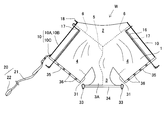
- FIG. 1 is an explanatory view of livestock clothing.
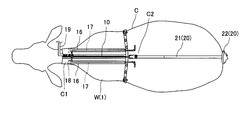
- 2 (a) is an explanatory view showing a state in which the livestock apparel shown in FIG. 1 is folded along the left and right center lines
- FIG. 2 (b) is an engaging portion and a thoracic side end provided at the rear edge of the chest covering portion. It is explanatory drawing of the locking ring with which the part was equipped.
- Fig.3 (a) is a side view which shows the state which attached the clothing for livestock to the dairy cow which is an example of a livestock
- FIG.3 (b) is the perspective view.
- FIG. 4 is a plan view showing a state in which livestock clothing is attached to a cow that is an example of livestock.
- FIG.5 (a) is explanatory drawing which shows the principal part of the fastener which is an example of a junction part, and a water absorption mechanism
- FIG.5 (b) is explanatory drawing of the cross-section of a body cloth, a waterproof member, and a water absorption pipe.
- FIG. 6 is an explanatory diagram of data showing experimental results.
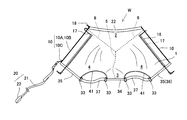
- FIG. 7 is an explanatory diagram of livestock clothing showing another embodiment.
- FIG. 8 is a perspective view showing a state in which the animal clothing of another embodiment is attached to a dairy cow that is an example of livestock.
- livestock apparel W for heat countermeasures includes a body cloth 1 formed in a sheet shape in an unfolded state, and the body cloth 1 as a part of a livestock body. And a joining portion 10 that joins the ends of the body cloth 1 at the back in a state of being wound around the portion.
- the body cloth 1 is composed of a stretchable cloth in two directions, and has a substantially triangular neck covering portion 2 that covers the neck of livestock, a first chest covering portion 3 that covers the front of the chest, and a substantially rectangular covering the side of the chest.
- a second chest covering 4 is provided.
- the first breast covering portion 3 and the second chest covering portion 4 are formed at the joint portion 5 so as to join together a substantially symmetrical monolithic body cloth along a line connecting the center of the breast and the center of the abdomen.
- a notch 31 is formed between the first chest cover 3 and the second chest cover 4 so as to swell in a convex shape corresponding to the chest.
- the elastic tape 34 with the carabiners 33 attached to the left and right ends is sewn to the edge 3A of the first chest covering 3 separated from the second chest covering 4 by the notch 31. That is, the carabiner 33 functions as a locking ring 33 provided at the thoracic end portion 32 of each notch 31.
- a plurality of annular engaging portions 36 made of synthetic leather are provided on the rear edge 35 of the second chest covering portion 4. It is the engaging part 36 for engaging with the carabiner 33, and each engaging part 36 is arranged so that the position is different in the vertical direction from the back part of the livestock to the abdomen with the livestock apparel W attached to the livestock. And is sewn to the rear edge 35 of the second chest covering portion 4.
- neck covering portion 2 described above is sewn at the front edge on the side opposite to the rear end edge 35 of the second chest covering portion 4 at the contact portion 6.
- the joint portion 10 described above is provided on the edge of the second chest covering portion 4 opposite to the joint portion 5. As shown in FIG. 5A, the joint 10 is arranged on a pair of left and right tapes 10A joined to the body cloth 1, elements 10B arranged along the edges of the tape 10A, and the left and right tapes 10A. It is composed of a fastener provided with a slider 10C that engages or opens the elements 10B.
- the first chest covering portion 4 is first placed from the neck 2 of the body cloth 1 to the cow. It is hung so as to cover the back part C2 of C, and after the base end side of the fastener, that is, the neck side of the cow C, is engaged with the lower side of the neck C1 of the cow C, the joint 10 is rotated so that it is positioned upward. . Thereafter, the slider 10C is pulled from the neck C1 toward the tail C3, thereby engaging the elements 10B to the other end of the fastener.
- the elastic belt 21 having one end attached to the handle of the slider 10C is pulled toward the tail portion C3, and the cow's tail C4 is inserted into the annular fitting insertion portion 22 provided at the other end of the elastic belt 21. 1 is fixed.
- a tensioning tool 20 that stretches the body cloth 1 toward the tail portion C3 is constituted by the elastic belt 21 and the fitting insertion portion 22.
- a rear leg can be selected as a part for fixing the body cloth 1 via the elastic belt 21.
- the elastic belt 21 may be attached to the body cloth 1 itself including an aspect in which one end of the elastic belt 21 is fixed to the back of the body cloth 1 by sewing or the like.
- first chest part is located between the left and right front legs and the torso so that the left and right front legs of the cow C are positioned in the notch 31 formed between the first breast cover part 3 and the second breast cover part 4.
- the edge portion 3A of the covering portion 3 is pulled in, the left and right end portions of the elastic tape 34 are pulled upward from the left and right body portions, respectively, and the carabiner 33 is engaged with any of the plurality of engaging portions 36 in a tensioned state.
- the body cloth 1 is attached so as to be in close contact with the body surface of the cow C with the body cloth 1 stretched to some extent in two directions. That is, the state in which the first chest covering portion 3 is in contact with the thoracic appendage, the second chest covering portion 4 is in contact with the chest from the left and right shoulders, and the neck covering portion 2 is in contact with the lower part of the neck of the cow C is maintained. It becomes like this.
- the body cloth 1 described above is configured by knitting non-cellulosic fibers and polyurethane elastic fibers so that sufficient stretchability in two directions can be ensured.
- the thermoplastic elastomer containing a polyester-type elastomer and the contact cooling sensation fiber containing an inorganic filler are used.
- thermoplastic elastomer which is a non-cellulosic fiber is not particularly limited, and a polyamide-based elastomer, a polyester-based elastomer, a urethane-based elastomer and the like can be suitably used, and may be used alone or in a mixed form.
- the thermoplastic elastomer preferably has a hydrophilic functional group in order to absorb water evaporated from the skin and dissipate it to the outside.
- the polyamide-based elastomer is not particularly limited, and for example, a polyether block amide copolymer, a polyether amide copolymer, a polyester amide copolymer, and the like can be used. These may be used independently and may use 2 or more types together.
- polyamide-based elastomers examples include, for example, Pebax (manufactured by Arkema), UBE nylon (manufactured by Ube Industries), Grilon ELX, Grillamide ELY (above, made by MMS Showa Denko), Diamide, Bestamido (above) , Manufactured by Daicel-Dexa).
- the polyester elastomer is not particularly limited, and for example, a polyether ester copolymer, a polyester ester copolymer, or the like can be used. These may be used alone or in combination of two or more.
- polyester-based elastomers that are commercially available, for example, Glais (Dainippon Ink Chemical Co., Ltd.), Nouvelan (Teijin Chemicals), Perprene (Toyobo), Hytrel (Toray DuPont) Product), Primalloy (manufactured by Mitsubishi Chemical Corporation), and the like.
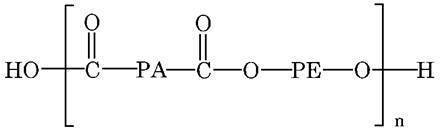
- the polyether block amide copolymer represented by the following formula (Chemical Formula 1) has an excellent contact cooling sensation, a hygroscopic property, and a low specific gravity. It is particularly suitable for fabrics, clothing and underwear.
- Examples of such polyether block amide copolymers that are commercially available include Pebax (manufactured by Arkema).
- PA represents polyamide
- PE represents polyether.
- the urethane elastomer is not particularly limited, and polyester polyurethane elastomer, polycaprolactone polyurethane elastomer, polycarbonate polyurethane elastomer, polyether urethane elastomer, and the like can be used.
- Non-cellulosic fibers can efficiently evaporate moisture without impregnating moisture like cotton yarn, and can effectively lower the body temperature of livestock.
- a fabric made of fibers obtained by spinning a thermoplastic elastomer containing a polyamide-based elastomer and / or a polyester-based elastomer as described above has excellent contact cooling feeling, and is made of contact cooling-sensitive fibers and has elasticity. When the dough comes into contact with the body surface of the dairy cow, heat is easily released from the body surface.
- the increase in body temperature can be effectively suppressed, so that the vicinity of the carotid artery is covered by the neck covering portion 2 to cover the thoracic appendage Since the vicinity of the heart is covered with the first chest covering portion 3, an increase in body temperature of the dairy cow is effectively suppressed.
- the whole body cloth 1 does not need to be composed of contact cooling sensation fibers, and at least the neck covering portion 2 and the first chest covering portion 3 may be composed of contact cooling sensation fibers. Although it is preferable that both are comprised with the contact cooling sensation fiber, only the 1st chest coating
- the amount of heat radiation of at least a portion covering the carotid artery and / or heart of the cow is 600 W / m 2 or more, more preferably 800 W / m 2 or more, it is suitably used as a body cloth for heat countermeasures be able to.
- the heat release amount is obtained from the integrated value of the amount of heat diffused by the sample for a fixed time, set so that the sample surface is in contact with the hot plate set at a constant temperature. Furthermore, if the measurement is performed with the sample wet with water, the amount of heat taken away by the heat of vaporization of water can be measured.
- a fabric is fixed to an embroidery frame with a diameter of 12 cm, and about 0.075 g of water is sprayed in the center of the fabric with a sprayer 5 times (total of about 0.375 g) in total, and then heated at 37 ° C. It is a value obtained from the integrated value of the amount of heat taken by the sample in 600 seconds by placing the dough surface in contact with the hot plate (assuming the surface temperature of the cow's skin).
- Thermolab II precision rapid thermophysical property measuring apparatus manufactured by Kato Tech Co., Ltd. can be used.
- the qmax value of the portion covering the carotid artery and / or heart of the dairy cow is 0.15 J / sec. / M 2 or more, more preferably 0.2 J / sec. / M 2 or more, it can be suitably used as a body cloth for measures against heat.
- the “qmax value” is a peak value of the heat flow rate in which a predetermined amount of heat is stored in a hot plate having a constant area and a constant mass, and the stored heat amount moves to the low temperature side sample immediately after it contacts the sample surface.
- the qmax value is considered to simulate the body temperature taken away by the sample when wearing clothes, and the larger the qmax value is, the higher the body temperature taken when wearing the clothes, and the higher the cool feeling of contact.
- qmax value is, for example, place the fabric on a sample stand set at a temperature of 20.5 ° C., contacting the heat storage plate warmed to a temperature of 32.5 ° C. over the dough pressure 0.098 N / cm 2
- the stored heat amount is a value obtained by measuring the peak value of the heat amount that moves to the low temperature side sample.
- Thermolab II precision rapid thermophysical property measuring apparatus manufactured by Kato Tech Co., Ltd.
- Non-cellulosic fibers are not limited to thermoplastic elastomers, for example, nylon 6 and nylon 12 as long as the amount of heat release and qmax value of the portion covering the carotid artery and / or heart of the cow are within the numerical ranges shown above.
- Polyamide fibers, polyester fibers, etc. can also be used, and can be knitted with cellulosic fibers as necessary.
- the above-described livestock apparel W has a belt-like shape extending from the neck portion C1 to the back portion C2 on the upper left and right sides of the body cloth 1 across the back of the cow C.
- the flexible water supply pipe 17 for humidifying the body surface of the dairy cow C through the body cloth 1 is disposed between the body cloth 1 and the waterproof member 16.
- the end of the water supply pipe 17 is closed by a plug member, the base end is connected to a connecting pipe 18, and a water supply hose 19 is connected to the connecting pipe 18.
- a waterproof member 16 a belt-like fabric whose inner surface is water-repellent is used, and the periphery of the belt-like fabric is sewn to the body fabric 1, and a water supply pipe 17 is inserted into the gap between the body fabric 1 and the belt-like fabric.
- the water supply pipe 17 is not closed with a stopper member and is piped so that it can be drained or circulated outside the barn via a hose or the like, water will remain in the pipe 17 and the temperature will rise to about the outside temperature. Therefore, the body temperature of the dairy cow C falls effectively.
- the water supply pipe 17 is formed with a plurality of minute openings 17h in the peripheral portion so that water supplied from the water supply hose 19 is ejected from the openings 17h.
- the water discharged through the water supply pipe 17 disposed between the body cloth 1 and the waterproof member 16 infiltrates the body cloth 1 without being blocked by the waterproof member 16 and traveling along the outer surface of the body cloth 1. And supplied to the body surface side of the dairy cow C.
- the body surface of the abdomen from the back side of the cow C is humidified, and the body temperature of the cow C is effectively lowered by the heat of vaporization when water is evaporated by the body temperature of the cow C.
- heat can be radiated by heat of vaporization more effectively by performing blowing with a fan or the like.
- the valve provided in the water supply hose 19 If a control device is provided that opens the valve and supplies a predetermined amount of water, and then closes the valve, the body temperature of the dairy cow can be lowered due to heat so that the reduction in milking amount can be avoided. Become.
- the water supply pipe 17 it is not essential to incorporate the water supply pipe 17 into the clothing, and it is a selective configuration.
- a stretch knitted fabric knitted with a horizontal knitting machine or a warp knitting machine can be used as the body fabric 1, and a horizontal knitted fabric knitted with a non-cellulosic fiber and polyurethane elastic fiber is preferably used.
- the organization is not limited to this.
- the knitted fabric may be formed using a covering yarn in which a polyurethane-based elastic fiber is used as a core yarn and is coated with non-cellulosic fibers.
- the clothing for livestock for heat countermeasures using contact cooling fibers as non-cellulosic fibers has been described, but the body fabrics using hollow fibers with good heat retention as a countermeasure against cold, rayon, It is also possible to use a body cloth using hygroscopic heat-generating fibers such as cupra, tencel, and lyocell. If these fabrics are used to protect the carotid artery and the heart, the decrease in body temperature can be effectively suppressed.
- dairy cows are exemplified as examples of livestock.
- livestock to which the present invention can be applied is not limited to dairy cows, and can be widely applied to other livestock such as beef cattle, horses, pigs, dogs, and cats. .
- the livestock apparel W for dairy cows described in FIG. 1 is covered by the first chest covering portion 3 between the front of the left and right front legs from the front of the chest, and between the first chest covering portion 3 and the second chest covering portion 4.
- the carabiner 33 is fixed to the engaging portion 36 so that the front leg is sandwiched between the formed cutout portions 31. If such a structure is employ
- the first chest covering portion 3 covering the breast appendage is cut so that the vertical length is short, and the rear edge 35 of the second chest covering portion 4 is vertically It is cut at a relatively upper portion so that the length thereof is shortened, and is cut so that the lower end of each of the left and right rear end edges 35 and the lower end of the first chest covering portion 3 are connected by an edge portion 41 having a smooth curve. .
- wide elastic tapes 34, 36, and 22 are provided on the lower end edge of the first breast covering portion 3, the rear end edge 35 of the second breast covering portion 4 and the front end edge of the neck covering portion 2, and various kinds of cows are provided.
- the body cloth 1 does not deviate greatly from the skin surface following the posture change, and is configured to follow the skin surface.
- a carabiner 33 as a locking ring is fixed to the ends of the elastic tapes 34 and 36, and an elastic belt 37 for connecting the pair of carabiners 33 to each other is provided.
- the elastic belt 37 is inserted between the front legs of the cows, and the lower end edge of the first breast covering portion 3 and the lower portion of the rear end edge 35 of the second chest covering portion 4 are connected.
- the body cloth 1 is attached so as to be in close contact with the body surface of the cow C with the stretch in two directions to some extent, the first breast covering portion 3 contacts the thoracic appendage, 2
- the state in which the chest covering portion 4 is in contact with the chest from the left and right shoulders and the neck covering portion 2 is in contact with the lower part of the neck of the cow C is maintained.
- the entire breast of the livestock is not covered, but a part of the chest is covered. Since the heart region is covered, the body temperature of the livestock can be adjusted to a favorable temperature state.
- the inventors of the present application conducted a verification experiment on how effective the above-described livestock apparel W is as a countermeasure against heat for dairy cows.
- a five-day wearing experiment was conducted by selecting the midsummer season.
- the cause of the decrease in milking amount of dairy cows is considered to be the point of being stressed by heat, and the degree of stress is indirectly measured by measuring the blood concentration of interleukin-6 (IL-6), a kind of cytokine. Evaluated.
- IL-6 interleukin-6
- FIG. 6 shows the experimental results, showing the measurement date, measurement time, temperature, humidity, rectal temperature, milking amount, and IL-6 concentration.
- Comparative Example 1 where no countermeasures against heat were taken, the IL-6 concentration increased from daytime to evening. In summer, the heat continues for a long time from the daytime when the temperature has risen to the evening when the temperature has fallen, and it is considered that the dairy cows were subjected to heat stress and the IL-6 concentration increased.
- Comparative Example 2 in which a neck cooler composed of a water-absorbing polymer was wound around the neck, IL-6 increased from daytime to evening in the same manner as Comparative Example 1 on the third and fifth days. On the first day, IL-6 decreased from daytime to evening. This was because the temperature of the evening on the first day was lower than 30 ° C, so it was relatively difficult to receive heat stress. It is thought that it was because of.
- IL-6 decreased from daytime to evening in any of the first day, the third day, and the fifth day. Compared to Comparative Examples 1 and 2, it is considered that there was an effect of relieving heat stress. Therefore, the result that the variation rate of the milking amount of the dairy cow of the Example was smaller than the variation rate of the milking amount of the dairy cows of Comparative Example 1 and Comparative Example 2 was obtained.
- the present invention can be suitably used as various clothing for livestock in order to suppress the rise in body temperature of livestock during hot weather and to suppress the decrease in body temperature of livestock during cold weather.
- Body fabric 2 Neck covering part 3: First chest covering part (chest covering part) 4: Second chest covering part 10: Fastener (joint part) 20: Tension tool 31: Notch 33: Locking ring 36: Engagement part W: Livestock clothing
Landscapes
- Life Sciences & Earth Sciences (AREA)
- Environmental Sciences (AREA)
- Zoology (AREA)
- Animal Husbandry (AREA)
- Biodiversity & Conservation Biology (AREA)
- Professional, Industrial, Or Sporting Protective Garments (AREA)
Abstract
家畜への着脱が容易で適切に体温を調整することができ、ストレスを低減可能な家畜用衣料を提供する。 展開状態でシート状に形成された身生地1と、身生地1を家畜の体の一部に巻き付けた状態で身生地の端部同士を接合する接合部10と、を備えている家畜用衣料であって、身生地が、縦横二方向への伸縮生地で構成されるとともに、少なくとも家畜の胸部の一部を被覆する胸部被覆部3を備えて構成され、身生地1が、非セルロース繊維とポリウレタン系弾性繊維との交編により構成されている。
Description
本発明は、家畜用衣料に関する。
近年、地球温暖化の問題が指摘されているように、我が国でも夏季の気温上昇が顕著になっている。人間のみならず家畜にとっても夏季の気温上昇のもたらす影響が様々な状況で顕在化している。
例えば、畜産業界では暑熱による影響を受けて乳牛からの搾乳量が低下するという問題があり、畜舎内の送風機構や日除け部材の設置等の他、断熱塗料や断熱部材を用いた畜舎の改装等、様々な試みがなされてきている。
例えば、多量の吸水が可能な高分子ポリマーで構成された環状帯を牛の首に巻き付けて、気化熱を利用して牛を冷却する冷感ベルトが提案されている。
特許文献1には、低コストでより確実かつ効率的に家畜のヒートストレス対策ができる冷却具を提供することを目的として、保冷剤を収納可能なポケットを2個以上有し、家畜の頸部の少なくとも一部を覆うように形成された保冷剤カバーと、この保冷剤カバーを家畜の頸部に巻き付けた際に、その保冷剤カバーの両端部を相互に繋ぐことが可能なベルト1本以上とを備えた冷却帯が開示されている。
また、畜舎内にミスト噴霧機構を設けてミスト噴霧により冷却することも考慮されているが、牛床が水で濡れると細菌の繁殖によって乳房炎等の細菌感染を引き起こす虞があった。
この様な問題は乳牛のみならず様々な家畜でも起こり得る問題であり、また暑熱の影響のみならず寒冷による影響も考慮する必要があった。
例えば、特許文献2には、胴回り全体を覆うことにより腹部を保温可能な四足動物の衣服が開示されている。
当該衣服は牛等の四足動物の衣服であり、展開状態で1枚のシート状であり、四足動物の胴回りに巻きつけて胴回り方向の両端部間に形成した連結手段により連結することにより胴回り全体を被覆することができ、該連結手段は一方の端部に形成される連結具と他方の端部に形成される連結具とからなり、該両連結具が相互に連結可能に形成されており該両連結具が一体に結合されることにより連結され、前記一方の端部の連結具と他方の端部の連結具の少なくともどちらかの連結具が胴回り方向に所定間隔をおいて複数設定されており、四足動物の胴回りの大きさに応じて複数の連結具のいずれかを選択して連結するように構成されている。
特許文献3には、子牛等の家畜に巻付け、安価かつ確実に保温することができる家畜用保温胴衣が開示されている。
当該家畜用保温胴衣は、家畜の胴部分を覆う胴保温部と、家畜の肩部分を覆う肩保温部と、家畜の腰部分を覆う腰保温部と、胴保温部に設けられ胴保温部を固定する胴固定手段と、肩保温部に設けられ略胸垂部分において肩保温部を固定する肩固定手段と、腰保温部に設けられ略後脚の上部において腰保温部を固定する腰固定手段とを備えて構成されている。
しかし、特許文献1に記載された冷却帯を用いる場合には、定期的に保冷剤を交換する必要があり、吸水ポリマーを用いた環状帯を用いる場合にも、乾燥した環状帯を吸水処理した環状帯に定期的に取り換える必要があり、何れの場合も煩雑な交換作業が必要になるという問題があった。
また、特許文献2,3に開示された家畜用の衣料は、何れも保温用の衣料であり暑熱対策として用いることが想定された衣料ではなかった。例えば、特許文献2に開示された衣料は、内側が有毛で外面が無毛となっており、無毛な外面が撥水性に優れ、体表面に接触する内面が保温性に優れた生地で構成されているため、暑熱時の家畜の発汗等の作用に対応可能な素材ではなかった。
また、当該衣料は牛のサイズに合わせて複数の固定具を備える必要があり、コストが嵩むとともに着脱に手間がかかるという問題もあった。
また、特許文献3に開示された衣料も同様に、胴保温部、肩保温部及び腰保温部は、ビニールやゴム等でコーティングされた防水繊維かズック(黄麻)生地、或いはセラミック繊維が表面に用いられ、内側にフェルト加工した布等の保温性のよい材料が用いられるので、暑熱時の家畜の発汗等の作用に対応可能な素材ではなかった。
さらに、当該衣料は牛の肩部や脚部等複数個所に備えた固定手段で固定する必要があり、着脱作業に手間がかかるという問題もあった。
本発明の目的は、上述の問題に鑑み、家畜への着脱が容易で適切に体温を調整することができ、ストレスを低減可能な家畜用衣料を提供する点にある。
上述の目的を達成するため、本発明による家畜用衣料の第一の特徴構成は、特許請求の範囲の書類の請求項1に記載した通り、展開状態でシート状に形成された身生地と、前記身生地を家畜の体の一部に巻き付けた状態で前記身生地の端部同士を接合する接合部と、を備えている家畜用衣料であって、前記身生地が伸縮生地で構成されるとともに、少なくとも家畜の胸部の一部を被覆する胸部被覆部を備えて構成されている点にある。
伸縮生地で構成される身生地で家畜を覆い、接合部で身生地の端部を接合することにより、多少サイズが異なる複数の家畜の何れであっても身生地を家畜の体表面に密接させることができ、家畜の姿勢が変化しても身生地の密接状態を維持することができる。その結果、身生地に備えた特性で家畜の体表面の状態を制御できるようになる。例えば熱伝達性の良い生地であれば家畜の体表面からの放熱を促進し、保温性の良い生地であれば家畜の体表面を保温できる。そして、身生地に備えた胸部被覆部により家畜の心臓部位が被覆されることにより、家畜の体温を良好な温度状態に調整可能になる。
同第二の特徴構成は、同請求項2に記載した通り、上述の第一の特徴構成に加えて、前記身生地が、家畜の首部を被覆する首部被覆部をさらに備えて構成されている点にある。
身生地に備えた首部被覆部により頸動脈が位置する首部が被覆されることにより、例えば熱伝達性の良い生地であれば頸動脈を通る血液が冷やされて家畜の体温を効果的に低下させることができ、保温性の良い生地であれば頸動脈を通る血液が保温されて家畜の体温を良好な温度状態に維持することができるようになる。
同第三の特徴構成は、同請求項3に記載した通り、上述の第一または第二の特徴構成に加えて、前記接合部は家畜の首部から背部に到る頂部で前記身生地を接合する留め具で構成され、前記身生地を尾部側に張設する張設具を備えている点にある。
家畜を被覆した身生地を、留め具を用いて家畜の首部から背部に到る頂部で接合すれば、伸縮生地が家畜の体表面に密接するような状態で極めて容易に装着でき、さらに張設具によって身生地が尾部側に張設されるので、家畜の姿勢が頻繁に変化する場合でも伸縮生地が首部から尾部側に引っ張られ、身生地の着用状態が崩れるようなことがない。
同第四の特徴構成は、同請求項4に記載した通り、上述の第三の特徴構成に加えて、前記留め具は家畜の首部から背部に向けてスライダーを移動させることによりエレメント同士が係合するファスナーで構成され、前記張設具は、一端が前記スライダーの引手または前記身生地の背部に固定され、他端に家畜の尾を嵌挿する嵌挿部を備えた弾性ベルトで構成されている点にある。
身生地の両端を接合する留め具としてファスナーが用いられ、首部から背部に向けてファスナーのスライダーを移動すれば、エレメント同士が係合する際に身生地が伸張されて体表面に身生地が密接するようになる。また、家畜の背中側で接合できるので、しゃがみ込むような窮屈な姿勢で身生地を接合するような煩雑な作業から開放される。さらに、スライダーの引手または前記身生地の背部に固定された弾性ベルトを伸張して嵌挿部を尾部に嵌挿することで、首部から背部の間で身生地が適切に伸張されるようになり、家畜の姿勢変化等によって装着状態が崩れるようなことがなくなる。
同第五の特徴構成は、同請求項5に記載した通り、上述の第一から第四の何れかの特徴構成に加えて、前記胸部被覆部のうち家畜の胸垂の左右両側に対応する部位に前脚を挟む切欠部が形成され、各切欠部の胸垂側端部に係止リングが設けられるとともに、前記胸部被覆部の後端縁に複数の係合部が設けられ、前記胸垂側端部が胸垂に接触するように、前記係止リングが前脚の内側から前記係合部の何れかに係止可能に構成されている点にある。
切欠き部で左右の脚部を挟むように、胸部被覆部の後端縁側を家畜の左右の前脚と胴部との間に挿し込んで上方に引き上げ、胸部被覆部の後端縁に設けられた複数の係合部の何れかに胸垂側端部の係止リングを係止することによって、胸部被覆部が家畜の胸部に密接するようになる。このような係止リングを係合部に係止する作業は比較的楽な姿勢で行える。
同第六の特徴構成は、同請求項6に記載した通り、上述の第一から第四の何れかの特徴構成に加えて、前記胸部被覆部のうち家畜の胸垂の左右両側に対応する部位及び前記胸部被覆部の左右後端縁下部にそれぞれ係止リングが設けられ、前記胸垂側端部が胸垂に接触するように、左右それぞれの係止リングを連結する弾性ベルトが前脚の内側を通って連結されている点にある。
胸部被覆部の左右両端部と胸部被覆部の左右後端縁下部を、前脚の内側を通るように弾性ベルトで連結することにより、胸部被覆部が家畜の胸部の一部である胸垂に密接するようになる。
同第七の特徴構成は、同請求項7に記載した通り、上述の第一から第六の何れかの特徴構成に加えて、前記身生地のうち家畜の背を挟んで左右両側上面に首部から背部に向けた帯状の防水部材が設けられ、前記身生地と前記防水部材との間に前記身生地を介して家畜の体表面を加湿する給水パイプが配置されている点にある。
身生地と防水部材との間に配置された給水パイプを介して放水された水は、防水部材に阻まれて身生地の外側表面を伝うことなく、従って畜舎の床に液滴することなく、身生地を浸潤して家畜の体表面側に供給され、家畜の背側から腹側の体表面が加湿されるようになる。そして家畜の体温によって水が蒸発するときの気化熱で家畜の体温を効果的に低下させることができるようになる。
同第八の特徴構成は、同請求項8に記載した通り、上述の第一から第七の何れかの特徴構成に加えて、前記身生地が、非セルロース系繊維とポリウレタン系弾性繊維との交編により構成されている点にある。
身生地が非セルロース系繊維とポリウレタン系弾性繊維との交編により構成されていると、二方向への十分な伸縮性を確保することができ、また非セルロース系繊維であれば綿糸のように水分が含浸することなく効率的に水分が蒸散されるようになり、家畜の体温を効果的に低下させることができるようになる。
同第九の特徴構成は、同請求項9に記載した通り、上述の第八の特徴構成に加えて、前記非セルロース系繊維が、ポリアミド系エラストマー及び/またはポリエステル系エラストマーを含む熱可塑性エラストマー、及び無機フィラーを含有する接触冷感繊維である点にある。
伸縮性を備えた接触冷感繊維で構成された生地が家畜の体表面に接触すると、体表面の熱を逃がし易くなる。ポリアミド系エラストマー及び/またはポリエステル系エラストマーを含む熱可塑性エラストマーを紡糸して得られる繊維で構成された生地は接触冷感に優れ、またそのような繊維に無機フィラーを含有させると、湿潤時の不快感を防止することができ、接触冷感生地として好適に用いることができる。
同第十の特徴構成は、同請求項10に記載した通り、上述の第一から第九の何れかの特徴構成に加えて、前記身生地のうち、少なくとも家畜の頸動脈及び/または心臓を覆う部分の放熱量が600W/m2以上である点にある。
家畜の頸動脈及び/または心臓を覆う部分の放熱量が600W/m2以上であれば、暑熱対策用の身生地として好適に用いることができる。
同第十一の特徴構成は、同請求項11に記載した通り、上述の第一から第九の何れかの特徴構成に加えて、前記身生地のうち、少なくとも家畜の頸動脈及び/または心臓を覆う部分のqmax値が0.15J/sec./m2以上である点にある。
家畜の頸動脈及び/または心臓を覆う部分のqmax値が0.15J/sec./m2以上であれば、暑熱対策用の身生地として好適に用いることができる。
以上説明した通り、本発明によれば、家畜への着脱が容易で適切に体温を調整することができ、ストレスを低減可能な家畜用衣料を提供することができるようになった。
以下、本発明を適用した乳牛用の家畜用衣料を図面に基づいて説明する。
図1及び図2(a),(b)に示すように、暑熱対策用の家畜用衣料Wは、展開状態でシート状に形成された身生地1と、身生地1を家畜の体の一部に巻き付けた状態で身生地1の端部同士を背部で接合する接合部10と、を備えている。
図1及び図2(a),(b)に示すように、暑熱対策用の家畜用衣料Wは、展開状態でシート状に形成された身生地1と、身生地1を家畜の体の一部に巻き付けた状態で身生地1の端部同士を背部で接合する接合部10と、を備えている。
身生地1は二方向への伸縮生地で構成され、家畜の首部を被覆する略三角形の首部被覆部2と、胸部正面を被覆する第1胸部被覆部3と、胸部側面を被覆する略矩形の第2胸部被覆部4を備えている。
第1胸部被覆部3と第2胸部被覆部4は、左右対称形状の略方形の一体の身生地を家畜の胸部中央から腹部中央を結ぶ線に沿って接ぎ合わせるように、接ぎ部5で家畜の胸部に対応して凸状に膨らむようにダーツ縫いにより縫着され、第1胸部被覆部3と第2胸部被覆部4との間に切欠部31が形成されている。
切欠部31により第2胸部被覆部4と分離された第1胸部被覆部3の端縁部3Aには、左右端部にカラビナ33が取り付けられた弾性テープ34が縫着されている。つまり、カラビナ33が、各切欠部31の胸垂側端部32に設けられた係止リング33として機能する。
第2胸部被覆部4の後端縁35に合成皮革を用いて構成された複数の環状の係合部36が設けられている。カラビナ33と係合するための係合部36であり、各係合部36は家畜用衣料Wを家畜に装着した状態で家畜の背部から腹部に上下方向に位置を異ならせて配置されるように第2胸部被覆部4の後端縁35に縫着されている。
また、第2胸部被覆部4の後端縁35とは反対側の前縁には上述した首部被覆部2が接ぎ部6で縫着されている。
第2胸部被覆部4のうち接ぎ部5とは反対側の端縁に上述した接合部10が設けられている。
図5(a)に示すように、接合部10は身生地1に接合された左右一対のテープ10Aとテープ10Aの縁部に沿って配列されたエレメント10Bと、左右のテープ10Aに配列されたエレメント10B同士を噛合させ、或いは開放するスライダー10Cを備えたファスナーで構成されている。
図5(a)に示すように、接合部10は身生地1に接合された左右一対のテープ10Aとテープ10Aの縁部に沿って配列されたエレメント10Bと、左右のテープ10Aに配列されたエレメント10B同士を噛合させ、或いは開放するスライダー10Cを備えたファスナーで構成されている。
図3(a),(b)及び図4に示すように、上述の家畜用衣料Wを乳牛Cに装着する際には、先ず身生地1の首部2から第1胸部被覆部4を、乳牛Cの背部C2に被覆するように掛けて、乳牛Cの首C1の下部側でファスナーの基端側つまり乳牛Cの首側を噛合させた後に接合部10が上方に位置するように回転移動させる。その後、スライダー10Cを首C1から尾部C3側に引っ張ることによりファスナーの他端側までエレメント10B同士を噛合させる。
さらに、スライダー10Cの引手に一端が取り付けられた弾性ベルト21を尾部C3に向けて引っ張り、弾性ベルト21の他端に備えた環状の嵌挿部22に乳牛のしっぽC4を挿入することにより身生地1を固定する。弾性ベルト21及び嵌挿部22によって身生地1を尾部C3側に張設する張設具20が構成されている。また、弾性ベルト21を介して身生地1を固定する部位として、しっぽC4以外に、後脚を選択することも可能である。
尚、弾性ベルト21の一端をスライダー10Cの引手に取り付ける態様以外に、弾性ベルト21の一端を身生地1の背部に縫着等により固定する態様を含めて身生地1そのものに取り付けてもよい。
さらに、第1胸部被覆部3と第2胸部被覆部4の間に形成された切欠部31に乳牛Cの左右の前脚が位置するように、左右の前脚と胴部との間に第1胸部被覆部3の端縁部3Aを引き込み、弾性テープ34の左右端部を左右の胴部からそれぞれ上方に引き上げて、張力がかかった状態でカラビナ33を複数の係合部36の何れかに係合する。
このようにして、身生地1が二方向へある程度伸張した状態で乳牛Cの体表面に密接するように装着される。つまり、第1胸部被覆部3が胸垂に接触し、第2胸部被覆部4が左右の肩から胸に接触し、首部被覆部2が乳牛Cの首の下部に接触した状態が維持されるようになる。
上述の身生地1は、二方向への十分な伸縮性が確保できるように、非セルロース系繊維とポリウレタン系弾性繊維とが交編されて構成され、非セルロース系繊維が、ポリアミド系エラストマー及び/またはポリエステル系エラストマーを含む熱可塑性エラストマー、及び無機フィラーを含有する接触冷感繊維が用いられている。
非セルロース系繊維である熱可塑性エラストマーとしては特に限定されるものではなく、ポリアミド系エラストマー、ポリエステル系エラストマー、ウレタン系エラストマー等を好適に用いることができ、単独または混合いずれの態様で用いてもよい。熱可塑性エラストマーは、肌から蒸散される水分を吸収して外部に放散するために、特に親水性の官能基を備えていることが好ましい。
ポリアミド系エラストマーは特に限定されず、例えば、ポリエーテルブロックアミド共重合体、ポリエーテルアミド共重合体、ポリエステルアミド共重合体等を用いることができる。これらは単独で用いられてもよく、2種以上を併用してもよい。
ポリアミド系エラストマーのうち市販されているものとして、例えば、ペバックス(アルケマ社製)、UBEナイロン(宇部興産社製)、グリロンELX、グリルアミドELY(以上、エムス昭和電工社製)、ダイアミド、ベスタミド(以上、ダイセル・デクサ社製)等が挙げられる。
ポリエステル系エラストマーは特に限定されず、例えば、ポリエーテルエステル共重合体、ポリエステルエステル共重合体等を用いることができる。これらは単独で用いてもよく、2種以上を併用してもよい。
これらのポリエステル系エラストマーのうち市販されているものとして、例えば、グリラックス(大日本インキ化学工業社製)、ヌーベラン(帝人化成社製)、ペルプレン(東洋紡績社製)、ハイトレル(東レ・デュポン社製)、プリマロイ(三菱化学社製)等が挙げられる。
これらの熱可塑性エラストマーのなかでも、下記(化1)式で表されるポリエーテルブロックアミド共重合体は、極めて優れた接触冷感が得られるとともに、吸湿性が得られ、比重も軽いため、生地、衣料、肌着に特に好適である。このようなポリエーテルブロックアミド共重合体のうち市販されているものとしては、例えば、ペバックス(アルケマ社製)等が挙げられる。(化1)式で、PAはポリアミドを表し、PEはポリエーテルを表す。
ウレタン系エラストマーは、特に限定されず、ポリエステル系のポリウレタンエラストマー、ポリカプロラクトン系のポリウレタンエラストマー、ポリカーボネート系ポリウレタンエラストマー、ポリエーテル系のウレタン系エラストマー等を用いることができる。
非セルロース系繊維であれば綿糸のように水分が含浸することなく効率的に水分が蒸散されるようになり、家畜の体温を効果的に低下させることができるようになる。
また、上述したようなポリアミド系エラストマー及び/またはポリエステル系エラストマーを含む熱可塑性エラストマーを紡糸して得られる繊維で構成された生地は接触冷感に優れ、接触冷感繊維で構成され伸縮性を備えた生地が乳牛の体表面に接触すると体表面から熱を逃がし易くなる。
またそのような繊維に無機フィラーを含有させると、湿潤時の不快感を防止することができるので、乳牛が暑熱により発生するストレスを軽減でき搾乳量の低下を抑制することができる。
特に、心臓及び心臓から血液が送られる太い頸動脈近傍が放熱されると、効果的に体温の上昇を抑制することができるため、首部被覆部2によって頸動脈近傍が被覆され、胸垂を被覆する第1胸部被覆部3によって心臓近傍が被覆されることにより乳牛の体温上昇が効果的に抑制されるようになる。
身生地1全体が接触冷感繊維で構成されている必要はなく、少なくとも首部被覆部2と第1胸部被覆部3が接触冷感繊維で構成されていればよい。双方が接触冷感繊維で構成されていることが好ましいが、第1胸部被覆部3のみが接触冷感繊維で構成されていてもよい。
身生地1のうち、少なくとも乳牛の頸動脈及び/または心臓を覆う部分の放熱量が600W/m2以上、より好ましくは800W/m2以上であると、暑熱対策用の身生地として好適に用いることができる。
放熱量とは、一定温度に設定された熱板に試料表面が接するようにセットして、一定時間の間に試料によって拡散された熱量の積算値から求められる。さらに試料を水で濡らした状態で測定を行なえば、水の気化熱によって奪われた熱量を測定することができる。
例えば、直径12cmの刺繍枠に生地を固定し、生地の中央に噴霧器で約0.075gの水を計5回(合計約0.375g)吹きかけて濡らした後、37℃に保たれた熱板(牛の外皮の表面温度を想定している)の上に生地表面が熱板に接するように設置して、600秒の間に試料によって奪われた熱量の積算値から求められる値である。測定には、例えばサーモラボII型精密迅速熱物性測定装置(カトーテック社製)を用いることができる。
また、乳牛の頸動脈及び/または心臓を覆う部分のqmax値が0.15J/sec./m2以上、より好ましくは0.2J/sec./m2以上であると、暑熱対策用の身生地として好適に用いることができる。
「qmax値」とは、一定面積、一定質量の熱板に所定の熱を蓄え、これが試料表面に接触した直後、蓄えられた熱量が低温側の試料に移動する熱流量のピーク値である。qmax値は、着衣したときに試料に奪われる体温をシミュレートしていると考えられ、qmax値が大きいほど着衣時に奪われる体温が大きく、接触冷感が高いと考えられる。
qmax値は、例えば、20.5℃の温度に設定した試料台の上に生地を置き、生地の上に32.5℃の温度に温められた貯熱板を接触圧0.098N/cm2で重ねた直後、蓄えられた熱量が低温側の試料に移動する熱量のピーク値を測定して得られる値である。測定には、例えばサーモラボII型精密迅速熱物性測定装置(カトーテック社製)を用いることができる。
乳牛の頸動脈及び/または心臓を覆う部分の放熱量及びqmax値は上記で示した数値範囲内であれば、非セルロース系繊維は熱可塑性エラストマーに限定されることなく、例えばナイロン6、ナイロン12等のポリアミド系繊維やポリエステル繊維等も用いることができ、必要に応じてセルロース系繊維と交編することもできる。
図4及び図5(a),(b)に示すように、上述の家畜用衣料Wには、身生地1のうち乳牛Cの背を挟んで左右両側上面に首部C1から背部C2に沿う帯状の防水部材16が設けられ、身生地1と防水部材16との間に身生地1を介して乳牛Cの体表面を加湿するための可撓性の給水パイプ17が配置されている。
給水パイプ17の終端は栓部材で閉止され、基端は連結管18に連結され、連結管18に給水ホース19が接続されている。防水部材16として内側面がはっ水処理された帯状生地が用いられ、身生地1に帯状生地の周囲が縫着されるとともに身生地1と帯状生地との間隙に給水パイプ17が挿入されている。
また、給水パイプ17の終端を栓部材で閉止せず、ホース等を介して牛舎外に排水或いは循環できるように配管しておくと、パイプ17に水が滞留して外気温程度に上昇することを防ぐことができるため、乳牛Cの体温が効果的に低下するようになる。
給水パイプ17には周部に微小な開口17hが複数形成され、給水ホース19から供給された水が開口17hから噴出するように構成されている。身生地1と防水部材16との間に配置された給水パイプ17を介して放水された水は、防水部材16に阻まれて身生地1の外側表面を伝うことなく、身生地1を浸潤して乳牛Cの体表面側に供給される。
従って牛舎の床に液滴することはない。乳牛Cの背側から腹側の体表面が加湿され、乳牛Cの体温によって水が蒸発するときの気化熱で乳牛Cの体温が効果的に低下するようになる。
身生地1と防水部材16との間に配置された給水パイプ17全体または一部を吸水性の高い生地(例えば綿の不織布)で被覆すると、開口17hから噴出した水が不織布に浸潤して徐々に身生地1に浸潤するようになる。その結果、使用中に身生地1が汚れて浸潤性能が低下しても、水滴が身生地1の表面を伝って床面に滴下するような事態が解消される。
さらに、ファン等による送風を併せて行なうことにより、より効果的に気化熱による放熱を行なうことができる。
例えば、給水パイプ17の設置位置近傍に身生地1の水分量を検知するセンサを設けて、当該センサによって身生地1が乾燥状態になったことが検知されると、給水ホース19に備えたバルブを開放して所定量の給水を行ない、その後バルブを閉じるような制御装置を備えると、暑熱による乳牛の体温を低下させることができるようになり、搾乳量の低減を回避することができるようになる。
尚、当該衣料に給水パイプ17を組み込むことは必須でなく、選択的な構成であることは言うまでもない。
身生地1として、例えば、ヨコ編機やタテ編機で編み上げた伸縮性編地を用いることができ、特に非セルロース系繊維とポリウレタン系弾性繊維を添え編で編成したヨコ編地を好適に用いることができるが、編組織はこれに限るものではない。例えば、ポリウレタン系弾性繊維を芯糸としてその周囲に非セルロース系繊維で被覆したカバリング糸を用いて編地を構成してもよい。
以上の実施形態では、非セルロース系繊維として接触冷感繊維を用いた暑熱対策用の家畜用の衣料を説明したが、寒冷対策用として保温性の良い中空繊維を用いた身生地や、レーヨン、キュプラ、テンセル、リヨセルなどの吸湿発熱繊維を用いた身生地等を用いることも可能である。これらの生地を用いて頸動脈や心臓を保護すれば、効果的に体温の低下を抑制することができる。
上述した実施形態では、家畜の例として乳牛を例示したが、本発明が適用可能な家畜は乳牛に限るものではなく、肉牛、馬、豚、犬、猫等のその他の家畜にも広く適用できる。
以下に別実施形態を説明する。
図1で説明した乳牛用の家畜用衣料Wは、第1胸部被覆部3によって胸部正面から左右の前脚の間が覆われ、第1胸部被覆部3と第2胸部被覆部4との間に形成された切欠部31で前脚を挟むようにしてカラビナ33を係合部36に固定するような構成である。このような構成を採用すると、乳牛が床に伏せることにより、第1胸部被覆部3は床面に接触してひどく汚れる虞がある。また、乳牛が床に伏せた姿勢から起立するような場合に、脚部が切欠部31に引っ掛かって身生地1の破断につながる虞もある。
図1で説明した乳牛用の家畜用衣料Wは、第1胸部被覆部3によって胸部正面から左右の前脚の間が覆われ、第1胸部被覆部3と第2胸部被覆部4との間に形成された切欠部31で前脚を挟むようにしてカラビナ33を係合部36に固定するような構成である。このような構成を採用すると、乳牛が床に伏せることにより、第1胸部被覆部3は床面に接触してひどく汚れる虞がある。また、乳牛が床に伏せた姿勢から起立するような場合に、脚部が切欠部31に引っ掛かって身生地1の破断につながる虞もある。
図7及び図8には、このような観点で態様を異ならせた家畜用衣料Wが示されている。以下、先に説明した家畜用衣料Wと異なる部位のみ説明する。図1に示す家畜用衣料Wと比較して、胸垂を覆う第1胸部被覆部3の上下長さが短くなるように裁断されるとともに、第2胸部被覆部4の後端縁35の上下長さが短くなるように比較的上部で裁断され、左右それぞれの後端縁35の下端と第1胸部被覆部3の下端とが滑らかな曲線となる縁部41で連なるように裁断されている。
さらに、第1胸部被覆部3の下端縁、第2胸部被覆部4の後端縁35及び首部被覆部2の前端縁には幅広の弾性テープ34,36,22が設けられ、乳牛の様々な姿勢変化に追従して身生地1が肌面から大きくずれるようなことがなく、肌面に沿うように構成されている。
弾性テープ34,36の端部には、係止リングとしてのカラビナ33が固定され、一対のカラビナ33同士を連結する弾性ベルト37が設けられている。乳牛の前脚の間に当該弾性ベルト37を挿通して、第1胸部被覆部3の下端縁と第2胸部被覆部4の後端縁35下部とが連結される。装着対象となる乳牛のサイズに応じて当該弾性ベルト37の長さを調整することにより、身生地1が乳牛の肌に密着するようになる。
このような家畜用衣料Wであれば、身生地1が二方向へある程度伸張した状態で乳牛Cの体表面に密接するように装着され、第1胸部被覆部3が胸垂に接触し、第2胸部被覆部4が左右の肩から胸に接触し、首部被覆部2が乳牛Cの首の下部に接触した状態が維持されるようになる。図1に示す家畜用衣料Wと異なり、家畜の胸部全体を被覆するのではなく、胸部の一部を被覆することになるが、何れの態様であっても、胸部被覆部により家畜の頸動脈及び心臓部位が被覆されるため、家畜の体温を良好な温度状態に調整可能になる。
本願発明者らは、上述した家畜用衣料Wが乳牛に対する暑熱対策としてどの程度有効であるのかの検証実験を行なった。
上述した接触冷感繊維とポリウレタン系弾性繊維とが添え編で編成されたヨコ編地で構成された図1に示す家畜用衣料Wを着用した乳牛(実施例)と、何も着用しない乳牛(比較例1)と、吸水性の高分子ポリマーを用いた市販の牛用ネッククーラ(日本全薬工業製「クールダー」)を首周りに着用させた乳牛(比較例2)の3頭に対して、盛夏時期を選んで5日間の着用実験を行なった。
上述した接触冷感繊維とポリウレタン系弾性繊維とが添え編で編成されたヨコ編地で構成された図1に示す家畜用衣料Wを着用した乳牛(実施例)と、何も着用しない乳牛(比較例1)と、吸水性の高分子ポリマーを用いた市販の牛用ネッククーラ(日本全薬工業製「クールダー」)を首周りに着用させた乳牛(比較例2)の3頭に対して、盛夏時期を選んで5日間の着用実験を行なった。
特開2009-126826号公報や、国際公開WO2006/003927号公報に示されているように、生物はストレスを受けると血液中のサイトカイン濃度が上昇することが知られている。
乳牛の搾乳量が低下する原因が暑熱によりストレスを受ける点にあると考えられ、そのストレスの程度をサイトカインの一種であるインターロイキン-6(IL-6)の血中濃度を測定することにより間接的に評価した。
朝方(8時45分)、昼間(13時00分)、夕方(16時45分)に乳牛の直腸温の測定と血液の採取を行ない、採取した血液から血中のインターロイキン-6の濃度を測定した。
図6には実験結果が示され、測定日、測定時間、気温、湿度、直腸温度、搾乳量、IL-6濃度が示されている。何も暑熱対策を行なっていない比較例1では、昼間から夕方にかけてIL-6の濃度が何れも上昇した。夏場は気温が上がりきった昼間から気温が下がりきる夕方以降までの長い時間に暑さが続くため、乳牛が暑熱ストレスを受け、IL-6濃度が上昇したものと考えられる。
吸水性の高分子ポリマーで構成されたネッククーラを首部に巻いた比較例2では、3日目と5日目は比較例1と同様に昼間から夕方にかけてIL-6が上昇している。尚、1日目は昼間から夕方にかけてIL-6が減少しているが、これは1日目の夕方の気温が30℃を下回っていたことから、比較的暑熱ストレスを受けにくい環境下であったためと考えられる。
実施例では、図6中に矢示したように、1日目、3日目、5日目の何れの場合でも昼間から夕方にかけてIL-6が減少していた。比較例1、比較例2と比べて暑熱ストレスが緩和される作用があったと考えられる。そのために、実施例の乳牛の搾乳量の変動率は、比較例1、比較例2の乳牛の搾乳量の変動率よりも小さくなっているという結果が得られた。
以上説明した実施形態は、何れも本発明の一例に過ぎず、当該記載により本発明が限定されるものではなく、身生地を構成する編地の種類、糸種、太さ、熱可塑性エラストマーの種類等の具体的な構成は、本発明の作用効果が奏される範囲で適宜変更設計可能であることはいうまでもない。
本発明は、暑熱時の家畜の体温上昇を抑制し、寒冷時の家畜の体温低下を抑制するため様々な家畜用の衣料として、好適に使用できる。
1:身生地
2:首部被覆部
3:第1胸部被覆部(胸部被覆部)
4:第2胸部被覆部
10:留め具(接合部)
20:張設具
31:切欠部
33:係止リング
36:係合部
W:家畜用衣料
2:首部被覆部
3:第1胸部被覆部(胸部被覆部)
4:第2胸部被覆部
10:留め具(接合部)
20:張設具
31:切欠部
33:係止リング
36:係合部
W:家畜用衣料
Claims (11)
- 展開状態でシート状に形成された身生地と、前記身生地を家畜の体の一部に巻き付けた状態で前記身生地の端部同士を接合する接合部と、を備えている家畜用衣料であって、
前記身生地が伸縮生地で構成されるとともに、少なくとも家畜の胸部の一部を被覆する胸部被覆部を備えて構成されている家畜用衣料。 - 前記身生地が、家畜の首部を被覆する首部被覆部をさらに備えて構成されている請求項1記載の家畜用衣料。
- 前記接合部は家畜の首部から背部に到る頂部で前記身生地を接合する留め具で構成され、前記身生地を尾部側に張設する張設具を備えている請求項1または2記載の家畜用衣料。
- 前記留め具は家畜の首部から背部に向けてスライダーを移動させることによりエレメント同士が係合するファスナーで構成され、
前記張設具は、一端が前記スライダーの引手または前記身生地の背部に固定され、他端に家畜の尾を嵌挿する嵌挿部を備えた弾性ベルトで構成されている請求項3記載の家畜用衣料。 - 前記胸部被覆部のうち家畜の胸垂の左右両側に対応する部位に前脚を挟む切欠部が形成され、各切欠部の胸垂側端部に係止リングが設けられるとともに、前記胸部被覆部の後端縁に複数の係合部が設けられ、
前記胸垂側端部が胸垂に接触するように、前記係止リングが前脚の内側から前記係合部の何れかに係止可能に構成されている請求項1から4の何れかに記載の家畜用衣料。 - 前記胸部被覆部のうち家畜の胸垂の左右両側に対応する部位及び前記胸部被覆部の左右後端縁下部にそれぞれ係止リングが設けられ、前記胸垂側端部が胸垂に接触するように、左右それぞれの係止リングを連結する弾性ベルトが前脚の内側を通って連結されている請求項1から4の何れかに記載の家畜用衣料。
- 前記身生地のうち家畜の背を挟んで左右両側上面に首部から背部に向けた帯状の防水部材が設けられ、前記身生地と前記防水部材との間に前記身生地を介して家畜の体表面を加湿する給水パイプが配置されている請求項1から6の何れかに記載の家畜用衣料。
- 前記身生地が、非セルロース系繊維とポリウレタン系弾性繊維との交編により構成されている請求項1から7の何れかに記載の家畜用衣料。
- 前記非セルロース系繊維が、ポリアミド系エラストマー及び/またはポリエステル系エラストマーを含む熱可塑性エラストマー、及び無機フィラーを含有する接触冷感繊維である請求項8記載の家畜用衣料。
- 前記身生地のうち、少なくとも家畜の頸動脈及び/または心臓を覆う部分の放熱量が600W/m2以上である請求項1から9の何れかに記載の家畜用衣料。
- 前記身生地のうち、少なくとも家畜の頸動脈及び/または心臓を覆う部分のqmax値が0.15J/sec./m2以上である請求項1から9の何れかに記載の家畜用衣料。
Applications Claiming Priority (2)
| Application Number | Priority Date | Filing Date | Title |
|---|---|---|---|
| JP2016002254 | 2016-01-08 | ||
| JP2016-002254 | 2016-01-08 |
Publications (1)
| Publication Number | Publication Date |
|---|---|
| WO2017119500A1 true WO2017119500A1 (ja) | 2017-07-13 |
Family
ID=59273870
Family Applications (1)
| Application Number | Title | Priority Date | Filing Date |
|---|---|---|---|
| PCT/JP2017/000322 Ceased WO2017119500A1 (ja) | 2016-01-08 | 2017-01-06 | 家畜用衣料 |
Country Status (2)
| Country | Link |
|---|---|
| JP (1) | JP2017123842A (ja) |
| WO (1) | WO2017119500A1 (ja) |
Cited By (1)
| Publication number | Priority date | Publication date | Assignee | Title |
|---|---|---|---|---|
| JP7129722B1 (ja) | 2021-06-14 | 2022-09-02 | 寿ニット株式会社 | 家畜用衣服 |
Families Citing this family (3)
| Publication number | Priority date | Publication date | Assignee | Title |
|---|---|---|---|---|
| JP6931265B1 (ja) * | 2020-05-11 | 2021-09-01 | 株式会社アールエスタイチ | 衣服用冷却システムおよびそれを備える冷却システム |
| WO2021229839A1 (ja) * | 2020-05-11 | 2021-11-18 | 株式会社アールエスタイチ | 衣服用冷却システムおよびそれを備える冷却システム |
| JP2022091082A (ja) * | 2020-12-08 | 2022-06-20 | 株式会社エージートレーディング | 子牛用頸部保温用ウォーマー |
Citations (5)
| Publication number | Priority date | Publication date | Assignee | Title |
|---|---|---|---|---|
| JPH03224421A (ja) * | 1990-01-26 | 1991-10-03 | Kanebo Ltd | 家蓄用衣料 |
| JP3001976U (ja) * | 1994-03-14 | 1994-09-06 | 株式会社ミック | 家畜用保温胴衣 |
| JP2004016190A (ja) * | 2001-01-29 | 2004-01-22 | Torres Pablo | フライプロテクター |
| JP2004073020A (ja) * | 2002-08-12 | 2004-03-11 | Tanaka:Kk | ペット用衣服 |
| JP2008029250A (ja) * | 2006-07-28 | 2008-02-14 | Chubu Shiryo Kk | 牛等の四足動物の衣服 |
Family Cites Families (10)
| Publication number | Priority date | Publication date | Assignee | Title |
|---|---|---|---|---|
| JPS4827792B1 (ja) * | 1968-06-01 | 1973-08-25 | ||
| JPH02283224A (ja) * | 1989-04-24 | 1990-11-20 | Sochi Shikenjo | 家畜の防護用衣服 |
| US5271211A (en) * | 1992-04-08 | 1993-12-21 | Marlene Newman | Modular, anti-chafing covering system for horses |
| NL1012809C2 (nl) * | 1999-08-11 | 2001-02-13 | Lely Res Holding | Werkwijze voor het afkoelen van dieren. |
| JP2002069805A (ja) * | 2000-08-31 | 2002-03-08 | Du Pont Toray Co Ltd | 立体構造編地 |
| JP2008163470A (ja) * | 2006-12-27 | 2008-07-17 | Toray Ind Inc | 光沢に優れた交編ストッキング |
| JP2013179903A (ja) * | 2012-03-02 | 2013-09-12 | Taniguchi Sangyo Kk | 家畜用冷却帯 |
| JP6162995B2 (ja) * | 2012-04-03 | 2017-07-12 | 旭化成株式会社 | 春夏用繊維製品 |
| JP6287014B2 (ja) * | 2013-10-02 | 2018-03-07 | 東洋紡株式会社 | 快適性布帛及びその製造方法 |
| JP2015144579A (ja) * | 2014-02-03 | 2015-08-13 | パイロットインキ株式会社 | ペット用衣類 |
-
2017
- 2017-01-06 WO PCT/JP2017/000322 patent/WO2017119500A1/ja not_active Ceased
- 2017-01-06 JP JP2017001330A patent/JP2017123842A/ja active Pending
Patent Citations (5)
| Publication number | Priority date | Publication date | Assignee | Title |
|---|---|---|---|---|
| JPH03224421A (ja) * | 1990-01-26 | 1991-10-03 | Kanebo Ltd | 家蓄用衣料 |
| JP3001976U (ja) * | 1994-03-14 | 1994-09-06 | 株式会社ミック | 家畜用保温胴衣 |
| JP2004016190A (ja) * | 2001-01-29 | 2004-01-22 | Torres Pablo | フライプロテクター |
| JP2004073020A (ja) * | 2002-08-12 | 2004-03-11 | Tanaka:Kk | ペット用衣服 |
| JP2008029250A (ja) * | 2006-07-28 | 2008-02-14 | Chubu Shiryo Kk | 牛等の四足動物の衣服 |
Cited By (2)
| Publication number | Priority date | Publication date | Assignee | Title |
|---|---|---|---|---|
| JP7129722B1 (ja) | 2021-06-14 | 2022-09-02 | 寿ニット株式会社 | 家畜用衣服 |
| JP2022190319A (ja) * | 2021-06-14 | 2022-12-26 | 寿ニット株式会社 | 家畜用衣服 |
Also Published As
| Publication number | Publication date |
|---|---|
| JP2017123842A (ja) | 2017-07-20 |
Similar Documents
| Publication | Publication Date | Title |
|---|---|---|
| US20080040839A1 (en) | Flexible cooling garment | |
| US7793619B2 (en) | Animal garment article and method | |
| WO2017119500A1 (ja) | 家畜用衣料 | |
| US4671049A (en) | Protective blanket for hoofed and domestic animals, in particular horses and dogs | |
| US20040031448A1 (en) | Post-surgical care bandage cover for pets | |
| US8113152B1 (en) | Canine wound boot | |
| US20100050958A1 (en) | Animal cooling vest | |
| JP2006525020A (ja) | 愛玩動物用おむつ服 | |
| WO2020100702A1 (ja) | 冷感体 | |
| US9462785B2 (en) | Multi-panel animal blanket | |
| US7044087B1 (en) | Unisex protective garment for dogs | |
| US20200154671A1 (en) | Pet costume | |
| US8938816B2 (en) | Female pants | |
| US20180027768A1 (en) | Animal cooling garment | |
| CA2866464A1 (en) | Equine ear warmers | |
| JP2019180296A (ja) | ペット用暖房ウェア | |
| US20180139929A1 (en) | Body Temperature Modulating Garment | |
| US6520120B1 (en) | Small animal drying bag | |
| JP2006211933A (ja) | 獣類用保温ジャケット | |
| KR20110137002A (ko) | 가축용 방한복 | |
| US20190254255A1 (en) | Method and Device for Cooling or Warming Cattle | |
| JP2019216615A (ja) | 四足動物用の保温衣料 | |
| JP2006180772A (ja) | ペット用衣服 | |
| WO2017119496A1 (ja) | 湿潤状態検知装置及び給水管理システム | |
| JP2022188632A (ja) | ペット用コート |
Legal Events
| Date | Code | Title | Description |
|---|---|---|---|
| 121 | Ep: the epo has been informed by wipo that ep was designated in this application |
Ref document number: 17736037 Country of ref document: EP Kind code of ref document: A1 |
|
| NENP | Non-entry into the national phase |
Ref country code: DE |
|
| 122 | Ep: pct application non-entry in european phase |
Ref document number: 17736037 Country of ref document: EP Kind code of ref document: A1 |