WO2017110747A1 - 吸収性物品 - Google Patents
吸収性物品 Download PDFInfo
- Publication number
- WO2017110747A1 WO2017110747A1 PCT/JP2016/087812 JP2016087812W WO2017110747A1 WO 2017110747 A1 WO2017110747 A1 WO 2017110747A1 JP 2016087812 W JP2016087812 W JP 2016087812W WO 2017110747 A1 WO2017110747 A1 WO 2017110747A1
- Authority
- WO
- WIPO (PCT)
- Prior art keywords
- region
- basis weight
- skin
- facing surface
- width direction
- Prior art date
- Legal status (The legal status is an assumption and is not a legal conclusion. Google has not performed a legal analysis and makes no representation as to the accuracy of the status listed.)
- Ceased
Links
Images


Classifications
-
- A—HUMAN NECESSITIES
- A61—MEDICAL OR VETERINARY SCIENCE; HYGIENE
- A61F—FILTERS IMPLANTABLE INTO BLOOD VESSELS; PROSTHESES; DEVICES PROVIDING PATENCY TO, OR PREVENTING COLLAPSING OF, TUBULAR STRUCTURES OF THE BODY, e.g. STENTS; ORTHOPAEDIC, NURSING OR CONTRACEPTIVE DEVICES; FOMENTATION; TREATMENT OR PROTECTION OF EYES OR EARS; BANDAGES, DRESSINGS OR ABSORBENT PADS; FIRST-AID KITS
- A61F13/00—Bandages or dressings; Absorbent pads
- A61F13/15—Absorbent pads, e.g. sanitary towels, swabs or tampons for external or internal application to the body; Supporting or fastening means therefor; Tampon applicators
- A61F13/51—Absorbent pads, e.g. sanitary towels, swabs or tampons for external or internal application to the body; Supporting or fastening means therefor; Tampon applicators characterised by the outer layers of the pads
- A61F13/511—Topsheet, i.e. the permeable cover or layer facing the skin
-
- A—HUMAN NECESSITIES
- A61—MEDICAL OR VETERINARY SCIENCE; HYGIENE
- A61F—FILTERS IMPLANTABLE INTO BLOOD VESSELS; PROSTHESES; DEVICES PROVIDING PATENCY TO, OR PREVENTING COLLAPSING OF, TUBULAR STRUCTURES OF THE BODY, e.g. STENTS; ORTHOPAEDIC, NURSING OR CONTRACEPTIVE DEVICES; FOMENTATION; TREATMENT OR PROTECTION OF EYES OR EARS; BANDAGES, DRESSINGS OR ABSORBENT PADS; FIRST-AID KITS
- A61F13/00—Bandages or dressings; Absorbent pads
- A61F13/15—Absorbent pads, e.g. sanitary towels, swabs or tampons for external or internal application to the body; Supporting or fastening means therefor; Tampon applicators
- A61F13/53—Absorbent pads, e.g. sanitary towels, swabs or tampons for external or internal application to the body; Supporting or fastening means therefor; Tampon applicators characterised by the absorbing medium
- A61F13/534—Absorbent pads, e.g. sanitary towels, swabs or tampons for external or internal application to the body; Supporting or fastening means therefor; Tampon applicators characterised by the absorbing medium having an inhomogeneous composition through the thickness of the pad
-
- A—HUMAN NECESSITIES
- A61—MEDICAL OR VETERINARY SCIENCE; HYGIENE
- A61F—FILTERS IMPLANTABLE INTO BLOOD VESSELS; PROSTHESES; DEVICES PROVIDING PATENCY TO, OR PREVENTING COLLAPSING OF, TUBULAR STRUCTURES OF THE BODY, e.g. STENTS; ORTHOPAEDIC, NURSING OR CONTRACEPTIVE DEVICES; FOMENTATION; TREATMENT OR PROTECTION OF EYES OR EARS; BANDAGES, DRESSINGS OR ABSORBENT PADS; FIRST-AID KITS
- A61F13/00—Bandages or dressings; Absorbent pads
- A61F13/15—Absorbent pads, e.g. sanitary towels, swabs or tampons for external or internal application to the body; Supporting or fastening means therefor; Tampon applicators
- A61F13/53—Absorbent pads, e.g. sanitary towels, swabs or tampons for external or internal application to the body; Supporting or fastening means therefor; Tampon applicators characterised by the absorbing medium
- A61F13/534—Absorbent pads, e.g. sanitary towels, swabs or tampons for external or internal application to the body; Supporting or fastening means therefor; Tampon applicators characterised by the absorbing medium having an inhomogeneous composition through the thickness of the pad
- A61F13/535—Absorbent pads, e.g. sanitary towels, swabs or tampons for external or internal application to the body; Supporting or fastening means therefor; Tampon applicators characterised by the absorbing medium having an inhomogeneous composition through the thickness of the pad inhomogeneous in the plane of the pad, e.g. core absorbent layers being of different sizes
Definitions
- the present invention relates to an absorbent article having an absorbent body folded by a fold extending in the front-rear direction.
- a disposable diaper having an absorbent body folded by a fold extending in the front-rear direction is provided (see, for example, Patent Document 1).
- the absorber of patent document 1 is a sheet-like absorber containing absorption materials, such as SAP.
- the outer edge of the absorbent body is folded back in the width direction along the first folding line extending in the front-rear direction, and the folded area is folded back in the width direction along the second folding line.
- the absorber of Patent Document 1 has three layers overlapping between the first fold line and the second fold line.
- the region where the absorbers are stacked in three layers is relatively thick, and the body fluid may not reach the layer located on the non-skin facing surface side quickly.
- the absorbent material is similarly disposed in all three layers, the body fluid discharged to the skin facing surface side remains in the layer located on the skin facing surface side or the layer located in the center in the thickness direction, and the body fluid is non-skin It may be difficult to reach the layer located on the opposite surface side. Since it becomes difficult for body fluid to reach the layer located on the non-skin facing surface side, the absorption performance of the absorbent body may not be effectively utilized.
- the present invention has been made in view of the above-described problems, and an object thereof is to effectively utilize the absorption performance of an absorbent body in an absorbent article having an absorbent body folded by a fold extending in the front-rear direction.
- An absorbent article (disposable diaper 10) according to the present disclosure includes a pair of longitudinal directions (front-rear direction L), a width direction (width direction W) orthogonal to the front-rear direction, and an absorbent material, and extending in the front-rear direction.
- An absorbent body (absorbent body 40) having a first fold line (first fold line FL1) and a pair of second fold lines (second fold line FL2), and a skin surface sheet (top sheet) disposed on the skin-facing surface side of the absorbent body 50), wherein the absorber is positioned between the pair of first folds and includes a first region (first region 401) including a center in the width direction of the absorber.
- a pair of third regions (third regions 403) respectively disposed on the skin facing surface side of the second region, and the pair of second folds are separated in the width direction
- the basis weight of the absorbent material in the second region is lower than the basis weight of the absorbent material in the first region and lower than the basis weight of the absorbent material in the third region.
- the absorbent performance of the absorbent body can be effectively utilized.
- FIG. 2 is a cross-sectional view of the disposable diaper along the line AA shown in FIG. 1. It is an expansion
- FIG. 4 is a cross-sectional view of the absorber along the line BB in FIG. 3. It is sectional drawing which showed typically the cross section along the width direction of a top sheet and an absorber. It is sectional drawing of the absorbent article which concerns on the modification 1. It is a top view of the absorber of the absorptive article concerning modification 2. It is a top view of the absorptive article concerning modification 3.
- An absorber including an absorbent material and having a pair of first folds and a pair of second folds extending in the front-rear direction;
- a skin surface sheet disposed on the skin facing surface side of the absorbent body, and an absorbent article comprising:
- the absorber is A first region located between the pair of first folds and including a center in the width direction of the absorber;
- a pair of second regions located between the second fold and the first fold located on the inner side in the width direction than the first fold, and disposed on the skin facing surface side of the first region,
- a pair of third regions that are located on the outer side in the width direction than the second fold and are respectively disposed on the skin facing surface side of the second region,
- the pair of second folds are separated in the width direction,
- the absorbent article having a basis weight of the absorbent material in the second region is lower than a basis weight of the absorbent material in the first region and lower than a basis weight of the absorbent material in the third region.
- the thickness of the absorbent body is relatively thin and is recessed on the non-skin surface side as compared with the region on the outer side in the width direction than the pair of second fold lines. Since the center in the width direction of the absorbent body is recessed toward the non-skin surface side, a space extending in the front-rear direction can be formed between the wearer and the absorbent body. The body fluid can be diffused in the front-rear direction by the space, and it becomes easy to effectively utilize the absorption performance over the entire front-rear direction of the absorber.
- the skin sheet may be disposed across the skin facing surface side of the first region located between the pair of second folds and the skin facing surface side of the third region.
- the overlapping portion is located on the inner side in the width direction when a force toward the inner side in the width direction is applied to the overlapping portion. Therefore, the deformation of the absorber can be effectively suppressed.
- the skin sheet is between the first region and the second region, and between the second region and the third region. It does not need to be arranged between.
- the skin sheet in the overlapping portion, is not disposed between the first region and the second region, and between the second region and the third region, and the absorbers overlap each other.
- the weight of the skin is relatively high between the absorbent bodies having a relatively high weight.
- a low skin surface sheet is disposed, and it may be difficult to draw body fluid from the skin facing surface side to the non-skin facing surface side.
- the absorbent bodies overlap with each other in the overlapping portion, the basis weight becomes relatively high and the dense structure is maintained, so that the body fluid on the skin facing surface side can be drawn in smoothly.
- Such an absorbent article In the overlapping portion in which the first region, the second region, and the third region are stacked, it is preferable that the skin facing surface of the second region and the non-skin facing surface of the third region are not joined. .
- the thickness of the overlapping portion is likely to be thicker than the configuration in which the second region and the third region are joined. Therefore, the dent between the pair of second folds can be formed deeply.
- the force which goes to the width direction inner side is applied to the 3rd area
- the skin facing surface of the first region and the non-skin facing surface of the second region are joined to each other in the overlapping portion where the first region, the second region, and the third region are stacked.
- Having a joint to The said junction part may be arrange
- the second region rises, thereby widening the space recessed toward the non-skin surface side in the center in the width direction of the absorbent body.
- the excrement can be absorbed by diffusing the excrement throughout the absorber. Therefore, leakage of excrement can be suppressed.
- the third region extends outward in the width direction from the first fold.
- the non-skin facing surface of the first region and the non-skin facing surface of the third region are joined to a non-skin surface sheet, It is desirable that the non-skin facing surface of the first region and the non-skin facing surface of the third region are separated in the width direction.
- the space surrounded by the non-skin facing surface of the first region, the non-skin facing surface of the third region, and the non-skin facing sheet is between the first region and the third region. It is formed.
- the space can hold body fluid that could not be absorbed by the absorber. Further, body fluid can be diffused in the front-rear direction by the space, and the entire body of the absorber can be effectively utilized to efficiently absorb the body fluid.
- the absorber has pulp as an absorbent material,
- the basis weight of the pulp in the first region and the basis weight of the pulp in the third region are preferably higher than the basis weight of the pulp in the second region.
- the fabric weight of the pulp of the second region is lower than that of the first region and the third region, it is possible to suppress the thickness of the overlapping portion from becoming too thick, and the non-skin facing surface side It becomes easy to guide the body fluid to the first region located at the position.
- the basis weight of the pulp in the first region is higher than the basis weight of the pulp in the second region, the body fluid easily moves from the second region to the first region, and the body fluid is located in the first region located on the non-skin facing surface side. It becomes easy to guide.
- the absorber has pulp and absorbent polymer as an absorbent material,
- the basis weight of the absorbent polymer in the second region is preferably higher than the basis weight of the pulp in the second region.
- the absorbent article it is possible to efficiently improve the absorption performance of the overlapping portion.
- the ratio of the absorbent polymer hereinafter referred to as SAP
- the basis weight of the pulp is increased together with the SAP, the rigidity of the overlapped portion is increased as a whole, and a feeling of strangeness at the time of mounting is likely to occur.
- the SAP ratio can be increased without inducing deformation of the absorber, and the absorption performance of the overlapping portion can be increased efficiently.
- the skin sheet has a low basis weight part and a high basis weight part having a higher basis weight than the low basis weight part, It is desirable that the low basis weight portion and the high basis weight portion respectively extend along the front-rear direction and are alternately arranged in the width direction.
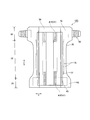
- FIG. 1 is a developed plan view of a disposable diaper 10 according to the present embodiment.
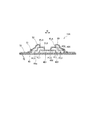
- FIG. 2 is a cross-sectional view of the disposable diaper 10 taken along the line AA shown in FIG.
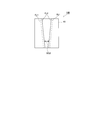
- FIG. 3 is a developed plan view of the absorber.
- FIG. 4 is a cross-sectional view of the absorber taken along line BB in FIG.
- the development plan view shown in FIG. 1 extends the leg stretchable part 75 and the elastic member 77 of the leak-proof cuff until no wrinkles are formed on the top sheet 50 and the side sheet 70 as skin sheets constituting the disposable diaper.
- FIG. 1 The development plan view shown in FIG. 1 extends the leg stretchable part 75 and the elastic member 77 of the leak-proof cuff until no wrinkles are formed on the top sheet 50 and the side sheet 70 as skin sheets constituting the disposable diaper.
- the disposable diaper 10 has a front waistline region 20, a crotch region 25, and a back waistline region 30.
- the front waistline region 20 is a portion in contact with the wearer's front waistline portion (abdomen portion).
- the back waistline area 30 is a part which contacts a wearer's back waistline part (back part).
- the crotch region 25 is a region that is located between the front waistline region 20 and the rear waistline region 30 and is provided with a leg opening 35.
- the leg opening 35 is provided at the outer edge of the disposable diaper, and is a portion that is disposed around the leg of the wearer while the disposable diaper is worn by the wearer.
- the outer edge is an outer end in the width direction
- the inner edge is an inner end in the width direction.
- the disposable diaper 10 includes at least an absorbent body 40, a skin sheet disposed on the skin facing surface side T1 of the absorbent body 40, and a non-skin surface sheet disposed on the non-skin facing surface side T2 of the absorbent body 40. Prepare.
- the absorber 40 is disposed at least in the crotch region 25. As shown in FIG. 4, the absorber 40 has the absorption core 40a and the core wrap 40b.
- the absorbent core 40a can be made of the same material as a conventional disposable diaper, and can be appropriately formed using a known member or material such as pulverized pulp or high-absorption polymer (SAP).
- the core wrap 40b is a sheet that covers the absorbent core 40a.
- the core wrap 40b is composed of various fiber nonwoven fabrics or tissues having liquid permeability.
- the absorber 40 will be described in detail later.
- the skin sheet has a top sheet 50 and a side sheet 70.
- the top sheet 50 is formed of a liquid permeable sheet such as a nonwoven fabric or a woven fabric.
- the top sheet 50 is a sheet that comes into contact with the skin of the wearer. The top sheet will be described in detail later.
- the side sheet 70 covers the outer edge of the top sheet 50 and extends outward in the width direction from the top sheet 50.
- the inner edge of the side sheet 70 is folded outward in the width direction, and an elastic member 77 that expands and contracts in the front-rear direction is disposed between the two side sheets 70.
- the side seat 70 and the elastic member 77 constitute a leakage cuff.
- the non-skin surface sheet has at least a back sheet 60 a and an exterior sheet 60.
- the back sheet 60a has liquid impermeability and is disposed on the non-skin facing surface side of the absorbent core 40a and the core wrap 40b.
- the exterior sheet 60 is disposed on the non-skin facing surface side of the back sheet 60a.
- the side sheet 70 is provided with a fastening tape 90.
- the fastening tape 90 extends along the width direction W in the rear waistline region 30 and is fastened to the target portion 95 of the front waistline region 20 to hold the disposable diaper 10 on the wearer's body.
- the target portion 95 is configured such that the pair of fastening tapes 90 are fixed to each other.
- On the outer side in the width direction of the absorber 40 there is provided a leg expansion / contraction portion 75 that is formed around the leg opening 35 and that can expand and contract in the front-rear direction L.
- the absorber 40 is in the form of a single sheet in the unfolded state.
- the absorber 40 has a pair of first folds FL1 extending in the front-rear direction and a pair of second folds FL2 extending in the front-rear direction.
- the absorber 40 is folded at four locations by a pair of first folds FL1 and a pair of second folds FL2, and is laminated in a plurality of layers.
- the pair of first fold lines, the pair of second fold lines, and the first fold line FL1 and the second fold line FL2 are spaced apart from each other in the width direction.
- the absorber 40 has a first region 401, a pair of second regions 402, and a pair of third regions 403.
- the first region 401, the pair of second regions 402, and the pair of third regions 403 are hatched differently.
- the first region 401 is located in the center of the absorbent body 40 in the width direction W and is a region between the pair of first folds FL ⁇ b> 1.
- the second region 402 is located on both sides of the first region 401 in the unfolded state, and is a region between the first fold line FL1 and the second fold line FL2.
- the third region 403 is located on both sides of the second region 402 in the unfolded state, and is a region between the second fold line FL2 and the outer side in the width direction.
- the first region 401, the second region 402, and the third region 403 are continuous in the width direction W.
- the first region 401, the second region 402, and the third region 403 are covered with a single continuous core wrap 40b.
- the absorber 40 is valley-folded by the first fold FL1 and mountain-folded by the second fold FL2. As shown in FIGS. 1 and 2, in a folded state where the absorber 40 is folded, the second region 402 is disposed on the skin facing surface side of the first region 401, and the second region 402 is disposed on the skin facing surface side of the second region 402. Three areas 403 are arranged.
- the third region is a concept including at least part of the second region as long as it is disposed on the skin facing surface side of the second region and having a portion not disposed on the second skin facing surface side. Since the absorbent body is folded by the first fold line FL1 and the second fold line FL2, the dimension in the width direction becomes compact.
- the pair of second folds FL2 are separated in the width direction W.
- the outer edge of the third region 403 extends outward in the width direction W from the first fold FL1. Only the third region 403 is arranged on the outer side in the width direction than the first fold line FL1.
- the outer edge 40E of the folded absorbent body 40 is arranged around the wearer's leg. Only the third region 403 is disposed on the outer edge 40E of the folded absorbent body 40 and is relatively thin. Therefore, the uncomfortable feeling around the wearer's leg can be reduced.
- an overlapping portion 45 in which the first area 401, the second area 402, and the third area 403 are arranged is formed.
- the overlapping portion 45 is a portion where the first region 401, the second region 402, and the third region 403 are stacked, and is a portion between the first fold line FL1 and the second fold line FL2. Only the first region 401 is disposed between the pair of second folds FL2.
- the thickness of the absorber 40 is relatively thin and is recessed on the non-skin facing surface side as compared with the outer region in the width direction than the pair of second folds FL2.
- the non-skin facing surface of the first region 401 and the non-skin facing surface of the third region 403 are joined to a back sheet 60a that is a non-skin surface sheet. As shown in FIG. 2, the non-skin facing surface of the first region 401 and the non-skin facing surface of the third region 403 may be separated in the width direction W. A space S1 surrounded by the non-skin facing surface of the first region 401, the non-skin facing surface of the third region 403, and the backsheet 60a is formed between the first region 401 and the third region 403.
- region 403 are continuously joined along the front-back direction.
- a space surrounded by the non-skin facing surface of the first region, the non-skin facing surface of the third region, and the non-skin facing sheet is formed between the first region and the third region.
- the space can hold body fluid that could not be absorbed by the absorber. Further, body fluid can be diffused in the front-rear direction by the space, and the entire body of the absorber can be effectively utilized to efficiently absorb the body fluid.
- the basis weight of the overlapping portion 45 is higher than the area where only the first area 401 is arranged (the center in the width direction of the absorber).
- the body fluid can be quickly drawn in while diffusing the body fluid in the overlapping portion 45 having a high basis weight of the absorbent material.
- the absorption rate can be increased as compared with an absorbent body having a uniform basis weight of the absorbent material.
- the center in the width direction of the absorbent body 40 is recessed toward the non-skin facing surface side, and a space S2 extending in the front-rear direction is formed between the wearer and the absorbent body 40.
- the body fluid can be diffused in the front-rear direction by the space S2.
- the overlapping unit 45 is in contact with the space S2, and can quickly absorb both the body fluid diffused by the space S2 and the body fluid guided from the skin facing surface side (exhausted from the excretion opening).
- a wall extending from the second fold line FL2 to the skin facing surface side is formed on the outer side in the width direction of the space S2.
- the wall is formed by the inner edge of the second region 402 and the inner edge of the third region 403.
- the bodily fluid discharged between the pair of second folds FL2 is absorbed by the walls of the second region 402 and the third region 403, and hardly flows to the outside in the width direction. Therefore, the lateral leakage of body fluid can be suppressed.
- a stool can be accommodated by space S2, and a stool leak can be suppressed.
- the air can easily flow along the front-rear direction by the space S2, and moisture between the wearer and the disposable diaper can be discharged to suppress the stuffiness.
- the center of the width direction of the absorber 40 is dented in the non-skin opposing surface side, it can suppress that the absorber 40 which absorbed bodily fluid always adheres to skin, can prevent skin irritation, and improves a feeling of wearing. it can. Moreover, since the center of the absorbent body 40 in the width direction is not in close contact with the body, re-wetting of the body fluid can be prevented.
- the absorbent body 40 is sandwiched between the legs of the wearer when worn and is applied with a force toward the inner side in the width direction.
- a force toward the inner side in the width direction is applied to the overlapping portion 45.
- the movement of the overlapping portion 45 can be absorbed by the space S ⁇ b> 2 between the left and right overlapping portions 45.
- a force toward the inner side in the width direction is applied to the absorber 40
- a force toward the inner side in the width direction is applied between the outer edge 40E of the absorber 40 and the second fold line FL2
- the second fold line FL2 A force (force toward the outside in the width direction) opposite to the force toward the inside in the width direction is applied between the first folds FL1.
- the absorber 40 Since the absorber 40 is folded by the first fold line FL1 and the second fold line FL2, opposing forces act and are difficult to deform.
- the force can be dispersed by the superimposing part 45, and the center of the absorber 40 (between the superimposing parts 45) becomes difficult to twist.
- the dent formed in the center of the absorber 40 can be maintained, the body fluid can be drawn and diffused, and the absorption performance of the absorber 40 can be effectively utilized.
- the basis weight of the absorbent material in the second region 402 is lower than the basis weight of the absorbent material in the first region 401 and lower than the basis weight of the absorbent material in the third region 403.
- the first region 401 has pulp and SAP
- the second region 402 has only SAP. Therefore, the basis weight of the pulp in the first region 401 and the basis weight of the pulp in the third region 403 are higher than the basis weight of the pulp in the second region 402.
- the fabric weight of the design pulp is 0 in the 2nd area
- region 402 may contain the pulp of the fabric weight lower than the 1st area
- the fabric weight of the pulp of the 2nd field 402 is low compared with the 1st field 401 and the 3rd field 403, it can control that the thickness of superposition part 45 becomes too thick, and is the 1st field located in the non-skin opposing surface side It becomes easy to guide body fluid to 401.
- the basis weight of the pulp in the first region 401 is higher than the basis weight of the pulp in the second region 402, the body fluid easily moves from the second region 402 to the first region 401, and is located on the non-skin facing surface side. It becomes easy to guide body fluid to one region 401.
- the first fold line FL1 and the second fold line FL2 are formed with a difference in rigidity due to a difference in pulp basis weight. Therefore, it becomes easier to fold the absorber 40 by the first fold line FL1 and the second fold line FL2.
- the basis weight of the SAP in the second region 402 may be higher than the basis weight of the pulp in the second region 402. If the fabric weight of the pulp in the second region 402 is increased too much in order to increase the absorption performance of the overlapping portion 45, the rigidity of the overlapping portion 45 becomes too high, and the feeling of discomfort at the time of wearing becomes higher. May be difficult to guide. However, by making the SAP basis weight of the second region 402 relatively high, it is possible to improve the absorption performance of the overlapping portion 45, suppress a sense of discomfort during wearing, and smoothly guide body fluid to the first region 401.
- the deformation of the second region 402 is suppressed even if the pulp weight and rigidity of the second region 402 are low. can do.
- the body fluid diffused in the front-rear direction by the space S2 extending in the front-rear direction between the wearer and the absorber 40 can be quickly confined in the overlapping portion 45.
- the thickness of the second region 402 is thinner than the thickness of the first region 401 and thinner than the thickness of the third region 403.
- the first fold line FL1 and the second fold line FL2 are boundaries where the thickness and basis weight of the absorber 40 change, and are boundaries where the rigidity changes. Therefore, it is easy to fold the absorber 40 based on the first fold line FL1 and the second fold line FL2.
- the basis weight of the absorbent material in the first region 401, the basis weight of the absorbent material in the second region 402, and the basis weight of the absorbent material in the third region 403 are the same, the thickness of the overlapping portion 45 becomes too thick, and the skin facing surface The body fluid discharged to the side may not easily reach the first region 401.
- the first area 401 cannot be used, and the absorption performance of the absorber 40 may not be used effectively.
- the body fluid drawn into the third region 403 located on the skin facing surface side is the second region 402 or the first region. It becomes easy to reach the region 401. Therefore, the absorption performance can be effectively utilized over the entire region of the absorbent body 40 in the width direction.
- FIG. 5 is a cross-sectional view schematically showing a cross section of the top sheet and the absorbent body 40 along the width direction.
- the top sheet 50 has a low basis weight portion 51 and a high basis weight portion 52.
- the low basis weight 51 has a lower basis weight of the nonwoven fabric fibers constituting the top sheet than the high basis weight 52.
- the low basis weight portion 51 is a portion where the basis weight of the fiber is lower than the average basis weight of the fiber of the top sheet 50
- the high basis weight portion 52 is a portion where the basis weight of the fiber is higher than the average basis weight of the fiber of the top sheet 50.
- the thickness T51 of the low basis weight 51 may be configured to be thinner than the thickness T52 of the high basis weight 52.
- the high basis weight part 52 may comprise a convex part protruding in the thickness direction of the absorbent article, and the low basis weight part 51 may constitute a concave part recessed in the thickness direction.
- the top sheet has a ridge groove structure having a ridge composed of convex portions and a groove composed of concave portions.
- the density of the low basis weight part 51 which comprises a recessed part is higher than the density of the high basis weight part 52 which comprises a convex part. According to such a configuration, a density difference is generated between the convex portion (high weight portion 52) and the concave portion (low weight portion 51).
- the body fluid quickly moves from the convex portion of the high basis weight portion 52 to the concave portion of the low basis weight portion 51. Therefore, the body fluid can be easily drawn by the concave portion of the top sheet, and the absorbability can be increased.
- the top sheet has a concave part and a convex part, and the widthwise center of the absorbent body is recessed to the non-skin surface side, a space S2 extending in the front-rear direction between the wearer and the absorbent body, and the top sheet
- the air permeability can be further improved by the unevenness. Specifically, even when the disposable diaper is in close contact with the wearer's skin, a gap is formed between the body and the disposable diaper due to the unevenness of the top sheet, and air permeability can be maintained.
- the basis weight of the sheet and the absorber can be measured, for example, by the following measuring method.
- the area and weight of the sheet for measuring the basis weight are measured, and the basis weight is calculated based on the weight and the area.
- the basis weight of the sheet and the absorber can be measured by the measurement method.
- the basis weight of the high basis weight portion and the low basis weight portion can be measured by cutting out only the high basis weight portion and cutting out only the low basis weight portion and using the cut out portion.
- the low basis weight 51 and the high basis weight 52 each extend in the front-rear direction L.
- the low basis weight parts 51 are arranged with an interval in the width direction
- the high basis weight parts 52 are arranged with an interval in the width direction.
- the low basis weight portions 51 and the high basis weight portions 52 are alternately arranged in the width direction W.
- “extending along the front-rear direction” may be a configuration having at least a certain range in the front-rear direction, and includes a configuration extending in the front-rear direction while being inclined with respect to the front-rear direction.
- the low and high basis weight portions of the skin surface sheet extend in the front-rear direction, air and body fluid are easily diffused in the front-rear direction.
- the entire absorber can be utilized more efficiently.
- air permeability can be improved, and stuffiness can be effectively suppressed.
- the top sheet 50 is disposed across the skin facing surface side of the first region 401 and the skin facing surface side of the third region 403 located between the pair of second folds FL2. Since the top sheet 50 is arranged across the first region 401 and the third region 403, the overlapping portion 45 becomes difficult to move inward in the width direction when a force toward the inner side in the width direction is applied to the overlapping portion 45, The deformation of the absorber 40 can be effectively suppressed. That is, the top sheet extending in the width direction from the skin facing surface side of the first region 401 does not extend between the first region and the second region, but extends to the skin facing surface side of the third region.
- the top sheet 50 is not disposed between the first region and the second region and between the second region and the third region.
- the skin sheet is not disposed between the first region 401 and the second region 402, and between the second region 402 and the third region 403, and the absorbent bodies overlap each other.
- the absorbent body 40 having a relatively high weight per unit area.
- a skin sheet having a relatively low basis weight is disposed on the skin surface, and it may be difficult to draw body fluid from the skin facing surface side to the non-skin facing surface side.
- the absorbent bodies overlap with each other in the overlapping portion 45, the basis weight becomes relatively high and the dense structure is maintained, so that the body fluid on the skin facing surface side can be drawn in smoothly.
- FIG. 6 is a cross-sectional view of a cross section along the width direction of the absorbent article 10A according to the first modification.
- the absorbent body 40 of the absorbent article according to Modification 1 is folded by a pair of first folds FL1, a pair of second folds FL2, a pair of third folds FL3, and a pair of fourth folds FL4.
- the absorber 40 is valley-folded by the first fold FL1, is mountain-folded by the second fold FL2, is valley-folded by the third fold FL3, and is mountain-folded by the fourth fold.
- the second region 402 is disposed on the skin facing surface side of the first region 401
- the third region 403 is disposed on the skin facing surface side of the second region 402.
- region 404 located between the 3rd fold and the 4th fold is arrange
- a fifth region 405 located outside the direction is arranged.
- the basis weight of the absorbent material in the fourth region is lower than the basis weight of the absorbent material in the third region 403 and lower than the basis weight of the absorbent material in the fifth region.
- the three regions (the first region 401, the third region 403, and the fifth region) having a relatively high basis weight of the absorbent material are configured so as not to overlap three layers. That is, the three regions having a relatively high weight per unit area of the absorbent material are arranged so as to have two layers or less in the thickness direction.
- the body fluid drawn into the third region 403 or the fifth region located on the skin facing surface side may be the second region 402 or It becomes easy to reach the first region 401. Therefore, also with the absorbent article which concerns on the modification 1, absorption capability can be effectively utilized over the whole area of the width direction of the absorber 40.
- the absorber 40 according to the modification 1 is folded by the first fold FL1 to the fourth fold.
- a stepped wall is provided so as to surround the central recess. Due to the formation of a plurality of walls that are shifted in the width direction, the body fluid introduced into the recess was absorbed by the first wall (the wall formed by the second fold) and could not be absorbed by the first wall. Body fluid can be absorbed by the second wall (the wall by the fourth fold). The body fluid can be absorbed in a plurality of stages, and side leakage can be effectively prevented.
- the absorber 40 of the modification 1 can form deeply the recessed part formed in the center of the width direction of the absorber 40.
- FIG. The body fluid is diffused more smoothly, and it becomes easier to effectively utilize the absorption performance over the entire region of the absorber 40 in the front-rear direction.
- the recessed part of the modification 1 is thick and the width
- the said recessed part makes it easier to flow air along the front-back direction, and can improve the suppression effect of stuffiness.
- FIG. 7 is a plan view of the absorbent body 40 of the absorbent article 10B according to the second modification.
- fold of the absorber 40 which concerns on the modification 2 is extended in the width direction outer side toward back. Therefore, the length WS2 in the width direction of the space S2 between the overlapping portions 45 in Modification 2 becomes longer toward the rear.
- the volume of the space S2 is larger at the rear than at the front. The volume of the space behind the feces is increased, and fecal leakage can be suppressed.
- FIG. 8 is a plan view of an absorbent article 10C according to Modification 3.
- the skin facing surface of the first region 401 and the non-skin facing surface of the second region 402 are in contact with each other in the overlapping portion, and the skin facing surface of the second region 402 and the third region 403 are in contact with each other.
- the non-skin facing surface is in contact.
- the overlapping portion 45 includes a joint portion 41 that joins the skin facing surface of the first region 401 and the non-skin facing surface of the second region 402.
- the joint portion 41 is discontinuously arranged in the front-rear direction L.
- the joint portion 41 includes a front joint portion 41F extending rearward from the front end edge of the absorber 40 and a rear joint portion 41R extending forward from the rear end edge of the absorber 40.
- the front joint portion 41F and the rear joint portion 41R are separated from each other in the front-rear direction L.
- the joining portion joins the core wrap located on the skin facing surface of the first region 401 and the core wrap located on the non-skin facing surface of the second region 402.
- the absorbent article according to the modified example 3 can form an accommodation space between the left and right second regions 402 without the first region 401 and the second region 402 being joined.
- a wall formed by the second region 402 and the third region 403 can be provided, and the space S2 that is recessed toward the non-skin facing surface side can be provided more widely in the center of the absorbent body 40 in the width direction. It is possible to diffuse and retain excrement by diffusing excrement throughout the absorber. Therefore, leakage of excrement can be suppressed.
- the skin facing surface of the second region 402 and the non-skin facing surface of the third region 403 may not be joined. Since the second region 402 and the third region 403 are not joined, the thickness of the overlapping portion 45 tends to be thick compared to the configuration in which the second region 402 and the third region 403 are joined. Therefore, the recess between the pair of second folds FL2 can be formed deeply. Further, when a force directed inward in the width direction is applied to the third region 403 of the absorber 40, the third region 403 is deformed to absorb the force, and the force is transmitted to the second region 402 and the first region 401. This can be suppressed. It is possible to suppress deformation of the entire absorber, and to suppress leakage due to deformation of the absorber 40.
- the outer edge of the absorbent body may not extend outward in the width direction from the first fold line, and may coincide with the position in the width direction of the first fold line, or from the first fold line. May also be located inside the width direction.
- the outer edge of the absorber when the body fluid is discharged in the vicinity of the overlapping portion, the overlapping portion absorbs the body fluid and the overlapping portion locally swells, The body fluid is diffused by the overlapping portion, and the depth of the space S2 provided on the inner side in the width direction than the overlapping portion is increased. Therefore, the wall surrounding the center in the width direction of the absorber is increased, and side leakage can be further prevented.
- an absorbent article having an absorbent body folded by a fold extending in the front-rear direction, an absorbent article that can effectively utilize the absorbent performance of the absorbent body can be provided.
Landscapes
- Health & Medical Sciences (AREA)
- Epidemiology (AREA)
- Engineering & Computer Science (AREA)
- Biomedical Technology (AREA)
- Heart & Thoracic Surgery (AREA)
- Vascular Medicine (AREA)
- Life Sciences & Earth Sciences (AREA)
- Animal Behavior & Ethology (AREA)
- General Health & Medical Sciences (AREA)
- Public Health (AREA)
- Veterinary Medicine (AREA)
- Absorbent Articles And Supports Therefor (AREA)
Abstract
使い捨ておむつ(10)は、前後方向に延びる一対の第1折り目(FL1)及び一対の第2折り目(FL2)を有する吸収体(40)と、肌面シートと、を備える。吸収体は、一対の第1折り目の間に位置し、吸収体の幅方向の中央を含む第1領域(401)と、第1折り目より幅方向内側に位置する前記第2折り目と前記第1折り目との間に位置し、第1領域の肌対向面側にそれぞれ配置される一対の第2領域(402)と、第2折り目よりも幅方向の外側に位置し、第2領域の肌対向面側にそれぞれ配置される一対の第3領域(403)と、を有する。一対の第2折り目は、幅方向において離間している。第2領域の吸収材料の目付は、前記第1領域の吸収材料の目付よりも低く、第3領域の吸収材料の目付よりも低い。
Description
本発明は、前後方向に延びる折り目によって折り畳まれた吸収体を有する吸収性物品に関する。
前後方向に延びる折り目によって折り畳まれた吸収体を有する使い捨ておむつが提供されている(例えば、特許文献1参照)。特許文献1の吸収体は、SAP等の吸収材料を含むシート状の吸収体である。吸収体の外側縁は、前後方向に延びる第1折り返し線に沿って幅方向内側に折り返され、当該折り返された領域は、第2折り返し線に沿って幅方向外側に折り返されている。
特許文献1の吸収体は、第1折り返し線と第2折り返し線の間において3層重なっている。吸収体が3層重なっている領域は、比較的厚くなり、非肌対向面側に位置する層に体液が迅速に到達しないことがあった。また、3層全てに同様に吸収材料が配置されているため、肌対向面側に排出された体液が肌対向面側に位置する層や厚み方向中央に位置する層に留まり、体液が非肌対向面側に位置する層に到達し難くなることがあった。非肌対向面側に位置する層に体液が到達し難くなることにより、吸収体の吸収性能を有効活用できないことがあった。
本発明は、上述の課題に鑑みてなされたものであり、前後方向に延びる折り目によって折り畳まれた吸収体を有する吸収性物品において、吸収体の吸収性能を有効活用することを目的とする。
本開示に係る吸収性物品(使い捨ておむつ10)は、前後方向(前後方向L)と、前記前後方向と直交する幅方向(幅方向W)と、吸収材料を含み、前記前後方向に延びる一対の第1折り目(第1折り目FL1)及び一対の第2折り目(第2折り目FL2)を有する吸収体(吸収体40)と、前記吸収体の肌対向面側に配置される肌面シート(トップシート50)と、を備える吸収性物品であって、前記吸収体は、前記一対の第1折り目の間に位置し、前記吸収体の幅方向の中央を含む第1領域(第1領域401)と、前記第1折り目より幅方向内側に位置する前記第2折り目と前記第1折り目との間に位置し、前記第1領域の肌対向面側にそれぞれ配置される一対の第2領域(第2領域402)と、前記第2折り目よりも幅方向の外側に位置し、前記第2領域の肌対向面側にそれぞれ配置される一対の第3領域(第3領域403)と、を有し、前記一対の第2折り目は、前記幅方向において離間しており、前記第2領域の吸収材料の目付は、前記第1領域の吸収材料の目付よりも低く、前記第3領域の吸収材料の目付よりも低いことを要旨とする。
本開示によれば、前後方向に延びる折り目によって折り畳まれた吸収体を有する吸収性物品において、吸収体の吸収性能を有効活用することができる。
本明細書及び添付図面の記載により、少なくとも以下の事項が明らかとなる。
前後方向と、
前記前後方向と直交する幅方向と、
吸収材料を含み、前記前後方向に延びる一対の第1折り目及び一対の第2折り目を有する吸収体と、
前記吸収体の肌対向面側に配置される肌面シートと、を備える吸収性物品であって、
前記吸収体は、
前記一対の第1折り目の間に位置し、前記吸収体の幅方向の中央を含む第1領域と、
前記第1折り目より幅方向内側に位置する前記第2折り目と前記第1折り目との間に位置し、前記第1領域の肌対向面側にそれぞれ配置される一対の第2領域と、
前記第2折り目よりも幅方向の外側に位置し、前記第2領域の肌対向面側にそれぞれ配置される一対の第3領域と、を有し、
前記一対の第2折り目は、前記幅方向において離間しており、
前記第2領域の吸収材料の目付は、前記第1領域の吸収材料の目付よりも低く、前記第3領域の吸収材料の目付よりも低い、吸収性物品。
前記前後方向と直交する幅方向と、
吸収材料を含み、前記前後方向に延びる一対の第1折り目及び一対の第2折り目を有する吸収体と、
前記吸収体の肌対向面側に配置される肌面シートと、を備える吸収性物品であって、
前記吸収体は、
前記一対の第1折り目の間に位置し、前記吸収体の幅方向の中央を含む第1領域と、
前記第1折り目より幅方向内側に位置する前記第2折り目と前記第1折り目との間に位置し、前記第1領域の肌対向面側にそれぞれ配置される一対の第2領域と、
前記第2折り目よりも幅方向の外側に位置し、前記第2領域の肌対向面側にそれぞれ配置される一対の第3領域と、を有し、
前記一対の第2折り目は、前記幅方向において離間しており、
前記第2領域の吸収材料の目付は、前記第1領域の吸収材料の目付よりも低く、前記第3領域の吸収材料の目付よりも低い、吸収性物品。
このような吸収性物品によれば、吸収体の一対の第2折り目間には、第1領域のみが配置され、一対の第2折り目よりも幅方向外側には、第1領域、第2領域及び第3領域が配置される。そのため、吸収体の一対の第2折り目間は、吸収体の厚みが比較的薄く、一対の第2折り目よりも幅方向外側の領域と比較して非肌面側に凹む。吸収体の幅方向中央が非肌面側に凹んでいるため、着用者と吸収体の間に前後方向に延びる空間を形成できる。当該空間によって体液を前後方向に拡散することができ、吸収体の前後方向の全域にわたって吸収性能を有効活用し易くなる。
かかる吸収性物品であって、
前記肌面シートは、前記一対の第2折り目間に位置する第1領域の肌対向面側と、前記第3領域の肌対向面側と、に跨って配置されてもよい。
前記肌面シートは、前記一対の第2折り目間に位置する第1領域の肌対向面側と、前記第3領域の肌対向面側と、に跨って配置されてもよい。
このような吸収性物品によれば、肌面シートが第1領域と第3領域に跨って配置されているため、重畳部に幅方向内側に向かう力がかかった際に重畳部が幅方向内側に移動し難くなり、吸収体の変形を効果的に抑制できる。
かかる吸収性物品であって、
前記第1領域、前記第2領域及び前記第3領域が積層された重畳部において、前記肌面シートは、前記第1領域と前記第2領域の間、及び前記第2領域と前記第3領域の間に配置されなくてもよい。
前記第1領域、前記第2領域及び前記第3領域が積層された重畳部において、前記肌面シートは、前記第1領域と前記第2領域の間、及び前記第2領域と前記第3領域の間に配置されなくてもよい。
このような吸収性物品によれば、重畳部では、第1領域と第2領域の間、及び第2領域と第3領域の間に肌面シートが配置されず、吸収体同士が重なる。例えば、第1領域と第2領域の間、及び第2領域と第3領域の間に肌面シートが配置される構成にあっては、比較的目付の高い吸収体の間に比較的目付の低い肌面シートが配置され、肌対向面側から非肌対向面側に体液を引き込み難くなることがある。しかし、重畳部において吸収体同士が重なるため、比較的目付が高くなり、また粗密構造が維持されるため、肌対向面側の体液を円滑に引き込むことが可能となる。
かかる吸収性物品であって、
前記第1領域、前記第2領域及び前記第3領域が積層された重畳部において、前記第2領域の肌対向面と前記第3領域の非肌対向面とは、接合されていないことが望ましい。
前記第1領域、前記第2領域及び前記第3領域が積層された重畳部において、前記第2領域の肌対向面と前記第3領域の非肌対向面とは、接合されていないことが望ましい。
このような吸収性物品によれば、第2領域と第3領域が接合されている構成と比較して重畳部の厚みが厚くなり易い。そのため、一対の第2折り目間の凹みを深く形成できる。また、吸収体の第3領域に幅方向内側に向かう力がかかった際に、第3領域が変形して力を吸収し、第2領域や第1領域に力が伝播することを抑制できる。吸収体全域が変形することを抑制し、吸収体の変形による漏れを抑制できる。
かかる吸収性物品であって、前記第1領域、前記第2領域及び前記第3領域が積層された重畳部において、前記第1領域の肌対向面と第2領域の非肌対向面とを接合する接合部を有し、
前記接合部は、前記前後方向において非連続に配置されてよい。
前記接合部は、前記前後方向において非連続に配置されてよい。
このような吸収性物品によれば、第1領域と第2領域とが接合されていない領域では、第2領域が立ちあがることにより、吸収体の幅方向中央に非肌面側に凹む空間を広く設け、排泄物を吸収体全体に拡散させて、排泄物を吸収することができる。よって排泄物の漏れを抑制できる。
かかる吸収性物品であって、
前記第3領域は、前記第1折り目よりも幅方向外側に延びており、
前記第1領域の非肌対向面と前記第3領域の非肌対向面は、非肌面シートに接合されており、
前記第1領域の非肌対向面と前記第3領域の非肌対向面は、前記幅方向において離間していることが望ましい。
前記第3領域は、前記第1折り目よりも幅方向外側に延びており、
前記第1領域の非肌対向面と前記第3領域の非肌対向面は、非肌面シートに接合されており、
前記第1領域の非肌対向面と前記第3領域の非肌対向面は、前記幅方向において離間していることが望ましい。
このような吸収性物品によれば、第1領域の非肌対向面、第3領域の非肌対向面、及び非肌対向シートによって囲まれる空間が、第1領域と第3領域との間に形成される。空間によって、吸収体によって吸収しきれなかった体液を保持できる。また、当該空間によって体液を前後方向に拡散し、吸収体全域を有効活用して、効率よく体液を吸収できる。
かかる吸収性物品であって、
前記吸収体は、吸収材料としてのパルプを有し、
前記第1領域のパルプの目付及び前記第3領域のパルプの目付は、前記第2領域のパルプの目付よりも高いことが望ましい。
前記吸収体は、吸収材料としてのパルプを有し、
前記第1領域のパルプの目付及び前記第3領域のパルプの目付は、前記第2領域のパルプの目付よりも高いことが望ましい。
このような吸収性物品によれば、第2領域のパルプの目付が第1領域及び第3領域と比較して低いため、重畳部の厚みが厚くなり過ぎることを抑制でき、非肌対向面側に位置する第1領域に体液を導き易くなる。また、第2領域のパルプの目付よりも第1領域のパルプの目付が高いため、第2領域から第1領域に体液が移行し易くなり、非肌対向面側に位置する第1領域に体液を導き易くなる。
かかる吸収性物品であって、
前記吸収体は、吸収材料としてのパルプ及び吸収性ポリマーを有し、
前記第2領域の吸収性ポリマーの目付は、前記第2領域のパルプの目付よりも高いことが望ましい。
前記吸収体は、吸収材料としてのパルプ及び吸収性ポリマーを有し、
前記第2領域の吸収性ポリマーの目付は、前記第2領域のパルプの目付よりも高いことが望ましい。
このような吸収性物品によれば、重畳部の吸収性能を効率よく高めることができる。吸収体の変形に比較的寄与する第1領域及び第3領域においては、吸収性ポリマー(以下、SAPとする)の比率を高くし過ぎると、吸収体の変形が誘発されるため、SAPと共にパルプの目付を高めることが好ましい。SAPと共にパルプの目付を高めると、重畳部の剛性が全体的に高まり、装着時の違和感が生じ易くなる。一方、第2領域においては、吸収体の変形を誘発することなくSAPの比率を高めることができ、重畳部の吸収性能を効率よく高めることができる。
かかる吸収性物品であって、
前記肌面シートは、低目付部と、前記低目付部よりも目付が高い高目付部と、を有し、
前記低目付部と前記高目付部は、前記前後方向に沿ってそれぞれ延び、前記幅方向に交互に配置されていることが望ましい。
前記肌面シートは、低目付部と、前記低目付部よりも目付が高い高目付部と、を有し、
前記低目付部と前記高目付部は、前記前後方向に沿ってそれぞれ延び、前記幅方向に交互に配置されていることが望ましい。
このような吸収性物品によれば、肌面シートの低目付部及び高目付部が前後方向に延びるため、前後方向に空気や体液を拡散し易い。体液を前後方向に拡散することにより、吸収体全域をより効率的に活用することができる。また、空気を前後方向に拡散することにより、通気性を向上させ、蒸れを効果的に抑制できる。
===本実施の形態に係る吸収性物品について===
次に、本発明に係る吸収性物品としての使い捨ておむつの実施形態について、図面を参照しながら説明する。なお、以下の図面の記載において、同一または類似の部分には、同一または類似の符号を付している。ただし、図面は模式的なものであり、各寸法の比率などは現実のものとは異なることに留意すべきである。したがって、具体的な寸法などは以下の説明を参酌して判断すべきである。また、図面相互間においても互いの寸法の関係や比率が異なる部分が含まれ得る。
次に、本発明に係る吸収性物品としての使い捨ておむつの実施形態について、図面を参照しながら説明する。なお、以下の図面の記載において、同一または類似の部分には、同一または類似の符号を付している。ただし、図面は模式的なものであり、各寸法の比率などは現実のものとは異なることに留意すべきである。したがって、具体的な寸法などは以下の説明を参酌して判断すべきである。また、図面相互間においても互いの寸法の関係や比率が異なる部分が含まれ得る。
(1)使い捨ておむつの全体概略構成
図1は、本実施形態に係る使い捨ておむつ10の展開平面図である。図2は、図1に示したA-A線に沿った使い捨ておむつ10の断面図である。図3は、吸収体の展開平面図である。図4は、図3のB-B線に沿った吸収体の断面図である。図1に示す展開平面図は、使い捨ておむつを構成する肌面シートとしてのトップシート50及びサイドシート70等の皺が形成されない状態まで、レッグ伸縮部75及び漏防カフの弾性部材77を伸長させた状態の図である。
図1は、本実施形態に係る使い捨ておむつ10の展開平面図である。図2は、図1に示したA-A線に沿った使い捨ておむつ10の断面図である。図3は、吸収体の展開平面図である。図4は、図3のB-B線に沿った吸収体の断面図である。図1に示す展開平面図は、使い捨ておむつを構成する肌面シートとしてのトップシート50及びサイドシート70等の皺が形成されない状態まで、レッグ伸縮部75及び漏防カフの弾性部材77を伸長させた状態の図である。
使い捨ておむつ10は、前胴回り域20と、股下域25と、後胴回り域30と、を有する。前胴回り域20は、着用者の前胴回り部(腹部分)と接する部分である。また、後胴回り域30は、着用者の後胴回り部(背部分)と接する部分である。股下域25は、前胴回り域20と後胴回り域30との間に位置し、脚回り開口部35が設けられる領域である。脚回り開口部35は、使い捨ておむつの外側縁に設けられており、使い捨ておむつが着用者に着用された状態で着用者の脚回りに沿って配置される部分である。なお、外側縁は、幅方向の外側端であり、内側縁は、幅方向の内側端である。
なお、本実施形態では、前胴回り域20から後胴回り域30に向かう方向を前後方向Lと呼び、前後方向Lと直交する方向を幅方向Wと呼ぶ。使い捨ておむつ10は、吸収体40と、吸収体40の肌対向面側T1に配置される肌面シートと、吸収体40の非肌対向面側T2に配置される非肌面シートと、を少なくとも備える。
吸収体40は、少なくとも股下域25に配置される。図4に示すように、吸収体40は、吸収コア40aと、コアラップ40bと、を有する。吸収コア40aは、従来の使い捨ておむつと同様の材料によって構成でき、粉砕パルプや高吸収ポリマー(SAP)など、公知の部材や材料を用いて適宜構成することができる。
コアラップ40bは、吸収コア40aを被覆するシートである。コアラップ40bは、透液性を有する各種の繊維不織布もしくはティッシュによって構成される。吸収体40については、後述にて詳細に説明する。
肌面シートは、トップシート50と、サイドシート70と、を有する。トップシート50は、不織布や織物などの液透過性のシートによって形成される。トップシート50は、着用者の肌に当接するシートである。トップシートについては後述にて詳細に説明する。
サイドシート70は、トップシート50の外側縁を覆い、トップシート50よりも幅方向外側に延出する。サイドシート70の内側縁は、幅方向外側に折り返されており、2層のサイドシート70間に前後方向に伸縮する弾性部材77が配置される。サイドシート70と弾性部材77とは、漏防カフを構成する。
非肌面シートは、少なくともバックシート60aと外装シート60を有する。バックシート60aは、液不透過性を有し、吸収コア40a及びコアラップ40bの非肌対向面側に配置される。外装シート60は、バックシート60aの非肌対向面側に配置される。
サイドシート70には、ファスニングテープ90が備えられる。ファスニングテープ90は、後胴回り域30において、幅方向Wに沿って延び、前胴回り域20のターゲット部95に止着されることにより、使い捨ておむつ10を着用者の身体に保持する。ターゲット部95は、一対のファスニングテープ90がそれぞれ止着するように構成されている。吸収体40の幅方向の外側には、脚回り開口部35の周囲に形成され、前後方向Lに伸縮可能なレッグ伸縮部75が備えられる。
(2)吸収体の構成
次いで、吸収体40の構成について詳細に説明する。吸収体40は、図3及び図4に示すように、展開状態において1枚のシート状である。吸収体40は、前後方向に延びる一対の第1折り目FL1と、前後方向に延びる一対の第2折り目FL2と、を有する。吸収体40は、一対の第1折り目FL1と一対の第2折り目FL2とによって4か所で折られており、複数層に積層されている。一対の第1折り目同士、一対の第2折り目同士、及び第1折り目FL1と第2折り目FL2は、それぞれ幅方向において離間している。
次いで、吸収体40の構成について詳細に説明する。吸収体40は、図3及び図4に示すように、展開状態において1枚のシート状である。吸収体40は、前後方向に延びる一対の第1折り目FL1と、前後方向に延びる一対の第2折り目FL2と、を有する。吸収体40は、一対の第1折り目FL1と一対の第2折り目FL2とによって4か所で折られており、複数層に積層されている。一対の第1折り目同士、一対の第2折り目同士、及び第1折り目FL1と第2折り目FL2は、それぞれ幅方向において離間している。
吸収体40は、第1領域401と、一対の第2領域402と、一対の第3領域403と、を有する。図3において、第1領域401と、一対の第2領域402と、一対の第3領域403と、に異なる斜線を付している。図3及び図4に示す展開状態において、第1領域401は、吸収体40の幅方向Wの中央に位置し、一対の第1折り目FL1の間の領域である。第2領域402は、展開状態において第1領域401を挟んで両側に位置し、第1折り目FL1と第2折り目FL2の間の領域である。第3領域403は、展開状態において第2領域402を挟んで両側に位置し、第2折り目FL2よりも幅方向外側の間の領域である。第1領域401、第2領域402、及び第3領域403は、幅方向Wにおいて連続している。第1領域401、第2領域402、第3領域403は、連続する1枚のコアラップ40bによって覆われている。
吸収体40は、第1折り目FL1によって谷折りされ、かつ第2折り目FL2によって山折りされる。図1及び図2に示すように、吸収体40が折り畳まれた折り畳み状態で、第1領域401の肌対向面側に第2領域402が配置され、第2領域402の肌対向面側に第3領域403が配置されている。第3領域は、少なくとも一部が、第2領域の肌対向面側に配置されていればよく、第2肌対向面側に配置されない部分を有するように構成されたものも含む概念である。吸収体は、第1折り目FL1及び第2折り目FL2によって折り畳まれるため、幅方向の寸法がコンパクトになる。
折り畳み状態で一対の第2折り目FL2は、幅方向Wにおいて離間している。第3領域403の外側縁は、第1折り目FL1よりも幅方向Wの外側に延出している。第1折り目FL1よりも幅方向外側には、第3領域403のみが配置される。折り畳み状態の吸収体40の外側縁40Eは、着用者の脚回りに配置される。折り畳み状態の吸収体40の外側縁40Eには、第3領域403のみが配置され、比較的厚みが薄い。よって、着用者の脚回りにおける違和感を低減できる。
第1折り目FL1と第2折り目FL2の間は、第1領域401、第2領域402、及び第3領域403が配置される重畳部45を構成する。重畳部45は、第1領域401、第2領域402及び第3領域403が積層された部分であり、第1折り目FL1と第2折り目FL2の間の部分である。一対の第2折り目FL2の間には、第1領域401のみが配置される。一対の第2折り目FL2の間は、吸収体40の厚みが比較的薄く、一対の第2折り目FL2よりも幅方向の外側の領域と比較して非肌対向面側に凹んでいる。
第1領域401の非肌対向面と第3領域403の非肌対向面は、非肌面シートであるバックシート60aに接合されている。図2に示すように、第1領域401の非肌対向面と第3領域403の非肌対向面は、幅方向Wにおいて離間してよい。第1領域401の非肌対向面、第3領域403の非肌対向面、及びバックシート60aによって囲まれる空間S1が、第1領域401と第3領域403との間に形成される。また、重畳部45において、第2領域402の肌対向面と第3領域403の非肌対向面とは、前後方向に沿って連続的に接合されている。第1領域の非肌対向面、第3領域の非肌対向面、及び非肌対向シートによって囲まれる空間が、第1領域と第3領域との間に形成される。空間によって、吸収体によって吸収しきれなかった体液を保持できる。また、当該空間によって体液を前後方向に拡散し、吸収体全域を有効活用して、効率よく体液を吸収できる。
重畳部45の目付は、第1領域401のみが配置される領域(吸収体の幅方向中央)と比較して目付が高い。吸収材料の目付が高い重畳部45で体液を拡散しつつ、迅速に体液を引き込むことができる。吸収材料の目付が均一である吸収体と比較して、吸収速度を高めることができる。
吸収体40の幅方向の中央が非肌対向面側に凹んでおり、着用者と吸収体40の間に前後方向に延びる空間S2が形成される。当該空間S2によって体液を前後方向に拡散することができる。吸収体全域を有効活用して、効率よく体液を吸収できる。また、重畳部45は、空間S2に接しており、空間S2によって拡散される体液と、肌対向面側から導かれた(排泄口から排出された)体液と、の両方を迅速に吸収できる。空間S2の幅方向外側には、第2折り目FL2から肌対向面側に延びる壁が形成される。当該壁は、第2領域402の内側縁及び第3領域403の内側縁によって形成される。一対の第2折り目FL2間に排出された体液は、第2領域402及び第3領域403による壁に吸収され、幅方向の外側に伝い流れ難くなる。よって、体液の横漏れを抑制できる。また、空間S2によって便を収容することができ、便漏れを抑制できる。加えて、空間S2によって空気が前後方向に沿って流れ易く、着用者と使い捨ておむつとの間の湿気を排出し、蒸れを抑制できる。
また、吸収体40の幅方向中央が非肌対向面側に凹んでいるため、体液を吸収した吸収体40が常に肌に密着することを抑制でき、肌のかぶれを防止でき、装着感を向上できる。また、吸収体40の幅方向中央が身体に密着しないため、体液のリウェットを防止できる。
吸収体40は、着用時に着用者の脚によって挟まれ、幅方向内側に向かう力がかかる。特に、重畳部45に、幅方向内側に向かう力がかかる。このとき、左右の重畳部45間の空間S2によって重畳部45の移動を吸収できる。また、吸収体40に幅方向内側に向かう力がかかった際に、吸収体40の外側縁40Eと第2折り目FL2との間には、幅方向内側に向かう力がかかり、第2折り目FL2と第1折り目FL1の間には、幅方向内側に向かう力に対向する力(幅方向外側に向かう力)がかかる。吸収体40は、第1折り目FL1及び第2折り目FL2によって折り畳まれているため、相反する力が作用し、変形し難くなる。重畳部45によって力を分散でき、吸収体40の中央(重畳部45間)がよれ難くなる。吸収体40の中央に形成される凹みを維持し、体液の引き込み性及び拡散性を向上でき、吸収体40の吸収性能を有効活用することができる。
第2領域402の吸収材料の目付は、第1領域401の吸収材料の目付よりも低く、第3領域403の吸収材料の目付よりも低い。具体的には、第1領域401は、パルプとSAPを有し、第2領域402は、SAPのみを有する。よって、第1領域401のパルプの目付及び第3領域403のパルプの目付は、第2領域402のパルプの目付よりも高い。なお、第2領域402は、設計上のパルプの目付が0であるが、製造過程で混入したパルプが配置されていてもよい。また、第2領域402は、第1領域401等よりも低い目付のパルプを含んでいてもよいし、パルプ及びSAPの両方を含まずにコアラップのみで構成されていてもよく、比較的目付が低く構成されていることにより、第2領域を介して第1領域に体液を円滑に導くことができる。
第2領域402のパルプの目付が第1領域401及び第3領域403と比較して低いため、重畳部45の厚みが厚くなり過ぎることを抑制でき、非肌対向面側に位置する第1領域401に体液を導き易くなる。また、第2領域402のパルプの目付よりも第1領域401のパルプの目付が高いため、第2領域402から第1領域401に体液が移行し易くなり、非肌対向面側に位置する第1領域401に体液を導き易くなる。第1折り目FL1及び第2折り目FL2には、パルプの目付の違いによる剛性差が形成される。よって、第1折り目FL1及び第2折り目FL2によって吸収体40をより折り畳み易くなる。
また、第2領域402のSAPの目付は、第2領域402のパルプの目付よりも高くてよい。重畳部45の吸収性能を高めるために、第2領域402のパルプの目付を高くし過ぎると、重畳部45の剛性が高くなり過ぎて着用時の違和感が高くなったり、第1領域401に体液を導きにくくなったりするおそれがある。しかし、第2領域402のSAPの目付を比較的高くすることにより、重畳部45の吸収性能を高めつつ、着用時の違和感を抑制するとともに第1領域401に体液を円滑に導くことができる。また、第2領域402は、第1領域401と第3領域403に挟まれているため、第2領域402のパルプの目付及び剛性が低く構成されていても、第2領域402の変形を抑制することができる。また、重畳部45の吸収容量を高くすることにより、着用者と吸収体40の間に前後方向に延びる空間S2によって前後方向に拡散された体液を素早く重畳部45内に閉じ込めることができる。
第2領域402の厚みは、第1領域401の厚みよりも薄く、第3領域403の厚みよりも薄い。第1折り目FL1及び第2折り目FL2は、吸収体40の厚み及び目付が変化する境界であり、剛性が変化する境界となる。よって、第1折り目FL1及び第2折り目FL2を基点に吸収体40を折り畳み易い。
第1領域401の吸収材料の目付、第2領域402の吸収材料の目付及び第3領域403の吸収材料の目付が同じ構成にあっては、重畳部45の厚みが厚くなり過ぎ、肌対向面側に排出された体液が第1領域401に到達し難いことがある。第1領域401を活用することができず、吸収体40の吸収性能を有効活用できないことがある。しかし、本実施形態に係る使い捨ておむつは、第2領域402の吸収材料の目付が比較的低いため、肌対向面側に位置する第3領域403に引き込まれた体液が第2領域402や第1領域401に到達し易くなる。そのため、吸収体40の幅方向の全域にわたって吸収性能を有効活用することができる。
(3)トップシートの構成
次いで、図5に基づいてトップシート50の構成について詳細に説明する。図5は、トップシートと吸収体40の幅方向に沿った断面を模式的に示した断面図である。トップシート50は、低目付部51と高目付部52を有する。低目付部51は、トップシートを構成する不織布の繊維の目付が高目付部52よりも低い。低目付部51は、トップシート50の繊維の平均目付よりも繊維の目付が低い部分であり、高目付部52は、トップシート50の繊維の平均目付よりも繊維の目付が高い部分である。
次いで、図5に基づいてトップシート50の構成について詳細に説明する。図5は、トップシートと吸収体40の幅方向に沿った断面を模式的に示した断面図である。トップシート50は、低目付部51と高目付部52を有する。低目付部51は、トップシートを構成する不織布の繊維の目付が高目付部52よりも低い。低目付部51は、トップシート50の繊維の平均目付よりも繊維の目付が低い部分であり、高目付部52は、トップシート50の繊維の平均目付よりも繊維の目付が高い部分である。
低目付部51の厚みT51は、高目付部52の厚みT52よりも薄く構成されていてよい。詳細には、高目付部52は、吸収性物品の厚さ方向に突出する凸部を構成し、低目付部51は、厚さ方向に窪んでいる凹部を構成してよい。トップシートは、凸部からなる畝と凹部からなる溝を有する畝溝構造である。凹部を構成する低目付部51の密度は、凸部を構成する高目付部52の密度よりも高い。このような構成によれば、凸部(高目付部52)と凹部(低目付部51)に密度差が発生する。この密度差によって体液が高目付部52の凸部から低目付部51の凹部へ素早く移行する。そのため、トップシートの凹部によって体液を引き込み易くなり、吸収性を高めることができる。
また、トップシートが凹部と凸部を有し、かつ吸収体の幅方向中央が非肌面側に凹んでいるため、着用者と吸収体の間に前後方向に延びる空間S2と、トップシートの凹凸と、によって通気性を更に向上できる。具体的には、着用者の肌に使い捨ておむつが密着した場合であっても、トップシートの凹凸によって体と使い捨ておむつとの間に隙間が生じ、通気性を維持することができる。
また、シート及び吸収体の目付は、例えば、以下の測定方法によって測定することができる。目付を測定するシートの面積及び重量を測定し、重量と面積とに基づいて目付を算出する。当該測定方法によってシート及び吸収体の目付を測定することができる。また、高目付部と低目付部の目付は、シートの高目付部のみを切り出すと共に低目付部のみを切り出し、当該切り出した部分を用いて測定できる。
低目付部51及び高目付部52は、それぞれ前後方向Lに延びている。低目付部51は、幅方向に間隔を空けて配置され、高目付部52は、幅方向に間隔を空けて配置されている。低目付部51と高目付部52は、幅方向Wにおいて交互に配置される。なお、本実施の形態において「前後方向に沿って延びる」とは、少なくとも前後方向に一定の範囲を有する構成であればよく、前後方向に対して傾斜しつつ前後方向に延びる構成も含むものである。
肌面シートの低目付部及び高目付部が前後方向に延びるため、前後方向に空気や体液を拡散し易い。体液を前後方向に拡散することにより、吸収体全域をより効率的に活用することができる。また、空気を前後方向に拡散することにより、通気性を向上させ、蒸れを効果的に抑制できる。
トップシート50は、一対の第2折り目FL2間に位置する第1領域401の肌対向面側と、第3領域403の肌対向面側と、に跨って配置されている。トップシート50が第1領域401と第3領域403に跨って配置されているため、重畳部45に幅方向内側に向かう力がかかった際に重畳部45が幅方向内側に移動し難くなり、吸収体40の変形を効果的に抑制できる。すなわち、第1領域401の肌対向面側から幅方向に延びるトップシートは、第1領域と第2領域の間に延出せずに、第3領域の肌対向面側に延びる。重畳部45において、トップシート50は、第1領域と第2領域の間、及び第2領域と第3領域の間に配置されていない。重畳部45では、第1領域401と第2領域402の間、及び第2領域402と第3領域403の間に肌面シートが配置されず、吸収体同士が重なる。例えば、第1領域401と第2領域402の間、及び第2領域402と第3領域403の間に肌面シートが配置される構成にあっては、比較的目付の高い吸収体40の間に比較的目付の低い肌面シートが配置され、肌対向面側から非肌対向面側に体液を引き込み難くなることがある。しかし、重畳部45において吸収体同士が重なるため、比較的目付が高くなり、また粗密構造が維持されるため、肌対向面側の体液を円滑に引き込むことが可能となる。
(4)変形例に係る吸収性物品
次いで、図6から図8に基づいて変形例に係る吸収性物品について説明する。なお、変形例の説明において実施形態と同様の構成については同符号を用いて説明を省略する。図6は、変形例1に係る吸収性物品10Aの幅方向に沿った断面の断面図である。変形例1に係る吸収性物品の吸収体40は、一対の第1折り目FL1と、一対の第2折り目FL2と、一対の第3折り目FL3と、一対の第4折り目FL4と、によって折り畳まれる。吸収体40は、第1折り目FL1によって谷折りされ、かつ第2折り目FL2によって山折りされ、第3折り目FL3によって谷折りされ、第4折り目によって山折りされている。折り畳み状態で、第1領域401の肌対向面側に第2領域402が配置され、第2領域402の肌対向面側に第3領域403が配置される。更に、第3領域403の肌対向面側に、第3折り目と第4折り目の間に位置する第4領域404が配置され、第4領域404の肌対向面側に、第4折り目よりも幅方向の外側に位置する第5領域405が配置されている。
次いで、図6から図8に基づいて変形例に係る吸収性物品について説明する。なお、変形例の説明において実施形態と同様の構成については同符号を用いて説明を省略する。図6は、変形例1に係る吸収性物品10Aの幅方向に沿った断面の断面図である。変形例1に係る吸収性物品の吸収体40は、一対の第1折り目FL1と、一対の第2折り目FL2と、一対の第3折り目FL3と、一対の第4折り目FL4と、によって折り畳まれる。吸収体40は、第1折り目FL1によって谷折りされ、かつ第2折り目FL2によって山折りされ、第3折り目FL3によって谷折りされ、第4折り目によって山折りされている。折り畳み状態で、第1領域401の肌対向面側に第2領域402が配置され、第2領域402の肌対向面側に第3領域403が配置される。更に、第3領域403の肌対向面側に、第3折り目と第4折り目の間に位置する第4領域404が配置され、第4領域404の肌対向面側に、第4折り目よりも幅方向の外側に位置する第5領域405が配置されている。
第4領域の吸収材料の目付は、第3領域403の吸収材料の目付よりも低く、第5領域の吸収材料の目付よりも低い。吸収材料の目付が比較的高い3つの領域(第1領域401、第3領域403、及び第5領域)が3層重ならないように構成されている。すなわち、吸収材料の目付が比較的高い3つの領域は、厚み方向において2層以下となるように配置される。
吸収材料の目付が比較的高い3つの領域が3層重ならないように構成されているため、肌対向面側に位置する第3領域403や第5領域に引き込まれた体液が第2領域402や第1領域401に到達し易くなる。そのため、変形例1に係る吸収性物品によっても、吸収体40の幅方向の全域にわたって吸収性能を有効活用することができる。
また、変形例1に係る吸収体40は、第1折り目FL1から第4折り目によって折り畳まれている。中央の凹みを囲むように階段状の壁が設けられている。幅方向にずれて複数の壁が形成されていることによって、凹部内に導かれた体液を1つ目の壁(第2折り目による壁)によって吸収し、1つ目の壁によって吸収できなかった体液を2つ目の壁(第4折り目による壁)によって吸収できる。複数の段階に分けて体液を吸収でき、横漏れを効果的に防止できる。
また、変形例1の吸収体40は、吸収体40の幅方向中央に形成される凹部を深く形成することができる。体液をより円滑に拡散し、吸収体40の前後方向の全域にわたって吸収性能を有効活用し易くなる。更に、実施形態の凹部と比較して、変形例1の凹部は、厚みが深く、凹部の幅が広いため、便の収容空間が大きくなり、便漏れを抑制できる。また、当該凹部によって前後方向に沿って空気をより流れ易くし、蒸れの抑制効果を高めることができる。
図7は、変形例2に係る吸収性物品10Bの吸収体40の平面図である。変形例2に係る吸収体40の第2折り目は、後方に向かって幅方向外側に延びている。よって、変形例2における重畳部45間の空間S2の幅方向の長さWS2は、後方に向かうにつれて長くなる。空間S2の容積は、前方よりも後方の方が大きい。便が排出される後方の空間の容積が大きくなり、便漏れを抑制できる。
図8は、変形例3に係る吸収性物品10Cの平面図である。変形例3に係る吸収性物品は、重畳部において、第1領域401の肌対向面と第2領域402の非肌対向面が当接し、第2領域402の肌対向面と第3領域403の非肌対向面が当接している。重畳部45において、第1領域401の肌対向面と第2領域402の非肌対向面とを接合する接合部41を有する。接合部41は、前後方向Lにおいて非連続に配置される。具体的には、接合部41は、吸収体40の前端縁から後方に延びる前接合部41Fと、吸収体40の後端縁から前方に延びる後接合部41Rと、を含む。前接合部41Fと後接合部41Rとは、前後方向Lに離間している。接合部は、第1領域401の肌対向面に位置するコアラップと、第2領域402の非肌対向面に位置するコアラップと、を接合する。
変形例3に係る吸収性物品は、第1領域401と第2領域402とが接合されてなく、左右の第2領域402間に収容空間を形成できる。第2領域402が立ちあがることにより、第2領域402及び第3領域403による壁を設け、吸収体40の幅方向中央に非肌対向面側に凹む空間S2をより広く設けることができる。吸収体全域に排泄物を拡散させて、排泄物を吸収及び保持することができる。よって排泄物の漏れを抑制できる。
重畳部45において、第2領域402の肌対向面と第3領域403の非肌対向面とは、接合されてなくてよい。第2領域402と第3領域403が接合されていないことにより、第2領域402と第3領域403が接合されている構成と比較して重畳部45の厚みが厚くなり易い。そのため、一対の第2折り目FL2間の凹みを深く形成できる。また、吸収体40の第3領域403に幅方向内側に向かう力がかかった際に、第3領域403が変形して力を吸収し、第2領域402や第1領域401に力が伝播することを抑制できる。吸収体全域が変形することを抑制し、吸収体40の変形による漏れを抑制できる。
(5)その他の実施形態
吸収体の外側縁は、第1折り目よりも幅方向の外側に延出せずに、第1折り目の幅方向の位置と一致していてもよいし、第1折り目よりも幅方向の内側に位置していてもよい。吸収体の外側縁が第1折り目よりも幅方向の内側に位置する構成において、重畳部近傍に体液が排出されると、重畳部によって体液を吸収して重畳部が局所的に膨んだり、重畳部によって体液を拡散したりして重畳部よりも幅方向内側に設けられる空間S2の深さが深くなる。よって、吸収体の幅方向中央を囲む壁が高くなり、横漏れをより防止できる。
吸収体の外側縁は、第1折り目よりも幅方向の外側に延出せずに、第1折り目の幅方向の位置と一致していてもよいし、第1折り目よりも幅方向の内側に位置していてもよい。吸収体の外側縁が第1折り目よりも幅方向の内側に位置する構成において、重畳部近傍に体液が排出されると、重畳部によって体液を吸収して重畳部が局所的に膨んだり、重畳部によって体液を拡散したりして重畳部よりも幅方向内側に設けられる空間S2の深さが深くなる。よって、吸収体の幅方向中央を囲む壁が高くなり、横漏れをより防止できる。
上述したように、本発明の実施形態を通じて本発明の内容を開示したが、この開示の一部をなす論述及び図面は、本発明を限定するものであると理解すべきではない。この開示から当業者には様々な代替実施の形態、実施例及び運用技術が明らかとなる。したがって、本発明の技術的範囲は、上述の説明から妥当な特許請求の範囲に係る発明特定事項によってのみ定められるものである。
なお、2015年12月25日に出願された日本国特許出願第2015-254293号の全内容が、参照により、本明細書に組み込まれる。
前後方向に延びる折り目によって折り畳まれた吸収体を有する吸収性物品において、吸収体の吸収性能を有効活用できる吸収性物品を提供することができる。
10,10A、10B :吸収性物品
20 :前胴回り域
25 :股下域
30 :後胴回り域
35 :脚回り開口部
40 :吸収体
401 :第1領域
402 :第2領域
403 :第3領域
40a :吸収コア
40b :コアラップ
50 :トップシート(肌面シート)
51 :低目付部
52 :高目付部
60 :外装シート(非肌面シート)
60a :バックシート(非肌面シート)
L :前後方向
T :厚み方向
W :幅方向
FL1 :第1折り目
FL2 :第2折り目
20 :前胴回り域
25 :股下域
30 :後胴回り域
35 :脚回り開口部
40 :吸収体
401 :第1領域
402 :第2領域
403 :第3領域
40a :吸収コア
40b :コアラップ
50 :トップシート(肌面シート)
51 :低目付部
52 :高目付部
60 :外装シート(非肌面シート)
60a :バックシート(非肌面シート)
L :前後方向
T :厚み方向
W :幅方向
FL1 :第1折り目
FL2 :第2折り目
Claims (9)
- 前後方向と、
前記前後方向と直交する幅方向と、
吸収材料を含み、前記前後方向に延びる一対の第1折り目及び一対の第2折り目を有する吸収体と、
前記吸収体の肌対向面側に配置される肌面シートと、を備える吸収性物品であって、
前記吸収体は、
前記一対の第1折り目の間に位置し、前記吸収体の幅方向の中央を含む第1領域と、
前記第1折り目より幅方向内側に位置する前記第2折り目と前記第1折り目との間に位置し、前記第1領域の肌対向面側にそれぞれ配置される一対の第2領域と、
前記第2折り目よりも幅方向の外側に位置し、前記第2領域の肌対向面側にそれぞれ配置される一対の第3領域と、を有し、
前記一対の第2折り目は、前記幅方向において離間しており、
前記第2領域の吸収材料の目付は、前記第1領域の吸収材料の目付よりも低く、前記第3領域の吸収材料の目付よりも低い、吸収性物品。 - 前記肌面シートは、前記一対の第2折り目間に位置する第1領域の肌対向面側と、前記第3領域の肌対向面側と、に跨って配置される、請求項1に記載の吸収性物品。
- 前記第1領域、前記第2領域及び前記第3領域が積層された重畳部において、前記肌面シートは、前記第1領域と前記第2領域の間、及び前記第2領域と前記第3領域の間に配置されない、請求項1に記載の吸収性物品。
- 前記第1領域、前記第2領域及び前記第3領域が積層された重畳部において、前記第2領域の肌対向面と前記第3領域の非肌対向面とは、接合されていない、請求項1から請求項3のいずれかに記載の吸収性物品。
- 前記第1領域、前記第2領域及び前記第3領域が積層された重畳部において、前記第1領域の肌対向面と第2領域の非肌対向面とを接合する接合部を有し、
前記接合部は、前記前後方向において非連続に配置される、請求項1から請求項4のいずれかに記載の吸収性物品。 - 前記第3領域は、前記第1折り目よりも幅方向外側に延びており、
前記第1領域の非肌対向面と前記第3領域の非肌対向面は、非肌面シートに接合されており、
前記第1領域の非肌対向面と前記第3領域の非肌対向面は、前記幅方向において離間している、請求項1から請求項5のいずれかに記載の吸収性物品。 - 前記吸収体は、吸収材料としてのパルプを有し、
前記第1領域のパルプの目付及び前記第3領域のパルプの目付は、前記第2領域のパルプの目付よりも高い、請求項1から請求項6のいずれかに記載の吸収性物品。 - 前記吸収体は、吸収材料としてのパルプ及び吸収性ポリマーを有し、
前記第2領域の吸収性ポリマーの目付は、前記第2領域のパルプの目付よりも高い、請求項1から請求項7のいずれかに記載の吸収性物品。 - 前記肌面シートは、低目付部と、前記低目付部よりも目付が高い高目付部と、を有し、
前記低目付部と前記高目付部は、前記前後方向に沿ってそれぞれ延び、前記幅方向に交互に配置されている、請求項1から請求項8のいずれかに記載の吸収性物品。
Priority Applications (1)
| Application Number | Priority Date | Filing Date | Title |
|---|---|---|---|
| CN201680071618.4A CN108366895A (zh) | 2015-12-25 | 2016-12-19 | 吸收性物品 |
Applications Claiming Priority (2)
| Application Number | Priority Date | Filing Date | Title |
|---|---|---|---|
| JP2015254293A JP6059329B1 (ja) | 2015-12-25 | 2015-12-25 | 吸収性物品 |
| JP2015-254293 | 2015-12-25 |
Publications (1)
| Publication Number | Publication Date |
|---|---|
| WO2017110747A1 true WO2017110747A1 (ja) | 2017-06-29 |
Family
ID=57756232
Family Applications (1)
| Application Number | Title | Priority Date | Filing Date |
|---|---|---|---|
| PCT/JP2016/087812 Ceased WO2017110747A1 (ja) | 2015-12-25 | 2016-12-19 | 吸収性物品 |
Country Status (4)
| Country | Link |
|---|---|
| JP (1) | JP6059329B1 (ja) |
| CN (1) | CN108366895A (ja) |
| TW (1) | TW201729775A (ja) |
| WO (1) | WO2017110747A1 (ja) |
Cited By (1)
| Publication number | Priority date | Publication date | Assignee | Title |
|---|---|---|---|---|
| US12390376B2 (en) | 2018-02-28 | 2025-08-19 | Kimberly-Clark Worldwide, Inc. | Multi-layer absorbent cores and methods of manufacture |
Families Citing this family (4)
| Publication number | Priority date | Publication date | Assignee | Title |
|---|---|---|---|---|
| WO2018100650A1 (ja) * | 2016-11-29 | 2018-06-07 | ユニ・チャーム株式会社 | 吸収性物品 |
| JP7129382B2 (ja) * | 2019-06-28 | 2022-09-01 | ユニ・チャーム株式会社 | 吸収性物品 |
| CN113576760B (zh) * | 2021-07-09 | 2022-07-29 | 上海护理佳实业有限公司 | 乳垫 |
| CN115120414B (zh) * | 2022-06-27 | 2023-08-15 | 福建恒安集团有限公司 | 一种贴身弹性拉拉裤的制备方法 |
Citations (5)
| Publication number | Priority date | Publication date | Assignee | Title |
|---|---|---|---|---|
| JPS58176908U (ja) * | 1982-05-19 | 1983-11-26 | 大王製紙株式会社 | 紙おむつ |
| JPS62142317U (ja) * | 1986-03-04 | 1987-09-08 | ||
| JPH0984816A (ja) * | 1995-07-17 | 1997-03-31 | Ryozo Nachi | 紙おむつ |
| JP2008025079A (ja) * | 2006-06-23 | 2008-02-07 | Uni Charm Corp | 不織布 |
| JP2008023365A (ja) * | 2007-10-03 | 2008-02-07 | Oji Paper Co Ltd | 折り返し部を有する吸収体製品 |
Family Cites Families (3)
| Publication number | Priority date | Publication date | Assignee | Title |
|---|---|---|---|---|
| JP3442943B2 (ja) * | 1996-10-23 | 2003-09-02 | 花王株式会社 | 吸収性物品 |
| US20020169432A1 (en) * | 2001-05-14 | 2002-11-14 | Fell David A. | Absorbent garment with expandable absorbent element |
| CN101443502B (zh) * | 2006-06-23 | 2011-12-07 | 尤妮佳股份有限公司 | 无纺织物 |
-
2015
- 2015-12-25 JP JP2015254293A patent/JP6059329B1/ja not_active Expired - Fee Related
-
2016
- 2016-12-19 CN CN201680071618.4A patent/CN108366895A/zh active Pending
- 2016-12-19 WO PCT/JP2016/087812 patent/WO2017110747A1/ja not_active Ceased
- 2016-12-22 TW TW105142762A patent/TW201729775A/zh unknown
Patent Citations (5)
| Publication number | Priority date | Publication date | Assignee | Title |
|---|---|---|---|---|
| JPS58176908U (ja) * | 1982-05-19 | 1983-11-26 | 大王製紙株式会社 | 紙おむつ |
| JPS62142317U (ja) * | 1986-03-04 | 1987-09-08 | ||
| JPH0984816A (ja) * | 1995-07-17 | 1997-03-31 | Ryozo Nachi | 紙おむつ |
| JP2008025079A (ja) * | 2006-06-23 | 2008-02-07 | Uni Charm Corp | 不織布 |
| JP2008023365A (ja) * | 2007-10-03 | 2008-02-07 | Oji Paper Co Ltd | 折り返し部を有する吸収体製品 |
Cited By (1)
| Publication number | Priority date | Publication date | Assignee | Title |
|---|---|---|---|---|
| US12390376B2 (en) | 2018-02-28 | 2025-08-19 | Kimberly-Clark Worldwide, Inc. | Multi-layer absorbent cores and methods of manufacture |
Also Published As
| Publication number | Publication date |
|---|---|
| TW201729775A (zh) | 2017-09-01 |
| JP6059329B1 (ja) | 2017-01-11 |
| JP2017113418A (ja) | 2017-06-29 |
| CN108366895A (zh) | 2018-08-03 |
Similar Documents
| Publication | Publication Date | Title |
|---|---|---|
| JP6006289B2 (ja) | 吸収性物品 | |
| JP6059329B1 (ja) | 吸収性物品 | |
| JP2008136739A (ja) | 吸収性物品 | |
| JP6185106B1 (ja) | 吸収性物品 | |
| JP6162412B2 (ja) | 吸収性物品 | |
| JP6901272B2 (ja) | 吸収性物品 | |
| JP6396547B1 (ja) | 吸収性物品 | |
| JP6674968B2 (ja) | 吸収性物品 | |
| JP6711850B2 (ja) | 吸収性物品 | |
| JP5053806B2 (ja) | 生理用ナプキン | |
| JP2019141308A (ja) | 吸収性物品 | |
| JP6621717B2 (ja) | 吸収性物品 | |
| JP4425038B2 (ja) | 吸収性物品 | |
| JP6382253B2 (ja) | 吸収性物品 | |
| JP5406963B2 (ja) | 吸収性物品 | |
| JP6696854B2 (ja) | 吸収性物品 | |
| JP5117203B2 (ja) | 吸収性物品 | |
| JP7598304B2 (ja) | 吸収性物品 | |
| JP6424185B2 (ja) | 吸収性物品 | |
| JP6456319B2 (ja) | 吸収性物品 | |
| JP7149070B2 (ja) | 吸収性物品 | |
| JP4963250B2 (ja) | 吸収性物品 | |
| JP2023060732A (ja) | 男性用吸収性物品 | |
| JP5934506B2 (ja) | 吸収性物品 | |
| WO2016067859A1 (ja) | 吸収性物品 |
Legal Events
| Date | Code | Title | Description |
|---|---|---|---|
| 121 | Ep: the epo has been informed by wipo that ep was designated in this application |
Ref document number: 16878636 Country of ref document: EP Kind code of ref document: A1 |
|
| NENP | Non-entry into the national phase |
Ref country code: DE |
|
| 122 | Ep: pct application non-entry in european phase |
Ref document number: 16878636 Country of ref document: EP Kind code of ref document: A1 |