WO2017104850A1 - ビフィドバクテリウム属細菌および/または乳酸菌の増殖促進および/または減少抑制剤 - Google Patents
ビフィドバクテリウム属細菌および/または乳酸菌の増殖促進および/または減少抑制剤 Download PDFInfo
- Publication number
- WO2017104850A1 WO2017104850A1 PCT/JP2016/087751 JP2016087751W WO2017104850A1 WO 2017104850 A1 WO2017104850 A1 WO 2017104850A1 JP 2016087751 W JP2016087751 W JP 2016087751W WO 2017104850 A1 WO2017104850 A1 WO 2017104850A1
- Authority
- WO
- WIPO (PCT)
- Prior art keywords
- bifidobacterium
- spirulina
- bacteria
- growth
- lactic acid
- Prior art date
- Legal status (The legal status is an assumption and is not a legal conclusion. Google has not performed a legal analysis and makes no representation as to the accuracy of the status listed.)
- Ceased
Links
Classifications
-
- A—HUMAN NECESSITIES
- A61—MEDICAL OR VETERINARY SCIENCE; HYGIENE
- A61K—PREPARATIONS FOR MEDICAL, DENTAL OR TOILETRY PURPOSES
- A61K35/00—Medicinal preparations containing materials or reaction products thereof with undetermined constitution
- A61K35/66—Microorganisms or materials therefrom
- A61K35/74—Bacteria
- A61K35/741—Probiotics
- A61K35/744—Lactic acid bacteria, e.g. enterococci, pediococci, lactococci, streptococci or leuconostocs
- A61K35/745—Bifidobacteria
-
- A—HUMAN NECESSITIES
- A23—FOODS OR FOODSTUFFS; TREATMENT THEREOF, NOT COVERED BY OTHER CLASSES
- A23L—FOODS, FOODSTUFFS OR NON-ALCOHOLIC BEVERAGES, NOT OTHERWISE PROVIDED FOR; PREPARATION OR TREATMENT THEREOF
- A23L33/00—Modifying nutritive qualities of foods; Dietetic products; Preparation or treatment thereof
- A23L33/10—Modifying nutritive qualities of foods; Dietetic products; Preparation or treatment thereof using additives
-
- A—HUMAN NECESSITIES
- A23—FOODS OR FOODSTUFFS; TREATMENT THEREOF, NOT COVERED BY OTHER CLASSES
- A23L—FOODS, FOODSTUFFS OR NON-ALCOHOLIC BEVERAGES, NOT OTHERWISE PROVIDED FOR; PREPARATION OR TREATMENT THEREOF
- A23L33/00—Modifying nutritive qualities of foods; Dietetic products; Preparation or treatment thereof
- A23L33/10—Modifying nutritive qualities of foods; Dietetic products; Preparation or treatment thereof using additives
- A23L33/17—Amino acids, peptides or proteins
- A23L33/185—Vegetable proteins
-
- A—HUMAN NECESSITIES
- A23—FOODS OR FOODSTUFFS; TREATMENT THEREOF, NOT COVERED BY OTHER CLASSES
- A23L—FOODS, FOODSTUFFS OR NON-ALCOHOLIC BEVERAGES, NOT OTHERWISE PROVIDED FOR; PREPARATION OR TREATMENT THEREOF
- A23L33/00—Modifying nutritive qualities of foods; Dietetic products; Preparation or treatment thereof
- A23L33/10—Modifying nutritive qualities of foods; Dietetic products; Preparation or treatment thereof using additives
- A23L33/17—Amino acids, peptides or proteins
- A23L33/19—Dairy proteins
-
- A—HUMAN NECESSITIES
- A61—MEDICAL OR VETERINARY SCIENCE; HYGIENE
- A61K—PREPARATIONS FOR MEDICAL, DENTAL OR TOILETRY PURPOSES
- A61K35/00—Medicinal preparations containing materials or reaction products thereof with undetermined constitution
- A61K35/12—Materials from mammals; Compositions comprising non-specified tissues or cells; Compositions comprising non-embryonic stem cells; Genetically modified cells
- A61K35/20—Milk; Whey; Colostrum
-
- A—HUMAN NECESSITIES
- A61—MEDICAL OR VETERINARY SCIENCE; HYGIENE
- A61K—PREPARATIONS FOR MEDICAL, DENTAL OR TOILETRY PURPOSES
- A61K35/00—Medicinal preparations containing materials or reaction products thereof with undetermined constitution
- A61K35/66—Microorganisms or materials therefrom
- A61K35/74—Bacteria
- A61K35/748—Cyanobacteria, i.e. blue-green bacteria or blue-green algae, e.g. spirulina
-
- A—HUMAN NECESSITIES
- A61—MEDICAL OR VETERINARY SCIENCE; HYGIENE
- A61K—PREPARATIONS FOR MEDICAL, DENTAL OR TOILETRY PURPOSES
- A61K38/00—Medicinal preparations containing peptides
- A61K38/01—Hydrolysed proteins; Derivatives thereof
- A61K38/012—Hydrolysed proteins; Derivatives thereof from animals
- A61K38/018—Hydrolysed proteins; Derivatives thereof from animals from milk
-
- A—HUMAN NECESSITIES
- A61—MEDICAL OR VETERINARY SCIENCE; HYGIENE
- A61K—PREPARATIONS FOR MEDICAL, DENTAL OR TOILETRY PURPOSES
- A61K47/00—Medicinal preparations characterised by the non-active ingredients used, e.g. carriers or inert additives; Targeting or modifying agents chemically bound to the active ingredient
- A61K47/06—Organic compounds, e.g. natural or synthetic hydrocarbons, polyolefins, mineral oil, petrolatum or ozokerite
- A61K47/26—Carbohydrates, e.g. sugar alcohols, amino sugars, nucleic acids, mono-, di- or oligo-saccharides; Derivatives thereof, e.g. polysorbates, sorbitan fatty acid esters or glycyrrhizin
-
- A—HUMAN NECESSITIES
- A61—MEDICAL OR VETERINARY SCIENCE; HYGIENE
- A61K—PREPARATIONS FOR MEDICAL, DENTAL OR TOILETRY PURPOSES
- A61K47/00—Medicinal preparations characterised by the non-active ingredients used, e.g. carriers or inert additives; Targeting or modifying agents chemically bound to the active ingredient
- A61K47/30—Macromolecular organic or inorganic compounds, e.g. inorganic polyphosphates
- A61K47/42—Proteins; Polypeptides; Degradation products thereof; Derivatives thereof, e.g. albumin, gelatin or zein
-
- A—HUMAN NECESSITIES
- A61—MEDICAL OR VETERINARY SCIENCE; HYGIENE
- A61K—PREPARATIONS FOR MEDICAL, DENTAL OR TOILETRY PURPOSES
- A61K9/00—Medicinal preparations characterised by special physical form
- A61K9/08—Solutions
-
- A—HUMAN NECESSITIES
- A61—MEDICAL OR VETERINARY SCIENCE; HYGIENE
- A61K—PREPARATIONS FOR MEDICAL, DENTAL OR TOILETRY PURPOSES
- A61K9/00—Medicinal preparations characterised by special physical form
- A61K9/14—Particulate form, e.g. powders, Processes for size reducing of pure drugs or the resulting products, Pure drug nanoparticles
- A61K9/141—Intimate drug-carrier mixtures characterised by the carrier, e.g. ordered mixtures, adsorbates, solid solutions, eutectica, co-dried, co-solubilised, co-kneaded, co-milled, co-ground products, co-precipitates, co-evaporates, co-extrudates, co-melts; Drug nanoparticles with adsorbed surface modifiers
- A61K9/145—Intimate drug-carrier mixtures characterised by the carrier, e.g. ordered mixtures, adsorbates, solid solutions, eutectica, co-dried, co-solubilised, co-kneaded, co-milled, co-ground products, co-precipitates, co-evaporates, co-extrudates, co-melts; Drug nanoparticles with adsorbed surface modifiers with organic compounds
-
- A—HUMAN NECESSITIES
- A61—MEDICAL OR VETERINARY SCIENCE; HYGIENE
- A61P—SPECIFIC THERAPEUTIC ACTIVITY OF CHEMICAL COMPOUNDS OR MEDICINAL PREPARATIONS
- A61P1/00—Drugs for disorders of the alimentary tract or the digestive system
- A61P1/12—Antidiarrhoeals
-
- A—HUMAN NECESSITIES
- A61—MEDICAL OR VETERINARY SCIENCE; HYGIENE
- A61P—SPECIFIC THERAPEUTIC ACTIVITY OF CHEMICAL COMPOUNDS OR MEDICINAL PREPARATIONS
- A61P3/00—Drugs for disorders of the metabolism
- A61P3/04—Anorexiants; Antiobesity agents
-
- C—CHEMISTRY; METALLURGY
- C12—BIOCHEMISTRY; BEER; SPIRITS; WINE; VINEGAR; MICROBIOLOGY; ENZYMOLOGY; MUTATION OR GENETIC ENGINEERING
- C12N—MICROORGANISMS OR ENZYMES; COMPOSITIONS THEREOF; PROPAGATING, PRESERVING, OR MAINTAINING MICROORGANISMS; MUTATION OR GENETIC ENGINEERING; CULTURE MEDIA
- C12N1/00—Microorganisms; Compositions thereof; Processes of propagating, maintaining or preserving microorganisms or compositions thereof; Processes of preparing or isolating a composition containing a microorganism; Culture media therefor
- C12N1/12—Unicellular algae; Culture media therefor
-
- C—CHEMISTRY; METALLURGY
- C12—BIOCHEMISTRY; BEER; SPIRITS; WINE; VINEGAR; MICROBIOLOGY; ENZYMOLOGY; MUTATION OR GENETIC ENGINEERING
- C12N—MICROORGANISMS OR ENZYMES; COMPOSITIONS THEREOF; PROPAGATING, PRESERVING, OR MAINTAINING MICROORGANISMS; MUTATION OR GENETIC ENGINEERING; CULTURE MEDIA
- C12N1/00—Microorganisms; Compositions thereof; Processes of propagating, maintaining or preserving microorganisms or compositions thereof; Processes of preparing or isolating a composition containing a microorganism; Culture media therefor
- C12N1/20—Bacteria; Culture media therefor
Definitions
- the present technology relates to a growth-promoting and / or decrease-inhibiting agent used to promote or suppress the growth of Bifidobacterium (also referred to as “Bifidobacterium”) and / or lactic acid bacteria, and to promote and / or decrease the growth. It relates to a suppression method.
- the present technology also relates to an oral composition containing a Bifidobacterium and / or lactic acid bacterium together with the growth promoting and / or decrease inhibitor.
- Bifidobacterium is an intestinal resident bacteria of mammals (including humans) and is not pathogenic in itself, but rather antagonizes pathogenic enterobacteria in terms of lactic acid production and auxotrophy. It is known that these bacteria have an action of inhibiting the growth in the intestinal tract.
- the intestinal flora (intestinal flora) in the infant's large intestine is dominated by Bifidobacterium, but the flora changes with age. Specifically, Bifidobacterium bacteria decrease from adolescence to middle age, and spoilage bacteria such as Clostridium bacteria and Escherichia coli increase markedly. As a result, the intestinal environment deteriorates and adversely affects the health of the host (person). For this reason, in order to maintain health for a long time as a person ages, it is extremely important to keep the intestinal flora in a state in which useful bacteria such as Bifidobacterium are always dominant.
- lactic acid bacteria are usually contained in dairy products such as yogurt and fermented foods such as pickles, and when they are eaten by mammals (including humans), they enter the intestine and normal balance of enteric bacteria is normal. Or exert an intestinal regulating action.
- dairy products such as yogurt and fermented foods such as pickles
- enteric bacteria normally exerts an intestinal regulating action.
- lactic acid bacteria have a function to suppress allergic diseases such as hay fever, atopic dermatitis, asthma, and can be expected to have an effect of suppressing the reduction of good cholesterol in blood and lowering the value of neutral fat. Is also shown.
- growth promoters substances that promote the growth of Bifidobacterium and lactic acid bacteria (hereinafter simply referred to as “growth promoters”) have been sought, and many growth promoters have been developed and proposed. .
- oligosaccharides such as fructooligosaccharide, galactooligosaccharide, xylo-oligosaccharide, isomaltoligosaccharide, and soybean oligosaccharide; N-acetylglucosamine, lactulose, Sugars such as raffinose, thendellose, cyclodextrin, and konjac mannan (Patent Documents 1 to 4, Non-Patent Documents 1 to 3); Soymilk and Soymilk Extract (Patent Documents 5 to 6); Tea Extract (Patent Documents) 7); calcium phosphate (patent document 8); bovine lactoferrin, bovine apolactophyrin, bovine lactophilin iron (patent document 9) and the like.
- oligosaccharides such as fructooligosaccharide, galactooligosaccharide, xylo-oligosaccharide, isomaltoligosacc
- JP 60-41449 A Japanese Patent Laid-Open No. 3-183454 JP-A-57-138385 Japanese Patent Laid-Open No. 10-175867 Japanese Patent Publication No. 45-9822 JP 59-179064 A Japanese Patent Laid-Open No. 1-191680 JP 2005-130804 A JP-A-8-38044
- Bifidobacterium genus bacteria and lactic acid bacteria may be reduced when the growth is promoted or the number of bacteria remains unchanged depending on the environment in which they exist. Therefore, the present technology provides a technology that can promote growth in an environment where Bifidobacterium and lactic acid bacteria grow or have no change in the number of bacteria, and can suppress the decrease in a decreasing environment. Main purpose.
- the present inventors coexisted cyanobacteria belonging to the genus Arthrospira or Spirulina with Bifidobacterium and / or lactic acid bacteria. And found that Spirulina has the effect of promoting the growth of Bifidobacterium and / or lactic acid bacteria.
- an agent for promoting and / or reducing the growth of Bifidobacterium and / or lactic acid bacteria comprising as an active ingredient Arthrospira cyanobacteria and / or Spirulina cyanobacteria.
- the proliferation promoting and / or decrease suppressing agent according to the present technology may further contain at least one selected from the group consisting of proteins and carbohydrates.
- milk protein and / or plant protein can be selected as the protein.
- saccharide sugar, at least 1 sort (s) selected from the group which consists of a monosaccharide, a disaccharide, and an oligosaccharide can be selected.
- An oral composition comprising at least one bacterium selected from the group consisting of Bifidobacterium and lactic acid bacteria is provided.
- the oral composition according to the present technology may further contain at least one selected from the group consisting of proteins and carbohydrates.
- milk protein and / or plant protein can be selected as the protein.
- sugar at least 1 sort (s) selected from the group which consists of a monosaccharide, a disaccharide, and an oligosaccharide can be selected.
- the oral composition can be used for improving gut microbiota, immune regulation, diarrhea, constipation, obesity, or prevention and / or treatment of inflammatory bowel disease.
- At least one bacterium selected from the group consisting of Bifidobacterium and lactic acid bacteria, and Arthrospira cyanobacteria and / or Spirulina cyanobacteria coexist.
- a method for promoting the growth and / or suppressing the decrease of Bifidobacterium and / or lactic acid bacteria comprising the steps of:
- at least one selected from the group consisting of proteins and carbohydrates can be allowed to coexist.
- milk protein and / or plant protein can be selected as the protein.
- sugar at least 1 sort (s) selected from the group which consists of a monosaccharide, a disaccharide, and an oligosaccharide can be selected.
- the present technology it is possible to promote growth in an environment where Bifidobacterium bacteria and lactic acid bacteria grow or have no change in the number of bacteria, and to suppress the decrease in a decreasing environment.
- the effect described here is not necessarily limited, and may be any effect described in the present technology.
- Growth Promotion and / or Reduction Inhibitor Growth promotion and / or reduction inhibitors according to the present technology are Arthrospira cyanobacteria and / or Spirulina ( Spirulina) a preparation containing cyanobacteria as an active ingredient, and at least one bacterium selected from the group consisting of Bifidobacterium and lactic acid bacteria (hereinafter simply referred to as “Bifidobacterium and / or lactic acid bacteria”) Alternatively, it has an effect of promoting the growth of “bifidobacterium / lactic acid bacterium”).
- the growth promoter of the present technology may contain at least one selected from the group consisting of proteins and carbohydrates in addition to Arthrospira cyanobacteria and / or Spirulina cyanobacteria. Good.
- the present technology will be described in detail.
- Bifidobacterium spp. Bifidobacterium spp. Targeted by the present technology include, for example, Bifidobacterium lactis, Bifidobacterium longum, Bifidobacteria Bifidobacterium infantis, Bifidobacterium adolescentis, Bifidobacterium breve, Bifidobacterium bifidum, Bifidobacterium animalis (Bifidobacterium animalis) and the like. These Bifidobacterium bacteria may be used alone or in any combination of two or more.
- Bifidobacterium longum, Bifidobacterium breve, and Bifidobacterium infantis are preferable. Bifidobacterium longum and Bifidobacterium breve are more preferable.
- Lactic acid bacteria Lactococcus lactis subsp. Cremoris (Lactococcus lactis subsp. Cremoris) (Lactococcus lactis subsp. Cremoris) Streptococcus salivarius subsp. Thermophilus (hereinafter also referred to as Streptococcus bacterium, Enterococcus bacterium); Leuconostoc mesenteroides subsp. cremoris (Leuconostock bacteria); Lactobacillus acidophilus, Lactobacillus casei, Lactobacillus delbu Bulgaricus (Lactobacillus delbrueckii subsp.
- Lactobacillus delbrueckii subsp. Lactis Lactobacillus delbrueckii subsp. Lactis
- Lactobacillus gasseri Lactobacillus gasseri
- Lactobacillus helcilactus L Talam Lactobacillus plantarum
- Lactobacillus brevis Lactobacillus brevis
- Lactobacillus casei subspices rhamnosus Lactobacillus casei subsp.
- Lactobacillus paracasei Lactobacillus paracasei
- Tetragenococcus halophilus above, Tetragenococcus spp.
- Pediococcus pentosaseus above, Pegococcus pentosaseus Iokokkasu bacteria belonging to the genus
- lactic acid bacteria may be used alone or in any combination of two or more.
- Lactobacillus gasseri, Lactobacillus acidophilus, and Lactobacillus paracasei are preferable. More preferred is Lactobacillus gasseri.
- Spirulina is a cyanobacteria belonging to the genus Arthrospira or Spirulina.
- cyanobacteria include, for example, Arthrospira (Spirulina) platensis, Arthrospira (Spirulina) maxima, Spirulina subsalsa, Spirulina major (Spirulina major) ), Spirulina geitleri, Spirulina siamese, Spirulina princeps, Spirulina laxissima, Spirulina curta (Spirulina curta, Spirulina curta (Spirulina curta) Includes Spirulina Aldaria. These Spirulina may be used alone or in any combination of two or more.
- Spirulina contains calcium (400-1200 mg: content in 100 g of spirulina, the same applies hereinafter), potassium (800-2000 mg), iron (50-150 mg), in addition to protein, chlorophyll, carotene, vitamin B group, and the like. It is known to contain a lot of minerals such as zinc (1-3 mg) and copper (0.3-0.6 mg) (for example, Ikuo Saiki “Ultimate Complete Food Spirulina”, Takanawa Publishing Co., Ltd., (December 20, 1996, pages 62-65).
- the form of Spirulina blended in the growth promoting / decreasing inhibitor of the present technology is not particularly limited, and algal bodies cultured in a liquid medium (also referred to as “wet algal bodies”) or crushed algal bodies, for example, Further, a crushed product by ultrasonic waves, a crushed product crushed by a homogenizer or the like, or a dried alga body obtained by drying them may be used. Further, the dried alga body may be pulverized and prepared in a powder state. Preferably, it is in the form of a dry alga body, more preferably an algal body in a dry powder state.
- the dried alga bodies of Spirulina can be prepared by drying Spirulina obtained by cultivating itself (see, for example, JP-A-2006-25668), but can also be obtained commercially. (For example, Spirulina Institute, Inc.)
- a solvent extract such as spirulina algal or wet algal water, hot water, or an organic solvent may be used.
- spirulina alga bodies or wet algal bodies are liquefied by crushing such alga bodies or a part thereof, preferably using a homogenizer, ultrasonic crushing, water, Extract with a solvent such as water or an organic solvent.
- 1 to 500 parts by mass of the solvent is used to heat and reflux at a temperature below the boiling point of the solvent while stirring or shaking, or ultrasonically at room temperature.
- the method of extracting is mentioned.
- the extract can be separated from insolubles by an appropriate method such as filtration or centrifugation to obtain a crude extract.
- organic solvent examples include alcohols such as methanol, ethanol and butanol; esters such as methyl acetate, ethyl acetate, propyl acetate and butyl acetate; ketones such as acetone and methyl isobutyl ketone; ethers such as diethyl ether and petroleum ether; Hydrocarbons such as hexane, cyclohexane, toluene, and benzene; halogenated hydrocarbons such as carbon tetrachloride, dichloromethane, and chloroform; heterocyclic compounds such as pyridine; glycols such as ethylene glycol; polyalcohols such as polyethylene glycol; nitriles such as acetonitrile Examples thereof include a solvent and a mixed solution of these solvents. These solvents may be anhydrous or may be in a water-containing state.
- the growth promoting / decreasing agent of the present technology may be composed of 100% by mass of Spirulina, and may contain other components in addition to Spirulina as described above. For this reason, the content ratio of spirulina in the growth promoting / decreasing inhibitor of the present technology can be appropriately adjusted within a range of 0.01 to 100% by mass.
- the growth promoting / decreasing inhibitor of the present technology is a ratio such that the final concentration of Spirulina is 0.0001 to 100% by mass, depending on the final form of a pharmaceutical, quasi-drug, food or drink, etc. described later. And preferably in a proportion of 0.1 to 100% by mass.
- the amount taken per day is the growth promoting / decreasing amount of this technology.
- the amount of spirulina contained in the inhibitor can be generally 10 mg to 20 g / day, preferably 30 mg to 10 g / day, more preferably 1 to 6 g / day.
- the intake may be divided into two or more times a day.
- a protein in addition to spirulina, a protein can be added to the growth promoting / decreasing inhibitor of the present technology. By blending the protein, the effect of promoting the growth and / or suppressing the decrease of Bifidobacterium and / or lactic acid bacteria is further improved, as shown in the Examples described later.
- proteins that can be used in the growth promoting / decrease suppressing agent of the present technology can be freely selected and used.
- proteins derived from milk such as casein and whey protein and proteins derived from plants such as soybean protein can be mentioned.
- casein that can be used include various commercially available caseins and caseinates. More specifically, lactate casein, sulfate casein, casein hydrochloride, sodium caseinate, potassium caseinate, calcium caseinate, magnesium caseinate, or any mixture thereof can be used.
- purified by the conventional method from cow's milk, skim milk, whole fat milk powder, and skim milk powder can also be utilized.
- whey protein As whey protein, whey (eg, whey powder, desalted whey powder, etc.) separated from commercially available products or from milk, skim milk, etc. by a known method, or separated and purified whey protein concentrate, whey protein isolated Or mixtures of these in any proportions. These proteins can be used in a purified form as a protein, but can also be used in the form of a raw material containing these proteins.
- Raw materials containing milk-derived proteins include raw milk, milk, buffalo milk, goat milk, sheep milk, horse milk, concentrated milk, skim concentrated milk, skim milk powder, whey protein concentrate (WPC), and whey protein isolate.
- WPI milk protein concentrate
- MCI micellar casein isolate
- MPI milk protein isolate
- “Milk” in this technology includes raw milk, milk, special milk, and raw goat milk stipulated in the “Ministry of Health, Labor and Welfare Ordinance on Component Standards for Milk and Dairy Products” (hereinafter simply referred to as “Ministerial Ordinance for Milk”).
- Ministerial Ordinance for Milk In addition to pasteurized goat milk, partially skimmed milk, skimmed milk and processed milk (mammalian mother's milk), soy milk, almond milk, and milk derived from plants such as coconut milk (milk) are included. These may be used alone or in combination with the growth promoter of the present technology, or two or more thereof may be combined arbitrarily.
- breast milk and soy milk of the above mammals more preferably raw milk derived from cattle, cow milk, special cow milk, partially skimmed milk, skimmed milk and processed milk; and soy milk.
- raw milk, milk, special milk, raw goat milk, pasteurized goat milk, partially skimmed milk, skimmed milk and processed milk is as defined by a ministerial ordinance such as milk.
- the average composition of milk is 3.3% protein, 3.8% lipid, 4.8% carbohydrate, minerals (potassium, calcium, phosphate, magnesium, sodium, citrate, phosphorus, iron) Etc.) 0.37% by weight, vitamins (vitamins A, B1, B2, C and E) and water, about 67 kilocalories per 100 grams.
- About 80% by mass of the protein contained in milk is casein (casein micelle).
- the remaining 20% by mass is whey protein, which includes proteins such as ⁇ -lactoglobulin, ⁇ -lactoglobulin, immunoglobulin, serum albumin, and lactoferrin.
- carbohydrate contained in milk examples include lactose (disaccharide), glucose, galactose (above, monosaccharide), and other oligosaccharides. Most carbohydrates are lactose and occupy 50 mass% of solid content of skim milk powder. Most of the remaining 50% by mass of skim milk powder (solid content) is protein.
- raw materials containing plant-derived proteins include soy milk, almond milk, and coconut milk.
- Soy milk is made by soaking soybeans in water and adding the water to the soup.
- Almond milk is made by crushing almonds soaked in water with a mixer, adding water, and rinsing them with gauze.
- Coconut milk is a sweet milky ingredient obtained from solid endosperm that is layered inside mature coconut seeds.
- the product for example, dairy product etc.
- which processed the raw material containing protein further can also be mix
- the dairy product means an edible product obtained by artificially processing the aforementioned milk (preferably raw milk and soy milk).
- dairy products prepared from raw milk include cream, butter, butter oil, cheese, concentrated whey, ice cream (ice cream, lacto ice, ice milk), concentrated milk, defatted concentrated milk, sugar-free milk, sugar-free Skim milk, sweetened milk, sweetened skim milk, whole milk powder, skim milk powder, cream powder, whey powder, buttermilk powder, sweetened powdered milk, adjusted powdered milk, fermented milk, lactic acid bacteria beverage (non-fat milk solid content 3% or more And dairy drinks).
- the definition of each of these components shall be based on the ordinance of milk.
- non-fat milk whey, concentrated whey, cottage cheese, non-fat concentrated milk, sugar-free skim milk, sweetened skim milk, non-fat concentrated milk, sugar-free skim milk, sweetened skim milk, non-fat dry milk, whey powder
- Powdered milk whole powdered milk, skim milk powder, cream powder, whey powder, buttermilk powder, sweetened powdered milk, adjusted powdered milk
- skim milk powder and whey powder are examples of milk powder.
- the blending amount is not particularly limited, and can be freely set according to the amount of Spirulina or the purpose of use. In the present technology, it is particularly preferable to add 1 to 10000 parts by mass, and more preferably 50 to 300 parts by mass with respect to 100 parts by mass of Spirulina.
- a sugar in addition to Spirulina, a sugar can be added to the growth promoting / decreasing inhibitor of the present technology.
- a saccharide By adding a saccharide, the effect of promoting the growth and / or suppressing the decrease of Bifidobacterium and / or lactic acid bacteria is further improved, as shown in the Examples described later.
- one or two or more carbohydrates that can be used in the fields of medicine, food, etc. can be freely selected and used. it can.
- monosaccharides such as glucose, fructose, galactose, rhamnose and fucose
- disaccharides such as lactose, sucrose, maltose and trehalose
- trisaccharides such as raffinose
- lactulose fructooligosaccharides, galactooligosaccharides
- examples thereof include oligosaccharides such as mannan oligosaccharide, isomaltoligosaccharide, and xylooligosaccharide; polysaccharides such as N-acetylglucosamine, dextrin and soybean oligosaccharide.
- Lactulose is obtained by alkaline isomerization of lactose by a known method and can be obtained commercially, but can also be produced according to the method described in Japanese Patent Publication No. Sho 52-21063.
- the amount of the saccharide is not particularly limited, and can be freely set according to the amount of Spirulina or the purpose of use.
- 1 to 20000 parts by mass is preferably added to 100 parts by mass of Spirulina, more preferably 80 to 500 parts by mass.
- the growth promoting / decreasing inhibitor of this technology is free of one or more other components that can be used in the fields of medicine, food, etc., as long as the effects of this technology are not impaired. Can be selected and used.
- components include carriers and additives used to formulate spirulina.
- components such as an excipient, a pH adjuster, a colorant, and a corrigent can be used.
- the component which has the effect of prevention, improvement, and / or treatment of the well-known disease or symptom discovered in the future according to the objective suitably.
- the preparation carrier various organic or inorganic carriers can be used depending on the dosage form.
- the carrier in the case of a solid preparation include excipients, binders, disintegrants, lubricants, stabilizers, and flavoring agents.
- excipient examples include sugar derivatives such as lactose, sucrose, glucose, mannitol and sorbit; starch derivatives such as corn starch, potato starch, ⁇ -starch, dextrin and carboxymethyl starch; crystalline cellulose and hydroxypropylcellulose Cellulose derivatives such as hydroxypropylmethylcellulose, carboxymethylcellulose, carboxymethylcellulose calcium; gum arabic; dextran; pullulan; silicate derivatives such as light anhydrous silicic acid, synthetic aluminum silicate, magnesium magnesium magnesium silicate; phosphate derivatives such as calcium phosphate; Examples thereof include carbonate derivatives such as calcium carbonate; sulfate derivatives such as calcium sulfate.
- sugar derivatives such as lactose, sucrose, glucose, mannitol and sorbit
- starch derivatives such as corn starch, potato starch, ⁇ -starch, dextrin and carboxymethyl starch
- crystalline cellulose and hydroxypropylcellulose Cellulose derivatives such
- binder examples include gelatin, polyvinyl pyrrolidone, macrogol and the like in addition to the excipients described above.
- disintegrant examples include, in addition to the above excipients, chemically modified starch or cellulose derivatives such as croscarmellose sodium, carboxymethyl starch sodium, and crosslinked polyvinylpyrrolidone.
- lubricant examples include talc; stearic acid; stearic acid metal salts such as calcium stearate and magnesium stearate; colloidal silica; waxes such as pea gum and gallow; boric acid; glycol; carboxyl such as fumaric acid and adipic acid Acids; sodium carboxylic acid salts such as sodium benzoate; sulfates such as sodium sulfate; leucine; lauryl sulfates such as sodium lauryl sulfate and magnesium lauryl sulfate; silicic acids such as anhydrous silicic acid and silicic acid hydrate; starch derivatives, etc. Can be mentioned.
- the stabilizer examples include paraoxybenzoates such as methylparaben and propylparaben; alcohols such as chlorobutanol, benzyl alcohol and phenylethyl alcohol; benzalkonium chloride; acetic anhydride; sorbic acid and the like.
- flavoring agent examples include sweeteners, acidulants, and fragrances.
- a carrier used in the case of a liquid for oral administration a solvent such as water, a flavoring agent and the like can be mentioned.
- the growth promoting / decreasing inhibitor of the present technology exclusively promotes the growth of Bifidobacterium / lactic acid bacteria, suppresses the decrease, increases the number of bacteria, or the bacteria. It is used for the purpose of improving the survivability.
- proliferation promotion means acting on a Bifidobacterium / lactic acid bacterium (live bacteria) in a viable environment to promote its growth.
- decrease suppression means that in an environment where survival or growth (proliferation) is suppressed, the Bifidobacterium / lactic acid bacterium is promoted to proliferate to kill ( It means that the decrease in the number of viable cells due to (inactivation) can be suppressed, and the number of cells remaining in the living state (viable cell count) can be maintained or increased (improved survival rate).
- the number of viable bacteria of the genus Bifidobacterium / lactic acid can be determined based on a standard method.
- the method for measuring the number of viable bacteria include a colony counting method using a TOS propionic acid agar medium (Yakult Pharmaceutical Co., Ltd.) as a method for measuring Bifidobacterium.
- An example of a method for measuring lactic acid bacteria is a colony counting method using a BCP-added plate count agar medium “Eiken” (Eiken Chemical Co., Ltd.).
- the growth-promoting / decrease-inhibiting agent of the present technology promotes the growth of Bifidobacterium / lactic acid bacteria or suppresses the decrease, thereby improving the gut microbiota, immune regulation, diarrhea, constipation, obesity, Or since it is useful for prevention and / or treatment of inflammatory bowel disease, it can be used in the form of pharmaceuticals or quasi-drugs, foods and drinks, and feeds based on these uses.
- the pharmaceutical product When blended with a pharmaceutical product, the pharmaceutical product can be appropriately formulated into a desired dosage form according to an administration method such as oral administration or parenteral administration.
- the dosage form is not particularly limited, but for oral administration, for example, solid preparations such as powders, granules, tablets, troches and capsules; liquid preparations such as solutions, syrups, suspensions and emulsions.
- parenteral administration it can be formulated into, for example, suppositories, sprays, inhalants, ointments, patches, injections and the like.
- the formulation can be appropriately performed by a known method depending on the dosage form.
- the growth promoting / decreasing inhibitor according to the present technology utilizes the excellent growth promoting / decreasing inhibitory effect of Bifidobacterium / lactic acid bacteria, It can be used as an active ingredient in functional foods, foods for the sick, enteral nutrition foods, special purpose foods, functional health foods, foods for specified health use, functional indication foods, functional nutrition foods, etc. .
- the growth promoting / decreasing inhibitor according to the present technology can be prepared by adding to a known food or drink, or can be mixed in a raw material for food or drink to produce a new food or drink.
- the food and drink may be in the form of liquid, paste, solid, powder, etc., in addition to tablet confectionery, liquid food, etc., for example, flour products, instant foods, processed agricultural products, processed fishery products, processed livestock products, milk -Dairy products, fats and oils, basic seasonings, compound seasonings / foods, frozen foods, confectionery, beverages, commercial products other than these.
- Examples of the flour product include bread, macaroni, spaghetti, noodles, cake mix, fried flour, bread crumbs and the like.
- Examples of the instant foods include instant noodles, cup noodles, retort / cooked food, cooking canned food, microwave food, instant soup / stew, instant miso soup / soup, canned soup, freeze-dried food, other instant foods, etc.
- Examples of the processed agricultural products include canned agricultural products, canned fruits, jams and marmalades, pickles, boiled beans, dried agricultural products, and cereals (cereal processed products).
- Examples of the processed fishery products include canned fishery products, fish hams and sausages, fishery paste products, fishery delicacies, and tsukudani.
- Examples of the processed livestock products include canned livestock products / pastes, livestock meat hams / sausages, and the like.
- milk / dairy products include processed milk, milk beverages, yogurts, lactic acid bacteria beverages, cheese, ice creams, prepared milk powders, creams, and other dairy products.
- Examples of the fats and oils include butter, margarines, and vegetable oils.
- Examples of the basic seasonings include soy sauce, miso, sauces, tomato processed seasonings, mirins, vinegars, etc.
- the mixed seasonings and foods include cooking mixes, curry ingredients, and sauces , Dressings, noodle soups, spices, and other complex seasonings.
- raw material frozen food, semi-cooked frozen food, cooked frozen food, etc. are mentioned, for example.
- confectionery examples include caramel, candy, chewing gum, chocolate, cookies, biscuits, cakes, pie, snacks, crackers, Japanese confectionery, rice confectionery, bean confectionery, dessert confectionery, and other confectionery.
- beverage examples include carbonated beverages, natural fruit juices, fruit juice beverages, soft drinks with fruit juice, fruit beverages, fruit beverages with fruit granules, vegetable beverages, soy milk, soy milk beverages, coffee beverages, tea beverages, powdered beverages, and concentrated beverages.
- commercially available foods other than the above include baby foods, sprinkles, and tea paste.
- the food and drink defined in the present disclosure can be provided and sold as a food and drink displaying specific uses (particularly health uses) and functions.
- the “display” act includes all acts for informing the consumer of the use, and if the expression can remind the user of the use, the purpose of the display, the content of the display, the display Regardless of the target object / medium, etc., all fall under the “display” act of this disclosure.
- the “display” is performed by an expression that allows the consumer to directly recognize the use. Specifically, it is the act of transferring, displaying, importing, displaying, or importing products that are related to food or drinks or products that describe the use, on advertisements, price lists, or transaction documents. For example, an act of describing and displaying the above uses or distributing them, or describing the above uses in information including the contents and providing them by an electromagnetic (Internet or the like) method can be given.
- the display content is preferably a display approved by the government or the like (for example, a display that is approved based on various systems determined by the government and is performed in a mode based on such approval).
- “Indications” include health foods, functional foods, foods for the sick, enteral nutritional foods, special purpose foods, health functional foods, foods for specified health use, functional labeling foods, nutritional functional foods, and pharmaceutical departments.
- the display as a foreign article etc. is also mentioned.
- indications approved by the Consumer Affairs Agency for example, indications approved by food systems for specific health use, functional indication food systems, systems similar to these, and the like. More specifically, indication as food for specified health use, indication as conditional health food, indication as functional indication food, indication to affect body structure and function, indication of reduced disease risk, etc. Can be mentioned.
- a typical example of this is the indication of food for specified health use (particularly indication of health use) as stipulated in the Enforcement Regulations of the Health Promotion Act (Ministry of Health, Labor and Welfare Ordinance No. 86 of April 30, 2003) These are the functions stipulated in the Food Labeling Act (Act No. 70 of 2013), the labeling as a labeling food and the like.
- the growth promoting / decreasing inhibitor according to the present technology uses the excellent growth promoting / decreasing inhibitory effect of Bifidobacterium / lactic acid bacteria as an active ingredient of animal feed, It can be used.
- the growth promoting / decreasing inhibitor according to the present technology can be prepared by adding to a known feed, or can be mixed in the feed raw material to produce a new feed.
- Examples of the raw material of the feed include cereals such as corn, wheat, barley, and rye; bran such as bran, wheat straw, rice bran, and defatted rice bran; Animal feeds such as whey, fish meal and bone meal; yeasts such as beer yeast; mineral feeds such as calcium phosphate and calcium carbonate; fats and oils; amino acids;
- examples of the form of the feed include pet animal feed (pet food, etc.), livestock feed, fish feed, and the like.
- the oral composition according to the present technology is a composition comprising at least Spirulina and at least one bacterium selected from the group consisting of Bifidobacterium and lactic acid bacteria. Moreover, at least 1 sort (s) selected from the group which consists of protein and carbohydrate can be contained as needed.
- the oral composition can be used for the prevention and / or treatment of intestinal microbiota improvement, immune regulation, diarrhea, constipation, obesity, inflammatory bowel disease and the like.
- the content of Bifidobacterium / lactic acid bacteria in the oral composition is not particularly limited, and can be freely set according to the purpose of use.
- 1 g of oral composition contains Bifidobacterium and / or lactic acid bacteria (total amount when both are included), usually 1 ⁇ 10 4 cfu / g or more, preferably 1 ⁇ 10 6 to 1 It can be contained in a range of ⁇ 10 12 cfu / g.
- Bifidobacterium / lactic acid bacterium, spirulina, protein, saccharide, and other components are the same as those described above for the growth promoting and / or decreasing inhibitor, and thus the description thereof is omitted here.
- Bifidobacterium / lactic acid bacteria growth promotion and / or reduction suppression method Bifidobacterium bacteria / lactic acid bacteria growth promotion and / or reduction suppression method (hereinafter simply referred to as “proliferation promotion / reduction suppression method”) of the present technology Is a method having a step of allowing Spirulina to coexist with at least one bacterium selected from the group consisting of Bifidobacterium and lactic acid bacteria. Moreover, at least 1 sort (s) selected from the group which consists of protein and carbohydrate can also coexist as needed.
- Bifidobacterium / lactic acid bacterium, spirulina, protein, saccharide, and other components are the same as the growth-promoting and / or decrease-inhibiting agent and oral composition described above, so the explanation is omitted here. To do.
- Example described below shows an example of a typical example of the present technology, and the scope of the present technology is not interpreted narrowly.
- Bifidobacterium longum Bifidobacterium longum
- Bifidobacterium breve Bifidobacterium breve
- FERM BP-11175 Bifidobacterium breve FERM BP-11175
- NITE National Institute of Technology and Evaluation
- spirulina spirulina powder obtained from Spirulina Laboratories Co., Ltd. was used (hereinafter the same).
- each experimental material (1-1) Preparation of Bifidobacterium genus dry powder Various Bifidobacterium genus bacteria were inoculated into a medium containing protein, amino acid and sugar source, and the temperature was 32-41 ° C. After culturing for 5 to 24 hours, cells (wet cells) were collected from the culture solution by centrifugation.
- Bifidobacterium bacteria powder dry powders of various Bifidobacterium bacteria (hereinafter referred to as “Bifidobacterium bacteria powder”).
- Example 2 In Experimental Example 2, the effect of Spirulina on the growth of lactic acid bacteria was examined.
- Lactobacillus gasseri Lactobacillus gasseri
- Lactobacillus gazeri a fungus that has been deposited with the National Institute of Technology and Evaluation Technology under the deposit number “NITE BP-01669” and can be obtained commercially (the same shall apply hereinafter) ).
- each experimental material (1-1) Preparation of dry powder of lactic acid bacteria After inoculating lactic acid bacteria in a medium containing protein, amino acid, and sugar source and culturing at 32 to 41 ° C. for 5 to 24 hours, The cells (wet cells) were collected from the culture solution by centrifugation. Freeze drying is performed for 18 to 96 hours using a freeze dryer (manufactured by Kyowa Vacuum Co., Ltd.), and the cell mass after the completion of freeze drying is physically pulverized to dry powder of lactic acid bacteria (hereinafter referred to as “lactic acid bacteria powder”). Got.
- lactic acid bacteria were also cultivated in the presence of spirulina, as in the case of Experimental Example 1, and the effects of promoting the growth of bacteria and increasing the survival were found. In addition, the same effect was confirmed also after 8 hours after culture
- Example 9 Spirulina powder 3 g and sugar (lactose or glucose) were dissolved in 100 mL of tap water to prepare a Spirulina solution having a sugar concentration of 5% by weight. This Spirulina solution was sterilized by autoclaving at 90 ° C. for 10 minutes.
- Example 11 Spirulina powder 3 g and skim milk powder were dissolved in 100 mL of tap water to prepare a spirulina solution having a skim milk powder concentration of 10% by weight. This Spirulina solution was sterilized by autoclaving at 90 ° C. for 10 minutes.
- an aqueous solution (Comparative Examples 7 and 8) having a protein concentration of 3% by weight in which protein (casein or whey protein) is dissolved in tap water and sugar (lactose or glucose), respectively.
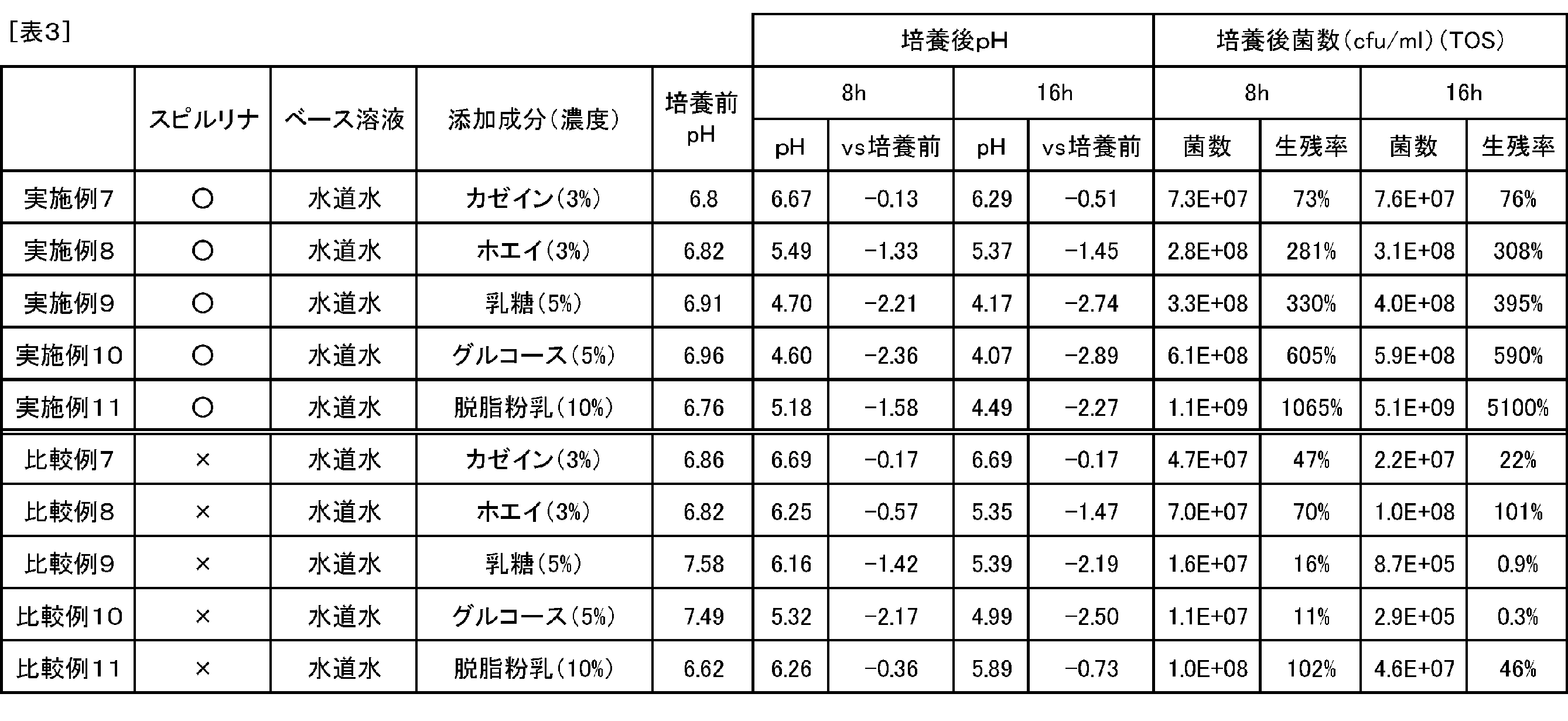
- lactose is the main carbohydrate constituting milk, so that the viability of the Bifidobacterium genus by the milk shown in Comparative Examples 2 and 4 of Experimental Example 1 is high. The increase is thought to be due to components other than fat and sugar contained in milk.
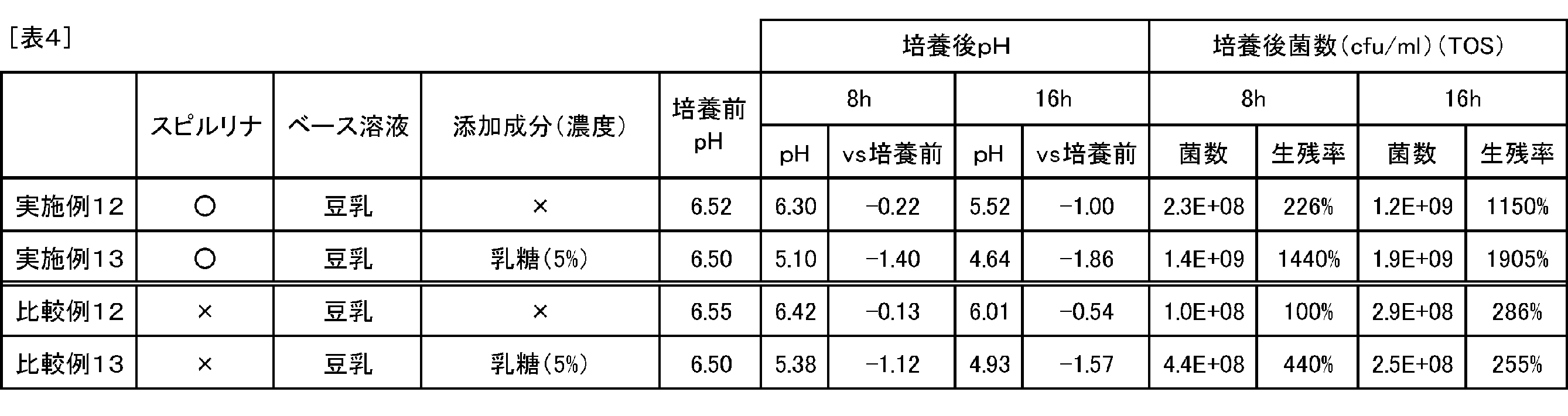
- Example 12 From the comparison between Example 12 and Comparative Example 12, it was found that even when soymilk was used as a base, the survival of Bifidobacterium was increased by using Spirulina. Moreover, as shown in Comparative Example 13, the growth of Bifidobacterium bacteria is promoted by using lactose in the soymilk base, but by using spirulina in combination with this, as shown in Example 13 It was found that the growth of the bacteria was greatly promoted and the survival was significantly increased.
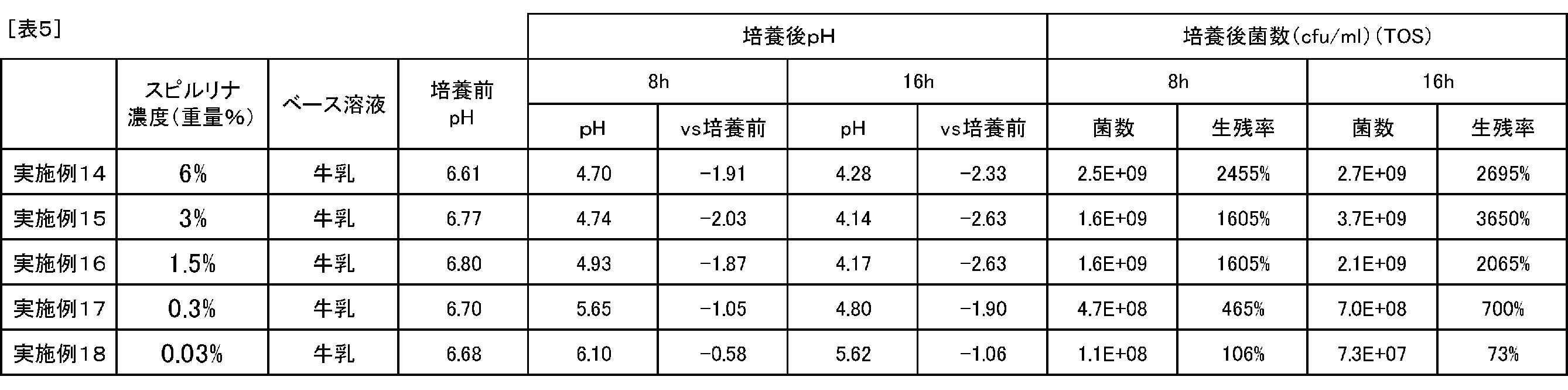
- Example 18 As shown in Table 5, it was found that the effect of promoting the growth of Bifidobacterium increased in a spirulina concentration-dependent manner. In Example 18, it is considered that there was a growth peak between 8 and 16 hours after culturing.
- Example 19 and 20 Spirulina powder 3 g and sugar (lactose) were dissolved in 100 mL of a phosphate buffer solution to prepare a Spirulina-phosphate buffer solution having a sugar concentration of 5% by weight. This spirulina-phosphate buffer solution was sterilized by autoclaving at 90 ° C. for 10 minutes.
- this technique can also take the following structures.
- the Arthrospira cyanobacteria and / or the Spirulina cyanobacteria are cultured in a liquid medium, algal bodies or wet algal bodies, crushed algal bodies, and dried products (crushed)
- the growth promoting and / or reducing inhibitor according to (1) which is contained in one or more forms selected from a solvent extract of algal bodies or wet algal bodies.
- the proliferation promoting and / or reducing inhibitor according to (1) or (2) further comprising at least one selected from the group consisting of proteins and carbohydrates.
- Arthrospira cyanobacteria and / or Spirulina cyanobacteria An oral composition comprising at least one bacterium selected from the group consisting of Bifidobacterium and lactic acid bacteria.
- the Arthrospira cyanobacteria and / or the Spirulina cyanobacteria are cultured in a liquid medium, algal bodies or wet algal bodies, crushed algal bodies, and dried products (crushed)
- the oral composition according to (6) which is contained in one or more forms selected from algal bodies or solvent extracts of wet algal bodies.
- the oral composition according to (6) or (7) further comprising at least one selected from the group consisting of proteins and carbohydrates.
- the oral composition according to (8), wherein the protein is milk protein and / or plant protein.
- Bifido having a step of coexisting at least one bacterium selected from the group consisting of Bifidobacterium and lactic acid bacteria, and Arthrospira cyanobacteria and / or Spirulina cyanobacteria A method for promoting growth and / or suppressing decrease of bacteria belonging to the genus Bacteria and / or lactic acid bacteria.
- the Arthrospira cyanobacteria and / or the Spirulina cyanobacteria are cultured in a liquid medium, algal bodies or wet algal bodies, crushed algal bodies, and dried products (crushed)
- (25) A method for promoting growth and / or suppressing decrease of Bifidobacterium and / or lactic acid bacteria, comprising administering Arthrospira cyanobacteria and / or Spirulina cyanobacteria to an application subject.
- (26) A method for promoting and / or suppressing the growth of Bifidobacterium and / or lactic acid bacteria, comprising administering the growth promoting and / or decreasing inhibitor according to (1) to an application target.
- (27) The improvement method of an intestinal microflora using the method of (26).
- (28) An immunomodulation method using the method of (25) or (26).
- (29) A method for preventing and / or treating diarrhea, constipation, obesity, or inflammatory bowel disease using the method of (25) or (26).
Landscapes
- Health & Medical Sciences (AREA)
- Life Sciences & Earth Sciences (AREA)
- Chemical & Material Sciences (AREA)
- Engineering & Computer Science (AREA)
- General Health & Medical Sciences (AREA)
- Medicinal Chemistry (AREA)
- Pharmacology & Pharmacy (AREA)
- Animal Behavior & Ethology (AREA)
- Public Health (AREA)
- Veterinary Medicine (AREA)
- Bioinformatics & Cheminformatics (AREA)
- Epidemiology (AREA)
- Biotechnology (AREA)
- Organic Chemistry (AREA)
- Zoology (AREA)
- Mycology (AREA)
- Microbiology (AREA)
- Genetics & Genomics (AREA)
- Wood Science & Technology (AREA)
- Proteomics, Peptides & Aminoacids (AREA)
- Nutrition Science (AREA)
- Virology (AREA)
- Food Science & Technology (AREA)
- Biomedical Technology (AREA)
- Polymers & Plastics (AREA)
- General Chemical & Material Sciences (AREA)
- Chemical Kinetics & Catalysis (AREA)
- Biochemistry (AREA)
- Molecular Biology (AREA)
- Nuclear Medicine, Radiotherapy & Molecular Imaging (AREA)
- Immunology (AREA)
- General Engineering & Computer Science (AREA)
- Tropical Medicine & Parasitology (AREA)
- Cell Biology (AREA)
- Child & Adolescent Psychology (AREA)
- Diabetes (AREA)
- Obesity (AREA)
- Hematology (AREA)
- Inorganic Chemistry (AREA)
- Botany (AREA)
Abstract
Description
そこで、本技術では、ビフィドバクテリウム属細菌や乳酸菌が増殖したり菌数に変化がない環境下においては増殖を促進させ、減少する環境下においては減少を抑制させ得る技術を提供することを主目的とする。
本技術に係る増殖促進および/または減少抑制剤には、さらにタンパク質および糖質からなる群から選択される少なくとも1種を含有させることもできる。
この場合、上記タンパク質としては、乳タンパク質および/または植物タンパク質を選択することができる。
また、上記糖質としては、単糖、二糖およびオリゴ糖からなる群から選択される少なくとも1種を選択することができる。
ビフィドバクテリウム属細菌および乳酸菌からなる群から選択される少なくとも1種の細菌と、を含む経口組成物を提供する。
本技術に係る経口組成物には、さらにタンパク質および糖質からなる群から選択される少なくとも1種を含有させることができる。
この場合、上記タンパク質としては、乳タンパク質および/または植物タンパク質を選択することができる。
また、上記糖質としては、単糖、二糖およびオリゴ糖からなる群から選択される少なくとも1種を選択することができる。
さらに、前記経口組成物は、腸内細菌叢の改善、免疫調節、下痢、便秘、肥満、又は炎症性腸疾患の予防及び/又は治療に用いることができる。
本技術に係る増殖促進および/または減少抑制方法では、さらにタンパク質および糖質からなる群から選択される少なくとも1種を共存させることもできる。
この場合、上記タンパクとしては、乳タンパク質および/または植物タンパク質を選択することができる。
また、上記糖質としては、単糖、二糖およびオリゴ糖からなる群から選択される少なくとも1種を選択することができる。
本技術に係る増殖促進および/または減少抑制剤(以下、単に「増殖促進・減少抑制剤」とも称する)は、アルスロスピラ属(Arthrospira)藍藻類および/またはスピルリナ属(Spirulina)藍藻類を有効成分とする製剤であって、ビフィドバクテリウム属細菌および乳酸菌からなる群から選択される少なくとも1種の細菌(以下、単に「ビフィドバクテリウム属細菌および/または乳酸菌」または「ビフィドバクテリウム属細菌/乳酸菌」と称する)の増殖を促進する作用効果を有することを特徴とする。また本技術の増殖促進剤は、アルスロスピラ属(Arthrospira)藍藻類および/またはスピルリナ属(Spirulina)藍藻類に加えて、タンパク質および糖質からなる群から選択される少なくとも1種を含有していてもよい。
以下、本技術について詳細に説明する。
本技術が対象とするビフィドバクテリウム属細菌としては、例えばビフィドバクテリウム・ラクティス(Bifidobacterium lactis)、ビフィドバクテリウム・ロンガム(Bifidobacterium longum)、ビフィドバクテリウム・インファンティス(Bifidobacterium infantis)、ビフィドバクテリウム・アドレセンティス(Bifidobacterium adolescentis)、ビフィドバクテリウム・ブレーベ(Bifidobacterium breve)、ビフィドバクテリウム・ビフィダム(Bifidobacterium bifidum)、ビフィドバクテリウム・アニマリス(Bifidobacterium animalis)などが挙げられる。これらのビフィドバクテリウム属細菌は一種単独を対象にしてもよいし、また二種以上を任意に組み合わせて対象とすることもできる。制限はされないものの、好ましくは、ビフィドバクテリウム・ロンガム、ビフィドバクテリウム・ブレーベ、およびビフィドバクテリウム・インファンティスを挙げることができる。より好ましくはビフィドバクテリウム・ロンガム、およびビフィドバクテリウム・ブレーベである。
本技術が対象とする乳酸菌としては、例えばラクトコッカス・ラクチス・サブスピーシーズ・ラクティス(Lactococcus lactis subsp. lactis)、ラクトコッカス・ラクティス・サブスピーシーズ・クレモリス(Lactococcus lactis subsp. cremoris)(以上、ラクトコッカス属細菌);ストレプトコッカス・サリバリウス・サブスピーシーズ・サーモフィラス(Streptococcus salivarius subsp. thermophilus)(以上、ストレプトコッカス属細菌、エンテロコッカス属細菌とも称する);リューコノストック・メセンテロイデス・サブスピーシーズ・クレモリス(Leuconostoc mesenteroides subsp. cremoris)(以上、リューコノストック属細菌);ラクトバシラス・アシドフィラス(Lactobacillus acidophilus)、ラクトバシラス・カゼイ(Lactobacillus casei)、ラクトバシラス・デルブルギ・サブスピーシーズ・ブルガリカス(Lactobacillus delbrueckii subsp. bulgaricus)、ラクトバシラス・デルブルギ・サブスピーシーズ・ラクティス(Lactobacillus delbrueckii subsp. lactis)、ラクトバシラス・ガセリ(Lactobacillus gasseri)、ラクトバシラス・ヘルベティカス(Lactobacillus helveticus)、ラクトバシラス・プランタラム(Lactobacillus plantarum)、ラクトバシラス・ブレビス(Lactobacillus brevis)、ラクトバシラス・カゼイ・サブスピーシーズラムノーサス(Lactobacillus casei subsp. rhamnosus)、ラクトバシラス・パラカゼイ(Lactobacillus paracasei)(以上、ラクトバシラス属細菌);テトラジェノコッカス・ハロフィルス(Tetragenococcus halophilus)(以上、テトラジェノコッカス属細菌)、およびペディオコッカス・ペントサセウス(Pediococcus pentosaseus)(以上、ペディオコッカス属細菌)などが挙げられる。これらの乳酸菌は一種単独を対象としてもよいし、また二種以上を任意に組み合わせて対象とすることもできる。制限はされないものの、好ましくはラクトバシラス・ガセリ、ラクトバシラス・アシドフィラス、およびラクトバシラス・パラカゼイを挙げることができる。より好ましくはラクトバシラス・ガセリである。
スピルリナ(Spirulina)は、アルスロスピラ属(Arthrospira)あるいはスピルリナ属(Spirulina)に属する藍藻類である。これらの藍藻類には、例えばアルスロスピラ(スピルリナ)・プラテンシス(Arthrospira(Spirulina) platensis)、アルスロスピラ(スピルリナ)・マキシマ(Arthrospira(Spirulina) maxima)、スピルリナ・サブサルサ(Spirulina subsalsa)、スピルリナ・メジャー(Spirulina major)、スピルリナ・ゲイトレリ(Spirulina geitleri)、スピルリナ・サイアミーゼ(Spirulina siamese)、スピルリナ・プリンセプス(Spirulina princeps)、スピルリナ・ラキシシマ(Spirulina laxissima)、スピルリナ・クルタ(Spirulina curta)、スピルリナ・スピルリノイデス(Spirulina spirulinoides)、スピルリナ・アルダリア等が含まれる。これらのスピルリナは一種単独で使用してもよいし、また二種以上を任意に組み合わせて使用することもできる。
抽出液は、濾過又は遠心分離等の適当な方法により、不溶物を分離して粗抽出物を得ることができる。
なお、前記有機溶媒としては、メタノール、エタノール、ブタノール等のアルコール;酢酸メチル、酢酸エチル、酢酸プロピル、酢酸ブチル等のエステル;アセトン、メチルイソブチルケトン等のケトン;ジエチルエーテル、石油エーテル等のエーテル;ヘキサン、シクロヘキサン、トルエン、ベンゼン等の炭化水素;四塩化炭素、ジクロロメタン、クロホルム等のハロゲン化炭化水素;ピリジン等の複素環化合物、エチレングリコール等のグリコール;ポリエチレングリコール等のポリアルコール;アセトニトリル等のニトリル溶媒、及びこれらの溶媒の混合液等が挙げられる。また、これらの溶媒は無水であってもよく、含水状態であってもよい。
前述するように、本技術の増殖促進・減少抑制剤には、スピルリナに加えて、タンパク質を配合することができる。タンパク質を配合することにより、後述する実施例に示す通り、ビフィドバクテリウム属細菌および/または乳酸菌の増殖促進および/または減少抑制の効果がより優れたものとなる。
カゼインとしては、例えば、市販の各種カゼイン、カゼイネート等を利用することができる。より具体的には、乳酸カゼイン、硫酸カゼイン、塩酸カゼイン、ナトリウムカゼイネート、カリウムカゼイネート、カルシウムカゼイネート、マグネシウムカゼイネート又はこれらの任意の混合物等が挙げられる。また、牛乳、脱脂乳、全脂粉乳、脱脂粉乳から常法により精製したカゼイン等を利用することもできる。
ホエイタンパク質としては、市販品又は牛乳、脱脂乳等から公知の方法により分離されたホエイ(例えば、ホエイ粉末、脱塩ホエイ粉末等)又は、分離精製した乳清蛋白質濃縮物、乳清蛋白質単離物、若しくはこれらの任意の割合の混合物を用いることができる。
これらのタンパク質は、タンパク質として精製された形態で用いることもできるが、これらのタンパク質を含む原料の形態で用いることもできる。
豆乳は、大豆を水に浸してすりつぶし、水を加えて煮つめた汁を漉したものである。
アーモンドミルクは、水に浸したアーモンドをミキサーなどで砕き、水を加えてガーゼなどで滓を漉したものである。
ココナッツミルクは、成熟したココナッツの種子の内側に、層状に形成される固形胚乳から得られる甘い乳状の食材である。
乳製品とは、前述する乳(好ましくは生乳および豆乳)を人為的に加工した可食性製品を意味する。例えば生乳から調製される乳製品としては、クリーム、バター、バターオイル、チーズ、濃縮ホエイ、アイスクリーム類(アイスクリーム、ラクトアイス、アイスミルク)、濃縮乳、脱脂濃縮乳、無糖れん乳、無糖脱脂れん乳、加糖れん乳、加糖脱脂れん乳、全粉乳、脱脂粉乳、クリームパウダー、ホエイパウダー、バターミルクパウダー、加糖粉乳、調整粉乳、発酵乳、乳酸菌飲料(無脂乳固形分3%以上を含むものに限る)および乳飲料を挙げることができる。これら各成分の定義は乳等省令によるものとする。なかでも好ましくは脱脂乳(ホエイ、濃縮ホエイ、カッテージチーズ、脱脂濃縮乳、無糖脱脂れん乳、加糖脱脂れん乳、脱脂濃縮乳、無糖脱脂れん乳、加糖脱脂れん乳、脱脂粉乳、ホエイパウダー)、粉乳(全粉乳、脱脂粉乳、クリームパウダー、ホエイパウダー、バターミルクパウダー、加糖粉乳、調整粉乳)であり、より好ましくは脱脂粉乳、ホエイパウダーである。
前述するように、本技術の増殖促進・減少抑制剤には、スピルリナに加えて、糖質を配合することができる。糖質を配合することにより、後述する実施例に示す通り、ビフィドバクテリウム属細菌および/または乳酸菌の増殖促進および/または減少抑制の効果がより優れたものとなる。
本技術の増殖促進・減少抑制剤には、本技術の効果を損なわない限り、医療、食品等の分野において使用可能なその他の成分を、1種又は2種以上、自由に選択して用いることができる。
なお、経口投与用の液剤の場合に使用する担体としては、水等の溶剤、矯味矯臭剤等が挙げられる。
本技術の増殖促進・減少抑制剤は、もっぱらビフィドバクテリウム属細菌/乳酸菌の増殖を促進し、又は、減少を抑制し、当該細菌の菌数を増加させるか、又は当該細菌の生残性を向上させる目的で使用される。
本技術において「減少抑制」(減少抑制作用)とは、生存または生育(増殖)が抑制された環境下において、当該ビフィドバクテリウム属細菌/乳酸菌に対して増殖促進を図ることで、死滅(不活性化)による生菌数の減少を抑え、生きた状態で残存する菌体数(生菌数)を維持または増やすことができること(生残率の向上)をいう。
生残率(%)=[培養後の生菌数/培養前の生菌数]×100
本技術に係る増殖促進・減少抑制剤は、その優れたビフィドバクテリウム属細菌/乳酸菌の増殖促進・減少抑制効果を利用して、ヒト若しくは動物用の医薬品、医薬部外品等の有効成分として、これらに配合して使用可能である。
なお、製剤化は剤形に応じて、適宜、公知の方法により実施できる。
本技術に係る増殖促進・減少抑制剤は、その優れたビフィドバクテリウム属細菌/乳酸菌の増殖促進・減少抑制効果を利用して、ヒト若しくは動物用の健康食品、機能性食品、病者用食品、経腸栄養食品、特別用途食品、保健機能食品、特定保健用食品、機能性表示食品、栄養機能食品等の有効成分として、これらに配合して使用可能である。
前記即席食品類としては、例えば、即席めん、カップめん、レトルト・調理食品、調理缶詰め、電子レンジ食品、即席スープ・シチュー、即席みそ汁・吸い物、スープ缶詰め、フリーズ・ドライ食品、その他の即席食品等が挙げられる。
前記農産加工品としては、例えば、農産缶詰め、果実缶詰め、ジャム・マーマレード類、漬物、煮豆類、農産乾物類、シリアル(穀物加工品)等が挙げられる。
前記水産加工品としては、例えば、水産缶詰め、魚肉ハム・ソーセージ、水産練り製品、水産珍味類、つくだ煮類等が挙げられる。
前記畜産加工品としては、例えば、畜産缶詰め・ペースト類、畜肉ハム・ソーセージ等が挙げられる。
前記乳・乳製品としては、例えば、加工乳、乳飲料、ヨーグルト類、乳酸菌飲料類、チーズ、アイスクリーム類、調製粉乳類、クリーム、その他の乳製品等が挙げられる。
前記油脂類としては、例えば、バター、マーガリン類、植物油等が挙げられる。
前記基礎調味料としては、例えば、しょうゆ、みそ、ソース類、トマト加工調味料、みりん類、食酢類等が挙げられ、前記複合調味料・食品類として、調理ミックス、カレーの素類、たれ類、ドレッシング類、めんつゆ類、スパイス類、その他の複合調味料等が挙げられる。
前記冷凍食品としては、例えば、素材冷凍食品、半調理冷凍食品、調理済冷凍食品等が挙げられる。
前記菓子類としては、例えば、キャラメル、キャンディー、チューインガム、チョコレート、クッキー、ビスケット、ケーキ、パイ、スナック、クラッカー、和菓子、米菓子、豆菓子、デザート菓子、その他の菓子等が挙げられる。
前記飲料としては、例えば、炭酸飲料、天然果汁、果汁飲料、果汁入り清涼飲料、果肉飲料、果粒入り果実飲料、野菜系飲料、豆乳、豆乳飲料、コーヒー飲料、お茶飲料、粉末飲料、濃縮飲料、スポーツ飲料、栄養飲料、アルコール飲料、その他の嗜好飲料等が挙げられる。
上記以外の市販食品としては、例えば、ベビーフード、ふりかけ、お茶潰けのり等が挙げられる。
「表示」行為には、需要者に対して前記用途を知らしめるための全ての行為が含まれ、前記用途を想起・類推させうるような表現であれば、表示の目的、表示の内容、表示する対象物・媒体等の如何に拘わらず、全て本開示の「表示」行為に該当する。
本技術に係る増殖促進・減少抑制剤は、その優れたビフィドバクテリウム属細菌/乳酸菌の増殖促進・減少抑制効果を利用して、動物用の飼料の有効成分として、使用可能である。本技術に係る増殖促進・減少抑制剤は、公知の飼料に添加して調製することもできるし、飼料の原料中混合して新たな飼料を製造することもできる。
本技術に係る経口組成物は、スピルリナと、ビフィドバクテリウム属細菌および乳酸菌からなる群から選択される少なくとも1種の細菌と、を少なくとも含む組成物である。また、必要に応じて、タンパク質および糖質からなる群から選択される少なくとも1種を含有させることができる。前記経口組成物は、腸内細菌叢の改善、免疫調節、下痢、便秘、肥満、又は炎症性腸疾患等の予防及び/又は治療に用いることができる。
本技術のビフィドバクテリウム属細菌/乳酸菌の増殖促進および/または減少抑制方法(以下、単に「増殖促進・減少抑制方法」ともいう)は、ビフィドバクテリウム属細菌及び乳酸菌からなる群から選択される少なくとも1種の細菌と、スピルリナと、を共存させる工程を有する方法である。また、必要に応じて、さらにタンパク質および糖質からなる群から選択される少なくとも1種を共存させることもできる。
実験例1では、ビフィドバクテリウム属細菌の増殖性に対するスピルリナの影響を調べた。
なお、ビフィドバクテリウム属細菌として、ビフィドバクテリウム・ロンガム(Bifidobacterium longum)と、ビフィドバクテリウム・ブレーベ(Bifidobacterium breve)を用いた。より具体的には、ビフィドバクテリウム・ロンガムとしては、「BAA-999」(Bifidobacterium longum ATCC BAA-999)という寄託番号でアメリカン・タイプ・カルチャー・コレクション(ATCC)に寄託されており、商業的に入手することが可能な(http://www.atcc.org/products/all/BAA-999.aspx)菌を、ビフィドバクテリウム・ブレーベとしては、「FERM BP-11175」(Bifidobacterium breve FERM BP-11175)という寄託番号で独立行政法人製品評価技術基盤機構(NITE)に寄託されており、商業的に入手することが可能な菌を、それぞれ用いた(以下同じ)。
また、スピルリナとして、株式会社スピルリナ研究所から入手したスピルリナ粉末を用いた(以下同じ)。
(1-1)ビフィドバクテリウム属細菌乾燥粉末の調製
各種ビフィドバクテリウム属細菌を、蛋白質、アミノ酸、糖源を含有する培地に接種し、32~41℃で5~24時間培養を行った後、培養液から遠心分離により菌体(湿菌体)を集菌した。凍結乾燥機(共和真空社製)を用いて、ビフィドバクテリウム・ロンガムについては18~96時間、ビフィドバクテリウム・ブレーベについては120時間の凍結乾燥を行い、凍結乾燥終了後の菌体塊を物理的に粉砕して各種ビフィドバクテリウム属細菌乾燥粉末(以下、「ビフィドバクテリウム属細菌末」という。)を得た。
スピルリナ粉末3gを水道水又は牛乳100mLに溶解し、スピルリナ溶液を調製し、90℃で10分間オートクレーブ殺菌を行い、滅菌した。
試験管に入れた10mL量の各スピルリナ溶液(滅菌済)に、10mLあたりの菌数が1.0×10⁹cfu(1.0×10⁸cfu/mL)となるように生理食塩水で希釈調整した各種ビフィドバクテリウム属細菌末を接種し、37℃で8時間および16時間培養した。培養後、培養物中の菌数(cfu/mL)とpHを測定し、培養前の菌数とpHと比較し、ビフィドバクテリウム属細菌の増殖性に対するスピルリナの影響を評価した。なお、比較のため、上記スピルリナ溶液に代えて、水道水又は牛乳を用いて、同様に実験を行った。
実施例1~4および比較例1~4の結果を表1に示す。

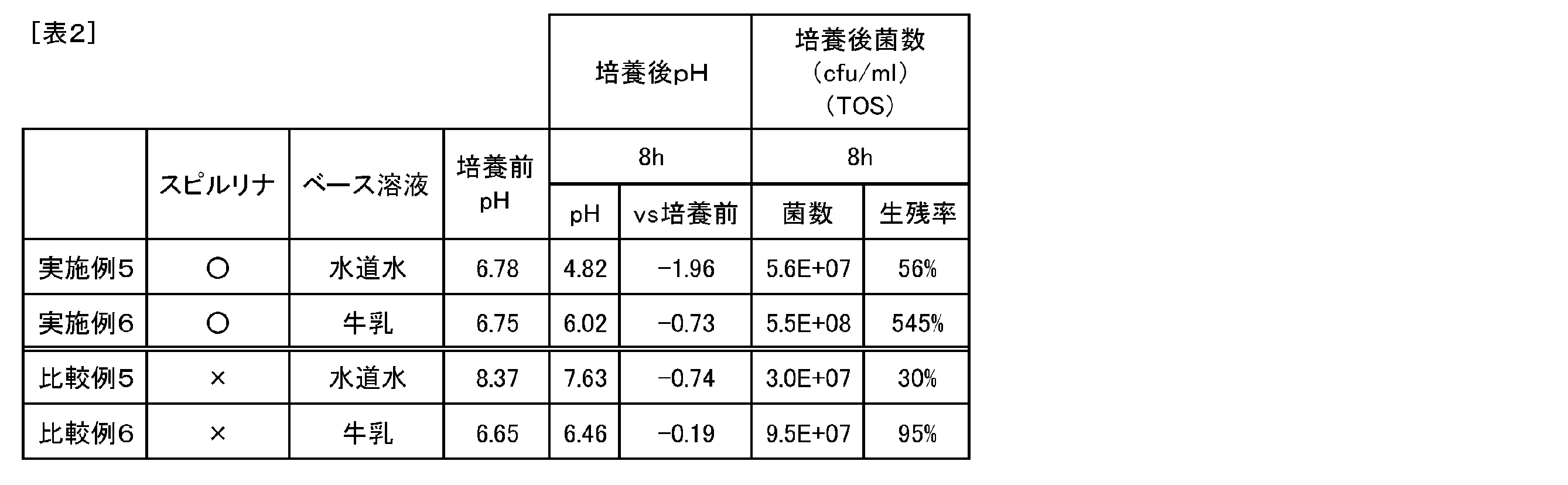
また、比較例2及び比較例4に示すように、牛乳にはビフィドバクテリウム属細菌の生残性を上昇させる効果があるものの、牛乳にスピルリナを組み合わせることで、ビフィドバクテリウム属細菌の菌増殖がさらに一層促進されて、菌数が格段に増加することが判明した。
実験例2では、乳酸菌の増殖性に対するスピルリナの影響を調べた。
なお、乳酸菌として、ラクトバシラス・ガゼリ(Lactobacillus gasseri)を用いた。より具体的には、ラクトバシラス・ガゼリとして、「NITE BP-01669」という寄託番号で独立行政法人製品評価技術基盤機構に寄託されており、商業的に入手することができる菌を用いた(以下同じ)。
(1-1)乳酸菌乾燥粉末の調製
乳酸菌を、蛋白質、アミノ酸、糖源を含有する培地に接種し、32~41℃で5~24時間培養を行った後、培養液から遠心分離 により菌体(湿菌体)を集菌した。凍結乾燥機(共和真空社製)を用いて18~96時間の凍結乾燥を行い、凍結乾燥終了後の菌体塊を物理的に粉砕して乳酸菌乾燥粉末(以下、「乳酸菌末」という。)を得た。
スピルリナ粉末3gを水道水又は牛乳100mLに溶解し、スピルリナ溶液を調製し、90℃で10分間オートクレーブ殺菌を行い、滅菌した。
試験管に入れた10mL量の各スピルリナ溶液(滅菌済)に、10mLあたりの菌数が1.0×10⁹cfu(1.0×10⁸cfu/mL)となるように生理食塩水で希釈調整した乳酸菌末を接種し、37℃で8時間培養した。培養後、培養物中の菌数(cfu/mL)とpHを測定し、培養前の菌数とpHと比較し、乳酸菌の増殖性に対するスピルリナの影響を評価した。なお、比較のため、上記スピルリナ溶液に代えて、水道水又は牛乳を用いて、同様に実験を行った。
実施例5~6および比較例5~6の結果を表2に示す。
実験例3では、ビフィドバクテリウム属細菌の増殖性に対するスピルリナとタンパク質および/または糖質との併用の影響を調べた。
なお、ビフィドバクテリウム属細菌として、ビフィドバクテリウム・ロンガム(Bifidobacterium longum)を用いた。
(1-1)ビフィドバクテリウム属細菌末の調製
実験例1と同様の方法により、ビフィドバクテリウム属細菌末を調整した。
[実施例7および8]
スピルリナ粉末3gおよびタンパク質(カゼイン又はホエイタンパク質)を水道水100mLに溶解し、タンパク質濃度3重量%のスピルリナ溶液を調製した。このスピルリナ溶液を、90℃で10分間オートクレーブ殺菌を行い、滅菌した。
スピルリナ粉末3gおよび糖(乳糖又はグルコース)を水道水100mLに溶解し、糖濃度5重量%のスピルリナ溶液を調製した。このスピルリナ溶液を、90℃で10分間オートクレーブ殺菌を行い、滅菌した。
スピルリナ粉末3gおよび脱脂粉乳を水道水100mLに溶解し、脱脂粉乳濃度10重量%のスピルリナ溶液を調製した。このスピルリナ溶液を、90℃で10分間オートクレーブ殺菌を行い、滅菌した。
試験管に入れた10mL量の各スピルリナ溶液(滅菌済)に、10mLあたりの菌数が1.0×10⁹cfu(1.0×10⁸cfu/mL)となるように生理食塩水で希釈調整したビフィドバクテリウム属細菌末を接種し、37℃で8時間および16時間培養した。培養後、培養物中の菌数(cfu/mL)とpHを測定し、培養前の菌数とpHと比較し、ビフィドバクテリウム属細菌の増殖性に対するスピルリナ、タンパク質及び糖質の影響を評価した。なお、比較のため、上記スピルリナ溶液に代えて、タンパク質(カゼイン又はホエイタンパク質)をそれぞれ水道水に溶解したタンパク質濃度3重量%の水溶液(比較例7及び8)、糖(乳糖またはグルコース)をそれぞれ水道水に溶解した糖濃度5重量%の水溶液(比較例9及び10)、および脱脂粉乳を水道水に溶解した脱脂粉乳濃度10重量%の水溶液(比較例11)を用いて、同様に実験を行った。
実施例7~11および比較例7~11の結果を表3に示す。
実験例4では、牛乳の代わりに豆乳を用いた場合に、ビフィドバクテリウム属細菌の増殖性に対するスピルリナの影響を調べた。
なお、ビフィドバクテリウム属細菌として、ビフィドバクテリウム・ロンガム(Bifidobacterium longum)を用いた。
(1-1)ビフィドバクテリウム属細菌末・乳酸菌末の調製
実験例1と同様の方法により、ビフィドバクテリウム属細菌末を調整した。
[実施例12]
スピルリナ粉末3gを豆乳100mLに溶解し、スピルリナ溶液を調製した。このスピルリナ溶液を、90℃で10分間オートクレーブ殺菌を行い、滅菌した。
[実施例13]
スピルリナ粉末3gおよび糖質(乳糖)を豆乳100mLに溶解し、糖質濃度5重量%のスピルリナ溶液を調製した。このスピルリナ溶液を、90℃で10分間オートクレーブ殺菌を行い、滅菌した。
試験管に入れた10mL量の各スピルリナ溶液(滅菌済)に、10mLあたりの菌数が1.0×10⁹cfu(1.0×10⁸cfu/mL)となるように生理食塩水で希釈調整したビフィドバクテリウム属細菌末を接種し、37℃で8時間および16時間培養した。培養後、培養物中の菌数(cfu/mL)とpHを測定し、培養前の菌数とpHと比較し、ビフィドバクテリウム属細菌または乳酸菌の増殖性に対する豆乳及び糖質の影響を評価した。なお、比較のため、上記スピルリナ溶液に代えて、豆乳(比較例12)及び糖(乳糖)を豆乳に溶解した糖濃度5重量%の水溶液(比較例13)を用いて、同様に実験を行った。
実施例12~13および比較例12~13の結果を表4に示す。
実験例5では、ビフィドバクテリウム属細菌の増殖性に対するスピルリナ濃度の影響を調べた。
なお、ビフィドバクテリウム属細菌として、ビフィドバクテリウム・ロンガム(Bifidobacterium longum)を用いた。
(1-1)ビフィドバクテリウム属細菌末の調製
実験例1と同様の方法により、ビフィドバクテリウム属細菌末を調整した。
スピルリナ粉末を牛乳100mLに下記表5に示す濃度になるようにそれぞれ溶解し、各スピルリナ溶液を調製した。このスピルリナ溶液を、90℃で10分間オートクレーブ殺菌を行い、滅菌した。
試験管に入れた10mL量の各スピルリナ溶液(滅菌済)に、10mLあたりの菌数が1.0×10⁹cfu(1.0×10⁸cfu/mL)となるように生理食塩水で希釈調整したビフィドバクテリウム属細菌末を接種し、37℃で8時間および16時間培養した。培養後、培養物中の菌数(cfu/mL)とpHを測定し、培養前の菌数とpHと比較し、ビフィドバクテリウム属細菌の増殖性に対するスピルリナの濃度の影響を評価した。
実施例14~18の結果を表5に示す。
実験例6では、水道水に代えてリン酸緩衝液を用いて、ビフィドバクテリウム属細菌の増殖性に対するスピルリナおよび糖の影響を調べた。
なお、ビフィドバクテリウム属細菌として、ビフィドバクテリウム・ロンガム(Bifidobacterium longum)を用いた。
(1-1)ビフィドバクテリウム属細菌末の調製
実験例1と同様の方法により、ビフィドバクテリウム属細菌末を調整した。
0.2Mリン酸二水素ナトリウム溶液と0.2Mリン酸水素二ナトリウム溶液とを混合し、pHを7に調整した。
[実施例21]
スピルリナ粉末3gをリン酸緩衝溶液100mLに溶解し、スピルリナ-リン酸緩衝溶液を調製した。このスピルリナ-リン酸緩衝溶液を、90℃で10分間オートクレーブ殺菌を行い、滅菌した。
スピルリナ粉末3gおよび糖(乳糖)をリン酸緩衝溶液100mLに溶解し、糖濃度5重量%のスピルリナ-リン酸緩衝溶液を調製した。このスピルリナ-リン酸緩衝溶液を、90℃で10分間オートクレーブ殺菌を行い、滅菌した。
試験管に入れた10mL量の各スピルリナ-リン酸緩衝溶液(滅菌済)に、10mLあたりの菌数が1.0×10⁹cfu(1.0×10⁸cfu/mL)となるように生理食塩水で希釈調整したビフィドバクテリウム属細菌末を接種し、37℃で8時間および16時間培養した。培養後、培養物中の菌数(cfu/mL)とpHを測定し、培養前の菌数とpHと比較し、ビフィドバクテリウム属細菌の増殖性に対するスピルリナ-リン酸緩衝溶液をおよびスピルリナ-リン酸緩衝溶液+糖の影響を評価した。なお、比較のため、上記スピルリナ-リン酸緩衝溶液に代えて、リン酸緩衝溶液(比較例14)及び糖(乳糖)をリン酸緩衝溶液に溶解した糖濃度5重量%のリン酸緩衝溶液(比較例15)を用いて、同様に実験を行った。
実施例19~20及び比較例14~15の結果を表6に示す。

(1)
アルスロスピラ属(Arthrospira)藍藻類および/またはスピルリナ属(Spirulina)藍藻類を有効成分とする、ビフィドバクテリウム属細菌および/または乳酸菌の増殖促進および/または減少抑制剤。
(2)
前記アルスロスピラ属(Arthrospira)藍藻類および/または前記スピルリナ属(Spirulina)藍藻類を、液体培地中で培養した状態の藻体または湿藻体、藻体の破砕物、およびこれらの乾燥物(粉砕した粉末も含む)、並びに、藻体または湿藻体の溶媒抽出物から選ばれる1種または2種以上の形態で含有する、(1)に記載の増殖促進および/または減少抑制剤。
(3)
さらにタンパク質および糖質からなる群から選択される少なくとも1種を含有する、(1)または(2)に記載の増殖促進および/または減少抑制剤。
(4)
上記タンパク質が、乳タンパク質および/または植物タンパク質である、(3)に記載の増殖促進および/または減少抑制剤。
(5)
上記糖質が、単糖、二糖およびオリゴ糖からなる群から選択される少なくとも1種である(3)または(4)に記載の増殖促進および/または減少抑制剤。
(6)
アルスロスピラ属(Arthrospira)藍藻類および/またはスピルリナ属(Spirulina)藍藻類と、
ビフィドバクテリウム属細菌および乳酸菌からなる群から選択される少なくとも1種の細菌と、を含む経口組成物。
(7)
前記アルスロスピラ属(Arthrospira)藍藻類および/または前記スピルリナ属(Spirulina)藍藻類を、液体培地中で培養した状態の藻体または湿藻体、藻体の破砕物、およびこれらの乾燥物(粉砕した粉末も含む)、並びに、藻体または湿藻体の溶媒抽出物から選ばれる1種または2種以上の形態で含有する、(6)に記載の経口組成物。(8)
さらにタンパク質および糖質からなる群から選択される少なくとも1種を含有する、(6)または(7)に記載の経口組成物。
(9)
上記タンパク質が、乳タンパク質および/または植物タンパク質である、(8)に記載の経口組成物。
(10)
上記糖質が、単糖、二糖およびオリゴ糖からなる群から選択される少なくとも1種である(8)または(9)に記載の経口組成物。
(11)
腸内細菌叢の改善、免疫調節、下痢、便秘、肥満、又は炎症性腸疾患の予防及び/又は治療に用いられる、(6)から(10)のいずれか一項に記載の経口組成物。
(12)
ビフィドバクテリウム属細菌及び乳酸菌からなる群から選択される少なくとも1種の細菌と、アルスロスピラ属(Arthrospira)藍藻類および/またはスピルリナ属(Spirulina)藍藻類と、を共存させる工程を有する、ビフィドバクテリウム属細菌および/または乳酸菌の増殖促進および/または減少抑制方法。
(13)
前記アルスロスピラ属(Arthrospira)藍藻類および/または前記スピルリナ属(Spirulina)藍藻類を、液体培地中で培養した状態の藻体または湿藻体、藻体の破砕物、およびこれらの乾燥物(粉砕した粉末も含む)、並びに、藻体または湿藻体の溶媒抽出物から選ばれる1種または2種以上の形態で含有する、(12)に記載の増殖促進および/または減少抑制方法。
(14)
さらにタンパク質および糖質からなる群から選択される少なくとも1種を共存させる、(12)または(13)に記載の増殖促進および/または減少抑制方法。
(15)
上記タンパク質が、乳タンパク質および/または植物タンパク質である、(14)に記載の増殖促進および/または減少抑制方法。
(16)
上記糖質が、単糖、二糖およびオリゴ糖からなる群から選択される少なくとも1種である(14)または(15)に記載の増殖促進および/または減少抑制方法。
(17)
ビフィドバクテリウム属細菌および/または乳酸菌の増殖促進および/または減少抑制剤のための、アルスロスピラ属(Arthrospira)藍藻類および/またはスピルリナ属(Spirulina)藍藻類の使用。
(18)
ビフィドバクテリウム属細菌および/または乳酸菌の増殖促進および/または減少抑制用経口組成物のための、アルスロスピラ属(Arthrospira)藍藻類および/またはスピルリナ属(Spirulina)藍藻類の使用。
(19)
腸内細菌叢の改善、免疫調節、下痢、便秘、肥満、又は炎症性腸疾患の予防及び/又は治療に用いられる、(18)に記載の使用。
(20)
ビフィドバクテリウム属細菌および/または乳酸菌の増殖促進および/または減少抑制剤の製造ための、アルスロスピラ属(Arthrospira)藍藻類および/またはスピルリナ属(Spirulina)藍藻類の使用。(21)
ビフィドバクテリウム属細菌および/または乳酸菌の増殖促進および/または減少抑制用経口組成物の製造ための、アルスロスピラ属(Arthrospira)藍藻類および/またはスピルリナ属(Spirulina)藍藻類の使用。(22)
アルスロスピラ属(Arthrospira)藍藻類および/またはスピルリナ属(Spirulina)藍藻類の、ビフィドバクテリウム属細菌および/または乳酸菌の増殖促進および/または減少抑制剤への使用。
(23)
アルスロスピラ属(Arthrospira)藍藻類および/またはスピルリナ属(Spirulina)藍藻類の、ビフィドバクテリウム属細菌および/または乳酸菌の増殖促進および/または減少抑制用経口組成物への使用。(24)
腸内細菌叢の改善、免疫調節、下痢、便秘、肥満、又は炎症性腸疾患の予防及び/又は治療に用いられる、(23)に記載の使用。(25)
アルスロスピラ属(Arthrospira)藍藻類および/またはスピルリナ属(Spirulina)藍藻類を適用対象に投与する、ビフィドバクテリウム属細菌および/または乳酸菌の増殖促進および/または減少抑制方法。
(26)
(1)に記載の増殖促進および/または減少抑制剤を適用対象に投与する、ビフィドバクテリウム属細菌および/または乳酸菌の増殖促進および/または減少抑制方法。
(27)
(25)又は(26)の方法を用いる、腸内細菌叢の改善方法。
(28)
(25)又は(26)の方法を用いる、免疫調節方法。
(29)
(25)又は(26)の方法を用いる、下痢、便秘、肥満、又は炎症性腸疾患の予防及び/又は治療方法。
Claims (13)
- アルスロスピラ属(Arthrospira)藍藻類および/またはスピルリナ属(Spirulina)藍藻類を有効成分とする、ビフィドバクテリウム属細菌および/または乳酸菌の増殖促進および/または減少抑制剤。
- さらにタンパク質および糖質からなる群から選択される少なくとも1種を含有する、請求項1に記載の増殖促進および/または減少抑制剤。
- 上記タンパク質が、乳タンパク質および/または植物タンパク質である、請求項2に記載の増殖促進および/または減少抑制剤。
- 上記糖質が、単糖、二糖およびオリゴ糖からなる群から選択される少なくとも1種である請求項2または3に記載の増殖促進および/または減少抑制剤。
- アルスロスピラ属(Arthrospira)藍藻類および/またはスピルリナ属(Spirulina)藍藻類と、
ビフィドバクテリウム属細菌および乳酸菌からなる群から選択される少なくとも1種の細菌と、を含む経口組成物。 - さらにタンパク質および糖質からなる群から選択される少なくとも1種を含有する、請求項5に記載の経口組成物。
- 上記タンパク質が、乳タンパク質および/または植物タンパク質である、請求項6に記載の経口組成物。
- 上記糖質が、単糖、二糖およびオリゴ糖からなる群から選択される少なくとも1種である請求項6または7に記載の経口組成物。
- 腸内細菌叢の改善、免疫調節、下痢、便秘、肥満、又は炎症性腸疾患の予防及び/又は治療に用いられる、請求項5から8のいずれか一項に記載の経口組成物。
- ビフィドバクテリウム属細菌及び乳酸菌からなる群から選択される少なくとも1種の細菌と、アルスロスピラ属(Arthrospira)藍藻類および/またはスピルリナ属(Spirulina)藍藻類と、を共存させる工程を有する、ビフィドバクテリウム属細菌および/または乳酸菌の増殖促進および/または減少抑制方法。
- さらにタンパク質および糖質からなる群から選択される少なくとも1種を共存させる、請求項10に記載の増殖促進および/または減少抑制方法。
- 上記タンパク質が、乳タンパク質および/または植物タンパク質である、請求項11に記載の増殖促進および/または減少抑制方法。
- 上記糖質が、単糖、二糖およびオリゴ糖からなる群から選択される少なくとも1種である請求項11または12に記載の増殖促進および/または減少抑制方法。
Priority Applications (2)
| Application Number | Priority Date | Filing Date | Title |
|---|---|---|---|
| US16/063,630 US20180369298A1 (en) | 2015-12-18 | 2016-12-19 | An agent for promoting the growth of, and/or suppressing a decrease in, bifidobacterium bacteria and/or lactic acid bacteria |
| AU2016370012A AU2016370012B2 (en) | 2015-12-18 | 2016-12-19 | Agent for promoting growth of, and/or suppressing decrease in, Bifidobacterium bacteria and/or lactic acid bacteria |
Applications Claiming Priority (2)
| Application Number | Priority Date | Filing Date | Title |
|---|---|---|---|
| JP2015247921A JP6551934B2 (ja) | 2015-12-18 | 2015-12-18 | ビフィドバクテリウム属細菌および/または乳酸菌の増殖促進および/または減少抑制剤 |
| JP2015-247921 | 2015-12-18 |
Publications (1)
| Publication Number | Publication Date |
|---|---|
| WO2017104850A1 true WO2017104850A1 (ja) | 2017-06-22 |
Family
ID=59056841
Family Applications (1)
| Application Number | Title | Priority Date | Filing Date |
|---|---|---|---|
| PCT/JP2016/087751 Ceased WO2017104850A1 (ja) | 2015-12-18 | 2016-12-19 | ビフィドバクテリウム属細菌および/または乳酸菌の増殖促進および/または減少抑制剤 |
Country Status (4)
| Country | Link |
|---|---|
| US (1) | US20180369298A1 (ja) |
| JP (1) | JP6551934B2 (ja) |
| AU (1) | AU2016370012B2 (ja) |
| WO (1) | WO2017104850A1 (ja) |
Cited By (1)
| Publication number | Priority date | Publication date | Assignee | Title |
|---|---|---|---|---|
| JP2022164535A (ja) * | 2021-04-16 | 2022-10-27 | ビオフェルミン製薬株式会社 | 酸化マグネシウム配合組成物 |
Families Citing this family (7)
| Publication number | Priority date | Publication date | Assignee | Title |
|---|---|---|---|---|
| JP6998193B2 (ja) * | 2017-12-08 | 2022-02-10 | 森永乳業株式会社 | 新規ビフィドバクテリウム属細菌及び当該細菌を含む組成物 |
| JP7131937B2 (ja) * | 2018-03-28 | 2022-09-06 | 森永乳業株式会社 | スピルリナ含有緑色飲料及びその製造方法 |
| KR102135195B1 (ko) * | 2018-10-08 | 2020-07-17 | 아주대학교산학협력단 | 테트라제노코커스 할로필러스를 포함하는 베체트병 또는 헤르페스 바이러스 감염증의 예방 또는 치료용 조성물 |
| BR112022014252A2 (pt) * | 2020-01-23 | 2022-09-20 | Gervais Danone Sa | Processo para a preparação de uma composição fermentada à base de plantas, composição à base de plantas e composição fermentada à base de plantas |
| JP7601332B2 (ja) * | 2020-06-04 | 2024-12-17 | 江南化工株式会社 | 便秘解消組成物 |
| CN111534434B (zh) * | 2020-06-28 | 2022-07-05 | 江南大学 | 一种冻干保护剂及其在冻干青春双歧杆菌中的应用 |
| KR102540263B1 (ko) * | 2020-12-24 | 2023-06-07 | 주식회사 한국인삼공사 | 인삼 추출물 또는 그의 분획물을 포함하는 장내 미생물 균총 개선용 조성물 |
Citations (8)
| Publication number | Priority date | Publication date | Assignee | Title |
|---|---|---|---|---|
| CN1243747A (zh) * | 1997-08-15 | 2000-02-09 | 北京建昊高科技股份有限公司 | 一种肠道微生态有益菌促生组合物 |
| WO2002045732A1 (en) * | 2000-12-05 | 2002-06-13 | Kabushiki Kaisha Yakult Honsha | Proliferation promoters for enteric bifidobacteria |
| JP2003199531A (ja) * | 2001-11-01 | 2003-07-15 | Fuyuki Mitsuyama | 発酵食品と腸内有用菌物質 |
| JP2004081206A (ja) * | 2002-06-26 | 2004-03-18 | Dainippon Ink & Chem Inc | スピルリナの処理方法 |
| JP2006298779A (ja) * | 2005-04-15 | 2006-11-02 | Kanehide Bio Kk | 乳酸菌培養により得られる抗アレルギー剤 |
| JP2006298778A (ja) * | 2005-04-15 | 2006-11-02 | Kanehide Bio Kk | 乳酸菌培養により得られる免疫活性賦活剤 |
| JP2009511506A (ja) * | 2005-10-24 | 2009-03-19 | ネステク ソシエテ アノニム | 食物繊維製剤及び投与方法 |
| JP2015533484A (ja) * | 2012-09-11 | 2015-11-26 | ティラビスコ アーベー | プレバイオティックチラコイド組成物 |
Family Cites Families (4)
| Publication number | Priority date | Publication date | Assignee | Title |
|---|---|---|---|---|
| WO2008002058A1 (en) * | 2006-06-26 | 2008-01-03 | B.M.Tech World Co., Ltd. | Method of preparing powder kimchi and kimchi composition using the same |
| US7923044B2 (en) * | 2008-07-15 | 2011-04-12 | Paradise Herbs & Essentials, Inc. | Composition for high-ORAC value dietary supplement |
| US8257694B2 (en) * | 2009-05-14 | 2012-09-04 | Product Partners, Llc | Nutritional compositions for reducing oxidative damage |
| MX2014010048A (es) * | 2012-02-22 | 2015-03-19 | Algal Scient Corp | Composiciones alimenticias para animales y metodos de uso de las mismas. |
-
2015
- 2015-12-18 JP JP2015247921A patent/JP6551934B2/ja active Active
-
2016
- 2016-12-19 WO PCT/JP2016/087751 patent/WO2017104850A1/ja not_active Ceased
- 2016-12-19 AU AU2016370012A patent/AU2016370012B2/en not_active Ceased
- 2016-12-19 US US16/063,630 patent/US20180369298A1/en not_active Abandoned
Patent Citations (8)
| Publication number | Priority date | Publication date | Assignee | Title |
|---|---|---|---|---|
| CN1243747A (zh) * | 1997-08-15 | 2000-02-09 | 北京建昊高科技股份有限公司 | 一种肠道微生态有益菌促生组合物 |
| WO2002045732A1 (en) * | 2000-12-05 | 2002-06-13 | Kabushiki Kaisha Yakult Honsha | Proliferation promoters for enteric bifidobacteria |
| JP2003199531A (ja) * | 2001-11-01 | 2003-07-15 | Fuyuki Mitsuyama | 発酵食品と腸内有用菌物質 |
| JP2004081206A (ja) * | 2002-06-26 | 2004-03-18 | Dainippon Ink & Chem Inc | スピルリナの処理方法 |
| JP2006298779A (ja) * | 2005-04-15 | 2006-11-02 | Kanehide Bio Kk | 乳酸菌培養により得られる抗アレルギー剤 |
| JP2006298778A (ja) * | 2005-04-15 | 2006-11-02 | Kanehide Bio Kk | 乳酸菌培養により得られる免疫活性賦活剤 |
| JP2009511506A (ja) * | 2005-10-24 | 2009-03-19 | ネステク ソシエテ アノニム | 食物繊維製剤及び投与方法 |
| JP2015533484A (ja) * | 2012-09-11 | 2015-11-26 | ティラビスコ アーベー | プレバイオティックチラコイド組成物 |
Non-Patent Citations (4)
| Title |
|---|
| DE CARIE GZ. ET AL.: "Effect of Spirulina platensis biomass on the growth of lactic acid bacteria in milk", WORLD J MICROBIOL BIOTECH., vol. 16, 2000, pages 563 - 565 * |
| LIANG B. ET AL.: "Promoting effect of Spirulina platensis on growth of intestinal microbiota in vitro", CHINESE J MARINE DRUGS., vol. 18, no. 3, 1999, pages 7 - 10 * |
| NOBORU TSUCHIHASHI ET AL.: "Effects of Spirulina (Spirulina plantensis) on Cecum Contents in Rats", BULLETIN OF CHIBA COLLEGE OF HEALTH SCIENCE, vol. 5, no. 2, 1986, pages 27 - 30 * |
| VARGA L. ET AL.: "Influence of a Spirulina platensis biomass on the microflora of fermented ABT milks during storage (R1", J DAIRY SCI., vol. 85, 2002, pages 1031 - 1038, XP026990469 * |
Cited By (2)
| Publication number | Priority date | Publication date | Assignee | Title |
|---|---|---|---|---|
| JP2022164535A (ja) * | 2021-04-16 | 2022-10-27 | ビオフェルミン製薬株式会社 | 酸化マグネシウム配合組成物 |
| JP7825390B2 (ja) | 2021-04-16 | 2026-03-06 | ビオフェルミン製薬株式会社 | 酸化マグネシウム配合組成物 |
Also Published As
| Publication number | Publication date |
|---|---|
| AU2016370012B2 (en) | 2019-11-14 |
| US20180369298A1 (en) | 2018-12-27 |
| JP2017109976A (ja) | 2017-06-22 |
| AU2016370012A1 (en) | 2018-06-21 |
| JP6551934B2 (ja) | 2019-07-31 |
Similar Documents
| Publication | Publication Date | Title |
|---|---|---|
| AU2019243093B2 (en) | Nutritional composition, food/drink composition using nutritional composition, and modified milk powder using nutritional composition | |
| JP7516053B2 (ja) | 組成物並びに飲食品組成物、栄養組成物および調製乳 | |
| JP6551934B2 (ja) | ビフィドバクテリウム属細菌および/または乳酸菌の増殖促進および/または減少抑制剤 | |
| JP2017109976A5 (ja) | ||
| WO2020246585A1 (ja) | 栄養組成物 | |
| JP2019116423A (ja) | 整腸用組成物 | |
| WO2019188943A1 (ja) | 脳血流低下の予防及び/又は改善用組成物 | |
| WO2019182160A1 (ja) | 母乳成分増強用組成物 | |
| JP7522043B2 (ja) | ノロウイルス感染抑制用組成物 | |
| JP6847577B2 (ja) | ビフィドバクテリウム属細菌および/または乳酸菌の増殖促進および/または減少抑制剤 | |
| AU2018414925B2 (en) | Composition for promoting the secretion of FGF21 | |
| JP7368484B2 (ja) | 組成物並びに該組成物含有する飲食品組成物および調製乳 | |
| JP7299744B2 (ja) | 血中尿酸値低減用組成物、及び高尿酸血症予防又は改善用組成物、並びに、該組成物を用いた医薬品組成物及び飲食品組成物 | |
| JP2021182889A (ja) | 肺機能改善用組成物、および肺疾患の予防、治療または症状軽減用組成物 | |
| JP7696423B2 (ja) | 組成物 | |
| Kumar et al. | Composite Probiotic Dairy Products: Concepts and Design with a Focus on Millets | |
| WO2024024906A1 (ja) | ビフィドバクテリウム・ブレーベのオリゴ糖資化促進用組成物 | |
| JP2021121584A (ja) | 運動機能向上用組成物および活動促進用組成物 | |
| JP2021042142A (ja) | 筋肉量及び/又は筋力の維持、或いは筋肉量及び/又は筋力の低下抑制用組成物、並びに、該組成物を用いた医薬品組成物及び飲食品組成物 |
Legal Events
| Date | Code | Title | Description |
|---|---|---|---|
| 121 | Ep: the epo has been informed by wipo that ep was designated in this application |
Ref document number: 16875824 Country of ref document: EP Kind code of ref document: A1 |
|
| NENP | Non-entry into the national phase |
Ref country code: DE |
|
| ENP | Entry into the national phase |
Ref document number: 2016370012 Country of ref document: AU Date of ref document: 20161219 Kind code of ref document: A |
|
| 122 | Ep: pct application non-entry in european phase |
Ref document number: 16875824 Country of ref document: EP Kind code of ref document: A1 |