WO2017097218A1 - 来源于寄生疫霉的用于合成多不饱和脂肪酸的ω-3脂肪酸脱饱和酶、含所述脂肪酸脱饱和酶的载体、重组微生物及其应用 - Google Patents
来源于寄生疫霉的用于合成多不饱和脂肪酸的ω-3脂肪酸脱饱和酶、含所述脂肪酸脱饱和酶的载体、重组微生物及其应用 Download PDFInfo
- Publication number
- WO2017097218A1 WO2017097218A1 PCT/CN2016/108983 CN2016108983W WO2017097218A1 WO 2017097218 A1 WO2017097218 A1 WO 2017097218A1 CN 2016108983 W CN2016108983 W CN 2016108983W WO 2017097218 A1 WO2017097218 A1 WO 2017097218A1
- Authority
- WO
- WIPO (PCT)
- Prior art keywords
- recombinant
- fatty acid
- strain
- omega
- alpina
- Prior art date
- Legal status (The legal status is an assumption and is not a legal conclusion. Google has not performed a legal analysis and makes no representation as to the accuracy of the status listed.)
- Ceased
Links
Images




Classifications
-
- C—CHEMISTRY; METALLURGY
- C12—BIOCHEMISTRY; BEER; SPIRITS; WINE; VINEGAR; MICROBIOLOGY; ENZYMOLOGY; MUTATION OR GENETIC ENGINEERING
- C12N—MICROORGANISMS OR ENZYMES; COMPOSITIONS THEREOF; PROPAGATING, PRESERVING, OR MAINTAINING MICROORGANISMS; MUTATION OR GENETIC ENGINEERING; CULTURE MEDIA
- C12N1/00—Microorganisms; Compositions thereof; Processes of propagating, maintaining or preserving microorganisms or compositions thereof; Processes of preparing or isolating a composition containing a microorganism; Culture media therefor
- C12N1/14—Fungi; Culture media therefor
- C12N1/145—Fungi isolates
-
- C—CHEMISTRY; METALLURGY
- C12—BIOCHEMISTRY; BEER; SPIRITS; WINE; VINEGAR; MICROBIOLOGY; ENZYMOLOGY; MUTATION OR GENETIC ENGINEERING
- C12N—MICROORGANISMS OR ENZYMES; COMPOSITIONS THEREOF; PROPAGATING, PRESERVING, OR MAINTAINING MICROORGANISMS; MUTATION OR GENETIC ENGINEERING; CULTURE MEDIA
- C12N1/00—Microorganisms; Compositions thereof; Processes of propagating, maintaining or preserving microorganisms or compositions thereof; Processes of preparing or isolating a composition containing a microorganism; Culture media therefor
- C12N1/14—Fungi; Culture media therefor
-
- C—CHEMISTRY; METALLURGY
- C12—BIOCHEMISTRY; BEER; SPIRITS; WINE; VINEGAR; MICROBIOLOGY; ENZYMOLOGY; MUTATION OR GENETIC ENGINEERING
- C12N—MICROORGANISMS OR ENZYMES; COMPOSITIONS THEREOF; PROPAGATING, PRESERVING, OR MAINTAINING MICROORGANISMS; MUTATION OR GENETIC ENGINEERING; CULTURE MEDIA
- C12N15/00—Mutation or genetic engineering; DNA or RNA concerning genetic engineering, vectors, e.g. plasmids, or their isolation, preparation or purification; Use of hosts therefor
- C12N15/09—Recombinant DNA-technology
- C12N15/63—Introduction of foreign genetic material using vectors; Vectors; Use of hosts therefor; Regulation of expression
- C12N15/79—Vectors or expression systems specially adapted for eukaryotic hosts
- C12N15/80—Vectors or expression systems specially adapted for eukaryotic hosts for fungi
- C12N15/81—Vectors or expression systems specially adapted for eukaryotic hosts for fungi for yeasts
-
- C—CHEMISTRY; METALLURGY
- C12—BIOCHEMISTRY; BEER; SPIRITS; WINE; VINEGAR; MICROBIOLOGY; ENZYMOLOGY; MUTATION OR GENETIC ENGINEERING
- C12N—MICROORGANISMS OR ENZYMES; COMPOSITIONS THEREOF; PROPAGATING, PRESERVING, OR MAINTAINING MICROORGANISMS; MUTATION OR GENETIC ENGINEERING; CULTURE MEDIA
- C12N15/00—Mutation or genetic engineering; DNA or RNA concerning genetic engineering, vectors, e.g. plasmids, or their isolation, preparation or purification; Use of hosts therefor
- C12N15/09—Recombinant DNA-technology
- C12N15/63—Introduction of foreign genetic material using vectors; Vectors; Use of hosts therefor; Regulation of expression
- C12N15/79—Vectors or expression systems specially adapted for eukaryotic hosts
- C12N15/82—Vectors or expression systems specially adapted for eukaryotic hosts for plant cells, e.g. plant artificial chromosomes (PACs)
- C12N15/8201—Methods for introducing genetic material into plant cells, e.g. DNA, RNA, stable or transient incorporation, tissue culture methods adapted for transformation
-
- C—CHEMISTRY; METALLURGY
- C12—BIOCHEMISTRY; BEER; SPIRITS; WINE; VINEGAR; MICROBIOLOGY; ENZYMOLOGY; MUTATION OR GENETIC ENGINEERING
- C12N—MICROORGANISMS OR ENZYMES; COMPOSITIONS THEREOF; PROPAGATING, PRESERVING, OR MAINTAINING MICROORGANISMS; MUTATION OR GENETIC ENGINEERING; CULTURE MEDIA
- C12N15/00—Mutation or genetic engineering; DNA or RNA concerning genetic engineering, vectors, e.g. plasmids, or their isolation, preparation or purification; Use of hosts therefor
- C12N15/09—Recombinant DNA-technology
- C12N15/63—Introduction of foreign genetic material using vectors; Vectors; Use of hosts therefor; Regulation of expression
- C12N15/79—Vectors or expression systems specially adapted for eukaryotic hosts
- C12N15/82—Vectors or expression systems specially adapted for eukaryotic hosts for plant cells, e.g. plant artificial chromosomes (PACs)
- C12N15/8241—Phenotypically and genetically modified plants via recombinant DNA technology
- C12N15/8242—Phenotypically and genetically modified plants via recombinant DNA technology with non-agronomic quality (output) traits, e.g. for industrial processing; Value added, non-agronomic traits
- C12N15/8243—Phenotypically and genetically modified plants via recombinant DNA technology with non-agronomic quality (output) traits, e.g. for industrial processing; Value added, non-agronomic traits involving biosynthetic or metabolic pathways, i.e. metabolic engineering, e.g. nicotine, caffeine
- C12N15/8247—Phenotypically and genetically modified plants via recombinant DNA technology with non-agronomic quality (output) traits, e.g. for industrial processing; Value added, non-agronomic traits involving biosynthetic or metabolic pathways, i.e. metabolic engineering, e.g. nicotine, caffeine involving modified lipid metabolism, e.g. seed oil composition
-
- C—CHEMISTRY; METALLURGY
- C12—BIOCHEMISTRY; BEER; SPIRITS; WINE; VINEGAR; MICROBIOLOGY; ENZYMOLOGY; MUTATION OR GENETIC ENGINEERING
- C12N—MICROORGANISMS OR ENZYMES; COMPOSITIONS THEREOF; PROPAGATING, PRESERVING, OR MAINTAINING MICROORGANISMS; MUTATION OR GENETIC ENGINEERING; CULTURE MEDIA
- C12N9/00—Enzymes; Proenzymes; Compositions thereof; Processes for preparing, activating, inhibiting, separating or purifying enzymes
- C12N9/0004—Oxidoreductases (1.)
- C12N9/0071—Oxidoreductases (1.) acting on paired donors with incorporation of molecular oxygen (1.14)
-
- C—CHEMISTRY; METALLURGY
- C12—BIOCHEMISTRY; BEER; SPIRITS; WINE; VINEGAR; MICROBIOLOGY; ENZYMOLOGY; MUTATION OR GENETIC ENGINEERING
- C12P—FERMENTATION OR ENZYME-USING PROCESSES TO SYNTHESISE A DESIRED CHEMICAL COMPOUND OR COMPOSITION OR TO SEPARATE OPTICAL ISOMERS FROM A RACEMIC MIXTURE
- C12P7/00—Preparation of oxygen-containing organic compounds
- C12P7/64—Fats; Fatty oils; Ester-type waxes; Higher fatty acids, i.e. having at least seven carbon atoms in an unbroken chain bound to a carboxyl group; Oxidised oils or fats
-
- C—CHEMISTRY; METALLURGY
- C12—BIOCHEMISTRY; BEER; SPIRITS; WINE; VINEGAR; MICROBIOLOGY; ENZYMOLOGY; MUTATION OR GENETIC ENGINEERING
- C12P—FERMENTATION OR ENZYME-USING PROCESSES TO SYNTHESISE A DESIRED CHEMICAL COMPOUND OR COMPOSITION OR TO SEPARATE OPTICAL ISOMERS FROM A RACEMIC MIXTURE
- C12P7/00—Preparation of oxygen-containing organic compounds
- C12P7/64—Fats; Fatty oils; Ester-type waxes; Higher fatty acids, i.e. having at least seven carbon atoms in an unbroken chain bound to a carboxyl group; Oxidised oils or fats
- C12P7/6409—Fatty acids
- C12P7/6427—Polyunsaturated fatty acids [PUFA], i.e. having two or more double bonds in their backbone
-
- C—CHEMISTRY; METALLURGY
- C12—BIOCHEMISTRY; BEER; SPIRITS; WINE; VINEGAR; MICROBIOLOGY; ENZYMOLOGY; MUTATION OR GENETIC ENGINEERING
- C12P—FERMENTATION OR ENZYME-USING PROCESSES TO SYNTHESISE A DESIRED CHEMICAL COMPOUND OR COMPOSITION OR TO SEPARATE OPTICAL ISOMERS FROM A RACEMIC MIXTURE
- C12P7/00—Preparation of oxygen-containing organic compounds
- C12P7/64—Fats; Fatty oils; Ester-type waxes; Higher fatty acids, i.e. having at least seven carbon atoms in an unbroken chain bound to a carboxyl group; Oxidised oils or fats
- C12P7/6409—Fatty acids
- C12P7/6427—Polyunsaturated fatty acids [PUFA], i.e. having two or more double bonds in their backbone
- C12P7/6432—Eicosapentaenoic acids [EPA]
-
- C—CHEMISTRY; METALLURGY
- C12—BIOCHEMISTRY; BEER; SPIRITS; WINE; VINEGAR; MICROBIOLOGY; ENZYMOLOGY; MUTATION OR GENETIC ENGINEERING
- C12N—MICROORGANISMS OR ENZYMES; COMPOSITIONS THEREOF; PROPAGATING, PRESERVING, OR MAINTAINING MICROORGANISMS; MUTATION OR GENETIC ENGINEERING; CULTURE MEDIA
- C12N1/00—Microorganisms; Compositions thereof; Processes of propagating, maintaining or preserving microorganisms or compositions thereof; Processes of preparing or isolating a composition containing a microorganism; Culture media therefor
- C12N1/14—Fungi; Culture media therefor
- C12N1/16—Yeasts; Culture media therefor
- C12N1/18—Baker's yeast; Brewer's yeast
- C12N1/185—Saccharomyces isolates
-
- C—CHEMISTRY; METALLURGY
- C12—BIOCHEMISTRY; BEER; SPIRITS; WINE; VINEGAR; MICROBIOLOGY; ENZYMOLOGY; MUTATION OR GENETIC ENGINEERING
- C12R—INDEXING SCHEME ASSOCIATED WITH SUBCLASSES C12C - C12Q, RELATING TO MICROORGANISMS
- C12R2001/00—Microorganisms ; Processes using microorganisms
- C12R2001/645—Fungi ; Processes using fungi
-
- C—CHEMISTRY; METALLURGY
- C12—BIOCHEMISTRY; BEER; SPIRITS; WINE; VINEGAR; MICROBIOLOGY; ENZYMOLOGY; MUTATION OR GENETIC ENGINEERING
- C12R—INDEXING SCHEME ASSOCIATED WITH SUBCLASSES C12C - C12Q, RELATING TO MICROORGANISMS
- C12R2001/00—Microorganisms ; Processes using microorganisms
- C12R2001/645—Fungi ; Processes using fungi
- C12R2001/85—Saccharomyces
- C12R2001/865—Saccharomyces cerevisiae
-
- C—CHEMISTRY; METALLURGY
- C12—BIOCHEMISTRY; BEER; SPIRITS; WINE; VINEGAR; MICROBIOLOGY; ENZYMOLOGY; MUTATION OR GENETIC ENGINEERING
- C12Y—ENZYMES
- C12Y114/00—Oxidoreductases acting on paired donors, with incorporation or reduction of molecular oxygen (1.14)
- C12Y114/19—Oxidoreductases acting on paired donors, with incorporation or reduction of molecular oxygen (1.14) with oxidation of a pair of donors resulting in the reduction of molecular oxygen to two molecules of water (1.14.19)
- C12Y114/19006—DELTA12-fatty-acid desaturase (1.14.19.6), i.e. oleoyl-CoA DELTA12 desaturase
Definitions
- the invention claims the Chinese invention patent application dated December 9, 2015, the application number is 2015109025795, and the Chinese invention patent application whose application date is March 28, 2016, and the application number is 201610184669X.
- the invention belongs to the field of bioengineering technology, and relates to the synthesis of polyunsaturated fatty acids by microorganisms, in particular to an omega-3 fatty acid desaturase for synthesizing polyunsaturated fatty acids, a carrier containing the omega-3 fatty acid desaturase, Recombinant microorganisms containing the vector and uses thereof.
- LC-PUFAs Long-chain polyunsaturated fatty acids
- omega-6 and omega-3 are polyunsaturated fatty acids containing 20 or more carbon atoms, which can be classified into two categories: omega-6 and omega-3 according to the position of the first double bond from the C-terminus.
- omega-3LC-PUFAs are not self-synthesizing in humans and need to be obtained from diets, which are essential fatty acids such as EPA and DHA.
- omega-3LC-PUFAs represented by EPA and DHA can be used as precursors for the synthesis of certain hormones, with multiple physiological functions and potential medicinal value. So far, the sources of omega-3LC-PUFAs are mainly deep-sea fish.
- LC-PUFAs extracted from them have disadvantages such as poor stability, complicated purification process and easy oxidation.
- microbes as a new source of LC-PUFAs are receiving more and more attention: marine algae grow by autotrophic, heterotrophic and mixed nutrition, with short growth cycle and are the primary producers of EPA and DHA. It is also one of the most promising sources of omega-3LC-PUFAs; yeast, mold and other research costs are low, suitable for large-scale production and detailed genetic background, and have the potential to produce a variety of LC-PUFAs.
- EPA, DHA due to inefficiency and other reasons, has not yet achieved commercialization.
- omega-3LC-PUFAs are usually synthesized starting from LA and ALA and catalyzed by a series of desaturase and elongase to form EPA and DHA.
- omega-3 fatty acid desaturase is one of the key enzymes in the synthesis of omega-3LC-PUFAs, with three histidine-rich domains, which can omega-6 polyunsaturated fatty acids such as LA (C18: 2) GLA (C18:3), DGLA (C20:3) and ARA (Arachidonic acid, C20:4, or AA) respectively catalyze the formation of the corresponding omega-3 polyunsaturated fatty acid ALA (C18:3), SDA (C18:4), ETA (C20:4) and EPA (C20:5).
- LA C18: 2
- GLA C18:3
- DGLA C20:3
- ARA Arachidonic acid, C20:4, or AA
- omega-3 fatty acid desaturases from different sources have different catalytic efficiencies for fatty acids of different carbon chain lengths.
- known omega-3 fatty acid desaturase derived from algae and plants can only catalyze 18C omega-6 polyunsaturated fatty acids such as LA and GLA.
- the omega-3 fatty acid desaturase FAT 1 derived from Caenorhabditis elegans can simultaneously use 18C and 20C polyunsaturated fatty acids as substrates, but the catalytic activity on the 20C substrate is very low.
- Pereira et al. found that the omega-3 fatty acid desaturase sdd17 derived from S.
- heterophylla has no catalytic activity for 18C polyunsaturated fatty acids, but can catalyze 20C ARA to EPA with a conversion rate of 25.9%.
- the omega-3 fatty acid desaturase OPIN 17 derived from Phytophthora infestans could not use 18C polyunsaturated fatty acid as a substrate, but the conversion rate to ARA reached 30.94%.
- Mortierella alpina is an oil-producing fungus with lipid accumulation that can reach 50% of the dry weight of cells. It is an important model organism for basic research in lipid biochemistry. Mortierella alpina has been used in the industrial production of arachidonic acid (AA, C20:4), and its edible oils and fats have passed the safety assessment of the US Food and Drug Administration (FDA). In addition to synthetic AA, Mortierella alpina also has certain ability to synthesize Eicosapentanoic acid (EPA, C20:5).
- EPA Eicosapentanoic acid
- omega-3 long-chain polyunsaturated fatty acids LC-PUFAs
- LC-PUFAs omega-3 long-chain polyunsaturated fatty acids
- the body itself cannot synthesize these fatty acids and needs to be taken from foods rich in omega-3LC-PUFAs, such as deep sea fish oil. Due to the destruction of large-scale fishing and environmental pollution, the omega-3LC-PUFAs provided by deep-sea fish have been unable to meet the increasing market demand, so the use of microbial production of omega-3LCPUFAs has become a hot research topic.
- the object of the present invention is to obtain some omega-3 fatty acid desaturase (or ⁇ -3 desaturase) which has a normal temperature preference of 20C by means of bioinformatics, by constructing recombinant yeast and Mortierella alpina, for each
- omega-3 fatty acid desaturase or ⁇ -3 desaturase
- the ability of omega-3 fatty acid desaturase to catalyze the production of EPA by ARA was identified to obtain the most important potential for the application of highly efficient 20C ⁇ -6LC-PUFAs to synthesize fatty acid desaturase of omega-3LC-PUFAs.
- the idea of the present invention is to desaturate five known omega-3 fatty acids having a normal temperature preference of 20C.
- the enzyme sequences were aligned. According to the sequence similarity and homology analysis, the gene sequence from Phytophthora parasitica with high similarity and closeness to the known sequence was selected as SEQ ID NO. 1 and from the fungal vector.
- the gene sequence is SEQ ID NO.
- the Clustal W2 software was used to align its amino acid sequence with various known ambient temperature preference 20C omega-3 fatty acid desaturase sequences, and the natural gene sequence from Phytophthora parasitica was found as SEQ ID NO. 1 and from the fungal vector.
- the gene sequence SEQ ID NO. 7 of the genus Aspergillus possesses three His-box regions similar to the known sequences. Analysis by TMHMM software revealed that the selected sequence had a transmembrane domain similar to the known sequence, followed by activity verification.
- the present invention constructs two segments of the omega-3 fatty acid desaturase sequence optimized for Saccharomyces cerevisiae using whole gene synthesis technology: oPpFADS17y as SEQ ID NO. 3 (i.e., oPpFADS17 in CN 2015109025795, the sequence of which is different from CN201610184669X)
- the target gene fragment was amplified by PCR and inserted into pYES 2/NT C (written as PYES 2/NT C in CN 2015109025795) expression vector to obtain pYES2/NT C-oPpFADS17 (written as PYES2/NT C-oPpFADS17 in CN 2015109025795) And pYES2/NT C-oAiFADS17 (written as PYES2/NT C-oAiFADS17 in CN 2015109025795) and completed sequencing verification, and then chemically transformed into S. cerevisiae INVSc 1, the recombinant S. cerevisiae strain can express two-stage gene coding smoothly. protein.
- the polyunsaturated fatty acid substrate with different carbon chain lengths was added by exogenously to verify the activity, and the oPpFADS17y and oAiFADS17y sequences were determined to have omega-3 fatty acid desaturase activity.
- the present invention provides a coding sequence for an omega-3 fatty acid desaturase having a specific catalytic 20C ability, the nucleic acid sequences of which are SEQ ID NO. 3 and SEQ ID NO. 9, respectively.
- the present invention also provides expression vectors pUC57-oPpFADS17 and pUC57-oAiFADS17 comprising the nucleic acid sequences of SEQ ID NO. 3 and SEQ ID NO. 9, respectively, capable of expressing ⁇ -3 fatty acid desaturase of Phytophthora parasitica and fungal vector, respectively. .
- the present invention also provides a recombinant microorganism capable of expressing an omega-3 fatty acid desaturase of Parasitic Phytophthora and Fungal Vector.
- the recombinant microorganism is Saccharomyces cerevisiae.
- the present invention successfully expressed omega-3 fatty acid desaturases oPpFADS17 and oAiFADS17 which are derived from Phytophthora parasitica and fungal vector, and which play a key role in the polyunsaturated fatty acid biosynthesis pathway, and the amino acid sequences thereof are respectively SEQ ID NO. 4 and SEQ ID NO.
- the present invention also relates to the use of the above omega-3 fatty acid desaturase oPpFADS17y (i.e., oPpFADS17 in CN2015109025795) and oAiFADS17y (iAiFADS17 in CN2015109025795) for polyunsaturated fatty acid biosynthesis, particularly C20:4 ⁇ 5 at normal temperature. , 8,11,14 catalyzed as C20:5 ⁇ 5,8,11,14,17 .
- the present invention obtains two kinds of omega-3 fatty acid desaturase which can catalyze both 18C and 20C polyunsaturated fatty acids by experimental methods, but prefers to convert 20C ARA into EPA, and the catalytic efficiency reaches 65%.
- the use of this gene to construct genetically engineered strains laid the foundation for the subsequent industrial production of EPA and DHA.
- the present invention also provides a recombinant engineered strain of Mortierella alpina which can produce EPA at room temperature, by means of Agrobacterium tumefaciens-mediated method, by overexpressing omega-3 fatty acid desaturase oPpFADS17m (ie CN 201610184669X) oPpFADS17, the sequence of which is different from oPpFADS17 in CN 2015109025795, so the suffix "m" is added in the present invention to distinguish the gene to obtain a recombinant strain of Mortierella alpina, and the recombinant strain is also used for the engineering strain of Mortierella alpina Industrial production of fatty acids, especially the production of EPA.
- the present invention transforms oPpFADS17m from Parasitic Phytophthora, which is optimized for Mortierella alpina, into a strain of Mortierella alpina uracil auxotrophic strain, and constructs a strain. Mortarella alpina with higher EPA yield.
- the present invention provides a recombinant Mortierella alpina MA-oPpFADS17-4 which overexpresses the ⁇ -3 fatty acid desaturase oPpFADS17m (i.e., oPpFADS17 in CN 201610184669X) derived from Phytophthora parasitica.
- the strain was deposited on January 18, 2016 at the General Microbiology Center of the China Microbial Culture Collection Management Committee. It is located at No. 3, No. 1 Beichen West Road, Chaoyang District, Beijing. The Institute of Microbiology, Chinese Academy of Sciences, the deposit number is CGMCC No.11820.
- the omega-3 fatty acid desaturase oPpFADS17m gene is an omega-3 fatty acid desaturase gene derived from Phytophthora parasitica optimized for Mortierella alpina, and the nucleic acid sequence thereof is SEQ ID NO. 5 ( Genbank accession No: KT372001), the amino acid sequence of which is shown in SEQ ID NO.
- the M. alpina strain is transformed with Agrobacterium tumefaciens using the recombinant plasmid pBIG2-ura5s-oPpFADS17 containing the omega-3 fatty acid desaturase oPpFADS17m gene, and then the nodule containing the transforming plasmid pBIG2-ura5s-oPpFADS17 Agrobacterium was transformed into a strain of Mortierella urophylla auxotrophic strain.
- the M. alpina uracil auxotrophic strain is a strain of Aspergillus alpine that inactivates the ura5 gene encoding the orotate phosphoribosyltransferase OPRTase in the genome of M. alpina ATCC32222.
- Strain. More preferably, the M. alpina uracil auxotrophic strain is the M. alpina MAU1 disclosed in Chinese Patent Application No. CN201310347934.8, which was deposited on the Chinese microbial species preservation management on November 1, 2013. Commission General Microbiological Center, with accession number CGMCC No. 8414. The strain was also kept in the laboratory of Jiangnan University and was named CCFM501.
- the present invention also provides a method for constructing the strain, comprising the following steps:
- omega-3 fatty acid desaturase according to the natural omega-3 fatty acid desaturase sequence derived from Phytophthora parasitica (Genbank accession No: XM_008906963) according to the preference of M. alpina codon usage Gene oPpFADS17m (ie in CN 201610184669.X) oPpFADS17), as shown in SEQ ID NO. 5 (Genbank accession No: KT372001);
- Agrobacterium tumefaciens of step c) is Agrobacterium tumefaciens C58C1.
- the M. alpina uracil auxotrophic strain of step d) is recombinant M. alpina MAU1 (CGMCC No. 8414), or CCFM501 according to the name of the laboratory of Jiangnan University.
- the method for screening and identifying the transformed strain in the step e) comprises the following steps:
- the present invention also provides the use of the above recombinant strain of Mortierella alpina or the recombinant Mortierella alpina obtained according to the above method for producing a fatty acid, particularly EPA.
- the construction of the recombinant plasmid pBIG2-ura5s-oPpFADS17 can be referred to the disclosure of Chinese Patent Application No. CN201310524221.4.
- the HPH expression unit was first obtained from the pD4 plasmid by PCR, and the HPH expression unit was digested with restriction enzymes EcoR I and Xba I, and inserted into EcoR I and Xba I digested pET28a. In the multiple cloning site (MCS) of (+), plasmid pET28a-HPHs was obtained.
- MCS multiple cloning site
- the ura5 (orotic acid phosphoribosyltransferase; OPRTase) gene was obtained from the M. alpina cDNA by PCR, and the ura5 gene was digested with restriction endonucleases BspH I and BamH I to insert the ura5 gene.
- the plasmid pET28a-ura5s was constructed by replacing the hpt gene with the plasmid pET28a-HPHs digested with Nco I and BamH I.
- the ura5s expression unit was obtained by digesting the plasmid pET28a-ura5s with the restriction enzymes EcoR I and Xba I.
- the ura5s expression unit was replaced with the HPH expression unit in plasmid pBIG2RHPH2, and the plasmid transformation plasmid pBIG2-ura5s was further constructed. Further, based on the plasmid pBIG2-ura5s and the plasmid pET28a-HPHs, a universal vector for the manipulation of the M. alpina gene was constructed. A non-coding intron DNA fragment IT was obtained from the M. alpina genome by PCR.
- the IT gene fragment and plasmid pET28a-HPHs were digested with restriction endonucleases Nco I and BamH I, respectively, and the IT fragment was substituted for the hpt gene of plasmid pET28a-HPHs by ligation reaction to obtain plasmid pET28a-ITs.
- the plasmid pET28a-ITs was digested with restriction endonucleases Spe I and Xba I to obtain ITs expression units.
- the ITs expression unit was inserted into the Xba I-digested plasmid pBIG2-ura5s to obtain the M. alpina gene manipulation universal vector pBIG2-ura5s-ITs. Genetic engineering The ⁇ -3 fatty acid desaturase gene was inserted into the M. alpina common vector pBIG2-ura5s-ITs to construct the binary expression vector pBIG2-ura5s-oPpFADS17.
- the M. alpina uracil auxotrophic strain is the disclosed recombinant M. alpina MAU1 (CCFM501), the preservation number is CGMCC No. 8414, and the strain is already in Chinese patent application CN 201310347934.8 public.
- the recombinant C. alpina CCFM501 was constructed by inactivating the ura5 gene encoding the orotate phosphoribosyltransferase OPRTase in the ATCC32222 genome of M. alpina.
- the inactivation of the ura5 gene was achieved by deleting the 213bp-230bp 18bp sequence of the 654bp ura5 gene, using the homologous arms of the ura5 gene upstream of -1380 to +212 of 1393 bp and downstream of +231 to 136592 of the 1362 bp fragment, the specific steps are: first obtain the ura5 knockout gene fragment, and further construct the knockout plasmid pBIG4KOura5, then transform the Agrobacterium tumefaciens with the recombinant plasmid pBIG4KOura5, and finally use the transformed root cancer soil containing the plasmid pBIG4KOura5 The bacillus transforms Mortierella alpina and screens and identifies the transformed Mortierella alpina to obtain a uracil auxotrophic strain of Mortierella alpina MAU1 (CCFM501).
- the Agrobacterium tumefaciens which is applied to transform M. alpina is: Agrobacterium tumefaciens C58C1 (Tsuji G, Fujii S, Fujihara N, et al. Agrobacterium tumefaciens-mediated transformation for random insertional mutagenesis in Colletotrichum lagenarium [J Journal of General Plant Pathology, 2003, 69(4): 230-239.), a strain which is publicly available to those skilled in the art, and in some literature, it may also be referred to as Agrobacterium tumefaciens.
- the present invention constructs an omega-3 fatty acid desaturase derived from Phytophthora parasitica in Mortierella alpina by using the Agrobacterium tumefaciens-mediated gene transformation method based on the existing transformation system of Mortierella alpina.
- the gene opPpFADS17m is a strain of Mortierella alpina.
- the obtained recombinant P. alpina was passaged several times, and the oPpFADS17m fragment was still stably present in the genome, and the growth characteristics of the strain were not significantly different from those of the prototrophic strain, but the EPA yield of the recombinant bacteria reached 31.5% of the total fatty acid.
- the conversion rate of AA is as high as 77.6%, while the original strain can hardly detect EPA, which is more heterogeneous than other heterologously expressed omega-3 fatty acid desaturase.
- the recombinant M. alpina strain MA-oPpFADS17-4 of the present invention was deposited on January 18, 2016 at the General Microbiology Center of the China Microbial Culture Collection Management Committee, Address No. 3, No. 1 Beichen West Road, Chaoyang District, Beijing, China Academy of Sciences Institute of Microbiology, the deposit number is CGMCC No.11820.
- Figure 1 is a fragment of a target gene fragment amplified by PCR
- M is the nucleic acid Marker; Lane 1 is the oPaFADS17 gene fragment (1080 bp); Lane 2 is the oPpFADS17y gene fragment (1086 bp); Lane 3 is the oAiFADS17y gene fragment (1095 bp);
- M is the nucleic acid Marker
- Lane 1 is the vector containing the empty plasmid
- Lanes 2-4 are the transformants 1, 2, and 3 of INVSc 1-oPaFADS17
- Lanes 5-7 are the 1, 2, and 3 transforms of INVSc1-oPpFADS17.
- Lanes 8-10 are transformants 1, 2, and 3 of INVSc 1-oAiFADS17;
- Figure 3 is the transcription level of each omega-3 fatty acid desaturase Saccharomyces cerevisiae transformant; 1 is a vector containing an empty plasmid; 2-4 is a transformant of No. 1, 2, and 3 of INVSc 1-oPpFADS17; 5-7 is an INVSc Transformants 1, 2, and 3 of 1-oAiFADS17; 8-10 are transformants 1, 2, and 3 of INVSc1-oPaFADS17;
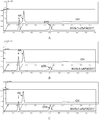
- Figure 4 is a gas phase detection diagram of each omega-3 fatty acid desaturase Saccharomyces cerevisiae transformant
- A is a gas phase detection chart of INVSc 1-oPpFADS17;
- B is a gas phase detection diagram of INVSc 1-oAiFADS17;
- C is a gas phase detection chart of INVSc 1-oPaFADS17;
- Figure 5 is a schematic diagram showing the construction of a binary expression vector pBIG2-ura5s-oPpFADS17;
- Figure 6 is an agarose gel electrophoresis pattern of a recombinant strain of Mortierella alpina which overexpresses the oPpFADS17m gene;
- M is a marker; 1: represents a negative control; 2-6: represents a transformant of 1-5;
- Figure 7 is a graph showing the results of RT-qPCR analysis of the M. alpina wild type strain and the 5 strains of the recombinant M. alpina strain omega-3 fatty acid desaturase gene (oPpFADS17m);
- M. alpina is a wild type control of Mortierella alpina; 1-5 represents a recombinant strain of M. alpina MA-oPpFADS17-1, MA-oPpFADS17-2, MA-oPpFADS17-3, MA-oPpFADS17-4, MA- oPpFADS17-5.
- the present invention relates to the following media:
- the composition of Broth medium was: 20 g/L glucose, 5 g/L yeast extract, 1 g/L potassium dihydrogen phosphate, 0.25 g/L magnesium sulfate heptahydrate, 10 g/L potassium nitrate, and the balance was water, pH 6.0.
- the composition of the MM solid medium according to the present invention is: 1.74 g/L dipotassium hydrogen phosphate, 1.37 g/L potassium dihydrogen phosphate, 0.146 g/L sodium chloride, 0.49 g/L magnesium sulfate heptahydrate, 0.078 g. / L calcium chloride, 0.0025 g / L ferrous sulfate heptahydrate, 0.53 g / L ammonium sulfate, 1.8 g / L glucose, 0.5% glycerol, 20 g / L agar, the balance is water, pH 6.8.
- the IM medium was composed of 200 ⁇ M of acetosyringone (AS) added to the MM medium.
- AS acetosyringone
- SC solid medium composition 20g / L glucose, 5g / L yeast nitrogen source without amino acid and ammonium sulfate, 1.7g / L ammonium sulfate, 60mg / L isoleucine, 60mg / L leucine, 60mg / L benzene Alanine, 50mg/L threonine, 40mg/L lysine, 30mg/L tyrosine, 20mg/L adenine, 20mg/L arginine, 20mg/L histidine, 10mg/L methyl sulfide Amino acid, 20 g/L agar, the balance is water, pH 6.8.
- the SC-CS medium was an SC solid medium supplemented with 100 ⁇ g/mL Spectinomycin and 100 ⁇ g/mL Cefotaxime Sodium.
- SC selection medium 6.7g / L yeast nitrogen source (no amino acid with ammonium sulfate), 20g / L Glucose, 0.1g / L (adenine, arginine, cysteine, leucine, lysine, threonine, tryptophan, respectively), 0.05g / L (aspartic acid, Histidine, isoleucine, methionine, phenylalanine, valine, serine, tyrosine and valine), 20 g/L agar powder.
- GY solid medium composition 20g / L glucose, 10g / L yeast extract, 2g / L potassium nitrate, 1g / L sodium dihydrogen phosphate, 3g / L magnesium sulfate heptahydrate, 20g / L agar, the balance is water , pH 6.8.
- the GY-CS medium was a GY solid medium supplemented with a concentration of 100 ⁇ g/mL spectinomycin and a concentration of 100 ⁇ g/mL cefotaxime antibiotic.
- composition of the SOC resuscitation medium was: 20 g/L peptone, 5 g/L yeast powder, 0.5 g/L sodium chloride, 2.5 mM potassium chloride, 10 mM magnesium chloride, 20 mM glucose.
- composition of the LB solid medium was: 10 g/L peptone, 5 g/L yeast powder, 10 g/L sodium chloride, 20 g/L agar.
- the YPD medium composition was: 10 g/L yeast extract, 20 g/L peptone, 20 g/L glucose. 20 g/L agar was added to the solid medium.
- Example 1 Determination of omega-3 fatty acid desaturase with 20C at room temperature
- omega-3 fatty acid desaturase or simply omega-3 desaturase sequences (genes OPIN 17, sdd 17, PsD 17, PrD 17 and PaD 17) were performed in the NCBI library. Based on sequence similarity and homology analysis, two omega-3 fatty acid desaturase gene sequences with high similarity and closeness to known sequences were screened, which were derived from Phytophthora parasitica and fungal vector silk sac. The corresponding gene numbers of the bacteria are XM_008906963 and XM_008870610, respectively. The NCBI library's annotation of these two sequences belongs to the fatty acid desaturase family, but no detailed comments on its specific functions.
- the coding region sequences of the above two genes were compared with the above five known 20C ⁇ -3 fatty acid desaturase sequences by Clustal W2 software, and the above two were found.
- the segment sequence has three His-box regions similar to the known sequence, that is, the common point of all the omega-3 fatty acid desaturases, and the similar His-box region protein sequences are shown in Table 1.
- Analysis by TMHMM software revealed that the above two sequences have a transmembrane domain similar to the known sequence.
- the nucleic acid is used by Genscript OptimumGeneTM system according to the codon usage preference of eukaryotes.
- the sequence was codon-optimized, and the optimized gene oPpFADS17y (i.e., oPpFADS17 in CN2015109025795), oAiFADS17y (i.e., oAiFADS17 in CN2015109025795) and oPaFADS17 (as a positive control) were artificially synthesized, and the sequence was SEQ ID NO.
- Primers were designed according to the sequence of oPpFADS17y, oAiFADS17y and oPaFADS17, and the enzyme cleavage sites EcoR I and Xho I (underlined) were added to each pair of primers.
- the plasmid pUC57-oPpFADS17, pUC57-oAiFADS17 and pUC57-oPaFADS17 containing the above optimized genes were used as templates, and the target gene fragment was amplified by PCR using KDN high-fidelity polymerase corresponding to each gene-specific primer.
- the PCR program was: 94 ° C for 30 s, 55 ° C for 30 s, 68 ° C for 1.5 min, 30 cycles, 68 ° C for 10 min, and the PCR product was purified, and the purified product was verified by 1.0% agarose gel electrophoresis. The result is shown in Figure 1.
- the primer sequences used to amplify the gene of interest are as follows:
- the restriction endonuclease EcoR I and Xho I double-digested the target gene fragment and the vector pYES2/NT C (written as PYES2/NTC in CN 2015109025795) at 37 °C, and the enzyme digestion system (100 ⁇ L) For: 2 ⁇ L EcoR I, 2 ⁇ L Xho I, 30 ⁇ L of target gene/vector, 10 ⁇ L of cutsmart Buffer, 56 ⁇ L of deionized water, and incubated at 37 ° C for 12 h. The digested product was recovered by gel using a Thermo Scientific GeneJET gel extraction kit, and stored at -20 ° C until use.
- endonuclease buffer 10 ⁇ cutsmart Buffer 500 mM potassium acetate, 200 mM Tris-acetate buffer, 100 mM magnesium acetate, 1000 ⁇ g/mL bovine serum albumin, pH 7.9.
- the purified target genes oPpFADS17y, oAiFADS17y and oPaFADS17 and vector pYES2/NT C were ligated with T4 ligase, and incubated at 4 ° C for 12 h.
- the ligation system was: pYES2/NT C vector (50 ng/ ⁇ L) 1 ⁇ L, gene fragment 75-150 ng, buffer 1 ⁇ L, T4 ligase 1 ⁇ L, hydration to 10 ⁇ L.
- 10 ⁇ ligase buffer 660 mM Tris-HCl buffer (pH 7.6), 66 mM magnesium chloride, 100 mM dithiothreitol, 1 mM adenosine triphosphate.
- the conversion method is as follows:
- the transformed competent cells were transferred to a centrifuge tube containing 1 mL of SOC resuscitation medium, and incubated at 37 ° C, 150 rpm for 1 h.
- a S. cerevisiae INVSc 1 (purchased from Invitrogen, USA) was picked and cloned in 10 mL of YPD medium and cultured overnight at 30 °C. Measure the OD 600 , transfer a certain amount of bacterial solution to 50 mL of the medium to make the OD value of 0.4, and continue to culture for 2-4 h. Centrifuge at 2500 rpm for 3 min and resuspend in 40 mL of 1 x TE. Centrifuge at 2500 rpm for 3 min, resuspend in 2 mL of 1 ⁇ LiAc/0.5X TE, and incubate for 10 min at room temperature.
- 100 ⁇ l of the yeast suspension of the previous step was added to each transformant of Example 2, and 1 ⁇ g of recombinant expression vector plasmid DNA and 100 ⁇ g of salmon sperm DNA were added.
- the vector DNA was subjected to denaturation treatment before each transformation, boiling water for 2 min, ice bath for 2 min, and repeated four times.
- Colonies with good growth conditions were picked from the plate and inoculated into 5 mL of AMPD-resistant YPD medium, cultured at 30 ° C for 200 h at 48 rpm, and the plasmid was extracted with a plasmid extraction kit (purchased from Tiangen) to measure A 260 nm and A 280 nm value, the concentration of the plasmid was calculated and stored at low temperature.
- a plasmid extraction kit purchased from Tiangen
- PCR identification was performed using the corresponding primers.
- the primers are as follows:
- T7 terminator TCGGTTAGAGCGGATGTG
- the PCR reaction system was as follows: dd H 2 O 7 ⁇ L, 10 ⁇ Taq MIX 10 ⁇ L, universal primer T7 1 ⁇ L, universal primer T7 terminator 1 ⁇ L, template (plasmid) 1 ⁇ L.
- PCR reaction conditions 94 ° C for 5 min, 94 ° C for 30 s, 58 ° C for 30 s, 72 ° C for 1.5 min, 30 cycles, 72 ° C for 7 min.
- 3 ⁇ L of the PCR product was subjected to 1 wt% agarose gel electrophoresis to examine the size of the PCR product band, as shown in FIG. 2 .
- each transformant obtains three transformants.
- Recombinant transformants were named INVSc 1-oPpFADS17-1, INVSc 1-oAiFADS17-2 and INVSc1-oPaFADS17-3, respectively, and were deposited in 30 wt% glycerol tubes.
- the PYES2/NTC empty vector in which the gene fragment was not inserted was used as a negative control group.
- a single colony on the S. cerevisiae transformant plate was picked and inoculated into seed medium SC-U, and cultured at 28 ° C for 48 h, and the OD 600 value was measured.
- the medium was transferred to an induction medium to achieve an OD value of 0.4, while a polyunsaturated fatty acid substrate having a different carbon chain length was externally added.
- the cells were cultured at 28 ° C for 48 h.
- the seed medium SC-U is: 6.7g/L yeast nitrogen source (no amino acid with ammonium sulfate), 20g/L glucose, 0.1g/L (adenine, arginine, cysteine, leucine, respectively) Acid, lysine, threonine, tryptophan and uracil, 0.05g/L (aspartic acid, histidine, isoleucine, methionine, phenylalanine, guanidine, respectively) Amino acids, serines, tyrosines and prolines).
- the induction medium was prepared by replacing the carbon source of the seed medium with 10 g/L of raffinose and adding 20 g/L of the inducer galactose.
- RNA integrity 1 ⁇ g of RNA was electrophoresed in 1.2 wt% denaturing gel to observe RNA integrity.
- qRT-PCR primers were designed based on the oPpFADS17y, oAiFADS17y and oPaFADS17 gene sequences and the S. cerevisiae internal reference 18S rDNA sequence:
- RNA 0.5-1 ⁇ g of total RNA was used as a template, and the cDNA of the recombinant strain was obtained by operating according to the kit instructions of PrimeScript RT reagent kit (purchased from TaKaRa Co., Japan).
- PrimeScript RT reagent kit purchased from TaKaRa Co., Japan.
- the RT-qPCR reaction was carried out using an ABI-Prism 7900 sequence detection system (Applied Biosystems, CA) according to the instructions of SYBR Green PCR Master Mix (Applied Biosystems, CA).
- the reaction system was: 10 ⁇ l of SYBR Green PCR Master Mix, 0.5 ⁇ l of each of the upstream and downstream primers of each gene, 8 ⁇ l of enzyme-free water, and 1 ⁇ l of template.
- the PCR cycle was set to 50 ° C for 2 min, 95 ° C for 10 min, 95 ° C for 15 s, 60 ° C for 30 s, 40 cycles.
- the 18S rRNA of Saccharomyces cerevisiae is used as an internal reference gene.
- the total cell protein was extracted by disrupting the cells with 0.5 mm acid-washed glass beads.
- the protein in the protein gel was transferred to a PVDF membrane in a Bio-Rad electrophoresis apparatus. Turn Membrane conditions were 20 mA overnight.
- the PVDF membrane was immersed in TBST buffer and incubated for 10 min at room temperature on a horizontal shaker. repeat three times.
- the PVDF membrane was immersed in TBST buffer containing 5 wt% skim milk and incubated for 90 min at room temperature on a horizontal shaker.
- the PVDF membrane was immersed in TBST buffer and incubated for 10 min at room temperature on a horizontal shaker. repeat three times.
- Anti-His primary antibody was incubated in a 1:5000 ratio in TBST buffer containing 5 wt% skim milk for 1 h on a horizontal shaker.
- the PVDF membrane was immersed in TBST buffer and incubated for 10 min at room temperature on a horizontal shaker. repeat three times.
- the goat anti-mouse secondary antibody was incubated in a ratio of 1:10000 in a TBST buffer containing 5 wt% skim milk at a horizontal shaker for 1 h.
- the PVDF membrane was immersed in TBST buffer and incubated for 10 min at room temperature on a horizontal shaker. repeat three times.
- the PVDF film was developed by the ECL method. Exposure to photographing in a western imager.
- composition of TBST buffer (1 L) was: 8.8 g sodium chloride; 20 mL 1 M Tris-HCl buffer pH 8.0; 0.5 mL Tween 20.
- Example 8 Extraction of fatty acids from Saccharomyces cerevisiae
- the induced cells were collected and vacuum-dried.
- the mixture was thoroughly ground and pulverized, and 10 mg of 1 mL of a 10 wt% hydrochloric acid methanol solution (i.e., methanol containing 10 wt% of HCl) was added, and the internal standard (C15:0, C21:0 each 100 ⁇ l) was shaken and mixed. 60 ° C water bath 3h, shaking every 0.5h.
- a 10 wt% hydrochloric acid methanol solution i.e., methanol containing 10 wt% of HCl
- the liquid in the new bottle was blown dry with N 2 . 1 mL of n-hexane was added, and the lid was screwed and shaken to obtain a fatty acid methyl ester solution.
- the obtained fatty acid methyl ester was analyzed by GC-MS (Shimadzu Co., Japan), and the column was Rtx-Wax (30 m ⁇ 0.25 mm, 0.25 ⁇ m).
- the mass spectrometer was used for detection.
- the vaporization chamber and detector temperatures were 240 ° C and 250 ° C, respectively, and 1 ⁇ L was injected in a split mode.
- the split ratio was 10:1 and the carrier gas was helium.
- the three transformants of INVSc 1-oPpFADS17 had the highest catalytic efficiency for ARA, with INVSc 1-oPpFADS17-3 reaching 64.8%, 49.0%, and 43.8%, respectively, under three concentration gradients, and the positive control INVSc 1-oPaFADS17 at three.
- the catalytic efficiency at the concentration was 69.7%, 48.4%, and 39.5%, and the absolute yield was further superior to the individual transformants of the positive control.
- the INVSc 1-oPpFADS17 transformant of the present invention is required to achieve a comparable catalytic conversion ratio as compared to the recombinant lipolytic yeast described in the prior art ⁇ Identification and characterization of new ⁇ -17 fatty acid desaturases>.
- the substrate ARA concentration in the induction medium was significantly reduced, especially at 0.05 mM, and the EPA yield was further improved, showing better EPA conversion ability.
- the expression vector Saccharomyces cerevisiae used in the present invention contains only ⁇ 9 fatty acid dehydrogenase, that is, only two oleic acid and palmitoleic acid monounsaturated fatty acids in Saccharomyces cerevisiae, compared with the existing recombinant lipolytic yeast.
- the recombinant Saccharomyces cerevisiae of the present invention does not interfere with the polyunsaturated fatty acid synthesis pathway to be utilized, and the recombinant vector of the present invention carries a His tag, which is more advantageous for purification and identification of subsequent proteins.
- the omega-3 fatty acid desaturase gene (oAiFADS17y) sequence from the fungal vector, M. sphaeroides has a high similarity to the omega-3 fatty acid desaturase gene (oPpFADS17y) sequence from Phytophthora parasitica.
- the catalytic efficiency of the transformant INVSc 1-oAiFADS17 from Fungal Vectors was relatively low, 46.3%, 33.5%, 23.9%, respectively.
- the fatty acid assay results from Table 4 show that the conversion rates of different recombinant strains are reduced at low temperatures.
- the recombinant S. cerevisiae capable of expressing the parasitic Phytophthora omega-3 fatty acid desaturase in the present invention has a significantly higher recombinant S. cerevisiae at a lower temperature than the omega-3 fatty acid desaturase capable of expressing the fungal vector.
- the EPA conversion and EPA production are also superior to the EPA conversion and EPA production of recombinant S. cerevisiae capable of expressing the omega-3 fatty acid desaturase of Pythium.
- the omega-3 fatty acid desaturase from Phytophthora parasitica was optimized according to the characteristics of Mortierella alpina, and the artificially optimized gene sequence oPpFADS17m (as shown in SEQ ID No. 5) was ligated to the pUC57 vector to obtain pUC57-oPpFADS17. (Writing PUC57-oPpFADS17 in CN201610184669.X).
- the plasmid pUC57-oPpFADS17 and the vector pBIG2-ura5s-ITs were digested with restriction endonuclease Hind III overnight at 37 °C.
- the Hind III digestion system 100 ⁇ L was: 2 ⁇ L Hind III-HF, 30 ⁇ L plasmid or
- the vector pBIG2-ura5s-Its is directly obtained according to the Chinese patent application CN201310524221.4.
- the HPH expression unit was obtained from the pD4 plasmid by PCR, and the HPH expression unit was digested with the restriction enzymes EcoR I and Xba I, and inserted into the multiple cloning position of EcoR I and Xba I digested pET28a (+). In the spot (MCS), plasmid pET28a-HPHs was obtained.
- the ura5 (orotic acid phosphoribosyltransferase; OPRTase) gene was obtained from the M. alpina cDNA by PCR, and the ura5 gene was digested with restriction endonucleases BspH I and BamH I to insert the ura5 gene.
- the plasmid pET28a-ura5s was constructed by replacing the hpt gene with the plasmid pET28a-HPHs digested with Nco I and BamH I.
- the ura5s expression unit was obtained by digesting the plasmid pET28a-ura5s with the restriction enzymes EcoR I and Xba I.
- the ura5s expression unit was replaced with the HPH expression unit in plasmid pBIG2RHPH2, and the plasmid transformation plasmid pBIG2-ura5s was further constructed. Further, based on the plasmid pBIG2-ura5s and the plasmid pET28a-HPHs, a universal vector for the manipulation of the M.
- alpina gene was constructed.
- a non-coding intron DNA fragment IT was obtained from the M. alpina genome by PCR.
- the IT gene fragment and plasmid pET28a-HPHs were digested with restriction endonucleases NcoI and BamHI, respectively, and the IT fragment was substituted for the hpt gene of plasmid pET28a-HPHs by ligation reaction to obtain plasmid pET28a-ITs.
- the plasmid pET28a-ITs was digested with restriction endonucleases Spe I and Xba I to obtain ITs expression units.
- the ITs expression unit was inserted into the Xba I-digested plasmid pBIG2-ura5s to obtain the M. alpina gene manipulation universal vector pBIG2-ura5s-ITs.
- the digested product was recovered, and further digested with restriction endonuclease Xho I, and the target gene was purified by gel-cutting purification (the omega-3 fatty acid desaturase gene fragment oPpFADS17m from Parasitic Phytophthora, optimized for Mortierella alpina, The oPpFADS17) and vector pBIG2-ura5s-ITs fragments were written in CN 201610184669X.
- the enzyme digestion system is (100 ⁇ L): 2 ⁇ L of Xho I, 30 ⁇ L of plasmid or vector pBIG2-ura5s-ITs fragment, 10 ⁇ L of cutsmart Buffer, 58 ⁇ L of deionized water, and digested with a 37 ° C water bath for 12 h.
- Cutsmart buffer 50 mM acetic acid, 20 mM Tris-acetic acid, 10 M magnesium acetate, 100 ⁇ g/mL bovine serum albumin, pH 7.9.
- the o ⁇ -3 fatty acid desaturase gene fragment oPpFADS17m was digested with the vector pBIG2-ura5s-ITs by T4 ligase, and ligated at 4 ° C for 12 h to obtain a recombinant expression vector pBIG2-ura5s-oPpFADS17.
- the ligation system was (10 ⁇ L): 2 ⁇ L of the target gene was digested, 3 ⁇ L of the vector was cleaved, 1 ⁇ L of ligase buffer, 1 ⁇ L of T4 ligase, 3 ⁇ L of sterile water, and ligated at 4 ° C for 12 h.
- the ligation product was transformed into E. coli TOP10 competent cells, and the transformation method was as follows:
- the binary expression vector pBIG2-ura5s-oPpFADS17 was electroporated to transform Agrobacterium tumefaciens by the method of transforming E. coli TOP10. Get plasmid Agrobacterium tumefaciens C58C1 of pBIG2-ura5s-oPpFADS17.
- Example 11 Agrobacterium tumefaciens-mediated transformation of Mortierella alpina
- Agrobacterium tumefaciens C58C1 containing plasmid pBIG2-ura5s-oPpFADS17 stored at -80 °C was streaked on a YEP solid medium plate containing 100 ⁇ g/mL rifampicin and 100 ⁇ g/mL kanamycin. Incubate at 28 ° C for 48 h in the dark.
- the cells were collected by centrifugation at 4000 ⁇ g for 5 min, and the supernatant was discarded.
- the cells were resuspended in 5 mL of IM medium, centrifuged at 4000 x g for 5 min, and the supernatant was discarded.
- the cells were resuspended by adding 2 mL of IM medium.
- the bacterial concentration was adjusted with IM medium to an OD 600 of 0.3.
- the cells were incubated at 28 ° C, shaking at 200 rpm in the dark to an OD 600 to 1.0.
- the spores were collected by culturing 500 ⁇ L of sterilized physiological saline on the GY-U slant surface for more than one month, and the spores were collected by the uridine auxotrophic strain CCFM501 (i.e., the uracil auxotrophic strain MAU1 disclosed in CN201310347934.8). Count with a hemocytometer and adjust the spore concentration to 10 7 per 100 ⁇ L.
- SC-CS SC plate
- Example 12 Screening and identification of engineered strains of Mortierella alpina overexpressing oPpFADS17m
- the stable genetic strain was identified as a recombinant H. albicans strain heterologously expressing the oPpFADS17m gene, deposited on the GY slope;
- Fig. 6 M is a marker; Lane 1 is a negative control; and Lanes 2-6 are MA-oPpFADS17 recombinant strains No. 1-5.
- the results showed that two positive transformants could amplify two product bands of 818 bp and 1086 bp, respectively.
- the electrophoresis results indicated that the transformants of 1-5 were binary expression vectors successfully integrated into the M. alpina genome. Positive transformants.
- RNA integrity 1 ⁇ g of RNA was electrophoresed in 1.2 vol% denaturing gel to observe RNA integrity.
- RNA samples 0.5-1 ⁇ g of cDNA was used as a template, and RT-qPCR reaction was carried out in accordance with the instructions of iTaq Universal SYBR Green Supermix using Bio-Rad CFX ConnectTM system.
- the reaction system was: 8 ⁇ L of enzyme-free water, 10 ⁇ L of iTaq Universal SYBR Green Supermix, 0.5 ⁇ L of q-oPpFADS17m F, 0.5 ⁇ L of q-oPpFADS17-m R, 1 ⁇ L of template, and a total volume of 20 ⁇ L.
- the PCR cycle was set to 50 ° C for 2 min, 95 ° C for 10 min, 95 ° C for 15 s, 60 ° C for 30 s, 30 cycles.
- the 18S rRNA of Mortierella alpina was used as an internal reference gene, and each transformant was taken in three parallels.
- the wild type control ⁇ -3 fatty acid desaturase gene (oPpFADS17m) was not transcribed, while the transcription rate of 5 genetically engineered ⁇ -3 fatty acid desaturase genes (oPpFADS17m) was significant. improve.
- the Agrobacterium-mediated method enables the exogenous omega-3 fatty acid desaturase gene (oPpFADS17m from Pseudomonas aeruginosa optimized for Mortierella alpina) to be transcribed and expressed in M. alpina.
- Example 15 Positive transformant fatty acid extraction
- the M. alpina prototrophic strain and the M. alpina overexpressing oPpFADS17m engineering strain obtained by screening in Example 3 were inoculated into Broth medium, and cultured at 28 ° C, shaking at 200 rpm for 7 days.
- Example 16 Positive transformant fatty acid detection
- fatty acid composition and content 1 Add 100 ⁇ L of 2.02 mg/mL internal standard C15:0 and 1 mL of 10% by weight hydrochloric acid methanol to the above crude fat, and shake at 60 ° C for 3 h, shake for 1 min every 30 min; 2 after cooling to room temperature Add 1 mL of n-hexane and 1 mL of saturated sodium chloride solution, mix by shaking, centrifuge at 3000 ⁇ g for 3 min, aspirate the n-hexane layer, add 1 mL of n-hexane, mix by shaking, centrifuge at 3000 ⁇ g for 3 min, aspirate and combine n-hexane; After drying under nitrogen, add 1 mL of n-hexane, mix and transfer to a gas phase bottle to obtain a fatty acid methyl ester solution; 4 fatty acid methyl ester analysis using GC-2010 (Shimadzu Co., Japan), and the column is DB-Waxe
- the hydrogen flame ion detector detects that the vaporization chamber and the detector temperature are 240 ° C and 260 ° C, respectively, and the injection method is 1 ⁇ L, the split ratio is 10:1, and the carrier gas is nitrogen. Temperature programmed: initial temperature 120 ° C Hold for 3 min, raise to 190 ° C at 5 ° C / min, and then rise to 220 ° C at 4 ° C / min for 20 min.
- Qualitative and quantitative analysis of fatty acid components in samples by mass comparison with commercial fatty acid methyl ester standards (mixed with 37 fatty acid methyl esters, Supelco, USA) and internal standard C15:0, with total fatty acid content in units The quality of the total fatty acids in the cells.
- Table 5 compares the fatty acid yields of Mortierella alpina strains with wild-type (prototrophic) strains of Mortierella alpina and five strains of the oPpFADS17m gene expressing Phytophthora parasitica.
- Table 6 shows the expression of wild-type strains and five strains of Mortierella alpina. Comparison of the fatty acid composition of the Mortierella alpina strain of the oPpFADS17m gene of Phytophthora parasitica. From the results of Tables 5 and 6, it can be seen that there is no significant difference in the biomass of the five genetically engineered strains and the wild-type strains, but the fatty acid composition has changed significantly.
- the yield of AA (C20:4) in the five recombinant strains was reduced to a different extent than that of the wild type, and a large amount of EPA (C20:5) was produced, and the yield reduction of AA and the increase of EPA had obvious regularity.
- the yields of various fatty acids (C16:0, C18:0, C18:1, C18:2, C18:3) did not change significantly, indicating that the five recombinant strains can catalyze AA to EPA to varying degrees.
- the remaining four recombinant strains (MA-oPpFADS 17-1, 2, 3, and 5) also showed varying degrees of increase in EPA production to distinguish significantly from wild-type strains.
- the effect of MA-oPpFADS17-4 was the most obvious, and it was unexpectedly compared with other MA-oPpFADS17 transformants. High, also significantly higher than other prior art records.
- oPpFADS17m omega-3 fatty acid desaturase gene
- the improvement is superior to other recombinant strains obtained by the same method, and is also significantly higher than other known EPA yields obtained by the normal temperature culture process of the recombinant H. albicans overexpressing the omega-3 fatty acid desaturase gene.
- the genetic engineering strains and construction methods constructed by this method laid the theoretical and application basis for the subsequent industrialization.
- omega-3 fatty acid desaturase obtained by the present invention can catalyze both 18C and 20C polyunsaturated fatty acids, but prefers to convert 20C ARA into EPA, and the conversion efficiency is obviously high at normal temperature.
- the efficiency of synthesizing omega-3 PUFAs is further superior to the prior art. Using this gene to construct genetically engineered strains for subsequent industrial production EPA and DHA laid the foundation for application.
Landscapes
- Life Sciences & Earth Sciences (AREA)
- Health & Medical Sciences (AREA)
- Chemical & Material Sciences (AREA)
- Engineering & Computer Science (AREA)
- Genetics & Genomics (AREA)
- Organic Chemistry (AREA)
- Wood Science & Technology (AREA)
- Zoology (AREA)
- Biotechnology (AREA)
- Bioinformatics & Cheminformatics (AREA)
- General Engineering & Computer Science (AREA)
- Biomedical Technology (AREA)
- General Health & Medical Sciences (AREA)
- Microbiology (AREA)
- Biochemistry (AREA)
- Molecular Biology (AREA)
- Oil, Petroleum & Natural Gas (AREA)
- Mycology (AREA)
- Physics & Mathematics (AREA)
- Biophysics (AREA)
- Plant Pathology (AREA)
- Medicinal Chemistry (AREA)
- Chemical Kinetics & Catalysis (AREA)
- General Chemical & Material Sciences (AREA)
- Cell Biology (AREA)
- Virology (AREA)
- Tropical Medicine & Parasitology (AREA)
- Botany (AREA)
- Nutrition Science (AREA)
- Micro-Organisms Or Cultivation Processes Thereof (AREA)
- Preparation Of Compounds By Using Micro-Organisms (AREA)
Abstract
如SEQ ID NO.3的编码寄生疫霉ω-3脂肪酸脱饱和酶的重组核酸序列、含所述ω-3脂肪酸脱饱和酶的载体、含有所述载体的重组酿酒酵母和重组高山被孢霉,所述重组工程菌株的构建方法。所述重组酿酒酵母在多不饱和脂肪酸生物合成中的用途,其在常温下能够将C20:4 Δ5,8,11,14催化为C20:5 Δ5,8,11,14,17,催化效率达到65%。所述重组高山被孢霉发酵产物中的EPA含量达到脂肪酸总量的31.5%。
Description
本发明请求申请日为2015年12月9日、申请号为2015109025795的中国发明专利申请,及申请日为2016年3月28日、申请号为201610184669X的中国发明专利申请为优先权。
本发明属于生物工程技术领域,涉及利用微生物合成多不饱和脂肪酸,具体涉及一种用于合成多不饱和脂肪酸的ω-3脂肪酸脱饱和酶、含所述ω-3脂肪酸脱饱和酶的载体、含有所述载体的重组微生物及其应用。
长链多不饱和脂肪酸(LC-PUFAs)是指含有20个或20个以上碳原子的多不饱和脂肪酸,按照第一个双键距离C端的位置可以分为ω-6和ω-3两类。ω-3LC-PUFAs在人体内无法自行合成,需要从饮食中获取,属于必需脂肪酸,如EPA和DHA。研究发现,以EPA和DHA为代表的ω-3LC-PUFAs可以作为合成某些激素的前体物质,具有多重生理功能和潜在的药用价值。迄今为止,ω-3LC-PUFAs的来源以深海鱼类为主,然而从中提取的LC-PUFAs却存在稳定性差、纯化工艺复杂、易氧化等缺点。近年来,微生物作为一种新的LC-PUFAs来源正受到越来越广泛的关注:海洋藻类通过自养、异养和混合营养的方式生长,生长周期短,是EPA和DHA的初级生产者,也是ω-3LC-PUFAs最有潜力的来源之一;酵母菌、霉菌等研究成本低、适合大规模生产且遗传背景明细,拥有生产多种LC-PUFAs的潜力。随着分子生物学和生物技术的飞速发展,人们将越来越多的目光投向了产油真菌,以期通过基因工程改造菌体脂肪酸合成路径来生产
EPA、DHA,但由于效率低下等原因,至今仍未实现商业化。
自然界中ω-3LC-PUFAs通常由LA和ALA起始合成,经过一系列去饱和酶和延长酶催化,最终形成EPA和DHA。其中,ω-3脂肪酸脱饱和酶是ω-3LC-PUFAs合成过程中的关键酶之一,具有三个富含组氨酸的结构域,能将ω-6多不饱和脂肪酸如LA(C18:2)、GLA(C18:3)、DGLA(C20:3)和ARA(Arachidonic acid,C20:4,或写为AA)分别催化生成对应的ω-3多不饱和脂肪酸ALA(C18:3)、SDA(C18:4)、ETA(C20:4)和EPA(C20:5)。
研究发现,不同来源的ω-3脂肪酸脱饱和酶对不同碳链长度的脂肪酸具有不同的催化效率。目前,已知的来源于藻类和植物的ω-3脂肪酸脱饱和酶只能催化18C的ω-6多不饱和脂肪酸如LA和GLA。而来源于秀丽隐杆线虫的ω-3脂肪酸脱饱和酶FAT 1则能同时以18C和20C的多不饱和脂肪酸为底物,但其中对20C底物的催化活性很低。随后,Pereira等人发现来源于异枝水霉的ω-3脂肪酸脂肪酸脱饱和酶sdd17对18C的多不饱和脂肪酸没有催化活性,却能将20C的ARA催化为EPA,转化率为25.9%。同样的,来源于致病疫霉的ω-3脂肪酸脱饱和酶OPIN 17也不能以18C的多不饱和脂肪酸为底物,但是对ARA的转化率达到了30.94%。
近年来,Xue等人从瓜果腐霉、大豆疫霉菌、栎树猝死病菌中分离出三种ω-3脂肪酸脱饱和酶——PaD 17、PsD 17和PrD 17并在重组解脂酵母菌中实现异源表达(Identification and characterization of new Δ-17 fatty acid desaturases,Appl Microbiol Biotechnol(2013)97:1973–1985)。这三种酶既能催化18C又能催化20C的多不饱和脂肪酸,但偏好催化20C底物ARA。通过对这些偏好催化20C脂肪酸脱饱和酶的进一步研究发现,其在常温下对ARA有较高的转化率,实现了常温下生物积累EPA。这一类偏好以20Cω-6LC-PUFAs为底物催化合成ω-3LC-PUFAs的脂肪酸脱饱和酶可以直接、高效地催化
ARA生成EPA,为通过延长酶催化合成DHA提供了底物,对于生物合成法生产ω-3LC-PUFAs具有十分重要的意义。为了提高生产效率,筛选此种高效催化ARA合成EPA的脂肪酸脱饱和酶显得尤为重要。这将为构建高产ω-3LC-PUFAs的工程菌,常温发酵生产EPA、DHA,打下坚实的基础。
另一方面,高山被孢霉(Mortierella alpina)是一种脂质积累可以达到细胞干重50%的产油真菌,是脂质生物化学基础研究的重要模式生物。高山被孢霉已经被应用于工业化生产花生四烯酸(Arachidonic acid,AA,C20:4),其生产的食用油脂已经通过美国食品药品监督管理局(FDA)的安全性评估。除了合成AA之外,高山被孢霉也具有一定的合成二十碳五烯酸(Eicosapentanoic acid,EPA,C20:5)的能力。EPA属于ω-3长链多不饱和脂肪酸(LC-PUFAs),具有重要的生理功能,如:促进哺乳动物大脑发育以及神经组织形成和修复的能力,预防哮喘、癌症、抑郁、肥胖、免疫紊乱以及心血管疾病等。但是人体自身不能合成这些脂肪酸,需要从富含ω-3LC-PUFAs的食物(如深海鱼油)中摄取。由于大肆捕捞和环境污染破坏,深海鱼类提供的ω-3LC-PUFAs已无法满足日益增长的市场需求,所以利用微生物生产ω-3LCPUFAs已经成为当前的研究热点。
然而,获得具有更优秀的EPA产率的产油真菌特别是高山被孢霉依然是本领域技术人员的期望。
【发明内容】
本发明的目的是利用生物信息学的方法,获得一些常温偏好20C的ω-3脂肪酸脱饱和酶(或简称ω-3脱饱和酶),通过构建重组酵母菌和高山被孢霉,对每一种ω-3脂肪酸脱饱和酶催化ARA生成EPA的能力进行了鉴定,以获得最具有重要应用潜力的高效催化20Cω-6LC-PUFAs合成ω-3LC-PUFAs的脂肪酸脱饱和酶。
本发明的思路是将5种已知的常温偏好20C的ω-3脂肪酸脱饱和
酶序列进行比对,根据序列相似度及同源性分析,筛选出与已知序列相似度高、亲缘性近的来自寄生疫霉的基因序列如SEQ ID NO.1和来自真菌媒介丝囊菌的基因序列SEQ ID NO.7。利用Clustal W2软件将其氨基酸序列与多种已知的常温偏好20C的ω-3脂肪酸脱饱和酶序列进行比对,发现天然的来自寄生疫霉的基因序列如SEQ ID NO.1和来自真菌媒介丝囊菌的基因序列SEQ ID NO.7拥有与已知序列相似的3个His-box区。通过TMHMM软件分析结果显示所选序列具有与已知序列相似的跨膜域,随后进行活性验证。
进一步,本发明利用全基因合成技术构建了两段针对酿酒酵母经过优化的ω-3脂肪酸脱饱和酶序列:如SEQ ID NO.3的oPpFADS17y(即CN 2015109025795中的oPpFADS17,其序列区别于CN201610184669X中的针对高山被孢霉进行优化的ω-3脂肪酸脱饱和酶oPpFADS17,在本发明中分别增加后缀“y”或“m”以示区别)和如SEQ ID NO.9的oAiFADS17y(同理,即CN 2015109025795中的oAiFADS17,其序列区别于CN 201610184669X中的针对高山被孢霉进行优化的oAiFADS17,在本发明中分别增加后缀“y”或“m”以示区别)。使用PCR技术扩增出目的基因片段,插入pYES 2/NT C(在CN 2015109025795中写作PYES 2/NT C)表达载体得到pYES2/NT C-oPpFADS17(在CN 2015109025795中写作PYES2/NT C-oPpFADS17)和pYES2/NT C-oAiFADS17(在CN 2015109025795中写作PYES2/NT C-oAiFADS17)并完成测序验证,进而用化学法转化入酿酒酵母INVSc 1,得到的重组酿酒酵母菌株能顺利表达两段基因编码的蛋白。最后通过外源添加不同碳链长度的多不饱和脂肪酸底物进行活性验证,确定筛选的oPpFADS17y、oAiFADS17y序列具有ω-3脂肪酸脱饱和酶活性。
本发明提供具有特异性催化20C能力的ω-3脂肪酸脱饱和酶的编码序列,其核酸序列分别如SEQ ID NO.3和SEQ ID NO.9。
本发明还提供分别含有SEQ ID NO.3和SEQ ID NO.9核酸序列的表达载体pUC57-oPpFADS17和pUC57-oAiFADS17,能够分别表达寄生疫霉和真菌媒介丝囊菌的ω-3脂肪酸脱饱和酶。
本发明还提供能够分别表达寄生疫霉和真菌媒介丝囊菌的ω-3脂肪酸脱饱和酶的重组微生物。优选地,所述重组微生物是酿酒酵母。
本发明成功表达了来源于寄生疫霉和真菌媒介丝囊菌、在多不饱和脂肪酸生物合成途径中起关键作用的ω-3脂肪酸脱饱和酶oPpFADS17和oAiFADS17,其氨基酸序列分别如SEQ ID NO.4和SEQ ID NO.10。
本发明还涉及上述ω-3脂肪酸脱饱和酶oPpFADS17y(即CN2015109025795中的oPpFADS17)和oAiFADS17y(即CN2015109025795中的oAiFADS17)在多不饱和脂肪酸生物合成中的用途,特别是在常温下将C20:4Δ5,8,11,14催化为C20:5Δ5,8,11,14,17。
本发明通过实验方法获得两种ω-3脂肪酸脱饱和酶既能催化18C又能催化20C的多不饱和脂肪酸,但偏好于将20C的ARA转化为EPA,催化效率达到65%。用此基因构建基因工程菌株为后续工业化生产EPA、DHA奠定了应用基础。
此外,本发明还提供一株能在常温环境下高产EPA的重组高山被孢霉工程菌株,借助根瘤土壤杆菌介导的方法、通过过表达ω-3脂肪酸脱饱和酶oPpFADS17m(即CN 201610184669X中的oPpFADS17,其序列区别于CN 2015109025795中的oPpFADS17,故在本发明中增加后缀“m”以示区别)基因得到一株重组高山被孢霉,还涉及将所述重组高山被孢霉工程菌株用于工业生产脂肪酸、特别是生产EPA。
经过上述研究,申请人期望验证在高山被孢霉中过表达来源于寄生疫霉的ω-3脂肪酸脱饱和酶能够提高高山被孢霉的EPA产量,并期望从中获得一株产量突出的工程菌株。
为此,本发明将针对高山被孢霉经过优化的来自于寄生疫霉的oPpFADS17m转化入高山被孢霉尿嘧啶营养缺陷型菌株,构建一株常
温下EPA产量更高的高山被孢霉。
具体地,本发明提供一株过表达来源于寄生疫霉的ω-3脂肪酸脱饱和酶oPpFADS17m(即CN 201610184669X中的oPpFADS17)基因的重组高山被孢霉(Mortierella alpina)MA-oPpFADS17-4,该菌株于2016年1月18日保藏于中国微生物菌种保藏管理委员会普通微生物中心,地址北京市朝阳区北辰西路1号院3号,中国科学院微生物研究所,保藏编号为CGMCC No.11820。
在本发明中,所述ω-3脂肪酸脱饱和酶oPpFADS17m基因是针对高山被孢霉经过优化的来源于寄生疫霉的ω-3脂肪酸脱饱和酶基因,其核酸序列如SEQ ID NO.5(Genbank accession No:KT372001)所示,其氨基酸序列如SEQ ID NO.6所示。
在本发明中,所述高山被孢霉菌株是用含有ω-3脂肪酸脱饱和酶oPpFADS17m基因的重组质粒pBIG2-ura5s-oPpFADS17转化根瘤土壤杆菌后,再以含转化质粒pBIG2-ura5s-oPpFADS17的根瘤土壤杆菌转化高山被孢霉尿嘧啶营养缺陷型菌株构建而成的。
根据一种优选的实施方式,所述高山被孢霉尿嘧啶营养缺陷型菌株是一株使高山被孢霉ATCC32222基因组中编码乳清酸磷酸核糖转移酶OPRTase的ura5基因失活的高山被孢霉菌株。更优选地,所述高山被孢霉尿嘧啶营养缺陷型菌株是中国发明专利申请CN201310347934.8中公开的高山被孢霉MAU1,该菌株于2013年11月01日保藏于中国微生物菌种保藏管理委员会普通微生物中心,保藏编号为CGMCC No.8414。该菌株也保存于江南大学的实验室,被命名为CCFM501。
为了获得上述重组高山被孢霉,本发明还提供所述菌株的构建方法,包括以下步骤:
a)根据天然的来源于寄生疫霉的ω-3脂肪酸脱饱和酶序列(Genbank accession No:XM_008906963),根据高山被孢霉密码子使用偏好性,人工合成优化后的ω-3脂肪酸脱饱和酶基因oPpFADS17m(即CN 201610184669.X中的
oPpFADS17),如SEQ ID NO.5(Genbank accession No:KT372001)所示;
b)构建重组质粒pBIG2-ura5s-oPpFADS17;
c)用构建获得的重组质粒pBIG2-ura5s-oPpFADS17转化根瘤土壤杆菌;
d)用含重组质粒pBIG2-ura5s-oPpFADS17的根瘤土壤杆菌转化高山被孢霉尿嘧啶营养缺陷型菌株;
e)筛选鉴定转化菌株,获得一株特别高产EPA的过表达ω-3脂肪酸脱饱和酶oPpFADS17m基因的重组高山被孢霉菌株MA-oPpFADS17-4。
其中,步骤c)的根瘤土壤杆菌为根瘤土壤杆菌(Agrobacterium tumefaciens)C58C1。
步骤d)的高山被孢霉尿嘧啶营养缺陷型菌株是重组高山被孢霉MAU1(CGMCC No.8414),或按照江南大学的实验室的命名称为CCFM501。
其中,步骤e)中筛选鉴定转化菌株的方法包括以下步骤:
1)用3mL生理盐水冲刷GY表面,收集液体于一个无菌1.5mL离心管中,过25μm滤膜;
2)用血球计数器计数,调整为三种孢子浓度梯度108个每100μL、106个每100μL、104个每100μL,各取200μL涂布于含有100μg/mL壮观霉素,100μg/mL头孢噻肟的GY-CS平板上,25℃避光培养2-3d;
3)随时用无菌镊子挑出生长的真菌菌丝于含有100μg/mL壮观霉素,100μg/mL头孢噻肟的SC-CS平板上,25℃培养2-3d;
4)观察高山被孢霉在平板上的生长情况,挑出在SC-CS平板上生长的菌丝接种于GY斜面上;
5)将上述步骤4)中平板上的高山被孢霉菌株孢子在GY斜面上传代三次;
6)将稳定遗传的菌株鉴定为过表达ω-3脂肪酸脱饱和酶
oPpFADS17m基因的重组高山被孢霉菌株,保藏于GY斜面上;
7)提取含有ω-3脂肪酸脱饱和酶oPpFADS17m基因的重组高山被孢霉菌株的基因组DNA,设计一对与启动子和终止子特异性结合的引物进行PCR验证:
P1(sense):CACACACAAACCTCTCTCCCACT
P2(antisense):CAAATGAACGTATCTTATCGAGATCC;
8)所述重组菌株保藏于GY斜面上。
本发明还提供上述重组高山被孢霉菌株或根据上述方法得到的重组高山被孢霉在生产脂肪酸、特别是EPA中的用途。
在本发明中,重组质粒pBIG2-ura5s-oPpFADS17的构建可参考中国专利申请CN201310524221.4中公开的内容。根据该申请的记载,首先用PCR的方法从pD4质粒上获得HPH表达单元,将HPH表达单元用限制性内切酶EcoR I和Xba I酶切,插入到EcoR I和Xba I酶切过的pET28a(+)的多克隆位点(MCS)中,得到质粒pET28a-HPHs。利用PCR从高山被孢霉cDNA中获得ura5(乳清酸磷酸核糖转移酶;OPRTase)基因,并利用限制性内切酶BspH I和BamH I酶切ura5基因,将酶切过的ura5基因插入到Nco I和BamH I酶切过的质粒pET28a-HPHs中,以替换hpt基因,构建质粒pET28a-ura5s。用限制性内切酶EcoR I和Xba I酶切质粒pET28a-ura5s得到ura5s表达单元。将ura5s表达单元替换质粒pBIG2RHPH2中的HPH表达单元,进一步构建质粒转化质粒pBIG2-ura5s。更进一步地在质粒pBIG2-ura5s和质粒pET28a-HPHs的基础上,构建高山被孢霉基因操作通用载体。用PCR的方法从高山被孢霉基因组中获得非编码的内含子DNA片段IT。用限制性内切酶Nco I和BamH I分别对IT基因片段和质粒pET28a-HPHs进行酶切,并通过连接反应将IT片段取代质粒pET28a-HPHs的hpt基因,得到质粒pET28a-ITs。用限制性内切酶Spe I和Xba I双酶切质粒pET28a-ITs得到ITs表达单元。将ITs表达单元插入到Xba I酶切过的质粒pBIG2-ura5s中,得到高山被孢霉基因操作通用载体pBIG2-ura5s-ITs。然后通过基因工程技术
将ω-3脂肪酸脱饱和酶基因插入高山被孢霉通用载体pBIG2-ura5s-ITs中,构建二元表达载体pBIG2-ura5s-oPpFADS17。
在本发明中,所述高山被孢霉尿嘧啶营养缺陷型菌株是已公开的重组高山被孢霉MAU1(CCFM501),其保藏编号为CGMCC No.8414,该菌株已在中国专利申请CN 201310347934.8中公开。
根据CN 201310347934.8说明书记载,重组高山被孢霉CCFM501是通过失活高山被孢霉ATCC32222基因组中编码乳清酸磷酸核糖转移酶OPRTase的ura5基因构建而成的。其中,ura5基因的失活是通过缺失654bp的ura5基因中的213bp-230bp共18bp的序列而实现的,所使用的同源臂分别是ura5基因上游-1180至+212的1393bp和下游+231至+1592的1362bp的片段,具体步骤为:首先获得ura5敲除基因片段,并进一步构建敲除质粒pBIG4KOura5,然后用重组质粒pBIG4KOura5转化根癌农杆菌,最后用经转化的含质粒pBIG4KOura5的根癌土壤杆菌转化高山被孢霉并对转化后的高山被孢霉进行筛选和鉴定,获得尿嘧啶营养缺陷型高山被孢霉MAU1(CCFM501)菌株。
在本发明中,应用于转化高山被孢霉的根瘤土壤杆菌为:根瘤土壤杆菌Agrobacterium tumefaciens C58C1(Tsuji G,Fujii S,FujiharaN,et al.Agrobacterium tumefaciens-mediated transformation for random insertional mutagenesis in Colletotrichum lagenarium[J].Journal of General Plant Pathology,2003,69(4):230-239.),为本领域技术人员可以公开获得的菌株,在某些文献中,它也可能被称为根癌农杆菌。
本发明在现有的高山被孢霉转化系统的基础上,采用根瘤土壤杆菌介导的基因转化方法,构建了在高山被孢霉中过表达来源于寄生疫霉的ω-3脂肪酸脱饱和酶基因oPpFADS17m的高山被孢霉菌株。获得的重组高山被孢霉经过多次传代,经鉴定oPpFADS17m片段仍稳定存在基因组中,且菌株的生长特性与原养型菌株无明显差别,但重组菌的EPA产量达到总脂肪酸的31.5%,对AA的转化率高达77.6%,而原始菌株几乎检测不到EPA,较其他异源表达ω-3脂肪酸脱饱和酶基
因的重组高山被孢霉、甚至在先申请记载的过表达来源于瓜果腐霉的ω-3脂肪酸脱饱和酶基因的高山被孢霉MA-oPaFADS17-3菌株在EPA产量上均得到了显著提高,进一步推动了产油真菌产业进步和EPA的工业化生产。
本发明的重组高山被孢霉菌株MA-oPpFADS17-4于2016年1月18日保藏于中国微生物菌种保藏管理委员会普通微生物中心,地址北京市朝阳区北辰西路1号院3号,中国科学院微生物研究所,保藏编号为CGMCC No.11820。
图1为PCR扩增的目的基因片段图;
其中M为核酸Marker;泳道1为oPaFADS17基因片段(1080bp);泳道2为oPpFADS17y基因片段(1086bp);泳道3为oAiFADS17y基因片段(1095bp);
图2为酿酒酵母重组转化子PCR鉴定的琼脂糖凝胶电泳图;
其中M为核酸Marker;泳道1为含空质粒的载体;泳道2-4为INVSc 1-oPaFADS17的1、2、3号转化子;泳道5-7为INVSc1-oPpFADS17的1、2、3号转化子;泳道8-10为INVSc 1-oAiFADS17的1、2、3号转化子;
图3为各ω-3脂肪酸脱饱和酶酿酒酵母转化子的转录水平;1为含空质粒的载体;2-4为INVSc 1-oPpFADS17的1、2、3号转化子;5-7为INVSc 1-oAiFADS17的1、2、3号转化子;8-10为INVSc1-oPaFADS17的1、2、3号转化子;
图4为各ω-3脂肪酸脱饱和酶酿酒酵母转化子气相检测图;
A为INVSc 1-oPpFADS17气相检测图;
B为INVSc 1-oAiFADS17气相检测图;
C为INVSc 1-oPaFADS17气相检测图;
图5为二元表达载体pBIG2-ura5s-oPpFADS17的构建示意图;
图6为过表达oPpFADS17m基因的高山被孢霉重组菌株鉴定的琼脂糖凝胶电泳图;
其中,M为marker;1:代表阴性对照;2-6:代表1-5号转化子;
图7为高山被孢霉野生型菌株与5株重组高山被孢霉菌株ω-3脂肪酸脱饱和酶基因(oPpFADS17m)RT-qPCR的结果分析图;
其中,M.alpina为高山被孢霉野生型对照;1-5代表重组高山被孢霉菌株MA-oPpFADS17-1,MA-oPpFADS17-2,MA-oPpFADS17-3,MA-oPpFADS17-4,MA-oPpFADS17-5。
以下实施例用于非限制性地解释本发明的技术方案。
本发明所涉及以下培养基:
Broth培养基的组成为:20g/L葡萄糖,5g/L酵母提取物,1g/L磷酸二氢钾,0.25g/L七水硫酸镁,10g/L硝酸钾,余量为水,pH 6.0。
本发明所涉及的MM固体培养基的组成为:1.74g/L磷酸氢二钾,1.37g/L磷酸二氢钾,0.146g/L氯化钠,0.49g/L七水硫酸镁,0.078g/L氯化钙,0.0025g/L七水硫酸亚铁,0.53g/L硫酸铵,1.8g/L葡萄糖,0.5%甘油,20g/L琼脂,余量为水,pH 6.8。
IM培养基是在MM培养基的基础上添加了200μM的乙酰丁香酮(AS)构成的。
SC固体培养基组成为:20g/L葡萄糖,5g/L酵母氮源无氨基酸和硫酸铵,1.7g/L硫酸铵,60mg/L异亮氨酸,60mg/L亮氨酸,60mg/L苯丙氨酸,50mg/L苏氨酸,40mg/L赖氨酸,30mg/L酪氨酸,20mg/L腺嘌呤,20mg/L精氨酸,20mg/L组氨酸,10mg/L甲硫氨酸,20g/L琼脂,余量为水,pH 6.8。
SC-CS培养基是添加了浓度为100μg/mL壮观霉素奇霉素(Spectinomycin)和浓度为100μg/mL头孢噻肟抗生素(Cefotaxime Sodium)的SC固体培养基。
SC选择培养基为:6.7g/L酵母氮源(无氨基酸有硫酸铵),20g/L
葡萄糖,0.1g/L(分别为腺嘌呤,精氨酸,半胱氨酸,亮氨酸,赖氨酸,苏氨酸,色氨酸),0.05g/L(分别为天冬氨酸,组氨酸,异亮氨酸,甲硫氨酸,苯丙氨酸,脯氨酸,丝氨酸,酪氨酸和缬氨酸),20g/L琼脂粉。
GY固体培养基组成为:20g/L葡萄糖,10g/L酵母提取物,2g/L硝酸钾,1g/L磷酸二氢钠,3g/L七水硫酸镁,20g/L琼脂,余量为水,pH 6.8。
GY-CS培养基是添加了浓度为100μg/mL壮观霉素奇霉素和浓度为100μg/mL头孢噻肟抗生素的GY固体培养基。
SOC复苏培养基的组成为:20g/L蛋白胨,5g/L酵母粉,0.5g/L氯化钠,2.5mM氯化钾,10mM氯化镁,20mM葡萄糖。
LB固体培养基的组成是:10g/L蛋白胨,5g/L酵母粉,10g/L氯化钠,20g/L琼脂。
YPD培养基组成为:10g/L酵母抽提物,20g/L蛋白胨,20g/L葡萄糖。涉及到固体培养基时添加20g/L琼脂。
一、表达寄生疫霉菌的ω-3脂肪酸脱饱和酶的重组酿酒酵母菌
实施例1:常温偏好20C的ω-3脂肪酸脱饱和酶的确定
将5种已知的常温偏好20C的ω-3脂肪酸脱饱和酶(或简称ω-3脱饱和酶)序列(基因OPIN 17、sdd 17、PsD 17、PrD 17和PaD 17)在NCBI文库中进行比对,根据序列相似度及同源性分析,筛选出两种与已知序列相似度高、亲缘性近的ω-3脂肪酸脱饱和酶基因序列,分别来自于寄生疫霉、真菌媒介丝囊菌,其对应的基因编号分别为XM_008906963、XM_008870610。NCBI文库对这两段序列的注释均属于脂肪酸脱饱和酶家族,但并未对其具体功能做详细的注释。
通过Clustal W2软件将以上两段基因的编码区序列与前述5种已知的偏好20C的ω-3脂肪酸脱饱和酶序列进行蛋白比对,发现以上两
段序列具有与已知序列相似的3个His-box区,即所有ω-3脂肪酸脱饱和酶的共同点,其相似的His-box区蛋白序列见表1。通过TMHMM软件分析发现以上两段序列具有与已知序列相似的跨膜域。
表1 常温下偏好20C的ω-3脂肪酸脱饱和酶的3个His-box氨基酸序列

实施例2:重组表达载体的构建
1、获得目的基因
由于来源于寄生疫霉、真菌媒介丝囊菌和瓜果腐霉的基因序列密码子使用偏好性不同于宿主酿酒酵母,所以根据真核生物的密码子使用偏好性,利用Genscript OptimumGeneTM system对其核酸序列进行密码子优化,分别人工合成了优化后的基因oPpFADS17y(即CN2015109025795中的oPpFADS17)、oAiFADS17y(即CN2015109025795中的oAiFADS17)和oPaFADS17(作为阳性对照),其序列如SEQ ID NO.3、SEQ ID NO.9和SEQ ID NO.11,然后分别与pUC57-simple(在CN 2015109025795中写作PUC57-simple)载体连接得pUC57-oPpFADS17、pUC57-oAiFADS17和pUC57-oPaFADS17,保存在大肠杆菌Top10中(购买自中国南京金
斯瑞公司)。
根据oPpFADS17y、oAiFADS17y和oPaFADS17,序列设计引物,每对引物添加酶切位点EcoR I和Xho I(下划线处)。以分别含有以上优化基因的质粒pUC57-oPpFADS17、pUC57-oAiFADS17和pUC57-oPaFADS17为模板,用每种基因对应引物,KOD高保真聚合酶,通过PCR扩增得到目的基因片段。PCR程序为:94℃30s,55℃30s,68℃1.5min,30个循环,68℃10min,并对PCR产物进行纯化,纯化产物用1.0%的琼脂糖凝胶电泳验证。结果如图1。用于扩增目的基因的引物序列如下:
oPpFADS17y F ctaattgaattcATGGCAACCAAGCAAGC
oPpFADS17y R cgattctcgagTTAAGTTGACTTGGTTTTAACAGCG
oAiFADS17y F acaatggaattcATGCCATCCCCTAAAGCCAC
oAiFADS17y R cctgatctcgagTTATAAGGTCTTTTTAACTGAGTTTGCTCT
oPaFADS17 F catgtagaattcATGGCTTCGTCCACCGTTG
oPaFADS17 R ttacgactcgagTTAGTTAGCCTTGGTCTTGGCAG
2、酶切反应:
在37℃条件下,用限制性内切酶EcoR I和Xho I双酶切目的基因片段和载体pYES2/NT C(在CN 2015109025795中写作PYES2/NTC)进行酶切反应,酶切体系(100μL)为:2μL EcoR I,2μL Xho I,30μL目的基因/载体,10μL cutsmart Buffer,56μL去离子水,37℃孵育12h。酶切产物用Thermo Scientific GeneJET gel extraction kit试剂盒进行胶回收后,存于-20℃待用。
其中,内切酶缓冲液10×cutsmart Buffer:500mM乙酸钾,200mM Tris-醋酸盐缓冲液,100mM醋酸镁,1000μg/mL牛血清白蛋白,pH7.9。
3、连接反应:
用T4连接酶分别连接纯化后的目的基因oPpFADS17y、oAiFADS17y和oPaFADS17和载体pYES2/NT C,4℃孵育12h,连
接体系为:pYES2/NT C载体(50ng/μL)1μL,基因片段75-150ng,buffer 1μL,T4连接酶1μL,补水至10μL。
其中,10×连接酶buffer:660mM Tris-盐酸缓冲液(pH 7.6),66mM氯化镁,100mM二硫苏糖,1mM三磷酸腺苷。
4、转化大肠杆菌TOP 10感受态细胞:
转化方法如下:
1)无菌状态下取100μL感受态细胞,加入1-2μL连接产物,吹吸混匀。
2)将上述步骤中的感受态细胞移入电转杯中,避免产生气泡。
3)将电转杯放入Bio-Rad电转仪,调到合适预设程序档位,根据仪器使用操作说明进行电转化,电压条件为1.8kv。
4)将转化后的感受态细胞移至含有1mL SOC复苏培养基的离心管中,37℃,150rpm孵育1h。
5)取200μL涂布于含有100μg/mL氨苄霉素的LB固体培养基平板。倒置37℃培养过夜。
挑取阳性转化子,提取质粒并测序,测序结果与基因序列完全匹配,表明连接成功,获得表达载体,分别命名为pYES2/NT C-oPpFADS17、pYES2/NT C-oAiFADS17、pYES2/NT C-oPpFADS17。
挑取一个酿酒酵母INVSc 1(购自美国英杰公司)克隆于10mL YPD培养基中,30℃过夜培养。测OD600,转接一定量菌液于50mL培养基使OD值为0.4,继续培养2-4h。2500rpm离心3min,40mL1×TE重悬。2500rpm离心3min,2mL 1×LiAc/0.5X TE重悬,室温孵育10min。
对实施例2的每个转化子取100μl上一步的酵母悬液,加入1μg重组表达载体质粒DNA和100μg鲑鱼精担体DNA。为了获得最佳的转化效率,每次转化前重复对载体DNA进行变性处理,沸水浴2min,冰浴2min,反复四次。加入700μl 1×LiAc/40wt%
PEG-3350/1×TE,混匀。30℃孵育30min。补加88μl DMSO,混匀,42℃休克7min。离心10s,去上清。加入1mL 1×TE重悬,再次离心。50-100μl 1×TE重悬菌体,涂于SC选择养基平板上。30℃培养2-5d。
其中1×TE:10mM Tris-盐酸缓冲液(PH=8.0),1mM乙二胺四乙醇胺(PH=8.0);1×LiAc:10mM醋酸锂。
实验例4、酿酒酵母转化子的PCR验证
从平板上挑取生长状态良好的菌落接种到5mL含氨苄抗性的YPD培养基中,30℃200rpm培养48h,用质粒抽提试剂盒(购自天根公司)抽提质粒,测量A 260nm和A 280nm值,计算质粒的浓度,低温保存。
用相应引物进行PCR鉴定。引物如下:
T7 TAATACGACTCACTATAGGG
T7 terminator TCGGTTAGAGCGGATGTG
PCR反应体系如下:dd H2O 7μL,10×Taq MIX 10μL,通用引物T7 1μL,通用引物T7 terminator 1μL,模板(质粒)1μL。PCR反应条件:94℃5min,94℃30s,58℃30s,72℃1.5min,30个循环,72℃7min。扩增反应结束后取3μL PCR产物进行1wt%琼脂糖凝胶电泳,检测PCR产物条带大小,如图2所示。
由图2可见各基因分别得到3个转化子。重组转化子分别命名为INVSc 1-oPpFADS17-1、INVSc 1-oAiFADS17-2和INVSc1-oPaFADS17-3,于30wt%甘油管保藏。未插入基因片段的PYES2/NTC空载体作为阴性对照组。
实验例5:酿酒酵母转化子诱导培养
挑取酿酒酵母转化子平板上的单菌落接种于种子培养基SC-U,28℃培养48h,测量OD600值。转接入诱导培养基,使OD值达到0.4,同时外源添加不同碳链长度的多不饱和脂肪酸底物。28℃培养48h,
收集菌体。
其中种子培养基SC-U为:6.7g/L酵母氮源(无氨基酸有硫酸铵),20g/L葡萄糖,0.1g/L(分别有腺嘌呤,精氨酸,半胱氨酸,亮氨酸,赖氨酸,苏氨酸,色氨酸和尿嘧啶),0.05g/L(分别有天冬氨酸,组氨酸,异亮氨酸,甲硫氨酸,苯丙氨酸,脯氨酸,丝氨酸,酪氨酸和缬氨酸)。
诱导培养基是将种子培养基的碳源更换为10g/L棉籽糖,并添加20g/L诱导剂半乳糖。
实验例6:酿酒酵母转化子的转录水平测定
提取酿酒酵母转化子总RNA,具体步骤为:
1)取出适量在液氮中冻存的菌体,于预冷的无菌无酶研钵中加入液氮充分研磨。
2)加入1mL TRIzol(购买自美国Invitrogen公司)继续研磨至粉末,室温放置至溶解。
3)用无酶枪头吸取1mL上述液体于无酶离心管中,加入200μL三氯甲烷混匀。
4)12000rpm4℃离心15min,吸上清于新的无酶离心管中。
5)加入200μL三氯甲烷混匀,12000rpm 4℃离心15min,吸上清于新的无酶离心管中。
6)加入等体积的异丙醇,静置15min,12000rpm 4℃离心15min。弃上清,室温晾干。
7)加入1mL 70vol%乙醇,12000rpm 4℃离心15min。用无酶枪头吸去乙醇,室温放置干燥。
8)加入50μL无酶水溶解RNA,-80℃储存。
9)浓度测定:取1μL RNA用NaNodrop 2000测定浓度。
10)变性胶电泳检测RNA完整性:取1μg RNA在1.2wt%的变性胶中电泳,观察RNA完整性。
根据oPpFADS17y、oAiFADS17y和oPaFADS17基因序列和酿酒酵母内参18S rDNA序列设计qRT-PCR引物:
q-oPpFADS17y F GGCAACCAAGCAAGCCTATGTA
q-oPpFADS17y R GCTAAGGCAACTGCAATTACCAAAC
q-oAiFADS17y F TACTACTTCGCTCCATTGTTCGTTT
q-oAiFADS17y R CAACCGTAGGATCTATCAACTGAAG
q-oPaFADS17 F CTTCGTCCACCGTTGCTG
q-oPaFADS17 R AGCCAGCGATTCCGAGA
18S-F AATCATCAAAGAGTCCGAAGACATTG
18S-R CCTTTACTACATGGTATAACTGTGG
取0.5-1μg总RNA为模板,根据PrimeScript RT reagent kit(购自日本TaKaRa公司)试剂盒说明进行操作,获得重组菌株的cDNA。使用ABI-Prism 7900sequence detection system(Applied Biosystems,CA)按照SYBR Green PCR Master Mix(Applied Biosystems,CA)的说明进行RT-qPCR反应。
反应体系为:10μl SYBR Green PCR MasterMix,各基因上下游引物各0.5μl,8μl无酶水,1μl模板。PCR循环设置为50℃2min,95℃10min,95℃15s,60℃30s,40个循环。酿酒酵母的18S rRNA作为内参基因。
根据2-ΔΔCt法计算基因的相对转录水平,其中所有样品测三个重复,其中:ΔΔCt=ΔCt(样品)-ΔCt(对照)
结果如图3所示。分析发现,各基因转化子较对照组,ΔΔCt值均达到10左右,证明此基因的表达量发生了从无到有的变化,表明在宿主菌株中均成功转录。
实验例7:酿酒酵母的蛋白表达测定
以相同的条件,对不同基因的不同转化子分别诱导后,用0.5mm酸洗玻璃珠破碎菌体提取细胞总蛋白。
用BSA法测定蛋白浓度后,以100μg总蛋白的上样量进行SDS-PAGE电泳,至Marker完全分离。
于Bio-Rad电泳仪中将蛋白凝胶中的蛋白转移到PVDF膜上。转
膜条件为20mA,过夜。
转膜完成后,将PVDF膜浸泡在TBST缓冲液中,于水平摇床上室温孵育10min。重复三次。
将PVDF膜浸泡在含5wt%脱脂乳的TBST缓冲液中,于水平摇床上室温孵育90min。
将PVDF膜浸泡在TBST缓冲液中于水平摇床上室温孵育10min。重复三次。
将抗His一抗以1:5000的比例溶于含有5wt%脱脂乳的TBST缓冲液中水平摇床孵育1h。
将PVDF膜浸泡在TBST缓冲液中于水平摇床上室温孵育10min。重复三次。
将羊抗鼠二抗以1:10000的比例溶于含有5wt%脱脂乳的TBST缓冲液水平摇床孵育1h。
将PVDF膜浸泡在TBST缓冲液中于水平摇床上室温孵育10min。重复三次。
将PVDF膜用ECL法显影。在western成像仪中曝光拍照。
结果表明,不同基因的不同转化子蛋白均得到表达,且不同转化子蛋白表达量几乎一致。
其中TBST缓冲液(1L)组成为:8.8g氯化钠;20mL 1M Tris-HCl缓冲液pH 8.0;0.5mL吐温20。
实施例8:酿酒酵母脂肪酸的提取
包括以下步骤:
收集诱导后菌体,真空冷冻干燥。
充分研磨粉碎,称取10mg加入1mL 10wt%盐酸甲醇溶液(即含有10wt%HCl的甲醇),内标(C15:0,C21:0各100μl),振荡混匀。60℃水浴3h,每隔0.5h震荡一次。
加入1mL正己烷和1mL饱和氯化钠振荡混匀,4000rpm离心5min。取上清至干净的瓶中。
取1mL正己烷加于原瓶,4000rpm离心5min,取上清于上述新瓶中。
新瓶中的液体用N2吹干。加入1mL正己烷,旋紧盖子,振荡溶解,得到脂肪酸甲酯溶液。
所得脂肪酸甲酯分析采用GC-MS(Shimadzu Co.,Japan),色谱柱为Rtx-Wax(30m×0.25mm,0.25μm)。进行质谱检测器检测,汽化室和检测器温度分别为240℃和250℃,分流方式进样1μL,分流比10:1,载气为氦气。
程序升温:初始温度40℃保持5min,以20℃/min升到150℃,再以5℃/min升到190℃,保持5min,最后以5℃/min升到220℃,保持17min。通过与脂肪酸甲酯标准品(C15:0)保留时间,峰面积比对以及质谱分析结果,定性、定量样品中脂肪酸组分。
实施例9:常温偏好20C的ω-3脂肪酸脱饱和酶活性鉴定
在诱导培养基中添加三个浓度梯度0.05mM、0.1mM、0.2mM的ARA作为底物进行诱导,收集菌体,提取脂肪酸,GC-MS脂肪酸测定结果如图4所示。
与Ctrl组相比,INVSc 1-oPpFADS17、INVSc 1-oAiFADS17、INVSc 1-oPaFADS17在37.5min中出现新峰,通过与脂肪酸甲酯标准品比对以及质谱分析,判定此峰为EPA。具体分析结果见表2。


表2 不同ω-3脂肪酸脱饱和酶酿酒酵母重组转化子对ARA的催化效率
INVSc 1-oPpFADS17的三个转化子对ARA的催化效率最高,其中INVSc 1-oPpFADS17-3在三个浓度梯度下分别达到64.8%、49.0%、43.8%,与阳性对照INVSc 1-oPaFADS17在三个浓度下的催化效率69.7%,48.4%,39.5%几乎没有差别,而绝对产量进一步优于阳性对照的各个转化子。
特别地,与现有技术<Identification and characterization of newΔ-17 fatty acid desaturases>中记载的重组解脂酵母相比,本发明的INVSc 1-oPpFADS17转化子在实现相当的催化转化率时,其所需的诱导培养基中的底物ARA浓度显著降低,特别是在0.05mM下实现最高转化率,且EPA产量也进一步提高,显示出更好的EPA转化能力。另外,本发明使用的表达载体酿酒酵母中仅含有Δ9脂肪酸脱氢酶,即酿酒酵母中仅有亚油酸和棕榈油酸两种单不饱和脂肪酸,与现有的重组解脂酵母相比,本发明的重组酿酒酵母不会干扰要利用的多不饱和脂肪酸合成途径,且本发明的重组载体上带有His标签,更有利于后续蛋白的纯化和鉴定。
此外,以上数据看出,来自真菌媒介丝囊菌的ω-3脂肪酸脱饱和酶基因(oAiFADS17y)序列尽管与来自寄生疫霉的ω-3脂肪酸脱饱和酶基因(oPpFADS17y)序列具有相似度高、亲缘性近的特点,但通过相同技术手段获得的重组酿酒酵母菌却不能起到相同的效果。来自真菌媒介丝囊菌的转化子INVSc 1-oAiFADS17的催化效率相对较低,分别为46.3%,33.5%,23.9%。为了进一步验证这几段基因是否偏好催化20C的底物,选取INVSc 1-oPpFADS17-3、INVSc 1-oAiFADS17-3和INVSc 1-oPaFADS17-1三株重组转化子,分别在诱导培养基中添加0.2mM LA、GLA、DGLA、ARA以及同时添加0.1mM LA和0.1mM ARA分别进行诱导,结果如表3。
表3 28℃不同ω-3脱饱和酿酒酵母重组转化子对不同底物的催化效率

分析可知,重组转化子INVSc 1-oPpFADS17-3和INVSc 1-oAiFADS17-3、INVSc 1-oPaFADS17-1对20C底物的转化率显著高于18C底物,其中对ARA的转化效率尤为明显。INVSc 1-oPpFADS17-3对ARA的转化率最高,与阳性对照INVSc 1-oPaFADS17-1的转化率相当,产量则高于阳性对照;此外,INVSc 1-oPpFADS17-3对ARA以外的ω-6PUFAs的转化率是阳性对照的两倍左右,说明本发明的重组菌合成ω-3PUFAs的效率明显高于阳性对照。
为了证明达寄生疫霉的ω-3脂肪酸脱饱和酶在常温和较低温下催化活性均较高,在诱导培养基添加0.2mM LA、GLA、DGLA、ARA以及同时添加0.1mM LA和0.1mM ARA,12℃条件下进行诱导,结果如表4。
表4 12℃不同ω-3脱饱和酿酒酵母重组转化子对不同底物的催化效率


从表4的脂肪酸测定结果表明,不同的重组菌低温下的转化率均有所降低。然而,本发明中能够表达寄生疫霉ω-3脂肪酸脱饱和酶的重组酿酒酵母菌在较低温下具有显著高于能够表达真菌媒介丝囊菌的ω-3脂肪酸脱饱和酶的重组酿酒酵母菌的EPA转化率和EPA产量,也优于能够表达瓜果腐霉的ω-3脂肪酸脱饱和酶的重组酿酒酵母菌的EPA转化率和EPA产量。
二、表达寄生疫霉菌的ω-3脂肪酸脱饱和酶的重组高山被孢霉菌
实施例10:构建表达载体pBIG2-ura5s-oPpFADS17
对来自寄生疫霉菌的ω-3脂肪酸脱饱和酶按高山被孢霉特性进行优化,将人工合成的优化后的基因序列oPpFADS17m(如SEQ ID No.5所示)与pUC57载体连接得pUC57-oPpFADS17(在CN201610184669.X中写作PUC57-oPpFADS17)。
在37℃条件下,先用限制性内切酶Hind III过夜酶切质粒pUC57-oPpFADS17及载体pBIG2-ura5s-ITs片段,Hind III酶切体系(100μL)为:2μL Hind III-HF,30μL质粒或载体,10μL Cutsmart Buffer,58μL去离子水,37℃孵育12h。
其中,载体pBIG2-ura5s-Its是根据中国专利申请CN201310524221.4直接获得的。
通过PCR的方法从pD4质粒上获得HPH表达单元,将HPH表达单元用限制性内切酶EcoR I和Xba I酶切,插入到EcoR I和Xba I酶切过的pET28a(+)的多克隆位点(MCS)中,得到质粒pET28a-HPHs。利用PCR从高山被孢霉cDNA中获得ura5(乳清酸磷酸核糖转移酶;OPRTase)基因,并利用限制性内切酶BspH I和BamH I酶切ura5基因,将酶切过的ura5基因插入到Nco I和BamH I酶切过的质粒pET28a-HPHs中,以替换hpt基因,构建质粒pET28a-ura5s。用限制性内切酶EcoR I和Xba I酶切质粒pET28a-ura5s得到ura5s表达单元。将ura5s表达单元替换质粒pBIG2RHPH2中的HPH表达单元,进一步构建质粒转化质粒pBIG2-ura5s。更进一步地在质粒pBIG2-ura5s和质粒pET28a-HPHs的基础上,构建高山被孢霉基因操作通用载体。用PCR的方法从高山被孢霉基因组中获得非编码的内含子DNA片段IT。用限制性内切酶NcoI和BamHI分别对IT基因片段和质粒pET28a-HPHs进行酶切,并通过连接反应将IT片段取代质粒pET28a-HPHs的hpt基因,得到质粒pET28a-ITs。用限制性内切酶Spe I和Xba I双酶切质粒pET28a-ITs得到ITs表达单元。将ITs表达单元插入到Xba I酶切过的质粒pBIG2-ura5s中得到高山被孢霉基因操作通用载体pBIG2-ura5s-ITs。
回收酶切产物,进一步使用限制性内切酶Xho I单酶切,切胶纯化回收目的基因(针对高山被孢霉进行优化的、来自寄生疫霉菌的ω-3脂肪酸脱饱和酶基因片段oPpFADS17m,在CN 201610184669X中写作oPpFADS17)和载体pBIG2-ura5s-ITs片段。酶切体系为(100μL):
2μL Xho I,30μL质粒或载体pBIG2-ura5s-ITs片段,10μL cutsmart Buffer,58μL去离子水,37℃水浴酶切12h。
其中,内切酶缓冲液Cutsmart buffer:50mM乙酸,20mM Tris-乙酸,10M乙酸镁,100μg/mL牛血清白蛋白,pH 7.9。
然后,用T4连接酶将酶切纯化后的ω-3脂肪酸脱饱和酶基因片段oPpFADS17m与载体pBIG2-ura5s-ITs连接,4℃连接12h,得到重组表达载体pBIG2-ura5s-oPpFADS17。连接体系为(10μL):2μL目的基因酶切后片段,3μL载体酶切后片段,1μL连接酶buffer,1μL T4连接酶,3μL无菌水,4℃连接12h。
连接产物转化大肠杆菌TOP10感受态细胞,转化方法如下:
⑴无菌状态下取100μL感受态细胞,加入1-2μL连接产物,吹吸混匀。
⑵将混匀的感受态细胞移入预冷过的电转杯中,避免产生气泡。
⑶将电转杯放入Bio-Rad电转仪,调到合适预设程序档位,电转。电压条件为1.8kv。
⑷加入1mL SOC复苏培养基于电转后的感受态细胞中,混匀转移至1.5mL离心管中,37℃,150rpm孵育1h。
⑸取200μL涂布含有100μg/mL卡那霉素的LB固体培养基平板。倒置37℃培养过夜。
挑取阳性转化子,提取质粒,测序验证结果表明连接成功,获得二元表达载体pBIG2-ura5s-oPpFADS17。
二元表达载体pBIG2-ura5s-oPpFADS17电击转化根瘤土壤杆菌的方法参照转化大肠杆菌TOP10的方法。得到含有质粒
pBIG2-ura5s-oPpFADS17的根瘤土壤杆菌C58C1。
实施例11:根瘤土壤杆菌介导转化高山被孢霉
在已有的国内外文献有关根瘤农杆菌转化方法报道的基础上,做了适当的优化调整,具体如下:
⑴取保存于-80℃的含有质粒pBIG2-ura5s-oPpFADS17的根瘤农杆菌C58C1于含有100μg/mL利福平和100μg/mL卡那霉素的YEP固体培养基平板划线。28℃倒置避光培养48h。
⑵挑取单克隆接种至20mL含有100μg/mL利福平和100μg/mL卡那霉素的液体YEP培养基中28℃,200rpm避光培养24-48h。
⑶4000×g离心5min收集菌体,倒掉上清。加5mL IM培养基重悬菌体,4000×g离心5min,倒掉上清。加2mL IM培养基重悬菌体。
⑷用IM培养基调整菌浓度至OD600为0.3。置于28℃,200rpm摇床避光培养至OD600到1.0。
⑸用500μL灭菌的生理盐水冲刷在GY-U斜面培养1个月以上的高山被孢霉尿嘧啶营养缺陷性菌株CCFM501(即CN201310347934.8公开的尿嘧啶营养缺陷型菌株MAU1),收集孢子,用血球计数器计数,调整孢子浓度到107个每100μL。
⑹取100μL根瘤土壤杆菌与100μL孢子混合,均匀涂布于铺有玻璃纸的IM固体培养基上。23℃避光培养36-48h。
⑺将玻璃纸转移到含有100μg/mL壮观霉素和100μg/mL头孢噻肟抗生素的SC平板(SC-CS)上。18℃避光培养12h,随后转移至25℃培养。
⑻持续观察菌落在SC-CS平板上的生长情况,若长出明显菌落,及时用尖头镊子将菌落外沿挖出,接种于SC-CS平板上,继续正置
于25℃培养箱中培养。
⑼待SC-CS平板上的转化子长出后,挑菌丝转接于SC-CS平板,重复筛选3次,排除阴性转化子。
⑽将筛选3次后生长的菌落接种至GY平板,28℃培养至产生大量孢子,保藏在4℃。
实施例12:高山被孢霉过表达oPpFADS17m工程菌株筛选和鉴定
1)用3mL生理盐水冲刷GY表面,收集液体于一个无菌1.5mL离心管中。过25μm滤膜;
2)用血球计数器计数,调整为三种孢子浓度梯度108个每100μL、106个每100μL、104个每100μL,分别取200μL涂布于含有100μg/mL壮观霉素和100μg/mL头孢噻肟的GY-CS平板上,25℃避光培养2-3d;
3)随时用无菌镊子挑出生长的真菌菌丝SC-CS平板上,25℃培养2-3d;
4)观察高山被孢霉在平板上的生长情况,挑出在SC-CS平板上生长的菌丝接种于GY斜面上;
5)将上述步骤4)中平板上的高山被孢霉菌株孢子在GY斜面上传代三次;
6)将稳定遗传的菌株鉴定为异源表达oPpFADS17m基因的重组高山被孢霉菌株,保藏于GY斜面上;
7)提取鉴定正确的重组高山被孢霉菌株的基因组DNA,用一对与启动子和终止子特异性结合的引物进行PCR验证:
P1(sense):CACACACAAACCTCTCTCCCACT
P2(antisense):CAAATGAACGTATCTTATCGAGATCC;
重组菌株鉴定的琼脂糖凝胶电泳分析结果见图6,M为marker;泳道1为阴性对照;泳道2-6为1-5号MA-oPpFADS17重组菌株。结果可见,5株阳性转化子均可扩增出两条大小分别为818bp和1086bp的产物条带,电泳结果说明1-5号转化子均为二元表达载体成功整合到高山被孢霉基因组中的阳性转化子。
8)所得重组菌株分别保藏于GY斜面上。
实施例13:阳性转化子MA-oPpFADS17总RNA提取
1.取出适量在液氮中冻存的菌体,于预冷的无菌无酶研钵中加入液氮充分研磨。
2.加入1mL TRIzol(购自Invitrogen公司,Carlsbad,CA,USA)继续研磨至粉末,室温放置至溶解。
3.用无酶枪头吸取1mL上述步骤中液体于无酶离心管中,加入200μL三氯甲烷混匀。
4.13200×g,4℃,离心15min吸上清于新的无酶离心管中。
5.加入200μL三氯甲烷混匀,13200×g,4℃,离心15min吸上清于新的无酶离心管中。
6.加入等体积的异丙醇,静置15min,13200×g,4℃,离心15min。弃上清,室温晾干。
7.加入1mL的70vol%乙醇,13200×g,4℃,离心15min。用无酶枪头吸去乙醇,室温放置干燥。
8.加入50μL无酶水溶解RNA,-80℃储存。
9.浓度测定:取1μL RNA用Nanodrop 2000测定浓度。
10.变性胶电泳检测RNA完整性:取1μg RNA在1.2vol%的变性胶中电泳,观察RNA完整性。
11.取1μg总RNA为模板,根据PrimeScript RT reagent kit
(TaKaRa,Otsu,Shiga,Japan)试剂盒说明进行操作,获得重组菌株的cDNA。
实施例14:阳性转化子MA-oPpFADS17转录水平的RT-qPCR检测
根据oPpFADS17序列和内参18SrRNA序列设计引物:
q-oPpFADS17m F:TCTTCCCCACCCTCACCG
(在CN 201610184669.X中写作q-oPpFADS17F)
q-oPpFADS17m R:CAAGCCACGAGCGTAGTTCA
(在CN 201610184669.X中写作q-oPpFADS17R)
18SRTF:CGTACTACCGATTGAATGGCTTAG
18SRTR:CCTACGGAAACCTTGTTACGACT
取0.5-1μg cDNA为模板,使用Bio-Rad CFX ConnectTM system按照iTaq Universal SYBR Green Supermix的说明进行RT-qPCR反应。反应体系为:8μL无酶水,10μL iTaq Universal SYBR Green Supermix,0.5μL q-oPpFADS17m F,0.5μL q-oPpFADS17–m R,1μL模板,总体积20μL。PCR循环设置为50℃2min,95℃10min,95℃15s,60℃30s,30个循环。以高山被孢霉的18S rRNA作为内参基因,各转化子取三个平行。结果如图7所示,高山被孢霉野生型对照ω-3脂肪酸脱饱和酶基因(oPpFADS17m)无转录,而5株基因工程菌ω-3脂肪酸脱饱和酶基因(oPpFADS17m)的转录量有显著提高。这说明使用农杆菌介导的方法能够使外源ω-3脂肪酸脱饱和酶基因(针对高山被孢霉进行优化的、来自寄生疫霉菌的oPpFADS17m)在高山被孢霉中转录和表达。
实施例15:阳性转化子脂肪酸提取
⑴将高山被孢霉原养型菌株与实施例3筛选获得的高山被孢霉过表达oPpFADS17m工程菌株接种于Broth培养基中,28℃,200rpm摇床培养7d。
⑵收集菌体,真空冷冻干燥至恒重,称量菌体重量,计算生物量。
⑶将菌体研磨成粉末,称取50mg,加入2mL 4M盐酸。
⑷80℃水浴1h,-80℃放置15min。重复一次。80℃水浴1h。
⑸冷却至室温,加入1mL甲醇,混匀。
⑹加入1mL氯仿,震荡10min。3000×g离心3min。收集氯仿。
⑺重复⑹两次。
⑻合并氯仿(3mL),加入1mL饱和氯化钠,混匀,3000×g离心3min。收集氯仿层于新瓶。剩余液体继续加入1mL氯仿,3000×g离心3min。合并氯仿(4mL)。
⑼氮吹干燥,加入1mL乙醚,转移至洁净的已经称重的瓶中。氮吹干燥。
实施例16:阳性转化子脂肪酸检测
脂肪酸组成及含量的测定方法:①向上述粗脂中分别加入100μL2.02mg/mL内标C15:0和1mL 10wt%的盐酸甲醇,60℃水浴3h,每隔30min振荡1min;②冷却至室温后加入1mL正己烷和1mL饱和氯化钠溶液,震荡混匀,3000×g离心3min,吸出正己烷层,再加入1mL正己烷,震荡混匀,3000×g离心3min,吸出并合并正己烷;③37℃氮气吹干后,加入1mL正己烷,混匀,转入气相瓶,得到脂肪酸甲酯溶液;④脂肪酸甲酯分析采用GC-2010(Shimadzu Co.,Japan),色谱柱为DB-Waxetr(30m×0.32mm,0.22μm)。氢火焰离子检测器检测,汽化室和检测器温度分别为240℃和260℃,分流方式进样1μL,分流比10:1,载气为氮气。程序升温:初始温度120℃
保持3min,以5℃/min升到190℃,再以4℃/min升到220℃,保持20min。通过与商业化的脂肪酸甲酯标准品(37种脂肪酸甲酯混标,Supelco,USA)和加入内标C15:0的质量比较,定性、定量分析样品中脂肪酸组分,其中总脂肪酸含量用单位菌体中总脂肪酸的质量表示。
表5是高山被孢霉野生型(原养型)菌株与五株表达寄生疫霉菌的oPpFADS17m基因的高山被孢霉菌株脂肪酸产量的比较,表6是高山被孢霉野生型菌株与五株表达寄生疫霉菌的oPpFADS17m基因的高山被孢霉菌株脂肪酸组成的比较。由表5和表6的结果可以看出五株基因工程菌株与野生型菌株生物量没有显著差异,而脂肪酸组成却发生了明显变化。其中,5株重组菌株中AA(C20:4)的产量较野生型有不同程度的减少,且有大量EPA(C20:5)产生,且AA的减产与EPA的增产有明显的规律,而其余各种脂肪酸(C16:0、C18:0、C18:1、C18:2、C18:3)的产量没有显著变化,这说明5株重组菌株都能不同程度地将AA催化为EPA。其中,MA-oPpFADS17-4表现出特别优秀的EPA产量,其EPA的产量达到1197.3mg/L,占总脂肪酸(TFA)含量的31.5%,同时其AA产量仅为326.8mg/L,表示能够将大部分AA催化转化为EPA,对AA的转化率达77.6%(转化率=EPA/(AA+EPA)×100%),此外其总脂肪酸绝对值也有一定幅度提高。
此外,其余四株重组菌株(MA-oPpFADS17-1、2、3和5)也表现出不同程度的EPA产量的提高,以明显区别于野生型菌株。这表明异源表达来自寄生疫霉菌的ω-3脂肪酸脱饱和酶基因oPpFADS17m在高山被孢霉中能够成功表达,通过本发明的构建方法得到的重组菌能够将AA转化为EPA并具有相当转化率。其中,以MA-oPpFADS17-4效果最为明显,较其他MA-oPpFADS17转化子菌株有意想不到的提
高,也显著高于其他现有技术的记载。
表5 高山被孢霉野生型菌株与五株基因工程菌株脂肪酸产量比较

表6 高山被孢霉野生型菌株与五株基因工程菌株脂肪组成比较

结果表明,通过本发明的方法获得的过表达来自寄生疫霉菌的ω-3脂肪酸脱饱和酶基因(oPpFADS17m)的重组高山被孢霉具有多次传代的遗传稳定性,且通过常温培养获得的产物中,其脂肪酸分析结果与野生型菌株无明显差别,所得菌株中EPA产量均有提高,其中菌株MA-oPpFADS17-4中EPA含量达到脂肪酸总量的31.5%,相比于野生型菌株EPA产量显著提高,优于经过相同方法得到的其他重组菌株,也显著高于其他已知的过表达ω-3脂肪酸脱饱和酶基因的重组高山被孢霉通过常温培养工艺得到的EPA产量。用此方法构建的基因工程菌株及构建方法为后续工业化奠定了理论及应用基础。
综上所述,通过本发明获得的ω-3脂肪酸脱饱和酶既能催化18C,又能催化20C的多不饱和脂肪酸,但偏好将20C的ARA转化为EPA,且在常温下转化效率明显高于提高,此外合成ω-3PUFAs的效率进一步优于现有技术。用此基因构建基因工程菌株为后续工业化生产
EPA、DHA奠定了应用基础。
虽然本发明专利已以较佳实施例公开如上,但其并非用以限定本发明。任何熟悉此技术的人,在不脱离本发明的精神和范围内,都可做各种改动与修饰。因此本发明的保护范围应该以权利要求书所界定的为准。


Claims (20)
- 如SEQ ID NO.3的编码寄生疫霉ω-3脂肪酸脱饱和酶的重组核酸序列。
- 含有权利要求1所述核酸的表达载体,其特征在于能够表达寄生疫霉的ω-3脂肪酸脱饱和酶。
- 根据权利要求2所述的1表达载体,其特征在于所述载体是pYES2/NT C-oPpFADS17。
- 根据权利要求3所述的表达载体,其特征在于扩增目的基因的引物为:oPpFADS17y F:ctaattgaattcATGGCAACCAAGCAAGCoPpFADS17y R:cgattctcgagTTAAGTTGACTTGGTTTTAACAGCG。
- 含有权利要求2或3所述表达载体的重组微生物,其特征在于所述重组微生物能够表达寄生疫霉的ω-3脂肪酸脱饱和酶。
- 根据权利要求5所述的重组微生物,其特征在于所述重组微生物是重组酿酒酵母菌。
- 权利要求6所述的重组酿酒酵母菌的构建方法,包括以下步骤:(1)根据酿酒酵母的密码子使用偏好性,对寄生疫霉的核酸序列进行密码子优化,人工合成如SEQ ID NO.3的优化后的基因序列oPpFADS17y,然后与pUC57-simple载体连接得重组质粒pUC57-oPpFADS17,保存在大肠杆菌Top10中;(2)根据oPpFADS17y序列设计引物:oPpFADS17y F:ctaattgaattcATGGCAACCAAGCAAGCoPpFADS17y R:cgattctcgagTTAAGTTGACTTGGTTTTAACAGCG以质粒pUC57-oPpFADS17为模板,PCR扩增得到目的基因片段;(3)用限制性内切酶EcoR I和Xho I双酶切目的基因片段和载体pYES2/NT C,酶切产物用Thermo Scientific GeneJET gel extraction kit试剂盒进行胶回收后,存于-20℃待用;用T4连接酶连接纯化后的目的基因片段oPpFADS17y和载体pYES2/NT C,4℃孵育12h,得到重组表达载体质粒pYES2/NT C-oPpFADS17;(4)转化酿酒酵母INVSc 1得到重组酿酒酵母菌。
- 根据权利要求7所述的构建方法,其特征在于步骤(2)中PCR扩增的反应条件为:94℃30s,55℃30s,68℃1.5min,30个循环,68℃10min,并对PCR产物进行纯化,纯化产物用1.0%的琼脂糖凝胶电泳验证。
- 如SEQ ID NO.4的编码寄生疫霉ω-3脂肪酸脱饱和酶的重组氨基酸序列。
- 权利要求1所述的脂肪酸脱饱和酶在多不饱和脂肪酸生物合成中的用途,其特征在于在常温下将C20:4Δ5,8,11,14催化为C20:5Δ5,8,11,14,17,催化效率达到65%。
- 一株过表达来源于寄生疫霉的ω-3脂肪酸脱饱和酶oPpFADS17m基因的重组高山被孢霉(Mortierella alpina)MA-oPpFADS17-4,该菌株于2016年1月18日保藏于中国微生物菌种保藏管理委员会普通微生物中心,地址北京市朝阳区北辰西路1号院3号,中国科学院微生物研究所,保藏编号为CGMCC No.11820。
- 根据权利要求11所述的重组高山被孢霉,其特征在于所述ω-3脂肪酸脱饱和酶oPpFADS17m基因是根据高山被孢霉密码子使用偏好性优化的,来源于寄生疫霉的ω-3脂肪酸脱饱和酶基因,其核酸序列如SEQ ID NO.5所示。
- 根据权利要求11所述的重组高山被孢霉,其特征在于该菌株是用含有ω-3脂肪酸脱饱和酶oPpFADS17m基因的重组质粒pBIG2-ura5s-oPpFADS17转化根瘤土壤杆菌后,再以含转化质粒pBIG2-ura5s-oPpFADS17的根瘤土壤杆菌转化高山被孢霉尿嘧啶营养缺陷型菌株构建而成的。
- 根据权利要求13所述的重组高山被孢霉,其特征在于所述高山被孢霉尿嘧啶营养缺陷型菌株是一株使高山被孢霉ATCC32222 基因组中编码乳清酸磷酸核糖转移酶OPRTase的ura5基因失活的高山被孢霉菌株。
- 构建权利要求11所述的重组高山被孢霉菌株的方法,包括以下步骤:a)根据天然的来源于寄生疫霉的ω-3脂肪酸脱饱和酶序列,根据高山被孢霉密码子使用偏好性进行优化,人工合成优化后的ω-3脂肪酸脱饱和酶基因oPpFADS17m,如SEQ ID NO.5所示;b)构建重组质粒pBIG2-ura5s-oPpFADS17;c)用构建获得的重组质粒pBIG2-ura5s-oPpFADS17转化根瘤土壤杆菌;d)用含重组质粒pBIG2-ura5s-oPpFADS17的根瘤土壤杆菌转化高山被孢霉尿嘧啶营养缺陷型菌株;e)筛选鉴定转化菌株,获得一株特别高产EPA的过表达ω-3脂肪酸脱饱和酶oPpFADS17m基因的重组高山被孢霉菌株MA-oPpFADS17-4。
- 根据权利要求15所述的方法,其特征在于所述步骤c)的根瘤土壤杆菌为根瘤土壤杆菌(Agrobacterium tumefaciens)C58C1。
- 根据权利要求15所述的方法,其特征在于所述步骤d)的高山被孢霉尿嘧啶营养缺陷型菌株是重组高山被孢霉MAU1,该菌株于2013年11月01日保藏于中国微生物菌种保藏管理委员会普通微生物中心,保藏编号为CGMCC No.8414。
- 根据权利要求14所述的构建重组高山被孢霉菌株的方法,其特征在于所述步骤e)中筛选鉴定转化菌株的方法包括以下步骤:1)用3mL生理盐水冲刷GY表面,收集液体于一个无菌1.5mL离心管中,过25μm滤膜;2)用血球计数器计数,调整为三种孢子浓度梯度108个每100μL、106个每100μL、104个每100μL,各取200μL涂布于含有100μg/mL壮观霉素,100μg/mL头孢噻肟的GY-CS平板上,25℃避光培养2-3d;3)随时用无菌镊子挑出生长的真菌菌丝于含有100μg/mL壮观霉素,100μg/mL头孢噻肟的SC-CS平板上,25℃培养2-3d;4)观察高山被孢霉在平板上的生长情况,挑出在SC-CS平板上生长的菌丝接种于GY斜面上;5)将上述步骤4)中平板上的高山被孢霉菌株孢子在GY斜面上传代三次;6)将稳定遗传的菌株鉴定为过表达ω-3脂肪酸脱饱和酶oPpFADS17m基因的重组高山被孢霉菌株,保藏于GY斜面上;7)提取含有ω-3脂肪酸脱饱和酶oPpFADS17m基因的重组高山被孢霉菌株的基因组DNA,设计一对与启动子和终止子特异性结合的引物进行PCR验证:P1(sense):CACACACAAACCTCTCTCCCACTP2(antisense):CAAATGAACGTATCTTATCGAGATCC;8)所述重组菌株保藏于GY斜面上。
- 权利要求11-14中任一项权利要求所述的重组高山被孢霉菌株MA-oPpFADS17-4或根据权利要求5-8中任一项权利要求所述的方法得到的重组高山被孢霉在生产脂肪酸中的用途。
- 权利要求11-14中任一项权利要求所述的重组高山被孢霉菌株MA-oPpFADS17-4或根据权利要求15-19中任一项权利要求所述的方法得到的重组高山被孢霉在生产EPA方面的用途。
Priority Applications (1)
| Application Number | Priority Date | Filing Date | Title |
|---|---|---|---|
| US16/060,417 US10533232B2 (en) | 2015-12-09 | 2016-12-08 | Parasitic phytophthora-derived omega-3 fatty acid desaturase for synthesizing polyunsaturated fatty acids, carrier containing fatty acid desaturase, recombinant microorganisms, and application thereof |
Applications Claiming Priority (4)
| Application Number | Priority Date | Filing Date | Title |
|---|---|---|---|
| CN201510902579.5 | 2015-12-09 | ||
| CN201510902579.5A CN105368851B (zh) | 2015-12-09 | 2015-12-09 | 一种来源于寄生疫霉的ω-3脱饱和酶、含所述脱饱和酶的载体、重组微生物及其应用 |
| CN201610184669.XA CN105647822B (zh) | 2016-03-28 | 2016-03-28 | 一株过表达来源于寄生疫霉的ω-3脱饱和酶的重组高山被孢霉、其构建方法及应用 |
| CN201610184669.X | 2016-03-28 |
Publications (1)
| Publication Number | Publication Date |
|---|---|
| WO2017097218A1 true WO2017097218A1 (zh) | 2017-06-15 |
Family
ID=59013675
Family Applications (1)
| Application Number | Title | Priority Date | Filing Date |
|---|---|---|---|
| PCT/CN2016/108983 Ceased WO2017097218A1 (zh) | 2015-12-09 | 2016-12-08 | 来源于寄生疫霉的用于合成多不饱和脂肪酸的ω-3脂肪酸脱饱和酶、含所述脂肪酸脱饱和酶的载体、重组微生物及其应用 |
Country Status (2)
| Country | Link |
|---|---|
| US (1) | US10533232B2 (zh) |
| WO (1) | WO2017097218A1 (zh) |
Citations (5)
| Publication number | Priority date | Publication date | Assignee | Title |
|---|---|---|---|---|
| CN101646766A (zh) * | 2006-04-20 | 2010-02-10 | 纳幕尔杜邦公司 | Δ17去饱和酶及其用于制备多不饱和脂肪酸的用途 |
| CN102776213A (zh) * | 2012-08-28 | 2012-11-14 | 江南大学 | 一种用于多不饱和脂肪酸生物合成的脱饱和酶ω3 Des |
| CN103820335A (zh) * | 2014-03-11 | 2014-05-28 | 江南大学 | 一种过表达ω3脱饱和酶基因的高山被孢霉基因工程菌株及其构建方法 |
| CN105368851A (zh) * | 2015-12-09 | 2016-03-02 | 江南大学 | 一种来源于寄生疫霉的ω-3脱饱和酶、含所述脱饱和酶的载体、重组微生物及其应用 |
| CN105647822A (zh) * | 2016-03-28 | 2016-06-08 | 江南大学 | 一株过表达来源于寄生疫霉的ω-3脱饱和酶的重组高山被孢霉、其构建方法及应用 |
-
2016
- 2016-12-08 WO PCT/CN2016/108983 patent/WO2017097218A1/zh not_active Ceased
- 2016-12-08 US US16/060,417 patent/US10533232B2/en not_active Expired - Fee Related
Patent Citations (5)
| Publication number | Priority date | Publication date | Assignee | Title |
|---|---|---|---|---|
| CN101646766A (zh) * | 2006-04-20 | 2010-02-10 | 纳幕尔杜邦公司 | Δ17去饱和酶及其用于制备多不饱和脂肪酸的用途 |
| CN102776213A (zh) * | 2012-08-28 | 2012-11-14 | 江南大学 | 一种用于多不饱和脂肪酸生物合成的脱饱和酶ω3 Des |
| CN103820335A (zh) * | 2014-03-11 | 2014-05-28 | 江南大学 | 一种过表达ω3脱饱和酶基因的高山被孢霉基因工程菌株及其构建方法 |
| CN105368851A (zh) * | 2015-12-09 | 2016-03-02 | 江南大学 | 一种来源于寄生疫霉的ω-3脱饱和酶、含所述脱饱和酶的载体、重组微生物及其应用 |
| CN105647822A (zh) * | 2016-03-28 | 2016-06-08 | 江南大学 | 一株过表达来源于寄生疫霉的ω-3脱饱和酶的重组高山被孢霉、其构建方法及应用 |
Non-Patent Citations (2)
| Title |
|---|
| DATABASE Nucleotide 27 August 2014 (2014-08-27), RUSS, C.: "Phytophthora parasitica INRA-310 hypothetical protein mRNA", XP055599161, Database accession no. XM_008906963.1 * |
| XUE, ZHIXIONG: "Identification and characterization of new A-17 fatty acid desaturases", APPL. MICROBIOL. BIOTECHNOL., vol. 97, no. 5, 27 May 2012 (2012-05-27), pages 1973 - 1985, XP055273434 * |
Also Published As
| Publication number | Publication date |
|---|---|
| US20190233908A1 (en) | 2019-08-01 |
| US10533232B2 (en) | 2020-01-14 |
Similar Documents
| Publication | Publication Date | Title |
|---|---|---|
| CN102459600B (zh) | 提高种子中的物质生产性的基因及其利用方法 | |
| WO2011077931A1 (ja) | チオエステラーゼ改変体を用いた脂肪酸含有脂質の製造方法 | |
| CN105647822B (zh) | 一株过表达来源于寄生疫霉的ω-3脱饱和酶的重组高山被孢霉、其构建方法及应用 | |
| WO2020119634A1 (zh) | 一种产十八碳四烯酸卷枝毛霉细胞工厂的构建及其发酵技术 | |
| CN105121646B (zh) | 新的酰基转移酶多核苷酸、多肽、及其使用方法 | |
| CN105368851B (zh) | 一种来源于寄生疫霉的ω-3脱饱和酶、含所述脱饱和酶的载体、重组微生物及其应用 | |
| CN105567579A (zh) | 一种在高山被孢霉中表达异源ω-3脱饱和酶的重组菌株及其构建方法 | |
| CN108795898A (zh) | 一种促进植物种子亚麻酸积累的基因的应用 | |
| CN114990153B (zh) | 水稻脂质转移蛋白在提高稻米脂肪酸含量和降低稻米垩白度中的应用 | |
| CN110997703B (zh) | 新丙酮酸转移酶 | |
| CN108841734A (zh) | 一种提高高山被孢霉产不饱和脂肪酸能力的方法 | |
| CN105779446B (zh) | 3-磷酸甘油酸激酶启动子和终止子及其应用 | |
| JP2016136962A (ja) | 粘液細菌からの遺伝子集団の異種発現による脂肪酸の生産 | |
| CN107384979B (zh) | 高渗透压甘油蛋白激酶基因RKHog1的用途 | |
| CN112410353A (zh) | 一种fkbS基因、含其的基因工程菌及其制备方法和用途 | |
| CN105176848B (zh) | 一株过表达3‑磷酸甘油脱氢酶基因的高山被孢霉、其构建方法及应用 | |
| WO2017097218A1 (zh) | 来源于寄生疫霉的用于合成多不饱和脂肪酸的ω-3脂肪酸脱饱和酶、含所述脂肪酸脱饱和酶的载体、重组微生物及其应用 | |
| CN105368727B (zh) | 一株协同表达6-磷酸葡萄糖脱氢酶与苹果酸酶的重组高山被孢霉菌株及其构建方法和应用 | |
| WO2022189976A1 (en) | Genetic alterations in microalgae organisms, and methods and compositions | |
| CN108342347B (zh) | Bdsf高产菌株及其发酵优化方法和应用 | |
| CN115996757A (zh) | 用于在产油酵母中表达基因的通用基因表达系统 | |
| CN114891822B (zh) | 高产γ-亚麻酸卷枝毛霉重组菌的构建方法、该方法构建的重组菌及应用 | |
| CN110029092B (zh) | 一种3-磷酸甘油醛脱氢酶及其应用 | |
| CN110499300B (zh) | 一种β-异丙基苹果酸脱氢酶及其在脂质合成中的应用 | |
| WO2020103854A1 (zh) | 一种用于提高卷枝毛霉产油量的碳四二羧酸转运体 |
Legal Events
| Date | Code | Title | Description |
|---|---|---|---|
| 121 | Ep: the epo has been informed by wipo that ep was designated in this application |
Ref document number: 16872407 Country of ref document: EP Kind code of ref document: A1 |
|
| NENP | Non-entry into the national phase |
Ref country code: DE |
|
| 122 | Ep: pct application non-entry in european phase |
Ref document number: 16872407 Country of ref document: EP Kind code of ref document: A1 |