WO2017094850A1 - 繊維強化プラスチック成形体用シート、繊維強化プラスチック成形体用プリプレスシート及び成形体 - Google Patents
繊維強化プラスチック成形体用シート、繊維強化プラスチック成形体用プリプレスシート及び成形体 Download PDFInfo
- Publication number
- WO2017094850A1 WO2017094850A1 PCT/JP2016/085760 JP2016085760W WO2017094850A1 WO 2017094850 A1 WO2017094850 A1 WO 2017094850A1 JP 2016085760 W JP2016085760 W JP 2016085760W WO 2017094850 A1 WO2017094850 A1 WO 2017094850A1
- Authority
- WO
- WIPO (PCT)
- Prior art keywords
- fiber
- sheet
- reinforced plastic
- plastic molded
- molded body
- Prior art date
- Legal status (The legal status is an assumption and is not a legal conclusion. Google has not performed a legal analysis and makes no representation as to the accuracy of the status listed.)
- Ceased
Links
Classifications
-
- B—PERFORMING OPERATIONS; TRANSPORTING
- B29—WORKING OF PLASTICS; WORKING OF SUBSTANCES IN A PLASTIC STATE IN GENERAL
- B29C—SHAPING OR JOINING OF PLASTICS; SHAPING OF MATERIAL IN A PLASTIC STATE, NOT OTHERWISE PROVIDED FOR; AFTER-TREATMENT OF THE SHAPED PRODUCTS, e.g. REPAIRING
- B29C43/00—Compression moulding, i.e. applying external pressure to flow the moulding material; Apparatus therefor
- B29C43/32—Component parts, details or accessories; Auxiliary operations
- B29C43/34—Feeding the material to the mould or the compression means
-
- B—PERFORMING OPERATIONS; TRANSPORTING
- B29—WORKING OF PLASTICS; WORKING OF SUBSTANCES IN A PLASTIC STATE IN GENERAL
- B29C—SHAPING OR JOINING OF PLASTICS; SHAPING OF MATERIAL IN A PLASTIC STATE, NOT OTHERWISE PROVIDED FOR; AFTER-TREATMENT OF THE SHAPED PRODUCTS, e.g. REPAIRING
- B29C51/00—Shaping by thermoforming, i.e. shaping sheets or sheet like preforms after heating, e.g. shaping sheets in matched moulds or by deep-drawing; Apparatus therefor
- B29C51/02—Combined thermoforming and manufacture of the preform
-
- C—CHEMISTRY; METALLURGY
- C08—ORGANIC MACROMOLECULAR COMPOUNDS; THEIR PREPARATION OR CHEMICAL WORKING-UP; COMPOSITIONS BASED THEREON
- C08J—WORKING-UP; GENERAL PROCESSES OF COMPOUNDING; AFTER-TREATMENT NOT COVERED BY SUBCLASSES C08B, C08C, C08F, C08G or C08H
- C08J5/00—Manufacture of articles or shaped materials containing macromolecular substances
- C08J5/04—Reinforcing macromolecular compounds with loose or coherent fibrous material
-
- D—TEXTILES; PAPER
- D04—BRAIDING; LACE-MAKING; KNITTING; TRIMMINGS; NON-WOVEN FABRICS
- D04H—MAKING TEXTILE FABRICS, e.g. FROM FIBRES OR FILAMENTARY MATERIAL; FABRICS MADE BY SUCH PROCESSES OR APPARATUS, e.g. FELTS, NON-WOVEN FABRICS; COTTON-WOOL; WADDING ; NON-WOVEN FABRICS FROM STAPLE FIBRES, FILAMENTS OR YARNS, BONDED WITH AT LEAST ONE WEB-LIKE MATERIAL DURING THEIR CONSOLIDATION
- D04H1/00—Non-woven fabrics formed wholly or mainly of staple fibres or like relatively short fibres
- D04H1/70—Non-woven fabrics formed wholly or mainly of staple fibres or like relatively short fibres characterised by the method of forming fleeces or layers, e.g. reorientation of fibres
- D04H1/72—Non-woven fabrics formed wholly or mainly of staple fibres or like relatively short fibres characterised by the method of forming fleeces or layers, e.g. reorientation of fibres the fibres being randomly arranged
- D04H1/732—Non-woven fabrics formed wholly or mainly of staple fibres or like relatively short fibres characterised by the method of forming fleeces or layers, e.g. reorientation of fibres the fibres being randomly arranged by fluid current, e.g. air-lay
Definitions
- the present invention relates to a sheet for a fiber reinforced plastic molded body, a prepress sheet for a fiber reinforced plastic molded body, and a molded body. Specifically, the present invention relates to a sheet for a fiber-reinforced plastic molded body containing reinforcing fibers derived from organic resources and a thermoplastic resin, a prepress sheet for a fiber-reinforced plastic molded body formed from the sheet, and a molded body. Furthermore, the present invention relates to a method for producing a sheet for a fiber-reinforced plastic molded article and a method for producing a molded article.
- Fiber reinforced plastic moldings molded from nonwoven fabrics also referred to as fiber reinforced plastic molding sheets
- reinforced fibers such as carbon fibers and glass fibers
- a thermosetting resin or a thermoplastic resin is used as the matrix resin in the fiber reinforced plastic molded body.
- Recently, development of a fiber reinforced plastic molded body using a thermoplastic resin has been promoted.
- Carbon fiber, glass fiber, aramid fiber, etc. are used for the reinforcing fiber.
- Such reinforcing fibers serve to increase the strength of the fiber-reinforced plastic molded body.
- molded products are discarded, landfill or incineration is carried out, but molded products using reinforcing fibers such as those described above have low biodegradability after landfill and are incinerated. There is a problem that a large load is applied to the incinerator or the like during processing.
- Patent Documents 1 to 3 For this reason, in recent years, it has been proposed to use pulp fibers as reinforcing fibers (for example, Patent Documents 1 to 3).
- Patent Documents 1 and 2 a slurry containing pulp fibers and a thermoplastic resin is made into a paper, and a formed product is obtained by heat-pressing a formed paper-making intermediate product.
- Patent Document 3 proposes that a pellet is formed from a slurry containing pulp fibers and a thermoplastic resin, and a molded product is manufactured by injection molding the pellet.
- the present inventors have provided a sheet for a fiber-reinforced plastic molded body that can exhibit good moldability even when the molded body is molded by deep drawing or the like, and The study was advanced for the purpose of providing a prepress sheet for fiber reinforced plastic moldings.
- the present inventors have found that a fiber-reinforced plastic molded sheet containing a reinforcing fiber derived from an organic resource and a thermoplastic resin has a tensile force in the first direction. It has been found that when the ratio of the strength and the tensile strength in the second direction, which is a direction orthogonal to the first direction, is within a predetermined range, good moldability can be exhibited during molding.
- the present invention has the following configuration.
- a method for producing a sheet for a fiber-reinforced plastic molded article comprising a step of mixing and depositing reinforcing fibers derived from organic resources and a thermoplastic resin in the air.
- the present invention it is possible to obtain a fiber reinforced plastic molded body sheet and a fiber reinforced plastic molded body prepress sheet that can exhibit good moldability during molding.
- the sheet for fiber-reinforced plastic molded body and the prepress sheet for fiber-reinforced plastic molded body of the present invention it is possible to easily perform deep drawing and the like, and to manufacture a molded body having a complicated shape such as a curved portion. it can.
- the present invention relates to a sheet for a fiber-reinforced plastic molded article, which contains a reinforcing fiber derived from an organic resource and a thermoplastic resin.
- T is the tensile strength in the first direction of the sheet for fiber-reinforced plastic molded body
- Y is the tensile strength in the second direction that is perpendicular to the first direction of the sheet for fiber-reinforced plastic molded body.
- T / Y is 0.4 or more and 2.5 or less.
- the fiber-reinforced plastic molded sheet according to the present invention is a sheet before being heated and pressed, and is a nonwoven fabric containing reinforcing fibers derived from organic resources and a thermoplastic resin.
- the fiber-reinforced plastic molded sheet of the present invention has the above-described configuration, it can exhibit excellent moldability.
- a molded article having a complicated shape such as a curved portion can be produced without defects.
- the molded body molded from the sheet for fiber-reinforced plastic molded body of the present invention has good surface properties and does not have defects such as tearing and see-through in the curved portion.
- seat for fiber reinforced plastic moldings of this invention is a sheet
- the fiber reinforced plastic molded sheet of the present invention uses reinforced fibers derived from organic resources as reinforcing fibers, it is highly biodegradable after filling the molded body, etc., and reduces the load during incineration processing. can do.
- the sheet for a fiber-reinforced plastic molded body according to the present invention is a sheet that enables reduction of an environmental load.
- T / Y may be 0.4 or more, preferably 0.67 or more, more preferably 0.71 or more, and further preferably 0.77 or more.
- T / Y should just be 2.5 or less, it is preferable that it is 1.5 or less, it is more preferable that it is 1.4 or less, and it is further more preferable that it is 1.3 or less.
- seat for fiber reinforced plastics molded objects is arbitrary 1 directions in the plane direction of the sheet
- the orientation direction is taken as the first direction.
- seat for fiber reinforced plastic moldings let the flow direction be a 1st direction.
- the flow direction in the manufacturing process of the fiber reinforced plastic molded sheet is known, the flow direction in the manufacturing process is referred to as a first direction (MD direction), and the flow direction in the obtained fiber reinforced plastic molded sheet is Sometimes called T.
- the second direction of the fiber reinforced plastic molded body sheet is one direction in the plane direction of the fiber reinforced plastic molded body sheet and is a direction orthogonal to the first direction.
- the direction orthogonal to the flow direction in the manufacturing process is called the second direction (CD direction)
- the obtained fiber reinforced plastic molded sheet The second direction may be referred to as the Y eye.
- the fiber-reinforced plastic molded sheet is cut into a strip of 25 mm ⁇ 150 mm. Then, the first direction is determined in the cut sheet. When no fiber orientation is observed in the surface direction of the cut sheet (when the fibers are completely randomly oriented in the plane direction), the tensile strength is measured with any one direction as the first direction. When fiber orientation is observed in the surface direction of the cut sheet, the tensile strength is measured with the direction in which the most fibers are oriented as the first direction. Since the second direction is a direction orthogonal to the first direction determined by the above method, the tensile strength in that direction is measured.
- the tensile strength in each direction is measured according to JIS P8113.
- the tensile strength in each direction is a value measured at a speed of 200 mm / min using Tensilon manufactured by A & D as a tensile tester.
- the tensile strength in the first direction of the fiber-reinforced plastic molded sheet is preferably 0.005 N / 25 mm or more, and more preferably 0.01 N / 25 mm or more.
- the tensile strength in the second direction of the fiber-reinforced plastic molded sheet is preferably 0.005 N / 25 mm or more, and more preferably 0.01 N / 25 mm or more.
- the tensile strength in the first direction and the tensile strength in the second direction of the fiber-reinforced plastic molded sheet are not limited to the above.
- the thickness of the fiber reinforced plastic molded sheet is preferably 0.1 mm or more, and more preferably 0.4 mm or more. Further, the thickness of the fiber-reinforced plastic molded sheet is preferably 300 mm or less, and more preferably 200 mm or less. By setting the thickness of the fiber-reinforced plastic molded sheet within the above range, the moldability of the molded body can be more effectively enhanced.
- Density of fiber-reinforced plastic molded body sheet is preferably 0.01 g / cm 3 or more, more preferably 0.03 g / cm 3 or more, still be at 0.05 g / cm 3 or more preferable.
- the density of the fiber reinforced plastic molded sheet is preferably 3.0 g / cm 3 or less, more preferably 1.5 g / cm 3 or less, and 1.0 g / cm 3 or less. Is more preferable.
- the value of B / A is small, and the rate of decrease in temperature-dependent tensile strength is large.
- the value of B / A is preferably 0.49 or less, preferably 0.4 or less, and more preferably 0.3 or less.
- the value of B / A compares the temperature dependence of the tensile strength in the same direction. For example, when A is the tensile strength in the first direction at 23 ° C., B is the tensile strength in the first direction at 150 ° C.
- seat for fiber reinforced plastic molding contains the reinforced fiber derived from an organic resource.
- reinforcing fibers derived from organic resources include pulp fibers, cotton, kenaf, bamboo, hemp, wool, and rayon.
- the sheet for fiber-reinforced plastic molded body may contain components other than organic fiber-derived reinforcing fibers, for example, organic resource-derived powders such as wood flour, glass fibers, ceramic fibers, carbon fibers, etc. You can leave,
- the organic fiber-derived reinforcing fibers are preferably pulp fibers.
- the pulp which comprises a pulp fiber there is no limitation in particular in the manufacturing method and kind.
- chemical pulp such as kraft pulp (KP) of hardwood and softwood, mechanical pulp such as SGP, RGP, BCTMP and CTMP, waste paper pulp such as deinked pulp, and kenaf, jute, bagasse, bamboo, straw, hemp And non-wood pulp.
- pulp chlorine-free pulp such as ECF pulp and TCF pulp can be used.
- the content of organic fiber-derived reinforcing fibers in the fiber-reinforced plastic molded sheet is preferably 5% by mass or more, and preferably 10% by mass or more, based on the total mass of the fiber-reinforced plastic molded sheet. More preferably, it is more preferably 25% by mass or more, particularly preferably 35% by mass or more, and most preferably 51% by mass or more. Moreover, it is preferable that content of the reinforced fiber derived from an organic resource is 95 mass% or less.
- the mass average fiber length of the reinforcing fibers derived from organic resources is preferably from 0.1 mm to 15 mm, more preferably from 0.5 mm to 10 mm, and further preferably from 1 mm to 5 mm.
- the mass average fiber length is an average value of the fiber lengths measured for 100 fibers.
- seat for fiber reinforced plastic molding contains a thermoplastic resin.
- the melting point of the thermoplastic resin is preferably 200 ° C. or lower, more preferably 195 ° C. or lower, and more preferably 180 ° C. or lower. Further, the melting point of the thermoplastic resin is preferably 80 ° C. or higher, more preferably 90 ° C. or higher, and further preferably 100 ° C. or higher.
- thermoplastic resin examples include polyesters such as polyolefin, polystyrene, and amorphous PET, acrylonitrile-styrene copolymer, ABS, polyvinyl chloride, poly (meth) acrylic acid alkyl ester, and polyfluoride. And vinylidene chloride, nylon 12, polyacetal, polycarbonate, ethylene vinyl alcohol copolymer, and polylactic acid.
- polyesters such as polyolefin, polystyrene, and amorphous PET, acrylonitrile-styrene copolymer, ABS, polyvinyl chloride, poly (meth) acrylic acid alkyl ester, and polyfluoride.
- vinylidene chloride nylon 12
- polyacetal polycarbonate
- ethylene vinyl alcohol copolymer polylactic acid
- PET low melting point polyethylene terephthalate
- polyolefin is preferably used.
- polystyrene resin examples include polyethylene (PE) and polypropylene (PP).
- the above resin is preferable because it has a melting point of 100 ° C. or higher and 180 ° C. or lower, has excellent wettability with organic fiber-derived reinforcing fibers when melted, and easily obtains the strength of the molded body.
- thermoplastic resin contained in the fiber reinforced plastic molded sheet is not limited, it is preferably a thermoplastic resin fiber or powder. Further, a liquid made of a thermoplastic resin may be sprayed on the sheet. Examples of the thermoplastic resin fiber include fibers made of the above-described thermoplastic resin. A core-sheath fiber or a sheath-type composite fiber made of two or more types of thermoplastic resins is also preferably used.
- PET / low melting point PET core-sheath type composite fiber PE / low melting point PE core / sheath type composite fiber, and PP / low melting point PP core / sheath type composite fiber are also preferably used.
- various components are listed so as to be a core / sheath.
- a fiber having a concentric cross-sectional structure or an eccentric cross-sectional structure is used.
- a fiber having a concentric cross-sectional structure is more preferably used.
- the thermoplastic resin content in the fiber reinforced plastic molded sheet is preferably 5% by mass or more, more preferably 10% by mass or more, based on the total mass of the fiber reinforced plastic molded sheet. It is further preferably 20% by mass or more, more preferably 30% by mass or more, still more preferably 35% by mass or more, and particularly preferably 40% by mass or more. Moreover, it is preferable that it is 95 mass% or less, and, as for content of a thermoplastic resin, it is more preferable that it is 85 mass% or less.
- seat for fiber reinforced plastic moldings may contain a binder component as other components.
- the binder component may be contained so as to be 0.1% by mass or more and 45% by mass or less, and 0.3% by mass or more and 40% by mass or less with respect to the total mass of the fiber reinforced plastic molded sheet. It may be contained so that it may become 0.4 mass% or more and 35 mass% or less, and it may contain so that it may become 0.5 mass% or more and 30 mass% or less.
- binder components various starches, caseins, sodium alginate, hydroxyethyl cellulose, carboxymethyl cellulose, acrylic resins, styrene- (meth) acrylic acid ester copolymer resins, urethane resins, polyvinyl alcohol (PVA) resins, various starches, cellulose derivatives , Polyacrylic acid soda, polyacrylamide, polyvinylpyrrolidone, acrylamide-acrylic acid ester-methacrylic acid ester copolymer, styrene-maleic anhydride copolymer alkali salt, isobutylene-maleic anhydride copolymer alkali salt, polyvinyl acetate Resin, styrene-butadiene copolymer, vinyl chloride-vinyl acetate copolymer, ethylene-vinyl acetate copolymer, styrene-butadiene- (meth) acrylate copolymer, etc. It can be
- the sheet for a fiber-reinforced plastic molded body may further contain a filler or a papermaking chemical.
- fillers include kaolin, calcined kaolin, calcium carbonate, calcium sulfate, barium sulfate, titanium dioxide, talc, zinc oxide, alumina, magnesium carbonate, magnesium oxide, silica, white carbon, bentonite, zeolite, sericite, and smectite.
- mineral pigments and organic pigments such as polystyrene resins, urea resins, melamine resins, acrylic resins, and vinylidene chloride resins.
- papermaking chemicals include paper strength enhancers, yield improvers, freeness improvers, dyes, fluorescent brighteners, pH adjusters, antifoaming agents, pitch control agents, slime control agents and the like.
- paper strength enhancers include polyacrylamide.
- a wet paper strength enhancer can be used in combination, and examples thereof include polyamide resins, melamine-formaldehyde resins, urea-formaldehyde resins, polyamide-polyamine-epichlorohydrin resins, and polyethyleneimine resins.
- the present invention also relates to a prepress sheet for a fiber-reinforced plastic molded body containing reinforcing fibers derived from organic resources and a thermoplastic resin.
- t is the tensile strength in the first direction of the prepress sheet for fiber-reinforced plastic molded body
- t is the tensile strength in the second direction that is perpendicular to the first direction of the prepress sheet for fiber-reinforced plastic molded body.
- t / y is 0.4 or more and 2.5 or less.
- the prepress sheet for a fiber-reinforced plastic molded body is a sheet obtained by heat-pressing the above-described fiber-reinforced plastic molded sheet at a low pressure.
- the heat and pressure molding includes a step of processing in an on-line pressing step after the production of the fiber-reinforced plastic molded sheet.
- the prepress sheet for a fiber reinforced plastic molded body becomes a molded body through a molding process.
- the pre-press sheet for a fiber-reinforced plastic molded body refers to a sheet formed by heating and press-molding the molded body sheet one or more times to the extent that there is room for molding (remaining).
- the heating and pressurizing step performed once or a plurality of times is performed in order to obtain a thickness for more effectively increasing the moldability of the molded body.
- the heating and pressing conditions may be appropriately adjusted depending on the type of thermoplastic resin contained, and specifically, the melting point of the thermoplastic resin contained in the fiber-reinforced plastic molded sheet or the fiber-reinforced plastic molded pre-press sheet. It is preferable to perform heating within the range of ⁇ 20 ° C., and the pressure may be adjusted as appropriate while confirming the thickness after pressing.
- the thickness of the prepress sheet for fiber-reinforced plastic molded body is preferably 0.1 m or more. Moreover, it is preferable that the thickness of the prepress sheet
- the prepress sheet for a fiber-reinforced plastic molded body according to the present invention has the above-described configuration, it can exhibit excellent moldability.
- a molded body having a complicated shape such as a curved portion can be produced without defects.
- the molded body molded from the prepress sheet for fiber-reinforced plastic molded body of the present invention has good surface properties and does not have defects such as tearing and see-through in the curved portion.
- seat for fiber reinforced plastic moldings of this invention is a sheet
- the prepress sheet seat for fiber reinforced plastics molded objects.
- the strength of the prepress sheet for a fiber-reinforced plastic molded body is reflected in the strength of the molded body after molding. It becomes easy to control the thickness.
- the tensile strength in the first direction of the prepress sheet for a fiber-reinforced plastic molded body is t
- the tensile strength in the second direction which is a direction orthogonal to the first direction of the prepress sheet for a fiber-reinforced plastic molded body, is y.
- t / y may be 0.4 or more, preferably 0.67 or more, more preferably 0.71 or more, and further preferably 0.77 or more.
- t / y should just be 2.5 or less, it is preferable that it is 1.5 or less, it is more preferable that it is 1.4 or less, and it is further more preferable that it is 1.3 or less.
- the first direction of the prepress sheet for fiber-reinforced plastic molded body is any one direction in the plane direction of the prepress sheet for fiber-reinforced plastic molded body.
- the orientation direction is taken as the first direction.
- seat for fiber reinforced plastic moldings is known, let the flow direction be a 1st direction.
- the second direction of the prepress sheet for a fiber reinforced plastic molded body is one direction in the plane direction of the prepress sheet for a fiber reinforced plastic molded body, and is a direction orthogonal to the first direction.
- the prepress sheet for the fiber reinforced plastic molded body is cut into a strip of 25 mm ⁇ 150 mm. . Then, the first direction is determined in the cut sheet. When no fiber orientation is observed in the surface direction of the cut sheet, the tensile strength is measured with any one direction as the first direction. When fiber orientation is observed in the surface direction of the cut sheet, the tensile strength is measured with the direction in which the most fibers are oriented as the first direction. Since the second direction is a direction orthogonal to the first direction determined by the above method, the tensile strength in that direction is measured.
- the tensile strength in each direction is measured according to JIS P8113.
- the tensile strength in each direction is a value measured at a speed of 200 mm / min using Tensilon manufactured by A & D as a tensile tester.
- the tensile strength in the first direction of the prepress sheet for a fiber-reinforced plastic molded body is preferably 1 N / 25 mm or more, more preferably 10 N / 25 mm or more, and further preferably 30 N / 25 mm or more.
- the tensile strength in the second direction of the prepress sheet for fiber-reinforced plastic molded body is preferably 1 N / 25 mm or more, more preferably 10 N / 25 mm or more, and further preferably 30 N / 25 mm or more.
- the tensile strength in the first direction and the tensile strength in the second direction of the prepress sheet for a fiber-reinforced plastic molded body are not limited to the above.
- the density of the prepress sheet for a fiber-reinforced plastic molded body is preferably 0.10 g / cm 3 or more, more preferably 0.12 g / cm 3 or more, and 0.30 g / cm 3 or more. More preferably, it is more preferably 0.36 or more, and particularly preferably 0.50 g / cm 3 or more.
- the density of the fiber-reinforced plastic molded body pre-pressed sheet it is preferably, more preferably 1.80 g / cm 3 or less, 1.50 g / cm 3 or less is 2.0 g / cm 3 or less More preferably.
- the density of the prepress sheet for fiber reinforced plastic molded products within the above range, it becomes less susceptible to the heat insulation by the air contained in the prepress sheet for fiber reinforced plastic molded products.
- the moldability of the molded body can be improved by being sufficiently heated up to the inside, and it becomes easy to perform deep drawing or the like.
- the value of B / A is small and the temperature-dependent tensile strength reduction rate is large.
- the value of B / A is preferably 0.49 or less, preferably 0.4 or less, and more preferably 0.3 or less.
- the value of B / A compares the temperature dependence of the tensile strength in the same direction. For example, when A is the tensile strength in the first direction at 23 ° C., B is the tensile strength in the first direction at 150 ° C.
- Examples of the organic fiber-derived reinforced fiber and thermoplastic resin contained in the pre-press sheet for fiber reinforced plastic molded body include the organic fiber-derived reinforced fiber and thermoplastic resin contained in the fiber reinforced plastic molded sheet. it can. Moreover, the range of these preferable content is also the same as the range of content in the sheet
- seat for fiber reinforced plastic moldings is manufactured using the dry-type sheet
- seat for fiber reinforced plastic molded objects includes the process which mixes and accumulates the reinforcing fiber derived from an organic resource, and a thermoplastic resin in the air.
- the sheet for fiber-reinforced plastic molded body of the present invention is preferably a dry nonwoven fabric.
- the airlaid method uses an airflow containing raw material fibers, etc., in which thermoplastic resin fibers defibrated in air and reinforcing fibers derived from organic resources are uniformly mixed in an airflow, on a mesh endless belt with a suction box on the lower side. It is a method of forming an air laid web by discharging to the surface. That is, the airlaid method is a method including a step of mixing and depositing reinforcing fibers derived from organic resources and a thermoplastic resin in the air. In the airlaid method, the above operation may be repeated a plurality of times as necessary.
- the web formed by the above method is formed into a sheet by a fiber bonding process as described below.
- a fiber bonding step for example, there is a method of forming a sheet by interlacing thermoplastic resin fibers or organic resource-derived reinforcing fibers with each other by passing a needle in a direction perpendicular to the web surface, such as a needle punch method.
- Such a bonding step is preferably used in combination with a web forming method by a carding method.
- the process of bonding the raw fibers by fusing the heat-fusible adhesive compounded into the dry process web by heating (thermal bond method), and applying the adhesive to the resulting dry process web
- thermal bond method thermo bond method
- multi-bond method multi-bond method
- the thermal bond method it is preferable to heat at a temperature 20 ° C. or higher than the melting point of the heat-fusible adhesive.
- the heat treatment include hot air treatment and hot pressure treatment with low pressure after the hot air treatment.
- the heat-fusible adhesive may be the above-described thermoplastic resin or binder component.
- heat-fusible resin particles such as polyethylene, polypropylene, polyester low-melting point polyethylene terephthalate, low-melting point polyamide, low-melting point polylactic acid, and polybutylene succinate are used.
- fibrous heat-fusible adhesives examples include polyesters such as low melting point polyethylene terephthalate, low melting point polylactic acid, polybutylene succinate (PBS) and polyethylene terephthalate (PET), polyethylene (PE), polypropylene (PP), Low melting point polyamide, acrylic resin, and vinyl acetate (PVAc) resins are used.
- PBS polybutylene succinate
- PET polyethylene terephthalate
- PE polyethylene
- PP polypropylene
- Low melting point polyamide acrylic resin
- vinyl acetate (PVAc) resins Low melting point polyamide
- acrylic resin acrylic resin
- the heat-fusible composite synthetic fiber having a core-sheath structure has a structure in which a sheath made of a resin having a low melting point is formed on the outer periphery of a core made of a resin having a high melting point.
- a combination of two resins having different melting points PET / PET composite fiber, PE / PE composite fiber, PP / PP composite fiber, PE / PET composite fiber, PP / PET composite fiber, PE / PP Composite fiber, PVAc / PET composite resin).
- a binder component in order to fix the fibers.
- the binder component it can be appropriately selected according to need, for example, a solution type binder such as starch, casein, sodium alginate, hydroxyethyl cellulose, carboxymethyl cellulose sodium salt, polyvinyl alcohol (PVA), sodium polyacrylate, Polyacrylate, acrylic / styrene copolymer, polyvinyl acetate, ethylene / vinyl acetate copolymer, acrylonitrile / butadiene copolymer, methyl methacrylate / butadiene copolymer, urea / melamine resin, styrene / butadiene copolymer
- An emulsion type binder such as a polymer resin can be used.
- binder component it is also preferable to use the binder component described above.
- said binder the thing of various forms, such as a fiber, powder, a granular form, a solution, or an emulsion, can be used, and 2 or more types can also be used together.
- a calendering treatment may be performed as necessary for the purpose of improving the smoothness and controlling the density after the heat treatment.
- the sheet density can be arbitrarily controlled by pressing with a metal roll or a resin roll.
- a highly smooth and high density sheet can be obtained by setting the roll for performing the calendar process to an arbitrary temperature and heating and pressurizing the sheet.
- each fiber constituting the fiber reinforced plastic molded sheet is randomly three-dimensionally oriented in the longitudinal direction, the width direction, and the thickness direction. Yes.
- seat for fiber reinforced plastic moldings become a comparable value. That is, in the present invention, a sheet for a fiber-reinforced plastic molded body having excellent isotropy in the planar direction can be obtained.
- the fiber-reinforced plastic molded sheet is manufactured using a wet sheet forming method.
- the process for producing the sheet for fiber-reinforced plastic molded body includes a step of papermaking a slurry containing organic fiber-derived reinforcing fibers and a thermoplastic resin.
- a sheet forming method in which hydrogen bonding between the fibers is reduced and a process of weakening the entanglement between the fibers is performed.
- a method for reducing hydrogen bonds between fibers and weakening the entanglement between fibers include a physical treatment such as a hydroentanglement method and a method of weakening the entanglement of fibers by chemical treatment by adding a chemical.
- the fluidity at the time of molding a sheet for a fiber-reinforced plastic molded body can be improved by performing a process for reducing hydrogen bonding between fibers and weakening the entanglement between fibers.
- fibers are entangled by entanglement by jetting of high-pressure water flow, but because it is possible to form a sheet with a gap between the fibers, compared with a sheet obtained by a general wet papermaking method Thus, a sheet with weak entanglement between fibers can be obtained.
- an alkyl group-containing compound In the chemical treatment, for example, it is preferable to add an alkyl group-containing compound. In order to reduce hydrogen bonds between fibers, for example, it is effective to add an alkyl group-containing compound. Since the alkyl group-containing compound seals a part of a group that forms a hydrogen bond between fibers, the entanglement between fibers can be weakened.
- the alkyl group-containing compound used in the present invention is preferably a compound having 8 or more carbon atoms, and more preferably a compound having a linear alkyl group having 8 or more carbon atoms.
- alkyl group-containing compound used in the present invention examples include alkyl ketene dimer (hereinafter referred to as AKD), paraffin wax, low molecular weight polyethylene wax, polyoxyethylene alkyl ether, and aliphatic quaternary ammonium salt. It is done.
- AKD and waxes are particularly preferably used because they can impart not only flexibility but also water resistance to the fiber-reinforced plastic molded sheet.
- a plurality of these alkyl group-containing compounds can be used in combination as required.
- the content of the alkyl group-containing compound is 0.1% by mass or more and 5.0% by mass with respect to the total mass of the organic fiber-derived reinforcing fibers. % Or less, more preferably 0.2% by mass or more and 4.0% by mass or less, and further preferably 0.4% by mass or more and 2.0% by mass or less.
- an emulsion dispersion or an aqueous solution of the alkyl group-containing compound is preferably added to a slurry containing organic fiber-derived reinforcing fibers and a thermoplastic resin.
- the fiber reinforced plastic molded sheet When making a fiber reinforced plastic molded sheet by dry paper making method or wet paper making method, by controlling the heating conditions and density at the time of paper making, the fiber reinforced plastic molded sheet having water permeability and breathability and It becomes possible to obtain a fiber reinforced plastic molding.
- a fiber reinforced plastic molded sheet having water permeability and a fiber reinforced plastic molded body it can be suitably used for filter applications such as filtration.
- seat and fiber reinforced plastic molding which have air permeability it can use suitably for a filter use or a mask use.
- an arbitrary sheet can be laminated between the sheets.
- a sheet such as tissue or nonwoven fabric can be used. These arbitrary sheets are laminated for the purpose of improving surface properties, improving interlayer strength, and providing other functions.
- the prepress sheet for a fiber-reinforced plastic molded body can be obtained by heat-pressing the above-mentioned fiber-reinforced plastic molded sheet at a low pressure.
- the specific heating temperature is preferably within the range of ⁇ 20 ° C. of the melting point of the thermoplastic resin contained in the fiber-reinforced plastic molded sheet.
- the heating temperature is preferably 150 ° C. or higher and 180 ° C. or lower, and more preferably 160 ° C. or higher and 180 ° C. or lower.
- the pressure condition is preferably 0.1 MPa or more and 5 MPa or less.
- the pressing process may be provided after the heating and pressing process.
- the present invention may relate to a molded body formed from the above-mentioned fiber reinforced plastic molded body sheet and a prepress sheet for fiber reinforced plastic molded body.
- a molded object contains the reinforced fiber derived from an organic resource, and a thermoplastic resin. Further, when the tensile strength in the first direction of the molded body is t ′ and the tensile strength in the second direction, which is a direction orthogonal to the first direction of the molded body, is y ′, t ′ / y ′ is 0.4 or more and 2.5 or less. That is, in the molded body, the fibers are randomly oriented and excellent in isotropy.
- the tensile strength of each direction in a molded object can be measured by the method similar to the measuring method in the prepress sheet
- the thickness of the molded body is not particularly limited, but is preferably 0.1 mm or more and 200 mm or less. By setting the thickness of the molded product of the present invention within the above range, a molded product having excellent water resistance and surface properties can be obtained. Further, the strength can be set to a desired range.
- the density of the molded body is preferably 0.10 g / cm 3 or more, and more preferably 0.20 g / cm 3 or more.
- the density of the molded body is preferably 3.0 g / cm 3 or less, more preferably 2.0 g / cm 3 or less.
- the present invention also relates to a method for producing a molded body including a step of molding the above-described fiber reinforced plastic molded body sheet or a prepress sheet for fiber reinforced plastic molded body.
- the sheet for fiber-reinforced plastic molded body or the prepress sheet for fiber-reinforced plastic molded body can be processed into an arbitrary shape according to the shape and molding method of the target molded product.
- Fiber reinforced plastic molded sheet or fiber reinforced plastic molded sheet pre-press sheet can be laminated individually or in a desired thickness, and the thickness and strength of the molded article can be adjusted by adjusting the number of laminated sheets. Can be adjusted.
- the forming step is preferably at least one step selected from a press forming step, a vacuum forming step, and a pressure forming step.
- these molding steps may be a combination of a plurality of molding steps, or a plurality of steps may be performed simultaneously to form a single step.
- the step of forming in at least one step selected from the step of press molding, the step of vacuum forming and the step of pressure forming, in the sheet for fiber reinforced plastic molding by controlling the heating temperature, the heating time and the heated part It is also possible to melt only a part of the thermoplastic resin contained in the resin, and in such a case, a molded article excellent in air permeability and water permeability can be obtained.
- the forming step is preferably a press forming step.
- the step of press molding is a step of heat and pressure molding.
- the heating temperature in the step of heating and pressing is preferably 100 ° C.
- thermoplastic resin contained in the fiber-reinforced plastic molded sheet or the fiber-reinforced plastic molded pre-press sheet. It is preferable. Specifically, it is preferable to perform heating within the range of ⁇ 20 ° C. of the melting point of the thermoplastic resin contained in the fiber-reinforced plastic molded sheet or the prepress sheet for fiber-reinforced plastic molded body.
- the heating temperature is preferably 150 ° C. or higher and 180 ° C. or lower, and more preferably 160 ° C. or higher and 180 ° C. or lower.
- thermoforming By performing thermoforming within such a temperature range, thermal decomposition (decomposition of hemicellulose) of organic fiber-derived reinforcing fibers contained in fiber reinforced plastic molded sheet or fiber reinforced plastic molded sheet prepress sheet is suppressed. Therefore, a molded body having higher strength can be obtained.
- the pressure condition in the step of heat and pressure molding is 5 MPa or more and 25 MPa or less.
- the rate of temperature rise until reaching the desired holding temperature is preferably 3 ° C./min to 30 ° C./min, and the holding time under the desired heating and pressing conditions is 1 min to 30 min, and then molding.
- the cooling rate is 3 ° C./min to 20 ° C./min while maintaining the pressure up to the temperature at which the body is taken out (200 ° C. or less).
- the various methods of press molding there are autoclave methods that are often used when producing molded body members such as large aircraft, and die presses that have relatively simple processes.
- the method is preferred.
- the autoclave method is preferred from the viewpoint of obtaining a high-quality molded product with few voids.
- the metal mold is made using a metal mold. It is preferable to use a mold press method, and these can be selected according to the application.
- heat and pressure molding may be performed a plurality of times for the purpose of preventing defects such as breakage due to insufficient elongation of reinforcing fibers derived from organic resources and thermoplastic resin. Thereby, the molded object which is more excellent in intensity
- the step of press molding may be a step of stamping molding.
- a fiber reinforced plastic molded body sheet or a fiber reinforced plastic molded body prepress sheet is heated in advance, and the thermoplastic resin is melted and softened and placed inside the mold, and then the mold is closed. The mold is clamped and then pressurized and cooled.
- a heating device such as a far-infrared heater, a heating plate, a high-temperature oven, or dielectric heating can be used for heating.
- a hot press method can also be employ
- the step of forming may be a step of vacuum forming.
- vacuum forming the adhesiveness between the sheet and the mold is increased and the moldability is improved by applying a vacuum between the mold for the fiber reinforced plastic molded sheet or the prepress sheet for the fiber reinforced plastic molded body and the mold. be able to.
- the vacuum forming is preferably performed in the mold clamping step of the stamping forming step described above. Specifically, the fiber reinforced plastic molded body sheet or the fiber reinforced plastic molded body prepress sheet is heated, and the thermoplastic resin is melted and softened and placed inside the mold, and then the mold is closed. In the step of clamping, vacuum forming is performed. In vacuum forming, vacuum suction is performed from the mold side.
- the molding pressure in the vacuum molding is usually 1.0 kg / cm 2 or less, and the molding is performed for about 0.1 seconds to 60 seconds.
- a vacuum forming step in the forming step for example, it becomes easy to perform deep drawing or complex shape forming.
- the forming step may be a pressure forming step.
- the pressure forming the compressed air is blown onto the fiber-reinforced plastic molded sheet or the pre-press sheet for the fiber-reinforced plastic molded body to be brought into close contact with the mold, thereby improving the adhesion between the sheet and the mold.
- the pressure forming is preferably performed in the mold clamping step of the stamping forming step described above. Specifically, a fiber reinforced plastic molded sheet or a fiber reinforced plastic molded body prepress sheet is heated, and the thermoplastic resin is melted and softened and placed in a mold, and then compressed air is supplied from the sheet side. Molding is performed by spraying.
- the compression molding is performed with a compressed air pressure of 3 kg / cm 2 or more and 8 kg / cm 2 or less, and the molding is performed for about 0.1 seconds to 60 seconds or more.
- the molded article formed from the sheet for fiber-reinforced plastic molded article and the prepress sheet for fiber-reinforced plastic molded article of the present invention includes: electric / electronic equipment, OA equipment, electrical equipment, civil engineering / architecture, automobile, aircraft parts, structure It is preferably used for parts and casings, containers (for example, food containers, chemical packaging containers, cosmetic packaging containers, medical equipment packaging containers), furniture, daily goods, medical equipment, and the like.
- Example 1 (Preparation of sheet for fiber reinforced plastic molding) A tissue having a basis weight of 14 g / m 2 was fed out on a traveling endless mesh-shaped conveyor, and raw material fibers were dropped and deposited together with an air stream on an airlaid web forming machine to form a web.
- the raw material fibers include pulp (NBKP) and ethylene vinyl alcohol copolymer fibers (trade name: S030, melting point 170 ° C., fiber thickness of about 9 ⁇ m, fiber length: 5 mm, also made by Kuraray Co., Ltd., EVOH fiber) Were mixed at a mass ratio of 51:49 and mixed uniformly in air. Next, the tissue was fed out on the formed web.
- the web having tissue on the front and back surfaces was passed through a through air dryer having a temperature of 140 ° C. to prepare a dry nonwoven fabric sheet having a basis weight of 150 g / m 2 . Thereafter, the tissue on the front and back surfaces was peeled off to obtain a fiber-reinforced plastic molded sheet.
- the thickness of the fiber reinforced plastic molded sheet was 2.5 mm, and the density was 0.06 g / cm 3 .
- 1 sheet of the obtained fiber reinforced plastic molded body was inserted into a 160 ° C. hot press and heated and pressurized at 0.5 MPa for 30 seconds, then inserted into a cold press at room temperature and heated at 0.5 MPa for 30 seconds. And a prepress sheet for a fiber-reinforced plastic molded body having a thickness of 0.26 mm and a density of 0.58 g / cm 3 was obtained.
- Example 2 In the production of a sheet for a fiber-reinforced plastic molded body, 51 pulp (NBKP) and PP / PE core-sheath composite fiber (trade name: ETC, melting point 130 ° C., fiber thickness 13 ⁇ m, fiber length 5 mm, manufactured by Chisso Corporation) 51 A fiber reinforced plastic molded sheet was obtained in the same manner as in Example 1 except that raw material fibers prepared by mixing at a mass ratio of 49 and uniformly mixing in air were used. Also, the fiber was the same as in Example 1 except that it was inserted into a 130 ° C.
- a prepress sheet for a reinforced plastic molding was obtained.
- the thickness of the fiber reinforced plastic molded sheet was 0.43 mm and the density was 0.35 g / cm 3
- the thickness of the prepress sheet for the fiber reinforced plastic molded body was 0.26 mm and the density was 0.58 g / cm 3. It was.
- Example 3 In the production of a fiber reinforced plastic molded sheet, 51:49 of pulp (NBKP) and polylactic acid fiber (trade name: PL01, melting point 170 ° C., fiber thickness 15 ⁇ m, fiber length: 5 mm, manufactured by Unitika) A fiber reinforced plastic molded body sheet and a fiber reinforced plastic molded body prepress sheet were obtained in the same manner as in Example 1 except that raw material fibers prepared by mixing at a mass ratio and uniformly mixed in air were used. The thickness of the fiber reinforced plastic molded body sheet was 2.5 mm and the density was 0.06 g / cm 3 , and the thickness of the fiber reinforced plastic molded body prepress sheet was 0.26 mm and the density was 0.58 g / cm 3 . .
- Example 4 In the production of a fiber reinforced plastic molded sheet, pulp (NBKP) and PP / PE core-sheath type composite fiber (trade name: ETC, melting point 130 ° C., fiber thickness 13 ⁇ m, fiber length 5 mm, manufactured by Chisso Corporation) A fiber reinforced plastic molded sheet was obtained in the same manner as in Example 1 except that the raw material fibers prepared by mixing at a mass ratio of 40:60 and uniformly mixing in air were used. Moreover, it inserts into a 130 degreeC hot press and heat-presses at 0.5 Mpa for 30 seconds, It inserts into a cold press at normal temperature, and pressurizes at 0.5 Mpa for 30 seconds, it is the same as Example 1.
- a prepress sheet for fiber-reinforced plastic molding was obtained.
- the thickness of the sheet for fiber reinforced plastic molding is 0.44 mm and the density is 0.34 g / cm 3.
- the thickness of the prepress sheet for fiber reinforced plastic molding is 0.41 mm and the density is 0.37 g / cm 3. It was.
- Example 5 In the production of a fiber reinforced plastic molded sheet, pulp (NBKP) and PP / PE core-sheath type composite fiber (trade name: ETC, melting point 130 ° C., fiber thickness 13 ⁇ m, fiber length 5 mm, manufactured by Chisso Corporation) A fiber-reinforced plastic molded sheet was obtained in the same manner as in Example 1 except that the blending was performed at a mass ratio of 60:40. Also, after inserting into a 140 ° C. hot press and heating and pressing at 0.5 MPa for 30 seconds, and then inserting into a cold press at room temperature and pressing at 0.5 MPa for 30 seconds, a prepress sheet for a fiber reinforced plastic molded body was obtained. Obtained.
- the thickness of the fiber reinforced plastic molded body sheet was 0.5 mm and the density was 0.30 g / cm 3
- the thickness of the pre-pressed sheet for fiber reinforced plastic molded body was 0.34 mm and the density was 0.44 g / cm 3. It was. Thickness 1mm in the same manner as in Example 1, a bowl-type press molding having a density of 1.35g / cm 3 (F1-1) and thickness 0.25 mm, domed density 0.6 g / cm 3 vacuum forming body (F2- 1) was obtained.
- Example 6> After adding 100 g of a 0.03% by mass solution of polyacrylamide-based anionic flocculant (trade name: Sumifloc FA-40, manufactured by Sumitomo Chemical Co., Ltd.) to 5 kg of water, rayon (trade name: corona, fiber thickness) 13 ⁇ m, fiber length 5 mm, manufactured by Daiwabo Rayon Co., Ltd.) and PP / PE core-sheath composite fiber (trade name: ETC, melting point 130 ° C., fiber thickness 13 ⁇ m, fiber length 5 mm, manufactured by Chisso Corporation) 12.5 g each It was added, stirred and dispersed to obtain a 0.5 mass% fiber dispersion.
- polyacrylamide-based anionic flocculant trade name: Sumifloc FA-40, manufactured by Sumitomo Chemical Co., Ltd.
- rayon trade name: corona, fiber thickness 13 ⁇ m, fiber length 5 mm, manufactured by Daiwabo Rayon Co., Ltd.
- NNKP 0.5% by mass dispersion of pulp
- Sheet slurry for fiber reinforced plastic molding Using a long net paper machine, the above-mentioned sheet slurry for fiber-reinforced plastic molded body is made into paper, hydroentangled with a water jet, dried with a cylinder dryer at 110 ° C., and fiber reinforced with a basis weight of 40 g / m 2 . A plastic molded sheet was obtained. Further, one sheet for fiber-reinforced plastic molded body was processed in the same manner as in Example 2 to obtain a prepress sheet for fiber-reinforced plastic molded body. The thickness of the sheet for fiber reinforced plastic molding is 0.2 mm and the density is 0.20 g / cm 3.
- the thickness of the prepress sheet for fiber reinforced plastic molding is 0.11 mm and the density is 0.36 g / cm 3. It was. Except that 33 sheets of the obtained fiber reinforced plastic molded sheets were stacked to form a press mold, a press mold with a thickness of 1 mm and a density of 1.32 g / cm 3 was obtained in the same manner as in Example 1. G1-1) was obtained. Further, a dome-type vacuum molded body (G2-1) having a thickness of 0.1 mm and a density of 0.4 g / cm 3 was obtained from a prepress sheet for a fiber-reinforced plastic molded body.
- ⁇ Comparative Example 1> After adding 100 g of a 0.03% solution of polyacrylamide-based anionic flocculant (trade name: Sumifloc FA-40, manufactured by Sumitomo Chemical Co., Ltd.) to 5 kg of water, ethylene vinyl alcohol copolymer fibers (trade name: S030, 25 g of a melting point of 170 ° C., a fiber thickness of about 9 ⁇ m, a fiber length: 5 mm, manufactured by Kuraray Co., Ltd.) was added and dispersed by stirring to obtain a 0.5% ethylene vinyl alcohol copolymer fiber dispersion.
- polyacrylamide-based anionic flocculant trade name: Sumifloc FA-40, manufactured by Sumitomo Chemical Co., Ltd.
- the fiber reinforced plastic molded sheet slurry is made into a paper, dried with a cylinder dryer at 110 ° C., and a basis weight of 150 g / m 2 for fiber reinforced plastic molded sheet (C1).
- one sheet (C1) for fiber reinforced plastic molded body is inserted into a hot press at 160 ° C. and heated and pressurized at 0.5 MPa for 30 seconds, and then inserted into a cold press at room temperature for 30 at 0.5 MPa. Second pressurization was performed to obtain a prepress sheet (C2) for a fiber-reinforced plastic molded body.
- the fiber reinforced plastic molded sheet (C1) has a thickness of 0.29 mm and a density of 0.52 g / cm 3
- the fiber reinforced plastic molded sheet of the prepress sheet (C2) has a thickness of 0.25 mm and a density of 0.8. It was 6 g / cm 3
- Thickness 1mm in the same manner as in Example 1, a bowl-type press molding having a density of 1.35g / cm 3 (C1-1) and thickness 0.25 mm, domed density 0.6 g / cm 3 vacuum forming body (C2- 1) was obtained.
- Table 1 shows T / Y values of the fiber-reinforced plastic molded body sheet (C1) and the fiber-reinforced plastic molded body prepress sheet (C2).
- ⁇ Tensile strength a> A fiber-reinforced plastic molded sheet is cut out to be a strip of 25 mm ⁇ 150 mm, and the tensile strength (T) in the first direction of the sheet is the second direction that is perpendicular to the first direction of the sheet.
- the tensile strength was measured according to JIS P8113. Measurement was performed at a speed of 200 mm / min using a tensile tester (manufactured by A & D, Tensilon).
- the prepress sheets for fiber-reinforced plastic molded bodies are also cut out to be strips of 25 mm ⁇ 150 mm, and the tensile strength (T) in the first direction of these sheets is used, in the direction orthogonal to the first direction of the sheets.
- the tensile strength (Y) in a certain second direction was measured at a speed of 200 mm / min using a tensile tester (manufactured by A & D, Tensilon).
- the vertical direction (MD direction) is the first direction
- CD direction is the second direction with respect to the flow direction.
- ⁇ Tensile strength b> The pre-press sheets for fiber-reinforced plastic moldings obtained in the examples and comparative examples were cut out to be strips of 25 mm ⁇ 150 mm, and the tensile strength (T) in the first direction of these sheets was used.
- the prepress sheets for fiber-reinforced plastic molded articles of Examples 1 to 5 have a large reduction rate of the tensile strength B at 150 ° C. with respect to the tensile strength A at 23 ° C.
- the prepress sheet for fiber-reinforced plastic molded body of Comparative Example 1 has a small decrease rate of the tensile strength B at 150 ° C. with respect to the tensile strength A at 23 ° C.
- Example 1 This is because the pre-press sheet for fiber-reinforced plastic molded body of Example 1 is formed from a sheet for fiber-reinforced plastic molded body produced by the dry papermaking method, so there are few hydrogen bonds between fibers, and entanglement between fibers. It is considered that the rate of decrease in the temperature dependence of the tensile strength is large.
Landscapes
- Engineering & Computer Science (AREA)
- Chemical & Material Sciences (AREA)
- Manufacturing & Machinery (AREA)
- Mechanical Engineering (AREA)
- Health & Medical Sciences (AREA)
- Materials Engineering (AREA)
- Textile Engineering (AREA)
- Chemical Kinetics & Catalysis (AREA)
- Medicinal Chemistry (AREA)
- Polymers & Plastics (AREA)
- Organic Chemistry (AREA)
- Reinforced Plastic Materials (AREA)
- Casting Or Compression Moulding Of Plastics Or The Like (AREA)
- Blow-Moulding Or Thermoforming Of Plastics Or The Like (AREA)
- Nonwoven Fabrics (AREA)
Abstract
本発明は、成形体を深絞り成形等によって成形する場合においても、良好な成形性を発揮し得る繊維強化プラスチック成形体用シート及び繊維強化プラスチック成形体用プリプレスシートを提供することを課題とする。本発明は、有機資源由来の強化繊維と、熱可塑性樹脂とを含む繊維強化プラスチック成形体用シートであって、繊維強化プラスチック成形体用シートの第1の方向の引張強度をTとし、繊維強化プラスチック成形体用シートの第1の方向と直交する方向である第2の方向の引張強度をYとした場合、T/Yは0.4以上2.5以下である繊維強化プラスチック成形体用シートに関する。
Description
本発明は、繊維強化プラスチック成形体用シート、繊維強化プラスチック成形体用プリプレスシート及び成形体に関する。具体的には、本発明は、有機資源由来の強化繊維と、熱可塑性樹脂とを含む繊維強化プラスチック成形体用シート、該シートから形成される繊維強化プラスチック成形体用プリプレスシート及び成形体に関する。さらに本発明は、繊維強化プラスチック成形体用シートの製造方法及び成形体の製造方法に関するものでもある。
炭素繊維やガラス繊維等の強化繊維を含む不織布(繊維強化プラスチック成形体用シートともいう)から成形された繊維強化プラスチック成形体は、既にスポーツ、レジャー用品、航空機用材料、電子機器部材など様々な分野で用いられている。繊維強化プラスチック成形体においてマトリックスとなる樹脂には、熱硬化性樹脂や熱可塑性樹脂が用いられているが、近年は熱可塑性樹脂を用いた繊維強化プラスチック成形体の開発が進められている。
強化繊維には、炭素繊維やガラス繊維、アラミド繊維等が用いられている。このような強化繊維は、繊維強化プラスチック成形体の強度を高める働きをする。このような成形加工品を廃棄する場合には、埋め立てたり、焼却処分することが行われているが、上記のような強化繊維を使用した成形加工品は埋め立て後の生分解性が低く、焼却処理時には焼却炉等にかかる負荷が大きいという問題がある。
このため、近年は、強化繊維としてパルプ繊維を用いることが提案されている(例えば、特許文献1~3)。特許文献1及び2では、パルプ繊維と熱可塑性樹脂を含むスラリーを抄紙し、成形した抄造成形中間品を加熱加圧成形することで成形品を得ている。特許文献3では、パルプ繊維と熱可塑性樹脂を含むスラリーからペレットを形成し、このペレットを射出成形することにより成形品を製造することが提案されている。
特許文献1~3に開示された成形体においては、強化繊維としてパルプ繊維を用いているため、生分解性が良好であり、焼却時等における環境負荷を軽減することはできる。しかしながら、湾曲部を有する成形体を成形する場合などには、その成形性が必ずしも良好ではなく、湾曲部に破れ等の不具合が発生することがあり問題となっていた。
そこで本発明者らは、このような従来技術の課題を解決するために、成形体を深絞り成形等によって成形する場合においても、良好な成形性を発揮し得る繊維強化プラスチック成形体用シート及び繊維強化プラスチック成形体用プリプレスシートを提供することを目的として検討を進めた。
上記の課題を解決するために鋭意検討を行った結果、本発明者らは、有機資源由来の強化繊維と、熱可塑性樹脂とを含む繊維強化プラスチック成形体用シートにおいて、第1の方向の引張強度と、第1の方向と直交する方向である第2の方向の引張強度の比を所定の範囲内とすることにより、成形時に良好な成形性を発揮し得ることを見出した。
具体的に、本発明は、以下の構成を有する。
具体的に、本発明は、以下の構成を有する。
[1] 有機資源由来の強化繊維と、熱可塑性樹脂とを含む繊維強化プラスチック成形体用シートであって、繊維強化プラスチック成形体用シートの第1の方向の引張強度をTとし、繊維強化プラスチック成形体用シートの第1の方向と直交する方向である第2の方向の引張強度をYとした場合、T/Yは0.4以上2.5以下である繊維強化プラスチック成形体用シート。
[2] 有機資源由来の強化繊維の含有量は、繊維強化プラスチック成形体用シートの全質量に対して5質量%以上である[1]に記載の繊維強化プラスチック成形体用シート。
[3] 有機資源由来の強化繊維はパルプ繊維である[1]又は[2]に記載の繊維強化プラスチック成形体用シート。
[4] 熱可塑性樹脂の融点は200℃以下である[1]~[3]のいずれかに記載の繊維強化プラスチック成形体用シート。
[5] 有機資源由来の強化繊維と、熱可塑性樹脂とを含む繊維強化プラスチック成形体用プリプレスシートであって、繊維強化プラスチック成形体用プリプレスシートの第1の方向の引張強度をtとし、繊維強化プラスチック成形体用プリプレスシートの第1の方向と直交する方向である第2の方向の引張強度をyとした場合、t/yは0.4以上2.5以下である繊維強化プラスチック成形体用プリプレスシート。
[6] 有機資源由来の強化繊維の含有量は、繊維強化プラスチック成形体用シートの全質量に対して5質量%以上である[5]に記載の繊維強化プラスチック成形体用プリプレスシート。
[7] 有機資源由来の強化繊維はパルプ繊維である[5]又は[6]に記載の繊維強化プラスチック成形体用プリプレスシート。
[8] 熱可塑性樹脂の融点は200℃以下である[5]~[7]のいずれかに記載の繊維強化プラスチック成形体用プリプレスシート。
[9] 有機資源由来の強化繊維と、熱可塑性樹脂とを空気中で混合し、堆積させる工程を含む繊維強化プラスチック成形体用シートの製造方法。
[10] [1]~[4]のいずれかに記載の繊維強化プラスチック成形体用シート、もしくは[5]~[8]のいずれかに記載の繊維強化プラスチック成形体用プリプレスシートを成形する工程を含む成形体の製造方法。
[11] 成形する工程が、プレス成形する工程、真空成形する工程及び圧空成形する工程から選択される少なくとも1工程である[10]に記載の成形体の製造方法。
[2] 有機資源由来の強化繊維の含有量は、繊維強化プラスチック成形体用シートの全質量に対して5質量%以上である[1]に記載の繊維強化プラスチック成形体用シート。
[3] 有機資源由来の強化繊維はパルプ繊維である[1]又は[2]に記載の繊維強化プラスチック成形体用シート。
[4] 熱可塑性樹脂の融点は200℃以下である[1]~[3]のいずれかに記載の繊維強化プラスチック成形体用シート。
[5] 有機資源由来の強化繊維と、熱可塑性樹脂とを含む繊維強化プラスチック成形体用プリプレスシートであって、繊維強化プラスチック成形体用プリプレスシートの第1の方向の引張強度をtとし、繊維強化プラスチック成形体用プリプレスシートの第1の方向と直交する方向である第2の方向の引張強度をyとした場合、t/yは0.4以上2.5以下である繊維強化プラスチック成形体用プリプレスシート。
[6] 有機資源由来の強化繊維の含有量は、繊維強化プラスチック成形体用シートの全質量に対して5質量%以上である[5]に記載の繊維強化プラスチック成形体用プリプレスシート。
[7] 有機資源由来の強化繊維はパルプ繊維である[5]又は[6]に記載の繊維強化プラスチック成形体用プリプレスシート。
[8] 熱可塑性樹脂の融点は200℃以下である[5]~[7]のいずれかに記載の繊維強化プラスチック成形体用プリプレスシート。
[9] 有機資源由来の強化繊維と、熱可塑性樹脂とを空気中で混合し、堆積させる工程を含む繊維強化プラスチック成形体用シートの製造方法。
[10] [1]~[4]のいずれかに記載の繊維強化プラスチック成形体用シート、もしくは[5]~[8]のいずれかに記載の繊維強化プラスチック成形体用プリプレスシートを成形する工程を含む成形体の製造方法。
[11] 成形する工程が、プレス成形する工程、真空成形する工程及び圧空成形する工程から選択される少なくとも1工程である[10]に記載の成形体の製造方法。
本発明によれば、成形時に良好な成形性を発揮し得る繊維強化プラスチック成形体用シート及び繊維強化プラスチック成形体用プリプレスシートを得ることができる。本発明の繊維強化プラスチック成形体用シート及び繊維強化プラスチック成形体用プリプレスシートを用いれば、深絞り成形等を容易に行うことができ、湾曲部等の複雑形状を有する成形体を製造することができる。
以下において、本発明について詳細に説明する。以下に記載する構成要件の説明は、代表的な実施形態や具体例に基づいてなされることがあるが、本発明はそのような実施形態に限定されるものではない。
(繊維強化プラスチック成形体用シート)
本発明は、有機資源由来の強化繊維と、熱可塑性樹脂とを含む繊維強化プラスチック成形体用シートに関する。ここで、繊維強化プラスチック成形体用シートの第1の方向の引張強度をTとし、繊維強化プラスチック成形体用シートの第1の方向と直交する方向である第2の方向の引張強度をYとした場合、T/Yは0.4以上2.5以下である。本発明の繊維強化プラスチック成形体用シートは、加熱加圧成形前のシートであり、有機資源由来の強化繊維と、熱可塑性樹脂とを含む不織布である。
本発明は、有機資源由来の強化繊維と、熱可塑性樹脂とを含む繊維強化プラスチック成形体用シートに関する。ここで、繊維強化プラスチック成形体用シートの第1の方向の引張強度をTとし、繊維強化プラスチック成形体用シートの第1の方向と直交する方向である第2の方向の引張強度をYとした場合、T/Yは0.4以上2.5以下である。本発明の繊維強化プラスチック成形体用シートは、加熱加圧成形前のシートであり、有機資源由来の強化繊維と、熱可塑性樹脂とを含む不織布である。
本発明の繊維強化プラスチック成形体用シートは、上述したような構成を有するため、優れた成形性を発揮することができる。本発明の繊維強化プラスチック成形体用シートを用いることにより、湾曲部等の複雑形状を有する成形体を欠陥なく製造することができる。本発明の繊維強化プラスチック成形体用シートから成形された成形体は、表面性状が良好であり、湾曲部に破れや透け等の欠陥を有していない。このように本発明の繊維強化プラスチック成形体用シートは、例えば深絞り成形等に適したシートである。
さらに、本発明の繊維強化プラスチック成形体用シートは、強化繊維として有機資源由来の強化繊維を用いているため、成形体等を埋め立てた後の生分解性が高く、焼却処理時の負荷を低減することができる。このように、本発明の繊維強化プラスチック成形体用シートは、環境への負荷の低減を可能にするシートである。
さらに、本発明の繊維強化プラスチック成形体用シートは、強化繊維として有機資源由来の強化繊維を用いているため、成形体等を埋め立てた後の生分解性が高く、焼却処理時の負荷を低減することができる。このように、本発明の繊維強化プラスチック成形体用シートは、環境への負荷の低減を可能にするシートである。
繊維強化プラスチック成形体用シートの第1の方向の引張強度をTとし、繊維強化プラスチック成形体用シートの第1の方向と直交する方向である第2の方向の引張強度をYとした場合、T/Yは0.4以上であればよく、0.67以上であることが好ましく、0.71以上であることがより好ましく、0.77以上であることがさらに好ましい。また、T/Yは2.5以下であればよく、1.5以下であることが好ましく、1.4以下であることがより好ましく、1.3以下であることがさらに好ましい。T/Yを上記範囲内とすることにより、繊維強化プラスチック成形体用シートから成形体を成形する際の成形性を高めることができる。
繊維強化プラスチック成形体用シートの第1の方向は、繊維強化プラスチック成形体用シートの平面方向における任意の1方向である。但し、繊維強化プラスチック成形体用シートに含まれる繊維が平面方向のいずれかの方向に配向している場合は、その配向方向を第1の方向とする。また繊維強化プラスチック成形体用シートの製造工程における流れ方向が分かる場合は、その流れ方向を第1の方向とする。繊維強化プラスチック成形体用シートの製造工程における流れ方向が分かる場合は、製造工程における流れ方向を、第1の方向(MD方向)といい、得られた繊維強化プラスチック成形体用シートにおける流れ方向をT目ということもある。
繊維強化プラスチック成形体用シートの第2の方向は、繊維強化プラスチック成形体用シートの平面方向における1方向であって、第1の方向に直交する方向である。繊維強化プラスチック成形体用シートの製造工程における流れ方向が分かる場合は、製造工程における流れ方向に直交する方向を、第2の方向(CD方向)といい、得られた繊維強化プラスチック成形体用シートにおける第2の方向をY目いうこともある。
繊維強化プラスチック成形体用シートの第2の方向は、繊維強化プラスチック成形体用シートの平面方向における1方向であって、第1の方向に直交する方向である。繊維強化プラスチック成形体用シートの製造工程における流れ方向が分かる場合は、製造工程における流れ方向に直交する方向を、第2の方向(CD方向)といい、得られた繊維強化プラスチック成形体用シートにおける第2の方向をY目いうこともある。
繊維強化プラスチック成形体用シートの第1の方向と第2の方向の引張強度を測定する際には、まず繊維強化プラスチック成形体用シートを、25mm×150mmの短冊片となるように切り出す。そして、この切り出したシートにおいて、第1の方向を決定する。切り出したシートの表面方向において繊維配向が全く見られない場合(平面方向において繊維が完全にランダム配向の場合)は、任意の1方向を第1の方向として、引張強度を測定する。切り出したシートの表面方向において繊維配向が見られる場合は、最も多くの繊維が配向している方向を第1の方向として引張強度を測定する。第2の方向は上記の方法で決定した第1の方向に直交する方向であるため、その方向の引張強度を測定する。
なお、各方向の引張強度の測定は、JIS P 8113に準じて測定する。各方向の引張強度は、引張試験機として、エーアンドディー社製のテンシロンを用いて200mm/分の速度で測定した値である。
なお、各方向の引張強度の測定は、JIS P 8113に準じて測定する。各方向の引張強度は、引張試験機として、エーアンドディー社製のテンシロンを用いて200mm/分の速度で測定した値である。
繊維強化プラスチック成形体用シートの第1の方向の引張強度は、0.005N/25mm以上であることが好ましく、0.01N/25mm以上であることがより好ましい。
繊維強化プラスチック成形体用シートの第2の方向の引張強度は、0.005N/25mm以上であることが好ましく、0.01N/25mm以上であることがより好ましい。
但し、繊維強化プラスチック成形体用シートの第1の方向の引張強度及び第2の方向の引張強度は、それぞれ上記に限定されるものではない。
繊維強化プラスチック成形体用シートの第2の方向の引張強度は、0.005N/25mm以上であることが好ましく、0.01N/25mm以上であることがより好ましい。
但し、繊維強化プラスチック成形体用シートの第1の方向の引張強度及び第2の方向の引張強度は、それぞれ上記に限定されるものではない。
繊維強化プラスチック成形体用シートの厚みは、0.1mm以上であることが好ましく、0.4mm以上であることがより好ましい。また、繊維強化プラスチック成形体用シートの厚みは、300mm以下であることが好ましく、200mm以下であることがより好ましい。繊維強化プラスチック成形体用シートの厚みを上記範囲内とすることにより、成形体の成形性をより効果的に高めることができる。
繊維強化プラスチック成形体用シートの密度は、0.01g/cm3以上であることが好ましく、0.03g/cm3以上であることがより好ましく、0.05g/cm3以上であることがさらに好ましい。また、繊維強化プラスチック成形体用シートの密度は、3.0g/cm3以下であることが好ましく、1.5g/cm3以下であることがより好ましく、1.0g/cm3以下であることがさらに好ましい。繊維強化プラスチック成形体用シートの密度を上記範囲内とすることにより、成形体の成形性を高めることができ、深絞り成形等を行うことが容易となる。
本発明の繊維強化プラスチック成形体用シートにおいては、23℃における引張強度をAとし、150℃における引張強度をBとした場合、Aと比較したBの低下率が大きい。すなわち、本発明の繊維強化プラスチック成形体用シートにおいてはB/Aの値が小さく、温度依存性の引張強度の低下率が大きい。具体的にはB/Aの値は、0.49以下であることが好ましく、0.4以下であることが好ましく、0.3以下であることがさらに好ましい。これは、本発明の繊維強化プラスチック成形体用シートにおいては、繊維間の水素結合が少なく、繊維同士の絡みが弱いため、温度上昇に伴う引張強度の低下が顕著に生じるものと考えられる。
なお、B/Aの値は、同一方向における引張強度の温度依存性を比較したものである。例えば、Aが23℃における第1の方向の引張強度である場合、Bは150℃における第1の方向の引張強度である。
なお、B/Aの値は、同一方向における引張強度の温度依存性を比較したものである。例えば、Aが23℃における第1の方向の引張強度である場合、Bは150℃における第1の方向の引張強度である。
<有機資源由来の強化繊維>
繊維強化プラスチック成形体用シートは、有機資源由来の強化繊維を含む。有機資源由来の強化繊維としては、例えば、パルプ繊維、コットン、ケナフ、竹、麻、羊毛、レーヨン等を挙げることができる。なお、繊維強化プラスチック成形体用シートには、有機資源由来の強化繊維以外の成分を含んでいてもよく、例えば、木粉等の有機資源由来粉末、ガラス繊維、セラミック繊維、カーボン繊維等を含んでいてもよい、
繊維強化プラスチック成形体用シートは、有機資源由来の強化繊維を含む。有機資源由来の強化繊維としては、例えば、パルプ繊維、コットン、ケナフ、竹、麻、羊毛、レーヨン等を挙げることができる。なお、繊維強化プラスチック成形体用シートには、有機資源由来の強化繊維以外の成分を含んでいてもよく、例えば、木粉等の有機資源由来粉末、ガラス繊維、セラミック繊維、カーボン繊維等を含んでいてもよい、
有機資源由来の強化繊維はパルプ繊維であることが好ましい。パルプ繊維を構成するパルプについては、その製法および種類等に特に限定はない。例えば、広葉樹や針葉樹のクラフトパルプ(KP)のような化学パルプ、SGP、RGP、BCTMP及びCTMP等の機械パルプ、脱墨パルプのような古紙パルプ、ならびにケナフ、ジュート、バガス、竹、藁、麻等の非木材パルプが挙げられる。また、パルプとしては、ECFパルプ、TCFパルプ等の塩素フリーパルプを用いることができる。
繊維強化プラスチック成形体用シートにおける有機資源由来の強化繊維の含有量は、繊維強化プラスチック成形体用シートの全質量に対して5質量%以上であることが好ましく、10質量%以上であることがより好ましく、25質量%以上であることがさらに好ましく、35質量%以上であることが特に好ましく、51質量%以上であることが最も好ましい。また、有機資源由来の強化繊維の含有量は、95質量%以下であることが好ましい。有機資源由来の強化繊維の含有量を上記範囲内とすることにより、成形体の強度を高めることができる。
有機資源由来の強化繊維の質量平均繊維長は、0.1mm以上15mm以下であることが好ましく、0.5mm以上10mm以下であることがより好ましく、1mm以上5mm以下であることがさらに好ましい。有機資源由来の強化繊維の繊維長を上記範囲内とすることにより、繊維強化プラスチック成形体用シートから有機資源由来の強化繊維が脱落することを抑制することができ、かつ、強度に優れた成形体を形成することが可能となる。また、有機資源由来の強化繊維の繊維長を上記範囲内とすることにより、有機資源由来の強化繊維の分散性を良好にすることができる。なお、本明細書において、質量平均繊維長は、100本の繊維について測定した繊維長の平均値である。
<熱可塑性樹脂>
繊維強化プラスチック成形体用シートは熱可塑性樹脂を含む。熱可塑性樹脂の融点は200℃以下であることが好ましく、195℃以下であることがより好ましく、180℃以下であることがより好ましい。また、熱可塑性樹脂の融点は、80℃以上であることが好ましく、90℃以上であることがより好ましく、100℃以上であることがさらに好ましい。熱可塑性樹脂の融点を上記範囲内とすることにより、併用する有機資源由来の強化繊維が劣化することを抑制することができ、成形体の耐水性、意匠性及び強度を高めることができる。
繊維強化プラスチック成形体用シートは熱可塑性樹脂を含む。熱可塑性樹脂の融点は200℃以下であることが好ましく、195℃以下であることがより好ましく、180℃以下であることがより好ましい。また、熱可塑性樹脂の融点は、80℃以上であることが好ましく、90℃以上であることがより好ましく、100℃以上であることがさらに好ましい。熱可塑性樹脂の融点を上記範囲内とすることにより、併用する有機資源由来の強化繊維が劣化することを抑制することができ、成形体の耐水性、意匠性及び強度を高めることができる。
本発明で用いることができる熱可塑性樹脂としては、例えば、ポリオレフィン、ポリスチレン、非晶質PETなどのポリエステル、アクリロニトリル-スチレン共重合体、ABS、ポリ塩化ビニル、ポリ(メタ)アクリル酸アルキルエステル、ポリフッ化ビニリデン、ナイロン12、ポリアセタール、ポリカーボネート、エチレンビニルアルコール共重合体、ポリ乳酸等が挙げられる。中でも、ポリ乳酸(PLA)、ポリブチレンサクシネート、エチレンビニルアルコール共重合体(EVOH)、低融点ポリエチレンテレフタレート(PET)及びポリオレフィンからなる群から選ばれる少なくとも1種は好ましく用いられる。なお、ポリオレフィンとしては、例えば、ポリエチレン(PE)やポリプロピレン(PP)が挙げられる。上記樹脂は、融点が100℃以上180℃以下であり、 溶融した場合の有機資源由来の強化繊維との濡れ性が優れており、成形体の強度が得られやすいため好ましい。
繊維強化プラスチック成形体用シートに含まれる熱可塑性樹脂の形状は問わないが、熱可塑性樹脂繊維もしくは粉末であることが好ましい。また、シートに熱可塑性樹脂からなる液体が散布されていても良い。熱可塑性樹脂繊維としては、上述した熱可塑性樹脂からなる繊維を挙げることができる。また、2種類以上の熱可塑性樹脂からなる芯鞘繊維や鞘型複合繊維も好ましく用いられる。例えば、ポリ乳酸(PLA)/ポリエチレンテレフタレート(PET)芯鞘繊維、ポリ乳酸(PLA)/ポリブチレンサクシネート(PBS)芯鞘繊維、ポリエチレン(PE)/ポリプロピレン(PP)芯鞘型複合繊維、ポリプロピレン(PP)/ポリエチレン(PE)芯鞘型複合繊維、ポリエチレンテレフタレート(PET)/ポリエチレン(PE)芯鞘型複合繊維、ポリエチレンテレフタレート(PET)/ポリプロピレン(PP)芯鞘型複合繊維が好ましく用いられる。また、PET/低融点PET芯鞘型複合繊維、PE/低融点PE芯鞘型複合繊維、PP/低融点PP芯鞘型複合繊維も好ましく用いられる。なお、上記においては、芯/鞘となるように各種成分を列挙している。
2種類以上の熱可塑性樹脂からなる芯鞘繊維の場合、同心断面構造や偏心断面構造の繊維が使用されるが、本発明においては、同心断面構造の繊維がより好ましく使用される。同心断面構造の繊維を使用することで、均質で密度の高い繊維強化プラスチック成形体用シートを作製することが可能となる。
繊維強化プラスチック成形体用シートにおける熱可塑性樹脂の含有量は、繊維強化プラスチック成形体用シートの全質量に対して5質量%以上であることが好ましく、10質量%以上であることがより好ましく、20質量%以上であることがさらに好ましく、30質量%以上であることが一層好ましく、35質量%以上であることがより一層好ましく、40質量%以上であることが特に好ましい。また、熱可塑性樹脂の含有量は、95質量%以下であることが好ましく、85質量%以下であることがより好ましい。熱可塑性樹脂の含有量を上記範囲内とすることにより、成形体の強度及び成形性を高めることができる。
<その他成分>
繊維強化プラスチック成形体用シートは、その他成分として、バインダー成分を含有してもよい。バインダー成分は、繊維強化プラスチック成形体用シートの全質量に対して0.1質量%以上45質量%以下となるように含有されてもよく、0.3質量%以上40質量%以下となるように含有されてもよく、0.4質量%以上35質量%以下となるように含有されてもよく、0.5質量%以上30質量%以下となるように含有されてもよい。バインダー成分の含有量を上記範囲内とすることにより、成形体を製造する際の、ハンドリング性等を向上させることができる。
繊維強化プラスチック成形体用シートは、その他成分として、バインダー成分を含有してもよい。バインダー成分は、繊維強化プラスチック成形体用シートの全質量に対して0.1質量%以上45質量%以下となるように含有されてもよく、0.3質量%以上40質量%以下となるように含有されてもよく、0.4質量%以上35質量%以下となるように含有されてもよく、0.5質量%以上30質量%以下となるように含有されてもよい。バインダー成分の含有量を上記範囲内とすることにより、成形体を製造する際の、ハンドリング性等を向上させることができる。
バインダー成分としては、各種デンプン、カゼイン、アルギン酸ナトリウム、ヒドロキシエチルセルロース、カルボキシメチルセルロース、アクリル樹脂、スチレン-(メタ)アクリル酸エステル共重合体樹脂、ウレタン樹脂、ポリビニルアルコール(PVA)樹脂、各種澱粉、セルロース誘導体、ポリアクリル酸ソーダ、ポリアクリルアミド、ポリビニルピロリドン、アクリルアミドーアクリル酸エステル-メタクリル酸エステル共重合体、スチレン-無水マレイン酸共重合体アルカリ塩、イソブチレン-無水マレイン酸共重合体アルカリ塩、ポリ酢酸ビニル樹脂、スチレン-ブタジエン共重合体、塩化ビニル-酢酸ビニル共重合体、エチレン-酢酸ビニル共重合体、スチレン-ブタジエン-(メタ)アクリル酸エステル共重合体等が使用できる。
繊維強化プラスチック成形体用シートは、さらに、填料や製紙薬品を含有していてもよい。填料としては、例えばカオリン、焼成カオリン、炭酸カルシウム、硫酸カルシウム、硫酸バリウム、二酸化チタン、タルク、酸化亜鉛、アルミナ、炭酸マグネシウム、酸化マグネシウム、シリカ、ホワイトカーボン、ベントナイト、ゼオライト、セリサイト及びスメクタイト等の鉱物顔料、並びにポリスチレン系樹脂、尿素系樹脂、メラミン系樹脂、アクリル系樹脂及び塩化ビニリデン系樹脂等の有機顔料が挙げられる。
製紙薬品としては、紙力増強剤、歩留向上剤、濾水性向上剤、染料、蛍光増白剤、pH調整剤、消泡剤、ピッチコントロール剤、スライムコントロール剤等が挙げられる。紙力増強剤としては、ポリアクリルアミド等が挙げられる。さらに湿潤紙力増強剤も併用可能であり、例えばポリアミド樹脂、メラミン-ホルムアルデヒド樹脂、尿素―ホルムアルデヒド樹脂、ポリアミド-ポリアミン-エピクロルヒドリン樹脂、ポリエチレンイミン樹脂等が挙げられる。
製紙薬品としては、紙力増強剤、歩留向上剤、濾水性向上剤、染料、蛍光増白剤、pH調整剤、消泡剤、ピッチコントロール剤、スライムコントロール剤等が挙げられる。紙力増強剤としては、ポリアクリルアミド等が挙げられる。さらに湿潤紙力増強剤も併用可能であり、例えばポリアミド樹脂、メラミン-ホルムアルデヒド樹脂、尿素―ホルムアルデヒド樹脂、ポリアミド-ポリアミン-エピクロルヒドリン樹脂、ポリエチレンイミン樹脂等が挙げられる。
(繊維強化プラスチック成形体用プリプレスシート)
本発明は、有機資源由来の強化繊維と、熱可塑性樹脂とを含む繊維強化プラスチック成形体用プリプレスシートに関するものでもある。ここで、繊維強化プラスチック成形体用プリプレスシートの第1の方向の引張強度をtとし、繊維強化プラスチック成形体用プリプレスシートの第1の方向と直交する方向である第2の方向の引張強度をyとした場合、t/yは0.4以上2.5以下である。
本発明は、有機資源由来の強化繊維と、熱可塑性樹脂とを含む繊維強化プラスチック成形体用プリプレスシートに関するものでもある。ここで、繊維強化プラスチック成形体用プリプレスシートの第1の方向の引張強度をtとし、繊維強化プラスチック成形体用プリプレスシートの第1の方向と直交する方向である第2の方向の引張強度をyとした場合、t/yは0.4以上2.5以下である。
繊維強化プラスチック成形体用プリプレスシートは、上述した繊維強化プラスチック成形体用シートを低圧で加熱加圧成形することにより得られるシートである。なお、加熱加圧成形には、繊維強化プラスチック成形体用シート作製後にオンライン上のプレス工程で処理する工程も含まれる。繊維強化プラスチック成形体用プリプレスシートは、さらに成形工程を経ることにより成形体となる。なお、本明細書において、繊維強化プラスチック成形体用プリプレスシートは、成形の余地がある(残されている)程度に1回又は複数回成形体用シートを加熱加圧成形したものをいい、プレス成形がなされていない繊維強化プラスチック成形体用シートと区別される。ここで、1回又は複数回行われる加熱加圧工程は、成形体の成形性をより効果的に高めるための厚さにするために行われる。加熱加圧条件は含有される熱可塑性樹脂の種類により適宜調節すればよいが、具体的には、繊維強化プラスチック成形体用シート又は繊維強化プラスチック成形体用プリプレスシートに含まれる熱可塑性樹脂の融点の±20℃の範囲内で加熱を行うことが好ましく、圧力についてはプレス後の厚さを確認しながら適宜調節すればよい。
繊維強化プラスチック成形体用プリプレスシートの厚みは、0.1m以上であることが好ましい。また、繊維強化プラスチック成形体用プリプレスシートの厚みは、300mm以下であることが好ましい。繊維強化プラスチック成形体用プリプレスシートの厚みを上記範囲内とすることにより、成形体の成形性をより効果的に高めることができる。
本発明の繊維強化プラスチック成形体用プリプレスシートは、上述したような構成を有するため、優れた成形性を発揮することができる。本発明の繊維強化プラスチック成形体用プリプレスシートを用いることにより、湾曲部等の複雑形状を有する成形体を欠陥なく製造することができる。本発明の繊維強化プラスチック成形体用プリプレスシートから成形された成形体は、表面性状が良好であり、湾曲部に破れや透け等の欠陥を有していない。このように本発明の繊維強化プラスチック成形体用プリプレスシートは、例えば深絞り成形等に適したシートである。
また、繊維強化プラスチック成形体用プリプレスシートを用いることにより、成形体の密度を所望の範囲に調整しやすくなる。例えば、真空成形や圧空成形で成形体を作製する場合、繊維強化プラスチック成形体用プリプレスシートの強度が成形後の成形体の強度に反映されるため、プリプレスしたシートを用いることで成形体の硬さをコントロールすることが容易になる。
また、繊維強化プラスチック成形体用プリプレスシートを用いることにより、成形体の密度を所望の範囲に調整しやすくなる。例えば、真空成形や圧空成形で成形体を作製する場合、繊維強化プラスチック成形体用プリプレスシートの強度が成形後の成形体の強度に反映されるため、プリプレスしたシートを用いることで成形体の硬さをコントロールすることが容易になる。
繊維強化プラスチック成形体用プリプレスシートの第1の方向の引張強度をtとし、繊維強化プラスチック成形体用プリプレスシートの第1の方向と直交する方向である第2の方向の引張強度をyとした場合、t/yは0.4以上であればよく、0.67以上であることが好ましく、0.71以上であることがより好ましく、0.77以上であることがさらに好ましい。また、t/yは2.5以下であればよく、1.5以下であることが好ましく、1.4以下であることがより好ましく、1.3以下であることがさらに好ましい。t/yを上記範囲内とすることにより、繊維強化プラスチック成形体用プリプレスシートから成形体を成形する際の成形性を高めることができる。
繊維強化プラスチック成形体用プリプレスシートの第1の方向は、繊維強化プラスチック成形体用プリプレスシートの平面方向における任意の1方向である。但し、繊維強化プラスチック成形体用プリプレスシートに含まれる繊維が平面方向のいずれかの方向に配向している場合は、その配向方向を第1の方向とする。また繊維強化プラスチック成形体用プリプレスシートの製造工程における流れ方向が分かる場合は、その流れ方向を第1の方向とする。繊維強化プラスチック成形体用プリプレスシートの第2の方向は、繊維強化プラスチック成形体用プリプレスシートの平面方向における1方向であって、第1の方向に直交する方向である。
繊維強化プラスチック成形体用プリプレスシートの第1の方向と第2の方向の引張強度を測定する際には、まず繊維強化プラスチック成形体用プリプレスシートを、25mm×150mmの短冊片となるように切り出す。そして、この切り出したシートにおいて、第1の方向を決定する。切り出したシートの表面方向において繊維配向が全く見られない場合は、任意の1方向を第1の方向として、引張強度を測定する。切り出したシートの表面方向において繊維配向が見られる場合は、最も多くの繊維が配向している方向を第1の方向として引張強度を測定する。第2の方向は上記の方法で決定した第1の方向に直交する方向であるため、その方向の引張強度を測定する。
なお、各方向の引張強度の測定は、JIS P 8113に準じて測定する。各方向の引張強度は、引張試験機として、エーアンドディー社製のテンシロンを用いて200mm/分の速度で測定した値である。
なお、各方向の引張強度の測定は、JIS P 8113に準じて測定する。各方向の引張強度は、引張試験機として、エーアンドディー社製のテンシロンを用いて200mm/分の速度で測定した値である。
繊維強化プラスチック成形体用プリプレスシートの第1の方向の引張強度は、1N/25mm以上であることが好ましく、10N/25mm以上であることがより好ましく、30N/25mm以上であることがさらに好ましい。
繊維強化プラスチック成形体用プリプレスシートの第2の方向の引張強度は、1N/25mm以上であることが好ましく、10N/25mm以上であることがより好ましく、30N/25mm以上であることがさらに好ましい。
但し、繊維強化プラスチック成形体用プリプレスシートの第1の方向の引張強度及び第2の方向の引張強度は、それぞれ上記に限定されるものではない。
繊維強化プラスチック成形体用プリプレスシートの第2の方向の引張強度は、1N/25mm以上であることが好ましく、10N/25mm以上であることがより好ましく、30N/25mm以上であることがさらに好ましい。
但し、繊維強化プラスチック成形体用プリプレスシートの第1の方向の引張強度及び第2の方向の引張強度は、それぞれ上記に限定されるものではない。
繊維強化プラスチック成形体用プリプレスシートの密度は、0.10g/cm3以上であることが好ましく、0.12g/cm3以上であることがより好ましく、0.30g/cm3以上であることがさらに好ましく、0.36以上であることが一層好ましく、0.50g/cm3以上であることが特段好ましい。また、繊維強化プラスチック成形体用プリプレスシートの密度は、2.0g/cm3以下であることが好ましく、1.80g/cm3以下であることがより好ましく、1.50g/cm3以下であることがさらに好ましい。繊維強化プラスチック成形体用プリプレスシートの密度を上記範囲内とすることにより、繊維強化プラスチック成形体用プリプレスシート内に含まれる空気による断熱の影響を受けにくくなり、成形時、繊維強化プラスチック成形体用プリプレスシートを加熱した際、内部まで十分に加熱されることで成形体の成形性を高めることができ、深絞り成形等を行うことが容易となる。
繊維強化プラスチック成形体用プリプレスシートにおいては、23℃における引張強度をAとし、150℃における引張強度をBとした場合、Aと比較したBの低下率が大きい。すなわち、本発明の繊維強化プラスチック成形体用プリプレスシートにおいてはB/Aの値が小さく、温度依存性の引張強度の低下率が大きい。具体的にはB/Aの値は、0.49以下であることが好ましく、0.4以下であることが好ましく、0.3以下であることがさらに好ましい。これは、本発明の繊維強化プラスチック成形体用プリプレスシートにおいては、繊維間の水素結合が少なく、繊維同士の絡みが弱いため、温度上昇に伴う引張強度の低下が顕著に生じるものと考えられる。
なお、B/Aの値は、同一方向における引張強度の温度依存性を比較したものである。例えば、Aが23℃における第1の方向の引張強度である場合、Bは150℃における第1の方向の引張強度である。
なお、B/Aの値は、同一方向における引張強度の温度依存性を比較したものである。例えば、Aが23℃における第1の方向の引張強度である場合、Bは150℃における第1の方向の引張強度である。
繊維強化プラスチック成形体用プリプレスシートに含まれる有機資源由来の強化繊維及び熱可塑性樹脂としては、繊維強化プラスチック成形体用シートに含まれる有機資源由来の強化繊維及び熱可塑性樹脂を同様に挙げることができる。また、これらの好ましい含有量の範囲も繊維強化プラスチック成形体用シートにおける含有量の範囲と同様である。なお、繊維強化プラスチック成形体用プリプレスシートに含まれるその他の成分についても繊維強化プラスチック成形体用シートに含まれる他の成分と同様のものを例示することができる。
(繊維強化プラスチック成形体用シートの製造方法)
本発明の第1の態様では、繊維強化プラスチック成形体用シートは、乾式のシート形成方法を用いて製造される。具体的には、繊維強化プラスチック成形体用シートの製造工程は、有機資源由来の強化繊維と、熱可塑性樹脂とを空気中で混合し、堆積させる工程を含む。本発明の繊維強化プラスチック成形体用シートは乾式不織布であることが好ましい。
本発明の第1の態様では、繊維強化プラスチック成形体用シートは、乾式のシート形成方法を用いて製造される。具体的には、繊維強化プラスチック成形体用シートの製造工程は、有機資源由来の強化繊維と、熱可塑性樹脂とを空気中で混合し、堆積させる工程を含む。本発明の繊維強化プラスチック成形体用シートは乾式不織布であることが好ましい。
乾式抄紙法を用いて繊維強化プラスチック成形体用シートを製造する際には、エアレイド法を採用することが好ましい。エアレイド法は、空気中で解繊した熱可塑性樹脂繊維及び有機資源由来の強化繊維を気流中で均一に混合した原料繊維などを含む気流を、下側にサクションボックスを備えたメッシュ状無端ベルト上に吐出してエアレイドウェブを形成する方法である。すなわち、エアレイド法は、有機資源由来の強化繊維と、熱可塑性樹脂とを空気中で混合し、堆積させる工程を含む方法である。エアレイド法においては、必要に応じて上記の操作を複数回繰り返してもよい。
上記方法で形成されたウェブは、以下に示すような繊維結合工程によってシート化される。繊維結合工程としては、例えば、ニードルパンチ法のようにウェブ面に垂直方向に針を通すことにより熱可塑性樹脂繊維や有機資源由来の強化繊維を互いに交絡させてシートを形成する方法がある。このような結合工程は、カーディング法によるウェブ形成方法と組み合わせて好ましく用いられる。また、繊維結合工程では、加熱により乾式法ウェブに配合された熱融着性接着剤を融着させて原料繊維を結合する工程(サーマルボンド法)、得られた乾式法ウェブに接着剤を付与して原料繊維を結合する工程(ケミカルボンド法)、あるいはサーマルボンド法とケミカルボンド法を組み合わせた方法(マルチボンド法)を採用することができる。
サーマルボンド法においては、熱融着性接着剤の融点よりも20℃以上高い温度で加熱をすることが好ましい。加熱処理としては、熱風処理、および熱風処理後の低圧による熱圧処理が挙げられる。
サーマルボンド法やマルチボンド法が採用される場合には、粒子状あるいは繊維状の熱融着性接着剤が使用されることが好ましい。熱融着性接着剤は、上述した熱可塑性樹脂又はバインダー成分であってもよい。粒子状の熱融着性接着剤としては、ポリエチレン、ポリプロピレン、ポリエステル低融点ポリエチレンテレフタレート、低融点ポリアミド、低融点ポリ乳酸、ポリブチレンサクシネートなどの熱融着性の樹脂粒子が用いられる。繊維状の熱融着性接着剤としては、低融点ポリエチレンテレフタレート、低融点ポリ乳酸、ポリブチレンサクシネート(PBS)、ポリエチレンテレフタレート(PET)、などのポリエステル、ポリエチレン(PE)、ポリプロピレン(PP)、低融点ポリアミド、アクリル樹脂、酢酸ビニル(PVAc)の樹脂類が用いられる。また、熱融着性合成繊維としては、融点の異なる2種類の樹脂を複合化させて得られ、繊維の表面のみが溶融する芯鞘型構造の熱融着性複合合成繊維も好ましく用いることができる。芯鞘型構造の熱融着性複合合成繊維は、融点の高い樹脂からなる芯の外周上に、融点の低い樹脂からなる鞘が形成された構造を有する。具体的には、融点が異なる2種の樹脂を組み合わせた形態(PET/PET複合繊維、PE/PE複合繊維、PP/PP複合繊維、PE/PET複合繊維、PP/PET複合繊維、PE/PP複合繊維、PVAc/PET複合樹脂)が挙げられる。
また、繊維の結合にケミカルボンド法が用いられる場合、繊維同士を固着させるためにバインダー成分が添加されることが好ましい。バインダー成分としては、必要に応じて適宜選択可能であり、たとえば、デンプン、カゼイン、アルギン酸ナトリウム、ヒドロキシエチルセルロース、カルボキシメチルセルロースナトリウム塩、ポリビニルアルコール(PVA)、ポリアクリル酸ソーダ等の溶液タイプのバインダーや、ポリアクリル酸エステル、アクリル・スチレン共重合体、ポリ酢酸ビニル、エチレン・酢酸ビニル共重合体、アクリルニトリル・ブタジエン共重合体、メチルメタアクリレート・ブタジエン共重合体、尿素-メラミン樹脂、スチレン-ブタジエン共重合体樹脂等のエマルジョンタイプのバインダー等が使用可能である。また、上述したバインダー成分を使用することも好ましい。なお、上記のバインダーとしては、繊維、粉体、顆粒状、溶液あるいはエマルジョンなど、種々の形態のものを用いることができ、二種以上を併用することもできる。
また、繊維の結合にケミカルボンド法が用いられる場合、繊維同士を固着させるためにバインダー成分が添加されることが好ましい。バインダー成分としては、必要に応じて適宜選択可能であり、たとえば、デンプン、カゼイン、アルギン酸ナトリウム、ヒドロキシエチルセルロース、カルボキシメチルセルロースナトリウム塩、ポリビニルアルコール(PVA)、ポリアクリル酸ソーダ等の溶液タイプのバインダーや、ポリアクリル酸エステル、アクリル・スチレン共重合体、ポリ酢酸ビニル、エチレン・酢酸ビニル共重合体、アクリルニトリル・ブタジエン共重合体、メチルメタアクリレート・ブタジエン共重合体、尿素-メラミン樹脂、スチレン-ブタジエン共重合体樹脂等のエマルジョンタイプのバインダー等が使用可能である。また、上述したバインダー成分を使用することも好ましい。なお、上記のバインダーとしては、繊維、粉体、顆粒状、溶液あるいはエマルジョンなど、種々の形態のものを用いることができ、二種以上を併用することもできる。
乾式抄紙法を用いて繊維強化プラスチック成形体用シートを製造する場合、加熱処理の後に平滑度の向上、密度のコントロールを目的として、必要に応じてカレンダー処理を施しても良い。カレンダー処理は金属ロールや樹脂ロールで加圧することでシートの密度を任意にコントロールすることができる。また、カレンダー処理を行うロールを任意の温度に設定し、シートを加熱、加圧することで高平滑、高密度のシートを得ることができる。
上述したような乾式抄紙法で製造された繊維強化プラスチック成形体用シートは、繊維強化プラスチック成形体用シートを構成する各繊維が、長手方向、幅方向および厚み方向にランダムに3次元配向されている。このため、本発明においては、繊維強化プラスチック成形体用シートの第1の方向の引張強度と、第2方向の引張強度が同程度の値となる。すなわち、本発明では、平面方向における等方性に優れた繊維強化プラスチック成形体用シートが得られる。
本発明の第2の態様では、繊維強化プラスチック成形体用シートは、湿式のシート形成方法を用いて製造される。第2の態様では、繊維強化プラスチック成形体用シートの製造工程は、有機資源由来の強化繊維と、熱可塑性樹脂とを含むスラリーを抄紙する工程を含む。
第2の態様では、繊維間の水素結合を少なくし、繊維同士の絡みを弱める処理を施したシートの形成方法を採用することが好ましい。繊維間の水素結合を減らしたり、繊維同士の絡みを弱める方法としては、水流交絡法などの物理的処理や、化学薬品の添加による薬品処理によって繊維の絡みを弱める方法が挙げられる。繊維間の水素結合を少なくし、繊維同士の絡みを弱める処理を施すころにより、繊維強化プラスチック成形体用シートを成形する際の流動性を向上させることができる。
水流交絡法では、高圧水流の噴射による絡み合わせによって繊維を絡ませるが、繊維間に空隙を持たせてシート化することが可能となるため、一般的な湿式抄紙法で得られるシートと比較して繊維間の絡みが弱いシートが得られる。
薬品処理では、例えば、アルキル基含有化合物を添加することが好ましい。繊維間の水素結合を減らすためには、例えば、アルキル基含有化合物を添加することが有効である。アルキル基含有化合物は、繊維間の水素結合を形成する基の一部を封止するため、繊維間の絡みを弱めることができる。本発明で使用するアルキル基含有化合物は、炭素数が8以上の化合物であることが好ましく、炭素数が8以上の直鎖アルキル基を有する化合物であることがより好ましい。
本発明で使用されるアルキル基含有化合物としては、具体的には、アルキルケテンダイマー(以下AKD)、パラフィンワックス、低分子量ポリエチレンワックス、ポリオキシエチレンアルキルエーテル、脂肪族第4級アンモニウム塩等が挙げられる。これらの化合物のうち、AKD及びワックス類は、繊維強化プラスチック成形体用シートに柔軟性だけでなく耐水性も付与できることから、特に好適に用いられる。なお、これらのアルキル基含有化合物は必要に応じて複数種類併用することもできる。
繊維強化プラスチック成形体用シートにアルキル基含有化合物が添加される場合は、アルキル基含有化合物の含有量は、有機資源由来の強化繊維の全質量に対して0.1質量%以上5.0質量%以下であることが好ましく、0.2質量%以上4.0質量%以下であることがより好ましく、0.4質量%以上2.0質量%以下であることがさらに好ましい。アルキル基含有化合物の含有量を上記範囲内とすることにより、費用対効果が高まり、かつ繊維強化プラスチック成形体用シートに十分な柔軟性を発現させることができる。
アルキル基含有化合物の添加する際には、例えばアルキル基含有化合物のエマルジョン分散液や水溶液を、有機資源由来の強化繊維と、熱可塑性樹脂とを含むスラリーに添加することが好ましい。
乾式抄紙法もしくは湿式抄紙法で繊維強化プラスチック成形体用シートを抄紙する際には、抄紙時の加熱条件や密度をコントロールすることにより、通水性、通気性を持つ繊維強化プラスチック成形体用シート及び繊維強化プラスチック成形体を得ることが可能となる。通水性を持つ繊維強化プラスチック成形体用シートや繊維強化プラスチック成形体の場合、ろ過などのフィルター用途として好適に使用することができる。また、通気性を持つ繊維強化プラスチック成形体用シートや繊維強化プラスチック成形体の場合、フィルター用途やマスク用途として好適に使用することができる。
なお、繊維強化プラスチック成形体用シートの製造工程においては、成形性を阻害しない任意のシートを繊維強化プラスチック成形体用シートに積層して積層シートを製造してもよい。例えば、繊維強化プラスチック成形体用シートの表面や、繊維強化プラスチック成形体用シートを積層する際にシート間に任意のシートを積層することができる。積層する任意のシートとしては、ティシュや不織布などのシートを用いることができる。これら任意のシートは、表面性の向上や層間強度の向上、その他機能の付与を目的として積層される。
(繊維強化プラスチック成形体用プリプレスシートの製造方法)
繊維強化プラスチック成形体用プリプレスシートは、上述した繊維強化プラスチック成形体用シートを低圧で加熱加圧成形することで得ることができる。具体的な加熱温度は、繊維強化プラスチック成形体用シートに含まれる熱可塑性樹脂の融点の±20℃の範囲内で加熱を行うことが好ましい。なお、熱可塑性樹脂としてポリ乳酸を用いた場合、加熱温度は150℃以上180℃以下であることが好ましく、160℃以上180℃以下であることがより好ましい。圧力条件は、0.1MPa以上5MPa以下であることが好ましい。
なお、繊維強化プラスチック成形体用プリプレスシートの製造工程においては、上述した任意のシートを積層した積層シートを用いてもよい。
繊維強化プラスチック成形体用プリプレスシートは、上述した繊維強化プラスチック成形体用シートを低圧で加熱加圧成形することで得ることができる。具体的な加熱温度は、繊維強化プラスチック成形体用シートに含まれる熱可塑性樹脂の融点の±20℃の範囲内で加熱を行うことが好ましい。なお、熱可塑性樹脂としてポリ乳酸を用いた場合、加熱温度は150℃以上180℃以下であることが好ましく、160℃以上180℃以下であることがより好ましい。圧力条件は、0.1MPa以上5MPa以下であることが好ましい。
なお、繊維強化プラスチック成形体用プリプレスシートの製造工程においては、上述した任意のシートを積層した積層シートを用いてもよい。
繊維強化プラスチック成形体用プリプレスシートの製造工程においては、加熱加圧工程の後に、加圧工程のみを設けてもよい。例えば、160℃の条件下で0.5MPaで1秒以上300秒以下加圧した後に、25℃の条件下で0.5MPaで1秒以上300秒以下加圧することが好ましい。
(成形体)
本発明は、上述した繊維強化プラスチック成形体用シート及び繊維強化プラスチック成形体用プリプレスシートから成形される成形体に関するものであってもよい。成形体は、有機資源由来の強化繊維と、熱可塑性樹脂とを含む。また、成形体の第1の方向の引張強度をt'とし、成形体の第1の方向と直交する方向である第2の方向の引張強度をy'とした場合、t'/y’は0.4以上2.5以下である。すなわち、成形体においても繊維はランダムに配向しており、等方性に優れている。なお、成形体における各方向の引張強度は、繊維強化プラスチック成形体用プリプレスシートにおける測定方法と同様の方法で測定することができる。
本発明は、上述した繊維強化プラスチック成形体用シート及び繊維強化プラスチック成形体用プリプレスシートから成形される成形体に関するものであってもよい。成形体は、有機資源由来の強化繊維と、熱可塑性樹脂とを含む。また、成形体の第1の方向の引張強度をt'とし、成形体の第1の方向と直交する方向である第2の方向の引張強度をy'とした場合、t'/y’は0.4以上2.5以下である。すなわち、成形体においても繊維はランダムに配向しており、等方性に優れている。なお、成形体における各方向の引張強度は、繊維強化プラスチック成形体用プリプレスシートにおける測定方法と同様の方法で測定することができる。
成形体の厚みは、特に限定されないが、0.1mm以上200mm以下であることが好ましい。本発明の成形体の厚みを上記範囲内とすることにより、耐水性及び表面性状に優れた成形体を得ることができる。また、強度を所望の範囲とすることもできる。
成形体の密度は、0.10g/cm3以上であることが好ましく、0.20g/cm3以上であることがより好ましい。また、成形体の密度は、3.0g/cm3以下であることが好ましく、2.0g/cm3以下であることがより好ましい。
(成形体の製造方法)
本発明は、上述した繊維強化プラスチック成形体用シート、もしくは繊維強化プラスチック成形体用プリプレスシートを成形する工程を含む成形体の製造方法に関するものでもある。繊維強化プラスチック成形体用シートもしくは繊維強化プラスチック成形体用プリプレスシートは、目的とする成形品の形状や成形法に合わせて任意の形状に加工することができる。繊維強化プラスチック成形体用シート又は繊維強化プラスチック成形体用プリプレスシートは、1枚単独、或いは所望の厚さとなるように積層することができ、積層枚数を調節することで、成形体の厚みや強度を調整することができる。
本発明は、上述した繊維強化プラスチック成形体用シート、もしくは繊維強化プラスチック成形体用プリプレスシートを成形する工程を含む成形体の製造方法に関するものでもある。繊維強化プラスチック成形体用シートもしくは繊維強化プラスチック成形体用プリプレスシートは、目的とする成形品の形状や成形法に合わせて任意の形状に加工することができる。繊維強化プラスチック成形体用シート又は繊維強化プラスチック成形体用プリプレスシートは、1枚単独、或いは所望の厚さとなるように積層することができ、積層枚数を調節することで、成形体の厚みや強度を調整することができる。
成形する工程は、プレス成形する工程、真空成形する工程及び圧空成形する工程から選択される少なくとも1工程であることが好ましい。また、これらの成形工程は複数の成形工程を組み合わせも良く、複数の工程を同時に実施し、一工程としても良い。プレス成形する工程、真空成形する工程及び圧空成形する工程から選択される少なくとも1工程で成形する工程においては、加熱温度、加熱時間、加熱する部位を制御することで繊維強化プラスチック成形体用シート中に含まれる熱可塑性樹脂の一部のみを溶融することもでき、このような場合、通気性、通水性に優れた成形体を得ることができる。
成形する工程はプレス成形する工程であることが好ましい。プレス成形を行うことで繊維強化プラスチック成形体用シート中に含まれる熱可塑性樹脂が溶融し、強度の優れた成形体を得ることができる。この場合、プレス成形する工程は、加熱加圧成形する工程である。加熱加圧成形する工程では、繊維強化プラスチック成形体用シート又は繊維強化プラスチック成形体用プリプレスシートを、100℃以上となるように加熱し、かつ2MPa以上となるように加圧することが好ましい。加熱加圧成形する工程における加熱温度は、100℃以上であることが好ましいが、繊維強化プラスチック成形体用シート又は繊維強化プラスチック成形体用プリプレスシートに含有される熱可塑性樹脂の種類により適宜調節することが好ましい。具体的には、繊維強化プラスチック成形体用シート又は繊維強化プラスチック成形体用プリプレスシートに含まれる熱可塑性樹脂の融点の±20℃の範囲内で加熱を行うことが好ましい。なお、熱可塑性樹脂としてポリ乳酸を用いた場合、加熱温度は150℃以上180℃以下であることが好ましく、160℃以上180℃以下であることがより好ましい。このような温度範囲内で加熱成形を行うことにより、繊維強化プラスチック成形体用シート又は繊維強化プラスチック成形体用プリプレスシートに含有される有機資源由来の強化繊維の熱分解(ヘミセルロースの分解)を抑制することができ、より強度に優れた成形体を得ることができる。
加熱加圧成形する工程における圧力条件は、5MPa以上25MPa以下であることが好ましい。また、所望の保持温度に到達するまでの昇温速度は3℃/分以上30℃/分以下が好ましく、所望の加熱加圧条件での保持時間としては1分以上30分以下、その後、成形体を取り出す温度(200℃以下)までは圧力を維持しながら、3℃/分以上20℃/分以下の冷却速度とすることが好ましい。
加熱加圧成形の方法としては、各種存在するプレス成形の方法の中でも、大型の航空機などの成形体部材を作製する際によく使用されるオートクレーブ法や、工程が比較的簡便である金型プレス法が好ましく挙げられる。ボイドの少ない高品質な成形体を得るという観点からはオートクレーブ法が好ましい。一方、設備や成形工程でのエネルギー使用量、使用する成形用の治具や副資材等の簡略化、成形圧力、温度の自由度の観点からは、金属製の型を用いて成形をおこなう金型プレス法を用いることが好ましく、これらは用途に応じて選択することができる。
加熱加圧成形する工程では、有機資源由来の強化繊維および熱可塑性樹脂の伸び不足による破れ等の欠損を防ぐことを目的として、加熱加圧成形を複数回行なってもよい。これにより、より強度及び意匠性に優れる成形体を得ることができる。
プレス成形する工程はスタンピング成形する工程であってもよい。スタンピング成形法は、予め繊維強化プラスチック成形体用シート又は繊維強化プラスチック成形体用プリプレスシートを加熱し、熱可塑性樹脂を溶融、軟化させた状態で、成形型の内部に配置し、次いで型を閉じて型締を行い、その後加圧冷却する方法である。加熱には、遠赤外線ヒーター、加熱板、高温オーブン、誘電加熱などの加熱装置を用いることができる。また、低密度の成形体を得る場合など、成形時の温度が比較的低い場合は、ホットプレス法を採用することもできる。
成形する工程は、真空成形する工程であってもよい。真空成形においては、繊維強化プラスチック成形体用シート又は繊維強化プラスチック成形体用プリプレスシートと、金型との間を真空状態にすることにより、シートと金型との密着性を高め成形性を高めることができる。真空成形は上述したスタンピング成形工程の型締工程で行われることが好ましい。具体的には、繊維強化プラスチック成形体用シート又は繊維強化プラスチック成形体用プリプレスシートを加熱し、熱可塑性樹脂を溶融、軟化させた状態で、成形型の内部に配置し、次いで型を閉じて型締を行う工程において、真空成形を行う。真空成形においては、成形型側から真空吸入を行う。真空成形における成形圧は通常1.0kg/cm2以下で行い、0.1秒以上60秒以下程度で成形を行う。成形工程において真空成形工程を採用することにより、例えば、深絞り成形や、複雑形状の成形を行うことが容易となる。
成形する工程は、圧空成形する工程であってもよい。圧空成形においては、繊維強化プラスチック成形体用シート又は繊維強化プラスチック成形体用プリプレスシートに圧縮空気を吹き付けることにより型に密着させ、シートと金型との密着性を高めることができる。圧空成形は上述したスタンピング成形工程の型締工程で行われることが好ましい。具体的には、繊維強化プラスチック成形体用シート又は繊維強化プラスチック成形体用プリプレスシートを加熱し、熱可塑性樹脂を溶融、軟化させた状態で、成形型に配置し、次いでシート側から圧縮空気を吹き付けることにより成形を行う。圧空成形は、3kg/cm2以上8kg/cm2以下の圧縮空気圧で行うことが多く、0.1秒以上60秒秒以上程度で成形を行う。成形工程において圧空成形工程を採用することにより、例えば、深絞り成形や、複雑形状の成形を行うことが容易となる。
(用途)
本発明の繊維強化プラスチック成形体用シート及び繊維強化プラスチック成形体用プリプレスシートから成形される成形体は、電機・電子機器、OA機器、架電機器、土木・建築、自動車、航空機の部品、構造部品および筐体、容器(例えば、食品容器、薬品包装容器、化粧品包装容器、医療機器包装容器)、家具、日用雑貨、医療用具などに好ましく用いられる。
本発明の繊維強化プラスチック成形体用シート及び繊維強化プラスチック成形体用プリプレスシートから成形される成形体は、電機・電子機器、OA機器、架電機器、土木・建築、自動車、航空機の部品、構造部品および筐体、容器(例えば、食品容器、薬品包装容器、化粧品包装容器、医療機器包装容器)、家具、日用雑貨、医療用具などに好ましく用いられる。
以下に実施例と比較例を挙げて本発明の特徴をさらに具体的に説明する。以下の実施例に示す材料、使用量、割合、処理内容、処理手順等は、本発明の趣旨を逸脱しない限り適宜変更することができる。したがって、本発明の範囲は以下に示す具体例により限定的に解釈されるべきものではない。
<実施例1>
(繊維強化プラスチック成形体用シートの作製)
走行する無端のメッシュ状コンベア上に坪量14g/m2のティシュを繰り出し、その上に、原料繊維を、エアレイド方式のウェブフォーミング機により空気流とともに落下堆積させてウェブを形成した。なお、原料繊維には、パルプ(NBKP)と、エチレンビニルアルコール共重合体繊維(商品名:S030、融点170℃、繊維太さ約9μm、繊維長:5mm、クラレ社製、EVOH繊維ともいう)を51:49の質量比で配合し、空気中で均一に混合して調製したものを用いた。
次いで、形成されたウェブ上にティシュを繰り出した。表裏面にティシュを有するウェブを、温度140℃のスルーエアードライヤーに通過させ、坪量150g/m2の乾式不織布シートを作製した。その後、表裏面のティシュを剥ぎ取り、繊維強化プラスチック成形体用シートとした。繊維強化プラスチック成形体用シートの厚みは2.5mm、密度は0.06g/cm3であった。得られた繊維強化プラスチック成形体用シート1枚を、160℃のホットプレスに挿入して0.5MPaで30秒加熱加圧した後、常温のコールドプレスに挿入して0.5MPaで30秒加圧し、厚み0.26mm、密度0.58g/cm3の繊維強化プラスチック成形体用プリプレスシートを得た。
(繊維強化プラスチック成形体用シートの作製)
走行する無端のメッシュ状コンベア上に坪量14g/m2のティシュを繰り出し、その上に、原料繊維を、エアレイド方式のウェブフォーミング機により空気流とともに落下堆積させてウェブを形成した。なお、原料繊維には、パルプ(NBKP)と、エチレンビニルアルコール共重合体繊維(商品名:S030、融点170℃、繊維太さ約9μm、繊維長:5mm、クラレ社製、EVOH繊維ともいう)を51:49の質量比で配合し、空気中で均一に混合して調製したものを用いた。
次いで、形成されたウェブ上にティシュを繰り出した。表裏面にティシュを有するウェブを、温度140℃のスルーエアードライヤーに通過させ、坪量150g/m2の乾式不織布シートを作製した。その後、表裏面のティシュを剥ぎ取り、繊維強化プラスチック成形体用シートとした。繊維強化プラスチック成形体用シートの厚みは2.5mm、密度は0.06g/cm3であった。得られた繊維強化プラスチック成形体用シート1枚を、160℃のホットプレスに挿入して0.5MPaで30秒加熱加圧した後、常温のコールドプレスに挿入して0.5MPaで30秒加圧し、厚み0.26mm、密度0.58g/cm3の繊維強化プラスチック成形体用プリプレスシートを得た。
(成形体のプレス成形加工)
上記繊維強化プラスチック成形体用シートを9枚積層して、底面からの高さが8cm、直径14cmのどんぶり形状の凹凸型に入れて常温のホットプレスに挿入し、30tプレス機を用いて、1MPaの加圧下で160℃まで昇温した後10MPaまで加圧した。この状態で10分間保持した後、10分かけて30℃まで冷却して厚み1mm、密度1.35g/cm3のおわん型プレス成形体(A1-1)を得た。
上記繊維強化プラスチック成形体用シートを9枚積層して、底面からの高さが8cm、直径14cmのどんぶり形状の凹凸型に入れて常温のホットプレスに挿入し、30tプレス機を用いて、1MPaの加圧下で160℃まで昇温した後10MPaまで加圧した。この状態で10分間保持した後、10分かけて30℃まで冷却して厚み1mm、密度1.35g/cm3のおわん型プレス成形体(A1-1)を得た。
(成形体の真空成形加工)
加熱ゾーンと成形ゾーンからなる真空成形機を用いて、上記で得られた繊維強化プラスチック成形体用プリプレスシート1枚を成形装置の枠に固定した。加熱ゾーンの遠赤外過熱装置の温度設定を400℃(シートの表面温度が160℃になるように)設定にして15秒加熱した後、成形ゾーンで底面からの高さが1cm、直径1cmのドーム形状の凹凸型を用いて真空成形を行い、厚み0.25mm、密度0.6g/cm3のドーム型真空成形体(A2-1)を得た。
加熱ゾーンと成形ゾーンからなる真空成形機を用いて、上記で得られた繊維強化プラスチック成形体用プリプレスシート1枚を成形装置の枠に固定した。加熱ゾーンの遠赤外過熱装置の温度設定を400℃(シートの表面温度が160℃になるように)設定にして15秒加熱した後、成形ゾーンで底面からの高さが1cm、直径1cmのドーム形状の凹凸型を用いて真空成形を行い、厚み0.25mm、密度0.6g/cm3のドーム型真空成形体(A2-1)を得た。
<実施例2>
繊維強化プラスチック成形体用シートの作製において、パルプ(NBKP)とPP/PE芯鞘型複合繊維(商品名:ETC、融点130℃、繊維太さ13μm、繊維長5mm、チッソ株式会社製)を51:49の質量比で配合し、空気中で均一に混合して調製した原料繊維を用いた以外は、実施例1と同様にして繊維強化プラスチック成形体用シートを得た。また、130℃のホットプレスに挿入して0.5MPaで30秒加熱加圧した後、常温のコールドプレスに挿入して0.5MPaで30秒加圧した以外は実施例1と同様にして繊維強化プラスチック成形体用プリプレスシートを得た。繊維強化プラスチック成形体用シートの厚みは0.43mm、密度は0.35g/cm3であり、繊維強化プラスチック成形体用プリプレスシートの厚みは0.26mm、密度は0.58g/cm3であった。実施例1と同様にして厚み1mm、密度1.35g/cm3のおわん型プレス成形体(B1-1)と厚み0.25mm、密度0.6g/cm3のドーム型真空成形体(B2-1)を得た。
繊維強化プラスチック成形体用シートの作製において、パルプ(NBKP)とPP/PE芯鞘型複合繊維(商品名:ETC、融点130℃、繊維太さ13μm、繊維長5mm、チッソ株式会社製)を51:49の質量比で配合し、空気中で均一に混合して調製した原料繊維を用いた以外は、実施例1と同様にして繊維強化プラスチック成形体用シートを得た。また、130℃のホットプレスに挿入して0.5MPaで30秒加熱加圧した後、常温のコールドプレスに挿入して0.5MPaで30秒加圧した以外は実施例1と同様にして繊維強化プラスチック成形体用プリプレスシートを得た。繊維強化プラスチック成形体用シートの厚みは0.43mm、密度は0.35g/cm3であり、繊維強化プラスチック成形体用プリプレスシートの厚みは0.26mm、密度は0.58g/cm3であった。実施例1と同様にして厚み1mm、密度1.35g/cm3のおわん型プレス成形体(B1-1)と厚み0.25mm、密度0.6g/cm3のドーム型真空成形体(B2-1)を得た。
<実施例3>
繊維強化プラスチック成形体用シートの作製において、パルプ(NBKP)と、ポリ乳酸繊維 (商品名:PL01、融点170℃、繊維太さ15μm、繊維長:5mm、ユニチカ社製)とを51:49の質量比で配合し、空気中で均一に混合して調製した原料繊維を用いた以外は実施例1と同様にして繊維強化プラスチック成形体用シートと繊維強化プラスチック成形体用プリプレスシートを得た。繊維強化プラスチック成形体用シートの厚みは2.5mm、密度は0.06g/cm3であり、繊維強化プラスチック成形体用プリプレスシートの厚みは0.26mm、密度0.58g/cm3であった。実施例1と同様にして厚み1mm、密度1.35g/cm3のおわん型プレス成形体(D1-1)と厚み0.25mm、密度0.6g/cm3のドーム型真空成形体(D2-1)を得た。
繊維強化プラスチック成形体用シートの作製において、パルプ(NBKP)と、ポリ乳酸繊維 (商品名:PL01、融点170℃、繊維太さ15μm、繊維長:5mm、ユニチカ社製)とを51:49の質量比で配合し、空気中で均一に混合して調製した原料繊維を用いた以外は実施例1と同様にして繊維強化プラスチック成形体用シートと繊維強化プラスチック成形体用プリプレスシートを得た。繊維強化プラスチック成形体用シートの厚みは2.5mm、密度は0.06g/cm3であり、繊維強化プラスチック成形体用プリプレスシートの厚みは0.26mm、密度0.58g/cm3であった。実施例1と同様にして厚み1mm、密度1.35g/cm3のおわん型プレス成形体(D1-1)と厚み0.25mm、密度0.6g/cm3のドーム型真空成形体(D2-1)を得た。
<実施例4>
繊維強化プラスチック成形体用シートの作製において、パルプ(NBKP)と、PP/PE芯鞘型複合繊維(商品名:ETC、融点130℃、繊維太さ13μm、繊維長5mm、チッソ株式会社製)を40:60の質量比で配合し、空気中で均一に混合して調製した原料繊維を用いた以外は、実施例1と同様にして繊維強化プラスチック成形体用シートを得た。また、130℃のホットプレスに挿入して0.5MPaで30秒加熱加圧した後、常温のコールドプレスに挿入して0.5MPaで30秒加圧した以外は、実施例1と同様にして繊維強化プラスチック成形体用プリプレスシートを得た。繊維強化プラスチック成形体用シートの厚みは0.44mm、密度は0.34g/cm3であり、繊維強化プラスチック成形体用プリプレスシートの厚みは0.41mm、密度は0.37g/cm3であった。実施例1と同様にして厚み1mm、密度1.35g/cm3のおわん型プレス成形体(E1-1)と厚み0.25mm、密度0.6g/cm3のドーム型真空成形体(E2-1)を得た。
繊維強化プラスチック成形体用シートの作製において、パルプ(NBKP)と、PP/PE芯鞘型複合繊維(商品名:ETC、融点130℃、繊維太さ13μm、繊維長5mm、チッソ株式会社製)を40:60の質量比で配合し、空気中で均一に混合して調製した原料繊維を用いた以外は、実施例1と同様にして繊維強化プラスチック成形体用シートを得た。また、130℃のホットプレスに挿入して0.5MPaで30秒加熱加圧した後、常温のコールドプレスに挿入して0.5MPaで30秒加圧した以外は、実施例1と同様にして繊維強化プラスチック成形体用プリプレスシートを得た。繊維強化プラスチック成形体用シートの厚みは0.44mm、密度は0.34g/cm3であり、繊維強化プラスチック成形体用プリプレスシートの厚みは0.41mm、密度は0.37g/cm3であった。実施例1と同様にして厚み1mm、密度1.35g/cm3のおわん型プレス成形体(E1-1)と厚み0.25mm、密度0.6g/cm3のドーム型真空成形体(E2-1)を得た。
<実施例5>
繊維強化プラスチック成形体用シートの作製において、パルプ(NBKP)と、PP/PE芯鞘型複合繊維(商品名:ETC、融点130℃、繊維太さ13μm、繊維長5mm、チッソ株式会社製)を60:40の質量比で配合した以外は、実施例1と同様にして繊維強化プラスチック成形体用シートを得た。また、140℃のホットプレスに挿入して0.5MPaで30秒加熱加圧した後、常温のコールドプレスに挿入して0.5MPaで30秒加圧したと繊維強化プラスチック成形体用プリプレスシートを得た。繊維強化プラスチック成形体用シートの厚みは0.5mm、密度は0.30g/cm3であり、繊維強化プラスチック成形体用プリプレスシートの厚みは0.34mm、密度は0.44g/cm3であった。実施例1と同様にして厚み1mm、密度1.35g/cm3のおわん型プレス成形体(F1-1)と厚み0.25mm、密度0.6g/cm3のドーム型真空成形体(F2-1)を得た。
繊維強化プラスチック成形体用シートの作製において、パルプ(NBKP)と、PP/PE芯鞘型複合繊維(商品名:ETC、融点130℃、繊維太さ13μm、繊維長5mm、チッソ株式会社製)を60:40の質量比で配合した以外は、実施例1と同様にして繊維強化プラスチック成形体用シートを得た。また、140℃のホットプレスに挿入して0.5MPaで30秒加熱加圧した後、常温のコールドプレスに挿入して0.5MPaで30秒加圧したと繊維強化プラスチック成形体用プリプレスシートを得た。繊維強化プラスチック成形体用シートの厚みは0.5mm、密度は0.30g/cm3であり、繊維強化プラスチック成形体用プリプレスシートの厚みは0.34mm、密度は0.44g/cm3であった。実施例1と同様にして厚み1mm、密度1.35g/cm3のおわん型プレス成形体(F1-1)と厚み0.25mm、密度0.6g/cm3のドーム型真空成形体(F2-1)を得た。
<実施例6>
5kgの水に、ポリアクリルアミド系のアニオン凝集剤(商品名:スミフロックFA-40、住友化学社製)の0.03質量%の溶液を100g添加した後、レーヨン(商品名:コロナ、繊維太さ13μm、繊維長5mm、ダイワボウレーヨン社製)と、PP/PE芯鞘型複合繊維(商品名:ETC、融点130℃、繊維太さ13μm、繊維長5mm、チッソ株式会社製)を各12.5g添加し、撹拌して分散させて、0.5質量%の繊維分散液を得た。さらにパルプ(NBKP)(ろ水度:480ml)の0.5質量%分散液を5.2kgを投入し混合撹拌して、レーヨン:PP/PE芯鞘型複合繊維:パルプ(25.5:25.5:49(質量比))の繊維強化プラスチック成形体用シートスラリーを得た。
5kgの水に、ポリアクリルアミド系のアニオン凝集剤(商品名:スミフロックFA-40、住友化学社製)の0.03質量%の溶液を100g添加した後、レーヨン(商品名:コロナ、繊維太さ13μm、繊維長5mm、ダイワボウレーヨン社製)と、PP/PE芯鞘型複合繊維(商品名:ETC、融点130℃、繊維太さ13μm、繊維長5mm、チッソ株式会社製)を各12.5g添加し、撹拌して分散させて、0.5質量%の繊維分散液を得た。さらにパルプ(NBKP)(ろ水度:480ml)の0.5質量%分散液を5.2kgを投入し混合撹拌して、レーヨン:PP/PE芯鞘型複合繊維:パルプ(25.5:25.5:49(質量比))の繊維強化プラスチック成形体用シートスラリーを得た。
(繊維強化プラスチック成形体用シートスラリーのシート化)
長網式抄紙機を用いて、上記繊維強化プラスチック成形体用シートスラリーを抄紙して、ウォータージェットにより、水流交絡させ、110℃のシリンダードライヤーで乾燥させて、坪量40g/m2の繊維強化プラスチック成形体用シートを得た。また、繊維強化プラスチック成形体用シート1枚を実施例2と同様にして処理し、繊維強化プラスチック成形体用プリプレスシートを得た。繊維強化プラスチック成形体用シートの厚みは 0.2mm、密度は0.20g/cm3であり、繊維強化プラスチック成形体用プリプレスシートの厚みは 0.11mm、密度は0.36g/cm3であった。
得られた繊維強化プラスチック成形体用シートを33枚重ねておわん型プレス成形体を成形した以外は、実施例1と同様にして厚み1mm、密度1.32g/cm3のおわん型プレス成形体(G1-1)を得た。また、繊維強化プラスチック成形体用プリプレスシートから厚み0.1mm、密度0.4g/cm3のドーム型真空成形体(G2-1)を得た。
長網式抄紙機を用いて、上記繊維強化プラスチック成形体用シートスラリーを抄紙して、ウォータージェットにより、水流交絡させ、110℃のシリンダードライヤーで乾燥させて、坪量40g/m2の繊維強化プラスチック成形体用シートを得た。また、繊維強化プラスチック成形体用シート1枚を実施例2と同様にして処理し、繊維強化プラスチック成形体用プリプレスシートを得た。繊維強化プラスチック成形体用シートの厚みは 0.2mm、密度は0.20g/cm3であり、繊維強化プラスチック成形体用プリプレスシートの厚みは 0.11mm、密度は0.36g/cm3であった。
得られた繊維強化プラスチック成形体用シートを33枚重ねておわん型プレス成形体を成形した以外は、実施例1と同様にして厚み1mm、密度1.32g/cm3のおわん型プレス成形体(G1-1)を得た。また、繊維強化プラスチック成形体用プリプレスシートから厚み0.1mm、密度0.4g/cm3のドーム型真空成形体(G2-1)を得た。
<比較例1>
5kgの水中にポリアクリルアミド系のアニオン凝集剤(商品名:スミフロックFA-40、住友化学社製)の0.03%液を100g添加した後、エチレンビニルアルコール共重合体繊維(商品名:S030、融点170℃、繊維太さ約9μm、繊維長:5mm、クラレ社製)を25g添加し、撹拌して分散させて、0.5%のエチレンビニルアルコール共重合体繊維分散液を得た。さらにNBKP(ろ水度:480ml)の0.5%分散液5.2kgを投入して混合撹拌して、ポリ乳酸:パルプ(51:49(質量比))の繊維強化プラスチック成形体用シートスラリーを得た。
5kgの水中にポリアクリルアミド系のアニオン凝集剤(商品名:スミフロックFA-40、住友化学社製)の0.03%液を100g添加した後、エチレンビニルアルコール共重合体繊維(商品名:S030、融点170℃、繊維太さ約9μm、繊維長:5mm、クラレ社製)を25g添加し、撹拌して分散させて、0.5%のエチレンビニルアルコール共重合体繊維分散液を得た。さらにNBKP(ろ水度:480ml)の0.5%分散液5.2kgを投入して混合撹拌して、ポリ乳酸:パルプ(51:49(質量比))の繊維強化プラスチック成形体用シートスラリーを得た。
(繊維強化プラスチック成形体用シートスラリーのシート化)
長網式抄紙機を用いて、上記繊維強化プラスチック成形体用シートスラリーを抄紙して、110℃のシリンダードライヤーで乾燥させて、坪量150g/m2の繊維強化プラスチック成形体用シート(C1)を得た。また、繊維強化プラスチック成形体用シート(C1)1枚を、160℃のホットプレスに挿入して0.5MPaで30秒加熱加圧した後、常温のコールドプレスに挿入して0.5MPaで30秒加圧し繊維強化プラスチック成形体用プリプレスシート(C2)を得た。繊維強化プラスチック成形体用シート(C1)の厚みは0.29mm、密度は0.52g/cm3であり、繊維強化プラスチック成形体用プリプレスシート(C2)の厚みは0.25mm、密度は0.6g/cm3であった。実施例1と同様にして厚み1mm、密度1.35g/cm3のおわん型プレス成形体(C1-1)と厚み0.25mm、密度0.6g/cm3のドーム型真空成形体(C2-1)を得た。繊維強化プラスチック成形体用シート(C1)と繊維強化プラスチック成形体用プリプレスシート(C2)のT/Yは表1の通りであった。
長網式抄紙機を用いて、上記繊維強化プラスチック成形体用シートスラリーを抄紙して、110℃のシリンダードライヤーで乾燥させて、坪量150g/m2の繊維強化プラスチック成形体用シート(C1)を得た。また、繊維強化プラスチック成形体用シート(C1)1枚を、160℃のホットプレスに挿入して0.5MPaで30秒加熱加圧した後、常温のコールドプレスに挿入して0.5MPaで30秒加圧し繊維強化プラスチック成形体用プリプレスシート(C2)を得た。繊維強化プラスチック成形体用シート(C1)の厚みは0.29mm、密度は0.52g/cm3であり、繊維強化プラスチック成形体用プリプレスシート(C2)の厚みは0.25mm、密度は0.6g/cm3であった。実施例1と同様にして厚み1mm、密度1.35g/cm3のおわん型プレス成形体(C1-1)と厚み0.25mm、密度0.6g/cm3のドーム型真空成形体(C2-1)を得た。繊維強化プラスチック成形体用シート(C1)と繊維強化プラスチック成形体用プリプレスシート(C2)のT/Yは表1の通りであった。
(評価)
<表面性状(成形性)>
得られた成形体の形状を確認して表面性状(成形性)を評価した。
◎:表面性状(成形性)が良好であり、成形体の表面に透け及び破れがない
○:成形体の表面積の1%以上20%未満の領域に透けがある
△:成形体の表面積の20%以上50%未満の領域に透けがある
×:成形体の表面積の50%以上の領域に透けがある、もしくは、成形体の表面に破れがある。
<表面性状(成形性)>
得られた成形体の形状を確認して表面性状(成形性)を評価した。
◎:表面性状(成形性)が良好であり、成形体の表面に透け及び破れがない
○:成形体の表面積の1%以上20%未満の領域に透けがある
△:成形体の表面積の20%以上50%未満の領域に透けがある
×:成形体の表面積の50%以上の領域に透けがある、もしくは、成形体の表面に破れがある。
<引張強度a>
繊維強化プラスチック成形体用シートを、25mm×150mmの短冊片となるように切り出し、このシートの第1の方向の引張強度(T)とし、シートの第1の方向と直交する方向である第2の方向の引張強度(Y)とする。引張強度の測定は、JIS P 8113に準じて測定した。引張試験機(エーアンドディー社製、テンシロン)を用いて200mm/分の速度で測定した。
繊維強化プラスチック成形体用プリプレスシートについても、25mm×150mmの短冊片となるように切り出し、これらのシートの第1の方向の引張強度(T)とし、シートの第1の方向と直交する方向である第2の方向の引張強度(Y)を、引張試験機(エーアンドディー社製、テンシロン)を用いて200mm/分の速度で測定した。
なお、各シートにおいて、シートの流れ方向がわかる場合は、流れ方向に対してタテ方向(MD方向)を第1の方向とし、ヨコ方向(CD方向)を第2の方向とした。
繊維強化プラスチック成形体用シートを、25mm×150mmの短冊片となるように切り出し、このシートの第1の方向の引張強度(T)とし、シートの第1の方向と直交する方向である第2の方向の引張強度(Y)とする。引張強度の測定は、JIS P 8113に準じて測定した。引張試験機(エーアンドディー社製、テンシロン)を用いて200mm/分の速度で測定した。
繊維強化プラスチック成形体用プリプレスシートについても、25mm×150mmの短冊片となるように切り出し、これらのシートの第1の方向の引張強度(T)とし、シートの第1の方向と直交する方向である第2の方向の引張強度(Y)を、引張試験機(エーアンドディー社製、テンシロン)を用いて200mm/分の速度で測定した。
なお、各シートにおいて、シートの流れ方向がわかる場合は、流れ方向に対してタテ方向(MD方向)を第1の方向とし、ヨコ方向(CD方向)を第2の方向とした。

表1からわかるように、実施例では、プレス成形及び真空成形のいずれの成形法においても良好な成形性を発揮し得る繊維強化プラスチック成形体用シート及びプリプレスが得られていることがわかる。一方、比較例では、得られた繊維強化プラスチック成形体用シート及びプリプレスの成形性が劣っている。また、実施例3においても、プレス成形及び真空成形のいずれの成形法においても良好な成形性(具体的には、プレス成形体では◎、真空成形体では○)を発揮し得る繊維強化プラスチック成形体用シートが得られていることがわかった。
<引張強度b>
実施例及び比較例で得られた繊維強化プラスチック成形体用プリプレスシートを、25mm×150mmの短冊片となるように切り出し、これらのシートの第1の方向の引張強度(T)とし、シートの第1の方向と直交する方向である第2の方向の引張強度(Y)を、引張試験機(エーアンドディー社製、テンシロン)を用いて23℃及び150℃に条件下で200m/分の速度で測定した。なお、各シートにおいて、シートの流れ方向がわかる場合は、流れ方向に対してタテ方向(MD方向)を第1の方向とし、ヨコ方向(CD方向)を第2の方向とした。
実施例及び比較例で得られた繊維強化プラスチック成形体用プリプレスシートを、25mm×150mmの短冊片となるように切り出し、これらのシートの第1の方向の引張強度(T)とし、シートの第1の方向と直交する方向である第2の方向の引張強度(Y)を、引張試験機(エーアンドディー社製、テンシロン)を用いて23℃及び150℃に条件下で200m/分の速度で測定した。なお、各シートにおいて、シートの流れ方向がわかる場合は、流れ方向に対してタテ方向(MD方向)を第1の方向とし、ヨコ方向(CD方向)を第2の方向とした。
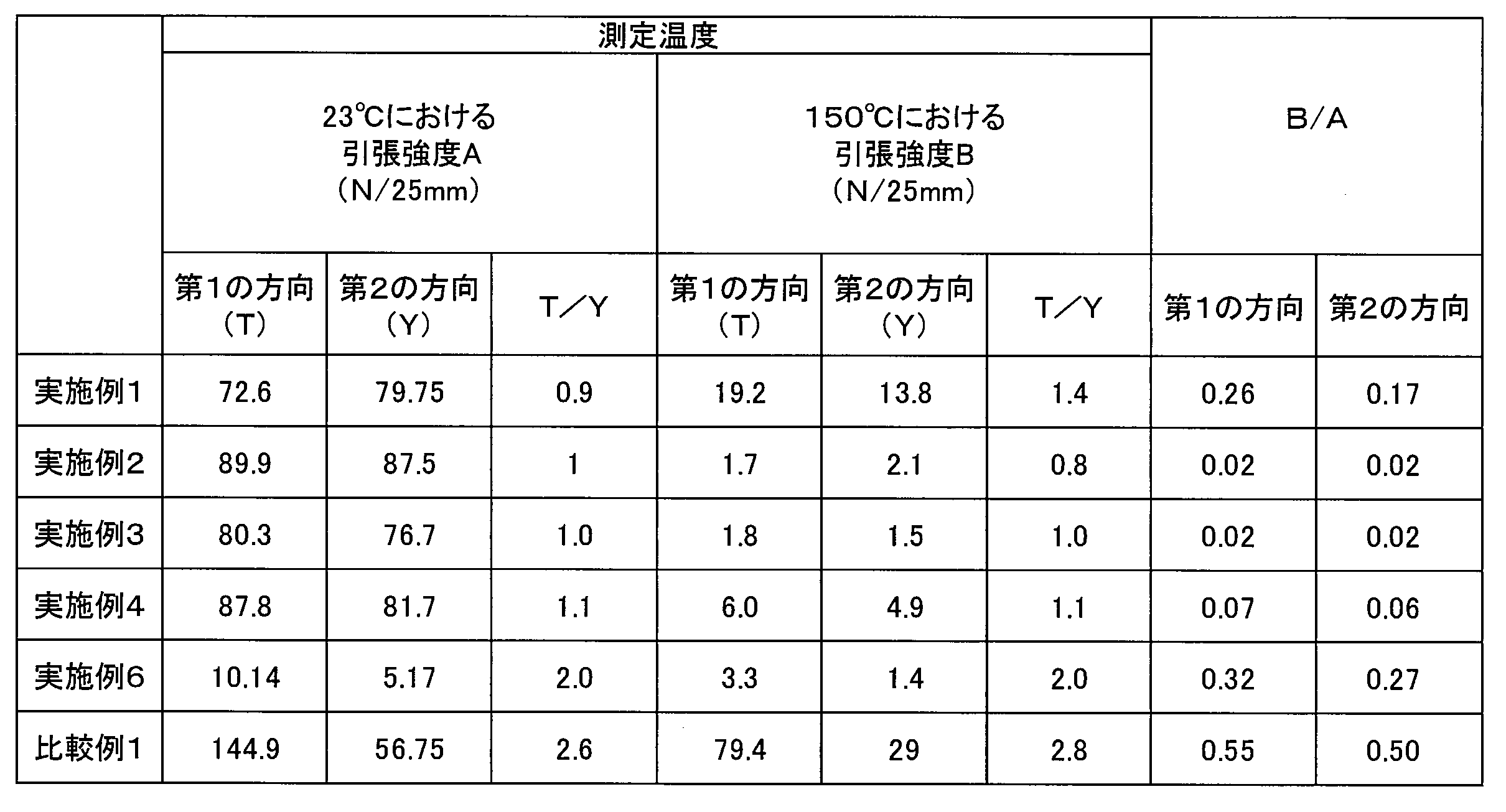
実施例1~5の繊維強化プラスチック成形体用プリプレスシートは、23℃における引張強度Aに対する150℃における引張強度Bの低下率が大きいことがわかる。
一方で、比較例1の繊維強化プラスチック成形体用プリプレスシートは、23℃における引張強度Aに対する150℃における引張強度Bの低下率が小さいことがわかる。これは、実施例1の繊維強化プラスチック成形体用プリプレスシートは、乾式抄紙法で製造された繊維強化プラスチック成形体用シートから形成されているため、繊維間の水素結合が少なく、繊維同士の絡みが弱いため、引張強度の温度依存性の低下率が大きいものと考えられる。
一方で、比較例1の繊維強化プラスチック成形体用プリプレスシートは、23℃における引張強度Aに対する150℃における引張強度Bの低下率が小さいことがわかる。これは、実施例1の繊維強化プラスチック成形体用プリプレスシートは、乾式抄紙法で製造された繊維強化プラスチック成形体用シートから形成されているため、繊維間の水素結合が少なく、繊維同士の絡みが弱いため、引張強度の温度依存性の低下率が大きいものと考えられる。
Claims (11)
- 有機資源由来の強化繊維と、熱可塑性樹脂とを含む繊維強化プラスチック成形体用シートであって、
前記繊維強化プラスチック成形体用シートの第1の方向の引張強度をTとし、前記繊維強化プラスチック成形体用シートの第1の方向と直交する方向である第2の方向の引張強度をYとした場合、T/Yは0.4以上2.5以下である繊維強化プラスチック成形体用シート。 - 前記有機資源由来の強化繊維の含有量は、前記繊維強化プラスチック成形体用シートの全質量に対して5質量%以上である請求項1に記載の繊維強化プラスチック成形体用シート。
- 前記有機資源由来の強化繊維はパルプ繊維である請求項1又は2に記載の繊維強化プラスチック成形体用シート。
- 前記熱可塑性樹脂の融点は200℃以下である請求項1~3のいずれか1項に記載の繊維強化プラスチック成形体用シート。
- 有機資源由来の強化繊維と、熱可塑性樹脂とを含む繊維強化プラスチック成形体用プリプレスシートであって、
前記繊維強化プラスチック成形体用プリプレスシートの第1の方向の引張強度をtとし、前記繊維強化プラスチック成形体用プリプレスシートの第1の方向と直交する方向である第2の方向の引張強度をyとした場合、t/yは0.4以上2.5以下である繊維強化プラスチック成形体用プリプレスシート。 - 前記有機資源由来の強化繊維の含有量は、前記繊維強化プラスチック成形体用シートの全質量に対して5質量%以上である請求項5に記載の繊維強化プラスチック成形体用プリプレスシート。
- 前記有機資源由来の強化繊維はパルプ繊維である請求項5又は6に記載の繊維強化プラスチック成形体用プリプレスシート。
- 前記熱可塑性樹脂の融点は200℃以下である請求項5~7のいずれか1項に記載の繊維強化プラスチック成形体用プリプレスシート。
- 有機資源由来の強化繊維と、熱可塑性樹脂とを空気中で混合し、堆積させる工程を含む繊維強化プラスチック成形体用シートの製造方法。
- 請求項1~4のいずれか1項に記載の繊維強化プラスチック成形体用シート、もしくは請求項5~8のいずれか1項に記載の繊維強化プラスチック成形体用プリプレスシートを成形する工程を含む成形体の製造方法。
- 前記成形する工程が、プレス成形する工程、真空成形する工程及び圧空成形する工程から選択される少なくとも1工程である請求項10に記載の成形体の製造方法。
Priority Applications (1)
| Application Number | Priority Date | Filing Date | Title |
|---|---|---|---|
| JP2017554181A JPWO2017094850A1 (ja) | 2015-12-02 | 2016-12-01 | 繊維強化プラスチック成形体用シート、繊維強化プラスチック成形体用プリプレスシート及び成形体 |
Applications Claiming Priority (2)
| Application Number | Priority Date | Filing Date | Title |
|---|---|---|---|
| JP2015-236120 | 2015-12-02 | ||
| JP2015236120 | 2015-12-02 |
Publications (1)
| Publication Number | Publication Date |
|---|---|
| WO2017094850A1 true WO2017094850A1 (ja) | 2017-06-08 |
Family
ID=58797484
Family Applications (1)
| Application Number | Title | Priority Date | Filing Date |
|---|---|---|---|
| PCT/JP2016/085760 Ceased WO2017094850A1 (ja) | 2015-12-02 | 2016-12-01 | 繊維強化プラスチック成形体用シート、繊維強化プラスチック成形体用プリプレスシート及び成形体 |
Country Status (2)
| Country | Link |
|---|---|
| JP (1) | JPWO2017094850A1 (ja) |
| WO (1) | WO2017094850A1 (ja) |
Cited By (1)
| Publication number | Priority date | Publication date | Assignee | Title |
|---|---|---|---|---|
| WO2023074841A1 (ja) * | 2021-10-29 | 2023-05-04 | 王子ホールディングス株式会社 | 成形用繊維集合体 |
Citations (5)
| Publication number | Priority date | Publication date | Assignee | Title |
|---|---|---|---|---|
| JPH07165950A (ja) * | 1993-12-15 | 1995-06-27 | Daifuku Seishi Kk | プリプレグシート及び繊維強化樹脂管状体 |
| JP2003129365A (ja) * | 2001-10-24 | 2003-05-08 | Toppan Printing Co Ltd | 植物繊維からなる立体成形物の製造方法及びこれに用いる金型 |
| JP2004052116A (ja) * | 2002-07-16 | 2004-02-19 | Toppan Printing Co Ltd | 機能性繊維シートとその繊維シートを用いた立体成形体およびこれらの製造方法 |
| JP2005139582A (ja) * | 2003-11-07 | 2005-06-02 | Toppan Printing Co Ltd | パルプ成形体およびその製造方法 |
| WO2013073425A1 (ja) * | 2011-11-14 | 2013-05-23 | 東レ株式会社 | プレス成型用不織布及びその製造方法並びに成型体の製造方法 |
-
2016
- 2016-12-01 WO PCT/JP2016/085760 patent/WO2017094850A1/ja not_active Ceased
- 2016-12-01 JP JP2017554181A patent/JPWO2017094850A1/ja active Pending
Patent Citations (5)
| Publication number | Priority date | Publication date | Assignee | Title |
|---|---|---|---|---|
| JPH07165950A (ja) * | 1993-12-15 | 1995-06-27 | Daifuku Seishi Kk | プリプレグシート及び繊維強化樹脂管状体 |
| JP2003129365A (ja) * | 2001-10-24 | 2003-05-08 | Toppan Printing Co Ltd | 植物繊維からなる立体成形物の製造方法及びこれに用いる金型 |
| JP2004052116A (ja) * | 2002-07-16 | 2004-02-19 | Toppan Printing Co Ltd | 機能性繊維シートとその繊維シートを用いた立体成形体およびこれらの製造方法 |
| JP2005139582A (ja) * | 2003-11-07 | 2005-06-02 | Toppan Printing Co Ltd | パルプ成形体およびその製造方法 |
| WO2013073425A1 (ja) * | 2011-11-14 | 2013-05-23 | 東レ株式会社 | プレス成型用不織布及びその製造方法並びに成型体の製造方法 |
Cited By (3)
| Publication number | Priority date | Publication date | Assignee | Title |
|---|---|---|---|---|
| WO2023074841A1 (ja) * | 2021-10-29 | 2023-05-04 | 王子ホールディングス株式会社 | 成形用繊維集合体 |
| JPWO2023074841A1 (ja) * | 2021-10-29 | 2023-05-04 | ||
| JP7782573B2 (ja) | 2021-10-29 | 2025-12-09 | 王子ホールディングス株式会社 | 成形用繊維集合体 |
Also Published As
| Publication number | Publication date |
|---|---|
| JPWO2017094850A1 (ja) | 2018-11-01 |
Similar Documents
| Publication | Publication Date | Title |
|---|---|---|
| JP7147932B2 (ja) | 成形体および成形体の製造方法 | |
| JP6962358B2 (ja) | 繊維強化プラスチック成形体用シートおよびその成形方法 | |
| KR20170109243A (ko) | 열가소성 섬유질 재료 및 이의 제조방법 | |
| US20190232522A1 (en) | In-plane isotropic, binderless products of cellulosic filament based compositions by compression molding | |
| JP5653683B2 (ja) | 補強シート及びこれを用いたシート状構造材 | |
| WO2017094850A1 (ja) | 繊維強化プラスチック成形体用シート、繊維強化プラスチック成形体用プリプレスシート及び成形体 | |
| JP6493159B2 (ja) | 外装補強用シート及び成形体 | |
| JP7782573B2 (ja) | 成形用繊維集合体 | |
| JP2014113715A (ja) | 成形品とその製造方法 | |
| JP2014000718A (ja) | 建築部材用複合シートおよび建築部材 | |
| JP7592996B2 (ja) | 成形体用シート及び成形体 | |
| JP6957854B2 (ja) | 成形体及び成形体の製造方法 | |
| JP2013049361A (ja) | 乗物用内装材およびその製造方法 | |
| JP2017024255A (ja) | 成形体及び成形体の製造方法 | |
| KR20250123785A (ko) | 셀룰로오스 섬유 함유 성형체 및 그 제조 방법 | |
| JP2004292646A (ja) | 強化繊維シートの製造方法、強化繊維シートおよびその用途 | |
| WO2024225060A1 (ja) | セルロース繊維含有樹脂ペレットの製造方法および成形体の製造方法 | |
| TW386943B (en) | A fibrous board and method for manufacturing same | |
| JP2026040862A (ja) | 樹脂組成物 | |
| JP2023121005A (ja) | 成形体および吸音材 | |
| WO2024225061A1 (ja) | セルロース繊維含有樹脂成形体 | |
| JP2024157503A (ja) | セルロース繊維含有樹脂成形体 | |
| JP2024157415A (ja) | セルロース繊維含有樹脂ペレットの製造方法および成形体の製造方法 | |
| CN118202103A (zh) | 成型用纤维集合体 | |
| WO2026003431A2 (en) | Fibre article and method for the manufacture thereof |
Legal Events
| Date | Code | Title | Description |
|---|---|---|---|
| 121 | Ep: the epo has been informed by wipo that ep was designated in this application |
Ref document number: 16870787 Country of ref document: EP Kind code of ref document: A1 |
|
| ENP | Entry into the national phase |
Ref document number: 2017554181 Country of ref document: JP Kind code of ref document: A |
|
| NENP | Non-entry into the national phase |
Ref country code: DE |
|
| 122 | Ep: pct application non-entry in european phase |
Ref document number: 16870787 Country of ref document: EP Kind code of ref document: A1 |