WO2017082004A1 - 焼結ペレットの製造方法 - Google Patents
焼結ペレットの製造方法 Download PDFInfo
- Publication number
- WO2017082004A1 WO2017082004A1 PCT/JP2016/080913 JP2016080913W WO2017082004A1 WO 2017082004 A1 WO2017082004 A1 WO 2017082004A1 JP 2016080913 W JP2016080913 W JP 2016080913W WO 2017082004 A1 WO2017082004 A1 WO 2017082004A1
- Authority
- WO
- WIPO (PCT)
- Prior art keywords
- pellet
- pellets
- sintered
- coal
- grains
- Prior art date
- Legal status (The legal status is an assumption and is not a legal conclusion. Google has not performed a legal analysis and makes no representation as to the accuracy of the status listed.)
- Ceased
Links
Images





Classifications
-
- C—CHEMISTRY; METALLURGY
- C22—METALLURGY; FERROUS OR NON-FERROUS ALLOYS; TREATMENT OF ALLOYS OR NON-FERROUS METALS
- C22B—PRODUCTION AND REFINING OF METALS; PRETREATMENT OF RAW MATERIALS
- C22B1/00—Preliminary treatment of ores or scrap
- C22B1/14—Agglomerating; Briquetting; Binding; Granulating
- C22B1/16—Sintering; Agglomerating
-
- C—CHEMISTRY; METALLURGY
- C22—METALLURGY; FERROUS OR NON-FERROUS ALLOYS; TREATMENT OF ALLOYS OR NON-FERROUS METALS
- C22B—PRODUCTION AND REFINING OF METALS; PRETREATMENT OF RAW MATERIALS
- C22B1/00—Preliminary treatment of ores or scrap
- C22B1/14—Agglomerating; Briquetting; Binding; Granulating
- C22B1/16—Sintering; Agglomerating
- C22B1/216—Sintering; Agglomerating in rotary furnaces
Definitions
- the present invention relates to a method for producing sintered pellets by firing pellet grains containing iron ore.
- sintered pellets to be charged as raw materials for blast furnaces, reduction furnaces and the like have been manufactured by granulating pellet grains containing iron ore and firing them.
- coal is incorporated in the pellet grains as a heat source (see Patent Document 1).
- the present inventors have satisfied at least the following conditions: It was confirmed that the double shell structure was generated with high probability.
- the specific surface area of the iron ore is small.
- the brain index is 2730 cm 2 / g or more.
- the brane index is an index representing the specific surface area of the particle, and is a value measured by a brain air permeation test specified by JIS R 5201, specifically, in the target powder compact. Corresponds to a measured value of resistance generated when air passes through.
- the surface portion 110 of the pellet 100 that has been previously sintered and clogged with pores as described above prevents oxygen from entering the inner portion 120. This causes insufficient firing of the inner portion 120.
- such a double shell structure pellet has a feature that there are more layers of magnetite (Fe 3 O 4 ) in the center than in the surface.
- the formation of the double shell structure pellets can be prevented. Avoidance of (a) is not preferable because it significantly restricts selection of iron ore as a raw material. Therefore, it is conceivable to avoid the condition (b), that is, to keep the content rate of the interior coal low, but the coal is incorporated in order to promote the firing by the internal combustion of the pellet particles. There is a concern that the entire pellet may be insufficiently fired due to the suppression of the content of the interior coal. In particular, when the iron ore is a hematite ore, it does not generate heat due to its own oxidation reaction unlike the magnetite ore, and thus it has been performed so far to incorporate a large amount of coal in the pellet grain.
- the present inventors have conceived that it is possible to perform sufficient firing while suppressing the internal coal by putting the pellet particles into a great kiln furnace having both a traveling great and a rotary kiln. .
- the present inventors suppress the content of the interior coal of pellet particles to be sintered to 0.5% or less in terms of weight ratio, and use a great kiln furnace as a means for firing the pellet particles.
- a hematite ore having a large specific surface area having a Blaine index of 2730 cm 2 / g or more can be used as a raw material, and a good sintered pellet having no double shell structure can be produced. I found.
- the present invention has been made from such a viewpoint. That is, provided by the present invention is a method for producing sintered pellets containing iron ore, and hematite ore having a Brane index of 2730 cm 2 / g or more and 3220 cm 2 / g or less and other additives And a pellet granule producing step for producing pellet granules having a content ratio of interior coal of 0.5% or less in a weight ratio by mixing and granulating, and the produced pellet granules in a drying chamber and a water separation chamber And a pellet firing step of firing by a great kiln furnace including a traveling great having a preheating chamber and a rotary kiln connected to the traveling great.
- FIG. 1 shows an example of an apparatus for carrying out a sintered pellet manufacturing method according to an embodiment of the present invention.
- This apparatus includes a pellet particle generation unit X1 for performing a pellet particle generation step for generating pellet particles, and a great kiln furnace X2 for performing a pellet baking step for baking the generated pellet particles.
- the pellet grain generation part X1 includes a secondary raw material hopper 20, an iron ore hopper 10, and a pelletizer 30.
- the great kiln furnace X2 includes a traveling grate 40 that is a heating device, a rotary kiln 50, a kiln burner 60, and a cooler 70.
- This method includes the pellet grain generation step and the pellet firing step.
- generation process In this process, the pellet ore before baking is produced
- the iron ore and the auxiliary material are respectively input to the pelletizer 30 from the iron ore hopper 10 and the auxiliary material hopper 20, and the pelletizer 30 mixes the iron ore and the auxiliary material to form pellet particles. Is generated.
- the iron ore hopper 10 stores the iron ore and throws the iron ore into the pelletizer 30 from the bottom of the iron ore hopper 10.
- the auxiliary raw material hopper 20 stores the auxiliary raw material that is a part of the raw material of the sintered pellet, and causes the auxiliary raw material to flow out from the bottom of the auxiliary raw material hopper 20.
- This auxiliary material includes bentonite, limestone, and the like, and in some cases, interior coal.
- the pelletizer 30 generates pellets before firing by mixing and granulating the iron ore thrown from the hoppers 10 and 20 and the auxiliary raw material.
- the pellet grains are screened by, for example, an unillustrated seed screen, and only pellet grains having an outer diameter equal to or smaller than a predetermined outer diameter are put into the great kiln furnace.
- the blending ratio of the interior coal is important. Even when a fine hematite ore having a Blaine index of 2730 cm 2 / g or more is used as the iron ore, by suppressing the coal content to 0.5% or less (including 0%), It is prevented that double-shell pellets are generated in the pellet firing step. Moreover, despite the low coal content, the use of the great kiln furnace X2 makes it possible to fire all pellets uniformly and satisfactorily without leaving underfired pellets. is there.
- Pellet firing step The pellet grains produced in the pellet grain production part X1 are heated in the traveling great 40 of the great kiln furnace X2, and then fired in the rotary kiln 50 to become sintered pellets. The sintered pellet is cooled to a predetermined temperature in the cooler 70.
- the traveling great 40 performs the heat treatment while transporting the pellet particles toward the rotary kiln 50, thereby drying the pellet particles and adjusting the hardness of the pellet particles in the previous stage of firing, I do.
- the traveling great 40 includes a drying chamber 41, a water separation chamber 42 and a preheating chamber 43 in order from the upstream side in the conveying direction of the pellet particles.
- the drying chamber 41 the moisture contained in the pellet particles is evaporated by heating the pellet particles
- the water separation chamber 42 the crystal water contained in the iron ore in the pellet particles is evaporated by heating the pellet particles.
- the preheating chamber 43 by adjusting the hardness of the pellet particles so as to sufficiently suppress the generation of powder due to the rolling of the pellet particles in the rotary kiln 50, which will be described later, by heating the pellet particles, Preheating is performed.
- the rotary kiln 50 receives the pellet particles preheated in the preheating chamber 43, and sinters the pellet particles 140 with a flame sprayed from the kiln burner 60, thereby generating sintered pellets.
- the rotary kiln 50 has an inflow port 51 connected to the preheating chamber 43 of the traveling great 40 and an outflow port 52 connected to a cooler 70 which will be described later, and is directed downward from the inflow port 51 toward the outflow port 52. It is arranged to incline.
- the flame from the kiln burner 60 is introduced into the rotary kiln 50 through the outlet 52.
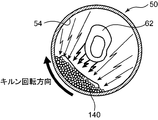
- the rotary kiln 50 has a cylindrical inner peripheral surface 54 as shown in FIG. 3, and rolls the pellet particles 140 on the inner peripheral surface 54 by rotating while containing the pellet particles 140 inside thereof. Let Radiant heat from the flame 62 by the kiln burner 60 is uniformly applied to the pellet particles 140 that roll in this way.
- the inner peripheral surface 54 is protected by a refractory material. The pellets thus fired are cooled by the cooler 70 and then discharged outside the furnace.
- the use of the great kiln furnace X2 is important in suppressing the content of the interior coal in the pellet particles.
- the pellet grains of the portion 220 are easily heated excessively, and conversely, heat is not easily transmitted to the pellet grains of the lower layer portion 230, and there is a possibility that the non-passage firing is insufficient.
- coal is not installed, it is necessary to flow a higher temperature process gas to compensate for the reduced heat source of the coal, and the pellets in the lower layer portion 230 must be fired at a high temperature of 1300 ° C.
- the portion 200 cannot be thermally endured.
- the pellet grains 140 roll on the inner circumferential surface 54 of the kiln as shown in FIG. 3, the radiant heat from the flame 62 is equally applied to the pellet grains 140. . Therefore, even if the content of the interior coal in each pellet grain 140 is small or no interior coal is contained, the pellet grain 140 can be surely fired on the inner circumferential surface 54 of the kiln.
- the combination of the suppression of the coal content in the pellet grains and the use of the great kiln furnace X2 including the rotary kiln 50 is used as an iron ore as a raw material.
- the great kiln furnace X2 including the rotary kiln 50 is used as an iron ore as a raw material.
- the experiment was performed mainly on the sample 3 having a Blaine index of 2860 cm 2 / g, and for this sample 3, the blending ratio of the interior coal was 0, 0.5, and 1.0 (whichever In each case, the confirmation of the structure of the fired pellets by visual inspection and the measurement of the crushing strength and the residual FeO were carried out.
- the residual FeO here refers to the content of the magnetite reduced from hematite to magnetite during the sintering of the pellet and finally remaining in the sintered pellet.
- the same experiment and confirmation of the baked pellet were performed also about sample 1,2,4 with the specific interior coal compounding ratio.
- the blending ratio when the blending ratio is 1.0%, a double shell structure is observed in the fired pellets. In fact, the FeO content when the blending ratio is 1.0% is a very high value of 4.2% (FIG. 5). Due to the double shell structure, the crushing strength of the obtained sintered pellet is also as low as 209 kg (FIG. 6).
- a sintered pellet having such a low crushing strength is put into, for example, a blast furnace or a reducing furnace, a large amount of powder is generated in the furnace due to the crushing of the sintered pellet in the blast furnace or the reducing furnace. May interfere with its normal operation.
- the present inventors conducted cross-sectional observation of the fired pellet when the double shell structure was observed when the blending ratio of the sample 3 was 1.0%, and contained FeO on the surface and the center. The rate relationship was investigated. The results are shown in FIGS.
- FIG. 7 is a photograph of a cross section of the sintered pellet when the firing temperature Tb is 1320 ° C. The double shell structure is clearly confirmed from the photograph.
- FIG. 8 shows the radial position of the sintered pellet of FIG. 7 (D / 8, D / 4 and D / 2: D is the diameter of the pellet, for example D / 8 is 1/8 the diameter of the pellet diameter D.
- O / Fe molecular ratio of oxygen to iron
- a low O / Fe indicates that iron oxide in the sintered pellet is reduced, indicating that magnetization is progressing.
- O / Fe is lower at the pellet center portion at the radial positions D / 4 and D / 2 than at the pellet surface portion at the radial position D / 8. From this, it can be confirmed that magnetization by reduction of hematite proceeds in the center of the pellet rather than the surface of the pellet. Since the reduction is an endothermic reaction, it can be said that the center is insufficiently sintered.
- a method for producing a sintered pellet according to one aspect of the present invention is a method for producing a sintered pellet by firing pellet grains containing iron ore, and has a brain of 2730 cm 2 / g or more and 3220 cm 2 / g or less.
- a pellet firing step in which the pellet grains are fired by a great kiln furnace including a traveling great having a drying chamber, a water separation chamber, and a preheating chamber and a rotary kiln connected to the traveling great.
Landscapes
- Engineering & Computer Science (AREA)
- Chemical & Material Sciences (AREA)
- Manufacturing & Machinery (AREA)
- Geochemistry & Mineralogy (AREA)
- Geology (AREA)
- General Life Sciences & Earth Sciences (AREA)
- Life Sciences & Earth Sciences (AREA)
- Environmental & Geological Engineering (AREA)
- Materials Engineering (AREA)
- Mechanical Engineering (AREA)
- Metallurgy (AREA)
- Organic Chemistry (AREA)
- Manufacture And Refinement Of Metals (AREA)
Abstract
2730cm2/g以上3220cm2/g以下のブレーン指数をもつヘマタイト鉱石とその他の添加物とを混合して造粒することにより重量比にして0.5%以下の内装石炭の含有率をもつペレット粒を生成するペレット粒生成工程と、生成された前記ペレット粒を乾燥室41、離水室42および予熱室43を有するトラベリンググレートと当該トラベリンググレートに繋がるロータリキルン50とを含むグレートキルン炉X2によって焼成するペレット焼成工程と、を含む焼結ペレットの製造方法によって、二重殻構造のペレットの生成を抑止することが可能な方法を提供する。
Description
本発明は、鉄鉱石を含むペレット粒を焼成することにより焼結ペレットを製造するための方法に関するものである。
従来、鉄鉱石を含むペレット粒を造粒してこれを焼成することにより、高炉や還元炉等の原料として投入される焼結ペレットが製造されている。前記ペレット粒には、一般に熱源として石炭が内装される(特許文献1参照)。
本発明者らは、種々の条件での造粒及び焼成により製造された焼結ペレットの性状を調べた結果、表面のみが焼結して内側部分の焼成が不足することでいわば二重殻構造を有するに至ったペレットが製造される場合が存在することを確認した。このようなペレットは、焼結された外殻部分とその内側の焼結不足部分との間に界面が存在するため構造的に不安定であり、特に当該界面での応力集中のために、高い圧潰強度を有することは難しい。このようなペレットが後段の設備(例えば高炉やその他の還元炉)に投入されると、当該ペレットが圧潰して粉体を発生させ、これにより当該設備の還元ガスの通気性が損なわれ良好な運転を阻害するおそれがある。
そこで、本発明者らは、前記二重殻構造をもつペレットの生成を有効に抑止するため、前記二重殻構造をもつペレットが生成される要因について精査した結果、少なくとも次の条件を満たす場合に前記二重殻構造が高い確率で発生することを確認した。
(a)当該鉄鉱石の比表面積が小さいこと。具体的にはブレーン指数が2730cm2/g以上であること。ここでブレーン指数とは、粒子の比表面積を表す指標であって、JIS R 5201で規定されるブレーン(blaine)空気透過試験により測定された値、具体的には、対象となる粉末圧縮体中を空気が通過する際に生じる抵抗の測定値、に相当する。
(b)ペレット粒に内装される石炭の含有率が高いこと。
このような条件を満たす場合、次のメカニズムで二重殻構造が生ずるものと考えられる。
1 内装石炭の含有率が高いペレットを加熱すると当該ペレット粒のうちの表面部分の石炭が急速に燃焼し、これにより当該表面部分の焼結反応が内側部分よりも先行して急激に進行する。
2 さらに、鉄鉱石の比表面積が小さいとその気孔も小さいため、前記表面部分の気孔が前記焼結によって早期に塞がってしまう。
3 図2に模式的に示すように、前記のように先行焼結して気孔が塞がれたペレット100の表面部分110は、その内側の部分120に酸素が進入することを阻み、これにより当該内側部分120の焼成不足を引き起こす。
4 さらに、前記鉄鉱石がヘマタイト鉱石である場合、前記内側部分での石炭の不完全燃焼により発生した一酸化炭素は、当該内側部分のヘマタイト(Fe2O3)の一部をマグネタイト(Fe3O4)に還元する。この還元は吸熱反応であるため、前記内側部分の焼成不足を助長する。
このようにして、先行焼結した表面部分(外殻部分)110と、焼成が不足した内側部分120と、の間に界面130が生じてしまうものと考えられる。また前記メカニズムにより、このような二重殻構造ペレットは、表面部より中心部にマグネタイト(Fe3O4)からなる層が多い特徴を有することとなる。
従って、前記条件(a)及び(b)のいずれかを回避するようなペレットの焼結を行えば、前記二重殻構造のペレットの生成を防ぐことができるが、鉄鉱石の比表面積に関する条件(a)の回避は、原料である鉄鉱石の選択に著しい制約を与えることになり、好ましくない。そこで、条件(b)を回避すること、つまり内装石炭の含有率を低く抑えること、が考えられるが、当該石炭はペレット粒の内部燃焼によってその焼成を促進するために内装されるものであるため、当該内装石炭の含有率の抑制によりペレット全体の焼成不足が生じることが懸念される。特に、前記鉄鉱石がヘマタイト鉱石である場合、マグネタイト鉱石のようにそれ自身の酸化反応によって発熱することがないので、前記ペレット粒には多くの石炭を内装することがこれまで行われてきた。
しかしながら、本発明者らは、当該ペレット粒をトラベリンググレートとロータリキルンとを併有するグレートキルン炉に投入することにより、前記内装石炭を抑えながら十分な焼成を行うことか可能であることに想到した。具体的に、本発明者らは、焼結されるペレット粒の内装石炭の含有率を重量比にして0.5%以下に抑えることと、当該ペレット粒の焼成手段としてグレートキルン炉を用いることと、の組み合わせにより、ブレーン指数が2730cm2/g以上であるような比表面積の大きいヘマタイト鉱石を原材料として用いながらも、二重殻構造をもたない良好な焼結ペレットが製造可能であることを見出した。
本発明は、このような観点からなされたものである。すなわち、本発明により提供されるのは、鉄鉱石を含む焼結ペレットを製造するための方法であって、2730cm2/g以上3220cm2/g以下のブレーン指数をもつヘマタイト鉱石とその他の添加物とを混合して造粒することにより重量比にして0.5%以下の内装石炭の含有率をもつペレット粒を生成するペレット粒生成工程と、生成された前記ペレット粒を乾燥室、離水室、および予熱室を有するトラベリンググレートと当該トラベリンググレートに繋がるロータリキルンとを含むグレートキルン炉によって焼成するペレット焼成工程と、を含む。
上記の焼結ペレットの製造方法によれば、二重殻構造をもつペレットの生成を有効に抑止することが可能となる。
以下、本発明の好ましい実施の形態について、図面を参照しながら説明する。
図1は、本発明の実施の形態に係る焼結ペレットの製造方法を実施するための装置の一例を示す。この装置は、ペレット粒を生成するペレット粒生成工程を実施するためのペレット粒生成部X1と、生成されたペレット粒を焼成するペレット焼成工程を実施するためのグレートキルン炉X2と、を備える。前記ペレット粒生成部X1は、副原料ホッパ20と、鉄鉱石ホッパ10と、ペレタイザ30と、を含む。前記グレートキルン炉X2は、加熱装置であるトラベリンググレート40と、ロータリキルン50と、キルンバーナー60と、クーラー70と、を含む。
以下、この装置を用いて行われる焼結ペレットの製造のための方法について、詳述する。この方法は、前記のペレット粒生成工程及びペレット焼成工程を含む。
(1)ペレット粒生成工程
この工程では、ヘマタイト鉱石からなる鉄鉱石とその他の添加物である副原料とが混合され、造粒されることにより、焼成前のペレット粒が生成される。具体的に、前記装置では、鉄鉱石ホッパ10および副原料ホッパ20からそれぞれ前記鉄鉱石及び前記副原料がペレタイザ30に投入され、当該ペレタイザ30は前記鉄鉱石及び前記副原料を混合してペレット粒を生成する。
この工程では、ヘマタイト鉱石からなる鉄鉱石とその他の添加物である副原料とが混合され、造粒されることにより、焼成前のペレット粒が生成される。具体的に、前記装置では、鉄鉱石ホッパ10および副原料ホッパ20からそれぞれ前記鉄鉱石及び前記副原料がペレタイザ30に投入され、当該ペレタイザ30は前記鉄鉱石及び前記副原料を混合してペレット粒を生成する。
前記鉄鉱石ホッパ10は、前記鉄鉱石を貯留するとともに、当該鉄鉱石ホッパ10の底から前記ペレタイザ30に当該鉄鉱石を投入する。同様に、前記副原料ホッパ20は、焼結ペレットの原料の一部である副原料を貯留するとともに、当該副原料ホッパ20の底から副原料を流出させる。この副原料には、ベントナイト、石灰石等が含まれ、場合により内装用の石炭が含まれる。
前記ペレタイザ30は、前記両ホッパ10,20から投ぜられる鉄鉱石と副原料とを混合して造粒することにより、焼成前のペレット粒を生成する。このペレット粒は、例えば、図略のシードスクリーンによってスクリーニングされ、所定の外径以下の外径を有するペレット粒のみが前記グレートキルン炉に投入される。
このペレット粒生成工程において、前記内装石炭の配合比は重要である。前記鉄鉱石として、ブレーン指数が2730cm2/g以上の細かいヘマタイト鉱石が用いられる場合であっても、前記石炭の含有量を0.5%以下(0%も含む)に抑えることにより、後のペレット焼成工程において二重殻構造のペレットが生成されることが防がれる。しかも、このように石炭の含有量を低く抑えているにもかかわらず、前記グレートキルン炉X2の使用によって、焼成不足のペレットを残すことなく全ペレットを均一にかつ良好に焼成することが可能である。
(2)ペレット焼成工程
前記ペレット粒生成部X1で生成されたペレット粒は、グレートキルン炉X2のトラベリンググレート40において加熱処理された後、ロータリキルン50において焼成されることにより焼結ペレットとなり、当該焼結ペレットがクーラー70において所定の温度まで冷却される。
前記ペレット粒生成部X1で生成されたペレット粒は、グレートキルン炉X2のトラベリンググレート40において加熱処理された後、ロータリキルン50において焼成されることにより焼結ペレットとなり、当該焼結ペレットがクーラー70において所定の温度まで冷却される。
前記トラベリンググレート40は、前記ペレット粒を前記ロータリキルン50に向けて搬送しながらその加熱処理を行うことにより、当該ペレット粒の乾燥と、焼成の前段階における当該ペレット粒の固さの調整と、を行う。当該トラベリンググレート40は、前記ペレット粒の搬送方向の上流側から順に、乾燥室41、離水室42及び予熱室43を有する。乾燥室41では、ペレット粒の加熱により当該ペレット粒に含まれる水分が蒸発し、離水室42は、ペレット粒の加熱により当該ペレット粒中の鉄鉱石に含まれる結晶水が蒸発する。予熱室43では、ペレット粒の加熱により、後述するロータリキルン50内のペレット粒の転動による粉体の発生を十分に抑止するように当該ペレット粒の固さを調整すること、つまりペレット粒の予熱、が行われる。
前記ロータリキルン50は、前記予熱室43で予熱されたペレット粒を受け入れ、これらを前記キルンバーナー60から噴射される火炎によって当該ペレット粒140を焼成することにより、焼結ペレットを生成する。前記ロータリキルン50は、前記トラベリンググレート40の予熱室43に繋がる流入口51と、後述するクーラー70に繋がる流出口52と、を有しており、流入口51から流出口52に向けて下方に傾斜するように配置されている。前記キルンバーナー60による火炎は前記流出口52を通じてロータリキルン50内に導入される。
ロータリキルン50は、図3に示すような円筒状の内周面54を有し、その内側にペレット粒140を収容しながら回転することにより当該ペレット粒140を当該内周面54上で転動させる。このように転動するペレット粒140に対して前記キルンバーナー60による火炎62からの輻射熱が万遍なく与えられる。前記内周面54は耐火物により保護されている。このようにして焼成されたペレットは、クーラー70で冷却された後、炉外に排出される。
前記のようにペレット粒における内装石炭の含有量を抑えるにあたり、前記グレートキルン炉X2の使用は重要である。
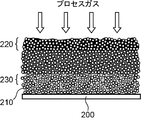
例えば、前記のようなロータリキルンを含まずにトラベリンググレートのみでペレットの焼成を行う、いわゆるストレートグレート方式の炉では、内装石炭の含有量を抑えることは難しい。すなわち、当該ストレートグレート方式では、模式的に図4に示すように、グレートカーと呼ばれる、ペレット運搬のための金属製の運搬部200の上に当該運搬部200の熱保護を目的として既に焼成されたペレット210が床敷きされ、その上に生ペレット粒が積まれた状態で、さらにその上を流れるプロセスガスからの熱の供給により各ペレットの焼成が行われるので、前記ペレット粒のうち最上層部分220のペレット粒は過度に加熱されやすく、逆に下層部分230のペレット粒には熱が伝わりにくく当該不通路の焼成が不十分となるおそれがある。このようないわゆる焼ムラを抑止して焼成が不十分なペレットを残さないためには、各ペレット粒に十分な石炭を内装して当該石炭を内部燃焼させる必要がある。石炭を内装しない場合は、減じた石炭の熱源補償のためにより高温のプロセスガスを流し、下層部分230のペレット粒を1300°Cレベルの高温で焼成させる必要があるが、この場合金属製の運搬部200が熱的に耐えられない。このように加熱温度の著しい制約を受けるストレートグレート方式において焼きムラを抑止して焼成が不十分なペレットを残さないためには、十分な石炭の内装が必須となる。従って、当該ストレートグレート方式ではペレットの二重殻構造を引起しやすい運転をせざるを得ない。
これに対して前記ロータリキルン50では、図3に示すようにキルン内周面54上をペレット粒140が転動するために、当該ペレット粒140には火炎62からの放射熱が均等に与えられる。従って、各ペレット粒140の内装石炭の含有量が小さくても、あるいは内装石炭が含有されていなくても、キルン内周面54上で当該ペレット粒140の確実な焼成が可能である。
つまり、この実施の形態に係る焼結ペレットの製造においては、ペレット粒における石炭の含有量の抑制と、ロータリキルン50を含むグレートキルン炉X2の使用と、の組み合わせが、原料である鉄鉱石としてブレーン指数の高いヘマタイト鉱石が用いられるにもかかわらず、二重殻構造をもつペレットの生成を回避することを可能にする。
(A)焼結ペレットの製造実験について
本発明者らは、二重殻構造をもつペレットの生成の可能性がある鉄鉱石の比表面積(粉末度)と、当該二重殻構造をもつペレットの生成を防ぐための石炭の含有量と、の特定を行うために、互いにブレーン指数の異なる複数種のヘマタイト鉱石(試料1~4)を用いて図1に示される装置により焼結ペレットの製造の実験を行った。当該実験での焼成温度は試料1,2, 4は1320°C、試料3は1260℃である。
本発明者らは、二重殻構造をもつペレットの生成の可能性がある鉄鉱石の比表面積(粉末度)と、当該二重殻構造をもつペレットの生成を防ぐための石炭の含有量と、の特定を行うために、互いにブレーン指数の異なる複数種のヘマタイト鉱石(試料1~4)を用いて図1に示される装置により焼結ペレットの製造の実験を行った。当該実験での焼成温度は試料1,2, 4は1320°C、試料3は1260℃である。
当該実験の結果を表1に示す。

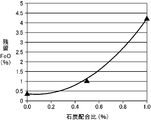
表1に示されるように、前記実験はブレーン指数が2860cm2/gである試料3をメインに行われ、この試料3については内装石炭の配合比が0,0.5及び1.0(いずれも乾燥重量%)のそれぞれの場合について焼成されたペレットの構造の目視による確認と、圧潰強度及び残留FeOの測定と、が行われた。ここで言う残留FeOとはペレットの焼結中にヘマタイトからマグネタイトに還元されかつ最終的に焼結ペレットに残留した当該マグネタイトの含有率を指す。また、試料1,2,4についても特定の内装石炭配合比で同様の実験及び焼成ペレットの確認が行われた。
(B)考察
(B-1)試料3について
まず、メインの試料3に着目すると、内装石炭を含まない場合及びその配合比が0.5%の場合のいずれにおいても、焼成されたペレットに二重殻構造は認められない。事実、内側部分の焼成が十分であるためペレット内に残留するFeOの含有率も0.4%、1.0%とそれぞれ低い(図5)。つまり、内装石炭の含有率が低い場合には、二重殻構造の判断の目安となる残留マグネタイトの含有率が少なく、実際の目視でも二重殻構造は確認されていない。このように、二重殻構造が存在しないために、得られる圧潰強度(それぞれ335kg、308kg)も高い(図6)。これに対し、前記配合比が1.0%の場合には、焼成されたペレットに二重殻構造が認められる。事実、前記配合比が1.0%の場合のFeOの含有率は4.2%と非常に高い値となっている(図5)。当該二重殻構造のために、得られる焼結ペレットの圧潰強度も209kgと低くなっている(図6)。このような低い圧潰強度をもつ焼結ペレットが例えば高炉や還元炉等に投入されると、当該高炉や還元炉等内での当該焼結ペレットの圧潰によって多量の粉体が炉内に発生してその正常な運転を阻害するおそれがある。
(B-1)試料3について
まず、メインの試料3に着目すると、内装石炭を含まない場合及びその配合比が0.5%の場合のいずれにおいても、焼成されたペレットに二重殻構造は認められない。事実、内側部分の焼成が十分であるためペレット内に残留するFeOの含有率も0.4%、1.0%とそれぞれ低い(図5)。つまり、内装石炭の含有率が低い場合には、二重殻構造の判断の目安となる残留マグネタイトの含有率が少なく、実際の目視でも二重殻構造は確認されていない。このように、二重殻構造が存在しないために、得られる圧潰強度(それぞれ335kg、308kg)も高い(図6)。これに対し、前記配合比が1.0%の場合には、焼成されたペレットに二重殻構造が認められる。事実、前記配合比が1.0%の場合のFeOの含有率は4.2%と非常に高い値となっている(図5)。当該二重殻構造のために、得られる焼結ペレットの圧潰強度も209kgと低くなっている(図6)。このような低い圧潰強度をもつ焼結ペレットが例えば高炉や還元炉等に投入されると、当該高炉や還元炉等内での当該焼結ペレットの圧潰によって多量の粉体が炉内に発生してその正常な運転を阻害するおそれがある。
さらに、本発明者らは、前記試料3の前記配合比を1.0%とした場合において、二重殻構造がみられた場合の焼成ペレットの断面観察を行い、表面と中心部のFeO含有率の関係を調査した。その結果を図7及び図8に示す。
図7は、焼成温度Tbが1320°Cの場合において、焼結ペレットの断面を撮影した写真である。当該写真から明らかに二重殻構造が確認される。
図8は、図7の焼結ペレットの半径方向の位置(D/8,D/4及びD/2:Dはペレットの直径であり、例えばD/8はペレット直径Dの1/8の直径をもつ球面上の位置を示す。)における酸化度合いを示す比O/Fe(鉄に対する酸素のモル比)の測定結果を示したグラフである。O/Feが低いということは焼結ペレット中の酸化鉄が還元されていることを表し、マグネタイト化が進んでいることを示す。図8によれば、半径方向位置D/8にあるペレット表面部に比べ、半径方向位置D/4及びD/2にあるペレット中心部ではO/Feが低い。このことから、ペレット表面部よりもペレット中心部においてヘマタイトの還元によるマグネタイト化が進んでいることが確認できる。前記還元は吸熱反応であることから、中心部では焼結不足となっていると言える。
以上の結果は、上述した二重殻構造のペレットの生成のメカニズムの妥当性を如実に示していると言える。
(B-2)試料1,2及び4について
さらに、他の試料1,2及び4について着目すると、試料3よりも低いブレーン指数(2770cm2/g)をもつ試料2、及び、試料3よりも高いブレーン指数(3220cm2/g)をもつ試料4、のいずれにおいても、少なくとも内装石炭配合比が0.5%以下の場合には焼結ペレットに二重殻構造が認められず、また十分な圧潰強度が得られている。残留FeOの比率も小さい。一方、最も低いブレーン指数(2730cm2/g)をもつ試料1でも、内装石炭配合比が1.0%である場合には二重殻構造が発生し、得られる圧潰強度も低くなっている。
さらに、他の試料1,2及び4について着目すると、試料3よりも低いブレーン指数(2770cm2/g)をもつ試料2、及び、試料3よりも高いブレーン指数(3220cm2/g)をもつ試料4、のいずれにおいても、少なくとも内装石炭配合比が0.5%以下の場合には焼結ペレットに二重殻構造が認められず、また十分な圧潰強度が得られている。残留FeOの比率も小さい。一方、最も低いブレーン指数(2730cm2/g)をもつ試料1でも、内装石炭配合比が1.0%である場合には二重殻構造が発生し、得られる圧潰強度も低くなっている。
以上の結果から、少なくともブレーン指数が2730cm2/g以上3220cm2/gのヘマタイト鉱石を用いて焼結ペレットを製造する場合について、焼成されるペレット粒における内装石炭配合比を0.5重量%以下にすることにより、二重殻構造のペレットの生成を回避することができる、という結論を導くことができる。
ここで、上記実施形態について概説する。
本発明の一局面に従う焼結ペレットの製造方法は、鉄鉱石を含むペレット粒を焼成することにより焼結ペレットを製造するための方法であって、2730cm2/g以上3220cm2/g以下のブレーン指数をもつヘマタイト鉱石とその他の添加物とを混合して造粒することにより重量比にして0.5%以下の内装石炭の含有率をもつペレット粒を生成するペレット粒生成工程と、生成された前記ペレット粒を乾燥室、離水室、および予熱室を有するトラベリンググレートと当該トラベリンググレートに繋がるロータリキルンとを含むグレートキルン炉によって焼成するペレット焼成工程と、を含む。
上記の焼結ペレットの製造方法によれば、二重殻構造をもつペレットの生成を有効に抑止することが可能である。
Claims (1)
- 鉄鉱石を含むペレット粒を焼成することにより焼結ペレットを製造するための方法であって、
2730cm2/g以上3220cm2/g以下のブレーン指数をもつヘマタイト鉱石とその他の添加物とを混合して造粒することにより重量比にして0.5%以下の内装石炭の含有率をもつペレット粒を生成するペレット粒生成工程と、
生成された前記ペレット粒を乾燥室、離水室、および予熱室を有するトラベリンググレートと当該トラベリンググレートに繋がるロータリキルンとを含むグレートキルン炉によって焼成するペレット焼成工程と、を含む、焼結ペレットの製造方法。
Applications Claiming Priority (2)
| Application Number | Priority Date | Filing Date | Title |
|---|---|---|---|
| JP2015-219516 | 2015-11-09 | ||
| JP2015219516A JP2017088946A (ja) | 2015-11-09 | 2015-11-09 | 焼結ペレットの製造方法 |
Publications (1)
| Publication Number | Publication Date |
|---|---|
| WO2017082004A1 true WO2017082004A1 (ja) | 2017-05-18 |
Family
ID=58695067
Family Applications (1)
| Application Number | Title | Priority Date | Filing Date |
|---|---|---|---|
| PCT/JP2016/080913 Ceased WO2017082004A1 (ja) | 2015-11-09 | 2016-10-19 | 焼結ペレットの製造方法 |
Country Status (2)
| Country | Link |
|---|---|
| JP (1) | JP2017088946A (ja) |
| WO (1) | WO2017082004A1 (ja) |
Cited By (1)
| Publication number | Priority date | Publication date | Assignee | Title |
|---|---|---|---|---|
| WO2021056830A1 (zh) * | 2019-09-23 | 2021-04-01 | 中国科学院过程工程研究所 | 一种链篦机回转窑球团焙烧烟气的脱硝处理系统及处理方法 |
Families Citing this family (2)
| Publication number | Priority date | Publication date | Assignee | Title |
|---|---|---|---|---|
| JP7207153B2 (ja) * | 2019-05-16 | 2023-01-18 | 日本製鉄株式会社 | 塊成物 |
| JP7440768B2 (ja) * | 2020-08-18 | 2024-02-29 | 日本製鉄株式会社 | 高炉用焼成ペレット及び高炉用焼成ペレットの製造方法 |
Citations (4)
| Publication number | Priority date | Publication date | Assignee | Title |
|---|---|---|---|---|
| JPS5611290B2 (ja) * | 1976-04-30 | 1981-03-13 | ||
| JPS5711380B2 (ja) * | 1978-10-12 | 1982-03-04 | ||
| JPS5760412B2 (ja) * | 1976-03-02 | 1982-12-20 | Nippon Steel Corp | |
| JP2008127636A (ja) * | 2006-11-21 | 2008-06-05 | Kobe Steel Ltd | 鉄鉱石ペレットの製造方法 |
-
2015
- 2015-11-09 JP JP2015219516A patent/JP2017088946A/ja active Pending
-
2016
- 2016-10-19 WO PCT/JP2016/080913 patent/WO2017082004A1/ja not_active Ceased
Patent Citations (4)
| Publication number | Priority date | Publication date | Assignee | Title |
|---|---|---|---|---|
| JPS5760412B2 (ja) * | 1976-03-02 | 1982-12-20 | Nippon Steel Corp | |
| JPS5611290B2 (ja) * | 1976-04-30 | 1981-03-13 | ||
| JPS5711380B2 (ja) * | 1978-10-12 | 1982-03-04 | ||
| JP2008127636A (ja) * | 2006-11-21 | 2008-06-05 | Kobe Steel Ltd | 鉄鉱石ペレットの製造方法 |
Cited By (1)
| Publication number | Priority date | Publication date | Assignee | Title |
|---|---|---|---|---|
| WO2021056830A1 (zh) * | 2019-09-23 | 2021-04-01 | 中国科学院过程工程研究所 | 一种链篦机回转窑球团焙烧烟气的脱硝处理系统及处理方法 |
Also Published As
| Publication number | Publication date |
|---|---|
| JP2017088946A (ja) | 2017-05-25 |
Similar Documents
| Publication | Publication Date | Title |
|---|---|---|
| JP6620850B2 (ja) | 焼結鉱製造用の炭材内装造粒粒子とその製造方法 | |
| JP6460293B2 (ja) | 焼結鉱の製造方法 | |
| WO2017082004A1 (ja) | 焼結ペレットの製造方法 | |
| JP2023033734A (ja) | 鉄鉱石焼成ペレットの製造方法 | |
| JP5357551B2 (ja) | 鉄鉱石ペレットの製造方法 | |
| TWI689598B (zh) | 燒結礦的製造方法 | |
| JP5003328B2 (ja) | 焼結鉱の製造方法 | |
| JP6264517B1 (ja) | 炭材内装焼結鉱の製造方法 | |
| WO2022209014A1 (ja) | 塊成物製造用の原料粒子、塊成物製造用の原料粒子の製造方法、塊成物、塊成物の製造方法および還元鉄の製造方法 | |
| JP2001348622A (ja) | 高炉用高品質低SiO2焼結鉱の製造方法 | |
| JP6887717B2 (ja) | 焼結鉱製造用の炭材内装造粒粒子およびそれを用いた焼結鉱の製造方法 | |
| JP7836742B2 (ja) | 鉄鉱石ペレットの製造方法 | |
| JP4996211B2 (ja) | 鉄鉱石ペレットを製造する際の造粒原料の粒度決定方法 | |
| JP5801752B2 (ja) | 焼結鉱 | |
| JP2015063716A (ja) | 焼結鉱製造用鉄鉱石ミニペレット | |
| JP2024064028A (ja) | 鉄鉱石ペレットの高温性状判定方法、鉄鉱石ペレットの製造方法及び鉄鉱石ペレット | |
| JP2001271121A (ja) | 高炉用焼結鉱の製造方法 | |
| CN118946674A (zh) | 造粒装置、造粒烧结原料的制造方法及烧结矿的制造方法 | |
| JP6436317B2 (ja) | 焼結鉱製造用の炭材内装造粒粒子およびそれを用いた焼結鉱の製造方法 | |
| CN116981785A (zh) | 铁矿石球团的制造方法 | |
| PL197110B1 (pl) | Sposób przetwarzania drobnoziarnistych odpadów z procesów hutniczych, zwłaszcza pyłu konwertorowego | |
| JPH03130326A (ja) | 高ゲーサイト鉱石を使用する高炉用の焼結鉱の製造法 |
Legal Events
| Date | Code | Title | Description |
|---|---|---|---|
| 121 | Ep: the epo has been informed by wipo that ep was designated in this application |
Ref document number: 16863968 Country of ref document: EP Kind code of ref document: A1 |
|
| NENP | Non-entry into the national phase |
Ref country code: DE |
|
| 122 | Ep: pct application non-entry in european phase |
Ref document number: 16863968 Country of ref document: EP Kind code of ref document: A1 |