WO2017073232A1 - 神経系血管バリアー破綻抑制剤及び神経系疾患治療剤 - Google Patents
神経系血管バリアー破綻抑制剤及び神経系疾患治療剤 Download PDFInfo
- Publication number
- WO2017073232A1 WO2017073232A1 PCT/JP2016/078775 JP2016078775W WO2017073232A1 WO 2017073232 A1 WO2017073232 A1 WO 2017073232A1 JP 2016078775 W JP2016078775 W JP 2016078775W WO 2017073232 A1 WO2017073232 A1 WO 2017073232A1
- Authority
- WO
- WIPO (PCT)
- Prior art keywords
- nervous system
- nucleic acid
- functional nucleic
- expression
- therapeutic agent
- Prior art date
- Legal status (The legal status is an assumption and is not a legal conclusion. Google has not performed a legal analysis and makes no representation as to the accuracy of the status listed.)
- Ceased
Links
Images

Classifications
-
- A—HUMAN NECESSITIES
- A61—MEDICAL OR VETERINARY SCIENCE; HYGIENE
- A61K—PREPARATIONS FOR MEDICAL, DENTAL OR TOILETRY PURPOSES
- A61K31/00—Medicinal preparations containing organic active ingredients
- A61K31/70—Carbohydrates; Sugars; Derivatives thereof
- A61K31/7088—Compounds having three or more nucleosides or nucleotides
- A61K31/713—Double-stranded nucleic acids or oligonucleotides
-
- A—HUMAN NECESSITIES
- A61—MEDICAL OR VETERINARY SCIENCE; HYGIENE
- A61K—PREPARATIONS FOR MEDICAL, DENTAL OR TOILETRY PURPOSES
- A61K48/00—Medicinal preparations containing genetic material which is inserted into cells of the living body to treat genetic diseases; Gene therapy
-
- C—CHEMISTRY; METALLURGY
- C12—BIOCHEMISTRY; BEER; SPIRITS; WINE; VINEGAR; MICROBIOLOGY; ENZYMOLOGY; MUTATION OR GENETIC ENGINEERING
- C12N—MICROORGANISMS OR ENZYMES; COMPOSITIONS THEREOF; PROPAGATING, PRESERVING, OR MAINTAINING MICROORGANISMS; MUTATION OR GENETIC ENGINEERING; CULTURE MEDIA
- C12N15/00—Mutation or genetic engineering; DNA or RNA concerning genetic engineering, vectors, e.g. plasmids, or their isolation, preparation or purification; Use of hosts therefor
- C12N15/09—Recombinant DNA-technology
- C12N15/11—DNA or RNA fragments; Modified forms thereof; Non-coding nucleic acids having a biological activity
- C12N15/113—Non-coding nucleic acids modulating the expression of genes, e.g. antisense oligonucleotides; Antisense DNA or RNA; Triplex- forming oligonucleotides; Catalytic nucleic acids, e.g. ribozymes; Nucleic acids used in co-suppression or gene silencing
Definitions
- the present invention relates to a nervous system vascular barrier breakdown inhibitor and a therapeutic agent for nervous system diseases that act on not only hypoxia but also nervous system vascular barrier breakdown caused by various triggers.
- a blood vessel barrier (blood-brain barrier, blood-retinal barrier, etc.) is formed between blood and nerve tissue, and there is an optimal tissue microenvironment where nerve cells can function normally. It is maintained and compartmentalized from other tissues by the barrier function of tissue-specific differentiated vasculature.
- the vascular barrier function of adult nervous tissue is induced during the ontogeny process, but once induced, the vascular barrier function is not always in a constant state, and adults can increase or decrease the vascular barrier function. Maintaining an optimal microenvironment for normal functioning of nerve cells.
- refractory nervous system diseases such as ischemic brain disease
- the disruption of the vascular barrier function and the disruption of the tissue microenvironment works as a major factor that worsens the disease state. Therefore, regulators of vascular barrier function are expected to become targets for the development of new therapies for preventing the deterioration of the pathological conditions of these intractable diseases.
- TJ tight junction
- the failure of the nervous system vascular barrier allows the entry of neurotoxic molecules into the tissue and causes tissue edema due to leaching of plasma components. If edema persists over a period of time, it causes irreversible damage to nervous system tissue.
- the treatment of increasing plasma colloid osmotic pressure by intravenous administration of glyceol and moving tissue interstitial fluid into blood vessels is the mainstream.
- corticosteroid administration is also considered effective for edema, its edema mitigation mechanism is not clear and many side effects are associated with it.
- hypoxia works as an incentive for vascular barrier breakdown in many nervous system diseases
- various triggers other than hypoxia are mixed and involved in vascular barrier breakdown. Therefore, therapeutic agents targeting ADAM12 and / or ADAM17 contribute to the improvement of the pathological condition of nervous system diseases, but there remains a possibility that suppression of vascular barrier breakdown is not complete. Therefore, there has been a demand for a therapeutic agent for nervous system diseases that acts on vascular barrier breakdown caused by various triggers as well as hypoxia.
- baicidin is a glycoprotein belonging to the immunoglobulin superfamily localized in the cell membrane and is also called EMMPRIN (extracellular matrix metalloproteinase inducer), CD147 (cluster of differentiation 147), HT7, and OX-47.
- EMMPRIN extracellular matrix metalloproteinase inducer
- CD147 cluster of differentiation 147
- HT7 HT7
- OX-47 OX-47.
- siRNA targeting vasidin decreases MMP-9
- an antibody targeting basidine increases or decreases MMP-2 in human fibroblasts co-cultured with hepatocellular carcinoma
- vasicin antibody can be used for diagnosis and treatment of cancer and inflammatory diseases (see Patent Documents 3 and 4)
- vasidin antibody is used for diagnosis or treatment of malignant diseases involved in angiogenesis.
- An object of the present invention is to provide a nervous system vascular barrier breakdown inhibitor and a nervous system disease therapeutic agent that acts on vascular barrier breakdown caused by various triggers as well as hypoxia.
- the present inventors have conducted an analysis focusing on tissue hypoxia that exists as an incentive for vascular barrier breakdown in many nervous system diseases, and ADAM12 and ADAM17 expressed in vascular endothelial cells are vascularized by hypoxic stimulation. We identified them as responsible factors for barrier failure and showed the usefulness of therapeutic drugs targeting them. However, in addition to hypoxia, there are triggers for vascular barrier breakdown, and in many neurological diseases, it is considered that these triggers are mixed to cause vascular barrier breakdown. ADAM12 and ADAM17 are factors that are mainly involved in vascular barrier failure caused by hypoxia, so if you can identify the responsible factors common to vascular barrier failure caused by various causes, you can adapt to many nervous system diseases We proceeded with research because it was expected to establish a new therapeutic method with higher versatility.
- baicidin was reported (initially reported as HT7; [Risau W, et al. EMBO (1986) J. 5, 3179-3183). Despite the analysis of baicidin by many researchers, its function in the vascular barrier remains unknown. All the analyzes so far have been based on the viewpoint that “molecules specifically expressed in vascular barrier-forming endothelial cells” are “molecules that act to induce and maintain vascular barrier function”.
- a nervous system vascular barrier breakdown inhibitor comprising any of the following (a) to (c) as an active ingredient.
- the nervous system blood vessel barrier breakdown inhibitor according to the above [1], wherein the functional nucleic acid that suppresses expression of the baicidin gene is siRNA.
- An siRNA comprising a functional nucleic acid that suppresses expression of a baicidin gene, consisting of a nucleotide sense strand sequence shown in SEQ ID NO: 1 and a complementary antisense strand sequence shown in SEQ ID NO: 2, or SEQ ID NO: 3
- the nervous system vascular barrier breakdown inhibitor according to the above [2] which is an siRNA comprising the nucleotide sense strand sequence shown in FIG. 4 and the complementary antisense strand sequence shown in SEQ ID NO: 4.
- a therapeutic agent for nervous system diseases caused by the breakdown of the nervous system vascular barrier comprising any of the following (a) to (c) as an active ingredient.
- A a functional nucleic acid that suppresses the expression of a basigin gene
- B a functional nucleic acid that eliminates or reduces the activity of basidine
- C the functional nucleic acid expression vector comprising DNA encoding the functional nucleic acid of (a) or (b) above
- the therapeutic agent for nervous system disease according to [4] wherein the nervous system disease is a cranial nervous system disease or a retinal nervous system disease.
- the therapeutic agent for nervous system diseases according to any one of [4] to [6] above, wherein the functional nucleic acid that suppresses expression of the baicidin gene is siRNA.
- An siRNA comprising a functional nucleic acid that suppresses expression of a baicidin gene consisting of a nucleotide sense strand sequence shown in SEQ ID NO: 1 and a complementary antisense strand sequence shown in SEQ ID NO: 2, or SEQ ID NO: 3
- the therapeutic agent is a siRNA composed of a sense strand sequence of the nucleotide shown in FIG. 4 and a complementary antisense strand sequence shown in SEQ ID NO: 4.
- a nervous system vascular barrier breakdown inhibitor and a nervous system disease therapeutic agent that acts on vascular barrier breakdown caused by various triggers as well as hypoxia.
- FIG. 5 is a diagram showing the results of quantifying the expression of claudin-5 protein in FIG. It is a conceptual diagram of the method of measuring an intracutaneous electrical resistance value (TEER).
- TEER intracutaneous electrical resistance value
- TEER transdermal electrical resistance value
- a mouse brain vascular endothelial cell line (bEND.3 cell) is cultured, ADAM12 siRNA, ADAM17 siRNA, Non-silence siRNA is introduced, TNF- ⁇ and VEGF are further added, and then cultured for 6 hours, or low
- bEND.3 cell a mouse brain vascular endothelial cell line
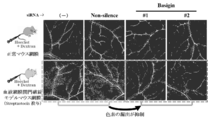
- Example 2 normal mice and streptozotocin-administered mice were injected with BSG siRNA # 1 or 2 and Non-silence siRNA into the vitreous, and after the tracer was administered, the leakage of the tracer was observed with a confocal microscope. It is.
- Examples of the therapeutic agent for nervous system diseases in the present invention include (a) a functional nucleic acid that suppresses the expression of a basigin gene; (b) a functional nucleic acid that eliminates or reduces the activity of basidine; (c) the above (a) Or (b) a functional nucleic acid expression vector containing a DNA encoding a functional nucleic acid; an inhibitor of disruption of a nervous system vascular barrier comprising any one of the functional nucleic acid expression vectors (hereinafter referred to as “disruption of the nervous system vascular barrier of the present invention”).
- a therapeutic agent for nervous system diseases caused by the breakdown of the nervous system vascular barrier comprising any one of the above (a) to (c) as an active ingredient (hereinafter referred to as “the nervous system disease of the present invention”). It is not limited in particular if it is referred to as a “therapeutic agent”), and it is possible to suppress the disappearance of claudin-5, to suppress the breakdown of the nervous system blood vessel barrier function, and to effectively prevent the nervous system blood vessel barrier with few side effects. It is possible to treat neurological diseases caused by the breakdown of the disease.
- another embodiment of the nervous system vascular barrier breakdown inhibitor of the present invention includes (a) a functional nucleic acid that suppresses the expression of a basidine gene; (b) a functional nucleic acid that eliminates or reduces the activity of basidine; c) a method for suppressing the breakdown of the nervous system vascular barrier, characterized by administering to the subject any one of the functional nucleic acid expression vectors comprising DNA encoding the functional nucleic acid of (a) or (b) above, (A) a functional nucleic acid that suppresses the expression of a basidine gene; (b) a functional nucleic acid that eliminates or reduces the physiological activity of basidine; (c) above (a ) Or (b) the functional nucleic acid expression vector comprising DNA encoding the functional nucleic acid; or (a) a functional nucleic acid that suppresses the expression of a baicidin gene; Functional nucleic acid that loses or diminishes sex; (c) the functional nucleic acid expression
- another embodiment of the therapeutic agent for nervous system diseases of the present invention includes (a) a functional nucleic acid that suppresses expression of a basidine gene; (b) a functional nucleic acid that eliminates or reduces the activity of basidine; (c) the above Treatment of nervous system diseases caused by the breakdown of the nervous system vascular barrier, characterized by administering to the subject any one of the functional nucleic acid expression vectors comprising DNA encoding the functional nucleic acid of (a) or (b) (A) a functional nucleic acid that suppresses the expression of a vasidin gene, (b) a function that eliminates or reduces the physiological activity of basidine, A functional nucleic acid; (c) any one of the functional nucleic acid expression vectors comprising a DNA encoding the functional nucleic acid of (a) or (b) above; or (a) a functionality that suppresses expression of a basidin gene.
- Basicin is a glycoprotein belonging to the immunoglobulin superfamily, which is localized in the cell membrane, and is also called EMMPRIN (extracellular matrix metalloproteinase inducer), CD147 (cluster of differentiation 147), HT7, and OX-47.
- EMMPRIN extracellular matrix metalloproteinase inducer
- CD147 cluster of differentiation 147
- HT7 HT7
- OX-47 OX-47
- examples of the functional nucleic acid that suppresses the expression of the basidine gene include siRNA, antisense RNA, miRNA, shRNA, and ribozyme that suppress the expression of the basidine gene.
- examples of the functional nucleic acid that loses or reduces the activity of vasidin include an aptamer that loses or reduces the function of basidine to open the vascular barrier.
- the functional nucleic acid can be designed based on the sequence information of the baicidin gene, for example, by the method described in the following literature (Wadhwa, R, et al. Reviews in Mutat. Res. (2004) 567: 71-84, Wadhwa, R. et al.
- Such functional nucleic acids can be prepared by known synthetic methods and methods using gene recombination techniques.
- the siRNA that suppresses expression of the basidine gene is a double-stranded RNA that consists of a sense strand sequence of nucleotides homologous to the mRNA of the basidine gene and a complementary antisense strand sequence thereof, and suppresses the expression of the basidine gene.
- the length of the double-stranded RNA is preferably 17 to 27 base pairs, more preferably 18 to 20 base pairs.
- the siRNA that suppresses the expression of the baicidin gene is specifically a siRNA composed of a nucleotide sense strand sequence shown in SEQ ID NO: 1 and a complementary antisense strand sequence shown in SEQ ID NO: 2, or SEQ ID NO: 3.
- siRNA composed of the sense strand sequence of the nucleotide shown in FIG. 5 and its complementary antisense strand sequence shown in SEQ ID NO: 4 can be preferably mentioned.
- the 3 ′ side of each chain may have an overhang sequence, preferably 2 bases selected from thymine, guanine, cytosine, and adenine, to enhance the basilin gene expression inhibitory action. it can.
- the functional nucleic acid expression vector containing DNA encoding the functional nucleic acid is not particularly limited as long as it is a vector capable of expressing the functional nucleic acid.
- the functional nucleic acid is siRNA
- the identification of baicidin It can be prepared by inserting a double-stranded RNA expression cassette comprising a nucleotide sense strand sequence-linker-complementary antisense strand sequence downstream of the promoter.
- a vector used for the preparation of such a functional nucleic acid expression vector a commercially available product can be used including a commercially available product, but a viral vector is preferable when introduced into a mammal.
- viral vectors include mouse leukemia retrovirus vectors, adeno-associated virus vectors, adenovirus vectors, and liposomes.
- HIV lentiviral vectors are also effective for non-dividing cells. This is preferable in that it can be expressed for a long time.
- these expression systems may contain not only the expression but also a control sequence that regulates the expression.
- Examples of the nervous system disease resulting from the breakdown of the nervous system vascular barrier can include a disorder caused by disruption of the tissue microenvironment due to breakdown of the vascular barrier function, more preferably brain edema, cerebral infarction, Examples thereof include cerebral nervous system diseases such as vascular dementia and ischemic brain disease, and retinal nervous system diseases such as retinal edema, and particularly preferably include brain edema and retinal edema.
- a nervous system blood vessel is a blood vessel of a nervous system tissue and does not include a blood vessel in a tissue other than the nervous system tissue.
- the nervous system blood vessel barrier means a mechanism that restricts the exchange of substances between blood and nervous system tissue fluids, the blood-brain barrier that restricts the exchange of substances between blood and brain tissue fluids, and the blood and retinal tissue fluids.
- a blood-retinal barrier that restricts substance exchange can be preferably cited.
- the failure of the blood vessel barrier means that a mechanism that restricts material exchange between blood and nervous system tissue fluid does not function.
- the breakdown of the vascular barrier results in impaired vascular barrier functions such as invasion of neurotoxic molecules into tissues and leaching of plasma components.
- the nervous system blood vessel barrier breakdown inhibitor or the therapeutic agent for nervous system diseases of the present invention encodes a functional nucleic acid that suppresses expression of a baicidin gene, a functional nucleic acid that eliminates or reduces the activity of baicidin, and such a functional nucleic acid.
- the functional nucleic acid expression vector containing DNA may be used as an active ingredient, and excipients, binders, lubricants, disintegrants, preservatives, isotonic agents, stabilizers, dispersants, antioxidants, It may contain pharmaceutically acceptable additives that are commonly used for the preparation of coloring agents, flavoring agents, buffering agents and the like.
- the dosage form of the preparation may be a solid preparation such as a powder or a granule, but from the viewpoint of obtaining an excellent therapeutic effect on a nervous system disease, it is preferably a liquid such as a solution, an emulsion or a suspension. .
- the administration method of the nervous system vascular barrier breakdown inhibitor of the present invention is not particularly limited as long as the desired nervous system vascular barrier breakdown inhibitory effect is obtained, and the administration method of the nervous system disease therapeutic agent of the present invention is as follows.
- any administration method can be administered intravenously, orally, intramuscularly, subcutaneously, transdermally, nasally, pulmonary, etc.
- intravitreal administration can be mentioned.
- the dose of the nervous system vascular barrier breakdown inhibitor or the nervous system disease therapeutic agent of the present invention is not particularly limited, and is appropriately adjusted according to the physical condition, disease state, body weight, age, sex, etc. of the subject or the subject animal. be able to.
- Examples of the dose include 0.01 ⁇ g to 100 g / kg body weight, more preferably 0.1 ⁇ g to 10 g / kg body weight, more preferably 1 ⁇ g to 1 g / kg body weight per day.
- a systemic vascular barrier breakdown inhibitor may be used in combination with another nervous system vascular barrier breakdown inhibitor, and the therapeutic agent for nervous system disease of the present invention may be used in combination with another therapeutic agent for nervous system disease.
- the administration frequency and administration period of the nervous system vascular barrier breakdown inhibitor or the nervous system disease therapeutic agent of the present invention are not particularly limited, and the daily dose is administered once or divided into several times a day. You can also.
- the origin of the cells and tissues to be administered and the living body are not particularly limited and are preferably mammals, for example, humans, monkeys, cows, horses, sheep, pigs, dogs, cats, rats, mice, hamsters, etc. Among them, humans can be exemplified.
- siRNAs that specifically suppress the expression of the target factor were prepared, and claw from the cell membrane of mouse brain vascular endothelial cell line (bEND.3 cells) by various stimuli (hypoxia, cytokines, etc.).
- SiRNA showing an inhibitory effect common to Din-5 disappearance was used as a therapeutic drug candidate for vascular barrier breakdown.
- siRNA against vasidin was used as a candidate, and the usefulness of such candidate siRNA as a therapeutic agent for vascular barrier failure was analyzed by the following method using an in vitro system.
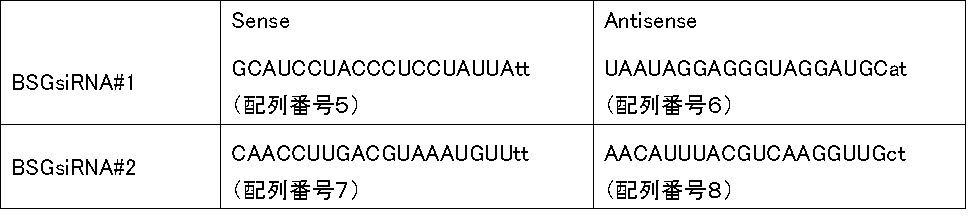
- BSGsiRNA # 1 sense strand sequence: SEQ ID NO: 5
- BSG siRNA # 2 sense strand sequence: Two types of SEQ ID NO: 7 and antisense strand sequence: SEQ ID NO: 8)
- Non-silence siRNA Silencer (registered trademark) Select Negative Control # 1 siRNA: Catalog No. 4390843
- SEQ ID NOS: 5 to 12 the base sequence represented by a small letter represents an overhang sequence.
- bEND.3 cells Four mouse cerebral vascular endothelial cell lines (bEND.3 cells: purchased from ATCC) were prepared, respectively, using a DMEM medium (Sigma Aldrich) containing 10% FBS (fetal calf serum) at 37 ° C., 95 The cells were cultured under the conditions of% air and 5% CO 2 . Each of the siRNAs was further introduced to a final concentration of 10 nM 5.5 days after conferencing. 36 hours after introduction, 1 dish out of 4 dishes was added with VEGF, 1 dish was added with TNF- ⁇ at 50 ng / ml, 1 dish was not added, and another 3 hours and 6 hours in normoxia, respectively. Cultured for 9 hours. The remaining 1 dish out of 4 dishes was 1% hypoxic for about 30 minutes 36 hours after siRNA introduction.
- DMEM medium Sigma Aldrich
- FBS fetal calf serum
- FIG. 2 shows the result of quantifying the expression of claudin-5 protein in FIG. 1 according to the method described in Non-Patent Document 3 above.
- TEER transdermal electrical resistance value
- ADAM12 siRNA sense strand sequence: SEQ ID NO: 9, antisense strand sequence: SEQ ID NO: 10
- ADAM17 siRNA sense strand sequence: SEQ ID NO: 11, antisense strand sequence
- Table 2 instead of BSG siRNA # 1 or 2 above:
- bEND Using two types of SEQ ID NO: 12
- the phenomenon of claudin-5 disappearance from the cell membrane of 3 cells was examined. The results are shown in FIG.
- ADAM12 siRNA or ADAM17 siRNA As shown in FIG. 5, the claudin-5 disappearance phenomenon from the cell membrane by the hypoxic treatment is suppressed by ADAM12 siRNA or ADAM17 siRNA, but the claudin-5 disappearance phenomenon from the cell membrane by the addition of VEGF and TNF- ⁇ is It was confirmed that it is not suppressed by ADAM12 siRNA or ADAM17 siRNA. Therefore, it has been clarified that ADAM12 or ADAM17 is only a factor involved in the vascular barrier breakdown caused by hypoxia.
- baicidin is a factor that regulates vascular barrier function downstream of common intracellular signal transduction systems (factors that open the barrier). Therefore, it is suggested that the functional nucleic acid that suppresses the expression of the baicidin gene is a useful therapeutic target for nervous system diseases in which various triggers are mixed and vascular barrier breakdown occurs. Then, the functional analysis using the in vivo system
- the retina is a tissue formed in the form of the central nervous system budding during the ontogeny process, and is a part of the central nervous system like the brain. Since the retinal vasculature can be observed and evaluated two-dimensionally over the entire length in the long axis direction, in this study, the retina was used as an analysis material as a representative of the central nervous system.
- mice 7-week-old C57B6 / N mice were fasted for 4 hours, and blood sugar and body weight were measured.
- 150 mg / kg of streptozotocin (Streptozotocin: dissolved in citrate buffer) was injected intraperitoneally.
- the animals were fasted for 4 hours 4 days after the injection of streptozotocin, blood glucose and body weight were measured, and a mouse having a blood glucose level of 250 mg / dl or more was used as a blood retinal barrier failure model mouse.
- BSG siRNA # 1 or 2 or Non-silence siRNA was injected into the vitreous body of normal mice (C57B6 / N mice injected intraperitoneally with citrate buffer) and blood retinal barrier failure model mice obtained above (10 nM). 1 ⁇ l).
- mice C57B6 / N mice injected intraperitoneally with citrate buffer
- blood retinal barrier failure model mice obtained above (10 nM). 1 ⁇ l).
- three days after injection into the vitreous (seven days after administration of streptozotocin), each mouse was given a fluorescent dye as a tracer intracardiacly, then a retinal extension specimen was prepared, and leakage of the injected tracer was observed with a confocal microscope.
- the permeability of retinal blood vessels indicator of blood retinal barrier function
- the present invention artificially controls the cascade of pathological deterioration, including not only improving edema but also inhibiting the invasion of neurotoxic molecules into tissues in refractory nervous system diseases for which there is still no effective treatment. It becomes possible to perform treatment that leads to improvement of the disease state.
- neurological diseases such as cerebral edema, retinal edema, and ischemic brain disease caused by the breakdown of the nervous system vascular barrier.
Landscapes
- Health & Medical Sciences (AREA)
- Life Sciences & Earth Sciences (AREA)
- Chemical & Material Sciences (AREA)
- Engineering & Computer Science (AREA)
- Genetics & Genomics (AREA)
- Molecular Biology (AREA)
- General Health & Medical Sciences (AREA)
- Biotechnology (AREA)
- Biomedical Technology (AREA)
- Public Health (AREA)
- Zoology (AREA)
- Epidemiology (AREA)
- Pharmacology & Pharmacy (AREA)
- Veterinary Medicine (AREA)
- Medicinal Chemistry (AREA)
- Organic Chemistry (AREA)
- Biochemistry (AREA)
- General Engineering & Computer Science (AREA)
- Animal Behavior & Ethology (AREA)
- Bioinformatics & Cheminformatics (AREA)
- Wood Science & Technology (AREA)
- Microbiology (AREA)
- Plant Pathology (AREA)
- Biophysics (AREA)
- Physics & Mathematics (AREA)
- Pharmaceuticals Containing Other Organic And Inorganic Compounds (AREA)
- Medicines That Contain Protein Lipid Enzymes And Other Medicines (AREA)
Abstract
本発明の課題は、低酸素状態のみならず様々な誘因による血管バリアー破綻に対して作用する神経系血管バリアーの破綻抑制剤及び神経系疾患治療剤を提供することである。解決手段として、(a)ベイシジン(basigin)遺伝子の発現を抑制する機能性核酸;(b)ベイシジンの生理活性を消失又は減退する機能性核酸;(c)上記(a)又は(b)の機能性核酸をコードするDNAを含む該機能性核酸発現ベクター;のいずれかを有効成分とする神経系血管バリアーの破綻抑制剤又は神経系疾患治療剤を調整する。神経系疾患としては、脳神経系疾患又は網膜神経系疾患が好ましい。
Description
本発明は低酸素状態のみならず様々な誘因による神経系血管バリアー破綻に対して作用する神経系血管バリアー破綻抑制剤及び神経系疾患治療剤に関する。
成体の神経組織(脳、網膜、脊髄など)では、血液と神経組織の間に血管バリアー(血液脳関門、血液網膜関門など)が形成され、神経細胞が正常に機能できる至適組織微小環境が維持されており、組織特異的に分化した血管系が有するバリアー機能により他組織から区画化されている。成体神経組織の血管バリアー機能は個体発生過程において誘導されるが、いったん誘導された血管バリアー機能も常に一定の状態にあるわけではなく、成体は血管バリアー機能を増強したり減弱させたりすることにより、神経細胞が正常に機能するための至適微小環境を維持している。一方、虚血性脳疾患などの難治性神経系疾患においては、血管バリアー機能が破綻し組織微小環境の撹乱が生じることが、病態を悪化させる大きな要因として働いている。したがって、血管バリアー機能の調節因子は、それら難治性疾患の病態悪化を妨げるための新規治療法開発の標的となることが期待される。
神経系血管バリアー機能の本体は、血管の内皮細胞間に形成されるタイトジャンクション(tight junction:以下、TJ)網に依存することから、TJ構成分子を研究することが、血管バリアー調節機構の解明に向けた戦略の中心となっている。TJ構成分子としては、occludin、claudin(27メンバーからなるファミリーを形成)、junctional adhesion molecule A (JAM-A)などが特定されているが、生理的状態の神経系血管内皮細胞の細胞膜に発現・局在しているクローディン-5(claudin-5:claudin family membersの一つ)が血管バリアー機能に必須であることが報告されている(非特許文献1参照)。また、本発明者らは、1)難治性神経系疾患の血管内皮細胞の細胞膜からのクローディン-5の消失、2)血管バリアー機能の破綻、3)病態悪化、というカスケードを報告した(非特許文献2参照)。しかしながら、血管バリアー機能の制御機構については、いまだ多くが不明のままである。
神経系血管バリアーの破綻は、神経毒性分子の組織内侵入を許すとともに、血漿成分の浸出による組織浮腫を惹起する。浮腫が一定期間を超えて持続すると神経系組織に不可逆的な障害が加わる。現在の医療では、血管バリアー破綻による脳浮腫に対しては、グリセオールの静脈内投与により血漿膠質浸透圧を上げ、組織間質液を血管内に移動させる治療が主流となっている。副腎皮質ステロイド投与も浮腫に有効との考えもあるが、その浮腫軽減機構は明らかではなく、副作用も多く併発することから治療適応は狭い。
また、難治性神経疾患において血管バリアーを破綻させる種々の誘因が知られているが、本発明者らは、誘因として組織低酸素状態に焦点を当てた解析を行い、ADAM12及びADAM17を血管バリアー破綻の責任因子として特定し、それらを標的とした治療薬の有用性を示した(特許文献1、非特許文献3参照)。ADAM12及びADAM17を標的とした治療薬は、主として低酸素状態を誘因とした血管バリアー破綻に対して有用である。
一方、多くの神経系疾患における血管バリアー破綻には低酸素状態が誘因として働くものの、実際には、低酸素状態以外の種々の誘因が混在して血管バリアー破綻に関与している。そのため、ADAM12及び/又はADAM17を標的とした治療薬は神経系疾患の病態改善に寄与するが、血管バリアー破綻の抑制が完全ではない可能性が残る。そこで、低酸素状態のみならず様々な誘因による血管バリアー破綻に対して作用する神経系疾患治療薬が求められていた。
ところで、ベイシジンは細胞膜に局在するイムノグロブリンスーパーファミリーに属する糖タンパク質であり、EMMPRIN(extracellular matrix metalloproteinase inducer)、CD147(cluster of differentiation 147)、HT7、OX-47とも称されている。かかるベイシジンをターゲットとするsiRNAがMMP-9を減少させること、及び、ベイシジンをターゲットとする抗体が、肝細胞がんと共培養したヒト繊維芽細胞におけるMMP-2を増減させること(特許文献2参照)や、ベイシジン抗体が、がんや炎症性疾患の診断、治療に用いることができること(特許文献3、4参照)や、ベイシジン抗体が、血管新生に関与する悪性疾患の診断又は治療に用いることができること(特許文献5、6参照)が報告されているが、ベイシジンと血管バリアー破綻との関係は示されていない。
Nitta T, et al. J. Cell Biol.(2003) 161:653-660
Koto T, et al. Am. J. Pathol.(2007) 170:1389-1397
Cui D, et al. Sci. Rep. 5:12796(2015) doi:10.1038/srep12796
本発明の課題は、低酸素状態のみならず様々な誘因による血管バリアー破綻に対して作用する神経系血管バリアーの破綻抑制剤及び神経系疾患治療剤を提供することにある。
本発明者らは、多くの神経系疾患において血管バリアー破綻の誘因として存在する組織低酸素状態に焦点をあてた解析を行い、血管内皮細胞に発現しているADAM12とADAM17が低酸素刺激による血管バリアー破綻の責任因子として特定し、それらを標的とした治療薬の有用性を示した。しかし、低酸素状態以外にも血管バリアー破綻の誘因は存在し、多くの神経系疾患においては、それらの誘因が混在して血管バリアー破綻を来たすと考えられる。ADAM12とADAM17は、主として低酸素状態を誘因とした血管バリアー破綻に関与する因子であることから、もしも様々な誘因による血管バリアー破綻に共通した責任因子を特定できれば、多くの神経系疾患に適応可能なより汎用性の高い新規治療法の確立が期待されると考え研究を進めた。そして、低酸素状態と共に炎症などの誘因による血管バリアー破綻に共通する責任因子としてベイシジン(basigin)に着目した。ベイシジンが報告されて約30年間が経過する(当初はHT7として報告;[Risau W, et al. EMBO(1986) J. 5, 3179-3183)。多くの研究者によるベイシジンの解析にも拘わらず、その血管バリアーにおける機能は不明のままである。これまでの解析は全て、「血管バリアー形成内皮細胞に特異的に発現している分子」は「血管バリアー機能を誘導し維持するために働く分子」との視点に立ったものであった。そこで、本発明者らは、発想を逆転し、「血管バリアー形成内皮細胞に特異的に発現している分子」は「必要な時に血管バリアーを開くために働く分子」ではないかとの仮説を立て、本発明の研究計画の着想に至り解析を進めた。その結果、神経系血管内皮細胞に発現するベイシジンは、種々の誘因による血管バリアー破綻に共通した責任因子であること、神経系疾患における治療標的として有用であることが明らかとなり、本発明を完成した。
すなわち、本発明は、以下に示すとおりのものである。
[1]以下の(a)~(c)のいずれかを有効成分とする神経系血管バリアーの破綻抑制剤。
(a)ベイシジン(basigin)遺伝子の発現を抑制する機能性核酸;
(b)ベイシジンの活性を消失又は減退する機能性核酸;
(c)上記(a)又は(b)の機能性核酸をコードするDNAを含む該機能性核酸発現ベクター;
[2]ベイシジン遺伝子の発現を抑制する機能性核酸がsiRNAであることを特徴とする上記[1]記載の神経系血管バリアーの破綻抑制剤。
[3]ベイシジン遺伝子の発現を抑制する機能性核酸が、配列番号1に示すヌクレオチドのセンス鎖配列と配列番号2に示すその相補的なアンチセンス鎖配列から構成されるsiRNA、又は、配列番号3に示すヌクレオチドのセンス鎖配列と配列番号4に示すその相補的なアンチセンス鎖配列から構成されるsiRNAであることを特徴とする上記[2]記載の神経系血管バリアーの破綻抑制剤。
[4]以下の(a)~(c)のいずれかを有効成分とする神経系血管バリアーの破綻に起因する神経系疾患治療剤。
(a)ベイシジン(basigin)遺伝子の発現を抑制する機能性核酸;
(b)ベイシジンの活性を消失又は減退する機能性核酸;
(c)上記(a)又は(b)の機能性核酸をコードするDNAを含む該機能性核酸発現ベクター;
[5]神経系疾患が、脳神経系疾患又は網膜神経系疾患であることを特徴とする上記[4]記載の神経系疾患治療剤。
[6]神経系疾患が、脳浮腫又は網膜浮腫であることを特徴とする上記[5]記載の神経系疾患治療剤。
[7]ベイシジン遺伝子の発現を抑制する機能性核酸がsiRNAであることを特徴とする上記[4]~[6]のいずれか記載の神経系疾患治療剤。
[8]ベイシジン遺伝子の発現を抑制する機能性核酸が、配列番号1に示すヌクレオチドのセンス鎖配列と配列番号2に示すその相補的なアンチセンス鎖配列から構成されるsiRNA、又は、配列番号3に示すヌクレオチドのセンス鎖配列と配列番号4に示すその相補的なアンチセンス鎖配列から構成されるsiRNAであることを特徴とする上記[7]記載の神経系疾患治療剤。
[1]以下の(a)~(c)のいずれかを有効成分とする神経系血管バリアーの破綻抑制剤。
(a)ベイシジン(basigin)遺伝子の発現を抑制する機能性核酸;
(b)ベイシジンの活性を消失又は減退する機能性核酸;
(c)上記(a)又は(b)の機能性核酸をコードするDNAを含む該機能性核酸発現ベクター;
[2]ベイシジン遺伝子の発現を抑制する機能性核酸がsiRNAであることを特徴とする上記[1]記載の神経系血管バリアーの破綻抑制剤。
[3]ベイシジン遺伝子の発現を抑制する機能性核酸が、配列番号1に示すヌクレオチドのセンス鎖配列と配列番号2に示すその相補的なアンチセンス鎖配列から構成されるsiRNA、又は、配列番号3に示すヌクレオチドのセンス鎖配列と配列番号4に示すその相補的なアンチセンス鎖配列から構成されるsiRNAであることを特徴とする上記[2]記載の神経系血管バリアーの破綻抑制剤。
[4]以下の(a)~(c)のいずれかを有効成分とする神経系血管バリアーの破綻に起因する神経系疾患治療剤。
(a)ベイシジン(basigin)遺伝子の発現を抑制する機能性核酸;
(b)ベイシジンの活性を消失又は減退する機能性核酸;
(c)上記(a)又は(b)の機能性核酸をコードするDNAを含む該機能性核酸発現ベクター;
[5]神経系疾患が、脳神経系疾患又は網膜神経系疾患であることを特徴とする上記[4]記載の神経系疾患治療剤。
[6]神経系疾患が、脳浮腫又は網膜浮腫であることを特徴とする上記[5]記載の神経系疾患治療剤。
[7]ベイシジン遺伝子の発現を抑制する機能性核酸がsiRNAであることを特徴とする上記[4]~[6]のいずれか記載の神経系疾患治療剤。
[8]ベイシジン遺伝子の発現を抑制する機能性核酸が、配列番号1に示すヌクレオチドのセンス鎖配列と配列番号2に示すその相補的なアンチセンス鎖配列から構成されるsiRNA、又は、配列番号3に示すヌクレオチドのセンス鎖配列と配列番号4に示すその相補的なアンチセンス鎖配列から構成されるsiRNAであることを特徴とする上記[7]記載の神経系疾患治療剤。
本発明により、低酸素状態のみならず様々な誘因による血管バリアー破綻に対して作用する神経系血管バリアーの破綻抑制剤及び神経系疾患治療剤を提供することが可能となる。
本発明における神経系疾患治療剤としては、(a)ベイシジン(basigin)遺伝子の発現を抑制する機能性核酸;(b)ベイシジンの活性を消失又は減退する機能性核酸;(c)上記(a)又は(b)の機能性核酸をコードするDNAを含む該機能性核酸発現ベクター;のいずれかを有効成分とする神経系血管バリアーの破綻抑制剤(以下、「本発明の神経系血管バリアーの破綻抑制剤」という場合がある)や、上記(a)~(c)のいずれかを有効成分とする神経系血管バリアーの破綻に起因する神経系疾患治療剤(以下、「本発明の神経系疾患治療剤」という場合がある)であれば特に制限されず、クローディン-5の消失を抑制すると共に、神経系血管バリアー機能の破綻を抑制することや、副作用が少なく効果的に神経系血管バリアーの破綻に起因する神経系疾患治療をすることができる。
また、本発明の神経系血管バリアーの破綻抑制剤の別の態様としては、(a)ベイシジン遺伝子の発現を抑制する機能性核酸;(b)ベイシジンの活性を消失又は減退する機能性核酸;(c)上記(a)又は(b)の機能性核酸をコードするDNAを含む該機能性核酸発現ベクター;のいずれかを対象に投与することを特徴とする神経系血管バリアーの破綻抑制方法や、神経系血管バリアーの破綻抑制剤として使用するための、(a)ベイシジン遺伝子の発現を抑制する機能性核酸;(b)ベイシジンの生理活性を消失又は減退する機能性核酸;(c)上記(a)又は(b)の機能性核酸をコードするDNAを含む該機能性核酸発現ベクター;のいずれかや、(a)ベイシジン遺伝子の発現を抑制する機能性核酸;(b)ベイシジンの生理活性を消失又は減退する機能性核酸;(c)上記(a)又は(b)の機能性核酸をコードするDNAを含む該機能性核酸発現ベクター;のいずれかの、神経系血管バリアーの破綻抑制剤の調製における使用を挙げることができる。
さらに、本発明の神経系疾患治療剤の別の態様としては、(a)ベイシジン遺伝子の発現を抑制する機能性核酸;(b)ベイシジンの活性を消失又は減退する機能性核酸;(c)上記(a)又は(b)の機能性核酸をコードするDNAを含む該機能性核酸発現ベクター;のいずれかを対象に投与することを特徴とする神経系血管バリアーの破綻に起因する神経系疾患治療方法や、神経系血管バリアーの破綻に起因する神経系疾患治療剤として使用するための、(a)ベイシジン遺伝子の発現を抑制する機能性核酸;(b)ベイシジンの生理活性を消失又は減退する機能性核酸;(c)上記(a)又は(b)の機能性核酸をコードするDNAを含む該機能性核酸発現ベクター;のいずれかや、(a)ベイシジン遺伝子の発現を抑制する機能性核酸;(b)ベイシジンの生理活性を消失又は減退する機能性核酸;(c)上記(a)又は(b)の機能性核酸をコードするDNAを含む該機能性核酸発現ベクター;のいずれかの、神経系血管バリアーの破綻に起因する神経系疾患治療剤の調製における使用を挙げることができる。
ベイシジンは、細胞膜に局在するイムノグロブリンスーパーファミリーに属する糖タンパク質であり、EMMPRIN(extracellular matrix metalloproteinase inducer)、CD147(cluster of differentiation 147)、HT7、OX-47とも称されている。
本発明において、ベイシジン遺伝子の発現を抑制する機能性核酸としては、ベイシジン遺伝子の発現を抑制するsiRNA、アンチセンスRNA、miRNA、shRNA、リボザイムを挙げることができ、ベイシジン遺伝子の発現を抑制するsiRNAを好適に挙げることができる。また、本発明において、ベイシジンの活性を消失又は減退する機能性核酸としては、ベイシジンが血管バリアーを開く機能を消失又は減退するアプタマーを挙げることができる。上記機能性核酸はベイシジン遺伝子の配列情報に基づいて設計することができ、例えば以下の文献に記載の方法で設計することができる(Wadhwa, R, et al. Reviews in Mutat. Res. (2004) 567:71-84, Wadhwa, R. et al. Current Opinions in Molecular Therapeutics. (2004) 6:367-372, Wadhwa, R. et al. EMBO (2003) 4:595-601)。また、かかる機能性核酸は公知の合成による方法及び遺伝子組換え技術を用いる方法により作製することができる。
上記ベイシジン遺伝子の発現を抑制するsiRNAとは、ベイシジン遺伝子のmRNAに相同なヌクレオチドのセンス鎖配列と、その相補的なアンチセンス鎖配列とからなり、ベイシジン遺伝子の発現を抑制する二本鎖RNAを意味する。二本鎖RNAの長さは、好ましくは17~27塩基対、より好ましくは18~20塩基対である。ベイシジン遺伝子の発現を抑制するsiRNAとしては、具体的には、配列番号1に示すヌクレオチドのセンス鎖配列と配列番号2に示すその相補的なアンチセンス鎖配列から構成されるsiRNA、又は配列番号3に示すヌクレオチドのセンス鎖配列と配列番号4に示すその相補的なアンチセンス鎖配列から構成されるsiRNAを好適に挙げることができる。また、それぞれの鎖の3’側には、オーバーハング配列、好ましくはチミン、グアニン、シトシン、アデニンのいずれかから選択される2塩基をもたせることにより、ベイシジン遺伝子の発現抑制作用を増強することもできる。
上記機能性核酸をコードするDNAを含む該機能性核酸発現ベクターとしては、上記機能性核酸を発現可能なベクターであれば特に制限されないが、たとえば機能性核酸がsiRNAの場合には、ベイシジンの特定ヌクレオチドのセンス鎖配列-リンカー-その相補的なアンチセンス鎖配列からなる二本鎖RNA発現カセットをプロモーターの下流に挿入することにより作製することができる。かかる機能性核酸発現ベクター作製に用いるベクターは、市販品を含め公知のものを用いることができるが、哺乳動物に導入する場合にはウイルスベクターであることが好ましい。ウイルスベクターとしては、例えば、マウス白血病レトロウイルスベクターや、アデノ随伴ウイルスベクターや、アデノウイルスベクターや、リポソームなどを具体的に挙げることができるが、HIVレンチウイルスベクターは、非分裂細胞にも効率よく長期発現が可能であるという特徴を有する点で好ましい。また、これら発現系は、発現を起こさせるだけでなく、発現を調節する制御配列を含んでいてもよい。
前記神経系血管バリアーの破綻に起因する神経系疾患としては、好ましくは血管バリアー機能が破綻して組織微小環境の攪乱が生じることによる疾患を挙げることができ、より好ましくは脳浮腫、脳梗塞、血管性認知症、虚血性脳疾患などの脳神経系疾患、又は網膜浮腫などの網膜神経系疾患を挙げることができ、特に好ましくは脳浮腫又は網膜浮腫を挙げることができる。なお、神経系血管とは、神経系組織の血管であり、神経系組織以外の組織における血管は含まれない。
前記神経系血管バリアーとは、血液と神経系の組織液との物質交換を制限する機構を意味し、血液と脳の組織液との物質交換を制限する血液脳関門や、血液と網膜の組織液との物質交換を制限する血液網膜関門を好適に挙げることができる。
本発明において、血管バリアーの破綻とは、血液と神経系の組織液との物質交換を制限する機構が機能しないことを意味する。かかる血管バリアーの破綻により、神経毒性分子の組織内侵入や血漿成分の浸出などの血管バリアー機能の障害が生じることとなる。
本発明の神経系血管バリアーの破綻抑制剤又は神経系疾患治療剤は、ベイシジン遺伝子の発現を抑制する機能性核酸、ベイシジンの活性を消失又は減退する機能性核酸や、かかる機能性核酸をコードするDNAを含む該機能性核酸発現ベクターを有効成分としていればよく、賦形剤、結合剤、滑沢剤、崩壊剤、防腐剤、等張化剤、安定化剤、分散剤、酸化防止剤、着色剤、香味剤、緩衝剤などの製剤化のために通常使用され薬学的に許容される添加物を含んでいてもよい。製剤の剤型としては散剤、顆粒剤などの固形製剤であってもよいが、優れた神経系疾患治療効果を得る観点からは、溶液剤、乳剤、懸濁剤などの液剤とすることが好ましい。
本発明の神経系血管バリアーの破綻抑制剤の投与方法としては所望の神経系血管バリアーの破綻抑制効果が得られる限り特に制限されず、また、本発明の神経系疾患治療剤の投与方法としては、所望の神経系疾患治療効果が得られる限り特に制限されず、所貴いずれの投与方法も静脈内投与、経口投与、筋肉内投与、皮下投与、経皮投与、経鼻投与、経肺投与などを挙げることができ、特に網膜神経系疾患においては、硝子体内投与を挙げることができる。また、本発明の神経系血管バリアーの破綻抑制剤又は神経系疾患治療剤の投与量は特に制限されず、被検者や被検動物の体調、病状、体重、年齢、性別などによって適宜調整することができる。投与量としては、例えば1日あたり、0.01μg~100g/kg体重、より好ましくは0.1μg~10g/kg体重、さらに好ましくは1μg~1g/kg体重を挙げることができ、本発明の神経系血管バリアーの破綻抑制剤を他の神経系血管バリアーの破綻抑制剤と併用してもよく、また、本発明の神経系疾患治療剤を他の神経系疾患治療剤と併用してもよい。本発明の神経系血管バリアーの破綻抑制剤又は神経系疾患治療剤の投与回数や投与期間なども特に制限されず、1日あたりの投与量を1日1回又は数回に分けて投与することもできる。また投与対象の細胞、組織の由来や生体は特に制限されず、好ましくは哺乳類であり、例えばヒト、サル、ウシ、ウマ、ヒツジ、ブタ、イヌ、ネコ、ラット、マウス、ハムスターなどを例示することができ、中でもヒトを例示することができる。
以下、実施例により本発明をより具体的に説明するが、本発明の技術的範囲はこれらの例示に限定されるものではない。
[マウス脳血管内皮細胞株の単層培養を用いたin vitro系解析]
本発明者らはこれまでに、上述のように1)難治性神経系疾患の血管内皮細胞の細胞膜からのクローディン-5の消失、2)血管バリアー機能の破綻、3)病態悪化、というカスケードを明らかにして報告した。そこで、1次スクリーニングとして、対象因子の発現を特異的に抑制するsiRNAを作製し、種々の刺激(低酸素、サイトカインなど)によるマウス脳血管内皮細胞株(bEND.3細胞)の細胞膜からのクローディン-5消失に共通した阻害効果を示すsiRNAを、血管バリアー破綻に対する治療薬候補とした。そのなかでベイシジンに対するsiRNAを候補とし、かかる候補siRNAの血管バリアー破綻に対する治療薬としての有用性について、以下に示す方法でin vitro系を用いた機能的解析を行った。
本発明者らはこれまでに、上述のように1)難治性神経系疾患の血管内皮細胞の細胞膜からのクローディン-5の消失、2)血管バリアー機能の破綻、3)病態悪化、というカスケードを明らかにして報告した。そこで、1次スクリーニングとして、対象因子の発現を特異的に抑制するsiRNAを作製し、種々の刺激(低酸素、サイトカインなど)によるマウス脳血管内皮細胞株(bEND.3細胞)の細胞膜からのクローディン-5消失に共通した阻害効果を示すsiRNAを、血管バリアー破綻に対する治療薬候補とした。そのなかでベイシジンに対するsiRNAを候補とし、かかる候補siRNAの血管バリアー破綻に対する治療薬としての有用性について、以下に示す方法でin vitro系を用いた機能的解析を行った。
ベイシジンに対するsiRNA(ベイシジン特異的siRNA(BSGsiRNA))として、以下の表1に示すBSGsiRNA#1(センス鎖配列:配列番号5、アンチセンス鎖配列:配列番号6)、BSGsiRNA#2(センス鎖配列:配列番号7、アンチセンス鎖配列:配列番号8)の2種類、及びNon-silence siRNA(Silencer(登録商標) Select Negative Control #1 siRNA:カタログ番号4390843)をThermo Fisher Scientific社から購入した。なお、配列番号5~12中、小文字で表される塩基配列はオーバーハング配列を表す。
マウス脳血管内皮細胞株(bEND.3細胞:ATCCより購入)をそれぞれ4ディッシュ用意し、10%FBS(ウシ胎児血清)入りのDMEM培地(シグマ・アルドリッチ社製)を用いて、37℃、95%エアー、5%CO2条件下で培養した。コンフェルトになってからさらに5.5日後に上記各siRNAを終濃度が10nMとなるように導入した。導入36時間後に、4ディッシュのうち1ディッシュはVEGFを、1ディッシュはTNF-αを50ng/mlとなるように加え、1ディッシュは添加無しとし、正常酸素状態でそれぞれさらに3時間、6時間、9時間培養した。また、4ディッシュのうち残りの1ディッシュはsiRNA導入36時間後に、30分間ほど1%低酸素状態とした。
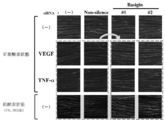
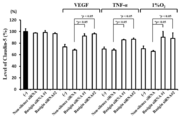
TNF-α、VEGFを添加してから6時間培養後、又は低酸素処理直後におけるクローディン-5の発現と局在を、1次抗体としてRabbit anti-mouse claudin-5(Thermo Fisher Scientific社製)、2次抗体としてAlexaFluor(登録商標) 488 Goat anti-Rabbit IgG抗体(Thermo Fisher Scientific社製)を用いた免疫染色により調べた結果を図1に示す。また、図1におけるクローディン-5タンパク質の発現を上記非特許文献3に記載の方法に準じて定量化した結果を図2に示す。具体的には、1検体あたり、3視野を無作為に選出して写真を撮影し、1枚の写真につき3本のラインを引き、細胞膜との交点におけるクローディン-5の蛍光強度を測定し、平均値を算出した。同様に1群あたり3検体ずつ測定を行い、平均値を比較した。
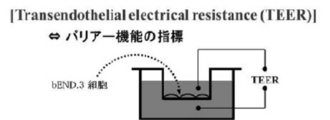
さらに、血管バリアーの機能的指標として、TNF-α又はVEGFを添加して3、6、9時間培養後における、細胞単層の経皮内電気抵抗値(TEER)を上記非特許文献2に記載の方法に従って図3に示すように測定した結果を図4に示す。
(結果)
図1、2に示すように、siRNA無し若しくはNon-silence siRNAを導入した場合には、VEGF添加、TNF-α添加、低酸素状態の全ての病的刺激によってbEND.3細胞の細胞膜からのクローディン-5消失現象が観察された。一方、BSGsiRNA#1又は2をbEND.3細胞に導入してベイシジンの発現を阻害したところ、VEGF添加、TNF-α添加、低酸素状態のいずれもbEND.3細胞の細胞膜からのクローディン-5消失現象が抑制された。さらに、図4に示すように、VEGF添加、TNF-α添加におけるbEND.3細胞単層のTEERを経時的に測定したところ、BSGsiRNA#1又は2は、VEGF添加、TNF-α添加によるTEER低下を抑制することが明らかとなった。したがって、ベイシジン遺伝子の発現を抑制する機能性核酸は、低酸素状態のみならずVEGFやTNF-αなどの様々な誘因による血管バリアー破綻に対して作用することが明らかとなった。
図1、2に示すように、siRNA無し若しくはNon-silence siRNAを導入した場合には、VEGF添加、TNF-α添加、低酸素状態の全ての病的刺激によってbEND.3細胞の細胞膜からのクローディン-5消失現象が観察された。一方、BSGsiRNA#1又は2をbEND.3細胞に導入してベイシジンの発現を阻害したところ、VEGF添加、TNF-α添加、低酸素状態のいずれもbEND.3細胞の細胞膜からのクローディン-5消失現象が抑制された。さらに、図4に示すように、VEGF添加、TNF-α添加におけるbEND.3細胞単層のTEERを経時的に測定したところ、BSGsiRNA#1又は2は、VEGF添加、TNF-α添加によるTEER低下を抑制することが明らかとなった。したがって、ベイシジン遺伝子の発現を抑制する機能性核酸は、低酸素状態のみならずVEGFやTNF-αなどの様々な誘因による血管バリアー破綻に対して作用することが明らかとなった。
[参考例]
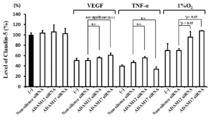
上記BSGsiRNA#1又は2の代わりに以下の表2に示すADAM12siRNA(センス鎖配列:配列番号9、アンチセンス鎖配列:配列番号10)、ADAM17siRNA(センス鎖配列:配列番号11、アンチセンス鎖配列:配列番号12)の2種類を用いて、上記と同様にbEND.3細胞の細胞膜からのクローディン-5消失現象を調べた。結果を図5に示す。
上記BSGsiRNA#1又は2の代わりに以下の表2に示すADAM12siRNA(センス鎖配列:配列番号9、アンチセンス鎖配列:配列番号10)、ADAM17siRNA(センス鎖配列:配列番号11、アンチセンス鎖配列:配列番号12)の2種類を用いて、上記と同様にbEND.3細胞の細胞膜からのクローディン-5消失現象を調べた。結果を図5に示す。
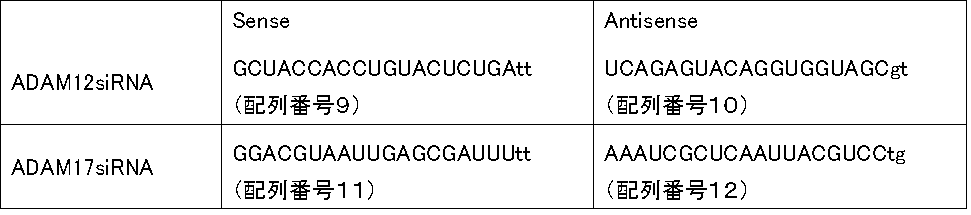
図5に示すように、低酸素処理による細胞膜からのクローディン-5消失現象は、ADAM12siRNA又はADAM17siRNAによって抑制されるが、VEGF添加、TNF-α添加による細胞膜からのクローディン-5消失現象は、ADAM12siRNA又はADAM17siRNAによって抑制されないことが確認された。したがって、ADAM12又はADAM17は、あくまで低酸素状態を誘因とした血管バリアー破綻に関与する因子であるに過ぎないことが明らかとなった。
[マウスの網膜組織を用いたin vivo系解析]
VEGFやTNF-αなどの病的刺激は異なる細胞内シグナル伝達系を介して働くことから、ベイシジンは、異なる細胞内シグナル伝達系に共通した下流において血管バリアー機能を調節する因子(バリアーを開く因子)であると解釈される。したがって、ベイシジン遺伝子の発現を抑制する機能性核酸は、種々の誘因が混在して血管バリアー破綻が起こる神経系疾患に対する有用な治療標的をなることが示唆される。そこで、ベイシジンの治療標的としての有用性について、以下に示す方法でマウスを用いたin vivo系を用いた機能的解析を行った。なお、網膜は、個体発生の過程で中枢神経系が出芽する形で形成される組織であり、脳と同様に中枢神経系の一部である。網膜の血管系は、長軸方向に全長に渡って2次元的に観察・評価することが可能であるため、本研究では、中枢神経系の代表として網膜を解析材料として用いた。
VEGFやTNF-αなどの病的刺激は異なる細胞内シグナル伝達系を介して働くことから、ベイシジンは、異なる細胞内シグナル伝達系に共通した下流において血管バリアー機能を調節する因子(バリアーを開く因子)であると解釈される。したがって、ベイシジン遺伝子の発現を抑制する機能性核酸は、種々の誘因が混在して血管バリアー破綻が起こる神経系疾患に対する有用な治療標的をなることが示唆される。そこで、ベイシジンの治療標的としての有用性について、以下に示す方法でマウスを用いたin vivo系を用いた機能的解析を行った。なお、網膜は、個体発生の過程で中枢神経系が出芽する形で形成される組織であり、脳と同様に中枢神経系の一部である。網膜の血管系は、長軸方向に全長に渡って2次元的に観察・評価することが可能であるため、本研究では、中枢神経系の代表として網膜を解析材料として用いた。
7週齢のC57B6/Nマウスを4時間絶食し、血糖と体重を測定した。次に、150mg/kgのストレプトゾトシン(Streptozotocin:クエン酸緩衝液に溶解)を腹腔内注射した。さらにストレプトゾトシン注射から4日後に4時間絶食し、血糖と体重を測定し、血糖値が250mg/dl以上のマウスを血液網膜関門破綻モデルマウスとした。
正常マウス(クエン酸緩衝液を腹腔内注射したC57B6/Nマウス)と上記で得られた血液網膜関門破綻モデルマウスの硝子体内に、BSGsiRNA#1又は2、又はNon-silence siRNAを注射(10nMを1μl)した。硝子体への注射から3日後(ストレプトゾトシン投与から7日後)に各々のマウスに、トレーサーとして蛍光色素を心臓内投与した後、網膜伸展標本を作製し、注入したトレーサーの漏出を共焦点顕微鏡にて観察することで網膜血管の透過性(血液網膜関門機能の指標)を評価した。トレーサーとしては、Tetramethylrhodamine-conjugated lysine fixable dextran(10kDa;Thermo Fisher Scientific社製)及びHoechst stain H33252(534Da;Thermo Fisher Scientific社製)の2つの蛍光色素を用いた。結果を図6に示す。
図6に示すように、siRNA注射なし(-)又はNon-silence siRNAを注射した場合のストレプトゾトシン投与血液網膜関門破綻モデルマウスは、血管内投与した色素の網膜血管からの漏出亢進が認められた(図6の下段左枠)。一方、その血液網膜関門破綻モデルマウスの硝子体内にBSGsiRNA#1又は2を投与した場合には、網膜血管からの色素漏出は、正常マウスの網膜血管と同程度の透過性まで抑制された(図6の下段右枠)。これらの結果は、種々の誘因が混在して血管バリアー破綻を来している神経系疾患において、血管バリアー機能を回復させるための治療標的としてベイシジンが有用であること、換言すれば、ベイシジン遺伝子の発現を抑制する機能性核酸を用いれば、血管バリアー機能を回復させて神経系疾患を治療できることが可能であることを示している。
これらの結果より、本発明によって、いまだ有効な治療法がない難治性神経系疾患において、浮腫改善のみならず神経毒性分子の組織内侵入の阻害も含め、病態悪化のカスケードを人為的に制御し、病態の改善につながる治療を行うことが可能となる。
神経系血管バリアーの破綻に起因する脳浮腫、網膜浮腫、虚血性脳疾患などの神経系疾患に対する新規治療薬として利用される。
Claims (8)
- 以下の(a)~(c)のいずれかを有効成分とする神経系血管バリアーの破綻抑制剤。
(a)ベイシジン(basigin)遺伝子の発現を抑制する機能性核酸;
(b)ベイシジンの活性を消失又は減退する機能性核酸;
(c)上記(a)又は(b)の機能性核酸をコードするDNAを含む該機能性核酸発現ベクター; - ベイシジン遺伝子の発現を抑制する機能性核酸がsiRNAであることを特徴とする請求項1記載の神経系血管バリアー破綻抑制剤。
- ベイシジン遺伝子の発現を抑制する機能性核酸が、配列番号1に示すヌクレオチドのセンス鎖配列と配列番号2に示すその相補的なアンチセンス鎖配列から構成されるsiRNA、又は、配列番号3に示すヌクレオチドのセンス鎖配列と配列番号4に示すその相補的なアンチセンス鎖配列から構成されるsiRNAであることを特徴とする請求項2記載の神経系血管バリアー破綻抑制剤。
- 以下の(a)~(c)のいずれかを有効成分とする神経系血管バリアーの破綻に起因する神経系疾患治療剤。
(a)ベイシジン(basigin)遺伝子の発現を抑制する機能性核酸;
(b)ベイシジンの活性を消失又は減退する機能性核酸;
(c)上記(a)又は(b)の機能性核酸をコードするDNAを含む該機能性核酸発現ベクター; - 神経系疾患が、脳神経系疾患又は網膜神経系疾患であることを特徴とする請求項4記載の神経系疾患治療剤。
- 神経系疾患が、脳浮腫又は網膜浮腫であることを特徴とする請求項5記載の神経系疾患治療剤。
- ベイシジン遺伝子の発現を抑制する機能性核酸がsiRNAであることを特徴とする請求項4~6のいずれか記載の神経系疾患治療剤。
- ベイシジン遺伝子の発現を抑制する機能性核酸が、配列番号1に示すヌクレオチドのセンス鎖配列と配列番号2に示すその相補的なアンチセンス鎖配列から構成されるsiRNA、又は、配列番号3に示すヌクレオチドのセンス鎖配列と配列番号4に示すその相補的なアンチセンス鎖配列から構成されるsiRNAであることを特徴とする請求項7記載の神経系疾患治療剤。
Priority Applications (1)
| Application Number | Priority Date | Filing Date | Title |
|---|---|---|---|
| JP2017547680A JP6818358B2 (ja) | 2015-10-29 | 2016-09-29 | 神経系血管バリアーの機能回復剤及び神経系疾患治療剤 |
Applications Claiming Priority (2)
| Application Number | Priority Date | Filing Date | Title |
|---|---|---|---|
| JP2015212817 | 2015-10-29 | ||
| JP2015-212817 | 2015-10-29 |
Publications (1)
| Publication Number | Publication Date |
|---|---|
| WO2017073232A1 true WO2017073232A1 (ja) | 2017-05-04 |
Family
ID=58631740
Family Applications (1)
| Application Number | Title | Priority Date | Filing Date |
|---|---|---|---|
| PCT/JP2016/078775 Ceased WO2017073232A1 (ja) | 2015-10-29 | 2016-09-29 | 神経系血管バリアー破綻抑制剤及び神経系疾患治療剤 |
Country Status (2)
| Country | Link |
|---|---|
| JP (1) | JP6818358B2 (ja) |
| WO (1) | WO2017073232A1 (ja) |
Cited By (3)
| Publication number | Priority date | Publication date | Assignee | Title |
|---|---|---|---|---|
| WO2022039223A1 (ja) | 2020-08-21 | 2022-02-24 | 国立大学法人山口大学 | 神経系血管バリアーの可逆的開口剤 |
| JPWO2022181333A1 (ja) * | 2021-02-26 | 2022-09-01 | ||
| WO2022203043A1 (ja) * | 2021-03-25 | 2022-09-29 | 国立大学法人山口大学 | 神経系血管バリアー破綻の抑制剤、及び神経系疾患治療剤 |
Citations (1)
| Publication number | Priority date | Publication date | Assignee | Title |
|---|---|---|---|---|
| JP2015524418A (ja) * | 2012-07-27 | 2015-08-24 | アンスティテュ ナショナル ドゥ ラ サンテ エ ドゥ ラ ルシェルシュ メディカル | 血管内皮細胞への髄膜炎菌の線毛媒介接着の受容体としてのcd147 |
-
2016
- 2016-09-29 JP JP2017547680A patent/JP6818358B2/ja active Active
- 2016-09-29 WO PCT/JP2016/078775 patent/WO2017073232A1/ja not_active Ceased
Patent Citations (1)
| Publication number | Priority date | Publication date | Assignee | Title |
|---|---|---|---|---|
| JP2015524418A (ja) * | 2012-07-27 | 2015-08-24 | アンスティテュ ナショナル ドゥ ラ サンテ エ ドゥ ラ ルシェルシュ メディカル | 血管内皮細胞への髄膜炎菌の線毛媒介接着の受容体としてのcd147 |
Non-Patent Citations (4)
| Title |
|---|
| HUET, E. ET AL.: "EMMPRIN Modulates Epithelial Barrier Function through a MMP-Mediated Occludin Cleavage", THE AMERICAN JOURNAL OF PATHOLOGY, vol. 179, no. 3, 2011, pages 1278 - 1286, XP055380013, ISSN: 0002-9440 * |
| MORENO, V. ET AL.: "An EMMPRIN-y-catenin-Nm23 complex drives ATP production and actomyosin contractility at endothelial junctions", JOURNAL OF CELL SCIENCE, vol. 127, 2014, pages 3768 - 3781, XP055380010 * |
| TU, Y. ET AL.: "Extracellular Matrix Metalloproteinase Inducer is Associated with Severity of Brain Oedema Following Experimental Subarachnoid Haemorrhage in Rats", THE JOURNAL OF INTERNATIONAL MEDICAL RESEARCH, vol. 40, 2012, pages 1089 - 1098, ISSN: 0300-0605 * |
| WEI, M. ET AL.: "Increased CD 147(EMMPRIN) expression in the rat brain following traumatic brain injury", BRAIN RESEARCH, vol. 1585, 2014, pages 150 - 158, XP029048158, ISSN: 0006-8993 * |
Cited By (8)
| Publication number | Priority date | Publication date | Assignee | Title |
|---|---|---|---|---|
| WO2022039223A1 (ja) | 2020-08-21 | 2022-02-24 | 国立大学法人山口大学 | 神経系血管バリアーの可逆的開口剤 |
| JPWO2022039223A1 (ja) * | 2020-08-21 | 2022-02-24 | ||
| JP7761277B2 (ja) | 2020-08-21 | 2025-10-28 | 国立大学法人山口大学 | 神経系血管バリアーの可逆的開口剤 |
| JPWO2022181333A1 (ja) * | 2021-02-26 | 2022-09-01 | ||
| WO2022181333A1 (ja) * | 2021-02-26 | 2022-09-01 | 国立大学法人大阪大学 | 軽度認知障害検査 |
| JP7808340B2 (ja) | 2021-02-26 | 2026-01-29 | 国立大学法人大阪大学 | 軽度認知障害検査 |
| WO2022203043A1 (ja) * | 2021-03-25 | 2022-09-29 | 国立大学法人山口大学 | 神経系血管バリアー破綻の抑制剤、及び神経系疾患治療剤 |
| JPWO2022203043A1 (ja) * | 2021-03-25 | 2022-09-29 |
Also Published As
| Publication number | Publication date |
|---|---|
| JP6818358B2 (ja) | 2021-01-27 |
| JPWO2017073232A1 (ja) | 2018-08-30 |
Similar Documents
| Publication | Publication Date | Title |
|---|---|---|
| Moreno et al. | Conditional ablation of astroglial CCL2 suppresses CNS accumulation of M1 macrophages and preserves axons in mice with MOG peptide EAE | |
| Joyal et al. | Ischemic neurons prevent vascular regeneration of neural tissue by secreting semaphorin 3A | |
| Shaked et al. | Transcription factor Nr4a1 couples sympathetic and inflammatory cues in CNS-recruited macrophages to limit neuroinflammation | |
| Kobayashi et al. | Macrophage-T cell interactions mediate neuropathic pain through the glucocorticoid-induced tumor necrosis factor ligand system | |
| Cheng et al. | A critical role of Src family kinase in SDF-1/CXCR4-mediated bone-marrow progenitor cell recruitment to the ischemic heart | |
| Ramakrishnan et al. | Vascular endothelial growth factor signaling in hypoxia and inflammation | |
| US20170296627A1 (en) | Exersomes, methods of producing and method of using | |
| Díaz-Coránguez et al. | Transmigration of neural stem cells across the blood brain barrier induced by glioma cells | |
| Machalińska et al. | Long-term neuroprotective effects of NT-4–engineered mesenchymal stem cells injected intravitreally in a mouse model of acute retinal injury | |
| US20180142261A1 (en) | Targeted lipid particles for systemic delivery of nucleic acid molecules to leukocytes | |
| Puram et al. | STAT3-iNOS signaling mediates EGFRvIII-induced glial proliferation and transformation | |
| Zhang et al. | Matrix metalloproteinase-9 and stromal cell-derived factor-1 act synergistically to support migration of blood-borne monocytes into the injured spinal cord | |
| Saadane et al. | CCR2-positive monocytes contribute to the pathogenesis of early diabetic retinopathy in mice | |
| Xu et al. | Subretinal delivery of AAV2-mediated human erythropoietin gene is protective and safe in experimental diabetic retinopathy | |
| UA128249C2 (uk) | Рекомбінантна конструкція glut1 аденоасоційованого вірусного вектора і спосіб відновлення експресії glut1 на її основі | |
| BR112021012715A2 (pt) | Silenciamento de tgf-beta 1 e cox2 usando sirnas entregues em combinação com inibidores imune checkpoint para tratar câncer | |
| JP2016538276A (ja) | 筋萎縮性側索硬化症の処置のためのNF−κBおよびSOD−1を阻害する組成物および方法 | |
| Manavski et al. | Brag2 differentially regulates β1-and β3-integrin-dependent adhesion in endothelial cells and is involved in developmental and pathological angiogenesis | |
| Haykin et al. | Reward system activation improves recovery from acute myocardial infarction | |
| JP6818358B2 (ja) | 神経系血管バリアーの機能回復剤及び神経系疾患治療剤 | |
| Wang et al. | Absence of macrophage migration inhibitory factor reduces proliferative retinopathy in a mouse model | |
| Shi et al. | Antitumor and antimetastatic activities of vesicular stomatitis virus matrix protein in a murine model of breast cancer | |
| KR20230140614A (ko) | 혈관신생과 관련된 병리학적 증상을 치료하기 위한ido1-의존성 혈관화 세포를 이용한 방법 및 조성물 | |
| CN115944740B (zh) | 靶向hif-1/cbs在三阴性乳腺癌中的应用 | |
| JP2010526049A (ja) | エリスロポエチンおよび顆粒球コロニー刺激因子の併用による脳血管疾患の治療 |
Legal Events
| Date | Code | Title | Description |
|---|---|---|---|
| 121 | Ep: the epo has been informed by wipo that ep was designated in this application |
Ref document number: 16859469 Country of ref document: EP Kind code of ref document: A1 |
|
| ENP | Entry into the national phase |
Ref document number: 2017547680 Country of ref document: JP Kind code of ref document: A |
|
| NENP | Non-entry into the national phase |
Ref country code: DE |
|
| 122 | Ep: pct application non-entry in european phase |
Ref document number: 16859469 Country of ref document: EP Kind code of ref document: A1 |