WO2017033674A1 - 大豆油の製造方法、混合油の製造方法、及び大豆油の明所臭を抑制する方法 - Google Patents
大豆油の製造方法、混合油の製造方法、及び大豆油の明所臭を抑制する方法 Download PDFInfo
- Publication number
- WO2017033674A1 WO2017033674A1 PCT/JP2016/072476 JP2016072476W WO2017033674A1 WO 2017033674 A1 WO2017033674 A1 WO 2017033674A1 JP 2016072476 W JP2016072476 W JP 2016072476W WO 2017033674 A1 WO2017033674 A1 WO 2017033674A1
- Authority
- WO
- WIPO (PCT)
- Prior art keywords
- oil
- soybean
- amount
- producing
- mixed
- Prior art date
- Legal status (The legal status is an assumption and is not a legal conclusion. Google has not performed a legal analysis and makes no representation as to the accuracy of the status listed.)
- Ceased
Links
Classifications
-
- A—HUMAN NECESSITIES
- A23—FOODS OR FOODSTUFFS; TREATMENT THEREOF, NOT COVERED BY OTHER CLASSES
- A23D—EDIBLE OILS OR FATS, e.g. MARGARINES, SHORTENINGS OR COOKING OILS
- A23D9/00—Other edible oils or fats, e.g. shortenings or cooking oils
- A23D9/02—Other edible oils or fats, e.g. shortenings or cooking oils characterised by the production or working-up
-
- C—CHEMISTRY; METALLURGY
- C11—ANIMAL OR VEGETABLE OILS, FATS, FATTY SUBSTANCES OR WAXES; FATTY ACIDS THEREFROM; DETERGENTS; CANDLES
- C11B—PRODUCING, e.g. BY PRESSING RAW MATERIALS OR BY EXTRACTION FROM WASTE MATERIALS, REFINING OR PRESERVING FATS, FATTY SUBSTANCES, e.g. LANOLIN, FATTY OILS OR WAXES; ESSENTIAL OILS; PERFUMES
- C11B3/00—Refining fats or fatty oils
- C11B3/02—Refining fats or fatty oils by chemical reaction
Definitions
- the present invention relates to a method for producing soybean oil, and more particularly, to a method for producing soybean oil with reduced photopic odor, a method for producing a mixed oil blended with the soybean oil, and a method for suppressing the photopic odor of soybean oil. .
- soybean oil becomes odorless after the refining process, a special odor called a return odor occurs during storage.
- This return odor is said to be the largest cause of light during storage, and is also referred to as “lighthouse odor”. Traditionally, this light odor has limited the amount of soy oil blended into salad oil and mayonnaise.
- Patent Document 1 has a step of subjecting soybean seeds to pressing without using an organic solvent, and the step before the treatment is performed at a temperature of 90 ° C. or lower.
- a manufacturing method is disclosed.
- the Example describes that the soybean oil obtained by the production method has a better flavor after exposure than the comparative example.
- An object of the present invention is to provide a method for producing soybean oil with reduced photopic odor, a method for producing a mixed oil containing the soybean oil, and a method for suppressing the photopic odor of soybean oil.
- oils and fats squeezed from soybeans have been subjected to 3,4-dimethyl-5-pentyl-2-furanonanoic acid (hereinafter referred to as “F3”). It was found that the photoodor of soybean oil can be reduced by irradiating ultraviolet rays of a specific wavelength or contacting lipoxygenase so as to reduce the amount, and the present invention has been completed.
- F3 3,4-dimethyl-5-pentyl-2-furanonanoic acid
- the first aspect of the present invention provides a method for producing soybean oil comprising a step of irradiating an oil and fat squeezed from soybean with ultraviolet rays having a wavelength of 200 to 280 nm so as to reduce the amount of F3 in the oil and fat. It is to provide.
- the method for producing soybean oil according to the first aspect of the present invention preferably includes a step of deodorizing the fats and oils obtained in the above step.
- the oil and fat squeezed from soybean is an oil and fat that has been degummed.
- the 2nd aspect of this invention provides the manufacturing method of soybean oil including the process of making lipoxygenase contact the oil and fat squeezed from soybean so that the amount of F3 in the oil and fat may be reduced.
- the lipoxygenase is preferably derived from soybean.
- the oil / fat extracted from soybean is an oil / fat that has undergone degumming treatment.
- the amount of F3 in the oil after irradiation with the ultraviolet light or after contact with the lipoxygenase is 180 ppm or less. More preferably, the amount of F3 is 60 ppm or less.
- the fat and oil squeezed from soybean is irradiated with ultraviolet rays having a wavelength of 200 to 280 nm or brought into contact with lipoxygenase so as to reduce the amount of F3 in the fat and oil.
- the manufacturing method of mixed oil including the process of mixing the soybean oil obtained by this with edible oils other than the said soybean oil is provided.
- the soybean oil is mixed with the other edible oil so that the blending ratio of the soybean oil in the mixed oil is 15% by mass or more. It is preferable.
- the other edible oil is one or more selected from the group consisting of rapeseed oil, sunflower oil, corn oil, palm oil, and palm fractionated oil. It is preferable that
- the value A calculated by the following formula (1) is preferably less than 40.
- A the amount of F3 in the oil after exposure to the ultraviolet light or after contact with the lipoxygenase (ppm) ⁇ the blending ratio (mass%) of the soybean oil in the mixed oil ⁇ 100 (1)
- the fat extracted from soybean is irradiated with ultraviolet rays having a wavelength of 200 to 280 nm or brought into contact with lipoxygenase so as to reduce the amount of F3 in the fat.
- the present invention provides a method for reducing the photopic odor of soybean oil.
- the present invention it is possible to provide a method for producing soybean oil with reduced photopic odor, a method for producing a mixed oil containing the soybean oil, and a method for suppressing the photopic odor of soybean oil.
- edible oils are produced by obtaining crude oil by squeezing and / or solvent extraction from oil raw materials and then further refining the crude oil.
- Compressed extraction is performed by applying high pressure to the raw material to squeeze out the oil in the cells.
- Squeezed extraction is suitable for plant materials with relatively high oil content such as sesame.
- Solvent extraction is performed by bringing oil seeds as raw materials into contact with the residue after pressing or squeezing and extracting the oil as a solvent solution, and distilling off the solvent from the resulting solution to obtain the oil. Is. Solvent extraction is suitable for raw materials with low oil content such as soybean. Hexane is used as the solvent.
- a general refining process for vegetable oil is applied. That is, in general, impurities are removed in the order of (extracted oil) crude oil ⁇ degummed oil ⁇ deoxidized oil ⁇ decolorized oil ⁇ deodorized oil (refined oil), and operations between them are “degumming treatment” and “deacidification”. In general, degumming treatment, deoxidation treatment, decolorization treatment, and deodorization treatment are adopted as the steps of “treatment”, “decolorization treatment”, and “deodorization treatment”.
- the degumming treatment is, for example, a step of hydrating and removing the gums mainly composed of phospholipids contained in the oil.
- the deoxidation treatment is a step of removing free fatty acids contained in the oil as soap, for example, by treatment with alkaline water.
- the decolorization treatment is a step of removing the pigment contained in the oil by adsorbing it on the activated clay, for example.
- the deodorization treatment is a step of removing volatile odorous components contained in the oil by, for example, steam distillation under reduced pressure.
- the “fat and oil squeezed from soybean” includes fats and oils in the middle of the refining process of a general edible oil as described above, and also includes soybean oil after finishing them. Meaning.
- fats and oils squeezed from soybeans are irradiated with ultraviolet rays having a wavelength of 200 to 280 nm so as to reduce the amount of F3 in the fats and oils.
- F3 (3,4-dimethyl-5-pentyl-2-furanonanoic acid) is usually present in an ester-bonded state with glycerol in fats and oils. Therefore, in this specification, the amount of F3 in fats and oils mainly refers to the amount of F3 in an ester-bonded state with glycerol.
- Ultraviolet rays are classified into three types according to wavelength length, and are classified into ultraviolet A wave, B wave, and C wave.
- the wavelengths of the ultraviolet A wave, B wave, and C wave are 315 to 400 nm, 280 to 315 nm, and 200 to 280 nm, respectively.
- ultraviolet rays having a wavelength of 200 to 280 nm corresponding to ultraviolet C waves are used in the present invention.
- ultraviolet rays having a wavelength of 220 to 270 nm are used.
- ultraviolet light having a wavelength of 365 nm which is an ultraviolet A wave
- visible light cannot reduce the photopic odor although the amount of F3 is reduced.
- the amount of F3 and the light odor reduction effect do not necessarily correlate, it is an indicator of whether or not the irradiated ultraviolet rays have effectively affected the oil or fat, or the degree of the effect.
- it is sufficient to use an ultraviolet ray having a wavelength of 200 to 280 nm corresponding to the ultraviolet C wave with an intensity effective for reducing the amount of F3, and includes ultraviolet rays other than the above wavelengths, visible light, and the like.
- a light source may be irradiated.
- Conditions such as temperature and time at the time of irradiation with the ultraviolet rays are not particularly limited, but irradiation is preferably performed so that the amount of F3 in the oil and fat after the ultraviolet irradiation is 180 ppm or less, and 80 ppm or less. Irradiation is more preferable, irradiation is more preferable to be 60 ppm or less, irradiation is particularly preferably performed to be 45 ppm or less, and irradiation is most preferably performed to be 35 ppm or less. If the amount of F3 exceeds 180 ppm, it may be difficult to obtain the effect of reducing the bright odor.
- the irradiation is preferably performed in the presence of oxygen.
- the intensity of the ultraviolet rays is not particularly limited, but is preferably 0.1 mW / cm 2 or more, and more preferably 0.3 mW / cm 2 or more.
- the irradiation intensity is less than 0.1 mW / cm 2 , it may be difficult to obtain the effect of reducing the bright odor by ultraviolet irradiation.
- a purification step including a step of deodorizing the obtained fat after irradiating the ultraviolet rays. According to this, in the case where an odorous component is generated in the oil during the treatment, the odorous component can be removed.
- the refined state of the oil / fat extracted from soybean, which is irradiated with the ultraviolet rays is not particularly limited. preferable.
- the photopic odor can be reduced more effectively. Can be reduced.
- the mode of irradiating with ultraviolet rays is not particularly limited as long as the fats and oils squeezed from soybeans are exposed to the influence of the ultraviolet rays.
- the ultraviolet rays are emitted from a predetermined ultraviolet irradiation device installed around the lower part, etc. to irradiate the fats and oils in the container, or when the fats and oils are transported by a lorry vehicle, the ultraviolet rays are emitted from the predetermined ultraviolet irradiation device.
- To irradiate the oil and fat in the container to irradiate the oil and fat during the degumming process, during the deoxidation process, and during the decolorization process, or to feed the oil and fat And so on.
- lipoxygenase is brought into contact with fat and oil squeezed from soybean so as to reduce the amount of F3 in the fat and oil.
- soybean-derived lipoxygenase it is preferable to use soybean-derived lipoxygenase.
- the soybean water extract extracted with water-type extraction solvents such as water, warm water, salt containing water, may be used, and what was further refine
- the lipoxygenase may be in any form such as an aqueous solution, powder, or immobilized on a carrier, but is preferably immobilized on the carrier in terms of post-treatment.
- Conditions such as temperature, pH, and time when contacting the lipoxygenase are not particularly limited, but preferably the amount of F3 in the fat after contact with the lipoxygenase is 180 ppm or less at the optimal temperature and pH of the lipoxygenase. It is preferable to contact so that it may become 80 ppm or less, it is more preferable to contact so that it may become 60 ppm or less, It is especially preferable to contact so that it may become 45 ppm or less, and 35 ppm or less It is most preferable to make contact. If the amount of F3 exceeds 180 ppm, it may be difficult to obtain the effect of reducing the bright odor.
- a purification step including a step of deodorizing the obtained fat after contacting with the lipoxygenase. According to this, in the case where an odorous component is generated in the oil during the treatment, the odorous component can be removed.
- the state of purification of the oil / fat extracted from soybean, which is brought into contact with the lipoxygenase is not particularly limited, but the oil / fat is preferably an oil / fat that has undergone a degumming treatment, and more preferably a fat / oil that has undergone a deoxidation treatment. preferable.
- the photopic odor can be reduced more effectively. Can be reduced.
- the aspect in which the lipoxygenase is brought into contact is not particularly limited as long as the fat and lipoxygenase squeezed from soybeans are present in the same reaction system.
- the soybean oil obtained as described above is mixed with an edible oil other than the soybean oil.
- edible oils are not particularly limited, and examples thereof include rapeseed oil, sunflower oil, corn oil, palm oil, and palm fractionated oil. Two or more of these may be used in combination.
- the blending ratio of the soybean oil in the mixed oil is preferably 15% by mass or more, preferably 20% by mass or more, preferably 30% by mass or more, and 40% by mass or more. Preferably, it is preferably 60% by mass or more, more preferably 80% by mass or more, and even more preferably 15% by mass or more and less than 100% by mass. Further, the total blending ratio of other edible oils in the mixed oil is preferably 85% by mass or less, preferably 80% by mass or less, preferably 70% by mass or less, and 60% by mass or less. It is preferable that it is 40 mass% or less, it is preferable that it is 20 mass% or less, and it is more preferable that it is more than 0 mass% and 85 mass% or less. That is, by using the soybean oil with a reduced photopic odor in a blending ratio of a predetermined amount or more, it is possible to provide an inexpensive mixed oil at a reduced cost.
- A F3 amount (ppm) in fats and oils after irradiation with ultraviolet rays or contact with lipoxygenase ⁇ mixing ratio of the soybean oil in the mixed oil (mass%) ⁇ 100
- the value A calculated by the above formula may be 60 or less. Preferably, it is 35 or less, more preferably 28 or less, and preferably 50 or less, more preferably 45 or less, and even more preferably 25 or less when it is 50 to 70% by mass. More preferably, when it is 15% by mass or more and less than 50% by mass, it is preferably 50 or less, more preferably 35 or less, and even more preferably 20 or less. Moreover, it can be said that the value A calculated by the above formula is more preferably less than 40 and even more preferably 23 or less regardless of the blending ratio of the soybean oil in the mixed oil.
- soybean oil with reduced odor can be obtained efficiently.
- soybean oil with reduced photopic odor can be efficiently obtained by adopting a method in which lipoxygenase is brought into contact with oil and fat squeezed from soybean so as to reduce the amount of F3 in the oil and fat.
- soybean degummed oil was prepared from soybean according to a conventional method.
- the obtained soybean degummed oil was subjected to deoxidation treatment according to a conventional method to obtain soybean deoxidized oil.
- soybean deoxidized oil was subjected to decolorization treatment and deodorization treatment according to a conventional method to obtain soybean deodorized oil.
- soybean water extract (Preparation of soybean water extract) The soybean was pulverized, 6 parts by mass of water was added to 1 part by mass of the pulverized soybean, and the mixture was stirred and allowed to stand at room temperature for 4 hours. After standing, the soybean water extract was obtained by filtering. Similarly, a lipoxygenase-deficient soybean water extract was obtained from lipoxygenase-deficient soybean.
- GC condition device 7890A manufactured by Agilent Column: HP-88, manufactured by Agilent, 60 m in length, 250 ⁇ m in inner diameter, 0.2 ⁇ m in film thickness
- Inlet temperature 250 ° C
- Injection method Splitless 1.5 minutes
- Injection volume 1 ⁇ l
- Mobile phase Helium oven conditions: 100 ° C held for 1 minute, heated to 240 ° C at 10 ° C / minute, held at 240 ° C for 3 minutes Transfer line: 230 ° C
- MS condition device 5975C manufactured by Agilent Ion source: 230 ° C
- Quadrupole 150 ° C
- UVC Ultraviolet C-wave
- 200 g of soybean deodorized oil was put in an 8.5 cm glass petri dish, and at 24 ° C., ultraviolet light of 254 nm (apparatus Handy UV Lamp SLUV-4, manufactured by AZ ONE, ultraviolet A wave (UVA) intensity: not detected, UVC intensity: 0.6 mW / cm 2 and illuminance 250 Lux) were irradiated for the time shown in Table 1. After irradiation, the amount of F3 in the fat was measured. After the soybean deodorized oil after ultraviolet irradiation was purified by deodorizing treatment, the photoodor was evaluated. The results are shown in Table 1.
- Preparation Example 1 (Preparation of mayonnaise) Using the soybean oil obtained in Example 1-4 of Test Example 1 to prepare mayonnaise (78% by mass of the soybean oil) by a conventional method, it was possible to obtain mayonnaise with reduced photoodor.
- ⁇ Test Example 2> (Ultraviolet C wave (UVC) irradiation) 200 g of soybean degummed oil or soybean deoxidized oil was put in an 8.5 cm glass petri dish, and irradiated with ultraviolet rays of 254 nm (ultraviolet C wave (UVC) under the same conditions as in Test Example 1) at 24 ° C. for 140 hours. After irradiation, the amount of F3 in the fat was measured. Soybean degummed oil after UV irradiation is refined by deoxidation, decolorization, and deodorization treatment. Soybean deoxidized oil after UV irradiation is refined by decolorization and deodorization treatment. We evaluated the light odor of soybean oil. The results are shown in Table 2.
- UVA Ultraviolet A wave
- 200 g of soybean deodorized oil was put in an 8.5 cm glass petri dish, and ultraviolet rays of 365 nm (device Handy UV Lamp SLUV-4, manufactured by AZ ONE, UVA intensity: 1.0 mW / cm 2 , UVC intensity: detected) Irradiance was 380 Lux) for 170 hours.
- the amount of F3 in the fat was measured.
- the soybean deodorized oil after ultraviolet irradiation was purified by deodorizing treatment the photoodor was evaluated. The results are shown in Table 3.
- ⁇ Test Example 5> Contact with lipoxygenase 9 parts by mass of soybean water extract or lipoxygenase-deficient soybean water extract was mixed with 1 part by mass of soybean deodorized oil, stirred with a homomixer, and allowed to stand at 4 ° C. for 24 hours. After standing, the oil was collected by solvent extraction. After recovery, the amount of F3 in the fat was measured. The oil and fat after contact with lipoxygenase was purified by decolorization and deodorization, and then the photoodor was evaluated. The results are shown in Table 5.
- ⁇ Test Example 6> (Preparation of mixed oil, part 1) Using the soybean oils obtained in Comparative Examples 1-1 to 1-3 and Examples 1-1 to 2 in Test Example 1 and mixed with rapeseed oil (manufactured by J-Oil Mills Co., Ltd.) in the proportions shown in Table 6. . About the obtained mixed oil, the photopic odor was evaluated. The results are shown in Table 6.
- the photopic odor can be reduced when the F3 amount of soybean oil is 50 ppm or less (A value is 40 ppm or less). I understood.
- ⁇ Test Example 7> (Preparation of mixed oil, part 2) Using the soybean oils obtained in Comparative Examples 1-1 to 1-3 and Examples 1-1 to 2 in Test Example 1, the ratio shown in Table 7 was mixed with rapeseed oil (manufactured by J-Oil Mills Co., Ltd.). . About the obtained mixed oil, the photopic odor was evaluated. The results are shown in Table 7.
- the photopic odor can be reduced when the F3 amount of soybean oil is 118 ppm or less (A value is 71 ppm or less). I understood.
- ⁇ Test Example 8> (Preparation of mixed oil, part 3) Using the soybean oil obtained in Comparative Examples 1-1 to 1-3 of Test Example 1 and Example 1-1, the oil was mixed with rapeseed oil (manufactured by J-Oil Mills Co., Ltd.) at the ratio shown in Table 8. About the obtained mixed oil, the photopic odor was evaluated. The results are shown in Table 8.
- the photopic odor can be reduced when the F3 amount of soybean oil is 118 ppm or less (A value is 47 ppm or less). I understood.
- the photopic odor can be reduced when the F3 amount of soybean oil is 118 ppm or less (A value is 35 ppm or less). I understood.
- the photopic odor can be reduced when the F3 amount of soybean oil is 118 ppm or less (A value is 24 ppm or less). I understood.
Landscapes
- Chemical & Material Sciences (AREA)
- Life Sciences & Earth Sciences (AREA)
- Oil, Petroleum & Natural Gas (AREA)
- Engineering & Computer Science (AREA)
- Chemical Kinetics & Catalysis (AREA)
- General Chemical & Material Sciences (AREA)
- Microbiology (AREA)
- Wood Science & Technology (AREA)
- Organic Chemistry (AREA)
- Food Science & Technology (AREA)
- Polymers & Plastics (AREA)
- Edible Oils And Fats (AREA)
- Fats And Perfumes (AREA)
Abstract
明所臭の低減された大豆油の製造方法、その大豆油を配合した混合油の製造方法、ならびに大豆油の明所臭を抑制する方法を提供する。 大豆から搾油された油脂に、その油脂中の3,4-ジメチル-5-ペンチル-2-フランノナン酸量(F3量)を低減させるように、波長200~280nmの紫外線を照射する工程を含む、大豆油の製造方法である。また、大豆から搾油された油脂に、その油脂中のF3量を低減させるように、リポキシゲナーゼを接触させる工程を含む、大豆油の製造方法である。また、そのようにして得られた大豆油を、他の食用油と混合する工程を含む、混合油の製造方法である。また、大豆から搾油された油脂に、その油脂中のF3量を低減させるように、波長200~280nmの紫外線を照射するか、又は、リポキシゲナーゼを接触させる、大豆油の明所臭を低減する方法である。
Description
本発明は、大豆油の製造方法に関し、詳しくは明所臭の低減された大豆油の製造方法、その大豆油を配合した混合油の製造方法、ならびに大豆油の明所臭を抑制する方法に関する。
大豆油は、精製工程を経て無臭となるにもかかわらず、保存中に戻り臭と呼ばれる特有の臭いが発生する。この戻り臭は、保存時の光が最大の発生要因であると言われており、「明所臭」とも呼ばれている。従来、この明所臭がサラダ油やマヨネーズなどへの大豆油の配合量を制限していた。
大豆油の製造方法に関しては、例えば特許文献1には、有機溶剤を用いることなく大豆種子の圧搾処理を施す工程を有し、前記処理前の工程を90℃以下の温度でおこなうことを特徴とする製造方法が開示されている。そしてその実施例には、当該製造方法で得られた大豆油は曝光後の風味が比較例に比して良好であることが記載されている。
しかしながら、上記特許文献1に記載の方法では、大豆種子からの搾油率が低く、明所臭の低減効果も充分ではなかった。
本発明の目的は、明所臭の低減された大豆油の製造方法、その大豆油を配合した混合油の製造方法、ならびに大豆油の明所臭を抑制する方法を提供することにある。
本発明者らは、上記課題を解決するために鋭意検討した結果、大豆から搾油された油脂に、その油脂中の3,4-ジメチル-5-ペンチル-2-フランノナン酸(以下、「F3」と略す。)量を低減させるように、特定波長の紫外線を照射することにより、または、リポキシゲナーゼを接触させることにより、大豆油の明所臭を低減できることを見出し、本発明を完成した。
すなわち、本発明の第1の態様は、大豆から搾油された油脂に、その油脂中のF3量を低減させるように、波長200~280nmの紫外線を照射する工程を含む、大豆油の製造方法を提供するものである。
本発明の第1の態様の大豆油の製造方法においては、前記工程で得られた油脂を脱臭処理する工程を含むことが好ましい。
本発明の第1の態様の大豆油の製造方法においては、大豆から搾油された前記油脂が脱ガム処理を経た油脂であることが好ましい。
また、本発明の第2の態様は、大豆から搾油された油脂に、その油脂中のF3量を低減させるように、リポキシゲナーゼを接触させる工程を含む、大豆油の製造方法を提供するものである。
本発明の第2の態様の大豆油の製造方法においては、前記リポキシゲナーゼが大豆由来であることが好ましい。
本発明の第2の態様の大豆油の製造方法においては、前記工程で得られた油脂を脱臭処理する工程を含むことが好ましい。
本発明の第2の態様の大豆油の製造方法においては、大豆から搾油された前記油脂が脱ガム処理を経た油脂であることが好ましい。
本発明の第1又は第2の態様の大豆油の製造方法においては、前記紫外線の照射後又は前記リポキシゲナーゼとの接触後の該油脂中の前記F3量が180ppm以下であることが好ましい。また、前記F3量が60ppm以下であることがより好ましい。
一方、本発明の第3の態様は、大豆から搾油された油脂に、その油脂中のF3量を低減させるように、波長200~280nmの紫外線を照射することにより、又は、リポキシゲナーゼを接触させることにより得られた大豆油を、前記大豆油以外の他の食用油と混合する工程を含む、混合油の製造方法を提供するものである。
本発明の第3の態様の混合油の製造方法においては、前記混合油中の前記大豆油の配合割合が、15質量%以上となるように、前記大豆油を前記他の食用油と混合することが好ましい。
本発明の第3の態様の混合油の製造方法においては、前記他の食用油が、菜種油、ひまわり油、コーン油、パーム油、パーム分別油からなる群から選ばれた1種又は2種以上であることが好ましい。
本発明の第3の態様の混合油の製造方法においては、下記式(1)で算出される値Aが40未満であることが好ましい。
A=前記紫外線の照射後又は前記リポキシゲナーゼとの接触後の該油脂中の前記F3量(ppm)×前記混合油中の前記大豆油の配合割合(質量%)÷100 …(1)
他方、本発明の第4の態様は、大豆から搾油された油脂に、その油脂中のF3量を低減させるように、波長200~280nmの紫外線を照射するか、又は、リポキシゲナーゼを接触させる、大豆油の明所臭を低減する方法を提供するものである。
本発明によれば、明所臭の低減された大豆油の製造方法、その大豆油を配合した混合油の製造方法、ならびに大豆油の明所臭を抑制する方法を提供するすることができる。
一般的に、食用油は、油糧原料から圧搾抽出および/または溶剤抽出により搾油して原油を得た後、その原油をさらに精製することにより製造されている。
圧搾抽出とは、原料に高圧を加えて細胞中の油分を搾り取ることにより行うものである。圧搾抽出は、ゴマのような比較的油分の高い植物原料に向いている。
溶剤抽出とは、原料となる油糧種子を圧扁もしくは圧搾抽出後の残渣に溶剤を接触させ、油分を溶剤溶液として抽出し、得られる溶液から溶剤を留去して油分を得ることにより行うものである。溶剤抽出は、大豆のような含油量の少ない原料に向いている。溶剤にはヘキサンなどを使用する。
原油を精製する手段としては、植物油の一般的な精製工程が適用されている。すなわち、一般に、(抽出油)原油→脱ガム油→脱酸油→脱色油→脱臭油(精製油)の順に不純物が除かれ、それぞれの間の操作である「脱ガム処理」、「脱酸処理」、「脱色処理」、「脱臭処理」の工程は、それ自体としては一般的な、脱ガム処理、脱酸処理、脱色処理、脱臭処理が採用される。
ここで、脱ガム処理は、例えば、油分中に含まれるリン脂質を主成分とするガム質を水和除去する工程である。
また、脱酸処理は、例えば、アルカリ水で処理することにより、油分中に含まれる遊離脂肪酸をセッケン分として除去する工程である。
また、脱色処理は、例えば、油分中に含まれる色素を活性白土に吸着させて除去する工程である。
また、脱臭処理は、例えば、減圧下で水蒸気蒸留することによって油分中に含まれる揮発性有臭成分を除去する工程である。
本明細書において、「大豆から搾油された油脂」とは、以上に説明したような一般的な食用油の精製工程の途中段階の油脂も含み、また、それらを終えた大豆油をも包含する意味である。
本発明の一態様においては、大豆から搾油された油脂に、その油脂中のF3量を低減させるように、波長200~280nmの紫外線を照射する。なお、F3(3,4-ジメチル-5-ペンチル-2-フランノナン酸)は、通常、油脂中のグリセロールとエステル結合した状態で存在する。よって、本明細書において、油脂中のF3量とは、主にグリセロールとエステル結合した状態のF3量を指す。
紫外線は波長の長さで3つに分類され、紫外線A波、B波、C波に分類される。紫外線A波、B波、およびC波の波長は、それぞれ、315~400nm、280~315nm、および200~280nmである。本発明ではこのうち、紫外線C波に相当する波長200~280nmの紫外線を用いる。好ましくは、波長220~270nmの紫外線を用いる。後述する比較例で示したように、紫外線A波である波長365nmの紫外線や可視光では、F3量は減少するものの明所臭を低減することはできない。よって、F3量と明所臭の低減効果が必ずしも相関するものではないが、照射した紫外線が有効に油脂に影響を与えたかどうか、あるいはその影響の程度の指標となる。なお、本発明においては、紫外線C波に相当する波長200~280nmの紫外線を、F3量を低減するのに有効な強度で含む紫外線を用いればよく、上記波長以外の紫外線や可視光線等を含む光源を照射してもよい。
前記紫外線を照射する際の温度や時間等の条件は、特に問わないが、前記紫外線の照射後の油脂中のF3量が180ppm以下となるように照射することが好ましく、80ppm以下となるように照射することがより好ましく、60ppm以下となるように照射することがさらに好ましく、45ppm以下となるように照射することが特に好ましく、35ppm以下となるように照射することが最も好ましい。F3量が180ppmを超えると明所臭の低減の効果が得にくい場合がある。また、当該照射は酸素存在下でおこなうことが好ましい。
また、前記紫外線の強度は、特に問わないが、0.1mW/cm2以上が好ましく、0.3mW/cm2以上がより好ましい。照射強度が0.1mW/cm2未満となると、紫外線照射による明所臭の低減の効果が得にくい場合がある。
また、前記紫外線を照射した後、得られた油脂を脱臭処理する工程を含む精製工程をおこなうことが好ましい。これによれば、その処理の際に油分に有臭成分が生じた場合などにおいて、その有臭成分を除去することができる。
また、前記紫外線を照射する、大豆から搾油された前記油脂の精製状態は特に問わないが、前記油脂が脱ガム処理を経た油脂であることが好ましく、脱酸処理を経た油脂であることがさらに好ましい。脱ガム処理を経た油脂に対して前記紫外線の照射を行うことで、より効果的に明所臭を低減でき、脱酸処理を経た油脂に対して行うことで、さらに効果的に明所臭を低減することができる。
前記紫外線を照射する態様は、大豆から搾油された前記油脂が前記紫外線の影響下に曝されるようにすればよく、特に問わないが、例えば、油脂を容器に収容して、その容器の上方、下方等の周囲に設置された所定の紫外線照射装置から前記紫外線を射出して、容器内の油脂に照射したり、油脂をローリー車等で輸送する際に、所定の紫外線照射装置から前記紫外線を射出して、容器内の油脂に照射したり、脱ガム処理工程中・脱酸処理工程中・脱色処理工程中など油脂の精製工程中に照射したり、または油脂を送液する際の配管内で照射したりすることなどが挙げられる。
本発明の他の態様においては、大豆から搾油された油脂に、その油脂中のF3量を低減させるように、リポキシゲナーゼを接触させる。
そのリポキシゲナーゼとしては、大豆由来のものを用いることが好ましい。その場合、水や温水、塩含有水等の水系抽出溶媒で抽出した大豆水抽出物でもよく、あるいはその大豆水抽出物からさらに精製したものであってもよい。また、リポキシゲナーゼは、水溶液、粉体、担体に固定化したもの等のいずれの形態のものを用いてもよいが、後処理等の点で担体に固定化したものが好ましい。
前記リポキシゲナーゼを接触させる際の温度やpHや時間等の条件は、特に問わないが、好ましくはリポキシゲナーゼの至適温度及び至適pHで前記リポキシゲナーゼと接触後の油脂中のF3量が180ppm以下となるように接触させることが好ましく、80ppm以下となるように接触させることがより好ましく、60ppm以下となるように接触することがさらに好ましく、45ppm以下となるように接触することが特に好ましく、35ppm以下となるように接触することが最も好ましい。F3量が180ppmを超えると明所臭の低減の効果が得にくい場合がある。
また、前記リポキシゲナーゼと接触させた後、得られた油脂を脱臭処理する工程を含む精製工程をおこなうことが好ましい。これによれば、その処理の際に油分に有臭成分が生じた場合などにおいて、その有臭成分を除去することができる。
また、前記リポキシゲナーゼと接触させる、大豆から搾油された前記油脂の精製状態は特に問わないが、前記油脂が脱ガム処理を経た油脂であることが好ましく、脱酸処理を経た油脂であることがさらに好ましい。脱ガム処理を経た油脂に対して前記リポキシゲナーゼの接触を行うことで、より効果的に明所臭を低減でき、脱酸処理を経た油脂に対して行うことで、さらに効果的に明所臭を低減することができる。
前記リポキシゲナーゼを接触させる態様は、大豆から搾油された前記油脂とリポキシゲナーゼとを同一の反応系に存在させればよく、特に問わないが、例えば、油脂を収容した容器にリポキシゲナーゼを添加したり、リポキシゲナーゼを収容した容器に油脂を添加したり、またはリポキジゲナーゼを固定化した担体に油脂を通液したりすることなどが挙げられる。
一方、本発明のさらに他の態様においては、上記のようにして得られた大豆油を、前記大豆油以外の他の食用油と混合する。
他の食用油としては、特に限定されず、例えば、菜種油、ひまわり油、コーン油、パーム油、パーム分別油などが挙げられる。これらは2種類以上を併用してもよい。
混合油中の前記大豆油の配合割合は、15質量%以上とすることが好ましく、20質量%以上とすることが好ましく、30質量%以上とすることが好ましく、40質量%以上とすることが好ましく、60質量%以上とすることが好ましく、80質量%以上とすることが好ましく、15質量%以上100質量%未満とすることがさらにより好ましい。また、混合油中の他の食用油の合計の配合割合は85質量%以下であることが好ましく、80質量%以下であることが好ましく、70質量%以下であることが好ましく、60質量%以下であることが好ましく、40質量%以下であることが好ましく、20質量%以下であることが好ましく、0質量%超85質量%以下であることがさらに好ましい。すなわち、明所臭の低減された前記大豆油を所定量以上の配合割合で利用することにより、コストを抑えて安価な混合油を提供することができる。
なお、混合油の場合、前記紫外線の照射や前記リポキシゲナーゼとの接触が有効に油脂に影響を与えたかどうか、あるいはその影響の程度を評価するには、下記式によることが好ましい。
A=前記紫外線の照射後又はリポキシゲナーゼとの接触後の油脂中のF3量(ppm)×前記混合油中の前記大豆油の配合割合(質量%)÷100
すなわち、例えば後述の実施例の結果を参考にすると、前記混合油中の前記大豆油の配合割合が70質量%以上であるときには、上記式にて算出される値Aが60以下であることが好ましく、35以下であることがより好ましく、28以下であることがさらに好ましく、50質量%以上70質量%未満であるときには75以下であることが好ましく、45以下であることがより好ましく、25以下であることがさらに好ましく、15質量%以上50質量%未満であるときは50以下であることが好ましく、35以下であることがより好ましく、20以下であることがさらに好ましいと言える。また、前記混合油中の前記大豆油の配合割合がいずれの場合でも、上記式にて算出される値Aが40未満であることがより好ましく、23以下であることがさらに好ましいと言える。
他方、本発明のさらに別の態様においては、大豆から搾油された油脂に、その油脂中のF3量を低減させるように、波長200~280nmの紫外線を照射する方法を採用することにより、明所臭の低減された大豆油を効率よく得ることができる。また、大豆から搾油された油脂に、その油脂中のF3量を低減させるように、リポキシゲナーゼを接触させる方法を採用することにより、明所臭の低減された大豆油を効率よく得ることができる。
以下、実施例および比較例を挙げて、本発明をさらに詳細に説明する。しかし、以下の実施例は、本発明を限定するものではない。
(大豆脱ガム油、大豆脱酸油、大豆脱臭油の調製)
大豆脱ガム油は、大豆から常法に従って調製した。得られた大豆脱ガム油を常法に従って、脱酸処理をおこない、大豆脱酸油を得た。さらに、大豆脱酸油を常法に従って、脱色処理、脱臭処理をおこない、大豆脱臭油を得た。
大豆脱ガム油は、大豆から常法に従って調製した。得られた大豆脱ガム油を常法に従って、脱酸処理をおこない、大豆脱酸油を得た。さらに、大豆脱酸油を常法に従って、脱色処理、脱臭処理をおこない、大豆脱臭油を得た。
(大豆水抽出物の調製)
大豆を粉砕し、大豆粉砕物1質量部に対し水を6質量部添加し撹拌後、4時間室温にて静置した。静置後、ろ過することで大豆水抽出物を得た。また、リポキシゲナーゼ欠損大豆から同様にリポキシゲナーゼ欠損大豆水抽出物を得た。
大豆を粉砕し、大豆粉砕物1質量部に対し水を6質量部添加し撹拌後、4時間室温にて静置した。静置後、ろ過することで大豆水抽出物を得た。また、リポキシゲナーゼ欠損大豆から同様にリポキシゲナーゼ欠損大豆水抽出物を得た。
(油脂中のF3量の測定方法)
1.前処理等
試料約8mgを試験管に秤量し、1mlのヘキサンを加えて溶解させた。2M水酸化カリウム-メタノール溶液を0.1ml加え、30秒間撹拌することで、メチルエステル化を行った。遠心分離を行い、上層0.5mlを別の試験管に移した。水0.5mlを加え撹拌後、静置した。上層0.1mlをバイアルに採取し、内部標準物質である重水素にてラベルされたベヘン酸メチル-d3標準品溶液(和光純薬製、2μg/mlヘキサン溶液)を0.1ml加え、撹拌後、ガスクロマトグラフ/質量分析計(GC/MS)に供した。
1.前処理等
試料約8mgを試験管に秤量し、1mlのヘキサンを加えて溶解させた。2M水酸化カリウム-メタノール溶液を0.1ml加え、30秒間撹拌することで、メチルエステル化を行った。遠心分離を行い、上層0.5mlを別の試験管に移した。水0.5mlを加え撹拌後、静置した。上層0.1mlをバイアルに採取し、内部標準物質である重水素にてラベルされたベヘン酸メチル-d3標準品溶液(和光純薬製、2μg/mlヘキサン溶液)を0.1ml加え、撹拌後、ガスクロマトグラフ/質量分析計(GC/MS)に供した。
2.GC条件
装置:アジレント社製7890A
カラム:アジレント社製 HP-88 長さ60m、内径250μm、膜厚0.2μm
注入口温度:250℃
注入方式:スプリットレス 1.5分間
注入量:1μl
カラム流量:1ml/分
移動相:ヘリウム
オーブン条件:100℃ 1分間保持、10℃/分にて240℃まで昇温、240℃にて3分間保持
トランスファーライン:230℃
装置:アジレント社製7890A
カラム:アジレント社製 HP-88 長さ60m、内径250μm、膜厚0.2μm
注入口温度:250℃
注入方式:スプリットレス 1.5分間
注入量:1μl
カラム流量:1ml/分
移動相:ヘリウム
オーブン条件:100℃ 1分間保持、10℃/分にて240℃まで昇温、240℃にて3分間保持
トランスファーライン:230℃
3.MS条件
装置:アジレント社製5975C
イオン源:230℃
四重極:150℃
測定モード:SIM
F3:定量イオン m/z=179
内部標準物質:定量イオン m/z=357.4
装置:アジレント社製5975C
イオン源:230℃
四重極:150℃
測定モード:SIM
F3:定量イオン m/z=179
内部標準物質:定量イオン m/z=357.4
4.定量計算
標品のF3(トロントケミカルリサーチ社製)を0、50、100、200、500ppmとなるよう菜種油に添加し、検量線サンプルを調製した。各検量線サンプル約4mgを試験管に秤量し、脂肪酸メチル化キット(ナカライテスク社製)を用いて、メチルエステル化を行った。その後、ヘキサン0.5mlを添加、撹拌することで、メチルエステル化物を抽出した。静置後、上層0.1mlをバイアルに採取し、内部標準物質である重水素にてラベルされたベヘン酸メチル-d3標準品溶液(和光純薬製、2μg/mlヘキサン溶液)を0.1ml加え、撹拌後、ガスクロマトグラフ/質量分析計(GC/MS)に供した。得られたF3の面積値(m/z=179)ならびに内部標準物質の面積値(m/z=357.4)の比より検量線を作成した。作成した検量線を用いて、試料中のF3量(ppm)を算出した。
標品のF3(トロントケミカルリサーチ社製)を0、50、100、200、500ppmとなるよう菜種油に添加し、検量線サンプルを調製した。各検量線サンプル約4mgを試験管に秤量し、脂肪酸メチル化キット(ナカライテスク社製)を用いて、メチルエステル化を行った。その後、ヘキサン0.5mlを添加、撹拌することで、メチルエステル化物を抽出した。静置後、上層0.1mlをバイアルに採取し、内部標準物質である重水素にてラベルされたベヘン酸メチル-d3標準品溶液(和光純薬製、2μg/mlヘキサン溶液)を0.1ml加え、撹拌後、ガスクロマトグラフ/質量分析計(GC/MS)に供した。得られたF3の面積値(m/z=179)ならびに内部標準物質の面積値(m/z=357.4)の比より検量線を作成した。作成した検量線を用いて、試料中のF3量(ppm)を算出した。
(明所臭の評価)
20ml容ガラスバイアル瓶に試料10gを入れ、密栓し、蛍光灯下(24℃、1000ルクス(Lux))で1週間保存後、100℃に加熱した際の明所臭の有無を評価した。評価は、3名のパネラーにより、以下の評価基準で行い、全パネラーの平均的な評価によって表示した。
A 明所臭がない
B 明所臭がほとんどない
C 明所臭がわずかにある
D 明所臭がある
20ml容ガラスバイアル瓶に試料10gを入れ、密栓し、蛍光灯下(24℃、1000ルクス(Lux))で1週間保存後、100℃に加熱した際の明所臭の有無を評価した。評価は、3名のパネラーにより、以下の評価基準で行い、全パネラーの平均的な評価によって表示した。
A 明所臭がない
B 明所臭がほとんどない
C 明所臭がわずかにある
D 明所臭がある
以下、紫外線を照射することによる明所臭の低減の効果を確認した。
<試験例1>(紫外線C波(UVC)の照射)
大豆脱臭油200gを8.5cmガラスシャーレに入れ、24℃にて、254nmの紫外線(装置Handy UV Lamp SLUV-4、AZ ONE社製、紫外線A波(UVA)強度:検出されず、UVC強度:0.6mW/cm2、照度250Lux)を表1に示す時間照射した。照射した後、油脂中のF3量を測定した。紫外線照射後の大豆脱臭油を脱臭処理にて精製した後、明所臭の評価をおこなった。結果を表1に示す。
大豆脱臭油200gを8.5cmガラスシャーレに入れ、24℃にて、254nmの紫外線(装置Handy UV Lamp SLUV-4、AZ ONE社製、紫外線A波(UVA)強度:検出されず、UVC強度:0.6mW/cm2、照度250Lux)を表1に示す時間照射した。照射した後、油脂中のF3量を測定した。紫外線照射後の大豆脱臭油を脱臭処理にて精製した後、明所臭の評価をおこなった。結果を表1に示す。

その結果、表1に示したように、大豆脱臭油に254nmの紫外線C波をF3量が50ppm以下となるように照射することで、明所臭の低減された大豆油を得ることができた。また、39ppm以下とすることで、さらに明所臭を低減させることができ、31ppm以下とすることでその効果は顕著であった。
[調製例1](マヨネーズの調製)
試験例1の実施例1-4で得られた大豆油を用いて、常法によりマヨネーズ(当該大豆油78質量%)を調製したところ、明所臭の低減したマヨネーズを得ることができた。
試験例1の実施例1-4で得られた大豆油を用いて、常法によりマヨネーズ(当該大豆油78質量%)を調製したところ、明所臭の低減したマヨネーズを得ることができた。
<試験例2>(紫外線C波(UVC)の照射)
大豆脱ガム油または大豆脱酸油200gを8.5cmガラスシャーレに入れ、24℃にて、254nmの紫外線(試験例1と同じ条件の紫外線C波(UVC))を140時間照射した。照射した後、油脂中のF3量を測定した。紫外線照射後の大豆脱ガム油は、脱酸・脱色・脱臭処理にて精製をし、また、紫外線照射後の大豆脱酸油は、脱色・脱臭処理にて精製をし、それぞれ精製後の大豆油の明所臭の評価をおこなった。結果を表2に示す。
大豆脱ガム油または大豆脱酸油200gを8.5cmガラスシャーレに入れ、24℃にて、254nmの紫外線(試験例1と同じ条件の紫外線C波(UVC))を140時間照射した。照射した後、油脂中のF3量を測定した。紫外線照射後の大豆脱ガム油は、脱酸・脱色・脱臭処理にて精製をし、また、紫外線照射後の大豆脱酸油は、脱色・脱臭処理にて精製をし、それぞれ精製後の大豆油の明所臭の評価をおこなった。結果を表2に示す。

その結果、表2に示したように、大豆脱ガム油や大豆脱酸油に対し、それらの油脂中のF3量を低減させるように紫外線C波を照射することで、明所臭の低減された大豆油を得ることができた。なかでも脱酸処理の工程を経た大豆脱酸油に紫外線C波を照射することで、より効果的に明所臭を低減できることがわかった。
<試験例3>(紫外線A波(UVA)の照射)
大豆脱臭油200gを8.5cmガラスシャーレに入れ、24℃にて、365nmの紫外線(装置 Handy UV Lamp SLUV-4、AZ ONE社製、UVA強度:1.0mW/cm2、UVC強度:検出されず、照度380Lux)を170時間照射した。照射した後、油脂中のF3量を測定した。紫外線照射後の大豆脱臭油を脱臭処理にて精製した後、明所臭の評価をおこなった。結果を表3に示す。
大豆脱臭油200gを8.5cmガラスシャーレに入れ、24℃にて、365nmの紫外線(装置 Handy UV Lamp SLUV-4、AZ ONE社製、UVA強度:1.0mW/cm2、UVC強度:検出されず、照度380Lux)を170時間照射した。照射した後、油脂中のF3量を測定した。紫外線照射後の大豆脱臭油を脱臭処理にて精製した後、明所臭の評価をおこなった。結果を表3に示す。

その結果、表3に示したように、大豆脱臭油に365nmの紫外線A波を照射した場合、その照射により、その油脂中のF3量が低減したにもかかわらず、明所臭は低減できなかった。
<試験例4>(可視光の照射)
大豆脱臭油200gを8.5cmガラスシャーレに入れ、24℃にて、可視光(装置 蛍光灯スタンド BT K-7567、小泉産業社製、UVA強度:検出されず、UVC強度:検出されず、照度1000Lux)を1週間照射した。照射した後、油脂中のF3量を測定した。紫外線照射後の大豆脱臭油は脱臭処理により精製した後、明所臭の評価をおこなった。結果を表4に示す。
大豆脱臭油200gを8.5cmガラスシャーレに入れ、24℃にて、可視光(装置 蛍光灯スタンド BT K-7567、小泉産業社製、UVA強度:検出されず、UVC強度:検出されず、照度1000Lux)を1週間照射した。照射した後、油脂中のF3量を測定した。紫外線照射後の大豆脱臭油は脱臭処理により精製した後、明所臭の評価をおこなった。結果を表4に示す。
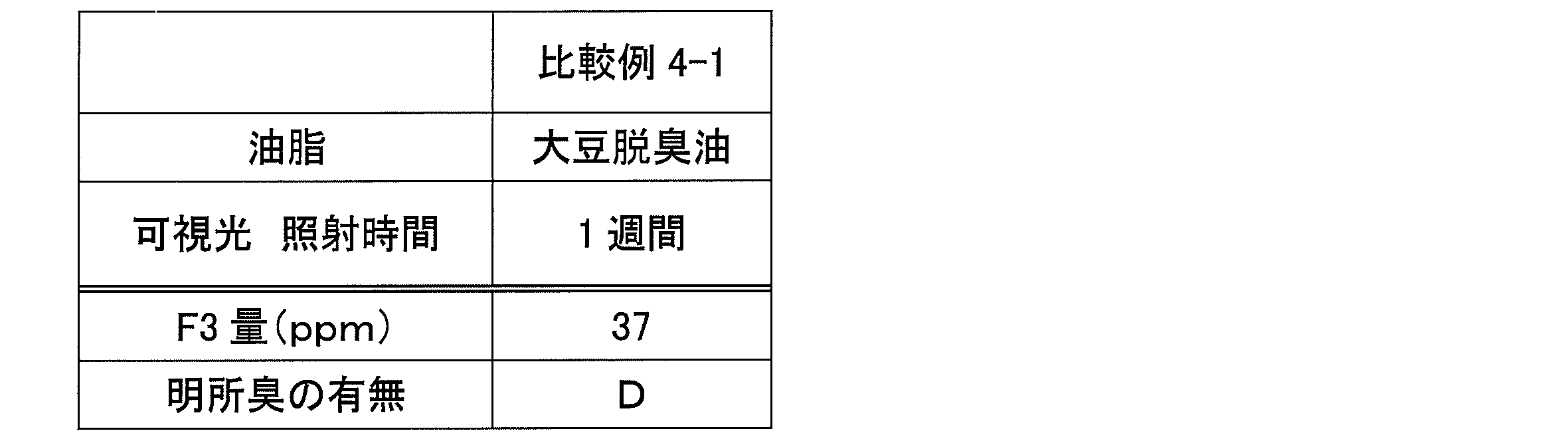
その結果、表4に示したように、大豆脱臭油に可視光を照射した場合、その照射により、その油脂中のF3量が低減したにもかかわらず、明所臭は低減できなかった。
<試験例5>(リポキシゲナーゼとの接触)
大豆脱臭油1質量部に対し、大豆水抽出物あるいはリポキシゲナーゼ欠損大豆水抽出物を9質量部配合し、ホモミキサーにて撹拌の後、4℃にて24時間静置した。静置後、溶剤抽出にて油脂を回収した。回収後、油脂中のF3量を測定した。リポキシゲナーゼとの接触後の油脂を脱色処理ならびに脱臭処理にて精製した後、明所臭の評価をおこなった。結果を表5に示す。
大豆脱臭油1質量部に対し、大豆水抽出物あるいはリポキシゲナーゼ欠損大豆水抽出物を9質量部配合し、ホモミキサーにて撹拌の後、4℃にて24時間静置した。静置後、溶剤抽出にて油脂を回収した。回収後、油脂中のF3量を測定した。リポキシゲナーゼとの接触後の油脂を脱色処理ならびに脱臭処理にて精製した後、明所臭の評価をおこなった。結果を表5に示す。

その結果、表5に示したように、大豆水抽出物と大豆脱臭油を混合することにより、その油脂中のF3量が低下し、明所臭の低減した大豆油を得ることができた。一方、リポキシゲナーゼの欠損した大豆水抽出物では、同様の処理をおこなっても、F3量が低下せず、明所臭を低減させることはできなかった。
<試験例6>(混合油の調製 その1)
試験例1の比較例1-1~3、実施例1-1~2で得られた大豆油を用いて、表6に示す割合で、菜種油(株式会社J-オイルミルズ社製)と混合した。得られた混合油について、明所臭の評価をおこなった。結果を表6に示す。
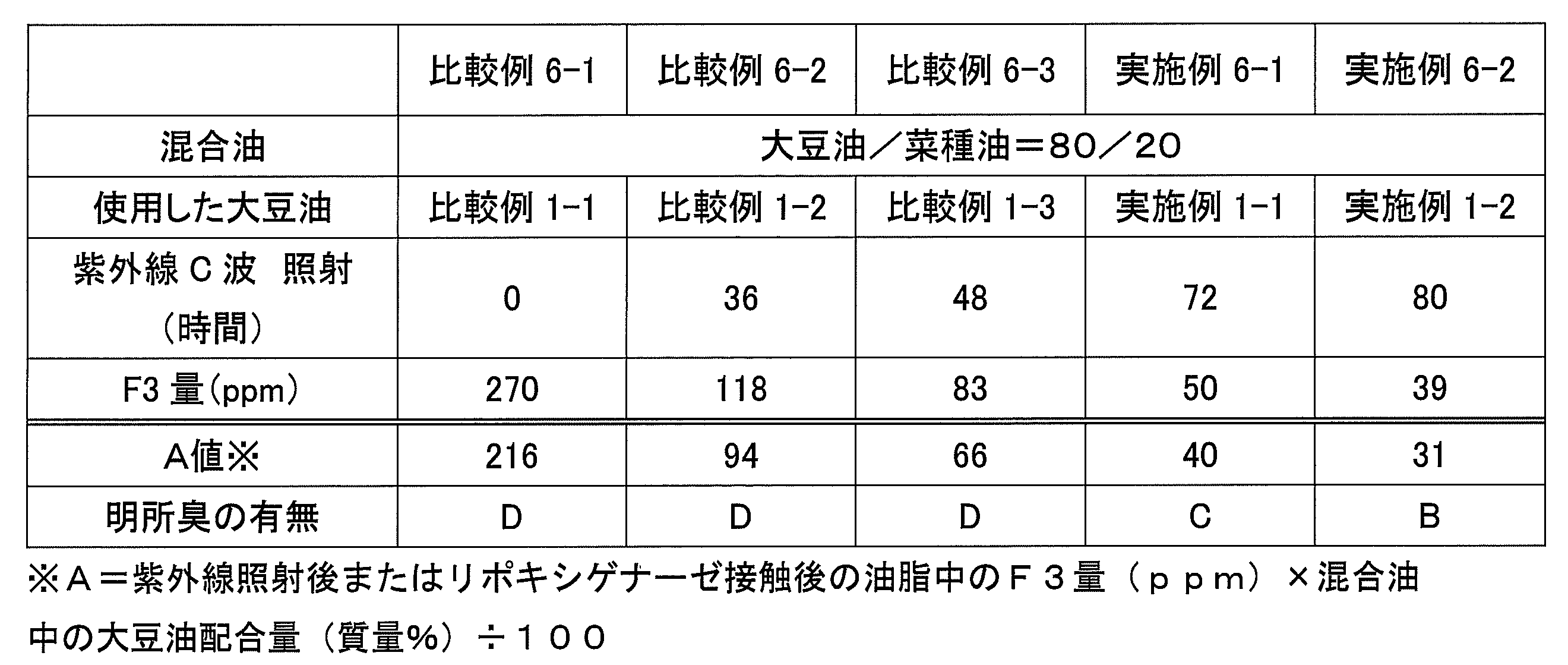
試験例1の比較例1-1~3、実施例1-1~2で得られた大豆油を用いて、表6に示す割合で、菜種油(株式会社J-オイルミルズ社製)と混合した。得られた混合油について、明所臭の評価をおこなった。結果を表6に示す。
その結果、表6で示したように、大豆油80質量%と菜種油20質量%との混合油では、大豆油のF3量が50ppm以下(A値としては40ppm以下)で明所臭を低減できることがわかった。
<試験例7>(混合油の調製 その2)
試験例1の比較例1-1~3、実施例1-1~2で得られた大豆油を用いて、表7に示す割合で、菜種油(株式会社J-オイルミルズ社製)と混合した。得られた混合油について、明所臭の評価をおこなった。結果を表7に示す。
試験例1の比較例1-1~3、実施例1-1~2で得られた大豆油を用いて、表7に示す割合で、菜種油(株式会社J-オイルミルズ社製)と混合した。得られた混合油について、明所臭の評価をおこなった。結果を表7に示す。
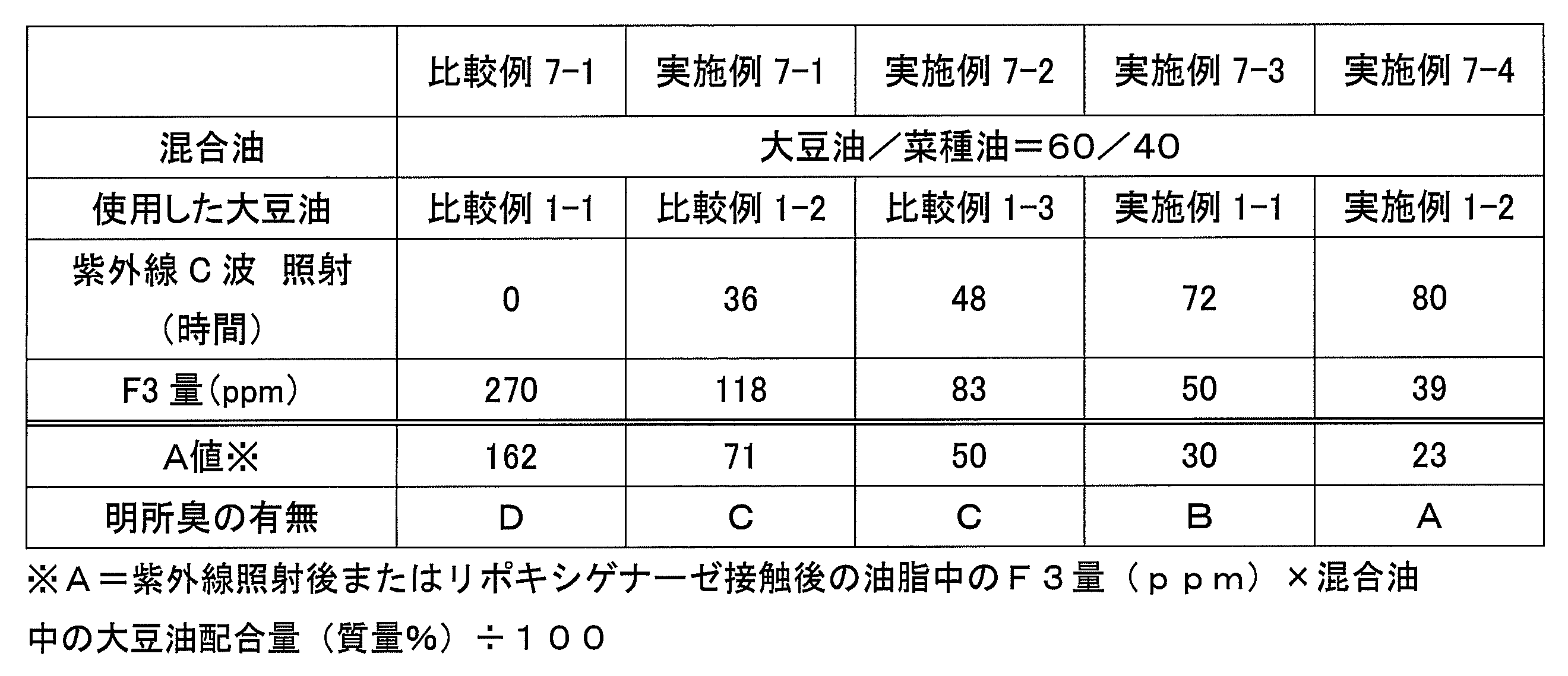
その結果、表7で示したように、大豆油60質量%と菜種油40質量%との混合油では、大豆油のF3量が118ppm以下(A値としては71ppm以下)で明所臭を低減できることがわかった。
<試験例8>(混合油の調製 その3)
試験例1の比較例1-1~3、実施例1-1で得られた大豆油を用いて、表8に示す割合で、菜種油(株式会社J-オイルミルズ社製)と混合した。得られた混合油について、明所臭の評価をおこなった。結果を表8に示す。
試験例1の比較例1-1~3、実施例1-1で得られた大豆油を用いて、表8に示す割合で、菜種油(株式会社J-オイルミルズ社製)と混合した。得られた混合油について、明所臭の評価をおこなった。結果を表8に示す。
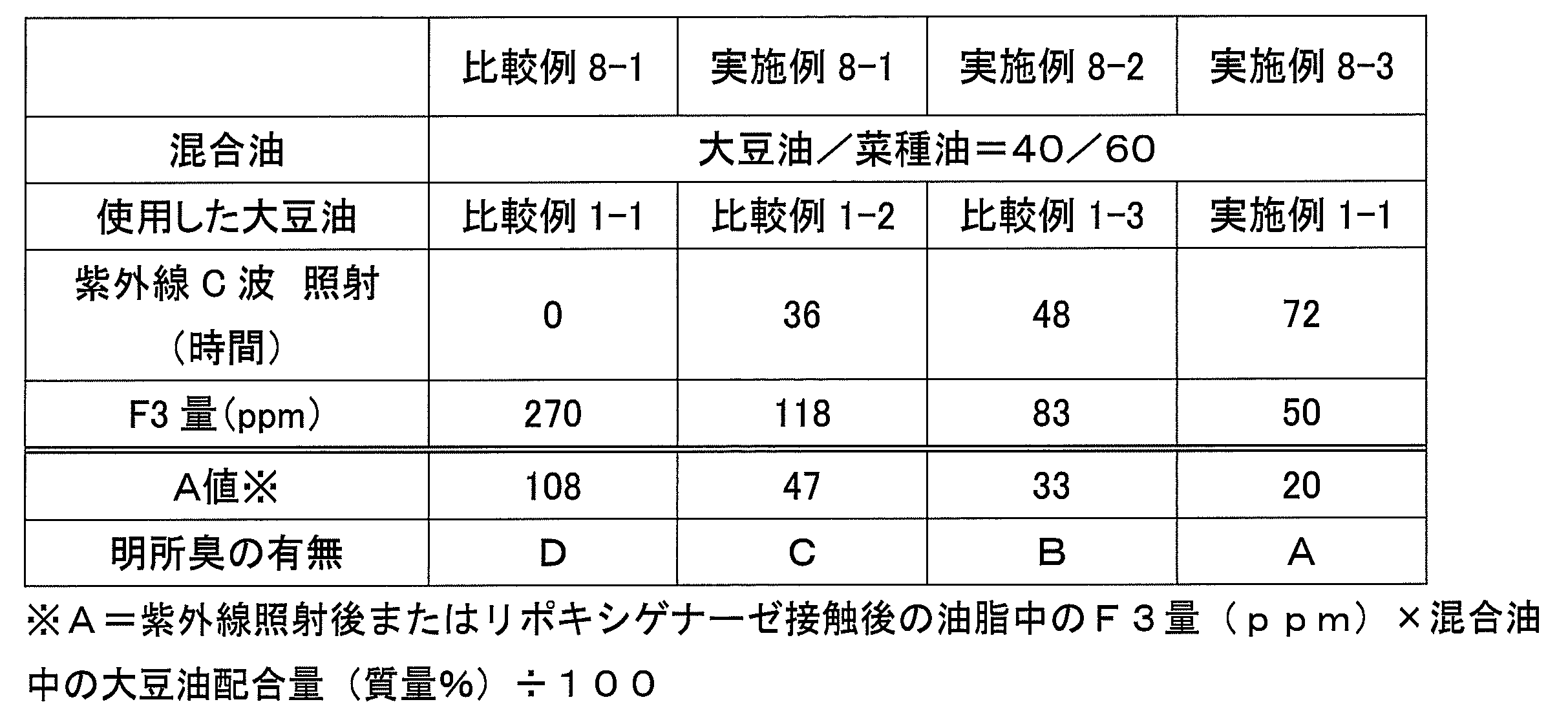
その結果、表8で示したように、大豆油40質量%と菜種油60質量%との混合油では、大豆油のF3量が118ppm以下(A値としては47ppm以下)で明所臭を低減できることがわかった。
<試験例9>(混合油の調製 その4)
試験例1の比較例1-1~3、実施例1-1で得られた大豆油を用いて、表9に示す割合で、菜種油(株式会社J-オイルミルズ社製)と混合した。得られた混合油について、明所臭の評価をおこなった。結果を表9に示す。
試験例1の比較例1-1~3、実施例1-1で得られた大豆油を用いて、表9に示す割合で、菜種油(株式会社J-オイルミルズ社製)と混合した。得られた混合油について、明所臭の評価をおこなった。結果を表9に示す。
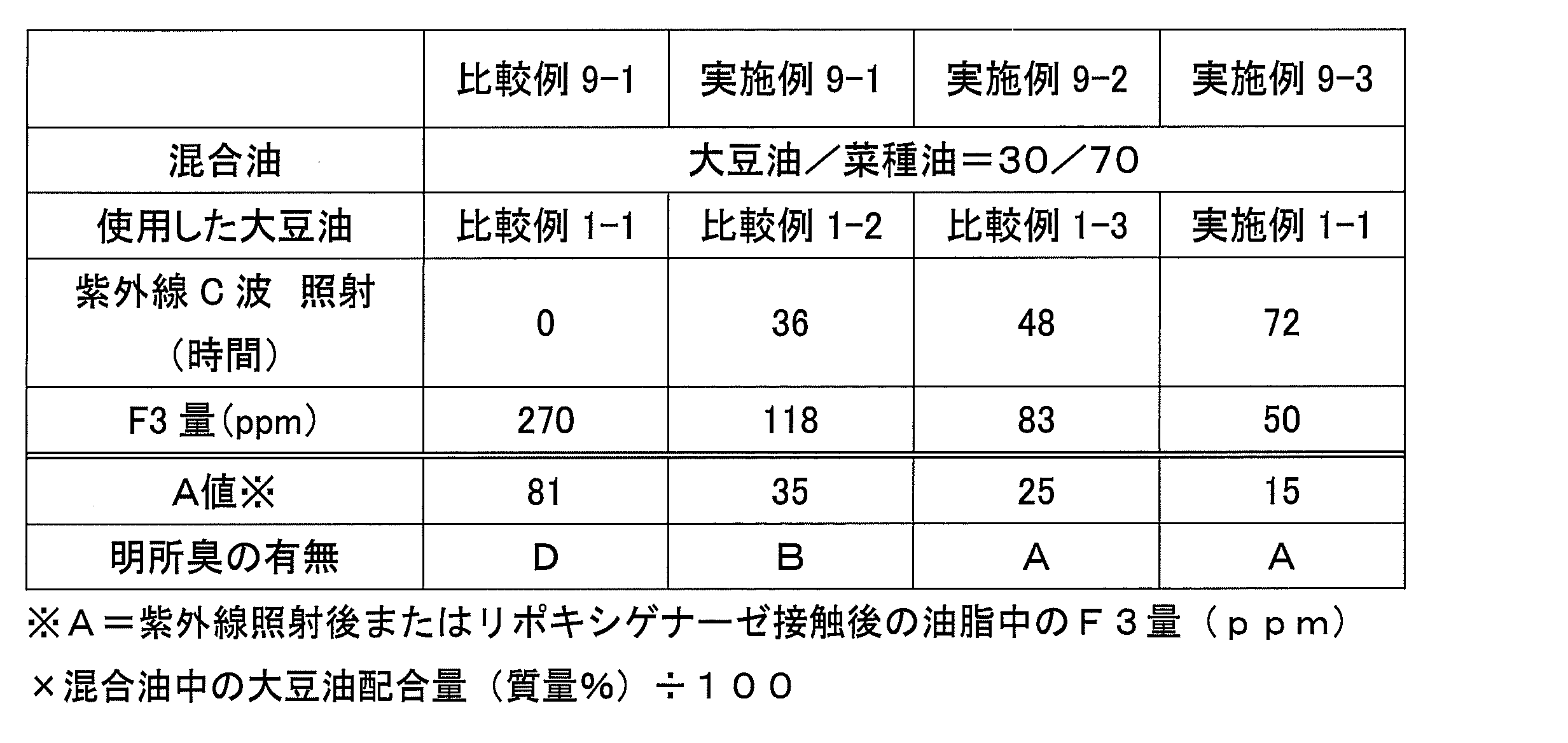
その結果、表9で示したように、大豆油30質量%と菜種油70質量%との混合油では、大豆油のF3量が118ppm以下(A値としては35ppm以下)で明所臭を低減できることがわかった。
<試験例10>(混合油の調製 その5)
試験例1の比較例1-1~3で得られた大豆油を用いて、表10に示す割合で、菜種油(株式会社J-オイルミルズ社製)と混合した。得られた混合油について、明所臭の評価をおこなった。結果を表10に示す。
試験例1の比較例1-1~3で得られた大豆油を用いて、表10に示す割合で、菜種油(株式会社J-オイルミルズ社製)と混合した。得られた混合油について、明所臭の評価をおこなった。結果を表10に示す。
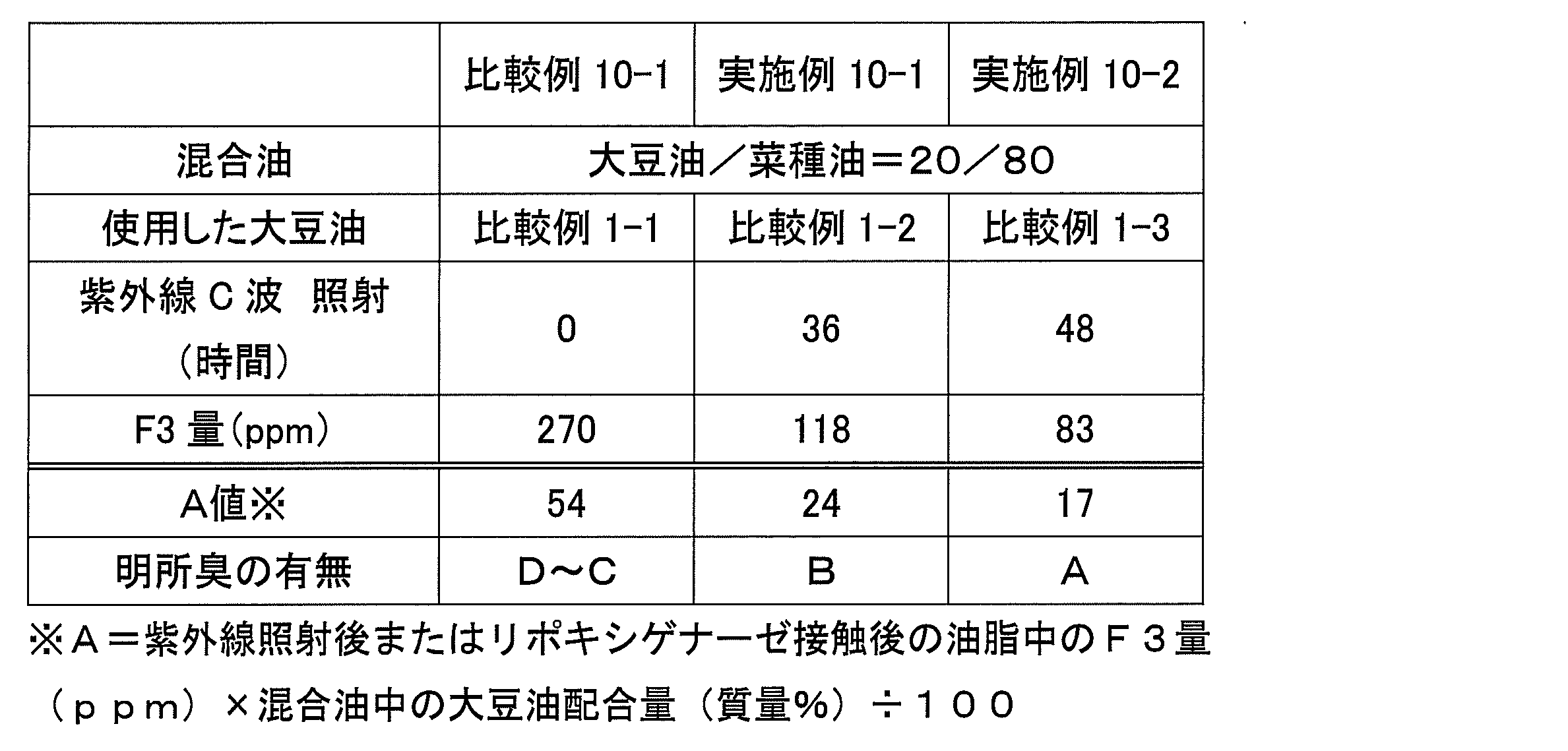
その結果、表10で示したように、大豆油20質量%と菜種油80質量%との混合油では、大豆油のF3量が118ppm以下(A値としては24ppm以下)で明所臭を低減できることがわかった。
<試験例11>(混合油の調製 その6)
試験例1の比較例1-1、実施例1-2で得られた大豆油を用いて、表11に示す割合で、ハイオレイックひまわり油(株式会社J-オイルミルズ社製)と混合した。得られた混合油について、明所臭の評価をおこなった。結果を表11に示す。
試験例1の比較例1-1、実施例1-2で得られた大豆油を用いて、表11に示す割合で、ハイオレイックひまわり油(株式会社J-オイルミルズ社製)と混合した。得られた混合油について、明所臭の評価をおこなった。結果を表11に示す。

その結果、表11で示したように、菜種油に代えて、ハイオレイックひまわり油40質量%を大豆油60質量%と混合しても、F3量が39ppm以下(A値としては23ppm以下)で、同様に明所臭を低減できることがわかった。
Claims (14)
- 大豆から搾油された油脂に、その油脂中の3,4-ジメチル-5-ペンチル-2-フランノナン酸量を低減させるように、波長200~280nmの紫外線を照射する工程を含む、大豆油の製造方法。
- 前記工程で得られた油脂を脱臭処理する工程を含む、請求項1に記載の製造方法。
- 大豆から搾油された前記油脂が脱ガム処理を経た油脂である、請求項1又は2に記載の製造方法。
- 大豆から搾油された油脂に、その油脂中の3,4-ジメチル-5-ペンチル-2-フランノナン酸量を低減させるように、リポキシゲナーゼを接触させる工程を含む、大豆油の製造方法。
- 前記リポキシゲナーゼが大豆由来である、請求項4に記載の製造方法。
- 前記工程で得られた油脂を脱臭処理する工程を含む、請求項4又は5に記載の製造方法。
- 大豆から搾油された前記油脂が脱ガム処理を経た油脂である、請求項4~6のいずれか一項に記載の製造方法。
- 前記紫外線の照射後又は前記リポキシゲナーゼとの接触後の該油脂中の前記3,4-ジメチル-5-ペンチル-2-フランノナン酸量が180ppm以下である、請求項1~7のいずれか一項に記載の製造方法。
- 前記3,4-ジメチル-5-ペンチル-2-フランノナン酸量が60ppm以下である、請求項8に記載の製造方法。
- 大豆から搾油された油脂に、その油脂中の3,4-ジメチル-5-ペンチル-2-フランノナン酸量を低減させるように、波長200~280nmの紫外線を照射することにより、又は、リポキシゲナーゼを接触させることにより得られた大豆油を、前記大豆油以外の他の食用油と混合する工程を含む、混合油の製造方法。
- 前記混合油中の前記大豆油の配合割合が、15質量%以上となるように、前記大豆油を前記他の食用油と混合する、請求項10記載に混合油の製造方法。
- 前記他の食用油が、菜種油、ひまわり油、コーン油、パーム油、パーム分別油からなる群から選ばれた1種又は2種以上である、請求項10又は11に記載の混合油の製造方法。
- 下記式(1)で算出される値Aが40未満である、請求項10~12のいずれか一項に記載の混合油の製造方法。
A=前記紫外線の照射後又は前記リポキシゲナーゼとの接触後の該油脂中の前記3,4-ジメチル-5-ペンチル-2-フランノナン酸量(ppm)×前記混合油中の前記大豆油の配合割合(質量%)÷100 …(1) - 大豆から搾油された油脂に、その油脂中の3,4-ジメチル-5-ペンチル-2-フランノナン酸量を低減させるように、波長200~280nmの紫外線を照射するか、又は、リポキシゲナーゼを接触させる、大豆油の明所臭を低減する方法。
Priority Applications (1)
| Application Number | Priority Date | Filing Date | Title |
|---|---|---|---|
| JP2017536709A JP6714001B2 (ja) | 2015-08-24 | 2016-08-01 | 大豆油の製造方法、混合油の製造方法、及び大豆油の明所臭を抑制する方法 |
Applications Claiming Priority (2)
| Application Number | Priority Date | Filing Date | Title |
|---|---|---|---|
| JP2015-164563 | 2015-08-24 | ||
| JP2015164563 | 2015-08-24 |
Publications (1)
| Publication Number | Publication Date |
|---|---|
| WO2017033674A1 true WO2017033674A1 (ja) | 2017-03-02 |
Family
ID=58100039
Family Applications (1)
| Application Number | Title | Priority Date | Filing Date |
|---|---|---|---|
| PCT/JP2016/072476 Ceased WO2017033674A1 (ja) | 2015-08-24 | 2016-08-01 | 大豆油の製造方法、混合油の製造方法、及び大豆油の明所臭を抑制する方法 |
Country Status (2)
| Country | Link |
|---|---|
| JP (1) | JP6714001B2 (ja) |
| WO (1) | WO2017033674A1 (ja) |
Cited By (3)
| Publication number | Priority date | Publication date | Assignee | Title |
|---|---|---|---|---|
| JP2019022467A (ja) * | 2017-07-25 | 2019-02-14 | 株式会社J−オイルミルズ | 油脂組成物の明所臭抑制方法 |
| WO2019173292A1 (en) * | 2018-03-06 | 2019-09-12 | Bunge Global Innovation, Llc | Methods for bleaching phospholipid compositions |
| JPWO2022158583A1 (ja) * | 2021-01-21 | 2022-07-28 |
Citations (6)
| Publication number | Priority date | Publication date | Assignee | Title |
|---|---|---|---|---|
| JPH01138298A (ja) * | 1987-07-24 | 1989-05-31 | Fuji Oil Co Ltd | 精製大豆油の製造法 |
| JPH07322819A (ja) * | 1994-05-31 | 1995-12-12 | Ajinomoto Co Inc | 明所臭の発生の少ない食用油脂製品 |
| JPH08504084A (ja) * | 1992-09-28 | 1996-05-07 | ベエファ・ラボラトワール | 芳香物質、特にイオノン及びc▲下6▼〜c▲下1▼▲下0▼のアルデヒドの、酵素による調製方法 |
| JPH10191885A (ja) * | 1997-01-14 | 1998-07-28 | Nisshin Oil Mills Ltd:The | 大豆・菜種配合油 |
| JP2005073564A (ja) * | 2003-08-29 | 2005-03-24 | Peace Beans Kk | 大豆を用いたマヨネーズ風ソースの製造方法及び大豆を用いたマヨネーズ風ソース |
| CN102746943A (zh) * | 2012-07-20 | 2012-10-24 | 嘉祥县嘉冠油脂化工有限公司 | 一种非转基因大豆油的冷榨制取工艺 |
-
2016
- 2016-08-01 WO PCT/JP2016/072476 patent/WO2017033674A1/ja not_active Ceased
- 2016-08-01 JP JP2017536709A patent/JP6714001B2/ja active Active
Patent Citations (6)
| Publication number | Priority date | Publication date | Assignee | Title |
|---|---|---|---|---|
| JPH01138298A (ja) * | 1987-07-24 | 1989-05-31 | Fuji Oil Co Ltd | 精製大豆油の製造法 |
| JPH08504084A (ja) * | 1992-09-28 | 1996-05-07 | ベエファ・ラボラトワール | 芳香物質、特にイオノン及びc▲下6▼〜c▲下1▼▲下0▼のアルデヒドの、酵素による調製方法 |
| JPH07322819A (ja) * | 1994-05-31 | 1995-12-12 | Ajinomoto Co Inc | 明所臭の発生の少ない食用油脂製品 |
| JPH10191885A (ja) * | 1997-01-14 | 1998-07-28 | Nisshin Oil Mills Ltd:The | 大豆・菜種配合油 |
| JP2005073564A (ja) * | 2003-08-29 | 2005-03-24 | Peace Beans Kk | 大豆を用いたマヨネーズ風ソースの製造方法及び大豆を用いたマヨネーズ風ソース |
| CN102746943A (zh) * | 2012-07-20 | 2012-10-24 | 嘉祥县嘉冠油脂化工有限公司 | 一种非转基因大豆油的冷榨制取工艺 |
Non-Patent Citations (4)
| Title |
|---|
| JAIN VISHAL P. ET AL.: "Production of Conjugated Linoleic Acid-Rich Potato Chips", JOURNAL OF FOOD SCIENCE, vol. 72, no. 1, 2007, pages S75 - S78, XP055365543, ISSN: 0022-1147 * |
| KERR JEANNE L. ET AL.: "Soybean Oil Biofuel Cell: Utilizing Lipoxygenase Immobilized by Modified Nafion to Catalyze the Oxidation of Fatty Acids for Biofuel Cells", ACS SYMPOSIUM SERIES, vol. 986, 2008, pages 334 - 353, XP055365540 * |
| TADAAKI MATSUI ET AL.: "Shigaisen Shosha shita Daizuyu-chu no Cis, Trans -Fuhowa Shibosan ni Tsuite", PROCEEDINGS OF THE ANNUAL MEETING OF JAPAN SOCIETY FOR BIOSCIENCE, BIOTECHNOLOGY, AND AGROCHEMISTRY, vol. 62, no. 3, 1988, Japan Society for Bioscience, Biotechnology, and Agrochemistry, pages 210, ISSN: 0002-1407 * |
| WANG HUI-LIAN ET AL.: "The protective effect and mechanism of soybean oil and its extracts on DNA damage in human ECV304 cells exposed to UV-C", BIOCHIMICA ET BIOPHYSICA ACTA, vol. 1626, 2003, pages 19 - 24, XP004420591, ISSN: 0167-4781 * |
Cited By (7)
| Publication number | Priority date | Publication date | Assignee | Title |
|---|---|---|---|---|
| JP2019022467A (ja) * | 2017-07-25 | 2019-02-14 | 株式会社J−オイルミルズ | 油脂組成物の明所臭抑制方法 |
| WO2019173292A1 (en) * | 2018-03-06 | 2019-09-12 | Bunge Global Innovation, Llc | Methods for bleaching phospholipid compositions |
| CN111970932A (zh) * | 2018-03-06 | 2020-11-20 | 邦吉全球创新有限责任公司 | 对磷脂组合物进行脱色的方法 |
| US11466229B2 (en) | 2018-03-06 | 2022-10-11 | Bunge Global Innovation, Llc | Methods for bleaching phospholipid compositions |
| JPWO2022158583A1 (ja) * | 2021-01-21 | 2022-07-28 | ||
| WO2022158583A1 (ja) * | 2021-01-21 | 2022-07-28 | 国立大学法人佐賀大学 | 低フラン酸ダイズ |
| JP7820735B2 (ja) | 2021-01-21 | 2026-02-26 | 国立大学法人佐賀大学 | 低フラン酸ダイズ |
Also Published As
| Publication number | Publication date |
|---|---|
| JP6714001B2 (ja) | 2020-06-24 |
| JPWO2017033674A1 (ja) | 2018-06-07 |
Similar Documents
| Publication | Publication Date | Title |
|---|---|---|
| Liu et al. | Effect of refining process on physicochemical parameters, chemical compositions and in vitro antioxidant activities of rice bran oil | |
| TWI522044B (zh) | A glyceride composition and a method for producing the glyceride composition | |
| Van Hoed et al. | Influence of chemical refining on the major and minor components of rice brain oil | |
| Ghazani et al. | Minor components in canola oil and effects of refining on these constituents: A review | |
| US11814601B2 (en) | Method for reducing content of saturated hydrocarbon, and refined palm-based oils and/or fats | |
| RU2672605C1 (ru) | Удаление нежелательных пропаноловых компонентов | |
| JP5216942B1 (ja) | 精製グリセリド組成物及び該精製グリセリド組成物の製造方法 | |
| Sulihatimarsyila et al. | Production of refined red palm-pressed fibre oil from physical refining pilot plant | |
| Gromadzka et al. | Trends in edible vegetable oils analysis. Part A. Determination of different components of edible oils-a review | |
| EP3428255B1 (en) | Method for producing refined palm-based fat/oil, and method for reducing glycidol, 3-chloropropane-1,2-diol and fatty acid esters thereof and/or diglycerides in refined palm-based fat/oil | |
| TW201408767A (zh) | 精製油脂的製造方法 | |
| JP6714001B2 (ja) | 大豆油の製造方法、混合油の製造方法、及び大豆油の明所臭を抑制する方法 | |
| Lv et al. | Changes in stability, phytonutrients, 3-chloropropanol esters and glycidyl esters of peanut oil-based diacylglycerols during heat treatment | |
| JP2021120465A (ja) | 精製油脂の製造方法 | |
| Zhou et al. | Chemical property, bioactive constituent and volatile compound changes of beef tallow during an improved flavor-retaining refining approach | |
| Nikiema et al. | Study of the stability of Ricinodendron heudelotii oil: Effects of solar radiation on the chemical composition of the oil | |
| WO2019151008A1 (ja) | フライ調理用油脂組成物のアニシジン価上昇及びトコフェロール類減少の抑制方法 | |
| WO2015146248A1 (ja) | 精製パーム系油脂の製造方法 | |
| JP2022533470A (ja) | 精製食用油脂の製造方法、食用油脂の曝光臭改善方法、及び精製食用油脂 | |
| EP3030086B1 (en) | Fat or oil composition | |
| JP5924755B2 (ja) | グリセリド組成物の製造方法 | |
| Vardin et al. | Effect of industrial refining process on fatty acid, sterol, volatile compound profile and 3-MCPD ester content of canola and corn oils | |
| CN113614212A (zh) | 精制油脂的制造方法和生育酚类的制造方法 | |
| Niamat et al. | Stabilization of sunflower oil with extracts from fenugreek, mint and liquorice | |
| JP6166983B2 (ja) | 精製油脂の製造方法 |
Legal Events
| Date | Code | Title | Description |
|---|---|---|---|
| 121 | Ep: the epo has been informed by wipo that ep was designated in this application |
Ref document number: 16839021 Country of ref document: EP Kind code of ref document: A1 |
|
| ENP | Entry into the national phase |
Ref document number: 2017536709 Country of ref document: JP Kind code of ref document: A |
|
| NENP | Non-entry into the national phase |
Ref country code: DE |
|
| 122 | Ep: pct application non-entry in european phase |
Ref document number: 16839021 Country of ref document: EP Kind code of ref document: A1 |