WO2016204250A1 - 電力供給システム - Google Patents
電力供給システム Download PDFInfo
- Publication number
- WO2016204250A1 WO2016204250A1 PCT/JP2016/068004 JP2016068004W WO2016204250A1 WO 2016204250 A1 WO2016204250 A1 WO 2016204250A1 JP 2016068004 W JP2016068004 W JP 2016068004W WO 2016204250 A1 WO2016204250 A1 WO 2016204250A1
- Authority
- WO
- WIPO (PCT)
- Prior art keywords
- power
- power transmission
- line
- transmission line
- unit
- Prior art date
- Legal status (The legal status is an assumption and is not a legal conclusion. Google has not performed a legal analysis and makes no representation as to the accuracy of the status listed.)
- Ceased
Links
Images






Classifications
-
- H—ELECTRICITY
- H02—GENERATION; CONVERSION OR DISTRIBUTION OF ELECTRIC POWER
- H02J—ELECTRIC POWER NETWORKS; CIRCUIT ARRANGEMENTS OR SYSTEMS FOR SUPPLYING OR DISTRIBUTING ELECTRIC POWER; SYSTEMS FOR STORING ELECTRIC ENERGY
- H02J50/00—Circuit arrangements or systems for wireless supply or distribution of electric power
- H02J50/05—Circuit arrangements or systems for wireless supply or distribution of electric power using capacitive coupling
-
- H—ELECTRICITY
- H02—GENERATION; CONVERSION OR DISTRIBUTION OF ELECTRIC POWER
- H02J—ELECTRIC POWER NETWORKS; CIRCUIT ARRANGEMENTS OR SYSTEMS FOR SUPPLYING OR DISTRIBUTING ELECTRIC POWER; SYSTEMS FOR STORING ELECTRIC ENERGY
- H02J3/00—Circuit arrangements for AC mains or AC distribution networks
- H02J3/001—Arrangements for handling faults or abnormalities, e.g. emergencies or contingencies
- H02J3/0014—Arrangements for handling faults or abnormalities, e.g. emergencies or contingencies for preventing or reducing power oscillations in networks
-
- H—ELECTRICITY
- H02—GENERATION; CONVERSION OR DISTRIBUTION OF ELECTRIC POWER
- H02J—ELECTRIC POWER NETWORKS; CIRCUIT ARRANGEMENTS OR SYSTEMS FOR SUPPLYING OR DISTRIBUTING ELECTRIC POWER; SYSTEMS FOR STORING ELECTRIC ENERGY
- H02J3/00—Circuit arrangements for AC mains or AC distribution networks
- H02J3/01—Arrangements for reducing harmonics or ripples
-
- H—ELECTRICITY
- H02—GENERATION; CONVERSION OR DISTRIBUTION OF ELECTRIC POWER
- H02J—ELECTRIC POWER NETWORKS; CIRCUIT ARRANGEMENTS OR SYSTEMS FOR SUPPLYING OR DISTRIBUTING ELECTRIC POWER; SYSTEMS FOR STORING ELECTRIC ENERGY
- H02J50/00—Circuit arrangements or systems for wireless supply or distribution of electric power
- H02J50/40—Circuit arrangements or systems for wireless supply or distribution of electric power using two or more transmitting or receiving devices
-
- H—ELECTRICITY
- H02—GENERATION; CONVERSION OR DISTRIBUTION OF ELECTRIC POWER
- H02J—ELECTRIC POWER NETWORKS; CIRCUIT ARRANGEMENTS OR SYSTEMS FOR SUPPLYING OR DISTRIBUTING ELECTRIC POWER; SYSTEMS FOR STORING ELECTRIC ENERGY
- H02J50/00—Circuit arrangements or systems for wireless supply or distribution of electric power
- H02J50/70—Circuit arrangements or systems for wireless supply or distribution of electric power involving the reduction of electric, magnetic or electromagnetic leakage fields
-
- H—ELECTRICITY
- H02—GENERATION; CONVERSION OR DISTRIBUTION OF ELECTRIC POWER
- H02J—ELECTRIC POWER NETWORKS; CIRCUIT ARRANGEMENTS OR SYSTEMS FOR SUPPLYING OR DISTRIBUTING ELECTRIC POWER; SYSTEMS FOR STORING ELECTRIC ENERGY
- H02J50/00—Circuit arrangements or systems for wireless supply or distribution of electric power
- H02J50/80—Circuit arrangements or systems for wireless supply or distribution of electric power involving the exchange of data, concerning supply or distribution of electric power, between transmitting devices and receiving devices
-
- Y—GENERAL TAGGING OF NEW TECHNOLOGICAL DEVELOPMENTS; GENERAL TAGGING OF CROSS-SECTIONAL TECHNOLOGIES SPANNING OVER SEVERAL SECTIONS OF THE IPC; TECHNICAL SUBJECTS COVERED BY FORMER USPC CROSS-REFERENCE ART COLLECTIONS [XRACs] AND DIGESTS
- Y02—TECHNOLOGIES OR APPLICATIONS FOR MITIGATION OR ADAPTATION AGAINST CLIMATE CHANGE
- Y02E—REDUCTION OF GREENHOUSE GAS [GHG] EMISSIONS, RELATED TO ENERGY GENERATION, TRANSMISSION OR DISTRIBUTION
- Y02E40/00—Technologies for an efficient electrical power generation, transmission or distribution
- Y02E40/40—Arrangements for reducing harmonics
Definitions
- the present invention relates to a power supply system to which electric field coupling power transmission technology is applied.
- the present inventor has already invented the “electric field coupling method” as a new method of electric power transmission, and has further already described a circuit technology capable of realizing the new method (hereinafter referred to as “electric field coupling electric power transmission technology”).
- electric field coupled power transmission technology two metal plates (conductive plates) are made to face each other, and a capacitor (such a capacitor is hereinafter referred to as a “junction capacitance”) is formed using these two metal plates as electrode pairs. In this state, non-contact power transmission is realized by flowing a high-frequency current.
- the power transmission system to which the electric field coupled power transmission technology is applied includes a power transmission unit that transmits power from a power source and a power reception unit that receives power from the power transmission unit and supplies the power to a load.
- a power transmission unit that transmits power from a power source
- a power reception unit that receives power from the power transmission unit and supplies the power to a load.
- an electrode such as a metal plate provided at the end of the power transmission unit (hereinafter referred to as “power transmission electrode”) and an electrode such as a metal plate provided at the tip of the power reception unit (hereinafter referred to as “power reception electrode”) are made to face each other to form a junction capacitance.
- the electric field coupled power transmission technology can also be applied to slit coaxial lines.
- FIG. 13 is a perspective view showing an external configuration of a conventional coaxial line with slits.
- the coaxial line 70 with a slit is an example of a conventional power transmission system to which an electric field coupling power transmission technique is applied.
- the coaxial line with slit 70 is attached so that a load (camera or the like) driven by electric power can be freely moved along the slit, and can transmit electric power to the load regardless of its position (even during movement).
- the coaxial line 70 with a slit includes a connector 81, an outer conductor 82, and an inner conductor 83.
- the connector 81 is a component that can be freely moved along the slit while attaching a load and supplying power to the load, and has a power receiving electrode.
- the external conductor 82 is a conductive member having a rectangular parallelepiped shape inside, and functions as a line extending in a rod shape in a predetermined direction, for example, like a curtain rail disposed on a wall of an office or factory. That is, a predetermined surface (a surface not shown in FIG. 13, hereinafter referred to as “back surface”) of the outer conductor 82, such as a curtain rail, is connected to a wall of an office or a factory. In the longitudinal direction of the outer surface (hereinafter referred to as “front surface”) opposite to the back surface, a slit is formed as shown in FIG.
- the connector 81 is attached so as to be movable along the slit. That is, the connector 81 freely moves along the slit of the external conductor 82 with a load (not shown) attached.
- the inner conductor 83 is a bar-like conductive member that is disposed in the inner space of the outer conductor 82 and extends in the substantially same direction as the longitudinal direction of the outer conductor 82.
- the outer conductor 82 and the inner conductor 83 are collectively referred to as “line” as appropriate.
- This line itself functions as a power transmission electrode. That is, the portion of the line on which the connector 81 is located functions as a power transmission electrode, and forms a junction capacitance with the power reception electrode of the connector 81.
- the present invention has been made in view of such a situation, and in a power supply system to which electric field coupling power transmission technology is applied, long-distance transmission of power is possible, power can be taken out at an arbitrary point, and communication can be performed.
- the aim is to establish a technology that can do this.
- the power supply system of one embodiment of the present invention includes: A power supply system using electric field coupled power transmission technology, A power transmission line for transmitting power from an AC power source of a predetermined wavelength; By having a power reception electrode, moving along the power transmission line, and forming a junction capacitance by the power transmission electrode and the power reception electrode, with the portion of the power transmission line facing the power reception electrode as a power transmission electrode A power receiving unit that receives power from the power transmission line and supplies the power to a load; A DC line for transmitting DC power to the power transmission line; With The power transmission line is A unit having a length based on the predetermined wavelength, and a unit for generating a standing wave from the AC power supply as a unit section, It is configured by repeatedly arranging a plurality of the unit sections, Each of the plurality of unit sections includes an inverter that converts DC power transmitted through the DC line into AC power having the predetermined wavelength.
- the unit section is composed of one or more construction modules serving as construction units
- the construction module may include an inductor that resonates with a line capacitance of the power supply line.
- the power receiving unit For input impedance Z in
- the impedance of the line is Z 0 and the number of power receivers is m.
- the power transmission line has a non-parallel line structure composed of an outer conductor having an inner space structure and an inner conductor disposed in the inner space portion of the outer conductor,
- the power receiving electrode that forms the junction capacitance with the outer conductor is disposed opposite to the outer conductor, A shield cover covering the power receiving electrode; be able to.
- the power transmission line has a non-parallel line structure composed of an outer conductor having an inner space structure and an inner conductor disposed in the inner space portion of the outer conductor,
- the power receiving electrode that forms the junction capacitance with the outer conductor is disposed facing the inner side of the outer conductor,
- Each of the receiving electrodes is arranged symmetrically so that the radiated electric fields cancel each other, Can be.
- the power supply system includes: Further comprising a communication line for communication, constituted by a leaky coaxial line; Can be.
- the communication line is normally closed, but is covered with a metal shield having an open end into which an antenna can be inserted, An antenna for transmitting and receiving electromagnetic waves from the communication line, which is movable according to the movement of the power receiving unit, is inserted into the open end of the metal shield, Can be.
- FIG. 1 It is a schematic diagram of the electric power supply line to which the electric power transmission circuit of FIG. 1 is applied. It is a figure which shows the track
- the power supply line to which the present invention is applied it is a diagram showing a line structure when the non-contact power transmission line 23 and the DC power transmission line 24 are completely separated and run independently.
- FIG. 3 is a diagram showing a cross-sectional structure of a non-contact power transmission line 23.
- FIG. It is a figure which shows the structure of the circuit of the power receiving part 2, and the non-contact electric power transmission line 23 in the electric power supply line to which the electric field coupling electric power transmission technique used as the foundation of this invention is applied.
- FIG. 4 is a diagram illustrating a countermeasure for reducing attenuation of a communication signal in a communication line 25. It is a figure which shows the case where the external conductor 32 and the DC power transmission line 24 are applied to a magnetic field coupling system. It is a perspective view which shows the external appearance structure of the conventional coaxial line with a slit.
- FIG. 1 is a diagram showing a basic circuit of a power transmission circuit to which an electric field coupling power transmission technology as a basis of the present invention is applied.
- a power transmission circuit to which electric field coupling power transmission technology is applied includes a power transmission unit 1 and a power reception unit 2.
- the electric field coupled power transmission technology is a non-contact power method in which a high-frequency current is passed in a state where a junction capacitor Cc is formed by a pair of electrodes made of two opposing metal plates.
- This technology realizes electric transmission. That is, a metal plate power transmission electrode is attached to the end of the power transmission unit 1 that transmits power from the power source Vf, and a metal plate power reception electrode is attached to the tip of the power reception unit 2 that receives the power and supplies it to the load R.
- An electric field coupled power transmission technique is realized by forming the junction capacitance Cc by making the pair of power transmission electrode and power reception electrode face each other.
- the power transmission unit 1 includes a parallel resonance circuit 11 and a transformer 12, and is connected to an AC power supply Vf and receives power.
- the parallel resonance circuit 11 is connected to the AC power source Vf via the transformer 12, and includes a capacitor C1 and a coil L2. That is, the capacitor C1 and the coil L2 are connected in parallel to each other, so that the parallel resonance circuit 11 is configured.
- the transformer 12 is configured by adopting the coil L2 as the secondary winding and the coil L1 as the primary winding.
- the voltage on the primary side that is, the voltage of the AC power supply Vf is boosted n times in the transformer 12 and is parallelized.
- Two power transmission electrodes are connected to both ends of the parallel resonant circuit.
- the power receiving unit 2 includes a parallel resonant circuit 14 and a transformer 15.
- the parallel resonance circuit 14 is connected to two power receiving electrodes of the power receiving unit 2 and includes a capacitor C2 and a coil L3. That is, the capacitor C2 and the coil L3 are connected in parallel to each other, whereby the parallel resonance circuit 14 is configured.
- the transformer 15 is configured by adopting the coil L3 as the primary winding and the coil L4 as the secondary winding.
- the number of windings of the coil L3: the number of windings of the coil L4 n: 1
- the voltage on the primary side that is, the voltage received by the power receiving electrode and applied to the parallel resonance circuit 14 is 15, the voltage is stepped down 1 / n times and applied to the load R.
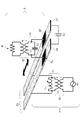
- FIG. 2 is a schematic diagram of a power supply line to which the power transmission circuit of FIG. 1 is applied, which is an embodiment of the power supply line to which the present invention is applied.
- the power transmission unit 1 causes each of two lines extending in a rod shape in a predetermined direction to function as the power transmission electrode 21.
- the power transmission electrodes 21 that are these two lines are collectively referred to as a “non-contact power transmission line 23”. That is, the power receiving unit 2 as a moving body can be freely moved along the non-contact power transmission line 23 by disposing the two power receiving electrodes 22 so as to face the non-contact power transmission line 23. It is configured.
- Each of the two power receiving electrodes 22 and each of the two power transmitting electrodes 21 constituting the non-contact power transmission line 23 have two junction capacitances Cc (the junction capacitances Cc on the left side and the right side in FIG. 1). Is formed. That is, the power receiving unit 2 can freely move on the non-contact power transmission line 23 and can receive power at an arbitrary position on the non-contact power transmission line 23.
- the power transmission electrode 21 is configured as a long rod-shaped line as shown in FIG. 2, the inter-line capacitance Cu cannot be ignored. Therefore, resonance is caused between the line capacitance Cu and the power transmission side inductor Lu (corresponding to the coil L2 in FIG. 1). Thereby, the transmission efficiency of electric power can be improved.
- an adjustment power transmission side inductor Lv may be inserted as shown in FIG. 2 (in this case, a parallel circuit of the power transmission side inductor Lu and the adjustment power transmission side inductor Lv is Equivalent to the coil L2 in FIG. 1).
- the power transmission side inductor Lv for adjustment is connected in parallel in the example of FIG. 2, it may be connected in series.
- FIG. 3 is a diagram showing a line structure when a DC power transmission line 24 and a communication line 25 are run in parallel with a non-contact power transmission line 23 as another embodiment of a power supply line to which the present invention is applied. It is.
- the contactless power transmission line 23 in the example of FIG. 1 is provided with an outer conductor 32 and an inner conductor 33.
- the DC power transmission line 24 runs parallel to the non-contact power transmission line 23. That is, in order to make the power supply line to which the present invention applies correspond to long-distance transmission in the km order, it is necessary to solve the problem of long-distance transmission of electric power and the problem of standing waves.
- DC power transmission using the DC power transmission line 24 is employed. That is, in the DC power transmission, the current flows through the entire cross section of the power transmission line (in this example, the DC power transmission line 24). Furthermore, the voltage in the case of direct current power transmission can be 0.707 times the voltage when the same power is passed by alternating current. Furthermore, cooperation with the superconducting DC transmission system is facilitated. For this reason, the DC power transmission line 24 is employed as the power transmission unit.
- the non-contact power supply to which the electric field coupling power transmission technology is applied requires an AC power supply Vf for flowing a high frequency current of about 100 kHz to 10 MHz band. Therefore, in the present embodiment, one inverter 34 that converts direct current flowing through the direct-current power transmission line 24 into alternating current is provided for each unit section 51 of the non-contact power transmission line 23. The reason why the non-contact power transmission line 23 is divided into a plurality of unit sections 51 will be described later.
- the inverter 34 of each unit section 51 is not always driven, but only the inverter 34 of the unit section 51 required according to the position where the power receiving unit 2 that is a moving body is driven.
- the DC power transmitted through the DC power transmission line 24 is converted into AC power by the driving inverter 34.
- the AC power changed by the inverter 34 is supplied from the AC power source Vf of the power transmission unit 1 to the power receiving electrode via the power transmission unit 1, that is, the external conductor 32 and the internal conductor 33, and further receives power in a non-contact manner. Supplied to section 2.
- the external conductor 32 is connected to the DC power transmission line 24 and the power transmission unit 1, thereby functioning as a part of the DC line and reducing electromagnetic radiation accompanying power transmission.
- the transmitted high frequency is reflected at the end portion and returned, so that a settling wave is generated.
- voltage antinodes and valleys appear alternately.
- electric field valleys (current antinodes) and current valleys (electric field antinodes) appear alternately.
- the power receiving unit 2 is provided with both electric field coupling method (electric field coupling power transmission technology) and magnetic field coupling method, so that the electric field and the current can be reduced.
- electric field coupling method electric field coupling power transmission technology
- magnetic field coupling method magnetic field coupling method
- the power receiving unit 2 physically has two methods, and thus the power receiving unit 2 itself has to be enlarged.
- the electric field coupling method electric field coupling power transmission technology
- the unit section 51 having a length based on the wavelength of the transmission frequency is used. And a standing wave is generated only in the unit section 51.
- the electric field can be maximized at the end by opening the end of the transmission line (non-contact power transmission line 23 in the example of FIG. 3). it can.
- the length of the unit section 51 can be short and arranging the inverter 34 at the center of the unit section 51 so as to reflect at both ends of the unit section 51, voltage fluctuation can be suppressed low. it can.
- the technical idea of the unit section 51 can be applied not only to the electric field coupling method but also to the magnetic field coupling method as described later with reference to FIG. However, when applied to the magnetic field coupling method, the end portion needs to be short-circuited.
- Unit sections 51 having a length (for example, a length of ⁇ / 6) based on the wavelength ⁇ of the transmission frequency are connected repeatedly, and an inverter 34 that obtains power from the DC power transmission line 24 is placed at the center.
- a substantially constant voltage section can be realized in all sections. A specific example of this point will be described later with reference to FIG.
- the communication line 25 runs parallel to the non-contact power transmission line 23 independently.
- the communication line 25 runs parallel to the non-contact power transmission line 23 and is transmitted and received from the communication transceiver.
- the communication transceiver and the communication relay amplifier (not shown) of the communication line 25 are connected to the DC power transmission line 24 and are supplied with electric power.
- the communication signal is transmitted through the communication line 25. Therefore, the non-contact power transmission line 23 only needs to flow DC power or non-contact power (high-frequency AC power), and does not need to flow communication line communication signals. Thereby, the required value regarding processing accuracy can be reduced and cost reduction can be achieved.
- the frequency band of the communication signal in this case is a GHz frequency band.
- the communication line 25 can be laid for a long distance at a time.
- the communication line 25 can employ LCX (leakage coaxial cable).
- LCX is employed in the communication line 25 of FIG. 3 and FIG. 4 and FIG. This is because LCX has the advantage of being able to maintain a constant quality because it is mass-productive and inexpensive because it can use existing products.
- LCX can also be used on the power receiving unit 2 (moving body) side by running the antennas in parallel without contact.
- FIG. 4 shows, as yet another embodiment of the power supply line to which the present invention is applied, a line structure when the non-contact power transmission line 23 and the DC power transmission line 24 are completely separated and run independently.
- the non-contact power transmission line 23 in the example of FIG. 4 includes an outer conductor 32 and an inner conductor 33.
- the DC power transmission line 41 is running independently with respect to the non-contact power transmission line 23.
- each external conductor 32 is connected by an external conductor connecting portion 61 for each unit section 51.
- the AC power supply Vf of the power transmission unit 1 is a power supply for contactless power supply to which electric field coupling power transmission technology is applied, as in the example of FIG.
- the communication line 25 runs in parallel independently of the non-contact power transmission line 23 and is connected to an AC power source, as in the example of FIG. 3.
- the processing accuracy can be made low for each of the communication line 25 and the non-contact power transmission line 23, but the outer conductor 32 is one of the DC transmission lines 41. Since it becomes an independent form without functioning as a part, material cost increases compared with the power supply line of the example of FIG.
- FIG. 5 is a diagram illustrating an application example of the unit section 51 and the construction module 52.
- FIG. 5A shows a case where the unit section 51 is configured by combining a plurality of short construction modules 52.
- the unit section 51 is a section that is set with a length with little voltage fluctuation based on the wavelength ⁇ of the power transmission frequency, and is a unit that generates a standing wave.
- the construction module 52 refers to a functional unit that can be replaced in construction. That is, the unit section 51 is composed of one or more construction modules 52.
- each of the construction modules 52 is connected by an external conductor connection portion 61 for the external conductor 32.
- each of the construction modules 52 is connected by the internal conductor connection portion 62.
- the construction module 52 that is the end of the unit section 51 is opened. That is, the connection between the inner conductors 33 is not performed at the boundary of the unit section 51. Thereby, since the high frequency for non-contact power supply can be reflected, a standing wave can be generated only in the unit section 51.
- the joining between the construction modules 52 is mechanically and electrically connected to both the outer conductor 32 and the inner conductor 33.
- each of the n construction modules 52 includes the construction module 52.
- a capacitor Cmk (k is an integer value of 1 to n) between the inner conductor 33 and the outer conductor 32 and an inductor Lmk that resonates at a power transmission frequency are attached.
- the power transmission unit 1 can be externally provided with a resonance (matching) inductor Lm0 and supplied with electric power therefrom.
- FIG. 5B shows a case where the unit section 51 and the construction module 52 are the same, that is, a case where the unit section 51 is configured by one construction module 52.
- the unit section 51 is configured by one construction module 52.
- the external conductor 32 is connected between the adjacent construction modules 52 (unit sections 51). That is, the joining between the construction modules 52 is mechanically and electrically connected to the outer conductor 32.
- the matching transformer 12 and inverter 34 can be installed at the factory and adjusted before shipment.
- the fine adjustment can be performed by the power transmission side inductor Lv shown in the schematic diagram of FIG.
- the unit sections 51 are substantially omitted.
- a constant voltage interval can be realized in all intervals.
- the AC power source Vf obtains a minimum amount of power, detects signals from the power receiving unit 2, a server not shown, an adjacent AC power source, and the like, and wakes up when the power receiving unit 2 approaches. Further, the AC power supply Vf synchronizes and transmits when the adjacent AC power supply Vf operates together.
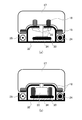
- FIG. 6 is a diagram illustrating a cross-sectional structure of the non-contact power transmission line 23.
- 6A and 6B are diagrams showing the structure of the non-contact power transmission line 23 having an unbalanced line structure.
- 6C and 6D are diagrams showing the structure of the non-contact power transmission line 23 having a balanced line structure.
- the non-contact power transmission line 23 having an unbalanced line structure includes an external conductor 32 that functions as a power transmission electrode, and a power transmission electrode that is disposed inside the external conductor 32. It is comprised with the one internal conductor 33 which functions.
- the outer conductor 32 and the inner conductor 33 are connected by a resonance inductor Lm. Note that the resonance inductor Lm may be provided outside the external conductor 32.
- the non-contact power transmission line 23 having a balanced line structure includes an outer conductor 32 and two inner conductors 33 arranged inside the outer conductor 32. It is configured. Each of the two inner conductors 33 functions as each of the two power transmission electrodes and is connected by a resonance inductor Lm. That is, the outer conductor 32 in the non-contact power transmission line 23 having a balanced line structure does not contribute to power transmission (does not function as a power transmission electrode), but shields against electron emission from the non-contact power transmission line 23, fixing of the line, traveling Used for car rails. Note that the resonance inductor Lm may be provided outside the external conductor 32.
- FIG. 7 is a diagram illustrating a circuit of the power receiving unit 2 and a structure of the non-contact power transmission line 23 in a power supply line to which the electric field coupled power transmission technology that is the basis of the present invention is applied.
- the parallel resonance circuit 14 included in the power reception unit 2 in FIG. 7 is equivalent to a state in which an n 2 R resistor is attached in parallel to the resonance inductor. For this reason, the Q value of the parallel resonant circuit 14 can be increased by increasing n 2 R.
- the input impedance of the power receiving unit 2 becomes n 2 R, and by making the impedance sufficiently higher than the impedance Z 0 of the line, a plurality of simultaneously on the line in the same unit section 51.
- the power receiving unit 2 of the base can be driven.
- the impedance of the line is Z 0
- the number of power receiving units 2 is m
- n or R When the number of the power receiving bodies 2 is known and communication can be transmitted to each of the power receiving bodies 2, the above relationship can be maintained by changing n or R.
- the size of the power reception electrode of the power reception unit 2 is sufficiently larger than the size of the gap at the boundary of the unit section 51 of the internal conductor 33.
- the junction capacitance Cc is slightly reduced when passing through the gap, but can pass through without any problem.
- the battery can pass without problems.
- the power receiving unit 2 can know its own position by reading a linear marker attached to the track.
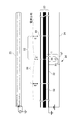
- FIG. 8 is a diagram showing a cross-sectional structure of a power supply line to which the present invention is applied when the power receiving unit 2 is a moving body.
- the DC power transmission line 24 and the communication line 25 are running in parallel outside the outer conductor 32.
- the DC power transmission line 24 and the communication line 25 have a structure that can be retrofitted by site construction after connecting the aluminum block of the unit section 51, and are fixed to the external conductor 32 by a caulking material or the like.
- the outer conductor 32 and the inner conductor 33 are separated by an insulating layer 34.
- FIG. 8A shows an example in which the drive wheels 18 provided in the movement / communication / action unit 17 (corresponding to the power receiving unit 2 in FIG. 1) are arranged so as to run on the upper surface of the external conductor 32.
- the movement / communication / action unit 17 in the example of FIG. 8A includes a drive wheel 18 for moving on the non-contact power transmission line 23 and a guide wheel 19 for preventing rolling during movement.
- the power receiving electrode 22 is provided on the surface of the outer conductor 32 and the inner conductor 33 facing the two transmission electrodes, and power is supplied from the power transmission unit 1 via the outer conductor 32 and the inner conductor 33.
- the driving wheel 18 provided in the movement / communication / action unit 17 (corresponding to the power receiving unit 2 in FIG. 1) is arranged to run on the upper surface of the inner conductor 33 and the side surface of the outer conductor. An example is shown.
- the movement / power receiving unit 20 (corresponding to the power receiving unit 2 in FIG. 1) in the example of FIG. 8B is sandwiched between driving wheels that run on the upper surface of the internal conductor 33 and is disposed so as to be close to the internal conductor 33. Has been.
- the power receiving electrode 22 is provided, and power is supplied from the power transmitting unit 1 through the internal conductor 33.
- 8 (a) and 8 (b) can be used properly depending on the purpose.
- the communication line 25 may be subjected to a low attenuation treatment shown in FIG.
- the communication line 25 is assumed to amplify every certain section, and power necessary for amplification is received from the DC power transmission line 24.
- the power output from the DC power transmission line 24 is received by passing the coating of the DC power transmission line 24 with a screw and peeling off the oxide film that is a part of the outer conductor 32.
- the power receiving unit 2 and the communication line 25 are electromagnetically connected.
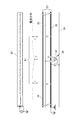
- FIG. 9 is a diagram illustrating an example of the arrangement of the power receiving electrode 22 with respect to the unbalanced line.
- the power receiving electrode 22 shown in English letters shows an example when power is received from the external conductor 32, and any one set is adopted.
- the power receiving electrode 22 shown in Greek letters indicates a case where power is received from the inner conductor 33, and any one of them is adopted.
- examples of receiving power from the external conductor 32 inside the external conductor 32 include BB ′, CC ′, and DD ′.
- the power receiving electrode is attached to the inside of the outer conductor 32 that shields the radiated electric field, but the power receiving electrode 22 is arranged symmetrically as in the case where the power received from the outer conductor 32 is received outside the outer conductor 32. I will do it. As a result, the radiated electric fields cancel each other.
- FIGS. 10A to 10I show examples of the arrangement of the power receiving electrode 22 in the balanced line.
- AA ′, BB ′, and CC ′ are examples of combinations in which the power receiving electrode 22 is disposed on each of the two inner conductors 33 disposed inside the outer conductor 32.
- DD ′, EE ′, FF ′, GG ′, HH ′, and II′JJ ′ are examples of combinations in which the power receiving electrode 22 is disposed on each of the two inner conductors 33 disposed inside the outer conductor 32.
- DD ′, EE ′, FF ′, GG ′, HH ′, and II′JJ ′ are examples of the arrangement of the power receiving electrode 22 in the balanced line.
- FIG. 11 is a diagram illustrating a countermeasure for reducing the attenuation of the communication signal in the communication line 25.
- FIG. 11A is a diagram showing the communication line 25 in which no measures are taken.
- FIG. 11B is a diagram illustrating a case where the communication line 25 is surrounded by the metal shield 29.
- FIG. 11C is a diagram showing a state where an antenna is inserted into the open end of the metal shield 29.
- the communication line 25 that has not taken any countermeasures radiates electromagnetic energy 28 from the slit 27, so that the distance attenuation increases.
- FIG. 11B when the communication line 25 is surrounded by a shield made of ultrathin metal or the like, electromagnetic wave radiation is reduced, so that distance attenuation can be reduced.
- the insertion type antenna 30 When receiving or transmitting electromagnetic waves from the communication line 25, as shown in FIG. 11C, there is a method in which the insertion type antenna 30 is inserted into the end portion of the metal shield 29 and is slid. With such a structure, the insertion type antenna 30 can be moved with the movement of the power receiving unit 2. If the insertion antenna 30 is not inserted, the communication line 25 automatically returns to the state surrounded by the metal shield 29 as shown in FIG.
- Shielding the communication line 25 that functions as a control line can enhance resistance to electromagnetic interference from the peripheral system. At the same time, since electromagnetic interference from hackers and the like can be eliminated, a highly reliable system can be constructed.
- the power receiving unit 2 needs to include some means for controlling the electrode interval or reducing the friction.
- a method for controlling the electrode interval or reducing the friction there are a method in which the power transmitting electrode 21 and the power receiving electrode 22 are brought into contact with each other, and a method in which both are not in contact with each other.
- the electrode surface is coated with a material having strength and slidability.
- a material having strength and slidability for example, DLC (Diamond Like Carbon) is available.
- the power transmitting electrode 21 and the power receiving electrode 22 may be brought into light contact so as to touch or not touch.
- ultrasonic waves may be applied to the electrodes to reduce friction.
- a piezo element may be used to control the distance between the power transmission electrode 21 and the power reception electrode 22. In this case, the operation of the piezo element detecting contact and releasing immediately is repeated.
- the power transmission electrode 21 and the power reception electrode 22 non-contact there is a method of bringing them close to each other by mechanical accuracy.
- a piezo element may be used to precisely control the interval. In this case, the sensor is controlled so as not to make contact.
- an air film may be placed between the power transmission electrode 21 and the power reception electrode 22 to separate the electrodes.
- an air film may be placed between the power transmission electrode 21 and the power reception electrode 22 to separate the electrodes.
- the power transmission electrode 21 and the power reception electrode 22 may be separated by a magnetic method.
- a magnetic method there are a method of floating an electrode by obtaining a repulsive force by a varying magnetic field, a method of floating an electrode by arranging permanent magnets, and the like.
- the electrode may be floated by ultrasonic levitation or superconducting levitation, and the power transmission electrode 21 and the power reception electrode 22 may be separated.
- the space between the gaps may be converted into plasma by barrier discharge to increase the conductivity so that transmission can be performed even in a wide gap.
- the non-contact power transmission line 23 shown in FIG. 3 is connected to the DC power transmission line 24 and the communication line 25 in parallel, or the non-contact power transmission line 23 and the DC power transmission line 24 shown in FIG.
- the separated line structure can be applied not only to the electric field coupling method (electric field coupling power transmission technology) but also to the magnetic field coupling type non-contact power transmission line.
- FIG. 12 is a diagram showing a case where the outer conductor 32 and the DC power transmission line 24 are applied to the magnetic field coupling method.
- the loop current 35 is present in the unit section 51, the loop current can flow in the unit section 51 only when the power receiving unit 2 is present in the unit section 51. As a result, no current flows to an unnecessary place outside the unit section, so that copper loss can be reduced.
- the wiring of the inverter and the end of the loop current 35 have a structure through which the E-shaped core can pass.
- the DC power transmission line 24 shown in FIG. 12 is not limited to one. That is, the non-contact power transmission line 23 and the DC power transmission line 24 shown in FIG. 4 may be two lines so that they are completely separated.
- the present invention is not limited to the above-described embodiments, and modifications, improvements, and the like within a scope that can achieve the object of the present invention are included in the present invention. is there.
- the power supply system to which the present invention is applied only needs to have the following configuration, and can take various various embodiments including the above-described embodiments.
- the power supply system to which the present invention is applied is A power supply system (for example, the power supply system of FIG. 3) to which electric field coupled power transmission technology is applied,
- a power transmission line for transmitting power from an AC power source of a predetermined wavelength for example, the non-contact power transmission line 23 in FIG. 3
- a power receiving electrode for example, the power receiving electrode 22 in FIG. 2
- a power receiving unit for example, the power receiving unit 2 in FIG.
- the power transmission line is A unit having a length based on the predetermined wavelength, and a unit for generating a standing wave from the AC power supply is defined as a unit section (for example, the unit section 51 in FIG. 5). It is configured by repeatedly arranging a plurality of the unit sections, Each of the plurality of unit sections includes an inverter (for example, the inverter 34 in FIG. 3) that converts DC power transmitted through the DC line into AC power having the predetermined wavelength.
- an inverter for example, the inverter 34 in FIG. 3
- the unit section is composed of one or more construction modules (for example, the construction module 52 in FIG. 5 (a)) serving as a construction unit
- the construction module may include inductors (for example, inductors Lm1 to Lmn in FIG. 5) that resonate with the line capacitance of the power supply line.
- the power transmission line includes an outer conductor (for example, the outer conductor 32 in FIG. 9) having an inner structure and an inner conductor (for example, the inner conductor 33 in FIG. 9) disposed in the inner space of the outer conductor.
- the power receiving electrode that forms the junction capacitance with the outer conductor is disposed opposite to the outer conductor, Having a shield cover (for example, the shield cover 21 of FIG. 9) covering the power receiving electrode; be able to.
- the power transmission line includes an outer conductor (for example, the outer conductor 32 in FIG. 9) having an inner structure and an inner conductor (for example, the inner conductor 33 in FIG. 9) disposed in the inner space of the outer conductor.
- the power receiving electrode that forms the junction capacitance with the outer conductor is disposed facing the inner side of the outer conductor,
- Each of the power receiving electrodes is arranged symmetrically so that the radiated electric fields cancel each other (for example, as shown in FIG. 9), Can be.
- a communication line for example, communication line 25 in FIG. 3
- a leaky coaxial line for communication, constituted by a leaky coaxial line; Can be.
- the communication line is covered with a metal shield (for example, the metal shield 29 in FIG. 11), An antenna for transmitting and receiving electromagnetic waves from the communication line, which is movable according to the movement of the power receiving unit (for example, the insertion type antenna 30 in FIG. 11) is inserted into the end of the metal shield. Yes, Can be.
- a metal shield for example, the metal shield 29 in FIG. 11
- An antenna for transmitting and receiving electromagnetic waves from the communication line which is movable according to the movement of the power receiving unit (for example, the insertion type antenna 30 in FIG. 11) is inserted into the end of the metal shield. Yes, Can be.
- External conductor 33, 83 ... ⁇ Internal conductor 34 ⁇ ⁇ ⁇ Inverter 51 ⁇ ⁇ ⁇ Unit section 52 ⁇ ⁇ ⁇ Construction module 61 ⁇ ⁇ ⁇ External conductor connection 62 ⁇ ⁇ ⁇ Internal conductor connection 70 ⁇ ⁇ ⁇ Slit coaxial line 81 ⁇ ⁇ ⁇ Connector
Landscapes
- Engineering & Computer Science (AREA)
- Power Engineering (AREA)
- Computer Networks & Wireless Communication (AREA)
- Physics & Mathematics (AREA)
- Electromagnetism (AREA)
- Current-Collector Devices For Electrically Propelled Vehicles (AREA)
- Waveguide Aerials (AREA)
Abstract
Description
電界結合電力伝送技術は、2枚の金属板(導電性の板)を対向させて、これら2枚の金属板を電極対としてコンデンサ(このようなコンデンサを以下「接合容量」と呼ぶ)を形成した状態で、高周波電流を流すことで非接触の電力電送を実現する技術である。
スリット付同軸線路70は、電界結合電力伝送技術が適用された従来の電力電送システムの一例である。
スリット付同軸線路70は、電力で駆動する負荷(カメラ等)をスリットに沿って自在に移動できるように取り付け、当該負荷に対してその位置によらず(移動中でも)電力を伝送することができる。
スリット付同軸線路70は、コネクタ81と、外部導体82と、内部導体83とを備えている。
即ち、カーテンレールのように、外部導体82の外側の所定面(図13には図示されていない面であり、以下「裏面」と呼ぶ)が、オフィスや工場の壁等に接続される。
この裏面と反対側の外側の面(以下、「表面」と呼ぶ)の長手方向には、図13に示すように、スリットが形成されている。
このスリットに沿って移動可能なように、コネクタ81は取り付けられる。即ち、コネクタ81は、図示せぬ負荷を取り付けた状態で、外部導体82のスリットに沿って自在に移動する。
この線路自体が送電電極として機能する。つまり、コネクタ81が位置する線路の部分が送電電極として機能し、コネクタ81の受電電極と対になって接合容量を構成する。
導波管内における反射は、低コスト且つ経年変化のないスリット付同軸線路を構築する場合に、障害となるおそれがある。
電界結合電力伝送技術を適用した電力供給システムであって、
所定の波長の交流電源からの電力を送電する電力伝送線路と、
受電電極を有し、前記電力伝送線路に沿って移動し、前記電力伝送線路のうち前記受電電極と対向する部位を送電電極として、当該送電電極と当該受電電極とにより接合容量を形成することにより前記電力伝送線路から電力を受電して負荷に供給する受電部と、
前記電力伝送線路に直流電力を伝送するための直流線路と、
を備え、
前記電力伝送線路は、
前記所定の波長に基づく長さを有する単位であって、前記交流電源からの定在波を発生させる単位を単位区間として、
複数の前記単位区間が繰り返して配置されることにより構成され、
複数の前記単位区間の夫々は、前記直流線路を伝送する直流電力を、前記所定の波長を有する交流電力に変換するインバータを有する。
前記施工モジュールは、前記電力供給線路の線間容量と共振させるインダクタを有する
ようにすることができる。
入力インピーダンスZinについて、
線路のインピーダンスをZ0とし、受電体の数をmとしたとき、
パラメータを調整し又は近傍範囲内に置くことにより、おおよそZin=Z0×mの関係を維持させることができる。
これにより、伝送効率を高めることができる。
前記外部導体と前記接合容量を形成する前記受電電極は、前記外部導体の外側において対向して配置され、
当該受電電極を覆うシールドカバーを有する、
ことができる。
前記外部導体と前記接合容量を形成する前記受電電極は、前記外部導体の内側において対向して配置され、
前記受電電極の夫々は、放射電界が相互に打ち消されるようにシンメトリーに配置されている、
ようにすることができる。
漏洩同軸線路により構成される、通信をするための通信線路をさらに備える、
ようにすることができる。
前記通信線路からの電磁波を送受信するためのアンテナであって、前記受電部の移動に応じて移動可能なアンテナが、前記金属シールドの開口端に挿入される、
ようにすることができる。
即ち、電源Vfからの電力を送電する送電部1の末端に金属板の送電電極を取り付け、当該電力を受電して負荷Rに供給する受電部2の先端に金属板の受電電極を取り付けて、これら対となる送電電極及び受電電極を対向させて接合容量Ccを形成することで、電界結合電力電送技術が実現される。
並列共振回路11は、トランス12を介して交流電源Vfに接続されるものであり、コンデンサC1及びコイルL2を備えている。即ち、コンデンサC1とコイルL2とは、相互に並列に接続されることで、並列共振回路11が構成される。
さらに、コイルL2を二次側巻線として採用し、一次側巻線としてコイルL1を採用することで、トランス12が構成されている。
ここで、コイルL1の巻線数:コイルL2の巻線数=1:nとされているので、一次側の電圧、即ち交流電源Vfの電圧は、トランス12においてn倍に昇圧されて、並列共振回路11に印加される。
並列共振回路の両端には、2つの送電電極が接続される。
並列共振回路14は、受電部2の2つの受電電極が接続されるものであり、コンデンサC2及びコイルL3を備えている。即ち、コンデンサC2とコイルL3とは、相互に並列に接続されることで、並列共振回路14が構成される。
さらに、コイルL3を一次側巻線として採用し、二次側巻線としてコイルL4を採用することで、トランス15が構成されている。
ここで、コイルL3の巻線数:コイルL4の巻線数=n:1とされているので、一次側の電圧、即ち受電電極で受信されて並列共振回路14に印加された電圧は、トランス15において1/n倍に降圧されて、負荷Rに印加される。
つまり、移動体である受電部2は、2枚の受電電極22を非接触電力伝送線路23に対向させるように夫々配置させることで、当該非接触電力伝送電路23に沿って自在に移動できるように構成されている。この2枚の受電電極22の夫々と、非接触電力伝送線路23を構成する2本の送電電極21の夫々とにより、2つの接合容量Cc(図1の左側と右側の夫々の接合容量Cc)が形成される。
つまり、受電部2は、非接触電力伝送線路23の上を自在に移動することができ、当該非接触電力伝送線路23の任意の位置で電力を受け取ることができる。
なお、送電側インダクタLuの他に、図2に示すように、調整用の送電側インダクタLvを入れてもよい(この場合、送電側インダクタLuと調整用の送電側インダクタLvの並列回路が、図1のコイルL2に相当)。さらにまた、調整用の送電側インダクタLvは、図2の例では並列に接続されているが、直列に接続されてもよい。
つまり、本発明が適用される電力供給線路を、kmオーダーの長距離送電に対応させるためには、電力の長距離送電の問題と、定在波の問題とを解決する必要がある。
本実施形態では、電力の長距離送電の問題を解決すべく、直流送電線24による直流送電が採用されている。
即ち、直流送電は、送電線(本例では直流送電線24)の全断面に電流が流れるため、交流に比べて材料の利用効率が高くなる。さらに、直流送電の場合における電圧は、交流で同じ電力を流す場合の0.707倍の電圧で済ませることができる。さらに、超電導直流送電系との連携も容易になる。
このようなことから、電力伝送部としては直流送電線24を採用している。
そこで本実施形態では、直流送電線24を流れる直流を交流に変換するインバータ34が、非接触電力伝送線路23の単位区間51毎に1つずつ設けられている。なお、非接触電力伝送線路23が複数の単位区間51で区分されている理由については、後述する。
外部導体32は、直流送電線24と送電部1とに接続されることにより、直流線路の一部として機能するとともに、送電に伴う電磁波放射を低減させている。
定住波が発生すると、電圧の腹と谷が交互に現れ、高周波線路であれば、電界の谷(電流の腹)と、電流の谷(電界の腹)とが交互に現れる。
ここで、電界結合電力伝送技術以外の非接触電力供給技術として、磁界結合方式がある。磁界結合方式場合、電界結合電力伝送技術とは逆に、電流の谷(電界の腹)では受電できない。また、電流の谷(電界の腹)でない場合であっても、電流の谷(電界の腹)に近ければ受電性能は落ちる。
具体的には、電界の谷(電流の腹)では、磁界結合方式により受電し、電流の谷(電界の腹)では、電界結合電力伝送技術を適用した受電を行うという方法である。
さらに、電界結合方式と磁界結合方式夫々の受電手段を使い分けるために必要となる電力を供給するため、電流を流す必要があることから、距離が増すほど銅損(インダクタやコイルにおいて、その巻線抵抗成分により発生する損失)が増大するという問題が生じる。
本実施形態のように電界結合方式の場合には、伝送線路(図3の例では非接触電力伝送線路23)の端部をオープンにすることにより、端部で電界を最大値にすることができる。さらに、単位区間51の長さを短く設定して、単位区間51の中央部にインバータ34を配置して、当該単位区間51の両端で反射させるようにすることで、電圧変動を低く抑えることができる。
なお、単位区間51の技術的思想は、電界結合方式に適用できるだけではなく、図12を用いて後述するように、磁界結合方式に適用することもできる。ただし、磁界結合方式に適用した場合には、端部はショートする必要がある。
また、インバータ34の両側にλ/12の端部を設ければ、単位区間51はλ/6(=7.4m)となり、電圧値は略一定になる。
例えば、2MHzで発信した場合の波長(λ)は、150mとなり、λ/6は25mになる。
なお、この点の具体例については、図5を参照して後述する。
また、通信線路25は、非接触電力伝送線路23から独立して並走し、通信用トランシーバから送受信されている。また、通信線路25の、通信用トランシーバ及び図示せぬ通信用中継増幅器は、直流送電線24に接続され、電力の供給を受けている。
即ち、外部導体接続部61の経年変化により、外部導体の接続状態が悪くなると、通信波が反射する等の障害が現れるおそれがある。また、これを防止するために、外部導体接続部61の加工精度を上げようとすると、コスト増大につながる。
なお、この場合の通信信号の周波数帯域は、GHz帯の周波数帯域とする。
例えば通信線路25は、LCX(漏洩同軸ケーブル)を採用することができる。図3や、後述の図4や図12の通信線路25では、LCXが採用されている。LCXは、量産性があるため品質の一定化が保てるだけでなく、既存製品を利用できるため安価であるという長所があるからである。
非接触電力伝送線路23に対して、直流送電線41が独立して併走している。また、各外部導体32は、単位区間51毎に、外部導体接続部61で接続されている。
送電部1の交流電源Vfは、図3の例と同様に、電界結合電力伝送技術を適用した非接触電力供給用の電源である。
この場合、図3の例と同様に、通信線路25と、非接触電力伝送線路23夫々について、加工精度を低コストなものとすることができるが、外部導体32ついては、直流送電線41の一部として機能せずに独立した形態となることから、図3の例の電力供給線路と比べて材料コストが増大する。
図5(a)は、短い施工モジュール52を複数個組み合わせて単位区間51を構成した場合を示している。
施工モジュール52とは、施工上交換可能な機能単位をいう。つまり、単位区間51は1以上の施工モジュール52により構成される。
一方、内部導体33については、原則として、各施工モジュール52の夫々が内部導体接続部62により接続される。ただし、単位区間51の端部となる施工モジュール52については開放される。つまり、単位区間51の境界において内部導体33間の接続は行わない。これにより、非接触電力供給用の高周波を反射させることができるので、単位区間51内だけで定在波を発生させることができる。
このような図5(a)の構成をとる場合には、施工モジュール52同士の接合は、外部導体32及び内部導体33ともに、機械的及び電気的に接続する。
また、送電部1には、外部に共振用(マッチング用)インダクタLm0を取り付け、ここから電力供給することができる。
この場合、外部導体32のみが、隣接する施工モジュール52(単位区間51)同士接続される。つまり、施工モジュール52同士の接合は、外部導体32について、機械的及び電気的に接続する。
図5(b)に示す構成をとる場合、例えば、単位区間51が7mであれば、単位区間線路を工場で作成して、ロングボディトラックで運搬し、トンネル等の施工場所で接合、固定、配線等を容易に行うことが可能となる。
また、交流電源Vfは、隣接する交流電源Vfがともに動作する際には、同期をとり発信する。
図6は、非接触電力伝送線路23の断面構造を示す図である。
図6(a)及び(b)は、不平衡線路構造の非接触電力伝送線路23の構造を示す図である。
図6(c)及び(d)は、平衡線路構造の非接触電力伝送線路23の構造を示す図である。
外部導体32と、内部導体33とは、共振用インダクタLmで接続されている。
なお、共振用インダクタLmは、外部導体32の外部に出してもよい。
2本の内部導体33の夫々は、2つの送電電極の夫々として機能し、共振用インダクタLmで接続されている。つまり、平衡線路構造の非接触電力伝送線路23における外部導体32は、送電には寄与しない(送電電極として機能しない)が、非接触電力伝送線路23からの電子放射に対するシールド、線路の固定、走行車のレール等に用いられる。
なお、共振用インダクタLmは、外部導体32の外部に出してもよい。
図7は、本発明の基礎となる電界結合電力伝送技術を適用した電力供給線路における、受電部2の回路と、非接触電力伝送線路23の構造を示す図である。
また、受電部2は、線路に付けられたリニアマーカーを読むことにより、自分の位置を知ることができる。
例えば直流送電線24及び通信線路25は、単位区間51のアルミニウムブロックを接続した後に、現場施工で後付けができる構造とし、コーキング材等で外部導体32に固定されている。
外部導体32と内部導体33との間は、絶縁層34によって区切られている。
図8(a)の例における移動・通信・作用部17は、非接触電力伝送線路23上を移動するための駆動輪18と、移動時の横揺れを防ぐためのガイド輪19とを備える。また、外部導体32及び内部導体33の2つの送信電極に夫々対向する面に受電電極22を備え、送電部1から外部導体32及び内部導体33を介して電力の供給を受けている。
直流送電線24からの電力の出力は、直流送電線24の被覆をねじで貫通させるとともに、外部導体32の一部である酸化被膜を剥ぐことによって受電する。
受電部2と通信線路25は、電磁的に接続されている。
英文字で示した受電電極22は、外部導体32から受電した場合の例を示しており、いずれか1つの組を採用する。
ギリシャ文字で示した受電電極22は、内部導体33から受電した場合を示し、いずれか1つを採用する。
この例の場合、放射電界をシールドする外部導体32の内部に受電電極を取り付けるが、外部導体32からの受電を、外部導体32の外側で受け取る場合と同様に、受電電極22をシンメトリーに配置することとする。これにより、放射電界が相互に打ち消されることとなる。
図10に示すように、外部導体32の内部に配置された2本の内部導体33夫々に、受電電極22を配置する組み合わせの例として、A-A´、B-B´、C-C´、D-D´、E-E´、F-F´、G-G´、H-H´、I-I´J-J´がある。
いずれもの場合も、受電電極をシンメトリーに配置することにより、放射電界が相互に打ち消されるようにする。
図11(a)は、何らの対策を講じていない通信線路25を示す図である。
図11(b)は、金属シールド29で通信線路25を囲んだ場合を示す図である。
図11(c)は、金属シールド29の開口端にアンテナを挿入している状態を示す図である。
これに対し、図11(b)に示すように、通信線路25を極薄金属等のシールドで囲んだ場合には、電磁波放射が低減するため、距離減衰を小さくすることができる。
なお、挿入型アンテナ30が挿入されていない場合は、自動的に図11(b)に示すように、通信線路25が金属シールド29で囲まれた状態に戻る。
これにより、制御情報等の外部漏洩に伴うハッカー等への情報漏洩を防止することができる。同時に、他の機器への電磁妨害も防止することができる。
したがって、受電部2は、電極間隔を制御し、または摩擦を低減させるための何らかの手段を備える必要がある。
例えば、DLC(Diamond Like Carbon)等がある。
または、摩擦を低減させるため、超音波を電極に加えてもよい。
または、摩擦を低減させるため、電極自体を回転体またはキャタピラ状にしてもよい。
または、送電電極21と受電電極22との間隔を制御するために、ピエゾ素子を用いてもよい。この場合、ピエゾ素子が接触を検知し、直ぐに離すという動作を繰り返すこととする。
または、精密に間隔を制御するため、ピエゾ素子を用いてもよい。この場合、センサーにより、接触をさせないように制御を行う。
例えば、ポンプによって電極間に空気を送風する方法、電極に空気取り入れ開口を作り、移動時に空気を取り込んで浮上させる方法等がある。
例えば、変動磁界により反発力を得て電極を浮かせる方法、永久磁石を配列させて電極を浮かせる方法等がある。
または、ギャップ間空間をバリア放電によりプラズマ化することにより導電率を高め、ワイドギャップでも送信ができるようにしてもよい。
これにより、単位区間外の不要な場所にまで電流を流すことがなくなるため、銅損を低減させることができる。
換言すると、本発明が適用される電力供給システムは、次のような構成であれば足り、上述した実施形態を含め各種各様な実施形態を取ることができる。
電界結合電力伝送技術を適用した電力供給システム(例えば図3の電力供給システム)であって、
所定の波長の交流電源からの電力を送電する電力伝送線路(例えば図3の非接触電力伝送線路23)と、
受電電極(例えば図2の受電電極22)を有し、前記電力伝送線路に沿って移動し、前記電力伝送線路のうち前記受電電極と対向する部位を送電電極として、当該送電電極と当該受電電極とにより接合容量を形成することにより前記電力伝送線路から電力を受電して負荷に供給する受電部(例えば図2の受電部2)と、
前記電力伝送線路に直流電力を伝送するための直流線路(例えば図3の直流送電線24)と、
を備え、
前記電力伝送線路は、
前記所定の波長に基づく長さを有する単位であって、前記交流電源からの定在波を発生させる単位を単位区間(例えば図5の単位区間51)として、
複数の前記単位区間が繰り返して配置されることにより構成され、
複数の前記単位区間の夫々は、前記直流線路を伝送する直流電力を、前記所定の波長を有する交流電力に変換するインバータ(例えば図3のインバータ34)を有する。
前記施工モジュールは、前記電力供給線路の線間容量と共振させるインダクタ(例えば図5のインダクタLm1乃至Lmn)を有する
ようにすることができる。
線路上の電圧分布が略一定なとき、線路のインピーダンスをZ0とし、受電部2の台数をmとしたときに、
Z0=n2R/mとなるように、パラメータを調整し又は近傍範囲内に置くことができる。
これにより、最大の受電効率を得ることができる。
前記外部導体と前記接合容量を形成する前記受電電極は、前記外部導体の外側において対向して配置され、
当該受電電極を覆うシールドカバー(例えば図9のシールドカバー21)を有する、
ことができる。
前記外部導体と前記接合容量を形成する前記受電電極は、前記外部導体の内側において対向して配置され、
前記受電電極の夫々は、放射電界が相互に打ち消されるようにシンメトリーに配置されている(例えば図9のように配置されている)、
ようにすることができる。
ようにすることができる。
前記通信線路からの電磁波を送受信するためのアンテナであって、前記受電部の移動に応じて移動可能なアンテナ(例えば図11の挿入型アンテナ30)が、前記金属シールドの端部に挿入されている、
ようにすることができる。
2・・・ 受電部
11、14・・・ 並列共振回路
12、15・・・ トランス
16・・・ 高電圧入力、低入力インピーダンスの降圧型DC/DC変換器
17・・・ 移動・通信・作用部
18・・・ 駆動輪
19・・・ ガイド輪
20・・・ 移動・受電部
21・・・ 送電電極
22・・・ 受電電極
23・・・ 非接触電力伝送線路
24、41・・・ 直流送電線
25・・・ 通信線路
27・・・ スリット
28・・・ 電磁エネルギー
29・・・ 金属シールド
30・・・ 挿入型アンテナ
32、82・・・ 外部導体
33、83・・・ 内部導体
34・・・ インバータ
51・・・ 単位区間
52・・・ 施工モジュール
61・・・ 外部導体接続部
62・・・ 内部導体接続部
70・・・ スリット付同軸線路
81・・・ コネクタ
Claims (7)
- 電界結合電力伝送技術を適用した電力供給システムであって、
所定の波長の交流電源からの電力を送電する電力伝送線路と、
受電電極を有し、前記電力伝送線路に沿って移動し、前記電力伝送線路のうち前記受電電極と対向する部位を送電電極として、当該送電電極と当該受電電極とにより接合容量を形成することにより前記電力伝送線路から電力を受電して負荷に供給する受電部と、
前記電力伝送線路に直流電力を伝送するための直流線路と、
を備え、
前記電力伝送線路は、
前記所定の波長に基づく長さを有する単位であって、前記交流電源からの定在波を発生させる単位を単位区間として、
複数の前記単位区間が繰り返して配置されることにより構成され、
複数の前記単位区間の夫々は、前記直流線路を伝送する直流電力を、前記所定の波長を有する交流電力に変換するインバータを有する、
電力供給システム。 - 前記単位区間は、施工の単位となる1以上の施工モジュールから構成され、
前記施工モジュールは、前記電力伝送線路の線間容量と共振させるインダクタを有する
請求項1に記載の電力供給システム。 - 前記受電部は、
線路のインピーダンスをZ0とし、受電部の台数をmとしたときに、
Z0=n2R/mとなるように、パラメータを調整し又は傍範囲内に置く、
請求項1又は2に記載の電力供給システム。 - 前記電力伝送線路は、内空の構造を有する外部導体と、前記外部導体の内空部に配置される内部導体とからなる不平行線路構造を有し、
前記外部導体と前記接合容量を形成する前記受電電極は、前記外部導体の外側において対向して配置され、
当該受電電極を覆うシールドカバーを有する、
請求項1乃至3のうち何れか1項に記載の電力供給システム。 - 前記電力伝送線路は、内空の構造を有する外部導体と、前記外部導体の内空部に配置される内部導体とからなる不平行線路構造を有し、
前記外部導体と前記接合容量を形成する前記受電電極は、前記外部導体の内側において対向して配置され、
前記受電電極の夫々は、放射電界が相互に打ち消されるようにシンメトリーに配置されている、
請求項1乃至3のうち何れか1項に記載の電力供給システム。 - 漏洩同軸線路により構成される、通信をするための通信線路をさらに備える、
請求項1乃至5のうち何れか1項に記載の電力供給システム。 - 前記通信線路は、金属シールドにより覆われており、
前記通信線路からの電磁波を送受信するためのアンテナであって、前記受電部の移動に応じて移動可能なアンテナが、前記金属シールドの端部に挿入されている、
請求項6に記載の電力供給システム。
Priority Applications (2)
| Application Number | Priority Date | Filing Date | Title |
|---|---|---|---|
| JP2017524836A JP6586460B2 (ja) | 2015-06-17 | 2016-06-16 | 電力供給システム |
| US15/737,168 US20180248405A1 (en) | 2015-06-17 | 2016-06-16 | Electric power supply system |
Applications Claiming Priority (2)
| Application Number | Priority Date | Filing Date | Title |
|---|---|---|---|
| JP2015-121963 | 2015-06-17 | ||
| JP2015121963 | 2015-06-17 |
Publications (1)
| Publication Number | Publication Date |
|---|---|
| WO2016204250A1 true WO2016204250A1 (ja) | 2016-12-22 |
Family
ID=57546243
Family Applications (1)
| Application Number | Title | Priority Date | Filing Date |
|---|---|---|---|
| PCT/JP2016/068004 Ceased WO2016204250A1 (ja) | 2015-06-17 | 2016-06-16 | 電力供給システム |
Country Status (3)
| Country | Link |
|---|---|
| US (1) | US20180248405A1 (ja) |
| JP (1) | JP6586460B2 (ja) |
| WO (1) | WO2016204250A1 (ja) |
Cited By (10)
| Publication number | Priority date | Publication date | Assignee | Title |
|---|---|---|---|---|
| CN109286246A (zh) * | 2017-07-20 | 2019-01-29 | 松下知识产权经营株式会社 | 电极单元、送电装置、受电装置、电子设备、移动体以及无线电力传输系统 |
| JP2019068581A (ja) * | 2017-09-29 | 2019-04-25 | 国立大学法人豊橋技術科学大学 | 送電電極装置、およびこれを用いた無線給電システム |
| JP2019068580A (ja) * | 2017-09-29 | 2019-04-25 | 国立大学法人豊橋技術科学大学 | 無線給電装置およびこれを用いた搬送システム、ならびに無線給電装置の制御方法 |
| WO2019168416A1 (en) | 2018-03-02 | 2019-09-06 | Auckland Uniservices Limited | A wireless power transfer device |
| WO2019189374A1 (ja) * | 2018-03-29 | 2019-10-03 | パナソニックIpマネジメント株式会社 | 送電モジュール、送電装置、および無線電力伝送システム |
| JP2021180597A (ja) * | 2020-05-15 | 2021-11-18 | 株式会社デンソー | 非接触型給電路及びその施工方法 |
| JP2022069131A (ja) * | 2020-10-23 | 2022-05-11 | 株式会社ExH | 電力供給システム |
| JP2023079980A (ja) * | 2021-11-29 | 2023-06-08 | 古野電気株式会社 | アンテナおよび通信システム |
| JP2024018532A (ja) * | 2022-07-29 | 2024-02-08 | 古河電気工業株式会社 | 無線電力送電装置、無線電力受電装置及び無線電力伝送システム |
| JP2025012518A (ja) * | 2023-07-13 | 2025-01-24 | キヤノン株式会社 | 受信装置及び通信システム |
Families Citing this family (1)
| Publication number | Priority date | Publication date | Assignee | Title |
|---|---|---|---|---|
| DE102019120428A1 (de) * | 2019-07-29 | 2021-02-04 | Bayerische Motoren Werke Aktiengesellschaft | Energieübertragungsvorrichtung zum drahtlosen Übertragen von elektrischer Energie, sowie Verfahren |
Citations (3)
| Publication number | Priority date | Publication date | Assignee | Title |
|---|---|---|---|---|
| JP2008154198A (ja) * | 2006-11-21 | 2008-07-03 | Sony Corp | 通信システム並びに通信装置 |
| WO2013114511A1 (ja) * | 2012-02-03 | 2013-08-08 | 日本電気株式会社 | 電力伝送装置、及び、電力伝送方法 |
| WO2013124935A1 (ja) * | 2012-02-24 | 2013-08-29 | 日本電気株式会社 | 受電装置、給電装置、通信装置 |
Family Cites Families (5)
| Publication number | Priority date | Publication date | Assignee | Title |
|---|---|---|---|---|
| US5943017A (en) * | 1995-12-13 | 1999-08-24 | Ail Systems, Inc. | Dual near-field focused antenna array |
| JP5415780B2 (ja) * | 2009-02-20 | 2014-02-12 | 健一 原川 | 電力供給システム、及びそのための可動体と固定体 |
| US9755435B2 (en) * | 2011-08-16 | 2017-09-05 | Philips Lighting Holding B.V. | Wireless power converter utilized as a capacitive power transfer system |
| JP2014225387A (ja) * | 2013-05-16 | 2014-12-04 | 原川 健一 | 給電通信構造と、そのための給電通信用線路及び給電通信用接続体 |
| JP2016096667A (ja) * | 2014-11-14 | 2016-05-26 | 株式会社ExH | 給電通信構造及び給電通信用線路 |
-
2016
- 2016-06-16 WO PCT/JP2016/068004 patent/WO2016204250A1/ja not_active Ceased
- 2016-06-16 US US15/737,168 patent/US20180248405A1/en not_active Abandoned
- 2016-06-16 JP JP2017524836A patent/JP6586460B2/ja not_active Expired - Fee Related
Patent Citations (3)
| Publication number | Priority date | Publication date | Assignee | Title |
|---|---|---|---|---|
| JP2008154198A (ja) * | 2006-11-21 | 2008-07-03 | Sony Corp | 通信システム並びに通信装置 |
| WO2013114511A1 (ja) * | 2012-02-03 | 2013-08-08 | 日本電気株式会社 | 電力伝送装置、及び、電力伝送方法 |
| WO2013124935A1 (ja) * | 2012-02-24 | 2013-08-29 | 日本電気株式会社 | 受電装置、給電装置、通信装置 |
Cited By (19)
| Publication number | Priority date | Publication date | Assignee | Title |
|---|---|---|---|---|
| JP7054834B2 (ja) | 2017-07-20 | 2022-04-15 | パナソニックIpマネジメント株式会社 | 電極ユニット、送電装置、受電装置、電子機器、移動体、および無線電力伝送システム |
| JP2019170146A (ja) * | 2017-07-20 | 2019-10-03 | パナソニックIpマネジメント株式会社 | 電極ユニット、送電装置、受電装置、電子機器、移動体、および無線電力伝送システム |
| CN109286246A (zh) * | 2017-07-20 | 2019-01-29 | 松下知识产权经营株式会社 | 电极单元、送电装置、受电装置、电子设备、移动体以及无线电力传输系统 |
| JP2019068581A (ja) * | 2017-09-29 | 2019-04-25 | 国立大学法人豊橋技術科学大学 | 送電電極装置、およびこれを用いた無線給電システム |
| JP2019068580A (ja) * | 2017-09-29 | 2019-04-25 | 国立大学法人豊橋技術科学大学 | 無線給電装置およびこれを用いた搬送システム、ならびに無線給電装置の制御方法 |
| WO2019168416A1 (en) | 2018-03-02 | 2019-09-06 | Auckland Uniservices Limited | A wireless power transfer device |
| CN112385115A (zh) * | 2018-03-02 | 2021-02-19 | 奥克兰联合服务有限公司 | 无线功率输送装置 |
| EP3759790A4 (en) * | 2018-03-02 | 2021-12-08 | Auckland Uniservices Limited | DEVICE FOR WIRELESS POWER TRANSMISSION |
| WO2019189374A1 (ja) * | 2018-03-29 | 2019-10-03 | パナソニックIpマネジメント株式会社 | 送電モジュール、送電装置、および無線電力伝送システム |
| CN111937271A (zh) * | 2018-03-29 | 2020-11-13 | 松下知识产权经营株式会社 | 送电模块、送电装置以及无线电力传输系统 |
| JP2021180597A (ja) * | 2020-05-15 | 2021-11-18 | 株式会社デンソー | 非接触型給電路及びその施工方法 |
| JP7367608B2 (ja) | 2020-05-15 | 2023-10-24 | 株式会社デンソー | 非接触型給電路及びその施工方法 |
| JP2022069131A (ja) * | 2020-10-23 | 2022-05-11 | 株式会社ExH | 電力供給システム |
| JP7518510B2 (ja) | 2020-10-23 | 2024-07-18 | 株式会社ExH | 電力供給システム |
| JP2023079980A (ja) * | 2021-11-29 | 2023-06-08 | 古野電気株式会社 | アンテナおよび通信システム |
| JP7795385B2 (ja) | 2021-11-29 | 2026-01-07 | 古野電気株式会社 | アンテナおよび通信システム |
| JP2024018532A (ja) * | 2022-07-29 | 2024-02-08 | 古河電気工業株式会社 | 無線電力送電装置、無線電力受電装置及び無線電力伝送システム |
| JP2025012518A (ja) * | 2023-07-13 | 2025-01-24 | キヤノン株式会社 | 受信装置及び通信システム |
| JP7739363B2 (ja) | 2023-07-13 | 2025-09-16 | キヤノン株式会社 | 受信装置及び通信システム |
Also Published As
| Publication number | Publication date |
|---|---|
| JPWO2016204250A1 (ja) | 2018-04-05 |
| JP6586460B2 (ja) | 2019-10-02 |
| US20180248405A1 (en) | 2018-08-30 |
Similar Documents
| Publication | Publication Date | Title |
|---|---|---|
| JP6586460B2 (ja) | 電力供給システム | |
| JP4680924B2 (ja) | 通信装置および通信方法 | |
| KR102661233B1 (ko) | 통합형 임피던스 매칭을 갖는 무선 전력 전송 시스템 및 그 사용 방법 | |
| US9601265B2 (en) | Wireless power transmission apparatus and direct drive type system including the apparatus | |
| US20090160262A1 (en) | Installation | |
| KR101230211B1 (ko) | 자계 공명 방식의 비접촉 급전장치 | |
| US20150008767A1 (en) | Insulated transmission medium and insulated transmission apparatus | |
| CN104350664A (zh) | 用于无线分配电力的系统 | |
| CN110620408A (zh) | 具有电磁屏蔽功能的无线充电器 | |
| US20180138743A1 (en) | Electric power supply system | |
| US11876384B2 (en) | Wireless power transfer device | |
| JP2018170841A (ja) | 電力供給システム | |
| US10951066B2 (en) | Wireless power supply device and wireless power supply method | |
| JP7758058B2 (ja) | アンテナ装置、無線電力伝送装置、及び無線電力伝送システム | |
| WO2019160162A1 (ja) | 電力供給システム、配置方法 | |
| JP7798332B2 (ja) | 無線電力送信システム、送電装置、受電装置、及び移動体 | |
| KR20250043197A (ko) | 표면파 패치 안테나를 이용한 무선통신 장치 | |
| WO2016114158A1 (ja) | 無線電力伝送システム | |
| JP2016025685A (ja) | 電力供給システム、給電装置、受電装置、及び電力供給方法 | |
| JPWO2017146082A1 (ja) | 電力供給システム | |
| JP6538628B2 (ja) | フィルタ回路及びワイヤレス電力伝送システム | |
| KR101965367B1 (ko) | 이중 동위상 직렬 급전 방식을 갖는 개방형 이중 공진 코일 | |
| WO2007066405A1 (ja) | 通信装置 | |
| JPWO2013128518A1 (ja) | 送電装置、受電装置、電力供給システム及び電子機器 | |
| JP5595895B2 (ja) | 共鳴コイル及びそれを有する非接触電力伝送装置 |
Legal Events
| Date | Code | Title | Description |
|---|---|---|---|
| 121 | Ep: the epo has been informed by wipo that ep was designated in this application |
Ref document number: 16811724 Country of ref document: EP Kind code of ref document: A1 |
|
| ENP | Entry into the national phase |
Ref document number: 2017524836 Country of ref document: JP Kind code of ref document: A |
|
| NENP | Non-entry into the national phase |
Ref country code: DE |
|
| WWE | Wipo information: entry into national phase |
Ref document number: 15737168 Country of ref document: US |
|
| 122 | Ep: pct application non-entry in european phase |
Ref document number: 16811724 Country of ref document: EP Kind code of ref document: A1 |