WO2016194034A1 - 封止用樹脂組成物、半導体装置、および構造体 - Google Patents
封止用樹脂組成物、半導体装置、および構造体 Download PDFInfo
- Publication number
- WO2016194034A1 WO2016194034A1 PCT/JP2015/065523 JP2015065523W WO2016194034A1 WO 2016194034 A1 WO2016194034 A1 WO 2016194034A1 JP 2015065523 W JP2015065523 W JP 2015065523W WO 2016194034 A1 WO2016194034 A1 WO 2016194034A1
- Authority
- WO
- WIPO (PCT)
- Prior art keywords
- compound
- resin composition
- sealing
- group
- sealing resin
- Prior art date
- Legal status (The legal status is an assumption and is not a legal conclusion. Google has not performed a legal analysis and makes no representation as to the accuracy of the status listed.)
- Ceased
Links
Images

Classifications
-
- C—CHEMISTRY; METALLURGY
- C08—ORGANIC MACROMOLECULAR COMPOUNDS; THEIR PREPARATION OR CHEMICAL WORKING-UP; COMPOSITIONS BASED THEREON
- C08G—MACROMOLECULAR COMPOUNDS OBTAINED OTHERWISE THAN BY REACTIONS ONLY INVOLVING UNSATURATED CARBON-TO-CARBON BONDS
- C08G59/00—Polycondensates containing more than one epoxy group per molecule; Macromolecules obtained by polymerising compounds containing more than one epoxy group per molecule using curing agents or catalysts which react with the epoxy groups
- C08G59/18—Macromolecules obtained by polymerising compounds containing more than one epoxy group per molecule using curing agents or catalysts which react with the epoxy groups ; e.g. general methods of curing
- C08G59/40—Macromolecules obtained by polymerising compounds containing more than one epoxy group per molecule using curing agents or catalysts which react with the epoxy groups ; e.g. general methods of curing characterised by the curing agents used
- C08G59/62—Alcohols or phenols
-
- C—CHEMISTRY; METALLURGY
- C08—ORGANIC MACROMOLECULAR COMPOUNDS; THEIR PREPARATION OR CHEMICAL WORKING-UP; COMPOSITIONS BASED THEREON
- C08K—Use of inorganic or non-macromolecular organic substances as compounding ingredients
- C08K5/00—Use of organic ingredients
- C08K5/04—Oxygen-containing compounds
- C08K5/13—Phenols; Phenolates
-
- C—CHEMISTRY; METALLURGY
- C08—ORGANIC MACROMOLECULAR COMPOUNDS; THEIR PREPARATION OR CHEMICAL WORKING-UP; COMPOSITIONS BASED THEREON
- C08L—COMPOSITIONS OF MACROMOLECULAR COMPOUNDS
- C08L63/00—Compositions of epoxy resins; Compositions of derivatives of epoxy resins
-
- H—ELECTRICITY
- H10—SEMICONDUCTOR DEVICES; ELECTRIC SOLID-STATE DEVICES NOT OTHERWISE PROVIDED FOR
- H10W—GENERIC PACKAGES, INTERCONNECTIONS, CONNECTORS OR OTHER CONSTRUCTIONAL DETAILS OF DEVICES COVERED BY CLASS H10
- H10W74/00—Encapsulations, e.g. protective coatings
- H10W74/40—Encapsulations, e.g. protective coatings characterised by their materials
- H10W74/47—Encapsulations, e.g. protective coatings characterised by their materials comprising organic materials, e.g. plastics or resins
Definitions
- the present invention relates to a sealing resin composition, a semiconductor device, and a structure.
- the semiconductor device is formed, for example, by sealing and molding a semiconductor element mounted on a substrate using a sealing resin composition.
- a sealing resin composition for example, an epoxy resin composition containing an epoxy resin may be used.
- Patent Document 1 describes a technique related to a phenol novolac condensate used as a curing agent for epoxy resins.
- the base material the semiconductor element mounted on the said base material, and the hardened
- a semiconductor device is provided.
- the base material is comprised by the base material, the several semiconductor element mounted on the said base material, and the hardened
- the semiconductor element can be stably sealed.
- the sealing resin composition according to the present embodiment includes an epoxy resin (A), a phenol aralkyl resin (B) having a biphenylene skeleton, and a compound (C) having only one phenolic hydroxyl group. Further, the compound (C) includes a compound represented by the following formula (1).
- the present inventor has newly found that when the compound represented by the above formula (1) is contained as the compound (C) having only one phenolic hydroxyl group, the cartrare can be suppressed.
- This embodiment implement achieves the resin composition for sealing containing the compound shown by said Formula (1) based on such new knowledge. Thereby, a calcaret can be suppressed and the moldability of the resin composition for sealing can be improved. Therefore, the semiconductor element can be stably sealed.
- the sealing resin composition is used to form a sealing resin that seals a semiconductor element mounted on a substrate.
- the sealing molding using the sealing resin composition is not particularly limited, but can be performed by, for example, a transfer molding method or a compression molding method.
- the base material is, for example, a wiring board such as an interposer or a lead frame.
- the semiconductor element is electrically connected to the base material by wire bonding or flip chip connection.
- a semiconductor device obtained by sealing a semiconductor element by sealing molding using a sealing resin composition is not particularly limited.
- QFP Quad Flat Package
- SOP Small Outline Package
- BGA Ball Grid Array
- CSP Chip Size Package
- QFN Quad Flat Non-leaded Package
- SON Small Outline Non-leaded Package
- LF-BGA Lead Frame BGA
- the sealing resin composition according to the present embodiment also relates to a structure formed by MAP (Mold Array Package) molding, which is often applied to molding of these packages in recent years.
- the said structure is obtained by sealing the several semiconductor element mounted on a base material collectively using the resin composition for sealing.
- the encapsulating resin composition contains an epoxy resin (A), a phenol aralkyl resin (B) having a biphenylene skeleton, and a compound (C) having only one phenolic hydroxyl group. Thereby, the resin composition for sealing excellent in moldability is realizable.
- epoxy resin (A) As the epoxy resin (A), monomers, oligomers and polymers generally having two or more epoxy groups in one molecule can be used, and the molecular weight and molecular structure are not particularly limited.
- the epoxy resin (A) is, for example, a biphenyl type epoxy resin; a bisphenol type epoxy resin such as a bisphenol A type epoxy resin, a bisphenol F type epoxy resin, or a tetramethylbisphenol F type epoxy resin; a stilbene type epoxy resin; Novolac epoxy resins such as novolac epoxy resins and cresol novolac epoxy resins; polyfunctional epoxy resins such as triphenolmethane epoxy resins and alkyl-modified triphenolmethane epoxy resins; phenol aralkyl epoxy resins having a phenylene skeleton, biphenylene Aralkyl epoxy resin such as phenol aralkyl epoxy resin having a skeleton; dihydroxy naphthalene epoxy resin, dihydroxy naphthalene
- the epoxy resin (A) is selected from the group consisting of an epoxy resin represented by the following formula (4), an epoxy resin represented by the following formula (5), and an epoxy resin represented by the following formula (6). It is particularly preferable to use a material containing at least one kind.
- Ar 1 represents a phenylene group or a naphthylene group, and when Ar 1 is a naphthylene group, the glycidyl ether group may be bonded to either the ⁇ -position or the ⁇ -position.
- Ar 2 is a phenylene group.
- R a and R b each independently represents a hydrocarbon group having 1 to 10 carbon atoms, g is an integer of 0 to 5 and h represents a group selected from the group consisting of a biphenylene group and a naphthylene group. Is an integer from 0 to 8.
- n 3 represents the degree of polymerization, and the average value is from 1 to 3.
- R c s each independently represent a hydrogen atom or a hydrocarbon group having 1 to 4 carbon atoms.
- N 5 represents a degree of polymerization, and an average value thereof is 0 to 4)
- R d and R e each independently represents a hydrogen atom or a hydrocarbon group having 1 to 4 carbon atoms.
- N 6 represents the degree of polymerization, and the average value is 0 to 4)
- the content of the epoxy resin (A) in the sealing resin composition is preferably 2% by mass or more, and preferably 3% by mass or more with respect to the entire sealing resin composition. Is more preferable.
- the content of an epoxy resin (A) in the encapsulating resin composition is preferably 40% by mass or less and more preferably 30% by mass or less with respect to the entire encapsulating resin composition. preferable. Improve moisture resistance reliability and reflow resistance of a semiconductor device provided with a sealing resin formed using a sealing resin composition by setting the content of the epoxy resin (A) to the upper limit or less. Can do.
- the phenol aralkyl resin (B) having a biphenylene skeleton functions as a curing agent that is cured by reacting with an epoxy resin.
- the phenol aralkyl resin (B) having a biphenylene skeleton it is more preferable to use a resin represented by the following formula (7), and it is particularly preferable to use a resin represented by the following formula (8). . Thereby, the moldability of the resin composition for sealing can be improved more effectively.
- R f and R g is hydrogen, alkyl group having 1 to 4 carbon atoms, or an aryl group.
- Each R f is or different and be identical to one another, each R g May be the same as or different from each other, n 7 represents the degree of polymerization, and the average value is an integer of 1 to 5)
- n 8 represents the degree of polymerization, and the average value is an integer of 1 to 5)
- the content of the phenol aralkyl resin (B) having a biphenylene skeleton in the encapsulating resin composition is preferably 1% by mass or more based on the entire encapsulating resin composition. % Or more is more preferable.
- liquidity of the resin composition for sealing can be improved and a moldability can be improved further.
- the content of the phenol aralkyl resin (B) having a biphenylene skeleton in the encapsulating resin composition is preferably 20% by mass or less with respect to the entire encapsulating resin composition, and is 10% by mass or less.
- a semiconductor device including a sealing resin formed using the sealing resin composition is moisture-resistant reliability and reflow resistance Can be improved.
- the sealing resin composition according to the present embodiment may further include other components other than the phenol aralkyl resin (B) having a biphenylene skeleton as a curing agent.
- other components include linear aliphatic diamines having 2 to 20 carbon atoms such as ethylenediamine, trimethylenediamine, tetramethylenediamine, hexamethylenediamine, metaphenylenediamine, paraphenylenediamine, 4,4′-diaminodiphenylmethane, 4,4'-diaminodiphenylpropane, 4,4'-diaminodiphenyl ether, 4,4'-diaminodiphenyl sulfone, 4,4'-diaminodicyclohexane, bis (4-aminophenyl) phenylmethane, 1,5-diamino Amines such as naphthalene, metaxylenediamine, paraxylenediamine, 1,1
- the phenol aralkyl resin (B) having the biphenylene skeleton is preferably contained in an amount of 20% by mass or more with respect to the entire curing agent. More preferably, it is contained in an amount of 30% by mass or more, more preferably 50% by mass or more.
- the encapsulating resin composition contains a compound (C) having only one phenolic hydroxyl group. Thereby, it becomes possible to adjust the hardening characteristic of the resin composition for sealing, and to improve the balance of a moldability and moisture resistance reliability more effectively.
- including the compound (C) having only one phenolic hydroxyl group in the encapsulating resin composition refers to a case where 1 ppm or more is included with respect to the entire encapsulating resin composition.
- the content of the compound (C) having only one phenolic hydroxyl group is preferably 1 ppm or more, and more preferably 5 ppm or more with respect to the entire sealing resin composition.
- the content of the compound (C) having only one phenolic hydroxyl group is preferably 3000 ppm or less, more preferably 2500 ppm or less, based on the entire sealing resin composition.
- the content of the compound (C) having only one phenolic hydroxyl group can be analyzed by, for example, gas chromatography. The same applies to the contents of the compound represented by the following formula (1), the compound (D) represented by the following formula (2), and the compound (E) represented by the following formula (3).
- the compound (C) having only one phenolic hydroxyl group includes a compound represented by the following formula (1).
- the car tray at the time of sealing molding can be suppressed, and the sealing resin composition excellent in moldability can be realized.
- the term “containing a compound represented by the following formula (1) in the compound (C)” means a case where 1 ppm or more is contained with respect to the whole compound (C).
- the content of the compound represented by the above formula (1) is preferably 10 ppm or more, more preferably 15 ppm or more, and more preferably 25 ppm or more with respect to the entire sealing resin composition. More preferably.
- the content of the compound represented by the above formula (1) is preferably 10 ppm or more, more preferably 15 ppm or more, and more preferably 25 ppm or more with respect to the entire sealing resin composition. More preferably.
- the content of the compound represented by the above formula (1) is preferably 300 ppm or less, more preferably 200 ppm or less, and preferably 100 ppm or less with respect to the entire sealing resin composition. Particularly preferred.
- the compound (C) having only one phenolic hydroxyl group may further contain other compounds than the compound represented by the above formula (1).
- examples of such other components include a compound represented by the following formula (9) and a compound represented by the following formula (10).
- the sealing resin composition according to the present embodiment may further contain, for example, a compound (D) represented by the following formula (2).
- a compound (D) represented by the following formula (2) thereby, the car tray at the time of sealing molding can be suppressed more effectively, and the moldability can be further improved. Moreover, the adjustment of the curing characteristics can be further facilitated, which can contribute to the balance between moldability and moisture resistance reliability.
- the compound (D) being included in the encapsulating resin composition indicates a case where 1 ppm or more is included with respect to the entire encapsulating resin composition.
- the content of the compound (D) represented by the above formula (2) is preferably 30 ppm or more, more preferably 40 ppm or more with respect to the entire sealing resin composition. Further, the content of the compound (D) represented by the above formula (2) is preferably 800 ppm or less, and more preferably 500 ppm or less, with respect to the entire sealing resin composition.
- the sealing resin composition according to the present embodiment may further contain, for example, a compound (E) represented by the following formula (3).
- a compound (E) represented by the following formula (3) thereby, the car tray at the time of sealing molding can be suppressed more effectively, and the moldability can be further improved.
- the compound (E) being included in the sealing resin composition refers to a case where 1 ppm or more is included with respect to the entire sealing resin composition.
- the content of the compound (E) represented by the above formula (3) is preferably 1 ppm or more, more preferably 3 ppm or more with respect to the entire sealing resin composition. Further, the content of the compound (E) represented by the above formula (3) is preferably 50 ppm or less, and more preferably 30 ppm or less, with respect to the whole sealing resin composition.
- a biphenyl compound having four or more aromatic rings as shown in the above formula (1), the above formula (2), and the above formula (3), and having a phenolic hydroxyl group of 2 or less.
- the sealing resin composition can contain an aromatic ring which is at least one terminal and does not have a phenolic hydroxyl group.
- Such a compound is presumed to have a function of improving the releasability from the plunger and the mold when the mold is opened. Based on such knowledge, the present inventor has improved the mold releasability at the time of mold opening of the encapsulating resin composition, thereby realizing the suppression of cartrare at the time of sealing molding.
- the compound represented by the above formula (1) which is the compound (C) having only one phenolic hydroxyl group
- the compound (D) represented by the above formula (2) and the above formula (3) It is particularly preferable to further contain at least one of the compounds (E) represented by the formula in order to more effectively suppress the cartrare. Thereby, it becomes possible to implement
- a reaction product obtained by polycondensation of phenols and bishalogenomethylbiphenyl such as 4,4′-bischloromethylbiphenyl is distilled off from the unreacted component, and By performing the water washing treatment, a mixture containing the phenol aralkyl resin (B) having a biphenylene skeleton and the compound (C) having only one phenolic hydroxyl group can be obtained. At this time, it is possible to obtain the above mixture containing the compound represented by the above formula (1) by appropriately adjusting the conditions for the unreacted portion distillation treatment and the water washing treatment.
- the unreacted component distillation process can be performed, for example, by a technique for removing a low molecular weight component.
- a technique for removing the low molecular weight component for example, a general-purpose vacuum distillation method may be used by appropriately setting the temperature and the degree of vacuum, and fractionation or fractionation by steam distillation, molecular distillation, GPC column or the like. Such a method may be applied.
- the low molecular weight component is once removed by the above conventional method for removing a low molecular weight component, and then the removed low molecular weight component is distilled. It is also preferable to adopt a technique in which the sample is retained and added to the matrix again.
- distilled water may be added to the reaction product and shaken, and then the operation of rinsing the water layer (water washing) may be performed several times.
- the phenols for example, one or more selected from phenol, cresol, methylphenol, n-propylphenol, xylenol, methylbutylphenol, cyclopentylphenol, and cyclohexylphenol can be used.
- the compound (D) represented by the above formula (2) is further controlled by highly controlling the conditions of the unreacted distillate treatment and the water washing treatment. It is also possible to obtain the above mixture further comprising a compound (E) represented by the above formula (3). It is also possible to control the contents of the compound (D) represented by the above formula (2) and the compound (E) represented by the above formula (3).
- the resin composition for sealing can further contain a filler (F), for example.
- a filler (F) what is used for the general epoxy resin composition for semiconductor sealing can be used, for example, fused spherical silica, fused crushed silica, crystalline silica, talc, alumina, titanium white, nitriding Examples include inorganic fillers such as silicon, and organic fillers such as organosilicone powder and polyethylene powder. Of these, it is particularly preferable to use fused spherical silica. These fillers may be used alone or in combination of two or more.
- the shape of the filler (F) is not particularly limited, but is as spherical as possible from the viewpoint of increasing the filler content while suppressing an increase in the melt viscosity of the encapsulating resin composition, and the particle size.
- the distribution is preferably broad.
- the content of the filler (F) is preferably 35% by mass or more, more preferably 50% by mass or more, and more preferably 65% by mass or more with respect to the entire sealing resin composition. Is particularly preferred.
- the content of the filler (F) is preferably 95% by mass or less, more preferably 93% by mass or less, and particularly preferably 90% by mass or less.
- the content of the filler (F) By controlling the content of the filler (F) to be equal to or less than the above upper limit value, it is possible to suppress a decrease in moldability due to a decrease in the fluidity of the sealing resin composition, a bonding wire flow due to a high viscosity, and the like. It becomes possible.
- the resin composition for sealing can further contain, for example, a curing accelerator (G).
- the curing accelerator (G) may be any one that promotes the crosslinking reaction between the epoxy group of the epoxy resin (A) and the phenolic hydroxyl group of the phenol aralkyl resin (B) having a biphenylene skeleton. What is used for the epoxy resin composition for a stop can be used.
- the curing accelerator (G) contains a phosphorus atom such as an organic phosphine, a tetra-substituted phosphonium compound, a phosphobetaine compound, an adduct of a phosphine compound and a quinone compound, or an adduct of a phosphonium compound and a silane compound.
- a phosphorus atom such as an organic phosphine, a tetra-substituted phosphonium compound, a phosphobetaine compound, an adduct of a phosphine compound and a quinone compound, or an adduct of a phosphonium compound and a silane compound.
- a phosphorus atom such as an organic phosphine, a tetra-substituted phosphonium compound, a phosphobetaine compound, an adduct of a phosphine compound and a quinone compound, or an ad
- Nitrogen atoms such as quaternary salts of the above amidines and amines
- One type or two or more types selected from compounds can be included.
- a phosphorus atom containing compound is included from a viewpoint of improving curability.
- latent properties such as tetra-substituted phosphonium compounds, phosphobetaine compounds, adducts of phosphine compounds and quinone compounds, and adducts of phosphonium compounds and silane compounds. It is more preferable to include those.
- Examples of the organic phosphine that can be used in the sealing resin composition include a first phosphine such as ethylphosphine and phenylphosphine; a second phosphine such as dimethylphosphine and diphenylphosphine; trimethylphosphine, triethylphosphine, tributylphosphine, and triphenyl. Third phosphine such as phosphine can be mentioned.
- Examples of the tetra-substituted phosphonium compound that can be used in the sealing resin composition include a compound represented by the following general formula (13).
- P represents a phosphorus atom.
- R 4 , R 5 , R 6 and R 7 represent an aromatic group or an alkyl group.
- A is selected from a hydroxyl group, a carboxyl group, and a thiol group.
- An anion of an aromatic organic acid having at least one functional group in the aromatic ring, AH is an aromatic having at least one functional group selected from a hydroxyl group, a carboxyl group, and a thiol group in the aromatic ring.
- Represents an organic acid, where x and y are numbers from 1 to 3, z is a number from 0 to 3, and x y.
- the compound represented by General formula (13) is obtained as follows, for example, it is not limited to this. First, a tetra-substituted phosphonium halide, an aromatic organic acid and a base are mixed in an organic solvent and mixed uniformly to generate an aromatic organic acid anion in the solution system. Subsequently, when water is added, the compound represented by the general formula (13) can be precipitated.
- R 4 , R 5 , R 6 and R 7 bonded to the phosphorus atom are phenyl groups
- AH is a compound having a hydroxyl group in an aromatic ring, that is, phenols.
- A is preferably an anion of the phenol.
- phenols examples include monocyclic phenols such as phenol, cresol, resorcin, and catechol, condensed polycyclic phenols such as naphthol, dihydroxynaphthalene, and anthraquinol, bisphenols such as bisphenol A, bisphenol F, and bisphenol S, Examples include polycyclic phenols such as phenylphenol and biphenol.
- Examples of the phosphobetaine compound that can be used in the encapsulating resin composition include compounds represented by the following general formula (14).
- R 8 represents an alkyl group having 1 to 3 carbon atoms
- R 9 represents a hydroxyl group
- f is a number from 0 to 5
- g is a number from 0 to 3.
- the compound represented by the general formula (14) is obtained as follows, for example. First, it is obtained through a step of bringing a triaromatic substituted phosphine, which is a third phosphine, into contact with a diazonium salt and replacing the triaromatic substituted phosphine with a diazonium group of the diazonium salt.
- a triaromatic substituted phosphine which is a third phosphine
- the present invention is not limited to this.
- Examples of the adduct of a phosphine compound and a quinone compound that can be used in the sealing resin composition include compounds represented by the following general formula (15).
- P represents a phosphorus atom.
- R 10 , R 11 and R 12 represent an alkyl group having 1 to 12 carbon atoms or an aryl group having 6 to 12 carbon atoms, and are the same as each other.
- R 13 , R 14 and R 15 each represents a hydrogen atom or a hydrocarbon group having 1 to 12 carbon atoms and may be the same or different from each other, and R 14 and R 15 are bonded to each other. And may have a circular structure.
- Examples of the phosphine compound used as an adduct of a phosphine compound and a quinone compound include an aromatic ring such as triphenylphosphine, tris (alkylphenyl) phosphine, tris (alkoxyphenyl) phosphine, trinaphthylphosphine, and tris (benzyl) phosphine.
- aromatic ring such as triphenylphosphine, tris (alkylphenyl) phosphine, tris (alkoxyphenyl) phosphine, trinaphthylphosphine, and tris (benzyl) phosphine.
- Those having a substituent or a substituent such as an alkyl group and an alkoxyl group are preferred, and examples of the substituent such as an alkyl group and an alkoxyl group include those having 1 to 6 carbon atoms. From the viewpoint of availability, triphenyl
- examples of the quinone compound used for the adduct of the phosphine compound and the quinone compound include benzoquinone and anthraquinones, and among them, p-benzoquinone is preferable from the viewpoint of storage stability.
- the adduct can be obtained by contacting and mixing in a solvent capable of dissolving both organic tertiary phosphine and benzoquinone.
- the solvent is preferably a ketone such as acetone or methyl ethyl ketone, which has low solubility in the adduct.
- the present invention is not limited to this.
- R 10 , R 11 and R 12 bonded to the phosphorus atom are phenyl groups, and R 13 , R 14 and R 15 are hydrogen atoms, ie, 1,
- a compound in which 4-benzoquinone and triphenylphosphine are added is preferable in that it reduces the thermal elastic modulus of the cured product of the encapsulating resin composition.
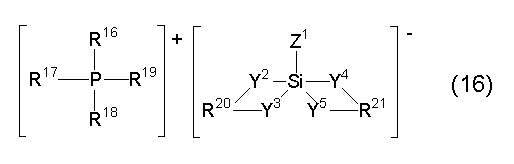
- Examples of the adduct of a phosphonium compound and a silane compound that can be used in the sealing resin composition include compounds represented by the following general formula (16).
- P represents a phosphorus atom and Si represents a silicon atom.
- R 16 , R 17 , R 18 and R 19 are each an organic group having an aromatic ring or a heterocyclic ring, or an aliphatic group. Represents a group, which may be the same or different from each other, wherein R 20 is an organic group bonded to the groups Y 2 and Y 3.
- R 21 represents the groups Y 4 and Y 5 ; Y 2 and Y 3 represent a group formed by releasing a proton from a proton donating group, and groups Y 2 and Y 3 in the same molecule are bonded to a silicon atom to form a chelate structure.
- Y 4 and Y 5 represent a group formed by releasing a proton from a proton donating group, and groups Y 4 and Y 5 in the same molecule are combined with a silicon atom to form a chelate structure.
- R 20, and R 21 are each other Or different and the same, Y 2, Y 3, Y 4 and Y 5 may .Z 1 also being the same or different organic group having an aromatic ring or a heterocyclic ring or fat, A group.
- examples of R 16 , R 17 , R 18 and R 19 include a phenyl group, a methylphenyl group, a methoxyphenyl group, a hydroxyphenyl group, a naphthyl group, a hydroxynaphthyl group, a benzyl group, and a methyl group.
- alkyl group such as phenyl group, methylphenyl group, methoxyphenyl group, hydroxyphenyl group, hydroxynaphthyl group, alkoxy group, etc.
- An aromatic group having a substituent such as a hydroxyl group or an unsubstituted aromatic group is more preferable.
- R 20 is an organic group bonded to Y 2 and Y 3.
- R 21 is an organic group that binds to groups Y 4 and Y 5 .
- Y 2 and Y 3 are groups formed by proton-donating groups releasing protons, and groups Y 2 and Y 3 in the same molecule are combined with a silicon atom to form a chelate structure.
- Y 4 and Y 5 are groups formed by proton-donating groups releasing protons, and groups Y 4 and Y 5 in the same molecule are combined with a silicon atom to form a chelate structure.
- the groups R 20 and R 21 may be the same or different from each other, and the groups Y 2 , Y 3 , Y 4 , and Y 5 may be the same or different from each other.
- the proton donor releases two protons.
- the proton donor is preferably an organic acid having at least two carboxyl groups or hydroxyl groups in the molecule, and further has a carboxyl group or hydroxyl group on the adjacent carbon constituting the aromatic ring.
- An aromatic compound having at least two is preferable, and an aromatic compound having at least two hydroxyl groups on adjacent carbons constituting the aromatic ring is more preferable.
- catechol pyrogallol, 1,2-dihydroxynaphthalene, 2,3-dihydroxy Naphthalene, 2,2′-biphenol, 1,1′-bi-2-naphthol, salicylic acid, 1-hydroxy-2-naphthoic acid, 3- Examples include droxy-2-naphthoic acid, chloranilic acid, tannic acid, 2-hydroxybenzyl alcohol, 1,2-cyclohexanediol, 1,2-propanediol, and glycerin. Among these, catechol, 1,2- Dihydroxynaphthalene and 2,3-dihydroxynaphthalene are more preferable.
- Z 1 in the general formula (16) represents an organic group or an aliphatic group having an aromatic ring or a heterocyclic ring.
- Specific examples thereof include a methyl group, an ethyl group, a propyl group, a butyl group, Aliphatic hydrocarbon groups such as hexyl group and octyl group, aromatic hydrocarbon groups such as phenyl group, benzyl group, naphthyl group and biphenyl group, glycidyloxy groups such as glycidyloxypropyl group, mercaptopropyl group and aminopropyl group Reactive groups such as mercapto groups, alkyl groups having amino groups, and vinyl groups.
- methyl groups, ethyl groups, phenyl groups, naphthyl groups, and biphenyl groups are preferred from the viewpoint of thermal stability. More preferable.
- a silane compound such as phenyltrimethoxysilane and a proton donor such as 2,3-dihydroxynaphthalene are added to a flask containing methanol, and then dissolved.
- Sodium methoxide-methanol solution is added dropwise with stirring.
- crystals are precipitated. The precipitated crystals are filtered, washed with water, and vacuum dried to obtain an adduct of a phosphonium compound and a silane compound.
- the content of the curing accelerator (G) is preferably 0.05% by mass or more, and more preferably 0.1% by mass or more with respect to the entire sealing resin composition.
- the content is particularly preferably 0.15% by mass or more.
- content of a hardening accelerator (G) is 1.0 mass% or less with respect to the whole resin composition for sealing, and it is more preferable that it is 0.5 mass% or less.
- a coupling agent for the sealing resin composition, one kind of various additives such as a coupling agent, a release agent, an ion scavenger, a low-stress component, a flame retardant, a colorant, and an antioxidant, if necessary.
- a coupling agent for the sealing resin composition, one kind of various additives such as a coupling agent, a release agent, an ion scavenger, a low-stress component, a flame retardant, a colorant, and an antioxidant, if necessary.
- Coupling agents are known couplings such as various silane compounds such as epoxy silane, mercapto silane, amino silane, alkyl silane, ureido silane, vinyl silane, methacryl silane, titanium compounds, aluminum chelates, and aluminum / zirconium compounds.
- One type or two or more types selected from agents can be included.
- the mold release agent may contain, for example, natural wax such as carnauba wax, synthetic wax such as montanic acid ester wax, higher fatty acid such as zinc stearate and metal salts thereof, and one or more selected from paraffin. it can.
- the ion scavenger includes, for example, hydrotalcite.
- the low stress component includes, for example, silicone rubber.
- the flame retardant can include one or more selected from, for example, aluminum hydroxide, magnesium hydroxide, zinc borate, zinc molybdate, and phosphazene.
- the colorant includes, for example, carbon black.
- the above-mentioned components are mixed by a known means, further melt kneaded with a kneader such as a roll, a kneader or an extruder, cooled and pulverized, or tableted after pulverization.
- a kneader such as a roll, a kneader or an extruder
- a tablet formed by tableting, or a composition whose dispersity, fluidity and the like are appropriately adjusted as necessary can be used.
- FIG. 1 is a cross-sectional view showing an example of a semiconductor device 100 according to the present embodiment.
- the semiconductor device 100 is a semiconductor package including a base material 10, a semiconductor element 20 mounted on the base material 10, and a sealing resin 30 that seals the semiconductor element 20.
- FIG. 1 illustrates the case where the semiconductor device 100 is a BGA package. In this case, a plurality of solder balls 50 are provided on the back surface of the substrate 10 opposite to the surface on which the semiconductor element 20 is mounted.
- the semiconductor element 20 is electrically connected to the base material 10 through the bonding wire 40.
- the semiconductor element 20 may be flip-chip mounted on the base material 10.
- the sealing resin 30 is composed of a cured product of the above-described sealing resin composition. Thereby, it is possible to suppress the occurrence of cartra tray when the semiconductor element 20 is sealed. For this reason, it becomes possible to realize more stable manufacturing of the semiconductor device 100.
- the sealing resin 30 is formed, for example, by sealing and molding the sealing resin composition using a known method such as a transfer molding method or a compression molding method.
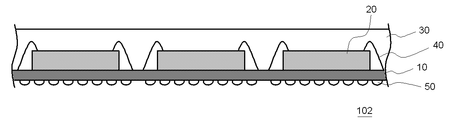
- FIG. 2 is a cross-sectional view showing an example of the structure 102 according to the present embodiment.
- the structure 102 is a molded product formed by MAP molding. For this reason, a plurality of semiconductor packages are obtained by dividing the structure 102 into pieces for each semiconductor element 20.
- the structure 102 includes a base material 10, a plurality of semiconductor elements 20, and a sealing resin 30.
- the plurality of semiconductor elements 20 are arranged on the base material 10.
- FIG. 2 the case where each semiconductor element 20 is electrically connected to the base material 10 through the bonding wire 40 is illustrated.
- the present invention is not limited to this, and each semiconductor element 20 may be flip-chip mounted on the base material 10. Note that the substrate 10 and the semiconductor element 20 can be the same as those exemplified in the semiconductor device 100.
- Sealing resin 30 seals a plurality of semiconductor elements 20.
- the sealing resin 30 is composed of a cured product of the above-described sealing resin composition. Thereby, it can suppress that a cartra is produced in the case of sealing molding. For this reason, it becomes possible to manufacture the structure 102 and the semiconductor device obtained by separating the structure 102 more stably.
- the sealing resin 30 is formed, for example, by sealing and molding the sealing resin composition using a known method such as a transfer molding method or a compression molding method.
- the content of the compound (C) with respect to the phenol aralkyl resin (B) having a biphenylene skeleton was 1.0% by mass.
- the compound (C) contained the compound shown by following formula (1).
- the content of the compound represented by the following formula (1) with respect to the phenol aralkyl resin (B) having a biphenylene skeleton was 720 ppm.
- the content of the compound (D) relative to the phenol aralkyl resin (B) having a biphenylene skeleton was 1900 ppm.
- the content of the compound (E) relative to the phenol aralkyl resin (B) having a biphenylene skeleton was 120 ppm.
- the contents of the compound (C), the compound represented by the formula (1), the compound (D), and the compound (E) were analyzed by gas chromatography. The same applies to Synthesis Examples 2 to 4 below.
- the content of the compound represented by the above formula (1) with respect to the phenol aralkyl resin (B) having a biphenylene skeleton was 1000 ppm.
- the content of the compound (D) relative to the phenol aralkyl resin (B) having a biphenylene skeleton was 2630 ppm.
- the content of the compound (E) relative to the phenol aralkyl resin (B) having a biphenylene skeleton was 160 ppm.
- the content of the compound represented by the above formula (1) with respect to the phenol aralkyl resin (B) having a biphenylene skeleton was 500 ppm.
- the content of the compound (D) relative to the phenol aralkyl resin (B) having a biphenylene skeleton was 1310 ppm.
- the content of the compound (E) relative to the phenol aralkyl resin (B) having a biphenylene skeleton was 80 ppm.
- the oil layer was separated, and unreacted phenol was removed by distillation under reduced pressure to obtain a mixture containing the phenol aralkyl resin (B) having a biphenylene skeleton and the compound (C) having only one phenolic hydroxyl group. .
- addition of unreacted molecularly distilled components was not performed.
- the content of the compound (C) with respect to the phenol aralkyl resin (B) having a biphenylene skeleton was 0.6% by mass.
- the compound (D) represented by the above formula (2) and the compound (E) represented by the above formula (3) were not contained in the above mixture.
- the phrase “not contained in the mixture” refers to a case where the content of the whole mixture is less than 1 ppm.
- the compound shown by the said Formula (1) was not contained in the compound (C).
- sealing resin compositions were prepared as follows. First, according to the formulation shown in Table 1, each component was mixed at 15 to 28 ° C. using a mixer and then roll kneaded at 70 to 100 ° C. Next, this was cooled and pulverized to obtain a sealing resin composition.
- the phenol aralkyl resin (B) having a biphenylene skeleton the compound (C), the compound (D) and the compound (E), in Example 1 and Example 2, the above mixture obtained in Synthesis Example 1 was used. In Example 3, the mixture obtained in Synthesis Example 2 was used. In Example 4, the mixture obtained in Synthesis Example 3 was used.
- Epoxy resin (A) Epoxy resin 1: Phenol aralkyl type epoxy resin containing phenylene skeleton (NC-2000, manufactured by Nippon Kayaku Co., Ltd.)
- Epoxy resin 2 biphenyl type epoxy resin (YX4000K, manufactured by Mitsubishi Chemical Corporation)
- Biphenylene skeleton-containing phenol aralkyl resin 1 phenol aralkyl resin (B) having a biphenylene skeleton synthesized according to Synthesis Example 1 above
- Biphenylene skeleton-containing phenol aralkyl resin 2 Phenol aralkyl resin (B) having a biphenylene skeleton synthesized according to Synthesis Example 2 above
- Biphenylene skeleton-containing phenol aralkyl resin 3 Phenol aralkyl resin (B) having a biphenylene skeleton synthesized according to Synthesis Example 3 above
- Biphenylene skeleton-containing phenol aralkyl resin 4 Phenol aralkyl resin (B) having a biphenylene skeleton synthesized according to Synthesis Example 4 above
- Filler 1 Spherical fused silica (manufactured by Denki Kagaku Kogyo, FB560 (average particle size 30 ⁇ m))
- Filler 2 Spherical fused silica (manufactured by Admatechs, SO-25R (average particle size 0.5 ⁇ m))
- Curing accelerator 1 Compound represented by the following formula (11)
- Curing accelerator 2 Compound represented by the following formula (12) [Method of synthesizing curing accelerator 1] A separable flask equipped with a condenser and a stirrer was charged with 6.49 g (0.060 mol) of benzoquinone, 17.3 g (0.066 mol) of triphenylphosphine and 40 ml of acetone, and reacted at room temperature with stirring. The precipitated crystals were washed with acetone, filtered and dried to obtain dark green crystal curing accelerator 1.
- Coupling agent 1 N-phenyl-3-aminopropyltrimethoxysilane (manufactured by Shin-Etsu Chemical Co., Ltd., KBM-573)
- Coupling agent 2 3-glycidoxypropyltrimethoxysilane (manufactured by Shin-Etsu Chemical Co., Ltd., KBM-403)
- Ion scavenger Hydrotalcite (Kyowa Chemical Industry Co., Ltd., DHT-4H)
- Mold release agent 1 Carnauba wax (Nikko Fine Products, Nikko Carnauba)
- Release agent 2 Urethane modified polyethylene oxide wax (Nippon Seiwa Co., Ltd., NSP-6010P)
- Colorant Carbon black (Mitsubishi Chemical Corporation MA-600)
- the number of times that the kull was manually removed because the kull (residue of the sealing resin composition) adhered and remained on the plunger or the mold when the mold was opened is shown in Table 1 as the number of cartolare. .
- the moldability is good for those having the number of cartolare of 2 or less.
Landscapes
- Chemical & Material Sciences (AREA)
- Health & Medical Sciences (AREA)
- Chemical Kinetics & Catalysis (AREA)
- Medicinal Chemistry (AREA)
- Polymers & Plastics (AREA)
- Organic Chemistry (AREA)
- Structures Or Materials For Encapsulating Or Coating Semiconductor Devices Or Solid State Devices (AREA)
- Epoxy Resins (AREA)
Abstract
Description
エポキシ樹脂(A)と、
ビフェニレン骨格を有するフェノールアラルキル樹脂(B)と、
フェノール性水酸基を一つのみ有する化合物(C)と、
を含み、
上記化合物(C)は、下記式(1)により示される化合物を含む封止用樹脂組成物が提供される。


封止用樹脂組成物は、基材上に搭載された半導体素子を封止する封止樹脂を形成するために用いられる。封止用樹脂組成物を用いた封止成形は、とくに限定されないが、たとえばトランスファー成形法、または圧縮成形法により行うことができる。基材は、たとえばインターポーザ等の配線基板、またはリードフレームである。また、半導体素子は、ワイヤボンディングまたはフリップチップ接続等により、基材に電気的に接続される。
エポキシ樹脂(A)としては、1分子内にエポキシ基を2個以上有するモノマー、オリゴマー、ポリマー全般を用いることができ、その分子量や分子構造は特に限定されない。
本実施形態において、エポキシ樹脂(A)は、たとえばビフェニル型エポキシ樹脂;ビスフェノールA型エポキシ樹脂、ビスフェノールF型エポキシ樹脂、テトラメチルビスフェノールF型エポキシ樹脂等のビスフェノール型エポキシ樹脂;スチルベン型エポキシ樹脂;フェノールノボラック型エポキシ樹脂、クレゾールノボラック型エポキシ樹脂等のノボラック型エポキシ樹脂;トリフェノールメタン型エポキシ樹脂、アルキル変性トリフェノールメタン型エポキシ樹脂等の多官能エポキシ樹脂;フェニレン骨格を有するフェノールアラルキル型エポキシ樹脂、ビフェニレン骨格を有するフェノールアラルキル型エポキシ樹脂等のアラルキル型エポキシ樹脂;ジヒドロキシナフタレン型エポキシ樹脂、ジヒドロキシナフタレンの2量体をグリシジルエーテル化して得られるエポキシ樹脂等のナフトール型エポキシ樹脂;トリグリシジルイソシアヌレート、モノアリルジグリシジルイソシアヌレート等のトリアジン核含有エポキシ樹脂;ジシクロペンタジエン変性フェノール型エポキシ樹脂等の有橋環状炭化水素化合物変性フェノール型エポキシ樹脂から選択される1種類または2種類以上を含むものである。これらのうち、耐湿信頼性と成形性のバランスを向上させる観点からは、ビスフェノール型エポキシ樹脂、ビフェニル型エポキシ樹脂およびフェノールアラルキル型エポキシ樹脂のうちの少なくとも一つを含むことがより好ましく、ビフェニル型エポキシ樹脂およびフェノールアラルキル型エポキシ樹脂のうちの少なくとも一方を含むことがとくに好ましい。


一方で、封止用樹脂組成物中におけるエポキシ樹脂(A)の含有量は、封止用樹脂組成物全体に対して40質量%以下であることが好ましく、30質量%以下であることがより好ましい。エポキシ樹脂(A)の含有量を上記上限値以下とすることにより、封止用樹脂組成物を用いて形成される封止樹脂を備える半導体装置について、耐湿信頼性や耐リフロー性を向上させることができる。
ビフェニレン骨格を有するフェノールアラルキル樹脂(B)は、エポキシ樹脂と反応して硬化させる硬化剤として機能する。本実施形態においては、ビフェニレン骨格を有するフェノールアラルキル樹脂(B)としては、下記式(7)により示されるものを用いることがより好ましく、下記式(8)により示されるものを用いることがとくに好ましい。これにより、封止用樹脂組成物の成形性をより効果的に向上させることができる。


一方で、封止用樹脂組成物中におけるビフェニレン骨格を有するフェノールアラルキル樹脂(B)の含有量は、封止用樹脂組成物全体に対して20質量%以下であることが好ましく、10質量%以下であることがより好ましい。ビフェニレン骨格を有するフェノールアラルキル樹脂(B)の含有量を上記上限値以下とすることにより、封止用樹脂組成物を用いて形成される封止樹脂を備える半導体装置について、耐湿信頼性や耐リフロー性を向上させることができる。
硬化剤として上記ビフェニレン骨格を有するフェノールアラルキル樹脂(B)以外の他の成分を含む場合、硬化剤全体に対し、ビフェニレン骨格を有するフェノールアラルキル樹脂(B)が20質量%以上含まれることが好ましく、30質量%以上含まれることがより好ましく、50質量%以上含まれることがさらに好ましい。
封止用樹脂組成物は、フェノール性水酸基を一つのみ有する化合物(C)を含む。これにより、封止用樹脂組成物の硬化特性を調製して、成形性や耐湿信頼性のバランスをより効果的に向上させることが可能となる。なお、本明細書において、封止用樹脂組成物中にフェノール性水酸基を一つのみ有する化合物(C)を含むとは、封止用樹脂組成物全体に対して1ppm以上含む場合を指す。
なお、フェノール性水酸基を一つのみ有する化合物(C)の含有量は、たとえばガスクロマトグラフィーにより分析することが可能である。以下、下記式(1)により示される化合物、下記式(2)により示される化合物(D)、および下記式(3)により示される化合物(E)それぞれの含有量について同様である。

一方で、上記式(1)により示される化合物の含有量は、封止用樹脂組成物全体に対して300ppm以下であることが好ましく、200ppm以下であることがより好ましく、100ppm以下であることがとくに好ましい。上記式(1)により示される化合物の含有量を上記上限値以下とすることにより、封止用樹脂組成物について、成形性と硬化性の間におけるバランスを向上させることが可能となる。
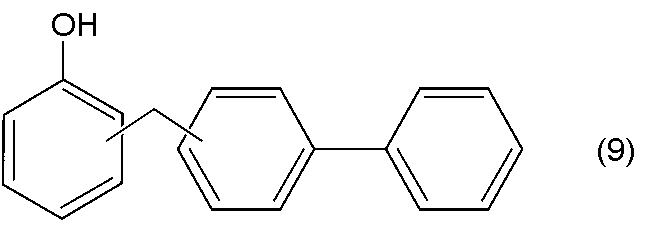

本実施形態に係る封止用樹脂組成物は、たとえば下記式(2)により示される化合物(D)をさらに含んでいてもよい。これにより、封止成形時におけるカルトラレをより効果的に抑制し、成形性のさらなる向上を図ることができる。また、硬化特性の調整をさらに容易として、成形性と耐湿信頼性のバランスに寄与することもできる。なお、本明細書中において、封止用樹脂組成物中に化合物(D)を含むとは、封止用樹脂組成物全体に対して1ppm以上含む場合を指す。

本実施形態に係る封止用樹脂組成物は、たとえば下記式(3)により示される化合物(E)をさらに含んでいてもよい。これにより、封止成形時におけるカルトラレをより効果的に抑制し、成形性のさらなる向上を図ることができる。なお、本明細書中において、封止用樹脂組成物中に化合物(E)を含むとは、封止用樹脂組成物全体に対して1ppm以上含む場合を指す。

このような観点から、フェノール性水酸基を一つのみ有する化合物(C)である上記式(1)により示される化合物に加え、上記式(2)により示される化合物(D)および上記式(3)により示される化合物(E)のうちの少なくとも一方をさらに含むことが、カルトラレをより効果的に抑制するためにはとくに好ましい。これにより、封止成形をより安定的に行うことが可能な封止用樹脂組成物を実現することが可能となる。
また、未反応分の留去処理、および水洗処理の条件を、さらに高度に制御することにより、上記式(1)により示される化合物に加えて、上記式(2)により示される化合物(D)と、上記式(3)により示される化合物(E)と、をさらに含む上記混合物を得ることも可能となる。また、上記式(2)により示される化合物(D)と上記式(3)により示される化合物(E)それぞれの含有量を制御することも可能となる。
封止用樹脂組成物は、たとえば充填剤(F)をさらに含むことができる。充填材(F)としては、一般の半導体封止用エポキシ樹脂組成物に使用されているものを用いることができ、たとえば溶融球状シリカ、溶融破砕シリカ、結晶シリカ、タルク、アルミナ、チタンホワイト、窒化珪素等の無機充填材、オルガノシリコーンパウダー、ポリエチレンパウダー等の有機充填材が挙げられる。これらのうち、溶融球状シリカを用いることがとくに好ましい。これらの充填材は、1種を単独で用いてもよく、2種以上を併用してもよい。
また、充填材(F)の形状としては、とくに限定されないが、封止用樹脂組成物の溶融粘度の上昇を抑えつつ、充填材の含有量を高める観点から、できるだけ真球状であり、かつ粒度分布がブロードであることが好ましい。
一方で、充填剤(F)の含有量は、95質量%以下であることが好ましく、93質量%以下であることがより好ましく、90質量%以下であることがとくに好ましい。充填剤(F)の含有量を上記上限値以下とすることにより、封止用樹脂組成物の流動性の低下にともなう成形性の低下や、高粘度化に起因したボンディングワイヤ流れ等を抑制することが可能となる。
封止用樹脂組成物は、たとえば硬化促進剤(G)をさらに含むことができる。硬化促進剤(G)は、エポキシ樹脂(A)のエポキシ基と、ビフェニレン骨格を有するフェノールアラルキル樹脂(B)のフェノール性水酸基と、の架橋反応を促進させるものであればよく、たとえば一般の封止用エポキシ樹脂組成物に使用するものを用いることができる。
本実施形態において、硬化促進剤(G)は、たとえば有機ホスフィン、テトラ置換ホスホニウム化合物、ホスホベタイン化合物、ホスフィン化合物とキノン化合物との付加物、ホスホニウム化合物とシラン化合物との付加物等のリン原子含有化合物;1,8-ジアザビシクロ(5,4,0)ウンデセン-7、ベンジルジメチルアミン、2-メチルイミダゾール等が例示されるアミジンや3級アミン、上記アミジンやアミンの4級塩等の窒素原子含有化合物から選択される1種類または2種類以上を含むことができる。これらの中でも、硬化性を向上させる観点からはリン原子含有化合物を含むことがより好ましい。また、成形性と硬化性のバランスを向上させる観点からは、テトラ置換ホスホニウム化合物、ホスホベタイン化合物、ホスフィン化合物とキノン化合物との付加物、ホスホニウム化合物とシラン化合物との付加物等の潜伏性を有するものを含むことがより好ましい。


一方で、硬化促進剤(G)の含有量は、封止用樹脂組成物全体に対して1.0質量%以下であることが好ましく、0.5質量%以下であることがより好ましい。硬化促進剤(G)の含有量を上記上限値以下とすることにより、封止成形時における流動性の向上を図ることができる。
封止用樹脂組成物には、必要に応じて、たとえばカップリング剤、離型剤、イオン捕捉剤、低応力成分、難燃剤、着色剤、および酸化防止剤等の各種添加剤のうち1種以上を適宜配合することができる。
カップリング剤は、たとえばエポキシシラン、メルカプトシラン、アミノシラン、アルキルシラン、ウレイドシラン、ビニルシラン、メタクリルシラン等の各種シラン系化合物、チタン系化合物、アルミニウムキレート類、アルミニウム/ジルコニウム系化合物等の公知のカップリング剤から選択される1種類または2種類以上を含むことができる。これらの中でも、本願発明の効果をより効果的に発現するものとして、エポキシシランまたはアミノシランを含むことがより好ましく、2級アミノシランを含むことが流動性等の観点からとくに好ましい。離型剤は、たとえばカルナバワックス等の天然ワックス、モンタン酸エステルワックス等の合成ワックス、ステアリン酸亜鉛等の高級脂肪酸およびその金属塩類、ならびにパラフィンから選択される1種類または2種類以上を含むことができる。イオン捕捉剤は、たとえばハイドロタルサイトを含む。低応力成分は、たとえばシリコーンゴムを含む。難燃剤は、たとえば水酸化アルミニウム、水酸化マグネシウム、ホウ酸亜鉛、モリブデン酸亜鉛、ホスファゼンから選択される1種類または2種類以上を含むことができる。着色剤は、たとえばカーボンブラックを含む。
図1は、本実施形態に係る半導体装置100の一例を示す断面図である。半導体装置100は、基材10と、基材10上に搭載された半導体素子20と、半導体素子20を封止する封止樹脂30と、を備えた半導体パッケージである。図1においては、半導体装置100がBGAパッケージである場合が例示されている。この場合、基材10のうち半導体素子20を搭載する表面とは反対側の裏面には、複数の半田ボール50が設けられる。
半導体素子20は、ボンディングワイヤ40を介して基材10へ電気的に接続される。一方で、半導体素子20は、基材10上にフリップチップ実装されていてもよい。
図2は、本実施形態に係る構造体102の一例を示す断面図である。構造体102は、MAP成形により形成された成形品である。このため、構造体102を半導体素子20毎に個片化することにより、複数の半導体パッケージが得られることとなる。
構造体102は、基材10と、複数の半導体素子20と、封止樹脂30と、を備えている。複数の半導体素子20は、基材10上に配列されている。図2においては、各半導体素子20が、ボンディングワイヤ40を介して基材10に電気的に接続される場合が例示されている。しかしながら、これに限られず、各半導体素子20は、基材10に対してフリップチップ実装されていてもよい。なお、基材10および半導体素子20は、半導体装置100において例示したものと同様のものを用いることができる。
(合成例1)
まず、セパラブルフラスコに撹拌装置、温度計、還流冷却器、および窒素導入口を装着した。次いで、フェノール(関東化学(株)製特級試薬、「フェノール」、融点41℃、分子量94、純度99.3%)517質量部、あらかじめ粒状に砕いた4,4'-ビスクロロメチルビフェニル(和光純薬工業(株)製、「4,4'-ビスクロロメチルビフェニル」、融点126℃、純度95%、分子量251)251質量部を、上記セパラブルフラスコに秤量し、窒素置換しながら加熱し、フェノールの溶融の開始に併せて攪拌を開始した。次いで、系内温度を65℃にして3時間反応させた後、90kPaに減圧しつつ80℃1時間反応を行った。次いで、系内温度を70℃に下げ、クエン酸三ナトリウムを6質量部添加し、30分撹拌した。次いで、加温した蒸留水100質量部を加えて140℃まで昇温した後、1kPaで1時間、さらに180℃、0.2kPaで1時間未反応分を留去した。なお、この未反応分の留去より得られた留分は保存した。さらに、一旦取りだした生成物をトルエン500質量部に均一溶解させた。これを分液漏斗に移して蒸留水150質量部を加えて振とうした後に水層を棄却する操作(水洗)を2回行った。その後、トルエンを留去して得られた生成物のガスクロマトグラフィーによる分析を行い、別途上記未反応分を水洗し、分子蒸留することにより低分子量分等を除去して得られたものを当該生成物に添加した。このようにして、ビフェニレン骨格を有するフェノールアラルキル樹脂(B)と、フェノール性水酸基を一つのみ有する化合物(C)と、下記式(2)により示される化合物(D)と、下記式(3)により示される化合物(E)と、を含む混合物を得た。
得られた上記混合物において、ビフェニレン骨格を有するフェノールアラルキル樹脂(B)に対する化合物(C)の含有量は、1.0質量%であった。また、化合物(C)は、下記式(1)により示される化合物を含んでいた。ビフェニレン骨格を有するフェノールアラルキル樹脂(B)に対する下記式(1)により示される化合物の含有量は、720ppmであった。ビフェニレン骨格を有するフェノールアラルキル樹脂(B)に対する化合物(D)の含有量は、1900ppmであった。ビフェニレン骨格を有するフェノールアラルキル樹脂(B)に対する化合物(E)の含有量は、120ppmであった。なお、化合物(C)、式(1)により示される化合物、化合物(D)、および化合物(E)それぞれの含有量は、ガスクロマトグラフィーにより分析した。以下、合成例2~4について同様である。



分子蒸留した未反応分の添加量を変更した以外は、合成例1と同様にして、ビフェニレン骨格を有するフェノールアラルキル樹脂(B)と、フェノール性水酸基を一つのみ有する化合物(C)と、上記式(2)により示される化合物(D)と、上記式(3)により示される化合物(E)と、を含む混合物を得た。得られた上記混合物において、ビフェニレン骨格を有するフェノールアラルキル樹脂(B)に対する化合物(C)の含有量は、1.5質量%であった。また、化合物(C)は、上記式(1)により示される化合物を含んでいた。ビフェニレン骨格を有するフェノールアラルキル樹脂(B)に対する上記式(1)により示される化合物の含有量は、1000ppmであった。ビフェニレン骨格を有するフェノールアラルキル樹脂(B)に対する化合物(D)の含有量は、2630ppmであった。ビフェニレン骨格を有するフェノールアラルキル樹脂(B)に対する化合物(E)の含有量は、160ppmであった。
分子蒸留した未反応分の添加量を変更した以外は、合成例1と同様にして、ビフェニレン骨格を有するフェノールアラルキル樹脂(B)と、フェノール性水酸基を一つのみ有する化合物(C)と、上記式(2)により示される化合物(D)と、上記式(3)により示される化合物(E)と、を含む混合物を得た。得られた上記混合物において、ビフェニレン骨格を有するフェノールアラルキル樹脂(B)に対する化合物(C)の含有量は、0.7質量%であった。また、化合物(C)は、上記式(1)により示される化合物を含んでいた。ビフェニレン骨格を有するフェノールアラルキル樹脂(B)に対する上記式(1)により示される化合物の含有量は、500ppmであった。ビフェニレン骨格を有するフェノールアラルキル樹脂(B)に対する化合物(D)の含有量は、1310ppmであった。ビフェニレン骨格を有するフェノールアラルキル樹脂(B)に対する化合物(E)の含有量は、80ppmであった。
まず、攪拌機と冷却器の付いたフラスコに、フェノール564質量部、およびビス(メトキシメチル)ビフェニル484質量部を仕込み、これに硫酸ジエチル15.4質量部を滴下した。次いで、系内温度を160℃に保ちながら3時間反応させた。その間、生成するアルコールを留去した。反応終了後冷却し、水洗を3回行った。油層を分離し、減圧蒸留により未反応フェノールを留去することにより、ビフェニレン骨格を有するフェノールアラルキル樹脂(B)と、フェノール性水酸基を一つのみ有する化合物(C)と、を含む混合物を得た。なお、本合成例では、分子蒸留した未反応分の添加は行わなかった。得られた上記混合物において、ビフェニレン骨格を有するフェノールアラルキル樹脂(B)に対する化合物(C)の含有量は、0.6質量%であった。
一方で、上記混合物中には、上記式(2)により示される化合物(D)と、上記式(3)により示される化合物(E)と、が含まれていなかった。ここで、混合物中に含まれていないとは、混合物全体に対する含有量が1ppm未満である場合を指す。また、化合物(C)には、上記式(1)により示される化合物が含まれていなかった。
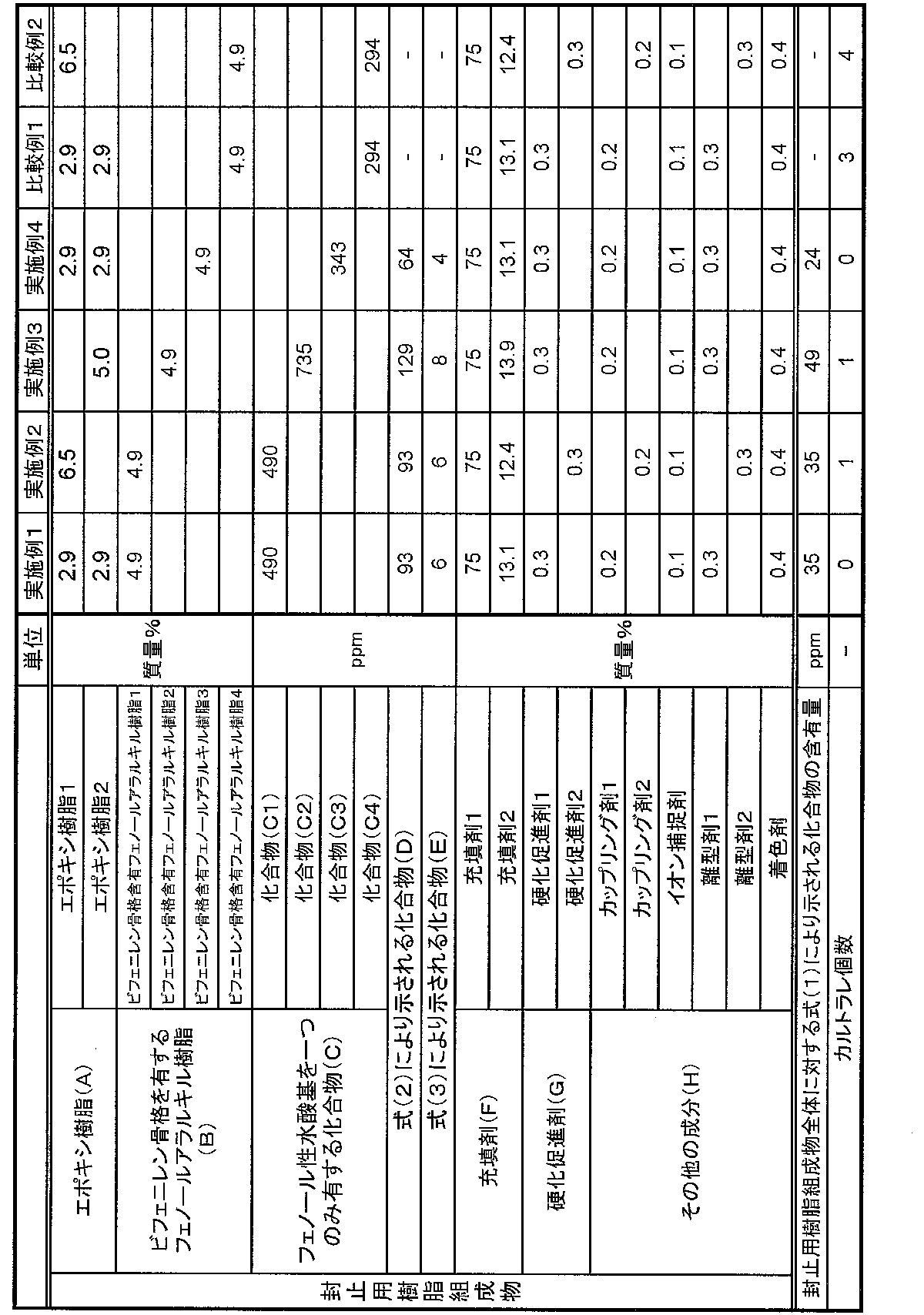
実施例1~4および比較例1~2のそれぞれについて、以下のように封止用樹脂組成物を調整した。まず、表1に示す配合に従い、各成分を、ミキサーを用いて15~28℃で混合した後、70~100℃でロール混練した。次いで、これを冷却し、粉砕して封止用樹脂組成物を得た。なお、ビフェニレン骨格を有するフェノールアラルキル樹脂(B)、化合物(C)、化合物(D)および化合物(E)について、実施例1および実施例2では合成例1にて得られた上記混合物を、実施例3では合成例2にて得られた上記混合物を、実施例4では合成例3にて得られた上記混合物を、比較例1および比較例2では合成例4にて得られた上記混合物を、それぞれ使用した。
表1中における各成分の詳細は下記のとおりである。なお、表1に示す各成分の配合割合は、全て封止用樹脂組成物全体に対する配合割合(質量%またはppm)を指す。
エポキシ樹脂1:フェニレン骨格含有フェノールアラルキル型エポキシ樹脂(NC-2000、日本化薬(株)製)
エポキシ樹脂2:ビフェニル型エポキシ樹脂(YX4000K、三菱化学(株)製)
ビフェニレン骨格含有フェノールアラルキル樹脂1:上記合成例1により合成されたビフェニレン骨格を有するフェノールアラルキル樹脂(B)
ビフェニレン骨格含有フェノールアラルキル樹脂2:上記合成例2により合成されたビフェニレン骨格を有するフェノールアラルキル樹脂(B)
ビフェニレン骨格含有フェノールアラルキル樹脂3:上記合成例3により合成されたビフェニレン骨格を有するフェノールアラルキル樹脂(B)
ビフェニレン骨格含有フェノールアラルキル樹脂4:上記合成例4により合成されたビフェニレン骨格を有するフェノールアラルキル樹脂(B)
化合物(C1):上記合成例1により合成された化合物(C)
化合物(C2):上記合成例2により合成された化合物(C)
化合物(C3):上記合成例3により合成された化合物(C)
化合物(C4):上記合成例4により合成された化合物(C)
充填剤1:球状溶融シリカ(電気化学工業製、FB560(平均粒径30μm))
充填剤2:球状溶融シリカ((株)アドマテックス製、SO-25R(平均粒径0.5μm))
硬化促進剤1:下記式(11)で示される化合物
硬化促進剤2:下記式(12)で示される化合物
[硬化促進剤1の合成方法]
冷却管及び攪拌装置付きのセパラブルフラスコにベンゾキノン6.49g(0.060mol)、トリフェニルホスフィン17.3g(0.066mol)およびアセトン40mlを仕込み、攪拌下、室温で反応した。析出した結晶をアセトンで洗浄後、ろ過、乾燥し暗緑色結晶の硬化促進剤1を得た。
[硬化促進剤2の合成方法]
冷却管及び攪拌装置付きのセパラブルフラスコに2,3‐ジヒドロキシナフタレン12.81g(0.080mol)、テトラフェニルホスホニウムブロミド16.77g(0.040mol)およびメタノール100mlを仕込み攪拌し、均一に溶解させた。予め水酸化ナトリウム1.60g(0.04ml)を10mlのメタノールに溶解した水酸化ナトリウム溶液をフラスコ内に徐々に滴下すると結晶が析出した。析出した結晶をろ過、水洗、真空乾燥し、硬化促進剤2を得た。


カップリング剤1:N-フェニル-3-アミノプロピルトリメトキシシラン(信越化学工業(株)製、KBM-573)
カップリング剤2:3-グリシドキシプロピルトリメトキシシラン(信越化学工業(株)製、KBM-403)
イオン捕捉剤:ハイドロタルサイト(協和化学工業(株)製、DHT-4H)
離型剤1:カルナバワックス(日興ファインプロダクツ(株)製、ニッコウカルナバ)
離型剤2:ウレタン変性酸化ポリエチレンワックス(日本精蝋(株)製、NSP-6010P)
着色剤:カーボンブラック(三菱化学(株)製、MA-600)
実施例1~4および比較例1~2のそれぞれについて、得られた封止用樹脂組成物により、低圧トランスファー成形機を用いて、金型温度175℃、注入圧力100kg/cm2、予熱3秒、注入時間7秒、硬化時間45秒の条件で、80ピン Quad Flat Package(80pQFP、Cu製リードフレーム、パッケージ寸法14mm×20mm×2.0mmt)を500ショットまで封止成形した。ここで、500ショット中において、型開き時にカル(封止用樹脂組成物の残存物)がプランジャまたは金型に付着残存したためにカルを手動で除去した回数を、カルトラレ個数として表1に示した。ここでは、カルトラレ個数が2以下であるものについて、成形性が良好であると評価することができる。
Claims (7)
- エポキシ樹脂(A)と、
ビフェニレン骨格を有するフェノールアラルキル樹脂(B)と、
フェノール性水酸基を一つのみ有する化合物(C)と、
を含み、
前記化合物(C)は、下記式(1)により示される化合物を含む封止用樹脂組成物。

- 請求項1に記載の封止用樹脂組成物において、
前記式(1)により示される化合物の含有量は、前記封止用樹脂組成物全体に対して10ppm以上300ppm以下である封止用樹脂組成物。 - 請求項1または2に記載の封止用樹脂組成物において、
前記化合物(C)の含有量は、前記封止用樹脂組成物全体に対して1ppm以上3000ppm以下である封止用樹脂組成物。 - 請求項1~3いずれか一項に記載の封止用樹脂組成物において、
下記式(2)により示される化合物(D)をさらに含む封止用樹脂組成物。

- 請求項1~4いずれか一項に記載の封止用樹脂組成物において、
下記式(3)により示される化合物(E)をさらに含む封止用樹脂組成物。

- 基材と、
前記基材上に搭載された半導体素子と、
請求項1~5いずれか一項に記載の封止用樹脂組成物の硬化物により構成され、かつ前記半導体素子を封止する封止樹脂と、
を備える半導体装置。 - 基材と、
前記基材上に搭載された複数の半導体素子と、
請求項1~5いずれか一項に記載の封止用樹脂組成物の硬化物により構成され、かつ前記複数の半導体素子を封止する封止樹脂と、
を備える構造体。
Priority Applications (3)
| Application Number | Priority Date | Filing Date | Title |
|---|---|---|---|
| KR1020177026888A KR102367125B1 (ko) | 2015-05-29 | 2015-05-29 | 봉지용 수지 조성물, 반도체 장치, 및 구조체 |
| CN201580077279.6A CN107406580B (zh) | 2015-05-29 | 2015-05-29 | 密封用树脂组合物、半导体装置和结构体 |
| PCT/JP2015/065523 WO2016194034A1 (ja) | 2015-05-29 | 2015-05-29 | 封止用樹脂組成物、半導体装置、および構造体 |
Applications Claiming Priority (1)
| Application Number | Priority Date | Filing Date | Title |
|---|---|---|---|
| PCT/JP2015/065523 WO2016194034A1 (ja) | 2015-05-29 | 2015-05-29 | 封止用樹脂組成物、半導体装置、および構造体 |
Publications (1)
| Publication Number | Publication Date |
|---|---|
| WO2016194034A1 true WO2016194034A1 (ja) | 2016-12-08 |
Family
ID=57440935
Family Applications (1)
| Application Number | Title | Priority Date | Filing Date |
|---|---|---|---|
| PCT/JP2015/065523 Ceased WO2016194034A1 (ja) | 2015-05-29 | 2015-05-29 | 封止用樹脂組成物、半導体装置、および構造体 |
Country Status (3)
| Country | Link |
|---|---|
| KR (1) | KR102367125B1 (ja) |
| CN (1) | CN107406580B (ja) |
| WO (1) | WO2016194034A1 (ja) |
Citations (3)
| Publication number | Priority date | Publication date | Assignee | Title |
|---|---|---|---|---|
| WO2009011335A1 (ja) * | 2007-07-18 | 2009-01-22 | Nipponkayaku Kabushikikaisha | 半導体封止用エポキシ樹脂組成物および半導体装置 |
| JP5179194B2 (ja) * | 2005-11-30 | 2013-04-10 | 日本化薬株式会社 | フェノール樹脂、その製造法、エポキシ樹脂及びその用途 |
| JP5616234B2 (ja) * | 2009-01-30 | 2014-10-29 | 明和化成株式会社 | エポキシ樹脂組成物、該エポキシ樹脂組成物の製造方法およびその硬化物 |
Family Cites Families (1)
| Publication number | Priority date | Publication date | Assignee | Title |
|---|---|---|---|---|
| JP3122834B2 (ja) | 1994-09-20 | 2001-01-09 | 明和化成株式会社 | 新規フェノールノボラック縮合体 |
-
2015
- 2015-05-29 WO PCT/JP2015/065523 patent/WO2016194034A1/ja not_active Ceased
- 2015-05-29 KR KR1020177026888A patent/KR102367125B1/ko active Active
- 2015-05-29 CN CN201580077279.6A patent/CN107406580B/zh not_active Expired - Fee Related
Patent Citations (3)
| Publication number | Priority date | Publication date | Assignee | Title |
|---|---|---|---|---|
| JP5179194B2 (ja) * | 2005-11-30 | 2013-04-10 | 日本化薬株式会社 | フェノール樹脂、その製造法、エポキシ樹脂及びその用途 |
| WO2009011335A1 (ja) * | 2007-07-18 | 2009-01-22 | Nipponkayaku Kabushikikaisha | 半導体封止用エポキシ樹脂組成物および半導体装置 |
| JP5616234B2 (ja) * | 2009-01-30 | 2014-10-29 | 明和化成株式会社 | エポキシ樹脂組成物、該エポキシ樹脂組成物の製造方法およびその硬化物 |
Also Published As
| Publication number | Publication date |
|---|---|
| KR102367125B1 (ko) | 2022-02-25 |
| CN107406580B (zh) | 2020-01-24 |
| KR20180013847A (ko) | 2018-02-07 |
| CN107406580A (zh) | 2017-11-28 |
Similar Documents
| Publication | Publication Date | Title |
|---|---|---|
| KR101902137B1 (ko) | 반도체 봉지용 수지 조성물, 반도체 장치 및 구조체 | |
| TWI774852B (zh) | 電子零件裝置的製造方法 | |
| CN101370870B (zh) | 封固用环氧树脂成形材料以及电子零件装置 | |
| CN105968324B (zh) | 密封用树脂组合物、电子零件的制造方法和电子零件 | |
| JP7782634B2 (ja) | 硬化性樹脂組成物用添加剤、硬化性樹脂組成物及び電子部品装置 | |
| JP2024096265A (ja) | 樹脂組成物及び電子部品装置 | |
| JP4538971B2 (ja) | エポキシ樹脂組成物及び半導体装置 | |
| JP2022011184A (ja) | 封止用樹脂組成物及び電子部品装置 | |
| JP2018024770A (ja) | 封止用樹脂組成物、および半導体装置 | |
| JP2024081937A (ja) | 半導体封止用樹脂組成物および半導体装置 | |
| JP6375634B2 (ja) | 封止用樹脂組成物、半導体装置、および構造体 | |
| JP2018104603A (ja) | 硬化性樹脂組成物及び電子部品装置 | |
| CN107406580B (zh) | 密封用树脂组合物、半导体装置和结构体 | |
| TWI666307B (zh) | 密封用樹脂組成物、半導體裝置、及構造體 | |
| JP7460025B2 (ja) | 半導体封止用樹脂組成物および半導体装置 | |
| CN117222686B (zh) | 密封用树脂组合物和使用其的电子装置 | |
| TWI685535B (zh) | 密封用樹脂組成物及電子零件裝置 | |
| JP2021084980A (ja) | 封止用樹脂組成物、電子部品装置及び電子部品装置の製造方法 | |
| JP6291729B2 (ja) | エポキシ樹脂用硬化促進剤、エポキシ樹脂組成物及び電子部品装置 | |
| JP2024129417A (ja) | 封止用樹脂組成物 | |
| JP2022057356A (ja) | 封止用樹脂組成物および半導体装置 | |
| JP2020045425A (ja) | 封止用エポキシ樹脂組成物及び電子部品装置 | |
| JP2008195820A (ja) | 封止用エポキシ樹脂組成物及びこの樹脂組成物で封止された素子を備えた電子部品装置 | |
| JP2019048998A (ja) | モールドアンダーフィル用樹脂組成物及び電子部品装置 | |
| JP2006335835A (ja) | エポキシ樹脂組成物および半導体装置 |
Legal Events
| Date | Code | Title | Description |
|---|---|---|---|
| 121 | Ep: the epo has been informed by wipo that ep was designated in this application |
Ref document number: 15894069 Country of ref document: EP Kind code of ref document: A1 |
|
| ENP | Entry into the national phase |
Ref document number: 20177026888 Country of ref document: KR Kind code of ref document: A |
|
| NENP | Non-entry into the national phase |
Ref country code: DE |
|
| 122 | Ep: pct application non-entry in european phase |
Ref document number: 15894069 Country of ref document: EP Kind code of ref document: A1 |
|
| NENP | Non-entry into the national phase |
Ref country code: JP |