WO2016175608A1 - 이온성 기능기를 갖는 고분자 나노 부직웹 및 이를 구비하는 호흡 마스크 - Google Patents
이온성 기능기를 갖는 고분자 나노 부직웹 및 이를 구비하는 호흡 마스크 Download PDFInfo
- Publication number
- WO2016175608A1 WO2016175608A1 PCT/KR2016/004540 KR2016004540W WO2016175608A1 WO 2016175608 A1 WO2016175608 A1 WO 2016175608A1 KR 2016004540 W KR2016004540 W KR 2016004540W WO 2016175608 A1 WO2016175608 A1 WO 2016175608A1
- Authority
- WO
- WIPO (PCT)
- Prior art keywords
- group
- substituted
- unsubstituted
- polymer
- nonwoven web
- Prior art date
- Legal status (The legal status is an assumption and is not a legal conclusion. Google has not performed a legal analysis and makes no representation as to the accuracy of the status listed.)
- Ceased
Links
Images


Classifications
-
- D—TEXTILES; PAPER
- D04—BRAIDING; LACE-MAKING; KNITTING; TRIMMINGS; NON-WOVEN FABRICS
- D04H—MAKING TEXTILE FABRICS, e.g. FROM FIBRES OR FILAMENTARY MATERIAL; FABRICS MADE BY SUCH PROCESSES OR APPARATUS, e.g. FELTS, NON-WOVEN FABRICS; COTTON-WOOL; WADDING ; NON-WOVEN FABRICS FROM STAPLE FIBRES, FILAMENTS OR YARNS, BONDED WITH AT LEAST ONE WEB-LIKE MATERIAL DURING THEIR CONSOLIDATION
- D04H1/00—Non-woven fabrics formed wholly or mainly of staple fibres or like relatively short fibres
- D04H1/40—Non-woven fabrics formed wholly or mainly of staple fibres or like relatively short fibres from fleeces or layers composed of fibres without existing or potential cohesive properties
- D04H1/42—Non-woven fabrics formed wholly or mainly of staple fibres or like relatively short fibres from fleeces or layers composed of fibres without existing or potential cohesive properties characterised by the use of certain kinds of fibres insofar as this use has no preponderant influence on the consolidation of the fleece
- D04H1/4382—Stretched reticular film fibres; Composite fibres; Mixed fibres; Ultrafine fibres; Fibres for artificial leather
- D04H1/43838—Ultrafine fibres, e.g. microfibres
-
- A—HUMAN NECESSITIES
- A01—AGRICULTURE; FORESTRY; ANIMAL HUSBANDRY; HUNTING; TRAPPING; FISHING
- A01N—PRESERVATION OF BODIES OF HUMANS OR ANIMALS OR PLANTS OR PARTS THEREOF; BIOCIDES, e.g. AS DISINFECTANTS, AS PESTICIDES OR AS HERBICIDES; PEST REPELLANTS OR ATTRACTANTS; PLANT GROWTH REGULATORS
- A01N25/00—Biocides, pest repellants or attractants, or plant growth regulators, characterised by their forms, or by their non-active ingredients or by their methods of application, e.g. seed treatment or sequential application; Substances for reducing the noxious effect of the active ingredients to organisms other than pests
- A01N25/08—Biocides, pest repellants or attractants, or plant growth regulators, characterised by their forms, or by their non-active ingredients or by their methods of application, e.g. seed treatment or sequential application; Substances for reducing the noxious effect of the active ingredients to organisms other than pests containing solids as carriers or diluents
- A01N25/10—Macromolecular compounds
-
- A—HUMAN NECESSITIES
- A01—AGRICULTURE; FORESTRY; ANIMAL HUSBANDRY; HUNTING; TRAPPING; FISHING
- A01N—PRESERVATION OF BODIES OF HUMANS OR ANIMALS OR PLANTS OR PARTS THEREOF; BIOCIDES, e.g. AS DISINFECTANTS, AS PESTICIDES OR AS HERBICIDES; PEST REPELLANTS OR ATTRACTANTS; PLANT GROWTH REGULATORS
- A01N57/00—Biocides, pest repellants or attractants, or plant growth regulators containing organic phosphorus compounds
- A01N57/10—Biocides, pest repellants or attractants, or plant growth regulators containing organic phosphorus compounds having phosphorus-to-oxygen bonds or phosphorus-to-sulfur bonds
- A01N57/12—Biocides, pest repellants or attractants, or plant growth regulators containing organic phosphorus compounds having phosphorus-to-oxygen bonds or phosphorus-to-sulfur bonds containing acyclic or cycloaliphatic radicals
-
- A—HUMAN NECESSITIES
- A01—AGRICULTURE; FORESTRY; ANIMAL HUSBANDRY; HUNTING; TRAPPING; FISHING
- A01N—PRESERVATION OF BODIES OF HUMANS OR ANIMALS OR PLANTS OR PARTS THEREOF; BIOCIDES, e.g. AS DISINFECTANTS, AS PESTICIDES OR AS HERBICIDES; PEST REPELLANTS OR ATTRACTANTS; PLANT GROWTH REGULATORS
- A01N59/00—Biocides, pest repellants or attractants, or plant growth regulators containing elements or inorganic compounds
- A01N59/12—Iodine, e.g. iodophors; Compounds thereof
-
- A—HUMAN NECESSITIES
- A01—AGRICULTURE; FORESTRY; ANIMAL HUSBANDRY; HUNTING; TRAPPING; FISHING
- A01N—PRESERVATION OF BODIES OF HUMANS OR ANIMALS OR PLANTS OR PARTS THEREOF; BIOCIDES, e.g. AS DISINFECTANTS, AS PESTICIDES OR AS HERBICIDES; PEST REPELLANTS OR ATTRACTANTS; PLANT GROWTH REGULATORS
- A01N59/00—Biocides, pest repellants or attractants, or plant growth regulators containing elements or inorganic compounds
- A01N59/16—Heavy metals; Compounds thereof
-
- A—HUMAN NECESSITIES
- A62—LIFE-SAVING; FIRE-FIGHTING
- A62B—DEVICES, APPARATUS OR METHODS FOR LIFE-SAVING
- A62B18/00—Breathing masks or helmets, e.g. affording protection against chemical agents or for use at high altitudes or incorporating a pump or compressor for reducing the inhalation effort
- A62B18/02—Masks
-
- A—HUMAN NECESSITIES
- A62—LIFE-SAVING; FIRE-FIGHTING
- A62B—DEVICES, APPARATUS OR METHODS FOR LIFE-SAVING
- A62B23/00—Filters for breathing-protection purposes
- A62B23/02—Filters for breathing-protection purposes for respirators
- A62B23/025—Filters for breathing-protection purposes for respirators the filter having substantially the shape of a mask
-
- B—PERFORMING OPERATIONS; TRANSPORTING
- B01—PHYSICAL OR CHEMICAL PROCESSES OR APPARATUS IN GENERAL
- B01D—SEPARATION
- B01D39/00—Filtering material for liquid or gaseous fluids
- B01D39/02—Loose filtering material, e.g. loose fibres
-
- B—PERFORMING OPERATIONS; TRANSPORTING
- B01—PHYSICAL OR CHEMICAL PROCESSES OR APPARATUS IN GENERAL
- B01D—SEPARATION
- B01D39/00—Filtering material for liquid or gaseous fluids
- B01D39/14—Other self-supporting filtering material ; Other filtering material
- B01D39/16—Other self-supporting filtering material ; Other filtering material of organic material, e.g. synthetic fibres
- B01D39/1607—Other self-supporting filtering material ; Other filtering material of organic material, e.g. synthetic fibres the material being fibrous
- B01D39/1623—Other self-supporting filtering material ; Other filtering material of organic material, e.g. synthetic fibres the material being fibrous of synthetic origin
-
- B—PERFORMING OPERATIONS; TRANSPORTING
- B01—PHYSICAL OR CHEMICAL PROCESSES OR APPARATUS IN GENERAL
- B01D—SEPARATION
- B01D46/00—Filters or filtering processes specially modified for separating dispersed particles from gases or vapours
-
- B—PERFORMING OPERATIONS; TRANSPORTING
- B01—PHYSICAL OR CHEMICAL PROCESSES OR APPARATUS IN GENERAL
- B01J—CHEMICAL OR PHYSICAL PROCESSES, e.g. CATALYSIS OR COLLOID CHEMISTRY; THEIR RELEVANT APPARATUS
- B01J20/00—Solid sorbent compositions or filter aid compositions; Sorbents for chromatography; Processes for preparing, regenerating or reactivating thereof
- B01J20/02—Solid sorbent compositions or filter aid compositions; Sorbents for chromatography; Processes for preparing, regenerating or reactivating thereof comprising inorganic material
-
- B—PERFORMING OPERATIONS; TRANSPORTING
- B01—PHYSICAL OR CHEMICAL PROCESSES OR APPARATUS IN GENERAL
- B01J—CHEMICAL OR PHYSICAL PROCESSES, e.g. CATALYSIS OR COLLOID CHEMISTRY; THEIR RELEVANT APPARATUS
- B01J20/00—Solid sorbent compositions or filter aid compositions; Sorbents for chromatography; Processes for preparing, regenerating or reactivating thereof
- B01J20/22—Solid sorbent compositions or filter aid compositions; Sorbents for chromatography; Processes for preparing, regenerating or reactivating thereof comprising organic material
- B01J20/26—Synthetic macromolecular compounds
- B01J20/265—Synthetic macromolecular compounds modified or post-treated polymers
-
- B—PERFORMING OPERATIONS; TRANSPORTING
- B01—PHYSICAL OR CHEMICAL PROCESSES OR APPARATUS IN GENERAL
- B01J—CHEMICAL OR PHYSICAL PROCESSES, e.g. CATALYSIS OR COLLOID CHEMISTRY; THEIR RELEVANT APPARATUS
- B01J20/00—Solid sorbent compositions or filter aid compositions; Sorbents for chromatography; Processes for preparing, regenerating or reactivating thereof
- B01J20/28—Solid sorbent compositions or filter aid compositions; Sorbents for chromatography; Processes for preparing, regenerating or reactivating thereof characterised by their form or physical properties
- B01J20/28014—Solid sorbent compositions or filter aid compositions; Sorbents for chromatography; Processes for preparing, regenerating or reactivating thereof characterised by their form or physical properties characterised by their form
- B01J20/28033—Membrane, sheet, cloth, pad, lamellar or mat
- B01J20/28038—Membranes or mats made from fibers or filaments
-
- B—PERFORMING OPERATIONS; TRANSPORTING
- B01—PHYSICAL OR CHEMICAL PROCESSES OR APPARATUS IN GENERAL
- B01J—CHEMICAL OR PHYSICAL PROCESSES, e.g. CATALYSIS OR COLLOID CHEMISTRY; THEIR RELEVANT APPARATUS
- B01J39/00—Cation exchange; Use of material as cation exchangers; Treatment of material for improving the cation exchange properties
- B01J39/08—Use of material as cation exchangers; Treatment of material for improving the cation exchange properties
- B01J39/16—Organic material
- B01J39/18—Macromolecular compounds
- B01J39/19—Macromolecular compounds obtained otherwise than by reactions only involving unsaturated carbon-to-carbon bonds
-
- B—PERFORMING OPERATIONS; TRANSPORTING
- B01—PHYSICAL OR CHEMICAL PROCESSES OR APPARATUS IN GENERAL
- B01J—CHEMICAL OR PHYSICAL PROCESSES, e.g. CATALYSIS OR COLLOID CHEMISTRY; THEIR RELEVANT APPARATUS
- B01J39/00—Cation exchange; Use of material as cation exchangers; Treatment of material for improving the cation exchange properties
- B01J39/08—Use of material as cation exchangers; Treatment of material for improving the cation exchange properties
- B01J39/16—Organic material
- B01J39/18—Macromolecular compounds
- B01J39/20—Macromolecular compounds obtained by reactions only involving unsaturated carbon-to-carbon bonds
-
- B—PERFORMING OPERATIONS; TRANSPORTING
- B01—PHYSICAL OR CHEMICAL PROCESSES OR APPARATUS IN GENERAL
- B01J—CHEMICAL OR PHYSICAL PROCESSES, e.g. CATALYSIS OR COLLOID CHEMISTRY; THEIR RELEVANT APPARATUS
- B01J41/00—Anion exchange; Use of material as anion exchangers; Treatment of material for improving the anion exchange properties
- B01J41/08—Use of material as anion exchangers; Treatment of material for improving the anion exchange properties
- B01J41/12—Macromolecular compounds
- B01J41/13—Macromolecular compounds obtained otherwise than by reactions only involving unsaturated carbon-to-carbon bonds
-
- B—PERFORMING OPERATIONS; TRANSPORTING
- B01—PHYSICAL OR CHEMICAL PROCESSES OR APPARATUS IN GENERAL
- B01J—CHEMICAL OR PHYSICAL PROCESSES, e.g. CATALYSIS OR COLLOID CHEMISTRY; THEIR RELEVANT APPARATUS
- B01J41/00—Anion exchange; Use of material as anion exchangers; Treatment of material for improving the anion exchange properties
- B01J41/08—Use of material as anion exchangers; Treatment of material for improving the anion exchange properties
- B01J41/12—Macromolecular compounds
- B01J41/14—Macromolecular compounds obtained by reactions only involving unsaturated carbon-to-carbon bonds
-
- C—CHEMISTRY; METALLURGY
- C08—ORGANIC MACROMOLECULAR COMPOUNDS; THEIR PREPARATION OR CHEMICAL WORKING-UP; COMPOSITIONS BASED THEREON
- C08F—MACROMOLECULAR COMPOUNDS OBTAINED BY REACTIONS ONLY INVOLVING CARBON-TO-CARBON UNSATURATED BONDS
- C08F212/00—Copolymers of compounds having one or more unsaturated aliphatic radicals, each having only one carbon-to-carbon double bond, and at least one being terminated by an aromatic carbocyclic ring
- C08F212/02—Monomers containing only one unsaturated aliphatic radical
- C08F212/04—Monomers containing only one unsaturated aliphatic radical containing one ring
- C08F212/06—Hydrocarbons
- C08F212/08—Styrene
-
- C—CHEMISTRY; METALLURGY
- C08—ORGANIC MACROMOLECULAR COMPOUNDS; THEIR PREPARATION OR CHEMICAL WORKING-UP; COMPOSITIONS BASED THEREON
- C08F—MACROMOLECULAR COMPOUNDS OBTAINED BY REACTIONS ONLY INVOLVING CARBON-TO-CARBON UNSATURATED BONDS
- C08F220/00—Copolymers of compounds having one or more unsaturated aliphatic radicals, each having only one carbon-to-carbon double bond, and only one being terminated by only one carboxyl radical or a salt, anhydride ester, amide, imide or nitrile thereof
- C08F220/02—Monocarboxylic acids having less than ten carbon atoms; Derivatives thereof
- C08F220/10—Esters
- C08F220/12—Esters of monohydric alcohols or phenols
- C08F220/14—Methyl esters, e.g. methyl (meth)acrylate
-
- C—CHEMISTRY; METALLURGY
- C08—ORGANIC MACROMOLECULAR COMPOUNDS; THEIR PREPARATION OR CHEMICAL WORKING-UP; COMPOSITIONS BASED THEREON
- C08F—MACROMOLECULAR COMPOUNDS OBTAINED BY REACTIONS ONLY INVOLVING CARBON-TO-CARBON UNSATURATED BONDS
- C08F220/00—Copolymers of compounds having one or more unsaturated aliphatic radicals, each having only one carbon-to-carbon double bond, and only one being terminated by only one carboxyl radical or a salt, anhydride ester, amide, imide or nitrile thereof
- C08F220/02—Monocarboxylic acids having less than ten carbon atoms; Derivatives thereof
- C08F220/10—Esters
- C08F220/20—Esters of polyhydric alcohols or phenols, e.g. 2-hydroxyethyl (meth)acrylate or glycerol mono-(meth)acrylate
-
- C—CHEMISTRY; METALLURGY
- C08—ORGANIC MACROMOLECULAR COMPOUNDS; THEIR PREPARATION OR CHEMICAL WORKING-UP; COMPOSITIONS BASED THEREON
- C08F—MACROMOLECULAR COMPOUNDS OBTAINED BY REACTIONS ONLY INVOLVING CARBON-TO-CARBON UNSATURATED BONDS
- C08F230/00—Copolymers of compounds having one or more unsaturated aliphatic radicals, each having only one carbon-to-carbon double bond, and containing phosphorus, selenium, tellurium or a metal
- C08F230/02—Copolymers of compounds having one or more unsaturated aliphatic radicals, each having only one carbon-to-carbon double bond, and containing phosphorus, selenium, tellurium or a metal containing phosphorus
-
- C—CHEMISTRY; METALLURGY
- C08—ORGANIC MACROMOLECULAR COMPOUNDS; THEIR PREPARATION OR CHEMICAL WORKING-UP; COMPOSITIONS BASED THEREON
- C08F—MACROMOLECULAR COMPOUNDS OBTAINED BY REACTIONS ONLY INVOLVING CARBON-TO-CARBON UNSATURATED BONDS
- C08F8/00—Chemical modification by after-treatment
- C08F8/30—Introducing nitrogen atoms or nitrogen-containing groups
- C08F8/32—Introducing nitrogen atoms or nitrogen-containing groups by reaction with amines
-
- C—CHEMISTRY; METALLURGY
- C08—ORGANIC MACROMOLECULAR COMPOUNDS; THEIR PREPARATION OR CHEMICAL WORKING-UP; COMPOSITIONS BASED THEREON
- C08G—MACROMOLECULAR COMPOUNDS OBTAINED OTHERWISE THAN BY REACTIONS ONLY INVOLVING UNSATURATED CARBON-TO-CARBON BONDS
- C08G67/00—Macromolecular compounds obtained by reactions forming in the main chain of the macromolecule a linkage containing oxygen or oxygen and carbon, not provided for in groups C08G2/00 - C08G65/00
-
- D—TEXTILES; PAPER
- D04—BRAIDING; LACE-MAKING; KNITTING; TRIMMINGS; NON-WOVEN FABRICS
- D04H—MAKING TEXTILE FABRICS, e.g. FROM FIBRES OR FILAMENTARY MATERIAL; FABRICS MADE BY SUCH PROCESSES OR APPARATUS, e.g. FELTS, NON-WOVEN FABRICS; COTTON-WOOL; WADDING ; NON-WOVEN FABRICS FROM STAPLE FIBRES, FILAMENTS OR YARNS, BONDED WITH AT LEAST ONE WEB-LIKE MATERIAL DURING THEIR CONSOLIDATION
- D04H1/00—Non-woven fabrics formed wholly or mainly of staple fibres or like relatively short fibres
- D04H1/40—Non-woven fabrics formed wholly or mainly of staple fibres or like relatively short fibres from fleeces or layers composed of fibres without existing or potential cohesive properties
- D04H1/42—Non-woven fabrics formed wholly or mainly of staple fibres or like relatively short fibres from fleeces or layers composed of fibres without existing or potential cohesive properties characterised by the use of certain kinds of fibres insofar as this use has no preponderant influence on the consolidation of the fleece
-
- D—TEXTILES; PAPER
- D04—BRAIDING; LACE-MAKING; KNITTING; TRIMMINGS; NON-WOVEN FABRICS
- D04H—MAKING TEXTILE FABRICS, e.g. FROM FIBRES OR FILAMENTARY MATERIAL; FABRICS MADE BY SUCH PROCESSES OR APPARATUS, e.g. FELTS, NON-WOVEN FABRICS; COTTON-WOOL; WADDING ; NON-WOVEN FABRICS FROM STAPLE FIBRES, FILAMENTS OR YARNS, BONDED WITH AT LEAST ONE WEB-LIKE MATERIAL DURING THEIR CONSOLIDATION
- D04H1/00—Non-woven fabrics formed wholly or mainly of staple fibres or like relatively short fibres
- D04H1/40—Non-woven fabrics formed wholly or mainly of staple fibres or like relatively short fibres from fleeces or layers composed of fibres without existing or potential cohesive properties
- D04H1/42—Non-woven fabrics formed wholly or mainly of staple fibres or like relatively short fibres from fleeces or layers composed of fibres without existing or potential cohesive properties characterised by the use of certain kinds of fibres insofar as this use has no preponderant influence on the consolidation of the fleece
- D04H1/4282—Addition polymers
- D04H1/4291—Olefin series
-
- D—TEXTILES; PAPER
- D04—BRAIDING; LACE-MAKING; KNITTING; TRIMMINGS; NON-WOVEN FABRICS
- D04H—MAKING TEXTILE FABRICS, e.g. FROM FIBRES OR FILAMENTARY MATERIAL; FABRICS MADE BY SUCH PROCESSES OR APPARATUS, e.g. FELTS, NON-WOVEN FABRICS; COTTON-WOOL; WADDING ; NON-WOVEN FABRICS FROM STAPLE FIBRES, FILAMENTS OR YARNS, BONDED WITH AT LEAST ONE WEB-LIKE MATERIAL DURING THEIR CONSOLIDATION
- D04H1/00—Non-woven fabrics formed wholly or mainly of staple fibres or like relatively short fibres
- D04H1/40—Non-woven fabrics formed wholly or mainly of staple fibres or like relatively short fibres from fleeces or layers composed of fibres without existing or potential cohesive properties
- D04H1/42—Non-woven fabrics formed wholly or mainly of staple fibres or like relatively short fibres from fleeces or layers composed of fibres without existing or potential cohesive properties characterised by the use of certain kinds of fibres insofar as this use has no preponderant influence on the consolidation of the fleece
- D04H1/4282—Addition polymers
- D04H1/43—Acrylonitrile series
-
- D—TEXTILES; PAPER
- D04—BRAIDING; LACE-MAKING; KNITTING; TRIMMINGS; NON-WOVEN FABRICS
- D04H—MAKING TEXTILE FABRICS, e.g. FROM FIBRES OR FILAMENTARY MATERIAL; FABRICS MADE BY SUCH PROCESSES OR APPARATUS, e.g. FELTS, NON-WOVEN FABRICS; COTTON-WOOL; WADDING ; NON-WOVEN FABRICS FROM STAPLE FIBRES, FILAMENTS OR YARNS, BONDED WITH AT LEAST ONE WEB-LIKE MATERIAL DURING THEIR CONSOLIDATION
- D04H1/00—Non-woven fabrics formed wholly or mainly of staple fibres or like relatively short fibres
- D04H1/40—Non-woven fabrics formed wholly or mainly of staple fibres or like relatively short fibres from fleeces or layers composed of fibres without existing or potential cohesive properties
- D04H1/42—Non-woven fabrics formed wholly or mainly of staple fibres or like relatively short fibres from fleeces or layers composed of fibres without existing or potential cohesive properties characterised by the use of certain kinds of fibres insofar as this use has no preponderant influence on the consolidation of the fleece
- D04H1/4326—Condensation or reaction polymers
- D04H1/4358—Polyurethanes
-
- D—TEXTILES; PAPER
- D04—BRAIDING; LACE-MAKING; KNITTING; TRIMMINGS; NON-WOVEN FABRICS
- D04H—MAKING TEXTILE FABRICS, e.g. FROM FIBRES OR FILAMENTARY MATERIAL; FABRICS MADE BY SUCH PROCESSES OR APPARATUS, e.g. FELTS, NON-WOVEN FABRICS; COTTON-WOOL; WADDING ; NON-WOVEN FABRICS FROM STAPLE FIBRES, FILAMENTS OR YARNS, BONDED WITH AT LEAST ONE WEB-LIKE MATERIAL DURING THEIR CONSOLIDATION
- D04H1/00—Non-woven fabrics formed wholly or mainly of staple fibres or like relatively short fibres
- D04H1/70—Non-woven fabrics formed wholly or mainly of staple fibres or like relatively short fibres characterised by the method of forming fleeces or layers, e.g. reorientation of fibres
- D04H1/72—Non-woven fabrics formed wholly or mainly of staple fibres or like relatively short fibres characterised by the method of forming fleeces or layers, e.g. reorientation of fibres the fibres being randomly arranged
- D04H1/728—Non-woven fabrics formed wholly or mainly of staple fibres or like relatively short fibres characterised by the method of forming fleeces or layers, e.g. reorientation of fibres the fibres being randomly arranged by electro-spinning
-
- A—HUMAN NECESSITIES
- A41—WEARING APPAREL
- A41D—OUTERWEAR; PROTECTIVE GARMENTS; ACCESSORIES
- A41D13/00—Professional, industrial or sporting protective garments, e.g. surgeons' gowns or garments protecting against blows or punches
- A41D13/05—Professional, industrial or sporting protective garments, e.g. surgeons' gowns or garments protecting against blows or punches protecting only a particular body part
- A41D13/11—Protective face masks, e.g. for surgical use, or for use in foul atmospheres
-
- B—PERFORMING OPERATIONS; TRANSPORTING
- B01—PHYSICAL OR CHEMICAL PROCESSES OR APPARATUS IN GENERAL
- B01D—SEPARATION
- B01D2239/00—Aspects relating to filtering material for liquid or gaseous fluids
- B01D2239/02—Types of fibres, filaments or particles, self-supporting or supported materials
- B01D2239/0208—Single-component fibres
-
- B—PERFORMING OPERATIONS; TRANSPORTING
- B01—PHYSICAL OR CHEMICAL PROCESSES OR APPARATUS IN GENERAL
- B01D—SEPARATION
- B01D2239/00—Aspects relating to filtering material for liquid or gaseous fluids
- B01D2239/02—Types of fibres, filaments or particles, self-supporting or supported materials
- B01D2239/025—Types of fibres, filaments or particles, self-supporting or supported materials comprising nanofibres
-
- B—PERFORMING OPERATIONS; TRANSPORTING
- B01—PHYSICAL OR CHEMICAL PROCESSES OR APPARATUS IN GENERAL
- B01D—SEPARATION
- B01D2239/00—Aspects relating to filtering material for liquid or gaseous fluids
- B01D2239/04—Additives and treatments of the filtering material
- B01D2239/0414—Surface modifiers, e.g. comprising ion exchange groups
-
- B—PERFORMING OPERATIONS; TRANSPORTING
- B01—PHYSICAL OR CHEMICAL PROCESSES OR APPARATUS IN GENERAL
- B01D—SEPARATION
- B01D2239/00—Aspects relating to filtering material for liquid or gaseous fluids
- B01D2239/06—Filter cloth, e.g. knitted, woven non-woven; self-supported material
- B01D2239/0604—Arrangement of the fibres in the filtering material
- B01D2239/0618—Non-woven
-
- C—CHEMISTRY; METALLURGY
- C08—ORGANIC MACROMOLECULAR COMPOUNDS; THEIR PREPARATION OR CHEMICAL WORKING-UP; COMPOSITIONS BASED THEREON
- C08F—MACROMOLECULAR COMPOUNDS OBTAINED BY REACTIONS ONLY INVOLVING CARBON-TO-CARBON UNSATURATED BONDS
- C08F12/00—Homopolymers and copolymers of compounds having one or more unsaturated aliphatic radicals, each having only one carbon-to-carbon double bond, and at least one being terminated by an aromatic carbocyclic ring
- C08F12/02—Monomers containing only one unsaturated aliphatic radical
- C08F12/04—Monomers containing only one unsaturated aliphatic radical containing one ring
- C08F12/14—Monomers containing only one unsaturated aliphatic radical containing one ring substituted by hetero atoms or groups containing heteroatoms
- C08F12/16—Halogens
- C08F12/18—Chlorine
-
- C—CHEMISTRY; METALLURGY
- C08—ORGANIC MACROMOLECULAR COMPOUNDS; THEIR PREPARATION OR CHEMICAL WORKING-UP; COMPOSITIONS BASED THEREON
- C08F—MACROMOLECULAR COMPOUNDS OBTAINED BY REACTIONS ONLY INVOLVING CARBON-TO-CARBON UNSATURATED BONDS
- C08F212/00—Copolymers of compounds having one or more unsaturated aliphatic radicals, each having only one carbon-to-carbon double bond, and at least one being terminated by an aromatic carbocyclic ring
- C08F212/02—Monomers containing only one unsaturated aliphatic radical
- C08F212/04—Monomers containing only one unsaturated aliphatic radical containing one ring
- C08F212/14—Monomers containing only one unsaturated aliphatic radical containing one ring substituted by heteroatoms or groups containing heteroatoms
- C08F212/16—Halogens
- C08F212/18—Chlorine
-
- C—CHEMISTRY; METALLURGY
- C08—ORGANIC MACROMOLECULAR COMPOUNDS; THEIR PREPARATION OR CHEMICAL WORKING-UP; COMPOSITIONS BASED THEREON
- C08F—MACROMOLECULAR COMPOUNDS OBTAINED BY REACTIONS ONLY INVOLVING CARBON-TO-CARBON UNSATURATED BONDS
- C08F220/00—Copolymers of compounds having one or more unsaturated aliphatic radicals, each having only one carbon-to-carbon double bond, and only one being terminated by only one carboxyl radical or a salt, anhydride ester, amide, imide or nitrile thereof
- C08F220/02—Monocarboxylic acids having less than ten carbon atoms; Derivatives thereof
- C08F220/10—Esters
- C08F220/26—Esters containing oxygen in addition to the carboxy oxygen
- C08F220/28—Esters containing oxygen in addition to the carboxy oxygen containing no aromatic rings in the alcohol moiety
- C08F220/281—Esters containing oxygen in addition to the carboxy oxygen containing no aromatic rings in the alcohol moiety and containing only one oxygen, e.g. furfuryl (meth)acrylate or 2-methoxyethyl (meth)acrylate
-
- D—TEXTILES; PAPER
- D10—INDEXING SCHEME ASSOCIATED WITH SUBLASSES OF SECTION D, RELATING TO TEXTILES
- D10B—INDEXING SCHEME ASSOCIATED WITH SUBLASSES OF SECTION D, RELATING TO TEXTILES
- D10B2509/00—Medical; Hygiene
Definitions
- the present invention relates to nonwoven webs and, more particularly, to gas filters.
- the electret filter is a filter manufactured by charging the filter in various ways, including triboelectric charging, DC corona discharge, or hydrocharging.
- the electret filter gradually loses its performance due to gradually being depleted by moisture in the air or moisture by respiration. have.
- the problem to be solved by the present invention is to provide a polymer nonwoven web that can be improved rather than the fine dust filtering efficiency by the moisture generated by the breath.
- the polymeric nonwoven web is formed of polymeric fibers having a diameter in the nanometer range, wherein the polymer has ionic functional groups in the main chain or side chain.
- the ionic functional group may include a sulfonate group, an ammonium group, an azanide group, a phosphate group, or a zwitter ion group in which two of them are connected.
- the ammonium group may be a quaternary ammonium group.
- the ionic functional group including the azanide group may be a sulfadiazinyl group.
- the ionic functional group including the zwitter ion group may be a phosphorylcholine group.
- the polymeric nonwoven web may further contain Ag + or I ⁇ as counter ions having opposite signs of charge to the charge of the ionic functional group.
- the polymer may be polystyrene, polymethylmethacrylate, polyarylene ether, polyurethane, or a copolymer of two or more thereof.
- the polymer may be a copolymer of a unit having an ionic functional group and a unit having no ionic functional group.
- the units may be styrene units, methyl methacrylate units, arylene ether units, or urethane units regardless of each other.
- the fiber may have a diameter of 100 to 900 nm.
- the polymeric nonwoven web may be a gas filter.
- the manufacturing method includes the step of electrospinning the polymer having an ionic functional group in the main chain or side chain, to prepare a nonwoven web formed of polymer fibers having a diameter in the nanometer range.
- the ionic functional group may include a sulfonate group, an ammonium group, an azanide group, a phosphate group, or a zwitter ion group in which two of them are connected.
- the nonwoven web may be immersed in an ion exchange solution to introduce Ag + or I ⁇ , which is a counter ion having a charge opposite to that of the ionic functional group.
- the respiratory mask has a base layer and a cover layer.
- a polymer nonwoven web may be disposed between the base layer and the cover layer.
- the polymeric nonwoven web is a nonwoven web formed of polymeric fibers having ionic functional groups in the main or side chains and having a diameter in the nanometer range.
- the polymer constituting the fiber has an ionic functional group to filter fine dust by electrostatic attraction
- the size of the pores is not greatly reduced, and thus, the filtering pressure is excellent and the filtering efficiency is good.
- the ionic particles contained in the fine dust can be efficiently filtered.
- the ionization may be promoted by moisture by respiration, and thus the electrostatic force may be improved, and even when the polymer nonwoven web is washed, the electrostatic force may be permanently maintained.
- FIG. 1 is a schematic view showing a polymer nonwoven web according to an embodiment of the present invention.
- FIG. 2 is a schematic view showing a cross-section of a breathing mask according to another embodiment of the present invention.
- FIG. 4 is a Fourier-transform infrared spectroscopy (FT-IR) graph of the polymer A obtained in Polymer Synthesis Example 1.
- FIG. 4 is a Fourier-transform infrared spectroscopy (FT-IR) graph of the polymer A obtained in Polymer Synthesis Example 1.
- FIG. 5 is a 1 H-NMR (nuclear magnetic resonance) graph measured under DMSO-d6 solvent of Polymer B obtained in Polymer Synthesis Example 2.
- FIG. 5 is a 1 H-NMR (nuclear magnetic resonance) graph measured under DMSO-d6 solvent of Polymer B obtained in Polymer Synthesis Example 2.
- FIG. 6 is a Fourier-transform infrared spectroscopy (FT-IR) graph of Polymer B obtained in Polymer Synthesis Example 2.
- FT-IR Fourier-transform infrared spectroscopy
- FIG. 7 is a 1 H-NMR graph measured in the solvent of dimethyl sulfoxide-d6 of Polymer C obtained in Polymer Synthesis Example 3.
- FIG. 7 is a 1 H-NMR graph measured in the solvent of dimethyl sulfoxide-d6 of Polymer C obtained in Polymer Synthesis Example 3.
- FIG. 8 is an FT-IR graph of the polymer C obtained in Polymer Synthesis Example 3.
- EDS 12 is a graph showing the results of Energy Dispersive X-ray Spectroscopy (EDS) analysis on the polymer nonwoven web A according to Preparation Example 1 of the antimicrobial polymer nonwoven web.
- EDS Energy Dispersive X-ray Spectroscopy
- FIG. 13 is a graph showing the results of EDS analysis for the polymer nonwoven web B according to Preparation Example 2 of the antimicrobial polymer nonwoven web.
- FIG. 15 is a graph showing dust collection efficiency and face intake resistance of filters 1-1, 1-2, and filters according to Comparative Examples.
- FIG. 15 is a graph showing dust collection efficiency and face intake resistance of filters 1-1, 1-2, and filters according to Comparative Examples.
- 16 is a graph showing dust collection efficiency and face intake resistance of filters 2-1, 2-2, and filters according to Comparative Examples.
- FIG. 17 is a graph showing dust collection efficiency and facial intake resistance of filters 3-1, 3-3, and filters according to Comparative Examples.
- FIG. 17 is a graph showing dust collection efficiency and facial intake resistance of filters 3-1, 3-3, and filters according to Comparative Examples.
- FIG. 18 is a photograph showing the results of culturing Staphylococcus aureus in the culture medium itself (A) and the polymer nonwoven web A (B) containing the culture medium
- FIG. 19 is a polymer containing pneumonia bacteria in the culture medium itself (A) and culture medium. The photographs show the results of incubation on nonwoven web A (B).
- Figure 20 is a photograph showing the results of culturing Staphylococcus aureus in the culture medium itself (A) and the polymer nonwoven web B (B) containing the culture medium
- Figure 21 is a polymer containing pneumonia bacteria culture medium itself (A) and culture medium The photographs show the results of incubation in nonwoven web B (B).
- FIG. 22 is a photograph showing the results of culturing Staphylococcus aureus in the culture medium itself (A) and the polymer nonwoven web C (B) containing the culture medium
- FIG. 23 is a polymer containing pneumonia bacteria in the culture medium itself (A) and culture medium. The photographs show the results of incubation on nonwoven web C (B).
- a layer is referred to herein as being "on" another layer or substrate, it may be formed directly on the other layer or substrate, or a third layer may be interposed therebetween.
- the directional expression of the upper portion, the upper portion, and the upper surface may be understood as the meaning of the lower portion, the lower portion, the lower surface, and the like.
- the expression of the spatial direction should be understood in the relative direction and not limitedly as it means the absolute direction.
- alkyl group means an aliphatic hydrocarbon group.
- the alkyl group may be a "saturated alkyl group” that does not contain any double or triple bonds.
- the alkyl group may be an "unsaturated alkyl group” containing at least one double or triple bond.
- the alkyl group, whether saturated or unsaturated, may be branched, straight chain or cyclic.
- the alkyl group may be a C1 to C4 alkyl group, specifically, it may be selected from the group consisting of methyl, ethyl, propyl, iso-propyl, n-butyl, iso-butyl, sec-butyl and t-butyl.
- alkylene group is a divalent atomic group resulting from the hydrogen atom of one of the “alkyl groups”, and may have a saturated or unsaturated form.
- aryl group means a monocyclic aromatic compound or a polycyclic aromatic compound composed of fused aromatic rings, and includes a heteroaryl group.
- heteroaryl group includes at least one hetero atom selected from the group consisting of N, O, S, Se, and P, and the remaining members are carbons.
- Polycyclic aromatic compounds consisting of phosphorus, monocyclic aromatic compounds or fused aromatic rings.
- arylene group may refer to a divalent atomic group generated except for one hydrogen atom of the "aryl group”.
- the substituent in the "substituted" functional group may be an alkyl group, an aryl group, a halogen group, or a hydroxyl group.
- halogen group is an element belonging to Group 17, specifically, it may be a fluorine, chlorine, bromine, or iodine group.
- a "copolymer” may be an alternating copolymer, a block copolymer, or a random copolymer, and the form may be a linear copolymer, a branched copolymer, or a networked copolymer.
- FIG. 1 is a schematic view showing a polymer nonwoven web according to an embodiment of the present invention.
- the polymer nonwoven web may be an aggregate of fibers not subjected to a woven fabric process.
- the polymeric nonwoven web may be a fluid filter, specifically, a liquid filter or a gas filter.
- it may be an air filter, and specifically, an automobile air conditioner filter or a filter of an air purifier.
- an example of the air filter may be a filter used in a respirator mask.
- the fiber may be, for example, a nanofiber having a diameter in the nanometer range, for example, 100 nm or more and less than 1000 nm.
- the diameter of the fiber may have any value within the above range, but may be, for example, 100 to 900 nm, 200 to 800 nm, 300 to 700 nm, or 400 to 600 nm.
- the average size of the pores in the polymeric nonwoven web may be 0.1 ⁇ m to 5 ⁇ m.
- the polymer nonwoven web may have a thickness of several tens of micrometers, specifically, 30 to 50 micrometers. However, the present invention is not limited thereto, and the thickness of the polymer nonwoven web may be varied depending on the use.
- Polymers forming the fibers include polyolefins such as polystyrene, polymethyl methacrylate, polyethylene, and polypropylene; Polypolyarylene ethers such as polyphenylene ether; Polyesters such as polyethylene terephthalate, polybutylene terephthalate and polyhydroxycarboxylic acid; Fluorine resins such as PTFE (Polytetrafluoroethylene), CTFE (Chlorotrifluoroethylene), PFA (perfluoroalkoxy alkanes), and polyvinylidene fluoride (PVDF); Halogenated polyolefins such as polyvinyl chloride; Polyamides such as nylon-6 and nylon-66; Urea resins; Phenol resins; Melamine resins; cellulose; Cellulose acetate; Cellulose nitrate; Polyether ketones; Polyether ketone ketone; Polyether ether ketone; Polysulfones; Polyether sulfone; Polyimide
- the polymer may be polystyrene, polymethyl methacrylate, polyarylene ether, polyurethane, or a copolymer of two or more thereof. Such polymers may have sufficient mechanical strength to form nonwoven webs.
- the polymer may have a molecular weight of 10,000 to 500,000, for example, 50,000 to 300,000.
- Such polymers may have ionic functionalities in their main or side chains. Accordingly, the polymer may have an ion exchange capacity in the range of 0.01-3.00 meq / g, specifically, 0.01-2.00 meq / g.
- the polymer may be a copolymer of a unit having an ionic functional group in its main chain or side chain and a unit having no ionic functional group.
- the units may be styrene units, methyl methacrylate units, arylene ether units, or urethane units regardless of each other. In this case, the conditions favorable for the electrospinning mentioned later can be obtained by adjusting the ratio of the unit which has an ionic functional group, and the unit which is not equipped with an ionic functional group.
- various linking groups may be used between the ionic functional group and the main chain of the polymer.
- substituted or unsubstituted C1 to C12 alkylene group substituted or unsubstituted C1 to C12 alkylenecarbonyl group, substituted or unsubstituted C1 to C12 alkylenecarboxyl group, substituted or unsubstituted C1 to C12 C12 alkyleneamide group, substituted or unsubstituted C3 to C12 arylene group, substituted or unsubstituted C3 to C12 arylenecarbonyl group, substituted or unsubstituted C3 to C12 arylenecarboxyl group, or substituted or unsubstituted It may be a ring C3 to C12 aryleneamide group.
- the ionic functional group is sulfonate group (sulfonate group, -SO 3 -) , carboxylate group (carboxylate group, -COO -), an ammonium group (ammonium group, -NR 3 +, or -NR 2 + -, R is another hydrogen, substituted or unsubstituted C1-alkyl group, or a substituted or non-substituted of unsubstituted C4 regardless of the C3 to C6 aryl), aza arsenide group (azanide group, -NR -, or -N - -, R is hydrogen, optionally substituted or unsubstituted C1 to C4 alkyl groups of, substituted or unsubstituted C3 to C6 aryl group, or a sulfonyl group), phosphonate groups (phosphonate group, -PO (O - ) 2, or -PO (oR) O - , R is independently selected
- the ionic functional group is sulfonate is a relatively degree of ionization that can be ionized by the a small amount of water, such as moisture by the high breathing carbonate group (-SO 3 -), ammonium groups (-NR 3 +, or -NR 2 + -, R is independently selected from hydrogen, substituted or unsubstituted alkyl group of C1 to C4 unsubstituted, or a substituted or unsubstituted C3 to C6 aryl), aza arsenide group (-NR -, or -N - -, R is hydrogen, substituted or unsubstituted hwandoen alkyl C1 to C4, substituted or unsubstituted C3 to C6 aryl group, or a sulfonyl group), phosphates (phosphate group, -OPO (O - ) 2 or -OPO (oR) O -, R is related to each other, Hydrogen, substituted
- the ammonium group may be a quaternary ammonium group (-NR 3 + or -NR 2 + -, R is a substituted or unsubstituted C1 to C4 alkyl group, or a substituted or unsubstituted C3 to C6 aryl group irrespective of each other).
- the ionic functional group including the azanide group may be a sulfadiazinyl group having an antibacterial property.
- the ammonium group may also exhibit antimicrobial properties.
- the ionic functional group including the zwitter ion group may be a phosphorylcholine group having a phosphate group and a quaternary ammonium group.
- Such ionic functional groups may serve to filter fine dust by electrostatic attraction.
- Cloudy air may include PM10 (2.5 ⁇ m ⁇ particle diameter ⁇ 10 ⁇ m), commonly called fine dust, and PM2.5 (particle diameter ⁇ 2.5 ⁇ m), called ultrafine dust.
- Existing filters physically filter particles by forming pores having a size smaller than the diameter of the particles. In order to filter fine particles such as recently generated fine dust and ultra-fine dust, the pore size must be very small. In this case, the pressure drop across the filter becomes too large to increase power consumption or to breathe when used as a fluid filter. If used as a mask, this may result in difficulty in breathing.
- the polymer nonwoven web according to the present embodiment as the polymer is provided with ionic functional groups to filter fine dust by electrostatic attraction, the size of pores is not significantly reduced, and thus the filter has good pressure drop and good filtering. Efficiency can be indicated.
- the fine dust is known to be more than 50% of ionic particles such as nitrogen oxides (NOx), sulfur oxides (SOx), ammonium salt (Nmmonium salt, NHx), according to this embodiment
- ionic particles such as nitrogen oxides (NOx), sulfur oxides (SOx), ammonium salt (Nmmonium salt, NHx)
- Polymeric nonwoven webs can efficiently filter these ionic particles by electrostatic attraction.
- the polymeric nonwoven web according to the present embodiment can also efficiently filter ionic particles in a liquid.
- the polymer nonwoven web according to this embodiment contains an ionic functional group, in particular the ionic functional group having a relatively high degree of ionization Ionization is also promoted by moisture by respiration, and thus the electrostatic force can be improved, and even when the polymer nonwoven web is washed, the electrostatic force can be permanently maintained.
- the polymer may further include counter ions having a charge opposite to that of the ionic functional groups, in addition to the ionic functional groups.
- the counter ion may be H + , Ag + , Cl ⁇ , Br ⁇ or I ⁇ .
- the counter ion may be Ag + or I ⁇ , which may have antimicrobial properties.
- antimicrobial nanoparticles ex. Silver nanoparticles
- the antimicrobial activity can be more easily activated by the moisture contained in the user's breath or air.
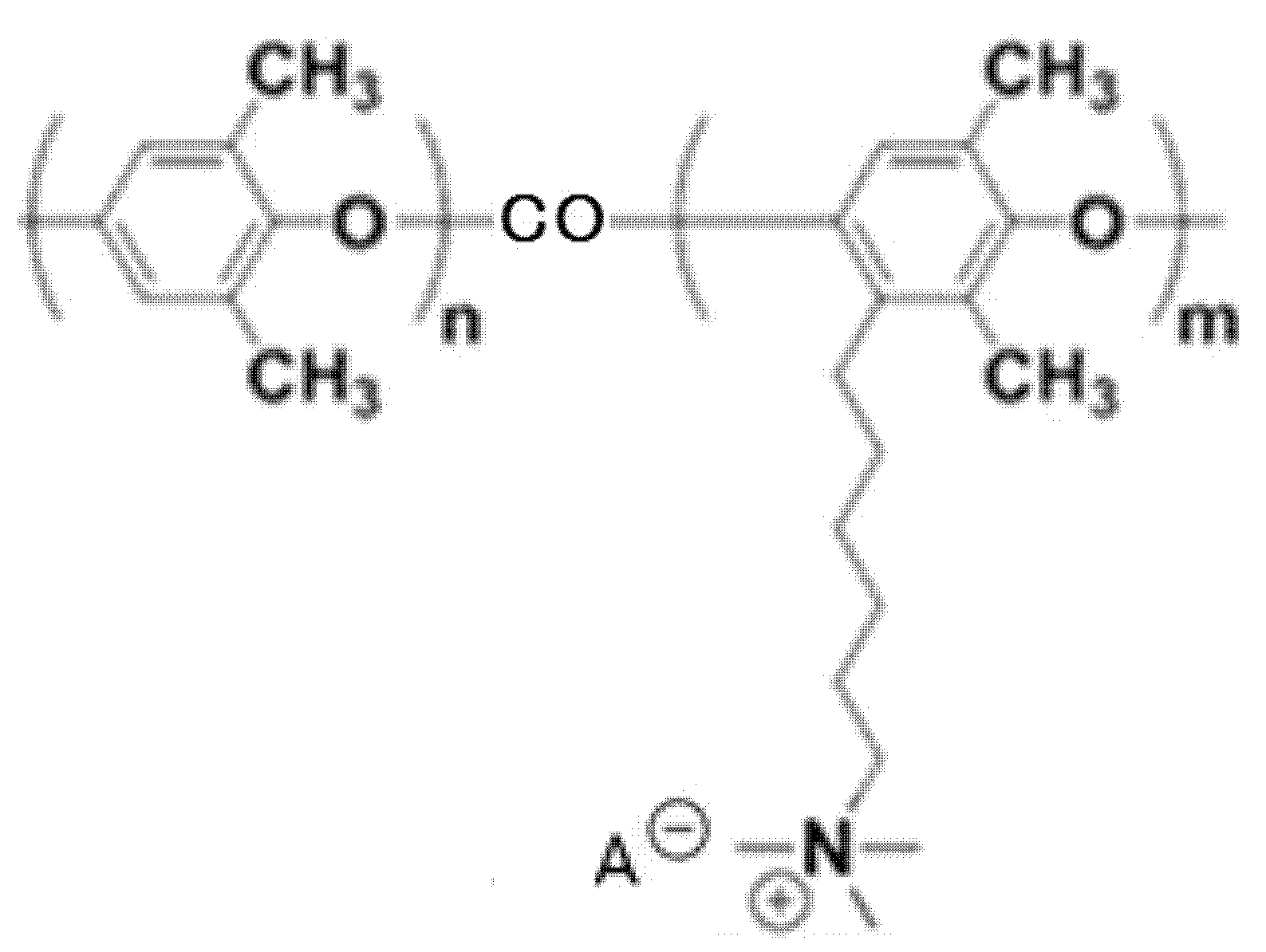
- Such a polymer may be any one of the following Chemical Formulas 1-3.
- the following polymers may have, for example, a molecular weight of 10,000 to 500,000, and an example of a molecular weight of 50,000 to 300,000.
- n is an integer from 0 to 10000
- m is an integer from 2 to 10000
- l 1 is an integer from 1 to 4
- 1 2 is an integer from 1 to 3
- R 1 is independently of each other hydrogen, a substituted or unsubstituted C1 to C4 alkyl group, or a substituted or unsubstituted C3 to C12 aryl group,
- R 2 is hydrogen, a substituted or unsubstituted C1 to C4 alkyl group, or a substituted or unsubstituted C3 to C12 aryl group, independently of each other,
- R 3 is a bond, carbonyl group, carboxyl group, amide group, substituted or unsubstituted C1 to C12 alkylene group, substituted or unsubstituted C1 to C12 alkylenecarbonyl group, substituted or unsubstituted C1 to C12 carbonyl Alkylene group, substituted or unsubstituted C1 to C12 alkylene carboxyl group, substituted or unsubstituted C1 to C12 carboxyalkylene group, substituted or unsubstituted C1 to C12 alkyleneamide group, substituted or unsubstituted C1 to C12 amidealkylene group, substituted or unsubstituted C3 to C12 arylene group, substituted or unsubstituted C3 to C12 arylenecarbonyl group, substituted or unsubstituted C3 to C12 carbonylarylene group, substituted or unsubstituted Substituted C3 to C12 arylene carboxy
- IG may be a group including an ionic functional group, and specifically, a sulfonate group, a carboxylate group, an ammonium group, an azanide group, a phosphonate group, a phosphate group, or a zwitter ion group in which two of them are connected. group).
- the IG may further comprise counter ions for the ionic functional group.
- the repeating unit of Chemical Formula 1 may be represented by the following Chemical Formulas 1A or 1B.
- n, m, l 1 , 1 2 , R 1 , R 2 , and R 3 may be the same as defined in Formula 1, and A + may be absent, H + , or Ag +. have.
- n, m, l 1 , 1 2 , R 1 , R 2 , and R 3 may be the same as defined in Formula 1, and R 4 may be substituted or unsubstituted C1 regardless of each other.
- a ⁇ may be absent or Cl ⁇ , Br ⁇ , or I ⁇ .
- polymer of Formula 1A may be a polymer represented by Formula 1A_1.
- n and A + may be the same as defined in Formula 1A.
- polymer of Formula 1B may be a polymer represented by Formula 1B_1, Formula 1B_2, or Formula 1B_3.
- n and A ⁇ may be the same as defined in Formula 1B.
- n, m, and A ⁇ may be the same as defined in Formula 1B.
- n, m, and A ⁇ may be the same as defined in Formula 1B.
- n is an integer from 0 to 10000
- n 2 to 10000
- R a1 , R a2 , R b1 , And R b2 is hydrogen, a substituted or unsubstituted C1 to C12 alkyl group, or a substituted or unsubstituted C3 to C12 aryl group, irrespective of each other,
- R a3 may be a substituted or unsubstituted C1 to C12 alkyl group, a substituted or unsubstituted C3 to C12 aryl group, or a substituted or unsubstituted C1 to C12 alkylcarboxy group.
- the substituted C1 to C12 alkylcarboxyl group may be a C1 to C12 hydroxyalkylcarboxyl group.
- R b3 is a bond, carbonyl group, carboxyl group, amide group, substituted or unsubstituted C1 to C12 alkylene group, substituted or unsubstituted C1 to C12 alkylenecarbonyl group, substituted or unsubstituted C1 to C12 carbonyl Alkylene group, substituted or unsubstituted C1 to C12 alkylene carboxyl group, substituted or unsubstituted C1 to C12 carboxyalkylene group, substituted or unsubstituted C1 to C12 alkyleneamide group, substituted or unsubstituted C1 to C12 amidealkylene group, substituted or unsubstituted C3 to C12 arylene group, substituted or unsubstituted C3 to C12 arylenecarbonyl group, substituted or unsubstituted C3 to C12 carbonylarylene group, substituted or unsubstituted Substituted C3 to C12 arylene
- IG may be a group including an ionic functional group, and specifically, may include a sulfonate group, a carboxylate group, an ammonium group, an azanide group, a phosphonate group, a phosphate group, or a zwitter ion group to which two of them are connected. have.
- the IG may further comprise counter ions to the ionic functional group.
- the polymer of Chemical Formula 2 may be represented by the following Chemical Formula 2A.
- R a1 , R a2 , R a3 , R b1 , R b2 , and IG may be the same as defined in Formula 2, and R b3 ′ is a bond, a carbonyl group, a carboxyl group, an amide group, a substitution or It may be an unsubstituted C1 to C6 alkylene group, or a substituted or unsubstituted C3 to C6 arylene group.
- the polymer of Formula 2A may be represented by the following Formulas 2A_1, 2A_2, 2A_3, or 2A_4.
- n, m, R a1 , R a2 , R b1 , R b2 , and R b3 ′ may be the same as defined in Formula 2A, and A + may be absent, H + , or Ag + .
- n, m, R a1 , R a2 , R b1 , R b2 , and R b3 ′ may be the same as defined in Formula 2A, and R b4 is a substituted or unsubstituted C1 to C4 alkyl group irrespective of each other.
- a ⁇ may be absent or Cl ⁇ , Br ⁇ , or I ⁇ .
- R a4 is a substituted or unsubstituted C1 to C12 alkyl group as one example. It may be a C1 to C12 hydroxyalkyl group, A + may be absent, H + , or Ag + .
- R a4 is a substituted or unsubstituted C1 to C12 alkyl group, for example , C1 to C12 may be a hydroxyalkyl group, R b4 may be a substituted or unsubstituted C1 to C4 alkyl group irrespective of each other, and A ⁇ may be absent, Cl ⁇ , Br ⁇ , or I ⁇ .
- the polymer of Chemical Formula 2 may be represented by the following Chemical Formula 2B or Chemical Formula 2C.
- R a4 is a substituted or unsubstituted C1 to C12 alkyl group, for example, It may be a hydroxyalkyl group of C1 to C12, A + may be Ag + .
- polymer of Formula 2B may be a polymer represented by Formula 2B_1.
- n and m may be the same as defined in Formula 2B.
- R a4 is a substituted or unsubstituted C1 to C12 alkyl group, for example, It may be a C1 to C12 hydroxyalkyl group, A + may be absent, H + , or Ag + , A - may be absent, Cl ⁇ , Br ⁇ , or I ⁇ .
- polymer of Formula 2C may be a polymer represented by the following Formula 2C_1.
- n, m, A + , and A ⁇ may be the same as defined in Formula 2C, and R a4 may be an ethyl group or a hydroxy group.
- l is an integer from 0 to 10000
- n is an integer from 1 to 10000
- n1 and m2 are integers where m1 + m2 satisfies 1 to 10000,
- R a1 , R a2 , R b1 , R b2 , R c1 , R c2 , R d1 , R d2 is hydrogen, a substituted or unsubstituted C1 to C12 alkyl group, or a substituted or unsubstituted C3 to C12 aryl group, irrespective of each other,
- R a3 and R c3 are each independently a substituted or unsubstituted C1 to C12 alkyl group, a substituted or unsubstituted C3 to C12 aryl group, or a substituted or unsubstituted C1 to C12 alkylcarboxy group,
- R b3 and R d3 are each independently a bond, a carbonyl group, a carboxy group, an amide group, a substituted or unsubstituted C1 to C12 alkylene group, a substituted or unsubstituted C1 to C12 alkylenecarbonyl group, a substituted or unsubstituted Substituted C1 to C12 carbonylalkylene group, substituted or unsubstituted C1 to C12 alkylene carboxyl group, substituted or unsubstituted C1 to C12 carboxyalkylene group, substituted or unsubstituted C1 to C12 alkyleneamide group, Substituted or unsubstituted C1 to C12 amidealkylene group, substituted or unsubstituted C3 to C12 arylene group, substituted or unsubstituted C3 to C12 arylenecarbonyl group, substituted or unsubstituted C3 to C12 carbonyl A
- IG 1 and IG 2 may be a group including an ionic functional group, specifically, a sulfonate group, a carboxylate group, an ammonium group, an azanide group, a phosphonate group, a phosphate group, or a zwitter to which two of them are connected It may include an ionic group.
- IG 1 and IG 2 may further comprise counter ions to the ionic functional group.
- the polymer of Chemical Formula 3 may be represented by the following Chemical Formula 3A.
- R b3 ′ is a bond, a carbonyl group, a carboxyl group, an amide group, a substituted or unsubstituted C1 to C6 alkylene group, or a substituted or unsubstituted C3 to C6 May be an arylene group
- R c3 ′ may be a substituted or unsubstituted C1 to C12 alkyl group
- R b4 is a substituted or unsubstituted C1 to C4 alkyl group independently of each other
- a ⁇ is Cl ⁇ , Br -, or I - can work.
- the preparation of such polymeric nonwoven web can be carried out using an electrospinning method. Specifically, after preparing the spinning solution by dissolving the above-described polymer in a solvent, the spinning solution may be put in a syringe connected to the needle to apply an electric field between the needle and the collector, to electrospin the fibers onto the collector.
- an electrospinning method a nonwoven web in which nanofibers having a diameter of 100 nm or more and less than 1000 nm can be randomly entangled.
- a copolymer of a unit having an ionic functional group and a unit having no ionic functional group may be used (in Formula 1 or Formula 2, n is an integer of 1 or more, and the sum of l and n in Formula 3 is an integer of 1 or more). Occation).
- l: m1 + m2: n may be about 1: 1: 2, specifically, in Formula 3A, l: m1: n may be about 1: 1: 2. Meanwhile, n: m in Formula 2 or Formula 1 may be 7: 3, and specifically, n: m in Formula 2c-1 may be 7: 3.
- the reverse of Ag + or I - which may have antimicrobial properties by immersing the nonwoven web in an ion exchange solution such as AgNO 3 or KI solution. Ions can be introduced.
- the nonwoven web may be heat treated or ultraviolet treated or crosslinked after introducing an additional crosslinking agent into the nonwoven web.
- the mechanical strength of the nonwoven web can be further improved.
- FIG. 2 is a schematic view showing a cross-section of a breathing mask according to another embodiment of the present invention. Specifically, FIG. 2 shows the filter member in the respiratory mask.
- the breathing mask according to the present embodiment may be a dust mask, a yellow dust mask, a fine dust mask, or the like as a protective device for covering the nose and mouth of a person.
- the respirator mask may include a base layer 10, a cover layer 30, and a polymer nonwoven web 20 disposed therebetween.
- the polymer nonwoven web 20 may be the polymer nonwoven web described above.
- the polymeric nonwoven web 20 may be a layer formed by electrospinning on the base layer 10.
- One of the base layer 10 and the cover layer 30 may be an inner skin layer that contacts the user's skin and the other may be an outer skin layer that is exposed to the outside.
- the cover layer 30 may be an inner skin layer
- the base layer 10 may be an outer skin layer.
- the inner layer may be a nonwoven fabric formed of natural fibers or synthetic fibers with less skin irritation and excellent breathability.
- the outer layer is formed of the same material as the inner layer or a synthetic fiber having a mechanical strength sufficient to protect the polymeric nonwoven web 20, for example, a nonwoven fabric formed of polyethylene terephthalate, polyethylene fiber or polypropylene fiber. Can be.
- the fibers forming the base layer 10 and the cover layer 30 may have a diameter in micro units. Therefore, although the particles may be filtered in the base layer 10 and the cover layer 30, the fine dust may be mainly filtered in the polymer nonwoven web 20.
- MMA methyl methacrylate
- VBC vinylbenzyl chloride
- styrene a polymerization initiator (benzoyl peroxide) was added thereto.
- a polymerization initiator benzoyl peroxide
- the obtained co-polymer was precipitated, washed, dried in an oven at 60 ° C. to obtain an intermediate.
- the co-polymer was subjected to an amine reaction with trimethyl amine (TMA) to obtain polymer A (number average molecular weight 200,000 to 300,000 molecular weight, ion exchange capacity 1.40 meq / g).
- TMA trimethyl amine
- FIG. 4 is a Fourier-transform infrared spectroscopy (FT-IR) graph of the polymer A obtained in Polymer Synthesis Example 1.
- FIG. 4 is a Fourier-transform infrared spectroscopy (FT-IR) graph of the polymer A obtained in Polymer Synthesis Example 1.
- polymer A was synthesized as peaks related to N-H stretch vibration and C-N stretch vibration were identified.
- PPO polyphenylene oxide
- Chlorosulfonic acid was slowly added dropwise to this PPO solution.
- Polymer B synthesized through the reaction was obtained through precipitation.
- the polymer B was washed with deionized water and filtered, and then dried in an oven at 60 ° C. for at least 24 hours. (Number average molecular weight 50,000 to 60,000, ion exchange capacity 1.70 meq / g).
- FIG. 5 is a 1 H-NMR (nuclear magnetic resonance) graph measured under DMSO-d6 solvent of Polymer B obtained in Polymer Synthesis Example 2.
- FIG. 5 is a 1 H-NMR (nuclear magnetic resonance) graph measured under DMSO-d6 solvent of Polymer B obtained in Polymer Synthesis Example 2.
- the polymer B was synthesized as a peak indicating the sulfonic acid group shown on the 1 H-NMR graph was confirmed.
- FIG. 6 is a Fourier-transform infrared spectroscopy (FT-IR) graph of Polymer B obtained in Polymer Synthesis Example 2.
- FT-IR Fourier-transform infrared spectroscopy
- the polymer B is synthesized according to the peaks related to the wagging, asymmetric stretching, and symmetric stretching of the sulfonic acid group.
- HEMA hydroxyethyl methacrylate
- MPC 2-methacryloyloxyethyl phosphorylcholine
- FIG. 7 is a 1 H-NMR graph measured in the solvent of dimethyl sulfoxide-d6 of Polymer C obtained in Polymer Synthesis Example 3.
- FIG. 7 is a 1 H-NMR graph measured in the solvent of dimethyl sulfoxide-d6 of Polymer C obtained in Polymer Synthesis Example 3.
- FIG. 8 is an FT-IR graph of the polymer C obtained in Polymer Synthesis Example 3.
- polymer C was synthesized as the PO stretch vibration and N (CH 3 ) 3 stretching vibration related peaks were confirmed.
- Polymer A obtained in Polymer Preparation Example 1 was dissolved in DMAc at a concentration of 20 wt% to obtain a spinning solution.
- This spinning solution was filled into the syringe of the spinning device.
- the syringe was connected with a 23 gauge needle.
- a 13 kV bias potential is applied between the needle and the collector using a voltage power supply, and the spinning solution is deposited on the base layer at a rate of 0.6 mL / h.
- Electrospinning formed a polymeric nonwoven web A having a thickness of about 40 ⁇ m.
- Polymer B obtained in Polymer Preparation Example 2 was dissolved in DMAc at a concentration of 20 wt% to obtain a spinning solution.
- This spinning solution was filled in a syringe of a spinning device.
- the syringe was connected with a 23 gauge needle.
- After placing the base layer (PET) on the collector of the spinning device apply a 15 kV bias potential between the needle and the collector using the power supply, and electrospin the spinning solution on the base layer at a rate of 0.9 mL / h to about 40
- a polymeric nonwoven web B having a thickness of ⁇ m was formed.
- Polymer C obtained in Polymer Preparation Example 3 was dissolved in DMF (dimethylformamide) at a concentration of 20 wt% to obtain a spinning solution.
- This spinning solution was filled in a syringe of a spinning device.
- the syringe was connected with a 23 gauge needle.
- a polymeric nonwoven web C having a thickness of 40 ⁇ m was formed.
- polymeric nonwoven webs according to Polymer Nonwoven Web Preparation Examples 1, 2, and 3 have fibers having a diameter of 400 to 600 nm.
- Antimicrobial polymer Nonwoven web Production Example 1 I - Ion-Introduced Polymer Nonwoven web A
- Polymer Nonwoven Web The polymer nonwoven web A according to Preparation Example 1 was immersed in an ion exchange solution (0.1 M KI solution) for 24 hours to ionically bind I-ion to the quaternary amine cation of the polymer nonwoven web A. It was then immersed in purified water for 24 hours to remove excess ion exchange solution left in the nonwoven web and dried in an oven at 30 ° C.
- an ion exchange solution 0.1 M KI solution
- Polymer nonwoven web The polymer nonwoven web B according to Preparation Example 2 was immersed in an ion exchange solution (0.1M AgNO 3 solution) for 24 hours, and Ag + ions were ion-bonded to the sulfonic acid anion of the polymeric nonwoven web B. It was then immersed in purified water for 24 hours to remove excess ion exchange solution left in the filter, and dried in an oven at 30 °C.
- an ion exchange solution 0.1M AgNO 3 solution
- Polymer nonwoven web The polymer nonwoven web C according to Preparation Example 3 was immersed in an ion exchange solution (0.1M AgNO 3 solution) for 24 hours, and Ag + ions were ion-bonded to the phosphate anion of the polymer nonwoven web C. It was then immersed in purified water for 24 hours to remove excess ion exchange solution left in the filter, and dried in an oven at 30 °C.
- an ion exchange solution 0.1M AgNO 3 solution
- FIG. 12 is a graph showing the results of EDS (Energy Dispersive X-ray Spectroscopy) analysis of the polymer nonwoven web A according to Preparation Example 1 of the antimicrobial polymer nonwoven web
- FIG. 13 is the polymer nonwoven web B of the Preparation Example 2 of the antimicrobial polymer nonwoven web
- Figure 14 is a graph showing the results of EDS analysis
- Figure 14 is a graph showing the results of EDS analysis for the polymer nonwoven web C according to the antimicrobial polymer nonwoven web Preparation Example 3.
- PET cover layer
- the filters vary air permeability values depending on the difference in packing density (shown in the tables below).
- the base layer and the cover layer used in the polymer nonwoven web production examples have pores wide enough to not affect the dust collection efficiency or the face intake resistance.
- the flow rate through the test mask was also used to values similar to human breath, ie 20 liters per minute (LPM). At this time, except for 1 LPM of aerosol flow rate, 19 LPM of clean air from which both water and particles were removed.
- LPM liters per minute
- the particle number before and after passing the test mask was measured using a condensation particle counter (TSI3772, TSI).
- the pressure drop (unit: mmH 2 O) was measured when 30 LPM of clean air from which both moisture and particles were removed was passed at a continuous flow rate.
- Table 1 shows the air permeability, dust collection efficiency, and face intake resistance of the filters 1-1 and 1-2, and the filter according to the comparative example.
- Filters 1-1 and 1-2 are filters in which the polymer nonwoven web according to Preparation Example 1 of the polymer nonwoven web differs only in packing density, that is, air permeability.
- Filters 2-1 and 2-2 are filters in which the polymer nonwoven web according to Preparation Example 2 of the polymer nonwoven web differs only in packing density, that is, air permeability.
- Table 3 shows the air permeability, dust collection efficiency, and face intake resistance of the filters 3-1 and 3-2, and the filters according to the comparative examples.
- Filters 3-1 and 3-2 are filters in which the polymer nonwoven web according to Preparation Example 3 of the polymer nonwoven web differs only in packing density, that is, air permeability.
- FIG. 15 is a graph showing dust collection efficiency and face intake resistance of filters 1-1, 1-2, and filters according to Comparative Examples.
- FIG. 15 is a graph showing dust collection efficiency and face intake resistance of filters 1-1, 1-2, and filters according to Comparative Examples.
- the air permeability value is lowered from the filter 1-1 to the filter 1-2 and thus the pore size is reduced.
- both dust collection efficiency and pressure drop ie face intake resistance
- Filter 1-1 removed 300 nm, 200 nm, and 100 nm sodium chloride particles, respectively 96.401%, 80.687%, and 77.505%, respectively, and the face intake resistance was 1 mmH 2 O.
- 300nm, 200nm, and 100nm sodium chloride particles showed high dust collection efficiency of more than 90%, and the face intake resistance was low as 4mmH 2 O.
- 16 is a graph showing dust collection efficiency and face intake resistance of filters 2-1, 2-2, and filters according to Comparative Examples.
- the air permeability value is lowered from the filter 2-1 to the filter 2-2, thereby decreasing the pore size.
- pressure drop ie, facial intake resistance
- filter 2-1 removed 93.550%, 92.270% and 87.743% of 300 nm, 200 nm, and 100 nm sodium chloride particles, respectively, and the face intake resistance was 2 mmH 2 O.
- the 300 nm, 200 nm, and 100 nm sodium chloride particles showed high dust collection efficiency of 90% or more, and the face intake resistance was as low as 2 mmH 2 O.
- 17 is a graph showing the dust collection efficiency and the pressure drop value of the filter 3-1, the filter 3-2, and the filter according to the comparative example.
- the air permeability value is lowered from the filter 3-1 to the filter 3-2 and thus the pore size is reduced.
- dust collection efficiency increased, and pressure drop (ie, face intake resistance) increased.
- filter 3-1 removed 97.317%, 94.319%, and 84.159% of 300 nm, 200 nm, and 100 nm sodium chloride particles, respectively, and the face intake resistance was 2 mmH 2 O.
- the face intake resistance was low as 3 mmH 2 O.
- the filter according to the comparative examples in Tables 1 to 3 and FIGS. 15 to 17 is a commercially available mask filter, and has a large pore size because the fiber diameter is about 2 to 3 ⁇ m and produced by the melt blown method. Therefore, in order to improve the particle removal efficiency, the size of the pores should be reduced.
- the filter manufactured by the melt blown method stacks the fibers thickly (thickness of the filter itself: 110 ⁇ m).
- all of the 300 nm, 200 nm, and 100 nm sodium chloride particles showed low dust collection efficiency compared to the functional polymer nonwoven web according to the present invention, and the face intake resistance was high as 5 mmH 2 O.
- the polymer nonwoven web ie, the respiratory mask, manufactured through the experimental examples according to the present invention has a high dust removal efficiency and has a moderate level of pressure drop, that is, a face portion intake resistance.
- the polymeric nonwoven web consists of a functional polymer containing an ionic functional group.
- conventional filters filter (physical filtering) particles larger than pore size.
- the polymer nonwoven web according to the present embodiment since the ionic functional group is exposed on the fiber surface, while filtering the particles larger than the pore size, even if the particles smaller than the pore size exhibits ionic properties of the particles and the fiber surface Chemical filtering is also possible, which filters the particles by the attraction between the ionic functional groups.
- the particles can be filtered by electrostatic attraction.
- the pore size may not be reduced to match the size of the fine particles (the pore sizes of the filters 1-1 and 1-2 are 1 to 1.5 ⁇ m, the filter The pore size of the 2-1 and 2-2 is 0.9 to 1.1um, the pore size of the filter 3-1 and 3-2 is 0.9 to 1.8um), the pressure drop across the filter, that is, the face intake resistance can be low.
- the polymer nonwoven web produced through the present embodiment is not only yellow dust and fine dust (PM10, 2.5 ⁇ m ⁇ diameter ⁇ 10 ⁇ m) but also ultra fine dust (PM2.5, diameter ⁇ 2.5 ⁇ m), in particular less than 1 ⁇ m It is suitable for use as a respirator mask filter fabric that can remove even ultrafine dust.
- the antimicrobial properties of the polymer nonwoven webs A, B, and C obtained through Production Examples 1, 2, and 3 of the antimicrobial polymer nonwoven web were evaluated as bacteriostatic values according to the KSK0693 standard. Staphylococcus aureus and pneumococci were each incubated for 18 hours in the culture medium itself (control) and in the polymer nonwoven web containing the culture solution.
- FIG. 18 is a photograph showing the results of culturing Staphylococcus aureus in the culture medium itself (A) and the polymer nonwoven web A (B) containing the culture medium, and FIG. The photographs show the results of incubation on nonwoven web A (B).
- the amount of bacteria is very small in the polymer nonwoven web A (B) containing iodine ions according to the experimental example of the present invention.
- the polymer nonwoven web A (B) according to the experimental example of the present invention showed an antimicrobial effect reduced by more than 99% for Staphylococcus aureus and pneumococci, respectively.
- FIG. 20 is a photograph showing the results of culturing Staphylococcus aureus in the culture medium itself (A) and the polymer nonwoven web B (B) containing the culture medium, and FIG. The photographs show the results of incubation in nonwoven web B (B).
- the amount of bacteria is very small in the polymer nonwoven web B (B) containing silver ions according to the experimental example of the present invention.
- the polymer nonwoven web B (B) according to the experimental example of the present invention showed an antimicrobial effect reduced by at least 99.9% against Staphylococcus aureus and pneumococci, respectively.
- FIG. 22 is a photograph showing the results of culturing Staphylococcus aureus in the culture medium itself (A) and the polymer nonwoven web C (B) containing the culture medium, and FIG. The photographs show the results of incubation on nonwoven web C (B).
- the amount of bacteria is very small in the polymer nonwoven web C (B) containing silver ions according to the experimental example of the present invention.
- the polymer nonwoven web C (B) according to the experimental example of the present invention showed an antimicrobial effect reduced by more than 99.9% against Staphylococcus aureus and pneumococci, respectively.
Landscapes
- Chemical & Material Sciences (AREA)
- Chemical Kinetics & Catalysis (AREA)
- Life Sciences & Earth Sciences (AREA)
- Organic Chemistry (AREA)
- Health & Medical Sciences (AREA)
- Engineering & Computer Science (AREA)
- Textile Engineering (AREA)
- General Health & Medical Sciences (AREA)
- Medicinal Chemistry (AREA)
- Polymers & Plastics (AREA)
- Zoology (AREA)
- Environmental Sciences (AREA)
- Pest Control & Pesticides (AREA)
- Plant Pathology (AREA)
- Dentistry (AREA)
- Wood Science & Technology (AREA)
- Agronomy & Crop Science (AREA)
- Inorganic Chemistry (AREA)
- Analytical Chemistry (AREA)
- Business, Economics & Management (AREA)
- Emergency Management (AREA)
- General Chemical & Material Sciences (AREA)
- Pulmonology (AREA)
- Toxicology (AREA)
- Filtering Materials (AREA)
- Nonwoven Fabrics (AREA)
Abstract
Description




| 비교예 | 필터 1-1 | 필터 1-2 | ||
| 고분자 종류 | - | 고분자 A | 고분자 A | |
| 공기투과도 (cfm@125Pa) | - | 15 | 5 | |
| 기공 크기 (㎛) | - | 1.5 | 1.0 | |
| 분진포집효율 (%) | 100 nm | 82.554 | 82.286 | 89.477 |
| 200 nm | 78.238 | 96.384 | 98.630 | |
| 300 nm | 84.937 | 99.124 | 99.751 | |
| 안면부 흡기저항 (mmH2O) | 5 | 1 | 2 | |
| 비교예 | 필터 2-1 | 필터 2-2 | ||
| 고분자 종류 | - | 고분자 B | 고분자 B | |
| 공기투과도 (cfm@125Pa) | - | 13 | 3 | |
| 기공 크기 (㎛) | - | 1.1 | 0.9 | |
| 분진포집효율 (%) | 100 nm | 82.554 | 87.743 | 93.550 |
| 200 nm | 78.238 | 92.270 | 95.140 | |
| 300 nm | 84.937 | 93.550 | 95.176 | |
| 안면부 흡기저항 (mmH2O) | 5 | 2 | 2 | |
| 비교예 | 필터 3-1 | 필터 3-2 | ||
| 고분자 종류 | - | 고분자 C | 고분자 C | |
| 공기투과도 (cfm@125Pa) | - | 15 | 4 | |
| 기공 크기 (㎛) | - | 1.8 | 0.9 | |
| 분진포집효율 (%) | 100 nm | 82.554 | 84.159 | 91.708 |
| 200 nm | 78.238 | 94.319 | 97.509 | |
| 300 nm | 84.937 | 97.317 | 98.608 | |
| 안면부 흡기저항 (mmH2O) | 5 | 2 | 3 | |
Claims (18)
- 주쇄 또는 측쇄에 이온성 작용기를 갖고,나노미터 범위의 직경을 갖는 고분자 섬유로 형성된 고분자 부직웹.
- 제1항에 있어서,상기 이온성 작용기는설포네이트기, 암모늄기, 아자나이드기, 포스페이트기, 또는 이들 중 두 개가 연결된 쯔비터 이온기를 포함하는 고분자 부직웹.
- 제2항에 있어서,상기 암모늄기는 4차 암모늄기인 고분자 부직웹.
- 제2항에 있어서,상기 아자나이드기를 포함하는 이온성 작용기는 설파다이아지닐기(sulfadiazinyl group)인 고분자 부직웹.
- 제2항에 있어서,상기 쯔비터 이온기를 포함하는 이온성 작용기는 포스포릴콜린 기(phosphorylcholine group)인 고분자 부직웹.
- 제1항에 있어서,상기 이온성 작용기의 전하에 대해 반대부호의 전하를 갖는 반대 이온으로서, Ag+ 또는 I-를 더 함유하는 고분자 부직웹.
- 제1항에 있어서,상기 고분자는 폴리스티렌, 폴리메틸메타크릴레이트, 폴리아릴렌에테르, 폴리우레탄 또는 이들 중 둘 이상의 공중합체인 고분자 부직웹.
- 제1항에 있어서,상기 고분자는 이온성 작용기를 구비하는 단위체와 이온성 작용기를 구비하지 않는 단위체의 공중합체인 고분자 부직웹.
- 제8항에 있어서,상기 단위체들은 서로에 관계없이 스티렌계 단위체, 메틸메타크릴레이트계 단위체, 아릴렌에테르계 단위체, 또는 우레탄계 단위체인 고분자 부직웹.
- 제1항에 있어서,상기 고분자는 하기 화학식 1에 나타낸 고분자인 고분자 부직웹:[화학식 1]
 상기 화학식 1에서,n은 0 내지 10000의 정수이고,m은 2 내지 10000의 정수이고,l1은 1 내지 4의 정수이고,12는 1 내지 3의 정수이고,R1은 서로에 관계없이 수소, 치환 또는 비치환된 C1 내지 C4의 알킬기, 또는 치환 또는 비치환된 C3 내지 C12의 아릴기이고,R2은 서로에 관계없이 수소, 치환 또는 비치환된 C1 내지 C4의 알킬기, 또는 치환 또는 비치환된 C3 내지 C12의 아릴기이고,R3는 결합, 카보닐기, 카르복시기, 아미드기, 치환 또는 비치환된 C1 내지 C12의 알킬렌기, 치환 또는 비치환된 C1 내지 C12의 알킬렌카보닐기, 치환 또는 비치환된 C1 내지 C12의 카보닐알킬렌기, 치환 또는 비치환된 C1 내지 C12의 알킬렌카르복시기, 치환 또는 비치환된 C1 내지 C12의 카르복시알킬렌기, 치환 또는 비치환된 C1 내지 C12의 알킬렌아미드기, 치환 또는 비치환된 C1 내지 C12의 아미드알킬렌기, 치환 또는 비치환된 C3 내지 C12의 아릴렌기, 치환 또는 비치환된 C3 내지 C12의 아릴렌카보닐기, 치환 또는 비치환된 C3 내지 C12의 카보닐아릴렌기, 치환 또는 비치환된 C3 내지 C12의 아릴렌카르복시기, 치환 또는 비치환된 C3 내지 C12의 카르복시아릴렌기, 치환 또는 비치환된 C3 내지 C12의 아릴렌아미드기, 치환 또는 비치환된 C3 내지 C12의 아미드아릴렌기, 치환 또는 비치환된 C4 내지 C12의 아릴렌알킬기, 또는 치환 또는 비치환된 C4 내지 C12의 알킬렌아릴기이고,IG는 설포네이트기, 카르복실레이트기, 암모늄기, 아자나이드기, 포스포네이트기, 포스페이트기, 또는 이들 중 두 개가 연결된 쯔비터 이온기를 포함하는 이온성 작용기이다.
 - 제1항에 있어서,상기 고분자는 하기 화학식 2에 나타낸 고분자인 고분자 부직웹:[화학식 2]
 상기 화학식 2에서,n은 0 내지 10000의 정수이고,m은 2 내지 10000의 정수이고,Ra1, Ra2, Rb1, 및 Rb2는 서로에 관계없이 수소, 치환 또는 비치환된 C1 내지 C12의 알킬기, 또는 치환 또는 비치환된 C3 내지 C12의 아릴기이고,Ra3는 치환 또는 비치환된 C1 내지 C12의 알킬기, 치환 또는 비치환된 C3 내지 C12의 아릴기, 또는 치환 또는 비치환된 C1 내지 C12의 알킬카르복시기이고,Rb3는 결합, 카보닐기, 카르복시기, 아미드기, 치환 또는 비치환된 C1 내지 C12의 알킬렌기, 치환 또는 비치환된 C1 내지 C12의 알킬렌카보닐기, 치환 또는 비치환된 C1 내지 C12의 카보닐알킬렌기, 치환 또는 비치환된 C1 내지 C12의 알킬렌카르복시기, 치환 또는 비치환된 C1 내지 C12의 카르복시알킬렌기, 치환 또는 비치환된 C1 내지 C12의 알킬렌아미드기, 치환 또는 비치환된 C1 내지 C12의 아미드알킬렌기, 치환 또는 비치환된 C3 내지 C12의 아릴렌기, 치환 또는 비치환된 C3 내지 C12의 아릴렌카보닐기, 치환 또는 비치환된 C3 내지 C12의 카보닐아릴렌기, 치환 또는 비치환된 C3 내지 C12의 아릴렌카르복시기, 치환 또는 비치환된 C3 내지 C12의 카르복시아릴렌기, 치환 또는 비치환된 C3 내지 C12의 아릴렌아미드기, 치환 또는 비치환된 C3 내지 C12의 아미드아릴렌기, 치환 또는 비치환된 C4 내지 C12의 아릴렌알킬기, 또는 치환 또는 비치환된 C4 내지 C12의 알킬렌아릴기이고,IG는 설포네이트기, 카르복실레이트기, 암모늄기, 아자나이드기, 포스포네이트기, 포스페이트기, 또는 이들 중 두 개가 연결된 쯔비터 이온기를 포함하는 이온성 작용기이다.
 - 제1항에 있어서,상기 고분자는 하기 화학식 3에 나타낸 고분자인 고분자 부직웹:[화학식 3]
 상기 화학식 3에서,l은 0 내지 10000의 정수이고,n은 1 내지 10000의 정수이고,m1과 m2는 m1 + m2가 1 내지 10000을 만족하는 정수들이고,Ra1, Ra2, Rb1, Rb2, Rc1, Rc2, Rd1, Rd2는 서로에 관계없이 수소, 치환 또는 비치환된 C1 내지 C12의 알킬기, 또는 치환 또는 비치환된 C3 내지 C12의 아릴기이고,Ra3 및 Rc3는 서로에 관계없이 치환 또는 비치환된 C1 내지 C12의 알킬기, 치환 또는 비치환된 C3 내지 C12의 아릴기, 또는 치환 또는 비치환된 C1 내지 C12의 알킬카르복시기이고,Rb3 및 Rd3는 서로에 관계없이 결합, 카보닐기, 카르복시기, 아미드기, 치환 또는 비치환된 C1 내지 C12의 알킬렌기, 치환 또는 비치환된 C1 내지 C12의 알킬렌카보닐기, 치환 또는 비치환된 C1 내지 C12의 카보닐알킬렌기, 치환 또는 비치환된 C1 내지 C12의 알킬렌카르복시기, 치환 또는 비치환된 C1 내지 C12의 카르복시알킬렌기, 치환 또는 비치환된 C1 내지 C12의 알킬렌아미드기, 치환 또는 비치환된 C1 내지 C12의 아미드알킬렌기, 치환 또는 비치환된 C3 내지 C12의 아릴렌기, 치환 또는 비치환된 C3 내지 C12의 아릴렌카보닐기, 치환 또는 비치환된 C3 내지 C12의 카보닐아릴렌기, 치환 또는 비치환된 C3 내지 C12의 아릴렌카르복시기, 치환 또는 비치환된 C3 내지 C12의 카르복시아릴렌기, 치환 또는 비치환된 C3 내지 C12의 아릴렌아미드기, 치환 또는 비치환된 C3 내지 C12의 아미드아릴렌기, 치환 또는 비치환된 C4 내지 C12의 아릴렌알킬기, 또는 치환 또는 비치환된 C4 내지 C12의 알킬렌아릴기이고,IG1 및 IG2는 서로에 관계없이 설포네이트기, 카르복실레이트기, 암모늄기, 아자나이드기, 포스포네이트기, 포스페이트기, 또는 이들 중 두 개가 연결된 쯔비터 이온기이다.
 - 제1항에 있어서,상기 섬유는 100 내지 900㎚의 직경을 갖는 고분자 부직웹.
- 제1항에 있어서,상기 고분자 부직웹은 기체 필터인 고분자 부직웹.
- 주쇄 또는 측쇄에 이온성 작용기를 갖는 고분자를 전기방사하여, 나노미터 범위의 직경을 갖는 고분자 섬유로 형성된 부직웹을 제조하는 단계를 포함하는 고분자 부직웹 제조방법.
- 제15항에 있어서,상기 이온성 작용기는 설포네이트기, 암모늄기, 아자나이드기, 포스페이트기, 또는 이들 중 두 개가 연결된 쯔비터 이온기를 포함하는 고분자 부직웹 제조방법.
- 제15항에 있어서,상기 부직웹을 이온교환용액에 침지하여, 상기 이온성 작용기의 전하에 대해 반대부호의 전하를 갖는 반대 이온인 Ag+ 또는 I-를 도입하는 단계를 더 포함하는 고분자 부직웹 제조방법.
- 베이스층;커버층; 및상기 베이스층과 상기 커버층 사이에 배치된 제1항의 고분자 부직웹을 구비하는 호흡 마스크.
Priority Applications (3)
| Application Number | Priority Date | Filing Date | Title |
|---|---|---|---|
| CN201680038375.4A CN107735522B (zh) | 2015-04-30 | 2016-04-29 | 具有离子官能团的聚合物非织造纳米网及含其的呼吸口罩 |
| US15/570,494 US20180185678A1 (en) | 2015-04-30 | 2016-04-29 | Polymer nonwoven nanoweb having ionic functional group and respirator mask comprising the same |
| KR1020177031484A KR101968039B1 (ko) | 2015-04-30 | 2016-04-29 | 이온성 기능기를 갖는 고분자 나노 부직웹 및 이를 구비하는 호흡 마스크 |
Applications Claiming Priority (2)
| Application Number | Priority Date | Filing Date | Title |
|---|---|---|---|
| KR10-2015-0061166 | 2015-04-30 | ||
| KR20150061166 | 2015-04-30 |
Publications (1)
| Publication Number | Publication Date |
|---|---|
| WO2016175608A1 true WO2016175608A1 (ko) | 2016-11-03 |
Family
ID=57199482
Family Applications (1)
| Application Number | Title | Priority Date | Filing Date |
|---|---|---|---|
| PCT/KR2016/004540 Ceased WO2016175608A1 (ko) | 2015-04-30 | 2016-04-29 | 이온성 기능기를 갖는 고분자 나노 부직웹 및 이를 구비하는 호흡 마스크 |
Country Status (4)
| Country | Link |
|---|---|
| US (1) | US20180185678A1 (ko) |
| KR (1) | KR101968039B1 (ko) |
| CN (1) | CN107735522B (ko) |
| WO (1) | WO2016175608A1 (ko) |
Families Citing this family (7)
| Publication number | Priority date | Publication date | Assignee | Title |
|---|---|---|---|---|
| KR101855683B1 (ko) * | 2015-06-01 | 2018-05-09 | 주식회사 아모그린텍 | 흡착 멤브레인이 내장된 마스크 |
| KR20190091652A (ko) | 2018-01-29 | 2019-08-07 | 금오공과대학교 산학협력단 | 유무기 하이브리드 나노섬유를 이용한 기능성 먼지제거 마스크 및 이의 제조방법 |
| CN111330355B (zh) * | 2020-02-28 | 2022-06-14 | 厦门理工学院 | 一种驻极纳米纤维高效过滤材料及其制备方法 |
| AU2021102029A4 (en) * | 2020-04-17 | 2021-06-10 | Kraton Polymers Research B.V. | Antimicrobial Face Mask |
| GB2601381A (en) * | 2020-11-30 | 2022-06-01 | Hardshell Uk Limted | Air filtration apparatus |
| CN113417076B (zh) * | 2021-06-23 | 2022-07-22 | 海南欣龙无纺股份有限公司 | 一种艾草整理熔喷布及其制备方法和应用 |
| KR102632849B1 (ko) | 2021-11-17 | 2024-02-06 | 한국과학기술연구원 | 나노섬유 매트, 나노섬유 매트 제조장치 및 방법 |
Citations (5)
| Publication number | Priority date | Publication date | Assignee | Title |
|---|---|---|---|---|
| US6204324B1 (en) * | 1995-04-03 | 2001-03-20 | Nof Corporation | Method for producing aqueous solution of polymer having phosphorylcholine groups |
| KR20090120360A (ko) * | 2008-05-19 | 2009-11-24 | 영남대학교 산학협력단 | 은이 함유된 고분자량 혼성배열 폴리비닐알코올 나노부직포의 제조방법 및 그 나노 부직포 |
| KR20110095511A (ko) * | 2010-02-19 | 2011-08-25 | 광주과학기술원 | 전기방사를 이용한 염제거막 제조방법 및 그에 의해 제조된 염제거막 |
| WO2012091087A1 (ja) * | 2010-12-29 | 2012-07-05 | 太陽化学株式会社 | 機能性素材含有マスク |
| KR20140137197A (ko) * | 2013-05-22 | 2014-12-02 | 주식회사 아모그린텍 | 술폰화된 나노 섬유 웹을 이용한 액체처리 케미컬 필터 및 그의 제조방법 |
Family Cites Families (2)
| Publication number | Priority date | Publication date | Assignee | Title |
|---|---|---|---|---|
| DE69728778D1 (de) * | 1996-09-19 | 2004-05-27 | Procter & Gamble | Weichspüler mit verbesserter leistung |
| JP3708398B2 (ja) * | 1999-10-21 | 2005-10-19 | 株式会社荏原製作所 | 分離機能性材料 |
-
2016
- 2016-04-29 US US15/570,494 patent/US20180185678A1/en not_active Abandoned
- 2016-04-29 CN CN201680038375.4A patent/CN107735522B/zh not_active Expired - Fee Related
- 2016-04-29 KR KR1020177031484A patent/KR101968039B1/ko active Active
- 2016-04-29 WO PCT/KR2016/004540 patent/WO2016175608A1/ko not_active Ceased
Patent Citations (5)
| Publication number | Priority date | Publication date | Assignee | Title |
|---|---|---|---|---|
| US6204324B1 (en) * | 1995-04-03 | 2001-03-20 | Nof Corporation | Method for producing aqueous solution of polymer having phosphorylcholine groups |
| KR20090120360A (ko) * | 2008-05-19 | 2009-11-24 | 영남대학교 산학협력단 | 은이 함유된 고분자량 혼성배열 폴리비닐알코올 나노부직포의 제조방법 및 그 나노 부직포 |
| KR20110095511A (ko) * | 2010-02-19 | 2011-08-25 | 광주과학기술원 | 전기방사를 이용한 염제거막 제조방법 및 그에 의해 제조된 염제거막 |
| WO2012091087A1 (ja) * | 2010-12-29 | 2012-07-05 | 太陽化学株式会社 | 機能性素材含有マスク |
| KR20140137197A (ko) * | 2013-05-22 | 2014-12-02 | 주식회사 아모그린텍 | 술폰화된 나노 섬유 웹을 이용한 액체처리 케미컬 필터 및 그의 제조방법 |
Also Published As
| Publication number | Publication date |
|---|---|
| CN107735522B (zh) | 2020-11-27 |
| US20180185678A1 (en) | 2018-07-05 |
| CN107735522A (zh) | 2018-02-23 |
| KR20170129952A (ko) | 2017-11-27 |
| KR101968039B1 (ko) | 2019-04-10 |
Similar Documents
| Publication | Publication Date | Title |
|---|---|---|
| WO2016175608A1 (ko) | 이온성 기능기를 갖는 고분자 나노 부직웹 및 이를 구비하는 호흡 마스크 | |
| EP0616831B1 (en) | Oily mist resistant electret filter media | |
| EP2004302B1 (en) | Electrets and compounds useful in electrets | |
| JP4440470B2 (ja) | フッ素化エレクトレット | |
| KR100885338B1 (ko) | 정전기 방지 조성물 | |
| WO2015016450A1 (ko) | 일렉트로블로운 또는 멜트블로운과, 전기방사를 이용한 다층 나노섬유 필터여재 및 이의 제조방법 | |
| WO2015084124A1 (ko) | 블록 공중합체 | |
| WO2015084125A1 (ko) | 블록 공중합체 | |
| WO2015084123A1 (ko) | 블록 공중합체 | |
| WO2015084120A1 (ko) | 단량체 및 블록 공중합체 | |
| WO2015084122A1 (ko) | 블록 공중합체 | |
| WO2015084130A1 (ko) | 블록 공중합체 | |
| WO2015053443A1 (ko) | 기재 양면에 나노섬유를 포함하는 필터 및 이의 제조방법 | |
| WO2014081228A1 (ko) | 내염소성이 우수한 고유량 수처리 분리막 | |
| WO2021015554A1 (ko) | 필터여재 및 이를 포함하는 복합필터 | |
| WO2020246802A1 (ko) | 전기집진장치 및 이의 제조방법 | |
| WO2016032299A1 (ko) | 단량체 염을 이용한 폴리이미드 제조방법 | |
| WO2014137095A1 (ko) | 내열성이 향상된 기재 양면 나노섬유 필터여재 및 이의 제조방법 | |
| EP1682247B1 (en) | Atmospheric plasma treatment of meltblown fibers used in filtration | |
| WO2020004857A1 (ko) | 플레이크 형상의 분말 코팅층을 포함하는 필터 및 이의 제조방법 | |
| WO2018105951A1 (ko) | 공기 청정 필터, 하이브리드 공기 청정 필터 및 공기 청정기 | |
| WO2022045675A1 (ko) | 지방족 폴리에스터 섬유로 이루어진 공기정화용 웹-필름 필터 및 이의 제조방법 | |
| WO2025075299A1 (ko) | 나노섬유 필터 및 그 제조 방법 | |
| WO2018147617A1 (ko) | 폴리아마이드-이미드 필름 및 이의 제조방법 | |
| WO2018208040A2 (ko) | 고성능의 유해물질 포집 필터 및 그의 제조 방법 |
Legal Events
| Date | Code | Title | Description |
|---|---|---|---|
| 121 | Ep: the epo has been informed by wipo that ep was designated in this application |
Ref document number: 16786794 Country of ref document: EP Kind code of ref document: A1 |
|
| ENP | Entry into the national phase |
Ref document number: 20177031484 Country of ref document: KR Kind code of ref document: A |
|
| NENP | Non-entry into the national phase |
Ref country code: DE |
|
| 32PN | Ep: public notification in the ep bulletin as address of the adressee cannot be established |
Free format text: NOTING OF LOSS OF RIGHTS PURSUANT TO RULE 112(1) EPC (EPO FORM 1205A DATED 05.02.2018) |
|
| 122 | Ep: pct application non-entry in european phase |
Ref document number: 16786794 Country of ref document: EP Kind code of ref document: A1 |