WO2016171035A1 - 湿気硬化型ウレタン組成物及び被覆材 - Google Patents
湿気硬化型ウレタン組成物及び被覆材 Download PDFInfo
- Publication number
- WO2016171035A1 WO2016171035A1 PCT/JP2016/061793 JP2016061793W WO2016171035A1 WO 2016171035 A1 WO2016171035 A1 WO 2016171035A1 JP 2016061793 W JP2016061793 W JP 2016061793W WO 2016171035 A1 WO2016171035 A1 WO 2016171035A1
- Authority
- WO
- WIPO (PCT)
- Prior art keywords
- moisture
- mass
- urethane
- curable urethane
- urethane composition
- Prior art date
- Legal status (The legal status is an assumption and is not a legal conclusion. Google has not performed a legal analysis and makes no representation as to the accuracy of the status listed.)
- Ceased
Links
Classifications
-
- C—CHEMISTRY; METALLURGY
- C08—ORGANIC MACROMOLECULAR COMPOUNDS; THEIR PREPARATION OR CHEMICAL WORKING-UP; COMPOSITIONS BASED THEREON
- C08G—MACROMOLECULAR COMPOUNDS OBTAINED OTHERWISE THAN BY REACTIONS ONLY INVOLVING UNSATURATED CARBON-TO-CARBON BONDS
- C08G18/00—Polymeric products of isocyanates or isothiocyanates
- C08G18/06—Polymeric products of isocyanates or isothiocyanates with compounds having active hydrogen
- C08G18/08—Processes
- C08G18/10—Prepolymer processes involving reaction of isocyanates or isothiocyanates with compounds having active hydrogen in a first reaction step
- C08G18/12—Prepolymer processes involving reaction of isocyanates or isothiocyanates with compounds having active hydrogen in a first reaction step using two or more compounds having active hydrogen in the first polymerisation step
-
- C—CHEMISTRY; METALLURGY
- C08—ORGANIC MACROMOLECULAR COMPOUNDS; THEIR PREPARATION OR CHEMICAL WORKING-UP; COMPOSITIONS BASED THEREON
- C08G—MACROMOLECULAR COMPOUNDS OBTAINED OTHERWISE THAN BY REACTIONS ONLY INVOLVING UNSATURATED CARBON-TO-CARBON BONDS
- C08G18/00—Polymeric products of isocyanates or isothiocyanates
- C08G18/06—Polymeric products of isocyanates or isothiocyanates with compounds having active hydrogen
- C08G18/08—Processes
- C08G18/16—Catalysts
-
- C—CHEMISTRY; METALLURGY
- C08—ORGANIC MACROMOLECULAR COMPOUNDS; THEIR PREPARATION OR CHEMICAL WORKING-UP; COMPOSITIONS BASED THEREON
- C08G—MACROMOLECULAR COMPOUNDS OBTAINED OTHERWISE THAN BY REACTIONS ONLY INVOLVING UNSATURATED CARBON-TO-CARBON BONDS
- C08G18/00—Polymeric products of isocyanates or isothiocyanates
- C08G18/06—Polymeric products of isocyanates or isothiocyanates with compounds having active hydrogen
- C08G18/28—Polymeric products of isocyanates or isothiocyanates with compounds having active hydrogen characterised by the compounds used containing active hydrogen
- C08G18/65—Low-molecular-weight compounds having active hydrogen with high-molecular-weight compounds having active hydrogen
- C08G18/66—Compounds of groups C08G18/42, C08G18/48, or C08G18/52
-
- C—CHEMISTRY; METALLURGY
- C08—ORGANIC MACROMOLECULAR COMPOUNDS; THEIR PREPARATION OR CHEMICAL WORKING-UP; COMPOSITIONS BASED THEREON
- C08G—MACROMOLECULAR COMPOUNDS OBTAINED OTHERWISE THAN BY REACTIONS ONLY INVOLVING UNSATURATED CARBON-TO-CARBON BONDS
- C08G18/00—Polymeric products of isocyanates or isothiocyanates
- C08G18/06—Polymeric products of isocyanates or isothiocyanates with compounds having active hydrogen
- C08G18/70—Polymeric products of isocyanates or isothiocyanates with compounds having active hydrogen characterised by the isocyanates or isothiocyanates used
- C08G18/72—Polyisocyanates or polyisothiocyanates
- C08G18/74—Polyisocyanates or polyisothiocyanates cyclic
- C08G18/75—Polyisocyanates or polyisothiocyanates cyclic cycloaliphatic
-
- C—CHEMISTRY; METALLURGY
- C08—ORGANIC MACROMOLECULAR COMPOUNDS; THEIR PREPARATION OR CHEMICAL WORKING-UP; COMPOSITIONS BASED THEREON
- C08G—MACROMOLECULAR COMPOUNDS OBTAINED OTHERWISE THAN BY REACTIONS ONLY INVOLVING UNSATURATED CARBON-TO-CARBON BONDS
- C08G18/00—Polymeric products of isocyanates or isothiocyanates
- C08G18/06—Polymeric products of isocyanates or isothiocyanates with compounds having active hydrogen
- C08G18/70—Polymeric products of isocyanates or isothiocyanates with compounds having active hydrogen characterised by the isocyanates or isothiocyanates used
- C08G18/72—Polyisocyanates or polyisothiocyanates
- C08G18/74—Polyisocyanates or polyisothiocyanates cyclic
- C08G18/76—Polyisocyanates or polyisothiocyanates cyclic aromatic
-
- C—CHEMISTRY; METALLURGY
- C09—DYES; PAINTS; POLISHES; NATURAL RESINS; ADHESIVES; COMPOSITIONS NOT OTHERWISE PROVIDED FOR; APPLICATIONS OF MATERIALS NOT OTHERWISE PROVIDED FOR
- C09D—COATING COMPOSITIONS, e.g. PAINTS, VARNISHES OR LACQUERS; FILLING PASTES; CHEMICAL PAINT OR INK REMOVERS; INKS; CORRECTING FLUIDS; WOODSTAINS; PASTES OR SOLIDS FOR COLOURING OR PRINTING; USE OF MATERIALS THEREFOR
- C09D175/00—Coating compositions based on polyureas or polyurethanes; Coating compositions based on derivatives of such polymers
- C09D175/04—Polyurethanes
- C09D175/08—Polyurethanes from polyethers
-
- C—CHEMISTRY; METALLURGY
- C09—DYES; PAINTS; POLISHES; NATURAL RESINS; ADHESIVES; COMPOSITIONS NOT OTHERWISE PROVIDED FOR; APPLICATIONS OF MATERIALS NOT OTHERWISE PROVIDED FOR
- C09D—COATING COMPOSITIONS, e.g. PAINTS, VARNISHES OR LACQUERS; FILLING PASTES; CHEMICAL PAINT OR INK REMOVERS; INKS; CORRECTING FLUIDS; WOODSTAINS; PASTES OR SOLIDS FOR COLOURING OR PRINTING; USE OF MATERIALS THEREFOR
- C09D7/00—Features of coating compositions, not provided for in group C09D5/00; Processes for incorporating ingredients in coating compositions
- C09D7/40—Additives
Definitions
- the present invention relates to a moisture curable urethane composition useful as a waterproof material.
- a two-component fast-curing polyurethane is disclosed (for example, see Patent Document 1).
- the fast-curing polyurethane is instantly cured by spray coating, so that large-area construction is easy, but there is a problem that handling is poor due to the need for large-scale machine operation and the fact that the reaction is too fast.
- the problems to be solved by the present invention are the test temperature 23 ° C., ⁇ 20 ° C. and 60 ° C. specified in the tensile performance of urethane rubber system in “Table 1 Performance of waterproof coating material for roof” of JIS A6021: 2011.
- the high-strength type (hereinafter abbreviated as “high-strength type standard”) standards and the deterioration property standards when stretched, and covering materials such as waterproof materials easily without the need to operate with large machines Is to provide a material that can be constructed.
- the present invention relates to an isocyanate obtained by reacting a polyisocyanate (a-2) with a polyol (a-1) containing polytetramethylene glycol (a-1-1) and a chain extender (a-1-2).
- Urethane prepolymer (A) having a group, urethane compound having an oxazolidine group obtained by reacting polyol (b-1), polyisocyanate (b-2) and N-2-hydroxyalkyloxazolidine (b-3)
- a moisture-curing urethane composition comprising (B), an acid catalyst (C), a filler (D), and a plasticizer (E), and obtained by moisture-curing it
- the coating material characterized by the above is provided.
- the moisture-curable urethane composition of the present invention is excellent in storage stability, can easily produce a coating film by glazing or the like, and can be applied without using a large machine.
- the cured product obtained by moisture-curing the moisture-curable urethane composition of the present invention satisfies the high-strength shape standard and the deterioration property standard at the time of elongation, and therefore is extremely excellent in high-strength property.
- it has excellent tensile performance even at low and high temperatures and has a low shrinkage rate. Therefore, the moisture-curable urethane composition of the present invention can be suitably used as a civil engineering-related coating material, and can be particularly suitably used as a waterproof material.
- the moisture-curable urethane composition of the present invention comprises a polyol (a-1) containing polytetramethylene glycol (a-1-1) and a chain extender (a-1-2), a polyisocyanate (a-2), Obtained by reacting urethane prepolymer (A) having an isocyanate group, polyol (b-1), polyisocyanate (b-2) and N-2-hydroxyalkyloxazolidine (b-3) obtained by reacting
- the urethane compound (B) having an oxazolidine group, an acid catalyst (C), a filler (D), and a plasticizer (E) are contained as essential components.
- the polytetramethylene glycol (a-1-1) is an essential component for satisfying the high strength type standard (particularly, tensile strength at 60 ° C.).
- a polyol having a high mechanical strength such as a polyester polyol or a polycarbonate polyol.
- the number average molecular weight of the polytetramethylene glycol (a-1-1) is preferably in the range of 500 to 5,000, more preferably in the range of 800 to 3,000, from the viewpoint of high strength.
- the number average molecular weight of the polytetramethylene glycol (a-1-1) is a value obtained by measurement under the following conditions by gel permeation chromatography (GPC) method.
- Measuring device High-speed GPC device (“HLC-8220GPC” manufactured by Tosoh Corporation) Column: The following columns manufactured by Tosoh Corporation were connected in series. "TSKgel G5000" (7.8 mm ID x 30 cm) x 1 "TSKgel G4000” (7.8 mm ID x 30 cm) x 1 "TSKgel G3000” (7.8 mm ID x 30 cm) x 1 “TSKgel G2000” (7.8 mm ID ⁇ 30 cm) ⁇ 1 detector: RI (differential refractometer) Column temperature: 40 ° C Eluent: Tetrahydrofuran (THF) Flow rate: 1.0 mL / min Injection amount: 100 ⁇ L (tetrahydrofuran solution with a sample concentration of 0.4 mass%) Standard sample: A calibration curve was prepared using the following standard polystyrene.
- the chain extender (a-1-2) is an essential component for satisfying the high strength form standard.
- the use of the chain extender (a-1-2) increases the urethane group concentration, and a cured product having high mechanical strength can be obtained by forming a sea-island structure in the resulting polyurethane.
- a urethane prepolymer (A) is obtained by using in combination with the polytetramethylene glycol (a-1), and further, a urethane compound (B) having an oxazolidine group, a filler (D), and a plasticizer (E) described later.
- chain extender (a-1-2) examples include ethylene glycol, diethylene glycol, triethylene glycol, tetraethylene glycol, 1,2-propanediol, 1,3-propanediol, dipropylene glycol, and tripropylene glycol.
- chain extenders may be used alone or in combination of two or more. Among these, it is preferable to use one or more chain extenders selected from the group consisting of dipropylene glycol, propylene glycol and butanediol from the viewpoint of further improving the high strength and storage stability.
- the number average molecular weight of the chain extender (a-1-2) is preferably in the range of 50 to 450 from the viewpoint of tensile strength.
- the number average molecular weight of the chain extender (a-1-2) is a value obtained by measurement in the same manner as the number average molecular weight of the polytetramethylene glycol (a-1-1).
- the amount of the chain extender (a-1-2) used is 1 to 40 masses with respect to the total amount of the polyol (a-1) and the polyisocyanate (a-2) from the viewpoint of tensile strength. % Is preferable, and a range of 5 to 30% by mass is more preferable.
- the polyol (a-1) contains the polytetramethylene glycol (a-1-1) and the chain extender (a-1-2) as essential components, but contains other polyols as necessary. can do.
- polyether polyol examples include polyethylene glycol, polypropylene glycol, polyoxyethylene polyoxypropylene glycol, polyoxypropylene polyoxytetramethylene glycol, polyoxyethylene polyoxytetramethylene glycol, and the like. These polyether polyols may be used alone or in combination of two or more. Among these, it is preferable to use a polyether polyol having an oxyethylene structure because moisture curing can be further accelerated.
- the number average molecular weight of the polyether polyol is preferably in the range of 500 to 5,000, more preferably in the range of 800 to 3,000, from the viewpoint of high strength.
- the number average molecular weight of the polyether polyol is a value obtained by measurement in the same manner as the number average molecular weight of the polytetramethylene glycol (a-1-1).
- the amount of the polyether polyol used is preferably 50% by mass or less based on the total amount of the polyol (a-1) and the polyisocyanate (a-2).
- polyisocyanate (a-2) examples include aromatic polyisocyanates such as tolylene diisocyanate, diphenylmethane diisocyanate, carbodiimidized diphenylmethane diisocyanate, polymethylene polyphenyl polyisocyanate, naphthalene diisocyanate, phenylene diisocyanate, and xylylene diisocyanate; Aliphatic or alicyclic polyisocyanates such as diisocyanate, isophorone diisocyanate, hydrogenated xylylene diisocyanate, hydrogenated diphenylmethane diisocyanate, and cyclohexane diisocyanate can be used.
- aromatic polyisocyanates such as tolylene diisocyanate, diphenylmethane diisocyanate, carbodiimidized diphenylmethane diisocyanate, polymethylene polyphenyl polyisocyanate, naphthalene di
- polyisocyanates may be used alone or in combination of two or more.
- polyisocyanates selected from the group consisting of toluene diisocyanate, isophorone diisocyanate, and diphenylmethane diisocyanate from the viewpoint that the high strength and storage stability can be further improved.
- the molar ratio (NCO / OH) of the hydroxyl group of the polyol (a-1) to the isocyanate group of the polyisocyanate (a-2) is preferably 1 It is preferable to use a method in which the polyol (a-1) and the polyisocyanate (a-3) are reacted in the range of 1 to 2 from the viewpoint of further improving the high strength and storage stability.
- the urethane prepolymer (A) has an isocyanate group, and as its isocyanate group content (hereinafter abbreviated as “NCO%”), high strength and storage stability can be further improved. A range of 2 to 5% by mass is preferred.
- NCO% isocyanate group content
- a technique for improving the high strength a technique for increasing the isocyanate group content of the urethane prepolymer is generally used, but the isocyanate group has an oxazolidine group possessed by the urethane compound (B) described later due to its high activity. It has been found that the ring-opening action is strong, and the reaction proceeds in the composition system before use, and the storage stability tends to deteriorate.
- the weight average molecular weight of the urethane prepolymer (A) is preferably in the range of 800 to 20,000 from the viewpoint of further improving the curing rate, adhesion, high strength and storage stability. A range of 000 to 8,000 is more preferable.
- the weight average molecular weight of the urethane prepolymer (A) is a value obtained by measurement in the same manner as the number average molecular weight of the polytetramethylene glycol (a-1-1).
- Examples of the polyol (b-1) used as a raw material for the urethane compound (B) having the oxazolidine group include polyether polyol, polyester polyol, polycarbonate polyol, polyacryl polyol, dimer diol, polybutadiene polyol, and the like. it can. These polyols may be used alone or in combination of two or more. Among these, it is preferable to use a polyether polyol from the viewpoint that workability and flexibility can be further improved.
- first polyether polyol examples include polyoxyethylene polyol, polyoxypropylene polyol, polyoxytetramethylene polyol, polyoxyethylene polyoxypropylene polyol, polyoxyethylene polyoxytetramethylene polyol, and polyoxypropylene polyoxytetramethylene polyol. Etc. can be used. These polyether polyols may be used alone or in combination of two or more.
- the number average molecular weight of the polyol (b-1) is preferably in the range of 500 to 5,000, more preferably in the range of 800 to 3,000, from the viewpoint that workability and flexibility can be further improved.
- the number average molecular weight of the polyol (b-1) is a value obtained by measurement in the same manner as the number average molecular weight of the polytetramethylene glycol (a-1-1).
- polyisocyanate (b-2) used as a raw material for the urethane compound (B) having the oxazolidine group the same polyisocyanate (a-2) can be used.
- N-2-hydroxyalkyloxazolidine (b-3) for example, one obtained by reacting an aldehyde compound with a dihydroxyalkylamine compound can be used.
- aldehyde compound for example, formaldehyde, acetaldehyde, propyl aldehyde, butyraldehyde, benzaldehyde or the like can be used. These compounds may be used alone or in combination of two or more.
- dihydroxyalkylamine compound for example, diethanolamine, dipropanolamine and the like can be used. These compounds may be used alone or in combination of two or more.
- the urethane compound (B) is obtained by reacting the polyol (b-1), the polyisocyanate (b-2) and the N-2-hydroxyalkyloxazolidine (b-3) by a known method,
- the number of oxazolidine groups is preferably in the range of 1 to 4, and more preferably in the range of 1 to 3, from the viewpoints of tensile performance at low and high temperatures and workability.
- the number average molecular weight of the urethane compound (B) is preferably in the range of 500 to 15,000 from the viewpoint of further improving the adhesion to the substrate and the curing rate.
- the number average molecular weight of the urethane compound (B) is a value measured in the same manner as the polytetramethylene glycol (a-1-1).
- the urethane compound (B) is used in an amount that can further improve the tensile performance at low temperatures and high temperatures, the curing rate, the adhesion to the substrate, the high strength, and the storage stability. It is preferably in the range of 10 to 100 parts by mass, more preferably in the range of 20 to 60 parts by mass with respect to 100 parts by mass of the polymer (A).
- the acid catalyst (C) promotes dissociation of the oxazolidine group of the urethane compound (B).
- sulfuric acid, hydrochloric acid, phosphoric acid, carbonic acid, alkylbenzenesulfonic acid, benzoic acid, salicylic acid, formic acid, acetic acid, Organic acids or inorganic acids such as maleic acid and fumaric acid; salts thereof and the like can be used.
- These acid catalysts may be used alone or in combination of two or more. Among these, it is preferable to use one or more acid catalysts selected from the group consisting of phosphoric acid, salicylic acid and phosphate from the viewpoint of further improving the curability.
- the amount of the acid catalyst (C) used is preferably in the range of 0.01 to 1 part by mass with respect to 100 parts by mass of the urethane compound (B) from the viewpoint of curability.
- the filler (D) is an essential component for obtaining excellent low-temperature strength and workability.
- the reason why good low-temperature strength and workability can be obtained by blending the filler (D) is that a reinforcing effect can be obtained and that the viscosity and the degree of variation can be adjusted. Conceivable.
- filler (D) for example, calcium carbonate, calcium oxide, clay, talc, titanium oxide, aluminum sulfate, kaolin, clay and glass balloon can be used. These fillers may be used alone or in combination of two or more.
- the filler (D) is used in an amount of 1 to 60% by mass based on the total mass of the urethane prepolymer (A), the urethane compound (B) having the oxazolidine group and the plasticizer (F). It is preferable that the range is 20 to 50% by mass.
- the plasticizer (F) is an essential component for obtaining an excellent elongation at low temperatures. It is conceivable that the reason why a good elongation at low temperature can be obtained by blending the plasticizer (F) is that low-temperature plasticity can be imparted.
- plasticizer (F) examples include 2-ethylhexyl phthalate, dibutyl phthalate, dioctyl phthalate, diundecyl phthalate, dilauryl phthalate, butyl benzyl phthalate, diisodecyl phthalate, dibutyl adipate, dioctyl adipate, diisononyl adipate, diisononyl adipate, dioctyl Azelate, dioctyl sebacate, trioctyl phosphate, triphenyl phosphate and the like can be used. These plasticizers may be used alone or in combination of two or more.
- the amount of the plasticizer (F) used is preferably in the range of 1 to 30% by mass based on the total mass of the urethane prepolymer (A) and the urethane compound (B) having the oxazolidine group. A range of 20% by mass is more preferable.
- the moisture curable urethane composition of the present invention comprises the urethane prepolymer (A), the urethane compound (B), the acid catalyst (C), the filler (D), and the plasticizer (E) as essential components. However, it may contain other additives as necessary.
- additives examples include organic solvents, pigments, thixotropic agents, process oils, UV inhibitors, reinforcing materials, aggregates, curing accelerators, flame retardants, and the like. These additives may be used alone or in combination of two or more.
- organic solvent for example, xylene, toluene, methyl ethyl ketone, ethyl acetate, methyl isobutyl ketone and the like can be used. These organic solvents may be used alone or in combination of two or more.
- the amount of the organic solvent used is preferably in the range of 0.5 to 10% by mass in the moisture curable urethane composition.
- the moisture-curable urethane composition of the present invention is excellent in storage stability, can easily produce a coating film even by glazing, and can be applied without using a large machine.
- the cured product obtained by moisture-curing the moisture-curable urethane composition of the present invention satisfies the high-strength shape standard and the deterioration property standard at the time of elongation, and therefore is extremely excellent in high-strength property.
- it has excellent tensile performance even at low and high temperatures and has a low shrinkage rate. Therefore, the moisture-curable urethane composition of the present invention can be suitably used as a civil engineering-related coating material, and can be particularly suitably used as a waterproof material.
- an inorganic base material such as concrete, asphalt or mortar; metal, wood, fabric, plastic, etc. Can be used.
- the thickness at the time of application is appropriately determined according to the application, but is in the range of 0.1 to 10 mm, for example.
- the moisture curable urethane composition is cured by moisture to obtain a cured product.
- Examples of the moisture curing method include a method of curing for 5 to 10 days under conditions of 25 ° C. and 50% humidity.
- the cured product obtained by the above method satisfies the high-strength form standard, that is, the tensile strength (temperature at test 23 ° C.) measured in accordance with JIS A6021: 2011 is 10 N / mm 2 or more, and the tensile strength (Temperature at test ⁇ 20 ° C.) is 10 N / mm 2 or more, Tensile strength (Test temperature 60 ° C.) is 6 N / mm 2 or more, Elongation at break (Test temperature 23 ° C.) 200% or more, elongation between grips at break (temperature at test ⁇ 20 ° C.) is 100% or more, and elongation between grips at break (temperature at test 60 ° C.) is 100% or more. .
- the high-strength form standard that is, the tensile strength (temperature at test 23 ° C.) measured in accordance with JIS A6021: 2011 is 10 N / mm 2 or more, and
- the cured product obtained by the above method satisfies the “deterioration property during elongation” defined in JIS A6021: 2011. Specifically, even when heat treatment, accelerated exposure treatment, and ozone treatment are performed, The specimen is free from cracks and significant deformation.
- Synthesis Example 1 Synthesis of Urethane Prepolymer (A-1) Polytetramethylene glycol (number average molecular weight; 1,000, hereinafter abbreviated as “PTMG”) 300 parts by mass, dipropylene glycol (hereinafter referred to as “DPG”) Abbreviated.) 85 parts by mass was mixed, 200 parts by mass of tolylene diisocyanate (hereinafter abbreviated as “TDI”) was added thereto, and the mixture was reacted at 90 ° C. for 8 hours under a nitrogen stream, and NCO%; % Urethane prepolymer (A-1) was obtained.
- PTMG number average molecular weight; 1,000, hereinafter abbreviated as “PTMG”) 300 parts by mass, dipropylene glycol (hereinafter referred to as “DPG”) Abbreviated.) 85 parts by mass was mixed, 200 parts by mass of tolylene diisocyanate (hereinafter abbreviated as “TDI”) was added thereto,
- Synthesis Example 2 Synthesis of Urethane Prepolymer (A-2) 300 parts by mass of PTMG and 50 parts by mass of 1,3-butanediol (hereinafter abbreviated as “BG”) were mixed, and 200 parts by mass of TDI was mixed there. A urethane prepolymer (A-2) of NCO%; 4.5% by mass was obtained by reacting at 90 ° C. for 8 hours under a nitrogen stream.
- BG 1,3-butanediol
- Example 1 A predetermined amount of urethane prepolymer (A) and urethane compound (B) shown in Table 1 in a sealed mixing container, 400 parts by weight of calcium carbonate (“NS-200” manufactured by Nitto Flour Chemical Co., Ltd.) previously dried, dioctyl phthalate 50 parts by mass, 50 parts by mass of xylene and 0.4 parts by mass of salicylic acid were uniformly mixed to obtain a moisture-curable urethane composition.
- calcium carbonate (“NS-200” manufactured by Nitto Flour Chemical Co., Ltd.) previously dried, dioctyl phthalate 50 parts by mass, 50 parts by mass of xylene and 0.4 parts by mass of salicylic acid
- a moisture curable urethane composition in the same manner as in Example 1 except that the types and / or amounts of the urethane prepolymer (A) and the urethane compound (B) and the types of plasticizers were changed as shown in Tables 1 and 2.
- Examples 1 to 6 which are the moisture curable urethane compositions of the present invention, satisfy the standard of the high-strength type standard and also satisfy the deterioration property at the time of elongation.
- Comparative Examples 1 and 2 did not contain the filler (C), but the elongation between grips at -20 ° C. was poor.
- Comparative Example 3 is an embodiment in which polypropylene glycol is used in place of polytetramethylene glycol (a-1-1), but the tensile strength at 23 ° C. and 60 ° C. is insufficient, and the deterioration property at the time of elongation. Was also bad.
Landscapes
- Chemical & Material Sciences (AREA)
- Organic Chemistry (AREA)
- Health & Medical Sciences (AREA)
- Chemical Kinetics & Catalysis (AREA)
- Medicinal Chemistry (AREA)
- Polymers & Plastics (AREA)
- Life Sciences & Earth Sciences (AREA)
- Engineering & Computer Science (AREA)
- Materials Engineering (AREA)
- Wood Science & Technology (AREA)
- Polyurethanes Or Polyureas (AREA)
- Compositions Of Macromolecular Compounds (AREA)
- Paints Or Removers (AREA)
Abstract
ポリテトラメチレングリコール系ウレタンプレポリマー、オキサゾリジン基を有するウレタン化合物(B)、酸触媒(C)、充填剤(D)、及び、可塑剤(E)を含有することを特徴とする湿気硬化型ウレタン組成物、及び、それを湿気硬化して得られたことを特徴とする被覆材を提供する。本被覆材は、JISA6021:2011の「表1-屋根用塗膜防水材の性能」中のウレタンゴム系の引張性能に規定する試験時温度23℃、-20℃及び60℃の高強度形の基準、及び、伸び時の劣化性状の基準を満たし、大型機械による操作を行わなくても簡便に防水材等の被覆材を施工することができる。
Description
本発明は、防水材として有用な湿気硬化型ウレタン組成物に関する。
近年、ウレタン系材料の高耐久化を目的として、防水材や補強材用樹脂に対する高強度化・高靭性化のニーズが高まっている。特に、防水材ではJISA6021に「高強度形」の規格が制定されたこともあり、産業界ではこの規格を満たす材料開発が盛んに行われている。
前記高強度規格を満たす材料としては、例えば、2液系の速硬化型ポリウレタンが開示されている(例えば、特許文献1を参照。)。前記速硬化型ポリウレタンはスプレー塗布により瞬間硬化するため大面積の施工が容易であるが、大型機械操作が必要である点及び反応が速すぎる点により取扱い性が悪いとの問題点があった。
本発明が解決しようとする課題は、JISA6021:2011の「表1-屋根用塗膜防水材の性能」中のウレタンゴム系の引張性能に規定する試験時温度23℃、-20℃及び60℃の高強度形(以下、「高強度形規格」と略記する。)の基準、及び、伸び時の劣化性状の基準を満たし、大型機械による操作を行わなくても簡便に防水材等の被覆材を施工することができる材料を提供することである。
本発明は、ポリテトラメチレングリコール(a-1-1)及び鎖伸長剤(a-1-2)を含むポリオール(a-1)とポリイソシアネート(a-2)とを反応させて得られるイソシアネート基を有するウレタンプレポリマー(A)、ポリオール(b-1)とポリイソシアネート(b-2)とN-2-ヒドロキシアルキルオキサゾリジン(b-3)とを反応させて得られるオキサゾリジン基を有するウレタン化合物(B)、酸触媒(C)、充填剤(D)、及び、可塑剤(E)を含有することを特徴とする湿気硬化型ウレタン組成物、及び、それを湿気硬化して得られたことを特徴とする被覆材を提供するものである。
本発明の湿気硬化型ウレタン組成物は貯蔵安定性に優れ、鏝塗り等によっても簡便に塗膜を作製でき、大型機械によらなくても施工が可能なものである。また、本発明の湿気硬化型ウレタン組成物を湿気硬化させて得られる硬化物は、高強度形規格及び伸び時の劣化性状の基準を満たすものであるため、高強度性に極めて優れるものであり、また低温時及び高温時でも優れた引張性能を有し、収縮率も少ないものである。従って、本発明の湿気硬化型ウレタン組成物は、土木建築関連の被覆材として好適に使用することができ、防水材として特に好適に使用することができる。
本発明の湿気硬化型ウレタン組成物は、ポリテトラメチレングリコール(a-1-1)及び鎖伸長剤(a-1-2)を含むポリオール(a-1)とポリイソシアネート(a-2)とを反応させて得られるイソシアネート基を有するウレタンプレポリマー(A)、ポリオール(b-1)とポリイソシアネート(b-2)とN-2-ヒドロキシアルキルオキサゾリジン(b-3)とを反応させて得られるオキサゾリジン基を有するウレタン化合物(B)、酸触媒(C)、充填剤(D)、及び、可塑剤(E)を必須成分として含有するものである。
前記ポリテトラメチレングリコール(a-1-1)は、高強度形規格(特に、60℃における引張強さ)を満たすうえで必須の成分である。通常、強度の高い硬化物を得る場合には、ポリエステルポリオールやポリカーボネートポリオールのような機械的強度の高いポリオールを用いることが一般的であるが、高強度形規格の基準は非常にハードルが高く、これらのポリオールで鋭意検討を行ったものの、前記基準を満たすことができなかった。本発明のように、機械的強度の劣るポリテトラメチレングリコール(a-1-1)を用いることにより前記基準を満たすことができたのは非常に驚きであった。
前記ポリテトラメチレングリコール(a-1-1)の数平均分子量としては、高強度性の点から、500~5,000の範囲が好ましく、800~3,000の範囲がより好ましい。なお、前記ポリテトラメチレングリコール(a-1-1)の数平均分子量は、ゲル・パーミエーション・クロマトグラフィー(GPC)法により、下記の条件で測定して得られた値を示す。
測定装置:高速GPC装置(東ソー株式会社製「HLC-8220GPC」)
カラム:東ソー株式会社製の下記のカラムを直列に接続して使用した。
「TSKgel G5000」(7.8mmI.D.×30cm)×1本
「TSKgel G4000」(7.8mmI.D.×30cm)×1本
「TSKgel G3000」(7.8mmI.D.×30cm)×1本
「TSKgel G2000」(7.8mmI.D.×30cm)×1本
検出器:RI(示差屈折計)
カラム温度:40℃
溶離液:テトラヒドロフラン(THF)
流速:1.0mL/分
注入量:100μL(試料濃度0.4質量%のテトラヒドロフラン溶液)
標準試料:下記の標準ポリスチレンを用いて検量線を作成した。
カラム:東ソー株式会社製の下記のカラムを直列に接続して使用した。
「TSKgel G5000」(7.8mmI.D.×30cm)×1本
「TSKgel G4000」(7.8mmI.D.×30cm)×1本
「TSKgel G3000」(7.8mmI.D.×30cm)×1本
「TSKgel G2000」(7.8mmI.D.×30cm)×1本
検出器:RI(示差屈折計)
カラム温度:40℃
溶離液:テトラヒドロフラン(THF)
流速:1.0mL/分
注入量:100μL(試料濃度0.4質量%のテトラヒドロフラン溶液)
標準試料:下記の標準ポリスチレンを用いて検量線を作成した。
(標準ポリスチレン)
東ソー株式会社製「TSKgel 標準ポリスチレン A-500」
東ソー株式会社製「TSKgel 標準ポリスチレン A-1000」
東ソー株式会社製「TSKgel 標準ポリスチレン A-2500」
東ソー株式会社製「TSKgel 標準ポリスチレン A-5000」
東ソー株式会社製「TSKgel 標準ポリスチレン F-1」
東ソー株式会社製「TSKgel 標準ポリスチレン F-2」
東ソー株式会社製「TSKgel 標準ポリスチレン F-4」
東ソー株式会社製「TSKgel 標準ポリスチレン F-10」
東ソー株式会社製「TSKgel 標準ポリスチレン F-20」
東ソー株式会社製「TSKgel 標準ポリスチレン F-40」
東ソー株式会社製「TSKgel 標準ポリスチレン F-80」
東ソー株式会社製「TSKgel 標準ポリスチレン F-128」
東ソー株式会社製「TSKgel 標準ポリスチレン F-288」
東ソー株式会社製「TSKgel 標準ポリスチレン F-550」
東ソー株式会社製「TSKgel 標準ポリスチレン A-500」
東ソー株式会社製「TSKgel 標準ポリスチレン A-1000」
東ソー株式会社製「TSKgel 標準ポリスチレン A-2500」
東ソー株式会社製「TSKgel 標準ポリスチレン A-5000」
東ソー株式会社製「TSKgel 標準ポリスチレン F-1」
東ソー株式会社製「TSKgel 標準ポリスチレン F-2」
東ソー株式会社製「TSKgel 標準ポリスチレン F-4」
東ソー株式会社製「TSKgel 標準ポリスチレン F-10」
東ソー株式会社製「TSKgel 標準ポリスチレン F-20」
東ソー株式会社製「TSKgel 標準ポリスチレン F-40」
東ソー株式会社製「TSKgel 標準ポリスチレン F-80」
東ソー株式会社製「TSKgel 標準ポリスチレン F-128」
東ソー株式会社製「TSKgel 標準ポリスチレン F-288」
東ソー株式会社製「TSKgel 標準ポリスチレン F-550」
前記鎖伸長剤(a-1-2)は、高強度形規格を満たす上で必須の成分である。なお、鎖伸長剤(a-1-2)を用いることにより、ウレタン基濃度が増加し、得られるポリウレタンに海島構造を形成させることで機械的強度の高い硬化物が得られることはポリウレタンの技術分野においては広く知られている。しかしながら、前記ポリテトラメチレングリコール(a-1)と組合せ用いてウレタンプレポリマー(A)を得、更に後述するオキサゾリジン基を有するウレタン化合物(B)、充填剤(D)及び可塑剤(E)と組合せることにより、高強度形規格を満たすことが分かり、これ以外の態様では前記高強度形規格を満たすことは非常に困難であった。
前記鎖伸長剤(a-1-2)としては、例えば、エチレングリコール、ジエチレングリコール、トリエチレングリコール、テトラエチレングリコール、1,2-プロパンジオール、1,3-プロパンジオール、ジプロピレングリコール、トリプロピレングリコール、ブタンジオール、1,5-ペンタンジオール、1,5-ヘキサンジオール、1,6-ヘキサンジオール、2,5-ヘキサンジオール、1,7-ヘプタンジオール、1,8-オクタンジオール、1,9-ノナンジオール、1,10-デカンジオール、1,11-ウンデカンジオール、1,12-ドデカンジオール、2-メチル-1,3-プロパンジオール、ネオペンチルグリコール、2-ブチル-2-エチル-1,3-プロパンジオール、3-メチル-1,5-ペンタンジオール、2-エチル-1,3-ヘキサンジオール、2-メチル-1,8-オクタンジオール、グリセリン、トリメチロ-ルプロパン、ジトリメチロールプロパン、トリメチロールプロパン、ペンタエリスリトール等の脂肪族ポリオール;1,4-シクロヘキサンジメタノール、水添ビスフェノールA等の脂環式ポリオール;ビスフェノールA、ビスフェノールAのアルキレンオキサイド付加物、ビスフェノールS、ビスフェノールSのアルキレンオキサイド付加物等の芳香族ポリオールなどを用いることができる。これらの鎖伸長剤は単独で用いても2種以上を併用してもよい。これらの中でも、高強度性及び貯蔵安定性をより一層向上できる点から、ジプロピレングリコール、プロピレングリコール及びブタンジオールからなる群より選ばれる1種以上の鎖伸長剤を用いることが好ましい。
前記鎖伸長剤(a-1-2)の数平均分子量としては、引張強さの点から、50~450の範囲であることが好ましい。なお、前記鎖伸長剤(a-1-2)の数平均分子量は、前記ポリテトラメチレングリコール(a-1-1)の数平均分子量と同様に測定して得られた値を示す。
前記鎖伸長剤(a-1-2)の使用量としては、引張強さの点から、前記ポリオール(a-1)及びポリイソシアネート(a-2)の合計量に対して、1~40質量%の範囲であることが好ましく、5~30質量%の範囲がより好ましい。
前記ポリオール(a-1)は、前記ポリテトラメチレングリコール(a-1-1)及び前記鎖伸長剤(a-1-2)を必須成分として含有するが、必要に応じてその他のポリオールを含有することができる。
前記その他のポリオールとしては、例えば、前記ポリテトラメチレングリコール(a-1-1)以外のポリエーテルポリオール、ポリエステルポリオール、ポリカーボネートポリオール、ポリアクリルポリオール、ダイマーポリオール、ポリブタジエンポリオール等を用いることができる。これらのポリオールは単独で用いても2種以上を併用してもよい。これらの中でも、湿気硬化を一層促進できる点から、ポリテトラメチレングリコール(a-1-1)以外のポリエーテルポリオールを用いることが好ましい。
前記ポリエーテルポリオールとしては、例えば、ポリエチレングリコール、ポリプロピレングリコール、ポリオキシエチレンポリオキシプロピレングリコール、ポリオキシプロピレンポリオキシテトラメチレングリコール、ポリオキシエチレンポリオキシテトラメチレングリコール等を用いることができる。これらのポリエーテルポリオールは単独で用いて2種以上を併用してもよい。これらの中でも、湿気硬化を一層促進できる点から、オキシエチレン構造を有するポリエーテルポリオールを用いることが好ましい。
前記ポリエーテルポリオールの数平均分子量としては、高強度性の点から、500~5,000の範囲が好ましく、800~3,000の範囲がより好ましい。なお、前記ポリエーテルポリオールの数平均分子量は、前記ポリテトラメチレングリコール(a-1-1)の数平均分子量と同様に測定して得られた値を示す。
前記ポリエーテルポリオールを用いる場合の使用量としては前記ポリオール(a-1)及びポリイソシアネート(a-2)の合計量に対して、50質量%以下であることが好ましい。
前記ポリイソシアネート(a-2)としては、例えば、トリレンジイソシアネート、ジフェニルメタンジイソシアネート、カルボジイミド化ジフェニルメタンジイソシアネート、ポリメチレンポリフェニルポリイソシアネート、ナフタレンジイソシアネート、フェニレンジイソシアネート、キシリレンジイソシアネート等の芳香族ポリイソシアネート;ヘキサメチレンジイソシアネート、イソホロンジイソシアネート、水添キシリレンジイソシアネート、水添ジフェニルメタンジイソシアネート、シクロヘキサンジイソシアネート等の脂肪族又は脂環式ポリイソシアネートなどを用いることができる。これらのポリイソシアネートは単独で用いても2種以上を併用してもよい。これらの中でも、高強度性及び貯蔵安定性をより一層向上できる点から、トルエンジイソシアネート、イソホロンジイソシアネート及びジフェニルメタンジイソシアネートからなる群より選ばれる1種以上のポリイソシアネートを用いることがより好ましい。
前記ウレタンプレポリマー(A)の製造方法としては、前記ポリオール(a-1)が有する水酸基と前記ポリイソシアネート(a-2)が有するイソシアネート基とのモル比(NCO/OH)が、好ましくは1.1~2の範囲で、前記ポリオール(a-1)及び前記ポリイソシアネート(a-3)を反応させる方法を使用することが、高強度性及び貯蔵安定性をより一層向上できる点から好ましい。
前記ウレタンプレポリマー(A)はイソシアネート基を有するものであり、そのイソシアネート基含有率(以下「NCO%」と略記する。)としては、高強度性及び貯蔵安定性をより一層向上できる点から、2~5質量%の範囲であることが好ましい。なお、高強度性を向上する手法としては、ウレタンプレポリマーのイソシアネート基含有率を高める手法が一般的であるが、イソシアネート基は自身の高活性により後述するウレタン化合物(B)の有するオキサゾリジン基を開環させる作用が強く、使用前に組成物系中で反応が進行してしまい貯蔵安定性が悪化する傾向があることが分かった。
前記ウレタンプレポリマー(A)の重量平均分子量としては、硬化速度、接着性、高強度性及び貯蔵安定性をより一層向上できる点から、800~20,000の範囲であることが好ましく、4,000~8,000の範囲がより好ましい。なお、前記ウレタンプレポリマー(A)の重量平均分子量は、前記ポリテトラメチレングリコール(a-1-1)の数平均分子量と同様に測定して得られた値を示す。
前記オキサゾリジン基を有するウレタン化合物(B)の原料として用いる前記ポリオール(b-1)としては、例えば、ポリエーテルポリオール、ポリエステルポリオール、ポリカーボネートポリオール、ポリアクリルポリオール、ダイマージオール、ポリブタジエンポリオール等を用いることができる。これらのポリオールは単独で用いても2種以上を併用してもよい。これらの中でも、作業性及び柔軟性をより一層向上できる点から、ポリエーテルポリオールを用いることが好ましい。
前期ポリエーテルポリオールとしては、例えば、ポリオキシエチレンポリオール、ポリオキシプロピレンポリオール、ポリオキシテトラメチレンポリオール、ポリオキシエチレンポリオキシプロピレンポリオール、ポリオキシエチレンポリオキシテトラメチレンポリオール、ポリオキシプロピレンポリオキシテトラメチレンポリオール等を用いることができる。これらのポリエーテルポリオールは単独で用いても2種以上を併用してもよい。
前記ポリオール(b-1)の数平均分子量としては、作業性及び柔軟性をより一層向上できる点から、500~5,000の範囲が好ましく、800~3,000の範囲がより好ましい。なお、前記ポリオール(b-1)の数平均分子量は、前記ポリテトラメチレングリコール(a-1-1)の数平均分子量と同様に測定して得られた値を示す。
前記オキサゾリジン基を有するウレタン化合物(B)の原料として用いる前記ポリイソシアネート(b-2)としては、前記ポリイソシアネート(a-2)と同様のものを用いることができる。
前記N-2-ヒドロキシアルキルオキサゾリジン(b-3)としては、例えば、アルデヒド化合物とジヒドロキシアルキルアミン化合物とを反応させて得られたものを用いることができる。
前記アルデヒド化合物としては、例えば、ホルムアルデヒド、アセトアルデヒド、プロピルアルデヒド、ブチルアルデヒド、ベンズアルデヒド等を用いることができる。これらの化合物は単独で用いても2種以上を併用してもよい。
前記ジヒドロキシアルキルアミン化合物としては、例えば、ジエタノールアミン、ジプロパノールアミン等を用いることができる。これらの化合物は単独で用いても2種以上を併用してもよい。
前記ウレタン化合物(B)は、前記ポリオール(b-1)、前記ポリイソシアネート(b-2)及び前記N-2-ヒドロキシアルキルオキサゾリジン(b-3)を公知の方法で反応させたものであり、そのオキサゾリジン基の数としては、低温時及び高温時の引張性能並びに作業性の点から、1~4の範囲であることが好ましく、1~3の範囲がより好ましい。
前記ウレタン化合物(B)の数平均分子量としては、基材への接着性及び硬化速度をより一層向上できる点から、500~15,000の範囲であることが好ましい。なお、前記ウレタン化合物(B)の数平均分子量は、前記ポリテトラメチレングリコール(a-1-1)と同様に測定した値を示す。
前記ウレタン化合物(B)の使用量としては、低温時及び高温時での引張性能、硬化速度、基材への接着性、高強度性並びに貯蔵安定性をより一層向上できる点から、前記ウレタンプレポリマー(A)100質量部に対して、10~100質量部の範囲であることが好ましく、20~60質量部の範囲がより好ましい。
前記酸触媒(C)は、前記ウレタン化合物(B)が有するオキサゾリジン基の解離を促進するものであり、例えば、硫酸、塩酸、燐酸、炭酸、アルキルベンゼンスルホン酸、安息香酸、サリチル酸、蟻酸、酢酸、マレイン酸、フマル酸等の有機酸又は無機酸;それらの塩などを用いることができる。これらの酸触媒は単独で用いても2種以上を併用してもよい。これらの中でも、硬化性がより一層向上する点から、燐酸、サリチル酸及び燐酸塩からなる群より選ばれる1種以上の酸触媒を用いることが好ましい。
前記酸触媒(C)の使用量としては、硬化性の点から、前記ウレタン化合物(B)100質量部に対して、0.01~1質量部の範囲であることが好ましい。
前記充填剤(D)は、優れた低温時の強度、及び作業性を得る上で必須の成分である。前記充填剤(D)を配合することにより、良好な低温時の強度、及び作業性が得られる理由としては、補強効果が得られること、及び粘度、揺変度の調整が可能であることが考えられる。
前記充填剤(D)としては、例えば、炭酸カルシウム、酸化カルシウム、クレー、タルク、酸化チタン、硫酸アルミニウム、カオリン、硅そう土、ガラスバルーン等を用いることができる。これらの充填剤は単独で用いても2種以上を併用してもよい。前記充填剤(D)の使用量としては、前記ウレタンプレポリマー(A)及び前記オキサゾリジン基を有するウレタン化合物(B)及び前記可塑剤(F)の合計質量に対し1~60質量%の範囲であることが好ましく、20~50質量%の範囲がより好ましい。
前記可塑剤(F)は、優れた低温時の伸び率を得る上で必須の成分である。前記可塑剤(F)を配合することにより、良好な低温時の伸び率が得られる理由としては、低温時の可塑性を付与できることであることが考えられる。
前記可塑剤(F)としては、例えば、2-エチルヘキシルフタレート、ジブチルフタレート、ジオクチルフタレート、ジウンデシルフタレート、ジラウリルフタレート、ブチルベンジルフタレート、ジイソデシルフタレート、ジブチルアジペート、ジオクチルアジペート、ジイソノニルアジペート、ジイソノニルアジペート、ジオクチルアゼレート、ジオクチルセバケート、トリオクチルホスフェート、トリフェニルホスフェート等を用いることができる。これらの可塑剤は単独で用いても2種以上を併用してもよい。前記可塑剤(F)の使用量としては、前記ウレタンプレポリマー(A)及び前記オキサゾリジン基を有するウレタン化合物(B)の合計質量に対し1~30質量%の範囲であることが好ましく、10~20質量%の範囲がより好ましい。
本発明の湿気硬化型ウレタン組成物は、前記ウレタンプレポリマー(A)、前記ウレタン化合物(B)、前記酸触媒(C)、前記充填剤(D)、及び前記可塑剤(E)を必須成分として含有するものであるが、必要に応じてその他の添加剤を含有してもよい。
前記その他の添加剤としては、例えば、有機溶剤、顔料、チキソ性付与剤、プロセスオイル、紫外線防止剤、補強材、骨材、硬化促進剤、難燃剤等を用いることができる。これらの添加剤は単独で用いても2種以上を併用してもよい。
前記有機溶剤としては、例えば、キシレン、トルエン、メチルエチルケトン、酢酸エチル、メチルイソブチルケトン等を用いることができる。これらの有機溶剤は単独で用いても2種以上を併用してもよい。前記有機溶剤を用いる場合の使用量としては、湿気硬化型ウレタン組成物中0.5~10質量%の範囲であることが好ましい。
以上、本発明の湿気硬化型ウレタン組成物は貯蔵安定性に優れ、鏝塗り等によっても簡便に塗膜を作製でき、大型機械によらなくても施工が可能なものである。また、本発明の湿気硬化型ウレタン組成物を湿気硬化させて得られる硬化物は、高強度形規格及び伸び時の劣化性状の基準を満たすものであるため、高強度性に極めて優れるものであり、また低温時及び高温時でも優れた引張性能を有し、収縮率も少ないものである。従って、本発明の湿気硬化型ウレタン組成物は、土木建築関連の被覆材として好適に使用することができ、防水材として特に好適に使用することができる。
本発明の湿気硬化型ウレタン組成物を土木建築関連の被覆材として用いる場合に塗布する基材(下地材)としては、コンクリート、アスファルト、モルタル等の無機質基材;金属、木材、布帛、プラスチックなどを用いることができる。また、塗布する際の厚さは、用途に応じて適宜決定されるが、例えば、0.1~10mmの範囲である。
前記湿気硬化型ウレタン組成物は、湿気により硬化し硬化物を得る。前記湿気硬化させる方法としては、例えば、25℃、湿度50%の条件下で5~10日間養生させる方法が挙げられる。
前記方法により得られる硬化物は、高強度形規格を満たすものであり、すなわちJISA6021:2011に準拠して測定した引張強さ(試験時温度23℃)が10N/mm2以上であり、引張強さ(試験時温度-20℃)が10N/mm2以上であり、引張強さ(試験時温度60℃)が6N/mm2以上であり、破断時の伸び率(試験時温度23℃)が200%以上であり、破断時のつかみ間の伸び率(試験時温度-20℃)が100%以上であり、破断時のつかみ間の伸び率(試験時温度60℃)が100%以上である。
また、前記方法により得られる硬化物は、JISA6021:2011にて規定する「伸び時の劣化性状」を満たすものであり、具体的には、加熱処理、促進暴露処理、オゾン処理を行っても、試験片にひび割れ及び著しい変形がないものである。
以下、実施例を用いて、本発明をより詳細に説明する。
[合成例1]ウレタンプレポリマー(A-1)の合成
ポリテトラメチレングリコール(数平均分子量;1,000、以下「PTMG」と略記する。)300質量部、ジプロピレングリコール(以下「DPG」と略記する。)85質量部を混合し、そこへトリレンジイソシアネート(以下「TDI」と略記する。)200質量部加え、窒素気流下、90℃で8時間反応させ、NCO%;4.5質量%のウレタンプレポリマー(A-1)を得た。
ポリテトラメチレングリコール(数平均分子量;1,000、以下「PTMG」と略記する。)300質量部、ジプロピレングリコール(以下「DPG」と略記する。)85質量部を混合し、そこへトリレンジイソシアネート(以下「TDI」と略記する。)200質量部加え、窒素気流下、90℃で8時間反応させ、NCO%;4.5質量%のウレタンプレポリマー(A-1)を得た。
[合成例2]ウレタンプレポリマー(A-2)の合成
PTMGを300質量部、1,3-ブタンジオール(以下「BG」と略記する。)50質量部を混合し、そこへTDIを200質量部加え、窒素気流下、90℃で8時間反応させ、NCO%;4.5質量%のウレタンプレポリマー(A-2)を得た。
PTMGを300質量部、1,3-ブタンジオール(以下「BG」と略記する。)50質量部を混合し、そこへTDIを200質量部加え、窒素気流下、90℃で8時間反応させ、NCO%;4.5質量%のウレタンプレポリマー(A-2)を得た。
[合成例3]ウレタンプレポリマー(A-3)の合成
PTMGを200質量部、DPGを50質量部混合し、そこへTDIを200質量部加え、窒素気流下、90℃で8時間反応させ、NCO%;4.9質量%のウレタンプレポリマー(A-3)を得た。
PTMGを200質量部、DPGを50質量部混合し、そこへTDIを200質量部加え、窒素気流下、90℃で8時間反応させ、NCO%;4.9質量%のウレタンプレポリマー(A-3)を得た。
[合成例4]ウレタンプレポリマー(A-4)の合成
PTMGを200質量部、DPGを80質量部混合し、そこへTDIを200質量部加え、窒素気流下、90℃で8時間反応させ、NCO%;2.3質量%のウレタンプレポリマー(A-4)を得た。
PTMGを200質量部、DPGを80質量部混合し、そこへTDIを200質量部加え、窒素気流下、90℃で8時間反応させ、NCO%;2.3質量%のウレタンプレポリマー(A-4)を得た。
[合成例5]ウレタンプレポリマー(A-5)の合成
PTMGを1,000質量部、DPGを200質量部混合し、そこへTDIを300質量部加え、窒素気流下、90℃で8時間反応させ、NCO%;2.4質量%のウレタンプレポリマー(A-5)を得た。
PTMGを1,000質量部、DPGを200質量部混合し、そこへTDIを300質量部加え、窒素気流下、90℃で8時間反応させ、NCO%;2.4質量%のウレタンプレポリマー(A-5)を得た。
[合成例6]ウレタンプレポリマー(A-6)の合成
PTMGを200質量部、DPGを40質量部混合し、そこへTDIを150質量部加え、窒素気流下、90℃で8時間反応させ、NCO%;5質量%のウレタンプレポリマー(A-6)を得た。
PTMGを200質量部、DPGを40質量部混合し、そこへTDIを150質量部加え、窒素気流下、90℃で8時間反応させ、NCO%;5質量%のウレタンプレポリマー(A-6)を得た。
[合成例7]ウレタンプレポリマー(A-7)の合成
PTMGを200質量部、DPGを60質量部混合し、そこへTDIを150質量部加え、窒素気流下、90℃で8時間反応させ、NCO%;3.6質量%のウレタンプレポリマー(A-7)を得た。
PTMGを200質量部、DPGを60質量部混合し、そこへTDIを150質量部加え、窒素気流下、90℃で8時間反応させ、NCO%;3.6質量%のウレタンプレポリマー(A-7)を得た。
[合成例8]ウレタンプレポリマー(A-8)の合成
ポリプロピレングリコール(数平均分子量;1,000、以下「PPG」と略記する。)を200質量部、DPGを120質量部混合し、そこへTDIを200質量部加え、窒素気流下、90℃で8時間反応させ、NCO%;2.3質量%のウレタンプレポリマー(A-8)を得た。
ポリプロピレングリコール(数平均分子量;1,000、以下「PPG」と略記する。)を200質量部、DPGを120質量部混合し、そこへTDIを200質量部加え、窒素気流下、90℃で8時間反応させ、NCO%;2.3質量%のウレタンプレポリマー(A-8)を得た。
[合成例8]ウレタン化合物(B-1)の合成
ポリオキシエチレンポリオキシプロピレングリコール(数平均分子量;1,000、オキシエチレン構造の含有量;20質量%、以下、「EOPO」と略記する。)を100質量部、TDIを80質量部を反応させ、NCO%;16.8質量%のウレタンプレポリマーを得た。次いで、キシレンを40質量部加えて撹拌しながら、N-2-イソプロピル-3-(2-ヒドロキシエチル)-1,3-オキサゾリジン(以下、「OXZ-1」と略記する。)114.5質量部を、発熱を抑えながらゆっくり滴下した。発熱が収まったのを確認した後、70℃にて8時間撹拌させ、オキサゾリジン基を有するウレタン化合物(B-1)を得た。
ポリオキシエチレンポリオキシプロピレングリコール(数平均分子量;1,000、オキシエチレン構造の含有量;20質量%、以下、「EOPO」と略記する。)を100質量部、TDIを80質量部を反応させ、NCO%;16.8質量%のウレタンプレポリマーを得た。次いで、キシレンを40質量部加えて撹拌しながら、N-2-イソプロピル-3-(2-ヒドロキシエチル)-1,3-オキサゾリジン(以下、「OXZ-1」と略記する。)114.5質量部を、発熱を抑えながらゆっくり滴下した。発熱が収まったのを確認した後、70℃にて8時間撹拌させ、オキサゾリジン基を有するウレタン化合物(B-1)を得た。
[実施例1]
密閉した混合容器内で表1に示した所定量のウレタンプレポリマー(A)とウレタン化合物(B)、更に予め乾燥した炭酸カルシウム(日東粉化製「NS-200」)400質量部、ジオクチルフタレート50質量部、キシレン50質量部、及び、サリチル酸0.4質量部を均一に混合して湿気硬化型ウレタン組成物を得た。
密閉した混合容器内で表1に示した所定量のウレタンプレポリマー(A)とウレタン化合物(B)、更に予め乾燥した炭酸カルシウム(日東粉化製「NS-200」)400質量部、ジオクチルフタレート50質量部、キシレン50質量部、及び、サリチル酸0.4質量部を均一に混合して湿気硬化型ウレタン組成物を得た。
ウレタンプレポリマー(A)及びウレタン化合物(B)の種類及び/又は量と、可塑剤の種類とを表1~2に示す通り変更した以外は実施例1と同様にして湿気硬化型ウレタン組成物を得た。
[引張性能試験]
JISA6021:2011「6.6.1 23℃における引張性能試験」に準拠して引張試験を行い、試験時温度23℃における引張強さ(N/mm2)、破断時の伸び率(%)を測定した。
また、JISA6021:2011「6.6.2 -20℃及び60℃における引張性能試験」に準拠して引張試験を行い、試験時温度-20℃における引張強さ(N/mm2)及び破断時のつかみ間の伸び率(%)、及び、試験時温度60℃における引張強さ(N/mm2)及び破断時のつかみ間の伸び率(%)を測定した。
JISA6021:2011「6.6.1 23℃における引張性能試験」に準拠して引張試験を行い、試験時温度23℃における引張強さ(N/mm2)、破断時の伸び率(%)を測定した。
また、JISA6021:2011「6.6.2 -20℃及び60℃における引張性能試験」に準拠して引張試験を行い、試験時温度-20℃における引張強さ(N/mm2)及び破断時のつかみ間の伸び率(%)、及び、試験時温度60℃における引張強さ(N/mm2)及び破断時のつかみ間の伸び率(%)を測定した。
[伸び時の劣化性状試験]
JISA6021:2011「6.10 伸び時の劣化性状試験」に準拠して、加熱処理、促進暴露処理、及び、オゾン処理を行い、塗膜表面を目視観察した。いずれの試験においても塗膜表面にひび割れ及び著しい変形がない場合は「T」、ある場合は「F」と評価した。
JISA6021:2011「6.10 伸び時の劣化性状試験」に準拠して、加熱処理、促進暴露処理、及び、オゾン処理を行い、塗膜表面を目視観察した。いずれの試験においても塗膜表面にひび割れ及び著しい変形がない場合は「T」、ある場合は「F」と評価した。

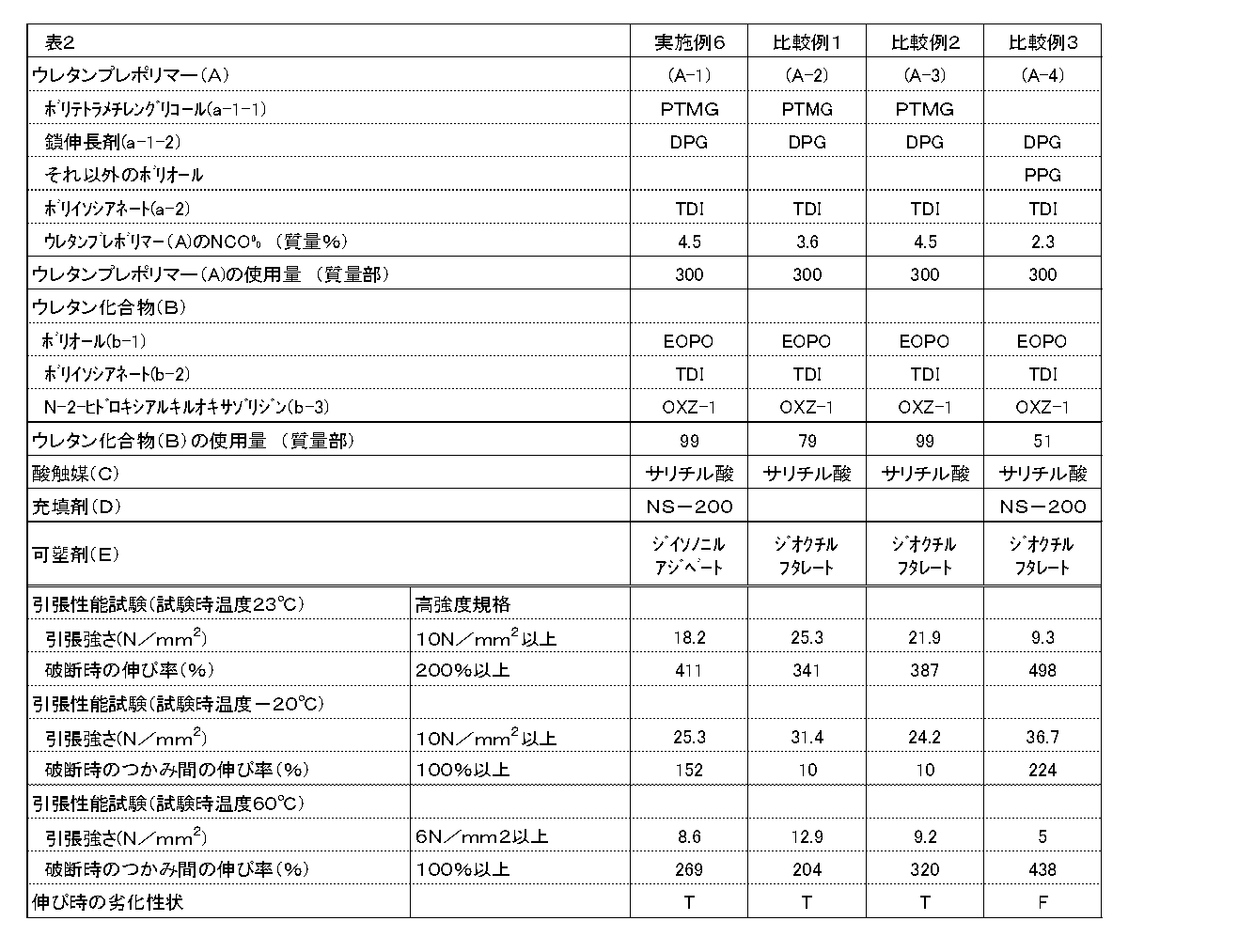
本発明の湿気硬化型ウレタン組成物である実施例1~6は、高強度形規格の基準を満たし、かつ、伸び時の劣化性状も満たすことが分かった。
一方、比較例1及び2は、充填剤(C)を含有しない態様であるが、-20℃における破断時のつかみ間の伸び率が不良であった。
比較例3は、ポリテトラメチレングリコール(a-1-1)の代わりにポリプロピレングリコールを用いた態様であるが23℃及び60℃における引張強さが不充分であり、かつ、伸び時の劣化性状も不良であった。
Claims (5)
- ポリテトラメチレングリコール(a-1-1)及び鎖伸長剤(a-1-2)を含むポリオール(a-1)とポリイソシアネート(a-2)とを反応させて得られるイソシアネート基を有するウレタンプレポリマー(A)、
ポリオール(b-1)とポリイソシアネート(b-2)とN-2-ヒドロキシアルキルオキサゾリジン(b-3)とを反応させて得られるオキサゾリジン基を有するウレタン化合物(B)、酸触媒(C)、充填剤(D)、及び、可塑剤(E)を含有することを特徴とする湿気硬化型ウレタン組成物。 - 前記鎖伸長剤(a-1-2)が、ジプロピレングリコール、プロピレングリコール及びブタンジオールからなる群より選ばれる1種以上のものである請求項1記載の湿気硬化型ウレタン組成物。
- 前記ポリイソシアネート(a-2)が、トルエンジイソシアネート、イソホロンジイソシアネート及びジフェニルメタンジイソシアネートからなる群より選ばれる1種以上のものである請求項1記載の湿気硬化型ウレタン組成物。
- 硬化物のJISA6021:2011に準拠して測定した引張強さ(試験時温度23℃)が10N/mm2以上であり、引張強さ(試験時温度-20℃)が10N/mm2以上であり、引張強さ(試験時温度60℃)が6N/mm2以上であり、破断時の伸び率(試験時温度23℃)が200%以上であり、破断時のつかみ間の伸び率(試験時温度-20℃)が100%以上であり、破断時のつかみ間の伸び率(試験時温度60℃)が100%以上であり、かつ、伸び時の劣化性状を満たすものである請求項1記載の湿気硬化型ウレタン組成物。
- 請求項1~4のいずれか1項記載の湿気硬化型ウレタン組成物を湿気硬化して得られたことを特徴とする被覆材。
Priority Applications (1)
| Application Number | Priority Date | Filing Date | Title |
|---|---|---|---|
| JP2016559374A JP6168376B2 (ja) | 2015-04-22 | 2016-04-12 | 湿気硬化型ウレタン組成物及び被覆材 |
Applications Claiming Priority (2)
| Application Number | Priority Date | Filing Date | Title |
|---|---|---|---|
| JP2015-087560 | 2015-04-22 | ||
| JP2015087560 | 2015-04-22 |
Publications (1)
| Publication Number | Publication Date |
|---|---|
| WO2016171035A1 true WO2016171035A1 (ja) | 2016-10-27 |
Family
ID=57144419
Family Applications (1)
| Application Number | Title | Priority Date | Filing Date |
|---|---|---|---|
| PCT/JP2016/061793 Ceased WO2016171035A1 (ja) | 2015-04-22 | 2016-04-12 | 湿気硬化型ウレタン組成物及び被覆材 |
Country Status (2)
| Country | Link |
|---|---|
| JP (1) | JP6168376B2 (ja) |
| WO (1) | WO2016171035A1 (ja) |
Citations (3)
| Publication number | Priority date | Publication date | Assignee | Title |
|---|---|---|---|---|
| JP2002003566A (ja) * | 2000-06-23 | 2002-01-09 | Dainippon Ink & Chem Inc | 湿気硬化性ウレタン組成物 |
| JP2003128988A (ja) * | 2001-10-23 | 2003-05-08 | Dainippon Ink & Chem Inc | 湿気硬化型プライマー |
| WO2014114640A1 (en) * | 2013-01-22 | 2014-07-31 | Sika Technology Ag | Liquid-applied waterproofing membrane comprising oxazolidine and aldimine |
-
2016
- 2016-04-12 WO PCT/JP2016/061793 patent/WO2016171035A1/ja not_active Ceased
- 2016-04-12 JP JP2016559374A patent/JP6168376B2/ja not_active Expired - Fee Related
Patent Citations (3)
| Publication number | Priority date | Publication date | Assignee | Title |
|---|---|---|---|---|
| JP2002003566A (ja) * | 2000-06-23 | 2002-01-09 | Dainippon Ink & Chem Inc | 湿気硬化性ウレタン組成物 |
| JP2003128988A (ja) * | 2001-10-23 | 2003-05-08 | Dainippon Ink & Chem Inc | 湿気硬化型プライマー |
| WO2014114640A1 (en) * | 2013-01-22 | 2014-07-31 | Sika Technology Ag | Liquid-applied waterproofing membrane comprising oxazolidine and aldimine |
Also Published As
| Publication number | Publication date |
|---|---|
| JPWO2016171035A1 (ja) | 2017-05-18 |
| JP6168376B2 (ja) | 2017-07-26 |
Similar Documents
| Publication | Publication Date | Title |
|---|---|---|
| CN112752821B (zh) | 双组分固化型粘接剂组合物 | |
| KR101427122B1 (ko) | 수작업 시공용 도공제 | |
| CN110114380A (zh) | 双组分聚氨酯粘合剂 | |
| JP5904313B1 (ja) | 湿気硬化型ウレタン組成物及び被覆材 | |
| KR102243167B1 (ko) | 옥사졸리딘 및 알디민을 포함하는 액체 도포 방수막 | |
| CN112752818B (zh) | 双组分固化型粘接剂组合物 | |
| JP2008285616A (ja) | 一液湿気硬化型ウレタン樹脂系接着剤 | |
| KR20220044207A (ko) | 일액형 폴리우레탄 전구중합체 조성물 | |
| JP6492608B2 (ja) | 湿気硬化型ウレタン組成物及び被覆材 | |
| CN112752819B (zh) | 双组分固化型粘接剂组合物 | |
| JP2017052908A (ja) | 湿気硬化型ウレタン組成物、及び被覆材 | |
| WO2015115291A1 (ja) | ポリイソシアネート組成物、2液硬化型ポリウレタン樹脂、塗料および接着剤 | |
| JP6575811B2 (ja) | 湿気硬化型ウレタン組成物、及び被覆材 | |
| JP4736438B2 (ja) | 二成分系常温硬化型液状ウレタン組成物 | |
| JP6168376B2 (ja) | 湿気硬化型ウレタン組成物及び被覆材 | |
| WO2006075710A1 (ja) | コーティング剤組成物およびその用途 | |
| JP5906804B2 (ja) | 湿気硬化型ウレタン被覆材 | |
| JP7469672B2 (ja) | 2液硬化型接着剤組成物 | |
| CN118159424A (zh) | 层叠体及合成皮革 | |
| JPH0649975A (ja) | 構築物の防水被覆方法 | |
| JP6575810B2 (ja) | 湿気硬化型ウレタン組成物、及び被覆材 | |
| KR20170039186A (ko) | 이소시아네이트-종료된 프레폴리머를 함유하는 1-성분 구조 접착제 | |
| CN105814103A (zh) | 具有聚氨酯分散体和羟基官能化合物的密封剂组合物 | |
| WO2025224005A1 (en) | Slow cure hybrid polyurea | |
| JP3608036B2 (ja) | 湿気硬化性ウレタン樹脂組成物及び防水材 |
Legal Events
| Date | Code | Title | Description |
|---|---|---|---|
| ENP | Entry into the national phase |
Ref document number: 2016559374 Country of ref document: JP Kind code of ref document: A |
|
| 121 | Ep: the epo has been informed by wipo that ep was designated in this application |
Ref document number: 16783056 Country of ref document: EP Kind code of ref document: A1 |
|
| NENP | Non-entry into the national phase |
Ref country code: DE |
|
| 122 | Ep: pct application non-entry in european phase |
Ref document number: 16783056 Country of ref document: EP Kind code of ref document: A1 |