WO2016153071A1 - 絶縁フィルム - Google Patents
絶縁フィルム Download PDFInfo
- Publication number
- WO2016153071A1 WO2016153071A1 PCT/JP2016/059928 JP2016059928W WO2016153071A1 WO 2016153071 A1 WO2016153071 A1 WO 2016153071A1 JP 2016059928 W JP2016059928 W JP 2016059928W WO 2016153071 A1 WO2016153071 A1 WO 2016153071A1
- Authority
- WO
- WIPO (PCT)
- Prior art keywords
- mica
- resin
- insulating film
- film
- cellulose acetate
- Prior art date
- Legal status (The legal status is an assumption and is not a legal conclusion. Google has not performed a legal analysis and makes no representation as to the accuracy of the status listed.)
- Ceased
Links
Images
Classifications
-
- C—CHEMISTRY; METALLURGY
- C08—ORGANIC MACROMOLECULAR COMPOUNDS; THEIR PREPARATION OR CHEMICAL WORKING-UP; COMPOSITIONS BASED THEREON
- C08K—Use of inorganic or non-macromolecular organic substances as compounding ingredients
- C08K3/00—Use of inorganic substances as compounding ingredients
- C08K3/18—Oxygen-containing compounds, e.g. metal carbonyls
- C08K3/20—Oxides; Hydroxides
- C08K3/22—Oxides; Hydroxides of metals
-
- C—CHEMISTRY; METALLURGY
- C08—ORGANIC MACROMOLECULAR COMPOUNDS; THEIR PREPARATION OR CHEMICAL WORKING-UP; COMPOSITIONS BASED THEREON
- C08K—Use of inorganic or non-macromolecular organic substances as compounding ingredients
- C08K3/00—Use of inorganic substances as compounding ingredients
- C08K3/34—Silicon-containing compounds
-
- C—CHEMISTRY; METALLURGY
- C08—ORGANIC MACROMOLECULAR COMPOUNDS; THEIR PREPARATION OR CHEMICAL WORKING-UP; COMPOSITIONS BASED THEREON
- C08L—COMPOSITIONS OF MACROMOLECULAR COMPOUNDS
- C08L1/00—Compositions of cellulose, modified cellulose or cellulose derivatives
- C08L1/08—Cellulose derivatives
- C08L1/10—Esters of organic acids, i.e. acylates
-
- H—ELECTRICITY
- H01—ELECTRIC ELEMENTS
- H01B—CABLES; CONDUCTORS; INSULATORS; SELECTION OF MATERIALS FOR THEIR CONDUCTIVE, INSULATING OR DIELECTRIC PROPERTIES
- H01B3/00—Insulators or insulating bodies characterised by the insulating materials; Selection of materials for their insulating or dielectric properties
-
- H—ELECTRICITY
- H01—ELECTRIC ELEMENTS
- H01B—CABLES; CONDUCTORS; INSULATORS; SELECTION OF MATERIALS FOR THEIR CONDUCTIVE, INSULATING OR DIELECTRIC PROPERTIES
- H01B3/00—Insulators or insulating bodies characterised by the insulating materials; Selection of materials for their insulating or dielectric properties
- H01B3/18—Insulators or insulating bodies characterised by the insulating materials; Selection of materials for their insulating or dielectric properties mainly consisting of organic substances
- H01B3/30—Insulators or insulating bodies characterised by the insulating materials; Selection of materials for their insulating or dielectric properties mainly consisting of organic substances plastics; resins; waxes
Definitions
- the present invention relates to a film intended for insulation.
- thermosetting resin such as epoxy resin and phenol resin
- thermoplastic resin such as polypropylene and polybutyl terephthalate
- Molding material (2) filler made of heat-resistant cement, oil-modified natural resin, etc., (3) filled with thermosetting or thermoplastic resin using paper, glass fiber, polyamide cloth, laminated mica as a base material
- sheet materials (4) film materials such as polyimide films and polyethylene naphthalate films.
- the minimum thickness of the molding material is regulated by the fluidity of molding, and the electrode spacing during filling is difficult to control with the filler.
- the electrodes are not flat, such as a bent bus bar. In this case, an inflexible sheet material is difficult to apply.
- the insulation film is produced by a melt film-forming method in which a thermoplastic resin such as polypropylene or polyethylene terephthalate is extruded from a mold such as a T-die in a molten state, and the resin is diluted with a solvent and cast onto a support. Can be divided into a solution casting method in which the solvent is evaporated and the coating film is peeled off from the support.
- a thermoplastic resin such as polypropylene or polyethylene terephthalate
- polypropylene, polyethylene terephthalate, etc. are mainly used as the film for film capacitors, and these are generally applied by melt-casting and then biaxially stretched to a thickness of 1-20 ⁇ m.
- film capacitors are generally applied by melt-casting and then biaxially stretched to a thickness of 1-20 ⁇ m.
- a solution casting method in which a varnish produced by mixing and stirring a resin and a solvent is cast on a support, and the solvent is evaporated on the support to form a film.
- a film produced by the melting station film-forming method is superior in strength, heat resistance and the like as compared with a film produced by the melt film-forming method (for example, see Patent Document 2).
- those using laminated mica can be expected to have a higher withstand voltage due to the maze effect due to the high aspect ratio of mica, and can be obtained by making mica with an average particle diameter of 0.1 to several mm.
- the thing which impregnated the laminated mica with the epoxy resin etc. is generally applied (for example, refer patent document 3).
- the insulating materials those using laminated mica are produced by the paper making method, and therefore it is difficult to make a thin film due to strength problems, and it is difficult to produce a thin film thinner than about 100 ⁇ m.
- the solution casting method is suitable for producing a mica-filled film, but the solution casting method has the following disadvantages.
- a varnish produced by mixing and stirring a resin, mica and a solvent is cast on a support, and the solvent is evaporated on the support.
- the film volume decreases and contracts, but only the resin part and the solvent part contract, and the mica does not contract. Therefore, the resin part does not have a similar shape before and after the solvent evaporation. For this reason, distortion occurs in the resin portion contraction, and voids are likely to occur in a portion where the resin volume ratio is large in the mica arrangement.
- an electric spark is easily generated in the void, and the insulating property is low.
- the relative dielectric constants of polypropylene and polyethylene terephthalate are not as large as 2.2 and 3.2, respectively.
- hard mica has a high relative dielectric constant of about 7 and is preferably mica filled.
- voids are likely to occur in mica filling, and it is difficult to achieve high withstand voltage.
- the object of the present invention is to solve the above-mentioned problems and provide an insulating film having a high withstand voltage.
- the object of the present invention is to increase the dielectric constant for film capacitors and the like.
- the present invention provides the following method in order to solve the above problems.
- An insulating film comprising a resin composition comprising mica and a cellulose resin selected from the group consisting of cellulose acetate, cellulose acetate butyrate, cellulose acetate propionate, and combinations thereof.
- the insulating film as described in (1) containing the filler whose average particle diameter is 1 time or less with respect to the average thickness of a mica piece.
- an insulating film having a high withstand voltage can be provided, and further, an insulating film having a high withstand voltage and a high dielectric constant suitable for use as a film capacitor can be provided.
- the insulating film of the present embodiment is made of a resin composition containing mica and a cellulose resin.
- the mica contained in the resin composition used for the insulating film of the present embodiment can be used without particular limitation. Among these, it is preferable to use hard mica from the viewpoint of dielectric constant. Due to the labyrinth effect due to the inclusion of high aspect ratio mica, the insulation film can have a high withstand voltage.
- the cellulose resin contained in the resin composition used for the insulating film of the present embodiment is selected from the group consisting of cellulose acetate, cellulose acetate butyrate, cellulose acetate propionate, and combinations thereof.
- the cellulosic resin has a high dielectric constant of the resin itself and a large effect of improving the withstand voltage by filling with mica, and it is highly insulative to produce voids when producing a mica-filled film by a solution casting method. Since a film is obtained, it is preferable. Among these, it is more preferable to use cellulose acetate butyrate from the viewpoint of improving the withstand voltage.
- the resin composition used for the insulating film of the present embodiment may further include a filler having an average particle size of 1 time or less with respect to the average thickness of the mica pieces.
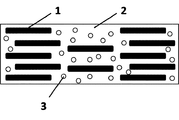
- a filler 3 having a small particle size separately from the mica the particle size distribution of the material (mica 1 and the filler 3 having a small particle size) to be filled in the cellulosic resin 2 is increased.
- the average particle size of the filler means a particle size (D50) with a mass cumulative particle size distribution of 50%, and a laser diffraction scattering type particle size distribution measuring device (for example, product name: LS230, manufactured by Beckman Coulter, Inc.). Can be measured.
- Titanium oxide improves the dielectric constant as well as withstand voltage. Therefore, it is particularly suitable when the insulating film of this embodiment is used for a film capacitor.
- the resin composition and solvent used in the present embodiment are mixed and stirred using a known stirrer or the like to form a varnish, and the obtained varnish is coated on a support, An insulating film can be obtained by making it dry above.
- a coating apparatus known to those skilled in the art such as a comma coater, a bar coater, a kiss coater, a roll coater, a gravure coater, a die coater, and the like can be used.
- Example 1 10% by volume of mica (hard mica, average particle diameter 5 ⁇ m, average aspect ratio 20), 90% by volume of cellulose acetate (molecular weight 30,000) as a resin, and 35% by weight of ethyl acetate with respect to mica And varnish, which is a total of 13% by weight diluted with respect to cellulose resin, and the varnish is stirred with a self-revolving mixer (10 min, 1,000 min ⁇ 1 ) and coated with a bar coater (Coating speed 60 mm / sec, wet thickness 76.3 ⁇ m) After drying (125 ° C., 30 min), a dielectric breakdown voltage test is performed, a scale parameter ⁇ is calculated by a method described later, and a relative dielectric constant ⁇ r is measured. did.
- a self-revolving mixer 10 min, 1,000 min ⁇ 1
- a bar coater Coating speed 60 mm / sec, wet thickness 76.3 ⁇ m
- Example 2 Except that the resin is cellulose acetate butyrate (molecular weight 70,000), the same formulation, coating and drying as in Example 1 were performed, the scale parameter ⁇ was calculated by the same method, and the relative dielectric constant It was measured ⁇ r.
- the resin is cellulose acetate butyrate (molecular weight 70,000)
- Example 3 Except that the resin is cellulose acetate propionate (molecular weight 25,000), the same formulation, coating and drying as in Example 1 were performed, the scale parameter ⁇ was calculated by the same method, and the relative dielectric constant The rate ⁇ r was measured.
- the resin is cellulose acetate propionate (molecular weight 25,000)
- the same formulation, coating and drying as in Example 1 were performed, the scale parameter ⁇ was calculated by the same method, and the relative dielectric constant The rate ⁇ r was measured.
- Example 4 10% by volume of the mica, 80% by volume of the cellulose acetate butyrate, 10% by volume of titanium oxide (rutile, average particle size 0.25 ⁇ m), and a mixture of the ethyl acetate as a varnish
- the same coating and drying as in Example 1 were performed, the scale parameter ⁇ was calculated by the same method, and the relative dielectric constant ⁇ r was measured.
- Comparative Example 1 10% by volume of the mica, 90% by volume of acrylic resin (molecular weight 1,300,000) as a resin, and varnish containing ethyl acetate were used to calculate the scale parameter ⁇ by the same method as in Example 1. The relative dielectric constant ⁇ r was measured.
- Comparative Example 2 A varnish was prepared by blending the acrylic resin and ethyl acetate as a resin. A scale parameter ⁇ was calculated by the same method as in Example 1, and a relative dielectric constant ⁇ r was measured.
- Scale parameter ⁇ dielectric breakdown potential gradient when the cumulative probability in the regression line of the above plot is 63.2%.
- the relative dielectric constant ⁇ r was measured using an LCR meter (manufactured by Agilent Technologies, trade name: E4980A).
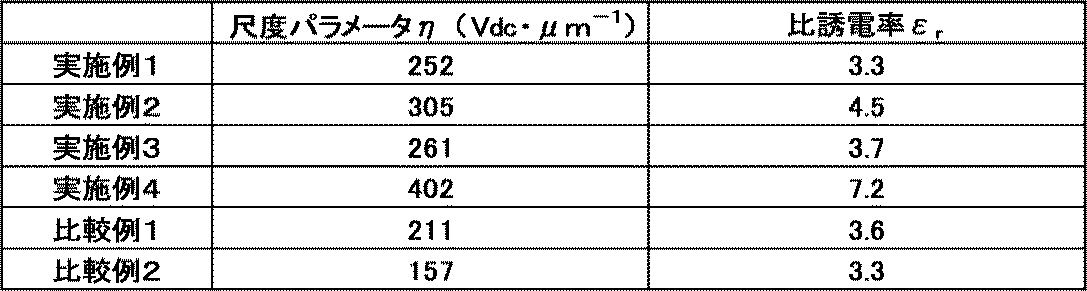
- Table 1 The test results are shown in Table 1. As shown in Table 1, in the examples comprising a resin composition containing mica and a cellulose-based resin, voids hardly occur even when a mica-filled film is produced by a solution casting method. It was confirmed that the dielectric constant can be achieved.
Landscapes
- Chemical & Material Sciences (AREA)
- Health & Medical Sciences (AREA)
- Chemical Kinetics & Catalysis (AREA)
- Medicinal Chemistry (AREA)
- Polymers & Plastics (AREA)
- Organic Chemistry (AREA)
- Physics & Mathematics (AREA)
- Spectroscopy & Molecular Physics (AREA)
- Insulating Bodies (AREA)
- Manufacture Of Macromolecular Shaped Articles (AREA)
- Compositions Of Macromolecular Compounds (AREA)
- Organic Insulating Materials (AREA)
Abstract
マイカと、セルロースアセテート、セルロースアセテートブチレート、セルロースアセテートプロピオネート及びこれらの組合せからなる群から選択されるセルロース系樹脂と、を含む樹脂組成物からなる絶縁フィルム。好ましくは、さらに充填材として酸化チタンを含む、絶縁フィルム。
Description
本発明は、絶縁を目的としたフィルムに関する。
異電位間の絶縁に用いる材料は、(1)エポキシ樹脂、フェノール樹脂等の熱硬化性樹脂や、ポリプロピレン、ポリブチルテレフタレート等の熱可塑性樹脂などを主成分とし金型内で成形することからなる成形材、(2)耐熱セメント、油変性天然樹脂等からなる充填材、(3)紙、ガラス繊維、ポリアミド布、集成マイカ等を基材とし熱硬化性または熱可塑性樹脂を充填することからなるシート材、(4)ポリイミドフィルム、ポリエチレンナフタレートフィルム等のフィルム材に大別される。
これらは使用形態により適宜選択されるが、以下の場合等ではフィルム材を用いることが好適である。(1)小型化を目的として異電位電極間隔を最小限とする場合。この場合、成形材では成形の流動性により最小肉厚が規制され、また充填材では充填時の電極間隔を制御しにくい。(2)曲げ加工を行ったバスバー等、電極間が平面ではない場合。この場合、可撓性がないシート材は適用しにくい。(3)少量生産の場合。この場合、高価な成形型は使用できない。
これらは使用形態により適宜選択されるが、以下の場合等ではフィルム材を用いることが好適である。(1)小型化を目的として異電位電極間隔を最小限とする場合。この場合、成形材では成形の流動性により最小肉厚が規制され、また充填材では充填時の電極間隔を制御しにくい。(2)曲げ加工を行ったバスバー等、電極間が平面ではない場合。この場合、可撓性がないシート材は適用しにくい。(3)少量生産の場合。この場合、高価な成形型は使用できない。
絶縁フィルムの製法は、ポリプロピレンやポリエチレンテレフタレート等の熱可塑性樹脂を溶融状態でTダイ等の金型から押し出す溶融製膜法と、溶剤で樹脂を薄めて支持体上に流延し、支持体上で溶剤を蒸発させ、塗装膜を支持体から引き剥がす溶液製膜法に分けられる。
絶縁フィルムのうち、フィルムコンデンサ用フィルムとしては、主としてポリプロピレン、ポリエチレンテレフタレート等が用いられ、これらは一般的に溶融製膜法で製膜後、2軸延伸で厚さ1~20μmとしたものが適用されている(例えば、特許文献1参照)。
他の絶縁フィルムの製造方法としては、樹脂と溶剤を混合し攪拌することにより作製したワニスを支持体上に流延し、支持体上で溶剤を蒸発させて製膜する溶液製膜法があり、溶駅製膜法により作製したフィルムは、溶融製膜法により作製したものに比べて強度、耐熱性等に優れることが知られている(例えば、特許文献2参照)。
また、絶縁材のうち、集成マイカを使用したものは、マイカの高アスペクト比による迷路効果により高耐電圧化が期待でき、平均粒子径が0.1~数mmのマイカを抄造して得られる集成マイカにエポキシ樹脂等を含浸しているものが一般的に適用されている(例えば、特許文献3参照)。
絶縁材のうち、集成マイカを使用したものは、集成マイカが抄造法により作製されるため、強度上の問題で薄膜化が困難であり、100μm程度より薄い薄膜フィルムの作製は困難である。
溶融製膜法によるマイカ充填フィルム作製では、マイカ充填による流動性低下により薄膜化が困難であり、特に延伸による薄膜化は極めて困難である。
このためマイカ充填フィルム作製には溶液製膜法が好適ではあるが、溶液製膜法には以下の短所がある。
溶融製膜法によるマイカ充填フィルム作製では、マイカ充填による流動性低下により薄膜化が困難であり、特に延伸による薄膜化は極めて困難である。
このためマイカ充填フィルム作製には溶液製膜法が好適ではあるが、溶液製膜法には以下の短所がある。
溶液製膜法では、樹脂、マイカ、溶剤を混合し攪拌することにより作製したワニスを支持体上に流延し、支持体上で溶剤を蒸発させる。この蒸発により、膜体積は減少し収縮するが、収縮するのは樹脂部及び溶剤部のみでありマイカは収縮しないため、樹脂部は溶剤蒸発の前後にて相似形とならない。このため樹脂部収縮に歪を生じ、マイカ配置にて樹脂体積率が大きい部位ではボイドを生じ易い。ここでボイドでは電気火花を生じ易く、絶縁性が低い。
フィルムコンデンサ素子の体積は、誘電率と電位傾度の二乗値に反比例することから、フィルムコンデンサ素子を小型化するためには誘電率向上と高絶縁性(高電位傾度)が望まれるが、従来フィルムのポリプロピレンやポリエチレンテレフタレートの比誘電率は、それぞれ2.2、3.2と大きくない。マイカのうち硬質マイカの比誘電率は7程度と高く、マイカ充填が好ましいが、上記の通りマイカ充填ではボイドが発生し易く高耐電圧化が困難である。
本発明は、上記問題点を解決し、高耐電圧の絶縁フィルムを提供することを目的とし、特にフィルムコンデンサ用等では高誘電率化することも目的とする。
本発明は、上記問題点を解決し、高耐電圧の絶縁フィルムを提供することを目的とし、特にフィルムコンデンサ用等では高誘電率化することも目的とする。
本発明は、上記の課題を解決するために、下記の手法を提供するものである。
(1)マイカと、セルロースアセテート、セルロースアセテートブチレート、セルロースアセテートプロピオネート及びこれらの組合せからなる群から選択されるセルロース系樹脂とを含む樹脂組成物からなる絶縁フィルム。
(2)さらに、マイカ片の平均厚さに対して、平均粒径が1倍以下である充填材を含む(1)に記載の絶縁フィルム。
(3)充填材が酸化チタンである(2)に記載の絶縁フィルム。
(1)マイカと、セルロースアセテート、セルロースアセテートブチレート、セルロースアセテートプロピオネート及びこれらの組合せからなる群から選択されるセルロース系樹脂とを含む樹脂組成物からなる絶縁フィルム。
(2)さらに、マイカ片の平均厚さに対して、平均粒径が1倍以下である充填材を含む(1)に記載の絶縁フィルム。
(3)充填材が酸化チタンである(2)に記載の絶縁フィルム。
本発明によれば、高耐電圧の絶縁フィルムを提供することができ、さらに、フィルムコンデンサ用として用いて好適な、高耐電圧かつ高誘電率の絶縁フィルムを提供することができる。
本実施形態の絶縁フィルムは、マイカ及びセルロース系樹脂を含む樹脂組成物からなるものである。
本実施形態の絶縁フィルムに用いる樹脂組成物に含まれるマイカとしては、硬質マイカ、軟質マイカ、合成マイカ等を特に制限無く用いることができる。中でも、誘電率の観点で、硬質マイカを用いることが好ましい。高アスペクト比のマイカを含むことによる迷路効果により、絶縁フィルムを高耐電圧化することができる。
本実施形態の絶縁フィルムに用いる樹脂組成物に含まれるセルロース系樹脂は、セルロースアセテート、セルロースアセテートブチレート、セルロースアセテートプロピオネート及びこれらの組合せからなる群から選択されるものである。前記セルロース系樹脂は、樹脂そのものの比誘電率が高いとともにマイカ充填による耐電圧の向上効果が大きく、かつ、溶液製膜法でマイカ充填フィルムを作製する際にボイドが発生しにくく高絶縁性のフィルムが得られるため好ましい。中でも、耐電圧向上の観点で、セルロースアセテートブチレートを用いることがより好ましい。
本実施形態の絶縁フィルムに用いる樹脂組成物は、さらに、マイカ片の平均厚さに対して、平均粒径が1倍以下である充填材を含んでもよい。
図1に示すように、マイカ1とは別に小粒径の充填材3を加えることにより、セルロース系樹脂2に充填する材料(マイカ1及び小粒径の充填材3)の粒度分布を2峰性とし、セルロース系樹脂2に充填する材料の密な部分と粗な部分を減らして、耐電圧を向上させることができるとともに、溶液製膜法でワニスを支持体上に流延し、支持体上で溶剤を蒸発させる際に膜体積の収縮を均等化してボイドの発生を抑制し、高絶縁性のフィルムが得られるため好ましい。なお、充填材の平均粒径は、質量累積粒度分布が50%となる粒径(D50)を意味し、レーザー回折散乱式粒度分布測定装置(例えば、ベックマン・コールター社製、商品名:LS230)を用いて測定することができる。
図1に示すように、マイカ1とは別に小粒径の充填材3を加えることにより、セルロース系樹脂2に充填する材料(マイカ1及び小粒径の充填材3)の粒度分布を2峰性とし、セルロース系樹脂2に充填する材料の密な部分と粗な部分を減らして、耐電圧を向上させることができるとともに、溶液製膜法でワニスを支持体上に流延し、支持体上で溶剤を蒸発させる際に膜体積の収縮を均等化してボイドの発生を抑制し、高絶縁性のフィルムが得られるため好ましい。なお、充填材の平均粒径は、質量累積粒度分布が50%となる粒径(D50)を意味し、レーザー回折散乱式粒度分布測定装置(例えば、ベックマン・コールター社製、商品名:LS230)を用いて測定することができる。
充填材としては、一般的な無機充填材、有機充填材等を単独でまたは2種以上を組み合わせて、特に制限なく用いることができるが、酸化チタンは、耐電圧と同時に誘電率も向上させることができるため、本実施形態の絶縁フィルムをフィルムコンデンサ用として用いる場合に特に好適である。
本実施形態の絶縁フィルムの作製方法としては、溶液製膜法を用いることが好ましい。具体的には、本実施形態に用いる上記の樹脂組成物と溶剤とを、公知の攪拌機等を用いて混合、攪拌してワニスとし、得られたワニスを支持体上に塗工し、支持体上で乾燥させることにより絶縁フィルムを得ることができる。
ワニスを支持体上に塗工する方法としては、例えば、コンマコータ、バーコータ、キスコータ、ロールコータ、グラビアコータ、ダイコータ等の当業者に公知の塗工装置を用いることができる。
ワニスを支持体上に塗工する方法としては、例えば、コンマコータ、バーコータ、キスコータ、ロールコータ、グラビアコータ、ダイコータ等の当業者に公知の塗工装置を用いることができる。
以下、本発明を実施例により具体的に説明するが、本発明はこれらの実施例に限定されるものではない。
実施例1:マイカ(硬質マイカ、平均粒子径5μm、平均アスペクト比20)を10体積%、樹脂としてセルロースアセテート(分子量30,000)を90体積%、酢酸エチルをマイカに対して35質量%希釈とセルロース系樹脂に対して13質量%希釈となる量の合計となるようにして配合したものをワニスとし、ワニスを自公転式ミキサで攪拌(10min、1,000min-1)、バーコータで塗工(塗工速度60mm/sec、ウェット厚さ76.3μm)、乾燥(125℃、30min)した後に絶縁破壊電圧試験を行い、後述する手法により尺度パラメータηを算出し、比誘電率εrを測定した。
実施例2:樹脂がセルロースアセテートブチレート(分子量70,000)とすることを除いて、実施例1と同じ配合、塗工、乾燥をし、同じ手法により尺度パラメータηを算出し、比誘電率εrを測定した。
実施例3:樹脂がセルロースアセテートプロピオネート(分子量25,000)とすることを除いて、実施例1と同じ配合、塗工、乾燥をし、同じ手法により尺度パラメータηを算出し、比誘電率εrを測定した。
実施例4:前記マイカを10体積%、前記セルロースアセテートブチレートを80体積%、酸化チタン(ルチル、平均粒子径0.25μm)を10体積%、前記酢酸エチルを配合したものをワニスとし、実施例1と同じ塗工、乾燥をし、同じ手法により尺度パラメータηを算出し、比誘電率εrを測定した。
比較例1:前記マイカを10体積%、樹脂としてアクリル樹脂(分子量1,300,000)を90体積%、酢酸エチルを配合したものをワニスとし、実施例1と同じ手法により尺度パラメータηを算出し、比誘電率εrを測定した。
比較例2:樹脂として前記アクリル樹脂、酢酸エチルを配合したものをワニスとし、実施例1と同じ手法により尺度パラメータηを算出し、比誘電率εrを測定した。
絶縁破壊電圧試験は、一定の昇圧速度(250Vdc/sec)で、絶縁破壊が起きるまで電圧を印加した。サンプルが絶縁破壊した時の電圧を記録し、絶縁破壊電圧をサンプルの厚さで除して絶縁破壊電位傾度を算出した。1試料に対し30点測定し、算出結果をワイブル確率紙にプロットした。プロットより尺度パラメータηを算出した。
ワイブルプロットの手順を以下に示す。(1)試験結果の絶縁破壊電圧を、当該部厚さで除した絶縁破壊電位傾度を求める。(2)絶縁破壊電位傾度のデータを昇順に並べ、その累積数より累積確率を求める。

(3)絶縁破壊電位傾度と、その累積確率を以下のようにプロットする。
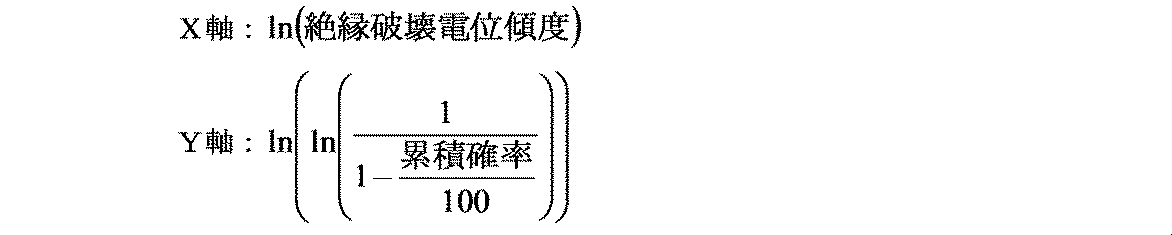
尺度パラメータη:上記プロットの回帰直線における累積確率が63.2%の時の絶縁破壊電位傾度。
また、比誘電率εrはLCRメータ(Agilent Technologies社製、商品名:E4980A)を用いて測定した。
ワイブルプロットの手順を以下に示す。(1)試験結果の絶縁破壊電圧を、当該部厚さで除した絶縁破壊電位傾度を求める。(2)絶縁破壊電位傾度のデータを昇順に並べ、その累積数より累積確率を求める。
また、比誘電率εrはLCRメータ(Agilent Technologies社製、商品名:E4980A)を用いて測定した。
試験結果を表1に示す。表1に示す通り、マイカと、セルロース系樹脂とを含む樹脂組成物からなる実施例では、マイカ充填フィルムを溶液製膜法で作製してもボイドが発生しにくいため、高耐電圧化、高誘電率化が達成できることが確認された。
1…マイカ、2…セルロース系樹脂、3…充填材
Claims (3)
- マイカと、
セルロースアセテート、セルロースアセテートブチレート、セルロースアセテートプロピオネート及びこれらの組合せからなる群から選択されるセルロース系樹脂と、
を含む樹脂組成物からなる絶縁フィルム。 - さらに、マイカ片の平均厚さに対して、平均粒径が1倍以下である充填材を含む請求項1に記載の絶縁フィルム。
- 充填材が酸化チタンである請求項2に記載の絶縁フィルム。
Priority Applications (1)
| Application Number | Priority Date | Filing Date | Title |
|---|---|---|---|
| JP2017507649A JPWO2016153071A1 (ja) | 2015-03-26 | 2016-03-28 | 絶縁フィルム |
Applications Claiming Priority (2)
| Application Number | Priority Date | Filing Date | Title |
|---|---|---|---|
| JP2015064532 | 2015-03-26 | ||
| JP2015-064532 | 2015-03-26 |
Publications (1)
| Publication Number | Publication Date |
|---|---|
| WO2016153071A1 true WO2016153071A1 (ja) | 2016-09-29 |
Family
ID=56979139
Family Applications (1)
| Application Number | Title | Priority Date | Filing Date |
|---|---|---|---|
| PCT/JP2016/059928 Ceased WO2016153071A1 (ja) | 2015-03-26 | 2016-03-28 | 絶縁フィルム |
Country Status (2)
| Country | Link |
|---|---|
| JP (1) | JPWO2016153071A1 (ja) |
| WO (1) | WO2016153071A1 (ja) |
Cited By (2)
| Publication number | Priority date | Publication date | Assignee | Title |
|---|---|---|---|---|
| JP2018156965A (ja) * | 2017-03-15 | 2018-10-04 | 日立化成株式会社 | コンデンサ用絶縁フィルム及びそれを用いたフィルムコンデンサ |
| JP2019033207A (ja) * | 2017-08-09 | 2019-02-28 | 日立化成株式会社 | フィルムコンデンサ用フィルム及びそれを用いたフィルムコンデンサ |
Citations (3)
| Publication number | Priority date | Publication date | Assignee | Title |
|---|---|---|---|---|
| JPH08143709A (ja) * | 1994-11-16 | 1996-06-04 | Daicel Chem Ind Ltd | セルロースエステル溶液および成形品の製造方法 |
| JP2004171799A (ja) * | 2002-11-15 | 2004-06-17 | Toshiba Corp | 絶縁構造材料 |
| JP2005194302A (ja) * | 2003-12-26 | 2005-07-21 | Daicel Chem Ind Ltd | セルロースエステル系樹脂組成物 |
Family Cites Families (4)
| Publication number | Priority date | Publication date | Assignee | Title |
|---|---|---|---|---|
| JP3019541B2 (ja) * | 1990-11-22 | 2000-03-13 | 株式会社村田製作所 | コンデンサ内蔵型配線基板およびその製造方法 |
| JP3817274B2 (ja) * | 1992-07-29 | 2006-09-06 | 住友化学株式会社 | 積層ガスバリア材 |
| WO2003034103A1 (fr) * | 2001-10-12 | 2003-04-24 | Daicel Chemical Industries, Ltd. | Feuille de dosage de la lumiere et procede de fabrication de cette feuille |
| JP5338282B2 (ja) * | 2008-12-01 | 2013-11-13 | ダイキン工業株式会社 | 積層型高誘電性フィルム |
-
2016
- 2016-03-28 JP JP2017507649A patent/JPWO2016153071A1/ja active Pending
- 2016-03-28 WO PCT/JP2016/059928 patent/WO2016153071A1/ja not_active Ceased
Patent Citations (3)
| Publication number | Priority date | Publication date | Assignee | Title |
|---|---|---|---|---|
| JPH08143709A (ja) * | 1994-11-16 | 1996-06-04 | Daicel Chem Ind Ltd | セルロースエステル溶液および成形品の製造方法 |
| JP2004171799A (ja) * | 2002-11-15 | 2004-06-17 | Toshiba Corp | 絶縁構造材料 |
| JP2005194302A (ja) * | 2003-12-26 | 2005-07-21 | Daicel Chem Ind Ltd | セルロースエステル系樹脂組成物 |
Cited By (2)
| Publication number | Priority date | Publication date | Assignee | Title |
|---|---|---|---|---|
| JP2018156965A (ja) * | 2017-03-15 | 2018-10-04 | 日立化成株式会社 | コンデンサ用絶縁フィルム及びそれを用いたフィルムコンデンサ |
| JP2019033207A (ja) * | 2017-08-09 | 2019-02-28 | 日立化成株式会社 | フィルムコンデンサ用フィルム及びそれを用いたフィルムコンデンサ |
Also Published As
| Publication number | Publication date |
|---|---|
| JPWO2016153071A1 (ja) | 2017-10-19 |
Similar Documents
| Publication | Publication Date | Title |
|---|---|---|
| JP5278709B2 (ja) | 導電性樹脂組成物およびチップ型電子部品 | |
| KR101133466B1 (ko) | 태양전지용 저온 건조형 전극 페이스트 조성물 및 이를 이용한 인쇄방법 | |
| JP2022000522A (ja) | コア‐シェル構造の銀コーティングされた銅ナノワイヤを含むエポキシペースト組成物、およびそれを含む導電性フィルム | |
| TWI737892B (zh) | 電鍍液及使用此電鍍液之附絕緣被膜之導體的製造方法 | |
| CN101490767A (zh) | 涂料组合物 | |
| US9396834B2 (en) | Metal foil provided with filler-containing resin layer and method for manufacturing metal foil provided with filler-containing resin layer | |
| TW201702302A (zh) | 樹脂組成物、樹脂薄片、預浸體、絕緣物、樹脂薄片硬化物及散熱構件 | |
| JP2008229849A (ja) | 誘電体フィルムおよびそれを用いた電子部品 | |
| WO2016153071A1 (ja) | 絶縁フィルム | |
| WO2022048992A1 (de) | Pulverlack-formulierung für ein isolationssystem einer elektrischen maschine, elektrische maschine mit einem solchen isolationssystem und verfahren zum herstellen eines solchen isolationssystems | |
| Shen et al. | Unique Li0. 3Ti0. 02Ni0. 68O-carbon nanotube hybrids: Synthesis and their epoxy resin composites with remarkably higher dielectric constant and lower dielectric loss | |
| JP2016003312A (ja) | 透明導電性コーティング組成物、透明導電性シート及びその製造方法、並びに透明導電パターン形成方法 | |
| KR20180048458A (ko) | 코어-쉘 구조의 은 코팅된 구리 나노와이어를 포함하는 에폭시 페이스트 조성물 및 이를 포함하는 도전성 필름 | |
| JP2017010978A (ja) | 絶縁フィルム | |
| WO2014141787A1 (ja) | 導電膜形成用組成物及びこれを用いる導電膜の製造方法 | |
| JP5176290B2 (ja) | ペースト組成物、誘電体組成物、誘電体シート、およびこれらを用いたキャパシタ内蔵回路基板 | |
| CN103910991B (zh) | 用于可热成型电路的防潮层电介质 | |
| JP5151588B2 (ja) | 高誘電性フィルム形成用のコーティング組成物および高誘電性フィルム | |
| JP6069035B2 (ja) | 電着塗装体の製造方法 | |
| JP2019029577A (ja) | コンデンサ用絶縁フィルム及びフィルムコンデンサ | |
| Sangermano et al. | Enhanced Performance of Graphene–Epoxy Flexible Capacitors by Means of Ceramic Fillers | |
| WO2011096288A1 (ja) | 樹脂電極ペーストおよびそれを用いて形成された樹脂電極を有する電子部品 | |
| JP2018157016A (ja) | コンデンサ用絶縁フィルム及びそれを用いたフィルムコンデンサ | |
| CN106471585A (zh) | 用于可热成形电容电路的高k值电介质组合物 | |
| JP2014203652A (ja) | ポリマー型導電性ペースト、及びポリマー型導電性ペーストを用いた電極の製造方法 |
Legal Events
| Date | Code | Title | Description |
|---|---|---|---|
| 121 | Ep: the epo has been informed by wipo that ep was designated in this application |
Ref document number: 16768973 Country of ref document: EP Kind code of ref document: A1 |
|
| ENP | Entry into the national phase |
Ref document number: 2017507649 Country of ref document: JP Kind code of ref document: A |
|
| NENP | Non-entry into the national phase |
Ref country code: DE |
|
| 122 | Ep: pct application non-entry in european phase |
Ref document number: 16768973 Country of ref document: EP Kind code of ref document: A1 |