WO2016152953A1 - モルヒナン誘導体及びその医薬用途 - Google Patents
モルヒナン誘導体及びその医薬用途 Download PDFInfo
- Publication number
- WO2016152953A1 WO2016152953A1 PCT/JP2016/059295 JP2016059295W WO2016152953A1 WO 2016152953 A1 WO2016152953 A1 WO 2016152953A1 JP 2016059295 W JP2016059295 W JP 2016059295W WO 2016152953 A1 WO2016152953 A1 WO 2016152953A1
- Authority
- WO
- WIPO (PCT)
- Prior art keywords
- opioid
- added
- methanobenzofuro
- receptor
- mmol
- Prior art date
- Legal status (The legal status is an assumption and is not a legal conclusion. Google has not performed a legal analysis and makes no representation as to the accuracy of the status listed.)
- Ceased
Links
- 0 OC1(CCCC2*3=O)C22c4c3c(OCc3ccccc3)ccc4CC22C1NC2 Chemical compound OC1(CCCC2*3=O)C22c4c3c(OCc3ccccc3)ccc4CC22C1NC2 0.000 description 2
- LPTJVFMCUOSQHE-UISOLRNRSA-N CN(Cc1ccccc1)C(CCC1(C23CCN(CC4CC4)C1[C@H]1O)O)C2Oc2c3c1ccc2O Chemical compound CN(Cc1ccccc1)C(CCC1(C23CCN(CC4CC4)C1[C@H]1O)O)C2Oc2c3c1ccc2O LPTJVFMCUOSQHE-UISOLRNRSA-N 0.000 description 1
Classifications
-
- A—HUMAN NECESSITIES
- A61—MEDICAL OR VETERINARY SCIENCE; HYGIENE
- A61K—PREPARATIONS FOR MEDICAL, DENTAL OR TOILETRY PURPOSES
- A61K31/00—Medicinal preparations containing organic active ingredients
- A61K31/33—Heterocyclic compounds
- A61K31/395—Heterocyclic compounds having nitrogen as a ring hetero atom, e.g. guanethidine or rifamycins
- A61K31/435—Heterocyclic compounds having nitrogen as a ring hetero atom, e.g. guanethidine or rifamycins having six-membered rings with one nitrogen as the only ring hetero atom
- A61K31/47—Quinolines; Isoquinolines
- A61K31/485—Morphinan derivatives, e.g. morphine, codeine
-
- C—CHEMISTRY; METALLURGY
- C07—ORGANIC CHEMISTRY
- C07D—HETEROCYCLIC COMPOUNDS
- C07D489/00—Heterocyclic compounds containing 4aH-8, 9 c- Iminoethano-phenanthro [4, 5-b, c, d] furan ring systems, e.g. derivatives of [4, 5-epoxy]-morphinan of the formula:
- C07D489/06—Heterocyclic compounds containing 4aH-8, 9 c- Iminoethano-phenanthro [4, 5-b, c, d] furan ring systems, e.g. derivatives of [4, 5-epoxy]-morphinan of the formula: with a hetero atom directly attached in position 14
- C07D489/08—Oxygen atom
Definitions
- the present invention relates to a morphinan derivative and its pharmaceutical use.
- the opioid receptor is a seven-transmembrane receptor coupled with a GTP-binding protein, and is classified into three subtypes: ⁇ receptor, ⁇ receptor, and ⁇ receptor.
- Opioid ⁇ receptor agonists represented by morphine and fentanyl have a strong analgesic action, and are currently widely used as analgesics in clinical settings.
- these opioid ⁇ receptor agonists are also known to have side effects such as drug dependence and respiratory depression, and the development of analgesics that do not have such side effects is desired.
- Selective opioid ⁇ receptor agonists were expected to be powerful analgesics without the side effects of opioid ⁇ receptor agonists such as drug dependence and respiratory depression. However, because selective opioid ⁇ receptor agonists are difficult to separate from their analgesic effects and side effects such as sedation and discomfort, selective opioid ⁇ receptor agonists are currently used as analgesics. Is not used.
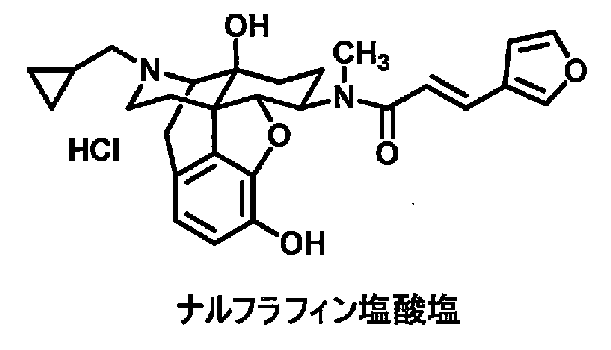
- the only selective opioid ⁇ receptor agonist used as a medicine, nalfrafin hydrochloride represented by the following formula (Patent Document 1) is used as a therapeutic drug for intractable pruritus associated with renal dialysis or liver injury. in use.
- Opioid ⁇ receptors are present throughout the body, such as in the brain, spinal cord, central and peripheral areas of primary sensory afferents, and on immune cells.
- opioid ⁇ receptors present in the periphery are not related to side effects such as sedation and discomfort, and exert an analgesic action by activation thereof (Non-patent Documents 1 and 2). Therefore, even if it is an opioid ⁇ receptor agonist, if it is a peripheral selective opioid ⁇ receptor agonist with a high degree of central migration, it will be an analgesic with reduced side effects such as sedation and discomfort. You can expect as you get.
- Patent Document 2 non-morphinan derivative asimadoline
- Patent Document 3 peptide CR-845
- 10 ⁇ -hydroxy-nalfraphine has ⁇ receptor agonist activity and peripheral opioid ⁇ receptor agonist activity.
- no morphinan derivatives having peripheral type selective opioid ⁇ receptor agonist activity are known.
- the present invention has peripheral type selective opioid ⁇ receptor agonist, and is based on side effects such as drug dependence and respiratory depression based on opioid ⁇ receptor agonist, and central opioid ⁇ receptor agonist
- the object is to provide an analgesic with reduced side effects such as sedation and discomfort.
- the present inventors have found a morphinan derivative having peripheral type selective opioid ⁇ receptor agonist or a pharmacologically acceptable acid addition salt thereof, Furthermore, these have been found to be useful as analgesics based on their action, and the present invention has been completed.
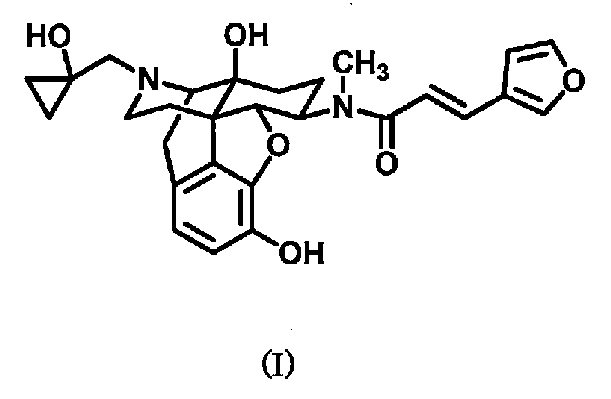
- the present invention provides a morphinan derivative represented by the following formula (I) or a pharmacologically acceptable acid addition salt thereof.
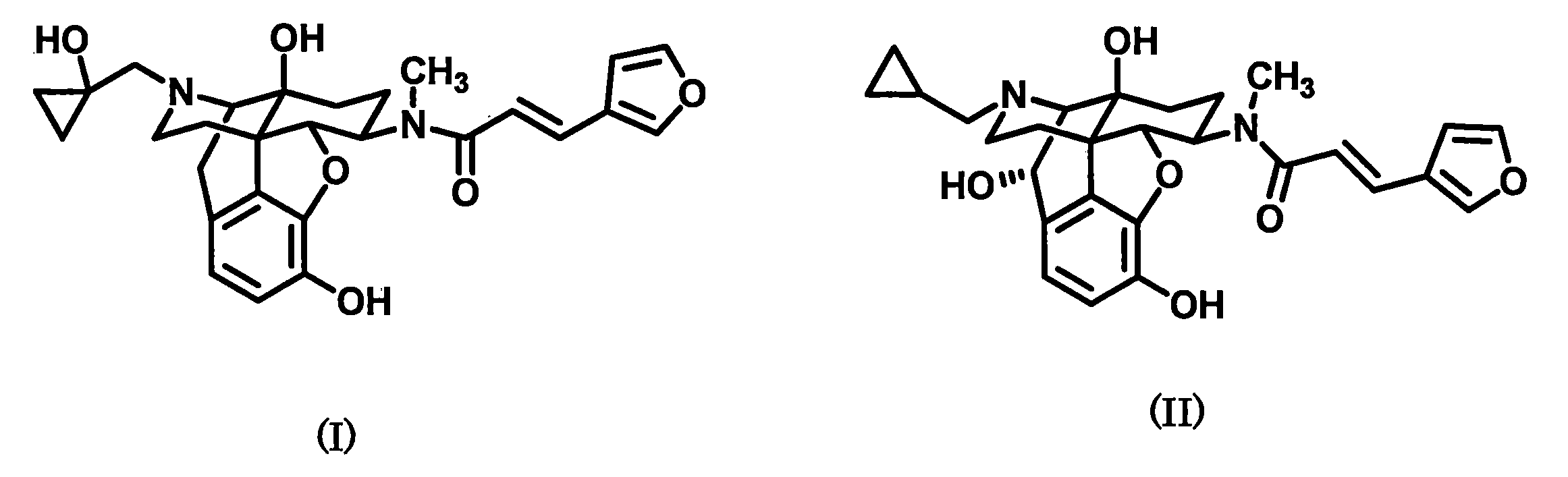
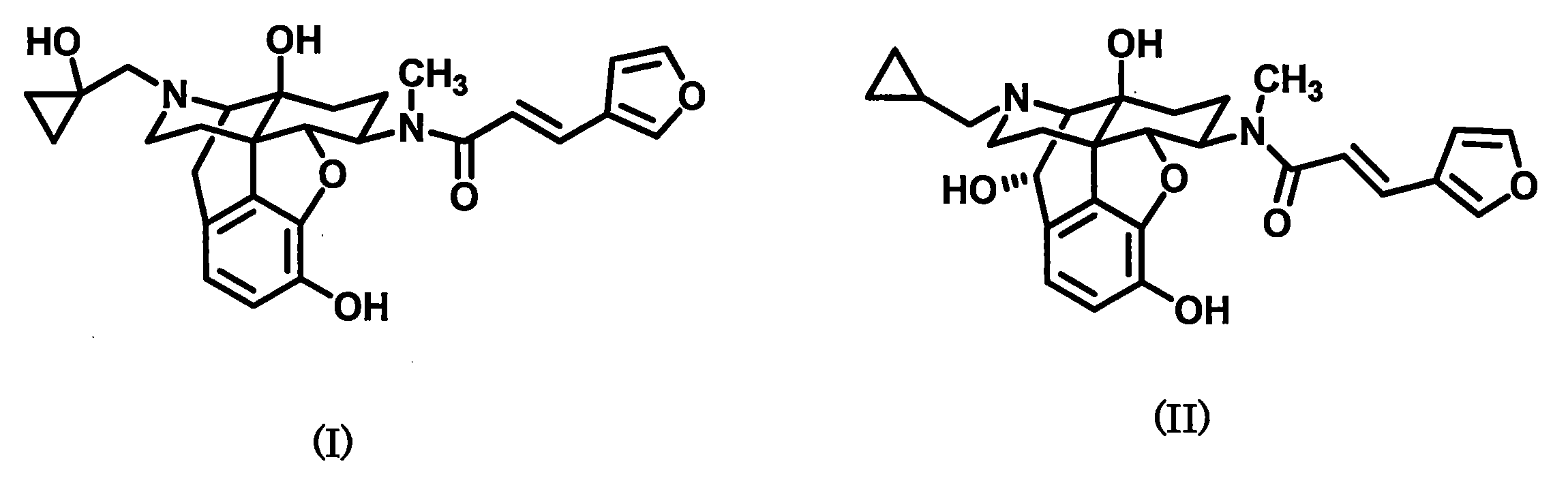
- the present invention also provides a medicament, particularly an analgesic, containing a morphinan derivative represented by the following formula (I) or formula (II) or a pharmacologically acceptable acid addition salt thereof as an active ingredient.
- the morphinan derivative represented by the formula (II) or a pharmacologically acceptable acid addition salt thereof has peripheral type selective opioid ⁇ receptor agonist activity, drug dependence based on opioid ⁇ receptor agonist activity It can be used as a medicine, particularly an analgesic, in which side effects such as sedation and discomfort based on vasoactivity, respiratory depression, and central opioid ⁇ receptor agonist activity are reduced.
- the morphinan derivative of the present invention is characterized by being represented by the following formula (I).
- a morphinan derivative which is an active ingredient of the medicament of the present invention, particularly an analgesic, is characterized by being represented by the following formula (I) or formula (II).
- Examples of the pharmacologically acceptable acid addition salt of the morphinan derivative represented by the above formula (I) or formula (II) include hydrochloride, sulfate, nitrate, hydrobromide, hydroiodic acid.
- Inorganic acid salts such as salt or phosphate, acetate, lactate, citrate, oxalate, glutarate, malate, tartrate, fumarate, mandelate, maleate, benzoic acid
- Organic carboxylic acid salts such as salts or phthalates, or organic sulfonates such as methane sulfonate, ethane sulfonate, benzene sulfonate, p-toluene sulfonate, camphor sulfonate, etc.
- Hydrochloride, hydrobromide, phosphate, tartrate or methanesulfonate are preferred, and hydrochloride, tartrate or methanesulfonate are more preferred
- the morphinan derivative represented by the above formula (I) or formula (II) can be produced by an appropriate method based on the characteristics derived from the basic skeleton and the type of substituent.
- the starting materials and reagents used for this production can generally be purchased. Further, the synthesis method of the starting material used in Reference Example 7 is disclosed in JP-A-2014-62069.
- Examples of the acid used for the chlorination reaction of the morphinan derivative represented by the above formula (I) or formula (II) include inorganic acids such as hydrochloric acid, sulfuric acid, nitric acid, hydrobromic acid, hydroiodic acid, or phosphoric acid.
- Acetic acid lactic acid, citric acid, oxalic acid, glutaric acid, malic acid, tartaric acid, fumaric acid, mandelic acid, maleic acid, benzoic acid, phthalic acid and other organic carboxylic acids or methanesulfonic acid, ethanesulfonic acid, benzenesulfonic acid And organic sulfonic acids such as p-toluenesulfonic acid and camphorsulfonic acid.
- the chlorination reaction is generally performed in a solvent, and a solvent that does not inhibit the reaction is appropriately selected.
- a solvent include aliphatic alcohols such as methanol, ethanol or isopropanol, ethers such as diethyl ether, tetrahydrofuran, 1,4-dioxane or ethylene glycol dimethyl ether, N, N-dimethylformamide or N-methyl.
- Amides such as pyrrolidone, sulfoxides such as dimethyl sulfoxide, aliphatic nitriles such as acetonitrile or propionitrile, ketones such as acetone or 2-butanone, esters such as methyl acetate, ethyl acetate or n-butyl acetate, or Water etc. are mentioned, You may use these mixed solvents.
- opioid ⁇ receptor operation It can be used as a medicine, particularly an analgesic, in which side effects such as drug dependence and respiratory depression based on sex and sedation and discomfort based on central opioid ⁇ receptor agonists are reduced.
- Selective opioid ⁇ receptor agonist means that the ratio of ⁇ receptor agonist to ⁇ receptor agonist ( ⁇ receptor agonist / ⁇ receptor agonist ratio) is 100 times or more.
- the morphinan derivative represented by the above formula (I) or formula (II) and a pharmacologically acceptable acid addition salt thereof have selective ⁇ receptor agonist activity, for example, human opioid ⁇ receptor and It can be evaluated by measuring the operability of these receptors (for example, the inhibitory effect on Forskolin-induced cAMP production) using cells stably expressing human opioid ⁇ receptors. If the EC 50 ( ⁇ ) value relative to the EC 50 ( ⁇ ) value (EC 50 ( ⁇ ) value / EC 50 ( ⁇ ) value) is 100 times or more, it can be said that it has selective opioid ⁇ receptor agonist activity.
- Peripheral means that the ratio of central drug concentration to peripheral drug concentration after drug administration (central concentration / peripheral concentration) is 0.2 or less.
- the peripheral form of the morphinan derivative represented by the above formula (I) or formula (II) and its pharmacologically acceptable acid addition salt is, for example, a plasma concentration after intravenous administration to mice. It can be evaluated by measuring the brain concentration. If the ratio of brain concentration to plasma concentration (brain concentration / plasma concentration ratio) is 0.2 or less, it can be said to be a peripheral type.
- the excellent analgesic action of the morphinan derivative represented by the above formula (I) or formula (II) or a pharmacologically acceptable acid addition salt thereof can be evaluated using an appropriate animal model.
- suitable animal models for evaluating analgesic activity include, for example, mouse acetate rising model (Academic Press, 1977, Chapter 6, p. 83-99), rat formalin test (Pain, 1992, Vol. 51). , P. 5-17), rat carrageenin-induced inflammation model (Japanese Journal of Pharmacology, 1970, Vol. 20, pp. 337-348), rat hot plate test for acute pain (Journal of Pharmacology and ExperimentalTemperature, 1975, Vol. 192, pp. 497-505), or tail flick test (Journal of Pharmaceutical Sciences, 196) Year, Vol 51, p.185-186), and the like.
- a medicament containing the morphinan derivative represented by the above formula (I) or formula (II) or a pharmacologically acceptable acid addition salt thereof as an active ingredient is a mammal (eg, mouse, rat, hamster, rabbit, Cats, dogs, cows, sheep, monkeys or humans), especially when administered to humans, it exhibits excellent analgesic activity.
- a mammal eg, mouse, rat, hamster, rabbit, Cats, dogs, cows, sheep, monkeys or humans
- the morphinan derivative represented by the above formula (I) or formula (II) or a pharmacologically acceptable acid addition salt thereof As a dosage form of the morphinan derivative represented by the above formula (I) or formula (II) or a pharmacologically acceptable acid addition salt thereof, the morphinan derivative represented by the above formula (I) or formula (II) Alternatively, the pharmacologically acceptable acid addition salt thereof can be administered orally or parenterally as it is or with a pharmaceutically acceptable carrier.
- a dosage form when orally administering a medicament containing the morphinan derivative represented by the above formula (I) or formula (II) or a pharmacologically acceptable acid addition salt thereof for example, tablets (sugar-coated tablets and (Including film-coated tablets), pills, granules, powders, capsules (including soft capsules and microcapsules), syrups, emulsions or suspensions, and dosage forms for parenteral administration Examples include injections, infusions, drops, and suppositories.
- an appropriate base eg, butyric acid polymer, glycolic acid polymer, butyric acid-glycolic acid copolymer, a mixture of butyric acid polymer and glycolic acid polymer, or polyglycerol fatty acid ester
- an appropriate base eg, butyric acid polymer, glycolic acid polymer, butyric acid-glycolic acid copolymer, a mixture of butyric acid polymer and glycolic acid polymer, or polyglycerol fatty acid ester
- the preparation of the above dosage form can be performed according to a known production method generally used in the pharmaceutical field.
- excipients, binders, lubricants, disintegrants, sweeteners, surfactants, suspending agents and / or emulsifiers and the like generally used in the pharmaceutical field are included as necessary.
- the above tablet can be prepared by adding an excipient, a binder, a disintegrant and / or a lubricant
- the pill and the above granule can be prepared by adding an excipient, a binder. It can be carried out by containing an agent and / or a disintegrant.
- the above powder and capsules are prepared with excipients
- the syrup is prepared with sweeteners
- the emulsion or suspension is prepared with surfactants, suspensions. It can be carried out by containing an agent and / or an emulsifier.
- excipient examples include lactose, glucose, starch, sucrose, microcrystalline cellulose, licorice powder, mannitol, sodium bicarbonate, calcium phosphate or calcium sulfate.
- binder examples include starch paste, gum arabic solution, gelatin solution, tragacanth solution, carboxymethylcellulose solution, sodium alginate solution, and glycerin.
- disintegrant examples include starch and calcium carbonate.
- Examples of the lubricant include magnesium stearate, stearic acid, calcium stearate, and purified talc.
- sweetener examples include glucose, fructose, invert sugar, sorbitol, xylitol, glycerin, and simple syrup.
- surfactant examples include sodium lauryl sulfate, polysorbate 80, sorbitan monofatty acid ester, and polyoxyl 40 stearate.
- suspending agent examples include gum arabic, sodium alginate, sodium carboxymethyl cellulose, methyl cellulose, and bentonite.
- emulsifier examples include gum arabic, tragacanth, gelatin, and polysorbate 80.
- the daily dose of the pharmaceutical containing the morphinan derivative represented by the above formula (I) or formula (II) or a pharmacologically acceptable acid addition salt thereof depends on the patient's condition, body weight, and type of compound. Depending on the route of administration, etc., for example, in the case of oral administration, it is preferable to administer 1 to 3 divided doses in the range of 0.01 mg to 1000 mg for an adult (body weight of about 60 kg). In the case of an injection, it is preferably administered by intravenous injection in the range of 0.001 mg to 100 mg per kg body weight.
- the solvent name in parentheses shown in the NMR data indicates the solvent used for the measurement.
- the 400 MHz NMR spectrum was measured using a JNM-AL400 nuclear magnetic resonance apparatus manufactured by JEOL.
- the chemical shift is represented by ⁇ (unit: ppm) based on tetramethylsilane, and the signals are s (single line), d (double line), t (triple line), q (quadruple line), m ( Multiple lines), br (wide), or a combination thereof.
- the IR spectrum was measured using FT / IR-410 manufactured by JASCO Corporation, and the ESI-MS spectrum was measured using Micromass ZQ2K manufactured by Waters or 1200LC / MSD manufactured by Agilent Technology. All solvents were commercially available. For flash chromatography, YFLC W-prep2XY manufactured by Yamazen Co., Ltd. was used.
- the water used in the Reference Examples and Examples means distilled water.
- naloxone free form
- N N-dimethylformamide
- potassium carbonate 10 g, 75 mmol
- benzyl bromide 3.3 mL, 28 mmol
- Example 1 (E) -N-((4R, 4aS, 7R, 7aR, 12bS) -4a, 9-dihydroxy-3-((1-hydroxycyclopropyl) methyl) -2,3,4,4a , 5,6,7,7a-Octahydro-1H-4,12-methanobenzofuro [3,2-e] isoquinolin-7-yl) -3- (furan-3-yl) -N-methylacrylamide: A solution of sodium bicarbonate (1.5 g, 15 mmol) in water (20 mL) was added to a solution of the crude product (2.6 g) obtained in Reference Example 6 in tetrahydrofuran (35 mL).
- Example 2 (E) -N-((4R, 4aS, 7R, 7aR, 12bS) -4a, 9-dihydroxy-3-((1-hydroxycyclopropyl) methyl) -2,3,4,4a , 5,6,7,7a-Octahydro-1H-4,12-methanobenzofuro [3,2-e] isoquinolin-7-yl) -3- (furan-3-yl) -N-methylacrylamide hydrochloride : To a solution of the compound of Example 1 (1.1 g, 2.3 mmol) in water (75 mL) was added 1N hydrochloric acid (2.5 mL, 2.5 mmol) under ice cooling, and the mixture was stirred for 1 hour.
- 1N hydrochloric acid 2.5 mL, 2.5 mmol
- Human opioid ⁇ receptor and ⁇ receptor agonist test Using cells stably expressing human opioid ⁇ receptor or human opioid ⁇ receptor, the morphinan derivative represented by the above formula (I) or formula (II) or a pharmacologically acceptable acid addition salt thereof is human. Opioid ⁇ receptor and ⁇ receptor operability was evaluated.
- a modified human opioid kappa receptor gene whose base sequence is optimized to increase the expression level using GeneOptimizer (registered trademark; Takara Bio Inc.) is introduced into HEK-293 cells, and the human opioid kappa receptor is stabilized according to a conventional method. Expression cells were generated.
- the human opioid ⁇ receptor gene was introduced into CHO-dhfr ( ⁇ ) cells, and human opioid ⁇ receptor stably expressing cells were prepared according to a conventional method.
- Human opioid ⁇ receptor stably expressing cells are cultured with 10% FBS and DMEM containing 50 ⁇ g / mL Hygromycin B, and human opioid ⁇ receptor stably expressing cells are cultured with 10% FBS and 500 ⁇ g / mL G418-containing MEM- ⁇ . It was used as a liquid and maintained in culture in a 37 ° C., 5% CO 2 incubator.
- the human opioid receptor operability of the test substance was evaluated using the above human opioid receptor stably expressing cells as an indicator of the inhibitory effect on Forskolin-induced cAMP production.
- AlphaScreen registered trademark
- cAMP Detection Kit PerkinElmer
- an HBSS buffer (pH 7.4) (hereinafter referred to as SB) containing 0.5 mmol / L IBMX, 5 mmol / L HEPES, and 0.1% BSA was prepared at the time of use.
- a HEPES buffer (pH 7.4) (hereinafter, L / DB) containing 0.1% BSA and 0.3% Tween-20 (registered trademark) was prepared as a Lysis / Detection buffer.
- a 1 U / 5 ⁇ L anti-cAMP antibody acceptor bead solution was prepared using SB, and an SA donor bead / biotinylated cAMP detection mix was prepared using L / DB.
- the SA donor beads / biotinylated cAMP detection mix was incubated for about 60 minutes at room temperature under light-shielding conditions after preparation.
- test substance and Forskolin were dissolved in dimethyl sulfoxide (hereinafter DMSO) and then diluted with SB to obtain a test substance / Forskolin mixed solution.
- DMSO dimethyl sulfoxide
- the final concentration of Forskolin in the reaction system was 10 ⁇ mol / L, and the final concentration of DMSO was 0.4% or less.
- human opioid receptor stable expression cells human opioid ⁇ receptor stable expression cells or human opioid ⁇ receptor stable expression cells
- PBS PBS
- the cells were transferred to a tube and centrifuged for 5 minutes (room temperature, about 470 ⁇ g) to obtain a cell pellet.
- Anti-cAMP antibody acceptor bead solution was added to the cell pellet to prepare 1 ⁇ 10 6 cells / mL cell / anti-cAMP antibody acceptor beads.
- test substance non-added well 5 ⁇ L of the test substance / Forskolin mixed solution was added to the plate (384 well).
- 5 ⁇ L of cell / anti-cAMP antibody acceptor beads was added to each well.
- the cAMP concentration of the test substance non-added well was defined as 0% inhibition.
- c-AMP concentration when U-69593 (Sigma, # U103) (final concentration 10 ⁇ mol / L) showing human opioid ⁇ receptor agonist was added instead of the test substance. was controlled to 100%.
- the cAMP concentration when DAMGO (Sigma, # E7384) (final concentration 10 ⁇ mol / L) showing human opioid ⁇ receptor agonist activity was added instead of the test substance was controlled at 100 %.
- the inhibition rate (%) for Forskolin-induced cAMP production of each test substance was determined, and the EC 50 of each test substance was calculated by two-point regression sandwiching the inhibition rate of 50%.
- Table 1 shows the EC 50 value of each test substance.
- the compound of Example 2 and the compound of Example 3 exhibited potent human opioid ⁇ receptor agonist activity.
- the compound of Example 2 and the compound of Example 3 showed extremely weak human opioid ⁇ receptor agonist activity. Therefore, the morphinan derivative represented by the above formula (I) or formula (II) or a pharmacologically acceptable acid addition salt thereof has been shown to have selective opioid ⁇ receptor agonist activity, It can be a powerful analgesic with reduced side effects of opioid ⁇ receptor agonists such as respiratory depression.
- Example 5 Brain migration confirmation test in mice: Measurement of plasma concentration and brain concentration after intravenous administration of the morphinan derivative represented by the above formula (I) or formula (II) or a pharmacologically acceptable acid addition salt thereof to a mouse, Sex was evaluated. Nalfurafine hydrochloride (International Publication No. 1993/015081) was similarly evaluated as a comparative compound.
- the test substance was intravenously administered once to the mouse at a dose of 1 mg / kg.
- the administration solutions of the compound of Example 2, the compound of Example 3 and the comparative compound were physiological saline, DMSO / Tween 80 / distilled water mixture (1: 1: 8), DMSO / hydroxypropyl- ⁇ -cyclodextrin, respectively. (Hereinafter referred to as HP- ⁇ -CD) / distilled water mixed solution (1: 8: 11).
- Intravenous administration of the administration liquid was carried out in the tail vein with a volume of 5 mL / kg using a syringe needle and syringe without anesthesia.
- mice 15 minutes after intravenous administration, blood was collected from the posterior vena cava or heart of mice under isoflurane anesthesia. Each test substance was administered to 3 mice. In addition, after finishing blood collection, the mouse was exsanguinated and euthanized, and then the brain was removed. Furthermore, blood and brain were collected from mice not administered the test substance.
- the collected blood was centrifuged at 4 ° C. and 15,000 rpm for 10 minutes (Hitachi Koki CT15RE) to separate plasma, and the obtained plasma was stored at ⁇ 30 ° C. until the preparation of the sample for analysis.
- the collected brain is added with distilled water 2 to 3 times the weight of the brain, and the tissue is ground until it becomes uniform (Biomedical Science, Inc., Shake Master Neo).
- the obtained brain homogenized solution is the sample for analysis. Stored at ⁇ 30 ° C. until preparation.
- the plasma and brain homogenized solution obtained from the mice administered with the test substance are called mouse plasma sample and mouse brain sample, respectively, and the plasma and brain homogenized solution obtained from the mouse not administered with the test substance are respectively blank plasma. This is called a blank brain.
- mice plasma sample or mouse plasma sample appropriately diluted with blank plasma To 50 ⁇ L of mouse plasma sample or mouse plasma sample appropriately diluted with blank plasma, add 5 to 20 ⁇ L of internal standard solution and 100 to 200 ⁇ L of methanol, acetonitrile or methanol / acetonitrile mixture (1: 1), and after stirring, Cooled at 4 ° C. for 10 minutes. Also, add 50 to 20 ⁇ L of an internal standard solution and 100 to 200 ⁇ L of methanol, acetonitrile, or a methanol / acetonitrile mixture (1: 1) to 50 ⁇ L of a mouse brain sample or a mouse brain sample appropriately diluted with a blank brain, and stir. And cooled at 4 ° C. for 10 minutes. A calibration curve sample was prepared by treating a blank plasma and a blank brain to which a standard curve standard solution was added in the same manner.
- the obtained analytical sample was subjected to LC / MS / MS analysis.
- the analysis was performed under the conditions shown in Table 2 or a method according thereto.
- Table 3 shows the brain concentration (ng / g tissue), plasma concentration (ng / mL) and brain concentration / plasma concentration ratio (Kp, brain) 15 minutes after administration of each test substance. .
- the brain concentration / plasma concentration ratio of the compound of Example 2 and the compound of Example 3 was 0.2 or less. Therefore, it was shown that the morphinan derivative represented by the above formula (I) or formula (II) or a pharmaceutically acceptable acid addition salt thereof is a peripheral type.
- Example 6 Effect on nociceptive pain: Using a mouse acetate rising model that can evaluate nociceptive pain, the analgesic action of the morphinan derivative represented by the above formula (I) or (II) or a pharmacologically acceptable acid addition salt thereof was evaluated.
- mice In the experiment, 5 to 6-week-old ddY male mice (Japan SLC Co., Ltd.) that were allowed to freely ingest solid feed (Oriental Yeast Co., Ltd.) and tap water were used.
- Example 2 The compound of Example 2 was dissolved in 20% HP- ⁇ -CD containing 5% DMSO, and the compound of Example 3 was dissolved in 20% HP- ⁇ -CD to prepare an administration solution for each test substance.
- the prepared test substance administration solution was administered to mice in the tail vein at a volume of 5 mL / kg.
- a solvent corresponding to each test substance was similarly administered as a control to form a “solvent group”.
- a 0.6% acetic acid solution was administered intraperitoneally to the mouse (10 mL / kg) to induce a rising reaction (behavior to stretch or warp the body). Rising reactions that occurred 10 minutes after administration of the 0.6% acetic acid solution were counted, and the number of times was used as an index of pain.
- ED 50 50% effective dose
- the ED 50 values of the compound of Example 2 and the compound of Example 3 were ⁇ 1 mg / kg, indicating excellent analgesic activity. Therefore, it has been clarified that the morphinan derivative represented by the above formula (I) or formula (II) or a pharmacologically acceptable acid addition salt thereof exhibits an excellent analgesic action.
- the morphinan derivative represented by the above formula (I) or formula (II) or a pharmacologically acceptable acid addition salt thereof has peripheral opioid ⁇ receptor agonist activity, opioid ⁇ receptor operation It can be used as an analgesic with reduced side effects such as drug dependence and respiratory depression based on sex and sedation and discomfort based on central opioid kappa receptor agonism.
Landscapes
- Chemical & Material Sciences (AREA)
- Health & Medical Sciences (AREA)
- Organic Chemistry (AREA)
- Epidemiology (AREA)
- Medicinal Chemistry (AREA)
- Pharmacology & Pharmacy (AREA)
- Emergency Medicine (AREA)
- Life Sciences & Earth Sciences (AREA)
- Animal Behavior & Ethology (AREA)
- General Health & Medical Sciences (AREA)
- Public Health (AREA)
- Veterinary Medicine (AREA)
- Pharmaceuticals Containing Other Organic And Inorganic Compounds (AREA)
Abstract
本発明は、末梢型の選択的オピオイドκ受容体作動性を有し、オピオイドμ受容体作動性に基づく薬物依存性や呼吸抑制などの副作用、及び、中枢型のオピオイドκ受容体作動性に基づく鎮静や不快感などの副作用が低減された鎮痛薬を提供することを目的としている。本発明は、下記の式(I)若しくは式(II)で示されるモルヒナン誘導体又はその薬理学的に許容される酸付加塩を有効成分として含有する医薬を提供する。
Description
本発明は、モルヒナン誘導体及びその医薬用途に関する。
オピオイド受容体は、GTP結合タンパク質と共役する7回膜貫通型受容体であり、μ受容体、δ受容体及びκ受容体の3つのサブタイプに分類される。
モルヒネやフェンタニルに代表されるオピオイドμ受容体作動薬は、強力な鎮痛作用を有するため、現在、臨床現場で鎮痛薬として広く使用されている。しかし、一方で、これらオピオイドμ受容体作動薬は、薬物依存性や呼吸抑制などの副作用を有することも知られており、このような副作用を持たない鎮痛薬の開発が望まれている。
選択的オピオイドκ受容体作動薬は、薬物依存性や呼吸抑制などのオピオイドμ受容体作動薬の副作用のない、強力な鎮痛薬となり得るとして期待されていた。しかし、選択的オピオイドκ受容体作動薬は、その鎮痛作用と、鎮静や不快感などの副作用との分離が困難であることなどから、現時点では、選択的オピオイドκ受容体作動薬は鎮痛薬としては使用されていない。唯一、医薬として使用されている選択的オピオイドκ受容体作動薬である、下記式で示されるナルフラフィン塩酸塩(特許文献1)は、腎透析や肝障害に伴う難治性そう痒症の治療薬として使用されている。
オピオイドκ受容体は、脳内、脊髄内、一次感覚求心路の中枢及び末梢、並びに、免疫細胞上など、全身に存在している。近年、末梢に存在するオピオイドκ受容体は、鎮静や不快感などの副作用と関連がないこと、また、その活性化により鎮痛作用を発揮することが示された(非特許文献1及び2)。そのため、オピオイドκ受容体作動薬であっても、中枢移行性を高度に抑制した末梢型の選択的オピオイドκ受容体作動薬であれば、鎮静や不快感などの副作用の低減された鎮痛薬となり得るとして期待できる。
現在、末梢型の選択的オピオイドκ受容体作動薬として、非モルヒナン誘導体であるアシマドリン(特許文献2)やペプチド性のCR-845(特許文献3)などが知られている。
一方、モルヒナン誘導体として、10α-ヒドロキシ-ナルフラフィンが知られている(非特許文献3)。
Riviereら、British Journal of Pharmacology、2004年、第141巻、p.1331-1334
Hughesら、The Open Medicinal Chemistry Journal、2013年、第7巻、p.16-22
Horikiriら、Chemical Pharmaceutical Bulletin、2004年、第52巻、p.664-669
しかしながら、10α-ヒドロキシ-ナルフラフィンがκ受容体作動性を有することはもとより、末梢型のオピオイドκ受容体作動性を有することについては一切知られていない。また、末梢型の選択的オピオイドκ受容体作動性を有するモルヒナン誘導体も一切知られていない。
本発明は、末梢型の選択的オピオイドκ受容体作動性を有し、オピオイドμ受容体作動性に基づく薬物依存性や呼吸抑制などの副作用、及び、中枢型のオピオイドκ受容体作動性に基づく鎮静や不快感などの副作用が低減された鎮痛薬を提供することを目的とする。
本発明者らは、上記の目的を達成するため鋭意研究を重ねた結果、末梢型の選択的オピオイドκ受容体作動性を有するモルヒナン誘導体又はその薬理学的に許容される酸付加塩を見出し、さらに、これらが、その作用に基づき鎮痛薬として有用であることを見出し、本発明を完成させるに至った。
すなわち、本発明は、下記の式(I)で示されるモルヒナン誘導体又はその薬理学的に許容される酸付加塩を提供する。
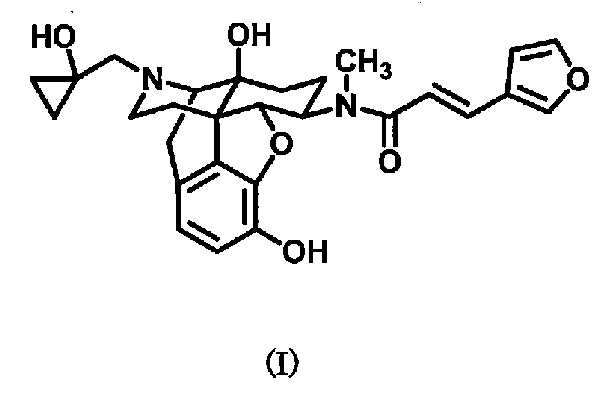
また本発明は、下記の式(I)若しくは式(II)で示されるモルヒナン誘導体又はその薬理学的に許容される酸付加塩を有効成分として含有する医薬、特に鎮痛薬を提供する。

本発明の、上記の式(I)で示されるモルヒナン誘導体若しくはその薬理学的に許容される酸付加塩、又は、本発明の医薬、特に鎮痛薬、の有効成分である上記の式(I)若しくは式(II)で示されるモルヒナン誘導体若しくはその薬理学的に許容される酸付加塩は、末梢型の選択的オピオイドκ受容体作動性を有するため、オピオイドμ受容体作動性に基づく薬物依存性や呼吸抑制、及び、中枢型のオピオイドκ受容体作動性に基づく鎮静や不快感などの副作用が低減された、医薬、特に鎮痛薬として用いることができる。
本発明のモルヒナン誘導体は、下記の式(I)で示されることを特徴としている。

また、本発明の医薬、特に鎮痛薬、の有効成分であるモルヒナン誘導体は、下記の式(I)又は式(II)で示されることを特徴としている。
上記の式(I)又は式(II)で示されるモルヒナン誘導体の薬理学的に許容される酸付加塩としては、例えば、塩酸塩、硫酸塩、硝酸塩、臭化水素酸塩、ヨウ化水素酸塩若しくはリン酸塩等の無機酸塩、酢酸塩、乳酸塩、クエン酸塩、シュウ酸塩、グルタル酸塩、リンゴ酸塩、酒石酸塩、フマル酸塩、マンデル酸塩、マレイン酸塩、安息香酸塩若しくはフタル酸塩等の有機カルボン酸塩又はメタンスルホン酸塩、エタンスルホン酸塩、ベンゼンスルホン酸塩、p-トルエンスルホン酸塩若しくはカンファースルホン酸塩等の有機スルホン酸塩等が挙げられるが、塩酸塩、臭化水素酸塩、リン酸塩、酒石酸塩又はメタンスルホン酸塩が好ましく、塩酸塩、酒石酸塩又はメタンスルホン酸塩がより好ましい。
上記の式(I)又は式(II)で示されるモルヒナン誘導体は、その基本骨格や置換基の種類に由来する特徴に基づいた適切な方法で製造することができる。なお、この製造に使用する出発物質及び試薬は、一般に購入することができる。また、参考例7で使用した出発物質の合成法については、特開2014-62069号公報に開示されている。
上記の式(I)又は式(II)で示されるモルヒナン誘導体の塩化反応に用いる酸としては、例えば、塩酸、硫酸、硝酸、臭化水素酸、ヨウ化水素酸、若しくはリン酸等の無機酸、酢酸、乳酸、クエン酸、シュウ酸、グルタル酸、リンゴ酸、酒石酸、フマル酸、マンデル酸、マレイン酸、安息香酸若しくはフタル酸等の有機カルボン酸又はメタンスルホン酸、エタンスルホン酸、ベンゼンスルホン酸、p-トルエンスルホン酸若しくはカンファースルホン酸等の有機スルホン酸が挙げられる。
塩化反応は、一般に溶媒中で行われ、反応を阻害しない溶媒が適宜選択される。このような溶媒としては、例えば、メタノール、エタノール若しくはイソプロパノール等の脂肪族アルコール類、ジエチルエーテル、テトラヒドロフラン、1,4-ジオキサン若しくはエチレングリコールジメチルエーテル等のエーテル類、N,N-ジメチルホルムアミド若しくはN-メチルピロリドン等のアミド類、ジメチルスルホキシド等のスルホキシド類、アセトニトリル若しくはプロピオニトリル等の脂肪族ニトリル類、アセトン若しくは2-ブタノン等のケトン類、酢酸メチル、酢酸エチル若しくは酢酸n-ブチル等のエステル類又は水等が挙げられ、これらの混合溶媒を用いてもよい。
上記の式(I)又は式(II)で示されるモルヒナン誘導体及びその薬理学的に許容される酸付加塩は、末梢型の選択的オピオイドκ受容体作動性を有するため、オピオイドμ受容体作動性に基づく薬物依存性や呼吸抑制、及び、中枢型のオピオイドκ受容体作動性に基づく鎮静や不快感などの副作用が低減された、医薬、特に鎮痛薬として用いることができる。
選択的オピオイドκ受容体作動性とは、κ受容体作動性に対するμ受容体作動性の比(μ受容体作動性/κ受容体作動性比)が100倍以上であることを意味する。上記の式(I)又は式(II)で示されるモルヒナン誘導体及びその薬理学的に許容される酸付加塩が、選択的κ受容体作動性を有することは、例えば、ヒトオピオイドκ受容体及びヒトオピオイドμ受容体を安定発現した細胞を用いて、これら受容体に対する作動性(例えば、Forskolin誘発cAMP産生に対する抑制作用)を測定することで評価できる。EC50(μ)値に対するEC50(κ)値(EC50(μ)値/EC50(κ)値)が100倍以上であれば、選択的オピオイドκ受容体作動性を有するといえる。
末梢型とは、薬物投与後の末梢の薬物濃度に対する中枢の薬物濃度の比(中枢濃度/末梢濃度)が0.2以下であることを意味する。上記の式(I)又は式(II)で示されるモルヒナン誘導体及びその薬理学的に許容される酸付加塩が、末梢型であることは、例えば、マウスに静脈内投与した後の血漿中濃度及び脳中濃度を測定することで評価できる。血漿中濃度に対する脳中濃度の比(脳中濃度/血漿中濃度比)が0.2以下であれば、末梢型であるといえる。
上記の式(I)若しくは式(II)で示されるモルヒナン誘導体又はその薬理学的に許容される酸付加塩の優れた鎮痛作用は、適切な動物モデルを用いて評価することができる。鎮痛作用を評価するための適切な動物モデルとしては、例えば、マウス酢酸ライジングモデル(Academic Press、1977年、第6章、p.83-99)、ラットホルマリンテスト(Pain、1992年、第51巻、p.5-17)、ラットカラゲニン誘発炎症モデル(Japanese Jounal of Pharmacology、1970年、第20巻、p.337-348)、急性疼痛のためのラットホットプレートテスト(Journal of Pharmacology and Experimental Therapeutics、1975年、第192巻、p.497-505)、又はテールフリックテスト(Journal of Pharmaceutical Sciences、1962年、第51巻、p.185-186)等が挙げられる。
上記の式(I)若しくは式(II)で示されるモルヒナン誘導体又はその薬理学的に許容される酸付加塩を有効成分として含有する医薬は、哺乳動物(例えば、マウス、ラット、ハムスター、ウサギ、ネコ、イヌ、ウシ、ヒツジ、サル又はヒト等)、特にヒトに対して投与した場合に、優れた鎮痛作用を示す。
上記の式(I)若しくは式(II)で示されるモルヒナン誘導体又はその薬理学的に許容される酸付加塩の投与形態としては、上記の式(I)若しくは式(II)で示されるモルヒナン誘導体又はその薬理学的に許容される酸付加塩をそのまま若しくは医薬として許容される担体を配合して、経口的又は非経口的に投与することができる。
上記の式(I)若しくは式(II)で示されるモルヒナン誘導体又はその薬理学的に許容される酸付加塩を含有する医薬を、経口投与する場合の剤形としては、例えば、錠剤(糖衣錠及びフィルムコーティング錠を含む)、丸剤、顆粒剤、散剤、カプセル剤(ソフトカプセル剤及びマイクロカプセル剤を含む)、シロップ剤、乳剤又は懸濁剤が挙げられ、また、非経口投与する場合の剤形としては、例えば、注射剤、注入剤、点滴剤又は坐剤が挙げられる。また、適当な基剤(例えば、酪酸の重合体、グリコール酸の重合体、酪酸-グリコール酸の共重合体、酪酸の重合体とグリコール酸の重合体との混合物又はポリグリセロール脂肪酸エステル)と組み合わせて、徐放性製剤とすることも有効である。
上記の剤形の製剤の調製は、製剤分野で一般的に用いられている公知の製造方法に従って行うことができる。この場合、必要に応じて、製剤分野において一般的に用いられる賦形剤、結合剤、滑沢剤、崩壊剤、甘味剤、界面活性剤、懸濁化剤及び/又は乳化剤等を含有させて製造することができる。
上記の錠剤の調製は、賦形剤、結合剤、崩壊剤及び/又は滑沢剤等を含有させて行うことができ、上記の丸剤及び上記の顆粒剤の調製は、賦形剤、結合剤及び/又は崩壊剤等を含有させて行うことができる。また、上記の散剤及び上記のカプセル剤の調製は賦形剤等を、上記のシロップ剤の調製は甘味剤等を、上記の乳剤又は上記の懸濁剤の調製は、界面活性剤、懸濁化剤及び/又は乳化剤等を含有させて行うことができる。
上記の賦形剤としては、例えば、乳糖、ブドウ糖、デンプン、ショ糖、微結晶セルロース、カンゾウ末、マンニトール、炭酸水素ナトリウム、リン酸カルシウム又は硫酸カルシウムが挙げられる。
上記の結合剤としては、例えば、デンプンのり液、アラビアゴム液、ゼラチン液、トラガント液、カルボキシメチルセルロース液、アルギン酸ナトリウム液又はグリセリンが挙げられる。
上記の崩壊剤としては、例えば、デンプン又は炭酸カルシウムが挙げられる。
上記の滑沢剤としては、例えば、ステアリン酸マグネシウム、ステアリン酸、ステアリン酸カルシウム又は精製タルクが挙げられる。
上記の甘味剤としては、例えば、ブドウ糖、果糖、転化糖、ソルビトール、キシリトール、グリセリン又は単シロップが挙げられる。
上記の界面活性剤としては、例えば、ラウリル硫酸ナトリウム、ポリソルベート80、ソルビタンモノ脂肪酸エステル又はステアリン酸ポリオキシル40が挙げられる。
上記の懸濁化剤としては、例えば、アラビアゴム、アルギン酸ナトリウム、カルボキシメチルセルロースナトリウム、メチルセルロース又はベントナイトが挙げられる。
上記の乳化剤としては、例えば、アラビアゴム、トラガント、ゼラチン又はポリソルベート80が挙げられる。
さらに、上記の式(I)若しくは式(II)で示されるモルヒナン誘導体又はその薬理学的に許容される酸付加塩を含有する医薬を、上記の剤形に調製する場合には、製剤分野において一般的に用いられる着色剤、保存剤、芳香剤、矯味剤、安定剤及び/又は粘稠剤等を添加することができる。
上記の式(I)若しくは式(II)で示されるモルヒナン誘導体又はその薬理学的に許容される酸付加塩を含有する医薬の1日あたりの投与量は、患者の状態や体重、化合物の種類及び投与経路等によって異なるが、例えば、経口投与する場合には成人(体重約60kg)であれば0.01mg~1000mgの範囲で、1~3回に分けて投与することが好ましく、非経口投与する場合には、注射剤であれば体重1kgあたり0.001mg~100mgの範囲で静脈注射により投与することが好ましい。
以下、参考例及び実施例を示して本発明を具体的に詳述するが、本発明はこれらに限定されるものではない。
NMRデータ中に示されている括弧内の溶媒名は、測定に使用した溶媒を示している。
400MHz NMRスペクトルは、日本電子製JNM-AL400型核磁気共鳴装置を用いて測定した。ケミカルシフトはテトラメチルシランを基準として、δ(単位:ppm)で表し、シグナルはそれぞれs(一重線)、d(二重線)、t(三重線)、q(四重線)、m(多重線)、br(幅広)又はそれらの組合せで示した。IRスペクトルは、日本分光社製FT/IR-410を、ESI-MSスペクトルは、Waters社製Micromass ZQ2K又はAgilentTechnology社製1200LC/MSDを用いて測定した。溶媒は全て市販のものを用いた。フラッシュクロマトグラフィーは山善社製YFLC W-prep2XYを用いた。
参考例及び実施例で使用する水は蒸留水を意味する。
(参考例1)(4R,4aS,7aR,12bS)-3-アリル-9-(ベンジルオキシ)-4a-ヒドロキシ-2,3,4,4a,5,6-ヘキサヒドロ-1H-4,12-メタノベンゾフロ[3,2-e]イソキノリン-7(7aH)-オンの合成:

ナロキソン塩酸塩二水和物(10g、25mmol)の水(100mL)溶液に、炭酸水素ナトリウム(4.2g、50mmol)を加え、室温で1時間撹拌した。反応液をクロロホルムで抽出した。有機層を飽和食塩水で洗浄し、硫酸ナトリウムで乾燥、減圧濃縮し、ナロキソン(フリー体)を得た。得られたナロキソン(フリー体)のN,N-ジメチルホルムアミド(40mL)溶液に、炭酸カリウム(10g、75mmol)、ベンジルブロミド(3.3mL、28mmol)を加え、室温で2時間撹拌した。反応液に水を加え、酢酸エチルで抽出した。有機層を飽和食塩水で洗浄し、硫酸ナトリウムで乾燥、減圧濃縮し、(4R,4aS,7aR,12bS)-3-アリル-9-(ベンジルオキシ)-4a-ヒドロキシ-2,3,4,4a,5,6-ヘキサヒドロ-1H-4,12-メタノベンゾフロ[3,2-e]イソキノリン-7(7aH)-オン(8.2g、2工程収率76%)を得た。
1H NMR (400 MHz, CDCl3): δ1.53-1.69 (m, 2H), 1.83-1.91 (m, 1H), 2.09-2.18 (m, 1H), 2.27-2.34 (m, 1H), 2.34-2.44 (m, 1H), 2.52-2.62 (m, 2H), 2.97-3.08 (m, 2H), 3.08 (d, J = 18.4 Hz, 1H), 3.15 (d, J = 6.4 Hz, 2H), 4.69 (s, 1H), 5.04 (brs, 1H), 5.19 (d, J = 10.4 Hz, 1H), 5.21 (d, J = 12.0 Hz, 1H), 5.21 (d, J = 17.2 Hz, 1H), 5.29 (d, J = 12.0 Hz, 1H), 5.82 (ddt, J = 10.4, 17.2, 6.4Hz, 1H), 6.58 (d, J = 8.0 Hz, 1H), 6.72 (d, J = 8.0 Hz, 1H), 7.29 (d, J = 7.2 Hz, 1H), 7.35 (q, J = 7.2 Hz, 2H), 7.45 (d, J = 7.2 Hz, 1H).
1H NMR (400 MHz, CDCl3): δ1.53-1.69 (m, 2H), 1.83-1.91 (m, 1H), 2.09-2.18 (m, 1H), 2.27-2.34 (m, 1H), 2.34-2.44 (m, 1H), 2.52-2.62 (m, 2H), 2.97-3.08 (m, 2H), 3.08 (d, J = 18.4 Hz, 1H), 3.15 (d, J = 6.4 Hz, 2H), 4.69 (s, 1H), 5.04 (brs, 1H), 5.19 (d, J = 10.4 Hz, 1H), 5.21 (d, J = 12.0 Hz, 1H), 5.21 (d, J = 17.2 Hz, 1H), 5.29 (d, J = 12.0 Hz, 1H), 5.82 (ddt, J = 10.4, 17.2, 6.4Hz, 1H), 6.58 (d, J = 8.0 Hz, 1H), 6.72 (d, J = 8.0 Hz, 1H), 7.29 (d, J = 7.2 Hz, 1H), 7.35 (q, J = 7.2 Hz, 2H), 7.45 (d, J = 7.2 Hz, 1H).
(参考例2)(4R,4aS,7aR,12bS)-9-(ベンジルオキシ)-4a-ヒドロキシ-2,3,4,4a,5,6-ヘキサヒドロ-1H-4,12-メタノベンゾフロ[3,2-e]イソキノリン-7(7aH)-オンの合成:
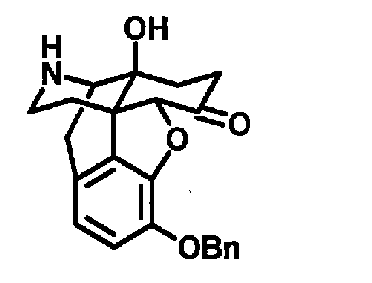
(4R,4aS,7aR,12bS)-3-アリル-9-(ベンジルオキシ)-4a-ヒドロキシ-2,3,4,4a,5,6-ヘキサヒドロ-1H-4,12-メタノベンゾフロ[3,2-e]イソキノリン-7(7aH)-オン(8.2g、25mmol)のアセトニトリル(250mL)と水(50mL)との混合溶液に、トリス(トリフェニルフォスフィン)ロジウム(I)クロリド(2.3g、2.5mmol)を加え、アルゴン雰囲気下、80℃で10時間撹拌した。反応液を室温まで冷却し、減圧濃縮した。残渣に飽和食塩水、酢酸エチルを加え、不溶物を濾別し、濾液を酢酸エチルで抽出した。有機層を硫酸ナトリウムで乾燥、減圧濃縮し、得られた粗生成物をシリカゲルカラムクロマトグラフィー(溶出液:クロロホルム/メタノール=10/1)で精製し、(4R,4aS,7aR,12bS)-9-(ベンジルオキシ)-4a-ヒドロキシ-2,3,4,4a,5,6-ヘキサヒドロ-1H-4,12-メタノベンゾフロ[3,2-e]イソキノリン-7(7aH)-オン(3.5g、2工程収率39%)を得た。
1H NMR (400 MHz , CDCl3): δ1.58-1.70 (2H, m), 2.00-2.11 (1H, m), 2.27-2.35 (1H, m), 2.56-2.67 (1H, m), 2.73-2.82 (1H, m), 2.99-3.16 (3H, m), 3.29 (1H, d, J = 18.8 Hz), 3.66-3.78 (1H, m), 4.75 (1H, s), 5.21 (1H, d, J = 12.0 Hz), 5.28 (1H, d, J = 12.0 Hz), 6.63 (1H, d, J = 8.0 Hz), 6.77 (1H, d, J = 8.0 Hz), 7.29 (1H, d, J = 7.6 Hz), 7.35 (2H, dd, J = 7.2, 7.6 Hz), 7.44 (2H, d, J = 7.2 Hz).
1H NMR (400 MHz , CDCl3): δ1.58-1.70 (2H, m), 2.00-2.11 (1H, m), 2.27-2.35 (1H, m), 2.56-2.67 (1H, m), 2.73-2.82 (1H, m), 2.99-3.16 (3H, m), 3.29 (1H, d, J = 18.8 Hz), 3.66-3.78 (1H, m), 4.75 (1H, s), 5.21 (1H, d, J = 12.0 Hz), 5.28 (1H, d, J = 12.0 Hz), 6.63 (1H, d, J = 8.0 Hz), 6.77 (1H, d, J = 8.0 Hz), 7.29 (1H, d, J = 7.6 Hz), 7.35 (2H, dd, J = 7.2, 7.6 Hz), 7.44 (2H, d, J = 7.2 Hz).
(参考例3)(4R,4aS,7aR,12bS)-9-(ベンジルオキシ)-4a-ヒドロキシ-3-(1-ヒドロキシシクロプロパンカルボニル)-2,3,4,4a,5,6-ヘキサヒドロ-1H-4,12-メタノベンゾフロ[3,2-e]イソキノリン-7(7aH)-オンの合成:
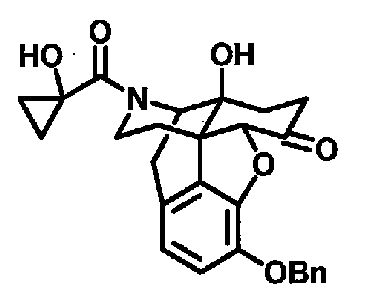
(4R,4aS,7aR,12bS)-9-(ベンジルオキシ)-4a-ヒドロキシ-2,3,4,4a,5,6-ヘキサヒドロ-1H-4,12-メタノベンゾフロ[3,2-e]イソキノリン-7(7aH)-オン(2.9g、7.6mmol)、1-ヒドロキシ-1-シクロプロパンカルボン酸(0.77g、7.6mmol)のN,N-ジメチルホルムアミド(6.0mL)溶液に、ジイソプロピルエチルアミン(1.6mL、9.1mmol)、1-[ビス(ジメチルアミノ)メチレン]-1H-1,2,3-トリアゾロ[4,5-b]ピリジニウム-3-オキシドヘキサフルオロホスフェイト(3.2g、8.3mmol)を加え、アルゴン雰囲気下、室温で18時間撹拌した。反応液に水を加え、酢酸エチルで抽出した。有機層を1N塩酸、0.1N塩酸、飽和重曹水、飽和食塩水の順で洗浄し、硫酸ナトリウムで乾燥、減圧濃縮し、得られた粗生成物をシリカゲルカラムクロマトグラフィー(溶出液:クロロホルム/酢酸エチル=10/1)で精製し、(4R,4aS,7aR,12bS)-9-(ベンジルオキシ)-4a-ヒドロキシ-3-(1-ヒドロキシシクロプロパンカルボニル)-2,3,4,4a,5,6-ヘキサヒドロ-1H-4,12-メタノベンゾフロ[3,2-e]イソキノリン-7(7aH)-オン(2.6g、46%収率)を得た。
1H NMR (400 MHz, CDCl3): δ0.80-1.30 (4H, m), 1.59-1.66 (1H, m), 1.70-1.80 (1H, m), 1.90-1.98 (1H, m), 1.90-1.98 (1H, m), 2.28-2.36 (1H, m), 2.50-2.70 (1H, m), 2.81-2.96 (1H, m), 2.96-3.09 (1H, m), 3.09-3.20 (1H, m), 3.85-4.00 (1H, m), 4.30-4.60 (1H, m), 4.71 (1H, s), 4.90 (1H, d, J = 6.0 Hz), 5.23 (1H, d, J = 12.0 Hz), 5.31 (1H, d, J = 12.0 Hz), 6.61 (1H, d, J = 8.0 Hz), 6.78 (1H, d, J = 8.0 Hz), 7.31 (1H, d, J = 7.2 Hz), 7.36 (1H, dd, J = 7.2, 7.6 Hz), 7.46 (2H, d, J = 7.6 Hz).
LC/MS (ESI): m/z 462 ([M+H]+)
1H NMR (400 MHz, CDCl3): δ0.80-1.30 (4H, m), 1.59-1.66 (1H, m), 1.70-1.80 (1H, m), 1.90-1.98 (1H, m), 1.90-1.98 (1H, m), 2.28-2.36 (1H, m), 2.50-2.70 (1H, m), 2.81-2.96 (1H, m), 2.96-3.09 (1H, m), 3.09-3.20 (1H, m), 3.85-4.00 (1H, m), 4.30-4.60 (1H, m), 4.71 (1H, s), 4.90 (1H, d, J = 6.0 Hz), 5.23 (1H, d, J = 12.0 Hz), 5.31 (1H, d, J = 12.0 Hz), 6.61 (1H, d, J = 8.0 Hz), 6.78 (1H, d, J = 8.0 Hz), 7.31 (1H, d, J = 7.2 Hz), 7.36 (1H, dd, J = 7.2, 7.6 Hz), 7.46 (2H, d, J = 7.6 Hz).
LC/MS (ESI): m/z 462 ([M+H]+)
(参考例4)((4R,4aS,7aR,12bS)-7-(ベンジル(メチル)アミノ)-9-(ベンジルオキシ)-4a-ヒドロキシ-4,4a,5,6,7,7a-ヘキサヒドロ-1H-4,12-メタノベンゾフロ[3,2-e]イソキノリン-3(2H)-イル)(1-ヒドロシクロプロピル)メタノンの合成:
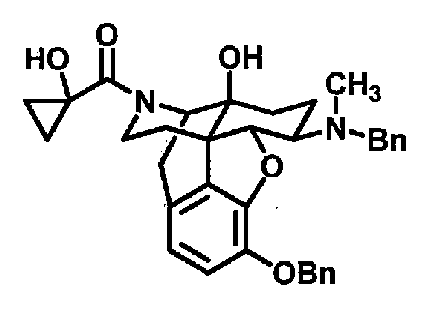
(4R,4aS,7aR,12bS)-9-(ベンジルオキシ)-4a-ヒドロキシ-3-(1-ヒドロキシシクロプロパンカルボニル)-2,3,4,4a,5,6-ヘキサヒドロ-1H-4,12-メタノベンゾフロ[3,2-e]イソキノリン-7(7aH)-オン(3.7g、8.0mmol)、安息香酸 (0.97g、8.0mmol)のベンゼン(100mL)溶液に、ベンジルメチルアミン(2.1mL、16mmol)を加え、液溜め部にMS4Aを詰めたDean-Stark還流器を付け、120℃で17時間加熱還流させた。反応液を室温まで冷却し、シアノ水素化ホウ素ナトリウム(0.65g、10mmol)のメタノール(14mL)溶液を加え、室温で0.5時間撹拌した。反応液に水、飽和重曹水を加え、酢酸エチルで抽出した。有機層を飽和食塩水で洗浄し、硫酸ナトリウムで乾燥、減圧濃縮し、得られた粗生成物をシリカゲルカラムクロマトグラフィー(溶出液:クロロホルム/メタノール=10/1)で精製し、((4R,4aS,7aR,12bS)-7-(ベンジル(メチル)アミノ)-9-(ベンジルオキシ)-4a-ヒドロキシ-4,4a,5,6,7,7a-ヘキサヒドロ-1H-4,12-メタノベンゾフロ[3,2-e]イソキノリン-3(2H)-イル)(1-ヒドロシクロプロピル)メタノン(2.5g、収率55%)を得た。
1H NMR (400 MHz, CDCl3): δ0.60-1.35 (4H, m), 1.35-1.60 (3H, m), 1.60-1.75 (1H, m), 1.84-2.02 (1H, m), 2.30 (3H, s), 2.30-2.55 (1H, m), 2.60-2.68 (1H, m), 2.68-3.02 (2H, m), 3.02-3.30 (1H, m), 3.60-3.90 (2H, m), 4.20-4.45 (1H, m), 4.65-5.00 (2H, m), 5.10-5.24 (2H, m), 6.57 (1H, d, J = 8.0 Hz), 6.80 (1H, d, J = 8.0 Hz), 7.15-7.40 (8H, m), 7.44 (2H, d, J = 6.4 Hz).
LC/MS (ESI): m/z 567 ([M+H]+)
1H NMR (400 MHz, CDCl3): δ0.60-1.35 (4H, m), 1.35-1.60 (3H, m), 1.60-1.75 (1H, m), 1.84-2.02 (1H, m), 2.30 (3H, s), 2.30-2.55 (1H, m), 2.60-2.68 (1H, m), 2.68-3.02 (2H, m), 3.02-3.30 (1H, m), 3.60-3.90 (2H, m), 4.20-4.45 (1H, m), 4.65-5.00 (2H, m), 5.10-5.24 (2H, m), 6.57 (1H, d, J = 8.0 Hz), 6.80 (1H, d, J = 8.0 Hz), 7.15-7.40 (8H, m), 7.44 (2H, d, J = 6.4 Hz).
LC/MS (ESI): m/z 567 ([M+H]+)
(参考例5)(4R,4aS,7R,7aR,12bS)-7-(ベンジル(メチル)アミノ)-9-(ベンジルオキシ)-3-((1-ヒドロキシシクロプロピル)メチル)-2,3,4,4a,5,6,7,7a-オクタヒドロ-1H-4,12-メタノベンゾフロ[3,2-e]イソキノリン-4a-オールの合成:
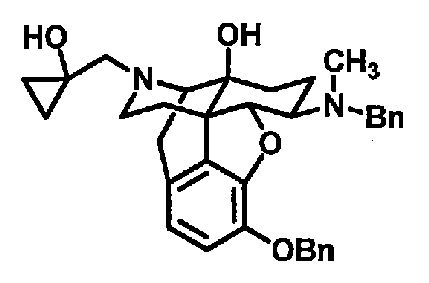
水素化アルミニウムリチウム(0.67g、18mmol)のテトラヒドロフラン(75mL)懸濁液に、((4R,4aS,7aR,12bS)-7-(ベンジル(メチル)アミノ)-9-(ベンジルオキシ)-4a-ヒドロキシ-4,4a,5,6,7,7a-ヘキサヒドロ-1H-4,12-メタノベンゾフロ[3,2-e]イソキノリン-3(2H)-イル)(1-ヒドロシクロプロピル)メタノン(2.5g、4.4mmol)のテトラヒドロフラン(75mL)溶液を加え、2時間加熱還流させた。氷冷下、反応液に水(0.7mL)、20%水酸化ナトリウム水溶液(0.7mL)、水 (2.0mL)を順に加えた。不溶物はセライトを通して濾別し、濾液を減圧濃縮し、得られた粗生成物をアミンシリカゲルカラムクロマトグラフィー(溶出液:クロロホルム)で精製し、(4R,4aS,7R,7aR,12bS)-7-(ベンジル(メチル)アミノ)-9-(ベンジルオキシ)-3-((1-ヒドロキシシクロプロピル)メチル)-2,3,4,4a,5,6,7,7a-オクタヒドロ-1H-4,12-メタノベンゾフロ[3,2-e]イソキノリン-4a-オール(2.0g、収率82%)を得た。
1H NMR (400 MHz, CDCl3): δ0.43-0.48 (2H, m), 0.82-0.87 (2H, m), 1.30-1.70 (4H, m), 1.95-2.08 (1H, m), 2.15-2.32 (2H, m), 2.35 (3H, s), 2.53 (1H, d, J = 12.8 Hz), 2.60-2.70 (2H, m), 2.75 (1H, d, J = 12.8 Hz), 2.72-2.82 (1H, m), 2.97-3.08 (2H, m), 3.72 (1H, d, J = 13.6 Hz), 3.81 (1H, d, J = 13.6 Hz), 4.77 (1H, d, J = 7.6 Hz), 5.20 (2H, s), 6.53 (1H, d, J = 8.0 Hz), 6.74 (1H, d, J = 8.0 Hz), 7.15-7.50 (10H, m).
LC/MS (ESI): m/z 553 ([M+H]+)
1H NMR (400 MHz, CDCl3): δ0.43-0.48 (2H, m), 0.82-0.87 (2H, m), 1.30-1.70 (4H, m), 1.95-2.08 (1H, m), 2.15-2.32 (2H, m), 2.35 (3H, s), 2.53 (1H, d, J = 12.8 Hz), 2.60-2.70 (2H, m), 2.75 (1H, d, J = 12.8 Hz), 2.72-2.82 (1H, m), 2.97-3.08 (2H, m), 3.72 (1H, d, J = 13.6 Hz), 3.81 (1H, d, J = 13.6 Hz), 4.77 (1H, d, J = 7.6 Hz), 5.20 (2H, s), 6.53 (1H, d, J = 8.0 Hz), 6.74 (1H, d, J = 8.0 Hz), 7.15-7.50 (10H, m).
LC/MS (ESI): m/z 553 ([M+H]+)
(参考例6)(4R,4aS,7R,7aR,12bS)-3-((1-ヒドロキシシクロプロピル)メチル)-7-(メチルアミノ)-2,3,4,4a,5,6,7,7a-オクタヒドロ-1H-4,12-メタノベンゾフロ[3,2-e]イソキノリン-4a,9-ジオールの合成:
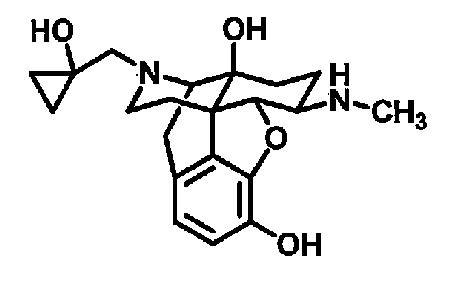
(4R,4aS,7R,7aR,12bS)-7-(ベンジル(メチル)アミノ)-9-(ベンジルオキシ)-3-((1-ヒドロキシシクロプロピル)メチル)-2,3,4,4a,5,6,7,7a-オクタヒドロ-1H-4,12-メタノベンゾフロ[3,2-e]イソキノリン-4a-オール(2.0g、3.6mmol)のメタノール(200mL)溶液に、フタル酸(1.2g、7.2mmol)、10%パラジウム/カーボン(約50%含水、1.5g)を加え、水素雰囲気下、室温で16.5時間撹拌した。不溶物はセライトを通して濾別し、濾液を減圧濃縮し、得られた粗生成物(3.0g)をそのまま次工程に用いた。
(実施例1)(E)-N-((4R,4aS,7R,7aR,12bS)-4a,9-ジヒドロキシ-3-((1-ヒドロキシシクロプロピル)メチル)-2,3,4,4a,5,6,7,7a-オクタヒドロ-1H-4,12-メタノベンゾフロ[3,2-e]イソキノリン-7-イル)-3-(フラン-3-イル)-N-メチルアクリルアミドの合成:

参考例6で得られた粗成生物(2.6g)のテトラヒドロフラン(35mL)溶液に、重曹(1.5g、15mmol)の水(20mL)溶液を加えた。(E)-3-(フラン-3-イル)アクリロイルクロリド(0.57g、3.6mmol)のテトラヒドロフラン(20mL)溶液を加え、アルゴン雰囲気下、室温で0.5時間撹拌した。反応液に2N水酸化ナトリウム水溶液(5.5mL)、メタノール(13mL)を加え、室温で0.5時間撹拌した。反応液に飽和重曹水、水を加え、酢酸エチルで抽出した。有機層を飽和食塩水で洗浄し、硫酸ナトリウムで乾燥、減圧濃縮し、得られた粗生成物をアミンシリカゲルカラムクロマトグラフィー(溶出液:クロロホルム/メタノール=10/1)で精製し、(E)-N-((4R,4aS,7R,7aR,12bS)-4a,9-ジヒドロキシ-3-((1-ヒドロキシシクロプロピル)メチル)-2,3,4,4a,5,6,7,7a-オクタヒドロ-1H-4,12-メタノベンゾフロ[3,2-e]イソキノリン-7-イル)-3-(フラン-3-イル)-N-メチルアクリルアミド(以下、実施例1の化合物)(1.3g、2工程収率78%)を得た。
1H NMR (400 MHz, DMSO-d6): δ0.27-0.42 (2H, m), 0.48-0.53 (2H, m), 1.15-1.53 (4H, m), 1.90-2.35 (4H, m), 2.45-2.60(1.35H, m), 2.65-2.80 (2H, m), 2.85-3.00 (1.65H, m), 2.86 (1.95H, s), 3.09 (1.05H, s), 3.52-3.67 (0.65H, m), 4.10-4.25 (0.35H, m), 4.63 (0.65H, d, J = 7.6 Hz), 4.72 (0.35H, d, J = 7.6 Hz), 5.12 (0.35H, s), 5.15 (0.65H, s), 5.25 (1H, s), 6.41 (0.65H, d, J = 15.6 Hz), 6.51 (0.35H, d, J = 8.0 Hz), 6.57 (0.35H, d, J = 8.0 Hz), 6.58 (0.65H, d, J = 8.0 Hz), 6.65 (0.65H, d, J = 8.0 Hz), 6.71 (0.65H, d, J = 8.0 Hz), 6.90 (0.35H, d, J = 14.8 Hz), 7.00 (0.35H, s), 7.21 (0.65H, d, J = 15.6 Hz), 7.36 (0.35H, d, J =14.8 Hz), 7.66 (0.65H, s), 7.72 (0.35H, s), 7.92 (0.65H, s), 8.03 (0.35H, s), 8.98 (0.35H, brs), 9.39 (0.65H, brs).
LC/MS (ESI): m/z 493 ([M+H]+)
1H NMR (400 MHz, DMSO-d6): δ0.27-0.42 (2H, m), 0.48-0.53 (2H, m), 1.15-1.53 (4H, m), 1.90-2.35 (4H, m), 2.45-2.60(1.35H, m), 2.65-2.80 (2H, m), 2.85-3.00 (1.65H, m), 2.86 (1.95H, s), 3.09 (1.05H, s), 3.52-3.67 (0.65H, m), 4.10-4.25 (0.35H, m), 4.63 (0.65H, d, J = 7.6 Hz), 4.72 (0.35H, d, J = 7.6 Hz), 5.12 (0.35H, s), 5.15 (0.65H, s), 5.25 (1H, s), 6.41 (0.65H, d, J = 15.6 Hz), 6.51 (0.35H, d, J = 8.0 Hz), 6.57 (0.35H, d, J = 8.0 Hz), 6.58 (0.65H, d, J = 8.0 Hz), 6.65 (0.65H, d, J = 8.0 Hz), 6.71 (0.65H, d, J = 8.0 Hz), 6.90 (0.35H, d, J = 14.8 Hz), 7.00 (0.35H, s), 7.21 (0.65H, d, J = 15.6 Hz), 7.36 (0.35H, d, J =14.8 Hz), 7.66 (0.65H, s), 7.72 (0.35H, s), 7.92 (0.65H, s), 8.03 (0.35H, s), 8.98 (0.35H, brs), 9.39 (0.65H, brs).
LC/MS (ESI): m/z 493 ([M+H]+)
(実施例2)(E)-N-((4R,4aS,7R,7aR,12bS)-4a,9-ジヒドロキシ-3-((1-ヒドロキシシクロプロピル)メチル)-2,3,4,4a,5,6,7,7a-オクタヒドロ-1H-4,12-メタノベンゾフロ[3,2-e]イソキノリン-7-イル)-3-(フラン-3-イル)-N-メチルアクリルアミド塩酸塩の合成:

実施例1の化合物(1.1g、2.3mmol)の水(75mL)溶液に、氷冷下、1N塩酸(2.5mL、2.5mmol)を加え、1時間撹拌した。反応液を凍結乾燥し、(E)-N-((4R,4aS,7R,7aR,12bS)-4a,9-ジヒドロキシ-3-((1-ヒドロキシシクロプロピル)メチル)-2,3,4,4a,5,6,7,7a-オクタヒドロ-1H-4,12-メタノベンゾフロ[3,2-e]イソキノリン-7-イル)-3-(フラン-3-イル)-N-メチルアクリルアミド塩酸塩(以下、実施例2の化合物)(1.2g、収率100%)を得た。
1H NMR (400 MHz, DMSO-d6): δ0.66-0.90 (4H, m), 1.22-1.55 (3H, m), 1.70-1.80 (1H, m), 2.03-2.24 (1H, m), 2.45-2.69 (3H, m), 2.92 (1.8H, s), 3.00-3.22 (2H, m), 3.16 (1.2H, s), 3.22-3.53 (2H, m), 3.53-3.65 (0.6H, m), 3.97-4.06 (1H, m), 4.14-4.26 (0.4H, m), 4.85 (0.6H, sd, J = 8.0 Hz), 4.92 (0.4H, d, J = 8.0 Hz), 6.18 (1H, s), 6.36 (0.6H, d, J = 15.6 Hz), 6.50 (0.4H, s), 6.59 (0.6H, s), 6.62 (0.6H, s), 6.64 (0.4H, d, J = 8.0 Hz), 6.71 (0.4H, d, J = 8.0 Hz), 6.71 (0.6H, d, J = 8.0 Hz), 6.85 (0.6H, d, J = 8.0 Hz), 6.90 (0.4H, d, J = 15.0 Hz), 7.00 (0.4H, s), 7.22 (0.6H, d, J = 15.6 Hz), 7.37 (0.4H, d, J = 15.0 Hz), 7.66 (0.6H, s), 7.72 (0.4H, s), 7.92 (0.6H, s), 8.03 (0.4H, s), 8.43 (1H, brs), 9.29 (0.4H, s), 9.69 (0.6H, s).
LC/MS (ESI): m/z 493 ([M+H]+)
1H NMR (400 MHz, DMSO-d6): δ0.66-0.90 (4H, m), 1.22-1.55 (3H, m), 1.70-1.80 (1H, m), 2.03-2.24 (1H, m), 2.45-2.69 (3H, m), 2.92 (1.8H, s), 3.00-3.22 (2H, m), 3.16 (1.2H, s), 3.22-3.53 (2H, m), 3.53-3.65 (0.6H, m), 3.97-4.06 (1H, m), 4.14-4.26 (0.4H, m), 4.85 (0.6H, sd, J = 8.0 Hz), 4.92 (0.4H, d, J = 8.0 Hz), 6.18 (1H, s), 6.36 (0.6H, d, J = 15.6 Hz), 6.50 (0.4H, s), 6.59 (0.6H, s), 6.62 (0.6H, s), 6.64 (0.4H, d, J = 8.0 Hz), 6.71 (0.4H, d, J = 8.0 Hz), 6.71 (0.6H, d, J = 8.0 Hz), 6.85 (0.6H, d, J = 8.0 Hz), 6.90 (0.4H, d, J = 15.0 Hz), 7.00 (0.4H, s), 7.22 (0.6H, d, J = 15.6 Hz), 7.37 (0.4H, d, J = 15.0 Hz), 7.66 (0.6H, s), 7.72 (0.4H, s), 7.92 (0.6H, s), 8.03 (0.4H, s), 8.43 (1H, brs), 9.29 (0.4H, s), 9.69 (0.6H, s).
LC/MS (ESI): m/z 493 ([M+H]+)
(参考例7)2-((4R,4aS,7R,7aR,12bS)-9-(ベンジルオキシ)-3-(シクロプロピルメチル)-4a-ヒドロキシ-2,3,4,4a,5,6,7,7a-オクタヒドロ-1H-4,12-メタノベンゾフロ[3,2-e]イソキノリン-7-イル)イソインドリン-1,3-ジオンの合成:
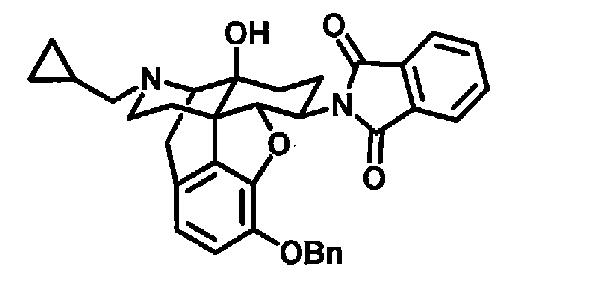
2-((4R,4aS,7R,7aR,12bS)-3-(シクロプロピルメチル)-4a,9-ジヒドロキシ-2,3,4,4a,5,6,7,7a-オクタヒドロ-1H-4,12-メタノベンゾフロ[3,2-e]イソキノリン-7-イル)イソインドリン-1,3-ジオン(特開2014-62069号公報)(5.0g、11mmol)のN,N-ジメチルホルムアミド(85mL)溶液に、炭酸カリウム(3.2g、23mmol)、ベンジルブロミド(2.5mL、21mmol)を加え、室温で2時間撹拌した。反応液に水を加え、酢酸エチルで抽出した。有機層を水で洗浄し、硫酸ナトリウムで乾燥、減圧濃縮し、粗成生物にメタノールを加え、スラリー濾過し、2-((4R,4aS,7R,7aR,12bS)-9-(ベンジルオキシ)-3-(シクロプロピルメチル)-4a-ヒドロキシ-2,3,4,4a,5,6,7,7a-オクタヒドロ-1H-4,12-メタノベンゾフロ[3,2-e]イソキノリン-7-イル)イソインドリン-1,3-ジオン(5.8g、収率98%)を得た。
1H NMR (400 MHz, CDCl3): δ0.13 (2H, m), 0.54 (2H, m), 0.86 (1H, m), 1.52 (3H, m), 1.71 (1H, m), 2.12 (1H, dt, J = 12.0, 4.0 Hz), 2.36 (3H, m), 2.65 (2H, m), 2.79 (1H, dq, J = 13.2, 2.4 Hz), 3.06 (1H, d, J = 18.4 Hz), 3.11 (1H, d, J = 5.2 Hz), 4.16 (1H, ddd, J = 13.2, 8.4, 4.8 Hz), 5.09 (1H, d, J = 12.0 Hz), 5.19 (1H, d, J = 12.0 Hz), 5.27 (1H, d, J = 8.4 Hz), 6.61 (1H, d, J = 8.4 Hz), 6.76 (1H, d, J = 8.4 Hz), 7.26 (1H, t, J = 7.6 Hz), 7.33 (2H, t, J = 7.6 Hz), 7.43 (2H, d, J = 7.6 Hz), 7.72 (2H, m), 7.84 (2H, m).
1H NMR (400 MHz, CDCl3): δ0.13 (2H, m), 0.54 (2H, m), 0.86 (1H, m), 1.52 (3H, m), 1.71 (1H, m), 2.12 (1H, dt, J = 12.0, 4.0 Hz), 2.36 (3H, m), 2.65 (2H, m), 2.79 (1H, dq, J = 13.2, 2.4 Hz), 3.06 (1H, d, J = 18.4 Hz), 3.11 (1H, d, J = 5.2 Hz), 4.16 (1H, ddd, J = 13.2, 8.4, 4.8 Hz), 5.09 (1H, d, J = 12.0 Hz), 5.19 (1H, d, J = 12.0 Hz), 5.27 (1H, d, J = 8.4 Hz), 6.61 (1H, d, J = 8.4 Hz), 6.76 (1H, d, J = 8.4 Hz), 7.26 (1H, t, J = 7.6 Hz), 7.33 (2H, t, J = 7.6 Hz), 7.43 (2H, d, J = 7.6 Hz), 7.72 (2H, m), 7.84 (2H, m).
(参考例8)2-((4R,4aS,7R,7aR,12bS,13S)-9-(ベンジルオキシ)-3-(シクロプロピルメチル)-4a,13-ジヒドロキシ-2,3,4,4a,5,6,7,7a-オクタヒドロ-1H-4,12-メタノベンゾフロ[3,2-e]イソキノリン-7-イル)イソインドリン-1,3-ジオンの合成:
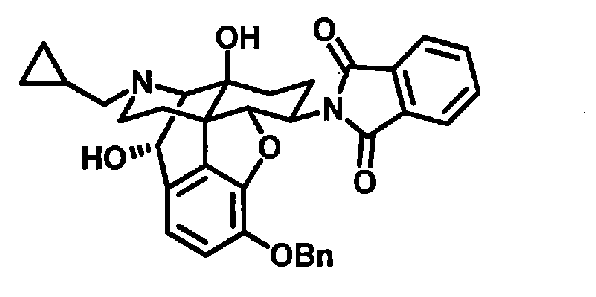
2-((4R,4aS,7R,7aR,12bS)-9-(ベンジルオキシ)-3-(シクロプロピルメチル)-4a-ヒドロキシ-2,3,4,4a,5,6,7,7a-オクタヒドロ-1H-4,12-メタノベンゾフロ[3,2-e]イソキノリン-7-イル)イソインドリン-1,3-ジオン(2.0g、3.6mmol)のアセトニトリル(190mL)と水(10mL)との混合溶液に、ヘキサニトラトセリウム(IV)酸アンモニウム(7.7g、14mmol)、重曹(4.7g、56mmol)、セライト(6.2g)を加え、室温で20時間撹拌した。反応液に飽和重曹水、酢酸エチルを加え、不溶物はセライトを通して濾別し、濾液を酢酸エチルで抽出した。有機層を硫酸ナトリウムで乾燥、減圧濃縮し、得られた粗生成物をシリカゲルカラムクロマトグラフィー(溶出液:n-ヘキサン/酢酸エチル=1/2)にて精製し、2-((4R,4aS,7R,7aR,12bS,13S)-9-(ベンジルオキシ)-3-(シクロプロピルメチル)-4a,13-ジヒドロキシ-2,3,4,4a,5,6,7,7a-オクタヒドロ-1H-4,12-メタノベンゾフロ[3,2-e]イソキノリン-7-イル)イソインドリン-1,3-ジオン(560mg、収率27%)を得た。
1H NMR (400 MHz, CDCl3): δ0.12-0.24 (2H, m), 0.53-0.60 (2H, m), 0.91 (1H, m), 1.44-1.55 (2H, m), 1.66 (1H, m), 1.80-1.90 (2H, m), 2.02 (1H, td, J = 11.6, 4.5 Hz), 2.36 (1H, td, J = 12.6, 5.4 Hz), 2.49 (1H, dd, J = 12.8, 6.7 Hz), 2.56 (1H, dd, J = 12.8, 6.7 Hz), 2.65 (3H, dd, J = 12.1, 5.0 Hz), 2.78 (1H, qd, J = 12.9, 4.6 Hz), 3.16 (1H, s), 4.07-4.11 (1H, m), 4.99 (1H, d, J = 4.4 Hz), 5.18 (2H, dd, J = 33.9, 12.0 Hz), 5.30 (1H, d, J = 8.3 Hz), 6.88 (1H, d, J = 8.3 Hz), 6.92 (1H, d, J = 8.3 Hz), 7.28 (1H, d, J = 6.8 Hz), 7.34 (2H, t, J = 6.8 Hz), 7.43 (2H, d, J = 6.8 Hz), 7.71 (2H, dd, J = 5.5, 3.0 Hz), 7.84 (2H, dd, J = 5.5, 3.0 Hz).
1H NMR (400 MHz, CDCl3): δ0.12-0.24 (2H, m), 0.53-0.60 (2H, m), 0.91 (1H, m), 1.44-1.55 (2H, m), 1.66 (1H, m), 1.80-1.90 (2H, m), 2.02 (1H, td, J = 11.6, 4.5 Hz), 2.36 (1H, td, J = 12.6, 5.4 Hz), 2.49 (1H, dd, J = 12.8, 6.7 Hz), 2.56 (1H, dd, J = 12.8, 6.7 Hz), 2.65 (3H, dd, J = 12.1, 5.0 Hz), 2.78 (1H, qd, J = 12.9, 4.6 Hz), 3.16 (1H, s), 4.07-4.11 (1H, m), 4.99 (1H, d, J = 4.4 Hz), 5.18 (2H, dd, J = 33.9, 12.0 Hz), 5.30 (1H, d, J = 8.3 Hz), 6.88 (1H, d, J = 8.3 Hz), 6.92 (1H, d, J = 8.3 Hz), 7.28 (1H, d, J = 6.8 Hz), 7.34 (2H, t, J = 6.8 Hz), 7.43 (2H, d, J = 6.8 Hz), 7.71 (2H, dd, J = 5.5, 3.0 Hz), 7.84 (2H, dd, J = 5.5, 3.0 Hz).
(参考例9)2-((4R,4aS,7R,7aR,12bS,13S)-3-(シクロプロピルメチル)-4a,9,13-トリヒドロキシ-2,3,4,4a,5,6,7,7a-オクタヒドロ-1H-4,12,-メタノベンゾフロ[3,2,-e]イソキノリン-7-イル)イソインドリン-1,3-ジオンの合成:
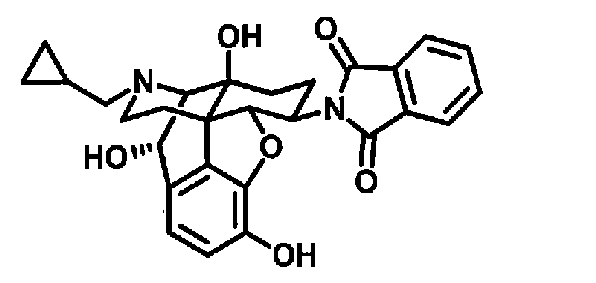
2-((4R,4aS,7R,7aR,12bS,13S)-9-(ベンジルオキシ)-3-(シクロプロピルメチル)-4a,13-ジヒドロキシ-2,3,4,4a,5,6,7,7a-オクタヒドロ-1H-4,12-メタノベンゾフロ[3,2-e]イソキノリン-7-イル)イソインドリン-1,3-ジオン(450mg、0.77mmol)のテトラヒドロフラン(15mL)溶液に、10%パラジウム/カーボン(約50%含水、220mg)、ギ酸(3.0mL)を加え、室温で19時間撹拌した。不溶物はセライトを通して濾別、濾液を飽和重曹水で洗浄した。有機層を硫酸ナトリウムで乾燥、減圧濃縮し、2-((4R,4aS,7R,7aR,12bS,13S)-3-(シクロプロピルメチル)-4a,9,13-トリヒドロキシ-2,3,4,4a,5,6,7,7a-オクタヒドロ-1H-4,12,-メタノベンゾフロ[3,2,-e]イソキノリン-7-イル)イソインドリン-1,3-ジオン(370mg、収率99%)を得た。
1H NMR (400 MHz, DMSO-d6): δ0.20-0.34 (2H, m), 0.44-0.55 (2H, m), 0.88-0.96 (1H, m), 0.88-0.98 (1H, m), 1.22-1.29 (1H, m), 1.35-1.44 (1H, m), 1.48-1.55 (1H, m), 1.76-1.95 (2H, m), 2.13-2.24 (1H, m), 2.37 (1H, dd, J = 12.7, 6.8 Hz), 2.42-2.62 (1H, m), 3.17 (2H, d, J = 5.1 Hz), 3.88 (1H, m), 4.82 (2H, d, J = 4.6 Hz), 5.04 (1H, d, J = 8.3 Hz), 5.24 (1H, d, J = 4.6 Hz), 6.69 (1H, d, J = 8.0 Hz), 6.84 (1H, d, J = 8.0 Hz), 7.86-7.91 (4H, m), 9.21 (1H, s).
1H NMR (400 MHz, DMSO-d6): δ0.20-0.34 (2H, m), 0.44-0.55 (2H, m), 0.88-0.96 (1H, m), 0.88-0.98 (1H, m), 1.22-1.29 (1H, m), 1.35-1.44 (1H, m), 1.48-1.55 (1H, m), 1.76-1.95 (2H, m), 2.13-2.24 (1H, m), 2.37 (1H, dd, J = 12.7, 6.8 Hz), 2.42-2.62 (1H, m), 3.17 (2H, d, J = 5.1 Hz), 3.88 (1H, m), 4.82 (2H, d, J = 4.6 Hz), 5.04 (1H, d, J = 8.3 Hz), 5.24 (1H, d, J = 4.6 Hz), 6.69 (1H, d, J = 8.0 Hz), 6.84 (1H, d, J = 8.0 Hz), 7.86-7.91 (4H, m), 9.21 (1H, s).
(参考例10)(4R,4aS,7R,7aR,12bS,13S)-7-アミノ-3-(シクロプロピルメチル)-2,3,4,4a,5,6,7,7a-オクタヒドロ-1H-4,12-メタノベンゾフロ[3,2-e]イソキノリン-4a,9,13-トリオールの合成:
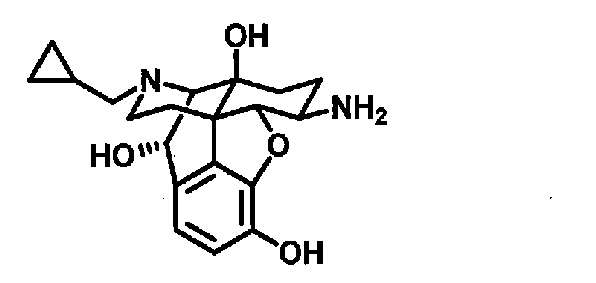
2-((4R,4aS,7R,7aR,12bS,13S)-3-(シクロプロピルメチル)-4a,9,13-トリヒドロキシ-2,3,4,4a,5,6,7,7a-オクタヒドロ-1H-4,12,-メタノベンゾフロ[3,2,-e]イソキノリン-7-イル)イソインドリン-1,3-ジオン(130mg、0.22mmol)のエタノール(1.0mL)溶液に、ヒドラジン一水和物(33mg、0.66mmol)を加え、70℃で3時間撹拌した。反応液を減圧濃縮し、得られた粗生成物をシリカゲルカラムクロマトグラフィー(溶出液:クロロホルム/メタノール=10/1)で精製し、(4R,4aS,7R,7aR,12bS,13S)-7-アミノ-3-(シクロプロピルメチル)-2,3,4,4a,5,6,7,7a-オクタヒドロ-1H-4,12-メタノベンゾフロ[3,2-e]イソキノリン-4a,9,13-トリオール(93mg、収率94%)を得た。
1H NMR (400 MHz, CDCl3): δ0.11-0.22 (2H, m), 0.54-0.59 (2H, m), 0.86-0.92 (1H, m), 1.59-1.71 (10H, m), 1.99-2.20 (2H, m), 2.41-2.63 (4H, m), 3.09 (1H, s), 4.24 (1H, d, J = 7.6 Hz), 4.93 (1H, s), 6.77-6.85 (2H, m).
1H NMR (400 MHz, CDCl3): δ0.11-0.22 (2H, m), 0.54-0.59 (2H, m), 0.86-0.92 (1H, m), 1.59-1.71 (10H, m), 1.99-2.20 (2H, m), 2.41-2.63 (4H, m), 3.09 (1H, s), 4.24 (1H, d, J = 7.6 Hz), 4.93 (1H, s), 6.77-6.85 (2H, m).
(参考例11)(4R,4aS,7R,7aR,12bS,13S)-7-(ベンジル(メチル)アミノ)-3-(シクロプロピルメチル)-2,3,4,4a,5,6,7,7a-オクタヒドロ-1H-4,12-メタノベンゾフロ[3,2-e]イソキノリン-4a,9,13-トリオールの合成:

(4R,4aS,7R,7aR,12bS,13S)-7-アミノ-3-(シクロプロピルメチル)-2,3,4,4a,5,6,7,7a-オクタヒドロ-1H-4,12-メタノベンゾフロ[3,2-e]イソキノリン-4a,9,13-トリオール(93mg、0.2mmol)のジクロロメタン(1mL)溶液に、ベンズアルデヒド(21μL)、水素化トリアセトキシホウ素化ナトリウム(140mg、0.65mmol)を加え、室温で1時間撹拌した。反応液にホルマリン(50μL、0.69mmol)を加え、室温で1時間撹拌した。反応液に水を加え、酢酸エチルで抽出した。有機層を硫酸ナトリウムで乾燥、減圧濃縮し、得られた粗生成物をシリカゲルカラムクロマトグラフィー(溶出液:n-ヘキサン/酢酸エチル=1/2)で精製し、(4R,4aS,7R,7aR,12bS,13S)-7-(ベンジル(メチル)アミノ)-3-(シクロプロピルメチル)-2,3,4,4a,5,6,7,7a-オクタヒドロ-1H-4,12-メタノベンゾフロ[3,2-e]イソキノリン-4a,9,13-トリオール(56mg、収率49%)を得た。
1H NMR (400 MHz, CDCl3): δ0.12-0.22 (2H, m), 0.53-0.61 (2H, m), 0.85-0.95 (1H, m), 1.47-1.74 (5H, m), 1.97-2.07 (2H, m), 2.19-2.26 (8H, m), 3.10 (1H, m), 3.69-3.82 (2H, m), 4.77 (1H, d, J = 8.0 Hz), 4.93 (1H, s), 5.23 (2H, s), 6.84 (2H, s), 7.16-7.45 (7H, m).
1H NMR (400 MHz, CDCl3): δ0.12-0.22 (2H, m), 0.53-0.61 (2H, m), 0.85-0.95 (1H, m), 1.47-1.74 (5H, m), 1.97-2.07 (2H, m), 2.19-2.26 (8H, m), 3.10 (1H, m), 3.69-3.82 (2H, m), 4.77 (1H, d, J = 8.0 Hz), 4.93 (1H, s), 5.23 (2H, s), 6.84 (2H, s), 7.16-7.45 (7H, m).
(参考例12)(4R,4aS,7R,7aR,12bS,13S)-3-(シクロプロピルメチル)-7-(メチルアミノ)-2,3,4,4a,5,6,7,7a-オクタヒドロ-1H-4,12-メタノベンゾフロ[3,2-e]イソキノリン-4a,9,13-トリオールの合成

(4R,4aS,7R,7aR,12bS,13S)-7-(ベンジル(メチル)アミノ)-3-(シクロプロピルメチル)-2,3,4,4a,5,6,7,7a-オクタヒドロ-1H-4,12-メタノベンゾフロ[3,2-e]イソキノリン-4a,9,13-トリオール(56mg、0.1mmol)のメタノール(1mL)溶液に、10%塩酸メタノール溶液(0.2mL)、10%パラジウム/カーボン(約50%含水、8mg)を加え、水素雰囲気下、室温で16時間撹拌した。不溶物はセライトを通して濾別し、濾液を減圧濃縮し、(4R,4aS,7R,7aR,12bS,13S)-3-(シクロプロピルメチル)-7-(メチルアミノ)-2,3,4,4a,5,6,7,7a-オクタヒドロ-1H-4,12-メタノベンゾフロ[3,2-e]イソキノリン-4a,9,13-トリオール(52mg、収率100%)を得た。
1H NMR (400 MHz, CD3OD): δ0.55-0.62 (2H, m), 0.76-0.90 (2H, m), 1.18-1.24 (1H, m), 1.63-1.66 (1H, m), 1.84-2.11 (4H, m), 2.56-2.67 (2H, m), 2.89 (3H, s), 2.95-3.12 (3H, m), 3.34 (3H, s), 3.43-3.51 (1H, m), 3.88 (1H, s), 5.29 (1H, s), 6.88 (1H, d, J = 8.4 Hz), 7.04 (1H, d, J = 8.4 Hz).
1H NMR (400 MHz, CD3OD): δ0.55-0.62 (2H, m), 0.76-0.90 (2H, m), 1.18-1.24 (1H, m), 1.63-1.66 (1H, m), 1.84-2.11 (4H, m), 2.56-2.67 (2H, m), 2.89 (3H, s), 2.95-3.12 (3H, m), 3.34 (3H, s), 3.43-3.51 (1H, m), 3.88 (1H, s), 5.29 (1H, s), 6.88 (1H, d, J = 8.4 Hz), 7.04 (1H, d, J = 8.4 Hz).
(実施例3)(E)-N-((4R,4aS,7R,7aR,12bS,13S)-3-(シクロプロピルメチル)-4a,9,13-トリヒドロキシ-2,3,4,4a,5,6,7,7a,オクタヒドロ-1H-4,12-メタノベンゾフロ[3,2-e]イソキノリン-7-イル)-3-(フラン-3-イル)-N-メチルアクリルアミドの合成:

(4R,4aS,7R,7aR,12bS,13S)-3-(シクロプロピルメチル)-7-(メチルアミノ)-2,3,4,4a,5,6,7,7a-オクタヒドロ-1H-4,12-メタノベンゾフロ[3,2-e]イソキノリン-4a,9,13-トリオール(52mg、0.12mmol)のジクロロメタン(1mL)溶液に、1-[ビス(ジメチルアミノ)メチレン]-1H-1,2,3-トリアゾロ[4,5-b]ピリジニウム-3-オキシドヘキサフルオロホスフェイト(97mg、0.25mmol)、トリエチルアミン(49mg、0.48mmol)、トランス-3-フランアクリル酸(31mg、0.23mmol)を加え、室温で3時間撹拌した。反応液にメタノール(1mL)、1N水酸化ナトリウム水溶液(0.5mL)を加え、室温で18時間撹拌した。反応液に酢酸エチル、飽和塩化アンモニウム水溶液、35%アンモニア水を加え、酢酸エチルで抽出した。有機層を硫酸マグネシウムで乾燥、減圧濃縮し、粗生成物に酢酸エチルを加え、スラリー濾過し、(E)-N-((4R,4aS,7R,7aR,12bS,13S)-3-(シクロプロピルメチル)-4a,9,13-トリヒドロキシ-2,3,4,4a,5,6,7,7a,オクタヒドロ-1H-4,12-メタノベンゾフロ[3,2-e]イソキノリン-7-イル)-3-(フラン-3-イル)-N-メチルアクリルアミド(以下、実施例3の化合物)(22mg、収率44%)を得た。
1H NMR (400 MHz, DMSO-d6): δ0.09-0.23 (2H, m), 0.45-0.53 (2H, m), 0.87-0.96 (1H, m), 1.18-1.35 (2H, m), 1.41-1.50 (1H, m), 1.70-1.96 (2H, m), 2.00-2.23 (2H, m), 2.32-2.40 (1H, m), 2.50-2.62 (2H, m), 2.84 (2H, s), 2.92 (1H, s), 3.08 (1H, s), 3.58 (0.66H, br), 4.20 (0.33H, br), 4.63 (0.66H, d, J = 8.0 Hz), 4.71-4.82 (2H, m), 5.20 (0.34H, d, J = 4.6 Hz), 5.25 (0.66H, d, J = 4.6 Hz), 6.41 (0.66H, d, J = 15.4 Hz), 6.65 (1H, m), 6.78-6.91 (2H, m), 6.99 (0.34H, s), 7.21 (0.66H, d, J = 15.4 Hz), 7.37 (0.34H, d, J = 15.4 Hz), 7.67 (0.66H, s), 7.71 (0.34H, s), 7.92 (0.66H, s), 8.02 (0.34H, s), 9.17 (0.34H, s), 9.61 (0.66H, s).
1H NMR (400 MHz, DMSO-d6): δ0.09-0.23 (2H, m), 0.45-0.53 (2H, m), 0.87-0.96 (1H, m), 1.18-1.35 (2H, m), 1.41-1.50 (1H, m), 1.70-1.96 (2H, m), 2.00-2.23 (2H, m), 2.32-2.40 (1H, m), 2.50-2.62 (2H, m), 2.84 (2H, s), 2.92 (1H, s), 3.08 (1H, s), 3.58 (0.66H, br), 4.20 (0.33H, br), 4.63 (0.66H, d, J = 8.0 Hz), 4.71-4.82 (2H, m), 5.20 (0.34H, d, J = 4.6 Hz), 5.25 (0.66H, d, J = 4.6 Hz), 6.41 (0.66H, d, J = 15.4 Hz), 6.65 (1H, m), 6.78-6.91 (2H, m), 6.99 (0.34H, s), 7.21 (0.66H, d, J = 15.4 Hz), 7.37 (0.34H, d, J = 15.4 Hz), 7.67 (0.66H, s), 7.71 (0.34H, s), 7.92 (0.66H, s), 8.02 (0.34H, s), 9.17 (0.34H, s), 9.61 (0.66H, s).
(実施例4)ヒトオピオイドκ受容体及びμ受容体作動性試験:
ヒトオピオイドκ受容体又はヒトオピオイドμ受容体を安定発現した細胞を用いて、上記の式(I)若しくは式(II)で示されるモルヒナン誘導体又はその薬理学的に許容される酸付加塩のヒトオピオイドκ受容体及びμ受容体作動性を評価した。
ヒトオピオイドκ受容体又はヒトオピオイドμ受容体を安定発現した細胞を用いて、上記の式(I)若しくは式(II)で示されるモルヒナン誘導体又はその薬理学的に許容される酸付加塩のヒトオピオイドκ受容体及びμ受容体作動性を評価した。
GeneOptimizer(登録商標;タカラバイオ)を用いて発現量が増大するように塩基配列を最適化した改変型ヒトオピオイドκ受容体遺伝子をHEK-293細胞に導入し、定法に従い、ヒトオピオイドκ受容体安定発現細胞を作製した。
ヒトオピオイドμ受容体遺伝子をCHO-dhfr(-)細胞に導入し、定法に従い、ヒトオピオイドμ受容体安定発現細胞を作製した。
ヒトオピオイドκ受容体安定発現細胞は、10% FBS及び50μg/mL Hygromycin Bを含むDMEMを、ヒトオピオイドμ受容体安定発現細胞は、10%FBS及び500μg/mL G418を含むMEM-αを、培養液として用い、37℃、5%CO2インキュベーター内で培養維持した。
被験物質のヒトオピオイド受容体作動性の評価は、上記のヒトオピオイド受容体安定発現細胞を用いて、Forskolin誘発cAMP産生に対する抑制作用を指標に行った。cAMP産生量の測定にはAlphaScreen(登録商標) cAMP Detection Kit(PerkinElmer)を用いた。
Stimulationバッファーとして、0.5mmol/L IBMX、5mmol/L HEPES、0.1% BSAを含むHBSSバッファー(pH7.4)(以下、SB)を用時調製した。また、Lysis/Detectionバッファーとして、0.1% BSA、0.3% Tween-20(登録商標)を含むHEPESバッファー(pH7.4)(以下、L/DB)を用時調製した。SBを用いて1U/5μLの抗cAMP抗体アクセプタービーズ溶液、及び、L/DBを用いてSAドナービーズ/ビオチン化cAMP検出ミックスを用時調製した。なお、SAドナービーズ/ビオチン化cAMP検出ミックスは調製後、室温・遮光条件下で約60分間インキュベートした。
各被験物質及びForskolinは、ジメチルスルホキシド(以下、DMSO)に溶解した後、SBで希釈したものを用い、被験物質/Forskolin混合溶液とした。反応系でのForskolinの最終濃度は10μmol/Lとし、DMSO最終濃度は0.4%以下とした。
上記のヒトオピオイド受容体安定発現細胞(ヒトオピオイドκ受容体安定発現細胞又はヒトオピオイドμ受容体安定発現細胞)をPBS(-)に懸濁し、生細胞数を求めた。細胞をチューブに移し、5分間(室温、約470×g)遠心分離し、細胞ペレットを得た。細胞ペレットに抗cAMP抗体アクセプタービーズ溶液を加え、1×10⁶cells/mLの細胞/抗cAMP抗体アクセプタービーズを調製した。
プレート(384ウェル)に、被験物質/Forskolin混合溶液を5μL添加した。なお、「被験物質非添加ウェル」として、10μmol/LのForskolinを含むSBを5μL添加したウェルを設けた。各ウェルに、細胞/抗cAMP抗体アクセプタービーズを5μL添加した。
また、cAMP検量線を作成するために、キットに付属の50μmol/L cAMPスタンダード溶液をSBで系列希釈したcAMP標準液を5μL、及び、抗cAMP抗体アクセプタービーズ溶液を5μL添加したウェルを設けた。
プレートを37℃・遮光条件下で30分間インキュベーションした後、すべてのウェルに、SAドナービーズ/ビオチン化cAMP検出ミックスを15μL添加した。プレートを室温・遮光条件下で120分間静置した後、EnVision(PerkinElmaer)を用いて、各ウェルのAlphaScreen(登録商標)シグナル(cps:count per sec)を測定した。
各被験物質の評価は、公比10の濃度で各濃度につきN=2で実施した。cAMP検量線の作成にはGraphPad Prismを用い、作成した検量線から各ウェルのcAMP濃度を算出した。
被験物質非添加ウェルのcAMP濃度を抑制率0%とした。また、ヒトオピオイドκ受容体作動性試験においては、ヒトオピオイドκ受容体作動性を示すU-69593(Sigma、#U103)(最終濃度10μmol/L)を被験物質の代わりに添加したときのcAMP濃度を抑制率100%とした。ヒトオピオイドμ受容体作動性試験においては、ヒトオピオイドμ受容体作動性を示すDAMGO(Sigma、#E7384)(最終濃度10μmol/L)を被験物質の代わりに添加したときのcAMP濃度を抑制率100%とした。各被験物質のForskolin誘発cAMP産生に対する抑制率(%)を求め、抑制率50%を挟む2点回帰により、各被験物質のEC50を算出した。
各被験物質のEC50値を表1に示す。

表1の結果から明らかな通り、実施例2の化合物及び実施例3の化合物は、強力なヒトオピオイドκ受容体作動性を示した。一方、実施例2の化合物及び実施例3の化合物は、極めて弱いヒトオピオイドμ受容体作動性を示した。したがって、上記の式(I)若しくは式(II)で示されるモルヒナン誘導体又はその薬理学的に許容される酸付加塩は、選択的オピオイドκ受容体作動性を有することが示され、薬物依存性や呼吸抑制などのオピオイドμ受容体作動薬の副作用が低減された、強力な鎮痛薬となり得る。
(実施例5)マウスにおける脳移行性確認試験:
上記の式(I)若しくは式(II)で示されるモルヒナン誘導体又はその薬理学的に許容される酸付加塩をマウスに静脈内投与した後の血漿中濃度及び脳中濃度を測定し、脳移行性を評価した。比較化合物として、ナルフラフィン塩酸塩(国際公開第1993/015081号)を同様に評価した。
上記の式(I)若しくは式(II)で示されるモルヒナン誘導体又はその薬理学的に許容される酸付加塩をマウスに静脈内投与した後の血漿中濃度及び脳中濃度を測定し、脳移行性を評価した。比較化合物として、ナルフラフィン塩酸塩(国際公開第1993/015081号)を同様に評価した。
実験には、固形飼料(オリエンタル酵母工業株式会社)及び水道水を自由に摂取させた7週齢のCrl:CD1(ICR)系又はCrlj:CD1(ICR)系雄性マウス(日本チャールス・リバー株式会社)を使用した。
被験物質をマウスに1mg/kgの用量で単回静脈内投与した。実施例2の化合物、実施例3の化合物及び比較化合物の投与液は、それぞれ、生理食塩液、DMSO/Tween 80/蒸留水混液(1:1:8)、DMSO/ヒドロキシプロピル-β-シクロデキストリン(以下、HP-β-CD)/蒸留水混液(1:8:11)に溶解して調製した。投与液の静脈内投与は、無麻酔下で注射針及び注射筒を用いて5mL/kgの容量で、尾静脈内に行った。
静脈内投与後15分に、マウスの後大静脈又は心臓からイソフルラン麻酔下で採血した。なお、各被験物質につき、3匹のマウスに投与した。また、採血を終えたマウスを放血安楽死させた後、脳を摘出した。さらに、被験物質を投与していないマウスから、血液及び脳を採取した。
採取した血液を、4℃、15,000rpmで10分間遠心(日立工機 CT15RE)して血漿を分離し、得られた血漿は分析用試料の調製時まで-30℃で保管した。また、採取した脳は、脳重量の2~3倍量の蒸留水を加えて均一になるまで組織をすりつぶし(株式会社バイオメディカルサイエンス Shake Master Neo)、得られた脳ホモジナイズ液は分析用試料の調製時まで-30℃で保管した。なお、被験物質を投与したマウスから得た血漿及び脳ホモジナイズ液を、それぞれマウス血漿サンプル、マウス脳サンプルとよび、被験物質を投与していないマウスから得た血漿及び脳ホモジナイズ液を、それぞれブランク血漿、ブランク脳とよぶ。
マウス血漿サンプル、又は、ブランク血漿で適宜希釈したマウス血漿サンプル50μLに、内部標準溶液5~20μL及びメタノール、アセトニトリル又はメタノール/アセトニトリル混液(1:1)100~200μLを添加し、撹拌してから、4℃で10分間冷却した。また、マウス脳サンプル、又は、ブランク脳で適宜希釈したマウス脳サンプル50μLに、内部標準溶液5~20μL及びメタノール、アセトニトリル又はメタノール/アセトニトリル混液(1:1)100~200μLを添加し、撹拌してから、4℃で10分間冷却した。検量線サンプルは、ブランク血漿及びブランク脳に検量線用標準液を添加したものを、同様に処理して調製した。
冷却後の各サンプルを、4℃、3,000rpmで10分間遠心(日立工機 Himac CF7D2)し、上清を0.66μmフィルタープレート(コーニング)上に添加してさらに4oC、2,000rpmで5分間遠心ろ過(日立工機 Himac CF7D2)し、得られたろ液に蒸留水(0~100μL)を添加して、分析用試料とした。
得られた分析用試料をLC/MS/MS分析した。分析は、表2に示す条件又はそれに準じる方法で行った。

LC/MS/MS分析の結果から、Analyst 1.5又は1.6(Applied Biosystems)を用いて検量線を作成し、分析用試料中の被験物質の濃度を算出した。各被験物質について、投与した被験物質の血漿中濃度(ng/mL)及び脳中濃度(ng/g組織)(平均値±標準偏差、N=3)を算出した。また、各被験物質の脳中濃度/血漿中濃度比(Kp,brain)を算出した。
その結果を表3に示す。表3は、各被験物質投与後15分の脳中濃度(ng/g組織)、血漿中濃度(ng/mL)及び脳中濃度/血漿中濃度比(Kp,brain)を示したものである。
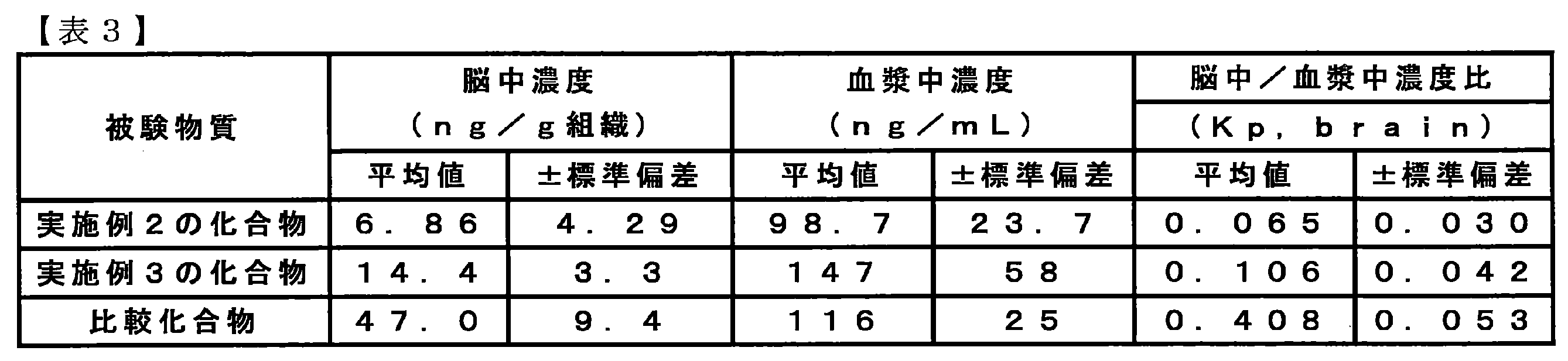
実施例2の化合物及び実施例3の化合物の脳中濃度/血漿中濃度比は、0.2以下であった。したがって、上記の式(I)若しくは式(II)で示されるモルヒナン誘導体又はその薬理学的に許容される酸付加塩は、末梢型であることが示された。
(実施例6)侵害受容性疼痛に対する効果:
侵害受容性疼痛を評価できるマウス酢酸ライジングモデルを用い、上記の式(I)若しくは式(II)で示されるモルヒナン誘導体又はその薬理学的に許容される酸付加塩の鎮痛作用を評価した。
侵害受容性疼痛を評価できるマウス酢酸ライジングモデルを用い、上記の式(I)若しくは式(II)で示されるモルヒナン誘導体又はその薬理学的に許容される酸付加塩の鎮痛作用を評価した。
実験には、固形飼料(オリエンタル酵母工業株式会社)及び水道水を自由に摂取させた5~6週齢のddY系雄性マウス(日本エスエルシー株式会社)を使用した。
実施例2の化合物は5%DMSO含有20%HP-β-CDに溶解し、実施例3の化合物は20%HP-β-CDに溶解して、各被験物質の投与液を調製した。調製した被験物質の投与液をマウスに5mL/kgの容量で、尾静脈内投与した。各被験物質に対応する溶媒を対照として同様に投与し「溶媒群」とした。
被験物質の投与の直後に0.6%酢酸溶液をマウス腹腔内に投与(10mL/kg)し、ライジング反応(体を伸ばしたり、反らしたりする行動)を誘発させた。0.6%酢酸溶液投与10分後から10分間に生じたライジング反応を計数し、その回数を痛みの指標とした。
溶媒群のライジング反応の回数の平均値を100%として、ライジング反応を50%抑制した被験物質の用量を50%有効用量(ED50)として示した。ED50の算出には、GraphPad Prism ver. 5.04(GraphPad社)を使用した。
その結果を表4に示す。

実施例2の化合物及び実施例3の化合物のED50値は、<1mg/kgであり、優れた鎮痛作用を示すことが示された。したがって、上記の式(I)若しくは式(II)で示されるモルヒナン誘導体又はその薬理学的に許容される酸付加塩は、優れた鎮痛作用を示すことが明らかとなった。
上記の式(I)若しくは式(II)で示されるモルヒナン誘導体又はその薬理学的に許容される酸付加塩は、末梢型の選択的オピオイドκ受容体作動性を有するため、オピオイドμ受容体作動性に基づく薬物依存性や呼吸抑制、及び、中枢型のオピオイドκ受容体作動性に基づく鎮静や不快感などの副作用が低減された、鎮痛薬として用いることができる。
Claims (3)
- 以下の式(I)で示されるモルヒナン誘導体又はその薬理学的に許容される酸付加塩。
- 以下の式(I)若しくは式(II)で示されるモルヒナン誘導体又はその薬理学的に許容される酸付加塩を有効成分として含有する、医薬。
- 請求項2記載のモルヒナン誘導体又はその薬理学的に許容される酸付加塩を有効成分として含有する、鎮痛薬。
Priority Applications (1)
| Application Number | Priority Date | Filing Date | Title |
|---|---|---|---|
| JP2016518227A JPWO2016152953A1 (ja) | 2015-03-24 | 2016-03-24 | モルヒナン誘導体及びその医薬用途 |
Applications Claiming Priority (2)
| Application Number | Priority Date | Filing Date | Title |
|---|---|---|---|
| JP2015061227 | 2015-03-24 | ||
| JP2015-061227 | 2015-03-24 |
Publications (1)
| Publication Number | Publication Date |
|---|---|
| WO2016152953A1 true WO2016152953A1 (ja) | 2016-09-29 |
Family
ID=56978749
Family Applications (1)
| Application Number | Title | Priority Date | Filing Date |
|---|---|---|---|
| PCT/JP2016/059295 Ceased WO2016152953A1 (ja) | 2015-03-24 | 2016-03-24 | モルヒナン誘導体及びその医薬用途 |
Country Status (2)
| Country | Link |
|---|---|
| JP (1) | JPWO2016152953A1 (ja) |
| WO (1) | WO2016152953A1 (ja) |
Cited By (4)
| Publication number | Priority date | Publication date | Assignee | Title |
|---|---|---|---|---|
| WO2017073710A1 (ja) * | 2015-10-29 | 2017-05-04 | 東レ株式会社 | モルヒナン誘導体及びその医薬用途 |
| CN109970747A (zh) * | 2019-05-05 | 2019-07-05 | 潍坊科技学院 | 一种制备10α-羟基纳呋拉啡的方法 |
| CN114621238A (zh) * | 2020-12-10 | 2022-06-14 | 鲁南制药集团股份有限公司 | 一种制备纳呋拉啡的方法 |
| WO2025228169A1 (zh) * | 2024-04-30 | 2025-11-06 | 宜昌人福药业有限责任公司 | 一种吗啡喃型化合物、其制备方法、其组合物及应用 |
Citations (3)
| Publication number | Priority date | Publication date | Assignee | Title |
|---|---|---|---|---|
| WO1993015081A1 (en) * | 1992-01-23 | 1993-08-05 | Toray Industries, Inc. | Morphinan derivative and medicinal use |
| JP2002308769A (ja) * | 2001-04-12 | 2002-10-23 | Toray Ind Inc | 止痒剤 |
| US20090170888A1 (en) * | 2005-03-10 | 2009-07-02 | Toray Industries, Inc. | Antipruritic Agent for Pruritus Caused by Multiple Sclerosis |
-
2016
- 2016-03-24 WO PCT/JP2016/059295 patent/WO2016152953A1/ja not_active Ceased
- 2016-03-24 JP JP2016518227A patent/JPWO2016152953A1/ja active Pending
Patent Citations (3)
| Publication number | Priority date | Publication date | Assignee | Title |
|---|---|---|---|---|
| WO1993015081A1 (en) * | 1992-01-23 | 1993-08-05 | Toray Industries, Inc. | Morphinan derivative and medicinal use |
| JP2002308769A (ja) * | 2001-04-12 | 2002-10-23 | Toray Ind Inc | 止痒剤 |
| US20090170888A1 (en) * | 2005-03-10 | 2009-07-02 | Toray Industries, Inc. | Antipruritic Agent for Pruritus Caused by Multiple Sclerosis |
Non-Patent Citations (3)
| Title |
|---|
| HORIKIRI, HIROMASA ET AL.: "Syntheses of 10-Oxo, 10a-Hydroxy, and 10b -Hydroxy Derivatives of a Potent k -Opioid Receptor Agonist, TRK-820", CHEM. PHARM. BULL., vol. 52, no. 6, 2004, pages 664 - 669, XP055315348 * |
| NEMOTO, TORU ET AL., BIOORGANIC & MEDICINAL CHEMISTRY, vol. 21, 2013, pages 7628 - 7647 * |
| SAGARA, TAKESHI ET AL.: "DESIGN AND SYNTHESIS OF 10-OXO DERIVATIVE OF NCYCLOPROPYLMETHYL(-)-613-ACETYLTHIODIHYDRONORMORPHINE,A POTENTIALLY 1c-SELECTIVEOPIOID RECEPTOR LIGAND", BIOORGANIC & MEDICINAL CHEMISTRY LETTERS, vol. 5, no. 14, 1995, pages 1505 - 1508, XP055315350 * |
Cited By (8)
| Publication number | Priority date | Publication date | Assignee | Title |
|---|---|---|---|---|
| WO2017073710A1 (ja) * | 2015-10-29 | 2017-05-04 | 東レ株式会社 | モルヒナン誘導体及びその医薬用途 |
| CN108368122A (zh) * | 2015-10-29 | 2018-08-03 | 国立大学法人筑波大学 | 吗啡喃衍生物及其药物用途 |
| JPWO2017073710A1 (ja) * | 2015-10-29 | 2018-08-23 | 国立大学法人 筑波大学 | モルヒナン誘導体及びその医薬用途 |
| US10377763B2 (en) | 2015-10-29 | 2019-08-13 | University Of Tsukuba | Morphinan derivative and medical usage thereof |
| CN109970747A (zh) * | 2019-05-05 | 2019-07-05 | 潍坊科技学院 | 一种制备10α-羟基纳呋拉啡的方法 |
| CN109970747B (zh) * | 2019-05-05 | 2020-07-24 | 潍坊科技学院 | 一种制备10α-羟基纳呋拉啡的方法 |
| CN114621238A (zh) * | 2020-12-10 | 2022-06-14 | 鲁南制药集团股份有限公司 | 一种制备纳呋拉啡的方法 |
| WO2025228169A1 (zh) * | 2024-04-30 | 2025-11-06 | 宜昌人福药业有限责任公司 | 一种吗啡喃型化合物、其制备方法、其组合物及应用 |
Also Published As
| Publication number | Publication date |
|---|---|
| JPWO2016152953A1 (ja) | 2018-01-11 |
Similar Documents
| Publication | Publication Date | Title |
|---|---|---|
| EP3697759B1 (en) | MUSCARINIC ACETYLCHOLINE RECEPTOR M4 ANTAGONISTS | |
| KR102794731B1 (ko) | 라파마이신 유도체 | |
| JP7352294B2 (ja) | ムスカリン性アセチルコリン受容体m4のアンタゴニスト | |
| EP3766882B1 (en) | Phthalazine isoxazole alkoxy derivatives, preparation method thereof, pharmaceutical composition and use thereof | |
| CN112672997A (zh) | 哒嗪酮衍生物 | |
| EP4037677B1 (en) | Antagonists of the muscarinic acetylcholine receptor m4 | |
| EP3665175B1 (en) | Antagonists of the muscarinic acetylcholine receptor m4 | |
| EP3697781B1 (en) | Antagonists of the muscarinic acetylcholine receptor m4 | |
| JP2021503443A (ja) | ムスカリン性アセチルコリン受容体m4のアンタゴニスト | |
| WO2016148232A1 (ja) | モルヒナン誘導体 | |
| WO2016152953A1 (ja) | モルヒナン誘導体及びその医薬用途 | |
| JPWO2015037716A1 (ja) | 含窒素飽和複素環化合物 | |
| US20240010640A1 (en) | Antagonists of the muscarinic acetylcholine receptor m4 | |
| US12516067B2 (en) | Antagonists of the muscarinic acetylcholine receptor M4 | |
| EP4286384A1 (en) | Aza-ergoline derivative and preparation method therefor and application thereof | |
| JP2018048093A (ja) | モルヒナン誘導体及びその医薬用途 | |
| WO2025174540A1 (en) | Novel morphine framework derivatives | |
| WO2022164842A1 (en) | Competitive and noncompetitive inhibitors of the muscarinic acetylcholine receptor m5 | |
| HK40104323A (en) | Aza-ergoline derivative and preparation method therefor and application thereof | |
| HK40053244A (en) | Pyridazinone derivative |
Legal Events
| Date | Code | Title | Description |
|---|---|---|---|
| ENP | Entry into the national phase |
Ref document number: 2016518227 Country of ref document: JP Kind code of ref document: A |
|
| 121 | Ep: the epo has been informed by wipo that ep was designated in this application |
Ref document number: 16768856 Country of ref document: EP Kind code of ref document: A1 |
|
| NENP | Non-entry into the national phase |
Ref country code: DE |
|
| 122 | Ep: pct application non-entry in european phase |
Ref document number: 16768856 Country of ref document: EP Kind code of ref document: A1 |