WO2016148172A1 - 高純度マグネシウムを使用した医療用インプラント材及びその製造方法 - Google Patents
高純度マグネシウムを使用した医療用インプラント材及びその製造方法 Download PDFInfo
- Publication number
- WO2016148172A1 WO2016148172A1 PCT/JP2016/058262 JP2016058262W WO2016148172A1 WO 2016148172 A1 WO2016148172 A1 WO 2016148172A1 JP 2016058262 W JP2016058262 W JP 2016058262W WO 2016148172 A1 WO2016148172 A1 WO 2016148172A1
- Authority
- WO
- WIPO (PCT)
- Prior art keywords
- magnesium
- implant
- strength
- purity
- mass
- Prior art date
- Legal status (The legal status is an assumption and is not a legal conclusion. Google has not performed a legal analysis and makes no representation as to the accuracy of the status listed.)
- Ceased
Links
Images


Classifications
-
- A—HUMAN NECESSITIES
- A61—MEDICAL OR VETERINARY SCIENCE; HYGIENE
- A61B—DIAGNOSIS; SURGERY; IDENTIFICATION
- A61B17/00—Surgical instruments, devices or methods
- A61B17/12—Surgical instruments, devices or methods for ligaturing or otherwise compressing tubular parts of the body, e.g. blood vessels or umbilical cord
-
- A—HUMAN NECESSITIES
- A61—MEDICAL OR VETERINARY SCIENCE; HYGIENE
- A61B—DIAGNOSIS; SURGERY; IDENTIFICATION
- A61B17/00—Surgical instruments, devices or methods
- A61B17/56—Surgical instruments or methods for treatment of bones or joints; Devices specially adapted therefor
- A61B17/58—Surgical instruments or methods for treatment of bones or joints; Devices specially adapted therefor for osteosynthesis, e.g. bone plates, screws or setting implements
-
- A—HUMAN NECESSITIES
- A61—MEDICAL OR VETERINARY SCIENCE; HYGIENE
- A61F—FILTERS IMPLANTABLE INTO BLOOD VESSELS; PROSTHESES; DEVICES PROVIDING PATENCY TO, OR PREVENTING COLLAPSING OF, TUBULAR STRUCTURES OF THE BODY, e.g. STENTS; ORTHOPAEDIC, NURSING OR CONTRACEPTIVE DEVICES; FOMENTATION; TREATMENT OR PROTECTION OF EYES OR EARS; BANDAGES, DRESSINGS OR ABSORBENT PADS; FIRST-AID KITS
- A61F2/00—Filters implantable into blood vessels; Prostheses, i.e. artificial substitutes or replacements for parts of the body; Appliances for connecting them with the body; Devices providing patency to, or preventing collapsing of, tubular structures of the body, e.g. stents
- A61F2/02—Prostheses implantable into the body
- A61F2/04—Hollow or tubular parts of organs, e.g. bladders, tracheae, bronchi or bile ducts
- A61F2/06—Blood vessels
- A61F2/07—Stent-grafts
-
- A—HUMAN NECESSITIES
- A61—MEDICAL OR VETERINARY SCIENCE; HYGIENE
- A61L—METHODS OR APPARATUS FOR STERILISING MATERIALS OR OBJECTS IN GENERAL; DISINFECTION, STERILISATION OR DEODORISATION OF AIR; CHEMICAL ASPECTS OF BANDAGES, DRESSINGS, ABSORBENT PADS OR SURGICAL ARTICLES; MATERIALS FOR BANDAGES, DRESSINGS, ABSORBENT PADS OR SURGICAL ARTICLES
- A61L27/00—Materials for grafts or prostheses or for coating grafts or prostheses
-
- A—HUMAN NECESSITIES
- A61—MEDICAL OR VETERINARY SCIENCE; HYGIENE
- A61L—METHODS OR APPARATUS FOR STERILISING MATERIALS OR OBJECTS IN GENERAL; DISINFECTION, STERILISATION OR DEODORISATION OF AIR; CHEMICAL ASPECTS OF BANDAGES, DRESSINGS, ABSORBENT PADS OR SURGICAL ARTICLES; MATERIALS FOR BANDAGES, DRESSINGS, ABSORBENT PADS OR SURGICAL ARTICLES
- A61L31/00—Materials for other surgical articles, e.g. stents, stent-grafts, shunts, surgical drapes, guide wires, materials for adhesion prevention, occluding devices, surgical gloves, tissue fixation devices
-
- C—CHEMISTRY; METALLURGY
- C22—METALLURGY; FERROUS OR NON-FERROUS ALLOYS; TREATMENT OF ALLOYS OR NON-FERROUS METALS
- C22B—PRODUCTION AND REFINING OF METALS; PRETREATMENT OF RAW MATERIALS
- C22B26/00—Obtaining alkali, alkaline earth metals or magnesium
- C22B26/20—Obtaining alkaline earth metals or magnesium
- C22B26/22—Obtaining magnesium
-
- C—CHEMISTRY; METALLURGY
- C22—METALLURGY; FERROUS OR NON-FERROUS ALLOYS; TREATMENT OF ALLOYS OR NON-FERROUS METALS
- C22C—ALLOYS
- C22C1/00—Making non-ferrous alloys
- C22C1/02—Making non-ferrous alloys by melting
-
- C—CHEMISTRY; METALLURGY
- C22—METALLURGY; FERROUS OR NON-FERROUS ALLOYS; TREATMENT OF ALLOYS OR NON-FERROUS METALS
- C22C—ALLOYS
- C22C23/00—Alloys based on magnesium
- C22C23/04—Alloys based on magnesium with zinc or cadmium as the next major constituent
Definitions
- the present invention relates to an implant using a high-purity magnesium material and a manufacturing method thereof.
- the present invention relates to high purity magnesium with biodegradability, a production method for making the high purity magnesium suitable for an implant, and an implant using the high purity and high strength magnesium.
- a metal material excellent in mechanical properties such as strength and workability has been used as an implant material used for bone fixation, prosthesis or the like in jointing or reconstruction of a damaged or fractured portion of a bone. It was.
- stainless steel, tantalum, titanium, or titanium alloy having high biocompatibility and high strength is used.
- the above-mentioned metal bone plates and stents have a risk of being left in the body for a long time or semi-permanently after treatment. Specifically, if it is left for a long period of time, the implant will support the load instead of the bone, and there is a risk that the bone mass will be reduced or the bone will be weakened. In addition, there is a concern that bone growth may be inhibited when the implant is used in a growing child.
- the bone plate is removed by re-operation after treatment of bone damage or fracture.
- it is a burden on the patient to perform reoperation, it is desired to develop a bone plate that does not require reoperation.
- Patent Documents 1-3 As such a biodegradable material that does not require re-operation, an implant using polylactic acid or a high-purity magnesium material of 99.99% by mass or more has been proposed (Patent Documents 1-3).
- Patent Document 1 discloses an osteosynthesis material having biodegradability using high-purity magnesium.
- a bone plate or the like is manufactured by pressure forming or forging forming a magnesium lump having a magnesium purity of 99.998% by weight.
- Patent Document 2 discloses a biological device such as a bone plate having a first portion formed of high-purity magnesium metal having high corrosion resistance and a second portion formed of low-purity magnesium metal having low corrosion resistance. Yes. An attempt was made to control the dissolution rate in vivo by using two kinds of magnesium having different purities.
- Patent Document 3 discloses a vascular stent formed of a thread made of a bioabsorbable polymer having a shape memory function.
- Polylactic acid (PLLA) and polyglycolic acid (PGA) are disclosed as bioabsorbable polymers.
- Patent Document 1 uses high-purity magnesium of 4N (N represents the number of 9 consecutive digits) or more, and the biodegradability is maintained moderately, but the strength is high. There was a problem that it was not enough. Therefore, sufficient strength could not be ensured particularly with a bone subjected to a load.
- the biomedical device disclosed in Patent Document 2 can control the time taken by the living body, there is a problem in that it is difficult to obtain sufficient strength because both are combined with members made of magnesium metal.
- the polymer described in Patent Document 3 has good biodegradability, it has low strength and does not cause a problem when used as a stent. However, it cannot be used as a load-bearing member such as a bone plate. .
- polylactic acid and high-purity magnesium are both excellent in biodegradability, they have a problem of low strength.
- polylactic acid is good in biodegradability but weak in strength. Therefore, there is a problem that the load cannot be supported when used for a medical member that requires strength, such as a bone plate used for the treatment of a fracture, and the expanded blood vessel cannot be supported when used for a stent. Arise.
- Magnesium has a specific gravity of 1.74, 1/4 of iron and 2/3 of aluminum, which is the lightest among practical metals, and has superior strength and rigidity per weight compared to iron and aluminum.
- the strength and rigidity per weight are excellent, it is necessary to reduce the thickness and thickness as much as possible for use in vivo.
- magnesium is superior in strength and rigidity to iron and aluminum, it is lower in strength and rigidity than titanium and titanium alloy. Therefore, as a substitute for titanium as an implant material such as a bone plate to be placed in the living body, the present situation is that it has not been put into practical use so far, despite the advantage of bioabsorbability.
- the object of the present invention is to provide an implant made of titanium or a titanium alloy that is already widely used and an implant that is inferior in terms of strength while using high-purity magnesium and maintaining its biodegradable characteristics. Therefore, it is an object to stably purify high-purity magnesium and to produce a high-purity magnesium material having sufficient strength to withstand the strength of implants such as bone plates and stents.
- the present invention is magnesium having a purity of 99.99% or more used as an implant, Zn is in the range of 0.0010 to 0.0070% by mass, Si and acid-insoluble Al are below the detection limit, and acid-soluble Al and Mn are 0.0003% or less.
- the magnesium material used for the implant is 99.99% by mass or more, that is, magnesium having a purity of 4N or more. It is already known that high purity magnesium of 4N or more is excellent in corrosion resistance. When placed in the living body for the purpose of treatment such as treatment of fractures and dilation of blood vessels, it is necessary to have sufficient strength in the living body for at least 6 months. Magnesium having a purity of about 3N has been pointed out to have low corrosion resistance, and since it is absorbed quickly in the body, sufficient strength cannot be maintained after 6 months. Therefore, magnesium having a purity of 4N or more and excellent corrosion resistance is required as a material for implants such as bone plates and stents.
- the solubility in the body differs depending on the composition of impurities even if the magnesium concentration is as high as 99.99% or more.
- the implant When used as an implant, it is important that it is dissolved and absorbed in the body. However, if the dissolution rate is high, the implant may be absorbed before the bone-joined site has sufficient strength.
- Si, Al, and Mn contained as impurities can maintain sufficient strength as an implant until about 6 months after osteosynthesis if the concentration is low.
- Magnesium having a purity of 99.99% or more used as an implant of the present invention has a Zn content in the range of 0.0010 to 0.0070% by mass, Si, Al, and Mn are below the detection limit and has a strength of 100 N ⁇ mm. It is the above.
- high-purity magnesium has low strength, and it is not possible to obtain a strength that can sufficiently support the load if it is purified by ordinary vacuum distillation.
- the present inventors were able to obtain magnesium having higher strength by processing the purified magnesium by extrusion molding or die forging. If the strength of the implant before placement is 100 mm or more, a strength comparable to other materials used as the implant can be obtained.
- sufficient strength is obtained when used as implants such as bone plates and stents by processing such as extrusion after magnesium distillation purification, and 35 N ⁇ mm even after 6 months in vivo.
- the above strength could be obtained.
- the strength after being placed in a living body for 6 months is 35 N ⁇ mm or more, even when used as a bone plate, the strength is sufficient to support bones that are in the process of healing.
- the method for purifying magnesium used as the implant of the present invention is a method for producing magnesium having a purity of 99.9% by mass or more and less than 99.99% by mass with respect to magnesium ingot of 0.4% by mass to 1.2% by mass of aluminum. And purified by distillation.
- the method for producing magnesium used as the implant of the present invention uses the above magnesium, an extrusion load of 3.5 to 5.0 ton / cm 2 , an extrusion temperature of 290 ° C. to 350 ° C., and a compression temperature of 400 ° C. to 450 ° C. It is characterized by extrusion.
- Magnesium ingots purified by vacuum distillation are excellent in corrosion resistance, but if used as they are, there is a problem that the strength is slightly low. Therefore, magnesium after vacuum distillation is extruded under the conditions in the above range, and after molding into a round bar, square bar, etc., even if it is used as an implant such as a bone plate or stent, A sufficiently strong magnesium material can be obtained.
- the method for producing magnesium used as the implant of the present invention is characterized in that die forging is performed in the direction perpendicular to the extrusion direction using the magnesium.
- Magnesium produced by an extrusion apparatus has a uniform structure in the extrusion direction, and when the implant is produced as it is, the directionality is a cause of lowering the strength. In order to remove this, die forging is performed in a direction perpendicular to the extrusion direction, and by eliminating the directionality as the structure, it is possible to obtain a material having a further sufficient strength and having no variation in strength between products. . In addition, a magnesium material having an appropriate absorption rate in vivo can be obtained.
- the implant of the present invention is characterized by using the high purity magnesium.
- the implant may be a bone plate, a stent, or a hemostatic clip.
- the implant produced using the magnesium member produced by the method of the present invention has high strength, is well biodegradable, and absorbs and decomposes in vivo, and metals other than Zn are below the detection limit. High safety in use. Therefore, it has the required strength even when used as a bone plate, stent, or hemostatic clip. Further, since it is absorbed by the living body, it is not necessary to remove it by re-operation, and the burden on the patient is small.
- the implant manufactured using the high-purity magnesium of the present invention is absorbed in vivo, there is no need for re-operation for removal. Moreover, although it is absorbed in the living body, its absorption speed is relatively slow, so that it is possible to obtain a sufficient strength to support a load for a long period of time even when used for the treatment of a fracture.
- the present inventors have found that high purity magnesium can be stably obtained by coexisting aluminum when purifying magnesium by a vacuum distillation method. Specifically, an aluminum foil is added to magnesium having a purity of 99.9% by mass or more and less than 99.99% by mass so that the aluminum foil is 0.4% by mass to 1.2% by mass with respect to the magnesium metal, Purify by vacuum distillation.
- the vacuum distillation apparatus may be a generally used vacuum distillation apparatus.
- vacuum distillation was performed using an apparatus basically the same as the self-made apparatus described in Non-Patent Document 1.
- magnesium and aluminum foil as raw materials are accommodated in a crucible and melted by heating to a temperature of 560 ° C. or higher under a reduced pressure of 120 Pa or lower.
- Magnesium has a melting point of 650 ° C. and a boiling point of 1091 ° C. under atmospheric pressure (about 100 kPa), but the melting point and boiling point are reduced by reducing the pressure to 120 Pa or less.
- the magnesium material can be melted by heating to 560 ° C. or higher under reduced pressure, and further purified by vaporizing the molten magnesium.
- the vaporized magnesium vapor is condensed in a condenser disposed above the crucible.
- 4N or more of magnesium can be obtained by maintaining the state of heating to a temperature of 560 ° C. or more for about 11 to 20 hours under a reduced pressure of 120 Pa or less.
- the magnesium metal may be a 3N grade magnesium material, and consists of less than 99.99% by mass of magnesium and the remaining impurities.
- Impurities include beryllium, aluminum, silicon, calcium, manganese, iron, nickel, copper, zinc, zirconium, silver, cadmium, tin, lanthanum, cerium, neodymium, lead, mercury, sodium and the like.
- Example 1 vacuum distillation was performed with 0.69% by mass of the magnesium material, and in Example 2 with 0.81% by mass of aluminum foil. In both Examples 1 and 2, the vacuum distillation was performed under a reduced pressure of 10 Pa or less at a temperature of 600 ° C. for 12 hours. Moreover, Example 3 was performed at the temperature of 620 degree
- the component analysis method and results of the sample purified by vacuum distillation are shown below.
- the ingot purified by vacuum distillation has a cylindrical shape, and its components are not homogeneous. This is because impurities other than magnesium have inherent melting points and boiling points, and the components to be distilled differ depending on the time of distillation. Therefore, samples were collected from the central part, the intermediate part, and the peripheral part in the direction crossing the sample, and component analysis was performed to obtain the average value.
- the analysis method is as follows.
- the obtained sample was dissolved with an acid, and Zn, Mn, and acid-soluble Al (sol. Al) were analyzed by ICP mass spectrometry.
- the acid-dissolved residue was dissolved in an alkali, then dissolved in an acid, and acid-insoluble Al (insol. Al) was analyzed by atomic absorption spectrometry.
- Si was measured by molybdonate blue absorptiometry.
- Table 1 Comparative Example 1 shows the result of analyzing a sample purified in the same manner as in Examples 1 and 2 except that vacuum distillation was performed without adding an aluminum foil.
- magnesium purity refers to the purity of magnesium calculated by measuring all elements other than magnesium contained in the magnesium ingot as impurities.
- the magnesium ingot By adding aluminum foil to the magnesium metal and distilling it, the magnesium ingot has Zn in the range of 0.0010 to 0.0070% by mass, and Si, Al, Mn and other elements are below the detection limit (Si Further, high-purity magnesium having an acid-insoluble Al content of less than 0.001% by mass and an acid-soluble Al content of less than 0.0001% by mass was obtained.
- the magnesium ingot of the comparative example although the contents of Zn and acid-insoluble Al are equivalent to the magnesium of the present invention, an ingot having a high content of Si, acid-soluble Al, and Mn is obtained. In particular, the contents of acid-soluble aluminum and manganese are high.
- magnesium having a low Si, Al, or Mn concentration may be obtained, but it is difficult to set the conditions depending on the starting material, and the desired high purity magnesium is always obtained. It is not done. High-quality magnesium material can be obtained stably by vacuum distillation of aluminum foil with magnesium metal.
- the purity of magnesium is 99.99% by mass or more, that is, 4N grade purity. That is, there is no difference in terms of purity.
- the composition of elements contained as impurities differs between the purification method according to the present invention and the purification method represented by the comparative example.
- High purity magnesium, especially 4N or more magnesium is said to be excellent in terms of biodegradability.
- the present inventors also immersed 3M grade low-purity magnesium in a simulated body fluid and conducted a test simulating absorption in a living body. As a result, dissolution was fast and the original shape could not be retained in several months.
- the purity of magnesium used as an implant material is important, but studies by the present inventors have revealed that both the purity and the composition of impurities are deeply involved in absorption in the body. In addition to purity, what impurities are contained is important in terms of biodegradability and strength.
- Fe, Ni, and Cu are said to be involved in the stability of magnesium in vivo, and the smaller the content, the more stable.
- Ni is a metal that easily causes metal allergy, and Cu is highly toxic to living bodies, it is preferable that the content is low from the viewpoint of safety.
- the magnesium material of the present invention contains almost no of these elements, and it is possible to produce an implant with high stability and safety in vivo.
- a bone plate was prepared using the magnesium purified as described above, placed in a living body, and the ratio of the cross-sectional area that decreased by being absorbed by biodegradation over time was determined.
- a bioabsorbable bone plate and a screw having a thickness of 1.5 mm were prepared, implanted into the head of a Wistar female rat, taken out after 1 month, 2 months, and 6 months, and the absorption into the living body was measured over time.
- An anesthetic was administered to the rats, and the limbs were fixed in a prone position on the animal fixation plate after reaching a sufficient depth of anesthesia. After the scalp incision, the skull was exposed by peeling off the subperiosteum. The implant product washed with acetone was placed on the exposed skull. Then, it was covered with periosteum as much as possible. After the incision wound was closed with sutures, the rats were awakened and reared in a breeding cage, one per cage.
- the implanted implants were taken out from each group of rats, photographed, weight-inspected, and the degree of absorption was measured.
- the condition of the whole body of the test rat and the surgical site were confirmed.
- visual inspection, palpation, weight measurement, and ultrasonic examination were performed.
- biochemical tests such as blood biochemical tests, urinary excretion metal tests and pathological examinations after excision were performed to confirm whether the implant had any adverse effects on living tissues or the like.
- MgO is formed on the metal surface in the body as an absorption decomposition mode, and is absorbed and excreted very slowly from the metal surface.
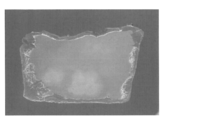
- FIG. 1 is an SEM photograph of a cross section of the implant of the present invention, which was formed from the magnesium material purified in Example 1 into an implant and extracted 6 months after implantation in a rat. Even after 6 months, the shape of the implant is retained, and as shown in the photograph, absorption is observed at the periphery.
- Fig. 2 shows the ratio of the cross-sectional area of the bone plate that was placed in the living body and the cross-sectional area measured by SEM and the cross-sectional area was measured. ing.
- the implant made of high purity magnesium of the present invention it was found that 70% or more remains in the living body even after 6 months and the absorption rate in the body is slow. This is consistent with the transition of the amount of Mg excreted in urine.
- the strength after 6 months is calculated from the ratio of the remaining cross-sectional area, the strength is 35 N ⁇ mm or more. Taking into account the healing of bone damage such as fractures, it is considered that the strength of 35 N ⁇ mm and 70% or more remain sufficient after 6 months. In addition, no abnormalities were observed by blood biochemical tests at any time point.
- the high purity magnesium of 4N or more of Example 3 has a slightly higher concentration of acid-soluble Al and Mn than the magnesium materials of Examples 1 and 2, but from a magnesium ingot just vacuum distilled.
- an implant was prepared, implanted in a living body and taken out 6 months later and the strength was measured, sufficient strength was not obtained. Therefore, the strength was increased by performing extrusion using an extrusion apparatus.
- a round bar or a square member was formed using an extrusion apparatus (manufactured by Koei Seisakusho Co., Ltd.) to examine whether the strength was improved.
- the extrusion temperature was 290 ° C to 350 ° C and the compression temperature was 400 ° C to 450 ° C.
- a bending strength test based on JIS T 0311: 2009 “Bending test method for metal bone-joint article” was performed using a square bar obtained by extruding the magnesium material of Example 3 at an extrusion load of 4.0 ton / cm 2 . Specifically, a square material of 3 mm ⁇ 20 mm ⁇ 2 mm was prepared, and the bending strength was measured with a 1 kN tester (Instron, model: E1000), 2 kN load cell (Instron, model: 2527-129). The bending strength was measured in accordance with a static three-point bending test (JIST0311: 2009 “Bending test method for metal osteosynthesis products”).
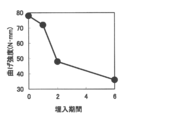
- a bone plate was produced from the material obtained by extruding the magnesium material of Example 3 as described above, placed in a living body, taken out after 1, 2, and 6 months, and the bending strength was measured. The results are shown in FIG. Even after 6 months, the value is 36 N ⁇ mm. Extrusion of the magnesium material of Example 3 having a relatively low degree of purification As a result of extrusion processing, a material with a sufficiently high strength of 35 N ⁇ mm or more can be obtained even after 6 months of implantation in the living body. It was.
- Extrusion of the magnesium material of Example 1 was carried out at a high extrusion load of 5.0 ton / cm 2 .
- the bending strength was measured with a plate made from the manufactured extruded material.
- values of 156 N ⁇ mmm, 166 N ⁇ mm, and 166 N ⁇ mm were obtained with extremely small variations (average value 163 N ⁇ mm).
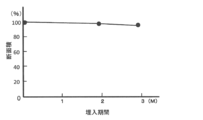
- a bone plate was prepared from this material, and it was similarly embedded in the rat's head and removed after 1 month, 2 months, and 6 months, and the absorption into the living body over time was measured. The results are shown in FIG.
- the extrusion load high, not only a material with little variation was obtained.
- the reduction rate of the cross-sectional area was very small. Even at 6 months, it retained 92% and had sufficient strength.
- a round bar or square bar is cut to a certain length, and the material is pushed into the mold along the extrusion direction by forging.
- the mold is manufactured so that the pushed material flows in a direction perpendicular to the extrusion direction. Thereby, the directionality of the structure
- the forging rate was 15%.
- a plate material having a thickness of 3 to 5 mm was produced by forging, a square material of 3 mm ⁇ 20 mm ⁇ 2 mm cut out from the plate material was prepared, and bending strength was measured by the above test method. Was measured.
- the values of 250 N ⁇ mm, 329 N ⁇ mm, and 355 N ⁇ mm were obtained (average value 311 N ⁇ mm).
- SuperFixsorb trademark, manufactured by Medical U & A Co.
- a bone plate was prepared from a material with a 5% forging rate, embedded in the head of a Wistar female rat, taken out after 2 months and 3 months, and the absorption into the living body was measured over time. The results are shown in FIG. Since the reduction of the cross-sectional area is extremely small and the absorption rate is slow, it is assumed that the body has sufficient strength even after 6 months.
- the purification method and the production method of the present invention it is possible to obtain a magnesium material having sufficient strength as a bone plate and a stent and having an appropriate absorption rate in vivo in clinical use.
Landscapes
- Health & Medical Sciences (AREA)
- Life Sciences & Earth Sciences (AREA)
- Chemical & Material Sciences (AREA)
- Engineering & Computer Science (AREA)
- Public Health (AREA)
- Surgery (AREA)
- Animal Behavior & Ethology (AREA)
- General Health & Medical Sciences (AREA)
- Veterinary Medicine (AREA)
- Heart & Thoracic Surgery (AREA)
- Biomedical Technology (AREA)
- Metallurgy (AREA)
- Organic Chemistry (AREA)
- Mechanical Engineering (AREA)
- Vascular Medicine (AREA)
- Materials Engineering (AREA)
- Molecular Biology (AREA)
- Oral & Maxillofacial Surgery (AREA)
- Nuclear Medicine, Radiotherapy & Molecular Imaging (AREA)
- Medical Informatics (AREA)
- Orthopedic Medicine & Surgery (AREA)
- Epidemiology (AREA)
- Transplantation (AREA)
- General Life Sciences & Earth Sciences (AREA)
- Gastroenterology & Hepatology (AREA)
- Dermatology (AREA)
- Environmental & Geological Engineering (AREA)
- Reproductive Health (AREA)
- Geology (AREA)
- Manufacturing & Machinery (AREA)
- Medicinal Chemistry (AREA)
- Pulmonology (AREA)
- Cardiology (AREA)
- Materials For Medical Uses (AREA)
- Laser Surgery Devices (AREA)
- Prostheses (AREA)
- Surgical Instruments (AREA)
Abstract
高純度マグネシウムを使用して、生分解性の特性はそのままに、強度の面で汎用されているチタンやチタン合金製のインプラントと強度面で遜色のない高純度マグネシウム素材を製造するとともに、これを用いたインプラントを提供することを課題とする。真空蒸留法によって、Znが0.0010~0.0070質量%の範囲であって、Si,Al,Mnは検出限界以下であり、残余がMgからなる高純度マグネシウムを用いて、押出成形法等によって強度を高めた後にインプラントを製造することにより、強度が強く、生体内で吸収されるインプラントを提供することができる。
Description
本発明は、高純度マグネシウム素材を用いたインプラント、及びその製造方法に関する。特に、生分解性を備えた高純度マグネシウム、該高純度マグネシウムをインプラントに適した強度にする製造方法、及び該高純度、高強度マグネシウムを用いたインプラントに関する。
従来、骨の損傷部分又は骨折部分等の接合術又は再建術において骨の固定、補綴等に用いられるインプラントの材料としては、強度等の機械的性質及び加工性に優れた金属材料が用いられてきた。特に、生体適合性が良く、強度の強いステンレス、タンタル、チタン又はチタン合金が用いられている。
しかしながら、上記金属製のボーンプレートやステントは、治療後も長期、もしくは半永久的に体内に留置することから生じるリスクが問題となっている。具体的には、長期にわたり留置しておくとインプラントが骨に代わって荷重を支持することになり、骨量が減少したり骨が脆弱化する虞がある。また、成長期の小児に前記インプラントを用いると骨の成長を阻害することが懸念される。
そこで、骨の損傷又は骨折の治療後に再手術によりボーンプレートを抜去することが行われている。しかし、再手術を行うことは患者の負担が大きいことから、再手術を行う必要のないボーンプレートの開発が望まれている。
また、ステントの場合は、ステント血栓症のリスクやステント本体により血管壁に対して生じるメカニカルストレスのために慢性的な炎症が起こる可能性が指摘されている。また、バイパス手術やCT撮影の際に邪魔になるという問題もある。そのため、一定期間後に分解される素材の使用が望まれていた。
このような再手術を必要としない生分解性のある素材として、ポリ乳酸や99.99質量%以上の高純度マグネシウム材料を用いるインプラントが提案されている(特許文献1-3)。
特許文献1には、高純度マグネシウムを用いた生体内分解性を有する骨接合材が開示されている。実施例によれば99.998重量%のマグネシウム純度のマグネシウム塊を加圧成形、あるいは圧造成形によりボーンプレート等を製造している。
特許文献2には、耐食性の高い高純度マグネシウム金属で形成されている第1部分と耐食性の低い低純度マグネシウム金属で形成されている第2部分とを有するボーンプレートなどの生体器具が開示されている。純度の異なる2種のマグネシウムを用いることによって、生体内での溶解速度の制御を図ろうとするものであった。
特許文献3には、形状記憶機能を有する生体吸収ポリマーからなる糸により形成された脈管用ステントが開示されている。生体吸収ポリマーとして、ポリ乳酸(PLLA)、ポリグリコール酸(PGA)が開示されている。
井上 誠、長岡技術科学大学平成11年博士論文「マグネシウム合金の精製および耐食性に関する研究」
特許文献1に開示されている方法は、4N(Nは連続する9の桁数を表す。)以上の高純度マグネシウムを用いるものであり、生分解性は適度に保たれているものの、強度が十分ではないという問題があった。そのため、特に荷重のかかる骨では十分な強度を担保することができなかった。特許文献2に開示されている生体器具は、生体に吸収される時間を制御できるものの、どちらもマグネシウム金属からなる部材を組み合わせており、十分な強度を得ることが困難であるという問題があった。特許文献3に記載のポリマーは生分解性はよいものの、強度が弱く、ステントとして使用するのには問題は生じないが、ボーンプレートのように荷重のかかる部材としての使用には適用できなかった。
すなわち、ポリ乳酸も高純度マグネシウムも生分解性には優れているものの、強度が低いという問題点がある。特に、ポリ乳酸は生分解性はよいものの強度が弱い。そのため骨折の治療に使用されるボーンプレートのように強度が必要とされる医療用部材に用いると荷重を支えきれず、また、ステントに用いた場合には拡張した血管を支えきれないという問題が生ずる。
マグネシウムの比重は1.74と鉄の1/4、アルミニウムと比べても2/3と実用金属の中では最も軽く、鉄やアルミニウムと比較して重量当たりの強度や剛性が優れている。しかしながら、重量当たりの強度や剛性が優れているとはいえ、生体内で用いるためにはできるだけ軽く、また、厚みを薄くする必要がある。マグネシウムは、鉄、アルミニウムに比べて、強度や剛性が優れているとはいえ、チタン、チタン合金に比べて強度、剛性が低い。そのため、生体内に留置するボーンプレート等のインプラント材料のチタンに代わる材料としては、生体吸収性という利点があるにもかかわらず現在までのところ実用化にいたっていないというのが現状である。
本発明は、高純度マグネシウムを使用して、生分解性の特性はそのままに、すでに汎用されているチタンやチタン合金製のインプラントと強度面で遜色のないインプラントを提供することを課題とする。そのために安定して高純度マグネシウムを精製すること、さらにその強度をボーンプレート、ステント等のインプラントとした場合にも十分に耐えられる強度とする高純度マグネシウム素材を製造することを課題とする。
本発明は、インプラントとして用いる純度99.99%以上のマグネシウムであって、Znが0.0010~0.0070質量%の範囲であり、Si、及び酸不溶性Alは検出限界以下であり、酸可溶性Al、及びMnは0.0003%以下であることを特徴とする。
インプラントとして用いるマグネシウム素材としては99.99質量%以上、すなわち4N以上の純度のマグネシウムであることが生分解性の点から望ましい。4N以上の高純度マグネシウムは耐食性に優れていることがすでに知られている。骨折の治療、血管の拡張といった治療目的で生体内に留置した場合に、少なくとも6ヶ月は生体内で十分な強度を備えていることが必要とされる。3N程度の純度のマグネシウムは耐食性が低いことが指摘されており、体内での吸収が早いため6ヶ月後には十分な強度を保つことができない。したがって、4N以上の純度の耐食性に優れたマグネシウムであることがボーンプレート、ステント等のインプラントの素材として要求される。
さらに、本発明者らが鋭意検討したところ、マグネシウム濃度が99.99%以上と同じような純度のマグネシウムであっても、不純物の組成によって体内での溶解度が違うことが明らかとなった。インプラントとして用いる場合には、体内で溶解し吸収されることは重要であるが、溶解速度が速いと骨を接合した箇所が十分な強度を得る前にインプラントが吸収されてしまう可能性がある。しかし、不純物として含まれるSi、Al、Mnは低濃度であれば、骨接合後6ヶ月程度までインプラントとして十分な強度を保てることが明らかとなった。具体的には、Si,及び酸不溶性Alは検出限界以下、酸可溶性Al、及びMnは0.0003%以下であれば、体内における吸収が比較的緩やかであり、体内留置後6ヶ月でも断面積が元の断面積形状の60%程度まで維持することができる。
本発明のインプラントとして用いる純度99.99%以上のマグネシウムは、Znが0.0010~0.0070質量%の範囲であって、Si,Al,Mnは検出限界以下であり、強度が100N・mm以上であることを特徴とする。
上述のように4N以上の高純度マグネシウムであっても、不純物として含まれる元素によって強度が異なる。不純物として含まれるSi、Al、Mnの濃度が低ければ、体内での吸収速度が穏やかなマグネシウムを得ることができる。したがって、これら不純物は検出限界以下であることが好ましい。
また、高純度マグネシウムは強度が低く、通常の真空蒸留により精製を行った状態のままでは荷重を十分に支える強度を得ることができない。本発明者らは、精製後のマグネシウムを押出成形、型鍛造によって加工することにより、より高強度のマグネシウムを得ることができた。留置前のインプラントの強度が100・mm以上であれば、インプラントとして用いられている他の材料とも遜色ない程度の強度が得られる。
本発明では、マグネシウム蒸留精製後の押出成形等の加工によって、ボーンプレートやステント等のインプラントとして用いた際に、十分な強度が得られ、生体内に6ヶ月留置後であっても35N・mm以上の強度を得ることができた。また、生体内に6ヶ月留置後の強度が35N・mm以上であれば、ボーンプレートとして用いた場合にも、治癒途上にある骨を支えるのに十分な強度である。
本発明のインプラントとして用いるマグネシウムの精製方法は、99.9質量%以上99.99質量%未満の純度のマグネシウムをマグネシウム地金に対して0.4質量%以上~1.2質量%以下のアルミニウムとともに蒸留精製することを特徴とする。
マグネシウム素材を真空蒸留する際に、アルミニウム箔とともに真空蒸留することによって、安定して4N以上の高純度のマグネシウムインゴットが得られるとともに、Si,Al,Mnの含有量が検出限界以下となる。また、これら以外の元素についても、融点及び蒸発温度の低いアルミニウム箔を一定濃度加えてに真空蒸留しているのにもかかわらず、アルミニウムが検出限界以下であることから、検出限界以下であることが推認される。Si,Al,Mnが検出限界以下であることにより、また、Znしか含まれないことにより、インプラントとして必要な耐食性を担保することができる。また、この方法によって精製することによって安定して高純度マグネシウムを精製することが可能となる。
本発明のインプラントとして用いるマグネシウムの製造方法は、前記マグネシウムを用い、押出荷重3.5~5.0トン/cm2、押出温度は290℃~350℃、圧縮温度400℃~450℃の条件で押出成形をすることを特徴とする。
真空蒸留によって精製したマグネシウムインゴットは耐食性に優れているが、このまま用いると強度がやや低いという問題がある。そこで、真空蒸留後のマグネシウムを、上記範囲の条件で押出成形を行い、丸棒、角材などに成形後、インプラントを製造することによって、ボーンプレートやステント等のインプラントとして用いた場合であっても十分な強度のマグネシウム材料を得ることができる。
本発明のインプラントとして用いるマグネシウムの製造方法は、前記マグネシウムを用い、押出方向と直角の方向に型鍛造を行うことを特徴とする。
押出装置により製造されたマグネシウムは、押出方向に組織が揃っており、このままインプラントを製造すると、その方向性が強度を低下させる一因となっている。これを取り除くために、押出方向と直角な方向に型鍛造を行い、組織としての方向性を無くすことにより、さらに十分な強度を備え、さらに製品ごとの強度のばらつきのない素材を得ることができる。また、生体内での吸収速度も適切なマグネシウム素材を得ることができる。
本発明のインプラントは、前記高純度マグネシウムを用いることを特徴とする。また、前記インプラントが、ボーンプレート、ステント、又は止血クリップであることを特徴とする。
本発明の方法によって、製造したマグネシウム部材を用いて作成したインプラントは強度も高く、また生分解性もよく生体内の吸収分解様式およびZn以外の金属が検出限界以下であることからヒトでの臨床使用において安全性が高い。したがって、ボーンプレート、ステント、止血クリップとして用いた場合でも必要な強度を備えている。また、生体に吸収されることから、再手術によって取り除く必要がなく、患者の負担が少ない。
本発明の高純度マグネシウムを用いて製造したインプラントは、生体内で吸収されることから、抜去するために再手術の必要がない。また、生体内で吸収されるもののその吸収速度が比較的遅いことから骨折の治療に用いた場合でも、長期間荷重を支えるだけの十分な強度を得ることができる。
本発明者らは、真空蒸留法によってマグネシウムを精製する際に、アルミニウムを共存させることによって、安定して高純度マグネシウムが得られることを見出した。具体的には市販の純度99.9%質量以上99.99質量%未満のマグネシウムに、アルミニウム箔をマグネシウム地金に対して0.4質量%~1.2質量%のアルミニウムになるよう加え、真空蒸留法により精製する。
真空蒸留装置は一般的に用いられている真空蒸留装置を用いればよい。ここでは、非特許文献1に記載の自製の装置と基本的に同形の装置を用いて真空蒸留を行った。具体的には、原料となるマグネシウム及びアルミニウム箔を坩堝に収容し、120Pa以下の減圧下、560℃以上の温度に加熱することにより溶融させる。大気圧(約100kPa)下におけるマグネシウムの融点は650℃であり、沸点は1091℃であるが、120Pa以下の減圧にすることにより融点及び沸点は低下する。減圧下でマグネシウム材料を560℃以上に加熱することによって溶融させ、さらに溶融されたマグネシウムを気化させることにより精製することができる。
次に、気化させたマグネシウム蒸気を坩堝の上方に配設された凝縮器に凝縮させる。前記のように120Pa以下の減圧下、560℃以上の温度に加熱する状態を11時間から20時間程度保持することにより、4N以上のマグネシウムを得ることができる。
原料となるマグネシウム材料としては、市販のマグネシウム地金を用いることができる。マグネシウム地金は3N級マグネシウム材料であればよく、99.99質量%未満のマグネシウムと残部の不純物からなる。不純物としては、ベリリウム、アルミニウム、ケイ素、カルシウム、マンガン、鉄、ニッケル、銅、亜鉛、ジルコニウム、銀、カドミウム、スズ、ランタン、セリウム、ネオジム、鉛、水銀、ナトリウム等が含まれる。
ここでは、マグネシウム99.93質量%、亜鉛0.0025質量%、鉄0.0024質量%、ケイ素0.0016質量%、ニッケル0.0005質量%、銅0.0011質量%、アルミニウム0.015質量%、マンガン0.016質量%、ナトリウム0.003質量%からなるマグネシウム地金を用いて精製を行った。
実施例1では上記マグネシウム材料に対して、0.69質量%、実施例2では0.81質量%のアルミニウム箔とともに真空蒸留を行った。実施例1、2ともに真空蒸留の条件は、10Pa以下の減圧下、温度600℃、12時間で行った。また、実施例3は、温度620度、1.2Pa、12時間で行った。
真空蒸留により精製された試料の成分分析の方法及び結果を以下に示す。真空蒸留によって精製したインゴットは筒状をしており、その成分は均質なわけではない。マグネシウム以外の不純物にも固有の融点、沸点があるため、蒸留の時期によって蒸留される成分が異なるからである。そこで、試料を横断する方向において中心部、中間部、周辺部から試料を採取しそれぞれ成分分析を行いその平均値を求めた。
分析方法は以下のとおりである。得られた試料を酸で溶解し、ICP質量分析法でZn、Mn、酸可溶性Al(sol.Al)を分析した。酸溶解残渣はアルカリ溶解後、酸で溶解し、原子吸光分析法で酸不溶性Al(insol.Al)を分析した。また、Siはモリブドン酸青吸光光度法で測定した。成分分析の結果を表1に示す。なお、比較例1は、アルミニウム箔を加えずに真空蒸留を行った以外は全く実施例1、2と同様にして精製した試料を分析した結果を示す。

マグネシウムの融点が651℃、蒸発温度が443℃であるのに対し、亜鉛の融点は419℃、蒸発温度は343℃と低いことから、マグネシウムを真空蒸留によって精製する過程で亜鉛を除去するのが困難であり、マグネシウムインゴットには亜鉛を不純物として含むものが多い。そのためマグネシウム精製後の純度をインゴット中の亜鉛を除いたマグネシウムの純度で規定することが多い。しかし、本願発明では、「マグネシウムの純度」はマグネネシウムインゴット中に含まれるマグネシウム以外のすべての元素を不純物として測定し算出したマグネシウムの純度をいう。
アルミニウム箔をマグネシウム地金に加えて蒸留することによって、マグネシウムインゴットとして、Znが0.0010~0.0070質量%の範囲であって、Si,Al,Mn及び他の元素は検出限界以下(Si、酸不溶性Alは0.001質量%未満、酸可溶性Al、Mnは0.0001質量%未満)の高純度マグネシウムが得られた。これに対し、比較例のマグネシウムインゴットでは、Zn及び酸不溶性Alの含有量は本発明のマグネシウムと同等であるものの、Si、酸可溶性Al、Mnの含有量の高いインゴットが得られている。特に、酸可溶性アルミニウム、マンガンの含有量が高くなっている。
また、実施例3のように蒸留温度を調整することにより、Si、Al、Mn濃度の低いマグネシウムが得られる場合もあるが、出発材料によってその条件設定が難しく、常に所望の高純度マグネシウムが得られるわけではない。アルミニウム箔をマグネシウム地金とともに真空蒸留することにより安定して高品質のマグネシウム素材を得ることが可能となった。
本発明のマグネシウムの精製方法でも、比較例の精製方法や、特許文献1に記載の精製方法であってもマグネシウムの純度は99.99質量%以上の純度、すなわち4N級の純度が得られる。すなわち、純度の点では差異がない。しかしながら、本願発明による精製方法と、比較例に代表されるような精製方法とでは不純物として含まれる元素の組成が異なっている。
高純度マグネシウム、特に4N以上のマグネシウムは生分解性の点で優れているといわれている。本発明者らも3N級の純度の低いマグネシウムを疑似体液に浸漬させ、生体内での吸収を模した試験を行ったところ溶解が早く、数ヶ月で元の形状を留めなくなった。従来は、インプラント材料として用いるマグネシウムの純度が重要であると言われていたが、本発明者らの研究により、純度ともに不純物の組成も体内での吸収に深くかかわることが明らかとなった。純度だけではなく、どのような不純物が含まれているかが生分解性や強度の点で重要である。Fe、Ni、及びCuは、マグネシウムの生体内での安定性に関与すると言われており、含有量が少ない方が安定となる。また、Niは金属アレルギーを起こしやす金属であること、Cuは生体に対する毒性が高いことから、安全性の面からも含有量が少ない方が好ましい。本発明のマグネシウム素材はこれら元素もほとんど含まれておらず、生体内での安定性及び安全性の高いインプラントの製造が可能である。
上記で精製したマグネシウムを用いてボーンプレートを作成し生体内に留置し、経時的に生分解により吸収されることによって減少する断面積の比率を求めた。厚さ1.5mmの生体吸収性ボーンプレート及びスクリューを作成し、Wistar系雌性ラットの頭部に埋め込み1ヶ月、2ヶ月、6ヶ月後に取り出し、経時的に生体への吸収を測定した。
ラットに麻酔剤を投与し、十分な麻酔深度に達したラットを動物固定板に腹臥位の状態で四肢を固定した。頭皮切開後、頭蓋骨骨膜下を剥離して頭蓋骨を露出した。露出した頭蓋骨の上にアセトン洗浄した本インプラント製品を留置した。その後、可及的に骨膜で被覆した。切開創を縫合閉鎖した後、ラットを覚醒させ、飼育ケージにて1ケージあたり1匹、飼育した。
埋入後、1、2、6ヶ月後に各群のラットから、埋入したインプランを取り出し、写真撮影、重量検査を行い吸収具合の測定を行った。インプラント埋入直後、摘出直前を含め、各月末に被験ラットの全身および手術部位の状態を確認した。確認には、視診、触診、体重測定、超音波検査を行った。また、血液生化学検査等の生化学検査、尿中の排泄金属検査や摘出後に病理学的検査を行い、インプラントが生体組織等に悪影響を与えていないか確認を行った。
さらに、SEM観察時に併せてEDX分析を行った。吸収分解様式として体内にて金属表面にMgOを形成しており、金属表面から非常に緩徐に吸収・排せつされることを見出した。
図1は実施例1で精製したマグネシウム材料をインプラントに成形し、ラットに埋入後6ヶ月後に摘出した本発明のインプラントの断面のSEM写真である。6ヶ月後であってもインプラントの形状を留めており、写真に示すように周辺部において吸収が見られる程度である。
図2は生体内に留置したボーンプレートの切断面をSEMによる形態観察を行うとともに断面積を測定し、生体内留置前のプレートと経時的に生分解により吸収され残存した断面積の比率を示している。本発明の高純度マグネシウムからなるインプラントを用いた場合には、6ヶ月後であっても70%以上は生体内に残存し体内における吸収速度が遅いことが見出された。このことは、尿中に排泄されたMg量の推移とも一致している。残存している断面積の比率から6ヶ月後の強度を計算により求めると35N・mm以上の強度となる。骨折等、骨の損傷の治癒を考慮に入れると、6ヶ月後に35N・mmの強度かつ70%以上残存していれば十分な強度を備えていると考えられる。また、いずれの時点における血液生化学検査等によっても異常は認められなかった。
また、真空蒸留によって精製したマグネシウムインゴットをそのままボーンプレートの素材として用いると高い強度の素材を得ることができない。実際に、実施例3の4N以上の高純度マグネシウムは、酸可溶性AlとMnの濃度が実施例1、及び2のマグネシウム材料に比べて若干高いだけであるが、真空蒸留しただけのマグネシウムインゴットからインプラントを作製し生体内に埋め込み6ヶ月後に取り出して強度を測定したところ十分な強度が得られなかった。そこで押出装置を用いて押出成形を行うことにより強度を高めた。ここでは押出装置(光栄製作所社製)を用いて丸棒又は角材の部材を成形し強度が向上するか検討した。丸棒、角材ともに、押出温度は290℃~350℃、圧縮温度400℃~450℃で行った。
実施例3のマグネシウム材料を押出荷重4.0トン/cm2で押出成形した角材を用いJIS T 0311:2009「金属製骨接合用品の曲げ試験方法」に基づいた曲げ強度試験を行った。具体的には3mm×20mm×2mmの角材を作成し曲げ強度を1kN 試験機(インストロン社製、型式:E1000)、2kN ロードセル(インストロン社製、型式:2527-129)により測定した。曲げ強度の測定は静的3点曲げ試験(JIST0311:2009「金属製骨接合用品の曲げ試験方法」)に準拠して行った。その結果、4つの試料を測定したところ、曲げ強度は163N・mm、96N・mm、306N・mm、78N・mmの値を得た(平均値161N・mm)。これに対し、実施例3のマグネシウム材料から押出成形を行わずに製造した角材の強度は50N・mmであった。押出し成形だけでは、ばらつきが大きいものの押出成形を行わない実施例3のマグネシウム材料から製造した角材よりは曲げ強度の高い材料を得ることができた。すなわち、本発明の条件で押出成形を行うことにより、平均で3倍以上の曲げ強度の素材を得ることができた。
この強度はチタン、又はチタン合金の強度と比べると低い値ではあるものの、ポリ乳酸を主成分としてすでに販売されているラクトソーブ(商標、メディカルU&A社製)の強度と比較して1.5倍以上の強度を備えており、ボーンプレートとして用いても十分に荷重を支える強度である。
実施例3のマグネシウム素材を、上記のように押出し加工した材料からボーンプレートを作製して、生体内に留置し1、2、6ヶ月後に取り出して曲げ強度を測定した。結果を図3に示す。6ヶ月後でも36N・mmの値を示している。比較的精製度が低い押出し実施例3のマグネシウム材料であっても、押出し加工を行った結果、生体内に埋入6ヶ月後でも35N・mm以上と十分に高い強度の材料を得ることができた。
実施例1のマグネシウム材料を押出荷重を5.0トン/cm2と高目に設定して押出加工を行った。製造した押出材料から作成した板材で曲げ強度を測定した。押出し荷重を高めると、156N・mmm、166N・mm、166N・mmと極めてばらつきの小さい値が得られた(平均値163N・mm)。押出荷重を高めることにより、平均値は変わらないものの均一な素材を得ることができる。
この材料からボーンプレートを作成し、同様にラットの頭部に埋め込み1ヶ月、2ヶ月、6ヶ月後に取り出し、経時的な生体への吸収を測定した。結果を図4に示す。押出荷重を高く設定することにより、ばらつきの少ない材料が得られただけではなく。断面積の減少率は極めて少なかった。6ヶ月でも92%を保持しており、十分な強度を備えていた。
押出装置を用いて成形を行い強度を高めることを確認したが、さらに強度を向上させるために、押出素材の押出方向の組織の方向性を無くす必要がある。押出装置を用いて成形した丸棒又は角材の部材を用いて、押出方向と直角な方向に型鍛造を行い、組織としての方向性を無くすことを行った。
具体的には、丸棒又は角材を一定の長さに切断し、鍛造により押出方向に沿って金型に材料を押し込む。押し込まれた材料は押出方向と直角な方向に流れるように金型を製造する。これにより、押出方向の組織の方向性が直角方向に広がり、方向性はなくなる。鍛造率は15%とした。
実施例1のマグネシウム材料を用い、押出し成形した後、厚み3~5mmの板材を鍛造により製造し、その板材から切り出した3mm×20mm×2mmの角材を作成して、前記の試験方法で曲げ強度を測定した。250N・mm、329N・mm、355N・mmの値を得た(平均値311N・mm)。ばらつきが比較的大きいが、これは、ポリ乳酸を主成分としてすでに販売されているスーパーフィクソーブ(商標、メディカルU&A社製)の強度と比較してほぼ同等の強度を備えている。したがって、ボーンプレートとして用いても、荷重を支える十分な強度を備えている。
さらに鍛造率を5%に低下させた材料から板材を製造し、同様に曲げ強度を測定すると、200N・mm、206N・mm、221N・mmとばらつきが極めて小さい値を得た(平均値209N・mm)。鍛造率15%に比べると曲げ強度は若干低下するが、既存のラクトソープ、スーパーフィクソープと比べても遜色のない値である。
5%鍛造率の材料からボーンプレートを作成し、Wistar系雌性ラットの頭部に埋め込み2ヶ月後、3ヶ月後に取り出し、経時的に生体への吸収を測定した。結果を図5に示す。断面積の減少は極めて少なく、吸収速度が遅いことから、6ヶ月後であっても体内における十分な強度を備えていることが想定される。
本発明の精製方法、製造方法によれば、ボーンプレート、ステントとしても十分な強度を備え、また、臨床使用において生体内での吸収速度も適切なマグネシウム素材を得ることができる。
Claims (8)
- インプラントとして用いる純度99.99%以上のマグネシウムであって、
Znが0.0010~0.0070質量%の範囲であり、
Si,及び酸不溶性Alは検出限界以下であり、
酸可溶性Al、及びMnは0.0003%以下であることを特徴とするインプラント用高純度マグネシウム。 - インプラントとして用いる純度99.99%以上のマグネシウムであって、
Znが0.0010~0.0070質量%の範囲であって、
Si、Al、Mnは検出限界以下であり、
強度が100N・mm以上であることを特徴とするインプラント用高純度マグネシウム。 - 請求項1、又は2記載のマグネシウムであって、
生体内に6ヶ月留置後の強度が35N・mm以上であることを特徴とするインプラント用高純度マグネシウム。 - インプラントとして用いるマグネシウムの精製方法であって、
99.9質量%以上99.99質量%未満の純度のマグネシウムを
0.4質量%以上~1.2質量%以下のアルミニウムとともに蒸留精製することを特徴とするマグネシウムの精製方法。 - インプラントとして用いるマグネシウムの製造方法であって、
請求項4に記載の方法で精製されたマグネシウムを用い、
押出荷重3.5~5.0トン/cm2、押出温度は290℃~350℃、圧縮温度400℃~450℃の条件で押出成形をすることを特徴とするマグネシウムの製造方法。 - インプラントとして用いるマグネシウムの製造方法であって、
請求項5記載の方法で製造されたマグネシウムを用い、
押出方向と直角の方向に型鍛造を行うことを特徴とするマグネシウムの製造方法。 - 請求項1~3いずれか1項に記載の高純度マグネシウムを用いることを特徴とするインプラント。
- 前記インプラントが、
ボーンプレート、ステント、又は止血クリップであることを特徴とする請求項7に記載のインプラント。
Applications Claiming Priority (2)
| Application Number | Priority Date | Filing Date | Title |
|---|---|---|---|
| JP2015-053092 | 2015-03-17 | ||
| JP2015053092A JP2018075045A (ja) | 2015-03-17 | 2015-03-17 | 高純度マグネシウムを使用した医療用インプラント材及びその製造方法 |
Publications (1)
| Publication Number | Publication Date |
|---|---|
| WO2016148172A1 true WO2016148172A1 (ja) | 2016-09-22 |
Family
ID=56920177
Family Applications (1)
| Application Number | Title | Priority Date | Filing Date |
|---|---|---|---|
| PCT/JP2016/058262 Ceased WO2016148172A1 (ja) | 2015-03-17 | 2016-03-16 | 高純度マグネシウムを使用した医療用インプラント材及びその製造方法 |
Country Status (2)
| Country | Link |
|---|---|
| JP (1) | JP2018075045A (ja) |
| WO (1) | WO2016148172A1 (ja) |
Citations (4)
| Publication number | Priority date | Publication date | Assignee | Title |
|---|---|---|---|---|
| JP2005126802A (ja) * | 2003-10-27 | 2005-05-19 | Japan Steel Works Ltd:The | マグネシウム材の精製方法 |
| JP2013198698A (ja) * | 2012-03-26 | 2013-10-03 | Olympus Corp | マグネシウム合金製インプラントとその加工方法 |
| JP2014031535A (ja) * | 2012-08-02 | 2014-02-20 | Jx Nippon Mining & Metals Corp | 高純度マグネシウムの製造方法及び高純度マグネシウム |
| JP2015027455A (ja) * | 2013-07-26 | 2015-02-12 | ヘレーウス メディカル ゲゼルシャフト ミット ベシュレンクテル ハフツングHeraeus Medical GmbH | マグネシウムおよびマグネシウム合金を含有する生体吸収性コンポジット材料ならびに前記コンポジットから作製されたインプラント |
-
2015
- 2015-03-17 JP JP2015053092A patent/JP2018075045A/ja active Pending
-
2016
- 2016-03-16 WO PCT/JP2016/058262 patent/WO2016148172A1/ja not_active Ceased
Patent Citations (4)
| Publication number | Priority date | Publication date | Assignee | Title |
|---|---|---|---|---|
| JP2005126802A (ja) * | 2003-10-27 | 2005-05-19 | Japan Steel Works Ltd:The | マグネシウム材の精製方法 |
| JP2013198698A (ja) * | 2012-03-26 | 2013-10-03 | Olympus Corp | マグネシウム合金製インプラントとその加工方法 |
| JP2014031535A (ja) * | 2012-08-02 | 2014-02-20 | Jx Nippon Mining & Metals Corp | 高純度マグネシウムの製造方法及び高純度マグネシウム |
| JP2015027455A (ja) * | 2013-07-26 | 2015-02-12 | ヘレーウス メディカル ゲゼルシャフト ミット ベシュレンクテル ハフツングHeraeus Medical GmbH | マグネシウムおよびマグネシウム合金を含有する生体吸収性コンポジット材料ならびに前記コンポジットから作製されたインプラント |
Non-Patent Citations (1)
| Title |
|---|
| "Cho Kojundo Magnesium o Mochiita Seitai Kyushusei Bone Plate Seizo Gijutsu no Kaihatsu", HEISEI 23 NENDO DAI 3-JI HOSEI YOSAN JIGYO SENRYAKUTEKI KIBAN GIJUTSU KODOKA SHIEN JIGYO SEIKA HOKOKUSHO(KOKAIBAN), TOHOKU KEIZAI SANGYOKYOKU, February 2013 (2013-02-01), XP055312229, Retrieved from the Internet <URL:http://www.chusho.meti.go.jp/keiei/sapoin/portal/seika/2011/23320713010.pdf> * |
Also Published As
| Publication number | Publication date |
|---|---|
| JP2018075045A (ja) | 2018-05-17 |
Similar Documents
| Publication | Publication Date | Title |
|---|---|---|
| Wang et al. | In vivo study of the efficacy, biosafety, and degradation of a zinc alloy osteosynthesis system | |
| CN109972007B (zh) | 一种生物体内可降解Mg-Zn-Ca-M的吻合钉材料及其制备方法 | |
| Ding et al. | In vitro and in vivo biocompatibility of Mg–Zn–Ca alloy operative clip | |
| KR102253200B1 (ko) | 조정가능한 분해율을 갖는 마그네슘 합금 | |
| US10196715B2 (en) | Magnesium alloy with adjustable degradation rate | |
| ES2913105T3 (es) | Aleación de magnesio, método para la producción de la misma y uso de la misma | |
| RU2647951C2 (ru) | Магниевый сплав, способ его производства и использования | |
| EP2764130B1 (en) | Biodegradable metal alloys | |
| ES2487631T3 (es) | Dispositivo médico implantable biodegradable formado a partir de un material basado en magnesio superpuro | |
| CN101899600B (zh) | 骨科用镁合金内植入材料及其制备方法 | |
| ES2797499T3 (es) | Esta solicitud de patente se refiere a un implante hecho de una aleación de magnesio y a un método para la producción del mismo | |
| EP2213314B1 (en) | Implant with a base body of a biocorrodible magnesium alloy | |
| US10604827B2 (en) | Biodegradable metal alloys | |
| US11696976B2 (en) | Degradable magnesium-based implant devices for bone fixation | |
| Celarek et al. | PHB, crystalline and amorphous magnesium alloys: Promising candidates for bioresorbable osteosynthesis implants? | |
| Khanra et al. | Comparative property study on extruded Mg–HAP and ZM61–HAP composites | |
| BR112015004503B1 (pt) | composição de liga de mgznca, seu método de produção e implante | |
| CN107198796B (zh) | 一种生物医用Zn-Mn-Cu系锌合金及其制备方法 | |
| CN103184379A (zh) | 生物可降解Mg-Gd-Zn-Ag-Zr系镁合金及其制备方法 | |
| CN110106413B (zh) | Mg-Si-Ca-Zn系镁合金及其制备方法与应用 | |
| JP2016540128A (ja) | インプラント、その製造方法及びその使用 | |
| CN112426570A (zh) | 体内可降解高强韧医用Zn-Cu-Ag-Zr合金材料 | |
| CN107304466A (zh) | 生物降解可吸收高强韧耐蚀镁合金材料及其制备和用途 | |
| JP2018075045A (ja) | 高純度マグネシウムを使用した医療用インプラント材及びその製造方法 | |
| CN112430764B (zh) | 生物体内可降解高强韧医用Zn-Cu-Mn-Zr合金 |
Legal Events
| Date | Code | Title | Description |
|---|---|---|---|
| 121 | Ep: the epo has been informed by wipo that ep was designated in this application |
Ref document number: 16765001 Country of ref document: EP Kind code of ref document: A1 |
|
| NENP | Non-entry into the national phase |
Ref country code: DE |
|
| 122 | Ep: pct application non-entry in european phase |
Ref document number: 16765001 Country of ref document: EP Kind code of ref document: A1 |
|
| NENP | Non-entry into the national phase |
Ref country code: JP |