WO2016143887A1 - 乳酸菌、発酵産生物、ピロガロール産生方法およびピロガロール産生乳酸菌の選抜方法 - Google Patents
乳酸菌、発酵産生物、ピロガロール産生方法およびピロガロール産生乳酸菌の選抜方法 Download PDFInfo
- Publication number
- WO2016143887A1 WO2016143887A1 PCT/JP2016/057702 JP2016057702W WO2016143887A1 WO 2016143887 A1 WO2016143887 A1 WO 2016143887A1 JP 2016057702 W JP2016057702 W JP 2016057702W WO 2016143887 A1 WO2016143887 A1 WO 2016143887A1
- Authority
- WO
- WIPO (PCT)
- Prior art keywords
- lactic acid
- pyrogallol
- acid bacteria
- strain
- lactobacillus pentosus
- Prior art date
- Legal status (The legal status is an assumption and is not a legal conclusion. Google has not performed a legal analysis and makes no representation as to the accuracy of the status listed.)
- Ceased
Links
Images
Classifications
-
- C—CHEMISTRY; METALLURGY
- C12—BIOCHEMISTRY; BEER; SPIRITS; WINE; VINEGAR; MICROBIOLOGY; ENZYMOLOGY; MUTATION OR GENETIC ENGINEERING
- C12N—MICROORGANISMS OR ENZYMES; COMPOSITIONS THEREOF; PROPAGATING, PRESERVING, OR MAINTAINING MICROORGANISMS; MUTATION OR GENETIC ENGINEERING; CULTURE MEDIA
- C12N1/00—Microorganisms; Compositions thereof; Processes of propagating, maintaining or preserving microorganisms or compositions thereof; Processes of preparing or isolating a composition containing a microorganism; Culture media therefor
- C12N1/20—Bacteria; Culture media therefor
-
- C—CHEMISTRY; METALLURGY
- C12—BIOCHEMISTRY; BEER; SPIRITS; WINE; VINEGAR; MICROBIOLOGY; ENZYMOLOGY; MUTATION OR GENETIC ENGINEERING
- C12P—FERMENTATION OR ENZYME-USING PROCESSES TO SYNTHESISE A DESIRED CHEMICAL COMPOUND OR COMPOSITION OR TO SEPARATE OPTICAL ISOMERS FROM A RACEMIC MIXTURE
- C12P7/00—Preparation of oxygen-containing organic compounds
- C12P7/02—Preparation of oxygen-containing organic compounds containing a hydroxy group
- C12P7/22—Preparation of oxygen-containing organic compounds containing a hydroxy group aromatic
Definitions
- the present invention relates to a lactic acid bacterium that produces pyrogallol from a substrate.
- the present invention also relates to a fermentation product produced from the lactic acid bacteria.
- the present invention also relates to a method for producing pyrogallol using the lactic acid bacteria.
- the present invention also relates to a method for selecting such lactic acid bacteria.
- the hot water extraction component of tea leaves as described above contains many components other than the antiallergic active components. For this reason, in order to take a prescribed amount of the active ingredient, the user needs to take a relatively large amount of the antiallergic composition. For this reason, in the antiallergic composition as described above, the burden of taking by the user is relatively large and the portability when going out is impaired.
- An object of the present invention is to make preparations with heat energy unnecessary or with relatively less heat energy, and with a relatively small burden on the user, and being portable when going out
- the object is to provide an antiallergic agent having excellent properties.
- the lactic acid bacterium according to the first aspect of the present invention is a Lactobacillus pentosus lactic acid bacterium that produces pyrogallol (see the following chemical formula (I)) from a substrate.
- This lactic acid bacterium is preferably at least one of Awabancha and its raw tea leaves or an extract component thereof (for example, hot water extract (100 ° C., 3 minutes) of Awabancha tea leaves (for 5 sheets) and Awabancha tea leaves (5 Lactobacillus pentosus lactic acid bacteria that produce pyrogallol at a rate of 10 ⁇ g / mL or more from the substrate that is a mixture of the pulverized product).
- lactic acid bacteria examples include Lactobacillus pentosus OLL 203969 strain (Accession number NITE BP-01986) and Lactobacillus pentosus OLL 203982 strain (Accession number NITE BP Lact-0187). Examples include Lactobacillus pentosus OLL203984 strain (Accession number: NITE BP-0188).
- Pyrogallol also contains benzene-1,2,3-triol, 1,2,3-trihydroxybenzene, 1,2,3-benzenetriol, 3-hydroxypyrocatechol, trihydroxybenzene, pyrogallic acid, pyrogenic Also called gallic acid.
- the substrate is, for example, Awaban tea, its raw tea leaves (tea leaves before fermentation of Awaban tea), processed products thereof, or extracted components thereof.
- Awabancha here is a post-fermented tea produced in a limited area centering on the mountainous area of Tokushima Prefecture, and has recently been called “Awabancha”. This Awaban tea is produced by immersing boiled raw tea leaves in a wooden bowl and subjecting them to lactic acid fermentation for about 10 to half a month, followed by drying in the sun.
- pyrogallol which is a highly efficient antiallergic active ingredient, is produced from the substrate at a temperature of about room temperature (about 20 ° C.) to 30 ° C.
- the fermentation product of lactic acid bacteria contains a relatively large amount of pyrogallol.
- this lactic acid bacterium it is possible to produce (produce) an antiallergic agent with a high degree of portability, such as when going out, with a relatively low burden on the user.
- the fermentation product according to the second aspect of the present invention is produced by inoculating a food material with the lactic acid bacteria according to the first aspect of the present invention and fermenting it.
- the “food material” mentioned here is preferably Awaban tea, its raw tea leaves (tea leaves before fermentation of Awaban tea), processed products thereof, or extracted components thereof (particularly hot water extracted components).
- this fermentation product is produced by inoculating and fermenting only the lactic acid bacteria according to the first aspect of the present invention.
- the above fermented product contains pyrogallol, which is a highly efficient antiallergic active ingredient. Moreover, this fermented product containing pyrogallol is produced at a temperature of room temperature to about 30 ° C. For this reason, by using this fermentation product, it is possible to obtain an antiallergic active ingredient without using (consuming) heat energy or suppressing heat energy to a relatively low level. Moreover, this fermentation product contains a relatively large amount of pyrogallol. For this reason, by using this fermented product, it is possible to produce (preparation) an antiallergic agent with a high degree of portability, such as when going out, with a relatively low burden on the user. . Therefore, by using this fermented product, it is possible to prepare an antiallergic agent with no heat energy or relatively low heat energy, and relatively small burden on the user. It is possible to provide an antiallergic agent that is suppressed and excellent in portability when going out.
- the pyrogallol production method includes Lactobacillus pentosus OLL203969 strain, Lactobacillus pentosus OLLL203982 strain and Lactobacillus pentosus OLTL1398 strain OLLL1398. It can be carried out by giving a substrate to lactic acid bacteria and culturing the above-mentioned lactic acid bacteria for a predetermined period in an anaerobic environment at a predetermined temperature.
- the “substrate” as used herein is contained in fermented tea such as Awabancha, its raw tea leaves (tea leaves before fermentation of Awabancha), processed products thereof, or extracted components thereof (particularly hot water extracted components). Preferably it is a component.
- pyrogallol which is a highly efficient antiallergic active ingredient, is produced from the substrate at a temperature of about 30 ° C. from room temperature. For this reason, by using this pyrogallol production method, it is possible to obtain an antiallergic active ingredient without using (consuming) heat energy or by suppressing heat energy to a relatively low level.
- the fermented product of lactic acid bacteria described above contains a relatively large amount of pyrogallol. For this reason, by using this pyrogallol production method, it is possible to produce (produce) an antiallergic agent with high efficiency while keeping the burden of taking the user relatively small and having excellent portability when going out. .
- the selection method for pyrogallol-producing lactic acid bacteria includes a culture process, a measurement process, and a selection process.
- the culturing step at least one of Awaban tea and its raw tea leaves or an extract component thereof is given to lactic acid bacteria, and the above-mentioned lactic acid bacteria are cultured for a predetermined period in an anaerobic environment at a predetermined temperature.
- the “predetermined temperature” is, for example, 25 to 45 ° C.
- the “predetermined period” here is, for example, 1 to 20 days.
- the “extraction component” referred to here is a hot water (hot water) extraction component, an ethyl acetate extraction component, or the like.
- the measuring step the amount of pyrogallol produced by the lactic acid bacterium in the culture step of the lactic acid bacterium is measured.
- the selection step lactic acid bacteria are selected based on the amount of pyrogallol produced.
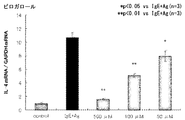
- FIG. 3 is a graph showing the action of pyrogallol in Example 1 to suppress mRNA expression of interleukin 4.
- the lactic acid bacterium of the present invention is preferably a hot water extract (90-100 ° C., 3-5 minutes) of at least one of Awabancha and its raw tea leaves or an extract component thereof (for example, Awabancha tea leaves (4-6 pieces)) ) And Awabancha tea leaves (4-6 pulverized mixture), pyrogallol is produced at 10 ⁇ g / mL or more, more preferably pyrogallol is produced at 30 ⁇ g / mL or more, more preferably Pyrogallol is produced at 50 ⁇ g / mL or more, more preferably pyrogallol is produced at 100 ⁇ g / mL or more, more preferably pyrogallol is produced at 130 ⁇ g / mL or more, more preferably pyrogallol is produced at 150 ⁇ g / mL or more. Particularly preferably, pyrogallol is produced at 170 ⁇ g / mL or more.
- the lactic acid bacteria of the present invention are preferably at least Lactobacillus pentosus OLL203984 strains of Lactobacillus pentosus OLL203969, Lactobacillus pentosus OLL203982 and Lactobacillus pentosus OLL203984.
- hot water extract 90-100 ° C., 3-5 minutes
- Awabancha and its raw tea leaves or an extract component thereof eg, Awabancha tea leaves (4-6 pieces)
- Awabancha tea leaves mixture of 4 to 6 pieces
- the above-mentioned lactic acid bacteria are cultured for a predetermined period in an anaerobic environment at a predetermined temperature.
- the “predetermined temperature” mentioned here is, for example, 25 to 45 ° C., preferably 26 to 40 ° C., more preferably 27 to 35 ° C., further preferably 28 to 32 ° C., and particularly preferably 30 ° C.
- the “predetermined period” referred to here is, for example, 1 to 20 days, preferably 3 to 15 days, more preferably 5 to 10 days, still more preferably 6 to 8 days, and particularly preferably 7 days.
- a pyrogallol-producing lactic acid bacterium of the present invention at least one of Awaban tea and its raw tea leaves or an extract component thereof is given to the lactic acid bacterium of the present invention, and the lactic acid bacterium is kept in an anaerobic environment at a predetermined temperature for a predetermined period. After culturing, the amount of pyrogallol produced by lactic acid bacteria is measured, and lactic acid bacteria are selected based on the amount of pyrogallol produced.
- the “predetermined temperature” mentioned here is, for example, 25 to 45 ° C., preferably 26 to 40 ° C., more preferably 27 to 35 ° C., further preferably 28 to 32 ° C., and particularly preferably 30 ° C.
- the “predetermined period” referred to here is, for example, 1 to 20 days, preferably 3 to 15 days, more preferably 5 to 10 days, still more preferably 6 to 8 days, and particularly preferably 7 days.
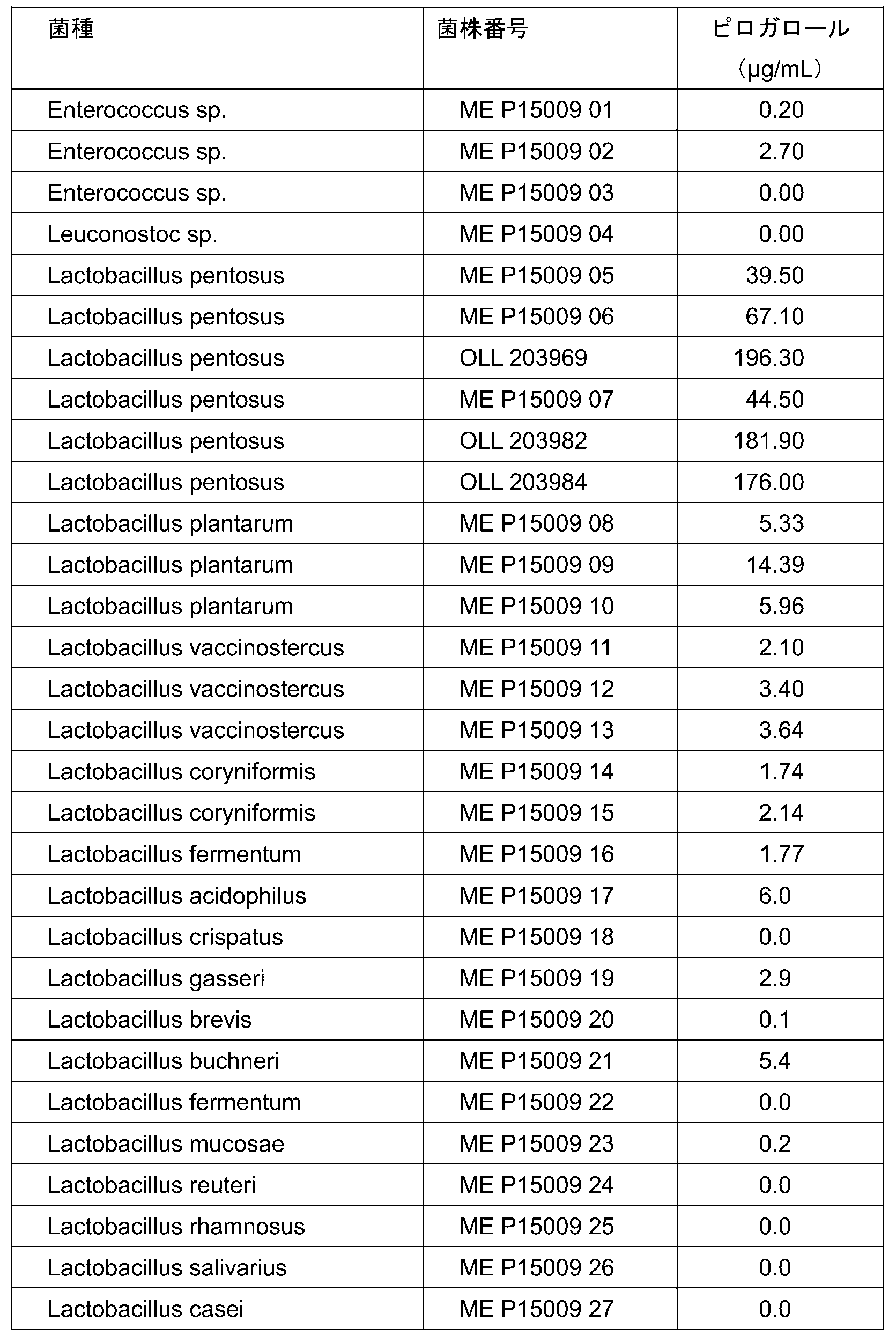
- ⁇ Selection of pyrogallol-producing lactic acid bacteria 30 types of lactic acid bacteria listed in Table 1 (including lactic acid bacteria derived from humans and lactic acid bacteria derived from Awaban tea) were prepared. Next, various lactic acid bacteria were activated and cultured twice using the MRS medium. And the culture medium containing lactic acid bacteria was put into the sample tube, and it used for the centrifuge. Subsequently, after discarding the supernatant from the sample tube, physiological saline equivalent to the supernatant was poured into the sample tube to prepare suspensions of various lactic acid bacteria.
- Table 1 including lactic acid bacteria derived from humans and lactic acid bacteria derived from Awaban tea
- tea leaf pieces (about 5 pieces) were put into tea leaf boiled juice (4 mL), and further, various lactic acid bacteria suspensions (80 ⁇ L) were inoculated there.
- the lactic acid bacteria were cultured for 7 days in an anaerobic environment at 30 ° C. Thereafter, the culture solution was subjected to a high performance liquid chromatograph, and the amount of pyrogallol produced was measured. Pyrogallol elutes at the time of 14.015 minutes in the high performance liquid chromatograph under the following conditions.
- Table 1 shows the amount of pyrogallol produced by various lactic acid bacteria. From this result, it was clarified that pyrogallol production ability varies depending on the type of lactic acid bacteria. And among the lactic acid bacteria of Table 1, it was revealed that the pyrogallol producing ability of Lactobacillus pentosasus was high, and among them, the pyrogallol producing ability of strain numbers OLL203969, OLL203982 and OLL203984 was remarkable.
Landscapes
- Chemical & Material Sciences (AREA)
- Engineering & Computer Science (AREA)
- Life Sciences & Earth Sciences (AREA)
- Organic Chemistry (AREA)
- Health & Medical Sciences (AREA)
- Wood Science & Technology (AREA)
- Zoology (AREA)
- Biotechnology (AREA)
- Genetics & Genomics (AREA)
- Bioinformatics & Cheminformatics (AREA)
- Microbiology (AREA)
- General Health & Medical Sciences (AREA)
- Biochemistry (AREA)
- General Engineering & Computer Science (AREA)
- Tropical Medicine & Parasitology (AREA)
- Chemical Kinetics & Catalysis (AREA)
- Medicinal Chemistry (AREA)
- General Chemical & Material Sciences (AREA)
- Virology (AREA)
- Biomedical Technology (AREA)
- Micro-Organisms Or Cultivation Processes Thereof (AREA)
- Preparation Of Compounds By Using Micro-Organisms (AREA)
- Coloring Foods And Improving Nutritive Qualities (AREA)
- Medicines Containing Material From Animals Or Micro-Organisms (AREA)
Abstract
熱エネルギーを不要とするか、熱エネルギーを比較的に少なく抑えて製造することができ、服用者の服用の負担を比較的小さく抑えて、かつ外出時などの携帯性に優れる抗アレルギー剤を提供することにある。ラクトバチルス・ペントーサス(Lactobacillus pentosus)OLL203969株(受託番号NITE BP-01986)、ラクトバチルス・ペントーサス(Lactobacillus pentosus)OLL203982株(受託番号NITE BP-01987)またはラクトバチルス・ペントーサス(Lactobacillus pentosus)OLL203984株(受託番号NITE BP-01988)の少なくとも1種の乳酸菌に基質を与える、ピロガロールの産生方法である。
Description
本発明は、基質からピロガロールを産生する乳酸菌に関する。また、本発明は、その乳酸菌から産生される発酵産生物にも関する。また、本発明は、その乳酸菌を利用したピロガロール産生方法にも関する。さらに、本発明は、そのような乳酸菌の選抜方法にも関する。
過去に「阿波番茶の熱水抽出成分と桑茶の熱水抽出成分とを含む抗アレルギー組成物」が提案されている(例えば、特開2012-153613号公報等参照)。
ところで、上述の抗アレルギー組成物を調製するためには、阿波番茶や桑茶の茶葉を熱水中に投入して保持する必要があり、熱エネルギーを比較的大きく消費することが必然となる。
また、上述のような茶葉の熱水抽出成分には、抗アレルギーの有効成分以外の成分が多く含まれている。このため、服用者は、規定量の有効成分を服用しようとすると、その抗アレルギー組成物を比較的に多く服用する必要がある。このため、上述のような抗アレルギー組成物では、服用者の服用の負担が比較的に大きくなっていると共に、外出時などの携帯性を損ねている。
本発明の課題は、熱エネルギーを不要とするか、あるいは熱エネルギーを比較的に少なくして調製することができ、服用者の服用の負担を比較的小さく抑えて、かつ、外出時などの携帯性に優れる抗アレルギー剤を提供することにある。
本発明の第1局面に係る乳酸菌は、基質からピロガロール(以下の化式(I)参照)を産生する、ラクトバチルス・ペントーサスの乳酸菌である。この乳酸菌は、好ましくは、阿波番茶およびその原料茶葉の少なくとも一方またはその抽出成分(例えば、阿波番茶の茶葉(5枚分)の熱湯抽出物(100℃、3分間)と阿波番茶の茶葉(5枚分)の粉砕物の混合物)である基質からピロガロールを10μg/mL以上で産生する、ラクトバチルス・ペントーサスの乳酸菌である。なお、このような乳酸菌としては、例えば、ラクトバチルス・ペントーサス(Lactobacillus pentosus)OLL203969株(受託番号 NITE BP-01986)、ラクトバチルス・ペントーサス(Lactobacillus pentosus)OLL203982株(受託番号 NITE BP-01987)またはラクトバチルス・ペントーサス(Lactobacillus pentosus)OLL203984株(受託番号 NITE BP-01988)が挙げられる。また、ピロガロールは、ベンゼン-1,2,3-トリオール、1,2,3-トリヒドロキシベンゼン、1,2,3-ベンゼントリオール、3-ヒドロキシピロカテコール、トリヒドロキシベンゼン、ピロ没食子酸、焦性没食子酸とも称されている。また、基質とは、例えば、阿波番茶やその原料茶葉(阿波番茶の発酵前の茶葉)もしくはその加工品またはその抽出成分などである。なお、ここにいう「阿波番茶」は、徳島県の山間部を中心とする極限られた地域で生産されている後発酵茶であって、最近、「阿波晩茶」とも称されている。この阿波番茶は、茹でた原料茶葉を木桶に漬け込んで10日から半月程度、乳酸発酵させた後に、天日乾燥させることによって製造される。
これらの乳酸菌では、室温(約20℃)から30℃程度の温度下で、基質から高効率な抗アレルギーの有効成分であるピロガロールが産生される。このため、この乳酸菌を用いることによって、熱エネルギーを使用(消費)しないか、あるいは熱エネルギーを比較的に少なく抑えて、抗アレルギーの有効成分を得ることができる。また、この乳酸菌の発酵産生物には、ピロガロールが比較的に多く含有される。このため、この乳酸菌を用いることによって、服用者の服用の負担を比較的に小さく抑えて、かつ外出時などの携帯性に優れる抗アレルギー剤を高効率で製造(産生)することができる。したがって、この乳酸菌を利用することによって、熱エネルギーを不要とするか、あるいは熱エネルギーを比較的に少なく抑えてピロガロールを調製することができると共に、服用者の服用の負担を比較的に小さく抑えて、かつ外出時などの携帯性に優れる抗アレルギー剤を提供することができる。

本発明の第2局面に係る発酵産生物は、食品素材に、本発明の第1局面に係る乳酸菌を接種して発酵させることによって産生される。なお、ここにいう「食品素材」とは、阿波番茶やその原料茶葉(阿波番茶の発酵前の茶葉)もしくはその加工品またはその抽出成分(特に、熱湯抽出成分)等であることが好ましい。また、この発酵産生物は、本発明の第1局面に係る乳酸菌のみを接種して発酵させることによって産生されることが好ましい。
上述の発酵産生物には、高効率な抗アレルギーの有効成分であるピロガロールが含有される。また、ピロガロールを含有するこの発酵産生物は、室温から30℃程度の温度下で産生される。このため、この発酵産生物を用いることによって、熱エネルギーを使用(消費)しないか、あるいは熱エネルギーを比較的に少なく抑えて、抗アレルギーの有効成分を得ることができる。また、この発酵産生物には、ピロガロールが比較的に多く含有される。このため、この発酵産生物を用いることによって、服用者の服用の負担を比較的に小さく抑えて、かつ外出時などの携帯性に優れる抗アレルギー剤を高効率で製造(調製)することができる。したがって、この発酵産生物を用いることによって、熱エネルギーを不要とするか、あるいは熱エネルギーを比較的少なく抑えて抗アレルギー剤を調製することができると共に、服用者の服用の負担を比較的に小さく抑えて、かつ外出時などの携帯性に優れる抗アレルギー剤を提供することができる。
本発明の第3局面に係るピロガロール産生方法は、ラクトバチルス・ペントーサス(Lactobacillus pentosus)OLL203969株、ラクトバチルス・ペントーサス(Lactobacillus pentosus)OLL203982株およびラクトバチルス・ペントーサス(Lactobacillus pentosus)OLL203984株の少なくとも1種の乳酸菌に基質を与えて、所定温度の嫌気性の環境下において、上述の乳酸菌を所定期間で培養することによって実行することができる。なお、ここにいう「基質」とは、阿波番茶等の発酵茶やその原料茶葉(阿波番茶の発酵前の茶葉)もしくはその加工品またはその抽出成分(特に、熱湯抽出成分)などに含有される成分であることが好ましい。
このピロガロール産生方法では、室温から30℃程度の温度下で、基質から高効率な抗アレルギーの有効成分であるピロガロールが産生される。このため、このピロガロール産生方法を用いることによって、熱エネルギーを使用(消費)しないか、あるいは熱エネルギーを比較的に少なく抑えて、抗アレルギーの有効成分を得ることができる。また、上述の乳酸菌の発酵産生物には、ピロガロールが比較的に多く含有される。このため、このピロガロール産生方法を用いることによって、服用者の服用の負担を比較的に小さく抑えて、かつ外出時などの携帯性に優れる抗アレルギー剤を高効率で製造(産生)することができる。したがって、このピロガロール産生方法を用いることによって、熱エネルギーを不要とするか、あるいは熱エネルギーを比較的に少なく抑えて抗アレルギー剤を調製することができると共に、服用者の服用の負担を比較的に小さく抑えて、かつ外出時などの携帯性に優れる抗アレルギー剤を提供することができる。
本発明の第4局面に係るピロガロール産生乳酸菌の選抜方法は、培養工程、測定工程および選抜工程を備える。培養工程では、乳酸菌に、阿波番茶およびその原料茶葉の少なくとも一方またはその抽出成分を与えて、所定温度の嫌気性の環境下において、上述の乳酸菌を所定期間、培養する。なお、ここにいう「所定温度」とは、例えば、25~45℃である。また、ここにいう「所定期間」とは、例えば、1~20日間である。また、ここにいう「抽出成分」とは、熱湯(熱水)抽出成分や酢酸エチル抽出成分などである。測定工程では、乳酸菌の培養工程における乳酸菌のピロガロール産生量が測定される。選抜工程では、ピロガロール産生量に基づいて、乳酸菌が選抜される。
このピロガロール産生の乳酸菌の選抜方法を利用することによって、高効率な抗アレルギーの有効成分であるピロガロールを産生する乳酸菌を容易に選抜することができる。
本発明の乳酸菌は、好ましくは、阿波番茶およびその原料茶葉の少なくとも一方またはその抽出成分(例えば、阿波番茶の茶葉(4~6枚分)の熱湯抽出物(90~100℃、3~5分間)と阿波番茶の茶葉(4~6枚分)の粉砕物の混合物)である基質からピロガロールを10μg/mL以上で産生し、より好ましくは、ピロガロールを30μg/mL以上で産生し、さらに好ましくは、ピロガロールを50μg/mL以上で産生し、さらに好ましくは、ピロガロールを100μg/mL以上で産生し、さらに好ましくは、ピロガロールを130μg/mL以上で産生し、さらに好ましくは、ピロガロールを150μg/mL以上で産生し、とくに好ましくは、ピロガロールを170μg/mL以上で産生する。
本発明の乳酸菌は、好ましくは、ラクトバチルス・ペントーサス(Lactobacillus pentosus)OLL203969株、ラクトバチルス・ペントーサス(Lactobacillus pentosus)OLL203982株およびラクトバチルス・ペントーサス(Lactobacillus pentosus)OLL203984株の少なくとも1種の乳酸菌である。
本発明のピロガロール産生方法では、阿波番茶およびその原料茶葉の少なくとも一方またはその抽出成分(例えば、阿波番茶の茶葉(4~6枚分)の熱湯抽出物(90~100℃、3~5分間)と阿波番茶の茶葉(4~6枚分)の粉砕物の混合物)である基質を、本発明の乳酸菌に与えて、所定温度の嫌気性の環境下において、上述の乳酸菌を所定期間、培養する。なお、ここにいう「所定温度」とは、例えば、25~45℃、好ましくは26~40℃、より好ましくは27~35℃、さらに好ましくは28~32℃、とくに好ましくは30℃である。また、ここにいう「所定期間」とは、例えば、1~20日間、好ましくは3~15日間、より好ましくは5~10日間、さらに好ましくは6~8日間、とくに好ましくは7日間である。
本発明のピロガロール産生の乳酸菌の選抜方法では、阿波番茶およびその原料茶葉の少なくとも一方またはその抽出成分が、本発明の乳酸菌に与えられて、所定温度の嫌気性の環境下において、乳酸菌が所定期間、培養されてから、乳酸菌のピロガロール産生量が測定され、ピロガロール産生量に基づいて、乳酸菌が選抜される。なお、ここにいう「所定温度」とは、例えば、25~45℃、好ましくは26~40℃、より好ましくは27~35℃、さらに好ましくは28~32℃、とくに好ましくは30℃である。また、ここにいう「所定期間」とは、例えば、1~20日間、好ましくは3~15日間、より好ましくは5~10日間、さらに好ましくは6~8日間、とくに好ましくは7日間である。
以下、実施例を示して本発明をより詳細に説明する。なお、以下に示される実施例は、例示に過ぎず、本発明を限定するものではない。
<ピロガロール産生の乳酸菌の選抜>
先ず、ピロガロール産生の乳酸菌の候補として、表1に列記される30種類の乳酸菌(ヒト由来の乳酸菌や阿波番茶由来の乳酸菌が含まれている。)を準備した。次いで、MRS培地を用いて、各種の乳酸菌を2回、賦活培養した。そして、乳酸菌を含む培地をサンプル管に入れて遠心分離機に供した。続いて、そのサンプル管から上清を捨てた後、その上清と等量の生理食塩水を、そのサンプル管に投入して、各種の乳酸菌の懸濁液を調製した。
先ず、ピロガロール産生の乳酸菌の候補として、表1に列記される30種類の乳酸菌(ヒト由来の乳酸菌や阿波番茶由来の乳酸菌が含まれている。)を準備した。次いで、MRS培地を用いて、各種の乳酸菌を2回、賦活培養した。そして、乳酸菌を含む培地をサンプル管に入れて遠心分離機に供した。続いて、そのサンプル管から上清を捨てた後、その上清と等量の生理食塩水を、そのサンプル管に投入して、各種の乳酸菌の懸濁液を調製した。
一方、蒸留水に阿波番茶の茶葉を数枚入れた後、その茶葉入り蒸留水を100℃で3分間、煮沸した。そして、煮沸後の茶葉を乳鉢で軽く磨り潰して、茶葉片を調製した。
茶葉の煮汁(4mL)に上述の茶葉片(約5枚分)を入れ、さらに、そこに各種の乳酸菌の懸濁液(80μL)を接種した。そして、30℃の嫌気性の環境下において、その乳酸菌を7日間、培養した。その後、その培養液を高速液体クロマトグラフに供して、ピロガロールの産生量を測定した。なお、ピロガロールは、以下の条件の高速液体クロマトグラフにおいて、14.015分の時点で溶出する。
・カラム:COSMOSIL(登録商標) 5C18-MS II(直径: 4.6mm、 長さ: 250mm)(ナカライテスク株式会社製)
・移動層: 溶媒A(水:酢酸=99:1),溶媒B(メタノール:アセトン:酢酸=95:4:1)
・溶出条件:
0-15分: 溶媒A 95質量%/溶媒B 5質量%
15-30分: 溶媒A 45-50質量%/溶媒B 55-50質量%
30-40分: 溶媒A 50-0質量%/溶媒B 50-100質量%
40-50分: 溶媒A 0質量%/溶媒B 100質量%
45-55分: 溶媒A 0-95質量%/溶媒B 100-5質量%
・カラム温度: 室温
・測定波長: 270nm
サンプル注入量: 10μL
・流速: 0.5mL/分
・移動層: 溶媒A(水:酢酸=99:1),溶媒B(メタノール:アセトン:酢酸=95:4:1)
・溶出条件:
0-15分: 溶媒A 95質量%/溶媒B 5質量%
15-30分: 溶媒A 45-50質量%/溶媒B 55-50質量%
30-40分: 溶媒A 50-0質量%/溶媒B 50-100質量%
40-50分: 溶媒A 0質量%/溶媒B 100質量%
45-55分: 溶媒A 0-95質量%/溶媒B 100-5質量%
・カラム温度: 室温
・測定波長: 270nm
サンプル注入量: 10μL
・流速: 0.5mL/分
表1には、各種の乳酸菌のピロガロールの産生量が示されている。この結果から、乳酸菌の種類によって、ピロガロールの産生能が異なることが明らかとなった。そして、表1の乳酸菌の中でも、ラクトバチルス・ペントーサスのピロガロールの産生能が高く、それらの中でも特に、OLL203969、OLL203982およびOLL203984の菌株番号のピロガロール産生能が顕著であることが明らかとなった。
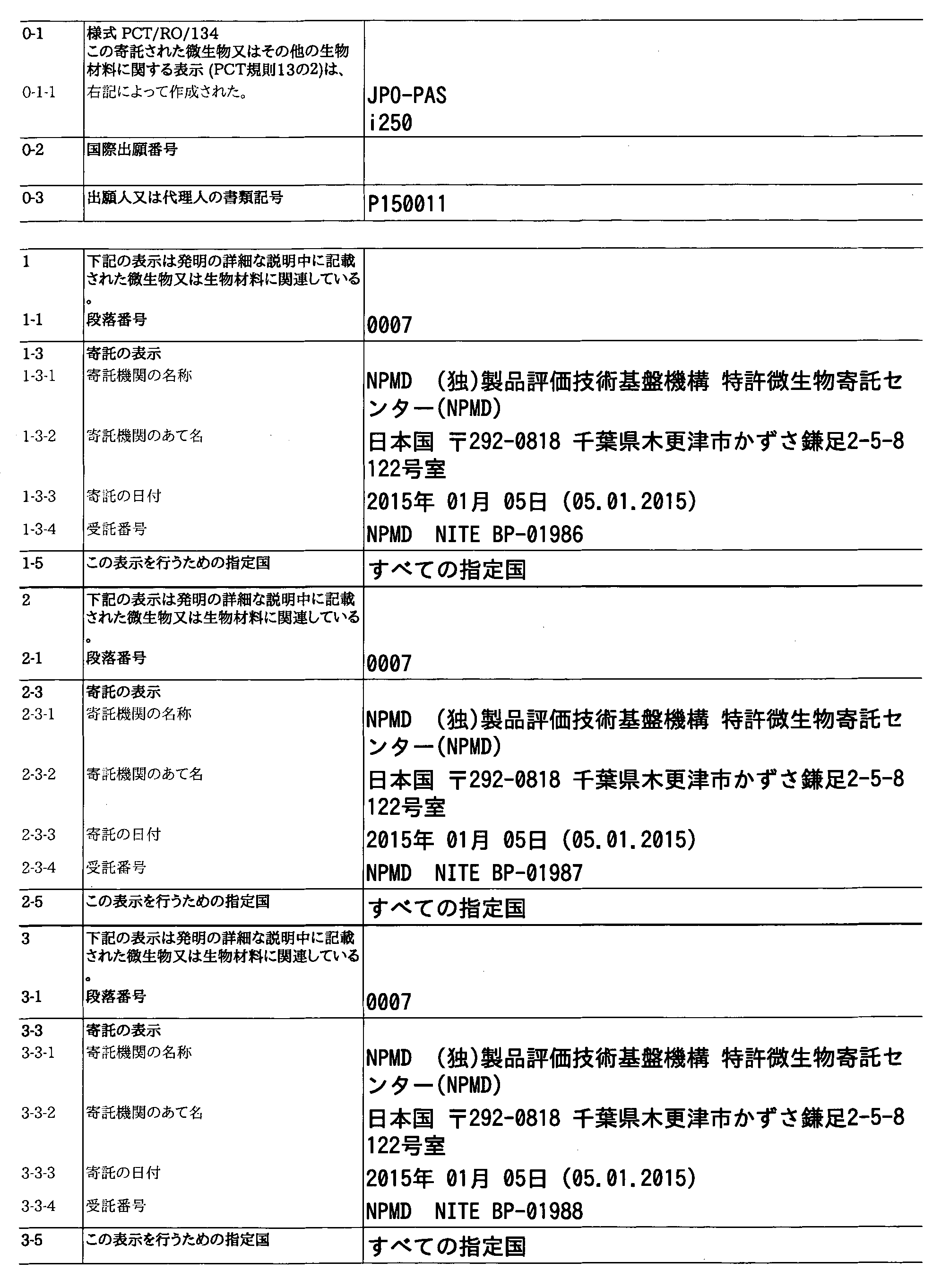
NITE BP-01986
NITE BP-01987
NITE BP-01988
NITE BP-01987
NITE BP-01988
[規則26に基づく補充 30.03.2016]
Claims (6)
- 基質からピロガロールを産生する、ラクトバチルス・ペントーサスの乳酸菌。
- 前記乳酸菌は、ラクトバチルス・ペントーサス(Lactobacillus pentosus)OLL203969株(受託番号NITE BP-01986)、ラクトバチルス・ペントーサス(Lactobacillus pentosus)OLL203982株(受託番号NITE BP-01987)またはラクトバチルス・ペントーサス(Lactobacillus pentosus)OLL203984株(受託番号NITE-BP-01988)である
請求項1に記載の乳酸菌。 - 食品素材に、請求項1または2に記載の乳酸菌を接種して発酵させることによって産生される、発酵産生物。
- ラクトバチルス・ペントーサス(Lactobacillus pentosus)OLL203969株(受託番号NITE BP-01986)、ラクトバチルス・ペントーサス(Lactobacillus pentosus)OLL203982株(受託番号NITE BP-01987)およびラクトバチルス・ペントーサス(Lactobacillus pentosus)OLL203984株(受託番号NITE BP-01988)の少なくとも1種の乳酸菌に基質を与えることによってピロガロールを産生させる、ピロガロール産生方法。
- 前記基質は、阿波番茶の原料茶葉に含有される成分である
請求項4に記載のピロガロール産生方法。 - 乳酸菌に阿波番茶およびその原料茶葉の少なくとも一方またはその抽出成分を与えて、所定温度の嫌気性の環境下において、前記乳酸菌を所定期間、培養する培養工程と、
前記培養工程における前記乳酸菌のピロガロール産生量を測定する測定工程と、
前記ピロガロール産生量に基づいて前記乳酸菌を選抜する選抜工程と
を備える、ピロガロール産生乳酸菌の選抜方法。
Priority Applications (2)
| Application Number | Priority Date | Filing Date | Title |
|---|---|---|---|
| SG11201705067SA SG11201705067SA (en) | 2015-03-11 | 2016-03-11 | Lactic acid bacterium, fermentation product, pyrogallol production method and method for selecting pyrogallol-producing lactic acid bacterium |
| CN201680004269.4A CN107109355A (zh) | 2015-03-11 | 2016-03-11 | 乳酸菌、发酵产物、邻苯三酚生产方法以及生产邻苯三酚的乳酸菌的筛选方法 |
Applications Claiming Priority (2)
| Application Number | Priority Date | Filing Date | Title |
|---|---|---|---|
| JP2015048287A JP6616579B2 (ja) | 2015-03-11 | 2015-03-11 | 乳酸菌、発酵産生物およびピロガロール産生方法 |
| JP2015-048287 | 2015-03-11 |
Publications (1)
| Publication Number | Publication Date |
|---|---|
| WO2016143887A1 true WO2016143887A1 (ja) | 2016-09-15 |
Family
ID=56879672
Family Applications (1)
| Application Number | Title | Priority Date | Filing Date |
|---|---|---|---|
| PCT/JP2016/057702 Ceased WO2016143887A1 (ja) | 2015-03-11 | 2016-03-11 | 乳酸菌、発酵産生物、ピロガロール産生方法およびピロガロール産生乳酸菌の選抜方法 |
Country Status (4)
| Country | Link |
|---|---|
| JP (1) | JP6616579B2 (ja) |
| CN (1) | CN107109355A (ja) |
| SG (1) | SG11201705067SA (ja) |
| WO (1) | WO2016143887A1 (ja) |
Families Citing this family (3)
| Publication number | Priority date | Publication date | Assignee | Title |
|---|---|---|---|---|
| JP7385387B2 (ja) * | 2018-07-23 | 2023-11-22 | 株式会社明治 | 没食子酸の製造方法及び茶発酵物の製造方法、並びに、乳酸菌、乳酸菌組成物、茶発酵物、及び飲食品 |
| JP7681849B2 (ja) * | 2020-05-18 | 2025-05-23 | 国立大学法人千葉大学 | 整腸用茶発酵組成物及びその製造方法 |
| JP7794395B2 (ja) * | 2022-01-21 | 2026-01-06 | 徳島県 | 新規乳酸菌及びその利用 |
-
2015
- 2015-03-11 JP JP2015048287A patent/JP6616579B2/ja active Active
-
2016
- 2016-03-11 WO PCT/JP2016/057702 patent/WO2016143887A1/ja not_active Ceased
- 2016-03-11 CN CN201680004269.4A patent/CN107109355A/zh not_active Withdrawn
- 2016-03-11 SG SG11201705067SA patent/SG11201705067SA/en unknown
Non-Patent Citations (4)
| Title |
|---|
| "Kenko Chaba Gentokucha no Goannai", 13 September 2005 (2005-09-13), Retrieved from the Internet <URL:https://web.archive.org/web/20050913183909/http://ww9.tiki.ne.jp/-golfya-aida/gentoku/gentoku.htm> [retrieved on 20160516] * |
| HIRONORI MORIYAMA: "Biseibutsu Hakkocha no Polyphenol-rui, Shokuhinchu no Kenko Kinosei Seibun no Bunsekiho Manual", March 2010 (2010-03-01), pages 3, Retrieved from the Internet <URL:https://unit.aist.go.jp/shikoku/food_forum/manual/511K.pdf> [retrieved on 20160516] * |
| KWON T. ET AL.: "Characterization of Lactobacilli with Tannase Activity Isolated from Kimchi", FOOD SCI. BIOTECHNOL., vol. 17, no. 6, 2008, pages 1322 - 1326 * |
| MIYUKI KATO: "Kohakkocha no Kagaku", RYOKUCHA TSUSHIN, vol. 9, 2004, pages 35 - 40 * |
Also Published As
| Publication number | Publication date |
|---|---|
| SG11201705067SA (en) | 2017-07-28 |
| CN107109355A (zh) | 2017-08-29 |
| JP2016167984A (ja) | 2016-09-23 |
| JP6616579B2 (ja) | 2019-12-04 |
Similar Documents
| Publication | Publication Date | Title |
|---|---|---|
| Puerari et al. | New cocoa pulp-based kefir beverages: Microbiological, chemical composition and sensory analysis | |
| Lu et al. | Effects of sugar concentration on mango wine composition fermented by Saccharomyces cerevisiae MERIT. ferm | |
| CN106754580B (zh) | 可同时促进酿酒酵母产酒精和风味物质的芽孢杆菌及其应用 | |
| JP2015502148A (ja) | キムチの熟成遅延のための混合乳酸菌培養液組成物及びこれを用いたキムチ製造方法 | |
| CN116138429B (zh) | 矮小哈萨克斯坦酵母xj-65及其在辣椒发酵中的应用 | |
| JP6616579B2 (ja) | 乳酸菌、発酵産生物およびピロガロール産生方法 | |
| Vohra et al. | Effects of medium variation and fermentation time towards the pH level and ethanol content of Kombucha | |
| UA97282C2 (ru) | Состав пива "радой" и способ его производства | |
| Liu et al. | Screening low-methanol and high-aroma produced yeasts for cider fermentation by transcriptive characterization | |
| CN108094905A (zh) | 一种基于4-乙基愈创木酚发酵强化的酱香郫县豆瓣生产方法 | |
| Liu et al. | Influence of fermentation temperature and source of enzymes on enological characteristics of rice wine | |
| Zubaidah et al. | Sauerkraut with the addition of Lactobacillus casei: Effects of salt and sugar concentrations on fermentation and antioxidant activity | |
| Yao et al. | Growth capacity of Bacillus potential starter strains isolated from cocoa beans fermentation under culture stress conditions | |
| CN103194416A (zh) | 一种浓香型白酒窖泥己酸菌增殖培养基及其制备方法 | |
| CN117778210A (zh) | 一种光滑假丝酵母菌(Candida glabrata)菌株196及其用途、产品与方法 | |
| Wang et al. | Effect of cofermentation inoculation strategy of Saccharomyces cerevisiae and Hanseniaspora uvarum on the aroma and quality of sugarcane wine | |
| CN104513763B (zh) | 一种沙棘酒的酿造方法 | |
| KR20140068351A (ko) | 카테킨 생물전환능을 가지는 로도토룰라 그라미니스 jag-12 및 이를 이용한 카테킨의 생물전환방법 | |
| KR101670038B1 (ko) | 홍삼농축액이 혼합된 발효 홍삼 농축액 튜브음료 제조방법 및 홍삼 튜브음료 | |
| JP2020500154A (ja) | 後発酵茶由来の新規なケンペロール系化合物 | |
| JP6713636B2 (ja) | 泡盛もろみ酢発酵飲料の製造方法 | |
| JP2019530710A (ja) | 新規なクエルセチン系化合物 | |
| HK1237367A1 (en) | Lactic acid bacterium, fermentation product, pyrogallol production method and method for selecting pyrogallol-producing lactic acid bacterium | |
| Don et al. | Developing Herbal-Based Beverage Fermentation Using Saccharomyces cerevisiae: The Physico-Chemical Properties | |
| Xu et al. | Physicochemical, functional, and storage characteristics of Chuju chrysanthemum fermented tea added with exogenous Lactobacillus plantarum ATCC8014 |
Legal Events
| Date | Code | Title | Description |
|---|---|---|---|
| 121 | Ep: the epo has been informed by wipo that ep was designated in this application |
Ref document number: 16761852 Country of ref document: EP Kind code of ref document: A1 |
|
| WWE | Wipo information: entry into national phase |
Ref document number: 11201705067S Country of ref document: SG |
|
| NENP | Non-entry into the national phase |
Ref country code: DE |
|
| 122 | Ep: pct application non-entry in european phase |
Ref document number: 16761852 Country of ref document: EP Kind code of ref document: A1 |