WO2016142764A1 - 感熱記録体 - Google Patents
感熱記録体 Download PDFInfo
- Publication number
- WO2016142764A1 WO2016142764A1 PCT/IB2016/000243 IB2016000243W WO2016142764A1 WO 2016142764 A1 WO2016142764 A1 WO 2016142764A1 IB 2016000243 W IB2016000243 W IB 2016000243W WO 2016142764 A1 WO2016142764 A1 WO 2016142764A1
- Authority
- WO
- WIPO (PCT)
- Prior art keywords
- heat
- sensitive recording
- pyridinyl
- recording material
- dimethylbenzenamine
- Prior art date
- Legal status (The legal status is an assumption and is not a legal conclusion. Google has not performed a legal analysis and makes no representation as to the accuracy of the status listed.)
- Ceased
Links
Classifications
-
- B—PERFORMING OPERATIONS; TRANSPORTING
- B41—PRINTING; LINING MACHINES; TYPEWRITERS; STAMPS
- B41M—PRINTING, DUPLICATING, MARKING, OR COPYING PROCESSES; COLOUR PRINTING
- B41M5/00—Duplicating or marking methods; Sheet materials for use therein
- B41M5/26—Thermography ; Marking by high energetic means, e.g. laser otherwise than by burning, and characterised by the material used
- B41M5/28—Thermography ; Marking by high energetic means, e.g. laser otherwise than by burning, and characterised by the material used using thermochromic compounds or layers containing liquid crystals, microcapsules, bleachable dyes or heat- decomposable compounds, e.g. gas- liberating
-
- B—PERFORMING OPERATIONS; TRANSPORTING
- B41—PRINTING; LINING MACHINES; TYPEWRITERS; STAMPS
- B41M—PRINTING, DUPLICATING, MARKING, OR COPYING PROCESSES; COLOUR PRINTING
- B41M5/00—Duplicating or marking methods; Sheet materials for use therein
- B41M5/26—Thermography ; Marking by high energetic means, e.g. laser otherwise than by burning, and characterised by the material used
- B41M5/30—Thermography ; Marking by high energetic means, e.g. laser otherwise than by burning, and characterised by the material used using chemical colour formers
-
- B—PERFORMING OPERATIONS; TRANSPORTING
- B41—PRINTING; LINING MACHINES; TYPEWRITERS; STAMPS
- B41M—PRINTING, DUPLICATING, MARKING, OR COPYING PROCESSES; COLOUR PRINTING
- B41M5/00—Duplicating or marking methods; Sheet materials for use therein
- B41M5/26—Thermography ; Marking by high energetic means, e.g. laser otherwise than by burning, and characterised by the material used
- B41M5/30—Thermography ; Marking by high energetic means, e.g. laser otherwise than by burning, and characterised by the material used using chemical colour formers
- B41M5/323—Organic colour formers, e.g. leuco dyes
-
- B—PERFORMING OPERATIONS; TRANSPORTING
- B41—PRINTING; LINING MACHINES; TYPEWRITERS; STAMPS
- B41M—PRINTING, DUPLICATING, MARKING, OR COPYING PROCESSES; COLOUR PRINTING
- B41M5/00—Duplicating or marking methods; Sheet materials for use therein
- B41M5/26—Thermography ; Marking by high energetic means, e.g. laser otherwise than by burning, and characterised by the material used
- B41M5/30—Thermography ; Marking by high energetic means, e.g. laser otherwise than by burning, and characterised by the material used using chemical colour formers
- B41M5/337—Additives; Binders
Definitions
- the present invention relates to a heat-sensitive recording material utilizing a color reaction between a dye precursor and a developer, and more specifically, a portion colored by thermal energy from a thermal head, a thermal stamp, or the like is in a yellow hue range.
- the present invention relates to a heat-sensitive recording material having high recording density and light-resistant storage stability of a recording portion and good heat-resistant background fogging.
- a heat-sensitive recording material that uses a reaction between a dye precursor and a developer and reacts both substances with thermal energy to obtain a recorded image is well known.
- Such a heat-sensitive recording material is relatively inexpensive, and the recording device is compact and easy to maintain, so that it is used not only as a recording medium for facsimiles and printers but also in a wide range of fields.
- the main object of the present invention is to provide a heat-sensitive recording material having a high recording density in the yellow hue region and excellent in light-resistant storage stability and heat-resistant background fogging of the recording portion.
- the present inventors have used a dye precursor represented by the following general formula (1) and a phenol compound represented by the following general formula (2) in the heat-sensitive recording layer. It came to solve the said problem. That is, the present invention relates to the following thermal recording material.
- thermosensitive recording medium comprising a thermosensitive recording layer containing a dye precursor and a developer on one surface of a support, wherein the thermosensitive recording layer is represented by the following general formula (1) And a phenolic compound represented by the following general formula (2).
- R 1 and R 2 may be the same or different and each represents a hydrogen atom or a branched alkoxy group which may having a carbon number 1 - 8, R 3 is a C1- 4 represents an alkyl group which may be branched.
- R 4 represents a saturated or unsaturated alkylene group that may be substituted, a saturated or unsaturated alkylidene group that may be substituted, or a cycloalkylene group that may be substituted
- R 5 and R 6 May be the same or different and each represents a hydrogen atom, a halogen atom, a saturated or unsaturated alkyl group which may be substituted, or a saturated or unsaturated alkoxyl group which may be substituted.
- the dye precursor represented by the general formula (1) is 4- [2- (2-butoxyphenyl) -6-phenyl-4-pyridinyl] -N, N-dimethylbenzenamine, 4- [ 2- (2-pentyloxyphenyl) -6-phenyl-4-pyridinyl] -N, N-dimethylbenzenamine, 4- [2- (2-hexyloxyphenyl) -6-phenyl-4-pyridinyl] -N , N-dimethylbenzenamine, 4- [2- [2- (ethoxyphenyl] -6-phenyl-4-pyridinyl] -N, N-dimethylbenzenamine, 4- [2- (2-octyloxyphenyl)- 6-phenyl-4-pyridinyl] -N, N-dimethylbenzenamine, 4- (2,6-diphenyl-4-pyridinyl) -N, N-dimethylbenzenamine, 4- [2,6-bis (2 Butoxy
- Item 3 The phenol compound represented by the general formula (2) is 2,2′-methylenebis (4-methyl-6-tert-butylphenol) and 2,2′-methylenebis (4-ethyl-6-tert- Item 3.
- the thermal recording material according to Item 1 or 2 which is at least one member selected from the group consisting of (butylphenol).
- Item 4 The heat-sensitive recording material according to any one of Items 1 to 3, wherein an average particle size of the phenol compound represented by the general formula (2) is 0.4 to 2.0 ⁇ m.
- Item 5 The heat-sensitive recording material according to any one of Items 1 to 4, wherein the support has a metallic luster.
- Item 6 The thermal recording material according to Item 5, wherein the dynamic color density obtained by printing the thermal recording material with a thermal head with an applied energy of 0.97 mJ / dot is 1.00 or more.
- Item 7 The heat-sensitive recording material according to Item 5 or 6, wherein the support has a metallic luster on the surface of a substrate having no metallic luster.
- the heat-sensitive recording material of the present invention has a high recording density in the yellow hue region, and is excellent in light-resistant storage stability and heat-resistant background fogging of the recording area. Further, when the support has a metallic luster, the heat-sensitive recording material of the present invention has an effect that the color-development image has a metallic luster and exhibits a vivid golden metallic tone in addition to the above effects.
- the heat-sensitive recording layer in the present invention contains a dye precursor represented by the general formula (1), a developer, and a phenol compound represented by the general formula (2). Thereby, yellow coloring is exhibited, and the storage stability and heat resistant background fogging property of the recording portion are excellent in the yellow hue range.
- the dye precursor represented by the general formula (1) is 4- [2- (2-butoxyphenyl) -6-phenyl-4-pyridinyl] -N, N-dimethylbenzenamine, 4- [2- (2 -Pentyloxyphenyl) -6-phenyl-4-pyridinyl] -N, N-dimethylbenzenamine, 4- [2- (2-hexyloxyphenyl) -6-phenyl-4-pyridinyl] -N, N-dimethyl Benzeneamine, 4- [2- [2- (ethoxyphenyl] -6-phenyl-4-pyridinyl] -N, N-dimethylbenzenamine, 4- [2- (2-octyloxyphenyl) -6-phenyl- 4-pyridinyl] -N, N-dimethylbenzenamine, 4- (2,6-diphenyl-4-pyridinyl) -N, N-dimethylbenzenamine, 4- [2,6-bis (2-but
- R 1 or R 2 in the general formula (1) is an alkoxy group having 4 to 8 carbon atoms. Is preferably represented. Further, from the viewpoint of improving the recording density, it is preferable that either R 1 or R 2 represents a hydrogen atom. From the viewpoint of increasing the recording density, it is preferable to exclude the case where R 1 and R 2 are hydrogen atoms at the same time in the general formula (1).
- the form of the dye precursor contained in the heat-sensitive recording layer is not particularly limited.
- the dye precursor is used in the form of solid fine particles, a polyvalent isocyanate compound is used as a solvent, and the dye precursor is a solute.
- examples include use in the form of composite fine particles obtained by polymerizing a polyisocyanate compound after emulsifying and dispersing a solution-like composition contained in water, or use in the form of microcapsules encapsulated in microcapsules. And can be appropriately selected and used so as to obtain desired quality.
- water is used as a dispersion medium and pulverized by various wet pulverizers such as a sand grinder, an attritor, a ball mill, a cobo mill, and the like.
- water-soluble polymer compounds such as alcohol, modified polyvinyl alcohols such as sulfone-modified polyvinyl alcohol, methyl cellulose, carboxymethyl cellulose, styrene-maleic anhydride copolymer salts, and derivatives thereof, surfactants, It can be dispersed in a dispersion medium together with a foaming agent to form a dispersion, and this dispersion can be used for the preparation of a thermal recording layer coating liquid.
- modified polyvinyl alcohols such as sulfone-modified polyvinyl alcohol, methyl cellulose, carboxymethyl cellulose, styrene-maleic anhydride copolymer salts, and derivatives thereof
- surfactants It can be dispersed in a dispersion medium together with a foaming agent to form a dispersion, and this dispersion can be used for the preparation of a thermal recording layer coating liquid.
- phenol compound represented by the general formula (2) examples include, for example, 2,2′-methylenebis (4-methyl-6-tert-butylphenol), 2,2′-methylenebis (4-ethyl-6-tert).
- -Butylphenol 2,2'-ethylenebis (4-methyl-6-tert-butylphenol), 2,2'-methylenebis (4,6-di-tert-butylphenol), 2,2'-ethylidenebis (4 , 6-di-tert-butylphenol), 2,2′-ethylidenebis (4-methyl-6-tert-butylphenol), 2,2′-ethylidenebis (4-ethyl-6-tert-butylphenol), 2, 2 ′-(2,2′-propylidene) bis (4,6-di-tert-butylphenol), 2,2′-methylenebis (4-me Carboxymethyl -6-tert-butylphenol), 2,2'-methylenebis (6-tert-butylphenol)
- the content ratio of the phenol compound represented by the general formula (2) is not particularly limited, but is about 1 to 500 parts by mass, preferably about 10 to 200 parts by mass with respect to 100 parts by mass of the dye precursor. is there.
- the average particle size of the phenolic compound represented by the general formula (2) is preferably in the range of 0.4 to 2.0 ⁇ m, from the viewpoint of improving the recording density and the light resistance storage stability, and 0.4 to 1.5 ⁇ m. More preferably, it is the range.
- an average particle diameter is a volume average particle diameter by a laser diffraction method.
- examples of the storage stability improver include 1,1,3-tris (2-methyl-4-hydroxy-5-cyclohexylphenyl) butane, 1,1,3-tris (2-methyl-4- Hydroxy-5-tert-butylphenyl) butane, 1,1-bis (2-methyl-4-hydroxy-5-tert-butylphenyl) butane, 4,4 ′-[1,4-phenylenebis (1-methyl) Ethylidene)] bisphenol and phenol compounds such as 4,4 ′-[1,3-phenylenebis (1-methylethylidene)] bisphenol, 4-benzyloxyphenyl-4 ′-(2-methyl-2,3-epoxy Propyloxy) phenylsulfone, 4- (2-methyl-1,2-epoxyethyl) diphenylsulfone, and 4- (2-ethyl-1,2-epoxy) At least one selected from epoxy compounds such as ethyl) diphenylsulfone and
- the color developer in the present invention is selected from those having the property of being liquefied or dissolved by an increase in temperature, and the property of causing color development upon contact with the dye precursor.
- Specific examples of the developer include organic acidic substances such as phenol compounds, aromatic carboxylic acids, or polyvalent metal salts of these compounds.
- the developer may be usually present in the composite fine particles or in the microcapsules, or may be present in the state of solid dispersed fine particles.
- the content ratio of the developer is preferably about 30 to 2000 parts by mass, more preferably about 50 to 250 parts by mass with respect to 100 parts by mass of the dye precursor.
- the composite fine particles can be prepared by a method similar to the method of preparing the composite fine particles containing the dye precursor.
- developer examples include, for example, 4-tert-butylphenol, 4-acetylphenol, 4-tert-octylphenol, 4,4′-sec-butylidene diphenol, 4-phenylphenol, 4,4′-dihydroxy Diphenylmethane, 4,4′-isopropylidene diphenol, 4,4′-dihydroxydiphenyl ether, 4,4′-cyclohexylidene diphenol, 1,1-bis (4-hydroxyphenyl) ethane, 1,1-bis (4 -Hydroxyphenyl) -1-phenylethane, 4,4'-dihydroxydiphenyl sulfide, 4,4'-thiobis (3-methyl-6-tert-butylphenol), 4,4'-dihydroxydiphenylsulfone, 2,4 ' -Dihydroxydiphenylsulfone, 4-hydro Si-4′-isopropoxydiphenylsulfone, 4-hydroxy-4′-n-propyl
- a sensitizer can be further contained in order to improve the recording sensitivity.
- compounds conventionally known as sensitizers for thermal recording materials can be used.
- parabenzylbiphenyl, dibenzyl terephthalate, phenyl 1-hydroxy-2-naphthoate, dibenzyl oxalate Di-o-chlorobenzyl adipate, 1,2-diphenoxyethane, 1,2-di (3-methylphenoxy) ethane, di-p-methylbenzyl oxalate, di-p-chlorobenzyl oxalate, , 2-bis (3,4-dimethylphenyl) ethane, 1,3-bis (2-naphthoxy) propane, metaterphenyl, diphenyl, benzophenone, and the like.
- Auxiliaries such as developer, preservability improver, and sensitizer used in the heat-sensitive recording layer are dispersed in water in the same manner as when the dye precursor is used in the form of solid dispersed fine particles. What is necessary is just to mix with this in the case of preparation of the coating liquid.
- these adjuvants can be dissolved in a solvent and emulsified in water using a water-soluble polymer compound as an emulsifier.
- the preservability improver and the sensitizer may be contained in the composite fine particles containing the dye precursor.
- a fine pigment having a high whiteness and an average particle size of 10 ⁇ m or less can be contained in the heat-sensitive recording layer.
- inorganic carbonates such as calcium carbonate, magnesium carbonate, kaolin, clay, talc, calcined clay, silica, diatomaceous earth, synthetic aluminum silicate, zinc oxide, titanium oxide, aluminum hydroxide, barium sulfate, surface treated calcium carbonate and silica
- organic pigments such as urea-formalin resin, styrene-methacrylic acid copolymer resin, and polystyrene resin can be used.
- an adhesive is used, and if necessary, a crosslinking agent, waxes, metal soaps, colored dyes, colored pigments, fluorescent dyes, and the like can be used.
- the adhesive include polyvinyl alcohol and derivatives thereof, starch and derivatives thereof, cellulose derivatives such as hydroxymethylcellulose, hydroxyethylcellulose, hydroxypropylcellulose, methylcellulose, and ethylcellulose, sodium polyacrylate, polyvinylpyrrolidone, and acrylamide-acrylate.
- Water-soluble polymer materials such as polymers, acrylamide-acrylic acid ester-methacrylic acid ester copolymers, styrene-maleic anhydride copolymers, isobutylene-maleic anhydride copolymers, casein, gelatin and derivatives thereof, Polyvinyl acetate, polyurethane, polyacrylic acid, polyacrylic acid ester, vinyl chloride-vinyl acetate copolymer, polybutyl methacrylate, ethylene-vinyl acetate Emulsion coalescence such as styrene - butadiene copolymer, styrene - butadiene - can be given latex water-insoluble polymer such as an acrylic copolymer.
- a crosslinking agent for curing the adhesive can be contained in the thermosensitive recording layer.
- aldehyde compounds such as glyoxal, polyamine compounds such as polyethyleneimine, epoxy compounds, polyamide resins, melamine resins, glyoxylate, dimethylol urea compounds, aziridine compounds, blocked isocyanate compounds, and ammonium persulfate, second chloride
- the total solid content of the heat-sensitive recording layer contains at least one cross-linking agent selected from iron and inorganic compounds such as magnesium chloride, sodium tetraborate and potassium tetraborate, or boric acid, boric acid triesters, boron-based polymers and hydrazide compounds. It is preferably used in the range of about 1 to 10 parts by mass with respect to 100 parts by mass.
- waxes such as paraffin wax, carnauba wax, microcrystalline wax, polyolefin wax, and polyethylene wax
- higher fatty acid amides such as stearamide and ethylenebisstearic amide, And higher fatty acid esters and derivatives thereof.
- the metal soap added to the heat-sensitive recording layer examples include higher fatty acid polyvalent metal salts such as zinc stearate, aluminum stearate, calcium stearate, and zinc oleate.
- the heat-sensitive recording material of the present invention is used as a two-color heat-sensitive recording material, it is possible to include a colored dye or a pigment having a color tone complementary to the low-temperature color tone in the heat-sensitive recording layer. It is preferably used for adjusting the color tone of the front and rear multicolor thermosensitive recording materials.
- various auxiliary agents such as an oil repellent, an antifoaming agent and a viscosity modifier can be further added to the heat-sensitive recording layer as long as the effects of the present invention are not impaired.
- microcapsules encapsulating an ultraviolet absorber or solid dispersed fine particles of the ultraviolet absorber can be added to greatly improve the light resistance.
- the ultraviolet absorber include salicylic acid-based ultraviolet absorbers such as phenyl salicylate, p-tert-butylphenyl salicylate, p-octylphenyl salicylate, 2,4-dihydroxybenzophenone, 2-hydroxy-4-octyloxy Benzophenone, 2-hydroxy-4-methoxybenzophenone, 2-hydroxy-4-dodecyloxybenzophenone, 2,2′-dihydroxy-4-methoxybenzophenone, 2,2′-dihydroxy-4,4′-dimethoxybenzophenone, 2- Examples thereof include benzophenone-based ultraviolet absorbers such as hydroxy-4-methoxy-5sulfobenzophenone.
- salicylic acid-based ultraviolet absorbers such as phenyl salicylate, p-tert-butylphenyl salicylate, p-octylphenyl salicylate, 2,4-dihydroxybenzophenone, 2-hydroxy-4-octyloxy
- the heat-sensitive recording layer in the present invention is a dispersion in which, for example, water is used as a dispersion medium, and a specific dye precursor, a developer, a specific phenol compound, if necessary, a preservability improver, a sensitizer, etc. are dispersed together or separately.
- a coating solution for a heat-sensitive recording layer prepared by mixing and stirring a pigment, an adhesive, a crosslinking agent, other auxiliaries and the like, if necessary, using a solution, preferably in a dry weight of 2 to 12 g / m 2. It is formed by applying and drying on a support so as to be about 2 to 8 g / m 2 .
- the type, shape, dimensions and the like of the support in the present invention are not particularly limited.
- high-quality paper acidic paper, neutral paper
- medium-quality paper coated paper, art paper, cast-coated paper, glassine paper, resin
- various transparent supports can be appropriately selected and used.
- the support in the present invention may have a metallic luster on at least one surface.
- the support of the heat-sensitive recording medium has a metallic luster, so that in the yellow colored hue range, the recording density is high, the recording area has excellent light-resistant storage and heat-resistant background fogging, and the colored image has a metallic luster.
- a support having a metallic luster for example, a support having a metallic luster such as a metal plate, a metal foil, or a metal film itself, high-quality paper (acidic paper, neutral paper), medium-quality paper, coated paper, art paper , Supports coated with metallic luster on substrates that do not have metallic luster, such as cast coated paper, glassine paper, paperboard, cardboard, resin laminated paper, polyolefin synthetic paper, synthetic fiber paper, nonwoven fabric, synthetic resin film, etc. .
- the substrate may be transparent, translucent, or opaque. Among these, since a specular gloss can be obtained visually, a support provided with a metallic gloss on a film or synthetic paper is preferable.
- a method for imparting a metallic luster to the surface of a substrate there are a method of plating, a method of bonding a metal foil such as an aluminum foil, and a method of bonding a paper or film having a metal vapor-deposited layer. Furthermore, there is a method in which a metal vapor deposition film such as aluminum or silver is directly provided on the substrate. In this case, a smooth resin layer is preliminarily provided on the surface of the substrate, and a direct vapor deposition method in which a metal vapor is deposited thereon to form a metal layer, and a metal vapor deposition layer previously provided on the film is coated with an adhesive. There is a method in which the film is peeled off and transferred to a substrate.
- a method of providing a metallic luster layer by printing or coating on a substrate there is also a method of providing a metallic luster layer by printing or coating on a substrate.
- a metallic glossy surface using a metal ink obtained by mixing a metal powder such as aluminum powder or an aluminum paste in which aluminum powder is dispersed in a solvent with a vehicle.
- a metal powder such as aluminum powder or an aluminum paste in which aluminum powder is dispersed in a solvent with a vehicle.
- mica powder such as aluminum powder or an aluminum paste in which aluminum powder is dispersed in a solvent with a vehicle.
- mica powder but mica or ink using inorganic pearl pigment such as pigment obtained by coating mica with titanium oxide.
- thermosensitive recording layer provided with a support having a metallic luster has the thermosensitive recording layer formed on the support and covers part or all of the metallic luster of the support as viewed from the recording surface side.
- the heat-sensitive recording layer may be formed on the side having the metallic luster of the support, and for example, if it is a support having a metallic luster that can be visually confirmed through the substrate like a transparent substrate, You may form in the other side of the surface which has a metallic luster of a support body.
- an undercoat layer can be provided between the support and the heat-sensitive recording layer, it is preferable that the undercoat layer does not mask the metallic luster of the support.
- thermosensitive recording medium comprising a support having a metallic luster
- the dye precursor in the thermosensitive recording layer develops a yellowish color tone, but since the colored image has a metallic luster when viewed from the recording surface side, it is vividly visible. It can exhibit a golden metal tone.
- the dye precursor present in the form of fine particles in the heat-sensitive recording layer and the developer that develops the color of the dye precursor by reacting with heating is once melted by the applied energy of a thermal head and solidified again.
- the irregular reflection in the heat-sensitive recording layer is reduced and a golden metal tone can be obtained through the heat-sensitive recording layer.
- the heat-sensitive recording layer covers the metallic luster of the support, but since the color image exhibits a golden metal tone, the degree to which the thermo-sensitive recording layer conceals the metallic luster of the support is limited.
- it is not particularly limited, and it may be a mat-like plain paper like when viewed from the recording surface side, or may be such that the metallic luster can be visually confirmed through the heat-sensitive recording layer.
- the dynamic color density obtained by printing the thermal recording material with a thermal head such as a printer with an applied energy of 0.97 mJ / dot is 1.00 or more.
- the load on the printer can be reduced, the contrast can be increased, and the color density can be increased to obtain a sufficient golden metal tone.
- the upper limit of the dynamic color density is not particularly limited, but if it exceeds 2.0, the color developability is saturated.
- the dynamic color density is the Y (yellow) density of the recording portion.
- the yellow color is suppressed and the heat resistant background fogging property is excellent in a high temperature atmosphere.
- the content of the dye precursor represented by the general formula (1) may be less than usual, preferably 1.3 g / m 2 or less, more preferably 1.1 g / m 2 or less. Can do.
- an undercoat layer can be provided between the support and the heat-sensitive recording layer as necessary. Thereby, the recording sensitivity can be further increased.
- the undercoat layer supports an undercoat layer coating solution containing an oil-absorbing pigment having an oil absorption of 70 ml / 100 g or more, particularly about 80 to 150 ml / 100 g, at least one of organic hollow particles and thermally expandable particles, and a binder. It is formed by applying and drying on top.
- the oil absorption is a value determined according to the method described in JIS K 5101.
- a pigment having a high porosity such as silica or calcined kaolin
- the coating amount of the undercoat layer coating solution is preferably about 3 to 20 g / m 2 by dry weight, and more preferably about 4 to 12 g / m 2 .
- the binder in the undercoat layer can be appropriately selected from those that can be used in the heat-sensitive recording layer.
- these binders starch-vinyl acetate graft copolymer, polyvinyl alcohol, styrene-butadiene latex and the like are preferable from the viewpoint of improving barrier properties.
- a protective layer containing a known water-soluble polymer material and pigment, which has been conventionally used in thermal recording materials, can be provided on the thermal recording layer.
- the water-soluble polymer material and the pigment materials exemplified in the above-mentioned heat-sensitive recording layer can be used.
- the light resistance can be greatly improved by containing the microcapsules encapsulating the ultraviolet absorber or the solid dispersed fine particles of the ultraviolet absorber in the protective layer.
- microcapsules having a wall film made of polyurethane-polyurea resin or aminoaldehyde resin are excellent in heat resistance, and are therefore added to the thermal recording layer or protective layer for the purpose of preventing sticking to the thermal head.
- the protective layer By including a pigment in the protective layer, it is possible to prevent debris adhesion and sticking to the thermal head.
- a pigment As the oil absorption amount of the pigment, it is preferable to use a pigment of 50 ml / 100 g or more.
- the pigment content is preferably an amount that does not decrease the recording density, that is, 50% by mass or less of the total solid content of the protective layer.
- the protective layer is, for example, a coating solution for the protective layer prepared by mixing and stirring an adhesive, a pigment, if necessary, a crosslinking agent, other auxiliary agents, etc., using water as a dispersion medium, and the coating amount is preferably 0 by dry weight. It is formed by applying and drying on the heat-sensitive recording layer so as to be about 1 to 15 g / m 2 , more preferably about 0.5 to 8 g / m 2 .
- a resin layer cured with an electron beam or ultraviolet light can be provided on the heat-sensitive recording layer or the protective layer.
- resins that can be cured with an electron beam are described in Japanese Patent Application Laid-Open No. 58-177392, Japanese Patent Application Laid-Open No. 58-177392, and the like.
- auxiliary agents such as a non-electron beam curable resin, a pigment, an antifoaming agent, a leveling agent, a lubricant, a surfactant, and a plasticizer can be appropriately added.
- pigments such as calcium carbonate and aluminum hydroxide, and lubricants such as waxes and silicon to prevent sticking to the thermal head.
- an adhesive paper, a re-moistened adhesive paper, and a delayed tack paper can be obtained by applying a coating process with a pressure-sensitive adhesive, a re-humidified adhesive, a delayed tack type pressure-sensitive adhesive, or the like on the back surface.
- a function as a thermal transfer paper, an ink jet paper, a carbonless paper, an electrostatic recording paper, or a zeography paper can be added to form a recording paper capable of double-sided recording.
- a double-sided thermal recording material can also be used.
- the heat-sensitive recording layer is applied using a heat-sensitive recording layer coating solution containing a dye precursor and a developer, and the protective layer is applied layer by layer using a protective layer coating solution containing a water-soluble polymer material.
- a heat-sensitive recording layer coating solution containing a dye precursor and a developer
- the protective layer is applied layer by layer using a protective layer coating solution containing a water-soluble polymer material.
- it may be formed by drying, or simultaneous multi-layer coating in which two or more layers are simultaneously coated may be performed.
- the simultaneous multilayer coating is a method in which two or more layers are coated at the same time, and includes a method in which the upper layer is coated without drying after the lower layer is coated.
- each layer on the support examples include air knife method, blade method, gravure method, roll coater method, spray method, dipping method, bar method, curtain method, slot die method, slide die method, and extrusion method. Any known coating method such as the above may be used.
- a back layer can be provided for suppressing permeation of oil and plasticizer from the back surface of the heat-sensitive recording material, or for curling control and antistatic.
- the heat-sensitive recording surface may be applied to either a metal roll or an elastic roll of the calendar.
- blend with a dye precursor, a color developer, a phenol compound, a preservability improving agent, and a protective layer uses laser diffraction type particle size distribution analyzer SALD-2200 (made by Shimadzu Corporation). Then, the volume average particle diameter was measured.
- Example 1 Preparation of liquid A (dye precursor dispersion) 4- [2- (2-octyloxyphenyl) -6-phenyl-4-pyridinyl] -N, N-dimethylbenzenamine 40 parts, polyvinyl alcohol (degree of polymerization 500)
- the composition comprising 40 parts of a 10% aqueous solution having a saponification degree of 88% and 20 parts of water is adjusted to an average particle diameter of 0.7 ⁇ m using a vertical sand mill (a sand grinder manufactured by IMEX Co., Ltd.). After being pulverized and dispersed, a dye precursor dispersion was obtained.
- liquid B developer dispersion
- developer dispersion From 40 parts of 4-hydroxy-4'-isopropoxydiphenylsulfone, 40 parts of 10% aqueous solution of polyvinyl alcohol (polymerization degree 500, saponification degree 88%), and water 20 parts
- the resulting composition was pulverized and dispersed using an ultraviscomil so that the average particle size was 1.5 ⁇ m to obtain a developer dispersion.
- liquid C (phenol compound dispersion) 40 parts of 2,2′-methylenebis (4-ethyl-6-tert-butylphenol), 40 parts of 10% aqueous solution of polyvinyl alcohol (polymerization degree 500, saponification degree 88%), And the composition which consists of 20 parts of water was grind
- liquid D (kaolin dispersion) Kaolin (trade name: UW-90 (registered trademark), manufactured by BASF) 80 parts, 40% aqueous solution of sodium polyacrylate (trade name: Aron T-50, Toagosei ( A composition comprising 1 part) and 53 parts of water was pulverized and dispersed using a sand mill until the volume average particle diameter was 1.6 ⁇ m to obtain a kaolin dispersion.
- Kaolin trade name: UW-90 (registered trademark), manufactured by BASF
- 40% aqueous solution of sodium polyacrylate (trade name: Aron T-50, Toagosei ( A composition comprising 1 part) and 53 parts of water was pulverized and dispersed using a sand mill until the volume average particle diameter was 1.6 ⁇ m to obtain a kaolin dispersion.
- acetoacetyl-modified polyvinyl alcohol (trade name: Gohsenx (registered trademark) Z-200, manufactured by Nippon Synthetic Chemical Industry Co., Ltd., degree of polymerization: about 1000, degree of saponification: about 98 parts by weight of 15% aqueous solution of 98 mol%), paraffin wax (trade name: Hydrin P-7, manufactured by Chukyo Yushi Co., Ltd., solid content concentration 30%), 7.5 parts, 5% aqueous surfactant solution (trade name: SN wet OT-70, manufactured by San Nopco Co., Ltd.) 5 parts, Glyoxal (manufactured by Nippon Synthetic Chemical Industry Co., Ltd., solid content concentration 40%) 0.3 part, and a composition comprising 12.5 parts of water, The mixture was stirred to obtain a protective layer coating solution.
- acetoacetyl-modified polyvinyl alcohol (trade name: Gohsenx (registered trademark) Z-200, manufactured by
- thermosensitive recording material After drying the coating solution for the thermosensitive recording layer and the coating solution for the protective layer on one side of a synthetic paper (trade name: FPG-80, manufactured by YUPO Corporation, thickness: 80 ⁇ m), respectively.
- the coating amount after coating was applied with a Mayer bar so that the coating amount after drying was 6 g / m 2 and 3 g / m 2 , dried, and then subjected to supercalendering to obtain a heat-sensitive recording material.
- Example 2 In the preparation of the liquid C of Example 1, 2,2′-methylenebis (4-methyl-6-tert-butylphenol) was used instead of 2,2′-methylenebis (4-ethyl-6-tert-butylphenol). A heat-sensitive recording material was obtained in the same manner as in Example 1 except that.
- Example 3 In the preparation of the liquid C of Example 1, the average particle diameter of 2,2′-methylenebis (4-ethyl-6-tert-butylphenol) was changed to 2.0 ⁇ m, and pulverized and dispersed to 1.5 ⁇ m. Except for the above, a heat-sensitive recording material was obtained in the same manner as in Example 1.
- Example 4 In the preparation of the liquid C of Example 1, the average particle diameter of 2,2′-methylenebis (4-ethyl-6-tert-butylphenol) was pulverized and dispersed so as to be 0.5 ⁇ m instead of 2.0 ⁇ m. Except for this, a heat-sensitive recording material was obtained in the same manner as in Example 1.
- Example 5 Instead of 4- [2- (2-octyloxyphenyl) -6-phenyl-4-pyridinyl] -N, N-dimethylbenzenamine in the preparation of solution A in Example 1, 4- [2- (2 A thermosensitive recording material was obtained in the same manner as in Example 1 except that -butoxyphenyl) -6-phenyl-4-pyridinyl] -N, N-dimethylbenzenamine was used.
- Example 6 In the production of the heat-sensitive recording material of Example 1, aluminum vapor-deposited paper (trade name: Almic T, manufactured by Toppan Label Co., Ltd., thickness 50 ⁇ m) was used instead of synthetic paper, and heat-sensitive on the surface provided with the aluminum vapor-deposited layer. A heat-sensitive recording material was obtained in the same manner as in Example 1 except that the recording layer coating solution and the protective layer coating solution were applied.
- Almic T manufactured by Toppan Label Co., Ltd., thickness 50 ⁇ m
- Example 7 In the preparation of solution C in Example 6, 2,2′-methylenebis (4-methyl-6-tert-butylphenol) was used instead of 2,2′-methylenebis (4-ethyl-6-tert-butylphenol). A heat-sensitive recording material was obtained in the same manner as in Example 6 except that.
- Example 8 In the preparation of the liquid C of Example 6, the average particle diameter of 2,2′-methylenebis (4-ethyl-6-tert-butylphenol) was changed to 2.0 ⁇ m, and pulverized and dispersed to 1.5 ⁇ m. Except for the above, a heat-sensitive recording material was obtained in the same manner as in Example 6.
- Example 9 In the preparation of the liquid C of Example 6, 2,2′-methylenebis (4-ethyl-6-tert-butylphenol) was pulverized and dispersed so that the average particle diameter was 0.5 ⁇ m instead of 2.0 ⁇ m. Except for this, a heat-sensitive recording material was obtained in the same manner as in Example 6.
- Example 10 instead of 4- [2- (2-octyloxyphenyl) -6-phenyl-4-pyridinyl] -N, N-dimethylbenzenamine in the preparation of solution A in Example 6, 4- [2- (2 A heat-sensitive recording material was obtained in the same manner as in Example 6 except that -butoxyphenyl) -6-phenyl-4-pyridinyl] -N, N-dimethylbenzenamine was used.
- Comparative Example 8 A heat-sensitive recording material was obtained in the same manner as in Example 6 except that 11 parts of liquid C was not used in the preparation of the heat-sensitive recording layer coating liquid of Example 6.
- thermosensitive recording material thus obtained was evaluated as follows. The results were as shown in Tables 1 and 2.
- the unrecorded portion (background portion) of the thermal recording material is treated at 60 ° C. for 24 hours, the unrecorded portion Y (yellow) is measured using an x-rite spectral densitometer (trade name: x-rite 528, using color measurement). Concentration was measured.
- the density of the background portion after the treatment is preferably 0.10 or less, but is preferably 0.25 or less when the support has a metallic luster.
- the heat-sensitive recording material having high recording density and light-resistant storage stability of the recording portion and good heat-resistant background fogging property is used for a gold voucher, ticket, ticket, bag, label, coupon utilizing a clear yellow hue. It can be expected to be put to practical use in applications such as tickets.
- the heat-sensitive recording material of the present invention provides a color image having a color tone different from the color tone of the dye precursor contained in the heat-sensitive recording layer. It is possible to record variable information that takes advantage of the vivid golden metal color tone, such as various tickets such as gold vouchers, coupons, receipts, labels, bags, sample books, price tags, packing tags, direct mail, It is suitably used for displays such as message cards, advertisements, signboards, packaging and packaging materials, and for applications such as substituting gold leaf.
Landscapes
- Physics & Mathematics (AREA)
- Optics & Photonics (AREA)
- Chemical & Material Sciences (AREA)
- Chemical Kinetics & Catalysis (AREA)
- General Chemical & Material Sciences (AREA)
- Heat Sensitive Colour Forming Recording (AREA)
Abstract
本発明は、黄色の色相域において、記録濃度が高く、記録部の耐光保存性及び耐熱地肌カプリ性に優れた感熱記録体を提供する。より具体的には、本発明は、支持体の一方の面に染料前駆体及び顕色剤を含有する感熱記録層を備えた感熱記録体において、感熱記録層が一般式(1)で表される染料前駆体と、一般式(2)で表されるフェノール化合物とを含有する感熱記録体に関する。
Description
本発明は、染料前駆体と顕色剤との発色反応を利用した感熱記録体に関し、より具体的には、サーマルヘッド及び熱スタンプ等からの熱エネルギーにより発色した部分が、黄色の色相域において記録濃度及び記録部の耐光保存性が高く、耐熱地肌カブリ性が良好な感熱記録体に関する。
本願は、2015年3月10日に出願された日本国特願2015−047410号及び2015年3月26日に出願された日本国特願2015−064692号に基づく優先権を主張し、その内容をここに援用する。
本願は、2015年3月10日に出願された日本国特願2015−047410号及び2015年3月26日に出願された日本国特願2015−064692号に基づく優先権を主張し、その内容をここに援用する。
染料前駆体と顕色剤との反応を利用し、熱エネルギーによって両物質を反応させて記録像を得る感熱記録体は良く知られている。かかる感熱記録体は比較的安価であり、また記録機器がコンパクトでその保守も容易であるため、ファクシミリ及びプリンター用の記録媒体としてのみならず幅広い分野において使用されている。
用途の拡大に伴って要求される性能、品質も多様化しており、黄色の色相領域でも記録濃度及び記録部の画像保存性が高い感熱記録体が求められている。しかしながら、黄色に発色する感熱記録体の実用化を妨げる要因として、記録部の耐光保存性に乏しく、また、高温下で黄色の地肌カブリを起こす問題が挙げられる。
黄色に発色する感熱記録体としては、特定の発色成分を用いた感熱記録体(特許文献1~4参照)、低温記録領域及び高温記録領域で異なる色相を持つ2色感熱記録体(特許文献5参照)等が提案されている。また、発色像が金属光沢を帯び、見た目に鮮やかな金色メタル調の色調を呈する感熱記録体(特許文献6参照)が提案されている。しかしながら、前記の課題について、必ずしも満足すべき結果が得られていないのが現状である。
本発明は、黄色の色相域において、記録濃度が高く、記録部の耐光保存性及び耐熱地肌カブリ性に優れた感熱記録体を提供することを主な目的とする。
本発明者等は、鋭意検討を重ねた結果、感熱記録層に下記一般式(1)で表される染料前駆体と、下記一般式(2)で表されるフェノール化合物とを用いることにより、前記問題点を解決するに至った。即ち、本発明は、下記の感熱記録体に係る。
項1:支持体の一方の面に染料前駆体及び顕色剤を含有する感熱記録層を備えた感熱記録体において、前記感熱記録層が、下記一般式(1)で表される染料前駆体と、下記一般式(2)で表されるフェノール化合物とを含有することを特徴とする感熱記録体。
 (式中、R1及びR2は、同一であっても異なっていてもよく、それぞれ水素原子または炭素数1~8の分岐してもよいアルコキシ基を表し、R3は、炭素数1~4の分岐してもよいアルキル基を表す。)
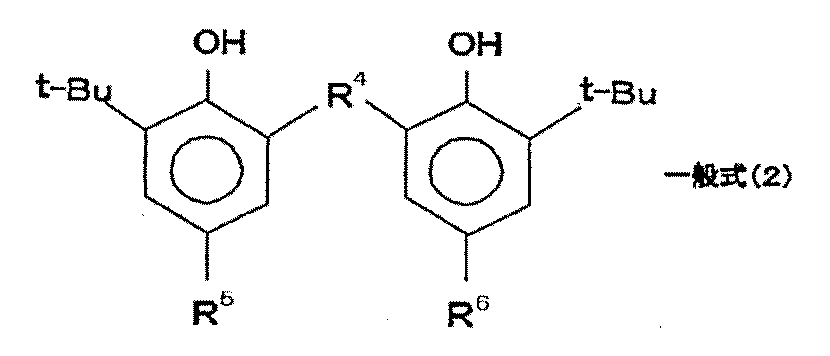 (式中、R4は、置換されてもよい飽和または不飽和のアルキレン基、置換されてもよい飽和または不飽和のアルキリデン基、置換されてもよいシクロアルキレン基を表し、R5及びR6は、同一であっても異なっていてもよく、それぞれ水素、ハロゲン原子、置換されてもよい飽和または不飽和のアルキル基、置換されてもよい飽和または不飽和のアルコキシル基を表す。)
項2:前記一般式(1)で表される染料前駆体が、4−[2−(2−ブトキシフェニル)−6−フェニル−4−ピリジニル]−N,N−ジメチルベンゼンアミン、4−[2−(2−ペンチルオキシフェニル)−6−フェニル−4−ピリジニル]−N,N−ジメチルベンゼンアミン、4−[2−(2−ヘキシルオキシフェニル)−6−フェニル−4−ピリジニル]−N,N−ジメチルベンゼンアミン、4−[2−[2−(エトキシフェニル]−6−フェニル−4−ピリジニル]−N,N−ジメチルベンゼンアミン、4−[2−(2−オクチルオキシフェニル)−6−フェニル−4−ピリジニル]−N,N−ジメチルベンゼンアミン、4−(2,6−ジフェニル−4−ピリジニル)−N,N−ジメチルベンゼンアミン、4−[2,6−ビス(2−ブトキシフェニル)−4−ピリジニル]−N,N−ジメチルベンゼンアミン、4−[2,6−ビス(2−ペンチルオキシフェニル)−4−ピリジニル]−N,N−ジメチルベンゼンアミン、4−[2,6−ビス(2−ヘキシルオキシフェニル)−4−ピリジニル]−N,N−ジメチルベンゼンアミン、及び4−[2,6−ビス(2−オクチルオキシフェニル)−4−ピリジニル]−N,N−ジメチルベンゼンアミンからなる群から選ばれる少なくとも1種である、項1に記載の感熱記録体。
項3:前記一般式(2)で表されるフェノール化合物が、2,2’−メチレンビス(4−メチル−6−tert−ブチルフェノール)及び2,2’−メチレンビス(4−エチル−6−tert−ブチルフェノール)からなる群から選ばれる少なくとも1種である、項1または2に記載の感熱記録体。
項4:前記一般式(2)で表されるフェノール化合物の平均粒子径が0.4~2.0μmである、項1~3のいずれか1項に記載の感熱記録体。
項5:前記支持体が金属光沢を有する、項1~4のいずれか1項に記載の感熱記録体。
項6:前記感熱記録体を0.97mJ/dotの印加エネルギーでサーマルヘッドにより印字して得られる動発色濃度が1.00以上である、項5に記載の感熱記録体。
項7:前記支持体が、金属光沢を有しない基材の表面に金属光沢を付与したものである、項5または6に記載の感熱記録体。
本発明の感熱記録体は、黄色の色相域において、記録濃度が高く、記録部の耐光保存性及び耐熱地肌カブリ性に優れる。また、本発明の感熱記録体は、支持体が金属光沢を有する場合、前記効果以外にも、発色像が金属光沢を帯びて、見た目に鮮やかな金色メタル調の色調を呈する効果がある。
本発明における感熱記録層は、前記一般式(1)で表される染料前駆体、顕色剤、及び前記一般式(2)で表されるフェノール化合物を含有している。これにより、黄色の発色を呈し、黄色の色相域において記録部の保存性及び耐熱地肌カブリ性に優れる。
一般式(1)で表される染料前駆体は、4−[2−(2−ブトキシフェニル)−6−フェニル−4−ピリジニル]−N,N−ジメチルベンゼンアミン、4−[2−(2−ペンチルオキシフェニル)−6−フェニル−4−ピリジニル]−N,N−ジメチルベンゼンアミン、4−[2−(2−ヘキシルオキシフェニル)−6−フェニル−4−ピリジニル]−N,N−ジメチルベンゼンアミン、4−[2−[2−(エトキシフェニル]−6−フェニル−4−ピリジニル]−N,N−ジメチルベンゼンアミン、4−[2−(2−オクチルオキシフェニル)−6−フェニル−4−ピリジニル]−N,N−ジメチルベンゼンアミン、4−(2,6−ジフェニル−4−ピリジニル)−N,N−ジメチルベンゼンアミン、4−[2,6−ビス(2−ブトキシフェニル)−4−ピリジニル]−N,N−ジメチルベンゼンアミン、4−[2,6−ビス(2−ペンチルオキシフェニル)−4−ピリジニル]−N,N−ジメチルベンゼンアミン、4−[2,6−ビス(2−ヘキシルオキシフェニル)−4−ピリジニル]−N,N−ジメチルベンゼンアミン、及び4−[2,6−ビス(2−オクチルオキシフェニル)−4−ピリジニル]−N,N−ジメチルベンゼンアミンからなる群から選ばれる少なくとも1種であることが好ましい。これにより、黄色の色相域において記録濃度を高めることができる。
本発明では、記録濃度を高めて、記録部の保存性及び耐光性を向上する観点から、前記一般式(1)中、R1またはR2のいずれか一方が炭素数4~8のアルコキシ基を表すことが好ましい。また、記録濃度を向上する観点から、R1またはR2のいずれか一方が水素原子を表すことが好ましい。記録濃度を高める観点からは、前記一般式(1)中、R1及びR2が同時に水素原子である場合を除くことが好ましい。
本発明において、感熱記録層に含有される染料前駆体の形態については特に限定されるものではなく、例えば、固体微粒子の形態での使用、多価イソシアネート化合物を溶媒とし、且つ染料前駆体を溶質として含む溶液状組成物を水中に乳化分散後、多価イソシアネート化合物の重合反応により得られる複合微粒子の形態での使用、或いは、マイクロカプセルに内包してマイクロカプセル化した形態での使用等が挙げられ、所望とする品質が得られるよう適宜選択して使用することができる。
染料前駆体を固体分散微粒子の形態で使用する場合、水を分散媒体として、例えば、サンドグラインダー、アトライター、ボールミル、コボーミル等の各種湿式粉砕機によって粉砕し、これをポリアクリルアミド、ポリビニルピロリドン、ポリビニルアルコール、スルホン変性ポリビニルアルコール等の変性ポリビニルアルコール、メチルセルロース、カルボキシメチルセルロース、スチレン−無水マレイン酸共重合体塩、及びそれらの誘導体等の水溶性高分子化合物のほか、必要に応じて界面活性剤、消泡剤等と共に分散媒体中に分散させて分散液とし、この分散液を感熱記録層用塗液の調製に用いることができる。
一般式(2)で表されるフェノール化合物の具体例として、例えば、2,2’−メチレンビス(4−メチル−6−tert−ブチルフェノール)、2,2’−メチレンビス(4−エチル−6−tert−ブチルフェノール)、2,2’−エチレンビス(4−メチル−6−tert−ブチルフェノール)、2,2’−メチレンビス(4,6−ジ−tert−ブチルフェノール)、2,2’−エチリデンビス(4,6−ジ−tert−ブチルフェノール)、2,2’−エチリデンビス(4−メチル−6−tert−ブチルフェノール)、2,2’−エチリデンビス(4−エチル−6−tert−ブチルフェノール)、2,2’−(2,2’−プロピリデン)ビス(4,6−ジ−tert−ブチルフェノール)、2,2’−メチレンビス(4−メトキシ−6−tert−ブチルフェノール)、2,2’−メチレンビス(6−tert−ブチルフェノール)等が挙げられる。これらのなかでも2,2’−メチレンビス(4−メチル−6−tert−ブチルフェノール)及び2,2’−メチレンビス(4−エチル−6−tert−ブチルフェノール)が特に好ましく用いられる。
一般式(2)で表されるフェノール化合物の含有割合は、特に限定するものではないが、染料前駆体100質量部に対して、1~500質量部程度、好ましくは10~200質量部程度である。
一般式(2)で表されるフェノール化合物の平均粒子径は、記録濃度及び耐光保存性を高める観点から、0.4~2.0μmの範囲であることが好ましく、0.4~1.5μmの範囲であることがより好ましい。ここで、平均粒子径は、レーザー回析法による体積平均粒子径である。
本発明では、保存性改良剤としては、例えば、1,1,3−トリス(2−メチル−4−ヒドロキシ−5−シクロヘキシルフェニル)ブタン、1,1,3−トリス(2−メチル−4−ヒドロキシ−5−tert−ブチルフェニル)ブタン、1,1−ビス(2−メチル−4−ヒドロキシ−5−tert−ブチルフェニル)ブタン、4,4’−〔1,4−フェニレンビス(1−メチルエチリデン)〕ビスフェノール、及び4,4’−〔1,3−フェニレンビス(1−メチルエチリデン)〕ビスフェノール等のフェノール化合物、4−ベンジルオキシフェニル−4’−(2−メチル−2,3−エポキシプロピルオキシ)フェニルスルホン、4−(2−メチル−1,2−エポキシエチル)ジフェニルスルホン、及び4−(2−エチル−1,2−エポキシエチル)ジフェニルスルホン等のエポキシ化合物、並びに1,3,5−トリス(2,6−ジメチルベンジル−3−ヒドロキシ−4−tert−ブチル)イソシアヌル酸等のイソシアヌル酸化合物から選ばれる少なくとも1種以上等を感熱記録層に含有させることもできる。勿論、保存性改良剤はこれらに限定されるものではなく、また必要に応じて2種以上の化合物を併用することもできる。
本発明における顕色剤は、温度の上昇によって液化または溶解する性質を有し、染料前駆体と接触してこれを発色させる性質を有するものから選ばれる。顕色剤の具体例としては、例えば、フェノール化合物、芳香族カルボン酸、或いはこれらの化合物の多価金属塩等の有機酸性物質等を挙げることができる。
顕色剤は通常、複合微粒子中またはマイクロカプセル中に存在していてもよく、或いは固体分散微粒子の状態で存在していてもよい。顕色剤の含有割合としては、染料前駆体100質量部に対し、30~2000質量部程度が好ましく、より好ましくは50~250質量部程度である。なお、複合微粒子は、前記の染料前駆体を含有する複合微粒子を調製する方法と同様の方法で調製することができる。
顕色剤の具体例としては、例えば、4−tert−ブチルフェノール、4−アセチルフェノール、4−tert−オクチルフェノール、4,4’−sec−ブチリデンジフェノール、4−フェニルフェノール、4,4’−ジヒドロキシジフェニルメタン、4,4’−イソプロピリデンジフェノール、4,4’−ジヒドロキシジフェニルエーテル、4,4’−シクロヘキシリデンジフェノール、1,1−ビス(4−ヒドロキシフェニル)エタン、1,1−ビス(4−ヒドロキシフェニル)−1−フェニルエタン、4,4’−ジヒドロキシジフェニルサルファイド、4,4’−チオビス(3−メチル−6−tert−ブチルフェノール)、4,4’−ジヒドロキシジフェニルスルホン、2,4’−ジヒドロキシジフェニルスルホン、4−ヒドロキシ−4’−イソプロポキシジフェニルスルホン、4−ヒドロキシ−4’−n−プロポキシジフェニルスルホン、4−ヒドロキシ−4’−アリルオキシジフェニルスルホン、ビス(3−アリル−4−ヒドロキシフェニル)スルホン、4,4’−ビス[(4−メチル−3−フェノキシカルボニルアミノフェニル)ウレイド]ジフェニルスルホン、4−[4’−(1’−メチルエチルオキシ)フェニル]スルホニルフェノール、N−(p−トルエンスルホニル)−N’−(3−p−トルエンスルホニルオキシフェニル)ウレア、N−p−トリルスルホニル−p−ブトキシカルボニルフェニルウレア、N−(p−トルエンスルホニル)−N’−フェニルウレア、4,4’−ビス(3−トシルウレイド)ジフェニルメタン等の化合物を挙げることができる。
更には、4−ヒドロキシベンゾフェノン、4−ヒドロキシフタル酸ジメチル、4−ヒドロキシ安息香酸メチル、4−ヒドロキシ安息香酸プロピル、4−ヒドロキシ安息香酸−sec−ブチル、4−ヒドロキシ安息香酸フェニル、4−ヒドロキシ安息香酸ベンジル、4−ヒドロキシ安息香酸トリル、4−ヒドロキシ安息香酸クロロフェニル、4,4’−ジヒドロキシジフェニルエーテル等のフェノール化合物、又は、安息香酸、p−tert−ブチル安息香酸、トリクロル安息香酸、テレフタル酸、サリチル酸、3−tert−ブチルサリチル酸、3−イソプロピルサリチル酸、3−ベンジルサリチル酸、3,5−(α−メチルベンジル)サリチル酸、3,5−ジ−tert−ブチルサリチル酸等の芳香族カルボン酸、及び前記フェノール化合物または芳香族カルボン酸と、例えば亜鉛、マグネシウム、アルミニウム、カルシウム等の多価金属との塩等の有機酸性物質等が挙げられる。
これらの顕色剤の中でも、4−ヒドロキシ−4’−インプロポキシジフェニルスルホン、N−p−トリルスルホニル−p−ブトキシカルボニルフェニルウレア、N−(p−トルエンスルホニル)−N’−(3−p−トルエンスルホニルオキシフェニル)ウレア、N−(p−トルエンスルホニル)−N’−フェニルウレアが本発明の効果を遺憾なく発揮できることから好ましい。
感熱記録層において、記録感度を向上させるために、更に増感剤を含有させることができる。増感剤としては、従来から感熱記録体の増感剤として知られている化合物を使用することができ、例えばパラベンジルビフェニル、ジベンジルテレフタレート、1−ヒドロキシ−2−ナフトエ酸フェニル、シュウ酸ジベンジル、アジピン酸ジ−o−クロルベンジル、1,2−ジフェノキシエタン、1,2−ジ(3−メチルフェノキシ)エタン、シュウ酸ジ−p−メチルベンジル、シュウ酸ジ−p−クロルベンジル、1,2−ビス(3,4−ジメチルフェニル)エタン、1,3−ビス(2−ナフトキシ)プロパン、メタターフェニル、ジフェニル、ベンゾフェノン等を挙げることができる。
感熱記録層において使用する顕色剤、保存性改良剤、及び増感剤等の助剤は、染料前駆体を固体分散微粒子の形態で使用する時と同じ方法で水中に分散させ、感熱記録層用塗液の調製の際にこれに混合すればよい。また、これらの助剤を溶剤に溶解し、水溶性高分子化合物を乳化剤として用いて水中に乳化して使用することもできる。また、保存性改良剤及び増感剤は、染料前駆体を含有する複合微粒子中に含有させてもよい。
感熱記録層の白色度向上及び画像の均一性向上のため、白色度が高く、平均粒子径が10μm以下の微粒子顔料を感熱記録層に含有させることができる。例えば、炭酸カルシウム、炭酸マグネシウム、カオリン、クレー、タルク、焼成クレー、シリカ、珪藻土、合成珪酸アルミニウム、酸化亜鉛、酸化チタン、水酸化アルミニウム、硫酸バリウム、表面処理された炭酸カルシウム及びシリカ等の無機顔料、並びに、尿素−ホルマリン樹脂、スチレン−メタクリル酸共重合樹脂、ポリスチレン樹脂等の有機顔料が使用できる。
感熱記録層を構成する他の成分材料としては接着剤を用い、更に必要により、架橋剤、ワックス類、金属石鹸、有色染料、有色顔料、及び蛍光染料等を用いることができる。接着剤としては、例えば、ポリビニルアルコール及びその誘導体、澱粉及びその誘導体、ヒドロキシメチルセルロース、ヒドロキシエチルセルロース、ヒドロキシプロピルセルロース、メチルセルロース、エチルセルロース等のセルロース誘導体、ポリアクリル酸ソーダ、ポリビニルピロリドン、アクリルアミド−アクリル酸エステル共重合体、アクリルアミド−アクリル酸エステル−メタアクリル酸エステル共重合体、スチレン−無水マレイン酸共重合体、イソブチレン−無水マレイン酸共重合体、カゼイン、ゼラチン及びそれらの誘導体等の水溶性高分子材料、並びに、ポリ酢酸ビニル、ポリウレタン、ポリアクリル酸、ポリアクリル酸エステル、塩化ビニル−酢酸ビニル共重合体、ポリブチルメタクリレート、エチレン−酢酸ビニル共重合体等のエマルジョン、スチレン−ブタジエン共重合体、スチレン−ブタジエン−アクリル系共重合体等の水不溶性重合体のラテックス等を挙げることができる。
また、感熱記録層の耐水性を向上させるために、接着剤を硬化させるための架橋剤を感熱記録層中に含有させることができる。例えば、グリオキザール等のアルデヒド系化合物、ポリエチレンイミン等のポリアミン系化合物、エポキシ系化合物、ポリアミド樹脂、メラミン樹脂、グリオキシル酸塩、ジメチロールウレア化合物、アジリジン化合物、ブロックイソシアネート化合物、並びに過硫酸アンモニウム、塩化第二鉄、及び塩化マグネシウム、四硼酸ソーダ、四硼酸カリウム等の無機化合物、または硼酸、硼酸トリエステル、硼素系ポリマー、ヒドラジド化合物等から選ばれる少なくとも1種の架橋剤を、感熱記録層の全固形分100質量部に対して1~10質量部程度の範囲で用いることが好ましい。
感熱記録層に添加されるワックスとしては、パラフィンワックス、カルナバワックス、マイクロクリスタリンワックス、ポリオレフィンワックス、及びポリエチレンワックス等のワックス類、並びに、例えばステアリン酸アミド、エチレンビスステアリン酸アミド等の高級脂肪酸アミド、高級脂肪酸エステル、及びその誘導体等を挙げることができる。
感熱記録層に添加される金属石鹸としては、高級脂肪酸多価金属塩、例えば、ステアリン酸亜鉛、ステアリン酸アルミニウム、ステアリン酸カルシウム、及びオレイン酸亜鉛等を挙げることができる。本発明の感熱記録体を2色感熱記録材料とする場合、低温発色色調に対して補色の関係にある色調を有する有色染料または有色顔料を感熱記録層中に含有させることは、印画(印字)前後の多色感熱記録材料の色調を調節するために好ましく用いられる。また、必要に応じて、本発明の効果を損なわない範囲で、感熱記録層中に、更に撥油剤、消泡剤、粘度調節剤等の各種助剤を添加することができる。
更に感熱記録層において、紫外線吸収剤を内包したマイクロカプセルまたは紫外線吸収剤の固体分散微粒子を添加し、耐光性を大幅に向上させることもできる。
紫外線吸収剤の具体例としては、例えば、フェニルサリシレート、p−tert−ブチルフェニルサリシレート、p−オクチルフェニルサリシレート等のサリチル酸系紫外線吸収剤、2,4−ジヒドロキシベンゾフェノン、2−ヒドロキシ−4−オクチルオキシベンゾフェノン、2−ヒドロキシ−4−メトキシベンゾフェノン、2−ヒドロキシ−4−ドデシルオキシベンゾフェノン、2,2’−ジヒドロキシ−4−メトキシベンゾフェノン、2,2’−ジヒドロキシ−4,4’−ジメトキシベンゾフェノン、2−ヒドロキシ−4−メトキシ−5スルホベンゾフェノン等のベンゾフェノン系紫外線吸収剤を挙げることができる。
更には、2−(2’−ヒドロキシ−5’−メチルフェニル)ベンゾトリアゾール、2−(2’−ヒドロキシ−5’−tert−ブチルフェニル)ベンゾトリアゾール、2−(2’−ヒドロキシ−3’,5’−ジ−tert−ブチルフェニル)ベンゾトリアゾール、2−(2’−ヒドロキシ−3’−tert−ブチル−5’−メチルフェニル)−5−クロロベンゾトリアゾール、2−(2’−ヒドロキシ−3’,5’−ジ−tert−ブチルフェニル)−5−クロロベンゾトリアゾール、2−(2’−ヒドロキシ−3’,5’−ジ−tert−アミルフェニル)ベンゾトリアゾール、2−〔2’−ヒドロキシ−3’−(3”,4”,5”,6”−テトラヒドロフタルイミド−メチル)−5’−メチルフェニル〕ベンゾトリアゾール、2−(2’−ヒドロキシ−5’−tert−オクチルフェニル)ベンゾトリアゾール、2−〔2’−ヒドロキシ−3’,5’−ビス(α,α−ジメチルベンジル)フェニル〕−2H−ベンゾトリアゾール、2−(2’−ヒドロキシ−3’−ドデシル−5’−メチルフェニル)ベンゾトリアゾール、2−〔2’−ヒドロキシ−4’−(2”−エチルヘキシル)オキシフェニル〕ベンゾトリアゾール、ポリエチレングリコール(分子量約300)とメチル−3−〔3−tert−ブチル−5−(2H−ベンゾトリアゾール−2−イル)−4−ヒドロキシフェニル〕プロピオネートとの縮合物等のベンゾトリアゾール系の紫外線吸収剤、2’−エチルヘキシル−2−シアノ−3,3−ジフェニルアクリレート、エチル−2−シアノ−3,3−ジフェニルアクリレート等のシアノアクリレート系の紫外線吸収剤等を挙げることができる。勿論、これらに限られるものではなく、また必要に応じて2種以上を併用することもできる。
本発明における感熱記録層は、例えば水を分散媒体とし、特定の染料前駆体、顕色剤、特定のフェノール化合物、必要により保存性改良剤、増感剤等を共に、或いは別々に分散した分散液を用いて、必要により顔料、接着剤、架橋剤、その他助剤等を混合撹拌することにより調製された感熱記録層用塗液を、塗布量が乾燥重量で好ましくは2~12g/m2程度、より好ましくは2~8g/m2程度となるように、支持体上に塗布及び乾燥して形成される。
本発明における支持体の種類、形状、寸法等は、格別の限定はなく、例えば上質紙(酸性紙、中性紙)、中質紙、コート紙、アート紙、キャストコート紙、グラシン紙、樹脂ラミネート紙、ポリオレフィン系合成紙、合成繊維紙、不織布、合成樹脂フィルム等の他、各種透明支持体等も適宜選択して使用することができる。
本発明における支持体は、少なくとも一方の面に金属光沢を有してもよい。感熱記録体の支持体が金属光沢を有することにより、黄色の発色色相域において、記録濃度が高く、記録部の耐光保存性及び耐熱地肌カブリ性に優れるのみならず、発色像が金属光沢を帯び、見た目に鮮やかな金色メタル調の色調を呈した感熱記録体を提供することができる。
金属光沢を有する支持体として、例えば、金属板、金属箔、金属膜等のそれ自体が金属光沢を有する支持体、上質紙(酸性紙、中性紙)、中質紙、コート紙、アート紙、キャストコート紙、グラシン紙、板紙、段ボール、樹脂ラミネート紙、ポリオレフィン系合成紙、合成繊維紙、不織布、合成樹脂フィルム等の金属光沢を有しない基材に金属光沢を付与した支持体が挙げられる。基材は透明であっても、半透明であっても、不透明であってもよい。これらの中でも、見た目に鏡面光沢が得られるため、フィルムまたは合成紙に金属光沢を付与した支持体が好ましい。
基材の表面に金属光沢を付与する方法としては、メッキする方法、アルミ箔など金属箔を貼合する方法、及び金属蒸着層を有する紙またはフィルムを貼合する方法がある。さらに、基材に直接、アルミニウムまたは銀などの金属蒸着膜を設ける方法も存在する。この場合には、基材表面に平滑な樹脂層を予め設け、そこへ金属蒸気を付着させて金属層を形成させる直接蒸着法、及び、予めフィルムに設けられた金属蒸着層を、接着剤を介して基材と貼合してフィルムを剥離して転写する方法がある。また、基材に印刷または塗布することにより、金属光沢層を設ける方法もある。この場合、金属の粉末、例えばアルミニウム粉末、またはアルミニウム粉末を溶剤に分散させたアルミニウムペーストをビヒクルと混合して得たメタルインクを使用して、金属光沢のある面を得ることが可能である。金属粉末ではなく、雲母、または雲母に酸化チタンをコーティングして得た顔料等の無機パール顔料を使用したインクを使用することも可能である。
金属光沢を有する支持体を備える感熱記録層は、当該感熱記録層が支持体上に形成されており、記録面側から見て支持体の有する金属光沢の一部または全部を覆っている。感熱記録層は、支持体の金属光沢を有する面側に形成されていてもよく、また、例えば透明な基材のように基材を通して目視で確認可能な金属光沢を有する支持体であれば、支持体の金属光沢を有する面の反対側に形成されていてもよい。支持体と感熱記録層との間には、下塗り層を設けることもできるが、下塗り層は支持体の有する金属光沢を隠蔽しないことが好ましい。
金属光沢を有する支持体を備える感熱記録体では、感熱記録層中の染料前駆体が黄色系の色調に発色するが、記録面側から見て発色像が金属光沢を帯びるため、見た目に鮮やかな金色メタル調の色調を呈することができる。本発明では、感熱記録層中に微粒子状態で存在する染料前駆体及び加熱下に反応して前記染料前駆体を発色させる顕色剤が、サーマルヘッド等の印加エネルギーで一旦溶融して再び固化することにより、感熱記録層における乱反射を低減させて、感熱記録層を通して金色メタル調が得られるものと考えられる。本発明では、感熱記録層が支持体の有する金属光沢を遮るように覆っているが、発色像が金色メタル調を呈するため、感熱記録層が支持体の有する金属光沢を隠蔽している程度は、特に限定されず、記録面側から見てマット調の普通紙ライクであってもよいし、感熱記録層を通して金属光沢が目視で確認可能な程度であってもよい。
本発明では、感熱記録体を0.97mJ/dotの印加エネルギーでプリンター等のサーマルヘッドにより印字して得られる動発色濃度が1.00以上であることが好ましい。これにより、プリンターへの負荷を減らし、コントラストを有し、発色濃度を高めて十分な金色メタル調を得ることができる。動発色濃度を1.00とすることにより目視で十分であると評価できるレベルに達するが、より好ましくは1.50以上である。動発色濃度の上限は、特に限定されないが、2.0を超えると発色性は飽和することから、2.0以下程度とすることが好ましい。ここで、動発色濃度とは、記録部のY(イエロー)濃度のことである。
本発明では、一般式(2)で表されるフェノール化合物を一般式(1)で表される染料前駆体とともに用いることにより、高温の雰囲気下では黄色発色を抑えて耐熱地肌カブリ性に優れる一方、一方でプリンターのサーマルヘッドによる加熱下では増感効果を発揮し、発色像の可逆反応を抑えて、金色メタル調を呈する記録部の耐光保存性に優れる。このため、一般式(1)で表される染料前駆体の含有量は、通常よりも少なくて済み、好ましくは1.3g/m2以下、より好ましくは1.1g/m2以下に抑えることができる。
本発明では、必要に応じて、支持体と感熱記録層との間に、下塗り層を設けることもできる。これにより、記録感度をより高めることができる。下塗り層は、吸油量が70ml/100g以上、特に80~150ml/100g程度の吸油性顔料、有機中空粒子及び熱膨張性粒子の少なくとも1種、並びにバインダーを含有する下塗り層用塗液を支持体上に塗布及び乾燥して形成される。ここで、吸油量はJIS K 5101に記載の方法に従い、求められる値である。下塗り層に、シリカ、焼成カオリン等の空隙率の高い顔料を使用することにより、感熱記録層の記録感度を上げることができる。また下塗り層中にプラスチックピグメント、中空粒子、発泡体等を含有させることもその上に形成される感熱記録層の記録感度向上に効果がある。下塗り層用塗液の塗布量は、乾燥重量で3~20g/m2程度が好ましく、4~12g/m2程度がより好ましい。
下塗り層中のバインダーとしては、感熱記録層に使用できるものの中から適宜選択することができる。これらのバインダーの中でも、バリア性を向上する観点から、澱粉−酢酸ビニルグラフト共重合体、ポリビニルアルコール、スチレン−ブタジエン系ラテックス等が好ましい。
本発明では、感熱記録層の上に、従来より感熱記録体に使用されているような公知の水溶性高分子材料及び顔料を含有する保護層を設けることができる。水溶性高分子材料及び顔料としては、前述の感熱記録層で例示したような材料を使用することができる。この時、架橋剤を添加して、保護層に耐水性を付与することがより望ましい。
本発明においては、紫外線吸収剤を内包したマイクロカプセルまたは紫外線吸収剤の固体分散微粒子を保護層に含有することで、耐光性を大幅に向上させることもできる。特に、ポリウレタン−ポリウレア樹脂、或いはアミノアルデヒド樹脂からなる壁膜を有するマイクロカプセルは、耐熱性に優れるため、サーマルヘッドへのスティッキングを防止する目的で、感熱記録層中或いは保護層中に添加される無機顔料の機能をも果たすという優れた付随効果を発揮し、しかも、他の壁膜からなるマイクロカプセル及び通常の顔料と比較して屈折率が低く、且つ形状が球形であるため、保護層中に多量に添加しても光の乱反射に起因する濃度低下を招く恐れがないので好ましく用いられる。
保護層中に顔料を含有させることにより、サーマルヘッドに対するカス付着、及びスティッキングを防止することができる。顔料の吸油量としては、50ml/100g以上の顔料を使用することが好ましい。顔料の含有割合は、記録濃度を低下させない程度の量、即ち、保護層の全固形量のうち50質量%以下であることが好ましい。
保護層は、例えば水を分散媒体として、接着剤、顔料、必要により架橋剤、その他助剤等を混合撹拌することにより調製された保護層用塗液を、塗布量が乾燥重量で好ましくは0.1~15g/m2程度、より好ましくは0.5~8g/m2程度となるように、感熱記録層上に塗布及び乾燥して形成される。
本発明では、電子線または紫外線で硬化された樹脂層を、感熱記録層上または保護層上に設けることもできる。電子線で硬化され得る樹脂の例としては、日本国特開昭58−177392号公報、日本国特開昭58−177392号公報等に記載がある。このような樹脂中に、非電子線硬化樹脂、顔料、消泡剤、レベリング剤、滑剤、界面活性剤、及び可塑剤等の助剤を適宜添加することもできる。特に、炭酸カルシウム、水酸化アルミニウム等の顔料、及びワックス類、シリコン等の滑剤を添加することは、サーマルヘッドに対するスティッキング防止に役立つため好ましい。
本発明においては、感熱記録体の付加価値を高めるために、これに更に加工を施し、より高い機能を付与した感熱記録体とすることができる。例えば、裏面に粘着剤、再湿接着剤、ディレードタック型の粘着剤等による塗布加工を施すことにより、粘着紙、再湿接着紙、ディレードタック紙とすることができる。また、裏面を利用して、これに熱転写用紙、インクジェット用紙、ノーカーボン用紙、静電記録用紙、ゼオグラフィー用紙としての機能を付与し、両面記録が可能な記録紙とすることもできる。勿論、両面感熱記録体とすることもできる。
感熱記録層は、染料前駆体及び顕色剤を含む感熱記録層用塗液を用いて、また、保護層は、水溶性高分子材料を含む保護層用塗液を用いて、1層ずつ塗布及び乾燥して形成してもよく、2つ以上の層を同時に塗布する同時多層塗布を行ってもよい。ここで同時多層塗布とは、2層以上の層を塗布するに際し、上下層を同時に塗布する方法であり、下層を塗布した後に乾燥することなく上層を塗布する方法を含む。
支持体上に前記各層を形成する方法としては、エアナイフ法、ブレード法、グラビア法、ロールコーター法、スプレー法、ディップ法、バー法、カーテン法、スロットダイ法、スライドダイ法、及びエクストルージョン法等の既知の塗布方法のいずれを利用してもよい。また、感熱記録体裏面からの油及び可塑剤の浸透抑制、またはカールコントロール及び帯電防止のため、バック層を設けることもできる。
感熱記録面を、スーパーカレンダーまたはソフトカレンダー等の既知の平滑化方法を用いて平滑化処理することは、その記録感度を高めることに効果がある。感熱記録面を、カレンダーの金属ロール及び弾性ロールのいずれに当てて処理してもよい。
本発明を実施例により更に詳しく説明するが、本発明はこれらにより限定されるものではない。なお、特に断わらない限り、「部」及び「%」は、それぞれ「質量部」及び「質量%」を示す。また、染料前駆体、顕色剤、フェノール化合物、保存性改良剤、及び保護層に配合する顔料の粒子径は、レーザー回折式粒度分布測定装置SALD−2200((株)島津製作所製)を用いて、体積平均粒子径を測定した。
実施例1
・A液(染料前駆体分散液)の調製
4−[2−(2−オクチルオキシフェニル)−6−フェニル−4−ピリジニル]−N,N−ジメチルベンゼンアミン40部、ポリビニルアルコール(重合度500、鹸化度88%)の10%水溶液40部、及び水20部からなる組成物を、縦型サンドミル(アイメックス(株)製、サンドグラインダー)を用いて、平均粒子径が0.7μmとなるように粉砕、分散して染料前駆体分散液を得た。
・A液(染料前駆体分散液)の調製
4−[2−(2−オクチルオキシフェニル)−6−フェニル−4−ピリジニル]−N,N−ジメチルベンゼンアミン40部、ポリビニルアルコール(重合度500、鹸化度88%)の10%水溶液40部、及び水20部からなる組成物を、縦型サンドミル(アイメックス(株)製、サンドグラインダー)を用いて、平均粒子径が0.7μmとなるように粉砕、分散して染料前駆体分散液を得た。
・B液(顕色剤分散液)の調製
4−ヒドロキシ−4’−イソプロポキシジフェニルスルホン40部、ポリビニルアルコール(重合度500、鹸化度88%)の10%水溶液40部、及び水20部からなる組成物を、ウルトラビスコミルを用いて、平均粒子径が1.5μmとなるよう粉砕、分散して顕色剤分散液を得た。
4−ヒドロキシ−4’−イソプロポキシジフェニルスルホン40部、ポリビニルアルコール(重合度500、鹸化度88%)の10%水溶液40部、及び水20部からなる組成物を、ウルトラビスコミルを用いて、平均粒子径が1.5μmとなるよう粉砕、分散して顕色剤分散液を得た。
・C液(フェノール化合物分散液)の調製
2,2’−メチレンビス(4−エチル−6−tert−ブチルフェノール)40部、ポリビニルアルコール(重合度500、鹸化度88%)の10%水溶液40部、及び水20部からなる組成物を、縦型サンドミル(アイメックス(株)製、サンドグラインダー)を用いて、平均粒子径が2.0μmとなるように粉砕、分散してフェノール化合物分散液を得た。
2,2’−メチレンビス(4−エチル−6−tert−ブチルフェノール)40部、ポリビニルアルコール(重合度500、鹸化度88%)の10%水溶液40部、及び水20部からなる組成物を、縦型サンドミル(アイメックス(株)製、サンドグラインダー)を用いて、平均粒子径が2.0μmとなるように粉砕、分散してフェノール化合物分散液を得た。
・感熱記録層用塗液の調製
A液10部、スチレン−ブタジエン系ラテックス(商品名:L1571、旭化成(株)製、固形分濃度48%)5部、ポリビニルアルコール(商品名:ポバール(登録商標)PVA−110、(株)クラレ製)の10%水溶液25部、B液23部、C液11部、5%界面活性剤水溶液(商品名:SNウェットOT−70、サンノプコ(株)製)2部、及び水17部からなる組成物を混合撹拌して感熱記録層用塗液を得た。
A液10部、スチレン−ブタジエン系ラテックス(商品名:L1571、旭化成(株)製、固形分濃度48%)5部、ポリビニルアルコール(商品名:ポバール(登録商標)PVA−110、(株)クラレ製)の10%水溶液25部、B液23部、C液11部、5%界面活性剤水溶液(商品名:SNウェットOT−70、サンノプコ(株)製)2部、及び水17部からなる組成物を混合撹拌して感熱記録層用塗液を得た。
・D液(カオリン分散液)の調製
カオリン(商品名:UW−90(登録商標)、BASF社製)80部、ポリアクリル酸ナトリウムの40%水溶液(商品名:アロンT−50、東亞合成(株)製)1部、及び水53部からなる組成物を、サンドミルを用いて体積平均粒子径が1.6μmとなるまで粉砕、分散してカオリン分散液を得た。
カオリン(商品名:UW−90(登録商標)、BASF社製)80部、ポリアクリル酸ナトリウムの40%水溶液(商品名:アロンT−50、東亞合成(株)製)1部、及び水53部からなる組成物を、サンドミルを用いて体積平均粒子径が1.6μmとなるまで粉砕、分散してカオリン分散液を得た。
・保護層用塗液の調製
D液25部、アセトアセチル変性ポリビニルアルコール(商品名:ゴーセネックス(登録商標)Z−200、日本合成化学工業(株)製、重合度:約1000、鹸化度:約98モル%)の15%水溶液50部、パラフィンワックス(商品名:ハイドリンP−7、中京油脂(株)製、固形分濃度30%)7.5部、5%界面活性剤水溶液(商品名:SNウェットOT−70、サンノプコ(株)製)5部、グリオキザール(日本合成化学工業(株)製、固形分濃度40%)0.3部、及び水12.5部からなる組成物を混合、攪拌して保護層用塗液を得た。
D液25部、アセトアセチル変性ポリビニルアルコール(商品名:ゴーセネックス(登録商標)Z−200、日本合成化学工業(株)製、重合度:約1000、鹸化度:約98モル%)の15%水溶液50部、パラフィンワックス(商品名:ハイドリンP−7、中京油脂(株)製、固形分濃度30%)7.5部、5%界面活性剤水溶液(商品名:SNウェットOT−70、サンノプコ(株)製)5部、グリオキザール(日本合成化学工業(株)製、固形分濃度40%)0.3部、及び水12.5部からなる組成物を混合、攪拌して保護層用塗液を得た。
・感熱記録体の作製
合成紙(商品名:FPG−80、(株)ユポ・コーポレーション製、厚さ80μm)の片面上に、感熱記録層用塗液、保護層用塗液を、それぞれ乾燥後の塗布量が乾燥後の塗布量が6g/m2、3g/m2となるようにメイヤーバーにより塗布し、乾燥させた後、スーパーカレンダー処理を行い、感熱記録体を得た。
合成紙(商品名:FPG−80、(株)ユポ・コーポレーション製、厚さ80μm)の片面上に、感熱記録層用塗液、保護層用塗液を、それぞれ乾燥後の塗布量が乾燥後の塗布量が6g/m2、3g/m2となるようにメイヤーバーにより塗布し、乾燥させた後、スーパーカレンダー処理を行い、感熱記録体を得た。
実施例2
実施例1のC液の調製において、2,2’−メチレンビス(4−エチル−6−tert−ブチルフェノール)に代えて、2,2’−メチレンビス(4−メチル−6−tert−ブチルフェノール)を用いた以外は、実施例1と同様にして感熱記録体を得た。
実施例1のC液の調製において、2,2’−メチレンビス(4−エチル−6−tert−ブチルフェノール)に代えて、2,2’−メチレンビス(4−メチル−6−tert−ブチルフェノール)を用いた以外は、実施例1と同様にして感熱記録体を得た。
実施例3
実施例1のC液の調製において、2,2’−メチレンビス(4−エチル−6−tert−ブチルフェノール)の平均粒子径を2.0μmに代えて、1.5μmとなるように粉砕、分散した以外は、実施例1と同様にして感熱記録体を得た。
実施例1のC液の調製において、2,2’−メチレンビス(4−エチル−6−tert−ブチルフェノール)の平均粒子径を2.0μmに代えて、1.5μmとなるように粉砕、分散した以外は、実施例1と同様にして感熱記録体を得た。
実施例4
実施例1のC液の調製において、2,2’−メチレンビス(4−エチル−6−tert−ブチルフェノール)の平均粒子径が2.0μmに代えて、0.5μmとなるように粉砕、分散した以外は、実施例1と同様にして感熱記録体を得た。
実施例1のC液の調製において、2,2’−メチレンビス(4−エチル−6−tert−ブチルフェノール)の平均粒子径が2.0μmに代えて、0.5μmとなるように粉砕、分散した以外は、実施例1と同様にして感熱記録体を得た。
実施例5
実施例1のA液の調製において、4−[2−(2−オクチルオキシフェニル)−6−フェニル−4−ピリジニル]−N,N−ジメチルベンゼンアミンに代えて、4−[2−(2−ブトキシフェニル)−6−フェニル−4−ピリジニル]−N,N−ジメチルベンゼンアミンを用いた以外は、実施例1と同様にして感熱記録体を得た。
実施例1のA液の調製において、4−[2−(2−オクチルオキシフェニル)−6−フェニル−4−ピリジニル]−N,N−ジメチルベンゼンアミンに代えて、4−[2−(2−ブトキシフェニル)−6−フェニル−4−ピリジニル]−N,N−ジメチルベンゼンアミンを用いた以外は、実施例1と同様にして感熱記録体を得た。
比較例1
実施例1のC液の調製において、2,2’−メチレンビス(4−エチル−6−tert−ブチルフェノール)に代えて、4,4’−チオビス(6−tert−ブチル−o−クレゾール)を用いた以外は、実施例1と同様にして感熱記録体を得た。
実施例1のC液の調製において、2,2’−メチレンビス(4−エチル−6−tert−ブチルフェノール)に代えて、4,4’−チオビス(6−tert−ブチル−o−クレゾール)を用いた以外は、実施例1と同様にして感熱記録体を得た。
比較例2
実施例1のC液の調製において、2,2’−メチレンビス(4−エチル−6−tert−ブチルフェノール)に代えて、4,4’−チオビス(6−tert−ブチル−m−クレゾール)を用いた以外は、実施例1と同様にして感熱記録体を得た。
実施例1のC液の調製において、2,2’−メチレンビス(4−エチル−6−tert−ブチルフェノール)に代えて、4,4’−チオビス(6−tert−ブチル−m−クレゾール)を用いた以外は、実施例1と同様にして感熱記録体を得た。
比較例3
実施例1のC液の調製において、2,2’−メチレンビス(4−エチル−6−tert−ブチルフェノール)に代えて、1,1,3−トリス(2−メチル−4−ヒドロキシ−5−シクロヘキシルフェニル)ブタンを用いた以外は、実施例1と同様にして感熱記録体を得た。
実施例1のC液の調製において、2,2’−メチレンビス(4−エチル−6−tert−ブチルフェノール)に代えて、1,1,3−トリス(2−メチル−4−ヒドロキシ−5−シクロヘキシルフェニル)ブタンを用いた以外は、実施例1と同様にして感熱記録体を得た。
比較例4
実施例1の感熱記録層用塗液の調製において、C液11部を用いなかった以外は、実施例1と同様にして感熱記録体を得た。
実施例1の感熱記録層用塗液の調製において、C液11部を用いなかった以外は、実施例1と同様にして感熱記録体を得た。
実施例6
実施例1の感熱記録体の作製において、合成紙に代えて、アルミ蒸着紙(商品名:アルミックT、トッパンレーベル社製、厚さ50μm)を用い、アルミ蒸着層が設けられた面上に感熱記録層用塗液及び保護層用塗液を塗布したこと以外は、実施例1と同様にして感熱記録体を得た。
実施例1の感熱記録体の作製において、合成紙に代えて、アルミ蒸着紙(商品名:アルミックT、トッパンレーベル社製、厚さ50μm)を用い、アルミ蒸着層が設けられた面上に感熱記録層用塗液及び保護層用塗液を塗布したこと以外は、実施例1と同様にして感熱記録体を得た。
実施例7
実施例6のC液の調製において、2,2’−メチレンビス(4−エチル−6−tert−ブチルフェノール)に代えて、2,2’−メチレンビス(4−メチル−6−tert−ブチルフェノール)を用いた以外は、実施例6と同様にして感熱記録体を得た。
実施例6のC液の調製において、2,2’−メチレンビス(4−エチル−6−tert−ブチルフェノール)に代えて、2,2’−メチレンビス(4−メチル−6−tert−ブチルフェノール)を用いた以外は、実施例6と同様にして感熱記録体を得た。
実施例8
実施例6のC液の調製において、2,2’−メチレンビス(4−エチル−6−tert−ブチルフェノール)の平均粒子径を2.0μmに代えて、1.5μmとなるように粉砕、分散した以外は、実施例6と同様にして感熱記録体を得た。
実施例6のC液の調製において、2,2’−メチレンビス(4−エチル−6−tert−ブチルフェノール)の平均粒子径を2.0μmに代えて、1.5μmとなるように粉砕、分散した以外は、実施例6と同様にして感熱記録体を得た。
実施例9
実施例6のC液の調製において、2,2’−メチレンビス(4−エチル−6−tert−ブチルフェノール)の平均粒子径が2.0μmに代えて、0.5μmとなるように粉砕、分散した以外は、実施例6と同様にして感熱記録体を得た。
実施例6のC液の調製において、2,2’−メチレンビス(4−エチル−6−tert−ブチルフェノール)の平均粒子径が2.0μmに代えて、0.5μmとなるように粉砕、分散した以外は、実施例6と同様にして感熱記録体を得た。
実施例10
実施例6のA液の調製において、4−[2−(2−オクチルオキシフェニル)−6−フェニル−4−ピリジニル]−N,N−ジメチルベンゼンアミンに代えて、4−[2−(2−ブトキシフェニル)−6−フェニル−4−ピリジニル]−N,N−ジメチルベンゼンアミンを用いた以外は、実施例6と同様にして感熱記録体を得た。
実施例6のA液の調製において、4−[2−(2−オクチルオキシフェニル)−6−フェニル−4−ピリジニル]−N,N−ジメチルベンゼンアミンに代えて、4−[2−(2−ブトキシフェニル)−6−フェニル−4−ピリジニル]−N,N−ジメチルベンゼンアミンを用いた以外は、実施例6と同様にして感熱記録体を得た。
比較例5
実施例6のC液の調製において、2,2’−メチレンビス(4−エチル−6−tert−ブチルフェノール)に代えて、4,4’−チオビス(6−tert−ブチル−o−クレゾール)を用いた以外は、実施例6と同様にして感熱記録体を得た。
実施例6のC液の調製において、2,2’−メチレンビス(4−エチル−6−tert−ブチルフェノール)に代えて、4,4’−チオビス(6−tert−ブチル−o−クレゾール)を用いた以外は、実施例6と同様にして感熱記録体を得た。
比較例6
実施例6のC液の調製において、2,2’−メチレンビス(4−エチル−6−tert−ブチルフェノール)に代えて、4,4’−チオビス(6−tert−ブチル−m−クレゾール)を用いた以外は、実施例6と同様にして感熱記録体を得た。
実施例6のC液の調製において、2,2’−メチレンビス(4−エチル−6−tert−ブチルフェノール)に代えて、4,4’−チオビス(6−tert−ブチル−m−クレゾール)を用いた以外は、実施例6と同様にして感熱記録体を得た。
比較例7
実施例6のC液の調製において、2,2’−メチレンビス(4−エチル−6−tert−ブチルフェノール)に代えて、1,1,3−トリス(2−メチル−4−ヒドロキシ−5−シクロヘキシルフェニル)ブタンを用いた以外は、実施例6と同様にして感熱記録体を得た。
実施例6のC液の調製において、2,2’−メチレンビス(4−エチル−6−tert−ブチルフェノール)に代えて、1,1,3−トリス(2−メチル−4−ヒドロキシ−5−シクロヘキシルフェニル)ブタンを用いた以外は、実施例6と同様にして感熱記録体を得た。
比較例8
実施例6の感熱記録層用塗液の調製において、C液11部を用いなかった以外は、実施例6と同様にして感熱記録体を得た。
実施例6の感熱記録層用塗液の調製において、C液11部を用いなかった以外は、実施例6と同様にして感熱記録体を得た。
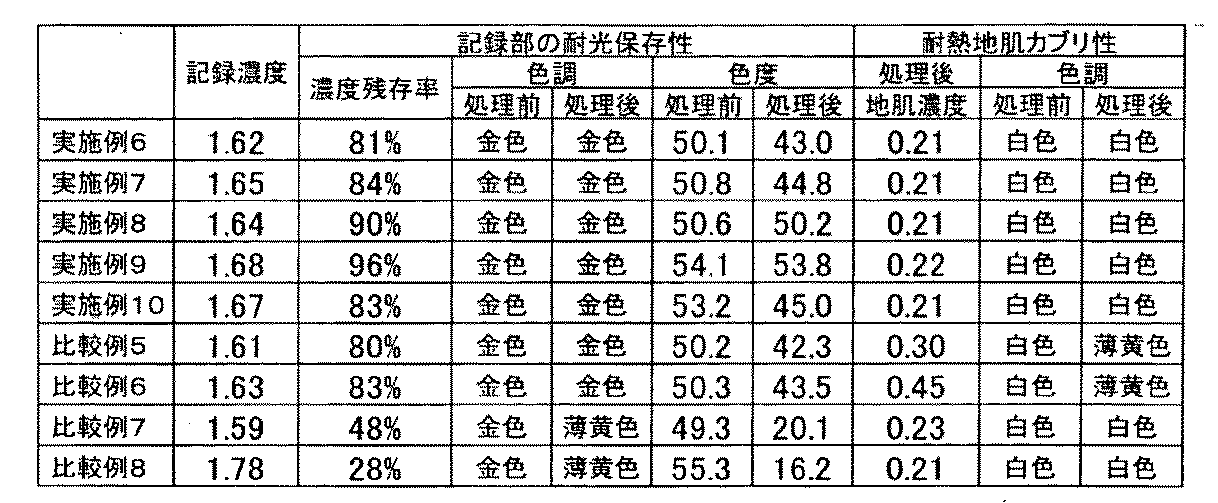
かくして得られた感熱記録体について、以下の評価を行った。その結果は、表1及び2に示す通りであった。
(記録濃度)
感熱記録用シミュレーター(商品名:TH−PMD、大倉電機社製)を用い、印加エネルギー0.968mJ/dotの条件にて記録し、x−rite分光濃度計(商品名:x−rite528、色彩測定使用)を用いて記録部のY(イエロー)濃度を測定した。
感熱記録用シミュレーター(商品名:TH−PMD、大倉電機社製)を用い、印加エネルギー0.968mJ/dotの条件にて記録し、x−rite分光濃度計(商品名:x−rite528、色彩測定使用)を用いて記録部のY(イエロー)濃度を測定した。
(記録部の耐光保存性)
感熱記録用シミュレーター(商品名:TH−PMD、大倉電機社製)を用い、印加エネルギー0.968mJ/dotの条件にて記録し、記録部を有する感熱記録体を、蛍光灯下5000Luxで100時間処理した後、x−rite分光濃度計(商品名:x−rite528、色彩測定使用)を用いて記録部のY(イエロー)濃度を測定した。下記式で表される処理後の記録部の濃度残存率を求めた。濃度残存率は、処理前の初期濃度に対し、50%以上が好ましい。
濃度残存率(%)=(処理後の記録濃度)/(処理前の記録濃度)×100
感熱記録用シミュレーター(商品名:TH−PMD、大倉電機社製)を用い、印加エネルギー0.968mJ/dotの条件にて記録し、記録部を有する感熱記録体を、蛍光灯下5000Luxで100時間処理した後、x−rite分光濃度計(商品名:x−rite528、色彩測定使用)を用いて記録部のY(イエロー)濃度を測定した。下記式で表される処理後の記録部の濃度残存率を求めた。濃度残存率は、処理前の初期濃度に対し、50%以上が好ましい。
濃度残存率(%)=(処理後の記録濃度)/(処理前の記録濃度)×100
(耐熱地肌カブリ性)
感熱記録体の未記録部(地肌部)を60℃で24時間処理した後、x−rite分光濃度計(商品名:x−rite528、色彩測定使用)を用いて未記録部のY(イエロー)濃度を測定した。処理後の地肌部の濃度は、0.10以下が好ましいが、支持体が金属光沢を有する場合、0.25以下が好ましい。
感熱記録体の未記録部(地肌部)を60℃で24時間処理した後、x−rite分光濃度計(商品名:x−rite528、色彩測定使用)を用いて未記録部のY(イエロー)濃度を測定した。処理後の地肌部の濃度は、0.10以下が好ましいが、支持体が金属光沢を有する場合、0.25以下が好ましい。
(色度)
感熱記録用シミュレーター(商品名:TH−PMD、大倉電機社製)を用い、印加エネルギー0.968mJ/dotの条件にて記録し、x−rite分光濃度計(商品名:x−rite528、エックスライト社製、色彩測定使用)を用いて、支持体が金属光沢を有する実施例6~10及び比較例5~8について記録部の色度b*値を測定した。この初期の色度に対して、上記の耐光保存性の処理後の記録部の色度を同様にして測定した。十分な金色を得るには、+40.0以上が好ましい。
感熱記録用シミュレーター(商品名:TH−PMD、大倉電機社製)を用い、印加エネルギー0.968mJ/dotの条件にて記録し、x−rite分光濃度計(商品名:x−rite528、エックスライト社製、色彩測定使用)を用いて、支持体が金属光沢を有する実施例6~10及び比較例5~8について記録部の色度b*値を測定した。この初期の色度に対して、上記の耐光保存性の処理後の記録部の色度を同様にして測定した。十分な金色を得るには、+40.0以上が好ましい。

本発明の黄色の色相域において記録濃度及び記録部の耐光保存性が高く、耐熱地肌カブリ性の良好な感熱記録体は、鮮明な黄色色相を活かした金券、チケット、切符、籤、ラベル、クーポン券等の用途に実用化が期待できるものである。
また、本発明の感熱記録体は、支持体が金属光沢を有する場合、見た目の色調が感熱記録層に含有される染料前駆体の発色色調とは異なる発色像が得られ、鮮明な金色メタル調を呈することができるため、鮮明な金色メタル調の色調を活かした可変情報を記録可能となり、例えば金券、クーポン券などの各種チケット、レシート、ラベル、籤、見本帳、値札、荷札、ダイレクトメール、メッセージカード、広告、看板などのディスプレイ、梱包・包装材料等のほか、金箔の代用等の用途に好適に用いられる。
Claims (7)
- 支持体の一方の面に染料前駆体及び顕色剤を含有する感熱記録層を備えた感熱記録体において、前記感熱記録層が、下記一般式(1)で表される染料前駆体と、下記一般式(2)で表されるフェノール化合物とを含有することを特徴とする感熱記録体。
(式中、R1及びR2は、同一であっても異なっていてもよく、それぞれ水素原子または炭素数1~8の分岐してもよいアルコキシ基を表し、R3は、炭素数1~4の分岐してもよいアルキル基を表す。)
(式中、R4は、置換されてもよい飽和または不飽和のアルキレン基、置換されてもよい飽和または不飽和のアルキリデン基、置換されてもよいシクロアルキレン基を表し、R5及びR6は、同一であっても異なっていてもよく、それぞれ水素、ハロゲン原子、置換されてもよい飽和または不飽和のアルキル基、置換されてもよい飽和または不飽和のアルコキシル基を表す。)
- 前記一般式(1)で表される染料前駆体が、4−[2−(2−ブトキシフェニル)−6−フェニル−4−ピリジニル]−N,N−ジメチルベンゼンアミン、4−[2−(2−ペンチルオキシフェニル)−6−フェニル−4−ピリジニル]−N,N−ジメチルベンゼンアミン、4−[2−(2−ヘキシルオキシフェニル)−6−フェニル−4−ピリジニル]−N,N−ジメチルベンゼンアミン、4−[2−[2−(エトキシフェニル]−6−フェニル−4−ピリジニル]−N,N−ジメチルベンゼンアミン、4−[2−(2−オクチルオキシフェニル)−6−フェニル−4−ピリジニル]−N,N−ジメチルベンゼンアミン、4−(2,6−ジフェニル−4−ピリジニル)−N,N−ジメチルベンゼンアミン、4−[2,6−ビス(2−ブトキシフェニル)−4−ピリジニル]−N,N−ジメチルベンゼンアミン、4−[2,6−ビス(2−ペンチルオキシフェニル)−4−ピリジニル]−N,N−ジメチルベンゼンアミン、4−[2,6−ビス(2−ヘキシルオキシフェニル)−4−ピリジニル]−N,N−ジメチルベンゼンアミン、及び4−[2,6−ビス(2−オクチルオキシフェニル)−4−ピリジニル]−N,N−ジメチルベンゼンアミンからなる群から選ばれる少なくとも1種である、請求項1に記載の感熱記録体。
- 前記一般式(2)で表されるフェノール化合物が、2,2’−メチレンビス(4−メチル−6−tert−ブチルフェノール)及び2,2’−メチレンビス(4−エチル−6−tert−ブチルフェノール)からなる群から選ばれる少なくとも1種である、請求項1または2に記載の感熱記録体。
- 前記一般式(2)で表されるフェノール化合物の平均粒子径が0.4~2.0μmである、請求項1~3のいずれか1項に記載の感熱記録体。
- 前記支持体が金属光沢を有する、請求項1~4のいずれか1項に記載の感熱記録体。
- 前記感熱記録体を0.97mJ/dotの印加エネルギーでサーマルヘッドにより印字して得られる動発色濃度が1.00以上である、請求項5に記載の感熱記録体。
- 前記支持体が、金属光沢を有しない基材の表面に金属光沢を付与したものである、請求項5または6に記載の感熱記録体。
Applications Claiming Priority (4)
| Application Number | Priority Date | Filing Date | Title |
|---|---|---|---|
| JP2015047410A JP6384368B2 (ja) | 2015-03-10 | 2015-03-10 | 感熱記録体 |
| JP2015-047410 | 2015-03-10 | ||
| JP2015064692A JP6384379B2 (ja) | 2015-03-26 | 2015-03-26 | 感熱記録体 |
| JP2015-064692 | 2015-03-26 |
Publications (1)
| Publication Number | Publication Date |
|---|---|
| WO2016142764A1 true WO2016142764A1 (ja) | 2016-09-15 |
Family
ID=56880101
Family Applications (1)
| Application Number | Title | Priority Date | Filing Date |
|---|---|---|---|
| PCT/IB2016/000243 Ceased WO2016142764A1 (ja) | 2015-03-10 | 2016-03-08 | 感熱記録体 |
Country Status (2)
| Country | Link |
|---|---|
| TW (1) | TW201641621A (ja) |
| WO (1) | WO2016142764A1 (ja) |
Citations (6)
| Publication number | Priority date | Publication date | Assignee | Title |
|---|---|---|---|---|
| JPH0564960A (ja) * | 1991-03-15 | 1993-03-19 | Kanzaki Paper Mfg Co Ltd | 感熱記録体 |
| JPH06227143A (ja) * | 1993-01-29 | 1994-08-16 | New Oji Paper Co Ltd | 感熱記録体 |
| JP2008168566A (ja) * | 2007-01-15 | 2008-07-24 | Osaka Sealing Printing Co Ltd | 感熱記録シート |
| US20130075675A1 (en) * | 2011-09-26 | 2013-03-28 | Inc. Chromatic Technologies | Thermochromic Compositions From Trisubstituted Pyridine Leuco Dyes |
| WO2014181746A1 (ja) * | 2013-05-10 | 2014-11-13 | 王子ホールディングス株式会社 | 感熱記録体 |
| WO2014181745A1 (ja) * | 2013-05-10 | 2014-11-13 | 王子ホールディングス株式会社 | 金色メタル調の色調を示す感熱記録体、及び/又は異なる2色の発色色調を示す感熱記録体 |
-
2016
- 2016-03-01 TW TW105106104A patent/TW201641621A/zh unknown
- 2016-03-08 WO PCT/IB2016/000243 patent/WO2016142764A1/ja not_active Ceased
Patent Citations (6)
| Publication number | Priority date | Publication date | Assignee | Title |
|---|---|---|---|---|
| JPH0564960A (ja) * | 1991-03-15 | 1993-03-19 | Kanzaki Paper Mfg Co Ltd | 感熱記録体 |
| JPH06227143A (ja) * | 1993-01-29 | 1994-08-16 | New Oji Paper Co Ltd | 感熱記録体 |
| JP2008168566A (ja) * | 2007-01-15 | 2008-07-24 | Osaka Sealing Printing Co Ltd | 感熱記録シート |
| US20130075675A1 (en) * | 2011-09-26 | 2013-03-28 | Inc. Chromatic Technologies | Thermochromic Compositions From Trisubstituted Pyridine Leuco Dyes |
| WO2014181746A1 (ja) * | 2013-05-10 | 2014-11-13 | 王子ホールディングス株式会社 | 感熱記録体 |
| WO2014181745A1 (ja) * | 2013-05-10 | 2014-11-13 | 王子ホールディングス株式会社 | 金色メタル調の色調を示す感熱記録体、及び/又は異なる2色の発色色調を示す感熱記録体 |
Also Published As
| Publication number | Publication date |
|---|---|
| TW201641621A (zh) | 2016-12-01 |
Similar Documents
| Publication | Publication Date | Title |
|---|---|---|
| JP5479523B2 (ja) | 感熱記録体 | |
| JP5954186B2 (ja) | 多色感熱記録材料及びその多色感熱記録材料の発色方法 | |
| CN105189132B (zh) | 表现出金色金属色调的热敏记录介质和/或表现出两种不同色调的热敏记录介质 | |
| JP5928406B2 (ja) | 偽造防止用記録体及びその偽造物識別方法、並びにその製造方法 | |
| WO2014181746A1 (ja) | 感熱記録体 | |
| JP2012245666A (ja) | 感熱記録体 | |
| JP6589720B2 (ja) | 感熱記録体 | |
| US7312176B2 (en) | Thermally sensitive recording medium | |
| JP6086025B2 (ja) | 感熱記録体及びその記録方法 | |
| JP2018134818A (ja) | 感熱記録体 | |
| CN121532292A (zh) | 热敏记录体用印刷墨 | |
| JP5585310B2 (ja) | 感熱記録体 | |
| JP4651106B2 (ja) | 感熱記録体 | |
| JP6384368B2 (ja) | 感熱記録体 | |
| JP6384379B2 (ja) | 感熱記録体 | |
| JP5895898B2 (ja) | 感熱記録体 | |
| WO2016142764A1 (ja) | 感熱記録体 | |
| JP6011466B2 (ja) | 2色感熱記録体 | |
| JP2013056484A (ja) | 感熱記録材料 | |
| JP5942924B2 (ja) | 2色感熱記録体 | |
| JP6011448B2 (ja) | 2色感熱記録体 | |
| JP4508106B2 (ja) | 感熱記録体 | |
| JP2015000491A (ja) | 感熱記録体 | |
| JP2016135547A (ja) | 多色感熱記録材料 | |
| JPH04339689A (ja) | 感熱記録体 |
Legal Events
| Date | Code | Title | Description |
|---|---|---|---|
| 121 | Ep: the epo has been informed by wipo that ep was designated in this application |
Ref document number: 16761152 Country of ref document: EP Kind code of ref document: A1 |
|
| NENP | Non-entry into the national phase |
Ref country code: DE |
|
| 122 | Ep: pct application non-entry in european phase |
Ref document number: 16761152 Country of ref document: EP Kind code of ref document: A1 |