WO2016136631A1 - 高強度冷延鋼板の製造方法 - Google Patents
高強度冷延鋼板の製造方法 Download PDFInfo
- Publication number
- WO2016136631A1 WO2016136631A1 PCT/JP2016/054901 JP2016054901W WO2016136631A1 WO 2016136631 A1 WO2016136631 A1 WO 2016136631A1 JP 2016054901 W JP2016054901 W JP 2016054901W WO 2016136631 A1 WO2016136631 A1 WO 2016136631A1
- Authority
- WO
- WIPO (PCT)
- Prior art keywords
- steel sheet
- rolled steel
- strength cold
- formula
- annealing
- Prior art date
- Legal status (The legal status is an assumption and is not a legal conclusion. Google has not performed a legal analysis and makes no representation as to the accuracy of the status listed.)
- Ceased
Links
Classifications
-
- C—CHEMISTRY; METALLURGY
- C21—METALLURGY OF IRON
- C21D—MODIFYING THE PHYSICAL STRUCTURE OF FERROUS METALS; GENERAL DEVICES FOR HEAT TREATMENT OF FERROUS OR NON-FERROUS METALS OR ALLOYS; MAKING METAL MALLEABLE, e.g. BY DECARBURISATION OR TEMPERING
- C21D9/00—Heat treatment, e.g. annealing, hardening, quenching or tempering, adapted for particular articles; Furnaces therefor
- C21D9/46—Heat treatment, e.g. annealing, hardening, quenching or tempering, adapted for particular articles; Furnaces therefor for sheet metals
-
- C—CHEMISTRY; METALLURGY
- C22—METALLURGY; FERROUS OR NON-FERROUS ALLOYS; TREATMENT OF ALLOYS OR NON-FERROUS METALS
- C22C—ALLOYS
- C22C38/00—Ferrous alloys, e.g. steel alloys
-
- C—CHEMISTRY; METALLURGY
- C22—METALLURGY; FERROUS OR NON-FERROUS ALLOYS; TREATMENT OF ALLOYS OR NON-FERROUS METALS
- C22C—ALLOYS
- C22C38/00—Ferrous alloys, e.g. steel alloys
- C22C38/04—Ferrous alloys, e.g. steel alloys containing manganese
-
- C—CHEMISTRY; METALLURGY
- C22—METALLURGY; FERROUS OR NON-FERROUS ALLOYS; TREATMENT OF ALLOYS OR NON-FERROUS METALS
- C22C—ALLOYS
- C22C38/00—Ferrous alloys, e.g. steel alloys
- C22C38/18—Ferrous alloys, e.g. steel alloys containing chromium
- C22C38/40—Ferrous alloys, e.g. steel alloys containing chromium with nickel
- C22C38/58—Ferrous alloys, e.g. steel alloys containing chromium with nickel with more than 1.5% by weight of manganese
Definitions
- the present invention relates to a method for producing a high-strength cold-rolled steel sheet that can be effectively used for automobile structural materials and the like.
- Patent Document 2 if the Si content is 0.3% by mass or less, Mn: 1.5% by mass or more, Si from the viewpoint that a good correlation between the color tone after annealing and the chemical conversion treatment property is recognized.
- a technique relating to a method for producing a continuously annealed cold-rolled steel strip containing 0.3% by mass or less has been proposed. This proposal is intended to adjust the annealing conditions including the in-furnace atmosphere of the continuous annealing furnace while measuring the surface color tone of the cold-rolled steel strip after continuous annealing so that the color tone falls within a predetermined range.
- Patent Document 3 in the method for producing a high-strength steel sheet, a high-tensile steel sheet having excellent chemical conversion processability is obtained by controlling the annealing atmosphere in the preheating process, the temperature raising process, and the recrystallization process in the annealing process. A technology that can be used has been proposed.
- An object of the present invention is to provide a method for producing a rolled steel sheet.
- the method for producing a high-strength cold-rolled steel sheet according to the present invention is a method for producing a high-strength cold-rolled steel sheet that produces a high-strength cold-rolled steel sheet by a process including an annealing process, and the sheet temperature T in the annealing process is 800 ° C. or higher.
- the time required for the parameter X defined by the expression (1) to satisfy X ⁇ 0 is 5 seconds or longer.
- the method for producing a high-strength cold-rolled steel sheet according to the present invention is a method for producing a high-strength cold-rolled steel sheet that produces a high-strength cold-rolled steel sheet by a process including an annealing process, and a maximum ultimate sheet temperature Tmax in the annealing process Is a method for producing a high-strength cold-rolled steel sheet, characterized in that the time when the parameter Y defined by the formula (2) satisfies Y ⁇ 0 is 5 seconds or more.
- Y D ⁇ 273.15 ⁇ log (P) / (15 ⁇ log (P)) (2)
- D is the dew point of the atmospheric gas in the annealing step (°C)
- P 2.06 ⁇ 10 -13 ⁇ [Si] ⁇ p (H 2) ⁇ exp (27076 / (T max + 273.15) -2.25 * log ( Tmax + 273.15)).
- p (H 2) is H 2 partial pressure in the atmosphere (Pa).
- the manufacturing method of the high strength cold-rolled steel sheet of the present invention is a manufacturing method of a high-strength cold-rolled steel sheet that manufactures a high-strength cold-rolled steel sheet by a process including an annealing process, and the sheet temperature T in the annealing process is 800.
- the time when the parameter X determined by the equation (1) satisfies X ⁇ 0 is 5 seconds or more and the time when the parameter Y determined by the equation (2) satisfies Y ⁇ 0 is 5
- D represents the dew point (° C.) of the atmospheric gas in the annealing process
- P 2.06 ⁇ 10 ⁇ 13 ⁇ [Si] ⁇ p (H 2 ) ⁇ exp (27076 / (T max +273.15) -2.25 ⁇ log (T max +273.15)), where [Si] is the Si content (mass%) in the steel sheet and T max is the annealing.
- P (H 2 ) represents the H 2 partial pressure (Pa) in the atmosphere.
- the dew point D of the atmospheric gas in the annealing step is 0 ° C. or less.
- the Si content in the steel sheet is preferably more than 2.0% by mass.
- the appearance quality is a high-strength cold-rolled steel sheet that is likely to deteriorate due to darkening, the color change that the steel sheet surface becomes black does not occur and is good. It is possible to obtain a high-strength cold-rolled steel sheet having appearance quality, good chemical conversion properties, and excellent surface properties.
- the present inventors obtain a high-strength cold-rolled steel sheet having an excellent appearance that does not cause a change in color tone such as darkening on the surface of the steel sheet, even if the appearance quality is easily deteriorated due to darkness.
- intensive studies were conducted.
- the high-strength cold-rolled steel sheet produced by the method for producing a high-strength cold-rolled steel sheet of the present invention is a steel sheet having a tensile strength exceeding 590 MPa.
- the component composition of the high-strength cold-rolled steel sheet produced by the method for producing a high-strength cold-rolled steel sheet of the present invention is not particularly limited, but the characteristics necessary for use as an automobile structural material, such as an automobile body, etc.
- the additive element and its content are preferably in the following ranges, with the balance being iron and inevitable impurities. All units are described as%, but indicate mass%.
- C 0.08 to 0.25% Since C is an element necessary for ensuring the strength of the steel sheet, it is preferably contained in an amount of 0.08% or more. More preferably, it is 0.1% or more. However, if the content of C is excessive, the strength is excessively increased and the delayed fracture property is deteriorated. Therefore, the content is preferably 0.25% or less. More preferably, it is 0.21% or less.
- Mn is an element effective for ensuring the strength of the steel sheet, it is preferably contained in an amount of 1.0% or more. More preferably, it is 1.5% or more, More preferably, it is 2.0% or more. On the other hand, when Mn is contained in a large amount, segregation becomes remarkable, workability is lowered, and weldability is easily deteriorated. Therefore, the upper limit of the Mn content is preferably 3.5%. More preferably, it is 3.0% or less, More preferably, it is 2.5% or less.
- Si 0.8-3.5%
- the upper limit of the Si content is preferably 3.5%. From the viewpoint of the toughness of the steel sheet, it is more preferably 2.5% or less, still more preferably 1.8% or less.
- Si is a substitutional solid solution strengthening element that contributes to hardening of the steel sheet. In the conventional method, if it exceeds 2.0%, it is difficult to obtain chemical conversion treatment. However, in the present invention, chemical conversion treatment can be obtained even if Si exceeds 2.0% and Si is 2.1% or more.
- the high-strength cold-rolled steel sheet produced by the method for producing a high-strength cold-rolled steel sheet of the present invention is Al: more than 0% and 0.2% or less, Cr: more than 0% and 2% or less, Ni: 0% More than 0.5% or less, Cu: more than 0%, 0.5% or less, Ti: more than 0%, 0.3% or less, Mo: more than 0%, 1% or less, B: more than 0%, 0.02% or less 1 type, or 2 or more types may be contained.
- a high-strength cold-rolled steel sheet is manufactured by a process including a hot rolling process, a cold rolling process, and an annealing process.
- a hot rolling process a cold rolling process
- an annealing process iron oxidation occurs even when the steel sheet is exposed to a high temperature of 800 ° C. or higher.
- a reducing atmosphere such as an atmosphere containing 5% or more of hydrogen.
- Si or Mn is selectively selected by a very small amount of oxygen present in the furnace. Oxidized, and a part of it is attached to the surface of the steel sheet as Si oxide or Mn oxide. As a result, the surface of the steel sheet becomes blackish, which is required for the appearance of the steel sheet and the steel sheet for automobile bodies. It was understood that the surface characteristics would be deteriorated.
- the plate temperature T in the annealing process is 800 ° C. or higher, and the parameter X defined by the formula (1) satisfies the condition that X ⁇ 0 is 5 seconds or longer, so that a change in color tone due to darkening occurs on the steel sheet surface. And a high-strength cold-rolled steel sheet having good appearance quality can be obtained.
- the deterioration of the external appearance after annealing accompanying component addition can be represented by the L value shown in JIS Z 8730.
- the L value tends to decrease slightly, so the upper limit of the dew point is preferably 0 ° C. More preferably, it is less than ⁇ 5 ° C., and further preferably less than ⁇ 10 ° C.
- the Si oxide film when the Si oxide film is formed on the steel sheet surface, it is necessary to remove the Si oxide film from the steel sheet surface in advance by a method such as pickling after annealing.
- a method such as pickling after annealing.
- the Si oxide film does not dissolve in ordinary acids, a longer pickling time is required compared with materials not added with Si in order to ensure good chemical conversion treatment, and in the case of a continuous line, the plate passing speed is high. There is a problem of being constrained.
- the inventors have conducted an annealing atmosphere, that is, the dew point and the hydrogen partial pressure are appropriately controlled according to the amount of Si added in the steel component and the annealing temperature.
- an annealing atmosphere that is, the dew point and the hydrogen partial pressure are appropriately controlled according to the amount of Si added in the steel component and the annealing temperature.
- chemical conversion treatment can be improved.
- the maximum ultimate plate temperature Tmax in the annealing process is 800 ° C. or higher, and the parameter Y defined by the formula (2) has a time of satisfying Y ⁇ 0 for 5 seconds or more.
- a strength cold-rolled steel sheet can be obtained.
- the normal annealing requires an extremely long pickling to ensure chemical conversion treatment.
- the normal pickling time is, for example, within 30 seconds at a hydrochloric acid concentration of 15% and a bath temperature of 70 ° C.
- Example 1 A slab was prepared using molten steel having each component composition shown in Table 1, and hot-rolled to obtain a hot-rolled steel sheet having a thickness of 32 mm. Further, the obtained hot-rolled steel sheet was cold-rolled to produce a cold-rolled steel sheet having a thickness of 1.4 mm.
- Table 1 “-” indicates a value below the detection limit value.
- These cold-rolled steel sheets were annealed in a heating furnace with controlled atmosphere. Heating was performed with an induction heater, and the rate of temperature increase was 5 ° C./sec. Heat treatment was performed while flowing a gas whose dew point was controlled by bubbling a part of a mixture of nitrogen gas and hydrogen. The hydrogen partial pressure in the heating furnace was 1000 to 60000 Pa, and the dew point was ⁇ 40 ° C. to 0 ° C.
- a predetermined temperature T1 800 ° C. to 920 ° C.
- a predetermined time t1 3 seconds to 90 seconds
- an atmospheric gas different from that in the first half was introduced, and the temperature T2 (850 ° C. to 920 ° C.) was maintained for a predetermined time t2 (3 seconds to 60 seconds).
- the latter half of the heating was No. Only 12-19. Then cooled in N 2 gas up to 200 ° C. or less.
- the time t2 is the time from the start of gas introduction to the start of cooling. In general, it seems that a certain amount of time is required from the start of gas introduction until the atmosphere in the vicinity of the steel sheet changes, but by directly blowing a gas heated to the furnace temperature in advance to the steel sheet, It is estimated that the atmosphere is replaced in a few seconds.
- the annealed steel sheet was dipped in a 15% by mass hydrochloric acid bath for 5 seconds, pickled, and washed with ion-exchanged water. Some samples (Nos. 1 to 6) were used for evaluation as they were without pickling.
- the appearance was evaluated by observing the surface of the steel sheet after annealing and pickling. Specifically, the L value was measured based on JIS Z 8730, and those with an L value exceeding 50 were evaluated as “good”, and those with an L value exceeding 55 were evaluated as “good”. On the other hand, those having an L value of 50 or less were rated as x and evaluated as rejected. Production conditions and test results are shown in Table 2.
- the temperature T1 or T2 is 800 ° C. or more, and 3.5 ⁇ [Si] / [Mn ] -0.068 ⁇ T + 0.5 ⁇ D + 69.6
- the parameter X defined by the formula (1) satisfies the condition that the time for satisfying X ⁇ 0 is 5 seconds or more. The result was excellent. On the other hand, no. 3, 6, 9, 12, 13, 16, 17, 22 cannot satisfy the condition that the parameter X satisfies the condition that X ⁇ 0 is 5 seconds or more, and the surface of the steel plate is blackish. It became the appearance.
- Example 2 A slab was produced using molten steel having each component composition shown in Table 3, and hot-rolled to obtain a hot-rolled steel plate having a thickness of 32 mm. Further, the obtained hot-rolled steel sheet was cold-rolled to produce a cold-rolled steel sheet having a thickness of 1.4 mm.
- Table 3 “ ⁇ ” indicates a value below the detection limit value.
- These cold-rolled steel sheets were annealed in a heating furnace with controlled atmosphere. Heating was performed with an induction heater, and the rate of temperature increase was 5 ° C./sec. Heat treatment was performed while flowing a gas whose dew point was controlled by bubbling a part of a mixture of nitrogen gas and hydrogen. The hydrogen partial pressure in the heating furnace was 1000 to 60000 Pa, and the dew point was ⁇ 40 ° C. to 0 ° C.
- a predetermined temperature T1 800 ° C. to 920 ° C.
- a predetermined time t1 3 seconds to 90 seconds
- an atmospheric gas different from that in the first half was introduced, and the temperature T2 (850 ° C. to 920 ° C.) was maintained for a predetermined time t2 (3 seconds to 60 seconds).
- the latter half of the heating was No. Only 17-24.
- Time t2 is the time from the start of gas introduction to the start of cooling.
- the annealed steel sheet was dipped in a 15% by mass hydrochloric acid bath for 5 seconds, pickled, and washed with ion-exchanged water. Some samples (Nos. 1 to 7) were used for evaluation without pickling.
- the chemical conversion property of the steel sheet after annealing and pickling was evaluated.
- the chemical conversion treatment is performed by immersing for 120 seconds at 35 ° C. using a coating base chemical “Palbond L3065 (PB-L3065)” manufactured by Nihon Parkerizing Co., Ltd. (Scanning Electron Microscope: SEM) was observed, and the chemical conversion property was evaluated by measuring the ratio of the area where the crystal of the chemical conversion film was not attached to the observation visual field area.
- the observation visual field was 100 ⁇ m ⁇ 100 ⁇ m, the number of observation visual fields was 3, and the average value of the ratio of the areas in the 3 visual fields was determined.
- No. 1 to 5, 7, 9 to 12, 14, 19, 20, 23 to 29, 31, 32 have a temperature T1 or T2 of 800 ° C. or higher, and D-273.15 ⁇ log (P) / (15 ⁇ Since the parameter Y defined by the expression (2) (log (P)) satisfies the condition that the time for satisfying Y ⁇ 0 is 5 seconds or more, the area ratio to which the chemical conversion film is not attached becomes 0%, and the chemical conversion processability The result was excellent. On the other hand, no. 6, 8, 13, 15 to 18, 21, 22, 30, 33, the parameter Y cannot satisfy the condition that the time for satisfying Y ⁇ 0 is 5 seconds or more, and the chemical conversion film is attached. As a result, the area ratio that was not exceeded exceeded 0%, and the chemical conversion treatment performance was not excellent.
- Example 3 A slab was prepared using molten steel having each component composition shown in Table 5, and hot-rolled to obtain a hot-rolled steel sheet having a thickness of 3.2 mm. Further, the obtained hot-rolled steel sheet was cold-rolled to produce a cold-rolled steel sheet having a thickness of 1.4 mm.
- “-” indicates the detection limit value or less.
- These cold-rolled steel sheets were annealed in a heating furnace with controlled atmosphere. Heating was performed with an induction heater, and the rate of temperature increase was 5 ° C./sec. Heat treatment was performed while flowing a gas whose dew point was controlled by bubbling a part of a mixture of nitrogen gas and hydrogen. The hydrogen partial pressure in the heating furnace was 1000 to 60000 Pa, and the dew point was ⁇ 40 ° C. to 0 ° C.
- a predetermined temperature T1 800 ° C. to 920 ° C.
- a predetermined time t1 3 seconds to 90 seconds
- an atmospheric gas different from that in the first half was introduced, and the temperature T2 (850 ° C. to 920 ° C.) was maintained for a predetermined time t2 (3 seconds to 60 seconds).
- the latter half of the heating was No. Only 24 to 31.
- Time t2 is the time from the start of gas introduction to the start of cooling.
- the annealed steel sheet was dipped in a 15% by mass hydrochloric acid bath for 5 seconds, pickled, and washed with ion-exchanged water. Some samples (Nos. 1 to 7) were used for evaluation without pickling.
- the appearance was evaluated by observing the surface of the steel sheet after annealing and pickling, and the chemical conversion property of the steel sheet after annealing and pickling was evaluated.
- Appearance evaluation measured the L value based on JIS Z 8730, and evaluated that the L value exceeded 50 and the L value exceeded 55 were evaluated as ⁇ , respectively. On the other hand, those having an L value of 50 or less were rated as x and evaluated as rejected.
- the chemical conversion treatment was evaluated by performing chemical conversion treatment by immersing at 35 ° C. for 120 seconds using a coating base chemical “Palbond L3065 (PB-L3065)” manufactured by Nippon Parkerizing Co., Ltd.
- the surface of the steel sheet was observed with a scanning electron microscope (Scanning Electron Microscope: SEM), and the ratio of the area where the crystal of the chemical conversion film was not attached to the observation visual field area was measured.
- the observation visual field was 100 ⁇ m ⁇ 100 ⁇ m, the number of observation visual fields was 3, and the average value of the ratio of the areas in the 3 visual fields was determined.
- both the external appearance evaluation and the chemical conversion treatment evaluation are acceptable, and it is possible to obtain a high-strength cold-rolled steel sheet having both excellent external appearance quality and chemical conversion treatment performance. ⁇ and passed. On the other hand, what was x in both the appearance evaluation and the chemical conversion treatment evaluation was evaluated as x in the comprehensive evaluation and rejected. The above production conditions and test results are shown in Table 6.
- No. 4, 7, 9, 12, 14, 15, 18, 21, 23 to 25, 28, 29, 34, 37, 40 are 3.5 ⁇ [Si] / [Mn] ⁇ 0.068 ⁇ T + 0.5
- the strength cold-rolled steel sheet of the present invention is a high-strength cold-rolled steel sheet that has good appearance quality, good chemical conversion properties, and excellent surface properties without causing a color change that makes the steel sheet surface black. In particular, it is useful for automobile structural materials.
Landscapes
- Chemical & Material Sciences (AREA)
- Engineering & Computer Science (AREA)
- Materials Engineering (AREA)
- Mechanical Engineering (AREA)
- Metallurgy (AREA)
- Organic Chemistry (AREA)
- Physics & Mathematics (AREA)
- Thermal Sciences (AREA)
- Crystallography & Structural Chemistry (AREA)
- Heat Treatment Of Sheet Steel (AREA)
Abstract
焼鈍工程を含むプロセスにより高強度冷延鋼板を製造する高強度冷延鋼板の製造方法であって、焼鈍工程における板温Tが800℃以上であると共に、式(1)で定めるパラメータXが、X≧0を満足する時間が5秒以上である。 X=3.5×[Si]/[Mn]-0.068×T+0.5×D+69.6・・・式(1) 但し、式(1)中、[ ]は鋼板中の各元素の含有量(質量%)を示し、Dは焼鈍工程の雰囲気ガスの露点(℃)である。
Description
本発明は、自動車構造材用等として有効に用いることができる高強度冷延鋼板の製造方法に関するものである。
近年、自動車は燃費向上などのため軽量化が図られておりボディへの高強度鋼の適用が進み、自動車構造材用等として引張強度が590MPaを超える鋼板の適用が拡大している。
このような鋼板には高強度や優れた成形性などの機械的特性を確保するためにC、Mn、Si等の様々な元素が添加されるが、これら添加元素が多くなると高強度や優れた成形性などの機械特性を得るための焼鈍、酸洗工程で、鋼板表面の色調が黒くなり、外観品質が劣化してしまうという問題があった。また、電着塗装の塗膜密着性を向上させるための前処理として化成処理が行われているが、Siの含有量が多い場合は、良好な化成処理性を確保することができないという問題もあった。
このように、鋼板の高強度化や優れた成形性に加え、外観品質の向上、或いは優れた化成処理性という相矛盾する特性を備えた鋼板を得ようということで、従来から様々な技術が提案されている。例えば特許文献1により、Si、Mn等の表面性状を劣化させる元素を、Siで0.45重量%以下、Mnで0.3~1.5重量%と極力低減し、それに伴う強度低下を、TiCを用いることで補おうという技術が提案されている。
また、特許文献2により、Si含有量が0.3質量%以下であれば、焼鈍後の色調と化成処理性に良好な相関が認められるという観点から、Mn:1.5質量%以上、Si:0.3質量%以下を含有する連続焼鈍された冷延鋼帯の製造方法に関する技術が提案されている。この提案は、連続焼鈍後の冷延鋼帯の表面色調を測定しつつ、その色調が所定範囲内に入るように連続焼鈍炉の炉内雰囲気を含む焼鈍条件を調整しようというものである。
また、特許文献3により、高張力鋼板の製造方法において、焼鈍工程中の予熱工程、昇温工程、再結晶化工程の焼鈍雰囲気を制御することで、化成処理性に優れた高張力鋼板を得ることができるとした技術が提案されている。
本発明は、上記従来の問題を解決せんとしてなされたもので、鋼板表面が黒くなるという色調変化がなく外観品質が良好で、また、化成処理性が良好な、表面性状に優れた高強度冷延鋼板の製造方法を提供することを課題とするものである。
本発明の高強度冷延鋼板の製造方法は、焼鈍工程を含むプロセスにより高強度冷延鋼板を製造する高強度冷延鋼板の製造方法であって、前記焼鈍工程における板温Tが800℃以上であると共に、式(1)で定めるパラメータXが、X≧0を満足する時間が5秒以上であることを特徴とする高強度冷延鋼板の製造方法である。
X=3.5×[Si]/[Mn]-0.068×T+0.5×D+69.6・・・式(1)
但し、前記式(1)中、[ ]は鋼板中の各元素の含有量(質量%)を示し、Dは焼鈍工程の雰囲気ガスの露点(℃)である。
X=3.5×[Si]/[Mn]-0.068×T+0.5×D+69.6・・・式(1)
但し、前記式(1)中、[ ]は鋼板中の各元素の含有量(質量%)を示し、Dは焼鈍工程の雰囲気ガスの露点(℃)である。
また、本発明の高強度冷延鋼板の製造方法は、焼鈍工程を含むプロセスにより高強度冷延鋼板を製造する高強度冷延鋼板の製造方法であって、前記焼鈍工程における最高到達板温Tmaxが800℃以上であると共に、式(2)で定めるパラメータYが、Y≧0を満足する時間が5秒以上であることを特徴とする高強度冷延鋼板の製造方法である。
Y=D-273.15×log(P)/(15-log(P))・・・式(2)
但し、前記式(2)中、Dは焼鈍工程の雰囲気ガスの露点(℃)であり、P= 2.06×10⁻¹³×[Si]×p(H2)×exp(27076/(Tmax+273.15)-2.25×log(Tmax+273.15))である。また、前記式中、[Si]は鋼板中のSiの含有量(質量%)を示し、p(H2)は雰囲気中のH2分圧(Pa)を示す。
Y=D-273.15×log(P)/(15-log(P))・・・式(2)
但し、前記式(2)中、Dは焼鈍工程の雰囲気ガスの露点(℃)であり、P= 2.06×10⁻¹³×[Si]×p(H2)×exp(27076/(Tmax+273.15)-2.25×log(Tmax+273.15))である。また、前記式中、[Si]は鋼板中のSiの含有量(質量%)を示し、p(H2)は雰囲気中のH2分圧(Pa)を示す。
また、本発明の高強度冷延鋼板の製造方法は、焼鈍工程を含むプロセスにより高強度冷延鋼板を製造する高強度冷延鋼板の製造方法であって、前記焼鈍工程における板温Tが800℃以上であると共に、式(1)で定めるパラメータXが、X≧0を満足する時間が5秒以上であり、且つ式(2)で定めるパラメータYが、Y≧0を満足する時間が5秒以上であることを特徴とする高強度冷延鋼板の製造方法である。
X=3.5×[Si]/[Mn]-0.068×T+0.5×D+69.6・・・式(1)
Y=D-273.15×log(P)/(15-log(P))・・・式(2)
但し、前記式(1)中、[ ]は鋼板中の各元素の含有量(質量%)を示し、Dは焼鈍工程の雰囲気ガスの露点(℃)を示す。また、前記式(2)中、Dは焼鈍工程の雰囲気ガスの露点(℃)を示し、P= 2.06×10⁻¹³×[Si]×p(H2)×exp(27076/(Tmax+273.15)-2.25×log(Tmax+273.15))であり、また、前記式中、[Si]は鋼板中のSiの含有量(質量%)を、Tmaxは前記焼鈍工程における最高到達板温を、p(H2)は雰囲気中のH2分圧(Pa)を示す。
X=3.5×[Si]/[Mn]-0.068×T+0.5×D+69.6・・・式(1)
Y=D-273.15×log(P)/(15-log(P))・・・式(2)
但し、前記式(1)中、[ ]は鋼板中の各元素の含有量(質量%)を示し、Dは焼鈍工程の雰囲気ガスの露点(℃)を示す。また、前記式(2)中、Dは焼鈍工程の雰囲気ガスの露点(℃)を示し、P= 2.06×10⁻¹³×[Si]×p(H2)×exp(27076/(Tmax+273.15)-2.25×log(Tmax+273.15))であり、また、前記式中、[Si]は鋼板中のSiの含有量(質量%)を、Tmaxは前記焼鈍工程における最高到達板温を、p(H2)は雰囲気中のH2分圧(Pa)を示す。
また、前記焼鈍工程の雰囲気ガスの露点Dが0℃以下であることが好ましい。
また、前記鋼板中のSiの含有量が2.0質量%超であることが好ましい。
本発明の高強度冷延鋼板の製造方法によると、外観品質が黒ずみなどで悪化しやすい高強度冷延鋼板であるに拘らず、鋼板表面が黒くなるという色調変化が発生することがなく良好な外観品質を有し、また、化成処理性が良好な、表面性状に優れた高強度冷延鋼板を得ることができる。
本発明者らは、外観品質が黒ずみなどで悪化しやすい高強度冷延鋼板であっても、鋼板表面に黒ずみなどの色調変化が発生することがない外観に優れた高強度冷延鋼板を得ることができる高強度冷延鋼板の製造方法を見出すため、鋭意、検討を行った。
その結果、Mnの添加量が多く、また、焼鈍温度が高いものほど鋼板表面に黒ずみによる色調変化が発生する傾向が強く、また、焼鈍雰囲気の水素分圧が高くなると、酸洗後に同じく鋼板表面に黒ずみによる色調変化が発生する傾向が強くなることを見出した。更には、Siの添加量を増加させると鋼板表面が黒ずみによる色調変化が発生し難くなることを合わせて見出し、本発明を完成させるに至った。
以下、本発明を実施形態に基づいて更に詳細に説明するが、まず、本発明の高強度冷延鋼板の製造方法によって製造される高強度冷延鋼板について説明する。尚、本発明の高強度冷延鋼板の製造方法によって製造される高強度冷延鋼板は、引張強度が590MPaを超える鋼板である。
(鋼板の成分組成)
本発明の高強度冷延鋼板の製造方法によって製造される高強度冷延鋼板の成分組成については特に限定することはないが、自動車のボディ等、自動車構造材用として用いるために必要な特性を満たすためには、添加元素およびその含有量は以下に示す範囲であることが好ましく、残部は鉄および不可避的不純物である。尚、単位は全て%と記載するが、質量%のことを示す。
本発明の高強度冷延鋼板の製造方法によって製造される高強度冷延鋼板の成分組成については特に限定することはないが、自動車のボディ等、自動車構造材用として用いるために必要な特性を満たすためには、添加元素およびその含有量は以下に示す範囲であることが好ましく、残部は鉄および不可避的不純物である。尚、単位は全て%と記載するが、質量%のことを示す。
・C:0.08~0.25%
Cは、鋼板の強度確保に必要な元素であるため、0.08%以上含有させることが好ましい。より好ましくは0.1%以上である。しかし、Cの含有量が過剰になると、強度が高まり過ぎて遅れ破壊性が悪化するため、その含有量は0.25%以下とすることが好ましい。より好ましくは0.21%以下である。
Cは、鋼板の強度確保に必要な元素であるため、0.08%以上含有させることが好ましい。より好ましくは0.1%以上である。しかし、Cの含有量が過剰になると、強度が高まり過ぎて遅れ破壊性が悪化するため、その含有量は0.25%以下とすることが好ましい。より好ましくは0.21%以下である。
・Mn:1.0~3.5%
Mnは、鋼板の強度確保に有効な元素であるため、1.0%以上含有させることが好ましい。より好ましくは1.5%以上、更に好ましくは2.0%以上である。一方、Mnを多量に含有させると、偏析が顕著になり加工性が低下し、更には、溶接性も劣化し易くなる。よってMnの含有量の上限は3.5%とすることが好ましい。より好ましくは3.0%以下であり、更に好ましくは2.5%以下である。
Mnは、鋼板の強度確保に有効な元素であるため、1.0%以上含有させることが好ましい。より好ましくは1.5%以上、更に好ましくは2.0%以上である。一方、Mnを多量に含有させると、偏析が顕著になり加工性が低下し、更には、溶接性も劣化し易くなる。よってMnの含有量の上限は3.5%とすることが好ましい。より好ましくは3.0%以下であり、更に好ましくは2.5%以下である。
・Si:0.8~3.5%
鋼板のプレス成形性を確保するために、強度、伸びバランスを向上させるSiを0.8%以上含有させることが好ましい。より好ましくは1.0%以上、更に好ましくは1.2%以上である。但し、その含有量が多くなり過ぎると靭性が劣化するため、Siの含有量の上限を3.5%とすることが好ましい。鋼板の靭性の観点からは、より好ましくは2.5%以下、更に好ましくは1.8%以下である。またSiは、鋼板の硬質化に寄与する置換型固溶体強化元素である。従来の方法では2.0%を超えると化成処理性が得られ難いが、本発明ではSiが2.0%超、更に高くSiが2.1%以上でも化成処理性が得られる。
鋼板のプレス成形性を確保するために、強度、伸びバランスを向上させるSiを0.8%以上含有させることが好ましい。より好ましくは1.0%以上、更に好ましくは1.2%以上である。但し、その含有量が多くなり過ぎると靭性が劣化するため、Siの含有量の上限を3.5%とすることが好ましい。鋼板の靭性の観点からは、より好ましくは2.5%以下、更に好ましくは1.8%以下である。またSiは、鋼板の硬質化に寄与する置換型固溶体強化元素である。従来の方法では2.0%を超えると化成処理性が得られ難いが、本発明ではSiが2.0%超、更に高くSiが2.1%以上でも化成処理性が得られる。
・その他の添加元素
また、更に、本発明の高強度冷延鋼板の製造方法によって製造される高強度冷延鋼板は、Al:0%超0.2%以下、Cr:0%超2%以下、Ni:0%超0.5%以下、Cu:0%超0.5%以下、Ti:0%超0.3%以下、Mo:0%超1%以下、B:0%超0.02%以下のいずれか1種または2種以上を含有していても良い。
また、更に、本発明の高強度冷延鋼板の製造方法によって製造される高強度冷延鋼板は、Al:0%超0.2%以下、Cr:0%超2%以下、Ni:0%超0.5%以下、Cu:0%超0.5%以下、Ti:0%超0.3%以下、Mo:0%超1%以下、B:0%超0.02%以下のいずれか1種または2種以上を含有していても良い。
(外観が優れた高強度冷延鋼板を得るための製造方法)
一般に高強度冷延鋼板は、熱間圧延工程、冷間圧延工程、焼鈍工程を含むプロセスにより製造されるが、焼鈍工程では、鋼板が800℃以上の高温にさらされても鉄の酸化が起こらないように水素を5%以上含有する雰囲気等の還元雰囲気で実施されるのが通常である。
一般に高強度冷延鋼板は、熱間圧延工程、冷間圧延工程、焼鈍工程を含むプロセスにより製造されるが、焼鈍工程では、鋼板が800℃以上の高温にさらされても鉄の酸化が起こらないように水素を5%以上含有する雰囲気等の還元雰囲気で実施されるのが通常である。
しかし、鉄が酸化しない程度に還元性に維持された焼鈍炉内においても、鋼板成分としてSiやMnを添加している場合はSiやMnが炉内に存在するごく微量の酸素によって選択的に酸化され、その一部がSi酸化物やMn酸化物として鋼板の表面に付着した状態となり、その結果、鋼板表面が黒みを帯びたような状態となり、鋼板の外観や自動車ボディ用鋼板として求められる表面特性が劣化する原因となることを把握した。
通常、冷延鋼板の焼鈍後には外観や表面品質を安定させるために、塩酸や硫酸を含む酸液などを用いた酸洗が行われる。その酸洗時間は通常30秒以内程度である。本発明者らは種々検討の結果、鋼中のMnの添加量が多いほど酸洗後の表面が黒く変色し、外観が劣化することを確認した。更に、Mn添加量が多い場合でも、Mnの添加量に応じてSiを一定以上添加し、加えて、焼鈍温度と雰囲気の露点を適正に制御することにより、焼鈍後の外観劣化を抑制できることを見出した。
この見解を基に見出したのが下記式(1)である。
X=3.5×[Si]/[Mn]-0.068×T+0.5×D+69.6・・・式(1)
但し、前記式(1)中、[ ]は鋼板中の各元素の含有量(質量%)を示し、Dは焼鈍工程の雰囲気ガスの露点(℃)を示し、Tは焼鈍工程における板温を示す。
X=3.5×[Si]/[Mn]-0.068×T+0.5×D+69.6・・・式(1)
但し、前記式(1)中、[ ]は鋼板中の各元素の含有量(質量%)を示し、Dは焼鈍工程の雰囲気ガスの露点(℃)を示し、Tは焼鈍工程における板温を示す。
焼鈍工程における板温Tが800℃以上であると共に、式(1)で定めるパラメータXが、X≧0を満足する時間が5秒以上であることで、鋼板表面に黒ずみによる色調変化が発生することがなく、良好な外観品質を有する高強度冷延鋼板を得ることができる。
尚、成分添加に伴う焼鈍後の外観の劣化は、JIS Z 8730に示されるL値により表すことができる。但し、焼鈍工程の雰囲気ガスの露点が上がりすぎると若干L値が低下する傾向があるため、露点の上限は0℃とすることが好ましい。より好ましくは-5℃未満、更に好ましくは-10℃未満である。
(化成処理性に優れた高強度冷延鋼板を得るための製造方法)
また、自動車用鋼板の製造にあたっては、部品製造工程において、電着塗装の塗膜密着性を向上させるための前処理として化成処理が行われているが、Si酸化膜が鋼板表面に形成されている場合は、その表面に化成処理皮膜が付着せず、良好な化成処理性を確保できなかった。
また、自動車用鋼板の製造にあたっては、部品製造工程において、電着塗装の塗膜密着性を向上させるための前処理として化成処理が行われているが、Si酸化膜が鋼板表面に形成されている場合は、その表面に化成処理皮膜が付着せず、良好な化成処理性を確保できなかった。
そのため、Si酸化膜が鋼板表面に形成されている場合は、焼鈍後に酸洗などの方法でそのSi酸化膜を鋼板表面から事前に除去する必要がある。しかし、Si酸化膜は通常の酸にも溶解しないため、良好な化成処理性を確保するためにSi添加しない材料と比べて長い酸洗時間を要し、特に連続ラインの場合は通板速度が制約されるという問題がある。
本発明者らは種々検討の結果、焼鈍中の雰囲気、すなわち露点と水素分圧を、鋼成分中のSi添加量や焼鈍温度に応じて適正に制御することにより、Siの添加量が多い場合でも化成処理性を向上できることを見出した。
この見解を基に見出したのが下記式(2)である。
Y=D-273.15×log(P)/(15-log(P))・・・式(2)
但し、前記式(2)中、Dは焼鈍工程の雰囲気ガスの露点(℃)であり、P= 2.06×10⁻¹³×[Si]×p(H2)×exp(27076/(Tmax+273.15)-2.25×log(Tmax+273.15))である。また、前記式中、[Si]は鋼板中のSiの含有量(質量%)を、p(H2)は雰囲気中のH2分圧(Pa)を、Tmaxは焼鈍工程における最高到達板温を示す。
Y=D-273.15×log(P)/(15-log(P))・・・式(2)
但し、前記式(2)中、Dは焼鈍工程の雰囲気ガスの露点(℃)であり、P= 2.06×10⁻¹³×[Si]×p(H2)×exp(27076/(Tmax+273.15)-2.25×log(Tmax+273.15))である。また、前記式中、[Si]は鋼板中のSiの含有量(質量%)を、p(H2)は雰囲気中のH2分圧(Pa)を、Tmaxは焼鈍工程における最高到達板温を示す。
焼鈍工程における最高到達板温Tmaxが800℃以上であると共に、式(2)で定めるパラメータYが、Y≧0を満足する時間が5秒以上であることで、化成処理性に優れた高強度冷延鋼板を得ることができる。
また、鋼板中のSiの含有量が2.0質量%を超えるような場合には通常の焼鈍では化成処理性を確保するためには極めて長時間の酸洗が必要となるが、式(2)を採用した製造方法では通常の酸洗時間で化成処理性の確保が可能である。尚、通常の酸洗時間とは、たとえば塩酸濃度15%、浴温70℃で30秒以内である。
(その他の製造方法)
更に、上記2つの知見を組み合わせ、焼鈍工程における板温Tを800℃以上とすると共に、前記式(1)と式(2)を共に満足させた製造方法とすることで、優れた外観品質と化成処理性を共に備えた高強度冷延鋼板を得ることができる。
更に、上記2つの知見を組み合わせ、焼鈍工程における板温Tを800℃以上とすると共に、前記式(1)と式(2)を共に満足させた製造方法とすることで、優れた外観品質と化成処理性を共に備えた高強度冷延鋼板を得ることができる。
以下、実施例を挙げて本発明をより具体的に説明するが、本発明はもとより下記実施例によって制限を受けるものではなく、本発明の趣旨に適合し得る範囲で適宜変更を加えて実施することも可能であり、それらは何れも本発明の技術的範囲に含まれる。
(実施例1)
表1に示す各成分組成の溶鋼を用いてスラブを作製し、熱間圧延を施すことで板厚が32mmの熱延鋼板とした。更に得られた熱延鋼板を冷間圧延し、板厚が1.4mmの冷延鋼板を製造した。尚、表1において、「-」は検出限界値以下を示す。
表1に示す各成分組成の溶鋼を用いてスラブを作製し、熱間圧延を施すことで板厚が32mmの熱延鋼板とした。更に得られた熱延鋼板を冷間圧延し、板厚が1.4mmの冷延鋼板を製造した。尚、表1において、「-」は検出限界値以下を示す。
これらの冷延鋼板に対して雰囲気を制御した加熱炉で焼鈍処理を行った。加熱はインダクションヒーターで行い、昇温速度は5℃/secとした。窒素ガスに水素を混合したものの一部をバブリングすることで露点を制御したガスを流入させながら加熱処理を行った。加熱炉内の水素分圧は1000~60000Pa、露点を-40℃~0℃とした。
加熱の前半では所定の温度T1(800℃~920℃)で所定時間t1(3秒~90秒)保持した。一方、加熱の後半では前半と異なる雰囲気ガスを導入しながら温度T2(850℃~920℃)で所定時間t2(3秒~60秒)保持した。尚、後半の加熱を施したのはNo.12~19のみである。その後、N2ガスにて200℃以下まで冷却した。
尚、時間t2は、ガスを導入し始めてから冷却開始までの時間である。一般に、ガスの導入を開始してから鋼板近傍の雰囲気が変化するまでには一定の時間が必要であると思われるが、予め炉内温度に加熱したガスを鋼板に直接吹き付けることにより鋼板近傍の雰囲気の置換は数秒で行われているものと推定される。
最後に焼鈍後の鋼板を、15質量%塩酸の浴に5秒間浸漬して酸洗し、イオン交換水で洗浄した。また、一部のサンプル(No.1~6)は酸洗せずそのまま評価に用いた。
本実施例では、焼鈍、酸洗後の鋼板の表面を観察することにより外観評価を行った。具体的には、JIS Z 8730に基づいてL値を測定し、L値が50を超えるものを○、L値が55を超えるものを◎として、それぞれ合格と評価した。一方、L値が50以下のものは×とし、不合格と評価した。製造条件および試験結果を表2に示す。

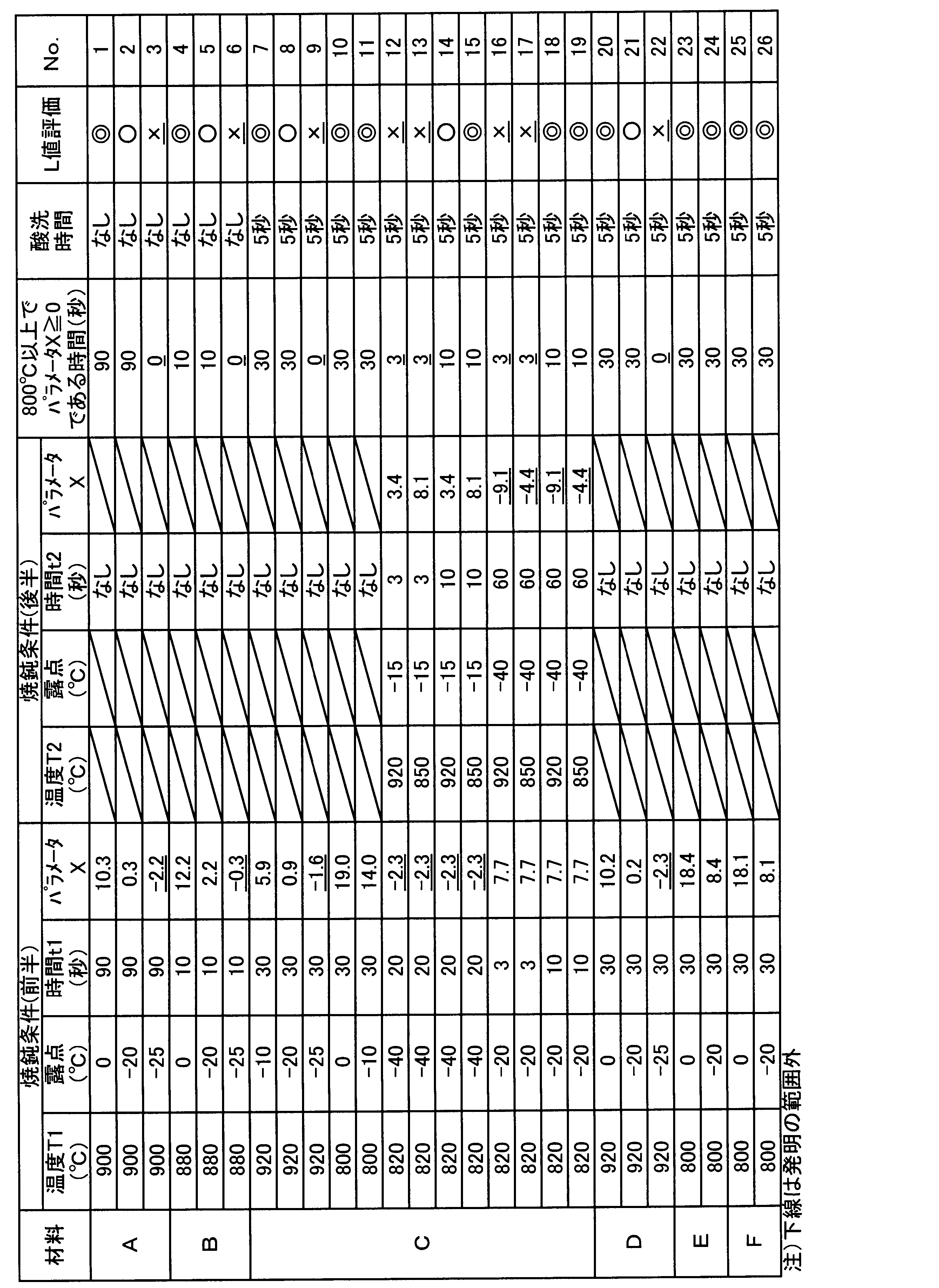
No.1,2,4,5,7,8,10,11,14,15,18~21,23~26は、温度T1またはT2が800℃以上であり、3.5×[Si]/[Mn]-0.068×T+0.5×D+69.6という式(1)で定めるパラメータXが、X≧0を満足する時間が5秒以上という条件を満足したため、L値が全て50を超え、外観に優れているという結果になった。一方、No.3,6,9,12,13,16,17,22は、前記パラメータXが、X≧0を満足する時間が5秒以上という条件を満足することができず、鋼板の表面は黒みを帯びた外観となった。
(実施例2)
表3に示す各成分組成の溶鋼を用いてスラブを作製し、熱間圧延を施すことで板厚が32mmの熱延鋼板とした。更に得られた熱延鋼板を冷間圧延し、板厚が1.4mmの冷延鋼板を製造した。尚、表3において、「-」は検出限界値以下を示す。
表3に示す各成分組成の溶鋼を用いてスラブを作製し、熱間圧延を施すことで板厚が32mmの熱延鋼板とした。更に得られた熱延鋼板を冷間圧延し、板厚が1.4mmの冷延鋼板を製造した。尚、表3において、「-」は検出限界値以下を示す。
これらの冷延鋼板に対して雰囲気を制御した加熱炉で焼鈍処理を行った。加熱はインダクションヒーターで行い、昇温速度は5℃/secとした。窒素ガスに水素を混合したものの一部をバブリングすることで露点を制御したガスを流入させながら加熱処理を行った。加熱炉内の水素分圧は1000~60000Pa、露点を-40℃~0℃とした。
加熱の前半では所定の温度T1(800℃~920℃)で所定時間t1(3秒~90秒)保持した。一方、加熱の後半では前半と異なる雰囲気ガスを導入しながら温度T2(850℃~920℃)で所定時間t2(3秒~60秒)保持した。尚、後半の加熱を施したのはNo.17~24のみである。その後、N2ガスにて200℃以下まで冷却した。尚、時間t2は、ガスを導入し始めてから冷却開始までの時間である。
最後に焼鈍後の鋼板を、15質量%塩酸の浴に5秒間浸漬して酸洗し、イオン交換水で洗浄した。また、一部のサンプル(No.1~7)は酸洗せずそのまま評価に用いた。
本実施例では、焼鈍、酸洗後の鋼板の化成処理性の評価を行った。化成処理は、日本パーカライジング株式会社製の塗装下地用化成剤「パルボンドL3065(PB-L3065)」を用い、35℃で120秒間浸漬することにより行い、化成処理後における鋼板の表面を走査型電子顕微鏡(Scanning Electron Microscope:SEM)で観察し、観察視野面積に対して、化成処理した皮膜の結晶が付着していない面積の割合を測定することで、化成処理性の評価を行った。観察視野は100μm×100μmとし、観察視野数は3視野とし、3視野における前記面積の割合の平均値を求めた。
鋼板の表面を化成処理皮膜が完全に覆い、化成処理皮膜が付着していない面積率が0%の場合を○で合格と評価し、鋼板の表面の一部が化成処理皮膜で覆われておらず、化成処理皮膜が付着していない面積率が0%を超えた場合を×で不合格と評価した。製造条件および試験結果を表4に示す。
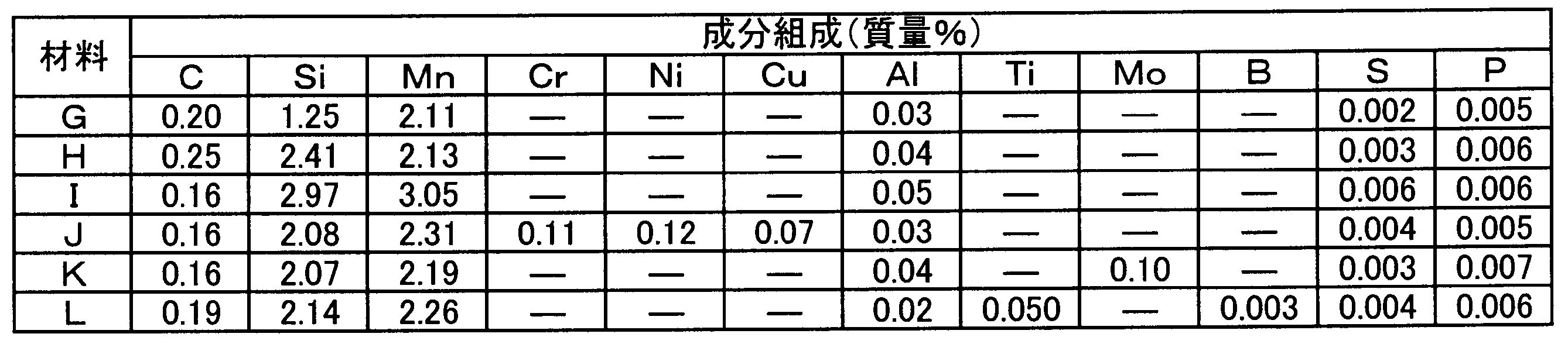
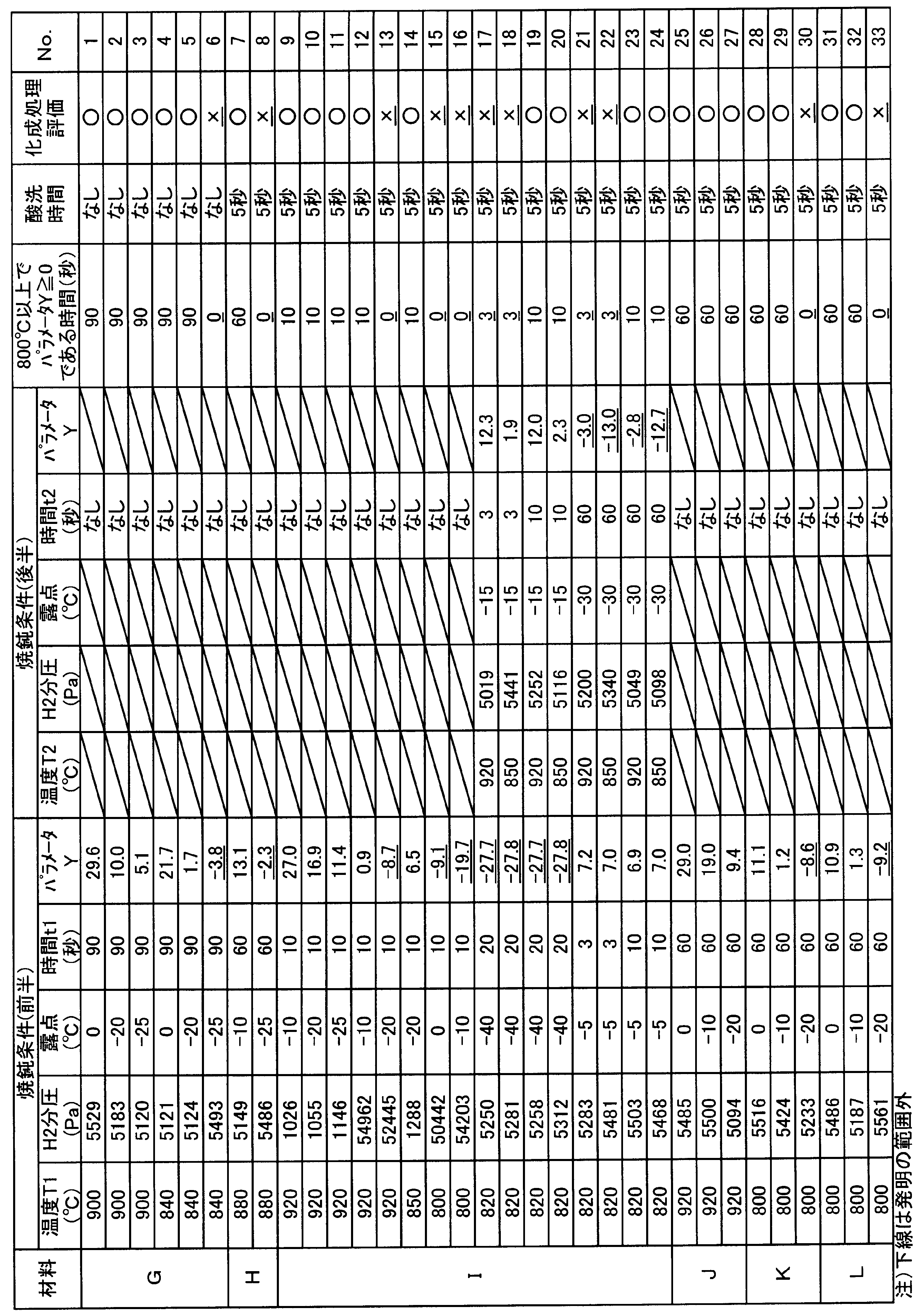
No.1~5,7,9~12,14,19,20,23~29,31,32は、温度T1またはT2が800℃以上であり、D-273.15×log(P)/(15-log(P))という式(2)で定めるパラメータYが、Y≧0を満足する時間が5秒以上という条件を満足したため、化成処理皮膜が付着していない面積率が0%となり化成処理性に優れているという結果になった。一方、No.6,8,13,15~18,21,22,30,33は、前記パラメータYが、Y≧0を満足する時間が5秒以上という条件を満足することができず、化成処理皮膜が付着していない面積率が0%を超えてしまい化成処理性は優れていないという結果になった。
(実施例3)
表5に示す各成分組成の溶鋼を用いてスラブを作製し、熱間圧延を施すことで板厚が3.2mmの熱延鋼板とした。更に得られた熱延鋼板を冷間圧延し、板厚が1.4mmの冷延鋼板を製造した。尚、表5において、「-」は検出限界値以下を示す。
表5に示す各成分組成の溶鋼を用いてスラブを作製し、熱間圧延を施すことで板厚が3.2mmの熱延鋼板とした。更に得られた熱延鋼板を冷間圧延し、板厚が1.4mmの冷延鋼板を製造した。尚、表5において、「-」は検出限界値以下を示す。
これらの冷延鋼板に対して雰囲気を制御した加熱炉で焼鈍処理を行った。加熱はインダクションヒーターで行い、昇温速度は5℃/secとした。窒素ガスに水素を混合したものの一部をバブリングすることで露点を制御したガスを流入させながら加熱処理を行った。加熱炉内の水素分圧は1000~60000Pa、露点を-40℃~0℃とした。
加熱の前半では所定の温度T1(800℃~920℃)で所定時間t1(3秒~90秒)保持した。一方、加熱の後半では前半と異なる雰囲気ガスを導入しながら温度T2(850℃~920℃)で所定時間t2(3秒~60秒)保持した。尚、後半の加熱を施したのはNo.24~31のみである。その後、N2ガスにて200℃以下まで冷却した。尚、時間t2は、ガスを導入し始めてから冷却開始までの時間である。
最後に焼鈍後の鋼板を、15質量%塩酸の浴に5秒間浸漬して酸洗し、イオン交換水で洗浄した。また、一部のサンプル(No.1~7)は酸洗せずそのまま評価に用いた。
本実施例では、焼鈍、酸洗後の鋼板の表面を観察することにより外観評価を行うと共に、焼鈍、酸洗後の鋼板の化成処理性の評価を行った。外観評価は、JIS Z 8730に基づいてL値を測定し、L値が50を超えるものを○、L値が55を超えるものを◎として、それぞれ合格と評価した。一方、L値が50以下のものは×とし、不合格と評価した。
また、化成処理性の評価は、日本パーカライジング株式会社製の塗装下地用化成剤「パルボンドL3065(PB-L3065)」を用い、35℃で120秒間浸漬することにより化成処理を行い、化成処理後における鋼板の表面を走査型電子顕微鏡(Scanning Electron Microscope:SEM)で観察し、観察視野面積に対して、化成処理した皮膜の結晶が付着していない面積の割合を測定することにより実施した。観察視野は100μm×100μmとし、観察視野数は3視野とし、3視野における前記面積の割合の平均値を求めた。
鋼板の表面を化成処理皮膜が完全に覆い、化成処理皮膜が付着していない面積率が0%の場合を○で合格と評価し、鋼板の表面の一部が化成処理皮膜で覆われておらず、化成処理皮膜が付着していない面積率が0%を超えた場合を×で不合格と評価した。
本実施例では、外観評価と化成処理性の評価が共に合格であるものを、優れた外観品質と化成処理性を共に備えた高強度冷延鋼板を得ることができたものとして、総合評価は○とし合格とした。これに対し、外観評価と化成処理性の評価の一方でも×であったものは、総合評価では×とし不合格とした。以上の製造条件および試験結果を表6に示す。
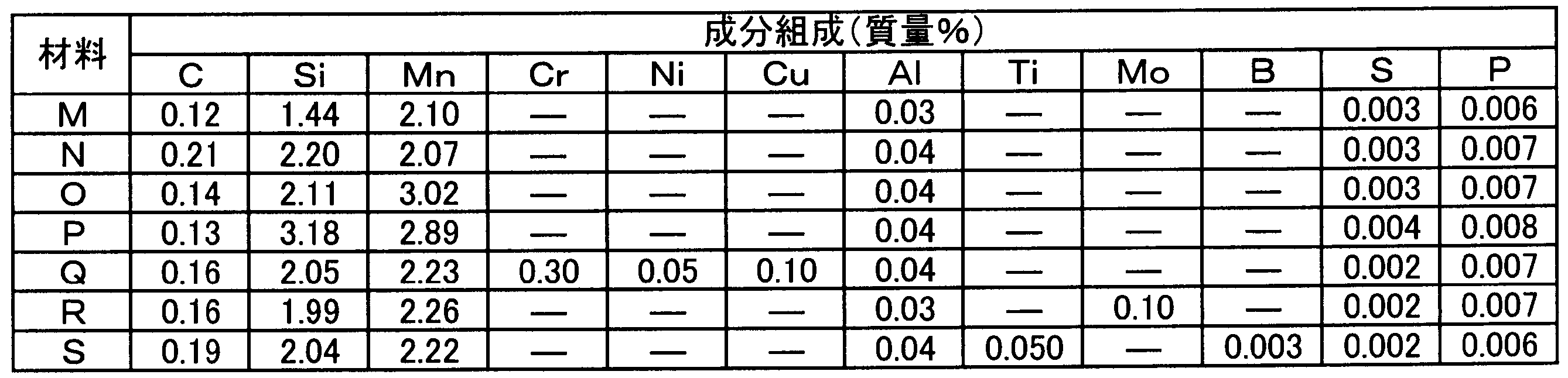
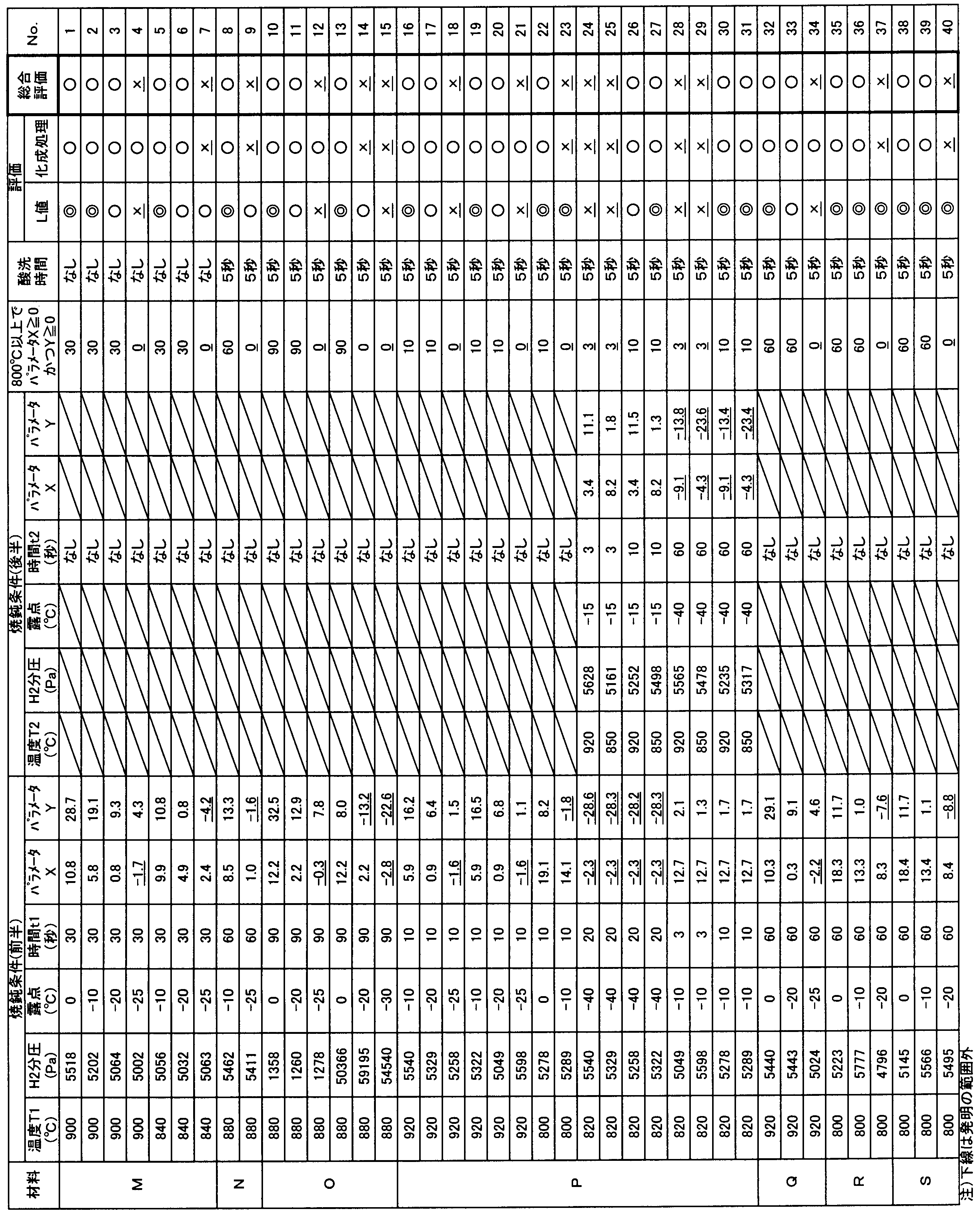
No.1~3,5,6,8,10,11,13,16,17,19,20,22,26,27,30~33,35,36,38,39は、温度T1またはT2が800℃以上であり、3.5×[Si]/[Mn]-0.068×T+0.5×D+69.6という式(1)で定めるパラメータXが、X≧0を満足する時間が5秒以上という条件、D-273.15×log(P)/(15-log(P))という式(2)で定めるパラメータYが、Y≧0を満足する時間が5秒以上という条件を、共に満足したため、総合評価は○となり、優れた外観品質と化成処理性を共に備えているという結果になった。
一方、No.4,7,9,12,14,15,18,21,23~25,28,29,34,37,40は、3.5×[Si]/[Mn]-0.068×T+0.5×D+69.6という式(1)で定めるパラメータXが、X≧0を満足する時間が5秒以上という条件、D-273.15×log(P)/(15-log(P))という式(2)で定めるパラメータYが、Y≧0を満足する時間が5秒以上という条件の、少なくとも一方を満足しなかったため、総合評価は×という結果になった。
本発明を詳細にまた特定の実施態様を参照して説明したが、本発明の精神と範囲を逸脱することなく様々な変更や修正を加えることができることは当業者にとって明らかである。
本出願は、2015年2月27日出願の日本特許出願(特願2015-038855)に基づくものであり、その内容はここに参照として取り込まれる。
本出願は、2015年2月27日出願の日本特許出願(特願2015-038855)に基づくものであり、その内容はここに参照として取り込まれる。
本発明の強度冷延鋼板は、鋼板表面が黒くなる色調変化を起こすことがなく、良好な外観品質を有し、化成処理性が良好な、表面性状に優れた高強度冷延鋼板を得ることができ、特に自動車構造材用として有用である。
Claims (5)
- 焼鈍工程を含むプロセスにより高強度冷延鋼板を製造する高強度冷延鋼板の製造方法であって、
前記焼鈍工程における板温Tが800℃以上であると共に、式(1)で定めるパラメータXが、X≧0を満足する時間が5秒以上であることを特徴とする高強度冷延鋼板の製造方法。
X=3.5×[Si]/[Mn]-0.068×T+0.5×D+69.6・・・式(1)
但し、前記式(1)中、[ ]は鋼板中の各元素の含有量(質量%)を示し、Dは焼鈍工程の雰囲気ガスの露点(℃)である。 - 焼鈍工程を含むプロセスにより高強度冷延鋼板を製造する高強度冷延鋼板の製造方法であって、
前記焼鈍工程における最高到達板温Tmaxが800℃以上であると共に、式(2)で定めるパラメータYが、Y≧0を満足する時間が5秒以上であることを特徴とする高強度冷延鋼板の製造方法。
Y=D-273.15×log(P)/(15-log(P))・・・式(2)
但し、前記式(2)中、Dは焼鈍工程の雰囲気ガスの露点(℃)であり、P= 2.06×10⁻¹³×[Si]×p(H2)×exp(27076/(Tmax+273.15)-2.25×log(Tmax+273.15))である。また、前記式中、[Si]は鋼板中のSiの含有量(質量%)を示し、p(H2)は雰囲気中のH2分圧(Pa)を示す。 - 焼鈍工程を含むプロセスにより高強度冷延鋼板を製造する高強度冷延鋼板の製造方法であって、
前記焼鈍工程における板温Tが800℃以上であると共に、式(1)で定めるパラメータXが、X≧0を満足する時間が5秒以上であり、且つ式(2)で定めるパラメータYが、Y≧0を満足する時間が5秒以上であることを特徴とする高強度冷延鋼板の製造方法。
X=3.5×[Si]/[Mn]-0.068×T+0.5×D+69.6・・・式(1)
Y=D-273.15×log(P)/(15-log(P))・・・式(2)
但し、前記式(1)中、[ ]は鋼板中の各元素の含有量(質量%)を示し、Dは焼鈍工程の雰囲気ガスの露点(℃)を示す。また、前記式(2)中、Dは焼鈍工程の雰囲気ガスの露点(℃)を示し、P= 2.06×10⁻¹³×[Si]×p(H2)×exp(27076/(Tmax+273.15)-2.25×log(Tmax+273.15))であり、また、前記式中、[Si]は鋼板中のSiの含有量(質量%)を、Tmaxは前記焼鈍工程における最高到達板温を、p(H2)は雰囲気中のH2分圧(Pa)を示す。 - 前記焼鈍工程の雰囲気ガスの露点Dが0℃以下である請求項1乃至3のいずれかに記載の高強度冷延鋼板の製造方法。
- 前記鋼板中のSiの含有量が2.0質量%超である請求項2または3に記載の高強度冷延鋼板の製造方法。
Applications Claiming Priority (2)
| Application Number | Priority Date | Filing Date | Title |
|---|---|---|---|
| JP2015038855A JP6466204B2 (ja) | 2015-02-27 | 2015-02-27 | 高強度冷延鋼板の製造方法 |
| JP2015-038855 | 2015-02-27 |
Publications (1)
| Publication Number | Publication Date |
|---|---|
| WO2016136631A1 true WO2016136631A1 (ja) | 2016-09-01 |
Family
ID=56788520
Family Applications (1)
| Application Number | Title | Priority Date | Filing Date |
|---|---|---|---|
| PCT/JP2016/054901 Ceased WO2016136631A1 (ja) | 2015-02-27 | 2016-02-19 | 高強度冷延鋼板の製造方法 |
Country Status (2)
| Country | Link |
|---|---|
| JP (1) | JP6466204B2 (ja) |
| WO (1) | WO2016136631A1 (ja) |
Citations (3)
| Publication number | Priority date | Publication date | Assignee | Title |
|---|---|---|---|---|
| JP2004323969A (ja) * | 2003-04-10 | 2004-11-18 | Kobe Steel Ltd | 化成処理性に優れる高強度冷延鋼板 |
| JP2011047042A (ja) * | 2009-07-29 | 2011-03-10 | Jfe Steel Corp | 化成処理性に優れた高強度冷延鋼板の製造方法 |
| JP2013237912A (ja) * | 2012-05-16 | 2013-11-28 | Nippon Steel & Sumitomo Metal Corp | 化成処理性に優れた高張力冷延鋼帯とその製造方法 |
-
2015
- 2015-02-27 JP JP2015038855A patent/JP6466204B2/ja not_active Expired - Fee Related
-
2016
- 2016-02-19 WO PCT/JP2016/054901 patent/WO2016136631A1/ja not_active Ceased
Patent Citations (3)
| Publication number | Priority date | Publication date | Assignee | Title |
|---|---|---|---|---|
| JP2004323969A (ja) * | 2003-04-10 | 2004-11-18 | Kobe Steel Ltd | 化成処理性に優れる高強度冷延鋼板 |
| JP2011047042A (ja) * | 2009-07-29 | 2011-03-10 | Jfe Steel Corp | 化成処理性に優れた高強度冷延鋼板の製造方法 |
| JP2013237912A (ja) * | 2012-05-16 | 2013-11-28 | Nippon Steel & Sumitomo Metal Corp | 化成処理性に優れた高張力冷延鋼帯とその製造方法 |
Also Published As
| Publication number | Publication date |
|---|---|
| JP6466204B2 (ja) | 2019-02-06 |
| JP2016160466A (ja) | 2016-09-05 |
Similar Documents
| Publication | Publication Date | Title |
|---|---|---|
| KR101858868B1 (ko) | 충격특성이 우수한 열간성형용 도금강판, 열간성형 부재 및 그들의 제조방법 | |
| JP7280364B2 (ja) | 熱間成形後の衝撃特性に優れた熱間成形用めっき鋼板、熱間成形部材及びこれらの製造方法 | |
| CN1152970C (zh) | 应变时效硬化特性优良的冷轧钢板及其制造方法 | |
| JP5958659B2 (ja) | 高強度溶融亜鉛めっき鋼板およびその製造方法 | |
| JP5839152B1 (ja) | 高強度溶融亜鉛めっき鋼板および高強度合金化溶融亜鉛めっき鋼板の製造方法 | |
| TWI518186B (zh) | 高強度熱軋鋼板及其製造方法 | |
| CN102918174A (zh) | 弯曲性和焊接性优良的高强度热镀锌钢板及其制造方法 | |
| JP2017048412A (ja) | 溶融亜鉛めっき鋼板、合金化溶融亜鉛めっき鋼板、およびそれらの製造方法 | |
| CN103205657A (zh) | 高强度罐用钢板及其制造方法 | |
| CN108368590A (zh) | 化学转化处理性及弯曲加工性优异的超高强度钢板及其制造方法 | |
| WO2015087549A1 (ja) | 高強度合金化溶融亜鉛めっき鋼板の製造方法 | |
| RU2768710C1 (ru) | Горячекатаный стальной лист с высоким отношением раздачи отверстия и способ его производства | |
| JP5531757B2 (ja) | 高強度鋼板 | |
| TW201441384A (zh) | 高強度熱軋鋼板及其製造方法 | |
| JP5655381B2 (ja) | 高張力溶融亜鉛めっき鋼板の製造方法 | |
| CN118406859A (zh) | 一种热轧镀锌复相钢及其制备方法 | |
| TW201437389A (zh) | 高強度熱軋鋼板及其製造方法 | |
| JP5124865B2 (ja) | 高張力冷延鋼板およびその製造方法 | |
| CN113166886A (zh) | 耐鳞爆优秀的搪瓷用冷轧钢板及其制造方法 | |
| JP6466204B2 (ja) | 高強度冷延鋼板の製造方法 | |
| JP4432725B2 (ja) | 伸びフランジ性に優れたCr含有高強度冷延鋼板およびその製造方法 | |
| JP4415579B2 (ja) | 溶融亜鉛めっき鋼板の製造方法 | |
| JP4419605B2 (ja) | 2重巻きパイプ用鋼板およびその製造方法 | |
| CN116368253A (zh) | 热稳定性优异的高强度钢板及其制造方法 | |
| JP2010215998A (ja) | 高強度溶融亜鉛めっき鋼板および高強度合金化溶融亜鉛めっき鋼板の製造方法 |
Legal Events
| Date | Code | Title | Description |
|---|---|---|---|
| 121 | Ep: the epo has been informed by wipo that ep was designated in this application |
Ref document number: 16755377 Country of ref document: EP Kind code of ref document: A1 |
|
| NENP | Non-entry into the national phase |
Ref country code: DE |
|
| 122 | Ep: pct application non-entry in european phase |
Ref document number: 16755377 Country of ref document: EP Kind code of ref document: A1 |