WO2016134294A1 - Bicyclic heterocycles as fgfr4 inhibitors - Google Patents
Bicyclic heterocycles as fgfr4 inhibitors Download PDFInfo
- Publication number
- WO2016134294A1 WO2016134294A1 PCT/US2016/018737 US2016018737W WO2016134294A1 WO 2016134294 A1 WO2016134294 A1 WO 2016134294A1 US 2016018737 W US2016018737 W US 2016018737W WO 2016134294 A1 WO2016134294 A1 WO 2016134294A1
- Authority
- WO
- WIPO (PCT)
- Prior art keywords
- alkyl
- diyl
- independently selected
- difluoro
- cycloalkyl
- Prior art date
- Legal status (The legal status is an assumption and is not a legal conclusion. Google has not performed a legal analysis and makes no representation as to the accuracy of the status listed.)
- Ceased
Links
- 0 COc(cc(c(F)c1N(Cc(c(C23CC2)c2)cnc2C(*CN=C2)=C2NO)C3=O)OC)c1F Chemical compound COc(cc(c(F)c1N(Cc(c(C23CC2)c2)cnc2C(*CN=C2)=C2NO)C3=O)OC)c1F 0.000 description 3
- RAJUTASCDBJQNW-UHFFFAOYSA-N CCOC(C(c1nc(Cl)ncc1CN1c(c(F)c(cc2OC)OC)c2F)C1=O)=O Chemical compound CCOC(C(c1nc(Cl)ncc1CN1c(c(F)c(cc2OC)OC)c2F)C1=O)=O RAJUTASCDBJQNW-UHFFFAOYSA-N 0.000 description 1
- UGROMKOQSBRWOA-UHFFFAOYSA-N COc(c(F)c1N(Cc(c(C23CC2)c2)cnc2-c2ccnc(NC(C=C)=O)c2)C3=O)cc(OC)c1F Chemical compound COc(c(F)c1N(Cc(c(C23CC2)c2)cnc2-c2ccnc(NC(C=C)=O)c2)C3=O)cc(OC)c1F UGROMKOQSBRWOA-UHFFFAOYSA-N 0.000 description 1
- YBLZSQRPAYPTNQ-UHFFFAOYSA-N Cc(c(-c1ncc(CN(C(C23CC2)=O)c(c(F)c(cc2OC)OC)c2F)c3c1)c1)ncc1NC(C=C)=O Chemical compound Cc(c(-c1ncc(CN(C(C23CC2)=O)c(c(F)c(cc2OC)OC)c2F)c3c1)c1)ncc1NC(C=C)=O YBLZSQRPAYPTNQ-UHFFFAOYSA-N 0.000 description 1
- FRXMMWDTOPSDBC-UHFFFAOYSA-N Cc(c(-c1ncc(CN(C(C23CC2)=O)c(c(F)c(cc2OC)OC)c2F)c3n1)c1)ccc1NC(C=C)=O Chemical compound Cc(c(-c1ncc(CN(C(C23CC2)=O)c(c(F)c(cc2OC)OC)c2F)c3n1)c1)ccc1NC(C=C)=O FRXMMWDTOPSDBC-UHFFFAOYSA-N 0.000 description 1
Classifications
-
- A—HUMAN NECESSITIES
- A61—MEDICAL OR VETERINARY SCIENCE; HYGIENE
- A61K—PREPARATIONS FOR MEDICAL, DENTAL OR TOILETRY PURPOSES
- A61K31/00—Medicinal preparations containing organic active ingredients
- A61K31/33—Heterocyclic compounds
- A61K31/395—Heterocyclic compounds having nitrogen as a ring hetero atom, e.g. guanethidine or rifamycins
- A61K31/535—Heterocyclic compounds having nitrogen as a ring hetero atom, e.g. guanethidine or rifamycins having six-membered rings with at least one nitrogen and one oxygen as the ring hetero atoms, e.g. 1,2-oxazines
- A61K31/5375—1,4-Oxazines, e.g. morpholine
- A61K31/5377—1,4-Oxazines, e.g. morpholine not condensed and containing further heterocyclic rings, e.g. timolol
-
- A—HUMAN NECESSITIES
- A61—MEDICAL OR VETERINARY SCIENCE; HYGIENE
- A61K—PREPARATIONS FOR MEDICAL, DENTAL OR TOILETRY PURPOSES
- A61K31/00—Medicinal preparations containing organic active ingredients
- A61K31/33—Heterocyclic compounds
- A61K31/395—Heterocyclic compounds having nitrogen as a ring hetero atom, e.g. guanethidine or rifamycins
- A61K31/435—Heterocyclic compounds having nitrogen as a ring hetero atom, e.g. guanethidine or rifamycins having six-membered rings with one nitrogen as the only ring hetero atom
- A61K31/4353—Heterocyclic compounds having nitrogen as a ring hetero atom, e.g. guanethidine or rifamycins having six-membered rings with one nitrogen as the only ring hetero atom ortho- or peri-condensed with heterocyclic ring systems
- A61K31/4375—Heterocyclic compounds having nitrogen as a ring hetero atom, e.g. guanethidine or rifamycins having six-membered rings with one nitrogen as the only ring hetero atom ortho- or peri-condensed with heterocyclic ring systems the heterocyclic ring system containing a six-membered ring having nitrogen as a ring heteroatom, e.g. quinolizines, naphthyridines, berberine, vincamine
-
- A—HUMAN NECESSITIES
- A61—MEDICAL OR VETERINARY SCIENCE; HYGIENE
- A61K—PREPARATIONS FOR MEDICAL, DENTAL OR TOILETRY PURPOSES
- A61K31/00—Medicinal preparations containing organic active ingredients
- A61K31/33—Heterocyclic compounds
- A61K31/395—Heterocyclic compounds having nitrogen as a ring hetero atom, e.g. guanethidine or rifamycins
- A61K31/435—Heterocyclic compounds having nitrogen as a ring hetero atom, e.g. guanethidine or rifamycins having six-membered rings with one nitrogen as the only ring hetero atom
- A61K31/44—Non condensed pyridines; Hydrogenated derivatives thereof
- A61K31/4427—Non condensed pyridines; Hydrogenated derivatives thereof containing further heterocyclic ring systems
- A61K31/444—Non condensed pyridines; Hydrogenated derivatives thereof containing further heterocyclic ring systems containing a six-membered ring with nitrogen as a ring heteroatom, e.g. amrinone
-
- A—HUMAN NECESSITIES
- A61—MEDICAL OR VETERINARY SCIENCE; HYGIENE
- A61P—SPECIFIC THERAPEUTIC ACTIVITY OF CHEMICAL COMPOUNDS OR MEDICINAL PREPARATIONS
- A61P35/00—Antineoplastic agents
-
- C—CHEMISTRY; METALLURGY
- C07—ORGANIC CHEMISTRY
- C07D—HETEROCYCLIC COMPOUNDS
- C07D471/00—Heterocyclic compounds containing nitrogen atoms as the only ring hetero atoms in the condensed system, at least one ring being a six-membered ring with one nitrogen atom, not provided for by groups C07D451/00 - C07D463/00
- C07D471/02—Heterocyclic compounds containing nitrogen atoms as the only ring hetero atoms in the condensed system, at least one ring being a six-membered ring with one nitrogen atom, not provided for by groups C07D451/00 - C07D463/00 in which the condensed system contains two hetero rings
- C07D471/04—Ortho-condensed systems
Definitions
- the present disclosure relates to bicyclic heterocycles, and pharmaceutical compositions of the same, that are inhibitors of the enzyme FGFR4 and are useful in the treatment of FGFR4-associated diseases such as cancer.
- the Fibroblast Growth Factor Receptors are receptor tyrosine kinases that bind to fibroblast growth factor (FGF) ligands.
- FGF fibroblast growth factor
- FGFR1-4 FGFR proteins that are capable of binding ligands and are involved in the regulation of many physiological processes including tissue development, angiogenesis, wound healing, and metabolic regulation.
- FGFR1-4 FGFR proteins that are capable of binding ligands and are involved in the regulation of many physiological processes including tissue development, angiogenesis, wound healing, and metabolic regulation.
- the receptors Upon ligand binding, the receptors undergo dimerization and phosphorylation leading to stimulation of the protein kinase activity and recruitment of many intracellular docking proteins.
- Mechanisms that lead to aberrant ligand-dependent signaling in human disease include overexpression of FGFs and changes in FGFR splicing that lead to receptors with more promiscuous ligand binding abilities (Reviewed in Knights and Cook Pharmacology & Therapeutics, 2010; Turner and Grose, Nature Reviews Cancer, 2010). Therefore, development of inhibitors targeting FGFR may be useful in the clinical treatment of diseases that have elevated FGF or FGFR activity.
- carcinomas e.g., bladder, breast, cervical, colorectal, endometrial, gastric, head and neck, kidney, liver, lung, ovarian, prostate
- hematopoietic malignancies e.g., multiple myeloma, chronic lymphocytic lymphoma, adult T cell leukemia, acute myelogenous leukemia, non- Hodgkin lymphoma, myeloproliferative neoplasms, and Waldenstrom's Macroglubulinemia
- other neoplasms e.g., glioblastoma, melanoma, and rhabdosarcoma.
- FGFR activation has also been implicated in skeletal and chondrocyte disorders including, but not limited to, achrondroplasia and craniosynostosis syndromes.
- the FGFR4-FGF19 signaling axis specifically, has been implicated in the pathogenesis of a number of cancers including hepatocellular carcinoma (Heinzle et al, Cur. Pharm. Des. 2014, 20:2881). Ectopic expression of FGF19 in transgenic mice was shown to lead to tumor formation in the liver and a neutralizing antibody to FGF19 was found to inhibit tumor growth in mice. In addition, overexpression of FGFR4 has been observed in a multiple tumor types including hepatocellular carcinoma, colorectal, breast, pancreatic, prostate, lung, and thyroid cancers. Furthermore, activating mutations in FGFR4 have been reported in rhabdomyosarcoma (Taylor et al. JCI 2009,119:3395). Targeting FGFR4 with selective small molecule inhibitors may therefore prove beneficial in the treatment of certain cancers.
- compositions comprising a compound of Formula (I), or a pharmaceutically acceptable salt thereof, and at least one pharmaceutically acceptable carrier or excipient.
- the present disclosure provides methods for inhibiting an FGFR4 enzyme.
- the method includes contacting the enzyme with a compound of Formula (I), or a pharmaceutically acceptable salt thereof or a composition comprising compounds of Formula
- the present disclosure provides a method for treating a disease associated with abnormal activity or expression of an FGFR4 enzyme.
- the method includes administering an effective amount of a compound of Formula (I), or a pharmaceutically acceptable salt thereof, or a composition comprising a compound of Formula (I), to a patient in need thereof.
- the present disclosure provides compounds of Formula (I) for use in treating a disease associated with abnormal activity or expression of an FGFR4 enzyme.
- the present disclosure provides a method for treating a disorder mediated by an FGFR4 enzyme, or a mutant thereof, in a patient in need thereof.
- the method includes administering to the patient a compound as described herein or pharmaceutically acceptable salts thereof or a composition comprising a compound as described herein.
- the present disclosure provides the use of compounds of Formula (I) in the preparation of a medicament for use in therapy.
- the present disclosure provides a compound having Formula (I):
- ring A is a Ge-io arylene, 5 to 6-membered heteroarylene, 5 to 6-membered heterocycloalkylene or C3-7cycloalkylene, wherein the 5 to 6-membered heteroarylene or 5 to 6-membered heterocycloalkylene has carbon and 1 to 4 heteroatoms as ring members selected from O, N, and S;
- each R 12 is independently selected from H, halo, Ci-6 alkyl, C2-6 alkenyl, C2-6 alkynyl, Ci-6 haloalkyl, Ge-io aryl, C3-10 cycloalkyl, 5-10 membered heteroaryl, 4-10 membered heterocycloalkyl, Ge-io aryl-Ci-4 alkyl-, C3-10 cycloalkyl-Ci-4 alkyl-, (5-10 membered heteroaryl)-Ci-4 alkyl-, (4-10 membered heterocycloalkyl)-Ci- 4 alkyl-, CN, NO2, OR a , SR a , C(0)R a , C(0)NR a R a , C(0)OR a , OC(0)R a , OC(0)NR a R a , NR a R a , NR a OR a , NR a C(0)R a , NR a C(0)OR
- NR c C(0)OR c NR c C(0)NR c R c , NR c S(0)R c , NR c S(0) 2 R c , NR c S(0) 2 NR c R c , S(0)R c , S(0)NR c R c , S(0) 2 R c , and S(0) 2 NR c R c ;
- R 12 substituents on ring A taken together with the atoms to which they are attached form a fused 5- or 6-member cycloalkyl ring, 5 to 6-membered heterocycloalkyl ring, phenyl or 5 to 6-membered heteroaryl ring, each of which is optionally substituted with from 1 -3 R 10A groups, wherein the heterocycloalkyl or heteroaryl has 1-2 heteroatoms as ring members selected from O, N, and S;
- each R a is independently selected from H, Ci-6 alkyl, C 1-4 haloalkyl, C2-6 alkenyl, C2-6 alkynyl, Ce- ⁇ aryl, C3-10 cycloalkyl, 5-10 membered heteroaryl, 4-10 membered
- heterocycloalkyl Ce- ⁇ aryl-Ci-4 alkyl-, C3-10 cycloalkyl-Ci-4 alkyl-, (5-10 membered heteroaryl)-Ci-4 alkyl-, and (4-10 membered heterocycloalkyl)-Ci-4 alkyl-, wherein said Ci-6 alkyl, C2-6 alkenyl, C2-6 alkynyl, Ce- ⁇ aryl, C3-10 cycloalkyl, 5-10 membered heteroaryl, 4-10 membered heterocycloalkyl, Ce- ⁇ aryl-Ci-4 alkyl-, C3-10 cycloalkyl-Ci-4 alkyl-, (5-10 membered heteroaryl)-Ci-4 alkyl-, and (4-10 membered heterocycloalkyl)-Ci-4 alkyl- are each optionally substituted with 1 , 2, 3, 4, or 5 R d substituents independently selected from C1-4 alkyl, C M haloalkyl,
- each R c is independently selected from H, Ci-6 alkyl, C 1-4 haloalkyl, C 2 -6 alkenyl, C 2 -6 alkynyl, Ce- ⁇ aryl, C3-10 cycloalkyl, 5-10 membered heteroaryl, 4-10 membered
- heterocycloalkyl Ce- ⁇ aryl-Ci-4 alkyl-, C3-10 cycloalkyl-Ci-4 alkyl-, (5-10 membered heteroaryl)-Ci-4 alkyl-, and (4-10 membered heterocycloalkyl)-Ci-4 alkyl-, wherein said Ci-6 alkyl, C 2 -6 alkenyl, C 2 -6 alkynyl, Ce- ⁇ aryl, C3-10 cycloalkyl, 5-10 membered heteroaryl, 4-10 membered heterocycloalkyl, Ce- ⁇ aryl-Ci-4 alkyl-, C3-10 cycloalkyl-Ci-4 alkyl-, (5-10 membered heteroaryl)-Ci-4 alkyl-, and (4-10 membered heterocycloalkyl)-Ci-4 alkyl- are each optionally substituted with 1 , 2, 3, 4, or 5 R f substituents independently selected from C1-4 alkyl, C M haloalky
- R a substituents attached to the same nitrogen atom, together with the nitrogen atom to which they are attached, a 4-, 5-, 6-, or 7-membered heterocycloalkyl group optionally substituted with 1, 2, or 3 independently selected R h substituents;
- each R h is independently selected from Ci-6 alkyl, C3-7 cycloalkyl, 4-7 membered heterocycloalkyl, Ce- ⁇ aryl, 5-6 membered heteroaryl, Ci-6 haloalkyl, halo, CN, OR 1 , SR 1 , C(0)R ⁇ C ⁇ NR'R 1 , 0(0)0 ⁇ , OC(0)R ⁇ OC ⁇ NR'R 1 , NR'R 1 , NR'CCO) ⁇ , NR'CCO ⁇ R'R 1 ,
- Ci-e alkyl, C3-7 cycloalkyl, 4-7 membered heterocycloalkyl, Ce- ⁇ aryl, and 5-6 membered heteroaryl are each optionally substituted by 1, 2, or 3 independently selected R> substituents;
- each Rj is independently selected from halo, C1-4 alkyl, Ci-4 haloalkyl, CN, 0R k , SR k , C(0)R k , C(0)NR k R k , C(0)OR k , OC(0)R k , OC(0)NR k R k , NR k R k , NR k C(0)R k ,
- R c substituents attached to the same nitrogen atom, together with the nitrogen atom to which they are attached, a 4-, 5-, 6-, or 7-membered heterocycloalkyl group optionally substituted with 1, 2, or 3 independently selected R h substituents;
- R e substituents attached to the same nitrogen atom, together with the nitrogen atom to which they are attached, a 4-, 5-, 6-, or 7-membered heterocycloalkyl group optionally substituted with 1, 2, or 3 independently selected R h substituents;
- R g substituents attached to the same nitrogen atom, together with the nitrogen atom to which they are attached, a 4-, 5-, 6-, or 7-membered heterocycloalkyl group optionally substituted with 1, 2, or 3 independently selected R h substituents;
- R 1 substituents attached to the same nitrogen atom, together with the nitrogen atom to which they are attached, a 4-, 5-, 6-, or 7-membered heterocycloalkyl group optionally substituted with 1, 2, or 3 independently selected R h substituents;
- each R e , R ⁇ , R 1 or R k is independently selected from H, C1-4 alkyl, C6-ioaryl, C1-4 haloalkyl, C 2 -4 alkenyl, and C 2 -4 alkynyl, wherein the C1-4 alkyl, C6-ioaryl, C 2 -4 alkenyl or C 2 -4 alkynyl is optionally substituted with 1, 2, or 3 substituents independently selected from OH, CN, amino, halo, C1-4 alkyl, C1-4 alkoxy, C 1-4 alkylthio, C1-4 alkylamino, di(Ci-4 alkyl)amino, Ci-4 haloalkyl, and Ci-4 haloalkoxy;
- L is NR 9 or a bond, wherein R 9 is H, Ci-6alkyl, 4 to 6-membered hetercycloalkyl, where Ci-6alkyl or 4 to 6-membered hetercycloalkyl is optionally
- X 1 is -CR 10 R n - or -NR 7 -
- X 2 is N or CR 6 ;
- R 1 is Ci-3 alkyl or Ci-3 haloalkyl
- R 2 is H, halo, Ci-3 alkyl, Ci-3 haloalkyl, CN, or C1-3 alkoxy;
- R 3 is H, halo, C1-3 alkyl, C1-3 haloalkyl, CN, or C1-3 alkoxy;
- R 4 is Ci-3 alkyl or C 1-3 haloalkyl
- R 5 is H, halo, C1-3 alkyl, C1-3 haloalkyl, CN, or C1-3 alkoxy;
- R 6 and R 7 are each independently selected from H, halo, CN, OR a4 , SR a4 ,
- R 8a and R 8b are each independently H, halogen, methyl, or CF3;
- R 8c is H or Ci-4 alkyl optionally substituted with R 17 ;
- R 10 and R 11 are each independently selected from H, Ci-6 alkyl, C 2 -6 alkenyl, C 2 -6 alkynyl, Ci-6 haloalkyl, Ce- ⁇ aryl, C3-10 cycloalkyl, a 5-10 membered heteroaryl moiety having carbon and 1, 2, or 3 heteroatoms independently selected from N, O and S, and a 4-10 membered heterocycloalkyl moiety having carbon and 1, 2, or 3 heteroatoms independently selected from N, O and S; wherein said Ci-6 alkyl, C 2 -6 alkenyl, C 2 -6 alkynyl, Ce- ⁇ aryl, C3-10 cycloalkyl, 5-10 membered heteroaryl, and 4-10 membered heterocycloalkyl groups of R 10 and R 11 are each optionally substituted with 1 , 2, 3, or 4 R 10A ;
- NR c4 C( NR e4 )NR c4 R d4 , NR c4 R d4 , NR c4 C(0)R b4 , NR c4 C(0)OR a4 , NR c4 C(0)NR c4 R d4 , NR c4 S(0)R b4 , NR c4 S(0) 2 R b4 , NR c4 S(0) 2 NR c4 R d4 , S(0)R b4 , S(0)NR c4 R d4 , S(0) 2 R b4 , S(0) 2 NR c4 R d4 , Ci-6 alkyl, C 2 -e alkenyl, C 2 -e alkynyl, Ci-e haloalkyl, phenyl, C3-6 cycloalkyl, a 5-6 membered heteroaryl moiety having carbon and 1, 2, or 3 heteroatoms independently selected from N, O and S, and a 4-7 member
- R a4 , R M , R c4 , and R d4 are independently selected from H, C1-4 alkyl, C2-4 alkenyl, C2-4 alkynyl, C1-4 haloalkyl, phenyl, C3-6 cycloalkyl, a 5-6 membered heteroaryl moiety having carbon and 1, 2, or 3 heteroatoms independently selected from N, O and S, and a 4-7 membered heterocycloalkyl moiety having carbon and 1, 2, or 3 heteroatoms independently selected from N, O and S; wherein said C1-4 alkyl, C2-4 alkenyl, C2-4 alkynyl, phenyl, C3-6 cycloalkyl, 5-6 membered heteroaryl, and 4-7 membered heterocycloalkyl group of R a4 , R M , R c4 , and R d4 are each optionally substituted with 1, 2, or 3 substituents independently selected from R 19 ;
- R c4 and R d4 together with the nitrogen atom to which they are attached form a 4-, 5-, 6-, or 7-membered heterocycloalkyl group which is optionally substituted with 1, 2 or 3 substituents independently selected from R 19 ;
- R e4 at each occurrence, is H or C1-4 alkyl
- R 10 and R 11 together with the carbon atom to which they are attached form a 3-, 4-, 5-, 6-, or 7-membered cycloalkyl group or a 4-, 5-, 6-, 7-, 8-, 9-, or 10- membered heterocycloalkyl group; wherein said 3-, 4-, 5-, 6-, or 7-membered cycloalkyl group and 4-, 5-, 6-, 7-, 8-, 9-, or 10-membered heterocycloalkyl group are each optionally substituted with 1, 2, 3 or 4 R 10A ;
- NR c7 C( NR e7 )NR c7 R d7 , NR c7 R d7 , NR c7 C(0)R b7 , NR c7 C(0)OR a7 , NR c7 C(0)NR c7 R d7 , NR c7 S(0)R b7 , NR c7 S(0) 2 R b7 , NR c7 S(0) 2 NR c7 R d7 , S(0)R b7 , S(0)NR c7 R d7 , S(0) 2 R b7 , S(0)NR c7 R d7 , S(0) 2 R b7 ,
- R c7 and R d7 together with the nitrogen atom to which they are attached form a 4-, 5-, 6-, or 7-membered heterocycloalkyl group which is optionally substituted with 1, 2 or 3 substituents independently selected from R 19 ;
- R e7 at each occurrence, is H or C1-4 alkyl
- R 19 is independently selected from halo, CN, NO2, OR a9 , SR a9 , C(0)R b9 , C(0)NR c9 R d9 , C(0)OR a9 , OC(0)R b9 , OC(0)NR c9 R d9 , NR c9 R d9 , NR c9 C(0)R b9 , NR c9 C(0)OR a9 , NR c9 C(0)NR c9 R d9 , NR c9 S(0)R b9 , NR c9 S(0) 2 R b9 , NR c9 S(0) 2 NR c9 R d9 , S(0)R b9 , S(0)NR c9 R d9 , S(0)R b9 , S(0)NR c9 R d9 , S(0)R b9 , S(0)NR c9 R d9 , S(0)R b9 , S(0)NR c9 R
- R a9 , R c9 , and R d9 are independently selected from H and C1-4 alkyl;
- each R b9 is independently C1-4 alkyl; and the subscript n is 1, 2 or 3.
- compounds of Formula (I) have selective inhibitory activity on FGFR4 enzyme or any mutant thereof.
- ring A is a Ce- ⁇ arylene, 5 to 6-membered heteroarylene, 5 to 6-membered heterocycloalkylene or C3-7cycloalkylene, wherein the 5 to 6-membered heteroarylene or 5 to 6-membered heterocycloalkylene have carbon and 1 to 4 heteroatoms as ring members selected from O, N and S;
- each R 12 is independently selected from H, halo, Ci-6 alkyl, C2-6 alkenyl, C2-6 alkynyl, Ci-6 haloalkyl, Ce- ⁇ aryl, C3-10 cycloalkyl, 5-10 membered heteroaryl, 4-10 membered heterocycloalkyl, Ce- ⁇ aryl-Ci-4 alkyl-, C3-10 cycloalkyl-Ci-4 alkyl-, (5-10 membered heteroaryl)-Ci-4 alkyl-, (4-10 membered heterocycloalkyl)-Ci- 4 alkyl-, CN, NO2, OR a , SR a , C(0)R a , C(0)NR a R a , C(0)OR a , OC(0)R a , OC(0)NR a R a , NR a R a , NR a OR a , NR a C(0)R a , NR a C(0)OR a
- NR c C(0)OR c NR c C(0)NR c R c , NR c S(0)R c , NR c S(0) 2 R c , NR c S(0) 2 NR c R c , S(0)R c , S(0)NR c R c , S(0) 2 R c , and S(0) 2 NR c R c ;
- R 12 substituents on ring A taken together with the atoms to which they are attached form a fused 5- or 6-member cycloalkyl ring, 5 to 6-membered heterocycloalkyl ring, phenyl or 5 to 6-membered heteroaryl ring, each of which is optionally substitutued with from 1 -3 R 10A groups, wherein the heterocycloalkyl or heteroaryl have 1-2 heteroatoms as ring members selected from O, N and S;
- each R a is independently selected from H, Ci-6 alkyl, C 1-4 haloalkyl, C2-6 alkenyl, C2-6 alkynyl, Ce- ⁇ aryl, C3-10 cycloalkyl, 5-10 membered heteroaryl, 4-10 membered
- heterocycloalkyl Ce- ⁇ aryl-Ci-4 alkyl-, C3-10 cycloalkyl-Ci-4 alkyl-, (5-10 membered heteroaryl)-Ci-4 alkyl-, and (4-10 membered heterocycloalkyl)-Ci-4 alkyl-, wherein said Ci-6 alkyl, C2-6 alkenyl, C2-6 alkynyl, Ce- ⁇ aryl, C3-10 cycloalkyl, 5-10 membered heteroaryl, 4-10 membered heterocycloalkyl, Ce- ⁇ aryl-Ci-4 alkyl-, C3-10 cycloalkyl-Ci-4 alkyl-, (5-10 membered heteroaryl)-Ci-4 alkyl-, and (4-10 membered heterocycloalkyl)-Ci-4 alkyl- are each optionally substituted with 1 , 2, 3, 4, or 5 R d substituents independently selected from C1-4 alkyl, C M haloalkyl,
- each R c is independently selected from H, Ci-6 alkyl, C 1-4 haloalkyl, C 2 -6 alkenyl, C 2 -6 alkynyl, Ce- ⁇ aryl, C3-10 cycloalkyl, 5-10 membered heteroaryl, 4-10 membered
- R a substituents attached to the same nitrogen atom, together with the nitrogen atom to which they are attached, a 4-, 5-, 6-, or 7-membered heterocycloalkyl group optionally substituted with 1, 2, or 3 independently selected R h substituents;
- each Rj is independently selected from halo, C1-4 alkyl, Ci-4 haloalkyl, CN, 0R k , SR k , C(0)R k , C(0)NR k R k , C(0)OR k , OC(0)R k , OC(0)NR k R k , NR k R k , NR k C(0)R k ,
- R c substituents attached to the same nitrogen atom, together with the nitrogen atom to which they are attached, a 4-, 5-, 6-, or 7-membered heterocycloalkyl group optionally substituted with 1, 2, or 3 independently selected R h substituents;
- R e substituents attached to the same nitrogen atom, together with the nitrogen atom to which they are attached, a 4-, 5-, 6-, or 7-membered heterocycloalkyl group optionally substituted with 1, 2, or 3 independently selected R h substituents;
- R substituents attached to the same nitrogen atom, together with the nitrogen atom to which they are attached, a 4-, 5-, 6-, or 7-membered heterocycloalkyl group optionally substituted with 1, 2, or 3 independently selected R h substituents;
- R 1 substituents attached to the same nitrogen atom, together with the nitrogen atom to which they are attached, a 4-, 5-, 6-, or 7-membered heterocycloalkyl group optionally substituted with 1, 2, or 3 independently selected R h substituents;
- each R e , R , R 1 or R k is independently selected from H, C1-4 alkyl, C6-ioaryl, C1-4 haloalkyl, C 2 -4 alkenyl, and C 2 -4 alkynyl, wherein the C1-4 alkyl, C6-ioaryl, C 2 -4 alkenyl or C 2 -4 alkynyl is optionally substituted with 1, 2, or 3 substituents independently selected from OH, CN, amino, halo, Ci-4 alkyl, Ci-4 alkoxy, C 1-4 alky lthio, Ci-4 alkylamino, di(Ci-4 alkyl)amino, Ci-4 haloalkyl, and Ci-4 haloalkoxy;
- L is NR 9 or a bond, wherein R 9 is H or Ci-6alkyl
- X 1 is -CR 10 R n - or -NR 7 -;
- X 2 is N or CR 6 ;
- R 1 is Ci-3 alkyl or Ci-3 haloalkyl
- R 2 is H, halo, C1-3 alkyl, C1-3 haloalkyl, CN, or C1-3 alkoxy;
- R 3 is H, halo, C1-3 alkyl, C1-3 haloalkyl, CN, or C1-3 alkoxy;
- R 4 is Ci-3 alkyl or C 1-3 haloalkyl
- R 5 is H, halo, C1-3 alkyl, C1-3 haloalkyl, CN, or C1-3 alkoxy;
- R 6 is selected from H, halo, CN, OR a4 , SR a4 , C(0)NR c4 R d4 , OC(0)NR c4 R d4 , NR c4 R d4 , NR c4 C(0)R b4 , NR c4 C(0)OR a4 , NR c4 C(0)NR c4 R d4 , NR c4 S(0)R M , NR c4 S(0) 2 R b4 ,
- R 7 is selected from H, C(0)NR c4 R d4 , S(0)R M , S(0)NR c4 R d4 , S(0) 2 R b4 ,
- R 8a and R 8b are each independently H, halogen, methyl, or CF3;
- R 8c is H or Ci-4 alkyl optionally substituted with R 17 ;
- R 10 and R 11 are each independently selected from H, Ci-6 alkyl, C 2 -6 alkenyl, C 2 -6 alkynyl, Ci-6 haloalkyl, Ce- ⁇ aryl, C3-10 cycloalkyl, a 5-10 membered heteroaryl moiety having carbon and 1, 2, or 3 heteroatoms independently selected from N, O and S, and a 4-10 membered heterocycloalkyl moiety having carbon and 1, 2, or 3 heteroatoms independently selected from N, O and S; wherein said Ci-6 alkyl, C 2 -6 alkenyl, C 2 -6 alkynyl, Ce- ⁇ aryl, C3-10 cycloalkyl, 5-10 membered heteroaryl, and 4-10 membered heterocycloalkyl groups of R 10 and R 11 are each optionally substituted with 1 , 2, 3, or 4 R 10A ;
- NR c4 C( NR e4 )NR c4 R d4 , NR c4 R d4 , NR c4 C(0)R M , NR c4 C(0)OR a4 , NR c4 C(0)NR c4 R d4 , NR c4 S(0)R b4 , NR c4 S(0) 2 R M , NR c4 S(0) 2 NR c4 R d4 , S(0)R M , S(0)NR c4 R d4 , S(0) 2 R b4 ,
- R a4 , R M , R c4 , and R d4 are independently selected from H, C1-4 alkyl, C2-4 alkenyl, C 2 -4 alkynyl, C1-4 haloalkyl, phenyl, C3-6 cycloalkyl, a 5-6 membered heteroaryl moiety having carbon and 1, 2, or 3 heteroatoms independently selected from N, O and S, and a 4-7 membered heterocycloalkyl moiety having carbon and 1 , 2, or 3 heteroatoms independently selected from N, O and S; wherein said C1-4 alkyl, C 2 -4 alkenyl, C 2 -4 alkynyl, phenyl, C3-6 cycloalkyl, 5-6 membered heteroaryl, and 4-7 membered heterocycloalkyl groups of R a4 , R M , R c4 , and R d4 are each optionally substituted with 1 , 2, or 3 substituents independently selected from R 19
- R c4 and R d4 together with the nitrogen atom to which they are attached form a 4-, 5-, 6-, or 7-membered heterocycloalkyl group which is optionally substituted with 1, 2 or 3 substituents independently selected from R 19 ;
- R e4 is H or C 1-4 alkyl
- R 10 and R 11 together with the carbon atom to which they are attached form a 3-, 4-, 5-, 6-, or 7-membered cycloalkyl group or a 4-, 5-, 6-, 7-, 8-, 9-, or 10- membered heterocycloalkyl group; wherein said 3-, 4-, 5-, 6-, or 7-membered cycloalkyl group and 4-, 5-, 6-, 7-, 8-, 9-, or 10-membered heterocycloalkyl group are each optionally substituted with 1, 2, 3 or 4 R 10A ;
- NR c7 C( NR e7 )NR c7 R d7 , NR c7 R d7 , NR c7 C(0)R b7 , NR c7 C(0)OR a7 , NR c7 C(0)NR c7 R d7 , NR c7 S(0)R b7 , NR c7 S(0) 2 R b7 , NR c7 S(0) 2 NR c7 R d7 , S(0)R b7 , S(0)NR c7 R d7 , S(0) 2 R b7 , S(0) 2 NR c7 R d7 , Ci-6 alkyl, C2-6 alkenyl, C2-6 alkynyl, Ci-e haloalkyl, phenyl, C3-6 cycloalkyl, a 5-6 membered heteroaryl moiety having carbon and 1, 2, or 3 heteroatoms independently selected from N, O and S, and a 4-7 membered heterocycl
- R a7 , R b7 , R c7 , and R d7 are independently selected from H, C1-4 alkyl, C2-4 alkenyl, C2-4 alkynyl, C1-4 haloalkyl, phenyl, C3-6 cycloalkyl, a 5-6 membered heteroaryl moiety having carbon and 1, 2, or 3 heteroatoms independently selected from N, O and S, and a 4-7 membered heterocycloalkyl moiety having carbon and 1, 2, or 3 heteroatoms independently selected from N, O and S; wherein said C1-4 alkyl, C2-4 alkenyl, C2-4 alkynyl, phenyl, C3-6 cycloalkyl, 5-6 membered heteroaryl, and 4-7 membered heterocycloalkyl groups of R a7 , R b7 , R c7 , and R d7 are each optionally substituted with 1, 2, or 3 substituents independently selected from R 19 ;
- R c7 and R d7 together with the nitrogen atom to which they are attached form a 4-, 5-, 6-, or 7-membered heterocycloalkyl group which is optionally substituted with
- R e7 is H or C1-4 alkyl
- R 19 is independently selected from halo, CN, NO2, OR a9 , SR a9 , C(0)R b9 , C(0)NR c9 R d9 , C(0)OR a9 , OC(0)R b9 , OC(0)NR c9 R d9 , NR c9 R d9 , NR c9 C(0)R b9 , NR c9 C(0)OR a9 , NR c9 C(0)NR c9 R d9 , NR c9 S(0)R b9 , NR c9 S(0) 2 R b9 , NR c9 S(0) 2 NR c9 R d9 , S(0)R b9 , S(0)NR c9 R d9 , S(0)R b9 , S(0)NR c9 R d9 , S(0)R b9 , S(0)NR c9 R d9 , S(0)R b9 , S(0)NR c9 R
- R a9 , R c9 , and R d9 are independently selected from H and C1-4 alkyl;
- R b9 is Ci-4 alkyl
- n 1, 2 or 3.
- R 7 is selected from H, Ci-6 alkyl, C2-6 alkenyl, C2-6 alkynyl, Ci- 6 haloalkyl, phenyl, C3-6 cycloalkyl, a 5-6 membered heteroaryl moiety having carbon and 1,
- Ci-6 alkyl, C2-6 alkenyl, C2-6 alkynyl, phenyl, C3-6 cycloalkyl, 5-6 membered heteroaryl, and 4-7 membered heterocycloalkyl groups of R 7 are each optionally substituted with 1, 2, or 3 substituents independently selected from R 10A .
- ring A is C6-ioarylene, such as a phenylene.
- ring A is 1,3-phenylene.
- ring A is 1,2- phenylene.
- ring A is 1,4-phenylene.
- ring A is naphth- 1,8-diyl or naphth-l,3-diyl.
- ring A is phenylene, for example, 1,2-phenylene, 1,3-phenylene or 1,4-phenylene and two adjacent R 12 substituents on the phenylene ring taken together with the carbon atoms to which they are attached form a fused 3 to 7-membered cycloalkyl, which is optionally substituted with from 1-3
- ring A is phenylene for example, 1,2- phenylene, 1,3-phenylene or 1,4-phenylene and two adjacent R 12 substituents on the phenylene ring taken together with the carbon atoms to which they are attached form a fused cyclopropyl, cyclobutyl, cyclopentyl, cyclohexyl or cycloheptyl, each of is optionally substituted with from 1-3 independently selected R 10A groups.
- ring A is phenylene, for example, 1,2-phenylene, 1,3-phenylene or 1,4-phenylene and two adjacent R 12 substituents on the phenylene ring taken together with the carbon atoms to which they are attached form a fused 4 to 6-membered heterocycloalkyl, which is optionally substituted with from 1-3 independently selected R 10A groups.
- ring A is phenylene, for example, 1,2-phenylene, 1,3-phenylene or 1,4-phenylene and two adjacent R 12 substituents on the phenylene ring taken together with the carbon atoms to which they are attached form a fused 2-oxetanyl, 2-tetrahydrofuranyl, 3-tetrahydrofuranyl, 2-tetrahydrothiophenyl, 3- tetrahydrothiophenyl, l,l-dioxotetrahydrothiophen-2-yl, l,l-dioxotetrahydrothiophen-3-yl, 2- tetrahydropyranyl, 3-tetrahydropyranyl, 4-tetrahydropyranyl, 3,6-dihydro-2H-pyranyl, 3,4- dihydro-2H-pyranyl, 1 -azetidinyl, 2-azetidinyl, 3-azetidinyl,
- ring A is a 5-membered heteroarylene selected from pyrrol-2,5-diyl, pyrrol- 1,2-diyl, pyrrol-3,4-diyl, pyrrol-2,3-diyl, pyrrol-l,3-diyl, pyrrol- 1,4-diyl, pyrazol-l,3-diyl, pyrazol- 1,4-diyl, pyrazol-l,5-diyl, pyrazol-
- ring A is a 6-membered heteroarylene.
- ring A is a 6-membered heteroarylene selected from pyridin-2,3-diyl, pyridin-2,4-diyl, pyridin-2,5-diyl, pyridin-2,6- diyl, pyridin-3,4-diyl, pyridin-3,5-diyl, pyrazin-2,3-diyl, pyrazin-2,5-diyl, pyrazin-2,6-diyl, pyridazin-3,4-yl, pyridazin-3,5-yl, pyridazin-3,6-yl, pyridazin-4,5-yl, pyridazin-4,6-yl, primidin-2,4-diyl, primidin-2,4-diyl, primidin-2,5-diyl, primidin-4,5-diyl, primidin-4,6-diyl, triazin
- ring A is cycloalkylene.
- ring A is selected from cycloprop- 1,2-diyl, cyclobut-l,2-diyl, cyclobut-1,3- diyl, cyclopent- 1,2-diyl, cyclopent-l,3-diyl, cyclohex-l,2-diyl, cyclohex-l,3-diyl, cyclohex- 1,4-diyl, cyclohept- 1,2-diyl, cyclohept-l,3-diyl, cyclohept- 1,4-diyl, cyclooct-l,2-diyl, cyclooct-l,3-diyl, cyclooct- 1,4-diyl or cyclooct-l,5-diyl.
- R 2 and R 5 are each
- R 2 and R 5 are each independently halogen. In some instances, R 2 and R 5 are halogen. In a preferred embodiment, R 2 and R 5 are F.
- R 1 and R 4 are each
- R 1 and R 4 are each independently C1-3 alkyl. In other instances, R 1 and R 4 are each independently methyl, ethyl, propyl, CF3, CF2H or CFH2. In a preferred embodiment, R 1 and R 4 are CH3.
- R 3 is H, halo, C1-3 alkyl, C1-3 haloalkyl, CN, or C1-3 alkoxy. In some instances, R 3 is H, F, CI, Ci-3alkyl, CF3, CF3O, CFH2, CHF2, OCFH2 or OCHF2. In a preferred embodiment, R 3 is H.
- R 10 and R 11 are each
- R 10 and R 11 are methyl.
- R 10 and R 11 taken together with the carbon atom to which they are attached form a 3-, 4-, 5-, 6-, or 7-membered cycloalkyl group, which is optionally substituted with 1 or 2
- R 10A groups independently selected R 10A groups.
- R 10 and R 11 taken together with the carbon atom to which they are attached form cyclopropyl, cyclobutyl, cyclopentyl, cyclohexyl or cycloheptyl group, each of which is optionally substituted with from 1-3 R 10A groups.
- R 10 and R 11 together with the carbon atom to which they are attached form a cyclopropyl, optionally substituted with 1 or 2 independently selected R 10A groups.
- R 10 and R 11 are H.
- R 10 and R 11 is selected from Ci-6 alkyl, C2-6 alkenyl, C2-6 alkynyl, and Ci-6 haloalkyl; wherein said Ci-6 alkyl, C2-6 alkenyl, and C2-6 alkynyl are each optionally substituted with 1, 2 or 3 substituents independently selected from R 10A .
- R 10 and R 11 taken together with the carbon atom to which they are attached form 4-, 5-, 6-, or 7-membered heterocycloalkyl group, which is optionally substituted with 1 or 2 independently selected R 10A groups.
- R 10 and R 11 together with the carbon atom to which they are attached form 2- oxetanyl, 2-tetrahydrofuranyl, 3-tetrahydrofuranyl, 2-tetrahydropyranyl, 3-tetrahydropyranyl, 4-tetrahydropyranyl, 3,6-dihydro-2H-pyranyl, 3,4-dihydro-2H-pyranyl, 1 -azetidinyl, 2- azetidinyl, 3-azetidinyl, 1-pyrrolidinyl, 2-pyrrolidinyl, 3-pyrrolidinyl, 1 -piperidinyl, 2- piperidinyl, 3-piperidinyl, 4-piperidinyl, 1-piperazinyl, 2-piperazinyl, 4-morpholinyl, 3- mo holinyl or 2-morpholinyl, 1-azepanyl, 2-azepanyl, 3-azepanyl, 4-azepanyl, 2-
- X 1 is -CR 10 R n - or -NR 7 -. In one embodiment, X 1 is -CR 10 R n -. In another embodiment, X 1 is NR 7 -. In some instances, X 1 is CH2 or NH. In one instance, X 1 is NH. [0031] In some embodiments of compounds of Formula (I), X 2 is N or CR 6 . In other embodiments, X 2 is N or CH. In one preferred embodiment, X 2 is N. In another preferred embodiment, X 2 is CH.
- L is a bond or NR 9 , where R 9 is H, Ci-6alkyl, 4 to 6-membered hetercycloalkyl, where Ci-6alkyl or 4 to 6-membered hetercycloalkyl is optionally substituted with 1-3 independently selected R d groups.
- L is NR 9 , where R 9 is H or Ci-4alkyl.
- L is Ci-6alkyl or 4 to 6-membered hetercycloalkyl, each of which is optionally substituted with 1-3
- L is NH. In some embodiments, L is -N(CH3)-. In some embodiments, L is a bond when L is connected to ring A through a ring nitrogen atom. In some embodiments, when L is NR 9 , L is connected to ring A through a ring carbon atom. In some embodiments, L is a bond, NH, or -N(CH3)-.
- each R 12 is independently H, halo, Ci-6 alkyl, C2-6 alkenyl, C2-6 alkynyl, Ci-6 haloalkyl, Ce- ⁇ aryl, C3-10 cycloalkyl, 5-10 membered heteroaryl, 4-10 membered heterocycloalkyl, Ce- ⁇ aryl-Ci-4 alkyl-, C3-10 cycloalkyl-C 1-4 alkyl-, (5-10 membered heteroaryl)-Ci-4 alkyl-, (4-10 membered
- each R 12 is independently selected from -NH2, -NHOH, -NHOR 3 , -NHR a , -NHC(0)R a , -NHC(0)NHR a , Ci-ealkyl, Ci- 6alkoxy, Ci-6 haloalkyl, Ci-4 haloalkoxy, halo, CN or 4 to 6-membered heterocycloalkyl, wherein Ci-6 alkyl, Ci-6haloalkyl, or 4 to 6-membered heterocycloalkyl is optionally substituted with from 1-3 R b ; and Ci-6alkoxy and Ci-4haloalkoxy is optionally substituted by 1-3 R d .
- each R 12 is independently selected from NH2, CH3, F, CN, 1- piperidinyl, 1-piperazinyl and 4-morpholinyl.
- R 12 is CH3 or CN.
- n is 1 or 2 and R 12 is H, methyl, cyano, fluoro, morpholino, morpholin-4-ylmethyl, hydroxymethyl, 2-methoxy ethyl, 2- ethoxy ethyl, 2 -hydroxy ethyl, tetrahydro-2H-pyran-4-yl, 2-morpholinoethyl, 2- (methylamino)-2-oxoethyl, pyridin-4-ylmethyl, pyridin-3-ylmethyl, (l-methyl-lH-1,2,4- triazol-3-yl)methyl, (tetrahydro-2H-pyran-4-yl)methyl, isoxazol-3-ylmethyl, (1-methyl-lH- pyrazol-5-yl)methyl, 1 -methyl- lH-pyrazol-4-yl)methyl, (tetrahydrofuran-3-yl)methyl, (R)
- n is 1 and R 12 is H, methyl, morpholino, morpholin-4-ylmethyl, hydroxymethyl, 2-methoxy ethyl, 2-ethoxy ethyl, 2- hydroxy ethyl, tetrahydro-2H-pyran-4-yl, 2-mo holinoethyl, 2-(methylamino)-2-oxoethyl, pyridin-4-ylmethyl, pyridin-3-ylmethyl, (l-methyl-lH-l,2,4-triazol-3-yl)methyl, (tetrahydro- 2H-pyran-4-yl)methyl, isoxazol-3-ylmethyl, (l-methyl-lH-pyrazol-5-yl)methyl, 1-methyl- lH-pyrazol-4-yl)methyl, (tetrahydrofuran-3-yl)methyl, (R)-(tetrahydrofuran
- the subscript n is 1. In another embodiment, the subscript n is 2. In another embodiment, the subscript n is 3.
- compounds of Formula (I) have subformula (la):
- variables ring A, R 1 , R 2 , R 3 , R 4 , R 5 , R 10 , R 11 , R 12 , X 1 ' X 2 , L and n are as defined in any embodiment of compounds of Formula (I).
- ring A is a Ce- ⁇ arylene, 5 to 6- membered heteroarylene, C3-7cycloalkylene, 5 to 6-membered heterocycloalkylene, where 5 to 6-membered heteroarylene or 5 to 6-membered heterocycloalkylene have carbon and 1 to 4 heteroatoms as ring members selected from O, N, and S; each R 12 is independently selected from H, halo, Ci-6 alkyl, C2-6 alkenyl, C2-6 alkynyl, Ci-6 haloalkyl, C6-io aryl, C3-10 cycloalkyl, 5-10 membered heteroaryl, 4-10 membered heterocycloalkyl, Ce- ⁇ aryl-Ci-4 alkyl-, C3-10 cycloalkyl-C 1-4 alkyl-, (5-10 membered heteroaryl)-Ci-4 alkyl-, (4-10 membered
- each R a is independently selected from H, Ci-6 alkyl, C 1-4 haloalkyl, C2-6 alkenyl, C2-6 alkynyl, Ce- ⁇ aryl, C3-10 cycloalkyl, 5-10 membered heteroaryl, 4-10 membered
- heterocycloalkyl Ce- ⁇ aryl-Ci-4 alkyl-, C3-10 cycloalkyl-Ci-4 alkyl-, (5-10 membered heteroaryl)-Ci-4 alkyl-, and (4-10 membered heterocycloalkyl)-Ci-4 alkyl-, wherein said Ci-6 alkyl, C2-6 alkenyl, C2-6 alkynyl, Ce- ⁇ aryl, C3-10 cycloalkyl, 5-10 membered heteroaryl, 4-10 membered heterocycloalkyl, Ce- ⁇ aryl-Ci-4 alkyl-, C3-10 cycloalkyl-Ci-4 alkyl-, (5-10 membered heteroaryl)-Ci-4 alkyl-, and (4-10 membered heterocycloalkyl)-Ci-4 alkyl- is optionally substituted with 1, 2, 3, 4, or 5 R d substituents independently selected from C1-4 alkyl, CM haloalkyl, halo
- heterocycloalkyl Ce- ⁇ aryl-Ci-4 alkyl-, C3-10 cycloalkyl-Ci-4 alkyl-, (5-10 membered heteroaryl)-Ci-4 alkyl-, and (4-10 membered heterocycloalkyl)-Ci-4 alkyl-, wherein said Ci-6 alkyl, C2-6 alkenyl, C2-6 alkynyl, Ce- ⁇ aryl, C3-10 cycloalkyl, 5-10 membered heteroaryl, 4-10 membered heterocycloalkyl, Ce- ⁇ aryl-Ci-4 alkyl-, C3-10 cycloalkyl-Ci-4 alkyl-, (5-10 membered heteroaryl)-Ci-4 alkyl-, and (4-10 membered heterocycloalkyl)-Ci-4 alkyl- is optionally substituted with 1, 2, 3, 4, or 5 R f substituents independently selected from C1-4 alkyl, Ci- 4 haloalkyl, hal
- R a substituents attached to the same nitrogen atom, together with the nitrogen atom to which they are attached, a 4-, 5-, 6-, or 7-membered heterocycloalkyl group optionally substituted with 1, 2, or 3 independently selected R h substituents;
- each R h is independently selected from Ci-6 alkyl, C3-7 cycloalkyl, 4-7 membered heterocycloalkyl, Ce- ⁇ aryl, 5-6 membered heteroaryl, Ci-6 haloalkyl, halo, CN, OR 1 , SR 1 , NR'R 1 , NR i C(0)R i , NR C NRR 1 , NR C OR 1 ,
- Ci-e alkyl, C3-7 cycloalkyl, 4-7 membered heterocycloalkyl, Ce- ⁇ aryl, and 5-6 membered heteroaryl are optionally substituted by 1, 2, or 3 independently selected RJ substituents;
- each Rj is independently selected from halo, C1-4 alkyl, Ci-4 haloalkyl, CN, OR k , SR k , C(0)R k , C(0)NR k R k , C(0)OR k , OC(0)R k , OC(0)NR k R k , NR k R k , NR k C(0)R k ,
- R c substituents attached to the same nitrogen atom, together with the nitrogen atom to which they are attached, a 4-, 5-, 6-, or 7-membered heterocycloalkyl group optionally substituted with 1, 2, or 3 independently selected R h substituents;
- R e substituents attached to the same nitrogen atom, together with the nitrogen atom to which they are attached, a 4-, 5-, 6-, or 7-membered heterocycloalkyl group optionally substituted with 1, 2, or 3 independently selected R h substituents; or any two R substituents, attached to the same nitrogen atom, together with the nitrogen atom to which they are attached, a 4-, 5-, 6-, or 7-membered heterocycloalkyl group optionally substituted with 1, 2, or 3 independently selected R h substituents;
- R 1 substituents attached to the same nitrogen atom, together with the nitrogen atom to which they are attached, a 4-, 5-, 6-, or 7-membered heterocycloalkyl group optionally substituted with 1, 2, or 3 independently selected R h substituents;
- each R e , R , R 1 or R k is independently selected from H, Ci-4 alkyl, C6-ioaryl, Ci-4 haloalkyl, C2-4 alkenyl, and C2-4 alkynyl, wherein the C1-4 alkyl, C6-ioaryl, C2-4 alkenyl or C2-4 alkynyl, is optionally substituted with 1, 2, or 3 substituents independently selected from OH, CN, amino, halo, C1-4 alkyl, Ci-4 alkoxy, C 1-4 alky lthio, Ci-4 alkylamino, di(Ci-4 alkyl)amino, Ci-4 haloalkyl, and Ci-4 haloalkoxy;
- L is NR 9 or a bond, wherein R 9 is H or Ci-6alkyl
- X 1 is -CR 10 R n - or -NR 7 -;
- X 2 is N or CR 6 ;
- R 1 is Ci-3 alkyl or C 1-3 haloalkyl
- R 2 is H, halo, C1-3 alkyl, C1-3 haloalkyl, CN, or C1-3 alkoxy;
- R 3 is H, halo, C1-3 alkyl, C1-3 haloalkyl, CN, or C1-3 alkoxy;
- R 4 is Ci-3 alkyl or C1-3 haloalkyl
- R 5 is H, halo, C1-3 alkyl, C1-3 haloalkyl, CN, or C1-3 alkoxy;
- R 6 is H, halo, CN, OR a4 , SR a4 , C(0)NR c4 R d4 , OC(0)NR c4 R d4 , NR c4 R d4 , NR c4 C(0)R b4 , NR c4 C(0)OR a4 , NR c4 C(0)NR c4 R d4 , NR c4 S(0)R M , NR c4 S(0) 2 R b4 , NR c4 S(0) 2 NR c4 R d4 , S(0)R b4 , S(0)NR c4 R d4 , S(0) 2 R b4 , S(0) 2 NR c4 R d4 , Ci-e alkyl, C2-6 alkenyl, C2-6 alkynyl, Ci-e haloalkyl, phenyl, C3-6 cycloalkyl, a 5-6 membered heteroaryl moiety having carbon and
- heterocycloalkyl moiety having carbon and 1, 2, or 3 heteroatoms independently selected from N, O and S; wherein said Ci-6 alkyl, C2-6 alkenyl, C2-6 alkynyl, phenyl, C3-6 cycloalkyl, 5-6 membered heteroaryl, and 4-7 membered heterocycloalkyl groups of R 6 are each optionally substituted with 1, 2, or 3 substituents independently selected from R 10A ;
- R 10 and R 11 are each independently selected from Ci-6 alkyl, C2-6 alkenyl, C2-6 alkynyl, Ci-6 haloalkyl, Ce- ⁇ aryl, C3-10 cycloalkyl, a 5-10 membered heteroaryl moiety having carbon and 1, 2, or 3 heteroatoms independently selected from N, O and S, and a 4-10 membered heterocycloalkyl moiety having carbon and 1, 2, or 3 heteroatoms independently selected from N, O and S; wherein said Ci-6 alkyl, C2-6 alkenyl, C2-6 alkynyl, C6-io aryl, C3-10 cycloalkyl, 5-10 membered heteroaryl, and 4-10 membered heterocycloalkyl groups of R 10 and R 11 are each optionally substituted with 1, 2, 3, or 4 R 10A ;
- NR c4 C( NR e4 )NR c4 R d4 , NR c4 R d4 , NR c4 C(0)R M , NR c4 C(0)OR a4 , NR c4 C(0)NR c4 R d4 , NR c4 S(0)R b4 , NR c4 S(0) 2 R M , NR c4 S(0) 2 NR c4 R d4 , S(0)R M , S(0)NR c4 R d4 , S(0) 2 R b4 ,
- R a4 , R M , R c4 , and R d4 are independently selected from H, C1-4 alkyl, C2-4 alkenyl, C 2 -4 alkynyl, C1-4 haloalkyl, phenyl, C3-6 cycloalkyl, a 5-6 membered heteroaryl moiety having carbon and 1, 2, or 3 heteroatoms independently selected from N, O and S, and a 4-7 membered heterocycloalkyl moiety having carbon and 1, 2, or 3 heteroatoms independently selected from N, O and S; wherein said C1-4 alkyl, C 2 -4 alkenyl, C 2 -4 alkynyl, phenyl, C3-6 cycloalkyl, 5-6 membered heteroaryl, and 4-7 membered heterocycloalkyl group of R a4 , R M , R c4 , and R d4 are each optionally substituted with 1, 2, or 3 substituents independently selected from R 19 ;
- R c4 and R d4 together with the nitrogen atom to which they are attached form a 4-, 5-, 6-, or 7-membered heterocycloalkyl group which is optionally substituted with 1, 2 or 3 substituents independently selected from R 19 ;
- each R e4 is independently H or C1-4 alkyl
- R 11 is selected from Ci-6 alkyl, C2-6 alkenyl, C2-6 alkynyl, and Ci-6 haloalkyl; wherein said Ci-6 alkyl, C2-6 alkenyl, and C2-6 alkynyl are each optionally substituted with 1, 2 or 3 substituents independently selected from R 10A ;
- R 10 and R 11 together with the carbon atom to which they are attached form a 3-, 4-, 5-, 6-, or 7-membered cycloalkyl group or a 4-, 5-, 6-, 7-, 8-, 9-, or 10- membered heterocycloalkyl group; wherein said 3-, 4-, 5-, 6-, or 7-membered cycloalkyl group and 4-, 5-, 6-, 7-, 8-, 9-, or 10-membered heterocycloalkyl group are each optionally substituted with 1, 2, 3 or 4 R 10A ;
- NR c7 C( NR e7 )NR c7 R d7 , NR c7 R d7 , NR c7 C(0)R b7 , NR c7 C(0)OR a7 , NR c7 C(0)NR c7 R d7 , NR c7 S(0)R b7 , NR c7 S(0) 2 R b7 , NR c7 S(0) 2 NR c7 R d7 , S(0)R b7 , S(0)NR c7 R d7 , S(0) 2 R b7 , S(0)NR c7 R d7 , S(0) 2 R b7 ,
- R a7 , R b7 , R c7 , and R d7 are independently selected from H, C1-4 alkyl, C2-4 alkenyl, C 2 -4 alkynyl, C1-4 haloalkyl, phenyl, C3-6 cycloalkyl, a 5-6 membered heteroaryl moiety having carbon and 1, 2, or 3 heteroatoms independently selected from N, O and S, and a 4-7 membered heterocycloalkyl moiety having carbon and 1, 2, or 3 heteroatoms independently selected from N, O and S; wherein said C1-4 alkyl, C 2 -4 alkenyl, C 2 -4 alkynyl, phenyl, C3-6 cycloalkyl, 5-6 membered heteroaryl, and 4-7 membered heterocycloalkyl groups of R a7 , R b7 , R c7 , and R d7 are each optionally substituted with 1, 2, or 3 substituents independently selected from R 19
- R c7 and R d7 together with the nitrogen atom to which they are attached form a 4-, 5-, 6-, or 7-membered heterocycloalkyl group which is optionally substituted with 1, 2 or 3 substituents independently selected from R 19 ;
- each R e7 is independently H or C1-4 alkyl
- R 19 is independently selected from halo, CN, N0 2 , OR a9 , SR a9 , C(0)R b9 , C(0)NR c9 R d9 , C(0)OR a9 , OC(0)R b9 , OC(0)NR c9 R d9 , NR c9 R d9 , NR c9 C(0)R b9 , NR c9 C(0)OR a9 , NR c9 C(0)NR c9 R d9 , NR c9 S(0)R b9 , NR c9 S(0) 2 R b9 , NR c9 S(0) 2 R b9 , NR c9 S(0) 2 NR c9 R d9 , S(0)R b9 , S(0)NR c9 R d9 , S(0)R b9 , S(0)NR c9 R d9 , S(0)R b9 , S(0)NR c9 R d9
- R a9 , R c9 , and R d9 at each occurrence, are independently selected from H and C1-4 alkyl; each R b9 is independently C1-4 alkyl; and the subscript n is 1, 2 or 3.
- compounds of Formula (I) have selective inhibitory activity on FGFR4 enzyme or any mutant thereof.
- compounds of Formula (I) have subformula (lb):
- R 7 is H, halo, CN, or Ci-6 alkyl. In one embodiment, R 7 is H or Ci-6 alkyl.
- compounds of Formula (I) have subformula (Ic):
- variables ring A, R 1 , R 2 , R 3 , R 4 , R 5 , R 7 , R 9 , R 12 , X 2 and n are as defined in any embodiment of compounds of Formula (I).
- compounds of Formula (I) have subformula (Id):
- R 9 is H.
- compounds of Formula (I) have subformula (Ie):
- R 2 is F or CI
- R 5 is F or CI
- R 10 is selected from Ci-6 alkyl, C2-6 alkenyl, C2-6 alkynyl, Ci-6 haloalkyl, C6-io aryl, C3- 10 cycloalkyl, a 5-10 membered heteroaryl moiety having carbon and 1, 2, or 3 heteroatoms independently selected from N, O and S, and a 4-10 membered heterocycloalkyl moiety having carbon and 1, 2, or 3 heteroatoms independently selected from N, O and S; wherein said Ci-6 alkyl, C2-6 alkenyl, C2-6 alkynyl, C6-io aryl, C3-10 cycloalkyl, 5-10 membered heteroaryl, and 4-10 membered heterocycloalkyl groups of R 10 are each optionally substituted with 1, 2, 3, or 4 R 10A ; R 10A , at each occurrence, is independently selected from halo, CN, NO2, OR a4 , SR a4 , C(0)R M , C(0)
- NR c4 C( NR e4 )NR c4 R d4 , NR c4 R d4 , NR c4 C(0)R M , NR c4 C(0)OR a4 , NR c4 C(0)NR c4 R d4 , NR c4 S(0)R b4 , NR c4 S(0) 2 R M , NR c4 S(0) 2 NR c4 R d4 , S(0)R M , S(0)NR c4 R d4 , S(0) 2 R b4 ,
- R a4 , R M , R c4 , and R d4 are independently selected from H, C1-4 alkyl, C 2 -4 alkenyl, C 2 -4 alkynyl, C1-4 haloalkyl, phenyl, C3-6 cycloalkyl, a 5-6 membered heteroaryl moiety having carbon and 1, 2, or 3 heteroatoms independently selected from N, O and S, and a 4-7 membered heterocycloalkyl moiety having carbon and 1, 2, or 3 heteroatoms independently selected from N, O and S; wherein said C1-4 alkyl, C 2 -4 alkenyl, C 2 -4 alkynyl, phenyl, C3-6 cycloalkyl, 5-6 membered heteroaryl, and 4-7 membered heterocycloalkyl groups of R a4 , R M , R c4 , and R d4 are each optionally substituted with 1, 2, or 3 substituents independently selected from R 19 ;
- R c4 and R d4 together with the nitrogen atom to which they are attached form a 4-, 5-, 6-, or 7-membered heterocycloalkyl group which is optionally substituted with 1, 2 or 3 substituents s independently selected from R 19 ;
- each R e4 is H or C1-4 alkyl
- R 11 is selected from Ci-6 alkyl, C2-6 alkenyl, C2-6 alkynyl, and Ci-6 haloalkyl;
- R 10 and R 11 together with the carbon atom to which they are attached form a 3-, 4-, 5-, 6-, or 7-membered cycloalkyl group or a 4-, 5-, 6-, or 7-membered heterocycloalkyl group; wherein said 3-, 4-, 5-, 6-, or 7-membered cycloalkyl group and 4-, 5-, 6-, or 7-membered heterocycloalkyl group are each optionally substituted with 1, 2, 3 or 4
- R 17 is independently selected from OH, CN, amino, halo, Ci-6 alkyl, Ci-4 alkoxy, C1-4 alkylthio, C1-4 alkylamino, di(Ci-4 alkyl)amino, C1-4 haloalkyl, and C1-4 haloalkoxy;
- R 19 is independently selected from halo, CN, N0 2 , OR a9 , SR a9 , C(0)R b9 , C(0)NR c9 R d9 , C(0)OR a9 , OC(0)R b9 , OC(0)NR c9 R d9 , NR c9 R d9 , NR c9 C(0)R b9 , NR c9 C(0)OR a9 , NR c9 C(0)NR c9 R d9 , NR c9 S(0)R b9 , NR c9 S(0) 2 R b9 , NR c9 S(0) 2 R b9 , NR c9 S(0) 2 NR c9 R d9 , S(0)R b9 , S(0)NR c9 R d9 , S(0)R b9 , S(0)NR c9 R d9 , S(0)R b9 , S(0)NR c9 R d9
- R a9 , R c9 , and R d9 are independently selected from H and Ci-4 alkyl;
- each R b9 is independently Ci-4 alkyl.
- X 2 is N.
- X 2 is CR 6 .
- R 6 is H, halo, CN, or Ci-6 alkyl. In some embodiments, R 6 is H.
- R 6 is Ci-6 alkyl. In some embodiments, R 6 is methyl. In some embodiments, R 6 is halo. In some embodiments, R 6 is CN.
- R 1 is Ci-3 alkyl. In some embodiments, R 1 is methyl.
- R 2 is halo. In some embodiments, R 2 is fluoro. In some embodiments, R 2 is chloro.
- R 3 is H.
- R 4 is C1-3 alkyl. In some embodiments, R 4 is methyl.
- R 5 is halo. In some embodiments, R 5 is fluoro. In some embodiments, R 5 is chloro.
- R 2 is fluoro and R 5 is fluoro. In some embodiments, R 2 is chloro and R 5 is chloro.
- R 1 is C1-3 alkyl; R 2 is halo; R 3 is H; R 4 is C1-3 alkyl; and R 5 is halo.
- R 1 is C1-3 alkyl; R 2 is F; R 3 is H; R 4 is C1-3 alkyl; and R 5 is F.
- R 1 is methyl; R 2 is F; R 3 is H; R 4 is methyl; and R 5 is F.
- R 1 is C1-3 alkyl; R 2 is CI; R 3 is H; R 4 is C1-3 alkyl; and R 5 is CI.
- R 1 is methyl; R 2 is CI; R 3 is H; R 4 is methyl; and R 5 is CI.
- R 10 is Ci-6 alkyl. In some embodiments, R 10 is methyl.
- R 11 is Ci-6 alkyl. In some embodiments, R 11 is methyl.
- R 10 and R 11 are each Ci-6 alkyl. In some embodiments, R 10 and R 11 are each methyl.
- R 10 and R 11 together with the carbon atom to which they are attached form a 3-, 4-, 5-, 6-, or 7-membered cycloalkyl group. In some embodiments, R 10 and R 11 together with the carbon atom to which they are attached form a 3-, 4-, 5-, or 6- membered cycloalkyl group. In some embodiments, R 10 and R 11 together with the carbon atom to which they are attached form a 3-, 4-, or 5-membered cycloalkyl group.
- R 10 and R 11 together with the carbon atom to which they are attached form a cyclopropyl group. In some embodiments, R 10 and R 11 together with the carbon atom to which they are attached form a cyclobutyl group. In some embodiments, R 10 and R 11 together with the carbon atom to which they are attached form a cyclopentyl group. In some embodiments, R 10 and R 11 together with the carbon atom to which they are attached form a cyclohexyl group. In some embodiments, R 10 and R 11 together with the carbon atom to which they are attached form a cycloheptyl group.
- R 10 and R 11 together with the carbon atom to which they are attached form a cyclopropyl group optionally substituted by 1 or 2 R 10A .
- R 10 and R 11 together with the carbon atom to which they are attached form a cyclobutyl group optionally substituted by 1 or 2 R 10A . In some embodiments, R 10 and R 11 together with the carbon atom to which they are attached form a cyclopentyl group optionally substituted by 1 or 2 R 10A . In some embodiments, R 10 and R 11 together with the carbon atom to which they are attached form a cyclohexyl group optionally substituted by 1 or 2 R 10A .
- R 10 and R 11 together with the carbon atom to which they are attached form 4-, 5-, 6-, or 7-membered heterocycloalkyl group.
- R 10 and R 11 together with the carbon atom to which they are attached form a tetrahydropyranyl group, a tetrahydrofuranyl group, tetrahydrothiophene group, a pyrrolidinyl group, or a piperidinyl group. In some embodiments, R 10 and R 11 together with the carbon atom to which they are attached form a tetrahydropyranyl group. In some embodiments, R 10 and R 11 together with the carbon atom to which they are attached form a tetrahydropyranyl group optionally substituted by 1 or 2 R 10A .
- R 10 and R 11 together with the carbon atom to which they are attached form a tetrahydrofuranyl group. In some embodiments, R 10 and R 11 together with the carbon atom to which they are attached form a tetrahydrofuranyl group optionally substituted by R 10A . In some embodiments, R 10 and R 11 together with the carbon atom to which they are attached form an azetidinyl group. In some embodiments, R 10 and R 11 together with the carbon atom to which they are attached form an azetidinyl group optionally substituted by R 10A .
- compounds of Formula (I) have sub Formula (If):
- ring A is a 5 or 6-membered heterocycloalkyl ring, where the nitrogen atom in ring A is connected to the carbonyl of the acryl group.
- ring A is a 5-membered heteroaryl ring, where the nitrogen atom in ring A is connected to the carbonyl of the acryl group.
- ring A is a piperidine ring or a piperazine ring.
- X 1 is CR 10 R n , where R 10 and R 11 are as defined in any embodiment of compounds of Formula (I).
- R 10 and R 11 taken together with the carbon atom to which they attach form a 3 to 7 membered cycloalkyl or
- heterocycloalkyl ring each of which is optionally substituted with from 1-3 independently selected R 10A groups.
- compounds of Formula (I) have sub Formula (Ig):
- compounds of Formula (I) have sub formula (Ih)
- compounds of Formula (I) have sub Formula (Ii):
- R 2 , R 3 , R ⁇ , R ⁇ , R ⁇ , R ⁇ 2 , X 2 , L and n are as defined in any embodiment of Formula (I) as described herein.
- L is NH.
- L is a bond.
- R 3 is H.
- ring A, R 3 , R 10 , R 11 , R 12 , X 2 , L and n are as defined in any embodiment of compounds of Formula (I) as described herein.
- L is NH.
- L is a bond.
- R 3 is H.
- compounds of Formula (I) have sub Formula (Ik):
- compounds of Formula (I) have sub Formula (Im):
- X 2 is N. In other embodiments, X 2 is CH. In one embodiment, ring A is 1,2-phen-diyl, 1,3-phen-diyl or 1,4- phen-diyl.
- ring A is 5-membered heteroarylene selected from pyrrol- 2,5-diyl, pyrrol- 1,2-diyl, pyrrol-3,4-diyl, pyrrol-2,3-diyl, pyrrol-l,3-diyl, pyrrol- 1,4-diyl, pyrazol-l,3-diyl, pyrazol-l,4-diyl, pyrazol- 1,5 -diyl, pyrazol-3,4-diyl, pyrazol-4,5-diyl, pyrazol-3,5-diyl, imidazol- 1,2-diyl, imidazol-l,4-diyl, imidazol-l,5-diyl, imidazol-2,4-diyl, imidazol-2,5-diyl, triazol-diyl, tetrazol-diyl, tetra
- ring A is pyridin-2,3-diyl, pyridin-2,4-diyl, pyridin- 2,5-diyl, pyridin-2,6-diyl, pyridin-3,4-diyl, pyridin-3,5-diyl.
- each R 12 is independently selected from NH2, CH3, F, CN, 1 -piperidinyl, 1-piperazinyl or 4-morpholinyl.
- the subscript n is 1.
- the subscript n is 2.
- the subscript n is 3.
- R 3 is H.
- substituents of compounds of the invention are disclosed in groups or in ranges. It is specifically intended that the invention include each and every individual subcombination of the members of such groups and ranges.
- the term "Ci-6 alkyl” is specifically intended to individually disclose methyl, ethyl, C3 alkyl, C4 alkyl, C5 alkyl, and e alkyl.
- aryl, heteroaryl, cycloalkyl, and heterocycloalkyl rings are described. Unless otherwise specified, these rings can be attached to the rest of the molecule at any ring member as permitted by valency.
- a pyridine ring or “pyridinyl” may refer to a pyridin-2-yl, pyridin-3-yl, or pyridin-4-yl ring.
- n-membered where n is an integer typically describes the number of ring- forming atoms in a moiety where the number of ring-forming atoms is n.
- piperidinyl is an example of a 6-membered heterocycloalkyl ring
- pyrazolyl is an example of a 5-membered heteroaryl ring
- pyridyl is an example of a 6-membered heteroaryl ring
- 1,2,3,4-tetrahydro-naphthalene is an example of a 10-membered cycloalkyl group.
- each variable can be a different moiety independently selected from the group defining the variable.
- the two R groups can represent different moieties independently selected from the group defined for R.
- substituted means that a hydrogen atom is replaced by a non-hydrogen group. It is to be understood that substitution at a given atom is limited by valency.
- Ci-j where i and j are integers, employed in combination with a chemical group, designates a range of the number of carbon atoms in the chemical group with i-j defining the range.
- Ci-6 alkyl refers to an alkyl group having 1, 2, 3, 4, 5, or 6 carbon atoms.
- alkyl refers to a saturated hydrocarbon group that may be straight-chain or branched.
- the alkyl group contains 1 to 6, 1 to 4, or 1 to 3 carbon atoms.
- alkyl moieties include, but are not limited to, chemical groups such as methyl, ethyl, n- propyl, isopropyl, n-butyl, isobutyl, sec-butyl, fert-butyl, w-pentyl, 2-methyl-l -butyl, 3- pentyl, w-hexyl, 1 ,2,2-trimethylpropyl, and the like.
- the alkyl group is methyl, ethyl, or propyl.
- alkenyl employed alone or in combination with other terms, refers to an alkyl group having one or more carbon-carbon double bonds. In some embodiments, the alkenyl moiety contains 2 to 6 or 2 to 4 carbon atoms.
- Example alkenyl groups include, but are not limited to, ethenyl, w-propenyl, isopropenyl, w-butenyl, seobutenyl, and the like.
- alkynyl employed alone or in combination with other terms, refers to an alkyl group having one or more carbon-carbon triple bonds. In some embodiments, the alkynyl moiety contains 2 to 6 or 2 to 4 carbon atoms.
- Example alkynyl groups include, but are not limited to, ethynyl, propyn-l-yl, propyn-2-yl, and the like.
- halo or "halogen”, employed alone or in combination with other terms, includes fluoro, chloro, bromo, and iodo. In some embodiments, halo is F or CI. In some embodiments, halo is F.
- haloalkyl employed alone or in combination with other terms, refers to an alkyl group having up to the full valency of halogen atom substituents, which may either be the same or different.
- the halogen atoms are fluoro atoms.
- the alkyl group has 1 to 6, 1 to 4, or 1 to 3 carbon atoms.
- Example haloalkyl groups include CF3, C2F5, CHF2, CCh, CHCh, C2CI5, and the like.
- alkoxy refers to a group of formula -O-alkyl.
- the alkyl group has 1 to 6, 1 to 4, or 1 to 3 carbon atoms.
- Example alkoxy groups include methoxy, ethoxy, propoxy (e.g., n-propoxy and isopropoxy), t-butoxy, and the like. In some embodiments, alkoxy is methoxy.
- haloalkoxy employed alone or in combination with other terms, refers to a group of formula -0-(haloalkyl).
- the alkyl group has 1 to 6, 1 to 4, or 1 to 3 carbon atoms.
- An example haloalkoxy group is -OCF3.
- amino employed alone or in combination with other terms, refers to NH 2 .
- alkylamino employed alone or in combination with other terms, refers to a group of formula -NH(alkyl). In some embodiments, the alkylamino group has 1 to 6 or 1 to 4 carbon atoms.
- Example alkylamino groups include methylamino, ethylamino, propylamino (e.g., n-propylamino and isopropylamino), and the like.
- dialkylamino employed alone or in combination with other terms, refers to a group of formula -N(alkyl)2.
- Example dialkylamino groups include dimethylamino, diethylamino, dipropylamino (e.g., di(n-propyl)amino and
- each alkyl group independently has 1 to 6 or 1 to 4 carbon atoms.
- alkylthio employed alone or in combination with other terms, refers to a group of formula -S-alkyl. In some embodiments, the alkyl group has 1 to 6 or 1 to 4 carbon atoms.
- cycloalkyl employed alone or in combination with other terms, refers to a non-aromatic cyclic hydrocarbon including cyclized alkyl and alkenyl groups.
- Cycloalkyl groups can include mono- or poly cyclic (e.g., having 2, 3, or 4 fused, bridged, or spiro rings) ring systems.
- cycloalkyl moieties that have one or more aromatic rings (e.g., aryl or heteroaryl rings) fused (i.e., having a bond in common with) to the cycloalkyl ring, for example, benzo derivatives of cyclopentane, cyclohexene, cyclohexane, and the like, or pyrido derivatives of cyclopentane or cyclohexane. Ring-forming carbon atoms of a cycloalkyl group can be optionally substituted by oxo. Cycloalkyl groups also include cycloalkylidenes.
- cycloalkyl also includes bridgehead cycloalkyl groups (e.g., non-aromatic cyclic hydrocarbon moieties containing at least one bridgehead carbon, such as admantan-l-yl) and spirocycloalkyl groups (e.g., non-aromatic hydrocarbon moieties containing at least two rings fused at a single carbon atom, such as spiro[2.5]octane and the like).
- the cycloalkyl group has 3 to 10 ring members, or 3 to 7 ring members, or 3 to 6 ring members.
- the cycloalkyl group is monocyclic or bicyclic.
- the cycloalkyl group is monocyclic. In some embodiments, the cycloalkyl group is a C3-7 monocyclic cycloalkyl group.
- Example cycloalkyl groups include cyclopropyl, cyclobutyl, cyclopentyl, cyclohexyl, cycloheptyl, cyclopentenyl, cyclohexenyl, cyclohexadienyl, cycloheptatrienyl, norbornyl, norpinyl, norcamyl, tetrahydronaphthalenyl,
- the cycloalkyl group is cyclopropyl, cyclobutyl, cyclopentyl, or cyclohexyl.
- cycloalkylene by itself or as part of another substituent, refers to a divalent cycloalkyl, where the cycloalkyl as defined above having 3-10, also 3-8, preferably 3-7, more preferably 3-6, ring members per ring.
- Exemplary cycloalkylene includes, e.g., 1 ,2-, 1 ,3-, or 1 ,4-cis or trans-cyclohexylene, 1,2-cycloprop-diyl, 1,2-cyclobut- diyl, 1,3-cyclobut-diyl, 1,3-cyclopent-diyl, 2-methyl-l ,4-cyclohexylene, 2,2-dimethyl-l ,4- cyclohexylene, and the like.
- heterocycloalkyl refers to a non-aromatic ring or ring system, which may optionally contain one or more alkenylene or alkynylene groups as part of the ring structure, which has at least one heteroatom ring member independently selected from nitrogen, sulfur, oxygen, and phosphorus.
- Heterocycloalkyl groups can include mono- or poly cyclic (e.g., having 2, 3 or 4 fused, bridged, or spiro rings) ring systems.
- the heterocycloalkyl group is a monocyclic or bicyclic group having 1, 2, 3, or 4 heteroatoms independently selected from nitrogen, sulfur and oxygen. Also included in the definition of
- heterocycloalkyl are moieties that have one or more aromatic rings (e.g., aryl or heteroaryl rings) fused (i.e., having a bond in common with) to the non-aromatic heterocycloalkyl ring, for example, 1 ,2,3,4-tetrahydro-quinoline and the like.
- Heterocycloalkyl groups can also include bridgehead heterocycloalkyl groups (e.g., a heterocycloalkyl moiety containing at least one bridgehead atom, such as azaadmantan-l-yl and the like) and spiroheterocycloalkyl groups (e.g., a heterocycloalkyl moiety containing at least two rings fused at a single atom, such as [l,4-dioxa-8-aza-spiro[4.5]decan-N-yl] and the like).
- the heterocycloalkyl group has 3 to 10 ring-forming atoms, 4 to 10 ring-forming atoms, or 3 to 8 ring forming atoms.
- the heterocycloalkyl group has 1 to 5 heteroatoms, 1 to 4 heteroatoms, 1 to 3 heteroatoms, or 1 to 2 heteroatoms.
- the carbon atoms or heteroatoms in the ring(s) of the heterocycloalkyl group can be oxidized to form a carbonyl, an N-oxide, or a sulfonyl group (or other oxidized linkage) or a nitrogen atom can be quaternized.
- the heterocycloalkyl portion is a C2-7 monocyclic heterocycloalkyl group.
- the heterocycloalkyl group is a morpholine ring, pyrrolidine ring, piperazine ring, piperidine ring, dihydropyran ring, tetrahydropyran ring, tetrahyropyridine, azetidine ring, or tetrahydrofuran ring.
- heterocycloalkylene by itself or as part of another substituent, refers to a divalent heterocycloalkyl, where the heterocycloalkyl is as defined herein.
- exemplary heterocycloalkylene includes, e.g., piperazin-l,4-diyl, piperidin-l,4-diyl, 1 ,2,3,6-tetrahydropyridin-l,4-diyl, and the like.
- aryl employed alone or in combination with other terms, refers to a monocyclic or poly cyclic (e.g., having 2 fused rings) aromatic hydrocarbon moiety, such as, but not limited to, phenyl, 1-naphthyl, 2-naphthyl, and the like. In some embodiments, aryl groups have from 6 to 10 carbon atoms or 6 carbon atoms. In some embodiments, the aryl group is a monocyclic or bicyclic group. In some embodiments, the aryl group is phenyl or naphthyl.
- arylene by itself or as part of another substituent, refers to a divalent aryl, where the aryl is as defined herein.
- exemplary arylene includes, e.g., 1,2- phenylene, 1,3-phenylene, 1,4-phenylene, 1,8-naphth-diyl, 4,4'-biphenyl-diyl, and the like
- heteroaryl employed alone or in combination with other terms, refers to a monocyclic or poly cyclic (e.g., having 2 or 3 fused rings) aromatic hydrocarbon moiety, having one or more heteroatom ring members independently selected from nitrogen, sulfur and oxygen.
- the heteroaryl group is a monocyclic or bicyclic group having 1, 2, 3, or 4 heteroatoms independently selected from nitrogen, sulfur and oxygen.
- Example heteroaryl groups include, but are not limited to, pyridyl, pyrimidinyl, pyrazinyl, pyridazinyl, triazinyl, furyl, thienyl, imidazolyl, thiazolyl, indolyl, pynyl, oxazolyl, benzofuryl, benzothienyl, benzthiazolyl, isoxazolyl, pyrazolyl, triazolyl, tetrazolyl, indazolyl, 1,2,4-thiadiazolyl, isothiazolyl, purinyl, carbazolyl, benzimidazolyl, indolinyl, pyrrolyl, azolyl, quinolinyl, isoquinolinyl, benzisoxazolyl, imidazo[l,2-b]thiazolyl or the like.
- the carbon atoms or heteroatoms in the ring(s) of the heteroaryl group can be oxidized to form a carbonyl, an N-oxide, or a sulfonyl group (or other oxidized linkage) or a nitrogen atom can be quaternized, provided the aromatic nature of the ring is preserved.
- the heteroaryl group is a 5 to 10 membered heteroaryl group. In another embodiment the heteroaryl group is a 5 to 6 membered heteroaryl group.
- heteroarylene by itself or as part of another substituent, refers to a divalent heteroaryl, where the heteroaryl is as defined herein.
- exemplary heteroarylene includes, e.g., pyridin-2,3-diyl, pyridin-2,4-diyl, pyridin-2,5-diyl, pyridin-2,6- diyl, pyridin-3,4-diyl, pyridin-3,5-diyl, pyrimidin-2,5-diyl, pyridazin-3,5-diyl, pyrazin-2,5- diyl, and the like.
- the compounds described herein can be asymmetric (e.g., having one or more stereocenters). All stereoisomers, such as enantiomers and diastereomers, are intended unless otherwise indicated.
- An example method includes fractional recrystallizaion using a chiral resolving acid which is an optically active, salt-forming organic acid.
- Suitable resolving agents for fractional recrystallization methods are, for example, optically active acids, such as the D and L forms of tartaric acid, diacetyltartaric acid, dibenzoyltartaric acid, mandelic acid, malic acid, lactic acid or the various optically active camphorsulfonic acids.
- resolving agents suitable for fractional crystallization methods include stereoisomerically pure forms of methylbenzylamine (e.g., S md R forms, or diastereomerically pure forms), 2-phenylglycinol, norephedrine, ephedrine, N-methylephedrine, cyclohexylethylamine, 1 ,2- diaminocyclohexane, and the like.
- Resolution of racemic mixtures can also be carried out by elution on a column packed with an optically active resolving agent (e.g., dinitrobenzoylphenylglycine).
- an optically active resolving agent e.g., dinitrobenzoylphenylglycine
- Suitable elution solvent composition can be determined by one skilled in the art.
- Tautomeric forms result from the swapping of a single bond with an adjacent double bond together with the concomitant migration of a proton.
- Tautomeric forms include prototropic tautomers which are isomeric protonation states having the same empirical formula and total charge.
- Example prototropic tautomers include ketone - enol pairs, amide - imidic acid pairs, lactam - lactim pairs, enamine - imine pairs, and annular forms where a proton can occupy two or more positions of a heterocyclic system, for example, 1H- and 3H-imidazole, 1H-, 2H- and 4H- 1,2,4-triazole, 1H- and 2H- isoindole, and 1H- and 2H-pyrazole.
- Tautomeric forms can be in equilibrium or sterically locked into one form by appropriate substitution.
- Compounds of the invention also include all isotopes of atoms occurring in the intermediates or final compounds.
- Isotopes include those atoms having the same atomic number but different mass numbers.
- isotopes of hydrogen include tritium and deuterium.
- compound as used herein is meant to include all stereoisomers, geometric iosomers, tautomers, and isotopes of the structures depicted.
- All compounds, and pharmaceutically acceptable salts thereof, can be found together with other substances such as water and solvents (e.g., in the form of hydrates and solvates) or can be isolated.
- the compounds of the invention, or salts thereof are substantially isolated.
- substantially isolated is meant that the compound is at least partially or substantially separated from the environment in which it was formed or detected.
- Partial separation can include, for example, a composition enriched in the compounds of the invention.
- Substantial separation can include compositions containing at least about 50%, at least about 60%, at least about 70%, at least about 80%, at least about 90%, at least about 95%, at least about 97%, or at least about 99% by weight of the compounds of the invention, or salt thereof. Methods for isolating compounds and their salts are routine in the art.
- phrases "pharmaceutically acceptable” is employed herein to refer to those compounds, materials, compositions, and/or dosage forms which are, within the scope of sound medical judgment, suitable for use in contact with the tissues of human beings and animals without excessive toxicity, irritation, allergic response, or other problem or complication, commensurate with a reasonable benefit/risk ratio.
- the present invention also includes pharmaceutically acceptable salts of the compounds described herein.
- pharmaceutically acceptable salts refers to derivatives of the disclosed compounds wherein the parent compound is modified by converting an existing acid or base moiety to its salt form.
- examples of pharmaceutically acceptable salts include, but are not limited to, mineral or organic acid salts of basic residues such as amines; alkali or organic salts of acidic residues such as carboxylic acids; and the like.
- the pharmaceutically acceptable salts of the present invention include the non-toxic salts of the parent compound formed, for example, from non-toxic inorganic or organic acids.
- the pharmaceutically acceptable salts of the present invention can be synthesized from the parent compound which contains a basic or acidic moiety by conventional chemical methods.
- such salts can be prepared by reacting the free acid or base forms of these compounds with a stoichiometric amount of the appropriate base or acid in water or in an organic solvent, or in a mixture of the two; generally, non-aqueous media like ether, ethyl acetate, alcohols (e.g., methanol, ethanol, iso-propanol, or butanol) or acetonitrile (ACN) are preferred.
- non-aqueous media like ether, ethyl acetate, alcohols (e.g., methanol, ethanol, iso-propanol, or butanol) or acetonitrile (ACN) are preferred.
- non-aqueous media like ether, ethyl acetate, alcohols (e.g., methanol, ethanol, iso-propanol, or butanol) or acetonitrile (ACN) are preferred.
- ACN acetonitrile
- an ex vivo cell can be part of a tissue sample excised from an organism such as a mammal.
- an in vitro cell can be a cell in a cell culture.
- an in vivo cell is a cell living in an organism such as a mammal.
- contacting refers to the bringing together of indicated moieties in an in vitro system or an in vivo system.
- "contacting" the FGFR4 enzyme with a compound of the invention includes the administration of a compound of the present invention to an individual or patient, such as a human, having FGFR, as well as, for example, introducing a compound of the invention into a sample containing a cellular or purified preparation containing the FGFR4 enzyme.
- the term "individual” or “patient,” used interchangeably, refers to any animal, including mammals, preferably mice, rats, other rodents, rabbits, dogs, cats, swine, cattle, sheep, horses, or primates, and most preferably humans.
- the phrase "therapeutically effective amount” refers to the amount of active compound or pharmaceutical agent that elicits the biological or medicinal response in a tissue, system, animal, individual or human that is being sought by a researcher, veterinarian, medical doctor or other clinician.
- treating refers to 1) preventing the disease; for example, preventing a disease, condition or disorder in an individual who may be predisposed to the disease, condition or disorder but does not yet experience or display the pathology or symptomatology of the disease; 2) inhibiting the disease; for example, inhibiting a disease, condition or disorder in an individual who is experiencing or displaying the pathology or symptomatology of the disease, condition or disorder (i.e. , arresting further development of the pathology and/or symptomatology), or 3) ameliorating the disease; for example, ameliorating a disease, condition or disorder in an individual who is experiencing or displaying the pathology or symptomatology of the disease, condition or disorder (i.e. , reversing the pathology and/or symptomatology).
- the reactions for preparing compounds of the invention can be carried out in suitable solvents which can be readily selected by one of skill in the art of organic synthesis.
- suitable solvents can be substantially nonreactive with the starting materials (reactants), the intermediates, or products at the temperatures at which the reactions are carried out, e.g., temperatures which can range from the solvent's freezing temperature to the solvent's boiling temperature.
- a given reaction can be carried out in one solvent or a mixture of more than one solvent.
- suitable solvents for a particular reaction step can be selected by the skilled artisan.
- Reactions can be monitored according to any suitable method known in the art.
- product formation can be monitored by spectroscopic means, such as nuclear magnetic resonance spectroscopy (e.g., 3 ⁇ 4 or 1 C), infrared spectroscopy, spectrophotometry (e.g., UV -visible), or mass spectrometry, or by chromatography such as high performance liquid chromatography (HPLC) or thin layer chromatography.
- spectroscopic means such as nuclear magnetic resonance spectroscopy (e.g., 3 ⁇ 4 or 1 C), infrared spectroscopy, spectrophotometry (e.g., UV -visible), or mass spectrometry
- chromatography such as high performance liquid chromatography (HPLC) or thin layer chromatography.
- ambient temperature e.g. a reaction temperature
- room temperature e.g. a temperature that is about the temperature of the room in which the reaction is carried out, for example, a temperature from about 20 °C to about 30 °C.
- reaction temperature e.g. a temperature that is about the temperature of the room in which the reaction is carried out
- a temperature from about 20 °C to about 30 °C e.g. a temperature from about 20 °C to about 30 °C.
- Compounds as disclosed herein can be prepared by one skilled in the art according to preparatory routes known in the literature. Example synthetic methods for preparing compounds of the invention are provided in the Schemes below.
- Dichloropyrimidine 8 can be prepared by the methods described in Scheme 2. Treatment of 5- (hydroxymethyl)pyrimidine-2,4(lH,3H)-dione with POCh can afford trichloride 6, which can be converted to iodide 7 using Nal. Compound 7 can be coupled with aniline 3, in the presence of a base such as, z ' PnNEt, CS2CO3, or NaH, to give dichloropyrimidine 8.
- Lactam 11 can be prepared by the treatment of compounds 10 with a strong base, such as NaH or CS2CO3 in DMF, and followed by an acid, such as HCl, mediated decarboxylation.
- a-Substituted lactam 12 can be obtained by treating compound 11 with a base, such as NaH or CS2CO3 in DMF or acetonitrile, and followed by the addition of halides R 10 X and/or R n X (X is halo such as CI, Br, or I).
- Chloride 12 can be converted to the compound 13 under standard Suzuki conditions ⁇ e.g., in the presence of a palladium catalyst, such as, but not limited to, [l,l '-bis(di- cyclohexylphosphino)ferrocene]dichloropalladium(II) and a bicarbonate or carbonate base ⁇ .
- a palladium catalyst such as, but not limited to, [l,l '-bis(di- cyclohexylphosphino)ferrocene]dichloropalladium(II) and a bicarbonate or carbonate base ⁇ .
- a base such as z ' P ⁇ NEt
- Compounds of the present disclosure can inhibit the activity of the FGFR4 enzyme.
- the compounds of the disclosure can be used to inhibit activity of an FGFR4 enzyme in a cell or in an individual or patient in need of inhibition of the enzyme by administering an inhibiting amount of a compound of the disclosure to the cell, individual, or patient.
- the compounds of the disclosure are selective for the enzyme FGFR4 over one or more of FGFR1, FGFR2, and/or FGFR3.
- the compounds of the disclosure are selective for the enzyme FGFR4 over FGFR1, FGFR2, and FGFR3.
- the compounds of the disclosure are selective for the enzyme FGFR4 over VEGFR2.
- the selectivity is 2-fold or more, 3-fold or more, 5-fold or more, 10-fold or more, 25-fold or more, 50-fold or more, or 100-fold or more.
- the compounds of the disclosure are useful in the treatment of various diseases associated with abnormal expression or activity of the FGFR4 enzyme or FGFR ligands.
- Compounds which inhibit FGFR will be useful in providing a means of preventing the growth or inducing apoptosis in tumors, particularly by inhibiting
- tumours with activating mutants of receptor tyrosine kinases or upregulation of receptor tyrosine kinases may be particularly sensitive to the inhibitors.
- the FGFR4, or a mutant thereof activity is inhibited irreversibly. In certain embodiments, FGFR4, or a mutant thereof, activity is inhibited irreversibly by covalently modifying Cys 552 of FGFR4.
- the disclosure provides a method for treating a FGFR4- mediated disorder in a patient in need thereof, comprising the step of administering to said patient a compound according to the invention, or a pharmaceutically acceptable composition thereof.
- Example cancers include bladder cancer, breast cancer, cervical cancer, colorectal cancer, cancer of the small intestine, colon cancer, rectal cancer, cacncer of the anus, endometrial cancer, gastric cancer, head and neck cancer (e.g., cancers of the larynx, hypopharynx, nasopharynx, oropharynx, lips, and mouth), kidney cancer, liver cancer (e.g., hepatocellular carcinoma, cholangiocellular carcinoma), lung cancer (e.g., adenocarcinoma, small cell lung cancer and non-small cell lung carcinomas, parvicellular and non-parvicellular carcinoma, bronchial carcinoma, bronchial adenoma, pleuropulmonary blastoma), ovarian cancer, prostate cancer, testicular cancer, uterine cancer, esophageal cancer, gall bladder cancer, pancreatic cancer (e.g.
- exocrine pancreatic carcinoma stomach cancer, thyroid cancer, parathyroid cancer, skin cancer (e.g., squamous cell carcinoma, Kaposi sarcoma, Merkel cell skin cancer), and brain cancer (e.g., astrocytoma, medulloblastoma, ependymoma, neuroectodermal tumors, pineal tumors).
- skin cancer e.g., squamous cell carcinoma, Kaposi sarcoma, Merkel cell skin cancer
- brain cancer e.g., astrocytoma, medulloblastoma, ependymoma, neuroectodermal tumors, pineal tumors.
- cancers include hematopoietic malignancies such as leukemia or lymphoma, multiple myeloma, chronic lymphocytic lymphoma, adult T cell leukemia, B-cell lymphoma, cutaneous T-cell lymphoma, acute myelogenous leukemia, Hodgkin's or non- Hodgkin's lymphoma, myeloproliferative neoplasms (e.g., polycythemia vera, essential thrombocythemia, and primary myelofibrosis), Waldenstrom's Macroglubulinemia, hairy cell lymphoma, chronic myelogenic lymphoma, acute lymphoblastic lymphoma, AIDS-related lymphomas, and Burkitt's lymphoma.
- leukemia or lymphoma multiple myeloma, chronic lymphocytic lymphoma, adult T cell leukemia, B-cell lymphoma, cutaneous T-cell lympho
- cancers treatable with the compounds of the disclosure include tumors of the eye, glioblastoma, melanoma, rhabdosarcoma, lymphosarcoma, and osteosarcoma.
- compounds of the disclosure can also be useful in the inhibition of tumor metastisis.
- the present disclosure provides a method for treating hepatocellular carcinoma in a patient in need thereof, comprising the step of administering to said patient a compound of Formula (I) or a compouind as disclosed herein, or a
- the present disclosure provides a method for treating
- Rhabdomyosarcoma esophageal cancer, breast cancer, or cancer of a head or neck, in a patient in need thereof, comprising the step of administering to said patient a compound Formula (I) or a compound as disclosed herein, or a pharmaceutically acceptable salt thereof, or a composition comprising a compound of Formula (I) or a compound as disclosed herein.
- the present disclosure provides a method of treating cancer, wherein the cancer is selected from hepatocellular cancer, breast cancer, bladder cancer, colorectal cancer, melanoma, mesothelioma, lung cancer, prostate cancer, pancreatic cancer, testicular cancer, thyroid cancer, squamous cell carcinoma, glioblastoma, neuroblastoma, uterine cancer, and rhabdosarcoma.
- the cancer is selected from hepatocellular cancer, breast cancer, bladder cancer, colorectal cancer, melanoma, mesothelioma, lung cancer, prostate cancer, pancreatic cancer, testicular cancer, thyroid cancer, squamous cell carcinoma, glioblastoma, neuroblastoma, uterine cancer, and rhabdosarcoma.
- One or more additional pharmaceutical agents or treatment methods such as, for example, anti-viral agents, chemotherapeutics or other anti-cancer agents, immune enhancers, immunosuppressants, radiation, anti -tumor and anti-viral vaccines, cytokine therapy (e.g., IL2, GM-CSF, etc.), and/or tyrosine kinase inhibitors can be used in combination with the compounds of Formula (I) or a compound as described herein for treatment of FGFR- associated diseases, disorders or conditions.
- the agents can be combined with the present compounds in a single dosage form, or the agents can be administered simultaneously or sequentially as separate dosage forms.
- Suitable antiviral agents contemplated for use in combination with the compounds of the present disclosure can comprise nucleoside and nucleotide reverse transcriptase inhibitors (NRTIs), non-nucleoside reverse transcriptase inhibitors (N RTIs), protease inhibitors and other antiviral drugs.
- NRTIs nucleoside and nucleotide reverse transcriptase inhibitors
- N RTIs non-nucleoside reverse transcriptase inhibitors
- protease inhibitors and other antiviral drugs.
- Example suitable NRTIs include zidovudine (AZT); didanosine (ddl); zalcitabine (ddC); stavudine (d4T); lamivudine (3TC); abacavir (1592U89); adefovir dipivoxil [bis(POM)- PMEA]; lobucavir (BMS-180194); BCH-10652; emitricitabine [(-)-FTC]; beta-L-FD4 (also called beta-L-D4C and named beta-L-2', 3'-dicleoxy-5-fluoro-cytidene); DAPD, ((-)-beta-D- 2,6,-diamino-purine dioxolane); and lodenosine (FddA).
- ZT zidovudine
- ddl didanosine
- ddC zalcitabine
- stavudine d4T
- NNRTIs include nevirapine (BI-RG-587); delaviradine (BHAP, U-90152); efavirenz (DMP-266); PNU- 142721 ; AG-1549; MKC-442 (l-(ethoxy-methyl)-5-(l-methylethyl)-6-(phenylmethyl)- (2,4(lH,3H)-pyrimidinedione); and (+)-calanolide A (NSC-675451) and B.
- Typical suitable protease inhibitors include saquinavir (Ro 31-8959); ritonavir (ABT-538); indinavir (MK- 639); nelfnavir (AG-1343); amprenavir (141W94); lasinavir (BMS-234475); DMP-450; BMS- 2322623; ABT-378; and AG-1 549.
- Other antiviral agents include hydroxyurea, ribavirin, IL- 2, IL-12, pentafuside and Yissum Project No.11607.
- Suitable agents for use in combination with the compounds of the present invention for the treatment of cancer include chemotherapeutic agents, targeted cancer therapies, immunotherapies or radiation therapy.
- Compounds of this invention may be effective in combination with anti-hormonal agents for treatment of breast cancer and other tumors.
- anti-estrogen agents including but not limited to tamoxifen and toremifene, aromatase inhibitors including but not limited to letrozole, anastrozole, and exemestane, adrenocorticosteroids (e.g. prednisone), progestins (e.g. megastrol acetate), and estrogen receptor antagonists (e.g. fulvestrant).
- Suitable anti -hormone agents used for treatment of prostate and other cancers may also be combined with compounds of the present invention.
- anti-androgens including but not limited to flutamide, bicalutamide, and nilutamide, luteinizing hormone-releasing hormone (LHRH) analogs including leuprolide, goserelin, triptorelin, and histrelin, LHRH antagonists (e.g. degarelix), androgen receptor blockers (e.g. enzalutamide) and agents that inhibit androgen production (e.g. abiraterone).
- LHRH luteinizing hormone-releasing hormone
- LHRH antagonists e.g. degarelix
- androgen receptor blockers e.g. enzalutamide
- agents that inhibit androgen production e.g. abiraterone
- Compounds of the present invention may be combined with or in sequence with other agents against membrane receptor kinases especially for patients who have developed primary or acquired resistance to the targeted therapy.
- These therapeutic agents include inhibitors or antibodies against EGFR, Her2, VEGFR, c-Met, Ret, IGFR1, or Flt-3 and against cancer- associated fusion protein kinases such as Bcr-Abl and EML4-Alk.
- Inhibitors against EGFR include gefitinib and erlotinib, and inhibitors against EGFR/Her2 include but are not limited to dacomitinib, afatinib, lapitinib and neratinib.
- Antibodies against the EGFR include but are not limited to cetuximab, panitumumab and necitumumab.
- Inhibitors of c-Met may be used in combination with FGFR inhibitors. These include onartumzumab, tivantnib, and INC-280.
- Agents against Abl (or Bcr-Abl) include imatinib, dasatinib, nilotinib, and ponatinib and those against Alk (or EML4-ALK) include crizotinib.
- Angiogenesis inhibitors may be efficacious in some tumors in combination with FGFR inhibitors. These include antibodies against VEGF or VEGFR or kinase inhibitors of VEGFR. Antibodies or other therapeutic proteins against VEGF include bevacizumab and aflibercept. Inhibitors of VEGFR kinases and other anti-angiogenesis inhibitors include but are not limited to sunitinib, sorafenib, axitinib, cediranib, pazopanib, regorafenib, brivanib, and vandetanib
- agents targeting components of these pathways have been combined with receptor targeting agents to enhance efficacy and reduce resistance.
- agents that may be combined with compounds of the present invention include inhibitors of the PI3K-AKT-mTOR pathway, inhibitors of the Raf-MAPK pathway, inhibitors of JAK-STAT pathway, and inhibitors of protein chaperones and cell cycle progression.
- Agents against the PI3 kinase include but are not limited topilaralisib, idelalisib, buparlisib.
- Inhibitors of mTOR such as rapamycin, sirolimus, temsirolimus, and everolimus may be combined with FGFR inhibitors.
- Other suitable examples include but are not limited to vemurafenib and dabrafenib (Raf inhibitors) and trametinib, selumetinib and GDC-0973 (MEK inhibitors).
- Inhibitors of one or more JAKs e.g., ruxolitinib, baricitinib, tofacitinib), Hsp90 (e.g., tanespimycin), cyclin dependent kinases (e.g., palbociclib), HDACs (e.g., panobinostat), PARP (e.g., olaparib), and proteasomes (e.g., bortezomib, carfilzomib) can also be combined with compounds of the present invention.
- the JAK inhibitor is selective for JAK1 over JAK2 and JAK3.
- Suitable agents for use in combination with the compounds of the present invention include chemotherapy combinations such as platinum-based doublets used in lung cancer and other solid tumors (cisplatin or carboplatin plus gemcitabine; cisplatin or carboplatin plus docetaxel; cisplatin or carboplatin plus paclitaxel; cisplatin or carboplatin plus pemetrexed) or gemcitabine plus paclitaxel bound particles (Abraxane®).
- chemotherapy combinations such as platinum-based doublets used in lung cancer and other solid tumors (cisplatin or carboplatin plus gemcitabine; cisplatin or carboplatin plus docetaxel; cisplatin or carboplatin plus paclitaxel; cisplatin or carboplatin plus pemetrexed) or gemcitabine plus paclitaxel bound particles (Abraxane®).
- Suitable chemotherapeutic or other anti-cancer agents include, for example, alkylating agents (including, without limitation, nitrogen mustards, ethylenimine derivatives, alkyl sulfonates, nitrosoureas and triazenes) such as uracil mustard, chlormethine, cyclophosphamide (CytoxanTM), ifosfamide, melphalan, chlorambucil, pipobroman, triethylene-melamine, triethylenethiophosphoramine, busulfan, carmustine, lomustine, streptozocin, dacarbazine, and temozolomide.
- alkylating agents including, without limitation, nitrogen mustards, ethylenimine derivatives, alkyl sulfonates, nitrosoureas and triazenes
- alkylating agents including, without limitation, nitrogen mustards, ethylenimine derivatives, alkyl sulfonates, nitrosoure
- DTIC dacarbazine
- BCNU carmustine
- TNF tumor necrosis factor
- Suitable chemotherapeutic or other anti-cancer agents include, for example, antimetabolites (including, without limitation, folic acid antagonists, pyrimidine analogs, purine analogs and adenosine deaminase inhibitors) such as methotrexate, 5-fluorouracil, floxuridine, cytarabine, 6-mercaptopurine, 6-thioguanine, fludarabine phosphate, pentostatine, and gemcitabine.
- antimetabolites including, without limitation, folic acid antagonists, pyrimidine analogs, purine analogs and adenosine deaminase inhibitors
- methotrexate including, without limitation, folic acid antagonists, pyrimidine analogs, purine analogs and adenosine deaminase inhibitors
- methotrexate including, without limitation, folic acid antagonists, pyrimidine analogs, purine analogs and adenosine deaminase inhibitors
- Suitable chemotherapeutic or other anti-cancer agents further include, for example, certain natural products and their derivatives (for example, vinca alkaloids, antitumor antibiotics, enzymes, lymphokines and epipodophyllotoxins) such as vinblastine, vincristine, vindesine, bleomycin, dactinomycin, daunorubicin, doxorubicin, epirubicin, idarubicin, ara-C, paclitaxel (TAXOLTM), mithramycin, deoxycoformycin, mitomycin-C, L-asparaginase, interferons (especially IFN-a), etoposide, and teniposide.
- certain natural products and their derivatives for example, vinca alkaloids, antitumor antibiotics, enzymes, lymphokines and epipodophyllotoxins
- vinblastine vincristine, vindesine
- bleomycin dactinomycin
- daunorubicin daunor
- cytotoxic agents include navelbene, CPT-11 , anastrazole, letrazole, capecitabine, reloxafine, cyclophosphamide, ifosamide, and droloxafine.
- cytotoxic agents such as epidophyllotoxin; an antineoplastic enzyme; a topoisomerase inhibitor; procarbazine; mitoxantrone; platinum coordination complexes such as cis-platin and carboplatin; biological response modifiers; growth inhibitors; antihormonal therapeutic agents; leucovorin; tegafur; and haematopoietic growth factors.
- anti-cancer agent(s) include antibody therapeutics such as trastuzumab (Herceptin), antibodies to costimulatory molecules such as CTLA-4, 4-lBB and PD-1, or antibodies to cytokines (IL-10, TGF- ⁇ , etc.).
- trastuzumab Herceptin
- costimulatory molecules such as CTLA-4, 4-lBB and PD-1
- cytokines IL-10, TGF- ⁇ , etc.
- anti-cancer agents also include those that block immune cell migration such as antagonists to chemokine receptors, including CCR2 and CCR4.
- anti-cancer agents also include those that augment the immune system such as adjuvants or adoptive T cell transfer.
- Anti-cancer vaccines include dendritic cells, synthetic peptides, DNA vaccines and recombinant viruses.
- the compounds of the invention can be administered in the form of pharmaceutical compositions which refers to a combination of a compound of the invention, or its pharmaceutically acceptable salt, and at least one pharmaceutically acceptable carrier.
- compositions can be prepared in a manner well known in the pharmaceutical art, and can be administered by a variety of routes, depending upon whether local or systemic treatment is desired and upon the area to be treated.
- Administration may be topical (including ophthalmic and to mucous membranes including intranasal, vaginal and rectal delivery), pulmonary (e.g., by inhalation or insufflation of powders or aerosols, including by nebulizer; intratracheal, intranasal, epidermal and transdermal), ocular, oral or parenteral.
- Methods for ocular delivery can include topical administration (eye drops), subconjunctival, periocular or intravitreal injection or introduction by balloon catheter or ophthalmic inserts surgically placed in the conjunctival sac.
- Parenteral administration includes intravenous, intraarterial, subcutaneous,
- compositions and formulations for topical administration may include transdermal patches, ointments, lotions, creams, gels, drops, suppositories, sprays, liquids and powders. Conventional pharmaceutical carriers, aqueous, powder or oily bases, thickeners and the like may be necessary or desirable.
- compositions which contain, as the active ingredient, one or more of the compounds of the invention above in combination with one or more pharmaceutically acceptable carriers.
- the active ingredient is typically mixed with an excipient, diluted by an excipient or enclosed within such a carrier in the form of, for example, a capsule, sachet, paper, or other container.
- the excipient serves as a diluent, it can be a solid, semi-solid, or liquid material, which acts as a vehicle, carrier or medium for the active ingredient.
- compositions can be in the form of tablets, pills, powders, lozenges, sachets, cachets, elixirs, suspensions, emulsions, solutions, syrups, aerosols (as a solid or in a liquid medium), ointments containing, for example, up to 10 % by weight of the active compound, soft and hard gelatin capsules, suppositories, sterile injectable solutions, and sterile packaged powders.
- the active compound in preparing a formulation, can be milled to provide the appropriate particle size prior to combining with the other ingredients. If the active compound is substantially insoluble, it can be milled to a particle size of less than 200 mesh. If the active compound is substantially water soluble, the particle size can be adjusted by milling to provide a substantially uniform distribution in the formulation, e.g. about 40 mesh.
- excipients include lactose, dextrose, sucrose, sorbitol, mannitol, starches, gum acacia, calcium phosphate, alginates, tragacanth, gelatin, calcium silicate, microcrystalline cellulose, polyvinylpyrrolidone, cellulose, water, syrup, and methyl cellulose.
- the formulations can additionally include: lubricating agents such as talc, magnesium stearate, and mineral oil; wetting agents; emulsifying and suspending agents; preserving agents such as methyl- and propylhydroxy-benzoates; sweetening agents; and flavoring agents.
- the compositions of the invention can be formulated so as to provide quick, sustained or delayed release of the active ingredient after administration to the patient by employing procedures known in the art.
- compositions can be formulated in a unit dosage form, each dosage containing from about 5 to about 100 mg, more usually about 10 to about 30 mg, of the active ingredient.
- unit dosage forms refers to physically discrete units suitable as unitary dosages for human subjects and other mammals, each unit containing a predetermined quantity of active material calculated to produce the desired therapeutic effect, in association with a suitable pharmaceutical excipient.
- the active compound can be effective over a wide dosage range and is generally administered in a pharmaceutically effective amount. It will be understood, however, that the amount of the compound actually administered will usually be determined by a physician, according to the relevant circumstances, including the condition to be treated, the chosen route of administration, the actual compound administered, the age, weight, and response of the individual patient, the severity of the patient's symptoms, and the like.
- the principal active ingredient is mixed with a pharmaceutical excipient to form a solid pre-formulation composition containing a homogeneous mixture of a compound of the present invention.
- a solid pre-formulation composition containing a homogeneous mixture of a compound of the present invention.
- the active ingredient is typically dispersed evenly throughout the composition so that the composition can be readily subdivided into equally effective unit dosage forms such as tablets, pills and capsules.
- This solid pre-formulation is then subdivided into unit dosage forms of the type described above containing from, for example, 0.1 to about 500 mg of the active ingredient of the present invention.
- the tablets or pills of the present invention can be coated or otherwise compounded to provide a dosage form affording the advantage of prolonged action.
- the tablet or pill can comprise an inner dosage and an outer dosage component, the latter being in the form of an envelope over the former.
- the two components can be separated by an enteric layer which serves to resist disintegration in the stomach and permit the inner component to pass intact into the duodenum or to be delayed in release.
- enteric layers or coatings such materials including a number of polymeric acids and mixtures of polymeric acids with such materials as shellac, cetyl alcohol, and cellulose acetate.
- liquid forms in which the compounds and compositions of the present invention can be incorporated for administration orally or by injection include aqueous solutions, suitably flavored syrups, aqueous or oil suspensions, and flavored emulsions with edible oils such as cottonseed oil, sesame oil, coconut oil, or peanut oil, as well as elixirs and similar pharmaceutical vehicles.
- compositions for inhalation or insufflation include solutions and suspensions in pharmaceutically acceptable, aqueous or organic solvents, or mixtures thereof, and powders.
- the liquid or solid compositions may contain suitable pharmaceutically acceptable excipients as described supra.
- the compositions are administered by the oral or nasal respiratory route for local or systemic effect.
- Compositions in can be nebulized by use of inert gases. Nebulized solutions may be breathed directly from the nebulizing device or the nebulizing device can be attached to a face masks tent, or intermittent positive pressure breathing machine. Solution, suspension, or powder compositions can be administered orally or nasally from devices which deliver the formulation in an appropriate manner.
- compositions can be administered to a patient already suffering from a disease in an amount sufficient to cure or at least partially arrest the symptoms of the disease and its complications. Effective doses will depend on the disease condition being treated as well as by the judgment of the attending clinician depending upon factors such as the severity of the disease, the age, weight and general condition of the patient, and the like.
- compositions administered to a patient can be in the form of pharmaceutical compositions described above. These compositions can be sterilized by conventional sterilization techniques, or may be sterile filtered. Aqueous solutions can be packaged for use as is, or lyophilized, the lyophilized preparation being combined with a sterile aqueous carrier prior to administration.
- the pH of the compound preparations typically will be between 3 and 11 , more preferably from 5 to 9 and most preferably from 7 to 8. It will be understood that use of certain of the foregoing excipients, carriers, or stabilizers will result in the formation of pharmaceutical salts.
- the therapeutic dosage of the compounds of the present invention can vary according to, for example, the particular use for which the treatment is made, the manner of
- a compound of the invention in a pharmaceutical composition can vary depending upon a number of factors including dosage, chemical characteristics (e.g., hydrophobicity), and the route of administration.
- the compounds of the invention can be provided in an aqueous physiological buffer solution containing about 0.1 to about 10% w/v of the compound for parenteral
- Some typical dose ranges are from about 1 ⁇ g/kg to about 1 g/kg of body weight per day. In some embodiments, the dose range is from about 0.01 mg/kg to about 100 mg/kg of body weight per day.
- the dosage is likely to depend on such variables as the type and extent of progression of the disease or disorder, the overall health status of the particular patient, the relative biological efficacy of the compound selected, formulation of the excipient, and its route of administration. Effective doses can be extrapolated from dose- response curves derived from in vitro or animal model test systems.
- the compounds of the invention can also be formulated in combination with one or more additional active ingredients which can include any pharmaceutical agent such as antiviral agents, vaccines, antibodies, immune enhancers, immune suppressants, antiinflammatory agents and the like.
- Another aspect of the present invention relates to fluorescent dye, spin label, heavy metal or radio-labeled compounds of the invention that would be useful not only in imaging but also in assays, both in vitro and in vivo, for localizing and quantitating the FGFR enzyme in tissue samples, including human, and for identifying FGFR enzyme ligands by inhibition binding of a labeled compound.
- the present invention includes FGFR enzyme assays that contain such labeled compounds.
- the present invention further includes isotopically-labeled compounds of the invention.
- An “isotopically” or “radio-labeled” compound is a compound of the invention where one or more atoms are replaced or substituted by an atom having an atomic mass or mass number different from the atomic mass or mass number typically found in nature (i.e., naturally occurring).
- Suitable radionuclides that may be incorporated in compounds of the present invention include but are not limited to 2 H (also written as D for deuterium), H (also written as T for tritium), n C, 1 C, 14 C, 1 N, 15 N, 15 0, 17 0, 18 0, 18 F, 5 S, 6 C1, 82 Br, 75 Br, 76 Br, 77 Br, 12 I, 124 I, 125 I and 1 l l.
- the radionuclide that is incorporated in the instant radio-labeled compounds will depend on the specific application of that radio-labeled compound.
- a “radio-labeled " or “labeled compound” is a compound that has incorporated at least one radionuclide.
- the radionuclide is selected from the group consisting of H, 14 C, 125 1 , 5 S and 82 Br.
- Synthetic methods for incorporating radio-isotopes into organic compounds are applicable to compounds of the invention and are well known in the art.
- a radio-labeled compound of the invention can be used in a screening assay to identify/evaluate compounds.
- a newly synthesized or identified compound i.e., test compound
- a test compound can be evaluated for its ability to reduce binding of the radio-labeled compound of the invention to the FGFR4 enzyme. Accordingly, the ability of a test compound to compete with the radio-labeled compound for binding to the FGFR4 enzyme directly correlates to its binding affinity.
- kits useful for example, in the treatment or prevention of FGFR-associated diseases or disorders, obesity, diabetes and other diseases referred to herein which include one or more containers containing a pharmaceutical composition comprising a therapeutically effective amount of a compound of the invention.
- kits can further include, if desired, one or more of various conventional pharmaceutical kit components, such as, for example, containers with one or more pharmaceutically acceptable carriers, additional containers, etc., as will be readily apparent to those skilled in the art.
- Instructions, either as inserts or as labels, indicating quantities of the components to be administered, guidelines for administration, and/or guidelines for mixing the components, can also be included in the kit.
- the invention will be described in greater detail by way of specific examples.
- Preparatory LC-MS purifications of some of the compounds prepared were performed on Waters mass directed fractionation systems.
- the basic equipment setup, protocols, and control software for the operation of these systems have been described in detail in the literature. See e.g. "Two-Pump At Column Dilution Configuration for Preparative LC-MS", K. Blom, J. Combi. Chem., 4, 295 (2002); "Optimizing Preparative LC-MS Configurations and Methods for Parallel Synthesis Purification", K. Blom, R. Sparks, J. Doughty, G. Everlof, T. Haque, A. Combs, J. Combi.
- pH 2 purifications: Waters SunfireTM Cie 5 ⁇ particle size, 19 x 100 mm column, eluting with mobile phase A: 0.1% TFA (trifluoroacetic acid) in water and mobile phase B: acetonitrile; the flow rate was 30 mL/minute, the separating gradient was optimized for each compound using the Compound Specific Method Optimization protocol as described in the literature [see “Preparative LCMS Purification: Improved Compound Specific Method Optimization", K. Blom, B. Glass, R. Sparks, A. Combs, J. Comb. Chem., 6, 874-883 (2004)]. Typically, the flow rate used with the 30 x 100 mm column was 60 mL/minute.
- pH 10 purifications: Waters XBridge Cie 5 ⁇ particle size, 19 x 100 mm column, eluting with mobile phase A: 0.15% NH4OH in water and mobile phase B: acetonitrile; the flow rate was 30 mL/minute, the separating gradient was optimized for each compound using the Compound Specific Method Optimization protocol as described in the literature [See “Preparative LCMS Purification: Improved Compound Specific Method Optimization", K. Blom, B. Glass, R. Sparks, A. Combs, J. Comb. Chem. , 6, 874-883 (2004)]. Typically, the flow rate used with 30 x 100 mm column was 60 mL/minute.
- Step 3 ethyl 3-[[(4, 6-dichloropyridin-3-yl)methyl](2, 6-difluoro-3,5- dimethoxyphenyl)aminoJ-3-oxopropanoate
- Step 4 ethyl 6-chloro-2-(2, 6-difluoro-3,5-dimethoxyphenyl)-3-oxo-l,2,3,4-tetrahydro-2, 7- naphthyridine-4-carboxylate
- Step 5 6-chloro-2-(2, 6-difluoro-3,5-dimethoxyphenyl)-l,2-dihydro-2, 7-naphthyridin-3(4H)- one
- Step 6 6'-chloro-2'-(2, 6-difluoro-3,5-dimethoxyphenyl)-l 2'-dihydro-3'H- spirof cycloprop ne-1, 4 '-[ 2, 7Jnaphthyridin ]-3 '-one
- Step 7 6'-(3-aminophenyl)-2'-(2, 6-difluoro-3,5-dimethoxyphenyl)-l'H-spiro[cyclopropane- 1,4' -[2, 7 Jnaphthyridin ]-3'(2 'H)-one
- Step 8 N- ⁇ 3-[ 2'-(2, 6-difluoro-3, 5-dimethoxyphenyl)-3 '-oxo-2 ' 3 '-dihydro-1 ⁇ - spirof cyclopropane- 1, 4 '-[ 2, 7]naphthyridin ]-6'-yl Jphenyljacrylamide
- Step 1 N-(5-( 2 '-( 2, 6-difluoro-3, 5-dimethoxyphenyl)-3 '-oxo-2 ', 3 '-dihydro-1 ⁇ - spirof cyclopropane- 1, 4 '-[ 2, 7]naphthyridine ]-6'-yl)pyridin-3-yl)acetamide
- Step 2 6'-(5-aminopyridin-3-yl)-2'-(2, 6-difluoro-3,5-dimethoxyphenyl)-l ⁇ - spiro [cyclopropane- 1 ,4'- [2, 7]naphthyridin] -3'(2'H)-one
- Step 3 N-(5-( 2 '-( 2, 6-difluoro-3, 5-dimethoxyphenyl)-3 '-oxo-2 ', 3 '-dihydro-1 ⁇ - spiro[cyclopropane-l , 4'-[2, 7]naphthyridine]-6'-yl)pyridin-3-yl)acrylamide
- This compound was prepared using procedures analogous to those for example 1 , step 8, with 6'-(5-aminopyridin-3-yl)-2'-(2,6-difluoro-3,5-dimethoxyphenyl)- H- spiro[cyclopropane-l,4'-[2,7]naphthyridin]-3'(2'H)-one replacing 6'-(3-aminophenyl)-2'-(2,6- difluoro-3,5-dimethoxyphenyl)- H-spiro[cyclopropane-l,4'-[2,7]naphthyridin]-3'(2'H)-one.
- Step 1 6-methyl-5-( 4, 4, 5, 5-tetramethyl-l, 3, 2-dioxaborolan-2-yl)pyridin-3-amine
- Step 2 N-(5-( 2 '-( 2, 6-difluoro-3, 5-dimethoxyphenyl)-3 '-oxo-2 ', 3 '-dihydro-1 ⁇ - spiro[cyclopropane-l,4'-[2 JnaphthyridineJ-6'-yl)-6-methylpyridin-3-yl)acrylamide
- Step 1 tert-butyl 3-(7-(2, 6-difluoro-3,5-dimethoxyphenyl)-6-oxo-5, 6, 7,8-tetrahydro-2, 7- naphthyridin-3-yl)-5, 6-dihydropyridine-l(2H)-carboxylate
- Step 2 tert-butyl 3-(7-(2, 6-difluoro-3,5-dimethoxyphenyl)-6-oxo-5, 6, 7,8-tetrahydro-2, 7- naphthyridin-3-yl)piperidine-l-carboxylate
- Step 3 tert-butyl 3-(2'-(2, 6-difluoro-3,5-dimethoxyphenyl)-3'-oxo-2',3'-dihydro-l'H- spirof cyclopropane- 1, 4 '-[ 2, 7]naphthyridine ]-6'-yl)piperidine-l-carboxylate
- Step 4 2'-(2, 6-difluoro-3,5-dimethoxyphenyl)-6'-(piperidin-3-yl)-l ⁇ -spiro [cyclopropane- 1,4' -[2, 7 Jnaphthyridin ]-3'(2 'H)-one
- Step 5 6'-(l-acryloylpiperidin-3-yl)-2'-(2, 6-difluoro-3,5-dimethoxyphenyl)-l'H- spirof cycloprop ne-1, 4 '-[ 2, 7]naphthyridin ]-3 '( 2 'H)-one
- Step 2 2 '-(2, 6-difluoro-3, 5-dimethoxyphenyl)-6'-( 3-morpholin-4-yl-5-nitrophenyl)-l' 2 '- dihydro-3 ⁇ -spirof cyclopr
- Step 3 6'-(3-amino-5-morpholinophenyl)-2'-(2, 6-difluoro-3,5-dimethoxyphenyl)-l ⁇ - spiro [cyclopropane- 1 ,4'- [2, 7]naphthyridin] -3'(2'H)-one
- Step 4 N- ⁇ 3-[ 2'-(2, 6-difluoro-3, 5-dimethoxyphenyl)-3 '-oxo-2 ' 3 '-dihydro-1 ⁇ - spirof cycloprop ne-1, 4 '-[ 2, 7Jnaphthyridin ]-6'-yl ]-5-morpholin-4-ylphenyl ⁇ acrylamide
- Step 2 2'-(2, 6-difluoro-3, 5-dimethoxyphenyl)-6'-[3-(morpholin-4-ylmethyl)-5-nitrophenylJ- 1 ' 2 '-dihydro-3 ⁇ -spirof cyclopropane-1, 4 '-[ 2, 7]naphthyridin ]-3 '-one
- Step 3 N-[ 3-[ 2 '-( 2, 6-difluoro-3, 5-dimethoxyphenyl)-3 '-oxo-2 ' 3 '-dihydro-1 ⁇ - spiro[cyclopropane-l , 4'-[2, 7]naphthyridin ]-6'-yl]-5-(morpholin-4- ylmethyljphenyl Jacrylamide
- Step 2 N-(5-( 2 '-( 2, 6-difluoro-3, 5-dimethoxyphenyl)-3 '-oxo-2 ', 3 '-dihydro-1 ⁇ - spirof cyclopropane-1 , 4 '-[ 2, 7Jnaphthyridine ]-6'-yl)-2-formylphenyl)acrylamide
- the titled compound was prepared using procedures analogous to those for Example 10, Step 4, with 2-arnino-4-(2'-(2,6-difluoro-3,5-dimethoxyphenyl)-3'-oxo-2',3'-dihydro-rH- spiro[cyclopropane-l,4'-[2,7]naphthyridine]-6'-yl)benzaldehyde replacing 6'-(3-amino-5- morpholinophenyl)-2'-(2,6-difluoro-3,5-dimethoxyphenyl)- H-spiro[cyclopropane-l,4'- [2,7]naphthyridin]-3'(2'H)-one.
- the titled compound was isolated as the TFA salt.
- Step 3 N-(5-( 2 '-( 2, 6-difluoro-3, 5-dimethoxyphenyl)-3 '-oxo-2 ', 3 '-dihydro-1 ⁇ - spiro[cyclopropane-l, 4'-[2 JnaphthyridineJ-6'-yl)-2-(morpholinomethyl)phenyl)acrylamide
- Step 1 2'-(2, 6-difluoro-3,5-dimethoxyphenyl)-6'-(4-nitro-l-((2- (trimethylsilyl)ethoxy)methyl)-lH-pyrazol-5-yl)-l 'H-spiro[cyclopropane-l,4'- [2, 7]naphthyridin] -3'(2'H)-one
- Step 2 6'-(4-amino-l-((2-(trimethylsilyl)ethoxy)methyl)-lH-pyrazol-5-yl)-2'-(2, 6-difluoro- 3, 5-dimethoxyphenyl)-l ⁇ -spirof cyclopropane-1, 4 '-[ 2, 7]naphthyridin ]-3 '(2'H)-one
- Step 3 N-(5-( 2 '-( 2, 6-difluoro-3, 5-dimethoxyphenyl)-3 '-oxo-2 ', 3 '-dihydro-1 ⁇ - spiro[cyclopropane-l, 4'-[2 JnaphthyridineJ-6'-yl)-l-((2-(trimethylsilyl)ethoxy)methyl)-lH- pyrazol-4-yl)acrylamide
- Step 1 2'-(2, 6-difluoro-3,5-dimethoxyphenyl)-6'-(4-nitro-lH-pyrazol-5-yl)-l ⁇ - spirof cycloprop ne-1, 4 '-[ 2, 7]naphthyridin ]-3 '( 2 'H)-one
- Step 2 2'-(2, 6-difluoro-3,5-dimethoxyphenyl)-6'-(l-(2-methoxyethyl)-4-nitro-lH-pyrazol-5- yl)-l 'H-spiro[cyclopropane-l, 4'-[2, 7]naphthyridin] -3'(2'H)-one
- Triphenylphosphine (18.5 mg, 0.0704 mmol) was added to the solution of 2'-(2,6- difluoro-3,5-dimethoxyphenyl)-6'-(4-nitro-lH-pyrazol-5-yl)- ,2'-dihydro-3'H- spiro[cyclopropane-l,4'-[2,7]naphthyridin]-3'-one (23.0 mg, 0.0503 mmol) and 2- methoxyethanol (5.15 ⁇ L, 0.0654 mmol) in THF.
- Step 3 6'-(4-amino-l-(2-methoxyethyl)-lH-pyrazol-5-yl)-2'-(2, 6-difluoro-3,5- dimethoxyphenyl)-! ⁇ -spirof cyclopropane-1 , 4'-[ 2, 7]naphthyridin ]-3 '(2'H)-one
- Step 4 N-(5-( 2 '-( 2, 6-difluoro-3, 5-dimethoxyphenyl)-3 '-oxo-2 ', 3 '-dihydro-1 ⁇ - spiro[cyclopropane-l, 4'-[2 ]naphthyridine]-6'-yl)-l-(2-methoxyethyl)-lH-pyrazol-4- yljacrylamide
- Step 3 N-[ ( 2, 4-dichloropyrimidin-5-yl)methyl ]-2, 6-difluoro-3, 5 -dimethoxy aniline
- Step 4 ethyl 3-(((2,4-dichloropyrimidin-5-yl)methyl)(2, 6-difluoro-3,5- dimethoxyphenyl)amino)-3-oxopropanoate
- Step 5 ethyl 2-chloro-6-(2, 6-difluoro-3,5-dimethoxyphenyl)-7-oxo-5, 6, 7, 8- tetrahydropyridof 4, 3-d]pyrimidi -8-carboxylate
- Step 6 2-chloro-6-(2, 6-difluoro-3, 5-dimethoxyphenyl)-5, 8-dihydropyrido [ 4, 3-dJpyrimidin- 7(6H)-one
- Step 7 2'-chloro-6'-(2, 6-difluoro-3, 5-dimethoxyphenyl)-5', 6'-dihydro-7'H- spirof cyclopropane- 1 , 8'-pyrido [ 4, 3-dJpyrimidin J -7 '-one
- Step 8 N-(3-(6'-(2, 6-difluoro-3, 5-dimethoxyphenyl)-7'-oxo-6', 7'-dihydro-5'H- spirof cyclopropane- 1 , 8'-pyrido [ 4, 3-dJpyrimidine ]-2 '-yl)-4-methylphenyl)acrylamide
- the inhibitor potency of the exemplified compounds was measured in an enzyme assay that measures peptide phosphorylation using FRET measurements to detect product formation.
- Inhibitors were serially diluted in DMSO and a volume of 0.5 was transferred to the wells of a 384-well plate.
- FGFR3 enzyme Millipore
- assay buffer 50 mM HEPES, 10 mM MgCh, 1 mM EGTA, 0.01% Tween-20, 5 mM DTT, pH 7.5
- the reactions were ended with the addition of 10 ⁇ ⁇ of quench solution (50 mM Tris, 150 mM NaCl, 0.5 mg/mL BSA, pH 7.8; 30 mM EDTA with Perkin Elmer Lance Reagents at 3.75 nM Eu-antibody PY20 and 180 nM APC-Streptavidin).
- quench solution 50 mM Tris, 150 mM NaCl, 0.5 mg/mL BSA, pH 7.8; 30 mM EDTA with Perkin Elmer Lance Reagents at 3.75 nM Eu-antibody PY20 and 180 nM APC-Streptavidin.
- the plate was allowed to equilibrate for ⁇ 1 hr before scanning the wells on a PheraStar plate reader (BMG Labtech).
- FGFR1, FGFR2, and FGFR4 are measured under equivalent conditions with the following changes in enzyme and ATP concentrations: FGFR1, 0.02 nM and 210 uM respectively, FGFR2, 0.01 nM and 100 uM, respectively, and FGFR4, 0.04 nM and 600 uM respectively.
- the enzymes were purchased from Millipore or Invitrogen.
- GraphPad prism3 was used to analyze the data.
- the IC50 values were derived by fitting the data to the equation for a sigmoidal dose-response with a variable slope.
- Y Bottom + (Top-Bottom)/(l+10 A ((LogIC5o-X)*HillSlope)) where X is the logarithm of concentration and Y is the response. Compounds having an IC50 of 1 ⁇ or less are considered active.
- the compounds of the invention were found to be selective inhibitors of FGFR4 according to the FGFR Enzymatic Assay. Compouds of Formula (I) and all the compounds as described herein have been tested and exhibit an IC50 of less than 1 ⁇ .
- Table 1 provides IC50 data for compounds of the invention assayed in the FGFR Enzymatic Assay after dilution in assay buffer, added to the plate and pre-incubated for 4 hours.
- Table 2 provides IC50 ratios showing FGFR4 selectivity.
- Table 3 provides IC50 data for compounds of the invention assayed in the FGFR Enzymatic Assay after dilution in assay buffer, added to the plate and pre-incubated for 5 to 10 minutes.
- Table 4 provides IC50 ratios showing FGFR4 selectivity.
- FGFR4 inhibitory activity of the example compounds in cells, tissues, and/or animals can be demonstrated according to one or more assays or models described in the art such as, for example, in French et al. "Targeting FGFR4 Inihibits Hepatocellular Carcinoma in Preclinical Mouse Models," PLoS ONE, May 2012, Vol. 7, Issue 5, e36713, which is incorporated herein by reference in its entirety.
Landscapes
- Health & Medical Sciences (AREA)
- Chemical & Material Sciences (AREA)
- Medicinal Chemistry (AREA)
- Pharmacology & Pharmacy (AREA)
- Life Sciences & Earth Sciences (AREA)
- Animal Behavior & Ethology (AREA)
- General Health & Medical Sciences (AREA)
- Public Health (AREA)
- Veterinary Medicine (AREA)
- Organic Chemistry (AREA)
- Epidemiology (AREA)
- Chemical Kinetics & Catalysis (AREA)
- General Chemical & Material Sciences (AREA)
- Nuclear Medicine, Radiotherapy & Molecular Imaging (AREA)
- Pharmaceuticals Containing Other Organic And Inorganic Compounds (AREA)
- Nitrogen Condensed Heterocyclic Rings (AREA)
Abstract
The present disclosure relates to bicyclic heterocycles of formula (I), and pharmaceutical compositions of the same, that are inhibitors of the FGFR4 enzyme and are useful in the treatment of FGFR4-associated diseases such as cancer.
Description
BICYCLIC HETEROCYCLES AS FGFR4 INHIBITORS
FIELD OF THE INVENTION
[0001] The present disclosure relates to bicyclic heterocycles, and pharmaceutical compositions of the same, that are inhibitors of the enzyme FGFR4 and are useful in the treatment of FGFR4-associated diseases such as cancer.
BACKGROUND OF INVENTION
[0002] The Fibroblast Growth Factor Receptors (FGFR) are receptor tyrosine kinases that bind to fibroblast growth factor (FGF) ligands. There are four FGFR proteins (FGFR1-4) that are capable of binding ligands and are involved in the regulation of many physiological processes including tissue development, angiogenesis, wound healing, and metabolic regulation. Upon ligand binding, the receptors undergo dimerization and phosphorylation leading to stimulation of the protein kinase activity and recruitment of many intracellular docking proteins. These interactions facilitate the activation of an array of intracellular signaling pathways including Ras-MAPK, AKT-PI3K, and phospholipase C that are important for cellular growth, proliferation and survival (Reviewed in Eswarakumar et al. Cytokine & Growth Factor Reviews, 2005).
[0003] Aberrant activation of this pathway either through overexpression of FGF ligands or FGFR or activating mutations in the FGFRs can lead to tumor development, progression, and resistance to conventional cancer therapies. In human cancer, genetic alterations including gene amplification, chromosomal translocations and somatic mutations that lead to ligand- independent receptor activation have been described. Large scale DNA sequencing of thousands of tumor samples has revealed that components of the FGFR pathway are among the most frequently mutated in human cancer. Many of these activating mutations are identical to germline mutations that lead to skeletal dysplasia syndromes. Mechanisms that lead to aberrant ligand-dependent signaling in human disease include overexpression of FGFs and changes in FGFR splicing that lead to receptors with more promiscuous ligand binding abilities (Reviewed in Knights and Cook Pharmacology & Therapeutics, 2010; Turner and Grose, Nature Reviews Cancer, 2010). Therefore, development of inhibitors targeting FGFR may be useful in the clinical treatment of diseases that have elevated FGF or FGFR activity.
[0004] The cancer types in which FGF/FGFRs are implicated include, but are not limited to: carcinomas (e.g., bladder, breast, cervical, colorectal, endometrial, gastric, head and neck, kidney, liver, lung, ovarian, prostate); hematopoietic malignancies (e.g., multiple myeloma, chronic lymphocytic lymphoma, adult T cell leukemia, acute myelogenous leukemia, non- Hodgkin lymphoma, myeloproliferative neoplasms, and Waldenstrom's Macroglubulinemia); and other neoplasms (e.g., glioblastoma, melanoma, and rhabdosarcoma). In addition to a role in oncogenic neoplasms, FGFR activation has also been implicated in skeletal and chondrocyte disorders including, but not limited to, achrondroplasia and craniosynostosis syndromes.
[0005] The FGFR4-FGF19 signaling axis, specifically, has been implicated in the pathogenesis of a number of cancers including hepatocellular carcinoma (Heinzle et al, Cur. Pharm. Des. 2014, 20:2881). Ectopic expression of FGF19 in transgenic mice was shown to lead to tumor formation in the liver and a neutralizing antibody to FGF19 was found to inhibit tumor growth in mice. In addition, overexpression of FGFR4 has been observed in a multiple tumor types including hepatocellular carcinoma, colorectal, breast, pancreatic, prostate, lung, and thyroid cancers. Furthermore, activating mutations in FGFR4 have been reported in rhabdomyosarcoma (Taylor et al. JCI 2009,119:3395). Targeting FGFR4 with selective small molecule inhibitors may therefore prove beneficial in the treatment of certain cancers.
[0006] There is a continuing need for the development of new drugs for the treatment of cancer and other diseases, and the FGFR4 inhibitors described herein address this need.
SUMMARY OF INVENTION
[0007] In one aspect, the present disclosure relates to compounds having Formula (I):

or a pharmaceutically acceptable salt thereof, wherein constituent variables are defined herein.
[0008] In another aspact, the present disclosure provides pharmaceutical compositions comprising a compound of Formula (I), or a pharmaceutically acceptable salt thereof, and at least one pharmaceutically acceptable carrier or excipient.
[0009] In another aspect, the present disclosure provides methods for inhibiting an FGFR4 enzyme. The method includes contacting the enzyme with a compound of Formula (I), or a pharmaceutically acceptable salt thereof or a composition comprising compounds of Formula
(I).
[0010] In another aspect, the present disclosure provides a method for treating a disease associated with abnormal activity or expression of an FGFR4 enzyme. The method includes administering an effective amount of a compound of Formula (I), or a pharmaceutically acceptable salt thereof, or a composition comprising a compound of Formula (I), to a patient in need thereof.
[0011] In yet another aspect, the present disclosure provides compounds of Formula (I) for use in treating a disease associated with abnormal activity or expression of an FGFR4 enzyme.
[0012] In another aspect, the present disclosure provides a method for treating a disorder mediated by an FGFR4 enzyme, or a mutant thereof, in a patient in need thereof. The method includes administering to the patient a compound as described herein or pharmaceutically acceptable salts thereof or a composition comprising a compound as described herein.
[0013] In another aspact, the present disclosure provides the use of compounds of Formula (I) in the preparation of a medicament for use in therapy.
DETAILED DESCRIPTION
Compounds
[0014] In one aspect, the present disclosure provides a compound having Formula (I):

or a pharmaceutically acceptable salt thereof, wherein:
ring A is a Ge-io arylene, 5 to 6-membered heteroarylene, 5 to 6-membered heterocycloalkylene or C3-7cycloalkylene, wherein the 5 to 6-membered heteroarylene or 5 to 6-membered heterocycloalkylene has carbon and 1 to 4 heteroatoms as ring members selected from O, N, and S;
each R12 is independently selected from H, halo, Ci-6 alkyl, C2-6 alkenyl, C2-6 alkynyl, Ci-6 haloalkyl, Ge-io aryl, C3-10 cycloalkyl, 5-10 membered heteroaryl, 4-10 membered heterocycloalkyl, Ge-io aryl-Ci-4 alkyl-, C3-10 cycloalkyl-Ci-4 alkyl-, (5-10 membered heteroaryl)-Ci-4 alkyl-, (4-10 membered heterocycloalkyl)-Ci-4 alkyl-, CN, NO2, ORa, SRa, C(0)Ra, C(0)NRaRa, C(0)ORa, OC(0)Ra, OC(0)NRaRa, NRaRa, NRaORa, NRaC(0)Ra, NRaC(0)ORa, NRaC(0)NRaRa, C(=NRa)Ra, C(=NRa)NRaRa, NRaC(=NRa)NRaRa,
NRaS(0)Ra, NRaS(0)2Ra, NRaS(0)2NRaRa, S(0)Ra, S(0)NRaRa, S(0)2Ra, and S(0)2NRaRa, wherein the Ci-6 alkyl, C2-6 alkenyl, C2-6 alkynyl, Ge-io aryl, C3-10 cycloalkyl, 5-10 membered heteroaryl, 4-10 membered heterocycloalkyl, Ce-ιο aryl-Ci-4 alkyl-, C3-10 cycloalkyl-Ci-4 alkyl- , (5-10 membered heteroaryl)-Ci-4 alkyl-, and (4-10 membered heterocycloalkyl)-Ci-4 alkyl- are each optionally substituted with 1, 2, 3, or 4 Rb substituents independently selected from
halo, Ci-4 alkyl, CM haloalkyl, CN, N02, ORc, SRC, C(0)Rc, C(0)NRcRc, C(0)ORc, OC(0)Rc, OC(0)NRcRc, C(=NRC)NRCRC, NRCC(=NRC)NRCRC, NRCRC, NRcC(0)Rc,
NRcC(0)ORc, NRcC(0)NRcRc, NRcS(0)Rc, NRcS(0)2Rc, NRcS(0)2NRcRc, S(0)Rc, S(0)NRcRc, S(0)2Rc, and S(0)2NRcRc;
or two adjacent R12 substituents on ring A taken together with the atoms to which they are attached form a fused 5- or 6-member cycloalkyl ring, 5 to 6-membered heterocycloalkyl ring, phenyl or 5 to 6-membered heteroaryl ring, each of which is optionally substituted with from 1 -3 R10A groups, wherein the heterocycloalkyl or heteroaryl has 1-2 heteroatoms as ring members selected from O, N, and S;
each Ra is independently selected from H, Ci-6 alkyl, C 1-4 haloalkyl, C2-6 alkenyl, C2-6 alkynyl, Ce-ιο aryl, C3-10 cycloalkyl, 5-10 membered heteroaryl, 4-10 membered
heterocycloalkyl, Ce-ιο aryl-Ci-4 alkyl-, C3-10 cycloalkyl-Ci-4 alkyl-, (5-10 membered heteroaryl)-Ci-4 alkyl-, and (4-10 membered heterocycloalkyl)-Ci-4 alkyl-, wherein said Ci-6 alkyl, C2-6 alkenyl, C2-6 alkynyl, Ce-ιο aryl, C3-10 cycloalkyl, 5-10 membered heteroaryl, 4-10 membered heterocycloalkyl, Ce-ιο aryl-Ci-4 alkyl-, C3-10 cycloalkyl-Ci-4 alkyl-, (5-10 membered heteroaryl)-Ci-4 alkyl-, and (4-10 membered heterocycloalkyl)-Ci-4 alkyl- are each optionally substituted with 1 , 2, 3, 4, or 5 Rd substituents independently selected from C1-4 alkyl, C M haloalkyl, halo, CN, ORe, SRe, C(0)Re, C(0)NReRe, C(0)ORe, OC(0)Re, OC(0)NReRe, NReRe, NReC(0)Re, NReC(0)NReRe, NReC(0)ORe, C(=NRe)NReRe, NReC(=NRe)NReRe, S(0)Re, S(0)NReRe, S(0)2Re, NReS(0)2Re, NReS(0)2NReRe, and S(0)2NReRe;
each Rc is independently selected from H, Ci-6 alkyl, C 1-4 haloalkyl, C2-6 alkenyl, C2-6 alkynyl, Ce-ιο aryl, C3-10 cycloalkyl, 5-10 membered heteroaryl, 4-10 membered
heterocycloalkyl, Ce-ιο aryl-Ci-4 alkyl-, C3-10 cycloalkyl-Ci-4 alkyl-, (5-10 membered heteroaryl)-Ci-4 alkyl-, and (4-10 membered heterocycloalkyl)-Ci-4 alkyl-, wherein said Ci-6 alkyl, C2-6 alkenyl, C2-6 alkynyl, Ce-ιο aryl, C3-10 cycloalkyl, 5-10 membered heteroaryl, 4-10 membered heterocycloalkyl, Ce-ιο aryl-Ci-4 alkyl-, C3-10 cycloalkyl-Ci-4 alkyl-, (5-10 membered heteroaryl)-Ci-4 alkyl-, and (4-10 membered heterocycloalkyl)-Ci-4 alkyl- are each optionally substituted with 1 , 2, 3, 4, or 5 Rf substituents independently selected from C1-4 alkyl, C M haloalkyl, halo, CN, ORg, SRg, C(0)Rg, C(0)NRgRg, C(0)ORg, OC(0)Rg, OC(0)NRgRg, NRgRg, NRgC(0)Rg, NRgC(0)NRgRg, NRgC(0)ORg, C(=NRg)NRgRg, NRgC(=NRg)NRgRg, S(0)Rg, S(0)NRgRg, S(0)2Rg, NRgS(0)2Rg, NRgS(0)2NRgRg, and S(0)2NRgRg; wherein each Rg is independently selected from H, CM alkyl, C6-ioaryl, CM haloalkyl, C2-4 alkenyl, and C2-4 alkynyl, wherein the CM alkyl, C6-ioaryl, C2-4 alkenyl or C2-4
alkynyl of R is optionally substituted with 1, 2, or 3 substituents independently selected from OH, CN, amino, halo, Ci-4 alkyl, Ci-4 alkoxy, Ci-4 alkylthio, Ci-4 alkylamino, di(Ci-4 alkyl)amino, Ci-4 haloalkyl, and Ci-4 haloalkoxy;
or any two Ra substituents, attached to the same nitrogen atom, together with the nitrogen atom to which they are attached, a 4-, 5-, 6-, or 7-membered heterocycloalkyl group optionally substituted with 1, 2, or 3 independently selected Rh substituents;
each Rh is independently selected from Ci-6 alkyl, C3-7 cycloalkyl, 4-7 membered heterocycloalkyl, Ce-ιο aryl, 5-6 membered heteroaryl, Ci-6 haloalkyl, halo, CN, OR1, SR1, C(0)R\ C^NR'R1, 0(0)0^, OC(0)R\ OC^NR'R1, NR'R1, NR'CCO)^, NR'CCO^R'R1,

R'S^ R'R1, and SCO^NR , wherein said Ci-e alkyl, C3-7 cycloalkyl, 4-7 membered heterocycloalkyl, Ce-ιο aryl, and 5-6 membered heteroaryl are each optionally substituted by 1, 2, or 3 independently selected R> substituents;
each Rj is independently selected from halo, C1-4 alkyl, Ci-4 haloalkyl, CN, 0Rk, SRk, C(0)Rk, C(0)NRkRk, C(0)ORk, OC(0)Rk, OC(0)NRkRk, NRkRk, NRkC(0)Rk,
NRkC(0)NRkRk, NRkC(0)ORi, C(=NRk)NRkRk, NRkC (=NRk)NRkRk, S(0)Rk, S(0)NRkRk, S(0)2Rk, NRkS(0)2Rk, NRkS(0)2NRkRk, and S(0)2NRkRk;
or any two Rc substituents, attached to the same nitrogen atom, together with the nitrogen atom to which they are attached, a 4-, 5-, 6-, or 7-membered heterocycloalkyl group optionally substituted with 1, 2, or 3 independently selected Rh substituents;
or any two Re substituents, attached to the same nitrogen atom, together with the nitrogen atom to which they are attached, a 4-, 5-, 6-, or 7-membered heterocycloalkyl group optionally substituted with 1, 2, or 3 independently selected Rh substituents;
or any two Rg substituents, attached to the same nitrogen atom, together with the nitrogen atom to which they are attached, a 4-, 5-, 6-, or 7-membered heterocycloalkyl group optionally substituted with 1, 2, or 3 independently selected Rh substituents;
or any two R1 substituents, attached to the same nitrogen atom, together with the nitrogen atom to which they are attached, a 4-, 5-, 6-, or 7-membered heterocycloalkyl group optionally substituted with 1, 2, or 3 independently selected Rh substituents;
each Re, R§, R1 or Rk is independently selected from H, C1-4 alkyl, C6-ioaryl, C1-4 haloalkyl, C2-4 alkenyl, and C2-4 alkynyl, wherein the C1-4 alkyl, C6-ioaryl, C2-4 alkenyl or C2-4 alkynyl is optionally substituted with 1, 2, or 3 substituents independently selected from OH, CN, amino, halo, C1-4 alkyl, C1-4 alkoxy, C 1-4 alkylthio, C1-4 alkylamino, di(Ci-4 alkyl)amino, Ci-4 haloalkyl, and Ci-4 haloalkoxy;
L is NR9 or a bond, wherein R9 is H, Ci-6alkyl, 4 to 6-membered hetercycloalkyl, where Ci-6alkyl or 4 to 6-membered hetercycloalkyl is optionally substituted with 1-3 independently selected Rd groups;
X1 is -CR10Rn- or -NR7-
X2 is N or CR6;
R1 is Ci-3 alkyl or Ci-3 haloalkyl;
R2 is H, halo, Ci-3 alkyl, Ci-3 haloalkyl, CN, or C1-3 alkoxy;
R3 is H, halo, C1-3 alkyl, C1-3 haloalkyl, CN, or C1-3 alkoxy;
R4 is Ci-3 alkyl or C 1-3 haloalkyl;
R5 is H, halo, C1-3 alkyl, C1-3 haloalkyl, CN, or C1-3 alkoxy;
R6 and R7 are each independently selected from H, halo, CN, ORa4, SRa4,
C(0)NRc4Rd4, OC(0)NRc4Rd4, NRc4Rd4, NRc4C(0)Rb4, NRc4C(0)ORa4, NRc4C(0)NRc4Rd4, NRc4S(0)Rb4, NRc4S(0)2RM, NRc4S(0)2NRc4Rd4, S(0)RM, S(0)NRc4Rd4, S(0)2Rb4, S(0)2NRc4Rd4, Ci-6 alkyl, C2-e alkenyl, C2-e alkynyl, Ci-e haloalkyl, phenyl, C3-6 cycloalkyl, a 5-6 membered heteroaryl having carbon and 1, 2, or 3 heteroatoms independently selected from N, O and S, and a 4-7 membered heterocycloalkyl having carbon and 1, 2, or 3 heteroatoms independently selected from N, O and S; wherein said Ci-6 alkyl, C2-6 alkenyl, C2-6 alkynyl, phenyl, C3-6 cycloalkyl, 5-6 membered heteroaryl, and 4-7 membered heterocycloalkyl groups of R6 and R7 are each optionally substituted with 1 , 2, or 3 substituents independently selected from R10A;
R8a and R8b are each independently H, halogen, methyl, or CF3;
R8c is H or Ci-4 alkyl optionally substituted with R17;
R10 and R11 are each independently selected from H, Ci-6 alkyl, C2-6 alkenyl, C2-6 alkynyl, Ci-6 haloalkyl, Ce-ιο aryl, C3-10 cycloalkyl, a 5-10 membered heteroaryl moiety having carbon and 1, 2, or 3 heteroatoms independently selected from N, O and S, and a 4-10 membered heterocycloalkyl moiety having carbon and 1, 2, or 3 heteroatoms independently selected from N, O and S; wherein said Ci-6 alkyl, C2-6 alkenyl, C2-6 alkynyl, Ce-ιο aryl, C3-10 cycloalkyl, 5-10 membered heteroaryl, and 4-10 membered heterocycloalkyl groups of R10 and R11 are each optionally substituted with 1 , 2, 3, or 4 R10A;
R10A, at each occurrence, is independently selected from halo, CN, N02, ORa4, SRa4, C(0)RM, C(0)NRc4Rd4, C(0)ORa4, OC(0)Rb4, OC(0)NRc4Rd4, C(=NRe4)NRc4Rd4,
NRc4C(=NRe4)NRc4Rd4, NRc4Rd4, NRc4C(0)Rb4, NRc4C(0)ORa4, NRc4C(0)NRc4Rd4, NRc4S(0)Rb4, NRc4S(0)2Rb4, NRc4S(0)2NRc4Rd4, S(0)Rb4, S(0)NRc4Rd4, S(0)2Rb4, S(0)2NRc4Rd4, Ci-6 alkyl, C2-e alkenyl, C2-e alkynyl, Ci-e haloalkyl, phenyl, C3-6 cycloalkyl, a
5-6 membered heteroaryl moiety having carbon and 1, 2, or 3 heteroatoms independently selected from N, O and S, and a 4-7 membered heterocycloalkyl moiety having carbon and 1, 2, or 3 heteroatoms independently selected from N, O and S; wherein said Ci-6 alkyl, C2-6 alkenyl, C2-6 alkynyl, phenyl, C3-6 cycloalkyl, 5-6 membered heteroaryl, and 4-7 membered heterocycloalkyl group of R10A are each optionally substituted with 1, 2, or 3 substituents independently selected from R19;
Ra4, RM, Rc4, and Rd4, at each occurrence, are independently selected from H, C1-4 alkyl, C2-4 alkenyl, C2-4 alkynyl, C1-4 haloalkyl, phenyl, C3-6 cycloalkyl, a 5-6 membered heteroaryl moiety having carbon and 1, 2, or 3 heteroatoms independently selected from N, O and S, and a 4-7 membered heterocycloalkyl moiety having carbon and 1, 2, or 3 heteroatoms independently selected from N, O and S; wherein said C1-4 alkyl, C2-4 alkenyl, C2-4 alkynyl, phenyl, C3-6 cycloalkyl, 5-6 membered heteroaryl, and 4-7 membered heterocycloalkyl group of Ra4, RM, Rc4, and Rd4 are each optionally substituted with 1, 2, or 3 substituents independently selected from R19;
alternatively, Rc4 and Rd4 together with the nitrogen atom to which they are attached form a 4-, 5-, 6-, or 7-membered heterocycloalkyl group which is optionally substituted with 1, 2 or 3 substituents independently selected from R19;
Re4 , at each occurrence, is H or C1-4 alkyl;
alternatively, R10 and R11 together with the carbon atom to which they are attached form a 3-, 4-, 5-, 6-, or 7-membered cycloalkyl group or a 4-, 5-, 6-, 7-, 8-, 9-, or 10- membered heterocycloalkyl group; wherein said 3-, 4-, 5-, 6-, or 7-membered cycloalkyl group and 4-, 5-, 6-, 7-, 8-, 9-, or 10-membered heterocycloalkyl group are each optionally substituted with 1, 2, 3 or 4 R10A;
R17, at each occurrence, is independently selected from halo, CN, NO2, ORa7, SRa7, C(0)Rb7, C(0)NRc7Rd7, C(0)ORa7, OC(0)Rb7, OC(0)NRc7Rd7, C(=NRe7)NRc7Rd7,
NRc7C(=NRe7)NRc7Rd7, NRc7Rd7, NRc7C(0)Rb7, NRc7C(0)ORa7, NRc7C(0)NRc7Rd7, NRc7S(0)Rb7, NRc7S(0)2Rb7, NRc7S(0)2NRc7Rd7, S(0)Rb7, S(0)NRc7Rd7, S(0)2Rb7,
S(0)2NRc7Rd7, Ci-6 alkyl, C2-6 alkenyl, C2-6 alkynyl, Ci-e haloalkyl, phenyl, C3-6 cycloalkyl, a 5-6 membered heteroaryl having carbon and 1, 2, or 3 heteroatoms independently selected from N, O and S, and a 4-7 membered heterocycloalkyl having carbon and 1, 2, or 3 heteroatoms independently selected from N, O and S; wherein said Ci-6 alkyl, C2-6 alkenyl, C2-6 alkynyl, phenyl, C3-6 cycloalkyl, 5-6 membered heteroaryl, and 4-7 membered heterocycloalkyl groups of R17 are each optionally substituted with 1, 2, or 3 substituents independently selected from R19;
Ra7, Rb7, Rc7, and Rd7, at each occurrence, are independently selected from H, Ci-4 alkyl, C2-4 alkenyl, C2-4 alkynyl, C1-4 haloalkyl, phenyl, C3-6 cycloalkyl, a 5-6 membered heteroaryl moiety having carbon and 1, 2, or 3 heteroatoms independently selected from N, O and S, and a 4-7 membered heterocycloalkyl moiety having carbon and 1, 2, or 3 heteroatoms independently selected from N, O and S; wherein said C1-4 alkyl, C2-4 alkenyl, C2-4 alkynyl, phenyl, C3-6 cycloalkyl, 5-6 membered heteroaryl, and 4-7 membered heterocycloalkyl groups of Ra7, Rb7, Rc7, and Rd7 are each optionally substituted with 1, 2, or 3 substituents independently selected from R19;
alternatively, Rc7 and Rd7 together with the nitrogen atom to which they are attached form a 4-, 5-, 6-, or 7-membered heterocycloalkyl group which is optionally substituted with 1, 2 or 3 substituents independently selected from R19;
Re7, at each occurrence, is H or C1-4 alkyl;
R19, at each occurrence, is independently selected from halo, CN, NO2, ORa9, SRa9, C(0)Rb9, C(0)NRc9Rd9, C(0)ORa9, OC(0)Rb9, OC(0)NRc9Rd9, NRc9Rd9, NRc9C(0)Rb9, NRc9C(0)ORa9, NRc9C(0)NRc9Rd9, NRc9S(0)Rb9, NRc9S(0)2Rb9, NRc9S(0)2NRc9Rd9, S(0)Rb9, S(0)NRc9Rd9, S(0)2Rb9, S(0)2NRc9Rd9, CM alkyl, C2-4 alkenyl, C2-4 alkynyl, and Ci-4 haloalkyl;
Ra9, Rc9, and Rd9, at each occurrence, are independently selected from H and C1-4 alkyl;
each Rb9 is independently C1-4 alkyl; and the subscript n is 1, 2 or 3. In some embodiments, compounds of Formula (I) have selective inhibitory activity on FGFR4 enzyme or any mutant thereof.
[0015] In some embodiments of compounds of Formula (I):
ring A is a Ce-ιο arylene, 5 to 6-membered heteroarylene, 5 to 6-membered heterocycloalkylene or C3-7cycloalkylene, wherein the 5 to 6-membered heteroarylene or 5 to 6-membered heterocycloalkylene have carbon and 1 to 4 heteroatoms as ring members selected from O, N and S;
each R12 is independently selected from H, halo, Ci-6 alkyl, C2-6 alkenyl, C2-6 alkynyl, Ci-6 haloalkyl, Ce-ιο aryl, C3-10 cycloalkyl, 5-10 membered heteroaryl, 4-10 membered heterocycloalkyl, Ce-ιο aryl-Ci-4 alkyl-, C3-10 cycloalkyl-Ci-4 alkyl-, (5-10 membered heteroaryl)-Ci-4 alkyl-, (4-10 membered heterocycloalkyl)-Ci-4 alkyl-, CN, NO2, ORa, SRa, C(0)Ra, C(0)NRaRa, C(0)ORa, OC(0)Ra, OC(0)NRaRa, NRaRa, NRaORa, NRaC(0)Ra, NRaC(0)ORa, NRaC(0)NRaRa, C(=NRa)Ra, C(=NRa)NRaRa, NRaC(=NRa)NRaRa,
NRaS(0)Ra, NRaS(0)2Ra, NRaS(0)2NRaRa, S(0)Ra, S(0)NRaRa, S(0)2Ra, and S(0)2NRaRa, wherein the Ci-6 alkyl, C2-6 alkenyl, C2-6 alkynyl, Ce-ιο aryl, C3-10 cycloalkyl, 5-10 membered heteroaryl, 4-10 membered heterocycloalkyl, Ce-ιο aryl-Ci-4 alkyl-, C3-10 cycloalkyl-Ci-4 alkyl- , (5-10 membered heteroaryl)-Ci-4 alkyl-, and (4-10 membered heterocycloalkyl)-Ci-4 alkyl- are each optionally substituted with 1, 2, 3, or 4 Rb substituents independently selected from halo, Ci-4 alkyl, CM haloalkyl, CN, N02, ORc, SRC, C(0)Rc, C(0)NRcRc, C(0)ORc, OC(0)Rc, OC(0)NRcRc, C(=NRC)NRCRC, NRCC(=NRC)NRCRC, NRCRC, NRcC(0)Rc,
NRcC(0)ORc, NRcC(0)NRcRc, NRcS(0)Rc, NRcS(0)2Rc, NRcS(0)2NRcRc, S(0)Rc, S(0)NRcRc, S(0)2Rc, and S(0)2NRcRc;
or two adjacent R12 substituents on ring A taken together with the atoms to which they are attached form a fused 5- or 6-member cycloalkyl ring, 5 to 6-membered heterocycloalkyl ring, phenyl or 5 to 6-membered heteroaryl ring, each of which is optionally substitutued with from 1 -3 R10A groups, wherein the heterocycloalkyl or heteroaryl have 1-2 heteroatoms as ring members selected from O, N and S;
each Ra is independently selected from H, Ci-6 alkyl, C 1-4 haloalkyl, C2-6 alkenyl, C2-6 alkynyl, Ce-ιο aryl, C3-10 cycloalkyl, 5-10 membered heteroaryl, 4-10 membered
heterocycloalkyl, Ce-ιο aryl-Ci-4 alkyl-, C3-10 cycloalkyl-Ci-4 alkyl-, (5-10 membered heteroaryl)-Ci-4 alkyl-, and (4-10 membered heterocycloalkyl)-Ci-4 alkyl-, wherein said Ci-6 alkyl, C2-6 alkenyl, C2-6 alkynyl, Ce-ιο aryl, C3-10 cycloalkyl, 5-10 membered heteroaryl, 4-10 membered heterocycloalkyl, Ce-ιο aryl-Ci-4 alkyl-, C3-10 cycloalkyl-Ci-4 alkyl-, (5-10 membered heteroaryl)-Ci-4 alkyl-, and (4-10 membered heterocycloalkyl)-Ci-4 alkyl- are each optionally substituted with 1 , 2, 3, 4, or 5 Rd substituents independently selected from C1-4 alkyl, C M haloalkyl, halo, CN, ORe, SRe, C(0)Re, C(0)NReRe, C(0)ORe, OC(0)Re, OC(0)NReRe, NReRe, NReC(0)Re, NReC(0)NReRe, NReC(0)ORe, C(=NRe)NReRe, NReC(=NRe)NReRe, S(0)Re, S(0)NReRe, S(0)2Re, NReS(0)2Re, NReS(0)2NReRe, and S(0)2NReRe;
each Rc is independently selected from H, Ci-6 alkyl, C 1-4 haloalkyl, C2-6 alkenyl, C2-6 alkynyl, Ce-ιο aryl, C3-10 cycloalkyl, 5-10 membered heteroaryl, 4-10 membered
heterocycloalkyl, Ce-ιο aryl-Ci-4 alkyl-, C3-10 cycloalkyl-Ci-4 alkyl-, (5-10 membered heteroaryl)-Ci-4 alkyl-, and (4-10 membered heterocycloalkyl)-Ci-4 alkyl-, wherein said Ci-6 alkyl, C2-6 alkenyl, C2-6 alkynyl, Ce-ιο aryl, C3-10 cycloalkyl, 5-10 membered heteroaryl, 4-10 membered heterocycloalkyl, Ce-ιο aryl-Ci-4 alkyl-, C3-10 cycloalkyl-Ci-4 alkyl-, (5-10 membered heteroaryl)-Ci-4 alkyl-, and (4-10 membered heterocycloalkyl)-Ci-4 alkyl- are each optionally substituted with 1 , 2, 3, 4, or 5 Rf substituents independently selected from C1-4
alkyl, Ci-4 haloalkyl, halo, CN, ORg, SRg, C(0)Rg, C(0)NRgRg, C(0)ORg, OC(0)Rg, OC(0)NRgRg, NR R , NRgC(0)Rg, NR C(0)NR R , NRgC(0)ORg, C(=NRg)NRgRg, NRgC(=NRg)NRgRg, S(0)Rg, S(0)NRgRg, S(0)2Rg, NRgS(0)2Rg, NRgS(0)2NRgRg, and S(0)2NRgRg;
or any two Ra substituents, attached to the same nitrogen atom, together with the nitrogen atom to which they are attached, a 4-, 5-, 6-, or 7-membered heterocycloalkyl group optionally substituted with 1, 2, or 3 independently selected Rh substituents;
each Rh is independently selected from Ci-6 alkyl, C3-7 cycloalkyl, 4-7 membered heterocycloalkyl, Ce-ιο aryl, 5-6 membered heteroaryl, Ci-6 haloalkyl, halo, CN, OR1, SR1, C(0)R\ C^NR'R1, 0(0)0^, 00(0)^, OC^NR'R1, NR'R1, NR'CCO)^, NR'CCO^R'R1, NR CO R1, C(= Ri) RiRi, RiC(= Ri) RiRi, δ(0)^, S^ R'R1, SCO)*1, RiS(0)2Ri, R'S^ R'R1, and SCO^NR , wherein said Ci-e alkyl, C3-7 cycloalkyl, 4-7 membered heterocycloalkyl, Ce-ιο aryl, and 5-6 membered heteroaryl are each optionally substituted by 1, 2, or 3 independently selected R> substituents;
each Rj is independently selected from halo, C1-4 alkyl, Ci-4 haloalkyl, CN, 0Rk, SRk, C(0)Rk, C(0)NRkRk, C(0)ORk, OC(0)Rk, OC(0)NRkRk, NRkRk, NRkC(0)Rk,
NRkC(0)NRkRk, NRkC(0)ORi, C(=NRk)NRkRk, NRkC (=NRk)NRkRk, S(0)Rk, S(0)NRkRk, S(0)2Rk, NRkS(0)2Rk, NRkS(0)2NRkRk, and S(0)2NRkRk;
or any two Rc substituents, attached to the same nitrogen atom, together with the nitrogen atom to which they are attached, a 4-, 5-, 6-, or 7-membered heterocycloalkyl group optionally substituted with 1, 2, or 3 independently selected Rh substituents;
or any two Re substituents, attached to the same nitrogen atom, together with the nitrogen atom to which they are attached, a 4-, 5-, 6-, or 7-membered heterocycloalkyl group optionally substituted with 1, 2, or 3 independently selected Rh substituents;
or any two R substituents, attached to the same nitrogen atom, together with the nitrogen atom to which they are attached, a 4-, 5-, 6-, or 7-membered heterocycloalkyl group optionally substituted with 1, 2, or 3 independently selected Rh substituents;
or any two R1 substituents, attached to the same nitrogen atom, together with the nitrogen atom to which they are attached, a 4-, 5-, 6-, or 7-membered heterocycloalkyl group optionally substituted with 1, 2, or 3 independently selected Rh substituents;
each Re, R , R1 or Rk is independently selected from H, C1-4 alkyl, C6-ioaryl, C1-4 haloalkyl, C2-4 alkenyl, and C2-4 alkynyl, wherein the C1-4 alkyl, C6-ioaryl, C2-4 alkenyl or C2-4 alkynyl is optionally substituted with 1, 2, or 3 substituents independently selected from OH,
CN, amino, halo, Ci-4 alkyl, Ci-4 alkoxy, C 1-4 alky lthio, Ci-4 alkylamino, di(Ci-4 alkyl)amino, Ci-4 haloalkyl, and Ci-4 haloalkoxy;
L is NR9 or a bond, wherein R9 is H or Ci-6alkyl;
X1 is -CR10Rn- or -NR7-;
X2 is N or CR6;
R1 is Ci-3 alkyl or Ci-3 haloalkyl;
R2 is H, halo, C1-3 alkyl, C1-3 haloalkyl, CN, or C1-3 alkoxy;
R3 is H, halo, C1-3 alkyl, C1-3 haloalkyl, CN, or C1-3 alkoxy;
R4 is Ci-3 alkyl or C 1-3 haloalkyl;
R5 is H, halo, C1-3 alkyl, C1-3 haloalkyl, CN, or C1-3 alkoxy;
R6 is selected from H, halo, CN, ORa4, SRa4, C(0)NRc4Rd4, OC(0)NRc4Rd4, NRc4Rd4, NRc4C(0)Rb4, NRc4C(0)ORa4, NRc4C(0)NRc4Rd4, NRc4S(0)RM, NRc4S(0)2Rb4,
NRc4S(0)2NRc4Rd4, S(0)RM, S(0)NRc4Rd4, S(0)2RM, S(0)2NRc4Rd4, Ci-e alkyl, C2-e alkenyl, C2-6 alkynyl, Ci-6 haloalkyl, phenyl, C3-6 cycloalkyl, a 5-6 membered heteroaryl moiety having carbon and 1, 2, or 3 heteroatoms independently selected from N, O and S, and a 4-7 membered heterocycloalkyl moiety having carbon and 1, 2, or 3 heteroatoms independently selected from N, O and S; wherein said Ci-6 alkyl, C2-6 alkenyl, C2-6 alkynyl, phenyl, C3-6 cycloalkyl, 5-6 membered heteroaryl, and 4-7 membered heterocycloalkyl groups of R6 are each optionally substituted with 1, 2, or 3 substituents independently selected from R10A;
R7 is selected from H, C(0)NRc4Rd4, S(0)RM, S(0)NRc4Rd4, S(0)2Rb4,
S(0)2NRc4Rd4, Ci-6 alkyl, C2-e alkenyl, C2-e alkynyl, Ci-e haloalkyl, phenyl, C3-6 cycloalkyl, a 5-6 membered heteroaryl moiety having carbon and 1 , 2, or 3 heteroatoms independently selected from N, O and S, and a 4-7 membered heterocycloalkyl moiety having carbon and 1 , 2, or 3 heteroatoms independently selected from N, O and S; wherein said Ci-6 alkyl, C2-6 alkenyl, C2-6 alkynyl, phenyl, C3-6 cycloalkyl, 5-6 membered heteroaryl, and 4-7 membered heterocycloalkyl groups of R7 are each optionally substituted with 1 , 2, or 3 substituents independently selected from R10A;
R8a and R8b are each independently H, halogen, methyl, or CF3;
R8c is H or Ci-4 alkyl optionally substituted with R17;
R10 and R11 are each independently selected from H, Ci-6 alkyl, C2-6 alkenyl, C2-6 alkynyl, Ci-6 haloalkyl, Ce-ιο aryl, C3-10 cycloalkyl, a 5-10 membered heteroaryl moiety having carbon and 1, 2, or 3 heteroatoms independently selected from N, O and S, and a 4-10 membered heterocycloalkyl moiety having carbon and 1, 2, or 3 heteroatoms independently selected from N, O and S; wherein said Ci-6 alkyl, C2-6 alkenyl, C2-6 alkynyl, Ce-ιο aryl, C3-10
cycloalkyl, 5-10 membered heteroaryl, and 4-10 membered heterocycloalkyl groups of R10 and R11 are each optionally substituted with 1 , 2, 3, or 4 R10A;
R10A, at each occurrence, is independently selected from halo, CN, NO2, ORa4, SRa4, C(0)RM, C(0)NRc4Rd4, C(0)ORa4, OC(0)Rb4, OC(0)NRc4Rd4, C(=NRe4)NRc4Rd4,
NRc4C(=NRe4)NRc4Rd4, NRc4Rd4, NRc4C(0)RM, NRc4C(0)ORa4, NRc4C(0)NRc4Rd4, NRc4S(0)Rb4, NRc4S(0)2RM, NRc4S(0)2NRc4Rd4, S(0)RM, S(0)NRc4Rd4, S(0)2Rb4,
S(0)2NRc4Rd4, Ci-6 alkyl, C2-6 alkenyl, C2-6 alkynyl, Ci-e haloalkyl, phenyl, C3-6 cycloalkyl, a 5-6 membered heteroaryl moiety having carbon and 1 , 2, or 3 heteroatoms independently selected from N, O and S, and a 4-7 membered heterocycloalkyl moiety having carbon and 1 , 2, or 3 heteroatoms independently selected from N, O and S; wherein said Ci-6 alkyl, C2-6 alkenyl, C2-6 alkynyl, phenyl, C3-6 cycloalkyl, 5-6 membered heteroaryl, and 4-7 membered heterocycloalkyl groups of R10A are each optionally substituted with 1, 2, or 3 substituents independently selected from R19;
Ra4, RM, Rc4, and Rd4, at each occurrence, are independently selected from H, C1-4 alkyl, C2-4 alkenyl, C2-4 alkynyl, C1-4 haloalkyl, phenyl, C3-6 cycloalkyl, a 5-6 membered heteroaryl moiety having carbon and 1, 2, or 3 heteroatoms independently selected from N, O and S, and a 4-7 membered heterocycloalkyl moiety having carbon and 1 , 2, or 3 heteroatoms independently selected from N, O and S; wherein said C1-4 alkyl, C2-4 alkenyl, C2-4 alkynyl, phenyl, C3-6 cycloalkyl, 5-6 membered heteroaryl, and 4-7 membered heterocycloalkyl groups of Ra4, RM, Rc4, and Rd4 are each optionally substituted with 1 , 2, or 3 substituents independently selected from R19;
alternatively, Rc4 and Rd4 together with the nitrogen atom to which they are attached form a 4-, 5-, 6-, or 7-membered heterocycloalkyl group which is optionally substituted with 1, 2 or 3 substituents independently selected from R19;
Re4 is H or C 1-4 alkyl;
alternatively, R10 and R11 together with the carbon atom to which they are attached form a 3-, 4-, 5-, 6-, or 7-membered cycloalkyl group or a 4-, 5-, 6-, 7-, 8-, 9-, or 10- membered heterocycloalkyl group; wherein said 3-, 4-, 5-, 6-, or 7-membered cycloalkyl group and 4-, 5-, 6-, 7-, 8-, 9-, or 10-membered heterocycloalkyl group are each optionally substituted with 1, 2, 3 or 4 R10A;
R17, at each occurrence, is independently selected from halo, CN, N02, ORa7, SRa7, C(0)Rb7, C(0)NRc7Rd7, C(0)ORa7, OC(0)Rb7, OC(0)NRc7Rd7, C(=NRe7)NRc7Rd7,
NRc7C(=NRe7)NRc7Rd7, NRc7Rd7, NRc7C(0)Rb7, NRc7C(0)ORa7, NRc7C(0)NRc7Rd7, NRc7S(0)Rb7, NRc7S(0)2Rb7, NRc7S(0)2NRc7Rd7, S(0)Rb7, S(0)NRc7Rd7, S(0)2Rb7,
S(0)2NRc7Rd7, Ci-6 alkyl, C2-6 alkenyl, C2-6 alkynyl, Ci-e haloalkyl, phenyl, C3-6 cycloalkyl, a 5-6 membered heteroaryl moiety having carbon and 1, 2, or 3 heteroatoms independently selected from N, O and S, and a 4-7 membered heterocycloalkyl moiety having carbon and 1, 2, or 3 heteroatoms independently selected from N, O and S; wherein said Ci-6 alkyl, C2-6 alkenyl, C2-6 alkynyl, phenyl, C3-6 cycloalkyl, 5-6 membered heteroaryl, and 4-7 membered heterocycloalkyl groups of R17 are each optionally substituted with 1, 2, or 3 substituents independently selected from R19;
Ra7, Rb7, Rc7, and Rd7, at each occurrence, are independently selected from H, C1-4 alkyl, C2-4 alkenyl, C2-4 alkynyl, C1-4 haloalkyl, phenyl, C3-6 cycloalkyl, a 5-6 membered heteroaryl moiety having carbon and 1, 2, or 3 heteroatoms independently selected from N, O and S, and a 4-7 membered heterocycloalkyl moiety having carbon and 1, 2, or 3 heteroatoms independently selected from N, O and S; wherein said C1-4 alkyl, C2-4 alkenyl, C2-4 alkynyl, phenyl, C3-6 cycloalkyl, 5-6 membered heteroaryl, and 4-7 membered heterocycloalkyl groups of Ra7, Rb7, Rc7, and Rd7 are each optionally substituted with 1, 2, or 3 substituents independently selected from R19;
alternatively, Rc7 and Rd7 together with the nitrogen atom to which they are attached form a 4-, 5-, 6-, or 7-membered heterocycloalkyl group which is optionally substituted with
1, 2 or 3 substituents independently selected from R19;
Re7,at each occurrence, is H or C1-4 alkyl;
R19, at each occurrence, is independently selected from halo, CN, NO2, ORa9, SRa9, C(0)Rb9, C(0)NRc9Rd9, C(0)ORa9, OC(0)Rb9, OC(0)NRc9Rd9, NRc9Rd9, NRc9C(0)Rb9, NRc9C(0)ORa9, NRc9C(0)NRc9Rd9, NRc9S(0)Rb9, NRc9S(0)2Rb9, NRc9S(0)2NRc9Rd9, S(0)Rb9, S(0)NRc9Rd9, S(0)2Rb9, S(0)2NRc9Rd9, CM alkyl, C2-4 alkenyl, C2-4 alkynyl, and Ci-4 haloalkyl;
Ra9, Rc9, and Rd9, at each occurrence, are independently selected from H and C1-4 alkyl;
Rb9 is Ci-4 alkyl; and
the subscript n is 1, 2 or 3.
[0016] In some embodiments, R7 is selected from H, Ci-6 alkyl, C2-6 alkenyl, C2-6 alkynyl, Ci- 6 haloalkyl, phenyl, C3-6 cycloalkyl, a 5-6 membered heteroaryl moiety having carbon and 1,
2, or 3 heteroatoms independently selected from N, O and S, and a 4-7 membered heterocycloalkyl moiety having carbon and 1, 2, or 3 heteroatoms independently selected from N, O and S; wherein said Ci-6 alkyl, C2-6 alkenyl, C2-6 alkynyl, phenyl, C3-6 cycloalkyl,
5-6 membered heteroaryl, and 4-7 membered heterocycloalkyl groups of R7 are each optionally substituted with 1, 2, or 3 substituents independently selected from R10A.
[0017] In some embodiments of compounds of Formula (I), ring A is C6-ioarylene, such as a phenylene. In certain instances, ring A is 1,3-phenylene. In another instance, ring A is 1,2- phenylene. In another instance, ring A is 1,4-phenylene. In some instances, ring A is naphth- 1,8-diyl or naphth-l,3-diyl.
[0018] In some embodiments of compounds of Formula (I), ring A is phenylene, for example, 1,2-phenylene, 1,3-phenylene or 1,4-phenylene and two adjacent R12 substituents on the phenylene ring taken together with the carbon atoms to which they are attached form a fused 3 to 7-membered cycloalkyl, which is optionally substituted with from 1-3
independently selected R10A groups. In some instances, ring A is phenylene for example, 1,2- phenylene, 1,3-phenylene or 1,4-phenylene and two adjacent R12 substituents on the phenylene ring taken together with the carbon atoms to which they are attached form a fused cyclopropyl, cyclobutyl, cyclopentyl, cyclohexyl or cycloheptyl, each of is optionally substituted with from 1-3 independently selected R10A groups.
[0019] In some embodiments of compounds of Formula (I), ring A is phenylene, for example, 1,2-phenylene, 1,3-phenylene or 1,4-phenylene and two adjacent R12 substituents on the phenylene ring taken together with the carbon atoms to which they are attached form a fused 4 to 6-membered heterocycloalkyl, which is optionally substituted with from 1-3 independently selected R10A groups. In some instances, ring A is phenylene, for example, 1,2-phenylene, 1,3-phenylene or 1,4-phenylene and two adjacent R12 substituents on the phenylene ring taken together with the carbon atoms to which they are attached form a fused 2-oxetanyl, 2-tetrahydrofuranyl, 3-tetrahydrofuranyl, 2-tetrahydrothiophenyl, 3- tetrahydrothiophenyl, l,l-dioxotetrahydrothiophen-2-yl, l,l-dioxotetrahydrothiophen-3-yl, 2- tetrahydropyranyl, 3-tetrahydropyranyl, 4-tetrahydropyranyl, 3,6-dihydro-2H-pyranyl, 3,4- dihydro-2H-pyranyl, 1 -azetidinyl, 2-azetidinyl, 3-azetidinyl, 1 -pyrrolidinyl, 2-pyrrolidinyl, 3- pyrrolidinyl, 2-oxo-pyrrolidin-l-yl, 2-oxo-pyrrolidin-3-yl, 2-oxo-pyrrolidin-4-yl, 2-oxo- pyrrolidin-5-yl, 1-piperidinyl, 2-piperidinyl, 3-piperidinyl, 4-piperidinyl, 2-oxo-piperidin-l- yl, 2-oxo-piperidin-3-yl, 2-oxo-piperidin-4-yl, 2-oxo-piperidin-5-yl, 2-oxo-piperidin-6-yl, 1- piperazinyl, 2-piperazinyl, 4-morpholinyl, 3-morpholinyl or 2-morpholinyl, each of which is optionally substituted with from 1-3 independently selected 1-3 independently selected R10A groups.
[0020] In some embodiments of compounds of Formula (I), ring A is 5-membered heteroarylene.
[0021] In some embodiments of compounds of Formula (I), ring A is a 5-membered heteroarylene selected from pyrrol-2,5-diyl, pyrrol- 1,2-diyl, pyrrol-3,4-diyl, pyrrol-2,3-diyl, pyrrol-l,3-diyl, pyrrol- 1,4-diyl, pyrazol-l,3-diyl, pyrazol- 1,4-diyl, pyrazol-l,5-diyl, pyrazol-
3.4- diyl, pyrazol-4,5-diyl, pyrazol-3,5-diyl, imidazol- 1,2-diyl, imidazol- 1,4-diyl, imidazol-
1.5- diyl, imidazol-2,4-diyl, imidazol-2,5-diyl, triazol-diyl, tetrazol-diyl, oxazol-2,5-diyl, oxazol-2,4-diyl, thiophen-2,3-diyl, thiophen-2,4-diyl, thiophen-2,5-diyl, thiazol-2,4-diyl, thiazol-2,5-diyl, isoxazol-3,4-diyl, isoxazol-3,5-diyl, isothiazol-3,4-yl, isothiazol-3,5-diyl, furan-2,3-diyl, furan-2,4-diyl or furan-2,5-diyl.
[0022] In some embodiments of compounds of Formula (I), ring A is a 6-membered heteroarylene.
[0023] In some embodiments of compounds of Formula (I), ring A is a 6-membered heteroarylene selected from pyridin-2,3-diyl, pyridin-2,4-diyl, pyridin-2,5-diyl, pyridin-2,6- diyl, pyridin-3,4-diyl, pyridin-3,5-diyl, pyrazin-2,3-diyl, pyrazin-2,5-diyl, pyrazin-2,6-diyl, pyridazin-3,4-yl, pyridazin-3,5-yl, pyridazin-3,6-yl, pyridazin-4,5-yl, pyridazin-4,6-yl, primidin-2,4-diyl, primidin-2,5-diyl, primidin-4,5-diyl, primidin-4,6-diyl, triazin-diyl, 1,3,5- triazin-2,4-diyl, l,2,3-triazin-4,5-diyl, l,2,3-triazin-4,6-diyl, l,2,3-triazin-5,6-diyl, 1,2,4- triazin-3,5-diyl, l,2,4-triazin-3,6-diyl or l,2,4-triazin-5,6-diyl.
[0024] In some embodiments of compounds of Formula (I), ring A is cycloalkylene. In certain instances, ring A is selected from cycloprop- 1,2-diyl, cyclobut-l,2-diyl, cyclobut-1,3- diyl, cyclopent- 1,2-diyl, cyclopent-l,3-diyl, cyclohex-l,2-diyl, cyclohex-l,3-diyl, cyclohex- 1,4-diyl, cyclohept- 1,2-diyl, cyclohept-l,3-diyl, cyclohept- 1,4-diyl, cyclooct-l,2-diyl, cyclooct-l,3-diyl, cyclooct- 1,4-diyl or cyclooct-l,5-diyl.
[0025] In some embodiments of compounds of Formula (I), R2 and R5 are each
independently H, halo, C1-3 alkyl, C1-3 haloalkyl, CN, or C1-3 alkoxy. In other embodiments, R2 and R5 are each independently halogen. In some instances, R2 and R5 are halogen. In a preferred embodiment, R2 and R5 are F.
[0026] In some embodiments of compounds of Formula (I), R1 and R4 are each
independently C1-3 alkyl or C1-3 haloalkyl. In some instances, R1 and R4 are each
independently C1-3 alkyl. In other instances, R1 and R4 are each independently methyl, ethyl, propyl, CF3, CF2H or CFH2. In a preferred embodiment, R1 and R4 are CH3.
[0027] In some embodiments of compounds of Formula (I), R3 is H, halo, C1-3 alkyl, C1-3 haloalkyl, CN, or C1-3 alkoxy. In some instances, R3 is H, F, CI, Ci-3alkyl, CF3, CF3O, CFH2, CHF2, OCFH2 or OCHF2. In a preferred embodiment, R3 is H.
[0028] In some embodiments of compounds of Formula (I), R10 and R11 are each
independently Ci-6 alkyl. In some instances, R10 and R11 are methyl. In some embodiments, R10 and R11 taken together with the carbon atom to which they are attached form a 3-, 4-, 5-, 6-, or 7-membered cycloalkyl group, which is optionally substituted with 1 or 2
independently selected R10A groups. In some instances, R10 and R11 taken together with the carbon atom to which they are attached form cyclopropyl, cyclobutyl, cyclopentyl, cyclohexyl or cycloheptyl group, each of which is optionally substituted with from 1-3 R10A groups. In a preferred embodiment, R10 and R11 together with the carbon atom to which they are attached form a cyclopropyl, optionally substituted with 1 or 2 independently selected R10A groups. In some embodiments, R10 and R11 are H. In certain embodiments, R10 and R11 is selected from Ci-6 alkyl, C2-6 alkenyl, C2-6 alkynyl, and Ci-6 haloalkyl; wherein said Ci-6 alkyl, C2-6 alkenyl, and C2-6 alkynyl are each optionally substituted with 1, 2 or 3 substituents independently selected from R10A.
[0029] In some embodiments of compounds of Formula (I), R10 and R11 taken together with the carbon atom to which they are attached form 4-, 5-, 6-, or 7-membered heterocycloalkyl group, which is optionally substituted with 1 or 2 independently selected R10A groups. In some instances, R10 and R11 together with the carbon atom to which they are attached form 2- oxetanyl, 2-tetrahydrofuranyl, 3-tetrahydrofuranyl, 2-tetrahydropyranyl, 3-tetrahydropyranyl, 4-tetrahydropyranyl, 3,6-dihydro-2H-pyranyl, 3,4-dihydro-2H-pyranyl, 1 -azetidinyl, 2- azetidinyl, 3-azetidinyl, 1-pyrrolidinyl, 2-pyrrolidinyl, 3-pyrrolidinyl, 1 -piperidinyl, 2- piperidinyl, 3-piperidinyl, 4-piperidinyl, 1-piperazinyl, 2-piperazinyl, 4-morpholinyl, 3- mo holinyl or 2-morpholinyl, 1-azepanyl, 2-azepanyl, 3-azepanyl, 4-azepanyl, 2-oxepanyl, 3-oxepanyl or 4-oxepanyl, each of which is optionally substituted with 1 or 2 independently selected R10A.
[0030] In some embodiments of compounds of Formula (I), X1 is -CR10Rn- or -NR7-. In one embodiment, X1 is -CR10Rn-. In another embodiment, X1 is NR7-. In some instances, X1 is CH2 or NH. In one instance, X1 is NH.
[0031] In some embodiments of compounds of Formula (I), X2 is N or CR6. In other embodiments, X2 is N or CH. In one preferred embodiment, X2 is N. In another preferred embodiment, X2 is CH.
[0032] In some embodiments of compounds of Formula (I), L is a bond or NR9, where R9 is H, Ci-6alkyl, 4 to 6-membered hetercycloalkyl, where Ci-6alkyl or 4 to 6-membered hetercycloalkyl is optionally substituted with 1-3 independently selected Rd groups. In one embodiment, L is NR9, where R9 is H or Ci-4alkyl. In other embodiments, L is Ci-6alkyl or 4 to 6-membered hetercycloalkyl, each of which is optionally substituted with 1-3
independently selected Rd groups. In a preferred embodiment, L is NH. In some embodiments, L is -N(CH3)-. In some embodiments, L is a bond when L is connected to ring A through a ring nitrogen atom. In some embodiments, when L is NR9, L is connected to ring A through a ring carbon atom. In some embodiments, L is a bond, NH, or -N(CH3)-.
[0033] In some embodiments of compounds of Formula (I), each R12 is independently H, halo, Ci-6 alkyl, C2-6 alkenyl, C2-6 alkynyl, Ci-6 haloalkyl, Ce-ιο aryl, C3-10 cycloalkyl, 5-10 membered heteroaryl, 4-10 membered heterocycloalkyl, Ce-ιο aryl-Ci-4 alkyl-, C3-10 cycloalkyl-C 1-4 alkyl-, (5-10 membered heteroaryl)-Ci-4 alkyl-, (4-10 membered
heterocycloalkyl)-Ci-4 alkyl-, CN, ORa, SRa, C(0)Ra, C(0)NRaRa, C(0)ORa, OC(0)Ra, OC(0)NRaRa, NRaRa, NRORa, NRaC(0)Ra, NRaC(0)ORa, NRaC(0)NRaRa, NRaS(0)Ra, NRaS(0)2Ra, NRaS(0)2NRaRa, S(0)Ra, S(0)NRaRa, S(0)2Ra, and S(0)2NRaRa, wherein the Ci-6 alkyl, C2-6 alkenyl, C2-6 alkynyl, C6-io aryl, C3-10 cycloalkyl, 5-10 membered heteroaryl, 4-10 membered heterocycloalkyl, Ce-ιο aryl-Ci-4 alkyl-, C3-10 cycloalkyl-C 1-4 alkyl-, (5-10 membered heteroaryl)-Ci-4 alkyl-, and (4-10 membered heterocycloalkyl)-Ci-4 alkyl- are each optionally substituted with 1-3 independently selected Rb substituents.
[0034] In some embodiments of compounds of Formula (I), each R12 is independently selected from -NH2, -NHOH, -NHOR3, -NHRa, -NHC(0)Ra, -NHC(0)NHRa, Ci-ealkyl, Ci- 6alkoxy, Ci-6 haloalkyl, Ci-4 haloalkoxy, halo, CN or 4 to 6-membered heterocycloalkyl, wherein Ci-6 alkyl, Ci-6haloalkyl, or 4 to 6-membered heterocycloalkyl is optionally substituted with from 1-3 Rb; and Ci-6alkoxy and Ci-4haloalkoxy is optionally substituted by 1-3 Rd. In some instances, each R12 is independently selected from NH2, CH3, F, CN, 1- piperidinyl, 1-piperazinyl and 4-morpholinyl. In some embodiments, R12 is CH3 or CN.
[0035] In some embodiments of compounds of Formula (I), n is 1 or 2 and R12 is H, methyl, cyano, fluoro, morpholino, morpholin-4-ylmethyl, hydroxymethyl, 2-methoxy ethyl, 2-
ethoxy ethyl, 2 -hydroxy ethyl, tetrahydro-2H-pyran-4-yl, 2-morpholinoethyl, 2- (methylamino)-2-oxoethyl, pyridin-4-ylmethyl, pyridin-3-ylmethyl, (l-methyl-lH-1,2,4- triazol-3-yl)methyl, (tetrahydro-2H-pyran-4-yl)methyl, isoxazol-3-ylmethyl, (1-methyl-lH- pyrazol-5-yl)methyl, 1 -methyl- lH-pyrazol-4-yl)methyl, (tetrahydrofuran-3-yl)methyl, (R)- (tetrahydrofuran-3-yl)methyl, (S)-(tetrahydrofuran-3-yl)methyl, (tetrahydrofuran-2- yl)methyl, (R)-(tetrahydrofuran-2-yl)methyl, (S)-(tetrahydrofuran-2-yl)methyl, 2- (trifluoromethoxy)ethyl or 2-(dimethylamino)-2-oxoethyl.
[0036] In some embodiments of compounds of Formula (I), n is 1 and R12 is H, methyl, morpholino, morpholin-4-ylmethyl, hydroxymethyl, 2-methoxy ethyl, 2-ethoxy ethyl, 2- hydroxy ethyl, tetrahydro-2H-pyran-4-yl, 2-mo holinoethyl, 2-(methylamino)-2-oxoethyl, pyridin-4-ylmethyl, pyridin-3-ylmethyl, (l-methyl-lH-l,2,4-triazol-3-yl)methyl, (tetrahydro- 2H-pyran-4-yl)methyl, isoxazol-3-ylmethyl, (l-methyl-lH-pyrazol-5-yl)methyl, 1-methyl- lH-pyrazol-4-yl)methyl, (tetrahydrofuran-3-yl)methyl, (R)-(tetrahydrofuran-3-yl)methyl, (S)- (tetrahydrofuran-3-yl)methyl, (tetrahydrofuran-2-yl)methyl, (R)-(tetrahydrofuran-2- yl)methyl, (S)-(tetrahydrofuran-2-yl)methyl, 2-(trifluoromethoxy)ethyl or 2-(dimethylamino)- 2-oxoethyl.
[0037] In one embodiment of compounds of Formula (I), the subscript n is 1. In another embodiment, the subscript n is 2. In another embodiment, the subscript n is 3.
Subformula
[0038] In some embodiments, compounds of Formula (I) have subformula (la):

or a pharmaceutically acceptable salt thereof, wherein the variables ring A, R1, R2, R3, R4, R5, R10, R11, R12, X1' X2, L and n are as defined in any embodiment of compounds of Formula (I).
[0039] In some embodiments of compounds of Formula (la), ring A is a Ce-ιο arylene, 5 to 6- membered heteroarylene, C3-7cycloalkylene, 5 to 6-membered heterocycloalkylene, where 5 to 6-membered heteroarylene or 5 to 6-membered heterocycloalkylene have carbon and 1 to 4 heteroatoms as ring members selected from O, N, and S; each R12 is independently selected from H, halo, Ci-6 alkyl, C2-6 alkenyl, C2-6 alkynyl, Ci-6 haloalkyl, C6-io aryl, C3-10 cycloalkyl, 5-10 membered heteroaryl, 4-10 membered heterocycloalkyl, Ce-ιο aryl-Ci-4 alkyl-, C3-10 cycloalkyl-C 1-4 alkyl-, (5-10 membered heteroaryl)-Ci-4 alkyl-, (4-10 membered
heterocycloalkyl)-Ci-4 alkyl-, CN, NO2, ORa, SRa, C(0)Ra, C(0)NRaRa, C(0)ORa, OC(0)Ra, OC(0)NRaRa, NRaRa, NRORa, NRaC(0)Ra, NRaC(0)ORa, NRaC(0)NRaRa, C(=NRa)Ra, C(=NRa)NRaRa, NRaC (=NRa)NRaRa, NRaS(0)Ra, NRaS(0)2Ra, NRaS(0)2NRaRa, S(0)Ra, S(0)NRaRa, S(0)2Ra, and S(0)2NRaRa, wherein the Ci-e alkyl, C2-6 alkenyl, C2-6 alkynyl, Ce- 10 aryl, C3-10 cycloalkyl, 5-10 membered heteroaryl, 4-10 membered heterocycloalkyl, Ce-ιο aryl-Ci-4 alkyl-, C3-10 cycloalkyl-Ci-4 alkyl-, (5-10 membered heteroaryl)-Ci-4 alkyl-, and (4-10 membered heterocycloalkyl)-Ci-4 alkyl- are each optionally substituted with 1, 2, 3, or 4 Rb substituents independently selected from halo, C1-4 alkyl, C1-4 haloalkyl, CN, N02, ORc, SRC, C(0)Rc, C(0)NRcRc, C(0)ORc, OC(0)Rc, OC(0)NRcRc, C(=NRC)NRCRC,
NRCC(=NRC)NRCRC, NRCRC, NRcC(0)Rc, NRcC(0)ORc, NRcC(0)NRcRc, NRcS(0)Rc, NRcS(0)2Rc, NRcS(0)2NRcRc, S(0)Rc, S(0)NRcRc, S(0)2Rc, and S(0)2NRcRc; or two adjacent R12 substituents on ring A taken together with the atoms to which they are attached form a fused 5- or 6-member cycloalkyl ring, 5 to 6-membered heterocycloalkyl ring, phenyl or 5 to 6-membered heteroaryl ring, wherein the heterocycloalkyl or heteroaryl have 1-2 heteroatoms as ring members selected from O, N, and S;
each Ra is independently selected from H, Ci-6 alkyl, C 1-4 haloalkyl, C2-6 alkenyl, C2-6 alkynyl, Ce-ιο aryl, C3-10 cycloalkyl, 5-10 membered heteroaryl, 4-10 membered
heterocycloalkyl, Ce-ιο aryl-Ci-4 alkyl-, C3-10 cycloalkyl-Ci-4 alkyl-, (5-10 membered heteroaryl)-Ci-4 alkyl-, and (4-10 membered heterocycloalkyl)-Ci-4 alkyl-, wherein said Ci-6 alkyl, C2-6 alkenyl, C2-6 alkynyl, Ce-ιο aryl, C3-10 cycloalkyl, 5-10 membered heteroaryl, 4-10 membered heterocycloalkyl, Ce-ιο aryl-Ci-4 alkyl-, C3-10 cycloalkyl-Ci-4 alkyl-, (5-10 membered heteroaryl)-Ci-4 alkyl-, and (4-10 membered heterocycloalkyl)-Ci-4 alkyl- is optionally substituted with 1, 2, 3, 4, or 5 Rd substituents independently selected from C1-4 alkyl, CM haloalkyl, halo, CN, ORe, SRe, C(0)Re, C(0)NReRe, C(0)ORe, OC(0)Re, OC(0)NReRe, NReRe, NReC(0)Re, NReC(0)NReRe, NReC(0)ORe, C(=NRe)NReRe, NReC(=NRe)NReRe, S(0)Re, S(0)NReRe, S(0)2Re, NReS(0)2Re, NReS(0)2NReRe, and S(0)2NReRe;
each Rc is independently selected froni H, Ci-6 alkyl, Ci-4 haloalkyl, C2-6 alkenyl, C2-6 alkynyl, Ce-ιο aryl, C3-10 cycloalkyl, 5-10 membered heteroaryl, 4-10 membered
heterocycloalkyl, Ce-ιο aryl-Ci-4 alkyl-, C3-10 cycloalkyl-Ci-4 alkyl-, (5-10 membered heteroaryl)-Ci-4 alkyl-, and (4-10 membered heterocycloalkyl)-Ci-4 alkyl-, wherein said Ci-6 alkyl, C2-6 alkenyl, C2-6 alkynyl, Ce-ιο aryl, C3-10 cycloalkyl, 5-10 membered heteroaryl, 4-10 membered heterocycloalkyl, Ce-ιο aryl-Ci-4 alkyl-, C3-10 cycloalkyl-Ci-4 alkyl-, (5-10 membered heteroaryl)-Ci-4 alkyl-, and (4-10 membered heterocycloalkyl)-Ci-4 alkyl- is optionally substituted with 1, 2, 3, 4, or 5 Rf substituents independently selected from C1-4 alkyl, Ci-4 haloalkyl, halo, CN, ORg, SRg, C(0)Rg, C(0)NRgRg, C(0)ORg, OC(0)Rg, OC(0)NRgRg, NRgRg, NRgC(0)Rg, NRgC(0)NRgRg, NRgC(0)ORg, C(=NRg)NRgRg, NRgC(=NRg)NRgRg, S(0)Rg, S(0)NRgRg, S(0)2Rg, NRgS(0)2Rg, NRgS(0)2NRgRg, and S(0)2NRgRg;
or any two Ra substituents, attached to the same nitrogen atom, together with the nitrogen atom to which they are attached, a 4-, 5-, 6-, or 7-membered heterocycloalkyl group optionally substituted with 1, 2, or 3 independently selected Rh substituents;
each Rh is independently selected from Ci-6 alkyl, C3-7 cycloalkyl, 4-7 membered heterocycloalkyl, Ce-ιο aryl, 5-6 membered heteroaryl, Ci-6 haloalkyl, halo, CN, OR1, SR1,
 NR'R1, NRiC(0)Ri, NR C NRR1, NR C OR1,

NRSCO^NRR1, and SCO^NRR1, wherein said Ci-e alkyl, C3-7 cycloalkyl, 4-7 membered heterocycloalkyl, Ce-ιο aryl, and 5-6 membered heteroaryl are optionally substituted by 1, 2, or 3 independently selected RJ substituents;
each Rj is independently selected from halo, C1-4 alkyl, Ci-4 haloalkyl, CN, ORk, SRk, C(0)Rk, C(0)NRkRk, C(0)ORk, OC(0)Rk, OC(0)NRkRk, NRkRk, NRkC(0)Rk,
NRkC(0)NRkRk, NRkC(0)ORi, C(=NRk)NRkRk, NRkC (=NRk)NRkRk, S(0)Rk, S(0)NRkRk, S(0)2Rk, NRkS(0)2Rk, NRkS(0)2NRkRk, and S(0)2NRkRk;
or any two Rc substituents, attached to the same nitrogen atom, together with the nitrogen atom to which they are attached, a 4-, 5-, 6-, or 7-membered heterocycloalkyl group optionally substituted with 1, 2, or 3 independently selected Rh substituents;
or any two Re substituents, attached to the same nitrogen atom, together with the nitrogen atom to which they are attached, a 4-, 5-, 6-, or 7-membered heterocycloalkyl group optionally substituted with 1, 2, or 3 independently selected Rh substituents;
or any two R substituents, attached to the same nitrogen atom, together with the nitrogen atom to which they are attached, a 4-, 5-, 6-, or 7-membered heterocycloalkyl group optionally substituted with 1, 2, or 3 independently selected Rh substituents;
or any two R1 substituents, attached to the same nitrogen atom, together with the nitrogen atom to which they are attached, a 4-, 5-, 6-, or 7-membered heterocycloalkyl group optionally substituted with 1, 2, or 3 independently selected Rh substituents;
each Re, R , R1 or Rk is independently selected from H, Ci-4 alkyl, C6-ioaryl, Ci-4 haloalkyl, C2-4 alkenyl, and C2-4 alkynyl, wherein the C1-4 alkyl, C6-ioaryl, C2-4 alkenyl or C2-4 alkynyl, is optionally substituted with 1, 2, or 3 substituents independently selected from OH, CN, amino, halo, C1-4 alkyl, Ci-4 alkoxy, C 1-4 alky lthio, Ci-4 alkylamino, di(Ci-4 alkyl)amino, Ci-4 haloalkyl, and Ci-4 haloalkoxy;
L is NR9 or a bond, wherein R9 is H or Ci-6alkyl;
X1 is -CR10Rn- or -NR7-;
X2 is N or CR6;
R1 is Ci-3 alkyl or C 1-3 haloalkyl;
R2 is H, halo, C1-3 alkyl, C1-3 haloalkyl, CN, or C1-3 alkoxy;
R3 is H, halo, C1-3 alkyl, C1-3 haloalkyl, CN, or C1-3 alkoxy;
R4 is Ci-3 alkyl or C1-3 haloalkyl;
R5 is H, halo, C1-3 alkyl, C1-3 haloalkyl, CN, or C1-3 alkoxy;
R6 is H, halo, CN, ORa4, SRa4, C(0)NRc4Rd4, OC(0)NRc4Rd4, NRc4Rd4, NRc4C(0)Rb4, NRc4C(0)ORa4, NRc4C(0)NRc4Rd4, NRc4S(0)RM, NRc4S(0)2Rb4, NRc4S(0)2NRc4Rd4, S(0)Rb4, S(0)NRc4Rd4, S(0)2Rb4, S(0)2NRc4Rd4, Ci-e alkyl, C2-6 alkenyl, C2-6 alkynyl, Ci-e haloalkyl, phenyl, C3-6 cycloalkyl, a 5-6 membered heteroaryl moiety having carbon and 1, 2, or 3 heteroatoms independently selected from N, O and S, and a 4-7 membered
heterocycloalkyl moiety having carbon and 1, 2, or 3 heteroatoms independently selected from N, O and S; wherein said Ci-6 alkyl, C2-6 alkenyl, C2-6 alkynyl, phenyl, C3-6 cycloalkyl, 5-6 membered heteroaryl, and 4-7 membered heterocycloalkyl groups of R6 are each optionally substituted with 1, 2, or 3 substituents independently selected from R10A;
R10 and R11 are each independently selected from Ci-6 alkyl, C2-6 alkenyl, C2-6 alkynyl, Ci-6 haloalkyl, Ce-ιο aryl, C3-10 cycloalkyl, a 5-10 membered heteroaryl moiety having carbon and 1, 2, or 3 heteroatoms independently selected from N, O and S, and a 4-10 membered heterocycloalkyl moiety having carbon and 1, 2, or 3 heteroatoms independently selected from N, O and S; wherein said Ci-6 alkyl, C2-6 alkenyl, C2-6 alkynyl, C6-io aryl, C3-10
cycloalkyl, 5-10 membered heteroaryl, and 4-10 membered heterocycloalkyl groups of R10 and R11 are each optionally substituted with 1, 2, 3, or 4 R10A;
R10A, at each occurrence, is independently selected from halo, CN, NO2, ORa4, SRa4, C(0)RM, C(0)NRc4Rd4, C(0)ORa4, OC(0)Rb4, OC(0)NRc4Rd4, C(=NRe4)NRc4Rd4,
NRc4C(=NRe4)NRc4Rd4, NRc4Rd4, NRc4C(0)RM, NRc4C(0)ORa4, NRc4C(0)NRc4Rd4, NRc4S(0)Rb4, NRc4S(0)2RM, NRc4S(0)2NRc4Rd4, S(0)RM, S(0)NRc4Rd4, S(0)2Rb4,
S(0)2NRc4Rd4, Ci-6 alkyl, C2-6 alkenyl, C2-6 alkynyl, Ci-e haloalkyl, phenyl, C3-6 cycloalkyl, a 5-6 membered heteroaryl moiety having carbon and 1, 2, or 3 heteroatoms independently selected from N, O and S, and a 4-7 membered heterocycloalkyl moiety having carbon and 1, 2, or 3 heteroatoms independently selected from N, O and S; wherein said Ci-6 alkyl, C2-6 alkenyl, C2-6 alkynyl, phenyl, C3-6 cycloalkyl, 5-6 membered heteroaryl, and 4-7 membered heterocycloalkyl group of R10A are each optionally substituted with 1, 2, or 3 substituents independently selected from R19;
Ra4, RM, Rc4, and Rd4, at each occurrence, are independently selected from H, C1-4 alkyl, C2-4 alkenyl, C2-4 alkynyl, C1-4 haloalkyl, phenyl, C3-6 cycloalkyl, a 5-6 membered heteroaryl moiety having carbon and 1, 2, or 3 heteroatoms independently selected from N, O and S, and a 4-7 membered heterocycloalkyl moiety having carbon and 1, 2, or 3 heteroatoms independently selected from N, O and S; wherein said C1-4 alkyl, C2-4 alkenyl, C2-4 alkynyl, phenyl, C3-6 cycloalkyl, 5-6 membered heteroaryl, and 4-7 membered heterocycloalkyl group of Ra4, RM, Rc4, and Rd4 are each optionally substituted with 1, 2, or 3 substituents independently selected from R19;
alternatively, Rc4 and Rd4 together with the nitrogen atom to which they are attached form a 4-, 5-, 6-, or 7-membered heterocycloalkyl group which is optionally substituted with 1, 2 or 3 substituents independently selected from R19;
each Re4 is independently H or C1-4 alkyl;
In some embodiments, R11 is selected from Ci-6 alkyl, C2-6 alkenyl, C2-6 alkynyl, and Ci-6 haloalkyl; wherein said Ci-6 alkyl, C2-6 alkenyl, and C2-6 alkynyl are each optionally substituted with 1, 2 or 3 substituents independently selected from R10A;
alternatively, R10 and R11 together with the carbon atom to which they are attached form a 3-, 4-, 5-, 6-, or 7-membered cycloalkyl group or a 4-, 5-, 6-, 7-, 8-, 9-, or 10- membered heterocycloalkyl group; wherein said 3-, 4-, 5-, 6-, or 7-membered cycloalkyl group and 4-, 5-, 6-, 7-, 8-, 9-, or 10-membered heterocycloalkyl group are each optionally substituted with 1, 2, 3 or 4 R10A;
R17, at each occurrence, is independently selected from halo, CN, NO2, ORa7, SRa7, C(0)Rb7, C(0)NRc7Rd7, C(0)ORa7, OC(0)Rb7, OC(0)NRc7Rd7, C(=NRe7)NRc7Rd7,
NRc7C(=NRe7)NRc7Rd7, NRc7Rd7, NRc7C(0)Rb7, NRc7C(0)ORa7, NRc7C(0)NRc7Rd7, NRc7S(0)Rb7, NRc7S(0)2Rb7, NRc7S(0)2NRc7Rd7, S(0)Rb7, S(0)NRc7Rd7, S(0)2Rb7,
S(0)2NRc7Rd7, Ci-6 alkyl, C2-6 alkenyl, C2-6 alkynyl, Ci-e haloalkyl, phenyl, C3-6 cycloalkyl, a 5-6 membered heteroaryl moiety having carbon and 1, 2, or 3 heteroatoms independently selected from N, O and S, and a 4-7 membered heterocycloalkyl moiety having carbon and 1, 2, or 3 heteroatoms independently selected from N, O and S; wherein said Ci-6 alkyl, C2-6 alkenyl, C2-6 alkynyl, phenyl, C3-6 cycloalkyl, 5-6 membered heteroaryl, and 4-7 membered heterocycloalkyl groups of R17 are each optionally substituted with 1, 2, or 3 substituents independently selected from R19;
Ra7, Rb7, Rc7, and Rd7, at each occurrence, are independently selected from H, C1-4 alkyl, C2-4 alkenyl, C2-4 alkynyl, C1-4 haloalkyl, phenyl, C3-6 cycloalkyl, a 5-6 membered heteroaryl moiety having carbon and 1, 2, or 3 heteroatoms independently selected from N, O and S, and a 4-7 membered heterocycloalkyl moiety having carbon and 1, 2, or 3 heteroatoms independently selected from N, O and S; wherein said C1-4 alkyl, C2-4 alkenyl, C2-4 alkynyl, phenyl, C3-6 cycloalkyl, 5-6 membered heteroaryl, and 4-7 membered heterocycloalkyl groups of Ra7, Rb7, Rc7, and Rd7 are each optionally substituted with 1, 2, or 3 substituents independently selected from R19;
alternatively, Rc7 and Rd7 together with the nitrogen atom to which they are attached form a 4-, 5-, 6-, or 7-membered heterocycloalkyl group which is optionally substituted with 1, 2 or 3 substituents independently selected from R19;
each Re7 is independently H or C1-4 alkyl;
R19, at each occurrence, is independently selected from halo, CN, N02, ORa9, SRa9, C(0)Rb9, C(0)NRc9Rd9, C(0)ORa9, OC(0)Rb9, OC(0)NRc9Rd9, NRc9Rd9, NRc9C(0)Rb9, NRc9C(0)ORa9, NRc9C(0)NRc9Rd9, NRc9S(0)Rb9, NRc9S(0)2Rb9, NRc9S(0)2NRc9Rd9, S(0)Rb9, S(0)NRc9Rd9, S(0)2Rb9, S(0)2NRc9Rd9, CM alkyl, C2-4 alkenyl, C2-4 alkynyl, and Ci-4 haloalkyl;
Ra9, Rc9, and Rd9, at each occurrence, are independently selected from H and C1-4 alkyl; each Rb9 is independently C1-4 alkyl; and the subscript n is 1, 2 or 3. In some embodiments, compounds of Formula (I) have selective inhibitory activity on FGFR4 enzyme or any mutant thereof.
[0040] In some embodiments, compounds of Formula (I) have subformula (lb):

or a pharmaceutically acceptable salt thereof, wherein the variables ring A, R1, R2, R3, R4, R5, R9, R12, X1, X2 and n are as defined in any embodiment of compounds of Formula (I). In some embodiements, R7 is H, halo, CN, or Ci-6 alkyl. In one embodiment, R7 is H or Ci-6 alkyl.
[0041] In some embodiments, compounds of Formula (I) have subformula (Ic):

or a pharmaceutically acceptable salt thereof, wherein the variables ring A, R1, R2, R3, R4, R5, R7, R9, R12, X2 and n are as defined in any embodiment of compounds of Formula (I).
[0042] In some embodiments, compounds of Formula (I) have subformula (Id):

or a pharmaceutically acceptable salt thereof, wherein the variables ring A, R1, R2, R3, R4, R5, R9, R10, R11, R12, X2 and n are as defined in any embodiment of compounds of Formula (I). In a preferred embodiment, R9 is H.
[0043] In some embodiments, compounds of Formula (I) have subformula (Ie):

(Ie)
R2 is F or CI;
R5 is F or CI;
R10 is selected from Ci-6 alkyl, C2-6 alkenyl, C2-6 alkynyl, Ci-6 haloalkyl, C6-io aryl, C3- 10 cycloalkyl, a 5-10 membered heteroaryl moiety having carbon and 1, 2, or 3 heteroatoms independently selected from N, O and S, and a 4-10 membered heterocycloalkyl moiety having carbon and 1, 2, or 3 heteroatoms independently selected from N, O and S; wherein said Ci-6 alkyl, C2-6 alkenyl, C2-6 alkynyl, C6-io aryl, C3-10 cycloalkyl, 5-10 membered heteroaryl, and 4-10 membered heterocycloalkyl groups of R10 are each optionally substituted with 1, 2, 3, or 4 R10A;
R10A, at each occurrence, is independently selected from halo, CN, NO2, ORa4, SRa4, C(0)RM, C(0)NRc4Rd4, C(0)ORa4, OC(0)Rb4, OC(0)NRc4Rd4, C(=NRe4)NRc4Rd4,
NRc4C(=NRe4)NRc4Rd4, NRc4Rd4, NRc4C(0)RM, NRc4C(0)ORa4, NRc4C(0)NRc4Rd4, NRc4S(0)Rb4, NRc4S(0)2RM, NRc4S(0)2NRc4Rd4, S(0)RM, S(0)NRc4Rd4, S(0)2Rb4,
S(0)2NRc4Rd4, Ci-6 alkyl, C2-6 alkenyl, C2-6 alkynyl, Ci-e haloalkyl, phenyl, C3-6 cycloalkyl, a 5-6 membered heteroaryl moiety having carbon and 1, 2, or 3 heteroatoms independently selected from N, O and S, and a 4-7 membered heterocycloalkyl moiety having carbon and 1, 2, or 3 heteroatoms independently selected from N, O and S; wherein said Ci-6 alkyl, C2-6 alkenyl, C2-6 alkynyl, phenyl, C3-6 cycloalkyl, 5-6 membered heteroaryl, and 4-7 membered heterocycloalkyl groups of R10a are each optionally substituted with 1, 2, or 3 substituents independently selected from R19;
Ra4, RM, Rc4, and Rd4, at each occurrence, are independently selected from H, C1-4 alkyl, C2-4 alkenyl, C2-4 alkynyl, C1-4 haloalkyl, phenyl, C3-6 cycloalkyl, a 5-6 membered heteroaryl moiety having carbon and 1, 2, or 3 heteroatoms independently selected from N, O and S, and a 4-7 membered heterocycloalkyl moiety having carbon and 1, 2, or 3 heteroatoms independently selected from N, O and S; wherein said C1-4 alkyl, C2-4 alkenyl, C2-4 alkynyl, phenyl, C3-6 cycloalkyl, 5-6 membered heteroaryl, and 4-7 membered heterocycloalkyl groups of Ra4, RM, Rc4, and Rd4 are each optionally substituted with 1, 2, or 3 substituents independently selected from R19;
alternatively, Rc4 and Rd4 together with the nitrogen atom to which they are attached form a 4-, 5-, 6-, or 7-membered heterocycloalkyl group which is optionally substituted with 1, 2 or 3 substituents s independently selected from R19;
each Re4 is H or C1-4 alkyl;
R11 is selected from Ci-6 alkyl, C2-6 alkenyl, C2-6 alkynyl, and Ci-6 haloalkyl;
alternatively, R10 and R11 together with the carbon atom to which they are attached form a 3-, 4-, 5-, 6-, or 7-membered cycloalkyl group or a 4-, 5-, 6-, or 7-membered heterocycloalkyl group; wherein said 3-, 4-, 5-, 6-, or 7-membered cycloalkyl group and 4-, 5-, 6-, or 7-membered heterocycloalkyl group are each optionally substituted with 1, 2, 3 or 4
R10A.
R17, at each occurrence, is independently selected from OH, CN, amino, halo, Ci-6 alkyl, Ci-4 alkoxy, C1-4 alkylthio, C1-4 alkylamino, di(Ci-4 alkyl)amino, C1-4 haloalkyl, and C1-4 haloalkoxy;
R19, at each occurrence, is independently selected from halo, CN, N02, ORa9, SRa9, C(0)Rb9, C(0)NRc9Rd9, C(0)ORa9, OC(0)Rb9, OC(0)NRc9Rd9, NRc9Rd9, NRc9C(0)Rb9,
NRc9C(0)ORa9, NRc9C(0)NRc9Rd9, NRc9S(0)Rb9, NRc9S(0)2Rb9, NRc9S(0)2NRc9Rd9, S(0)Rb9, S(0)NRc9Rd9, S(0)2Rb9, S(0)2NRc9Rd9, CM alkyl, C2-4 alkenyl, C2-4 alkynyl, and Ci-4 haloalkyl;
Ra9, Rc9, and Rd9, at each occurrence, are independently selected from H and Ci-4 alkyl; and
each Rb9 is independently Ci-4 alkyl.
[0044] In some embodiments, X2 is N.
[0045] In some embodiments, X2 is CR6.
[0046] In some embodiments, R6 is H, halo, CN, or Ci-6 alkyl. In some embodiments, R6 is H.
[0047] In some embodiments, R6 is Ci-6 alkyl. In some embodiments, R6 is methyl. In some embodiments, R6 is halo. In some embodiments, R6 is CN.
[0048] In some embodiments, R1 is Ci-3 alkyl. In some embodiments, R1 is methyl.
[0049] In some embodiments, R2 is halo. In some embodiments, R2 is fluoro. In some embodiments, R2 is chloro.
[0050] In some embodiments, R3 is H.
[0051] In some embodiments, R4 is C1-3 alkyl. In some embodiments, R4 is methyl.
[0052] In some embodiments, R5 is halo. In some embodiments, R5 is fluoro. In some embodiments, R5 is chloro.
[0053] In some embodiments, R2 is fluoro and R5 is fluoro. In some embodiments, R2 is chloro and R5 is chloro.
[0054] In some embodiments, R1 is C1-3 alkyl; R2 is halo; R3 is H; R4 is C1-3 alkyl; and R5 is halo.
[0055] In some embodiments, R1 is C1-3 alkyl; R2 is F; R3 is H; R4 is C1-3 alkyl; and R5 is F. [0056] In some embodiments, R1 is methyl; R2 is F; R3 is H; R4 is methyl; and R5 is F. [0057] In some embodiments, R1 is C1-3 alkyl; R2 is CI; R3 is H; R4 is C1-3 alkyl; and R5 is CI. [0058] In some embodiments, R1 is methyl; R2 is CI; R3 is H; R4 is methyl; and R5 is CI.
[0059] In some embodiments, R10 is Ci-6 alkyl. In some embodiments, R10 is methyl.
[0060] In some embodiments, R11 is Ci-6 alkyl. In some embodiments, R11 is methyl.
[0061] In some embodiments, R10 and R11 are each Ci-6 alkyl. In some embodiments, R10 and R11 are each methyl.
[0062] In some embodiments, R10 and R11 together with the carbon atom to which they are attached form a 3-, 4-, 5-, 6-, or 7-membered cycloalkyl group. In some embodiments, R10 and R11 together with the carbon atom to which they are attached form a 3-, 4-, 5-, or 6- membered cycloalkyl group. In some embodiments, R10 and R11 together with the carbon atom to which they are attached form a 3-, 4-, or 5-membered cycloalkyl group.
[0063] In some embodiments, R10 and R11 together with the carbon atom to which they are attached form a cyclopropyl group. In some embodiments, R10 and R11 together with the carbon atom to which they are attached form a cyclobutyl group. In some embodiments, R10 and R11 together with the carbon atom to which they are attached form a cyclopentyl group. In some embodiments, R10 and R11 together with the carbon atom to which they are attached form a cyclohexyl group. In some embodiments, R10 and R11 together with the carbon atom to which they are attached form a cycloheptyl group.
[0064] In some embodiments, R10 and R11 together with the carbon atom to which they are attached form a cyclopropyl group optionally substituted by 1 or 2 R10A. In some
embodiments, R10 and R11 together with the carbon atom to which they are attached form a cyclobutyl group optionally substituted by 1 or 2 R10A. In some embodiments, R10 and R11 together with the carbon atom to which they are attached form a cyclopentyl group optionally substituted by 1 or 2 R10A. In some embodiments, R10 and R11 together with the carbon atom to which they are attached form a cyclohexyl group optionally substituted by 1 or 2 R10A.
[0065] In some embodiments, R10 and R11 together with the carbon atom to which they are attached form 4-, 5-, 6-, or 7-membered heterocycloalkyl group.
[0066] In some embodiments, R10 and R11 together with the carbon atom to which they are attached form a tetrahydropyranyl group, a tetrahydrofuranyl group, tetrahydrothiophene group, a pyrrolidinyl group, or a piperidinyl group. In some embodiments, R10 and R11 together with the carbon atom to which they are attached form a tetrahydropyranyl group. In some embodiments, R10 and R11 together with the carbon atom to which they are attached form a tetrahydropyranyl group optionally substituted by 1 or 2 R10A. In some embodiments,
R10 and R11 together with the carbon atom to which they are attached form a tetrahydrofuranyl group. In some embodiments, R10 and R11 together with the carbon atom to which they are attached form a tetrahydrofuranyl group optionally substituted by R10A. In some embodiments, R10 and R11 together with the carbon atom to which they are attached form an azetidinyl group. In some embodiments, R10 and R11 together with the carbon atom to which they are attached form an azetidinyl group optionally substituted by R10A.
[0067] In some embodiments, compounds of Formula (I) have sub Formula (If):

or a pharmaceutically acceptable salt thereof, wherein X1, X2, R1, R2, R3, R4, R5, R12, n and the nitrogen containing ring A are as defined in any embodiment of Formula (I) as described herein. In some emboodiments, ring A is a 5 or 6-membered heterocycloalkyl ring, where the nitrogen atom in ring A is connected to the carbonyl of the acryl group. In other
embodiments, ring A is a 5-membered heteroaryl ring, where the nitrogen atom in ring A is connected to the carbonyl of the acryl group. In some instances, ring A is a piperidine ring or a piperazine ring. In some embodiments, X1 is CR10Rn, where R10 and R11 are as defined in any embodiment of compounds of Formula (I). In some instances, R10 and R11 taken together with the carbon atom to which they attach form a 3 to 7 membered cycloalkyl or
heterocycloalkyl ring, each of which is optionally substituted with from 1-3 independently selected R10A groups.
[0068] In some embodiments, compounds of Formula (I) have sub Formula (Ig):

or a pharmaceutically acceptable salt thereof, wherein X2, R1, R2, R3, R4, R5, R10, R11, R12, n and the nitrogen containing ring A are as defined in any embodiment of Formula (I) as described herein.
[0069] In some embodiments, compounds of Formula (I) have sub formula (Ih)

(Ih) or a pharmaceutically acceptable salt thereof, wherein X2, R1, R2, R3, R4, R5, R10, R11, R12 and n are as defined in any embodiment of Formula (I) as described herein.
[0070] In some embodiments, compounds of Formula (I) have sub Formula (Ii):

or a pharmaceutically acceptable salt thereof, wherein ring A, R2, R3, R^, R^, R^, R^2, X2, L and n are as defined in any embodiment of Formula (I) as described herein. In one instance L is NH. In another instance, L is a bond. In a preferred embodiment, R3 is H.
[0071] In some embodiments, compounds of Formula (I) sub Formula (Ij):

or a pharmaceutically acceptable salt thereof, wherein ring A, R3, R10, R11, R12, X2, L and n are as defined in any embodiment of compounds of Formula (I) as described herein. In one instance L is NH. In another instance, L is a bond. In a preferred embodiment, R3 is H.
[0072] In some embodiments, compounds of Formula (I) have sub Formula (Ik):

or a pharmaceutically acceptable salt thereof, wherein ring A, R10, R11, X2, R3, R12 and n are as defined in any embodiment of compounds of Formula (I) as described herein.
[0073] In some embodiments, compounds of Formula (I) have sub Formula (Im):

or a pharmaceutically acceptable salt thereof, wherein ring A, R10, R11, X2, R3, R12 and n are as defined in any embodiment of compounds of Formula (I) as described herein.
[0074] In some embodiments of compounds of Formula (Ik) or (Im), X2 is N. In other embodiments, X2 is CH. In one embodiment, ring A is 1,2-phen-diyl, 1,3-phen-diyl or 1,4- phen-diyl. In another embodiment, ring A is 5-membered heteroarylene selected from pyrrol- 2,5-diyl, pyrrol- 1,2-diyl, pyrrol-3,4-diyl, pyrrol-2,3-diyl, pyrrol-l,3-diyl, pyrrol- 1,4-diyl, pyrazol-l,3-diyl, pyrazol-l,4-diyl, pyrazol- 1,5 -diyl, pyrazol-3,4-diyl, pyrazol-4,5-diyl, pyrazol-3,5-diyl, imidazol- 1,2-diyl, imidazol-l,4-diyl, imidazol-l,5-diyl, imidazol-2,4-diyl, imidazol-2,5-diyl, triazol-diyl, tetrazol-diyl, oxazol-2,5-diyl, oxazol-2,4-diyl, thiophen-2,3- diyl, thiophen-2,4-diyl, thiophen-2,5-diyl, thiazol-2,4-diyl, thiazol-2,5-diyl, isoxazol-3,4-diyl,
isoxazol-3,5-diyl, isothiazol-3,4-yl, isothiazol-3,5-diyl, furan-2,3-diyl, furan-2,4-diyl or furan-2,5-diyl. In other embodiments, ring A is pyridin-2,3-diyl, pyridin-2,4-diyl, pyridin- 2,5-diyl, pyridin-2,6-diyl, pyridin-3,4-diyl, pyridin-3,5-diyl. In some embodiements of compounds of Formula (Ik) or (Im), each R12 is independently selected from NH2, CH3, F, CN, 1 -piperidinyl, 1-piperazinyl or 4-morpholinyl. In one embodiment, the subscript n is 1. In another embodiment, the subscript n is 2. In another embodiment, the subscript n is 3. In one embodiment, R3 is H.
[0075] It is further appreciated that certain features of the invention, which are, for clarity, described in the context of separate embodiments, can also be provided in combination in a single embodiment. Conversely, various features of the invention which are, for brevity, described in the context of a single embodiment, can also be provided separately or in any suitable subcombination.
Definitions
[0076] At various places in the present specification, substituents of compounds of the invention are disclosed in groups or in ranges. It is specifically intended that the invention include each and every individual subcombination of the members of such groups and ranges. For example, the term "Ci-6 alkyl" is specifically intended to individually disclose methyl, ethyl, C3 alkyl, C4 alkyl, C5 alkyl, and e alkyl.
[0077] At various places in the present specification various aryl, heteroaryl, cycloalkyl, and heterocycloalkyl rings are described. Unless otherwise specified, these rings can be attached to the rest of the molecule at any ring member as permitted by valency. For example, the term "a pyridine ring" or "pyridinyl" may refer to a pyridin-2-yl, pyridin-3-yl, or pyridin-4-yl ring.
[0078] The term "n-membered" where n is an integer typically describes the number of ring- forming atoms in a moiety where the number of ring-forming atoms is n. For example, piperidinyl is an example of a 6-membered heterocycloalkyl ring, pyrazolyl is an example of a 5-membered heteroaryl ring, pyridyl is an example of a 6-membered heteroaryl ring, and 1,2,3,4-tetrahydro-naphthalene is an example of a 10-membered cycloalkyl group.
[0079] For compounds of the invention in which a variable appears more than once, each variable can be a different moiety independently selected from the group defining the variable. For example, where a structure is described having two R groups that are
simultaneously present on the same compound, the two R groups can represent different moieties independently selected from the group defined for R.
[0080] As used herein, the phrase "optionally substituted" means unsubstituted or substituted.
[0081] As used herein, the term "substituted" means that a hydrogen atom is replaced by a non-hydrogen group. It is to be understood that substitution at a given atom is limited by valency.
[0082] As used herein, the term "Ci-j," where i and j are integers, employed in combination with a chemical group, designates a range of the number of carbon atoms in the chemical group with i-j defining the range. For example, Ci-6 alkyl refers to an alkyl group having 1, 2, 3, 4, 5, or 6 carbon atoms.
[0083] As used herein, the term "alkyl," employed alone or in combination with other terms, refers to a saturated hydrocarbon group that may be straight-chain or branched. In some embodiments, the alkyl group contains 1 to 6, 1 to 4, or 1 to 3 carbon atoms. Examples of alkyl moieties include, but are not limited to, chemical groups such as methyl, ethyl, n- propyl, isopropyl, n-butyl, isobutyl, sec-butyl, fert-butyl, w-pentyl, 2-methyl-l -butyl, 3- pentyl, w-hexyl, 1 ,2,2-trimethylpropyl, and the like. In some embodiments, the alkyl group is methyl, ethyl, or propyl.
[0084] As used herein, "alkenyl," employed alone or in combination with other terms, refers to an alkyl group having one or more carbon-carbon double bonds. In some embodiments, the alkenyl moiety contains 2 to 6 or 2 to 4 carbon atoms. Example alkenyl groups include, but are not limited to, ethenyl, w-propenyl, isopropenyl, w-butenyl, seobutenyl, and the like.
[0085] As used herein, "alkynyl," employed alone or in combination with other terms, refers to an alkyl group having one or more carbon-carbon triple bonds. In some embodiments, the alkynyl moiety contains 2 to 6 or 2 to 4 carbon atoms. Example alkynyl groups include, but are not limited to, ethynyl, propyn-l-yl, propyn-2-yl, and the like.
[0086] As used herein, "halo" or "halogen", employed alone or in combination with other terms, includes fluoro, chloro, bromo, and iodo. In some embodiments, halo is F or CI. In some embodiments, halo is F.
[0087] As used herein, the term "haloalkyl," employed alone or in combination with other terms, refers to an alkyl group having up to the full valency of halogen atom substituents,
which may either be the same or different. In some embodiments, the halogen atoms are fluoro atoms. In some embodiments, the alkyl group has 1 to 6, 1 to 4, or 1 to 3 carbon atoms. Example haloalkyl groups include CF3, C2F5, CHF2, CCh, CHCh, C2CI5, and the like.
[0088] As used herein, the term "alkoxy," employed alone or in combination with other terms, refers to a group of formula -O-alkyl. In some embodiments, the alkyl group has 1 to 6, 1 to 4, or 1 to 3 carbon atoms. Example alkoxy groups include methoxy, ethoxy, propoxy (e.g., n-propoxy and isopropoxy), t-butoxy, and the like. In some embodiments, alkoxy is methoxy.
[0089] As used herein, "haloalkoxy," employed alone or in combination with other terms, refers to a group of formula -0-(haloalkyl). In some embodiments, the alkyl group has 1 to 6, 1 to 4, or 1 to 3 carbon atoms. An example haloalkoxy group is -OCF3.
[0090] As used herein, "amino," employed alone or in combination with other terms, refers to NH2.
[0091] As used herein, the term "alkylamino," employed alone or in combination with other terms, refers to a group of formula -NH(alkyl). In some embodiments, the alkylamino group has 1 to 6 or 1 to 4 carbon atoms. Example alkylamino groups include methylamino, ethylamino, propylamino (e.g., n-propylamino and isopropylamino), and the like.
[0092] As used herein, the term "dialkylamino," employed alone or in combination with other terms, refers to a group of formula -N(alkyl)2. Example dialkylamino groups include dimethylamino, diethylamino, dipropylamino (e.g., di(n-propyl)amino and
di(isopropyl)amino), and the like. In some embodiments, each alkyl group independently has 1 to 6 or 1 to 4 carbon atoms.
[0093] As used herein, the term "alkylthio," employed alone or in combination with other terms, refers to a group of formula -S-alkyl. In some embodiments, the alkyl group has 1 to 6 or 1 to 4 carbon atoms.
[0094] As used herein, the term "cycloalkyl," employed alone or in combination with other terms, refers to a non-aromatic cyclic hydrocarbon including cyclized alkyl and alkenyl groups. Cycloalkyl groups can include mono- or poly cyclic (e.g., having 2, 3, or 4 fused, bridged, or spiro rings) ring systems. Also included in the definition of cycloalkyl are moieties that have one or more aromatic rings (e.g., aryl or heteroaryl rings) fused (i.e., having a bond in common with) to the cycloalkyl ring, for example, benzo derivatives of
cyclopentane, cyclohexene, cyclohexane, and the like, or pyrido derivatives of cyclopentane or cyclohexane. Ring-forming carbon atoms of a cycloalkyl group can be optionally substituted by oxo. Cycloalkyl groups also include cycloalkylidenes. The term "cycloalkyl" also includes bridgehead cycloalkyl groups (e.g., non-aromatic cyclic hydrocarbon moieties containing at least one bridgehead carbon, such as admantan-l-yl) and spirocycloalkyl groups (e.g., non-aromatic hydrocarbon moieties containing at least two rings fused at a single carbon atom, such as spiro[2.5]octane and the like). In some embodiments, the cycloalkyl group has 3 to 10 ring members, or 3 to 7 ring members, or 3 to 6 ring members. In some embodiments, the cycloalkyl group is monocyclic or bicyclic. In some embodiments, the cycloalkyl group is monocyclic. In some embodiments, the cycloalkyl group is a C3-7 monocyclic cycloalkyl group. Example cycloalkyl groups include cyclopropyl, cyclobutyl, cyclopentyl, cyclohexyl, cycloheptyl, cyclopentenyl, cyclohexenyl, cyclohexadienyl, cycloheptatrienyl, norbornyl, norpinyl, norcamyl, tetrahydronaphthalenyl,
octahydronaphthalenyl, indanyl, and the like. In some embodiments, the cycloalkyl group is cyclopropyl, cyclobutyl, cyclopentyl, or cyclohexyl.
[0095] As used herein, the term "cycloalkylene" by itself or as part of another substituent, refers to a divalent cycloalkyl, where the cycloalkyl as defined above having 3-10, also 3-8, preferably 3-7, more preferably 3-6, ring members per ring. Exemplary cycloalkylene includes, e.g., 1 ,2-, 1 ,3-, or 1 ,4-cis or trans-cyclohexylene, 1,2-cycloprop-diyl, 1,2-cyclobut- diyl, 1,3-cyclobut-diyl, 1,3-cyclopent-diyl, 2-methyl-l ,4-cyclohexylene, 2,2-dimethyl-l ,4- cyclohexylene, and the like.
[0096] As used herein, the term "heterocycloalkyl," employed alone or in combination with other terms, refers to a non-aromatic ring or ring system, which may optionally contain one or more alkenylene or alkynylene groups as part of the ring structure, which has at least one heteroatom ring member independently selected from nitrogen, sulfur, oxygen, and phosphorus. Heterocycloalkyl groups can include mono- or poly cyclic (e.g., having 2, 3 or 4 fused, bridged, or spiro rings) ring systems. In some embodiments, the heterocycloalkyl group is a monocyclic or bicyclic group having 1, 2, 3, or 4 heteroatoms independently selected from nitrogen, sulfur and oxygen. Also included in the definition of
heterocycloalkyl are moieties that have one or more aromatic rings (e.g., aryl or heteroaryl rings) fused (i.e., having a bond in common with) to the non-aromatic heterocycloalkyl ring, for example, 1 ,2,3,4-tetrahydro-quinoline and the like. Heterocycloalkyl groups can also include bridgehead heterocycloalkyl groups (e.g., a heterocycloalkyl moiety containing at
least one bridgehead atom, such as azaadmantan-l-yl and the like) and spiroheterocycloalkyl groups (e.g., a heterocycloalkyl moiety containing at least two rings fused at a single atom, such as [l,4-dioxa-8-aza-spiro[4.5]decan-N-yl] and the like). In some embodiments, the heterocycloalkyl group has 3 to 10 ring-forming atoms, 4 to 10 ring-forming atoms, or 3 to 8 ring forming atoms. In some embodiments, the heterocycloalkyl group has 1 to 5 heteroatoms, 1 to 4 heteroatoms, 1 to 3 heteroatoms, or 1 to 2 heteroatoms. The carbon atoms or heteroatoms in the ring(s) of the heterocycloalkyl group can be oxidized to form a carbonyl, an N-oxide, or a sulfonyl group (or other oxidized linkage) or a nitrogen atom can be quaternized. In some embodiments, the heterocycloalkyl portion is a C2-7 monocyclic heterocycloalkyl group. In some embodiments, the heterocycloalkyl group is a morpholine ring, pyrrolidine ring, piperazine ring, piperidine ring, dihydropyran ring, tetrahydropyran ring, tetrahyropyridine, azetidine ring, or tetrahydrofuran ring.
[0097] As used herein, the term "heterocycloalkylene" by itself or as part of another substituent, refers to a divalent heterocycloalkyl, where the heterocycloalkyl is as defined herein. Exemplary heterocycloalkylene includes, e.g., piperazin-l,4-diyl, piperidin-l,4-diyl, 1 ,2,3,6-tetrahydropyridin-l,4-diyl, and the like.
[0098] As used herein, the term "aryl" employed alone or in combination with other terms, refers to a monocyclic or poly cyclic (e.g., having 2 fused rings) aromatic hydrocarbon moiety, such as, but not limited to, phenyl, 1-naphthyl, 2-naphthyl, and the like. In some embodiments, aryl groups have from 6 to 10 carbon atoms or 6 carbon atoms. In some embodiments, the aryl group is a monocyclic or bicyclic group. In some embodiments, the aryl group is phenyl or naphthyl.
[0099] As used herein, the term "arylene" by itself or as part of another substituent, refers to a divalent aryl, where the aryl is as defined herein. Exemplary arylene includes, e.g., 1,2- phenylene, 1,3-phenylene, 1,4-phenylene, 1,8-naphth-diyl, 4,4'-biphenyl-diyl, and the like
[0100] As used herein, the term "heteroaryl," employed alone or in combination with other terms, refers to a monocyclic or poly cyclic (e.g., having 2 or 3 fused rings) aromatic hydrocarbon moiety, having one or more heteroatom ring members independently selected from nitrogen, sulfur and oxygen. In some embodiments, the heteroaryl group is a monocyclic or bicyclic group having 1, 2, 3, or 4 heteroatoms independently selected from nitrogen, sulfur and oxygen. Example heteroaryl groups include, but are not limited to, pyridyl, pyrimidinyl, pyrazinyl, pyridazinyl, triazinyl, furyl, thienyl, imidazolyl, thiazolyl,
indolyl, pynyl, oxazolyl, benzofuryl, benzothienyl, benzthiazolyl, isoxazolyl, pyrazolyl, triazolyl, tetrazolyl, indazolyl, 1,2,4-thiadiazolyl, isothiazolyl, purinyl, carbazolyl, benzimidazolyl, indolinyl, pyrrolyl, azolyl, quinolinyl, isoquinolinyl, benzisoxazolyl, imidazo[l,2-b]thiazolyl or the like. The carbon atoms or heteroatoms in the ring(s) of the heteroaryl group can be oxidized to form a carbonyl, an N-oxide, or a sulfonyl group (or other oxidized linkage) or a nitrogen atom can be quaternized, provided the aromatic nature of the ring is preserved. In one embodiment the heteroaryl group is a 5 to 10 membered heteroaryl group. In another embodiment the heteroaryl group is a 5 to 6 membered heteroaryl group.
[0101] As used herein, the term "heteroarylene" by itself or as part of another substituent, refers to a divalent heteroaryl, where the heteroaryl is as defined herein. Exemplary heteroarylene includes, e.g., pyridin-2,3-diyl, pyridin-2,4-diyl, pyridin-2,5-diyl, pyridin-2,6- diyl, pyridin-3,4-diyl, pyridin-3,5-diyl, pyrimidin-2,5-diyl, pyridazin-3,5-diyl, pyrazin-2,5- diyl, and the like.
[0102] The compounds described herein can be asymmetric (e.g., having one or more stereocenters). All stereoisomers, such as enantiomers and diastereomers, are intended unless otherwise indicated. Compounds of the present invention that contain asymmetrically substituted carbon atoms can be isolated in optically active or racemic forms. Methods on how to prepare optically active forms from optically inactive starting materials are known in the art, such as by resolution of racemic mixtures or by stereoselective synthesis. Many geometric isomers of olefins, C=N double bonds, and the like can also be present in the compounds described herein, and all such stable isomers are contemplated in the present invention. Cis and trans geometric isomers of the compounds of the present invention are described and may be isolated as a mixture of isomers or as separated isomeric forms.
[0103] Resolution of racemic mixtures of compounds can be carried out by methods known in the art. An example method includes fractional recrystallizaion using a chiral resolving acid which is an optically active, salt-forming organic acid. Suitable resolving agents for fractional recrystallization methods are, for example, optically active acids, such as the D and L forms of tartaric acid, diacetyltartaric acid, dibenzoyltartaric acid, mandelic acid, malic acid, lactic acid or the various optically active camphorsulfonic acids. Other resolving agents suitable for fractional crystallization methods include stereoisomerically pure forms of methylbenzylamine (e.g., S md R forms, or diastereomerically pure forms), 2-phenylglycinol,
norephedrine, ephedrine, N-methylephedrine, cyclohexylethylamine, 1 ,2- diaminocyclohexane, and the like.
Resolution of racemic mixtures can also be carried out by elution on a column packed with an optically active resolving agent (e.g., dinitrobenzoylphenylglycine). Suitable elution solvent composition can be determined by one skilled in the art.
[0104] Compounds of the invention also include tautomeric forms. Tautomeric forms result from the swapping of a single bond with an adjacent double bond together with the concomitant migration of a proton. Tautomeric forms include prototropic tautomers which are isomeric protonation states having the same empirical formula and total charge. Example prototropic tautomers include ketone - enol pairs, amide - imidic acid pairs, lactam - lactim pairs, enamine - imine pairs, and annular forms where a proton can occupy two or more positions of a heterocyclic system, for example, 1H- and 3H-imidazole, 1H-, 2H- and 4H- 1,2,4-triazole, 1H- and 2H- isoindole, and 1H- and 2H-pyrazole. Tautomeric forms can be in equilibrium or sterically locked into one form by appropriate substitution.
[0105] Compounds of the invention also include all isotopes of atoms occurring in the intermediates or final compounds. Isotopes include those atoms having the same atomic number but different mass numbers. For example, isotopes of hydrogen include tritium and deuterium.
[0106] The term, "compound," as used herein is meant to include all stereoisomers, geometric iosomers, tautomers, and isotopes of the structures depicted.
[0107] All compounds, and pharmaceutically acceptable salts thereof, can be found together with other substances such as water and solvents (e.g., in the form of hydrates and solvates) or can be isolated.
[0108] In some embodiments, the compounds of the invention, or salts thereof, are substantially isolated. By "substantially isolated" is meant that the compound is at least partially or substantially separated from the environment in which it was formed or detected. Partial separation can include, for example, a composition enriched in the compounds of the invention. Substantial separation can include compositions containing at least about 50%, at least about 60%, at least about 70%, at least about 80%, at least about 90%, at least about 95%, at least about 97%, or at least about 99% by weight of the compounds of the invention, or salt thereof. Methods for isolating compounds and their salts are routine in the art.
[0109] The phrase "pharmaceutically acceptable" is employed herein to refer to those compounds, materials, compositions, and/or dosage forms which are, within the scope of sound medical judgment, suitable for use in contact with the tissues of human beings and animals without excessive toxicity, irritation, allergic response, or other problem or complication, commensurate with a reasonable benefit/risk ratio.
[0110] The present invention also includes pharmaceutically acceptable salts of the compounds described herein. As used herein, "pharmaceutically acceptable salts" refers to derivatives of the disclosed compounds wherein the parent compound is modified by converting an existing acid or base moiety to its salt form. Examples of pharmaceutically acceptable salts include, but are not limited to, mineral or organic acid salts of basic residues such as amines; alkali or organic salts of acidic residues such as carboxylic acids; and the like. The pharmaceutically acceptable salts of the present invention include the non-toxic salts of the parent compound formed, for example, from non-toxic inorganic or organic acids. The pharmaceutically acceptable salts of the present invention can be synthesized from the parent compound which contains a basic or acidic moiety by conventional chemical methods. Generally, such salts can be prepared by reacting the free acid or base forms of these compounds with a stoichiometric amount of the appropriate base or acid in water or in an organic solvent, or in a mixture of the two; generally, non-aqueous media like ether, ethyl acetate, alcohols (e.g., methanol, ethanol, iso-propanol, or butanol) or acetonitrile (ACN) are preferred. Lists of suitable salts are found in Remington's Pharmaceutical Sciences, 17th ed., Mack Publishing Company, Easton, Pa., 1985, p. 1418 and Journal of Pharmaceutical Science, 66, 2 (1977), each of which is incorporated herein by reference in its entirety.
[0111] The following abbreviations may be used herein: AcOH (acetic acid); AC2O (acetic anhydride); aq. (aqueous); atm. (atmosphere(s)); Boc (/-butoxycarbonyl); br (broad); Cbz (carboxybenzyl); calc. (calculated); d (doublet); dd (doublet of doublets); DCM
(dichloromethane); DEAD (diethyl azodicarboxylate); DIAD (N,N'-diisopropyl
azidodicarboxylate); DIPEA (N,N-diisopropylethylamine); DMF (N^V-dimethylformamide); Et (ethyl); EtOAc (ethyl acetate); g (gram(s)); h (hour(s)); HATU (N,N,N',N'-tetramethyl-0- (7-azabenzotriazol-l-yl)uronium hexafluorophosphate); HC1 (hydrochloric acid); HPLC (high performance liquid chromatography); Hz (hertz); J (coupling constant); LCMS (liquid chromatography - mass spectrometry); m (multiplex); M (molar); mCPBA (3- chloroperoxybenzoic acid); MgSCn (magnesium sulfate); MS (Mass spectrometry); Me (methyl); MeCN (acetonitrile); MeOH (methanol); mg (milligram(s)); min. (minutes(s)); mL
(milliliter(s)); mmol (millimole(s)); N (normal); NaHC03 (sodium bicarbonate); NaOH
(sodium hydroxide); Na2S04 (sodium sulfate); NH4CI (ammonium chloride); NH4OH (ammonium hydroxide); nM (nanomolar); NMR (nuclear magnetic resonance spectroscopy); OTf (trifluoromethanesulfonate); Pd (palladium); Ph (phenyl); pM (picomolar); PMB (para- methoxybenzyl), POCh (phosphoryl chloride); RP-HPLC (reverse phase high performance liquid chromatography); s (singlet); t (triplet or tertiary); TBS (tert-butyldimethylsilyl); tert (tertiary); tt (triplet of triplets); t-Bu (fert-butyl); TFA (trifluoroacetic acid); THF
(tetrahydrofuran); μg (microgram(s)); μΐ. (microliter(s)); μΜ (micromolar); wt% (weight percent)
[0112] As used herein, the term "cell" is meant to refer to a cell that is in vitro, ex vivo or in vivo. In some embodiments, an ex vivo cell can be part of a tissue sample excised from an organism such as a mammal. In some embodiments, an in vitro cell can be a cell in a cell culture. In some embodiments, an in vivo cell is a cell living in an organism such as a mammal.
[0113] As used herein, the term "contacting" refers to the bringing together of indicated moieties in an in vitro system or an in vivo system. For example, "contacting" the FGFR4 enzyme with a compound of the invention includes the administration of a compound of the present invention to an individual or patient, such as a human, having FGFR, as well as, for example, introducing a compound of the invention into a sample containing a cellular or purified preparation containing the FGFR4 enzyme.
[0114] As used herein, the term "individual" or "patient," used interchangeably, refers to any animal, including mammals, preferably mice, rats, other rodents, rabbits, dogs, cats, swine, cattle, sheep, horses, or primates, and most preferably humans.
[0115] As used herein, the phrase "therapeutically effective amount" refers to the amount of active compound or pharmaceutical agent that elicits the biological or medicinal response in a tissue, system, animal, individual or human that is being sought by a researcher, veterinarian, medical doctor or other clinician.
[0116] As used herein the term "treating" or "treatment" refers to 1) preventing the disease; for example, preventing a disease, condition or disorder in an individual who may be predisposed to the disease, condition or disorder but does not yet experience or display the pathology or symptomatology of the disease; 2) inhibiting the disease; for example, inhibiting a disease, condition or disorder in an individual who is experiencing or displaying the
pathology or symptomatology of the disease, condition or disorder (i.e. , arresting further development of the pathology and/or symptomatology), or 3) ameliorating the disease; for example, ameliorating a disease, condition or disorder in an individual who is experiencing or displaying the pathology or symptomatology of the disease, condition or disorder (i.e. , reversing the pathology and/or symptomatology).
Synthesis
[0117] Compounds of the invention, including salts thereof, can be prepared using known organic synthesis techniques and according to various possible synthetic routes.
[0118] The reactions for preparing compounds of the invention can be carried out in suitable solvents which can be readily selected by one of skill in the art of organic synthesis. Suitable solvents can be substantially nonreactive with the starting materials (reactants), the intermediates, or products at the temperatures at which the reactions are carried out, e.g., temperatures which can range from the solvent's freezing temperature to the solvent's boiling temperature. A given reaction can be carried out in one solvent or a mixture of more than one solvent. Depending on the particular reaction step, suitable solvents for a particular reaction step can be selected by the skilled artisan.
[0119] Preparation of compounds of the invention can involve the protection and
deprotection of various chemical groups. The need for protection and deprotection, and the selection of appropriate protecting groups, can be readily determined by one skilled in the art. The chemistry of protecting groups can be found, for example, in T.W. Greene and P.G.M. Wuts, Protective Groups in Organic Synthesis, 3rd. Ed., Wiley & Sons, Inc., New York (1999), which is incorporated herein by reference in its entirety.
[0120] Reactions can be monitored according to any suitable method known in the art. For example, product formation can be monitored by spectroscopic means, such as nuclear magnetic resonance spectroscopy (e.g., ¾ or 1 C), infrared spectroscopy, spectrophotometry (e.g., UV -visible), or mass spectrometry, or by chromatography such as high performance liquid chromatography (HPLC) or thin layer chromatography.
[0121] The expressions, "ambient temperature," "room temperature," and "r.t", as used herein, are understood in the art, and refer generally to a temperature, e.g. a reaction temperature, that is about the temperature of the room in which the reaction is carried out, for example, a temperature from about 20 °C to about 30 °C.
[0122] Compounds as disclosed herein can be prepared by one skilled in the art according to preparatory routes known in the literature. Example synthetic methods for preparing compounds of the invention are provided in the Schemes below.
Scheme 1

[0123] The synthesis of compound 4 is outlined in Scheme 1. Ester 1 can be reduced to the corresponding aldehyde 2 using DIBAL-H. The reductive amination on this aldehyde with aniline 3 can afford dichloropyridine 4.
heme 2

Dichloropyrimidine 8 can be prepared by the methods described in Scheme 2. Treatment of 5- (hydroxymethyl)pyrimidine-2,4(lH,3H)-dione with POCh can afford trichloride 6, which can be converted to iodide 7 using Nal. Compound 7 can be coupled with aniline 3, in the presence of a base such as, z'PnNEt, CS2CO3, or NaH, to give dichloropyrimidine 8.
Scheme 3


[0124] The synthesis of compound 14 is outlined in Scheme 3. Compound 9 can be treated with ethyl 3-chloro-3-oxopropanoate and NaH in THF to provide amide 10. Lactam 11 can be prepared by the treatment of compounds 10 with a strong base, such as NaH or CS2CO3 in DMF, and followed by an acid, such as HCl, mediated decarboxylation. a-Substituted lactam 12 can be obtained by treating compound 11 with a base, such as NaH or CS2CO3 in DMF or acetonitrile, and followed by the addition of halides R10X and/or RnX (X is halo such as CI, Br, or I). Chloride 12 can be converted to the compound 13 under standard Suzuki conditions {e.g., in the presence of a palladium catalyst, such as, but not limited to, [l,l '-bis(di- cyclohexylphosphino)ferrocene]dichloropalladium(II) and a bicarbonate or carbonate base}. The acryloylation of compound 13 with acryloyl chloride in the presence of a base, such as z'P^NEt, can afford amide 14.
Methods of Use
[0125] Compounds of the present disclosure can inhibit the activity of the FGFR4 enzyme. For example, the compounds of the disclosure can be used to inhibit activity of an FGFR4 enzyme in a cell or in an individual or patient in need of inhibition of the enzyme by administering an inhibiting amount of a compound of the disclosure to the cell, individual, or patient.
[0126] In some embodiments, the compounds of the disclosure are selective for the enzyme FGFR4 over one or more of FGFR1, FGFR2, and/or FGFR3. In some embodiments, the compounds of the disclosure are selective for the enzyme FGFR4 over FGFR1, FGFR2, and FGFR3. In some embodiments, the compounds of the disclosure are selective for the enzyme FGFR4 over VEGFR2. In some embodiments, the selectivity is 2-fold or more, 3-fold or more, 5-fold or more, 10-fold or more, 25-fold or more, 50-fold or more, or 100-fold or more.
[0127] As FGFR4 inhibitors, the compounds of the disclosure are useful in the treatment of various diseases associated with abnormal expression or activity of the FGFR4 enzyme or FGFR ligands. Compounds which inhibit FGFR will be useful in providing a means of preventing the growth or inducing apoptosis in tumors, particularly by inhibiting
angiogenesis. It is therefore anticipated that the compounds will prove useful in treating or preventing proliferative disorders such as cancers. In particular tumours with activating mutants of receptor tyrosine kinases or upregulation of receptor tyrosine kinases may be particularly sensitive to the inhibitors.
[0128] In certain embodiments, the FGFR4, or a mutant thereof, activity is inhibited irreversibly. In certain embodiments, FGFR4, or a mutant thereof, activity is inhibited irreversibly by covalently modifying Cys 552 of FGFR4.
[0129] In certain embodiments, the disclosure provides a method for treating a FGFR4- mediated disorder in a patient in need thereof, comprising the step of administering to said patient a compound according to the invention, or a pharmaceutically acceptable composition thereof.
[0130] For example, the compounds of the disclosure are useful in the treatment of cancer. Example cancers include bladder cancer, breast cancer, cervical cancer, colorectal cancer, cancer of the small intestine, colon cancer, rectal cancer, cacncer of the anus, endometrial cancer, gastric cancer, head and neck cancer (e.g., cancers of the larynx, hypopharynx, nasopharynx, oropharynx, lips, and mouth), kidney cancer, liver cancer (e.g., hepatocellular carcinoma, cholangiocellular carcinoma), lung cancer (e.g., adenocarcinoma, small cell lung cancer and non-small cell lung carcinomas, parvicellular and non-parvicellular carcinoma, bronchial carcinoma, bronchial adenoma, pleuropulmonary blastoma), ovarian cancer, prostate cancer, testicular cancer, uterine cancer, esophageal cancer, gall bladder cancer, pancreatic cancer (e.g. exocrine pancreatic carcinoma), stomach cancer, thyroid cancer, parathyroid cancer, skin cancer (e.g., squamous cell carcinoma, Kaposi sarcoma, Merkel cell
skin cancer), and brain cancer (e.g., astrocytoma, medulloblastoma, ependymoma, neuroectodermal tumors, pineal tumors).
[0131] Further example cancers include hematopoietic malignancies such as leukemia or lymphoma, multiple myeloma, chronic lymphocytic lymphoma, adult T cell leukemia, B-cell lymphoma, cutaneous T-cell lymphoma, acute myelogenous leukemia, Hodgkin's or non- Hodgkin's lymphoma, myeloproliferative neoplasms (e.g., polycythemia vera, essential thrombocythemia, and primary myelofibrosis), Waldenstrom's Macroglubulinemia, hairy cell lymphoma, chronic myelogenic lymphoma, acute lymphoblastic lymphoma, AIDS-related lymphomas, and Burkitt's lymphoma.
[0132] Other cancers treatable with the compounds of the disclosure include tumors of the eye, glioblastoma, melanoma, rhabdosarcoma, lymphosarcoma, and osteosarcoma.
[0133] compounds of the disclosure can also be useful in the inhibition of tumor metastisis.
[0134] In some embodiments, the present disclosure provides a method for treating hepatocellular carcinoma in a patient in need thereof, comprising the step of administering to said patient a compound of Formula (I) or a compouind as disclosed herein, or a
pharmaceutically acceptable salt thereof, or a composition comprising a compound of Formula (I) or a compound as disclosed herein.
[0135] In some embodiments, the present disclosure provides a method for treating
Rhabdomyosarcoma, esophageal cancer, breast cancer, or cancer of a head or neck, in a patient in need thereof, comprising the step of administering to said patient a compound Formula (I) or a compound as disclosed herein, or a pharmaceutically acceptable salt thereof, or a composition comprising a compound of Formula (I) or a compound as disclosed herein.
[0136] In some embodiments, the present disclosure provides a method of treating cancer, wherein the cancer is selected from hepatocellular cancer, breast cancer, bladder cancer, colorectal cancer, melanoma, mesothelioma, lung cancer, prostate cancer, pancreatic cancer, testicular cancer, thyroid cancer, squamous cell carcinoma, glioblastoma, neuroblastoma, uterine cancer, and rhabdosarcoma.
Combination Therapy
[0137] One or more additional pharmaceutical agents or treatment methods such as, for example, anti-viral agents, chemotherapeutics or other anti-cancer agents, immune enhancers,
immunosuppressants, radiation, anti -tumor and anti-viral vaccines, cytokine therapy (e.g., IL2, GM-CSF, etc.), and/or tyrosine kinase inhibitors can be used in combination with the compounds of Formula (I) or a compound as described herein for treatment of FGFR- associated diseases, disorders or conditions. The agents can be combined with the present compounds in a single dosage form, or the agents can be administered simultaneously or sequentially as separate dosage forms.
[0138] Suitable antiviral agents contemplated for use in combination with the compounds of the present disclosure can comprise nucleoside and nucleotide reverse transcriptase inhibitors (NRTIs), non-nucleoside reverse transcriptase inhibitors (N RTIs), protease inhibitors and other antiviral drugs.
[0139] Example suitable NRTIs include zidovudine (AZT); didanosine (ddl); zalcitabine (ddC); stavudine (d4T); lamivudine (3TC); abacavir (1592U89); adefovir dipivoxil [bis(POM)- PMEA]; lobucavir (BMS-180194); BCH-10652; emitricitabine [(-)-FTC]; beta-L-FD4 (also called beta-L-D4C and named beta-L-2', 3'-dicleoxy-5-fluoro-cytidene); DAPD, ((-)-beta-D- 2,6,-diamino-purine dioxolane); and lodenosine (FddA). Typical suitable NNRTIs include nevirapine (BI-RG-587); delaviradine (BHAP, U-90152); efavirenz (DMP-266); PNU- 142721 ; AG-1549; MKC-442 (l-(ethoxy-methyl)-5-(l-methylethyl)-6-(phenylmethyl)- (2,4(lH,3H)-pyrimidinedione); and (+)-calanolide A (NSC-675451) and B. Typical suitable protease inhibitors include saquinavir (Ro 31-8959); ritonavir (ABT-538); indinavir (MK- 639); nelfnavir (AG-1343); amprenavir (141W94); lasinavir (BMS-234475); DMP-450; BMS- 2322623; ABT-378; and AG-1 549. Other antiviral agents include hydroxyurea, ribavirin, IL- 2, IL-12, pentafuside and Yissum Project No.11607.
[0140] Suitable agents for use in combination with the compounds of the present invention for the treatment of cancer include chemotherapeutic agents, targeted cancer therapies, immunotherapies or radiation therapy. Compounds of this invention may be effective in combination with anti-hormonal agents for treatment of breast cancer and other tumors. Suitable examples are anti-estrogen agents including but not limited to tamoxifen and toremifene, aromatase inhibitors including but not limited to letrozole, anastrozole, and exemestane, adrenocorticosteroids (e.g. prednisone), progestins (e.g. megastrol acetate), and estrogen receptor antagonists (e.g. fulvestrant). Suitable anti -hormone agents used for treatment of prostate and other cancers may also be combined with compounds of the present invention. These include anti-androgens including but not limited to flutamide, bicalutamide,
and nilutamide, luteinizing hormone-releasing hormone (LHRH) analogs including leuprolide, goserelin, triptorelin, and histrelin, LHRH antagonists (e.g. degarelix), androgen receptor blockers (e.g. enzalutamide) and agents that inhibit androgen production (e.g. abiraterone).
[0141] Compounds of the present invention may be combined with or in sequence with other agents against membrane receptor kinases especially for patients who have developed primary or acquired resistance to the targeted therapy. These therapeutic agents include inhibitors or antibodies against EGFR, Her2, VEGFR, c-Met, Ret, IGFR1, or Flt-3 and against cancer- associated fusion protein kinases such as Bcr-Abl and EML4-Alk. Inhibitors against EGFR include gefitinib and erlotinib, and inhibitors against EGFR/Her2 include but are not limited to dacomitinib, afatinib, lapitinib and neratinib. Antibodies against the EGFR include but are not limited to cetuximab, panitumumab and necitumumab. Inhibitors of c-Met may be used in combination with FGFR inhibitors. These include onartumzumab, tivantnib, and INC-280. Agents against Abl (or Bcr-Abl) include imatinib, dasatinib, nilotinib, and ponatinib and those against Alk (or EML4-ALK) include crizotinib.
[0142] Angiogenesis inhibitors may be efficacious in some tumors in combination with FGFR inhibitors. These include antibodies against VEGF or VEGFR or kinase inhibitors of VEGFR. Antibodies or other therapeutic proteins against VEGF include bevacizumab and aflibercept. Inhibitors of VEGFR kinases and other anti-angiogenesis inhibitors include but are not limited to sunitinib, sorafenib, axitinib, cediranib, pazopanib, regorafenib, brivanib, and vandetanib
[0143] Activation of intracellular signaling pathways is frequent in cancer, and agents targeting components of these pathways have been combined with receptor targeting agents to enhance efficacy and reduce resistance. Examples of agents that may be combined with compounds of the present invention include inhibitors of the PI3K-AKT-mTOR pathway, inhibitors of the Raf-MAPK pathway, inhibitors of JAK-STAT pathway, and inhibitors of protein chaperones and cell cycle progression.
[0144] Agents against the PI3 kinase include but are not limited topilaralisib, idelalisib, buparlisib. Inhibitors of mTOR such as rapamycin, sirolimus, temsirolimus, and everolimus may be combined with FGFR inhibitors. Other suitable examples include but are not limited to vemurafenib and dabrafenib (Raf inhibitors) and trametinib, selumetinib and GDC-0973 (MEK inhibitors). Inhibitors of one or more JAKs (e.g., ruxolitinib, baricitinib, tofacitinib), Hsp90 (e.g., tanespimycin), cyclin dependent kinases (e.g., palbociclib), HDACs (e.g., panobinostat), PARP (e.g., olaparib), and proteasomes (e.g., bortezomib, carfilzomib) can also be combined
with compounds of the present invention. In some embodiments, the JAK inhibitor is selective for JAK1 over JAK2 and JAK3.
[0145] Other suitable agents for use in combination with the compounds of the present invention include chemotherapy combinations such as platinum-based doublets used in lung cancer and other solid tumors (cisplatin or carboplatin plus gemcitabine; cisplatin or carboplatin plus docetaxel; cisplatin or carboplatin plus paclitaxel; cisplatin or carboplatin plus pemetrexed) or gemcitabine plus paclitaxel bound particles (Abraxane®).
[0146] Suitable chemotherapeutic or other anti-cancer agents include, for example, alkylating agents (including, without limitation, nitrogen mustards, ethylenimine derivatives, alkyl sulfonates, nitrosoureas and triazenes) such as uracil mustard, chlormethine, cyclophosphamide (Cytoxan™), ifosfamide, melphalan, chlorambucil, pipobroman, triethylene-melamine, triethylenethiophosphoramine, busulfan, carmustine, lomustine, streptozocin, dacarbazine, and temozolomide.
[0147] Other suitable agents for use in combination with the compounds of the present invention include: dacarbazine (DTIC), optionally, along with other chemotherapy drugs such as carmustine (BCNU) and cisplatin; the "Dartmouth regimen," which consists of DTIC, BCNU, cisplatin and tamoxifen; a combination of cisplatin, vinblastine, and DTIC; or temozolomide. Compounds according to the invention may also be combined with immunotherapy drugs, including cytokines such as interferon alpha, interleukin 2, and tumor necrosis factor (TNF) in.
[0148] Suitable chemotherapeutic or other anti-cancer agents include, for example, antimetabolites (including, without limitation, folic acid antagonists, pyrimidine analogs, purine analogs and adenosine deaminase inhibitors) such as methotrexate, 5-fluorouracil, floxuridine, cytarabine, 6-mercaptopurine, 6-thioguanine, fludarabine phosphate, pentostatine, and gemcitabine.
[0149] Suitable chemotherapeutic or other anti-cancer agents further include, for example, certain natural products and their derivatives (for example, vinca alkaloids, antitumor antibiotics, enzymes, lymphokines and epipodophyllotoxins) such as vinblastine, vincristine, vindesine, bleomycin, dactinomycin, daunorubicin, doxorubicin, epirubicin, idarubicin, ara-C, paclitaxel (TAXOL™), mithramycin, deoxycoformycin, mitomycin-C, L-asparaginase, interferons (especially IFN-a), etoposide, and teniposide.
[0150] Other cytotoxic agents include navelbene, CPT-11 , anastrazole, letrazole, capecitabine, reloxafine, cyclophosphamide, ifosamide, and droloxafine.
[0151] Also suitable are cytotoxic agents such as epidophyllotoxin; an antineoplastic enzyme; a topoisomerase inhibitor; procarbazine; mitoxantrone; platinum coordination complexes such as cis-platin and carboplatin; biological response modifiers; growth inhibitors; antihormonal therapeutic agents; leucovorin; tegafur; and haematopoietic growth factors.
[0152] Other anti-cancer agent(s) include antibody therapeutics such as trastuzumab (Herceptin), antibodies to costimulatory molecules such as CTLA-4, 4-lBB and PD-1, or antibodies to cytokines (IL-10, TGF-β, etc.).
[0153] Other anti-cancer agents also include those that block immune cell migration such as antagonists to chemokine receptors, including CCR2 and CCR4.
[0154] Other anti-cancer agents also include those that augment the immune system such as adjuvants or adoptive T cell transfer.
[0155] Anti-cancer vaccines include dendritic cells, synthetic peptides, DNA vaccines and recombinant viruses.
[0156] Methods for the safe and effective administration of most of these chemotherapeutic agents are known to those skilled in the art. In addition, their administration is described in the standard literature. For example, the administration of many of the chemotherapeutic agents is described in the "Physicians' Desk Reference" (PDR, e.g., 1996 edition, Medical Economics Company, Montvale, NJ), the disclosure of which is incorporated herein by reference as if set forth in its entirety.
Pharmaceutical Formulations and Dosage Forms
[0157] When employed as pharmaceuticals, the compounds of the invention can be administered in the form of pharmaceutical compositions which refers to a combination of a compound of the invention, or its pharmaceutically acceptable salt, and at least one pharmaceutically acceptable carrier. These compositions can be prepared in a manner well known in the pharmaceutical art, and can be administered by a variety of routes, depending upon whether local or systemic treatment is desired and upon the area to be treated.
Administration may be topical (including ophthalmic and to mucous membranes including intranasal, vaginal and rectal delivery), pulmonary (e.g., by inhalation or insufflation of
powders or aerosols, including by nebulizer; intratracheal, intranasal, epidermal and transdermal), ocular, oral or parenteral. Methods for ocular delivery can include topical administration (eye drops), subconjunctival, periocular or intravitreal injection or introduction by balloon catheter or ophthalmic inserts surgically placed in the conjunctival sac. Parenteral administration includes intravenous, intraarterial, subcutaneous,
intraperitoneal, or intramuscular injection or infusion; or intracranial, e.g., intrathecal or intraventricular, administration. Parenteral administration can be in the form of a single bolus dose, or may be, for example, by a continuous perfusion pump. Pharmaceutical compositions and formulations for topical administration may include transdermal patches, ointments, lotions, creams, gels, drops, suppositories, sprays, liquids and powders. Conventional pharmaceutical carriers, aqueous, powder or oily bases, thickeners and the like may be necessary or desirable.
[0158] This invention also includes pharmaceutical compositions which contain, as the active ingredient, one or more of the compounds of the invention above in combination with one or more pharmaceutically acceptable carriers. In making the compositions of the invention, the active ingredient is typically mixed with an excipient, diluted by an excipient or enclosed within such a carrier in the form of, for example, a capsule, sachet, paper, or other container. When the excipient serves as a diluent, it can be a solid, semi-solid, or liquid material, which acts as a vehicle, carrier or medium for the active ingredient. Thus, the compositions can be in the form of tablets, pills, powders, lozenges, sachets, cachets, elixirs, suspensions, emulsions, solutions, syrups, aerosols (as a solid or in a liquid medium), ointments containing, for example, up to 10 % by weight of the active compound, soft and hard gelatin capsules, suppositories, sterile injectable solutions, and sterile packaged powders.
[0159] In preparing a formulation, the active compound can be milled to provide the appropriate particle size prior to combining with the other ingredients. If the active compound is substantially insoluble, it can be milled to a particle size of less than 200 mesh. If the active compound is substantially water soluble, the particle size can be adjusted by milling to provide a substantially uniform distribution in the formulation, e.g. about 40 mesh.
[0160] The Some examples of suitable excipients include lactose, dextrose, sucrose, sorbitol, mannitol, starches, gum acacia, calcium phosphate, alginates, tragacanth, gelatin, calcium silicate, microcrystalline cellulose, polyvinylpyrrolidone, cellulose, water, syrup, and methyl cellulose. The formulations can additionally include: lubricating agents such as talc,
magnesium stearate, and mineral oil; wetting agents; emulsifying and suspending agents; preserving agents such as methyl- and propylhydroxy-benzoates; sweetening agents; and flavoring agents. The compositions of the invention can be formulated so as to provide quick, sustained or delayed release of the active ingredient after administration to the patient by employing procedures known in the art.
[0161] The compositions can be formulated in a unit dosage form, each dosage containing from about 5 to about 100 mg, more usually about 10 to about 30 mg, of the active ingredient. The term "unit dosage forms" refers to physically discrete units suitable as unitary dosages for human subjects and other mammals, each unit containing a predetermined quantity of active material calculated to produce the desired therapeutic effect, in association with a suitable pharmaceutical excipient.
[0162] The active compound can be effective over a wide dosage range and is generally administered in a pharmaceutically effective amount. It will be understood, however, that the amount of the compound actually administered will usually be determined by a physician, according to the relevant circumstances, including the condition to be treated, the chosen route of administration, the actual compound administered, the age, weight, and response of the individual patient, the severity of the patient's symptoms, and the like.
[0163] For preparing solid compositions such as tablets, the principal active ingredient is mixed with a pharmaceutical excipient to form a solid pre-formulation composition containing a homogeneous mixture of a compound of the present invention. When referring to these pre-formulation compositions as homogeneous, the active ingredient is typically dispersed evenly throughout the composition so that the composition can be readily subdivided into equally effective unit dosage forms such as tablets, pills and capsules. This solid pre-formulation is then subdivided into unit dosage forms of the type described above containing from, for example, 0.1 to about 500 mg of the active ingredient of the present invention.
[0164] The tablets or pills of the present invention can be coated or otherwise compounded to provide a dosage form affording the advantage of prolonged action. For example, the tablet or pill can comprise an inner dosage and an outer dosage component, the latter being in the form of an envelope over the former. The two components can be separated by an enteric layer which serves to resist disintegration in the stomach and permit the inner component to pass intact into the duodenum or to be delayed in release. A variety of materials can be used for
such enteric layers or coatings, such materials including a number of polymeric acids and mixtures of polymeric acids with such materials as shellac, cetyl alcohol, and cellulose acetate.
[0165] The liquid forms in which the compounds and compositions of the present invention can be incorporated for administration orally or by injection include aqueous solutions, suitably flavored syrups, aqueous or oil suspensions, and flavored emulsions with edible oils such as cottonseed oil, sesame oil, coconut oil, or peanut oil, as well as elixirs and similar pharmaceutical vehicles.
[0166] The Compositions for inhalation or insufflation include solutions and suspensions in pharmaceutically acceptable, aqueous or organic solvents, or mixtures thereof, and powders. The liquid or solid compositions may contain suitable pharmaceutically acceptable excipients as described supra. In some embodiments, the compositions are administered by the oral or nasal respiratory route for local or systemic effect. Compositions in can be nebulized by use of inert gases. Nebulized solutions may be breathed directly from the nebulizing device or the nebulizing device can be attached to a face masks tent, or intermittent positive pressure breathing machine. Solution, suspension, or powder compositions can be administered orally or nasally from devices which deliver the formulation in an appropriate manner.
[0167] The amount of compound or composition administered to a patient will vary depending upon what is being administered, the purpose of the administration, such as prophylaxis or therapy, the state of the patient, the manner of administration, and the like. In therapeutic applications, compositions can be administered to a patient already suffering from a disease in an amount sufficient to cure or at least partially arrest the symptoms of the disease and its complications. Effective doses will depend on the disease condition being treated as well as by the judgment of the attending clinician depending upon factors such as the severity of the disease, the age, weight and general condition of the patient, and the like.
[0168] The compositions administered to a patient can be in the form of pharmaceutical compositions described above. These compositions can be sterilized by conventional sterilization techniques, or may be sterile filtered. Aqueous solutions can be packaged for use as is, or lyophilized, the lyophilized preparation being combined with a sterile aqueous carrier prior to administration. The pH of the compound preparations typically will be between 3 and 11 , more preferably from 5 to 9 and most preferably from 7 to 8. It will be understood that
use of certain of the foregoing excipients, carriers, or stabilizers will result in the formation of pharmaceutical salts.
[0169] The therapeutic dosage of the compounds of the present invention can vary according to, for example, the particular use for which the treatment is made, the manner of
administration of the compound, the health and condition of the patient, and the judgment of the prescribing physician. The proportion or concentration of a compound of the invention in a pharmaceutical composition can vary depending upon a number of factors including dosage, chemical characteristics (e.g., hydrophobicity), and the route of administration. For example, the compounds of the invention can be provided in an aqueous physiological buffer solution containing about 0.1 to about 10% w/v of the compound for parenteral
administration. Some typical dose ranges are from about 1 μg/kg to about 1 g/kg of body weight per day. In some embodiments, the dose range is from about 0.01 mg/kg to about 100 mg/kg of body weight per day. The dosage is likely to depend on such variables as the type and extent of progression of the disease or disorder, the overall health status of the particular patient, the relative biological efficacy of the compound selected, formulation of the excipient, and its route of administration. Effective doses can be extrapolated from dose- response curves derived from in vitro or animal model test systems.
[0170] The compounds of the invention can also be formulated in combination with one or more additional active ingredients which can include any pharmaceutical agent such as antiviral agents, vaccines, antibodies, immune enhancers, immune suppressants, antiinflammatory agents and the like.
Labeled Compounds and Assay Methods
[0171] Another aspect of the present invention relates to fluorescent dye, spin label, heavy metal or radio-labeled compounds of the invention that would be useful not only in imaging but also in assays, both in vitro and in vivo, for localizing and quantitating the FGFR enzyme in tissue samples, including human, and for identifying FGFR enzyme ligands by inhibition binding of a labeled compound. Accordingly, the present invention includes FGFR enzyme assays that contain such labeled compounds.
[0172] The present invention further includes isotopically-labeled compounds of the invention. An "isotopically" or "radio-labeled" compound is a compound of the invention where one or more atoms are replaced or substituted by an atom having an atomic mass or mass number different from the atomic mass or mass number typically found in nature (i.e.,
naturally occurring). Suitable radionuclides that may be incorporated in compounds of the present invention include but are not limited to 2H (also written as D for deuterium), H (also written as T for tritium), nC, 1 C, 14C, 1 N, 15N, 150, 170, 180, 18F, 5S, 6C1, 82Br, 75Br, 76Br, 77Br, 12 I, 124I, 125I and 1 ll. The radionuclide that is incorporated in the instant radio-labeled compounds will depend on the specific application of that radio-labeled compound. For example, for in vitro FGFR enzyme labeling and competition assays, compounds that incorporate H, 14C, 82Br, 1251 , 1 1\, or 5S will generally be most useful. For radio-imaging applications nC, 18F, 125I, 12 I, 124I, 1 11, 75Br, 76Br or 77Br will generally be most useful.
[0173] It is understood that a "radio-labeled " or "labeled compound" is a compound that has incorporated at least one radionuclide. In some embodiments the radionuclide is selected from the group consisting of H, 14C, 1251 , 5S and 82Br.
Synthetic methods for incorporating radio-isotopes into organic compounds are applicable to compounds of the invention and are well known in the art.
[0174] A radio-labeled compound of the invention can be used in a screening assay to identify/evaluate compounds. In general terms, a newly synthesized or identified compound (i.e., test compound) can be evaluated for its ability to reduce binding of the radio-labeled compound of the invention to the FGFR4 enzyme. Accordingly, the ability of a test compound to compete with the radio-labeled compound for binding to the FGFR4 enzyme directly correlates to its binding affinity.
Kits
[0175] The present invention also includes pharmaceutical kits useful, for example, in the treatment or prevention of FGFR-associated diseases or disorders, obesity, diabetes and other diseases referred to herein which include one or more containers containing a pharmaceutical composition comprising a therapeutically effective amount of a compound of the invention. Such kits can further include, if desired, one or more of various conventional pharmaceutical kit components, such as, for example, containers with one or more pharmaceutically acceptable carriers, additional containers, etc., as will be readily apparent to those skilled in the art. Instructions, either as inserts or as labels, indicating quantities of the components to be administered, guidelines for administration, and/or guidelines for mixing the components, can also be included in the kit.
[0176] The invention will be described in greater detail by way of specific examples. The following examples are offered for illustrative purposes, and are not intended to limit the invention in any manner. Those of skill in the art will readily recognize a variety of non- critical parameters which can be changed or modified to yield essentially the same results. The compounds of the Examples were found to be inhibitors of one or more FGFR's as described below.
EXAMPLES
[0177] Experimental procedures for compounds of the invention are provided below.
Preparatory LC-MS purifications of some of the compounds prepared were performed on Waters mass directed fractionation systems. The basic equipment setup, protocols, and control software for the operation of these systems have been described in detail in the literature. See e.g. "Two-Pump At Column Dilution Configuration for Preparative LC-MS", K. Blom, J. Combi. Chem., 4, 295 (2002); "Optimizing Preparative LC-MS Configurations and Methods for Parallel Synthesis Purification", K. Blom, R. Sparks, J. Doughty, G. Everlof, T. Haque, A. Combs, J. Combi. Chem., 5, 670 (2003); and "Preparative LC-MS Purification: Improved Compound Specific Method Optimization", K. Blom, B. Glass, R. Sparks, A. Combs, J. Combi. Chem., 6, 874-883 (2004). The compounds separated were typically subjected to analytical liquid chromatography mass spectrometry (LCMS) for purity check under the following conditions: Instrument; Agilent 1100 series, LC/MSD, Column: Waters Sunfire™ Cie 5 μπι particle size, 2.1 x 5.0 mm, Buffers: mobile phase A: 0.025% TFA in water and mobile phase B: acetonitrile; gradient 2% to 80% of B in 3 minutes with flow rate 2.0 mL/minute.
[0178] Some of the compounds prepared were also separated on a preparative scale by reverse-phase high performance liquid chromatography (RP-HPLC) with MS detector or flash chromatography (silica gel) as indicated in the Examples. Typical preparative reverse- phase high performance liquid chromatography (RP-HPLC) column conditions are as follows:
[0179] pH = 2 purifications: Waters Sunfire™ Cie 5 μιτι particle size, 19 x 100 mm column, eluting with mobile phase A: 0.1% TFA (trifluoroacetic acid) in water and mobile phase B: acetonitrile; the flow rate was 30 mL/minute, the separating gradient was optimized for each compound using the Compound Specific Method Optimization protocol as described in the literature [see "Preparative LCMS Purification: Improved Compound Specific Method
Optimization", K. Blom, B. Glass, R. Sparks, A. Combs, J. Comb. Chem., 6, 874-883 (2004)]. Typically, the flow rate used with the 30 x 100 mm column was 60 mL/minute.
[0180] pH = 10 purifications: Waters XBridge Cie 5 μιτι particle size, 19 x 100 mm column, eluting with mobile phase A: 0.15% NH4OH in water and mobile phase B: acetonitrile; the flow rate was 30 mL/minute, the separating gradient was optimized for each compound using the Compound Specific Method Optimization protocol as described in the literature [See "Preparative LCMS Purification: Improved Compound Specific Method Optimization", K. Blom, B. Glass, R. Sparks, A. Combs, J. Comb. Chem. , 6, 874-883 (2004)]. Typically, the flow rate used with 30 x 100 mm column was 60 mL/minute.
Example 1
N-{3-[2'-(2,6-difluoro-3,5-dimethoxyphenyl)-3'-oxo-2',3'-dihydro-l'H- ide

[0181] To a stirred solution of 2,4-dichloro-5-carbethoxypyridine (10.0 g, 45.4 mmol) in methylene chloride (100.0 mL), diisobutylaluminum hydride in methylene chloride (50.0 mL, 1.0 M, 50.0 mmol) was added dropwise at -78°C. After 2 hours, the reaction was quenched with a saturated solution of Rochelle's salt. After stirring for 12 hours, the aqueous solution was extracted with DCM (3 x 150 mL). The combined organic layers were dried over Na2S04 and concentrated in vacuo to afford the crude aldehyde (7.51 g, 42.9 mmol), which was used directly in the next step without further purification. LC-MS calculated for C6H4CI2NO
[M+H]+ m/z: 176.0; found 176.0.
Step 2: N-[ ( 4, 6-dichloropyridin-3-yl)methyl 7-2, 6-difluoro-3, 5 -dimethox aniline

[0182] To a stirred solution of 2,6-difluoro-3,5-dimethoxyaniline (9.03 g, 47.7 mmol), sodium triacetoxyborohydride (38.0 g, 180 mmol) in methylene chloride (60 mL) / trifluoroacetic acid (30 mL), 4,6-dichloronicotinaldehyde (8.00 g, 45.5 mmol) was added in small portions at room temperature. After 1 hour, the volatiles were removed in vacuo and saturated aqueous. NaHCC (200 mL) was added. The resulted mixture was extracted with DCM (3x150 mL). The organic layers were combined, dried over Na2S04, and concentrated. The residue was purified on silica gel (eluting with 0 to 0-40% EtOAc in hexanes) to afford the desired product (15.0 g). LC-MS calculated for C14H13CI2F2N2O2 [M+H]+ m/z: 349.0; found 349.1.
Step 3: ethyl 3-[[(4, 6-dichloropyridin-3-yl)methyl](2, 6-difluoro-3,5- dimethoxyphenyl)aminoJ-3-oxopropanoate

[0183] To a stirred solution of N-[(4,6-dichloropyridin-3-yl)methyl]-2,6-difluoro-3,5- dimethoxyaniline (3.50 g, 10.0 mmol) in tetrahydrofuran (20 mL), NaH (60% w/w in mineral oil, 421 mg, 10.5 mmol) was added at room temperature. After 10 minutes, ethyl malonyl chloride (1.92 mL, 15.0 mmol) was added drop wise. After another 1 hour, the reaction was quenched with saturated aqueous NH4CI, and extracted with DCM (3x100 mL). The organic layers were combined, dried over Na2S04, and concentrated. The residue was purified on silica gel (eluting with 0 to 0-35% EtOAc in hexanes) to afford the desired product (4.20 g, 9.1 mmol). LC-MS calculated for C19H19CI2F2N2O5 [M+H]+ m/z: 463.1; found 463.1.
Step 4: ethyl 6-chloro-2-(2, 6-difluoro-3,5-dimethoxyphenyl)-3-oxo-l,2,3,4-tetrahydro-2, 7- naphthyridine-4-carboxylate

[0184] To a stirred solution of ethyl 3-[[(4,6-dichloropyridin-3-yl)methyl](2,6-difluoro-3,5- dimethoxyphenyl)amino]-3-oxopropanoate (1.50 g, 3.24 mmol) in DMF (15. mL), NaH (60% w/w in mineral oil, 337 mg, 8.42 mmol) was added at room temperature. The resulteing mixture was then warmed up to 1 10°C. After 5 hours, the reaction was cooled to room temperature, saturated aqueous NH4CI (50 mL) was added to form precipitate. After filtration, the solid was dried in vacuo to give crude cyclized product (0.95 g, 2.23 mmol). LC-MS calculated for C19H18CIF2N2O5 [M+H]+ m/z: 427.1 ; found 427.0.
Step 5: 6-chloro-2-(2, 6-difluoro-3,5-dimethoxyphenyl)-l,2-dihydro-2, 7-naphthyridin-3(4H)- one

[0185] To a stirred solution of ethyl 6-chloro-2-(2,6-difluoro-3,5-dimethoxyphenyl)-3-oxo- l,2,3,4-tetrahydro-2,7- naphthyridine-4-carboxylate(0.95 g, 2.23 mmol) in 1 ,4-dioxane (5 mL). hydrogen chloride (4.0 M in dioxane, 2 mL, 8 mmol) was added at room temperature. The resulting mixture was warmed up to 100 °C. After 4 hours, the reaction was cooled to ambient temperature, quenched with saturated aqueous NaHCC , and extracted with DCM (3 x 100 mL). The organic layers were combined, dried over Na2S04, and concentrated. The residue was purified on silica gel (eluting with 0 to 0-30% EtOAc in DCM) to afford the desired product (0.75 g, 2.12 mmol). LC-MS calculated for C16H14CIF2N2O3 [M+H]+ m/z: 355.1 ; found 355.1.
Step 6: 6'-chloro-2'-(2, 6-difluoro-3,5-dimethoxyphenyl)-l 2'-dihydro-3'H- spirof cycloprop ne-1, 4 '-[ 2, 7Jnaphthyridin ]-3 '-one

[0186] To a stirred solution of 6-chloro-2-(2,6-difluoro-3,5-dimethoxyphenyl)-l,4-dihydro- 2,7-naphthyridin-3(2H)-one (1.50 g, 4.23 mmol) in DMF (10 mL), cesium carbonate (3.03 g, 9.30 mmol) and 1 -bromo-2-chloro-ethane (701 μί, 8.46 mmol) were added sequentially at room temperature. After 5 hours, the reaction was quenched with saturated aqueous NH4CI, and extracted with DCM (3x75 mL). The organic layers were combined, dried over Na2S04, and concentrated. The residue was purified on silica gel (eluting with 0 to 0-50% EtOAc in hexanes) to afford the desired product (1.20 g, 3.15 mmol). LC-MS calculated for
C18H16CIF2N2O3 [M+H]+ m/z: 381.1; found 381.1.
Step 7:6'-(3-aminophenyl)-2'-(2, 6-difluoro-3,5-dimethoxyphenyl)-l'H-spiro[cyclopropane- 1,4' -[2, 7 Jnaphthyridin ]-3'(2 'H)-one

[0187] A mixture of 6'-chloro-2'-(2,6-difluoro-3,5-dimethoxyphenyl)-r,2'-dihydro-3'H- spiro[cyclopropane-l,4'-[2,7]naphthyridin]-3'-one (30.0 mg, 0.0788 mmol), (3- aminophenyl)boronic acid (12.9 mg, 0.0945 mmol), sodium carbonate (18.4 mg, 0.173 mmol), and [l, -bis(di-cyclohexylphosphino)ferrocene]dichloropalladium(II) (3.0 mg, 0.0039 mmol) in fert-butyl alcohol (3.0 mL) / water (3.0 mL) was stirred and heated at 90 °C. After 2 hours, the reaction mixture was quenched with saturated aq. NH4CI, extracted with methylene chloride. The combined organic layers were dried over Na2S04, filtered, and concentrated to dryness under reduced pressure. The crude product was used directly in the next step without further purification. LCMS calculated for C24H22F2N3O3 (M+H)+ m/z :438.2; Found: 438.1;
Step 8: N-{ 3-[ 2'-(2, 6-difluoro-3, 5-dimethoxyphenyl)-3 '-oxo-2 ' 3 '-dihydro-1 Ή-
spirof cyclopropane- 1, 4 '-[ 2, 7]naphthyridin ]-6'-yl Jphenyljacrylamide
[0188] To a stirred solution of crude 6'-(3-aminophenyl)-2'-(2,6-difluoro-3,5- dimethoxyphenyl)- H-spiro[cyclopropane-l,4'-[2,7]naphthyridin]-3'(2'H)-one (0.030 g, 0.068 mmol) in methylene chloride (4.0 mLl), N,N-diisopropylethylamine (46 μί, 0.27 mmol) and 2-propenoyl chloride (5.8 μί, 0.072 mmol) were added sequentially at room temperature. After 3 minutes, the reaction was quenched with saturated aq. NH4CI, extracted with methylene chloride. The combined organic layers were dried over Na2S04, filtered, and concentrated to dryness under reduced pressure. The crude product was purified on prep- HPLC (pH = 2, acetonitrile/water+TFA) to give the desired product (15 mg) as its TFA salt. LC-MS calculated for C27H24F2N3O4 [M+H]+m/z: 492.2; found 492.2 ¾ NMR (500 MHz, DMSO-c¾): δ 10.29 (s, IH), 8.52 (s, IH), 8.32 (s, IH), 7.86 (d, J= 8.1 Hz, IH), 7.80 (d, J = 8.0 Hz, IH), 7.48 - 7.40 (m, 2H), 7.08 (t, J = 8.2 Hz, IH), 6.46 (dd, J = 17.0, 10.1 Hz, IH), 6.28 (dd, J= 17.0, 1.9 Hz, IH), 5.77 (dd, J = 10.1, 1.9 Hz, IH), 5.01 (s, 2H), 3.90 (s, 6H), 1.78 (q, J = 3.9, 3.2 Hz, 2H), 1.70 (q, J= 4.6, 4.0 Hz, 2H).
Example 2
N-(3-(2'-(2,6-difluoro-3,5-dimethoxyphenyl)-3'-oxo-2',3'-dihydro-l'H- spiro [cyclopropane- 1,4'- [2,7] naphthyridine] -6'-yl)-4-methylphenyl)acrylamide

[0189] This compound was prepared using procedures analogous to those for example 1, steps 7 to 8, with 4-methyl-3-(4,4,5,5-tetramethyl-l,3,2-dioxaborolan-2-yl)aniline replacing (3-aminophenyl)boronic acid in step 7. LCMS calculated for C28H26F2N3O4 [M+H]+ m/z: 506.2; Found: 506.2. ¾ NMR (500 MHz, DMSO-cfc): δ 10.18 (s, IH), 8.53 (s, IH), 7.67-7.70 (m, 2H), 7.26 (d, J= 8.9 Hz, IH), 7.13 - 7.05 (m, 2H), 6.43 (dd, J= 17.0, 10.2 Hz, IH), 6.24 (dd, J= 17.0, 1.9 Hz, IH), 5.74 (dd, J= 10.1, 1.9 Hz, IH), 5.03 (s, 2H), 3.90 (s, 6H), 2.25 (s, 3H), 1.78 (q, J = 3.8 Hz, 2H), 1.59 (q, J= 4.1 Hz, 2H).
Example 3
N-(5-(2'-(2,6-difluoro-3,5-dimethoxyphenyl)-3'-oxo-2',3'-dihydro-l'H- spiro[cyclopropane-l,4'-[ acrylamide

Step 1 : N-(5-( 2 '-( 2, 6-difluoro-3, 5-dimethoxyphenyl)-3 '-oxo-2 ', 3 '-dihydro-1 Ή- spirof cyclopropane- 1, 4 '-[ 2, 7]naphthyridine ]-6'-yl)pyridin-3-yl)acetamide

[0190] This compound was prepared using procedures analogous to those for example 1 , step 7, with N-[5-(4,4,5,5-tetramethyl-l ,3,2-dioxaborolan-2-yl)pyridin-3-yl]acetamide replacing (3-aminophenyl)boronic acid. LCMS calculated for C25H23F2N4O4 [M+H]+ m/z: 481.2; Found: 481.2.
Step 2: 6'-(5-aminopyridin-3-yl)-2'-(2, 6-difluoro-3,5-dimethoxyphenyl)-l Ή- spiro [cyclopropane- 1 ,4'- [2, 7]naphthyridin] -3'(2'H)-one

[0191] To a stirred solution of N- {5-[2'-(2,6-difluoro-3,5-dimethoxyphenyl)-3'-oxo-2',3'- dihydro- H-spiro[cyclopropane-l,4'-[2,7]naphthyridin]-6'-yl]pyridin-3-
yl}acetamide (0.048 g, 0.10 mmol) in ethanol (3.0 mL), potassium hydroxide (2.0 M in water, 0.15 mL, 0.30 mmol) was added at room temperature. The resulting mixture was heated at 60°C overnight. The reaction was quenched with saturated aq. NH4CI and the volatiles were removed under reduced pressure. The residue was dissolved in methylene chloride and was washed with saturated aq. NH4CI. The organic layer was dried over Na2S04, filtered, and concentrated to dryness under reduced pressure. The crude product (40 mg) was used directly in the next step without further purification. LCMS calculated for C23H21F2N4O3 (M+H)+ m/z :439.2; Found: 439.2.
Step 3: N-(5-( 2 '-( 2, 6-difluoro-3, 5-dimethoxyphenyl)-3 '-oxo-2 ', 3 '-dihydro-1 Ή- spiro[cyclopropane-l , 4'-[2, 7]naphthyridine]-6'-yl)pyridin-3-yl)acrylamide
[0192] This compound was prepared using procedures analogous to those for example 1 , step 8, with 6'-(5-aminopyridin-3-yl)-2'-(2,6-difluoro-3,5-dimethoxyphenyl)- H- spiro[cyclopropane-l,4'-[2,7]naphthyridin]-3'(2'H)-one replacing 6'-(3-aminophenyl)-2'-(2,6- difluoro-3,5-dimethoxyphenyl)- H-spiro[cyclopropane-l,4'-[2,7]naphthyridin]-3'(2'H)-one. LCMS calculated for C26H23F2N4O4 [M+H]+ m/z: 493.2; Found: 493.2. ¾ NMR (500 MHz, DMSO-c¾):5 10.58 (s, 1H), 9.07 (d, J = 1.8 Hz, 1H), 8.98 (d, J = 2.3 Hz, 1H), 8.81 (t, J = 2.1 Hz, 1H), 8.56 (s, 1H), 7.55 (s, 1H), 7.08 (t, J = 8.2 Hz, 1H), 6.47 (dd, J = 17.0, 10.1 Hz, 1H), 6.33 (dd, J = 17.0, 1.8 Hz, 1H), 5.84 (dd, J = 10.1 , 1.9 Hz, 1H), 5.02 (s, 2H), 3.90 (s, 6H), 1.81 - 1.69 (m, 4H).
Example 4
N-(4-(2'-(2,6-difluoro-3,5-dimethoxyphenyl)-3'-oxo-2',3'-dihydro-l'H- spiro[cyclopropane-l,4'-[2,7]naphthyridine]-6'-yl)pyridin-2-yl)acrylamide

[0193] This compound was prepared using procedures analogous to those for example 3, steps 1 to 3, with N-[4-(4,4,5,5-tetramethyl-l,3,2-dioxaborolan-2-yl)pyridin-2- yljpropanamide replacing N-[5-(4,4,5,5-tetramethyl-l,3,2-dioxaborolan-2-yl)pyridin-3-
yl]acetamide in step 1. LCMS calculated for C26H23F2N4O4 [M+H]+ m/z: 493.2; Found: 493.2.
Example 5
N-(4-cyano-3-(2'-(2,6-difluoro-3,5-dimethoxyphenyl)-3'-oxo-2',3'-dihydro-l'H- spiro [cyclopropane- 1,4'- [2,7] naphthyridine] -6'-yl)phenyl)acrylamide

[0194] This compound was prepared using procedures analogous to those for example 1 , steps 7 to 8, with 4-amino-2-(4,4,5,5-tetramethyl-l,3,2-dioxaborolan-2-yl)benzonitrile replacing (3-aminophenyl)boronic acid in step 7. LCMS calculated for C28H23F2N4O4
[M+H]+ m/z: 517.2; Found: 517.2.
Example 6
N-(5-(2'-(2,6-difluoro-3,5-dimethoxyphenyl)-3'-oxo-2',3'-dihydro-l'H- spiro[cyclopropane-l,4'-[2,7]naphthyridine]-6'-yl)-2-fluoro-4-methylphenyl)acrylamide

[0195] This compound was prepared using procedures analogous to those for example 1 , steps 7 to 8, with 2-fluoro-4-methyl-5-(4,4,5,5-tetramethyl-l ,3,2-dioxaborolan-2-yl)aniline replacing (3-aminophenyl)boronic acid in step 7. LCMS calculated for C28H25F3N3O4
[M+H]+ m/z: 524.2; Found: 524.2.
Example 7
N-(5-(2'-(2,6-difluoro-3,5-dimethoxyphenyl)-3'-oxo-2',3'-dihydro-l'H- spiro[cyclopropane-l,4'-[2,7]naphthyridine]-6'-yl)-6-methylpyridin-3-yl)acrylamide

Step 1 : 6-methyl-5-( 4, 4, 5, 5-tetramethyl-l, 3, 2-dioxaborolan-2-yl)pyridin-3-amine

[0196] A stirred mixture of 5-bromo-6-methylpyridin-3-amine (0.100 g, 0.535 mmol), 4,4,5,5,4',4',5',5'-octamethyl-[2,2']bi[[l ,3,2]dioxaborolanyl] (0.136 g, 0.535 mmol), [1, 1'- bis(diphenylphosphino)ferrocene]dichloropalladium(II) complexed with dichloromethane (1 : 1) (42 mg, 0.051 mmol) and potassium acetate (0.150 g, 1.53 mmol) in 1 ,4-dioxane (5.0 mL) was heated at 110°C. After 2 hours, the reaction was quenched with saturated aqueous NH4CI, and extracted with DCM (3 x30 mL). The organic layers were combined, dried over Na2S04, and concentrated. The crude product was used directly in the next step without further purification.
Step 2: N-(5-( 2 '-( 2, 6-difluoro-3, 5-dimethoxyphenyl)-3 '-oxo-2 ', 3 '-dihydro-1 Ή- spiro[cyclopropane-l,4'-[2 JnaphthyridineJ-6'-yl)-6-methylpyridin-3-yl)acrylamide
[0197] This compound was prepared using procedures analogous to those for example 1 , steps 7 to 8, with 6-methyl-5-(4,4,5, 5-tetramethyl-l , 3,2-dioxaborolan-2-yl)pyridin-3-amine replacing (3-aminophenyl)boronic acid in step 7. LCMS calculated for C27H25F2N4O4 [M+H]+ m/z: 507.2; Found: 507.2.
Example 8
6'-(l-acryloylpiperidin-3-yl)-2'-(2,6-difluoro-3,5-dimethoxyphenyl)-l'H- spiro [cyclopropane- 1,4'- [2,7] naphthyridin] -3'(2'H)-one

Step 1: tert-butyl 3-(7-(2, 6-difluoro-3,5-dimethoxyphenyl)-6-oxo-5, 6, 7,8-tetrahydro-2, 7- naphthyridin-3-yl)-5, 6-dihydropyridine-l(2H)-carboxylate

[0198] This compound was prepared using procedures analogous to those for example 1 , step 7, with tert-butyl 5-(4,4,5,5-tetramethyl-l,3,2-dioxaborolan-2-yl)-3,6-dihydropyridine-l(2H)- carboxylate replacing (3-aminophenyl)boronic acid and 6-chloro-2-(2,6-difluoro-3,5- dimethoxyphenyl)-l ,2-dihydro-2,7-naphthyridin-3(4H)-one (example 1 , step 5) replacing 6'- chloro-2'-(2,6-difluoro-3,5-dimethoxyphenyl)- ,2'-dihydro-3'H-spiro[cyclopropane-l ,4'- [2,7]naphthyridin]-3'-one. LCMS calculated for C26H30F2N3O5 [M+H]+ m/z: 502.2; Found: 502.2.
Step 2: tert-butyl 3-(7-(2, 6-difluoro-3,5-dimethoxyphenyl)-6-oxo-5, 6, 7,8-tetrahydro-2, 7- naphthyridin-3-yl)piperidine-l-carboxylate

[0199] To a stirred solution of tert-butyl 5-[7-(2,6-difluoro-3,5-dimethoxyphenyl)-6-oxo- 5,6,7,8-tetrahydro-2,7-naphthyridin-3-yl]-3,6-dihydropyridine-l(2H)-carboxylate (0.030 g,
0.060 mmol) in methanol (3.0 mL), palladium on carbon (10% w/w, 6 mg, 0.006 mmol) was added at room temperature. The resulting mixture was stirred under the atmosphere of H2. After 1 hour, the reaction mixture was filtered and the filtrate was concentrated. The residue was used directly in the next step without purification. LCMS calculated for C26H32F2N3O5 [M+H]+ m/z: 504.2; Found: 504.2.
Step 3: tert-butyl 3-(2'-(2, 6-difluoro-3,5-dimethoxyphenyl)-3'-oxo-2',3'-dihydro-l'H- spirof cyclopropane- 1, 4 '-[ 2, 7]naphthyridine ]-6'-yl)piperidine-l-carboxylate

[0200] To a stirred solution crude tert-butyl 3-(7-(2,6-difluoro-3,5-dimethoxyphenyl)-6-oxo- 5,6,7,8-tetrahydro-2,7-naphthyridin-3-yl)piperidine-l -carboxylate (20 mg, 0.04 mmol) in N,N-dimethylformamide (2.0 mL), cesium carbonate (0.049 g, 0.15 mmol) and l -bromo-2- chloro- ethane (0.017 g, 0.12 mmol) were added sequentially at room temperature. After 2 hours, the reaction was quenched with saturated aqueous NH4CI, and extracted with DCM (3 x 15 mL). The organic layers were combined, dried over Na2S04, and concentrated. The residue was purified on silica gel (eluting with 0 to 0-35% EtOAc in DCM) to afford the desired product (10 mg). LC-MS calculated for C28H34F2N3O5 [M+H]+ m/z: 530.2; found 530.2.
Step 4: 2'-(2, 6-difluoro-3,5-dimethoxyphenyl)-6'-(piperidin-3-yl)-l Ή-spiro [cyclopropane- 1,4' -[2, 7 Jnaphthyridin ]-3'(2 'H)-one

[0201] To a stirred solution of tert-butyl 3-[2'-(2,6-difluoro-3,5-dimethoxyphenyl)
2',3'-dihydro-l H-spiro[cyclopropane-l ,4'-[2J]naphthyridin]-6'-yl]piperidine-l-carboxylate (10.0 mg, 0.0189 mmol) in methylene chloride (1.0 mL), trifluoroacetic acid (0.5 mL, 6 mmol) was added at room temperature. After 30 minutes, the volatiles were removed under reduced pressure and the residue was used directly in the next step. LC-MS calculated for C23H26F2N3O3 [M+H]+ m/z: 430.2; found 430.2.
Step 5: 6'-(l-acryloylpiperidin-3-yl)-2'-(2, 6-difluoro-3,5-dimethoxyphenyl)-l'H- spirof cycloprop ne-1, 4 '-[ 2, 7]naphthyridin ]-3 '( 2 'H)-one
[0202] This compound was prepared using procedures analogous to those for example 1 , step 8, with 2'-(2,6-difluoro-3,5-dimethoxyphenyl)-6'-(piperidin-3-yl)- H-spiro[cyclopropane- l,4'-[2,7]naphthyridin]-3'(2'H)-one replacing 6'-(3-aminophenyl)-2'-(2,6-difluoro-3,5- dimethoxyphenyl)- H-spiro[cyclopropane-l ,4'-[2,7]naphthyridin]-3'(2'H)-one. LCMS calculated for C26H28F2N3O4 [M+H]+ m/z: 484.2; Found: 484.2.
Example 9
N-(3-(2'-(2,6-difluoro-3,5-dimethoxyphenyl)-3'-oxo-2',3'-dihydro-l'H- spiro[cyclopropane-l,4'-[ ethylacrylamide

[0203] To a stirred solution of 6'-(3-aminophenyl)-2'-(2,6-difluoro-3,5-dimethoxyphenyl)- ,2'-dihydro-3'H-spiro[cyclopropane-l ,4'-[2,7]naphthyridin]-3'-one (example 1 , step 8, 5.0 mg, 0.01 1 mmol) in N,N-dimethylformamide (2.0 mL), cesium
carbonate (7.4 mg, 0.023 mmol) and methyl iodide (2.1 μί, 0.034 mmol) were added sequentially at room temperature. The resulted mxiture was heated to 60°C. After 1 hour, the volatiles were removed, the residue was diluted with MeOH and purified on prep-HPLC (pH = 2, acetonitrile/water+TFA) to give the desired product (2.0 mg) as its TFA salt. LCMS calculated for C28H26F2N3O4 (M+H)+ m/z :506.2; Found: 506.1.
Example 10
N-{3-[2'-(2,6-difluoro-3,5-dimethoxyphenyl)-3'-oxo-2',3'-dihydro-l'H- 4-ylphenyl}acrylamide

[0204] A stirred solution of l-fluoro-3-iodo-5-nitrobenzene (100.0 mg, 0.3745 mmol) and morpholine (82 μί, 0.94 mmol) in dimethyl sulfoxide (1.0 mL) was heated at 130°C. After 2 hours, the reaction mixture was cooled to room temperature, diluted with EtOAc and washed with water. The organic layer was dried over Na2S04 and concentrated to afford crude product, which is used directly in the next step without further purification. LC-MS calculated for C10H12IN2O3 [M+H]+ m/z: 335.0; found: 335.0
Step 2: 2 '-(2, 6-difluoro-3, 5-dimethoxyphenyl)-6'-( 3-morpholin-4-yl-5-nitrophenyl)-l' 2 '- dihydro-3 Ή-spirof cyclopr
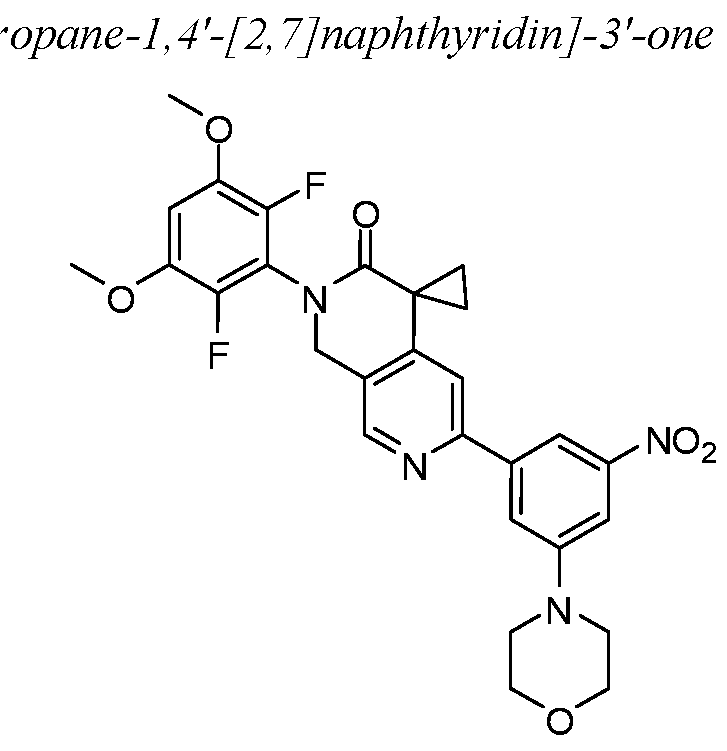
[0205] A stirred mixture of 4-(3-iodo-5-nitrophenyl)morpholine (0.0674 g, 0.202 mmol) , 4,4,5,5,4',4',5',5'-octamethyl-[2,2']bi[[l,3,2]dioxaborolanyl] (0.0563 g, 0.222 mmol), [1,1'-
bis(diphenylphosphino)ferrocene]dichloropalladium(II),complex with dichloromethane (1 : 1) (16 mg, 0.019 mmol) and potassium acetate (0.0565 g, 0.576 mmol) in 1,4-dioxane (2.0 mL mmol) was heated at 110°C for 2 hours. The reaction was then cooled to room temperature. 6'-chloro-2'-(2,6-difluoro-3,5-dimethoxyphenyl)- ,2'-dihydro-3'H-spiro[cyclopropane-l,4'- [2,7]naphthyridin]-3'-one (prepared as in Example 1, Step 6, 0.077 g, 0.20 mmol), sodium carbonate (0.043 g, 0.40 mmol), water (0.5 mL) and another portion of [Ι,Γ- bis(diphenylphosphino)ferrocene]dichloropalladium(II),complex with dichloromethane (1 : 1) (16 mg, 0.019 mmol) were added. The resulted mixture was heated at 110°C for additional 2 hours. The reaction was quenched with saturated aqueous NH4CI, extracted with DCM. The organic layers were combined, dried over Na2S04, filtered, and concentrated to give crude product. LC-MS calculated for C28H27F2N4O6 [M+H]+ m/z: 553.2; found: 553.2.
Step 3: 6'-(3-amino-5-morpholinophenyl)-2'-(2, 6-difluoro-3,5-dimethoxyphenyl)-l Ή- spiro [cyclopropane- 1 ,4'- [2, 7]naphthyridin] -3'(2'H)-one

[0206] To a stirred solution of crude 2'-(2,6-difluoro-3,5-dimethoxyphenyl)-6'-(3-morpholin- 4-yl-5-nitrophenyl)- ,2'-dihydro-3'H-spiro[cyclopropane-l,4'-[2,7]naphthyridin]-3'-one in methanol (3.0 mL), iron (0.056 g, 1.0 mmol) and 3 drops of concentrated HC1 were added sequentially. The resulted mixture was heated at 65 °C. After 30 minutes, the reaction was diluted with DCM, filtered and the filtrate was concentrated to give crude product as its HC1 salt, which is used directly in the next step without further purification. LC-MS calculated for C28H29F2N4O4 [M+H]+ m/z: 523.2; found: 523.2.
Step 4: N-{ 3-[ 2'-(2, 6-difluoro-3, 5-dimethoxyphenyl)-3 '-oxo-2 ' 3 '-dihydro-1 Ή- spirof cycloprop ne-1, 4 '-[ 2, 7Jnaphthyridin ]-6'-yl ]-5-morpholin-4-ylphenyl}acrylamide
[0207] To a stirred solution of 6'-(3-amino-5-morpholinophenyl)-2'-(2,6-difluoro-3,5- dimethoxyphenyl)- H-spiro[cyclopropane-l,4'-[2,7]naphthyridin]-3'(2'H)-one (10.0 mg,
0.0192 mmol) in methylene chloride (2.0 mL), triethylamine (7.8 μί, 0.056 mmol) and 2- propenoyl chloride (2.0 μί, 0.025 mmol) were added sequentially at room temperature. After 5 minutes, the reaction was quenched with MeOH. The volatiles were removed and the residue was purified on prep-HPLC (pH = 2, acetonitrile/water+TFA) to give the desired product as its TFA salt. LC-MS calculated for C31H31F2N4O5 [M+H]+ m/z: 577.2; found: 577.2.
Example 11
N-[3-[2'-(2,6-difluoro-3,5-dimethoxyphenyl)-3'-oxo-2',3'-dihydro-l'H- spiro[cyclopropane-l,4'-[2,7]naphthyridin]-6'-yl]-5-(morpholin-4- ylmethyl)phenyl] acrylamide

[0208] This compound was prepared using procedures analogous to those for Example 10, Step 2, with (3-bromo-5-nitrophenyl)methanol replacing 4-(3-iodo-5-nitrophenyl)morpholine. LC-MS calculated for C25H22F2N3O6 [M+H]+ m/z: 498.2; found: 498.2.
Step 2: 2'-(2, 6-difluoro-3, 5-dimethoxyphenyl)-6'-[3-(morpholin-4-ylmethyl)-5-nitrophenylJ- 1 ' 2 '-dihydro-3 Ή-spirof cyclopropane-1, 4 '-[ 2, 7]naphthyridin ]-3 '-one

[0209] To a stirred solution of 2'-(2,6-difluoro-3,5-dimethoxyphenyl)-6'-[3-(hydroxymethyl)- 5-nitrophenyl]- ,2'-dihydro-3'H-spiro[cyclopropane-l,4'-[2,7]naphthyridin]-3'-one (100.0 mg, 0.2010 mmol) in methylene chloride (5.0. mL), N,N-diisopropylethylamine (100 μί, 0.60 mmol) and methanesulfonyl chloride (19 μΐ., 0.24 mmol) were added at room temperature. After 2 hours, morpholine (35 μί, 0.40 mmol) and cesium carbonate (130 mg, 0.40 mmol) were added sequentially. The resulted mixture was stirred at room temperature overnight. The reaction was quenched with saturated aqueous NH4CI, extracted with DCM. The organic layers were combined, dried over Na2S04, filtered and concentrated. The residue was purified by chromatography on silica gel, eluting with 0-30% EtOAc/DCM, to give the desired product (80 mg). LC-MS calculated for C29H29F2N4O6 [M+H]+ m/z: 567.2; found: 567.2.
Step 3: N-[ 3-[ 2 '-( 2, 6-difluoro-3, 5-dimethoxyphenyl)-3 '-oxo-2 ' 3 '-dihydro-1 Ή- spiro[cyclopropane-l , 4'-[2, 7]naphthyridin ]-6'-yl]-5-(morpholin-4- ylmethyljphenyl Jacrylamide
[0210] The titled compound was prepared using procedures analogous to those for Example 10, Step 3 to 4, with 2'-(2,6-difluoro-3,5-dimethoxyphenyl)-6'-[3-(mo holin-4-ylmethyl)-5- nitrophenyl]- ,2'-dihydro-3'H-spiro[cyclopropane-l,4'-[2,7]naphthyridin]-3'-one replacing 2'- (2,6-difluoro-3,5-dimethoxyphenyl)-6'-(3-morpholin-4-yl-5-nitrophenyl)- ,2'-dihydro-3'H- spiro[cyclopropane-l ,4'-[2,7]naphthyridin]-3'-one in Step 3. LC-MS calculated for
C32H33F2N4O5 [M+H]+ m/z: 591.2; found: 591.2.
Example 12
N-(5-(2'-(2,6-difluoro-3,5-dimethoxyphenyl)-3'-oxo-2',3'-dihydro-l'H- spiro [cyclopropane- 1,4'- [2,7] naphthyridine] -6'-yl)-2- (morpholinomethyl)phenyl)acrylamide
Step 1. 2-amino-4-(2'-(2, 6-difluoro-3,
 Ή- spirof cycloprop ne-1, 4 '-[ 2, 7]naphthyridine ]-6'-yl)benzaldehyde

[0211] The titled compound was prepared using procedures analogous to those tor Example 10, Step 2, with 2-amino-4-bromobenzaldehyde replacing 4-(3-iodo-5- nitrophenyl)morpholine. LC-MS calculated for C25H22F2N3O4 [M+H]+ m/z: 466.2; found: 466.2.
Step 2: N-(5-( 2 '-( 2, 6-difluoro-3, 5-dimethoxyphenyl)-3 '-oxo-2 ', 3 '-dihydro-1 Ή- spirof cyclopropane-1 , 4 '-[ 2, 7Jnaphthyridine ]-6'-yl)-2-formylphenyl)acrylamide

[0212] The titled compound was prepared using procedures analogous to those for Example 10, Step 4, with 2-arnino-4-(2'-(2,6-difluoro-3,5-dimethoxyphenyl)-3'-oxo-2',3'-dihydro-rH- spiro[cyclopropane-l,4'-[2,7]naphthyridine]-6'-yl)benzaldehyde replacing 6'-(3-amino-5-
morpholinophenyl)-2'-(2,6-difluoro-3,5-dimethoxyphenyl)- H-spiro[cyclopropane-l,4'- [2,7]naphthyridin]-3'(2'H)-one. The titled compound was isolated as the TFA salt. LC-MS calculated for C28H24F2N3O5 [M+H]+ m/z: 520.2; found: 520.2.
Step 3: N-(5-( 2 '-( 2, 6-difluoro-3, 5-dimethoxyphenyl)-3 '-oxo-2 ', 3 '-dihydro-1 Ή- spiro[cyclopropane-l, 4'-[2 JnaphthyridineJ-6'-yl)-2-(morpholinomethyl)phenyl)acrylamide
[0213] To a stirred solution of N-{5-[2'-(2,6-difluoro-3,5-dimethoxyphenyl)-3'-oxo-2',3'- dihydro-lΉ-spiro[cyclopropane-l,4'-[2,7]naphthyridin]-6'-yl]-2-formylphenyl}acrylamide (10.0 mg, 0.0192 mmol) and morpholine (3.4 xL, 0.038 mmol) in methylene chloride (2.0 mL), acetic acid (0.0864 mL, 1.52 mmol) was added at room temperature. After 15 minutes, sodium triacetoxyborohydride (8.16 mg, 0.0385 mmol) was added. After another 1 hour, the volatiles were removed under reduced pressure and the residue was purified on prep-HPLC (pH = 2, acetonitrile/water+TFA) to give the desired product as its TFA salt. LC-MS calculated for C32H33F2N4O5 [M+H]+ m/z: 591.2; found: 591.2.
Example 13
N-(5-(2'-(2,6-difluoro-3,5-dimethoxyphenyl)-3'-oxo-2',3'-dihydro-l'H- spiro [cyclopropane- 1,4'- [2,7] naphthyridine] -6'-yl)-2- (hydroxymethyl)phenyl)

[0214] The titled compound was isolated under the same conditions as in Example 12, Step 3. LC-MS calculated for C28H26F2N3O5 [M+H]+ m/z: 522.2; found: 522.2.
Example 14
N-(5-(2'-(2,6-difluoro-3,5-dimethoxyphenyl)-3'-oxo-2',3'-dihydro-l'H- spiro [cyclopropane- 1,4'- [2,7]naphthyridine] -6'-yl)- lH-pyrazol-4-yl)acrylamide

Step 1: 2'-(2, 6-difluoro-3,5-dimethoxyphenyl)-6'-(4-nitro-l-((2- (trimethylsilyl)ethoxy)methyl)-lH-pyrazol-5-yl)-l 'H-spiro[cyclopropane-l,4'- [2, 7]naphthyridin] -3'(2'H)-one

[0215] 6'-chloro-2'-(2,6-difluoro-3,5-dimethoxyphenyl)-r,2'-dihydro-3'H- spiro[cyclopropane-l,4'-[2,7]naphthyridin]-3'-one (prepared as in Example 1, Step 6, 444 mg, 1.17 mmol), 4-nitro-l-{[2-(trimethylsilyl)ethoxy]methyl}-lH-pyrazole (355 mg, 1.46 mmol), palladium acetate (26 mg, 0.12 mmol), trimethylacetic acid (29.8 mg, 0.292 mmol), potassium carbonate (484 mg, 3.50 mmol) and di-l-adamantyl(butyl)phosphine (63 mg, 0.17 mmol) were mixed in DMF. The mixture was heated at 120 °C for 2 hours. The crude was diluted with DCM, and filtered through Celite. The filtrate was concentrated. The residue was purified by chromatography on silica gel eluting with 40-60% EtOAc/Hexanes, to give the desired coupling product (485 mg, 71% yield). LC-MS calculated for
C27H32F2N5O6S1 [M+H]+ m/z: 588.2; found: 588.2.
Step 2: 6'-(4-amino-l-((2-(trimethylsilyl)ethoxy)methyl)-lH-pyrazol-5-yl)-2'-(2, 6-difluoro- 3, 5-dimethoxyphenyl)-l Ή-spirof cyclopropane-1, 4 '-[ 2, 7]naphthyridin ]-3 '(2'H)-one

[0216] 2'-(2,6-difluoro-3,5-dimethoxyphenyl)-6'-(4-nitro-l-((2- (trimethylsilyl)ethoxy)methyl)-lH-pyrazol-5-yl)- H-spiro[cyclopropane-l,4'- [2,7]naphthyridin]-3'(2'H)-one (42.2 mg, 0.0718 mmol) and iron (38.5 mg, 0.690 mmol) were mixed together in acetic acid (327 μί, 5.74 mmol). The mixture was stirred at room temperature for 1 hour. The mixture was diluted with EtOAc and neutralized with Na2CCb solution. The mixture was extracted with EtOAc. The combined organic layers were dried, filtered and concentrated. The residue was purified by chromatography on silica gel to give the product 34.6 mg (86% yield). LC-MS calculated for C27H34F2N5O4S1 [M+H]+ m/z: 558.2; found: 558.2.
Step 3: N-(5-( 2 '-( 2, 6-difluoro-3, 5-dimethoxyphenyl)-3 '-oxo-2 ', 3 '-dihydro-1 Ή- spiro[cyclopropane-l, 4'-[2 JnaphthyridineJ-6'-yl)-l-((2-(trimethylsilyl)ethoxy)methyl)-lH- pyrazol-4-yl)acrylamide

[0217] 2-Propenoyl chloride (6.53 μί, 0.0804 mmol) was added to the solution of 6'-(4- amino-l-((2-(trimethylsilyl)ethoxy)methyl)-lH-pyrazol-5-yl)-2'-(2,6-difluoro-3,5- dimethoxyphenyl)- H-spiro[cyclopropane-l,4'-[2,7]naphthyridin]-3'(2'H)-one (34.5 mg, 0.0619 mmol) and triethylamine (19.8 \L, 0.142 mmol) in DCM. The mixture was stirred at room temperature overnight. The crude was concentrated. The residue was purified by chromatography on silica gel, eluting with 50-65% EtOAc/Hexanes, to give the amide 24.6 mg (65% yield). LC-MS calculated for C30H36F2N5O5S1 [M+H]+ m/z: 612.2; found: 612.2.
Step 4: N-(5-( 2 '-( 2, 6-difluoro-3, 5-dimethoxyphenyl)-3 '-oxo-2 ', 3 '-dihydro-1 Ή- spiro[cyclopropane-l,4'-[2 ]naphthyridine]-6'-yl)-lH-pyrazol-4-yl)acrylamide
[0218] Trifluoroacetic Acid (62.0 μΙ_, 0.804 mmol) was added to the solution of N-(5-[2'-
(2,6-difluoro-3,5-dimethoxyphenyl)-3'-oxo-2',3'-dihydro- H-spiro[cyclopropane-l,4'-
[2 ]naphthyridin]-6'-yl]-l-{[2-(trimethylsilyl)ethoxy]methyl}-lH-pyrazol-4-yl)acrylamide
(24.6 mg, 0.0402 mmol) in DCM. The mixture was stirred at room temperature for 15 hours.
The crude mixture was concentrated under vacuum to remove solvent and excess TFA, and then purified on prep-HPLC (pH = 2, acetonitrile/water+TFA) to give the desired product as its TFA salt. LC-MS calculated for C24H22F2N5O4 [M+H]+ m/z: 482.2; found: 482.1.
Example 15
^-(5-(2'-(2,6-difluoro-3,5-dimethoxyphenyl)-3'-oxo-2',3'-dihydro-l'H- spiro [cyclopropane- 1,4'- [2,7]naphthyridine] -6'-yl)- l-(2-methoxyethyl)- lH-pyrazol-4- yl)acrylamide
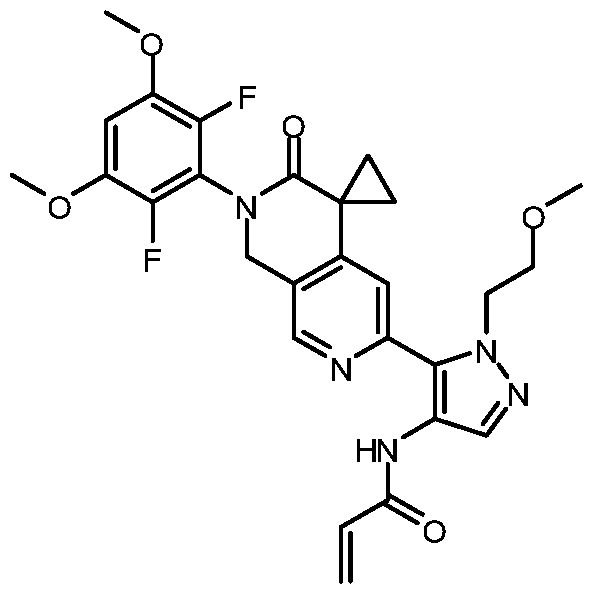
Step 1: 2'-(2, 6-difluoro-3,5-dimethoxyphenyl)-6'-(4-nitro-lH-pyrazol-5-yl)-l Ή- spirof cycloprop ne-1, 4 '-[ 2, 7]naphthyridin ]-3 '( 2 'H)-one

[0219] 4.0 M hydrogen chloride in dioxane (3.05 mL, 12.2 mmol) was added to the solution of 2'-(2,6-difluoro-3,5-dimethoxyphenyl)-6'-(4-nitro-l-{[2-(trimethylsilyl)ethoxy]methyl}- lH-pyrazol-5-yl)- ,2'-dihydro-3'H-spiro[cyclopropane-l,4'-[2,7]naphthyridin]-3'-one
(prepared as in Example 14, Step 1, 0.900 g, 1.52 mmol) in methanol (3.09 mL). The mixture was stirred at room temperature for 15 hours. The crude was neutralized by saturated aqueous NaHCC . The mixture was extracted with DCM. Some insoluble solid was filtered to give the pure product. The organic phase was dried over Na2S04, filtered and concentrated to give more desired product (658 mg combined, 94% yield). LC-MS calculated for C21H18F2N5O5 [M+H]+ m/z: 458.2; found: 458.2.
Step 2: 2'-(2, 6-difluoro-3,5-dimethoxyphenyl)-6'-(l-(2-methoxyethyl)-4-nitro-lH-pyrazol-5- yl)-l 'H-spiro[cyclopropane-l, 4'-[2, 7]naphthyridin] -3'(2'H)-one

[0220] Triphenylphosphine (18.5 mg, 0.0704 mmol) was added to the solution of 2'-(2,6- difluoro-3,5-dimethoxyphenyl)-6'-(4-nitro-lH-pyrazol-5-yl)- ,2'-dihydro-3'H- spiro[cyclopropane-l,4'-[2,7]naphthyridin]-3'-one (23.0 mg, 0.0503 mmol) and 2- methoxyethanol (5.15 \L, 0.0654 mmol) in THF. The mixture was cooled to 0 °C, and then diisopropyl azodicarboxylate (13.9 μί, 0.0704 mmol) was added. The reaction was stirred at room temperature overnight. The crude was concentrated. The residue was purified by chromatography on silica gel, eluting with 55-85% EtOAc/Hexanes, to give the product 18.0 mg. LC-MS calculated for C24H24F2N5O6 [M+H]+ m/z: 516.2; found: 516.2.
Step 3: 6'-(4-amino-l-(2-methoxyethyl)-lH-pyrazol-5-yl)-2'-(2, 6-difluoro-3,5- dimethoxyphenyl)-! Ή-spirof cyclopropane-1 , 4'-[ 2, 7]naphthyridin ]-3 '(2'H)-one

NaHCCb and then filtered through Celite. The filtrate was extracted with DCM. The combined organic layers were dried over Na2S04, filtered and concentrated. The residue was directly used for the next step. LC-MS calculated for C24H26F2N5O4 [M+H]+ m/z: 486.2; found 486.2.
Step 4: N-(5-( 2 '-( 2, 6-difluoro-3, 5-dimethoxyphenyl)-3 '-oxo-2 ', 3 '-dihydro-1 Ή- spiro[cyclopropane-l, 4'-[2 ]naphthyridine]-6'-yl)-l-(2-methoxyethyl)-lH-pyrazol-4- yljacrylamide
[0222] 2-propenoyl chloride (2.0 μί, 0.025 mmol) was added dropwise to the solution of 6'- [4-amino-l-(2-methoxyethyl)-lH-pyrazol-5-yl]-2'-(2,6-difluoro-3,5-dimethoxyphenyl)- ,2'- dihydro-3'H-spiro[cyclopropane-l,4'-[2,7]naphthyridin]-3'-one (11.1 mg, 0.0229 mmol) and triethylamine (7.33 μί, 0.0526 mmol) in DCM at 0°C. The mixture was stirred at room temperature for 30 minutes. The volatiles were removed under reduced pressure. The residue was diluted with MeOH and purified on prep-HPLC (pH = 2, acetonitrile/water+TFA) to give the desired product as its TFA salt. LC-MS calculated for C27H28F2N5O5 [M+H]+ m/z: 540.2; found: 540.2. ¾ NMR (400 MHz, DMSO) δ 9.60 (s, 1H), 8.58 (s, 1H), 7.83 (s, 1H), 7.16 (s, 1H), 7.10 (t, J = 8.2 Hz, 1H), 6.43 (dd, J = 17.0, 10.2 Hz, 1H), 6.21 (dd, J = 17.1, 1.9 Hz, 1H), 5.72 (dd, J = 10.2, 2.0 Hz, 1H), 5.05 (s, 2H), 4.46 (t, J = 5.5 Hz, 2H), 3.92 (s, 6H), 3.65 (t, J = 5.6 Hz, 2H), 3.13 (s, 3H), 1.79 (dd, J = 3.9, 3.9 Hz, 2H), 1.50 (dd, J = 3.9, 3.9 Hz, 2H)
Scheme 4

Table 5. The compounds in Table 5 were prepared in accordance with the synthetic protocols set forth in Scheme 4 and Example 15, using the appropriate starting materials.

 ¾ NMR (600 MHz, DMSO)
5 9.78 (s, 1H), 8.65 (d, J =
4.4 Hz, 2H), 8.49 (s, 1H),
7.97 (s, 1H), 7.34 (d, J = 5.4
Hz, 2H), 7.13 - 7.07 (m, 2H),
6.47 (dd, J= 17.0, 10.2 Hz,
1H), 6.25 (dd, J = 17.0, 1.9
Hz, 1H), 5.76 (m, 3H), 5.00
(s, 2H), 3.91 (s, 6H), 1.77
(dd, J= 3.8, 3.8 Hz, 2H),
1.46 (dd, J= 4.0, 4.0 Hz, 2H)
N-(5-(2'-(2,6-difluoro-3,5- 573.2 dimethoxyphenyl)-3'-oxo-2',3'- dihydro-l'H- spiro[cyclopropane-l,4'-
[2,7]naphthy ridine] -6'-y 1)- 1 -
(pyridin-3 -y lmethy 1)-1H- pyrazol-4-yl)acrylamide HN x>
N-(5-(2'-(2,6-difluoro-3,5- 577.2 dimethoxyphenyl)-3'-oxo-2',3'- dihydro-l'H- spiro[cyclopropane-l,4'- [2,7]naphthy ridine] -6'-y 1)- 1 - (( 1 -methyl- 1H- 1 ,2,4-triazol-3 - yl)methyl)-lH-pyrazol-4- HN JL?N
yl)acrylamide
N-(5-(2'-(2,6-difluoro-3,5- 580.2 dimethoxyphenyl)-3'-oxo-2',3'- dihydro-l'H- spiro[cyclopropane-l,4'-
[2,7]naphthy ridine] -6'-y 1)- 1 -
((tetrahydro-2H-pyran-4- yl)methyl)-lH-pyrazol-4- HN
yl)acrylamide
N-(5-(2'-(2,6-difluoro-3,5- 563.2 dimethoxyphenyl)-3'-oxo-2',3'- dihydro-l'H- spiro[cyclopropane-l,4'-
[2,7]naphthy ridine] -6'-y 1)- 1 -
(isoxazol-3-y lmethy 1)-1H- pyrazol-4-yl)acrylamide HN

yl)acrylamide

yl)acrylamide
Example 32
^-(3-(2'-(2,6-difluoro-3,5-dimethoxyphenyl)-3'-oxo-2',3'-dihydro-l'H- spiro [cyclopropane- 1,4'- [2,7]naphthyridine] -6'-yl)- l-(2-methoxyethyl)- lH-pyrazol-4- yl)acrylamide

[0223] Cesium carbonate (10.4 mg, 0.0320 mmol) was added to the solution of N-{5-[2'-(2,6- difluoro-3,5-dimethoxyphenyl)-3'-oxo-2',3'-dihydro- H-spiro[cyclopropane-l,4'- [2,7]naphthyridin]-6'-yl]-lH-pyrazol-4-yl} acrylarnide (7.7 mg, 0.016 mmol) and l-bromo-2- methoxyethane (3.78 μί, 0.0400 mmol) in DMF (1.0 mL). The resulted mixture was stirred at 40°C for 2 hours. The reaction was diluted with DCM, filtered, and the filtrate was concentrated under reduced pressure. The residue was diluted with MeOH and purified on prep-HPLC (pH = 2, acetonitrile/water+TFA) to give the desired product as its TFA salt. LC- MS calculated for C27H28F2N5O5 [M+H]+ m/z: 540.2; found: 540.2.
Example 33
^-(3-(2'-(2,6-difluoro-3,5-dimethoxyphenyl)-3'-oxo-2',3'-dihydro-l'H- spiro [cyclopropane- 1,4'- [2,7]naphthyridine] -6'-yl)- l-(2-(trifluoromethoxy)ethyl)- 1H- pyrazol-4-yl)acrylamide

[0224] Cesium carbonate (9.4 mg, 0.0291 mmol) was added to the solution of N- {5-[2'-(2,6- difluoro-3,5-dimethoxyphenyl)-3'-oxo-2',3'-dihydro- H-spiro[cyclopropane-l,4'- [2,7]naphthyridin]-6'-yl]-lH-pyrazol-4-yl} acrylarnide (7.0 mg, 0.014 mmol) and l-bromo-2- (trifluoromethoxy)ethane (7.0 mg, 0.0363 mmol) in DMF (1.0 mL). The resulted mixture was stirred at 40°C for 2 hours. The reaction was diluted with DCM, filtered, and the filtrate was concentrated under reduced pressure. The residue was diluted with MeOH and purified on prep-HPLC (pH = 2, acetonitrile/water+TFA) to give the desired product as its TFA salt. LC- MS calculated for C27H25F5N5O5 [M+H]+ m/z: 594.2; found: 594.2. ¾ NMR (600 MHz, DMSO) δ 10.82 (s, 1H), 8.55 (s, 1H), 8.46 (s, 1H), 7.41 (s, 1H), 7.10 (t, J = 8.2 Hz, 1H), 6.57 (dd, J = 17.0, 10.3 Hz, 1H), 6.25 (dd, J = 17.0, 1.4 Hz, 1H), 5.79 (dd, J = 10.3, 1.4 Hz, 1H), 5.03 (s, 2H), 4.65 - 4.40 (m, 4H), 3.92 (s, 6H), 1.89 - 1.68 (m, 2H), 1.56 (q, J = 4.2 Hz, 2H).
Example 34
^-(3-(2'-(2,6-difluoro-3,5-dimethoxyphenyl)-3'-oxo-2',3'-dihydro-l'H- spiro[cyclopropane-l,4'-[2,7]naphthyridine]-6'-yl)-l-(2-morpholinoethyl)-lH-pyrazol-4- yl)acrylamide

[0225] Cesium carbonate (14.2 mg, 0.0436 mmol) was added to the solution of N-{5-[2'-(2,6- difluoro-3,5-dimethoxyphenyl)-3'-oxo-2',3'-dihydro- H-spiro[cyclopropane-l,4'- [2,7]naphthyridin]-6'-yl]-lH-pyrazol-4-yl} acrylamide (6.0 mg, 0.012 mmol) and 4-(2-
bromoethyl)morpholine hydrochloride (5.7 mg, 0.0249 mmol) in DMF (1.0 mL). The resulted mixture was stirred at 40°C for 2 hours. The reaction was diluted with DCM, filtered, and the filtrate was concentrated under reduced pressure. The residue was diluted with MeOH and purified on prep-HPLC (pH = 2, acetonitrile/water+TFA) to give the desired product as its TFA salt. LC-MS calculated for C30H33F2N6O5 [M+H]+ m/z: 595.2; found: 595.2.
Example 35
^-(3-(2'-(2,6-difluoro-3,5-dimethoxyphenyl)-3'-oxo-2',3'-dihydro-l'H- spiro[cyclopropane-l,4'-[2,7]naphthyridine]-6'-yl)-l-((tetrahydro-2H-pyran-4- yl)methyl)-lH-pyrazol-4-yl)

[0226] Cesium Carbonate (8.1 mg, 0.0249 mmol) was added to the solution of N-{5-[2'-(2,6- difluoro-3,5-dimethoxyphenyl)-3'-oxo-2',3'-dihydro- H-spiro[cyclopropane-l,4'- [2,7]naphthyridin]-6'-yl]-lH-pyrazol-4-yl}acrylamide (6.0 mg, 0.012 mmol) and 4- (bromomethyl)tetrahydro-2H-pyran (4.5 mg, 0.0249 mmol) in DMF (1.0 mL). The resulted mixture was stirred at 40°C for 2 hours. The reaction was diluted with DCM, filtered, and the filtrate was concentrated under reduced pressure. The residue was diluted with MeOH and purified on prep-HPLC (pH = 2, acetonitrile/water+TFA) to give the desired product as its TFA salt. LC-MS calculated for C30H32F2N5O5 [M+H]+ m/z: 580.2; found: 580.2.
Example 36
A/-(3-(2'-(2,6-difluoro-3,5-dimethoxyphenyl)-3'-oxo-2',3'-dihydro-l'H- spiro[cyclopropane-l,4'-[2,7]naphthyridine]-6'-yl)-l-(2-(dimethylamino)-2-oxoethyl)- lH-pyrazol-4-yl)acrylamide

[0227] Cesium carbonate (9.7 mg, 0.0299 mmol) was added to the solution of N-{5-[2'-(2,6- difluoro-3,5-dimethoxyphenyl)-3'-oxo-2',3'-dihydro- H-spiro[cyclopropane-l,4'- [2,7]naphthyridin]-6'-yl]-lH-pyrazol-4-yl}acrylamide (7.2 mg, 0.015 mmol) and 2-chloro- Ν,Ν-dimethylacetamide (3.8 μΐ^, 0.0374 mmol) in DMF (1.0 mL). The resulted mixture was stirred at 40°C for 2 hours. The reaction was diluted with DCM, filtered, and the filtrate was concentrated under reduced pressure. The residue was diluted with MeOH and purified on prep-HPLC (pH = 2, acetonitrile/water+TFA) to give the desired product as its TFA salt. LC- MS calculated for C28H29F2N6O5 [M+H]+ m/z: 567.2; found: 567.2.
Example 37
N-(3-(6'-(2,6-difluoro-3,5-dimethoxyphenyl)-7'-oxo-6',7'-dihydro-5'H- spiro[cyclopropane-l,8'-pyrido[4,3-d]pyrimidine]-2'-yl)-4-methylphenyl)acrylamide

Step 1: 2,4-dichloro-5-(chloromethyl)pyrimidine

[0228] To a stirred solution of 5-(hydroxymethyl)uracil (5.0 g, 35 mmol) in phosphoryl chloride (25 mL, 270 mmol) and toluene (6.0 mL), N,N-diisopropylethylamine (26 mL, 150 mmol) was added dropwise at room temperature. The resulting solution was heated at 110 °C overnight. After being cooled to room temperature, the reaction mixture was concentrated
under reduced pressure, diluted with IN HC1 (100 mL) and water (200 mL), and was extracted with DCM. The organic layers were combined, dried over Na2S04, filtered and concentrated. The residue was purified on silica gel (eluting with 0-40% EtOAc in DCM) to give 6.4 g of the desired product. LCMS calculated for C5H4CI3N2 [M+H]+ m/z: 196.9;
Found: 197.0.
Step 2: 2,4-dichloro-5-(iodomethyl)pyrimidine

[0229] To a stirred solution of 2,4-dichloro-5-(chloromethyl)pyrimidine (1.50 g, 7.60 mmol) in acetone (10 mL), sodium iodide (1.20 g, 7.98 mmol) was added at room
temperature. After stirring for 5 hours, the reaction mixture was filtered and the solid was washed with acetone. The filtrate and washed solution were combined and concentrated. The residue was purified on silica gel (eluting with 0-40% EtOAc in hexanes) to give 1.5 g of the desired product. LCMS calculated for C5H4CI2IN2 [M+H]+ m/z: 288.9; Found: 288.8.
Step 3: N-[ ( 2, 4-dichloropyrimidin-5-yl)methyl ]-2, 6-difluoro-3, 5 -dimethoxy aniline

[0230] A mixture of 2,4-dichloro-5-(iodomethyl)pyrimidine (1.50 g, 5.19 mmol), 2,6- difluoro-3,5-dimethoxyaniline (1.08 g, 5.71 mmol) in N,N-diisopropylethylamine (4 mL) was stirred at 80 °C for 2 hours. After being cooled to room temperature, the reaction mixture was concentrated under reduced pressure. The residue was purified on silica gel (eluting with 0- 40% EtOAc in DCM) to give 1.70 g of the desired product. LCMS calculated for
C13H12CI2F2N3O2 [M+H]+ m/z: 350.0; Found: 350.0.
Step 4: ethyl 3-(((2,4-dichloropyrimidin-5-yl)methyl)(2, 6-difluoro-3,5- dimethoxyphenyl)amino)-3-oxopropanoate

[0231] The title compound was prepared using procedures analogous to those described for Example 1, Step 3, with N-[(2,4-dichloropyrimidin-5-yl)methyl]-2,6-difluoro-3,5- dimethoxyaniline replacing N-[(4,6-dichloropyridin-3-yl)methyl]-2,6-difluoro-3,5- dimethoxyaniline. LCMS calculated C18H18CI2F2N3O5 [M+H]+ m/z: 464.1 ; Found: 464.0.
Step 5: ethyl 2-chloro-6-(2, 6-difluoro-3,5-dimethoxyphenyl)-7-oxo-5, 6, 7, 8- tetrahydropyridof 4, 3-d]pyrimidi -8-carboxylate

[0232] A mixture of ethyl 3-[[(2,4-dichloropyrimidin-5-yl)methyl](2,6-difluoro-3,5- dimethoxyphenyl)amino]-3-oxopropanoate (1.2 g, 2.6 mmol) and 2-(tert-butylimino)-N,N- diethyl-l,3-dimethyl-l ,3,2 (5)-diazaphosphinan-2-amine (1.5 mL, 5.17 mmol) in methylene chloride (6 mL) was stirred at room temperature for 2 hours. The reaction mixture was concentrated under reduced pressure and the residue was purified on silica gel (eluting with 0-40% EtOAc in DCM) to give 0.88 g of the desired product. LCMS calculated for C18H17CIF2N3O5 [M+H]+ m/z: 428.1 ; Found: 428.0.
Step 6: 2-chloro-6-(2, 6-difluoro-3, 5-dimethoxyphenyl)-5, 8-dihydropyrido [ 4, 3-dJpyrimidin- 7(6H)-one

Step 7: 2'-chloro-6'-(2, 6-difluoro-3, 5-dimethoxyphenyl)-5', 6'-dihydro-7'H- spirof cyclopropane- 1 , 8'-pyrido [ 4, 3-dJpyrimidin J -7 '-one

[0234] The title compound was prepared using procedures analogous to those described for Example 1, Step 6, with 2-chloro-6-(2,6-difluoro-3,5-dimethoxyphenyl)-5,8- dihydropyrido[4,3-d]pyrimidin-7(6H)-one replacing 6-chloro-2-(2,6-difluoro-3,5- dimethoxyphenyl)-l ,4-dihydro-2,7-naphthyridin-3(2H)-one. LCMS calculated
C17H15CIF2N3O3 [M+H]+ m/z: 382.1 ; Found: 382.0.
Step 8: N-(3-(6'-(2, 6-difluoro-3, 5-dimethoxyphenyl)-7'-oxo-6', 7'-dihydro-5'H- spirof cyclopropane- 1 , 8'-pyrido [ 4, 3-dJpyrimidine ]-2 '-yl)-4-methylphenyl)acrylamide
[0235] The titled compound was prepared using procedures analogous to those for Example 1, Steps 7 to 8, with 2'-chloro-6'-(2, 6-difluoro-3,5-dimethoxyphenyl)-5', 6'-dihydro-7'H- spiro[cyclopropane-l, 8'-pyrido[4, 3-d]pyrimidin]-7'-one (Step 7) replacing 6'-chloro-2'-(2, 6- difluoro-3, 5-dimethoxyphenyl)-l ', 2 '-dihydro-3 Ή-spirof cyclopropane-1, 4 '- [2, 7]naphthyridin]-3 '-one and 4-methyl-3-(4, 4, 5,5-tetramethyl-l, 3,2-dioxaborolan-2- yljaniline replacing (3-aminophenyl)boronic acid in Step 7. LCMS calculated for
C27H25F2N4O4 [M+H]+ m/z: 507.2; Found: 507.2.
Example A
FGFR Enzymatic Assay
[0236] The inhibitor potency of the exemplified compounds was measured in an enzyme assay that measures peptide phosphorylation using FRET measurements to detect product formation. Inhibitors were serially diluted in DMSO and a volume of 0.5 was transferred
to the wells of a 384-well plate. For FGFR3, a 10 volume of FGFR3 enzyme (Millipore) diluted in assay buffer (50 mM HEPES, 10 mM MgCh, 1 mM EGTA, 0.01% Tween-20, 5 mM DTT, pH 7.5) was added to the plate and pre-incubated for a time between 5-10 minutes and up to 4 hours. Appropriate controls (enzyme blank and enzyme with no inhibitor) were included on the plate. The assay was initiated by the addition of a 10 solution containing biotinylated EQEDEPEGDYFEWLE peptide substrate (SEQ ID NO: 1) and ATP (final concentrations of 500 nM and 140 μΜ respectively) in assay buffer to the wells. The plate was incubated at 25 °C for 1 hr. The reactions were ended with the addition of 10 μΕΛ βΙΙ of quench solution (50 mM Tris, 150 mM NaCl, 0.5 mg/mL BSA, pH 7.8; 30 mM EDTA with Perkin Elmer Lance Reagents at 3.75 nM Eu-antibody PY20 and 180 nM APC-Streptavidin). The plate was allowed to equilibrate for ~1 hr before scanning the wells on a PheraStar plate reader (BMG Labtech).
[0237] FGFR1, FGFR2, and FGFR4 are measured under equivalent conditions with the following changes in enzyme and ATP concentrations: FGFR1, 0.02 nM and 210 uM respectively, FGFR2, 0.01 nM and 100 uM, respectively, and FGFR4, 0.04 nM and 600 uM respectively. The enzymes were purchased from Millipore or Invitrogen.
[0238] GraphPad prism3 was used to analyze the data. The IC50 values were derived by fitting the data to the equation for a sigmoidal dose-response with a variable slope.
Y=Bottom + (Top-Bottom)/(l+10A((LogIC5o-X)*HillSlope)) where X is the logarithm of concentration and Y is the response. Compounds having an IC50 of 1 μΜ or less are considered active.
[0239] The compounds of the invention were found to be selective inhibitors of FGFR4 according to the FGFR Enzymatic Assay. Compouds of Formula (I) and all the compounds as described herein have been tested and exhibit an IC50 of less than 1 μΜ.
[0240] Table 1 provides IC50 data for compounds of the invention assayed in the FGFR Enzymatic Assay after dilution in assay buffer, added to the plate and pre-incubated for 4 hours. The symbol: "+" indicates an IC50 less than 10 nM; "++" indicates an IC50 greater than or equal to 10 nM but less than 30 nM; "+++" indicates an IC50 greater than or equal to 30 nM but less than 200 nM; and "++++" indicates an IC50 greater than or equal to 200 nM. Table 2 provides IC50 ratios showing FGFR4 selectivity.
Table 1

+++ +++ ++ +
++++ ++++ ++++ +
+++ +++ +++ +
++ + ++ +
++++ ++++ ++++ +
++++ ++++ ++++ +
++++ ++++ ++++ +
++++ ++++ ++++ +++
++++ +++ ++ +
++++ ++++ ++++ +
++++ ++++ ++++ +
++++ +++ ++ +
+++ +++ +++ +
++++ ++++ ++++ +
++++ ++++ ++++ +
++++ ++++ ++++ +
++++ ++++ ++++ +
++++ ++++ ++++ ++
++++ ++++ ++++ ++
++++ ++++ ++++ ++
++++ ++++ ++++ +
++++ ++++ ++++ +
++++ ++++ ++++ +
++++ ++++ ++++ ++
++++ ++++ ++++ +
++++ ++++ ++++ ++
++++ ++++ ++++ +
++++ ++++ ++++ ++
++++ ++++ ++++ +
++++ ++++ ++++ +
++++ ++++ ++++ +
++++ ++++ ++++ +
++++ ++++ ++++ +
++++ ++++ ++++ +
++++ ++++ ++++ +
++++ ++++ ++++ +
++++ ++++ ++++ +
Table 2

7 >100 >100 >100
8 >10 >2 >2
9 >100 >10 >10
10 >100 >100 >100
11 >100 >100 >100
12 >100 > 25 > 10
13 >100 >100 > 50
14 >100 >100 >100
15 >100 >100 >100
16 >100 >100 >100
17 >100 >100 >100
18 >100 > 50 >100
19 >100 >100 >100
20 > 50 >100 >100
21 >100 >50 >100
22 >100 >100 >100
23 >100 >100 >100
24 >100 >100 >100
25 >100 >100 >100
26 >100 >50 >100
27 >100 >100 >100
28 >100 >100 >100
29 >100 >100 >100
30 >100 >100 >100
31 >100 >100 >100
32 >100 >100 >100
33 >100 >100 >100
34 >100 >100 >100
35 >100 >100 >100
36 >100 >100 >100
37 >100 >100 >100
[0241] Table 3 provides IC50 data for compounds of the invention assayed in the FGFR Enzymatic Assay after dilution in assay buffer, added to the plate and pre-incubated for 5 to 10 minutes. The symbol: "+" indicates an IC50 less than 10 nM; "++" indicates an IC50 greater than or equal to 10 nM but less than 30 nM; "+++" indicates an IC50 greater than or equal to 30 nM but less than 200 nM; and "++++" indicates an IC50 greater than or equal to 200 nM. Table 4 provides IC50 ratios showing FGFR4 selectivity.
Table 3
 2 ++++ ++++ ++++ +
3 +++ +++ +++ +
4 ++ + ++ +
5 ++++ ++++ ++++ +
6 ++++ ++++ ++++ +
7 ++++ ++++ ++++ +
8 ++++ ++++ ++++ ++++
9 +++ +++ ++ +
10 ++++ ++++ ++++ +
11 ++++ ++++ ++++ +
12 ++++ +++ +++ +
13 +++ +++ +++ +
Table 4

Example B
FGFR4 Cellular and In Vivo Assays
[0242] The FGFR4 inhibitory activity of the example compounds in cells, tissues, and/or animals can be demonstrated according to one or more assays or models described in the art such as, for example, in French et al. "Targeting FGFR4 Inihibits Hepatocellular Carcinoma in Preclinical Mouse Models," PLoS ONE, May 2012, Vol. 7, Issue 5, e36713, which is incorporated herein by reference in its entirety.
[0243] Various modifications of the invention, in addition to those described herein, will be apparent to those skilled in the art from the foregoing description. Such modifications are also intended to fall within the scope of the appended claims. Each reference, including all
patent, patent applications, and publications, cited in the present application is incorporated herein by reference in its entirety.
Claims
1. A compound of Formula (I):

or a pharmaceutically acceptable salt thereof, wherein:
ring A is a Ce-ιο arylene, 5 to 6-membered heteroarylene, 5 to 6-membered heterocycloalkylene or C3-7cycloalkylene, wherein the 5 to 6-membered heteroarylene or 5 to 6-membered heterocycloalkylene have carbon and 1 to 4 heteroatoms as ring members selected from O, N and S;
each R12 is independently selected from H, halo, Ci-6 alkyl, C2-6 alkenyl, C2-6 alkynyl, Ci-6 haloalkyl, Ce-ιο aryl, C3-10 cycloalkyl, 5-10 membered heteroaryl, 4-10 membered heterocycloalkyl, Ce-ιο aryl-Ci-4 alkyl-, C3-10 cycloalkyl-Ci-4 alkyl-, (5-10 membered heteroaryl)-Ci-4 alkyl-, (4-10 membered heterocycloalkyl)-Ci-4 alkyl-, CN, NO2, ORa, SRa, C(0)Ra, C(0)NRaRa, C(0)ORa, OC(0)Ra, OC(0)NRaRa, NRaRa, NRaORa, NRaC(0)Ra, NRaC(0)ORa, NRaC(0)NRaRa, C(=NRa)Ra, C(=NRa)NRaRa, NRaC(=NRa)NRaRa,
NRaS(0)Ra, NRaS(0)2Ra, NRaS(0)2NRaRa, S(0)Ra, S(0)NRaRa, S(0)2Ra, and S(0)2NRaRa, wherein the Ci-6 alkyl, C2-6 alkenyl, C2-6 alkynyl, Ce-ιο aryl, C3-10 cycloalkyl, 5-10 membered heteroaryl, 4-10 membered heterocycloalkyl, Ce-ιο aryl-Ci-4 alkyl-, C3-10 cycloalkyl-Ci-4 alkyl- , (5-10 membered heteroaryl)-Ci-4 alkyl-, and (4-10 membered heterocycloalkyl)-Ci-4 alkyl- are each optionally substituted with 1, 2, 3, or 4 Rb substituents independently selected from halo, Ci-4 alkyl, CM haloalkyl, CN, N02, ORc, SRC, C(0)Rc, C(0)NRcRc, C(0)ORc, OC(0)Rc, OC(0)NRcRc, C(=NRC)NRCRC, NRCC(=NRC)NRCRC, NRCRC, NRcC(0)Rc,
NRcC(0)ORc, NRcC(0)NRcRc, NRcS(0)Rc, NRcS(0)2Rc, NRcS(0)2NRcRc, S(0)Rc, S(0)NRcRc, S(0)2Rc, and S(0)2NRcRc;
or two adjacent R12 substituents on ring A taken together with the atoms to which they are attached form a fused 5- or 6-member cycloalkyl ring, 5 to 6-membered heterocycloalkyl
ring, phenyl or 5 to 6-membered heteroaryl ring, each of which is optionally substitutued with from 1 -3 R10A groups, wherein the heterocycloalkyl or heteroaryl have 1-2 heteroatoms as ring members selected from O, N and S;
each Ra is independently selected from H, Ci-6 alkyl, Ci-4 haloalkyl, C2-6 alkenyl, C2-6 alkynyl, Ce-ιο aryl, C3-10 cycloalkyl, 5-10 membered heteroaryl, 4-10 membered
heterocycloalkyl, Ce-ιο aryl-Ci-4 alkyl-, C3-10 cycloalkyl-Ci-4 alkyl-, (5-10 membered heteroaryl)-Ci-4 alkyl-, and (4-10 membered heterocycloalkyl)-Ci-4 alkyl-, wherein said Ci-6 alkyl, C2-6 alkenyl, C2-6 alkynyl, Ce-ιο aryl, C3-10 cycloalkyl, 5-10 membered heteroaryl, 4-10 membered heterocycloalkyl, Ce-ιο aryl-Ci-4 alkyl-, C3-10 cycloalkyl-Ci-4 alkyl-, (5-10 membered heteroaryl)-Ci-4 alkyl-, and (4-10 membered heterocycloalkyl)-Ci-4 alkyl- are each optionally substituted with 1 , 2, 3, 4, or 5 Rd substituents independently selected from C1-4 alkyl, Ci-4 haloalkyl, halo, CN, ORe, SRe, C(0)Re, C(0)NReRe, C(0)ORe, OC(0)Re, OC(0)NReRe, NReRe, NReC(0)Re, NReC(0)NReRe, NReC(0)ORe, C(=NRe)NReRe, NReC(=NRe)NReRe, S(0)Re, S(0)NReRe, S(0)2Re, NReS(0)2Re, NReS(0)2NReRe, and S(0)2NReRe;
each Rc is independently selected from H, Ci-6 alkyl, Ci-4 haloalkyl, C2-6 alkenyl, C2-6 alkynyl, Ce-ιο aryl, C3-10 cycloalkyl, 5-10 membered heteroaryl, 4-10 membered
heterocycloalkyl, Ce-ιο aryl-Ci-4 alkyl-, C3-10 cycloalkyl-Ci-4 alkyl-, (5-10 membered heteroaryl)-Ci-4 alkyl-, and (4-10 membered heterocycloalkyl)-Ci-4 alkyl-, wherein said Ci-6 alkyl, C2-6 alkenyl, C2-6 alkynyl, Ce-ιο aryl, C3-10 cycloalkyl, 5-10 membered heteroaryl, 4-10 membered heterocycloalkyl, Ce-ιο aryl-Ci-4 alkyl-, C3-10 cycloalkyl-Ci-4 alkyl-, (5-10 membered heteroaryl)-Ci-4 alkyl-, and (4-10 membered heterocycloalkyl)-Ci-4 alkyl- are each optionally substituted with 1 , 2, 3, 4, or 5 Rf substituents independently selected from C1-4 alkyl, Ci-4 haloalkyl, halo, CN, ORg, SRg, C(0)Rg, C(0)NRgRg, C(0)ORg, OC(0)Rg, OC(0)NRgRg, NRgRg, NRgC(0)Rg, NRgC(0)NRgRg, NRgC(0)ORg, C(=NRg)NRgRg, NRgC(=NRg)NRgRg, S(0)Rg, S(0)NRgRg, S(0)2Rg, NRgS(0)2Rg, NRgS(0)2NRgRg, and S(0)2NRgRg;
or any two Ra substituents, attached to the same nitrogen atom, together with the nitrogen atom to which they are attached, a 4-, 5-, 6-, or 7-membered heterocycloalkyl group optionally substituted with 1, 2, or 3 independently selected Rh substituents;
each Rh is independently selected from Ci-6 alkyl, C3-7 cycloalkyl, 4-7 membered heterocycloalkyl, Ce-ιο aryl, 5-6 membered heteroaryl, Ci-6 haloalkyl, halo, CN, OR1, SR1, C(0)R C(0)NRiRi, C(0)ORi, OC^R1, OC(0)NRiRi, NR'R1, NRiC(0)Ri, NRiC(0)NRiRi, NRiC(0)ORi,
 NR^O^R1,
NRiS(0)2NRiRi, and SCO^NR'R1, wherein said Ci-e alkyl, C3-7 cycloalkyl, 4-7 membered heterocycloalkyl, Ce-ιο aryl, and 5-6 membered heteroaryl are each optionally substituted by 1, 2, or 3 independently selected R> substituents;
NR^O^R1,
NRiS(0)2NRiRi, and SCO^NR'R1, wherein said Ci-e alkyl, C3-7 cycloalkyl, 4-7 membered heterocycloalkyl, Ce-ιο aryl, and 5-6 membered heteroaryl are each optionally substituted by 1, 2, or 3 independently selected R> substituents;
each Rj is independently selected from halo, C1-4 alkyl, Ci-4 haloalkyl, CN, ORk, SRk, C(0)Rk, C(0)NRkRk, C(0)ORk, OC(0)Rk, OC(0)NRkRk, NRkRk, NRkC(0)Rk,
NRkC(0)NRkRk, NRkC(0)ORi, C(=NRk)NRkRk, NRkC (=NRk)NRkRk, S(0)Rk, S(0)NRkRk, S(0)2Rk, NRkS(0)2Rk, NRkS(0)2NRkRk, and S(0)2NRkRk;
or any two Rc substituents, attached to the same nitrogen atom, together with the nitrogen atom to which they are attached, a 4-, 5-, 6-, or 7-membered heterocycloalkyl group optionally substituted with 1, 2, or 3 independently selected Rh substituents;
or any two Re substituents, attached to the same nitrogen atom, together with the nitrogen atom to which they are attached, a 4-, 5-, 6-, or 7-membered heterocycloalkyl group optionally substituted with 1, 2, or 3 independently selected Rh substituents;
or any two R substituents, attached to the same nitrogen atom, together with the nitrogen atom to which they are attached, a 4-, 5-, 6-, or 7-membered heterocycloalkyl group optionally substituted with 1, 2, or 3 independently selected Rh substituents;
or any two R1 substituents, attached to the same nitrogen atom, together with the nitrogen atom to which they are attached, a 4-, 5-, 6-, or 7-membered heterocycloalkyl group optionally substituted with 1, 2, or 3 independently selected Rh substituents;
each Re, Rg, R1 or Rk is independently selected from H, C1-4 alkyl, C6-ioaryl, C1-4 haloalkyl, C2-4 alkenyl, and C2-4 alkynyl, wherein the C1-4 alkyl, C6-ioaryl, C2-4 alkenyl or C2-4 alkynyl is optionally substituted with 1, 2, or 3 substituents independently selected from OH, CN, amino, halo, C1-4 alkyl, Ci-4 alkoxy, C 1-4 alky lthio, Ci-4 alkylamino, di(Ci-4 alkyl)amino, Ci-4 haloalkyl, and Ci-4 haloalkoxy;
L is NR9 or a bond, wherein R9 is H or Ci-6alkyl;
X1 is -CR10Rn- or -NR7-;
X2 is N or CR6;
R1 is Ci-3 alkyl or C 1-3 haloalkyl;
R2 is H, halo, C1-3 alkyl, C1-3 haloalkyl, CN, or C1-3 alkoxy;
R3 is H, halo, C1-3 alkyl, C1-3 haloalkyl, CN, or C1-3 alkoxy;
R4 is Ci-3 alkyl or C 1-3 haloalkyl;
R5 is H, halo, C1-3 alkyl, C1-3 haloalkyl, CN, or C1-3 alkoxy;
R6 is selected from H, halo, CN, ORa4, SRa4, C(0)NRc4Rd4, OC(0)NRc4Rd4, NRc4Rd4, NRc4C(0)Rb4, NRc4C(0)ORa4, NRc4C(0)NRc4Rd4, NRc4S(0)RM, NRc4S(0)2Rb4,
NRc4S(0)2NRc4Rd4, S(0)RM, S(0)NRc4Rd4, S(0)2RM, S(0)2NRc4Rd4, Ci-e alkyl, C2-6 alkenyl, C2-6 alkynyl, Ci-6 haloalkyl, phenyl, C3-6 cycloalkyl, a 5-6 membered heteroaryl moiety having carbon and 1, 2, or 3 heteroatoms independently selected from N, O and S, and a 4-7 membered heterocycloalkyl moiety having carbon and 1, 2, or 3 heteroatoms independently selected from N, O and S; wherein said Ci-6 alkyl, C2-6 alkenyl, C2-6 alkynyl, phenyl, C3-6 cycloalkyl, 5-6 membered heteroaryl, and 4-7 membered heterocycloalkyl groups of R6 are each optionally substituted with 1, 2, or 3 substituents independently selected from R10A;
R7 is selected from H, C(0)NRc4Rd4, S(0)RM, S(0)NRc4Rd4, S(0)2Rb4,
S(0)2NRc4Rd4, Ci-6 alkyl, C2-6 alkenyl, C2-6 alkynyl, Ci-e haloalkyl, phenyl, C3-6 cycloalkyl, a 5-6 membered heteroaryl moiety having carbon and 1 , 2, or 3 heteroatoms independently selected from N, O and S, and a 4-7 membered heterocycloalkyl moiety having carbon and 1 , 2, or 3 heteroatoms independently selected from N, O and S; wherein said Ci-6 alkyl, C2-6 alkenyl, C2-6 alkynyl, phenyl, C3-6 cycloalkyl, 5-6 membered heteroaryl, and 4-7 membered heterocycloalkyl groups of R7 are each optionally substituted with 1 , 2, or 3 substituents independently selected from R10A;
R8a and R8b are each independently H, halogen, methyl, or CF3;
R8c is H or Ci-4 alkyl optionally substituted with R17;
R10 and R11 are each independently selected from H, Ci-6 alkyl, C2-6 alkenyl, C2-6 alkynyl, Ci-6 haloalkyl, Ce-ιο aryl, C3-10 cycloalkyl, a 5-10 membered heteroaryl moiety having carbon and 1, 2, or 3 heteroatoms independently selected from N, O and S, and a 4-10 membered heterocycloalkyl moiety having carbon and 1, 2, or 3 heteroatoms independently selected from N, O and S; wherein said Ci-6 alkyl, C2-6 alkenyl, C2-6 alkynyl, Ce-ιο aryl, C3-10 cycloalkyl, 5-10 membered heteroaryl, and 4-10 membered heterocycloalkyl groups of R10 and R11 are each optionally substituted with 1 , 2, 3, or 4 R10A;
R10A, at each occurrence, is independently selected from halo, CN, NO2, ORa4, SRa4, C(0)RM, C(0)NRc4Rd4, C(0)ORa4, OC(0)Rb4, OC(0)NRc4Rd4, C(=NRe4)NRc4Rd4,
NRc4C(=NRe4)NRc4Rd4, NRc4Rd4, NRc4C(0)RM, NRc4C(0)ORa4, NRc4C(0)NRc4Rd4, NRc4S(0)Rb4, NRc4S(0)2Rb4, NRc4S(0)2NRc4Rd4, S(0)Rb4, S(0)NRc4Rd4, S(0)2Rb4,
S(0)2NRc4Rd4, Ci-6 alkyl, C2-6 alkenyl, C2-6 alkynyl, Ci-e haloalkyl, phenyl, C3-6 cycloalkyl, a 5-6 membered heteroaryl moiety having carbon and 1 , 2, or 3 heteroatoms independently selected from N, O and S, and a 4-7 membered heterocycloalkyl moiety having carbon and 1 , 2, or 3 heteroatoms independently selected from N, O and S; wherein said Ci-6 alkyl, C2-6 alkenyl, C2-6 alkynyl, phenyl, C3-6 cycloalkyl, 5-6 membered heteroaryl, and 4-7 membered
heterocycloalkyl groups of R10A are each optionally substituted with 1, 2, or 3 substituents independently selected from R19;
Ra4, RM, Rc4, and Rd4, at each occurrence, are independently selected from H, Ci-4 alkyl, C2-4 alkenyl, C2-4 alkynyl, C1-4 haloalkyl, phenyl, C3-6 cycloalkyl, a 5-6 membered heteroaryl moiety having carbon and 1, 2, or 3 heteroatoms independently selected from N, O and S, and a 4-7 membered heterocycloalkyl moiety having carbon and 1, 2, or 3 heteroatoms independently selected from N, O and S; wherein said C1-4 alkyl, C2-4 alkenyl, C2-4 alkynyl, phenyl, C3-6 cycloalkyl, 5-6 membered heteroaryl, and 4-7 membered heterocycloalkyl groups of Ra4, RM, Rc4, and Rd4 are each optionally substituted with 1, 2, or 3 substituents independently selected from R19;
alternatively, Rc4 and Rd4 together with the nitrogen atom to which they are attached form a 4-, 5-, 6-, or 7-membered heterocycloalkyl group which is optionally substituted with
1, 2 or 3 substituents independently selected from R19;
Re4 is H or C 1-4 alkyl;
alternatively, R10 and R11 together with the carbon atom to which they are attached form a 3-, 4-, 5-, 6-, or 7-membered cycloalkyl group or a 4-, 5-, 6-, 7-, 8-, 9-, or 10- membered heterocycloalkyl group; wherein said 3-, 4-, 5-, 6-, or 7-membered cycloalkyl group and 4-, 5-, 6-, 7-, 8-, 9-, or 10-membered heterocycloalkyl group are each optionally substituted with 1, 2, 3 or 4 R10A;
R17, at each occurrence, is independently selected from halo, CN, NO2, ORa7, SRa7, C(0)Rb7, C(0)NRc7Rd7, C(0)ORa7, OC(0)Rb7, OC(0)NRc7Rd7, C(=NRe7)NRc7Rd7,
NRc7C(=NRe7)NRc7Rd7, NRc7Rd7, NRc7C(0)Rb7, NRc7C(0)ORa7, NRc7C(0)NRc7Rd7, NRc7S(0)Rb7, NRc7S(0)2Rb7, NRc7S(0)2NRc7Rd7, S(0)Rb7, S(0)NRc7Rd7, S(0)2Rb7,
S(0)2NRc7Rd7, Ci-6 alkyl, C2-6 alkenyl, C2-6 alkynyl, Ci-e haloalkyl, phenyl, C3-6 cycloalkyl, a 5-6 membered heteroaryl moiety having carbon and 1, 2, or 3 heteroatoms independently selected from N, O and S, and a 4-7 membered heterocycloalkyl moiety having carbon and 1,
2, or 3 heteroatoms independently selected from N, O and S; wherein said Ci-6 alkyl, C2-6 alkenyl, C2-6 alkynyl, phenyl, C3-6 cycloalkyl, 5-6 membered heteroaryl, and 4-7 membered heterocycloalkyl groups of R17 are each optionally substituted with 1, 2, or 3 substituents independently selected from R19;
Ra7, Rb7, Rc7, and Rd7, at each occurrence, are independently selected from H, C1-4 alkyl, C2-4 alkenyl, C2-4 alkynyl, C1-4 haloalkyl, phenyl, C3-6 cycloalkyl, a 5-6 membered heteroaryl moiety having carbon and 1, 2, or 3 heteroatoms independently selected from N, O and S, and a 4-7 membered heterocycloalkyl moiety having carbon and 1, 2, or 3 heteroatoms
independently selected froni N, O and S; wherein said Ci-4 alkyl, C2-4 alkenyl, C2-4 alkynyl, phenyl, C3-6 cycloalkyl, 5-6 membered heteroaryl, and 4-7 membered heterocycloalkyl groups of RA7, RB7, RC7, and RD7 are each optionally substituted with 1 , 2, or 3 substituents independently selected from R19;
alternatively, RC7 and RD7 together with the nitrogen atom to which they are attached form a 4-, 5-, 6-, or 7-membered heterocycloalkyl group which is optionally substituted with 1, 2 or 3 substituents independently selected from R19;
Re7,at each occurrence, is H or C1-4 alkyl;
R19, at each occurrence, is independently selected from halo, CN, NO2, ORA9, SRA9, C(0)RB9, C(0)NRC9RD9, C(0)ORA9, OC(0)RB9, OC(0)NRC9RD9, NRC9RD9, NRC9C(0)RB9, NRC9C(0)ORA9, NRC9C(0)NRC9RD9, NRC9S(0)RB9, NRC9S(0)2RB9, NRC9S(0)2NRC9RD9, S(0)RB9, S(0)NRC9RD9, S(0)2RB9, S(0)2NRC9RD9, C M alkyl, C2-4 alkenyl, C2-4 alkynyl, and Ci-4 haloalkyl;
RA9, RC9, and RD9, at each occurrence, are independently selected from H and C 1-4 alkyl;
RB9 is Ci-4 alkyl; and
the subscript n is 1, 2 or 3.
2. The compound of claim 1, having Formula (la):

3. The compound of claim 1, having Formula (lb):

pharmaceutically acceptable salt thereof.
The compound of claim 1 having Formula (Ic):

harmaceutically acceptable salt thereof.
5. The compound of claim 1, having Formula (Id):

(Id) or a pharmaceutically acceptable salt thereof.
6. The compound of any of claims 1-5, or a pharmaceutically acceptable salt thereof, wherein ring A is C6-ioarylene.
7. The compound of any of claims 1-6, or a pharmaceutically acceptable salt thereof, wherein ring A is 1,3-phenylene.
8. The compound of any of claims 1-5, or a pharmaceutically acceptable salt thereof, wherein ring A is 5-membered heteroarylene.
9. The compound of any of claims 1-5 or 8, or a pharmaceutically acceptable salt thereof, wherein ring A is a 5-membered heteroarylene selected from pyrrol-2,5-diyl, pyrrol- 1,2-diyl, pyrrol-3,4-diyl, pyrrol-2,3-diyl, pyrrol-l,3-diyl, pyrrol- 1,4-diyl, pyrazol- 1,3 -diyl, pyrazol-l,4-diyl, pyrazol-l,5-diyl, pyrazol-3,4-diyl, pyrazol-4,5-diyl, pyrazol-3,5-diyl, imidazol-l,2-diyl, imidazol- 1,4-diyl, imidazol-l,5-diyl, imidazol-2,4-yl, imidazol-2,5-diyl, triazol-diyl, tetrazol-diyl, oxazol-2,5-diyl, oxazol-2,4-diyl, thiophen-2,3-diyl, thiophen-2,4- diyl, thiophen-2,5-diyl, thiazol-2,4-diyl, thiazol-2,5-diyl, isoxazol-3,4-diyl, isoxazol-3,5-diyl, isothiazol-3,4-diyl, isothiazol-3,5-diyl, furan-2,3-diyl, furan-2,4-diyl or furan-2,5-diyl.
10. The compound of any of claims 1-3, or a pharmaceutically acceptable salt thereof, wherein ring A is 6-membered heteroarylene.
11. The compound of any of claims 1-3 or 10, or a pharmaceutically acceptable salt thereof, wherein ring A is a 6-membered heteroarylene selected from pyridin-2,3-diyl, pyridin-2,4-diyl, pyridin-2,5-diyl, pyridin-2,6-diyl, pyridin-3,4-diyl, pyridin-3,5-diyl,
pyrazin-2,3-diyl, pyrazin-2,5-diyl, pyrazin-2,6-diyl, pyridazin-3,4-yl, pyridazin-3,5-yl, pyridazin-3,6-yl, pyridazin-4,5-yl, pyridazin-4,6-yl, primidin-2,4-diyl, primidin-2,5-diyl, primidin-4,5-diyl, primidin-4,6-diyl, or triazin-diyl.
12. The compound of any of claims 1-5, or a pharmaceutically acceptable salt thereof, wherein ring A is cycloalkylene selected from cycloprop-l,2-diyl, cyclobut-l,2-diyl, cyclobut-l,3-diyl, cyclopent-l,2-diyl, cyclopent-l,3-diyl, cyclohex-l,2-diyl, cyclohex-1,3- diyl, cyclohex-l,4-diyl, cyclohept-l,2-diyl, cyclohept-l,3-diyl or cyclohept-l,4-diyl.
13. The compound of any of claims 1-5, or a pharmaceutically acceptable salt thereof, wherein ring A is heterocycloalkylene.
14. The compound of any of claims 1-13, or a pharmaceutically acceptable salt thereof, wherein R2 and R5 are halogen.
15. The compound of any of claims 1-14, or a pharmaceutically acceptable salt thereof, wherein R2 and R5 are F.
16. The compound of any of claims 1-15, or a pharmaceutically acceptable salt thereof, wherein R1 and R4 are each independently Ci-3alkyl.
17. The compound of any of claims 1-16, or a pharmaceutically acceptable salt thereof, wherein R1 and R4 are each independently methyl.
18. The compound of any of claims 1-3 and 5-17, or a pharmaceutically acceptable salt thereof, wherein R10 and R11 are each independently Ci-6 alkyl.
19. The compound of any of claims 1-18, or a pharmaceutically acceptable salt thereof, wherein R10 and R11 are methyl.
20. The compound of any of claims 1-19, or a pharmaceutically acceptable salt thereof, wherein R10 and R11 together with the carbon atom to which they are attached form a 3-, 4-, 5-, 6-, or 7-membered cycloalkyl group, which is optionally substituted with 1 or 2 independently selected R10A groups.
21. The compound of any of claims 1-3, 5-17 and 20, or a pharmaceutically acceptable salt thereof, wherein R10 and R11 together with the carbon atom to which they are attached form a cyclopropyl, optionally substituted with 1 or 2 independently selected R10A groups.
22. The compound of any of claims 1-3 and 5-17, or a pharmaceutically acceptable salt thereof, wherein R10 and R11 together with the carbon atom to which they are attached form 4-, 5-, 6-, or 7-membered heterocycloalkyl group, which is optionally substituted with 1 or 2 independently selected R10A groups.
23. The compound of any of claims 1-22, or a pharmaceutically acceptable salt thereof, wherein X2 is N or CH.
24. The compound of any of claims 1-23, or a pharmaceutically acceptable salt thereof wherein each R12 is independently H, halo, Ci-6 alkyl, C2-6 alkenyl, C2-6 alkynyl, Ci-6 haloalkyl, Ce-ιο aryl, C3-10 cycloalkyl, 5-10 membered heteroaryl, 4-10 membered
heterocycloalkyl, Ce-ιο aryl-Ci-4 alkyl-, C3-10 cycloalkyl-Ci-4 alkyl-, (5-10 membered heteroaryl)-Ci-4 alkyl-, (4-10 membered heterocycloalkyl)-Ci-4 alkyl-, CN, ORa, SRa, C(0)Ra, C(0)NRaRa, C(0)ORa, OC(0)Ra, OC(0)NRaRa, NRaRa, NRaORa, NRaC(0)Ra, NRaC(0)ORa, NRaC(0)NRaRa, NRaS(0)Ra, NRaS(0)2Ra, NRaS(0)2NRaRa, S(0)Ra, S(0)NRaRa, S(0)2Ra, and S(0)2NRaRa, wherein the Ci-6 alkyl, C2-6 alkenyl, C2-6 alkynyl, Ce-ιο aryl, C3-10
cycloalkyl, 5-10 membered heteroaryl, 4-10 membered heterocycloalkyl, Ce-ιο aryl-Ci-4 alkyl- , C3-10 cycloalkyl-Ci-4 alkyl-, (5-10 membered heteroaryl)-Ci-4 alkyl-, and (4-10 membered heterocycloalkyl)-Ci-4 alkyl- are each optionally substituted with 1, 2 or 3 Rb substituents.
25. The compound of any of claims 1-24, or a pharmaceutically acceptable salt thereof, wherein each R12 is independently -NH2, -NHOH, -NHOR3, -NHRa, -NHC(0)Ra, - NHC(0)NHRa, Ci-ealkyl, Ci-ealkoxy, C 1-6 haloalkyl, Ci-4 haloalkoxy, halo, CN or 4 to 6- membered heterocycloalkyl, wherein Ci-6 alkyl, Ci-6haloalkyl, or 4 to 6-membered heterocycloalkyl is optionally substituted with from 1-3 Rb; and Ci-6alkoxy or Ci-4haloalkoxy is optionally substituted by 1-3 Rd.
26. The compound of any of claims 1-25, or a pharmaceutically acceptable salt thereof, wherein each R12 is independently NH2, CH3, F, CN, 4-piperidinyl, 4-piperazinyl or 4- morpholinyl.
27. The compound of any of claims 1-26, or a pharmaceutically acceptable salt thereof, wherein R3 is H.
28. The compound of any of claims 1 and 6-27, or a pharmaceutically acceptable salt thereof, wherein L is a bond or NH.
29. The compound of any of claims 1-28, or a pharmaceutically acceptable salt thereof, wherein n is 1 or 2.
30. The compound of claim 1, wherein the compound is selected from:
N- {3-[2'-(2,6-difluoro-3,5-dimethoxyphenyl)-3'-oxo-2',3'-dihydro-rH- spiro[cyclopropane-l ,4'-[2,7]naphthyridin]-6'-yl]phenyl}acrylamide;
N-(3-(2'-(2,6-difluoro-3,5-dimethoxyphenyl)-3'-oxo-2',3'-dihydro-rH- spiro[cyclopropane-l ,4'-[2,7]naphthyridine]-6'-yl)-4-methylphenyl)acrylamide;
N-(5-(2'-(2,6-difluoro-3,5-dimethoxyphenyl)-3'-oxo-2',3'-dihydro-rH- spiro[cyclopropane-l ,4'-[2,7]naphthyridine]-6'-yl)pyridin-3-yl)acrylarnide;
N-(4-(2'-(2,6-difluoro-3,5-dimethoxyphenyl)-3'-oxo-2',3'-dihydro-rH- spiro[cyclopropane-l ,4'-[2,7]naphthyridine]-6'-yl)pyridin-2-yl)acrylarnide;
N-(4-cyano-3-(2'-(2,6-difluoro-3,5-dimethoxyphenyl)-3'-oxo-2',3'-dihydro-rH- spiro[cyclopropane-l ,4'-[2,7]naphthyridine]-6'-yl)phenyl)acrylamide;
N-(5-(2'-(2,6-difluoro-3,5-dimethoxyphenyl)-3'-oxo-2',3'-dihydro-rH- spiro[cyclopropane-l ,4'-[2,7]naphthyridine]-6'-yl)-2-fluoro-4-methylphenyl)acrylamide;
N-(5-(2'-(2,6-difluoro-3,5-dimethoxyphenyl)-3'-oxo-2',3'-dihydro-rH- spiro[cyclopropane-l ,4'-[2,7]naphthyridine]-6'-yl)-6-methylpyridin-3-yl)acrylamide;
6'-(l-acryloylpiperidin-3-yl)-2'-(2,6-difluoro-3,5-dimethoxyphenyl)- H- spiro[cyclopropane-l ,4'-[2,7]naphthyridin]-3'(2'H)-one; and
N-(3-(2'-(2,6-difluoro-3,5-dimethoxyphenyl)-3'-oxo-2',3'-dihydro-rH- spiro[cyclopropane-l ,4'-[2,7]naphthyridine]-6'-yl)phenyl)-N-methylacrylarnide;
or a pharmaceutically acceptable salt thereof.
31. The compound of claim 1, wherein the compound is selected from:
N- {3-[2'-(2,6-difluoro-3,5-dimethoxyphenyl)-3'-oxo-2',3'-dihydro-rH- spiro[cyclopropane-l ,4'-[2,7]naphthyridin]-6'-yl]-5-morpholin-4-ylphenyl} acrylamide;
N-[3-[2'-(2,6-difluoro-3,5-dimethoxyphenyl)-3'-oxo-2',3'-dihydro-rH- spiro[cyclopropane-l ,4'-[2,7]naphthyridin]-6'-yl]-5-(morpholin-4- ylmethyl)phenyl]acrylamide;
N-(5-(2'-(2,6-difluoro-3,5-dimethoxyphenyl)-3'-oxo-2',3'-dihydro-rH- spiro[cyclopropane-l ,4'-[2,7]naphthyridine]-6'-yl)-2-(mo holinomethyl)phenyl)acrylamide;
N-(5-(2'-(2,6-difluoro-3,5-dimethoxyphenyl)-3'-oxo-2',3'-dihydro-rH- spiro[cyclopropane-l ,4'-[2,7]naphthyridine]-6'-yl)-2-(hydroxymethyl)phenyl)acrylamide;
N-(5-(2'-(2,6-difluoro-3,5-dimethoxyphenyl 3'-oxo-2',3'-dihydro-l'H- spiro[cyclopropane-l,4'-[2,7]naphthyridine]-6'-yl) H-pyrazol-4-yl)acrylamide;
N-(5-(2'-(2,6-difluoro-3,5-dimethoxyphenyl ■3'-oxo-2',3'-dihydro-l'H- spiro[cyclopropane-l,4'-[2,7]naphthyridine]-6'-yl) (2-methoxy ethyl)- lH-pyrazol-4- yl)acrylamide;
N-(5-(2'-(2,6-difluoro-3,5-dimethoxyphenyl ■3'-oxo-2',3'-dihydro-rH- spiro[cyclopropane-l,4'-[2,7]naphthyridine]-6'-yl) (2-ethoxy ethyl)- lH-pyrazol-4- yl)acrylamide;
N-(5-(2'-(2,6-difluoro-3,5-dimethoxyphenyl ■3'-oxo-2',3'-dihydro-rH- spiro[cyclopropane-l,4'-[2,7]naphthyridine]-6'-yl) (2 -hydroxy ethyl)- lH-pyrazol-4- yl)acrylamide;
N-(5-(2'-(2,6-difluoro-3,5-dimethoxyphenyl ■3'-oxo-2',3'-dihydro-rH- spiro[cyclopropane-l,4'-[2,7]naphthyridine]-6'-yl) (tetrahydro-2H-pyran-4-yl)-lH-pyrazol- 4-yl)acrylamide;
N-(5-(2'-(2,6-difluoro-3,5-dimethoxyphenyl ■3'-oxo-2',3'-dihydro-rH- spiro[cyclopropane-l,4'-[2,7]naphthyridine]-6'-yl) (2-morpholinoethyl)-lH-pyrazol-4- yl)acrylamide;
N-(5-(2'-(2,6-difluoro-3,5-dimethoxyphenyl ■3'-oxo-2',3'-dihydro-rH- spiro[cyclopropane-l,4'-[2,7]naphthyridine]-6'-yl) (2-(methylamino)-2-oxoethyl)-lH- pyrazol-4-yl)acrylamide;
N-(5-(2'-(2,6-difluoro-3,5-dimethoxyphenyl ■3'-oxo-2',3'-dihydro-rH- spiro[cyclopropane-l,4'-[2,7]naphthyridine]-6'-yl) (pyridin-4-ylmethyl)-lH-pyrazol-4- yl)acrylamide;
N-(5-(2'-(2,6-difluoro-3,5-dimethoxyphenyl ■3'-oxo-2',3'-dihydro-rH- spiro[cyclopropane-l,4'-[2,7]naphthyridine]-6'-yl) (pyridin-3-ylmethyl)-lH-pyrazol-4- yl)acrylamide;
N-(5-(2'-(2,6-difluoro-3,5-dimethoxyphenyl ■3'-oxo-2',3'-dihydro-rH- spiro[cyclopropane-l,4'-[2,7]naphthyridine]-6'-yl) (l-methyl-lH-l,2,4-triazol-3- yl)methyl)-lH-pyrazol-4-yl)acrylamide;
N-(5-(2'-(2,6-difluoro-3,5-dimethoxyphenyl ■3'-oxo-2',3'-dihydro-rH- spiro[cyclopropane-l,4'-[2,7]naphthyridine]-6'-yl) ■((tetrahydro-2H-pyran-4-yl)methyl)-lH- pyrazol-4-yl)acrylamide;
N-(5-(2'-(2,6-difluoro-3,5-dimethoxyphenyl)-3'-oxo-2,,3,-dihydro-rH- spiro[cyclopropane-l,4'-[2,7]naphthyridine]-6'-yl)-l-(isoxazol-3-ylmethyl)-lH-pyrazol-4- yl)acrylamide;
N-(5-(2'-(2,6-difluoro-3,5-dimethoxyphenyl)-3'-oxo-2',3'-dihydro-rH- spiro[cyclopropane-l,4'-[2 ]naphthyridine]-6'-yl)-l-((l-methyl-lH-pyrazol-5-yl)methyl)- lH-pyrazol-4-yl)acrylamide;
N-(5-(2'-(2,6-difluoro-3,5-dimethoxyphenyl)-3'-oxo-2',3'-dihydro-rH- spiro[cyclopropane-l,4'-[2 ]naphthyridine]-6'-yl)-l-((l-methyl-lH-pyrazol-4-yl)methyl)- lH-pyrazol-4-yl)acrylamide
(5)-N-(5-(2'-(2,6-difluoro-3,5-dimethoxyphenyl)-3'-oxo-2',3'-dihydro-rH- spiro[cyclopropane-l,4'-[2 ]naphthyridine]-6'-yl)-l-((tetrahydrofuran-3-yl)methyl)-lH- pyrazol-4-yl)acrylamide;
(i?)-N-(5-(2'-(2,6-difluoro-3,5-dimethoxyphenyl)-3'-oxo-2',3'-dihydro-rH- spiro[cyclopropane-l,4'-[2 ]naphthyridine]-6'-yl)-l-((tetrahydrofuran-3-yl)methyl)-lH- pyrazol-4-yl)acrylamide;
(i?)-N-(5-(2'-(2,6-difluoro-3,5-dimethoxyphenyl)-3'-oxo-2',3'-dihydro-rH- spiro[cyclopropane-l,4'-[2 ]naphthyridine]-6'-yl)-l-((tetrahydrofuran-2-yl)methyl)-lH- pyrazol-4-yl)acrylamide;
(5 -N-(5-(2'-(2,6-difluoro-3,5-dimethoxyphenyl)-3'-oxo-2',3'-dihydro-rH- spiro[cyclopropane-l,4'-[2 ]naphthyridine]-6'-yl)-l-((tetrahydrofuran-2-yl)methyl)-lH- pyrazol-4-yl)acrylamide;
N-(3-(2'-(2,6-difluoro-3,5-dimethoxyphenyl)-3'-oxo-2',3'-dihydro-rH- spiro[cyclopropane-l,4'-[2,7]naphthyridine]-6'-yl)-l-(2-methoxyethyl)-lH-pyrazol-4- yl)acrylamide;
N-(3-(2'-(2,6-difluoro-3,5-dimethoxyphenyl)-3'-oxo-2',3'-dihydro-rH- spiro[cyclopropane-l,4'-[2 ]naphthyridine]-6'-yl)-l-(2-(trifluoromethoxy)ethyl)-lH-pyrazol- 4-yl)acrylamide;
N-(3-(2'-(2,6-difluoro-3,5-dimethoxyphenyl)-3'-oxo-2',3'-dihydro-rH- spiro[cyclopropane-l,4'-[2J]naphthyridine]-6'-yl)-l-(2-morpholinoethyl)-lH-pyrazol-4- yl)acrylamide;
N-(3-(2'-(2,6-difluoro-3,5-dimethoxyphenyl)-3'-oxo-2',3'-dihydro-rH- spiro[cyclopropane-l,4'-[2 ]naphthyridine]-6'-yl)-l-((tetrahydro-2H-pyran-4-yl)methyl)-lH- pyrazol-4-yl)acrylamide;
N-(3-(2'-(2,6-difluoro-3,5-dimethoxyphenyl)-3'-oxo-2',3'-dihydro-rH- spiro[cyclopropane-l ,4'-[2,7]naphthyridine]-6'-yl)-l -(2-(dimethylamino)-2-oxoethyl)-lH- pyrazol-4-yl)acrylamide; and
N-(3-(6'-(2,6-difluoro-3,5-dimethoxyphenyl)-7'-oxo-6',7'-dihydro-5'H- spiro[cyclopropane-l ,8'-pyrido[4,3-d]pyrimidine]-2'-yl)-4-methylphenyl)acrylamide;
or a pharmaceutically acceptable salt thereof.
32. A pharmaceutical composition comprising a compound of any of claims 1 to 31, or a pharmaceutically acceptable salt thereof, and a pharmaceutically acceptable carrier or excipient.
33. A method for inhibiting an FGFR4 enzyme, said method comprising: contacting said enzyme with a compound of any of claims 1 to 31, or a pharmaceutically acceptable salt thereof or a composition of claim 32.
34. A method for treating cancer in a patient, said method comprising: administering to said patient a therapeutically effective amount of a compound of any of claims 1 to 31, or a pharmaceutically acceptable salt thereof, or a composition of claim 32.
35. The method of claim 33, wherein said cancer is selected from hepatocellular cancer, bladder cancer, breast cancer, cervical cancer, colorectal cancer, endometrial cancer, gastric cancer, head and neck cancer, kidney cancer, liver cancer, lung cancer, ovarian cancer, prostate cancer, esophageal cancer, gall bladder cancer, pancreatic cancer, thyroid cancer, skin cancer, leukemia, multiple myeloma, chronic lymphocytic lymphoma, adult T cell leukemia, B-cell lymphoma, acute myelogenous leukemia, Hodgkin's or non-Hodgkin's lymphoma, Waldenstrom's Macroglubulinemia, hairy cell lymphoma, Burkett's lymphoma, glioblastoma, melanoma, and rhabdosarcoma.
36. The method of claim 34, wherein said cancer is selected from hepatocellular cancer, breast cancer, bladder cancer, colorectal cancer, melanoma, mesothelioma, lung cancer, prostate cancer, pancreatic cancer, testicular cancer, thyroid cancer, squamous cell carcinoma, glioblastoma, neuroblastoma, uterine cancer, and rhabdosarcoma.
Applications Claiming Priority (2)
| Application Number | Priority Date | Filing Date | Title |
|---|---|---|---|
| US201562118704P | 2015-02-20 | 2015-02-20 | |
| US62/118,704 | 2015-02-20 |
Publications (1)
| Publication Number | Publication Date |
|---|---|
| WO2016134294A1 true WO2016134294A1 (en) | 2016-08-25 |
Family
ID=55487143
Family Applications (1)
| Application Number | Title | Priority Date | Filing Date |
|---|---|---|---|
| PCT/US2016/018737 Ceased WO2016134294A1 (en) | 2015-02-20 | 2016-02-19 | Bicyclic heterocycles as fgfr4 inhibitors |
Country Status (2)
| Country | Link |
|---|---|
| US (3) | US9580423B2 (en) |
| WO (1) | WO2016134294A1 (en) |
Cited By (11)
| Publication number | Priority date | Publication date | Assignee | Title |
|---|---|---|---|---|
| US9695165B2 (en) | 2014-01-15 | 2017-07-04 | Blueprint Medicines Corporation | Inhibitors of the fibroblast growth factor receptor |
| WO2018049233A1 (en) | 2016-09-08 | 2018-03-15 | Nicolas Stransky | Inhibitors of the fibroblast growth factor receptor in combination with cyclin-dependent kinase inhibitors |
| WO2018055503A1 (en) | 2016-09-20 | 2018-03-29 | Novartis Ag | Combination comprising a pd-1 antagonist and an fgfr4 inhibitor |
| WO2018083603A1 (en) | 2016-11-02 | 2018-05-11 | Novartis Ag | Combinations of fgfr4 inhibitors and bile acid sequestrants |
| US10196436B2 (en) | 2012-07-11 | 2019-02-05 | Blueprint Medicines Corporation | Inhibitors of the fibroblast growth factor receptor |
| US10221154B2 (en) | 2013-10-25 | 2019-03-05 | Blueprint Medicines Corporation | Inhibitors of the fibroblast growth factor receptor |
| WO2019047826A1 (en) | 2017-09-05 | 2019-03-14 | 博奥阿迪斯生物科技公司 | Aromatic derivative, preparation method for same, and medical applications thereof |
| WO2020177067A1 (en) * | 2019-03-05 | 2020-09-10 | Bioardis Llc | Aromatic derivatives, preparation methods, and medical uses thereof |
| WO2021083011A1 (en) | 2019-11-01 | 2021-05-06 | 北京伯汇生物技术有限公司 | Bridged cycloformylpyridine derivative and use thereof |
| EP3705480A4 (en) * | 2017-10-30 | 2021-07-21 | Shanghai Ringene BioPharma Co., Ltd. | CLASS OF FUSION CYCLIC COMPOUNDS CONTAINING NITROGEN ALTERNATIVE AMINO, THEIR PREPARATION PROCESS AND THEIR USE |
| EP4509142A1 (en) | 2023-08-16 | 2025-02-19 | Ona Therapeutics S.L. | Fgfr4 as target in cancer treatment |
Families Citing this family (26)
| Publication number | Priority date | Publication date | Assignee | Title |
|---|---|---|---|---|
| WO2012088266A2 (en) | 2010-12-22 | 2012-06-28 | Incyte Corporation | Substituted imidazopyridazines and benzimidazoles as inhibitors of fgfr3 |
| CA2876689C (en) | 2012-06-13 | 2022-04-26 | Incyte Corporation | Substituted tricyclic compounds as fgfr inhibitors |
| US9388185B2 (en) | 2012-08-10 | 2016-07-12 | Incyte Holdings Corporation | Substituted pyrrolo[2,3-b]pyrazines as FGFR inhibitors |
| PH12015502383B1 (en) | 2013-04-19 | 2023-02-03 | Incyte Holdings Corp | Bicyclic heterocycles as fgfr inhibitors |
| US10851105B2 (en) | 2014-10-22 | 2020-12-01 | Incyte Corporation | Bicyclic heterocycles as FGFR4 inhibitors |
| CA2976790C (en) | 2015-02-20 | 2024-02-27 | Incyte Corporation | Bicyclic heterocycles as fgfr inhibitors |
| MA41551A (en) | 2015-02-20 | 2017-12-26 | Incyte Corp | BICYCLIC HETEROCYCLES USED AS FGFR4 INHIBITORS |
| US9580423B2 (en) | 2015-02-20 | 2017-02-28 | Incyte Corporation | Bicyclic heterocycles as FGFR4 inhibitors |
| AR111960A1 (en) | 2017-05-26 | 2019-09-04 | Incyte Corp | CRYSTALLINE FORMS OF A FGFR INHIBITOR AND PROCESSES FOR ITS PREPARATION |
| EP3444275A1 (en) | 2017-08-16 | 2019-02-20 | Exiris S.r.l. | Monoclonal antibody anti-fgfr4 |
| KR102956194B1 (en) | 2018-05-04 | 2026-04-23 | 인사이트 코포레이션 | Salt of FGFR inhibitors |
| RS66310B1 (en) | 2018-05-04 | 2025-01-31 | Incyte Corp | Solid forms of an fgfr inhibitor and processes for preparing the same |
| WO2020185532A1 (en) | 2019-03-08 | 2020-09-17 | Incyte Corporation | Methods of treating cancer with an fgfr inhibitor |
| WO2021007269A1 (en) | 2019-07-09 | 2021-01-14 | Incyte Corporation | Bicyclic heterocycles as fgfr inhibitors |
| US12122767B2 (en) | 2019-10-01 | 2024-10-22 | Incyte Corporation | Bicyclic heterocycles as FGFR inhibitors |
| GEP20247679B (en) | 2019-10-14 | 2024-10-10 | Incyte Corp | Bicyclic heterocycles as fgfr inhibitors |
| US11566028B2 (en) | 2019-10-16 | 2023-01-31 | Incyte Corporation | Bicyclic heterocycles as FGFR inhibitors |
| WO2021113479A1 (en) | 2019-12-04 | 2021-06-10 | Incyte Corporation | Tricyclic heterocycles as fgfr inhibitors |
| MX2022006691A (en) | 2019-12-04 | 2022-09-19 | Incyte Corp | DERIVATIVES OF A FIBROBLAST GROWTH FACTOR RECEPTOR (FGFR) INHIBITOR. |
| US12012409B2 (en) | 2020-01-15 | 2024-06-18 | Incyte Corporation | Bicyclic heterocycles as FGFR inhibitors |
| AU2021436754B2 (en) * | 2021-03-26 | 2024-11-07 | Apeloa Pharmaceutical Co., Ltd. | Bicyclic heterocyclic fgfr4 inhibitor, pharmaceutical composition and preparation comprising same, and application thereof |
| EP4323405A1 (en) | 2021-04-12 | 2024-02-21 | Incyte Corporation | Combination therapy comprising an fgfr inhibitor and a nectin-4 targeting agent |
| CA3220274A1 (en) | 2021-06-09 | 2022-12-15 | Incyte Corporation | Tricyclic heterocycles as fgfr inhibitors |
| TW202313610A (en) | 2021-06-09 | 2023-04-01 | 美商英塞特公司 | Tricyclic heterocycles as fgfr inhibitors |
| WO2023078413A1 (en) * | 2021-11-04 | 2023-05-11 | 微境生物医药科技(上海)有限公司 | Fgfr2 inhibitor, preparation method therefor, and pharmaceutical use thereof |
| MX2024006113A (en) | 2021-11-22 | 2024-07-29 | Incyte Corp | Combination therapy comprising an fgfr inhibitor and a kras inhibitor. |
Citations (2)
| Publication number | Priority date | Publication date | Assignee | Title |
|---|---|---|---|---|
| WO2014144737A1 (en) * | 2013-03-15 | 2014-09-18 | Celgene Avilomics Research, Inc. | Heteroaryl compounds and uses thereof |
| WO2015108992A1 (en) * | 2014-01-15 | 2015-07-23 | Blueprint Medicines Corporation | Heterobicyclic compounds and their use as fgfr4 receptor inhibitors |
Family Cites Families (668)
| Publication number | Priority date | Publication date | Assignee | Title |
|---|---|---|---|---|
| US850370A (en) | 1906-06-05 | 1907-04-16 | William L Hynes | Water-automobile. |
| DE2156720A1 (en) | 1971-11-16 | 1973-05-24 | Bayer Ag | Pyrimido(4,5-d) pyrimidines - prepd from polychloroalkylimino acid chloride and 4-amino uracils, are starting materials for plant |
| US3894021A (en) | 1974-01-28 | 1975-07-08 | Squibb & Sons Inc | Derivatives of 1,7-dihydro-2H-pyrazolo{8 4{40 ,3{40 :5,6{9 pyrido{8 4,3-D{9 pyrimidine-2,4-(3H)-diones |
| US4347348A (en) | 1978-06-05 | 1982-08-31 | Chernikhov Alexei Y | Heat-resistant heterocyclic polymers and methods for producing same |
| FR2428654A1 (en) | 1978-06-13 | 1980-01-11 | Chernikhov Alexei | Heat-stable heterocyclic polymer prepn. - by reacting polyfunctional nitrile with polyfunctional isocyanate opt. contg. silicon, halogen, nitrogen, phosphorus and/or boron atoms |
| CH641470A5 (en) | 1978-08-30 | 1984-02-29 | Ciba Geigy Ag | SILANES CONTAINING IMID GROUPS. |
| CH635828A5 (en) | 1978-08-30 | 1983-04-29 | Ciba Geigy Ag | N-SUBSTITUTED IMIDES AND BISIMIDS. |
| US4339267A (en) | 1980-01-18 | 1982-07-13 | E. I. Du Pont De Nemours And Company | Herbicidal sulfonamides |
| US4405786A (en) | 1980-10-22 | 1983-09-20 | Plastics Engineering Company | Addition products of di-acetylene-terminated polyimide derivatives and an dienophile having ethylene groups |
| US4405520A (en) | 1980-10-22 | 1983-09-20 | Plastics Engineering Company | Addition products of di-acetylene-terminated polymide derivatives and dienophiles having terminal maleimide grops |
| US4405519A (en) | 1980-10-22 | 1983-09-20 | Plastics Engineering Company | Di-Acetylene-terminated polyimide derivatives |
| US4402878A (en) | 1980-10-22 | 1983-09-06 | Plastics Engineering Company | Addition products of di-acetylene-terminated polyimide derivatives with a polyimide having terminal non-conjugated acetylene groups |
| JPS5873576U (en) | 1981-11-12 | 1983-05-18 | 沖電気工業株式会社 | Connector lock structure |
| US4460773A (en) | 1982-02-05 | 1984-07-17 | Lion Corporation | 1-Phenyl-1H-pyrazolo [3,4-b]pyrazine derivatives and process for preparing same |
| JPS5926040U (en) | 1982-08-12 | 1984-02-17 | 井出 正一 | Rope tightening device |
| DE3432983A1 (en) | 1983-09-07 | 1985-04-18 | Lion Corp., Tokio/Tokyo | 1,5-disubstituted 1H-pyrazolo[3,4-b]pyrazine derivatives and antitumour agents which contain them |
| JPH029895Y2 (en) | 1984-11-08 | 1990-03-12 | ||
| JPH0348656Y2 (en) | 1985-05-10 | 1991-10-17 | ||
| JPS62273979A (en) | 1986-05-21 | 1987-11-28 | Lion Corp | 1,5-substituted-1H-pyrazolo[3,4-b]pyrazine derivatives and antitumor agents containing the compounds |
| JPS6310630A (en) | 1986-06-23 | 1988-01-18 | Teijin Ltd | Production of aromatic polyamide-imide ether |
| JPS6317882A (en) | 1986-07-09 | 1988-01-25 | Lion Corp | 5-substituted-1H-pyrazolo[3,4-b]pyrazine derivatives and antitumor agents containing the compounds |
| US4859672A (en) | 1986-10-29 | 1989-08-22 | Rorer Pharmaceutical Corporation | Pyrido[2,3-d]pyrimidinone and imidazo[4,5-b]pyrimidinone |
| US4874803A (en) | 1987-09-21 | 1989-10-17 | Pennwalt Corporation | Dianhydride coupled polymer stabilizers |
| DE3814549A1 (en) | 1987-10-30 | 1989-05-18 | Bayer Ag | N-SUBSTITUTED DERIVATIVES OF 1-DESOXYNOJIRIMYCIN AND 1-DESOXYMANNONOJIRIMYCIN, METHOD FOR THE PRODUCTION AND USE THEREOF IN MEDICINAL PRODUCTS |
| JPH029895A (en) | 1988-06-28 | 1990-01-12 | Lion Corp | Nucleoside analog compound and antitumor agent |
| DD280853A1 (en) | 1989-03-21 | 1990-07-18 | Akad Nauk Sssr | BINDER FOR ELECTRODES, PREFERABLY FOR POLYMER ELECTRODES |
| US5159054A (en) | 1989-05-16 | 1992-10-27 | The United States Of America As Represented By The Secretary Of The Navy | Synthesis of phthalonitrile resins containing ether and imide linkages |
| JP2845957B2 (en) | 1989-07-17 | 1999-01-13 | 三井化学株式会社 | Novel diphenols having imide ring and process for producing the same |
| US5726302A (en) | 1989-09-15 | 1998-03-10 | Gensia Inc. | Water soluble adenosine kinase inhibitors |
| DE3937633A1 (en) | 1989-11-11 | 1991-05-16 | Bayer Ag | HETEROCYCLIC COMPOUNDS AND THEIR USE AS PIGMENTS AND DYES |
| US5329046A (en) | 1989-12-28 | 1994-07-12 | Hoechst Aktiengesellschaft | Biscationic acid amide and imide derivatives and processes for their preparation |
| CA2072560A1 (en) | 1989-12-28 | 1991-06-29 | Hans-Tobias Macholdt | Biscationic acid amide and acid imide derivatives as charge controllers |
| JP2883670B2 (en) | 1990-03-23 | 1999-04-19 | 三井化学株式会社 | Novel bisphenol having imide ring and method for producing the same |
| GB9113137D0 (en) | 1990-07-13 | 1991-08-07 | Ici Plc | Thioxo heterocycles |
| NZ240089A (en) | 1990-10-03 | 1993-04-28 | Commw Scient Ind Res Org | Diaminobisimide compounds and compositions comprising such compounds for curing epoxy resins |
| JPH04158084A (en) | 1990-10-22 | 1992-06-01 | Fuji Photo Film Co Ltd | Recording material |
| JPH04179576A (en) | 1990-11-14 | 1992-06-26 | Fuji Photo Film Co Ltd | Recording material |
| JPH04328121A (en) | 1991-04-26 | 1992-11-17 | Sumitomo Bakelite Co Ltd | Epoxy resin composition for sealing semiconductor |
| EP0590022A1 (en) | 1991-06-14 | 1994-04-06 | PHARMACIA & UPJOHN COMPANY | IMIDAZO 1,5-a]QUINOXALINES |
| DE4119767A1 (en) | 1991-06-15 | 1992-12-17 | Dresden Arzneimittel | Prepn. of (pyrimid-2-yl-thio- or seleno-) acetic acid derivs. - by reacting the corresp. chloro:alkanoyl-amino cpd. with a rhodanide and water or an alcohol |
| JP3279635B2 (en) | 1992-05-18 | 2002-04-30 | 鐘淵化学工業株式会社 | Hydrosilyl group-containing imide compound |
| JP3232123B2 (en) | 1992-05-20 | 2001-11-26 | 鐘淵化学工業株式会社 | Curable composition |
| CA2136606A1 (en) | 1992-05-28 | 1993-11-29 | Trevor C. Morton | Bismaleimide compounds |
| AU5619094A (en) | 1992-12-07 | 1994-07-04 | Commonwealth Scientific And Industrial Research Organisation | Bisnadimides |
| CA2153595A1 (en) | 1993-01-11 | 1994-07-21 | Anthony F. Garito | Polycyclic aromatic compounds having nonlinear optical properties |
| AU4293193A (en) | 1993-04-28 | 1994-11-21 | Du Pont Merck Pharmaceutical Company, The | Novel trisubstituted aromatic amines useful for the treatment of cognitive deficits |
| US5536725A (en) | 1993-08-25 | 1996-07-16 | Fmc Corporation | Insecticidal substituted-2,4-diamino-5,6,7,8-tetrahydroquinazolines |
| US5480887A (en) | 1994-02-02 | 1996-01-02 | Eli Lilly And Company | Protease inhibitors |
| DE69426655T2 (en) | 1994-02-02 | 2001-06-13 | Eli Lilly And Co., Indianapolis | HIV PROTEASE INHIBITORS AND INTERMEDIATE PRODUCTS |
| FI971953A7 (en) | 1994-11-14 | 1997-05-12 | Warner Lambert Co | Protein tyrosine kinase-mediated cell proliferation is inhibited by 6-aryl-pyrido(2,3-d)pyrimidines and naphthyridines |
| US7125880B1 (en) | 1995-06-06 | 2006-10-24 | Pfizer Inc. | Corticotropin releasing factor antagonists |
| US5783577A (en) | 1995-09-15 | 1998-07-21 | Trega Biosciences, Inc. | Synthesis of quinazolinone libraries and derivatives thereof |
| JPH09188812A (en) | 1996-01-11 | 1997-07-22 | Mitsui Toatsu Chem Inc | Crystallization accelerator |
| WO1997047601A1 (en) | 1996-06-11 | 1997-12-18 | Yoshitomi Pharmaceutical Industries, Ltd. | Fused heterocyclic compounds and medicinal uses thereof |
| DK0920429T3 (en) | 1996-08-06 | 2003-05-12 | Pfizer | Substituted pyrido or pyrimido-containing, 6.6- or 6,7-bicyclic derivatives |
| US6184235B1 (en) | 1996-08-14 | 2001-02-06 | Warner-Lambert Company | 2-phenyl benzimidazole derivatives as MCP-1 antagonists |
| JP3669783B2 (en) | 1996-08-21 | 2005-07-13 | 三井化学株式会社 | Organic electroluminescence device |
| US5994364A (en) | 1996-09-13 | 1999-11-30 | Schering Corporation | Tricyclic antitumor farnesyl protein transferase inhibitors |
| AU6908398A (en) | 1996-10-28 | 1998-05-22 | Versicor Inc | Fused 2,4-pyrimidinedione combinatorial libraries and biologically active fused 2,4-pyramidinediones |
| AU5330698A (en) | 1996-12-23 | 1998-07-17 | Celltech Therapeutics Limited | Fused polycyclic 2-aminopyrimidine derivatives, their preparation and their use as protein tyrosine kinase inhibitors |
| ES2301194T3 (en) | 1997-02-05 | 2008-06-16 | Warner-Lambert Company Llc | PIRIDO 2,3-D PYRIMIDINS AND 4-AMINOPIRIMIDINAS AS INHIBITORS OF THE CELL PROLIFERATION. |
| JP2001521523A (en) | 1997-04-11 | 2001-11-06 | アボツト・ラボラトリーズ | Furopyridine, thienopyridine, pyrrolopyridine and related pyrimidine, pyridazine and triazine compounds useful in controlling chemical synaptic transmission |
| ES2235331T3 (en) | 1997-05-28 | 2005-07-01 | Aventis Pharmaceuticals Inc | QUINOLINE AND QUINOXALINE COMPOUNDS THAT INHIBIT THE GROWTH FACTOR DERIVED FROM PLATES AND / OR THYROSINE KINASE P561CK. |
| GB9716231D0 (en) | 1997-07-31 | 1997-10-08 | Amersham Int Ltd | Base analogues |
| CA2300478A1 (en) | 1997-08-11 | 1999-02-18 | Cor Therapeutics, Inc. | Selective factor xa inhibitors |
| AU742999B2 (en) | 1997-08-20 | 2002-01-17 | Warner-Lambert Company | Naphthyridinones for inhibiting protein tyrosine kinase and cell cycle kinase mediated cellular proliferation |
| US6465484B1 (en) | 1997-09-26 | 2002-10-15 | Merck & Co., Inc. | Angiogenesis inhibitors |
| JPH11171865A (en) | 1997-12-04 | 1999-06-29 | Yoshitomi Pharmaceut Ind Ltd | Fused heterocyclic compound |
| AU4481899A (en) | 1998-02-20 | 1999-09-06 | Takeda Chemical Industries Ltd. | Aminoguanidine hydrazone derivatives, process for producing the same and drugs thereof |
| CA2332239A1 (en) | 1998-05-15 | 1999-11-25 | Guilford Pharmaceuticals Inc. | Fused tricyclic compounds which inhibit parp activity |
| DE69939168D1 (en) | 1998-05-26 | 2008-09-04 | Warner Lambert Co | BICYCLIC PYRIMIDINES AND BICYCLIC 3,4-DIHYDROPYRIMIDINES AS INHIBITORS OF CELL REPRODUCTION |
| US20040044012A1 (en) | 1998-05-26 | 2004-03-04 | Dobrusin Ellen Myra | Bicyclic pyrimidines and bicyclic 3,4-dihydropyrimidines as inhibitors of cellular proliferation |
| AU4429799A (en) | 1998-06-12 | 1999-12-30 | Vertex Pharmaceuticals Incorporated | Inhibitors of p38 |
| JP2000123973A (en) | 1998-10-09 | 2000-04-28 | Canon Inc | Organic light emitting device |
| GB9823103D0 (en) | 1998-10-23 | 1998-12-16 | Pfizer Ltd | Pharmaceutically active compounds |
| PL347432A1 (en) | 1998-10-23 | 2002-04-08 | Hoffmann La Roche | Bicyclic nitrogen heterocycles |
| DE19912638A1 (en) | 1999-03-20 | 2000-09-21 | Bayer Ag | Naphthylcarboxamide substituted sulfonamides |
| DE19920790A1 (en) | 1999-05-06 | 2000-11-09 | Bayer Ag | Bis-sulfonamides with anti-HCMV activity |
| PE20010306A1 (en) | 1999-07-02 | 2001-03-29 | Agouron Pharma | INDAZOLE COMPOUNDS AND PHARMACEUTICAL COMPOSITIONS CONTAINING THEM USEFUL FOR THE INHIBITION OF PROTEIN KINASE |
| TR200200763T2 (en) | 1999-09-24 | 2003-09-22 | Janssen Pharmaceutica N.V. | Antiviral compositions |
| DE19946289A1 (en) | 1999-09-28 | 2001-03-29 | Basf Ag | Benzodiazepine derivatives, their production and use |
| ATE349447T1 (en) | 1999-10-21 | 2007-01-15 | Hoffmann La Roche | ALKYLAMINO-SUBSTITUTED BICYCLIC HETEROCYCLES AS P38 PROTEIN KINASE INHIBITORS |
| DE60033307T2 (en) | 1999-10-21 | 2007-07-12 | F. Hoffmann-La Roche Ag | HETEROALKYLAMINO-SUBSTITUTED BICYCLIC NITROGEN HETEROCYCLES AS P38 PROTEIN KINASE INHIBITORS |
| TWI271406B (en) | 1999-12-13 | 2007-01-21 | Eisai Co Ltd | Tricyclic condensed heterocyclic compounds, preparation method of the same and pharmaceuticals comprising the same |
| BR0016878A (en) | 1999-12-29 | 2002-10-08 | Wyeth Corp | Tricyclic protein kinase inhibitors |
| GEP20053429B (en) | 2000-01-24 | 2005-01-25 | Warner Lambert Co | 3-Aminoquinazolin-2,4-Dione, Pharmaceutical Composition Containing Them and Use Thereof as Antibacterial Agents |
| SK10772002A3 (en) | 2000-01-27 | 2004-01-08 | Warner-Lambert Company | Pyridopyrimidinone derivatives for treatment of neurodegenerative disease |
| ES2290115T3 (en) | 2000-02-01 | 2008-02-16 | ABBOTT GMBH & CO. KG | HETEROCICLICAL COMPOUNDS AND ITS APPLICATION AS PARP INHIBITORS. |
| WO2001057037A1 (en) | 2000-02-04 | 2001-08-09 | Cor Therapeutics, Inc. | Platelet adp receptor inhibitors |
| WO2001058899A1 (en) | 2000-02-09 | 2001-08-16 | Novartis Ag | Pyridine derivatives inhibiting angiogenesis and/or vegf receptor tyrosine kinase |
| AU2001235804A1 (en) | 2000-03-06 | 2001-09-17 | Astrazeneca Ab | Therapy |
| DE10012549A1 (en) | 2000-03-15 | 2001-09-20 | Bayer Ag | New heterocyclic-substituted dihydropyrimidine derivatives useful for treatment of viral infections, especially hepatitis B infections |
| JP2001265031A (en) | 2000-03-15 | 2001-09-28 | Fuji Xerox Co Ltd | Electrophotographic photoreceptor, process cartridge, and electrophotographic apparatus |
| TWI310035B (en) | 2000-04-28 | 2009-05-21 | Acadia Pharm Inc | Muscarinic agonists |
| AU2001264566A1 (en) | 2000-05-05 | 2001-11-20 | Cor Therapeutics, Inc. | Heterobicyclic sulfonamides and their use as platelet adp receptor inhibitors |
| AU2001268712A1 (en) | 2000-06-23 | 2002-01-08 | Bristol-Myers Squibb Company | 1 - (heteroaryl-phenyl) - condensed pyrazol derivatives as factor Xa inhibitors |
| AU2001285401A1 (en) | 2000-08-07 | 2002-02-18 | Neurogen Corporation | Heterocyclic compounds as ligands of the GABAa receptor |
| EP1309593B1 (en) | 2000-08-14 | 2006-03-15 | Ortho-McNeil Pharmaceutical, Inc. | Substituted pyrazoles |
| JP2004531456A (en) | 2000-09-06 | 2004-10-14 | オーソ−マクニール・フアーマシユーチカル・インコーポレーテツド | How to treat allergies with substituted pyrazoles |
| GB0025782D0 (en) | 2000-10-20 | 2000-12-06 | Pfizer Ltd | Use of inhibitors |
| EP1217000A1 (en) | 2000-12-23 | 2002-06-26 | Aventis Pharma Deutschland GmbH | Inhibitors of factor Xa and factor VIIa |
| GB0100621D0 (en) | 2001-01-10 | 2001-02-21 | Vernalis Res Ltd | Chemical compounds VI |
| GB0103926D0 (en) | 2001-02-17 | 2001-04-04 | Astrazeneca Ab | Chemical compounds |
| WO2002076953A1 (en) | 2001-03-21 | 2002-10-03 | Warner-Lambert Company Llc | New spirotricyclic derivatives and their use as phosphodiesterase-7 inhibitors |
| US6998408B2 (en) | 2001-03-23 | 2006-02-14 | Bristol-Myers Squibb Pharma Company | 6-5, 6-6, or 6-7 Heterobicycles as factor Xa inhibitors |
| JP2002296731A (en) | 2001-03-30 | 2002-10-09 | Fuji Photo Film Co Ltd | Heat developable color image recording material |
| EP2048142A3 (en) | 2001-04-26 | 2009-04-22 | Eisai R&D Management Co., Ltd. | Nitrogen-containing condensed cyclic compound having a pyrazolyl group as a substituent group and pharmaceutical composition thereof |
| CA2446514A1 (en) | 2001-04-30 | 2002-11-07 | Glaxo Group Limited | Fused pyrimidines as antagonists of the corticotropin releasing factor (crf) |
| WO2002094825A1 (en) | 2001-05-22 | 2002-11-28 | Banyu Pharmaceutical Co., Ltd. | Novel spiropiperidine derivative |
| US20030114448A1 (en) | 2001-05-31 | 2003-06-19 | Millennium Pharmaceuticals, Inc. | Inhibitors of factor Xa |
| MXPA03009894A (en) | 2001-06-19 | 2004-02-17 | Warner Lambert Co | Quinazolinediones as antibacterial agents. |
| WO2003000187A2 (en) | 2001-06-21 | 2003-01-03 | Ariad Pharmaceuticals, Inc. | Novel pyrazolo-and pyrrolo-pyrimidines and uses thereof |
| GB0115109D0 (en) | 2001-06-21 | 2001-08-15 | Aventis Pharma Ltd | Chemical compounds |
| WO2003000690A1 (en) | 2001-06-25 | 2003-01-03 | Aventis Pharmaceuticals Inc. | Synthesis of heterocyclic compounds employing microwave technology |
| US20040235867A1 (en) | 2001-07-24 | 2004-11-25 | Bilodeau Mark T. | Tyrosine kinase inhibitors |
| ATE427935T1 (en) | 2001-08-07 | 2009-04-15 | Banyu Pharma Co Ltd | SPIRO ISOBENZOFURANES AS NEUROPEPTIDE Y RECEPTOR ANTAGONISTS |
| IL161662A0 (en) | 2001-11-01 | 2004-09-27 | Janssen Pharmaceutica Nv | Heteroaryl amines as glycogen synthase kinase 3 beta inhibitors (gsk3 inhibitors) |
| MXPA04004166A (en) | 2001-11-07 | 2004-07-08 | Hoffmann La Roche | Aminopyrimidines and pyridines. |
| GB0129476D0 (en) | 2001-12-10 | 2002-01-30 | Syngenta Participations Ag | Organic compounds |
| NZ534069A (en) | 2002-01-22 | 2007-03-30 | Warner Lambert Co | 2-(Pyridin-2-ylamino)-pyrido[2,3-d]pyrimidin-7-ones to be used to treat neurodegenerative disorders, viruses and cancer |
| RU2312861C2 (en) | 2002-03-05 | 2007-12-20 | Мерк Фросст Кэнада Лтд. | Cathepsin-cysteine protease inhibitors |
| US6815519B2 (en) | 2002-03-22 | 2004-11-09 | Chung-Shan Institute Of Science & Technology | Acidic fluorine-containing poly (siloxane amideimide) silica hybrids |
| RU2310657C2 (en) | 2002-04-03 | 2007-11-20 | Ф.Хоффманн-Ля Рош Аг | Imidazo-condensed compounds and pharmaceutical composition containing thereof |
| AU2003234567A1 (en) | 2002-05-15 | 2003-12-02 | Janssen Pharmaceutica N.V. | N-substituted tricyclic 3-aminopyrazoles as pdfg receptor inhibitors |
| JP4499342B2 (en) | 2002-05-16 | 2010-07-07 | 株式会社カネカ | Method for producing nitrogen-containing organic compound containing SiH group |
| PT1551834E (en) | 2002-05-23 | 2010-09-30 | Novartis Vaccines & Diagnostic | Substituted quinazolinone compounds |
| US7119111B2 (en) | 2002-05-29 | 2006-10-10 | Amgen, Inc. | 2-oxo-1,3,4-trihydroquinazolinyl derivatives and methods of use |
| US7105526B2 (en) | 2002-06-28 | 2006-09-12 | Banyu Pharmaceuticals Co., Ltd. | Benzimidazole derivatives |
| US7196090B2 (en) | 2002-07-25 | 2007-03-27 | Warner-Lambert Company | Kinase inhibitors |
| IL166241A0 (en) | 2002-07-29 | 2006-01-15 | Rigel Pharmaceuticals Inc | Method of treating or preventing autoimmune diseases with 2,4-pyrimidinedinediamine compounds |
| RU2324695C2 (en) | 2002-08-06 | 2008-05-20 | Ф.Хоффманн-Ля Рош Аг | 6-ALCOXYPYRIDOPYRIMIDINES AND PHARMACEUTICAL COMPOUND POSSESSING ACTIVITY OF MAP p38 KINASE INHIBITORS |
| EP1388541A1 (en) | 2002-08-09 | 2004-02-11 | Centre National De La Recherche Scientifique (Cnrs) | Pyrrolopyrazines as kinase inhibitors |
| US7084270B2 (en) | 2002-08-14 | 2006-08-01 | Hoffman-La Roche Inc. | Pyrimido compounds having antiproliferative activity |
| GB0220187D0 (en) | 2002-08-30 | 2002-10-09 | Novartis Ag | Organic compounds |
| GB0223349D0 (en) | 2002-10-08 | 2002-11-13 | Merck Sharp & Dohme | Therapeutic agents |
| US7129351B2 (en) | 2002-11-04 | 2006-10-31 | Hoffmann-La Roche Inc. | Pyrimido compounds having antiproliferative activity |
| TW200413381A (en) | 2002-11-04 | 2004-08-01 | Hoffmann La Roche | Novel amino-substituted dihydropyrimido [4,5-d]pyrimidinone derivatives, their manufacture and use as pharmaceutical agents |
| US7384937B2 (en) | 2002-11-06 | 2008-06-10 | Bristol-Myers Squibb Co. | Fused heterocyclic compounds and use thereof |
| PL377620A1 (en) | 2002-11-18 | 2006-02-06 | F. Hoffmann-La Roche Ag | Diazinopyrimidines |
| WO2004048343A1 (en) | 2002-11-28 | 2004-06-10 | Schering Aktiengesellschaft | Chk-, pdk- and akt-inhibitory pyrimidines, their production and use as pharmaceutical agents |
| CA2508165C (en) | 2002-12-06 | 2014-05-06 | Purdue Research Foundation | Pyridines for treating injured mammalian nerve tissue |
| EP1571146A4 (en) | 2002-12-10 | 2010-09-01 | Ono Pharmaceutical Co | Nitrogen-containing heterocyclic compounds and medicinal use thereof |
| UA80171C2 (en) | 2002-12-19 | 2007-08-27 | Pfizer Prod Inc | Pyrrolopyrimidine derivatives |
| US7098332B2 (en) | 2002-12-20 | 2006-08-29 | Hoffmann-La Roche Inc. | 5,8-Dihydro-6H-pyrido[2,3-d]pyrimidin-7-ones |
| JP2004203749A (en) | 2002-12-24 | 2004-07-22 | Kanegafuchi Chem Ind Co Ltd | Method for producing nitrogen-containing organic compound containing SiH group |
| EP1590341B1 (en) | 2003-01-17 | 2009-06-17 | Warner-Lambert Company LLC | 2-aminopyridine substituted heterocycles as inhibitors of cellular proliferation |
| US7135469B2 (en) | 2003-03-18 | 2006-11-14 | Bristol Myers Squibb, Co. | Linear chain substituted monocyclic and bicyclic derivatives as factor Xa inhibitors |
| US20040242568A1 (en) | 2003-03-25 | 2004-12-02 | Syrrx, Inc. | Dipeptidyl peptidase inhibitors |
| GB0308208D0 (en) | 2003-04-09 | 2003-05-14 | Glaxo Group Ltd | Chemical compounds |
| CA2521124A1 (en) | 2003-04-10 | 2004-10-21 | F. Hoffmann-La Roche Ag | Pyrimido compounds |
| RU2328497C2 (en) | 2003-05-05 | 2008-07-10 | Ф.Хоффманн-Ля Рош Аг | Condensed pirimidine derivative and pharmaceutics with crf related activity |
| JP2004346145A (en) | 2003-05-21 | 2004-12-09 | Teijin Ltd | Imide composition, resin composition comprising the same, and method for producing the same |
| EP1651229A1 (en) | 2003-05-23 | 2006-05-03 | Chiron Corporation | Guanidino-substituted quinazolinone compounds as mc4-r agonists |
| CN101152185B (en) | 2003-06-06 | 2010-12-08 | 阿里克斯股份公司 | Use of heterocyclic compounds as SCCE inhibitors |
| IL156495A0 (en) | 2003-06-17 | 2004-01-04 | Prochon Biotech Ltd | Use of fgfr3 antagonists for treating t cell mediated diseases |
| JP4631703B2 (en) | 2003-06-18 | 2011-02-16 | 宇部興産株式会社 | Method for producing pyrimidin-4-one compound |
| JP2005015395A (en) | 2003-06-26 | 2005-01-20 | Japan Science & Technology Agency | A novel pyrimidopyrimidine nucleoside and its structural analogs |
| AR045037A1 (en) | 2003-07-10 | 2005-10-12 | Aventis Pharma Sa | TETRAHIDRO-1H-PIRAZOLO [3,4-C] SUBSTITUTED PYRIDINS, COMPOSITIONS THAT CONTAIN THEM AND ITS USE. |
| AU2004260689B8 (en) | 2003-07-29 | 2008-05-15 | Irm Llc | Compounds and compositions as protein kinase inhibitors |
| US7390820B2 (en) | 2003-08-25 | 2008-06-24 | Amgen Inc. | Substituted quinolinone derivatives and methods of use |
| AU2004274403A1 (en) | 2003-09-03 | 2005-03-31 | Aventis Pharmaceuticals Inc. | 5-aryl-Pyrazolo(4,3-d)pyrimidines, pyridines, and pyrazines and related compounds |
| NZ546611A (en) | 2003-09-18 | 2010-02-26 | Conforma Therapeutics Corp | Novel heterocyclic compounds as HSP90-inhibitors |
| ATE433974T1 (en) | 2003-09-19 | 2009-07-15 | Gilead Sciences Inc | AZACHINOLINOL PHOSPHONATE COMPOUNDS AS INTEGRAS INHIBITORS |
| JP4833069B2 (en) | 2003-10-01 | 2011-12-07 | ゼンション・リミテッド | Tetrahydro-naphthalene and urea derivatives |
| US20090099165A1 (en) | 2003-10-14 | 2009-04-16 | Arizona Board Of Regents On Behalf Of The University Of Arizona | Protein Kinase Inhibitors |
| CN1897950A (en) | 2003-10-14 | 2007-01-17 | 惠氏公司 | Fused aryl and heteroaryl derivatives and methods of use |
| MXPA06005578A (en) | 2003-11-17 | 2006-08-11 | Pfizer Prod Inc | Pyrrolopyrimidine compounds useful in treatment of cancer. |
| WO2005056524A2 (en) | 2003-12-09 | 2005-06-23 | Euro-Celtique S.A. | Therapeutic agents useful for treating pain |
| WO2005066162A1 (en) | 2003-12-23 | 2005-07-21 | Human Biomolecular Research Institute | Synthetic compounds and derivatives as modulators of smoking or nicotine ingestion and lung cancer |
| KR100703068B1 (en) | 2003-12-30 | 2007-04-05 | 에스케이케미칼주식회사 | Pyridine derivatives and preparation method thereof, and pharmaceutical composition |
| US7902225B2 (en) | 2004-01-23 | 2011-03-08 | Janssen Pharmaceutica Nv | Mycobacterial inhibitors |
| WO2005070929A1 (en) | 2004-01-23 | 2005-08-04 | Amgen Inc. | Vanilloid receptor ligands and their use in treatments |
| EP1715855A4 (en) | 2004-01-29 | 2010-06-16 | Elixir Pharmaceuticals Inc | Anti-viral therapeutics |
| GB0402137D0 (en) | 2004-01-30 | 2004-03-03 | Smithkline Beecham Corp | Novel compounds |
| PL1713806T3 (en) | 2004-02-14 | 2013-09-30 | Irm Llc | Compounds and compositions as protein kinase inhibitors |
| CA2555724A1 (en) | 2004-02-18 | 2005-09-09 | Warner-Lambert Company Llc | 2-(pyridin-3-ylamino)-pyrido[2,3-d]pyrimidin-7-ones |
| KR100844864B1 (en) | 2004-02-27 | 2008-07-09 | 에프. 호프만-라 로슈 아게 | Heteroaryl-fused pyrazolo derivatives |
| CN1926139A (en) | 2004-02-27 | 2007-03-07 | 霍夫曼-拉罗奇有限公司 | Fused pyrazole derivatives |
| WO2005087765A1 (en) | 2004-03-04 | 2005-09-22 | Arena Pharmaceuticals, Inc. | Ligands of follicle stimulating hormone receptor and methods of use thereof |
| EP1724264A1 (en) | 2004-03-10 | 2006-11-22 | Ono Pharmaceutical Co., Ltd. | Nitriles and medicinal compositions containing the same as the active ingredient |
| EP1736476A4 (en) | 2004-03-29 | 2010-04-07 | Mitsui Chemicals Inc | NOVEL COMPOUND AND ORGANIC ELECTRONIC DEVICE USING THE SAME |
| JP2005320288A (en) | 2004-05-10 | 2005-11-17 | Mitsui Chemicals Inc | Tetracarboxylic acid derivative, electrophotographic photoreceptor given by using the compound, and electrophotographic device |
| US20050256309A1 (en) | 2004-05-12 | 2005-11-17 | Altenbach Robert J | Tri-and bi-cyclic heteroaryl histamine-3 receptor ligands |
| JP4842929B2 (en) | 2004-05-27 | 2011-12-21 | ファイザー・プロダクツ・インク | Pyrrolopyrimidine derivatives useful for cancer treatment |
| PE20060426A1 (en) | 2004-06-02 | 2006-06-28 | Schering Corp | TARTARIC ACID DERIVATIVES AS INHIBITORS OF MMPs, ADAMs, TACE AND TNF-alpha |
| KR100883289B1 (en) | 2004-06-11 | 2009-02-11 | 니뽄 다바코 산교 가부시키가이샤 | 5-amino-2,4,7-trioxo-3,4,7,8-tetrahydro-2H-pyrido [2,3-D] pyrimidine derivatives and related compounds for cancer treatment |
| GB0512324D0 (en) | 2005-06-16 | 2005-07-27 | Novartis Ag | Organic compounds |
| JP2006028027A (en) | 2004-07-12 | 2006-02-02 | Mitsui Chemicals Inc | Tetracarboxylic acid derivative, electrophotographic photoconductor using the compound and electrohptographic apparatus |
| WO2006024486A2 (en) | 2004-08-31 | 2006-03-09 | F. Hoffmann-La Roche Ag | Amide derivatives of 3-phenyl dihydropyrimido[4,5-d]pyrimidinones, their manufacture and use as pharmaceutical agents |
| US20090118261A1 (en) | 2004-08-31 | 2009-05-07 | Astrazeneca Ab | Quinazolinone derivatives and their use as b-raf inhibitors |
| EP1789417A1 (en) | 2004-08-31 | 2007-05-30 | F.Hoffmann-La Roche Ag | AMIDE DERIVATIVES OF 7-AMINO-3-PHENYL-DIHYDROPYRIMIDO [4,5-d]PYRIMIDINONES, THEIR MANUFACTURE AND USE AS PHARMACEUTICAL AGENTS |
| DE102004042667A1 (en) | 2004-09-01 | 2006-03-30 | Ewald Dörken Ag | Multilayered building wall |
| CN1980970B (en) | 2004-09-10 | 2010-05-26 | 宇部兴产株式会社 | Modified polyimide resin and curable resin composition |
| US20080064680A1 (en) | 2004-09-14 | 2008-03-13 | Bamdad Cynthia C | Methods for Diagnosis and Treatment of Cancer |
| GB0420719D0 (en) | 2004-09-17 | 2004-10-20 | Addex Pharmaceuticals Sa | Novel allosteric modulators |
| WO2006038112A1 (en) | 2004-10-01 | 2006-04-13 | Warner-Lambert Company Llc | Use of kinase inhibitors to promote neochondrogenesis |
| FR2876582B1 (en) | 2004-10-15 | 2007-01-05 | Centre Nat Rech Scient Cnrse | USE OF PYRROLO-PYRAZINE DERIVATIVES FOR THE MANUFACTURE OF MEDICAMENTS FOR THE TREATMENT OF MUCOVISCIDOSIS AND DISEASES ASSOCIATED WITH A DEFECT OF ADDRESSING PROTEINS IN CELLS |
| US20060135553A1 (en) | 2004-10-28 | 2006-06-22 | Campbell David A | Imidazole derivatives |
| WO2006050076A1 (en) | 2004-10-29 | 2006-05-11 | Janssen Pharmaceutica, N.V. | Pyrimidinyl substituted fused-pyrrolyl compounds useful in treating kinase disorders |
| CA2587276A1 (en) | 2004-11-08 | 2006-05-18 | Baxter International Inc. | Nanoparticulate compositions of tubulin inhibitor compounds |
| CN101103016A (en) | 2004-11-18 | 2008-01-09 | 因塞特公司 | 11-beta hydroxysteroid dehydrogenase type 1 inhibitors and methods of use thereof |
| AU2005309566A1 (en) | 2004-11-22 | 2006-06-01 | Vertex Pharmaceuticals Incorporated | Bicyclic inhibitors or Rho kinase |
| MY140748A (en) | 2004-12-06 | 2010-01-15 | Astrazeneca Ab | Novel pyrrolo [3,2-d] pyrimidin-4-one derivatives and their use in therapy |
| US7767687B2 (en) | 2004-12-13 | 2010-08-03 | Biogen Idec Ma Inc. | Pyrido pyrimidinones, dihydro pyrimido pyrimidinones and pteridinones useful as RAF kinase inhibitors |
| WO2006074293A2 (en) | 2005-01-07 | 2006-07-13 | President And Fellows Of Harvard College | Bicyclic dihydropyrimidines as eg5 inhibitors |
| DE102005008310A1 (en) | 2005-02-17 | 2006-08-24 | Schering Ag | Use of CDKII inhibitors for fertility control |
| EP1855686A1 (en) | 2005-03-01 | 2007-11-21 | Pfizer Limited | Use of pde7 inhibitors for the treatment of neuropathic pain |
| US7402596B2 (en) | 2005-03-24 | 2008-07-22 | Renovis, Inc. | Bicycloheteroaryl compounds as P2X7 modulators and uses thereof |
| US8859495B2 (en) | 2005-03-30 | 2014-10-14 | Minerva Biotechnologies Corporation | Methods for stimulating or enhancing proliferation of non-tumorous cells expressing MUC1 receptors |
| JP2006284843A (en) | 2005-03-31 | 2006-10-19 | Mitsui Chemicals Inc | Electrophotographic photoreceptor using tetracarboxylic acid derivative and electrophotographing device |
| US20060223993A1 (en) | 2005-04-01 | 2006-10-05 | Connor Daniel M | Colorant compounds, intermediates, and compositions |
| JP2006316054A (en) | 2005-04-15 | 2006-11-24 | Tanabe Seiyaku Co Ltd | High conductance calcium-sensitive K channel opener |
| KR100781704B1 (en) | 2005-04-20 | 2007-12-03 | 에스케이케미칼주식회사 | Novel pyridine derivatives, process for preparing thereof and pharmaceutical compositions containing them |
| JP5198256B2 (en) | 2005-05-04 | 2013-05-15 | エボテク エージー | Fused heterocyclic compounds, and compositions and uses thereof |
| WO2006124731A2 (en) | 2005-05-12 | 2006-11-23 | Irm Llc | Compounds and compositions as protein kinase inhibitors |
| WO2006124462A2 (en) | 2005-05-13 | 2006-11-23 | Irm, Llc | Compounds and compositions as protein kinase inhibitors |
| WO2006135821A2 (en) | 2005-06-09 | 2006-12-21 | Achille Carlisle Tisdelle | Vehicular head and neck safety system and method |
| GB0512844D0 (en) | 2005-06-23 | 2005-08-03 | Novartis Ag | Organic compounds |
| US7932257B2 (en) | 2005-07-22 | 2011-04-26 | Sunesis Pharmaceuticals, Inc. | Substituted pyrazolo[4,3-d]pyrimidines as aurora kinase inhibitors |
| ES2270715B1 (en) | 2005-07-29 | 2008-04-01 | Laboratorios Almirall S.A. | NEW DERIVATIVES OF PIRAZINA. |
| AU2006279992A1 (en) | 2005-08-09 | 2007-02-22 | Irm Llc | Compounds and compositions as protein kinase inhibitors |
| MX2008002165A (en) | 2005-08-16 | 2008-04-29 | Irm Llc | Compounds and compositions as protein kinase inhibitors. |
| KR101011958B1 (en) | 2005-08-25 | 2011-01-31 | 에프. 호프만-라 로슈 아게 | p38 fused pyrazoles as MAP kinase inhibitors |
| US7678917B2 (en) | 2005-09-01 | 2010-03-16 | Hoffman-La Roche Inc. | Factor Xa inhibitors |
| EP1924572B1 (en) | 2005-09-06 | 2009-12-30 | SmithKline Beecham Corporation | Regioselective process for preparing benzimidazole thiophenes |
| WO2007032466A1 (en) | 2005-09-15 | 2007-03-22 | Aska Pharmaceutical Co., Ltd. | Heterocyclic compound, and production process and use thereof |
| US20070116984A1 (en) | 2005-09-21 | 2007-05-24 | Doosan Corporation | Spiro-compound for electroluminescent display device and electroluminescent display device comprising the same |
| US7482360B2 (en) | 2005-09-23 | 2009-01-27 | Schering Corporation | Fused tetracyclic mGluR1 antagonists as therapeutic agents |
| DE102005048072A1 (en) | 2005-09-24 | 2007-04-05 | Bayer Cropscience Ag | Thiazoles as fungicides |
| HRP20140975T1 (en) | 2005-10-07 | 2014-11-21 | Exelixis, Inc. | N- (3-amino-quinoxalin-2-yl) -sulfonamide derivatives and their use as phosphatidylinositol 3-kinase inhibitors |
| PT1940839E (en) | 2005-10-07 | 2013-10-10 | Exelixis Inc | Pyridopyrimidinone inhibitors of pi3kalpha |
| WO2007061554A2 (en) | 2005-10-21 | 2007-05-31 | Purdue Research Foundation | Dosage of 4-aminopyridine derivatives for treatment of central nervous system injuries |
| AR057982A1 (en) | 2005-10-26 | 2008-01-09 | Boehringer Ingelheim Int | ARILO [HETERO) COMPOUNDS WITH MCH ANTAGONIST ACTIVITY AND PHARMACEUTICAL COMPOSITION THAT INCLUDES THESE COMPOUNDS |
| WO2007053452A1 (en) | 2005-11-01 | 2007-05-10 | Targegen, Inc. | Bi-aryl meta-pyrimidine inhibitors of kinases |
| US8067457B2 (en) | 2005-11-01 | 2011-11-29 | Millennium Pharmaceuticals, Inc. | Compounds useful as antagonists of CCR2 |
| US8604042B2 (en) | 2005-11-01 | 2013-12-10 | Targegen, Inc. | Bi-aryl meta-pyrimidine inhibitors of kinases |
| US20070149508A1 (en) | 2005-11-02 | 2007-06-28 | Targegen, Inc. | Six membered heteroaromatic inhibitors targeting resistant kinase mutations |
| EP1945222B1 (en) | 2005-11-02 | 2012-12-26 | Bayer Pharma Aktiengesellschaft | Pyrrolo[2,1-f] [1,2,4]-triazin-4-ylamines as igf-1r kinase inhibitors for the treatment of cancer and other hyperproliferative diseases |
| ATE486875T1 (en) | 2005-11-10 | 2010-11-15 | Chemocentryx Inc | SUBSTITUTED QUINOLONES AND METHODS OF USE |
| RU2428423C2 (en) | 2005-11-10 | 2011-09-10 | Баниу Фармасьютикал Ко., Лтд. | Aza-substituted spiro-derivatives |
| WO2007058626A1 (en) | 2005-11-16 | 2007-05-24 | S*Bio Pte Ltd | Indazole compounds |
| AR057986A1 (en) | 2005-11-21 | 2008-01-09 | Japan Tobacco Inc | HETEROCICLICAL COMPOUND AND ITS PHARMACEUTICAL USE |
| BRPI0619146A2 (en) | 2005-12-02 | 2011-09-13 | Bayer Pharmaceuticals Corp | Substituted 4-amino-pyrroltriazine derivatives useful in the treatment of disorders and hyperproliferative diseases associated with angiogenesis |
| PE20070855A1 (en) | 2005-12-02 | 2007-10-14 | Bayer Pharmaceuticals Corp | DERIVATIVES OF 4-AMINO-PYRROLOTRIAZINE SUBSTITUTE AS KINASE INHIBITORS |
| WO2007067444A1 (en) | 2005-12-08 | 2007-06-14 | Millennium Pharmaceuticals, Inc. | Bicyclic compounds with kinase inhibitory activity |
| WO2007066189A2 (en) | 2005-12-09 | 2007-06-14 | Pfizer Products Inc. | Salts, prodrugs and formulations of 1-[5-(4-amino-7-isopropyl-7h-pyrrolo[2,3-d]pyrimidine-5-carbonyl)-2-methoxy-phenyl]-3-(2,4-dichloro-phenyl)-urea |
| JP2009520038A (en) | 2005-12-19 | 2009-05-21 | ジェネンテック・インコーポレーテッド | Pyrimidine kinase inhibitor |
| ME00011A (en) | 2005-12-21 | 2009-02-10 | Novartis Ag | Pyrimidinyl aryl urea derivatives being fgf inhibitors |
| US7998959B2 (en) | 2006-01-12 | 2011-08-16 | Incyte Corporation | Modulators of 11-β hydroxyl steroid dehydrogenase type 1, pharmaceutical compositions thereof, and methods of using the same |
| PE20071025A1 (en) | 2006-01-31 | 2007-10-17 | Mitsubishi Tanabe Pharma Corp | TRISUSTITUTED AMINE COMPOUND |
| US7427625B2 (en) | 2006-02-08 | 2008-09-23 | Janssen Pharmaceutica, N.V. | Substituted thiatriazaacenaphthylene-6-carbonitrile kinase inhibitors |
| AU2007216247A1 (en) | 2006-02-17 | 2007-08-23 | Pfizer Limited | 3 -deazapurine derivatives as TLR7 modulators |
| WO2007110868A2 (en) | 2006-03-28 | 2007-10-04 | Atir Holding S.A. | Heterocyclic compounds and uses thereof in the treatment of sexual disorders |
| WO2007112347A1 (en) | 2006-03-28 | 2007-10-04 | Takeda Pharmaceutical Company Limited | Dipeptidyl peptidase inhibitors |
| US20100273776A1 (en) | 2006-03-29 | 2010-10-28 | FOLDRx PHARMACEUTICALS, INC | Inhibition of alpha-synuclein toxicity |
| CN101472926A (en) | 2006-04-13 | 2009-07-01 | 阿斯利康(瑞典)有限公司 | Thioxanthine derivatives and their use as inhibitors of mpo |
| GB0608386D0 (en) | 2006-04-27 | 2006-06-07 | Senexis Ltd | Compounds |
| WO2007125405A2 (en) | 2006-05-01 | 2007-11-08 | Pfizer Products Inc. | Substituted 2-amino-fused heterocyclic compounds |
| PL2027123T3 (en) | 2006-05-11 | 2011-09-30 | Irm Llc | Compounds and compositions as protein kinase inhibitors |
| JP2009537520A (en) | 2006-05-15 | 2009-10-29 | アイアールエム・リミテッド・ライアビリティ・カンパニー | Compositions and methods for FGF receptor kinase inhibitors |
| US7910108B2 (en) | 2006-06-05 | 2011-03-22 | Incyte Corporation | Sheddase inhibitors combined with CD30-binding immunotherapeutics for the treatment of CD30 positive diseases |
| DE102006027156A1 (en) | 2006-06-08 | 2007-12-13 | Bayer Schering Pharma Ag | New sulfimide compounds are protein kinase inhibitors useful to treat e.g. cancer, Hodgkin's lymphoma, Kaposi's sarcoma, cardiovascular disease, Crohn's disease, endometriosis and hemangioma |
| JP5415942B2 (en) | 2006-06-22 | 2014-02-12 | プラナ バイオテクノロジー リミティッド | Method of treatment and drug useful for the treatment |
| TW200817391A (en) | 2006-06-30 | 2008-04-16 | Astrazeneca Ab | Novel compounds |
| WO2008005877A2 (en) | 2006-06-30 | 2008-01-10 | Board Of Regents, The University Of Texas System | Inhibitors of c-kit and uses thereof |
| WO2008003766A2 (en) | 2006-07-06 | 2008-01-10 | Boehringer Ingelheim International Gmbh | 4-heter0cycl0alkylpyri(mi)dines, process for the preparation thereof and their use as medicaments |
| WO2008008234A1 (en) | 2006-07-07 | 2008-01-17 | Targegen, Inc. | 2-amino-5-substituted pyrimidine inhibitors |
| TW200811134A (en) | 2006-07-12 | 2008-03-01 | Irm Llc | Compounds and compositions as protein kinase inhibitors |
| WO2008012635A2 (en) | 2006-07-26 | 2008-01-31 | Pfizer Products Inc. | Amine derivatives useful as anticancer agents |
| JP2010500372A (en) | 2006-08-09 | 2010-01-07 | スミスクライン ビーチャム コーポレーション | Novel compounds as antagonists or inverse agonists for opioid receptors |
| CA2658725A1 (en) | 2006-08-16 | 2008-02-21 | Exelixis, Inc. | Using pi3k and mek modulators in treatments of cancer |
| DE102006041382A1 (en) | 2006-08-29 | 2008-03-20 | Bayer Schering Pharma Ag | Carbamoyl sulfoximides as protein kinase inhibitors |
| DK2061765T3 (en) | 2006-09-01 | 2015-01-26 | Senhwa Biosciences Inc | Serine-threonine protein kinase AND PARP-MODULATOR |
| US8268809B2 (en) | 2006-09-05 | 2012-09-18 | Emory University | Kinase inhibitors for preventing or treating pathogen infection and method of use thereof |
| JP2010502751A (en) | 2006-09-11 | 2010-01-28 | シージーアイ ファーマシューティカルズ,インコーポレイティド | Kinase inhibitors and methods of using and identifying kinase inhibitors |
| US7897762B2 (en) | 2006-09-14 | 2011-03-01 | Deciphera Pharmaceuticals, Llc | Kinase inhibitors useful for the treatment of proliferative diseases |
| CA2664095A1 (en) | 2006-09-21 | 2008-03-27 | Boehringer Ingelheim International Gmbh | Glucopyranosyl-substituted difluorobenzyl-benzene derivatives, medicaments containing such compounds, their use and process for their manufacture |
| US20100035917A1 (en) | 2006-09-22 | 2010-02-11 | Paul Bamborough | Pyrrolo[2,3-b]pyridin-4-yl-benzenesulfonamide compounds as 1kk2 inhibitors |
| AU2007305016B2 (en) | 2006-10-02 | 2011-11-03 | Novartis Ag | Compounds and compositions as protein kinase inhibitors |
| WO2008052934A1 (en) | 2006-10-30 | 2008-05-08 | Glaxo Group Limited | Novel substituted pyrimidines as cysteine protease inhibitors |
| US7858645B2 (en) | 2006-11-01 | 2010-12-28 | Hoffmann-La Roche Inc. | Indazole derivatives |
| JP5244118B2 (en) | 2006-11-10 | 2013-07-24 | ブリストル−マイヤーズ スクイブ カンパニー | Novel kinase inhibitor |
| US7892454B2 (en) | 2006-11-17 | 2011-02-22 | Polyera Corporation | Acene-based organic semiconductor materials and methods of preparing and using the same |
| JP5380296B2 (en) | 2006-11-17 | 2014-01-08 | ポリエラ コーポレイション | Diimide-based semiconductor material and method for preparing and using diimide-based semiconductor material |
| KR20080045536A (en) | 2006-11-20 | 2008-05-23 | 에스케이케미칼주식회사 | Pharmaceutical composition having a hepatitis treatment and prevention or hepatoprotective effect comprising a pyridine compound |
| EP2104501B1 (en) | 2006-12-13 | 2014-03-12 | Merck Sharp & Dohme Corp. | Methods of cancer treatment with igf1r inhibitors |
| WO2008071455A1 (en) | 2006-12-15 | 2008-06-19 | Bayer Schering Pharma Aktiengesellschaft | Bicyclic acyltryptophanols |
| WO2008074068A1 (en) | 2006-12-20 | 2008-06-26 | Prana Biotechnology Limited | Substituted quinoline derivatives as antiamyloidogeneic agents |
| US7737149B2 (en) | 2006-12-21 | 2010-06-15 | Astrazeneca Ab | N-[5-[2-(3,5-dimethoxyphenyl)ethyl]-2H-pyrazol-3-yl]-4-(3,5-dimethylpiperazin-1-yl)benzamide and salts thereof |
| CN101679408B (en) | 2006-12-22 | 2016-04-27 | Astex治疗学有限公司 | Bicyclic heterocycles as FGFR inhibitors |
| EP2094682A2 (en) | 2006-12-22 | 2009-09-02 | Novartis AG | Heteroaryl-heteroaryl compounds as cdk inhibitors for the treatment of cancer, inflammation and viral infections |
| JP5442449B2 (en) | 2006-12-22 | 2014-03-12 | アステックス、セラピューティックス、リミテッド | New compounds |
| FR2911140B1 (en) | 2007-01-05 | 2009-02-20 | Sanofi Aventis Sa | NOVEL 2-ANILINO 4-HETEROARYL PYRIMIDES DERIVATIVES, THEIR PREPARATION AS MEDICAMENTS, PHARMACEUTICAL COMPOSITIONS, AND IN PARTICULAR AS INHIBITORS OF IKK |
| JP2010515684A (en) | 2007-01-08 | 2010-05-13 | ポリエラ コーポレイション | Method for preparing arene-bis (dicarboximide) based semiconductor materials and related intermediates for preparing the same |
| CN101007778A (en) | 2007-01-10 | 2007-08-01 | 复旦大学 | Chain-prolonged type fluorenyl bimaleimide and its preparation method |
| US20100105661A1 (en) | 2007-01-12 | 2010-04-29 | Astellas Pharma Inc. | Condensed pyridine compound |
| NZ598927A (en) | 2007-01-12 | 2013-09-27 | Biocryst Pharm Inc | Antiviral nucleoside analogs |
| FR2911604B1 (en) | 2007-01-19 | 2009-04-17 | Sanofi Aventis Sa | N- (HETEROARYL-1H-INDOLE-2-CARBOXAMIDE DERIVATIVES, THEIR PREPARATION AND THEIR THERAPEUTIC USE |
| JP5358962B2 (en) | 2007-02-06 | 2013-12-04 | 住友化学株式会社 | Composition and light-emitting device using the composition |
| JP2008198769A (en) | 2007-02-13 | 2008-08-28 | Nippon Steel Chem Co Ltd | Organic electroluminescent device |
| CN101622234B (en) | 2007-03-06 | 2013-08-07 | 诺瓦提斯公司 | Bicyclic organic compounds suitable for the treatment of inflammatory or allergic conditions |
| AU2008223348A1 (en) | 2007-03-07 | 2008-09-12 | Alantos Pharmaceuticals Holding, Inc. | Metalloprotease inhibitors containing a heterocyclic moiety |
| HUE029188T2 (en) | 2007-03-12 | 2017-03-28 | Ym Biosciences Australia Pty | Phenyl amino pyrimidine compounds and uses thereof |
| AU2007227278B2 (en) | 2007-03-21 | 2014-09-11 | Epix Pharmaceuticals, Inc. | SIP receptor modulating compounds and use thereof |
| US20080234262A1 (en) | 2007-03-21 | 2008-09-25 | Wyeth | Pyrazolopyrimidine analogs and their use as mtor kinase and pi3 kinase inhibitors |
| CA2680783C (en) | 2007-03-23 | 2012-04-24 | Amgen Inc. | Heterocyclic compounds and their uses |
| EP2896624B1 (en) | 2007-03-28 | 2016-07-13 | Atir Holding S.A. | Heterotricyclic compounds as serotonergic and/or dopaminergic agents and uses thereof |
| KR20080091948A (en) | 2007-04-10 | 2008-10-15 | 에스케이케미칼주식회사 | Pharmaceutical composition for the prevention and treatment of ischemic diseases containing lactam type pyridine compound |
| KR20100016477A (en) | 2007-04-12 | 2010-02-12 | 어드밴스드 테크놀러지 머티리얼즈, 인코포레이티드 | Zirconium, hafnuim, titanium, and silicon precursors for ald/cvd |
| WO2008130584A1 (en) | 2007-04-20 | 2008-10-30 | Schering Corporation | Pyrimidinone derivatives and methods of use thereof |
| EP1985612A1 (en) | 2007-04-26 | 2008-10-29 | Bayer Schering Pharma Aktiengesellschaft | Arymethylen substituted N-Acyl-gamma-aminoalcohols |
| TW200902008A (en) | 2007-05-10 | 2009-01-16 | Smithkline Beecham Corp | Quinoxaline derivatives as PI3 kinase inhibitors |
| WO2008144253A1 (en) | 2007-05-14 | 2008-11-27 | Irm Llc | Protein kinase inhibitors and methods for using thereof |
| GB2449293A (en) | 2007-05-17 | 2008-11-19 | Evotec | Compounds having Hsp90 inhibitory activity |
| KR20100033981A (en) | 2007-06-03 | 2010-03-31 | 벤더르빌트 유니버시티 | Benzamide mglur5 positive allosteric modulators and methods of making and using same |
| US8163752B2 (en) | 2007-06-07 | 2012-04-24 | Merck, Sharp & Dohme Corp. | Tricyclic anilide heterocyclic CGRP receptor antagonists |
| US8633186B2 (en) | 2007-06-08 | 2014-01-21 | Senomyx Inc. | Modulation of chemosensory receptors and ligands associated therewith |
| US7928111B2 (en) | 2007-06-08 | 2011-04-19 | Senomyx, Inc. | Compounds including substituted thienopyrimidinone derivatives as ligands for modulating chemosensory receptors |
| PL2168966T3 (en) | 2007-06-15 | 2017-06-30 | Msd K.K. | Bicycloaniline derivative |
| EP2018859A1 (en) | 2007-07-26 | 2009-01-28 | Bayer Schering Pharma Aktiengesellschaft | Arylmethylene substituted N-acyl-beta-amino alcohols |
| KR101150581B1 (en) | 2007-07-26 | 2012-06-11 | 노파르티스 아게 | Organic compounds |
| EP2020404A1 (en) | 2007-08-01 | 2009-02-04 | Bayer Schering Pharma Aktiengesellschaft | Cyanomethyl substituted N-Acyl Tryptamines |
| JP2010535804A (en) | 2007-08-09 | 2010-11-25 | グラクソスミスクライン・リミテッド・ライアビリティ・カンパニー | Quinoxaline derivatives as PI3 kinase inhibitors |
| WO2009019518A1 (en) | 2007-08-09 | 2009-02-12 | Astrazeneca Ab | Pyrimidine compounds having a fgfr inhibitory effect |
| US7960400B2 (en) | 2007-08-27 | 2011-06-14 | Duquesne University Of The Holy Ghost | Tricyclic compounds having cytostatic and/or cytotoxic activity and methods of use thereof |
| WO2009029625A1 (en) | 2007-08-27 | 2009-03-05 | Kalypsys, Inc. | 4- [heterocyclyl-methyl] -8-fluoro-quinolin-2-ones useful as nitric oxide synthase inhibitors |
| EP2200436B1 (en) | 2007-09-04 | 2015-01-21 | The Scripps Research Institute | Substituted pyrimidinyl-amines as protein kinase inhibitors |
| WO2009030871A1 (en) | 2007-09-07 | 2009-03-12 | Vernalis R & D Ltd | Pyrrolopyrimidine derivatives having hsp90 inhibitory activity |
| TW200920357A (en) | 2007-09-10 | 2009-05-16 | Curis Inc | HSP90 inhibitors containing a zinc binding moiety |
| CN101883777B (en) | 2007-10-01 | 2015-03-25 | Isis制药公司 | Antisense modulation of fibroblast growth factor receptor 4 expression |
| WO2009044788A1 (en) | 2007-10-05 | 2009-04-09 | Banyu Pharmaceutical Co., Ltd. | Benzoxazinone derivative |
| WO2009047255A1 (en) | 2007-10-09 | 2009-04-16 | Ucb Pharma, S.A. | Heterobicyclic compounds as histamine h4-receptor antagonists |
| WO2009049018A1 (en) | 2007-10-10 | 2009-04-16 | Syndax Pharmaceuticals, Inc. | Novel compounds and methods of using them |
| CN101821243B (en) | 2007-10-11 | 2013-05-08 | 中国科学院上海药物研究所 | A class of pyrimidine-substituted phenylpropionic acid derivatives and their use as PPAR agonists |
| GB0720041D0 (en) | 2007-10-12 | 2007-11-21 | Astex Therapeutics Ltd | New Compounds |
| GB0720038D0 (en) | 2007-10-12 | 2007-11-21 | Astex Therapeutics Ltd | New compounds |
| WO2009047993A1 (en) | 2007-10-13 | 2009-04-16 | Konica Minolta Holdings, Inc. | Organic electroluminescent device, display device and illuminating device |
| US8129371B2 (en) | 2007-10-16 | 2012-03-06 | Wyeth Llc | Thienopyrimidine and pyrazolopyrimidine compounds and their use as mTOR kinase and PI3 kinase inhibitors |
| RU2007139634A (en) | 2007-10-25 | 2009-04-27 | Сергей Олегович Бачурин (RU) | NEW THIAZOLE-, TRIAZOLE- OR OXADIAZOLE-CONTAINING TETRACYCLIC COMPOUNDS |
| EP2215085B1 (en) | 2007-10-25 | 2011-09-07 | AstraZeneca AB | Pyridine and pyrazine derivatives useful in the treatment of cell proliferative disorders |
| WO2009056886A1 (en) | 2007-11-01 | 2009-05-07 | Astrazeneca Ab | Pyrimidine derivatives and their use as modulators of fgfr activity |
| BRPI0819453A2 (en) | 2007-11-28 | 2014-10-07 | Dana Farber Cancer Inst Inc | COMPOUND, METHODS TO TREAT A KINASE ACTIVITY DISORDER, TO TREAT CANCER IN A PATIENT, TO INHIBIT KINASE ACTIVITY AND TO IDENTIFY A COMPOUND THAT MODULATES BCR-ABL KINASE ACTIVITY, PHARMACEUTICAL COMPOSITION, KARMACEUTICAL COMPOSITION |
| US8461147B2 (en) | 2007-12-03 | 2013-06-11 | Boehringer Ingelheim International Gmbh | Diaminopyridines for the treatment of diseases which are characterised by excessive or anomal cell proliferation |
| AU2008345225A1 (en) | 2007-12-21 | 2009-07-09 | University Of Rochester | Method for altering the lifespan of eukaryotic organisms |
| CA2710458A1 (en) | 2007-12-21 | 2009-07-09 | Wyeth Llc | Imidazo [1,2-b] pyridazine compounds as modulators of liver x receptors |
| WO2009086509A2 (en) | 2007-12-27 | 2009-07-09 | Purdue Research Foundation | Reagents for biomolecular labeling, detection and quantification employing raman spectroscopy |
| FR2926297B1 (en) | 2008-01-10 | 2013-03-08 | Centre Nat Rech Scient | INHIBITORY CHEMICAL MOLECULES IN THE SPLICE MECHANISM FOR TREATING DISEASES RESULTING FROM SPLICE ANOMALIES. |
| JP5584627B2 (en) | 2008-01-24 | 2014-09-03 | アンドレイ・アレクサンドロビッチ・イワシェンコ | Substituted cycloalkyl [e or d] pyrazolo [1,5-a] pyrimidine-serotonin 5-HT6 receptor antagonists, methods of preparation and use thereof |
| EA017805B1 (en) | 2008-01-24 | 2013-03-29 | Андрей Александрович ИВАЩЕНКО | 2-ALKYLAMINO-3-ARYLSULFONYLCYCLOALCANO[e OR d]PYRAZOLO[1,5-a]PYRIMIDINES - ANTAGONISTS OF SEROTONIN 5-HTRECEPTORS, METHODS FOR THE PRODUCTION AND THE USE THEREOF |
| EA201001205A1 (en) | 2008-01-24 | 2011-04-29 | Юсб Фарма, С.А. | COMPOUNDS CONTAINING CYCLOBUTOXY GROUP |
| ES2523169T3 (en) | 2008-01-25 | 2014-11-21 | High Point Pharmaceuticals, Llc | Tricyclic compounds as modulators of TNF synthesis and as PDE4 inhibitors |
| JP5608099B2 (en) | 2008-01-30 | 2014-10-15 | ジェネンテック, インコーポレイテッド | Pyrazolopyrimidine PI3K inhibitor compounds and methods of use |
| JP2011511005A (en) | 2008-02-04 | 2011-04-07 | オーエスアイ・フアーマスーテイカルズ・インコーポレーテツド | 2-aminopyridine kinase inhibitor |
| KR101247840B1 (en) | 2008-02-22 | 2013-03-26 | 에프. 호프만-라 로슈 아게 | Modulators for amyloid beta |
| WO2009105717A1 (en) | 2008-02-22 | 2009-08-27 | Irm Llc | Compounds and compositions as modulators of gpr119 activity |
| EP2265588B1 (en) | 2008-02-27 | 2013-06-26 | Vitae Pharmaceuticals, Inc. | INHIBITORS OF 11ß -HYDROXYSTEROID DEHYDROGENASE TYPE 1 |
| WO2009108827A1 (en) | 2008-02-29 | 2009-09-03 | Wyeth | Fused tricyclic pyrazolo[1, 5-a]pyrimidines, methods for preparation and uses thereof |
| GB0804701D0 (en) | 2008-03-13 | 2008-04-16 | Amura Therapeutics Ltd | Compounds |
| US8993580B2 (en) | 2008-03-14 | 2015-03-31 | Intellikine Llc | Benzothiazole kinase inhibitors and methods of use |
| WO2009114870A2 (en) | 2008-03-14 | 2009-09-17 | Intellikine, Inc. | Kinase inhibitors and methods of use |
| WO2009146034A2 (en) | 2008-03-31 | 2009-12-03 | Takeda Pharmaceutical Company Limited | Mapk/erk kinase inhibitors and methods of use thereof |
| US20100056524A1 (en) | 2008-04-02 | 2010-03-04 | Mciver Edward Giles | Compound |
| US8436005B2 (en) | 2008-04-03 | 2013-05-07 | Abbott Laboratories | Macrocyclic pyrimidine derivatives |
| ATE531372T1 (en) | 2008-04-07 | 2011-11-15 | Amgen Inc | GEM-DISUBSTITUTED AND SPIROCYCLIC AMINOPYRIDINES/PYRIMIDINES AS CELL CYCLE INHIBITORS |
| WO2009125808A1 (en) | 2008-04-11 | 2009-10-15 | 第一三共株式会社 | Aminocyclohexyl derivative |
| WO2009125809A1 (en) | 2008-04-11 | 2009-10-15 | 第一三共株式会社 | Piperidine derivatives |
| US20110105457A1 (en) | 2008-04-18 | 2011-05-05 | Shionogi & Co., Ltd. | Heterocyclic compound having inhibitory activity on pi3k |
| BRPI0910668A2 (en) | 2008-04-22 | 2019-09-24 | Portola Pharmaceutiacals Inc | protein kinase inhibitors |
| US7863291B2 (en) | 2008-04-23 | 2011-01-04 | Bristol-Myers Squibb Company | Quinuclidine compounds as alpha-7 nicotinic acetylcholine receptor ligands |
| US8309577B2 (en) | 2008-04-23 | 2012-11-13 | Bristol-Myers Squibb Company | Quinuclidine compounds as α-7 nicotinic acetylcholine receptor ligands |
| BRPI0911491A2 (en) | 2008-04-29 | 2016-01-05 | Novartis Ag | methods for monitoring the modulation of fibroblast growth factor receptor kinase activity and uses of said methods. |
| WO2009132980A1 (en) | 2008-04-29 | 2009-11-05 | F. Hoffmann-La Roche Ag | Pyrimidinyl pyridone inhibitors of jnk. |
| WO2009133127A1 (en) | 2008-04-30 | 2009-11-05 | Merck Serono S.A. | Fused bicyclic compounds and use thereof as pi3k inhibitors |
| US9315449B2 (en) | 2008-05-15 | 2016-04-19 | Duke University | Substituted pyrazoles as heat shock transcription factor activators |
| AU2009248774B2 (en) | 2008-05-23 | 2012-05-31 | Novartis Ag | Derivatives of quinolines and quinoxalines as protein tyrosine kinase inhibitors |
| WO2009144205A1 (en) | 2008-05-30 | 2009-12-03 | Basf Se | Rylene-based semiconductor materials and methods of preparation and use thereof |
| EP2288671B1 (en) | 2008-06-10 | 2012-08-15 | Basf Se | Novel transition metal complex and use thereof in organic light-emitting diodes - iii |
| EP2303885B1 (en) | 2008-06-12 | 2013-07-03 | Merck Sharp & Dohme Corp. | Process for producing bicycloaniline derivatives |
| GB0810902D0 (en) | 2008-06-13 | 2008-07-23 | Astex Therapeutics Ltd | New compounds |
| CA2728063A1 (en) | 2008-06-19 | 2009-12-23 | Astrazeneca Ab | Pyrazole compounds 436 |
| WO2009157423A1 (en) | 2008-06-24 | 2009-12-30 | 財団法人乙卯研究所 | Oxazolidinone derivative having fused ring |
| US8338439B2 (en) | 2008-06-27 | 2012-12-25 | Celgene Avilomics Research, Inc. | 2,4-disubstituted pyrimidines useful as kinase inhibitors |
| EP2303881A2 (en) | 2008-07-14 | 2011-04-06 | Gilead Sciences, Inc. | Fused heterocyclyc inhibitors of histone deacetylase and/or cyclin-dependent kinases |
| CA2726460C (en) | 2008-07-15 | 2017-02-21 | F. Hoffmann-La Roche Ag | Novel phenyl-imidazopyridines and pyridazines |
| WO2010007099A1 (en) | 2008-07-15 | 2010-01-21 | Cellzome Limited | 2-aminoimidazo[1,2-b]pyridazine derivatives as pi3k inhibitors |
| UY31982A (en) | 2008-07-16 | 2010-02-26 | Boehringer Ingelheim Int | DERIVATIVES OF 1,2-DIHYDROPIRIDIN-3-CARBOXAMIDS N-SUBSTITUTED |
| JP2011528368A (en) | 2008-07-16 | 2011-11-17 | シェーリング コーポレイション | Bicyclic heterocyclic derivatives and their use as GPCR modulators |
| MX2011000664A (en) | 2008-07-16 | 2011-02-24 | Schering Corp | Bicyclic heterocycle derivatives and use thereof as gpr119 modulators. |
| CA2732520A1 (en) | 2008-08-05 | 2010-02-11 | Merck Sharp & Dohme Corp. | Therapeutic compounds |
| WO2010015643A1 (en) | 2008-08-06 | 2010-02-11 | Novartis Ag | New antiviral modified nucleosides |
| CA2737219C (en) | 2008-08-11 | 2017-02-28 | Tracy Keller | Halofuginone analogs for inhibition of trna synthetases and uses thereof |
| UY32049A (en) | 2008-08-14 | 2010-03-26 | Takeda Pharmaceutical | CMET INHIBITORS |
| WO2010030027A1 (en) | 2008-09-10 | 2010-03-18 | Mitsubishi Tanabe Pharma Corporation | Aromatic nitrogen-containing 6-membered ring compounds and their use |
| TW201016676A (en) | 2008-10-03 | 2010-05-01 | Astrazeneca Ab | Heterocyclic derivatives and methods of use thereof |
| WO2010045371A1 (en) | 2008-10-15 | 2010-04-22 | Gilead Palo Alto, Inc. | Pyrido- and pyrimido (1, 2-a) pyrimidine compounds useful as stearoyl coa desaturase inhibitors |
| TW201022262A (en) | 2008-10-29 | 2010-06-16 | Astrazeneca Ab | Novel compounds 515 |
| US8476431B2 (en) | 2008-11-03 | 2013-07-02 | Itellikine LLC | Benzoxazole kinase inhibitors and methods of use |
| WO2010052448A2 (en) | 2008-11-05 | 2010-05-14 | Ucb Pharma S.A. | Fused pyrazine derivatives as kinase inhibitors |
| WO2010059552A1 (en) | 2008-11-18 | 2010-05-27 | Glaxosmithkline Llc | Prolyl hydroxylase inhibitors |
| AR074199A1 (en) | 2008-11-20 | 2010-12-29 | Glaxosmithkline Llc | COMPOSITE OF 6- (4-PYRIMIDINYL) -1H-INDAZOL, PHARMACEUTICAL COMPOSITIONS THAT INCLUDE IT AND ITS USE TO PREPARE A USEFUL MEDICINAL PRODUCT FOR THE TREATMENT OR DECREASE OF CANCER GRAVITY. |
| JP5522053B2 (en) | 2008-12-03 | 2014-06-18 | コニカミノルタ株式会社 | ORGANIC ELECTROLUMINESCENT ELEMENT, ORGANIC ELECTROLUMINESCENT ELEMENT MATERIAL, DISPLAY DEVICE AND LIGHTING DEVICE |
| KR101061599B1 (en) | 2008-12-05 | 2011-09-02 | 한국과학기술연구원 | Novel indazole derivatives that are protein kinase inhibitors for the treatment of abnormal cell growth diseases, pharmaceutically acceptable salts thereof, and pharmaceutical compositions containing the same as active ingredients |
| RU2016116516A (en) | 2008-12-08 | 2018-12-07 | Мандифарма Интернэшнл Корпорейшн Лимитед | COMPOSITIONS OF INHIBITORS OF TYROSINKINASE PROTEIN RECEPTORS |
| US8110265B2 (en) | 2008-12-09 | 2012-02-07 | The Coca-Cola Company | Pet container and compositions having enhanced mechanical properties and gas barrier properties |
| EP2376494A4 (en) | 2008-12-12 | 2012-07-11 | Msd Kk | DIHYDROPYRIMIDOPIRYMIDINE DERIVATIVES |
| CA2745970A1 (en) | 2008-12-12 | 2010-06-17 | Msd K.K. | Dihydropyrimidopyrimidine derivative |
| KR101685718B1 (en) | 2008-12-19 | 2016-12-12 | 제넨테크, 인크. | Heterocyclic compounds and methods of use |
| CN102325755B (en) | 2008-12-30 | 2015-07-01 | 艾科尔公司 | Substituted 5,6-dihydro-6-phenylbenzo[f] isoquinolin-2-amine compounds |
| WO2010078427A1 (en) | 2008-12-30 | 2010-07-08 | Arqule, Inc. | Substituted pyrazolo [3, 4-b] pyridine compounds |
| EP2379559B1 (en) | 2009-01-06 | 2017-10-25 | Dana-Farber Cancer Institute, Inc. | Pyrimido-diazepinone kinase scaffold compounds and methods of treating disorders |
| WO2010083283A2 (en) | 2009-01-15 | 2010-07-22 | Incyte Corporation | Processes for preparing jak inhibitors and related intermediate compounds |
| US8592425B2 (en) | 2009-01-16 | 2013-11-26 | Merck Sharp & Dohme Corp. | Imidazo[1,2-a]pyridines and imidazo[1,2-b]pyridazines as mark inhibitors |
| DE102009007038A1 (en) | 2009-02-02 | 2010-08-05 | Merck Patent Gmbh | metal complexes |
| JP2010180147A (en) | 2009-02-04 | 2010-08-19 | Mitsubishi Gas Chemical Co Inc | Cyanic acid ester compound and cured product thereof |
| TW201038569A (en) | 2009-02-16 | 2010-11-01 | Abbott Gmbh & Co Kg | Heterocyclic compounds, pharmaceutical compositions containing them, and their use in therapy |
| TW201035102A (en) | 2009-03-04 | 2010-10-01 | Gruenethal Gmbh | Sulfonylated tetrahydroazolopyrazines and their use as medicinal products |
| US20100278835A1 (en) | 2009-03-10 | 2010-11-04 | Astrazeneca Uk Limited | Novel compounds 660 |
| JP5615261B2 (en) | 2009-03-11 | 2014-10-29 | 学校法人関西学院 | Polycyclic aromatic compounds |
| JP2012520887A (en) | 2009-03-18 | 2012-09-10 | シェーリング コーポレイション | Bicyclic compounds as inhibitors of diacylglycerol acyltransferase |
| CN102438660A (en) | 2009-03-23 | 2012-05-02 | 美国西门子医疗解决公司 | Imaging agents for detecting neurological disorders |
| WO2010111573A1 (en) | 2009-03-27 | 2010-09-30 | Abbott Laboratories | Compounds as cannabinoid receptor ligands |
| TW201102391A (en) | 2009-03-31 | 2011-01-16 | Biogen Idec Inc | Certain substituted pyrimidines, pharmaceutical compositions thereof, and methods for their use |
| WO2010115279A1 (en) | 2009-04-06 | 2010-10-14 | University Health Network | Kinase inhibitors and method of treating cancer with same |
| UY32543A (en) | 2009-04-07 | 2010-11-30 | Astrazeneca Ab | ANALOGS OF ISOXAZOL-3 (2H) -ONA AS THERAPEUTIC AGENTS |
| GB0906470D0 (en) | 2009-04-15 | 2009-05-20 | Astex Therapeutics Ltd | New compounds |
| GB0906472D0 (en) | 2009-04-15 | 2009-05-20 | Astex Therapeutics Ltd | New compounds |
| JP5531446B2 (en) | 2009-04-20 | 2014-06-25 | コニカミノルタ株式会社 | ORGANIC ELECTROLUMINESCENT ELEMENT, ORGANIC ELECTROLUMINESCENT ELEMENT MATERIAL, DISPLAY DEVICE AND LIGHTING DEVICE |
| US8765754B2 (en) | 2009-04-29 | 2014-07-01 | Locus Pharmaceuticals, Inc. | Pyrrolotriazine compounds |
| ES2347630B1 (en) | 2009-04-29 | 2011-09-08 | Universitat Ramon Llull | SYNTHESIS AND USES OF 4-CIANOPENTANOATOS AND 4-CIANOPENTENOATS SUBSTITUTED. |
| US20100280067A1 (en) | 2009-04-30 | 2010-11-04 | Pakala Kumara Savithru Sarma | Inhibitors of acetyl-coa carboxylase |
| JO2860B1 (en) | 2009-05-07 | 2015-03-15 | ايلي ليلي اند كومباني | Vinyl indazolyl compounds |
| JP5600891B2 (en) | 2009-05-15 | 2014-10-08 | コニカミノルタ株式会社 | Organic electroluminescence element, display device and lighting device |
| JP5604808B2 (en) | 2009-05-20 | 2014-10-15 | コニカミノルタ株式会社 | Organic electroluminescence element, display device and lighting device |
| JP5629980B2 (en) | 2009-05-22 | 2014-11-26 | コニカミノルタ株式会社 | Organic electroluminescence element, display device and lighting device |
| JP5568889B2 (en) | 2009-05-22 | 2014-08-13 | コニカミノルタ株式会社 | ORGANIC ELECTROLUMINESCENT ELEMENT, DISPLAY DEVICE, LIGHTING DEVICE, AND ORGANIC ELECTROLUMINESCENT ELEMENT MATERIAL |
| JP5499519B2 (en) | 2009-05-27 | 2014-05-21 | コニカミノルタ株式会社 | Organic electroluminescence element, display device and lighting device |
| EP2435472A1 (en) | 2009-05-27 | 2012-04-04 | Københavns Universitet | Fibroblast growth factor receptor-derived peptides binding to ncam |
| GB0910003D0 (en) | 2009-06-11 | 2009-07-22 | Univ Leuven Kath | Novel compounds for the treatment of neurodegenerative diseases |
| JP5600894B2 (en) | 2009-06-24 | 2014-10-08 | コニカミノルタ株式会社 | White organic electroluminescence element, display device and lighting device |
| PT2445502T (en) | 2009-06-25 | 2017-09-22 | Alkermes Pharma Ireland Ltd | Heterocyclic compounds for the treatment of neurological and psychological disorders |
| WO2011002038A1 (en) | 2009-06-30 | 2011-01-06 | 日本ゼオン株式会社 | Novel diarylamine compound, and anti-aging agent, polymer composition, crosslinked rubber product and molded article thereof, and method for producing diarylamine compound |
| US20120135997A1 (en) | 2009-07-17 | 2012-05-31 | Shionogi & Co., Ltd. | Pharmaceutical composition comprising a lactam or benzenesulfonamide compound |
| US8680077B2 (en) | 2009-07-24 | 2014-03-25 | Duke University | Prochelators useful for inhibiting metal-associated toxicity |
| FR2948568B1 (en) | 2009-07-30 | 2012-08-24 | Sanofi Aventis | PHARMACEUTICAL FORMULATION |
| TWI468402B (en) | 2009-07-31 | 2015-01-11 | 必治妥美雅史谷比公司 | Compounds for the reduction of β-amyloid production |
| RU2012104214A (en) | 2009-08-05 | 2013-09-10 | Верситек Лимитед | ANTIVIRAL COMPOUNDS AND METHODS FOR PRODUCING AND USING THEM |
| JP2012197231A (en) | 2009-08-06 | 2012-10-18 | Oncotherapy Science Ltd | Pyridine and pyrimidine derivative having ttk-inhibiting action |
| HRP20151258T1 (en) | 2009-08-07 | 2016-02-26 | Chugai Seiyaku Kabushiki Kaisha | AMINOPIRAZOLA DERIVATIVE |
| WO2011018894A1 (en) | 2009-08-10 | 2011-02-17 | Raqualia Pharma Inc. | Pyrrolopyrimidine derivatives as potassium channel modulators |
| UA111579C2 (en) | 2009-08-17 | 2016-05-25 | Інтеллікіне Ллк | Heterocyclic 2-Aminobenzo [d] Oxazole Derivatives, Pharmaceutical Composition Based on Them and Their Applications for Disease Treatment |
| JP5577650B2 (en) | 2009-08-24 | 2014-08-27 | コニカミノルタ株式会社 | ORGANIC ELECTROLUMINESCENT ELEMENT, ORGANIC ELECTROLUMINESCENT ELEMENT MATERIAL, DISPLAY DEVICE AND LIGHTING DEVICE |
| KR101184115B1 (en) | 2009-08-31 | 2012-09-18 | 일동제약주식회사 | New peptide deformylase inhibitor compounds and the manufacturing process thereof |
| DK2473504T3 (en) | 2009-09-03 | 2015-03-16 | Bioenergenix | Heterocyclic Compounds for Inhibition of Passover |
| WO2011026579A1 (en) | 2009-09-04 | 2011-03-10 | Bayer Schering Pharma Aktiengesellschaft | Substituted aminoquinoxalines as tyrosine threonine kinase inhibitors |
| WO2011031740A1 (en) | 2009-09-09 | 2011-03-17 | Achaogen, Inc. | Antibacterial fluoroquinolone analogs |
| WO2011032050A2 (en) | 2009-09-11 | 2011-03-17 | Trius Therapeutics, Inc. | Gyrase inhibitors |
| WO2011041143A1 (en) | 2009-10-01 | 2011-04-07 | Merck Sharp & Dohme Corp. | HETEROCYCLIC-FUSED PYRAZOLO[4,3-c]PYRIDIN-3-ONE M1 RECEPTOR POSITIVE ALLOSTERIC MODULATORS |
| US8466155B2 (en) | 2009-10-02 | 2013-06-18 | Boehringer Ingelheim International Gmbh | Pyrimidines |
| GB0917571D0 (en) | 2009-10-07 | 2009-11-25 | Karobio Ab | Novel estrogen receptor ligands |
| EP2308866A1 (en) | 2009-10-09 | 2011-04-13 | Bayer CropScience AG | Phenylpyri(mi)dinylpyrazoles and their use as fungicides |
| FR2951172B1 (en) | 2009-10-13 | 2014-09-26 | Pf Medicament | PYRAZOLOPYRIDINE DERIVATIVES AS ANTI-CANCER AGENT |
| CN102666537A (en) | 2009-10-20 | 2012-09-12 | 艾格尔生物制药股份有限公司 | Azaindazoles to treat flaviviridae virus infection |
| KR20110043270A (en) | 2009-10-21 | 2011-04-27 | (주)씨에스엘쏠라 | Organic light emitting compound and organic light emitting device having same |
| BR112012009329A2 (en) | 2009-10-22 | 2016-06-07 | Gilead Sciences Inc | purine or deazapurine derivatives useful for the treatment of viral infections (inter alia) |
| WO2011050245A1 (en) | 2009-10-23 | 2011-04-28 | Yangbo Feng | Bicyclic heteroaryls as kinase inhibitors |
| ES2524548T3 (en) | 2009-10-30 | 2014-12-10 | Novartis Ag | 3- (2,6-Dichloro-3,5-dimethoxy-phenyl) -1- {6- [4- (4-ethyl-piperazin-1-yl) -phenylamino] -pyrimidin-4-yl N-oxide } -1-methyl-urea |
| KR20110049217A (en) | 2009-11-04 | 2011-05-12 | 다우어드밴스드디스플레이머티리얼 유한회사 | Novel organic light emitting compound and organic electroluminescent device employing the same |
| GB0919432D0 (en) | 2009-11-05 | 2009-12-23 | Glaxosmithkline Llc | Use |
| JP2013510166A (en) | 2009-11-06 | 2013-03-21 | プレキシコン インコーポレーテッド | Compounds, methods and applications for kinase regulation |
| CA2780892C (en) | 2009-11-13 | 2017-02-14 | Genosco | Kinase inhibitors |
| EP2501236B1 (en) | 2009-11-18 | 2017-03-29 | Plexxikon Inc. | N-[2-fluoro-3-(4-amino-7H-pyrrolo[2,3-d]pyrimidine-5-carbonyl)-phenyl]-4-benzenesulfonamide derivatives as Raf protein kinase modulators for the treatment of cancer |
| JP2013032290A (en) | 2009-11-20 | 2013-02-14 | Dainippon Sumitomo Pharma Co Ltd | Novel fused pyrimidine derivative |
| WO2011062885A1 (en) | 2009-11-23 | 2011-05-26 | Schering Corporation | Fused bicyclic pyrimidine derivatives and methods of use thereof |
| JP2013512282A (en) | 2009-12-01 | 2013-04-11 | アボット・ラボラトリーズ | New tricyclic compounds |
| JP2011116840A (en) | 2009-12-02 | 2011-06-16 | Fujifilm Corp | Pigment fine particle dispersion, photocurable composition using the same, and color filter |
| AR079257A1 (en) | 2009-12-07 | 2012-01-04 | Novartis Ag | CRYSTAL FORMS OF 3- (2,6-DICLORO-3-5-DIMETOXI-PHENYL) -1- {6- [4- (4-ETIL-PIPERAZIN-1-IL) -PENYL-AMINO] -PIRIMIDIN-4- IL} -1-METHYL-UREA AND SALTS OF THE SAME |
| AU2010331927B2 (en) | 2009-12-17 | 2013-10-10 | Merck Canada Inc. | Aminopyrimidines as Syk inhibitors |
| US20120258940A1 (en) | 2009-12-18 | 2012-10-11 | Giordano Caponigro | Method for treating haematological cancers |
| RU2573569C2 (en) | 2009-12-22 | 2016-01-20 | Вертекс Фармасьютикалз Инкорпорейтед | Isoindolinone-based phosphatidylinositol-3-kinase inhibitors |
| FR2954317B1 (en) | 2009-12-23 | 2012-01-27 | Galderma Res & Dev | NOVEL PHENOLIC DERIVATIVES, AND THEIR PHARMACEUTICAL OR COSMETIC USE |
| WO2011079231A1 (en) | 2009-12-23 | 2011-06-30 | Gatekeeper Pharmaceutical, Inc. | Compounds that modulate egfr activity and methods for treating or preventing conditions therewith |
| FR2954315B1 (en) | 2009-12-23 | 2012-02-24 | Galderma Res & Dev | NOVEL PHENOLIC DERIVATIVES, AND THEIR PHARMACEUTICAL OR COSMETIC USE |
| EP2519241A2 (en) | 2009-12-28 | 2012-11-07 | Afraxis, Inc. | Methods for treating autism |
| EP2937345B1 (en) | 2009-12-29 | 2018-03-21 | Dana-Farber Cancer Institute, Inc. | Type ii raf kinase inhibitors |
| WO2011080755A1 (en) | 2009-12-29 | 2011-07-07 | Advinus Therapeutics Private Limited | Fused nitrogen heterocyclic compounds, process of preparation and uses thereof |
| US8440828B2 (en) | 2009-12-29 | 2013-05-14 | Polyera Corporation | Organic semiconductors and devices incorporating same |
| WO2011082267A2 (en) | 2009-12-30 | 2011-07-07 | Arqule, Inc. | Substituted triazolo-pyrazine compounds |
| US8563567B2 (en) | 2009-12-30 | 2013-10-22 | Arqule, Inc. | Substituted heterocyclic compounds |
| KR20120124428A (en) | 2009-12-30 | 2012-11-13 | 아르퀼 인코포레이티드 | Substituted pyrrolo-aminopyrimidine compounds |
| CN102115026A (en) | 2009-12-31 | 2011-07-06 | 清华大学 | One-dimensional nano-structure, preparation method thereof and method for marking by using one-dimensional nano-structure |
| US20130109758A1 (en) | 2010-01-06 | 2013-05-02 | The University Of British Columbia | Bisphenol derivative therapeutics and methods for their use |
| KR101483215B1 (en) | 2010-01-29 | 2015-01-16 | 한미약품 주식회사 | Bicyclic heteroaryl derivatives having inhibitory activity for protein kinases |
| WO2011094890A1 (en) | 2010-02-02 | 2011-08-11 | Argusina Inc. | Phenylalanine derivatives and their use as non-peptide glp-1 receptor modulators |
| CA2789344A1 (en) | 2010-02-15 | 2011-08-18 | Jeremy Earle Wulff | Synthesis of bicyclic compounds and method for their use as therapeutic agents |
| AU2011218167B2 (en) | 2010-02-17 | 2014-07-10 | Amgen Inc. | Aryl carboxamide derivatives as sodium channel inhibitors for treatment of pain |
| SA111320200B1 (en) | 2010-02-17 | 2014-02-16 | ديبيوفارم اس ايه | Bicyclic Compounds and their Uses as Dual C-SRC / JAK Inhibitors |
| US9193728B2 (en) | 2010-02-18 | 2015-11-24 | Medivation Technologies, Inc. | Fused tetracyclic pyrido [4,3-B] indole and pyrido [3,4-B] indole derivatives and methods of use |
| US9433621B2 (en) | 2010-02-18 | 2016-09-06 | Merck Sharp & Dohme Corp. | Substituted pyridine and pyrimidine derivatives and their use in treating viral infections |
| WO2011102441A1 (en) | 2010-02-18 | 2011-08-25 | Ntn株式会社 | Thickener, grease, method for producing thickener, method for producing grease, and greased bearing |
| US9403769B2 (en) | 2010-02-22 | 2016-08-02 | Advanced Cancer Therapeutics, Llc | Small molecule inhibitors of PFKFB3 and glycolytic flux and their methods of use as anti-cancer therapeutics |
| JP5662994B2 (en) | 2010-02-26 | 2015-02-04 | 新日鉄住金化学株式会社 | Organic electroluminescence device |
| WO2011109237A2 (en) | 2010-03-02 | 2011-09-09 | Emory University | Uses of noscapine and derivatives in subjects diagnosed with fap |
| WO2011111880A1 (en) | 2010-03-08 | 2011-09-15 | 주식회사 메디젠텍 | Pharmaceutical composition for treating or preventing diseases caused by the nuclear export of gsk3, including a compound for inhibiting the nuclear export of gsk3 |
| WO2011112687A2 (en) | 2010-03-10 | 2011-09-15 | Kalypsys, Inc. | Heterocyclic inhibitors of histamine receptors for the treatment of disease |
| JP5938352B2 (en) | 2010-03-11 | 2016-06-22 | ギリアード コネチカット, インコーポレイテッド | Imidazopyridine SYK inhibitor |
| BR112012023021A2 (en) | 2010-03-16 | 2016-05-31 | Dana Farber Cancer Inst Inc | indazole compounds and their uses |
| EP2550266B1 (en) | 2010-03-24 | 2018-05-09 | Amitech Therapeutics Solutions, Inc. | Heterocyclic compounds useful for kinase inhibition |
| EP2552922A1 (en) | 2010-03-31 | 2013-02-06 | Bristol-Myers Squibb Company | Substituted pyrrolotriazines as protein kinase inhibitors |
| CN102153551B (en) | 2010-04-02 | 2012-04-25 | 济南海乐医药技术开发有限公司 | Indazole/azaindazole-based diarylcarbamide/thiocarbamide-structure antineoplastic drug |
| JP5724204B2 (en) | 2010-04-07 | 2015-05-27 | コニカミノルタ株式会社 | Organic electroluminescence element, display device, and lighting device |
| JP6067550B2 (en) | 2010-04-13 | 2017-01-25 | ライジェル ファーマシューティカルズ, インコーポレイテッド | 2,4-pyrimidinediamine compounds and prodrugs thereof and uses thereof |
| US8741903B2 (en) | 2010-04-16 | 2014-06-03 | Novartis Ag | Organic compound for use in the treatment of hepatocellular cancer (HCC) |
| US8822447B2 (en) | 2010-04-22 | 2014-09-02 | Janssen Pharmaceutica Nv | Indazole compounds useful as ketohexokinase inhibitors |
| EP2560656A4 (en) | 2010-04-23 | 2013-11-27 | Kineta Inc | ANTIVIRAL COMPOUNDS |
| AR081331A1 (en) | 2010-04-23 | 2012-08-08 | Cytokinetics Inc | AMINO- PYRIMIDINES COMPOSITIONS OF THE SAME AND METHODS FOR THE USE OF THE SAME |
| GB201007286D0 (en) | 2010-04-30 | 2010-06-16 | Astex Therapeutics Ltd | New compounds |
| CN103025744A (en) | 2010-04-30 | 2013-04-03 | 百时美施贵宝公司 | Aza-bicyclic amine n-oxide compounds as alpha-7 nicotinic acetylcholine receptor ligand pro-drugs |
| WO2011140338A1 (en) | 2010-05-05 | 2011-11-10 | Gatekeeper Pharmaceuticals, Inc. | Compounds that modulate egfr activity and methods for treating or preventing conditions therewith |
| CA2800311A1 (en) | 2010-05-11 | 2011-11-17 | Aveo Pharmaceuticals, Inc. | Anti-fgfr2 antibodies |
| EP2569310A1 (en) | 2010-05-11 | 2013-03-20 | Pfizer Inc | Morpholine compounds as mineralocorticoid receptor antagonists |
| TWI513694B (en) | 2010-05-11 | 2015-12-21 | Amgen Inc | Pyrimidine compounds that inhibit anaplastic lymphoma kinase |
| JP2013526542A (en) | 2010-05-12 | 2013-06-24 | アッヴィ・インコーポレイテッド | Indazole inhibitor of kinase |
| GB201008134D0 (en) | 2010-05-14 | 2010-06-30 | Medical Res Council Technology | Compounds |
| WO2011147199A1 (en) | 2010-05-28 | 2011-12-01 | Versitech Limited | Compounds and methods for treating viral infections |
| WO2011147198A1 (en) | 2010-05-28 | 2011-12-01 | Versitech Limited | Compounds and methods for treatment of proliferative diseases |
| WO2011153553A2 (en) | 2010-06-04 | 2011-12-08 | The Regents Of The University Of California | Methods and compositions for kinase inhibition |
| AU2011260323A1 (en) | 2010-06-04 | 2012-11-15 | F. Hoffmann-La Roche Ag | Aminopyrimidine derivatives as LRRK2 modulators |
| WO2011155983A1 (en) | 2010-06-07 | 2011-12-15 | Bikam Pharmaceuticals Inc. | Opsin-binding ligands, compositions and methods of use |
| TW201210597A (en) | 2010-06-09 | 2012-03-16 | Gilead Sciences Inc | Inhibitors of hepatitis C virus |
| US8299117B2 (en) | 2010-06-16 | 2012-10-30 | Metabolex Inc. | GPR120 receptor agonists and uses thereof |
| KR101486782B1 (en) | 2010-06-27 | 2015-01-28 | 킹 사우드 유니버시티 | One-time password authentication with infinite nested hash chains |
| CA2803446C (en) | 2010-07-02 | 2019-06-04 | University Health Network | Use of plk4 antagonists for treating pten mutant diseases |
| WO2012004217A1 (en) | 2010-07-06 | 2012-01-12 | Novartis Ag | Cyclic ether compounds useful as kinase inhibitors |
| FR2962437B1 (en) | 2010-07-06 | 2012-08-17 | Sanofi Aventis | IMIDAZOPYRIDINE DERIVATIVES, PROCESS FOR PREPARING THEM AND THEIR THERAPEUTIC APPLICATION |
| FR2962438B1 (en) | 2010-07-06 | 2012-08-17 | Sanofi Aventis | INDOLIZINE DERIVATIVES, PREPARATION METHODS AND THERAPEUTIC APPLICATION |
| JP5810157B2 (en) | 2010-07-09 | 2015-11-11 | ザ・ウォルター・アンド・エリザ・ホール・インスティテュート・オブ・メディカル・リサーチ | Protein kinase inhibitors and methods of treatment |
| WO2012009258A2 (en) | 2010-07-13 | 2012-01-19 | Edward Roberts | Peptidomimetic galanin receptor modulators |
| WO2012008999A2 (en) | 2010-07-14 | 2012-01-19 | Merck Sharp & Dohme Corp. | Tricyclic compounds as allosteric modulators of metabotropic glutamate receptors |
| TW201206946A (en) | 2010-07-15 | 2012-02-16 | Bristol Myers Squibb Co | Compounds for the reduction of beta-amyloid production |
| WO2012008564A1 (en) | 2010-07-16 | 2012-01-19 | 協和発酵キリン株式会社 | Nitrogenated aromatic heterocyclic ring derivative |
| EP2594566A4 (en) | 2010-07-16 | 2014-10-01 | Kyowa Hakko Kirin Co Ltd | Nitrogenated aromatic heterocyclic ring derivative |
| EP2413140A1 (en) | 2010-07-29 | 2012-02-01 | Sanofi | Method for identifying a compound having an antiarrhythmic effect as well as uses relating thereto |
| US20140054564A1 (en) | 2010-07-30 | 2014-02-27 | Rohm And Haas Electronic Materials Korea Ltd. | Electroluminescent device using electroluminescent compound as luminescent material |
| WO2012019093A1 (en) | 2010-08-05 | 2012-02-09 | Human Biomolecular Research Institute | Synthetic compounds and methods to decrease nicotine self-administration |
| US8883839B2 (en) | 2010-08-13 | 2014-11-11 | Abbott Laboratories | Tetraline and indane derivatives, pharmaceutical compositions containing them, and their use in therapy |
| US9051280B2 (en) | 2010-08-13 | 2015-06-09 | AbbVie Deutschland GmbH & Co. KG | Tetraline and indane derivatives, pharmaceutical compositions containing them, and their use in therapy |
| US8883801B2 (en) | 2010-08-23 | 2014-11-11 | Merck Sharp & Dohme Corp. | Substituted pyrazolo[1,5-a]pyrimidines as mTOR inhibitors |
| WO2012027239A1 (en) | 2010-08-23 | 2012-03-01 | Schering Corporation | NOVEL PYRAZOLO[1,5-a]PYRROLO[3,2-e]PYRIMIDINE DERIVATIVES AS mTOR INHIBITORS |
| CA2809836C (en) | 2010-09-01 | 2019-01-15 | Gilead Connecticut, Inc. | Pyridinones/pyrazinones, method of making, and method of use thereof for the treatment of disorders mediated by bruton's tyrosine kinase |
| ES2537190T3 (en) | 2010-09-01 | 2015-06-03 | Gilead Connecticut, Inc. | Pyridazinones, preparation procedure and procedures for their use |
| HRP20151017T1 (en) | 2010-09-08 | 2015-10-23 | Glaxosmithkline Intellectual Property Development Limited | POLYMORPHS AND SALTS N- [5- [4- (5 - {[(2R, 6S) -2,6-DIMETHYL-4-MORPHOLINYL] METHYL} -1,3-OXAZOL-2-yl) -1H-INDAZZOL- 6-IL] -2- (methyloxy) -3-pyridinyl] methanesulfonamide |
| EP2613781B1 (en) | 2010-09-08 | 2016-08-24 | GlaxoSmithKline Intellectual Property Development Limited | Indazole derivatives for use in the treatment of influenza virus infection |
| AR082799A1 (en) | 2010-09-08 | 2013-01-09 | Ucb Pharma Sa | DERIVATIVES OF QUINOLINE AND QUINOXALINE AS QUINASE INHIBITORS |
| TWI541243B (en) | 2010-09-10 | 2016-07-11 | 拜耳知識產權公司 | Substituted imidazopyridazines |
| EP2618219A4 (en) | 2010-09-14 | 2015-03-18 | Hodogaya Chemical Co Ltd | CHARGE CONTROL AGENT AND TONER USING THE SAME |
| CN102399233B (en) | 2010-09-15 | 2014-08-13 | 山东轩竹医药科技有限公司 | Dual PI3K and mTOR inhibitor compounds |
| CN102399220A (en) | 2010-09-15 | 2012-04-04 | 黄振华 | Tricyclic dual PI3K and mTOR inhibitors |
| WO2012036233A1 (en) | 2010-09-17 | 2012-03-22 | 塩野義製薬株式会社 | Condensed heterocyclic derivative having melanine-concentrating hormone receptor antagonistic activity |
| GB201015949D0 (en) | 2010-09-22 | 2010-11-03 | Medical Res Council Technology | Compounds |
| JO3062B1 (en) | 2010-10-05 | 2017-03-15 | Lilly Co Eli | Crystalline (r)-(e)-2-(4-(2-(5-(1-(3,5-dichloropyridin-4-yl)ethoxy)-1h-indazol-3-yl)vinyl)-1h-pyrazol-1-yl)ethanol |
| US8937077B2 (en) | 2010-10-22 | 2015-01-20 | Merck Sharp & Dohme Corp. | Bicyclic diamines as janus kinase inhibitors |
| JP2012092049A (en) | 2010-10-27 | 2012-05-17 | Sumitomo Chemical Co Ltd | Pest control composition and method for controlling pest |
| WO2012058211A2 (en) | 2010-10-29 | 2012-05-03 | Emory University | Quinazoline derivatives, compositions, and uses related thereto |
| WO2012061337A1 (en) | 2010-11-02 | 2012-05-10 | Exelixis, Inc. | Fgfr2 modulators |
| EP2638008B1 (en) | 2010-11-10 | 2015-07-01 | Actelion Pharmaceuticals Ltd | Lactam derivatives useful as orexin receptor antagonists |
| JP2013545740A (en) | 2010-11-10 | 2013-12-26 | グリュネンタール・ゲゼルシャフト・ミト・ベシュレンクテル・ハフツング | Substituted heteroaromatic carboxamide derivatives and urea derivatives as vanilloid receptor ligands |
| JP2012116825A (en) | 2010-11-11 | 2012-06-21 | Ehime Univ | Method for producing acene diimide compound |
| KR101171232B1 (en) | 2010-11-15 | 2012-08-06 | 단국대학교 산학협력단 | Spiro Compound and Organic Light Emitting Device Including the Same |
| WO2012065297A1 (en) | 2010-11-16 | 2012-05-24 | Impact Therapeutics, Inc. | 3-ARYL-6-ARYL-[1,2,4]TRIAZOLO[4,3-a]PYRIDINES AS INHIBITORS OF CELL PROLIFERATION AND THE USE THEREOF |
| WO2012068343A1 (en) | 2010-11-17 | 2012-05-24 | Amgen Inc. | Quinoline derivatives as pik3 inhibitors |
| EP2640392B1 (en) | 2010-11-18 | 2015-01-07 | Kasina Laila Innova Pharmaceuticals Private Ltd. | Substituted 4-(selenophen-2(or 3)-ylamino)pyrimidine compounds and methods of use thereof |
| GB201020179D0 (en) | 2010-11-29 | 2011-01-12 | Astex Therapeutics Ltd | New compounds |
| EP2651405A2 (en) | 2010-12-14 | 2013-10-23 | Electrophoretics Limited | Casein kinase 1 (ck1 ) inhibitors |
| JP5911508B2 (en) | 2010-12-22 | 2016-04-27 | レオ・ラボラトリーズ・リミテッドLeo Laboratories Limited | 3-acyl-ingenol II |
| WO2012088266A2 (en) | 2010-12-22 | 2012-06-28 | Incyte Corporation | Substituted imidazopyridazines and benzimidazoles as inhibitors of fgfr3 |
| WO2012083866A1 (en) | 2010-12-22 | 2012-06-28 | The Hong Kong Polytechnic University | Quinoline derivatives as anti-cancer agents |
| TWI548616B (en) | 2010-12-22 | 2016-09-11 | 理奧實驗有限公司 | Ingenol-3-acylates iii and ingenol-3-carbamates |
| MX2013007261A (en) | 2010-12-23 | 2013-11-04 | Amgen Inc | Heterocyclic compounds and their uses. |
| JP5691508B2 (en) | 2010-12-27 | 2015-04-01 | Jnc株式会社 | Diimide compound and inkjet ink and use thereof |
| KR101466150B1 (en) | 2010-12-31 | 2014-11-27 | 제일모직 주식회사 | Compound for organic photoelectric device and organic photoelectric device including the same |
| CN103328488B (en) | 2011-01-06 | 2015-12-09 | 吉坤日矿日石能源株式会社 | Imide compound and manufacture method, lubricating grease thickening material and grease composition |
| US8362023B2 (en) | 2011-01-19 | 2013-01-29 | Hoffmann-La Roche Inc. | Pyrazolo pyrimidines |
| FR2970967B1 (en) | 2011-01-27 | 2013-02-15 | Pf Medicament | AZAINDAZOLE OR DIAZAINDAZOLE DERIVATIVES AS A MEDICINAL PRODUCT |
| EP2487159A1 (en) | 2011-02-11 | 2012-08-15 | MSD Oss B.V. | RorgammaT inhibitors |
| WO2012112965A1 (en) | 2011-02-18 | 2012-08-23 | Medivation Technologies, Inc. | Compounds and methods of treating diabetes |
| WO2012116237A2 (en) | 2011-02-23 | 2012-08-30 | Intellikine, Llc | Heterocyclic compounds and uses thereof |
| TWI532742B (en) | 2011-02-28 | 2016-05-11 | 艾伯維有限公司 | Tricyclic inhibitors of kinases |
| US20130345234A1 (en) | 2011-03-17 | 2013-12-26 | Humphrey Athelstan Roy Gardner | Fgfr and ligands thereof as biomarkers for breast cancer in hr positive subjects |
| ITPD20110091A1 (en) | 2011-03-24 | 2012-09-25 | Univ Padova | USEFUL INHIBITORS FOR RELATED PATHOLOGIES: PHARMACOFORIC MODELS, IDENTIFIED COMPOUNDS BY THESE MODELS, METHODS FOR THEIR PREPARATION, THEIR FORMULATION AND THEIR THERAPEUTIC USE. |
| WO2012134943A1 (en) | 2011-03-25 | 2012-10-04 | Abbott Laboratories | Trpv1 antagonists |
| CA2828890A1 (en) | 2011-04-07 | 2012-10-11 | Genentech, Inc. | Anti-fgfr4 antibodies and methods of use |
| FR2974088A1 (en) | 2011-04-12 | 2012-10-19 | Pf Medicament | TRI- AND TETRACYCLIC PYRAZOLO [3,4-B] PYRIDINE COMPOUNDS AS ANTI-CANCER AGENTS |
| WO2012158704A1 (en) | 2011-05-16 | 2012-11-22 | Genentech, Inc. | Fgfr1 agonists and methods of use |
| WO2012158795A1 (en) | 2011-05-17 | 2012-11-22 | Principia Biopharma Inc. | Pyrazolopyrimidine derivatives as tyrosine kinase inhibitors |
| US20150182525A1 (en) | 2011-05-19 | 2015-07-02 | Novartis Ag | 4-Amino-5-Fluoro-3-[6-(4-Methylpiperazin-1-YL)-1H-Benzimidazol-2-YL]-1H-Quinolin-2-one for use in the Treatment of Adenoid Cystic Carcinoma |
| AR086656A1 (en) | 2011-06-03 | 2014-01-15 | Millennium Pharm Inc | COMBINATION OF MEK INHIBITORS AND SELECTIVE INHIBITORS OF QUINASA AURORA A |
| US8999530B2 (en) | 2011-06-13 | 2015-04-07 | Lg Chem, Ltd. | Compounds and organic electronic device using same |
| US8846656B2 (en) | 2011-07-22 | 2014-09-30 | Novartis Ag | Tetrahydropyrido-pyridine and tetrahydropyrido-pyrimidine compounds and use thereof as C5a receptor modulators |
| BR112014002472A2 (en) | 2011-08-12 | 2017-04-11 | Nissan Chemical Ind Ltd | "tricyclic heterocyclic compounds, their use, therapeutic agent for joint rheumatism and drug" |
| US9260425B2 (en) | 2011-08-12 | 2016-02-16 | Genetech, Inc. | Pyrazolo[3,4-c]pyridine compounds and methods of use |
| JP2013049251A (en) | 2011-08-31 | 2013-03-14 | Fujifilm Corp | Relief printing plate original plate for laser engraving, and, relief printing plate and method for producing the same |
| WO2013033981A1 (en) | 2011-09-06 | 2013-03-14 | 江苏先声药物研究有限公司 | 2,7-naphthyridine derivative, preparation method therefor and use thereof |
| US9345705B2 (en) | 2011-09-15 | 2016-05-24 | Merck Sharp & Dohme Corp. | Compositions and methods for treating cancer |
| US9376435B2 (en) | 2011-09-23 | 2016-06-28 | Jawaharlal Nehru Centre For Advanced Scientific Research | Chromophores for the detection of volatile organic compounds |
| JP2014528410A (en) | 2011-09-30 | 2014-10-27 | キネタ・インコーポレイテツド | Antiviral compounds |
| UA111382C2 (en) | 2011-10-10 | 2016-04-25 | Оріон Корпорейшн | Protein kinase inhibitors |
| KR101897044B1 (en) | 2011-10-20 | 2018-10-23 | 에스에프씨 주식회사 | Organic metal compounds and organic light emitting diodes comprising the same |
| WO2013063003A1 (en) | 2011-10-28 | 2013-05-02 | Novartis Ag | Method of treating gastrointestinal stromal tumors |
| RU2014120792A (en) | 2011-10-28 | 2015-12-10 | Новартис Аг | METHOD FOR TREATING STOMAL TUMORS OF THE GASTROINTESTINAL TRACT |
| WO2013088191A1 (en) | 2011-12-12 | 2013-06-20 | Institut National De La Sante Et De La Recherche Medicale (Inserm) | Antagonist of the fibroblast growth factor receptor 3 (fgfr3) for use in the treatment or the prevention of skeletal disorders linked with abnormal activation of fgfr3 |
| FR2985258A1 (en) | 2011-12-28 | 2013-07-05 | Sanofi Sa | FGFS RECEPTOR AGONISTIC DIMERS (FGFRS), PREPARATION METHOD AND THERAPEUTIC USE THEREOF |
| FR2985257B1 (en) | 2011-12-28 | 2014-02-14 | Sanofi Sa | FGFS RECEPTOR AGONISTIC DIMERS (FGFRS), PREPARATION METHOD AND THERAPEUTIC USE THEREOF |
| US10026905B2 (en) | 2012-01-18 | 2018-07-17 | Duk San Neolux Co., Ltd. | Compound, organic electric element using the same, and an electronic device thereof |
| WO2013109027A1 (en) | 2012-01-18 | 2013-07-25 | 덕산하이메탈(주) | Compound, organic electronic element using same and electronic device thereof |
| AU2013210403B2 (en) | 2012-01-19 | 2016-01-14 | Taiho Pharmaceutical Co., Ltd. | 3,5-disubstituted alkynylbenzene compound and salt thereof |
| CA2865021C (en) | 2012-02-23 | 2020-06-30 | Bayer Intellectual Property Gmbh | Substituted benzothienyl-pyrrolotriazines and uses thereof |
| JP2013179181A (en) | 2012-02-28 | 2013-09-09 | Sumitomo Chemical Co Ltd | Organic photoelectric conversion element |
| MA37405A1 (en) | 2012-03-14 | 2016-03-31 | Lupin Ltd | Heterocyclyl compounds |
| EP2830626B1 (en) | 2012-03-30 | 2019-01-02 | Novartis AG | Fgfr inhibitor for use in the treatment of hypophosphatemic disorders |
| JP5120580B1 (en) | 2012-05-14 | 2013-01-16 | Jsr株式会社 | Liquid crystal alignment agent |
| CA2876689C (en) | 2012-06-13 | 2022-04-26 | Incyte Corporation | Substituted tricyclic compounds as fgfr inhibitors |
| NZ703495A (en) | 2012-07-11 | 2018-02-23 | Blueprint Medicines Corp | Inhibitors of the fibroblast growth factor receptor |
| AU2013289175A1 (en) | 2012-07-11 | 2015-01-22 | Novartis Ag | Method of treating gastrointestinal stromal tumors |
| WO2014019186A1 (en) | 2012-08-02 | 2014-02-06 | Merck Sharp & Dohme Corp. | Antidiabetic tricyclic compounds |
| US20140045746A1 (en) | 2012-08-02 | 2014-02-13 | Merck Sharp & Dohme Corp. | Antidiabetic tricyclic compounds |
| US9388185B2 (en) | 2012-08-10 | 2016-07-12 | Incyte Holdings Corporation | Substituted pyrrolo[2,3-b]pyrazines as FGFR inhibitors |
| KR101985259B1 (en) | 2012-08-10 | 2019-06-03 | 제이에스알 가부시끼가이샤 | Liquid crystal aligning agent and compound |
| WO2014044846A1 (en) | 2012-09-24 | 2014-03-27 | Evotec (Uk) Ltd. | 3-(aryl- or heteroaryl-amino)-7-(3,5-dimethoxyphenyl)isoquinoline derivatives as fgfr inhibitors useful for the treatment of proliferative disorders or dysplasia |
| WO2014048878A1 (en) | 2012-09-26 | 2014-04-03 | Evotec (Uk) Ltd. | Phenyl- or pyridyl- pyrrolo[2,3b]pyrazine derivatives useful in the treatment or prevention of proliferative disorders or dysplasia |
| WO2014062454A1 (en) | 2012-10-15 | 2014-04-24 | Merck Sharp & Dohme Corp. | Compositions and methods for treating cancer |
| KR102000211B1 (en) | 2012-10-29 | 2019-09-30 | 삼성디스플레이 주식회사 | Organometallic compound and organic light emitting diode comprising the same |
| SMT201700595T1 (en) | 2012-11-28 | 2018-03-08 | Merck Sharp & Dohme | Compositions and methods for treating cancer |
| US20140148548A1 (en) | 2012-11-28 | 2014-05-29 | Central Glass Company, Limited | Fluorine-Containing Polymerizable Monomer And Polymer Compound Using Same |
| WO2014089913A1 (en) | 2012-12-12 | 2014-06-19 | 山东亨利医药科技有限责任公司 | Bicyclic compound functioning as tyrosine kinase inhibitor |
| US9266892B2 (en) | 2012-12-19 | 2016-02-23 | Incyte Holdings Corporation | Fused pyrazoles as FGFR inhibitors |
| TWI629266B (en) | 2012-12-28 | 2018-07-11 | 藍印藥品公司 | Inhibitors of the fibroblast growth factor receptor |
| WO2014105849A1 (en) | 2012-12-28 | 2014-07-03 | Xoma (Us) Llc | Antibodies specific for fgfr4 and methods of use |
| KR102030587B1 (en) | 2013-01-09 | 2019-10-10 | 에스에프씨주식회사 | Asymmetric antracene derivatives having two naphthyl groups and organic light-emitting diode including the same |
| CN103694236B (en) | 2013-01-15 | 2017-05-31 | 苏州开拓药业股份有限公司 | A kind of pyrimidine scaffold has the antitumoral compounds of activity of hedgehog path antagonist |
| US9695178B2 (en) | 2013-01-15 | 2017-07-04 | Suzhou Kintor Pharmaceuticals, Inc. | 6-(2-pyridyl)-7,8-dihydro-5H-pyrido[4,3-D]pyrimidine analogs as hedgehog pathway signaling inhibitors and therapeutic applications thereof |
| JP6311093B2 (en) | 2013-03-07 | 2018-04-18 | 国立大学法人九州大学 | Sensor elements for detecting supramolecular complexes, light emitters, and organic compounds |
| WO2014138485A1 (en) | 2013-03-08 | 2014-09-12 | Irm Llc | Ex vivo production of platelets from hematopoietic stem cells and the product thereof |
| US9498532B2 (en) | 2013-03-13 | 2016-11-22 | Novartis Ag | Antibody drug conjugates |
| EP2968285A4 (en) | 2013-03-13 | 2016-12-21 | Flatley Discovery Lab | Compounds and methods for the treatment of cystic fibrosis |
| MX2015012008A (en) | 2013-03-14 | 2016-04-15 | Abbvie Deutschland | Novel inhibitor compounds of phosphodiesterase type 10a. |
| TWI647220B (en) | 2013-03-15 | 2019-01-11 | 美商西建卡爾有限責任公司 | Heteroaryl compound and its use |
| WO2014160521A1 (en) | 2013-03-15 | 2014-10-02 | Blueprint Medicines Corporation | Piperazine derivatives and their use as kit modulators |
| TWI628176B (en) | 2013-04-04 | 2018-07-01 | 奧利安公司 | Protein kinase inhibitors |
| KR101573611B1 (en) | 2013-04-17 | 2015-12-01 | 주식회사 엘지화학 | Fullerene derivatives, organic solar cell using the same and fabricating method thereof |
| PH12015502383B1 (en) | 2013-04-19 | 2023-02-03 | Incyte Holdings Corp | Bicyclic heterocycles as fgfr inhibitors |
| GB201307577D0 (en) | 2013-04-26 | 2013-06-12 | Astex Therapeutics Ltd | New compounds |
| WO2014182829A1 (en) | 2013-05-09 | 2014-11-13 | Principia Biopharma Inc. | Quinolone derivatives as fibroblast growth factor inhibitors |
| CN105283184B (en) | 2013-06-14 | 2018-01-26 | 赛诺菲 | For treating the pyrazolo pyridine derivatives of carcinoma of urinary bladder |
| WO2014206344A1 (en) | 2013-06-28 | 2014-12-31 | Beigene, Ltd. | Fused tricyclic amide compounds as multiple kinase inhibitors |
| WO2014206343A1 (en) | 2013-06-28 | 2014-12-31 | Beigene, Ltd. | Fused tricyclic urea compounds as raf kinase and/or raf kinase dimer inhibitors |
| WO2015000715A1 (en) | 2013-07-02 | 2015-01-08 | Syngenta Participations Ag | Pesticidally active bi- or tricyclic heterocycles with sulfur containing substituents |
| AU2014287209B2 (en) | 2013-07-09 | 2019-01-24 | Dana-Farber Cancer Institute, Inc. | Kinase inhibitors for the treatment of disease |
| BR112016000195A8 (en) | 2013-07-11 | 2019-12-31 | Acea Biosciences Inc | heterocyclic compounds, pharmaceutical composition, combination, their use, and method for inhibiting a btk or jak tyrosine kinase activity, egfr, alk, pdgfr, blk, bmx / etk, flt3 (d835y), itk, tec, txk, and their respective ways |
| TW201605452A (en) | 2013-08-28 | 2016-02-16 | 安斯泰來製藥股份有限公司 | Pharmaceutical composition containing pyrimidine compound as an active ingredient |
| SG11201602069WA (en) | 2013-10-18 | 2016-04-28 | Eisai R&D Man Co Ltd | Pyrimidine fgfr4 inhibitors |
| PT3395814T (en) | 2013-10-25 | 2022-07-27 | Blueprint Medicines Corp | Inhibitors of the fibroblast growth factor receptor |
| CN105683188B (en) | 2013-10-25 | 2018-02-09 | 诺华股份有限公司 | The ring pyridinyl derivatives of condensed ring two as FGFR4 inhibitor |
| WO2015066452A2 (en) | 2013-11-01 | 2015-05-07 | Foundation Medicine, Inc. | Methods of treating pediatric cancers |
| CN104262330B (en) | 2014-08-27 | 2016-09-14 | 广东东阳光药业有限公司 | A kind of urea substituted biphenyl compounds and combinations thereof thing and purposes |
| WO2016064960A1 (en) | 2014-10-22 | 2016-04-28 | Incyte Corporation | Bicyclic heterocycles as fgfr4 inhibitors |
| MA41551A (en) | 2015-02-20 | 2017-12-26 | Incyte Corp | BICYCLIC HETEROCYCLES USED AS FGFR4 INHIBITORS |
| US9580423B2 (en) | 2015-02-20 | 2017-02-28 | Incyte Corporation | Bicyclic heterocycles as FGFR4 inhibitors |
| CA2976790C (en) | 2015-02-20 | 2024-02-27 | Incyte Corporation | Bicyclic heterocycles as fgfr inhibitors |
-
2016
- 2016-02-19 US US15/047,903 patent/US9580423B2/en active Active
- 2016-02-19 WO PCT/US2016/018737 patent/WO2016134294A1/en not_active Ceased
-
2017
- 2017-01-17 US US15/408,001 patent/US9801889B2/en active Active
- 2017-09-22 US US15/712,290 patent/US10016438B2/en active Active
Patent Citations (2)
| Publication number | Priority date | Publication date | Assignee | Title |
|---|---|---|---|---|
| WO2014144737A1 (en) * | 2013-03-15 | 2014-09-18 | Celgene Avilomics Research, Inc. | Heteroaryl compounds and uses thereof |
| WO2015108992A1 (en) * | 2014-01-15 | 2015-07-23 | Blueprint Medicines Corporation | Heterobicyclic compounds and their use as fgfr4 receptor inhibitors |
Non-Patent Citations (15)
| Title |
|---|
| "Physicians' Desk Reference", 1996, MEDICAL ECONOMICS COMPANY |
| "Remington's Pharmaceutical Sciences", 1985, MACK PUBLISHING COMPANY, pages: 1418 |
| "Substance Record for SID 240993001", 13 February 2015 (2015-02-13), pages 1 - 8, XP055263598, Retrieved from the Internet <URL:http://pubchem.ncbi.nlm.nih.gov/substance/240993001#section=Top> [retrieved on 20160407] * |
| ESWARAKUMAR ET AL., CYTOKINE & GROWTH FACTOR REVIEWS, 2005 |
| FRENCH ET AL.: "Targeting FGFR4 Inihibits Hepatocellular Carcinoma in Preclinical Mouse Models", PLOS ONE, vol. 7, no. 5, May 2012 (2012-05-01), pages E36713 |
| HEINZLE ET AL., CUR. PHARM. DES., vol. 20, 2014, pages 2881 |
| JOURNAL OFPHARMACEUTICAL SCIENCE, vol. 66, 1977, pages 2 |
| K. BLOM: "Two-Pump At Column Dilution Configuration for Preparative LC-MS", J COMBI. CHEM., vol. 4, 2002, pages 295 |
| K. BLOM; B. GLASS; R. SPARKS; A. COMBS: "Preparative LCMS Purification: Improved Compound Specific Method Optimization", J COMB. CHEM., vol. 6, 2004, pages 874 - 883 |
| K. BLOM; B. GLASS; R. SPARKS; A. COMBS: "Preparative LC-MS Purification: Improved Compound Specific Method Optimization", J COMBI. CHEM., vol. 6, 2004, pages 874 - 883 |
| K. BLOM; R. SPARKS; J. DOUGHTY; G. EVERLOF; T. HAQUE; A. COMBS: "Optimizing Preparative LC-MS Configurations and Methods for Parallel Synthesis Purification", J COMBI. CHEM., vol. 5, 2003, pages 670 |
| KNIGHTS; COOK, PHARMACOLOGY & THERAPEUTICS, 2010 |
| T.W. GREENE; P.G.M. WUTS: "Protective Groups in Organic Synthesis", 1999, WILEY & SONS, INC. |
| TAYLOR ET AL., JCI, vol. 119, 2009, pages 3395 |
| TURNER; GROSE, NATURE REVIEWS CANCER, 2010 |
Cited By (21)
| Publication number | Priority date | Publication date | Assignee | Title |
|---|---|---|---|---|
| US10196436B2 (en) | 2012-07-11 | 2019-02-05 | Blueprint Medicines Corporation | Inhibitors of the fibroblast growth factor receptor |
| US10875837B2 (en) | 2013-10-25 | 2020-12-29 | Blueprint Medicines Corporation | Inhibitors of the fibroblast growth factor receptor |
| US10221154B2 (en) | 2013-10-25 | 2019-03-05 | Blueprint Medicines Corporation | Inhibitors of the fibroblast growth factor receptor |
| US10000490B2 (en) | 2014-01-15 | 2018-06-19 | Blueprint Medicines Corporation | Inhibitors of the fibroblast growth factor receptor |
| US9695165B2 (en) | 2014-01-15 | 2017-07-04 | Blueprint Medicines Corporation | Inhibitors of the fibroblast growth factor receptor |
| WO2018049233A1 (en) | 2016-09-08 | 2018-03-15 | Nicolas Stransky | Inhibitors of the fibroblast growth factor receptor in combination with cyclin-dependent kinase inhibitors |
| WO2018055503A1 (en) | 2016-09-20 | 2018-03-29 | Novartis Ag | Combination comprising a pd-1 antagonist and an fgfr4 inhibitor |
| WO2018083603A1 (en) | 2016-11-02 | 2018-05-11 | Novartis Ag | Combinations of fgfr4 inhibitors and bile acid sequestrants |
| US11279697B2 (en) | 2017-09-05 | 2022-03-22 | Bioardis Llc | Aromatic derivative, preparation method for same, and medical applications thereof |
| KR20200083448A (en) * | 2017-09-05 | 2020-07-08 | 바이오아르디스 엘엘씨 | Aromatic derivatives, methods for their preparation and medical applications thereof |
| CN110997637A (en) * | 2017-09-05 | 2020-04-10 | 博奥阿迪斯生物科技公司 | Aromatic derivative, preparation method and application thereof in medicine |
| WO2019047826A1 (en) | 2017-09-05 | 2019-03-14 | 博奥阿迪斯生物科技公司 | Aromatic derivative, preparation method for same, and medical applications thereof |
| CN110997637B (en) * | 2017-09-05 | 2022-09-27 | 保仕健生物科技(上海)有限公司 | Aromatic derivative, preparation method and application thereof in medicine |
| KR102677016B1 (en) | 2017-09-05 | 2024-06-19 | 바이오아르디스 엘엘씨 | Aromatic derivatives, their production methods and their medical applications |
| EP3705480A4 (en) * | 2017-10-30 | 2021-07-21 | Shanghai Ringene BioPharma Co., Ltd. | CLASS OF FUSION CYCLIC COMPOUNDS CONTAINING NITROGEN ALTERNATIVE AMINO, THEIR PREPARATION PROCESS AND THEIR USE |
| US11267815B2 (en) | 2017-10-30 | 2022-03-08 | Shanghai Ringene Biopharma Co., Ltd. | Class of amino-substituted nitrogen-containing fused ring compounds, preparation method therefor, and use thereof |
| WO2020177067A1 (en) * | 2019-03-05 | 2020-09-10 | Bioardis Llc | Aromatic derivatives, preparation methods, and medical uses thereof |
| US11976058B2 (en) | 2019-03-05 | 2024-05-07 | Bioardis Llc | Aromatic derivatives, preparation methods, and medical uses thereof |
| WO2021083011A1 (en) | 2019-11-01 | 2021-05-06 | 北京伯汇生物技术有限公司 | Bridged cycloformylpyridine derivative and use thereof |
| EP4509142A1 (en) | 2023-08-16 | 2025-02-19 | Ona Therapeutics S.L. | Fgfr4 as target in cancer treatment |
| WO2025036876A2 (en) | 2023-08-16 | 2025-02-20 | ONA Therapeutics S.L. | New anti-cancer approaches |
Also Published As
| Publication number | Publication date |
|---|---|
| US9580423B2 (en) | 2017-02-28 |
| US10016438B2 (en) | 2018-07-10 |
| US20170119782A1 (en) | 2017-05-04 |
| US9801889B2 (en) | 2017-10-31 |
| US20160244450A1 (en) | 2016-08-25 |
| US20180008610A1 (en) | 2018-01-11 |
Similar Documents
| Publication | Publication Date | Title |
|---|---|---|
| US11667635B2 (en) | Bicyclic heterocycles as FGFR4 inhibitors | |
| US10016438B2 (en) | Bicyclic heterocycles as FGFR4 inhibitors | |
| US10851105B2 (en) | Bicyclic heterocycles as FGFR4 inhibitors | |
| AU2014253798B2 (en) | Bicyclic heterocycles as FGFR inhibitors | |
| US20170320877A1 (en) | Bicyclic heterocycles as fgfr4 inhibitors | |
| WO2021113479A1 (en) | Tricyclic heterocycles as fgfr inhibitors | |
| EA051246B1 (en) | Bicyclic heterocycles as FGFR4 inhibitors | |
| HK40022691B (en) | Bicyclic heterocycles as fgfr inhibitors | |
| HK40022691A (en) | Bicyclic heterocycles as fgfr inhibitors | |
| HK1246794B (en) | Bicyclic heterocycles as fgfr inhibitors |
Legal Events
| Date | Code | Title | Description |
|---|---|---|---|
| 121 | Ep: the epo has been informed by wipo that ep was designated in this application |
Ref document number: 16708865 Country of ref document: EP Kind code of ref document: A1 |
|
| NENP | Non-entry into the national phase |
Ref country code: DE |
|
| 122 | Ep: pct application non-entry in european phase |
Ref document number: 16708865 Country of ref document: EP Kind code of ref document: A1 |