WO2016132726A1 - 重合体およびポジ型レジスト組成物 - Google Patents
重合体およびポジ型レジスト組成物 Download PDFInfo
- Publication number
- WO2016132726A1 WO2016132726A1 PCT/JP2016/000771 JP2016000771W WO2016132726A1 WO 2016132726 A1 WO2016132726 A1 WO 2016132726A1 JP 2016000771 W JP2016000771 W JP 2016000771W WO 2016132726 A1 WO2016132726 A1 WO 2016132726A1
- Authority
- WO
- WIPO (PCT)
- Prior art keywords
- polymer
- molecular weight
- positive resist
- less
- average molecular
- Prior art date
- Legal status (The legal status is an assumption and is not a legal conclusion. Google has not performed a legal analysis and makes no representation as to the accuracy of the status listed.)
- Ceased
Links
Classifications
-
- C—CHEMISTRY; METALLURGY
- C08—ORGANIC MACROMOLECULAR COMPOUNDS; THEIR PREPARATION OR CHEMICAL WORKING-UP; COMPOSITIONS BASED THEREON
- C08F—MACROMOLECULAR COMPOUNDS OBTAINED BY REACTIONS ONLY INVOLVING CARBON-TO-CARBON UNSATURATED BONDS
- C08F212/00—Copolymers of compounds having one or more unsaturated aliphatic radicals, each having only one carbon-to-carbon double bond, and at least one being terminated by an aromatic carbocyclic ring
- C08F212/02—Monomers containing only one unsaturated aliphatic radical
- C08F212/04—Monomers containing only one unsaturated aliphatic radical containing one ring
- C08F212/06—Hydrocarbons
-
- C—CHEMISTRY; METALLURGY
- C08—ORGANIC MACROMOLECULAR COMPOUNDS; THEIR PREPARATION OR CHEMICAL WORKING-UP; COMPOSITIONS BASED THEREON
- C08F—MACROMOLECULAR COMPOUNDS OBTAINED BY REACTIONS ONLY INVOLVING CARBON-TO-CARBON UNSATURATED BONDS
- C08F220/00—Copolymers of compounds having one or more unsaturated aliphatic radicals, each having only one carbon-to-carbon double bond, and only one being terminated by only one carboxyl radical or a salt, anhydride ester, amide, imide or nitrile thereof
- C08F220/02—Monocarboxylic acids having less than ten carbon atoms; Derivatives thereof
- C08F220/10—Esters
- C08F220/22—Esters containing halogen
-
- G—PHYSICS
- G03—PHOTOGRAPHY; CINEMATOGRAPHY; ANALOGOUS TECHNIQUES USING WAVES OTHER THAN OPTICAL WAVES; ELECTROGRAPHY; HOLOGRAPHY
- G03F—PHOTOMECHANICAL PRODUCTION OF TEXTURED OR PATTERNED SURFACES, e.g. FOR PRINTING, FOR PROCESSING OF SEMICONDUCTOR DEVICES; MATERIALS THEREFOR; ORIGINALS THEREFOR; APPARATUS SPECIALLY ADAPTED THEREFOR
- G03F7/00—Photomechanical, e.g. photolithographic, production of textured or patterned surfaces, e.g. printing surfaces; Materials therefor, e.g. comprising photoresists; Apparatus specially adapted therefor
- G03F7/004—Photosensitive materials
- G03F7/039—Macromolecular compounds which are photodegradable, e.g. positive electron resists
-
- G—PHYSICS
- G03—PHOTOGRAPHY; CINEMATOGRAPHY; ANALOGOUS TECHNIQUES USING WAVES OTHER THAN OPTICAL WAVES; ELECTROGRAPHY; HOLOGRAPHY
- G03F—PHOTOMECHANICAL PRODUCTION OF TEXTURED OR PATTERNED SURFACES, e.g. FOR PRINTING, FOR PROCESSING OF SEMICONDUCTOR DEVICES; MATERIALS THEREFOR; ORIGINALS THEREFOR; APPARATUS SPECIALLY ADAPTED THEREFOR
- G03F7/00—Photomechanical, e.g. photolithographic, production of textured or patterned surfaces, e.g. printing surfaces; Materials therefor, e.g. comprising photoresists; Apparatus specially adapted therefor
- G03F7/20—Exposure; Apparatus therefor
Definitions
- the present invention relates to a polymer and a positive resist composition, and particularly to a polymer that can be suitably used as a positive resist and a positive resist composition containing the polymer.
- ionizing radiation such as an electron beam and short wavelength light such as ultraviolet rays (hereinafter, ionizing radiation and short wavelength light may be collectively referred to as “ionizing radiation or the like”).
- ionizing radiation and short wavelength light may be collectively referred to as “ionizing radiation or the like”.
- a polymer whose main chain is cleaved by irradiation and has increased solubility in a developing solution is used as a main chain-cutting positive resist.
- Patent Document 1 discloses ⁇ -methylstyrene / ⁇ -methyl chloroacrylate containing ⁇ -methylstyrene units and ⁇ -methyl chloroacrylate units as high-sensitivity main-chain-breaking positive resists.
- a positive resist made of a copolymer is disclosed.
- the positive resist has a high sensitivity while the exposed portion is sufficient for the developer.
- the positive resist made of ⁇ -methylstyrene / ⁇ -methyl chloroacrylate copolymer described in Patent Document 1 is not sufficiently sensitive and cannot sufficiently suppress tailing. It was. In recent years, a method of eliminating tailing by adjusting process conditions of the developing process (processing time, rotational speed of the developing platform in shower development, etc.) has been studied, but the developing process tends to be complicated. Therefore, there is a demand for a technique that can improve the sensitivity of the positive resist and suppress tailing by improving the properties of the polymer constituting the positive resist.
- an object of the present invention is to provide a polymer that can be satisfactorily used as a positive resist with sufficiently reduced bottoming and high sensitivity.
- Another object of the present invention is to provide a positive resist composition that can efficiently form a high-resolution resist pattern.
- the present inventor has intensively studied to achieve the above object.
- the inventor has found that the ⁇ -methylstyrene / ⁇ -chloroacrylate methyl copolymer having a predetermined molecular weight distribution and having a molecular weight of less than 6000 exceeds a predetermined value has sufficient tailing.
- the present invention was completed by finding that it can be used well as a positive resist with high sensitivity.
- the present invention aims to advantageously solve the above-mentioned problems, and the polymer of the present invention contains ⁇ -methylstyrene units and ⁇ -methyl chloroacrylate units, and has a molecular weight distribution.
- Mw / Mn is less than 1.25, and the proportion of components having a molecular weight of less than 6000 is more than 0.5%.
- An ⁇ -methylstyrene / ⁇ -chloroacrylate methyl copolymer having a molecular weight distribution (Mw / Mn) of less than 1.25 and a ratio of components having a molecular weight of less than 6000 is more than 0.5% is a positive type.
- the skirting when used as a resist has high sensitivity, and can be used favorably as a positive resist.
- “molecular weight distribution (Mw / Mn)” refers to the ratio of the weight average molecular weight (Mw) to the number average molecular weight (Mn).
- “number average molecular weight (Mn)” and “weight average molecular weight (Mw)” can be measured using gel permeation chromatography.
- the proportion of components having a molecular weight of less than 6000 is preferably 3.0% or more. This is because, if the proportion of the component having a molecular weight of less than 6000 is 3.0% or more, the tailing can be further suppressed while sufficiently increasing the sensitivity when used as a positive resist.
- the polymer of this invention is 70% or less in the ratio of the component whose molecular weight exceeds 20000. This is because if the proportion of the component having a molecular weight of more than 20000 is 70% or less, tailing can be further suppressed while sufficiently increasing sensitivity when used as a positive resist.
- the polymer of the present invention preferably has a weight average molecular weight (Mw) of 25000 or less. This is because if the weight average molecular weight (Mw) is 25000 or less, tailing can be further suppressed while sufficiently increasing sensitivity when used as a positive resist.
- the present invention aims to advantageously solve the above-mentioned problems, and the positive resist composition of the present invention is characterized by containing any of the above-mentioned polymers and a solvent. If the polymer described above is contained as a positive resist, a high-resolution resist pattern can be efficiently formed.
- the polymer of the present invention it is possible to provide a positive resist in which tailing is sufficiently suppressed and the sensitivity is high. Moreover, according to the positive resist composition of the present invention, a high-resolution resist pattern can be efficiently formed.
- the polymer of the present invention can be used favorably as a main chain-cutting positive resist in which the main chain is cut by irradiation with ionizing radiation such as an electron beam or light having a short wavelength such as ultraviolet light to reduce the molecular weight. can do.
- the positive resist composition of the present invention contains the polymer of the present invention as a positive resist.
- the polymer of the present invention is an ⁇ -methylstyrene / ⁇ -chloromethyl acrylate copolymer containing ⁇ -methylstyrene units and methyl ⁇ -chloroacrylate units, and has a molecular weight distribution (Mw / Mn).
- Mw / Mn molecular weight distribution
- the ratio of components having a molecular weight of less than 1.25 and a molecular weight of less than 6000 is more than 0.5%.
- the ⁇ -methylstyrene unit is a structural unit derived from ⁇ -methylstyrene. Since the polymer of the present invention has ⁇ -methylstyrene units, it exhibits excellent dry etching resistance due to the protective stability of the benzene ring when used as a positive resist.
- the polymer of the present invention preferably contains ⁇ -methylstyrene units in a proportion of 30 mol% to 70 mol%.
- the ⁇ -methyl chloroacrylate unit is a structural unit derived from methyl ⁇ -chloroacrylate. Since the polymer of the present invention has methyl ⁇ -chloroacrylate units, when irradiated with ionizing radiation or the like, chlorine atoms are eliminated and the main chain is easily cleaved by ⁇ -cleavage reaction. . Therefore, the positive resist made of the polymer of the present invention exhibits high sensitivity.
- the polymer of the present invention preferably contains methyl ⁇ -chloroacrylate at a ratio of 30 mol% to 70 mol%.
- the molecular weight distribution (Mw / Mn) of the polymer of the present invention needs to be less than 1.25, preferably 1.20 or less, more preferably 1.18 or less, and 1. More preferably, it is 17 or less.
- the molecular weight distribution (Mw / Mn) of the polymer is 1.25 or more, tailing when used as a positive resist cannot be suppressed, and the sensitivity cannot be sufficiently increased.
- the molecular weight distribution (Mw / Mn) of the polymer of the present invention is preferably 1.10 or more.
- the weight average molecular weight (Mw) of the polymer of the present invention is preferably 25000 or less, more preferably 18000 or less, further preferably 12000 or less, and particularly preferably 10,000 or less, 9000. Most preferably: If the weight average molecular weight (Mw) of the polymer is 25000 or less, the tailing can be further suppressed while sufficiently increasing the sensitivity when used as a positive resist. From the viewpoint of ensuring the formability of the resist pattern, the polymer of the present invention preferably has a weight average molecular weight (Mw) of 7000 or more.
- the number average molecular weight (Mn) of the polymer of the present invention is preferably 20000 or less, more preferably 16000 or less, further preferably 10,000 or less, and particularly preferably 8000 or less. If the number average molecular weight (Mn) of the polymer is 20000 or less, the tailing can be further suppressed while sufficiently increasing the sensitivity when used as a positive resist. From the viewpoint of ensuring the formability of the resist pattern, the number average molecular weight (Mn) of the polymer of the present invention is preferably 6000 or more.
- the proportion of components having a molecular weight of less than 6000 needs to be more than 0.5%, preferably 3.0% or more, and 8.0% or more. More preferably, it is more preferably 9.0% or more, and particularly preferably 20% or more.
- the proportion of the component having a molecular weight of less than 6000 is 0.5% or less, tailing when used as a positive resist cannot be suppressed, and the sensitivity cannot be sufficiently increased.
- the proportion of components having a molecular weight of less than 6000 is preferably 45% or less.
- the proportion of the component having a molecular weight of more than 20000 is preferably 70% or less, more preferably 45% or less, further preferably 20% or less, and 13% or less. It is particularly preferred that it is 4% or less. If the proportion of the component having a molecular weight of more than 20000 is 70% or less, the tailing can be further suppressed while sufficiently increasing the sensitivity when used as a positive resist.
- the ratio of the component having a molecular weight of more than 40000 is preferably 4.0% or less, more preferably 1.0% or less, and the polymer of the present invention has a molecular weight. More preferably it does not contain more than 40,000 components. If the proportion of the component having a molecular weight exceeding 40,000 is 4.0% or less, the tailing can be further suppressed while sufficiently increasing the sensitivity when used as a positive resist.
- the ratio of the component having a molecular weight of more than 60000 is preferably 1.0% or less, and the polymer of the present invention more preferably does not contain a component having a molecular weight of more than 60000. If the ratio of the component having a molecular weight of more than 60000 is 1.0% or less, tailing can be further suppressed while sufficiently increasing sensitivity when used as a positive resist.
- a monomer composition used for preparing the polymer of the present invention a monomer containing ⁇ -methylstyrene and ⁇ -methyl chloroacrylate, a solvent, and a polymerization initiator are optionally added. Mixtures with additives can be used.
- the polymerization of the monomer composition can be performed using a known method. Among them, it is preferable to use cyclopentanone or the like as the solvent, and it is preferable to use a radical polymerization initiator such as azobisisobutyronitrile as the polymerization initiator.
- the purification method used when the obtained polymer is purified to obtain the polymer having the above-described properties is not particularly limited, and a known purification method such as a reprecipitation method or a column chromatography method is used. Can do. Among them, it is preferable to use a reprecipitation method as a purification method.
- the purification of the polymer may be repeated a plurality of times.
- the purification of the polymer by the reprecipitation method is performed, for example, by dissolving the obtained polymer in a good solvent such as tetrahydrofuran, and then mixing the obtained solution with a good solvent such as tetrahydrofuran and a poor solvent such as methanol. It is preferable to carry out by dropping into a solvent and precipitating a part of the polymer. Thus, if the polymer solution is purified by dropping a polymer solution into a mixed solvent of a good solvent and a poor solvent, the weight obtained by changing the type and mixing ratio of the good solvent and the poor solvent can be obtained.
- the molecular weight distribution, the weight average molecular weight, the number average molecular weight, and the proportion of components having a low molecular weight can be easily adjusted. Specifically, for example, the molecular weight of the polymer precipitated in the mixed solvent can be increased as the proportion of the good solvent in the mixed solvent is increased.
- a polymer precipitated in a mixed solvent of a good solvent and a poor solvent may be used as long as the desired properties are satisfied
- a polymer that has not precipitated in the mixed solvent that is, a polymer dissolved in the mixed solvent
- the polymer which did not precipitate in the mixed solvent can be recovered from the mixed solvent by using a known method such as concentration to dryness.
- the positive resist composition of the present invention contains the above-described polymer and a solvent, and optionally further contains known additives that can be blended into the resist composition. And since the positive resist composition of the present invention contains the above-mentioned polymer as a positive resist, if a resist film obtained by applying and drying the positive resist composition of the present invention is used, A high-resolution resist pattern can be formed efficiently.
- solvent if it is a solvent which can dissolve the polymer mentioned above, a known solvent can be used. Among these, from the viewpoint of obtaining a positive resist composition having an appropriate viscosity and improving the coating property of the positive resist composition, it is preferable to use anisole as the solvent.
- the obtained polymer was measured for weight average molecular weight (Mw) and number average molecular weight (Mn) using gel permeation chromatography, and molecular weight distribution (Mw / Mn) was calculated. Specifically, a gel permeation chromatograph (manufactured by Tosoh Corporation, HLC-8220) is used, tetrahydrofuran is used as a developing solvent, and the weight average molecular weight (Mw) and number average molecular weight (Mn) of the polymer are converted into standard polystyrene values. As sought. And molecular weight distribution (Mw / Mn) was computed.
- Mw weight average molecular weight
- Mn number average molecular weight
- the applied positive resist composition was heated on a hot plate at a temperature of 180 ° C. for 3 minutes to form a resist film on the silicon wafer. Then, using an electron beam drawing apparatus (ELS-5700, manufactured by Elionix Co., Ltd.), a plurality of patterns (dimensions 500 ⁇ m ⁇ 500 ⁇ m) having different electron beam doses are drawn on the resist film, and amyl acetate is used as a resist developer. (Developed by Nippon Zeon, ZED-N50) was developed at a temperature of 23 ° C. for 1 minute, and then rinsed with isopropyl alcohol for 10 seconds. The dose of electron beam was varied by 4 ⁇ C within a range of 4 ⁇ C to 152 ⁇ C.
- the thickness of the resist film in the drawn portion is measured with an optical film thickness meter (Dainippon Screen, Lambda Ace), the common logarithm of the total irradiation amount of the electron beam, and the remaining film ratio of the resist film after development
- an optical film thickness meter Dainippon Screen, Lambda Ace
- the common logarithm of the total irradiation amount of the electron beam was measured.
- the remaining film ratio of the obtained sensitivity curve (horizontal axis: common logarithm of the total irradiation amount of electron beam, vertical axis: remaining film ratio of resist film (0 ⁇ remaining film ratio ⁇ 1.00))
- the sensitivity curve was fitted to a quadratic function in the range of 0.80, and the point of the remaining film rate 0 and the remaining film rate 0 on the obtained quadratic function (a function of the remaining film rate and the common logarithm of the total irradiation amount).
- a straight line connecting the points of .50 (an approximate line of the slope of the sensitivity curve) was created.
- Eth ( ⁇ C / cm 2 ) of the electron beam when the remaining film ratio of the obtained straight line was 0 was determined. And it evaluated according to the following criteria. It shows that the sensitivity of a resist is so high that the value of Eth is small.
- sensitivity a resist film was formed on a silicon wafer, and a sensitivity curve was created.
- the remaining film ratio is 0. 1 from the irradiation amount of the electron beam required for until 0.01 E 1 ( ⁇ C / cm 2 ), the dose E 2 of the electron beam required for the residual film rate is from 0.07 to 0.01 ([mu] C / cm 2 ) and the electron beam dose E 3 ( ⁇ C / cm 2 ) required for the remaining film ratio to be 0.05 to 0.01 were obtained and evaluated according to the following criteria.
- E 1 is 3 .mu.C / cm 2 or less
- B E 1 is 3 .mu.C / cm 2 ultra 5 [mu] C / cm 2 or less
- D E 1 is 10 [mu] C / cm 2 than 15 ⁇ C / cm 2 or less
- A: E 2 is 2 ⁇ C / cm 2 or less
- B: E 2 is 2 ⁇ C / cm 2 ultra 5 [mu] C / cm 2 or less
- D :
- Example 1 ⁇ Preparation of polymer> [Polymerization of monomer composition] 3.0 g of methyl ⁇ -chloroacrylate and 6.88 g of ⁇ -methylstyrene as monomers, 2.47 g of cyclopentanone as a solvent, 0.08728 g of azobisisobutyronitrile as a polymerization initiator, The monomer composition containing was put in a glass container, the glass container was sealed and purged with nitrogen, and stirred in a constant temperature bath at 78 ° C. for 6.5 hours under a nitrogen atmosphere.
- Example 2 Polymer, polymer and positive resist composition in the same manner as in Example 1 except that the amount of azobisisobutyronitrile as a polymerization initiator used in the polymerization of the monomer composition was changed to 0.10910 g. A product was prepared. Measurements and evaluations were performed in the same manner as in Example 1. The results are shown in Table 1. In addition, the weight average molecular weight (Mw) of the polymer before purification was 15000, and the molecular weight distribution (Mw / Mn) was 1.42.
- Mw weight average molecular weight
- Example 3 Polymer, polymer and positive resist composition in the same manner as in Example 1 except that the amount of azobisisobutyronitrile as a polymerization initiator used in the polymerization of the monomer composition was changed to 0.21821 g. A product was prepared. Measurements and evaluations were performed in the same manner as in Example 1. The results are shown in Table 1. In addition, the weight average molecular weight (Mw) of the polymer before purification was 10,000, and the molecular weight distribution (Mw / Mn) was 1.47.
- Mw weight average molecular weight
- Example 4 The amount of azobisisobutyronitrile as a polymerization initiator used at the time of polymerization of the monomer composition was changed to 0.32731 g, and a mixed solvent of 450 g of THF and 550 g of MeOH was used as a mixed solvent when purifying the polymer.
- a mixed solvent of 450 g of THF and 550 g of MeOH was used as a mixed solvent when purifying the polymer.
- the weight average molecular weight (Mw) of the polymer before purification was 8200
- the molecular weight distribution (Mw / Mn) was 1.48.
- Example 5 The amount of azobisisobutyronitrile as a polymerization initiator used in the polymerization of the monomer composition was changed to 0.43641 g, and a mixed solvent of 450 g of THF and 550 g of MeOH was used as a mixed solvent when purifying the polymer.
- a mixed solvent of 450 g of THF and 550 g of MeOH was used as a mixed solvent when purifying the polymer.
- the weight average molecular weight (Mw) of the polymer before purification was 6700, and the molecular weight distribution (Mw / Mn) was 1.48.
- Example 6 The amount of azobisisobutyronitrile as a polymerization initiator used in the polymerization of the monomer composition was changed to 0.54552 g, and a mixed solvent of 400 g of THF and 600 g of MeOH was used as a mixed solvent at the time of purification of the polymer.
- a mixed solvent of 400 g of THF and 600 g of MeOH was used as a mixed solvent at the time of purification of the polymer.
- the weight average molecular weight (Mw) of the polymer before purification was 5900
- Mw / Mn was 1.47.
- Example 7 The amount of azobisisobutyronitrile as a polymerization initiator used in the polymerization of the monomer composition was changed to 0.81827 g, and a mixed solvent of 350 g of THF and 650 g of MeOH was used as a mixed solvent when purifying the polymer.
- a mixed solvent of 350 g of THF and 650 g of MeOH was used as a mixed solvent when purifying the polymer.
- the weight average molecular weight (Mw) of the polymer before purification was 5000, and the molecular weight distribution (Mw / Mn) was 1.43.
- Example 8 The amount of azobisisobutyronitrile as a polymerization initiator used in the polymerization of the monomer composition was changed to 1.09103 g, and a mixed solvent of 300 g of THF and 700 g of MeOH was used as a mixed solvent when purifying the polymer.
- a mixed solvent of 300 g of THF and 700 g of MeOH was used as a mixed solvent when purifying the polymer.
- the weight average molecular weight (Mw) of the polymer before purification was 4000, and the molecular weight distribution (Mw / Mn) was 1.38.
- the solution containing the coagulum was filtered through a Kiriyama funnel to obtain a precipitated white coagulum.
- the obtained coagulated product had a weight average molecular weight (Mw) of 65000 and a molecular weight distribution (Mw / Mn) of 1.47.
- Mw weight average molecular weight
- Mw / Mn molecular weight distribution
- the obtained coagulated product was dissolved again in 100 g of THF, and the obtained solution was added again dropwise to a mixed solvent of 650 g of THF and 350 g of MeOH to precipitate a white coagulated product again.
- the solution containing the reprecipitated coagulum was filtered through a Kiriyama funnel, and the filtrate was recovered.
- Example 2 shows the results obtained by measuring the weight average molecular weight, number average molecular weight and molecular weight distribution, and the ratio of each molecular weight component in the polymer in the same manner as in Example 1.
- ⁇ Preparation of positive resist composition> A positive resist composition was prepared in the same manner as in Example 1 except that the polymer prepared as described above was used. Then, evaluation was performed in the same manner as in Example 1. The results are shown in Table 2.
- the polymer of the present invention it is possible to provide a positive resist in which tailing is sufficiently suppressed and the sensitivity is high. Moreover, according to the positive resist composition of the present invention, a high-resolution resist pattern can be efficiently formed.
Landscapes
- Chemical & Material Sciences (AREA)
- Physics & Mathematics (AREA)
- General Physics & Mathematics (AREA)
- Health & Medical Sciences (AREA)
- Chemical Kinetics & Catalysis (AREA)
- Medicinal Chemistry (AREA)
- Polymers & Plastics (AREA)
- Organic Chemistry (AREA)
- Spectroscopy & Molecular Physics (AREA)
- Materials For Photolithography (AREA)
- Addition Polymer Or Copolymer, Post-Treatments, Or Chemical Modifications (AREA)
Abstract
本発明は、裾引きが十分に抑制され、そして感度の高いポジ型レジストとして良好に使用し得る重合体、および、高解像度のレジストパターンを効率良く形成し得るポジ型レジスト組成物を提供することを目的とする。本発明の重合体は、α-メチルスチレン単位と、α-クロロアクリル酸メチル単位とを含有し、分子量分布(Mw/Mn)が1.25未満であり、分子量が6000未満の成分の割合が0.5%超である。また、本発明のポジ型レジスト組成物は、上述の重合体と、溶剤とを含む。
Description
本発明は、重合体およびポジ型レジスト組成物に関し、特には、ポジ型レジストとして好適に使用し得る重合体および当該重合体を含むポジ型レジスト組成物に関するものである。
従来、半導体製造等の分野において、電子線などの電離放射線や紫外線などの短波長の光(以下、電離放射線と短波長の光とを合わせて「電離放射線等」と称することがある。)の照射により主鎖が切断されて現像液に対する溶解性が増大する重合体が、主鎖切断型のポジ型レジストとして使用されている。
そして、例えば特許文献1には、高感度な主鎖切断型のポジ型レジストとして、α-メチルスチレン単位とα-クロロアクリル酸メチル単位とを含有するα-メチルスチレン・α-クロロアクリル酸メチル共重合体よりなるポジ型レジストが開示されている。
ここで、レジストパターンの形成に要する電離放射線等の照射量を低減して、レジストパターン形成の効率を高める観点からは、ポジ型レジストには、感度を高めつつ、露光部が現像液に十分に溶解せずに一部残存してしまう現象(裾引き)を抑制することが求められている。
しかし、特許文献1に記載のα-メチルスチレン・α-クロロアクリル酸メチル共重合体よりなるポジ型レジストは、感度の高さが十分ではなく、そして裾引きを十分に抑制することもできなかった。また近年、現像工程の工程条件(処理時間やシャワー現像における現像台の回転速度等)を調整することにより裾引きを解消する手法も検討されているが、現像工程が煩雑となり易い。よって、ポジ型レジストを構成する重合体の性状を改良することにより、ポジ型レジストの高感度化および裾引き抑制を可能とする技術が望まれる。
そこで、本発明は、裾引きが十分に抑制され、そして感度の高いポジ型レジストとして良好に使用し得る重合体を提供することを目的とする。
また、本発明は、高解像度のレジストパターンを効率良く形成し得るポジ型レジスト組成物を提供することを目的とする。
また、本発明は、高解像度のレジストパターンを効率良く形成し得るポジ型レジスト組成物を提供することを目的とする。
本発明者は、上記目的を達成するために鋭意検討を行った。そして、本発明者は、所定の分子量分布を有し、且つ分子量が6000未満の成分の割合が所定の値を超えるα-メチルスチレン・α-クロロアクリル酸メチル共重合体が、裾引きが十分に抑制され、そして感度の高いポジ型レジストとして良好に使用し得ることを見出し、本発明を完成させた。
即ち、この発明は、上記課題を有利に解決することを目的とするものであり、本発明の重合体は、α-メチルスチレン単位と、α-クロロアクリル酸メチル単位とを含有し、分子量分布(Mw/Mn)が1.25未満であり、分子量が6000未満の成分の割合が0.5%超であることを特徴とする。分子量分布(Mw/Mn)が1.25未満であって、分子量が6000未満の成分の割合が0.5%超であるα-メチルスチレン・α-クロロアクリル酸メチル共重合体は、ポジ型レジストとして使用した際の裾引きが十分に抑制され、また感度が高く、ポジ型レジストとして良好に使用することができる。
ここで、本発明において、「分子量分布(Mw/Mn)」とは、数平均分子量(Mn)に対する重量平均分子量(Mw)の比を指す。そして、本発明において、「数平均分子量(Mn)」および「重量平均分子量(Mw)」は、ゲル浸透クロマトグラフィーを用いて測定することができる。また、本発明において、「分子量が6000未満の成分の割合」は、ゲル浸透クロマトグラフィーによって得られるクロマトグラムを使用し、クロマトグラム中のピークの総面積(A)に対するクロマトグラム中の分子量が6000未満の成分のピークの面積の合計(B)の割合(=(B/A)×100%)を算出することにより求めることができる。
ここで、本発明において、「分子量分布(Mw/Mn)」とは、数平均分子量(Mn)に対する重量平均分子量(Mw)の比を指す。そして、本発明において、「数平均分子量(Mn)」および「重量平均分子量(Mw)」は、ゲル浸透クロマトグラフィーを用いて測定することができる。また、本発明において、「分子量が6000未満の成分の割合」は、ゲル浸透クロマトグラフィーによって得られるクロマトグラムを使用し、クロマトグラム中のピークの総面積(A)に対するクロマトグラム中の分子量が6000未満の成分のピークの面積の合計(B)の割合(=(B/A)×100%)を算出することにより求めることができる。
ここで、本発明の重合体は、分子量が6000未満の成分の割合が3.0%以上であることが好ましい。分子量が6000未満の成分の割合が3.0%以上であれば、ポジ型レジストとして使用した際の感度を十分に高めつつ、裾引きを更に抑制することができるからである。
そして、本発明の重合体は、分子量が20000超の成分の割合が70%以下であることが好ましい。分子量が20000超の成分の割合が70%以下であれば、ポジ型レジストとして使用した際の感度を十分に高めつつ、裾引きを更に抑制することができるからである。
ここで、本発明において、「分子量が20000超の成分の割合」は、ゲル浸透クロマトグラフィーによって得られるクロマトグラムを使用し、クロマトグラム中のピークの総面積(A)に対するクロマトグラム中の分子量が20000超の成分のピークの面積の合計(C)の割合(=(C/A)×100%)を算出することにより求めることができる。
ここで、本発明において、「分子量が20000超の成分の割合」は、ゲル浸透クロマトグラフィーによって得られるクロマトグラムを使用し、クロマトグラム中のピークの総面積(A)に対するクロマトグラム中の分子量が20000超の成分のピークの面積の合計(C)の割合(=(C/A)×100%)を算出することにより求めることができる。
更に、本発明の重合体は、重量平均分子量(Mw)が25000以下であることが好ましい。重量平均分子量(Mw)が25000以下であれば、ポジ型レジストとして使用した際の感度を十分に高めつつ、裾引きを更に抑制することができるからである。
また、この発明は、上記課題を有利に解決することを目的とするものであり、本発明のポジ型レジスト組成物は、上述した重合体の何れかと、溶剤とを含むことを特徴とする。上述した重合体をポジ型レジストとして含有すれば、高解像度のレジストパターンを効率良く形成することができる。
本発明の重合体によれば、裾引きが十分に抑制され、そして感度の高いポジ型レジストを提供することができる。
また、本発明のポジ型レジスト組成物によれば、高解像度のレジストパターンを効率良く形成することができる。
また、本発明のポジ型レジスト組成物によれば、高解像度のレジストパターンを効率良く形成することができる。
以下、本発明の実施形態について詳細に説明する。
ここで、本発明の重合体は、電子線などの電離放射線や紫外線などの短波長の光の照射により主鎖が切断されて低分子量化する、主鎖切断型のポジ型レジストとして良好に使用することができる。そして、本発明のポジ型レジスト組成物は、ポジ型レジストとして本発明の重合体を含むものである。
ここで、本発明の重合体は、電子線などの電離放射線や紫外線などの短波長の光の照射により主鎖が切断されて低分子量化する、主鎖切断型のポジ型レジストとして良好に使用することができる。そして、本発明のポジ型レジスト組成物は、ポジ型レジストとして本発明の重合体を含むものである。
(重合体)
本発明の重合体は、α-メチルスチレン単位と、α-クロロアクリル酸メチル単位とを含有するα-メチルスチレン・α-クロロアクリル酸メチル共重合体であり、分子量分布(Mw/Mn)が1.25未満であり、分子量が6000未満の成分の割合が0.5%超であることを特徴とする。そして、本発明の重合体は、α位にクロロ基(-Cl)を有するα-クロロアクリル酸メチルに由来する構造単位(α-クロロアクリル酸メチル単位)を含んでいるので、電離放射線等(例えば、電子線、KrFレーザー、ArFレーザー、EUVレーザーなど)が照射されると、主鎖が容易に切断されて低分子量化する。また、本発明の重合体は、分子量分布(Mw/Mn)が1.25未満であり、且つ分子量が6000未満の成分の割合が0.5%超であるので、ポジ型レジストとして使用した際の裾引きが十分に抑制され、そして感度が高く、主鎖切断型のポジ型レジストとして良好に使用することができる。
本発明の重合体は、α-メチルスチレン単位と、α-クロロアクリル酸メチル単位とを含有するα-メチルスチレン・α-クロロアクリル酸メチル共重合体であり、分子量分布(Mw/Mn)が1.25未満であり、分子量が6000未満の成分の割合が0.5%超であることを特徴とする。そして、本発明の重合体は、α位にクロロ基(-Cl)を有するα-クロロアクリル酸メチルに由来する構造単位(α-クロロアクリル酸メチル単位)を含んでいるので、電離放射線等(例えば、電子線、KrFレーザー、ArFレーザー、EUVレーザーなど)が照射されると、主鎖が容易に切断されて低分子量化する。また、本発明の重合体は、分子量分布(Mw/Mn)が1.25未満であり、且つ分子量が6000未満の成分の割合が0.5%超であるので、ポジ型レジストとして使用した際の裾引きが十分に抑制され、そして感度が高く、主鎖切断型のポジ型レジストとして良好に使用することができる。
<α-メチルスチレン単位>
ここで、α-メチルスチレン単位は、α-メチルスチレンに由来する構造単位である。そして、本発明の重合体は、α-メチルスチレン単位を有しているので、ポジ型レジストとして使用した際に、ベンゼン環の保護安定性により優れた耐ドライエッチング性を発揮する。
なお、本発明の重合体は、α-メチルスチレン単位を30mol%以上70mol%以下の割合で含有することが好ましい。
ここで、α-メチルスチレン単位は、α-メチルスチレンに由来する構造単位である。そして、本発明の重合体は、α-メチルスチレン単位を有しているので、ポジ型レジストとして使用した際に、ベンゼン環の保護安定性により優れた耐ドライエッチング性を発揮する。
なお、本発明の重合体は、α-メチルスチレン単位を30mol%以上70mol%以下の割合で含有することが好ましい。
<α-クロロアクリル酸メチル単位>
また、α-クロロアクリル酸メチル単位は、α-クロロアクリル酸メチルに由来する構造単位である。そして、本発明の重合体は、α-クロロアクリル酸メチル単位を有しているので、電離放射線等が照射されると、塩素原子が脱離し、β開裂反応によって主鎖が容易に切断される。従って、本発明の重合体よりなるポジ型レジストは、高い感度を示す。
なお、本発明の重合体は、α-クロロアクリル酸メチル単位を30mol%以上70mol%以下の割合で含有することが好ましい。
また、α-クロロアクリル酸メチル単位は、α-クロロアクリル酸メチルに由来する構造単位である。そして、本発明の重合体は、α-クロロアクリル酸メチル単位を有しているので、電離放射線等が照射されると、塩素原子が脱離し、β開裂反応によって主鎖が容易に切断される。従って、本発明の重合体よりなるポジ型レジストは、高い感度を示す。
なお、本発明の重合体は、α-クロロアクリル酸メチル単位を30mol%以上70mol%以下の割合で含有することが好ましい。
<分子量分布>
本発明の重合体の分子量分布(Mw/Mn)は、1.25未満であることが必要であり、1.20以下であることが好ましく、1.18以下であることがより好ましく、1.17以下であることが更に好ましい。重合体の分子量分布(Mw/Mn)が1.25以上の場合、ポジ型レジストとして使用した際の裾引きを抑制することができず、そして感度を十分に高めることができない。なお、重合体の調製の容易性の観点からは、本発明の重合体の分子量分布(Mw/Mn)は、1.10以上であることが好ましい。
本発明の重合体の分子量分布(Mw/Mn)は、1.25未満であることが必要であり、1.20以下であることが好ましく、1.18以下であることがより好ましく、1.17以下であることが更に好ましい。重合体の分子量分布(Mw/Mn)が1.25以上の場合、ポジ型レジストとして使用した際の裾引きを抑制することができず、そして感度を十分に高めることができない。なお、重合体の調製の容易性の観点からは、本発明の重合体の分子量分布(Mw/Mn)は、1.10以上であることが好ましい。
[重量平均分子量]
本発明の重合体の重量平均分子量(Mw)は、25000以下であることが好ましく、18000以下であることがより好ましく、12000以下であることが更に好ましく、10000以下であることが特に好ましく、9000以下であることが最も好ましい。重合体の重量平均分子量(Mw)が25000以下であれば、ポジ型レジストとして使用した際の感度を十分に高めつつ、裾引きを更に抑制することができる。なお、レジストパターンの形成性を確保する観点からは、本発明の重合体の重量平均分子量(Mw)は、7000以上であることが好ましい。
本発明の重合体の重量平均分子量(Mw)は、25000以下であることが好ましく、18000以下であることがより好ましく、12000以下であることが更に好ましく、10000以下であることが特に好ましく、9000以下であることが最も好ましい。重合体の重量平均分子量(Mw)が25000以下であれば、ポジ型レジストとして使用した際の感度を十分に高めつつ、裾引きを更に抑制することができる。なお、レジストパターンの形成性を確保する観点からは、本発明の重合体の重量平均分子量(Mw)は、7000以上であることが好ましい。
[数平均分子量]
本発明の重合体の数平均分子量(Mn)は、20000以下であることが好ましく、16000以下であることがより好ましく、10000以下であることが更に好ましく、8000以下であることが特に好ましい。重合体の数平均分子量(Mn)が20000以下であれば、ポジ型レジストとして使用した際の感度を十分に高めつつ、裾引きを更に抑制することができる。なお、レジストパターンの形成性を確保する観点からは、本発明の重合体の数平均分子量(Mn)は、6000以上であることが好ましい。
本発明の重合体の数平均分子量(Mn)は、20000以下であることが好ましく、16000以下であることがより好ましく、10000以下であることが更に好ましく、8000以下であることが特に好ましい。重合体の数平均分子量(Mn)が20000以下であれば、ポジ型レジストとして使用した際の感度を十分に高めつつ、裾引きを更に抑制することができる。なお、レジストパターンの形成性を確保する観点からは、本発明の重合体の数平均分子量(Mn)は、6000以上であることが好ましい。
<分子量が6000未満の成分の割合>
本発明の重合体は、分子量が6000未満の成分の割合が、0.5%超であることが必要であり、3.0%以上であることが好ましく、8.0%以上であることがより好ましく、9.0%以上であることが更に好ましく、20%以上であることが特に好ましい。分子量が6000未満の成分の割合が0.5%以下の場合、ポジ型レジストとして使用した際の裾引きを抑制することができず、そして感度を十分に高めることができない。なお、レジストパターンの形成性を確保する観点からは、分子量が6000未満の成分の割合は、45%以下であることが好ましい。
本発明の重合体は、分子量が6000未満の成分の割合が、0.5%超であることが必要であり、3.0%以上であることが好ましく、8.0%以上であることがより好ましく、9.0%以上であることが更に好ましく、20%以上であることが特に好ましい。分子量が6000未満の成分の割合が0.5%以下の場合、ポジ型レジストとして使用した際の裾引きを抑制することができず、そして感度を十分に高めることができない。なお、レジストパターンの形成性を確保する観点からは、分子量が6000未満の成分の割合は、45%以下であることが好ましい。
<分子量が20000超の成分の割合>
本発明の重合体は、分子量が20000超の成分の割合が、70%以下であることが好ましく、45%以下であることがより好ましく、20%以下であることが更に好ましく、13%以下であることが特に好ましく、4%以下であることが最も好ましい。分子量が20000超の成分の割合が70%以下であれば、ポジ型レジストとして使用した際の感度を十分に高めつつ、裾引きを更に抑制することができる。
本発明の重合体は、分子量が20000超の成分の割合が、70%以下であることが好ましく、45%以下であることがより好ましく、20%以下であることが更に好ましく、13%以下であることが特に好ましく、4%以下であることが最も好ましい。分子量が20000超の成分の割合が70%以下であれば、ポジ型レジストとして使用した際の感度を十分に高めつつ、裾引きを更に抑制することができる。
<分子量が40000超の成分の割合>
本発明の重合体は、分子量が40000超の成分の割合が、4.0%以下であることが好ましく、1.0%以下であることがより好ましく、そして本発明の重合体は、分子量が40000超の成分を含有しないことが更に好ましい。分子量が40000超の成分の割合が4.0%以下であれば、ポジ型レジストとして使用した際の感度を十分に高めつつ、裾引きを更に抑制することができる。
なお、本発明において、「分子量が40000超の成分の割合」は、ゲル浸透クロマトグラフィーによって得られるクロマトグラムを使用し、クロマトグラム中のピークの総面積(A)に対するクロマトグラム中の分子量が40000超の成分のピークの面積の合計(D)の割合(=(D/A)×100%)を算出することにより求めることができる。
本発明の重合体は、分子量が40000超の成分の割合が、4.0%以下であることが好ましく、1.0%以下であることがより好ましく、そして本発明の重合体は、分子量が40000超の成分を含有しないことが更に好ましい。分子量が40000超の成分の割合が4.0%以下であれば、ポジ型レジストとして使用した際の感度を十分に高めつつ、裾引きを更に抑制することができる。
なお、本発明において、「分子量が40000超の成分の割合」は、ゲル浸透クロマトグラフィーによって得られるクロマトグラムを使用し、クロマトグラム中のピークの総面積(A)に対するクロマトグラム中の分子量が40000超の成分のピークの面積の合計(D)の割合(=(D/A)×100%)を算出することにより求めることができる。
<分子量が60000超の成分の割合>
本発明の重合体は、分子量が60000超の成分の割合が、1.0%以下であることが好ましく、そして本発明の重合体は、分子量が60000超の成分を含有しないことがより好ましい。分子量が60000超の成分の割合が1.0%以下であれば、ポジ型レジストとして使用した際の感度を十分に高めつつ、裾引きを更に抑制することができる。
ここで、本発明において、「分子量が60000超の成分の割合」は、ゲル浸透クロマトグラフィーによって得られるクロマトグラムを使用し、クロマトグラム中のピークの総面積(A)に対するクロマトグラム中の分子量が60000超の成分のピークの面積の合計(E)の割合(=(E/A)×100%)を算出することにより求めることができる。
本発明の重合体は、分子量が60000超の成分の割合が、1.0%以下であることが好ましく、そして本発明の重合体は、分子量が60000超の成分を含有しないことがより好ましい。分子量が60000超の成分の割合が1.0%以下であれば、ポジ型レジストとして使用した際の感度を十分に高めつつ、裾引きを更に抑制することができる。
ここで、本発明において、「分子量が60000超の成分の割合」は、ゲル浸透クロマトグラフィーによって得られるクロマトグラムを使用し、クロマトグラム中のピークの総面積(A)に対するクロマトグラム中の分子量が60000超の成分のピークの面積の合計(E)の割合(=(E/A)×100%)を算出することにより求めることができる。
(重合体の調製方法)
そして、上述した性状を有する重合体は、例えば、α-メチルスチレンとα-クロロアクリル酸メチルとを含む単量体組成物を重合させた後、得られた重合物を精製することにより調製することができる。
なお、重合体の組成、分子量分布、重量平均分子量および数平均分子量、並びに、重合体中の各分子量の成分の割合は、重合条件および精製条件を変更することにより調整することができる。具体的には、例えば、重量平均分子量および数平均分子量は、重合温度を高くすれば、小さくすることができる。また、重量平均分子量および数平均分子量は、重合時間を短くすれば、小さくすることができる。
そして、上述した性状を有する重合体は、例えば、α-メチルスチレンとα-クロロアクリル酸メチルとを含む単量体組成物を重合させた後、得られた重合物を精製することにより調製することができる。
なお、重合体の組成、分子量分布、重量平均分子量および数平均分子量、並びに、重合体中の各分子量の成分の割合は、重合条件および精製条件を変更することにより調整することができる。具体的には、例えば、重量平均分子量および数平均分子量は、重合温度を高くすれば、小さくすることができる。また、重量平均分子量および数平均分子量は、重合時間を短くすれば、小さくすることができる。
<単量体組成物の重合>
ここで、本発明の重合体の調製に用いる単量体組成物としては、α-メチルスチレンおよびα-クロロアクリル酸メチルを含む単量体と、溶媒と、重合開始剤と、任意に添加される添加剤との混合物を用いることができる。そして、単量体組成物の重合は、既知の方法を用いて行うことができる。中でも、溶媒としては、シクロペンタノンなどを用いることが好ましく、重合開始剤としては、アゾビスイソブチロニトリルなどのラジカル重合開始剤を用いることが好ましい。
ここで、本発明の重合体の調製に用いる単量体組成物としては、α-メチルスチレンおよびα-クロロアクリル酸メチルを含む単量体と、溶媒と、重合開始剤と、任意に添加される添加剤との混合物を用いることができる。そして、単量体組成物の重合は、既知の方法を用いて行うことができる。中でも、溶媒としては、シクロペンタノンなどを用いることが好ましく、重合開始剤としては、アゾビスイソブチロニトリルなどのラジカル重合開始剤を用いることが好ましい。
なお、重合体の組成は、重合に使用した単量体組成物中の各単量体の含有割合を変更することにより調整することができる。また、重合体中に含まれている分子量が高い成分の割合は、重合開始剤の量を変更することにより調整することができ、例えば重合開始剤の量を少なくすれば、分子量が高い成分の割合を増加させることができる。
そして、単量体組成物を重合して得られた重合物は、特に限定されることなく、重合物を含む溶液にテトラヒドロフラン等の良溶媒を添加した後、良溶媒を添加した溶液をメタノール等の貧溶媒中に滴下して重合物を凝固させることにより回収し、以下のようにして精製することができる。
<重合物の精製>
得られた重合物を精製して上述した性状を有する重合体を得る際に用いる精製方法としては、特に限定されることなく、再沈殿法やカラムクロマトグラフィー法などの既知の精製方法を用いることができる。中でも、精製方法としては、再沈殿法を用いることが好ましい。
なお、重合物の精製は、複数回繰り返して実施してもよい。
得られた重合物を精製して上述した性状を有する重合体を得る際に用いる精製方法としては、特に限定されることなく、再沈殿法やカラムクロマトグラフィー法などの既知の精製方法を用いることができる。中でも、精製方法としては、再沈殿法を用いることが好ましい。
なお、重合物の精製は、複数回繰り返して実施してもよい。
そして、再沈殿法による重合物の精製は、例えば、得られた重合物をテトラヒドロフラン等の良溶媒に溶解した後、得られた溶液を、テトラヒドロフラン等の良溶媒とメタノール等の貧溶媒との混合溶媒に滴下し、重合物の一部を析出させることにより行うことが好ましい。このように、良溶媒と貧溶媒との混合溶媒中に重合物の溶液を滴下して重合物の精製を行えば、良溶媒および貧溶媒の種類や混合比率を変更することにより、得られる重合体の分子量分布、重量平均分子量、数平均分子量および分子量が低い成分の割合を容易に調整することができる。具体的には、例えば、混合溶媒中の良溶媒の割合を高めるほど、混合溶媒中で析出する重合体の分子量を大きくすることができる。
なお、再沈殿法により重合物を精製する場合、本発明の重合体としては、所望の性状を満たせば、良溶媒と貧溶媒との混合溶媒中で析出した重合体を用いてもよいし、混合溶媒中で析出しなかった重合体(即ち、混合溶媒中に溶解している重合体)を用いてもよい。ここで、混合溶媒中で析出しなかった重合体は、濃縮乾固などの既知の手法を用いて混合溶媒中から回収することができる。
(ポジ型レジスト組成物)
本発明のポジ型レジスト組成物は、上述した重合体と、溶剤とを含み、任意に、レジスト組成物に配合され得る既知の添加剤を更に含有する。そして、本発明のポジ型レジスト組成物は、上述した重合体をポジ型レジストとして含有しているので、本発明のポジ型レジスト組成物を塗布および乾燥させて得られるレジスト膜を使用すれば、高解像度のレジストパターンを効率良く形成することができる。
本発明のポジ型レジスト組成物は、上述した重合体と、溶剤とを含み、任意に、レジスト組成物に配合され得る既知の添加剤を更に含有する。そして、本発明のポジ型レジスト組成物は、上述した重合体をポジ型レジストとして含有しているので、本発明のポジ型レジスト組成物を塗布および乾燥させて得られるレジスト膜を使用すれば、高解像度のレジストパターンを効率良く形成することができる。
<溶剤>
なお、溶剤としては、上述した重合体を溶解可能な溶剤であれば既知の溶剤を用いることができる。中でも、適度な粘度のポジ型レジスト組成物を得てポジ型レジスト組成物の塗工性を向上させる観点からは、溶剤としてはアニソールを用いることが好ましい。
なお、溶剤としては、上述した重合体を溶解可能な溶剤であれば既知の溶剤を用いることができる。中でも、適度な粘度のポジ型レジスト組成物を得てポジ型レジスト組成物の塗工性を向上させる観点からは、溶剤としてはアニソールを用いることが好ましい。
以下、本発明について実施例に基づき具体的に説明するが、本発明はこれら実施例に限定されるものではない。なお、以下の説明において、量を表す「%」および「部」は、特に断らない限り、質量基準である。
そして、実施例および比較例において、重合体の重量平均分子量、数平均分子量および分子量分布、重合体中の各分子量の成分の割合、並びに、重合体よりなるポジ型レジストの感度および裾引きは、下記の方法で測定および評価した。
そして、実施例および比較例において、重合体の重量平均分子量、数平均分子量および分子量分布、重合体中の各分子量の成分の割合、並びに、重合体よりなるポジ型レジストの感度および裾引きは、下記の方法で測定および評価した。
<重量平均分子量、数平均分子量および分子量分布>
得られた重合体についてゲル浸透クロマトグラフィーを用いて重量平均分子量(Mw)および数平均分子量(Mn)を測定し、分子量分布(Mw/Mn)を算出した。
具体的には、ゲル浸透クロマトグラフ(東ソー製、HLC-8220)を使用し、展開溶媒としてテトラヒドロフランを用いて、重合体の重量平均分子量(Mw)および数平均分子量(Mn)を標準ポリスチレン換算値として求めた。そして、分子量分布(Mw/Mn)を算出した。
<重合体中の各分子量の成分の割合>
ゲル浸透クロマトグラフ(東ソー製、HLC-8220)を使用し、展開溶媒としてテトラヒドロフランを用いて、重合体のクロマトグラフを得た。そして、得られたクロマトグラムから、ピークの総面積(A)、分子量が6000未満の成分のピークの面積の合計(B)、分子量が20000超の成分のピークの面積の合計(C)、分子量が40000超の成分のピークの面積の合計(D)、および分子量が60000超の成分のピークの面積の合計(E)を求めた。そして、下記式を用いて各分子量の成分の割合を算出した。
分子量が6000未満の成分の割合(%)=(B/A)×100
分子量が20000超の成分の割合(%)=(C/A)×100
分子量が40000超の成分の割合(%)=(D/A)×100
分子量が60000超の成分の割合(%)=(E/A)×100
<感度>
スピンコーター(ミカサ製、MS-A150)を使用し、ポジ型レジスト組成物を直径4インチのシリコンウェハ上に厚さ500nmになるように塗布した。そして、塗布したポジ型レジスト組成物を温度180℃のホットプレートで3分間加熱して、シリコンウェハ上にレジスト膜を形成した。そして、電子線描画装置(エリオニクス社製、ELS-5700)を用いて、電子線の照射量が互いに異なるパターン(寸法500μm×500μm)をレジスト膜上に複数描画し、レジスト用現像液として酢酸アミル(日本ゼオン社製、ZED-N50)を用いて温度23℃で1分間の現像処理を行った後、イソプロピルアルコールで10秒間リンスした。なお、電子線の照射量は、4μCから152μCの範囲内で4μCずつ異ならせた。次に、描画した部分のレジスト膜の厚みを光学式膜厚計(大日本スクリーン製、ラムダエース)で測定し、電子線の総照射量の常用対数と、現像後のレジスト膜の残膜率(=現像後のレジスト膜の膜厚/シリコンウェハ上に形成したレジスト膜の膜厚)との関係を示す感度曲線を作成した。そして、得られた感度曲線(横軸:電子線の総照射量の常用対数、縦軸:レジスト膜の残膜率(0≦残膜率≦1.00))の残膜率0.20~0.80の範囲において感度曲線を二次関数にフィッティングし、得られた二次関数(残膜率と総照射量の常用対数との関数)上の残膜率0の点と残膜率0.50の点とを結ぶ直線(感度曲線の傾きの近似線)を作成した。次いで、得られた直線の残膜率が0となる際の、電子線の総照射量Eth(μC/cm2)を求めた。そして以下の基準に従って評価した。Ethの値が小さいほど、レジストの感度が高いことを示す。
A:Ethが55μC/cm2未満
B:Ethが55μC/cm2以上60μC/cm2未満
C:Ethが60μC/cm2以上
<裾引き>
「感度」の評価と同様にして、シリコンウェハ上にレジスト膜を形成し、感度曲線を作成した。そして、得られた感度曲線(横軸:電子線の総照射量の常用対数、縦軸:レジスト膜の残膜率(0≦残膜率≦1.00))から、残膜率が0.1から0.01になるまでに要する電子線の照射量E1(μC/cm2)、残膜率が0.07から0.01になるまでに要する電子線の照射量E2(μC/cm2)、および残膜率が0.05から0.01になるまでに要する電子線の照射量E3(μC/cm2)を求め、それぞれ以下の基準に従って評価した。E1、E2およびE3の値が小さいほど、露光したレジスト膜の溶解性が高く、裾引きが抑制されていることを示す。
[裾引き(1)-電子線の照射量E1-]
A:E1が3μC/cm2以下
B:E1が3μC/cm2超5μC/cm2以下
C:E1が5μC/cm2超10μC/cm2以下
D:E1が10μC/cm2超15μC/cm2以下
E:E1が15μC/cm2超
[裾引き(2)-電子線の照射量E2-]
A:E2が2μC/cm2以下
B:E2が2μC/cm2超5μC/cm2以下
C:E2が5μC/cm2超10μC/cm2以下
D:E2が10μC/cm2超15μC/cm2以下
E:E2が15μC/cm2超
[裾引き(3)-電子線の照射量E3-]
A:E3が3μC/cm2以下
B:E3が3μC/cm2超5μC/cm2以下
C:E3が5μC/cm2超10μC/cm2以下
D:E3が10μC/cm2超
得られた重合体についてゲル浸透クロマトグラフィーを用いて重量平均分子量(Mw)および数平均分子量(Mn)を測定し、分子量分布(Mw/Mn)を算出した。
具体的には、ゲル浸透クロマトグラフ(東ソー製、HLC-8220)を使用し、展開溶媒としてテトラヒドロフランを用いて、重合体の重量平均分子量(Mw)および数平均分子量(Mn)を標準ポリスチレン換算値として求めた。そして、分子量分布(Mw/Mn)を算出した。
<重合体中の各分子量の成分の割合>
ゲル浸透クロマトグラフ(東ソー製、HLC-8220)を使用し、展開溶媒としてテトラヒドロフランを用いて、重合体のクロマトグラフを得た。そして、得られたクロマトグラムから、ピークの総面積(A)、分子量が6000未満の成分のピークの面積の合計(B)、分子量が20000超の成分のピークの面積の合計(C)、分子量が40000超の成分のピークの面積の合計(D)、および分子量が60000超の成分のピークの面積の合計(E)を求めた。そして、下記式を用いて各分子量の成分の割合を算出した。
分子量が6000未満の成分の割合(%)=(B/A)×100
分子量が20000超の成分の割合(%)=(C/A)×100
分子量が40000超の成分の割合(%)=(D/A)×100
分子量が60000超の成分の割合(%)=(E/A)×100
<感度>
スピンコーター(ミカサ製、MS-A150)を使用し、ポジ型レジスト組成物を直径4インチのシリコンウェハ上に厚さ500nmになるように塗布した。そして、塗布したポジ型レジスト組成物を温度180℃のホットプレートで3分間加熱して、シリコンウェハ上にレジスト膜を形成した。そして、電子線描画装置(エリオニクス社製、ELS-5700)を用いて、電子線の照射量が互いに異なるパターン(寸法500μm×500μm)をレジスト膜上に複数描画し、レジスト用現像液として酢酸アミル(日本ゼオン社製、ZED-N50)を用いて温度23℃で1分間の現像処理を行った後、イソプロピルアルコールで10秒間リンスした。なお、電子線の照射量は、4μCから152μCの範囲内で4μCずつ異ならせた。次に、描画した部分のレジスト膜の厚みを光学式膜厚計(大日本スクリーン製、ラムダエース)で測定し、電子線の総照射量の常用対数と、現像後のレジスト膜の残膜率(=現像後のレジスト膜の膜厚/シリコンウェハ上に形成したレジスト膜の膜厚)との関係を示す感度曲線を作成した。そして、得られた感度曲線(横軸:電子線の総照射量の常用対数、縦軸:レジスト膜の残膜率(0≦残膜率≦1.00))の残膜率0.20~0.80の範囲において感度曲線を二次関数にフィッティングし、得られた二次関数(残膜率と総照射量の常用対数との関数)上の残膜率0の点と残膜率0.50の点とを結ぶ直線(感度曲線の傾きの近似線)を作成した。次いで、得られた直線の残膜率が0となる際の、電子線の総照射量Eth(μC/cm2)を求めた。そして以下の基準に従って評価した。Ethの値が小さいほど、レジストの感度が高いことを示す。
A:Ethが55μC/cm2未満
B:Ethが55μC/cm2以上60μC/cm2未満
C:Ethが60μC/cm2以上
<裾引き>
「感度」の評価と同様にして、シリコンウェハ上にレジスト膜を形成し、感度曲線を作成した。そして、得られた感度曲線(横軸:電子線の総照射量の常用対数、縦軸:レジスト膜の残膜率(0≦残膜率≦1.00))から、残膜率が0.1から0.01になるまでに要する電子線の照射量E1(μC/cm2)、残膜率が0.07から0.01になるまでに要する電子線の照射量E2(μC/cm2)、および残膜率が0.05から0.01になるまでに要する電子線の照射量E3(μC/cm2)を求め、それぞれ以下の基準に従って評価した。E1、E2およびE3の値が小さいほど、露光したレジスト膜の溶解性が高く、裾引きが抑制されていることを示す。
[裾引き(1)-電子線の照射量E1-]
A:E1が3μC/cm2以下
B:E1が3μC/cm2超5μC/cm2以下
C:E1が5μC/cm2超10μC/cm2以下
D:E1が10μC/cm2超15μC/cm2以下
E:E1が15μC/cm2超
[裾引き(2)-電子線の照射量E2-]
A:E2が2μC/cm2以下
B:E2が2μC/cm2超5μC/cm2以下
C:E2が5μC/cm2超10μC/cm2以下
D:E2が10μC/cm2超15μC/cm2以下
E:E2が15μC/cm2超
[裾引き(3)-電子線の照射量E3-]
A:E3が3μC/cm2以下
B:E3が3μC/cm2超5μC/cm2以下
C:E3が5μC/cm2超10μC/cm2以下
D:E3が10μC/cm2超
(実施例1)
<重合体の調製>
[単量体組成物の重合]
単量体としてのα-クロロアクリル酸メチル3.0gおよびα-メチルスチレン6.88gと、溶媒としてのシクロペンタノン2.47gと、重合開始剤としてのアゾビスイソブチロニトリル0.08728gとを含む単量体組成物をガラス容器に入れ、ガラス容器を密閉および窒素置換して、窒素雰囲気下、78℃の恒温槽内で6.5時間撹拌した。その後、室温に戻し、ガラス容器内を大気解放した後、得られた溶液にテトラヒドロフラン(THF)30gを加えた。そして、THFを加えた溶液をメタノール300g中に滴下し、重合物を析出させた。その後、析出した重合物を含む溶液をキリヤマ漏斗によりろ過し、白色の凝固物(重合物)を得た。得られた重合物の重量平均分子量(Mw)は17000であり、分子量分布(Mw/Mn)は1.46であった。また、得られた重合物は、α-メチルスチレン単位とα-クロロアクリル酸メチル単位とを50mol%ずつ含んでいた。
[重合物の精製]
次いで、得られた重合物を100gのTHFに溶解させ、得られた溶液をTHF500gとメタノール(MeOH)500gとの混合溶媒に滴下し、白色の凝固物(α-メチルスチレン単位およびα-クロロアクリル酸メチル単位を含有する重合体)を析出させた。その後、析出した重合体を含む溶液をキリヤマ漏斗によりろ過し、白色の重合体を得た。そして、得られた重合体について、重量平均分子量、数平均分子量および分子量分布、重合体中の各分子量の成分の割合を測定した。結果を表1に示す。
<ポジ型レジスト組成物の調製>
得られた重合体を溶剤としてのアニソールに溶解させ、重合体の濃度が11質量%であるレジスト溶液(ポジ型レジスト組成物)を調製した。そして、レジストの感度および裾引きを評価した。結果を表1に示す。
<重合体の調製>
[単量体組成物の重合]
単量体としてのα-クロロアクリル酸メチル3.0gおよびα-メチルスチレン6.88gと、溶媒としてのシクロペンタノン2.47gと、重合開始剤としてのアゾビスイソブチロニトリル0.08728gとを含む単量体組成物をガラス容器に入れ、ガラス容器を密閉および窒素置換して、窒素雰囲気下、78℃の恒温槽内で6.5時間撹拌した。その後、室温に戻し、ガラス容器内を大気解放した後、得られた溶液にテトラヒドロフラン(THF)30gを加えた。そして、THFを加えた溶液をメタノール300g中に滴下し、重合物を析出させた。その後、析出した重合物を含む溶液をキリヤマ漏斗によりろ過し、白色の凝固物(重合物)を得た。得られた重合物の重量平均分子量(Mw)は17000であり、分子量分布(Mw/Mn)は1.46であった。また、得られた重合物は、α-メチルスチレン単位とα-クロロアクリル酸メチル単位とを50mol%ずつ含んでいた。
[重合物の精製]
次いで、得られた重合物を100gのTHFに溶解させ、得られた溶液をTHF500gとメタノール(MeOH)500gとの混合溶媒に滴下し、白色の凝固物(α-メチルスチレン単位およびα-クロロアクリル酸メチル単位を含有する重合体)を析出させた。その後、析出した重合体を含む溶液をキリヤマ漏斗によりろ過し、白色の重合体を得た。そして、得られた重合体について、重量平均分子量、数平均分子量および分子量分布、重合体中の各分子量の成分の割合を測定した。結果を表1に示す。
<ポジ型レジスト組成物の調製>
得られた重合体を溶剤としてのアニソールに溶解させ、重合体の濃度が11質量%であるレジスト溶液(ポジ型レジスト組成物)を調製した。そして、レジストの感度および裾引きを評価した。結果を表1に示す。
(実施例2)
単量体組成物の重合時に使用する重合開始剤としてのアゾビスイソブチロニトリルの量を0.10910gに変更した以外は実施例1と同様にして、重合物、重合体およびポジ型レジスト組成物を調製した。そして、実施例1と同様にして測定および評価を行った。結果を表1に示す。
なお、精製前の重合物の重量平均分子量(Mw)は15000であり、分子量分布(Mw/Mn)は1.42であった。
単量体組成物の重合時に使用する重合開始剤としてのアゾビスイソブチロニトリルの量を0.10910gに変更した以外は実施例1と同様にして、重合物、重合体およびポジ型レジスト組成物を調製した。そして、実施例1と同様にして測定および評価を行った。結果を表1に示す。
なお、精製前の重合物の重量平均分子量(Mw)は15000であり、分子量分布(Mw/Mn)は1.42であった。
(実施例3)
単量体組成物の重合時に使用する重合開始剤としてのアゾビスイソブチロニトリルの量を0.21821gに変更した以外は実施例1と同様にして、重合物、重合体およびポジ型レジスト組成物を調製した。そして、実施例1と同様にして測定および評価を行った。結果を表1に示す。
なお、精製前の重合物の重量平均分子量(Mw)は10000であり、分子量分布(Mw/Mn)は1.47であった。
単量体組成物の重合時に使用する重合開始剤としてのアゾビスイソブチロニトリルの量を0.21821gに変更した以外は実施例1と同様にして、重合物、重合体およびポジ型レジスト組成物を調製した。そして、実施例1と同様にして測定および評価を行った。結果を表1に示す。
なお、精製前の重合物の重量平均分子量(Mw)は10000であり、分子量分布(Mw/Mn)は1.47であった。
(実施例4)
単量体組成物の重合時に使用する重合開始剤としてのアゾビスイソブチロニトリルの量を0.32731gに変更し、重合物の精製時に混合溶媒としてTHF450gとMeOH550gとの混合溶媒を用いた以外は実施例1と同様にして、重合物、重合体およびポジ型レジスト組成物を調製した。そして、実施例1と同様にして測定および評価を行った。結果を表1に示す。
なお、精製前の重合物の重量平均分子量(Mw)は8200であり、分子量分布(Mw/Mn)は1.48であった。
単量体組成物の重合時に使用する重合開始剤としてのアゾビスイソブチロニトリルの量を0.32731gに変更し、重合物の精製時に混合溶媒としてTHF450gとMeOH550gとの混合溶媒を用いた以外は実施例1と同様にして、重合物、重合体およびポジ型レジスト組成物を調製した。そして、実施例1と同様にして測定および評価を行った。結果を表1に示す。
なお、精製前の重合物の重量平均分子量(Mw)は8200であり、分子量分布(Mw/Mn)は1.48であった。
(実施例5)
単量体組成物の重合時に使用する重合開始剤としてのアゾビスイソブチロニトリルの量を0.43641gに変更し、重合物の精製時に混合溶媒としてTHF450gとMeOH550gとの混合溶媒を用いた以外は実施例1と同様にして、重合物、重合体およびポジ型レジスト組成物を調製した。そして、実施例1と同様にして測定および評価を行った。結果を表1に示す。
なお、精製前の重合物の重量平均分子量(Mw)は6700であり、分子量分布(Mw/Mn)は1.48であった。
単量体組成物の重合時に使用する重合開始剤としてのアゾビスイソブチロニトリルの量を0.43641gに変更し、重合物の精製時に混合溶媒としてTHF450gとMeOH550gとの混合溶媒を用いた以外は実施例1と同様にして、重合物、重合体およびポジ型レジスト組成物を調製した。そして、実施例1と同様にして測定および評価を行った。結果を表1に示す。
なお、精製前の重合物の重量平均分子量(Mw)は6700であり、分子量分布(Mw/Mn)は1.48であった。
(実施例6)
単量体組成物の重合時に使用する重合開始剤としてのアゾビスイソブチロニトリルの量を0.54552gに変更し、重合物の精製時に混合溶媒としてTHF400gとMeOH600gとの混合溶媒を用いた以外は実施例1と同様にして、重合物、重合体およびポジ型レジスト組成物を調製した。そして、実施例1と同様にして測定および評価を行った。結果を表1に示す。
なお、精製前の重合物の重量平均分子量(Mw)は5900であり、分子量分布(Mw/Mn)は1.47であった。
単量体組成物の重合時に使用する重合開始剤としてのアゾビスイソブチロニトリルの量を0.54552gに変更し、重合物の精製時に混合溶媒としてTHF400gとMeOH600gとの混合溶媒を用いた以外は実施例1と同様にして、重合物、重合体およびポジ型レジスト組成物を調製した。そして、実施例1と同様にして測定および評価を行った。結果を表1に示す。
なお、精製前の重合物の重量平均分子量(Mw)は5900であり、分子量分布(Mw/Mn)は1.47であった。
(実施例7)
単量体組成物の重合時に使用する重合開始剤としてのアゾビスイソブチロニトリルの量を0.81827gに変更し、重合物の精製時に混合溶媒としてTHF350gとMeOH650gとの混合溶媒を用いた以外は実施例1と同様にして、重合物、重合体およびポジ型レジスト組成物を調製した。そして、実施例1と同様にして測定および評価を行った。結果を表1に示す。
なお、精製前の重合物の重量平均分子量(Mw)は5000であり、分子量分布(Mw/Mn)は1.43であった。
単量体組成物の重合時に使用する重合開始剤としてのアゾビスイソブチロニトリルの量を0.81827gに変更し、重合物の精製時に混合溶媒としてTHF350gとMeOH650gとの混合溶媒を用いた以外は実施例1と同様にして、重合物、重合体およびポジ型レジスト組成物を調製した。そして、実施例1と同様にして測定および評価を行った。結果を表1に示す。
なお、精製前の重合物の重量平均分子量(Mw)は5000であり、分子量分布(Mw/Mn)は1.43であった。
(実施例8)
単量体組成物の重合時に使用する重合開始剤としてのアゾビスイソブチロニトリルの量を1.09103gに変更し、重合物の精製時に混合溶媒としてTHF300gとMeOH700gとの混合溶媒を用いた以外は実施例1と同様にして、重合物、重合体およびポジ型レジスト組成物を調製した。そして、実施例1と同様にして測定および評価を行った。結果を表1に示す。
なお、精製前の重合物の重量平均分子量(Mw)は4000であり、分子量分布(Mw/Mn)は1.38であった。
単量体組成物の重合時に使用する重合開始剤としてのアゾビスイソブチロニトリルの量を1.09103gに変更し、重合物の精製時に混合溶媒としてTHF300gとMeOH700gとの混合溶媒を用いた以外は実施例1と同様にして、重合物、重合体およびポジ型レジスト組成物を調製した。そして、実施例1と同様にして測定および評価を行った。結果を表1に示す。
なお、精製前の重合物の重量平均分子量(Mw)は4000であり、分子量分布(Mw/Mn)は1.38であった。
(比較例1)
単量体組成物の重合時に使用する重合開始剤としてのアゾビスイソブチロニトリルの量を0.01091gに変更し、重合物の精製を実施することなく、単量体組成物を重合した際にろ過により回収した重合物をそのまま重合体として用いてポジ型レジスト組成物を調製した以外は実施例1と同様にして、重合物(α-メチルスチレン単位およびα-クロロアクリル酸メチル単位を含有する重合体)およびポジ型レジスト組成物を調製した。そして、実施例1と同様にして測定および評価を行った。結果を表2に示す。
単量体組成物の重合時に使用する重合開始剤としてのアゾビスイソブチロニトリルの量を0.01091gに変更し、重合物の精製を実施することなく、単量体組成物を重合した際にろ過により回収した重合物をそのまま重合体として用いてポジ型レジスト組成物を調製した以外は実施例1と同様にして、重合物(α-メチルスチレン単位およびα-クロロアクリル酸メチル単位を含有する重合体)およびポジ型レジスト組成物を調製した。そして、実施例1と同様にして測定および評価を行った。結果を表2に示す。
(比較例2)
単量体組成物の重合時に使用する重合開始剤としてのアゾビスイソブチロニトリルの量を0.01091gに変更し、重合物の精製時に混合溶媒としてTHF600gとMeOH400gとの混合溶媒を用いた以外は実施例1と同様にして、重合物、重合体およびポジ型レジスト組成物を調製した。そして、実施例1と同様にして測定および評価を行った。結果を表2に示す。
なお、精製前の重合物の重量平均分子量(Mw)は55000であり、分子量分布(Mw/Mn)は1.85であった。
単量体組成物の重合時に使用する重合開始剤としてのアゾビスイソブチロニトリルの量を0.01091gに変更し、重合物の精製時に混合溶媒としてTHF600gとMeOH400gとの混合溶媒を用いた以外は実施例1と同様にして、重合物、重合体およびポジ型レジスト組成物を調製した。そして、実施例1と同様にして測定および評価を行った。結果を表2に示す。
なお、精製前の重合物の重量平均分子量(Mw)は55000であり、分子量分布(Mw/Mn)は1.85であった。
(比較例3)
<重合体の調製>
[単量体組成物の重合]
重合開始剤としてのアゾビスイソブチロニトリルの量を0.01091gに変更した以外は実施例1と同様にして単量体組成物を重合し、重合物を得た。なお、重合物の重量平均分子量(Mw)は55000であり、分子量分布(Mw/Mn)は1.85であった。
[重合物の精製]
得られた重合物を100gのTHFに溶解させ、得られた溶液をTHF600gとMeOH400gとの混合溶媒に滴下し、白色の凝固物を析出させた。その後、凝固物を含む溶液をキリヤマ漏斗によりろ過し、ろ液を回収した。そして、ろ液を濃縮乾固し、白色の凝固物(α-メチルスチレン単位およびα-クロロアクリル酸メチル単位を含有する重合体)を得た。得られた重合体について、重量平均分子量、数平均分子量および分子量分布、重合体中の各分子量の成分の割合を実施例1と同様にして測定した結果を表2に示す。
<ポジ型レジスト組成物の調製>
上述のようにして調製した重合体を用いた以外は実施例1と同様にして、ポジ型レジスト組成物を調製した。そして、実施例1と同様にして評価を行った。結果を表2に示す。
<重合体の調製>
[単量体組成物の重合]
重合開始剤としてのアゾビスイソブチロニトリルの量を0.01091gに変更した以外は実施例1と同様にして単量体組成物を重合し、重合物を得た。なお、重合物の重量平均分子量(Mw)は55000であり、分子量分布(Mw/Mn)は1.85であった。
[重合物の精製]
得られた重合物を100gのTHFに溶解させ、得られた溶液をTHF600gとMeOH400gとの混合溶媒に滴下し、白色の凝固物を析出させた。その後、凝固物を含む溶液をキリヤマ漏斗によりろ過し、ろ液を回収した。そして、ろ液を濃縮乾固し、白色の凝固物(α-メチルスチレン単位およびα-クロロアクリル酸メチル単位を含有する重合体)を得た。得られた重合体について、重量平均分子量、数平均分子量および分子量分布、重合体中の各分子量の成分の割合を実施例1と同様にして測定した結果を表2に示す。
<ポジ型レジスト組成物の調製>
上述のようにして調製した重合体を用いた以外は実施例1と同様にして、ポジ型レジスト組成物を調製した。そして、実施例1と同様にして評価を行った。結果を表2に示す。
(比較例4)
<重合体の調製>
[単量体組成物の重合]
重合開始剤としてのアゾビスイソブチロニトリルの量を0.01091gに変更した以外は実施例1と同様にして単量体組成物を重合し、重合物を得た。なお、重合物の重量平均分子量(Mw)は55000であり、分子量分布(Mw/Mn)は1.85であった。
[重合物の精製]
得られた重合物を100gのTHFに溶解させ、得られた溶液をTHF600gとMeOH400gとの混合溶媒に滴下し、白色の凝固物を析出させた。その後、凝固物を含む溶液をキリヤマ漏斗によりろ過し、析出した白色の凝固物を得た。得られた凝固物の重量平均分子量(Mw)は65000であり、分子量分布(Mw/Mn)は1.47であった。
次いで、得られた凝固物を100gのTHFに再び溶解させ、得られた溶液をTHF650gとMeOH350gとの混合溶媒に再び滴下し、白色の凝固物を再び析出させた。その後、再析出した凝固物を含む溶液をキリヤマ漏斗によりろ過し、ろ液を回収した。そして、ろ液を濃縮乾固し、白色の凝固物(α-メチルスチレン単位およびα-クロロアクリル酸メチル単位を含有する重合体)を得た。得られた重合体について、重量平均分子量、数平均分子量および分子量分布、重合体中の各分子量の成分の割合を実施例1と同様にして測定した結果を表2に示す。
<ポジ型レジスト組成物の調製>
上述のようにして調製した重合体を用いた以外は実施例1と同様にして、ポジ型レジスト組成物を調製した。そして、実施例1と同様にして評価を行った。結果を表2に示す。
<重合体の調製>
[単量体組成物の重合]
重合開始剤としてのアゾビスイソブチロニトリルの量を0.01091gに変更した以外は実施例1と同様にして単量体組成物を重合し、重合物を得た。なお、重合物の重量平均分子量(Mw)は55000であり、分子量分布(Mw/Mn)は1.85であった。
[重合物の精製]
得られた重合物を100gのTHFに溶解させ、得られた溶液をTHF600gとMeOH400gとの混合溶媒に滴下し、白色の凝固物を析出させた。その後、凝固物を含む溶液をキリヤマ漏斗によりろ過し、析出した白色の凝固物を得た。得られた凝固物の重量平均分子量(Mw)は65000であり、分子量分布(Mw/Mn)は1.47であった。
次いで、得られた凝固物を100gのTHFに再び溶解させ、得られた溶液をTHF650gとMeOH350gとの混合溶媒に再び滴下し、白色の凝固物を再び析出させた。その後、再析出した凝固物を含む溶液をキリヤマ漏斗によりろ過し、ろ液を回収した。そして、ろ液を濃縮乾固し、白色の凝固物(α-メチルスチレン単位およびα-クロロアクリル酸メチル単位を含有する重合体)を得た。得られた重合体について、重量平均分子量、数平均分子量および分子量分布、重合体中の各分子量の成分の割合を実施例1と同様にして測定した結果を表2に示す。
<ポジ型レジスト組成物の調製>
上述のようにして調製した重合体を用いた以外は実施例1と同様にして、ポジ型レジスト組成物を調製した。そして、実施例1と同様にして評価を行った。結果を表2に示す。
(比較例5)
単量体組成物の重合時に使用する重合開始剤としてのアゾビスイソブチロニトリルの量を0.02182gに変更し、重合物の精製時に混合溶媒としてTHF600gとMeOH400gとの混合溶媒を用いた以外は実施例1と同様にして、重合物、重合体およびポジ型レジスト組成物を調製した。そして、実施例1と同様にして測定および評価を行った。結果を表2に示す。
なお、精製前の重合物の重量平均分子量(Mw)は35000であり、分子量分布(Mw/Mn)は1.60であった。
単量体組成物の重合時に使用する重合開始剤としてのアゾビスイソブチロニトリルの量を0.02182gに変更し、重合物の精製時に混合溶媒としてTHF600gとMeOH400gとの混合溶媒を用いた以外は実施例1と同様にして、重合物、重合体およびポジ型レジスト組成物を調製した。そして、実施例1と同様にして測定および評価を行った。結果を表2に示す。
なお、精製前の重合物の重量平均分子量(Mw)は35000であり、分子量分布(Mw/Mn)は1.60であった。
(比較例6)
単量体組成物の重合時に使用する重合開始剤としてのアゾビスイソブチロニトリルの量を0.02182gに変更し、重合物の精製時に混合溶媒としてTHF550gとMeOH450gとの混合溶媒を用いた以外は実施例1と同様にして、重合物、重合体およびポジ型レジスト組成物を調製した。そして、実施例1と同様にして測定および評価を行った。結果を表2に示す。
なお、精製前の重合物の重量平均分子量(Mw)は35000であり、分子量分布(Mw/Mn)は1.60であった。
単量体組成物の重合時に使用する重合開始剤としてのアゾビスイソブチロニトリルの量を0.02182gに変更し、重合物の精製時に混合溶媒としてTHF550gとMeOH450gとの混合溶媒を用いた以外は実施例1と同様にして、重合物、重合体およびポジ型レジスト組成物を調製した。そして、実施例1と同様にして測定および評価を行った。結果を表2に示す。
なお、精製前の重合物の重量平均分子量(Mw)は35000であり、分子量分布(Mw/Mn)は1.60であった。
(比較例7)
単量体組成物の重合時に使用する重合開始剤としてのアゾビスイソブチロニトリルの量を0.03273gに変更し、重合物の精製時に混合溶媒としてTHF550gとMeOH450gとの混合溶媒を用いた以外は実施例1と同様にして、重合物、重合体およびポジ型レジスト組成物を調製した。そして、実施例1と同様にして測定および評価を行った。結果を表2に示す。
なお、精製前の重合物の重量平均分子量(Mw)は29000であり、分子量分布(Mw/Mn)は1.56であった。
単量体組成物の重合時に使用する重合開始剤としてのアゾビスイソブチロニトリルの量を0.03273gに変更し、重合物の精製時に混合溶媒としてTHF550gとMeOH450gとの混合溶媒を用いた以外は実施例1と同様にして、重合物、重合体およびポジ型レジスト組成物を調製した。そして、実施例1と同様にして測定および評価を行った。結果を表2に示す。
なお、精製前の重合物の重量平均分子量(Mw)は29000であり、分子量分布(Mw/Mn)は1.56であった。
(比較例8)
単量体組成物の重合時に使用する重合開始剤としてのアゾビスイソブチロニトリルの量を0.04364gに変更し、重合物の精製時に混合溶媒としてTHF550gとMeOH450gとの混合溶媒を用いた以外は実施例1と同様にして、重合物、重合体およびポジ型レジスト組成物を調製した。そして、実施例1と同様にして測定および評価を行った。結果を表2に示す。
なお、精製前の重合物の重量平均分子量(Mw)は24000であり、分子量分布(Mw/Mn)は1.53であった。
単量体組成物の重合時に使用する重合開始剤としてのアゾビスイソブチロニトリルの量を0.04364gに変更し、重合物の精製時に混合溶媒としてTHF550gとMeOH450gとの混合溶媒を用いた以外は実施例1と同様にして、重合物、重合体およびポジ型レジスト組成物を調製した。そして、実施例1と同様にして測定および評価を行った。結果を表2に示す。
なお、精製前の重合物の重量平均分子量(Mw)は24000であり、分子量分布(Mw/Mn)は1.53であった。
(比較例9)
単量体組成物の重合時に使用する重合開始剤としてのアゾビスイソブチロニトリルの量を0.06546gに変更し、重合物の精製時に混合溶媒としてTHF550gとMeOH450gとの混合溶媒を用いた以外は実施例1と同様にして、重合物、重合体およびポジ型レジスト組成物を調製した。そして、実施例1と同様にして測定および評価を行った。結果を表2に示す。
なお、精製前の重合物の重量平均分子量(Mw)は20000であり、分子量分布(Mw/Mn)は1.48であった。
単量体組成物の重合時に使用する重合開始剤としてのアゾビスイソブチロニトリルの量を0.06546gに変更し、重合物の精製時に混合溶媒としてTHF550gとMeOH450gとの混合溶媒を用いた以外は実施例1と同様にして、重合物、重合体およびポジ型レジスト組成物を調製した。そして、実施例1と同様にして測定および評価を行った。結果を表2に示す。
なお、精製前の重合物の重量平均分子量(Mw)は20000であり、分子量分布(Mw/Mn)は1.48であった。
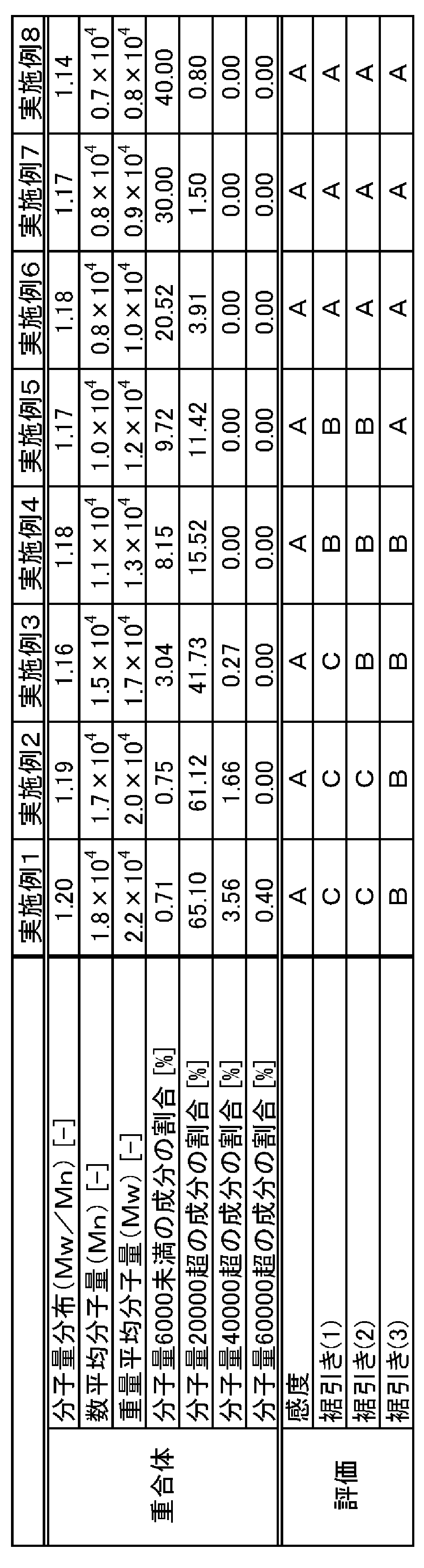

表1および表2より、分子量分布(Mw/Mn)が1.25未満であり、分子量が6000未満の成分の割合が0.5%超である重合体を用いた実施例1~8では、裾引きが十分に抑制され、そして感度の高いポジ型レジストを提供可能であることがわかる。
本発明の重合体によれば、裾引きが十分に抑制され、そして感度の高いポジ型レジストを提供することができる。
また、本発明のポジ型レジスト組成物によれば、高解像度のレジストパターンを効率良く形成することができる。
また、本発明のポジ型レジスト組成物によれば、高解像度のレジストパターンを効率良く形成することができる。
Claims (5)
- α-メチルスチレン単位と、α-クロロアクリル酸メチル単位とを含有し、
分子量分布(Mw/Mn)が1.25未満であり、
分子量が6000未満の成分の割合が0.5%超である、重合体。 - 分子量が6000未満の成分の割合が3.0%以上である、請求項1に記載の重合体。
- 分子量が20000超の成分の割合が70%以下である、請求項1または2に記載の重合体。
- 重量平均分子量(Mw)が25000以下である、請求項1~3の何れかに記載の重合体。
- 請求項1~4の何れかに記載の重合体と、溶剤とを含む、ポジ型レジスト組成物。
Priority Applications (1)
| Application Number | Priority Date | Filing Date | Title |
|---|---|---|---|
| JP2017500513A JPWO2016132726A1 (ja) | 2015-02-20 | 2016-02-15 | 重合体およびポジ型レジスト組成物 |
Applications Claiming Priority (2)
| Application Number | Priority Date | Filing Date | Title |
|---|---|---|---|
| JP2015-031734 | 2015-02-20 | ||
| JP2015031734 | 2015-02-20 |
Publications (1)
| Publication Number | Publication Date |
|---|---|
| WO2016132726A1 true WO2016132726A1 (ja) | 2016-08-25 |
Family
ID=56688956
Family Applications (1)
| Application Number | Title | Priority Date | Filing Date |
|---|---|---|---|
| PCT/JP2016/000771 Ceased WO2016132726A1 (ja) | 2015-02-20 | 2016-02-15 | 重合体およびポジ型レジスト組成物 |
Country Status (3)
| Country | Link |
|---|---|
| JP (1) | JPWO2016132726A1 (ja) |
| TW (1) | TWI686413B (ja) |
| WO (1) | WO2016132726A1 (ja) |
Cited By (2)
| Publication number | Priority date | Publication date | Assignee | Title |
|---|---|---|---|---|
| JPWO2016132727A1 (ja) * | 2015-02-20 | 2017-11-30 | 日本ゼオン株式会社 | 重合体およびポジ型レジスト組成物 |
| US10241405B2 (en) * | 2015-02-20 | 2019-03-26 | Zeon Corporation | Polymer and positive resist composition |
Citations (1)
| Publication number | Priority date | Publication date | Assignee | Title |
|---|---|---|---|---|
| JP2016012104A (ja) * | 2014-06-30 | 2016-01-21 | 大日本印刷株式会社 | ポジ型レジスト組成物及びその製造方法、並びに、当該ポジ型レジスト組成物を用いたレジストパターンの製造方法 |
Family Cites Families (1)
| Publication number | Priority date | Publication date | Assignee | Title |
|---|---|---|---|---|
| JP6680291B2 (ja) * | 2015-02-20 | 2020-04-15 | 日本ゼオン株式会社 | 重合体およびポジ型レジスト組成物 |
-
2016
- 2016-02-15 JP JP2017500513A patent/JPWO2016132726A1/ja not_active Withdrawn
- 2016-02-15 WO PCT/JP2016/000771 patent/WO2016132726A1/ja not_active Ceased
- 2016-02-19 TW TW105104875A patent/TWI686413B/zh not_active IP Right Cessation
Patent Citations (1)
| Publication number | Priority date | Publication date | Assignee | Title |
|---|---|---|---|---|
| JP2016012104A (ja) * | 2014-06-30 | 2016-01-21 | 大日本印刷株式会社 | ポジ型レジスト組成物及びその製造方法、並びに、当該ポジ型レジスト組成物を用いたレジストパターンの製造方法 |
Non-Patent Citations (2)
| Title |
|---|
| KATSUYA OKUBO ET AL.: "Cho Bisai Kako-yo Denshisen Polymer Resist no Kaihatsu to Hyoka", POLYMER MATERIAL FORUM KOEN YOKOSHU, vol. 21, 2012, pages 38 * |
| T. YAMAGUCHI ET AL.: "Molecular weight effect on line -edge roughness", PROCEEDINGS OF SPIE, vol. 5039, 2003, pages 1212 - 1219 * |
Cited By (2)
| Publication number | Priority date | Publication date | Assignee | Title |
|---|---|---|---|---|
| JPWO2016132727A1 (ja) * | 2015-02-20 | 2017-11-30 | 日本ゼオン株式会社 | 重合体およびポジ型レジスト組成物 |
| US10241405B2 (en) * | 2015-02-20 | 2019-03-26 | Zeon Corporation | Polymer and positive resist composition |
Also Published As
| Publication number | Publication date |
|---|---|
| TW201639893A (zh) | 2016-11-16 |
| JPWO2016132726A1 (ja) | 2017-11-30 |
| TWI686413B (zh) | 2020-03-01 |
Similar Documents
| Publication | Publication Date | Title |
|---|---|---|
| JP6680289B2 (ja) | 重合体およびポジ型レジスト組成物 | |
| JP6680290B2 (ja) | 重合体およびポジ型レジスト組成物 | |
| TWI675856B (zh) | 聚合物及正型光阻組合物 | |
| JP6844549B2 (ja) | レジストパターン形成方法および現像条件の決定方法 | |
| JP6575141B2 (ja) | レジストパターン形成方法および現像条件の決定方法 | |
| JP2017119744A (ja) | 重合体およびポジ型レジスト組成物 | |
| JP6680291B2 (ja) | 重合体およびポジ型レジスト組成物 | |
| WO2016132726A1 (ja) | 重合体およびポジ型レジスト組成物 | |
| JP6680292B2 (ja) | 重合体およびポジ型レジスト組成物、並びに、レジストパターン形成方法 | |
| WO2016132724A1 (ja) | 重合体およびポジ型レジスト組成物 | |
| JP6812636B2 (ja) | レジストパターン形成方法および現像条件の決定方法 | |
| JP2017120287A (ja) | レジストパターン形成方法および現像条件の決定方法 | |
| JP6750317B2 (ja) | 共重合体およびポジ型レジスト組成物 | |
| WO2018155214A1 (ja) | 重合体およびポジ型レジスト溶液 |
Legal Events
| Date | Code | Title | Description |
|---|---|---|---|
| 121 | Ep: the epo has been informed by wipo that ep was designated in this application |
Ref document number: 16752115 Country of ref document: EP Kind code of ref document: A1 |
|
| ENP | Entry into the national phase |
Ref document number: 2017500513 Country of ref document: JP Kind code of ref document: A |
|
| NENP | Non-entry into the national phase |
Ref country code: DE |
|
| 122 | Ep: pct application non-entry in european phase |
Ref document number: 16752115 Country of ref document: EP Kind code of ref document: A1 |