WO2016121823A1 - 蛍光体、発光装置及び蛍光体の製造方法 - Google Patents
蛍光体、発光装置及び蛍光体の製造方法 Download PDFInfo
- Publication number
- WO2016121823A1 WO2016121823A1 PCT/JP2016/052360 JP2016052360W WO2016121823A1 WO 2016121823 A1 WO2016121823 A1 WO 2016121823A1 JP 2016052360 W JP2016052360 W JP 2016052360W WO 2016121823 A1 WO2016121823 A1 WO 2016121823A1
- Authority
- WO
- WIPO (PCT)
- Prior art keywords
- phosphor
- light
- hydrofluoric acid
- manufacturing
- wavelength
- Prior art date
- Legal status (The legal status is an assumption and is not a legal conclusion. Google has not performed a legal analysis and makes no representation as to the accuracy of the status listed.)
- Ceased
Links
Images

Classifications
-
- C—CHEMISTRY; METALLURGY
- C09—DYES; PAINTS; POLISHES; NATURAL RESINS; ADHESIVES; COMPOSITIONS NOT OTHERWISE PROVIDED FOR; APPLICATIONS OF MATERIALS NOT OTHERWISE PROVIDED FOR
- C09K—MATERIALS FOR MISCELLANEOUS APPLICATIONS, NOT PROVIDED FOR ELSEWHERE
- C09K11/00—Luminescent materials, e.g. electroluminescent or chemiluminescent
- C09K11/08—Luminescent materials, e.g. electroluminescent or chemiluminescent containing inorganic luminescent materials
- C09K11/61—Luminescent materials, e.g. electroluminescent or chemiluminescent containing inorganic luminescent materials containing fluorine, chlorine, bromine, iodine or unspecified halogen elements
-
- C—CHEMISTRY; METALLURGY
- C09—DYES; PAINTS; POLISHES; NATURAL RESINS; ADHESIVES; COMPOSITIONS NOT OTHERWISE PROVIDED FOR; APPLICATIONS OF MATERIALS NOT OTHERWISE PROVIDED FOR
- C09K—MATERIALS FOR MISCELLANEOUS APPLICATIONS, NOT PROVIDED FOR ELSEWHERE
- C09K11/00—Luminescent materials, e.g. electroluminescent or chemiluminescent
- C09K11/08—Luminescent materials, e.g. electroluminescent or chemiluminescent containing inorganic luminescent materials
- C09K11/66—Luminescent materials, e.g. electroluminescent or chemiluminescent containing inorganic luminescent materials containing germanium, tin or lead
- C09K11/664—Halogenides
- C09K11/665—Halogenides with alkali or alkaline earth metals
-
- C—CHEMISTRY; METALLURGY
- C09—DYES; PAINTS; POLISHES; NATURAL RESINS; ADHESIVES; COMPOSITIONS NOT OTHERWISE PROVIDED FOR; APPLICATIONS OF MATERIALS NOT OTHERWISE PROVIDED FOR
- C09K—MATERIALS FOR MISCELLANEOUS APPLICATIONS, NOT PROVIDED FOR ELSEWHERE
- C09K11/00—Luminescent materials, e.g. electroluminescent or chemiluminescent
- C09K11/08—Luminescent materials, e.g. electroluminescent or chemiluminescent containing inorganic luminescent materials
- C09K11/55—Luminescent materials, e.g. electroluminescent or chemiluminescent containing inorganic luminescent materials containing beryllium, magnesium, alkali metals or alkaline earth metals
-
- C—CHEMISTRY; METALLURGY
- C09—DYES; PAINTS; POLISHES; NATURAL RESINS; ADHESIVES; COMPOSITIONS NOT OTHERWISE PROVIDED FOR; APPLICATIONS OF MATERIALS NOT OTHERWISE PROVIDED FOR
- C09K—MATERIALS FOR MISCELLANEOUS APPLICATIONS, NOT PROVIDED FOR ELSEWHERE
- C09K11/00—Luminescent materials, e.g. electroluminescent or chemiluminescent
- C09K11/08—Luminescent materials, e.g. electroluminescent or chemiluminescent containing inorganic luminescent materials
- C09K11/57—Luminescent materials, e.g. electroluminescent or chemiluminescent containing inorganic luminescent materials containing manganese or rhenium
-
- C—CHEMISTRY; METALLURGY
- C09—DYES; PAINTS; POLISHES; NATURAL RESINS; ADHESIVES; COMPOSITIONS NOT OTHERWISE PROVIDED FOR; APPLICATIONS OF MATERIALS NOT OTHERWISE PROVIDED FOR
- C09K—MATERIALS FOR MISCELLANEOUS APPLICATIONS, NOT PROVIDED FOR ELSEWHERE
- C09K11/00—Luminescent materials, e.g. electroluminescent or chemiluminescent
- C09K11/08—Luminescent materials, e.g. electroluminescent or chemiluminescent containing inorganic luminescent materials
- C09K11/61—Luminescent materials, e.g. electroluminescent or chemiluminescent containing inorganic luminescent materials containing fluorine, chlorine, bromine, iodine or unspecified halogen elements
- C09K11/615—Halogenides
- C09K11/616—Halogenides with alkali or alkaline earth metals
-
- C—CHEMISTRY; METALLURGY
- C09—DYES; PAINTS; POLISHES; NATURAL RESINS; ADHESIVES; COMPOSITIONS NOT OTHERWISE PROVIDED FOR; APPLICATIONS OF MATERIALS NOT OTHERWISE PROVIDED FOR
- C09K—MATERIALS FOR MISCELLANEOUS APPLICATIONS, NOT PROVIDED FOR ELSEWHERE
- C09K11/00—Luminescent materials, e.g. electroluminescent or chemiluminescent
- C09K11/08—Luminescent materials, e.g. electroluminescent or chemiluminescent containing inorganic luminescent materials
- C09K11/61—Luminescent materials, e.g. electroluminescent or chemiluminescent containing inorganic luminescent materials containing fluorine, chlorine, bromine, iodine or unspecified halogen elements
- C09K11/617—Silicates
-
- C—CHEMISTRY; METALLURGY
- C09—DYES; PAINTS; POLISHES; NATURAL RESINS; ADHESIVES; COMPOSITIONS NOT OTHERWISE PROVIDED FOR; APPLICATIONS OF MATERIALS NOT OTHERWISE PROVIDED FOR
- C09K—MATERIALS FOR MISCELLANEOUS APPLICATIONS, NOT PROVIDED FOR ELSEWHERE
- C09K11/00—Luminescent materials, e.g. electroluminescent or chemiluminescent
- C09K11/08—Luminescent materials, e.g. electroluminescent or chemiluminescent containing inorganic luminescent materials
- C09K11/66—Luminescent materials, e.g. electroluminescent or chemiluminescent containing inorganic luminescent materials containing germanium, tin or lead
-
- C—CHEMISTRY; METALLURGY
- C09—DYES; PAINTS; POLISHES; NATURAL RESINS; ADHESIVES; COMPOSITIONS NOT OTHERWISE PROVIDED FOR; APPLICATIONS OF MATERIALS NOT OTHERWISE PROVIDED FOR
- C09K—MATERIALS FOR MISCELLANEOUS APPLICATIONS, NOT PROVIDED FOR ELSEWHERE
- C09K11/00—Luminescent materials, e.g. electroluminescent or chemiluminescent
- C09K11/08—Luminescent materials, e.g. electroluminescent or chemiluminescent containing inorganic luminescent materials
- C09K11/67—Luminescent materials, e.g. electroluminescent or chemiluminescent containing inorganic luminescent materials containing refractory metals
- C09K11/674—Halogenides
- C09K11/675—Halogenides with alkali or alkaline earth metals
-
- C—CHEMISTRY; METALLURGY
- C09—DYES; PAINTS; POLISHES; NATURAL RESINS; ADHESIVES; COMPOSITIONS NOT OTHERWISE PROVIDED FOR; APPLICATIONS OF MATERIALS NOT OTHERWISE PROVIDED FOR
- C09K—MATERIALS FOR MISCELLANEOUS APPLICATIONS, NOT PROVIDED FOR ELSEWHERE
- C09K11/00—Luminescent materials, e.g. electroluminescent or chemiluminescent
- C09K11/08—Luminescent materials, e.g. electroluminescent or chemiluminescent containing inorganic luminescent materials
- C09K11/67—Luminescent materials, e.g. electroluminescent or chemiluminescent containing inorganic luminescent materials containing refractory metals
- C09K11/677—Germanates
-
- G—PHYSICS
- G02—OPTICS
- G02B—OPTICAL ELEMENTS, SYSTEMS OR APPARATUS
- G02B5/00—Optical elements other than lenses
- G02B5/003—Light absorbing elements
-
- H—ELECTRICITY
- H10—SEMICONDUCTOR DEVICES; ELECTRIC SOLID-STATE DEVICES NOT OTHERWISE PROVIDED FOR
- H10H—INORGANIC LIGHT-EMITTING SEMICONDUCTOR DEVICES HAVING POTENTIAL BARRIERS
- H10H20/00—Individual inorganic light-emitting semiconductor devices having potential barriers, e.g. light-emitting diodes [LED]
- H10H20/80—Constructional details
- H10H20/85—Packages
- H10H20/851—Wavelength conversion means
-
- H—ELECTRICITY
- H10—SEMICONDUCTOR DEVICES; ELECTRIC SOLID-STATE DEVICES NOT OTHERWISE PROVIDED FOR
- H10H—INORGANIC LIGHT-EMITTING SEMICONDUCTOR DEVICES HAVING POTENTIAL BARRIERS
- H10H20/00—Individual inorganic light-emitting semiconductor devices having potential barriers, e.g. light-emitting diodes [LED]
- H10H20/80—Constructional details
- H10H20/85—Packages
- H10H20/851—Wavelength conversion means
- H10H20/8511—Wavelength conversion means characterised by their material, e.g. binder
- H10H20/8512—Wavelength conversion materials
-
- H—ELECTRICITY
- H10—SEMICONDUCTOR DEVICES; ELECTRIC SOLID-STATE DEVICES NOT OTHERWISE PROVIDED FOR
- H10H—INORGANIC LIGHT-EMITTING SEMICONDUCTOR DEVICES HAVING POTENTIAL BARRIERS
- H10H20/00—Individual inorganic light-emitting semiconductor devices having potential barriers, e.g. light-emitting diodes [LED]
- H10H20/80—Constructional details
- H10H20/85—Packages
- H10H20/851—Wavelength conversion means
- H10H20/8511—Wavelength conversion means characterised by their material, e.g. binder
- H10H20/8512—Wavelength conversion materials
- H10H20/8513—Wavelength conversion materials having two or more wavelength conversion materials
Definitions
- the present invention relates to a phosphor that efficiently emits red light when excited by blue light, a light-emitting device using the phosphor, and a method for manufacturing the phosphor.
- a red-emitting phosphor and a method for manufacturing the same are disclosed.
- This manufacturing method is a manufacturing method in which an A 2 [MF 6 ] crystal serving as a base material of a phosphor and a K 2 MnF 6 crystal containing Mn serving as an emission center are dissolved in hydrofluoric acid and evaporated to dryness.
- an object of the present invention is to provide an A 2 MF 6 : Mn 4+ phosphor having high fluorescence intensity, a high-intensity light emitting device using the phosphor, and a method for producing the phosphor.
- the minimum value of light absorption appearing at a wavelength of 300 nm to 350 nm is 67% or less, and the maximum light absorption at a wavelength of 400 nm to 500 nm is 65% or more
- the phosphor has a Mn content of 0.3% by mass or more and 1.5% by mass or less.
- the average particle size of the phosphor is preferably 10 ⁇ m or more and 35 ⁇ m or less.
- the present invention is a light emitting device containing the phosphor and a light emitting light source, wherein the light emitting light source has a peak wavelength of 420 nm or more and 480 nm or less.
- This light-emitting device preferably includes the phosphor and a green phosphor having a peak wavelength of 510 nm or more and 550 nm or less when receiving excitation light of 455 nm.
- a green phosphor of the light emitting device Eu-activated ⁇ sialon is preferable.
- the present invention is a phosphor production method for producing the above-described phosphor, a dissolution step of dissolving a raw material in hydrofluoric acid, a precipitation step of depositing the phosphor from a solution after the dissolution step, and impurities.
- the hydrofluoric acid aqueous solution obtained in the dissolution step has a cleaning step to be removed and contains the elements A, M and Mn, and the aqueous solution of the hydrofluoric acid aqueous solution after the dissolution step is evaporated after the precipitation in the precipitation step It is the manufacturing method of the fluorescent substance used as the means.
- the present invention is a phosphor production method for producing the above-described phosphor, a dissolution step of dissolving a raw material in hydrofluoric acid, a precipitation step of depositing the phosphor from a solution after the dissolution step, and impurities.
- the hydrofluoric acid aqueous solution obtained in the dissolution step has a cleaning step to be removed and contains element A, element M, and Mn, and the precipitation in the precipitation step is used as a means for introducing a poor solvent into the hydrofluoric acid aqueous solution. It is a manufacturing method of fluorescent substance.
- the poor solvent is preferably water.
- the present invention is a phosphor production method for producing the above-described phosphor, a dissolution step of dissolving a raw material in hydrofluoric acid, a precipitation step of depositing the phosphor from a solution after the dissolution step, and impurities.
- Two or more types of hydrofluoric acid aqueous solutions having a cleaning step to be removed and containing element A, element M, and Mn are prepared in the dissolving step, and precipitation in the precipitation step is performed by the two or more types of hydrofluoric acid aqueous solutions. It is the manufacturing method of the fluorescent substance used as the means to mix and react.
- the phosphor of the present invention is a phosphor that emits excitation light efficiently and has high fluorescence intensity. Since the light-emitting device of the present invention uses the phosphor, the light-emitting device is a high-intensity light-emitting device.
- the phosphor production method of the present invention can produce a phosphor with high fluorescence intensity.
- the minimum value of light absorption appearing at a wavelength of 300 nm to 350 nm is 67% or less, and the maximum light absorption at a wavelength of 400 nm to 500 nm is 65% or more
- the phosphor has a Mn content of 0.3% by mass or more and 1.5% by mass or less.
- the element A is an alkali metal element, and is preferably one or more elements selected from Na, K, and Rb from the viewpoint of the crystal structure.
- the M is one or more metal elements selected from Si, Ge, Sn, Ti, Zr, and Hf, and Si, Ge, and Ti are preferable from the viewpoint of fluorescence characteristics and chemical stability.
- the fluorescence characteristics of the phosphor are affected by the type of element M.
- F is fluorine and Mn is manganese.
- Mn takes various oxidation numbers, and among these, Mn 4+ functions as the emission center substance of the phosphor of the present invention.
- Mn 4+ which is an activating ion of the phosphor has an excitation band in a wavelength range of 300 nm to 400 nm and a wavelength range of 400 nm to 500 nm.
- the peak wavelength of the excitation band varies depending on the type of the element M, and the excitation band peak wavelength on the long wavelength side is not less than 440 nm and not more than 480 nm.
- the excitation band peak wavelength on the long wavelength side coincides with the emission wavelength of the blue LED used as the excitation source of the white LED. If the light absorptance in this wavelength region is less than 65%, the luminance of the light emitting device using this phosphor cannot be sufficiently obtained, so the maximum light absorptance at a wavelength of 400 nm to 500 nm is 65% or more. Is preferable, more preferably 66% or more, still more preferably 68% or more, and even more preferably 78% or more.
- the minimum value of the light absorptance appearing at wavelengths of 300 nm to 350 nm is set to 67% or less for the following reason.
- the causes of light absorption include impurities and crystal defects in addition to Mn 4+ excitation. This crystal defect traps electrons excited by Mn 4+ and suppresses light emission.
- the inventors have found that the absorption in the ultraviolet region derived from crystal defects overlaps with the absorption band of Mn 4+ near the wavelength of 350 nm.
- the minimum value of light absorption that appears at a wavelength of 300 nm to 350 nm is 67% or less. It was. Preferably, the minimum value is 66% or less, more preferably 56% or less.
- the maximum light absorption rate at a wavelength of 400 nm or more and 500 nm or less is set to 65% or more in order to obtain sufficient luminance in a light emitting device using the phosphor of the present invention.
- the Mn content in the phosphor of the present invention is 0.3% by mass or more and 1.5% by mass or less. This is because if the Mn content is too low, sufficient fluorescence cannot be obtained, and if it is too high, the crystal emission tends to increase and the fluorescence emission tends to decrease due to concentration quenching.
- the average particle size of the phosphor of the present invention is preferably 10 ⁇ m or more and 35 ⁇ m or less.
- the average particle diameter is a volume median diameter obtained from a particle size distribution curve measured by a laser diffraction scattering method.
- the average particle size is too small, the light absorption rate is significantly reduced, so the fluorescence intensity tends to be low. If the average particle size is too large, the amount of phosphor added to obtain a predetermined color increases, It tends to cause a blockage of the dispenser during mounting.
- the present invention is a light emitting device containing the phosphor and a light emitting light source, wherein the light emitting light source has a peak wavelength of 420 nm or more and 480 nm or less.
- the reason why the peak wavelength of the light emission source is set to 420 nm or more and 480 nm or less is that Mn 4+ that is the emission center in the phosphor is efficiently excited and used as blue light of the light emitting device.
- the phosphor of the present invention has high fluorescence intensity due to the above-described configuration.
- the high fluorescence intensity specifically means that the internal quantum efficiency is 70% or more and the external quantum efficiency is 57% or more.
- This light-emitting device preferably includes the phosphor and a green phosphor having a peak wavelength of 510 nm or more and 550 nm or less when receiving excitation light of 455 nm.
- This light-emitting device can emit white light with a blue light-emitting light source, a red phosphor, and a green phosphor, and can emit different color gamuts depending on the blending ratio of the phosphors.
- an Eu-activated ⁇ sialon phosphor having a narrow half-width fluorescence spectrum is used as the green phosphor, a backlight light source for liquid crystal having a high color gamut can be obtained.
- Solvent evaporation method Method of evaporating the solvent after dissolving the element used as the phosphor material in the hydrofluoric acid solvent
- Poor solvent addition precipitation method adding the poor solvent to precipitate the phosphor
- Mixed reaction precipitation method a method in which two or more hydrofluoric acid solutions in which an element that is a raw material of the phosphor is dissolved are mixed to cause the phosphor to react and precipitate
- the phosphor of Example 1 is a phosphor of the general formula: A 2 MF 6 : Mn, and K (potassium) as the element A, Si (silicon) as the element M, and the light absorptance appearing at wavelengths of 300 nm to 350 nm.
- the excitation wavelength dependence of the light absorption rate of the phosphor of Example 1 was measured at room temperature by the following method.
- a standard reflector (Spectralon manufactured by Labsphere) having a reflectivity of 99% was set in the side opening ( ⁇ 10 mm) of the integrating sphere ( ⁇ 60 mm).
- monochromatic light dispersed at a predetermined wavelength from an Xe lamp as a light source is introduced as an excitation light by an optical fiber, and a reflected light spectrum of a standard reflector is measured by a spectrophotometer (MCPD-7000 manufactured by Otsuka Electronics Co., Ltd.).
- MCPD-7000 spectrophotometer manufactured by Otsuka Electronics Co., Ltd.
- Excitation light was irradiated at intervals of 5 nm in a range of 300 nm to 700 nm, and the spectrum of reflected light was measured for each excitation light.
- a concave cell filled with a phosphor so that the surface is smooth is set in the opening of the integrating sphere.
- monochromatic light is emitted at 5 nm intervals in the range of 300 nm to 700 nm. Irradiated, and the spectrum was measured with excitation light of each wavelength.
- the obtained spectrum was a reflection spectrum of excitation light and a fluorescence spectrum near red.
- FIG. 1 shows a plot of the light absorptance of the phosphor of Example 1 measured in this manner against the excitation wavelength.
- the optical absorptance shows the maximum optical absorptance at excitation wavelengths of 350 nm and 450 nm due to excitation of Mn 4+ , and the minimum value of the optical absorptance appearing in the wavelength range of 300 nm to 350 nm is 55.5%.
- the maximum light absorptance in the wavelength range of 400 nm to 500 nm was 78.1%.
- the Mn content contained in the phosphor of Example 1 was 0.75% by mass as a result of measurement by ICP (Inductively Coupled Plasma) emission spectroscopic analysis.
- the average particle size of the phosphor of Example 1 was determined by measuring the particle size distribution with a laser diffraction scattering type particle size distribution measuring device (LC13 320 manufactured by Beckman Coulter, Inc.). 50 volume% diameter (D50)) was determined. The average particle size of the phosphor of Example 1 was 29.8 ⁇ m. Ethanol was used as a measurement solvent in the measurement apparatus.
- the internal quantum efficiency and external quantum efficiency in the case of an excitation wavelength of 455 nm were determined by the following method.
- the number of excitation light photons was calculated from the spectrum in the wavelength range of 450 nm to 465 nm.
- the number of excited reflected light photons (Qref) and the number of fluorescent photons (Qem) were calculated from the spectrum of the phosphor.
- the number of excitation reflected light photons was calculated in the same wavelength range as the number of excitation light photons, and the number of fluorescent photons was calculated in the range of 465 to 800 nm.
- the internal quantum efficiency and external quantum efficiency of the phosphor of Example 1 when excited with a wavelength of 455 nm were 82.5% and 64.4%, respectively.
- Example 1 A method for manufacturing the phosphor of Example 1 will be described.
- the phosphor of Example 1 is a phosphor manufactured by the above-described poor solvent addition precipitation method.
- the poor solvent addition precipitation method a dissolution step of dissolving the raw material in hydrofluoric acid, a precipitation step of depositing the phosphor from the solution after the dissolution step, and a cleaning step of removing impurities were adopted.
- K 2 SiF 6 manufactured by Morita Chemical Co., Ltd., purity of 98% or more
- K 2 MnF 6 were used as the raw material of the phosphor. Both are powdery. A process for producing K 2 MnF 6 will be described.
- Teflon registered trademark
- 800 ml of 40% by mass hydrofluoric acid was added, and 260 g of powdered KHF 2 (manufactured by Wako Pure Chemical Industries, Ltd., special grade reagent) and potassium permanganate powder ( 12 g of Wako Pure Chemical Industries, Ltd., reagent grade 1) was dissolved.
- ⁇ Phosphor production process> In a 3000 ml Teflon (registered trademark) beaker, 1000 ml of 55% by weight hydrofluoric acid is added, and 30 g of powdery K 2 SiF 6 (Morita Chemical Co., Ltd., purity 98% or more) and the aforementioned K 2 MnF are added. 5 g of 6 was added and dissolved with sufficient stirring.
- the X-ray diffraction pattern of the phosphor of Example 1 was measured using an X-ray diffractometer (Uriga IV manufactured by Rigaku Corporation). As a result, the phosphor of Example 1 was single phase with K 2 SiF 6 crystal.
- Examples 2 to 4 and Comparative Examples 1 to 3 were phosphors produced by the same method as Example 1 except that the addition amounts of K 2 SiF 6 and K 2 MnF 6 shown in the raw material column of Table 1 were changed. It is.
- the phosphor of Comparative Example 1 has a minimum value of light absorption that appears at a wavelength of 300 nm or more and 350 nm or less, and the Mn content is more than 1.5% by mass, so that the internal quantum efficiency and the external quantum efficiency are acceptable. It was not value.
- the minimum value of the light absorption rate appearing at a wavelength of 400 nm to 500 nm was smaller than 65% and the Mn content was larger than 1.5% by mass, so that the external quantum efficiency was not an acceptable value.
- the external quantum efficiency was not an acceptable value because the minimum value of the light absorption rate appearing at a wavelength of 300 nm to 350 nm was greater than 67%.
- Comparative Example 4 Although not shown in Table 1, the phosphor of Comparative Example 4 is a phosphor manufactured by a mixed reaction precipitation method which is a manufacturing method different from the above-described Examples.
- KHF 2 powder special grade reagent manufactured by Wako Pure Chemical Industries, Ltd.
- Solution Y was prepared.
- the hydrofluoric acid solution Y was added to the hydrofluoric acid solution X being stirred with a stirrer.
- the phosphor was precipitated in the X solution by the addition of the Y solution, and after adding the entire amount of the Y solution, the mixture was stirred for 20 minutes and then allowed to stand to precipitate the solid content.
- the phosphor of Comparative Example 4 is a single phase with K 2 SiF 6 crystal, has a minimum value of light absorptance appearing in the wavelength range of 300 nm to 350 nm, 67.3%, and within the wavelength range of 400 to 500 nm.
- the maximum light absorption rate was 81.5%.
- the Mn content was 0.68% by mass, and the average particle size was 30.2 ⁇ m.
- FIG. 1 shows the excitation wavelength dependence of the optical absorptance of Comparative Example 4.
- the internal quantum efficiency and external quantum efficiency of the phosphor of Comparative Example 4 were 68.9% and 56.1%, respectively.
- the phosphor of Comparative Example 4 has a Mn content and particle size distribution similar to those of Example 1, but reflects the difference in excitation wavelength dependence of the light absorption rate as shown in FIG. Both the quantum efficiency and the external quantum efficiency were low values.
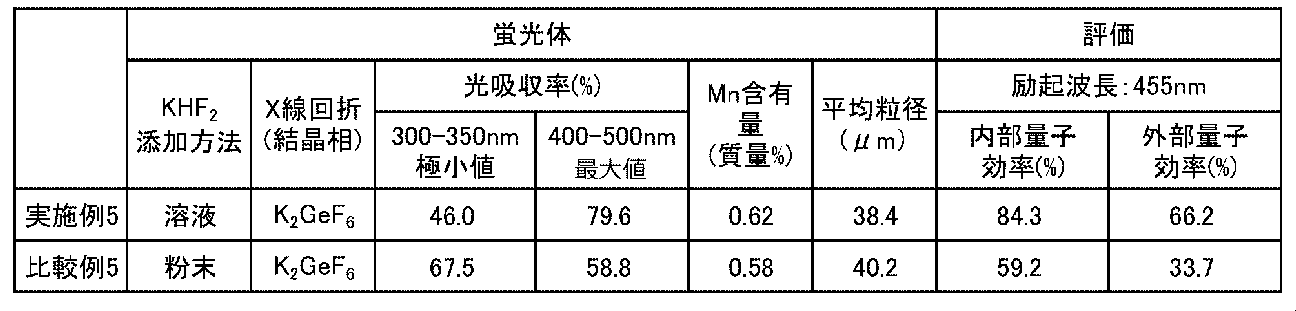
- the phosphor of Example 5 is a phosphor of the general formula: A 2 MF 6 : Mn, and K (potassium) as the element A, Ge (germanium) as the element M, and the light absorptance appearing at wavelengths of 300 nm to 350 nm.
- Phosphor having a minimum value of 46.0%, a maximum light absorption rate of 79.6% at a wavelength of 400 nm to 500 nm, an Mn content of 0.61% by mass, and an average particle size of 38.4 ⁇ m It is. Table 2 shows these characteristic values and effects of the invention described later.
- the manufacturing method of the phosphor in Example 5 is a mixed reaction precipitation method.
- Teflon registered trademark
- GeO 2 powder purity 99.99%, purity 99.99%)
- K 2 3 g of MnF 6 powder K 2 MnF 6 produced in Example 1
- Example 5 a solution prepared by dissolving 46.9 g of KHF 2 powder in 100 ml of 48% by mass hydrofluoric acid was added to this solution.
- Phosphor was precipitated by hydrofluoric acid solution of KHF 2. After the entire amount of KHF 2 hydrofluoric acid solution was added, the solution was stirred for 20 minutes and then allowed to stand to precipitate a solid content. After confirming the precipitation, the supernatant was removed.
- Example 5 The precipitate is repeatedly washed with 20% by mass of hydrofluoric acid until it becomes bright yellow, further washed with methanol, the solid part is separated and recovered by filtration, and the residual methanol is evaporated and removed by drying treatment. Thus, the phosphor of Example 5 was obtained.
- Example 5 For the phosphor of Comparative Example 5, the production method was the same as that of Example 5 except that “a solution obtained by dissolving 46.9 g of KHF 2 powder in 100 ml of 48% by mass hydrofluoric acid” and “46.9 g of KHF 2 powder”. The characteristic values and evaluation are as shown in Table 2.
- Comparative Example 5 the minimum value of the light absorptance seen in the vicinity of 300 nm is very high, the particle size is small, and the light absorptance in the vicinity of 450 nm is low. The value was lower than. Changing the method of adding KHF 2 from solution to powder reduced crystal growth.
- Example 6 and Example 7 were not shown in the table
- the internal quantum efficiency and the external quantum efficiency were lower than those in Example 1, but both were acceptable values.
- Example 1 Although not shown as an example, even with the solvent evaporation method, a phosphor equivalent to that in Example 1 could be obtained by performing synthesis with the generation of crystal defects suppressed as much as possible.
- Example 8 is a light emitting device having the phosphor of Example 1 and an LED as a light emitting source, and the LED has a peak wavelength of 455 nm.
- the light emitting device is specifically a lighting device.
- the light-emitting device of Example 8 was a light-emitting device having high emission intensity because the phosphor of Example 1 was used.
- Example 9 is a light-emitting device in which the phosphor of Example 1 and the green phosphor having a peak wavelength of 528 nm when receiving excitation light of 455 nm are used as the phosphor of Example 8.
- the green phosphor is (Ba, Sr) 2 SiO 4 : Eu. Since the light emitting device uses a green phosphor, the light emitting device emits white light.
- Example 9 was a light-emitting device having high emission intensity because the phosphor of Example 1 was used.
- Example 10 is a light emitting device in which Example 9 (Ba, Sr) 2 SiO 4 : Eu was Eu-activated ⁇ sialon.
- Example 10 was a light-emitting device having superior high-temperature stability and moisture resistance than Example 9.
Landscapes
- Chemical & Material Sciences (AREA)
- Inorganic Chemistry (AREA)
- Engineering & Computer Science (AREA)
- Materials Engineering (AREA)
- Organic Chemistry (AREA)
- Physics & Mathematics (AREA)
- General Physics & Mathematics (AREA)
- Optics & Photonics (AREA)
- Luminescent Compositions (AREA)
- Led Device Packages (AREA)
Abstract
Description
前記貧溶媒は水であることが好ましい。
1)溶媒蒸発方法:フッ化水素酸溶媒中に蛍光体の原料となる元素を溶解させた後、溶媒を蒸発させる方法
2)貧溶媒添加析出方法:貧溶媒を添加して蛍光体を析出させる方法
3)混合反応析出方法:蛍光体の原料となる元素を溶解させた二種以上のフッ化水素酸溶液を混合して蛍光体を反応析出させる方法

沈殿後、上澄み液を除去し、メタノールを加え、撹拌・静置し、上澄み液を除去し、更にメタノールを加えるという操作を、液が中性になるまで繰り返した。
容量3000mlのテフロン(登録商標)製のビーカーに濃度55質量%フッ化水素酸1000mlを入れ、粉末状のK2SiF6(森田化学株式会社製、純度98%以上)30gと前述のK2MnF6を5g加え、十分に撹拌して溶解した。
蒸留水全量を入れた後、更に、20分間撹拌し、その後、静置して固形分を沈殿させた。沈殿確認後、上澄み液を除去し、20質量%のフッ化水素酸及びメタノールでの洗浄を行い、濾過により固形部を分離回収し、更に乾燥処理により、残存メタノールを蒸発除去し、黄色の蛍光体粉末を得た。
実施例2~4、比較例1~3は、表1の原料の欄に示すK2SiF6及びK2MnF6の添加量を変えた以外は、実施例1と同じ方法で製造した蛍光体である。
比較例4の蛍光体は、表1には示さなかったが、上述の実施例とは異なる製造方法である混合反応析出方法で製造した蛍光体である。
実施例5の蛍光体は、一般式:A2MF6:Mnの蛍光体であり、元素AとしてK(カリウム)、元素MとしてGe(ゲルマニウム)、波長300nm以上350nm以下に現れる光吸収率の極小値が46.0%であり、波長400nm以上500nm以下での最大の光吸収率が79.6%で、Mn含有量が0.61質量%で、平均粒径が38.4μmの蛍光体である。これらの特性値と後述する発明の効果を表2に示す。
Claims (9)
- 一般式:A2MF6:Mn(元素Aはアルカリ金属元素であり、元素MはSi、Ge、Sn、Ti、Zr及びHfから選ばれる一種以上の四価の金属元素である。)で表される蛍光体であって、波長300nm以上350nm以下に現れる光吸収率の極小値が67%以下であり、波長400nm以上500nm以下での最大の光吸収率が65%以上で、Mn含有量が0.3質量%以上1.5質量%以下である蛍光体。
- 平均粒径が10μm以上35μm以下である請求項1記載の蛍光体。
- 請求項1又は請求項2記載の蛍光体と、発光光源とを含有する発光装置であって、前記発光光源のピーク波長が420nm以上480nm以下である発光装置。
- 蛍光体として、請求項1又は請求項2記載の蛍光体と、励起光455nmを受けた際のピーク波長が510nm以上550nm以下の緑色蛍光体を有する請求項3記載の発光装置。
- 前記緑色蛍光体がEu付活βサイアロンである請求項4記載の発光装置。
- 請求項1又は2に記載の蛍光体を製造する蛍光体の製造方法であり、原料をフッ化水素酸に溶解する溶解工程と、溶解工程後の溶液から蛍光体を析出させる析出工程、及び、不純物を除去する洗浄工程を有し、溶解工程で得られるフッ化水素酸水溶液が元素A、元素M及びMnを含有し、析出工程での析出を溶解工程後のフッ化水素酸水溶液の水溶液を蒸発させる手段とした蛍光体の製造方法。
- 請求項1又は2に記載の蛍光体を製造する蛍光体の製造方法であり、原料をフッ化水素酸に溶解する溶解工程と、溶解工程後の溶液から蛍光体を析出させる析出工程、及び、不純物を除去する洗浄工程を有し、溶解工程で得られるフッ化水素酸水溶液が元素A、元素M及びMnを含有し、析出工程での析出をフッ化水素酸水溶液に貧溶媒を投入する手段とした蛍光体の製造方法。
- 前記貧溶媒が水である請求項7記載の蛍光体の製造方法。
- 請求項1又は2に記載の蛍光体を製造する蛍光体の製造方法であり、原料をフッ化水素酸に溶解する溶解工程と、溶解工程後の溶液から蛍光体を析出させる析出工程、及び、不純物を除去する洗浄工程を有し、溶解工程で元素A、元素M及びMnを含有する二種類以上のフッ化水素酸水溶液を調製し、析出工程での析出を前記二種類以上のフッ化水素酸水溶液を混合して反応させる手段とした蛍光体の製造方法。
Priority Applications (5)
| Application Number | Priority Date | Filing Date | Title |
|---|---|---|---|
| KR1020177023971A KR102520635B1 (ko) | 2015-01-27 | 2016-01-27 | 형광체, 발광 장치 및 형광체의 제조 방법 |
| CN201680013888.XA CN107429159B (zh) | 2015-01-27 | 2016-01-27 | 荧光体、发光装置及荧光体的制造方法 |
| DE112016000492.3T DE112016000492B4 (de) | 2015-01-27 | 2016-01-27 | Leuchtstoff, lichtemittierende Vorrichtung und Verfahren zur Herstellung eines Leuchtstoffs |
| JP2016572108A JP6715778B2 (ja) | 2015-01-27 | 2016-01-27 | 蛍光体、発光装置及び蛍光体の製造方法 |
| US15/546,400 US10611956B2 (en) | 2015-01-27 | 2016-01-27 | Phosphor, light emitting device, and method for producing phosphor |
Applications Claiming Priority (2)
| Application Number | Priority Date | Filing Date | Title |
|---|---|---|---|
| JP2015-013263 | 2015-01-27 | ||
| JP2015013263 | 2015-01-27 |
Publications (1)
| Publication Number | Publication Date |
|---|---|
| WO2016121823A1 true WO2016121823A1 (ja) | 2016-08-04 |
Family
ID=56543433
Family Applications (1)
| Application Number | Title | Priority Date | Filing Date |
|---|---|---|---|
| PCT/JP2016/052360 Ceased WO2016121823A1 (ja) | 2015-01-27 | 2016-01-27 | 蛍光体、発光装置及び蛍光体の製造方法 |
Country Status (7)
| Country | Link |
|---|---|
| US (1) | US10611956B2 (ja) |
| JP (1) | JP6715778B2 (ja) |
| KR (1) | KR102520635B1 (ja) |
| CN (1) | CN107429159B (ja) |
| DE (1) | DE112016000492B4 (ja) |
| TW (1) | TWI688638B (ja) |
| WO (1) | WO2016121823A1 (ja) |
Families Citing this family (2)
| Publication number | Priority date | Publication date | Assignee | Title |
|---|---|---|---|---|
| CN117735612B (zh) * | 2023-12-21 | 2025-07-11 | 郑州大学 | 一种(NH4)2MnF6的还原-共沉淀制备方法及应用 |
| CN118206988A (zh) * | 2024-03-05 | 2024-06-18 | 南昌工程学院 | 氟化物及其制备方法和应用 |
Citations (3)
| Publication number | Priority date | Publication date | Assignee | Title |
|---|---|---|---|---|
| JP2010209311A (ja) * | 2008-09-05 | 2010-09-24 | Mitsubishi Chemicals Corp | 蛍光体及びその製造方法と、その蛍光体を用いた蛍光体含有組成物及び発光装置、並びに、その発光装置を用いた画像表示装置及び照明装置 |
| JP2013014715A (ja) * | 2011-07-06 | 2013-01-24 | Nichia Corp | フッ化物蛍光体及びそのフッ化物蛍光体を用いた発光装置 |
| WO2013137144A1 (ja) * | 2012-03-15 | 2013-09-19 | 株式会社 東芝 | 白色照明装置 |
Family Cites Families (4)
| Publication number | Priority date | Publication date | Assignee | Title |
|---|---|---|---|---|
| US7497973B2 (en) | 2005-02-02 | 2009-03-03 | Lumination Llc | Red line emitting phosphor materials for use in LED applications |
| KR101592836B1 (ko) * | 2008-02-07 | 2016-02-05 | 미쓰비시 가가꾸 가부시키가이샤 | 반도체 발광 장치, 백라이트, 컬러 화상 표시 장치, 및 그들에 사용하는 형광체 |
| MY167700A (en) * | 2011-04-08 | 2018-09-21 | Shinetsu Chemical Co | Preparation of complex fluoride and complex fluoride phosphor |
| JP6394307B2 (ja) * | 2014-01-30 | 2018-09-26 | 信越化学工業株式会社 | 複フッ化物蛍光体及びその製造方法 |
-
2016
- 2016-01-27 CN CN201680013888.XA patent/CN107429159B/zh active Active
- 2016-01-27 US US15/546,400 patent/US10611956B2/en active Active
- 2016-01-27 TW TW105102498A patent/TWI688638B/zh active
- 2016-01-27 KR KR1020177023971A patent/KR102520635B1/ko active Active
- 2016-01-27 DE DE112016000492.3T patent/DE112016000492B4/de active Active
- 2016-01-27 WO PCT/JP2016/052360 patent/WO2016121823A1/ja not_active Ceased
- 2016-01-27 JP JP2016572108A patent/JP6715778B2/ja active Active
Patent Citations (3)
| Publication number | Priority date | Publication date | Assignee | Title |
|---|---|---|---|---|
| JP2010209311A (ja) * | 2008-09-05 | 2010-09-24 | Mitsubishi Chemicals Corp | 蛍光体及びその製造方法と、その蛍光体を用いた蛍光体含有組成物及び発光装置、並びに、その発光装置を用いた画像表示装置及び照明装置 |
| JP2013014715A (ja) * | 2011-07-06 | 2013-01-24 | Nichia Corp | フッ化物蛍光体及びそのフッ化物蛍光体を用いた発光装置 |
| WO2013137144A1 (ja) * | 2012-03-15 | 2013-09-19 | 株式会社 東芝 | 白色照明装置 |
Also Published As
| Publication number | Publication date |
|---|---|
| DE112016000492T5 (de) | 2017-11-02 |
| KR102520635B1 (ko) | 2023-04-11 |
| JP6715778B2 (ja) | 2020-07-01 |
| US10611956B2 (en) | 2020-04-07 |
| TWI688638B (zh) | 2020-03-21 |
| DE112016000492B4 (de) | 2025-03-20 |
| CN107429159A (zh) | 2017-12-01 |
| KR20170108115A (ko) | 2017-09-26 |
| CN107429159B (zh) | 2020-06-16 |
| TW201634664A (zh) | 2016-10-01 |
| US20180072946A1 (en) | 2018-03-15 |
| JPWO2016121823A1 (ja) | 2017-11-02 |
Similar Documents
| Publication | Publication Date | Title |
|---|---|---|
| JP6155383B2 (ja) | 蛍光体、発光素子及び発光装置 | |
| JP6155382B2 (ja) | 蛍光体、発光素子及び発光装置 | |
| JP6273394B1 (ja) | フッ化物蛍光体とそれを用いた発光装置 | |
| JP6359066B2 (ja) | マンガン付活複フッ化物蛍光体原料用のフッ化マンガン酸カリウム及びそれを用いたマンガン付活複フッ化物蛍光体の製造方法 | |
| JP6826445B2 (ja) | 六フッ化マンガン酸カリウム及びそれを用いたマンガン付活複フッ化物蛍光体 | |
| JP6715778B2 (ja) | 蛍光体、発光装置及び蛍光体の製造方法 | |
| JP2019044018A (ja) | フッ化物蛍光体及び発光装置 | |
| JP2019044017A (ja) | フッ化物蛍光体及び発光装置 | |
| JP7588588B2 (ja) | 六フッ化マンガン酸カリウム、六フッ化マンガン酸カリウムの製造方法及びマンガン賦活複フッ化物蛍光体の製造方法 | |
| JP6590439B2 (ja) | 蛍光体の製造方法 | |
| JP6812231B2 (ja) | フッ化物蛍光体の製造方法 | |
| JP7538801B2 (ja) | 六フッ化マンガン酸カリウム、及びマンガン賦活複フッ化物蛍光体の製造方法 | |
| WO2023176559A1 (ja) | 複フッ化物蛍光体の製造方法 | |
| WO2015129742A1 (ja) | 蛍光体、発光素子及び発光装置 | |
| JP2019001986A (ja) | フッ化物蛍光体とそれを用いた発光装置 | |
| WO2023157885A1 (ja) | 蛍光体の製造方法 | |
| JP2019001985A (ja) | フッ化物蛍光体とそれを用いた発光装置 |
Legal Events
| Date | Code | Title | Description |
|---|---|---|---|
| 121 | Ep: the epo has been informed by wipo that ep was designated in this application |
Ref document number: 16743426 Country of ref document: EP Kind code of ref document: A1 |
|
| ENP | Entry into the national phase |
Ref document number: 2016572108 Country of ref document: JP Kind code of ref document: A |
|
| WWE | Wipo information: entry into national phase |
Ref document number: 112016000492 Country of ref document: DE |
|
| ENP | Entry into the national phase |
Ref document number: 20177023971 Country of ref document: KR Kind code of ref document: A |
|
| WWE | Wipo information: entry into national phase |
Ref document number: 15546400 Country of ref document: US |
|
| 122 | Ep: pct application non-entry in european phase |
Ref document number: 16743426 Country of ref document: EP Kind code of ref document: A1 |
|
| WWG | Wipo information: grant in national office |
Ref document number: 112016000492 Country of ref document: DE |