WO2016117242A1 - 溶解性の高いアセトン付加ピロロキノリンキノン塩 - Google Patents
溶解性の高いアセトン付加ピロロキノリンキノン塩 Download PDFInfo
- Publication number
- WO2016117242A1 WO2016117242A1 PCT/JP2015/085064 JP2015085064W WO2016117242A1 WO 2016117242 A1 WO2016117242 A1 WO 2016117242A1 JP 2015085064 W JP2015085064 W JP 2015085064W WO 2016117242 A1 WO2016117242 A1 WO 2016117242A1
- Authority
- WO
- WIPO (PCT)
- Prior art keywords
- alkali metal
- hop
- metal salt
- water
- salt
- Prior art date
- Legal status (The legal status is an assumption and is not a legal conclusion. Google has not performed a legal analysis and makes no representation as to the accuracy of the status listed.)
- Ceased
Links
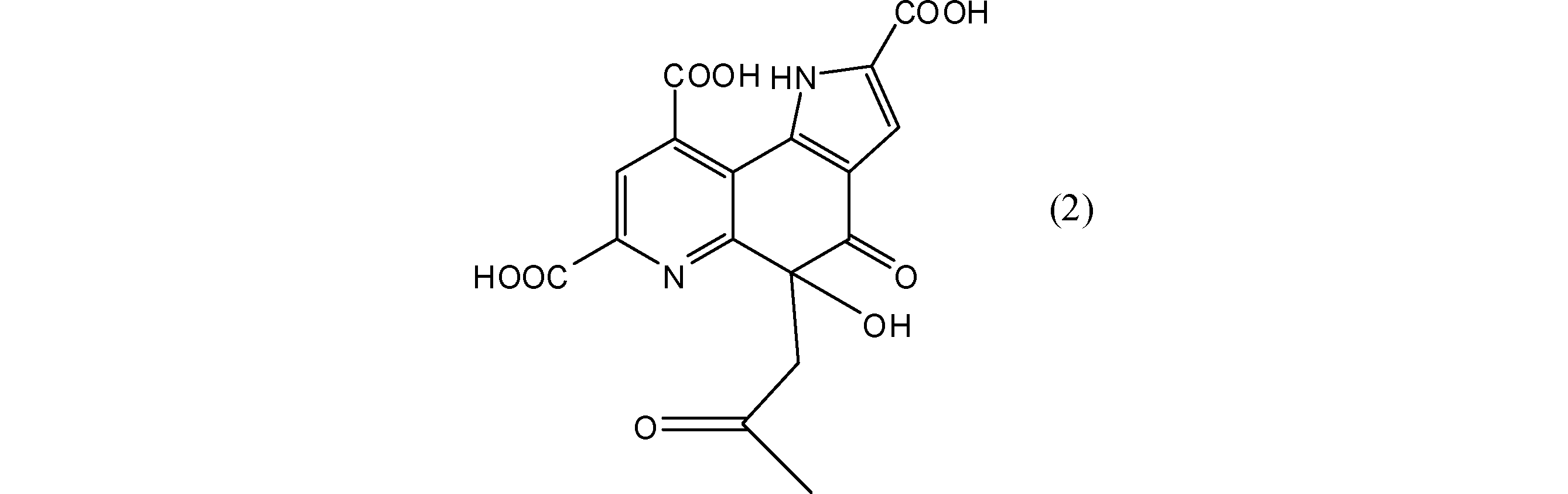
- YQTWHQXGPCJKAP-UHFFFAOYSA-N CC(CC1(c2nc(C(O)=O)cc(C(O)=O)c2-c([nH]c(C(O)=O)c2)c2C1=O)O)=O Chemical compound CC(CC1(c2nc(C(O)=O)cc(C(O)=O)c2-c([nH]c(C(O)=O)c2)c2C1=O)O)=O YQTWHQXGPCJKAP-UHFFFAOYSA-N 0.000 description 1
Images


Classifications
-
- C—CHEMISTRY; METALLURGY
- C07—ORGANIC CHEMISTRY
- C07D—HETEROCYCLIC COMPOUNDS
- C07D471/00—Heterocyclic compounds containing nitrogen atoms as the only ring hetero atoms in the condensed system, at least one ring being a six-membered ring with one nitrogen atom, not provided for by groups C07D451/00 - C07D463/00
- C07D471/02—Heterocyclic compounds containing nitrogen atoms as the only ring hetero atoms in the condensed system, at least one ring being a six-membered ring with one nitrogen atom, not provided for by groups C07D451/00 - C07D463/00 in which the condensed system contains two hetero rings
- C07D471/04—Ortho-condensed systems
-
- A—HUMAN NECESSITIES
- A61—MEDICAL OR VETERINARY SCIENCE; HYGIENE
- A61K—PREPARATIONS FOR MEDICAL, DENTAL OR TOILETRY PURPOSES
- A61K31/00—Medicinal preparations containing organic active ingredients
- A61K31/33—Heterocyclic compounds
- A61K31/395—Heterocyclic compounds having nitrogen as a ring hetero atom, e.g. guanethidine or rifamycins
- A61K31/435—Heterocyclic compounds having nitrogen as a ring hetero atom, e.g. guanethidine or rifamycins having six-membered rings with one nitrogen as the only ring hetero atom
- A61K31/47—Quinolines; Isoquinolines
- A61K31/4738—Quinolines; Isoquinolines ortho- or peri-condensed with heterocyclic ring systems
- A61K31/4745—Quinolines; Isoquinolines ortho- or peri-condensed with heterocyclic ring systems condensed with ring systems having nitrogen as a ring hetero atom, e.g. phenantrolines
-
- A—HUMAN NECESSITIES
- A61—MEDICAL OR VETERINARY SCIENCE; HYGIENE
- A61P—SPECIFIC THERAPEUTIC ACTIVITY OF CHEMICAL COMPOUNDS OR MEDICINAL PREPARATIONS
- A61P17/00—Drugs for dermatological disorders
-
- A—HUMAN NECESSITIES
- A61—MEDICAL OR VETERINARY SCIENCE; HYGIENE
- A61P—SPECIFIC THERAPEUTIC ACTIVITY OF CHEMICAL COMPOUNDS OR MEDICINAL PREPARATIONS
- A61P43/00—Drugs for specific purposes, not provided for in groups A61P1/00-A61P41/00
-
- C—CHEMISTRY; METALLURGY
- C07—ORGANIC CHEMISTRY
- C07B—GENERAL METHODS OF ORGANIC CHEMISTRY; APPARATUS THEREFOR
- C07B2200/00—Indexing scheme relating to specific properties of organic compounds
- C07B2200/13—Crystalline forms, e.g. polymorphs
Definitions
- the present invention relates to an alkali metal of 5-hydroxy-4-oxo-5- (2-oxopropyl) -4,5-dihydro-1H-pyrrolo [2,3-f] quinoline-2,7,9-tricarboxylic acid
- the present invention relates to a salt, a co-crystal and a production method thereof.
- HEP 5-hydroxy-4-oxo-5- (2-oxopropyl) -4,5-dihydro-1H-pyrrolo [2,3-f] quinoline-2,7,9-tricarboxylic acid
- HOP acetone adduct pyrroloquinoline quinone.
- the structure of HOP was used to determine the structure of pyrroloquinoline quinone (for example, see Non-Patent Document 1).
- HOP is a white to yellow substance.
- Cell proliferation activity is an important function for increasing culture productivity or skin metabolism when used as a medium component, cosmetic, or pharmaceutical.
- pyrroloquinoline quinone PQQ
- pyrroloquinoline quinone is problematic in that it is poorly soluble in water and easily deteriorated with discoloration and has poor stability. Therefore, a compound that can be expected to have the same effect as pyrroloquinoline quinone, has excellent solubility, and has excellent resistance to deterioration and discoloration has been desired.
- HOP which is an aldol adduct of PQQ
- PQQ pyrroloquinoline quinone
- HOP derivative has the same effect as pyrroloquinoline quinone, it has excellent solubility, resistance to discoloration, and resistance to discoloration. If it is excellent, it can be expected to be applied in uses such as medium components, cosmetics, and pharmaceuticals.
- HOP has a cell proliferation activity, and even when HOP is used at a higher concentration than PQQ, the cell proliferation rate is decreased with respect to the concentration. It turns out that it is hard to occur. Furthermore, there has been no report on a co-crystal containing an alkali metal salt of HOP or an alkali metal salt of HOP. In particular, it became clear in the course of the present inventors that HOP tends to be colored due to changes in pH, and the alkali metal salt isolation method removes moisture by reacting alkali metal hydroxide with tricarboxylic acid in an aqueous solution. There is a problem that it is difficult to isolate it as a clean solid by the simple method.
- the present invention has been made in view of the above problems, and has a high solubility and resistance to discoloration, a novel alkali metal salt of HOP, a method for producing the same, and a novel cocrystal containing the alkali metal salt of HOP The purpose is to provide.
- HOP has cell proliferation activity, is less reactive with other substances such as reducing agents and amino acids than pyrroloquinoline quinone, and is stable and hardly deteriorated.
- HOP is an alkali metal salt, so that the solubility is drastically improved, and a method capable of stably producing a salt with suppressed coloring is found, and the above problems are solved by the following items. I found out that I can do it.
- an alkali metal salt represented by the following formula (1) (In the above formula (1), M 1 , M 2 , and M 3 each independently represent hydrogen or an alkali metal, and one or more of M 1 , M 2 , and M 3 is an alkali metal. .) [2] Two or more of M 1 , M 2 and M 3 are alkali metals, [1] The alkali metal salt according to [1]. [3] The alkali metal salt according to [1] or [2], wherein the alkali metal is sodium.
- an HOP alkali metal salt and a stable production method thereof can be provided.
- the powder X-ray diffraction spectrum of the crystal obtained in Example 10. 4 is a powder X-ray diffraction spectrum of the crystal obtained in Example 11.
- FIG. 3 is a powder X-ray diffraction spectrum of the powder obtained in Comparative Example 2.
- the present embodiment a mode for carrying out the present invention (hereinafter referred to as “the present embodiment”) will be described in detail.
- the present invention is not limited to this, and various modifications can be made without departing from the gist thereof. Is possible.
- the alkali metal salt of the present embodiment is represented by the following formula (1).
- the alkali metal salt of the present embodiment is also referred to as “HOP alkali metal salt”, and a compound in which all of M 1 , M 2 , and M 3 are hydrogen atoms is also referred to as “HOP free body”.
- M 1 , M 2 , and M 3 each independently represent hydrogen or an alkali metal, and one or more of M 1 , M 2 , and M 3 is an alkali metal. .
- M 1, M 2, and M 1 one or more of the 3 is an alkali metal, M 1, M 2, and of M 3 2 or more or but three, it is preferably an alkali metal.
- M 1 , M 2 , and M 3 is an alkali metal
- the solubility of the HOP alkali metal salt in water is further improved. Specifically, as the number of alkali metal substitutions increases, the pH tends to be on the alkali side and the solubility tends to increase. When the number of alkali metals is 3, the solubility is highest.
- the number of alkali metal substitutions in the HOP alkali metal salt is considered to vary depending on the pH during crystallization in a solvent, and the number of substitutions increases as the acidity changes to alkalinity. Moreover, coloring to a to-be-mixed material can be suppressed more. Therefore, the use of the HOP alkali metal salt of this embodiment is more difficult to be restricted.
- the HOP alkali metal salt of the present embodiment is a single compound in which only M 1 is an alkali metal if one or more of M 1 , M 2 , and M 3 is an alkali metal, for example. also be a mixture comprising a compound only M 1 is an alkali metal, only M 2 is two or more compounds of compounds is an alkali metal, a compound only M 1 is an alkali metal, M 2 And a mixture containing two or more compounds such as a compound in which M 3 is an alkali metal.
- the number of moles of alkali metal contained per mole of the HOP alkali metal salt in the entire mixture is preferably 1 mol or more, more preferably 2 to 3 Mol, more preferably 2.5 to 2.9 mol.
- the solubility is higher and discoloration tends to be further suppressed.
- the alkali metal is not particularly limited, but is preferably Li, Na, and K, more preferably Na and K, and still more preferably Na.
- the solubility of the HOP alkali metal salt in water tends to be further improved.
- Na and K are ions that normally exist in the living body
- HOP alkali metal salts containing Na and / or K are used for foods, feeds, pharmaceuticals, and quasi drugs for humans or animals. And can be used more safely as an active ingredient of cosmetics and the like.
- HOP alkali metal salts HOP trisodium salt, HOP tripotassium salt, HOP disodium salt, and HOP dipotassium salt are preferable.
- HOP alkali metal salts not only have high solubility in water, but can be used more safely as active ingredients for humans or animals, such as foods, feeds, pharmaceuticals, quasi drugs, and cosmetics. .
- HOP alkali metal salts have —COOM 1 groups, —COOM 2 groups, —COOM 3 groups, and —OH groups, and one or more of M 1 , M 2 , and M 3 are alkali metals, It has a maximum of three functional groups from which hydrogen ions can be eliminated. Of these functional groups, the hydrogen ion of any functional group may be eliminated to form a —COO 2 — or —O 2 — group. Note that the desorption state of hydrogen ions may change depending on the crystal state of the HOP alkali metal salt.
- the HOP alkali metal salt of the present embodiment may be a hydrated salt in which one or two or more water molecules are hydrated, or a solvated salt in which one or more solvent molecules are solvated.
- the co-crystal of this embodiment includes the above HOP alkali metal salt, and an alkali metal hydrogen carbonate and / or alkali metal carbonate.
- the HOP co-crystal has a high solubility in water and has higher stability and less discoloration than the HOP alkali metal salt. Therefore, it can be suitably used in uses such as foods, feeds, pharmaceuticals, quasi drugs, and cosmetics for humans or animals.
- the alkali metal bicarbonate and the alkali metal contained in the alkali metal carbonate are preferably Li, Na, and K, more preferably Na and K, and still more preferably Na.
- the solubility of the HOP co-crystal in water tends to be further improved.
- Na and K are ions that are normally present in the living body
- HOP co-crystals containing Na and / or K are used for foods, feeds, pharmaceuticals, quasi-drugs for humans or animals, And it can be used more safely as an active ingredient of cosmetics and the like.
- the content of the alkali metal hydrogen carbonate in the HOP cocrystal is preferably 1 to 4 mol, more preferably 2 to 3 mol, per 1 mol of the HOP alkali metal salt.
- the content of the alkali metal carbonate in the HOP cocrystal is preferably 1 to 3 mol, more preferably 1 to 2 mol, and still more preferably 1 to 1 mol per mol of the HOP alkali metal salt. .5 moles.
- HOP trialkali metal hydrogen carbonate co-crystal is stable and hardly discolored. Therefore, it has the advantage that it is a stable substance with high solubility.
- this HOP co-crystal exists in a solid state, when dissolved in water, carbonic acid and hydrogen carbonate escape as carbon dioxide gas and can be handled in substantially the same manner as the above HOP alkali metal salt.
- the co-crystal has an advantage of imparting physiological activity by carbon dioxide gas in that carbon dioxide gas foams when contacted with water and dissolution of the powder into the liquid is promoted.
- the method for producing the HOP alkali metal salt of the present embodiment comprises 5-hydroxy-4-oxo-5- (2-oxopropyl) -4,5-dihydro-1H-pyrrolo [2,3-f] quinoline-2,
- the method is not particularly limited as long as it is a method having a mixing step of mixing 7,9-tricarboxylic acid and alkali metal hydrogen carbonate and / or alkali metal carbonate in a solvent.
- HOP-free manufacturing process Prior to the description of the above process, the manufacturing process of the HOP-free body will be described. Although it does not specifically limit as a manufacturing method of a HOP free body, For example, the method of mixing pyrroloquinoline quinone or its salt with acetone, and carrying out an aldol reaction is mentioned.
- the aldol reaction may be performed in solution, in a suspended state, or in a gel state, but is preferably performed in water.
- the reaction temperature is preferably 0 to 180 ° C, more preferably 5 to 130 ° C. Since reaction rate improves more because reaction temperature is 0 degreeC or more, it is industrially preferable. Further, when the reaction temperature is 180 ° C. or lower, the pressure resistance of the required reaction vessel is lowered, and the use of an expensive pressure vessel with high pressure resistance can be omitted, which is industrially preferable.
- the concentration of pyrroloquinoline quinone in the reaction system is preferably 0.1 to 30% by mass, more preferably 0.5 to 25% by mass, and further preferably 1 to 20% by mass.
- the amount of acetone used in the reaction system is preferably 0.3 to 50 parts by mass, more preferably 0.5 to 45 parts by mass, and still more preferably, with respect to 1 part by mass of pyrroloquinoline quinone. 1 to 40 parts by mass.
- the aldol reaction is started by making the pH in the system more than 7 alkaline, and after 3 days to 1 week, the pH in the system is acidified to 1 to 4 while precipitating a HOP-free body, The reaction can be stopped. Then, the HOP free body can be obtained by filtering out the precipitated HOP free body.
- a base for making it alkaline For example, sodium hydroxide and potassium hydroxide are mentioned.
- the acid for acidification is not particularly limited, and for example, hydrochloric acid, sulfuric acid, nitric acid, phosphoric acid, perchloric acid, acetic acid, citric acid, oxalic acid, succinic acid, tartaric acid and the like can be used.
- the progress of the aldol reaction can be determined by the color change in the system. For example, it can be confirmed that the aldol reaction has progressed by the solution of the red color initially changing to colorless or yellow.
- general analysis techniques such as liquid chromatography and paper chromatography can also be used.
- the HOP-free product obtained as described above may be further purified using a usual method such as recrystallization or chromatography.
- a higher purity HOP free body can be obtained by adding an acid to the aqueous solution containing the HOP free body obtained by the above reaction to bring the pH to 2 or less.
- the acid used at this time is not particularly limited, and for example, hydrochloric acid, sulfuric acid, nitric acid, phosphoric acid, perchloric acid, acetic acid, citric acid, oxalic acid, succinic acid, tartaric acid and the like can be used.
- the obtained HOP-free body does not contain an alkali metal and can be used as a raw material for the HOP salt.
- the HOP alkali metal salt of the present embodiment can be produced by refining the HOP free body and the alkali metal carbonate and / or alkali metal bicarbonate after mixing them in a solvent.
- the mixing temperature is preferably 0 to 50 ° C, more preferably 5 to 45 ° C, and further preferably 10 to 40 ° C.
- the HOP free body used in the mixing step it is preferable to use a HOP free body purified to a purity of 90% or more in the manufacturing process of the HOP free body.
- HOP alkali metal salts tend not to discolor when the solvent is sufficient under acidic conditions. Therefore, an alkali metal hydroxide and an alkali metal alkoxide can also be mixed and supplemented.
- the mixed solvent of water, an organic solvent, or water and an organic solvent is mentioned.
- the solvent contains water
- the yield of the HOP alkali metal salt tends to be further improved.
- the solvent contains an organic solvent
- the yield of the HOP co-crystal described later tends to be further improved.
- the content of water contained in the solvent is 90% by mass or more, more preferably 95% by mass or more, with respect to 100% by mass of the solvent.
- a water-soluble organic solvent is preferable.
- the water-soluble organic solvent include acetone; alcohols such as methanol, ethanol, isopropanol and 2-propanol; acetonitrile; glycols such as propylene glycol; glycerin and the like.
- the substitution number of the alkali metal salt can be controlled by the molar ratio of the HOP free body to the alkali metal carbonate and / or alkali metal hydrogencarbonate. For example, 1 mol of a HOP free form and 2 mol of an alkali metal hydrogen carbonate are mixed in a solvent, and water is removed by reducing the pressure, whereby a HOP alkali in which two of M 1 , M 2 , and M 3 are alkali metals. Metal salts can be easily obtained.
- Salting out can also be carried out by adding salting out or a water-soluble organic solvent.
- the purification treatment temperature is preferably 30 ° C. or lower, more preferably 20 ° C. or lower.
- the mixing step is performed in an aqueous solvent, and then an organic solvent is added to rapidly precipitate the HOP alkali metal salt.
- the number of moles of the metal hydrogen carbonate is preferably 1 to 3 moles, more preferably 2 to 3 moles, and further preferably 2 to 2.9 moles with respect to 1 mole of the HOP free form.
- a HOP alkali metal salt when making a HOP free body, an alkali metal carbonate, and / or an alkali metal hydrogencarbonate react in water, and adding and precipitating an organic solvent, the alkali metal used by a mixing process is used.
- the number of moles of the carbonate and / or alkali metal bicarbonate is preferably 1 to 3 moles per mole of the HOP free body, and more preferably 2.7 to 3 moles in consideration of treatment at a low temperature. .
- the co-crystal of this embodiment can be obtained when the HOP alkali metal salt production method is carried out in a solvent containing at least an organic solvent.
- the organic solvent are the same as those described above.
- the solvent may contain water according to the target co-crystal.
- the content of water contained in the solvent is preferably an amount such that the alkali metal carbonate and / or alkali metal bicarbonate remains in the solvent without being completely dissolved, and the optimum value depends on the amount of raw materials charged. Different.
- the content of water contained in the solvent is preferably 10% by mass or less, more preferably 7.5% by mass or less, and further preferably 5% by mass or less with respect to 100% by mass of the solvent. .
- the yield of the cocrystal is further improved, and the cocrystal tends to be obtained with good reproducibility.
- a HOP free body and an alkali metal compound are mixed with a solvent containing at least an organic solvent.
- the temperature at this time can be 0 to 120 ° C., preferably 0 to 50 ° C. Generally, it is easier to dissolve when the temperature is raised, but it is preferable to mix at a low temperature because it is easy to change in quality.
- Mixing is preferably performed from the standpoint of uniformity. It is preferred that the mixture dissolves completely.
- the mixture is left for 0.01 to 96 hours, after which water is removed. Removal can be performed under reduced pressure, spray drying, freeze drying, or the like.
- the salt of HOP can be obtained as a dry powder.
- the HOP alkali metal salt and HOP co-crystal of this embodiment have a cell growth promoting action. Moreover, it can be used as a generator of pyrroloquinoline quinone. Therefore, the HOP alkali metal salt and HOP co-crystal of this embodiment are anti-cataract action of pyrroloquinoline quinone function, liver disease prevention treatment action, wound healing action, anti-allergic action, reverse transcriptase inhibition action and glyoxalase I Inhibitory action-Has many pharmacological effects such as anticancer action and nerve fiber regeneration.
- the HOP alkali metal salt and HOP co-crystal of the present embodiment can be used as an active ingredient of a medicine or functional food. That is, it can be provided in the form of external preparations for skin, injections, oral preparations, suppositories, etc., or in the form of foods and drinks for daily consumption, nutrition-enhanced foods, various hospital foods and the like.
- it does not specifically limit as an additive used when preparing so that it may suit these forms.
- a liquid agent For example, saccharides, such as water, fructose, glucose, oils, such as falling raw oil, soybean oil, olive oil, glycols, such as polyethyleneglycol and polypropylene glycol, can be used.
- the excipient for solid preparations such as tablets, capsules and granules is not particularly limited, and examples thereof include sugars such as lactose, sucrose and mannitol.
- the lubricant is not particularly limited, and examples thereof include kaolin, talc and magnesium stearate, starch and sodium alginate as disintegrants, polyvinyl alcohol, cellulose and gelatin as binders.
- surfactant For example, fatty acid ester etc. are mentioned.
- the plasticizer is not particularly limited, and examples thereof include glycerin. Moreover, you may add a solubility promoter, a filler, etc. as needed.
- the HOP alkali metal salt and co-crystal of this embodiment may be used alone or in combination with other materials.
- Other materials that can be combined include vitamins such as vitamin B group, vitamin C and vitamin E, amino acids, carotenoids such as astaxanthin, ⁇ -carotene and ⁇ -carotene, ⁇ 3 fatty acids such as docosahexaenoic acid and eicosapentaenoic acid And omega 6 fatty acids such as arachidonic acid, but are not limited thereto.
- the HOP alkali metal salt of the present embodiment has high solubility and excellent storage stability, so that it can be stored for a long period of time and can be suitably used as an active ingredient in medicines and functional foods.
- LC condition 259 nm was set as a detection wavelength with an absorbance detector.
- a YMC-Pack ODS-A (150 mm, 4.6 mm) column at 40 ° C., analysis was performed at a flow rate of 1 mL / min using 30 mM acetic acid-70 mM ammonium acetate as a developing solution.
- the apparatus used was LC2010 (manufactured by Shimadzu Corporation).
- Example 1 Production of HOP disodium
- a flask was placed in a 35 ° C. water bath and the pressure was gradually reduced from 200 mbar to 30 mbar with an evaporator to remove water and white crystals were obtained. Further, the obtained crystals were dried overnight in a vacuum dryer. From alkali metal analysis using a Horiba sodium electrode and liquid chromatographic analysis (LC analysis) using LC2010 (manufactured by Shimadzu Corporation), it was confirmed that 0.47 g of HOP disodium salt was obtained.
- LC analysis liquid chromatographic analysis
- Example 5 Production of HOP trisodium by organic solvent precipitation method
- HOP free material 4 g of water, and 0.50 g of sodium hydrogen carbonate were mixed in the flask, foaming from the mixed solution was observed.
- this mixed solution was subjected to ultrasonic waves for 5 minutes, all solid components in the mixed solution were dissolved.
- 36 mL of methanol was added and stored overnight in a cold storage (4 ° C.), a solid precipitated. The solid was removed by centrifugation to obtain white crystals. Further, the obtained crystals were dried overnight in a vacuum dryer. From alkali metal analysis using a Horiba sodium electrode and liquid chromatographic analysis (LC analysis) using LC2010 (manufactured by Shimadzu Corporation), it was confirmed that 0.41 g of HOP trisodium was obtained.
- LC analysis liquid chromatographic analysis
- Example 7 Production of HOP dipotassium
- HOP dipotassium When 0.39 g of HOP free material, 10 g of water, and 0.20 g of potassium hydrogen carbonate were mixed in the flask, foaming from the mixed solution was observed. When this mixed solution was stirred at 23 ° C. for 1 hour, all solid components in the mixed solution were dissolved. Thereafter, a flask was attached to a 35 ° C. water bath, and the pressure was gradually reduced from 200 mbar to 30 mbar with an evaporator, and water was removed to obtain pale yellow crystals. Further, the obtained crystals were dried overnight in a vacuum dryer. From alkali metal analysis using a Horiba sodium electrode and liquid chromatographic analysis (LC analysis) using LC2010 (manufactured by Shimadzu Corporation), it was confirmed that 0.51 g of HOP dipotassium was obtained.
- LC analysis liquid chromatographic analysis
- Example 8 Production of HOP trilithium
- 0.39 g of a HOP free body 2 g of water, and 0.11 g of lithium carbonate were mixed in the flask, foaming from the mixed solution was observed.
- this mixed solution was stirred at 23 ° C. for 1 hour, all solid components in the mixed solution were dissolved. Thereafter, a flask was attached to a 35 ° C. water bath, and the pressure was gradually reduced from 200 mbar to 30 mbar with an evaporator, and water was removed to obtain pale yellow crystals. Further, the obtained crystals were dried overnight in a vacuum dryer. From alkali metal analysis using a Horiba sodium electrode and liquid chromatographic analysis (LC analysis) using LC2010 (manufactured by Shimadzu Corporation), it was confirmed that 0.39 g of HOP tripotassium was obtained.
- LC analysis liquid chromatographic analysis
- Example 9 Production of HOP dilithium
- 0.39 g of a HOP free body, 2 g of water, and 0.074 g of lithium carbonate were mixed in the flask, foaming from the mixed solution was observed.
- the mixed solution was stirred at 23 ° C. for 1 hour. Thereafter, a flask was attached to a 35 ° C. water bath, and the pressure was gradually reduced from 200 mbar to 30 mbar with an evaporator, and water was removed to obtain pale yellow crystals. Further, the obtained crystals were dried overnight in a vacuum dryer. From alkali metal analysis using a Horiba sodium electrode and liquid chromatographic analysis (LC analysis) using LC2010 (manufactured by Shimadzu Corporation), it was confirmed that 0.43 g of HOP dilithium was obtained.
- LC analysis liquid chromatographic analysis
- Example 10 HOP trisodium bicarbonate co-crystal When 0.78 g of HOP free material and 0.50 g of sodium hydrogen carbonate were mixed with 20 mL of ethanol, foaming from the mixed solution was not observed. The mixed solution was stirred at 23 ° C. for 20 hours. Thereafter, the solid in the mixed solution was filtered to obtain 1.08 g of white crystals. Further, the obtained crystals were dried overnight in a vacuum dryer. From alkali metal analysis using a Horiba sodium electrode and liquid chromatographic analysis (LC analysis) using LC2010 (manufactured by Shimadzu Corporation), it was confirmed that sodium / HOP was 3. It was found that hydrogen carbonate remained due to foaming when this solid was added to water.
- LC analysis liquid chromatographic analysis
- Example 11 HOP disodium bicarbonate co-crystal
- LC analysis liquid chromatographic analysis
- the co-crystal was very stable in both cold storage and room temperature storage. From the comparison between Example 2-2 and Examples 10-2 and 11-2, when the total amount of the HOP alkali metal salt is regarded as 1 mole, the HOP alkali metal salt having 3 moles of alkali metal is included. In comparison, when the total amount of the HOP alkali metal salt is 1 mol, the HOP co-crystal containing 3 alkali metals is superior in stability at room temperature storage and should be easy to use for various applications. I understood.
- the HOP alkali metal salt of this embodiment has a high cell growth activity.
- HOP disodium and pyrroloquinoline quinone disodium prepared in Example 1 were tested. 10 mg of a sample was put in a test tube, and 200 ⁇ L of a 10 mass% ascorbic acid aqueous solution was mixed. As a result, no significant color change was observed with disodium HOP. On the other hand, pyrroloquinoline quinone disodium turned black. From this result, it was found that the HOP alkali metal salt was superior in discoloration resistance compared to the pyrroloquinoline quinone salt. Further, it is presumed that the same result as that of the HOP alkali metal salt can be obtained also in the HOP co-crystal which is considered to exhibit the same behavior as the HOP alkali metal salt in the dissolved state.
- HOP alkali metal salt and HOP co-crystal prepared in Examples 1 to 11 are filled with rice flour so that the force of 10 kN is applied using Ichibashi Seiki Co., Ltd. HANDTAB-100 (R) 8 mM tablet form. I was able to make a tablet.
- the HOP alkali metal salt and the HOP co-crystal are excellent in tablet moldability and can be suitably used for uses such as oral intake.
- HOP alkali metal salt and HOP co-crystal prepared in Examples 1 to 11 were mixed with 10 mL of Boat fatty acid oil. Thereafter, it was allowed to stand at 30 ° C. for 1 day, but no change in color or the like was observed.
- the HOP alkali metal salt and the HOP co-crystal are excellent in stability in oil, and can be suitably used for applications such as a base material used for cosmetics and soft capsules.
- the HOP alkali metal salt and HOP co-crystal of the present invention have high solubility and can be used in the fields of pharmaceuticals, reagents, culture media, foods, cosmetics, and resin additives.
Landscapes
- Health & Medical Sciences (AREA)
- Chemical & Material Sciences (AREA)
- Organic Chemistry (AREA)
- Life Sciences & Earth Sciences (AREA)
- Veterinary Medicine (AREA)
- Public Health (AREA)
- General Health & Medical Sciences (AREA)
- Medicinal Chemistry (AREA)
- Animal Behavior & Ethology (AREA)
- Pharmacology & Pharmacy (AREA)
- General Chemical & Material Sciences (AREA)
- Nuclear Medicine, Radiotherapy & Molecular Imaging (AREA)
- Engineering & Computer Science (AREA)
- Chemical Kinetics & Catalysis (AREA)
- Bioinformatics & Cheminformatics (AREA)
- Epidemiology (AREA)
- Dermatology (AREA)
- Pharmaceuticals Containing Other Organic And Inorganic Compounds (AREA)
- Cosmetics (AREA)
- Nitrogen Condensed Heterocyclic Rings (AREA)
- Medicinal Preparation (AREA)
- Coloring Foods And Improving Nutritive Qualities (AREA)
Abstract
Description
〔1〕
下記式(1)で示される、アルカリ金属塩。

(上記式(1)中、M1、M2、及びM3は、各々独立して、水素又はアルカリ金属を示し、M1、M2、及びM3の1つ以上が、アルカリ金属である。)
〔2〕
M1、M2及びM3の2つ以上が、アルカリ金属である、
〔1〕記載のアルカリ金属塩。
〔3〕
前記アルカリ金属が、ナトリウムである、〔1〕又は〔2〕記載のアルカリ金属塩。
〔4〕
〔1〕~〔3〕のいずれか1項に記載のアルカリ金属塩と、
アルカリ金属炭酸水素塩及び/又はアルカリ金属炭酸塩と、を含む、共結晶。
〔5〕
5-ヒドロキシ-4-オキソ-5-(2-オキソプロピル)-4,5-ジハイドロ-1H-ピロロ[2,3-f]キノリン-2,7,9-トリカルボン酸と、アルカリ金属炭酸水素塩及び/又はアルカリ金属炭酸塩と、を溶媒中で混合する混合工程を有する、
5-ヒドロキシ-4-オキソ-5-(2-オキソプロピル)-4,5-ジハイドロ-1H-ピロロ[2,3-f]キノリン-2,7,9-トリカルボン酸のアルカリ金属塩の製造方法。
〔6〕
前記溶媒が、水を含む、〔5〕に記載の製造方法。
〔7〕
前記溶媒が、有機溶媒を含む、〔5〕に記載の製造方法。
本実施形態のアルカリ金属塩は、下記式(1)で示される。なお、本願明細書において、本実施形態のアルカリ金属塩を「HOPアルカリ金属塩」ともいい、M1、M2、及びM3の全てが水素原子である化合物を「HOPフリー体」ともいう。
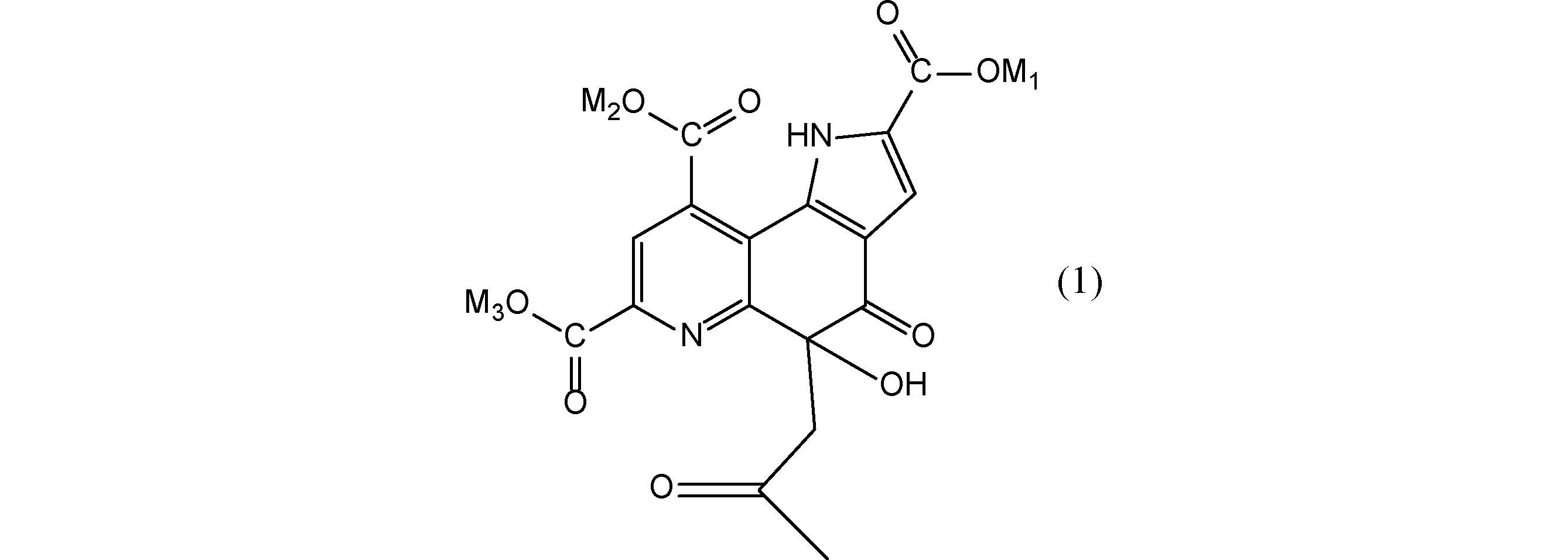
(上記式(1)中、M1、M2、及びM3は、各々独立して、水素又はアルカリ金属を示し、M1、M2、及びM3の1つ以上が、アルカリ金属である。)
本実施形態の共結晶(以下、「HOP共結晶」ともいう。)は、上記HOPアルカリ金属塩と、アルカリ金属炭酸水素塩及び/又はアルカリ金属炭酸塩と、を含む。HOP共結晶は、水に対する溶解度が高く、かつ、HOPアルカリ金属塩と比較して、安定性がより高く、より変色しにくい。そのため、ヒト用又は動物用の、食品、飼料、医薬品、医薬部外品、及び化粧品等の用途において、好適に用いることができる。
本実施形態のHOPアルカリ金属塩の製造方法は、5-ヒドロキシ-4-オキソ-5-(2-オキソプロピル)-4,5-ジハイドロ-1H-ピロロ[2,3-f]キノリン-2,7,9-トリカルボン酸と、アルカリ金属炭酸水素塩及び/又はアルカリ金属炭酸塩と、を溶媒中で混合する混合工程を有する方法であれば、特に限定されない。
上記工程の説明の前に、HOPフリー体の製造工程について説明する。HOPフリー体の製造方法としては、特に限定されないが、例えば、ピロロキノリンキノン又はその塩をアセトンと混合してアルドール反応させる方法が挙げられる。該アルドール反応は、溶液下、懸濁状態、又はゲル状態のいずれで行ってよいが、水中で行うことが好ましい。
本実施形態のHOPアルカリ金属塩は、HOPフリー体と、アルカリ金属炭酸塩及び/又はアルカリ金属炭酸水素塩と、を溶媒中で混合した後に、精製して製造することができる。混合温度は、好ましくは0~50℃であり、より好ましくは5~45℃であり、さらに好ましくは10~40℃である。なお、混合工程で用いるHOPフリー体としては、HOPフリー体の製造工程において純度が90%以上となるまで精製したHOPのフリー体を使用することが好ましい。
本実施形態の共結晶は、上記HOPアルカリ金属塩の製法において、少なくとも有機溶媒を含む溶媒中で行った場合に得ることができる。有機溶媒としては、上記と同様のものが挙げられる。
本実施形態のHOPアルカリ金属塩及びHOP共結晶は、細胞の増殖促進作用を有している。また、ピロロキノリンキノンの発生剤として使用することができる。そのため、本実施形態のHOPアルカリ金属塩及びHOP共結晶は、ピロロキノリンキノンの機能の抗白内障作用、肝臓疾患予防治療作用、創傷治癒作用、抗アレルギー作用、逆転写酵素阻害作用およびグリオキサラーゼI阻害作用-制癌作用、神経線維再生など多く薬理効果を有する。
PQQジナトリウム(三菱瓦斯化学製BioPQQ)11.2gを水1Lに加え水溶液を調製し、得られた水溶液にNaOHを加え、水溶液のpHを9にした。この水溶液にアセトン200g加えると20分で赤から薄い黄色に変色した。次いで、水溶液に塩酸を加え、水溶液のpHを2.5にした。その後、水溶液中に水分をエバポレートして、水溶液の総量が400gとなるまで濃縮した。濃縮後の水溶液中には黄色い固体が析出していた。これを、さらに減圧乾燥して8.01gの固体を得た。
上記のようにして得られた固体1mgを1%コリン水1gに溶解させて試験液を得た。得られた試験液をホリバ製ナトリウム電極を使用して室温(25℃)で分析した結果、アルカリ金属イオンは検出されなかった。このことから、得られた固体が、HOPフリー体であることが確認された。
フラスコ内でHOPフリー体0.39gと水20gと炭酸水素ナトリウム0.16gを混合したところ、混合溶液からの発泡が観察された。pH4であった。この混合溶液を23℃で5時間攪拌した後、35℃の水浴にフラスコをつけエバポレーターで200mbarから徐々に圧力を30mbarまで下げ、水を除去して白色の結晶を得た。さらに、得られた結晶を真空乾燥機で一晩乾燥した。ホリバ製ナトリウム電極を用いたアルカリ金属分析、LC2010(島津製作所社製)を用いた液体クロマトグラフ分析(LC分析)から、HOPジナトリウム塩が0.47g得られたことが確認された。
フラスコ内でHOPフリー体0.39gと水2gと炭酸水素ナトリウム0.25gを混合したところ、混合溶液からの発泡が観察された。この混合溶液を超音波に5分かけたところ、混合溶液中の固体成分がすべて溶けた。pH7であった。その後、35℃の水浴にフラスコをつけエバポレーターで200mbarから徐々に圧力を30mbarまで下げ、水を除去して淡黄色の結晶を得た。さらに、得られた結晶を真空乾燥機で一晩乾燥した。ホリバ製ナトリウム電極を用いたアルカリ金属分析、LC2010(島津製作所社製)を用いた液体クロマトグラフ分析(LC分析)から、HOPトリナトリウムが0.50g得られたことが確認された。
フラスコ内でHOPフリー体0.78gと水4gと炭酸水素ナトリウム0.42gを混合したところ、混合溶液からの発泡が観察された。この混合溶液を23℃で1時間攪拌したところ、混合溶液中の固体成分がすべて溶けた。pH7であった。その後、35℃の水浴にフラスコをつけエバポレーターで200mbarから徐々に圧力を30mbarまで下げ、で水を除去して淡黄色の結晶を得た。さらに、得られた結晶を真空乾燥機で一晩乾燥した。ホリバ製ナトリウム電極を用いたアルカリ金属分析、LC2010(島津製作所社製)を用いた液体クロマトグラフ分析(LC分析)から、HOP2.5ナトリウムが1.00g得られたことが確認された。
フラスコ内でHOPフリー体0.78gと水4gと炭酸水素ナトリウム0.49gを混合したところ、混合溶液からの発泡が観察された。この混合溶液を23℃で1時間攪拌したところ、混合溶液中の固体成分がすべて溶けた。pH7であった。その後、35℃の水浴にフラスコをつけエバポレーターで200mbarから徐々に圧力を30mbarまで下げ、水を除去して淡黄色の結晶を得た。さらに、得られた結晶を真空乾燥機で一晩乾燥した。ホリバ製ナトリウム電極を用いたアルカリ金属分析、LC2010(島津製作所社製)を用いた液体クロマトグラフ分析(LC分析)から、HOP2.9ナトリウムが0.95g得られたことが確認された。
フラスコ内でHOPフリー体0.78gと水4gと炭酸水素ナトリウム0.50gを混合したところ、混合溶液からの発泡が観察された。この混合溶液を超音波に5分かけたところ混合溶液中の固体成分がすべて溶けた。メタノール36mL加え、冷温庫(4℃)に一晩保存すると固体が析出した。固体を遠心分離して取り出し、白色の結晶を得た。さらに、得られた結晶を真空乾燥機で一晩乾燥した。ホリバ製ナトリウム電極を用いたアルカリ金属分析、LC2010(島津製作所社製)を用いた液体クロマトグラフ分析(LC分析)から、HOPトリナトリウムが0.41g得られたことが確認された。
フラスコ内でHOPフリー体0.39gと水2gと炭酸水素カリウム0.30gを混合したところ、混合溶液からの発泡が観察された。この混合溶液を23℃で1時間攪拌したところ、混合溶液中の固体成分がすべて溶けた。その後、35℃の水浴にフラスコをつけエバポレーターで200mbarから徐々に圧力を30mbarまで下げ、水を除去してグレーの結晶を得た。さらに、得られた結晶を真空乾燥機で一晩乾燥した。ホリバ製ナトリウム電極を用いたアルカリ金属分析、LC2010(島津製作所社製)を用いた液体クロマトグラフ分析(LC分析)から、HOPトリカリウムが0.55g得られたことが確認された。
フラスコ内でHOPフリー体0.39gと水10gと炭酸水素カリウム0.20gを混合したところ、混合溶液からの発泡が観察された。この混合溶液を23℃で1時間攪拌したところ、混合溶液中の固体成分がすべて溶けた。その後、35℃の水浴にフラスコをつけエバポレーターで200mbarから徐々に圧力を30mbarまで下げ、水を除去して薄い黄色結晶を得た。さらに、得られた結晶を真空乾燥機で一晩乾燥した。ホリバ製ナトリウム電極を用いたアルカリ金属分析、LC2010(島津製作所社製)を用いた液体クロマトグラフ分析(LC分析)から、HOPジカリウムが0.51g得られたことが確認された。
フラスコ内でHOPフリー体0.39gと水2gと炭酸リチウム0.11gを混合したところ、混合溶液からの発泡が観察された。この混合溶液を23℃で1時間攪拌したところ、混合溶液中の固体成分がすべて溶けた。その後、35℃の水浴にフラスコをつけエバポレーターで200mbarから徐々に圧力を30mbarまで下げ、水を除去して薄い黄色結晶を得た。さらに、得られた結晶を真空乾燥機で一晩乾燥した。ホリバ製ナトリウム電極を用いたアルカリ金属分析、LC2010(島津製作所社製)を用いた液体クロマトグラフ分析(LC分析)から、HOPトリカリウムが0.39g得られたことが確認された。
フラスコ内でHOPフリー体0.39gと水2gと炭酸リチウム0.074gを混合したところ、混合溶液からの発泡が観察された。この混合溶液を23℃で1時間攪拌した。その後、35℃の水浴にフラスコをつけエバポレーターで200mbarから徐々に圧力を30mbarまで下げ、水を除去して薄い黄色結晶を得た。さらに、得られた結晶を真空乾燥機で一晩乾燥した。ホリバ製ナトリウム電極を用いたアルカリ金属分析、LC2010(島津製作所社製)を用いた液体クロマトグラフ分析(LC分析)から、HOPジリチウムが0.43g得られたことが確認された。
HOPフリー体0.78gと炭酸水素ナトリウム0.50gをエタノール20mL混合したところ、混合溶液からの発泡は観察されなかった。この混合溶液を23℃で20時間撹拌した。その後、混合溶液中の固体を濾過して白色の結晶1.08gを得た。さらに、得られた結晶を真空乾燥機で一晩乾燥した。ホリバ製ナトリウム電極を用いたアルカリ金属分析、LC2010(島津製作所社製)を用いた液体クロマトグラフ分析(LC分析)から、ナトリウム/HOPは3であることが確認された。この固体を水に加えると発泡したため、炭酸水素塩が残留していることがわかった。
フラスコ内でHOPフリー体0.78gと炭酸水素ナトリウム0.33gをエタノール20mL混合したところ、混合溶液からの発泡は観察されなかった。この混合溶液を23℃で20時間攪拌した。その後、混合溶液中の固体を濾過して白色の結晶0.91gを得た。さらに、得られた結晶を真空乾燥機で一晩乾燥した。ホリバ製ナトリウム電極を用いたアルカリ金属分析、LC2010(島津製作所社製)を用いた液体クロマトグラフ分析(LC分析)から、ナトリウム/HOPは2であることが確認された。この固体を水に加えると発泡したため、炭酸水素塩が残留していることがわかった。
フラスコ内でHOPフリー体0.39gを水20mLと混合した。さらに、Naの添加モル数がHOPフリー体のモル数の3倍となるよう、25%水酸化ナトリウム水溶液を加えた。すると、フラスコ内の混合溶液は、すぐに褐色に変化した。pH7であった。この混合溶液の水分をエバポレーターで除去すると黒色の固体が得られた。LC2010(島津製作所社製)を用いた液体クロマトグラフ分析(LC分析)から、固体100質量%中に含まれるHOPの含有量は80質量%に減少しており、分解が進んでいることがわかった。この結果より、水酸化ナトリウムを使用した場合では、変色や分解が進行しやすく、HOPの塩が適切に得られていないことが分かった。
フラスコ内でHOPフリー体0.78gと炭酸水素ナトリウム0.50gをマグネチックスタラー駆動乳鉢を用いて18時間粉砕混合し、薄い黄色の粉末を得た。この粉末はHOPと炭酸水素ナトリウムの混合物であり、アルカリ金属塩ではなかった。
各実施例で作製したHOPアルカリ金属塩100mgに対し、HOPアルカリ金属塩が溶け残る量の水を加えた。その溶液を、30℃で1時間以上静置した。次いで、遠心分離により、上澄み液と溶け残ったHOPアルカリ金属塩を分離した後、上澄みを希釈して360nmの吸光度を測定した。得られた吸光度から溶解度を算出した。その結果を以下の表1に示す。なお、参考例2-1,3-1,4-1として、PQQフリー体、PQQトリナトリウム、及びPQQジナトリウムの飽和溶解度のデータも併記する。

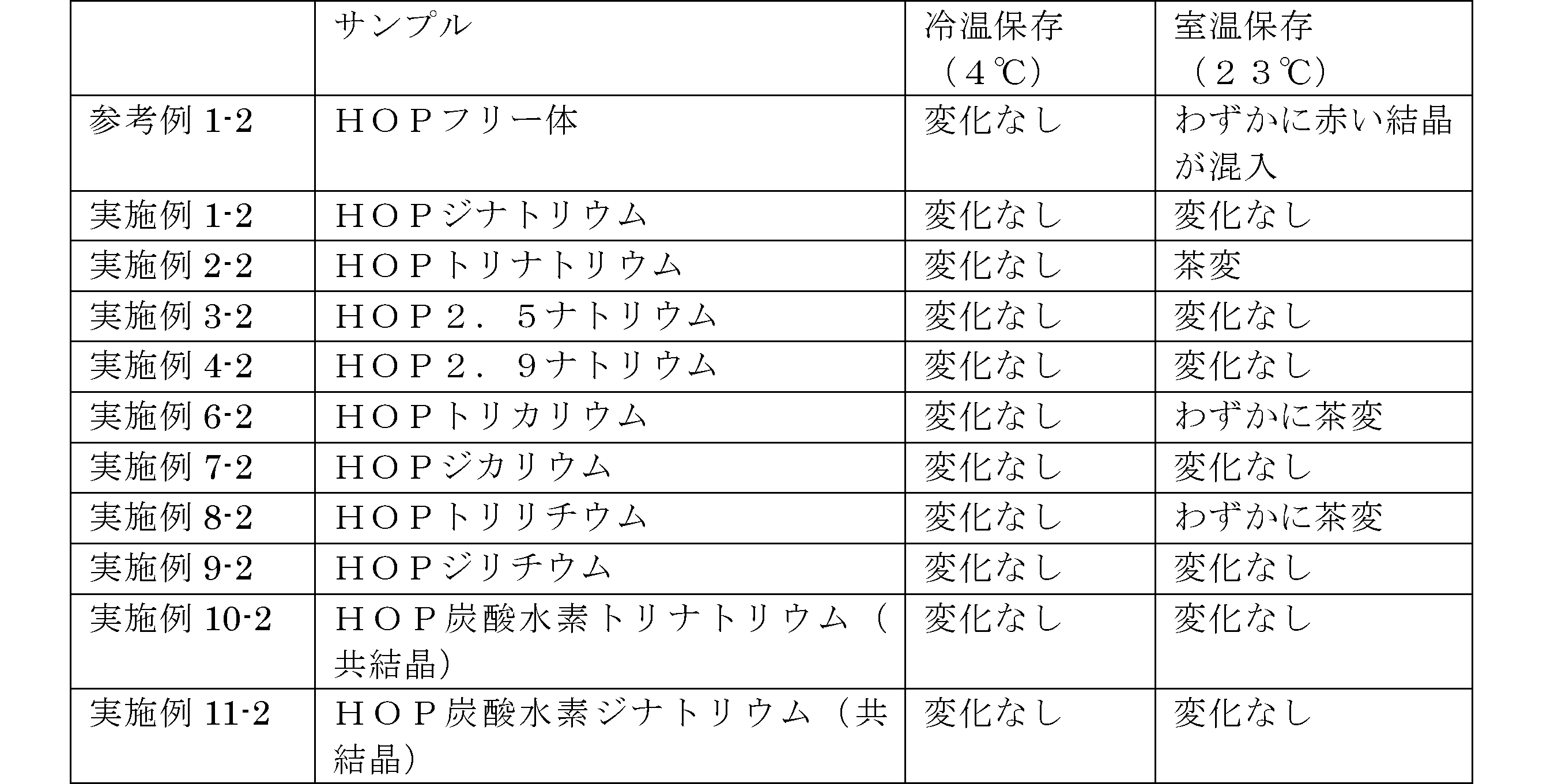
各実施例で作製したHOPアルカリ金属塩を、固体の状態で、冷温保存(4℃)および室温保存(23℃)し、1ヶ月経過した後の変化を目視で確認した。その結果を表2に示す。
ヒト子宮がん細胞HeLa細胞を、96ウェルに1000個/ウェルなるように撒き、DMEM(インビトロジェン社)+10%FBS培地中で、5%CO2濃度、37℃の条件で、インキュベーターで1晩培養した。その後、各実施例で作製したHOPアルカリ金属塩の濃度が4.9mg/L、19.5mg/Lになるように、HOPアルカリ金属塩を培地に加えた。さらに2日間培養を継続した後、ウェルから培地を取り除き、ウェル内を洗い、同仁化学製cell Counting kit 8を使用してウェル内の細胞数を測定した。HOPアルカリ金属塩を培地に加えていないときの細胞数を100とした場合の結果を以下の表に示す。

株式会社理学の粉末X線装置を使用し、Cu-Kα40kV100mAで測定を行った。その結果を表4、図1、2,3に示す。

実施例1で作成したHOPジナトリウムとピロロキノリンキノンジナトリウムを試験した。サンプル10mgをテストチューブにいれ、10質量%アスコルビン酸水溶液を200μL混合した。その結果、HOPジナトリウムでは色の大きな変化は認められなかった。一方、ピロロキノリンキノンジナトリウムは黒く変色した。この結果から、HOPアルカリ金属塩はピロロキノリンキノン塩と比べて耐変色性に優れることが分かった。また、溶解した状態でHOPアルカリ金属塩と同挙動を示すと考えられるHOP共結晶においてもHOPアルカリ金属塩と同様の結果が得られると推定される。
実施例1~11で作製したHOPアルカリ金属塩及びHOP共結晶10mgをコメ粉で方いっぱいになるようにつめ、市橋精機株式会社HANDTAB-100(R) 8mM錠剤形を使用して10kNの力をかけることにより、タブレットを作ることができた。このようにHOPアルカリ金属塩及びHOP共結晶は、錠剤成形性に優れ、経口摂取等の用途に好適に用いることができる。
実施例1~11で作製したHOPアルカリ金属塩及びHOP共結晶1mgを中佐脂肪酸オイル10mLに混合した。その後、30℃で1日放置したが色などの変化は認められなかった。このようにHOPアルカリ金属塩及びHOP共結晶は、油中での安定性に優れ、化粧品やソフトカプセルに使用する用途の基材等の用途に好適に用いることができる。
Claims (7)
- 下記式(1)で示される、アルカリ金属塩。

(上記式(1)中、M1、M2、及びM3は、各々独立して、水素又はアルカリ金属を示し、M1、M2、及びM3の1つ以上が、アルカリ金属である。) - M1、M2及びM3の2つ以上が、アルカリ金属である、
請求項1記載のアルカリ金属塩。 - 前記アルカリ金属が、ナトリウムである、請求項1又は2記載のアルカリ金属塩。
- 請求項1~3のいずれか1項に記載のアルカリ金属塩と、
アルカリ金属炭酸水素塩及び/又はアルカリ金属炭酸塩と、を含む、共結晶。 - 5-ヒドロキシ-4-オキソ-5-(2-オキソプロピル)-4,5-ジハイドロ-1H-ピロロ[2,3-f]キノリン-2,7,9-トリカルボン酸と、アルカリ金属炭酸水素塩及び/又はアルカリ金属炭酸塩と、を溶媒中で混合する混合工程を有する、
5-ヒドロキシ-4-オキソ-5-(2-オキソプロピル)-4,5-ジハイドロ-1H-ピロロ[2,3-f]キノリン-2,7,9-トリカルボン酸のアルカリ金属塩の製造方法。 - 前記溶媒が、水を含む、請求項5に記載の製造方法。
- 前記溶媒が、有機溶媒を含む、請求項5に記載の製造方法。
Priority Applications (3)
| Application Number | Priority Date | Filing Date | Title |
|---|---|---|---|
| CN201580073888.4A CN107207494B (zh) | 2015-01-19 | 2015-12-15 | 溶解性高的丙酮加成吡咯喹啉醌盐 |
| JP2016570511A JP6648700B2 (ja) | 2015-01-19 | 2015-12-15 | 溶解性の高いアセトン付加ピロロキノリンキノン塩 |
| US15/544,403 US10131661B2 (en) | 2015-01-19 | 2015-12-15 | High-solubility acetone-added pyrroloquinoline quinone salt |
Applications Claiming Priority (2)
| Application Number | Priority Date | Filing Date | Title |
|---|---|---|---|
| JP2015007414 | 2015-01-19 | ||
| JP2015-007414 | 2015-01-19 |
Publications (1)
| Publication Number | Publication Date |
|---|---|
| WO2016117242A1 true WO2016117242A1 (ja) | 2016-07-28 |
Family
ID=56416802
Family Applications (1)
| Application Number | Title | Priority Date | Filing Date |
|---|---|---|---|
| PCT/JP2015/085064 Ceased WO2016117242A1 (ja) | 2015-01-19 | 2015-12-15 | 溶解性の高いアセトン付加ピロロキノリンキノン塩 |
Country Status (4)
| Country | Link |
|---|---|
| US (1) | US10131661B2 (ja) |
| JP (1) | JP6648700B2 (ja) |
| CN (1) | CN107207494B (ja) |
| WO (1) | WO2016117242A1 (ja) |
Cited By (1)
| Publication number | Priority date | Publication date | Assignee | Title |
|---|---|---|---|---|
| JP2023068716A (ja) * | 2021-11-04 | 2023-05-18 | 三菱瓦斯化学株式会社 | ピロロキノリンキノンの微量分析方法 |
Families Citing this family (1)
| Publication number | Priority date | Publication date | Assignee | Title |
|---|---|---|---|---|
| WO2020045564A1 (ja) * | 2018-08-30 | 2020-03-05 | 三菱瓦斯化学株式会社 | 光劣化抑制剤、それを含む飲料、及び光劣化抑制方法 |
Citations (1)
| Publication number | Priority date | Publication date | Assignee | Title |
|---|---|---|---|---|
| JPH06128259A (ja) * | 1992-10-14 | 1994-05-10 | Mitsubishi Gas Chem Co Inc | 新規なピロロピリドシンノリン化合物 |
Family Cites Families (6)
| Publication number | Priority date | Publication date | Assignee | Title |
|---|---|---|---|---|
| JPH06126259A (ja) | 1992-10-13 | 1994-05-10 | Marubeni Tekuma Tex Kk | 超音波洗浄方法及び装置 |
| US9163014B2 (en) * | 2009-07-16 | 2015-10-20 | Mitsubishi Gas Chemical Company, Inc. | Crystals of pyrroloquinolinequinone sodium salts |
| US9174983B2 (en) * | 2011-06-16 | 2015-11-03 | Mitsubishi Gas Chemical Company, Inc. | Pyrroloquinoline quinone disodium salt crystal and method for producing the same |
| CN103857676B (zh) * | 2011-10-03 | 2016-06-08 | 三菱瓦斯化学株式会社 | 吡咯喹啉醌醇加成物 |
| US9394298B2 (en) * | 2012-08-17 | 2016-07-19 | Mitsubishi Gas Chemical Company, Inc. | Pyrroloquinoline quinone tetraalkali salt and crystal thereof, methods for producing these, and composition |
| JP6609261B2 (ja) * | 2014-09-22 | 2019-11-20 | 国立大学法人名古屋大学 | 新規な寿命延長剤、該寿命延長剤を用いた寿命延長方法、新規なデュアルオキシダーゼ活性化剤、デュアルオキシダーゼの活性化方法、寿命延長剤の製造、及びデュアルオキシダーゼ活性化剤の製造 |
-
2015
- 2015-12-15 US US15/544,403 patent/US10131661B2/en active Active
- 2015-12-15 CN CN201580073888.4A patent/CN107207494B/zh active Active
- 2015-12-15 JP JP2016570511A patent/JP6648700B2/ja active Active
- 2015-12-15 WO PCT/JP2015/085064 patent/WO2016117242A1/ja not_active Ceased
Patent Citations (1)
| Publication number | Priority date | Publication date | Assignee | Title |
|---|---|---|---|---|
| JPH06128259A (ja) * | 1992-10-14 | 1994-05-10 | Mitsubishi Gas Chem Co Inc | 新規なピロロピリドシンノリン化合物 |
Non-Patent Citations (3)
| Title |
|---|
| COREY, E. J. ET AL.: "Total synthesis of the quinonoid alcohol dehydrogenase coenzyme (1) of methylotrophic bacteria", JOURNAL OF THE AMERICAN CHEMICAL SOCIETY, vol. 103, no. 18, 1981, pages 5599 - 5600 * |
| GAINOR, JAMES A. ET AL.: "Total synthesis of methoxatin, the coenzyme of methanol dehydrogenase and glucose dehydrogenase", JOURNAL OF ORGANIC CHEMISTRY, vol. 46, no. 21, 1981, pages 4317 - 4319 * |
| SALISBURY, S. A. ET AL.: "A novel coenzyme from bacterial primary alcohol dehydrogenases", NATURE, vol. 280, no. 5725, 1979, pages 843 - 844 * |
Cited By (2)
| Publication number | Priority date | Publication date | Assignee | Title |
|---|---|---|---|---|
| JP2023068716A (ja) * | 2021-11-04 | 2023-05-18 | 三菱瓦斯化学株式会社 | ピロロキノリンキノンの微量分析方法 |
| JP7788071B2 (ja) | 2021-11-04 | 2025-12-18 | 三菱瓦斯化学株式会社 | ピロロキノリンキノンの微量分析方法 |
Also Published As
| Publication number | Publication date |
|---|---|
| JP6648700B2 (ja) | 2020-02-14 |
| US20180009803A1 (en) | 2018-01-11 |
| JPWO2016117242A1 (ja) | 2017-10-26 |
| CN107207494A (zh) | 2017-09-26 |
| CN107207494B (zh) | 2020-01-21 |
| US10131661B2 (en) | 2018-11-20 |
Similar Documents
| Publication | Publication Date | Title |
|---|---|---|
| US20240083847A1 (en) | Sulfonamide derivatives for protein degradation | |
| JP6160621B2 (ja) | ピロロキノリンキノンテトラアルカリ塩及びその結晶、これらの製造方法、並びに、組成物 | |
| JP5783165B2 (ja) | 還元型ピロロキノリンキノンの製造方法 | |
| AU2018386223A1 (en) | Small molecule degraders that recruit DCAFT15 | |
| EP2084159A1 (en) | Pyrido ý2, 3-d¨pyrimidines and their use as kinase inhibitors | |
| JP2019524790A (ja) | チエノピリミジン系化合物、その製造方法、医薬組成物およびその応用 | |
| JPWO2011055796A1 (ja) | ピロロキノリンキノンのフリー体 | |
| CN103261197A (zh) | 溶解性高的吡咯并喹啉醌盐及其制造方法 | |
| WO2008150260A1 (en) | 8-oxy-2-aminopyrido (2, 3-d) pyrimidin-7-one derivatives as kinase inhibitors and anticancer agents | |
| JPWO2016136928A1 (ja) | イミダゾオキサジンの結晶、当該結晶を含む医薬組成物、及び当該結晶の製造方法 | |
| JP6648700B2 (ja) | 溶解性の高いアセトン付加ピロロキノリンキノン塩 | |
| CA2934378C (en) | Tetrahydro-tetrazolo[1 ,5-a]pyrazines as ror-gamma inhibitors | |
| JPWO2008016002A1 (ja) | プロトンポンプ阻害剤を含有するアミロイドβ産生抑制剤 | |
| JP6395101B2 (ja) | イミダゾピロロキノリン塩 | |
| US20240383893A1 (en) | Hydroxamic Acid Compound Having ENPP1 Inhibitory Activity and Use Thereof | |
| CN110143948B (zh) | Cdk4/6抑制剂、其药物组合物、制备方法及应用 | |
| JP2018104312A (ja) | イミダゾピロロキノリン塩及びその製造方法、並びに、医薬品、化粧品及び食品 | |
| CN110194769B (zh) | 一类hdac、cdk双靶点抑制剂及其制备方法与应用 | |
| Majed et al. | Synthesis and kinetic study for the interconversion process of some 2'–hydroxychalcones to their corresponding flavanones | |
| CN106905408B (zh) | 1-羰基丹参酮iia衍生物及其制备 | |
| CN103288912A (zh) | 小叶黄杨碱衍生物的盐 | |
| CN108101892A (zh) | 一种白杨素非天然氨基酸衍生物及其制备方法和应用 | |
| WO2026072982A1 (en) | Pdhk inhibitors and uses thereof | |
| CN106279190B (zh) | 香豆素并咪唑衍生物或其可药用盐及用途 | |
| WO2025240525A1 (en) | Cdk2 degrader pyrazolopyrimidine compounds and uses thereof |
Legal Events
| Date | Code | Title | Description |
|---|---|---|---|
| 121 | Ep: the epo has been informed by wipo that ep was designated in this application |
Ref document number: 15878931 Country of ref document: EP Kind code of ref document: A1 |
|
| ENP | Entry into the national phase |
Ref document number: 2016570511 Country of ref document: JP Kind code of ref document: A |
|
| WWE | Wipo information: entry into national phase |
Ref document number: 15544403 Country of ref document: US |
|
| NENP | Non-entry into the national phase |
Ref country code: DE |
|
| 122 | Ep: pct application non-entry in european phase |
Ref document number: 15878931 Country of ref document: EP Kind code of ref document: A1 |