WO2016116512A2 - Mehrlagiges verbundmaterial und gegenstände umfassend dasselbe - Google Patents
Mehrlagiges verbundmaterial und gegenstände umfassend dasselbe Download PDFInfo
- Publication number
- WO2016116512A2 WO2016116512A2 PCT/EP2016/051147 EP2016051147W WO2016116512A2 WO 2016116512 A2 WO2016116512 A2 WO 2016116512A2 EP 2016051147 W EP2016051147 W EP 2016051147W WO 2016116512 A2 WO2016116512 A2 WO 2016116512A2
- Authority
- WO
- WIPO (PCT)
- Prior art keywords
- group
- layer
- adsorption
- volatile organic
- organic compounds
- Prior art date
- Legal status (The legal status is an assumption and is not a legal conclusion. Google has not performed a legal analysis and makes no representation as to the accuracy of the status listed.)
- Ceased
Links
Classifications
-
- B—PERFORMING OPERATIONS; TRANSPORTING
- B32—LAYERED PRODUCTS
- B32B—LAYERED PRODUCTS, i.e. PRODUCTS BUILT-UP OF STRATA OF FLAT OR NON-FLAT, e.g. CELLULAR OR HONEYCOMB, FORM
- B32B27/00—Layered products comprising a layer of synthetic resin
- B32B27/06—Layered products comprising a layer of synthetic resin as the main or only constituent of a layer, which is next to another layer of the same or of a different material
- B32B27/08—Layered products comprising a layer of synthetic resin as the main or only constituent of a layer, which is next to another layer of the same or of a different material of synthetic resin
-
- B—PERFORMING OPERATIONS; TRANSPORTING
- B29—WORKING OF PLASTICS; WORKING OF SUBSTANCES IN A PLASTIC STATE IN GENERAL
- B29C—SHAPING OR JOINING OF PLASTICS; SHAPING OF MATERIAL IN A PLASTIC STATE, NOT OTHERWISE PROVIDED FOR; AFTER-TREATMENT OF THE SHAPED PRODUCTS, e.g. REPAIRING
- B29C45/00—Injection moulding, i.e. forcing the required volume of moulding material through a nozzle into a closed mould; Apparatus therefor
- B29C45/0001—Injection moulding, i.e. forcing the required volume of moulding material through a nozzle into a closed mould; Apparatus therefor characterised by the choice of material
-
- B—PERFORMING OPERATIONS; TRANSPORTING
- B29—WORKING OF PLASTICS; WORKING OF SUBSTANCES IN A PLASTIC STATE IN GENERAL
- B29C—SHAPING OR JOINING OF PLASTICS; SHAPING OF MATERIAL IN A PLASTIC STATE, NOT OTHERWISE PROVIDED FOR; AFTER-TREATMENT OF THE SHAPED PRODUCTS, e.g. REPAIRING
- B29C49/00—Blow-moulding, i.e. blowing a preform or parison to a desired shape within a mould; Apparatus therefor
- B29C49/0005—Blow-moulding, i.e. blowing a preform or parison to a desired shape within a mould; Apparatus therefor characterised by the material
-
- B—PERFORMING OPERATIONS; TRANSPORTING
- B32—LAYERED PRODUCTS
- B32B—LAYERED PRODUCTS, i.e. PRODUCTS BUILT-UP OF STRATA OF FLAT OR NON-FLAT, e.g. CELLULAR OR HONEYCOMB, FORM
- B32B27/00—Layered products comprising a layer of synthetic resin
- B32B27/30—Layered products comprising a layer of synthetic resin comprising vinyl (co)polymers; comprising acrylic (co)polymers
- B32B27/304—Layered products comprising a layer of synthetic resin comprising vinyl (co)polymers; comprising acrylic (co)polymers comprising vinyl halide (co)polymers, e.g. PVC, PVDC, PVF, PVDF
-
- B—PERFORMING OPERATIONS; TRANSPORTING
- B32—LAYERED PRODUCTS
- B32B—LAYERED PRODUCTS, i.e. PRODUCTS BUILT-UP OF STRATA OF FLAT OR NON-FLAT, e.g. CELLULAR OR HONEYCOMB, FORM
- B32B27/00—Layered products comprising a layer of synthetic resin
- B32B27/30—Layered products comprising a layer of synthetic resin comprising vinyl (co)polymers; comprising acrylic (co)polymers
- B32B27/306—Layered products comprising a layer of synthetic resin comprising vinyl (co)polymers; comprising acrylic (co)polymers comprising vinyl acetate or vinyl alcohol (co)polymers
-
- B—PERFORMING OPERATIONS; TRANSPORTING
- B32—LAYERED PRODUCTS
- B32B—LAYERED PRODUCTS, i.e. PRODUCTS BUILT-UP OF STRATA OF FLAT OR NON-FLAT, e.g. CELLULAR OR HONEYCOMB, FORM
- B32B27/00—Layered products comprising a layer of synthetic resin
- B32B27/32—Layered products comprising a layer of synthetic resin comprising polyolefins
-
- B—PERFORMING OPERATIONS; TRANSPORTING
- B32—LAYERED PRODUCTS
- B32B—LAYERED PRODUCTS, i.e. PRODUCTS BUILT-UP OF STRATA OF FLAT OR NON-FLAT, e.g. CELLULAR OR HONEYCOMB, FORM
- B32B27/00—Layered products comprising a layer of synthetic resin
- B32B27/34—Layered products comprising a layer of synthetic resin comprising polyamides
-
- B—PERFORMING OPERATIONS; TRANSPORTING
- B32—LAYERED PRODUCTS
- B32B—LAYERED PRODUCTS, i.e. PRODUCTS BUILT-UP OF STRATA OF FLAT OR NON-FLAT, e.g. CELLULAR OR HONEYCOMB, FORM
- B32B2250/00—Layers arrangement
- B32B2250/03—3 layers
-
- B—PERFORMING OPERATIONS; TRANSPORTING
- B32—LAYERED PRODUCTS
- B32B—LAYERED PRODUCTS, i.e. PRODUCTS BUILT-UP OF STRATA OF FLAT OR NON-FLAT, e.g. CELLULAR OR HONEYCOMB, FORM
- B32B2264/00—Composition or properties of particles which form a particulate layer or are present as additives
- B32B2264/10—Inorganic particles
-
- B—PERFORMING OPERATIONS; TRANSPORTING
- B32—LAYERED PRODUCTS
- B32B—LAYERED PRODUCTS, i.e. PRODUCTS BUILT-UP OF STRATA OF FLAT OR NON-FLAT, e.g. CELLULAR OR HONEYCOMB, FORM
- B32B2307/00—Properties of the layers or laminate
- B32B2307/70—Other properties
- B32B2307/724—Permeability to gases, adsorption
- B32B2307/7242—Non-permeable
-
- B—PERFORMING OPERATIONS; TRANSPORTING
- B32—LAYERED PRODUCTS
- B32B—LAYERED PRODUCTS, i.e. PRODUCTS BUILT-UP OF STRATA OF FLAT OR NON-FLAT, e.g. CELLULAR OR HONEYCOMB, FORM
- B32B2439/00—Containers; Receptacles
Definitions
- Multilayer composite material and articles comprising same
- the present invention relates to a composition, as well as a multilayer composite material with barrier properties, objects, in particular
- a fuel tank comprising the same, a process for producing the
- Plastics especially those based on polyolefin, such as polyethylene (PE)
- PE polyethylene
- fuel tanks made of plastic (KKB) especially in the automotive sector, a significant weight reduction can be achieved while more flexible shaping, reduced susceptibility to corrosion and increased crash safety compared to steel fuel tanks.
- plastics are to some extent permeable to volatile (volatile) organic compounds (also referred to as "VOC” / volatile organic compounds), which therefore, if there is a concentration and / or pressure gradient on the two sides of the plastic wall, they can penetrate and thus be released to the environment (so-called permeation).
- volatile organic compounds also referred to as "VOC” / volatile organic compounds
- Barrier material which shows a low absorption capacity and permeability to VOC.
- ethylene vinyl alcohol copolymers EVOH
- PVDC polyvinylidene chloride
- EVOH is a random copolymer of ethylene and vinyl alcohol which is commercially available under the name EVAL TM with different proportions of ethylene in the copolymer of Kuraray (Chiyoda, Japan).
- EVAL TM ethylene vinyl alcohol copolymer
- Kuraray Chiyoda, Japan
- These copolymers have very good barrier properties against VOC and very good thermoplastic processability compared to many other plastics and are generally processable by extrusion, injection molding and also extrusion blow molding.
- the lower the ethylene content in the copolymer the higher its barrier effect to VOC, but as the ethylene content decreases, the processability and flexibility of the copolymer also decreases.
- Biofuels containing a significant proportion of volatile organic compounds produced by biological methods such as, for example, ethanol (eg so-called E10 fuel with a proportion of 5 to 10% ethanol), butanols and / or various ether compounds in so-called biofuels of the second and third generation, is a further improvement of such barrier systems in plastics for receiving, transmitting or enveloping substances that represent or contain volatile organic substances required.
- ethanol eg so-called E10 fuel with a proportion of 5 to 10% ethanol
- butanols and / or various ether compounds in so-called biofuels of the second and third generation
- the object of the present invention was therefore to provide a material for receiving, transmitting or enclosing substances which are or contain volatile organic compounds with improved barrier properties and a process for its preparation.
- This object is achieved by the multilayer composite material of the present invention, the articles comprising this composite material and the inventive method for producing this multilayer material or articles.
- the delivery of volatile organic substances to the environment by a plastic-containing material is minimized, i. the barrier properties of the plastic-containing material compared with VOC can be improved by introducing an adsorption material into the plastic-containing material.
- the adsorption materials in the sense of the present invention preferably have a porous structure.
- the penetration of the volatile organic substances into the plastic-containing material is not fundamentally minimized here, but the release of volatile organic substances which have already penetrated into the material is reduced to the environment.
- Potentially porous adsorption materials such as zeolites have been used in
- Polymers in particular those which have been used for the production of fuel tanks made of plastic, used primarily as fillers and stabilizers, as described, for example, in DE 10 2004 019 875 A1, or at best to minimize the emission of aldehydes which occur during the synthesis,
- Processing and storage can be formed in and released from the polymer itself, e.g. Formaldehyde or acetaldehyde from polyesters, as described, for example, in WO 94/29378 A1 and WO 2006/074997 A1.
- the present invention therefore relates to a multilayer composite material with barrier properties for volatile organic compounds, which has a first and a second surface and at least a first layer and
- the multilayer composite according to the invention comprises at least three layers, wherein the polymeric carrier material is selected from the group consisting of elastomers, thermoplastics and thermoplastic elastomers and mixtures thereof.
- the multilayer composite with barrier properties for volatile organic radicals The multilayer composite with barrier properties for volatile organic radicals
- Organic compounds may be a composite material, wherein the volatile organic compounds have at least one functional group selected from the group consisting of hydroxy group, ester group and / or ether group, wherein the multilayer composite material has a first and a second surface and at least a first layer and
- the composite material comprises at least three layers and wherein the adsorbent material is selected from the group consisting of layer and framework silicates, porous
- Carbon materials and organometallic frameworks and preferably comprises at least one porous material, which is particularly preferably selected from the group consisting of activated carbon, covalent
- COF Organic frameworks
- MOF organometallic frameworks
- mixtures thereof in particular from the group consisting of zeolites and organometallic frameworks (MOF) and mixtures thereof.
- a multilayer composite material is a material in which at least two layers of different chemical composition are bonded to one another in direct contact. At least two layers are preferred in this composite material
- these polymers are preferably each independently preferably selected from the group consisting of elastomers, thermoplastics and thermoplastic elastomers.
- the composite material of the present invention comprises at least two different layers, one of which contains an adsorption material according to the present invention.
- the at least one further layer preferably comprises no adsorption material in the sense of the present invention. If the adsorption material and the carrier material are not present in a mixture in one layer but in a composite, ie the adsorption material is present in a separate layer and / or under a layer of carrier material, the composite material according to the invention comprises at least three layers, of which at least two preferably no adsorption material in the Meaning of the present invention.
- the composite material according to the invention may also have more than two or, in the case of a composite of adsorption and carrier material, more than three
- Layers comprise, for example, a total of three, four, five, six, seven, eight, nine, ten, eleven, twelve, 13, 14, 15 or more layers, more preferably five, six or seven layers. These layers may in principle have the same or a different chemical composition with which
- Adsorption and support materials preferably comprise all layers at least one polymer. If the composite material according to the invention comprises more than two or, in the case of a composite of adsorption and carrier material, more than three layers, more than one, for example two or three, layers comprising adsorption material may also be present. As volatile organic compounds are used in the sense of the present
- Invention refers to organic compounds having a vapor pressure of at least 0.01 kPa at 20 ° C (293.15 K).
- the volatile organic compounds preferably have in each case 1 to 16, more preferably 1 to 12 and particularly preferably 1 to 8 carbon atoms. Further preferably, the volatile organic compounds have at least one functional group selected from the group consisting of hydroxyl group,
- the volatile organic compounds are preferably selected from the group consisting of acyclic and cyclic aliphatic and aromatic, optionally branched and / or
- halogenated hydrocarbons and heteroaromatic compounds alcohols, acetals, ketones, ethers, carboxylic acids and mixtures thereof.
- the volatile organic compounds are selected from the group consisting of alcohols, esters and / or ethers.
- the abovementioned alcohols are preferably selected from the group consisting of primary, secondary and / or tertiary alcohols which preferably have 1 to 16, more preferably 1 to 10 and particularly preferably 1 to 8 carbon atoms. More preferably, the aforementioned alcohols are selected from the group consisting of methanol, ethanol, propanol, butanol, pentanol and / or their isomers.
- the abovementioned ethers preferably have 1 to 16, more preferably 1 to 10 and particularly preferably 1 to 8 carbon atoms. More preferably, the abovementioned ethers are selected from the group consisting of tert-butyl ethyl ether (ETBE), 2-methoxy-2-methylpropane (methyl tert-butyl ether,
- ETBE tert-butyl ethyl ether
- 2-methoxy-2-methylpropane methyl tert-butyl ether
- the aforementioned esters are fatty acid methyl esters (FAME), more preferably they are selected from the group consisting of rapeseed methyl ester (RME), soybean methyl ester (SME) and / or jatropha methyl ester (JME).
- FAME fatty acid methyl esters
- RME rapeseed methyl ester
- SME soybean methyl ester
- JME jatropha methyl ester
- the volatile organic compounds may further include aldehydes, mixtures of such aldehydes and mixtures of such aldehydes with the preferred volatile organic compounds mentioned above.
- Lower limit of the carbon atoms in the molecule is determined by the chemical structure of the hydrocarbon and this is, for example, at least 2 for olefins and at least 6 carbon atoms for homoaromatic hydrocarbons.
- hydrocarbons in particular n-butane, n-pentane, n-hexane, n-heptane, n-octane, i-butane, i-pentane,
- Cyclopentene and mixtures thereof are particularly preferred.
- the abovementioned alcohols include mono- and polyhydric, for example diols, acyclic and cyclic aliphatic and (hetero) aromatic alcohols, in particular those having 1 to 16, preferably 1 to 10 and particularly preferably 1 to 8 carbon atoms, such as, for example, methanol, ethanol , 1-propanol, 2-propanol, butanols such as 1-butanol, 2-butanol and 2-methyl-1-propanol, 2-methyl-1-butanol, ethanediol, 1, 2-propanediol, 1, 3-propanediol, butanediols like 1,2-butanediol,
- acetals, ketones, ethers and carboxylic acids mentioned above may also be acyclic and cyclic, aliphatic or (hetero) aromatic
- ketones which preferably have 1 to 16, more preferably 1 to 10 and particularly preferably 1 to 8 carbon atoms in the case of aldehydes and carboxylic acids and in the case of ethers, acetals or ketones preferably 2 or 3 to 16, further preferably 2 or 3 to 10 and more preferably 2 or 3 to 8 carbon atoms.
- the ketones, acetals and ethers can
- ketones, ethers, aldehydes and carboxylic acids are MTBE, ETBE, TAME, di-n-butyl ether, 2,5-dimethylfuran, tetrahydrofuran and
- the VOCs are those which, due to their low boiling point or their high vapor pressure according to the above under conditions of use can be released from a hydrocarbon-containing substance.
- These are furthermore preferably those compounds which, if they are present in one
- Plastic container containing polyethylene, are stored with a wall thickness of 3 mm at room temperature, by permeation through the wall of the container to escape into the environment, unless appropriate measures are taken to treat the container.
- these are understood to mean those compounds which are permeation measurements according to the Micro SHED method (SHED: Sealed Housing for Evaporative Determination), as described in the SAE Technical Paper 2001 -01 -3769 "Innovative Testing Devices for Ultra-Low Fuel Permeation Systems".
- HDPE sample plates Lipolen 4261 AG from Lyondell Basell Industries, Rotterdam, Netherlands
- a permeation of more than 0.1 mg show this substance through the sample plate per day.
- the volatile organic compound (s) is preferably not or at least mostly (ie> 50% by weight, preferably> 75% by weight, more preferably> 90% by weight and in particular> 99.5% by weight. based on the total mass of the adsorbed organic compounds) not those released from the composite, such as unreacted monomers or liberated volatiles in the synthesis of a polymer
- Reaction products but one or more compounds that are released from a preferably liquid or gaseous hydrocarbon-containing substance, which is in contact with the composite material, but not part of the same.
- hydrocarbon-containing substances are understood as meaning both individual substances and mixtures of substances which comprise at least one hydrocarbon, such as solvents, solvent mixtures and solvent-containing substances, for example paints.
- Detergents, etc. and in particular fuels of fossil, biogenic or synthetic origin and mixtures thereof, for example gasoline, diesel, Natural gas, Liquified petroleum gas (LPG), compressed natural gas
- LPG Liquified petroleum gas
- the hydrocarbon-containing substance is particularly preferably a fuel for automobiles which is liquid at room temperature (20 ° C.) and atmospheric pressure (1013.25 hPa).
- adsorption material is understood to mean a solid material which is capable of enriching volatile organic compounds on its surface.
- surface also refers in particular to those of typical adsorption materials due to their porosity in relation to the outer, large inner surface.
- the accumulation of the volatile compounds as adsorbate on the surface of the adsorption material can in principle be based on van der Waals forces, dipole interactions, electrostatic interactions, hydrogen bonds and the formation of ionic and / or covalent chemical bonds between the adsorbent material (adsorbent) and the Adsorbate based. According to the strength of the interactions between adsorbate and adsorbent, a distinction is made between physisorption and chemisorption. Basically, the accumulation of volatile organic compounds on the adsorbent in the sense of
- present invention based on physisorption and / or chemisorption.
- the attachment of the volatile organic compounds to the adsorption material is preferably not based on the formation of covalent chemical bonds between the adsorption material and these organic compounds. Therefore, as the adsorbent material, it is preferable not to use materials containing incorporated compounds or substituents which undergo a chemical reaction with the volatile organic compounds.
- elastomers polymers are referred to with rubber-elastic behavior, which can be repeatedly elastically deformed at room temperature (20 ° C) under tensile and compressive load, after cancellation of the required for the deformation external constraint, however, (relatively fast) again almost their Take starting position. Examples of elastomeric polymers include
- Thermoplastics are polymers which above the service temperature (generally at least room temperature) have a flow transition region in which they can be deformed. The transition to the service temperature (generally at least room temperature)
- Thermoplastics can be processed into shaped parts by pressing, extruding, injection molding, blow molding and other shaping processes and can be welded under the influence of pressure and heat.
- thermoplastic polymers include u. a. Polyoxymethylene (POM), polyethylene (PE), including high and low density polyethylene and linear low density polyethylene (HDPE, LDPE or LLDPE), polypropylene (PP), polyamide (PA), polyethylene terephthalate (PET), polybutylene terephthalate (PBT), Acrylonitrile butadiene styrene (ABS), polystyrene (PS), polycarbonate (PC), polytetrafluoroethylene (PTFE), styrene-acrylonitrile copolymer (SAN), polyphenylene ether (PPE), polyether ether ketone (PEEK), polyethersulfone (PES), Polyvinyl chloride (PVC), polysulfone (PSU), polymethyl methacrylate (PMMA), and blends thereof, such as, but not limited to, PPO / PS or PC / ABS.
- POM Polyoxymethylene
- PE polyethylene
- PE including high and low
- Thermoplastic elastomers include soft, elastic segments / regions of high ductility and low glass transition temperature T g, and hard, crystallizable segments / regions of propensity, low extensibility and high glass transition temperature T g , which are individual, non-penetrating phases. These can be present within a polymer, for example in the form of block copolymers or in (micro) heterogeneous phase distribution in polymer blends.
- styrene-olefin block copolymers such as styrene-butadiene-styrene block copolymers (SBS), styrene-isoprene-styrene block copolymers (SIS), styrene-ethylene-butylene-styrene block copolymers (SEBS),
- SBS styrene-butadiene-styrene block copolymers
- SIS styrene-isoprene-styrene block copolymers
- SEBS styrene-ethylene-butylene-styrene block copolymers
- Polyether esters polyether amides, certain polyurethanes and copolyamides.
- Suitable polymer blends include, for example, mixtures of elastomers such as ethylene-propylene-diene rubber with propylene (PP / EPDM).
- the adsorptive material-comprising layer may include the at least one
- Mixture or composite include. Will that be at least one
- Adsorption and the at least one carrier material used in mixture can already before or during the polymerization to the mixture of the polymerized
- Monomers and / or prepolymers are given or mixed after preparation of the at least one polymer, for example by
- prepolymers are understood as meaning oligomeric or even already polymeric compounds which serve as precursors or intermediates in the synthesis of polymers and are converted into higher molecular weight polymeric compounds.
- the at least one adsorption material can also be in the form of a
- Coating may be applied to at least one surface of at least one carrier material layer, optionally using suitable adhesion promoters, for example in the form of a dispersion of the adsorbent in a suitable
- Dispersant or by means of a sol-gel process Suitable methods for applying surface coatings using
- Dispersions or sols for example by means of brushing, rolling, knife coating, spraying, spraying, dipping, curtain coating and combinations thereof, without being limited thereto, are known to the person skilled in the art.
- the adsorption material and the carrier material are present in a composite comprising at least two layers, namely at least one layer,
- the layer comprising adsorption material can also be introduced between at least two layers comprising carrier material, even if appropriate using suitable adhesion promoter layers.
- adsorption materials may be present together in one layer and / or in separate layers. These layers can each independently contain the respective adsorption material in admixture with at least one polymeric carrier material, or a layer of the respective adsorption material can in
- the content of adsorbent material in the adsorptive material-comprising layer provided adsorbent material and carrier material in a mixture in a
- Layer, or in the composite of the adsorptive material-comprising layer and the support material comprising layer is preferably> 0.001 to ⁇ 80 wt .-%, more preferably> 2 and ⁇ 50 wt .-%, particularly preferably> 5 and ⁇ 20 wt .-% and in particular 1 to 30% by weight, 2.5 to 20% by weight, 5 to 15% by weight,> 9 and ⁇ 13% by weight, or> 9 and ⁇ 1 1% by weight, in each case based on the total weight of adsorption material and polymeric carrier material in the layer which contains the adsorption material and the carrier material in a mixture or in the composite of adsorption and carrier material.
- the at least one adsorbent material is selected from the group consisting of layer and framework silicates, porous carbon materials and organometallic frameworks (MOF).
- the adsorption material comprises a porous material, which is particularly preferably selected from the group consisting of activated carbon, covalent
- COF Organic frameworks
- MOF organometallic frameworks
- a material is referred to, which has cavities in the interior and / or on its surface, which are filled with air or other material foreign substances.
- Porosity is a dimensionless measure of the void volume to volume ratio
- the adsorption material used in the context of the invention preferably has a porosity of at least 5%, preferably at least 10%, more preferably at least 20%, more preferably at least 30% and most preferably at least 40%. Naturally, the porosity of adsorbent materials is less than 100%. Usually, the adsorption material used in the invention has a
- DIN 66133 the open pores of a material are detected, i. H. Pores that communicate with the environment and with each other. The values given therefore refer to the porosity based on the open pores of the material.
- porous materials are classified as microporous (pore diameter below 2 nm), mesoporous (pore diameter 2 to 50 nm) and macroporous materials (pore diameter above 50 nm).
- the adsorbents used in the invention are preferably microporous materials, i. Materials in which the majority of the pores have a pore diameter below 2 nm, determined by means of micro pore analysis by gas adsorption according to Horvath-Kawazoe and Sito-Foley according to DIN 66135-4.
- the Horvath-Kawazoe method is used for carbon-based adsorption materials, which have predominantly slot-shaped pores, such as activated carbons.
- the Sito-Foley method is used for microporous adsorption materials
- the pore distribution by means of mercury intrusion according to DIN 66133 can be determined under the conditions already mentioned.
- Porous carbon materials in the context of the present invention include in particular activated carbon and so-called covalent organic frameworks (COF).
- COF covalent organic frameworks
- Activated carbon refers to carbon structures of very fine graphite crystals and amorphous carbon with a porous open-pore structure and a high specific surface area, which is usually at least 200 m 2 / g and generally between 300 and 2,000 m 2 / g.
- Activated carbons are known, for example, under the trade names BAX®, for example BAX® 1 100 and BAX® 1500 (Meadwestvaco, Richmond, Virginia, USA), or Norit®, for example Norit® CNR 15 and Norit® CN 520 (Norit Americas Inc., Marshall, Texas, USA).
- BAX® for example BAX® 1 100 and BAX® 1500 (Meadwestvaco, Richmond, Virginia, USA)
- Norit® for example Norit® CNR 15 and Norit® CN 520 (Norit Americas Inc., Marshall, Texas, USA).
- Covalent organic frameworks in the context of the invention are porous, crystalline, three-dimensional organic structures in which, via covalent chemical bonds, organic molecules, so-called.
- Secondary building units (secondary building units) are connected, wherein the resulting framework contains no metals (this definition explicitly does not fall within the meaning of the semi-metal boron).
- Such materials are, for example, by X. Feng et al. in Chem. Soc. Rev. 2012, 41, 6010-6022 and the references cited therein.
- layer silicates are naturally occurring and synthetic, optionally organically modified phyllosilicates, such as talc or montmorillonite and naturally occurring minerals, containing
- Phyllosilicates such as bentonite. Also suitable in particular
- Phyllosilicates in the form of so-called nanoclays which comprise nanoparticles of phyllosilicates.
- skeletal silicates tectosilicates
- organically modified skeletal silicates such as feldspar and zeolites, which are described in more detail below.
- Zeolites are microporous crystalline aluminosilicates, which occur in nature in numerous modifications and can also be produced synthetically.
- SiO " and AIO " tetrahedra are linked via oxygen bridges in a manner that forms ordered channel and cage structures. Because of their ability to selectively separate molecules by size due to their regular pore size distribution, they are also referred to as molecular sieves. The maximum size of a species, ie a molecule, ion or complex, which can penetrate into the interior of these pores is determined by their kinetic diameter.
- Zeolites can be subsumed under the general formula M n + x / n [(AIO 2) " x (SiO 2 ) y] zH 2 O, in which M is usually the exchangeable alkali metal or
- Termed alkaline earth metal cations such as Na + , K + , Ca 2+ , Ba 2+ , but also FT or (less preferably) NH 4 + ;
- n denotes the charge of the cation and is usually 1 or 2 and
- z denotes the number of water molecules taken up by the crystal.
- the molar ratio of SiO 2 to AIO 2 (y / x), also referred to as modulus, is usually in the range between 1 and 1500.
- zeolites as adsorption material in the context of the present invention with a molar ratio of SiO 2 to AIO 2 (y / x) of> 200 gave outstanding results. Accordingly, zeolites with a molar ratio of SiO 2 to AIO 2 (y / x) of> 200 and ⁇ 1500 are preferably used as the adsorption material in the context of the present invention.
- Also preferred molar ratio of SiO 2 to AIO 2 (y / x) are in a range of> 50 and ⁇ 1500, or> 100 and ⁇ 1400, more preferably> 400 and ⁇ 1300 and even more preferably> 500 and ⁇ 1000 Ratio of SiO 2 to AIO 2 (y / x) in the range of> 700 and ⁇ 900 is most preferred.
- the particle size of the adsorption material used preferably a zeolite with the previously defined molar ratio of SiO 2 to AIO 2 , can have a positive effect on the adsorption characteristic of the adsorption material.
- the particle size of the adsorbent is preferably in a range of> 1 ⁇ and ⁇ 150 ⁇ , more preferably in a range of> 1 ⁇ and ⁇ 50 ⁇ and more preferably in a range of> 1 ⁇ and ⁇ 15 ⁇ .
- a range of> 1 ⁇ and ⁇ 10 ⁇ , or> 1 ⁇ and ⁇ 10 ⁇ is most preferred.
- processing of the adsorption material according to the invention in admixture or in combination with the polymeric support material, for example in a coextrusion process was also improved with the previously defined particle sizes.
- a coextrudate comprising an inventive adsorption material having a particle size of about 10 ⁇ m, for example in a range of> 1 ⁇ m and ⁇ 15 ⁇ m, or> 1 ⁇ m and ⁇ 10 ⁇ m, in admixture with the polymeric carrier material a qualitatively superior and reliable coextrudate to be produced was obtained when using an adsorption material having a particle size of about 50 ⁇ m in admixture with the polymeric carrier material.
- Particle sizes may be determined according to ISO 13320: 2009 by laser diffraction (LALLS, Low Angle Laser Light Scattering) using a Malvern Mastersizer 2000 (Malvern Instruments Ltd., Malvern, Worchestershire, UK).
- zeolites having a pore diameter in the range of 0.3 to 0.7 nm used or mixtures of zeolites of different structure and possibly also pore diameter, but wherein the pore diameter of each zeolite in this particularly preferred embodiment also in the range of 0.3 to 0.7 nm.
- Suitable zeolites include, for example, zeolite A in the calcium (MS 5A), sodium (MS 4A) and / or potassium (MS 3A), zeolite L, X or Y, reduced aluminum Y zeolites (dealuminized NaY zeolites / DAY), ZSM-5, chabazite-M, mordenite, faujasite and mixtures thereof.
- zeolite A in the calcium (MS 5A), sodium (MS 4A) and / or potassium (MS 3A)
- zeolite L X or Y
- reduced aluminum Y zeolites dealuminized NaY zeolites / DAY
- ZSM-5 chabazite-M
- mordenite mordenite
- faujasite faujasite and mixtures thereof.
- the Zeolite, an MFI, BEA, or MOR zeolite with MFI zeolite being most preferred.
- organometallic frameworks are microporous crystalline materials which consist of metal ions and organic linkers, that is to say organic molecules, which
- metals and organic linkers can coordinate exist and thus form porous three-dimensional structures.
- Suitable metals include, for example, aluminum, but also transition metals such as, for example, iron, copper, manganese, cobalt, indium, zinc or mixtures thereof.
- Suitable linkers include, for example, di-, tri- or tetracarboxylic acids, such as oxalic acid, fumaric acid, malonic acid, succinic acid, glutaric acid, phthalic acid, isophthalic acid,
- Terephthalic acid, di- and triazoles such as imidazole or 1, 2,3-triazole.
- Suitable organometallic scaffolds is described in the literature.
- MOF are now also commercially available, for example under the trade names BASOLITE TM A100, C300 and Z1200 from BASF
- Suitable MOFs are, for example, zeolitic imidazolate skeletons (zeolitic
- ZIF tetrahedrally coordinated transition metal ions, such as iron, cobalt, copper, manganese, indium or zinc, which are connected via organic imidazole linkers. Since the angle of metal-imidazole metal is similar to the silicon-oxygen-silicon angle of 145 ° in zeolites, ZIF have a topologically isomorphic structure to zeolites.
- suitable ZIF defined pore size is, for example, by K. S. Park ei al. in PNAS 2006, 103, 10186-10191.
- MOF based on aluminum fumarate, for example as described in WO 2012/042410 A1.
- the adsorption of the volatile organic compounds can be optimize. It is also possible to use mixtures of different adsorption materials in order to determine the adsorption properties of the composite material according to the invention for mixtures of volatile organic compounds
- Preferred adsorption materials for methanol and ethanol are, for example, zeolite A in the calcium (MS 5A), sodium (MS 4A) and / or potassium (MS 3A), ZSM-5 [Na n AlnSi96-nOi92-16H 2 O with 0 ⁇ n ⁇ 27] and chabazite-M
- the specific surface area of the at least one adsorption material is preferably at least 10 m 2 / g, preferably at least 50 m 2 / g, more preferably at least 100 m 2 / g and particularly preferably at least 200 m 2 / g. Also preferred are even higher values, such as, for example, at least 300, 400 or 500 m 2 / g, determined in accordance with ISO 9277: 2010 (BET).
- the maximum specific surface area of the adsorption material is essentially determined only by the type of adsorption material used and is usually below 15,000 m 2 / g.
- the adsorption material preferably has pores with a diameter in the range of 0.1 to 10 nm, preferably in the range of 0.2 to 5 nm, more preferably 0.25 to 2 nm, particularly preferably 0.3 to 1 nm and in particular 0, 3 to 0.7 nm, determined according to DIN 66134 and DIN 66135, as already stated.
- the at least one further layer in the composite material according to the invention which preferably contains no adsorption material and also no direct carrier layer for the adsorption material in the already
- polymeric material also represents at least one polymeric material, which is particularly preferably also selected from the group consisting of elastomers, thermoplastics and thermoplastic elastomers.
- polymeric materials may be homopolymers, copolymers or a mixture of homopolymers and / or copolymers.
- copolymers are understood to mean random polymers, sequence copolymers, block copolymers and graft copolymers. Examples of suitable copolymers have already been mentioned above.
- Suitable grafting agents include, for example, maleic acid, maleic anhydride and / or acrylic acid.
- the polymeric material of the adsorptive material-comprising layer or of the composite comprising adsorption material with the carrier material and / or the further layer may preferably be selected independently of one another from the group consisting of optionally substituted or modified
- Polyolefins polyamides, polyesters, polycarbonates, polyurethanes,
- the polymeric material particularly preferably comprises a layer of the composite material according to the invention polyethylene (PE), in particular
- PE polyethylene
- HDPE High density polyethylene
- HDPE may be virgin HDPE as the polymeric material or a regenerant material obtained from the production residues of a coextrusion process, ie, millbase wherein all layers of a coextrudate are ground and subsequently recycled become.
- the polymeric material preferably comprises at least a proportion of 75% by weight of HDPE. More preferably, the polymeric material comprises at least a proportion of 85% by weight of HDPE. Most preferably, the polymeric material comprises a proportion of HDPE in the range of> 90 and ⁇ 100 wt%, or is "virgin" HDPE.
- each of the layers in the invention is a laminate of the layers in the invention.
- Composite material (with the exception of layers, the adsorption material contain, but not a polymer) at least one polymer which is independently selected from the group consisting of elastomers,
- thermoplastics and thermoplastic elastomers and mixtures thereof furthermore preferably selected from the above-mentioned polymers.
- substituted and modified polymers are understood as meaning polymers which, in addition to the units derived from the epoxide (s), contain further monomeric units having functional groups as substituents. These can be contained in the main and / or in the side chains and already during the epoxide (s), contain further monomeric units having functional groups as substituents. These can be contained in the main and / or in the side chains and already during the epoxide (s), contain further monomeric units having functional groups as substituents. These can be contained in the main and / or in the side chains and already during the
- Preferred elastomers for the purposes of the present invention are rubbers of natural or synthetic origin, such as, for example, natural rubber (NR), polyisoprene rubber (IR), butadiene rubber (BR), styrene-butadiene rubber (SBR), ethene-propene rubber (EPM), ethylene-propylene-diene rubber with dienes such as norbornene, hexadiene or dicyclopentadiene (EPDM), chloroprene rubber (CR), nitrile rubber (NBR), which is obtained by copolymerization of acrylonitrile and 1, 3-butadiene, mixtures (Blends) from
- NR natural rubber
- IR polyisoprene rubber
- BR butadiene rubber
- SBR styrene-butadiene rubber
- EPM ethene-propene rubber
- EPDM chloroprene rubber
- NBR nitrile rubber
- Nitrile rubber and polyvinyl chloride NBR / PVC
- hydrogenated acrylonitrile-butadiene rubber HNBR
- chlorosulfonated polyethylene CSM
- ACM acrylate rubber
- AEM ethylene-acrylate rubber
- PUR polyurethane rubber
- Polyester urethane rubber (AU, EU), ethylene oxide-epichlorohydrin rubber (ECO), fluororubber (FPM / FKM), perfluororubber (FFKM) and silicones (sometimes also referred to as silicone rubbers), such as, for example, methylpolysiloxane (MQ) , Vinyl-methyl-polysiloxane (VMQ), phenyl-vinyl-methyl-polysiloxane (PVMQ), fluoromethyl-polysiloxane (FVMQ), and mixtures thereof, but not limited thereto.
- MQ methylpolysiloxane
- VQ Vinyl-methyl-polysiloxane
- PVMQ phenyl-vinyl-methyl-polysiloxane
- FVMQ fluoromethyl-polysiloxane
- the polymer may contain fillers and reinforcing materials, such as, for example.
- Non-fibrous fillers include, for example, boron nitride, sulfates, carbon black, silica, graphite, and mixtures thereof, without being limited thereto.
- the polymeric carrier material may also contain other additives and modifiers, such as, for example, lubricants, release agents,
- Antioxidants light stabilizers, flame retardants, biocides, adhesion promoters, antistatic agents, wetting agents, plasticizers, impact modifiers,
- Crosslinking agents or mixtures thereof, without being limited thereto.
- At least one further layer of the composite material comprises at least one polymeric material which has barrier properties to volatile organic compounds.
- Barrier properties are understood for the purposes of the present invention, polymers which compared to a chemically unmodified high density polyethylene with the same layer thickness under identical
- Such polymeric materials include, for example, polyamide (PA), ethylene-vinyl alcohol copolymer (EVOH),
- PVDC Polyvinylidene chloride
- EVOH fluorinated or sulfonated polyethylene
- HDPE high density polyethylene
- EVOH ethyl vinyl alcohol
- HV adhesion-promoting layer
- a regenerate layer may be used instead of or in addition to a virgin HDPE (virgin HDPE) layer , so that preferably, for example, the following layer structures result, in which AMTM * either for a layer comprising a mixture of at least one adsorbent material according to the present invention and at least one support material therefor (AMTM), or a composite of adsorbent material and support material (AM / TM; TM / AM or TM / AM / TM):
- HDPE / HV / EVOH / HV / AMTM * HDPE / RG / HV / EVOH / HV / AMTM * ,
- HDPE / HV / EVOH / HV / HDPE / AMTM * HDPE / HV / EVOH / HV / AMTM HDPE, HDPE / RG / HV / EVOH / HV / HDPE / AMTM * , HDPE / RG / HV / EVOH / HV / AMTM7HDPE , HDPE / HV / EVOH / HV / RG / AMTM * , HDPE / HV / EVOH / HV / AMTM7RG,
- HDPE / RG / HV / EVOH / HV / RG / AMTM * HDPE / RG / HV / EVOH / HV / RG / AMTM *
- HDPE / RG / HV / EVOH / HV / AMTM7RG HDPE / HV / EVOH / HV / RG / HDPE / AMTM *
- HDPE / RG / HV / EVOH / HV / RG / AMTM7HDPE but not limited thereto.
- Adsorption material and at least one support material therefor (AMTM) or the corresponding composite of adsorbent material and support material can be connected via one or more adhesive layers (HV) with the other layers, which, for example, the following layer structures may result: HDPE / HV / EVOH / HV / AMTM * , HDPE / RG / HV / EVOH / HV / AMTM * ,
- HDPE / HV / EVOH / HV / HDPE / HV / AMTM * HDPE / HV / EVOH / HV / AMTM7HV / HDPE, HDPE / RG / HV / EVOH / HV / HDPE / HV / AMTM * ,
- HDPE / HV / EVOH / HV / RG / HV / AMTM * HDPE / HV / EVOH / HVAMTM7HV / RG, HDPE / RG / HV / EVOH / HV / RG / HV / AMTM * ,
- the respective adhesion promoters in the individual layers which contain them may each be the same or different from one another.
- regrind of "pure" HDPE production residues can be used, that is to say material which was not mixed with any further additives or which was not coextruded with further material, but also, for example, regrinds of production residues of a
- Coextrudates is used. But preferably one can
- hydrocarbon-containing substance can also be deliberately added to adsorption material, in which case the HPDE already present in the regenerate acts as a carrier material for the adsorption material (RG (AM)).
- RG adsorption material
- HDPE / HV / EVOH / HV / RG (AM) / HDPE and HDPE / RG / HV / EVOH / HV / RG (AM) / HDPE of which in particular the 6 and 7-layer structures HDPE / HV / EVOH / HV / RG (AM) / HDPE and
- HDPE / RG / HV / EVOH / HV / RG (AM) / HDPE are particularly preferred.
- the surface of the composite material which is in contact with the hydrocarbonaceous substance in the sense of the present invention is preferably on the left side, while on the right side the surface of the composite material which is in contact with the composite material Environment stands. On both sides of the layer structures shown above may be even more
- the composite of HDPE shown above, Primer, EVOH and Regenerat harshen is preferably prepared by coextrusion, while other layers, including the Adsorptionsmaterialum25den layer can be co-extruded at the same time or even subsequently by the skilled person known methods such as injection molding, painting, laminating, etc. can be applied.
- the adsorptive material-comprising layer is preferably located neither directly on the first nor directly on the second surface of the multilayer composite material according to the invention, but is covered by at least one further layer, particularly preferably another layer of polymeric material which is the same or different from the substrate material of the adsorbent material Layer may be, for example.
- Another HDPE or a lacquer layer is preferably used as a result, in particular when using hydrophilic adsorption materials, the absorption of water or
- the multilayer material of the present invention is particularly suitable for receiving, conducting and / or enclosing substances comprising volatile organic compounds.
- the invention further relates to a composition comprising a previously described adsorption material for volatile organic compounds and at least one previously described polymeric support material, and furthermore the use of such a composition for the production of an article for receiving or transferring substances containing said volatile organic compounds include, preferably for the preparation of a fuel tank. It is noted that all for the
- Adsorption material and / or the carrier material described preferred embodiments generally and also with respect to the compositions according to the invention are freely combinable, unless otherwise stated. Therefore, to avoid repetition, only a few preferred embodiments of the compositions will be explicitly set out below, but this does not mean that this would be an exhaustive list.
- the composition may comprise an adsorbent material for volatile organic compounds and at least one polymeric carrier material, the volatile organic compounds having at least one functional group selected from the group consisting of hydroxy group, ester group and / or ether group and wherein the polymeric carrier material is selected from the adsorbent material of Group consisting of layer and framework silicates, porous carbon materials and organometallic frameworks (MOF) and preferably comprises at least one porous material, which is particularly preferably selected from the group consisting of activated carbon, covalent organic frameworks (COF), porous silicates organometallic frameworks (MOF) and mixtures thereof and in particular from the group consisting of zeolites and organometallic frameworks (MOF) and mixtures thereof.
- the polymeric carrier material of the composition comprises HDPE in at least a proportion of 75% by weight.
- the adsorbent material of the composition is a zeolite having a molar ratio of SiO 2 to AIO 2 of> 200.
- the composition is characterized in that the content of adsorbent material and polymeric support material> 0.001 to ⁇ 80 wt .-%, preferably> 2 and ⁇ 50 wt .-%, more preferably> 5 and ⁇ 20 wt .-% and especially preferably> 9 and ⁇ 13% by weight, or> 9 and ⁇ 1 1% by weight, in each case based on the total weight of adsorption material and polymeric carrier material.
- the present invention further relates to an article for receiving, transmitting or wrapping substances, the volatile organic
- This article may preferably be a film, a tube, a hollow body or a closure or other (An) component for such a hollow body represent, preferably a hollow body, a closure or other (on -) - component for this purpose.
- Such hollow bodies may preferably constitute containers for the storage and transport of solid, gelatinous, pasty and liquid, in particular liquid, contents, such as, for example, fuels, household and industrial chemicals, including solvents and cleaning agents, but also cosmetics,
- Closure or other (An) components for such hollow body can, for example, supply and discharge lines, covers, valves and seals represent, without being limited thereto.
- the article according to the invention particularly preferably represents a fuel container.
- the at least one further layer of the composite material preferably comprises at least one polymeric material which has barrier properties to volatile organic compounds. As already described above, this is preferably selected from the group consisting of polyamide (PA), ethylene-vinyl alcohol copolymer (EVOH), polyvinylidene chloride (PVDC) and fluorinated or sulphonated
- the article is arranged so that the layer comprising the polymeric material having barrier properties is closer to that surface of the article that is in contact with the VOC
- the adsorptive material comprehensive layer is provided as the adsorptive material comprehensive layer. In this way it is ensured that a large part of the VOC is already prevented by the material with barrier properties from permeation through the composite material. The portion of the VOC which nevertheless penetrates this barrier layer is then bound to the adsorbent material and thus prevented from leaking / emanating from the article of the present invention through the multilayer composite material.
- the present invention further relates to the use of
- multilayer composite material of the invention or the invention Composition for producing the article according to the invention for receiving, transferring or enclosing substances which comprise said volatile organic compounds, preferably for producing a fuel tank.
- the invention further relates to a process for the preparation of
- article or multi-layer composite material according to the invention comprising a step of forming at least one layer comprising adsorption material by (co) extrusion, injection molding, (co) extrusion blow molding or lamination, in particular by
- the at least one layer comprising adsorption material is preferably formed on the at least one further layer by means of (co) extrusion, injection molding, (co) extrusion blow molding or lamination, in particular by coextrusion blow molding.
- Shaped bodies are known to the person skilled in the art.
- the method of preparation according to the invention may further comprise further method steps, such as steps for chemically and / or physically modifying the composite or article, shaping or modifying the shape and / or finish of the composite or article, such as steps comprising thermal and / or vacuum forming, compression molding, welding, installation and installation of other parts, painting, printing, labeling, without this
- the invention further relates to the use of the multilayer composite material or article according to the invention for reducing the emission of volatile organic compounds
- the specific surface area is a measure of the inner surface resulting from the porous structure of the adsorption matehal.
- Microporous structures such as those found in molecular sieves, zeolites and activated carbons, have voids with geometrical dimensions on the order of atomic diameters or effective molecular sizes.
- BET range Relative pressure range by means of the linearized 2-parameter BET equation (I):
- the specific surface results from this, taking into account the space requirement ⁇ for an adsorptive molecule in the
- a relative pressure range p / p 0 is used, in which n a - (1 - p / p 0 ) has a steadily increasing profile with increasing p / p 0 .
- the upper limit of the relative pressure range used for the evaluation results from the maximum of the function n a - (1 - p / po) over (1 - p / p 0 ).
- the fitted BET straight line must also have a positive ordinate section to obtain a positive value for the BET parameter C B ET ZU and the relative pressure value associated with the calculated specific monolayer capacitance must be within the relative pressure limits determined according to the above criteria.
- the relative pressure range p / p 0 usable for the evaluation is usually in the range of 0.001 to 0.1. Examples
- Example 1 Production of Sample Plates with and Without Adsorption Material
- Adsorption materials were molecular sieves with a pore size of 4 ⁇
- Spherical adsorbent material was crushed manually in a laboratory mortar. The crushed material was passed through an analytical sieve with metal wire mesh according to DIN ISO 3310-1: 2001 with a mesh size of 500 ⁇ . The sieve fraction was used for subsequent compounding with polymer. Powdered adsorbent materials were obtained directly in the prior art without prior manual comminution
- Blends containing 10% by weight of the respective adsorbent material and 90% by weight HPDE were loaded on a Brabender® Plasti-Corder® W 50 EHT with LabStation drive and PC controlled measuring unit (Brabender® GmbH & Co. KG, Duisburg, Germany) with counter-rotating kneading blades at 190 ° C and
- the 5-layer COEX material used was a film produced by the coextrusion process with the layer structure HDPE / adhesion promoter / EVOH / bonding agent / HDPE with a total thickness of 220 ⁇ m, in which the thickness of the two HDPE layers (Lupolen 4261 AG) was 90 ⁇ , the thickness of the two HDPE layers (Lupolen 4261 AG) was 90 ⁇ , the thickness of the two HDPE layers (Lupolen 4261 AG) was 90 ⁇ , the thickness of the two HDPE layers (Lupolen 4261 AG) was 90 ⁇ , the thickness of the two HDPE layers (Lupolen 4261 AG) was 90 ⁇ , the thickness of the two HDPE layers (Lupolen 4261 AG) was 90 ⁇ , the thickness of the two HDPE layers (Lupolen 4261 AG) was 90 ⁇ , the thickness of the two HDPE layers (Lupolen 4261 AG) was 90 ⁇ , the thickness of the two HDPE layers (Lupolen 4261 AG)
- Adhesive layer layers (Admer GT6, Mitsui Chemicals, Tokyo, Japan) each 10 ⁇ and the thickness of the EVOH layer (EVAL F101A, Kuraray, Chiyoda, Japan) 20 ⁇ amounted.
- This 5-layer film was laminated with the sample plates described in Example 1 in a Schwabenthan sample press by one of the sample plates described in Example 1 was applied to one side of the film and this structure at 190 ° C under a pressure of 90 bar for 5 min was pressed, the resulting laminate then using the water cooling the
- Sample press was cooled to a temperature below 60 ° C and the laminate was removed from the mold.
- Example 3 Adsorption and Desorption Measurements According to Example 1, sample plates weighing approximately 20 g were made from pure HPDE (i.e., without 5-layer laminated film) without the addition of
- Adsorbent (referred to in Table 1 as HPDE) as a comparative sample and with the addition of 10 wt .-% of the molecular sieve mentioned in Example 1 (referred to in Table 1 as MS) or organometallic network (referred to in Table 1 as MOF) prepared as an adsorbent , These were in
- Sample plates are shown in Table 1.
- the indicated ethanol loading accounts for the weight loss of the HDPE portion in the sample plates by extraction of certain components from the polymer over time.
- the sample plate which contained molecular sieve as adsorbent, as well as the sample plate of pure HDPE were then removed from the ethanol atmosphere and examined to investigate the desorption in a 60 ° C tempered vacuum drying oven VT 5042 EK (Heraeus) stored under ambient pressure for 7 days.
- the weight loss of the sample plate was determined after 24 h and 48 h and 7 days storage at 60 ° C using the analytical balance Sartorius 2007 MP6.
- Adsorbent determined in the sample plates. The specified
- Ethanol loading accounts for the weight loss of the HDPE portion in the sample plates by extraction of certain components from the polymer over time. The results are shown in Table 2.
- a commercially available 6-layer COEX fuel tank with a barrier layer made of EVOH having a thickness of 100 ⁇ m exhibits an emission loss of about 5 mg per day when using LEVI 11 fuel in a so-called CARB 24 hr diurnal cycle.
- Adsorbent is added, can be suppressed or reduced by adsorption of the passing through the barrier layer volatile organic compounds, the emission thereof over many years.
- Fuel tanks of 5 mg per day is the time to reach this maximum loading of the adsorbent with ethanol 6400 days.
- the modified fuel tank is therefore capable of adsorbing the ethanol passing through the EVOH barrier layer over a period of more than 17.5 years and thus preventing its release to the environment.
- Example 4 Repetition of Example 3 with further adsorption materials
- sample plates weighing about 20 g were made from pure HPDE (i.e., without 5-layer laminated film) without the addition of
- Adsorbent prepared as a comparative sample and with the addition of various zeolites as adsorbents with different weight ratios between support material and zeolite, and different particle sizes of zeolites (Tables 3 - 6). Furthermore, not only pure HDPE (virgin) was sometimes used for the latter sample plates, but also mixtures of HDPE with regeneration material (regrind), which from the
- Blends of virgin HDPE and regrind HDPE contained about 80% by weight of virgin HDPE.
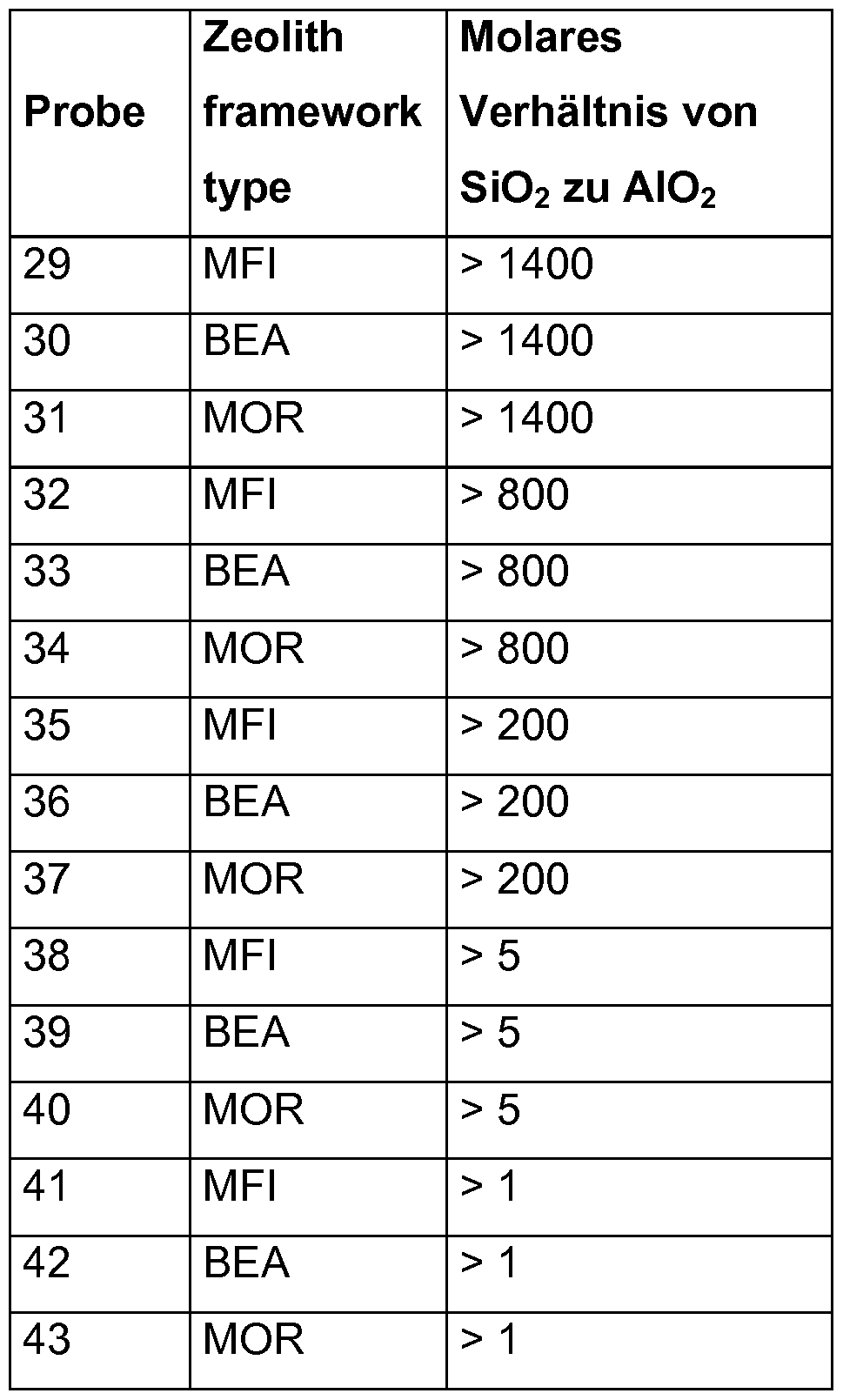
- Table 3 Series of experiments with a pentasil zeolite having a molar ratio of SiO 2 to AIO 2 > 800. The surface of the zeolite was> 300 m 2 / g The zeolite used had an MFI framework type.
- Table 5 Series of experiments with a beta zeolite (BEA framework type) and a mordenite zeolite (MOR framework type).
- the beta zeolite had a molar ratio of SiO 2 to AIO 2 of about 150 and the surface of the zeolite was> 500 m 2 / g.
- the mordenite zeolite had a molar ratio of SiO 2 to AIO 2 of about 200 and the surface of the zeolite was> 400 m 2 / g. It was used as a carrier material only "pure" HDPE.
- sample plates 7-43 thus prepared were analogously to Example 3 in glass containers at room temperature (about 20 to 23 ° C) of a gaseous
- Atmosphere of various volatile organic solvents methanol, ethanol, 2-propanol, 1-butanol, 2-methyl-1-propanol, 2-butanol, MTBE, ETBE, TAME
- TAEE tertiary amyl ethyl ether
- DME dimethyl ether
- DEE Diethyl ether
- THF terahydrofuran
- Adsorption materials are suitable for adsorption of all tested volatile organic solvents.
- Example 5 Comparison of Individual Sample Plates The following Table 7 summarizes the results of the adsorption measurements of Example 4 for selected sample plates. Given is one
- (+++), (++) and (+) correspond to a decreasing better adsorption and (-) a less good adsorption compared to the adsorbent used in Example 3, BASF molecular sieve 4A.
- Example 6 Repetition of Example 3 with activated carbon powder as
- sample plates weighing about 20 gm of pure HPDE i.e., without 5-layer laminated film
Landscapes
- Engineering & Computer Science (AREA)
- Manufacturing & Machinery (AREA)
- Mechanical Engineering (AREA)
- Laminated Bodies (AREA)
- Compositions Of Macromolecular Compounds (AREA)
- Containers Having Bodies Formed In One Piece (AREA)
- Blow-Moulding Or Thermoforming Of Plastics Or The Like (AREA)
Abstract
Description


Claims
Priority Applications (3)
| Application Number | Priority Date | Filing Date | Title |
|---|---|---|---|
| JP2017538680A JP2018504298A (ja) | 2015-01-22 | 2016-01-20 | 多層複合材料およびそれを含む物品 |
| US15/545,900 US20180015702A1 (en) | 2015-01-22 | 2016-01-20 | Multilayered composite material and objects comprising same |
| CN201680017828.5A CN107466270A (zh) | 2015-01-22 | 2016-01-20 | 多层复合材料和包含该多层复合材料的物体 |
Applications Claiming Priority (2)
| Application Number | Priority Date | Filing Date | Title |
|---|---|---|---|
| EP15152192.9A EP3047969B1 (de) | 2015-01-22 | 2015-01-22 | Mehrlagiges verbundmaterial und gegenstände umfassend dasselbe |
| EP15152192.9 | 2015-01-22 |
Publications (2)
| Publication Number | Publication Date |
|---|---|
| WO2016116512A2 true WO2016116512A2 (de) | 2016-07-28 |
| WO2016116512A3 WO2016116512A3 (de) | 2016-11-10 |
Family
ID=52391846
Family Applications (1)
| Application Number | Title | Priority Date | Filing Date |
|---|---|---|---|
| PCT/EP2016/051147 Ceased WO2016116512A2 (de) | 2015-01-22 | 2016-01-20 | Mehrlagiges verbundmaterial und gegenstände umfassend dasselbe |
Country Status (5)
| Country | Link |
|---|---|
| US (1) | US20180015702A1 (de) |
| EP (1) | EP3047969B1 (de) |
| JP (1) | JP2018504298A (de) |
| CN (1) | CN107466270A (de) |
| WO (1) | WO2016116512A2 (de) |
Cited By (1)
| Publication number | Priority date | Publication date | Assignee | Title |
|---|---|---|---|---|
| JP2019505637A (ja) * | 2016-01-15 | 2019-02-28 | ビーエーエスエフ ソシエタス・ヨーロピアBasf Se | 防水性通気性膜 |
Families Citing this family (4)
| Publication number | Priority date | Publication date | Assignee | Title |
|---|---|---|---|---|
| KR102206610B1 (ko) * | 2020-01-02 | 2021-01-22 | 주식회사 피에스원 | 발포 필름의 제조방법 |
| CN111848005A (zh) * | 2020-07-29 | 2020-10-30 | 常熟市卓诚新材料科技有限公司 | 一种碳纤维毡增强无机聚合物基复合材料及其制备方法 |
| JP2023536323A (ja) * | 2020-08-03 | 2023-08-24 | ビーエーエスエフ ソシエタス・ヨーロピア | 揮発性有機化合物のガス放出が少ない有機金属骨格を含むポリエステル成形品 |
| CN115254055B (zh) * | 2022-07-26 | 2023-08-18 | 四会市三乐电子照明有限公司 | 一种用于吸附甲醛的金属有机骨架材料及其制备方法和应用 |
Family Cites Families (18)
| Publication number | Priority date | Publication date | Assignee | Title |
|---|---|---|---|---|
| JPH0740517A (ja) * | 1993-05-24 | 1995-02-10 | Mitsubishi Chem Corp | 多層中空成形体 |
| PL311882A1 (en) | 1993-06-07 | 1996-03-18 | Eastman Chem Co | Polyester/zeolite mixtures |
| DE10020621A1 (de) * | 2000-04-27 | 2001-11-08 | Degussa | Farbloses, emissionsarmes Polymer |
| US6555243B2 (en) * | 2000-06-09 | 2003-04-29 | Ems-Chemie Ag | Thermoplastic multilayer composites |
| DE10114872A1 (de) | 2001-03-22 | 2002-09-26 | Volkswagen Ag | Kunststoffhohlkörper mit Sperrschicht gegen Permeation |
| FR2840913B1 (fr) * | 2002-06-13 | 2005-02-04 | Inst Francais Du Petrole | Composition pour reservoir a paroi monocouche |
| FR2840848B1 (fr) * | 2002-06-13 | 2004-10-15 | Inst Francais Du Petrole | Structure multicouche a permeabilite controlee |
| JP4596787B2 (ja) | 2003-04-25 | 2010-12-15 | 豊田合成株式会社 | 燃料タンク |
| EP1721737B1 (de) * | 2004-02-19 | 2016-11-09 | Toyo Seikan Kaisha, Ltd. | Mehrlagige konstoffstruktur |
| JP5024718B2 (ja) * | 2004-06-18 | 2012-09-12 | 東洋製罐株式会社 | 臭気捕捉用樹脂組成物 |
| DE102005001793A1 (de) | 2005-01-13 | 2006-07-27 | Basf Ag | Polyoxymethylen und Zeolith enthaltende Formmasse |
| CN101688002B (zh) * | 2007-02-20 | 2012-08-08 | 塞尔瑞星技术有限公司 | 取代环糊精化合物与活性碳的组合 |
| US20090220718A1 (en) * | 2008-02-29 | 2009-09-03 | Kuraray Co. Ltd. | Fuel container |
| JP5121655B2 (ja) * | 2008-10-06 | 2013-01-16 | 本田技研工業株式会社 | ガソリン−アルコール分離方法 |
| JP5244779B2 (ja) * | 2009-12-24 | 2013-07-24 | 日本ポリエチレン株式会社 | バイオディーゼル燃料容器用材料及び成形品 |
| AU2011309710A1 (en) | 2010-09-30 | 2013-03-21 | Basf Se | Process for preparing porous metal-organic frameworks based on aluminum fumarate |
| FR2965757A1 (fr) * | 2010-10-08 | 2012-04-13 | Inergy Automotive Systems Res | Reservoir a carburant en matiere plastique |
| AR093690A1 (es) * | 2012-11-30 | 2015-06-17 | Basf Se | Unidad de almacenamiento para un dispositivo de impulsion en un vehiculo |
-
2015
- 2015-01-22 EP EP15152192.9A patent/EP3047969B1/de not_active Not-in-force
-
2016
- 2016-01-20 JP JP2017538680A patent/JP2018504298A/ja active Pending
- 2016-01-20 CN CN201680017828.5A patent/CN107466270A/zh active Pending
- 2016-01-20 WO PCT/EP2016/051147 patent/WO2016116512A2/de not_active Ceased
- 2016-01-20 US US15/545,900 patent/US20180015702A1/en not_active Abandoned
Cited By (1)
| Publication number | Priority date | Publication date | Assignee | Title |
|---|---|---|---|---|
| JP2019505637A (ja) * | 2016-01-15 | 2019-02-28 | ビーエーエスエフ ソシエタス・ヨーロピアBasf Se | 防水性通気性膜 |
Also Published As
| Publication number | Publication date |
|---|---|
| EP3047969B1 (de) | 2018-04-25 |
| EP3047969A1 (de) | 2016-07-27 |
| US20180015702A1 (en) | 2018-01-18 |
| JP2018504298A (ja) | 2018-02-15 |
| WO2016116512A3 (de) | 2016-11-10 |
| CN107466270A (zh) | 2017-12-12 |
Similar Documents
| Publication | Publication Date | Title |
|---|---|---|
| EP3022053A1 (de) | Mehrlagiges verbundmaterial und gegenstände daraus | |
| EP3047969B1 (de) | Mehrlagiges verbundmaterial und gegenstände umfassend dasselbe | |
| US10363546B2 (en) | Multilayer polymeric membrane | |
| DE60309594T2 (de) | Mehrschichtiger Laminatschlauch | |
| US20160243525A1 (en) | Multilayer Polymeric Membrane and Process | |
| US20140287644A1 (en) | Sound-absorbing material for automobile using foaming urethane foam to which carbon nano-tube is applied and preparation method thereof | |
| KR20150027168A (ko) | 폴리머 복합물, 얻어진 판넬, 및 이를 제조하는 방법 | |
| CN107513211A (zh) | 一种低散发、低气味汽车用复合聚丙烯材料 | |
| EP3080166A1 (de) | Epoxyterminiertes polybutadien als sauerstoff-fänger | |
| EP3394170B1 (de) | Schalldämmungszusammensetzung und schalldämmplatte für ein fahrzeug | |
| EP3402354A1 (de) | Wasserdichte atmende membran | |
| DE102009033362A1 (de) | Formmasse zur Herstellung von Formteilen | |
| Ambrosio et al. | Characterization of flexible Poly (vinyl butyral)/wood flour composites | |
| CN111073140A (zh) | 一种低密度、低气味车用改性聚丙烯复合材料及其制备方法 | |
| DE102014117644A1 (de) | Folienverbund, Verpackungsfolie sowie Herstellungsverfahren | |
| WO2002081560A1 (de) | Dichtmasse niedriger dichte, grundmasse und verfahren zu ihrer herstellung sowie ihre verwendung | |
| DE102020004849A1 (de) | Mehrschichtstruktur und verpackungsmaterial, das diese enthält | |
| KR102341782B1 (ko) | 보존성이 향상된 포장재 및 그 제조방법 | |
| CN107177106A (zh) | 一种新型环保汽车内饰用改性材料及其制备方法 | |
| Aouinti et al. | A maghnite-clay-H/polymer membrane for separation of ethanol–water azeotrope | |
| DE112020003088T5 (de) | Harzzusammensetzung und mehrschichtstruktur sowie verpackungsmaterial, bei denen diese eingesetzt wird | |
| Du et al. | Study the factors affecting water vapor barrier properties of organic–inorganic hybrid coatings | |
| Ahmadi | Oxygen-barrier films based on low-density polyethylene/ethylene vinyl alcohol/polyethylene-grafted maleic anhydride compatibilizer Oxygen-barrier films based on low-density polyethylene/ethylene vinyl alcohol/polyethylene-grafted maleic anhydride compatibilizer | |
| DE112022004651T5 (de) | Harzzusammensetzung, Formteil, mehrschichtige Struktur, thermogeformter Behälter, blasgeformter Behälter und Aufdampffilm | |
| RU2356728C2 (ru) | Способ изготовления плит из композиционного материала |
Legal Events
| Date | Code | Title | Description |
|---|---|---|---|
| 121 | Ep: the epo has been informed by wipo that ep was designated in this application |
Ref document number: 16701585 Country of ref document: EP Kind code of ref document: A2 |
|
| ENP | Entry into the national phase |
Ref document number: 2017538680 Country of ref document: JP Kind code of ref document: A |
|
| WWE | Wipo information: entry into national phase |
Ref document number: 15545900 Country of ref document: US |
|
| NENP | Non-entry into the national phase |
Ref country code: DE |
|
| 122 | Ep: pct application non-entry in european phase |
Ref document number: 16701585 Country of ref document: EP Kind code of ref document: A2 |