WO2016104665A1 - ロリクリンの減少抑制・改善剤、トランスグルタミナーゼ3活性化剤および皮膚角層角化肥厚膜の形成促進・構造強化剤 - Google Patents
ロリクリンの減少抑制・改善剤、トランスグルタミナーゼ3活性化剤および皮膚角層角化肥厚膜の形成促進・構造強化剤 Download PDFInfo
- Publication number
- WO2016104665A1 WO2016104665A1 PCT/JP2015/086155 JP2015086155W WO2016104665A1 WO 2016104665 A1 WO2016104665 A1 WO 2016104665A1 JP 2015086155 W JP2015086155 W JP 2015086155W WO 2016104665 A1 WO2016104665 A1 WO 2016104665A1
- Authority
- WO
- WIPO (PCT)
- Prior art keywords
- skin
- keratinized
- sphingomyelin
- transglutaminase
- loricrin
- Prior art date
- Legal status (The legal status is an assumption and is not a legal conclusion. Google has not performed a legal analysis and makes no representation as to the accuracy of the status listed.)
- Ceased
Links
Images

Classifications
-
- A—HUMAN NECESSITIES
- A61—MEDICAL OR VETERINARY SCIENCE; HYGIENE
- A61K—PREPARATIONS FOR MEDICAL, DENTAL OR TOILETRY PURPOSES
- A61K31/00—Medicinal preparations containing organic active ingredients
- A61K31/66—Phosphorus compounds
- A61K31/683—Diesters of a phosphorus acid with two hydroxy compounds, e.g. phosphatidylinositols
- A61K31/688—Diesters of a phosphorus acid with two hydroxy compounds, e.g. phosphatidylinositols both hydroxy compounds having nitrogen atoms, e.g. sphingomyelins
Definitions
- the present invention relates to an agent for inhibiting or improving the reduction of loricrin in the keratinized thickened skin layer and an activator of transglutaminase 3 in the keratinized thickened skin layer.
- the present invention also relates to an agent for promoting the formation of a stratum corneum thickening film and a structure reinforcing agent. They are useful for preventing, suppressing or improving the deterioration of the skin condition.
- the stratum corneum of the epidermis is composed of stratum corneum cells in which epidermal keratinocytes (keratinocytes) are terminally differentiated, and stratum corneum intercellular lipids surrounding them.
- the intercellular lipid is composed of ceramide, cholesterol, fatty acid and the like, and a lamellar structure is formed by the lipid layer and the water molecule layer.
- stratum corneum cells contain natural moisturizing factors such as keratin fibers and amino acids that are components related to moisturizing. It is wrapped in a very tough, insoluble backing structure by cross-linking of various proteins called keratinized thickened membranes (also called keratinous thickened membranes, or cornified envelopes (CE)). It is very stable against various stimuli. Of the proteins constituting the keratinized thickened membrane, loricrin, which is formed in particular in the granular layer, plays a role of strengthening this backing structure.
- transglutaminase 3 of protein cross-linking adhesion enzyme attaches loricrin to immature keratinized thickened membrane formed by cross-linking reaction of proteins other than loricrin, and serves as a scaffold for keratinized thickened membrane. Complete by forming.
- the damage (damage) of the skin due to ultraviolet rays induces an abnormal turnover of the skin, and is particularly susceptible to the outermost stratum corneum. It is known that when an incomplete keratinized thickening film is formed due to corneal cell damage or parakeratosis, the barrier function of the epidermal horny layer is reduced and the water retained in the horny layer is lost. Yes.
- JP 2008-303185 discloses the use of a specific pyrrolidone derivative. Here, it is considered to mature an immature conified envelope.
- JP 2008-303185 discloses the use of a specific pyrrolidone derivative. Here, it is considered to mature an immature conified envelope.
- JP 2009-084244 A continuous oral intake of a saturated free fatty acid solution having 10 to 36 carbon atoms has an effect of improving the skin barrier function, an effect of increasing the amount of ceramide, and an effect of increasing the expression of loricrin gene. It is disclosed. However, there is no description or suggestion regarding oral intake of sphingomyelin.
- Japanese Patent Application Laid-Open No. 2007-117793 discloses pharmaceuticals and foods and drinks containing sphingomyelin as an active ingredient, and various actions such as sialomucin secretion promoting action, antiallergic action and antioxidant action by sphingomyelin are disclosed. Has been. However, there is no description or suggestion about the effect of suppressing the decrease of loricrin by sphingomyelin and the activation effect of transglutaminase 3.
- Hasegawa et al. Hisegawa T et al., “Dietary glucosylceramide enhances cornified envelope formation via transglutaminase expression and involucrin production”, Lipids (2011) 46, pp.529-535) It has been reported that effects of improving the skin barrier function of mice, increasing the expression of transglutaminase 1, increasing the production of involucrin, promoting the expression of transglutaminase 1 and 3, etc. have been observed. However, it has been confirmed that glucosylceramide is structurally different from sphingomyelin and has a completely different tendency of action from the administration of sphingomyelin.
- transglutaminase 3 is activated, thereby promoting the formation of keratinized thickening film and strengthening its structure Is not known so far as the present inventors know.
- the present inventors have unexpectedly found that orally taking sphingolipids, particularly sphingomyelin, suppresses the decrease of loricrin and activates transglutaminase 3.
- the present inventors suppress the decrease of loricrin and activate transglutaminase 3 to promote the formation of a keratinized thickened film and to strengthen the structure of an immature keratinized thickened film. Pay attention.
- the deteriorated state of the skin can be improved by these, and among them, it is possible to suppress a decrease in the barrier function of the skin under ultraviolet irradiation.
- the present invention is based on these findings.
- keratinized thickening film formation promoting / structural strengthening agent the formation promotion and structural strengthening of keratinized thickening film suppresses / improves the reduction of loricrin in the keratinized keratinized thickening film by sphingomyelin. And activation of transglutaminase 3.
- the sphingomyelin may be a milk-derived sphingomyelin.
- composition for oral ingestion or enteral administration comprising an agent for promoting the formation of a keratinized thickening film and for enhancing the structure.
- composition according to ⁇ 6> may be used for preventing, suppressing, or improving deterioration of skin condition.
- the deterioration of the skin condition may be a decrease in the barrier function of the skin.
- the decrease in the barrier function of the skin may be due to irradiation with ultraviolet rays.
- composition according to any one of the above items ⁇ 6> to ⁇ 9> preferably containing 0.5 to 1500 mg of sphingomyelin per day.
- a food / beverage product comprising an agent for promoting the formation of a keratinized thickening film and for enhancing the structure.
- a food or drink comprising the composition according to any one of ⁇ 6> to ⁇ 9>.
- the food or drink according to ⁇ 11> or ⁇ 12> preferably includes 0.2 to 45000 mg of sphingomyelin per package.
- the food or drink according to any one of ⁇ 11> to ⁇ 13> may be a functional food, a health nutrition food, a supplement, a food for specified health use, a functional display food, or a food with a disease risk reduction display. .
- a method for inhibiting or improving the reduction of loricrin comprising orally ingesting or enterally administering sphingomyelin to a subject having a reduced amount of loricrin in the keratinized thickened skin skin.
- Transglutaminase in a keratinized keratinized thickened skin layer comprising orally ingesting or enterally administering sphingomyelin to a subject having reduced activity of transglutaminase 3 in a keratinized thickened skin skin 3.
- Sphingomyelin is orally ingested or administered enterally to a subject who wants to promote the formation and strengthening of the keratinized thick film in the horny layer of the skin.
- the present invention it is possible to suppress / improve the decrease of loricrin in the skin keratinized keratinized thickened film, and to activate transglutaminase 3 in the keratinized keratinized thickened film.
- the reduction-suppressing / improving agent, activator or formation-promoting / structural-reinforcing agent, and composition of the present invention effectively prevent, inhibit or improve the decrease in skin barrier function under ultraviolet irradiation. Can do.
- the production promoter and composition of the present invention are taken by the oral or enteral route, and the raw materials are derived from those that have been used as conventional foods, they are safe and simple, and economical. It is also excellent in properties.
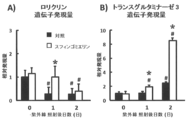
- FIG. 2 (A) shows the transition of the expression level of the loricrin gene
- FIG. 2 (B) shows the transition of the expression level of the transglutaminase 3 gene.
- * indicates that there is a significant difference with respect to the control group (P ⁇ 0.05)
- # indicates that there is a significant difference with respect to day 0 (P ⁇ 0.05).
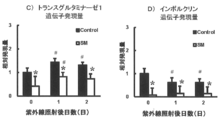
- FIG. 3 (C) shows the transition of the expression level of the transglutaminase 1 gene
- FIG. 3 (D) shows the transition of the expression level of the involucrin gene.
- * indicates that there is a significant difference with respect to the control group (P ⁇ 0.05)
- # indicates that there is a significant difference with respect to day 0 (P ⁇ 0.05).
- the agent for suppressing or improving the reduction of loricrin in the keratinized thickened skin layer of the present invention comprises sphingomyelin as an active ingredient.
- active ingredient means that the agent for suppressing or improving the decrease according to the present invention exerts the action of suppressing or improving the decrease of loricrin in the keratinized thickened skin layer in the living body. It means to contain a sufficient amount (ie, effective amount) of sphingomyelin.
- inhibition / improvement of decrease in loricrin means to suppress or improve the decrease of loricrin in the keratinized thickened skin layer, and to suppress or delay the decrease. It may include any meaning of stopping and maintaining the decrease, and suppressing the decrease and starting to increase. Furthermore, prevention of reduction may be included in “inhibition / improvement of reduction of loricrin”.
- “Loriculin” is a major constituent protein of the lining structure of the keratinized thickening membrane of the skin.
- the expression of the loricrin gene is used as an index, and the horny layer angle of the skin The reduced state of loricrin in the thickened membrane can be evaluated.
- the activator of transglutaminase 3 in the skin keratinized thickened membrane of the present invention comprises sphingomyelin as an active ingredient.
- active ingredient means that the activator according to the present invention is used in an amount sufficient to exert the action of activating transglutaminase 3 in the skin keratinized thickened membrane in the living body (that is, , An effective amount) of sphingomyelin.
- activation of transglutaminase 3 means that the enzyme activity of transglutaminase 3 in the skin keratinized thickened membrane is activated and the activity is increased from the state in which the activity has decreased, the activity Is used to encompass maintaining a high state.
- Transglutaminase 3 is an enzyme having a function of attaching loricrin to a keratinized thickened membrane and strengthening the backing structure of the keratinized thickened membrane. For example, as described in Examples described later, transglutaminase 3 Using the expression state of the 3 genes as an index, the activity of transglutaminase 3 in the skin keratinized thickened membrane can be evaluated.
- the formation promotion / structure strengthening agent for skin keratinized thickening film of the present invention comprises sphingomyelin as an active ingredient.
- active ingredient means that the formation promoting / structural strengthening agent according to the present invention can promote the formation of the keratinized and thickened skin keratinized layer and / or the effect of strengthening the structure. And a sufficient use amount (ie, an effective amount) of sphingomyelin.
- promoting formation / strengthening of skin keratinized thickened film means promoting the formation of skin keratinized thickened film, maturing immature keratinized thickened film, Used to include strengthening the structure of keratinized thick films.
- the formation promotion / structural strengthening of keratinized thickening film is to suppress the reduction of loricrin in the keratinized thickening skin skin by sphingomyelin. This is due to the improvement and activation of transglutaminase 3.
- sphingomyelin is one of sphingolipids.
- the sphingolipid is naturally derived, for example, milk, goat milk, sheep milk, horse milk and other milk-derived, egg yolk-derived, rice, corn, cereal-derived, konjac-derived, Examples include beet-derived, preferably milk-derived, and more preferably milk-derived. Therefore, the sphingomyelin that can be used in the present invention is of natural origin, preferably of milk, and more preferably of milk, similar to the sphingolipid described above. Sphingomyelin can be prepared from natural raw materials by a conventional method, but a commercially available product may be used.
- the sphingomyelin is milk-derived sphingomyelin.
- the milk-derived sphingomyelin that can be used in the present invention is preferably myrylstilsphingosylphosphorylcholine (d18: 1-C14: 0), tricosanylsphingosylphosphorylcholine (d18: 1-C23: 0), palmitylsphingo.
- Sylphosphorylcholine (d18: 1-C16: 0), tricosenoylsphingosylphosphorylcholine (d18: 1-C23: 1), stearylsphingosylphosphorylcholine (d18: 1-C18: 0), lignocerylsphingosylphosphorylcholine (d18: 1-C24: 0), arachidylsphingosylphosphorylcholine (d18: 1-C20: 0), nerbonylsphingosylphosphorylcholine (d18: 1-C24: 1), behenylsphingosylphosphorylcholine (d18: 1-C22: 0) And one or more molecular species selected from the group consisting of serotilsphingosylphosphorylcholine (d18: 1-C26: 0). More preferably, the milk-derived sphingomyelin contains three or more molecular species selected from the above group, and even more preferably contains five or more molecular species selected
- the reduction-suppressing / improving agent, activator or formation promoting / structural strengthening agent of the present invention is preferably for oral intake (ie, oral intake agent) or enteral administration (ie, enteral administration agent).
- the reduction-suppressing / improving agent, activator, or formation-accelerating / structural-strengthening agent of the present invention is preferably used for skin with deteriorated condition or skin with reduced barrier function.
- the barrier function in the reduced state of the skin barrier function, such as the reduction of loricrin in the keratinized thickening film of the skin, by suppressing and improving the reduction of loricrin,
- the barrier function can be maintained or improved.
- transglutaminase 3 is reduced in a state where the skin barrier function is reduced such that the activity of transglutaminase 3 in the keratinized thick film of skin is reduced.
- skin barrier function By activating, skin barrier function can be maintained or improved.
- the suppression and improvement of loricrin in the stratum corneum thickened skin and the activation of transglutaminase 3 promote the formation of the keratinized thickened membrane and strengthen the structure. Can improve the reduced skin.
- the reduction-suppressing / improving agent, activator or formation-accelerating / structural strengthening agent according to the present invention is more preferably used for skin with deteriorated condition or skin with reduced barrier function.
- Sphingomyelin an active ingredient in the present invention, can suppress and improve the decrease of loricrin in the keratinized thickened skin skin, and also activates transglutaminase 3 in the keratinized thickened skin skin (Examples described later). Thereby, formation of a keratinized thick film can be accelerated
- the deterioration of the skin condition includes, for example, a decrease in the barrier function of the skin, a drying of the skin, a skin roughness, a decrease in the amount of moisture in the stratum corneum, and atopic dermatitis.
- Reduction of the barrier function of the skin includes maintenance of the barrier function.
- the reduction in the skin barrier function is preferably a reduction in the skin barrier function under the irradiation of ultraviolet rays.
- prevention, suppression or improvement of an exacerbated state is used in a sense encompassing adjustment, delay of progression, mitigation, prevention of onset, prevention of recurrence, etc. of such a state.
- treatment, prevention, or improvement of a condition that can be treated, prevented, or improved can be achieved by suppressing or improving the decrease of loricrin or activating transglutaminase 3.
- the sphingomyelin is orally ingested or enterally administered to a subject having a reduced amount of loricrin in the keratinized thickened skin keratoplasty.
- sphingomyelin is orally ingested or enterally administered to a subject whose transglutaminase 3 activity has decreased in the keratinized and thickened skin corneum.
- a method for preventing, suppressing or improving the deterioration of the skin condition is provided.
- sphingomyelin is orally ingested or enterally administered to a subject who wants to promote the formation of a keratinized thick film in the stratum corneum and to strengthen the structure.
- Deteriorating skin condition including suppressing or improving loricrin in the keratinized thickened skin layer and activating transglutaminase 3 to promote the formation and strengthen the structure of the keratinized thickened skin layer.
- sphingomyelin for suppressing or improving the reduction of loricrin in the keratinized and thickened skin corneum.
- sphingomyelin for activating transglutaminase 3 in the keratinized and keratinized thick film of skin.
- a sphingomyelin is provided for promoting the formation of a keratinized thickened skin layer and / or strengthening its structure.
- sphingomyelin for suppressing or improving the reduction of loricrin in the keratinized thickened skin skin layer.
- use of sphingomyelin in the manufacture of a composition for oral ingestion or enteral administration for suppressing or improving the reduction of loricrin in the keratinized thickened skin skin layer Is provided.
- the use can be a non-therapeutic use.
- sphingomyelin for the activation of transglutaminase 3 in the keratinized keratinous thickened membrane.
- use of sphingomyelin in the manufacture of a composition for oral ingestion or enteral administration for the activation of transglutaminase 3 in a keratinized thickened skin skin layer Is provided.
- the use can be a non-therapeutic use.
- sphingomyelin to promote the formation of and / or strengthen the structure of the keratinized keratinized thick film.
- a composition pharmaceutical for oral ingestion or enteral administration for promoting the formation of a keratinized thickened skin layer and / or strengthening its structure
- sphingomyelin in the manufacture of can be a non-therapeutic use.
- compositions and Food / Beverage As described above, according to the present invention, the composition for oral intake or enteral administration, comprising the reduction inhibitor / ameliorator, activator or formation promoter / structure enhancer of the present invention. Is provided. Moreover, according to this invention, the food / beverage products which comprise the reduction
- compositions and foods and drinks include, for example, adding the reduction suppressing / improving agent, activator or formation promoting / structural strengthening agent of the present invention according to the present invention to the composition and material components of the food and drinks. It can manufacture with the manufacturing method which consists of these.
- composition for oral intake or enteral administration of the present invention is preferably used for prevention, suppression or improvement of skin condition deterioration. That is, according to the present invention, a composition for preventing, suppressing or improving deterioration of the skin condition is provided.
- composition for preventing, suppressing or improving deterioration of the skin condition of the present invention is a pharmaceutical composition as one preferred embodiment.
- the pharmaceutical composition is prepared as an oral preparation or a parenteral preparation according to a conventional method using additives that are acceptable for formulation.
- an oral preparation is preferable.
- oral preparations take the form of solid preparations such as tablets, powders, fine granules, granules, capsules, pills, sustained-release preparations, and liquid preparations such as solutions, suspensions, and emulsions. Can do.
- Additives that are acceptable for formulation include, for example, excipients, stabilizers, preservatives, wetting agents, emulsifiers, lubricants, sweeteners, colorants, fragrances, buffers, antioxidants, pH Examples thereof include regulators.
- Arbitrary ingredients can be added to the food and drink of the present invention as required.
- optional components that can be added there are no particular restrictions, but usually ingredients to be blended in foods and drinks, sweeteners, acidulants, vegetable and fruit juices and their extracts, vitamins, minerals, Nutrients such as amino acids, useful microorganisms such as lactic acid bacteria, bifidobacteria and propionic acid bacteria and their cultures, functional sugars such as oligosaccharides, royal jelly, collagen, ceramide, glucosamine, astaxanthin and polyphenols
- filler, a sour agent, a coloring agent, an emulsifier, a preservative, etc. can be mix
- the food and drink are other than the pharmaceutical composition and are not particularly limited as long as they are ingestible forms such as solutions, suspensions, emulsions, powders, and solid molded products.
- dairy products such as milk drinks, yogurts, lactic acid bacteria drinks, fermented milk, ice creams, creams, cheeses; soft drinks, fruit juice drinks, vegetable drinks, soy milk drinks, coffee drinks, tea drinks Jelly drinks, cocoa, smoothie powdered drinks and sports powdered drinks, nutrition-enriched powdered drinks, cosmetic powdered foods, powdered soup, steamed bread, concentrated drinks, alcoholic drinks, etc .
- bread, pasta , Flour products such as noodles, cake mix, fried flour, bread crumbs
- confectionery such as chocolate, gum, candy, cookies, gummi, snacks, Japanese confectionery, jelly, pudding, etc .
- the food and drink are milk drinks (which may include processed milk), fermented milk, soft drinks, jelly drinks, tablets, cosmetic powdered foods, powdered drinks, liquid foods, liquids.
- the food or drink is a milk beverage, fermented milk, soft drink, jelly drink, tablet, powdered food for beauty, and according to a more preferred embodiment, the food or drink is Milk beverage (which may include processed milk), fermented milk.
- the food or drink is a functional food, a health nutrition food, a supplement, a food for specified health use, a functional display food, or a food with a disease risk reduction display.
- the indication of disease risk reduction is the indication of food and drink that may reduce the disease risk, and is based on the standards established by the FAO / WHO Joint Food Standards Committee (Codex Committee). , Or with reference to the standard, it can be a defined or recognized display.
- the food and drink of the present invention are, for example, foods suitable for consumers who expect improvement or alleviation of skin condition deterioration, foods suitable for improvement of skin condition deterioration, that is, so-called foods for specific health use or functions It can be provided as sex indication food.
- a food or drink on which a function for preventing, suppressing, or improving deterioration of the skin state is displayed can be provided.
- the sphingomyelin can be adjusted to an effective amount that can be ingested by an adult (weight: 60 kg) per day at 0.5 to 1500 mg, preferably 1 to 1000 mg, more preferably 5 to 500 mg.
- the sphingomyelin content can be measured by a conventional method. For example, it can be measured by using liquid chromatography and using AQUASIL SP100 (4.6 ⁇ 250 mm, Senshu Kagaku) as a column.
- the mobile phase for example, a solution in which 0.5 mM phosphate-citrate buffer (pH 3.0) and methanol are mixed at a ratio of 5 to 95 may be used.
- the measurement time can be set to 20 minutes
- the flow rate of the mobile phase can be set to 0.6 mL / min
- the column temperature can be set to 40 ° C.
- the absorbance can be detected at 205 nm.
- the standard substance for example, sphingomyelin (derived from milk, manufactured by Nagara Science Co., Ltd.) can be used, and can be quantified by the area ratio.
- the content of active ingredients in foods and drinks and compositions can be specified per packaging form.
- the content of sphingomyelin is 5 to 1500 mg, preferably 6
- the sphingomyelin content is 0.5 to 1500 mg, preferably 1 to 1000 mg, more preferably 5 to 500 mg.
- the amount (content) per packaging form is not limited to a single intake, and may include intakes for multiple doses or multiple days (for example, for 30 days).
- the sphingomyelin content is 5 to 45000 mg, preferably 6 to 30000 mg, more preferably 7 to 15000 mg.
- the sphingomyelin content is 0.5 to 45000 mg, preferably 1 It can be contained in an amount of ⁇ 30000 mg, more preferably 5 to 15000 mg.
- the conventional general milk drink and fermented milk contain 20 mg of phospholipid per gram of lipid, whereas the milk drink and fermented milk of the present invention contain 25 to 3000 mg of phospholipid per gram of lipid. , Preferably 30 to 2500 mg, more preferably 40 to 2000 mg, and still more preferably 50 to 1500 mg.
- the conventional general milk drink and fermented milk contain 6 mg of sphingomyelin per gram of lipid, while the milk drink and fermented milk of the present invention contain 7 to 1500 mg of sphingomyelin per gram of lipid. Contained, preferably 8 to 1250 mg, more preferably 9 to 1000 mg, and still more preferably 10 to 750 mg.
- a milk drink or fermented milk with an intentionally increased sphingomyelin content can be used.
- lipid is contained in a normal amount (for example, lipid is contained at 3% by weight), sphingomyelin is contained at 0.2 to 60 mg / g, preferably 0.25 to 50 mg / g. g, more preferably 0.3 to 40 mg / g, and still more preferably 0.35 to 30 mg / g.
- lipid when lipid is contained in a small amount (for example, low fat containing 1% by weight of lipid), sphingomyelin is contained at 0.05 to 60 mg / g, preferably 0. 0.1 to 50 mg / g, more preferably 0.15 to 40 mg / g, and still more preferably 0.2 to 30 mg / g.
- sphingomyelin is contained at 0.02 to 60 mg / g.
- it can be contained at 0.04 to 50 mg / g, more preferably 0.06 to 40 mg / g, and still more preferably 0.08 to 30 mg / g.
- a milk drink or fermented milk containing additional sphingomyelin is provided, and a composition or food or drink containing such a milk drink or fermented milk is further provided. Is done. Examples of such a composition or food and drink include yogurt.
- a yogurt containing additional sphingomyelin can be provided, which is not only a sphingomyelin that can be naturally contained in yogurt, but additionally adding sphingomyelin to yogurt, Yogurt that intentionally increases the concentration of sphingomyelin.
- additional sphingomyelin is not a sphingomyelin that can be naturally contained in yogurt, but a sphingo added separately when adding yogurt intentionally with increased sphingomyelin concentration. Myelin.
- the agent for suppressing or improving loricrin reduction according to the present invention the activator of transglutaminase 3 according to the present invention, or the agent for promoting the formation of keratinized thickening film or the structure reinforcing agent according to the present invention.
- a yogurt comprising is provided.
- a yogurt having an effect of suppressing or improving the reduction of loricrin comprising additional sphingomyelin.
- a yogurt having an activation effect on transglutaminase 3 is provided, which comprises additional sphingomyelin.
- a yogurt containing an additional sphingomyelin and having an action of promoting the formation of a keratinized thick film and strengthening the structure is provided.
- sphingomyelin is orally administered or administered enterally to a subject having a reduced amount of loricrin in the keratinized thickened skin keratinized layer.
- An improvement method is provided.
- the amount of loricrin means the amount of loricrin present in the skin keratinized thickened membrane, and can be evaluated by, for example, the expression level of the loricrin gene.
- the sphingomyelin is orally ingested or enterally administered to a subject having reduced activity of transglutaminase 3 in the keratinized thickened skin keratin layer.
- a method for activating transglutaminase 3 in a keratinized thickened membrane is provided.
- the activity of transglutaminase 3 can be evaluated by, for example, the expression level of the transglutaminase 3 gene.
- the sphingomyelin is orally ingested or enterally administered to a subject where it is desired to promote the formation and strengthening of the keratinized thick film in the horny layer of the skin.
- a method for promoting the formation and strengthening of the keratinized keratinized thickened skin layer comprising suppressing and improving the decrease of loricrin in the keratinized thickened membrane and activating transglutaminase 3.
- the above method excludes medical use.
- the subject is preferably a human or a non-human mammal.
- the method preferably reduces loricrin for a subject with reduced amount of loricrin in the cutaneous keratinized thickened membrane, preferably continuously ingesting or enterally administering sphingomyelin for more than 2 days
- Inhibition / improvement method method of activating transglutaminase 3 in skin keratinized thickened film for subjects with decreased activity of transglutaminase 3 in skin keratinized thickened film, or skin keratinized thickened film It can be a formation promotion / structure strengthening method.
- ⁇ Experiment method> Deterioration of skin barrier function by ultraviolet irradiation Hairless mice (Hos: HR-1, female, 8 weeks old) were grouped, and one week later, under the condition of 20 mJ / cm 2 , ultraviolet rays (UV -B) was irradiated. In the test, individuals were required for each measurement and skin collection, so a total of 48 mice were used, and each group was divided into 8 mice.
- the expression of loricrin gene and transglutaminase 3 gene was determined for a predetermined group before irradiation (day 0), on irradiation day 1, and on irradiation day 2, in accordance with the flow of FIG. The amount was quantified. At this time, the expression levels of the transglutaminase 1 gene and the involucrin gene were also quantified.
- the synthesized cDNA was subjected to RT-PCR, the primer was TaqmanGene Expression Assay (Applied Biosystems), and 7500 real-time PCR® System (Applied Biosystems) was used as the target gene for each sample, Loricrin (Lorrisrin). ID: Mm01962650_s1), transglutaminase 3 (Transglutaminase 3) (Assay ID: Mm00436999_m1), transglutaminase 1 (Transglutaminase 1) (Assay ID: Mm00498375_m1), mol 52 The NA expression level was measured.
- GPDH glyceraldehyde-3-phosphate dehydrogenase
- Quantification was performed by the ⁇ Ct method, and the ratio of the target gene expression level of each group to the target gene expression level of the control day 0 group was calculated as the relative expression level.
- Test results Changes in gene expression related to the promotion of keratinized thickening film formation and structural enhancement were evaluated based on the expression levels of loricrin gene and transglutaminase 3 gene.
- the expression level of loricrin gene when the expression level of loricrin gene is high in the 0, 1, 2 day group of sphingomyelin intake compared to the control 0, 1, 2 day group, the decrease in loricrin expression is suppressed. means. Moreover, if the expression level of the transglutaminase 3 gene is higher in the 0, 1, 2 day group of the sphingomyelin intake compared to the control 0, 1, 2 day group, the increase in the expression of the transglutaminase 3 gene is increased. It means being promoted.
- the expression level of the transglutaminase 1 gene is lower in the 0, 1 and 2 day groups of sphingomyelin intake than the control 0, 1 and 2 day groups, This means that the increase in the expression of the transglutaminase 1 gene was suppressed.
- the involucrin gene expression level was low, the increase in involucrin gene expression was suppressed compared to the control 0, 1 and 2 day groups. Means that.
- the expression level of the loricrin gene was higher in the first day group of sphingomyelin intake than in the first day group of control (1 day after irradiation with ultraviolet rays).
- FIG. 2 (B) compared to the control day 1 group (1 day after UV irradiation) and the control day 2 group (2 days after UV irradiation), the first day group ingested the sphingomyelin group and the sphingomyelin group In the ingestion day 2 group, the expression level of the transglutaminase 3 gene was high.
- FIG. 3 (A) compared to the control 1, 2 and 3 day group (control group) (after UV irradiation 1, 2 and 3 days), in the sphingomyelin intake 1, 2 and 3 day group, In each case, the expression level of the transglutaminase 1 gene was low.
- FIG. 3 (B) compared to the control 1, 2 and 3 day group (SM group) (after UV irradiation 1, 2 and 3 days), in the sphingomyelin intake 1, 2 and 3 day group, Each of the involucrin gene expression levels were low.
- transglutaminase 1 gene and involucrin gene were not promoted by ingestion of sphingomyelin, oral ingestion of sphingomyelin promotes the formation of keratinized thickening film and strengthens the structure. It was suggested that it contributes specifically to the promotion of expression of related specific genes (here, loricrin gene and transglutaminase 3 gene).
Landscapes
- Health & Medical Sciences (AREA)
- Animal Behavior & Ethology (AREA)
- Medicinal Chemistry (AREA)
- Pharmacology & Pharmacy (AREA)
- Epidemiology (AREA)
- Life Sciences & Earth Sciences (AREA)
- Chemical & Material Sciences (AREA)
- General Health & Medical Sciences (AREA)
- Public Health (AREA)
- Veterinary Medicine (AREA)
- Pharmaceuticals Containing Other Organic And Inorganic Compounds (AREA)
- Coloring Foods And Improving Nutritive Qualities (AREA)
- Cosmetics (AREA)
Abstract
Description
本発明の皮膚角層角化肥厚膜におけるロリクリンの減少抑制・改善剤は、前記したように、スフィンゴミエリンを有効成分とするものである。
ここで、「有効成分とする」とは、本発明による減少抑制・改善剤が、ロリクリンの減少を抑制するか、または改善する作用を、生体内の皮膚角層角化肥厚膜において奏するのに充分な使用量(すなわち、有効量)のスフィンゴミエリンを含有することをいう。
本発明の皮膚角層角化肥厚膜におけるトランスグルタミナーゼ3の活性化剤は、前記したように、スフィンゴミエリンを有効成分とするものである。
ここで、「有効成分とする」とは、本発明による活性化剤が、トランスグルタミナーゼ3を活性化させる作用を、生体内の皮膚角層角化肥厚膜において奏するのに充分な使用量(すなわち、有効量)のスフィンゴミエリンを含有することをいう。
本発明の皮膚角層角化肥厚膜の形成促進・構造強化剤は、前記したように、スフィンゴミエリンを有効成分とするものである。
ここで、「有効成分とする」とは、本発明による形成促進・構造強化剤が、皮膚角層角化肥厚膜の形成を促進し、および/または、その構造を強化する効果を示しうるのに充分な使用量(すなわち、有効量)のスフィンゴミエリンを含有することをいう。
本明細書において、スフィンゴミエリンは、スフィンゴ脂質の一つである。ここで、スフィンゴ脂質は、天然由来のものであり、例えば、牛乳、ヤギ乳、羊乳、馬乳などの乳由来のもの、卵黄由来のもの、米、トウモロコシ、穀物由来のもの、コンニャク由来、ビート由来などが挙げられ、好ましくは、乳由来のものであり、より好ましくは牛乳由来のものである。したがって、本発明において使用可能なスフィンゴミエリンは、前記したスフィンゴ脂質と同様に、天然由来のものであり、好ましくは乳由来のものであり、より好ましくは牛乳由来のものである。スフィンゴミエリンは、天然原料より慣用の方法によって調製することもできるが、市販品を使用しても良い。
本発明における有効成分であるスフィンゴミエリンは、皮膚角層角化肥厚膜におけるロリクリンの減少を抑制・改善することができ、また、皮膚角層角化肥厚膜におけるトランスグルタミナーゼ3を活性化することができる(後述する実施例)。これにより、角化肥厚膜の形成を促進し、また、未熟な状態の角化肥厚膜の構造を強化することができる。さらに、本発明における有効成分であるスフィンゴミエリンは、皮膚の状態の悪化の予防、抑制もしくは改善効果を有する。
前記したように、本発明によれば、本発明の減少抑制・改善剤、活性化剤または形成促進・構造強化剤を含んでなる、経口摂取用または経腸投与用組成物が提供される。また、本発明によれば、本発明の減少抑制・改善剤、活性化剤または形成促進・構造強化剤を含んでなる、飲食品が提供される。
本発明の別の一つの好ましい態様によれば、追加的なスフィンゴミエリンを含む、トランスグルタミナーゼ3の活性化作用を有するヨーグルトが提供される。
本発明の別の一つの好ましい態様によれば、追加的なスフィンゴミエリンを含む、角化肥厚膜の形成促進・構造強化作用を有するヨーグルトが提供される。
ここで、ロリクリンの量とは、皮膚角層角化肥厚膜におけるロリクリンの存在量を意味し、例えば、ロリクリン遺伝子の発現量で評価することができる。
ここで、トランスグルタミナーゼ3の活性は、例えば、トランスグルタミナーゼ3遺伝子の発現量で評価することができる。
ヘアレスマウスに、紫外線(GL20SE、三共電気株式会社製)を照射して、皮膚のバリア機能を悪化させ、スフィンゴミエリンの連続経口摂取の影響を評価した。
(1)紫外線の照射による皮膚のバリア機能の悪化
ヘアレスマウス(Hos:HR-1、雌、8週齢)を群分けしてから、1週間後に、20mJ/cm2の条件で、紫外線(UV-B)を照射した。
試験では、各測定と皮膚の採取に個体が必要となるため、合計で48匹のマウスを用い、各群のマウスを8匹ずつとし、群わけした。
前記(1)で作成した紫外線照射モデル動物の試験系を用いて、スフィンゴミエリン(純度98%、長良サイエンス社製)の経口摂取(経口投与)による皮膚の遺伝子発現への影響を評価した。
群分けの日から9日間で経口投与した。
(i) 対照0日目群
(ii) 対照1日目群
(iii) 対照2日目群
(iv) スフィンゴミエリン摂取0日目群
(v) スフィンゴミエリン摂取1日目群
(vi) スフィンゴミエリン摂取2日目群
各個体から採取した皮膚サンプルよりRNeasy Fibirous Tissue Mini kit(QIAGEN社)を用いて総RNAの抽出を行い、皮膚から抽出した1.5μg当量の総RNAから、RivertAid First Strand cDNA Synthesis Kit(Thermo SCIENTIFIC社)を用いて、相補的DNA(cDNA)合成と逆転写反応を行った。
ΔCt=(各個体サンプルのターゲット遺伝子のCt値)―(各個体サンプルのGAPDH遺伝子のCt値)
ΔΔCt=(各個体サンプルのターゲット遺伝子のΔCt値)―(対照0日目群のΔCt平均値)
遺伝子発現量=2-ΔΔCt
相対発現量=(各個体サンプルのターゲット遺伝子の2-ΔΔCt)/(対照0日目群の2-ΔΔCt平均値)
ロリクリン遺伝子とトランスグルタミナーゼ3遺伝子の発現量により、角化肥厚膜の形成の促進や構造の強化に関連した遺伝子の発現の変化を評価した。
図2(B)から分かるとおり、対照1日目群(紫外線の照射1日後)と 対照2日目群(紫外線の照射2日後)に比べて、スフィンゴミエリン群摂取1日目群と スフィンゴミエリン群摂取2日目群において、トランスグルタミナーゼ3遺伝子の発現量は高値であった。
図3(B)から分かるとおり、対照1・2・3日目群(SM群)(紫外線の照射1・2・3日後)に比べて、スフィンゴミエリン摂取1・2・3日目群において、それぞれインボルクリン遺伝子の発現量は低値であった。
Claims (17)
- スフィンゴミエリンを有効成分とする、皮膚角層角化肥厚膜におけるロリクリンの減少抑制・改善剤。
- スフィンゴミエリンを有効成分とする、皮膚角層角化肥厚膜におけるトランスグルタミナーゼ3の活性化剤。
- スフィンゴミエリンを有効成分とする、皮膚角層角化肥厚膜の形成促進・構造強化剤。
- 角化肥厚膜の形成促進・構造強化が、スフィンゴミエリンによる皮膚角層角化肥厚膜におけるロリクリンの減少抑制・改善とトランスグルタミナーゼ3の活性化によるものである、請求項3に記載の角化肥厚膜の形成促進・構造強化剤。
- スフィンゴミエリンが、乳由来のスフィンゴミエリンである、請求項1~4のいずれか一項に記載の減少抑制・改善剤、活性化剤または形成促進・構造強化剤。
- 請求項1または5に記載のロリクリンの減少抑制・改善剤、請求項2または5に記載のトランスグルタミナーゼ3の活性化剤、または請求項3~5のいずれか一項に記載の角化肥厚膜の形成促進・構造強化剤を含んでなる、経口摂取用または経腸投与用組成物。
- 皮膚の状態の悪化の予防、抑制または改善のために用いられる、請求項6に記載の組成物。
- 皮膚の状態の悪化が、皮膚のバリア機能の低下である、請求項7に記載の組成物。
- 皮膚のバリア機能の低下が、紫外線の照射によるものである、請求項7または8に記載の組成物。
- 1日当たり0.5~1500mg摂取可能な量のスフィンゴミエリンを含む、請求項6~9のいずれか一項に記載の組成物。
- 請求項1または5に記載のロリクリンの減少抑制・改善剤、請求項2または5に記載のトランスグルタミナーゼ3の活性化剤、または請求項3~5のいずれか一項に記載の角化肥厚膜の形成促進・構造強化剤を含んでなる、飲食品。
- 請求項6~9のいずれか一項に記載の組成物を含んでなる、飲食品。
- 一包装形態当たり0.2~45000mg摂取可能な量のスフィンゴミエリンを含む、請求項11または12に記載の飲食品。
- 機能性食品、健康栄養食品、サプリメント、特定保健用食品、機能性表示食品または疾病リスク低減表示付き食品である、請求項11~13のいずれか一項に記載の飲食品。
- スフィンゴミエリンを、皮膚角層角化肥厚膜におけるロリクリンの量が低下した対象に、経口摂取させるか、または経腸投与することを含む、ロリクリンの減少抑制・改善方法。
- スフィンゴミエリンを、皮膚角層角化肥厚膜におけるトランスグルタミナーゼ3の活性が低下した対象に、経口摂取させるか、または経腸投与することを含む、皮膚角層角化肥厚膜におけるトランスグルタミナーゼ3の活性化方法。
- スフィンゴミエリンを、皮膚角層における角化肥厚膜の形成促進・構造強化が望まれる対象に、経口摂取させるか、または経腸投与することによって、皮膚角層角化肥厚膜におけるロリクリンの減少抑制もしくは改善を行い、トランスグルタミナーゼ3を活性化することを含む、皮膚角層角化肥厚膜の形成促進・構造強化方法。
Priority Applications (3)
| Application Number | Priority Date | Filing Date | Title |
|---|---|---|---|
| SG11201704734XA SG11201704734XA (en) | 2014-12-26 | 2015-12-25 | Agent for suppression and amelioration of reduction in loricrin, transglutaminase 3 activator, and agent for formation promotion and structure reinforcement of cornified envelope in skin stratum corneum |
| CN201580070282.5A CN107106579A (zh) | 2014-12-26 | 2015-12-25 | 兜甲蛋白减少的抑制/改善剂、谷氨酰胺转胺酶3激活剂和皮肤角质层角质化包膜的形成促进/结构增强剂 |
| JP2016566481A JPWO2016104665A1 (ja) | 2014-12-26 | 2015-12-25 | ロリクリンの減少抑制・改善剤、トランスグルタミナーゼ3活性化剤および皮膚角層角化肥厚膜の形成促進・構造強化剤 |
Applications Claiming Priority (2)
| Application Number | Priority Date | Filing Date | Title |
|---|---|---|---|
| JP2014264578 | 2014-12-26 | ||
| JP2014-264578 | 2014-12-26 |
Publications (1)
| Publication Number | Publication Date |
|---|---|
| WO2016104665A1 true WO2016104665A1 (ja) | 2016-06-30 |
Family
ID=56150678
Family Applications (1)
| Application Number | Title | Priority Date | Filing Date |
|---|---|---|---|
| PCT/JP2015/086155 Ceased WO2016104665A1 (ja) | 2014-12-26 | 2015-12-25 | ロリクリンの減少抑制・改善剤、トランスグルタミナーゼ3活性化剤および皮膚角層角化肥厚膜の形成促進・構造強化剤 |
Country Status (5)
| Country | Link |
|---|---|
| JP (1) | JPWO2016104665A1 (ja) |
| CN (1) | CN107106579A (ja) |
| SG (1) | SG11201704734XA (ja) |
| TW (1) | TW201639550A (ja) |
| WO (1) | WO2016104665A1 (ja) |
Citations (1)
| Publication number | Priority date | Publication date | Assignee | Title |
|---|---|---|---|---|
| JP2007507492A (ja) * | 2003-10-02 | 2007-03-29 | ドゥサン コーポレーション | 皮膚を保護するための組成物 |
-
2015
- 2015-12-24 TW TW104143606A patent/TW201639550A/zh unknown
- 2015-12-25 JP JP2016566481A patent/JPWO2016104665A1/ja active Pending
- 2015-12-25 WO PCT/JP2015/086155 patent/WO2016104665A1/ja not_active Ceased
- 2015-12-25 SG SG11201704734XA patent/SG11201704734XA/en unknown
- 2015-12-25 CN CN201580070282.5A patent/CN107106579A/zh active Pending
Patent Citations (1)
| Publication number | Priority date | Publication date | Assignee | Title |
|---|---|---|---|---|
| JP2007507492A (ja) * | 2003-10-02 | 2007-03-29 | ドゥサン コーポレーション | 皮膚を保護するための組成物 |
Non-Patent Citations (6)
| Title |
|---|
| DUAN,JINGJING ET AL.: "Dietary sphingolipids improve skin barrier functions via the upregulation of ceramide synthases in the epidermis", EXPERIMENTAL DERMATOLOGY, vol. 21, no. 6, 2012, pages 448 - 452 * |
| GONDRAN, C. ET AL.: "Studies of transglutaminase isoforms modulation in normal human keratinocytes and skin", JOURNAL OF INVESTIGATIVE DERMATOLOGY, vol. 129, no. Suppl.2, 2009, pages S64 * |
| HARUTA-ONO YUKO ET AL.: "Investigation into the dosage of dietary sphingomyelin concentrate in relation to the improvement of epidermal function in hairless mice", ANIM SCI J, vol. 83, no. 1-2, 2012, pages 178 - 183 * |
| HATTORI, FUMIHIRO ET AL.: "Possible roles of host defense protein S 100A7 /psoriasin in skin barrier functions", JOURNAL OF DERMATOLOGICAL SCIENCE, vol. 69, no. 2, 2013, pages e48 - e49, XP028971685, DOI: doi:10.1016/j.jdermsci.2012.11.450 * |
| KOJI URAZONO ET AL.: "Shigaisen (UAB) Shosha ni yoru Hifu Shogai ni Taisuru Sphingomyelin Noshukubutsu no Eikyo", THE JAPANESE SOCIETY OF NUTRITION AND FOOD SCIENCE TAIKAI KOEN YOSHISHU, vol. 68th, 30 April 2014 (2014-04-30), pages 296 * |
| YUKO HARUTA: "Effect of bovine milk and dairy products on skin health", BULLETIN OF JAPAN DAIRY TECHNICAL ASSOCIATION, vol. 63, 12 March 2014 (2014-03-12), pages 38 - 51 * |
Also Published As
| Publication number | Publication date |
|---|---|
| TW201639550A (zh) | 2016-11-16 |
| SG11201704734XA (en) | 2017-07-28 |
| CN107106579A (zh) | 2017-08-29 |
| JPWO2016104665A1 (ja) | 2017-10-19 |
Similar Documents
| Publication | Publication Date | Title |
|---|---|---|
| JP4791429B2 (ja) | オリゴ糖および植物性乳酸菌を含有する発酵乳および乳酸菌飲料 | |
| JP5876205B2 (ja) | D−ソルボースからなる甘味料におけるd−ソルボースの甘味の不足や、甘味の持続を改良する方法 | |
| WO2003061395A1 (en) | Ubiquinol-enriched fat-containing foods | |
| JP2010053122A (ja) | 脂質合成阻害剤 | |
| WO2016021573A1 (ja) | 角層細胞共有結合セラミドの産生促進剤 | |
| CN109475583B (zh) | 用于抑制红斑产生的组合物及其使用方法和制造方法、抑制红斑产生的方法、乳酸菌产物 | |
| JP6773562B2 (ja) | スフィンゴ脂質吸収促進剤 | |
| JP7265591B2 (ja) | 脳機能改善用組成物 | |
| JP5224234B2 (ja) | 血小板凝集抑制剤 | |
| JP6456032B2 (ja) | Sirt1活性化剤および当該Sirt1活性化剤の利用 | |
| JP4224593B2 (ja) | ワサビを有効成分とする脂肪蓄積抑制用組成物 | |
| JP4672304B2 (ja) | 脂肪分解促進剤 | |
| WO2016104665A1 (ja) | ロリクリンの減少抑制・改善剤、トランスグルタミナーゼ3活性化剤および皮膚角層角化肥厚膜の形成促進・構造強化剤 | |
| JP5305419B2 (ja) | 血小板凝集抑制剤 | |
| JP2007197371A (ja) | 美肌促進剤及び美容健康食品 | |
| JP5943516B2 (ja) | D−ソルボースを有効成分とする生体機能改善用甘味料 | |
| HK1242622A1 (en) | Agent for inhibiting or improving decrease of loricrin, transglutaminase-3 activator, and agent for promoting formation of skin horny cell layer cornified envelope or for strengthening structure of skin horny cell layer cornified envelope | |
| JP5507892B2 (ja) | 活性酸素起因障害抑制剤 | |
| JP2025182126A (ja) | コルチゾール産生抑制用組成物 | |
| JP2018012648A (ja) | デオキシリボ核酸保存用組成物およびその製造方法、デオキシリボ核酸を保存する方法、乳酸菌産生物およびその使用方法 | |
| JP2008050373A (ja) | ワサビを有効成分とする医薬品 | |
| JP5527736B2 (ja) | 血小板凝集抑制剤 | |
| HK1237278A1 (en) | Agent for promoting production of ceramide covalently bonded to horny cell | |
| JP2022072515A (ja) | イヌリンを含む肌状態改善剤 | |
| WO2019022216A1 (ja) | 筋力向上用アミノ酸組成物 |
Legal Events
| Date | Code | Title | Description |
|---|---|---|---|
| 121 | Ep: the epo has been informed by wipo that ep was designated in this application |
Ref document number: 15873233 Country of ref document: EP Kind code of ref document: A1 |
|
| ENP | Entry into the national phase |
Ref document number: 2016566481 Country of ref document: JP Kind code of ref document: A |
|
| WWE | Wipo information: entry into national phase |
Ref document number: 11201704734X Country of ref document: SG |
|
| NENP | Non-entry into the national phase |
Ref country code: DE |
|
| 122 | Ep: pct application non-entry in european phase |
Ref document number: 15873233 Country of ref document: EP Kind code of ref document: A1 |