WO2016017410A1 - 積層フィルム - Google Patents
積層フィルム Download PDFInfo
- Publication number
- WO2016017410A1 WO2016017410A1 PCT/JP2015/070027 JP2015070027W WO2016017410A1 WO 2016017410 A1 WO2016017410 A1 WO 2016017410A1 JP 2015070027 W JP2015070027 W JP 2015070027W WO 2016017410 A1 WO2016017410 A1 WO 2016017410A1
- Authority
- WO
- WIPO (PCT)
- Prior art keywords
- organic layer
- substituent
- film
- triazine derivative
- triazine
- Prior art date
- Legal status (The legal status is an assumption and is not a legal conclusion. Google has not performed a legal analysis and makes no representation as to the accuracy of the status listed.)
- Ceased
Links
- 0 CC(NC(O*)=NC1=NC(O*)=N2)(N1C2=N1)N=C1O* Chemical compound CC(NC(O*)=NC1=NC(O*)=N2)(N1C2=N1)N=C1O* 0.000 description 1
Images
Classifications
-
- B—PERFORMING OPERATIONS; TRANSPORTING
- B32—LAYERED PRODUCTS
- B32B—LAYERED PRODUCTS, i.e. PRODUCTS BUILT-UP OF STRATA OF FLAT OR NON-FLAT, e.g. CELLULAR OR HONEYCOMB, FORM
- B32B9/00—Layered products comprising a layer of a particular substance not covered by groups B32B11/00 - B32B29/00
-
- C—CHEMISTRY; METALLURGY
- C23—COATING METALLIC MATERIAL; COATING MATERIAL WITH METALLIC MATERIAL; CHEMICAL SURFACE TREATMENT; DIFFUSION TREATMENT OF METALLIC MATERIAL; COATING BY VACUUM EVAPORATION, BY SPUTTERING, BY ION IMPLANTATION OR BY CHEMICAL VAPOUR DEPOSITION, IN GENERAL; INHIBITING CORROSION OF METALLIC MATERIAL OR INCRUSTATION IN GENERAL
- C23C—COATING METALLIC MATERIAL; COATING MATERIAL WITH METALLIC MATERIAL; SURFACE TREATMENT OF METALLIC MATERIAL BY DIFFUSION INTO THE SURFACE, BY CHEMICAL CONVERSION OR SUBSTITUTION; COATING BY VACUUM EVAPORATION, BY SPUTTERING, BY ION IMPLANTATION OR BY CHEMICAL VAPOUR DEPOSITION, IN GENERAL
- C23C14/00—Coating by vacuum evaporation, by sputtering or by ion implantation of the coating forming material
- C23C14/06—Coating by vacuum evaporation, by sputtering or by ion implantation of the coating forming material characterised by the coating material
Definitions
- the present invention is a laminated film having an inorganic layer and an organic layer and having excellent adhesion and gas barrier properties, and is used not only for packaging foods, pharmaceuticals, industrial products, etc., but also for solar cells, electronic paper, and organic EL elements.
- the present invention relates to a laminated film that can be widely used in industrial applications such as semiconductor elements.
- a laminated film having gas barrier properties used for food packaging applications a thin film of an inorganic oxide such as silicon oxide or aluminum oxide (hereinafter referred to as an inorganic layer) or a metal thin film such as aluminum on the surface of a plastic film.
- Laminated films were known.
- the above-mentioned laminated film has insufficient gas barrier properties, and further needs to improve the gas barrier properties.
- an organic layer As one means for improving gas barrier properties, a method of laminating an inorganic layer and a thin film containing an organic substance (hereinafter referred to as an organic layer) on a plastic film is conceivable.
- the organic layer can be formed by a normal coating method, but a vapor deposition method can also be employed.
- Vapor deposition methods are broadly divided into physical vapor deposition methods such as vacuum vapor deposition, sputtering, and ion plating, and chemical vapor deposition methods such as PECVD (plasma CVD). Usually, physical vapor deposition is used. Yes.
- a physical vapor deposition method When a physical vapor deposition method is used, a certain degree of gas barrier property can be exhibited, and even when a material is deposited on a larger area, the film thickness can be made uniform.
- an organic material and an inorganic material when the physical vapor deposition method is used, an organic material and an inorganic material can be continuously formed into a vacuum to improve production efficiency such as cost reduction and film formation time.
- a laminated film in which an inorganic layer and an organic layer containing melamine are laminated is known (for example, see Patent Documents 1 and 2).
- a method is proposed in which an inorganic layer is laminated on a plastic film, and an organic layer is deposited on the inorganic layer by a vacuum deposition method.
- the organic layer is functionalized with a triazine derivative (for example, a melamine salt such as melamine, melem, melam, ammelin, ammelide, cyanuric acid, 2-ureidomelamine, melamine cyanurate, or a polymerizable group such as acrylate, epoxy, vinyl ether). Or a mixture of the above triazine derivatives.
- adhesion adhesion between the organic layer and the inorganic layer
- the present invention has been aimed at providing a laminated film having an inorganic layer and an organic layer and having excellent adhesion and oxygen gas barrier / water vapor barrier properties.
- the present inventors have provided an organic layer containing a 1,3,5-triazine derivative having a sulfur-containing group as a substituent at at least one of the 2, 4, 6 positions, and at least one of the 2, 4, 6 positions. Formed an organic layer containing a 1,3,5-triazine derivative having a group containing oxygen and / or a group containing nitrogen as a substituent and / or a condensate thereof as a result of adhesion, oxygen gas barrier properties, water vapor Both barrier properties can be expressed and the present invention has been completed.
- an inorganic layer, a first organic layer, and a second organic layer are provided on at least one surface of the plastic film in this order with or without other layers interposed therebetween.
- the first organic layer includes a 1,3,5-triazine derivative having a substituent containing sulfur as a substituent at at least one of the 2, 4, and 6 positions
- the second organic layer includes 2, 4, 6 It includes a 1,3,5-triazine derivative having a group containing oxygen and / or nitrogen at at least one of its positions as a substituent and / or a condensate thereof.
- the 1,3,5-triazine derivative contained in the first organic layer is preferably triazine trithiol or triazine dithiol, and more preferably triazine trithiol.
- 1,3,5-triazine derivatives and / or condensates thereof contained in the second organic layer are melamine, melem, melam, ammelin, ammelide, cyanuric acid, 2-ureidomelamine, melamine cyanurate, and polymerizable It is preferably at least one selected from the group consisting of melamine functionalized with a group, more preferably melem.
- the inorganic layer, the first organic layer, and the second organic layer are preferably formed by a vacuum deposition method.
- the laminated film according to the present invention can exhibit both adhesiveness and gas barrier properties.
- the laminated film according to the present invention can be widely used not only for packaging applications such as foods, pharmaceuticals, and industrial products, but also for industrial applications such as solar cells, electronic paper, organic EL elements, and semiconductor elements.
- both the first organic layer and the second organic layer contain a triazine derivative having a triazine skeleton, although the substituents are different. Since this triazine skeleton is planar and has a relatively large molecular structure, interaction between these organic layers is likely to occur, and good physical properties are exhibited.
- an inorganic layer, a first organic layer, and a second organic layer are provided on at least one surface of the plastic film in this order with or without other layers interposed therebetween.
- the first organic layer contains a 1,3,5-triazine derivative having a sulfur-containing group as a substituent in at least one of the 2, 4, 6 positions, and the second organic layer is in the 2, 4, 6 positions. 1,3,5-triazine derivatives having at least one of them a group containing oxygen and / or nitrogen as a substituent and / or a condensate thereof.
- the plastic film in the present invention is a film made of an organic polymer resin, melt-extruded, stretched in the longitudinal direction and / or width direction, and further heat-set and cooled.
- organic polymer resin Polyolefins such as polyethylene and polypropylene; Polyesters such as polyethylene terephthalate, polybutylene terephthalate and polyethylene-2,6-naphthalate; Polyamides such as nylon 6, nylon 4, nylon 66, nylon 12 and wholly aromatic polyamides; polyvinyl chloride, Examples thereof include polyvinylidene chloride, polyvinyl alcohol, polyamideimide, polyimide, polyetherimide, polysulfone, polyphenylene sulfide, and polyphenylene oxide. These organic polymer resins may be copolymerized in a small amount with other organic monomers or blended with other organic polymers.
- Preferred polyesters include polyethylene terephthalate, polybutylene terephthalate, polyethylene-2,6-naphthalate, and the like, and copolymers having these as main components may also be used.
- the main component of the dicarboxylic acid component is preferably an aromatic dicarboxylic acid such as terephthalic acid, isophthalic acid, phthalic acid, or 2,6-naphthalenedicarboxylic acid. And polyfunctional carboxylic acids such as trimellitic acid and pyromellitic acid; and aliphatic dicarboxylic acids such as adipic acid and sebacic acid.
- the main component of the glycol component is preferably ethylene glycol or 1,4-butanediol, and the other glycol components include aliphatic glycols such as diethylene glycol, propylene glycol and neopentyl glycol; p-xylylene glycol and the like. Aromatic glycols; alicyclic glycols such as 1,4-cyclohexanedimethanol; polyethylene glycols having a weight average molecular weight of 150 to 20000 are used.
- the preferable ratio of the copolymer component in the polyester copolymer is 20% by mass or less.
- a copolymerization component exceeds 20 mass%, film strength, transparency, heat resistance, etc. may be inferior.
- These polyester copolymers may be copolymerized with a small amount of other organic monomers or may be blended with other organic polymers.
- Preferred polyamides include polycaproamide (nylon 6), poly- ⁇ -aminoheptanoic acid (nylon 7), poly- ⁇ -aminononanoic acid (nylon 9), polyundecanamide (nylon 11), polylaurin lactam.
- nylon 12 polyethylene diamine adipamide (nylon 2.6), polytetramethylene adipamide (nylon 4.6), polyhexamethylene adipamide (nylon 6.6), polyhexamethylene sebacamide ( Nylon 6.10), Polyhexamethylene dodecamide (Nylon 6.12), Polyoctamethylene dodecamide (Nylon 8.12), Polyoctamethylene adipamide (Nylon 8.6), Polydecamethylene adipamide ( Nylon 10.6), polydecamethylene sebacamide (nylon 10.10), Polydodecamethylene dodecamide (nylon 12 and 12), metaxylylenediamine-6 nylon (MXD6) and the like may be mentioned, and a copolymer containing these as main components may also be used.
- MXD6 metaxylylenediamine-6 nylon
- Polyamide copolymers include caprolactam / laurin lactam copolymer, caprolactam / hexamethylene diammonium adipate copolymer, laurin lactam / hexamethylene diammonium adipate copolymer, hexamethylene diammonium adipate / hexamethylene diammonium sebacate Examples thereof include ethylene diammonium adipate / hexamethylene diammonium adipate copolymer, caprolactam / hexamethylene diammonium adipate / hexamethylene diammonium sebacate copolymer, and the like.
- plasticizers such as aromatic sulfonamides, p-hydroxybenzoic acid and esters, low elastic modulus elastomeric components and lactams as film flexibility modifying components. is there.
- additives such as ultraviolet absorbers, antistatic agents, plasticizers, lubricants, colorants and the like may be added to the organic polymer resin, and the transparency as a film is not particularly limited. However, when transparency is required, one having a light transmittance of 50% or more is preferable.
- the thickness of the plastic film in the present invention is preferably in the range of 3 to 500 ⁇ m, and more preferably in the range of 6 to 300 ⁇ m.
- the inorganic layer may be a single layer or a laminate of two or more layers. The inorganic layer and the organic layer described in detail later may be laminated on only one side of the plastic film or may be laminated on both sides.
- a commercially available vapor-deposited polyester film such as “Ecosial (registered trademark) VE100” manufactured by Toyobo Co., Ltd., in which a plastic film is vapor-deposited with an inorganic layer, can also be used.
- a vapor deposited nylon film can also be used.
- the inorganic layer in the present invention is preferably a multi-component inorganic layer containing at least aluminum oxide from the viewpoint of excellent gas barrier properties, and is a binary inorganic layer composed of silicon oxide and aluminum oxide or a two-component inorganic layer composed of magnesium oxide and aluminum oxide. An original inorganic layer is preferred.
- the silicon oxide is composed of a mixture of various silicon oxides such as Si, SiO and SiO 2
- the aluminum oxide is composed of a mixture of various aluminum oxides such as Al, AlO and Al 2 O 3
- Magnesium oxide is a mixture of various magnesium compounds such as Mg and MgO, and the amount of oxygen bound in each oxide varies depending on the respective production conditions.
- the content of aluminum oxide in the inorganic layer is preferably 20 to 99% by mass, and more preferably 20 to 75% by mass.
- the content of aluminum oxide in the inorganic layer is preferably 20 to 99% by mass, and more preferably 20 to 80% by mass.
- the gas barrier property may not always be sufficient.
- the content of aluminum oxide exceeds 99% by mass, the flexibility of the deposited film is lowered, the laminated film is relatively weak against bending and dimensional change, and the combined effect may be reduced.
- the thickness of the inorganic layer is usually preferably 1 to 800 nm and more preferably 5 to 500 nm. If the thickness is less than 1 nm, satisfactory gas barrier properties may be difficult to obtain. On the other hand, even if the thickness exceeds 800 nm, the corresponding gas barrier property improvement effect cannot be obtained, which is disadvantageous in terms of bending resistance and manufacturing cost.
- the inorganic layer As a typical production method for forming the inorganic layer, a known method such as a physical vapor deposition method such as a vacuum vapor deposition method, a sputtering method, or an ion plating method, a chemical vapor deposition method such as PECVD (plasma CVD), or the like is employed.
- a physical vapor deposition method such as a vacuum vapor deposition method, a sputtering method, or an ion plating method
- PECVD plasma CVD
- the inorganic layer is preferably formed by a vacuum deposition method.
- the vacuum deposition method is a method in which an inorganic substance is heated in a vacuum, and the material contained in the crucible is heated and evaporated to adhere onto the plastic film.
- the inside of the vapor deposition apparatus is evacuated and is preferably reduced to 3.0 ⁇ 10 ⁇ 2 Pa, and more preferably to 1.0 ⁇ 10 ⁇ 2 Pa.
- resistance heating high frequency induction heating, electron beam heating or the like can be employed. It is also possible to introduce oxygen, nitrogen, hydrogen, argon, carbon dioxide gas, water vapor or the like as the reactive gas, or to employ reactive vapor deposition using means such as ozone addition or ion assist.
- bias can be applied to the plastic film, or the plastic film can be changed by heating or cooling with a roll, and the roll temperature is preferably -20 to 40 ° C.
- the inorganic layer in the present invention is a multi-component inorganic layer containing at least silicon oxide and aluminum oxide
- the multi-component inorganic layer is treated at a temperature of 40 to 60 ° C. in a steam gas of 1 to 3 kPa for 50 hours or more. It is preferable to do.
- Thin film formation conditions such as vapor deposition material, reaction gas, substrate bias, heating and cooling can be similarly changed when a sputtering method, an ion plating method, or a CVD method is employed.
- the organic layer is laminated on the inorganic layer.
- at least two organic layers (first organic layer and second organic layer) are laminated on the surface of the inorganic layer.
- the first organic layer contains a 1,3,5-triazine derivative having a sulfur-containing group as a substituent at at least one of the 2, 4, and 6 positions.
- the second organic layer is a 1,3,5-triazine derivative having a substituent containing oxygen and / or nitrogen in at least one of the 2, 4, 6 positions as a substituent (substitution containing sulfur directly bonded to the triazine ring). Group) and / or a condensate thereof (a dimer or a bicyclic or tricyclic condensate thereof).
- Examples of the 1,3,5-triazine derivative having a substituent containing sulfur at at least one of the 2,4,6 positions include 1,3,5-triazine derivatives represented by the following chemical formulas, for example. , Alone or in combination. By including the following 1,3,5-triazine derivative in the organic layer, adhesion and gas barrier properties can be exhibited.
- the 1,3,5-triazine derivative represented by the above formula has a sulfur-containing group at the 2,4,6 position as a substituent, and the sulfur atom is directly bonded to the 2,4,6 position carbon atom.
- R 1 , R 2 and R 3 in the above formula are, for example, H, CH 3 , C 2 H 5 , C 4 H 9 , C 6 H 13 , C 8 H 17 , C 10 H 21 , C 12 H 25.
- the 1,3,5-triazine derivative represented by the above formula has a substituent containing sulfur at any two of the 2, 4, 6 positions as a substituent, and a group containing nitrogen as any one of the substituents. Have.
- the sulfur atom of the above substituent is directly bonded to any carbon atom at the 2, 4, 6 position.
- R 1 , R 2 , R 6 , and R 7 in the above formula are, for example, R 1 , R 2 , R 1 , R 2 of the 1,3,5-triazine derivative having a substituent containing sulfur at the 2,4,6 positions as described above. It includes the same groups as R 3.
- R 1 , R 2 , R 6 and R 7 may be the same or different.
- triazine dithiol represented by the above formula
- examples of the triazine dithiol represented by the above formula include 1,3,5-triazine-2,4-dithiol having a substituent at the 6-position, and 1,3,5-triazine-4,6 having a substituent at the 2-position.
- -Dithiol is preferred.
- the 1,3,5-triazine derivative represented by the above formula has a group containing sulfur as any one of the 2, 4, 6 positions, and a group containing nitrogen as any two of the two groups as substituents. Have.
- the sulfur atom of the above substituent is directly bonded to any carbon atom at the 2, 4, 6 position.
- R 1 , R 4 to R 7 in the above formula are, for example, R 1 , R 2 , R 3 of the 1,3,5-triazine derivative having a substituent containing sulfur at the 2,4,6 positions as described above.
- the same groups are mentioned.
- R 1 and R 4 to R 7 may be the same or different.
- the above 1,3,5-triazine derivative has a sulfur-containing group as a substituent at at least one of the 2,4,6 positions, but the sulfur atom of the sulfur-containing group is any of the 2,4,6 positions. Bonding directly to such carbon atoms is preferred.
- the 1,3,5-triazine derivative is a triazine dithiol having a substituent containing sulfur at any two of the 2, 4, 6 positions as a substituent, or a group containing sulfur at all of the 2, 4, 6 positions.
- the second organic layer for improving the gas barrier property includes a triazine derivative having a group containing oxygen and / or nitrogen as a substituent at at least one of the 2,4,6 positions of the 1,3,5-triazine derivative. It is out. Further, a dimer of this triazine derivative or a bicyclic or tricyclic condensate is used alone or at least one of the 2,4,6 positions of 1,3,5-triazine derivative as oxygen and / or nitrogen. As a mixture with a triazine derivative having a group containing as a substituent. When such an organic layer is used, gas barrier properties are improved when combined with an inorganic layer.
- the 1,3,5-triazine derivatives and their condensates used in the second organic layer of the present invention are represented by the following 18 formulas.
- the 1,3,5-triazine derivative represented by the above formula has a nitrogen-containing group as a substituent at any one of the 2, 4, and 6 positions, and the nitrogen atom of the substituent is 2, 4, 6 Directly attached to any carbon atom in the position.
- R 1 and R 2 in the above formula are, for example, the same groups as R 1 , R 2 and R 3 of the 1,3,5-triazine derivative having a substituent containing sulfur at the 2,4,6 positions as described above. Can be mentioned.
- R 1 and R 2 may be the same or different.
- the 1,3,5-triazine derivative represented by the above formula has a group containing nitrogen as a substituent at any two of the 2,4,6 positions, and the nitrogen atom of the above substituent has 2,4,6 Directly attached to any carbon atom in the position.
- R 1 , R 2 , R 3 , R 4 in the above formula are, for example, R 1 , R 2 , R 1 , R 2 , It includes the same groups as R 3. In the above formula, R 1 , R 2 , R 3 and R 4 may be the same or different.
- the 1,3,5-triazine derivative represented by the above formula has a group containing nitrogen at the 2,4,6 position as a substituent, and the nitrogen atom of the above substituent is a carbon atom at the 2,4,6 position.
- R 1 to R 6 are, for example, the same groups as R 1 , R 2 and R 3 of the 1,3,5-triazine derivative having a substituent containing sulfur at the 2,4,6 positions. Can be mentioned.
- R 1 to R 6 may be the same or different.
- the 1,3,5-triazine derivative represented by the above formula has a group containing oxygen at any one of the 2, 4, 6 positions as a substituent, and the oxygen atom of the substituent has 2, 4, 6 Directly attached to any carbon atom in the position.
- R 1 in the above formula include the same groups as R 1 , R 2 , and R 3 of the 1,3,5-triazine derivative having a substituent containing sulfur at the 2,4,6 positions.
- the 1,3,5-triazine derivative represented by the above formula has a group containing oxygen at any two of the 2, 4, 6 positions as a substituent, and the oxygen atom of the above substituent has 2, 4, 6 It is directly bonded to any two carbon atoms.
- R 1 and R 3 in the above formula are, for example, the same groups as R 1 , R 2 and R 3 of the 1,3,5-triazine derivative having a substituent containing sulfur at the 2,4,6 positions as described above. Can be mentioned. In the above formula, R 1 and R 3 may be the same or different.
- the 1,3,5-triazine derivative represented by the above formula has a group containing oxygen at the 2,4,6 position as a substituent, and the oxygen atom of the above substituent is a carbon atom at the 2,4,6 position.
- R 1 , R 3 , and R 5 in the above formula are, for example, R 1 , R 2 , R 3 of the 1,3,5-triazine derivative having a substituent containing sulfur at the 2,4,6 positions as described above. The same groups are mentioned. In the above formula, R 1 , R 3 and R 5 may be the same or different.
- the 1,3,5-triazine derivative represented by the above formula has as a substituent a group containing one each of oxygen and nitrogen at any two of the 2, 4 and 6 positions, and the oxygen and nitrogen of the above substituent The atom is directly bonded to any carbon atom in the 2, 4, 6 position.
- R 1, R 2, R 3 in the above formulas for example, the R 1, R 2, R 3 of 1,3,5-triazine derivatives having a substituent containing a sulfur 2,4,6-position described above The same groups are mentioned.
- R 1 , R 2 and R 3 may be the same or different.
- the 1,3,5-triazine derivative represented by the above formula has two substituents containing oxygen and one substituent containing nitrogen at any of the 2, 4, and 6 positions.
- the nitrogen atom is directly bonded to the carbon atoms at the 2, 4, and 6 positions.
- R 1 , R 2 , R 3 and R 5 in the above formula are, for example, R 1 , R 2 , R 1 , R 2 of the 1,3,5-triazine derivative having a substituent containing sulfur at the 2,4,6 positions as described above. It includes the same groups as R 3.
- R 1 , R 2 , R 3 and R 5 may be the same or different.
- the 1,3,5-triazine derivative represented by the above formula has one substituent containing oxygen at any of the 2, 4 and 6 positions and two substituents containing nitrogen.
- the nitrogen atom is directly bonded to the carbon atoms at the 2, 4, and 6 positions.
- R 1 to R 5 in the above formula are, for example, the same groups as R 1 , R 2 and R 3 of the 1,3,5-triazine derivative having a substituent containing sulfur at the 2,4,6 positions as described above. Can be mentioned.
- R 1 to R 5 may be the same or different.
- a 1,3,5-triazine derivative having as a substituent a group containing oxygen and / or nitrogen at at least one of the 2,4,6 positions shown in the above formulas Of the dimer may be contained.
- the condensate of the triazine derivative represented by the above formula has a nitrogen-containing group as a substituent at any one of the 2, 5, and 8 positions, and the nitrogen atom of the above substituent has any of the 2, 5, and 8 positions. It is directly bonded to the carbon atom.
- R 1 and R 2 in the above formula are, for example, the same groups as R 1 , R 2 and R 3 of the 1,3,5-triazine derivative having a substituent containing sulfur at the 2,4,6 positions as described above. Can be mentioned. In the above formula, R 1 and R 2 may be the same or different.
- the condensate of the triazine derivative represented by the above formula has a nitrogen-containing group as a substituent at any two of the 2, 5, and 8 positions, and the nitrogen atom of the above substituent has any of the 2, 5, and 8 positions. It is directly bonded to the carbon atom.
- R 1 to R 4 in the above formula are, for example, the same groups as R 1 , R 2 , R 3 of the 1,3,5-triazine derivative having a substituent containing sulfur at the 2,4,6 positions as described above. Can be mentioned. In the above formula, R 1 to R 4 may be the same or different.
- the condensate of the triazine derivative represented by the above formula has a nitrogen-containing group at the 2, 5 and 8 positions as a substituent, and the nitrogen atom of the above substituent is directly bonded to the carbon atoms at the 2, 5 and 8 positions.
- R 1 to R 6 are, for example, the same groups as R 1 , R 2 and R 3 of the 1,3,5-triazine derivative having a substituent containing sulfur at the 2,4,6 positions. Can be mentioned.
- R 1 to R 6 may be the same or different.
- a compound in which R 1 to R 6 are all H is referred to as melem (2,5,8-triamino-1,6-diazonia-3,4,7,9,9b-pentaaza-9bH-phenalene).
- the condensate of the triazine derivative represented by the above formula has an oxygen-containing group as a substituent at any one of the 2, 5, and 8 positions, and the oxygen atom of the substituent has any of the 2, 5, and 8 positions. It is directly bonded to the carbon atom.
- R 1 in the above formula include the same groups as R 1 , R 2 , and R 3 of the 1,3,5-triazine derivative having a substituent containing sulfur at the 2,4,6 positions.
- the condensate of the triazine derivative represented by the above formula has an oxygen-containing group as a substituent at any two of the 2, 5, and 8 positions, and the oxygen atom of the substituent has any of the 2, 5, and 8 positions.
- R 1 and R 3 in the above formula are, for example, the same groups as R 1 , R 2 and R 3 of the 1,3,5-triazine derivative having a substituent containing sulfur at the 2,4,6 positions as described above. Can be mentioned.
- R 1 and R 3 may be the same or different.
- the condensate of the triazine derivative represented by the above formula has a group containing oxygen at the 2, 5, and 8 positions as a substituent, and the oxygen atom of the substituent is directly bonded to the carbon atoms at the 2, 5, and 8 positions.
- R 1 , R 3 , and R 5 in the above formula are, for example, R 1 , R 2 , R 3 of the 1,3,5-triazine derivative having a substituent containing sulfur at the 2,4,6 positions as described above. The same groups are mentioned. In the above formula, R 1 , R 3 and R 5 may be the same or different.
- the condensate of the triazine derivative represented by the above formula has one substituent containing oxygen and one substituent containing nitrogen at any of the 2, 5 and 8 positions, and the oxygen and nitrogen atoms of the substituent are It is directly bonded to any of the carbon atoms at the 2, 5 and 8 positions.
- R 1 to R 3 in the above formula are, for example, the same groups as R 1 , R 2 and R 3 of the 1,3,5-triazine derivative having a substituent containing sulfur at the 2,4,6 positions as described above. Can be mentioned. In the above formula, R 1 to R 3 may be the same or different.
- the condensate of the triazine derivative represented by the above formula has two substituents containing oxygen at one of the 2, 5 and 8 positions and one substituent containing nitrogen, and the oxygen and nitrogen atoms of the substituents are , Bonded directly to the 2, 5 and 8 carbon atoms.
- R 1 , R 2 , R 3 and R 5 in the above formula are, for example, R 1 , R 2 , R 1 , R 2 of the 1,3,5-triazine derivative having a substituent containing sulfur at the 2,4,6 positions as described above. It includes the same groups as R 3.
- R 1 , R 2 , R 3 and R 5 may be the same or different.
- the condensate of the triazine derivative represented by the above formula has one substituent containing oxygen and two substituents containing nitrogen at any of the 2, 5, and 8 positions, and the oxygen and nitrogen atoms of the substituent are , Bonded directly to the 2, 5 and 8 carbon atoms.
- R 1 to R 5 in the above formula are, for example, the same groups as R 1 , R 2 and R 3 of the 1,3,5-triazine derivative having a substituent containing sulfur at the 2,4,6 positions as described above. Can be mentioned. In the above formula, R 1 to R 5 may be the same or different.
- Triazine derivatives having a substituent containing oxygen and / or nitrogen and their condensates include functionalized with melamine, melem, melam, ammelin, ammelide, cyanuric acid, 2-ureidomelamine, melamine cyanurate and polymerizable groups One or more selected from the group consisting of melamine.
- Melamine functionalized with a polymerizable group refers to melamine in which a polymerizable group is introduced into a compound by reacting acrylate, epoxy, vinyl ether or the like.
- gas barrier properties can be exhibited.
- the triazine derivative having a substituent containing oxygen and / or nitrogen and / or a condensate thereof the above-mentioned melem is preferable.
- the sulfur-containing triazine derivative used in the first organic layer has poor water resistance and solvent resistance.
- the adhesiveness to the adhesive is rather difficult to decrease due to poor solvent resistance, but it has been found that there is a problem that the water vapor barrier property is poor only with the sulfur-containing triazine derivative layer. .
- the present inventors have made various studies, and as a result of trial and error, it has been found that it is preferable to use an oxygen and / or nitrogen-containing triazine derivative or a condensate thereof.
- the organic layer is a composite of the above two types of materials, but a layer (first organic layer) composed only of a sulfur-containing 1,3,5-triazine derivative from the surface of the inorganic thin film to the middle.
- a structure composed of a layer (second organic layer) composed only of oxygen and / or nitrogen-containing triazine derivatives and / or their condensates is preferable.
- the film thickness of the entire organic layer is preferably 1 nm or more.
- the upper limit of the thickness of the organic layer is preferably 500 nm, more preferably 400 nm.
- the upper limit of the film thickness of the first organic layer is preferably 25 nm, more preferably 10 nm. Moreover, it is preferable that the upper limit of the film thickness of a 2nd organic layer is 500 nm, More preferably, it is 400 nm.
- a vapor deposition method instead of using an organic polymer resin as a binder resin.
- the organic polymer resin that may impair the gas barrier property in the organic layer can be reduced, so that the excellent gas barrier property of the organic layer can be sufficiently exhibited.
- a known method such as a physical vapor deposition method such as a vacuum vapor deposition method, a sputtering method or an ion plating method, a chemical vapor deposition method such as PECVD (plasma CVD), or the like is employed.
- the organic layer is preferably formed by a vacuum deposition method.
- the vacuum deposition method is a method in which an organic substance is heated in a vacuum, and a material contained in a crucible is heated and evaporated to be deposited on a plastic film or an inorganic layer.
- the inside of the vapor deposition apparatus is evacuated and is preferably reduced to 3.0 ⁇ 10 ⁇ 2 Pa, more preferably to 1.0 ⁇ 10 ⁇ 2 Pa, more preferably 1.0 It is most preferable to carry out at a high vacuum of 10-4 Pa or less.
- ⁇ Resistance heating, high frequency induction heating, electron beam heating, etc. can be employed for heating the organic matter.
- the sulfur-containing 1,3,5-triazine derivative for forming the first organic layer on the surface of the inorganic layer it is preferably performed at 200 to 400 ° C., preferably at 250 to 350 ° C. Is more preferable.
- vapor-depositing a triazine derivative having a group containing oxygen and / or nitrogen for forming the second organic layer as a substituent it is preferably performed at 200 to 500 ° C., and preferably at 250 to 450 ° C. Is more preferable.
- Oxygen permeability is preferably not more than 25 ml / m 2 DMPA, more preferably not more than 17 ml / m 2 DMPA, more preferably not more than 15 ml / m 2 DMPA, even more preferably 10 ml / m 2 DMPA It is as follows.
- the water vapor permeability is preferably 1 g / m 2 d or less, more preferably 0.7 g / m 2 d or less, still more preferably 0.6 g / m 2 d or less, and even more preferably 0. 0.5 g / m 2 d or less.
- the laminate strength is preferably 0.4 N / 15 mm or more, more preferably 1.0 N / 15 mm or more, still more preferably 1.3 N / 15 mm or more, and even more preferably 2.0 N / 15 mm or more. .
- the laminated film of the present invention can be provided with various layers provided in a known laminated film, if necessary.
- a heat-sealable resin layer called a sealant.
- the heat-sealable resin layer is usually formed by an extrusion lamination method or a dry lamination method.
- the thermoplastic polymer for forming the heat-sealable resin layer is not particularly limited as long as the sealant adhesiveness can be sufficiently exhibited, such as polyethylene resins such as HDPE, LDPE, and LLDPE, polypropylene resin, and ethylene-vinyl acetate. Polymers, ethylene- ⁇ -olefin random copolymers, ionomer resins and the like can be used.
- the laminated film of the present invention includes a printed layer or other plastic substrate and / or paper between any two adjacent layers of a plastic film, an inorganic layer, or an organic layer or on the outer side of the outermost layer. At least one layer of the base material may be laminated.
- the printing ink for forming the printing layer may be a water-based resin-containing printing ink or a solvent-based resin-containing printing ink.
- the resin used in the printing ink include acrylic resins, urethane resins, polyester resins, vinyl chloride resins, vinyl acetate copolymer resins, and mixtures thereof.
- the printing method for providing the printing layer is not particularly limited, and a known printing method such as an offset printing method, a gravure printing method, a screen printing method, or the like can be used.
- a known printing method such as an offset printing method, a gravure printing method, a screen printing method, or the like
- known drying methods such as hot air drying, hot roll drying and infrared drying can be used.
- plastic base materials and paper base materials paper, polyester resin, polyamide resin, biodegradable resin and the like are preferably used from the viewpoint of obtaining sufficient rigidity and strength of the laminate.
- stretched films such as a biaxially stretched polyester film and a biaxially stretched nylon film, are preferable.
- the evaluation method and the physical property measurement method for the specimens obtained in each example and comparative example are as follows.
- Oxygen permeability evaluation method For the test material, an oxygen permeability measuring device (“OX-TRAN 2/21” manufactured by MOCON Co., Ltd.) was used in accordance with the electrolytic sensor method (Method B: Isobaric method) of JIS-K7126-2. )), And the oxygen permeability in a normal state was measured in an atmosphere of a temperature of 23 ° C. and a humidity of 65% RH. The oxygen permeability was measured in the direction in which oxygen permeates from the organic layer side to the plastic film side.
- OX-TRAN 2/21 manufactured by MOCON Co., Ltd.
- urethane-based two-component curable adhesive (“Takelac (registered trademark) A525S", “Takenate (registered trademark) A50” manufactured by Mitsui Chemicals, Inc.) and ethyl acetate (Made by Nacalai Tesque) at a ratio of 13.5: 1: 8.2 (mass ratio) was applied using a wire bar # 5 to a film thickness of about 4 ⁇ m, and then applied to an oven at 60 ° C. For 30 seconds to evaporate the solvent.
- urethane-based two-component curable adhesive (“Takelac (registered trademark) A525S", “Takenate (registered trademark) A50” manufactured by Mitsui Chemicals, Inc.) and ethyl acetate (Made by Nacalai Tesque) at a ratio of 13.5: 1: 8.2 (mass ratio) was applied using a wire bar # 5 to a film thickness of about 4 ⁇ m, and then applied to an oven at 60 °
- an unstretched polypropylene film (“Pyrene (registered trademark) film P1146” manufactured by Toyobo Co., Ltd.) having a film thickness of 70 ⁇ m is pasted together by dry laminating method and seasoned at 40 ° C. for 3 days to obtain a laminate for evaluation.
- a gas barrier laminate (hereinafter sometimes referred to as “laminate laminate”) was obtained.
- the laminate laminate produced in (3) above was cut into a width of 15 mm and a length of 200 mm to form a test piece, and a Tensilon universal material testing machine under the conditions of a temperature of 23 ° C. and a relative humidity of 65%.
- the laminate strength was measured using “Tensilon UMT-II-500 type” manufactured by Toyo Baldwin.
- the laminate strength was the maximum strength when peeling was performed at a peeling angle of 90 degrees in a normal state with a tensile speed of 200 mm / min.
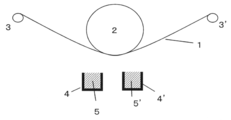
- FIG. 1 is a schematic view of a vapor deposition apparatus for producing the laminated film of the present invention, but is not limited to this apparatus.
- reference numeral 1 denotes a substrate (film), specifically, a film having an inorganic layer fed from a take-up roll.
- Reference numeral 2 denotes a roll for supporting the film 1, and the film 1 travels along the rolls 3 and 3 '. Or you may fix the sheet
- the crucible 4 is for holding the sulfur-containing triazine derivative 5, and the sulfur-containing triazine derivative vaporized by heating is deposited on the inorganic layer provided in the film. Next, from the crucible 4 ′, oxygen and / or nitrogen-containing triazine derivative 5 ′ is deposited on the layer (first organic layer) of the sulfur-containing triazine derivative 5 to form a second organic layer.
- the apparatus of FIG. 1 is housed in a vacuum chamber (not shown) capable of producing a vacuum of 1.0 ⁇ 10 ⁇ 5 Pa. At this time, it is also possible to prepare a laminated film according to the present invention using a film having an inorganic layer deposited on the film and using a film that does not have an inorganic layer. Can be made.
- the inside of the vapor deposition apparatus was evacuated and reduced to 5.0 ⁇ 10 ⁇ 5 Pa, and then heated at 180 ° C. for 60 minutes to remove moisture and impurities. Thereafter, the crucible 4 containing triazine trithiol was heated to 250 ° C. and deposited on the surface of the polyester film on which the ceramic was deposited to a thickness of 10 nm. Next, the melem side crucible 4 ′ was heated to 450 ° C., and the melem was deposited on the surface on which the ceramic / triazine trithiol was deposited to a thickness of 50 nm. Table 1 shows the physical property evaluation results of the obtained laminated film.
- Example 2 A 12 ⁇ m polyethylene terephthalate film (“E5100” manufactured by Toyobo Co., Ltd.) was used as the plastic film. These composite inorganic compound thin films were formed on the surface of the PET film by vapor deposition using aluminum oxide and magnesium oxide as raw materials for vapor deposition. Specifically, using a single electron gun, aluminum oxide and magnesium oxide are irradiated with an electron beam in a time-sharing manner and heated to evaporate these deposition materials and deposit an inorganic compound thin film. It was. The film thickness and composition of the inorganic compound thin film composed of aluminum oxide and magnesium oxide were adjusted by adjusting the output of the electron beam and the irradiation time for each vapor deposition raw material.
- the film feed rate was 95 m / min
- the emission current of the electron gun was 1.2 A
- the irradiation time of the electron beam was time-divided at a ratio of magnesium oxide 2 to aluminum oxide 13.
- the pressure during the vapor deposition of the inorganic compound thin film was 2.5 ⁇ 10 ⁇ 1 Pa or less.
- the thickness of the obtained inorganic compound thin film was 13 nm.
- Example 1 instead of “Ecosiale (registered trademark) VE100”, the above-mentioned vapor-deposited film (shown as PET / MgO / Al 2 O 3 in Table 1) was used, and the film thickness of triazine trithiol was 5 nm.
- a laminated film was obtained in the same manner as in Example 1 except that the film thickness was changed to 200 nm. Table 1 shows the physical property evaluation results of the obtained laminated film.
- Example 3 In Example 2, a laminated film was obtained in the same manner as in Example 2 except that the film thickness of melem was changed to 100 nm. Table 1 shows the physical property evaluation results of the obtained laminated film.
- Example 4 In Example 2, a laminated film was obtained in the same manner as in Example 2 except that the film thickness of melem was changed to 75 nm. Table 1 shows the physical property evaluation results of the obtained laminated film.
- Example 5 a laminated film was obtained in the same manner as in Example 2 except that the film thickness of melem was changed to 50 nm. Table 1 shows the physical property evaluation results of the obtained laminated film.
- Example 6 a laminated film was obtained in the same manner as in Example 2 except that the film thickness of triazine trithiol was changed to 1 nm and the film thickness of melem was changed to 53 nm. Table 1 shows the physical property evaluation results of the obtained laminated film.
- Example 7 a laminated film was obtained in the same manner as in Example 2 except that the film thickness of triazine trithiol was changed to 2 nm and the film thickness of melem was changed to 70 nm. Table 1 shows the physical property evaluation results of the obtained laminated film.
- Example 8 In Example 2, a laminated film was obtained in the same manner as in Example 2 except that the film thickness of triazine trithiol was changed to 3 nm and the film thickness of melem was changed to 81 nm. Table 1 shows the physical property evaluation results of the obtained laminated film.
- Example 9 In Example 2, a laminated film was obtained in the same manner as in Example 2 except that the film thickness of triazine trithiol was changed to 4 nm and the film thickness of melem was changed to 150 nm. Table 1 shows the physical property evaluation results of the obtained laminated film.
- Example 10 a laminated film was obtained in the same manner as in Example 2 except that the film thickness of triazine trithiol was changed to 5 nm and the film thickness of melem was changed to 151 nm.
- Table 1 shows the physical property evaluation results of the obtained laminated film.
- Example 1 (Comparative Example 1) In Example 1, the deposition raw material was changed to only melamine (manufactured by Wako Pure Chemical Industries, Ltd.), heated to 250 ° C., and melamine was deposited on the surface of the polyester film (VE100) on which the ceramic was deposited, A laminated film was obtained in the same manner as in Example 1 except that the film thickness of the organic layer was changed to 118 nm. Table 1 shows the physical property evaluation results of the obtained laminated film.
- Example 2 In Example 1, the deposition raw material was changed to only melamine (manufactured by Wako Pure Chemical Industries, Ltd.), heated to 250 ° C., and melamine was deposited on the surface of the polyester film (VE100) on which the ceramic was deposited, A laminated film was obtained in the same manner as in Example 1 except that the thickness of the organic layer was changed to 59 nm. Table 1 shows the physical property evaluation results of the obtained laminated film.
- Example 3 (Comparative Example 3)
- a polyethylene terephthalate film (“Cosmo Shine (registered trademark) A4100” manufactured by Toyobo Co., Ltd., film thickness 50 ⁇ m; indicated as PET A4100 in the table) was used instead of triazine trithiol.
- the amino-1,3,5-triazine-4,6-dithiol manufactured by Alfa Aesars, product number B20510
- the PET A laminated film was obtained in the same manner as in Example 1 except that the film was laminated on the surface of A4100 and the second organic layer was not laminated.
- Table 1 shows the physical property evaluation results of the obtained laminated film.
- Example 1 Example 1 except that the PET A4100 was used, the amount of triazine trithiol was adjusted to change the thickness of the first organic layer to 100 nm, and the second organic layer was not laminated. In the same manner, a laminated film was obtained. Table 1 shows the physical property evaluation results of the obtained laminated film.
- Example 5 (Comparative Example 5)
- the vapor deposition raw material was changed to 2-amino-1,3,5-triazine-4,6-dithiol only, heated to 250 ° C., and 2-amino-1,3,5-triazine-4 , 6-dithiol is deposited on the surface of the polyester film ("VE100") on which the ceramic is deposited, the thickness of the first organic layer is changed to 200 nm, and the second organic layer is not laminated.
- a laminated film was obtained in the same manner as in Example 1 except that. Table 1 shows the physical property evaluation results of the obtained laminated film.
- Example 6 (Comparative Example 6)
- the vapor deposition raw material was changed to only triazine trithiol, heated to 250 ° C., and triazine trithiol was vapor-deposited on the surface of the polyester film (“VE100”) on which the ceramic was vapor-deposited.
- a laminated film was obtained in the same manner as in Example 1 except that the thickness of the layer was changed to 200 nm and the second organic layer was not laminated. Table 1 shows the physical property evaluation results of the obtained laminated film.
- Example 7 (Comparative Example 7)
- the above PET A4100 was used, the amount of melem was adjusted, the film thickness of the organic layer was changed to 100 nm, and the inorganic layer and the first organic layer were not formed. Thus, a laminated film was obtained.
- Table 1 shows the physical property evaluation results of the obtained laminated film.
- Example 8 In Example 2, the vapor deposition material was changed to melem, the amount of melem was adjusted, the thickness of the organic layer was changed to 37 nm, and the inorganic layer and the first organic layer were not formed. A laminated film was obtained in the same manner. Table 1 shows the physical property evaluation results of the obtained laminated film.
- the laminated film according to the present invention was able to exhibit both adhesion and gas barrier properties even when an inorganic layer and an organic layer were laminated on a plastic film. Therefore, the laminated film according to the present invention can be widely used not only for packaging applications such as foods, pharmaceuticals, and industrial products, but also for industrial applications such as solar cells, electronic paper, organic EL elements, and semiconductor elements.
Landscapes
- Chemical & Material Sciences (AREA)
- Chemical Kinetics & Catalysis (AREA)
- Engineering & Computer Science (AREA)
- Materials Engineering (AREA)
- Mechanical Engineering (AREA)
- Metallurgy (AREA)
- Organic Chemistry (AREA)
- Laminated Bodies (AREA)
- Physical Vapour Deposition (AREA)
Abstract
プラスチックフィルムの上に無機層および有機層を積層した場合であっても、密着性および酸素ガスバリア・水蒸気バリア性に優れた積層フィルムを提供する。 プラスチックフィルムの少なくとも一方の表面に、無機層、第一の有機層、第二の有機層が、他の層を介してまたは介さずに、この順で設けられた積層フィルムであって、第一の有機層は2,4,6位の少なくとも1つに硫黄を含む基を置換基として有する1,3,5-トリアジン誘導体を含み、第二の有機層は2,4,6位の少なくとも一つに酸素および/または窒素を含む基を置換基として有する1,3,5-トリアジン誘導体および/またはこれらの縮合体を含むことを特徴とする積層フィルムである。
Description
本発明は、無機層および有機層を備え、かつ密着性およびガスバリア性に優れた積層フィルムであって、食品、医薬品、工業製品等の包装用途のみならず、太陽電池、電子ペーパー、有機EL素子、半導体素子等の工業用途にも広く用いることができる積層フィルムに関する。
従来、食品包装用途等に用いられるガスバリア性を有する積層フィルムとして、酸化ケイ素や酸化アルミニウム等の無機酸化物の薄膜(以下、無機層という)や、プラスチックフィルムの表面に、アルミニウム等の金属薄膜を積層させたフィルムが知られていた。しかし、太陽電池、電子ペーパー、有機EL素子、半導体素子等の工業用途では、上記の積層フィルムではガスバリア性が不十分であり、さらにガスバリア性を向上させる必要がある。
ガスバリア性を向上させる手段の一つとして、無機層と、有機物を含有する薄膜(以下、有機層という)とをプラスチックフィルムに積層する方法が考えられる。
有機層は、通常のコーティング法により形成する方法もあるが、蒸着法を採用することもできる。蒸着法としては、真空蒸着法、スパッタリング法、イオンプレーティング法等の物理蒸着法と、PECVD(プラズマCVD)等の化学蒸着法とに大別されるが、通常、物理蒸着法が用いられている。
物理蒸着法を用いると、ある程度のガスバリア性を発現させることができ、さらに広い面積に物質を蒸着させた場合でも膜厚を均一にすることができる。加えて、物理蒸着法を用いると、有機物と無機物とを連続的に真空製膜することで、コスト削減および製膜時間の短縮といった作製効率の向上を図ることができる。
無機層と有機層とを備えた積層フィルムとしては、無機層とメラミンを含む有機層とを積層した積層フィルムが知られている(例えば、特許文献1および2参照)。ここでは、プラスチックフィルムの上に無機層を積層し、無機層の上に真空蒸着法によって有機層を蒸着する方法が提案されている。有機層には、トリアジン誘導体(例えば、メラミン、メレム、メラム、アンメリン、アンメリド、シアヌル酸、2-ウレイドメラミンや、シアヌル酸メラミン等のメラミン塩や、アクリレート、エポキシ、ビニルエーテル等の重合性基で官能化させたメラミン等)または上記トリアジン誘導体の混合物が含まれている。
ところで、積層フィルムを包装用途で用いる場合には、ガスバリア性が優れているのみならず、有機層と無機層との層間の密着力(以下、密着力という)も優れている必要がある。しかし、特許文献1および2に記載の方法で作製された積層フィルムは、酸素ガスバリア性は有するものの、水蒸気バリア性が悪いことや密着力が弱いという問題があった。
本発明は、無機層および有機層を備え、かつ密着性および酸素ガスバリア・水蒸気バリア性に優れた積層フィルムの提供を課題として掲げた。
本発明者等は、2,4,6位の少なくとも1つに硫黄を含む基を置換基として有する1,3,5-トリアジン誘導体を含む有機層と、2,4,6位の少なくとも1つに酸素を含む基および/または窒素を含む基を置換基として有する1,3,5-トリアジン誘導体および/またはこれらの縮合体を含む有機層を形成させた結果、密着性と酸素ガスバリア性、水蒸気バリア性とを共に発現させることができ、本発明を完成するに至った。
本発明に係る積層フィルムは、プラスチックフィルムの少なくとも一方の表面に、無機層、第一の有機層、第二の有機層が、他の層を介してまたは介さずに、この順で設けられており、第一の有機層は2,4,6位の少なくとも1つに硫黄を含む基を置換基として有する1,3,5-トリアジン誘導体を含み、第二の有機層は2,4,6位の少なくとも一つに酸素および/または窒素を含む基を置換基として有する1,3,5-トリアジン誘導体および/またはこれらの縮合体を含むことを特徴とする。
第一の有機層に含まれる1,3,5-トリアジン誘導体は、トリアジントリチオールまたはトリアジンジチオールであることが好ましく、トリアジントリチオールであることがより好ましい。
第二の有機層に含まれる1,3,5-トリアジン誘導体および/またはこれらの縮合体は、メラミン、メレム、メラム、アンメリン、アンメリド、シアヌル酸、2-ウレイドメラミン、シアヌル酸メラミン、および重合性基で官能化させたメラミンよりなる群から選択される1種以上であることが好ましく、メレムであることがより好ましい。
無機層、第一の有機層および第二の有機層は、真空蒸着法によって形成されていることが好ましい。
本発明に係る積層フィルムは、密着性とガスバリア性とを共に発現させることができるものである。本発明に係る積層フィルムは、食品、医薬品、工業製品等の包装用途のみならず、太陽電池、電子ペーパー、有機EL素子、半導体素子等の工業用途にも広く用いることができる。
また、本発明に係る積層フィルムは、第一の有機層と第二の有機層の両方が、置換基は異なるが共にトリアジン骨格を有するトリアジン誘導体を含んでいる。このトリアジン骨格は平面状で比較的大きな分子構造を有するため、これらの有機層間で相互作用が起こりやすく、良好な物性が発現するものである。
本発明の積層フィルムは、プラスチックフィルムの少なくとも一方の表面に、無機層、第一の有機層、第二の有機層が、他の層を介してまたは介さずに、この順で設けられており、第一の有機層は2,4,6位の少なくとも1つに硫黄を含む基を置換基として有する1,3,5-トリアジン誘導体を含み、第二の有機層は2,4,6位の少なくとも一つに酸素および/または窒素を含む基を置換基として有する1,3,5-トリアジン誘導体および/またはこれらの縮合体を含むものである。以下、本発明に係る積層フィルムの物性や製造方法について説明する。
[プラスチックフィルム]
本発明におけるプラスチックフィルムとは、有機高分子樹脂からなり、溶融押出し後、長手方向および/または幅方向に延伸され、さらに熱固定、冷却を施されたフィルムであり、有機高分子樹脂としては、ポリエチレン、ポリプロピレン等のポリオレフィン;ポリエチレンテレフタレート、ポリブチレンテレフタレート、ポリエチレン-2,6-ナフタレート等のポリエステル;ナイロン6、ナイロン4、ナイロン66、ナイロン12、全芳香族ポリアミド等のポリアミド類;ポリ塩化ビニル、ポリ塩化ビニリデン、ポリビニルアルコール、ポリアミドイミド、ポリイミド、ポリエーテルイミド、ポリスルホン、ポリフェニレンスルフィド、ポリフェニレンオキサイド等が挙げられる。これらの有機高分子樹脂は、他の有機単量体を少量共重合したり、他の有機重合体をブレンドしたりしてもよい。
本発明におけるプラスチックフィルムとは、有機高分子樹脂からなり、溶融押出し後、長手方向および/または幅方向に延伸され、さらに熱固定、冷却を施されたフィルムであり、有機高分子樹脂としては、ポリエチレン、ポリプロピレン等のポリオレフィン;ポリエチレンテレフタレート、ポリブチレンテレフタレート、ポリエチレン-2,6-ナフタレート等のポリエステル;ナイロン6、ナイロン4、ナイロン66、ナイロン12、全芳香族ポリアミド等のポリアミド類;ポリ塩化ビニル、ポリ塩化ビニリデン、ポリビニルアルコール、ポリアミドイミド、ポリイミド、ポリエーテルイミド、ポリスルホン、ポリフェニレンスルフィド、ポリフェニレンオキサイド等が挙げられる。これらの有機高分子樹脂は、他の有機単量体を少量共重合したり、他の有機重合体をブレンドしたりしてもよい。
好ましいポリエステルとしては、ポリエチレンテレフタレート、ポリブチレンテレフタレート、ポリエチレン-2,6-ナフタレート等が挙げられるが、これらを主成分とする共重合体であってもよい。
ポリエステル共重合体を用いる場合、そのジカルボン酸成分の主成分としては、テレフタル酸、イソフタル酸、フタル酸、2,6-ナフタレンジカルボン酸等の芳香族ジカルボン酸が好ましく、他のカルボン酸成分としては、トリメリット酸、ピロメリット酸等の多官能カルボン酸;アジピン酸、セバシン酸等の脂肪族ジカルボン酸等が用いられる。また、グリコール成分の主成分としては、エチレングリコールまたは1,4-ブタンジオールが好ましく、他のグリコール成分としては、ジエチレングリコール、プロピレングリコール、ネオペンチルグリコール等の脂肪族グリコール;p-キシリレングリコール等の芳香族グリコール;1,4-シクロヘキサンジメタノール等の脂環族グリコール;重量平均分子量が150~20000のポリエチレングリコール等が用いられる。
ポリエステル共重合体中の共重合成分の好ましい比率は20質量%以下である。共重合成分が20質量%を超えるときは、フィルム強度、透明性、耐熱性等が劣る場合がある。これらのポリエステル共重合体には、他の有機単量体を少量共重合したり、他の有機重合体をブレンドしたりしてもよい。
また、好ましいポリアミドとしては、ポリカプロアミド(ナイロン6)、ポリ-ε-アミノへプタン酸(ナイロン7)、ポリ-ε-アミノノナン酸(ナイロン9)、ポリウンデカンアミド(ナイロン11)、ポリラウリンラクタム(ナイロン12)、ポリエチレンジアミンアジパミド(ナイロン2・6)、ポリテトラメチレンアジパミド(ナイロン4・6)、ポリヘキサメチレンアジパミド(ナイロン6・6)、ポリヘキサメチレンセバカミド(ナイロン6・10)、ポリヘキサメチレンドデカミド(ナイロン6・12)、ポリオクタメチレンドデカミド(ナイロン8・12)、ポリオクタメチレンアジパミド(ナイロン8・6)、ポリデカメチレンアジパミド(ナイロン10・6)、ポリデカメチレンセバカミド(ナイロン10・10)、ポリドデカメチレンドデカミド(ナイロン12・12)、メタキシリレンジアミン-6ナイロン(MXD6)等が挙げられ、これらを主成分とする共重合体であってもよい。
ポリアミド共重合体としては、カプロラクタム/ラウリンラクタム共重合体、カプロラクタム/ヘキサメチレンジアンモニウムアジペート共重合体、ラウリンラクタム/ヘキサメチレンジアンモニウムアジペート共重合体、ヘキサメチレンジアンモニウムアジペート/ヘキサメチレンジアンモニウムセバケート共重合体、エチレンジアンモニウムアジペート/ヘキサメチレンジアンモニウムアジペート共重合体、カプロラクタム/ヘキサメチレンジアンモニウムアジペート/ヘキサメチレンジアンモニウムセバケート共重合体等が挙げられる。
これらのポリアミドには、フィルムの柔軟性改質成分として、芳香族スルホンアミド類、p-ヒドロキシ安息香酸、エステル類等の可塑剤や低弾性率のエラストマー成分やラクタム類を配合することも有効である。
さらに、上記有機高分子樹脂には、公知の添加物、例えば、紫外線吸収剤、帯電防止剤、可塑剤、滑剤、着色剤等が添加されてもよく、フィルムとしての透明度は特に限定するものではないが、透明性を要求される場合には、50%以上の光線透過率をもつものが好ましい。
本発明では、本発明の目的を損なわないかぎりにおいて、有機層や無機層を積層する前のプラスチックフィルムに、コロナ放電処理、プラズマ放電処理、火炎処理、表面粗面化処理等の表面処理、公知のアンカーコート処理、印刷、装飾等を施してもよい。
本発明におけるプラスチックフィルムの厚みは、3~500μmの範囲が好ましく、6~300μmの範囲がより好ましい。
[無機層]
本発明でいう無機層は、特に制限はなく、物質としては、Al、Si、Ti、Zn、Zr、Mg、Sn、Cu、Fe等の金属や、これら金属の酸化物、窒化物、フッ素物、硫化物等が挙げられ、具体的には、SiOX(x=1.0~2.0)、アルミナ、マグネシア、硫化亜鉛、チタニア、ジルコニア、酸化セリウム、あるいはこれらの混合物が例示される。無機層は1層でも2層以上の積層体でもよい。無機層および後に詳述する有機層は、プラスチックフィルムの片面のみに積層されていても、両面に積層されていてもよい。なお、プラスチックフィルムに無機層の蒸着が施された東洋紡社製「エコシアール(登録商標)VE100」といった市販の蒸着ポリエステルフィルムも使用できる。また、蒸着されたナイロンフィルムを用いることもできる。
本発明でいう無機層は、特に制限はなく、物質としては、Al、Si、Ti、Zn、Zr、Mg、Sn、Cu、Fe等の金属や、これら金属の酸化物、窒化物、フッ素物、硫化物等が挙げられ、具体的には、SiOX(x=1.0~2.0)、アルミナ、マグネシア、硫化亜鉛、チタニア、ジルコニア、酸化セリウム、あるいはこれらの混合物が例示される。無機層は1層でも2層以上の積層体でもよい。無機層および後に詳述する有機層は、プラスチックフィルムの片面のみに積層されていても、両面に積層されていてもよい。なお、プラスチックフィルムに無機層の蒸着が施された東洋紡社製「エコシアール(登録商標)VE100」といった市販の蒸着ポリエステルフィルムも使用できる。また、蒸着されたナイロンフィルムを用いることもできる。
本発明における無機層は、ガスバリア性に優れる点から、少なくとも酸化アルミニウムを含む多元系無機層が好ましく、酸化ケイ素と酸化アルミニウムとからなる二元系無機層か、酸化マグネシウムと酸化アルミニウムとからなる二元系無機層が好ましい。
上記酸化ケイ素とは、Si、SiOやSiO2等の各種ケイ素酸化物の混合物からなり、上記酸化アルミニウムとは、Al、AlOや、Al2O3等の各種アルミニウム酸化物の混合物からなり、上記酸化マグネシウムとは、MgやMgO等の各種マグネシウム化合物の混合物であり、各酸化物内における酸素の結合量はそれぞれの製造条件によって異なってくる。
酸化ケイ素と酸化アルミニウムとを併用する場合、無機層中の酸化アルミニウムの含有率は、20~99質量%であることが好ましく、20~75質量%であることがより好ましい。
酸化マグネシウムと酸化アルミニウムとを併用する場合、無機層中の酸化アルミニウムの含有率は、20~99質量%であることが好ましく、20~80質量%であることがより好ましい。
酸化アルミニウムの含有率が20質量%未満になると、ガスバリア性が必ずしも十分でない場合がある。一方、酸化アルミニウムの含有率が99質量%を超えると、蒸着膜の柔軟性が低下し、積層フィルムが曲げや寸法変化に比較的弱くなり、二者併用の効果が低下する場合がある。
無機層の厚みは、通常1~800nmが好ましく、5~500nmがより好ましい。厚みが1nm未満になると、満足のいくガスバリア性が得られ難くなるおそれがある。一方、800nmを超えて過度に厚くしても、それに相当するガスバリア性の向上効果は得られず、耐屈曲性や製造コストの点でかえって不利となる。
無機層を形成する典型的な製法としては、公知の方法、例えば、真空蒸着法、スパッタリング法、イオンプレーティング法等の物理蒸着法や、PECVD(プラズマCVD)等の化学蒸着法等が採用される。無機層は、真空蒸着法によって形成されているのが好ましい。
例えば、真空蒸着法を採用する場合、蒸着原料としては、アルミニウム、珪素、チタン、マグネシウム、ジルコニウム、セリウム、亜鉛等の金属、また、SiOX(x=1.0~2.0)、アルミナ、マグネシア、硫化亜鉛、チタニア、ジルコニア等の化合物およびそれらの混合物が用いられる。真空蒸着法は、真空中で無機物を加熱し、るつぼに入った材料を加熱、蒸発させてプラスチックフィルムの上に付着させる方法である。真空にするためには、蒸着装置の内部を真空引きし、3.0×10⁻²Paまで低下させるのが好ましく、1.0×10⁻²Paまで低下させるのがより好ましい。
無機物の加熱には、抵抗加熱、高周波誘導加熱、電子ビーム加熱等を採用することができる。反応ガスとして、酸素、窒素、水素、アルゴン、炭酸ガス、水蒸気等を導入したり、オゾン添加、イオンアシスト等の手段を用いた反応性蒸着を採用したりすることも可能である。
さらに、プラスチックフィルムにバイアスを印加したり、プラスチックフィルムをロールで加熱したり冷却する等変更することができ、ロール温度は、-20~40℃で行うのが好ましい。
本発明における無機層が、少なくとも酸化ケイ素と酸化アルミニウムとを含む多元系無機層である場合、この多元系無機層を40~60℃の温度、かつ1~3kPaの水蒸気ガス中で50時間以上処理することが好ましい。
蒸着材料、反応ガス、基板バイアス、加熱・冷却等の薄膜形成条件は、スパッタリング法やイオンプレーティング法やCVD法を採用する場合にも同様に変更可能である。
[有機層]
有機層は無機層の上に積層されている。本発明の積層フィルムでは、無機層の表面に少なくとも2層の有機層(第一の有機層、第二の有機層)が積層されている。
第一の有機層は、2,4,6位の少なくとも1つに硫黄を含む基を置換基として有する1,3,5-トリアジン誘導体を含んでいる。第二の有機層は、2,4,6位の少なくとも一つに酸素および/または窒素を含む基を置換基として有する1,3,5-トリアジン誘導体(トリアジン環に直接結合する硫黄を含む置換基は有さない)および/またはこれらの縮合体(これらの2量体や2環や3環の縮合体)を含む。第一の有機層と第二の有機層を無機層と組み合わせることで、密着性とガスバリア性がより一層向上する。有機層自体がガスバリア性を有していなくても構わないが、ガスバリア性を有している方が好ましい。
有機層は無機層の上に積層されている。本発明の積層フィルムでは、無機層の表面に少なくとも2層の有機層(第一の有機層、第二の有機層)が積層されている。
第一の有機層は、2,4,6位の少なくとも1つに硫黄を含む基を置換基として有する1,3,5-トリアジン誘導体を含んでいる。第二の有機層は、2,4,6位の少なくとも一つに酸素および/または窒素を含む基を置換基として有する1,3,5-トリアジン誘導体(トリアジン環に直接結合する硫黄を含む置換基は有さない)および/またはこれらの縮合体(これらの2量体や2環や3環の縮合体)を含む。第一の有機層と第二の有機層を無機層と組み合わせることで、密着性とガスバリア性がより一層向上する。有機層自体がガスバリア性を有していなくても構わないが、ガスバリア性を有している方が好ましい。
[第一の有機層]
2,4,6位の少なくとも1つに硫黄を含む基を置換基として有する1,3,5-トリアジン誘導体としては、例えば、以下の化学式のような1,3,5-トリアジン誘導体が挙げられ、単独で若しくは併用することができる。下記1,3,5-トリアジン誘導体を有機層に含めることによって、密着性とガスバリア性を発現することができる。
2,4,6位の少なくとも1つに硫黄を含む基を置換基として有する1,3,5-トリアジン誘導体としては、例えば、以下の化学式のような1,3,5-トリアジン誘導体が挙げられ、単独で若しくは併用することができる。下記1,3,5-トリアジン誘導体を有機層に含めることによって、密着性とガスバリア性を発現することができる。

上記式に示す1,3,5-トリアジン誘導体は、2,4,6位に硫黄を含む基を置換基として有し、2,4,6位の炭素原子に硫黄原子が直接結合している。上記式中のR1、R2、R3は、例えば、H,CH3,C2H5,C4H9,C6H13,C8H17,C10H21,C12H25,C18H37,C20H41,C22H45,C24H49,CF3C6H4,C4F9C5H4,C6F13C5H4,C8F17C6H4,C10F21C6H4,C6F11C6H4,C9F17CH2,C10F21CH2,C4F9CH2,C6F13CH2CH2,C8F17CH2CH2,C10F21CH2CH2,CH2=CHCH2,CH2=CH(CH2)8,CH2=CH(CH2)9,C8H17CH2=C8H16,C6H11,C6H5CH2,C6H5CH2CH2,CH2=CH(CH2)4COOCH2CH2,CH2=CH(CH2)8COOCH2CH2,CH2=CH(CH2)9COOCH2CH2,C4F9CH2=CHCH2,C6F13CH2=CHCH2,C8F17CH2=CHCH2,C10F21CH2=CHCH2,C4F9CH2CH(OH)CH2,C6F13CH2CH(OH)CH2,C8F17CH2CH(OH)CH2,C10F21CH2CH(OH)CH2,CH2=CH(CH2)4COO(CH2CH2)2,CH2=CH(CH2)8COO(CH2CH2)2,CH2=CH(CH2)9COO(CH2CH2)2,C4F9COOCH2CH2,C6F13COOCH2CH2,C8F17COOCH2CH2,C10F21COOCH2CH2であり、R1~R3は同じであっても異なっていても構わない。
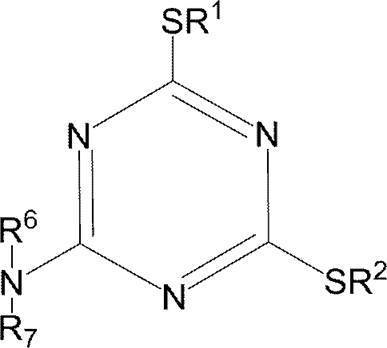
上記式に示す1,3,5-トリアジン誘導体は、2,4,6位のいずれか2つに硫黄を含む基を置換基として有し、いずれか1つに窒素を含む基を置換基として有している。上記置換基の硫黄原子は、2,4,6位のいずれかの炭素原子に直接結合している。上記式中のR1、R2、R6、R7は、例えば、前記した2,4,6位に硫黄を含む置換基を有する1,3,5-トリアジン誘導体のR1、R2、R3と同じ基が挙げられる。上記式中、R1、R2、R6、R7は同じであっても異なっていても構わない。
上記式で示されるトリアジンジチオールとしては、6位に置換基を有する1,3,5-トリアジン-2,4-ジチオールや、2位に置換基を有する1,3,5-トリアジン-4,6-ジチオールが好適である。
上記式で示されるトリアジンジチオールとしては、6位に置換基を有する1,3,5-トリアジン-2,4-ジチオールや、2位に置換基を有する1,3,5-トリアジン-4,6-ジチオールが好適である。
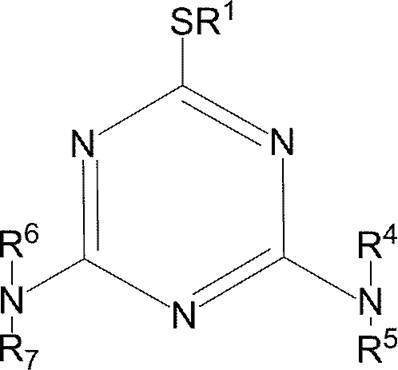
上記式に示す1,3,5-トリアジン誘導体は、2,4,6位のいずれか1つに硫黄を含む基を置換基として有し、いずれか2つに窒素を含む基を置換基として有している。上記置換基の硫黄原子は、2,4,6位のいずれかの炭素原子に直接結合している。上記式中のR1、R4~R7は、例えば、前記した2,4,6位に硫黄を含む置換基を有する1,3,5-トリアジン誘導体のR1、R2、R3と同じ基が挙げられる。上記式中、R1、R4~R7は同じであっても異なっていても構わない。
上記の1,3,5-トリアジン誘導体は、2,4,6位の少なくとも1つに硫黄を含む基を置換基として有するが、硫黄を含む基の硫黄原子は2,4,6位のいずれかの炭素原子に直接結合しているのが好ましい。
上記の1,3,5-トリアジン誘導体は、2,4,6位のいずれか2つに硫黄を含む基を置換基として有するトリアジンジチオール、または2,4,6位のすべてに硫黄を含む基を置換基として有し、R1、R2、R3のいずれもがHであるトリアジントリチオール(チオシアヌル酸)であることが好ましく、トリアジントリチオールであることがより好ましい。
[第二の有機層]
ガスバリア性向上のための第二の有機層は、1,3,5-トリアジン誘導体の2,4,6位の少なくとも一つに酸素および/または窒素を含む基を置換基として有するトリアジン誘導体を含んでいる。また、このトリアジン誘導体の2量体や、2環や3環の縮合体を、単独で、または1,3,5-トリアジン誘導体の2,4,6位の少なくとも一つに酸素および/または窒素を含む基を置換基として有するトリアジン誘導体との混合物として、含むものであってもよい。このような有機層を用いた場合、無機層と組み合わせたときに、ガスバリア性が向上する。本発明の第二の有機層で用いられる1,3,5-トリアジン誘導体およびこれらの縮合体は、下記の18個の式で表される。
ガスバリア性向上のための第二の有機層は、1,3,5-トリアジン誘導体の2,4,6位の少なくとも一つに酸素および/または窒素を含む基を置換基として有するトリアジン誘導体を含んでいる。また、このトリアジン誘導体の2量体や、2環や3環の縮合体を、単独で、または1,3,5-トリアジン誘導体の2,4,6位の少なくとも一つに酸素および/または窒素を含む基を置換基として有するトリアジン誘導体との混合物として、含むものであってもよい。このような有機層を用いた場合、無機層と組み合わせたときに、ガスバリア性が向上する。本発明の第二の有機層で用いられる1,3,5-トリアジン誘導体およびこれらの縮合体は、下記の18個の式で表される。

上記式に示す1,3,5-トリアジン誘導体は、2,4,6位のいずれか1つに窒素を含む基を置換基として有し、上記置換基の窒素原子は、2,4,6位のいずれかの炭素原子に直接結合している。上記式中のR1、R2は、例えば、前記した2,4,6位に硫黄を含む置換基を有する1,3,5-トリアジン誘導体のR1、R2、R3と同じ基が挙げられる。上記式中、R1、R2は同じであっても異なっていても構わない。
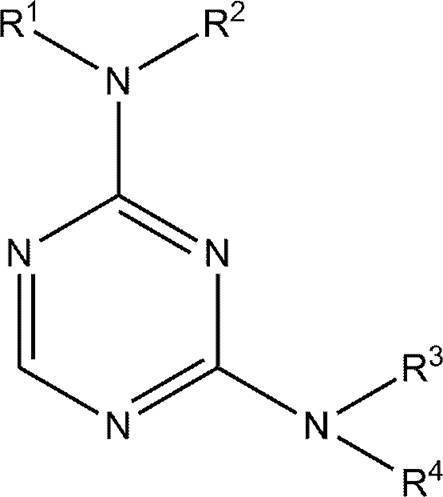
上記式に示す1,3,5-トリアジン誘導体は、2,4,6位のいずれか2つに窒素を含む基を置換基として有し、上記置換基の窒素原子は、2,4,6位のいずれかの炭素原子に直接結合している。上記式中のR1、R2、R3、R4は、例えば、前記した2,4,6位に硫黄を含む置換基を有する1,3,5-トリアジン誘導体のR1、R2、R3と同じ基が挙げられる。上記式中、R1、R2、R3、R4は同じであっても異なっていても構わない。

上記式に示す1,3,5-トリアジン誘導体は、2,4,6位に窒素を含む基を置換基として有し、上記置換基の窒素原子は、2,4,6位の炭素原子に直接結合している。上記式中のR1~R6は、例えば、前記した2,4,6位に硫黄を含む置換基を有する1,3,5-トリアジン誘導体のR1、R2、R3と同じ基が挙げられる。上記式中、R1~R6は同じであっても異なっていても構わない。
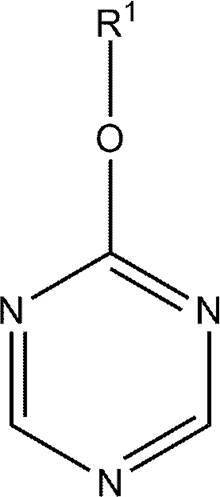
上記式に示す1,3,5-トリアジン誘導体は、2,4,6位のいずれか1つに酸素を含む基を置換基として有し、上記置換基の酸素原子は、2,4,6位のいずれかの炭素原子に直接結合している。上記式中のR1は、例えば、前記した2,4,6位に硫黄を含む置換基を有する1,3,5-トリアジン誘導体のR1、R2、R3と同じ基が挙げられる。
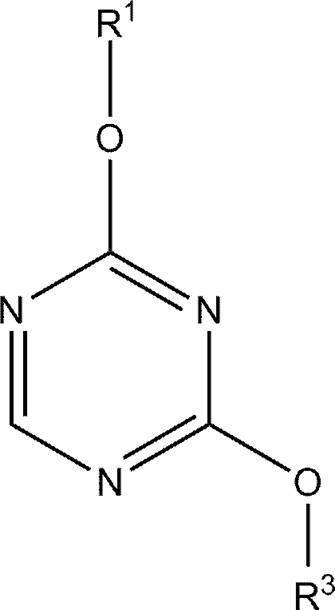
上記式に示す1,3,5-トリアジン誘導体は、2,4,6位のいずれか2つに酸素を含む基を置換基として有し、上記置換基の酸素原子は、2,4,6位のいずれか2つの炭素原子に直接結合している。上記式中のR1、R3は、例えば、前記した2,4,6位に硫黄を含む置換基を有する1,3,5-トリアジン誘導体のR1、R2、R3と同じ基が挙げられる。上記式中、R1、R3は同じであっても異なっていても構わない。

上記式に示す1,3,5-トリアジン誘導体は、2,4,6位に酸素を含む基を置換基として有し、上記置換基の酸素原子は、2,4,6位の炭素原子に直接結合している。上記式中のR1、R3、R5は、例えば、前記した2,4,6位に硫黄を含む置換基を有する1,3,5-トリアジン誘導体のR1、R2、R3と同じ基が挙げられる。上記式中、R1、R3、R5は同じであっても異なっていても構わない。
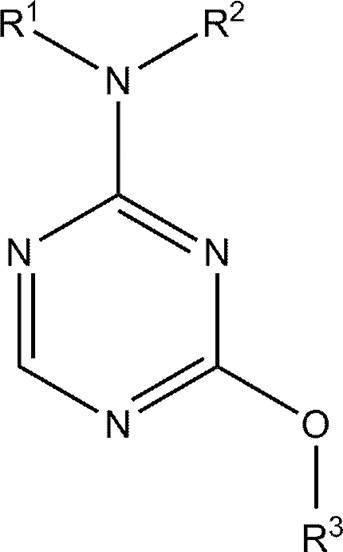
上記式に示す1,3,5-トリアジン誘導体は、2,4,6位のいずれか2つに酸素、窒素をそれぞれ一つずつ含む基を置換基として有し、上記置換基の酸素および窒素原子は、2,4,6位のいずれかの炭素原子に直接結合している。上記式中のR1、R2、R3は、例えば、前記した2,4,6位に硫黄を含む置換基を有する1,3,5-トリアジン誘導体のR1、R2、R3と同じ基が挙げられる。上記式中、R1、R2、R3は同じであっても異なっていても構わない。
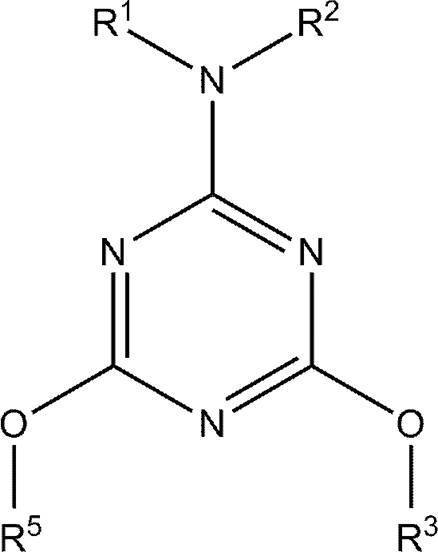
上記式に示す1,3,5-トリアジン誘導体は、2,4,6位のいずれかに酸素を含む置換基を2つ、窒素を含む置換基を1つ有し、上記置換基の酸素および窒素原子は、2,4,6位の炭素原子に直接結合している。上記式中のR1、R2、R3、R5は、例えば、前記した2,4,6位に硫黄を含む置換基を有する1,3,5-トリアジン誘導体のR1、R2、R3と同じ基が挙げられる。上記式中、R1、R2、R3、R5は同じであっても異なっていても構わない。

上記式に示す1,3,5-トリアジン誘導体は、2,4,6位のいずれかに酸素を含む置換基を1つと、窒素を含む置換基を2つ有し、上記置換基の酸素および窒素原子は、2,4,6位の炭素原子に直接結合している。上記式中のR1~R5は、例えば、前記した2,4,6位に硫黄を含む置換基を有する1,3,5-トリアジン誘導体のR1、R2、R3と同じ基が挙げられる。上記式中、R1~R5は同じであっても異なっていても構わない。
[2量体]
本発明の第二の有機層には、上記の各式に示した2,4,6位の少なくとも一つに酸素および/または窒素を含む基を置換基として有する1,3,5-トリアジン誘導体の2量体が含まれていてもよい。
本発明の第二の有機層には、上記の各式に示した2,4,6位の少なくとも一つに酸素および/または窒素を含む基を置換基として有する1,3,5-トリアジン誘導体の2量体が含まれていてもよい。
[縮合体]
本発明の第二の有機層には、上記の各式に示した2,4,6位の少なくとも一つに酸素および/または窒素を含む基を置換基として有する1,3,5-トリアジン誘導体の縮合体(下記各式参照)が含まれていてもよい。
本発明の第二の有機層には、上記の各式に示した2,4,6位の少なくとも一つに酸素および/または窒素を含む基を置換基として有する1,3,5-トリアジン誘導体の縮合体(下記各式参照)が含まれていてもよい。

上記式に示すトリアジン誘導体の縮合体は、2,5,8位のいずれか1つに窒素を含む基を置換基として有し、上記置換基の窒素原子は、2,5,8位のいずれかの炭素原子に直接結合している。上記式中のR1、R2は、例えば、前記した2,4,6位に硫黄を含む置換基を有する1,3,5-トリアジン誘導体のR1、R2、R3と同じ基が挙げられる。上記式中、R1、R2は同じであっても異なっていても構わない。

上記式に示すトリアジン誘導体の縮合体は、2,5,8位のいずれか2つに窒素を含む基を置換基として有し、上記置換基の窒素原子は、2,5,8位のいずれかの炭素原子に直接結合している。上記式中のR1~R4は、例えば、前記した2,4,6位に硫黄を含む置換基を有する1,3,5-トリアジン誘導体のR1、R2、R3と同じ基が挙げられる。上記式中、R1~R4は同じであっても異なっていても構わない。
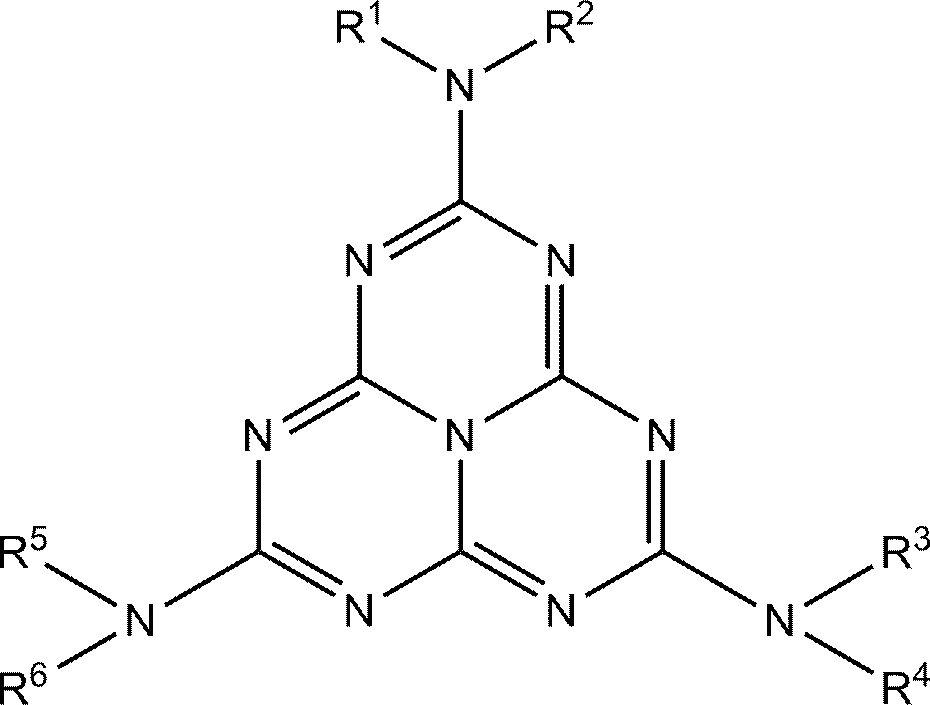
上記式に示すトリアジン誘導体の縮合体は、2,5,8位に窒素を含む基を置換基として有し、上記置換基の窒素原子は、2,5,8位の炭素原子に直接結合している。上記式中のR1~R6は、例えば、前記した2,4,6位に硫黄を含む置換基を有する1,3,5-トリアジン誘導体のR1、R2、R3と同じ基が挙げられる。上記式中、R1~R6は同じであっても異なっていても構わない。R1~R6がすべてHである化合物をメレム(2,5,8-トリアミノ-1,6-ジアゾニア-3,4,7,9,9b-ペンタアザ-9bH-フェナレン)という。

上記式に示すトリアジン誘導体の縮合体は、2,5,8位のいずれか1つに酸素を含む基を置換基として有し、上記置換基の酸素原子は、2,5,8位のいずれかの炭素原子に直接結合している。上記式中のR1は、例えば、前記した2,4,6位に硫黄を含む置換基を有する1,3,5-トリアジン誘導体のR1、R2、R3と同じ基が挙げられる。

上記式に示すトリアジン誘導体の縮合体は、2,5,8位のいずれか2つに酸素を含む基を置換基として有し、上記置換基の酸素原子は、2,5,8位のいずれか2つの炭素原子に直接結合している。上記式中のR1、R3は、例えば、前記した2,4,6位に硫黄を含む置換基を有する1,3,5-トリアジン誘導体のR1、R2、R3と同じ基が挙げられる。上記式中、R1、R3は同じであっても異なっていても構わない。

上記式に示すトリアジン誘導体の縮合体は、2,5,8位に酸素を含む基を置換基として有し、上記置換基の酸素原子は、2,5,8位の炭素原子に直接結合している。上記式中のR1、R3、R5は、例えば、前記した2,4,6位に硫黄を含む置換基を有する1,3,5-トリアジン誘導体のR1、R2、R3と同じ基が挙げられる。上記式中、R1、R3、R5は同じであっても異なっていても構わない。
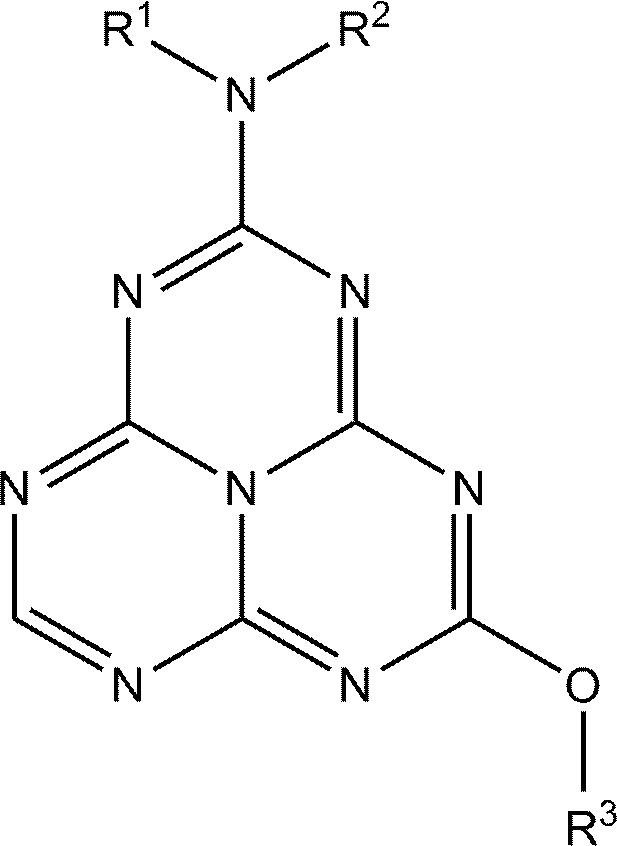
上記式に示すトリアジン誘導体の縮合体は、2,5,8位のいずれかに酸素を含む置換基と窒素を含む置換基をそれぞれ一つずつ有し、上記置換基の酸素および窒素原子は、2,5,8位のいずれかの炭素原子に直接結合している。上記式中のR1~R3は、例えば、前記した2,4,6位に硫黄を含む置換基を有する1,3,5-トリアジン誘導体のR1、R2、R3と同じ基が挙げられる。上記式中、R1~R3は同じであっても異なっていても構わない。
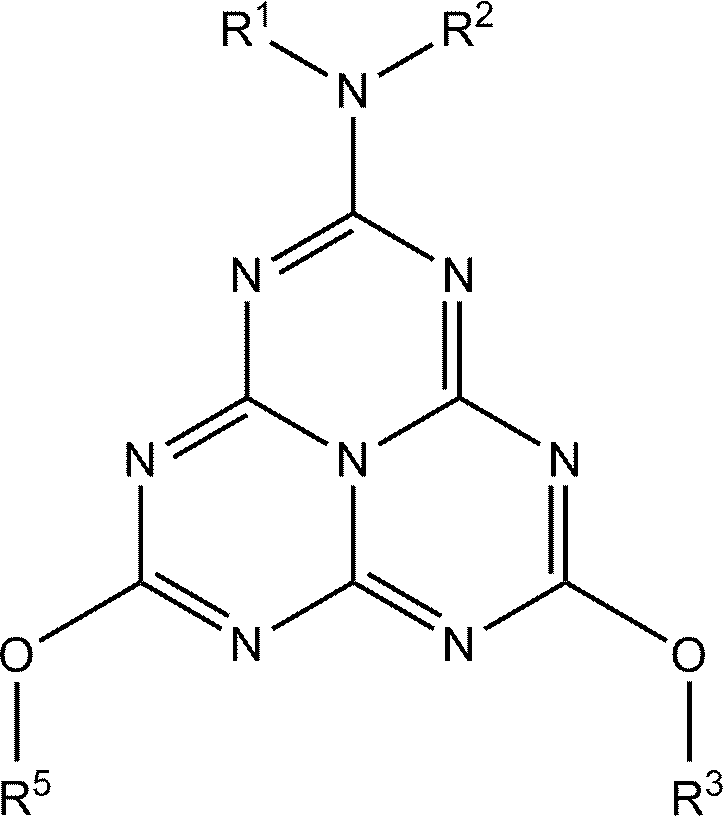
上記式に示すトリアジン誘導体の縮合体は、2,5,8位のいずれかに酸素を含む置換基を2つと、窒素を含む置換基を1つ有し、上記置換基の酸素および窒素原子は、2,5,8位の炭素原子に直接結合している。上記式中のR1、R2、R3、R5は、例えば、前記した2,4,6位に硫黄を含む置換基を有する1,3,5-トリアジン誘導体のR1、R2、R3と同じ基が挙げられる。上記式中、R1、R2、R3、R5は同じであっても異なっていても構わない。
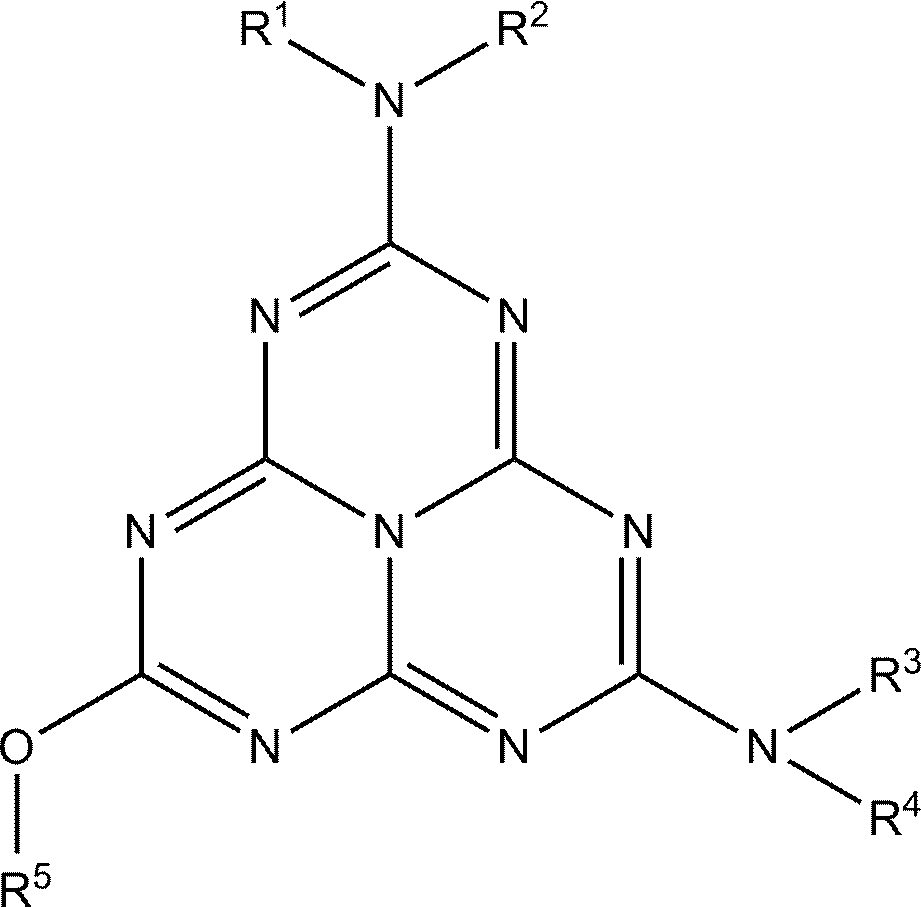
上記式に示すトリアジン誘導体の縮合体は、2,5,8位のいずれかに酸素を含む置換基を1つ、窒素を含む置換基を2つ有し、上記置換基の酸素および窒素原子は、2,5,8位の炭素原子に直接結合している。上記式中のR1~R5は、例えば、前記した2,4,6位に硫黄を含む置換基を有する1,3,5-トリアジン誘導体のR1、R2、R3と同じ基が挙げられる。上記式中、R1~R5は同じであっても異なっていても構わない。
上記酸素および/または窒素を含む置換基を有するトリアジン誘導体およびこれらの縮合体としては、メラミン、メレム、メラム、アンメリン、アンメリド、シアヌル酸、2-ウレイドメラミン、シアヌル酸メラミンおよび重合性基で官能化させたメラミンよりなる群から選択される1種以上である。重合性基で官能化させたメラミンとは、アクリレート、エポキシ、ビニルエーテル等を反応させて化合物中に重合性基を導入させたメラミンを指す。酸素および/または窒素を含む置換基を有するトリアジン誘導体および/またはこれらの縮合体を有機層に含めることによって、ガスバリア性を発現することができる。酸素および/または窒素を含む置換基を有するトリアジン誘導体および/またはこれらの縮合体としては、上記したメレムが好ましい。
上記酸素および/または窒素を含む置換基を有するトリアジン誘導体は、これらの2量体や2環や3環の縮合体、もしくはこれらの混合物も用いることができる。
第一の有機層に用いられる硫黄含有のトリアジン誘導体は耐水性や耐溶剤性が乏しい。耐溶剤性が劣ることで接着剤との密着性がむしろ低下しにくいということがある場合もあるが、硫黄含有のトリアジン誘導体層のみでは、水蒸気バリア性が悪いという問題もあることがわかってきた。これを改善するために、本発明者らが種々検討し、試行錯誤の結果、酸素および/または窒素含有のトリアジン誘導体やこれらの縮合体を用いることがよいということがわかった。
有機層は上記2種類の材料によって複合化されたものであるが、無機薄膜表面から途中まで硫黄含有の1,3,5-トリアジン誘導体のみで構成される層(第一の有機層)、さらに酸素および/窒素含有トリアジン誘導体および/またはこれらの縮合体のみで構成される層(第二の有機層)からなる構成が好ましい。
有機層全体の膜厚は1nm以上であるのが好ましい。有機層の膜厚の上限は500nmであるのが好ましく、より好ましくは400nmである。
第一の有機層の膜厚の上限は、25nmであるのが好ましく、より好ましくは10nmである。また、第二の有機層の膜厚の上限は500nmであるのが好ましく、より好ましくは400nmである。
有機層の無機層上への積層方法としては、有機高分子樹脂をバインダー樹脂とするのではなく、蒸着方法を用いることが好ましい。蒸着方法を用いると、有機層において、ガスバリア性を阻害するおそれのある有機高分子樹脂を低減できるため、本有機層の優れたガスバリア性を十分に発現させることができる。
第一の有機層と第二の有機層の積層時に、バインダー樹脂を用いず、トリアジン誘導体が100質量%含有されている方がよい理由としては、その他の不純物がない方が第一と第二の有機二層間での結晶構造等の高次構造が保持されやすいためである。
蒸着方法としては、公知の方法、例えば、真空蒸着法、スパッタリング法、イオンプレーティング法等の物理蒸着法や、PECVD(プラズマCVD)等の化学蒸着法等が採用される。有機層は、真空蒸着法によって形成されているのが好ましい。
真空蒸着法は、真空中で有機物を加熱し、るつぼに入った材料を加熱、蒸発させてプラスチックフィルムまたは無機層の上に付着させる方法である。真空にするためには、蒸着装置の内部を真空引きし、3.0×10⁻²Paまで低下させるのが好ましく、1.0×10⁻²Paまで低下させるのがより好ましく、1.0×10⁻⁴Pa以下の高真空で行うのが最も好ましい。
有機物の加熱には、抵抗加熱、高周波誘導加熱、電子ビーム加熱等を採用することができる。無機層の表面に、第一の有機層を形成するための硫黄含有1,3,5-トリアジン誘導体を蒸着する際には、200~400℃で行うのが好ましく、250~350℃で行うのがより好ましい。一方、第二の有機層を形成するための酸素および/または窒素を含む基を置換基として有するトリアジン誘導体を蒸着する際には、200~500℃で行うのが好ましく、250~450℃で行うのがより好ましい。また、反応ガスとして、酸素、窒素、水素、アルゴン、炭酸ガス、水蒸気等を導入したり、オゾン添加、イオンアシスト等の段を用いた反応性蒸着を採用したりすることも可能である。さらに、プラスチックフィルムにバイアスを印加したり、プラスチックフィルムを加熱したり冷却する等、薄膜形成条件も任意に変更することができる。
[積層フィルムの物性]
酸素透過度は、25ml/m2dMPa以下であることが好ましく、より好ましくは17ml/m2dMPa以下であり、さらに好ましくは15ml/m2dMPa以下であり、さらに一層好ましくは10ml/m2dMPa以下である。
酸素透過度は、25ml/m2dMPa以下であることが好ましく、より好ましくは17ml/m2dMPa以下であり、さらに好ましくは15ml/m2dMPa以下であり、さらに一層好ましくは10ml/m2dMPa以下である。
水蒸気透過度は、1g/m2d以下であることが好ましく、より好ましくは0.7g/m2d以下であり、さらに好ましくは0.6g/m2d以下であり、さらに一層好ましくは0.5g/m2d以下である。
ラミネート強度は、0.4N/15mm以上であるのが好ましく、より好ましくは1.0N/15mm以上、さらに好ましくは1.3N/15mm以上であり、さらに一層好ましくは2.0N/15mm以上である。
酸素透過度、水蒸気透過度、ラミネート強度の測定方法については後述する。
[その他の層]
本発明の積層フィルムには、プラスチックフィルム、無機層、第一有機層および第二有機層のほかに、必要に応じて、公知の積層フィルムが備えている種々の層を設けることができる。
本発明の積層フィルムには、プラスチックフィルム、無機層、第一有機層および第二有機層のほかに、必要に応じて、公知の積層フィルムが備えている種々の層を設けることができる。
例えば、無機層および有機層を備えた積層フィルムを包装材料として用いる場合には、シーラントと呼ばれるヒートシール性樹脂層を形成することが好ましい。ヒートシール性樹脂層の形成は、通常押出しラミネート法あるいはドライラミネート法によりなされる。ヒートシール性樹脂層を形成するための熱可塑性重合体としては、シーラント接着性が十分に発現できるものであればよく、HDPE、LDPE、LLDPE等のポリエチレン樹脂類、ポリプロピレン樹脂、エチレン-酢酸ビニル共重合体、エチレン-α-オレフィンランダム共重合体、アイオノマー樹脂等を使用できる。
さらに、本発明の積層フィルムには、プラスチックフィルム、無機層、有機層のうちの隣接するいずれか2つの層の間または最外層のさらに外側に、印刷層や他のプラスチック基材および/または紙基材を少なくとも1層以上積層していてもよい。
印刷層を形成する印刷インキとしては、水性の樹脂含有印刷インキであっても溶剤系の樹脂含有印刷インキであってもよい。ここで印刷インキに使用される樹脂としては、アクリル系樹脂、ウレタン系樹脂、ポリエステル系樹脂、塩化ビニル系樹脂、酢酸ビニル共重合樹脂およびこれらの混合物が例示される。印刷インキには、帯電防止剤、光線遮断剤、紫外線吸収剤、可塑剤、滑剤、フィラー、着色剤、安定剤、潤滑剤、消泡剤、架橋剤、耐ブロッキング剤、酸化防止剤等の公知の添加剤を含有させてもよい。印刷層を設けるための印刷方法としては、特に限定されず、オフセット印刷法、グラビア印刷法、スクリーン印刷法等の公知の印刷方法が使用できる。印刷後の溶媒の乾燥には、熱風乾燥、熱ロール乾燥、赤外線乾燥等公知の乾燥方法が使用できる。
他方、他のプラスチック基材や紙基材としては、充分な積層体の剛性および強度を得る観点から、紙、ポリエステル樹脂、ポリアミド樹脂および生分解性樹脂等が好ましく用いられる。また、機械的強度の優れたフィルムとする上では、二軸延伸ポリエステルフィルム、二軸延伸ナイロンフィルム等の延伸フィルムが好ましい。
本願は、2014年8月1日に出願された日本国特許出願第2014-158176号に基づく優先権の利益を主張するものである。2014年8月1日に出願された日本国特許出願第2014-158176号の明細書の全内容が、本願に参考のため援用される。
以下に実施例を挙げて本発明をより具体的に説明するが、本発明は、下記実施例によって限定されるものではなく、前・後記の趣旨に適合しうる範囲で適宜変更して実施することも可能であり、それらはいずれも本発明の技術的範囲に包含される。
各実施例、比較例で得られた供試材についての評価方法および物性測定方法は以下の通りである。
(1)酸素透過度の評価方法
供試材について、JIS-K7126-2の電解センサー法(B法:等圧法)に準じて、酸素透過度測定装置(MOCON社製「OX-TRAN 2/21」)を用い、温度23℃、湿度65%RHの雰囲気下で、常態での酸素透過度を測定した。なお、酸素透過度の測定は、有機層側からプラスチックフィルム側に酸素が透過する方向で行った。
供試材について、JIS-K7126-2の電解センサー法(B法:等圧法)に準じて、酸素透過度測定装置(MOCON社製「OX-TRAN 2/21」)を用い、温度23℃、湿度65%RHの雰囲気下で、常態での酸素透過度を測定した。なお、酸素透過度の測定は、有機層側からプラスチックフィルム側に酸素が透過する方向で行った。
(2)水蒸気透過度の評価方法
供試材について、JIS-K7129-2008の赤外センサー法に準じて、水蒸気透過度測定装置(MOCON社製「PERMA-TRAN 2/21」)を用い、温度40℃、湿度90%RHの雰囲気下で、常態での水蒸気透過度を測定した。なお、水蒸気透過度の測定は、有機層側からプラスチックフィルム側に水蒸気が透過する方向で行った。
供試材について、JIS-K7129-2008の赤外センサー法に準じて、水蒸気透過度測定装置(MOCON社製「PERMA-TRAN 2/21」)を用い、温度40℃、湿度90%RHの雰囲気下で、常態での水蒸気透過度を測定した。なお、水蒸気透過度の測定は、有機層側からプラスチックフィルム側に水蒸気が透過する方向で行った。
(3)評価用ラミネート積層体の作製
供試材の上に、ウレタン系2液硬化型接着剤(三井化学社製「タケラック(登録商標)A525S」と「タケネート(登録商標)A50」と酢酸エチル(ナカライテスク社製)を13.5:1:8.2(質量比)の割合で配合)をワイヤバー#5を用いて約4μmの膜厚となるように塗布した後に、60℃のオーブンにて30秒静置させ、溶媒を揮発させた。その後、ドライラミネート法により、膜厚が70μmの無延伸ポリプロピレンフィルム(東洋紡社製「パイレン(登録商標)フィルムP1146」)を貼り合わせ、40℃にて3日間シーズニングを施すことによって、評価用のラミネートガスバリア性積層体(以下「ラミネート積層体」と称することもある)を得た。
供試材の上に、ウレタン系2液硬化型接着剤(三井化学社製「タケラック(登録商標)A525S」と「タケネート(登録商標)A50」と酢酸エチル(ナカライテスク社製)を13.5:1:8.2(質量比)の割合で配合)をワイヤバー#5を用いて約4μmの膜厚となるように塗布した後に、60℃のオーブンにて30秒静置させ、溶媒を揮発させた。その後、ドライラミネート法により、膜厚が70μmの無延伸ポリプロピレンフィルム(東洋紡社製「パイレン(登録商標)フィルムP1146」)を貼り合わせ、40℃にて3日間シーズニングを施すことによって、評価用のラミネートガスバリア性積層体(以下「ラミネート積層体」と称することもある)を得た。
(4)ラミネート強度の評価方法
上記(3)で作製したラミネート積層体を幅15mm、長さ200mmに切り出して試験片とし、温度23℃、相対湿度65%の条件下で、テンシロン万能材料試験機(東洋ボールドウイン社製「テンシロンUMT-II-500型」)を用いてラミネート強度を測定した。ラミネート強度は、引張速度を200mm/分とし、常態にて剥離角度90度で剥離させたときの最大強度とした。
上記(3)で作製したラミネート積層体を幅15mm、長さ200mmに切り出して試験片とし、温度23℃、相対湿度65%の条件下で、テンシロン万能材料試験機(東洋ボールドウイン社製「テンシロンUMT-II-500型」)を用いてラミネート強度を測定した。ラミネート強度は、引張速度を200mm/分とし、常態にて剥離角度90度で剥離させたときの最大強度とした。
図1は本発明の積層フィルムを作製するための蒸着装置の概略図であるが、この装置に限定されるものではない。
図1において、1は基板(フィルム)、具体的には巻き取りロールから繰り出される無機層を有するフィルムである。2はフィルム1を支持するロールであり、フィルム1はロール3および3’に沿って走行する。あるいは、特定の大きさのシートフィルムを金具に固定してもよい。るつぼ4は、硫黄含有トリアジン誘導体5を保持するためのもので、加熱することにより気化された硫黄含有トリアジン誘導体はフィルムに備えられている無機層の上に蒸着される。次いで、るつぼ4’から、酸素および/または窒素含有トリアジン誘導体5’が硫黄含有トリアジン誘導体5の層(第一の有機層)の上に蒸着され、第二の有機層が形成される。
図1の装置は、1.0×10⁻⁵Paの真空にまですることのできる真空チャンバ(図示せず)の中に収納してある。このとき、フィルムに無機層を蒸着する設備を備え、無機層を有しないフィルムを用いて本発明に係る積層フィルムを作製することも可能であり、そうすることで1つの真空装置内で連続的に作製できる。
(実施例1)
最初に、セラミック(アルミナ/シリカ=40/60;質量比)の蒸着を施したポリエステルフィルム(東洋紡社製「エコシアール(登録商標)VE100」、膜厚12μm;表ではVE100と表示した)を図1に示した蒸着装置内のるつぼ4と対向する位置に設け、るつぼ4の内部にトリアジントリチオール(東京化学工業社製)を5g充填した。また、隣接するるつぼ4’内にメレム(Delamine社製)を15g充填した。なお、セラミック(アルミナ/シリカ)の蒸着を施したポリエステルフィルムは、例えば、特開2013-014126号公報に記載の方法により製造できる。
最初に、セラミック(アルミナ/シリカ=40/60;質量比)の蒸着を施したポリエステルフィルム(東洋紡社製「エコシアール(登録商標)VE100」、膜厚12μm;表ではVE100と表示した)を図1に示した蒸着装置内のるつぼ4と対向する位置に設け、るつぼ4の内部にトリアジントリチオール(東京化学工業社製)を5g充填した。また、隣接するるつぼ4’内にメレム(Delamine社製)を15g充填した。なお、セラミック(アルミナ/シリカ)の蒸着を施したポリエステルフィルムは、例えば、特開2013-014126号公報に記載の方法により製造できる。
次に、蒸着装置の内部を真空引きし、5.0×10⁻⁵Paまで低下させた後、180℃で60分間加熱し、水分や不純物等を取り除く処理を行った。その後、トリアジントリチオールの入ったるつぼ4を250℃まで加熱し、ポリエステルフィルムのセラミックが蒸着されている面の上に膜厚10nmとなるように蒸着した。次に、メレム側のるつぼ4’を450℃まで加熱し、セラミック/トリアジントリチオールが蒸着されている面の上に膜厚50nmとなるようにメレムを蒸着した。得られた積層フィルムの物性評価結果を表1に示す。
(実施例2)
プラスチックフィルムとして12μmのポリエチレンテレフタレートフィルム(東洋紡社製「E5100」)を用いた。酸化アルミニウムと酸化マグネシウムと蒸着原料とし、これらの複合無機化合物薄膜を蒸着により前記PETフィルムの表面に形成した。具体的には、1台の電子銃を用いて、酸化アルミニウムと酸化マグネシウムとに電子ビームを時分割で照射して加熱することにより、これらの蒸着原料を蒸発させ、無機化合物薄膜の蒸着を行った。電子ビームの出力と、個々の蒸着原料への照射時間を調整し、酸化アルミニウムと酸化マグネシウムとからなる無機化合物薄膜の膜厚および組成を調整した。基本的には、フィルムの送り速度を95m/min、電子銃のエミッション電流を1.2Aとし、電子ビームの照射時間を酸化アルミニウム13に対し、酸化マグネシウム2の比率で時分割した。無機化合物薄膜の蒸着の際の圧力は、2.5×10-1Pa以下であった。得られた無機化合物薄膜の厚みは13nmであった。
プラスチックフィルムとして12μmのポリエチレンテレフタレートフィルム(東洋紡社製「E5100」)を用いた。酸化アルミニウムと酸化マグネシウムと蒸着原料とし、これらの複合無機化合物薄膜を蒸着により前記PETフィルムの表面に形成した。具体的には、1台の電子銃を用いて、酸化アルミニウムと酸化マグネシウムとに電子ビームを時分割で照射して加熱することにより、これらの蒸着原料を蒸発させ、無機化合物薄膜の蒸着を行った。電子ビームの出力と、個々の蒸着原料への照射時間を調整し、酸化アルミニウムと酸化マグネシウムとからなる無機化合物薄膜の膜厚および組成を調整した。基本的には、フィルムの送り速度を95m/min、電子銃のエミッション電流を1.2Aとし、電子ビームの照射時間を酸化アルミニウム13に対し、酸化マグネシウム2の比率で時分割した。無機化合物薄膜の蒸着の際の圧力は、2.5×10-1Pa以下であった。得られた無機化合物薄膜の厚みは13nmであった。
実施例1において、「エコシアール(登録商標)VE100」にかえて、上記蒸着フィルム(表1では、PET/MgO/Al2O3と表示した)を用い、トリアジントリチオールの膜厚を5nm、メレムの膜厚を200nmに変更した以外は、実施例1と同様にして積層フィルムを得た。得られた積層フィルムの物性評価結果を表1に示す。
(実施例3)
実施例2において、メレムの膜厚を100nmに変更した以外は、実施例2と同様にして積層フィルムを得た。得られた積層フィルムの物性評価結果を表1に示す。
実施例2において、メレムの膜厚を100nmに変更した以外は、実施例2と同様にして積層フィルムを得た。得られた積層フィルムの物性評価結果を表1に示す。
(実施例4)
実施例2において、メレムの膜厚を75nmに変更した以外は、実施例2と同様にして積層フィルムを得た。得られた積層フィルムの物性評価結果を表1に示す。
実施例2において、メレムの膜厚を75nmに変更した以外は、実施例2と同様にして積層フィルムを得た。得られた積層フィルムの物性評価結果を表1に示す。
(実施例5)
実施例2において、メレムの膜厚を50nmに変更した以外は、実施例2と同様にして積層フィルムを得た。得られた積層フィルムの物性評価結果を表1に示す。
実施例2において、メレムの膜厚を50nmに変更した以外は、実施例2と同様にして積層フィルムを得た。得られた積層フィルムの物性評価結果を表1に示す。
(実施例6)
実施例2において、トリアジントリチオールの膜厚を1nm、メレムの膜厚を53nmに変更した以外は、実施例2と同様にして積層フィルムを得た。得られた積層フィルムの物性評価結果を表1に示す。
実施例2において、トリアジントリチオールの膜厚を1nm、メレムの膜厚を53nmに変更した以外は、実施例2と同様にして積層フィルムを得た。得られた積層フィルムの物性評価結果を表1に示す。
(実施例7)
実施例2において、トリアジントリチオールの膜厚を2nm、メレムの膜厚を70nmに変更した以外は、実施例2と同様にして積層フィルムを得た。得られた積層フィルムの物性評価結果を表1に示す。
実施例2において、トリアジントリチオールの膜厚を2nm、メレムの膜厚を70nmに変更した以外は、実施例2と同様にして積層フィルムを得た。得られた積層フィルムの物性評価結果を表1に示す。
(実施例8)
実施例2において、トリアジントリチオールの膜厚を3nm、メレムの膜厚を81nmに変更した以外は、実施例2と同様にして積層フィルムを得た。得られた積層フィルムの物性評価結果を表1に示す。
実施例2において、トリアジントリチオールの膜厚を3nm、メレムの膜厚を81nmに変更した以外は、実施例2と同様にして積層フィルムを得た。得られた積層フィルムの物性評価結果を表1に示す。
(実施例9)
実施例2において、トリアジントリチオールの膜厚を4nm、メレムの膜厚を150nmに変更した以外は、実施例2と同様にして積層フィルムを得た。得られた積層フィルムの物性評価結果を表1に示す。
実施例2において、トリアジントリチオールの膜厚を4nm、メレムの膜厚を150nmに変更した以外は、実施例2と同様にして積層フィルムを得た。得られた積層フィルムの物性評価結果を表1に示す。
(実施例10)
実施例2において、トリアジントリチオールの膜厚を5nm、メレムの膜厚を151nmに変更した以外は、実施例2と同様にして積層フィルムを得た。得られた積層フィルムの物性評価結果を表1に示す。
実施例2において、トリアジントリチオールの膜厚を5nm、メレムの膜厚を151nmに変更した以外は、実施例2と同様にして積層フィルムを得た。得られた積層フィルムの物性評価結果を表1に示す。
(比較例1)
実施例1において、蒸着原料をメラミン(和光純薬社製)のみへと変更し、250℃まで加熱し、メラミンをポリエステルフィルム(前記VE100)のセラミックが蒸着されている面の上に蒸着し、有機層の膜厚を118nmに変更した以外は、実施例1と同様にして積層フィルムを得た。得られた積層フィルムの物性評価結果を表1に示す。
実施例1において、蒸着原料をメラミン(和光純薬社製)のみへと変更し、250℃まで加熱し、メラミンをポリエステルフィルム(前記VE100)のセラミックが蒸着されている面の上に蒸着し、有機層の膜厚を118nmに変更した以外は、実施例1と同様にして積層フィルムを得た。得られた積層フィルムの物性評価結果を表1に示す。
(比較例2)
実施例1において、蒸着原料をメラミン(和光純薬社製)のみへと変更し、250℃まで加熱し、メラミンをポリエステルフィルム(前記VE100)のセラミックが蒸着されている面の上に蒸着し、有機層の膜厚を59nmと変更した以外は、実施例1と同様にして積層フィルムを得た。得られた積層フィルムの物性評価結果を表1に示す。
実施例1において、蒸着原料をメラミン(和光純薬社製)のみへと変更し、250℃まで加熱し、メラミンをポリエステルフィルム(前記VE100)のセラミックが蒸着されている面の上に蒸着し、有機層の膜厚を59nmと変更した以外は、実施例1と同様にして積層フィルムを得た。得られた積層フィルムの物性評価結果を表1に示す。
(比較例3)
実施例1において、無機層を備えていないポリエチレンテレフタレートフィルム(東洋紡社製「コスモシャイン(登録商標)A4100」、膜厚50μm;表ではPET A4100と表示した)を用い、トリアジントリチオールに替えて2-アミノ-1,3,5-トリアジン-4,6-ジチオール(Alfa Aesars社製、品番B20510)を用い、その量を調整して第一の有機層の膜厚を109nmと変更して上記PET A4100の表面に積層し、第二の有機層を積層しなかった以外は、実施例1と同様にして積層フィルムを得た。得られた積層フィルムの物性評価結果を表1に示す。
実施例1において、無機層を備えていないポリエチレンテレフタレートフィルム(東洋紡社製「コスモシャイン(登録商標)A4100」、膜厚50μm;表ではPET A4100と表示した)を用い、トリアジントリチオールに替えて2-アミノ-1,3,5-トリアジン-4,6-ジチオール(Alfa Aesars社製、品番B20510)を用い、その量を調整して第一の有機層の膜厚を109nmと変更して上記PET A4100の表面に積層し、第二の有機層を積層しなかった以外は、実施例1と同様にして積層フィルムを得た。得られた積層フィルムの物性評価結果を表1に示す。
(比較例4)
実施例1において、上記PET A4100を用い、トリアジントリチオールの量を調整して第一の有機層の膜厚を100nmと変更し、第二の有機層を積層しなかった以外は、実施例1と同様にして積層フィルムを得た。得られた積層フィルムの物性評価結果を表1に示す。
実施例1において、上記PET A4100を用い、トリアジントリチオールの量を調整して第一の有機層の膜厚を100nmと変更し、第二の有機層を積層しなかった以外は、実施例1と同様にして積層フィルムを得た。得られた積層フィルムの物性評価結果を表1に示す。
(比較例5)
実施例1において、蒸着原料を2-アミノ-1,3,5-トリアジン-4,6-ジチオールのみへと変更し、250℃まで加熱し、2-アミノ-1,3,5-トリアジン-4,6-ジチオールをポリエステルフィルム(前記「VE100」)のセラミックが蒸着されている面の上に蒸着し、第一の有機層の膜厚を200nmと変更し、第二の有機層を積層しなかった以外は、実施例1と同様にして積層フィルムを得た。得られた積層フィルムの物性評価結果を表1に示す。
実施例1において、蒸着原料を2-アミノ-1,3,5-トリアジン-4,6-ジチオールのみへと変更し、250℃まで加熱し、2-アミノ-1,3,5-トリアジン-4,6-ジチオールをポリエステルフィルム(前記「VE100」)のセラミックが蒸着されている面の上に蒸着し、第一の有機層の膜厚を200nmと変更し、第二の有機層を積層しなかった以外は、実施例1と同様にして積層フィルムを得た。得られた積層フィルムの物性評価結果を表1に示す。
(比較例6)
実施例1において、蒸着原料をトリアジントリチオールのみへと変更し、250℃まで加熱し、トリアジントリチオールをポリエステルフィルム(前記「VE100」)のセラミックが蒸着されている面の上に蒸着し、有機層の膜厚を200nmと変更し、第二の有機層を積層しなかった以外は、実施例1と同様にして積層フィルムを得た。得られた積層フィルムの物性評価結果を表1に示す。
実施例1において、蒸着原料をトリアジントリチオールのみへと変更し、250℃まで加熱し、トリアジントリチオールをポリエステルフィルム(前記「VE100」)のセラミックが蒸着されている面の上に蒸着し、有機層の膜厚を200nmと変更し、第二の有機層を積層しなかった以外は、実施例1と同様にして積層フィルムを得た。得られた積層フィルムの物性評価結果を表1に示す。
(比較例7)
実施例1において、上記PET A4100を用い、メレムの量を調整し、有機層の膜厚を100nmと変更し、無機層と第一の有機層を形成しなかった以外は、実施例1と同様にして積層フィルムを得た。得られた積層フィルムの物性評価結果を表1に示す。
実施例1において、上記PET A4100を用い、メレムの量を調整し、有機層の膜厚を100nmと変更し、無機層と第一の有機層を形成しなかった以外は、実施例1と同様にして積層フィルムを得た。得られた積層フィルムの物性評価結果を表1に示す。
(比較例8)
実施例2において、蒸着材料をメレムに替え、メレムの量を調整し、有機層の膜厚を37nmに変更し、無機層と第一の有機層を形成しなかった以外は、実施例2と同様にして積層フィルムを得た。得られた積層フィルムの物性評価結果を表1に示す。
実施例2において、蒸着材料をメレムに替え、メレムの量を調整し、有機層の膜厚を37nmに変更し、無機層と第一の有機層を形成しなかった以外は、実施例2と同様にして積層フィルムを得た。得られた積層フィルムの物性評価結果を表1に示す。
(比較例9)
実施例1で用いたポリエステルフィルム(前記「VE100」)に第一および第二の有機層のいずれも設けない状態で評価を行った。物性評価結果を表1に示す。
実施例1で用いたポリエステルフィルム(前記「VE100」)に第一および第二の有機層のいずれも設けない状態で評価を行った。物性評価結果を表1に示す。
(比較例10)
実施例2で用いたPET/MgO/Al2O3に第一および第二の有機層のいずれも設けない状態で評価を行った。物性評価結果を表1に示す。
実施例2で用いたPET/MgO/Al2O3に第一および第二の有機層のいずれも設けない状態で評価を行った。物性評価結果を表1に示す。
(比較例11)
比較例3で用いたPET A4100に第一および第二の有機層のいずれも設けない状態で評価を行った。物性評価結果を表1に示す。
比較例3で用いたPET A4100に第一および第二の有機層のいずれも設けない状態で評価を行った。物性評価結果を表1に示す。

本発明に係る積層フィルムは、プラスチックフィルムの上に無機層および有機層を積層した場合であっても、密着性とガスバリア性とを共に発現させることができた。よって、本発明に係る積層フィルムは、食品、医薬品、工業製品等の包装用途のみならず、太陽電池、電子ペーパー、有機EL素子、半導体素子等の工業用途にも広く用いることができる。
1 フィルム
2 ロール
3、3’ ロール
4、4’ るつぼ
5 硫黄含有トリアジン誘導体
5’ 酸素および/または窒素含有トリアジン誘導体
2 ロール
3、3’ ロール
4、4’ るつぼ
5 硫黄含有トリアジン誘導体
5’ 酸素および/または窒素含有トリアジン誘導体
Claims (6)
- プラスチックフィルムの少なくとも一方の表面に、無機層、第一の有機層、第二の有機層が、他の層を介してまたは介さずに、この順で設けられた積層フィルムであって、第一の有機層は2,4,6位の少なくとも1つに硫黄を含む基を置換基として有する1,3,5-トリアジン誘導体を含み、第二の有機層は2,4,6位の少なくとも一つに酸素および/または窒素を含む基を置換基として有する1,3,5-トリアジン誘導体および/またはこれらの縮合体を含むことを特徴とする積層フィルム。
- 第一の有機層に含まれる1,3,5-トリアジン誘導体は、トリアジントリチオールまたはトリアジンジチオールである請求項1に記載の積層フィルム。
- 第一の有機層に含まれる1,3,5-トリアジン誘導体は、トリアジントリチオールである請求項1または2に記載の積層フィルム。
- 第二の有機層に含まれる1,3,5-トリアジン誘導体および/またはこれらの縮合体は、メラミン、メレム、メラム、アンメリン、アンメリド、シアヌル酸、2-ウレイドメラミン、シアヌル酸メラミン、および重合性基で官能化させたメラミンよりなる群から選択される1種以上である請求項1~3のいずれかに記載の積層フィルム。
- 第二の有機層に含まれるトリアジン誘導体の縮合体がメレムである請求項4に記載の積層フィルム。
- 無機層、第一の有機層および第二の有機層は、真空蒸着法によって形成されている請求項1~5のいずれか1項に記載の積層フィルム。
Priority Applications (1)
| Application Number | Priority Date | Filing Date | Title |
|---|---|---|---|
| JP2016538252A JP6572895B2 (ja) | 2014-08-01 | 2015-07-13 | 積層フィルム |
Applications Claiming Priority (2)
| Application Number | Priority Date | Filing Date | Title |
|---|---|---|---|
| JP2014158176 | 2014-08-01 | ||
| JP2014-158176 | 2014-08-01 |
Publications (1)
| Publication Number | Publication Date |
|---|---|
| WO2016017410A1 true WO2016017410A1 (ja) | 2016-02-04 |
Family
ID=55217316
Family Applications (1)
| Application Number | Title | Priority Date | Filing Date |
|---|---|---|---|
| PCT/JP2015/070027 Ceased WO2016017410A1 (ja) | 2014-08-01 | 2015-07-13 | 積層フィルム |
Country Status (2)
| Country | Link |
|---|---|
| JP (1) | JP6572895B2 (ja) |
| WO (1) | WO2016017410A1 (ja) |
Citations (5)
| Publication number | Priority date | Publication date | Assignee | Title |
|---|---|---|---|---|
| JP2002019010A (ja) * | 2000-07-06 | 2002-01-22 | Dainippon Printing Co Ltd | ガスバリア性積層材 |
| JP2005288856A (ja) * | 2004-03-31 | 2005-10-20 | Mitsui Mining & Smelting Co Ltd | キャリア箔付電解銅箔及びその製造方法並びにそのキャリア箔付電解銅箔を用いた銅張積層板 |
| JP2006116708A (ja) * | 2004-10-19 | 2006-05-11 | Toppan Printing Co Ltd | 多層蒸着フィルム |
| JP2010515599A (ja) * | 2007-01-11 | 2010-05-13 | ディーエスエム アイピー アセッツ ビー.ブイ. | 高湿度においてバリヤー性を有する基材 |
| WO2014123068A1 (ja) * | 2013-02-06 | 2014-08-14 | 東洋紡株式会社 | 積層フィルム |
Family Cites Families (1)
| Publication number | Priority date | Publication date | Assignee | Title |
|---|---|---|---|---|
| JP6056521B2 (ja) * | 2013-02-06 | 2017-01-11 | 東洋紡株式会社 | ガスバリアフィルム |
-
2015
- 2015-07-13 JP JP2016538252A patent/JP6572895B2/ja active Active
- 2015-07-13 WO PCT/JP2015/070027 patent/WO2016017410A1/ja not_active Ceased
Patent Citations (5)
| Publication number | Priority date | Publication date | Assignee | Title |
|---|---|---|---|---|
| JP2002019010A (ja) * | 2000-07-06 | 2002-01-22 | Dainippon Printing Co Ltd | ガスバリア性積層材 |
| JP2005288856A (ja) * | 2004-03-31 | 2005-10-20 | Mitsui Mining & Smelting Co Ltd | キャリア箔付電解銅箔及びその製造方法並びにそのキャリア箔付電解銅箔を用いた銅張積層板 |
| JP2006116708A (ja) * | 2004-10-19 | 2006-05-11 | Toppan Printing Co Ltd | 多層蒸着フィルム |
| JP2010515599A (ja) * | 2007-01-11 | 2010-05-13 | ディーエスエム アイピー アセッツ ビー.ブイ. | 高湿度においてバリヤー性を有する基材 |
| WO2014123068A1 (ja) * | 2013-02-06 | 2014-08-14 | 東洋紡株式会社 | 積層フィルム |
Also Published As
| Publication number | Publication date |
|---|---|
| JPWO2016017410A1 (ja) | 2017-05-18 |
| JP6572895B2 (ja) | 2019-09-11 |
Similar Documents
| Publication | Publication Date | Title |
|---|---|---|
| JP4398265B2 (ja) | ガスバリア性フィルム及びガスバリア性積層体 | |
| US8747972B2 (en) | Packaging material for boil/retort treatment and pouch | |
| US20190270288A1 (en) | High-barrier, metal oxide films | |
| US11702262B2 (en) | Polyester laminate tube for container | |
| JP6225573B2 (ja) | 積層フィルム | |
| KR102166738B1 (ko) | 가스 배리어 필름 | |
| WO2021039259A1 (ja) | ガスバリア性ポリアミドフィルム | |
| CN113302057A (zh) | 层叠薄膜 | |
| JP6572895B2 (ja) | 積層フィルム | |
| US20200248298A1 (en) | Gas barrier film production method | |
| JP6047997B2 (ja) | ガスバリア性フィルム | |
| JP6195007B2 (ja) | ガスバリアフィルムの製造方法 | |
| JP2016112743A (ja) | 積層フィルム | |
| JP2005060618A (ja) | ポリエステルフィルム | |
| JP6365528B2 (ja) | ガスバリア性フィルム | |
| JP2006321192A (ja) | ガスバリア性積層フイルム | |
| JP2005144978A (ja) | ガスバリア性積層フィルム |
Legal Events
| Date | Code | Title | Description |
|---|---|---|---|
| 121 | Ep: the epo has been informed by wipo that ep was designated in this application |
Ref document number: 15827949 Country of ref document: EP Kind code of ref document: A1 |
|
| ENP | Entry into the national phase |
Ref document number: 2016538252 Country of ref document: JP Kind code of ref document: A |
|
| NENP | Non-entry into the national phase |
Ref country code: DE |
|
| 122 | Ep: pct application non-entry in european phase |
Ref document number: 15827949 Country of ref document: EP Kind code of ref document: A1 |