WO2016006628A1 - Rna-タンパク質複合体及びこれによるrnaおよびタンパク質のデリバリーシステム - Google Patents
Rna-タンパク質複合体及びこれによるrnaおよびタンパク質のデリバリーシステム Download PDFInfo
- Publication number
- WO2016006628A1 WO2016006628A1 PCT/JP2015/069634 JP2015069634W WO2016006628A1 WO 2016006628 A1 WO2016006628 A1 WO 2016006628A1 JP 2015069634 W JP2015069634 W JP 2015069634W WO 2016006628 A1 WO2016006628 A1 WO 2016006628A1
- Authority
- WO
- WIPO (PCT)
- Prior art keywords
- rna
- sequence
- protein
- bases
- sequences
- Prior art date
- Legal status (The legal status is an assumption and is not a legal conclusion. Google has not performed a legal analysis and makes no representation as to the accuracy of the status listed.)
- Ceased
Links
Images





Classifications
-
- C—CHEMISTRY; METALLURGY
- C07—ORGANIC CHEMISTRY
- C07K—PEPTIDES
- C07K19/00—Hybrid peptides, i.e. peptides covalently bound to nucleic acids, or non-covalently bound protein-protein complexes
-
- C—CHEMISTRY; METALLURGY
- C07—ORGANIC CHEMISTRY
- C07K—PEPTIDES
- C07K16/00—Immunoglobulins [IG], e.g. monoclonal or polyclonal antibodies
- C07K16/18—Immunoglobulins [IG], e.g. monoclonal or polyclonal antibodies against material from animals or humans
- C07K16/32—Immunoglobulins [IG], e.g. monoclonal or polyclonal antibodies against material from animals or humans against translation products of oncogenes
-
- C—CHEMISTRY; METALLURGY
- C12—BIOCHEMISTRY; BEER; SPIRITS; WINE; VINEGAR; MICROBIOLOGY; ENZYMOLOGY; MUTATION OR GENETIC ENGINEERING
- C12N—MICROORGANISMS OR ENZYMES; COMPOSITIONS THEREOF; PROPAGATING, PRESERVING, OR MAINTAINING MICROORGANISMS; MUTATION OR GENETIC ENGINEERING; CULTURE MEDIA
- C12N15/00—Mutation or genetic engineering; DNA or RNA concerning genetic engineering, vectors, e.g. plasmids, or their isolation, preparation or purification; Use of hosts therefor
- C12N15/09—Recombinant DNA-technology
-
- C—CHEMISTRY; METALLURGY
- C12—BIOCHEMISTRY; BEER; SPIRITS; WINE; VINEGAR; MICROBIOLOGY; ENZYMOLOGY; MUTATION OR GENETIC ENGINEERING
- C12N—MICROORGANISMS OR ENZYMES; COMPOSITIONS THEREOF; PROPAGATING, PRESERVING, OR MAINTAINING MICROORGANISMS; MUTATION OR GENETIC ENGINEERING; CULTURE MEDIA
- C12N15/00—Mutation or genetic engineering; DNA or RNA concerning genetic engineering, vectors, e.g. plasmids, or their isolation, preparation or purification; Use of hosts therefor
- C12N15/09—Recombinant DNA-technology
- C12N15/11—DNA or RNA fragments; Modified forms thereof; Non-coding nucleic acids having a biological activity
- C12N15/113—Non-coding nucleic acids modulating the expression of genes, e.g. antisense oligonucleotides; Antisense DNA or RNA; Triplex- forming oligonucleotides; Catalytic nucleic acids, e.g. ribozymes; Nucleic acids used in co-suppression or gene silencing
-
- C—CHEMISTRY; METALLURGY
- C12—BIOCHEMISTRY; BEER; SPIRITS; WINE; VINEGAR; MICROBIOLOGY; ENZYMOLOGY; MUTATION OR GENETIC ENGINEERING
- C12N—MICROORGANISMS OR ENZYMES; COMPOSITIONS THEREOF; PROPAGATING, PRESERVING, OR MAINTAINING MICROORGANISMS; MUTATION OR GENETIC ENGINEERING; CULTURE MEDIA
- C12N15/00—Mutation or genetic engineering; DNA or RNA concerning genetic engineering, vectors, e.g. plasmids, or their isolation, preparation or purification; Use of hosts therefor
- C12N15/09—Recombinant DNA-technology
- C12N15/87—Introduction of foreign genetic material using processes not otherwise provided for, e.g. co-transformation
-
- C—CHEMISTRY; METALLURGY
- C07—ORGANIC CHEMISTRY
- C07K—PEPTIDES
- C07K2318/00—Antibody mimetics or scaffolds
- C07K2318/20—Antigen-binding scaffold molecules wherein the scaffold is not an immunoglobulin variable region or antibody mimetics
-
- C—CHEMISTRY; METALLURGY
- C07—ORGANIC CHEMISTRY
- C07K—PEPTIDES
- C07K2319/00—Fusion polypeptide
-
- C—CHEMISTRY; METALLURGY
- C07—ORGANIC CHEMISTRY
- C07K—PEPTIDES
- C07K2319/00—Fusion polypeptide
- C07K2319/01—Fusion polypeptide containing a localisation/targetting motif
- C07K2319/10—Fusion polypeptide containing a localisation/targetting motif containing a tag for extracellular membrane crossing, e.g. TAT or VP22
-
- C—CHEMISTRY; METALLURGY
- C07—ORGANIC CHEMISTRY
- C07K—PEPTIDES
- C07K2319/00—Fusion polypeptide
- C07K2319/33—Fusion polypeptide fusions for targeting to specific cell types, e.g. tissue specific targeting, targeting of a bacterial subspecies
-
- C—CHEMISTRY; METALLURGY
- C12—BIOCHEMISTRY; BEER; SPIRITS; WINE; VINEGAR; MICROBIOLOGY; ENZYMOLOGY; MUTATION OR GENETIC ENGINEERING
- C12N—MICROORGANISMS OR ENZYMES; COMPOSITIONS THEREOF; PROPAGATING, PRESERVING, OR MAINTAINING MICROORGANISMS; MUTATION OR GENETIC ENGINEERING; CULTURE MEDIA
- C12N15/00—Mutation or genetic engineering; DNA or RNA concerning genetic engineering, vectors, e.g. plasmids, or their isolation, preparation or purification; Use of hosts therefor
- C12N15/09—Recombinant DNA-technology
- C12N15/11—DNA or RNA fragments; Modified forms thereof; Non-coding nucleic acids having a biological activity
- C12N15/111—General methods applicable to biologically active non-coding nucleic acids
-
- C—CHEMISTRY; METALLURGY
- C12—BIOCHEMISTRY; BEER; SPIRITS; WINE; VINEGAR; MICROBIOLOGY; ENZYMOLOGY; MUTATION OR GENETIC ENGINEERING
- C12N—MICROORGANISMS OR ENZYMES; COMPOSITIONS THEREOF; PROPAGATING, PRESERVING, OR MAINTAINING MICROORGANISMS; MUTATION OR GENETIC ENGINEERING; CULTURE MEDIA
- C12N2310/00—Structure or type of the nucleic acid
- C12N2310/10—Type of nucleic acid
- C12N2310/13—Decoys
-
- C—CHEMISTRY; METALLURGY
- C12—BIOCHEMISTRY; BEER; SPIRITS; WINE; VINEGAR; MICROBIOLOGY; ENZYMOLOGY; MUTATION OR GENETIC ENGINEERING
- C12N—MICROORGANISMS OR ENZYMES; COMPOSITIONS THEREOF; PROPAGATING, PRESERVING, OR MAINTAINING MICROORGANISMS; MUTATION OR GENETIC ENGINEERING; CULTURE MEDIA
- C12N2310/00—Structure or type of the nucleic acid
- C12N2310/10—Type of nucleic acid
- C12N2310/14—Type of nucleic acid interfering nucleic acids [NA]
-
- C—CHEMISTRY; METALLURGY
- C12—BIOCHEMISTRY; BEER; SPIRITS; WINE; VINEGAR; MICROBIOLOGY; ENZYMOLOGY; MUTATION OR GENETIC ENGINEERING
- C12N—MICROORGANISMS OR ENZYMES; COMPOSITIONS THEREOF; PROPAGATING, PRESERVING, OR MAINTAINING MICROORGANISMS; MUTATION OR GENETIC ENGINEERING; CULTURE MEDIA
- C12N2310/00—Structure or type of the nucleic acid
- C12N2310/30—Chemical structure
- C12N2310/35—Nature of the modification
- C12N2310/351—Conjugate
- C12N2310/3513—Protein; Peptide
-
- C—CHEMISTRY; METALLURGY
- C12—BIOCHEMISTRY; BEER; SPIRITS; WINE; VINEGAR; MICROBIOLOGY; ENZYMOLOGY; MUTATION OR GENETIC ENGINEERING
- C12N—MICROORGANISMS OR ENZYMES; COMPOSITIONS THEREOF; PROPAGATING, PRESERVING, OR MAINTAINING MICROORGANISMS; MUTATION OR GENETIC ENGINEERING; CULTURE MEDIA
- C12N2310/00—Structure or type of the nucleic acid
- C12N2310/50—Physical structure
- C12N2310/53—Physical structure partially self-complementary or closed
-
- C—CHEMISTRY; METALLURGY
- C12—BIOCHEMISTRY; BEER; SPIRITS; WINE; VINEGAR; MICROBIOLOGY; ENZYMOLOGY; MUTATION OR GENETIC ENGINEERING
- C12N—MICROORGANISMS OR ENZYMES; COMPOSITIONS THEREOF; PROPAGATING, PRESERVING, OR MAINTAINING MICROORGANISMS; MUTATION OR GENETIC ENGINEERING; CULTURE MEDIA
- C12N2320/00—Applications; Uses
- C12N2320/30—Special therapeutic applications
- C12N2320/32—Special delivery means, e.g. tissue-specific
Definitions
- the present invention relates to an RNA-protein complex having a specific structure and a method for using the same.
- nanoscale structures using biomolecules are being constructed, and in the field of protein engineering, new creation of enzymes by molecular design is being attempted.
- the “material” used in these attempts is a nucleic acid or protein.
- Triangular structures have been reported as structures produced using such nucleic acids and proteins (Patent Document 1 and Non-Patent Document 1).
- An object of the present invention is to provide an RNA or protein delivery system utilizing the characteristics of an RNA-protein complex or a functional RNA-protein complex having a novel structure.
- the present invention has been made to solve the above problems. That is, according to one embodiment of the present invention, in order to further enhance the recognition ability of the cell using an RNA-protein complex containing a protein that specifically recognizes a cell surface antigen, the RNA structure is appropriately selected. And using an RNA-protein complex. According to another embodiment of the present invention, the function is exhibited using an RNA-protein complex containing a functional RNA and a functional protein.
- RNA and protein delivery system using an RNA-protein complex comprising the following (1) to (3): (1) RNA comprising the following sequences (i) to (iv); (I) three or more sequences forming an RNA-protein binding motif, (Ii) two or more sequences of 15 bases or more, (Iii) a 5 ′ end sequence, and (iv) a 3 ′ end sequence, The 5 ′ terminal sequence of (iii) and the 3 ′ terminal sequence of (iv) are a total of 15 bases or more, (2) RNA comprising the following sequence; (A) three or more sequences forming an RNA-protein binding motif together with (i) of (1) above, (B) one or more sequences complementary to the sequence of 15 bases or more in (ii) of (1) above, (C) a sequence that is consecutively complementary to the 5 ′ terminal sequence and the 3 ′ terminal sequence of (iii) of (1) above, (D) a 5 ′ end sequence, and (
- RNA-protein binding motif of (i) in (1) There are three sequences forming the RNA-protein binding motif of (i) in (1), and three sequences forming the RNA-protein binding motif of (a) in (2)
- the number of sequences of 15 bases or more of (ii) of (1) is two, and the number of sequences complementary to the sequence of 15 bases or more of (b) of (2) is [1] The system described in.
- [3] The sum of the sequence of (1), the 5 ′ terminal sequence of (iii) of (1) and the 3 ′ terminal sequence of (iv), the sequence of (b) of (2), or (d)
- RNA-protein binding motif formed in (i) of (1) and (a) of (2) is a K-turn motif and forms the RNA-protein binding motif of (3)
- the system according to any one of [1] to [4], wherein the protein to be processed is L7Ae.
- RNA-protein complex comprising the following (1) to (4); (1) RNA comprising the following sequences (i) to (iii); (I) a sequence forming an RNA-protein binding motif, (Ii) two sequences of 7 bases or more, and (iii) siRNA sequences, (2) RNA comprising the following sequences (a) to (d); (A) a sequence that forms an RNA-protein binding motif together with (i) of (1) (b) 14 bases that are consecutively complementary to the two or more sequences of (ii) of (1) above 2 or more of the above sequences, (C) a 5 ′ end sequence, and (d) a 3 ′ end sequence, The 5 ′ terminal sequence of (c) and the 3 ′ terminal sequence of (d) are complementary in sequence to the sequence of 7 bases or more of (ii) of (1), (3) at least one protein that forms an RNA-protein binding motif with RNA formed in (i) of (1) and (a) of (2), and (4) ((1) of (1) RNA comprising
- the RNA of (1) is three, the sequence of 14 bases or more of (b) of (2) is two, and the RNA of (4) is three. 9.
- the sequence (ii) of (1) is 7 to 85 bases, and the sequence (b) of (2) is 14 to 92 bases [9] or [9]
- the RNA-protein binding motif formed in (i) of (1) and (a) of (2) is a K-turn motif, and the protein of (3) is L7Ae.
- RNA according to any one of [9] to [12], wherein the protein of (3) is a fusion protein further comprising a protein that specifically recognizes a cell surface antigen or a membrane-permeable peptide. -Protein complex.
- the membrane-permeable peptide is AntP, HIV-derived TAT, Penetratin, Buforin II, Transportan, MAP, K-FGF, Ku70, Prion, pVEC, Pep-1, Pep-7, SynB1, HN-I and
- the RNA-protein complex according to [13] which is a peptide selected from the group consisting of HSV-derived VP22.
- RNA and protein delivery system using the RNA-protein complex according to any one of [14].
- An RNA inhibitor comprising the RNA-protein complex according to any one of [9] to [14].
- a method for degrading intracellular mRNA comprising a step of bringing a cell into contact with the RNA-protein complex according to any one of [9] to [14].
- RNA comprising the following sequence; (I) three or more sequences forming an RNA-protein binding motif, (Ii) two or more sequences of 15 bases or more, and (iii) a 5 ′ terminal sequence and a 3 ′ terminal sequence consisting of a sequence of 15 bases or more in total, (2) RNA comprising the following sequence; (A) three or more sequences forming an RNA-protein binding motif together with (i) of (1) above, (B) one or more sequences complementary to the sequence of 15 bases or more in (ii) of (1) above, (C) a sequence complementary to the 5 ′ terminal sequence and the 3 ′ terminal sequence of (iii) of (1) above, and (d) a sequence of 15 bases or more of (ii) of (1) above Complementary 5 ′ terminal sequence and 3 ′ terminal sequence, and (3) RNA-protein binding motif with RNA formed in (i) of (1) and (a) of (2) At least one fusion protein comprising a protein and a protein that specifically recognizes a cell surface anti
- RNA comprising the following sequences (i) to (iii); (I) a sequence forming an RNA-protein binding motif, (Ii) two sequences of 7 bases or more, and (iii) siRNA sequences, (2) RNA comprising the following sequences (a) to (d); (A) a sequence that forms an RNA-protein binding motif together with (i) of (1) (b) 14 bases that are consecutively complementary to the two or more sequences of (ii) of (1) above 2 or more of the above sequences, (C) a 5 ′ end sequence, and (d) a 3 ′ end sequence, The 5 ′ terminal sequence of (c) and the 3 ′ terminal sequence of (d) are complementary in sequence to the sequence of 7 bases or more of (ii) of (1), (3) including at least a protein that forms an RNA-protein binding motif with the RNA formed in (i) of (1) and (a) of (2), and a protein that specifically recognizes a cell surface antigen, One fusion protein, and (4) an
- the target cell is stronger than the recognition ability that can be achieved by the protein alone. Can be recognized, which is advantageous.
- an RNA-protein complex containing a functional RNA can be used to exert the function of the RNA, a combination of each functional protein and functional RNA can be used to maintain an RNA that has a desired function.
- protein complexes can be provided.
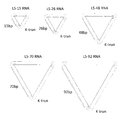
- FIG. 1 shows the structure of RNA (LS-15 RNA, LS-26 RNA, LS-48 RNA, LS-70 RNA, and LS-92 RNA) of each RNA-protein complex.
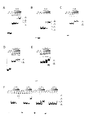
- FIG. 2A shows the results of gel shift assay when various concentrations of L7Ae were added to LS-15 RNA. The right side of the figure shows the structure of the assumed RNA-protein complex in each band.
- FIG. 2B shows the results of gel shift assay when various concentrations of L7Ae were added to LS-26 RNA. The right side of the figure shows the structure of the assumed RNA-protein complex in each band.
- FIG. 2C shows the results of gel shift assay when each concentration of L7Ae was added to LS-48 RNA.
- FIG. 2D shows the results of gel shift assay when various concentrations of L7Ae were added to LS-70 RNA.
- the right side of the figure shows the structure of the assumed RNA-protein complex in each band.
- FIG. 2E shows the results of gel shift assay when each concentration of L7Ae was added to LS-92 RNA.
- the right side of the figure shows the structure of the assumed RNA-protein complex in each band.
- Figure 2F shows the results of LS-26, LS-26 mut1 , LS-26 mut2, LS-26 gel shift assay upon addition of L7Ae for each concentration to mut3.
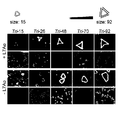
- FIG. 3 shows the case where L7Ae is added to each RNA-protein complex RNA (LS-15LSRNA, LS-26 RNA, LS-48 RNA, LS-70 RNA, and LS-92 RNA) (+ L7Ae) or A high-speed AFM- (HS-AFM) image is shown when L7Ae is not added (-L7Ae).
- L7Ae RNA-protein complex RNA
- H-AFM high-speed AFM-
- FIG. 4 shows a LS-26, LS-26 mut1, LS-26 mut2, when adding L7Ae to LS-26 mut3 (+ L7Ae) or was not added L7Ae (- L7Ae) to delivers high speed AFM (HS -AFM) image.
- Figure 5 shows a LS-26, LS-26 mut1 , LS-26 mut2, in the case of adding L7Ae to LS-26 mut3, a result of measuring the uptake of L7Ae of RNA- protein complex.
- FIG. 6 shows time-lapse images (30 sec, 35 sec, and 85 sec) analyzed by high-speed AFM (HS-AFM) when L7Ae was added to LS-26.
- FIG. 7 shows the results of gel shift assay after Phenol treatment and 20% FBS were added to LS-26 or RNA-protein complex (Tri-26) and incubated for 30, 60 or 120 minutes.
- FIG. 8 shows the results of gel shift assay after adding Phenol treatment and 20% human serum to LS-26 or RNA-protein complex (Tri-26) and incubating for 30 minutes, 60 minutes or 120 minutes.
- FIG. 9A shows a schematic diagram of an RNA-protein complex having an Affibody.
- FIG. 9B shows high-speed AFM (HS-AFM) images of LS-26 with or without L7Ae-Affibody fusion (+ L7Ae-Affibody) or without (-L7Ae-Affibody).
- H-AFM high-speed AFM
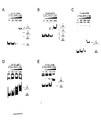
- FIG. 10A shows the results of gel shift assay when each concentration of L7Ae-Affibody fusion was added to LS-15 RNA.
- the right side of the figure shows the structure of the assumed RNA-protein complex in each band.
- FIG. 10B shows the results of gel shift assay when each concentration of L7Ae-Affibody fusion was added to LS-26 RNA.
- the right side of the figure shows the structure of the assumed RNA-protein complex in each band.
- FIG. 10C shows the results of gel shift assay when each concentration of L7Ae-Affibody fusion was added to LS-48 RNA.
- the right side of the figure shows the structure of the assumed RNA-protein complex in each band.
- FIG. 10D shows the results of gel shift assay when each concentration of L7Ae-Affibody fusion was added to LS-70 RNA.
- the right side of the figure shows the structure of the assumed RNA-protein complex in each band.
- FIG. 10E shows the results of gel shift assay when each concentration of L7Ae-Affibody fusion was added to LS-92 RNA.
- the right side of the figure shows the structure of the assumed RNA-protein complex in each band.
- RNA-protein complex Tri-15-AFB, Tri-26-AFB, Tri-48-AFB, Tri-70-AFB, and Tri-92-
- FIG. 12A shows RNA-protein complex (Tri-26-AFB) having Affibody added to each breast cancer cell line (SKBR3, MCF-7 and MDA-MB-231). The fluorescence intensity which means the amount of protein complex is shown.
- FIG. 12A shows RNA-protein complex (Tri-26-AFB) having Affibody added to each breast cancer cell line (SKBR3, MCF-7 and MDA-MB-231). The fluorescence intensity which means the amount of protein complex is shown.
- FIG. 12B shows stained images (Alexa 647 (RNA) after adding RNA-protein complex (Tri-26-AFB) having Affibody to each breast cancer cell line (SKBR3, MCF-7 and MDA-MB-231). Present), Hoechst (presents cell nuclei)).
- Figure 13 is a breast cancer cell line (SKBR3) to have each variant motifs and Affibody RNA-protein complexes (Tri-26-AFB, Tri -26 mut1 -AFB, Tri-26 mut2 -AFB, and Tri-26 mut3 - When AFB) is added, the fluorescence intensity means the amount of RNA-protein complex bound to the cells.
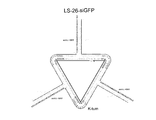
- FIG. 14 shows the structure of RNA of RNA-protein complex (LS-26-siGFP RNA).
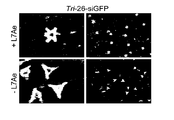
- FIG. 15 shows a high-speed AFM (HS-AFM) image of LS-26-siGFP RNA with or without L7Ae added (+ L7Ae) or without (-L7Ae). The left figure shows an enlarged image of the right figure.
- FIG. 16 shows the presence of Dicer with sh-GFP as a positive control when L7Ae is added or not added to RNA containing L1, L2, L3, S, and AS, which are components of LS-26-siGFP-RNA, in each combination. The result of the gel shift assay at the time of contacting with substrate sh-GFP under or absence is shown.
- an RNA and protein delivery system using an RNA-protein complex is provided.
- a delivery system is a system that delivers a desired substance to a target. In the present invention, it can also be called an RNA-protein complex for delivering RNA and / or protein to cells.
- RNA-protein complex of the present invention is a first RNA-protein complex comprising the following (1) to (3); (1) a first RNA comprising the following sequences (i) to (iv); (I) three or more sequences forming an RNA-protein binding motif, (Ii) two or more sequences of 15 bases or more, (Iii) a 5 ′ end sequence, and (iv) a 3 ′ end sequence,
- the 5 ′ terminal sequence of (iii) and the 3 ′ terminal sequence of (iv) are a total of 15 bases or more
- RNA containing a sequence forming an RNA-protein binding motif is the RNA side contained in the binding motif between RNA and protein in a natural or known RNA-protein complex, Alternatively, it is the RNA side contained in the artificial RNA-protein binding motif obtained by the in vitro evolution method (invitro selection method).
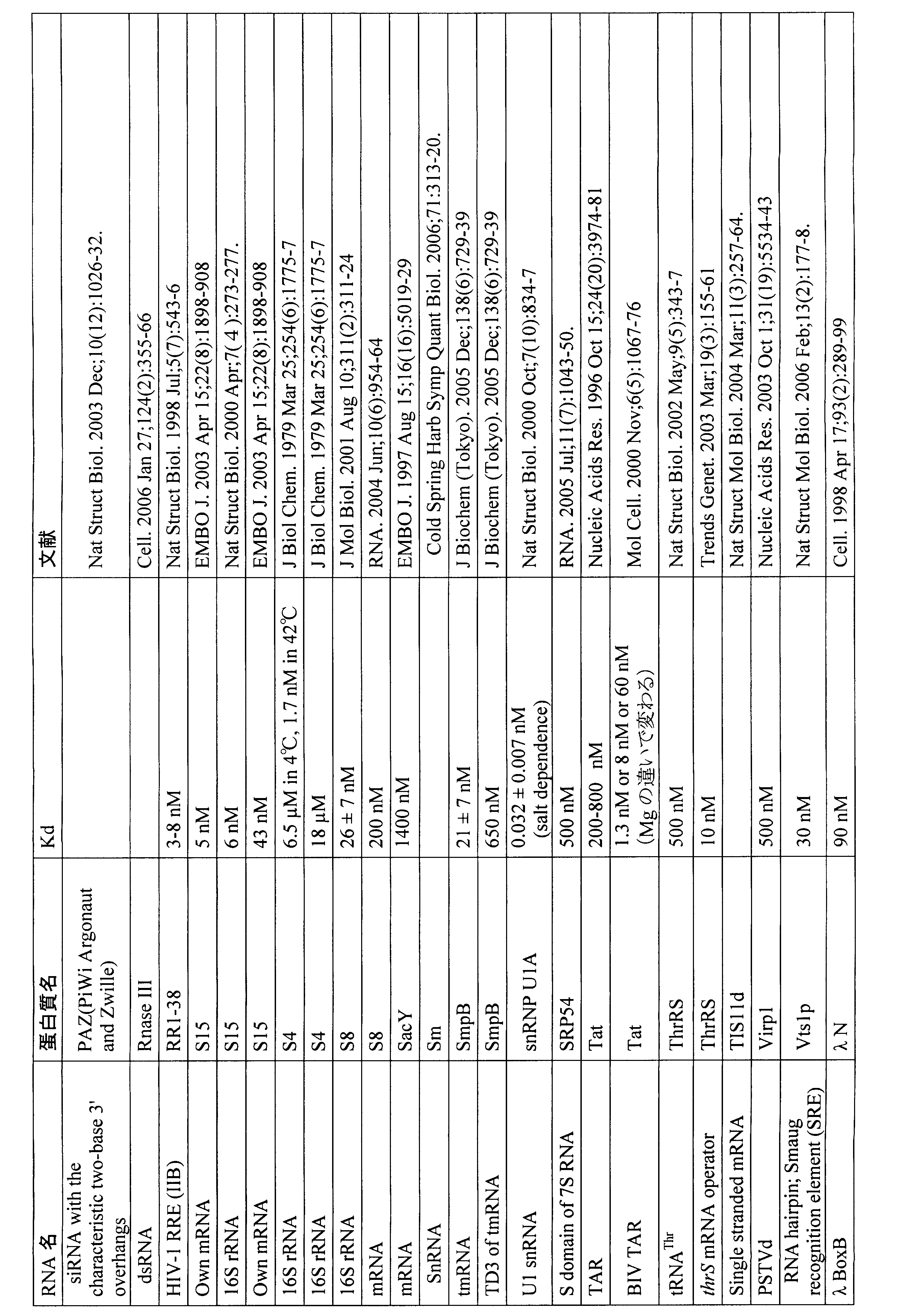
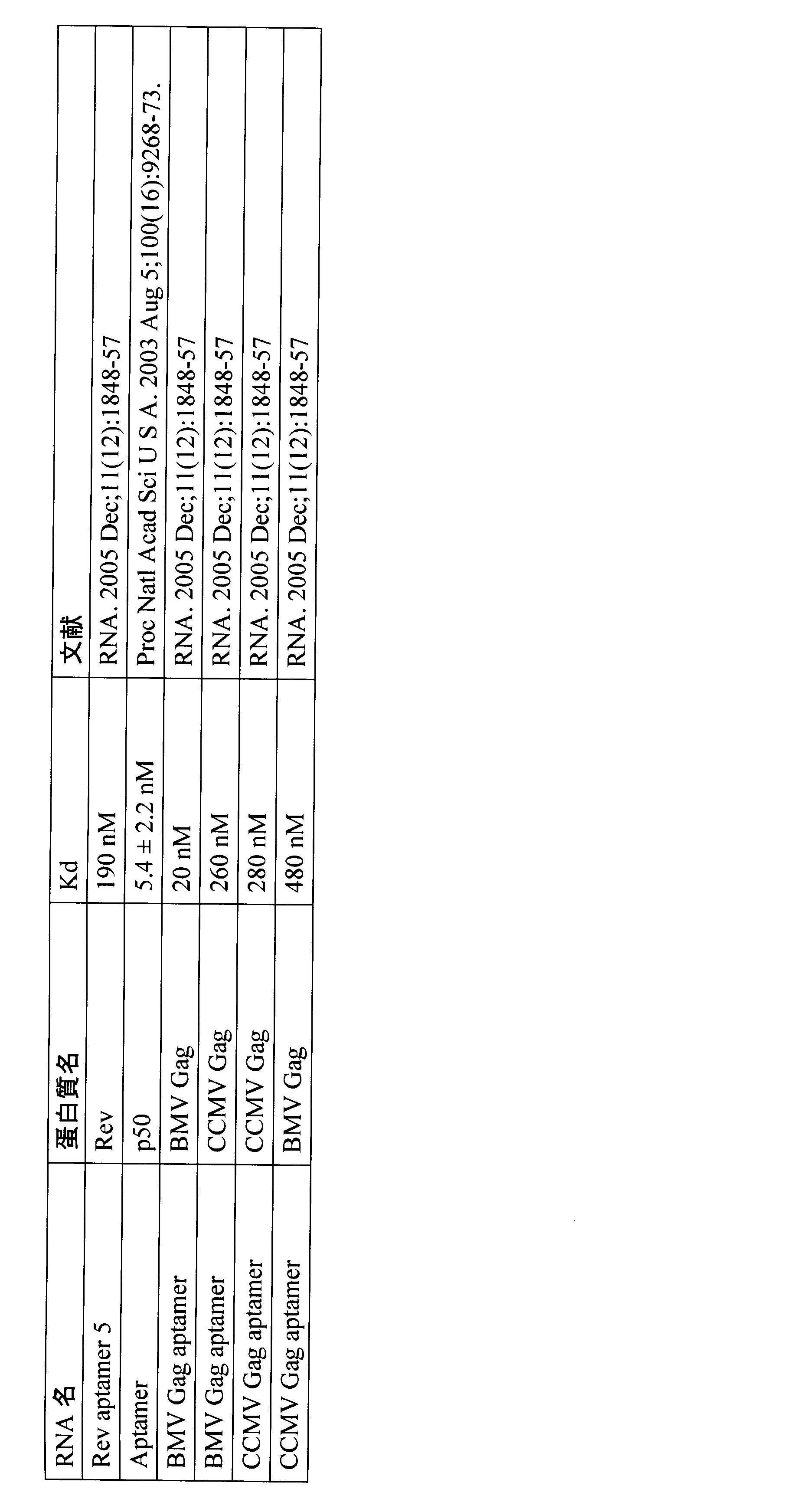
- a sequence that forms a natural RNA-protein binding motif is usually composed of about 5 to 30 bases, and is specific to a protein having a specific amino acid sequence noncovalently, that is, by hydrogen bonding. It is known to form bonds. Sequences forming such natural RNA-protein binding motifs are listed in Tables 1 and 2 below, and the database available on the website: http: // gibk26. bse. kyutech. ac. jp / jouhou / image / dna-protein / RNA / RNA. From html, a motif that causes a desired structural change can be appropriately selected and obtained.
- RNA-protein binding motif preferably used in this embodiment can be estimated from the three-dimensional structure of a homologous protein that has already undergone an X-ray crystal structure analysis or NMR structure analysis or a structural analysis. Motif. Furthermore, the protein is preferably a motif that specifically recognizes the secondary structure and base sequence of RNA.
- the RNA containing a sequence that forms an artificial RNA-protein binding motif is the RNA side in the binding motif between RNA and protein in an artificially designed RNA-protein complex.
- the base sequence of such RNA is usually composed of about 10 to 80 bases, and forms a specific bond with a specific amino acid sequence of a specific protein non-covalently, that is, by hydrogen bonding.
- An RNA aptamer that specifically binds to a specific protein is exemplified as the RNA containing a sequence that forms such an artificial RNA-protein binding motif.
- An RNA aptamer that specifically binds to a desired target protein can be obtained by, for example, an evolutionary engineering method known as in vitro selection method or SELEX method.
- the trigger protein at this time is a protein to which the RNA aptamer binds.
- the RNA sequences listed in Table 3 below are known, and these can also be used as sequences forming the RNA-protein binding motif of the present invention.
- the sequence forming the RNA-protein binding motif preferably has a dissociation constant Kd with the corresponding protein of about 0.1 nM to about 1 ⁇ M.
- variants of such sequences are also encompassed by the sequences according to the present invention.
- the mutant described in the present invention is a mutation having a dissociation constant Kd of 10%, 20%, 30%, 40% or 50% or more higher than a protein that specifically binds to a sequence forming an RNA-protein binding motif. Body or 10%, 20%, 30%, 40% or 50% or less mutant. Such mutants can be appropriately selected and used as long as an RNA-protein complex can be formed.
- the base sequence of such a variant can hybridize under stringent conditions with a nucleic acid (complementary strand) having a sequence complementary to the sequence (positive strand) forming the RNA-protein binding motif.
- a base sequence of a degree may be used.
- the stringent conditions here are the melting temperature (Tm) of the nucleic acid to be bound as taught by Berger and Kimmel (1987, GuideGto Molecular Cloning Techniques Methods in Enzymology, Vol.152, Academic Press, San Diego CA). Can be determined based on For example, as washing conditions after hybridization, the conditions of about “1 ⁇ SSC, 0.1% SDS, 37 ° C.” can be mentioned.
- the complementary strand is preferably one that maintains a hybridized state with the target positive strand even when washed under such conditions.
- washing is performed under more severe hybridization conditions such as “0.5 ⁇ SSC, 0.1% SDS, 42 ° C.”, more strictly “0.1 ⁇ SSC, 0.1% SDS, 65 ° C.”
- the conditions for maintaining the hybridized state between the positive strand and the complementary strand can be mentioned. Specifically, it comprises a base sequence having at least 90%, preferably at least 95%, 96%, 97%, 98% or 99% sequence identity with the RNA sequence contained in the RNA-protein binding motif described above. .
- Such mutants can maintain a constant bond with a protein that specifically binds to a sequence that forms an RNA-protein binding motif and contribute to the formation of an RNA-protein complex.
- RNA-protein binding motif A specific example of the sequence forming the RNA-protein binding motif according to this embodiment is a sequence to which L7Ae (Moore T et al., Structure Vol. 12, pp. 807-818 (2004)) binds. boxC motif (5′-GGCGUGAUGAGC-3 ′) (SEQ ID NO: 1), kink-loop (SEQ ID NO: 2), and kink-loop2 (SEQ ID NO: 3).
- MS2 stem loop motif 22: Keryer-Bibens C, Barreau C, Osborne HB (2008) Tethering of proteins to RNAs by bacteriophage proteins. Biol Cell 100: 125-138
- Fr15 24: Batey RT, Williamson JR (1996) Interaction of the Bacillus stearothermophilus ribosomal protein S15 with 16 S rRNA: I. Defining the minimal RNA . J Mol Biol 261: 536-549).
- a further specific example is an enzyme that performs aminoacylation, which is known to have Threonyl-tRNA synthetase (Cell (Cambridge, Mass.) V97, which binds to its own mRNA and has feedback inhibition that inhibits translation.
- pp.371-381 (1999)) is a sequence to which 5′-GGCGGUAUGUGAUCUUUCGUUGUGGUCACCACUGCGCC-3 ′ (SEQ ID NO: 4), and variants thereof.
- R9-2 5′-GGGGUGUCGAGCGUAGGAAGAAAGCCGGGGGGCUGGCAGAUAAUGUUAUAGC-3 ′ (SEQ ID NO: 5), which is a base sequence forming an RNA-protein binding motif derived from Bcl-2 family CED-9, which is a cancer cell-specific endogenous protein , And variants thereof, nucleotide sequences derived from aptamers of RNA sequences that bind to NF-kappaB, and variants thereof.
- a sequence of 15 bases or more, (iii) a 5 ′ terminal sequence, and (iv) a 3 ′ terminal sequence included in the first RNA included in the first RNA-protein complex of the present invention is arbitrary.
- the sequence may be a sequence, but preferably includes sequences that do not include sequences complementary to each other and do not take tertiary structure with the first RNA alone.
- the total of the 5 ′ terminal sequence of (iii) and the 3 ′ terminal sequence of (iv) contained in the first RNA included in the first RNA-protein complex of the present invention is 15 bases or more.
- the 5 ′ terminal sequence and the 3 ′ terminal sequence are linked, it means 15 bases or more.
- the 3 ′ terminal sequence has 14 bases or more. It means that there is.
- the first RNA contained in the first RNA-protein complex of the present invention is, for example, (5 'terminal sequence)-(sequence forming an RNA-protein binding motif)-[(sequence of 15 bases or more)- (Sequence forming an RNA-protein binding motif) n- (3 ′ terminal sequence) in this order, where “-” means ligation, [(sequence of 15 bases or more)-(RNA-protein binding Sequence Forming Motif)] n means that the linked sequence is repeated n times. The repetition is exemplified by 2 to 10 times.
- [(sequence of 15 bases or more)-(sequence forming an RNA-protein binding motif)] is 2 repetitions, that is, The first RNA is one RNA having three sequences forming an RNA-protein binding motif and two sequences having 15 bases or more.
- the sequence that forms the RNA-protein binding motif together with the sequence contained in the first RNA contained in the second RNA contained in the first RNA-protein complex of the present invention is the RNA-protein binding motif described above. Is a sequence that assists in the formation of the motif. Depending on the RNA-protein binding motif to be selected, the sequence may be omitted, for example, complementary to a part of the RNA-protein binding motif. It is an array containing an array. For example, when the sequence forming the RNA-protein binding motif contained in the first RNA is boxC motif (SEQ ID NO: 1), the sequence is boxD motif (SEQ ID NO: 6). Double-stranded RNA that forms a protein-binding motif is sometimes referred to as K-turn.
- the 5 ′ terminal sequence and the 3 ′ terminal sequence included in the first RNA, which are included in the second RNA included in the first RNA-protein complex of the present invention, are consecutively complementary sequences. This means a sequence that is complementary to the sequence of RNA in which the 5 ′ terminal sequence and the 3 ′ terminal sequence are linked and in the order 3 ′ terminal sequence ⁇ 5 ′ terminal sequence. Since it is desirable that the 5 ′ terminal sequence and the 3 ′ terminal sequence included in the first RNA have a total of 15 bases or more, the complementary sequence included in the second RNA may also include 15 bases or more. desirable.
- the 5 ′ terminal sequence and the 3 ′ terminal sequence contained in the second RNA contained in the first RNA-protein complex of the present invention are continuously complementary to a sequence of 15 bases or more contained in the first RNA.
- target means that the 5 ′ terminal sequence and the 3 ′ terminal sequence are linked to form an RNA sequence consisting of 3 ′ terminal sequence ⁇ 5 ′ terminal sequence in the order of 15 bases or more contained in the first RNA. Means complementary to the sequence. Therefore, it is desirable that the 5 'terminal sequence and the 3' terminal sequence contained in the second RNA have 15 bases or more in total.
- the second RNA contained in the first RNA-protein complex of the present invention is, for example, (5 ′ terminal sequence)-(sequence that forms an RNA-protein binding motif with the first RNA)-[(first Comprising a sequence complementary to a sequence of 15 bases or more contained in RNA of RNA)-(sequence forming an RNA-protein binding motif together with the first RNA)] n- (3 ′ terminal sequence), One (sequence complementary to a sequence of 15 bases or more contained in the first RNA) to (sequence complementary to the 5 ′ terminal sequence and 3 ′ terminal sequence contained in the first RNA) It is obtained by replacing.
- the second RNA is: One RNA having three sequences that form an RNA-protein binding motif together with the first RNA and one sequence complementary to a sequence of 15 bases or more contained in the first RNA.
- the fusion protein means a protein in which two or more kinds of proteins are functionally linked. Functionally linked means that the protein is linked so as to function, and examples include linkage via a spacer sequence.
- the spacer sequence is preferably an arbitrary 2 to 200 amino acid sequence.
- the amino acid sequence of the spacer sequence is not particularly limited as long as it does not adversely affect the function of the protein contained in the fusion protein, but is the amino acid sequence set forth in SEQ ID NO: 28.
- the fusion protein (3) comprises at least a protein that forms an RNA-protein binding motif.
- the protein can be appropriately selected according to the RNA of the RNA-protein binding motif. Although it does not specifically limit, For example, it is the protein (protein) of Table 1, Table 2, and Table 3. In one embodiment of the present invention, when the RNA-protein binding motif is K-turn, L7Ae (Moore T et al., Structure Vol. 12, pp. 807-818 (2004)) is exemplified.
- At least one fusion protein (3) contained in the first RNA-protein complex of the present invention has a function of specifically recognizing a cell surface antigen in addition to a function of forming an RNA-protein binding motif.
- a fusion protein of a protein forming an RNA-protein binding motif and a protein having a function of specifically recognizing a cell surface antigen is particularly preferred.
- a protein having a function of specifically recognizing a cell surface antigen is a protein that specifically binds to a cell surface antigen, and examples thereof include an antibody, a ligand protein, and an Affibody.
- Affibody is a protein produced by modifying a part of Protein A IgG binding domain, and an Affibody that binds to a desired cell surface antigen can be appropriately selected by screening.
- cell surface protein is HER2
- Affibody is (ZHER2: 342) 2 (Lina E., et al., PLOS ONE 2012, 7, 11, e49579), Anti-ErbB2 Affibody Molecule (ab31889) (Abcam) And the like.
- the number of proteins contained in the RNA-protein complex depends on the number of sequences forming the RNA-protein binding motif contained in the first RNA, it is possible to contain 3 or more. is there. At least one of the three or more proteins may be the fusion protein (3), and may contain two or more fusion proteins (3). When two or more (3) fusion proteins are included, these may be the same (3) fusion proteins or different (3) fusion proteins.
- the protein that forms the RNA-protein binding motif can be a specific protein that binds depending on the sequence that forms the RNA-protein binding motif. By changing and fusing the desired protein to this, the desired protein can be included in the RNA-protein complex.
- the protein included in the RNA-protein complex may optionally include one or more fusion proteins including proteins that form RNA-protein binding motifs and other functional proteins.
- examples of other functional proteins include membrane permeable peptides, signal peptides, endosome release peptides, and cytotoxic proteins.
- the fusion protein may be a protein comprising two or more other functional proteins having different functions, such as a protein that forms an RNA-protein binding motif and a cell surface antigen. It may be a fusion protein of a protein and a membrane permeable peptide. Alternatively, it may be a fusion protein of these and a protein containing an endosome release peptide.
- the membrane-permeable peptide is Drosophila-derived AntP, HIV-derived TAT (Frankel, A. et al, Cell 55, 1189-93 (1988) or Green, M. & Loewenstein, P. M. Cell. 55, 1179-88 (1988)), Penetratin (Derossi, D. et al, J. Biol. Chem. 269, 10444-50 (1994)), Buforin II (Park, C. B. et al. Proc. Natl Acad. Sci. USA 97, 8245-50 (2000)), Transportan (Pooga, M. et al. FASEB J.
- a signal peptide is an amino acid sequence involved in transport or localization of a protein to a specific organelle in the cell.
- the organelle include nucleus, cytoplasm, endoplasmic reticulum, mitochondria, Golgi apparatus, and peroxisome.
- a signal peptide that is exemplified and can be transported and localized in a desired organelle that is desired to exert its function can be appropriately selected.
- a signal peptide capable of cytoplasmic transport is preferable, and an example of such a signal peptide is a nuclear export signal (NES). (WO 2012/008361).
- NES include, but are not limited to, peptides having the following amino acid sequences.
- LPPLERLTL (SEQ ID NO: 7] (NES sequence derived from HIV-1 Rev protein)
- LALKLAGLDI (NES sequence derived from PKI- ⁇ )
- SLEGAVSEISLRD [SEQ ID NO: 10] (NES sequence derived from Dsk-1)
- LPVLENLTL [SEQ ID NO: 11] (TFIIIA-derived NES sequence)
- LASLMNLGMS [SEQ ID NO: 12] (NES sequence derived from Matrin3)
- examples of the cytotoxic protein include proteins that induce immune cells, proteins that induce cell death, and proteins that cause pores in the cell membrane.
- proteins that induce immune cells include antibody Fc sites, complements, etc.
- proteins that induce cell death include ⁇ -galactosidase, diphtheria toxin, Pseudomonas toxin, ricin, cholera toxin, retinoblastoma gene, p 53, Herpes simplex thymidine kinase, chickenpox-zoster thymidine kinase, cytosine deaminase, nitroreductase, cytochrome p-4502 B1, thymidine phosphorylase, purine nucleoside phosphorylase, alkaline phosphatase, carboxypeptidase A and G2, linamarase, ⁇ -lactamase And xanthine oxidase, and examples of proteins that cause pores
- the endosome release peptide means that the structure taken up by endocytosis escapes from the endosome by the effect of this peptide, and the structure is transferred to the cytoplasm, thereby preventing the degradation by the lysosome.
- hemagglutinin and GALA of influenza viruses are exemplified.
- the complex can be transferred to the cytoplasm.
- the RNA-protein complex delivered to the target cell is transported from the cell surface to the inside and trapped in the endosome, it can exert the function of knocking down the expression of the target gene by moving to the cytoplasm .
- the sequence of 15 bases or more contained in the first RNA-protein complex of the present invention may have no particular upper limit. For example, 150 bases or less, 100 bases or less, 92 bases or less, 90 bases or less, 80 bases Hereinafter, it is a sequence of 70 bases or less, 60 bases or less, 50 bases or less, or 48 bases or less, and more preferably a sequence of 26 bases.
- the first RNA-protein complex of the present invention comprises a step of designing each of the first RNA, second RNA, fusion protein or protein constituting the first RNA-protein complex so as to have the molecular characteristics described above, Mixing the first RNA, the second RNA, and the fusion protein under conditions known to those skilled in the art by obtaining each of the first RNA, the second RNA, the fusion protein or the protein by a conventional genetic engineering technique. And a step of forming a complex.
- the first RNA, the second RNA, the fusion protein or the protein can be obtained by an in vitro synthesis method using a template DNA containing a promoter sequence as a template.
- the step of forming a complex can be performed by preparing an RNA duplex under conditions for hybridizing an RNA strand known per se, and then contacting with a protein.
- the first RNA-protein complex thus formed is used for carrying out an RNA and protein delivery system in an aqueous solution system.
- RNA or protein contained in the RNA-protein complex can be appropriately selected.
- cell recognition efficiency can be increased by appropriately selecting the length of the RNA sequence.
- the sequence of RNA can be performed by appropriately changing the sequence of 15 bases or more, 5 'terminal sequence, and 3' terminal sequence contained in the RNA. In particular, it can be carried out by appropriately changing the number of bases of a sequence of 15 bases or more contained in the RNA and the total number of bases of the 5 'terminal sequence and 3' terminal sequence.
- the change can be carried out particularly from the viewpoint of increasing the binding ability of the cell surface antigen. Therefore, by measuring the binding ability to a desired cell surface antigen using the first RNA-protein complex in which the number of bases is appropriately changed, the number of bases that enhance cell recognition ability can be determined.
- RNA is usually easily degraded in the presence of serum, but the present invention can be carried out in the presence of serum by forming the complex.
- serum the serum of the same origin as the cell used as object is illustrated, For example, fetal bovine serum, human serum, etc. are mentioned.
- One embodiment of the implementation in the presence of serum is exemplified by intravenous administration of the first RNA-protein complex to a target organism.
- RNA-protein complex of the present invention is a second RNA-protein complex comprising the following (1) to (4); (1) a first RNA comprising the following sequences (i) to (iii); (I) a sequence forming an RNA-protein binding motif, (Ii) two sequences of 7 bases or more, and (iii) siRNA sequences, (2) a second RNA comprising the following sequences (a) to (d); (A) a sequence that forms an RNA-protein binding motif together with (i) of (1) (b) 14 bases that are consecutively complementary to the two or more sequences of (ii) of (1) above 2 or more of the above sequences, (C) a 5 ′ end sequence, and (d) a 3 ′ end sequence, The 5 ′ terminal sequence of (c) and the 3 ′ terminal sequence of (d) are complementary in sequence to the sequence of 7 bases or more of (ii) of (1), (3) at least one protein that forms an RNA-protein binding motif with RNA formed in (i) of (1)
- the sequence that forms the RNA-protein binding motif contained in the first RNA used in the second RNA-protein complex of the present invention, and the sequence that forms the RNA-protein binding motif together with the first RNA, are as described above. The same as the first RNA-protein complex can be used.
- sequence of 7 or more bases contained in the first RNA of the second RNA-protein complex of the present invention may be any sequence, but preferably a sequence complementary to the other 7 or more base sequences. Examples are sequences that do not include the first RNA alone and do not take tertiary structure.
- the siRNA sequence contained in the first RNA of the second RNA-protein complex of the present invention is one RNA sequence of double-stranded RNA constituting the siRNA, and any mRNA that is a target of RNA interference And preferably a sequence of 18 to 35 bases.
- Such sequences can be searched using search software provided free of charge on various websites. Examples of such sites include the siRNA Target Finder (http://www.ambion.com/jp/techlib/misc/siRNA_finder.html) and the pSilencer TM Expression Vector insert design tool (http://www.ambion.com/jp/techlib/misc/siRNA_finder.html).
- the first RNA of the second RNA-protein complex of the present invention is, for example, 5 ′ (siRNA sequence)-(sequence of 7 bases or more)-(sequence forming RNA-protein binding motif)-(7 bases
- the above sequence) is arranged in the order of 3 'or 5' (sequence of 7 bases or more)-(sequence forming RNA-protein binding motif)-(sequence of 7 bases or more)-(siRNA sequence) 3 '.
- first RNAs are preferably contained, and examples thereof include 10, 9, 8, 7, 6, 5, 4 and the like. Most preferably 3.
- the first RNA of the RNA-protein complex may have a different sequence from each other or may be composed of the same sequence. However, it is desirable not to include sequences complementary to each other in order to avoid binding between the first RNAs.
- a sequence of 14 bases or more that is complementary to two sequences of 7 bases or more contained in the first RNA contained in the second RNA of the second RNA-protein complex of the present invention is the first sequence.
- a sequence on the 3 ′ end side of a sequence of 7 bases or more contained in one RNA and a sequence on the 5 ′ end side of a sequence of 7 bases or more contained in another first RNA are generated.
- a sequence complementary to the sequence is meant.
- the number of sequences contained in the second RNA of 14 bases or more that are complementary to two or more sequences of 7 bases or more contained in the first RNA is the first RNA contained in the second RNA-protein complex. When the number of the first RNA is three, the number of sequences of 14 bases or more contained in the second RNA is two.
- the 5 ′ terminal sequence and the 3 ′ terminal sequence contained in the second RNA of the second RNA-protein complex of the present invention are successively complementary to a sequence of 7 bases or more contained in the first RNA.
- Is a part of the sequence of RNA in which the 5 ′ end sequence and the 3 ′ end sequence are linked to each other in the order of 3 ′ end sequence ⁇ 5 ′ end sequence, and the 5 ′ end sequence and 3 ′ end sequence Means that the sequence including any of the terminal sequences is complementary to a sequence of 7 bases or more contained in the first RNA, and more preferably an RNA comprising the sequence of 3 ′ end sequence-5 ′ end sequence Is a sequence on the 3 ′ end side of 7 bases or more contained in the first RNA and a sequence on the 5 ′ end side of 7 bases or more contained in the other first RNA.
- the 3 ′ terminal sequence and the 5 ′ terminal sequence included in the second RNA are 14 bases or more in total.
- the 3 ′ terminal sequence included in the second RNA is 13 bases
- the 5 ′ terminal sequence contained in the RNA is one or more bases.
- the second RNA of the second RNA-protein complex of the present invention is, for example, (5 ′ terminal sequence)-(sequence that forms an RNA-protein binding motif together with the first RNA)-[(first RNA2 A sequence of 14 bases or more complementary to a sequence of 7 bases or more)-(sequence that forms an RNA-protein binding motif with the first RNA)] m- (3 ′ terminal sequence), Any one (sequence complementary to a sequence of 15 bases or more contained in the first RNA) is continuously complementary to the 5 ′ terminal sequence and the 3 ′ terminal sequence contained in the first RNA. Array).
- the number m of repeats of the portion surrounded by “[” and “]” in the second RNA is one less than the number of the first RNA, and in the case of two repeats, RNA-protein together with the first RNA It is an RNA having three sequences that form a binding motif.
- the protein contained in the second RNA-protein complex of the present invention may be the same as the protein or protein fusion of (3) described in the above-mentioned first RNA-protein complex.
- the protein comprised in the RNA-protein complex in one embodiment of the present invention may comprise a protein fusion comprising other functional proteins in addition to the protein forming the RNA-protein binding motif.
- the number of proteins contained in the second RNA-protein complex of the present invention depends on the number of the first RNA, so that there are three or more types.
- a specific protein can be used depending on the sequence that forms the RNA-protein binding motif. Therefore, the sequence that forms the RNA-protein binding motif is appropriately changed.
- the desired protein can be included in the RNA-protein complex.
- a fusion protein comprising a protein that forms an RNA-protein binding motif and a fusion protein comprising a protein that specifically recognizes a cell surface antigen, and a protein that forms an RNA-protein binding motif and other functional proteins
- An RNA-protein complex containing two or more of can be formed.
- the third RNA containing a sequence complementary to the siRNA sequence contained in the RNA of the second RNA-protein complex of the present invention is a sequence complementary to the siRNA sequence of (1) (iii) described above. These are sequences that can form siRNA by forming a duplex with the siRNA sequence and exert its effects. Accordingly, it is preferable that the third RNA has a sequence in which two bases located on the 3 'end side thereof do not form a complementary strand with the siRNA sequence of (1) (iii). Desirably, the third RNA is included in the RNA-protein complex in the same number as the first RNA.
- a sequence that promotes transport of the complex to the cytoplasm is further added to the 5 ′ end of the first RNA or the 3 ′ end of the third RNA contained in the second RNA-protein complex of the present invention.
- Such sequences that facilitate transport to the cytoplasm include tRNA sequences. Since tRNA is one of the promoters that recognize RNA polymerase and also functions as a cytoplasmic transport signal, it may help the siRNA function of the second RNA-protein complex of the present invention to be exerted. (Japanese Patent No. 3831785).
- the second RNA-protein complex of the present invention has a function of siRNA contained in the complex, it can be used as an RNA inhibitor. Furthermore, it can be used in a method for suppressing mRNA corresponding to the siRNA sequence in the cell by introducing the second RNA-protein complex into the cell.
- the method for introducing the second RNA-protein complex into the cell can be carried out in the same manner as the method for introducing the first RNA-protein complex into the cell.
- Such a method can also be referred to as a method for degrading intracellular mRNA, which comprises the step of contacting the cell with an RNA-protein complex. At this time, the contact with the cell can be performed in vivo or in vitro.
- RNA or protein contained in the RNA-protein complex can be appropriately selected.
- the cell recognition ability can be increased by appropriately selecting the length of the RNA sequence.
- the RNA sequence can be changed by appropriately changing two 7-base or more sequences, 5 'terminal sequence, and 3' terminal sequence contained in the RNA.
- the RNA can be carried out by appropriately changing the number of bases of two or more 7 base sequences contained in the RNA and the total number of bases of the 5 'terminal sequence and 3' terminal sequence.
- the change can be carried out particularly from the viewpoint of increasing the binding ability of the cell surface antigen. Therefore, by measuring the binding ability to a desired cell surface antigen using the second RNA-protein complex in which the number of bases is appropriately changed, the number of bases that enhance cell recognition ability can be determined.
- the sequence (ii) of (1) in the second RNA-protein complex, using the binding ability to a cell surface antigen as an index, the sequence (ii) of (1), (1 It can also be said to be a method of selecting the base length of the sequence (iii) in (), the sequence (b) in (2) and the sequence (d) in (2).
- Triangular RNA-protein complex (Tri-RNP, FIG. 1) was prepared as described in Ohno, H. et al., Nat. Nanotechnol. 2011, 6, 116. Specifically, it has a K-turn RNA motif at the apex, and each side is long (L-RNA) and short (S-RNA) of 15, 26, 48, 70, and 92 bases, respectively.
- DsRNAs consisting of LS-15 (L-15: SEQ ID NO: 13 and S-15: SEQ ID NO: 14), LS-26 (L-26: SEQ ID NO: 15 and S-26: SEQ ID NO: 16), LS-48 (L- 48: SEQ ID NO: 17 and S-48: SEQ ID NO: 18), LS-70 (L-70 SEQ ID NO: 19 and S-70 SEQ ID NO: 20) and LS-92 (L-92 SEQ ID NO: 21 and S-92 SEQ ID NO: 22) (FIG. 1).
- RNA was prepared using MEGAshortscript T7 kit (Ambion) based on the DNA template described above.
- L-RNA and S-RNA were treated with an RNP-binding solvent (a solution comprising 150 ml KCl, 1.5 mM MgCl 2 and 20 mM HEPES-KOH (pH 7.5)) at 80 ° C. for 3 minutes, and then at room temperature. By cooling for 10 minutes, the RNAs were hybridized to produce a double-stranded RNA (LS-RNA) having a loop structure.
- RNP-binding solvent a solution comprising 150 ml KCl, 1.5 mM MgCl 2 and 20 mM HEPES-KOH (pH 7.5)
- L7Ae was prepared by transfection of E. coli (Rosetta (DE3) / pLysSpRARE2) with a plasmid (pET-28 (+) vector (Novagen) into which the L7Ae sequence was introduced).
- Tri-15 Tri-26
- Tri-48 Tri-70
- Tri-92 Tri-92
- one side has a length of approximately 13.7, 16.7, 22.6, 28.5 and 34.4 nm. It is thought.
- Tri-RNP Tri-26 and Tri-48
- HFM high-speed AFM
- 10 ⁇ 2 ⁇ 0.1 ⁇ M cantilever BL-AC10EGS, Olympus
- the cantilever was set with a spring constant of 0.1-0.2 N / m at 400-1000 KHz resonance frequency.
- the probe was deposited on the cantilever with an electron beam.
- a mica surface was coated with 0.1% APTES, and a 50 nM sample dissolved in an RNP binding solvent and an AFM observation solvent (20 mM Tris-HCl (pH 7.6) and 10 mM MgCl2) was left on mica. Images were analyzed using software such as ImageJ and WSxM.
- LS-RNAs of five different sizes exhibited a loop structure in the structure of double-stranded RNA.
- L7Ae when contacted with L7Ae, it was confirmed to exhibit a triangular structure.
- the state of RNA binding to the K-turn motif is confirmed as a dot at the apex of Tri-RNP, the inside of the triangle surrounded by three sides is confirmed as a cavity, and when it is contacted with L7Ae, it has a single structure (Fig. 3). In Tri-92, however, the triangular structure was confirmed to be slightly deformed.
- mutant K-turn motifs (mut box C: SEQ ID NO: 23, mut box D: SEQ ID NO: 24) one, two or three with LS-RNA (Tri-26 mut1 , Tri-26 mut2 and Tri -26 mut3 ) was confirmed by EMSA.
- EMSA the structural change according to the number of each mutant K-turn motif was confirmed (FIG. 4).
- n 114, 135, 93, and 188 structures were measured and the ratio of structure formation was calculated.
- the content ratio of the L7Ae and K-turn motifs and the ratio of the confirmed actual structure were (Fig. 5). From these results, it was confirmed that the interaction between the three L7Ae and the K-turn motif was performed at the apex of the triangle.
- RNA-protein complex RNP structural change from time-lapse image
- HS-AFM RNA-protein complex
- changes in RNA structure after addition of L7Ae were observed by time-lapse imaging (FIG. 6). From time-lapse images, it was confirmed that when L7Ae was directly bound to three LS-26 K-turn motifs, the K-turn motif was bent at an angle of 60 degrees, and this structural change shifted to a triangular structure. On the other hand, it was also confirmed that the protein transitions from the triangular structure to the loop structure by dissociating the protein from the RNA.
- RNA-protein complex (RNP) in the presence of serum was confirmed. Specifically, 20% FBS was added to 50 nM LS-26 or a mixture of 50 nM LS-26 and 300 nM L7Ae, incubated at 37 ° C for 0 min, 30 min, 60 min and 120 min, then 10 mM EDTA ( pH 8.0) and phenol were added, and electrophoresis was performed using polyacrylamide gel, and RNA stability was observed. As a result, it was confirmed that the formation of RNP in LS-26 in the presence of L7Ae enhances its stability in the serum-containing buffer (FIG. 7).
- Tri-26-AFB When LS-26 was used as RNA (Tri-26-AFB), the triangular structure was confirmed by HS-AFM, and it was also confirmed that a substance presumed to be AFB was added to each vertex (FIG. 9B). ). Furthermore, L7Ae-AFB was confirmed to bind to the K-turn motif in the same manner as Tri-26 using EMSA (FIG. 10).
- Tri-AFB binds to breast cancer cells. Specifically, remove the breast cancer cell line (SKBR3) (ATCC) culture medium, add Opti-MEM, then add 10 nM LS-RNA labeled with Alexa-647, or 10 nM Tri-AFB, The cells were cultured at 37 ° C. and 5% CO 2 for 1 hour. The binding of Tri-AFB to the cells after incubation was analyzed with a flow cytometer. As a result, Tri-26-AFB had the highest recognition ability (FIG. 11).
- SKBR3 breast cancer cell line
- Opti-MEM Opti-MEM
- Tri-26-AFB Three different breast cancer cell lines (SKBR3 (HER2 strong positive), MCF-7 (HER2 weak positive) and MDA-MB-231 (HER2 negative)) were used to examine the selective recognition ability of Tri-26-AFB. In the same manner, it was confirmed that Tri-26-AFB selectively recognizes SKBR3 as expected (FIG. 12).
- Tri-26 mutant having a mutation K-Turm motif Tri-26 mut1, Tri- 26 mut2 and Tri-26 mut3
- the binding ability with SKBR3 was weakened (FIG. 13). This suggests that the increase in the number of binding between AFB and HER2 affected the recognition ability.
- RNA can be transported to the target cell surface by using Tri-AFB.
- RNPs capable of binding to cells have an optimal size.
- the RNP shown in FIG. 14 was constructed. Specifically, S-26, L-26-1 (SEQ ID NO: 29), L-26-2 (SEQ ID NO: 30), L-26-3 so as to have siRNA for GFP on the three sides of LS-26. Five RNAs (SEQ ID NO: 31) and antisense-GFP (SEQ ID NO: 32) were hybridized in the same manner as described above to prepare LS-26-siGFP.
- Tri-26-siGFP having a triangular structure was prepared by mixing LS-26-siGFP and L7Ae, and the structure was confirmed using HS-AFM. It was confirmed that the structure considered to have taken the expected shape (the upper part of FIG. 15). On the other hand, in the absence of L7Ae, it was confirmed to take a heterogeneous RNA structure (lower part of FIG. 15). From the above, a triangular structure (Tri-26-siGFP) having a structure containing three duplexes having siRNA function could be constructed.
- Tri-26-siGFP Tri-26-siGFP
- 500 nM LS-26-siGFPs (L-26-1, S-26 and antisense-GFP hybridized RNA, L-26-2, S-26 and antisense-GFP hybridized RNA , L-26-3, S-26 and antisense-GFP hybridized RNA and LS-26-siGFP) or 500 nM LS-26-siGFP and 3 ⁇ M L7Ae 1 ⁇ L of 10 mM ATP, 0.5 ⁇ L 50 mM MaCl 2 , 4 ⁇ L of Dicer Reaction buffer, 1 ⁇ L of recombinant Dicer (Genlantis) were added with water to 10 ⁇ L, and incubated at 37 ° C.
- Tri-26-siGFP was confirmed to contribute to RNA cleavage by Dicer in the same manner as sh-GFP (SEQ ID NO: 33) used as a control (FIG. 16). Therefore, it was suggested that even if Tri-26-siGFP having a triangular structure by the interaction between L7Ae and the K-turn motif has an effect of siRNA without steric hindrance.
- RNPs having a triangular structure can stabilize RNA and have functions of cell recognition, degradation of mRNA by siRNA, and inhibition.
- Tri-26-siGFP As a positive control for Hela cells stably expressing GFP (Hela-GFP), 1 nM and 5 nM Tri-26-siGFP, 1 nM and 5 nM LS-26-siGFP, and 3 nM and 15 nM Each of the sh-GFP was transfected. The knockdown activity of GFP was measured by flow cytometry according to the expression level of GFP. As a result, it was shown that both Tri-26-siGFP and LS-26-siGFP can knock down GFP with an activity about 3 times that of sh-GFP.
Landscapes
- Health & Medical Sciences (AREA)
- Chemical & Material Sciences (AREA)
- Life Sciences & Earth Sciences (AREA)
- Genetics & Genomics (AREA)
- Organic Chemistry (AREA)
- Engineering & Computer Science (AREA)
- Molecular Biology (AREA)
- Biochemistry (AREA)
- Biomedical Technology (AREA)
- Biophysics (AREA)
- General Health & Medical Sciences (AREA)
- Zoology (AREA)
- General Engineering & Computer Science (AREA)
- Wood Science & Technology (AREA)
- Bioinformatics & Cheminformatics (AREA)
- Biotechnology (AREA)
- Proteomics, Peptides & Aminoacids (AREA)
- Medicinal Chemistry (AREA)
- Plant Pathology (AREA)
- Physics & Mathematics (AREA)
- Microbiology (AREA)
- Oncology (AREA)
- Immunology (AREA)
- Peptides Or Proteins (AREA)
- Pharmaceuticals Containing Other Organic And Inorganic Compounds (AREA)
- Medicinal Preparation (AREA)
- Medicines Containing Antibodies Or Antigens For Use As Internal Diagnostic Agents (AREA)
- Micro-Organisms Or Cultivation Processes Thereof (AREA)
Abstract
Description
本発明は、別の実施の形態によれば、機能性RNAおよび機能性タンパク質を含むRNA-タンパク質複合体を利用して当該機能を発揮させることを特徴とする。
[1]次の(1)から(3)を含むRNA-タンパク質複合体による、RNAおよびタンパク質のデリバリーシステム。
(1)次の(i)から(iv)の配列を含むRNA;
(i)RNA-タンパク質結合モチーフを形成する配列を3つ以上、
(ii)15塩基以上の配列を2つ以上、
(iii)5’末端配列、および
(iv)3’末端配列であって、
当該(iii)の5’末端配列および(iv)の3’末端配列が合計して15塩基以上の配列であり、
(2)次の配列を含むRNA;
(a)前記(1)の(i)と共にRNA-タンパク質結合モチーフを形成する配列を3つ以上、
(b)前記(1)の(ii)の15塩基以上の配列に相補的な配列を1つ以上、
(c)前記(1)の(iii)の5’末端配列および3’末端配列に連続して相補的な配列、
(d)5’末端配列、および
(e)3’末端配列であって、
当該(d)の5’末端配列および(e)の3’末端配列が、前記(1)の(ii)の15塩基以上の配列に連続して相補的であり、ならびに
(3)前記(1)の(i)および前記(2)の(a)で形成されるRNAとRNA-タンパク質結合モチーフを形成するタンパク質および細胞表面抗原を特異的に認識するタンパク質を含む、少なくとも1つの融合タンパク質。
[2]前記(1)の(i)のRNA-タンパク質結合モチーフを形成する配列が3つであり、前記(2)の(a)のRNA-タンパク質結合モチーフを形成する配列が3つであり、前記(1)の(ii)の15塩基以上の配列が2つであり、ならびに前記(2)の(b)の15塩基以上の配列に相補的な配列が1つである、[1]に記載のシステム。
[3]前記(1)の配列、前記(1)の(iii)の5’末端配列および(iv)の3’末端配列の合計、前記(2)の(b)の配列、または(d)に前記(2)の(d)の5’末端配列および(e)の3’末端配列の合計が、15塩基以上92塩基以下である、[1]または[2]に記載のシステム。
[4]前記(1)の配列、前記(1)の(iii)の5’末端配列および(iv)の3’末端配列の合計、前記(2)の(b)の配列、または(d)に前記(2)の(d)の5’末端配列および(e)の3’末端配列の合計を、細胞表面抗原への結合能を高めるように、塩基長が適宜選択されている、[1]から[3]のいずれか1項に記載のシステム。
[5]前記(1)の(i)および前記(2)の(a)で形成されるRNA-タンパク質結合モチーフが、K-turnモチーフであり、前記(3)のRNA-タンパク質結合モチーフを形成するタンパク質が、L7Aeである、[1]から[4]のいずれか1項に記載のシステム。
[6]前記(3)の細胞表面抗原を特異的に認識するタンパク質が、HER2を認識するタンパク質である、[1]から[5]のいずれか1項に記載のシステム。
[7]前記HER2を認識するタンパク質が、Affibodyである、[6]に記載のシステム。
[8]血清存在下でデリバリーが行われる、[1]から[7]のいずれか1項に記載のシステム。
[9]次の(1)から(4)を含むRNA-タンパク質複合体;
(1)次の(i)から(iii)の配列を含むRNA;
(i)RNA-タンパク質結合モチーフを形成する配列、
(ii)7塩基以上の配列を2つ、および
(iii)siRNA配列、
(2)次の(a)から(d)の配列を含むRNA;
(a)前記(1)の(i)と共にRNA-タンパク質結合モチーフを形成する配列
(b)前記(1)の前記(ii)の2つの7塩基以上の配列に連続して相補的な14塩基以上の配列を2つ以上、
(c)5’末端配列、および
(d)3’末端配列であって、
当該(c)の5’末端配列および(d)の3’末端配列が、前記(1)の前記(ii)の7塩基以上の配列に連続して相補的であり、
(3)前記(1)の(i)および前記(2)の(a)で形成されるRNAとRNA-タンパク質結合モチーフを形成するタンパク質を少なくとも1つ、ならびに
(4)前記(1)の(iii)のsiRNA配列に相補的な配列を含むRNA。
[10] 前記(1)のRNAが3つであり、前記(2)の(b)の14塩基以上の配列を2つであり、および前記(4)のRNAが3つである、請求項9に記載のRNA-タンパク質複合体。
[11]前記(1)の(ii)の配列が、7塩基以上85塩基以下であり、前記(2)の(b)の配列が、14塩基以上92塩基以下である、[9]または[10]に記載のRNA-タンパク質複合体。
[12]前記(1)の(i)および前記(2)の(a)で形成されるRNA-タンパク質結合モチーフが、K-turnモチーフであり、前記(3)のタンパク質が、L7Aeである、[9]から[11]のいずれか1項に記載のRNA-タンパク質複合体。
[13]前記(3)のタンパク質が、細胞表面抗原を特異的に認識するタンパク質または膜透過性ペプチドをさらに含む融合タンパク質である、[9]から[12]のいずれか1項に記載のRNA-タンパク質複合体。
[14]前記膜透過性ペプチドが、AntP、HIV由来のTAT、Penetratin、Buforin II、Transportan、MAP、K-FGF、Ku70、Prion、pVEC、Pep-1、Pep-7、SynB1、HN-IおよびHSV由来のVP22から成る群より選択されるペプチドである、[13]に記載のRNA-タンパク質複合体。
[9]から[14]のいずれか1項に記載のRNA-タンパク質複合体による、RNAおよびタンパク質のデリバリーシステム。
[15][9]から[14]のいずれか1項に記載のRNA-タンパク質複合体を含む、RNA阻害剤。
[16][9]から[14]のいずれか1項に記載のRNA-タンパク質複合体と細胞を接触させる工程を含む、細胞内のmRNAを分解する方法。
[17]前記RNA-タンパク質複合体と細胞を血清存在下で接触させる、[16]に記載の方法。
[18](1)次の配列を含むRNA;
(i)RNA-タンパク質結合モチーフを形成する配列を3つ以上、
(ii)15塩基以上の配列を2つ以上、ならびに
(iii)合わせて15塩基以上の配列から成る5’末端配列および3’末端配列、
(2)次の配列を含むRNA;
(a)前記(1)の(i)と共にRNA-タンパク質結合モチーフを形成する配列を3つ以上、
(b)前記(1)の(ii)の15塩基以上の配列に相補的な配列を1つ以上、
(c)前記(1)の(iii)の5’末端配列および3’末端配列に連続して相補的な配列、および
(d)前記(1)の(ii)の15塩基以上の配列に連続して相補的な5’末端配列および3’末端配列、ならびに
(3)前記(1)の(i)および前記(2)の(a)で形成されるRNAとRNA-タンパク質結合モチーフを形成するタンパク質および細胞表面抗原を特異的に認識するタンパク質を含む、少なくとも1つの融合タンパク質、
を含むRNA-タンパク質複合体において、細胞表面抗原への結合能を指標として、前記(1)の(ii)の配列、前記(1)の(iii)の配列、前記(2)の(b)の配列、および前記(2)の(d)の配列の塩基長を選択する方法。
[19](1)次の(i)から(iii)の配列を含むRNA;
(i)RNA-タンパク質結合モチーフを形成する配列、
(ii)7塩基以上の配列を2つ、および
(iii)siRNA配列、
(2)次の(a)から(d)の配列を含むRNA;
(a)前記(1)の(i)と共にRNA-タンパク質結合モチーフを形成する配列
(b)前記(1)の前記(ii)の2つの7塩基以上の配列に連続して相補的な14塩基以上の配列を2つ以上、
(c)5’末端配列、および
(d)3’末端配列であって、
当該(c)の5’末端配列および(d)の3’末端配列が、前記(1)の前記(ii)の7塩基以上の配列に連続して相補的であり、
(3)前記(1)の(i)および前記(2)の(a)で形成されるRNAとRNA-タンパク質結合モチーフを形成するタンパク質および細胞表面抗原を特異的に認識するタンパク質を含む、少なくとも1つの融合タンパク質、ならびに
(4)前記(1)の(iii)のsiRNA配列に相補的な配列を含むRNA、
を含むRNA-タンパク質複合体において、細胞表面抗原への結合能を指標として、前記(1)の(ii)の配列、および前記(2)の(b)の配列の塩基長を選択する方法。
(1)次の(i)から(iv)の配列を含む第一のRNA;
(i)RNA-タンパク質結合モチーフを形成する配列を3つ以上、
(ii)15塩基以上の配列を2つ以上、
(iii)5’末端配列、および
(iv)3’末端配列であって、
当該(iii)の5’末端配列および(iv)の3’末端配列が合計して15塩基以上の配列であり、
(2)次の(a)から(e)の配列を含む第二のRNA;
(a)前記(1)の(i)と共にRNA-タンパク質結合モチーフを形成する配列を3つ以上、
(b)前記(1)の(ii)の15塩基以上の配列に相補的な配列を1つ以上、
(c)前記(1)の(iii)の5’末端配列および3’末端配列に連続して相補的な配列、
(d)5’末端配列、および
(e)3’末端配列であって、
当該(d)の5’末端配列および(e)の3’末端配列が、前記(1)の(ii)の15塩基以上の配列に連続して相補的であり、ならびに
(3)前記(1)の(i)および前記(2)の(a)で形成されるRNAとRNA-タンパク質結合モチーフを形成するタンパク質および細胞表面抗原を特異的に認識するタンパク質を含む、少なくとも1つの融合タンパク質。

LPPLERLTL [配列番号7](HIV-1 Revタンパク由来NES配列)
ALQKKLEELELDE [配列番号8](MAPKK由来NES配列)
LALKLAGLDI [配列番号9](PKI-α由来NES配列)
SLEGAVSEISLRD [配列番号10](Dsk-1由来NES配列)
LPVLENLTL [配列番号11](TFIIIA由来NES配列)
LASLMNLGMS [配列番号12](Matrin3由来NES配列)
(1)次の(i)から(iii)の配列を含む第一のRNA;
(i)RNA-タンパク質結合モチーフを形成する配列、
(ii)7塩基以上の配列を2つ、および
(iii)siRNA配列、
(2)次の(a)から(d)の配列を含む第二のRNA;
(a)前記(1)の(i)と共にRNA-タンパク質結合モチーフを形成する配列
(b)前記(1)の前記(ii)の2つの7塩基以上の配列に連続して相補的な14塩基以上の配列を2つ以上、
(c)5’末端配列、および
(d)3’末端配列であって、
当該(c)の5’末端配列および(d)の3’末端配列が、前記(1)の前記(ii)の7塩基以上の配列に連続して相補的であり、
(3)前記(1)の(i)および前記(2)の(a)で形成されるRNAとRNA-タンパク質結合モチーフを形成するタンパク質を少なくとも1つ、ならびに
(4)前記(1)の(iii)のsiRNA配列に相補的な配列を含む第三のRNA。
三角形構造RNA-タンパク質複合体(Tri-RNP、図1)を、Ohno, H. et al.,. Nat. Nanotechnol. 2011, 6, 116.の記載に従い作製した。詳細には、K-turn RNAモチーフを頂点に有し、一辺が、それぞれ、15塩基、26塩基、48塩基、70塩基および92塩基の長鎖(L-RNA)および短鎖(S-RNA)からなるdsRNAsを設計した。それぞれ、LS-15(L-15:配列番号13およびS-15:配列番号14)、LS-26(L-26:配列番号15およびS-26:配列番号16)、LS-48(L-48:配列番号17およびS-48:配列番号18)、LS-70(L-70配列番号19およびS-70配列番号20)およびLS-92(L-92配列番号21およびS-92配列番号22)と称す(図1)。RNAは、前述のDNAテンプレートを元にMEGAshortscript T7 kit(Ambion)を用いて作製した。得られたL-RNAとS-RNAをRNP結合溶媒(150ml KCl、1.5mM MgCl2および20mM HEPES-KOH(pH 7.5)から成る溶液)にて、80℃で3分間処理した後、室温にて10分間冷却することで、RNAどうしをハイブリダイズさせ、ループ構造を有する二重鎖RNA (LS-RNA)を作製した。
上述したHS-AFMを用いて、L7Ae添加後のRNA構造における変化をタイムラプス撮像より観察した(図6)。タイムラプス画像により、L7Aeが直接3つのLS-26のK-turnモチーフに結合すると、K-turnモチーフが60度の角度に折り曲げられ、この構造変化より、三角形構造へ移行することを確認した。一方、RNAからタンパク質が解離することで、三角形構造からループ構造へと移行することも確認された。
血清の存在下におけるRNA-タンパク質複合体(RNP)の構造安定性について確認した。詳細には、50 nM LS-26または50 nM LS-26と300nM L7Aeとの混合物に20% FBSを添加し、37℃で0分、30分、60分および120分インキュベート後、10 mM EDTA (pH8.0)およびフェノールを添加し、ポリアクリルアミドゲルを用いて電気泳動し、RNAの安定性を観察した。その結果、LS-26においてL7Aeの存在下でRNPを形成させることで、血清含有緩衝液における、その安定性が亢進することが確認された(図7)。一方、L7Aeの非存在下では、LS-26は、30分間の血清処理で分解することが確認された。また、Tri-26mut3を用いた場合、分解は抑制されなかった。同じ結果が、ヒト血清(20%)においても観察された(図8)。これらの結果より、三角形構造を形成することで、血清存在下などの生理的条件下においても、RNAの安定性が高まることが確認された。
Tri-RNPに特定の癌細胞を認識する機能を付加した。詳細には、affibodyZHER2:342ペプチド(配列番号25および26)のN末端でSSSGSSSGSSSG(配列番号27および28)を介しL7AeのC末端と融合したタンパク質(L7Ae-AFB)を、上述のとおり、Ohno, Hらの記載に従い、プラスミドを大腸菌にトランスフェクションすることで用意した。このL7Ae-AFBをLS-RNAに添加し、RNPを構築した(Tri-AFB、図9A)。LS-26をRNAとして用いた場合(Tri-26-AFB)の三角形構造をHS-AFMにて確認し、各頂点にAFBと推定される物質が付加されていることも確認できた(図9B)。さらに、EMSAを用いてTri-26と同様にL7Ae-AFBが、K-turnモチーフに結合することが確認された(図10)。
三角形構造を有するRNPが、siRNAとしての機能を有するかについて検討を行うため、図14に示すRNPを構築した。詳細には、LS-26の3辺にGFPに対するsiRNAを有するように、S-26、L-26-1(配列番号29)、L-26-2(配列番号30)、L-26-3(配列番号31)およびantisense-GFP(配列番号32)との5つのRNAを上述と同様にハイブリダイズしてLS-26-siGFPを作製した。続いて、LS-26-siGFPとL7Aeとを混合することで三角形構造を有するTri-26-siGFPを作製し、HS-AFMを用いて構造を確認したところ、三角形の各辺に、GFPに対するsiRNAと思われる構造物が確認され、予想された形状を取ることが確認された(図15上段)。一方、L7Aeの非存在下では、不均一なRNA構造を取ることが確認された(図15下段)。以上より、siRNA機能を有する3つの二重鎖を含有する構造を持つ三角形構造(Tri-26-siGFP)を構築することができた。
Claims (19)
- 次の(1)から(3)を含むRNA-タンパク質複合体による、RNAおよびタンパク質のデリバリーシステム。
(1)次の(i)から(iv)の配列を含むRNA;
(i)RNA-タンパク質結合モチーフを形成する配列を3つ以上、
(ii)15塩基以上の配列を2つ以上、
(iii)5’末端配列、および
(iv)3’末端配列であって、
当該(iii)の5’末端配列および(iv)の3’末端配列が合計して15塩基以上の配列であり、
(2)次の配列を含むRNA;
(a)前記(1)の(i)と共にRNA-タンパク質結合モチーフを形成する配列を3つ以上、
(b)前記(1)の(ii)の15塩基以上の配列に相補的な配列を1つ以上、
(c)前記(1)の(iii)の5’末端配列および3’末端配列に連続して相補的な配列、
(d)5’末端配列、および
(e)3’末端配列であって、
当該(d)の5’末端配列および(e)の3’末端配列が、前記(1)の(ii)の15塩基以上の配列に連続して相補的であり、ならびに
(3)前記(1)の(i)および前記(2)の(a)で形成されるRNAとRNA-タンパク質結合モチーフを形成するタンパク質および細胞表面抗原を特異的に認識するタンパク質を含む、少なくとも1つの融合タンパク質。 - 前記(1)の(i)のRNA-タンパク質結合モチーフを形成する配列が3つであり、前記(2)の(a)のRNA-タンパク質結合モチーフを形成する配列が3つであり、前記(1)の(ii)の15塩基以上の配列が2つであり、ならびに前記(2)の(b)の15塩基以上の配列に相補的な配列が1つである、請求項1に記載のシステム。
- 前記(1)の配列、前記(1)の(iii)の5’末端配列および(iv)の3’末端配列の合計、前記(2)の(b)の配列、または(d)に前記(2)の(d)の5’末端配列および(e)の3’末端配列の合計が、15塩基以上92塩基以下である、請求項1または2に記載のシステム。
- 前記(1)の配列、前記(1)の(iii)の5’末端配列および(iv)の3’末端配列の合計、前記(2)の(b)の配列、または(d)に前記(2)の(d)の5’末端配列および(e)の3’末端配列の合計を、細胞表面抗原への結合能を高めるように、塩基長が適宜選択されている、請求項1から3のいずれか1項に記載のシステム。
- 前記(1)の(i)および前記(2)の(a)で形成されるRNA-タンパク質結合モチーフが、K-turnモチーフであり、前記(3)のRNA-タンパク質結合モチーフを形成するタンパク質が、L7Aeである、請求項1から4のいずれか1項に記載のシステム。
- 前記(3)の細胞表面抗原を特異的に認識するタンパク質が、HER2を認識するタンパク質である、請求項1から5のいずれか1項に記載のシステム。
- 前記HER2を認識するタンパク質が、Affibodyである、請求項6に記載のシステム。
- 血清存在下でデリバリーが行われる、請求項1から7のいずれか1項に記載のシステム。
- 次の(1)から(4)を含むRNA-タンパク質複合体;
(1)次の(i)から(iii)の配列を含むRNA;
(i)RNA-タンパク質結合モチーフを形成する配列、
(ii)7塩基以上の配列を2つ、および
(iii)siRNA配列、
(2)次の(a)から(d)の配列を含むRNA;
(a)前記(1)の(i)と共にRNA-タンパク質結合モチーフを形成する配列
(b)前記(1)の前記(ii)の2つの7塩基以上の配列に連続して相補的な14塩基以上の配列を2つ以上、
(c)5’末端配列、および
(d)3’末端配列であって、
当該(c)の5’末端配列および(d)の3’末端配列が、前記(1)の前記(ii)の7塩基以上の配列に連続して相補的であり、
(3)前記(1)の(i)および前記(2)の(a)で形成されるRNAとRNA-タンパク質結合モチーフを形成するタンパク質を少なくとも1つ、ならびに
(4)前記(1)の(iii)のsiRNA配列に相補的な配列を含むRNA。 - 前記(1)のRNAが3つであり、前記(2)の(b)の14塩基以上の配列を2つであり、および前記(4)のRNAが3つである、請求項9に記載のRNA-タンパク質複合体。
- 前記(1)の(ii)の配列が、7塩基以上85塩基以下であり、前記(2)の(b)の配列が、14塩基以上92塩基以下である、請求項9または10に記載のRNA-タンパク質複合体。
- 前記(1)の(i)および前記(2)の(a)で形成されるRNA-タンパク質結合モチーフが、K-turnモチーフであり、前記(3)のタンパク質が、L7Aeである、請求項9から11のいずれか1項に記載のRNA-タンパク質複合体。
- 前記(3)のタンパク質が、細胞表面抗原を特異的に認識するタンパク質または膜透過性ペプチドをさらに含む融合タンパク質である、請求項9から12のいずれか1項に記載のRNA-タンパク質複合体。
- 前記膜透過性ペプチドが、AntP、HIV由来のTAT、Penetratin、Buforin II、Transportan、MAP、K-FGF、Ku70、Prion、pVEC、Pep-1、Pep-7、SynB1、HN-IおよびHSV由来のVP22から成る群より選択されるペプチドである、請求項13に記載のRNA-タンパク質複合体。
- 請求項9から14のいずれか1項に記載のRNA-タンパク質複合体を含む、RNA阻害剤。
- 請求項9から14のいずれか1項に記載のRNA-タンパク質複合体と細胞を接触させる工程を含む、細胞内のmRNAを分解する方法。
- 前記RNA-タンパク質複合体と細胞を血清存在下で接触させる、請求項16に記載の方法。
- (1)次の配列を含むRNA;
(i)RNA-タンパク質結合モチーフを形成する配列を3つ以上、
(ii)15塩基以上の配列を2つ以上、ならびに
(iii)合わせて15塩基以上の配列から成る5’末端配列および3’末端配列、
(2)次の配列を含むRNA;
(a)前記(1)の(i)と共にRNA-タンパク質結合モチーフを形成する配列を3つ以上、
(b)前記(1)の(ii)の15塩基以上の配列に相補的な配列を1つ以上、
(c)前記(1)の(iii)の5’末端配列および3’末端配列に連続して相補的な配列、
および
(d)前記(1)の(ii)の15塩基以上の配列に連続して相補的な5’末端配列および3’末端配列、ならびに
(3)前記(1)の(i)および前記(2)の(a)で形成されるRNAとRNA-タンパク質結合モチーフを形成するタンパク質および細胞表面抗原を特異的に認識するタンパク質を含む、少なくとも1つの融合タンパク質、
を含むRNA-タンパク質複合体において、細胞表面抗原への結合能を指標として、前記(1)の(ii)の配列、前記(1)の(iii)の配列、前記(2)の(b)の配列、および
前記(2)の(d)の配列の塩基長を選択する方法。 - (1)次の(i)から(iii)の配列を含むRNA;
(i)RNA-タンパク質結合モチーフを形成する配列、
(ii)7塩基以上の配列を2つ、および
(iii)siRNA配列、
(2)次の(a)から(d)の配列を含むRNA;
(a)前記(1)の(i)と共にRNA-タンパク質結合モチーフを形成する配列
(b)前記(1)の前記(ii)の2つの7塩基以上の配列に連続して相補的な14塩基以上の配列を2つ以上、
(c)5’末端配列、および
(d)3’末端配列であって、
当該(c)の5’末端配列および(d)の3’末端配列が、前記(1)の前記(ii)の7塩基以上の配列に連続して相補的であり、
(3)前記(1)の(i)および前記(2)の(a)で形成されるRNAとRNA-タンパク質結合モチーフを形成するタンパク質および細胞表面抗原を特異的に認識するタンパク質を含む、少なくとも1つの融合タンパク質、ならびに
(4)前記(1)の(iii)のsiRNA配列に相補的な配列を含むRNA、
を含むRNA-タンパク質複合体において、細胞表面抗原への結合能を指標として、前記(1)の(ii)の配列、および前記(2)の(b)の配列の塩基長を選択する方法。
Priority Applications (3)
| Application Number | Priority Date | Filing Date | Title |
|---|---|---|---|
| US15/324,446 US20170327600A1 (en) | 2014-07-09 | 2015-07-08 | Rna-protein complex, and rna and protein delivery system using the same |
| EP15818679.1A EP3173482B1 (en) | 2014-07-09 | 2015-07-08 | Rna-protein complex, and rna and protein delivery system using same |
| JP2016532953A JPWO2016006628A1 (ja) | 2014-07-09 | 2015-07-08 | Rna−タンパク質複合体及びこれによるrnaおよびタンパク質のデリバリーシステム |
Applications Claiming Priority (2)
| Application Number | Priority Date | Filing Date | Title |
|---|---|---|---|
| JP2014-141431 | 2014-07-09 | ||
| JP2014141431 | 2014-07-09 |
Publications (1)
| Publication Number | Publication Date |
|---|---|
| WO2016006628A1 true WO2016006628A1 (ja) | 2016-01-14 |
Family
ID=55064257
Family Applications (1)
| Application Number | Title | Priority Date | Filing Date |
|---|---|---|---|
| PCT/JP2015/069634 Ceased WO2016006628A1 (ja) | 2014-07-09 | 2015-07-08 | Rna-タンパク質複合体及びこれによるrnaおよびタンパク質のデリバリーシステム |
Country Status (4)
| Country | Link |
|---|---|
| US (1) | US20170327600A1 (ja) |
| EP (1) | EP3173482B1 (ja) |
| JP (2) | JPWO2016006628A1 (ja) |
| WO (1) | WO2016006628A1 (ja) |
Cited By (2)
| Publication number | Priority date | Publication date | Assignee | Title |
|---|---|---|---|---|
| WO2017010568A1 (ja) * | 2015-07-16 | 2017-01-19 | 国立大学法人京都大学 | Rna-タンパク質複合体とその使用 |
| WO2018174158A1 (ja) | 2017-03-22 | 2018-09-27 | 国立大学法人京都大学 | 細胞質送達ペプチド |
Families Citing this family (1)
| Publication number | Priority date | Publication date | Assignee | Title |
|---|---|---|---|---|
| CN114106109B (zh) * | 2021-11-25 | 2024-06-04 | 嘉华药锐科技(北京)有限公司 | 一种细胞质靶向的rna结合蛋白富集试剂及其制备方法及应用 |
Citations (4)
| Publication number | Priority date | Publication date | Assignee | Title |
|---|---|---|---|---|
| WO2005079843A1 (ja) * | 2004-02-25 | 2005-09-01 | Ttc Co., Ltd. | 新規リポソーム |
| JP2007537700A (ja) * | 2003-07-04 | 2007-12-27 | アフィボディ・アーベー | Her2に対する結合親和性を有するポリペプチド |
| WO2010010862A1 (ja) * | 2008-07-22 | 2010-01-28 | 独立行政法人科学技術振興機構 | Rna-蛋白質複合体相互作用モチーフを利用して人工rnpナノ構造体を構築する方法 |
| WO2010067811A1 (ja) * | 2008-12-09 | 2010-06-17 | 独立行政法人科学技術振興機構 | RNPモチーフを利用した、蛋白質応答型shRNA/RNAi制御システムの構築 |
-
2015
- 2015-07-08 EP EP15818679.1A patent/EP3173482B1/en active Active
- 2015-07-08 US US15/324,446 patent/US20170327600A1/en not_active Abandoned
- 2015-07-08 WO PCT/JP2015/069634 patent/WO2016006628A1/ja not_active Ceased
- 2015-07-08 JP JP2016532953A patent/JPWO2016006628A1/ja active Pending
-
2019
- 2019-10-28 JP JP2019195334A patent/JP6969810B2/ja active Active
Patent Citations (4)
| Publication number | Priority date | Publication date | Assignee | Title |
|---|---|---|---|---|
| JP2007537700A (ja) * | 2003-07-04 | 2007-12-27 | アフィボディ・アーベー | Her2に対する結合親和性を有するポリペプチド |
| WO2005079843A1 (ja) * | 2004-02-25 | 2005-09-01 | Ttc Co., Ltd. | 新規リポソーム |
| WO2010010862A1 (ja) * | 2008-07-22 | 2010-01-28 | 独立行政法人科学技術振興機構 | Rna-蛋白質複合体相互作用モチーフを利用して人工rnpナノ構造体を構築する方法 |
| WO2010067811A1 (ja) * | 2008-12-09 | 2010-06-17 | 独立行政法人科学技術振興機構 | RNPモチーフを利用した、蛋白質応答型shRNA/RNAi制御システムの構築 |
Non-Patent Citations (2)
| Title |
|---|
| HIROHIDE SAITO: "RNA-Protein nanotechnology & synthetic biology", JOURNAL OF JAPANESE BIOCHEMICAL SOCIETY, vol. 86, no. l, 25 February 2014 (2014-02-25), pages 81 - 85, XP008185526 * |
| OHNO, H. ET AL.: "Synthetic RNA-protein complexshaped like an equilateral triangle.", NAT. NANOTECHNOL., vol. 6, 2011, pages 116 - 120, XP055346447 * |
Cited By (2)
| Publication number | Priority date | Publication date | Assignee | Title |
|---|---|---|---|---|
| WO2017010568A1 (ja) * | 2015-07-16 | 2017-01-19 | 国立大学法人京都大学 | Rna-タンパク質複合体とその使用 |
| WO2018174158A1 (ja) | 2017-03-22 | 2018-09-27 | 国立大学法人京都大学 | 細胞質送達ペプチド |
Also Published As
| Publication number | Publication date |
|---|---|
| JP2020022497A (ja) | 2020-02-13 |
| EP3173482A4 (en) | 2018-02-28 |
| JPWO2016006628A1 (ja) | 2017-04-27 |
| US20170327600A1 (en) | 2017-11-16 |
| EP3173482A1 (en) | 2017-05-31 |
| EP3173482B1 (en) | 2020-01-01 |
| JP6969810B2 (ja) | 2021-11-24 |
Similar Documents
| Publication | Publication Date | Title |
|---|---|---|
| JP7566853B2 (ja) | Crispr/cpf1システム及び方法 | |
| Souza et al. | 3D Cell-SELEX: Development of RNA aptamers as molecular probes for PC-3 tumor cell line | |
| Kim et al. | Identification of DNA aptamers toward epithelial cell adhesion molecule via cell-SELEX | |
| Wei et al. | Development of an antisense RNA delivery system using conjugates of the MS2 bacteriophage capsids and HIV-1 TAT cell penetrating peptide | |
| JP6969810B2 (ja) | Rna−タンパク質複合体及びこれによるrnaおよびタンパク質のデリバリーシステム | |
| Chen et al. | Targeted inhibition of oncogenic miR-21 maturation with designed RNA-binding proteins | |
| EP2221367B1 (en) | Protein-responsive translation control system utilizing rna-protein interaction motif | |
| JP7221865B2 (ja) | 細胞膜透過ペプチドおよびこれを含む細胞内伝達体 | |
| JP2013531988A (ja) | 細胞透過性ペプチドおよびその使用 | |
| CN113727993A (zh) | 通过遗传密码子扩展以靶蛋白选择性方式制备工程化靶蛋白的手段和方法 | |
| US10781442B2 (en) | High-speed in vitro screening method | |
| CN106795205B (zh) | 细胞膜穿透肽及其作为生物活性物质传递体的用途 | |
| KR20220075231A (ko) | 진핵 반합성 유기체 | |
| CN111849874A (zh) | Nme变体物种表达和抑制 | |
| KR20210031927A (ko) | 압타머 기반 가역적 세포 선택과 관련된 조성물 및 방법 | |
| Zhang et al. | Targeting folded RNA: a branched peptide boronic acid that binds to a large surface area of HIV-1 RRE RNA | |
| Janas et al. | The selection of aptamers specific for membrane molecular targets | |
| Danielson et al. | A novel p19 fusion protein as a delivery agent for short-interfering RNAs | |
| Lee et al. | Screening of cell‐penetrating peptides using mRNA display | |
| Karan et al. | A systematic analysis of affinity tags in the haloarchaeal expression system, Haloferax volcanii for protein purification | |
| CN102245766B (zh) | 采用RNP基序构建蛋白应答shRNA/RNAi控制体系 | |
| JP7644429B2 (ja) | 細胞透過性トランスポザーゼ | |
| Rao et al. | A novel lysine-rich domain and GTP binding motifs regulate the nucleolar retention of human guanine nucleotide binding protein, GNL3L | |
| KR101641920B1 (ko) | EpCAM에 특이적으로 결합하는 핵산 앱타머 및 이의 용도 | |
| WO2024073414A2 (en) | Programmable nuclease-peptidase compositions |
Legal Events
| Date | Code | Title | Description |
|---|---|---|---|
| 121 | Ep: the epo has been informed by wipo that ep was designated in this application |
Ref document number: 15818679 Country of ref document: EP Kind code of ref document: A1 |
|
| ENP | Entry into the national phase |
Ref document number: 2016532953 Country of ref document: JP Kind code of ref document: A |
|
| NENP | Non-entry into the national phase |
Ref country code: DE |
|
| REEP | Request for entry into the european phase |
Ref document number: 2015818679 Country of ref document: EP |
|
| WWE | Wipo information: entry into national phase |
Ref document number: 2015818679 Country of ref document: EP |
|
| WWE | Wipo information: entry into national phase |
Ref document number: 15324446 Country of ref document: US |