WO2016002829A1 - アミノ置換ホスファゼン化合物の製造方法、非水二次電池用電解液の製造方法および非水二次電池の製造方法 - Google Patents
アミノ置換ホスファゼン化合物の製造方法、非水二次電池用電解液の製造方法および非水二次電池の製造方法 Download PDFInfo
- Publication number
- WO2016002829A1 WO2016002829A1 PCT/JP2015/068948 JP2015068948W WO2016002829A1 WO 2016002829 A1 WO2016002829 A1 WO 2016002829A1 JP 2015068948 W JP2015068948 W JP 2015068948W WO 2016002829 A1 WO2016002829 A1 WO 2016002829A1
- Authority
- WO
- WIPO (PCT)
- Prior art keywords
- group
- compound
- oxide
- amino
- phosphazene compound
- Prior art date
- Legal status (The legal status is an assumption and is not a legal conclusion. Google has not performed a legal analysis and makes no representation as to the accuracy of the status listed.)
- Ceased
Links
Images


Classifications
-
- H—ELECTRICITY
- H01—ELECTRIC ELEMENTS
- H01M—PROCESSES OR MEANS, e.g. BATTERIES, FOR THE DIRECT CONVERSION OF CHEMICAL ENERGY INTO ELECTRICAL ENERGY
- H01M10/00—Secondary cells; Manufacture thereof
- H01M10/05—Accumulators with non-aqueous electrolyte
- H01M10/056—Accumulators with non-aqueous electrolyte characterised by the materials used as electrolytes, e.g. mixed inorganic/organic electrolytes
- H01M10/0564—Accumulators with non-aqueous electrolyte characterised by the materials used as electrolytes, e.g. mixed inorganic/organic electrolytes the electrolyte being constituted of organic materials only
- H01M10/0566—Liquid materials
- H01M10/0569—Liquid materials characterised by the solvents
-
- C—CHEMISTRY; METALLURGY
- C07—ORGANIC CHEMISTRY
- C07F—ACYCLIC, CARBOCYCLIC OR HETEROCYCLIC COMPOUNDS CONTAINING ELEMENTS OTHER THAN CARBON, HYDROGEN, HALOGEN, OXYGEN, NITROGEN, SULFUR, SELENIUM OR TELLURIUM
- C07F9/00—Compounds containing elements of Groups 5 or 15 of the Periodic Table
- C07F9/02—Phosphorus compounds
- C07F9/547—Heterocyclic compounds, e.g. containing phosphorus as a ring hetero atom
- C07F9/6564—Heterocyclic compounds, e.g. containing phosphorus as a ring hetero atom having phosphorus atoms, with or without nitrogen, oxygen, sulfur, selenium or tellurium atoms, as ring hetero atoms
- C07F9/6581—Heterocyclic compounds, e.g. containing phosphorus as a ring hetero atom having phosphorus atoms, with or without nitrogen, oxygen, sulfur, selenium or tellurium atoms, as ring hetero atoms having phosphorus and nitrogen atoms with or without oxygen or sulfur atoms, as ring hetero atoms
- C07F9/65812—Cyclic phosphazenes [P=N-]n, n>=3
- C07F9/65814—Cyclic phosphazenes [P=N-]n, n>=3 n = 3 or 4
-
- C—CHEMISTRY; METALLURGY
- C07—ORGANIC CHEMISTRY
- C07F—ACYCLIC, CARBOCYCLIC OR HETEROCYCLIC COMPOUNDS CONTAINING ELEMENTS OTHER THAN CARBON, HYDROGEN, HALOGEN, OXYGEN, NITROGEN, SULFUR, SELENIUM OR TELLURIUM
- C07F9/00—Compounds containing elements of Groups 5 or 15 of the Periodic Table
- C07F9/02—Phosphorus compounds
- C07F9/547—Heterocyclic compounds, e.g. containing phosphorus as a ring hetero atom
- C07F9/6564—Heterocyclic compounds, e.g. containing phosphorus as a ring hetero atom having phosphorus atoms, with or without nitrogen, oxygen, sulfur, selenium or tellurium atoms, as ring hetero atoms
- C07F9/6581—Heterocyclic compounds, e.g. containing phosphorus as a ring hetero atom having phosphorus atoms, with or without nitrogen, oxygen, sulfur, selenium or tellurium atoms, as ring hetero atoms having phosphorus and nitrogen atoms with or without oxygen or sulfur atoms, as ring hetero atoms
- C07F9/65812—Cyclic phosphazenes [P=N-]n, n>=3
- C07F9/65815—Cyclic phosphazenes [P=N-]n, n>=3 n = 3
-
- C—CHEMISTRY; METALLURGY
- C07—ORGANIC CHEMISTRY
- C07F—ACYCLIC, CARBOCYCLIC OR HETEROCYCLIC COMPOUNDS CONTAINING ELEMENTS OTHER THAN CARBON, HYDROGEN, HALOGEN, OXYGEN, NITROGEN, SULFUR, SELENIUM OR TELLURIUM
- C07F9/00—Compounds containing elements of Groups 5 or 15 of the Periodic Table
- C07F9/02—Phosphorus compounds
- C07F9/547—Heterocyclic compounds, e.g. containing phosphorus as a ring hetero atom
- C07F9/6564—Heterocyclic compounds, e.g. containing phosphorus as a ring hetero atom having phosphorus atoms, with or without nitrogen, oxygen, sulfur, selenium or tellurium atoms, as ring hetero atoms
- C07F9/6581—Heterocyclic compounds, e.g. containing phosphorus as a ring hetero atom having phosphorus atoms, with or without nitrogen, oxygen, sulfur, selenium or tellurium atoms, as ring hetero atoms having phosphorus and nitrogen atoms with or without oxygen or sulfur atoms, as ring hetero atoms
- C07F9/65812—Cyclic phosphazenes [P=N-]n, n>=3
- C07F9/65817—Cyclic phosphazenes [P=N-]n, n>=3 n = 4
-
- H—ELECTRICITY
- H01—ELECTRIC ELEMENTS
- H01M—PROCESSES OR MEANS, e.g. BATTERIES, FOR THE DIRECT CONVERSION OF CHEMICAL ENERGY INTO ELECTRICAL ENERGY
- H01M10/00—Secondary cells; Manufacture thereof
- H01M10/05—Accumulators with non-aqueous electrolyte
- H01M10/052—Li-accumulators
- H01M10/0525—Rocking-chair batteries, i.e. batteries with lithium insertion or intercalation in both electrodes; Lithium-ion batteries
-
- H—ELECTRICITY
- H01—ELECTRIC ELEMENTS
- H01M—PROCESSES OR MEANS, e.g. BATTERIES, FOR THE DIRECT CONVERSION OF CHEMICAL ENERGY INTO ELECTRICAL ENERGY
- H01M10/00—Secondary cells; Manufacture thereof
- H01M10/05—Accumulators with non-aqueous electrolyte
- H01M10/056—Accumulators with non-aqueous electrolyte characterised by the materials used as electrolytes, e.g. mixed inorganic/organic electrolytes
- H01M10/0561—Accumulators with non-aqueous electrolyte characterised by the materials used as electrolytes, e.g. mixed inorganic/organic electrolytes the electrolyte being constituted of inorganic materials only
-
- H—ELECTRICITY
- H01—ELECTRIC ELEMENTS
- H01M—PROCESSES OR MEANS, e.g. BATTERIES, FOR THE DIRECT CONVERSION OF CHEMICAL ENERGY INTO ELECTRICAL ENERGY
- H01M10/00—Secondary cells; Manufacture thereof
- H01M10/05—Accumulators with non-aqueous electrolyte
- H01M10/056—Accumulators with non-aqueous electrolyte characterised by the materials used as electrolytes, e.g. mixed inorganic/organic electrolytes
- H01M10/0564—Accumulators with non-aqueous electrolyte characterised by the materials used as electrolytes, e.g. mixed inorganic/organic electrolytes the electrolyte being constituted of organic materials only
- H01M10/0566—Liquid materials
- H01M10/0567—Liquid materials characterised by the additives
-
- H—ELECTRICITY
- H01—ELECTRIC ELEMENTS
- H01M—PROCESSES OR MEANS, e.g. BATTERIES, FOR THE DIRECT CONVERSION OF CHEMICAL ENERGY INTO ELECTRICAL ENERGY
- H01M10/00—Secondary cells; Manufacture thereof
- H01M10/05—Accumulators with non-aqueous electrolyte
- H01M10/058—Construction or manufacture
-
- H—ELECTRICITY
- H01—ELECTRIC ELEMENTS
- H01M—PROCESSES OR MEANS, e.g. BATTERIES, FOR THE DIRECT CONVERSION OF CHEMICAL ENERGY INTO ELECTRICAL ENERGY
- H01M4/00—Electrodes
- H01M4/02—Electrodes composed of, or comprising, active material
- H01M4/13—Electrodes for accumulators with non-aqueous electrolyte, e.g. for lithium-accumulators; Processes of manufacture thereof
- H01M4/131—Electrodes based on mixed oxides or hydroxides, or on mixtures of oxides or hydroxides, e.g. LiCoOx
-
- H—ELECTRICITY
- H01—ELECTRIC ELEMENTS
- H01M—PROCESSES OR MEANS, e.g. BATTERIES, FOR THE DIRECT CONVERSION OF CHEMICAL ENERGY INTO ELECTRICAL ENERGY
- H01M4/00—Electrodes
- H01M4/02—Electrodes composed of, or comprising, active material
- H01M4/13—Electrodes for accumulators with non-aqueous electrolyte, e.g. for lithium-accumulators; Processes of manufacture thereof
- H01M4/133—Electrodes based on carbonaceous material, e.g. graphite-intercalation compounds or CFx
-
- H—ELECTRICITY
- H01—ELECTRIC ELEMENTS
- H01M—PROCESSES OR MEANS, e.g. BATTERIES, FOR THE DIRECT CONVERSION OF CHEMICAL ENERGY INTO ELECTRICAL ENERGY
- H01M4/00—Electrodes
- H01M4/02—Electrodes composed of, or comprising, active material
- H01M4/36—Selection of substances as active materials, active masses, active liquids
- H01M4/48—Selection of substances as active materials, active masses, active liquids of inorganic oxides or hydroxides
- H01M4/50—Selection of substances as active materials, active masses, active liquids of inorganic oxides or hydroxides of manganese
- H01M4/505—Selection of substances as active materials, active masses, active liquids of inorganic oxides or hydroxides of manganese of mixed oxides or hydroxides containing manganese for inserting or intercalating light metals, e.g. LiMn2O4 or LiMn2OxFy
-
- H—ELECTRICITY
- H01—ELECTRIC ELEMENTS
- H01M—PROCESSES OR MEANS, e.g. BATTERIES, FOR THE DIRECT CONVERSION OF CHEMICAL ENERGY INTO ELECTRICAL ENERGY
- H01M4/00—Electrodes
- H01M4/02—Electrodes composed of, or comprising, active material
- H01M4/36—Selection of substances as active materials, active masses, active liquids
- H01M4/48—Selection of substances as active materials, active masses, active liquids of inorganic oxides or hydroxides
- H01M4/52—Selection of substances as active materials, active masses, active liquids of inorganic oxides or hydroxides of nickel, cobalt or iron
- H01M4/525—Selection of substances as active materials, active masses, active liquids of inorganic oxides or hydroxides of nickel, cobalt or iron of mixed oxides or hydroxides containing iron, cobalt or nickel for inserting or intercalating light metals, e.g. LiNiO2, LiCoO2 or LiCoOxFy
-
- H—ELECTRICITY
- H01—ELECTRIC ELEMENTS
- H01M—PROCESSES OR MEANS, e.g. BATTERIES, FOR THE DIRECT CONVERSION OF CHEMICAL ENERGY INTO ELECTRICAL ENERGY
- H01M4/00—Electrodes
- H01M4/02—Electrodes composed of, or comprising, active material
- H01M4/36—Selection of substances as active materials, active masses, active liquids
- H01M4/48—Selection of substances as active materials, active masses, active liquids of inorganic oxides or hydroxides
- H01M4/56—Selection of substances as active materials, active masses, active liquids of inorganic oxides or hydroxides of lead
-
- H—ELECTRICITY
- H01—ELECTRIC ELEMENTS
- H01M—PROCESSES OR MEANS, e.g. BATTERIES, FOR THE DIRECT CONVERSION OF CHEMICAL ENERGY INTO ELECTRICAL ENERGY
- H01M4/00—Electrodes
- H01M4/02—Electrodes composed of, or comprising, active material
- H01M4/36—Selection of substances as active materials, active masses, active liquids
- H01M4/58—Selection of substances as active materials, active masses, active liquids of inorganic compounds other than oxides or hydroxides, e.g. sulfides, selenides, tellurides, halogenides or LiCoFy; of polyanionic structures, e.g. phosphates, silicates or borates
- H01M4/581—Chalcogenides or intercalation compounds thereof
- H01M4/5815—Sulfides
-
- H—ELECTRICITY
- H01—ELECTRIC ELEMENTS
- H01M—PROCESSES OR MEANS, e.g. BATTERIES, FOR THE DIRECT CONVERSION OF CHEMICAL ENERGY INTO ELECTRICAL ENERGY
- H01M4/00—Electrodes
- H01M4/02—Electrodes composed of, or comprising, active material
- H01M4/36—Selection of substances as active materials, active masses, active liquids
- H01M4/58—Selection of substances as active materials, active masses, active liquids of inorganic compounds other than oxides or hydroxides, e.g. sulfides, selenides, tellurides, halogenides or LiCoFy; of polyanionic structures, e.g. phosphates, silicates or borates
- H01M4/5825—Oxygenated metallic salts or polyanionic structures, e.g. borates, phosphates, silicates, olivines
-
- H—ELECTRICITY
- H01—ELECTRIC ELEMENTS
- H01M—PROCESSES OR MEANS, e.g. BATTERIES, FOR THE DIRECT CONVERSION OF CHEMICAL ENERGY INTO ELECTRICAL ENERGY
- H01M4/00—Electrodes
- H01M4/02—Electrodes composed of, or comprising, active material
- H01M4/62—Selection of inactive substances as ingredients for active masses, e.g. binders, fillers
- H01M4/621—Binders
- H01M4/622—Binders being polymers
- H01M4/623—Binders being polymers fluorinated polymers
-
- H—ELECTRICITY
- H01—ELECTRIC ELEMENTS
- H01M—PROCESSES OR MEANS, e.g. BATTERIES, FOR THE DIRECT CONVERSION OF CHEMICAL ENERGY INTO ELECTRICAL ENERGY
- H01M4/00—Electrodes
- H01M4/02—Electrodes composed of, or comprising, active material
- H01M4/62—Selection of inactive substances as ingredients for active masses, e.g. binders, fillers
- H01M4/624—Electric conductive fillers
- H01M4/625—Carbon or graphite
-
- H—ELECTRICITY
- H01—ELECTRIC ELEMENTS
- H01M—PROCESSES OR MEANS, e.g. BATTERIES, FOR THE DIRECT CONVERSION OF CHEMICAL ENERGY INTO ELECTRICAL ENERGY
- H01M4/00—Electrodes
- H01M4/02—Electrodes composed of, or comprising, active material
- H01M4/62—Selection of inactive substances as ingredients for active masses, e.g. binders, fillers
- H01M4/624—Electric conductive fillers
- H01M4/626—Metals
-
- H—ELECTRICITY
- H01—ELECTRIC ELEMENTS
- H01M—PROCESSES OR MEANS, e.g. BATTERIES, FOR THE DIRECT CONVERSION OF CHEMICAL ENERGY INTO ELECTRICAL ENERGY
- H01M4/00—Electrodes
- H01M4/02—Electrodes composed of, or comprising, active material
- H01M4/64—Carriers or collectors
- H01M4/66—Selection of materials
- H01M4/661—Metal or alloys, e.g. alloy coatings
- H01M4/662—Alloys
-
- H—ELECTRICITY
- H01—ELECTRIC ELEMENTS
- H01M—PROCESSES OR MEANS, e.g. BATTERIES, FOR THE DIRECT CONVERSION OF CHEMICAL ENERGY INTO ELECTRICAL ENERGY
- H01M4/00—Electrodes
- H01M4/02—Electrodes composed of, or comprising, active material
- H01M4/64—Carriers or collectors
- H01M4/66—Selection of materials
- H01M4/665—Composites
- H01M4/667—Composites in the form of layers, e.g. coatings
-
- H—ELECTRICITY
- H01—ELECTRIC ELEMENTS
- H01M—PROCESSES OR MEANS, e.g. BATTERIES, FOR THE DIRECT CONVERSION OF CHEMICAL ENERGY INTO ELECTRICAL ENERGY
- H01M4/00—Electrodes
- H01M4/02—Electrodes composed of, or comprising, active material
- H01M4/64—Carriers or collectors
- H01M4/66—Selection of materials
- H01M4/669—Steels
-
- H—ELECTRICITY
- H01—ELECTRIC ELEMENTS
- H01M—PROCESSES OR MEANS, e.g. BATTERIES, FOR THE DIRECT CONVERSION OF CHEMICAL ENERGY INTO ELECTRICAL ENERGY
- H01M4/00—Electrodes
- H01M4/02—Electrodes composed of, or comprising, active material
- H01M4/64—Carriers or collectors
- H01M4/70—Carriers or collectors characterised by shape or form
- H01M4/72—Grids
- H01M4/74—Meshes or woven material; Expanded metal
-
- H—ELECTRICITY
- H01—ELECTRIC ELEMENTS
- H01M—PROCESSES OR MEANS, e.g. BATTERIES, FOR THE DIRECT CONVERSION OF CHEMICAL ENERGY INTO ELECTRICAL ENERGY
- H01M4/00—Electrodes
- H01M4/02—Electrodes composed of, or comprising, active material
- H01M4/64—Carriers or collectors
- H01M4/70—Carriers or collectors characterised by shape or form
- H01M4/80—Porous plates, e.g. sintered carriers
- H01M4/806—Nonwoven fibrous fabric containing only fibres
-
- H—ELECTRICITY
- H01—ELECTRIC ELEMENTS
- H01M—PROCESSES OR MEANS, e.g. BATTERIES, FOR THE DIRECT CONVERSION OF CHEMICAL ENERGY INTO ELECTRICAL ENERGY
- H01M4/00—Electrodes
- H01M4/02—Electrodes composed of, or comprising, active material
- H01M4/64—Carriers or collectors
- H01M4/70—Carriers or collectors characterised by shape or form
- H01M4/80—Porous plates, e.g. sintered carriers
- H01M4/808—Foamed, spongy materials
-
- H—ELECTRICITY
- H01—ELECTRIC ELEMENTS
- H01M—PROCESSES OR MEANS, e.g. BATTERIES, FOR THE DIRECT CONVERSION OF CHEMICAL ENERGY INTO ELECTRICAL ENERGY
- H01M50/00—Constructional details or processes of manufacture of the non-active parts of electrochemical cells other than fuel cells, e.g. hybrid cells
- H01M50/40—Separators; Membranes; Diaphragms; Spacing elements inside cells
- H01M50/409—Separators, membranes or diaphragms characterised by the material
- H01M50/411—Organic material
- H01M50/429—Natural polymers
- H01M50/4295—Natural cotton, cellulose or wood
-
- H—ELECTRICITY
- H01—ELECTRIC ELEMENTS
- H01M—PROCESSES OR MEANS, e.g. BATTERIES, FOR THE DIRECT CONVERSION OF CHEMICAL ENERGY INTO ELECTRICAL ENERGY
- H01M50/00—Constructional details or processes of manufacture of the non-active parts of electrochemical cells other than fuel cells, e.g. hybrid cells
- H01M50/40—Separators; Membranes; Diaphragms; Spacing elements inside cells
- H01M50/409—Separators, membranes or diaphragms characterised by the material
- H01M50/44—Fibrous material
-
- H—ELECTRICITY
- H01—ELECTRIC ELEMENTS
- H01M—PROCESSES OR MEANS, e.g. BATTERIES, FOR THE DIRECT CONVERSION OF CHEMICAL ENERGY INTO ELECTRICAL ENERGY
- H01M2300/00—Electrolytes
- H01M2300/0017—Non-aqueous electrolytes
- H01M2300/002—Inorganic electrolyte
-
- H—ELECTRICITY
- H01—ELECTRIC ELEMENTS
- H01M—PROCESSES OR MEANS, e.g. BATTERIES, FOR THE DIRECT CONVERSION OF CHEMICAL ENERGY INTO ELECTRICAL ENERGY
- H01M2300/00—Electrolytes
- H01M2300/0017—Non-aqueous electrolytes
- H01M2300/0025—Organic electrolyte
-
- H—ELECTRICITY
- H01—ELECTRIC ELEMENTS
- H01M—PROCESSES OR MEANS, e.g. BATTERIES, FOR THE DIRECT CONVERSION OF CHEMICAL ENERGY INTO ELECTRICAL ENERGY
- H01M2300/00—Electrolytes
- H01M2300/0017—Non-aqueous electrolytes
- H01M2300/0025—Organic electrolyte
- H01M2300/0028—Organic electrolyte characterised by the solvent
- H01M2300/0037—Mixture of solvents
-
- H—ELECTRICITY
- H01—ELECTRIC ELEMENTS
- H01M—PROCESSES OR MEANS, e.g. BATTERIES, FOR THE DIRECT CONVERSION OF CHEMICAL ENERGY INTO ELECTRICAL ENERGY
- H01M50/00—Constructional details or processes of manufacture of the non-active parts of electrochemical cells other than fuel cells, e.g. hybrid cells
- H01M50/40—Separators; Membranes; Diaphragms; Spacing elements inside cells
- H01M50/409—Separators, membranes or diaphragms characterised by the material
- H01M50/431—Inorganic material
- H01M50/434—Ceramics
-
- H—ELECTRICITY
- H01—ELECTRIC ELEMENTS
- H01M—PROCESSES OR MEANS, e.g. BATTERIES, FOR THE DIRECT CONVERSION OF CHEMICAL ENERGY INTO ELECTRICAL ENERGY
- H01M50/00—Constructional details or processes of manufacture of the non-active parts of electrochemical cells other than fuel cells, e.g. hybrid cells
- H01M50/40—Separators; Membranes; Diaphragms; Spacing elements inside cells
- H01M50/409—Separators, membranes or diaphragms characterised by the material
- H01M50/431—Inorganic material
- H01M50/434—Ceramics
- H01M50/437—Glass
-
- H—ELECTRICITY
- H01—ELECTRIC ELEMENTS
- H01M—PROCESSES OR MEANS, e.g. BATTERIES, FOR THE DIRECT CONVERSION OF CHEMICAL ENERGY INTO ELECTRICAL ENERGY
- H01M50/00—Constructional details or processes of manufacture of the non-active parts of electrochemical cells other than fuel cells, e.g. hybrid cells
- H01M50/40—Separators; Membranes; Diaphragms; Spacing elements inside cells
- H01M50/489—Separators, membranes, diaphragms or spacing elements inside the cells, characterised by their physical properties, e.g. swelling degree, hydrophilicity or shut down properties
-
- H—ELECTRICITY
- H01—ELECTRIC ELEMENTS
- H01M—PROCESSES OR MEANS, e.g. BATTERIES, FOR THE DIRECT CONVERSION OF CHEMICAL ENERGY INTO ELECTRICAL ENERGY
- H01M50/00—Constructional details or processes of manufacture of the non-active parts of electrochemical cells other than fuel cells, e.g. hybrid cells
- H01M50/40—Separators; Membranes; Diaphragms; Spacing elements inside cells
- H01M50/489—Separators, membranes, diaphragms or spacing elements inside the cells, characterised by their physical properties, e.g. swelling degree, hydrophilicity or shut down properties
- H01M50/491—Porosity
-
- Y—GENERAL TAGGING OF NEW TECHNOLOGICAL DEVELOPMENTS; GENERAL TAGGING OF CROSS-SECTIONAL TECHNOLOGIES SPANNING OVER SEVERAL SECTIONS OF THE IPC; TECHNICAL SUBJECTS COVERED BY FORMER USPC CROSS-REFERENCE ART COLLECTIONS [XRACs] AND DIGESTS
- Y02—TECHNOLOGIES OR APPLICATIONS FOR MITIGATION OR ADAPTATION AGAINST CLIMATE CHANGE
- Y02E—REDUCTION OF GREENHOUSE GAS [GHG] EMISSIONS, RELATED TO ENERGY GENERATION, TRANSMISSION OR DISTRIBUTION
- Y02E60/00—Enabling technologies; Technologies with a potential or indirect contribution to GHG emissions mitigation
- Y02E60/10—Energy storage using batteries
-
- Y—GENERAL TAGGING OF NEW TECHNOLOGICAL DEVELOPMENTS; GENERAL TAGGING OF CROSS-SECTIONAL TECHNOLOGIES SPANNING OVER SEVERAL SECTIONS OF THE IPC; TECHNICAL SUBJECTS COVERED BY FORMER USPC CROSS-REFERENCE ART COLLECTIONS [XRACs] AND DIGESTS
- Y02—TECHNOLOGIES OR APPLICATIONS FOR MITIGATION OR ADAPTATION AGAINST CLIMATE CHANGE
- Y02P—CLIMATE CHANGE MITIGATION TECHNOLOGIES IN THE PRODUCTION OR PROCESSING OF GOODS
- Y02P70/00—Climate change mitigation technologies in the production process for final industrial or consumer products
- Y02P70/50—Manufacturing or production processes characterised by the final manufactured product
Definitions
- the present invention relates to a method for producing an amino-substituted phosphazene compound, a method for producing an electrolyte for a non-aqueous secondary battery using the same, and a method for producing a non-aqueous secondary battery.
- Phosphazene compounds are applied in various applications. In recent years, it has attracted attention as a compound that can impart excellent flame retardancy to various materials. For example, in a lithium ion secondary battery, it has been proposed to be used as a compound imparting flame retardancy and to be used as an additive for the electrolytic solution (see Patent Document 1). Therein, a derivative in which a halogenated cyclic phosphazene is substituted with an alcohol compound is used as a flame retardant.
- the above alkoxy-substituted fluorinated phosphazene includes a compound represented by (PNF 2 ) n and an alcoholate represented by R—OM (wherein R represents an alkyl group and M represents an alkali metal),
- R—OM an alcoholate represented by R—OM
- R—OH an alcohol represented by R—OH
- a basic catalyst such as sodium carbonate or potassium carbonate
- Non-Patent Document 1 As for the synthesis of a fluorinated phosphazene substituted with an amino group, a method of reacting a compound represented by (PNF 2 ) n with 2 equivalents of an amine (see Non-Patent Document 1) is known. It proposes to carry out amino substitution reaction using dimethylaminotrimethylsilane. On the other hand, as a method for synthesizing a polysubstituted phosphazene compound, a compound represented by (PNCl 2 ) n and a hydroxy compound are reacted in the presence of a catalyst such as zinc oxide or zinc chloride in a short time. It has been proposed to introduce at a high substitution rate (see Patent Documents 7 and 8).
- the present invention has been made in view of such circumstances, and an object thereof is to provide a new method for synthesizing amino-substituted phosphazene compounds. Furthermore, if necessary, a production method for producing an amino-substituted phosphazene compound at high yield, high selectivity, high purity, and low cost, and an electrolyte for non-aqueous secondary battery and non-aqueous secondary using the same It aims at providing the manufacturing method of a battery.
- a fluorinated phosphazene compound and an amine compound are reacted in the presence of a catalyst comprising a compound having the following specific element M and oxygen atoms as constituent elements, and the fluorine atom of the fluorinated phosphazene compound and the amino group of the amine compound
- Specific element M at least one selected from magnesium, titanium, zirconium, vanadium, lithium, calcium, aluminum, manganese, molybdenum, silicon, and boron
- the amino-substituted phosphazene compound is represented by the following formula (1)
- Y 1 represents —NR 1 R 2 .
- Y 2 represents a fluorine atom or —NR 3 R 4 .
- R 1 to R 4 each independently represents a monovalent substituent or a hydrogen atom.
- R 1 and R 2 , R 3 and R 4 may form a ring.
- n represents 1 or 2.
- [5] The production method according to any one of [1] to [4], wherein the catalyst is added in an amount of 0.2 to 3 equivalents with respect to the fluorinated phosphazene compound.
- [7] The production method according to any one of [1] to [6], wherein the catalyst is added in an amount of 0.25 to 1 equivalent to the fluorinated phosphazene compound.
- a new method for synthesizing amino-substituted phosphazene compounds can be provided. Furthermore, if necessary, an amino-substituted phosphazene compound can be produced with high yield, high selectivity, high purity and low cost. Furthermore, the manufacturing method of the electrolyte solution for non-aqueous secondary batteries using the said amino substituted phosphazene compound and a non-aqueous secondary battery can be provided.
- FIG. 1 is a 1 H-NMR spectrum of compound (1-1).
- FIG. 2 is a 19 F-NMR spectrum of the compound (1-1).
- a fluorinated phosphazene compound and an amine compound are present in the presence of a catalyst comprising a compound having a specific element M and an oxygen atom in the structure (hereinafter, referred to as “specific catalyst”). Reaction is performed to synthesize amino-substituted phosphazene compounds.
- specific catalyst comprising a compound having a specific element M and an oxygen atom in the structure
- an amino group means a substituted amino group (for example, an alkylamino group or an arylamino group).
- Preferable examples include an amino group (NR 1 R 2 ) (synonymous with NR 3 R 4 ) defined in the substituent Y 1 described later.
- the phosphazene compound is preferably a cyclic phosphazene compound, and preferably a 6-membered or 8-membered cyclic phosphazene compound.
- the amino-substituted phosphazene compound is preferably a compound represented by the following formula (1).
- the group other than Y 1 and Y 2 is a fluorine atom among halogen atoms, for example, when applied as an additive (flame retardant) for an electrolyte solution of a lithium ion battery, imparting particularly high flame resistance, or a battery This is preferable because it contributes to maintenance of performance.
- Y 1 represents —NR 1 R 2 .
- R 1 and R 2 each independently represents a monovalent substituent or a hydrogen atom, and is preferably a monovalent substituent.
- R 1 and R 2 may form a ring with each other, or may have an arbitrary substituent T.
- the substituent T is not particularly limited, but is a halogen atom (for example, fluorine atom), a carbonyl group-containing group (for example, 2 to 6 carbon atoms), an alkoxy group (for example, 1 to 6 carbon atoms), a silyl group (for example, 1 to 3 carbon atoms). 6).
- Examples of the carbonyl group-containing group include an acyl group (preferably having 2 to 12 carbon atoms, more preferably 2 to 6 atoms, such as an acetyl group and a propionyl group), and an aryloyl group (preferably having 7 to 23 carbon atoms and having 7 to 15 carbon atoms). More preferred is 7 to 11, particularly preferred is benzoyl group, etc.), acyloxy group (preferably having 2 to 12 carbon atoms, more preferred is 2 to 6), acetyloxy group, propionyloxy group, etc., and aryloyloxy group (carbon number).
- an acyl group preferably having 2 to 12 carbon atoms, more preferably 2 to 6 atoms, such as an acetyl group and a propionyl group
- an aryloyl group preferably having 7 to 23 carbon atoms and having 7 to 15 carbon atoms. More preferred is 7 to 11, particularly preferred is benzoyl group, etc.
- 7 to 23 is preferable, 7 to 15 is more preferable, and 7 to 11 is particularly preferable, such as benzoyloxy group, (meth) acryloyl group, (meth) acryloyloxy group, carbamoyl group (preferably having 1 to 12 carbon atoms, It is more preferably 1 to 6.
- R 1 and R 2 are preferably each independently a hydrogen atom, an alkyl group, or an alkenyl group. Among them, an alkyl group having 1 to 6 carbon atoms is preferable, an alkyl group having 1 to 4 carbon atoms is more preferable, and an alkyl group having 1 to 3 carbon atoms is particularly preferable.
- R 1 and R 2 may be bonded to each other or condensed to form a ring. At this time, hetero atoms such as a nitrogen atom, an oxygen atom, and a sulfur atom may be incorporated. Specifically, a ring may be formed via a hetero linking group described later. The ring to be formed is preferably a 5-membered ring or a 6-membered ring.
- the five-membered ring is preferably a nitrogen-containing five-membered ring.
- the ring structure include pyrrole ring, imidazole ring, pyrazole ring, indazole ring, indole ring, benzimidazole ring, pyrrolidine ring, imidazolidine ring, pyrazolidine ring. , An indoline ring, a carbazole ring and the like (both N-substituted).
- Examples of the 6-membered ring include piperidine ring, morpholine ring, piperazine ring and the like (all are N-substituted).
- Y 2 represents a fluorine atom or —NR 3 R 4, and is particularly preferably a fluorine atom.
- R 3 and R 4 have the same meanings as R 1 and R 2 , respectively, and preferred ones are also the same.
- R 3 and R 4 may be bonded to each other or condensed to form a ring, and preferable ones of this ring structure are also the above-mentioned R 1 and R 2 bonded to each other or condensed to form a ring. This is the same as the preferred form.
- the reason why a fluorine atom is preferable among the halogen atoms is the same as described above.
- R 3 and R 4 may have an optional substituent T. Examples of the substituent T that R 3 and R 4 may have are the same as the examples of the substituent T that R 1 and R 2 may have, and preferred forms thereof are also the same.
- N 1 or 2 and is particularly preferably 1.
- amino-substituted phosphazene compound Preferred specific examples of the amino-substituted phosphazene compound are shown below. However, the present invention is not limited by the following compounds.
- the fluorinated phosphazene compound is preferably a compound represented by the following formula (2).
- n 1 or 2, and is particularly preferably 1.
- fluorinated phosphazene compounds were selected as reaction raw materials. The reasons for this include application advantages as described above, but reaction advantages in relation to the catalyst employed in the present invention.
- Halogenated phosphazenes release halogen atoms into the system during the substitution reaction.
- the fluorine anion is more reactive than the chlorine anion (see, for example, Chem, Ber. 116, 367-374, (1983) “Dar ein und Strukturbetician von Ammoniak-Phosphorpentafluorid (1/1)”). Therefore, the fluorine anion may react with an unreacted substrate to produce a by-product.
- the specific catalyst suitably applied in the present invention functions to suppress such side reactions and increase the yield and selectivity. That is, it is understood that the fluorine anion is trapped in the system. From the standpoint that such an effect appears remarkably, as described above, in the present invention, a substrate having a fluorine atom as a halogen atom and a specific catalyst are used in combination.
- mono- and di-substituted amino groups can be selectively synthesized.
- a specific catalyst is adapted to the reaction barrier depending on the number of substitutions (each step of the sequential reaction) and selectively generates the compound having the number of substitutions.
- the above-mentioned Patent Documents 7 and 8 aim at a high substitution rate rather than a reaction selectivity.
- monosubstituted or disubstituted (particularly monosubstituted) amino groups of fluorinated phosphazenes are particularly useful as flame retardants (International Publication No. 2013/047342 pamphlet).
- the amine compound means a compound having an amino group in the chemical structure, and the amino group is preferably the NR 1 R 2 (same as NR 3 R 4 ).
- the amine compound preferably has 1 to 12 carbon atoms, more preferably 1 to 8 carbon atoms, and particularly preferably 1 to 6 carbon atoms. When the number of carbon atoms is small, it is preferably 1 to 3.
- the amine compound is preferably a compound represented by H—NR 1 R 2 , and examples thereof include methylamine, ethylamine, dimethylamine, diethylamine, and ethylmethylamine. Of these, dimethylamine and diethylamine are particularly preferable.
- R 1 and R 2 have the same meaning as defined in the above formula (1).
- R 1 and R 2 may form a ring as defined above, and preferred examples thereof are the same as those exemplified as the ring formed by R 1 and R 2 of the amino-substituted phosphazene. is there.
- the reaction in the present invention when the fluorine atom bonded to the phosphorus atom of the fluorinated phosphazene compound is substituted with an amino group, the detached fluorine atom and the hydrogen atom of the amine compound are combined to generate hydrogen fluoride.
- a basic compound may be added.
- the basic compound to be added includes organic and inorganic compounds, and an organic base is particularly preferable. Examples of the organic base include triethylamine and diisopropylethylamine.
- the amine used for substitution may be used for neutralization.
- a catalyst having a good trapping property of fluorine anion may be used, and the reaction may be terminated in a form in which the catalyst is incorporated into the catalyst.
- a catalyst comprising a compound having a specific element M and an oxygen atom in its structure is used for the reaction of the fluorinated phosphazene compound and the amine compound.
- This catalyst is preferably composed of a compound having at least one M ⁇ O bond or M—O bond in the structure, and more preferably composed of a compound having at least one M ⁇ O bond in the structure.
- the specific element M is at least one selected from magnesium, titanium, zirconium, vanadium, lithium, calcium, aluminum, manganese, molybdenum, silicon, and boron.
- magnesium, titanium, zirconium, lithium, calcium, aluminum, silicon, and boron are preferable, and magnesium, titanium, zirconium, and aluminum are more preferable.
- the compound that forms the specific catalyst is preferably a Lewis acid.
- Lewis acid refers to a substance that can accept an electron pair.
- the specific catalyst may be used alone or in combination of two or more.
- the amount of the specific catalyst used is preferably 0.01 equivalents or more, more preferably 0.05 equivalents or more, and further more preferably 0.2 equivalents or more with respect to the fluorinated phosphazene compound that is the starting material.
- 0.25 equivalent or more is particularly preferable.
- the upper limit is preferably 5 equivalents or less, more preferably 3 equivalents or less, still more preferably 2 equivalents or less, and particularly preferably 1 equivalent or less.
- the reaction temperature in the present invention is preferably ⁇ 20 ° C. or higher, more preferably ⁇ 15 ° C. or higher, and particularly preferably ⁇ 10 ° C. or higher from the viewpoint of production efficiency.
- the upper limit is preferably 100 ° C. or lower, more preferably 60 ° C. or lower, further preferably 50 ° C. or lower, further preferably 40 ° C. or lower, more preferably 30 ° C. or lower, still more preferably 20 ° C. or lower, more preferably 15 ° C. or lower. More preferably, it is 10 ° C. or lower.
- the reaction time in the present invention is preferably within 24 hours, more preferably within 10 hours, further preferably within 5 hours, and particularly preferably within 3 hours. The reaction time for this reaction is usually 0.2 hours or longer, preferably 0.5 hours or longer. After completion of the reaction, purification such as separation or distillation is performed as necessary.
- a compound for example, when referring to a compound with a suffix
- a compound with a suffix is used in the meaning of including the compound itself, its salt, and its ion.
- it is meant to include derivatives in which a part thereof is changed, such as introduction of a substituent, within a range where a desired effect is exhibited.
- a substituent, a linking group, and a ring structure for which substitution / non-substitution is not specified is a meaning that these substituents, a linking group, and a ring structure may have an arbitrary substituent.
- Preferable examples of such an optional substituent include the following substituent Z.
- substituent Z examples include the following.
- An alkyl group preferably an alkyl group having 1 to 20 carbon atoms, such as methyl, ethyl, isopropyl, t-butyl, pentyl, heptyl, 1-ethylpentyl, benzyl, 2-ethoxyethyl, 1-carboxymethyl, etc.
- alkenyl A group preferably an alkenyl group having 2 to 20 carbon atoms such as vinyl, allyl, oleyl and the like
- an alkynyl group preferably an alkynyl group having 2 to 20 carbon atoms such as ethynyl, butadiynyl, phenylethynyl and the like
- a cycloalkyl group preferably a cycloalkyl group having 3 to 20 carbon atoms, such as cyclopropyl, cyclopentyl, cyclohexyl, 4-methylcyclohex
- each of the groups listed as the substituent Z may be further substituted by the above-described substituent Z.
- a compound or a substituent / linking group includes an alkyl group / alkylene group, an alkenyl group / alkenylene group, an alkynyl group / alkynylene group, etc., these may be cyclic or linear, and may be linear or branched These may be substituted as described above or may be unsubstituted.
- an aryl group, a heterocyclic group, etc. are included, they may be monocyclic or condensed and may be similarly substituted or unsubstituted.
- the linking group L includes a hydrocarbon linking group [an alkylene group having 1 to 10 carbon atoms (more preferably 1 to 6 carbon atoms, more preferably 1 to 3 carbon atoms), an alkenylene group having 2 to 10 carbon atoms (more preferably carbon atoms).
- arylene group having 6 to 22 carbon atoms (more preferably 6 to 10 carbon atoms)], a hetero linking group [carbonyl group (—CO—), ether group (—O —), Thioether group (—S—), imino group (—NR N —), imine linking group (R N —N ⁇ C ⁇ , —N ⁇ C (R N ) —)], or a combination thereof Groups are preferred.
- the said hydrocarbon coupling group may form the double bond and the triple bond suitably.
- RN is a hydrogen atom or a substituent.
- substituents examples include an alkyl group (preferably having 1 to 24 carbon atoms, more preferably 1 to 12 carbon atoms, further preferably 1 to 6 carbon atoms, and particularly preferably 1 to 3 carbon atoms), and an alkenyl group (preferably having 2 to 24 carbon atoms and 2 carbon atoms).
- To 12 is more preferable, 2 to 6 is more preferable, and 2 to 3 is particularly preferable, and an alkynyl group (2 to 24 carbon atoms is preferable, 2 to 12 is more preferable, 2 to 6 is more preferable, and 2 to 3 is Particularly preferred), an aralkyl group (preferably 7 to 22 carbon atoms, more preferably 7 to 14 carbon atoms, particularly preferably 7 to 10 carbon atoms), an aryl group (preferably 6 to 22 carbon atoms, more preferably 6 to 14 carbon atoms, 6 to 14 carbon atoms). 10 is particularly preferred).
- RP is a hydrogen atom, a hydroxyl group, or a substituent.
- substituents examples include an alkyl group (preferably having 1 to 24 carbon atoms, more preferably 1 to 12 carbon atoms, further preferably 1 to 6 carbon atoms, and particularly preferably 1 to 3 carbon atoms), and an alkenyl group (preferably having 2 to 24 carbon atoms and 2 carbon atoms).
- To 12 is more preferable, 2 to 6 is more preferable, and 2 to 3 is particularly preferable, and an alkynyl group (2 to 24 carbon atoms is preferable, 2 to 12 is more preferable, 2 to 6 is more preferable, and 2 to 3 is Particularly preferred), an aralkyl group (preferably 7 to 22 carbon atoms, more preferably 7 to 14 carbon atoms, particularly preferably 7 to 10 carbon atoms), an aryl group (preferably 6 to 22 carbon atoms, more preferably 6 to 14 carbon atoms, 6 to 14 carbon atoms).
- an alkoxy group preferably having 1 to 24 carbon atoms, more preferably 1 to 12, more preferably 1 to 6 and particularly preferably 1 to 3
- an alkenyloxy group having carbon number
- More preferably 2 to 12, more preferably 2 to 6, particularly preferably 2 to 3, and an alkynyloxy group preferably having 2 to 24 carbon atoms, more preferably 2 to 12 and more preferably 2 to 6.
- More preferably, 2 to 3 are particularly preferred
- an aralkyloxy group preferably 7 to 22 carbon atoms, more preferably 7 to 14 carbon atoms, particularly preferably 7 to 10 carbon atoms
- an aryloxy group preferably 6 to 22 carbon atoms, 6 to 14 are more preferable, and 6 to 10 are particularly preferable.
- the number of atoms constituting the linking group is preferably from 1 to 36, more preferably from 1 to 24, still more preferably from 1 to 12, and from 1 to 6 Is particularly preferred.
- the number of linking atoms in the linking group is preferably 10 or less, and more preferably 8 or less.
- the lower limit is 1 or more.
- the number of connected atoms refers to the minimum number of atoms that are located in a path connecting predetermined structural portions and are involved in the connection. For example, in the case of —CH 2 —C ( ⁇ O) —O—, the number of atoms constituting the linking group is 6, but the number of linking atoms is 3.
- substituents or linking groups when there are a plurality of substituents or linking groups indicated by a specific symbol, or when a plurality of substituents etc. (same definition of the number of substituents) are specified simultaneously or alternatively,
- the substituents and the like may be the same as or different from each other.
- substituents or linking groups When a plurality of substituents or linking groups are adjacent to each other, they may be bonded to each other or condensed to form a ring.
- a reaction solvent may or may not be used, but it is preferable to use this.
- the organic solvent include aliphatic hydrocarbon compounds, halogenated hydrocarbon compounds, ether compounds, ester compounds, ketone compounds, nitrile compounds, amide compounds, sulfoxide compounds, carboxylic acid compounds, aromatic hydrocarbon compounds, urea compounds, and the like. It is done.
- the aliphatic hydrocarbon compound include pentane, hexane, and cyclohexane.
- the halogenated hydrocarbon compound include methylene chloride, chloroform or 1,2-dichloroethane.
- Examples of the ether compound include diethyl ether, diisopropyl ether, dioxane, tetrahydrofuran, anisole, ethylene glycol dimethyl ether, diethylene glycol dimethyl ether, and diethylene glycol diethyl ether.
- Examples of the ester compound include methyl acetate, ethyl acetate, propyl acetate, isopropyl acetate, and butyl acetate.
- Examples of the ketone compound include acetone, 2-butanone, and 4-methyl-2-pentanone.
- Examples of the nitrile compound include acetonitrile.
- Examples of the amide compound include N, N-dimethylformamide, N, N-dimethylacetamide, and N-methylpyrrolidone.
- Examples of the sulfoxide compound include dimethyl sulfoxide and sulfolane. Acetic acid etc. are mentioned as a carboxylic acid compound.
- Examples of the aromatic hydrocarbon compound include benzene, chlorobenzene, dichlorobenzene, nitrobenzene, toluene, and xylene.
- Examples of the urea compound include 1,3-dimethyl-2-imidazolidinone.
- As the reaction solvent a nonpolar solvent or a polar solvent can be used.
- the nonpolar solvent is not particularly limited as long as the dipole moment of the molecules constituting the solvent is 0 or a low value, and examples thereof include hexane, pentane, cyclohexane, and toluene. Among these, hexane is particularly preferable because it is easy to handle and inexpensive.
- the polar solvent is not particularly limited as long as the molecule constituting the solvent has a dipole moment. For example, acetonitrile, tetrahydrofuran, diethyl ether, tertiary butyl methyl ether, ethyl acetate, acetone, nitrobenzene, dimethyl Examples include acetamide and N-methylpyrrolidone.
- acetonitrile tertiary butyl methyl ether, tetrahydrofuran, and the like are preferable from the viewpoint of easy handling, and acetonitrile is particularly preferable.
- the reaction solvent only one kind may be used, two or more kinds may be used, and the reaction may be performed in a two-phase system.
- the amino-substituted phosphazene compound obtained by the production method of the present invention can be used for various applications. For example, it can be applied as a flame retardant for resins, electrolytes, lubricants, paints and the like applied to various electrical equipment and industrial products. Alternatively, it can also be used as an insecticide (see German Offenlegungsschrift 213991). Recently, the use of non-aqueous secondary batteries is one of the high needs. Below, the outline is demonstrated about preferable embodiment at the time of applying to a non-aqueous secondary battery.
- Electrodes An electrolyte solution for a non-aqueous secondary battery is applied to the non-aqueous secondary battery of this embodiment.
- the electrolyte used in the electrolytic solution is preferably a salt of a metal ion belonging to Group 1 or Group 2 of the periodic table.
- the material is appropriately selected depending on the intended use of the electrolytic solution. For example, lithium salt, potassium salt, sodium salt, calcium salt, magnesium salt and the like can be mentioned, and lithium salt is preferable from the viewpoint of output.
- the amino-substituted phosphazene compound produced by the production method of the present invention is used as a non-aqueous electrolyte for a lithium secondary battery, it is preferable to select a lithium salt as the metal ion salt.
- the lithium salt is preferably a lithium salt usually used for an electrolyte of a non-aqueous electrolyte solution for a lithium secondary battery, and is not particularly limited. For example, those described below are preferable.
- Inorganic lithium salts inorganic fluoride salts such as LiPF 6 , LiBF 4 , LiAsF 6 , LiSbF 6 ; perhalogenates such as LiClO 4 , LiBrO 4 , LiIO 4 ; inorganic chloride salts such as LiAlCl 4 etc.
- (L-3) Oxalatoborate salt lithium bis (oxalato) borate, lithium difluorooxalatoborate and the like.
- Rf 1 and Rf 2 each represent a perfluoroalkyl group.
- the electrolyte used for electrolyte solution may be used individually by 1 type, or may combine 2 or more types arbitrarily.
- the electrolyte in the electrolytic solution (preferably a metal ion belonging to Group 1 or Group 2 of the periodic table or a metal salt thereof) is added in an amount so as to obtain a preferable salt concentration described in the method for preparing the electrolytic solution below. It is preferable.
- the salt concentration is appropriately selected depending on the intended use of the electrolytic solution, but is generally 10% to 50% by mass, more preferably 15% to 30% by mass, based on the total mass of the electrolytic solution.
- the molar concentration is preferably 0.5M to 1.5M.
- concentration when evaluating as an ion density
- the non-aqueous solvent used in the electrolyte solution of the present embodiment is preferably an aprotic organic solvent, and more preferably an aprotic organic solvent having 2 to 10 carbon atoms.
- the non-aqueous solvent is preferably composed of a compound having an ether group, a carbonyl group, an ester group, or a carbonate group. The above compound may have a substituent.
- non-aqueous solvent examples include ethylene carbonate, propylene carbonate, butylene carbonate, dimethyl carbonate, diethyl carbonate, ethyl methyl carbonate, methyl propyl carbonate, ⁇ -butyrolactone, ⁇ -valerolactone, 1,2-dimethoxyethane, tetrahydrofuran, 2 -Methyltetrahydrofuran, tetrahydropyran, 1,3-dioxolane, 4-methyl-1,3-dioxolane, 1,3-dioxane, 1,4-dioxane, methyl acetate, ethyl acetate, methyl propionate, ethyl propionate, butyric acid Methyl, methyl isobutyrate, methyl trimethylacetate, ethyl trimethylacetate, acetonitrile, glutaronitrile, adiponitrile, methoxyacetonitrile, 3-
- ethylene carbonate, propylene carbonate, dimethyl carbonate, diethyl carbonate and ethyl methyl carbonate, and ⁇ -butyrolactone is preferable.
- a high viscosity (high dielectric constant) solvent such as ethylene carbonate or propylene carbonate.
- a combination of (for example, relative dielectric constant ⁇ ⁇ 30) and a low viscosity solvent (for example, viscosity ⁇ 1 mPa ⁇ s) such as dimethyl carbonate, ethyl methyl carbonate, or diethyl carbonate is more preferable. This is because the dissociation property of the electrolyte salt and the ion mobility are improved.
- the non-aqueous solvent used in the present invention is not limited by the above examples.
- the manufacturing method of the electrolyte solution for non-aqueous secondary batteries of this invention can be implemented by preparing the electrolyte solution for non-aqueous secondary batteries containing this through the manufacturing method of the said amino substituted phosphazene compound. .
- each component is prepared by a conventional method by dissolving the above components in the non-aqueous electrolyte solvent, including an example in which a lithium salt is used as a metal ion salt.
- a lithium ion secondary battery according to a preferred embodiment of the present invention includes a nonaqueous secondary battery electrolyte according to the present invention and a positive electrode (positive electrode current collector, positive electrode active material layer) capable of inserting and releasing lithium ions. And a negative electrode (negative electrode current collector, negative electrode active material layer) capable of inserting and releasing lithium ions or dissolving and depositing lithium ions.
- the separator may be configured to be disposed between the positive electrode and the negative electrode, a current collecting terminal, and an outer case. .
- a protective element may be attached to at least one of the inside of the battery and the outside of the battery.
- the active material is a positive electrode active material. It is preferable to use a negative electrode mixture in which the positive electrode mixture and the active material are a negative electrode active material.
- each component in the dispersion (electrode composition) constituting the electrode mixture will be described.
- a lithium-containing transition metal oxide for the positive electrode active material.
- a transition element M a one or more elements selected from Co, Ni, Fe, Mn, Cu, V
- mixed element M b elements of the first (Ia) group of the metal periodic table other than lithium, elements of the second (IIa) group, Al, Ga, In, Ge, Sn, Pb, Sb, Bi, Si , P, B, etc.
- elements of the second (IIa) group Al, Ga, In, Ge, Sn, Pb, Sb, Bi, Si , P, B, etc.
- lithium-containing transition metal oxide examples include specific transition metal oxides including those represented by any of the following formulas (MA) to (MC), or other transition metal oxides such as V 2 O 5 , MnO. 2 etc. are mentioned.
- the positive electrode active material a particulate positive electrode active material may be used. Specifically, a transition metal oxide capable of reversibly inserting and releasing lithium ions can be used, but the specific transition metal oxide is preferably used.
- Examples of the lithium-containing transition metal oxides, oxides containing the above transition element M a is preferably exemplified.
- a mixed element M b (preferably Al) or the like may be mixed.
- the mixing amount is preferably 0 to 30 mol% with respect to the amount of the transition metal. That the molar ratio of li / M a was synthesized were mixed so that 0.3 to 2.2, more preferably.
- M 1 is as defined above M a.
- a represents 0 to 1.2, preferably 0.1 to 1.15, and more preferably 0.6 to 1.1.
- b represents 1 to 3 and is preferably 2.
- a part of M 1 may be substituted with the mixed element M b .
- the transition metal oxide represented by the above formula (MA) typically has a layered rock salt structure.
- transition metal compound examples include LiCoO 2 (lithium cobaltate [LCO]), LiNi 2 O 2 (lithium nickelate) LiNi 0.85 Co 0.10 Al 0.05 O 2 (nickel cobalt aluminum acid Lithium [NCA]), LiNi 1/3 Co 1/3 Mn 1/3 O 2 (nickel manganese lithium cobaltate [NMC]), LiNi 0.5 Mn 0.5 O 2 (lithium manganese nickelate).
- LCO lithium cobaltate
- NCA nickel cobalt aluminum acid Lithium
- NMC nickel manganese lithium cobaltate
- LiNi 0.5 Mn 0.5 O 2 lithium manganese nickelate
- M 2 is as defined above M a.
- c represents 0 to 2, preferably 0.1 to 1.5, more preferably 0.6 to 1.5, and still more preferably 0.6 to 1.15.
- d represents 3 to 5 and is preferably 4.
- Specific examples of the transition metal compound are LiMn 2 O 4 and LiMn 1.5 Ni 0.5 O 4 .
- Preferred examples of the transition metal oxide represented by the formula (MB) include those represented by the following.
- an electrode containing Ni is more preferable from the viewpoint of high capacity and high output.
- Transition metal oxide represented by formula (MC) As the lithium-containing transition metal oxide, it is also preferable to use a lithium-containing transition metal phosphor oxide, and among them, one represented by the following formula (MC) is also preferable. Li e M 3 (PO 4 ) f ... (MC)
- e represents 0 to 2, preferably 0.1 to 1.5, more preferably 0.5 to 1.5, and further preferably 0.5 to 1.15. preferable.
- f represents 1 to 5, and preferably 0.5 to 2.
- the M 3 represents one or more elements selected from V, Ti, Cr, Mn, Fe, Co, Ni, and Cu.
- the M 3 are, in addition to the mixing element M b above, Ti, Cr, Zn, Zr, may be substituted by other metals such as Nb.
- Specific examples include, for example, olivine-type iron phosphates such as LiFePO 4 and Li 3 Fe 2 (PO 4 ) 3 , iron pyrophosphates such as LiFeP 2 O 7 , cobalt phosphates such as LiCoPO 4 , and Li 3.
- Monoclinic Nasicon type vanadium phosphate salts such as V 2 (PO 4 ) 3 (lithium vanadium phosphate) can be mentioned.
- the a, c, e values representing the composition of Li are values that change due to charge / discharge, and are typically evaluated as values in a stable state when Li is contained.
- the composition of Li is shown as a specific value, but this also varies depending on the operation of the battery.
- particularly preferable positive electrode active materials include the following.
- LiNi 1/3 Co 1/3 Mn 1/3 O 2 LiNi 0.6 Co 0.2 Mn 0.2 O 2 LiNi 0.5 Co 0.3 Mn 0.2 O 2 LiNi 0.5 Mn 0.5 O 2 LiNi 0.5 Mn 1.5 O 4 Since these can be used at a high potential, the battery capacity can be increased, and even when used at a high potential, the capacity retention rate is high, which is particularly preferable.
- the average particle size of the positive electrode active material used is not particularly limited, but is preferably 0.1 ⁇ m to 50 ⁇ m.
- the specific surface area is not particularly limited, but is preferably 0.01 m 2 / g to 50 m 2 / g by the BET method.
- the pH of the supernatant when 5 g of the positive electrode active material is dissolved in 100 ml of distilled water is preferably 7 or more and 12 or less.
- the blending amount of the positive electrode active material is not particularly limited, but is preferably 60 to 98% by mass, and 70 to 95% by mass in 100% by mass of the solid component in the dispersion (mixture) for constituting the active material layer. % Is more preferable.
- Negative electrode active material As the negative electrode active material, those capable of reversibly inserting and releasing lithium ions are preferable, and there is no particular limitation. Carbonaceous materials, metal oxides such as tin oxide and silicon oxide, metal composite oxides, lithium Examples thereof include a single alloy and a lithium alloy such as a lithium aluminum alloy, and a metal capable of forming an alloy with lithium such as Sn and Si. These may be used individually by 1 type, or may use 2 or more types together by arbitrary combinations and a ratio. Of these, carbonaceous materials or lithium composite oxides are preferably used from the viewpoint of reliability. Moreover, as a metal complex oxide, what can occlude and discharge
- the carbonaceous material used as the negative electrode active material is a material substantially made of carbon.
- Examples thereof include carbonaceous materials obtained by firing artificial graphite such as petroleum pitch, natural graphite, and vapor-grown graphite, and various synthetic resins such as polyacrylonitrile resin and furfuryl alcohol resin.
- various carbon fibers such as polyacrylonitrile-based carbon fiber, cellulose-based carbon fiber, pitch-based carbon fiber, vapor-grown carbon fiber, dehydrated polyvinyl alcohol-based carbon fiber, lignin carbon fiber, glassy carbon fiber, activated carbon fiber, Examples thereof include mesophase microspheres, graphite whiskers, and flat graphite.
- amorphous oxide is particularly preferable, and chalcogenite, which is a reaction product of a metal element and an element of Group 16 of the periodic table, is also preferably used.
- preferable amorphous oxides and chalcogenides include, for example, Ga 2 O 3 , SiO, GeO, SnO, SnO 2 , PbO, PbO 2 , Pb 2 O 3 , Pb 2 O 4 , Pb 3 O 4 , Sb 2 O 3 , Sb 2 O 4 , Sb 2 O 5 , Bi 2 O 3 , Bi 2 O 4 , SnSiO 3 , GeS, SnS, SnS 2 , PbS, PbS 2 , Sb 2 S 3 , Sb 2 S 5 , such as SnSiS 3 may preferably be mentioned.
- these may be a complex oxide with lithium oxide, for example, Li 2 SnO 2 .
- the average particle size of the negative electrode active material is preferably 0.1 ⁇ m to 60 ⁇ m.
- Examples of the negative electrode active material that can be used in combination with the amorphous oxide negative electrode active material centering on Sn, Si, and Ge include carbon materials that can occlude and release lithium ions or lithium metal, lithium, lithium alloys, lithium A metal that can be alloyed with is preferable.
- the amount of the negative electrode active material in the dispersion (mixture) forming the electrode mixture is not particularly limited, but it is preferably 60 to 98% by mass, and 70 to 95% by mass in 100% by mass of the solid component. Is more preferable.
- the conductive material is preferably an electron conductive material that does not cause a chemical change in the configured secondary battery, and a known conductive material can be arbitrarily used.
- natural graphite scale-like graphite, scale-like graphite, earth-like graphite, etc.
- artificial graphite carbon black, acetylene black, ketjen black, carbon fiber and metal powder (copper, nickel, aluminum, silver (Japanese Patent Laid-Open No. Sho 63-63)) 10148,554), etc.
- metal fibers or polyphenylene derivatives (described in JP-A-59-20971) can be contained as one kind or a mixture thereof.
- the addition amount of the conductive material is preferably 1 to 50% by mass, and more preferably 2 to 30% by mass. In the case of carbon or graphite, 2 to 15% by mass is particularly preferable.
- binders include polysaccharides, thermoplastic resins, and polymers having rubber elasticity. Among them, polyacrylate ester latex, carboxymethylcellulose, polytetrafluoroethylene, and polyvinylidene fluoride are included. More preferable.
- Binders can be used alone or in combination of two or more.
- the amount of the binder added is small, the holding power and cohesive force of the electrode mixture are weakened. If the amount is too large, the electrode volume increases and the capacity per electrode unit volume or unit mass decreases. For this reason, the addition amount of the binder is preferably 1 to 30% by mass, and more preferably 2 to 10% by mass.
- the electrode compound material may contain the filler.
- the material forming the filler is preferably a fibrous material that does not cause a chemical change in the secondary battery of the present invention.
- fibrous fillers made of materials such as olefin polymers such as polypropylene and polyethylene, glass, and carbon are used.
- the addition amount of the filler is not particularly limited, but is preferably 0 to 30% by mass in the dispersion.
- the positive / negative current collector an electron conductor that does not cause a chemical change is preferably used.
- the current collector for the positive electrode in addition to aluminum, stainless steel, nickel, titanium and the like, those obtained by treating the surface of aluminum or stainless steel with carbon, nickel, titanium or silver are preferable. Those whose surfaces are treated with carbon, nickel, titanium or silver are preferred.
- the negative electrode current collector aluminum, copper, copper alloy, stainless steel, nickel and titanium are preferable, and aluminum, copper and copper alloy are more preferable.
- a film sheet shape is usually used, but a net, a punched material, a lath body, a porous body, a foamed body, a molded body of a fiber group, and the like can also be used.
- the thickness of the current collector is not particularly limited, but is preferably 1 ⁇ m to 500 ⁇ m.
- the current collector surface is roughened by surface treatment.
- An electrode mixture of the lithium secondary battery is formed by a member appropriately selected from these materials.
- the separator used in the non-aqueous secondary battery may be made of a material that mechanically insulates the positive electrode and the negative electrode, ion permeability, and oxidation / reduction resistant at the contact surface between the positive electrode and the negative electrode.
- a material a porous polymer material, an inorganic material, an organic-inorganic hybrid material, glass fiber, or the like is used.
- These separators preferably have a shutdown function for ensuring reliability, that is, a function of closing a gap at 80 ° C. or higher to increase resistance and blocking current, and a closing temperature is 90 ° C. or higher and 180 ° C. or lower. It is preferable.
- the shape of the holes of the separator is usually circular or elliptical, and the size is 0.05 ⁇ m to 30 ⁇ m, preferably 0.1 ⁇ m to 20 ⁇ m. Furthermore, it may be a rod-like or irregular-shaped hole as in the case of making by a stretching method or a phase separation method.
- the ratio of these gaps, that is, the porosity, is 20% to 90%, preferably 35% to 80%.
- the polymer material may be a single material such as a cellulose nonwoven fabric, polyethylene, or polypropylene, or may be a material using two or more composite materials. What laminated
- the inorganic material examples include oxides such as alumina and silicon dioxide, nitrides such as aluminum nitride and silicon nitride, and sulfates such as barium sulfate and calcium sulfate, and those having a particle shape or fiber shape are used.
- oxides such as alumina and silicon dioxide
- nitrides such as aluminum nitride and silicon nitride
- sulfates such as barium sulfate and calcium sulfate
- those having a particle shape or fiber shape are used.
- a thin film shape such as a non-woven fabric, a woven fabric, or a microporous film is used.
- the thin film shape those having a pore diameter of 0.01 ⁇ m to 1 ⁇ m and a thickness of 5 ⁇ m to 50 ⁇ m are preferably used.
- a separator formed by forming a composite porous layer containing the inorganic particles on the surface layer of the positive electrode and / or the negative electrode using a resin binder can be used.
- alumina particles having a 90% particle diameter of less than 1 ⁇ m are formed on both surfaces of the positive electrode as a porous layer using a fluororesin binder.
- the shape of the nonaqueous secondary battery of the present invention can be applied to any shape such as a sheet shape, a square shape, and a cylinder shape.
- a positive electrode active material or a mixture of negative electrode active materials is mainly used after being applied (coated), dried and compressed on a current collector.
- the selection and design of each member and the assembly thereof may be performed by a regular method, and general techniques of this type of product can be applied as appropriate.
- Example 1 In a 500 mL three-necked flask under nitrogen flow, 40.0 g (0.16 mol) of hexafluorophosphazene (product of Tokyo Chemical Industry Co., Ltd.) and 100 mL of acetonitrile were charged, and 5.48 g (0.053 mol) of aluminum oxide was cooled while cooling in an ice / methanol bath. added. Next, 14.41 g (0.32 mol) of dimethylamine gas (manufactured by Aldrich) was bubbled into the suspended reaction solution at ⁇ 10 ° C. to 0 ° C. at a rate of 0.3 g / min.
- dimethylamine gas manufactured by Aldrich
- Example cex Comparative example HFP: Hexafluorophosphazene DMA: Dimethylamine DEA: Diethylamine r. t. : Room temperature (about 23 ° C) The addition amount represents a molar ratio with respect to HFP.
- the selectivity in Table 1 represents the production rate of the target substitution product in the reaction system.
- Selectivity (%) [target substitution product conversion rate / (target substitution product conversion rate + other substitution product conversion rate)]
- Example Compounds 1-7, 1-8, 1-9, and 1-12 were synthesized using predetermined amine compounds in place of dimethylamine of Example 1 (ex.1). As a result, it was found that the target compound was obtained with good yield and selectivity.
Landscapes
- Chemical & Material Sciences (AREA)
- Chemical Kinetics & Catalysis (AREA)
- Electrochemistry (AREA)
- General Chemical & Material Sciences (AREA)
- Engineering & Computer Science (AREA)
- Inorganic Chemistry (AREA)
- Organic Chemistry (AREA)
- Manufacturing & Machinery (AREA)
- Materials Engineering (AREA)
- Life Sciences & Earth Sciences (AREA)
- Health & Medical Sciences (AREA)
- Biochemistry (AREA)
- General Health & Medical Sciences (AREA)
- Molecular Biology (AREA)
- Condensed Matter Physics & Semiconductors (AREA)
- Physics & Mathematics (AREA)
- General Physics & Mathematics (AREA)
- Composite Materials (AREA)
- Crystallography & Structural Chemistry (AREA)
- Wood Science & Technology (AREA)
- Secondary Cells (AREA)
- Catalysts (AREA)
- Low-Molecular Organic Synthesis Reactions Using Catalysts (AREA)
Abstract
Description
また、アミノ基が置換されたフッ素化ホスファゼンの合成については、(PNF2)nで表される化合物と、2当量のアミンを反応させる方法(非特許文献1参照)が知られている。そこではジメチルアミノトリメチルシランを用いてアミノ置換反応を行うことを提案している。
一方、多置換型のホスファゼン化合物の合成法としては、(PNCl2)nで表される化合物と、ヒドロキシ化合物を、酸化亜鉛や塩化亜鉛等の触媒の存在下で反応させることで、短時間に高置換率で導入することが提案されている(特許文献7、8参照)。
〔1〕フッ素化ホスファゼン化合物とアミン化合物とを下記特定元素M及び酸素原子を構成元素として有する化合物からなる触媒の存在下で反応させて、このフッ素化ホスファゼン化合物のフッ素原子とアミン化合物のアミノ基との置換反応によりアミノ置換ホスファゼン化合物を得るアミノ置換ホスファゼン化合物の製造方法。
特定元素M:マグネシウム、チタン、ジルコニウム、バナジウム、リチウム、カルシウム、アルミニウム、マンガン、モリブデン、ケイ素、およびホウ素から選ばれる少なくとも1種
〔2〕上記アミノ置換ホスファゼン化合物が下記式(1)で表される化合物である〔1〕に記載の製造方法。

〔3〕上記フッ素化ホスファゼン化合物が下記式(2)で表される〔1〕または〔2〕に記載の製造方法。

〔4〕上記アミン化合物の炭素数が1~12である〔1〕~〔3〕のいずれか1つに記載の製造方法。
〔5〕上記触媒を上記フッ素化ホスファゼン化合物に対して0.2~3当量で加える〔1〕~〔4〕のいずれか1つに記載の製造方法。
〔6〕上記触媒が、酸化アルミニウム、酸化マグネシウム、酸化チタン、酸化ジルコニウム、酸化バナジウム、酸化リチウム、酸化カルシウム、Zr=O(OH)2、酸化モリブデン、酸化ケイ素、および酸化ホウ素からなる群から選ばれる少なくとも一種である〔1〕~〔5〕のいずれか1つに記載の製造方法。
〔7〕上記触媒を上記フッ素化ホスファゼン化合物に対して0.25~1当量で加える〔1〕~〔6〕のいずれか1つに記載の製造方法。
〔8〕上記触媒が、酸化アルミニウム、酸化マグネシウム、酸化チタン、および酸化ジルコニウムからなる群から選ばれる少なくとも一種である〔1〕~〔7〕のいずれか1つに記載の製造方法。
〔9〕〔1〕~〔8〕のいずれか1つに記載の製造方法を介して、上記アミノ置換ホスファゼン化合物を含有する非水二次電池用電解液を調製する非水二次電池用電解液の製造方法。
〔10〕〔9〕に記載の製造方法を介して、正極と負極と上記非水二次電池用電解液とを具備する非水二次電池を作製する非水二次電池の製造方法。
本明細書において「~」を用いて表される数値範囲は「~」前後に記載される数値を下限値および上限値として含む範囲を意味する。
本発明の製造方法では、フッ素化ホスファゼン化合物と、アミン化合物とを、特定元素M及び酸素原子を構造中に有する化合物からなる触媒(以下、「特定触媒」と呼ぶことがある)の存在下で反応させて、アミノ置換ホスファゼン化合物を合成する。以下、本発明の好ましい実施形態を中心に本発明について詳細に説明する。
本発明において合成されるアミノ置換ホスファゼン化合物において、置換されたアミノ基の数は特に限定されないが、1~6個であることが好ましく、1~4個であることがより好ましく、1~2個であることが特に好ましい。なお、本発明において、アミノ基は置換アミノ基(例えばアルキルアミノ基やアリールアミノ基)を含む意味である。好ましいものとしては、後記置換基Y1のなかで定義されるアミノ基(NR1R2)(NR3R4に同義)が挙げられる。
ホスファゼン化合物は環状ホスファゼン化合物であることが好ましく、6員環または8員環の環状ホスファゼン化合物であることが好ましい。
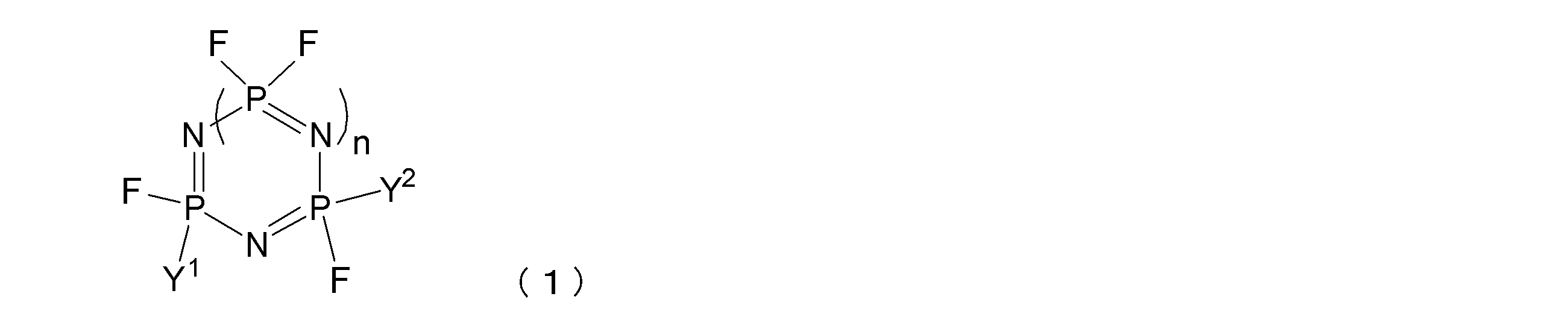

次に、本発明の環状ホスファゼン誘導体の製造方法に使用する出発物質化合物として好適に利用される式(2)で表される化合物およびアミン化合物について説明する。

本発明においては、反応原料として、ハロゲン化ホスファゼン化合物の中でもフッ素化ホスファゼン化合物を選定した。この理由として、上記のとおりアプリケーション上の利点が挙げられるが、本発明で採用される触媒との関係で反応上の利点が挙げられる。ハロゲン化ホスファゼンはその置換反応の際にハロゲン原子を系内に放出する。中でもフッ素アニオンは塩素アニオン等と比べ反応性が高い(例えば、Chem,Ber.116,367-374,(1983)“Darstellung und Strukturbestimmung von Ammoniak-Phosphorpentafluorid(1/1)”参照)。そのため、フッ素アニオンが未反応の基質と反応し、副生成物を生じさせてしまうことがある。そうすると、目的化合物の収率ないし選択率を低下させてしまうこととなる。これに対して、本発明において好適に適用される特定触媒は、そのような副反応を抑制し、収率・選択率を高める働きを奏する。すなわち、フッ素アニオンを系内でトラップする作用があるものと解される。このような効果が顕著に現れる観点から、上記のとおり、本発明においては、ハロゲン原子としてフッ素原子を有する基質と特定触媒とを組み合わせて用いる。
フッ素化合物ホスファゼンの調達方法としては、市販品を用いても良いし、適宜常法により合成してもよい。フッ素化合物ホスファゼンの合成方法としては、例えば、Schmutzler, R. Inorg. Synth. 1967, 9, 75を参照することができる。
アミン化合物は化学構造中にアミノ基を有する化合物を意味し、上記アミノ基は上記NR1R2(NR3R4と言っても同じである)であることが好ましい。アミン化合物は炭素数1~12であることが好ましく、1~8がより好ましく、1~6であることが特に好ましい。炭素数が少ないもののときには、1~3であることが好ましい。アミン化合物は具体的に、H-NR1R2で表される化合物であることが好ましく、メチルアミン、エチルアミン、ジメチルアミン、ジエチルアミン、エチルメチルアミンなどが挙げられる。中でも、ジメチルアミン、ジエチルアミンであることが特に好ましい。R1およびR2は上記式(1)で定義したものと同義である。アミン化合物において、R1およびR2が環を形成してもよいことは、上記と同義であり、その好ましいものもアミノ置換ホスファゼンのR1およびR2が形成する環として例示したものと同じである。
本発明に係るアミノ置換ホスファゼン化合物の製造方法においては、フッ素化ホスファゼン化合物とアミン化合物との反応に、特定元素Mと酸素原子とを構造中に有する化合物からなる触媒を用いる。この触媒は、少なくともひとつのM=O結合またはM-O結合を構造中に有する化合物からなることが好ましく、少なくともひとつのM=O結合を構造中に有する化合物からなることがより好ましい。特定元素Mは、マグネシウム、チタン、ジルコニウム、バナジウム、リチウム、カルシウム、アルミニウム、マンガン、モリブデン、ケイ素、およびホウ素から選ばれる少なくとも1種である。特定元素は、中でも、マグネシウム、チタン、ジルコニウム、リチウム、カルシウム、アルミニウム、ケイ素、およびホウ素が好ましく、マグネシウム、チタン、ジルコニウム、アルミニウムであることがより好ましい。
本明細書において置換・無置換を明記していない置換基、連結基及び環構造については、これらの置換基、連結基及び環構造が任意の置換基を有していてもよい意味である。これは置換・無置換を明記していない化合物についても同義である。かかる任意の置換基の好ましい例としては、下記置換基Zが挙げられる。
置換基Zとしては、下記のものが挙げられる。
アルキル基(好ましくは炭素原子数1~20のアルキル基、例えばメチル、エチル、イソプロピル、t-ブチル、ペンチル、ヘプチル、1-エチルペンチル、ベンジル、2-エトキシエチル、1-カルボキシメチル等)、アルケニル基(好ましくは炭素原子数2~20のアルケニル基、例えば、ビニル、アリル、オレイル等)、アルキニル基(好ましくは炭素原子数2~20のアルキニル基、例えば、エチニル、ブタジイニル、フェニルエチニル等)、シクロアルキル基(好ましくは炭素原子数3~20のシクロアルキル基、例えば、シクロプロピル、シクロペンチル、シクロヘキシル、4-メチルシクロヘキシル等)、アリール基(好ましくは炭素原子数6~26のアリール基、例えば、フェニル、1-ナフチル、4-メトキシフェニル、2-クロロフェニル、3-メチルフェニル等)、ヘテロ環基(好ましくは炭素原子数2~20のヘテロ環基、好ましくは、少なくとも1つの酸素原子、硫黄原子、窒素原子を有する5または6員環のヘテロ環基が好ましく、例えば、2-ピリジル、4-ピリジル、2-イミダゾリル、2-ベンゾイミダゾリル、2-チアゾリル、2-オキサゾリル等)、アルコキシ基(好ましくは炭素原子数1~20のアルコキシ基、例えば、メトキシ、エトキシ、イソプロピルオキシ、ベンジルオキシ等)、アリールオキシ基(好ましくは炭素原子数6~26のアリールオキシ基、例えば、フェノキシ、1-ナフチルオキシ、3-メチルフェノキシ、4-メトキシフェノキシ等)、アルコキシカルボニル基(好ましくは炭素原子数2~20のアルコキシカルボニル基、例えば、エトキシカルボニル、2-エチルヘキシルオキシカルボニル等)、アリールオキシカルボニル基(好ましくは炭素原子数6~26のアリールオキシカルボニル基、例えば、フェノキシカルボニル、1-ナフチルオキシカルボニル、3-メチルフェノキシカルボニル、4-メトキシフェノキシカルボニル等)、アミノ基(好ましくは炭素原子数0~20のアミノ基、アルキルアミノ基、アリールアミノ基を含み、例えば、アミノ、N,N-ジメチルアミノ、N,N-ジエチルアミノ、N-エチルアミノ、アニリノ等)、スルファモイル基(好ましくは炭素原子数0~20のスルファモイル基、例えば、N,N-ジメチルスルファモイル、N-フェニルスルファモイル等)、アシル基(好ましくは炭素原子数1~20のアシル基、例えば、アセチル、プロピオニル、ブチリル等)、アリーロイル基(好ましくは炭素原子数7~23のアリーロイル基、例えば、ベンゾイル等)、アシルオキシ基(好ましくは炭素原子数1~20のアシルオキシ基、例えば、アセチルオキシ等)、アリーロイルオキシ基(好ましくは炭素原子数7~23のアリーロイルオキシ基、例えば、ベンゾイルオキシ等)、カルバモイル基(好ましくは炭素原子数1~20のカルバモイル基、例えば、N,N-ジメチルカルバモイル、N-フェニルカルバモイル等)、アシルアミノ基(好ましくは炭素原子数1~20のアシルアミノ基、例えば、アセチルアミノ、ベンゾイルアミノ等)、アルキルチオ基(好ましくは炭素原子数1~20のアルキルチオ基、例えば、メチルチオ、エチルチオ、イソプロピルチオ、ベンジルチオ等)、アリールチオ基(好ましくは炭素原子数6~26のアリールチオ基、例えば、フェニルチオ、1-ナフチルチオ、3-メチルフェニルチオ、4-メトキシフェニルチオ等)、アルキルスルホニル基(好ましくは炭素原子数1~20のアルキルスルホニル基、例えば、メチルスルホニル、エチルスルホニル等)、アリールスルホニル基(好ましくは炭素原子数6~22のアリールスルホニル基、例えば、ベンゼンスルホニル等)、シリル基(好ましくは炭素原子数1~20のシリル基、例えば、モノメチルシリル、ジメチルシリル、トリメチルシリル、トリエチルシリル、トリフェニルシリル等)、ホスホリル基(好ましくは炭素原子数0~20のリン酸基、例えば、-OP(=O)(RP)2)、ホスホニル基(好ましくは炭素原子数0~20のホスホニル基、例えば、-P(=O)(RP)2)、ホスフィニル基(好ましくは炭素原子数0~20のホスフィニル基、例えば、-P(RP)2)、(メタ)アクリロイル基、(メタ)アクリロイルオキシ基、ヒドロキシル基、シアノ基、ハロゲン原子(例えばフッ素原子、塩素原子、臭素原子、ヨウ素原子等)が挙げられる。
また、これらの置換基Zで挙げた各基は、上記の置換基Zがさらに置換していてもよい。
化合物ないし置換基・連結基等がアルキル基・アルキレン基、アルケニル基・アルケニレン基、アルキニル基・アルキニレン基等を含むとき、これらは環状でも鎖状でもよく、また直鎖でも分岐していてもよく、上記のように置換されていても無置換でもよい。またアリール基、ヘテロ環基等を含むとき、それらは単環でも縮環でもよく、同様に置換されていても無置換でもよい。
連結基Lとしては、炭化水素連結基〔炭素数1~10のアルキレン基(より好ましくは炭素数1~6、さらに好ましくは1~3)、炭素数2~10のアルケニレン基(より好ましくは炭素数2~6、さらに好ましくは2~4)、炭素数6~22のアリーレン基(より好ましくは炭素数6~10)〕、ヘテロ連結基〔カルボニル基(-CO-)、エーテル基(-O-)、チオエーテル基(-S-)、イミノ基(-NRN-)、イミン連結基(RN-N=C<,-N=C(RN)-)〕、またはこれらを組み合せた連結基が好ましい。なお、縮合して環を形成する場合には、上記炭化水素連結基が、二重結合や三重結合を適宜形成していてもよい。
RNは水素原子または置換基である。置換基としては、アルキル基(炭素数1~24が好ましく、1~12がより好ましく、1~6がさらに好ましく、1~3が特に好ましい)、アルケニル基(炭素数2~24が好ましく、2~12がより好ましく、2~6がさらに好ましく、2~3が特に好ましい)、アルキニル基(炭素数2~24が好ましく、2~12がより好ましく、2~6がさらに好ましく、2~3が特に好ましい)、アラルキル基(炭素数7~22が好ましく、7~14がより好ましく、7~10が特に好ましい)、アリール基(炭素数6~22が好ましく、6~14がより好ましく、6~10が特に好ましい)が好ましい。
RPは水素原子、ヒドロキシル基、または置換基である。置換基としては、アルキル基(炭素数1~24が好ましく、1~12がより好ましく、1~6がさらに好ましく、1~3が特に好ましい)、アルケニル基(炭素数2~24が好ましく、2~12がより好ましく、2~6がさらに好ましく、2~3が特に好ましい)、アルキニル基(炭素数2~24が好ましく、2~12がより好ましく、2~6がさらに好ましく、2~3が特に好ましい)、アラルキル基(炭素数7~22が好ましく、7~14がより好ましく、7~10が特に好ましい)、アリール基(炭素数6~22が好ましく、6~14がより好ましく、6~10が特に好ましい)、アルコキシ基(炭素数1~24が好ましく、1~12がより好ましく、1~6がさらに好ましく、1~3が特に好ましい)、アルケニルオキシ基(炭素数2~24が好ましく、2~12がより好ましく、2~6がさらに好ましく、2~3が特に好ましい)、アルキニルオキシ基(炭素数2~24が好ましく、2~12がより好ましく、2~6がさらに好ましく、2~3が特に好ましい)、アラルキルオキシ基(炭素数7~22が好ましく、7~14がより好ましく、7~10が特に好ましい)、アリールオキシ基(炭素数6~22が好ましく、6~14がより好ましく、6~10が特に好ましい)、が好ましい。
本明細書において、連結基を構成する原子の数は、1~36であることが好ましく、1~24であることがより好ましく、1~12であることがさらに好ましく、1~6であることが特に好ましい。連結基の連結原子数は10以下であることが好ましく、8以下であることがより好ましい。下限としては、1以上である。上記連結原子数とは所定の構造部間を結ぶ経路に位置し連結に関与する最少の原子数を言う。たとえば、-CH2-C(=O)-O-の場合、連結基を構成する原子の数は6となるが、連結原子数は3となる。
本発明の製造方法においては、反応溶媒を用いても用いなくてもよいが、これを用いて行うことが好ましい。有機溶媒としては、脂肪族炭化水素化合物、ハロゲン化炭化水素化合物、エーテル化合物、エステル化合物、ケトン化合物、ニトリル化合物、アミド化合物、スルホキシド化合物、カルボン酸化合物、芳香族炭化水素化合物、尿素化合物等が挙げられる。
脂肪族炭化水素化合物としては、ペンタン、ヘキサンまたはシクロヘキサンなどが挙げられる。
ハロゲン化炭化水素化合物としては、塩化メチレン、クロロホルムまたは1,2-ジクロロエタンなどが挙げられる。
エーテル化合物としては、ジエチルエーテル、ジイソプロピルエーテル、ジオキサン、テトラヒドロフラン、アニソール、エチレングリコールジメチルエーテル、ジエチレングリコールジメチルエーテルまたはジエチレングリコールジエチルエーテルなどが挙げられる。
エステル化合物としては、酢酸メチル、酢酸エチル、酢酸プロピル、酢酸イソプロピルまたは酢酸ブチルなどが挙げられる。
ケトン化合物としては、アセトン、2-ブタノンまたは4-メチル-2-ペンタノンなどが挙げられる。
ニトリル化合物としては、アセトニトリルなどが挙げられる。
アミド化合物としては、N,N-ジメチルホルムアミド、N,N-ジメチルアセトアミドまたはN-メチルピロリドンなどが挙げられる。
スルホキシド化合物としては、ジメチルスルホキシド、スルホランなどが挙げられる。
カルボン酸化合物としては、酢酸などが挙げられる。
芳香族炭化水素化合物としては、ベンゼン、クロロベンゼン、ジクロロベンゼン、ニトロベンゼン、トルエンまたはキシレンなどが挙げられる。
尿素化合物としては、1,3-ジメチル-2-イミダゾリジノンなどが挙げられる。
反応溶媒としては、無極性溶媒、極性溶媒を用いることができる。無極性溶媒としては、溶媒を構成する分子の双極子モーメントが0又は低い値の溶媒であれば特に制限はないが、例えば、ヘキサン、ペンタン、シクロヘキサン及びトルエン等が挙げられる。これらの中でも、取り扱い易く、安価である点で、ヘキサンが特に好ましい。
上記極性溶媒としては、溶媒を構成する分子が双極子モーメントを有する溶媒であれば特に制限はないが、例えば、アセトニトリル、テトラヒドロフラン、ジエチルエーテル、ターシャリーブチルメチルエーテル、酢酸エチル、アセトン、ニトロベンゼン、ジメチルアセトアミド、N-メチルピロリドン等が挙げられる。これらの中でも、取り扱い易い点で、アセトニトリル、ターシャリーブチルメチルエーテル、テトラヒドロフラン等が好ましく、アセトニトリルが特に好ましい。反応溶媒は1種のみを用いてもよく、2種以上を用いてもよく、また2相系で反応してもよい。
(電解質)
本実施形態の非水二次電池には、非水二次電池用の電解液が適用される。電解液に用いる電解質は周期律表第一族又は第二族に属する金属イオンの塩であることが好ましい。その材料は電解液の使用目的により適宜選択される。例えば、リチウム塩、カリウム塩、ナトリウム塩、カルシウム塩、マグネシウム塩などが挙げられ、出力の観点からリチウム塩が好ましい。本発明の製造方法で製造したアミノ置換ホスファゼン化合物をリチウム二次電池用非水系電解液として用いる場合には、金属イオンの塩としてリチウム塩を選択することが好ましい。リチウム塩としては、リチウム二次電池用非水系電解液の電解質に通常用いられるリチウム塩が好ましく、特に制限はないが、例えば、以下に述べるものが好ましい。
これらのなかで、LiPF6、LiBF4、LiAsF6、LiSbF6、LiClO4、Li(Rf1SO3)、LiN(Rf1SO2)2、LiN(FSO2)2、及びLiN(Rf1SO2)(Rf2SO2)が好ましく、LiPF6、LiBF4、LiN(Rf1SO2)2、LiN(FSO2)2、及びLiN(Rf1SO2)(Rf2SO2)などのリチウム塩がさらに好ましい。ここで、Rf1、Rf2はそれぞれパーフルオロアルキル基を示す。
なお、電解液に用いる電解質は、1種を単独で使用しても、2種以上を任意に組み合わせてもよい。
電解液における電解質(好ましくは周期律表第一族又は第二族に属する金属のイオンもしくはその金属塩)は、以下に電解液の調製法で述べる好ましい塩濃度となるような量で添加されることが好ましい。塩濃度は電解液の使用目的により適宜選択されるが、一般的には電解液全質量中10質量%~50質量%であり、さらに好ましくは15質量%~30質量%である。モル濃度としては0.5M~1.5Mが好ましい。なお、イオンの濃度として評価するときには、その好適に適用される金属との塩換算で算定されればよい。
本実施形態の電解液に用いられる非水溶剤としては、非プロトン性有機溶媒であることが好ましく、なかでも炭素数2~10の非プロトン性有機溶媒であることが好ましい。上記非水溶剤は、エーテル基、カルボニル基、エステル基、またはカーボネート基を有する化合物で構成されることが好ましい。上記化合物は置換基を有していてもよい。
しかしながら、本発明に用いられる非水溶剤は、上記例示によって限定されるものではない。
本発明の非水二次電池用電解液の製造方法は、上記アミノ置換ホスファゼン化合物の製造方法を介して、これを含有する非水二次電池用電解液を調製することにより実施することができる。具体的には、例えば、金属イオンの塩としてリチウム塩を用いた例を含め、上記各成分を上記非水電解液溶媒に溶解して、常法により調製される。
本発明の非水二次電池の製造方法は、上記非水二次電池用電解液の製造方法を介して、正極と負極と上記非水二次電池用電解液とを具備する電池を作製することで実施することができる。
本発明に係る好ましい実施形態のリチウムイオン二次電池は、上記本発明の非水二次電池用電解液と、リチウムイオンの挿入放出が可能な正極(正極集電体,正極活物質層)と、リチウムイオンの挿入放出又は溶解析出が可能な負極(負極集電体,負極活物質層)とを備える。これら必須の部材に加え、電池が使用される目的、電位の形状などを考慮し、正極と負極の間に配設されるセパレータ、集電端子、及び外装ケース等を含んで構成されてもよい。必要に応じて、電池の内部及び電池の外部の少なくともいずれかに保護素子を装着してもよい。このような構造とすることにより、電解液内でリチウムイオンの授受が生じ、充電、放電を行うことができ、回路配線及び動作機構を介して運転あるいは蓄電を行うことができる。以下、これらの各部材について述べる。
(電極合材)
電極合材は、集電体(電極基材)上に活物質と導電剤、結着剤、フィラーなどの分散物を塗布したものであり、リチウム電池においては、活物質が正極活物質である正極合材と活物質が負極活物質である負極合材が使用されることが好ましい。次に、電極合材を構成する分散物(電極用組成物)中の各成分等について説明する。
正極活物質にはリチウム含有遷移金属酸化物を用いることが好ましく、中でも、遷移元素Ma(Co、Ni、Fe、Mn、Cu、Vから選択される1種以上の元素)を有することが好ましい。また、混合元素Mb(リチウム以外の金属周期律表の第1(Ia)族の元素、第2(IIa)族の元素、Al、Ga、In、Ge、Sn、Pb、Sb、Bi、Si、P、Bなど)を混合してもよい。この、リチウム含有遷移金属酸化物として例えば、下記式(MA)~(MC)のいずれかで表されるものを含む特定遷移金属酸化物、あるいはその他の遷移金属酸化物としてV2O5、MnO2等が挙げられる。正極活物質には、粒子状の正極活物質を用いてもよい。具体的に、可逆的にリチウムイオンを挿入・放出できる遷移金属酸化物を用いることができるが、上記特定遷移金属酸化物を用いるのが好ましい。
リチウム含有遷移金属酸化物としては中でも下式で表されるものが好ましい。
LiaM1Ob ・・・ (MA)
上記遷移金属化合物の具体例を示すと、LiCoO2(コバルト酸リチウム[LCO])、LiNi2O2(ニッケル酸リチウム)LiNi0.85Co0.10Al0.05O2(ニッケルコバルトアルミニウム酸リチウム[NCA])、LiNi1/3Co1/3Mn1/3O2(ニッケルマンガンコバルト酸リチウム[NMC])、LiNi0.5Mn0.5O2(マンガンニッケル酸リチウム)である。
リチウム含有遷移金属酸化物としては中でも下記式(MB)で表されるものも好ましい。
LicM2 2Od ・・・ (MB)
上記遷移金属化合物の具体例を示すと、LiMn2O4、LiMn1.5Ni0.5O4である。
(a) LiCoMnO4
(b) Li2FeMn3O8
(c) Li2CuMn3O8
(d) Li2CrMn3O8
(e) Li2NiMn3O8
高容量、高出力の観点で上記のうちNiを含む電極が更に好ましい。
リチウム含有遷移金属酸化物としてはリチウム含有遷移金属リン酸化物を用いることも好ましく、中でも下記式(MC)で表されるものも好ましい。
LieM3(PO4)f ・・・ (MC)
なお、Liの組成を表す上記a,c,e値は、充放電により変化する値であり、典型的には、Liを含有したときの安定な状態の値で評価される。上記式(a)~(e)では特定値としてLiの組成を示しているが、これも同様に電池の動作により変化するものである。
特に好ましい正極活物質の具体例としては下記が挙げられる。
LiNi1/3Co1/3Mn1/3O2
LiNi0.6Co0.2Mn0.2O2
LiNi0.5Co0.3Mn0.2O2
LiNi0.5Mn0.5O2
LiNi0.5Mn1.5O4
これらは高電位で使用できるため電池容量を大きくすることができ、また高電位で使用しても容量維持率が高いため特に好ましい。
負極活物質としては、可逆的にリチウムイオンを挿入・放出できるものが好ましく、特に制限はなく、炭素質材料、酸化錫や酸化ケイ素等の金属酸化物、金属複合酸化物、リチウム単体やリチウムアルミニウム合金等のリチウム合金、及び、SnやSi等のリチウムと合金形成可能な金属等が挙げられる。
これらは、1種を単独で用いても、2種以上を任意の組み合わせ及び比率で併用しても良い。なかでも炭素質材料又はリチウム複合酸化物が信頼性の点から好ましく用いられる。
また、金属複合酸化物としては、リチウムを吸蔵、放出可能であるものが好ましく、構成成分としてチタン及び/又はリチウムを含有していることが、高電流密度充放電特性の観点で好ましい。
金属酸化物及び金属複合酸化物としては、特に非晶質酸化物が好ましく、さらに金属元素と周期律表第16族の元素との反応生成物であるカルコゲナイトも好ましく用いられる。好ましい非晶質酸化物及びカルコゲナイドの具体例としては、例えば、Ga2O3、SiO、GeO、SnO、SnO2、PbO、PbO2、Pb2O3、Pb2O4、Pb3O4、Sb2O3、Sb2O4、Sb2O5、Bi2O3、Bi2O4、SnSiO3、GeS、SnS、SnS2、PbS、PbS2、Sb2S3、Sb2S5、SnSiS3などが好ましく挙げられる。また、これらは、酸化リチウムとの複合酸化物、例えば、Li2SnO2であってもよい。
導電材は、構成された二次電池において、化学変化を起こさない電子伝導性材料が好ましく、公知の導電材を任意に用いることができる。通常、天然黒鉛(鱗状黒鉛、鱗片状黒鉛、土状黒鉛など)、人工黒鉛、カーボンブラック、アセチレンブラック、ケッチェンブラック、炭素繊維や金属粉(銅、ニッケル、アルミニウム、銀(特開昭63-10148,554号に記載)等)、金属繊維あるいはポリフェニレン誘導体(特開昭59-20,971号に記載)などの導電性材料を1種又はこれらの混合物として含ませることができる。その中でも、黒鉛とアセチレンブラックの併用がとくに好ましい。上記導電材の添加量としては、1~50質量%が好ましく、2~30質量%がより好ましい。カーボンや黒鉛の場合は、2~15質量%が特に好ましい。
結着剤としては、多糖類、熱可塑性樹脂及びゴム弾性を有するポリマーなどが挙げられ、その中でも、ポリアクリル酸エステル系のラテックス、カルボキシメチルセルロース、ポリテトラフロロエチレン、ポリフッ化ビニリデンが、より好ましい。
電極合材は、フィラーを含んでいてもよい。フィラーを形成する材料は、本発明の二次電池において、化学変化を起こさない繊維状材料が好ましい。通常、ポリプロピレン、ポリエチレンなどのオレフィン系ポリマー、ガラス、炭素などの材料からなる繊維状のフィラーが用いられる。フィラーの添加量は特に限定されないが、分散物中、0~30質量%が好ましい。
正・負極の集電体としては、化学変化を起こさない電子伝導体が用いられることが好ましい。正極の集電体としては、アルミニウム、ステンレス鋼、ニッケル、チタンなどの他にアルミニウムやステンレス鋼の表面にカーボン、ニッケル、チタンあるいは銀を処理させたものが好ましく、その中でも、アルミニウムやステンレス鋼の表面にカーボン、ニッケル、チタンあるいは銀を処理させたものが好ましい。
これらの材料から適宜選択した部材によりリチウム二次電池の電極合材が形成される。
非水二次電池に用いられるセパレータは、正極と負極を電子的に絶縁する機械的強度、イオン透過性、及び正極と負極の接触面で酸化・還元耐性のある材料で構成されていることが好ましい。このような材料として多孔質のポリマー材料や無機材料、有機無機ハイブリッド材料、あるいはガラス繊維などが用いられる。これらセパレータは信頼性確保のためのシャットダウン機能、すなわち、80℃以上で隙間を閉塞して抵抗を上げ、電流を遮断する機能を持つことが好ましく、閉塞温度は90℃以上、180℃以下であることが好ましい。
本発明の非水二次電池の形状としては、シート状、角型、シリンダー状などいずれの形にも適用できる。正極活物質や負極活物質の合剤は、集電体の上に、塗布(コート)、乾燥、圧縮されて、主に用いられる。各部材の選択や設計、これらの組み立ては定法によればよく、この種の製品の一般的な技術を適宜適用することができる。
窒素フロー下、500mL三口フラスコに、ヘキサフルオロホスファゼン(東京化成社品)40.0g(0.16mol)、アセトニトリル100mLを仕込み、氷/メタノール浴で冷やしながら酸化アルミニウム5.48g(0.053mol)を加えた。次に、懸濁した反応液中に-10℃~0℃にてジメチルアミンガス(Aldrich社製)14.41g(0.32mol)を0.3g/minの速度でバブリングした。
次に、内温を5℃に保ちながら0.5時間反応を行った。反応の進行状態を、19F-NMRにて確認したところ、反応転換率80%であり、二置換体は確認されなかった。
反応終了後、分液や減圧蒸留精製により、無色透明の化合物(1-1)32.95g、収率75%で得た。化合物(1-1)の標準試料の1H、19F-NMRスペクトルを図1、図2に示す。また、純度をガスクロマトグラフィーで確認したところ、純度99.99%以上であった。
実施例1の手順に対して、用いる触媒を下表のとおりに代えて各反応を行った。
窒素フロー下、500mL三口フラスコに、ヘキサフルオロホスファゼン(東京化成社品)40.0g(0.16mol)、アセトニトリル100mLを仕込み、氷/メタノール浴で冷やした。次に、反応液中に-10℃~0℃にてジメチルアミンガス(Aldrich社製)14.41g(0.32mol)を0.3g/minの速度でバブリングした。
次に、室温(約23℃)にて1時間反応を行った。反応の進行状態を、19F-NMRにて確認したところ、一置換体である目的生成物への反応転換率は47%であり、二置換体10%が生成していた。
反応終了後、分液や減圧蒸留精製により、無色透明の化合物(1-1)13.35g、収率30%で得られた。また、純度をガスクロマトグラフィーで確認したところ、純度99.10%であった。
窒素フロー下、500mL三口フラスコに、ヘキサフルオロホスファゼン(東京化成社品)40.0g(0.16mol)、炭酸ナトリウム16.96g(0.16mol)、アセトニトリル200mLを仕込み、氷/メタノール浴で-10℃~0℃に保ちながら、ジメチルアミンガス(Aldrich社製)14.41g(0.32mol)を0.3g/minの速度でバブリングした。
次に、室温(約23℃)で2時間反応を行った。反応の進行状態を、内標にモノフッ化ベンゼンを用いて19F-NMRにて確認したところ、目的生成物への反応転換率は50%であり、二置換体が6%生成していた。また、そのほか未同定の副生成物の生成が確認できた。
反応終了後、分液や減圧蒸留精製により、無色透明の化合物(1-1)18.35g、収率42%で得た。また、純度をガスクロマトグラフィーで確認したところ、純度99.11%であった。
<比較例3等>
比較例2の手順に対して、用いる触媒を下表のとおりに代えて各反応を行った。
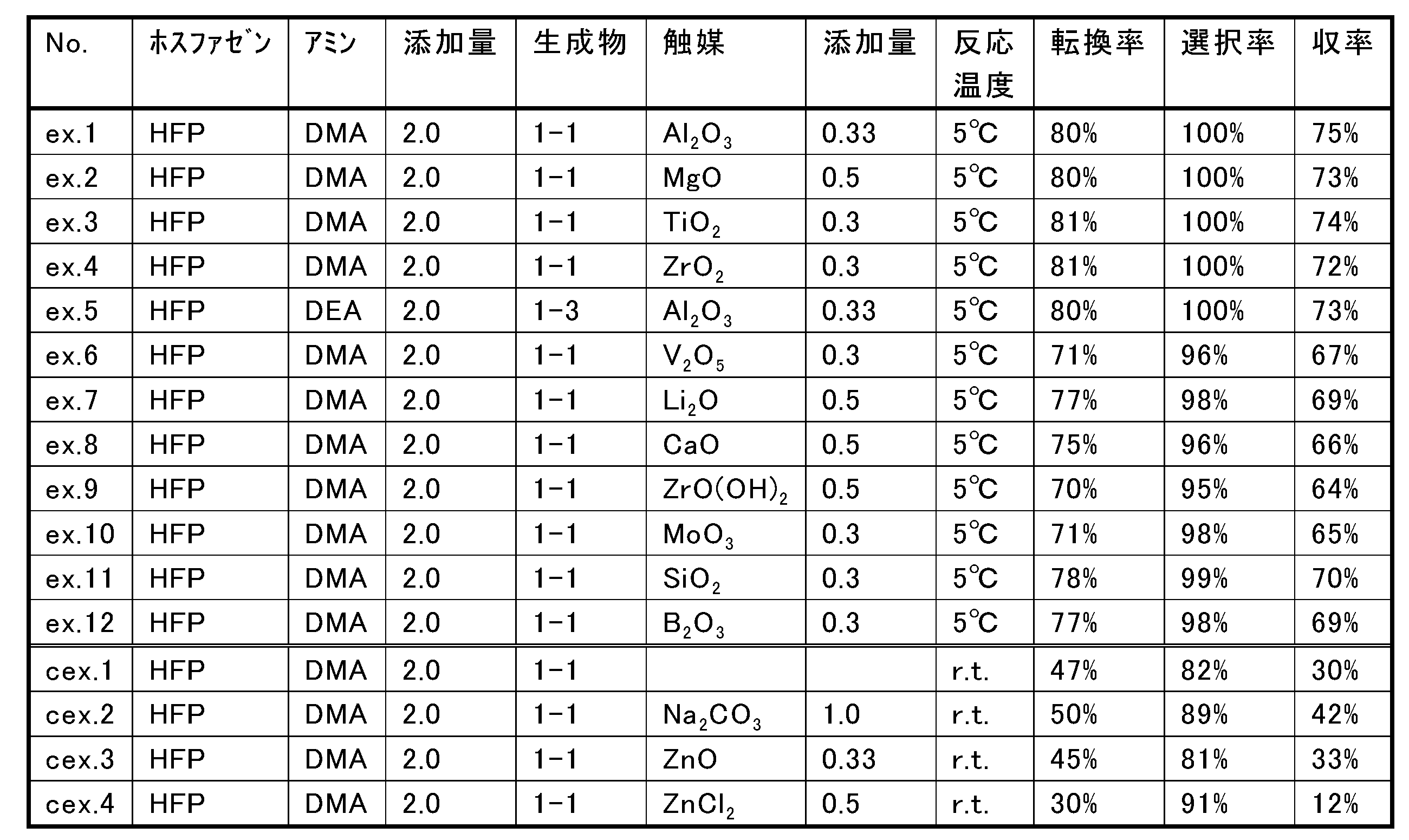
ex:実施例
cex:比較例
HFP:ヘキサフルオロホスファゼン
DMA:ジメチルアミン
DEA:ジエチルアミン
r.t.:室温(約23℃)
添加量は、HFPに対するモル比を表す。
選択率(%)= [目的置換体転換率/(目的置換体転換率+他置換体転換率)]
Claims (10)
- フッ素化ホスファゼン化合物とアミン化合物とを下記特定元素M及び酸素原子を構成元素として有する化合物からなる触媒の存在下で反応させて、該フッ素化ホスファゼン化合物のフッ素原子と該アミン化合物のアミノ基との置換反応によりアミノ置換ホスファゼン化合物を得るアミノ置換ホスファゼン化合物の製造方法。
特定元素M:マグネシウム、チタン、ジルコニウム、バナジウム、リチウム、カルシウム、アルミニウム、マンガン、モリブデン、ケイ素、およびホウ素から選ばれる少なくとも1種 - 上記アミノ置換ホスファゼン化合物が下記式(1)で表される化合物である請求項1に記載の製造方法。

- 上記フッ素化ホスファゼン化合物が下記式(2)で表される請求項1または2に記載の製造方法。

- 上記アミン化合物の炭素数が1~12である請求項1~3のいずれか1項に記載の製造方法。
- 上記触媒を上記フッ素化ホスファゼン化合物に対して0.2~3当量で加える請求項1~4のいずれか1項に記載の製造方法。
- 上記触媒が、酸化アルミニウム、酸化マグネシウム、酸化チタン、酸化ジルコニウム、酸化バナジウム、酸化リチウム、酸化カルシウム、Zr=O(OH)2、酸化モリブデン、酸化ケイ素、および酸化ホウ素からなる群から選ばれる少なくとも一種である請求項1~5のいずれか1項に記載の製造方法。
- 上記触媒を上記フッ素化ホスファゼン化合物に対して0.25~1当量で加える請求項1~6のいずれか1項に記載の製造方法。
- 上記触媒が、酸化アルミニウム、酸化マグネシウム、酸化チタン、および酸化ジルコニウムからなる群から選ばれる少なくとも一種である請求項1~7のいずれか1項に記載の製造方法。
- 請求項1~8のいずれか1項に記載の製造方法を介して、上記アミノ置換ホスファゼン化合物を含有する非水二次電池用電解液を調製する非水二次電池用電解液の製造方法。
- 請求項9に記載の製造方法を介して、正極と負極と上記非水二次電池用電解液とを具備する非水二次電池を作製する非水二次電池の製造方法。
Priority Applications (4)
| Application Number | Priority Date | Filing Date | Title |
|---|---|---|---|
| JP2016531414A JP6302551B2 (ja) | 2014-07-03 | 2015-07-01 | アミノ置換ホスファゼン化合物の製造方法、非水二次電池用電解液の製造方法および非水二次電池の製造方法 |
| CN201580034380.3A CN106661067B (zh) | 2014-07-03 | 2015-07-01 | 氨基取代磷腈化合物制造方法、非水二次电池用电解液制造方法及非水二次电池制造方法 |
| KR1020177001337A KR101913521B1 (ko) | 2014-07-03 | 2015-07-01 | 아미노 치환 포스파젠 화합물의 제조 방법, 비수 이차 전지용 전해액의 제조 방법 및 비수 이차 전지의 제조 방법 |
| US15/395,643 US10461367B2 (en) | 2014-07-03 | 2016-12-30 | Manufacturing method for amino-substituted phosphazene compound, manufacturing method for electrolyte solution for nonaqueous secondary battery, and manufacturing method for nonaqueous secondary battery |
Applications Claiming Priority (2)
| Application Number | Priority Date | Filing Date | Title |
|---|---|---|---|
| JP2014137764 | 2014-07-03 | ||
| JP2014-137764 | 2014-07-03 |
Related Child Applications (1)
| Application Number | Title | Priority Date | Filing Date |
|---|---|---|---|
| US15/395,643 Continuation US10461367B2 (en) | 2014-07-03 | 2016-12-30 | Manufacturing method for amino-substituted phosphazene compound, manufacturing method for electrolyte solution for nonaqueous secondary battery, and manufacturing method for nonaqueous secondary battery |
Publications (1)
| Publication Number | Publication Date |
|---|---|
| WO2016002829A1 true WO2016002829A1 (ja) | 2016-01-07 |
Family
ID=55019359
Family Applications (1)
| Application Number | Title | Priority Date | Filing Date |
|---|---|---|---|
| PCT/JP2015/068948 Ceased WO2016002829A1 (ja) | 2014-07-03 | 2015-07-01 | アミノ置換ホスファゼン化合物の製造方法、非水二次電池用電解液の製造方法および非水二次電池の製造方法 |
Country Status (5)
| Country | Link |
|---|---|
| US (1) | US10461367B2 (ja) |
| JP (1) | JP6302551B2 (ja) |
| KR (1) | KR101913521B1 (ja) |
| CN (1) | CN106661067B (ja) |
| WO (1) | WO2016002829A1 (ja) |
Families Citing this family (4)
| Publication number | Priority date | Publication date | Assignee | Title |
|---|---|---|---|---|
| JP6292727B2 (ja) * | 2014-07-04 | 2018-03-14 | 富士フイルム株式会社 | アミノ置換ホスファゼン化合物の製造方法、非水二次電池用電解液の製造方法および非水二次電池の製造方法 |
| US10707531B1 (en) | 2016-09-27 | 2020-07-07 | New Dominion Enterprises Inc. | All-inorganic solvents for electrolytes |
| CN109004277B (zh) * | 2018-07-24 | 2021-01-15 | 安普瑞斯(无锡)有限公司 | 锂离子二次电池及其电解液 |
| CN113121602B (zh) * | 2019-12-30 | 2023-03-24 | 北京卫蓝新能源科技有限公司 | 一种磷腈基磷酸酯添加剂和制备方法及锂电池电解液 |
Citations (9)
| Publication number | Priority date | Publication date | Assignee | Title |
|---|---|---|---|---|
| JPS63258928A (ja) * | 1987-04-15 | 1988-10-26 | Idemitsu Petrochem Co Ltd | 重合性ホスフアゼン化合物の製造法 |
| JPH1173999A (ja) * | 1997-08-28 | 1999-03-16 | Showa Denko Kk | 非水二次電池 |
| JP2002097160A (ja) * | 2000-09-20 | 2002-04-02 | Meiji Seika Kaisha Ltd | 芳香族ヨウ素化物の製造法 |
| JP2005298491A (ja) * | 2004-03-15 | 2005-10-27 | Nippon Shokubai Co Ltd | ハロゲン含有フタロシアニン化合物の製造方法 |
| JP2009235009A (ja) * | 2008-03-27 | 2009-10-15 | Fujifilm Corp | フッ素化合物の製造方法、及びフッ素化合物 |
| JP2010053086A (ja) * | 2008-08-28 | 2010-03-11 | Fushimi Pharm Co Ltd | 反応性基含有環状ホスファゼン化合物およびその製造方法 |
| JP2013235830A (ja) * | 2012-05-04 | 2013-11-21 | Samsung Sdi Co Ltd | リチウム二次電池用電解液およびこれを含むリチウム二次電池 |
| US20140178752A1 (en) * | 2012-12-24 | 2014-06-26 | Samsung Sdi Co., Ltd. | Cyclotriphosphazene compound, method of preparing the same, electrolyte for lithium secondary battery including the cyclotriphosphazene compound, and lithium secondary battery including the electrolyte |
| WO2015053302A1 (ja) * | 2013-10-11 | 2015-04-16 | 富士フイルム株式会社 | アミノ置換ホスファゼン化合物の製造方法、非水二次電池用電解液の製造方法および非水二次電池の製造方法 |
Family Cites Families (10)
| Publication number | Priority date | Publication date | Assignee | Title |
|---|---|---|---|---|
| JPS6487635A (en) | 1987-09-28 | 1989-03-31 | Idemitsu Petrochemical Co | Production of polymerizable phosphazene compound |
| US5830600A (en) | 1996-05-24 | 1998-11-03 | Sri International | Nonflammable/self-extinguishing electrolytes for batteries |
| JP4422256B2 (ja) | 1999-11-16 | 2010-02-24 | 日本化学工業株式会社 | スルホニル基を有するホスファゼン誘導体およびその製造方法 |
| JP4484318B2 (ja) | 2000-05-26 | 2010-06-16 | 日本化学工業株式会社 | スルホニル基含有ホスファゼン誘導体及びその製造方法 |
| EP1414097A4 (en) | 2001-07-05 | 2005-03-09 | Bridgestone Corp | NONAQUEOUS ELECTROLYTE ELEMENT, ELECTROLYTE STABILIZING AGENT, PHOSPHAZENE DERIVATIVE, AND PROCESS FOR PREPARING THE SAME |
| JP4458841B2 (ja) | 2003-12-26 | 2010-04-28 | 株式会社ブリヂストン | 電池用非水電解液及びそれを備えた非水電解液電池 |
| US7473777B2 (en) | 2004-03-15 | 2009-01-06 | Nippon Shokubai Co., Ltd. | Method for production of halogen-containing phthalocyanine compound |
| TWI378938B (en) * | 2006-01-13 | 2012-12-11 | Fushimi Pharmaceutical Co Ltd | Cyclic cyanato group-containing phosphazene compound and method for making such compound |
| CN101410359B (zh) * | 2006-03-31 | 2011-10-26 | 日本瑞翁株式会社 | 制备全氟炔烃化合物的方法 |
| JP6292727B2 (ja) * | 2014-07-04 | 2018-03-14 | 富士フイルム株式会社 | アミノ置換ホスファゼン化合物の製造方法、非水二次電池用電解液の製造方法および非水二次電池の製造方法 |
-
2015
- 2015-07-01 CN CN201580034380.3A patent/CN106661067B/zh active Active
- 2015-07-01 WO PCT/JP2015/068948 patent/WO2016002829A1/ja not_active Ceased
- 2015-07-01 JP JP2016531414A patent/JP6302551B2/ja not_active Expired - Fee Related
- 2015-07-01 KR KR1020177001337A patent/KR101913521B1/ko not_active Expired - Fee Related
-
2016
- 2016-12-30 US US15/395,643 patent/US10461367B2/en active Active
Patent Citations (9)
| Publication number | Priority date | Publication date | Assignee | Title |
|---|---|---|---|---|
| JPS63258928A (ja) * | 1987-04-15 | 1988-10-26 | Idemitsu Petrochem Co Ltd | 重合性ホスフアゼン化合物の製造法 |
| JPH1173999A (ja) * | 1997-08-28 | 1999-03-16 | Showa Denko Kk | 非水二次電池 |
| JP2002097160A (ja) * | 2000-09-20 | 2002-04-02 | Meiji Seika Kaisha Ltd | 芳香族ヨウ素化物の製造法 |
| JP2005298491A (ja) * | 2004-03-15 | 2005-10-27 | Nippon Shokubai Co Ltd | ハロゲン含有フタロシアニン化合物の製造方法 |
| JP2009235009A (ja) * | 2008-03-27 | 2009-10-15 | Fujifilm Corp | フッ素化合物の製造方法、及びフッ素化合物 |
| JP2010053086A (ja) * | 2008-08-28 | 2010-03-11 | Fushimi Pharm Co Ltd | 反応性基含有環状ホスファゼン化合物およびその製造方法 |
| JP2013235830A (ja) * | 2012-05-04 | 2013-11-21 | Samsung Sdi Co Ltd | リチウム二次電池用電解液およびこれを含むリチウム二次電池 |
| US20140178752A1 (en) * | 2012-12-24 | 2014-06-26 | Samsung Sdi Co., Ltd. | Cyclotriphosphazene compound, method of preparing the same, electrolyte for lithium secondary battery including the cyclotriphosphazene compound, and lithium secondary battery including the electrolyte |
| WO2015053302A1 (ja) * | 2013-10-11 | 2015-04-16 | 富士フイルム株式会社 | アミノ置換ホスファゼン化合物の製造方法、非水二次電池用電解液の製造方法および非水二次電池の製造方法 |
Also Published As
| Publication number | Publication date |
|---|---|
| KR20170019442A (ko) | 2017-02-21 |
| JP6302551B2 (ja) | 2018-03-28 |
| JPWO2016002829A1 (ja) | 2017-07-06 |
| US10461367B2 (en) | 2019-10-29 |
| KR101913521B1 (ko) | 2018-10-30 |
| CN106661067A (zh) | 2017-05-10 |
| CN106661067B (zh) | 2019-02-22 |
| US20170110762A1 (en) | 2017-04-20 |
Similar Documents
| Publication | Publication Date | Title |
|---|---|---|
| KR101718062B1 (ko) | 리튬전지 전해질용 첨가제, 이를 포함하는 유기전해액 및 상기 전해액을 채용한 리튬 전지 | |
| KR102152365B1 (ko) | 유기전해액 및 상기 전해액을 채용한 리튬 전지 | |
| JP6245312B2 (ja) | 非水系電解液二次電池用電解液及びそれを用いた非水系電解液二次電池 | |
| KR20200094782A (ko) | 비수 전해액 전지용 전해액 및 그것을 이용한 비수 전해액 전지 | |
| JP6292727B2 (ja) | アミノ置換ホスファゼン化合物の製造方法、非水二次電池用電解液の製造方法および非水二次電池の製造方法 | |
| KR20140127741A (ko) | 리튬전지 전해질용 첨가제, 이를 포함하는 유기전해액 및 상기 전해액을 채용한 리튬 전지 | |
| KR20210082231A (ko) | 포스파젠 함유 전해질 첨가제를 구비한 실리콘-기반 에너지 저장 디바이스 | |
| KR20160109664A (ko) | 유기전해액 및 이를 포함하는 리튬 전지 | |
| JP2015046389A (ja) | 非水二次電池用電解液および非水二次電池 | |
| WO2019111983A1 (ja) | 非水電解液電池用電解液及びそれを用いた非水電解液電池 | |
| JPWO2018135395A1 (ja) | 非水二次電池用電解液、非水二次電池及び金属錯体 | |
| KR20190133659A (ko) | 유기전해액 및 상기 전해액을 채용한 리튬 전지 | |
| JP6302551B2 (ja) | アミノ置換ホスファゼン化合物の製造方法、非水二次電池用電解液の製造方法および非水二次電池の製造方法 | |
| CN121620822A (zh) | 基于官能化有机分子的涂层材料及其在电化学应用中的用途 | |
| JP6182113B2 (ja) | アミノ置換ホスファゼン化合物の製造方法、非水二次電池用電解液の製造方法および非水二次電池の製造方法 | |
| KR20160109680A (ko) | 리튬전지용 전해질 및 상기 전해질을 포함한 리튬 전지 | |
| EP4589712A1 (en) | Electrolyte additive, electrolyte for lithium secondary battery comprising same, and lithium secondary battery | |
| JP6292730B2 (ja) | アミノ置換ホスファゼン化合物の製造方法、非水二次電池用電解液の製造方法および非水二次電池の製造方法 | |
| JP2016069316A (ja) | アミノ置換ホスファゼン化合物の製造方法、非水二次電池用電解液の製造方法および非水二次電池の製造方法 | |
| JP2016069315A (ja) | アミノ置換ホスファゼン化合物の製造方法、非水二次電池用電解液の製造方法および非水二次電池の製造方法 |
Legal Events
| Date | Code | Title | Description |
|---|---|---|---|
| 121 | Ep: the epo has been informed by wipo that ep was designated in this application |
Ref document number: 15814118 Country of ref document: EP Kind code of ref document: A1 |
|
| ENP | Entry into the national phase |
Ref document number: 2016531414 Country of ref document: JP Kind code of ref document: A |
|
| NENP | Non-entry into the national phase |
Ref country code: DE |
|
| ENP | Entry into the national phase |
Ref document number: 20177001337 Country of ref document: KR Kind code of ref document: A |
|
| 122 | Ep: pct application non-entry in european phase |
Ref document number: 15814118 Country of ref document: EP Kind code of ref document: A1 |