WO2016002672A1 - 水系ゲル化剤及びその利用 - Google Patents
水系ゲル化剤及びその利用 Download PDFInfo
- Publication number
- WO2016002672A1 WO2016002672A1 PCT/JP2015/068566 JP2015068566W WO2016002672A1 WO 2016002672 A1 WO2016002672 A1 WO 2016002672A1 JP 2015068566 W JP2015068566 W JP 2015068566W WO 2016002672 A1 WO2016002672 A1 WO 2016002672A1
- Authority
- WO
- WIPO (PCT)
- Prior art keywords
- gelling agent
- crosslinked polymer
- anionic
- cationic
- mol
- Prior art date
- Legal status (The legal status is an assumption and is not a legal conclusion. Google has not performed a legal analysis and makes no representation as to the accuracy of the status listed.)
- Ceased
Links
Classifications
-
- C—CHEMISTRY; METALLURGY
- C09—DYES; PAINTS; POLISHES; NATURAL RESINS; ADHESIVES; COMPOSITIONS NOT OTHERWISE PROVIDED FOR; APPLICATIONS OF MATERIALS NOT OTHERWISE PROVIDED FOR
- C09K—MATERIALS FOR MISCELLANEOUS APPLICATIONS, NOT PROVIDED FOR ELSEWHERE
- C09K3/00—Materials not provided for elsewhere
-
- C—CHEMISTRY; METALLURGY
- C09—DYES; PAINTS; POLISHES; NATURAL RESINS; ADHESIVES; COMPOSITIONS NOT OTHERWISE PROVIDED FOR; APPLICATIONS OF MATERIALS NOT OTHERWISE PROVIDED FOR
- C09K—MATERIALS FOR MISCELLANEOUS APPLICATIONS, NOT PROVIDED FOR ELSEWHERE
- C09K8/00—Compositions for drilling of boreholes or wells; Compositions for treating boreholes or wells, e.g. for completion or for remedial operations
- C09K8/60—Compositions for stimulating production by acting on the underground formation
- C09K8/62—Compositions for forming crevices or fractures
-
- E—FIXED CONSTRUCTIONS
- E21—EARTH OR ROCK DRILLING; MINING
- E21B—EARTH OR ROCK DRILLING; OBTAINING OIL, GAS, WATER, SOLUBLE OR MELTABLE MATERIALS OR A SLURRY OF MINERALS FROM WELLS
- E21B43/00—Methods or apparatus for obtaining oil, gas, water, soluble or meltable materials or a slurry of minerals from wells
- E21B43/16—Enhanced recovery methods for obtaining hydrocarbons
-
- E—FIXED CONSTRUCTIONS
- E21—EARTH OR ROCK DRILLING; MINING
- E21B—EARTH OR ROCK DRILLING; OBTAINING OIL, GAS, WATER, SOLUBLE OR MELTABLE MATERIALS OR A SLURRY OF MINERALS FROM WELLS
- E21B43/00—Methods or apparatus for obtaining oil, gas, water, soluble or meltable materials or a slurry of minerals from wells
- E21B43/25—Methods for stimulating production
- E21B43/26—Methods for stimulating production by forming crevices or fractures
Definitions
- This specification relates to an aqueous gelling agent and use thereof.
- Water-based gelling agents are used in a wide range of fields, including beauty care products such as cosmetics and shampoos, viscosity adjustments for inks and paints, and civil engineering chemicals such as drilling and well finishing liquids.
- the gelling agent is required to have high viscosity and good solubility from the viewpoint of handling.
- the water-based gelling agent is also used in, for example, a hydraulic crushing method for collecting gas or oil.
- the hydraulic fracturing method is a method in which a well is formed by excavation, a finishing fluid is injected into the well, a crack is formed in the rock by hydraulic pressure, and gas is collected through the crack.
- the water-based gelling agent is added to the finishing fluid (fracturing fluid) and used to gel the finishing fluid in the pit.
- the chemical solution containing the aqueous gelling agent is initially required to have low viscosity and excellent handling properties.
- the fracturing fluid has a high salt concentration and a high alkalinity. Therefore, salt resistance and acid / alkali resistance that can increase the viscosity even in such an environment are required. That is, the performance is required to increase and maintain a desired viscosity under specific conditions such as high temperature and pH.
- a liquid containing a polymer and a crosslinking agent is gelled in an underground formation (Patent Document 1).
- gelation is performed by improving the water absorption ratio by thermally decomposing a part of the crosslinking points of a polymer having a crosslinked structure (Patent Document 2).
- gel is obtained by decomposing a degradable cross-linking agent using cross-linked polymer particles each containing a hardly degradable cross-linking agent and a degradable cross-linking agent (Patent Documents 3 and 4).
- a polymer composition containing an anionic polymer and a cationic polymer it is disclosed to use a polymer composition containing an anionic polymer and a cationic polymer (Patent Document 5).
- the water-based gelling agent is required to have a thickening property that gels even at such a high temperature and a heat resistance that maintains a gel state to some extent.
- no composition has been reported to ensure good thickening and heat resistance at such high temperatures.
- an aqueous gelling agent that exhibits good viscosity increase under alkali in addition to high temperature is not provided.
- This specification provides an aqueous gelling agent that exhibits good thickening when given conditions such as a high temperature condition and / or an alkaline condition, and use thereof. Furthermore, the present specification provides an aqueous gelling agent that exhibits good thickening even under high salt concentration conditions.
- the inventors of the present invention have made various studies in order to solve the above-mentioned problems.
- the anionic crosslinked polymer and the cationic crosslinked polymer are used, and for example, predetermined conditions corresponding to an environment where thickening is desired to be exhibited. For example, when a high temperature of about 70 ° C. or higher and / or a pH in an alkaline region is applied, by reducing the degree of cross-linking of at least one of these cross-linked polymers, a thickening property is exhibited under these conditions, and heat resistance The knowledge that it can produce a gel with high resistance and salt resistance was obtained.
- an aqueous gelling agent containing an anionic crosslinked polymer and a cationic crosslinked polymer, wherein at least one of the anionic crosslinked polymer and the cationic crosslinked polymer is crosslinked.
- An aqueous gelling agent in which the coalescence has a cross-linking unit with a degradable cross-linking agent is provided.
- the aqueous gelling agent disclosed in the present specification includes 1 to 70 mol% of a structural unit in which the anionic crosslinked polymer has an anionic group, and the cationic crosslinked polymer has a cationic group.
- the structural unit can be contained in an amount of 1 mol% to 30 mol%.
- the water-based gelling agent disclosed in the present specification is such that the anionic crosslinked polymer and the cationic crosslinked polymer are each 10 ppm or more and 100,000 ppm or less of the degradable crosslinking agent based on the total amount of the constituent monomers. And 0 to 1000 ppm of a crosslinking unit formed by a hardly decomposable crosslinking agent.
- hydrocarbon drilling composition containing the water-based gelling agent disclosed in the present specification is also provided.
- an aqueous gelation comprising a step of gelling an aqueous dispersion containing the aqueous gelling agent disclosed in the present specification at a temperature of 70 ° C. or higher and / or pH 8 or higher. Methods of using the agent are also provided.
- the step of gelling an aqueous dispersion of an aqueous gelling agent containing proppant under the predetermined temperature condition there is also provided a hydrocarbon recovery method in which a crack is formed in or near a well and the proppant is disposed in the crack.
- the disclosure of the present specification relates to an aqueous gelling agent that exhibits excellent thickening under a desired environment and use thereof.
- the water-based gelling agent disclosed in the present specification (hereinafter, also simply referred to as the present gelling agent) contains an anionic crosslinked polymer and a cationic crosslinked polymer, and at least one of these crosslinked polymers.
- the cross-linked polymer has a cross-linking unit of a degradable cross-linking agent that decomposes at least partially when given conditions are given.
- Each crosslinked polymer is generally water-insoluble before decomposition of the degradable crosslinking agent and before gelation, and is powdery in the dry state, and may take various forms of particles.
- This gelling agent is a crosslink by a degradable crosslinking agent that decomposes when at least one of an anionic crosslinked polymer and a cationic crosslinked polymer is given a predetermined temperature condition and / or a predetermined pH condition. Includes units. For this reason, when the predetermined condition is given, at least a part of the degradable crosslinking agent is decomposed and the degree of crosslinking is lowered. Thereby, this gelling agent swells and the aqueous medium containing this gelling agent can be thickened. In this way, the present gelling agent can exhibit good thickening under a predetermined temperature condition and / or a predetermined pH condition.
- the predetermined temperature condition For example, by setting the predetermined temperature condition to a high temperature of 70 ° C. or higher, it is possible to exhibit good thickening in a high temperature environment that can be in a hydrocarbon well or the like.
- the predetermined pH condition to pH 10 or more, it is possible to exhibit good thickening in an alkaline environment that may be present in a hydrocarbon well or the like.
- the gelling agent includes an anionic crosslinked polymer and a cationic crosslinked polymer. Therefore, after at least a part of the degradable crosslinking agent is decomposed, extremely high viscosity can be exhibited by a synergistic effect with a decrease in the degree of crosslinking. Furthermore, since this gelling agent contains an anionic cross-linked polymer and a cationic cross-linked polymer, it exhibits high viscosity even when given temperature conditions and / or pH conditions are applied in a high salt concentration environment. it can. For this reason, the gel obtained by this gelling agent is excellent in salt resistance in addition to heat resistance. From the above, the present gelling agent is suitable for hydrocarbon drilling compositions such as finishing fluids used in the hydraulic fracturing method.
- hydrocarbon drilling compositions such as finishing fluids used in the hydraulic fracturing method.
- the gelling agent can include one or more anionic crosslinked polymers.
- the anionic crosslinked polymer has a structural unit having an anionic group.
- the anionic group in the structural unit having an anionic group includes a carboxyl (or carboxylate) group, a sulfonic acid (or sulfonate) group, a sulfuric acid (or sulfate) group, and phosphorous acid (or phosphite). Groups, phosphoric acid (or phosphate) groups, and the like, but are not limited thereto. One type or two or more types of anionic groups can be appropriately selected. From the viewpoint of salt resistance, it is preferable to use a sulfonic acid group as the anionic group.
- the salt include alkali metal salts such as sodium and potassium, ammonium salts, organic amine salts such as triethylamine, and triethanolamine.
- the structural unit having an anionic group is not particularly limited, and examples thereof include (meth) acrylic acid units, acrylamide units, styrene units, vinyl units, and allyl units.
- the constituent monomer corresponding to such an anionic group-containing structural unit is not particularly limited as long as it is a monomer having an anionic group and being polymerizable.
- the monomer having a sulfonic acid group include acrylamide propyl sulfonic acids (or salts thereof), allyl sulfonic acids (or salts thereof), styrene sulfonic acids (or salts thereof), vinyl sulfonic acids (or salts thereof) and the like. Is mentioned.
- acrylamido-2-methylpropanesulfonic acid salt
- 3-allyloyloxy-2-hydroxy-1-propanesulfonic acid salt
- styrenesulfonic acid salt
- ⁇ -methylstyrene examples include sulfonic acid (salt), vinyl sulfonic acid (salt), and allyl sulfonic acid (salt).
- (meth) acrylic acids As the monomer having a carboxylic acid group, (meth) acrylic acids, maleic acids (or anhydrides thereof), fumaric acid, itaconic acid, and salts thereof can be used. More specifically, it is (meth) acrylic acid.
- the anionic crosslinked polymer may include at least one other structural unit in addition to the anionic structural unit.
- the other structural unit is preferably a unit having neither an anionic group nor a cationic group, typically a nonionic structural unit.
- Other monomers corresponding to such other structural units include (meth) acrylic acid alkyl esters, (meth) acrylonitriles, (meth) acrylic acid hydroxyalkyl esters, (meth) acrylic acid alkoxyalkyl esters.
- Such other monomers preferably include acrylamides such as acrylamide.
- the other structural units and other monomers mentioned here do not include a crosslinking unit and a crosslinking agent described later.
- the ratio of the anionic structural unit in the anionic cross-linked polymer is the anionic property relative to the total number of moles of the anionic monomer and other monomers. It can be specified as the proportion of monomer.
- the ratio is not particularly limited. Preferably, it is preferably 1 mol% or more and 70 mol% or less based on the total number of moles. If it is less than 1 mol%, sufficient thickening cannot be imparted, and if it exceeds 70 mol%, the solubility when mixed with the cationic crosslinked polymer becomes insufficient. More preferably, they are 4 mol% or more and 60 mol% or less, More preferably, they are 5 mol% or more and 30 mol% or less, More preferably, they are 5 mol% or more and 10 mol% or less.
- the other copolymerizable monomer is preferably 30 mol% or more and 99 mol% or less based on the total number of moles. More preferably, it is 40 mol% or more and 96 mol% or less, More preferably, it is 70 mol% or more and 95 mol% or less, More preferably, it is 90 mol% or more and 95 mol% or less.
- the anionic crosslinked polymer has a chain structure including such an anionic structural unit and can further have a crosslinked unit.
- the crosslinking unit is generally constructed by a crosslinking agent such as a crosslinking monomer or a crosslinking oligomer.
- the cross-linking agent that builds the cross-linking unit may be divalent or trivalent or higher.
- the crosslinking unit in the anionic crosslinked polymer will be described in detail later.
- the gelling agent can contain one or more cationic crosslinked polymers.
- the cationic crosslinked polymer has a chain structure containing a cationic structural unit.
- the cationic group in the structural unit having a cationic group is not particularly limited, and examples thereof include primary amines, secondary amines, tertiary amines and salts thereof, and quaternary ammonium salts.
- One or more cationic groups can be appropriately selected.
- a quaternary ammonium salt is preferably used as the cationic group. Examples of the salt include halogen such as chlorine and bromine, sulfonic acid, phosphoric acid and the like.
- the structural unit having a cationic group is not particularly limited, but (meth) acrylic acid unit, (meth) allyloyloxy unit, (meth) acrylamide unit, styrene unit, vinyl unit, allyl unit, etc. Is mentioned. Considering the stability to hydrolysis, it is preferably not an ester unit such as a (meth) acrylic acid unit and a (meth) acryloyloxy unit, preferably an allylic unit and a (meth) acrylamide unit, more preferably , (Meth) acrylamide and (meth) acrylamide units which are derivatives thereof.
- ester unit such as a (meth) acrylic acid unit and a (meth) acryloyloxy unit, preferably an allylic unit and a (meth) acrylamide unit, more preferably , (Meth) acrylamide and (meth) acrylamide units which are derivatives thereof.
- Examples of (meth) acrylamide derivatives include N-alkyl (meth) acrylamides such as N-ethyl (meth) acrylamide, N-propyl (meth) acrylamide, and N, N-dimethyl (meth) acrylamide.
- the constituent monomer corresponding to such a cationic structural unit is not particularly limited as long as it is a monomer having the above cationic group and polymerizable.
- DADMAC diallyldimethylammonium chloride
- diallyldimethylammonium bromide diallyldimethylammonium sulfate
- diallyldimethylammonium phosphate dimethallyldiallyldimethylammonium chloride, diethylallyldimethylammonium chloride
- diallyldi (beta) -Hydroxyethyl) ammonium chloride diallyldi (beta-ethoxyethyl) ammonium chloride and the like and salts thereof.
- Examples of the (meth) acrylic acid monomer include aminoalkyl acrylates such as dimethylaminoethyl acrylate, diethylaminoethyl acrylate, and 7-amino-3,7-dimethyloctyl acrylate, and salts thereof.
- Examples of the (meth) acrylamide monomer include 3- (meth) acrylamidopropyltrimethylammonium chloride, N, N′-dimethylaminopropyl (meth) acrylamide and salts thereof.
- Examples of the acryloxy monomer include 2-((meth) acryloyloxy) ethyltrimethylammonium chloride. Preferred are DADMAC, 2-((meth) acryloyloxy) ethyltrimethylammonium chloride, and 3- (meth) acrylamidopropyltrimethylammonium chloride.
- the cationic crosslinked polymer may include at least one other structural unit in addition to the cationic structural unit.
- the other structural units and the corresponding other monomers are the same as those in the anionic crosslinked polymer, and the embodiment in the anionic crosslinked polymer can be applied to the cationic crosslinked polymer.
- the proportion of the cationic structural unit in the cationic cross-linked polymer in other words, the proportion of the cationic constituent monomer in the polymer is the cationic property relative to the total number of moles of the cationic monomer and other monomers. It can be specified as the proportion of monomer.
- the ratio is not particularly limited. Preferably, it is preferably 1 mol% or more and 30 mol% or less based on the total number of moles. If the amount is less than 1 mol%, sufficient thickening cannot be imparted. If the amount exceeds 30 mol%, the solubility when mixed with the anionic crosslinked polymer becomes insufficient.
- they are 2 mol% or more and 30 mol% or less, More preferably, they are 3 mol% or more and 30 mol% or less, More preferably, they are 2 mol% or more and 20 mol% or less, More preferably, they are 4 mol%. It is 20 mol% or less.
- the other copolymerizable monomer is preferably 70 mol% or more and 99 mol% or less, more preferably 70 mol% or more and 98 mol% or less, based on the total number of moles. 70 mol% or more and 97 mol% or less, more preferably 80 mol% or more and 98 mol% or less, and still more preferably 80 mol% or more and 96 mol% or less.
- the cationic crosslinked polymer and the anionic crosslinked polymer of the present gelling agent each have a unique chain structure as described above, and also have a crosslinking unit that crosslinks these chain structures.
- the cationic cross-linked polymer and the anionic cross-linked polymer constituting the gelling agent can each have a cross-linking unit formed by a degradable cross-linking agent and / or a hardly decomposable cross-linking agent.
- each crosslinkable polymer can have a degradable crosslinkable unit by a degradable crosslinker and / or a hardly decomposable crosslinkable unit by a hardly decomposable crosslinker, and has at least any one of the crosslinkable units and is crosslinkable. It only has to be a polymer.
- At least one of the cationic cross-linked polymer and the anionic cross-linked polymer of the present gelling agent has a degradable cross-linking unit by a decomposable cross-linking agent. That is, only the cationic crosslinked polymer may have a degradable crosslinking unit, or only the anionic crosslinked polymer may have a degradable crosslinking unit, or both of the crosslinked polymers may be degradable. It may have a crosslinking unit.
- the gelling agent can be swollen by lowering the degree of crosslinking of the crosslinked polymer by decomposing degradable crosslinking units by the degradable crosslinking agent.
- the average particle diameter of the crosslinked polymer can be increased by decomposing the degradable crosslinking unit.
- the gelling agent can be sufficiently thickened because the cross-linking structure as the gelling agent is reduced as a result of a decrease in the degree of crosslinking in any one of the crosslinked polymers. Moreover, this gelling agent also shows the thickening effect by a cationic crosslinked polymer and an anionic crosslinked polymer forming an ion complex. For this reason, even if the crosslinking degree of one of the crosslinked polymers is lowered, the viscosity can be sufficiently increased.
- the gelling ability of the gelling agent can be adjusted to easily obtain a thickening under the intended environment. Can do.
- a degradable cross-linking agent is a cross-linking agent that can contribute to a reduction in the degree of cross-linking of a cross-linked polymer by decomposing a cross-linking unit derived from itself in a polymer when given (decomposition) conditions are given. More specifically, the crosslinking agent itself is a crosslinking agent that is at least partially decomposed when given conditions are provided, or at least a part of the crosslinking unit by the degradable crosslinking agent when given conditions are given.
- the crosslinking agent which can start a physical-property change, such as swelling, by decompose
- the predetermined condition may be a temperature condition and / or a predetermined pH condition.
- the predetermined condition may be only the temperature condition, only the pH condition, or a combination of the temperature condition and the pH condition.
- the degradable cross-linking agent may have a different decomposition rate, degree of decomposition, and the like.
- the degradable crosslinking agent can be used alone or in combination of two or more. Two or more kinds of degradable crosslinking agents having substantially the same degradation conditions, degradation rate, and degree of degradation can be combined, and two or more types of degradable crosslinking agents having one or more different degradation conditions, degradation rates, and degradation levels can be used. You may combine more than one type.
- the predetermined temperature condition is generally preferably an environmental temperature intended for gelation of the gelling agent. Although it is illustration and it does not limit, it is preferred that it is 70 ° C or more. More preferably, it is 75 degreeC or more, More preferably, it is 80 degreeC or more, More preferably, it is 90 degreeC or more. Moreover, it is preferable that an upper limit is 170 degrees C or less, More preferably, it is 150 degrees C or less, More preferably, it is 130 degrees C or less, More preferably, it is 120 degrees C or less. Therefore, it is preferably 70 ° C. or higher and 170 ° C. or lower, more preferably 75 ° C. or higher and 150 ° C. or lower, further preferably 80 ° C.
- the predetermined temperature condition is preferably 90 ° C. or higher, for example.
- the predetermined pH condition is generally preferably the pH of an environment where the gelling agent is intended to be gelled. Although it is illustration and it does not limit, it is preferable that it is pH8 or more, More preferably, it is pH8.5 or more, More preferably, it is pH9 or more, More preferably, it is pH9.5 or more.
- the predetermined pH condition is preferably, for example, pH 10 or more, more preferably pH 11 or more.
- the degradable crosslinking agent is not particularly limited as long as it exhibits a decomposition behavior under intended predetermined conditions.
- a person skilled in the art can appropriately select and use a known crosslinking agent according to the decomposition temperature and / or decomposition pH as well as the decomposition rate and the degree of decomposition.
- the decomposition conditions such as decomposition temperature and decomposition pH of the known crosslinking agent can be confirmed, for example, by various analyzes such as NMR and IR after treatment at a predetermined temperature and pH condition, or using a known crosslinking agent.
- a decrease in the degree of cross-linking can be selected by evaluating changes in physical properties of the polymer. Further, the decomposition rate and the degree of decomposition of the crosslinking agent can be confirmed in the same manner.
- degradable crosslinking agents include ethylene glycol di (meth) acrylate, polyethylene glycol di (meth) acrylate, polypropylene glycol di (meth) acrylate, glycerin tri (meth) acrylate, trimethylolpropane trimethacrylate, and ethoxylated trimethylol.
- degradable crosslinking agents include polyfunctional compounds having an ester bond such as (meth) acrylate such as propane triacrylate and pentaerythritol di (tri) (tetra) (meth) acrylate.
- Preferred examples include polyethylene glycol di (meth) acrylate and di, tri and tetra (meth) acrylate of pentaerythritol.
- the content of the degradable crosslinking agent is not particularly limited, but it is preferably 10 ppm or more and 100000 ppm or less based on the total mass of the constituent monomers of the polymer. This is because if it is less than 10 ppm, the initial dispersibility (solubility) tends to decrease, and if it exceeds 100,000 ppm, it may take time until thickening is developed. More preferably, it is 100 ppm or more and 50000 ppm or less, More preferably, it is 1000 ppm or more and 30000 ppm or less, More preferably, it is 3000 ppm or more and 10,000 ppm or less, More preferably, it is 3000 ppm or more and 5000 ppm or less.
- the hard-to-decompose cross-linking agent maintains the cross-linking degree of the cross-linked polymer by substantially maintaining the cross-linking unit derived from itself in the polymer under the predetermined degrading conditions for the degradable cross-linking agent used in the present gelling agent. It is a crosslinking agent that can contribute to More specifically, the cross-linking agent itself depends on the cross-linking agent that does not substantially decompose even when the degradable cross-linking agent is decomposed, or the degradable cross-linking agent even if the degradable cross-linking agent is decomposed. Examples thereof include a crosslinking agent that substantially maintains a crosslinking unit and does not cause changes in physical properties such as swelling.
- the hardly decomposable crosslinking agent can be used alone or in combination of two or more.
- crosslinking agents that are hardly degradable can be used.
- Preferred are methylene bisacrylamide, ethylene bisacrylamide, N, N ′-(1,2-dihydroxyethylene) bisacrylamide, and divinylbenzene, and more preferred is methylene bisacrylamide.
- the content of the hardly decomposable crosslinking agent is not particularly limited, but is preferably 0 ppm or more and 1000 ppm or less with respect to the total mass of the constituent monomers. If it exceeds 1000 ppm, the polymer is difficult to swell and the function of exhibiting gelation tends to decrease. More preferably, it is 500 ppm or less. More preferably, they are 30 ppm or more and 200 ppm or less, More preferably, they are 50 ppm or more and 200 ppm or less.
- the hard-to-decompose crosslinking agent preferably contains 0% by mass or more and 20% by mass or less, more preferably 0.1% by mass or more and 10% by mass or less, based on the total mass of the degradable crosslinking agent. More preferably, it is 1 mass% or more and 5 mass% or less.
- the present gelling agent contains an anionic crosslinked polymer and a cationic crosslinked polymer, but the ratio of these is not particularly limited. Preferably, 10 mass parts or more and 1000 mass parts or less of solid content of a cationic crosslinked polymer are contained with respect to 100 mass parts of solid content of an anionic crosslinked polymer. Within this range, the thickening can be improved even at high temperatures due to the synergistic effect of the combination of the anionic crosslinked polymer and the cationic crosslinked polymer. Furthermore, thickening can be effectively improved under alkaline conditions. If it is in the said range, the synergistic effect to the viscosity increase by using combining an anionic crosslinked polymer and a cationic crosslinked polymer can be acquired.
- the solid content of the cationic crosslinked polymer may be 50 parts by mass or more and 500 parts by mass or less with respect to 100 parts by mass of the solid content. More preferably, the solid content of the cationic crosslinked polymer is 100 parts by mass or more and 200 parts by mass or less with respect to 100 parts by mass of the solid content.
- the average particle size of the crosslinked polymer containing a degradable crosslinking agent (cationic crosslinked polymer and / or anionic crosslinked polymer) before the degradable crosslinking agent is decomposed is although not particularly limited, it is preferably 1 ⁇ m or more and 200 ⁇ m or less. This is because if it is less than 1 ⁇ m, there is a lot of powdering and it is difficult to handle in work, and if it exceeds 200 ⁇ m, the solubility becomes low. More preferably, they are 10 micrometers or more and 180 micrometers or less, More preferably, they are 10 micrometers or more and 100 micrometers or less. More preferably, it is 20 ⁇ m or more and 50 ⁇ m or less.
- an average particle diameter is a volume average particle diameter, and can be measured with the measuring method of the average particle diameter equivalent to the laser diffraction method and the said method.
- any of these anionic crosslinked polymers and cationic crosslinked polymers can be produced by methods well known to those skilled in the art.
- the polymerization method is not particularly limited, and may be any mode such as thermal polymerization, photopolymerization, or a combination thereof. Specifically, emulsion polymerization, UV polymerization, gel polymerization, aqueous solution polymerization, microemulsion polymerization, reverse phase emulsion polymerization, bulk polymerization and the like can be used as appropriate.
- an anionic crosslinked polymer is obtained by polymerizing using the above-described anionic polymerizable monomer and the like and a degradable crosslinking agent and / or a hardly degradable crosslinking agent.
- an anionic crosslinked polymer is obtained by polymerizing the above-described cationic polymerizable monomer and the like with a degradable crosslinking agent and / or a hardly degradable crosslinking agent.
- polymerization initiators such as azo compounds, organic peroxides, and inorganic peroxides can be used as polymerization initiators, but redox polymerization starting from known oxidizing agents and reducing agents is started. Agents are preferred.
- radical polymerization may be performed by irradiating an aqueous monomer solution containing a photopolymerization initiator with an active energy ray such as ultraviolet rays.
- polymerization initiator examples include alkali metal persulfates such as sodium persulfate and potassium persulfate, persulfates such as ammonium persulfate, hydrogen peroxide, cumene hydroperoxide, benzoyl peroxide, and t-butyl peroxide.
- Organic peroxides such as benzoyl peroxide, 2,2′-azobis (4-cyanovaleric acid), 2,2′-azobis [2-methyl-N- (2-hydroxyethyl) -propionamide], 2 Azo compounds such as 2,2′-azobisisobutyronitrile and the like.
- a reducing agent for redox formation such as transition metal salt, bisulfite, L-ascorbic acid (salt), erythorbic acid (salt), amine compound and the like.
- the amount of the polymerization initiator is appropriately adjusted according to the type of polymerization initiator used, the composition of the target polymer, the degree of polymerization, the viscosity, and the like.
- the polymerization initiation temperature and the polymerization arrival temperature that are preferable in the polymerization reaction are not particularly limited.
- the polymerization initiation temperature is preferably 0 to 30 ° C., more preferably 5 to 25 ° C., and still more preferably 10 to 20 ° C.
- the polymerization arrival temperature is preferably 55 to 75 ° C.
- the polymerization arrival temperature can be set in consideration of the decomposition temperature and decomposition rate of the degradable crosslinking agent.
- the present gelling agent can be obtained by appropriately combining the anionic crosslinked polymer and the cationic crosslinked polymer thus produced.
- the gelling agent described above has a degree of crosslinking of at least one of an anionic crosslinked polymer and a cationic crosslinked polymer under the degradation conditions in which at least a part of the degradable crosslinking agent is degraded. Decreases. As a result of the loosening of the crosslinked structure of at least one polymer, the polymer swells to gel and thicken.
- prescribed pH conditions which were already demonstrated are applied.
- the viscosity can be increased under the condition.
- it is a gelling agent that can exhibit good thickening even under such environmental conditions and has excellent solubility and fluidity before thickening.
- good thickening can be maintained under the condition. Therefore, it is suitable for use in harsh environments such as hydrocarbon wells.
- the present gelling agent can exhibit good thickening even under high salt concentration. This point is also suitable for use in harsh environments such as hydrocarbon wells.
- the salt concentration is preferably 1% by mass, more preferably 5% by mass or more, and still more preferably 10% by mass or more.
- the salt may be an inorganic salt or an organic salt, but typically, an alkali metal such as sodium or potassium, an alkaline earth metal such as calcium or magnesium, and further manganese, iron, Examples thereof include inorganic salts of various metals such as transition metals such as copper and zinc.
- the gelling agent can also produce a gel with excellent heat resistance. This point is also suitable for use in harsh environments such as hydrocarbon wells.
- the gelling agent preferably has a maximum viscosity (90 ° C.) in pure water of 1000 mPa ⁇ s or more, more preferably 2000 mpa ⁇ s or more, and further preferably 3000 mPa ⁇ s or more.
- the maximum viscosity is adjusted to pH 11 by adding a 48% NaOH aqueous solution to a dispersion obtained by adding 0.3 g of a gelling agent to 100 g of pure water and stirring with a stirrer (500 rpm, 5 minutes).
- the time for the present gelling agent to reach the maximum viscosity is within 60 minutes. More preferably, it is 45 minutes or less, More preferably, it is within 30 minutes.
- the gelling agent preferably has a viscosity retention rate (90 ° C., 12 hours) of 85% or more. More preferably, it is 90% or more, More preferably, it is 95% or more. Moreover, it is also preferable that a viscosity retention (150 degreeC, 12 hours) is 40% or more, More preferably, it is 50% or more.
- the viscosity retention rate is the viscosity of the solution whose maximum viscosity was measured as described above (the solution reaching 90 ° C. and reaching the maximum viscosity) at 90 ° C. for 12 hours or 150 ° C. for 12 hours in an autoclave. Is measured with a B-type viscometer (60 rpm) at a liquid temperature of 25 ° C., and the ratio of the used solution to the maximum viscosity is defined as a retention rate.
- the present gelling agent can produce a gel having excellent salt resistance.
- the gelling agent preferably has a maximum viscosity of 350 mPa ⁇ s or higher, more preferably 400 mPa ⁇ s or higher, at a liquid temperature of 25 ° C. and a B-type viscometer (60 rpm) in a 1% by mass NaCl aqueous solution.
- it is 500 mPa ⁇ s or more, more preferably 600 mPa ⁇ s or more, and still more preferably 700 mPa ⁇ s or more.
- 800 mPa * s or more may be sufficient and 900 mPa * s or more may be sufficient.
- the gelling agent preferably has a maximum viscosity of 250 mPa ⁇ s or more, more preferably 300 mPa ⁇ s or more at a liquid temperature of 25 ° C. under a 10 mass% CaCl 2 aqueous solution.
- it is 400 mPa ⁇ s or more, more preferably 500 mPa ⁇ s or more, and still more preferably 600 mPa ⁇ s or more.
- 700 mPa * s or more and 800 mPa * s or more may be sufficient.
- the maximum viscosity of the present gelling agent under a 1% by mass NaCl aqueous solution and under a 10% by mass CaCl 2 aqueous solution is the same as the above-mentioned maximum viscosity under pure water, except that these solutions are used instead of pure water. It can be operated and measured.
- the present gelling agent can take various forms as long as it contains the anionic crosslinked polymer and the cationic crosslinked polymer described above.
- both the anionic crosslinked polymer and the cationic crosslinked polymer can take a solid particle form.
- the aqueous gelling agent is a mixture of particles (powder), a molded product obtained by molding the mixture into a predetermined three-dimensional shape such as a bead, or these particles in an appropriate solvent such as an aqueous solvent. A dispersed dispersion or a suspension in which these particles are suspended in a suitable solvent can be used.
- This gelling agent can also take the form of the solution which melt
- the gelling agent may also be in the form of a kit that can be mixed at the time of use.
- the anionic crosslinked polymer and the cationic crosslinked polymer may be packaged separately or in such a manner that they can be easily mixed.
- each of the anionic crosslinked polymer and the cationic crosslinked polymer can independently take any form of a powder, a molded product, a dispersion, a suspension, and a solution.
- the gelling agent may contain various known additives as appropriate in addition to the anionic crosslinked polymer and the cationic crosslinked polymer.
- additives are not particularly limited as appropriate depending on the use of the aqueous gelling agent.
- additives such as inorganic salts, organic salts, surfactants, antioxidants, bactericides, anticorrosives, etc., which can be contained in the injection liquid used in the hydraulic fracturing method for the recovery of hydrocarbons such as shale gas, are appropriately 1 Species or two or more species may be included beforehand.
- This gelling agent can be used for viscosity adjustment, thickening and gelation of various industrial products.
- the application object is not particularly limited, and can be applied to an application object of a known gelling agent or thickener.
- beauty care products such as cosmetics, daily necessities, coloring compositions such as inks and paints, civil engineering chemicals such as drilling and well finishing liquids, and the like.
- the method of using the gelling agent is a step of gelling an aqueous dispersion containing the gelling agent under a predetermined temperature condition and / or a predetermined pH condition. Can be provided.
- the predetermined temperature condition and / or pH condition can be applied as described above.
- a step of gelation at a temperature of 70 ° C. or higher and / or pH 8 or higher can be provided.
- the temperature is 80 ° C. or higher, more preferably 90 ° C. or higher, more preferably 95 ° C. or higher, preferably pH 8.5 or higher, more preferably 9 or higher, still more preferably 9.5 or higher, and still more preferably.
- This gelling agent is suitable because it thickens under temperature conditions and alkaline conditions that can occur in wells when applied to a hydrocarbon drilling composition or finishing fluid (pressed fluid) in the hydraulic fracturing method. Moreover, this gelling agent is suitable as a fluid for hydraulic fracturing methods also from the point of increasing the viscosity even under high-concentration salt conditions that can occur in a well.
- a hydrocarbon drilling composition a finishing fluid, a finishing fluid preparation method, and a method of using the same, which are used in a hydraulic fracturing method, which contains the gelling agent.
- the composition for hydrocarbon drilling can contain one or more of various components that can be contained in the finishing fluid.
- the finishing fluid can be used in combination with additives such as inorganic salts, surfactants, antioxidants, bactericides, and anticorrosives as necessary.
- inorganic salts such as sodium carbonate, potassium carbonate, ammonium carbonate, sodium sulfate, ammonium sulfate, organic acid salts such as sodium acetate and sodium lactate, surfactants such as polyethylene oxide, polyoxyethylene nonylphenol ether, sodium dioctylsulfosuccinate, Stabilizers (antioxidants) such as hydroquinone, catechol, guanidine sulfate, and thiourea can be included.
- a conventionally known method can be used as appropriate.
- the gelling agent is gelled in the well at a predetermined temperature condition and / or a predetermined pH condition already described, for example, a temperature of 70 ° C. or higher and / or a pH of 8 or higher.
- a process can be provided. More specifically, as a method for recovering hydrocarbons in the form of gas or liquid, in a hydrocarbon well, an aqueous dispersion of an aqueous gelling agent containing proppant is subjected to decomposition conditions corresponding to the environment in the well.
- the step of gelling under the predetermined temperature condition and / or the predetermined pH condition described above can be provided.
- this step it is possible to form a crack in the hydrocarbon well or in the vicinity thereof by gelation of the present gelling agent and to place the proppant in the crack.
- a known proppant can be appropriately used as the proppant.
- ratio display in the following examples is based on mass, for example, “part” means “part by mass”, “%” means “mass%”. Shall mean.
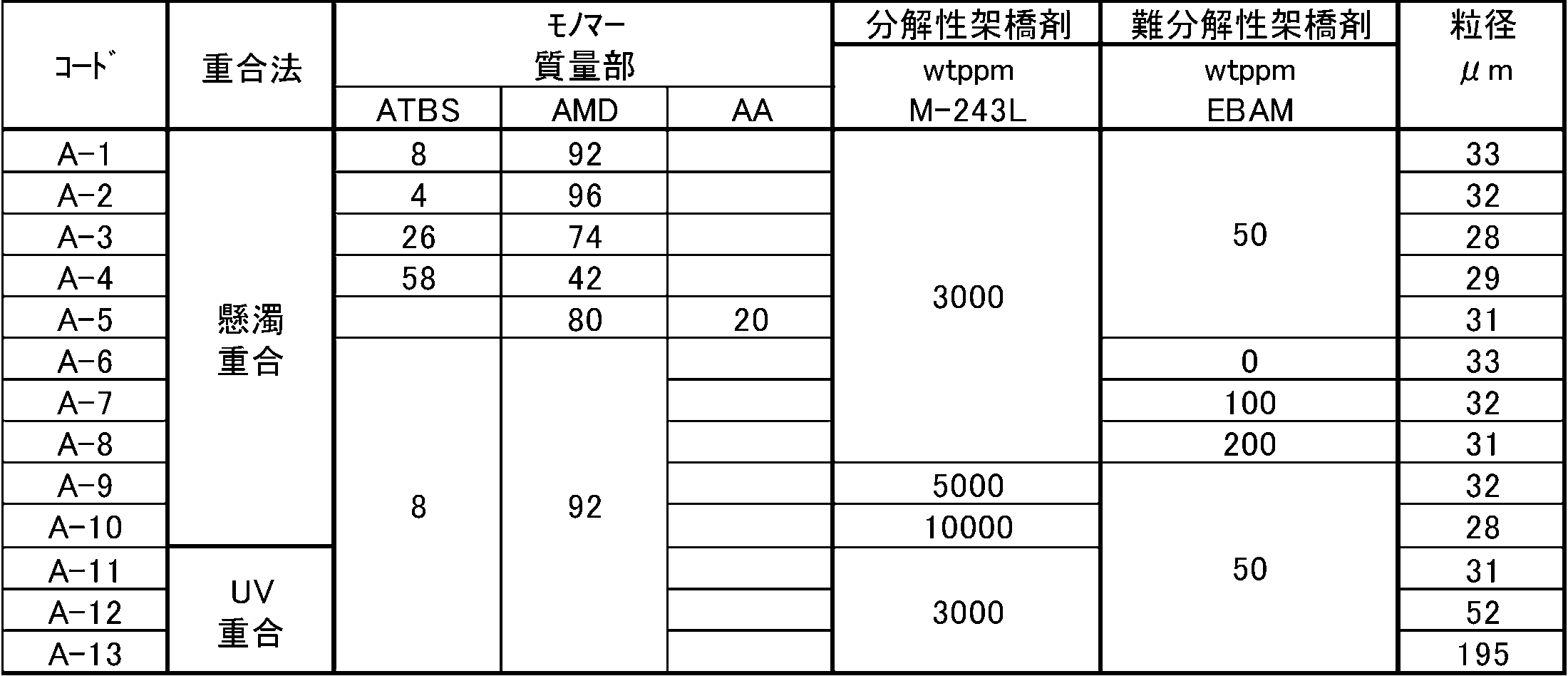
- the anionic crosslinked polymer particles of A-2 to 10 were prepared in the same manner as in A-1, except that the monomer species (AA: acrylic acid), monomer composition, and amount of crosslinking agent used in Table 1 were used. Obtained.
- V-50 manufactured by Wako Co., Ltd.
- a photoinitiator was added as a photoinitiator and polymerized at an initiation temperature of 25 ° C. and an illuminance of 0.6 mW / cm 2 for 2 hours.
- the polymerized gel was dried, pulverized and sieved to obtain anionic crosslinked polymer particles (A-11) having an average particle size of 31 ⁇ m.
- Anionic crosslinked polymer particles (A-12, 13) were obtained in the same manner as in A-11 except that the described grinding and sieving conditions were changed.
- Example 3 Evaluation of polymer The various polymers synthesized in Example 1 were combined at the mass ratio shown in Table 3, and the gelling agent (polymer composition) of Examples 1 to 20 and the gelling agent (polymer composition) of Comparative Examples 1 to 6 were used. Or a single agent). These various gelling agents were evaluated for the following items. The results are shown in Table 3.
- the gelling agents of Examples 1 to 20 in which an anionic crosslinked polymer and a cationic crosslinked polymer are combined have a maximum viscosity of 1000 mPa ⁇ s or more in pure water, Some exhibited 2000 mPa ⁇ s or more and 3000 mPa ⁇ s or more. In contrast, only one of the anionic crosslinked polymer and the cationic crosslinked polymer (Comparative Examples 1 to 5) cannot reach a sufficient viscosity, and can only exhibit a viscosity equal to or lower than that of guar gum. There wasn't.
- the gelling agents of Examples 1 to 20 exhibited sufficiently high maximum viscosities as compared with the comparative example even under 1% NaCl and 10% CaCl 2 . Furthermore, it has been found that the production method of the anionic crosslinked polymer can obtain the same result in both suspension polymerization and UV polymerization.
- the average particle diameter of the anionic crosslinked polymer and the cationic crosslinked polymer is preferably 10 ⁇ m or more and 180 ⁇ m or less, more preferably 10 ⁇ m or more and 100 ⁇ m or less. More preferably, it is 20 ⁇ m or more and 50 ⁇ m or less.
- the ratio (solid content) of the anionic crosslinked polymer to the cationic crosslinked polymer is preferably about 50 parts to 500 parts, more preferably 100 parts, relative to 100 parts of the anionic crosslinked polymer. It was found that the amount was 200 parts or less.
- the ratio of the anionic structural unit in the anionic crosslinked polymer is preferably about 4 mol% to 70 mol%, more preferably about 4 mol% to 60 mol%, and still more preferably 5 mol%. It was found that the content was about 30 mol% or less and more preferably 5 mol% or more and 10 mol% or less. Furthermore, the content of the degradable cross-linking agent in the anionic cross-linked polymer is preferable in a wide range from about 3000 ppm to about 10,000 ppm, more preferably about 3000 ppm to about 5000 ppm.
- the hardly decomposable crosslinking agent can be used in a wide range of about 0 ppm to 500 ppm, but is preferably 30 ppm to 200 ppm, more preferably about 50 ppm to 200 ppm. Further, it was found that the hardly decomposable cross-linking agent exhibits good thickening at about 1% to 5% of the degradable cross-linking agent.
- the ratio of the cationic structural unit in the cationic crosslinked polymer is preferably about 1 mol% to 30 mol%, more preferably 2 mol% to 30 mol%. More preferably, it is 3 mol% or more and 30 mol% or less, More preferably, it is 2 mol% or more and 20 mol% or less, More preferably, it is 4 mol% or more and 20 mol% or less. Furthermore, it was found that a sufficient effect can be obtained when the content of the degradable crosslinking agent in the anionic crosslinked polymer is about 3000 ppm, and that the effect can be obtained with about 50 ppm of the hardly degradable crosslinking agent. Further, it was found that the hardly decomposable cross-linking agent exhibits good thickening at about 2% of the degradable cross-linking agent.
Landscapes
- Chemical & Material Sciences (AREA)
- Engineering & Computer Science (AREA)
- Organic Chemistry (AREA)
- Life Sciences & Earth Sciences (AREA)
- Materials Engineering (AREA)
- Geology (AREA)
- General Life Sciences & Earth Sciences (AREA)
- Mining & Mineral Resources (AREA)
- Physics & Mathematics (AREA)
- Environmental & Geological Engineering (AREA)
- Fluid Mechanics (AREA)
- Geochemistry & Mineralogy (AREA)
- Compositions Of Macromolecular Compounds (AREA)
- Addition Polymer Or Copolymer, Post-Treatments, Or Chemical Modifications (AREA)
Abstract
所定の条件が付与されると良好な増粘性を発揮する水系ゲル化剤及びその利用を提供する。この目的のため、水系ゲル化剤は、アニオン性架橋重合体とカチオン性架橋重合体とを含み、前記アニオン性架橋重合体及び前記カチオン性架橋重合体の少なくとも一方が分解性架橋剤による架橋単位を有するようにする。
Description
本出願は、2014年7月1日付けで出願された日本国特許出願である特願2014-135749に基づく優先権を主張するものであり、本明細書にその全内容が記載されているように、参照により本明細書に組み込まれる。
本明細書は、水系ゲル化剤及びその利用に関する。
水系ゲル化剤は、化粧品やシャンプー等のビューティケア製品、インキや塗料等の粘度調整、掘削・坑井仕上液体等の土木用薬剤など、幅広い分野で利用されている。ゲル化剤は、一般に、高い増粘性が要請されるほか、ハンドリングの観点から良好な溶解性も要請される。
水系ゲル化剤は、例えば、ガスやオイル等を採取する水圧破砕工法にも用いられている。水圧破砕工法は、掘削により坑井を作り、坑内に仕上流体を投入して水圧により岩盤に亀裂(フラクチャ)を形成し、この亀裂を介してガス等を採取する工法である。水系ゲル化剤は、仕上流体(フラクチャリング流体)に添加されて、坑内にて仕上流体をゲル化させるのに用いられる。仕上流体をゲル化させることで、逸水を抑制するとともに効果的にフラクチャを生成、伸展させるとともに、フラクチャの閉合を阻止するための粒子(プロパント)を注入しフラクチャ内に配置することができるようになる。
水系ゲル化剤を、水圧破砕工法に用いる場合、水系ゲル化剤を含む薬液は当初低粘度であってハンドリング性に優れることが求められる。また、坑内は、地層から各種金属塩が溶出するために、フラクチャリング流体が高塩濃度及び高アルカリ性になる。したがって、こうした環境下でも増粘できる耐塩性及び耐酸/アルカリ性が求められる。すなわち、高温やpH等の特定の条件下で所望の粘度まで増粘し維持できるような性能が求められる。
良好な増粘性を確保するために、たとえば、以下の手法が試みられている。重合体及び架橋剤を含む液体を、地下累層でゲル化させることが開示されている(特許文献1)。また、架橋構造を有する重合体の架橋点の一部を加熱分解することで、吸水倍率を向上させてゲル化させることも開示されている(特許文献2)。さらに、難分解性架橋剤と分解性架橋剤とをそれぞれ含んだ架橋重合体粒子を用い、分解性架橋剤を分解することでゲル化させることも開示されている(特許文献3、4)。さらにまた、耐塩性の確保するために、アニオン性ポリマーとカチオン性ポリマーとを含む高分子組成物を用いることが開示されている(特許文献5)。
しかしながら、坑井が深くなるほど、地熱が上昇する。坑井によっては、100℃以上となることもある。したがって、水系ゲル化剤には、こうした高温下でもゲル化する増粘性及びある程度ゲル状態を維持する耐熱性が求められる。現時点において、こうした高温下での良好な増粘性及び耐熱性を確保するための組成は報告されていない。さらに、高温に加えて、アルカリ下で良好な増粘性を発揮する水系ゲル化剤も提供されていない。
本明細書は、高温条件及び/又はアルカリ条件など所定の条件が付与されると良好な増粘性を発揮する水系ゲル化剤及びその利用を提供する。さらに、本明細書は、高塩濃度条件下でも、良好な増粘性を発揮する水系ゲル化剤を提供する。
本発明者らは、上記課題を解決するために種々検討したところ、アニオン性架橋重合体とカチオン性架橋重合体とを用い、さらに、例えば、増粘性を発揮させたい環境に対応した所定の条件、例えば、70℃程度以上の高温及び/又はアルカリ域のpHが付与されるとき、これらの架橋重合体の少なくとも一方の架橋度を低下させることで、こうした条件下で増粘性を発揮させ、耐熱性及び耐塩性のゲルを生成させうるという知見を得た。
すなわち、本明細書の開示によれば、アニオン性架橋重合体とカチオン性架橋重合体とを含む水系ゲル化剤であって、アニオン性架橋重合体及びカチオン性架橋重合体の少なくとも一方の架橋重合体が、分解性架橋剤による架橋単位を有する水系ゲル化剤が提供される。
また、本明細書に開示される水系ゲル化剤は、アニオン性架橋重合体がアニオン性基を有する構造単位を1モル%以上70モル%以下を含み、カチオン性架橋重合体がカチオン性基を有する構造単位を1モル%以上30モル%以下を含むことができる。
さらに、本明細書に開示される水系ゲル化剤は、アニオン性架橋重合体及びカチオン性架橋重合体は、それぞれ、構成単量体の総量に対して、10ppm以上100000ppm以下の前記分解性架橋剤及び0ppm以上1000ppm以下の難分解性架橋剤による架橋単位を有することができる。
また、本明細書の開示によれば、本明細書に開示される水系ゲル化剤を含有する、炭化水素掘削用組成物も提供される。
また、本明細書の開示によれば、本明細書に開示される水系ゲル化剤を含む水系分散液を、70℃以上の温度及び/又はpH8以上でゲル化させる工程を備える、水系ゲル化剤の使用方法も提供される。
さらに、本明細書の開示によれば、炭化水素の坑井において、プロパントを含む水系ゲル化剤の水系分散液を前記所定の温度条件下でゲル化させる工程、を備え、前記ゲル化により前記坑井又はその近傍に亀裂を形成するとともに前記プロパントを前記亀裂に配置する、炭化水素の回収方法も提供される。
以下、本開示の代表的かつ非限定的な形態について、詳細に説明する。この詳細な説明は、本発明の好ましい例を実施するための詳細を当業者に示すことを単純に意図しており、本開示の範囲を限定することを意図したものではない。また、以下に開示される追加的な特徴ならびに発明は、さらに改善された水系ゲル化剤及びその利用を提供するために、他の特徴や発明とは別に、又は共に用いることができる。
また、以下の詳細な説明で開示される特徴や工程の組み合わせは、最も広い意味において本開示を実施する際に必須のものではなく、特に本開示の代表的な形態を説明するためにのみ記載されるものである。さらに、上記及び下記の代表的な具体例の様々な特徴、ならびに、独立及び従属クレームに記載されるものの様々な特徴は、本開示の追加的かつ有用な実施形態を提供するにあたって、ここに記載される具体例のとおりに、あるいは列挙された順番のとおりに組合せなければならないものではない。
本明細書及び/又はクレームに記載された全ての特徴は、実施例及び/又はクレームに記載された特徴の構成とは別に、出願当初の開示ならびにクレームされた特定事項に対する限定として、個別に、かつ互いに独立して開示されることを意図するものである。さらに、全ての数値範囲及びグループ又は集団に関する記載は、出願当初の開示ならびにクレームされた特定事項に対する限定として、それらの中間の構成を開示する意図を持ってなされている。
本明細書の開示は、所望の環境下で優れた増粘性を発揮する水系ゲル化剤及びその利用に関する。本明細書に開示される水系ゲル化剤(以下、単に、本ゲル化剤ともいう。)は、アニオン性架橋重合体及びカチオン性架橋重合体を含有し、これらの架橋重合体の少なくとも一方の架橋重合体が、所定の条件が付与されるとその少なくとも一部が分解する分解性架橋剤による架橋単位を有している。各架橋重合体は、分解性架橋剤分解前であってゲル化前においては、概して水不溶性であり、乾燥状態ではそれぞれ粉状であり、各種形状の粒子形態を呈しうる。
本ゲル化剤は、アニオン性架橋重合体とカチオン性架橋重合体の少なくとも一方の架橋重合体が、所定の温度条件及び/又は所定のpH条件が付与されると分解する分解性架橋剤による架橋単位を含む。このため、前記所定の条件が付与されると、分解性架橋剤の少なくとも一部が分解して架橋度が低下する。これにより、本ゲル化剤が膨潤し、本ゲル化剤を含む水系媒体を増粘することができる。本ゲル化剤は、このようにして、所定の温度条件及び/又は所定のpH条件で良好な増粘性を発揮できる。たとえば、所定温度条件を70℃以上の高温とすることで、炭化水素坑井等においてあり得る高温環境下で良好な増粘性を発揮させるようにすることができる。また、所定pH条件をpH10以上とすることで、炭化水素坑井等においてあり得るアルカリ環境下で良好な増粘性を発揮させるようにすることができる。
また、本ゲル化剤は、アニオン性架橋重合体とカチオン性架橋重合体とを含む。このため、分解性架橋剤の少なくとも一部が分解後において、架橋度の低下との相乗効果によって極めて高い増粘性を発揮できる。さらに、本ゲル化剤は、アニオン性架橋重合体とカチオン性架橋重合体とを含むため、高塩濃度環境下において所定の温度条件及び/又はpH条件が付与されても、高い増粘性を発揮できる。このため、本ゲル化剤によって得られるゲルは、耐熱性のほか、耐塩性に優れるものとなっている。以上のことから、本ゲル化剤は、水圧破砕工法で用いる仕上流体等の炭化水素掘削用組成物に好適である。以下、本明細書の開示に関する各種実施形態について詳細に説明する。
(水系ゲル化剤)
(アニオン性架橋重合体)
本ゲル化剤は、1種又は2種以上のアニオン性架橋重合体を含むことができる。アニオン架橋重合体は、アニオン性基を有する構造単位を有している。
(アニオン性架橋重合体)
本ゲル化剤は、1種又は2種以上のアニオン性架橋重合体を含むことができる。アニオン架橋重合体は、アニオン性基を有する構造単位を有している。
アニオン性基を有する構造単位におけるアニオン性基は、カルボキシル(又はカルボン酸塩)基、スルホン酸(又はスルホン酸塩)基、硫酸(又は硫酸塩)基、亜リン酸(又は亜リン酸塩)基、リン酸(又はリン酸塩)基などを包含するが、これらに限定されない。アニオン性基は、1種又は2種以上を適宜選択することができる。耐塩性の観点からは、アニオン性基として、スルホン酸基を用いることが好ましい。なお、塩としては、ナトリウム、カリウム等のアルカリ金属塩、アンモニウム塩、トリエチルアミン、トリエタノールアミン等の有機アミン塩等が挙げられる。
アニオン性基を有する構造単位は、特に限定されないが、(メタ)アクリル酸系単位、アクリルアミド系単位、スチレン系単位、ビニル系単位、アリル系単位などが挙げられる。
こうしたアニオン性基含有構造単位に対応する構成単量体としては、上記のアニオン性基を有し重合可能な単量体であればよく、特に限定されない。スルホン酸基を有する単量体としては、例えば、アクリルアミドプロピルスルホン酸類(又はその塩類)、アリルスルホン酸類(又はその塩類)、スチレンスルホン酸類(又はその塩類)、ビニルスルホン酸類(又はその塩類)等が挙げられる。より具体的には、例えば、アクリルアミド-2-メチルプロパンスルホン酸(塩)、3-アリロイルオキシ-2-ヒドロキシ-1-プロパンスルホン酸(塩)、スチレンスルホン酸(塩)、α-メチルスチレンスルホン酸(塩)、ビニルスルホン酸(塩)、アリルスルホン酸(塩)等が挙げられる。
カルボン酸基を有する単量体としては、(メタ)アクリル酸類、マレイン酸類(又はその無水物)、フマル酸、イタコン酸、及びこれらの塩類を用いることができる。より具体的には、(メタ)アクリル酸である。
アニオン性架橋重合体は、こうしたアニオン性構造単位の他、少なくとも1種の他の構造単位を備えていてもよい。他の構造単位は、アニオン性基及びカチオン性基をいずれも有しない単位、典型的には、ノニオン系構造単位であることが好ましい。かかる他の構造単位に対応する他の単量体としては、(メタ)アクリル酸アルキルエステル類、(メタ)アクリロニトリル類、(メタ)アクリル酸ヒドロキシアルキルエステル類、(メタ)アクリル酸アルコキシアルキルエステル類、アクリルアミド系単量体、スチレン類体、ビニルエステル類、ビニルエーテル類等が挙げられる。こうした他の単量体としては、好ましくはアクリルアミドなどのアクリルアミド類が挙げられる。なお、ここでいう他の構造単位及び他の単量体には、後述する架橋単位及び架橋剤を含まない。
アニオン性架橋重合体におけるアニオン性構造単位の割合、換言すれば、本重合体におけるアニオン性の構成単量体の割合は、アニオン性単量体及びその他の単量体の合計モル数に対するアニオン性単量体の割合として特定することができる。当該割合は、特に限定されない。好ましくは、前記合計モル数を基準とすると、1モル%以上70モル%以下であることが好ましい。1モル%未満であると、増粘性を十分付与することができず、70モル%を超えると、カチオン性架橋重合体と混合した際の溶解性が不十分となるためである。より好ましくは、4モル%以上60モル%以下であり、さらに好ましくは、5モル%以上30モル%以下であり、一層好ましくは5モル%以上10モル%以下である。
また、共重合可能な他の単量体は、前記合計モル数を基準とするとき、30モル%以上99モル%以下であることが好ましい。より好ましくは40モル%以上96モル%以下であり、さらに好ましくは70モル%以上95モル%以下であり、一層好ましくは、90モル%以上95モル%以下である。
アニオン性架橋重合体は、こうしたアニオン性構造単位を含む鎖状構造を有し、さらに、架橋単位を有することができる。架橋単位は、概して、架橋性単量体や架橋性オリゴマー等である架橋剤によって構築されている。架橋単位を構築する架橋剤は、2価性又は3価性以上であってもよい。アニオン性架橋重合体における架橋単位については、後段で詳述する。
(カチオン性架橋重合体)
本ゲル化剤は、1種又は2種以上のカチオン性架橋重合体を含むことができる。カチオン性架橋重合体は、カチオン性構造単位を含む鎖状構造を有している。
本ゲル化剤は、1種又は2種以上のカチオン性架橋重合体を含むことができる。カチオン性架橋重合体は、カチオン性構造単位を含む鎖状構造を有している。
カチオン性基を有する構造単位におけるカチオン性基は、特に限定されないが、第一級アミン、第二級アミン、第三級アミン及びそれらの塩、第四級アンモニウム塩が挙げられる。カチオン性基は、1種又は2種以上を適宜選択することができる。カチオン性基としては、第4級アンモニウム塩を用いることが好ましい。なお、塩としては、塩素、臭素等のハロゲン、スルホン酸、リン酸等が挙げられる。
カチオン性基を有する構造単位は、特に限定されないが、(メタ)アクリル酸系単位、(メタ)アリロイルオキシ系単位、(メタ)アクリルアミド系単位、スチレン系単位、ビニル系単位、アリル系単位等が挙げられる。加水分解に対する安定性を考慮すると、(メタ)アクリル酸系単位及び(メタ)アクリロイルオキシ系単位などのエステル系単位でないことが好ましく、アリル系単位及び(メタ)アクリルアミド系単位が好ましく、より好ましくは、(メタ)アクリルアミド及びその誘導体である(メタ)アクリルアミド系単位である。(メタ)アクリルアミド誘導体としては、たとえば、N-エチル(メタ)アクリルアミド、N-プロピル(メタ)アクリルアミド、N、N-ジメチル(メタ)アクリルアミド等のN-アルキル(メタ)アクリルアミド等が挙げられる。
こうしたカチオン性構造単位に対応する構成単量体としては、上記のカチオン性基を有し重合可能な単量体であればよく、特に限定されない。例えば、アリル系単量体としては、ジアリルジメチルアンモニウムクロリド(DADMAC)、ジアリルジメチルアンモニウムブロミド、ジアリルジメチルアンモニウムスルフェート、ジアリルジメチルアンモニウムホスフェート、ジメタリルジアリルジメチルアンモニウムクロリド、ジエチルアリルジメチルアンモニウムクロリド、ジアリルジ(ベータ-ヒドロキシエチル)アンモニウムクロリド、ジアリルジ(ベータ-エトキシエチル)アンモニウムクロリド等及びこれらの塩類が挙げられる。また、(メタ)アクリル酸系単量体としては、ジメチルアミノエチルアクリレート、ジエチルアミノエチルアクリレート、及び7-アミノ-3,7-ジメチルオクチルアクリレートなどのアミノアルキルアクリレート及びこれらの塩類が挙げられる。(メタ)アクリルアミド系単量体としては、3-(メタ)アクリルアミドプロピルトリメチルアンモニウムクロリド、N,N’-ジメチルアミノプロピル(メタ)アクリルアミド及びその塩類が挙げられる。アクリロキシ系単量体としては、2-((メタ)アクリロイルオキシ)エチルトリメチルアンモニウムクロリド等が挙げられる。好ましくは、DADMAC、2-((メタ)アクリロイルオキシ)エチルトリメチルアンモニウムクロリド、3-(メタ)アクリルアミドプロピルトリメチルアンモニウムクロリドが挙げられる。
カチオン性架橋重合体は、こうしたカチオン性構造単位の他、少なくとも1種の他の構造単位を備えていてもよい。他の構造単位及び対応する他の単量体は、アニオン性架橋重合体におけるのと同義であり、アニオン性架橋重合体における実施態様をカチオン性架橋重合体にも適用できる。
カチオン性架橋重合体におけるカチオン性構造単位の割合、換言すれば、本重合体におけるカチオン性の構成単量体の割合は、カチオン性単量体及びその他の単量体の合計モル数に対するカチオン性単量体の割合として特定することができる。当該割合は、特に限定されない。好ましくは、前記合計モル数を基準とすると、1モル%以上30モル%以下であることが好ましい。1モル%未満であると、増粘性を十分付与することができず、30モル%を超えると、アニオン性架橋重合体と混合した際の溶解性が不十分となるためである。より好ましくは、2モル%以上30モル%以下であり、さらに好ましくは、3モル%以上30モル%以下であり、一層好ましくは2モル%以上20モル%以下であり、一層好ましくは4モル%以上20モル%以下である。
また、共重合可能な他の単量体は、前記合計モル数を基準とするとき、70モル%以上99モル%以下であることが好ましく、より好ましくは70モル%以上98モル%以下であり、70モル%以上97モル%以下であり、一層好ましくは80モル%以上98モル%以下であり、より一層好ましくは80モル%以上96モル%以下である。
(架橋単位)
本ゲル化剤のカチオン性架橋重合体及びアニオン性架橋重合体は、それぞれ既述のように固有の鎖状構造を有するほか、これらの鎖状構造を架橋する架橋単位を有している。
本ゲル化剤を構成するカチオン性架橋重合体及びアニオン性架橋重合体は、それぞれ分解性架橋剤及び/又は難分解性架橋剤による架橋単位を有することができる。すなわち、各架橋性重合体は、分解性架橋剤による分解性架橋単位及び/又は難分解性架橋剤による難分解性架橋単位を有することができ、少なくともいずれかの架橋単位を有して架橋性重合体となっていればよい。
本ゲル化剤のカチオン性架橋重合体及びアニオン性架橋重合体は、それぞれ既述のように固有の鎖状構造を有するほか、これらの鎖状構造を架橋する架橋単位を有している。
本ゲル化剤を構成するカチオン性架橋重合体及びアニオン性架橋重合体は、それぞれ分解性架橋剤及び/又は難分解性架橋剤による架橋単位を有することができる。すなわち、各架橋性重合体は、分解性架橋剤による分解性架橋単位及び/又は難分解性架橋剤による難分解性架橋単位を有することができ、少なくともいずれかの架橋単位を有して架橋性重合体となっていればよい。
さらに、本ゲル化剤のカチオン性架橋重合体及びアニオン性架橋重合体の少なくとも一方の架橋重合体が分解性架橋剤による分解性架橋単位を有していればよい。すなわち、カチオン性架橋重合体のみにおいて分解性架橋単位を有していてもよいし、アニオン性架橋重合体のみにおいて分解性架橋単位を有していてもよいし、双方の架橋重合体において分解性架橋単位を有していてもよい。本ゲル化剤において、分解性架橋剤による分解性架橋単位を分解させることにより、その架橋重合体の架橋度を低下させて本ゲル化剤を膨潤させることができる。また、分解性架橋単位を分解させることで、その架橋重合体の平均粒子径を増大させることができる。
なお、本ゲル化剤は、いずれか一方の架橋重合体において架橋度が低下することで、本ゲル化剤としての全体としての架橋構造が低減するため、十分に増粘することができる。また、本ゲル化剤は、カチオン性架橋重合体とアニオン性架橋重合体がイオンコンプレックスを形成することによる増粘効果も示す。このため、一方の架橋重合体の架橋度低下でも、十分に増粘できる。
分解性架橋剤を用いること、さらには、これに組み合わせて難分解性架橋剤を用いることで、本ゲル化剤のゲル化能を調節して意図した環境下での増粘性を容易に得ることができる。
(分解性架橋剤)
分解性架橋剤は、所定の(分解)条件が付与されると、重合体においてそれ自身に由来する架橋単位が分解されて、架橋重合体の架橋度の減少に寄与できる架橋剤である。より具体的には、架橋剤自体が、所定の条件が付与されるとその少なくとも一部が分解する架橋剤や、所定の条件が付与されると当該分解性架橋剤による架橋単位の少なくとも一部が分解することで膨潤等の物性変化を開始させることができる架橋剤が挙げられる。ここで、所定の条件とは、温度条件及び/又は所定のpH条件とすることができる。すなわち、所定の条件は、温度条件のみであってもよいし、pH条件のみであってもよいし、温度条件とpH条件との組合せであってもよい。このほか、分解性架橋剤は、分解速度や分解程度等が異なっていてもよい。分解性架橋剤は、1種又は2種以上を組み合わせて用いることができる。ほぼ同様の分解条件、分解速度及び分解程度の分解性架橋剤を2種類以上組み合わせることもできるし、分解条件、分解速度及び分解程度のうち1種又は2種以上が異なる分解性架橋剤を2種類以上組み合わせてもよい。
分解性架橋剤は、所定の(分解)条件が付与されると、重合体においてそれ自身に由来する架橋単位が分解されて、架橋重合体の架橋度の減少に寄与できる架橋剤である。より具体的には、架橋剤自体が、所定の条件が付与されるとその少なくとも一部が分解する架橋剤や、所定の条件が付与されると当該分解性架橋剤による架橋単位の少なくとも一部が分解することで膨潤等の物性変化を開始させることができる架橋剤が挙げられる。ここで、所定の条件とは、温度条件及び/又は所定のpH条件とすることができる。すなわち、所定の条件は、温度条件のみであってもよいし、pH条件のみであってもよいし、温度条件とpH条件との組合せであってもよい。このほか、分解性架橋剤は、分解速度や分解程度等が異なっていてもよい。分解性架橋剤は、1種又は2種以上を組み合わせて用いることができる。ほぼ同様の分解条件、分解速度及び分解程度の分解性架橋剤を2種類以上組み合わせることもできるし、分解条件、分解速度及び分解程度のうち1種又は2種以上が異なる分解性架橋剤を2種類以上組み合わせてもよい。
本明細書において、所定の温度条件とは、概して本ゲル化剤のゲル化を意図する環境温度であることが好ましい。例示であって限定するものではないが、70℃以上であることが好ましい。より好ましくは75℃以上であり、さらに好ましくは80℃以上であり、一層好ましくは90℃以上である。また、上限は、170℃以下であることが好ましく、より好ましくは150℃以下であり、さらに好ましくは130℃以下であり、一層好ましくは120℃以下である。したがって、70℃以上170℃以下であることが好ましく、75℃以上150℃以下であることがより好ましく、80℃以上130℃以下であることがさらに好ましく、90℃以上120℃以下であることが一層好ましい。また、例えば、本ゲル化剤を水圧破砕工法に適用する場合においては、所定の温度条件として、例えば、90℃以上とすることが好ましい。
本明細書において、所定のpH条件とは、概して本ゲル化剤のゲル化を意図する環境のpHであることが好ましい。例示であって限定するものではないが、pH8以上であることが好ましく、より好ましくはpH8.5以上であり、さらに好ましくはpH9以上であり、一層好ましくはpH9.5以上である。水圧破砕工法に本ゲル化剤を適用する場合には、所定のpH条件として、例えば、pH10以上であることが好ましく、より好ましくはpH11以上である。
分解性架橋剤としては、特に限定されないで、意図した所定の条件下で分解挙動を呈するものであればよい。当業者であれば、公知の架橋剤から、分解温度及び/又は分解pH等のほか、分解速度や分解程度に応じて適宜選択して用いることができる。なお、公知の架橋剤の分解温度や分解pHなどの分解条件は、例えば、所定温度やpH条件下で処理した後のNMR、IR等の各種分析により確認したり、公知の架橋剤を用いて架橋重合体を合成して、種々の分解条件を付与した場合の、架橋度の低下を重合体の物性変化を評価することなどによって選択することができる。また、架橋剤の分解速度や分解程度なども同様にして確認することができる。
分解性架橋剤としては、例えば、エチレングリコールジ(メタ)アクリレート、ポリエチレングリコールジ(メタ)アクリレート、ポリプロピレングリコールジ(メタ)アクリレート、グリセリントリ(メタ)アクリレート、トリメチロールプロパントリメタクリレート、エトキシ化トリメチロールプロパントリアクリレート、ペンタエリスリトールジ(トリ)(テトラ)(メタ)アクリレート等の(メタ)アクリレート等のエステル結合を有する多官能化合物が挙げられる。好ましくは、ポリエチレングリコールジ(メタ)アクリレート、ペンタエリスリトールのジ、トリ及びテトラ(メタ)アクリレートが挙げられる。
分解性架橋剤の含有量は特に限定しないが、重合体の構成単量体の総質量に対して、10ppm以上100000ppm以下含んでいることが好ましい。10ppm未満であると、初期の分散性(溶解性)が低下する傾向があり、100000ppmを超えると、増粘性が発現されるまでに時間を要することがあるからである。さらに好ましくは100ppm以上50000ppm以下であり、一層好ましくは1000ppm以上30000ppm以下であり、さらに好ましくは3000ppm以上10000ppm以下であり、一層好ましくは3000ppm以上5000ppm以下である。
(難分解性架橋剤)
難分解性架橋剤は、本ゲル化剤に用いられる分解性架橋剤に関する所定の分解条件において、重合体においてそれ自身に由来する架橋単位を実質的に維持して架橋重合体の架橋度の維持に寄与できる架橋剤である。より具体的には、架橋剤自体が、分解性架橋剤の分解条件が付与されても実質的に分解しない架橋剤や、分解性架橋剤の分解条件が付与されても当該分解性架橋剤による架橋単位を実質的に維持して膨潤等の物性変化を生じさせない架橋剤が挙げられる。難分解性架橋剤は、1種又は2種以上を組み合わせて用いることができる。
難分解性架橋剤は、本ゲル化剤に用いられる分解性架橋剤に関する所定の分解条件において、重合体においてそれ自身に由来する架橋単位を実質的に維持して架橋重合体の架橋度の維持に寄与できる架橋剤である。より具体的には、架橋剤自体が、分解性架橋剤の分解条件が付与されても実質的に分解しない架橋剤や、分解性架橋剤の分解条件が付与されても当該分解性架橋剤による架橋単位を実質的に維持して膨潤等の物性変化を生じさせない架橋剤が挙げられる。難分解性架橋剤は、1種又は2種以上を組み合わせて用いることができる。
難分解性架橋剤としては、概して、難分解性である従来公知の架橋剤を用いることができる。例えば、N,N’-メチレンビスアクリルアミド、N,N’-エチレンビスアクリルアミド、N,N’-(1,2-ジヒドロキシエチレン)ビスアクリルアミド、ジビニルベンゼン、ジアリルアミン、トリアリルアミン、ジビニルスルホン、ジエチレングリコールジアリルエーテル等が挙げられる。好ましくは、メチレンビスアクリルアミド、エチレンビスアクリルアミド、N,N’-(1,2-ジヒドロキシエチレン)ビスアクリルアミド、ジビニルベンゼンであり、より好ましくは、メチレンビスアクリルアミドである。
難分解性架橋剤は、その含有量は特に限定しないが、構成単量体の総質量に対して、0ppm以上1000ppm以下含んでいることが好ましい。1000ppmを超えると重合体が膨潤し難く、ゲル化を発揮する機能が低下する傾向があるためである。より好ましくは500ppm以下である。さらに好ましくは30ppm以上200ppm以下であり、一層好ましくは50ppm以上200ppm以下である。
また、難分解性架橋剤は、分解性架橋剤の全質量に対して0質量%以上20質量%以下含んでいることが好ましく、より好ましくは0.1質量%以上10質量%以下であり、さらに好ましくは1質量%以上5質量%以下である。
本ゲル化剤は、アニオン性架橋重合体とカチオン性架橋重合体とを含有するが、これらの比率は特に限定されない。好ましくは、アニオン性架橋重合体の固形分100質量部に対してカチオン性架橋重合体の固形分を10質量部以上1000質量部以下含有する。この範囲であると、アニオン性架橋重合体及びカチオン性架橋重合体の組合せによる相乗効果によって、高温下でも増粘性を向上させることができる。さらに、アルカリ条件下で効果的に増粘性を向上させることができる。上記範囲内であれば、アニオン性架橋重合体とカチオン性架橋重合体とを組み合わせて用いることによる増粘性への相乗的な効果を得ることができる。より好ましくは、前記固形分100質量部に対してカチオン性架橋重合体の固形分を50質量部以上500質部以下含むことができる。より好ましくは、前記固形分100質量部に対して、カチオン性架橋重合体の固形分を100質量部以上200質量部以下含有する。
また、本ゲル化剤において、分解性架橋剤を含む架橋重合体(カチオン性架橋重合体及び/又はアニオン性架橋重合体)は、分解性架橋剤が分解する前の状態におけるその平均粒子径は、特に限定しないが、1μm以上200μm以下であることが好ましい。1μm未満であると粉立ちが多く作業上扱いが困難となり、200μmを超えると溶解性が低くなるからである。より好ましくは10μm以上180μm以下であり、さらに好ましくは10μm以上100μm以下である。一層好ましくは20μm以上50μm以下である。なお、本明細書において、平均粒子径は、体積平均粒子径であり、レーザー回折法及び当該方法と同等の平均粒子径の測定方法によって測定することができる。
(水系ゲル化剤の製造)
こうしたアニオン性架橋重合体とカチオン性架橋重合体とは、いずれも当業者に周知の方法で製造することができる。重合方法は特に限定されないで、熱重合及び光重合又はこれらの併用等いずれの態様であってもよい。具体的には、エマルション重合、UV重合、ゲル重合、水溶液重合、マイクロエマルション重合、逆相エマルション重合、バルク重合等を適宜用いることができる。すなわち、既述のアニオン性重合性モノマー等と分解性架橋剤及び/又は難分解性架橋剤を用いて重合させることによりアニオン性架橋重合体を得る。また、同様に、既述のカチオン性重合性モノマー等と分解性架橋剤及び/又は難分解性架橋剤を用いて重合させることによりアニオン性架橋重合体を得る。
こうしたアニオン性架橋重合体とカチオン性架橋重合体とは、いずれも当業者に周知の方法で製造することができる。重合方法は特に限定されないで、熱重合及び光重合又はこれらの併用等いずれの態様であってもよい。具体的には、エマルション重合、UV重合、ゲル重合、水溶液重合、マイクロエマルション重合、逆相エマルション重合、バルク重合等を適宜用いることができる。すなわち、既述のアニオン性重合性モノマー等と分解性架橋剤及び/又は難分解性架橋剤を用いて重合させることによりアニオン性架橋重合体を得る。また、同様に、既述のカチオン性重合性モノマー等と分解性架橋剤及び/又は難分解性架橋剤を用いて重合させることによりアニオン性架橋重合体を得る。
熱重合の場合、重合開始剤としては、アゾ系化合物、有機過酸化物、無機過酸化物等の公知の重合開始剤を用いることができるが、公知の酸化剤及び還元剤からなるレドックス重合開始剤が好ましい。またレドックス重合開始剤の替わりに、光重合開始剤を含有させた単量体水溶液に紫外線等の活性エネルギー線を照射してラジカル重合させてもよい。重合開始剤の具体例としては、過硫酸ナトリウムや過硫酸カリウム等の過硫酸アルカリ金属塩、過硫酸アンモニウム等の過硫酸塩、過酸化水素、クメンヒドロパーオキサイド、ベンゾイルパーオキシド、t-ブチルパーオキサイド、過酸化ベンゾイル等の有機過酸化物、2,2’-アゾビス(4-シアノ吉草酸)、2,2’-アゾビス[2-メチル-N-(2-ヒドロキシエチル)-プロピオンアミド]、2,2’-アゾビスイソブチロニトリル等のアゾ化合物等が挙げられる。このとき、遷移金属塩や亜硫酸水素塩、L-アスコルビン酸(塩)、エリソルビン酸(塩)、アミン化合物等のレドックス形成用の還元剤を併用することが好ましい。重合開始剤の量は、使用する重合開始剤の種類や目的とする重合体の組成、重合度、粘度などに応じて適宜調整される。
例えば、重合反応で好ましい重合開始温度及び重合到達温度は特に限定しないが、例えば、重合開始温度は0~30℃であることが好ましく、より好ましくは5~25℃であり、さらに好ましくは10~20℃である。また、重合到達温度は55~75℃であることが好ましい。重合到達温度は、分解性架橋剤の分解温度及び分解率を考慮して設定することができる。
重合反応後、重合体粒子が分散した液を得ることができる。この分散液から吸引ろ過等で溶媒を除去後、大過剰のエタノール等で洗浄し、適宜乾燥して各種架橋体重合体(粒子)を得ることができる。
こうして製造したアニオン性架橋重合体及びカチオン性架橋重合体を、適宜組み合わせることにより、本ゲル化剤を得ることができる。
以上説明した本ゲル化剤は、分解性架橋剤の少なくとも一部が分解する分解条件下において、分解性架橋剤が分解し、アニオン性架橋重合体及びカチオン性架橋重合体の少なくとも一方の架橋度が低下する。少なくとも一方の重合体の架橋構造が緩んだ結果、重合体が膨潤してゲル化し、増粘する。なお、ここで付与される分解条件については、既に説明した所定の温度条件及び/又は所定のpH条件が適用される。
本ゲル化剤によれば、既述の所定の分解条件、すなわち、70℃以上の高温条件及び/又はpH8以上のpH条件が付与されても、当該条件下で増粘することができる。このため、こうした環境条件下でも良好な増粘性を発揮できるとともに、増粘前においては、溶解性や流動性に優れるゲル化剤となっている。特に、90℃以上の温度条件下であっても、当該条件下で良好な増粘性を維持することができる。したがって、炭化水素坑井などの過酷な環境下での使用に適している。
また、本ゲル化剤は、高塩濃度下においても、良好な増粘性を発揮できる。この点においても、炭化水素坑井などの過酷な環境下での使用に適している。例えば、塩濃度としては、1質量%であることが好ましく、より好ましくは5質量%以上であり、さらに好ましくは10質量%以上である。なお、塩としては、無機塩であっても有機塩であってもよいが、典型的には、ナトリウムやカリウムなどのアルカリ金属やカルシウム、マグネシウム等のアルカリ土類金属、さらにはマンガン、鉄、銅、亜鉛等の遷移金属等の各種の金属の無機塩類が挙げられる。
本ゲル化剤は、また、耐熱性に優れるゲルを生成することができる。この点においても、炭化水素坑井などの過酷な環境下での使用に適している。本ゲル化剤は、例えば、純水下での最大粘度(90℃)が1000mPa・s以上であることが好ましく、より好ましくは2000mpa・s以上であり、さらに好ましくは3000mPa・s以上である。ここで最大粘度は、100gの純水に0.3gのゲル化剤を加えてスターラーで撹拌(500rpm、5分)して得た分散液に、48%NaOH水溶液を加えてpH11に調製後、90℃に加熱し90℃に保温しつつ、30、60、120、180及び360分経過後に、液温25℃にて、JIS Z 8803「9 単一円筒形回転粘度計による粘度測定方法」に準拠し、B型粘度計(60rpm)により粘度測定を行い、得られた最大値を最大粘度とする。
また、本ゲル化剤は、上記最大粘度に達する時間が60分以内であることが好ましい。より好ましくは45分以下であり、さらに好ましくは30分以内である。
また、本ゲル化剤は、粘度保持率(90℃、12時間)が85%以上であることが好ましい。より好ましくは90%以上であり、さらに好ましくは95%以上である。また、粘度保持率(150℃、12時間)が40%以上であることも好ましく、より好ましくは50%以上である。なお、粘度保持率は、上記のようにして最大粘度を測定した溶液(90℃に保持して最大粘度に到達した溶液)を90℃、12時間又はオートクレーブ内で150℃、12時間後の粘度を液温25℃にてB型粘度計(60rpm)により測定し、使用した溶液の最大粘度に対する割合を保持率とする。
また、本ゲル化剤は、耐塩性に優れるゲルを生成することができる。本ゲル化剤は、1質量%NaCl水溶液下において、液温25℃にてB型粘度計(60rpm)による最大粘度が350mPa・s以上であることが好ましく、400mPa・s以上であることがより好ましく、500mPa・s以上であることがさらに好ましく、600mPa・s以上であることがであり、さらに好ましくは700mPa・s以上である。また、800mPa・s以上であってもよく、900mPa・s以上であってもよい。
また、本ゲル化剤は、10質量%CaCl2水溶液下において、液温25℃にてB型粘度計による最大粘度が250mPa・s以上であることが好ましく、300mPa・s以上であることがより好ましく、400mPa・s以上であることがさらに好ましく、500mPa・s以上であることがであり、さらに好ましくは600mPa・s以上である。また、700mPa・s以上、800mPa・s以上であってもよい。
1質量%NaCl水溶液下及び10質量%CaCl2水溶液下の本ゲル化剤の最大粘度は、上記した純水下での最大粘度において、純水に替えてこれらの溶液をそれぞれ用いる以外は、同様に操作して測定することができる。
本ゲル化剤は、以上説明したアニオン性架橋重合体及びカチオン性架橋重合体を含んでいる限り、各種形態を採ることができる。例えば、既述したように、アニオン性架橋重合体及びカチオン性架橋重合体はいずれも固形の粒子形態を採ることができる。この場合、水系ゲル化剤は、粒子の混合物(粉状)であるほか、当該混合物をビーズ状等の所定の三次元形状に成形した成形体、あるいはこれら粒子が適当な水系溶媒などの溶媒に分散された分散液、これら粒子が適当な溶媒に懸濁された懸濁液の形態を採ることができる。本ゲル化剤は、また、アニオン性架橋重合体及びカチオン性架橋重合体は、適当な溶媒に溶解した溶液の形態を採ることができる。
本ゲル化剤は、また、使用時に混合できるようなキットの形態であってもよい。すなわち、アニオン系架橋重合体とカチオン性架橋重合体とをそれぞれ別個にあるいは容易に混合可能に包装された形態であってもよい。この場合、アニオン系架橋重合体及びカチオン系架橋重合体は、それぞれ、独立して、粉状、成形体、分散液、懸濁液及び溶液のいずれかの形態を採ることができる。
本ゲル化剤には、アニオン性架橋重合体及びカチオン性架橋重合体のほか、適宜公知の各種添加剤を含んでいてもよい。こうした添加剤は、水系ゲル化剤の用途に応じて適宜特に限定されない。たとえば、シェールガスなどの炭化水素の回収のための水圧破砕工法で用いる圧入液体に含まれうる無機塩、有機塩、界面活性剤、酸化防止剤、殺菌剤、防食剤などの添加剤を適宜1種又は2種以上予め含むこともできる。
(水系ゲル化剤の使用)
本ゲル化剤は、各種工業製品の粘度調整、増粘及びゲル化等に利用できる。適用対象は特に限定されないで、公知のゲル化剤又は増粘剤の適用対象に適用できる。典型的には、化粧品等のビューティケア製品、日用品、インキや塗料等の着色用組成物、掘削・坑井仕上液体等の土木用薬剤等が挙げられる。本ゲル化剤を各種用途に適用する場合、例えば、本ゲル化剤の使用方法は、本ゲル化剤を含む水系分散液を、所定の温度条件及び/又は所定のpH条件でゲル化させる工程を備えることができる。なお、所定の温度条件及び/又はpH条件は、既に説明した条件を適用できる。例えば、70℃以上の温度及び/又はpH8以上でゲル化させる工程を備えることができる。好ましくは、80℃以上、より好ましくは90℃以上、さらに好ましくは95℃以上の温度であり、また、好ましくはpH8.5以上、より好ましくは9以上、さらに好ましくは9.5以上、一層好ましくは10以上、より一層好ましくは11以上である。
本ゲル化剤は、各種工業製品の粘度調整、増粘及びゲル化等に利用できる。適用対象は特に限定されないで、公知のゲル化剤又は増粘剤の適用対象に適用できる。典型的には、化粧品等のビューティケア製品、日用品、インキや塗料等の着色用組成物、掘削・坑井仕上液体等の土木用薬剤等が挙げられる。本ゲル化剤を各種用途に適用する場合、例えば、本ゲル化剤の使用方法は、本ゲル化剤を含む水系分散液を、所定の温度条件及び/又は所定のpH条件でゲル化させる工程を備えることができる。なお、所定の温度条件及び/又はpH条件は、既に説明した条件を適用できる。例えば、70℃以上の温度及び/又はpH8以上でゲル化させる工程を備えることができる。好ましくは、80℃以上、より好ましくは90℃以上、さらに好ましくは95℃以上の温度であり、また、好ましくはpH8.5以上、より好ましくは9以上、さらに好ましくは9.5以上、一層好ましくは10以上、より一層好ましくは11以上である。
本ゲル化剤は、水圧破砕工法における炭化水素掘削用組成物ないし仕上流体(圧入流体)に適用されるとき、坑井内で生じうる温度条件及びアルカリ条件下で増粘するため好適である。また、本ゲル化剤は、坑井内で生じうる高濃度塩条件下でも増粘する点からも、水圧破砕工法用の流体として好適である。
本明細書によれば、本ゲル化剤を含有する、水圧破砕工法に用いる炭化水素掘削用組成物、仕上流体、仕上流体の調製方法及びその利用方法も提供される。炭化水素掘削用組成物は、仕上流体に含まれうる各種成分を1又は2以上含むことができる。仕上流体は、ゲル化剤のほか、例えば、必要に応じて無機塩、界面活性剤、酸化防止剤、殺菌剤、防食剤などの添加剤を併用することができる。例えば、炭酸ソーダ、炭酸カリウム、炭酸アンモニウム、硫酸ソーダ、硫酸アンモニウムなどの無機塩、酢酸ソーダ、乳酸ソーダなどの有機酸塩、ポリエチレンオキシド、ポリオキシエチレンノニルフェノールエーテル、ジオクチルスルホコハク酸ソーダなどの界面活性剤、ハイドロキノン、カテコール、グアニジン硫酸塩、チオ尿素などの安定剤(酸化防止剤)等を含むことができる。
仕上流体の調製方法、坑井へ注入方法等、水圧破砕工法への適用は、適宜従来公知の方法を利用することができる。例えば、本ゲル化剤を用いる場合、本ゲル化剤を、坑井内で、既に説明した所定温度条件及び/又は所定のpH条件、例えば、70℃以上の温度及び/又はpH8以上でゲル化させる工程を備えることができる。より具体的には、ガス又は液体の形態である炭化水素の回収方法として、炭化水素の坑井において、プロパントを含む水系ゲル化剤の水系分散液を、坑井内環境に対応する分解条件下、例えば、既に説明した所定の温度条件下及び/又は所定のpH条件下でゲル化させる工程、を備えることができる。この工程を備えることにより、本ゲル化剤のゲル化により炭化水素の坑井又はその近傍に亀裂を形成するとともにプロパントを亀裂に配置することができる。なお、プロパントとしては公知のプロパントを適宜用いることができる。
以下、本明細書の開示を具現化した具体例について説明するが、以下の実施例は本明細書の開示を限定するものではない。なお、以下の実施例の比率表示(部、%、ppm等)は、いずれも質量基準であり、例えば、「部」は「質量部」を意味し、「%」は、「質量%」を意味するものとする。
(アニオン性架橋重合体の合成)
(1:懸濁重合法による合成例)
(1)ピッチドパドル型撹拌翼と2本の垂直バッフルからなる撹拌機構を備え、さらに、温度計、還流冷却器及び窒素導入管を備えた重合反応器に、n-ヘプタン100部及びポリグリセリン脂肪酸エステル(坂本薬品工業社製CRS-75)0.8部を仕込んだ。
(2)一方、別の反応器に、40%アクリルアミド(AMD)水溶液360部、2-アクリルアミド-2-メチルプロパンスルホン酸(ATBS)36部、ポリエチレングリコールジアクリレート(東亞合成株式会社製アロニックスM-243L)平均分子量425L)0.5部(単官能ビニル系単量体100モルに対して0.05モルに相当)、0.1%エチレンビスアクリルアミド(EBAM)水溶液9.6部(単官能ビニル系単量体100モルに対して0.0025モルに相当)、48%NaOH水溶液11部を仕込んで、撹拌して均一に溶解させ、ビニル系単量体混合液(水溶液)を調製した。
(1:懸濁重合法による合成例)
(1)ピッチドパドル型撹拌翼と2本の垂直バッフルからなる撹拌機構を備え、さらに、温度計、還流冷却器及び窒素導入管を備えた重合反応器に、n-ヘプタン100部及びポリグリセリン脂肪酸エステル(坂本薬品工業社製CRS-75)0.8部を仕込んだ。
(2)一方、別の反応器に、40%アクリルアミド(AMD)水溶液360部、2-アクリルアミド-2-メチルプロパンスルホン酸(ATBS)36部、ポリエチレングリコールジアクリレート(東亞合成株式会社製アロニックスM-243L)平均分子量425L)0.5部(単官能ビニル系単量体100モルに対して0.05モルに相当)、0.1%エチレンビスアクリルアミド(EBAM)水溶液9.6部(単官能ビニル系単量体100モルに対して0.0025モルに相当)、48%NaOH水溶液11部を仕込んで、撹拌して均一に溶解させ、ビニル系単量体混合液(水溶液)を調製した。
(3)重合反応器内に設けた撹拌翼の回転速度を調整した後、上記で得られたビニル系単量体混合液の全量を、重合反応基内に仕込んで、重合反応器内の温度を20℃に保持しながら、撹拌混合して、ビニル系単量体混合液が滴状で油相(n-ヘプタン相)中に分散したW/O型の分散液を調製した。また、この混合撹拌の操作中に重合反応器内に窒素ガスを吹き込んで重合反応器内を酸素を除去した。
(4)ビニル系単量体の仕込みから30分経過後に、クメンハイドロパーオキサイド(酸化剤)の80%溶液(日本油脂株式会社製パークミルH80、芳香族炭化水素希釈品)0.07部をn-ヘプタン7部で希釈した溶液を重合反応器に仕込むとともに、ハイドロサルファイトナトリウム(還元剤)0.16部をイオン交換水1.6部に溶解した溶液を添加した。添加後、重合反応器内の温度が直ちに上昇し、重合が開始した。重合反応器内温度は数分でピーク温度(63℃)に達し、その後、降下した。重合反応器内の反応液を室温まで冷却して、アニオン性架橋重合体粒子(A-1)の分散液を得た。
(5)(4)で得られた分散液を吸引ろ過で溶媒除去後、大過剰のエタノールで洗浄し、温風乾燥機(80℃)で一晩乾燥することにより、アニオン性架橋重合体粒子(A-1)を得た。得られたアニオン性架橋重合体粒子(A-1)0.02gを秤量し、CRS-75を0.5質量%含有するヘプタン溶液20gを加え、十分に降り混ぜて均一に分散させた。これを試料とし、レーザー回折散乱式粒度分布計(日機装社製、MT-3300II)により平均粒子径を測定した結果、33μm(体積基準、メジアン径)の値が得られた。
表1中に記載のモノマー種(AA:アクリル酸)、モノマー組成、架橋剤使用量を使用した以外はA-1と同様に操作して、A-2~10のアニオン性架橋重合体粒子を得た。
(2:UV重合法による合成例)
40%アクリルアミド(AMD)水溶液360部、2-アクリルアミド-2-メチルプロパンスルホン酸(ATBS)36部、ポリエチレングリコールジアクリレート0.5部(単官能ビニル系単量体100モルに対して0.05モルに相当)、0.1%エチレンビスアクリルアミド(EBAM)水溶液0.1部(単官能ビニル系単量体100モルに対して0.001モルに相当)、48%NaOH水溶液11部を仕込んで、撹拌して均一に溶解した。この溶液に光開始剤としてV-50(Wako株式会社製)を0.1g加えて、開始温度25℃、0.6mW/cm2の照度で2時間重合した。
40%アクリルアミド(AMD)水溶液360部、2-アクリルアミド-2-メチルプロパンスルホン酸(ATBS)36部、ポリエチレングリコールジアクリレート0.5部(単官能ビニル系単量体100モルに対して0.05モルに相当)、0.1%エチレンビスアクリルアミド(EBAM)水溶液0.1部(単官能ビニル系単量体100モルに対して0.001モルに相当)、48%NaOH水溶液11部を仕込んで、撹拌して均一に溶解した。この溶液に光開始剤としてV-50(Wako株式会社製)を0.1g加えて、開始温度25℃、0.6mW/cm2の照度で2時間重合した。
重合したゲル物を乾燥後、粉砕、篩分して、平均粒径31μmのアニオン性架橋重合体粒子(A-11)を得た。記載の粉砕・篩分条件を変更した以外はA-11と同様にしてアニオン性架橋重合体粒子(A―12、13)を得た。
(カチオン性架橋重合体の合成)
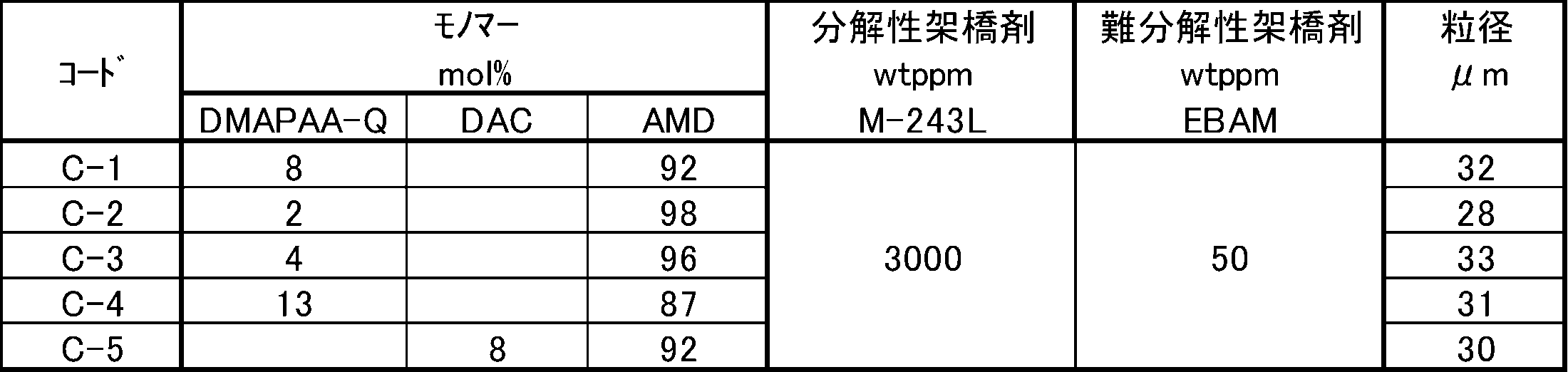
2-アクリルアミド-2-メチルプロパンスルホン酸(ATBS)を、3-アクリルアミドプロピルトリメチルアンモニウムクロリド(DMAPAA-Q)に変更し、アンモニア水による中和をしたこと以外は、懸濁重合法による合成例(アニオン性架橋重合体)と同様の操作を行い、平均粒子径32μmのカチオン性重合体粒子(C-1)を得た。表2中に記載のモノマー種(DAC:2-(アクリロイルオキシ)エチルトリメチルアンモニウムクロリド)、モノマー組成、架橋剤使用量等を用いる以外はC-1と同様に操作して、C-2~5のカチオン性架橋重合体粒子を得た。
2-アクリルアミド-2-メチルプロパンスルホン酸(ATBS)を、3-アクリルアミドプロピルトリメチルアンモニウムクロリド(DMAPAA-Q)に変更し、アンモニア水による中和をしたこと以外は、懸濁重合法による合成例(アニオン性架橋重合体)と同様の操作を行い、平均粒子径32μmのカチオン性重合体粒子(C-1)を得た。表2中に記載のモノマー種(DAC:2-(アクリロイルオキシ)エチルトリメチルアンモニウムクロリド)、モノマー組成、架橋剤使用量等を用いる以外はC-1と同様に操作して、C-2~5のカチオン性架橋重合体粒子を得た。
(重合体の評価)
実施例1で合成した各種重合体を表3に示す質量比で組み合わせて、実施例1~20のゲル化剤(重合体組成物)及び比較例1~6のゲル化剤(重合体組成物又は単剤)を調製した。これらの各種ゲル化剤につき、以下の項目に関して評価を行った。結果を表3に示す。
実施例1で合成した各種重合体を表3に示す質量比で組み合わせて、実施例1~20のゲル化剤(重合体組成物)及び比較例1~6のゲル化剤(重合体組成物又は単剤)を調製した。これらの各種ゲル化剤につき、以下の項目に関して評価を行った。結果を表3に示す。
(1)初期粘度
100gの純水に0.3gのゲル化剤を加え、スターラーで撹拌した(500rpm、5分)して得た分散液を、液温25℃に調整し、B型粘度計(60rpm)を用いて測定した際の粘度を初期粘度とした。
100gの純水に0.3gのゲル化剤を加え、スターラーで撹拌した(500rpm、5分)して得た分散液を、液温25℃に調整し、B型粘度計(60rpm)を用いて測定した際の粘度を初期粘度とした。
(2)最大粘度
100gの純水、1%NaCl水溶液、10%CaCl2水溶液それぞれに0.3gのゲル化剤を加えた。スターラーで撹拌(500rpm、5分)して得た分散液に、48%NaOH水溶液を加えてpH11に調製後、90℃に加熱して30、60、120、180及び360分経過後に液温25℃にて粘度測定(B型粘度計(60rpm))を行い、最大値を最大粘度とした。なお、純水中での最大粘度までの時間を最大粘度までの時間を測定した。
100gの純水、1%NaCl水溶液、10%CaCl2水溶液それぞれに0.3gのゲル化剤を加えた。スターラーで撹拌(500rpm、5分)して得た分散液に、48%NaOH水溶液を加えてpH11に調製後、90℃に加熱して30、60、120、180及び360分経過後に液温25℃にて粘度測定(B型粘度計(60rpm))を行い、最大値を最大粘度とした。なお、純水中での最大粘度までの時間を最大粘度までの時間を測定した。
(3)保持率
(2)で最大粘度に達した溶液(純水)を90℃、12時間又はオートクレーブ内で150℃、12時間後の粘度を測定(B型粘度計(60rpm))し、その際の最大粘度に対する割合を保持率とした。
(2)で最大粘度に達した溶液(純水)を90℃、12時間又はオートクレーブ内で150℃、12時間後の粘度を測定(B型粘度計(60rpm))し、その際の最大粘度に対する割合を保持率とした。

表3に示すように、アニオン性架橋重合体とカチオン性架橋重合体とを組み合わせた実施例1~20のゲル化剤は、純水下での最大粘度が1000mPa・s以上であり、さらに、2000mPa・s以上、3000mPa・s以上を呈するものもあった。これに対して、アニオン性架橋重合体及びカチオン性架橋重合体のいずれか一方のみ(比較例1~5)では、十分な粘度に到達しえず、グアガムと同等又はそれ以下の粘度しか呈し得なかった。
また、実施例1~20のゲル化剤は、1%NaCl下、10%CaCl2下でも、比較例に比して十分に高い最大粘度を呈していた。さらに、アニオン性架橋重合体の製法は、懸濁重合でもUV重合でも同等の結果が得られることがわかった。
さらにまた、平均粒径が200μm程度であると、最大粘度までの時間が遅延する傾向があることがわかった。実施例1~20の結果によれば、アニオン性架橋重合体及びカチオン性架橋重合体につき、平均粒径は、10μm以上180μm以下であることが好ましく、より好ましくは10μm以上100μm以下である。一層好ましくは20μm以上50μm以下である。
アニオン性架橋重合体とカチオン性架橋重合体との割合(固形分)については、好ましくはアニオン性架橋重合体100部に対して50部以上500部以下程度であると好ましく、より好ましくは100部以上200部以下であることがわかった。
また、アニオン性架橋重合体におけるアニオン性構造単位の比率に関し、4モル%以上70モル%以下程度であることが好ましく、より好ましくは4モル%以上60モル%以下程度、さらに好ましくは5モル%以上30モル%以下程度であり、一層好ましくは5モル%以上10モル%以下であることがわかった。さらに、アニオン性架橋重合体における分解性架橋剤の含有量は、3000ppm程度から10000ppm程度、の広い範囲で好ましいが、より好ましくは、3000ppm以上5000ppm程度であることがわかった。難分解性架橋剤については、0ppmから500ppm程度の広い範囲で使用可能であるが、好ましくは30ppm以上200ppm以下であり、より好ましくは50ppm以上200ppm以下程度であることがわかった。また、難分解性架橋剤は、分解性架橋剤の1%以上5%以下程度で良好な増粘性を呈することがわかった。
また、カチオン性架橋重合体におけるカチオン性構造単位の比率に関し、1モル%以上30モル%以下程度であることが好ましく、より好ましくは2モル%以上30モル%以下。さらに好ましくは3モル%以上30モル%以下であり、一層好ましくは2モル%以上20モル%以下であり、さらに一層好ましくは4モル%以上20モル%以下であることがわかった。さらに、アニオン性架橋重合体における分解性架橋剤の含有量は、3000ppm程度で十分な効果が得られることがわかった、難分解性架橋剤50ppm程度で効果が得られることがわかった。また、難分解性架橋剤は、分解性架橋剤の2%程度で良好な増粘性を呈することがわかった。
Claims (11)
- 水系ゲル化剤であって、
アニオン性架橋重合体とカチオン性架橋重合体とを含み、
前記アニオン性架橋重合体及び前記カチオン性架橋重合体は、少なくとも一方が分解性架橋剤による架橋単位を有する、水系ゲル化剤。 - 前記アニオン性架橋重合体は、アニオン性基を有する構造単位を1モル%以上70モル%以下含み、
前記カチオン性架橋重合体は、カチオン性基を有する構造単位を1モル%以上30モル%以下含む、請求項1に記載の水系ゲル化剤。 - 前記アニオン性架橋重合体及び前記カチオン性架橋重合体は、それぞれ、構成単量体の総量に対して、10ppm以上100000ppm以下の前記分解性架橋剤及び0ppm以上1000ppm以下の難分解性架橋剤による架橋単位を有する、請求項1又は2に記載の水系ゲル化剤。
- 前記アニオン性重合体の固形分100質量部に対して前記カチオン性重合体の固形分10質量部以上1000質量部以下を含有する、請求項1~3のいずれかに記載の水系ゲル化剤。
- 前記アニオン性基はスルホン酸基である、請求項1~4のいずれかに記載の水系ゲル化剤。
- 前記カチオン性基を有する構造単位は、(メタ)アクリルアミド又はその誘導体に基づく構造単位である、請求項1~5のいずれかに記載の水系ゲル化剤。
- 前記アニオン性架橋重合体及び前記カチオン性架橋重合体は、平均粒子径が、いずれも1μm以上100μm以下である粒子である、請求項1~6のいずれかに記載の水系ゲル化剤。
- 前記分解性架橋剤は、70℃以上の温度及び/又はpH8以上で少なくとも一部が分解する、請求項1~7のいずれかに記載の水系ゲル化剤。
- 請求項1~8のいずれかに記載の水系ゲル化剤を含有する、炭化水素掘削用組成物。
- 水系ゲル化剤の使用方法であって、
請求項1~7のいずれかに記載の水系ゲル化剤を含む水系分散液を、70℃以上の温度及び/又はpH8以上でゲル化させる工程、
を備える、方法。 - 炭化水素の回収方法であって、
前記炭化水素の坑井において、プロパントを含む、請求項1~8のいずれかに記載の水系ゲル化剤の水系分散液を前記所定の温度条件下でゲル化させる工程、
を備え、
前記ゲル化により前記坑井又はその近傍に亀裂を形成するとともに前記プロパントを亀裂に配置する、炭化水素の回収方法。
Applications Claiming Priority (2)
| Application Number | Priority Date | Filing Date | Title |
|---|---|---|---|
| JP2014-135749 | 2014-07-01 | ||
| JP2014135749A JP2017149788A (ja) | 2014-07-01 | 2014-07-01 | 水系ゲル化剤及びその利用 |
Publications (1)
| Publication Number | Publication Date |
|---|---|
| WO2016002672A1 true WO2016002672A1 (ja) | 2016-01-07 |
Family
ID=55019208
Family Applications (1)
| Application Number | Title | Priority Date | Filing Date |
|---|---|---|---|
| PCT/JP2015/068566 Ceased WO2016002672A1 (ja) | 2014-07-01 | 2015-06-26 | 水系ゲル化剤及びその利用 |
Country Status (2)
| Country | Link |
|---|---|
| JP (1) | JP2017149788A (ja) |
| WO (1) | WO2016002672A1 (ja) |
Cited By (1)
| Publication number | Priority date | Publication date | Assignee | Title |
|---|---|---|---|---|
| CN115010866A (zh) * | 2022-07-05 | 2022-09-06 | 中国石油天然气集团有限公司 | 井壁强化用粘性聚合物溶液、井壁强化剂及制备方法 |
Citations (3)
| Publication number | Priority date | Publication date | Assignee | Title |
|---|---|---|---|---|
| JP2007518002A (ja) * | 2004-01-16 | 2007-07-05 | シュランベルジェ、ホールディング、リミテッド | 地下累層の強化方法 |
| JP2009501820A (ja) * | 2005-07-21 | 2009-01-22 | チバ ホールディング インコーポレーテッド | 高イオン強度塩溶液のための増粘剤としての高分子電解質複合体 |
| US20090264325A1 (en) * | 2008-04-21 | 2009-10-22 | Atkins Jeffery M | Compositions and methods for recovering hydrocarbon fluids from a subterranean reservoir |
-
2014
- 2014-07-01 JP JP2014135749A patent/JP2017149788A/ja active Pending
-
2015
- 2015-06-26 WO PCT/JP2015/068566 patent/WO2016002672A1/ja not_active Ceased
Patent Citations (3)
| Publication number | Priority date | Publication date | Assignee | Title |
|---|---|---|---|---|
| JP2007518002A (ja) * | 2004-01-16 | 2007-07-05 | シュランベルジェ、ホールディング、リミテッド | 地下累層の強化方法 |
| JP2009501820A (ja) * | 2005-07-21 | 2009-01-22 | チバ ホールディング インコーポレーテッド | 高イオン強度塩溶液のための増粘剤としての高分子電解質複合体 |
| US20090264325A1 (en) * | 2008-04-21 | 2009-10-22 | Atkins Jeffery M | Compositions and methods for recovering hydrocarbon fluids from a subterranean reservoir |
Cited By (1)
| Publication number | Priority date | Publication date | Assignee | Title |
|---|---|---|---|---|
| CN115010866A (zh) * | 2022-07-05 | 2022-09-06 | 中国石油天然气集团有限公司 | 井壁强化用粘性聚合物溶液、井壁强化剂及制备方法 |
Also Published As
| Publication number | Publication date |
|---|---|
| JP2017149788A (ja) | 2017-08-31 |
Similar Documents
| Publication | Publication Date | Title |
|---|---|---|
| CN112300771B (zh) | 用于油气开采的组合物 | |
| US7884056B2 (en) | Composition that can form a gel comprising a copolymer, and useful copolymers | |
| CN107531848B (zh) | 制备稳定化聚丙烯酰胺组合物的方法 | |
| US10023782B2 (en) | Salt-tolerant, thermally-stable rheology modifiers | |
| US6579947B2 (en) | Hydraulic fracturing fluid comprising a block copolymer containing at least one water-soluble block and one hydrophobic block | |
| CN106279523A (zh) | 一种增稠剂及其制备方法和应用 | |
| Chen | Polyacrylamide and its derivatives for oil recovery | |
| CN101107419B (zh) | 水分散体在三级矿物油生产中的用途 | |
| AU2019372111B2 (en) | Polymer dispersions for wax inhibition during stimulation treatment | |
| US11787992B2 (en) | Suspension of associative polymers for the treatment of underground formations | |
| JP4950991B2 (ja) | 高イオン強度塩溶液のための増粘剤としての高分子電解質複合体 | |
| CN105154030A (zh) | 一种钻井液用无机-有机聚合物处理剂及其制备方法 | |
| WO2015042028A1 (en) | High temperature stable cross-linked polymers | |
| EP3774958B1 (fr) | Composition aqueuse gélifiée pour l'extraction pétrolière | |
| US10072202B2 (en) | Polymer composition for inhibiting the formation of inorganic and/or organic deposits in underground formations | |
| JP2017149788A (ja) | 水系ゲル化剤及びその利用 | |
| US11060016B2 (en) | Easily dispersible polymer powder for hydrocarbon extraction | |
| WO2024213472A1 (en) | New composition for oil and gas recovery | |
| CN107889495A (zh) | 用于监测滤液的序列聚合物 | |
| RU2786720C2 (ru) | Водно-гелевая композиция для нефтедобычи | |
| CN113773818B (zh) | 一种水基钻井液用抑制剂及其制备方法 | |
| JP4677110B2 (ja) | アクリルアミド系重合体組成物の製造方法 | |
| CN116615475A (zh) | 大分子单体、获得大分子单体的方法和含有大分子单体的共聚物 | |
| CN105295857A (zh) | 一种钻井液用无机-有机聚合物处理剂及其制备方法 |
Legal Events
| Date | Code | Title | Description |
|---|---|---|---|
| 121 | Ep: the epo has been informed by wipo that ep was designated in this application |
Ref document number: 15816028 Country of ref document: EP Kind code of ref document: A1 |
|
| NENP | Non-entry into the national phase |
Ref country code: DE |
|
| NENP | Non-entry into the national phase |
Ref country code: JP |
|
| 122 | Ep: pct application non-entry in european phase |
Ref document number: 15816028 Country of ref document: EP Kind code of ref document: A1 |