WO2015170752A1 - 殺菌性組成物 - Google Patents
殺菌性組成物 Download PDFInfo
- Publication number
- WO2015170752A1 WO2015170752A1 PCT/JP2015/063347 JP2015063347W WO2015170752A1 WO 2015170752 A1 WO2015170752 A1 WO 2015170752A1 JP 2015063347 W JP2015063347 W JP 2015063347W WO 2015170752 A1 WO2015170752 A1 WO 2015170752A1
- Authority
- WO
- WIPO (PCT)
- Prior art keywords
- copper
- agent
- parts
- rot
- compound
- Prior art date
- Legal status (The legal status is an assumption and is not a legal conclusion. Google has not performed a legal analysis and makes no representation as to the accuracy of the status listed.)
- Ceased
Links
Classifications
-
- A—HUMAN NECESSITIES
- A01—AGRICULTURE; FORESTRY; ANIMAL HUSBANDRY; HUNTING; TRAPPING; FISHING
- A01N—PRESERVATION OF BODIES OF HUMANS OR ANIMALS OR PLANTS OR PARTS THEREOF; BIOCIDES, e.g. AS DISINFECTANTS, AS PESTICIDES OR AS HERBICIDES; PEST REPELLANTS OR ATTRACTANTS; PLANT GROWTH REGULATORS
- A01N25/00—Biocides, pest repellants or attractants, or plant growth regulators, characterised by their forms, or by their non-active ingredients or by their methods of application, e.g. seed treatment or sequential application; Substances for reducing the noxious effect of the active ingredients to organisms other than pests
-
- A—HUMAN NECESSITIES
- A01—AGRICULTURE; FORESTRY; ANIMAL HUSBANDRY; HUNTING; TRAPPING; FISHING
- A01N—PRESERVATION OF BODIES OF HUMANS OR ANIMALS OR PLANTS OR PARTS THEREOF; BIOCIDES, e.g. AS DISINFECTANTS, AS PESTICIDES OR AS HERBICIDES; PEST REPELLANTS OR ATTRACTANTS; PLANT GROWTH REGULATORS
- A01N43/00—Biocides, pest repellants or attractants, or plant growth regulators containing heterocyclic compounds
- A01N43/72—Biocides, pest repellants or attractants, or plant growth regulators containing heterocyclic compounds having rings with nitrogen atoms and oxygen or sulfur atoms as ring hetero atoms
- A01N43/74—Biocides, pest repellants or attractants, or plant growth regulators containing heterocyclic compounds having rings with nitrogen atoms and oxygen or sulfur atoms as ring hetero atoms five-membered rings with one nitrogen atom and either one oxygen atom or one sulfur atom in positions 1,3
- A01N43/78—1,3-Thiazoles; Hydrogenated 1,3-thiazoles
-
- A—HUMAN NECESSITIES
- A01—AGRICULTURE; FORESTRY; ANIMAL HUSBANDRY; HUNTING; TRAPPING; FISHING
- A01N—PRESERVATION OF BODIES OF HUMANS OR ANIMALS OR PLANTS OR PARTS THEREOF; BIOCIDES, e.g. AS DISINFECTANTS, AS PESTICIDES OR AS HERBICIDES; PEST REPELLANTS OR ATTRACTANTS; PLANT GROWTH REGULATORS
- A01N55/00—Biocides, pest repellants or attractants, or plant growth regulators, containing organic compounds containing elements other than carbon, hydrogen, halogen, oxygen, nitrogen and sulfur
- A01N55/02—Biocides, pest repellants or attractants, or plant growth regulators, containing organic compounds containing elements other than carbon, hydrogen, halogen, oxygen, nitrogen and sulfur containing metal atoms
-
- A—HUMAN NECESSITIES
- A01—AGRICULTURE; FORESTRY; ANIMAL HUSBANDRY; HUNTING; TRAPPING; FISHING
- A01N—PRESERVATION OF BODIES OF HUMANS OR ANIMALS OR PLANTS OR PARTS THEREOF; BIOCIDES, e.g. AS DISINFECTANTS, AS PESTICIDES OR AS HERBICIDES; PEST REPELLANTS OR ATTRACTANTS; PLANT GROWTH REGULATORS
- A01N59/00—Biocides, pest repellants or attractants, or plant growth regulators containing elements or inorganic compounds
- A01N59/16—Heavy metals; Compounds thereof
- A01N59/20—Copper
Definitions
- the present invention relates to a bactericidal composition containing a known bactericidal agent as an active ingredient.
- Compound A is a known compound that is effective for blight, etc., and is known as an effective fungicide in paddy rice, fields or turf.
- the compound described as the active ingredient B which is a 2nd active ingredient used with the compound A in the bactericidal composition of this invention is a compound which has a well-known bactericidal activity (for example, refer nonpatent literature 1). ).
- the present inventors have completed the present invention as a result of various studies to develop an excellent bactericide in view of such a situation. That is, the present invention relates to the following compositions [1] to [7] (hereinafter referred to as the present composition) and the control methods [8] and [9] (hereinafter referred to as the present method). Is.
- Disinfectant composition containing 2 ', 6'-dibromo-2-methyl-4'-trifluoromethoxy-4-trifluoromethyl-1,3-thiazole-5-carboxyanilide and at least one organocopper agent Because
- the organic copper agent is a composition selected from the group consisting of 8-hydroxyquinoline copper, dodecylbenzenesulfonic acid bisethylenediamine copper complex [II], nonylphenol sulfonic acid copper, PCP copper, terephthalic acid copper and oxindole.
- [2] Contains 2 ', 6'-dibromo-2-methyl-4'-trifluoromethoxy-4-trifluoromethyl-1,3-thiazole-5-carboxyanilide, at least one inorganic copper agent and surfactant Disinfectant composition.
- [3] The fungicidal composition according to the above [1], wherein the organic copper agent is 8-hydroxyquinoline copper or dodecylbenzenesulfonic acid bisethylenediamine copper complex salt [II].
- [4] The fungicidal composition according to the above [3], wherein the organic copper agent is 8-hydroxyquinoline copper.
- the inorganic copper agent is selected from the group consisting of basic copper chloride, basic copper sulfate, cupric hydroxide, basic copper carbonate, cuprous oxide, basic copper phosphate, basic copper calcium sulfate and copper ammonium complex.
- the bactericidal composition according to the above [6] wherein the inorganic copper agent is basic copper sulfate.
- the organic copper agent is a method selected from the group consisting of 8-hydroxyquinoline copper, dodecylbenzenesulfonic acid bisethylenediamine copper complex [II], nonylphenol sulfonic acid copper, PCP copper, terephthalic acid copper, and oxindole.
- the above-mentioned two kinds of active ingredients act synergistically, so that each active ingredient is applied alone. It has a high bactericidal effect, a quick bactericidal effect, a wide bactericidal spectrum and a long persistence, and has an effect that its application rate can be reduced.
- the control method of the present invention is applied for the control of agricultural and horticultural diseases
- the above-mentioned two kinds of active ingredients act synergistically to compare with the control method in which each component is applied alone. It exhibits high bactericidal efficacy, immediate bactericidal effect, a wide bactericidal spectrum and a long persistence of active ingredients, and has the effect of suppressing the amount of active ingredients to be applied.
- composition of the present invention and the method of the present invention is that, firstly, compared to the case where each compound is used alone, it can be expected that its bactericidal efficacy is clearly enhanced and an immediate bactericidal effect is imparted. is there. Secondly, it can be expected to induce a broad sterilization spectrum and a long residual effect that are not observed in existing disinfectants. Thirdly, compared to the case where each compound is used alone, it can be expected that the amount of dropped drug can be reduced. That is, the composition of the present invention and the method of the present invention can be expected to have a synergistic bactericidal effect.
- an inorganic copper agent or an organic copper agent is mentioned.
- the organic copper agent is composed of 8-hydroxyquinoline copper, dodecylbenzenesulfonic acid bisethylenediamine copper complex salt [II], nonylphenol sulfonic acid copper, PCP copper, terephthalic acid copper and oxindole. Selected from the group.
- the fungicide composition also contains a surfactant.
- the inorganic copper agent may be an antibacterial inorganic compound containing copper ions.
- basic copper sulfate and cupric hydroxide are mentioned, Most preferably, basic copper sulfate is mentioned.
- the aspect of basic copper sulfate is not particularly limited, the state of Bordeaux liquid is particularly preferable.
- Preferred examples of the organic copper agent include 8-hydroxyquinoline copper and dodecylbenzenesulfonic acid bisethylenediamine copper complex salt [II], and particularly preferred is 8-hydroxyquinoline copper.
- the composition of the present invention and the method of the present invention are pure isomers thereof. , Pure crystalline forms, or mixtures thereof.
- a suitable mixing ratio of the compound A and the compound selected from the compound group B in the bactericidal composition is such that the compound selected from the compound group B is, for example, 0.001 to 1000 weights per 1 part by weight of the compound A. Parts, for example 0.01 to 100 parts by weight, for example 0.1 to 10 parts by weight.
- a preferable mixing ratio of the compound group B is, for example, 1 to 200 parts by weight, for example, 1 to 150 parts by weight, for example, 1 to 100 parts by weight with respect to 1 part by weight of the compound A.
- the preferred treatment dose of the bactericidal composition of compound A and a compound selected from compound group B depends on the type of target disease to be controlled, etc., but for example, compound A is usually 0.1 to 1000 g as an active ingredient. ai./ha (where g ai./ha represents the number of grams of active ingredient per hectare, the same applies hereinafter), preferably 1 to 300 g ai./ha.
- the compound selected from the compound group B as the active ingredient is usually 0.1 to 50000 g50ai./ha, preferably 100 to 25000 g ai./ha.
- composition of the present invention and the method of the present invention can be applied to so-called agricultural diseases that harm agricultural and horticultural crops and trees.
- Specific diseases that can be controlled using the composition of the present invention include the following, but are not limited thereto.
- Tritici leafy leaf disease (Pyrenophora graminea), net blotch (Pyrenophora teres), red mold (Gibberella zeae), rust (Puccinia striiformis, P. graminis, P. recondita, P.
- chrysanthmi Downy mildew (Peronospora destructor), rust (Puccinia allii), Leek wilt (Fusarium oxysporum), macular disease (Heterosporium alii), pink root rot (Pyrenochaeta terrestris), sclerotia rot (Botrytis squamosa), Onion dry rot (Fusarium oxysporum), smut (Urocystis cepulae), sclerotia nuclei (Ciborinia alli), gray mold (Botrytis cinerea), gray rot (Botrytis allii), rot (Erwinia rhapontici), phosphorus Burkholderia gladioli, Brassicaceae vegetable downy mildew (Peronospora parasitica), clubroot (Plasmodiophora brassicae), white rust (Albugo macrospora), black spot (Alternaria japonica
- brassicae white spot (Cercosporella brassicae), soft rot ( Erwinia carotovora), mycorrhizal disease (Sclerotinia sclerotiorum), Cabbage strain rot (Thanatephorus cucumeris), Verticillium dahliae, Chinese cabbage yellow rot (Verticillium dahliae), Butt rot (Rhizoctonia solani), Root rot (Aphanomyces raphani), Gray mold ( Botrytis cinerea), Pythium ultimum, Japanese radish anthracnose (Colletotrichum higginsianum), Verticillium sunspot (Verticilliu albo-atrum), Legume blight (Ralstonia solanacearum), wilt disease (Verticillium dahliae), mycorrhizal disease (Sclerotinia sclerotiorum), black root disease (Thielaviopsis sp.), Rust
- fragariae black spot (Alternaria alternate) , Potato rot (Mycosphaerella fragariae), anthrax (Colletotrichum acutatum, C. fragariae, Glomerella cingulata), root rot (Phytophthora fragariae), gray mold (Botrytis cinerea), bud blight (Rhizoctonia solani), circle Plaque disease (Drenerophoma obscurans), Lettuce sclerotia (Sclerotinia sclerotiorum), blight (Rhizobacter solani), soft rot (Erwinia carotovora), blight (Pythium sp.), Root rot (Fusarium oxysporum), gray mold (Botrytis cinerea), Spotted bacterial disease (Xanthomonas campestris pv.
- Vitians Big bene disease (Lettuce big-vein virus), rot disease (Pseudomonas cichorii, P. marginalis pv. Marginalis, P. viridiflava), downy mildew (Bremia lactucae), Burdock wilt disease (Fusarium oxysporum), black bruise (Rhizoctonia solani), black stripe disease (Itersonilia perplexans), black spot bacterial disease (Xanthomonas campestris pv.
- Nigromaculans black spot disease (Ascochyta phaseolorum), root rot (Pythium) irregulare), purple crest (Helicobasidium mompa), Carrot wilt (Fusarium oxysporum), powdery mildew (Erysiphe heraclei), black leaf blight (Alternaria dauci), mildew (Rhizoctonia dauci), spot rot (Pythium sulcatum), silkworm (Sclerotium rolfsii), soft rot Disease (Erwinia carotovora), root rot (Rhizoctonia solani), spot disease (Cercospora carotae), purple crest (Helicobasidium mompa), Tea net blast (Exobasidium reticulatum), white scab (Elsinoe leucospila), brown streak (Pseudocercospora ocellata, Cerospora chaae), blast (Exobasidium ve
- composition of the present invention can further contain a surfactant, animal or vegetable oil, mineral oil, water-soluble polymer, resin or wax as an efficacy enhancer for the compound selected from Compound A or Compound Group B.
- a surfactant animal or vegetable oil, mineral oil, water-soluble polymer, resin or wax
- an efficacy enhancer for the compound selected from Compound A or Compound Group B when using an inorganic copper agent as the compound group B, surfactant is contained in a disinfectant composition.
- surfactant examples include polyoxyethylene alkyl ether, polyoxyethylene alkyl (mono or di) phenyl ether, polyoxyethylene (mono, di or tri) styryl phenyl ether, polyoxyethylene polyoxypropylene block copolymer, polyoxyethylene Ethylene fatty acid (mono or di) ester, sorbitan fatty acid ester, polyoxyethylene sorbitan fatty acid ester, castor oil ethylene oxide adduct, acetylene glycol, acetylene alcohol, ethylene oxide adduct of acetylene glycol, ethylene oxide adduct of acetylene alcohol, alkyl Nonionic surfactants such as glycosides and alkylpolyglycosides, alkyl sulfates, alkylbenzene sulfonates Lignin sulfonate, alkyl sulfosuccinate, naphthalene sulfonate, alkyl
- Animal and vegetable oils include, for example, vegetable oils such as corn oil, soybean oil, linseed oil, sunflower oil, cottonseed oil, rapeseed oil, olive oil, castor oil, palm oil and avocado oil; animal oils such as beef tallow and whale oil.
- mineral oil petroleum-based hydrocarbons are usually used, and examples thereof include paraffin solvents such as machine oil, naphthene solvents, methylnaphthalene, and aromatic solvents such as 1-phenyl-1-xylylethane.
- paraffin solvents such as machine oil, naphthene solvents, methylnaphthalene, and aromatic solvents such as 1-phenyl-1-xylylethane.
- the water-soluble polymer is not particularly limited as long as it is a polymer that is completely or partially soluble in water.
- starch dextrin, cellulose, methylcellulose, ethylcellulose, carboxymethylcellulose, hydroxyethylcellulose, hydroxypropylcellulose, carboxymethyl
- Natural water-soluble polymers such as starch, pullulan, sodium alginate, ammonium alginate, propylene glycol alginate, guar gum, locust bean gum, gum arabic, xanthan gum, gelatin, casein, glue, polyvinyl alcohol, polyethylene oxide, polyethylene glycol, ethylene Synthetic water-soluble polymers such as propylene block polymer, sodium polyacrylate and polyvinylpyrrolidone And the like.
- the resin examples include acrylic resin, vinyl acetate resin, vinyl chloride resin, urethane resin, styrene-acrylic copolymer resin, styrene-acrylic acid ester copolymer resin, vinyl acetate copolymer resin, vinyl acetate-ethylene copolymer.
- examples thereof include a polymer resin, a vinyl acetate-acrylic copolymer resin, a vinyl acetate-ethylene-acrylic copolymer resin, and a vinyl acetate-ethylene-vinyl chloride copolymer resin. In actual use, it is preferably used in the form of an emulsion.
- wax examples include paraffin wax, microcrystalline wax, carnauba wax, polyethylene wax, and montan wax. In actual use, it is preferably used in the form of an emulsion.
- efficacy enhancers are not particularly limited, but is usually preferably in the range of 0.05 to 20 parts by weight with respect to 100 parts by weight of the composition of the present invention. Moreover, these efficacy enhancers may be used independently or may use 2 or more types together.
- composition of the present invention can be used as it is as a mixture of compound A and one or more compounds selected from compound group B, but is usually mixed with a suitable solid carrier or liquid carrier, and further optionally has surface activity.
- Emulsion emulsifiable rateconcentrate
- wettable powder wettable powder
- water-soluble solvent water soluble powder
- granular hydrated powder water dispersible granule
- granular water-soluble solvent water soluble granule
- suspension suspension
- milk milk
- any dosage form such as concentrated ⁇ emulsion, suspoemulsion, microemulsion, dustable powder, granule and gel It can be.
- the preparations of any of the above dosage forms can be provided by being enclosed in a water-soluble package such as a water-soluble capsule and a bag of a water-soluble film.
- solid carrier examples include quartz, calcite, gypsum, dolomite, chalk, kaolinite, pyrophyllite, sericite, halosite, metahalosite, kibushi clay, glazed clay, porcelain stone, nostirite, and allophane.
- liquid carrier examples include xylene, alkyl (C 9 or C 10 etc.) benzene, phenyl xylyl ethane and alkyl (C 1 or C 3 etc.) naphthalene and other aromatic hydrocarbons, machine oil, normal paraffin, isoparaffin and Aliphatic hydrocarbons such as naphthene, mixtures of aromatic and aliphatic hydrocarbons such as kerosene, alcohols such as ethanol, isopropanol, cyclohexanol, phenoxyethanol and benzyl alcohol, ethylene glycol, propylene glycol, diethylene glycol, hexylene glycol , Polyhydric alcohols such as polyethylene glycol and polypropylene glycol, propyl cellosolve, butyl cellosolve, phenyl cellosolve, propylene glycol monomethyl ether, propylene Ethers such as recall monoethyl ether, propylene glycol monopropyl ether,
- Surfactants include those exemplified above as potency enhancers.
- the content of the surfactant is not particularly limited, but is usually preferably in the range of 0.05 to 20 parts by weight with respect to 100 parts by weight of the composition of the present invention. These surfactants may be used alone or in combination of two or more.
- the application method of the composition of the present invention when used as an agricultural and horticultural fungicide, includes foliage spraying, soil treatment, seed disinfection, etc., but it is also effective in general methods usually used by those skilled in the art. . If necessary, it may be mixed with other types of herbicides, insecticides, fungicides, plant growth regulators, synergists and the like at the time of preparation or spraying.
- the application dose of the composition of the present invention varies depending on the application scene, application time, application method, target disease, cultivated crops, etc., but generally the effective ingredient amount is about 0.005 to 50 kg per hectare.
- [Wettable powder] Compound A 0.1 to 80 parts Compound selected from Compound Group B 0.1 to 80 parts Solid carrier 5 to 98.8 parts Surfactant 1 to 10 parts Others 0 to 5 parts Others include, for example, an anti-caking agent, Examples include decomposition inhibitors.
- composition of the present invention are shown, but are not limited thereto.
- “parts” means parts by weight.
- the control method of the present invention is suitable for application to paddy fields, upland fields, rice seedling boxes and cell trays of horticultural crops (vegetables, fruit trees, flowering plants).
- a compound selected from compound A and compound group B in place of the bactericidal composition of the present invention in the method in addition to the above-described method of applying the bactericidal composition of the present invention, a compound selected from compound A and compound group B in place of the bactericidal composition of the present invention in the method.
- a method of applying each individually, simultaneously or close in time can be mentioned.
- composition of the present invention and the method of the present invention will be specifically described in the following test examples. However, the composition of the present invention and the method of the present invention are not limited to these.
- Example 1 Rice Blight Prevention Effect Test According to Formulation Example 1 (when 8-hydroxyquinoline copper and basic copper sulfate are used) or Formulation Example 4 (when cupric hydroxide and DBEDC are used) The prepared drug was diluted with water to a predetermined concentration to obtain a test drug solution. Next, 5 grains of rice (Nipponbare) were sown in one place in a plastic pot having a diameter of 4 cm (volume 90 cm 3 ), and 5 ml per pot was sprayed with a spray gun on the grown seedlings at 4 seedling stages.
- Control value [1- (healed lesion height / untreated lesion height)] ⁇ 100
- the chemicals used and the results of the control values are shown in Tables 1 and 2. Further, the synergistic effect was calculated from the control value for each chemical concentration using the Colby method (Colby SR 1976, Weeds 15, 20-22). The calculation method is as follows.
- E ⁇ + ⁇ - ( ⁇ / 100) ⁇ : Control value when bactericidal agent A is treated with a (g ai./ha) ⁇ : Control value when bactericidal agent B is treated with b (g ai./ha) E: Bactericidal agent If the expected control value obtained when A is treated with a (g ai./ha) and bactericide B is treated with b (g ai./ha), the observed value is larger than the expected value. If the expected value is larger than the synergistic effect or the observed value, it is analyzed as an antagonism, and if the observed value is the same as the expected value, the additive effect is analyzed.
- composition of the present invention has an excellent bactericidal effect and is useful as an agricultural and horticultural fungicide.
Landscapes
- Life Sciences & Earth Sciences (AREA)
- Health & Medical Sciences (AREA)
- General Health & Medical Sciences (AREA)
- Dentistry (AREA)
- Plant Pathology (AREA)
- Engineering & Computer Science (AREA)
- Pest Control & Pesticides (AREA)
- Agronomy & Crop Science (AREA)
- Wood Science & Technology (AREA)
- Zoology (AREA)
- Environmental Sciences (AREA)
- Chemical & Material Sciences (AREA)
- Inorganic Chemistry (AREA)
- Toxicology (AREA)
- Agricultural Chemicals And Associated Chemicals (AREA)
Abstract
【課題】 新規な殺菌性組成物を提供する。 【解決手段】 2',6'-ジブロモ-2-メチル-4'-トリフルオロメトキシ-4-トリフルオロメチル-1,3-チアゾール-5-カルボキシアニリドと、公知の殺菌剤とを有効成分として含有する殺菌性組成物。又は2',6'-ジブロモ-2-メチル-4'-トリフルオロメトキシ-4-トリフルオロメチル-1,3-チアゾール-5-カルボキシアニリドと、公知の殺菌剤とを同時に、又は近接して処理することを特徴とする病害の防除方法。
Description
2’,6’-ジブロモ-2-メチル-4’-トリフルオロメトキシ-4-トリフルオロメチル-1,3-チアゾール-5-カルボキシアニリド(一般名:チフルザミド、以下化合物Aと称する。)と、公知の殺菌剤を有効成分として含有することを特徴とする殺菌性組成物に関するものである。
化合物Aは、紋枯病などに効果のある公知の化合物であり、水稲、畑又は芝における有効な殺菌剤として知られている。
また本発明の殺菌性組成物において化合物Aと共に用いられる第2の有効成分である活性成分Bとして記載されている化合物は、公知の殺菌活性を有する化合物である(例えば、非特許文献1参照。)。
また本発明の殺菌性組成物において化合物Aと共に用いられる第2の有効成分である活性成分Bとして記載されている化合物は、公知の殺菌活性を有する化合物である(例えば、非特許文献1参照。)。
ザ・ペスティサイド・マニュアル(The Pesticide Manual)16版、The British Crop Protection Council、2012年
今日、農園芸病害の防除を目的とする農園芸用殺菌剤の開発が広く進められ、多種多様な薬剤が実用に供されている。しかし、より高い防除効果を有し、防除困難な病害を防除する方法が、ひきつづき要望されている。
本発明者らは、このような状況に鑑み優れた殺菌剤を開発すべく種々検討を重ねた結果、本発明を完成させた。すなわち、本発明は、下記〔1〕~〔7〕の組成物(以下、本発明組成物と称する。)および〔8〕及び〔9〕の防除方法(以下、本発明方法と称する。)に関するものである。
〔1〕
2’,6’-ジブロモ-2-メチル-4’-トリフルオロメトキシ-4-トリフルオロメチル-1,3-チアゾール-5-カルボキシアニリド及び少なくとも1種の有機銅剤を含有する殺菌剤組成物であって、
前記有機銅剤は、8-ヒドロキシキノリン銅、ドデシルベンゼンスルホン酸ビスエチレンジアミン銅錯塩[II]、ノニルフェノールスルホン酸銅、PCP銅、テレフタル酸銅及びオキシンドーからなる群より選択される組成物。
〔2〕
2’,6’-ジブロモ-2-メチル-4’-トリフルオロメトキシ-4-トリフルオロメチル-1,3-チアゾール-5-カルボキシアニリド、少なくとも1種の無機銅剤及び界面活性剤を含有する殺菌剤組成物。
〔3〕
前記有機銅剤が8-ヒドロキシキノリン銅又はドデシルベンゼンスルホン酸ビスエチレンジアミン銅錯塩[II]である上記〔1〕記載の殺菌性組成物。
〔4〕
前記有機銅剤が8-ヒドロキシキノリン銅である上記〔3〕記載の殺菌性組成物。
〔5〕
前記無機銅剤が塩基性塩化銅、塩基性硫酸銅、水酸化第二銅、塩基性炭酸銅、亜酸化銅、塩基性燐酸銅、塩基性硫酸銅カルシウム及び銅アンモニウム錯塩からなる群より選択される上記〔2〕記載の殺菌性組成物。
〔6〕
前記無機銅剤が塩基性硫酸銅又は水酸化第二銅である上記〔5〕記載の殺菌性組成物。
〔7〕
前記無機銅剤が塩基性硫酸銅である上記〔6〕記載の殺菌性組成物。
〔8〕
2’,6’-ジブロモ-2-メチル-4’-トリフルオロメトキシ-4-トリフルオロメチル-1,3-チアゾール-5-カルボキシアニリドと、少なくとも1種の有機銅剤とを同時に、又は時間的に近接して処理することを特徴とする病害の防除方法であって、
前記有機銅剤は、8-ヒドロキシキノリン銅、ドデシルベンゼンスルホン酸ビスエチレンジアミン銅錯塩[II]、ノニルフェノールスルホン酸銅、PCP銅、テレフタル酸銅及びオキシンドーからなる群より選択される方法。
〔9〕
2’,6’-ジブロモ-2-メチル-4’-トリフルオロメトキシ-4-トリフルオロメチル-1,3-チアゾール-5-カルボキシアニリドと、少なくとも1種の無機銅剤と、界面活性剤とを同時に、又は時間的に近接して処理することを特徴とする病害の防除方法。
2’,6’-ジブロモ-2-メチル-4’-トリフルオロメトキシ-4-トリフルオロメチル-1,3-チアゾール-5-カルボキシアニリド及び少なくとも1種の有機銅剤を含有する殺菌剤組成物であって、
前記有機銅剤は、8-ヒドロキシキノリン銅、ドデシルベンゼンスルホン酸ビスエチレンジアミン銅錯塩[II]、ノニルフェノールスルホン酸銅、PCP銅、テレフタル酸銅及びオキシンドーからなる群より選択される組成物。
〔2〕
2’,6’-ジブロモ-2-メチル-4’-トリフルオロメトキシ-4-トリフルオロメチル-1,3-チアゾール-5-カルボキシアニリド、少なくとも1種の無機銅剤及び界面活性剤を含有する殺菌剤組成物。
〔3〕
前記有機銅剤が8-ヒドロキシキノリン銅又はドデシルベンゼンスルホン酸ビスエチレンジアミン銅錯塩[II]である上記〔1〕記載の殺菌性組成物。
〔4〕
前記有機銅剤が8-ヒドロキシキノリン銅である上記〔3〕記載の殺菌性組成物。
〔5〕
前記無機銅剤が塩基性塩化銅、塩基性硫酸銅、水酸化第二銅、塩基性炭酸銅、亜酸化銅、塩基性燐酸銅、塩基性硫酸銅カルシウム及び銅アンモニウム錯塩からなる群より選択される上記〔2〕記載の殺菌性組成物。
〔6〕
前記無機銅剤が塩基性硫酸銅又は水酸化第二銅である上記〔5〕記載の殺菌性組成物。
〔7〕
前記無機銅剤が塩基性硫酸銅である上記〔6〕記載の殺菌性組成物。
〔8〕
2’,6’-ジブロモ-2-メチル-4’-トリフルオロメトキシ-4-トリフルオロメチル-1,3-チアゾール-5-カルボキシアニリドと、少なくとも1種の有機銅剤とを同時に、又は時間的に近接して処理することを特徴とする病害の防除方法であって、
前記有機銅剤は、8-ヒドロキシキノリン銅、ドデシルベンゼンスルホン酸ビスエチレンジアミン銅錯塩[II]、ノニルフェノールスルホン酸銅、PCP銅、テレフタル酸銅及びオキシンドーからなる群より選択される方法。
〔9〕
2’,6’-ジブロモ-2-メチル-4’-トリフルオロメトキシ-4-トリフルオロメチル-1,3-チアゾール-5-カルボキシアニリドと、少なくとも1種の無機銅剤と、界面活性剤とを同時に、又は時間的に近接して処理することを特徴とする病害の防除方法。
本発明の殺菌性組成物は、農園芸病害の防除のために施用した際、上記2種の有効成分が相乗的に作用し合うことにより、各有効成分を単独で施用した場合と比較して、高い殺菌効力、即効的な殺菌効果、広い殺菌スペクトラムおよび長い残存性を有し、そしてその施用量を低減することができるという効果を奏する。
また、本発明の防除方法は、農園芸病害の防除のために適用した際、上記2種の有効成分が相乗的に作用し合うことにより、各成分を単独で施用する防除方法と比較して、高い殺菌効力、即効的な殺菌効果、広い殺菌スペクトラムおよび有効成分の長い残存性を示し、そして施用する有効成分の量を抑制することができるという効果を奏する。
また、本発明の防除方法は、農園芸病害の防除のために適用した際、上記2種の有効成分が相乗的に作用し合うことにより、各成分を単独で施用する防除方法と比較して、高い殺菌効力、即効的な殺菌効果、広い殺菌スペクトラムおよび有効成分の長い残存性を示し、そして施用する有効成分の量を抑制することができるという効果を奏する。
本発明組成物および本発明方法の特徴は、第1に各化合物を単独で使用した場合に比べ、その殺菌効力が明らかに増強されるとともに即効的な殺菌効果が付与されることが期待できることである。第2に、既存の殺菌剤に観られない広い殺菌スペクトラムや、長い残効性が誘導されることが期待できることである。第3に、各化合物を単独で使用した場合に比べ、投下薬量を低下させうることが期待できることである。
即ち、本発明組成物および本発明方法は、相乗的殺菌効果を奏することが期待できるものである。この相乗的殺菌効果は、各化合物の有する殺菌効果からは予測し得ぬものであり、本発明組成物および本発明方法の有用性は各種病害に対して各化合物を単独で使用するよりも確実な防除効果を発揮し得る点にあるといえる。
即ち、本発明組成物および本発明方法は、相乗的殺菌効果を奏することが期待できるものである。この相乗的殺菌効果は、各化合物の有する殺菌効果からは予測し得ぬものであり、本発明組成物および本発明方法の有用性は各種病害に対して各化合物を単独で使用するよりも確実な防除効果を発揮し得る点にあるといえる。
本発明の化合物群Bとしては無機銅剤又は有機銅剤が挙げられる。
化合物群Bとして有機銅剤を用いる場合、該有機銅剤は、8-ヒドロキシキノリン銅、ドデシルベンゼンスルホン酸ビスエチレンジアミン銅錯塩[II]、ノニルフェノールスルホン酸銅、PCP銅、テレフタル酸銅及びオキシンドーからなる群より選択される。
化合物群Bとして無機銅剤を用いる場合、殺菌剤組成物には界面活性剤も含有される。
無機銅剤としては、銅イオンを含有する抗菌性の無機化合物であればよく、例えば、塩基性塩化銅、塩基性硫酸銅、水酸化第二銅、塩基性炭酸銅、亜酸化銅、塩基性燐酸銅、塩基性硫酸銅カルシウム及び銅アンモニウム錯塩等が挙げられる。好ましくは、塩基性硫酸銅及び水酸化第二銅が挙げられ、特に好ましくは、塩基性硫酸銅が挙げられる。塩基性硫酸銅の態様は特に限定されないが、ボルドー液の状態が特に好ましい。
好ましい有機銅剤としては、8-ヒドロキシキノリン銅及びドデシルベンゼンスルホン酸ビスエチレンジアミン銅錯塩[II]が挙げられ、特に好ましくは8-ヒドロキシキノリン銅が挙げられる。
化合物群Bとして有機銅剤を用いる場合、該有機銅剤は、8-ヒドロキシキノリン銅、ドデシルベンゼンスルホン酸ビスエチレンジアミン銅錯塩[II]、ノニルフェノールスルホン酸銅、PCP銅、テレフタル酸銅及びオキシンドーからなる群より選択される。
化合物群Bとして無機銅剤を用いる場合、殺菌剤組成物には界面活性剤も含有される。
無機銅剤としては、銅イオンを含有する抗菌性の無機化合物であればよく、例えば、塩基性塩化銅、塩基性硫酸銅、水酸化第二銅、塩基性炭酸銅、亜酸化銅、塩基性燐酸銅、塩基性硫酸銅カルシウム及び銅アンモニウム錯塩等が挙げられる。好ましくは、塩基性硫酸銅及び水酸化第二銅が挙げられ、特に好ましくは、塩基性硫酸銅が挙げられる。塩基性硫酸銅の態様は特に限定されないが、ボルドー液の状態が特に好ましい。
好ましい有機銅剤としては、8-ヒドロキシキノリン銅及びドデシルベンゼンスルホン酸ビスエチレンジアミン銅錯塩[II]が挙げられ、特に好ましくは8-ヒドロキシキノリン銅が挙げられる。
化合物Aまたは化合物群Bより選ばれる化合物に立体異性体、幾何異性体、光学異性体、結晶多形あるいは互変異性体が存在する場合、本発明組成物および本発明方法はその純粋な異性体、純粋な結晶型、またはそれらの混合物を含む。
化合物Aと、化合物群Bより選ばれる化合物との殺菌性組成物における両者の好適な混合割合は、化合物Aの1重量部に対して化合物群Bより選ばれる化合物が例えば0.001~1000重量部、例えば0.01~100重量部、例えば0.1~10重量部である。
化合物群Bの好ましい混合割合は、化合物Aの1重量部に対して、例えば1~200重量部、例えば、1~150重量部、例えば、1~100重量部である。
化合物Aと、化合物群Bより選ばれる化合物との殺菌性組成物における両者の好適な混合割合は、化合物Aの1重量部に対して化合物群Bより選ばれる化合物が例えば0.001~1000重量部、例えば0.01~100重量部、例えば0.1~10重量部である。
化合物群Bの好ましい混合割合は、化合物Aの1重量部に対して、例えば1~200重量部、例えば、1~150重量部、例えば、1~100重量部である。
化合物Aと化合物群Bより選ばれる化合物との殺菌性組成物の好ましい処理薬量は、防除すべき対象病害の種類などにより左右されるが、例えば有効成分として化合物Aが通常0.1~1000g ai./ha(但し、g ai./haは1ヘクタールあたりの活性成分のグラム数を表す、以下も同様。)であり、好ましくは1~300g ai./haである。また有効成分として化合物群Bより選ばれる化合物が通常0.1~50000g ai./haであり、好ましくは100~25000g ai./haである。
本発明組成物および本発明方法は、農園芸作物および樹木などを加害するいわゆる農業病害に対して適用できる。本発明組成物を用いて防除しうる病害には具体的には次に示すものがあるが、それらのみに限定されるものではない。
病害としては、イネのいもち病(Pyricularia oryzae)、ごま葉枯病(Cochliobolus miyabeanus)、紋枯病(Rhizoctonia solani)、イネこうじ病(Claviceps virens)、ばか苗病(Gibberella fujikuroi)、苗立枯病(Rhizopus spp., Pythium graminicola, P. spinosum,Fusarium avenaceum, Fusarium spp.)、もみ枯細菌病(Burkholderia glumae)、苗立枯細菌病(Burkholderia plantarii)、褐条病(Acidovorax avenae)、白葉枯病(Xanthomonas oryzae)、内頴褐変病(Erwinia ananas)、
コムギ縞萎縮病(Wheat yellow mosaic virus)、オオムギ縞萎縮病(Barley yellow mosaic virus)、ムギ類のうどんこ病(Erysiphe graminis f. sp. hordei, E. graminis f. sp. tritici)、斑葉病(Pyrenophora graminea)、網斑病(Pyrenophora teres)、赤かび病(Gibberella zeae)、さび病(Puccinia striiformis, P. graminis, P. recondita, P. hordei)、褐色雪腐病(Pythium iwayamai)、雪腐病(Tipula sp., Micronectriella nivais)、裸黒穂病(Ustilago tritici, U.nuda)、雲形病(Rhynchosporium secalis)、葉枯病(Septoria tritici)、ふ枯病(Leptosphaeria nodorum)、眼紋病(Pseudocercosporella herpotrichoides)、雪腐小粒菌核病(Typhula incarnata)、雪腐大粒菌核病(Myriosclerotinia borealis)、コムギの紅色雪腐病(Monographella nivalis)、立枯病(Gaeumanomyces graminis)、
カンキツの黒点病(Diaporthe citri)、そうか病(Elsinoe fawcettii)、果実腐敗病(Penicillium digitatum, P. italicum)、かいよう病(Xanthomonas campestris)、灰色かび病(Botrytis cinerea)、
リンゴのモニリア病(Selerotinia mali)、腐らん病(Valsa mali)、うどんこ病(Podosphaera leucotricha)、斑点落葉病(Alternaria mali)、黒星病(Venturia inaequalis)、
ナシの黒星病(Venturia nashicola)、黒斑病(Alternaria kikuchiana)、赤星病(Gymnosporangium asiaticum)、疫病(Phytophthora cactorun, P. syringae)、葉炭そ病(Colletotrichum gloeosprioides)、輪紋病(Botryosphaeria berengeriana)、うどんこ病(Phyllactinia mali)、
モモの灰星病(Monilinia fructicola)、黒星病(Cladosporium carpophilum)、フォモプシス腐敗病(Phomopsis sp.)、せん孔病(Pseudocercospora circumscissa, Phyllosticta persicae)、白紋羽病(Rosellinia necatrix)、縮葉病(Taphrina deformans)、スモモのかいよう病(Pseudomonas syringae pv. morsprunorum)、灰星病(Monilinia fructicola)、黒斑病(Xanthomonas campestris pv. pruni)、アンズの灰星病(Monilinia fructicola)、
ウメのかいよう病(Pseudomonas syringae pv. morsprunorum)、黒星病(Cladosporium carpophilum)、
ブドウのべと病(Plasmopara viticola)、黒とう病(Elsinoe ampelina)、晩腐病(Glomerella cingulata)、うどんこ病(Uncinula necator)、さび病(Physppella ampelopsidis)、芽枯病(Diaporthe medusa)、灰色かび病(Botrytis cinerea)、
カキの炭そ病(Glomerella orbicula)、落葉病(Mycosphaerella nawai)、灰色かび病(Botrytis cinerea)、うどんこ病(Phyllactinia kakicola)、
ウリ類のべと病(Pseudoperenospora cubensis)、炭そ病(Colletotrichum orbicula)、うどんこ病(Sphaerotheca fuliginea)、つる枯病(Didlymella bryoniae)、つる割病(Fusarium oxysporum)、灰色かび病(Botrytis cinerea)、菌核病(Sclerotinia sclerotiorum)、立枯病(Fusarium solani)、白絹病(Sclerotium rolfsii)、
キュウリの褐斑病(Corynespora cassiicola)、苗立枯病(Pythium cucurbitacearum, P. debaryanum, Rhizoctonia solani)、根腐病(Pythium myriotylum, P. volutum)、疫病(Phytophthora meronis, P. nicotianae)、斑点細菌病(Pseudomonas syringae pv. lachrymans)、紫紋羽病(Helicobasidium mompa)、
スイカの褐色腐敗病(Phytophthora capsici)、疫病(Phytophthora cryptogea)、
メロンの立枯病(Pythium debaryanum)、疫病(Phytophthora nicotianae)、
カボチャの疫病(Phytophthora capsici)、
ナス科の青枯病(Ralstonia solanacearum)、萎凋病(Fusarium oxysporum)、灰色かび病(Botrytis cinerea)、菌核病(Sclerotinia sclerotiorum)、白絹病(Sclerotium rolfsii)、
ジャガイモの疫病(Phytophthora infestans)、夏疫病(Alternaria solani)、黒あざ病(Thanatephorus cucumeris)、黒あし病(Erwinia carotovora)、そうか病(Streptomyces spp.)、軟腐病(Erwinia carotovora)、粉状そうか病(Spongospora subterranea)、
トマトの疫病(Phytophthora infestans)、根腐疫病(Phytophthora cryptogea)、灰色疫病(Phytophthora capsici)、輪紋病(Alternaria solani)、葉かび病(Fulvia fulva)、うどんこ病(Oidium sp., Oidiopsisi sicula)、褐色腐敗病(Phytophthora nicotianae)、かいよう病(Clavibacter michiganensis)、褐色根腐病(Pyrenochaeta lycopersici)、炭そ病(Colletotrichum gloeosporioides)、苗立枯病(Pythium vexans、Rhizoctonia solani)、半身萎凋病(Verticillium dahliae)、斑点病(Stemphylium lycopersici)、
ピーマンの疫病(Phytophthora capsici)、うどんこ病(Oidiopsis sicula)、苗立枯病(Rhizoctonia solani)、斑点病(Cercospora capsici)、
ナスの疫病(Phytophthora infestans)、褐色腐敗病(Phytophthora capsici)、褐紋病(Phomopsis vexans)、うどんこ病(Erysiphe cichoracerum, Oidiopsis sicula)、
ホウレンソウの疫病(Phytophthora sp.)、べと病(Peronospora effusa)、立枯病(Pythium aphanidermatum, P. myriotylum、P. paroecandrum, P. ultimum)、萎凋病(Fusarium oxysporum)、株腐病(Rhizoctonia solani)、根腐病(Aphanomyces cochlioides)、斑点病(Heterosporium variabile)、
ネギ類の白色疫病(Phytophthora porri)、疫病(Phytophthora nicotianae)、白絹病(Sclerotium rolfsii)、苗立枯病(Rhizoctonia solani)、黒斑病(Alternaria porri)、軟腐病(Erwinia carotovora, E. chrysanthmi)、べと病(Peronospora destructor)、さび病(Puccinia allii)、
ネギの萎凋病(Fusarium oxysporum)、黄斑病(Heterosporium alii)、紅色根腐病(Pyrenochaeta terrestris)、小菌核腐敗病(Botrytis squamosa)、
タマネギの乾腐病(Fusarium oxysporum)、黒穂病(Urocystis cepulae)、小菌核病(Ciborinia alli)、灰色かび病(Botrytis cinerea)、灰色腐敗病(Botrytis allii)、腐敗病(Erwinia rhapontici)、りん片腐敗病(Burkholderia gladioli)、
アブラナ科野菜のべと病(Peronospora parasitica)、根こぶ病(Plasmodiophora brassicae)、白さび病(Albugo macrospora)、黒斑病(Alternaria japonica , A. brassicae)、白斑病(Cercosporella brassicae)、軟腐病(Erwinia carotovora)、菌核病(Sclerotinia sclerotiorum)、
キャベツの株腐病(Thanatephorus cucumeris)、バーティシリウム萎凋病(Verticillium dahliae)、ハクサイの黄化病(Verticillium dahliae)、尻腐病(Rhizoctonia solani)、根くびれ病(Aphanomyces raphani)、灰色かび病(Botrytis cinerea)、ピシウム腐敗病(Pythium ultimum)、
ダイコンの炭そ病(Colletotrichum higginsianum)、バーティシリウム黒点病(Verticilliu albo-atrum)、
マメ類の青枯病(Ralstonia solanacearum)、萎凋病(Verticillium dahliae)、菌核病(Sclerotinia sclerotiorum)、黒根病(Thielaviopsis sp.)、さび病(Phakopsora pachyrhizi)、白絹病(Sclerotium rolfsii)、立枯病(Fusarium oxysporum)、炭そ病(Colletotrichum truncatum, C. trifolii, Glomerella glycines, Gloeosporium sp.)、灰色かび病(Botrytis cinerea)、
ダイズのべと病(Peronospora manshurica)、茎疫病(Phytophthora sojae)、葉焼病(Xanthomonas campestris pv. glycines)、紫斑病(Cercospora kikuchii)、黒とう病(Elsinoe glycines)、苗立枯病(Pythium ultimum, P. spinosum, Pythium spp.,Fusarium spp.)、黒点病(Diaporthe phaseolorum)、斑点細菌病(Pseudomonas syringae)
ラッカセイの黒渋病(Mycosphaerella personata)、褐斑病(Mycosphaerella arachidis)、エンドウのうどんこ病(Erysiphe pisi)、
イチゴのうどんこ病(Sphaerotheca aphanis)、萎黄病(Fusarium oxysporum)、萎凋病(Verticillium dahliae)、疫病(Phytophthora cactorum)、角斑細菌病(Xanthomonas campestris, X. fragariae)、黒斑病(Alternaria alternate)、じゃのめ病(Mycosphaerella fragariae)、炭そ病(Colletotrichum acutatum, C. fragariae, Glomerella cingulata)、根腐病(Phytophthora fragariae)、灰色かび病(Botrytis cinerea)、芽枯病(Rhizoctonia solani)、輪斑病(Drenerophoma obscurans)、
レタスの菌核病(Sclerotinia sclerotiorum)、すそ枯病(Rhizobacter solani)、軟腐病(Erwinia carotovora)、立枯病(Pythium sp.)、根腐病(Fusarium oxysporum)、灰色かび病(Botrytis cinerea)、斑点細菌病(Xanthomonas campestris pv. vitians)、ビッグベイン病(Lettuce big-vein virus)、腐敗病(Pseudomonas cichorii, P. marginalis pv. marginalis, P. viridiflava)、べと病(Bremia lactucae)、
ゴボウの萎凋病(Fusarium oxysporum)、黒あざ病(Rhizoctonia solani)、黒条病(Itersonilia perplexans)、黒斑細菌病(Xanthomonas campestris pv. nigromaculans)、黒斑病(Ascochyta phaseolorum)、根腐病(Pythium irregulare)、紫紋羽病(Helicobasidium mompa)、
ニンジンの萎凋病(Fusarium oxysporum)、うどんこ病(Erysiphe heraclei)、黒葉枯病(Alternaria dauci)、こぶ病(Rhizoctonia dauci)、しみ腐病(Pythium sulcatum)、白絹病(Sclerotium rolfsii)、軟腐病(Erwinia carotovora)、根腐病(Rhizoctonia solani)、斑点病(Cercospora carotae)、紫紋羽病(Helicobasidium mompa)、
チャの網もち病(Exobasidium reticulatum)、白星病(Elsinoe leucospila)、褐色円星病(Pseudocercospora ocellata, Cerospora chaae)、もち病(Exobasidium vexans)、輪紋病(Pestaltiopsis longiseta, P. theae)、炭そ病(Colletotrichum thea-sinensis)、
タバコの赤星病(Alternaria alternata)、うどんこ病(Erysiphe cichoracearum)、炭そ病(Colletotrichum cichoracearum)、
テンサイの褐斑病(Cercospora beticola)、そう根病(Beet necrotic yellow vein virus)、
バラの黒星病(Diplocarpon rosae)、うどんこ病(Sphaerotheca pannosa)、
キクの褐斑病(Septoria chrysanthemiindici)、白さび病(Puccinia horiana)、
シバ類のファリーリング病(Lycoperdon perlatum, Lepista subnudo, Marasmius oreades)、擬似葉腐病(Ceratobasidium spp.)、立枯病(Gaemannomyces graminis)、カーブラリア葉枯病(Curvularia geniculata)、葉腐病(Rhizoctonia solani)、紅色雪腐病(Monographella nivalis)、ピシウム病(Pythium periplocum、P. graminicola, P. vanterpoolii)、さび病(Puccinia spp.)、うどんこ病(Erysiphe graminis DC)、ダラースポット病(Sclerotinia homoeocarpa)、
ベントグラスの赤焼病(Pythium aphanidermatum)、褐色雪腐病(Pythium iwayamai)、雪腐小粒菌核病(Typhula incarnata, T. isikariensis)、炭そ病(Colletotrichum sp.)等が挙げられる。
コムギ縞萎縮病(Wheat yellow mosaic virus)、オオムギ縞萎縮病(Barley yellow mosaic virus)、ムギ類のうどんこ病(Erysiphe graminis f. sp. hordei, E. graminis f. sp. tritici)、斑葉病(Pyrenophora graminea)、網斑病(Pyrenophora teres)、赤かび病(Gibberella zeae)、さび病(Puccinia striiformis, P. graminis, P. recondita, P. hordei)、褐色雪腐病(Pythium iwayamai)、雪腐病(Tipula sp., Micronectriella nivais)、裸黒穂病(Ustilago tritici, U.nuda)、雲形病(Rhynchosporium secalis)、葉枯病(Septoria tritici)、ふ枯病(Leptosphaeria nodorum)、眼紋病(Pseudocercosporella herpotrichoides)、雪腐小粒菌核病(Typhula incarnata)、雪腐大粒菌核病(Myriosclerotinia borealis)、コムギの紅色雪腐病(Monographella nivalis)、立枯病(Gaeumanomyces graminis)、
カンキツの黒点病(Diaporthe citri)、そうか病(Elsinoe fawcettii)、果実腐敗病(Penicillium digitatum, P. italicum)、かいよう病(Xanthomonas campestris)、灰色かび病(Botrytis cinerea)、
リンゴのモニリア病(Selerotinia mali)、腐らん病(Valsa mali)、うどんこ病(Podosphaera leucotricha)、斑点落葉病(Alternaria mali)、黒星病(Venturia inaequalis)、
ナシの黒星病(Venturia nashicola)、黒斑病(Alternaria kikuchiana)、赤星病(Gymnosporangium asiaticum)、疫病(Phytophthora cactorun, P. syringae)、葉炭そ病(Colletotrichum gloeosprioides)、輪紋病(Botryosphaeria berengeriana)、うどんこ病(Phyllactinia mali)、
モモの灰星病(Monilinia fructicola)、黒星病(Cladosporium carpophilum)、フォモプシス腐敗病(Phomopsis sp.)、せん孔病(Pseudocercospora circumscissa, Phyllosticta persicae)、白紋羽病(Rosellinia necatrix)、縮葉病(Taphrina deformans)、スモモのかいよう病(Pseudomonas syringae pv. morsprunorum)、灰星病(Monilinia fructicola)、黒斑病(Xanthomonas campestris pv. pruni)、アンズの灰星病(Monilinia fructicola)、
ウメのかいよう病(Pseudomonas syringae pv. morsprunorum)、黒星病(Cladosporium carpophilum)、
ブドウのべと病(Plasmopara viticola)、黒とう病(Elsinoe ampelina)、晩腐病(Glomerella cingulata)、うどんこ病(Uncinula necator)、さび病(Physppella ampelopsidis)、芽枯病(Diaporthe medusa)、灰色かび病(Botrytis cinerea)、
カキの炭そ病(Glomerella orbicula)、落葉病(Mycosphaerella nawai)、灰色かび病(Botrytis cinerea)、うどんこ病(Phyllactinia kakicola)、
ウリ類のべと病(Pseudoperenospora cubensis)、炭そ病(Colletotrichum orbicula)、うどんこ病(Sphaerotheca fuliginea)、つる枯病(Didlymella bryoniae)、つる割病(Fusarium oxysporum)、灰色かび病(Botrytis cinerea)、菌核病(Sclerotinia sclerotiorum)、立枯病(Fusarium solani)、白絹病(Sclerotium rolfsii)、
キュウリの褐斑病(Corynespora cassiicola)、苗立枯病(Pythium cucurbitacearum, P. debaryanum, Rhizoctonia solani)、根腐病(Pythium myriotylum, P. volutum)、疫病(Phytophthora meronis, P. nicotianae)、斑点細菌病(Pseudomonas syringae pv. lachrymans)、紫紋羽病(Helicobasidium mompa)、
スイカの褐色腐敗病(Phytophthora capsici)、疫病(Phytophthora cryptogea)、
メロンの立枯病(Pythium debaryanum)、疫病(Phytophthora nicotianae)、
カボチャの疫病(Phytophthora capsici)、
ナス科の青枯病(Ralstonia solanacearum)、萎凋病(Fusarium oxysporum)、灰色かび病(Botrytis cinerea)、菌核病(Sclerotinia sclerotiorum)、白絹病(Sclerotium rolfsii)、
ジャガイモの疫病(Phytophthora infestans)、夏疫病(Alternaria solani)、黒あざ病(Thanatephorus cucumeris)、黒あし病(Erwinia carotovora)、そうか病(Streptomyces spp.)、軟腐病(Erwinia carotovora)、粉状そうか病(Spongospora subterranea)、
トマトの疫病(Phytophthora infestans)、根腐疫病(Phytophthora cryptogea)、灰色疫病(Phytophthora capsici)、輪紋病(Alternaria solani)、葉かび病(Fulvia fulva)、うどんこ病(Oidium sp., Oidiopsisi sicula)、褐色腐敗病(Phytophthora nicotianae)、かいよう病(Clavibacter michiganensis)、褐色根腐病(Pyrenochaeta lycopersici)、炭そ病(Colletotrichum gloeosporioides)、苗立枯病(Pythium vexans、Rhizoctonia solani)、半身萎凋病(Verticillium dahliae)、斑点病(Stemphylium lycopersici)、
ピーマンの疫病(Phytophthora capsici)、うどんこ病(Oidiopsis sicula)、苗立枯病(Rhizoctonia solani)、斑点病(Cercospora capsici)、
ナスの疫病(Phytophthora infestans)、褐色腐敗病(Phytophthora capsici)、褐紋病(Phomopsis vexans)、うどんこ病(Erysiphe cichoracerum, Oidiopsis sicula)、
ホウレンソウの疫病(Phytophthora sp.)、べと病(Peronospora effusa)、立枯病(Pythium aphanidermatum, P. myriotylum、P. paroecandrum, P. ultimum)、萎凋病(Fusarium oxysporum)、株腐病(Rhizoctonia solani)、根腐病(Aphanomyces cochlioides)、斑点病(Heterosporium variabile)、
ネギ類の白色疫病(Phytophthora porri)、疫病(Phytophthora nicotianae)、白絹病(Sclerotium rolfsii)、苗立枯病(Rhizoctonia solani)、黒斑病(Alternaria porri)、軟腐病(Erwinia carotovora, E. chrysanthmi)、べと病(Peronospora destructor)、さび病(Puccinia allii)、
ネギの萎凋病(Fusarium oxysporum)、黄斑病(Heterosporium alii)、紅色根腐病(Pyrenochaeta terrestris)、小菌核腐敗病(Botrytis squamosa)、
タマネギの乾腐病(Fusarium oxysporum)、黒穂病(Urocystis cepulae)、小菌核病(Ciborinia alli)、灰色かび病(Botrytis cinerea)、灰色腐敗病(Botrytis allii)、腐敗病(Erwinia rhapontici)、りん片腐敗病(Burkholderia gladioli)、
アブラナ科野菜のべと病(Peronospora parasitica)、根こぶ病(Plasmodiophora brassicae)、白さび病(Albugo macrospora)、黒斑病(Alternaria japonica , A. brassicae)、白斑病(Cercosporella brassicae)、軟腐病(Erwinia carotovora)、菌核病(Sclerotinia sclerotiorum)、
キャベツの株腐病(Thanatephorus cucumeris)、バーティシリウム萎凋病(Verticillium dahliae)、ハクサイの黄化病(Verticillium dahliae)、尻腐病(Rhizoctonia solani)、根くびれ病(Aphanomyces raphani)、灰色かび病(Botrytis cinerea)、ピシウム腐敗病(Pythium ultimum)、
ダイコンの炭そ病(Colletotrichum higginsianum)、バーティシリウム黒点病(Verticilliu albo-atrum)、
マメ類の青枯病(Ralstonia solanacearum)、萎凋病(Verticillium dahliae)、菌核病(Sclerotinia sclerotiorum)、黒根病(Thielaviopsis sp.)、さび病(Phakopsora pachyrhizi)、白絹病(Sclerotium rolfsii)、立枯病(Fusarium oxysporum)、炭そ病(Colletotrichum truncatum, C. trifolii, Glomerella glycines, Gloeosporium sp.)、灰色かび病(Botrytis cinerea)、
ダイズのべと病(Peronospora manshurica)、茎疫病(Phytophthora sojae)、葉焼病(Xanthomonas campestris pv. glycines)、紫斑病(Cercospora kikuchii)、黒とう病(Elsinoe glycines)、苗立枯病(Pythium ultimum, P. spinosum, Pythium spp.,Fusarium spp.)、黒点病(Diaporthe phaseolorum)、斑点細菌病(Pseudomonas syringae)
ラッカセイの黒渋病(Mycosphaerella personata)、褐斑病(Mycosphaerella arachidis)、エンドウのうどんこ病(Erysiphe pisi)、
イチゴのうどんこ病(Sphaerotheca aphanis)、萎黄病(Fusarium oxysporum)、萎凋病(Verticillium dahliae)、疫病(Phytophthora cactorum)、角斑細菌病(Xanthomonas campestris, X. fragariae)、黒斑病(Alternaria alternate)、じゃのめ病(Mycosphaerella fragariae)、炭そ病(Colletotrichum acutatum, C. fragariae, Glomerella cingulata)、根腐病(Phytophthora fragariae)、灰色かび病(Botrytis cinerea)、芽枯病(Rhizoctonia solani)、輪斑病(Drenerophoma obscurans)、
レタスの菌核病(Sclerotinia sclerotiorum)、すそ枯病(Rhizobacter solani)、軟腐病(Erwinia carotovora)、立枯病(Pythium sp.)、根腐病(Fusarium oxysporum)、灰色かび病(Botrytis cinerea)、斑点細菌病(Xanthomonas campestris pv. vitians)、ビッグベイン病(Lettuce big-vein virus)、腐敗病(Pseudomonas cichorii, P. marginalis pv. marginalis, P. viridiflava)、べと病(Bremia lactucae)、
ゴボウの萎凋病(Fusarium oxysporum)、黒あざ病(Rhizoctonia solani)、黒条病(Itersonilia perplexans)、黒斑細菌病(Xanthomonas campestris pv. nigromaculans)、黒斑病(Ascochyta phaseolorum)、根腐病(Pythium irregulare)、紫紋羽病(Helicobasidium mompa)、
ニンジンの萎凋病(Fusarium oxysporum)、うどんこ病(Erysiphe heraclei)、黒葉枯病(Alternaria dauci)、こぶ病(Rhizoctonia dauci)、しみ腐病(Pythium sulcatum)、白絹病(Sclerotium rolfsii)、軟腐病(Erwinia carotovora)、根腐病(Rhizoctonia solani)、斑点病(Cercospora carotae)、紫紋羽病(Helicobasidium mompa)、
チャの網もち病(Exobasidium reticulatum)、白星病(Elsinoe leucospila)、褐色円星病(Pseudocercospora ocellata, Cerospora chaae)、もち病(Exobasidium vexans)、輪紋病(Pestaltiopsis longiseta, P. theae)、炭そ病(Colletotrichum thea-sinensis)、
タバコの赤星病(Alternaria alternata)、うどんこ病(Erysiphe cichoracearum)、炭そ病(Colletotrichum cichoracearum)、
テンサイの褐斑病(Cercospora beticola)、そう根病(Beet necrotic yellow vein virus)、
バラの黒星病(Diplocarpon rosae)、うどんこ病(Sphaerotheca pannosa)、
キクの褐斑病(Septoria chrysanthemiindici)、白さび病(Puccinia horiana)、
シバ類のファリーリング病(Lycoperdon perlatum, Lepista subnudo, Marasmius oreades)、擬似葉腐病(Ceratobasidium spp.)、立枯病(Gaemannomyces graminis)、カーブラリア葉枯病(Curvularia geniculata)、葉腐病(Rhizoctonia solani)、紅色雪腐病(Monographella nivalis)、ピシウム病(Pythium periplocum、P. graminicola, P. vanterpoolii)、さび病(Puccinia spp.)、うどんこ病(Erysiphe graminis DC)、ダラースポット病(Sclerotinia homoeocarpa)、
ベントグラスの赤焼病(Pythium aphanidermatum)、褐色雪腐病(Pythium iwayamai)、雪腐小粒菌核病(Typhula incarnata, T. isikariensis)、炭そ病(Colletotrichum sp.)等が挙げられる。
本発明組成物は、化合物Aまたは化合物群Bより選ばれる化合物の効力増強剤として、界面活性剤、動植物油、鉱物油、水溶性高分子、樹脂またはワックスを更に含有させることができる。
尚、上述の通り、化合物群Bとして無機銅剤を用いる場合、殺菌剤組成物には界面活性剤が含有される。
尚、上述の通り、化合物群Bとして無機銅剤を用いる場合、殺菌剤組成物には界面活性剤が含有される。
界面活性剤としては、例えばポリオキシエチレンアルキルエーテル、ポリオキシエチレンアルキル(モノまたはジ)フェニルエーテル、ポリオキシエチレン(モノ、ジまたはトリ)スチリルフェニルエーテル、ポリオキシエチレンポリオキシプロピレンブロックコポリマー、ポリオキシエチレン脂肪酸(モノまたはジ)エステル、ソルビタン脂肪酸エステル、ポリオキシエチレンソルビタン脂肪酸エステル、ヒマシ油エチレンオキサイド付加物、アセチレングリコール、アセチレンアルコール、アセチレングリコールのエチレンオキサイド付加物、アセチレンアルコールのエチレンオキサイド付加物、アルキルグリコシドおよびアルキルポリグリコシド等のノニオン性界面活性剤、アルキル硫酸エステル塩、アルキルベンゼンスルホン酸塩、リグニンスルホン酸塩、アルキルスルホコハク酸塩、ナフタレンスルホン酸塩、アルキルナフタレンスルホン酸塩、ナフタレンスルホン酸のホルマリン縮合物の塩、アルキルナフタレンスルホン酸のホルマリン縮合物の塩、ポリオキシエチレンアルキルエーテル硫酸または燐酸エステル塩、ポリオキシエチレン(モノまたはジ)アルキルフェニルエーテル硫酸または燐酸エステル塩、ポリオキシエチレン(モノ、ジまたはトリ)スチリルフェニルエーテル硫酸または燐酸エステル塩、ポリカルボン酸塩(例えば、ポリアクリル酸塩、ポリマレイン酸塩およびマレイン酸とオレフィンとの共重合物等)およびポリスチレンスルホン酸塩等のアニオン性界面活性剤、アルキルアミン塩およびアルキル4級アンモニウム塩等のカチオン性界面活性剤、アミノ酸型およびベタイン型等の両性界面活性剤、シリコーン系界面活性剤ならびにフッ素系界面活性剤が挙げられる。
動植物油としては、例えば、トウモロコシ油、大豆油、アマニ油、ヒマワリ油、綿実油、ナタネ油、オリーブ油、ヒマシ油、パーム油、アボガド油などの植物油;牛脂、鯨油などの動物油などが挙げられる。
鉱物油としては、通常石油系炭化水素が用いられ、例えば、マシン油などのパラフィン溶媒、ナフテン溶媒、メチルナフタレン、1-フェニル-1-キシリルエタンなどの芳香族溶媒が挙げられる。
水溶性高分子としては、水に完全溶解あるいは一部溶解する高分子であれば特に限定されないが、例えば、澱粉、デキストリン、セルロース、メチルセルロース、エチルセルロース、カルボキシメチルセルロース、ヒドロキシエチルセルロース、ヒドロキシプロピルセルロース、カルボキシメチルデンプン、プルラン、アルギン酸ナトリウム、アルギン酸アンモニウム、アルギン酸プロピレングリコールエステル、グアーガム、ローカストビーンガム、アラビアゴム、キサンタンガム、ゼラチン、カゼイン、にかわなどの天然水溶性高分子、ポリビニルアルコール、ポリエチレンオキサイド、ポリエチレングリコール、エチレン・プロピレンブロックポリマー、ポリアクリル酸ナトリウム、ポリビニルピロリドンなどの合成水溶性高分子などが挙げられる。
樹脂としては、例えば、アクリル樹脂、酢酸ビニル樹脂、塩化ビニル樹脂、ウレタン樹脂、スチレン-アクリル共重合体樹脂、スチレン-アクリル酸エステル共重合体樹脂、酢酸ビニル共重合体樹脂、酢酸ビニル-エチレン共重合体樹脂、酢酸ビニル-アクリル共重合体樹脂、酢酸ビニル-エチレン-アクリル共重合体樹脂、酢酸ビニル-エチレン-塩化ビニル共重合体樹脂などが挙げられる。また、実際の使用に際してはエマルジョンの形態で用いるのが好ましい。
ワックスとしては、例えば、パラフィンワックス、マイクロクリスタリンワックス、カルナウバワックス、ポリエチレンワックス、モンタンワックスなどが挙げられる。また、実際の使用に際してはエマルジョンの形態で用いるのが好ましい。
これらの効力増強剤の含有量は、特に限定されるものではないが、本発明組成物100重量部に対し、通常0.05~20重量部の範囲が望ましい。また、これらの効力増強剤は、単独で用いても2種以上を併用してもよい。
本発明組成物は、化合物Aと、化合物群Bより選ばれる化合物の1種以上との混合物としてそのまま使用することもできるが、通常適当な固体担体又は液体担体と混合し、更に所望により界面活性剤、浸透剤、展着剤、増粘剤、凍結防止剤、結合剤、固結防止剤、崩壊剤、消泡剤、防腐剤および分解防止剤等を添加して、液剤(soluble concentrate)、乳剤(emulsifiable concentrate)、水和剤(wettable powder)、水溶剤(water soluble powder)、顆粒水和剤(water dispersible granule)、顆粒水溶剤(water soluble granule)、懸濁剤(suspension concentrate)、乳濁剤(concentrated emulsion)、サスポエマルジョン(suspoemulsion)、マイクロエマルジョン(microemulsion)、粉剤(dustable powder)、粒剤(granule)およびゲル剤(gel)等任意の剤型の製剤にて実用に供することができる。また、省力化および安全性向上の観点から、上記任意の剤型の製剤を、水溶性カプセルおよび水溶性フィルムの袋等の水溶性包装体に封入して供することもできる。
固体担体としては、例えば石英、方解石、海泡石、ドロマイト、チョーク、カオリナイト、パイロフィライト、セリサイト、ハロサイト、メタハロサイト、木節粘土、蛙目粘土、陶石、ジークライト、アロフェン、シラス、きら、タルク、ベントナイト、活性白土、酸性白土、軽石、アタパルジャイト、ゼオライトおよび珪藻土等の天然鉱物質、例えば焼成クレー、パーライト、シラスバルーン、バーミキュライト、アタパルガスクレーおよび焼成珪藻土等の天然鉱物質の焼成品、例えば炭酸マグネシウム、炭酸カルシウム、炭酸ナトリウム、炭酸水素ナトリウム、硫酸アンモニウム、硫酸ナトリウム、硫酸マグネシウム、リン酸水素二アンモニウム、リン酸二水素アンモニウムおよび塩化カリウム等の無機塩類、例えばブドウ糖、果糖、しょ糖および乳糖などの糖類、例えば澱粉、粉末セルロースおよびデキストリン等の多糖類、例えば尿素、尿素誘導体、安息香酸および安息香酸の塩等の有機物、例えば木粉、コルク粉、トウモロコシ穂軸、クルミ殻およびタバコ茎等の植物類、フライアッシュ、ホワイトカーボン(例えば、含水合成シリカ、無水合成シリカおよび含水合成シリケート等)ならびに肥料等が挙げられる。
液体担体としては、例えばキシレン、アルキル(C9またはC10等)ベンゼン、フェニルキシリルエタンおよびアルキル(C1またはC3等)ナフタレン等の芳香族炭化水素類、マシン油、ノルマルパラフィン、イソパラフィンおよびナフテン等の脂肪族炭化水素類、ケロシン等の芳香族炭化水素と脂肪族炭化水素の混合物、エタノール、イソプロパノール、シクロヘキサノール、フェノキシエタノールおよびベンジルアルコール等のアルコール、エチレングリコール、プロピレングリコール、ジエチレングリコール、ヘキシレングリコール、ポリエチレングリコールおよびポリプロピレングリコール等の多価アルコール、プロピルセロソルブ、ブチルセロソルブ、フェニルセロソルブ、プロピレングリコールモノメチルエーテル、プロピレングリコールモノエチルエーテル、プロピレングリコールモノプロピルエーテル、プロピレングリコールモノブチルエーテルおよびプロピレングリコールモノフェニルエーテル等のエーテル、アセトフェノン、シクロヘキサノンおよびγ-ブチロラクトン等のケトン、脂肪酸メチルエステル、コハク酸ジアルキルエステル、グルタミン酸ジアルキルエステル、アジピン酸ジアルキルエステルおよびフタル酸ジアルキルエステル等のエステル、N-アルキル(C1、C8またはC12等)ピロリドン等の酸アミド、大豆油、アマニ油、ナタネ油、ヤシ油、綿実油およびヒマシ油等の油脂、ジメチルスルホキシドならびに水が挙げられる。
これら固体および液体担体は、単独で用いても2種以上を併用してもよい。
これら固体および液体担体は、単独で用いても2種以上を併用してもよい。
界面活性剤としては、効力増強剤として上記に例示した界面活性剤が挙げられる。界面活性剤の含有量は、特に限定されるものではないが、本発明組成物100重量部に対し、通常0.05~20重量部の範囲が望ましい。また、これら界面活性剤は、単独で用いても2種以上を併用してもよい。
本発明組成物の施用方法としては、農園芸用殺菌剤として使用する場合は、茎葉散布、土壌処理、種子消毒等があげられるが、通常当業者が利用する一般的な方法においても有効である。
また、必要に応じて製剤または散布時に他種の除草剤、殺虫剤、殺菌剤、植物生長調節剤、共力剤などと混合施用してもよい。本発明組成物の施用薬量は適用場面、施用時期、施用方法、対象病害、栽培作物等により差異はあるが、一般には有効成分量としてヘクタール当たり0.005~50kg程度が適当である。
本発明組成物の施用方法としては、農園芸用殺菌剤として使用する場合は、茎葉散布、土壌処理、種子消毒等があげられるが、通常当業者が利用する一般的な方法においても有効である。
また、必要に応じて製剤または散布時に他種の除草剤、殺虫剤、殺菌剤、植物生長調節剤、共力剤などと混合施用してもよい。本発明組成物の施用薬量は適用場面、施用時期、施用方法、対象病害、栽培作物等により差異はあるが、一般には有効成分量としてヘクタール当たり0.005~50kg程度が適当である。
次に、本発明組成物の配合例を示すが、本発明はこれらのみに限定されるものではない。なお、以下の例において「部」は重量部を意味する。
〔水和剤(wettable powder)〕
化合物A 0.1~80部
化合物群Bから選ばれる化合物 0.1~80部
固体担体 5~98.8部
界面活性剤 1~10部
その他 0~5部
その他として、例えば固結防止剤、分解防止剤等があげれらる。
化合物A 0.1~80部
化合物群Bから選ばれる化合物 0.1~80部
固体担体 5~98.8部
界面活性剤 1~10部
その他 0~5部
その他として、例えば固結防止剤、分解防止剤等があげれらる。
〔乳 剤(emulsifiable concentrate)〕
化合物A 0.1~30部
化合物群Bから選ばれる化合物 0.1~30部
液体担体 45~95部
界面活性剤 4.8~15部
その他 0~10部
その他として、例えば展着剤、分解防止剤等が挙げられる。
化合物A 0.1~30部
化合物群Bから選ばれる化合物 0.1~30部
液体担体 45~95部
界面活性剤 4.8~15部
その他 0~10部
その他として、例えば展着剤、分解防止剤等が挙げられる。
〔懸濁剤(suspension concentrate)〕
化合物A 0.1~70部
化合物群Bから選ばれる化合物 0.1~70部
液体担体 15~98.79部
界面活性剤 1~12部
その他 0.01~30部
その他として、例えば凍結防止剤、増粘剤等が挙げられる。
化合物A 0.1~70部
化合物群Bから選ばれる化合物 0.1~70部
液体担体 15~98.79部
界面活性剤 1~12部
その他 0.01~30部
その他として、例えば凍結防止剤、増粘剤等が挙げられる。
〔顆粒水和剤(water dispersible granule)〕
化合物A 0.1~90部
化合物群Bから選ばれる化合物 0.1~90部
固体担体 0~98.8部
界面活性剤 1~20部
その他 0~10部
その他として、例えば結合剤、分解防止剤等が挙げられる。
化合物A 0.1~90部
化合物群Bから選ばれる化合物 0.1~90部
固体担体 0~98.8部
界面活性剤 1~20部
その他 0~10部
その他として、例えば結合剤、分解防止剤等が挙げられる。
〔液 剤(soluble concentrate)〕
化合物A 0.1~70部
化合物群Bから選ばれる化合物 0.1~70部
液体担体 20~99.8部
その他 0~10部
その他として、例えば凍結防止剤、展着剤等が挙げられる。
化合物A 0.1~70部
化合物群Bから選ばれる化合物 0.1~70部
液体担体 20~99.8部
その他 0~10部
その他として、例えば凍結防止剤、展着剤等が挙げられる。
〔粒 剤(granule)〕
化合物A 0.1~80部
化合物群Bから選ばれる化合物 0.1~80部
固体担体 10~99.8部
その他 0~10部
その他として、例えば結合剤、分解防止剤等が挙げられる。
化合物A 0.1~80部
化合物群Bから選ばれる化合物 0.1~80部
固体担体 10~99.8部
その他 0~10部
その他として、例えば結合剤、分解防止剤等が挙げられる。
〔粉 剤(dustable powder)〕
化合物A 0.1~50部
化合物群Bから選ばれる化合物 0.1~50部
固体担体 65~99.8部
その他 0~5部
その他として、例えばドリフト防止剤、分解防止剤等が挙げられる。
使用に際しては上記製剤を水で1~10000倍に希釈して、または希釈せずに散布する。
化合物A 0.1~50部
化合物群Bから選ばれる化合物 0.1~50部
固体担体 65~99.8部
その他 0~5部
その他として、例えばドリフト防止剤、分解防止剤等が挙げられる。
使用に際しては上記製剤を水で1~10000倍に希釈して、または希釈せずに散布する。
〔製剤例〕
次に本発明組成物の製剤例を示すがこれらのみに限定されるものではない。なお、以下の配合例において「部」は重量部を意味する。
〔製剤例1〕水和剤(wettable powder)
化合物A 0.5部
有機銅 50部
パイロフィライト 43.5部
ソルポール5039 4部
(非イオン性界面活性剤とアニオン性界面活性剤との混合物:東邦化学工業(株)商品名)
カープレックス#80 2部
(合成含水珪酸:塩野義製薬(株)商品名)
以上を均一に混合粉砕して水和剤とする。
次に本発明組成物の製剤例を示すがこれらのみに限定されるものではない。なお、以下の配合例において「部」は重量部を意味する。
〔製剤例1〕水和剤(wettable powder)
化合物A 0.5部
有機銅 50部
パイロフィライト 43.5部
ソルポール5039 4部
(非イオン性界面活性剤とアニオン性界面活性剤との混合物:東邦化学工業(株)商品名)
カープレックス#80 2部
(合成含水珪酸:塩野義製薬(株)商品名)
以上を均一に混合粉砕して水和剤とする。
〔製剤例2〕乳 剤(emulsifiable concentrate)
化合物A 0.5部
塩基性硫酸銅 50部
キシレン 29.5部
N-メチルピロリドン 15部
ソルポール2680 5部
(非イオン性界面活性剤とアニオン性界面活性剤との混合物:東邦化学工業(株)商品名)
以上を均一に混合して乳剤とする。
化合物A 0.5部
塩基性硫酸銅 50部
キシレン 29.5部
N-メチルピロリドン 15部
ソルポール2680 5部
(非イオン性界面活性剤とアニオン性界面活性剤との混合物:東邦化学工業(株)商品名)
以上を均一に混合して乳剤とする。
〔製剤例3〕顆粒水和剤(water dispersible granule)
化合物A 0.1部
DBEDC 20部
ハイテノールNE-15 10部
(アニオン性界面活性剤:第一工業製薬(株)商品名)
バニレックスN 25部
(アニオン性界面活性剤:日本製紙(株)商品名)
カープレックス#80 44.9部
(合成含水珪酸:塩野義製薬(株)商品名)
以上を均一に混合粉砕した後、少量の水を加えて攪拌混合し、押出式造粒機で造粒し、乾燥して顆粒水和剤とする。
化合物A 0.1部
DBEDC 20部
ハイテノールNE-15 10部
(アニオン性界面活性剤:第一工業製薬(株)商品名)
バニレックスN 25部
(アニオン性界面活性剤:日本製紙(株)商品名)
カープレックス#80 44.9部
(合成含水珪酸:塩野義製薬(株)商品名)
以上を均一に混合粉砕した後、少量の水を加えて攪拌混合し、押出式造粒機で造粒し、乾燥して顆粒水和剤とする。
〔製剤例4〕懸濁剤(suspension concentrate)
化合物A 0.1部
水酸化第二銅 40部
アグリゾールS-710 10部
(非イオン性界面活性剤:花王(株)商品名)
ルノックス1000C 0.5部
(アニオン性界面活性剤:東邦化学工業(株)商品名)
キサンタンガム 0.2部
水 49.2部
以上を均一に混合した後、湿式粉砕して懸濁剤とする。
化合物A 0.1部
水酸化第二銅 40部
アグリゾールS-710 10部
(非イオン性界面活性剤:花王(株)商品名)
ルノックス1000C 0.5部
(アニオン性界面活性剤:東邦化学工業(株)商品名)
キサンタンガム 0.2部
水 49.2部
以上を均一に混合した後、湿式粉砕して懸濁剤とする。
〔製剤例5〕粒 剤(granule)
化合物A 5部
塩基性塩化銅 10部
ベントナイト 40部
タルク 45部
以上を均一に混合粉砕した後、少量の水を加えて攪拌混合し、押出式造粒機で造粒し、乾燥して粒剤とする。
化合物A 5部
塩基性塩化銅 10部
ベントナイト 40部
タルク 45部
以上を均一に混合粉砕した後、少量の水を加えて攪拌混合し、押出式造粒機で造粒し、乾燥して粒剤とする。
〔製剤例7〕粉 剤(dustable powder)
化合物A 1.5部
塩基性硫酸銅 6部
カープレックス#80D 0.5部
(合成含水珪酸:塩野義製薬(株)商品名)
カオリナイト 90部
リン酸ジイソプロピル 2部
以上を均一に混合粉砕して粉剤とする。
化合物A 1.5部
塩基性硫酸銅 6部
カープレックス#80D 0.5部
(合成含水珪酸:塩野義製薬(株)商品名)
カオリナイト 90部
リン酸ジイソプロピル 2部
以上を均一に混合粉砕して粉剤とする。
本発明の防除方法は、水田、畑地、イネの育苗箱および園芸作物(野菜、果樹、花き)のセルトレイ等への施用に適している。本発明の防除方法においては、本発明の殺菌性組成物を施用する上述の方法の他、該方法において本発明の殺菌性組成物に代えて、化合物Aと化合物群Bより選ばれる化合物とを各々個別に、同時にまたは時間的に近接して施用する方法が挙げられる。
本発明組成物および本発明方法の有用性について、以下の試験例において具体的に説明する。但し、本発明組成物および本発明方法はこれらのみに制限されるものではない。
実施例1:イネ紋枯病予防効果試験
製剤例1(8-ヒドロキシキノリン銅及び塩基性硫酸銅を用いた場合)又は製剤例4(水酸化第二銅及びDBEDCを用いた場合)に準じて調製した薬剤を所定の濃度となるように水で希釈し、試験用薬液を得た。次に、直径4cmのプラスチックポット(容積90cm3)にイネ(日本晴)を1ヶ所に5粒ずつ播種、育成した4苗期の苗にスプレーガンでポット当たり5ml散布処理した。
薬剤処理1日後にふすま培地で培養したイネ紋枯病菌(Rhizoctonia solani )の菌そう1gずつを苗の地際部に5gずつ置床し、25℃の湿室内に8日間入れた。地際部の最も高い位置に出現した病斑の地際部からの高さ(病斑高)を調査し、下記の式に従い防除価を算出した。
防除価=〔1-(処理区病斑高/無処理区病斑高)〕×100
使用した薬剤及び防除価の結果を第1表及び第2表に示す。
また、各薬液濃度に対する防除価から、コルビー法(Colby S.R.1976,Weeds15,20-22)を用いて相乗作用を算出した。計算方法は以下の通りである。
E=α+β―(αβ/100)
α:殺菌剤Aをa (g ai./ha)の量で処理したときの防除価
β:殺菌剤Bをb (g ai./ha)の量で処理したときの防除価
E:殺菌剤Aをa (g ai./ha)、殺菌剤Bをb (g ai./ha)の量で処理した場合の期待される防除価
得られた結果が、期待値よりも観察値が大きければ相乗作用、観察値よりも期待値が大きければ拮抗作用、観察値と期待値が同じであれば相加作用と解析される。

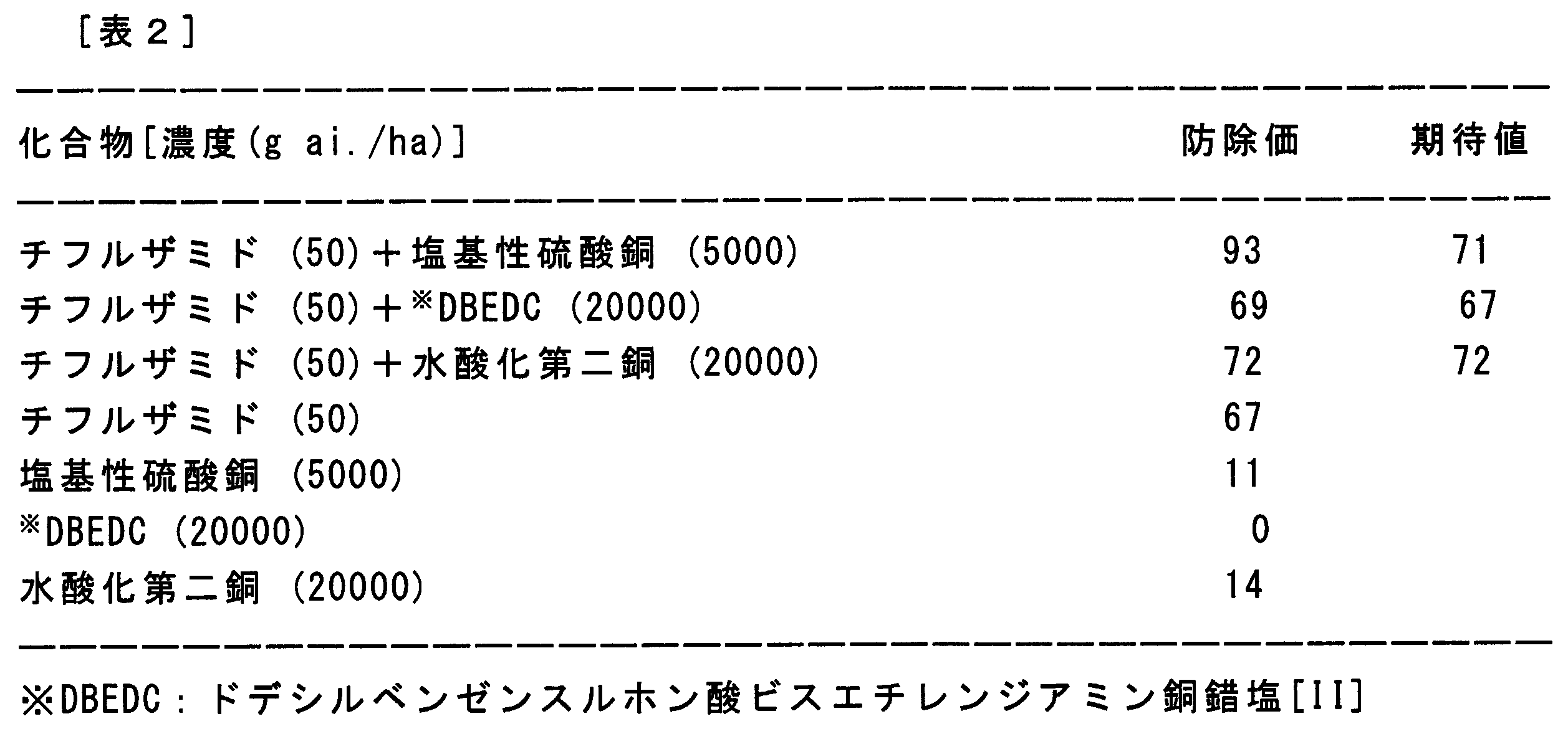
製剤例1(8-ヒドロキシキノリン銅及び塩基性硫酸銅を用いた場合)又は製剤例4(水酸化第二銅及びDBEDCを用いた場合)に準じて調製した薬剤を所定の濃度となるように水で希釈し、試験用薬液を得た。次に、直径4cmのプラスチックポット(容積90cm3)にイネ(日本晴)を1ヶ所に5粒ずつ播種、育成した4苗期の苗にスプレーガンでポット当たり5ml散布処理した。
薬剤処理1日後にふすま培地で培養したイネ紋枯病菌(Rhizoctonia solani )の菌そう1gずつを苗の地際部に5gずつ置床し、25℃の湿室内に8日間入れた。地際部の最も高い位置に出現した病斑の地際部からの高さ(病斑高)を調査し、下記の式に従い防除価を算出した。
防除価=〔1-(処理区病斑高/無処理区病斑高)〕×100
使用した薬剤及び防除価の結果を第1表及び第2表に示す。
また、各薬液濃度に対する防除価から、コルビー法(Colby S.R.1976,Weeds15,20-22)を用いて相乗作用を算出した。計算方法は以下の通りである。
E=α+β―(αβ/100)
α:殺菌剤Aをa (g ai./ha)の量で処理したときの防除価
β:殺菌剤Bをb (g ai./ha)の量で処理したときの防除価
E:殺菌剤Aをa (g ai./ha)、殺菌剤Bをb (g ai./ha)の量で処理した場合の期待される防除価
得られた結果が、期待値よりも観察値が大きければ相乗作用、観察値よりも期待値が大きければ拮抗作用、観察値と期待値が同じであれば相加作用と解析される。
本発明組成物は優れた殺菌効果を奏し、農園芸用殺菌剤として有用である。
Claims (9)
- 2’,6’-ジブロモ-2-メチル-4’-トリフルオロメトキシ-4-トリフルオロメチル-1,3-チアゾール-5-カルボキシアニリド及び少なくとも1種の有機銅剤を含有する殺菌剤組成物であって、
前記有機銅剤は、8-ヒドロキシキノリン銅、ドデシルベンゼンスルホン酸ビスエチレンジアミン銅錯塩[II]、ノニルフェノールスルホン酸銅、PCP銅、テレフタル酸銅及びオキシンドーからなる群より選択される組成物。 - 2’,6’-ジブロモ-2-メチル-4’-トリフルオロメトキシ-4-トリフルオロメチル-1,3-チアゾール-5-カルボキシアニリド、少なくとも1種の無機銅剤及び界面活性剤を含有する殺菌剤組成物。
- 前記有機銅剤が8-ヒドロキシキノリン銅又はドデシルベンゼンスルホン酸ビスエチレンジアミン銅錯塩[II]である請求項1記載の殺菌性組成物。
- 前記有機銅剤が8-ヒドロキシキノリン銅である請求項3記載の殺菌性組成物。
- 前記無機銅剤が塩基性塩化銅、塩基性硫酸銅、水酸化第二銅、塩基性炭酸銅、亜酸化銅、塩基性燐酸銅、塩基性硫酸銅カルシウム及び銅アンモニウム錯塩からなる群より選択される請求項2記載の殺菌性組成物。
- 前記無機銅剤が塩基性硫酸銅又は水酸化第二銅である請求項5記載の殺菌性組成物。
- 前記無機銅剤が塩基性硫酸銅である請求項6記載の殺菌性組成物。
- 2’,6’-ジブロモ-2-メチル-4’-トリフルオロメトキシ-4-トリフルオロメチル-1,3-チアゾール-5-カルボキシアニリドと、少なくとも1種の有機銅剤とを同時に、又は時間的に近接して処理することを特徴とする病害の防除方法であって、
前記有機銅剤は、8-ヒドロキシキノリン銅、ドデシルベンゼンスルホン酸ビスエチレンジアミン銅錯塩[II]、ノニルフェノールスルホン酸銅、PCP銅、テレフタル酸銅及びオキシンドーからなる群より選択される方法。 - 2’,6’-ジブロモ-2-メチル-4’-トリフルオロメトキシ-4-トリフルオロメチル-1,3-チアゾール-5-カルボキシアニリドと、少なくとも1種の無機銅剤と、界面活性剤とを同時に、又は時間的に近接して処理することを特徴とする病害の防除方法。
Applications Claiming Priority (2)
| Application Number | Priority Date | Filing Date | Title |
|---|---|---|---|
| JP2014-096519 | 2014-05-08 | ||
| JP2014096519A JP2017119627A (ja) | 2014-05-08 | 2014-05-08 | 殺菌性組成物 |
Publications (1)
| Publication Number | Publication Date |
|---|---|
| WO2015170752A1 true WO2015170752A1 (ja) | 2015-11-12 |
Family
ID=54392600
Family Applications (1)
| Application Number | Title | Priority Date | Filing Date |
|---|---|---|---|
| PCT/JP2015/063347 Ceased WO2015170752A1 (ja) | 2014-05-08 | 2015-05-08 | 殺菌性組成物 |
Country Status (3)
| Country | Link |
|---|---|
| JP (1) | JP2017119627A (ja) |
| TW (1) | TW201625136A (ja) |
| WO (1) | WO2015170752A1 (ja) |
Citations (4)
| Publication number | Priority date | Publication date | Assignee | Title |
|---|---|---|---|---|
| JPS60214717A (ja) * | 1984-01-18 | 1985-10-28 | ユニロイヤル リミテツド | 種子の保護方法 |
| JP2006348033A (ja) * | 2005-06-15 | 2006-12-28 | Rohm & Haas Co | 木材保存に有用な抗微生物組成物 |
| JP2008303204A (ja) * | 2007-01-05 | 2008-12-18 | Nissan Chem Ind Ltd | 殺菌剤組成物 |
| JP2012051843A (ja) * | 2010-09-02 | 2012-03-15 | Nissan Chem Ind Ltd | 殺虫、殺ダニ、殺線虫、殺軟体動物、殺菌又は殺バクテリア剤組成物及び病害虫の防除方法 |
-
2014
- 2014-05-08 JP JP2014096519A patent/JP2017119627A/ja active Pending
-
2015
- 2015-05-08 TW TW104114773A patent/TW201625136A/zh unknown
- 2015-05-08 WO PCT/JP2015/063347 patent/WO2015170752A1/ja not_active Ceased
Patent Citations (4)
| Publication number | Priority date | Publication date | Assignee | Title |
|---|---|---|---|---|
| JPS60214717A (ja) * | 1984-01-18 | 1985-10-28 | ユニロイヤル リミテツド | 種子の保護方法 |
| JP2006348033A (ja) * | 2005-06-15 | 2006-12-28 | Rohm & Haas Co | 木材保存に有用な抗微生物組成物 |
| JP2008303204A (ja) * | 2007-01-05 | 2008-12-18 | Nissan Chem Ind Ltd | 殺菌剤組成物 |
| JP2012051843A (ja) * | 2010-09-02 | 2012-03-15 | Nissan Chem Ind Ltd | 殺虫、殺ダニ、殺線虫、殺軟体動物、殺菌又は殺バクテリア剤組成物及び病害虫の防除方法 |
Also Published As
| Publication number | Publication date |
|---|---|
| JP2017119627A (ja) | 2017-07-06 |
| TW201625136A (zh) | 2016-07-16 |
Similar Documents
| Publication | Publication Date | Title |
|---|---|---|
| JP2010150230A (ja) | 殺菌剤組成物 | |
| EP3150069B1 (en) | Plant disease control composition and method for controlling plant disease by applying the same | |
| JP2022031705A (ja) | 殺真菌剤の組合せ | |
| JP2008303204A (ja) | 殺菌剤組成物 | |
| JP2022037118A (ja) | 殺真菌剤の組み合わせ | |
| JP2018150352A (ja) | 単糖の植物病害防除効果を増強する組成物 | |
| JPWO2015119246A1 (ja) | 殺菌又は殺バクテリア組成物、及び病害の防除方法 | |
| WO2012020776A1 (ja) | 植物病害防除組成物およびその用途 | |
| JP2013107877A (ja) | 植物病害防除組成物及び植物病害の防除方法 | |
| JP2013107879A (ja) | 植物病害防除組成物及び植物病害の防除方法 | |
| JP2013060401A (ja) | 生物農薬および化学農薬を含有する農薬 | |
| JP2013107876A (ja) | 植物病害防除組成物及び植物病害の防除方法 | |
| JP3963569B2 (ja) | 植物病害防除剤組成物 | |
| JP2008222705A (ja) | 殺虫及び殺菌組成物、並びに植物病害虫の防除方法 | |
| JP2014231485A (ja) | 殺菌性組成物 | |
| JP2017165720A (ja) | 植物病害防除組成物及び植物病害防除方法 | |
| WO2016114162A1 (ja) | カルバメート化合物及びその用途 | |
| JP2016079140A (ja) | 農園芸用殺菌剤 | |
| WO2015170752A1 (ja) | 殺菌性組成物 | |
| CN104066326A (zh) | 植物病害防治组合物 | |
| TWI700034B (zh) | 含有硝基苯酚化合物及殺菌活性化合物之協同性殺菌劑組成物 | |
| JP2010260822A (ja) | 殺菌剤組成物 | |
| CN108777964B (zh) | 用于防治植物病害的协同杀真菌组合物 | |
| JP2021193101A (ja) | 殺菌性組成物 | |
| JP6738811B2 (ja) | 植物病害防除組成物及び植物病害防除方法 |
Legal Events
| Date | Code | Title | Description |
|---|---|---|---|
| 121 | Ep: the epo has been informed by wipo that ep was designated in this application |
Ref document number: 15789533 Country of ref document: EP Kind code of ref document: A1 |
|
| NENP | Non-entry into the national phase |
Ref country code: DE |
|
| 122 | Ep: pct application non-entry in european phase |
Ref document number: 15789533 Country of ref document: EP Kind code of ref document: A1 |
|
| NENP | Non-entry into the national phase |
Ref country code: JP |