WO2015155952A1 - コア/シェル型硬化剤粒子および熱硬化性樹脂組成物 - Google Patents
コア/シェル型硬化剤粒子および熱硬化性樹脂組成物 Download PDFInfo
- Publication number
- WO2015155952A1 WO2015155952A1 PCT/JP2015/001767 JP2015001767W WO2015155952A1 WO 2015155952 A1 WO2015155952 A1 WO 2015155952A1 JP 2015001767 W JP2015001767 W JP 2015001767W WO 2015155952 A1 WO2015155952 A1 WO 2015155952A1
- Authority
- WO
- WIPO (PCT)
- Prior art keywords
- core
- resin composition
- thermosetting resin
- curing agent
- agent particles
- Prior art date
- Legal status (The legal status is an assumption and is not a legal conclusion. Google has not performed a legal analysis and makes no representation as to the accuracy of the status listed.)
- Ceased
Links
Classifications
-
- C—CHEMISTRY; METALLURGY
- C08—ORGANIC MACROMOLECULAR COMPOUNDS; THEIR PREPARATION OR CHEMICAL WORKING-UP; COMPOSITIONS BASED THEREON
- C08G—MACROMOLECULAR COMPOUNDS OBTAINED OTHERWISE THAN BY REACTIONS ONLY INVOLVING UNSATURATED CARBON-TO-CARBON BONDS
- C08G18/00—Polymeric products of isocyanates or isothiocyanates
- C08G18/06—Polymeric products of isocyanates or isothiocyanates with compounds having active hydrogen
- C08G18/28—Polymeric products of isocyanates or isothiocyanates with compounds having active hydrogen characterised by the compounds used containing active hydrogen
- C08G18/40—High-molecular-weight compounds
- C08G18/42—Polycondensates having carboxylic or carbonic ester groups in the main chain
- C08G18/4266—Polycondensates having carboxylic or carbonic ester groups in the main chain prepared from hydroxycarboxylic acids and/or lactones
- C08G18/4269—Lactones
- C08G18/4277—Caprolactone and/or substituted caprolactone
-
- C—CHEMISTRY; METALLURGY
- C08—ORGANIC MACROMOLECULAR COMPOUNDS; THEIR PREPARATION OR CHEMICAL WORKING-UP; COMPOSITIONS BASED THEREON
- C08G—MACROMOLECULAR COMPOUNDS OBTAINED OTHERWISE THAN BY REACTIONS ONLY INVOLVING UNSATURATED CARBON-TO-CARBON BONDS
- C08G18/00—Polymeric products of isocyanates or isothiocyanates
- C08G18/06—Polymeric products of isocyanates or isothiocyanates with compounds having active hydrogen
- C08G18/28—Polymeric products of isocyanates or isothiocyanates with compounds having active hydrogen characterised by the compounds used containing active hydrogen
- C08G18/30—Low-molecular-weight compounds
- C08G18/32—Polyhydroxy compounds; Polyamines; Hydroxyamines
- C08G18/3203—Polyhydroxy compounds
- C08G18/3206—Polyhydroxy compounds aliphatic
-
- C—CHEMISTRY; METALLURGY
- C08—ORGANIC MACROMOLECULAR COMPOUNDS; THEIR PREPARATION OR CHEMICAL WORKING-UP; COMPOSITIONS BASED THEREON
- C08G—MACROMOLECULAR COMPOUNDS OBTAINED OTHERWISE THAN BY REACTIONS ONLY INVOLVING UNSATURATED CARBON-TO-CARBON BONDS
- C08G18/00—Polymeric products of isocyanates or isothiocyanates
- C08G18/06—Polymeric products of isocyanates or isothiocyanates with compounds having active hydrogen
- C08G18/28—Polymeric products of isocyanates or isothiocyanates with compounds having active hydrogen characterised by the compounds used containing active hydrogen
- C08G18/40—High-molecular-weight compounds
- C08G18/48—Polyethers
- C08G18/4833—Polyethers containing oxyethylene units
-
- C—CHEMISTRY; METALLURGY
- C08—ORGANIC MACROMOLECULAR COMPOUNDS; THEIR PREPARATION OR CHEMICAL WORKING-UP; COMPOSITIONS BASED THEREON
- C08G—MACROMOLECULAR COMPOUNDS OBTAINED OTHERWISE THAN BY REACTIONS ONLY INVOLVING UNSATURATED CARBON-TO-CARBON BONDS
- C08G18/00—Polymeric products of isocyanates or isothiocyanates
- C08G18/06—Polymeric products of isocyanates or isothiocyanates with compounds having active hydrogen
- C08G18/28—Polymeric products of isocyanates or isothiocyanates with compounds having active hydrogen characterised by the compounds used containing active hydrogen
- C08G18/65—Low-molecular-weight compounds having active hydrogen with high-molecular-weight compounds having active hydrogen
- C08G18/66—Compounds of groups C08G18/42, C08G18/48, or C08G18/52
- C08G18/6633—Compounds of group C08G18/42
- C08G18/6637—Compounds of group C08G18/42 with compounds of group C08G18/32 or polyamines of C08G18/38
- C08G18/664—Compounds of group C08G18/42 with compounds of group C08G18/32 or polyamines of C08G18/38 with compounds of group C08G18/3203
-
- C—CHEMISTRY; METALLURGY
- C08—ORGANIC MACROMOLECULAR COMPOUNDS; THEIR PREPARATION OR CHEMICAL WORKING-UP; COMPOSITIONS BASED THEREON
- C08G—MACROMOLECULAR COMPOUNDS OBTAINED OTHERWISE THAN BY REACTIONS ONLY INVOLVING UNSATURATED CARBON-TO-CARBON BONDS
- C08G18/00—Polymeric products of isocyanates or isothiocyanates
- C08G18/06—Polymeric products of isocyanates or isothiocyanates with compounds having active hydrogen
- C08G18/70—Polymeric products of isocyanates or isothiocyanates with compounds having active hydrogen characterised by the isocyanates or isothiocyanates used
- C08G18/72—Polyisocyanates or polyisothiocyanates
- C08G18/73—Polyisocyanates or polyisothiocyanates acyclic
-
- C—CHEMISTRY; METALLURGY
- C08—ORGANIC MACROMOLECULAR COMPOUNDS; THEIR PREPARATION OR CHEMICAL WORKING-UP; COMPOSITIONS BASED THEREON
- C08G—MACROMOLECULAR COMPOUNDS OBTAINED OTHERWISE THAN BY REACTIONS ONLY INVOLVING UNSATURATED CARBON-TO-CARBON BONDS
- C08G18/00—Polymeric products of isocyanates or isothiocyanates
- C08G18/06—Polymeric products of isocyanates or isothiocyanates with compounds having active hydrogen
- C08G18/70—Polymeric products of isocyanates or isothiocyanates with compounds having active hydrogen characterised by the isocyanates or isothiocyanates used
- C08G18/72—Polyisocyanates or polyisothiocyanates
- C08G18/74—Polyisocyanates or polyisothiocyanates cyclic
- C08G18/75—Polyisocyanates or polyisothiocyanates cyclic cycloaliphatic
- C08G18/758—Polyisocyanates or polyisothiocyanates cyclic cycloaliphatic containing two or more cycloaliphatic rings
-
- C—CHEMISTRY; METALLURGY
- C08—ORGANIC MACROMOLECULAR COMPOUNDS; THEIR PREPARATION OR CHEMICAL WORKING-UP; COMPOSITIONS BASED THEREON
- C08G—MACROMOLECULAR COMPOUNDS OBTAINED OTHERWISE THAN BY REACTIONS ONLY INVOLVING UNSATURATED CARBON-TO-CARBON BONDS
- C08G18/00—Polymeric products of isocyanates or isothiocyanates
- C08G18/06—Polymeric products of isocyanates or isothiocyanates with compounds having active hydrogen
- C08G18/70—Polymeric products of isocyanates or isothiocyanates with compounds having active hydrogen characterised by the isocyanates or isothiocyanates used
- C08G18/72—Polyisocyanates or polyisothiocyanates
- C08G18/77—Polyisocyanates or polyisothiocyanates having heteroatoms in addition to the isocyanate or isothiocyanate nitrogen and oxygen or sulfur
- C08G18/78—Nitrogen
- C08G18/7806—Nitrogen containing -N-C=0 groups
- C08G18/7818—Nitrogen containing -N-C=0 groups containing ureum or ureum derivative groups
- C08G18/7831—Nitrogen containing -N-C=0 groups containing ureum or ureum derivative groups containing biuret groups
-
- C—CHEMISTRY; METALLURGY
- C08—ORGANIC MACROMOLECULAR COMPOUNDS; THEIR PREPARATION OR CHEMICAL WORKING-UP; COMPOSITIONS BASED THEREON
- C08G—MACROMOLECULAR COMPOUNDS OBTAINED OTHERWISE THAN BY REACTIONS ONLY INVOLVING UNSATURATED CARBON-TO-CARBON BONDS
- C08G18/00—Polymeric products of isocyanates or isothiocyanates
- C08G18/06—Polymeric products of isocyanates or isothiocyanates with compounds having active hydrogen
- C08G18/70—Polymeric products of isocyanates or isothiocyanates with compounds having active hydrogen characterised by the isocyanates or isothiocyanates used
- C08G18/72—Polyisocyanates or polyisothiocyanates
- C08G18/77—Polyisocyanates or polyisothiocyanates having heteroatoms in addition to the isocyanate or isothiocyanate nitrogen and oxygen or sulfur
- C08G18/78—Nitrogen
- C08G18/79—Nitrogen characterised by the polyisocyanates used, these having groups formed by oligomerisation of isocyanates or isothiocyanates
- C08G18/791—Nitrogen characterised by the polyisocyanates used, these having groups formed by oligomerisation of isocyanates or isothiocyanates containing isocyanurate groups
- C08G18/792—Nitrogen characterised by the polyisocyanates used, these having groups formed by oligomerisation of isocyanates or isothiocyanates containing isocyanurate groups formed by oligomerisation of aliphatic and/or cycloaliphatic isocyanates or isothiocyanates
Definitions
- the present invention relates to core / shell type curing agent particles in which a core contains an isocyanate group-containing compound and a shell contains a thermoplastic resin. More specifically, the present invention relates to core / shell type curing agent particles that have good long-term storage stability and can be cured at low temperature when used in a thermosetting resin composition.
- a blocked isocyanate group-containing compound in which an isocyanate group is protected with a substance that can be regenerated by heat in advance is widely used.
- blocking agents phenolic, caprolactam-based, oxime-based, active methylene compound-based, etc. are known, but the dissociation temperature of the blocked isocyanate group varies depending on the type of blocking agent or isocyanate, etc. It is about 120 to 250 ° C.
- the practical dissociation temperature of methyl ethyl ketoxime which is a general-purpose blocking agent, is 130 to 150 ° C.
- Blocked isocyanates using pyrazole compounds and triazole compounds and blocked isocyanates using cyclic amidine derivatives have been proposed.
- An object of the present invention is to provide core / shell type curing agent particles that provide a thermosetting resin composition having good long-term storage stability and low-temperature curability.
- excellent storage stability means that the viscosity change is small in the case of a one-component thermosetting resin composition when left at 40 ° C., in the case of a powder thermosetting resin composition. Means excellent blocking properties.
- being excellent in low-temperature curability means that the physical properties (tensile strength, adhesion, adhesiveness, etc.) of the cured product after baking at 100 ° C. for 20 minutes are excellent, and each is evaluated by the methods described below. can do.
- the present invention relates to a thermoplastic resin having a core containing an isocyanate group-containing compound (A), a shell having a glass transition temperature of 50 to 150 ° C., and a weight average molecular weight of 5,000 to 200,000.
- the core / shell type curing agent particles (D) of the present invention have the following effects. (1) The coverage of the isocyanate group-containing compound (A) as a core is high, and imparts excellent storage stability to the thermosetting resin composition. (2) It imparts excellent curability, particularly low temperature curability, to the thermosetting resin composition. (3) A cured product (coating film) obtained by reacting and curing the thermosetting resin composition is excellent in adhesion to the substrate and further excellent in water resistance. (4) A cured product obtained by reacting and curing the thermosetting resin composition is excellent in adhesiveness (adhesive strength) with a substrate.
- isocyanate group-containing compound (A) examples include polyisocyanate (A1), isocyanate group-terminated prepolymer (A2), and mixtures thereof.
- polyisocyanate (A1) an aromatic polyisocyanate (a1) having 6 to 20 carbon atoms (excluding carbon in the NCO group, the same shall apply hereinafter), an aliphatic polyisocyanate (a2) having 2 to 18 carbon atoms, a carbon number 4 to 15 alicyclic polyisocyanate (a3), araliphatic polyisocyanate (a4) having 8 to 15 carbon atoms and modified products of these polyisocyanates (urethane group, carbodiimide group, allophanate group, urea group, burette) Group, uretdione group, uretoimine group, isocyanurate group, modified product containing oxazolidone group) (a5) and a mixture of two or more thereof.
- the aromatic polyisocyanate (a1) is, for example, 2,4- and / or 2,6-tolylene diisocyanate (TDI), 2,4′- and / or 4,4′-diphenylmethane diisocyanate (MDI).
- the aliphatic polyisocyanate (a2) is, for example, hexamethylene diisocyanate (HDI).
- Examples of the alicyclic polyisocyanate (a3) include isophorone diisocyanate (IPDI), dicyclohexylmethane-4,4′-diisocyanate (hydrogenated MDI), methylcyclohexylene diisocyanate (hydrogenated TDI), and the like.
- Examples of the araliphatic polyisocyanate (a4) include m- and / or p-xylylene diisocyanate (XDI), ⁇ , ⁇ , ⁇ ′, ⁇ ′-tetramethylxylylene diisocyanate (TMXDI), and the like.
- modified polyisocyanate (a5) examples include urethane group, carbodiimide group, allophanate group, urea group, burette group, uretdione group, uretoimine group, isocyanurate group, and oxazolidone group-containing modified product.
- modified MDI urethane modified MDI, carbodiimide modified MDI, trihydrocarbyl phosphate modified MDI, etc.
- modified HDI burette modified HDI, isocyanurate modified HDI, etc.
- modified IPDI isocyanurate modified IPDI, etc.
- urethane Modified products of polyisocyanates such as modified TDI and mixtures of two or more thereof (for example, combined use of modified IPDI and urethane-modified TDI (isocyanate-containing prepolymer) are included.
- modified TDI urethane modified MDI, carbodiimide modified MDI, trihydrocarbyl phosphate modified MDI, etc.
- modified HDI burette modified HDI, isocyanurate modified HDI, etc.
- modified IPDI isocyanurate modified IPDI, etc.
- urethane Modified products of polyisocyanates such as modified TDI and mixtures of two or more thereof (for example, combined use
- Examples of the isocyanate group-terminated prepolymer (A2) include polyaddition products of the polyisocyanate (A1) with water, polyol (b), polyamine (c), polythiol (d), and the like.
- (B) is a hydroxyl group equivalent [Mn (number average molecular weight) or molecular weight per hydroxyl group calculated from molecular weight and hydroxyl value] of 150 or more (preferably 155 to 5,000, more preferably 160 to 3, 000) high molecular polyols, low molecular weight polyols having a hydroxyl equivalent weight of less than 150, and combinations of two or more thereof.
- polymer polyol examples include polyether polyol (b1) and polyester polyol (b2).
- polyoxyethylene for example, polyoxyethylene [polyethylene glycol and the like], polyoxypropylene [polypropylene glycol and the like], polyoxyethylene / propylene (addition form may be block and / or random)
- polytetramethylene ether glycol for example, polyoxyethylene [polyethylene glycol and the like], polyoxypropylene [polypropylene glycol and the like], polyoxyethylene / propylene (addition form may be block and / or random)
- aromatic ring-containing polyether polyol bisphenol-type PE, for example, 2 to 20 mol adduct of bisphenol A ethylene oxide (hereinafter abbreviated as EO), propylene oxide of bisphenol A (hereinafter abbreviated as PO) 2 to 20 mol adduct, And EO and / or PO2-20 mol adducts of resorcin.
- EO bisphenol A ethylene oxide
- PO propylene oxide of bisphenol A
- (B1) is a ring-opening addition reaction of EO and / or PO with a low molecular weight active hydrogen atom-containing compound containing an aliphatic or aromatic ring in the presence of a catalyst (alkali metal hydroxide, Lewis acid, etc.). can get.
- a catalyst alkali metal hydroxide, Lewis acid, etc.
- polyester polyol (b2) examples include condensed polyester polyols, polylactone polyols, polycarbonate polyols, and castor oil polyols.
- the condensed polyester polyol is composed of a polyhydric alcohol having a low molecular weight [carbon number (hereinafter abbreviated as C) of 2 or more and Mn of 300 or less] and a C2-20 polycarboxylic acid or an ester-forming derivative thereof.
- Polyester polyol examples include dihydric to octahydric or higher aliphatic polyhydric alcohol, phenol alkylene oxide (hereinafter abbreviated as AO), low molar (2 to 10 mol) adduct, and the like.
- polyvalent carboxylic acid examples include dicarboxylic acids [aliphatic (succinic acid, adipic acid, azelaic acid, sebacic acid, fumaric acid, maleic acid, etc.), alicyclic (dimer acid, etc.), aromatic (terephthalic acid, isophthalic acid, etc.).
- the condensed polyester polyol examples include polyethylene adipate diol, polybutylene adipate diol, polyhexamethylene adipate diol, polyhexamethylene isophthalate diol, polyneopentyl adipate diol, polyethylene propylene adipate diol, polyethylene butylene adipate diol, poly Butylene hexamethylene adipate diol, polydiethylene adipate diol, poly (polytetramethylene ether) adipate diol, poly (3-methylpentylene adipate) diol, polyethylene azelate diol, polyethylene sebacate diol, polybutylene azelate diol, polybutylene Sebacate diol, polyneopentyl terephthalate diol It is below.
- polylactone polyol is a polyaddition product of lactone to the low molecular weight polyhydric alcohol, and as lactone, C4-12 lactone can be used, for example, ⁇ -butyrolactone, ⁇ -valerolactone. , ⁇ -caprolactone and the like.
- lactone C4-12 lactone
- Specific examples of the polylactone polyol include polycaprolactone diol, polyvalerolactone diol, polycaprolactone triol, and the like.
- polycarbonate polyol is a polyaddition product of alkylene carbonate to the low molecular weight polyhydric alcohol, and C2-8 alkylene carbonate can be used as alkylene carbonate, such as ethylene carbonate, propylene carbonate, and These combination etc. are mentioned.
- Specific examples of the polycarbonate polyol include polyhexamethylene carbonate diol.
- the castor oil polyol includes castor oil and castor oil modified with polyol or AO.
- Modified castor oil can be produced by transesterification of castor oil and polyol and / or AO addition.
- the castor oil polyol includes castor oil, trimethylolpropane (hereinafter abbreviated as TMP) modified castor oil, pentaerythritol modified castor oil, EO (4 to 30 mol) adduct of castor oil, and the like.
- the low molecular weight polyol (b3) having a hydroxyl equivalent weight of less than 150 includes aliphatic polyvalent (divalent to tetravalent or higher) alcohols, alicyclic-containing polyvalent (divalent) alcohols, aromatic-ring-containing polyvalents. (Divalent to tetravalent) alcohols may be mentioned.
- Aliphatic dihydric alcohols include ethylene glycol (EG), propylene glycol (PG), 1,4-butanediol (1,4-BD), neopentyl glycol (NPG), 1,6-hexanediol ( 1,6-HD), trivalent alcohol, glycerin (hereinafter abbreviated as GR), TMP, etc .; alicyclic divalent alcohol, 1,4-cyclohexanediol, cyclohexanedimethanol, etc .; aromatic ring-containing polyvalent Examples of (2-4 valent) alcohols include xylylene glycol, bis (hydroxyethyl) benzene, bisphenol A EO and / or PO low (1-10) molar adducts.
- the free isocyanate group content (NCO content) of (A2) is usually 1 to 30% by weight, preferably 2 to 25% by weight.
- A2 may use polyamine (c), polythiol (d) or the like as an extender when preparing a prepolymer.
- Examples of the polyamine (c) include the following (c1) to (c4), and a mixture of two or more thereof.
- (C1) Aliphatic poly (2 to 7 valent) amines C2 or more and Mn 500 or less, such as C2 to 10 alkylene diamine (ethylene diamine, propylene diamine, etc.), polyalkylene (C2 to 10) poly (trivalent to hexavalent) Or more) amines [diethylenetriamine, triethylenetetramine, tetraethylenepentamine, etc.], and their alkyl (C1-4) or hydroxyalkyl (C2-4) substitutions, such as dialkyl (C1-3) aminopropylamine , Trimethylhexamethylenediamine, aminoethylethanolamine;
- (C2) Alicyclic ring-containing poly (2 to 3 valent) amines having C4 to 15 such as 1,3-diaminocyclohexane, isophoronediamine;
- C3 Heterocycle containing poly (2- to trivalent) amines of C4-15, such as piperazine, N-aminoethylpiperazine, 1,4-diaminoethylpiperazine;
- Aromatic ring-containing polyamines C8-15 such as xylylenediamine, tetrachloro-p-xylylenediamine, diaminodiphenylmethane.
- polythiol (d) examples include ethylenedithiol, 1,4-butanedithiol, 1,6-hexanedithiol, and the like.
- the free isocyanate group content (NCO content) of (A2) is usually 1 to 30% by weight, preferably 2 to 25% by weight.
- (A) from the viewpoint of preparing the core / shell type curing agent particles (D) described later, (a2), (a3), (a5), and (A2) are preferable, and more preferable.
- HDI, hydrogenated MDI, IPDI and their isocyanurate-modified products particularly preferred are isocyanurate-modified HDI and isocyanurate-modified IPDI.
- the thermoplastic resin (B) in the present invention has a weight average molecular weight (sometimes abbreviated as Mw) of 5,000 to 200,000, preferably 8,000 to 150,000, particularly preferably 10,000 to
- Mw weight average molecular weight
- the composition is not particularly limited as long as it is a resin that can form a shell by the manufacturing method described later.
- Mw can be measured by the GPC method described later.
- the glass transition temperature (sometimes abbreviated as Tg) of (B) is 50 to 150 ° C., preferably 60 to 140 ° C., more preferably 70 to 130 ° C.
- Tg is 50 to 150 ° C.
- the storage stability of (X) described later is deteriorated
- the Tg exceeds 150 ° C. the low temperature curability of (X) is deteriorated.
- the glass transition temperature is measured in accordance with a DSC (scanning differential thermal analysis) method (JIS K7121, “9.3 Determination Method of Glass Transition Temperature” of “Plastic Transition Temperature Measurement Method”). .
- the softening point of (B) is preferably 60 to 160 ° C., more preferably 70 to 150 ° C., and particularly preferably 80 to 140 ° C. from the viewpoint of storage stability and low-temperature curability of (X).
- the softening point is measured according to the ring and ball method (JIS K7234, “4.1 Ring and Ball Method” of “Softening Point Test Method of Epoxy Resin”).
- (B) includes, for example, vinyl resin (B1), polyester resin (B2), polyurethane resin (B3), polyurea resin (B4), polycarbonate resin (B5), and mixtures thereof.
- Vinyl resin A vinyl resin is a polymer obtained by homopolymerizing or copolymerizing vinyl monomers.
- Examples of the vinyl monomer include the following (e1) to (e10).
- (E1) Vinyl hydrocarbon (E1-1) Aliphatic vinyl hydrocarbons: alkenes such as ethylene, propylene, ⁇ -olefins other than those mentioned above; alkadienes such as butadiene and isoprene. (E1-2) Alicyclic vinyl hydrocarbons: mono- or di-cycloalkenes and alkadienes such as cyclohexene, (di) cyclopentadiene and the like; terpenes such as pinene and limonene.
- Aromatic vinyl hydrocarbons Styrene and its hydrocarbyl (alkyl, cycloalkyl, aralkyl and / or alkenyl) substituents such as ⁇ -methylstyrene, vinyltoluene, ethylstyrene and the like; and vinylnaphthalene.
- (E2) Carboxyl group-containing vinyl monomer and salt thereof: C3-C30 unsaturated monocarboxylic acid, unsaturated dicarboxylic acid and its anhydride and its monoalkyl (C1-24) ester such as (meth) acrylic acid, (meth) acrylic acid monoalkyl ester, ( Anhydrous) carboxyl group-containing vinyl monomers such as maleic acid, itaconic acid and cinnamic acid.
- R represents an alkyl group having 1 to 15 carbon atoms
- A represents an alkylene group having 2 to 4 carbon atoms, and when n is plural, they may be the same or different, and when they are different, they may be random or block).
- Ar represents a benzene ring, n represents an integer of 1 to 50, and R ′ represents an alkyl group having 1 to 15 carbon atoms which may be substituted with a fluorine atom.
- phosphoric acid monoesters such as 2-hydroxyethyl (meth) acryloyl phosphate, (meth) acryloyloxyalkyl (C1-24)
- phosphonic acids such as 2-acryloyloxyethyl Phosphonic acid and the like.
- Examples of the salts (e2) to (e4) include alkali metal salts (sodium salts, potassium salts, etc.), alkaline earth metal salts (calcium salts, magnesium salts, etc.), ammonium salts, amine salts, or quaternary salts. An ammonium salt is mentioned.
- (E5) Hydroxyl group-containing vinyl monomer Hydroxystyrene, N-methylol (meth) acrylamide, hydroxyethyl (meth) acrylate and the like.
- (E6) Nitrogen-containing vinyl monomer examples include (e6-1) to (e6-5).
- (E6-1) Amino group-containing vinyl monomer: aminoethyl (meth) acrylate, dimethylaminoethyl (meth) acrylate, N-aminoethyl (meth) acrylamide, (meth) allylamine, 4-vinylpyridine, salts thereof, and the like;
- (E6-2) Amide group-containing vinyl monomers: (meth) acrylamide, N-methyl (meth) acrylamide and the like;
- Epoxy group-containing vinyl monomer Glucidyl (meth) acrylate, tetrahydrofurfuryl (meth) acrylate, p-vinylphenylphenyl oxide and the like.
- (E8) Halogen element-containing vinyl monomer Vinyl chloride, vinyl bromide, vinylidene chloride, allyl chloride, chlorostyrene, dichlorostyrene, chloromethylstyrene, tetrafluorostyrene, chloroprene and the like.
- (E9) Vinyl ester, vinyl (thio) ether, vinyl ketone, vinyl sulfone: (E9-1) Vinyl esters such as vinyl acetate, vinyl butyrate, alkyl (meth) acrylates having 1 to 50 carbon atoms (methyl (meth) acrylate, 2-ethylhexyl (meth) acrylate, etc.) and the like; (E9-2) vinyl (thio) ether, such as vinyl methyl ether, vinyl ethyl ether, etc.
- vinyl ketone such as vinyl methyl ketone, vinyl phenyl ketone
- Vinyl sulfones such as divinyl sulfide, p-vinyl diphenyl sulfide, etc.
- copolymer of vinyl monomers examples include polymers obtained by (co) polymerizing any of the above monomers (e1) to (e10), either alone or more, in an arbitrary ratio.
- Copolymer styrene- (meth) acrylic acid ester copolymer, (meth) acrylic acid ester polymer, (meth) acrylic acid- (meth) acrylic acid ester copolymer, styrene- (anhydrous) maleic acid (salt) copolymer Polymer, styrene- (meth) acrylic acid (salt) copolymer, and the like.
- polyester resin examples include a polycondensate of a polyol and a polycarboxylic acid or its acid anhydride or its lower alkyl ester.
- examples of the polyol include the above-mentioned (b), and examples of the polycarboxylic acid or its acid anhydride or its lower alkyl ester include the above-mentioned dicarboxylic acid and trivalent or higher polycarboxylic acids and their acid anhydrides or lower alkyl esters. .
- the ratio of the polyol and the polycarboxylic acid is preferably 2/1 to 1/1, more preferably 1.5 / 1, as an equivalent ratio [OH] / [COOH] of the hydroxyl group [OH] and the carboxyl group [COOH]].
- the ratio of polyisocyanate to polyol, polyamine, polythiol is the equivalent ratio ⁇ [OH] + [NH 2 or NH] of hydroxyl group [OH], amino group [NH 2 or NH], thiol group [SH] and isocyanate group [NCO]. ] + [SH] ⁇ / [NCO], preferably 2/1 to 1/1, more preferably 1.5 / 1 to 1/1, particularly preferably 1.3 / 1 to 1.02 / 1. is there.
- polyurea resin examples include polyaddition products of polyisocyanate (A1) and / or isocyanate group-terminated prepolymer (A2) with water and polyamine (c).
- thermoplastic resins (B) a vinyl resin (B1), a polyester resin (B2), and a polyurethane (B3) resin are preferable from the viewpoint that core / shell type curing agent particles (D) described later are easily obtained.
- (B1) particularly preferably a styrene polymer, a styrene- (anhydrous) maleic acid (salt) copolymer, a styrene- (meth) acrylic acid (salt) copolymer, (Meth) acrylic acid ester polymer, (meth) acrylic acid- (meth) acrylic acid ester copolymer.
- the core / shell type curing agent particles of the present invention preferably further contain a surfactant (C).
- the surfactant (C) in the present invention is not particularly limited, and examples thereof include the following (C1), (C2), and a mixture of two or more thereof.
- Nonionic Surfactant examples include, for example, alkylene oxide addition type nonionic surfactants and polyvalent alcohol type nonionic surfactants.
- alkylene oxide addition type nonionic surfactant examples include oxyalkylene alkyl ethers (eg, lauryl alcohol ethylene oxide adduct, stearyl alcohol ethylene oxide adduct, etc.); polyoxyalkylene higher fatty acid esters (eg, stearyl) Acid ethylene oxide adduct, lauric acid ethylene oxide adduct, castor oil ethylene oxide adduct, hardened castor oil ethylene oxide adduct, etc.); Polyoxyalkylene polyhydric alcohol higher fatty acid esters (eg, lauric acid diester of polyethylene glycol, stearic acid diester of polyethylene glycol, etc.); Polyoxyalkylene alkyl phenyl ether (eg, nonylphenol ethylene oxide adduct, nonylphenol ethylene oxide propylene oxide block adduct, bisphenol A ethylene oxide adduct, cumylphenol ethylene oxide adduct, styrenated cumylphenol
- polyhydric alcohol type nonionic surfactant examples include polyhydric alcohol fatty acid ester, polyhydric alcohol fatty acid ester alkylene oxide adduct, polyhydric alcohol alkyl ether, polyhydric alcohol alkyl ether alkylene oxide adduct.
- Examples of the polyhydric alcohol fatty acid ester include pentaerythritol monolaurate, sorbitan monostearate, and sucrose monostearate.
- Examples of the polyhydric alcohol fatty acid ester alkylene oxide adduct include ethylene glycol monostearate ethylene oxide adduct, trimethylolpropane monostearate ethylene oxide propylene oxide random adduct, sorbitan monolaurate ethylene oxide adduct, and the like.
- Examples of the polyhydric alcohol alkyl ether include pentaerythritol monobutyl ether, sorbitan monomethyl ether, sorbitan monostearyl ether, and methyl glycoside.
- Examples of the polyhydric alcohol alkyl ether alkylene oxide adduct include sorbitan monostearyl ether ethylene oxide adduct, methylglycoside ethylene oxide propylene oxide random adduct, and the like.
- Anionic surfactants examples include carboxylic acids or salts thereof, sulfate esters, carboxymethylated salts, sulfonates, and phosphate esters.
- carboxylic acids or salts thereof include saturated or unsaturated fatty acids having 8 to 22 carbon atoms or salts thereof. Specifically, saponified lauric acid, stearic acid, oleic acid, coconut oil, palm kernel oil, and the like. And a mixture of higher fatty acids obtained.
- the salt include salts of sodium, ammonium, alkanolamine and the like.
- sulfate salts include higher alcohol sulfate esters (sulfate esters of aliphatic alcohols having 8 to 18 carbon atoms), higher alkyl ether sulfate esters (ethylene oxide 1 to 10 moles of aliphatic alcohols having 8 to 18 carbon atoms). Sulfates of adducts), sulfated oils (natural unsaturated oils or unsaturated waxes that have been neutralized by sulfation), sulfated fatty acid esters (sulfurized lower alcohol esters of unsaturated fatty acids) And sulfated olefins (those obtained by sulfating and neutralizing olefins having 12 to 18 carbon atoms).
- Examples of the salt include sodium salt, potassium salt, ammonium salt, and alkanolamine salt.
- Specific examples of the higher alcohol sulfate ester salt include octyl alcohol sulfate ester, stearyl alcohol sulfate ester, sulfate ester salt of alcohol synthesized using a Ziegler catalyst (for example, ALFOL 1214 manufactured by CONDEA), oxo method Sulfuric acid ester salts of synthesized alcohols (for example, Dovanol 23, 25, 45: manufactured by Mitsubishi Oil Chemical Co., Ltd., tridecanol: manufactured by Kyowa Hakko); specific examples of higher alkyl ether sulfates include lauryl alcohol ethylene oxide 2-mole adduct sulfuric acid Ester salts: Specific examples of sulfated oils include sodium oxide, castor oil, beef tallow and other sulfated sodium, ammonium, and alkanolamine salts.
- sulfated fatty acid esters include butyl oleate and butyl ricinoleate.
- Natri Ummum, ammonium, alkanolamine salts Specific examples of sulfated olefins include teepol (manufactured by Shell).
- carboxymethylated salt examples include a carboxymethylated salt of an aliphatic alcohol having 8 to 16 carbon atoms and a carboxymethylated salt of an adduct having 1 to 10 moles of ethylene oxide of an aliphatic alcohol having 8 to 16 carbon atoms. It is done.
- carboxymethylated salts of fatty alcohols include: octyl alcohol carboxymethylated sodium salt, lauryl alcohol carboxymethylated sodium salt; aliphatic alcohol ethylene oxide 1-10 mol adduct carboxymethylated salt
- Specific examples include lauryl alcohol ethylene oxide 4 mol adduct carboxymethylated sodium salt, tridecanol ethylene oxide 5 mol adduct carboxymethylated sodium salt, and the like.
- Examples of the sulfonate include alkylbenzene sulfonate, alkyl naphthalene sulfonate, sulfosuccinic acid diester type, ⁇ -olefin sulfonate, Igepon T type, and sulfonates of other aromatic ring-containing compounds.
- Specific examples of the alkylbenzene sulfonate include sodium dodecylbenzenesulfonate; specific examples of the alkylnaphthalene sulfonate; sodium dodecylnaphthalene sulfonate; and specific examples of the sulfosuccinic acid diester type include di-2 sulfosuccinic acid di-2.
- sulfonate of the aromatic ring-containing compound examples include mono- or disulfonate of alkylated diphenyl ether, styrenated phenol sulfonate, and the like.
- phosphate ester salts include higher alcohol phosphate ester salts and higher alcohol ethylene oxide adduct phosphate ester salts.
- higher alcohol phosphate ester salts include lauryl alcohol phosphate monoester disodium salt; specific examples of higher alcohol ethylene oxide adduct phosphate ester salts include oleyl alcohol ethylene oxide 5-mole adduct phosphate monoester A disodium salt is mentioned.
- (C1) is more preferable from the viewpoint of the coverage of the core / shell type curing agent particles (D) described later and the storage stability of the thermosetting resin composition (X) described later.
- the number average molecular weight (Mn) of (C) is preferably from 300 to 20,000, more preferably from 500 to 15,000, from the viewpoint of the emulsifiability of (A) and the physical properties of the cured product of (X). Particularly preferred is 1,000 to 10,000.
- Organic solvent (g) used in the present invention is for the purpose of dissolving the thermoplastic resin (B) which is a shell component when preparing the core / shell type curing agent particles (D) of the isocyanate group-containing compound (A). used. Moreover, it is used also for the purpose of melt
- the organic solvent (g) can be used as long as it is an organic solvent incompatible with water.
- the organic solvent incompatible with water is one having a water / octanol partition coefficient (logPow) value of 0 to 4.0, preferably 0.1 to 3.5, particularly preferably 0.2. ⁇ 2.0.
- the octanol / water partition coefficient (logPow) can be determined by a flask shaking method described in JIS Z7260-107 (2000). The coefficient is expressed as a common logarithm of the concentration of each target substance when the target substance is in an equilibrium state in a system where the octanol phase and the aqueous phase are in contact with each other. It will be. It shows that hydrophobicity is so large that this coefficient is large.
- the boiling point of the organic solvent (g) is preferably from 20 to 100 ° C., more preferably from 25 to 90, from the viewpoints of handleability and ease of solvent removal when preparing the core / shell type curing agent particles (D). ° C, particularly preferably 30 to 80 ° C.
- organic solvent (g) examples include aromatic hydrocarbon solvents such as toluene, xylene, ethylbenzene and tetralin; aliphatic or alicyclic hydrocarbon solvents such as n-hexane, n-heptane and cyclohexane; methyl chloride, Halogen solvents such as methyl bromide, methyl iodide, methylene dichloride, chloroform, carbon tetrachloride, trichloroethylene, perchloroethylene; esters or ester ether solvents such as ethyl acetate, butyl acetate, methoxybutyl acetate, ethyl cellosolve acetate; diethyl ether Ether solvents such as tetrahydrofuran, dioxane, butyl cellosolve and propylene glycol monomethyl ether; ketone solvents such as methyl ethyl ketone, methyl
- the organic solvent (g) used varies depending on the composition of the thermoplastic resin (B).
- (B) a vinyl resin, a polyester resin or a polyurethane resin is used as (B)
- (g) is ethyl acetate, methyl ethyl ketone, tetrahydrofuran. , Chloroform and the like are preferable.
- the blending amount of the organic solvent (g) with respect to the thermoplastic resin (B) is preferably 1-30 wt%, more preferably 3-25 wt%, particularly preferably 5-20 wt% as the concentration of (B) in the solution. %.
- the core contains the isocyanate group-containing compound (A), the shell has a glass transition temperature of 50 to 150 ° C., and 5,000 to 200, And a thermoplastic resin (B) having a weight average molecular weight of 000.
- the core / shell type curing agent particles (D) in the present invention are preferably composed of a core and a shell, and are preferably spherical. That is, (D) is preferably “ ⁇ ” in the TEM observation described later, in which case the inner circle is the core and the outer side is the shell.
- the aqueous dispersion means that particles are dispersed in an aqueous medium to be described later, and includes emulsions.
- An aqueous dispersion (A0) of (A) containing an isocyanate group-containing compound (A) and a surfactant (C) is gradually added with stirring to an organic solvent (g) solution of the thermoplastic resin (B).
- the organic solvent (g) is distilled off by reducing the pressure while heating to obtain an aqueous dispersion (D0) of the core / shell type curing agent particles (D).
- (D) can be obtained by distilling water further as needed.
- an aqueous medium is added, and the mixture is stirred and mixed for phase inversion emulsification.
- the surfactant (C) may be added to the organic solvent (g), to the aqueous medium, or to both (g) and the aqueous medium. Preference is given to adding (C) to the aqueous medium.
- the organic solvent (g) is distilled off by reducing the pressure while heating as necessary to obtain an aqueous dispersion (D0) of core / shell type curing agent particles (D).
- (D) can be obtained by distilling water further as needed.
- An oil phase solution in which the isocyanate group-containing compound (A), the thermoplastic resin (B), and the organic solvent (g) are compatibilized is prepared. A required amount of an aqueous medium is put in a separate container, and the oil phase solution prepared in the container is added at once, and then stirred and mixed to obtain a dispersion.
- the surfactant (C) may be added to the organic solvent (g), to the aqueous medium, or to both (g) and the aqueous medium. Preference is given to adding (C) to the aqueous medium.
- the organic solvent (g) is distilled off by reducing the pressure while heating as necessary to obtain an aqueous dispersion (D0) of core / shell type curing agent particles (D).
- (D) can be obtained by distilling water further as needed.
- the organic solvent (g) may remain as long as the effects of the present invention are not impaired, but the organic solvent (g) is used from the viewpoint of storage stability. It is preferable to distill off.
- the methods [1] and [2] are preferable from the viewpoint of industrial and storage stability, and the method [1] is more preferable.
- aqueous medium in the present invention examples include water and hydrophilic organic solvents other than (g) [C1-3 lower alcohol (methanol, ethanol, isopropanol, etc.), C3 ketone (acetone), C2-6 glycol (ethylene glycol). , Propylene glycol, diethylene glycol, triethylene glycol and the like) and monoalkyl (C1-2) ethers thereof, dimethylformamide, and the like. These may be used alone or in combination of two or more.
- aqueous medium water and a mixture of water and a hydrophilic organic solvent are preferable from the viewpoint of safety and storage stability, and water and a mixture of water and a hydrophilic solvent are more preferable ( Water is 50% by weight or more, preferably water is 90% by weight or more), and particularly preferred is water.
- the content of (B) based on the weight of (A) in the core / shell type curing agent particles (D) in the present invention is determined by the coating rate of the core and the cured product of the thermosetting resin composition (X) described later. From the viewpoint of the physical properties, it is preferably 5 to 100%, more preferably 10 to 80%, and particularly preferably 15 to 60%.
- the content of (C) based on the weight of (A) is preferably 2 to 50 from the viewpoint of storage stability of the thermosetting resin composition (X) described later and physical properties of the cured product of (X). %, More preferably 5 to 45%, particularly preferably 8 to 30%.
- the total weight of (g) and the aqueous medium is preferably 5% by weight or less based on the total weight of (A) and (B) from the viewpoint of industrial and storage stability of (X). More preferably, it is 3 weight% or less, Most preferably, it is 1 weight% or less.
- the core coverage (%) of the core / shell type curing agent particles (D) in the present invention is evaluated by the following two methods [1] and [2].
- the core coverage in the examples described later was in accordance with this method.
- the coverage of the core is preferably 90% or more, more preferably 95% or more, particularly preferably from the viewpoints of storage stability of the thermosetting resin composition (X) described later and physical properties of the cured product of (X). Is 98% or more.
- Core coverage (%) ([Isocyanate group content obtained from measurement method 2]-[Isocyanate group content obtained from measurement method 1]) ⁇ 100 / [Isocyanate group content obtained from measurement method 2]
- the sample is cut out to a thickness of 80 nm, and the cross section of the core / shell type curing agent particles is observed with a TEM.
- TEM to be used include “Thermal FE-SEM JSM7000F” manufactured by JEOL and “Cold FE-TEM” manufactured by Hitachi.
- the following conditions [1] to [3] are more preferable as conditions for easily obtaining (D0).
- [1] Preferable (A), (B), (C), (g), an aqueous medium, especially preferable (C), (g), an aqueous medium is used.
- a preferred amount of (A), (B), (C), (g), aqueous medium is used.
- [3] Increasing the amount of each of (C) and (g) and the aqueous medium, in particular, increasing the amount of (C) tends to be more easily obtained.
- the aqueous dispersion (D0) of the core / shell type curing agent particles (D) of the present invention is obtained by dispersing the core / shell type curing agent particles (D) in an aqueous medium.
- the aqueous dispersion refers to particles dispersed in the aqueous medium, and includes emulsions.
- the content of (D) based on the weight of the aqueous dispersion (D0) of the core / shell type curing agent particles (D) in the present invention is the handling of (D0) and the thermosetting resin composition (X) described later. From the viewpoint of storage stability, it is preferably 5 to 70%, more preferably 10 to 60%, and particularly preferably 15 to 50%.
- the content of (g) based on the weight of (D0) in the aqueous dispersion (D0) of core / shell type curing agent particles (D) is 15% by weight or less, and a thermosetting resin composition (described later) From the viewpoint of storage stability of X), it is preferably 5% by weight or less, more preferably 3% by weight or less, particularly preferably 0.5% by weight or less, and most preferably 0.1% by weight or less.
- Mn and Mw in the present invention are measured by the GPC method under the following conditions.
- Apparatus “Alliance” Nippon Waters Co., Ltd.
- Solvent Tetrahydrofuran (THF)
- Reference substance Polystyrene sample solution: 0.25 wt% tetrahydrofuran (THF) solution Column temperature: 40 ° C.
- the functional group capable of reacting with the isocyanate group in the present invention include a hydroxyl group, an amino group, and a thiol group.
- a main ingredient (E) which is a compound which has at least 2 functional groups which can react with an isocyanate group in the present invention especially if it is a compound which has at least one sort of functional groups among the above-mentioned functional groups. It is not limited.
- the number of functional groups in (E) is preferably 2 to 15, more preferably 3 to 8, from the viewpoint of adhesive strength and storage stability of (X).
- Examples of the main agent (E) that is a compound having at least two functional groups capable of reacting with an isocyanate group include the following (E1) to (E4) and a mixture of two or more thereof.
- (E1) Hydroxyl-containing compound For example, the above-mentioned high molecular polyols (b1), (b2), low molecular polyols (b3) and the like can be mentioned.
- polyamide amine examples include those having Mn of 200 to 20,000, an amine value of 1 to 500 mgKOH / g, and an acid value of 0 to 40 mgKOH / g.
- an amine value is represented by the milligram number of potassium hydroxide used as a molar equivalent with the base component in 1g of resin.
- the acid value is defined as the number of milligrams of potassium hydroxide required to neutralize the acidic component contained in 1 g of resin. Both are measured by the method described in JIS K2501.
- Polyamide amine can be obtained, for example, by a condensation reaction between the above (c) in excess (1.1 to 2 equivalents per equivalent of carboxyl group) and the above carboxylic acid.
- carboxylic acid constituting the polyamidoamine include the aforementioned carboxylic acids and mixtures of two or more thereof.
- polyether polyamines include those having a Mn of 500 to 20,000, for example, hydrogenated products of cyanoethylated products of polyether polyols (polytetramethylene glycol and the like).
- urethane-modified polyamine examples include those having a Mn of 500 to 20,000, for example, a reaction product of the aforementioned polyisocyanate (A) and the aforementioned (c) (alkylene diamine, polyalkylene polyamine, etc.).
- (E3) Thiol group-containing compound for example, the aforementioned polythiol (d), a known polymercaptan curing agent (for example, pentaerythritol tetrakis (3-mercaptopropionate) [trade name “Adeka Hardener EH317”, manufactured by Adeka Corporation] ], Pentaerythritol tetrakis (3-mercaptobutyrate), [trade name “Karenzu MT PEI”, manufactured by Showa Denko KK], 1,4-bis (3-mercaptobutyryloxy) butane, [trade name “Karenz MT BDI "manufactured by Showa Denko KK], 1,3,5-tris (3-mercaptobutyryloxyethyl) -1,3,5-triazine-2,4,6 (1H, 3H, 5H)- Trion, [trade name “Karenz MT NRI”, manufactured by Showa Denko KK], polyether polythiol, [trade
- (E) a hydroxyl group-containing compound and (E2) an amino group-containing compound from the viewpoint of storage stability of the low-temperature curability and the thermosetting resin composition (X).
- thermosetting resin composition (X) contains the core / shell type curing agent particles (D) and a main agent (E) which is a compound having at least two functional groups capable of reacting with an isocyanate group. It becomes.
- the thermosetting resin composition (X) includes an aqueous one-component thermosetting resin composition (X1), a non-aqueous one-component thermosetting resin composition (X2), and a powder thermosetting resin composition (X3). Is included.
- the (X1) is obtained by dispersing the core / shell type curing agent particles (D) in an aqueous medium and is liquid at 25 ° C.
- the main agent (E) which is a compound having at least two functional groups capable of reacting with an isocyanate group, may be either dispersed or dissolved in an aqueous medium.
- the (X1) contains substantially no organic solvent (g) (in the composition, 5% by weight or less, preferably 2% by weight or less).
- the total weight of (D) and (E) based on the weight of (X1) is preferably 20 to 80% by weight, more preferably 30 to 70% by weight from the viewpoint of dispersion stability and handling properties. %.
- (X2) is a main agent (E) which is a compound having at least two functional groups capable of reacting with an isocyanate group or a solution of a main agent (E) which is a compound having at least two functional groups capable of reacting with an isocyanate group ( E00) in which the core / shell type hardener particles (D) are dispersed and are liquid at 25 ° C.
- the (X2) is substantially free of an aqueous medium (in the composition, 5% by weight or less, preferably 2% by weight or less), and if necessary, the organic solvent as long as the effect of the present invention is not impaired. (G) may be contained.
- the content of the organic solvent (g) in the composition is preferably 15% by weight or less, more preferably 10% by weight or less.
- the total weight of (D) and (E) based on the weight of (X2) is preferably 80% by weight or more from the viewpoint of storage stability and handling properties of (X2), From the viewpoint of storage stability and handling properties, it is more preferably 88 to 99.5% by weight.
- the (X3) contains core / shell type curing agent particles (D) and a main agent (E) which is a compound having at least two functional groups capable of reacting with an isocyanate group, and is a powder at 25 ° C. is there.
- the (X3) includes the following (X31), (X32) and mixtures thereof.
- (X3) is substantially free of an aqueous medium and an organic solvent (g) (in the composition, the total of the aqueous medium and the organic solvent (g) is 5% by weight or less, preferably 2% by weight or less) Is. Further, the total weight of (D) and (E) based on the weight of (X3) is preferably 95% by weight or more, more preferably 98% by weight or more.
- the core / shell type curing agent particles (D) and / or the aqueous dispersion (D0) of the (D) prepared by the above-described method an isocyanate group
- the main component (E) which is a compound having at least two functional groups capable of reacting
- the aqueous dispersion (E0) of the (E) and / or the solution (E00) of the (E) if necessary And a method of distilling off the aqueous medium and the solvent.
- (D) and the aqueous dispersion (D0) from the viewpoint of the storage stability of (X) and the ease of production of (X), (D1) is preferred for (X1) and (X2). In (D) and (X3), it is (D).
- (E) the aqueous dispersion (E0) and the solution (E00), (X1) is preferable from the viewpoint of storage stability of (X) and ease of production of (X) ( E), (E0), and (X2) are (E), (E00), and (X3) are (E).
- the core / shell type curing agent particles (D) and the main component (E), which is a compound having at least two functional groups capable of reacting with the isocyanate group of the powder, are uniformly mixed, It is good also as a powder thermosetting resin composition.
- Examples of the method for producing the aqueous dispersion (E0) of (E) and the solution (E00) of (E) include the methods [1] to [3].
- An organic solvent (g) is added to the main agent (E), which is a compound having at least two functional groups capable of reacting with an isocyanate group, if necessary, and a surfactant (C) is further added. Then, the aqueous medium is gradually added dropwise or the like to carry out phase inversion emulsification.
- the aqueous dispersion (E0) of the main agent (E), which is a compound having at least two functional groups capable of reacting with an isocyanate group by distilling off the organic solvent by reducing the pressure while heating as necessary, is obtained. How to get.
- An aqueous medium solution of the surfactant (C) or an aqueous medium is added to (E) to which an organic solvent is added if necessary, and the mixture is dispersed by a normal disperser, and the organic solvent is distilled off as necessary.
- an aqueous dispersion (E0) of (E) is a compound having at least two functional groups capable of reacting with an isocyanate group by distilling off the organic solvent by reducing the pressure while heating as necessary.
- the organic solvent may remain as long as the effects of the present invention are not impaired, but it is preferable to distill off the organic solvent from the viewpoint of storage stability.
- the methods [1] and [3] are preferred from the viewpoint of industrial and (X) storage stability.
- the equivalent ratio [(D) / (E)] of (D) and (E) constituting the thermosetting resin composition (X) of the present invention is the physical properties of the cured product of (X) and (X) From the viewpoint of the storage stability, it is preferably 30/70 to 90/10, more preferably 40/60 to 70/30.
- the equivalent ratio [(D) / (E)] is the isocyanate equivalent of (D) and the hydroxyl equivalent of (E) (unit: g / eq. Only numerical values are shown below), amino group equivalent and thiol. It can be calculated from the equivalent (unit: g / eq. Only numerical values are shown below).
- the viscosity (mPa ⁇ s) at 25 ° C. of (X1) and (X2) is preferably from 100 to 100,000, more preferably from 500 to 5,000, from the viewpoint of sagging prevention and handling properties.
- the median particle diameter (unit: ⁇ m; only numerical values are shown below) of the particles (D) in (X) is preferably 0.01 to from the viewpoint of the viscosity and storage stability of (X). 50, more preferably 0.1-20.
- the median particle diameter in the examples is a value measured using a laser diffraction / scattering particle size distribution measuring apparatus (trade name “LA-700”, manufactured by Horiba, Ltd.) applying light scattering theory. (Unit: ⁇ m).
- the median particle diameters of the aqueous dispersion (D0) of (D) and the aqueous dispersion (E0) of (E) were also measured in the same manner. Further, the median particle diameter of (X3) is preferably 1 to 150 ⁇ m, more preferably 10 to 130 ⁇ m, and particularly preferably 20 to 120 ⁇ m from the viewpoint of coating efficiency and coating film appearance.
- the median particle diameter in Examples described later is a value measured using a particle size distribution measuring instrument using a laser diffraction scattering method [trade name “Microtrack MT3000II particle size analyzer”, manufactured by Nikkiso Co., Ltd.]. (Unit: ⁇ m).
- thermosetting resin composition (X) of the present invention a filler, an antiseptic, a heat stabilizer, a weather stabilizer, a colorant, a thickener, and a leveling agent are necessary as long as the effects of the present invention are not impaired.
- 1 type, or 2 or more types of additives (F) chosen from the group which consists of an antifoamer, a viscoelasticity modifier, and a dynamic surface tension regulator can be contained.
- the (F) can be added at any stage of the production process (X).
- the total content of the additive (F) is usually 30% or less, preferably 0.1 to 20%, more preferably 0, based on the total weight of the thermosetting resin composition (X) after the addition of the additive. 2 to 10%.
- Examples of the filler (F1) include sodium carbonate and silica.
- the content of (F1) is usually 10% or less, preferably 0.1 to 3%, based on the total weight of the thermosetting resin composition (X) after the addition of the additive.
- Examples of the preservative (F2) include methyl paraben and ethyl paraben.
- the content of (F2) is usually 10% or less, preferably 0.1 to 3%, based on the total weight of the thermosetting resin composition (X) after addition of the additive.
- heat resistance stabilizer (F3) examples include tris (2,4-di-t-butylphenyl) phosphate, dioctadecyl-3,3′-thiodipropionate, and the like.
- the content of (F3) is usually 10% or less, preferably 0.1 to 3%, based on the total weight of the thermosetting resin composition (X) after addition of the additive.
- weathering stabilizer (F4) examples include ultraviolet absorbers such as salicylic acid compounds (phenyl salicylate, etc.), benzophenones (2,4-dihydroxybenzophenone, etc.), benzotriazole compounds [2- (2′-hydroxy-5′-methylphenyl). ) Benzotriazole, etc.], cyanoacrylate compounds (2-ethylhexyl-2-cyano-3,3′-diphenyl acrylate, etc.); light stabilizers such as hindered amines [octylated diphenylamine, isooctyl-3- (3,5-di-) tert-butyl-4-hydroxyphenol) propionate and the like.
- the content of (F4) is usually 10% or less, preferably 0.5 to 3%, based on the total weight of the thermosetting resin composition (X) after addition of the additive.
- Colorants (F5) include pigments and dyes.
- inorganic pigments include titanium oxide, carbon black and the like; organic pigments include azo pigments (azo lakes, monoazos, etc.) and polycyclic pigments (benzimidazolones, phthalocyanines, etc.).
- the dye include nigrosine and aniline.
- the content of (F5) is usually 30% or less, preferably 1 to 10%, based on the total weight of the thermosetting resin composition (X) after addition of the additive.
- Examples of the thickener (F6) include montmorillonite and colloidal alumina.
- the content of (F6) is usually 10% or less, preferably 0.1 to 5%, based on the total weight of the thermosetting resin composition (X) after addition of the additive.
- Mn is preferably 100 to 1,000, polyolefin resin [polyethylene, polypropylene, etc.], olefin- (meth) acrylic acid copolymer [ethylene- (meth) acrylic acid copolymer, etc. ], Polyvinylpyrrolidone, etc. are mentioned.
- the content of (F7) is usually 6% or less, preferably 0.5 to 3%, based on the total weight of the thermosetting resin composition (X) after addition of the additive.
- Examples of the antifoaming agent (F8) include mineral oil defoaming agents and silicone oil defoaming agents.
- the content of (F8) is usually 6% or less, preferably 0.5 to 3%, based on the total weight of the thermosetting resin composition (X) after addition of the additive.
- the viscoelasticity adjusting agent (F9) a polymer type (Mn 10,000-500,000, for example, polycarboxylic acid, polysulfonic acid, polyether-modified carboxylic acid, polyether), association type (Mn 10,000-500). 1,000, for example, urethane-modified polyether).
- the content of (F9) is usually 10% or less, preferably 0.1 to 5%, based on the total weight of the thermosetting resin composition (X) after addition of the additive.
- Examples of the dynamic surface tension adjusting agent (F10) include acetylene glycol and fluorine-containing compound silicone-containing compounds.
- the dynamic surface tension adjusting agent has a function of reducing the surface tension.
- the content of (F10) is usually 20% or less, preferably 0.1 to 10%, based on the total weight of the thermosetting resin composition (X) after addition of the additive.
- thermosetting resin composition (X) of the present invention is excellent in storage stability, and further, a cured product obtained by reacting (X) is excellent in strength, and thus useful for adhesives, paints, and molded products. It is.
- thermosetting resin composition (X) of the present invention When used as an adhesive, the (X) is applied to an adherend.
- an aqueous one-component thermosetting resin composition (X1) and a non-aqueous one-component thermosetting resin composition (X2) are preferable from the viewpoint of adhesive strength and coating efficiency.
- the film thickness (film thickness after curing) is preferably 20 ⁇ m to 3 mm, more preferably 50 ⁇ m to 1 mm.
- the application method include coating by coating (for example, blade coater, roll coater, bar coater, gravure coater, etc.), dip coating, brush coating, spray coating, electrostatic powder coating, fluidized dip coating, and the like.
- the applied adherend is preferably from 80 to 180 ° C., more preferably from 100 to 160 ° C. from the viewpoint of curability and industry, and preferably from 5 to 60 minutes from the same viewpoint. It can be cured and bonded with a curing time of preferably 8 to 30 minutes, particularly preferably 10 to 20 minutes. Since an article to be bonded formed by curing an object to be bonded is excellent in adhesion to the substrate and strength of the cured product, (X) is suitable as an adhesive.
- thermosetting resin composition (X) of the present invention When the thermosetting resin composition (X) of the present invention is used as a paint, the (X) is applied to an object to be coated.
- water-based one-component thermosetting resin composition (X1) and a powder thermosetting resin composition (X3) are preferable from a viewpoint of a coating-film external appearance and coating efficiency.
- the coating method when the above (X1) or (X2) is used for an object to be coated, the wet film thickness (film thickness immediately after coating) is preferably 10 to 10 from the viewpoint of the coating effect and industrial. Examples of the method include spray coating so that the thickness is 200 ⁇ m, more preferably 20 to 100 ⁇ m.
- the film thickness is 10 to 150 ⁇ m, more preferably 15 to 100 ⁇ m, and particularly preferably 20 to 50 ⁇ m. Can be mentioned.
- the coated adherend is preferably from 80 to 180 ° C., more preferably from 100 to 160 ° C. from the viewpoint of coating film curability and industrial viewpoint, and preferably from 5 to 60 minutes from the same viewpoint. More preferably, the coating film can be formed with a curing time of 8 to 30 minutes, particularly preferably 10 to 20 minutes.
- the film thickness of the coating film after curing is preferably 10 to 150 ⁇ m, more preferably 15 to 100 ⁇ m, and particularly preferably 20 to 50 ⁇ m from the viewpoint of coating effect and industrial viewpoint. Since the article to be coated obtained by curing the article to be coated is excellent in adhesion to the substrate and water resistance of the coating film, (X) is suitable as a paint.
- the method for producing the thermosetting resin composition (X) of the present invention as a molded product includes injection molding, compression molding, calendar molding, slush molding, rotational molding, extrusion molding, blow molding, foam molding, film molding (casting method). , Tenter method, inflation method, etc.), etc., and can be molded by any method depending on the purpose.
- thermosetting resin composition (X) Since the cured product obtained by reacting and curing the thermosetting resin composition (X) of the present invention has excellent resin strength, the thermosetting resin composition (X) can be used in various applications, adhesives, paints, and molded products. Is suitable. *
- Isocyanate group-containing compound (A) A-1): Isocyanurate modified product of isophorone diisocyanate [trade name “VESTANAT T1890”, manufactured by Degussa Japan Co., Ltd.
- A-2) Hemethylene diisocyanate modified buret [trade name “Duranate 24A-220”, manufactured by Asahi Kasei Chemicals Corporation, Mn540, isocyanate group content 23.5%]
- A-3) Dicyclohexylmethane-4,4′-diisocyanate [trade name “Desmodur W”, manufactured by Sumika Bayer Urethane Co., Ltd., Mn262, isocyanate group content 32%]
- B-1 Polystyrene [trade name “Dick Styrene CR-2500”, Dainippon Ink Co., Ltd., Tg 90 ° C., Mw 145,000]
- B-2 Styrene-maleic anhydride copolymer [trade name “XIRAN SZ15170”, manufactured by POLYSCOPE, Tg 130 ° C., Mw 150,000]
- B-3 Methyl methacrylate-styrene-butyl acrylate copolymer [trade name “Acrypet IRL-409”, Mitsubishi Rayon Co., Ltd., Tg 115 ° C., Mw 80,000]
- C-1 17 mol styrenated phenol EO adduct [trade name “Sunspear ST-36”, manufactured by Sanyo Chemical Industries, Ltd.]
- C-2 Bisphenol AEO 18 mol adduct [trade name “New Pole BPE-180”, manufactured by Sanyo Chemical Industries, Ltd.]
- C0-5 51% aqueous solution of sodium dodecyl diphenyl ether disulfonate (C-5) [trade name “Eleminol MON-7”, manufactured by Sanyo Chemical Industries, Ltd.]
- E-3 Polymercaptan curing agent [trade name “ADEKA HARDNER EH317”, manufactured by ADEKA CORPORATION, Thiol group equivalent 145 g / eq]
- E-8 Hydroxyl-containing polyester resin [trade name “FINEDIC M-8021”, manufactured by DIC Corporation, Hydroxyl equivalent 1,870 g / eq]
- thermoplastic resin (B) Production Example 2
- the reaction vessel was charged with 700 parts of (g-1) and heated up until the solvent was refluxed.
- the monomer solution and the initiator solution were added dropwise to the reaction vessel over 3 hours. After completion of the dropwise addition, the mixture was reacted for 3 hours under reflux conditions.
- thermoplastic resin (B-4) (Tg 130 ° C., Mw 60,000).
- Production Example 4 In Production Example 2, (e-1) 300 parts, (e-2) 32 parts, and dodecyl mercaptan 5 parts were replaced with (e-3) 75 parts, (e-4) 325 parts, and dodecyl mercaptan 20 parts. Except for this, a thermoplastic resin (B-6) (Tg 149 ° C., Mw 8,000) was obtained in the same manner as in Production Example 2.
- Production Example 5 In Production Example 2, (e-1) 300 parts and (e-2) 32 parts were replaced with (e-1) 247 parts, (e-3) 50 parts, and (e-5) 103 parts, and further dodecyl A thermoplastic resin (B-7) (Tg 52 ° C., Mw 180,000) was obtained in the same manner as in Production Example 2, except that no mercaptan was added.
- thermoplastic resin (B-8) (Tg 60 ° C., Mw 100,000) was obtained in the same manner as in Production Example 2, except that 2 parts of dodecyl mercaptan was used.
- Production Example 7 In Production Example 2, (e-1) 300 parts and (e-2) 32 parts were replaced with (e-3) 80 parts, (e-4) 240 parts, and (e-5) 80 parts. In the same manner as in Production Example 2 to obtain a thermoplastic resin (B-9) (Tg 71 ° C., Mw 70,000).
- Production Example 8 In Production Example 2, 300 parts of (e-1), 32 parts of (e-2), 5 parts of dodecyl mercaptan and 5 parts of 2,2′-azobis (2,4-dimethylvaleronitrile) were added to (e-1) Thermoplastic resin in the same manner as in Production Example 2, except that 395 parts, 5 parts of (e-3), 8 parts of dodecyl mercaptan and 1 part of di-t-butyl peroxide [manufactured by NOF Corporation] were used. (B-10) (Tg 95 ° C., Mw 30,000) was obtained.
- thermoplastic resin (ratio B-2) (Tg 24 ° C., Mw 2,000) was obtained in the same manner as in Production Example 2, except that 25 parts of dodecyl mercaptan was used.
- Production Example 10 A reaction vessel was charged with 16.6 parts of (C-3) prepared in Production Example 9, 71.4 parts of PEG (polyethylene glycol, Mn 8,650) and 0.024 part of phosphoric acid, and the temperature was raised to 110 ° C. Stir to make the inside of the kettle uniform. After dehydration at the same temperature until the water content was 0.04%, 2.1 parts of HDI was added and reacted at 130 ° C. for 5 hours. Thereafter, when the temperature reached 100 ° C., 210 parts of water was added in 10 minutes to obtain a 30% aqueous solution (C0-4) of the surfactant (C-4).
- C0-4 a 30% aqueous solution
- Example 1 A container was charged with 39 parts of (A-1), 5 parts of (C-1), and 39 parts of (g-1) and stirred at 30 ° C. for 30 minutes. Thereafter, 24 parts of water was added dropwise over 2 hours at the same temperature to effect phase inversion emulsification, and the solvent was removed at 50 ° C. under reduced pressure (30 kPa or less, the same shall apply hereinafter) for 2 hours. A dispersion (A0-1) was obtained. In a separate container, 112 parts of (g-1) was charged, 6 parts of (B-1) was added, and the mixture was stirred at 30 ° C. for 2 hours.
- Example 2 aqueous dispersion of core / shell type hardener particles in the same manner as in Example 1 except that (A), (B), (C), (g) and water were used according to Table 1. Body (D0) and core / shell type curing agent particles (D) were obtained.
- Example 10 A container was charged with 36 parts of (A-1), 7 parts of (B-3) and 647 parts of (g-1) and stirred at 30 ° C. for 2 hours. Thereto, a surfactant aqueous solution in which 7 parts of (C-1) and 50 parts of water were compatibilized was added dropwise at 30 ° C. over 2 hours with stirring to effect phase inversion emulsification. Thereafter, the solvent was removed under reduced pressure for 2 hours to obtain 100 parts of an aqueous dispersion (D0-10) of core / shell type curing agent particles (D-10). This operation was performed 4 times in total to obtain 400 parts of an aqueous dispersion (D0-10) of (D-10). Next, half of the resulting aqueous dispersion (D0-10) was dehydrated at 50 ° C. under reduced pressure to obtain 100 parts of core / shell type curing agent particles (D-10).
- Example 19 In Example 10, aqueous dispersion of core / shell type curing agent particles was performed in the same manner as in Example 10 except that (A), (B), (C), (g), and water were used according to Table 1. Body (D0-19) and core / shell type hardener particles (D-19) were obtained.
- Example 20 A beaker was charged with 39 parts of (A-1), 6 parts of (B-1), and 151 parts of (g-1), and a precision emulsification disperser (product name “CLEARMIX CLM-0.8S”, M Technique Co., Ltd.) And stirred at 20,000 rpm for 5 minutes at 30 ° C. Thereto, a surfactant aqueous solution in which 5 parts of (C-1) and 50 parts of water were compatibilized was added all at once, and stirred at the same temperature and the same number of rotations for 10 minutes to obtain a dispersion.
- a precision emulsification disperser product name “CLEARMIX CLM-0.8S”, M Technique Co., Ltd.
- Table 1 shows the results of Examples 1 to 20 and Comparative Examples 1 and 2.
- Production Example 13 A reaction vessel was charged with 124 parts of dimer acid [trade name “EMPOL 1061” manufactured by BASF Japan Ltd.] and 60 parts of xylylenediamine, and the temperature was raised to 120 ° C. while supplying nitrogen gas at a flow rate of 1 L / min. After reacting at the same temperature for 3 hours, the temperature was further raised to 180 ° C. and reacted for 10 hours. Then, after the acid value of the contents became 0 mgKOH / g, 88 parts were taken out and cooled to room temperature.
- dimer acid trade name “EMPOL 1061” manufactured by BASF Japan Ltd.”
- xylylenediamine 60 parts of xylylenediamine
- the mixture was pulverized with a juicer mixer and passed through a sieve of 106 ⁇ m, and the material passed through the sieve was collected to obtain the main compound (E-6) (Mn800, active hydrogen equivalent 200) as an amino group-containing compound.
- E-6 Mn800, active hydrogen equivalent 200
- Production Example 14 A container was charged with 50 parts of diethylenetriamine (E-7), and 50 parts of water was added at 30 ° C. to obtain an aqueous solution (E00-7) of (E-7).
- thermosetting resin composition (X)> [Aqueous one-component thermosetting resin composition] Examples 21 to 36, Comparative Examples 3 to 4 In a reaction vessel capable of stirring, blended and mixed according to Table 2 (temperature 25 ° C., stirring time 30 minutes), aqueous one-component thermosetting resin compositions (X-1) to (X-16), (ratio X -1) to (ratio X-2) were obtained. Each water-based thermosetting resin composition was evaluated for performance according to the following test methods (1) and (4). The results are shown in Table 2.
- Non-aqueous one-component thermosetting resin composition Examples 37-46, 48, 50, Comparative Examples 5-6 Formulated and mixed according to Table 3 (temperature 25 ° C., stirring time 30 minutes), non-aqueous one-component thermosetting resin compositions (X-17) to (X-26), (X-28), (X-30) ) To (X-32), (Ratio X-3) to (Ratio X-4).
- Examples 47, 49 Formulated and mixed according to Table 3 (temperature 25 ° C., stirring time 30 minutes), dehydrated at 50 ° C. under reduced pressure for 5 hours, and non-aqueous one-component thermosetting resin composition (X-27), (X- 29) was obtained.
- thermosetting resin composition The performance of each non-aqueous one-component thermosetting resin composition was evaluated according to the following test methods (2) to (4). The results are shown in Table 3.
- Example 57 In a reaction vessel capable of stirring, 146 parts of (D0-14) and 27 parts of (E-8) were charged, mixed (temperature 25 ° C., stirring time 30 minutes), then dehydrated at 50 ° C. under reduced pressure for 5 hours. A powder thermosetting resin composition (X-37) was obtained. The obtained powder thermosetting resin composition (X-37) was evaluated for performance by the following test method. The results are shown in Table 4.
- ⁇ Test method> Coating film evaluation (low-temperature curability, physical properties of cured product) (1-1) Adhesiveness of the coating film
- the surface of the test steel sheet [0.5 mm ⁇ 80 mm ⁇ 150 mm cold-rolled steel sheet (SPCC-SD) specified in JIS G3141] was degreased with methanol and then baked. A thermosetting resin composition is applied so that the thickness is 30 to 40 ⁇ m, and a test piece is produced by low-temperature baking (100 ° C., 20 minutes).
- the cross-cut method of JIS K-5600-5-6 is applied. In accordance with this, the adhesion was evaluated by the number of peeled cells in 100 cells.
- thermosetting resin composition (X) The storage stability was evaluated according to the storage stability operation of JIS K6833-1. That is, 150 ml was filled in a glass container having a capacity of 300 ml and allowed to stand at 40 ° C. for 30 days.
- the aqueous one-component thermosetting resin composition was evaluated after standing at 40 ° C. for 30 days according to the following (4-1), (4-2), and (1).
- the non-aqueous one-component thermosetting resin composition was evaluated after standing at 40 ° C. for 30 days according to the following (4-2) and (4-3).
- the powder thermosetting resin composition was evaluated after standing at 40 ° C. for 30 days according to the following (4-3), (4-4) and (1).
- Tensile Shear Adhesive Strength Measure the adhesive strength when the adherends are test strips by the method of measuring the tensile shear adhesive strength of JIS K6850 in (2) above, and test the tensile shear before and after the test. The degree of decrease in adhesive strength was evaluated according to the following evaluation criteria. ⁇ Evaluation criteria> A: Decrease in tensile shear bond strength is less than 10% B: Decrease in tensile shear bond strength is 10% or more and less than 20% ⁇ : Decrease in tensile shear bond strength is 20% or more and less than 50% X: Tensile shear bond Over 50% strength reduction
- the core / shell type curing agent particles of the present invention have a high core coverage, and have superior storage stability and excellent thermosetting resin composition compared to the comparative ones. It can be seen that it imparts curability, particularly low temperature curability. Moreover, it is clear that the thermosetting resin composition of the present invention is excellent in storage stability and low-temperature curability and excellent in physical properties of the cured product.
- the core / shell type curing agent particles of the present invention have a high core coverage, and impart excellent storage stability and excellent curability, particularly low temperature curability, to the thermosetting resin composition. Further, the thermosetting resin composition of the present invention is excellent in storage stability and low-temperature curability, and a cured product obtained by curing the resin composition is excellent in adhesive strength and hardness. Can be used in a wide variety of applications as paints, adhesives, molded products, etc., for paints, adhesives, molded products for ships, structural materials such as ships, or for adhesives or molded products, such as buildings and home appliances. It is.
Landscapes
- Chemical & Material Sciences (AREA)
- Health & Medical Sciences (AREA)
- Chemical Kinetics & Catalysis (AREA)
- Medicinal Chemistry (AREA)
- Polymers & Plastics (AREA)
- Organic Chemistry (AREA)
- Polyurethanes Or Polyureas (AREA)
Abstract
長期間の貯蔵安定性と低温硬化性が良好な熱硬化性樹脂組成物を与えるコア/シェル型硬化剤粒子を提供する。本発明は、コアがイソシアネート基含有化合物を含有し、シェルが50~150℃のガラス転移温度を有し、かつ5,000~200,000の重量平均分子量を有する熱可塑性樹脂を含有するコア/シェル型硬化剤粒子;該コア/シェル型硬化剤粒子、およびイソシアネート基と反応し得る官能基を少なくとも2個有する化合物である主剤を含有してなる熱硬化性樹脂組成物;該コア/シェル型硬化剤粒子の製造方法である。
Description
本発明は、コアがイソシアネート基含有化合物を含有し、シェルが熱可塑性樹脂を含有するコア/シェル型硬化剤粒子に関する。さらに詳しくは、熱硬化性樹脂組成物に使用した際に、長期間の貯蔵安定性が良好で、かつ低温硬化が可能なコア/シェル型硬化剤粒子に関する。
従来、イソシアネート基を含有する化合物は、イソシアネート基と反応する官能基を含有する化合物と混合した場合、室温でも反応が進行して貯蔵安定性が悪い問題があった。
そこで、貯蔵安定性などを向上させるために、あらかじめイソシアネート基を熱により再生可能な物質で保護したブロック化イソシアネート基含有化合物が広く使用されている。ブロック剤としては、フェノール系、カプロラクタム系、オキシム系、活性メチレン化合物系等が知られているが、ブロック化イソシアネート基の解離温度は、ブロック剤やイソシアネートの種類等によって変わるが、一般的には120~250℃程度である。(例えば、汎用のブロック剤であるメチルエチルケトオキシムの実用上の解離温度は130~150℃である。)しかしながら、製造コストの削減等の要望により解離温度を下げたブロック化イソシアネートとして、ブロック剤として、ピラゾール系化合物やトリアゾール系化合物を用いたブロック化イソシアネートや環状アミジン誘導体を用いたブロック化イソシアネート(例えば、特許文献1、2参照)が提案されている。
そこで、貯蔵安定性などを向上させるために、あらかじめイソシアネート基を熱により再生可能な物質で保護したブロック化イソシアネート基含有化合物が広く使用されている。ブロック剤としては、フェノール系、カプロラクタム系、オキシム系、活性メチレン化合物系等が知られているが、ブロック化イソシアネート基の解離温度は、ブロック剤やイソシアネートの種類等によって変わるが、一般的には120~250℃程度である。(例えば、汎用のブロック剤であるメチルエチルケトオキシムの実用上の解離温度は130~150℃である。)しかしながら、製造コストの削減等の要望により解離温度を下げたブロック化イソシアネートとして、ブロック剤として、ピラゾール系化合物やトリアゾール系化合物を用いたブロック化イソシアネートや環状アミジン誘導体を用いたブロック化イソシアネート(例えば、特許文献1、2参照)が提案されている。
しかしながら、上記特許文献1および2の技術では、低温硬化性が不十分であり、かつ長期間の保管でブロック化剤が徐々に解離することから、長期の貯蔵安定性が十分ではなかった。
本発明の目的は、長期間の貯蔵安定性と低温硬化性が良好な熱硬化性樹脂組成物を与えるコア/シェル型硬化剤粒子を提供することにある。
なお、本発明において、貯蔵安定性に優れるとは、40℃で静置したとき、一液熱硬化性樹脂組成物の場合、粘度変化が小さいことを、粉体熱硬化性樹脂組成物の場合、ブロッキング性に優れることを、それぞれ意味する。
また、低温硬化性に優れるとは100℃、20分の条件で焼き付けた後の硬化物の物性(引張強度、密着性、接着性等)が優れることを意味し、それぞれは後述の方法により評価することができる。
本発明の目的は、長期間の貯蔵安定性と低温硬化性が良好な熱硬化性樹脂組成物を与えるコア/シェル型硬化剤粒子を提供することにある。
なお、本発明において、貯蔵安定性に優れるとは、40℃で静置したとき、一液熱硬化性樹脂組成物の場合、粘度変化が小さいことを、粉体熱硬化性樹脂組成物の場合、ブロッキング性に優れることを、それぞれ意味する。
また、低温硬化性に優れるとは100℃、20分の条件で焼き付けた後の硬化物の物性(引張強度、密着性、接着性等)が優れることを意味し、それぞれは後述の方法により評価することができる。
本発明者らは、上記課題を解決すべく鋭意検討した結果、本発明に到達した。すなわち、本発明は、コアがイソシアネート基含有化合物(A)を含有し、シェルが50~150℃のガラス転移温度を有し、かつ5,000~200,000の重量平均分子量を有する熱可塑性樹脂(B)を含有するコア/シェル型硬化剤粒子(D);該(D)、およびイソシアネート基と反応し得る官能基を少なくとも2個有する化合物である主剤(E)を含有してなる熱硬化性樹脂組成物(X);該(D)の製造方法である。
本発明のコア/シェル型硬化剤粒子(D)は以下の効果を奏する。
(1)コアであるイソシアネート基含有化合物(A)の被覆率が高く、熱硬化性樹脂組成物に優れた貯蔵安定性を付与する。
(2)熱硬化性樹脂組成物に、優れた硬化性とくに低温硬化性を付与する。
(3)該熱硬化性樹脂組成物を反応、硬化させてなる硬化物(塗膜)は、基材との密着性に優れ、さらに耐水性に優れる。
(4)該熱硬化性樹脂組成物を反応、硬化させてなる硬化物は、基材との接着性(接着強度)に優れる。
(1)コアであるイソシアネート基含有化合物(A)の被覆率が高く、熱硬化性樹脂組成物に優れた貯蔵安定性を付与する。
(2)熱硬化性樹脂組成物に、優れた硬化性とくに低温硬化性を付与する。
(3)該熱硬化性樹脂組成物を反応、硬化させてなる硬化物(塗膜)は、基材との密着性に優れ、さらに耐水性に優れる。
(4)該熱硬化性樹脂組成物を反応、硬化させてなる硬化物は、基材との接着性(接着強度)に優れる。
[イソシアネート基含有化合物(A)]
本発明におけるイソシアネート基含有化合物(A)は、ポリイソシアネート(A1)、イソシアネート基末端プレポリマー(A2)およびこれらの混合物などが挙げられる。
本発明におけるイソシアネート基含有化合物(A)は、ポリイソシアネート(A1)、イソシアネート基末端プレポリマー(A2)およびこれらの混合物などが挙げられる。
ポリイソシアネート(A1)としては、炭素数(NCO基中の炭素を除く、以下同様)6~20の芳香族ポリイソシアネート(a1)、炭素数2~18の脂肪族ポリイソシアネート(a2)、炭素数4~15の脂環式ポリイソシアネート(a3)、炭素数8~15の芳香脂肪族ポリイソシアネート(a4)およびこれらのポリイソシアネートの変性物(ウレタン基、カルボジイミド基、アロファネート基、ウレア基、ビューレット基、ウレトジオン基、ウレトイミン基、イソシアヌレート基、オキサゾリドン基含有変性物など)(a5)およびこれらの2種以上の混合物が挙げられる。
芳香族ポリイソシアネート(a1)は、例えば、2,4-および/または2,6-トリレンジイソシアネート(TDI)、2,4’-および/または4,4’-ジフェニルメタンジイソシアネート(MDI)等。
脂肪族ポリイソシアネート(a2)は、例えば、ヘキサメチレンジイソシアネート(HDI)等。
脂環式ポリイソシアネート(a3)は、例えば、イソホロンジイソシアネート(IPDI)、ジシクロヘキシルメタン-4,4’-ジイソシアネート(水添MDI)、メチルシクロヘキシレンジイソシアネート(水添TDI)等。
芳香脂肪族ポリイソシアネート(a4)は、例えば、m-および/またはp-キシリレンジイソシアネート(XDI)、α,α,α’,α’-テトラメチルキシリレンジイソシアネート(TMXDI)等。
脂肪族ポリイソシアネート(a2)は、例えば、ヘキサメチレンジイソシアネート(HDI)等。
脂環式ポリイソシアネート(a3)は、例えば、イソホロンジイソシアネート(IPDI)、ジシクロヘキシルメタン-4,4’-ジイソシアネート(水添MDI)、メチルシクロヘキシレンジイソシアネート(水添TDI)等。
芳香脂肪族ポリイソシアネート(a4)は、例えば、m-および/またはp-キシリレンジイソシアネート(XDI)、α,α,α’,α’-テトラメチルキシリレンジイソシアネート(TMXDI)等。
ポリイソシアネートの変性物(a5)は、例えば、ウレタン基、カルボジイミド基、アロファネート基、ウレア基、ビューレット基、ウレトジオン基、ウレトイミン基、イソシアヌレート基、オキサゾリドン基含有変性物が挙げられる。
具体的には、変性MDI(ウレタン変性MDI、カルボジイミド変性MDI、トリヒドロカルビルホスフェート変性MDIなど)、変性HDI(ビューレット変性HDI、イソシアヌレート変性HDIなど)、変性IPDI(イソシアヌレート変性IPDIなど)、ウレタン変性TDIなどのポリイソシアネートの変性物およびこれらの2種以上の混合物[たとえば変性IPDIとウレタン変性TDI(イソシアネート含有プレポリマー)との併用]が含まれる。
これらのうちで水性分散体を作成する観点から、好ましいものは(a2)、(a3)、および(a5)であり、とくに好ましいものはHDI、水添MDI、IPDIおよびその変性体である。
具体的には、変性MDI(ウレタン変性MDI、カルボジイミド変性MDI、トリヒドロカルビルホスフェート変性MDIなど)、変性HDI(ビューレット変性HDI、イソシアヌレート変性HDIなど)、変性IPDI(イソシアヌレート変性IPDIなど)、ウレタン変性TDIなどのポリイソシアネートの変性物およびこれらの2種以上の混合物[たとえば変性IPDIとウレタン変性TDI(イソシアネート含有プレポリマー)との併用]が含まれる。
これらのうちで水性分散体を作成する観点から、好ましいものは(a2)、(a3)、および(a5)であり、とくに好ましいものはHDI、水添MDI、IPDIおよびその変性体である。
イソシアネート基末端プレポリマー(A2)は、前記ポリイソシアネート(A1)と水、ポリオール(b)、ポリアミン(c)、ポリチオール(d)等との重付加物などが挙げられる。
(b)としては、水酸基当量[Mn(数平均分子量)もしくは分子量と水酸基価から算出される、水酸基1個当たりの分子量]150以上(好ましくは155~5,000、さらに好ましくは160~3,000)の高分子ポリオール、水酸基当量150未満の低分子ポリオールおよびこれらの2種以上の併用が含まれる。
上記高分子ポリオールとしては、ポリエーテルポリオール(b1)およびポリエステルポリオール(b2)等が挙げられる。
(b1)は、脂肪族ポリエーテルポリオールとしては、例えばポリオキシエチレン[ポリエチレングリコール等]、ポリオキシプロピレン[ポリプロピレングリコール等]、ポリオキシエチレン/プロピレン(付加形式はブロックおよび/またはランダムのいずれでもよい)およびポリテトラメチレンエーテルグリコール等が挙げられる。芳香環含有ポリエーテルポリオールとしては、ビスフェノール型PE、例えばビスフェノールAのエチレンオキサイド(以下EOと略記)2~20モル付加物、ビスフェノールAのプロピレンオキサイド(以下POと略記)2~20モル付加物、およびレゾルシンのEOおよび/またはPO2~20モル付加物等が挙げられる。
(b1)は、触媒(アルカリ金属水酸化物、ルイス酸等)の存在下で、脂肪族または芳香環含有の低分子量活性水素原子含有化合物にEOおよび/またはPOを開環付加反応させることで得られる。
ポリエステルポリオール(b2)としては、縮合型ポリエステルポリオール、ポリラクトンポリオール、ポリカーボネートポリオール、ヒマシ油ポリオール等が挙げられる。
縮合型ポリエステルポリオールは、低分子量[炭素数(以下、Cと略記することがある)2以上かつMn300以下]の多価アルコールと、C2~20の多価カルボン酸またはそのエステル形成性誘導体とのポリエステルポリオールである。
該多価アルコールとしては、2価~8価またはそれ以上の、脂肪族多価アルコール、フェノールのアルキレンオキサイド(以下AOと略記)低モル(2~10モル)付加物等が挙げられる。
該多価アルコールとしては、2価~8価またはそれ以上の、脂肪族多価アルコール、フェノールのアルキレンオキサイド(以下AOと略記)低モル(2~10モル)付加物等が挙げられる。
前記多価カルボン酸としては、ジカルボン酸[脂肪族(コハク酸、アジピン酸、アゼライン酸、セバチン酸、フマル酸、マレイン酸等)、脂環式(ダイマー酸等)、芳香族(テレフタル酸、イソフタル酸、フタル酸等)]、3価またはそれ以上のポリカルボン酸(トリメリット酸、ピロメリット酸等);前記エステル形成性誘導体としては、これらの無水物(無水コハク酸、無水マレイン酸、無水フタル酸、無水トリメリット酸等)、これらの酸ハロゲン化物(アジピン酸ジクロライド等)、これらの低分子量アルキル(C1~3)エステル(コハク酸ジメチル、フタル酸ジメチル等)、およびこれらの併用が挙げられる。
縮合型ポリエステルポリオールの具体例としては、例えばポリエチレンアジペートジオール、ポリブチレンアジペートジオール、ポリヘキサメチレンアジペートジオール、ポリヘキサメチレンイソフタレートジオール、ポリネオペンチルアジペートジオール、ポリエチレンプロピレンアジペートジオール、ポリエチレンブチレンアジペートジオール、ポリブチレンヘキサメチレンアジペートジオール、ポリジエチレンアジペートジオール、ポリ(ポリテトラメチレンエーテル)アジペートジオール、ポリ(3-メチルペンチレンアジペート)ジオール、ポリエチレンアゼレートジオール、ポリエチレンセバケートジオール、ポリブチレンアゼレートジオール、ポリブチレンセバケートジオール、ポリネオペンチルテレフタレートジオールが挙げられる。
(b2)のうち、ポリラクトンポリオールは、前記低分子量の多価アルコールへのラクトンの重付加物であり、ラクトンとしては、C4~12のラクトンが使用でき、例えばγ-ブチロラクトン、γ-バレロラクトン、ε-カプロラクトン等が挙げられる。
ポリラクトンポリオールの具体例としては、ポリカプロラクトンジオール、ポリバレロラクトンジオール、ポリカプロラクトントリオール等が挙げられる。
ポリラクトンポリオールの具体例としては、ポリカプロラクトンジオール、ポリバレロラクトンジオール、ポリカプロラクトントリオール等が挙げられる。
(b2)のうち、ポリカーボネートポリオールは、前記低分子量の多価アルコールへのアルキレンカーボネートの重付加物であり、アルキレンカーボネートとしてはC2~8のアルキレンカーボネートが使用でき、例えばエチレンカーボネート、プロピレンカーボネート、およびこれらの併用等が挙げられる。
ポリカーボネートポリオールの具体例としては、ポリヘキサメチレンカーボネートジオール等が挙げられる。
ポリカーボネートポリオールの具体例としては、ポリヘキサメチレンカーボネートジオール等が挙げられる。
(b2)のうち、ヒマシ油ポリオールには、ヒマシ油、およびポリオールまたはAOで変性されたヒマシ油が含まれる。
変性ヒマシ油はヒマシ油とポリオールとのエステル交換および/またはAO付加により製造できる。
ヒマシ油ポリオールとしては、ヒマシ油、トリメチロールプロパン(以下TMPと略記)変性ヒマシ油、ペンタエリスリトール変性ヒマシ油、ヒマシ油のEO(4~30モル)付加物等が挙げられる。
変性ヒマシ油はヒマシ油とポリオールとのエステル交換および/またはAO付加により製造できる。
ヒマシ油ポリオールとしては、ヒマシ油、トリメチロールプロパン(以下TMPと略記)変性ヒマシ油、ペンタエリスリトール変性ヒマシ油、ヒマシ油のEO(4~30モル)付加物等が挙げられる。
ポリオールのうち、水酸基当量150未満の低分子ポリオール(b3)としては、脂肪族多価(2価~4価またはそれ以上)アルコール、脂環含有多価(2価)アルコール、芳香環含有多価(2~4価)アルコールが挙げられる。
脂肪族の2価アルコールとしては、エチレングリコール(EG)、プロピレングリコール(PG)、1,4-ブタンジオール(1,4-BD)、ネオペンチルグリコール(NPG)、1,6-ヘキサンジーオール(1,6-HD)、3価アルコールとしては、グリセリン(以下GRと略記)、TMP等;脂環含有2価アルコールとしては、1,4-シクロヘキサンジオール、シクロヘキサンジメタノール等;芳香環含有多価(2~4価)アルコールとしては、キシリレングリコール、ビス(ヒドロキシエチル)ベンゼン、ビスフェノールAのEOおよび/またはPO低(1~10)モル付加物等が挙げられる。
脂肪族の2価アルコールとしては、エチレングリコール(EG)、プロピレングリコール(PG)、1,4-ブタンジオール(1,4-BD)、ネオペンチルグリコール(NPG)、1,6-ヘキサンジーオール(1,6-HD)、3価アルコールとしては、グリセリン(以下GRと略記)、TMP等;脂環含有2価アルコールとしては、1,4-シクロヘキサンジオール、シクロヘキサンジメタノール等;芳香環含有多価(2~4価)アルコールとしては、キシリレングリコール、ビス(ヒドロキシエチル)ベンゼン、ビスフェノールAのEOおよび/またはPO低(1~10)モル付加物等が挙げられる。
(A2)は、(A1)と上記ポリオールとを、通常は、当量比(NCO/OH)=1.1/1~50/1、生成するプレポリマーの粘度および接着強度の観点から好ましくは1.5/1~30/1、さらに好ましくは2/1~10/1で反応させることにより得られる。(A2)の遊離イソシアネート基含有量(NCO含量)は通常1~30重量%、好ましくは2~25重量%である。
(A2)は、プレポリマーを作成する際に伸長剤としてポリアミン(c)、ポリチオール(d)などを使用してもよい。
ポリアミン(c)としては、下記の(c1)~(c4)、およびこれらの2種またはそれ以上の混合物が挙げられる。
(c1)脂肪族ポリ(2~7価)アミン
C2以上かつMn500以下のもの、例えばC2~10のアルキレンジアミン(エチレンジアミン、プロピレンジアミン等)、ポリアルキレン(C2~10)ポリ(3価~6価またはそれ以上)アミン[ジエチレントリアミン、トリエチレンテトラミン、テトラエチレンペンタミン等]、並びに、それらのアルキル(C1~4)またはヒドロキシアルキル(C2~4)置換体、例えばジアルキル(C1~3)アミノプロピルアミン、トリメチルヘキサメチレンジアミン、アミノエチルエタノールアミン;
C2以上かつMn500以下のもの、例えばC2~10のアルキレンジアミン(エチレンジアミン、プロピレンジアミン等)、ポリアルキレン(C2~10)ポリ(3価~6価またはそれ以上)アミン[ジエチレントリアミン、トリエチレンテトラミン、テトラエチレンペンタミン等]、並びに、それらのアルキル(C1~4)またはヒドロキシアルキル(C2~4)置換体、例えばジアルキル(C1~3)アミノプロピルアミン、トリメチルヘキサメチレンジアミン、アミノエチルエタノールアミン;
(c2)脂環含有ポリ(2~3価)アミン
C4~15のもの、例えば1,3-ジアミノシクロヘキサン、イソホロンジアミン;
C4~15のもの、例えば1,3-ジアミノシクロヘキサン、イソホロンジアミン;
(c3)複素環含有ポリ(2~3価)アミン
C4~15のもの、例えばピペラジン、N-アミノエチルピペラジン、1,4-ジアミノエチルピペラジン;
C4~15のもの、例えばピペラジン、N-アミノエチルピペラジン、1,4-ジアミノエチルピペラジン;
(c4)芳香環含有ポリアミン
C8~15のもの、例えばキシリレンジアミン、テトラクロル-p-キシリレンジアミン、ジアミノジフェニルメタン。
C8~15のもの、例えばキシリレンジアミン、テトラクロル-p-キシリレンジアミン、ジアミノジフェニルメタン。
ポリチオール(d)としては、エチレンジチオール、1,4-ブタンジチオール、1,6-ヘキサンジチオールなどが挙げられる。
(A2)は、(A1)と上記ポリオール、ポリアミン、ポリチオールとを、通常は、当量比(NCO/OH)=1.1/1~50/1、生成するプレポリマーの粘度およびと接着強度の観点から好ましくは1.5/1~30/1、さらに好ましくは2/1~10/1で反応させることにより得られる。(A2)の遊離イソシアネート基含有量(NCO含量)は通常1~30重量%、好ましくは2~25重量%である。
上記(A)のうち、後述のコア/シェル型硬化剤粒子(D)を作製する観点から、好ましいのは(a2)、(a3)、(a5)、および(A2)であり、さらに好ましいものはHDI、水添MDI、IPDIおよびそれらのイソシアヌレート変性物、とくに好ましいのはイソシアヌレート変性HDI、イソシアヌレート変性IPDIである。
[熱可塑性樹脂(B)]
本発明における熱可塑性樹脂(B)としては、重量平均分子量(Mwと略記することがある)が5,000~200,000、好ましくは8,000~150,000、とくに好ましくは10,000~100,000であり、後述の製法でシェルを形成しうる樹脂であれば特に組成は限定されない。
該Mwが5,000未満では、後述の熱硬化性樹脂組成物(X)の貯蔵安定性が悪くなり、該Mwが200,000超では、(X)の低温硬化性が悪くなる 。なお、Mwは後述のGPC法で測定できる。
また、(B)のガラス転移温度(Tgと略記することがある)は、50~150℃、好ましくは60~140℃、さらに好ましくは70~130℃である。
該Tgが50℃未満では、後述の(X)の貯蔵安定性が悪くなり、該Tgが150℃超では、(X)の低温硬化性が悪くなる。なお、本発明においてガラス転移温度はDSC(走査型示差熱分析)法(JIS K7121、「プラスチックの転移温度測定方法」の「9.3ガラス転移温度の求め方」)に準拠して測定される。
また、(B)の軟化点は、(X)の貯蔵安定性および低温硬化性の観点から、好ましくは60~160℃、さらに好ましくは70~150℃、特に好ましくは80~140℃である。なお、本発明において軟化点は環球法(JIS K7234、「エポキシ樹脂の軟化点試験法」の「4.1環球法」)に準拠して測定される。
本発明における熱可塑性樹脂(B)としては、重量平均分子量(Mwと略記することがある)が5,000~200,000、好ましくは8,000~150,000、とくに好ましくは10,000~100,000であり、後述の製法でシェルを形成しうる樹脂であれば特に組成は限定されない。
該Mwが5,000未満では、後述の熱硬化性樹脂組成物(X)の貯蔵安定性が悪くなり、該Mwが200,000超では、(X)の低温硬化性が悪くなる 。なお、Mwは後述のGPC法で測定できる。
また、(B)のガラス転移温度(Tgと略記することがある)は、50~150℃、好ましくは60~140℃、さらに好ましくは70~130℃である。
該Tgが50℃未満では、後述の(X)の貯蔵安定性が悪くなり、該Tgが150℃超では、(X)の低温硬化性が悪くなる。なお、本発明においてガラス転移温度はDSC(走査型示差熱分析)法(JIS K7121、「プラスチックの転移温度測定方法」の「9.3ガラス転移温度の求め方」)に準拠して測定される。
また、(B)の軟化点は、(X)の貯蔵安定性および低温硬化性の観点から、好ましくは60~160℃、さらに好ましくは70~150℃、特に好ましくは80~140℃である。なお、本発明において軟化点は環球法(JIS K7234、「エポキシ樹脂の軟化点試験法」の「4.1環球法」)に準拠して測定される。
(B)としては、例えば、ビニル樹脂(B1)、ポリエステル樹脂(B2)、ポリウレタン樹脂(B3)、ポリウレア樹脂(B4)、ポリカーボネート樹脂(B5)、およびこれらの混合物が挙げられる。
(B1)ビニル樹脂
ビニル樹脂は、ビニルモノマーを単独重合または共重合したポリマーである。ビニルモノマーとしては、下記(e1)~(e10)が挙げられる。
ビニル樹脂は、ビニルモノマーを単独重合または共重合したポリマーである。ビニルモノマーとしては、下記(e1)~(e10)が挙げられる。
(e1)ビニル炭化水素:
(e1-1)脂肪族ビニル炭化水素:アルケン、例えばエチレン、プロピレン、前記以外のα-オレフィン等;アルカジエン、例えばブタジエン、イソプレン。
(e1-2)脂環式ビニル炭化水素:モノ-もしくはジ-シクロアルケンおよびアルカジエン、例えばシクロヘキセン、(ジ)シクロペンタジエン等;テルペン、例えばピネン、リモネン等。
(e1-3)芳香族ビニル炭化水素:スチレンおよびそのハイドロカルビル(アルキル、シクロアルキル、アラルキルおよび/またはアルケニル)置換体、例えばα-メチルスチレン、ビニルトルエン、エチルスチレン等;およびビニルナフタレン。
(e1-1)脂肪族ビニル炭化水素:アルケン、例えばエチレン、プロピレン、前記以外のα-オレフィン等;アルカジエン、例えばブタジエン、イソプレン。
(e1-2)脂環式ビニル炭化水素:モノ-もしくはジ-シクロアルケンおよびアルカジエン、例えばシクロヘキセン、(ジ)シクロペンタジエン等;テルペン、例えばピネン、リモネン等。
(e1-3)芳香族ビニル炭化水素:スチレンおよびそのハイドロカルビル(アルキル、シクロアルキル、アラルキルおよび/またはアルケニル)置換体、例えばα-メチルスチレン、ビニルトルエン、エチルスチレン等;およびビニルナフタレン。
(e2)カルボキシル基含有ビニルモノマー及びその塩:
炭素数3~30の不飽和モノカルボン酸、不飽和ジカルボン酸ならびにその無水物およびそのモノアルキル(炭素数1~24)エステル、例えば(メタ)アクリル酸、(メタ)アクリル酸モノアルキルエステル、(無水)マレイン酸、イタコン酸、桂皮酸等のカルボキシル基含有ビニルモノマー。
炭素数3~30の不飽和モノカルボン酸、不飽和ジカルボン酸ならびにその無水物およびそのモノアルキル(炭素数1~24)エステル、例えば(メタ)アクリル酸、(メタ)アクリル酸モノアルキルエステル、(無水)マレイン酸、イタコン酸、桂皮酸等のカルボキシル基含有ビニルモノマー。
(e3)スルホン基含有ビニルモノマー、ビニル硫酸モノエステル化物及びこれらの塩:
炭素数2~14のアルケンスルホン酸、例えばビニルスルホン酸、スチレンスルホン酸;およびその炭素数2~24のアルキル誘導体、例えばα-メチルスチレンスルホン酸等;スルホ(ヒドロキシ)アルキル-(メタ)アクリレートもしくは(メタ)アクリルアミド、例えば、スルホプロピル(メタ)アクリレート、2-(メタ)アクリルアミド-2-メチルプロパンスルホン酸、ポリ(n=2~30)オキシアルキレン(エチレン、プロピレン、ブチレン:単独、ランダム、ブロックでもよい)モノ(メタ)アクリレートの硫酸エステル[ポリ(n=5~15)オキシプロピレンモノメタクリレート硫酸エステル等]、ポリオキシエチレン多環フェニルエーテル硫酸エステル、および下記一般式(3-1)~(3-3)で示される硫酸エステルもしくはスルホン酸基含有モノマー;並びにそれらの塩等。
炭素数2~14のアルケンスルホン酸、例えばビニルスルホン酸、スチレンスルホン酸;およびその炭素数2~24のアルキル誘導体、例えばα-メチルスチレンスルホン酸等;スルホ(ヒドロキシ)アルキル-(メタ)アクリレートもしくは(メタ)アクリルアミド、例えば、スルホプロピル(メタ)アクリレート、2-(メタ)アクリルアミド-2-メチルプロパンスルホン酸、ポリ(n=2~30)オキシアルキレン(エチレン、プロピレン、ブチレン:単独、ランダム、ブロックでもよい)モノ(メタ)アクリレートの硫酸エステル[ポリ(n=5~15)オキシプロピレンモノメタクリレート硫酸エステル等]、ポリオキシエチレン多環フェニルエーテル硫酸エステル、および下記一般式(3-1)~(3-3)で示される硫酸エステルもしくはスルホン酸基含有モノマー;並びにそれらの塩等。

(式中、Rは炭素数1~15のアルキル基、Aは炭素数2~4のアルキレン基を示し、nが複数の場合同一でも異なっていてもよく、異なる場合はランダムでもブロックでもよい。Arはベンゼン環を示し、nは1~50の整数を示し、R’はフッ素原子で置換されていてもよい炭素数1~15のアルキル基を示す。)
(e4)リン酸基含有ビニルモノマー及びその塩:
(メタ)アクリロイルオキシアルキル(C1~C24)リン酸モノエステル、例えば、2-ヒドロキシエチル(メタ)アクリロイルホスフェート、(メタ)アクリロイルオキシアルキル(炭素数1~24)ホスホン酸、例えば2-アクリロイルオキシエチルホスホン酸等。
(メタ)アクリロイルオキシアルキル(C1~C24)リン酸モノエステル、例えば、2-ヒドロキシエチル(メタ)アクリロイルホスフェート、(メタ)アクリロイルオキシアルキル(炭素数1~24)ホスホン酸、例えば2-アクリロイルオキシエチルホスホン酸等。
なお、上記(e2)~(e4)の塩としては、例えばアルカリ金属塩(ナトリウム塩、カリウム塩等)、アルカリ土類金属塩(カルシウム塩、マグネシウム塩等)、アンモニウム塩、アミン塩もしくは4級アンモニウム塩が挙げられる。
(e5)ヒドロキシル基含有ビニルモノマー:
ヒドロキシスチレン、N-メチロール(メタ)アクリルアミド、ヒドロキシエチル(メタ)アクリレート等。
ヒドロキシスチレン、N-メチロール(メタ)アクリルアミド、ヒドロキシエチル(メタ)アクリレート等。
(e6)含窒素ビニルモノマー:
(e6)としては、例えば(e6-1)~(e6-5)が挙げられる。
(e6)としては、例えば(e6-1)~(e6-5)が挙げられる。
(e6-1)アミノ基含有ビニルモノマー:アミノエチル(メタ)アクリレート、ジメチルアミノエチル(メタ)アクリレート、N-アミノエチル(メタ)アクリルアミド、(メタ)アリルアミン、4ービニルピリジン、これらの塩等;
(e6-2)アミド基含有ビニルモノマー:(メタ)アクリルアミド、N-メチル(メタ)アクリルアミド等;
(e6-3)ニトリル基含有ビニルモノマー:(メタ)アクリロニトリル、シアノスチレン、シアノアクリレート等;
(e6-4)4級アンモニウムカチオン基含有ビニルモノマー:ジメチルアミノエチル(メタ)アクリレート、ジメチルアミノエチル(メタ)アクリルアミド等の3級アミン基含有ビニルモノマーの4級化物(メチルクロライド、ジメチル硫酸、ベンジルクロライド、ジメチルカーボネート等の4級化剤を用いて4級化したもの);
(e6-5)ニトロ基含有ビニルモノマー:ニトロスチレン等。
(e6-2)アミド基含有ビニルモノマー:(メタ)アクリルアミド、N-メチル(メタ)アクリルアミド等;
(e6-3)ニトリル基含有ビニルモノマー:(メタ)アクリロニトリル、シアノスチレン、シアノアクリレート等;
(e6-4)4級アンモニウムカチオン基含有ビニルモノマー:ジメチルアミノエチル(メタ)アクリレート、ジメチルアミノエチル(メタ)アクリルアミド等の3級アミン基含有ビニルモノマーの4級化物(メチルクロライド、ジメチル硫酸、ベンジルクロライド、ジメチルカーボネート等の4級化剤を用いて4級化したもの);
(e6-5)ニトロ基含有ビニルモノマー:ニトロスチレン等。
(e7)エポキシ基含有ビニルモノマー:
グルシジル(メタ)アクリレート、テトラヒドロフルフリル(メタ)アクリレート、p-ビニルフェニルフェニルオキサイド等。
グルシジル(メタ)アクリレート、テトラヒドロフルフリル(メタ)アクリレート、p-ビニルフェニルフェニルオキサイド等。
(e8)ハロゲン元素含有ビニルモノマー:
塩化ビニル、臭化ビニル、塩化ビニリデン、アリルクロライド、クロルスチレン、ジクロルスチレン、クロロメチルスチレン、テトラフルオロスチレン、クロロプレン等。
塩化ビニル、臭化ビニル、塩化ビニリデン、アリルクロライド、クロルスチレン、ジクロルスチレン、クロロメチルスチレン、テトラフルオロスチレン、クロロプレン等。
(e9)ビニルエステル、ビニル(チオ)エーテル、ビニルケトン、ビニルスルホン:
(e9-1)ビニルエステル、例えば酢酸ビニル、ビニルブチレート、炭素数1~50のアルキル基を有するアルキル(メタ)アクリレート[メチル(メタ)アクリレート、2-エチルヘキシル(メタ)アクリレート等]等;
(e9-2)ビニル(チオ)エーテル、例えばビニルメチルエーテル、ビニルエチルエーテル等
(e9-3)ビニルケトン、例えばビニルメチルケトン、ビニルフェニルケトン;
ビニルスルホン、例えばジビニルサルファイド、p-ビニルジフェニルサルファイド等。
(e9-1)ビニルエステル、例えば酢酸ビニル、ビニルブチレート、炭素数1~50のアルキル基を有するアルキル(メタ)アクリレート[メチル(メタ)アクリレート、2-エチルヘキシル(メタ)アクリレート等]等;
(e9-2)ビニル(チオ)エーテル、例えばビニルメチルエーテル、ビニルエチルエーテル等
(e9-3)ビニルケトン、例えばビニルメチルケトン、ビニルフェニルケトン;
ビニルスルホン、例えばジビニルサルファイド、p-ビニルジフェニルサルファイド等。
(e10)その他のビニルモノマー:
イソシアナトエチル(メタ)アクリレート、m-イソプロペニル-α,α-ジメチルベンジルイソシアネート等。
イソシアナトエチル(メタ)アクリレート、m-イソプロペニル-α,α-ジメチルベンジルイソシアネート等。
ビニルモノマーの共重合体としては、上記(e1)~(e10)の任意のモノマー同士を、単独またはそれ以上の個数で、任意の割合で(共)重合したポリマーが挙げられるが、例えばスチレン重合体、スチレン-(メタ)アクリル酸エステル共重合体、(メタ)アクリル酸エステル重合体、(メタ)アクリル酸-(メタ)アクリル酸エステル共重合体、スチレン-(無水)マレイン酸(塩)共重合体、スチレン-(メタ)アクリル酸(塩)共重合体等である。
(B2)ポリエステル樹脂
ポリエステル樹脂としては、ポリオールと、ポリカルボン酸またはその酸無水物またはその低級アルキルエステルとの重縮合物などが挙げられる。ポリオールとしては、前記(b)が、ポリカルボン酸またはその酸無水物またはその低級アルキルエステルとしては、前記ジカルボン酸および3価以上のポリカルボン酸およびこれらの酸無水物または低級アルキルエステルが挙げられる。
ポリオールとポリカルボン酸の比率は、水酸基[OH]とカルボキシル基[COOH]]の当量比[OH]/[COOH]として、好ましくは2/1~1/1、さらに好ましくは1.5/1~1/1、とくに好ましくは1.3/1~1.02/1である。
ポリエステル樹脂としては、ポリオールと、ポリカルボン酸またはその酸無水物またはその低級アルキルエステルとの重縮合物などが挙げられる。ポリオールとしては、前記(b)が、ポリカルボン酸またはその酸無水物またはその低級アルキルエステルとしては、前記ジカルボン酸および3価以上のポリカルボン酸およびこれらの酸無水物または低級アルキルエステルが挙げられる。
ポリオールとポリカルボン酸の比率は、水酸基[OH]とカルボキシル基[COOH]]の当量比[OH]/[COOH]として、好ましくは2/1~1/1、さらに好ましくは1.5/1~1/1、とくに好ましくは1.3/1~1.02/1である。
(B3)ポリウレタン樹脂
ポリウレタン樹脂としては、前記ポリイソシアネート(A1)および/またはイソシアネート基末端プレポリマー(A2)と水、前記ポリオール(b)、ポリアミン(c)、ポリチオール(d)等との重付加物などが挙げられる。
ポリイソシアネートとポリオール、ポリアミン、ポリチオールの比率は、水酸基[OH]、アミノ基[NH2またはNH]、チオール基[SH]とイソシアネート基[NCO]の当量比{[OH]+[NH2またはNH]+[SH]}/[NCO]として、好ましくは2/1~1/1、さらに好ましくは1.5/1~1/1、とくに好ましくは1.3/1~1.02/1である。
ポリウレタン樹脂としては、前記ポリイソシアネート(A1)および/またはイソシアネート基末端プレポリマー(A2)と水、前記ポリオール(b)、ポリアミン(c)、ポリチオール(d)等との重付加物などが挙げられる。
ポリイソシアネートとポリオール、ポリアミン、ポリチオールの比率は、水酸基[OH]、アミノ基[NH2またはNH]、チオール基[SH]とイソシアネート基[NCO]の当量比{[OH]+[NH2またはNH]+[SH]}/[NCO]として、好ましくは2/1~1/1、さらに好ましくは1.5/1~1/1、とくに好ましくは1.3/1~1.02/1である。
(B4)ポリウレア樹脂
ポリウレア樹脂としては、ポリイソシアネート(A1)および/またはイソシアネート基末端プレポリマー(A2)と水、ポリアミン(c)との重付加物などが挙げられる。
ポリウレア樹脂としては、ポリイソシアネート(A1)および/またはイソシアネート基末端プレポリマー(A2)と水、ポリアミン(c)との重付加物などが挙げられる。
これらの熱可塑性樹脂(B)うち、好ましいのは、後述のコア/シェル型硬化剤粒子(D)が得られやすいという観点からビニル樹脂(B1)、ポリエステル樹脂(B2)、ポリウレタン(B3)樹脂、およびそれらの併用、さらに好ましいのは(B1)、とくに好ましいのはスチレン重合体、スチレン-(無水)マレイン酸(塩)共重合体、スチレン-(メタ)アクリル酸(塩)共重合体、(メタ)アクリル酸エステル重合体、(メタ)アクリル酸-(メタ)アクリル酸エステル共重合体である。
[界面活性剤(C)]
本発明のコア/シェル型硬化剤粒子は、さらに界面活性剤(C)を含有することが好ましい。
本発明における界面活性剤(C)は特に限定されることなく、下記の(C1)、(C2)、およびこれらの2種またはそれ以上の混合物が挙げられる。
本発明のコア/シェル型硬化剤粒子は、さらに界面活性剤(C)を含有することが好ましい。
本発明における界面活性剤(C)は特に限定されることなく、下記の(C1)、(C2)、およびこれらの2種またはそれ以上の混合物が挙げられる。
(C1)ノニオン性界面活性剤
例えば、アルキレンオキサイド付加型非イオン界面活性剤および多価アルコ-ル型非イオン界面活性剤が挙げられる。
例えば、アルキレンオキサイド付加型非イオン界面活性剤および多価アルコ-ル型非イオン界面活性剤が挙げられる。
アルキレンオキサイド付加型非イオン界面活性剤の具体例としては、オキシアルキレンアルキルエ-テル(例えば、ラウリルアルコールエチレンオキサイド付加物、ステアリルアルコールエチレンオキサイド付加物等); ポリオキシアルキレン高級脂肪酸エステル(例えば、ステアリル酸エチレンオキサイド付加物、ラウリル酸エチレンオキサイド付加物、ひまし油エチレンオキサイド付加物、硬化ひまし油エチレンオキサイド付加物等);
ポリオキシアルキレン多価アルコ-ル高級脂肪酸エステル(例えば、ポリエチレングリコールのラウリン酸ジエステル、ポリエチレングリコールのステアリン酸ジエステル等);
ポリオキシアルキレンアルキルフェニルエ-テル(例えば、ノニルフェノールエチレンオキサイド付加物、ノニルフェノールエチレンオキサイドプロピレンオキサイドブロック付加物、ビスフェノールAエチレンオキサイド付加物、クミルフェノールエチレンオキサイド付加物、スチレン化クミルフェノールエチレンオキサイド付加物等);ポリオキシアルキレンアルキルアミノエ-テルおよび(例えば、ラウリルアミンエチレンオキサイド付加物,ステアリルアミンエチレンオキサイド付加物等);ポリオキシアルキレンアルキルアルカノ-ルアミド(例えば、ヒドロキシエチルラウリン酸アミドのエチレンオキサイド付加物、ヒドロキシプロピルオレイン酸アミドのエチレンオキサイド付加物等)が挙げられる。
ポリオキシアルキレン多価アルコ-ル高級脂肪酸エステル(例えば、ポリエチレングリコールのラウリン酸ジエステル、ポリエチレングリコールのステアリン酸ジエステル等);
ポリオキシアルキレンアルキルフェニルエ-テル(例えば、ノニルフェノールエチレンオキサイド付加物、ノニルフェノールエチレンオキサイドプロピレンオキサイドブロック付加物、ビスフェノールAエチレンオキサイド付加物、クミルフェノールエチレンオキサイド付加物、スチレン化クミルフェノールエチレンオキサイド付加物等);ポリオキシアルキレンアルキルアミノエ-テルおよび(例えば、ラウリルアミンエチレンオキサイド付加物,ステアリルアミンエチレンオキサイド付加物等);ポリオキシアルキレンアルキルアルカノ-ルアミド(例えば、ヒドロキシエチルラウリン酸アミドのエチレンオキサイド付加物、ヒドロキシプロピルオレイン酸アミドのエチレンオキサイド付加物等)が挙げられる。
多価アルコ-ル型非イオン界面活性剤としては、多価アルコール脂肪酸エステル、多価アルコール脂肪酸エステルアルキレンオキサイド付加物、多価アルコールアルキルエーテル、多価アルコールアルキルエーテルアルキレンオキサイド付加物が挙げられる。
多価アルコール脂肪酸エステルは、例えば、ペンタエリスリトールモノラウレート、ソルビタンモノステアレート、ショ糖モノステアレート等。
多価アルコール脂肪酸エステルアルキレンオキサイド付加物は、例えば、エチレングリコールモノステアレートエチレンオキサイド付加物、トリメチロールプロパンモノステアレートエチレンオキサイドプロピレンオキサイドランダム付加物、ソルビタンモノラウレートエチレンオキサイド付加物等。
多価アルコールアルキルエーテルは、例えば、ペンタエリスリトールモノブチルエーテル、ソルビタンモノメチルエーテル、ソルビタンモノステアリルエーテル、メチルグリコシド等。
多価アルコールアルキルエーテルアルキレンオキサイド付加物は、例えば、ソルビタンモノステアリルエーテルエチレンオキサイド付加物、メチルグリコシドエチレンオキサイドプロピレンオキサイドランダム付加物、等。
多価アルコール脂肪酸エステルアルキレンオキサイド付加物は、例えば、エチレングリコールモノステアレートエチレンオキサイド付加物、トリメチロールプロパンモノステアレートエチレンオキサイドプロピレンオキサイドランダム付加物、ソルビタンモノラウレートエチレンオキサイド付加物等。
多価アルコールアルキルエーテルは、例えば、ペンタエリスリトールモノブチルエーテル、ソルビタンモノメチルエーテル、ソルビタンモノステアリルエーテル、メチルグリコシド等。
多価アルコールアルキルエーテルアルキレンオキサイド付加物は、例えば、ソルビタンモノステアリルエーテルエチレンオキサイド付加物、メチルグリコシドエチレンオキサイドプロピレンオキサイドランダム付加物、等。
(C2)アニオン性界面活性剤
例えば、カルボン酸またはその塩、硫酸エステル塩、カルボキシメチル化物の塩、スルホン酸塩およびリン酸エステル塩が挙げられる。
例えば、カルボン酸またはその塩、硫酸エステル塩、カルボキシメチル化物の塩、スルホン酸塩およびリン酸エステル塩が挙げられる。
カルボン酸またはその塩としては、炭素数8~22の飽和または不飽和脂肪酸またはその塩が挙げられ、具体的にはラウリン酸,ステアリン酸,オレイン酸,およびヤシ油,パーム核油などをケン化して得られる高級脂肪酸の混合物があげられる。塩としてはそれらのナトリウム,アンモニウム,アルカノールアミンなどの塩が挙げられる。
硫酸エステル塩としては、高級アルコール硫酸エステル塩(炭素数8~18の脂肪族アルコールの硫酸エステル塩)、高級アルキルエーテル硫酸エステル塩(炭素数8~18の脂肪族アルコールのエチレンオキサイド1~10モル付加物の硫酸エステル塩)、硫酸化油(天然の不飽和油脂または不飽和のロウをそのまま硫酸化して中和したもの)、硫酸化脂肪酸エステル(不飽和脂肪酸の低級アルコールエステルを硫酸化して中和したもの)及び硫酸化オレフィン(炭素数12~18のオレフィンを硫酸化して中和したもの)が挙げられる。塩としては、ナトリウム塩,カリウム塩,アンモニウム塩,アルカノールアミン塩が挙げられる。
高級アルコール硫酸エステル塩の具体例としては、オクチルアルコール硫酸エステル塩,ステアリルアルコール硫酸エステル塩,チーグラー触媒を用いて合成されたアルコール(例えば、ALFOL 1214:CONDEA社製)の硫酸エステル塩,オキソ法で合成されたアルコール(たとえばドバノール23,25,45:三菱油化製,トリデカノール:協和発酵製)の硫酸エステル塩;高級アルキルエーテル硫酸エステル塩の具体例としては、ラウリルアルコールエチレンオキサイド2モル付加物硫酸エステル塩;硫酸化油の具体例としては、ヒマシ油,牛脂などの硫酸化物のナトリウム,アンモニウム,アルカノールアミン塩硫酸化脂肪酸エステルの具体例としては、オレイン酸ブチル,リシノレイン酸ブチルなどの硫酸化物のナトリウム,アンモニウム,アルカノールアミン塩;硫酸化オレフィンの具体例としては、ティーポール(シェル社製)が挙げられる。
高級アルコール硫酸エステル塩の具体例としては、オクチルアルコール硫酸エステル塩,ステアリルアルコール硫酸エステル塩,チーグラー触媒を用いて合成されたアルコール(例えば、ALFOL 1214:CONDEA社製)の硫酸エステル塩,オキソ法で合成されたアルコール(たとえばドバノール23,25,45:三菱油化製,トリデカノール:協和発酵製)の硫酸エステル塩;高級アルキルエーテル硫酸エステル塩の具体例としては、ラウリルアルコールエチレンオキサイド2モル付加物硫酸エステル塩;硫酸化油の具体例としては、ヒマシ油,牛脂などの硫酸化物のナトリウム,アンモニウム,アルカノールアミン塩硫酸化脂肪酸エステルの具体例としては、オレイン酸ブチル,リシノレイン酸ブチルなどの硫酸化物のナトリウム,アンモニウム,アルカノールアミン塩;硫酸化オレフィンの具体例としては、ティーポール(シェル社製)が挙げられる。
カルボキシメチル化物の塩としては、炭素数8~16の脂肪族アルコールのカルボキシメチル化物の塩および炭素数8~16の脂肪族アルコールのエチレンオキサイド1~10モル付加物のカルボキシメチル化物の塩が挙げられる。
脂肪族アルコールのカルボキシメチル化物の塩の具体例としては、オクチルアルコールカルボキシメチル化ナトリウム塩,ラウリルアルコールカルボキシメチル化ナトリウム塩;脂肪族アルコールのエチレンオキサイド1~10モル付加物のカルボキシメチル化物の塩の具体例としては、ラウリルアルコールエチレンオキサイド4モル付加物カルボキシメチル化ナトリウム塩,トリデカノールエチレンオキサイド5モル付加物カルボキシメチル化ナトリウム塩などが挙げられる。
脂肪族アルコールのカルボキシメチル化物の塩の具体例としては、オクチルアルコールカルボキシメチル化ナトリウム塩,ラウリルアルコールカルボキシメチル化ナトリウム塩;脂肪族アルコールのエチレンオキサイド1~10モル付加物のカルボキシメチル化物の塩の具体例としては、ラウリルアルコールエチレンオキサイド4モル付加物カルボキシメチル化ナトリウム塩,トリデカノールエチレンオキサイド5モル付加物カルボキシメチル化ナトリウム塩などが挙げられる。
スルホン酸塩としては、アルキルベンゼンスルホン酸塩、アルキルナフタレンスルホン酸塩、スルホコハク酸ジエステル型、α-オレフィンスルホン酸塩、イゲポンT型、その他芳香環含有化合物のスルホン酸塩が挙げられる。
アルキルベンゼンスルホン酸塩の具体例としては、ドデシルベンゼンスルホン酸ナトリウム塩;アルキルナフタレンスルホン酸塩の具体例としては、ドデシルナフタレンスルホン酸ナトリウム塩;スルホコハク酸ジエステル型の具体例としては、スルホコハク酸ジ-2-エチルヘキシルエステルナトリウム塩などが挙げられる。芳香環含有化合物のスルホン酸塩としては、アルキル化ジフェニルエーテルのモノまたはジスルホン酸塩、スチレン化フェノールスルホン酸塩などが挙げられる。
アルキルベンゼンスルホン酸塩の具体例としては、ドデシルベンゼンスルホン酸ナトリウム塩;アルキルナフタレンスルホン酸塩の具体例としては、ドデシルナフタレンスルホン酸ナトリウム塩;スルホコハク酸ジエステル型の具体例としては、スルホコハク酸ジ-2-エチルヘキシルエステルナトリウム塩などが挙げられる。芳香環含有化合物のスルホン酸塩としては、アルキル化ジフェニルエーテルのモノまたはジスルホン酸塩、スチレン化フェノールスルホン酸塩などが挙げられる。
リン酸エステル塩としては、高級アルコールリン酸エステル塩及び高級アルコールエチレンオキサイド付加物リン酸エステル塩が挙げられる。
高級アルコールリン酸エステル塩の具体例としては、ラウリルアルコールリン酸モノエステルジナトリウム塩;高級アルコールエチレンオキサイド付加物リン酸エステル塩の具体例としては、オレイルアルコールエチレンオキサイド5モル付加物リン酸モノエステルジナトリウム塩が挙げられる。
上記(C)のうち、後述のコア/シェル型硬化剤粒子(D)の被覆率、後述の熱硬化性樹脂組成物(X)の貯蔵安定性の観点から好ましいのは(C1)、さらに好ましいのはポリオキシアルキレン高級脂肪酸エステル、ポリオキシアルキレンアルキルフェニルエーテルである。
また、上記(C)の数平均分子量(Mn)は、(A)の乳化性および(X)の硬化物の物性の観点から、好ましくはMn300~20,000、さらに好ましくはMn500~15,000、とくに好ましくは1,000~10,000である。
また、上記(C)の数平均分子量(Mn)は、(A)の乳化性および(X)の硬化物の物性の観点から、好ましくはMn300~20,000、さらに好ましくはMn500~15,000、とくに好ましくは1,000~10,000である。
[有機溶剤(g)]
本発明に用いる有機溶剤(g)は、イソシアネート基含有化合物(A)のコア/シェル型硬化剤粒子(D)を作製する際に、シェル成分である熱可塑性樹脂(B)を溶解する目的で使用される。また、必要により(A)を溶解する目的でも使用される。
本発明に用いる有機溶剤(g)は、イソシアネート基含有化合物(A)のコア/シェル型硬化剤粒子(D)を作製する際に、シェル成分である熱可塑性樹脂(B)を溶解する目的で使用される。また、必要により(A)を溶解する目的でも使用される。
有機溶剤(g)は、水と相溶しない有機溶剤であれば使用することができる。ここで水と相溶しない有機溶剤とは、水/オクタノール分配係数(logPow)の値が0~4.0であるものであり、好ましくは0.1~3.5、とくに好ましくは0.2~2.0である。
該オクタノール/水分配係数(logPow)は、JIS Z7260-107(2000)に記載のフラスコ振とう法により求めることができる。該係数は、対象とする物質が、オクタノール相と水相の接した系中で平衡状態にある場合を対象として、各相の濃度の常用対数で示され、該対象物質の疎水性の指標となるものである。該係数が大であるほど疎水性が大であることを示す。
該オクタノール/水分配係数(logPow)は、JIS Z7260-107(2000)に記載のフラスコ振とう法により求めることができる。該係数は、対象とする物質が、オクタノール相と水相の接した系中で平衡状態にある場合を対象として、各相の濃度の常用対数で示され、該対象物質の疎水性の指標となるものである。該係数が大であるほど疎水性が大であることを示す。
有機溶剤(g)の沸点は、コア/シェル型硬化剤粒子(D)を作製する際のハンドリング性および脱溶剤のしやすさの観点から、好ましくは20~100℃、さらに好ましくは25~90℃、とくに好ましくは30~80℃である。
有機溶剤(g)の具体例としては、トルエン、キシレン、エチルベンゼン、テトラリン等の芳香族炭化水素溶剤;n-ヘキサン、n-ヘプタン、シクロヘキサン等の脂肪族または脂環式炭化水素溶剤;塩化メチル、臭化メチル、ヨウ化メチル、メチレンジクロライド、クロロホルム、四塩化炭素、トリクロロエチレン、パークロロエチレンなどのハロゲン溶剤;酢酸エチル、酢酸ブチル、メトキシブチルアセテート、エチルセロソルブアセテートなどのエステルまたはエステルエーテル溶剤;ジエチルエーテル、テトラヒドロフラン、ジオキサン、ブチルセロソルブ、プロピレングリコールモノメチルエーテルなどのエーテル溶剤;メチルエチルケトン、メチルイソブチルケトン、ジ-n-ブチルケトン、シクロヘキサノンなどのケトン溶剤;n-ブタノール、イソブタノール、t-ブタノール、2-エチルヘキシルアルコール、ベンジルアルコールなどのアルコール溶剤、ならびにこれらの2種以上の混合溶剤が挙げられる。
使用する有機溶剤(g)は熱可塑性樹脂(B)の組成により異なるが、例えば、(B)としてビニル樹脂、ポリエステル樹脂またはポリウレタン樹脂を使用する場合、(g)としては酢酸エチル、メチルエチルケトン、テトラヒドロフラン、クロロホルム等が好ましい。
熱可塑性樹脂(B)に対する有機溶剤(g)の配合量は、溶液中の(B)の濃度として好ましくは1~30重量%、さらに好ましくは3~25重量%、とくに好ましくは5~20重量%である。
[コア/シェル型硬化剤粒子(D)]
本発明のコア/シェル型硬化剤粒子(D)は、コアが前記イソシアネート基含有化合物(A)を含有し、シェルが50~150℃のガラス転移温度を有し、かつ5,000~200,000の重量平均分子量を有する熱可塑性樹脂(B)を含有してなる。
また、本発明におけるコア/シェル型硬化剤粒子(D)は、好ましくはコアとシェルとからなり、好ましくは球状である。
すなわち、(D)は、後述のTEM観察では好ましくは「◎」であり、その場合、内側の円がコアであり、その外側がシェルである。
本発明のコア/シェル型硬化剤粒子(D)は、コアが前記イソシアネート基含有化合物(A)を含有し、シェルが50~150℃のガラス転移温度を有し、かつ5,000~200,000の重量平均分子量を有する熱可塑性樹脂(B)を含有してなる。
また、本発明におけるコア/シェル型硬化剤粒子(D)は、好ましくはコアとシェルとからなり、好ましくは球状である。
すなわち、(D)は、後述のTEM観察では好ましくは「◎」であり、その場合、内側の円がコアであり、その外側がシェルである。
該(D)の具体的な製造方法としては、例えば以下の[1]~[3]の方法が挙げられる。なお、本発明において水性分散体とは、後述の水性媒体中に粒子が分散したものを意味し、エマルションも含まれるものとする。
[1]熱可塑性樹脂(B)の有機溶剤(g)溶液に、イソシアネート基含有化合物(A)および界面活性剤(C)を含有する(A)の水性分散体(A0)を、撹拌下徐々に加えて、転相乳化する。次に、加熱しながら減圧することで、有機溶剤(g)を留去して、コア/シェル型硬化剤粒子(D)の水性分散体(D0)を得る。なお、必要に応じて、さらに水を留去して(D)を得ることができる。
[2]イソシアネート基含有化合物(A)、熱可塑性樹脂(B)および有機溶剤(g)を相溶化させた後、水性媒体を加えて撹拌混合して転相乳化する。ここにおいて、界面活性剤(C)は、有機溶剤(g)に加えても、水性媒体に加えても、(g)と水性媒体の両方に加えてもよい。好ましいのは(C)を水性媒体に加える方法である。
次に、必要に応じ加熱しながら減圧することで、有機溶剤(g)を留去して、コア/シェル型硬化剤粒子(D)の水性分散体(D0)を得る。なお、必要に応じて、さらに水を留去して(D)を得ることができる。
[3]イソシアネート基含有化合物(A)、熱可塑性樹脂(B)および有機溶剤(g)を相溶化させた油相溶液を作製する。別納容器に水性媒体を必要量入れ、その容器に作製した油相溶液を一度に加えた後、攪拌混合して分散液とする。ここにおいて、界面活性剤(C)は、有機溶剤(g)に加えても、水性媒体に加えても、(g)と水性媒体の両方に加えてもよい。好ましいのは(C)を水性媒体に加える方法である。
次に、必要に応じ加熱しながら減圧することで、有機溶剤(g)を留去して、コア/シェル型硬化剤粒子(D)の水性分散体(D0)を得る。なお、必要に応じて、さらに水を留去して(D)を得ることができる。
なお、[1]~[3]のいずれの方法においても、本発明の効果を阻害しない範囲で有機溶剤(g)は残存してもよいが、貯蔵安定性の観点から有機溶剤(g)は留去することが好ましい。
上記[1]~[3]のうち、工業上および貯蔵安定性の観点から好ましいのは[1]、[2]の方法、さらに好ましいのは[1]の方法である。
[1]熱可塑性樹脂(B)の有機溶剤(g)溶液に、イソシアネート基含有化合物(A)および界面活性剤(C)を含有する(A)の水性分散体(A0)を、撹拌下徐々に加えて、転相乳化する。次に、加熱しながら減圧することで、有機溶剤(g)を留去して、コア/シェル型硬化剤粒子(D)の水性分散体(D0)を得る。なお、必要に応じて、さらに水を留去して(D)を得ることができる。
[2]イソシアネート基含有化合物(A)、熱可塑性樹脂(B)および有機溶剤(g)を相溶化させた後、水性媒体を加えて撹拌混合して転相乳化する。ここにおいて、界面活性剤(C)は、有機溶剤(g)に加えても、水性媒体に加えても、(g)と水性媒体の両方に加えてもよい。好ましいのは(C)を水性媒体に加える方法である。
次に、必要に応じ加熱しながら減圧することで、有機溶剤(g)を留去して、コア/シェル型硬化剤粒子(D)の水性分散体(D0)を得る。なお、必要に応じて、さらに水を留去して(D)を得ることができる。
[3]イソシアネート基含有化合物(A)、熱可塑性樹脂(B)および有機溶剤(g)を相溶化させた油相溶液を作製する。別納容器に水性媒体を必要量入れ、その容器に作製した油相溶液を一度に加えた後、攪拌混合して分散液とする。ここにおいて、界面活性剤(C)は、有機溶剤(g)に加えても、水性媒体に加えても、(g)と水性媒体の両方に加えてもよい。好ましいのは(C)を水性媒体に加える方法である。
次に、必要に応じ加熱しながら減圧することで、有機溶剤(g)を留去して、コア/シェル型硬化剤粒子(D)の水性分散体(D0)を得る。なお、必要に応じて、さらに水を留去して(D)を得ることができる。
なお、[1]~[3]のいずれの方法においても、本発明の効果を阻害しない範囲で有機溶剤(g)は残存してもよいが、貯蔵安定性の観点から有機溶剤(g)は留去することが好ましい。
上記[1]~[3]のうち、工業上および貯蔵安定性の観点から好ましいのは[1]、[2]の方法、さらに好ましいのは[1]の方法である。
本発明における水性媒体としては、水および(g)以外の親水性有機溶剤[C1~3の低級アルコール(メタノール、エタノールおよびイソプロパノール等)、C3のケトン(アセトン)、C2~6のグリコール(エチレングリコール、プロピレングリコール、ジエチレングリコールおよびトリエチレングリコール等)およびそのモノアルキル(C1~2)エーテル、並びにジメチルホルムアミド等]等が挙げられる。
これらは1種単独使用しても、2種以上を併用してもよい。水性媒体のうち、安全性および貯蔵安定性の観点から好ましいのは、水、および水と親水性有機溶剤との混合物であり、さらに好ましいのは、水、および水と親水性溶媒との混合物(水が50重量%以上、好ましくは水が90重量%以上)、とくに好ましいのは水である。
これらは1種単独使用しても、2種以上を併用してもよい。水性媒体のうち、安全性および貯蔵安定性の観点から好ましいのは、水、および水と親水性有機溶剤との混合物であり、さらに好ましいのは、水、および水と親水性溶媒との混合物(水が50重量%以上、好ましくは水が90重量%以上)、とくに好ましいのは水である。
本発明におけるコア/シェル型硬化剤粒子(D)中の、(A)の重量に基づく(B)の含有量は、後述のコアの被覆率および熱硬化性樹脂組成物(X)の硬化物の物性の観点から、好ましくは5~100%、さらに好ましくは10~80%、とくに好ましくは15~60%である。
また、(A)の重量に基づく(C)の含有量は、後述の熱硬化性樹脂組成物(X)の貯蔵安定性および(X)の硬化物の物性の観点から、好ましくは2~50%、さらに好ましくは5~45%、とくに好ましくは8~30%である。なお、(g)と水性媒体との合計重量は、工業上および(X)の貯蔵安定性の観点から、(A)と(B)との合計重量に基づいて、好ましくは5重量%以下、さらに好ましくは3重量%以下、とくに好ましくは1重量%以下である。
本発明におけるコア/シェル型硬化剤粒子(D)の、コアの被覆率(%)は、以下[1]、[2]の2通りの方法で評価する。後述の実施例におけるコアの被覆率は該方法に従った。
該コアの被覆率は、後述の熱硬化性樹脂組成物(X)の貯蔵安定性および(X)の硬化物の物性の観点から、好ましくは90%以上、さらに好ましくは95%以上、とくに好ましくは98%以上である。
[1] イソシアネート基含有率測定によるコアの被覆率(%)
作製したコア/シェル型硬化剤粒子において、コアがシェルに被覆されている割合は、下記の2通りの方法で測定したイソシアネート基含有率の値から計算式(1)に基づいて計算する。
コアの被覆率(%)=
([測定法2から得られたイソシアネート基含有率]-[測定法1から得られたイソシアネート基含有率])×100
/[測定法2から得られたイソシアネート基含有率] 計算式(1)
(1-1)イソシアネート基含有率の測定[測定法1]
作製したコア/シェル型硬化剤粒子のイソシアネート基含有率を、測定溶剤をトルエンから水に変更したこと以外はJIS K1603-1に記載の方法に基づいて測定した。
(1-2)イソシアネート基含有率の測定[測定法2]
作製したコア/シェル型硬化剤粒子のイソシアネート基含有率を、測定溶剤をトルエンからN,N’-ジメチルホルムアミドに変更したこと以外はJIS K1603-1に記載の方法で測定した。
該コアの被覆率は、後述の熱硬化性樹脂組成物(X)の貯蔵安定性および(X)の硬化物の物性の観点から、好ましくは90%以上、さらに好ましくは95%以上、とくに好ましくは98%以上である。
[1] イソシアネート基含有率測定によるコアの被覆率(%)
作製したコア/シェル型硬化剤粒子において、コアがシェルに被覆されている割合は、下記の2通りの方法で測定したイソシアネート基含有率の値から計算式(1)に基づいて計算する。
コアの被覆率(%)=
([測定法2から得られたイソシアネート基含有率]-[測定法1から得られたイソシアネート基含有率])×100
/[測定法2から得られたイソシアネート基含有率] 計算式(1)
(1-1)イソシアネート基含有率の測定[測定法1]
作製したコア/シェル型硬化剤粒子のイソシアネート基含有率を、測定溶剤をトルエンから水に変更したこと以外はJIS K1603-1に記載の方法に基づいて測定した。
(1-2)イソシアネート基含有率の測定[測定法2]
作製したコア/シェル型硬化剤粒子のイソシアネート基含有率を、測定溶剤をトルエンからN,N’-ジメチルホルムアミドに変更したこと以外はJIS K1603-1に記載の方法で測定した。
[2]TEM観察によるコアの被覆率(%)
作製したコア/シェル型硬化剤粒子において、コアがシェルに被覆されている割合は、以下に示す方法で試料を調整し、透過型電子顕微鏡(TEM)観察を行う。ランダムに計100個のコア/シェル型硬化剤粒子を観察し、コアが露出している粒子とコアが全く露出していない粒子に分けて、コアが全く露出していない粒子数の割合(%)を算出する。
(1)コア/シェル型硬化剤粒子をアクリル樹脂に埋包し、四酸化ルテニウムにて染色する。
(2)次に、染色後のサンプルをウルトラミクロトームで-80℃に冷却した状態で、厚さが80nmとなるように切り出し、コア/シェル型硬化剤粒子の断面について、TEM観察を行う。使用するTEMは例えば、「サーマルFE-SEM JSM7000F」JEOL製や「コールドFE-TEM」日立製が挙げられる。
作製したコア/シェル型硬化剤粒子において、コアがシェルに被覆されている割合は、以下に示す方法で試料を調整し、透過型電子顕微鏡(TEM)観察を行う。ランダムに計100個のコア/シェル型硬化剤粒子を観察し、コアが露出している粒子とコアが全く露出していない粒子に分けて、コアが全く露出していない粒子数の割合(%)を算出する。
(1)コア/シェル型硬化剤粒子をアクリル樹脂に埋包し、四酸化ルテニウムにて染色する。
(2)次に、染色後のサンプルをウルトラミクロトームで-80℃に冷却した状態で、厚さが80nmとなるように切り出し、コア/シェル型硬化剤粒子の断面について、TEM観察を行う。使用するTEMは例えば、「サーマルFE-SEM JSM7000F」JEOL製や「コールドFE-TEM」日立製が挙げられる。
また、本発明のコア/シェル型硬化剤粒子(D)の水性分散体(D0)の製造方法において、より好ましく(D0)を得られやすい条件としては、下記の[1]~[3]が挙げられる。
[1]好ましい(A)、(B)、(C)、(g)、水性媒体、とりわけ、好ましい(C)、(g)、水性媒体を使用する。
[2]好ましい量の(A)、(B)、(C)、(g)、水性媒体を使用する。
[3](C)、(g)、水性媒体ぞれぞれの量を増やす、とりわけ(C)の量を増やすことで、より得られやすい傾向がある。
[1]好ましい(A)、(B)、(C)、(g)、水性媒体、とりわけ、好ましい(C)、(g)、水性媒体を使用する。
[2]好ましい量の(A)、(B)、(C)、(g)、水性媒体を使用する。
[3](C)、(g)、水性媒体ぞれぞれの量を増やす、とりわけ(C)の量を増やすことで、より得られやすい傾向がある。
[コア/シェル型硬化剤粒子(D)の水性分散体(D0)]
本発明のコア/シェル型硬化剤粒子(D)の水性分散体(D0)は、前記コア/シェル型硬化剤粒子(D)が、水性媒体中に分散したものである。なお、本発明において水性分散体とは、粒子が前記水性媒体中に分散されたものを指し、エマルションも含まれるものとする。
本発明におけるコア/シェル型硬化剤粒子(D)の水性分散体(D0)の重量に基づく(D)の含有量は、(D0)の取り扱いおよび後述の熱硬化性樹脂組成物(X)の貯蔵安定性の観点から、好ましくは5~70%、さらに好ましくは10~60%、とくに好ましくは15~50%である。
本発明のコア/シェル型硬化剤粒子(D)の水性分散体(D0)は、前記コア/シェル型硬化剤粒子(D)が、水性媒体中に分散したものである。なお、本発明において水性分散体とは、粒子が前記水性媒体中に分散されたものを指し、エマルションも含まれるものとする。
本発明におけるコア/シェル型硬化剤粒子(D)の水性分散体(D0)の重量に基づく(D)の含有量は、(D0)の取り扱いおよび後述の熱硬化性樹脂組成物(X)の貯蔵安定性の観点から、好ましくは5~70%、さらに好ましくは10~60%、とくに好ましくは15~50%である。
また、コア/シェル型硬化剤粒子(D)の水性分散体(D0)中の、(D0)の重量に基づく(g)の含有量は15重量%以下、後述の熱硬化性樹脂組成物(X)の貯蔵安定性の観点から、好ましくは5重量%以下、さらに好ましくは3重量%以下、とくに好ましくは0.5重量%以下、最も好ましくは0.1重量%以下である。
本発明におけるMnおよびMwは、次の条件でのGPC法により測定される。
装置 :「Alliance」日本ウォーターズ(株)製
カラム :Guardcolumn Super H-L
TSKgel Super H4000
TSKgel Super H3000
TSKgel Super H2000
(上記カラムを直列に接続する。)
溶媒 :テトラヒドロフラン(THF)
基準物質 :ポリスチレン
試料溶液 :0.25重量%のテトラヒドロフラン(THF)溶液
カラム温度:40℃
装置 :「Alliance」日本ウォーターズ(株)製
カラム :Guardcolumn Super H-L
TSKgel Super H4000
TSKgel Super H3000
TSKgel Super H2000
(上記カラムを直列に接続する。)
溶媒 :テトラヒドロフラン(THF)
基準物質 :ポリスチレン
試料溶液 :0.25重量%のテトラヒドロフラン(THF)溶液
カラム温度:40℃
[イソシアネート基と反応し得る官能基を少なくとも2個有する化合物である主剤(E)]
本発明におけるイソシアネート基と反応し得る官能基としては、例えば、水酸基、アミノ基、チオール基等が挙げられる。そして、本発明におけるイソシアネート基と反応し得る官能基を少なくとも2個有する化合物である主剤(E)としては、上記官能基のうち、少なくとも1種の官能基を2個以上有する化合物であればとくに限定されない。
(E)中の該官能基数は、接着強度および(X)の貯蔵安定性の観点から、好ましくは2~15個、さらに好ましくは3~8個である。
本発明におけるイソシアネート基と反応し得る官能基としては、例えば、水酸基、アミノ基、チオール基等が挙げられる。そして、本発明におけるイソシアネート基と反応し得る官能基を少なくとも2個有する化合物である主剤(E)としては、上記官能基のうち、少なくとも1種の官能基を2個以上有する化合物であればとくに限定されない。
(E)中の該官能基数は、接着強度および(X)の貯蔵安定性の観点から、好ましくは2~15個、さらに好ましくは3~8個である。
イソシアネート基と反応し得る官能基を少なくとも2個有する化合物である主剤(E)としては、例えば、下記の(E1)~(E4)、およびこれらの2種またはそれ以上の混合物が挙げられる。
(E1)水酸基含有化合物
例えば、前述の高分子ポリオール(b1)、(b2)、低分子ポリオール(b3)等が挙げられる。
例えば、前述の高分子ポリオール(b1)、(b2)、低分子ポリオール(b3)等が挙げられる。
(E2)アミノ基含有化合物
例えば、前述のポリアミン(c)、ポリアミドアミン、ポリエーテルポリアミン、ウレタン変性ポリアミンが挙げられる。
例えば、前述のポリアミン(c)、ポリアミドアミン、ポリエーテルポリアミン、ウレタン変性ポリアミンが挙げられる。
ポリアミドアミンとしては、Mn200~20,000であり、アミン価が1~500mgKOH/g、酸価が0~40mgKOH/gのものが挙げられる。
なお、アミン価とは、樹脂1g中の塩基成分とモル当量となる水酸化カリウムのミリグラム数で表されるものである。一方、酸価とは、樹脂1g中に含まれる酸性成分を中和するのに要する水酸化カリウムのミリグラム数で定義されるものである。いずれも、JIS K2501に記載の方法で測定される。
なお、アミン価とは、樹脂1g中の塩基成分とモル当量となる水酸化カリウムのミリグラム数で表されるものである。一方、酸価とは、樹脂1g中に含まれる酸性成分を中和するのに要する水酸化カリウムのミリグラム数で定義されるものである。いずれも、JIS K2501に記載の方法で測定される。
ポリアミドアミンとしては、例えば過剰(カルボキシル基1当量当たり1.1~2当量)の前述(c)と前述のカルボン酸との縮合反応により得られる。ポリアミドアミンを構成するカルボン酸としては、前述のカルボン酸およびその2種またはそれ以上の混合物が挙げられる。
ポリエーテルポリアミンとしては、Mn500~20,000のもの、例えばポリエーテルポリオール(ポリテトラメチレングリコール等)のシアノエチル化物の水添化物が挙げられる。
ウレタン変性ポリアミンとしては、Mn500~20,000のもの、例えば前述のポリイソシアネート(A)と前述の(c)(アルキレンジアミン、ポリアルキレンポリアミン等)の反応物が挙げられる。
(E3)チオール基含有化合物
例えば、前述のポリチオール(d)、公知のポリメルカプタン硬化剤(例えば、ペンタエリスリトールテトラキス(3-メルカプトプロピオネート)[商品名「アデカハードナーEH317」、アデカ(株)製]、ペンタエリスリトールテトラキス(3-メルカプトブチレート)、[商品名「カレンズMT PEI」、昭和電工(株)製]、1,4-ビス(3-メルカプトブチリルオキシ)ブタン、[商品名「カレンズMT BDI」、昭和電工(株)製]、1,3,5-トリス(3-メルカプトブチリルオキシエチル)-1,3,5-トリアジン-2,4,6(1H,3H,5H)-トリオン、[商品名「カレンズMT NRI」、昭和電工(株)製]、ポリエーテルポリチオール、[商品名「jERキュアQX11」、三菱化学(株)製])等が挙げられる。
例えば、前述のポリチオール(d)、公知のポリメルカプタン硬化剤(例えば、ペンタエリスリトールテトラキス(3-メルカプトプロピオネート)[商品名「アデカハードナーEH317」、アデカ(株)製]、ペンタエリスリトールテトラキス(3-メルカプトブチレート)、[商品名「カレンズMT PEI」、昭和電工(株)製]、1,4-ビス(3-メルカプトブチリルオキシ)ブタン、[商品名「カレンズMT BDI」、昭和電工(株)製]、1,3,5-トリス(3-メルカプトブチリルオキシエチル)-1,3,5-トリアジン-2,4,6(1H,3H,5H)-トリオン、[商品名「カレンズMT NRI」、昭和電工(株)製]、ポリエーテルポリチオール、[商品名「jERキュアQX11」、三菱化学(株)製])等が挙げられる。
上記(E)のうち、低温硬化性および熱硬化性樹脂組成物(X)の貯蔵安定性の観点から好ましいのは、(E1)水酸基含有化合物、(E2)アミノ基含有化合物である。
[熱硬化性樹脂組成物(X)]
本発明の熱硬化性樹脂組成物(X)は、前記コア/シェル型硬化剤粒子(D)、およびイソシアネート基と反応し得る官能基を少なくとも2個有する化合物である主剤(E)を含有してなる。
熱硬化性樹脂組成物(X)には、水性一液熱硬化性樹脂組成物(X1)、非水性一液熱硬化性樹脂組成物(X2)および粉体熱硬化性樹脂組成物(X3)が含まれる。
本発明の熱硬化性樹脂組成物(X)は、前記コア/シェル型硬化剤粒子(D)、およびイソシアネート基と反応し得る官能基を少なくとも2個有する化合物である主剤(E)を含有してなる。
熱硬化性樹脂組成物(X)には、水性一液熱硬化性樹脂組成物(X1)、非水性一液熱硬化性樹脂組成物(X2)および粉体熱硬化性樹脂組成物(X3)が含まれる。
前記(X1)は、水性媒体中に、コア/シェル型硬化剤粒子(D)が分散したものであり、25℃で液状である。
該(X1)では、イソシアネート基と反応し得る官能基を少なくとも2個有する化合物である主剤(E)は、水性媒体中に分散していても、溶解していてもどちらでもよい。該(X1)は、有機溶剤(g)を実質的に含まない(組成物中、5重量%以下、好ましくは2重量%以下)ものである。
また、(X1)の重量に基づく、該(D)と該(E)との合計重量は、分散安定性およびハンドリング性の観点から、好ましくは20~80重量%、さらに好ましくは30~70重量%である。
該(X1)では、イソシアネート基と反応し得る官能基を少なくとも2個有する化合物である主剤(E)は、水性媒体中に分散していても、溶解していてもどちらでもよい。該(X1)は、有機溶剤(g)を実質的に含まない(組成物中、5重量%以下、好ましくは2重量%以下)ものである。
また、(X1)の重量に基づく、該(D)と該(E)との合計重量は、分散安定性およびハンドリング性の観点から、好ましくは20~80重量%、さらに好ましくは30~70重量%である。
前記(X2)は、イソシアネート基と反応し得る官能基を少なくとも2個有する化合物である主剤(E)またはイソシアネート基と反応し得る官能基を少なくとも2個有する化合物である主剤(E)の溶液(E00)中に、コア/シェル型硬化剤粒子(D)が分散したものであり、25℃で液状である。
該(X2)は、水性媒体を実質的に含まない(組成物中、5重量%以下、好ましくは2重量%以下)ものであり、本発明の効果を阻害しない範囲で必要により、前記有機溶剤(g)を含有していてもよい。この場合、有機溶剤(g)の含有量は、組成物中、好ましくは15重量%以下、さらに好ましくは10重量%以下である。
また、(X2)の重量に基づく、該(D)と該(E)との合計重量は、(X2)の貯蔵安定性およびハンドリング性の観点から、好ましくは80重量%以上、(X2)の貯蔵安定性およびハンドリング性の観点から、さらに好ましくは、88~99.5重量%である。
該(X2)は、水性媒体を実質的に含まない(組成物中、5重量%以下、好ましくは2重量%以下)ものであり、本発明の効果を阻害しない範囲で必要により、前記有機溶剤(g)を含有していてもよい。この場合、有機溶剤(g)の含有量は、組成物中、好ましくは15重量%以下、さらに好ましくは10重量%以下である。
また、(X2)の重量に基づく、該(D)と該(E)との合計重量は、(X2)の貯蔵安定性およびハンドリング性の観点から、好ましくは80重量%以上、(X2)の貯蔵安定性およびハンドリング性の観点から、さらに好ましくは、88~99.5重量%である。
前記(X3)は、コア/シェル型硬化剤粒子(D)とイソシアネート基と反応し得る官能基を少なくとも2個有する化合物である主剤(E)とを含有してなり、25℃で粉体である。
該(X3)には以下の(X31)、(X32)およびこれらの混合物が含まれる。
(X31):コア/シェル型硬化剤粒子(D)と粉体のイソシアネート基と反応し得る官能基を少なくとも2個有する化合物である主剤(E)との混合物。
(X32):該(D)とイソシアネート基と反応し得る官能基を少なくとも2個有する化合物である主剤(E)とを含有してなる組成物の粉体。
上記(X3)のうち、工業上の観点から、好ましいのは(X31)である。
なお、(X3)は、水性媒体および有機溶剤(g)を実質的に含まない(組成物中、水性媒体と有機溶剤(g)の合計が、5重量%以下、好ましくは2重量%以下)ものである。
また、(X3)の重量に基づく、該(D)と該(E)の合計重量は、好ましくは95重量%以上、さらに好ましくは98重量%以上である。
該(X3)には以下の(X31)、(X32)およびこれらの混合物が含まれる。
(X31):コア/シェル型硬化剤粒子(D)と粉体のイソシアネート基と反応し得る官能基を少なくとも2個有する化合物である主剤(E)との混合物。
(X32):該(D)とイソシアネート基と反応し得る官能基を少なくとも2個有する化合物である主剤(E)とを含有してなる組成物の粉体。
上記(X3)のうち、工業上の観点から、好ましいのは(X31)である。
なお、(X3)は、水性媒体および有機溶剤(g)を実質的に含まない(組成物中、水性媒体と有機溶剤(g)の合計が、5重量%以下、好ましくは2重量%以下)ものである。
また、(X3)の重量に基づく、該(D)と該(E)の合計重量は、好ましくは95重量%以上、さらに好ましくは98重量%以上である。
該(X)の具体的な製造方法としては、例えば、前述の方法で作製したコア/シェル型硬化剤粒子(D)および/または該(D)の水性分散体(D0)と、イソシアネート基と反応し得る官能基を少なくとも2個有する化合物である主剤(E)、該(E)の水性分散体(E0)および/または該(E)の溶液(E00)とを混合した後、必要に応じて水性媒体、溶剤を留去する方法が挙げられる。
該(D)および水性分散体(D0)のうち、(X)の貯蔵安定性および(X)の製造のしやすさの観点から好ましいのは、(X1)では(D0)、(X2)では(D)、(X3)では(D)である。
また、該(E)、水性分散体(E0)および溶液(E00)のうち、(X)の貯蔵安定性および(X)の製造のしやすさの観点から好ましいのは、(X1)では(E)、(E0)、(X2)では(E)、(E00)、(X3)では(E)である。
なお、前記(X3)の場合、コア/シェル型硬化剤粒子(D)と、粉体のイソシアネート基と反応し得る官能基を少なくとも2個有する化合物である主剤(E)を均一混合して、粉体熱硬化性樹脂組成物としてもよい。
該(D)および水性分散体(D0)のうち、(X)の貯蔵安定性および(X)の製造のしやすさの観点から好ましいのは、(X1)では(D0)、(X2)では(D)、(X3)では(D)である。
また、該(E)、水性分散体(E0)および溶液(E00)のうち、(X)の貯蔵安定性および(X)の製造のしやすさの観点から好ましいのは、(X1)では(E)、(E0)、(X2)では(E)、(E00)、(X3)では(E)である。
なお、前記(X3)の場合、コア/シェル型硬化剤粒子(D)と、粉体のイソシアネート基と反応し得る官能基を少なくとも2個有する化合物である主剤(E)を均一混合して、粉体熱硬化性樹脂組成物としてもよい。
前記(E)の水性分散体(E0)、該(E)の溶液(E00)の製造方法としては、例えば[1]~[3]の方法が挙げられる。
[1]イソシアネート基と反応し得る官能基を少なくとも2個有する化合物である主剤(E)に必要により有機溶剤(g)を加えて、さらに界面活性剤(C)を加えたものを、撹拌しながら、水性媒体を滴下等により徐々に加え転相乳化する。
次に、必要に応じて加熱しながら減圧することで、有機溶剤を留去してイソシアネート基と反応し得る官能基を少なくとも2個有する化合物である主剤(E)の水性分散体(E0)を得る方法。
[2]必要により有機溶剤を加えた(E)に、界面活性剤(C)の水性媒体溶液または水性媒体を加えて、通常の分散機により分散させ、必要に応じて有機溶剤を留去して、(E)の水性分散体(E0)を得る方法。
[3]撹拌下、(E)に水性媒体および/または有機溶剤を加えて、溶解させ、(E)の溶液(E00)を得る方法。
これらの溶液(E00)のうち、工業上および(X)の貯蔵安定性の観点から好ましいのは、水性媒体を用いるものである。
[1]イソシアネート基と反応し得る官能基を少なくとも2個有する化合物である主剤(E)に必要により有機溶剤(g)を加えて、さらに界面活性剤(C)を加えたものを、撹拌しながら、水性媒体を滴下等により徐々に加え転相乳化する。
次に、必要に応じて加熱しながら減圧することで、有機溶剤を留去してイソシアネート基と反応し得る官能基を少なくとも2個有する化合物である主剤(E)の水性分散体(E0)を得る方法。
[2]必要により有機溶剤を加えた(E)に、界面活性剤(C)の水性媒体溶液または水性媒体を加えて、通常の分散機により分散させ、必要に応じて有機溶剤を留去して、(E)の水性分散体(E0)を得る方法。
[3]撹拌下、(E)に水性媒体および/または有機溶剤を加えて、溶解させ、(E)の溶液(E00)を得る方法。
これらの溶液(E00)のうち、工業上および(X)の貯蔵安定性の観点から好ましいのは、水性媒体を用いるものである。
なお、[1]~[3]のいずれの方法においても、本発明の効果を阻害しない範囲で有機溶剤は残存してもよいが、貯蔵安定性の観点から有機溶剤は留去することが好ましい。
上記[1]~[3]のうち、工業上および(X)の貯蔵安定性の観点から好ましいのは[1]、[3]の方法である。
上記[1]~[3]のうち、工業上および(X)の貯蔵安定性の観点から好ましいのは[1]、[3]の方法である。
本発明の熱硬化性樹脂組成物(X)を構成する、(D)と(E)との当量比[(D)/(E)]は、(X)の硬化物の物性および(X)の貯蔵安定性の観点から好ましくは30/70~90/10、さらに好ましくは40/60~70/30である。
なお、当量比[(D)/(E)]は、(D)のイソシアネート当量と、(E)の水酸基当量(単位:g/eq。以下において数値のみを示す。)、アミノ基当量およびチオール当量(単位:g/eq。以下において数値のみを示す。)から算出できる。
なお、当量比[(D)/(E)]は、(D)のイソシアネート当量と、(E)の水酸基当量(単位:g/eq。以下において数値のみを示す。)、アミノ基当量およびチオール当量(単位:g/eq。以下において数値のみを示す。)から算出できる。
(X1)および(X2)の25℃における粘度(mPa・s)は、タレ防止性およびハンドリング性の観点から、好ましくは100~100,000、さらに好ましくは500~5,000である。
また、(X)中の(D)の粒子のメジアン粒子径(単位:μm。以下において数値のみを示す。)は、(X)の粘度および貯蔵安定性の観点から、好ましくは0.01~50、さらに好ましくは0.1~20である。なお、実施例における該メジアン粒子径は、光散乱理論を応用したレーザー回折・散乱式粒度分布測定装置[商品名「LA-700」、(株)堀場製作所製]を用いて測定した値である(単位:μm)。
なお、前記(D)の水性分散体(D0)および前記(E)の水性分散体(E0)のメジアン粒子径についても同様に測定した値である。
さらに、(X3)のメジアン粒子径は、塗装効率および塗膜外観の観点から好ましくは1~150μm、さらに好ましくは10~130μm、とくに好ましくは20~120μmである。
なお、後述の実施例における該メジアン粒子径は、レーザー回折散乱法を利用した粒度分布測定器[商品名「マイクロトラックMT3000II 粒度分析計」、日機装(株)製] を用いて測定した値である(単位:μm)。
また、(X)中の(D)の粒子のメジアン粒子径(単位:μm。以下において数値のみを示す。)は、(X)の粘度および貯蔵安定性の観点から、好ましくは0.01~50、さらに好ましくは0.1~20である。なお、実施例における該メジアン粒子径は、光散乱理論を応用したレーザー回折・散乱式粒度分布測定装置[商品名「LA-700」、(株)堀場製作所製]を用いて測定した値である(単位:μm)。
なお、前記(D)の水性分散体(D0)および前記(E)の水性分散体(E0)のメジアン粒子径についても同様に測定した値である。
さらに、(X3)のメジアン粒子径は、塗装効率および塗膜外観の観点から好ましくは1~150μm、さらに好ましくは10~130μm、とくに好ましくは20~120μmである。
なお、後述の実施例における該メジアン粒子径は、レーザー回折散乱法を利用した粒度分布測定器[商品名「マイクロトラックMT3000II 粒度分析計」、日機装(株)製] を用いて測定した値である(単位:μm)。
[添加剤(F)]
本発明の熱硬化性樹脂組成物(X)には、本発明の効果を阻害しない範囲で必要により、充填剤、防腐剤、耐熱安定剤、耐候安定剤、着色剤、増粘剤、レベリング剤、消泡剤、粘弾性調整剤および動的表面張力調整剤からなる群から選ばれる1種または2種以上の添加剤(F)を含有させることができる。
なお、該(F)は、上記(X)の製造工程の任意の段階で添加することができる。
添加剤(F)全体の含有量は、添加剤添加後の熱硬化性樹脂組成物(X)の全重量に基づいて、通常30%以下、好ましくは0.1~20%、さらに好ましくは0.2~10%である。
本発明の熱硬化性樹脂組成物(X)には、本発明の効果を阻害しない範囲で必要により、充填剤、防腐剤、耐熱安定剤、耐候安定剤、着色剤、増粘剤、レベリング剤、消泡剤、粘弾性調整剤および動的表面張力調整剤からなる群から選ばれる1種または2種以上の添加剤(F)を含有させることができる。
なお、該(F)は、上記(X)の製造工程の任意の段階で添加することができる。
添加剤(F)全体の含有量は、添加剤添加後の熱硬化性樹脂組成物(X)の全重量に基づいて、通常30%以下、好ましくは0.1~20%、さらに好ましくは0.2~10%である。
充填剤(F1)としては、炭酸ナトリウム、シリカ等が挙げられる。
(F1)の含有量は、添加剤添加後の熱硬化性樹脂組成物(X)の全重量に基づいて、通常10%以下、好ましくは0.1~3%である。
(F1)の含有量は、添加剤添加後の熱硬化性樹脂組成物(X)の全重量に基づいて、通常10%以下、好ましくは0.1~3%である。
防腐剤(F2)としては、メチルパラベン、エチルパラベン等が挙げられる。
(F2)の含有量は、添加剤添加後の熱硬化性樹脂組成物(X)の全重量に基づいて、通常10%以下、好ましくは0.1~3%である。
(F2)の含有量は、添加剤添加後の熱硬化性樹脂組成物(X)の全重量に基づいて、通常10%以下、好ましくは0.1~3%である。
耐熱安定剤(F3)としては、トリス(2,4-ジ-t-ブチルフェニル)ホスフェート、ジオクタデシル-3,3’-チオジプロピオナート等が挙げられる。
(F3)の含有量は、添加剤添加後の熱硬化性樹脂組成物(X)の全重量に基づいて、通常10%以下、好ましくは0.1~3%である。
(F3)の含有量は、添加剤添加後の熱硬化性樹脂組成物(X)の全重量に基づいて、通常10%以下、好ましくは0.1~3%である。
耐候安定剤(F4)としては、紫外線吸収剤、例えばサリチル酸化合物(フェニルサリシレート等)、ベンゾフェノン(2,4-ジヒドロキシベンゾフェノン等)、ベンゾトリアゾール化合物[2-(2’-ヒドロキシ-5’-メチルフェニル)ベンゾトリアゾール等]、シアノアクリレート化合物(2-エチルヘキシル-2-シアノ-3,3’-ジフェニルアクリレート等);光安定剤、例えばヒンダードアミン[オクチル化ジフェニルアミン、イソオクチル-3-(3,5-ジ-tert-ブチル-4-ヒドロキシフェノール)プロピオネート等]が挙げられる。
(F4)の含有量は、添加剤添加後の熱硬化性樹脂組成物(X)の全重量に基づいて、通常10%以下、好ましくは0.5~3%である。
(F4)の含有量は、添加剤添加後の熱硬化性樹脂組成物(X)の全重量に基づいて、通常10%以下、好ましくは0.5~3%である。
着色剤(F5)には顔料および染料が含まれる。顔料のうち、無機顔料としては、酸化チタン、カーボンブラック等;有機顔料としてはアゾ顔料(アゾレーキ系、モノアゾ系等)、多環式顔料(ベンズイミダゾロン系、フタロシアニン系等)が挙げられる。
染料としては、ニグロシン系、アニリン系等が挙げられる。
(F5)の含有量は、添加剤添加後の熱硬化性樹脂組成物(X)の全重量に基づいて、通常30%以下、好ましくは1~10%である。
染料としては、ニグロシン系、アニリン系等が挙げられる。
(F5)の含有量は、添加剤添加後の熱硬化性樹脂組成物(X)の全重量に基づいて、通常30%以下、好ましくは1~10%である。
増粘剤(F6)としては、モンモリロナイト、コロイド状アルミナ等が挙げられる。
(F6)の含有量は、添加剤添加後の熱硬化性樹脂組成物(X)の全重量に基づいて、通常10%以下、好ましくは0.1~5%である。
(F6)の含有量は、添加剤添加後の熱硬化性樹脂組成物(X)の全重量に基づいて、通常10%以下、好ましくは0.1~5%である。
レベリング剤(F7)としては、Mnが好ましくは100~1,000の、ポリオレフィン樹脂[ポリエチレン、ポリプロピレン等]、オレフィン-(メタ)アクリル酸共重合体[エチレン-(メタ)アクリル酸共重合体等]、ポリビニルピロリドン等が挙げられる。
(F7)の含有量は、添加剤添加後の熱硬化性樹脂組成物(X)の全重量に基づいて、通常6%以下、好ましくは0.5~3%である。
(F7)の含有量は、添加剤添加後の熱硬化性樹脂組成物(X)の全重量に基づいて、通常6%以下、好ましくは0.5~3%である。
消泡剤(F8)としては、ミネラルオイル消泡剤、シリコーンオイル消泡剤等が挙げられる。
(F8)の含有量は、添加剤添加後の熱硬化性樹脂組成物(X)の全重量に基づいて、通常6%以下、好ましくは0.5~3%である。
(F8)の含有量は、添加剤添加後の熱硬化性樹脂組成物(X)の全重量に基づいて、通常6%以下、好ましくは0.5~3%である。
粘弾性調整剤(F9)としては、高分子型(Mn10,000~500,000のもの、例えばポリカルボン酸、ポリスルホン酸、ポリエーテル変性カルボン酸、ポリエーテル)、会合型(Mn10,000~500,000のもの、例えばウレタン変性ポリエーテル)が挙げられる。
(F9)の含有量は、添加剤添加後の熱硬化性樹脂組成物(X)の全重量に基づいて、通常10%以下、好ましくは0.1~5%である。
(F9)の含有量は、添加剤添加後の熱硬化性樹脂組成物(X)の全重量に基づいて、通常10%以下、好ましくは0.1~5%である。
動的表面張力調整剤(F10)としては、アセチレングリコール、フッ素含有化合物シリコーン含有化合物等が挙げられる。なお、動的表面張力調整剤とは、表面張力を低下させる機能を有するものである。
(F10)の含有量は、添加剤添加後の熱硬化性樹脂組成物(X)の全重量に基づいて、通常20%以下、好ましくは0.1~10%である。
(F10)の含有量は、添加剤添加後の熱硬化性樹脂組成物(X)の全重量に基づいて、通常20%以下、好ましくは0.1~10%である。
[接着剤、塗料、成形品]
本発明の熱硬化性樹脂組成物(X)は、貯蔵安定性に優れ、さらに(X)を反応させてなる硬化物は、強度に優れるため、接着剤用途、塗料用途、成形品用途に有用である。
本発明の熱硬化性樹脂組成物(X)は、貯蔵安定性に優れ、さらに(X)を反応させてなる硬化物は、強度に優れるため、接着剤用途、塗料用途、成形品用途に有用である。
本発明の熱硬化性樹脂組成物(X)を接着剤として用いる場合には、被接着物に前記(X)を塗布する。なお、接着剤として用いる場合には、接着強度および塗布効率の観点から、水性一液熱硬化性樹脂組成物(X1)および非水性一液熱硬化性樹脂組成物(X2)が好ましい。
接着性および工業上の観点から膜厚(硬化後の膜厚)は好ましくは20μm~3mm、さらに好ましくは50μm~1mmである。塗布方法としては、例えばコーティング塗装(例えばブレードコーター、ロールコーター、バーコーター、グラビアコーター等)、浸漬塗装、刷毛塗り、スプレー塗装、静電粉体塗装、流動浸漬塗装等によって塗布することができる。
接着性および工業上の観点から膜厚(硬化後の膜厚)は好ましくは20μm~3mm、さらに好ましくは50μm~1mmである。塗布方法としては、例えばコーティング塗装(例えばブレードコーター、ロールコーター、バーコーター、グラビアコーター等)、浸漬塗装、刷毛塗り、スプレー塗装、静電粉体塗装、流動浸漬塗装等によって塗布することができる。
塗布された被接着物は、硬化性および工業上の観点から好ましくは80~180℃、さらに好ましくは100~160℃の硬化温度条件で、また、同様の観点から好ましくは5~60分、さらに好ましくは8~30分、とくに好ましくは10~20分の硬化時間で硬化、接着させることができる。
被接着物を硬化させてなる被接着物品は、基材との密着性、硬化物の強度に優れるため、(X)は接着剤として適している。
被接着物を硬化させてなる被接着物品は、基材との密着性、硬化物の強度に優れるため、(X)は接着剤として適している。
本発明の熱硬化性樹脂組成物(X)を塗料として用いる場合には、被塗装物に前記(X)を塗装する。なお、塗料として用いる場合には、塗膜外観および塗装効率の観点から、水性一液熱硬化性樹脂組成物(X1)および粉体熱硬化性樹脂組成物(X3)が好ましい。
塗装方法としては、被塗装物に対して、前記(X1)または(X2)を使用する場合は、ウェット膜厚(塗布直後の膜厚)が、塗装効果および工業上の観点から好ましくは10~200μm、さらに好ましくは20~100μmとなるようにスプレー塗布等する方法が挙げられる。前記(X3)を使用する場合は、膜厚(硬化後の膜厚)が10~150μm、さらに好ましくは15~100μm、とくに好ましくは20~50μmとなるように静電粉体塗装等する方法が挙げられる。
塗装方法としては、被塗装物に対して、前記(X1)または(X2)を使用する場合は、ウェット膜厚(塗布直後の膜厚)が、塗装効果および工業上の観点から好ましくは10~200μm、さらに好ましくは20~100μmとなるようにスプレー塗布等する方法が挙げられる。前記(X3)を使用する場合は、膜厚(硬化後の膜厚)が10~150μm、さらに好ましくは15~100μm、とくに好ましくは20~50μmとなるように静電粉体塗装等する方法が挙げられる。
塗装された被接着物は、塗膜硬化性および工業上の観点から好ましくは80~180℃、さらに好ましくは100~160℃の硬化温度条件で、また、同様の観点から好ましくは5~60分、さらに好ましくは8~30分、とくに好ましくは10~20分の硬化時間で塗膜を形成させることができる。
硬化後塗膜の膜厚は、塗装効果および工業上の観点から好ましいのは10~150μm、さらに好ましくは15~100μm、とくに好ましくは20~50μmである。
被塗装物を硬化させてなる被塗装物品は、基材との密着性、塗膜の対水性に優れるため、(X)は塗料として適している。
硬化後塗膜の膜厚は、塗装効果および工業上の観点から好ましいのは10~150μm、さらに好ましくは15~100μm、とくに好ましくは20~50μmである。
被塗装物を硬化させてなる被塗装物品は、基材との密着性、塗膜の対水性に優れるため、(X)は塗料として適している。
本発明の熱硬化性樹脂組成物(X)を成形品として製造する方法は、射出成形、圧縮成形、カレンダ成形、スラッシュ成形、回転成形、押出成形、ブロー成形、発泡成形、フィルム成形(キャスト法、テンター法、インフレーション法等)等が挙げられ、目的に応じて任意の方法で成形できる。
本発明の熱硬化性樹脂組成物(X)を反応、硬化させてなる硬化物は樹脂強度に優れるため、熱硬化性樹脂組成物(X)は種々の用途、接着剤、塗料、成形品に適している。
以下実施例により本発明をさらに説明するが、本発明はこれらに限定されるものではない。実施例中の部は重量部、モル%以外の%は重量%を表す。
実施例および比較例に使用した原料の組成、記号等は次のとおりである。
(1)イソシアネート基含有化合物(A)
(A-1):イソホロンジイソシアネートのイソシアヌレート変性体
[商品名「VESTANAT T1890」、デグサジャパン(株)製、
Mn730、イソシアネート基含有率17.3%]
(A-2):ヘキサメチレンジイソシアネートのビューレット変性体
[商品名「デュラネート24A-220」、旭化成ケミカルズ(株)製、
Mn540、イソシアネート基含有率23.5%]
(A-3):ジシクロヘキシルメタン-4,4‘-ジイソシアネート
[商品名「デスモジュールW」、住化バイエルウレタン(株)製、
Mn262、イソシアネート基含有率32%]
(1)イソシアネート基含有化合物(A)
(A-1):イソホロンジイソシアネートのイソシアヌレート変性体
[商品名「VESTANAT T1890」、デグサジャパン(株)製、
Mn730、イソシアネート基含有率17.3%]
(A-2):ヘキサメチレンジイソシアネートのビューレット変性体
[商品名「デュラネート24A-220」、旭化成ケミカルズ(株)製、
Mn540、イソシアネート基含有率23.5%]
(A-3):ジシクロヘキシルメタン-4,4‘-ジイソシアネート
[商品名「デスモジュールW」、住化バイエルウレタン(株)製、
Mn262、イソシアネート基含有率32%]
(2)熱可塑性樹脂(B)
(B-1):ポリスチレン[商品名「ディックスチレン CR-2500」、
大日本インキ(株)製、Tg90℃、Mw145,000]
(B-2):スチレン-無水マレイン酸共重合体
[商品名「XIRAN SZ15170」、POLYSCOPE社製、
Tg130℃、Mw150,000]
(B-3):メタクリル酸メチル-スチレン-アクリル酸ブチル共重合体
[商品名「アクリペット IRL-409」、
三菱レイヨン(株)製、Tg115℃、Mw80,000]
(B-1):ポリスチレン[商品名「ディックスチレン CR-2500」、
大日本インキ(株)製、Tg90℃、Mw145,000]
(B-2):スチレン-無水マレイン酸共重合体
[商品名「XIRAN SZ15170」、POLYSCOPE社製、
Tg130℃、Mw150,000]
(B-3):メタクリル酸メチル-スチレン-アクリル酸ブチル共重合体
[商品名「アクリペット IRL-409」、
三菱レイヨン(株)製、Tg115℃、Mw80,000]
(3)ビニルモノマー(e)
(e-1):スチレン
(e-2):無水マレイン酸
(e-3):メタクリル酸
(e-4):メタクリル酸メチル
(e-5):アクリル酸ブチル
(e-1):スチレン
(e-2):無水マレイン酸
(e-3):メタクリル酸
(e-4):メタクリル酸メチル
(e-5):アクリル酸ブチル
(4)界面活性剤(C)
(C-1):スチレン化フェノールEO17モル付加物
[商品名「サンスパール ST-36」、三洋化成工業(株)製]
(C-2):ビスフェノールAEO18モル付加物
[商品名「ニューポール BPE-180」、三洋化成工業(株)製]
(C0-5):ドデシルジフェニルエーテルジスルホン酸ナトリウム塩(C-5)の51%水溶液
[商品名「エレミノールMON-7」、三洋化成工業(株)製]
(C-1):スチレン化フェノールEO17モル付加物
[商品名「サンスパール ST-36」、三洋化成工業(株)製]
(C-2):ビスフェノールAEO18モル付加物
[商品名「ニューポール BPE-180」、三洋化成工業(株)製]
(C0-5):ドデシルジフェニルエーテルジスルホン酸ナトリウム塩(C-5)の51%水溶液
[商品名「エレミノールMON-7」、三洋化成工業(株)製]
(5)有機溶剤(g)
(g-1):酢酸エチル(logPow:0.73)
(g-2):メチルエチルケトン(以下、MEKと表記)(logPow:0.29)
(g-3):トルエン(logPow:2.73)
(g-1):酢酸エチル(logPow:0.73)
(g-2):メチルエチルケトン(以下、MEKと表記)(logPow:0.29)
(g-3):トルエン(logPow:2.73)
(6)イソシアネート基と反応する官能基を有する化合物である主剤(E)
(E-1):グリセリンのプロピレンオキサイド(PO)16モル付加物
[商品名「ニューポール GP-1000」、三洋化成工業(株)製、
水酸基当量335g/eq]
(E-2):ダイマー酸系ポリアミドポリアミン
[商品名「ポリマイド L-45-3」、三洋化成工業(株)製、
アミノ基当量180g/eq]
(E-3):ポリメルカプタン硬化剤
[商品名「アデカハードナーEH317」、アデカ(株)製、
チオール基当量145g/eq]
(E-8):水酸基含有ポリエステル樹脂
[商品名「ファインディックM-8021」、DIC(株)製、
水酸基当量1,870g/eq]
(E-1):グリセリンのプロピレンオキサイド(PO)16モル付加物
[商品名「ニューポール GP-1000」、三洋化成工業(株)製、
水酸基当量335g/eq]
(E-2):ダイマー酸系ポリアミドポリアミン
[商品名「ポリマイド L-45-3」、三洋化成工業(株)製、
アミノ基当量180g/eq]
(E-3):ポリメルカプタン硬化剤
[商品名「アデカハードナーEH317」、アデカ(株)製、
チオール基当量145g/eq]
(E-8):水酸基含有ポリエステル樹脂
[商品名「ファインディックM-8021」、DIC(株)製、
水酸基当量1,870g/eq]
[イソシアネート基含有化合物(A)の製造]
製造例1
反応容器にポリカプロラクトンジオール[商品名「プラクセル205」、ダイセル化学(株)製、Mn530]384部とエチレングリコール4部、(A-3)312部と酢酸エチル300部を仕込み、撹拌下、80℃まで昇温し、同温度で7時間反応させ、イソシアネート基含有化合物(A-4)(イソシアネート基含有率4.5%、Mw1,900、70%溶液)を得た。
製造例1
反応容器にポリカプロラクトンジオール[商品名「プラクセル205」、ダイセル化学(株)製、Mn530]384部とエチレングリコール4部、(A-3)312部と酢酸エチル300部を仕込み、撹拌下、80℃まで昇温し、同温度で7時間反応させ、イソシアネート基含有化合物(A-4)(イソシアネート基含有率4.5%、Mw1,900、70%溶液)を得た。
[熱可塑性樹脂(B)の製造]
製造例2
反応容器に(g-1)700部を仕込み、溶剤が還流するまで昇温した。別の容器に(e-1)300部と(e-2)32部と(g-1)140部とを相溶化させたモノマー溶液、およびドデシルメルカプタン5部と2,2’-アゾビス(2,4-ジメチルバレロニトリル)[和光純薬工業(株)製]5部と(g-1)80部を相溶化させた開始剤溶液1をそれぞれ作製する。反応容器にモノマー溶液および開始剤溶液を3時間かけて滴下した。滴下終了後、還流条件下で3時間反応させた。その後2,2’-アゾビス(2,4-ジメチルバレロニトリル)5部と(g-1)25部とを相溶化させた開始剤溶液2を滴下し、滴下終了後、還流条件下で3時間反応させた。その後脱溶剤することで、熱可塑性樹脂(B-4)(Tg130℃、Mw60,000)を得た。
製造例2
反応容器に(g-1)700部を仕込み、溶剤が還流するまで昇温した。別の容器に(e-1)300部と(e-2)32部と(g-1)140部とを相溶化させたモノマー溶液、およびドデシルメルカプタン5部と2,2’-アゾビス(2,4-ジメチルバレロニトリル)[和光純薬工業(株)製]5部と(g-1)80部を相溶化させた開始剤溶液1をそれぞれ作製する。反応容器にモノマー溶液および開始剤溶液を3時間かけて滴下した。滴下終了後、還流条件下で3時間反応させた。その後2,2’-アゾビス(2,4-ジメチルバレロニトリル)5部と(g-1)25部とを相溶化させた開始剤溶液2を滴下し、滴下終了後、還流条件下で3時間反応させた。その後脱溶剤することで、熱可塑性樹脂(B-4)(Tg130℃、Mw60,000)を得た。
製造例3
製造例2において、(e-1)300部と(e-2)32部とドデシルメルカプタン5部を、(e-3)35部と(e-4)365部とドデシルメルカプタン3部に代えたこと以外は製造例2と同様にして、熱可塑性樹脂(B-5)(Tg140℃、Mw80,000)を得た。
製造例2において、(e-1)300部と(e-2)32部とドデシルメルカプタン5部を、(e-3)35部と(e-4)365部とドデシルメルカプタン3部に代えたこと以外は製造例2と同様にして、熱可塑性樹脂(B-5)(Tg140℃、Mw80,000)を得た。
製造例4
製造例2において、(e-1)300部と(e-2)32部とドデシルメルカプタン5部を、(e-3)75部と(e-4)325部とドデシルメルカプタン20部に代えたこと以外は製造例2と同様にして、熱可塑性樹脂(B-6)(Tg149℃、Mw8,000)を得た。
製造例2において、(e-1)300部と(e-2)32部とドデシルメルカプタン5部を、(e-3)75部と(e-4)325部とドデシルメルカプタン20部に代えたこと以外は製造例2と同様にして、熱可塑性樹脂(B-6)(Tg149℃、Mw8,000)を得た。
製造例5
製造例2において、(e-1)300部と(e-2)32部を、(e-1)247部と(e-3)50部と(e-5)103部に代え、さらにドデシルメルカプタンを添加しなかったこと以外は製造例2と同様にして、熱可塑性樹脂(B-7)(Tg52℃、Mw180,000)を得た。
製造例2において、(e-1)300部と(e-2)32部を、(e-1)247部と(e-3)50部と(e-5)103部に代え、さらにドデシルメルカプタンを添加しなかったこと以外は製造例2と同様にして、熱可塑性樹脂(B-7)(Tg52℃、Mw180,000)を得た。
製造例6
製造例2において、(e-1)300部と(e-2)32部とドデシルメルカプタン5部を、(e-1)253部と(e-3)59部と(e-5)88部とドデシルメルカプタン2部に代えたこと以外は製造例2と同様にして、熱可塑性樹脂(B-8)(Tg60℃、Mw100,000)を得た。
製造例2において、(e-1)300部と(e-2)32部とドデシルメルカプタン5部を、(e-1)253部と(e-3)59部と(e-5)88部とドデシルメルカプタン2部に代えたこと以外は製造例2と同様にして、熱可塑性樹脂(B-8)(Tg60℃、Mw100,000)を得た。
製造例7
製造例2において、(e-1)300部と(e-2)32部を、(e-3)80部と(e-4)240部と(e-5)80部に代えたこと以外は製造例2と同様にして、熱可塑性樹脂(B-9)(Tg71℃、Mw70,000)を得た。
製造例2において、(e-1)300部と(e-2)32部を、(e-3)80部と(e-4)240部と(e-5)80部に代えたこと以外は製造例2と同様にして、熱可塑性樹脂(B-9)(Tg71℃、Mw70,000)を得た。
製造例8
製造例2において、(e-1)300部と(e-2)32部とドデシルメルカプタン5部と2,2’-アゾビス(2,4-ジメチルバレロニトリル)5部を、(e-1)395部と(e-3)5部とドデシルメルカプタン8部とジ-t-ブチルパーオキサイド[日本油脂(株)製]1部に代えたこと以外は製造例2と同様にして、熱可塑性樹脂(B-10)(Tg95℃、Mw30,000)を得た。
製造例2において、(e-1)300部と(e-2)32部とドデシルメルカプタン5部と2,2’-アゾビス(2,4-ジメチルバレロニトリル)5部を、(e-1)395部と(e-3)5部とドデシルメルカプタン8部とジ-t-ブチルパーオキサイド[日本油脂(株)製]1部に代えたこと以外は製造例2と同様にして、熱可塑性樹脂(B-10)(Tg95℃、Mw30,000)を得た。
比較製造例1
製造例2において、(e-1)300部と(e-2)32部と2,2’-アゾビス(2,4-ジメチルバレロニトリル)5部を、(e-3)230部と(e-4)170部と2,2’-アゾビス(2,4-ジメチルバレロニトリル)3部に代え、ドデシルメルカプタンを添加しなかったこと以外は製造例2と同様にして、熱可塑性樹脂(比B-1)(Tg167℃、Mw250,000)を得た。
製造例2において、(e-1)300部と(e-2)32部と2,2’-アゾビス(2,4-ジメチルバレロニトリル)5部を、(e-3)230部と(e-4)170部と2,2’-アゾビス(2,4-ジメチルバレロニトリル)3部に代え、ドデシルメルカプタンを添加しなかったこと以外は製造例2と同様にして、熱可塑性樹脂(比B-1)(Tg167℃、Mw250,000)を得た。
比較製造例2
製造例2において、(e-1)300部と(e-2)32部とドデシルメルカプタン5部を、(e-1)240部と(e-3)10部と(e-5)150部とドデシルメルカプタン25部に代えたこと以外は製造例2と同様にして、熱可塑性樹脂(比B-2)(Tg24℃、Mw2,000)を得た。
製造例2において、(e-1)300部と(e-2)32部とドデシルメルカプタン5部を、(e-1)240部と(e-3)10部と(e-5)150部とドデシルメルカプタン25部に代えたこと以外は製造例2と同様にして、熱可塑性樹脂(比B-2)(Tg24℃、Mw2,000)を得た。
[界面活性剤(C)の製造]
製造例9
反応容器に4-α-クミルフェノール25.5部およびルイス酸触媒「GalleonEarth」[水澤化学工業(株)製]2.3部を仕込み、撹拌下、系内を窒素ガスで置換し90℃に昇温した。同温度にてスチレン89.5部を3時間かけて滴下し、さらに同温度にて5時間反応(フリーデルクラフツ反応)させた。生成物を30℃に冷却後、触媒をろ別して、4-α-クミルフェノールのスチレン5モル付加物100部を得た。
次に、撹拌機、加熱冷却装置及び滴下ボンベを備えた耐圧反応容器に、得られた4-α-クミルフェノールのスチレン5モル付加物100部及び過塩素酸アルミニウム九水和物1部を投入し、窒素置換後密閉し、90℃に昇温し、1時間減圧下で脱水を行った。95℃に昇温し、EO152部を圧力が0.2MPaG以下になるように調整しながら10時間かけて滴下した後、95℃で5時間熟成した。次いで70℃に冷却後、「キョーワード600」[協和化学工業(株)製]15部を投入し、70℃で1時間撹拌して処理した後、吸着処理剤をろ過して界面活性剤(C-3)を得た。
製造例9
反応容器に4-α-クミルフェノール25.5部およびルイス酸触媒「GalleonEarth」[水澤化学工業(株)製]2.3部を仕込み、撹拌下、系内を窒素ガスで置換し90℃に昇温した。同温度にてスチレン89.5部を3時間かけて滴下し、さらに同温度にて5時間反応(フリーデルクラフツ反応)させた。生成物を30℃に冷却後、触媒をろ別して、4-α-クミルフェノールのスチレン5モル付加物100部を得た。
次に、撹拌機、加熱冷却装置及び滴下ボンベを備えた耐圧反応容器に、得られた4-α-クミルフェノールのスチレン5モル付加物100部及び過塩素酸アルミニウム九水和物1部を投入し、窒素置換後密閉し、90℃に昇温し、1時間減圧下で脱水を行った。95℃に昇温し、EO152部を圧力が0.2MPaG以下になるように調整しながら10時間かけて滴下した後、95℃で5時間熟成した。次いで70℃に冷却後、「キョーワード600」[協和化学工業(株)製]15部を投入し、70℃で1時間撹拌して処理した後、吸着処理剤をろ過して界面活性剤(C-3)を得た。
製造例10
反応容器に製造例9にて作製した(C-3)16.6部、PEG(ポリエチレングリコール、Mn8,650)71.4部、リン酸0.024部を仕込み、110℃に昇温し、撹拌し釜内を均一とした。同温度にて減圧して水分が0.04%になるまで脱水した後、HDI2.1部を仕込み、130℃で5時間反応させた。その後、100℃となったところで水210部を10分で投入することで界面活性剤(C-4)の30%水溶液(C0-4)を得た。
反応容器に製造例9にて作製した(C-3)16.6部、PEG(ポリエチレングリコール、Mn8,650)71.4部、リン酸0.024部を仕込み、110℃に昇温し、撹拌し釜内を均一とした。同温度にて減圧して水分が0.04%になるまで脱水した後、HDI2.1部を仕込み、130℃で5時間反応させた。その後、100℃となったところで水210部を10分で投入することで界面活性剤(C-4)の30%水溶液(C0-4)を得た。
[コア/シェル型硬化剤粒子(D)の製造]
実施例1
容器に(A-1)39部、(C-1)5部、および(g-1)39部を仕込み、30℃で30分間撹拌した。その後、同温度で水24部を2時間かけて滴下して転相乳化させたものを50℃、減圧下(30kPa以下、以下同じ)で2時間脱溶剤して、(A-1)の水性分散体(A0-1)を得た。
別の容器に(g-1)112部を仕込み、(B-1)6部を加えて、30℃で2時間撹拌した。同温度で、作製した(A-1)の水性分散体(A0-1)68部を2時間かけて滴下して転相乳化させたものを50℃、減圧下(30kPa以下、以下同じ)で2時間脱溶剤した。その後、固形分濃度を調整する目的で水を26部添加し、30℃で30分間撹拌して、コア/シェル型硬化剤粒子(D-1)の水性分散体(D0-1)100部を得た。この操作を合計4回行い、(D-1)の水性分散体(D0-1)400部を得た。
次に、得られた水性分散体(D0-1)の半量を、50℃、減圧下で脱水して、コア/シェル型硬化剤粒子(D-1)100部を得た。
実施例1
容器に(A-1)39部、(C-1)5部、および(g-1)39部を仕込み、30℃で30分間撹拌した。その後、同温度で水24部を2時間かけて滴下して転相乳化させたものを50℃、減圧下(30kPa以下、以下同じ)で2時間脱溶剤して、(A-1)の水性分散体(A0-1)を得た。
別の容器に(g-1)112部を仕込み、(B-1)6部を加えて、30℃で2時間撹拌した。同温度で、作製した(A-1)の水性分散体(A0-1)68部を2時間かけて滴下して転相乳化させたものを50℃、減圧下(30kPa以下、以下同じ)で2時間脱溶剤した。その後、固形分濃度を調整する目的で水を26部添加し、30℃で30分間撹拌して、コア/シェル型硬化剤粒子(D-1)の水性分散体(D0-1)100部を得た。この操作を合計4回行い、(D-1)の水性分散体(D0-1)400部を得た。
次に、得られた水性分散体(D0-1)の半量を、50℃、減圧下で脱水して、コア/シェル型硬化剤粒子(D-1)100部を得た。
実施例2~9、11~18、比較例1~2
実施例1において、表1に従って、(A)、(B)、(C)、(g)、水を用いたこと以外は実施例1と同様にして、コア/シェル型硬化剤粒子の水性分散体(D0)、コア/シェル型硬化剤粒子(D)を得た。
実施例1において、表1に従って、(A)、(B)、(C)、(g)、水を用いたこと以外は実施例1と同様にして、コア/シェル型硬化剤粒子の水性分散体(D0)、コア/シェル型硬化剤粒子(D)を得た。
実施例10
容器に(A-1)36部、(B-3)7部、(g-1)647部を仕込み、30℃で2時間撹拌した。そこに(C-1)7部と水50部とを相溶化させた界面活性剤水溶液を、30℃、撹拌下、2時間かけて滴下して転相乳化した。その後、減圧下で2時間脱溶剤して、コア/シェル型硬化剤粒子(D-10)の水性分散体(D0-10)100部を得た。この操作を合計4回行い、(D-10)の水性分散体(D0-10)400部を得た。
次に、得られた水性分散体(D0-10)の半量を、50℃、減圧下で脱水して、コア/シェル型硬化剤粒子(D-10)100部を得た。
容器に(A-1)36部、(B-3)7部、(g-1)647部を仕込み、30℃で2時間撹拌した。そこに(C-1)7部と水50部とを相溶化させた界面活性剤水溶液を、30℃、撹拌下、2時間かけて滴下して転相乳化した。その後、減圧下で2時間脱溶剤して、コア/シェル型硬化剤粒子(D-10)の水性分散体(D0-10)100部を得た。この操作を合計4回行い、(D-10)の水性分散体(D0-10)400部を得た。
次に、得られた水性分散体(D0-10)の半量を、50℃、減圧下で脱水して、コア/シェル型硬化剤粒子(D-10)100部を得た。
実施例19
実施例10において、表1に従って、(A)、(B)、(C)、(g)、水を用いたこと以外は実施例10と同様にして、コア/シェル型硬化剤粒子の水性分散体(D0-19)、コア/シェル型硬化剤粒子(D-19)を得た。
実施例10において、表1に従って、(A)、(B)、(C)、(g)、水を用いたこと以外は実施例10と同様にして、コア/シェル型硬化剤粒子の水性分散体(D0-19)、コア/シェル型硬化剤粒子(D-19)を得た。
実施例20
ビーカーに(A-1)39部、(B-1)6部、(g-1)151部を仕込み、精密乳化分散機(製品名「CLEARMIX CLM-0.8S」、エム・テクニック(株)製)を使用し、30℃にて20,000rpmで5分間撹拌した。そこに(C-1)5部と水50部とを相溶化させた界面活性剤水溶液を一度に添加し、同温度、同回転数で10分間撹拌して分散液とした。その後、別の容器に全量を移し、減圧下で2時間脱溶剤して、コア/シェル型硬化剤粒子(D-20)の水性分散体(D0-20)100部を得た。
この操作を合計4回行い、(D-20)の水性分散体(D0-20)400部を得た。
次に、得られた水性分散体(D0-20)の半量を、50℃、減圧下で脱水して、コア/シェル型硬化剤粒子(D-20)100部を得た。
ビーカーに(A-1)39部、(B-1)6部、(g-1)151部を仕込み、精密乳化分散機(製品名「CLEARMIX CLM-0.8S」、エム・テクニック(株)製)を使用し、30℃にて20,000rpmで5分間撹拌した。そこに(C-1)5部と水50部とを相溶化させた界面活性剤水溶液を一度に添加し、同温度、同回転数で10分間撹拌して分散液とした。その後、別の容器に全量を移し、減圧下で2時間脱溶剤して、コア/シェル型硬化剤粒子(D-20)の水性分散体(D0-20)100部を得た。
この操作を合計4回行い、(D-20)の水性分散体(D0-20)400部を得た。
次に、得られた水性分散体(D0-20)の半量を、50℃、減圧下で脱水して、コア/シェル型硬化剤粒子(D-20)100部を得た。
実施例1~20、比較例1~2の結果を表1に示す。
[イソシアネート基と反応し得る官能基を少なくとも2個有する化合物である主剤の水性分散体(E0)、溶液(E00)の製造]
製造例11
反応容器に、ポリテトラメチレングリコール[商品名「PTMG2000」、三菱化学(株)製、Mn2,000、水酸基当量1,000]400部に(g-3)25部を加えて、イソシアネート基と反応し得る官能基を少なくとも2個有する化合物である主剤(E-4)の溶液(E00-4)を得た。
製造例11
反応容器に、ポリテトラメチレングリコール[商品名「PTMG2000」、三菱化学(株)製、Mn2,000、水酸基当量1,000]400部に(g-3)25部を加えて、イソシアネート基と反応し得る官能基を少なくとも2個有する化合物である主剤(E-4)の溶液(E00-4)を得た。
製造例12
容器にグリセリンのプロピレンオキサイド(PO)16モル付加物[商品名「ニューポール GP-1000」、三洋化成工業(株)製、水酸基当量335]50部に(C-1)12部を仕込み、30℃で30分間撹拌した。その後、同温度で水60部を2時間かけて滴下して転相乳化して、(E-5)の水性分散体(E0-5)を得た。
容器にグリセリンのプロピレンオキサイド(PO)16モル付加物[商品名「ニューポール GP-1000」、三洋化成工業(株)製、水酸基当量335]50部に(C-1)12部を仕込み、30℃で30分間撹拌した。その後、同温度で水60部を2時間かけて滴下して転相乳化して、(E-5)の水性分散体(E0-5)を得た。
製造例13
反応容器にダイマー酸[商品名「EMPOL 1061」、BASFジャパン(株)製]124部、キシリレンジアミン60部を仕込み、流量1L/minで窒素ガスを通気しながら120℃まで昇温した。同温度で3時間反応させた後、さらに180℃まで昇温し10時間反応させた。その後、内容物の酸価が0mgKOH/gなった後、88部を取り出し、室温まで冷却した。それをジューサーミキサーで粉砕して106μmのふるいにかけ、ふるいを通過したものを集めてアミノ基含有化合物である主剤(E-6)(Mn800、活性水素当量200)を得た。
反応容器に残存している88部を70℃まで冷却後に(C-1)25部を仕込み、50℃で30分間攪拌した。その後、同温度で水155部を2時間かけて滴下して転相乳化して、(E-6)の水性分散体(E0-6)を得た。
反応容器にダイマー酸[商品名「EMPOL 1061」、BASFジャパン(株)製]124部、キシリレンジアミン60部を仕込み、流量1L/minで窒素ガスを通気しながら120℃まで昇温した。同温度で3時間反応させた後、さらに180℃まで昇温し10時間反応させた。その後、内容物の酸価が0mgKOH/gなった後、88部を取り出し、室温まで冷却した。それをジューサーミキサーで粉砕して106μmのふるいにかけ、ふるいを通過したものを集めてアミノ基含有化合物である主剤(E-6)(Mn800、活性水素当量200)を得た。
反応容器に残存している88部を70℃まで冷却後に(C-1)25部を仕込み、50℃で30分間攪拌した。その後、同温度で水155部を2時間かけて滴下して転相乳化して、(E-6)の水性分散体(E0-6)を得た。
製造例14
容器にジエチレントリアミン(E-7)50部を仕込み、30℃で水50部を添加して、(E-7)の水溶液(E00-7)を得た。
容器にジエチレントリアミン(E-7)50部を仕込み、30℃で水50部を添加して、(E-7)の水溶液(E00-7)を得た。
<一液熱硬化性樹脂組成物(X)>
[水性一液熱硬化性樹脂組成物]
実施例21~36、比較例3~4
撹拌が可能な反応容器に、表2に従って配合、混合(温度25℃、撹拌時間30分間)し、水性一液熱硬化性樹脂組成物(X-1)~(X-16)、(比X-1)~(比X-2)を得た。各水性熱硬化性樹脂組成物について下記の試験方法(1)、(4)に従って性能評価を行った。結果を表2に示す。
[水性一液熱硬化性樹脂組成物]
実施例21~36、比較例3~4
撹拌が可能な反応容器に、表2に従って配合、混合(温度25℃、撹拌時間30分間)し、水性一液熱硬化性樹脂組成物(X-1)~(X-16)、(比X-1)~(比X-2)を得た。各水性熱硬化性樹脂組成物について下記の試験方法(1)、(4)に従って性能評価を行った。結果を表2に示す。
[非水性一液熱硬化性樹脂組成物]
実施例37~46、48、50、比較例5~6
表3に従って配合、混合(温度25℃、撹拌時間30分間)し、非水性一液熱硬化性樹脂組成物(X-17)~(X-26)、(X-28)、(X-30)~(X-32)、(比X-3)~(比X-4)を得た。
実施例37~46、48、50、比較例5~6
表3に従って配合、混合(温度25℃、撹拌時間30分間)し、非水性一液熱硬化性樹脂組成物(X-17)~(X-26)、(X-28)、(X-30)~(X-32)、(比X-3)~(比X-4)を得た。
実施例47、49
表3に従って配合、混合(温度25℃、撹拌時間30分間)した後、50℃、減圧下で、5時間脱水し、非水性一液熱硬化性樹脂組成物(X-27)、(X-29)を得た。
表3に従って配合、混合(温度25℃、撹拌時間30分間)した後、50℃、減圧下で、5時間脱水し、非水性一液熱硬化性樹脂組成物(X-27)、(X-29)を得た。
各非水性一液熱硬化性樹脂組成物について下記の試験方法(2)~(4)に従って性能評価を行った。結果を表3に示す。
[粉体熱硬化性樹脂組成物]
実施例53~56、58~61、比較例7~8
表4に従って配合、混合(温度25℃、撹拌時間30分間)し、粉体熱硬化性樹脂組成物(X-33)~(X-36)、(X-38)~(X-41)、(比X-5)~(比X-6)を得た。
実施例53~56、58~61、比較例7~8
表4に従って配合、混合(温度25℃、撹拌時間30分間)し、粉体熱硬化性樹脂組成物(X-33)~(X-36)、(X-38)~(X-41)、(比X-5)~(比X-6)を得た。
実施例57
撹拌が可能な反応容器に、(D0-14)146部、(E-8)27部を仕込み、混合(温度25℃、撹拌時間30分間)した後、50℃、減圧下で5時間脱水し、粉末熱硬化性樹脂組成物(X-37)を得た。
得られた粉体熱硬化性樹脂組成物(X-37)について下記の試験方法で性能評価を行った。結果を表4に示す。
撹拌が可能な反応容器に、(D0-14)146部、(E-8)27部を仕込み、混合(温度25℃、撹拌時間30分間)した後、50℃、減圧下で5時間脱水し、粉末熱硬化性樹脂組成物(X-37)を得た。
得られた粉体熱硬化性樹脂組成物(X-37)について下記の試験方法で性能評価を行った。結果を表4に示す。
各粉体熱硬化性樹脂組成物について下記の試験方法(1)~(4)に従って性能評価を行った。結果を表4に示す。
<試験方法>
(1)塗膜評価(低温硬化性、硬化物の物性)
(1-1)塗膜の密着性
試験鋼板[JIS G3141に規定する0.5mm×80mm×150mmの冷間圧延鋼板(SPCC-SD)]の表面をメタノールで脱脂後、焼付け後の塗膜の厚さが30~40μmとなるように熱硬化性樹脂組成物を塗工し、低温焼付け(100℃、20分)で試験片を作製し、JIS K-5600-5-6のクロスカット法に準拠して、100マス中の剥離したマスの数で密着性を評価した。
(1-2)塗膜の耐水性
上記(1-1)の方法で試験片を作成し、JIS K5600-6-2の浸せき手順に準拠して、耐水性を目視による外観にて評価した。
<評価基準>
◎:膨れなし
○:膨れごくわずか
△:膨れ少しあり
×:膨れ多くあり
(1)塗膜評価(低温硬化性、硬化物の物性)
(1-1)塗膜の密着性
試験鋼板[JIS G3141に規定する0.5mm×80mm×150mmの冷間圧延鋼板(SPCC-SD)]の表面をメタノールで脱脂後、焼付け後の塗膜の厚さが30~40μmとなるように熱硬化性樹脂組成物を塗工し、低温焼付け(100℃、20分)で試験片を作製し、JIS K-5600-5-6のクロスカット法に準拠して、100マス中の剥離したマスの数で密着性を評価した。
(1-2)塗膜の耐水性
上記(1-1)の方法で試験片を作成し、JIS K5600-6-2の浸せき手順に準拠して、耐水性を目視による外観にて評価した。
<評価基準>
◎:膨れなし
○:膨れごくわずか
△:膨れ少しあり
×:膨れ多くあり
(2)引張せん断接着強さ(単位:MPa)(低温硬化性、接着強度の評価)
試験鋼板[JIS G3141に規定する0.5mm×80mm×150mmの冷間圧延鋼板(SPCC-SD)]の表面をメタノールで脱脂後、焼付け後の塗膜の厚さが0.1mmとなるように樹脂組成物を塗布し、低温焼き付け(100℃、20分)で試験片を作製し、JIS K6850の引張せん断接着強さの測定方法により被着材が試験鋼板[JIS G3141に規定する0.5mm×80mm×150mmの冷間圧延鋼板(SPCC-SD)]同士の場合の接着強さを評価した。
試験鋼板[JIS G3141に規定する0.5mm×80mm×150mmの冷間圧延鋼板(SPCC-SD)]の表面をメタノールで脱脂後、焼付け後の塗膜の厚さが0.1mmとなるように樹脂組成物を塗布し、低温焼き付け(100℃、20分)で試験片を作製し、JIS K6850の引張せん断接着強さの測定方法により被着材が試験鋼板[JIS G3141に規定する0.5mm×80mm×150mmの冷間圧延鋼板(SPCC-SD)]同士の場合の接着強さを評価した。
(3)硬化物の表面硬度(低温硬化性、成形品の硬度の評価)
縦と横の寸法が5cmの金型に、焼付け後の厚さが5mmとなるように樹脂組成物を注入し、低温焼き付け(100℃、20分)で試験片を作製し、JIS K7215のデュロメータD硬さの測定方法により成形品の表面硬度を評価した。
縦と横の寸法が5cmの金型に、焼付け後の厚さが5mmとなるように樹脂組成物を注入し、低温焼き付け(100℃、20分)で試験片を作製し、JIS K7215のデュロメータD硬さの測定方法により成形品の表面硬度を評価した。
(4)熱硬化性樹脂組成物(X)の貯蔵安定性
JIS K6833-1の貯蔵安定性の操作に準拠して貯蔵安定性を評価した。すなわち、容量300mlの密閉できるガラス容器に150ml充填し、40℃で30日間静置した。
水性一液熱硬化性樹脂組成物については、40℃で30日静置後のものを、以下の(4-1)、(4-2)、前記(1)に従って評価した。
非水性一液熱硬化性樹脂組成物については、40℃で30日静置後のものを、以下の(4-2)、(4-3)に従って評価した。
粉体熱硬化性樹脂組成物については、40℃で30日静置後のものを、以下の(4-3)、(4-4)、前記(1)に従って評価した。
JIS K6833-1の貯蔵安定性の操作に準拠して貯蔵安定性を評価した。すなわち、容量300mlの密閉できるガラス容器に150ml充填し、40℃で30日間静置した。
水性一液熱硬化性樹脂組成物については、40℃で30日静置後のものを、以下の(4-1)、(4-2)、前記(1)に従って評価した。
非水性一液熱硬化性樹脂組成物については、40℃で30日静置後のものを、以下の(4-2)、(4-3)に従って評価した。
粉体熱硬化性樹脂組成物については、40℃で30日静置後のものを、以下の(4-3)、(4-4)、前記(1)に従って評価した。
(4-1)メジアン粒子径
試験前後のメジアン粒子径を測定し、試験前後のメジアン粒子径増加程度を下記の評価基準で評価した。
<評価基準>
◎:メジアン粒子径の増加が5%未満
○:メジアン粒子径の増加が5%以上10%未満
△:メジアン粒子径増加が10%以上20%未満
×:メジアン粒子径増加が20%以上
試験前後のメジアン粒子径を測定し、試験前後のメジアン粒子径増加程度を下記の評価基準で評価した。
<評価基準>
◎:メジアン粒子径の増加が5%未満
○:メジアン粒子径の増加が5%以上10%未満
△:メジアン粒子径増加が10%以上20%未満
×:メジアン粒子径増加が20%以上
(4-2)粘度
BL型粘度計[型番「DVL-BII」、東機産業(株)製、回転数12rpm、3号スピンドル]により、JIS K7117-1に準じて25℃での粘度を測定した。試験前後の粘度の増加程度を下記の評価基準で評価した。
<評価基準>
◎:粘度の増加が5%未満
○:粘度の増加が5%以上10%未満
△:粘度の増加が10%以上20%未満
×:粘度の増加が20%以上
BL型粘度計[型番「DVL-BII」、東機産業(株)製、回転数12rpm、3号スピンドル]により、JIS K7117-1に準じて25℃での粘度を測定した。試験前後の粘度の増加程度を下記の評価基準で評価した。
<評価基準>
◎:粘度の増加が5%未満
○:粘度の増加が5%以上10%未満
△:粘度の増加が10%以上20%未満
×:粘度の増加が20%以上
(4-3)引張せん断接着強さ
上記(2)のJIS K6850の引張せん断接着強さの測定方法により被着材が試験綱板同士の場合の接着強さを測定し、試験前後の引張せん断接着強さの減少の程度を下記の評価基準で評価した。
<評価基準>
◎:引張せん断接着強さの減少が10%未満
○:引張せん断接着強さの減少が10%以上20%未満
△:引張せん断接着強さの減少が20%以上50%未満
×:引張せん断接着強さの減少が50%以上
上記(2)のJIS K6850の引張せん断接着強さの測定方法により被着材が試験綱板同士の場合の接着強さを測定し、試験前後の引張せん断接着強さの減少の程度を下記の評価基準で評価した。
<評価基準>
◎:引張せん断接着強さの減少が10%未満
○:引張せん断接着強さの減少が10%以上20%未満
△:引張せん断接着強さの減少が20%以上50%未満
×:引張せん断接着強さの減少が50%以上
(4-4)ブロッキング性
粉体熱硬化性樹脂組成物を40℃で30日間静置後、粉体熱硬化性樹脂組成物の状態を観察し、ブロッキングの程度を評価した。
<評価基準>
◎:粉体熱硬化性樹脂組成物の状態に全く変化なし
○:わずかに熱硬化性樹脂組成物の塊があるが、手で元の粉体に戻る
△:熱硬化性樹脂組成物の塊があり、手で元の粉体に戻らない
×:熱硬化性樹脂組成物の大きな塊があり、手で元の粉体に戻らない
粉体熱硬化性樹脂組成物を40℃で30日間静置後、粉体熱硬化性樹脂組成物の状態を観察し、ブロッキングの程度を評価した。
<評価基準>
◎:粉体熱硬化性樹脂組成物の状態に全く変化なし
○:わずかに熱硬化性樹脂組成物の塊があるが、手で元の粉体に戻る
△:熱硬化性樹脂組成物の塊があり、手で元の粉体に戻らない
×:熱硬化性樹脂組成物の大きな塊があり、手で元の粉体に戻らない
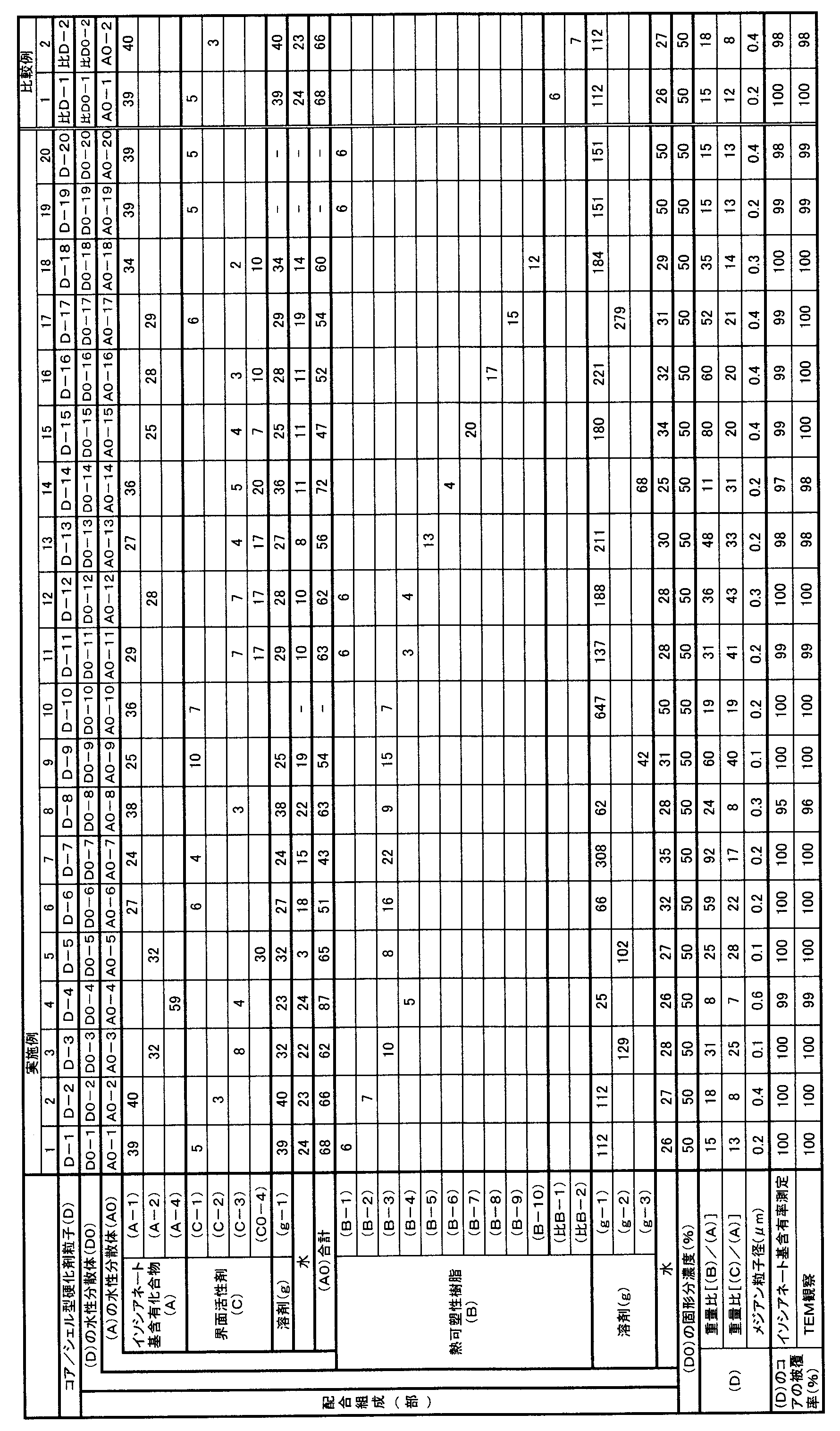
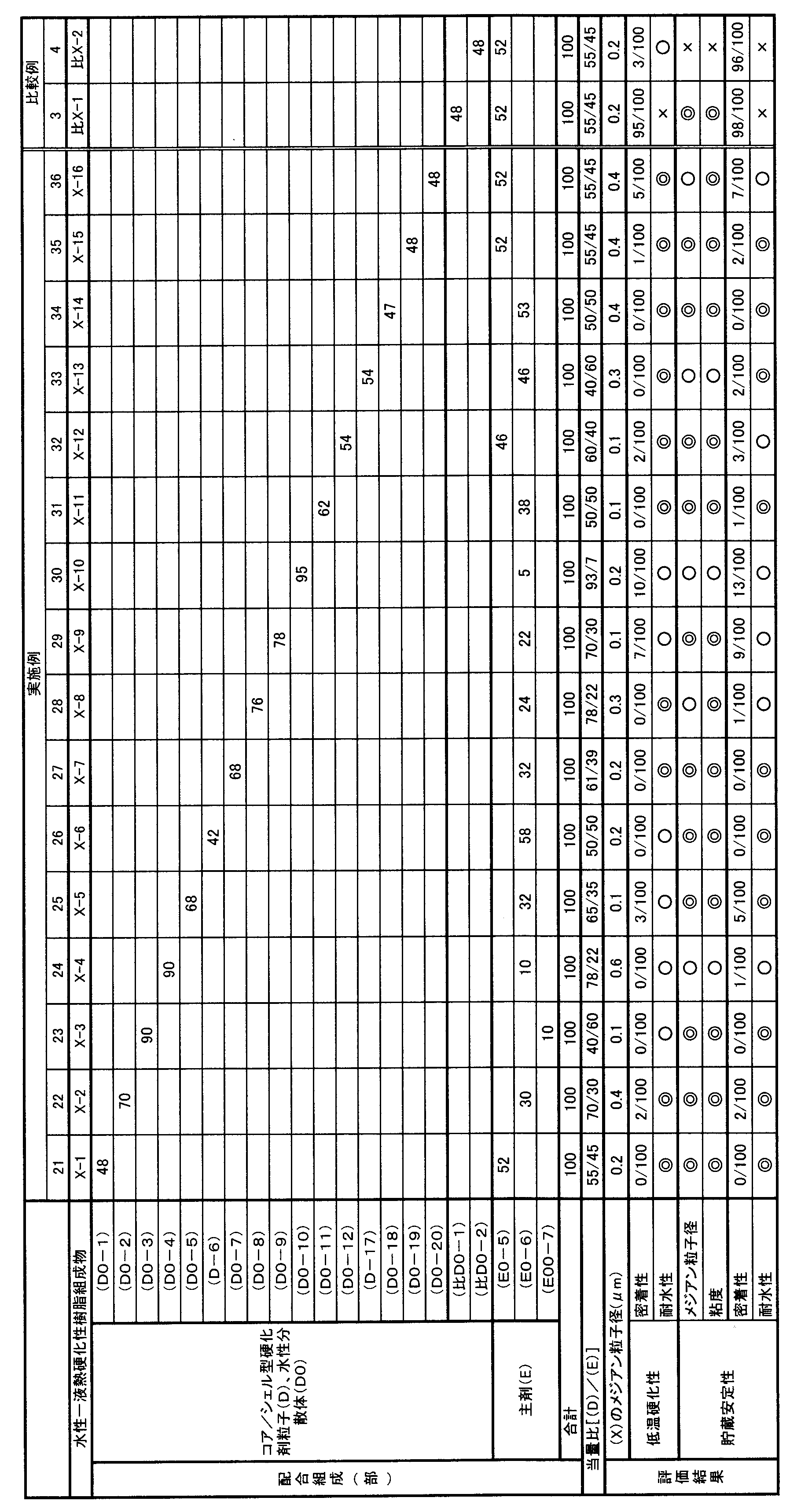
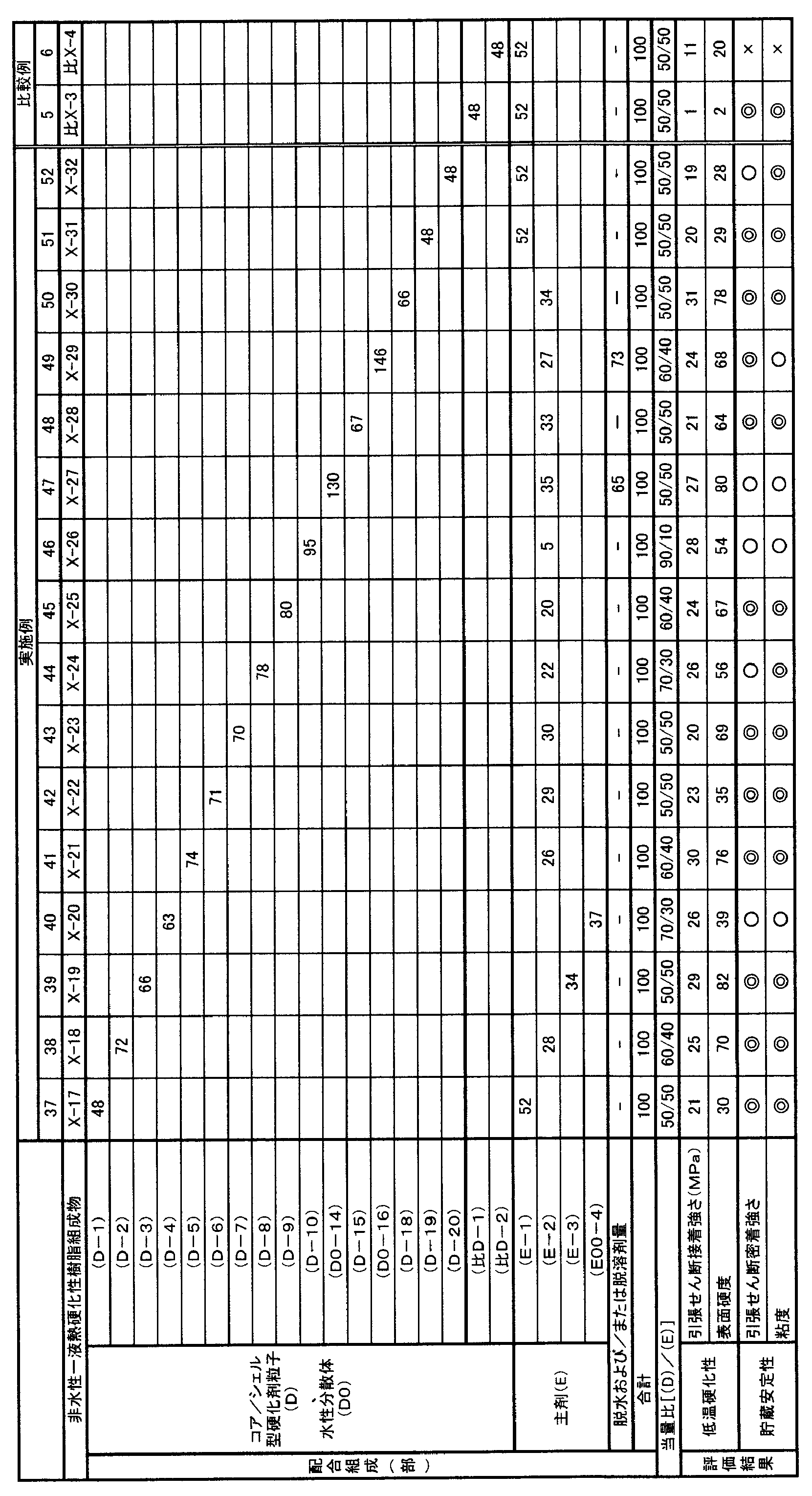
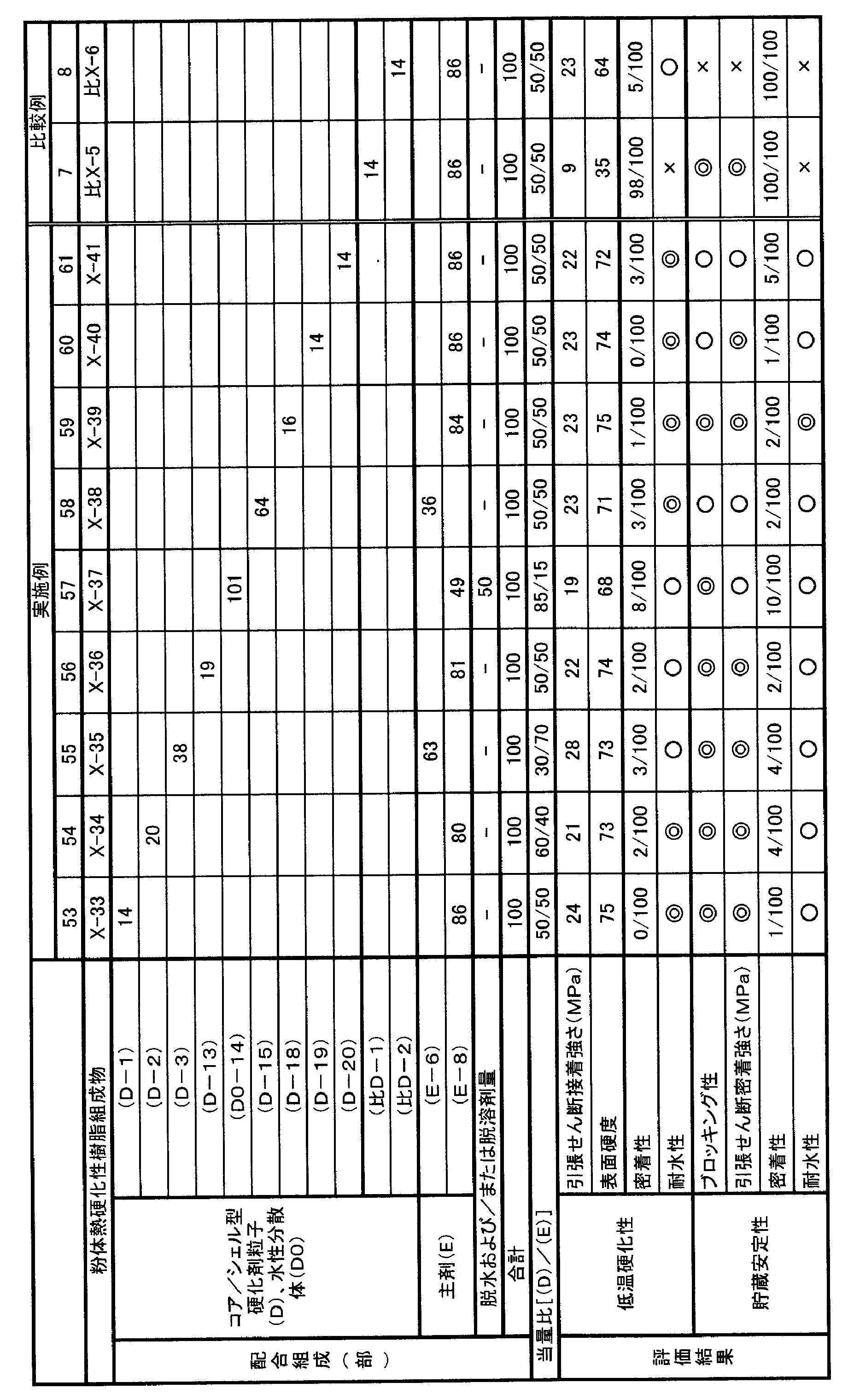
表1~4の結果から、本発明のコア/シェル型硬化剤粒子は、コアの被覆率が高く、比較のものと比べて、熱硬化性樹脂組成物に、優れた貯蔵安定性と優れた硬化性、とくに低温硬化性を付与することがわかる。
また、本発明の熱硬化性樹脂組成物は、貯蔵安定性と低温硬化性とに優れ、硬化物の物性に優れることが明らかである。
また、本発明の熱硬化性樹脂組成物は、貯蔵安定性と低温硬化性とに優れ、硬化物の物性に優れることが明らかである。
本発明のコア/シェル型硬化剤粒子は、コアの被覆率が高く、熱硬化性樹脂組成物に、優れた貯蔵安定性と優れた硬化性、とくに低温硬化性を付与する。
また、本発明の熱硬化性樹脂組成物は、貯蔵安定性および低温硬化性に優れ、その樹脂組成物を硬化させてなる硬化物は接着強度、硬度に優れることから、特に自動車、鉄道車両及び船舶等の構造材料の塗料用途、接着剤用途、成形品、あるいは建築物や家電製品等の接着用途や成型品等に塗料、接着剤、成形品等として幅広く好適に用いることができ、極めて有用である。
また、本発明の熱硬化性樹脂組成物は、貯蔵安定性および低温硬化性に優れ、その樹脂組成物を硬化させてなる硬化物は接着強度、硬度に優れることから、特に自動車、鉄道車両及び船舶等の構造材料の塗料用途、接着剤用途、成形品、あるいは建築物や家電製品等の接着用途や成型品等に塗料、接着剤、成形品等として幅広く好適に用いることができ、極めて有用である。
Claims (12)
- コアがイソシアネート基含有化合物(A)を含有し、シェルが50~150℃のガラス転移温度を有し、かつ5,000~200,000の重量平均分子量を有する熱可塑性樹脂(B)を含有するコア/シェル型硬化剤粒子(D)。
- (B)の含有量が(A)の重量に基づいて5~100%である請求項1記載のコア/シェル型硬化剤粒子。
- さらに界面活性剤(C)を含有してなる請求項1または2記載のコア/シェル型硬化剤粒子。
- 水性媒体中に、請求項1~3のいずれか記載のコア/シェル型硬化剤粒子(D)を分散してなる水性分散体(D0)。
- 請求項1~3のいずれか記載のコア/シェル型硬化剤粒子(D)、およびイソシアネート基と反応し得る官能基を少なくとも2個有する化合物である主剤(E)を含有してなる熱硬化性樹脂組成物(X)。
- 水性一液熱硬化性樹脂組成物(X1)、非水性一液熱硬化性樹脂組成物(X2)および粉体熱硬化性樹脂組成物(X3)からなる群から選ばれる1種である請求項5記載の熱硬化性樹脂組成物。
- (D)と(E)の当量比[(D)/(E)]が、30/70~90/10である請求項5または6記載の熱硬化性樹脂組成物。
- 塗料用、接着剤用および成形品用からなる群から選ばれる1種である請求項5~7のいずれか記載の熱硬化性樹脂組成物。
- 請求項5~8のいずれか記載の熱硬化性樹脂組成物(X)を反応、硬化させてなる硬化物。
- 50~150℃のガラス転移温度を有し、かつ5,000~200,000の重量平均分子量を有する熱可塑性樹脂(B)の有機溶剤(g)溶液と、界面活性剤(C)を含有するイソシアネート基含有化合物(A)の水性分散体(A0)とを転相乳化する、コアが該(A)を含有しシェルが該(B)を含有するコア/シェル型硬化剤粒子(D)の製造方法。
- イソシアネート基含有化合物(A)、50~150℃のガラス転移点を有し、かつ5,000~200,000の重量平均分子量を有する熱可塑性樹脂(B)および有機溶剤(g)を含有する溶液と、水性媒体とを転相乳化する製造方法であって、該転相乳化において界面活性剤(C)が該溶液および/または水性媒体に含有してなる、コアが該(A)を含有しシェルが該(B)を含有するコア/シェル型硬化剤粒子(D)の製造方法。
- 有機溶剤(g)の水/オクタノール分配係数(logPow)が0~4.0である請求項10または11記載のコア/シェル型硬化剤粒子の製造方法。
Applications Claiming Priority (4)
| Application Number | Priority Date | Filing Date | Title |
|---|---|---|---|
| JP2014078309 | 2014-04-07 | ||
| JP2014-078319 | 2014-04-07 | ||
| JP2014078319 | 2014-04-07 | ||
| JP2014-078309 | 2014-04-07 |
Publications (1)
| Publication Number | Publication Date |
|---|---|
| WO2015155952A1 true WO2015155952A1 (ja) | 2015-10-15 |
Family
ID=54287541
Family Applications (1)
| Application Number | Title | Priority Date | Filing Date |
|---|---|---|---|
| PCT/JP2015/001767 Ceased WO2015155952A1 (ja) | 2014-04-07 | 2015-03-27 | コア/シェル型硬化剤粒子および熱硬化性樹脂組成物 |
Country Status (1)
| Country | Link |
|---|---|
| WO (1) | WO2015155952A1 (ja) |
Citations (3)
| Publication number | Priority date | Publication date | Assignee | Title |
|---|---|---|---|---|
| JPS52156775A (en) * | 1976-06-23 | 1977-12-27 | Nissan Chem Ind Ltd | Production of microcapsule |
| JPH0975707A (ja) * | 1995-09-14 | 1997-03-25 | Kyokuto Internatl Corp | イソシアネート系化合物を内包するカプセル及びそのカプセル剤 |
| JP2006061802A (ja) * | 2004-08-26 | 2006-03-09 | Chukyo Yushi Kk | イソシアネート含有マイクロカプセル及びその製造方法、並びに、イソシアネート含有マイクロカプセルを含有する塗料組成物、接着剤組成物及びプラスチック改質剤 |
-
2015
- 2015-03-27 WO PCT/JP2015/001767 patent/WO2015155952A1/ja not_active Ceased
Patent Citations (3)
| Publication number | Priority date | Publication date | Assignee | Title |
|---|---|---|---|---|
| JPS52156775A (en) * | 1976-06-23 | 1977-12-27 | Nissan Chem Ind Ltd | Production of microcapsule |
| JPH0975707A (ja) * | 1995-09-14 | 1997-03-25 | Kyokuto Internatl Corp | イソシアネート系化合物を内包するカプセル及びそのカプセル剤 |
| JP2006061802A (ja) * | 2004-08-26 | 2006-03-09 | Chukyo Yushi Kk | イソシアネート含有マイクロカプセル及びその製造方法、並びに、イソシアネート含有マイクロカプセルを含有する塗料組成物、接着剤組成物及びプラスチック改質剤 |
Similar Documents
| Publication | Publication Date | Title |
|---|---|---|
| TWI630245B (zh) | 封阻型異氰酸酯、塗料組成物、接著劑組成物及物品 | |
| WO2016098336A1 (ja) | 水系コーティング剤組成物、それからなる水系潤滑被膜用塗料組成物および部材 | |
| US9255204B2 (en) | Cavitation resistant polyurethane compositions and methods of forming coating films using the same | |
| TW201323497A (zh) | 造膜助劑及含有其之水性樹脂組成物及鋼板表面處理劑 | |
| JP5105610B2 (ja) | カチオン性水系ポリウレタン樹脂組成物 | |
| WO2019004349A1 (ja) | ウレタン樹脂組成物、鋼板表面処理剤及びその塗膜を有する鋼板 | |
| KR20190029371A (ko) | 친환경 우레탄 방수재 도료 조성물 | |
| TW202537994A (zh) | 聚胺基甲酸酯水系分散體及水性塗料 | |
| JP6600508B2 (ja) | ポリイソシアネート組成物、コーティング組成物、水系コーティング組成物、及びコーティング基材 | |
| JPWO2020105569A1 (ja) | 複合樹脂水性分散体及び複合樹脂水性分散体の製造方法 | |
| JP2015220170A (ja) | 負極用結着剤 | |
| JP6139853B2 (ja) | ポリカーボネートジオール組成物、及びその製造方法 | |
| CN107109116A (zh) | 干燥之后具有柔软触感的水性涂料组合物 | |
| JPWO2019131617A1 (ja) | 塗料組成物 | |
| JP2015534597A (ja) | 増進した除去可能性を有するポリウレタン分散液系コーティング | |
| JP2016047914A (ja) | コア/シェル型硬化剤粒子 | |
| JP2004263147A (ja) | 水分散粉体スラリー塗料 | |
| JP6411552B2 (ja) | ポリイソシアネート組成物及びその製造方法、コーティング組成物、水系コーティング組成物、並びにコーティング基材 | |
| JP2017057239A (ja) | コア/シェル型硬化剤粒子および熱硬化性樹脂組成物 | |
| KR20200059212A (ko) | 수계 수지 조성물 | |
| WO2015155952A1 (ja) | コア/シェル型硬化剤粒子および熱硬化性樹脂組成物 | |
| JP6176648B2 (ja) | ポリウレタン樹脂水分散体、該組成物を用いた硬化物 | |
| JP3808045B2 (ja) | 水分散粉体スラリー塗料 | |
| JP2004263146A (ja) | 低温硬化型水分散粉体スラリー塗料 | |
| JP2018030972A (ja) | ポリイソシアネート組成物、水性塗料組成物、硬化塗膜及び塗装物 |
Legal Events
| Date | Code | Title | Description |
|---|---|---|---|
| 121 | Ep: the epo has been informed by wipo that ep was designated in this application |
Ref document number: 15776208 Country of ref document: EP Kind code of ref document: A1 |
|
| NENP | Non-entry into the national phase |
Ref country code: DE |
|
| 122 | Ep: pct application non-entry in european phase |
Ref document number: 15776208 Country of ref document: EP Kind code of ref document: A1 |
|
| NENP | Non-entry into the national phase |
Ref country code: JP |