WO2015141573A1 - 重合性非線形光学材料、非線形光学膜、光学素子、及び非線形光学膜の製造方法 - Google Patents
重合性非線形光学材料、非線形光学膜、光学素子、及び非線形光学膜の製造方法 Download PDFInfo
- Publication number
- WO2015141573A1 WO2015141573A1 PCT/JP2015/057430 JP2015057430W WO2015141573A1 WO 2015141573 A1 WO2015141573 A1 WO 2015141573A1 JP 2015057430 W JP2015057430 W JP 2015057430W WO 2015141573 A1 WO2015141573 A1 WO 2015141573A1
- Authority
- WO
- WIPO (PCT)
- Prior art keywords
- nonlinear optical
- group
- polymerizable
- compound
- optical material
- Prior art date
- Legal status (The legal status is an assumption and is not a legal conclusion. Google has not performed a legal analysis and makes no representation as to the accuracy of the status listed.)
- Ceased
Links
Classifications
-
- C—CHEMISTRY; METALLURGY
- C08—ORGANIC MACROMOLECULAR COMPOUNDS; THEIR PREPARATION OR CHEMICAL WORKING-UP; COMPOSITIONS BASED THEREON
- C08K—Use of inorganic or non-macromolecular organic substances as compounding ingredients
- C08K5/00—Use of organic ingredients
- C08K5/16—Nitrogen-containing compounds
- C08K5/22—Compounds containing nitrogen bound to another nitrogen atom
- C08K5/23—Azo-compounds
-
- C—CHEMISTRY; METALLURGY
- C09—DYES; PAINTS; POLISHES; NATURAL RESINS; ADHESIVES; COMPOSITIONS NOT OTHERWISE PROVIDED FOR; APPLICATIONS OF MATERIALS NOT OTHERWISE PROVIDED FOR
- C09D—COATING COMPOSITIONS, e.g. PAINTS, VARNISHES OR LACQUERS; FILLING PASTES; CHEMICAL PAINT OR INK REMOVERS; INKS; CORRECTING FLUIDS; WOODSTAINS; PASTES OR SOLIDS FOR COLOURING OR PRINTING; USE OF MATERIALS THEREFOR
- C09D163/00—Coating compositions based on epoxy resins; Coating compositions based on derivatives of epoxy resins
-
- C—CHEMISTRY; METALLURGY
- C09—DYES; PAINTS; POLISHES; NATURAL RESINS; ADHESIVES; COMPOSITIONS NOT OTHERWISE PROVIDED FOR; APPLICATIONS OF MATERIALS NOT OTHERWISE PROVIDED FOR
- C09D—COATING COMPOSITIONS, e.g. PAINTS, VARNISHES OR LACQUERS; FILLING PASTES; CHEMICAL PAINT OR INK REMOVERS; INKS; CORRECTING FLUIDS; WOODSTAINS; PASTES OR SOLIDS FOR COLOURING OR PRINTING; USE OF MATERIALS THEREFOR
- C09D201/00—Coating compositions based on unspecified macromolecular compounds
- C09D201/02—Coating compositions based on unspecified macromolecular compounds characterised by the presence of specified groups, e.g. terminal or pendant functional groups
- C09D201/025—Coating compositions based on unspecified macromolecular compounds characterised by the presence of specified groups, e.g. terminal or pendant functional groups containing nitrogen atoms
-
- G—PHYSICS
- G02—OPTICS
- G02F—OPTICAL DEVICES OR ARRANGEMENTS FOR THE CONTROL OF LIGHT BY MODIFICATION OF THE OPTICAL PROPERTIES OF THE MEDIA OF THE ELEMENTS INVOLVED THEREIN; NON-LINEAR OPTICS; FREQUENCY-CHANGING OF LIGHT; OPTICAL LOGIC ELEMENTS; OPTICAL ANALOGUE/DIGITAL CONVERTERS
- G02F1/00—Devices or arrangements for the control of the intensity, colour, phase, polarisation or direction of light arriving from an independent light source, e.g. switching, gating or modulating; Non-linear optics
- G02F1/35—Non-linear optics
- G02F1/355—Non-linear optics characterised by the materials used
- G02F1/361—Organic materials
-
- C—CHEMISTRY; METALLURGY
- C08—ORGANIC MACROMOLECULAR COMPOUNDS; THEIR PREPARATION OR CHEMICAL WORKING-UP; COMPOSITIONS BASED THEREON
- C08L—COMPOSITIONS OF MACROMOLECULAR COMPOUNDS
- C08L101/00—Compositions of unspecified macromolecular compounds
- C08L101/12—Compositions of unspecified macromolecular compounds characterised by physical features, e.g. anisotropy, viscosity or electrical conductivity
Definitions
- the present invention relates to a polymerizable nonlinear optical material, a nonlinear optical film, an optical element, and a method for producing a nonlinear optical film.
- inorganic compounds such as lithium niobate and potassium hydrogen phosphate have been widely used and put into practical use as compounds having nonlinear optical activity.
- organic compounds that have higher nonlinear optical effects than inorganic compounds and have advantages in response speed, photodamage threshold, molecular design freedom, mass productivity, etc. Consideration has been made.
- a compound having nonlinear optical activity exhibits a nonlinear optical effect by being placed in a state lacking inversion symmetry. Therefore, when a compound having nonlinear optical activity is used for an optical element, this compound is used in a certain orientation state.
- a compound having nonlinear optical activity is mixed with a polymer binder, the mixture is heated to a temperature near the glass transition temperature, and a high voltage is applied, whereby a compound having nonlinear optical activity is produced. The dipole is oriented and then cooled to harden the polymer binder, thereby fixing the orientation state (so-called polling treatment).
- Patent Document 1 In order to improve the stability of the above-described immobilized alignment state, it is known that a compound having nonlinear optical activity and a matrix polymer are crosslinked and linked (Patent Document 1, Non-Patent Document 1).
- Patent Document 2 describes that a compound having nonlinear optical activity is linked to a side chain of a polyimide precursor, and the alignment state is fixed by heating and curing the polyimide precursor. It is also known that a monomer is contained in a nonlinear optical material and a polymerization reaction is performed after the poling treatment.
- Patent Document 3 a polymer compound, a volatile monomer (such as methyl acrylate), and an organic compound having a nonlinear optical effect are dissolved in a solvent, and a film is produced from this solution to produce an organic nonlinear optical element.
- an electric field is applied to the film to align the organic compound having a nonlinear optical effect, followed by a polymerization reaction by UV irradiation with a glass mask placed thereon, and then unnecessary. It is described that an optical waveguide is formed by removing a monomer.
- Patent Document 1 describes that the reaction temperature when a compound having nonlinear optical activity and a matrix polymer are crosslinked is 150 ° C.
- the crosslinking reaction temperature described in Non-Patent Document 1 is 190 ° C.
- the heat curing temperature described in Patent Document 2 is 250 ° C. or higher.
- organic compounds having nonlinear optical activity generally have low heat resistance, and are usually decomposed or modified by heating at about 150 ° C. Therefore, the types of organic compounds having nonlinear optical activity that can be applied to the alignment fixing methods described in Patent Document 1, Patent Document 2, and Non-Patent Document 1 are greatly limited.
- the method described in Patent Document 3 cannot stably maintain the orientation state of the compound having nonlinear optical activity.
- the monomer described in Patent Document 3 since the monomer described in Patent Document 3 is volatile, the monomer is volatilized to some extent at the time of poling or polymerization reaction, and the place where the monomer was present becomes empty. . As a result, the distance between the molecules of the remaining non-volatile component becomes long, and the orientation of the organic compound having nonlinear optical activity cannot be firmly fixed. Furthermore, the volatilization of the monomer causes fluctuations in the material composition and the film thickness of the film, and also causes variations in nonlinear optical performance.
- a polymer binder for aligning and fixing the organic nonlinear compound is:
- organic nonlinear compound organic compound having nonlinear optical activity
- polymer binder polymer
- Tg glass transition temperature
- the polymer binder does not exhibit fluidity and the organic nonlinear compound cannot move sufficiently. It becomes difficult to orient. That is, the high degree of orientation of the organic nonlinear compound and the stable fixation of the orientation state are in a trade-off relationship with each other, and it is not easy to achieve both at a high level.
- the present invention can create a highly oriented state of an organic nonlinear compound (that is, a highly ordered orientation state) by a lower temperature poling process, and makes the orientation state of the organic nonlinear compound after poling more stable. It is an object of the present invention to provide a nonlinear optical material that can be held. Another object of the present invention is to provide a nonlinear optical film in which the organic nonlinear compound is highly oriented and excellent in the stability of the oriented state. Another object of the present invention is to provide an optical element having a high electro-optic effect and excellent durability. Moreover, this invention makes it a subject to provide the manufacturing method of the said nonlinear optical film.
- an organic nonlinear compound having a polymerizable group or an active hydrogen-containing group if necessary
- a high Tg polymer having a Tg of a specific temperature or more
- a compound having two or more polymerizable groups in the molecule and a molecule
- the Tg of the entire material can be lowered, and even if polling is performed at a relatively low temperature, it is organic.
- a polymerizable nonlinear optical material containing the following components (a) to (c) and having a glass transition temperature of 40 ° C. or higher and 120 ° C. or lower: (A) an organic compound having nonlinear optical activity; (B) one or more compounds selected from the following (b-1) and (b-2); (B-1) a compound having two or more polymerizable groups in the molecule (b-2) a compound having two or more active hydrogen-containing groups in the molecule (c) a polymer having a glass transition temperature of 120 ° C.
- the polymerizable nonlinear optical material contains the component (b-1) as the component (b) and the polymerizable group of the component (b-1) is reactive with the active hydrogen-containing group
- the polymerizable nonlinear optical material contains the above (b-2) or at least one of the components (a) has an active hydrogen-containing group
- the polymerizable nonlinear optical material does not contain (b-1)
- at least one of the components (a) has a group that is reactive with an active hydrogen-containing group.
- the polymerizable nonlinear optical material has a glass transition temperature of 120 ° C.
- the non-linear optical film is a film formed by subjecting a film formed using the polymerizable non-linear optical material to poling treatment to orient the component (a) and polymerizing and fixing the orientation state of the component (a) by a polymerization reaction.
- the nonlinear optical film according to [8]. An optical element having the nonlinear optical film according to [8] or [9].
- the optical element according to [10], wherein the optical element is a light modulation element.
- polymerization refers to a compound having an active hydrogen-containing group and a compound having a group reactive to the active hydrogen-containing group, in addition to an aspect in which a compound having an ethylenically unsaturated bond undergoes a polymerization reaction. Is used to include a form that reacts with to form a polymer.
- the “polymerizable group” means a group that is reactive with the active hydrogen-containing group.
- substituents when there are a plurality of substituents, linking groups, and the like (hereinafter referred to as substituents) indicated by specific symbols, or when a plurality of substituents are specified simultaneously or alternatively, It means that a substituent etc. may mutually be same or different. The same applies to the definition of the number of substituents and the like. Further, when there are repetitions of a plurality of partial structures represented by the same indication in the formula, each partial structure or repeating unit may be the same or different. Further, unless otherwise specified, when a plurality of substituents and the like are adjacent (particularly adjacent), they may be connected to each other or condensed to form a ring.
- the term “compound” (including polymer) is used to mean not only the compound itself but also its salt and its ion. In addition, it means that a part of the structure is changed as long as the desired effect is achieved.
- a substituent that does not clearly indicate substitution or non-substitution means that the group may further have a substituent as long as the intended effect is not impaired. .
- This is also synonymous for compounds that do not specify substitution / non-substitution.
- a numerical range expressed using “to” means a range including numerical values described before and after “to” as a lower limit value and an upper limit value.
- the polymerizable nonlinear optical material of the present invention can create a high degree of orientation of organic nonlinear compounds with a lower temperature poling process. Furthermore, the orientation state of the organic nonlinear compound created by the poling process can be maintained more stably.
- the organic nonlinear compound is highly oriented, and the orientation state is excellent in stability.
- the optical element of the present invention has a nonlinear optical film in which a highly oriented state of the organic nonlinear compound is stably maintained, has a high electro-optic effect, and is excellent in durability.
- the polymerizable nonlinear optical material of the present invention contains the following components (a) to (c) and has a glass transition temperature of 40 ° C. or higher and 120 ° C. or lower.
- the material of the present invention contains the above (b-1) as component (b)
- the material of the present invention contains the above (b-2) or at least one component (a) Having an active hydrogen-containing group
- the material of the present invention does not contain the above (b-1)
- at least one of the components (a) has a group that is reactive with the active hydrogen-containing group.
- the material of the present invention is preferably in the form of a composition. That is, the material of the present invention is preferably in a form in which each component is uniformly mixed.
- the material of the present invention may be liquid or have a specific shape. As will be described later, by using the material (composition) of the present invention, a material exhibiting nonlinear optical activity (such as a nonlinear optical film) can be produced.
- the material of the present invention contains at least one organic nonlinear compound (component (a)).
- the compound of component (a) is not particularly limited as long as it is an organic compound having nonlinear optical activity, and a conventionally known organic nonlinear compound can be used.
- a conventionally known organic nonlinear compound can be used.
- JP 2010-66325 A [0135], [0158], [0197], [0223], [0252], [0278], [0294], [0324], [0350], [0376], [0402], and [0422].
- Disperse Red 1 (trade name, manufactured by Sigma Aldrich), CLD-1 (trade name, manufactured by Sigma Aldrich), Disperse Red 19 (trade name, manufactured by Sigma Aldrich) and the like can also be used as commercially available products.
- the material of the present invention contains (b-1) as component (b) and does not contain (b-2), the polymerizable group of (b-1) reacts with the active hydrogen-containing group In the case of containing a group exhibiting properties, at least one of the components (a) has an active hydrogen-containing group. Thereby, the material of the present invention can be a material having polymerization reactivity. Even when the material of the present invention contains (b-2), an organic nonlinear compound having an active hydrogen-containing group can be used as the compound of component (a).
- the number of active hydrogen-containing groups in one molecule of the compound of component (a) is preferably 1 to 6, more preferably 2 to 5, and even more preferably 2 or 3 preferable.
- the active hydrogen-containing group that the compound of component (a) may have include a group selected from a hydroxyl group, a carboxy group, an amino group, an amide group, a sulfo group, a mercapto group, and an imino group.
- the active hydrogen-containing group possessed by the compound of component (a) is preferably a group selected from a hydroxyl group, a carboxy group, and an amino group, and more preferably a hydroxyl group.
- the compound of component (a) may have two or more active hydrogen-containing groups in one molecule.
- the organic nonlinear compound having an active hydrogen-containing group can be obtained by introducing an active hydrogen-containing group into the organic nonlinear compound exemplified above by a conventional method.
- the material of the present invention contains (b-2) as component (b) and does not contain (b-1), at least one of component (a) is reactive with the active hydrogen-containing group of (b-2) (Hereinafter, a group that is reactive with an active hydrogen-containing group is also referred to as an “active hydrogen reactive group”).
- the material of the present invention can be a material having polymerization reactivity.
- an organic nonlinear compound having an active hydrogen reactive group may be used as the compound of component (a). it can.
- the number of active hydrogen reactive groups in one molecule of the compound of component (a) is preferably 1 to 6, more preferably 2 to 5, Or 3 is more preferable.
- the group chosen from an epoxy group and an oxetanyl group can be used conveniently.
- the compound of component (a) particularly preferably has three oxetanyl groups or epoxy groups in the molecule.
- the compound of component (a) means a group having an ethylenically unsaturated group (an ethylene bond (carbon-carbon double bond) consumed in the measurement of bromine number and iodine number) as a polymerizable group, such as benzene. It is not an unsaturated group exhibiting aromaticity.
- the ethylenically unsaturated group is preferably introduced as an acryloyl group, a methacryloyl group, an acrylamide group, a vinyl group or the like.
- the number of ethylenically unsaturated groups in one molecule of the compound of component (a) is preferably 1 to 6, more preferably 2 to 5, Or 3 is more preferable.
- the compound of component (a) may have an anthryl group.
- An anthryl group can be linked to an ethylenically unsaturated group by a Diels-alder reaction.
- An organic nonlinear compound having a polymerizable group can be obtained by introducing a polymerizable group into the organic nonlinear compound exemplified above by a conventional method.
- the compound of component (a) contained in the material of the present invention is more preferably represented by any of the following formulas (A), (A5), and (C1) to (C4).
- R represents a hydrogen atom, an alkyl group (preferably an alkyl group having 1 to 10 carbon atoms, more preferably an alkyl group having 1 to 5 carbon atoms), a group having an oxetanyl group, a group having an epoxy group, an ethylenic group A group having an unsaturated group or a group having a hydroxyl group, preferably a hydrogen atom, a group having an oxetanyl group, a group having an epoxy group or a group having a hydroxyl group.
- the ethylenically unsaturated group is preferably introduced as an acryloyl group.
- R is a group having an ethylenically unsaturated group
- — (C 2 H 4 O) p —C ( ⁇ O) —CH ⁇ CH 2 (p is an integer of 1 to 5) is more preferred, More preferred is C 2 H 4 O—C 2 H 4 O—C ( ⁇ O) —CH ⁇ CH 2 .
- the molecular weight of the component (a) compound is preferably 300 to 1500, and more preferably 500 to 1000.
- the proportion of the component (a) in the total amount of the components (a) to (c) is preferably 1 to 60% by mass, more preferably 2 to 55% by mass. More preferably, it is 50 mass%.
- the material of the present invention contains one or more compounds (component (b)) selected from (b-1) and (b-2).
- Component (b) is preferably a compound having a molecular weight of 200 or more.
- the orientation-fixed state of the component (a) compound can be maintained more stably.
- the material of the present invention preferably contains at least one of (b-1) and at least one of (b-2).
- the compound (b-1) and the compound (b-2) will be described below.
- the material of the present invention may have a compound (b-1) having two or more polymerizable groups in the molecule as the component (b).
- the polymerizable group contained in the compound (b-1) is not particularly limited, but a group having an active hydrogen reactive group or an ethylenically unsaturated group is preferable. Further, the compound (b-1) may have an anthryl group as a polymerizable group.
- an active hydrogen reactive group The group chosen from an epoxy group and an oxetanyl group can be used conveniently.
- the ethylenically unsaturated group is preferably introduced as an acryloyl group, a methacryloyl group, an acrylamide group, a vinyl group or the like.
- (B-1) preferably includes a compound having two or more polymerizable groups selected from an epoxy group and an oxetanyl group, and is a compound having two or more polymerizable groups selected from an epoxy group and an oxetanyl group. More preferred.
- the number of polymerizable groups in one molecule of the compound (b-1) is preferably 2 to 6, more preferably 2 to 4, and even more preferably 2 or 3.
- the polymerizable group of the compound (b-1) is an active hydrogen reactive group (preferably an epoxy group or an oxetanyl group)
- the number of polymerizable groups in one molecule of the compound (b-1) is 2
- the compound (b-1) may be a low molecular compound or an oligomer, but in any case, the molecular weight is preferably 200 to 1,000, more preferably 200 to 500.
- the compound (b-1) that can be used in the present invention preferably has an active hydrogen reactive group and an aromatic ring.
- the compound (b-1) is preferably a compound having a bisphenol A type, bisphenol F type, biphenyl type, naphthalene type, phenanthrene type or anthracene type skeleton, more preferably bisphenol A type or bisphenol F. It is a compound having a type skeleton.
- a compound having these types of skeletons is represented by the following formula.
- R a represents a substituent, preferably an alkyl group having 1 to 5 carbon atoms, more preferably 1 to 3 carbon atoms.
- n1 represents an integer of 0 to 4, preferably 0 or 1.
- n2 represents an integer of 0 to 6, more preferably 0 to 2.
- n3 represents an integer of 0 to 8, and 0 or 2 is more preferable.
- R b represents a group having an active hydrogen reactive group, preferably a group having an oxetanyl group or an epoxy group.
- R b is more preferably an alkoxy group having an epoxy group or an oxetanyl group as a substituent (preferably methoxy having an epoxy group or an oxetanyl group as a substituent or ethoxy having an epoxy group or an oxetanyl group as a substituent).
- An alkoxy group having an epoxy group as a group preferably methoxy having an epoxy group as a substituent or ethoxy having an epoxy group as a substituent is more preferable.
- R c represents a hydrogen atom or a substituent, preferably a hydrogen atom, an alkyl group (preferably an alkyl group having 1 to 5 carbon atoms, more preferably an alkyl group having 1 to 3 carbon atoms) or an aryl group (preferably 6 to 20 carbon atoms). More preferably an aryl group having 6 to 18 carbon atoms, still more preferably an aryl group having 6 to 15 carbon atoms, particularly preferably phenyl, and particularly preferably a hydrogen atom.
- the compound (b-1) preferably has a structure represented by the following formula (P1) or (P2).
- R a, R c and n1 are each the same meaning as R a, R c and n1 in the bisphenol A type and F-type structure of a preferred form also the same .
- R f represents a group having an active hydrogen reactive group, preferably a group having an oxetanyl group or an epoxy group.
- R f is more preferably an alkyl group having an epoxy group or an oxetanyl group as a substituent (preferably methyl having an epoxy group or an oxetanyl group as a substituent or ethyl having an epoxy group or an oxetanyl group as a substituent).
- L is a divalent linking group, preferably an alkylene group having 3 to 5 carbon atoms, more preferably 3 or 4 carbon atoms. This alkylene group preferably has a hydroxyl group as a substituent.
- m is a number of 0 or more, preferably 0 to 10, more preferably 0 to 5.
- Tg is less than 120 ° C., preferably 20 to 100 ° C. That is, the compound of (b-1) is different from the polymer of component (c).
- Tg is measured using a differential scanning calorimeter (DSC). More specifically, at the intersection of the slope of the rising end of the endothermic process accompanying the glass transition and the baseline when measured at a rate of 10 ° C./min from room temperature using a differential scanning calorimeter (DSC). Let the corresponding temperature be Tg.
- DSC differential scanning calorimeter
- the material of the present invention may contain a compound (b-2) having two or more active hydrogen-containing groups in the molecule as the component (b).
- the active hydrogen-containing group possessed by the compound (b-2) is not particularly limited, and examples thereof include a group selected from a hydroxyl group, a carboxy group, an amino group, an amide group, a sulfo group, a mercapto group, and an imino group.
- the active hydrogen-containing group possessed by the compound of component (b-2) is preferably a group selected from a hydroxyl group, a carboxy group, and an amino group, and more preferably a hydroxyl group.
- the compound (b-2) may have two or more active hydrogen-containing groups in one molecule.
- the number of active hydrogen-containing groups in one molecule of the compound (b-2) is preferably 2 to 6, more preferably 2 to 4, and still more preferably 2 or 3.
- the molecular weight of the compound (b-2) is preferably 200 to 1000, more preferably 200 to 500.
- the compound (b-2) that can be used in the present invention more preferably has an aromatic ring.
- the compound (b-2) is preferably a compound having a bisphenol A type, bisphenol F type, biphenyl type, naphthalene type, phenanthrene type or anthracene type skeleton, more preferably bisphenol A type or bisphenol F. It is a compound having a type skeleton. These types of skeletons are represented by the following formulas.
- R a , n1, n2 and n3 are each of the above-described bisphenol A type, bisphenol F type, biphenyl type, naphthalene type, phenanthrene type or anthracene type described as the preferred form of (b-1). It is synonymous with R a , n1, n2, and n3 in the structural formula of the compound having a skeleton, and the preferred form is also the same.
- R e represents a group having an active hydrogen-containing group, preferably a group having a group selected from a hydroxyl group, a carboxy group and an amino group, and more preferably a hydroxyl group.
- R d represents a hydrogen atom or a substituent, preferably a hydrogen atom, an alkyl group (preferably an alkyl group having 1 to 5 carbon atoms, more preferably an alkyl group having 1 to 3 carbon atoms) or an aryl group (preferably 6 to 20 carbon atoms). More preferably an aryl group having 6 to 18 carbon atoms, still more preferably an aryl group having 6 to 15 carbon atoms, particularly preferably phenyl, and a hydrogen atom or the above aryl group is particularly preferable.
- the proportion of component (b) in the total amount of components (a) to (c) is preferably 10 to 90% by mass, and more preferably 10 to 80% by mass.
- the polymer (component (c)) having a glass transition temperature of 120 ° C. or higher contained in the material of the present invention is not particularly limited as long as the glass transition temperature is 120 ° C. or higher.
- polycarbonate, poly (meth) acrylic acid ester (Preferably methyl poly (meth) acrylate), amorphous fluoropolymer, polyimide and the like can be widely used.
- the material of the present invention may contain two or more kinds of polymers as component (c).
- Component (c) preferably contains polycarbonate, more preferably component (c) is polycarbonate.
- the weight average molecular weight of the polymer of component (c) is preferably from 5,000 to 100,000, more preferably from 10,000 to 50,000.
- the weight average molecular weight is, for example, using a high-speed GPC device (HLC-802A, manufactured by Toyo Soda Co., Ltd.), using a 0.5 mass% THF solution as a sample solution, and using one TSKgel HZM-M column. , 200 ⁇ L of sample is injected, eluted with the THF solution, and measured at 25 ° C. with a refractive index detector or UV detector (detection wavelength 254 nm). The measurement result is a molecular weight in terms of polyethylene glycol.
- the Tg of the polymer of component (c) is preferably 130 ° C. or higher, more preferably 140 ° C. or higher, and further preferably 150 ° C. or higher.
- Tg of component (c) is usually 250 ° C. or less from the viewpoint that the Tg of the whole material is a preferable value and the temperature of the poling treatment described later is kept low. Is preferable, and it is more preferable that it is 200 degrees C or less.
- the ratio of the component (c) to the total amount of the components (a) to (c) is preferably 3 to 85% by mass, and more preferably 5 to 80% by mass.
- the material of the present invention can further increase the Tg after polymerizing the material compared to the case where the polymer of component (c) is not included.
- the orientation state of the organic nonlinear compound after the poling treatment is kept stable.
- the material of the present invention may contain a curing agent, a curing accelerator, a polymerization initiator, an antioxidant, an ultraviolet absorber, an organic solvent and the like in addition to the components (a) to (c).
- the material of the present invention has a Tg of 40 ° C. or higher and 120 ° C. or lower.
- the organic nonlinear material can be oriented with a high degree of order even when the poling treatment is performed at a low temperature. Therefore, the poling process can be performed at a temperature lower than the heat resistant temperature of the organic nonlinear compound.
- the Tg of the material of the present invention is preferably 110 ° C. or lower, more preferably 100 ° C. or lower, still more preferably 95 ° C. or lower, and particularly preferably 90 ° C. or lower.
- the Tg of the material of the present invention when the Tg of the material of the present invention is 40 ° C. or higher, Tg can be sufficiently increased by polymerizing and fixing the alignment state of the organic nonlinear compound, and sufficient alignment stability can be obtained. On the other hand, if the Tg of the material of the present invention is lower than 40 ° C., even if the orientation state of the organic nonlinear compound is polymerized and fixed, the Tg cannot be sufficiently increased, and the orientation stability is lowered.
- the Tg of the material of the present invention is preferably 45 ° C. or higher, more preferably 50 ° C. or higher, and further preferably 55 ° C. or higher. In the measurement of Tg, since the volatile component is volatilized by heat, the Tg of the polymerizable nonlinear optical material is the Tg of the solid content of the polymerizable nonlinear optical material.
- Tg is increased by polymerization reaction as compared with that before polymerization.
- the material of the present invention preferably has a Tg of 120 ° C. or higher when the polymerizable group is polymerized to a polymerization rate of 80% (so that the polymerization rate of the polymerizable group is 80%). More preferably, it is 130 ° C or higher, and further preferably 140 ° C or higher.
- the material of the present invention usually has a Tg of 200 ° C. or less when the polymerizable group is subjected to a polymerization reaction so that the polymerization rate becomes 80%.
- the Tg is preferably increased by 30 ° C. or more compared to before the polymerization reaction, and increased by 40 ° C. More preferably, the temperature rises by 50 ° C. or more (that is, after the Tg of the material of the present invention and the material of the present invention are polymerized so that the polymerization rate of the polymerizable group becomes 80%).
- the difference from Tg is preferably 30 ° C or higher, more preferably 40 ° C or higher, and further preferably 50 ° C or higher.
- the organic nonlinear compound is highly oriented at a lower temperature at the time of poling by lowering the Tg before the polymerization reaction, and this orientation state is further strengthened by the polymerization reaction. It can be fixed.
- the difference in Tg before and after the polymerization reaction is preferably large.
- the polymerization reaction is performed so that the Tg of the material of the present invention and the material of the present invention have a polymerization rate of 80% of the polymerizable group.
- the difference from Tg after being made is 130 ° C. or less.
- the polymerization rate of the polymerizable group is determined by the reflection infrared spectroscopy measurement (IR), the peak area due to the polymerizable group of the material before the polymerization reaction, and the polymerization of the material after the polymerization reaction. It is calculated by comparing the peak area due to the sex group. More specifically, the peak area (%) due to the polymerizable group after the polymerization reaction was determined by setting the peak area due to the polymerizable group before the polymerization reaction to 100%, and was used as the polymerization rate of the polymerizable group.
- IR reflection infrared spectroscopy measurement
- the peak attributable to the epoxy group is in the vicinity of 916 cm -1
- a peak attributable to an oxetanyl group is in the vicinity of 982 cm -1
- the peak attributable to the ethylenically unsaturated group is in the vicinity of 810 cm -1.
- a polymerizable nonlinear optical material containing the following components (a3) to (c3) and having a glass transition temperature of 40 ° C. or higher and 120 ° C. or lower: (A3) 2-6 (preferably 2 or 3) organic compounds having reactivity with active hydrogen-containing groups in the molecule and having nonlinear optical activity, (B3) a compound having 2 to 6 (preferably 2 or 3) active hydrogen-containing groups in the molecule; (C3) A polymer having a glass transition temperature of 120 ° C. or higher.
- the preferred contents (ratio with other components) of the components (a1), (a2), (a3) and (a4) are all the above-mentioned components ( It is the same as the preferable content of a).
- the preferred contents of the components (b1), (b2), (b3) and (b4) are all the preferred contents of the above component (b). Is the same.
- the preferred contents of the components (c1), (c2), (c3) and (c4) are all the preferred contents of the above component (c). Is the same.
- the nonlinear optical film of the present invention is formed using the polymerizable nonlinear optical material of the present invention. More specifically, a film formed by forming a film using the polymerizable non-linear optical material of the present invention, subjecting the compound of component (a) to orientation by subjecting to a poling process described later, and polymerizing is preferable.
- the film forming method is not particularly limited, but the material (composition) of the present invention obtained by dissolving the above components (a) to (c) and other components in an organic solvent is spin coated, blade coated, dipped. It is preferable to employ a wet coating method in which a film is formed by coating on a substrate using a coating method, an ink jet method, a spray method or the like.
- the organic solvent may be any organic solvent as long as it can dissolve the components of the material of the present invention, but preferably has a boiling point in the range of 80 to 200 ° C. If an organic solvent with a boiling point of less than 80 ° C is used, for example, the solvent volatilizes during storage of the coating solution, and the viscosity of the coating solution changes (increases), or the solvent volatilization rate is too fast during coating, causing condensation Sometimes On the other hand, when an organic solvent having a boiling point exceeding 200 ° C. is used, it is difficult to remove the solvent after coating, and the remaining organic solvent acts as a plasticizer for the polymer binder, causing a decrease in the glass transition temperature. There is.
- organic solvents examples include diethylene glycol dimethyl ether, cyclopentanone, cyclohexanone, cyclohexanol, toluene, chlorobenzene, xylene, N, N-dimethylformamide, N, N-dimethylacetamide, dimethyl sulfoxide, 2,2,3,3 -Tetrafluoro-1-propanol, 1,2-dichloroethane, 1,2-dichloropropane, 1,3-dichloropropane, 1,2,3-trichloropropane and the like. These organic solvents may be used alone or in combination.
- a mixed solvent obtained by adding an organic solvent such as tetrahydrofuran, methyl ethyl ketone, isopropanol, or chloroform having a boiling point of less than 80 ° C. can also be used.
- the organic nonlinear compound is oriented, thereby exhibiting second-order nonlinear optical activity.
- the orientation of the organic nonlinear compound is preferably performed by an arbitrary poling process such as an optical poling method, an optically assisted electric field poling method, and an electric field poling method.
- the electric field poling method is particularly preferable in terms of the simplicity of the apparatus and the high degree of orientation obtained.
- the electric field poling method is largely classified into a contact poling method in which a nonlinear optical material is sandwiched between a pair of electrodes and an electric field is applied, and a corona poling method in which a corona discharge is applied to the surface of the nonlinear optical material on the substrate electrode and a charging electric field is applied. Separated.
- the electric field poling method is an alignment method in which the nonlinear optically active compound is aligned (polled) in the direction of the applied electric field by the Coulomb force between the dipole moment of the nonlinear optically active compound and the applied electric field.
- the randomization of the orientation state over time progresses more gradually as the difference between the environmental temperature where the nonlinear optical material is placed and the Tg of the nonlinear optical material is larger. Therefore, randomization can be suppressed by using a binder resin having a high Tg in the nonlinear optical material and designing the glass transition temperature of the nonlinear optical material to be high.
- the Tg of the nonlinear optical material is increased, it becomes necessary to perform electric field poling at a high temperature, and when an organic nonlinear compound having low heat resistance is used, the organic nonlinear compound is thermally decomposed and thermally denatured.
- the organic nonlinear compound can be oriented with a high degree of order even if the poling treatment is performed at a relatively low temperature after film formation. Further, since the material of the present invention is polymerizable, the organic nonlinear compound can be fixed by curing the film by a polymerization reaction described later. Moreover, since the material of the present invention contains a high Tg polymer as the component (c), the Tg of the material after the polymerization reaction (after curing) is further increased. That is, randomization of the aligned organic nonlinear compound can be effectively suppressed.
- the temperature of the poling treatment is appropriately selected according to the Tg of the material of the present invention. However, from the viewpoint of further suppressing the thermal decomposition and thermal denaturation of the organic nonlinear compound, it is preferably 140 ° C. or lower. Preferably it is 130 degrees C or less, More preferably, it is 120 degrees C or less, More preferably, it is 110 degrees C or less, More preferably, it is 105 degrees C or less, Especially preferably, it is 100 degrees C or less.
- the temperature of the poling treatment is usually 70 ° C. or higher, preferably 80 ° C. or higher, more preferably 85 ° C. or higher, and further preferably 90 ° C. or higher from the viewpoint of further improving the orientation of the organic nonlinear compound.
- the processing time of the polling process is not particularly limited, but is preferably 5 to 60 minutes, and more preferably 10 to 30 minutes.
- the nonlinear optical film of the present invention is formed using the material of the present invention as described above, and is subjected to poling treatment to orient the compound of component (a), and the orientation of component (a) by polymerization reaction. It is preferable to form by fixing the state by polymerization.
- “the component (a) is oriented by poling treatment and the orientation state of the component (a) is polymerized and fixed by polymerization reaction” means that the polymerization reaction is performed after the poling treatment.
- the meaning including both aspects of the aspect in which the polymerization reaction is performed simultaneously with the poling process the polymerization reaction proceeds by the poling process).
- an embodiment in which the polymerization reaction is performed simultaneously with the poling treatment is preferable.
- the polymerization reaction a thermal polymerization reaction or a photopolymerization reaction is preferable, and a thermal polymerization reaction is more preferable.
- the polymerization reaction can be carried out in the presence of a curing accelerator or a polymerization initiator.
- the radical may act on the organic nonlinear compound, and the nonlinear optical activity may decrease. Therefore, it is more preferable to carry out the polymerization reaction without using a radical polymerization initiator.
- the polymerizable group contained in the material of the present invention is preferably an active hydrogen reactive group.
- the temperature of the polling process and the temperature of the thermal polymerization reaction are the same. Also, when the thermal polymerization reaction is carried out after the poling treatment, it is preferable to carry out the thermal polymerization reaction at a temperature equivalent to the poling treatment temperature in order to prevent thermal decomposition and thermal denaturation of the organic nonlinear compound. That is, the reaction temperature of the thermal polymerization reaction is preferably 150 ° C. or less, more preferably 130 ° C. or less, further preferably 120 ° C. or less, further preferably 110 ° C. or less, more preferably 105 ° C. or less, and particularly preferably It is 100 degrees C or less. The reaction temperature of the thermal polymerization reaction is usually 70 ° C. or higher, preferably 80 ° C. or higher, more preferably 85 ° C. or higher, and further preferably 90 ° C. or higher.
- the reaction time of the polymerization reaction is not particularly limited, but is preferably 5 to 60 minutes, more preferably 10 to 30 minutes.
- the polymerization reaction it is preferable to polymerize the polymerizable group present in the film (in the material composition) before the polymerization reaction to a polymerization rate of 50% or more, more preferably 60% or more, and further preferably 70%. Polymerize as above.
- a polymerizable group present in the film (in the material composition) before the polymerization reaction it is preferable to polymerize a polymerizable group present in the film (in the material composition) before the polymerization reaction to a polymerization rate of 100% by the polymerization reaction. Usually, it is 97% or less.
- order parameter ⁇
- the order parameter is a numerical value that is 1 in an ideal state in which all molecules are perfectly oriented, and 0 when completely random, and indicates that the larger the value, the higher the degree of molecular orientation as a whole. By measuring this value, it can be determined how efficiently polling has been performed, and its stability can be evaluated.
- the film thickness of the nonlinear optical film of the present invention is appropriately adjusted depending on its application and is not limited at all, but is usually 100 to 3000 nm, and more preferably 500 to 2000 nm.
- the optical element of the present invention may be any element as long as it has the nonlinear optical film of the present invention and operates based on the nonlinear optical effect.
- Specific examples of the optical element of the present invention include a wavelength conversion element, a photorefractive element, an electro-optical element, and the like.
- Particularly preferred are electro-optical elements such as optical switches, optical modulators (optical modulation elements) and phase shifters that operate based on the electro-optical effect, and more preferred are optical modulation elements.
- the electro-optical element is preferably used as an element having a structure in which the nonlinear optical film of the present invention is formed on a substrate and sandwiched between electrode pairs for input electric signals.
- the material constituting such a substrate include metals such as aluminum, gold, iron, nickel, chromium, and titanium; semiconductors such as silicon, titanium oxide, zinc oxide, and gallium-arsenide; glass; polyethylene terephthalate, polyethylene naphthalate, Plastics such as polycarbonate, polysulfone, polyetherketone, polyimide, etc. can be used.
- a conductive film may be formed on the surface of these substrate materials, and examples of the conductive film material include metals such as aluminum, gold, nickel, chromium, and titanium; tin oxide, indium oxide, ITO (oxidized Conductive oxides such as tin-indium oxide composite oxide) and IZO (indium oxide-zinc oxide composite oxide); conductive polymers such as polythiophene, polyaniline, polyparaphenylene vinylene, and polyacetylene are used. These conductive films are formed by using any dry film forming method such as vapor deposition and sputtering, and any wet film forming method such as dip coating and electrolytic deposition, and a pattern is formed as necessary. May be. Note that the conductive substrate or the conductive film formed on the substrate as described above is used as an electrode at the time of polling or operation as an element (hereinafter abbreviated as “lower electrode”).
- the substrate surface is further provided with an adhesive layer for improving the adhesion between the film formed on the substrate and the substrate, a leveling layer for smoothing irregularities on the substrate surface, or these functions, if necessary.
- Some intermediate layer provided in a lump may be formed.
- the material for forming such a layer is not particularly limited, and examples thereof include acrylic resins, methacrylic resins, amide resins, vinyl chloride resins, vinyl acetate resins, phenol resins, urethane resins, vinyl alcohol resins, acetal resins, and the like. Any one of a crosslinked product such as a zirconium chelate compound, a titanium chelate compound, and a silane coupling agent and a co-crosslinked product thereof can be used.
- the electro-optical element is preferably formed to include a waveguide structure, and the nonlinear optical film of the present invention is particularly preferably included in the core layer of the waveguide.
- a cladding layer (hereinafter abbreviated as “lower cladding layer”) may be formed between the core layer containing the nonlinear optical film of the present invention and the substrate.
- the lower cladding layer may be any layer as long as it has a lower refractive index than the core layer and is not affected by the formation of the core layer.
- UV curable or thermosetting resins such as acrylic, epoxy, oxetane, thiirane, and silicone; polyimide; glass and the like are preferably used.
- a clad layer (hereinafter abbreviated as “upper clad layer”) may be further formed thereon in the same manner as the lower clad layer.
- upper clad layer a clad layer
- the core layer is patterned by any method using semiconductor process technology such as reactive ion etching (RIE), photolithography, electron beam lithography, etc., to form a channel-type waveguide or ridge-type waveguide
- RIE reactive ion etching
- a channel-type waveguide can be formed by changing the refractive index of the irradiated portion by patterning and irradiating a part of the core layer with UV light, an electron beam or the like.
- a basic electro-optic element is formed by forming an electrode (hereinafter referred to as “upper electrode”) for applying an input electric signal to the surface of the upper clad layer in a desired region of the upper clad layer. be able to.
- upper electrode an electrode for applying an input electric signal to the surface of the upper clad layer in a desired region of the upper clad layer.
- the core layer pattern may be any device structure such as a linear type, a Y-branch type, a directional coupler type, or a Mach-Zehnder type.
- the present invention can be configured, and can be applied to any optical information communication device such as an optical switch, an optical modulator, and a phase shifter.
- the compound (A1) when R is (3-methyloxetane-3-yl) methyl, the compound (A1), when R is CH 2 CH 2 OCH 2 CH 2 OH, the compound (A2) A compound that is n-butyl is referred to as a compound (A3), and a compound in which R is — (C 2 H 4 O) 2 C ( ⁇ O) —CH ⁇ CH 2 is referred to as a compound (A4).
- the structure of a compound having two or more polymerizable groups in the molecule used in this preparation example is shown below.
- Examples of the polymer having a Tg of 120 ° C. or more include polycarbonate (Iupizeta PCZ-300, manufactured by Mitsubishi Gas Chemical, weight average molecular weight: 30000, Tg: 185 ° C.), or polymethyl methacrylate (weight average molecular weight: 120,000, Tg: 120 ° C) was used.
- polycarbonate Iupizeta PCZ-300, manufactured by Mitsubishi Gas Chemical, weight average molecular weight: 30000, Tg: 185 ° C.
- polymethyl methacrylate weight average molecular weight: 120,000, Tg: 120 ° C
- Table 2 below also shows the Tg before the poling treatment of the film (that is, the Tg of the material prepared in the preparation example), the Tg after the poling treatment, and the difference between both Tg.
- the organic nonlinear compound could not be sufficiently oriented by poling at 100 ° C. (Comparative Example 1). And 2). Further, when the Tg of the nonlinear optical material is within the range defined by the present invention, the degree of orientation after the poling treatment is good. However, even in that case, when the nonlinear optical material has no polymerizability, or when the compound having a polymerizable group is a monofunctional volatile compound, the orientation state of the organic nonlinear compound could not be stably maintained. (Comparative Examples 3 and 4).
- both the degree of orientation of the organic nonlinear compound and the stability of the orientation state are inferior.
- Comparative Example 5 when the polymerizable nonlinear optical material of the present invention is used, a favorable alignment state of the organic nonlinear compound can be created by the polling process at 100 ° C., and the polymerization reaction is performed during the polling process. It was found that the orientation state of the compound can be stably maintained.
- the organic nonlinear compound is oriented with a high degree of order and is excellent in the stability of the orientation state. Therefore, by manufacturing an optical element such as a light modulation element using the nonlinear optical film of the present invention, an optical element having a high electrooptic effect and excellent durability can be obtained.
Landscapes
- Chemical & Material Sciences (AREA)
- Physics & Mathematics (AREA)
- Nonlinear Science (AREA)
- Organic Chemistry (AREA)
- Materials Engineering (AREA)
- Wood Science & Technology (AREA)
- Life Sciences & Earth Sciences (AREA)
- Engineering & Computer Science (AREA)
- Polymers & Plastics (AREA)
- Health & Medical Sciences (AREA)
- Medicinal Chemistry (AREA)
- Chemical Kinetics & Catalysis (AREA)
- General Physics & Mathematics (AREA)
- Optics & Photonics (AREA)
- Optical Modulation, Optical Deflection, Nonlinear Optics, Optical Demodulation, Optical Logic Elements (AREA)
- Compositions Of Macromolecular Compounds (AREA)
Abstract
下記成分(a)~(c)を含有し、ガラス転移温度が40℃以上120℃以下である重合性非線形光学材料、それを用いた非線形光学膜及び光学素子、並びに上記非線形光学膜の製造方法: (a)非線形光学活性を有する有機化合物; (b)下記(b-1)及び(b-2)から選ばれる1種又は2種以上の化合物; (b-1)分子内に2つ以上の重合性基を有する化合物 (b-2)分子内に2つ以上の活性水素含有基を有する化合物 (c)ガラス転移温度が120℃以上のポリマー。
Description
本発明は、重合性非線形光学材料、非線形光学膜、光学素子、及び非線形光学膜の製造方法に関する。
光情報処理、光通信等の分野においては、情報の大容量化や通信のさらなる高速化が求められている。この状況下において近年、非線形光学活性を有する化合物(非線形光学応答を示す化合物)の電気光学効果(非線形光学効果)を利用した光学素子の利用が注目されている。非線形光学活性を有する化合物は、強い光電場を与えたときに、分極応答が電場の強さに比例せず、光の電界の2乗、3乗あるいはそれ以上の高次の項に比例した分極応答を示す。非線形光学活性を有する化合物として、例えば、第2高調波を発生する化合物や、1次の電気光学効果であるポッケルス効果を示す化合物が知られている。
非線形光学活性を有する化合物としては、従来からニオブ酸リチウム、リン酸水素カリウム等の無機化合物が広く利用され、実用化されている。しかし近年では、無機化合物に比べて非線形光学効果が高く、応答速度、光損傷しきい値、分子設計の自由度、量産性等においても優位性のある有機化合物が着目され、実用化に向けて検討がなされている。
非線形光学活性を有する化合物は、反転対称心を欠いた状態に配置することで非線形光学効果を発現する。したがって、非線形光学活性を有する化合物を光学素子に用いる場合、この化合物を一定の配向状態にして用いられる。この配向状態を作り出すために、非線形光学活性を有する化合物を高分子バインダーと混合し、この混合物をガラス転移温度付近の温度に加熱して高電圧を印加し、これにより非線形光学活性を有する化合物の双極子を配向させ、その後冷却して高分子バインダーを固めることで、上記配向状態を固定化すること(いわゆるポーリング(poling)処理)が行われる。
上記の固定化された配向状態の安定性を向上させるために、非線形光学活性を有する化合物とマトリクスポリマーを架橋連結させることが知られている(特許文献1、非特許文献1)。また、特許文献2には、非線形光学活性を有する化合物をポリイミド前駆体の側鎖に連結し、このポリイミド前駆体を加熱硬化させることで配向状態を固定化することが記載されている。
また、非線形光学材料に単量体を含有させ、ポーリング処理後に重合反応を行わせることも知られている。例えば特許文献3には、高分子化合物、揮発性の単量体(メチルアクリレート等)及び非線形光学効果を有する有機化合物を溶媒に溶解し、この溶液からフィルムを作製して有機非線形光学素子を製造する方法が記載され、フィルム形成の際にフィルムに電界を印加して、非線形光学効果を有する有機化合物を配向させ、続いて、ガラスマスクを乗せて紫外線照射により重合反応を行い、その後、不要な単量体を取り除いて光導波路を形成することが記載されている。
また、非線形光学材料に単量体を含有させ、ポーリング処理後に重合反応を行わせることも知られている。例えば特許文献3には、高分子化合物、揮発性の単量体(メチルアクリレート等)及び非線形光学効果を有する有機化合物を溶媒に溶解し、この溶液からフィルムを作製して有機非線形光学素子を製造する方法が記載され、フィルム形成の際にフィルムに電界を印加して、非線形光学効果を有する有機化合物を配向させ、続いて、ガラスマスクを乗せて紫外線照射により重合反応を行い、その後、不要な単量体を取り除いて光導波路を形成することが記載されている。
Journal of Materials Chemistry,2012,22,p.951-959
上記特許文献1には、非線形光学活性を有する化合物とマトリクスポリマーとを架橋連結する際の反応温度を150℃にすることが記載されている。また、上記非特許文献1に記載の架橋反応温度は190℃、特許文献2に記載の加熱硬化温度は250℃以上である。しかし、非線形光学活性を有する有機化合物は一般的に耐熱性が低く、通常は150℃程度の加熱により分解ないし変性してしまう。そのため、上記特許文献1、特許文献2及び非特許文献1に記載された配向固定化方法に適用可能な非線形光学活性を有する有機化合物の種類は大幅に制限される。
また、上記特許文献3に記載の方法では、非線形光学活性を有する化合物の配向状態を安定に保持することはできない。すなわち、特許文献3に記載の単量体は揮発性であるため、ポーリング時や重合反応時等に単量体が一定程度揮発し、単量体が存在していた場所が空の状態となる。その結果、残留する不揮発性成分の分子間の距離が長くなり、非線形光学活性を有する有機化合物の配向を強固に固定化することができない。さらに単量体の揮発は材料組成や上記フィルムの膜厚の変動を引き起こし、非線形光学性能にばらつきが生じる原因にもなる。
また、上記特許文献3に記載の方法では、非線形光学活性を有する化合物の配向状態を安定に保持することはできない。すなわち、特許文献3に記載の単量体は揮発性であるため、ポーリング時や重合反応時等に単量体が一定程度揮発し、単量体が存在していた場所が空の状態となる。その結果、残留する不揮発性成分の分子間の距離が長くなり、非線形光学活性を有する有機化合物の配向を強固に固定化することができない。さらに単量体の揮発は材料組成や上記フィルムの膜厚の変動を引き起こし、非線形光学性能にばらつきが生じる原因にもなる。
非線形光学活性を有する有機化合物(以下、「有機非線形化合物」ともいう。)と高分子バインダー(ポリマー)とを含有する非線形光学材料において、有機非線形化合物を配向固定化するための高分子バインダーは、一般的に分子量が大きくガラス転移温度(Tg)が高い方が、ポーリング後に有機非線形化合物の動きを制限でき、有機非線形化合物の配向状態を安定的に固定化できる点で有利である。しかしその反面、一般的な有機非線形化合物の耐熱温度より低い温度でポーリング処理を行っても高分子バインダーが流動性を示さず、有機非線形化合物が十分に動けないため、高い秩序度で有機非線形化合物を配向させることは困難となる。つまり、有機非線形化合物の高度な配向性と、配向状態の安定的な固定化とは互いにトレードオフの関係にあり、両者を高いレベルで両立するのは容易でなかった。
本発明は、有機非線形化合物の高度な配向状態(すなわち高い秩序度の配向状態)をより低い温度のポーリング処理により作り出すことができ、且つ、このポーリング後の有機非線形化合物の配向状態をより安定に保持することを可能とする非線形光学材料を提供することを課題とする。また、本発明は、有機非線形化合物が高度に配向し、且つ、この配向状態の安定性にも優れた非線形光学膜を提供することを課題とする。また、本発明は、電気光学効果が高く、耐久性にも優れる光学素子を提供することを課題とする。また、本発明は、上記非線形光学膜の製造方法を提供することを課題とする。
本発明者らは上記課題に鑑み鋭意検討を重ねた。その結果、有機非線形化合物(必要により重合性基又は活性水素含有基を有する)と、Tgが特定温度以上の高Tgポリマーと、分子内に2つ以上の重合性基を有する化合物及び分子内に2つ以上の活性水素含有基を有する化合物から選ばれる化合物とを含有する重合性非線形光学材料を用いると、材料全体としてのTgを下げることができ、ポーリングを比較的低い温度で行っても有機非線形化合物を高い秩序度で配向させることが可能となること、さらに重合反応により材料中の有機非線形化合物の配向状態を固定化でき、且つ、高Tgポリマーの存在により重合反応後の材料のTgが大きく上昇し、有機非線形化合物の高度な配向状態をより安定に保持できることを見い出した。本発明はこれらの知見に基づき完成されるに至ったものである。
本発明の上記及び他の特徴及び利点は、下記の記載からより明らかになるであろう。
本発明の上記及び他の特徴及び利点は、下記の記載からより明らかになるであろう。
本発明の上記課題は以下の手段により達成された。
〔1〕
下記成分(a)~(c)を含有し、ガラス転移温度が40℃以上120℃以下である重合性非線形光学材料:
(a)非線形光学活性を有する有機化合物;
(b)下記(b-1)及び(b-2)から選ばれる1種又は2種以上の化合物;
(b-1)分子内に2つ以上の重合性基を有する化合物
(b-2)分子内に2つ以上の活性水素含有基を有する化合物
(c)ガラス転移温度が120℃以上のポリマー;
但し、上記重合性非線形光学材料が成分(b)として上記(b-1)を含有し、且つ上記(b-1)の重合性基が活性水素含有基と反応性を示す場合、重合性非線形光学材料は上記(b-2)を含有するか又は成分(a)の少なくとも1種が活性水素含有基を有し、
上記重合性非線形光学材料が上記(b-1)を含有しない場合、成分(a)の少なくとも1種が活性水素含有基と反応性を示す基を有する。
〔2〕
上記(b-1)が有する2つ以上の重合性基がエポキシ基、オキセタニル基及びエチレン性不飽和基から選ばれる基である、〔1〕に記載の重合性非線形光学材料。
〔3〕
成分(b)が、エポキシ基及びオキセタニル基から選ばれる重合性基を2つ以上有する化合物を含む、〔1〕又は〔2〕に記載の重合性非線形光学材料。
〔4〕
重合性非線形光学材料が、重合性非線形光学材料中の重合性基を重合率80%に重合させた場合に、ガラス転移温度が120℃以上となる、〔1〕~〔3〕のいずれかに記載の重合性非線形光学材料。
〔5〕
重合性非線形光学材料が、重合性非線形光学材料中の重合性基を重合率80%に重合させた場合に、重合反応前に比べてガラス転移温度が40℃以上上昇する、〔1〕~〔4〕のいずれかに記載の重合性非線形光学材料。
〔6〕
成分(c)がポリカーボネートを含む、〔1〕~〔5〕のいずれかに記載の重合性非線形光学材料。
〔7〕
成分(a)~(c)の総量に占める成分(b)の割合が10~90質量%である、〔1〕~〔6〕のいずれかに記載の重合性非線形光学材料。
〔8〕
〔1〕~〔7〕のいずれかに記載の重合性非線形光学材料を用いた非線形光学膜。
〔9〕
上記非線形光学膜が、上記重合性非線形光学材料を用いて形成した膜をポーリング処理に付して成分(a)を配向させ、重合反応により成分(a)の配向状態を重合固定化してなる膜である、〔8〕に記載の非線形光学膜。
〔10〕
〔8〕又は〔9〕に記載の非線形光学膜を有する光学素子。
〔11〕
上記光学素子が光変調素子である、〔10〕に記載の光学素子。
〔12〕
〔1〕~〔7〕のいずれかに記載の重合性非線形光学材料を基板上に塗布して成膜した後、ポーリング処理に付して成分(a)を配向させ、重合反応により成分(a)の配向状態を重合固定化することを含む、非線形光学膜の製造方法。
〔1〕
下記成分(a)~(c)を含有し、ガラス転移温度が40℃以上120℃以下である重合性非線形光学材料:
(a)非線形光学活性を有する有機化合物;
(b)下記(b-1)及び(b-2)から選ばれる1種又は2種以上の化合物;
(b-1)分子内に2つ以上の重合性基を有する化合物
(b-2)分子内に2つ以上の活性水素含有基を有する化合物
(c)ガラス転移温度が120℃以上のポリマー;
但し、上記重合性非線形光学材料が成分(b)として上記(b-1)を含有し、且つ上記(b-1)の重合性基が活性水素含有基と反応性を示す場合、重合性非線形光学材料は上記(b-2)を含有するか又は成分(a)の少なくとも1種が活性水素含有基を有し、
上記重合性非線形光学材料が上記(b-1)を含有しない場合、成分(a)の少なくとも1種が活性水素含有基と反応性を示す基を有する。
〔2〕
上記(b-1)が有する2つ以上の重合性基がエポキシ基、オキセタニル基及びエチレン性不飽和基から選ばれる基である、〔1〕に記載の重合性非線形光学材料。
〔3〕
成分(b)が、エポキシ基及びオキセタニル基から選ばれる重合性基を2つ以上有する化合物を含む、〔1〕又は〔2〕に記載の重合性非線形光学材料。
〔4〕
重合性非線形光学材料が、重合性非線形光学材料中の重合性基を重合率80%に重合させた場合に、ガラス転移温度が120℃以上となる、〔1〕~〔3〕のいずれかに記載の重合性非線形光学材料。
〔5〕
重合性非線形光学材料が、重合性非線形光学材料中の重合性基を重合率80%に重合させた場合に、重合反応前に比べてガラス転移温度が40℃以上上昇する、〔1〕~〔4〕のいずれかに記載の重合性非線形光学材料。
〔6〕
成分(c)がポリカーボネートを含む、〔1〕~〔5〕のいずれかに記載の重合性非線形光学材料。
〔7〕
成分(a)~(c)の総量に占める成分(b)の割合が10~90質量%である、〔1〕~〔6〕のいずれかに記載の重合性非線形光学材料。
〔8〕
〔1〕~〔7〕のいずれかに記載の重合性非線形光学材料を用いた非線形光学膜。
〔9〕
上記非線形光学膜が、上記重合性非線形光学材料を用いて形成した膜をポーリング処理に付して成分(a)を配向させ、重合反応により成分(a)の配向状態を重合固定化してなる膜である、〔8〕に記載の非線形光学膜。
〔10〕
〔8〕又は〔9〕に記載の非線形光学膜を有する光学素子。
〔11〕
上記光学素子が光変調素子である、〔10〕に記載の光学素子。
〔12〕
〔1〕~〔7〕のいずれかに記載の重合性非線形光学材料を基板上に塗布して成膜した後、ポーリング処理に付して成分(a)を配向させ、重合反応により成分(a)の配向状態を重合固定化することを含む、非線形光学膜の製造方法。
本明細書において「重合」とは、エチレン性不飽和結合を有する化合物が重合反応する態様等の他、活性水素含有基を有する化合物と、この活性水素含有基と反応性を示す基を有する化合物とが反応してポリマーとなる態様を含む意味に用いる。本明細書において「重合性基」とは、上記活性水素含有基と反応性を示す基を含む意味である。
本明細書において、特定の符号で表示された置換基や連結基等(以下、置換基等という)が複数あるとき、あるいは複数の置換基等を同時もしくは択一的に規定するときには、それぞれの置換基等は互いに同一でも異なっていてもよいことを意味する。このことは、置換基等の数の規定についても同様である。また、式中に同一の表示で表された複数の部分構造の繰り返しがある場合は、各部分構造ないし繰り返し単位は同一でも異なっていてもよい。また、特に断らない限り、複数の置換基等が近接(特に隣接)するときにはそれらが互いに連結したり縮環したりして環を形成していてもよい意味である。
本明細書において化合物(ポリマーを含む)の表示については、化合物そのもののほか、その塩、そのイオンを含む意味に用いる。また、目的の効果を奏する範囲で、構造の一部を変化させたものを含む意味である。
本明細書において置換・無置換を明記していない置換基(連結基についても同様)については、目的の効果を損なわない範囲で、その基にさらに置換基を有していてもよい意味である。これは置換・無置換を明記していない化合物についても同義である。
本明細書において「~」を用いて表される数値範囲は、「~」の前後に記載される数値を下限値および上限値として含む範囲を意味する。
本発明の重合性非線形光学材料は、有機非線形化合物の高度な配向をより低い温度のポーリング処理で作り出すことができる。さらに、ポーリング処理により作り出した有機非線形化合物の配向状態をより安定に保持することを可能とする。
本発明の非線形光学膜は、有機非線形化合物が高度に配向しており、且つ、この配向状態の安定性にも優れる。また、本発明の光学素子は、有機非線形化合物の高度な配向状態が安定に保持された非線形光学膜を有し、電気光学効果が高く、耐久性に優れる。
本発明の非線形光学膜は、有機非線形化合物が高度に配向しており、且つ、この配向状態の安定性にも優れる。また、本発明の光学素子は、有機非線形化合物の高度な配向状態が安定に保持された非線形光学膜を有し、電気光学効果が高く、耐久性に優れる。
以下、本発明について詳細に説明する。
[重合性非線形光学材料]
本発明の重合性非線形光学材料(以下、単に「本発明の材料」という。)は下記成分(a)~(c)を含有し、ガラス転移温度が40℃以上120℃以下である。
(a)有機非線形光学化合物
(b)下記(b-1)及び(b-2)から選ばれる1種又は2種以上の化合物
(b-1)分子内に2つ以上の重合性基を有する化合物
(b-2)分子内に2つ以上の活性水素含有基を有する化合物
(c)ガラス転移温度が120℃以上のポリマー
本発明の材料が成分(b)として上記(b-1)を含有し、且つ上記(b-1)の重合性基が活性水素含有基と反応性を示す場合、本発明の材料は上記(b-2)を含有するか又は成分(a)の少なくとも1種が活性水素含有基を有し、
本発明の材料が上記(b-1)を含有しない場合、成分(a)の少なくとも1種が活性水素含有基と反応性を示す基を有する。
本発明の材料は組成物の形態であることが好ましい。すなわち、本発明の材料は各成分が均質に混合された形態であることが好ましい。本発明の材料は液体状であっても特定の形状を有していてもよい。後述するように、本発明の材料(組成物)を用いることで、非線形光学活性を示す材料(非線形光学膜等)を製造することができる。
[重合性非線形光学材料]
本発明の重合性非線形光学材料(以下、単に「本発明の材料」という。)は下記成分(a)~(c)を含有し、ガラス転移温度が40℃以上120℃以下である。
(a)有機非線形光学化合物
(b)下記(b-1)及び(b-2)から選ばれる1種又は2種以上の化合物
(b-1)分子内に2つ以上の重合性基を有する化合物
(b-2)分子内に2つ以上の活性水素含有基を有する化合物
(c)ガラス転移温度が120℃以上のポリマー
本発明の材料が成分(b)として上記(b-1)を含有し、且つ上記(b-1)の重合性基が活性水素含有基と反応性を示す場合、本発明の材料は上記(b-2)を含有するか又は成分(a)の少なくとも1種が活性水素含有基を有し、
本発明の材料が上記(b-1)を含有しない場合、成分(a)の少なくとも1種が活性水素含有基と反応性を示す基を有する。
本発明の材料は組成物の形態であることが好ましい。すなわち、本発明の材料は各成分が均質に混合された形態であることが好ましい。本発明の材料は液体状であっても特定の形状を有していてもよい。後述するように、本発明の材料(組成物)を用いることで、非線形光学活性を示す材料(非線形光学膜等)を製造することができる。
〔(a)有機非線形化合物〕
本発明の材料は、少なくとも1種の有機非線形化合物(成分(a))を含有する。成分(a)の化合物は、非線形光学活性を有する有機化合物であれば特に制限はなく、従来公知の有機非線形化合物を用いることができる。例えば、米国特許第7307173号の図4,5、8~16、18~23に記載の化合物、米国特許第7961988号の図13に記載の化合物、特開2010-66325号公報の段落[0100]、[0135]、[0158]、[0197]、[0223]、[0252]、[0278]、[0294]、[0324]、[0350]、[0376]、[0402]及び[0422]に記載の化合物を成分(a)として用いることができる。また、市販品としてDisperse Red 1(商品名、Sigma Aldrich社製)、CLD-1(商品名、Sigma Aldrich社製)、Disperse Red 19(商品名、Sigma Aldrich社製)等を用いることもできる。
本発明の材料は、少なくとも1種の有機非線形化合物(成分(a))を含有する。成分(a)の化合物は、非線形光学活性を有する有機化合物であれば特に制限はなく、従来公知の有機非線形化合物を用いることができる。例えば、米国特許第7307173号の図4,5、8~16、18~23に記載の化合物、米国特許第7961988号の図13に記載の化合物、特開2010-66325号公報の段落[0100]、[0135]、[0158]、[0197]、[0223]、[0252]、[0278]、[0294]、[0324]、[0350]、[0376]、[0402]及び[0422]に記載の化合物を成分(a)として用いることができる。また、市販品としてDisperse Red 1(商品名、Sigma Aldrich社製)、CLD-1(商品名、Sigma Aldrich社製)、Disperse Red 19(商品名、Sigma Aldrich社製)等を用いることもできる。
本発明の材料が成分(b)として(b-1)を含有し、且つ(b-2)を含有しない場合であって、(b-1)が有する重合性基が活性水素含有基と反応性を示す基を含む場合、成分(a)の少なくとも1種は活性水素含有基を有する。これにより、本発明の材料を、重合反応性を有する材料とすることができる。なお、本発明の材料が(b-2)を含有する場合でも、成分(a)の化合物として、活性水素含有基を有する有機非線形化合物を用いることができる。
成分(a)の化合物が活性水素含有基を有する場合、成分(a)の化合物1分子中の活性水素含有基の数は1~6が好ましく、2~5がより好ましく、2又は3がさらに好ましい。成分(a)の化合物が有しうる活性水素含有基としては、例えば、水酸基、カルボキシ基、アミノ基、アミド基、スルホ基、メルカプト基及びイミノ基から選ばれる基が挙げられる。なかでも、成分(a)の化合物が有する活性水素含有基は水酸基、カルボキシ基及びアミノ基から選ばれる基が好ましく、さらに好ましくは水酸基である。成分(a)の化合物は1分子中に2種以上の活性水素含有基を有していてもよい。活性水素含有基を有する有機非線形化合物は、上記例示の有機非線形化合物に活性水素含有基を常法により導入して得ることができる。
成分(a)の化合物が活性水素含有基を有する場合、成分(a)の化合物1分子中の活性水素含有基の数は1~6が好ましく、2~5がより好ましく、2又は3がさらに好ましい。成分(a)の化合物が有しうる活性水素含有基としては、例えば、水酸基、カルボキシ基、アミノ基、アミド基、スルホ基、メルカプト基及びイミノ基から選ばれる基が挙げられる。なかでも、成分(a)の化合物が有する活性水素含有基は水酸基、カルボキシ基及びアミノ基から選ばれる基が好ましく、さらに好ましくは水酸基である。成分(a)の化合物は1分子中に2種以上の活性水素含有基を有していてもよい。活性水素含有基を有する有機非線形化合物は、上記例示の有機非線形化合物に活性水素含有基を常法により導入して得ることができる。
本発明の材料が成分(b)として(b-2)を含有し(b-1)を含有しない場合、成分(a)の少なくとも1種は(b-2)の活性水素含有基と反応性を示す基(以下、活性水素含有基と反応性を示す基を「活性水素反応性基」ともいう。)を有する。これにより、本発明の材料を、重合反応性を有する材料とすることができる。なお、本発明の材料が、(b-1)として活性水素反応性基を有する化合物を含有する場合でも、成分(a)の化合物として、活性水素反応性基を有する有機非線形化合物を用いることができる。
成分(a)の化合物が活性水素反応性基を有する場合、成分(a)の化合物1分子中の、活性水素反応性基の数は、1~6が好ましく、2~5がより好ましく、2又は3がさらに好ましい。成分(a)の化合物が有しうる、活性水素反応性基に特に制限はないが、エポキシ基及びオキセタニル基から選ばれる基を好適に用いることができる。成分(a)の化合物は、分子内にオキセタニル基又はエポキシ基を3つ有することが特に好ましい。
成分(a)の化合物が活性水素反応性基を有する場合、成分(a)の化合物1分子中の、活性水素反応性基の数は、1~6が好ましく、2~5がより好ましく、2又は3がさらに好ましい。成分(a)の化合物が有しうる、活性水素反応性基に特に制限はないが、エポキシ基及びオキセタニル基から選ばれる基を好適に用いることができる。成分(a)の化合物は、分子内にオキセタニル基又はエポキシ基を3つ有することが特に好ましい。
また、成分(a)の化合物は重合性基としてエチレン性不飽和基(臭素価やヨウ素価の測定で消費されるエチレン結合(炭素-炭素二重結合)を有する基を意味する。ベンゼンのような芳香族性を示す不飽和基ではない。)を有していてもよい。エチレン性不飽和基は、アクリロイル基、メタクリロイル基、アクリルアミド基、ビニル基等として導入されていることが好ましい。成分(a)の化合物がエチレン性不飽和基を有する場合、成分(a)の化合物1分子中の、エチレン性不飽和基の数は、1~6が好ましく、2~5がより好ましく、2又は3がさらに好ましい。
また、成分(a)の化合物はアントリル基を有していてもよい。アントリル基はエチレン性不飽和基とDiels-alder反応により連結することができる。
また、成分(a)の化合物はアントリル基を有していてもよい。アントリル基はエチレン性不飽和基とDiels-alder反応により連結することができる。
重合性基を有する有機非線形化合物は、上記例示の有機非線形化合物に重合性基を常法により導入して得ることができる。
本発明の材料に含有される成分(a)の化合物は、より好ましくは下記式(A)、(A5)、及び(C1)~(C4)のいずれかで表される。

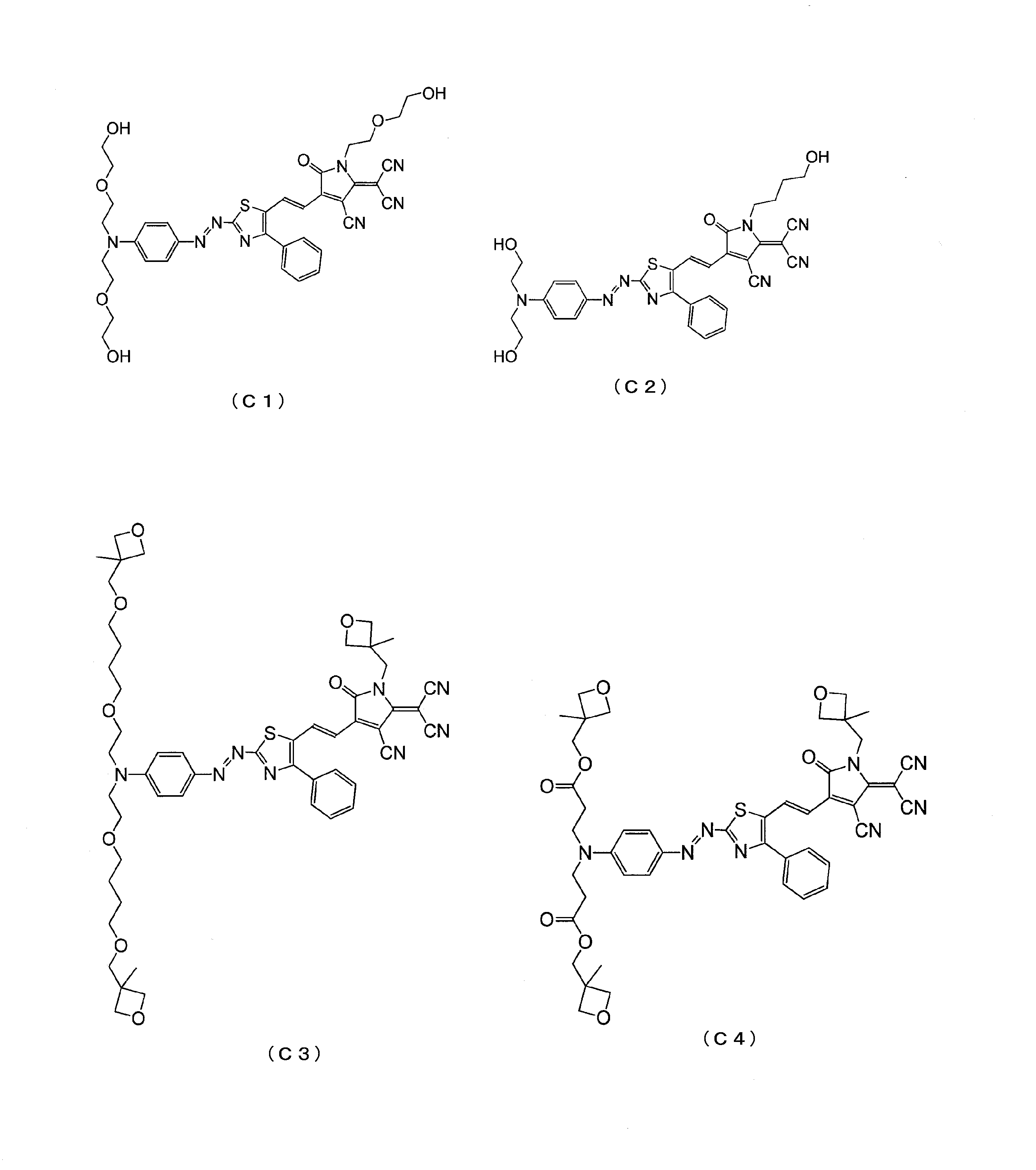
上記式(A)中、Rは水素原子、アルキル基(好ましくは炭素数1~10、より好ましくは炭素数1~5のアルキル基)、オキセタニル基を有する基、エポキシ基を有する基、エチレン性不飽和基を有する基又は水酸基を有する基であり、水素原子、オキセタニル基を有する基、エポキシ基を有する基又は水酸基を有する基であることが好ましい。Rがエチレン性不飽和基を有する基である場合、エチレン性不飽和基はアクリロイル基として導入されていることが好ましい。Rがエチレン性不飽和基を有する基である場合、-(C2H4O)p-C(=O)―CH=CH2(pは1~5の整数である)がより好ましく、-C2H4O-C2H4O-C(=O)―CH=CH2がさらに好ましい。
成分(a)の化合物の分子量は300~1500であることが好ましく、500~1000であることがより好ましい。
本発明の材料中、成分(a)~(c)の総量に占める成分(a)の割合は1~60質量%であることが好ましく、2~55質量%であることがより好ましく、3~50質量%であることがさらに好ましい。
本発明の材料中、成分(a)~(c)の総量に占める成分(a)の割合は1~60質量%であることが好ましく、2~55質量%であることがより好ましく、3~50質量%であることがさらに好ましい。
〔(b)(b-1)及び(b-2)から選ばれる化合物〕
本発明の材料は、(b-1)及び(b-2)から選ばれる1種又は2種以上の化合物(成分(b))を含有する。成分(b)は分子量200以上の化合物であることが好ましい。成分(b)の化合物の分子量を200以上とすることで、成分(b)が揮発しにくく、ポーリング処理等の際に成分(b)の揮発が抑えられる。これにより、本発明の材料で形成した膜の膜厚の変動を抑えることができ、性能のばらつきを抑えることができる。また、成分(a)の化合物の配向固定化状態をより安定に保持することができる。
本発明の材料は、(b-1)の少なくとも1種及び(b-2)の少なくとも1種を含有することが好ましい。
(b-1)の化合物及び(b-2)の化合物について以下に説明する。
本発明の材料は、(b-1)及び(b-2)から選ばれる1種又は2種以上の化合物(成分(b))を含有する。成分(b)は分子量200以上の化合物であることが好ましい。成分(b)の化合物の分子量を200以上とすることで、成分(b)が揮発しにくく、ポーリング処理等の際に成分(b)の揮発が抑えられる。これにより、本発明の材料で形成した膜の膜厚の変動を抑えることができ、性能のばらつきを抑えることができる。また、成分(a)の化合物の配向固定化状態をより安定に保持することができる。
本発明の材料は、(b-1)の少なくとも1種及び(b-2)の少なくとも1種を含有することが好ましい。
(b-1)の化合物及び(b-2)の化合物について以下に説明する。
<(b-1)分子内に2つ以上の重合性基を有する化合物>
本発明の材料は、成分(b)として分子内に2つ以上の重合性基を有する化合物(b-1)を有しうる。(b-1)の化合物が有する重合性基に特に制限はないが、活性水素反応性基又はエチレン性不飽和基を有する基が好ましい。また、(b-1)の化合物は重合性基としてアントリル基を有していてもよい。
活性水素反応性基に特に制限はないが、エポキシ基及びオキセタニル基から選ばれる基を好適に用いることができる。また、エチレン性不飽和基は、アクリロイル基、メタクリロイル基、アクリルアミド基、ビニル基等として導入されていることが好ましい。(b-1)はエポキシ基及びオキセタニル基から選ばれる重合性基を2つ以上有する化合物を含むことが好ましく、エポキシ基及びオキセタニル基から選ばれる重合性基を2つ以上有する化合物であることがより好ましい。
(b-1)の化合物1分子中の重合性基の数は2~6が好ましく、2~4がより好ましく、2又は3がさらに好ましい。また、(b-1)の化合物の重合性基が活性水素反応性基(好ましくはエポキシ基又はオキセタニル基)である場合、(b-1)の化合物1分子中の重合性基の数を2とすることが特に好ましい。
(b-1)の化合物は低分子化合物であってもオリゴマーであってもよいが、いずれの場合も、その分子量は200~1000であることが好ましく、200~500であることがより好ましい。
本発明の材料は、成分(b)として分子内に2つ以上の重合性基を有する化合物(b-1)を有しうる。(b-1)の化合物が有する重合性基に特に制限はないが、活性水素反応性基又はエチレン性不飽和基を有する基が好ましい。また、(b-1)の化合物は重合性基としてアントリル基を有していてもよい。
活性水素反応性基に特に制限はないが、エポキシ基及びオキセタニル基から選ばれる基を好適に用いることができる。また、エチレン性不飽和基は、アクリロイル基、メタクリロイル基、アクリルアミド基、ビニル基等として導入されていることが好ましい。(b-1)はエポキシ基及びオキセタニル基から選ばれる重合性基を2つ以上有する化合物を含むことが好ましく、エポキシ基及びオキセタニル基から選ばれる重合性基を2つ以上有する化合物であることがより好ましい。
(b-1)の化合物1分子中の重合性基の数は2~6が好ましく、2~4がより好ましく、2又は3がさらに好ましい。また、(b-1)の化合物の重合性基が活性水素反応性基(好ましくはエポキシ基又はオキセタニル基)である場合、(b-1)の化合物1分子中の重合性基の数を2とすることが特に好ましい。
(b-1)の化合物は低分子化合物であってもオリゴマーであってもよいが、いずれの場合も、その分子量は200~1000であることが好ましく、200~500であることがより好ましい。
本発明に用いうる(b-1)の化合物は、より好ましくは、活性水素反応性基を有し、且つ、芳香環を有する。この場合において、(b-1)の化合物は好ましくはビスフェノールA型、ビスフェノールF型、ビフェニル型、ナフタレン型、フェナントレン型又はアントラセン型の骨格を有する化合物であり、さらに好ましくはビスフェノールA型又はビスフェノールF型の骨格を有する化合物である。これらの型の骨格を有する化合物は下記式で表される。

上記各式において、Raは置換基を示し、好ましくは炭素数1~5、より好ましくは1~3のアルキル基である。n1は0~4の整数を示し、0又は1が好ましい。n2は0~6の整数を示し、0~2がより好ましい。n3は0~8の整数を示し、0又は2がより好ましい。Rbは活性水素反応性基を有する基を示し、好ましくはオキセタニル基又はエポキシ基を有する基である。Rbは置換基としてエポキシ基又はオキセタニル基を有するアルコキシ基(好ましくは置換基としてエポキシ基又はオキセタニル基を有するメトキシ又は置換基としてエポキシ基又はオキセタニル基を有するエトキシ)であることがより好ましく、置換基としてエポキシ基を有するアルコキシ基(好ましくは置換基としてエポキシ基を有するメトキシ又は置換基としてエポキシ基を有するエトキシ)がさらに好ましい。Rcは水素原子又は置換基を示し、好ましくは水素原子、アルキル基(好ましくは炭素数1~5、より好ましくは炭素数1~3のアルキル基)又はアリール基(好ましくは炭素数6~20、より好ましくは炭素数6~18、さらに好ましくは炭素数6~15のアリール基、特に好ましくはフェニル)であり、水素原子であることが特に好ましい。
(b-1)の化合物は、下記式(P1)又は(P2)で表される構造であることも好ましい。

上記式(P1)及び(P2)において、Ra、Rc及びn1は、それぞれ上記ビスフェノールA型及びF型の構造式におけるRa、Rc及びn1と同義であり、好ましい形態も同じである。Rfは活性水素反応性基を有する基を示し、好ましくはオキセタニル基又はエポキシ基を有する基である。Rfは置換基としてエポキシ基又はオキセタニル基を有するアルキル基(好ましくは置換基としてエポキシ基又はオキセタニル基を有するメチル又は置換基としてエポキシ基又はオキセタニル基を有するエチル)であることがより好ましい。Lは2価の連結基であり、好ましくは炭素数3~5、より好ましくは炭素数3又は4のアルキレン基である。このアルキレン基は置換基として水酸基を有することが好ましい。mは0以上の数であり、好ましくは0~10、より好ましくは0~5である。
(b-1)の化合物がオリゴマーの場合、そのTgは120℃未満であり、20~100℃であることが好ましい。すなわち、(b-1)の化合物は成分(c)のポリマーとは異なる。本明細書において、Tgは、示差走査熱量計(DSC)を用いて測定される。より詳細には、示差走査熱量計(DSC)を用いて、室温から毎分10℃の昇温速度で測定したときの、ガラス転移に伴う吸熱過程の立ち上がり部分の勾配とベースラインとの交点に相当する温度をTgとする。
<(b-2)分子内に2つ以上の活性水素含有基を有する化合物>
本発明の材料は、成分(b)として分子内に2つ以上の活性水素含有基を有する化合物(b-2)を含有しうる。(b-2)の化合物が有する活性水素含有基に特に制限はなく、例えば、水酸基、カルボキシ基、アミノ基、アミド基、スルホ基、メルカプト基及びイミノ基から選ばれる基が挙げられる。なかでも、成分(b-2)の化合物が有する活性水素含有基は水酸基、カルボキシ基及びアミノ基から選ばれる基が好ましく、さらに好ましくは水酸基である。(b-2)の化合物は1分子中に2種以上の活性水素含有基を有していてもよい。(b-2)の化合物1分子中の活性水素含有基の数は2~6が好ましく、2~4がより好ましく、2または3がさらに好ましい。
(b-2)の化合物の分子量は200~1000であることが好ましく、200~500であることがより好ましい。
本発明の材料は、成分(b)として分子内に2つ以上の活性水素含有基を有する化合物(b-2)を含有しうる。(b-2)の化合物が有する活性水素含有基に特に制限はなく、例えば、水酸基、カルボキシ基、アミノ基、アミド基、スルホ基、メルカプト基及びイミノ基から選ばれる基が挙げられる。なかでも、成分(b-2)の化合物が有する活性水素含有基は水酸基、カルボキシ基及びアミノ基から選ばれる基が好ましく、さらに好ましくは水酸基である。(b-2)の化合物は1分子中に2種以上の活性水素含有基を有していてもよい。(b-2)の化合物1分子中の活性水素含有基の数は2~6が好ましく、2~4がより好ましく、2または3がさらに好ましい。
(b-2)の化合物の分子量は200~1000であることが好ましく、200~500であることがより好ましい。
本発明に用いうる(b-2)の化合物は、より好ましくは芳香環を有する。この場合において、(b-2)の化合物は好ましくはビスフェノールA型、ビスフェノールF型、ビフェニル型、ナフタレン型、フェナントレン型又はアントラセン型の骨格を有する化合物であり、さらに好ましくはビスフェノールA型又はビスフェノールF型の骨格を有する化合物である。これらの型の骨格は下記式で表される。

上記各式において、Ra、n1、n2及びn3は、それぞれ、(b-1)の好ましい形態として説明した上述のビスフェノールA型、ビスフェノールF型、ビフェニル型、ナフタレン型、フェナントレン型又はアントラセン型の骨格を有する化合物の構造式におけるRa、n1、n2及びn3と同義であり、好ましい形態も同じである。Reは活性水素含有基を有する基を示し、好ましくは水酸基、カルボキシ基及びアミノ基から選ばれる基を有する基であり、より好ましくは水酸基である。Rdは水素原子又は置換基を示し、好ましくは水素原子、アルキル基(好ましくは炭素数1~5、より好ましくは炭素数1~3のアルキル基)又はアリール基(好ましくは炭素数6~20、より好ましくは炭素数6~18、さらに好ましくは炭素数6~15のアリール基、特に好ましくはフェニル)であり、水素原子又は上記アリール基が特に好ましい。
本発明の材料中、成分(a)~(c)の総量に占める成分(b)の割合は10~90質量%であることが好ましく、10~80質量%であることがより好ましい。
〔(c)ガラス転移温度が120℃以上のポリマー〕
本発明の材料が含有するガラス転移温度が120℃以上のポリマー(成分(c))は、ガラス転移温度が120℃以上であれば特に制限はなく、例えば、ポリカーボネート、ポリ(メタ)アクリル酸エステル(好ましくはポリ(メタ)アクリル酸メチル)、アモルファスフロロポリマー、ポリイミド等を広く用いることができる。また、本発明の材料は成分(c)として2種以上のポリマーを含有してもよい。成分(c)はポリカーボネートを含むことが好ましく、成分(c)がポリカーボネートであることがより好ましい。
成分(c)のポリマーの重量平均分子量は5000~100000であることが好ましく、10000~50000であることがより好ましい。重量平均分子量は、例えば、高速GPC装置(東洋曹達株式会社製、HLC-802A)を使用して、0.5質量%のTHF溶液を試料溶液とし、カラムはTSKgel HZM-M 1本を使用し、200μLの試料を注入し、前記THF溶液で溶離して、25℃で屈折率検出器又はUV検出器(検出波長254nm)により測定することができる。測定結果はポリエチレングリコール換算の分子量とする。
成分(c)のポリマーのTgは130℃以上が好ましく、140℃以上がより好ましく、150℃以上がさらに好ましい。また、成分(c)の配合量にもよるが、材料全体のTgを好ましい値とし、後述のポーリング処理の温度を低く抑える点から、成分(c)のTgは通常は250℃以下であることが好ましく、200℃以下であることがより好ましい。
本発明の材料が含有するガラス転移温度が120℃以上のポリマー(成分(c))は、ガラス転移温度が120℃以上であれば特に制限はなく、例えば、ポリカーボネート、ポリ(メタ)アクリル酸エステル(好ましくはポリ(メタ)アクリル酸メチル)、アモルファスフロロポリマー、ポリイミド等を広く用いることができる。また、本発明の材料は成分(c)として2種以上のポリマーを含有してもよい。成分(c)はポリカーボネートを含むことが好ましく、成分(c)がポリカーボネートであることがより好ましい。
成分(c)のポリマーの重量平均分子量は5000~100000であることが好ましく、10000~50000であることがより好ましい。重量平均分子量は、例えば、高速GPC装置(東洋曹達株式会社製、HLC-802A)を使用して、0.5質量%のTHF溶液を試料溶液とし、カラムはTSKgel HZM-M 1本を使用し、200μLの試料を注入し、前記THF溶液で溶離して、25℃で屈折率検出器又はUV検出器(検出波長254nm)により測定することができる。測定結果はポリエチレングリコール換算の分子量とする。
成分(c)のポリマーのTgは130℃以上が好ましく、140℃以上がより好ましく、150℃以上がさらに好ましい。また、成分(c)の配合量にもよるが、材料全体のTgを好ましい値とし、後述のポーリング処理の温度を低く抑える点から、成分(c)のTgは通常は250℃以下であることが好ましく、200℃以下であることがより好ましい。
本発明の材料中、成分(a)~(c)の総量に占める成分(c)の割合は3~85質量%であることが好ましく、5~80質量%であることがより好ましい。
本発明の材料は成分(c)のポリマー(高Tgポリマー)を含有することで、成分(c)のポリマーを含まない場合に比べて材料を重合反応させた後のTgをより高めることができ、ポーリング処理後における有機非線形化合物の配向状態が安定に保たれる。
本発明の材料は成分(c)のポリマー(高Tgポリマー)を含有することで、成分(c)のポリマーを含まない場合に比べて材料を重合反応させた後のTgをより高めることができ、ポーリング処理後における有機非線形化合物の配向状態が安定に保たれる。
本発明の材料中の重合性基が活性水素反応性基を含む場合、本発明の材料中の活性水素反応性基と活性水素含有基の比率は化学量論比で定まるが、モル比で、活性水素反応性基:活性水素含有基=30:70~70:30が好ましく、40:60~60:40がより好ましい。
〔その他の成分〕
本発明の材料は、上記成分(a)~(c)の他に、硬化剤、硬化促進剤、重合開始剤、酸化防止剤、紫外線吸収剤、有機溶剤等を含有してもよい。
本発明の材料は、上記成分(a)~(c)の他に、硬化剤、硬化促進剤、重合開始剤、酸化防止剤、紫外線吸収剤、有機溶剤等を含有してもよい。
〔重合性非線形光学材料のTg〕
本発明の材料は、Tgが40℃以上120℃以下である。本発明の材料のTgを本発明で規定する範囲内とすることで、ポーリング処理を低い温度で行っても有機非線形材料を高い秩序度で配向させることができる。したがって、有機非線形化合物の耐熱温度より低い温度でポーリング処理を行うことが可能となる。本発明の材料のTgは好ましくは110℃以下であり、より好ましくは100℃以下であり、さらに好ましくは95℃以下であり、特に好ましくは90℃以下である。また、本発明の材料のTgが40℃以上であると、有機非線形化合物の配向状態を重合固定化することで十分にTgを上げることができ、充分な配向安定性が得られる。
また、本発明の材料のTgが40℃よりも低いと、有機非線形化合物の配向状態を重合固定化しても十分にTgを上げることができず、配向安定性が低下してしまう。本発明の材料のTgは、45℃以上が好ましく、50℃以上がより好ましく、55℃以上がさらに好ましい。なお、Tgの測定では揮発成分は熱により揮発するので、重合性非線形光学材料のTgはすなわち重合性非線形光学材料の固形分のTgとなる。
本発明の材料は、Tgが40℃以上120℃以下である。本発明の材料のTgを本発明で規定する範囲内とすることで、ポーリング処理を低い温度で行っても有機非線形材料を高い秩序度で配向させることができる。したがって、有機非線形化合物の耐熱温度より低い温度でポーリング処理を行うことが可能となる。本発明の材料のTgは好ましくは110℃以下であり、より好ましくは100℃以下であり、さらに好ましくは95℃以下であり、特に好ましくは90℃以下である。また、本発明の材料のTgが40℃以上であると、有機非線形化合物の配向状態を重合固定化することで十分にTgを上げることができ、充分な配向安定性が得られる。
また、本発明の材料のTgが40℃よりも低いと、有機非線形化合物の配向状態を重合固定化しても十分にTgを上げることができず、配向安定性が低下してしまう。本発明の材料のTgは、45℃以上が好ましく、50℃以上がより好ましく、55℃以上がさらに好ましい。なお、Tgの測定では揮発成分は熱により揮発するので、重合性非線形光学材料のTgはすなわち重合性非線形光学材料の固形分のTgとなる。
本発明の材料は重合反応により重合前に比べてTgが上昇する。本発明の材料は、重合性基を重合率が80%に(重合性基の重合率が80%になるように)重合させた場合に、材料のTgが120℃以上となることが好ましく、130℃以上となることがより好ましく、140℃以上となることがさらに好ましい。本発明の材料は、重合性基を重合率80%となるように重合反応させた場合に、通常はTgが200℃以下である。
また、本発明の材料は、本発明の材料中の重合性基を重合率80%に重合させた場合に、重合反応前に比べてTgが30℃以上上昇することが好ましく、40℃以上上昇することがより好ましく、50℃以上上昇することがさらに好ましい(すなわち、本発明の材料のTgと、本発明の材料を重合性基の重合率が80%になるように重合反応させた後のTgとの差(重合反応後のTgから重合反応前のTgを引いた値)は30℃以上であることが好ましく、40℃以上であることがより好ましく、50℃以上であることがさらに好ましい)。このようなTgの上昇をもたらす材料組成とすることで、重合反応前のTgを低くしてポーリング時により低い温度で有機非線形化合物を高度に配向させ、さらに重合反応によりこの配向状態をより強固に固定化することが可能となる。また、重合反応前と重合反応後のTgの差は大きい方が好ましく、通常は、本発明の材料のTgと、本発明の材料を重合性基の重合率が80%になるように重合反応させた後のTgとの差は130℃以下である。
本明細書において、上記重合性基の重合率は、反射型赤外分光法測定(IR)により、重合反応の前の材料の重合性基に起因するピーク面積と、重合反応後の材料の重合性基に起因するピーク面積とを比較することで算出される。より詳細には、重合反応前における重合性基に起因するピーク面積を100%として、重合反応後における重合性基に起因するピーク面積(%)を求め、重合性基の重合率とした。なお、エポキシ基に起因するピークは916cm-1付近にあり、オキセタニル基に起因するピークは982cm-1付近にあり、エチレン性不飽和基に起因するピークは810cm-1付近にある。
また、本発明の材料は、本発明の材料中の重合性基を重合率80%に重合させた場合に、重合反応前に比べてTgが30℃以上上昇することが好ましく、40℃以上上昇することがより好ましく、50℃以上上昇することがさらに好ましい(すなわち、本発明の材料のTgと、本発明の材料を重合性基の重合率が80%になるように重合反応させた後のTgとの差(重合反応後のTgから重合反応前のTgを引いた値)は30℃以上であることが好ましく、40℃以上であることがより好ましく、50℃以上であることがさらに好ましい)。このようなTgの上昇をもたらす材料組成とすることで、重合反応前のTgを低くしてポーリング時により低い温度で有機非線形化合物を高度に配向させ、さらに重合反応によりこの配向状態をより強固に固定化することが可能となる。また、重合反応前と重合反応後のTgの差は大きい方が好ましく、通常は、本発明の材料のTgと、本発明の材料を重合性基の重合率が80%になるように重合反応させた後のTgとの差は130℃以下である。
本明細書において、上記重合性基の重合率は、反射型赤外分光法測定(IR)により、重合反応の前の材料の重合性基に起因するピーク面積と、重合反応後の材料の重合性基に起因するピーク面積とを比較することで算出される。より詳細には、重合反応前における重合性基に起因するピーク面積を100%として、重合反応後における重合性基に起因するピーク面積(%)を求め、重合性基の重合率とした。なお、エポキシ基に起因するピークは916cm-1付近にあり、オキセタニル基に起因するピークは982cm-1付近にあり、エチレン性不飽和基に起因するピークは810cm-1付近にある。
上記実施形態に関し、本発明の好ましい態様を下記に示す。
下記成分(a1)~(c1)を含有し、ガラス転移温度が40℃以上120℃以下である重合性非線形光学材料:
(a1)分子内に2~6個(好ましくは2又は3個)の活性水素含有基を有し、且つ、非線形光学活性を有する有機化合物、
(b1)下記(b1-1)の化合物及び(b1-2)の化合物、
(b1-1)分子内に2~6個(好ましくは2又は3個)の、活性水素含有基と反応性を示す基を有する化合物
(b1-2)分子内に2~6個(好ましくは2又は3個)の活性水素含有基を有する化合物
(c1)ガラス転移温度が120℃以上のポリマー。
(a1)分子内に2~6個(好ましくは2又は3個)の活性水素含有基を有し、且つ、非線形光学活性を有する有機化合物、
(b1)下記(b1-1)の化合物及び(b1-2)の化合物、
(b1-1)分子内に2~6個(好ましくは2又は3個)の、活性水素含有基と反応性を示す基を有する化合物
(b1-2)分子内に2~6個(好ましくは2又は3個)の活性水素含有基を有する化合物
(c1)ガラス転移温度が120℃以上のポリマー。
下記成分(a2)~(c2)を含有し、ガラス転移温度が40℃以上120℃以下である重合性非線形光学材料:
(a2)分子内に2~6個(好ましくは2又は3個)の、活性水素含有基と反応性を示す基を有し、且つ、非線形光学活性を有する有機化合物、
(b2)下記(b2-1)の化合物及び(b2-2)の化合物、
(b2-1)分子内に2~6個(好ましくは2又は3個)の、活性水素含有基と反応性を示す基を有する化合物
(b2-2)分子内に2~6個(好ましくは2又は3個)の活性水素含有基を有する化合物
(c2)ガラス転移温度が120℃以上のポリマー。
(a2)分子内に2~6個(好ましくは2又は3個)の、活性水素含有基と反応性を示す基を有し、且つ、非線形光学活性を有する有機化合物、
(b2)下記(b2-1)の化合物及び(b2-2)の化合物、
(b2-1)分子内に2~6個(好ましくは2又は3個)の、活性水素含有基と反応性を示す基を有する化合物
(b2-2)分子内に2~6個(好ましくは2又は3個)の活性水素含有基を有する化合物
(c2)ガラス転移温度が120℃以上のポリマー。
下記成分(a3)~(c3)を含有し、ガラス転移温度が40℃以上120℃以下である重合性非線形光学材料:
(a3)分子内に2~6個(好ましくは2又は3個)の、活性水素含有基と反応性を示す基を有し、且つ、非線形光学活性を有する有機化合物、
(b3)分子内に2~6個(好ましくは2又は3個)の活性水素含有基を有する化合物、
(c3)ガラス転移温度が120℃以上のポリマー。
(a3)分子内に2~6個(好ましくは2又は3個)の、活性水素含有基と反応性を示す基を有し、且つ、非線形光学活性を有する有機化合物、
(b3)分子内に2~6個(好ましくは2又は3個)の活性水素含有基を有する化合物、
(c3)ガラス転移温度が120℃以上のポリマー。
下記成分(a4)~(c4)を含有し、ガラス転移温度が40℃以上120℃以下である重合性非線形光学材料:
(a4)非線形光学活性を有する有機化合物、
(b4)下記(b4-1)の化合物及び(b4-2)の化合物、
(b4-1)分子内に2~6個(好ましくは2又は3個)の、活性水素含有基と反応性を示す基を有する化合物
(b4-2)分子内に2~6個(好ましくは2又は3個)の活性水素含有基を有する化合物
(c4)ガラス転移温度が120℃以上のポリマー。
(但し、上記(a4)の化合物は分子内の活性水素含有基の数が0又は1であり、且つ、分子内の、活性水素含有基と反応性を示す基の数が0又は1である。)
(a4)非線形光学活性を有する有機化合物、
(b4)下記(b4-1)の化合物及び(b4-2)の化合物、
(b4-1)分子内に2~6個(好ましくは2又は3個)の、活性水素含有基と反応性を示す基を有する化合物
(b4-2)分子内に2~6個(好ましくは2又は3個)の活性水素含有基を有する化合物
(c4)ガラス転移温度が120℃以上のポリマー。
(但し、上記(a4)の化合物は分子内の活性水素含有基の数が0又は1であり、且つ、分子内の、活性水素含有基と反応性を示す基の数が0又は1である。)
上記の各好ましい形態の重合性非線形光学材料において、上記成分(a1)、(a2)、(a3)及び(a4)の好ましい含有量(他の成分との比率)は、いずれも上述の成分(a)の好ましい含有量と同じである。また、上記の各好ましい形態の重合性非線形光学材料において、上記成分(b1)、(b2)、(b3)及び(b4)の好ましい含有量は、いずれも上述の成分(b)の好ましい含有量と同じである。また、上記の各好ましい形態の重合性非線形光学材料において、上記成分(c1)、(c2)、(c3)及び(c4)の好ましい含有量は、いずれも上述の成分(c)の好ましい含有量と同じである。
[非線形光学膜]
本発明の非線形光学膜は、本発明の重合性非線形光学材料を用いて形成される。より詳細には、本発明の重合性非線形光学材料を用いて成膜し、後述のポーリング処理に付して成分(a)の化合物を配向させ、重合して形成される膜が好ましい。成膜方法に特に制限はないが、上記成分(a)~(c)、その他の成分を有機溶剤に溶解させてなる本発明の材料(組成物)を、スピンコート法、ブレードコート法、浸漬塗布法、インクジェット法、スプレー法等の方法を用いて基板上に塗布することによって成膜する湿式塗布法を採用することが好ましい。
本発明の非線形光学膜は、本発明の重合性非線形光学材料を用いて形成される。より詳細には、本発明の重合性非線形光学材料を用いて成膜し、後述のポーリング処理に付して成分(a)の化合物を配向させ、重合して形成される膜が好ましい。成膜方法に特に制限はないが、上記成分(a)~(c)、その他の成分を有機溶剤に溶解させてなる本発明の材料(組成物)を、スピンコート法、ブレードコート法、浸漬塗布法、インクジェット法、スプレー法等の方法を用いて基板上に塗布することによって成膜する湿式塗布法を採用することが好ましい。
上記有機溶剤は、本発明の材料の成分を溶解し得るものであれば如何なるものでも構わないが、その沸点が80~200℃の範囲にあるものが好ましい。沸点が80℃未満の有機溶剤を用いると、例えば、塗布溶液の保管時に溶剤揮発が起こり塗布溶液の粘度が変化(上昇)してしまったり、塗布時に溶剤の揮発速度が早過ぎ結露が発生してしまったりする場合がある。一方、沸点が200℃を超える有機溶剤を用いると、塗布後の溶剤除去が困難になり残存した有機溶剤が高分子バインダーの可塑剤として働きガラス転移温度の低下を引き起こす等の問題が発生する場合がある。
好ましい有機溶剤の例としては、ジエチレングリコールジメチルエーテル、シクロペンタノン、シクロヘキサノン、シクロヘキサノール、トルエン、クロロベンゼン、キシレン、N,N-ジメチルホルムアミド、N,N-ジメチルアセトアミド、ジメチルスルホキシド、2,2,3,3-テトラフルオロ-1-プロパノール、1,2-ジクロロエタン、1,2-ジクロロプロパン、1,3-ジクロロプロパン、1,2,3-トリクロロプロパン等が挙げられる。なお、これらの有機溶剤は単独で用いても、複数を混合して用いてもよい。また、これらの好ましい有機溶剤に沸点が80℃未満のテトラヒドロフラン、メチルエチルケトン、イソプロパノール,クロロホルム等の有機溶剤を添加した混合溶剤も利用可能である。
-ポーリング処理-
本発明の非線形光学膜は、有機非線形化合物が配向しており、これにより2次の非線形光学活性を示す。有機非線形化合物の配向は、光ポーリング法、光アシスト電界ポーリング法、電界ポーリング法等の任意のポーリング処理により行うことが好ましい。これらの中でも、電界ポーリング法は、装置の簡便性、得られる配向度合いの高さ等の点で特に好ましい。
本発明の非線形光学膜は、有機非線形化合物が配向しており、これにより2次の非線形光学活性を示す。有機非線形化合物の配向は、光ポーリング法、光アシスト電界ポーリング法、電界ポーリング法等の任意のポーリング処理により行うことが好ましい。これらの中でも、電界ポーリング法は、装置の簡便性、得られる配向度合いの高さ等の点で特に好ましい。
上記電界ポーリング法は、非線形光学材料を一対の電極で挟み電界を印加するコンタクトポーリング法と、基板電極上の非線形光学材料の表面にコロナ放電を施し、帯電電界を印加するコロナポーリング法とに大別される。電界ポーリング法は、非線形光学活性化合物の双極子モーメントと印加電界とのクーロン力によって、非線形光学活性化合物を印加電界方向に配向(ポーリング)させる配向法である。
電界ポーリング法においては、一般的に、電界を印加した状態で、非線形光学材料のTg付近の温度に加熱することによって非線形光学活性化合物の電界方向への配向を促進させ十分な配向が誘起された後、電界を印加した状態のまま室温まで冷却し、配向状態を凍結した上で、印加電界を除去する。しかしながら、この配向状態は基本的に熱力学的非平衡状態であるため、非線形光学材料のTg以下の温度であっても経時にて徐々にランダム化し、非線形光学活性が低下してしまうという根本的な問題を抱えている。
上記経時による配向状態のランダム化は、非線形光学材料の置かれる環境温度と非線形光学材料のTgとの差が大きい程、緩やかに進行する。そのため、非線形光学材料中にTgの高いバインダー樹脂を用い、非線形光学材料のガラス転移温度を高く設計することによってランダム化を抑えることができる。しかし、非線形光学材料のTgを上げると、高温で電界ポーリングを行う必要が生じ、耐熱性の低い有機非線形化合物を用いた場合には有機非線形化合物の熱分解や熱変性が生じてしまう。
しかし、本発明の材料は、材料のTgが40~120℃の範囲にあるため、成膜後にポーリング処理を比較的低温で行っても有機非線形化合物を高い秩序度で配向させることができる。また、本発明の材料は重合性であるため、後述する重合反応により膜を硬化させて有機非線形化合物を固定化することができる。しかも、本発明の材料は成分(c)として高Tgポリマーを含有するため、重合反応後(硬化後)の材料のTgがより高められる。すなわち、配向させた有機非線形化合物のランダム化を効果的に抑えることができる。
上記経時による配向状態のランダム化は、非線形光学材料の置かれる環境温度と非線形光学材料のTgとの差が大きい程、緩やかに進行する。そのため、非線形光学材料中にTgの高いバインダー樹脂を用い、非線形光学材料のガラス転移温度を高く設計することによってランダム化を抑えることができる。しかし、非線形光学材料のTgを上げると、高温で電界ポーリングを行う必要が生じ、耐熱性の低い有機非線形化合物を用いた場合には有機非線形化合物の熱分解や熱変性が生じてしまう。
しかし、本発明の材料は、材料のTgが40~120℃の範囲にあるため、成膜後にポーリング処理を比較的低温で行っても有機非線形化合物を高い秩序度で配向させることができる。また、本発明の材料は重合性であるため、後述する重合反応により膜を硬化させて有機非線形化合物を固定化することができる。しかも、本発明の材料は成分(c)として高Tgポリマーを含有するため、重合反応後(硬化後)の材料のTgがより高められる。すなわち、配向させた有機非線形化合物のランダム化を効果的に抑えることができる。
ポーリング処理の温度は、本発明の材料のTgに応じて適宜に選択されるものであるが、有機非線形化合物の熱分解や熱変性をより抑える観点から、140℃以下とすることが好ましく、より好ましくは130℃以下、さらに好ましくは120℃以下、さらに好ましくは110℃以下、さらに好ましくは105℃以下、なかでも好ましくは100℃以下である。また、ポーリング処理の温度は通常は70℃以上であり、有機非線形化合物の配向性をより高める観点から80℃以上が好ましく、85℃以上がより好ましく、90℃以上がさらに好ましい。
ポーリング処理の処理時間に特に制限はないが、5~60分が好ましく、10~30分がより好ましい。
ポーリング処理の処理時間に特に制限はないが、5~60分が好ましく、10~30分がより好ましい。
-重合反応-
本発明の非線形光学膜は、上述のように本発明の材料を用いて成膜し、これをポーリング処理に付して成分(a)の化合物を配向させ、重合反応により成分(a)の配向状態を重合固定化して形成することが好ましい。本発明において「ポーリング処理に付して成分(a)の化合物を配向させ、重合反応により成分(a)の配向状態を重合固定化する」とは、ポーリング処理を行った後に重合反応を行う態様、及び、ポーリング処理と同時に重合反応を行う(ポーリング処理によって重合反応が進行する)態様の両態様を含む意味に用いる。なかでもポーリング処理と同時に重合反応を行う態様が好ましい。
本発明の非線形光学膜は、上述のように本発明の材料を用いて成膜し、これをポーリング処理に付して成分(a)の化合物を配向させ、重合反応により成分(a)の配向状態を重合固定化して形成することが好ましい。本発明において「ポーリング処理に付して成分(a)の化合物を配向させ、重合反応により成分(a)の配向状態を重合固定化する」とは、ポーリング処理を行った後に重合反応を行う態様、及び、ポーリング処理と同時に重合反応を行う(ポーリング処理によって重合反応が進行する)態様の両態様を含む意味に用いる。なかでもポーリング処理と同時に重合反応を行う態様が好ましい。
重合反応としては、熱重合反応又は光重合反応が好ましく、熱重合反応がより好ましい。重合反応は、硬化促進剤や重合開始剤を共存させて行うことができる。エチレン性不飽和基をラジカル重合させる場合には、ラジカルが有機非線形化合物に作用し、非線形光学活性が低下することがある。したがって、ラジカル重合開始剤を用いずに重合反応を行うことがより好ましい。この観点から、本発明の材料に含まれる重合性基は活性水素反応性基であることが好ましい。
熱重合反応をポーリング処理と同時に行う場合には、ポーリング処理の温度と熱重合反応の温度は同じである。また、熱重合反応をポーリング処理の後に行う場合にも、有機非線形化合物の熱分解や熱変性を防ぐために、ポーリング処理の温度と同等の温度下で熱重合反応を行うことが好ましい。すなわち、熱重合反応の反応温度は150℃以下とすることが好ましく、より好ましくは130℃以下、さらに好ましくは120℃以下、さらに好ましくは110℃以下、さらに好ましくは105℃以下、なかでも好ましくは100℃以下である。また、熱重合反応の反応温度は通常は70℃以上であり、80℃以上が好ましく、85℃以上がより好ましく、90℃以上がさらに好ましい。
重合反応の反応時間に特に制限はないが、5~60分が好ましく、10~30分がより好ましい。
上記重合反応によって、重合反応前の膜中(材料組成物中)に存在している重合性基を重合率50%以上に重合させることが好ましく、より好ましくは60%以上、さらに好ましくは70%以上に重合させる。また、非線形光学膜のTgをより高めるために、上記重合反応によって、重合反応前の膜中(材料組成物中)に存在している重合性基を重合率100%に重合することが好ましいが、通常は97%以下である。
有機非線形化合物の配向状態を確認する指標として、どれだけの有機非線形化合物が電界方向に配向したかを表す数値(オーダーパラメータ:φ)がある。オーダーパラメータは、有機非線形化合物の分子の向きがランダムの時の吸光度をA0、電界方向(膜厚方向)に配向しているときの吸光度をAtとした場合、φ=1-(At/A0)となる。
上記オーダーパラメータは、全ての分子が完全に配向した理想的な状態では1、完全にランダムなときは0となる数値であり、値が大きいほど全体としての分子の配向度が高いことを表わす。この値を測定することにより、どれだけ効率よくポーリングできたかが判断でき、また、その安定性なども評価できる。
上記オーダーパラメータは、全ての分子が完全に配向した理想的な状態では1、完全にランダムなときは0となる数値であり、値が大きいほど全体としての分子の配向度が高いことを表わす。この値を測定することにより、どれだけ効率よくポーリングできたかが判断でき、また、その安定性なども評価できる。
本発明の非線形光学膜の膜厚は、その用途によって適宜調整されるものであり、何ら限定されるものではないが、通常は100~3000nmであり、500~2000nmであることがより好ましい。
[光学素子]
本発明の光学素子は、本発明の非線形光学膜を有し、非線形光学効果に基づき動作するものであれば如何なるものでもよい。本発明の光学素子の具体例としては、例えば、波長変換素子、フォトリフラクティブ素子、電気光学素子、等が挙げられる。特に好ましくは、電気光学効果に基づき動作する光スイッチ、光変調器(光変調素子)、位相シフト器等の電気光学素子であり、より好ましくは光変調素子である。
本発明の光学素子は、本発明の非線形光学膜を有し、非線形光学効果に基づき動作するものであれば如何なるものでもよい。本発明の光学素子の具体例としては、例えば、波長変換素子、フォトリフラクティブ素子、電気光学素子、等が挙げられる。特に好ましくは、電気光学効果に基づき動作する光スイッチ、光変調器(光変調素子)、位相シフト器等の電気光学素子であり、より好ましくは光変調素子である。
上記電気光学素子としては、本発明の非線形光学膜を基板上に形成し、入力電気シグナル用の電極対で挟み込む構造を有する素子として利用することが好ましい。
このような基板を構成する材料としては、アルミニウム、金、鉄、ニッケル、クロム、チタン等の金属;シリコン、酸化チタン、酸化亜鉛、ガリウム-ヒ素などの半導体;ガラス;ポリエチレンテレフタレート、ポリエチレンナフタレート、ポリカーボネート、ポリスルフォン、ポリエーテルケトン、ポリイミド等のプラスティック;等を用いることができる。
このような基板を構成する材料としては、アルミニウム、金、鉄、ニッケル、クロム、チタン等の金属;シリコン、酸化チタン、酸化亜鉛、ガリウム-ヒ素などの半導体;ガラス;ポリエチレンテレフタレート、ポリエチレンナフタレート、ポリカーボネート、ポリスルフォン、ポリエーテルケトン、ポリイミド等のプラスティック;等を用いることができる。
これらの基板材料の表面には、導電性膜が形成されていてもよく、導電性膜の材料としては、アルミニウム、金、ニッケル、クロム、チタン等の金属;酸化スズ、酸化インジウム、ITO(酸化スズ-酸化インジウム複合酸化物)、IZO(酸化インジウム-酸化亜鉛複合酸化物)等の導電性酸化物;ポリチオフェン、ポリアニリン、ポリパラフェニレンビニレン、ポリアセチレン等の導電性高分子等が用いられる。これらの導電性膜は、蒸着、スパッタリング等の任意の乾式成膜法や、浸漬塗布や電解析出等の任意の湿式成膜法を利用して形成され、必要に応じてパターンが形成されていてもよい。なお、導電性基板、あるいは、上記したように基板上に形成された導電性膜は、ポーリング時や素子としての動作時の電極(以下、「下部電極」と略す)として利用される。
基板表面にはさらに、必要に応じて、その上に形成される膜と基板との接着性を向上させるための接着層、基板表面の凹凸を平滑化するためのレベリング層、あるいはこれらの機能を一括して提供する何らかの中間層が形成されていてもよい。このような層を形成する材料としては、特に限定されないが、例えば、アクリル樹脂、メタクリル樹脂、アミド樹脂、塩化ビニル樹脂、酢酸ビニル樹脂、フェノール樹脂、ウレタン樹脂、ビニルアルコール樹脂、アセタール樹脂等およびそれらの共重合物;ジルコニウムキレート化合物、チタンキレート化合物、シランカップリング剤等の架橋物およびそれらの共架橋物;等の任意のものを用いることができる。
上記電気光学素子は、導波路構造を含むものとして形成することが好ましく、本発明の非線形光学膜を、導波路のコア層に含有させることが特に好ましい。
本発明の非線形光学膜を含有するコア層と基板との間には、クラッド層(以下、「下部クラッド層」と略す)が形成されていてもよい。この下部クラッド層としては、コア層よりも屈折率が低く、コア層形成の際に侵されないものであれば如何なるものでもよい。このようなものとして、アクリル系、エポキシ系、オキセタン系、チイラン系、シリコーン系等のUV硬化性あるいは熱硬化性の樹脂;ポリイミド;ガラス等が好ましく使用される。
本発明の非線形光学膜によるコア層を形成した後、さらにその上部にクラッド層(以下、「上部クラッド層」と略す)を下部クラッド層と同様にして形成してもよい。これにより、基板/下部クラッド層/コア層/上部クラッド層、という構成のスラブ型導波路が形成される。
コア層を形成した後、反応性イオンエッチング(RIE)、フォトリソグラフィー、電子線リソグラフィー等の半導体プロセス技術を用いた任意の方法によりコア層をパターニングし、チャネル型導波路あるいはリッジ型導波路を形成することもできる。あるいは、コア層の一部にUV光、電子線等をパターニングして照射することにより、照射部分の屈折率を変化させてチャネル型導波路を形成することもできる。
上記上部クラッド層の表面に入力電気シグナルを印加するための電極(以下、「上部電極」と略す)を、上記上部クラッド層の所望の領域に形成することで基本的な電気光学素子を形成することができる。
上記のようにしてチャネル型導波路やリッジ型導波路を形成する際、コア層のパターンとしては、直線型、Y分岐型、方向性結合器型、Mach-Zehnder型等の任意のデバイス構造を構成することができ、光スイッチ、光変調器、位相シフト器等の任意の光情報通信用デバイスへの適用が可能である。
以下に実施例に基づき本発明を更に詳細に説明するが、本発明はこれらの実施例により限定されるものではない。
[調製例] 重合性非線形光学材料の調製
下記表1に示す有機非線形化合物、分子内に2つ以上の重合性基を有する化合物、分子内に2つ以上の活性水素含有基を有する化合物、Tgが120℃以上のポリマー、硬化剤、硬化促進剤、溶媒を、下記表1に示す割合(質量部、表1中[ ]内の数値)で均質に混合し、重合性非線形光学材料(液状組成物)を得た。各重合性非線形光学材料は、その固形分濃度をいずれも、塗布後膜厚が1800nmとなるように調整した。
この調製例で使用した有機非線形化合物の構造を以下に示す。
下記表1に示す有機非線形化合物、分子内に2つ以上の重合性基を有する化合物、分子内に2つ以上の活性水素含有基を有する化合物、Tgが120℃以上のポリマー、硬化剤、硬化促進剤、溶媒を、下記表1に示す割合(質量部、表1中[ ]内の数値)で均質に混合し、重合性非線形光学材料(液状組成物)を得た。各重合性非線形光学材料は、その固形分濃度をいずれも、塗布後膜厚が1800nmとなるように調整した。
この調製例で使用した有機非線形化合物の構造を以下に示す。


式(A)において、Rが(3-メチルオキセタン-3-イル)メチルであるものを化合物(A1)、RがCH2CH2OCH2CH2OHであるものを化合物(A2)、Rがn-ブチルであるものを化合物(A3)、Rが-(C2H4O)2C(=O)-CH=CH2であるものを化合物(A4)と呼ぶ。
この調製例で使用した分子内に2つ以上の重合性基を有する化合物の構造を以下に示す。下記(B1a)の化合物はモノマー(n=0)とオリゴマーの混合物であり、その重量平均分子量は400である。
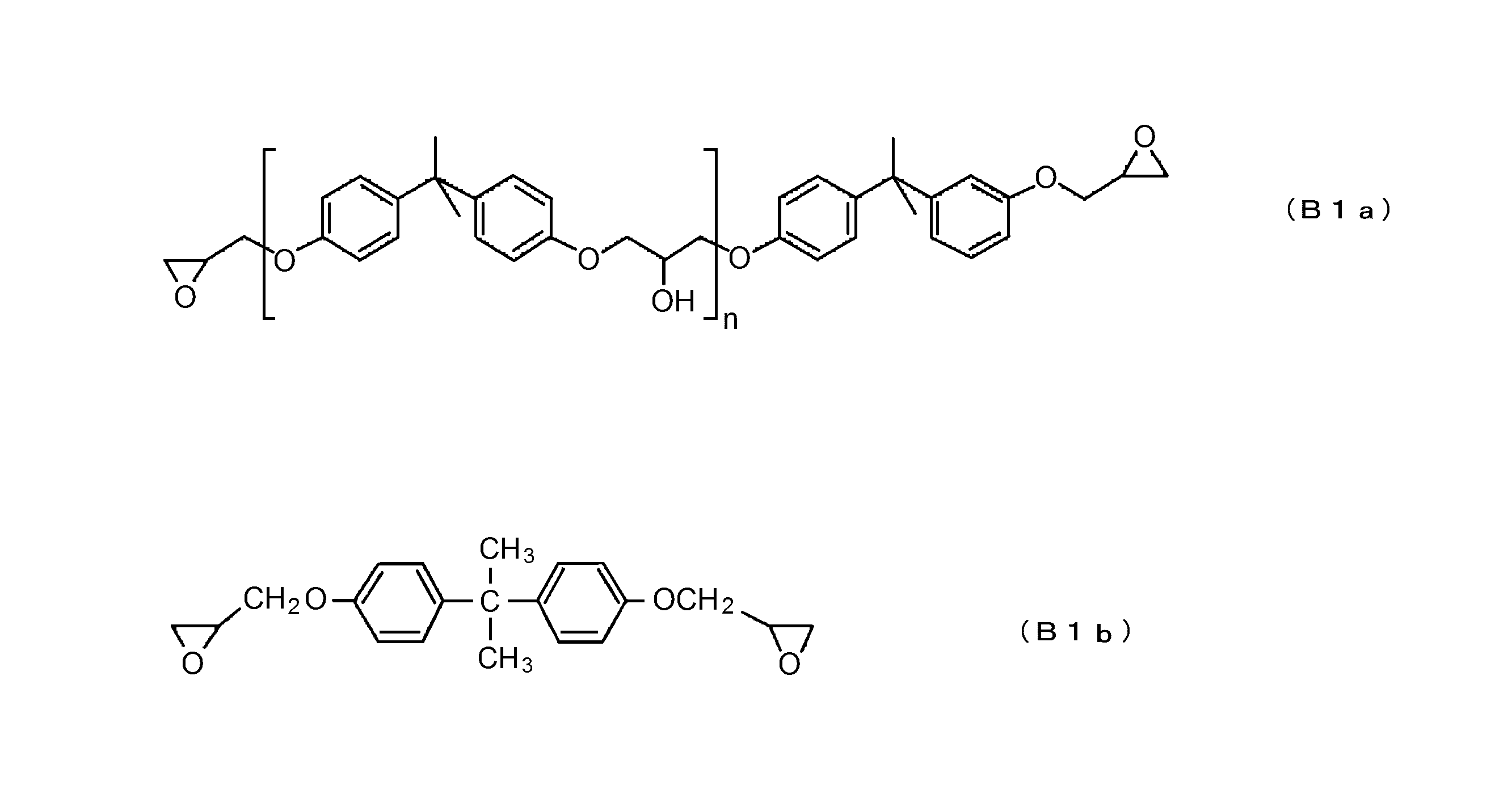

分子内に2つ以上の活性水素含有基を有する化合物として、4,4’-(α-メチルベンジリデン)ビスフェノール(東京化成工業社製、以下(B2)という。)を用いた。
Tgが120℃以上のポリマーとしては、ポリカーボネート(ユピゼータPCZ-300、三菱ガス化学製、重量平均分子量:30000、Tg:185℃)、又は、ポリメタクリル酸メチル(重量平均分子量:120000、Tg:120℃)を用いた。

[実施例] 非線形光学膜の製造と評価
5cm角サイズのITO基板(厚さ:700μm)上に、上記調製例で調製した重合性非線形光学材料をスピンコート法で塗布し、乾燥して成膜した(膜厚1800nm)。
5cm角サイズのITO基板(厚さ:700μm)上に、上記調製例で調製した重合性非線形光学材料をスピンコート法で塗布し、乾燥して成膜した(膜厚1800nm)。
〔電界ポーリング処理(重合反応)〕
上記で得られた膜をITO基板ごとホットプレート上に設置し、コロナポーリング処理を行った。より詳細には、放電電極を膜から30mmの距離となるよう設置して13kVの帯電電圧を印加した状態で、100℃で15分間保持した。その状態から帯電電圧を印加したまま30℃まで1分間かけて冷却した後、帯電電圧を除去し、ポーリング処理を完了した。
このポーリング処理時の熱により、上記調製例1~7及び9~13、比較調製例2及び5の材料を用いて成膜した膜において熱重合反応も同時に進行する。
また、調製例8及び比較例4については、ポーリング時に光照射して光重合反応を行った。光照射は、高圧水銀ランプ(SP-9-250DB spotcure、ウシオ社製)を使用し、5J/cm2の照射エネルギーで紫外線照射することで実施した。
上記で得られた膜をITO基板ごとホットプレート上に設置し、コロナポーリング処理を行った。より詳細には、放電電極を膜から30mmの距離となるよう設置して13kVの帯電電圧を印加した状態で、100℃で15分間保持した。その状態から帯電電圧を印加したまま30℃まで1分間かけて冷却した後、帯電電圧を除去し、ポーリング処理を完了した。
このポーリング処理時の熱により、上記調製例1~7及び9~13、比較調製例2及び5の材料を用いて成膜した膜において熱重合反応も同時に進行する。
また、調製例8及び比較例4については、ポーリング時に光照射して光重合反応を行った。光照射は、高圧水銀ランプ(SP-9-250DB spotcure、ウシオ社製)を使用し、5J/cm2の照射エネルギーで紫外線照射することで実施した。
〔分析1〕 重合率の評価
上記ポーリング処理後の膜について、膜中の重合性基の重合率を上述の方法で測定した。結果を下記表2に示す。
上記ポーリング処理後の膜について、膜中の重合性基の重合率を上述の方法で測定した。結果を下記表2に示す。
〔分析2〕 有機非線形化合物の配向度の評価
配向度は、上記ポーリング処理を完了した直後の膜を用いて、上述のオーダーパラメータ(ODP)を指標にして有機非線形化合物の配向度を下記評価基準により評価した。
-配向度の評価基準-
A:ODPが0.1以上
B:ODPが0.05以上0.1未満
C:ODPが0.05未満
結果を下記表2に示す。
配向度は、上記ポーリング処理を完了した直後の膜を用いて、上述のオーダーパラメータ(ODP)を指標にして有機非線形化合物の配向度を下記評価基準により評価した。
-配向度の評価基準-
A:ODPが0.1以上
B:ODPが0.05以上0.1未満
C:ODPが0.05未満
結果を下記表2に示す。
〔分析3〕 有機非線形化合物の配向状態の安定性評価
上記ポーリング処理を完了した膜を、ポーリング処理直後および24時間室温で保管した後、ODPを測定した。ポーリング処理を完了した直後のODPに対する、24時間室温で保管した後のODPの維持率を下記式により求め、配向状態の安定性を下記評価基準により評価した。
維持率(%)=100×[24時間室温で保管した後のODP]/[ポーリング処理を完了した直後のODP]
-配向状態の安定性評価基準-
A:ODPの維持率が90%以上
B:ODPの維持率が70%以上90%未満
C:ODPの維持率が70%未満
結果を下記表2に示す。
上記ポーリング処理を完了した膜を、ポーリング処理直後および24時間室温で保管した後、ODPを測定した。ポーリング処理を完了した直後のODPに対する、24時間室温で保管した後のODPの維持率を下記式により求め、配向状態の安定性を下記評価基準により評価した。
維持率(%)=100×[24時間室温で保管した後のODP]/[ポーリング処理を完了した直後のODP]
-配向状態の安定性評価基準-
A:ODPの維持率が90%以上
B:ODPの維持率が70%以上90%未満
C:ODPの維持率が70%未満
結果を下記表2に示す。
また、下記表2には、膜のポーリング処理前のTg(すなわち調製例で調製した材料のTg)、ポーリング処理後のTg、両Tgの差も併せて示す。

上記表1及び2に示されるように、用いる非線形光学材料のTgが本発明で規定するよりも高いと、100℃のポーリングでは有機非線形化合物を十分に配向させることができなかった(比較例1及び2)。
また、非線形光学材料のTgが本発明で規定する範囲内にある場合は、ポーリング処理後の配向度は良好である。しかしその場合でも、非線形光学材料が重合性を有さない場合や、重合性基を有する化合物が単官能の揮発性化合物である場合には、有機非線形化合物の配向状態を安定に保持できなかった(比較例3及び4)。
また、非線形光学材料が高Tgポリマーを含まず、材料のTgが本発明で規定するよりも低い場合には、有機非線形化合物の配向度、及び配向状態の安定性のいずれも劣る結果となった(比較例5)。
これに対し本発明の重合性非線形光学材料を用いると、100℃のポーリング処理によって有機非線形化合物の良好な配向状態を作り出すことができ、且つ、ポーリング処理時に重合反応を行わせることで、有機非線形化合物の配向状態を安定に保持できることがわかった。すなわち、本発明の重合性非線形光学材料を用いることで、有機非線形化合物が高度に配向しており、且つ、この配向状態の安定性にも優れる非線形光学膜が得られることが示された(実施例1~13)。
また、非線形光学材料のTgが本発明で規定する範囲内にある場合は、ポーリング処理後の配向度は良好である。しかしその場合でも、非線形光学材料が重合性を有さない場合や、重合性基を有する化合物が単官能の揮発性化合物である場合には、有機非線形化合物の配向状態を安定に保持できなかった(比較例3及び4)。
また、非線形光学材料が高Tgポリマーを含まず、材料のTgが本発明で規定するよりも低い場合には、有機非線形化合物の配向度、及び配向状態の安定性のいずれも劣る結果となった(比較例5)。
これに対し本発明の重合性非線形光学材料を用いると、100℃のポーリング処理によって有機非線形化合物の良好な配向状態を作り出すことができ、且つ、ポーリング処理時に重合反応を行わせることで、有機非線形化合物の配向状態を安定に保持できることがわかった。すなわち、本発明の重合性非線形光学材料を用いることで、有機非線形化合物が高度に配向しており、且つ、この配向状態の安定性にも優れる非線形光学膜が得られることが示された(実施例1~13)。
上記のように、本発明の非線形光学材料を用いて形成した非線形光学膜は、有機非線形化合物が高い秩序度で配向しており、配向状態の安定性にも優れる。したがって、本発明の非線形光学膜を用いて光変調素子等の光学素子を製造することで、電気光学効果が高く、且つ耐久性にも優れる光学素子が得られる。
本発明をその実施態様とともに説明したが、我々は特に指定しない限り我々の発明を説明のどの細部においても限定しようとするものではなく、添付の請求の範囲に示した発明の精神と範囲に反することなく幅広く解釈されるべきであると考える。
本願は、2014年3月19日に日本国で特許出願された特願2014-056912に基づく優先権を主張するものであり、これはここに参照してその内容を本明細書の記載の一部として取り込む。
Claims (12)
- 下記成分(a)~(c)を含有し、ガラス転移温度が40℃以上120℃以下である重合性非線形光学材料:
(a)非線形光学活性を有する有機化合物;
(b)下記(b-1)及び(b-2)から選ばれる1種又は2種以上の化合物;
(b-1)分子内に2つ以上の重合性基を有する化合物
(b-2)分子内に2つ以上の活性水素含有基を有する化合物
(c)ガラス転移温度が120℃以上のポリマー;
但し、前記重合性非線形光学材料が成分(b)として上記(b-1)を含有し、且つ前記(b-1)の重合性基が活性水素含有基と反応性を示す場合、重合性非線形光学材料は前記(b-2)を含有するか又は成分(a)の少なくとも1種が活性水素含有基を有し、
前記重合性非線形光学材料が前記(b-1)を含有しない場合、成分(a)の少なくとも1種が活性水素含有基と反応性を示す基を有する。 - 前記(b-1)が有する2つ以上の重合性基がエポキシ基、オキセタニル基及びエチレン性不飽和基から選ばれる基である、請求項1に記載の重合性非線形光学材料。
- 前記成分(b)が、エポキシ基及びオキセタニル基から選ばれる重合性基を2つ以上有する化合物を含む、請求項1又は2に記載の重合性非線形光学材料。
- 前記重合性非線形光学材料が、該重合性非線形光学材料中の重合性基を重合率80%に重合させた場合に、ガラス転移温度が120℃以上となる、請求項1~3のいずれか1項に記載の重合性非線形光学材料。
- 前記重合性非線形光学材料が、該重合性非線形光学材料中の重合性基を重合率80%に重合させた場合に、重合反応前に比べてガラス転移温度が40℃以上上昇する、請求項1~4のいずれか1項に記載の重合性非線形光学材料。
- 前記成分(c)がポリカーボネートを含む、請求項1~5のいずれか1項に記載の重合性非線形光学材料。
- 前記成分(a)~(c)の総量に占める成分(b)の割合が10~90質量%である、請求項1~6のいずれか1項に記載の重合性非線形光学材料。
- 請求項1~7のいずれか1項に記載の重合性非線形光学材料を用いた非線形光学膜。
- 前記非線形光学膜が、前記重合性非線形光学材料を用いて形成した膜をポーリング処理に付して成分(a)を配向させ、重合反応により成分(a)の配向状態を重合固定化してなる膜である、請求項8に記載の非線形光学膜。
- 請求項8又は9に記載の非線形光学膜を有する光学素子。
- 前記光学素子が光変調素子である、請求項10に記載の光学素子。
- 請求項1~7のいずれか1項に記載の重合性非線形光学材料を基板上に塗布して成膜した後、ポーリング処理に付して成分(a)を配向させ、重合反応により成分(a)の配向状態を重合固定化することを含む、非線形光学膜の製造方法。
Applications Claiming Priority (2)
| Application Number | Priority Date | Filing Date | Title |
|---|---|---|---|
| JP2014056912A JP6222637B2 (ja) | 2014-03-19 | 2014-03-19 | 重合性非線形光学材料、非線形光学膜、光学素子、光変調素子、及び非線形光学膜の製造方法 |
| JP2014-056912 | 2014-03-19 |
Publications (1)
| Publication Number | Publication Date |
|---|---|
| WO2015141573A1 true WO2015141573A1 (ja) | 2015-09-24 |
Family
ID=54144542
Family Applications (1)
| Application Number | Title | Priority Date | Filing Date |
|---|---|---|---|
| PCT/JP2015/057430 Ceased WO2015141573A1 (ja) | 2014-03-19 | 2015-03-13 | 重合性非線形光学材料、非線形光学膜、光学素子、及び非線形光学膜の製造方法 |
Country Status (2)
| Country | Link |
|---|---|
| JP (1) | JP6222637B2 (ja) |
| WO (1) | WO2015141573A1 (ja) |
Families Citing this family (6)
| Publication number | Priority date | Publication date | Assignee | Title |
|---|---|---|---|---|
| CN108779321B (zh) * | 2016-03-30 | 2021-04-02 | 株式会社Adeka | 固化性组合物、固化物的制造方法、及其固化物 |
| JP6993766B2 (ja) * | 2016-03-30 | 2022-01-14 | 株式会社Adeka | 硬化性組成物、硬化物の製造方法、およびその硬化物 |
| JP6492023B2 (ja) * | 2016-03-30 | 2019-03-27 | 富士フイルム株式会社 | 有機非線形光学色素、非線形光学材料、非線形光学膜及び光学素子 |
| JP6883021B2 (ja) * | 2016-03-30 | 2021-06-02 | 株式会社Adeka | 硬化性組成物、硬化物の製造方法、およびその硬化物 |
| JP7216470B2 (ja) * | 2016-03-30 | 2023-02-01 | 株式会社Adeka | 硬化性組成物、硬化物の製造方法、およびその硬化物 |
| JP6883020B2 (ja) * | 2016-03-31 | 2021-06-02 | 株式会社Adeka | 硬化性組成物、硬化物の製造方法、およびその硬化物 |
Citations (3)
| Publication number | Priority date | Publication date | Assignee | Title |
|---|---|---|---|---|
| JPH05232533A (ja) * | 1992-02-20 | 1993-09-10 | Fujitsu Ltd | 有機非線形光学材料 |
| JP2003344884A (ja) * | 2002-03-20 | 2003-12-03 | Fuji Xerox Co Ltd | コーティング液、非線形光学材料及びその製造方法、並びに非線形光学素子及びその製造方法 |
| JP2014044272A (ja) * | 2012-08-24 | 2014-03-13 | National Institute Of Information & Communication Technology | 光導波路及びその製造方法 |
-
2014
- 2014-03-19 JP JP2014056912A patent/JP6222637B2/ja not_active Expired - Fee Related
-
2015
- 2015-03-13 WO PCT/JP2015/057430 patent/WO2015141573A1/ja not_active Ceased
Patent Citations (3)
| Publication number | Priority date | Publication date | Assignee | Title |
|---|---|---|---|---|
| JPH05232533A (ja) * | 1992-02-20 | 1993-09-10 | Fujitsu Ltd | 有機非線形光学材料 |
| JP2003344884A (ja) * | 2002-03-20 | 2003-12-03 | Fuji Xerox Co Ltd | コーティング液、非線形光学材料及びその製造方法、並びに非線形光学素子及びその製造方法 |
| JP2014044272A (ja) * | 2012-08-24 | 2014-03-13 | National Institute Of Information & Communication Technology | 光導波路及びその製造方法 |
Also Published As
| Publication number | Publication date |
|---|---|
| JP2015179210A (ja) | 2015-10-08 |
| JP6222637B2 (ja) | 2017-11-01 |
Similar Documents
| Publication | Publication Date | Title |
|---|---|---|
| JP6222637B2 (ja) | 重合性非線形光学材料、非線形光学膜、光学素子、光変調素子、及び非線形光学膜の製造方法 | |
| JP6398130B2 (ja) | 光学フィルム | |
| Bai et al. | A new approach to highly electrooptically active materials using cross-linkable, hyperbranched chromophore-containing oligomers as a macromolecular dopant | |
| Luo et al. | Nanoscale architectural control and macromolecular engineering of nonlinear optical dendrimers and polymers for electro-optics | |
| Kim et al. | Flexible conductive polymer patterns from vapor polymerizable and photo-cross-linkable EDOT | |
| CN100393797C (zh) | 含有光固化型含氟聚合物的光学材料及光固化型含氟树脂组合物 | |
| JP6108468B2 (ja) | 高屈折率クラッド材料及び電気光学ポリマー光導波路 | |
| US20170242189A1 (en) | Low-resistance cladding material and electro-optic polymer optical waveguide | |
| CN104603650A (zh) | 取向材的制造方法、取向材、相位差材的制造方法及相位差材 | |
| KR20110131112A (ko) | 광학 필름 | |
| Zhong et al. | Comparative studies of polymer‐dispersed liquid crystal films via a thiol‐ene click reaction | |
| Wahle et al. | Embossing Reactive Mesogens: A Facile Approach to Polarization‐Independent Liquid Crystal Devices | |
| CN107614621B (zh) | 使用了非光反应性氢键性高分子液晶的液晶取向剂和液晶取向膜 | |
| WO2002093249A1 (fr) | Materiau optique non lineaire contenant un polymere fluore | |
| Kuo et al. | Enhanced thermal stability of electrooptic polymer modulators using the Diels-Alder crosslinkable polymer | |
| CN107636081B (zh) | 使用了光反应性氢键性高分子液晶的液晶取向剂和液晶取向膜 | |
| TW202012165A (zh) | 包含水平配向液晶硬化膜之積層體 | |
| JP4350597B2 (ja) | 帯電防止性樹脂組成物、帯電防止性樹脂塗料、光学フィルタ | |
| JP6071533B2 (ja) | 光硬化性組成物 | |
| WO2021100699A1 (ja) | 黒色粒子、黒色塗料、塗膜及びカラーフィルター用ブラックマトリクス | |
| Chen et al. | Synthesis and optical properties of a crosslinkable polymer system containing tricyanofuran‐based chromophores with excellent electro‐optic activity and thermal stability | |
| JP6010910B2 (ja) | 組成物及び光学フィルム | |
| Polishak et al. | A Triptycene-Containing Chromophore for Improved Temporal Stability of Highly Efficient Guest− Host Electrooptic Polymers | |
| JP6492023B2 (ja) | 有機非線形光学色素、非線形光学材料、非線形光学膜及び光学素子 | |
| JP2005227368A (ja) | 有機非線形光学材料及びそれを用いた非線形光学素子 |
Legal Events
| Date | Code | Title | Description |
|---|---|---|---|
| 121 | Ep: the epo has been informed by wipo that ep was designated in this application |
Ref document number: 15764558 Country of ref document: EP Kind code of ref document: A1 |
|
| NENP | Non-entry into the national phase |
Ref country code: DE |
|
| 122 | Ep: pct application non-entry in european phase |
Ref document number: 15764558 Country of ref document: EP Kind code of ref document: A1 |