WO2015137449A1 - トリアシルグリセロール高生産性藻類の作製法 - Google Patents
トリアシルグリセロール高生産性藻類の作製法 Download PDFInfo
- Publication number
- WO2015137449A1 WO2015137449A1 PCT/JP2015/057302 JP2015057302W WO2015137449A1 WO 2015137449 A1 WO2015137449 A1 WO 2015137449A1 JP 2015057302 W JP2015057302 W JP 2015057302W WO 2015137449 A1 WO2015137449 A1 WO 2015137449A1
- Authority
- WO
- WIPO (PCT)
- Prior art keywords
- triacylglycerol
- gene
- producing
- algae
- genus
- Prior art date
- Legal status (The legal status is an assumption and is not a legal conclusion. Google has not performed a legal analysis and makes no representation as to the accuracy of the status listed.)
- Ceased
Links
Images





Classifications
-
- C—CHEMISTRY; METALLURGY
- C12—BIOCHEMISTRY; BEER; SPIRITS; WINE; VINEGAR; MICROBIOLOGY; ENZYMOLOGY; MUTATION OR GENETIC ENGINEERING
- C12P—FERMENTATION OR ENZYME-USING PROCESSES TO SYNTHESISE A DESIRED CHEMICAL COMPOUND OR COMPOSITION OR TO SEPARATE OPTICAL ISOMERS FROM A RACEMIC MIXTURE
- C12P7/00—Preparation of oxygen-containing organic compounds
- C12P7/64—Fats; Fatty oils; Ester-type waxes; Higher fatty acids, i.e. having at least seven carbon atoms in an unbroken chain bound to a carboxyl group; Oxidised oils or fats
-
- C—CHEMISTRY; METALLURGY
- C12—BIOCHEMISTRY; BEER; SPIRITS; WINE; VINEGAR; MICROBIOLOGY; ENZYMOLOGY; MUTATION OR GENETIC ENGINEERING
- C12N—MICROORGANISMS OR ENZYMES; COMPOSITIONS THEREOF; PROPAGATING, PRESERVING, OR MAINTAINING MICROORGANISMS; MUTATION OR GENETIC ENGINEERING; CULTURE MEDIA
- C12N15/00—Mutation or genetic engineering; DNA or RNA concerning genetic engineering, vectors, e.g. plasmids, or their isolation, preparation or purification; Use of hosts therefor
- C12N15/09—Recombinant DNA-technology
- C12N15/63—Introduction of foreign genetic material using vectors; Vectors; Use of hosts therefor; Regulation of expression
- C12N15/79—Vectors or expression systems specially adapted for eukaryotic hosts
- C12N15/82—Vectors or expression systems specially adapted for eukaryotic hosts for plant cells, e.g. plant artificial chromosomes (PACs)
- C12N15/8241—Phenotypically and genetically modified plants via recombinant DNA technology
- C12N15/8242—Phenotypically and genetically modified plants via recombinant DNA technology with non-agronomic quality (output) traits, e.g. for industrial processing; Value added, non-agronomic traits
- C12N15/8243—Phenotypically and genetically modified plants via recombinant DNA technology with non-agronomic quality (output) traits, e.g. for industrial processing; Value added, non-agronomic traits involving biosynthetic or metabolic pathways, i.e. metabolic engineering, e.g. nicotine, caffeine
- C12N15/8247—Phenotypically and genetically modified plants via recombinant DNA technology with non-agronomic quality (output) traits, e.g. for industrial processing; Value added, non-agronomic traits involving biosynthetic or metabolic pathways, i.e. metabolic engineering, e.g. nicotine, caffeine involving modified lipid metabolism, e.g. seed oil composition
-
- C—CHEMISTRY; METALLURGY
- C12—BIOCHEMISTRY; BEER; SPIRITS; WINE; VINEGAR; MICROBIOLOGY; ENZYMOLOGY; MUTATION OR GENETIC ENGINEERING
- C12N—MICROORGANISMS OR ENZYMES; COMPOSITIONS THEREOF; PROPAGATING, PRESERVING, OR MAINTAINING MICROORGANISMS; MUTATION OR GENETIC ENGINEERING; CULTURE MEDIA
- C12N15/00—Mutation or genetic engineering; DNA or RNA concerning genetic engineering, vectors, e.g. plasmids, or their isolation, preparation or purification; Use of hosts therefor
- C12N15/09—Recombinant DNA-technology
- C12N15/63—Introduction of foreign genetic material using vectors; Vectors; Use of hosts therefor; Regulation of expression
- C12N15/79—Vectors or expression systems specially adapted for eukaryotic hosts
- C12N15/82—Vectors or expression systems specially adapted for eukaryotic hosts for plant cells, e.g. plant artificial chromosomes (PACs)
- C12N15/8216—Methods for controlling, regulating or enhancing expression of transgenes in plant cells
- C12N15/8237—Externally regulated expression systems
-
- C—CHEMISTRY; METALLURGY
- C12—BIOCHEMISTRY; BEER; SPIRITS; WINE; VINEGAR; MICROBIOLOGY; ENZYMOLOGY; MUTATION OR GENETIC ENGINEERING
- C12N—MICROORGANISMS OR ENZYMES; COMPOSITIONS THEREOF; PROPAGATING, PRESERVING, OR MAINTAINING MICROORGANISMS; MUTATION OR GENETIC ENGINEERING; CULTURE MEDIA
- C12N9/00—Enzymes; Proenzymes; Compositions thereof; Processes for preparing, activating, inhibiting, separating or purifying enzymes
- C12N9/10—Transferases (2.)
- C12N9/1025—Acyltransferases (2.3)
- C12N9/1029—Acyltransferases (2.3) transferring groups other than amino-acyl groups (2.3.1)
-
- C—CHEMISTRY; METALLURGY
- C12—BIOCHEMISTRY; BEER; SPIRITS; WINE; VINEGAR; MICROBIOLOGY; ENZYMOLOGY; MUTATION OR GENETIC ENGINEERING
- C12P—FERMENTATION OR ENZYME-USING PROCESSES TO SYNTHESISE A DESIRED CHEMICAL COMPOUND OR COMPOSITION OR TO SEPARATE OPTICAL ISOMERS FROM A RACEMIC MIXTURE
- C12P7/00—Preparation of oxygen-containing organic compounds
- C12P7/64—Fats; Fatty oils; Ester-type waxes; Higher fatty acids, i.e. having at least seven carbon atoms in an unbroken chain bound to a carboxyl group; Oxidised oils or fats
- C12P7/6436—Fatty acid esters
- C12P7/6445—Glycerides
- C12P7/6463—Glycerides obtained from glyceride producing microorganisms, e.g. single cell oil
-
- C—CHEMISTRY; METALLURGY
- C12—BIOCHEMISTRY; BEER; SPIRITS; WINE; VINEGAR; MICROBIOLOGY; ENZYMOLOGY; MUTATION OR GENETIC ENGINEERING
- C12Y—ENZYMES
- C12Y203/00—Acyltransferases (2.3)
- C12Y203/01—Acyltransferases (2.3) transferring groups other than amino-acyl groups (2.3.1)
- C12Y203/01085—Fatty-acid synthase (2.3.1.85)
Definitions
- the present invention relates to a method for producing triacylglycerol (hereinafter referred to as “TAG”) high productivity algae, a TAG high productivity algae, and a method for producing TAG using the algae.
- TAG triacylglycerol
- Non-Patent Document 1 Non-Patent Document 1
- Non-Patent Document 1 discloses a method in which DGAT2 gene added with psaD, which is a strong expression promoter, is introduced into C. reinhardtii, cultured under nitrogen or sulfur deficient conditions, and TAG is accumulated in the cells. Are listed. Patent Document 1 also describes C. reinhardtii into which DGAT2 gene added with psaD is introduced, as in Non-Patent Document 1.
- the algae belonging to the genus Nannochloropsis has attracted attention for the production of TAG. Since this algae can be cultured at a density about 100 times that of C. reinhardtii, it is considered to be more suitable for TAG production than C. reinhardtii.
- Non-Patent Document 1 describes that there was no statistically significant difference in the accumulated amount of TAG between the DGAT2 gene-introduced strain and the wild strain under either nitrogen deficiency or sulfur deficiency conditions. (Fig. 5 etc.).
- the object of the present invention is to provide a means for efficiently accumulating TAG in algal cells under such a background.
- the present inventor first thought that there was a cause in the promoter that a sufficient amount of TAG was not accumulated in the conventional method. That is, although TAG is accumulated at the time of nutrient deficiency, we thought that a strong expression promoter such as psaD may not function sufficiently at the time of nutrient deficiency. Therefore, the idea of using a nutrient deficiency responsive promoter instead of a strong expression promoter was obtained.
- the present inventor examined the accumulation amount of TAG and the fatty acid composition of TAG under nitrogen deficient condition and phosphorus deficient condition. As a result, 1) When proliferating cells are transplanted, the amount of TAG accumulated is higher in phosphorus deficient conditions than in nitrogen deficient conditions.
- the present inventor succeeded in producing a C. reinhardtii strain having high TAG production ability by introducing the DGTT4 gene to which the promoter of the SQD2a gene was added into C. reinhardtii.
- a patent application was filed for the sex C. reinhardtii strain (Japanese Patent Application Laid-Open No. 2014-68638, which was not published at the time of filing of Japanese Patent Application No. 2014-049651, which is the basis of the priority of the present application).
- the present inventor has further advanced this research and succeeded in obtaining an algal strain having a high TAG production ability for algae belonging to the genus Nannochloropsis, which is an algae more suitable for TAG production than C. reinhardtii.
- a TAG high productivity strain can be efficiently produced.
- the present invention has been completed based on the above findings.
- a method for producing a triacylglycerol highly productive algae characterized by introducing a construct containing the following (1) to (3) into algae: (1) triacylglycerol synthase gene, (2) a phosphorus deficiency responsive promoter placed upstream of the triacylglycerol synthase gene, (3) A 3 ′ untranslated region of a gene that is located downstream of a triacylglycerol synthase gene and is derived from an algae of the same type as the alga to which the construct is to be introduced.
- the algae is a genus Nannochloropsis, Chlamydomonas, Pseudocollistis, Feodactylum, Osterococcus, Cyanidiosizon, Klebsolmidium, Chlorochibus, Spirogyra, Kara, Choreokete
- the method for producing a triacylglycerol high-producing alga according to any one of [1] to [4], which is an algae belonging to the genus Genus, Chlorella or Fisturifera.
- a triacylglycerol highly productive algae wherein a construct containing the following (1) to (3) is introduced: (1) triacylglycerol synthase gene, (2) a phosphorus deficiency responsive promoter placed upstream of the triacylglycerol synthase gene, (3) A 3 ′ untranslated region of a gene that is located downstream of a triacylglycerol synthase gene and is derived from an algae of the same type as the alga to which the construct is to be introduced.
- the algae is selected from the group consisting of Nannochloropsis, Chlamydomonas, Pseudocollistis, Feodactylum, Osterococcus, Cyanidiozone, Klebsolmidium, Chlorochibus, Spirogyra, Kara, Choreokete
- the triacylglycerol high-producing alga according to any one of [7] to [10], which is an algae belonging to the genus, Chlorella, or Fisturifera.
- the triacylglycerol high-producing alga according to any one of [7] to [12] is cultured under phosphorus-deficient conditions, triacylglycerol is accumulated in the algal cells, and the accumulated triacylglycerol is collected. And a method for producing triacylglycerol.
- a method for producing a triacylglycerol highly productive algae characterized by introducing a construct containing the following (1) and (2) into algae: (1) triacylglycerol synthase gene, (2) A phosphorus deficiency responsive promoter placed upstream of the triacylglycerol synthase gene.
- the algae is selected from the group consisting of Nannochloropsis, Chlamydomonas, Pseudocollistis, Feodactylum, Osterococcus, Cyanidiosion, Klebsolmidium, Chlorochibus, Spirogyra, Kara, Choreokete
- the method for producing a triacylglycerol high-producing alga according to any one of [14] to [17], which is an algae belonging to the genus, Chlorella, or Fisturifera.
- the highly productive algae of the present invention have the following effects, for example.
- Accumulated fatty acids in TAG are not derived from already synthesized lipids (such as chloroplast lipids), but are newly synthesized, so they are also useful for the production of useful special fatty acids. It is.
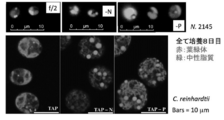
- f / 2 represents the case of f / 2 medium
- N represents the nitrogen-deficient f / 2 medium
- P represents the case of the phosphorous-deficient f / 2 medium.
- f / 2 represents the case of f / 2 medium
- N represents the nitrogen-deficient f / 2 medium
- P represents the case of the phosphorous-deficient f / 2 medium.
- f / 2 is f / 2 medium
- -N is nitrogen-deficient f / 2 medium
- -P is phosphorus-deficient f / 2 medium
- TAP is TAP medium
- TAP-N is nitrogen-deficient TAP medium
- TAP-P is The cases where the cells were cultured in a phosphorus-deficient TAP medium are shown.
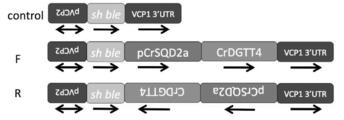
- the figure which represented the structure of the construct for strengthening TAG production system typically.
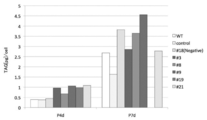
- P4d and P7d in the figure indicate the amount of TAG on the 4th day and 7th day of culture, respectively.
- Each bar graph shows the amount of TAG of wild strain, control strain, # 18, # 3, # 8, # 9, # 19, and # 21 from the left. The TAG amount on the seventh day of # 19 is not measured.
- P4d and P7d in the figure indicate the amount of TAG on the 4th day and 7th day of culture, respectively.
- Each bar graph shows the amount of TAG of wild strain, control strain, # 18, # 3, # 8, # 9, # 19, and # 21 from the left.
- the TAG amount on the seventh day of # 19 is not measured.
- Each bar graph shows the amount of TAG of wild strain, control strain, # 18, # 3, # 8, # 9, # 19, and # 21 from the left.
- Each bar graph shows the amount of TAG of wild strain, control strain, # 18, # 3, # 8, # 9, # 19, and # 21 from the left.
- F2N represents a case where the cells are cultured in an F2N50% SW medium
- P represents a phosphorus-deficient F2N50% SW medium
- N represents a nitrogen-deficient F2N50% SW medium.
- the vertical axis of the graph represents a relative value with respect to the expression level of actin.
- F2N represents a case where the cells are cultured in an F2N50% SW medium
- P represents a phosphorus-deficient F2N50% SW medium
- N represents a nitrogen-deficient F2N50% SW medium.
- the vertical axis of the graph represents a relative value with respect to the expression level of actin.
- the left figure shows the results on day 4 of nutritional deficiency
- the right figure shows the results on day 6 of nutritional deficiency.
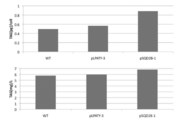
- the figure which shows the TAG amount [pg] per cell (upper figure), and the TAG amount [mg] per culture solution (lower figure).
- the method for producing a TAG highly productive algae of the present invention comprises: (1) a TAG synthase gene, (2) a phosphorus deficiency responsive promoter placed upstream of the TAG synthase gene, and (3) a TAG synthase gene.
- a construct that is arranged downstream and includes a 3 ′ untranslated region of a gene derived from the algae of the same species as the alga to which the construct is to be introduced is introduced.
- DGAT diacylglycerol acyltransferase
- DGAT1 has two isozymes, DGAT1 and DGAT2. Any of them can be used in the present invention, but DGAT2 is preferably used. Since DGAT2 and the gene encoding it have been reported in many papers (for example, Jay M. Shockey et al., The Plant Cell, Vol. 18 September 2006, 2294-2313, Miller et al., Plant Physiology, vol.154 2010, 1737-1752), those skilled in the art can understand what the DGAT2 gene is. Specific examples of the DGAT2 gene include the DGTT4 gene of C.
- the DGAT2A gene of Nannochloropsis sp. (Its base sequence is shown in SEQ ID NO: 28), and the DGAT2B gene (its base sequence is shown in SEQ ID NO: 29).
- DGAT2C gene (its base sequence is shown in SEQ ID NO: 30)
- DGAT2D gene (its base sequence is shown in SEQ ID NO: 31)
- DGAT2E gene (its base sequence is shown in SEQ ID NO: 32)
- DGAT2F gene Its base sequence is shown in SEQ ID NO: 33
- DGAT2G gene (its base sequence is shown in SEQ ID NO: 34)
- DGAT2H gene (its base sequence is shown in SEQ ID NO: 35), DGAT2I gene (its base sequence is shown)
- DGAT2J gene (its base sequence is shown in SEQ ID NO: 37), DGAT2K gene (its base sequence is shown in SEQ ID NO: 38), and the like.
- the DGTT4 gene can be used as the DGAT2 gene.
- DGTT4 is a protein belonging to the DGAT2 family contained in C. reinhardtii, and this protein and the gene encoding it have been reported in many papers (for example, Boyle et al. The Journal of biological chemistry, 287 (2012), pp. 15811-15825, Chen JE Smith AG, J Biotechnol. 2012 Jun 29), those skilled in the art can understand what the DGTT4 gene is.
- the amino acid sequence of DGTT4 and the base sequence of the gene encoding it are as shown in SEQ ID NO: 3 and SEQ ID NO: 2, respectively.
- the DGTT4 gene in the present invention includes not only the DGTT4 gene of C.
- DGreinhardtii (Cre03.g205050) but also a gene (such as a homolog) corresponding to this gene in other organisms.
- Specific examples of the DGTT4 gene in organisms other than C. reinhardtii include Volvox carteri f. Nagariensis DGAT2 (JGI protein ID77655) gene, Ostreococcus tauri's DGAT2 (JGI protein ID 21937) gene and the like.
- the base sequence of the DGTT4 gene As the base sequence of the DGTT4 gene, the base sequence shown in SEQ ID NO: 2 can be exemplified. Further, the base sequence of the DGTT4 gene is a base sequence having high identity with the base sequence shown in SEQ ID NO: 2, and may be a base sequence encoding a protein having activity (such as diacylglycerol acyltransferase activity). Good. “High identity” here means usually 90% or more identity, preferably 95 or more identity, more preferably 97% or more identity, and even more preferably 99% or more identity. The value of “identity” in the present specification can be calculated using a homology search program known to those skilled in the art. For example, the calculation can be performed by using default (initial setting) parameters in NCBI homology algorithm BLAST (Basic local alignment search tool).
- NCBI homology algorithm BLAST Basic local alignment search tool
- the base sequence of the DGTT4 gene consists of an amino acid sequence in which one or several amino acids have been deleted, substituted or added in the amino acid sequence shown in SEQ ID NO: 3, and an active protein (such as diacylglycerol acyltransferase activity). You may code.
- the “one or several” herein is usually 1 to 10, preferably 1 to 5, more preferably 1 to 3, and still more preferably 1.
- “deletion, substitution or addition” includes not only artificial mutations but also naturally occurring mutations (mutants and variants) such as cases based on individual differences, species or genus differences.
- an enzyme gene other than the DGTT4 gene may be used.
- a TAG synthase gene that preferentially incorporates polyunsaturated fatty acids into the TAG may be used.
- DGAT2 gene possessed by Thalassiosira pseudonana Japanese Patent Publication No. 2011-507513
- SQD2 is an enzyme involved in the synthesis of sulfoquinovosyl diacylglycerol (SQDG), and this enzyme and the gene encoding it have been reported in many papers (eg, Yu B, Xu C, Benning C ., Proc Natl Acad Sci U S A. 2002 Apr; 99 (8): 5732-7.) Since the amino acid sequence of this enzyme is also published on the database (for example, SQD2 (SQD2a of C. reinhardtii) ) Is described in GenBank Accession No.
- SQD2 gene As the promoter of the SQD2 gene, the promoter of the SQD2a gene of C. reinhardtii (its base sequence is shown in SEQ ID NO: 1), the promoter of the SQD2A gene of Nannochloropsis sp. (Its base sequence is shown in SEQ ID NO: 45), Nannochloropsis. A promoter of the SQD2B gene of sp. (its base sequence is shown in SEQ ID NO: 15) and the like can be used.
- the base sequence of the promoter of the SQD2 gene As the base sequence of the promoter of the SQD2 gene, the base sequence shown in SEQ ID NO: 1, SEQ ID NO: 15 or SEQ ID NO: 45, or the base sequence showing high identity with the base sequence shown in SEQ ID NO: 1, SEQ ID NO: 15 or SEQ ID NO: 45 Thus, examples include base sequences that maintain promoter activity. “High identity” here means usually 90% or more identity, preferably 95 or more identity, more preferably 97% or more identity, and even more preferably 99% or more identity.
- the promoter sequence of the SQD2 gene is a nucleotide sequence in which one or several bases are deleted, substituted or added in the nucleotide sequence shown in SEQ ID NO: 1, SEQ ID NO: 15 or SEQ ID NO: 45. It may be a base sequence that maintains
- the “one or several” herein is usually 1 to 10, preferably 1 to 5, more preferably 1 to 3, and still more preferably 1. Further, “deletion, substitution or addition” includes not only artificial mutations but also naturally occurring mutations (mutants and variants) such as cases based on individual differences, species or genus differences.
- a promoter other than the promoter of the SQD2 gene may be used.
- a promoter of the LDSP gene (its base sequence is shown in SEQ ID NO: 46)
- a promoter of the LPAT-Y gene its base sequence is shown in SEQ ID NO: 44
- the phosphorus deficiency responsive promoter is placed upstream of the TAG synthase gene in the construct to be introduced into algae.
- the phosphorus deficiency responsive promoter may be directly connected to the TAG synthase gene or may be connected via a linker or the like.
- the 3 ′ untranslated region uses a 3 ′ untranslated region of a gene derived from the algae of the same kind as the algae to which the construct is to be introduced.
- the 3 'untranslated region of VCP (violaxanthin / chlorophyll a-binding protein) 1 is used, but the 3' untranslated region of a gene derived from the same algae as the alga to which the construct is to be introduced. Anything is acceptable.
- Examples of the 3 ′ untranslated region of genes other than the VCP1 gene include the 3 ′ untranslated region of T35S of cauliflower mosaic virus, the 3 ′ untranslated region of Rubisco small subunit RBCS2 of alga belonging to the genus Nannochloropsis (Genome , Functional Gene Annotation, and Nuclear Transformation of the Heterokont Oleaginous Alga Nannochloropsis oceanica CCMP1779, PLoS Genet. 2012 Nov; 8 (11). Epub 2012 Nov 15.).
- the length of the 3 ′ untranslated region is not particularly limited, but is preferably 500 to 1500 bases, and more preferably 500 to 700 bases.
- the 3 ′ untranslated region is located downstream of the TAG synthase gene in the construct to be introduced into algae.
- the 3 ′ untranslated region may be directly connected to the TAG synthase gene or may be connected via a linker or the like.
- the construct may contain, in addition to the above-described TAG synthase gene, promoter, and 3 ′ untranslated region, other genes such as an antibiotic resistance gene and a promoter for expressing it.
- algae belonging to the genus Nannochloropsis is preferable, but other algae such as the genus Chlamydomonas, the genus Pseudochoricystis, the genus Phaeodactylum (Phaeodactylum) , Genus Ostreococcus, genus Cyanidioschyzon, genus Klebsormidium, genus Chlorokybus, genus Spirogyra, genus Chara, genus Coleochaete And algae belonging to the genus Chlorella, or the genus Fistulifera.
- algae belonging to the genus Nannochloropsis is preferable, but other algae such as the genus Chlamydomonas, the genus Pseudochoricystis, the genus Phaeodactylum (Phaeodactylum) , Genus Ostreococcus, genus Cyanidioschyzon, genus Kleb
- Examples of the algae of the genus Nannochloropsis include Nannochloropsis oculata, Nannochloropsis salina, Nannochloropsis gaditana, etc., and the algae of the genus Chlamydomonas Examples include Chlamydomonas reinhardtii, and algae of the genus Pseudocollistis can be exemplified by Pseudochoricystis ellipsoidea, and algae of the genus Phaeodactylum An example of a tricornutum (Phaeodactylum tricornutum), an example of an algae of the genus Osterococcus is an example of Ostreococcus tauri, and an example of an algae of the genus Cyanidiosis is cyanidiosizone.
- Examples of the algae of the genus Nannochloropsis include Nannochloropsis oculata, Nannochloropsis salina, Nannoch
- melora an example of an algae of the genus Klebsormidium flaccidum, an example of an algae of the genus Cala fragilis
- examples of the algae of the genus Coreocate include Coleochaete scutata
- the algae of the genus Chlorella can include, for example, Chlorella vulgaris
- the algae of the genus Fisturifera include fistula fera.
- Examples include Solaris (Fistulifera solaris).
- the 3 ′ untranslated region needs to be derived from the algae of the same type as the algae to which the construct is to be introduced, but the TAG synthase gene and the phosphorus deficiency responsive promoter are to introduce the construct. It may be derived from any algae of the same or different type.
- the construction of the construct and the operation of introducing it into algae can be performed according to conventional methods.
- the TAG highly productive algae produced by the above-described method can be cultured in the same manner as normal algae culture except that the TAG is accumulated under phosphorus-deficient conditions at the time of TAG accumulation.
- an f / 2 medium or the like can be used as the medium
- the culture temperature can be about 20 to 25 ° C.
- light during the culture can be used.
- the strength can be 10-40 ⁇ E / m 2 / sec.
- TAP medium can be used as the medium, and the culture temperature should be about 23-25 ° C.
- the light intensity during culture can be 10-40 ⁇ E / m 2 / sec.
- TAG When TAG is accumulated in TAG highly productive algae, it is cultured under phosphorus-deficient conditions.
- Culture under phosphorus-deficient conditions is, for example, a method in which cells in the logarithmic growth phase are removed from the medium used at the time of growth by removing the phosphorus component (for example, K 2 HPO 4 , KH 2 PO 4, etc.) It can be performed by transferring to a medium having a concentration of 33 ⁇ M or less and culturing. Usually, a sufficient amount of TAG is accumulated in the cells after culturing for about 8 to 13 days.
- the phosphorus component for example, K 2 HPO 4 , KH 2 PO 4, etc.
- high density culture For algae that can be cultured at high density, such as algae belonging to the genus Nannochloropsis, by culturing for a certain period of time under high-density conditions in a medium used during growth without transferring to a medium that does not contain phosphorus components. Can also accumulate TAG. This is thought to be due to natural phosphorus deficiency conditions after long-term culture. In this high-density culture method, a sufficient amount of TAG is usually accumulated in the cells after culturing for about 7 to 20 days.
- the term “high density culture” as used herein generally means a culture having a cell density of 1 ⁇ 10 8 cells / ml or more.
- TAG can be collected from cells that have accumulated TAG according to conventional methods.
- Example 1 [Experimental material] (1) Algal strain The true eye-point alga Nannochloropsis NIES-2145 (hereinafter N. 2145) was used. This algal strain is available from the National Institute for Environmental Studies (http://www.nies.go.jp/).
- the green alga Chlamydomonas reinhardtii C9 strain (CC-408 mt-) was used. This algal strain is available from the Chlamydomonas Center (http://chlamycollection.org/).
- (2) Gene name and protein ID The gene name and protein ID (JGI Chlamydomonas reinhardtii 4.0) are as follows. DGTT4: PID190539 SQD2a: PID116277 CBLP: PID164254 (3) Gene sequence The sequence of the SQD2a promoter (pCrSQD2a) derived from C. reinhardtii is as shown in SEQ ID NO: 1.
- C. reinhardtii The sequence of the DGTT4 gene (CrDGTT4) derived from C. reinhardtii is as shown in SEQ ID NO: 2.
- the sequence of the sh ble gene is as shown in SEQ ID NO: 4.
- the sequence of the promoter (NannoVCP2gene-promoter) derived from Nannochloropsis is as shown in SEQ ID NO: 5.
- NannoVCP1 (VCP1) 3′UTR) of the VCP1 gene derived from Nannochloropsis is as shown in SEQ ID NO: 6.
- TAP medium was used as a medium for normal culture, and swirl culture was performed at 20-30 ⁇ E / m 2 / sec, 23 ° C.
- K 2 HPO 4 and KH 2 PO 4 were removed from the TAP medium, and in the nitrogen-deficient medium, NH 4 Cl was removed.
- f / 2 medium or F2N50% SW medium was used as the medium for normal culture.
- the f / 2 medium was prepared as follows. Na 2 EDTA ⁇ 2H 2 O 440 mg, FeCl 3 ⁇ 6H 2 O 316 mg, CoSO 4 ⁇ 7H 2 O 1.2 mg, ZnSO 4 ⁇ 7H 2 O 2.1 mg, MnCl 2 ⁇ 4H 2 O 18 mg, CuSO 4 ⁇ 5H 0.7 mg of 2 O and 0.7 mg of Na 2 MoO 4 ⁇ 2H 2 O were dissolved in 100 mL of ion-exchanged water and stored at 4 ° C. as f / 2 metal.
- f / 2 medium was used as the medium for normal culture, and swirling culture was performed at 20 to 30 ⁇ E / m 2 / sec at 23 ° C.
- NaH 2 PO 4 was removed from the f / 2 medium, and in the nitrogen-deficient medium, NaNO 3 was removed.
- the F2N50% SW medium was prepared by making the artificial seawater contained in the F2N medium (PNAS, 2011, vol. 108 (no. 52) 21265-21269) into a 50% concentration and was prepared as follows. Tris (hydroxymethyl) aminomethane (12.11 g) was dissolved in ion-exchanged water (100 mL) and adjusted to pH 7.6 with HCl to obtain 1 M Tris (pH 7.6).
- the frozen cells were thawed, 1 ml of chloroform and 2 ml of methanol were added, and the mixture was kept at room temperature for 1 hour while being suspended every 10 minutes. Centrifugation was performed with a swing rotor at 800 ⁇ g for 5 minutes, and 4 ⁇ mL of the supernatant was recovered. Add 1% (W / V) KCl (0.8 mL), chloroform (1 mL), and methanol (2 mL) to the precipitate. After suspension, centrifuge at 800 x g for 5 minutes with a swing rotor, and add 3.8 mL of the supernatant to the previous supernatant. And recovered.
- RNA extraction Three times or more of the RNA extract and 3 times or more of the acidic phenol were added to the frozen cells, and ultrasonication (15 seconds of ultrasonic waves, 30 seconds of ice cooling) was performed 4 times while frozen. Centrifugation was performed at 20000 ⁇ g for 5 minutes at 4 ° C., and 400 to 500 ⁇ L of the supernatant was recovered. 300 ⁇ L of acidic phenol and 300 ⁇ L of chloroform were added to the supernatant and suspended, and then centrifuged at 14 k rpm for 5 minutes at 4 ° C. to recover 400 to 500 ⁇ L of the supernatant, and this operation was repeated 5 times.
- the supernatant was added with 1/10 volume of 3 M sodium acetate and 1 volume of isopropanol, suspended, and centrifuged at 20000 ⁇ g for 5 minutes at 4 ° C. 1 mL of 70% ethanol was added to the precipitate and centrifuged at 20000 ⁇ g for 5 minutes at 4 ° C. This operation was repeated twice, and then the precipitate was dried. The dried precipitate was dissolved in 400 ⁇ L of sterilized ion-exchanged water, and it was confirmed that the nucleic acid had a concentration of 1 ⁇ g / ⁇ L or higher.
- RNA having a concentration of 1 ⁇ g / ⁇ L or more 150 ⁇ L of 70% ethanol was added to the precipitate, and centrifuged at 20000 ⁇ g for 10 minutes at 4 ° C. This operation was repeated twice, and then the precipitate was dried. The dried precipitate was dissolved in 50 ⁇ L of sterilized ion-exchanged water and confirmed to be RNA having a concentration of 1 ⁇ g / ⁇ L or more.
- Quantitative RT-PCR method 2 ⁇ SYBR Green (TAKARA) 12.5 ⁇ L, 10 ⁇ M primer_F 1 ⁇ L, 10 ⁇ M primer_R 1 ⁇ L, 5-fold diluted cDNA 2 ⁇ L, sterile ion-exchanged water 8.5 ⁇ L are suspended in the reaction. Using.
- Nanno_realRT_TUBf AGCATGGCATTGACTCCACC SEQ ID NO: 7
- Nanno_realRT_TUBr AACGGCCTCGTTGTAGTACACG SEQ ID NO: 8
- CrDGTT4_realRT_F GTTCGTGCAGTTCAGTGTGG
- CrDGTT4_realRT_R CGGGCAGAATCCGAACA
- PCR reaction conditions were performed in the following 3 steps. step1 94 °C for 2 minutes step2 40 cycles of 94 °C 45 seconds, 55 °C 30 seconds, 71 °C 1 minute 30 seconds step3 71 ° C for 5 minutes The following primers were used.
- SQD2a_F2 CGGGATAGTTGTAGCTGTAG SEQ ID NO: 11
- SQD2a_R2 CGAAGAGTTGAGGTGTGTGTGTTC SEQ ID NO: 12
- PCR reaction conditions were performed in the following 3 steps. step1 94 °C 3 minutes step2 94 ° C for 30 seconds, 54 ° C for 30 seconds, 72 ° C for 1 minute for 41 cycles step3 72 ° C for 3 minutes The following primers were used.
- DGTT4_F2 ATGCCGCTCGCAAAGCTGCG SEQ ID NO: 13
- DGTT4_R2 CTACATTATGACCAGCTCCTC SEQ ID NO: 14
- the cell suspension was placed in an electroporation cuvette (2 mm width), and a voltage was applied once at 11 kV / cm and a time constant of 12 msec.
- 1 mL of normal medium was added to the cuvette to suspend the cells, and then transferred to a 15 mL tube. Furthermore, 4 mL of normal medium was added to make the total volume 5 mL.
- the culture was swirled at 10 ⁇ E / m 2 / sec, 23 ° C. for 48 hours, added with 0.4 mL of INA Agar / f / 2 5 mL, and plated on a plate added with 2 ⁇ g / ⁇ L zeocin. It was allowed to stand at 20 to 30 ⁇ E / m 2 / sec at 23 ° C., and colonies that grew after 14 to 20 days were planted on a new zeocin-containing plate as transformants.
- the present inventor has also found that the amount of TAG accumulated under the phosphorus deficiency condition of N. 2145 exceeds C. reinhardtii.
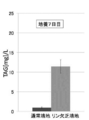
- the amount of TAG accumulated per liter of culture medium in the first week of culturing under phosphorus-deficient conditions was 12 mg / L, twice that of C. reinhardtii cultured during the same period.
- N. 2145 can be cultured at a high density up to 1 ⁇ 10 9 cells / mL in a normal medium and 2 ⁇ 10 8 cells / mL in a phosphorus-deficient medium. This is 100 times the cell density of C. reinhardtii. It is expected that 1g or more of TAG can be obtained per liter of culture solution if planted in a phosphorus-deficient medium with high-density culture.
- DGAT Diacylglycerol acyltransferase
- DGAT is an enzyme that catalyzes the final step of TAG biosynthesis.
- DGAT is an enzyme widely present in animals and plants, and two types of DGAT1 and DGAT2 have been reported.
- C. reinhardtii is known to have one type of DGAT1 and five types of DGAT2 (DGTT1-5).
- DGTT1 shows changes in mRNA levels under nitrogen-deficient conditions
- DGTT2 and Regarding DGTT3 it has been reported that the amount of mRNA changes little under nitrogen-deficient conditions, and that DGTT5 is not expressed (Plant Physiol. 2010, Vol. 154, 1737-1752).
- the present inventor found a promoter pSQD2a that induces strong expression under phosphorus-deficient conditions, and has developed a method for promoting TAG accumulation by ligation to the DGTT4 gene (Japanese Patent Laid-Open No. 2014-049651).
- the present inventor amplified the promoter region pCrSQD2a of SQD2a by PCR using the genome of C. reinhardtii as a template.
- the sequence of CrDGTT4 gene was obtained from the cDNA of C. reinhardtii at the time of phosphorus deficiency.
- pCrSQD2a was connected upstream of the CrDGTT4 gene to obtain pCrSQD2aCrDGTT4.
- a zeocin gene resistance gene S. hindustanus-derived ble was connected upstream for selection of mutant strains to obtain shblepCrSQD2aCrDGTT4. Referring to Kilian et al.
- a construct (control) in which only shble was inserted between the promoter of VCP2 of N.2145 and VCP1 3′UTR of N.2145 was used.
- a construct (R) in which pCrSQD2aCrDGTT4 was inserted in the reverse direction was also prepared (FIG. 5).
- the fatty acid composition of TAG under the phosphorus deficiency condition on the 4th day increased the ratio of C18: 1 in the strain in which CrDGTT4 gene expression was increased as compared with the wild strain and the control strain.
- CrDGTT4 has been reported to prefer C18: 1 as a substrate (Plant Cell 2013 2013 Feb; 25 (2): 677-93).
- This suggests that the combination of promoter pCrSQD2a and 3'UTR derived from N.2145 is suitable for greatly modifying the fatty acid composition of TAG from fatty acids contained in membrane lipids.
- the timing of fat accumulation can be controlled. It is suitable for the synthesis of novel fatty acids because it allows fat and oil accumulation while allowing cells to grow under phosphorus-deficient conditions. This is an effective method for accumulating useful special fatty acids.
- Example 2 In order to search for a promoter candidate derived from N. 2145 that responds to phosphorus deficiency, RNA was collected from cells on the 4th and 6th days of nutrient deficiency conditions, and quantitative RT-PCR was performed. In C. reinhardtii, increased expression of SQD2a was observed under phosphorus-deficient conditions, so the gene expression of N. 2145 homologous genes SQD2A, SQD2B, and SQD2C was examined. In addition, from a previous paper (Plant Physiology, April 2012, Vol. 158, pp.
- LDSP lipid droplet surface protein
- LPAT lipid droplet surface protein
- NannoACTf 5-ACCTTCTACAACGAGCTGC-3 (SEQ ID NO: 16)
- NannoACTr 5-GAACGTCTCAAACATAATCTGG-3 (SEQ ID NO: 17)
- NannoSQD2A_realRT_F 5-TCCCTTGCTTACTGCTCTGG-3 (SEQ ID NO: 18)
- NannoSQD2A_realRT_R 5-GATTCGCGTAGCCGCTTA-3 (SEQ ID NO: 19)
- NannoSQD2B_realRT_F 5-CTTAATACGACCACACACGTCCTC-3 (SEQ ID NO: 20)
- NannoSQD2B_realRT_R 5-TGATACGCCTCCGCACTTT-3 (SEQ ID NO: 21)
- NannoSQD2C_realRT_F 5-CCACGACTGCCGAATGA-3 (SEQ ID NO: 22)
- NannoSQD2C_realRT_R 5-TGCTAGTGGACCCTTGTTGG-3 (SEQ ID NO: 23) q
- LPAT-Y, SQD2-A, and SQD2-B increased in expression under phosphorus deficiency
- LDSP increased in expression under phosphorus deficiency and nitrogen deficiency
- 11 types of DGAT2 DGAT2A to DGAT2K
- 2 types of DGAT1 of N. 2145 was also examined, but no increase in expression was observed as in the above 4 genes. Therefore, about 1 kb of the promoter region of the above 4 genes was designated as promoters pNLPATY, pNSQD2A, pNSQD2B, pNLDSP derived from N. 2145 that induces strong expression under phosphorus-deficient conditions.
- the present inventors amplified the LPAT-Y and SQD2-B promoter regions pNLPATY and pNSQD2B, whose expression was elevated under phosphorus-deficient conditions, by PCR using the N.2145 genome as a template.
- pNLPATY and pNSQD2B were connected upstream of the CrDGTT4 gene instead of pCrSQD2a to obtain pNLPATYCrDGTT4 and pNSQD2BCrDGTT4 (FIG. 13).
- FIG. 13 The construct of FIG.
- NannoACTf 5-ACCTTCTACAACGAGCTGC-3 (SEQ ID NO: 47)
- NannoACTr 5-GAACGTCTCAAACATAATCTGG-3 (SEQ ID NO: 48)
- CrDGTT4_realRT_F 5-GTTCGTGCAGTTCAGTGTGG-3 (SEQ ID NO: 49)
- CrDGTT4_realRT_R 5-CGGGCAGAATCCGAACA-3 (SEQ ID NO: 50)
- CrDGTT4 gene expression was not confirmed in wild and control strains, and expression of CrDGTT4 was confirmed in transformants pLPATY-1, pLPATY-2, pLPATY-3, pSQD2B-1, pSQD2B-2, and pSQD2B-3 (Fig. 14).
- the cells were cultured in a phosphorus-deficient medium (200 ⁇ l), and the cells were collected on the fourth day of phosphorus deficiency, and the amount of accumulated TAG was examined (FIG. 15). From FIG. 15, it was found that TAG was accumulated in the transformants pLPATY-3 and pSQD2B-1 in which CrDGTT4 gene expression was elevated under the phosphorus deficient condition than in the wild type. From this, it can be said that this method using the promoter region of a gene that responds to phosphorus deficiency conditions for gene expression for TAG production is a method that can accumulate lipid efficiently in a short period of time.
- the sequences of genes and the like used in this example are as follows.
- the sequence of the DGAT2A gene derived from N. 2145 is as shown in SEQ ID NO: 28.
- the sequence of the DGAT2B gene derived from N. 2145 is as shown in SEQ ID NO: 29.
- the sequence of the DGAT2C gene derived from N. 2145 is as shown in SEQ ID NO: 30.
- the sequence of the DGAT2D gene derived from N. 2145 is as shown in SEQ ID NO: 31.
- the sequence of the DGAT2E gene derived from N. 2145 is as shown in SEQ ID NO: 32.
- the sequence of the DGAT2F gene derived from N. 2145 is as shown in SEQ ID NO: 33.
- the sequence of the DGAT2G gene derived from N. 2145 is as shown in SEQ ID NO: 34.
- the sequence of the DGAT2H gene derived from N. 2145 is as shown in SEQ ID NO: 35.
- the sequence of the DGAT2I gene derived from N. 2145 is as shown in SEQ ID NO: 36.
- the sequence of the DGAT2J gene derived from N. 2145 is as shown in SEQ ID NO: 37.
- the sequence of the DGAT2K gene derived from N. 2145 is as shown in SEQ ID NO: 38.
- the sequence of the SQD2A gene derived from N. 2145 is as shown in SEQ ID NO: 39.
- SEQ ID NO: 40 The sequence of the SQD2C gene derived from N. 2145 is as shown in SEQ ID NO: 41.
- the sequence of the LPAT-Y gene derived from N. 2145 is as shown in SEQ ID NO: 42.
- the sequence of the LDSP gene derived from N.2145 is as shown in SEQ ID NO: 43.
- the sequence of the promoter of the LPAT-Y gene derived from N. 2145 is as shown in SEQ ID NO: 44.
- the sequence of the promoter of the SQD2A gene derived from N.2145 is as shown in SEQ ID NO: 45.
- the sequence of the promoter of the SQD2B gene derived from N. 2145 is as shown in SEQ ID NO: 15.
- the sequence of the promoter of the LDSP gene derived from N.2145 is as shown in SEQ ID NO: 46.
- the present invention can be used in various industrial fields related to TAG production.
Landscapes
- Life Sciences & Earth Sciences (AREA)
- Health & Medical Sciences (AREA)
- Chemical & Material Sciences (AREA)
- Genetics & Genomics (AREA)
- Engineering & Computer Science (AREA)
- Organic Chemistry (AREA)
- Zoology (AREA)
- Wood Science & Technology (AREA)
- Bioinformatics & Cheminformatics (AREA)
- General Engineering & Computer Science (AREA)
- Biotechnology (AREA)
- General Health & Medical Sciences (AREA)
- Biochemistry (AREA)
- Biomedical Technology (AREA)
- Microbiology (AREA)
- Molecular Biology (AREA)
- Oil, Petroleum & Natural Gas (AREA)
- Cell Biology (AREA)
- Biophysics (AREA)
- Plant Pathology (AREA)
- Physics & Mathematics (AREA)
- Chemical Kinetics & Catalysis (AREA)
- General Chemical & Material Sciences (AREA)
- Nutrition Science (AREA)
- Medicinal Chemistry (AREA)
- Micro-Organisms Or Cultivation Processes Thereof (AREA)
- Preparation Of Compounds By Using Micro-Organisms (AREA)
Abstract
Description
〔1〕 藻類に以下の(1)~(3)を含むコンストラクトを導入することを特徴とするトリアシルグリセロール高生産性藻類の作製法、
(1)トリアシルグリセロール合成酵素遺伝子、
(2)トリアシルグリセロール合成酵素遺伝子の上流に配置されるリン欠乏応答プロモーター、
(3)トリアシルグリセロール合成酵素遺伝子の下流に配置され、コンストラクトを導入しようとする藻類と同種の藻類に由来する遺伝子の3'非翻訳領域。
(1)トリアシルグリセロール合成酵素遺伝子、
(2)トリアシルグリセロール合成酵素遺伝子の上流に配置されるリン欠乏応答プロモーター、
(3)トリアシルグリセロール合成酵素遺伝子の下流に配置され、コンストラクトを導入しようとする藻類と同種の藻類に由来する遺伝子の3'非翻訳領域。
(1)トリアシルグリセロール合成酵素遺伝子、
(2)トリアシルグリセロール合成酵素遺伝子の上流に配置されるリン欠乏応答プロモーター。
(1)従来知られている藻類よりも、多くのTAGを蓄積する。
(2)TAG合成酵素遺伝子はリン欠乏応答プロモーターの制御下にあるので、通常培養時にこの遺伝子は強発現しない。このため、TAG蓄積のタイミングをコントロールすることができる。
(3)通常条件に比べて増殖効率は低下するものの、リン欠乏条件下でもある程度の細胞増殖は可能なので、細胞を増殖させながら、TAGを蓄積させることも可能である。
(4)蓄積されるTAG中の脂肪酸は、既に合成されている脂質(葉緑体の脂質など)に由来するものではなく、新たに合成されたものなので、有用な特殊脂肪酸の生産にも有用である。
〔実施例1〕
〔実験材料〕
(1)藻類株
真正眼点藻 Nannochloropsis NIES-2145 (以後N. 2145)を使用した。この藻類株は独立行政法人国立環境研究所(http://www.nies.go.jp/)から入手可能である。
(2)遺伝子名とprotein ID
遺伝子名とprotein ID(JGI Chlamydomonas reinhardtii 4.0)は以下の通りである。
DGTT4: PID190539
SQD2a: PID116277
CBLP: PID164254
(3)遺伝子配列
C. reinhardtii由来のSQD2aプロモーター(pCrSQD2a)の配列は、配列番号1に示す通りである。
(1)培養条件
C. reinhardtiiの培養にはTAP培地を通常培養の培地として使用した。
Na2EDTA ・ 2H2O 440 mg, FeCl3 ・ 6H2O 316 mg, CoSO4 ・ 7H2O 1.2 mg, ZnSO4 ・ 7H2O 2.1 mg, MnCl2 ・ 4H2O 18 mg, CuSO4 ・ 5H2O 0.7 mg, Na2MoO4 ・ 2H2O 0.7 mgをイオン交換水 100 mLへ溶解し、f/2 metalとして4℃に保存しておいた。NaNO3 7.5 mg, NaH2PO4 ・ 2H2O 0.6 mg, Vitamin B12 0.05 μg, Biotin 0.05 μg, Thiamine HCl 10 μg, Na2SiO3 ・ 9H2O 1 mg, f/2 metal 0.1 mLを人工海水 99.9 mLへ溶解し、フィルター滅菌してから液体f/2培地として使用した。プレート培地として使用する場合は NaNO3 7.5 mg, NaH2PO4 ・ 2H2O 0.6 mg, Vitamin B12 0.05 μg, Biotin 0.05 μg, Thiamine HCl 10 μg, Na2SiO3 ・ 9H2O 1 mg, f/2 metal 0.1 mlを2倍濃度の人工海水 50 mLに溶解し、フィルター滅菌しておき、別のフラスコでINA Agar 8 gをイオン交換水 50 mLに加えてオートクレーブしてから、培地に加えた。
Tris(hydroxymethyl)aminomethane 12.11gをイオン交換水 100 mLへ溶解し、HClでpH7.6にあわせたものを1 M Tris(pH7.6)とした。1 M Tris(pH7.6) 10 mL, NH4Cl 26.745 mg, NaNO3 7.5 mg, NaH2PO4・2H2O 3.0 mg, Vitamin B12 0.25 μg, Biotin 0.25 μg, Thiamine HCl 50 μg, Na2SiO3 ・ 9H2O 1 mg, f/2 metal 0.5 mLを50%濃度の人工海水へ溶解して全量100 mLとし、フィルター滅菌してから液体F2N50%SW培地として使用した。脂質合成遺伝子発現のコンストラクトを導入したN. 2145を用いた実験(図6~15)では、F2N50%SW培地をコントロール培地、コントロール培地からNaH2PO4をのぞいたものをリン欠培地、コントロール培地からNaNO3、NH4Clをのぞいたものを窒素欠乏培地とした。
培養液100~450 mLを800×g, 5分間遠心して、培養細胞を沈殿させ、イオン交換水1 mLに懸濁した後、-80℃に保存した。
脂質抽出液50 μLを薄層シリカプレートにスポットし、ヘキサン:ジエチルエーテル:酢酸=160:40:4の展開液で45分間展開した。0.001%プリムリンを用いて、UV照射下でTAGを確認した。TAGがのっている部分のシリカを削り取り、1mM ペンタデカン酸 100 μL, 5% 塩酸/メタノールを500 μLを添加し、懸濁した後、85℃, 1時間静置した。ヘキサン 500 μLを添加し、懸濁した後、800×g, 5分間スイングローターで遠心し、上層のメチルエステル化した脂肪酸を回収した。下層に再びヘキサン500 μLを添加し、懸濁した後、800×g, 5分間スイングローターで遠心し、上層を回収した。メチルエステル化した脂肪酸を乾燥させた後、ヘキサン60 μLに溶解し、ガスクロマトグラフィサンプルとした。ガスクロマトグラフィはSHIMADZU GC-2014にHR-SS-10 25m (length) × 0.25mm (i.d.) (Shinwa Chemical Industries, Ltd., Japan)を取り付けて行った。
凍結細胞に3倍量以上のRNA抽出液と3倍量以上の酸性フェノールを加え、凍ったまま超音波破砕(超音波15秒、氷冷30秒)を4回行った。20000×g, 5分間, 4℃で遠心し、上清400~500 μLを回収した。上清に酸性フェノール 300 μL, クロロホルム 300 μLを添加し、懸濁した後、14k rpm, 5分間, 4℃で遠心し、上清400~500 μLを回収し、この操作を5回繰り返した。上清の1/10倍量の3 M 酢酸ナトリウム、1倍量のイソプロパノールを添加し、懸濁した後、20000×g, 5分間, 4℃で遠心した。沈殿物に70% エタノールを1 mL加え、20000×g,5分間, 4℃で遠心し、この操作を2回繰り返した後、沈殿物を乾燥させた。乾燥した沈殿を滅菌イオン交換水 400 μLに溶解した後、1 μg/μL以上の濃度の核酸であることを確認した。核酸 40 μLに10×DNase I Buffer 5 μL, DNase I 0.5 μL, 滅菌イオン交換水 4.5 μLを加え、37℃, 30分間静置した。酸性フェノール 50 μL, クロロホルム 50 μLを添加し、懸濁した後、20000×g,10分間, 4℃で遠心し、上清 35 μLを回収した。上清の1/10倍量の3 M 酢酸ナトリウム、1倍量のイソプロパノールを添加し、懸濁した後、20000×g,10分間, 4℃で遠心した。沈殿物に70% エタノール 150 μL加え、20000×g,10分間, 4℃で遠心し、この操作を2回繰り返した後、沈殿物を乾燥させた。乾燥した沈殿を滅菌イオン交換水 50 μLに溶解した後、1 μg/μL以上の濃度のRNAであることを確認した。
RNA 1 μgに10 mM dNTP 0.5 μL, 100 mM oligo dT18 0.25 μL, 100 mM random 6mer 0.25 μL, RNase free waterを適量(0 ~ 5 μL)加えて全量を6 μLとし、65℃, 5分間処理した後、氷上に静置した。さらに5xcDNA Synthesis Buffer 2 μL, 0.1 M DTT 0.5 μL, RNase OUT 0.5μL, Thermo Script RT 0.5 μL, RNase free water 0.5 μLを添加し、50℃, 40分間, 60℃, 20分間, 85℃, 5分間 処理した。得られたcDNAは-20℃ に保管した。
2×SYBR Green (TAKARA) 12.5 μL, 10 μM primer_F 1 μL, 10 μM primer_R 1 μL, 5倍希釈したcDNA 2 μL, 滅菌イオン交換水 8.5 μLを懸濁し、反応に用いた。
Nanno_realRT_TUBf AGCATGGCATTGACTCCACC(配列番号7)
Nanno_realRT_TUBr AACGGCCTCGTTGTAGTACACG(配列番号8)
CrDGTT4_realRT_F GTTCGTGCAGTTCAGTGTGG(配列番号9)
CrDGTT4_realRT_R CGGGCAGAATCCGAACA(配列番号10)
C. reinhardtii C9株のゲノムを鋳型にPCR反応を行い、プロモーター領域pCrSQD2aを得た。得られた約1kbの配列をpMD20-T vector(TAKARA)またはpZErO-2(Invitrogen)へ導入した。
step1 94℃ 2分間
step2 94℃ 45秒間, 55℃ 30秒間, 71℃ 1分30秒間を40サイクル
step3 71℃ 5分間
プライマーは以下のものを使用した。
SQD2a_F2 CGGGATAGTTGTAGCTGTAG(配列番号11)
SQD2a_R2 CGAAGAGTTGAGGTGTGTGTTC(配列番号12)
リン欠乏時のC. reinhardtiiのcDNAを鋳型にPCR反応を行い、DGTT4遺伝子の全長を得た。得られた約1kbの配列をpMD20-T vector(TAKARA)またはpZErO-2(Invitrogen)へ導入した。
step1 94℃ 3分間
step2 94℃ 30秒間, 54℃ 30秒間, 72℃ 1分間を41サイクル
step3 72℃ 3分間
プライマーは以下のものを使用した。
DGTT4_F2 ATGCCGCTCGCAAAGCTGCG(配列番号13)
DGTT4_R2 CTACATTATGACCAGCTCCTC(配列番号14)
通常培地で2~3×10⁶ cells/mLになるまで培養したN. 2145株 500mLを4℃, 980×g, 10分間遠心し、細胞を沈殿させた。上清をのぞいた後、氷冷した375 mM Sorbitolで3回洗浄した。洗浄後の沈殿細胞を終濃度5×10⁸ cells/mLになるように375 mM Sorbitolに懸濁した。濃縮細胞 200 μlに2~10 μgのコンストラクトDNA, 10 mg/mL キャリアssDNA(Salmon Sperm)2 μLを添加した。細胞懸濁液をエレクトロポレーション用キュベット(2 mm幅)に入れ、11kV/cm, 時定数 12 msecで1回電圧をかけた。通常培地 1 mLをキュベットへ添加し、細胞を懸濁した後、15 mLチューブへ移した。さらに通常培地を4 mL添加し、全量を5 mLとした。10 μE/m2/sec, 23℃, 48 時間旋回培養し、0.4% INA Agar/f/2 5 mLを添加し、2 μg/μLゼオシンを添加したプレートに蒔いた。20~30 μE/m2/sec, 23℃で静置し、14~20日後に生えて来たコロニーを形質転換株として新しいゼオシン入りプレートへ植えついだ。
(1)TAG/膜脂質合成系の制御検討
モデル藻類C. reinhardtiiでの脂質蓄積に関する知見として、窒素欠乏条件下で脂質が蓄積すること、脂質の中では貯蔵脂質であるTAGが蓄積すること、飽和脂肪酸の割合が増えることが報告されている(BMC Biotechnol. 2011; 11: 7.)。本発明者は対数増殖期の細胞をリン欠乏条件下におくと脂質蓄積がおこることを見出した(特開2014-049651)。超微細藻類であり、オイル高生産能がある真正眼点藻N. 2145でも同様にリン欠条件下での脂質蓄積を調べた。
C. reinhardtiiでの脂質蓄積の結果をふまえ、増殖が盛んな対数増殖期 (1×10⁷ cells/mL) のN. 2145を用いて窒素欠乏条件、リン欠乏条件の比較を行った。
Diacylglycerol acyltransferase (DGAT)はTAG生合成の最終ステップを触媒する酵素である。DGATは動物、植物に広く存在する酵素であり、DGAT1, DGAT2の2種類が報告されている。
図5のコンストラクトをN. 2145へ形質転換し、ゼオシンで選抜後、control株とF株については形質転換株を20~30株得た。R株は4株得られた。リン欠乏条件5日目の形質転換株から回収したRNAを用いて、定量RT-PCRを行い、CrDGTT4遺伝子の発現上昇が確認された株をさらに選抜した。野生株、control株、R株ではCrDGTT4遺伝子発現上昇は確認されなかった(図6)。このことから、プロモーターpCrSQD2aとN.2145由来の3'UTRの組み合わせは間に挟んだ遺伝子の発現上昇に有効であると考えられる。
リン欠乏に応答するN. 2145由来のプロモーター候補を探すために、栄養欠乏条件4日目、6日目の細胞からRNAを回収し、定量RT-PCR法を行った。C. reinhardtiiではリン欠乏条件下でSQD2aの発現上昇が見られたので、N. 2145の相同遺伝子であるSQD2A,SQD2B,SQD2Cの遺伝子発現を調べた。また、先行論文(Plant Physiology, April 2012, Vol. 158, pp. 1562-1569)から、LDSP(lipid droplet surface protein)の高発現が予想され、LPATについても本発明者の所属する研究室の先行研究より高発現が予想されたので、遺伝子発現を調べた。このとき、アクチンの発現をコントロールとした。
使用したプライマー配列は以下の通りである。
NannoACTr: 5-GAACGTCTCAAACATAATCTGG-3(配列番号17)
NannoSQD2A_realRT_F:5-TCCCTTGCTTACTGCTCTGG-3(配列番号18)
NannoSQD2A_realRT_R:5-GATTCGCGTAGCCGCTTA-3(配列番号19)
NannoSQD2B_realRT_F:5-CTTAATACGACCACACACGTCCTC-3(配列番号20)
NannoSQD2B_realRT_R:5-TGATACGCCTCCGCACTTT-3(配列番号21)
NannoSQD2C_realRT_F:5-CCACGACTGCCGAATGA-3(配列番号22)
NannoSQD2C_realRT_R:5-TGCTAGTGGACCCTTGTTGG-3(配列番号23)
qRT_LPATY_L:5-gcttgtcgagtacccattcat-3(配列番号24)
qRT_LPATY_:5-cagcagcccaaagaggttc-3(配列番号25)
qRT_LDSP_L:5-gtgcctttcgacctctcg-3(配列番号26)
qRT_LDSP_R:5-ggcacaaaaagatcctagcaa-3(配列番号27)
NannoACTf: 5-ACCTTCTACAACGAGCTGC-3(配列番号47)
NannoACTr: 5-GAACGTCTCAAACATAATCTGG-3(配列番号48)
CrDGTT4_realRT_F:5-GTTCGTGCAGTTCAGTGTGG-3(配列番号49)
CrDGTT4_realRT_R:5-CGGGCAGAATCCGAACA-3(配列番号50)
N. 2145由来のDGAT2A遺伝子の配列は、配列番号28に示す通りである。
N. 2145由来のDGAT2B遺伝子の配列は、配列番号29に示す通りである。
N. 2145由来のDGAT2C遺伝子の配列は、配列番号30に示す通りである。
N. 2145由来のDGAT2D遺伝子の配列は、配列番号31に示す通りである。
N. 2145由来のDGAT2E遺伝子の配列は、配列番号32に示す通りである。
N. 2145由来のDGAT2F遺伝子の配列は、配列番号33に示す通りである。
N. 2145由来のDGAT2G遺伝子の配列は、配列番号34に示す通りである。
N. 2145由来のDGAT2H遺伝子の配列は、配列番号35に示す通りである。
N. 2145由来のDGAT2I遺伝子の配列は、配列番号36に示す通りである。
N. 2145由来のDGAT2J遺伝子の配列は、配列番号37に示す通りである。
N. 2145由来のDGAT2K遺伝子の配列は、配列番号38に示す通りである。
N. 2145由来のSQD2A遺伝子の配列は、配列番号39に示す通りである。
N. 2145由来のSQD2B遺伝子の配列は、配列番号40に示す通りである。
N. 2145由来のSQD2C遺伝子の配列は、配列番号41に示す通りである。
N. 2145由来のLPAT-Y遺伝子の配列は、配列番号42に示す通りである。
N. 2145由来のLDSP遺伝子の配列は、配列番号43に示す通りである。
N. 2145由来のLPAT-Y遺伝子のプロモーターの配列は、配列番号44に示す通りである。
N. 2145由来のSQD2A遺伝子のプロモーターの配列は、配列番号45に示す通りである。
N. 2145由来のSQD2B遺伝子のプロモーターの配列は、配列番号15に示す通りである。
N. 2145由来のLDSP遺伝子のプロモーターの配列は、配列番号46に示す通りである。
Claims (19)
- 藻類に以下の(1)~(3)を含むコンストラクトを導入することを特徴とするトリアシルグリセロール高生産性藻類の作製法、
(1)トリアシルグリセロール合成酵素遺伝子、
(2)トリアシルグリセロール合成酵素遺伝子の上流に配置されるリン欠乏応答プロモーター、
(3)トリアシルグリセロール合成酵素遺伝子の下流に配置され、コンストラクトを導入しようとする藻類と同種の藻類に由来する遺伝子の3'非翻訳領域。 - リン欠乏応答プロモーターが、SQD2遺伝子のプロモーターであることを特徴とする請求項1に記載のトリアシルグリセロール高生産性藻類の作製法。
- トリアシルグリセロール合成酵素遺伝子が、DGAT2遺伝子であることを特徴とする請求項1又は2に記載のトリアシルグリセロール高生産性藻類の作製法。
- トリアシルグリセロール合成酵素遺伝子が、DGTT4遺伝子であることを特徴とする請求項1又は2に記載のトリアシルグリセロール高生産性藻類の作製法。
- 藻類が、ナンノクロロプシス属、クラミドモナス属、シュードコリシスチス属、フェオダクチラム属、オステレオコックス属、シアニディオシゾン属、クレブソルミディウム属、クロロキブス属、スピロギラ属、カラ属、コレオケーテ属、クロレラ属、又はフィスチュリフェラ属に属する藻類であることを特徴とする請求項1乃至4のいずれか一項に記載のトリアシルグリセロール高生産性藻類の作製法。
- 藻類が、ナンノクロロプシス属に属する藻類であることを特徴とする請求項1乃至4のいずれか一項に記載のトリアシルグリセロール高生産性藻類の作製法。
- 以下の(1)~(3)を含むコンストラクトが導入されていることを特徴とするトリアシルグリセロール高生産性藻類、
(1)トリアシルグリセロール合成酵素遺伝子、
(2)トリアシルグリセロール合成酵素遺伝子の上流に配置されるリン欠乏応答プロモーター、
(3)トリアシルグリセロール合成酵素遺伝子の下流に配置され、コンストラクトを導入しようとする藻類と同種の藻類に由来する遺伝子の3'非翻訳領域。 - リン欠乏応答プロモーターが、SQD2遺伝子のプロモーターであることを特徴とする請求項7に記載のトリアシルグリセロール高生産性藻類。
- トリアシルグリセロール合成酵素遺伝子が、DGAT2遺伝子であることを特徴とする請求項7又は8に記載のトリアシルグリセロール高生産性藻類。
- トリアシルグリセロール合成酵素遺伝子が、DGTT4遺伝子であることを特徴とする請求項7又は8に記載のトリアシルグリセロール高生産性藻類。
- 藻類が、ナンノクロロプシス属、クラミドモナス属、シュードコリシスチス属、フェオダクチラム属、オステレオコックス属、シアニディオシゾン属、クレブソルミディウム属、クロロキブス属、スピロギラ属、カラ属、コレオケーテ属、クロレラ属、又はフィスチュリフェラ属に属する藻類であることを特徴とする請求項7乃至10のいずれか一項に記載のトリアシルグリセロール高生産性藻類。
- 藻類が、ナンノクロロプシス属に属する藻類であることを特徴とする請求項7乃至10のいずれか一項に記載のトリアシルグリセロール高生産性藻類。
- 請求項7乃至12のいずれか一項に記載のトリアシルグリセロール高生産性藻類をリン欠乏条件下で培養し、藻類細胞中にトリアシルグリセロールを蓄積させ、蓄積したトリアシルグリセロールを採取することを特徴とするトリアシルグリセロールの製造方法。
- 藻類に以下の(1)及び(2)を含むコンストラクトを導入することを特徴とするトリアシルグリセロール高生産性藻類の作製法、
(1)トリアシルグリセロール合成酵素遺伝子、
(2)トリアシルグリセロール合成酵素遺伝子の上流に配置されるリン欠乏応答プロモーター。 - リン欠乏応答プロモーターが、SQD2遺伝子のプロモーターであることを特徴とする請求項14に記載のトリアシルグリセロール高生産性藻類の作製法。
- トリアシルグリセロール合成酵素遺伝子が、DGAT2遺伝子であることを特徴とする請求項14又は15に記載のトリアシルグリセロール高生産性藻類の作製法。
- トリアシルグリセロール合成酵素遺伝子が、DGTT4遺伝子であることを特徴とする請求項14又は15に記載のトリアシルグリセロール高生産性藻類の作製法。
- 藻類が、ナンノクロロプシス属、クラミドモナス属、シュードコリシスチス属、フェオダクチラム属、オステレオコックス属、シアニディオシゾン属、クレブソルミディウム属、クロロキブス属、スピロギラ属、カラ属、コレオケーテ属、クロレラ属、又はフィスチュリフェラ属に属する藻類であることを特徴とする請求項14乃至17のいずれか一項に記載のトリアシルグリセロール高生産性藻類の作製法。
- 藻類が、ナンノクロロプシス属に属する藻類であることを特徴とする請求項14乃至17のいずれか一項に記載のトリアシルグリセロール高生産性藻類の作製法。
Priority Applications (3)
| Application Number | Priority Date | Filing Date | Title |
|---|---|---|---|
| JP2016507824A JP6537146B2 (ja) | 2014-03-13 | 2015-03-12 | トリアシルグリセロール高生産性藻類の作製法 |
| AU2015227693A AU2015227693B2 (en) | 2014-03-13 | 2015-03-12 | Method for preparing triacylglycerol high-productivity algae |
| US15/125,485 US9944958B2 (en) | 2014-03-13 | 2015-03-12 | Method for preparing triacylglycerol high-productivity algae |
Applications Claiming Priority (2)
| Application Number | Priority Date | Filing Date | Title |
|---|---|---|---|
| JP2014049651 | 2014-03-13 | ||
| JP2014-049651 | 2014-03-13 |
Publications (1)
| Publication Number | Publication Date |
|---|---|
| WO2015137449A1 true WO2015137449A1 (ja) | 2015-09-17 |
Family
ID=54071886
Family Applications (1)
| Application Number | Title | Priority Date | Filing Date |
|---|---|---|---|
| PCT/JP2015/057302 Ceased WO2015137449A1 (ja) | 2014-03-13 | 2015-03-12 | トリアシルグリセロール高生産性藻類の作製法 |
Country Status (4)
| Country | Link |
|---|---|
| US (1) | US9944958B2 (ja) |
| JP (1) | JP6537146B2 (ja) |
| AU (1) | AU2015227693B2 (ja) |
| WO (1) | WO2015137449A1 (ja) |
Cited By (5)
| Publication number | Priority date | Publication date | Assignee | Title |
|---|---|---|---|---|
| WO2018105420A1 (ja) * | 2016-12-07 | 2018-06-14 | 花王株式会社 | 形質転換体の製造方法 |
| CN108220306A (zh) * | 2016-12-09 | 2018-06-29 | 中国科学院青岛生物能源与过程研究所 | 具有三脂酰甘油合成功能的基因及其在理性调控产油微藻三脂酰甘油含量或饱和度中的应用 |
| CN108424912A (zh) * | 2018-02-01 | 2018-08-21 | 山西省农业科学院作物科学研究所 | 玉米低磷胁迫诱导表达的启动子及其应用 |
| WO2020050412A1 (ja) * | 2018-09-07 | 2020-03-12 | 国立大学法人広島大学 | 微生物及びトリアシルグリセロールの製造方法 |
| WO2020033705A3 (en) * | 2018-08-08 | 2020-04-09 | Board Of Trustees Of Michigan State University | Improved production of terpenoids using enzymes anchored to lipid droplet surface proteins |
Families Citing this family (5)
| Publication number | Priority date | Publication date | Assignee | Title |
|---|---|---|---|---|
| US11725182B2 (en) | 2017-10-09 | 2023-08-15 | Board Of Supervisors Of Louisiana State University | Algae-based bioplastics and methods of making |
| WO2020071265A1 (ja) * | 2018-10-01 | 2020-04-09 | 花王株式会社 | 脂質の製造方法 |
| JP7360154B2 (ja) * | 2019-11-15 | 2023-10-12 | 株式会社ファイトリピッド・テクノロジーズ | Δ4デサチュレースによるドコサヘキサエン酸合成 |
| CN113652439A (zh) * | 2020-05-12 | 2021-11-16 | 中国科学院青岛生物能源与过程研究所 | 一种微拟球藻遗传转化体系及合成甘油三酯的基因和应用 |
| CN115747184B (zh) * | 2022-08-04 | 2024-09-13 | 中国科学院青岛生物能源与过程研究所 | 一种提高微藻中链甘油三酯产率的方法 |
Citations (5)
| Publication number | Priority date | Publication date | Assignee | Title |
|---|---|---|---|---|
| JP2001512977A (ja) * | 1997-02-24 | 2001-08-28 | パフォーマンス プランツ,インコーポレイテッド | リン酸欠乏誘導性プロモーター |
| WO2011156520A2 (en) * | 2010-06-09 | 2011-12-15 | Green Pacific Biologicals, Inc. | Compositions and methods for increasing oil production and secretion |
| JP2012007146A (ja) * | 2010-05-28 | 2012-01-12 | Tokyo Institute Of Technology | 植物油脂の製造方法 |
| JP2014068638A (ja) * | 2012-10-02 | 2014-04-21 | Tokyo Institute Of Technology | トリアシルグリセロール高生産性藻類の作製方法 |
| WO2015029997A1 (ja) * | 2013-08-29 | 2015-03-05 | 国立大学法人東京工業大学 | 融合遺伝子、ベクター、トランスジェニック植物、植物油脂の製造方法、トランスジェニック植物の作出方法、およびトランスジェニック植物の作出用キット |
-
2015
- 2015-03-12 AU AU2015227693A patent/AU2015227693B2/en active Active
- 2015-03-12 JP JP2016507824A patent/JP6537146B2/ja active Active
- 2015-03-12 US US15/125,485 patent/US9944958B2/en active Active
- 2015-03-12 WO PCT/JP2015/057302 patent/WO2015137449A1/ja not_active Ceased
Patent Citations (5)
| Publication number | Priority date | Publication date | Assignee | Title |
|---|---|---|---|---|
| JP2001512977A (ja) * | 1997-02-24 | 2001-08-28 | パフォーマンス プランツ,インコーポレイテッド | リン酸欠乏誘導性プロモーター |
| JP2012007146A (ja) * | 2010-05-28 | 2012-01-12 | Tokyo Institute Of Technology | 植物油脂の製造方法 |
| WO2011156520A2 (en) * | 2010-06-09 | 2011-12-15 | Green Pacific Biologicals, Inc. | Compositions and methods for increasing oil production and secretion |
| JP2014068638A (ja) * | 2012-10-02 | 2014-04-21 | Tokyo Institute Of Technology | トリアシルグリセロール高生産性藻類の作製方法 |
| WO2015029997A1 (ja) * | 2013-08-29 | 2015-03-05 | 国立大学法人東京工業大学 | 融合遺伝子、ベクター、トランスジェニック植物、植物油脂の製造方法、トランスジェニック植物の作出方法、およびトランスジェニック植物の作出用キット |
Non-Patent Citations (6)
| Title |
|---|
| CAKMAK Z. E. ET AL.: "Induction of triacylglycerol production in Chlamydomonas reinhardtii: comparative analysis of different element regimes", BIORESOUR. TECHNOL., vol. 155, pages 379 - 387, XP055224445, ISSN: 0960-8524 * |
| IWAI M. ET AL.: "Enhancement of extraplastidic oil synthesis in Chlamydomonas reinhardtii using a type-2 diacylglycerol acyltransferase with a phosphorus starvation--inducible promoter", PLANT BIOTECHNOL. J., vol. 12, no. 6, June 2014 (2014-06-01), pages 808 - 819, XP055224446, ISSN: 1467-7644 * |
| LA RUSSA M. ET AL.: "Functional analysis of three type-2 DGAT homologue genes for triacylglycerol production in the green microalga Chlamydomonas reinhardtii", J. BIOTECHNOL., vol. 162, no. 1, 2012, pages 13 - 20, XP028946462, ISSN: 0168-1656 * |
| MASAKO IWAI ET AL.: "Ryokuso Chlamydomonas reinhardtii ni Okeru Rin Ketsubo Otosei Promoter o Mochiita Shishitsu Chikuseki Kyoka", PROCEEDINGS OF THE 55TH ANNUAL MEETING OF THE JAPANESE SOCIETY OF PLANT PHYSIOLOGISTS, vol. 55, 11 April 2014 (2014-04-11), pages 362 * |
| MASAKO IWAI ET AL.: "Ryokuso Chlamydomonas reinhardtii Yurai no Rin Ketsubo Otosei Promoter o Mochiita Shishitsu Chikuseki Kyoka", PROCEEDINGS OF THE 56TH ANNUAL MEETING OF THE JAPANESE SOCIETY OF PLANT PHYSIOLOGISTS, vol. 56, 9 March 2015 (2015-03-09), pages 129 * |
| MASAKO IWAI ET AL.: "Sorui ni Okeru Rin Ketsubo Otosei Promoter o Mochiita Shishitsu Chikuseki Kyoka", PROCEEDINGS OF THE 78TH ANNUAL MEETING OF THE BOTANICAL SOCIETY OF JAPAN, vol. 78, 1 September 2014 (2014-09-01), pages 162 * |
Cited By (12)
| Publication number | Priority date | Publication date | Assignee | Title |
|---|---|---|---|---|
| WO2018105420A1 (ja) * | 2016-12-07 | 2018-06-14 | 花王株式会社 | 形質転換体の製造方法 |
| JP2018088902A (ja) * | 2016-12-07 | 2018-06-14 | 花王株式会社 | 相同組換えが生じた形質転換体の取得確率を向上させる方法 |
| US11306320B2 (en) | 2016-12-07 | 2022-04-19 | Kao Corporation | Method for promoting homologous recombination |
| CN108220306A (zh) * | 2016-12-09 | 2018-06-29 | 中国科学院青岛生物能源与过程研究所 | 具有三脂酰甘油合成功能的基因及其在理性调控产油微藻三脂酰甘油含量或饱和度中的应用 |
| CN108220306B (zh) * | 2016-12-09 | 2021-08-27 | 中国科学院青岛生物能源与过程研究所 | 具有三脂酰甘油合成功能的基因及其在理性调控产油微藻三脂酰甘油含量或饱和度中的应用 |
| CN108424912A (zh) * | 2018-02-01 | 2018-08-21 | 山西省农业科学院作物科学研究所 | 玉米低磷胁迫诱导表达的启动子及其应用 |
| CN108424912B (zh) * | 2018-02-01 | 2021-07-13 | 山西省农业科学院作物科学研究所 | 玉米低磷胁迫诱导表达的启动子及其应用 |
| WO2020033705A3 (en) * | 2018-08-08 | 2020-04-09 | Board Of Trustees Of Michigan State University | Improved production of terpenoids using enzymes anchored to lipid droplet surface proteins |
| WO2020050412A1 (ja) * | 2018-09-07 | 2020-03-12 | 国立大学法人広島大学 | 微生物及びトリアシルグリセロールの製造方法 |
| JPWO2020050412A1 (ja) * | 2018-09-07 | 2021-06-10 | 国立大学法人広島大学 | 微生物及びトリアシルグリセロールの製造方法 |
| US20210317482A1 (en) * | 2018-09-07 | 2021-10-14 | Hiroshima University | Microorganism and method for producing triacylglycerol |
| US11767545B2 (en) | 2018-09-07 | 2023-09-26 | Hiroshima University | Microorganism and method for producing triacylglycerol |
Also Published As
| Publication number | Publication date |
|---|---|
| JP6537146B2 (ja) | 2019-07-03 |
| AU2015227693B2 (en) | 2021-01-07 |
| US9944958B2 (en) | 2018-04-17 |
| US20170073711A1 (en) | 2017-03-16 |
| AU2015227693A1 (en) | 2016-10-20 |
| JPWO2015137449A1 (ja) | 2017-04-06 |
Similar Documents
| Publication | Publication Date | Title |
|---|---|---|
| JP6537146B2 (ja) | トリアシルグリセロール高生産性藻類の作製法 | |
| JP7261815B2 (ja) | ネルボン酸を生産する組換え酵母菌株およびその使用 | |
| US9957514B2 (en) | Transformation of duckweed and uses thereof | |
| CN102459600B (zh) | 提高种子中的物质生产性的基因及其利用方法 | |
| JP6818193B2 (ja) | 中性脂質の製造方法、トランスジェニック植物及びキット | |
| Úbeda-Mínguez et al. | Tools for microalgal biotechnology: development of an optimized transformation method for an industrially promising microalga—Tetraselmis chuii | |
| Rasala et al. | Genetic engineering to improve algal biofuels production | |
| JP5988212B2 (ja) | トリアシルグリセロール高生産性藻類の作製方法 | |
| Zhang et al. | Manipulation of triacylglycerol biosynthesis in Nannochloropsis oceanica by overexpressing an Arabidopsis thaliana diacylglycerol acyltransferase gene | |
| JP2026069629A (ja) | 脂質の製造方法 | |
| JP2007521837A (ja) | シゾチトリウム脂肪酸合成酵素(fas)ならびにそれに関連した製品および方法 | |
| US10370687B2 (en) | Genetically modified strain of eukaryotic microalga having improved triglyceride productivity, and use thereof | |
| JP2023038006A (ja) | 花の老化が遅延されたユリ植物及びその製造方法 | |
| Fathy et al. | Overexpressing key enzymes in lipogenesis to boost microalgae cellular oil content for biofuel production: a mini-review | |
| WO2011010485A1 (ja) | エイコサノイド生産方法、並びにゼニゴケ由来のエイコサノイド生合成系遺伝子及びその利用 | |
| Schuhmann et al. | Physiology, biochemistry and genetics of microalgal growth and lipid production. | |
| Zhang et al. | Association of triacylglyceride content and transcript abundance of genes involving in lipid synthesis of nitrogen deficient Phaeodactylum tricornutum | |
| CN118516400B (zh) | gma-miR169c基因在调控植物脂肪酸合成中的应用 | |
| Kumari et al. | Genetic engineering tools for enhancing lipid production in microalgae | |
| Eman et al. | Overexpressing key enzymes in lipogenesis to boost microalgae cellular oil content for biofuel production, A mini-review | |
| US20130189765A1 (en) | Algal bio-flocculation by inactivation of photoreceptors | |
| Schuhmann et al. | Growth and Lipid Production | |
| CN121022926A (zh) | Ect2和ect4基因在调控杨树叶片大小和形态中的应用 | |
| WO2015182110A1 (ja) | 藻類及びその製造方法、並びに該藻類を用いたバイオマスの製造方法 | |
| JP2023038009A (ja) | ユリの花の老化遅延法 |
Legal Events
| Date | Code | Title | Description |
|---|---|---|---|
| 121 | Ep: the epo has been informed by wipo that ep was designated in this application |
Ref document number: 15761056 Country of ref document: EP Kind code of ref document: A1 |
|
| ENP | Entry into the national phase |
Ref document number: 2016507824 Country of ref document: JP Kind code of ref document: A |
|
| WWE | Wipo information: entry into national phase |
Ref document number: 15125485 Country of ref document: US |
|
| NENP | Non-entry into the national phase |
Ref country code: DE |
|
| ENP | Entry into the national phase |
Ref document number: 2015227693 Country of ref document: AU Date of ref document: 20150312 Kind code of ref document: A |
|
| 122 | Ep: pct application non-entry in european phase |
Ref document number: 15761056 Country of ref document: EP Kind code of ref document: A1 |