WO2015137383A1 - 癌化学療法の補助剤 - Google Patents
癌化学療法の補助剤 Download PDFInfo
- Publication number
- WO2015137383A1 WO2015137383A1 PCT/JP2015/057119 JP2015057119W WO2015137383A1 WO 2015137383 A1 WO2015137383 A1 WO 2015137383A1 JP 2015057119 W JP2015057119 W JP 2015057119W WO 2015137383 A1 WO2015137383 A1 WO 2015137383A1
- Authority
- WO
- WIPO (PCT)
- Prior art keywords
- cancer
- period
- agent
- chemotherapeutic agent
- chemotherapy
- Prior art date
- Legal status (The legal status is an assumption and is not a legal conclusion. Google has not performed a legal analysis and makes no representation as to the accuracy of the status listed.)
- Ceased
Links
Images


Classifications
-
- A—HUMAN NECESSITIES
- A61—MEDICAL OR VETERINARY SCIENCE; HYGIENE
- A61K—PREPARATIONS FOR MEDICAL, DENTAL OR TOILETRY PURPOSES
- A61K31/00—Medicinal preparations containing organic active ingredients
- A61K31/185—Acids; Anhydrides, halides or salts thereof, e.g. sulfur acids, imidic, hydrazonic or hydroximic acids
- A61K31/19—Carboxylic acids, e.g. valproic acid
- A61K31/195—Carboxylic acids, e.g. valproic acid having an amino group
- A61K31/197—Carboxylic acids, e.g. valproic acid having an amino group the amino and the carboxyl groups being attached to the same acyclic carbon chain, e.g. gamma-aminobutyric acid [GABA], beta-alanine, epsilon-aminocaproic acid or pantothenic acid
- A61K31/198—Alpha-amino acids, e.g. alanine or edetic acid [EDTA]
-
- A—HUMAN NECESSITIES
- A23—FOODS OR FOODSTUFFS; TREATMENT THEREOF, NOT COVERED BY OTHER CLASSES
- A23L—FOODS, FOODSTUFFS OR NON-ALCOHOLIC BEVERAGES, NOT OTHERWISE PROVIDED FOR; PREPARATION OR TREATMENT THEREOF
- A23L33/00—Modifying nutritive qualities of foods; Dietetic products; Preparation or treatment thereof
- A23L33/10—Modifying nutritive qualities of foods; Dietetic products; Preparation or treatment thereof using additives
- A23L33/17—Amino acids, peptides or proteins
- A23L33/175—Amino acids
-
- A—HUMAN NECESSITIES
- A61—MEDICAL OR VETERINARY SCIENCE; HYGIENE
- A61K—PREPARATIONS FOR MEDICAL, DENTAL OR TOILETRY PURPOSES
- A61K31/00—Medicinal preparations containing organic active ingredients
- A61K31/33—Heterocyclic compounds
- A61K31/395—Heterocyclic compounds having nitrogen as a ring hetero atom, e.g. guanethidine or rifamycins
- A61K31/495—Heterocyclic compounds having nitrogen as a ring hetero atom, e.g. guanethidine or rifamycins having six-membered rings with two or more nitrogen atoms as the only ring heteroatoms, e.g. piperazine or tetrazines
- A61K31/505—Pyrimidines; Hydrogenated pyrimidines, e.g. trimethoprim
- A61K31/513—Pyrimidines; Hydrogenated pyrimidines, e.g. trimethoprim having oxo groups directly attached to the heterocyclic ring, e.g. cytosine
-
- A—HUMAN NECESSITIES
- A61—MEDICAL OR VETERINARY SCIENCE; HYGIENE
- A61K—PREPARATIONS FOR MEDICAL, DENTAL OR TOILETRY PURPOSES
- A61K31/00—Medicinal preparations containing organic active ingredients
- A61K31/33—Heterocyclic compounds
- A61K31/555—Heterocyclic compounds containing heavy metals, e.g. hemin, hematin, melarsoprol
-
- A—HUMAN NECESSITIES
- A61—MEDICAL OR VETERINARY SCIENCE; HYGIENE
- A61K—PREPARATIONS FOR MEDICAL, DENTAL OR TOILETRY PURPOSES
- A61K31/00—Medicinal preparations containing organic active ingredients
- A61K31/655—Azo (—N=N—), diazo (=N2), azoxy (>N—O—N< or N(=O)—N<), azido (—N3) or diazoamino (—N=N—N<) compounds
-
- A—HUMAN NECESSITIES
- A61—MEDICAL OR VETERINARY SCIENCE; HYGIENE
- A61K—PREPARATIONS FOR MEDICAL, DENTAL OR TOILETRY PURPOSES
- A61K31/00—Medicinal preparations containing organic active ingredients
- A61K31/70—Carbohydrates; Sugars; Derivatives thereof
- A61K31/7042—Compounds having saccharide radicals and heterocyclic rings
- A61K31/7052—Compounds having saccharide radicals and heterocyclic rings having nitrogen as a ring hetero atom, e.g. nucleosides, nucleotides
- A61K31/706—Compounds having saccharide radicals and heterocyclic rings having nitrogen as a ring hetero atom, e.g. nucleosides, nucleotides containing six-membered rings with nitrogen as a ring hetero atom
- A61K31/7064—Compounds having saccharide radicals and heterocyclic rings having nitrogen as a ring hetero atom, e.g. nucleosides, nucleotides containing six-membered rings with nitrogen as a ring hetero atom containing condensed or non-condensed pyrimidines
- A61K31/7068—Compounds having saccharide radicals and heterocyclic rings having nitrogen as a ring hetero atom, e.g. nucleosides, nucleotides containing six-membered rings with nitrogen as a ring hetero atom containing condensed or non-condensed pyrimidines having oxo groups directly attached to the pyrimidine ring, e.g. cytidine, cytidylic acid
-
- A—HUMAN NECESSITIES
- A61—MEDICAL OR VETERINARY SCIENCE; HYGIENE
- A61K—PREPARATIONS FOR MEDICAL, DENTAL OR TOILETRY PURPOSES
- A61K45/00—Medicinal preparations containing active ingredients not provided for in groups A61K31/00 - A61K41/00
- A61K45/06—Mixtures of active ingredients without chemical characterisation, e.g. antiphlogistics and cardiaca
-
- A—HUMAN NECESSITIES
- A61—MEDICAL OR VETERINARY SCIENCE; HYGIENE
- A61P—SPECIFIC THERAPEUTIC ACTIVITY OF CHEMICAL COMPOUNDS OR MEDICINAL PREPARATIONS
- A61P35/00—Antineoplastic agents
-
- A—HUMAN NECESSITIES
- A61—MEDICAL OR VETERINARY SCIENCE; HYGIENE
- A61P—SPECIFIC THERAPEUTIC ACTIVITY OF CHEMICAL COMPOUNDS OR MEDICINAL PREPARATIONS
- A61P43/00—Drugs for specific purposes, not provided for in groups A61P1/00-A61P41/00
-
- A—HUMAN NECESSITIES
- A23—FOODS OR FOODSTUFFS; TREATMENT THEREOF, NOT COVERED BY OTHER CLASSES
- A23V—INDEXING SCHEME RELATING TO FOODS, FOODSTUFFS OR NON-ALCOHOLIC BEVERAGES AND LACTIC OR PROPIONIC ACID BACTERIA USED IN FOODSTUFFS OR FOOD PREPARATION
- A23V2002/00—Food compositions, function of food ingredients or processes for food or foodstuffs
Definitions
- the present invention relates to a glutamine metabolism inhibitor, a cancer chemotherapeutic adjuvant, a cancer treatment and / or prevention agent, or a cancer treatment and / or prevention medical food containing an aromatic amino acid as an active ingredient.
- Chemotherapy is a treatment method that uses cancer drugs to suppress the division of cancer cells and destroy them.
- Anticancer agents include anticancer antibiotics, platinum preparations, alkylating agents, antimetabolites, plant alkaloids, molecular targeted therapeutic agents, hormonal agents, etc., but it is difficult to completely cure cancer with any drug, and recurrence due to drug resistance There are many cases to do.
- it is difficult for chemotherapy to act specifically on cancer cells such as nausea, loss of appetite, hair loss, stomatitis, leukopenia, thrombocytopenia, liver dysfunction, renal dysfunction, interstitial pneumonia, etc. Often with serious side effects.
- cancer cells particularly cancer cells having drug resistance, proliferate during this drug withdrawal period, and there is a risk of recurrence and metastasis.
- Non-Patent Documents 1-3 Glutamine metabolism is a pathway for the production of lactic acid from glutamine, and is an important energy source in cancer cells. Many inhibition of growth of cancer cells is achieved by inhibiting glutaminase, a glutamine metabolizing enzyme. Attempts have been made (Non-patent Document 4, Patent Document 1, etc.). In addition, glutaminase is known to play an important role in central nervous system diseases such as HIV-related dementia and multiple sclerosis (Non-Patent Document 5).
- MYC which is an oncogene
- glutamine transporters such as SCT2 and SLC7A1
- miRNA-23a / b a glutamine metabolizing enzyme.
- It is known to induce indirectly and promote glutamine metabolism (Non-Patent Documents 6 and 7).
- An ATP binding cassette expressed on the surface of a cancer cell is known as one of molecules involved in drug resistance because it pumps an anticancer drug out of the cell and lowers the intracellular concentration.
- Non-patent Document 2 an amino acid preparation for cancer characterized by containing an amino acid is known.
- this document only describes that a composition containing at least D-valine and seven essential amino acids other than L-valine showed a tumor growth inhibitory effect.
- an active mixture containing an amino acid such as L-phenylalanine and other small molecules has antitumor activity (Non-patent Document 10).
- Non-patent Document 10 an active mixture containing an amino acid such as L-phenylalanine and other small molecules has antitumor activity.
- Non-patent Document 10 discloses in a mixture of amino acids, and there is no description until L-phenylalanine treats or prevents cancer.
- an aromatic amino acid such as phenylalanine has an action of inhibiting glutamine metabolism as the mechanism.
- Non-patent Document 11 Furthermore, there is a report that the antitumor effect of an anticancer agent is enhanced by using L-phenylalanine together with the anticancer agent (Non-patent Document 11).
- the administration time is the same as that of the anticancer agent, and the antitumor effect of the anticancer agent is promoted as an expected effect, and the anticancer agent cannot be administered to restore physical strength from side effects. This is different from the present invention which expects to suppress the growth of cancer during the drug holiday by administration of L-phenylalanine.
- an L-phenylalanine-containing immune system activator adjusts the physical condition of cancer patients and the like and suppresses the progression of symptoms (Patent Document 3).
- L-phenylalanine is administered after discontinuing administration of an anticancer agent for some reason, and in order to recover from a side effect of a patient during a drug holiday (that is, during a treatment period with an anticancer agent).
- the period during which the administration of the anticancer agent is suspended is different from the present invention in which the effect of anticancer agent treatment is expected to be promoted during the suspension period (predetermined in the treatment schedule).
- the patent document is a case where the anticancer agent is not expected to be effective or the side effect is severe, and the administration of the anticancer agent is then performed as an alternative after the administration of the anticancer agent is stopped. This is different from the present invention which expects to be administered.
- An object of the present invention is to provide a cancer chemotherapeutic adjuvant, a cancer treatment and / or prevention agent, or a medical food for cancer treatment and / or prevention, which has a glutamine metabolism inhibitory action and is safer. To do.
- an aromatic amino acid has an excellent glutamine metabolism inhibitory action on cancer cells, and is a cancer chemotherapeutic adjuvant, cancer treatment and / or It has been found that the composition is useful as a prophylactic agent, or a medical food for cancer treatment and / or prevention, and the present invention has been completed.
- the present invention relates to the following.
- a cancer therapeutic and / or prophylactic agent containing an aromatic amino acid as an active ingredient [2] The cancer therapeutic and / or prophylactic agent according to [1] above, which is taken during cancer chemotherapy. [3] The cancer therapeutic and / or prophylactic agent according to the above [2], which is taken during a drug holiday during a cancer chemotherapy period. [4] The cancer therapeutic and / or prophylactic agent according to the above [3], wherein the period of drug withdrawal is from 5 days to 6 weeks.
- the cancer chemotherapeutic agent is one or more selected from the group consisting of dacarbazine, tegafur, gemcitabine, nedaplatin, fluorouracil, and cisplatin, and the period of drug withdrawal is from 7 days to 4 weeks,
- the cancer chemotherapeutic agent is dacarbazine
- the period of withdrawal is 13 days to 4 weeks
- the cancer chemotherapeutic agent is tegafur
- the period of withdrawal is 7 to 14 days
- the chemotherapeutic agent is gemcitabine
- the duration of withdrawal is 1 week
- the cancer chemotherapy agent is nedaplatin
- the duration of withdrawal is 4 weeks
- the cancer chemotherapy agent is fluorouracil
- withdrawal If the cancer chemotherapeutic agent is cisplatin, the withdrawal period is 1 to 3 weeks, and if the cancer chemotherapeutic agent is a multi-drug combination of cisplatin and gemcitabine
- the cancer therapeutic and / or prophylactic agent according to any one of [3] to [5] above, wherein the medium period is 13 days.
- a medical food for cancer treatment and / or prevention containing an aromatic amino acid as an active ingredient [12] The medical food for cancer treatment and / or prevention according to [11] above, wherein the medical food is taken during cancer chemotherapy. [13] The medical food for cancer treatment and / or prevention according to [12] above, wherein the medical food is taken during a drug holiday during a cancer chemotherapy period. [14] The medical food for cancer treatment and / or prevention according to [13] above, wherein the period of drug withdrawal is from 5 days to 6 weeks.
- the cancer chemotherapeutic agent is one or more selected from the group consisting of dacarbazine, tegafur, gemcitabine, nedaplatin, fluorouracil, and cisplatin, and the period of drug withdrawal is from 7 days to 4 weeks, A medical food for cancer treatment and / or prevention according to the above [13] or [14].
- the cancer chemotherapeutic agent is dacarbazine
- the period of withdrawal is from 13 days to 4 weeks
- the cancer chemotherapeutic agent is tegafur
- the period of withdrawal is from 7 days to 14 days.
- the duration of withdrawal is 1 week
- the cancer chemotherapy agent is nedaplatin
- the duration of withdrawal is 4 weeks
- the cancer chemotherapy agent is fluorouracil
- withdrawal If the cancer chemotherapeutic agent is cisplatin, the withdrawal period is 1 to 3 weeks, and if the cancer chemotherapeutic agent is a multi-drug combination of cisplatin and gemcitabine
- the cancer chemotherapeutic agent is one or more selected from the group consisting of dacarbazine, tegafur, gemcitabine, nedaplatin, fluorouracil, and cisplatin, and the period of drug withdrawal is from 7 days to 4 weeks, The cancer chemotherapeutic adjuvant according to [22] or [23] above.
- the cancer chemotherapeutic agent is dacarbazine
- the period of withdrawal is from 13 days to 4 weeks
- the cancer chemotherapeutic agent is tegafur the period of withdrawal is from 7 days to 14 days
- the chemotherapeutic agent is gemcitabine the duration of withdrawal is 1 week
- the cancer chemotherapy agent is nedaplatin
- the duration of withdrawal is 4 weeks
- the cancer chemotherapy agent is fluorouracil
- withdrawal If the cancer chemotherapeutic agent is cisplatin, the withdrawal period is 1 to 3 weeks, and if the cancer chemotherapeutic agent is a multi-drug combination of cisplatin and gemcitabine
- the cancer chemotherapeutic adjuvant according to any one of the above [22] to [24], wherein the inside period is 13 days.
- a glutamine metabolism inhibitor comprising an aromatic amino acid as an active ingredient.
- the glutamine metabolism inhibitor according to the above [33] which inhibits metabolism of cancer cells.
- the glutamine metabolism inhibitor provided by the present invention which contains an aromatic amino acid as an active ingredient, has an excellent glutamine metabolism inhibitory effect on cancer cells at a safe dose that does not exhibit toxicity. Therefore, it is possible to provide a cancer chemotherapeutic adjuvant, a cancer treatment and / or prevention agent with high safety and reduced side effects, or a medical food for cancer treatment and / or prevention.
- the cancer chemotherapeutic adjuvant of the present invention is administered during a drug holiday during the cancer chemotherapeutic agent administration period at the time of cancer chemotherapy, so that cancer cells during the drug holiday, particularly cancer with drug resistance It can suppress cell growth and prevent cancer recurrence and metastasis.
- the aromatic amino acid is a substance with established safety
- the glutamine metabolism inhibitor or cancer chemotherapeutic adjuvant of the present invention is highly safe and is not limited to pharmaceutical use, but can be used for foods and medical foods. Is also possible.
- FIG. 1 shows the amino acid concentration balance in the tumor tissue of 3LL subcutaneous transplantation model mice administered with L-phenylalanine.
- FIG. 2 is a graph showing the glutamine concentration in the tumor. The vertical axis of the graph represents the glutamine concentration in the tumor (pmol / mg tissue). The horizontal axis of the graph indicates the administered amino acid.
- FIG. 3 is a graph showing a tumor growth inhibitory effect in a mouse lung cancer 3LL subcutaneous transplantation model. The vertical axis of the graph represents the tumor volume (mm 3 ). The horizontal axis of the graph indicates the time (days) after cancer cell transplantation.
- FIG. 4 is a graph showing the effect of suppressing lung metastasis in a mouse breast cancer 4T1 spontaneous lung metastasis model.
- FIG. 5 is a graph showing the effect of combined administration of an anticancer drug and a) L-phenylalanine or b) L-threonine in a mouse lung cancer 3LL subcutaneous transplantation model.
- the vertical axis of the graph represents the tumor volume (mm 3 ).
- FIG. 6 is a graph showing the pharmacokinetic test results using a mouse breast cancer 4T1 cell subcutaneous transplantation model.
- the vertical axis of the graph represents blood phenylalanine concentration ( ⁇ M).
- the horizontal axis of the graph represents the time (hour) after administration of L-phenylalanine.
- Glutamine metabolism inhibitor of the present invention cancer chemotherapeutic adjuvant, or cancer treatment and / or prevention agent (hereinafter sometimes collectively referred to as “agent of the present invention”), cancer treatment and / or prevention medical.
- the food is characterized by containing an aromatic amino acid as an active ingredient.
- the aromatic amino acid means an amino acid having an aromatic ring in the side chain.
- the aromatic ring may have a substituent.
- the substituent selected from the following substituent A group is mentioned, for example.
- the number of the substituents is 1 to the maximum number that can be substituted, more preferably 1 to 3, and still more preferably 1.
- the substituent group A is: (1) a halogen atom; (2) hydroxy group; (3) a nitro group; (4) a cyano group; (5) a C 1-10 alkyl group; (6) a C 2-10 alkenyl group; (7) C 2-10 alkynyl group; (8) a C 3-7 cycloalkyl group; (9) a C 6-14 aryl group; (10) a C 7-16 aralkyl group; (11) heterocyclic group; (12) a C 1-6 alkoxy group; (13) a C 3-7 cycloalkyloxy group; (14) a C 6-14 aryloxy group; (15) C 7-16 aralkyloxy group; (16) Heterocycle-oxy group; (17) a C 1-6 alkyl-carbonyloxy group; (18) a C 3-7 cycloalkyl-carbonyloxy group; (19) a C 6-14 aryl-carbonyloxy group; (20) a C 7-16 aral
- aromatic amino acid of the present invention examples include phenylalanine, tyrosine, tryptophan, histidine and the like. Phenylalanine and tyrosine are preferable, and phenylalanine is particularly preferable.
- the aromatic amino acid of the present invention can be used alone or in combination of two or more aromatic amino acids.
- the agent of the present invention can inhibit metabolism in cancer cells by inhibiting the glutamine metabolic pathway in cancer cells.
- the glutamine metabolic pathway in cells other than cancer cells, it is useful as a preventive and / or therapeutic agent for HIV-related dementia and multiple sclerosis.
- the target cancer cells are not particularly limited, but cancer cells having enhanced glutamine metabolism and drug resistance are preferred.
- cancer stem cells can be mentioned.
- the agent of the present invention is an agent containing an aromatic amino acid whose safety has been established as an active ingredient, and suppresses the growth of cancer cells, particularly cancer cells having drug resistance, by inhibiting the glutamine metabolic pathway in cancer cells. It is useful as an adjuvant for cancer chemotherapy because it suppresses cancer recurrence and / or metastasis.
- cancer chemotherapy adjuvant refers to the proliferation of cancer cells having drug resistance during the drug holiday period by administration during the drug holiday period during the administration period of the anticancer drug at the time of cancer chemotherapy. Is an agent that suppresses cancer and prevents recurrence and / or metastasis of cancer.
- the “period of withdrawal” refers to a period during which the anticancer drug administration is suspended for recovery from the side effects of the patient during the treatment period with the anticancer drug, and is predetermined in the treatment schedule. It means a rest period. Unlike the case where administration of an anticancer drug is discontinued after replacement of the anticancer drug due to reasons such as the anticancer drug being ineffective or having serious side effects, it is planned to administer the anticancer drug and the agent of the present invention alternately. Means if The period of drug withdrawal varies depending on the type of anticancer drug and treatment method. The period of drug withdrawal is preferably 5 days to 6 weeks. More preferably, it is 7 days to 4 weeks.
- the cancer chemotherapeutic agent is one or more selected from the group consisting of dacarbazine, tegafur, gemcitabine, nedaplatin, fluorouracil, and cisplatin
- the period of drug withdrawal is 7 days to 4 weeks.
- dacarbazine (trade name: dacarbazine, Kyowa Hakko Kogyo Co., Ltd.) is administered daily for 5 days in the case of malignant melanoma, and then is withdrawn for 4 weeks.
- Tegafur (trade name: TS-1, Taiho Pharmaceutical Co., Ltd.) is administered daily for 28 days, then withdrawn for 14 days or withdrawn for 7 days.
- Gemcitabine (trade name: Gemzar, Eli Lilly Japan) is administered once a week for 3 consecutive weeks, and the fourth week (1 week) is withdrawn.
- Nedaplatin (trade name: Akpra, Shionogi & Co., Ltd.) will be withdrawn for 4 weeks after administration. Repeat this as one course.
- Fluorouracil (trade name: 5-FU, Kyowa Hakko Kogyo Co., Ltd.) is administered intravenously over 4 to 5 days and administered at intervals of 3 weeks or longer (drug holiday).
- Cisplatin (trade name: Platocin, Pfizer, Kyowa Hakko Kogyo Co., Ltd.) is withdrawn from the drug for at least 1 to 3 weeks after administration.
- cancers to which the present invention is applied include cancers in which administration of an antitumor agent is effective.
- lung cancers eg, non-small cell lung cancer, small cell lung cancer, malignant mesothelioma, etc.
- breast cancer Eg, invasive ductal cancer, non-invasive ductal cancer, inflammatory breast cancer, etc.
- prostate cancer eg, hormone-dependent prostate cancer, hormone-independent prostate cancer, etc.
- pancreatic cancer eg, pancreatic duct cancer, etc.
- Gastric cancer eg, papillary adenocarcinoma, mucinous adenocarcinoma, adenosquamous carcinoma, etc.
- colon cancer eg, gastrointestinal stromal tumor, etc.
- rectal cancer eg, gastrointestinal stromal tumor, etc.
- colon cancer eg, Familial colorectal cancer, hereditary nonpolyposis colorectal cancer, gastrointestinal stromal tumor, etc.
- the aromatic amino acid contained as an active ingredient in the agent of the present invention can be any of L-form, D-form, and DL-form, preferably L-form and DL-form, and more preferably Is the L-form.
- the aromatic amino acid for example, those obtained from hydrolysis of natural proteins derived from animals or plants can be used, or those obtained by fermentation or chemical synthesis methods can be used.
- Each aromatic amino acid can be used not only in a free form but also in the form of a salt, a chemically modified aromatic amino acid or a salt thereof, and the like.
- the salt form include acid addition salts and base addition salts, but any form can be adopted as long as it is a chemically acceptable salt.
- the salt form is preferably a pharmaceutically acceptable salt.
- chemically modified aromatic amino acids include compounds in which the amino group of the aromatic amino acid is acylated or alkylated (for example, N-acetylphenylalanine, N-methylphenylalanine, N-benzylphenylalanine, N-acetyltyrosine).
- N-methyltyrosine, N-benzyltyrosine, etc. compounds in which the carboxy group of an aromatic amino acid is esterified (for example, phenylalanine methyl ester, phenylalanine ethyl ester, phenylalanine t-butyl ester, phenylalanine benzyl ester, tyrosine methyl ester, Tyrosine ethyl ester, tyrosine t-butyl ester, tyrosine benzyl ester, etc.).
- it may be used in the form of a peptide in which two or more aromatic amino acids or other amino acids are peptide-bound.
- These compounds can be produced from aromatic amino acids by a method known per se.
- Examples of the pharmaceutically acceptable salt include a salt with an acid, a salt with a base, and a salt with an amino acid.
- Examples of the acid that forms a pharmaceutically acceptable salt by adding to an aromatic amino acid include inorganic acids such as hydrogen chloride, hydrobromic acid, sulfuric acid, phosphoric acid, acetic acid, lactic acid, citric acid, tartaric acid, maleic acid.
- An organic acid such as acid, fumaric acid or monomethyl sulfuric acid may be mentioned.
- Examples of the base that forms a pharmaceutically acceptable salt by adding to an aromatic amino acid include, for example, metal hydroxides such as sodium and potassium, metal carbonates such as calcium, inorganic bases such as ammonia, ethylenediamine, Examples include organic bases such as propylenediamine, ethanolamine, monoalkylethanolamine, dialkylethanolamine, diethanolamine, and triethanolamine.
- Examples of amino acids that are added to aromatic amino acids to form pharmaceutically acceptable salts include lysine, arginine, aspartic acid, glutamic acid and the like. According to a method known per se, each salt can be obtained by reacting an aromatic amino acid with an inorganic acid, an organic acid, an inorganic base, an organic base, or an amino acid.
- the agent of the present invention is useful as a medicine and food, and its application target includes mammals (for example, humans, mice, rats, hamsters, rabbits, cats, dogs, cows, sheep, monkeys, etc.).
- mammals for example, humans, mice, rats, hamsters, rabbits, cats, dogs, cows, sheep, monkeys, etc.
- the subject of application of the agent of the present invention is preferably a human.
- the intake of the agent of the present invention may be appropriately adjusted according to the body weight or size of the animal.
- the administration method when the agent of the present invention is used as a medicine may be either oral administration or parenteral administration.
- the dosage form for oral administration include liquids such as powders, granules, capsules, tablets, chewables and the like, liquids such as solutions and syrups, and parenteral dosage forms include injections. , Infusion agents, nasal / pulmonary sprays, and the like.
- the aromatic amino acid is preferably administered orally to the subject.
- intravenous or arterial administration is possible as an infusion.
- the agent of the present invention can be prepared by using an appropriate pharmaceutically acceptable carrier such as an excipient, a binder, a lubricant, a solvent, a disintegrant, a solubilizing agent, a suspension, as required in the preparation. It can be formulated as a pharmaceutical composition by blending agents, emulsifiers, isotonic agents, stabilizers, soothing agents, preservatives, antioxidants, flavoring agents, coloring agents, etc. It may be referred to as “the composition of the invention”). The agent of the present invention can be formulated into a dosage form as shown above by an ordinary method. As an aspect of the composition of the present invention, it is preferable that all active ingredients of aromatic amino acids are contained in the same composition from the viewpoint of easy administration, but each of the aromatic amino acids is used alone. Or may be contained in a plurality of compositions in any combination.
- an appropriate pharmaceutically acceptable carrier such as an excipient, a binder, a lubricant, a solvent, a disintegrant,
- excipients examples include sugars such as lactose, glucose, D-mannitol, organic excipients such as starches and celluloses such as crystalline cellulose, and inorganic excipients such as calcium carbonate and kaolin.
- a lubricant pregelatinized starch, gelatin, gum arabic, methylcellulose, carboxymethylcellulose, sodium carboxymethylcellulose, crystalline cellulose, D-mannitol, trehalose, hydroxypropylcellulose, hydroxypropylmethylcellulose, polyvinylpyrrolidone, polyvinyl alcohol, etc.
- fatty acid salts such as stearic acid and stearate, talc, silicates, etc., purified water, physiological saline, etc.
- Cellulose and starch, etc. used as a solubilizer include polyethylene glycol, propylene glycol, trehalose, benzyl benzoate, ethanol, sodium carbonate, sodium citrate, sodium salicylate, sodium acetate, and the like.
- a tonicity agent sodium lauryl sulfate, gum arabic, gelatin, lecithin, glyceryl monostearate, polyvinyl alcohol, polyvinyl pyrrolidone, carboxymethyl cellulose sodium and the like, polysorbates, polyoxyethylene hydrogenated castor oil, etc.
- Sodium chloride, potassium chloride, sugars, glycerin, urea, etc., and stabilizers such as polyethylene glycol, sodium dextran sulfate, and other amino acids.
- stabilizers such as polyethylene glycol, sodium dextran sulfate, and other amino acids.
- glucose, calcium gluconate, procaine hydrochloride, etc. and as preservatives, paraoxybenzoates, chlorobutanol, benzyl alcohol, phenethyl alcohol, dehydroacetic acid, sorbic acid, etc. are antioxidants.
- the agent include sulfite and ascorbic acid
- examples of the flavoring agent include sweeteners and fragrances that are commonly used in the pharmaceutical field
- coloring agent include colorants that are commonly used in the pharmaceutical field. It is done.
- the content of the aromatic amino acid contained in the composition of the present invention can be appropriately set according to the form of the preparation.
- the content of aromatic amino acid is usually 1 to 80% by weight, preferably 10 to 80% by weight, based on the whole composition.
- the content of the aromatic amino acid is usually 1 to 80% by weight, preferably 10 to 50% by weight, based on the whole composition.
- the content of aromatic amino acid is usually 50 to 100% by weight, preferably 90 to 100% by weight, based on the whole composition.
- “content” indicates the ratio of the total weight of aromatic amino acids in the weight of the composition of the present invention.
- an aromatic amino acid when included in one composition, its content is the ratio of the total weight of the aromatic amino acid to the weight of the composition, and each active ingredient is When included in a plurality of compositions alone or in any combination, the content is a ratio of the total weight of aromatic amino acids to the total weight of each composition.
- the “weight ratio” indicates the ratio of the weight of the aromatic amino acids contained in the composition of the present invention.
- the aromatic amino acids when included in one composition, the content of the aromatic amino acids are included in a plurality of compositions alone or in any combination, the ratio of the weight of each aromatic amino acid contained in each composition.
- the dose (intake) of the agent or composition of the present invention to humans varies depending on the age, body weight, disease state, administration method, etc. of the subject patient, but usually, aromatic amino acid 0.00005- 10 g (for example, phenylalanine 0.00005-6 g, tyrosine 0.00005-6 g).
- aromatic amino acid 0.00005- 10 g for example, phenylalanine 0.00005-6 g, tyrosine 0.00005-6 g.
- aromatic amino acid 0.00005- 10 g
- 0.001-9 g of aromatic amino acids eg, 0.005-5 g of phenylalanine, 0.005-4 g of tyrosine
- 7 g eg, phenylalanine 0.005 to 4 g, tyrosine 0.005 to 3 g.
- the daily dose for an adult is usually about 0.01 to 8 g, preferably about 0.1 to 6 g as a total amount of aromatic amino acids, and this is preferably 1 to 5 times as needed. Is administered in 2 to 4 divided doses.
- the agent or composition of this invention contains the salt of an aromatic amino acid, calculation of a dose shall be performed after converting all the salts of an aromatic amino acid into a free body.
- the timing of administration is not particularly limited in relation to meals, and may be any of before meals, between meals, and after meals. Also, the administration period is not particularly limited.
- the administered (ingested) amount varies depending on the symptom, age or weight of the subject of administration (ingestion), or the form of the adjuvant or administration (intake) method.
- the standard is 0.00005-7g phenylalanine and 0.00005-6g tyrosine per day. In the case of general adults, it is preferably 0.005 to 7 g of phenylalanine and 0.005 to 6 g of tyrosine, more preferably 0.005 to 5 g of phenylalanine and 0.005 to 4 g of tyrosine.
- the total amount of amino acids is preferably about 0.01 to 9 g per day.
- the cancer chemotherapeutic adjuvant of the present invention can be administered (taken) in a daily amount or divided into several times.
- the form of cancer chemotherapy adjuvant, administration (intake) method, administration (intake) period, etc. are not particularly limited.
- an aromatic amino acid (preferably phenylalanine) as an active ingredient in the unit is about 1 to 7 g, preferably about 2 to 5 g per administration (ingestion).
- 3 g can be contained.
- an aromatic amino acid which is an active ingredient used in the present invention
- the above calculation as an active ingredient of a drug used for the purpose of treatment, prevention, etc. of the disease targeted by the present invention As the range has been determined, it is necessary to include this in the calculation for aromatic amino acids that are ingested or administered for other purposes, for example, due to the need for a normal diet or for the treatment of another disease There is no principle. For example, it is not necessary in principle to calculate by subtracting the amount of aromatic amino acid per day taken from the normal diet from the daily dose of the active ingredient in the present invention.
- the actual dose ratio is the ratio of a single dose or a daily dose per administration subject (ie, patient).
- the weight ratio corresponds to the dose ratio.
- the ratio of the total amount of aromatic amino acids in each preparation administered once or daily corresponds to the weight ratio.
- the agent or composition of the present invention can also be used in the form of food.
- a food When used as a food, it may be any general dietary form containing an active ingredient of the food of the present invention, that is, an aromatic amino acid.
- drinks such as soft drinks and powdered drinks can be prepared by adding an appropriate flavor. Specifically, for example, it can be eaten and eaten mixed with juice, milk, confectionery, jelly, yogurt, candy and the like. It is also possible to provide such foods as health functional foods or dietary supplements.
- Functional health foods contain health functional ingredients that affect the body's physiological functions and biological activities, and are taken for specific health purposes in the diet. Expected food.
- the health functional food is sometimes referred to as a functional food, a functional label food, a health food (including a nutritional supplement), and the like.
- Functional foods or functionally labeled foods are foods made by taking advantage of the functions of bioregulatory components contained in foods, and health foods are a group of foods that are generally considered to help promote health. Say. These include nutritional supplements based on specific nutrients.
- the health functional food of the present invention includes food for specified health use and functional food for nutrition, and can be prevented from developing and developing cancer by feeding as a daily dietary supplement in patients suffering from cancer.
- the health functional food can be prepared by the same preparation technique as that for the pharmaceutical composition, or a general food preparation technique. Vitamins and other supplements may be added.
- the agent of the present invention can also be used as a concentrated liquid food or food supplement.
- a food supplement When used as a food supplement, it can be prepared in the form of tablets, capsules, powders, granules, suspensions, chewables, syrups and the like.
- food supplement refers to those taken for the purpose of supplementing nutrition in addition to those taken as food, and also includes nutritional supplements and supplements.
- the term “concentrated liquid food” is adjusted to a concentration of about 1 kcal / ml, and the qualitative composition of each nutrient is sufficiently taken into consideration so that a significant excess or deficiency of nutrients does not occur even after long-term single intake. It is a comprehensive nutritional food (liquid food) designed based on daily nutritional requirements.
- the agent of the present invention can also be used as a “medical food”.
- Medical food is a food ingredient having an effect on a specific disease, such as the present invention, characterized in that it is located between a pharmaceutical and a health supplement and is prescribed under the guidance of a doctor. It is a nutritional food for medical use that has been proven to be safe as a food and effective and effective against certain diseases. Examples of medical foods include Axona (R) (Caprylic Triglyceride) for patients with Alzheimer's disease, and Limbrel (R) (flavovoxid TM ) for patients with rheumatoid arthritis.
- R Axona
- R Caprylic Triglyceride
- Limbrel R
- flavovoxid TM for patients with rheumatoid arthritis.
- phenylalanine When ingested as a food or medical food, the intake varies depending on the symptoms, age or weight of the subject, or the form or ingestion method of the food or medical food.
- the standard is 0.00005-6g of tyrosine. In the case of general adults, it is preferably 0.005 to 7 g of phenylalanine and 0.005 to 6 g of tyrosine, more preferably 0.005 to 5 g of phenylalanine and 0.005 to 4 g of tyrosine.
- the total amount of amino acids is preferably about 0.01 to 9 g per day.
- the food or medical food of the present invention can be taken in the above-mentioned daily amount at one time or divided into several times.
- the form of food or medical food, intake method, intake period, etc. are not particularly limited.
- mice 1 g / kg phenylalanine was shown to have a pharmacological effect in mice (Examples 3 and 4). Since the mouse ingests 20 g / kg / day of protein, the effects of the present invention can be obtained by ingesting phenylalanine in 1/20 of the daily protein intake. On the other hand, in mice (Example 6) and humans (Proc Natl Acad Sci US A .: 96 (6), 3160-3164 (1999)), the metabolic rate of phenylalanine is almost the same.
- the food or medical food of the present invention contains about 2-4 g / day, preferably about 2-3 g / day, more preferably about 3 g / day of an aromatic amino acid (preferably phenylalanine) once. Or in several divided doses.
- an aromatic amino acid preferably phenylalanine
- Aromatic amino acids have already been widely used in the fields of medicine and food, and safety has been established.
- the acute toxicity (LD 50 ) in the agents and compositions of the present invention containing phenylalanine is 16 g / kg or higher when administered orally to rats.
- the agent or composition of the present invention is useful as a glutamine metabolism inhibitor or a cancer chemotherapy adjuvant, a cancer treatment and / or prevention agent, or a cancer treatment and / or prevention medical food, It can also be used in combination with existing anticancer agents.
- “combination” means use before, simultaneously with, or after administration of an existing anticancer agent, and also includes use as a compounding agent in which both are mixed.
- the cancer chemotherapy in the present invention is a treatment method that uses an anticancer agent to suppress the division of cancer cells and destroy the cancer cells.
- Cancer chemotherapy includes postoperative adjuvant chemotherapy and preoperative chemotherapy.
- the postoperative adjuvant chemotherapy in the present invention is cancer chemotherapy performed after surgery, and the preoperative chemotherapy in the present invention is cancer chemotherapy performed before surgery.
- the cancer chemotherapeutic agent in the present invention is an anticancer agent used for cancer chemotherapy, which acts directly or indirectly on cancer cells and contributes to suppression of cancer cell proliferation or metastasis, killing of cancer cells or suppression of cancer cell generation.
- the anti-cancer antibiotic, platinum preparation, alkylating agent, antimetabolite, plant alkaloid, molecular target therapeutic agent, hormone agent and the like can be mentioned.
- an existing anticancer agent that can be used in combination with the agent or composition of the present invention, it acts directly or indirectly on cancer cells and contributes to suppression of cancer cell proliferation or metastasis, killing of cancer cells or suppression of cancer cell generation.
- the compound is not particularly limited, and examples thereof include anticancer antibiotics, platinum preparations, alkylating agents, antimetabolites, plant alkaloids, molecular target therapeutic agents, and hormonal agents.
- Anticancer antibiotics refer to antibiotics belonging to anticancer agents (DNA-damaging anticancer agents) that suppress the growth of cancer cells by causing damage to DNA or RNA associated with cancer cells.
- anthracycline-type anticancer agents such as adriamycin, epidoxorubicin, epirubicin, daunorubicin, aclarubicin, pirarubicin, amrubicin, idarubicin; Mycin D, dinostatin stimamarer and the like.
- Platinum preparations are the bases of DNA, guanine and adenine that bind to the N-7 position at two chlorine atom sites, form crosslinks in the DNA strand, and inhibit DNA synthesis to proliferate cancer cells. It refers to an anticancer agent that exerts an inhibitory effect.
- the platinum preparation is not particularly limited, and examples thereof include cisplatin, carboplatin, nedaplatin, oxaliplatin and the like.
- An alkylating agent refers to an anticancer agent that exerts an effect of inhibiting the growth of cancer cells by cleaving by alkylating DNA.
- alkylating agent include, but are not limited to, nitrogen mustards such as nitrogen mustard, nitrogen mustard N-oxide, chlorambucil, ifosfamide, cyclophosphamide, and melphalan; ethyleneimines such as carbocon and thiotepa Sulfonic acid esters such as busulfan and improsulfan tosylate; nitrosoureas such as nimustine, ranimustine, dacarbazine and procarbazine, and temozolomide.
- nitrogen mustards such as nitrogen mustard, nitrogen mustard N-oxide, chlorambucil, ifosfamide, cyclophosphamide, and melphalan
- ethyleneimines such as carbocon and thiotepa Sulfonic acid esters such as busulfan and
- An antimetabolite is a substance that has a chemical structure similar to that of a nucleic acid material when cancer cells divide or proliferate, preventing DNA synthesis and inhibiting cancer cell metabolism. It refers to an anticancer drug that suppresses.
- the antimetabolite include, but are not limited to, pyrimidine antimetabolite such as 5-fluorouracil (5-FU), tegafur, carmofur, doxyfluridine, floxuridine, cytarabine, enocitabine, gemcitabine; mercaptopurine, thioguanine, phosphorus
- purine antimetabolites such as fludarabine acid and thioinosine
- antifolate antimetabolites such as methotrexate, trimethoprim, and pyrimethacin.
- Plant alkaloids include vinca alkaloids that inhibit the formation of microtubules that affect cancer cell division, taxanes that cause abnormal microtubule formation and inhibit the division of cancer cells, and DNA cleavage and reactivation during cell division.
- Examples include topoisomerase inhibitors that kill topoisomerase by inhibiting topoisomerase acting on binding.
- vinca alkaloids include vinblastine, vincristine, vindesine, vinorelbine, and the like.
- taxanes include docetaxel and paclitaxel.
- topoisomerase inhibitors include irinotecan, nogitecan, etoposide, sobuzoxane and the like.
- the molecular target therapeutic agent refers to an anticancer agent having an activity of killing cancer cells by targeting a molecule involved in cancer cell growth and inhibiting the molecule.
- the molecular target therapeutic agent is not particularly limited, and examples thereof include imatinib, gefitinib, erlotinib, vandetanib, sunitinib, sorafenib, rituximab, cetuximab, infliximab, trastuzumab, bevacizumab and the like.
- Hormonal agents refer to anticancer agents that act on hormones involved in the division or proliferation of cancer cells. Although it does not specifically limit as a hormonal agent, For example, anastrozole, exemestane, ethinyl estradiol, chlormadinone, goserelin, tamoxifen, bicalutamide, flutamide, prednisolone, leuprorelin, letrozole etc. are mentioned.
- anticancer agents include those that induce necrosis as forms of antitumor effects and those that induce apoptosis, and anticancer agents that cause cancer regrowth are anticancer agents that induce necrosis, such as 5-FU and doxorubicin. Vinorelbine, paclitaxel, docetaxel and the like.
- agents may be used alone or in combination with the agent or composition of the present invention, or two or more thereof may be used in combination.
- the dose, administration period, and administration interval of the drug used in combination with the agent or composition of the present invention can be appropriately set according to the disease state, the subject patient, and the like.
- EXAMPLE 1 Mouse Lung Cancer 3LL cells by amino acid concentration balance titration of tumor tissue in the subcutaneous transplant model C57BL / 6 mice into mouse lung carcinoma 3LL cells (1x10 6 cells) to produce a subcutaneous transplant model mouse by subcutaneous implantation, agent The effect was examined.
- the subcutaneously transplanted model mice were allowed to freely drink a 45 mM L-phenylalanine aqueous solution for 48 hours from day 5 to day 7 after cancer cell transplantation and for 48 hours from day 12 to day 14. After excising the tumor tissue on the 14th day, it was immediately frozen in liquid nitrogen and crushed with a crusher.
- the ground tissue sample was homogenized in a homogenate solution (80% MeOH / 20% Phe-d5 aqueous solution) and then extracted with chloroform.
- APDS derivatization reagent (3-aminopyridyl-N-hydroxysuccinimidyl carbamate) was added to the extracted amino acid, and the mixture was derivatized by heating at 55 ° C. for 10 minutes, and then API4000 LC-MS / MS system (AB). The amino acid concentration was measured by SCIEX).
- a wheel diagram was prepared by plotting the ratio of each amino acid in the tumor tissue of a mouse that was allowed to freely drink an L-phenylalanine aqueous solution when the concentration of each amino acid in the tumor tissue of a control mouse that had been infused with water was taken as 100%. .
- changes in amino acid composition by L-phenylalanine specifically, a significant increase in glutamine concentration and a significant decrease in glutamate, glycine, alanine, and methionine concentrations were shown (FIG. 1).
- Example 2 Intratumoral glutamine concentration of mouse lung cancer 3LL cell subcutaneous transplantation model
- the above-mentioned C57BL / 6 mouse was subcutaneously transplanted with mouse lung cancer 3LL cell subcutaneous transplantation model mouse, 48 hours from day 5 to day 7 after cancer cell transplantation, and For 48 hours from the 12th day to the 14th day, an aqueous solution containing 9 kinds of essential amino acids including L-phenylalanine at the concentrations shown in Table 1 was allowed to drink freely. As a result, only the L-phenylalanine administration group showed a significant increase in the glutamine concentration in the tumor (FIG. 2).
- Example 3 Murine Lung Cancer 3LL Cell Subcutaneous Transplant Model Cancer Growth Inhibitory Effect
- a mouse lung cancer 3LL cell (1 ⁇ 10 6 cells) was subcutaneously transplanted into a C57BL / 6 mouse, and a subcutaneously transplanted model mouse was prepared, and its efficacy was examined. did.
- the subcutaneously transplanted model mice were allowed to freely drink a 45 mM L-phenylalanine aqueous solution for 48 hours from day 5 to day 7 after cancer cell transplantation and for 48 hours from day 12 to day 14.
- the tumor volume on the 15th day after transplantation was 1000 mm 3 in the group in which the control group freely drank 45 mM L-phenylalanine aqueous solution compared to 3000 mm 3 .
- the tumor growth inhibitory effect of L-phenylalanine was shown (FIG. 3).
- Example 4 Mouse Breast Cancer 4T1 Spontaneous Lung Metastasis Model Inhibition of Metastasis Effect
- mouse breast cancer 4T1 cells (5 ⁇ 10 4 cells) were orthotopically transplanted into the milk fat layer to produce a breast cancer model mouse. It was investigated. The primary lesion was excised on the 21st day after the cancer cell transplantation, and a 45 mM L-phenylalanine aqueous solution was administered by the free drinking method from the 23rd day to the 30th day. On the 30th day, the lungs were removed and fixed in formalin, and the number of metastatic nodules in the lungs was counted under a microscope. As a result, the number of metastatic nodules in the mouse lung of the L-phenylalanine administration group was significantly reduced compared to the control group. L-phenylalanine showed an inhibitory effect on lung metastasis (FIG. 4).
- Example 5 Effect of Combined Administration of Anticancer Agent and L-Phenylalanine or L-Threonine in Mouse Lung Cancer 3LL Cell Subcutaneous Transplant Model
- the anticancer agent 5-FU was introduced from the fifth day after cancer cell transplantation.
- a single (10 mg / kg) or anticancer agent 5-FU (10 mg / kg) and 45 mM L-phenylalanine aqueous solution or 400 mM L-threonine aqueous solution were administered in combination by the free drinking method.
- the administration schedule is shown in Table 2.
- Example 6 Pharmacokinetic test using mouse breast cancer 4T1 cell subcutaneous transplantation model (PK test) Pharmacokinetic studies were performed using subcutaneously transplanted model mice in which mouse breast cancer 4T1 cells (5 ⁇ 10 5 cells) were subcutaneously transplanted into Balb / c mice by a conventional method and reared for 23 days.
- the first blood collection time was set to 0 h, and immediately after that, L-phenylalanine was forcibly administered orally in a volume of 1 g / kg, and then 50 ⁇ l from the subclavian vein in the time course of 0.5, 1, 2, 4, 8 (h). The blood collection was repeated with reference to.
- the amino acid concentration in blood was measured by the API4000 LC-MS / MS system (AB SCIEX) described above. As a result, it was revealed that the half-life of phenylalanine in the blood was 1 hour 30 minutes (FIG. 6). Since the half-life of phenylalanine in human blood is 1 hour (Proc Natl Acad Sci US A .: 96 (6), 3160-3164 (1999)), metabolism of phenylalanine in human and mouse The speed was shown to be about the same.
- cancer chemotherapeutic adjuvant, cancer treatment and / or prevention agent having excellent glutamine metabolism inhibitory action on cancer cells, high safety and reduced side effects, or cancer treatment and / or
- a preventive medical food can be provided.
- the cancer chemotherapeutic adjuvant, the cancer treatment and / or prevention agent of the present invention, or the medical food for cancer treatment and / or prevention is a drug withdrawal period during the administration period of the cancer chemotherapeutic agent at the time of cancer chemotherapy.
Landscapes
- Health & Medical Sciences (AREA)
- Life Sciences & Earth Sciences (AREA)
- Chemical & Material Sciences (AREA)
- General Health & Medical Sciences (AREA)
- Veterinary Medicine (AREA)
- Medicinal Chemistry (AREA)
- Public Health (AREA)
- Pharmacology & Pharmacy (AREA)
- Animal Behavior & Ethology (AREA)
- Epidemiology (AREA)
- Nuclear Medicine, Radiotherapy & Molecular Imaging (AREA)
- Organic Chemistry (AREA)
- General Chemical & Material Sciences (AREA)
- Chemical Kinetics & Catalysis (AREA)
- Engineering & Computer Science (AREA)
- Molecular Biology (AREA)
- Proteomics, Peptides & Aminoacids (AREA)
- Mycology (AREA)
- Nutrition Science (AREA)
- Food Science & Technology (AREA)
- Polymers & Plastics (AREA)
- Bioinformatics & Cheminformatics (AREA)
- Acyclic And Carbocyclic Compounds In Medicinal Compositions (AREA)
Abstract
本発明の目的は、安全性に優れた癌化学療法補助剤を提供することにある。本発明は、芳香族アミノ酸を有効成分として含むことを特徴とするグルタミン代謝阻害剤、癌化学療法補助剤、癌治療および/または予防用剤、あるいは、癌治療および/または予防用メディカルフードに関する。
Description
本発明は、芳香族アミノ酸を有効成分として含む、グルタミン代謝阻害剤、癌化学療法補助剤、癌治療および/または予防用剤、あるいは、癌治療および/または予防用メディカルフードに関する。
癌の治療においては、一般に、化学療法、癌免疫療法、放射線療法、外科手術等が行われている。
化学療法とは、抗癌剤を用いて癌細胞の分裂を抑え、癌細胞を破壊する治療法である。抗癌剤には、抗癌性抗生物質、白金製剤、アルキル化剤、代謝拮抗剤、植物アルカロイド、分子標的治療剤、ホルモン剤等があるが、いずれの薬剤でも癌の完治は難しく、薬剤耐性により再発するケースが多い。また、化学療法では、癌細胞特異的に薬剤を作用させることが困難であり、吐き気、食欲不振、脱毛、口内炎、白血球減少、血小板減少、肝機能障害、腎機能障害、間質性肺炎などの重大な副作用を伴うことが多い。そのため、抗癌剤の使用に際しては、これらの副作用を軽減し、骨髄機能等を回復させるために、休薬期間を設けることが行われている。しかしながら、この休薬期間中にも癌細胞、特に、薬剤耐性を持つ癌細胞が増殖し、再発および転移のおそれがある。
化学療法とは、抗癌剤を用いて癌細胞の分裂を抑え、癌細胞を破壊する治療法である。抗癌剤には、抗癌性抗生物質、白金製剤、アルキル化剤、代謝拮抗剤、植物アルカロイド、分子標的治療剤、ホルモン剤等があるが、いずれの薬剤でも癌の完治は難しく、薬剤耐性により再発するケースが多い。また、化学療法では、癌細胞特異的に薬剤を作用させることが困難であり、吐き気、食欲不振、脱毛、口内炎、白血球減少、血小板減少、肝機能障害、腎機能障害、間質性肺炎などの重大な副作用を伴うことが多い。そのため、抗癌剤の使用に際しては、これらの副作用を軽減し、骨髄機能等を回復させるために、休薬期間を設けることが行われている。しかしながら、この休薬期間中にも癌細胞、特に、薬剤耐性を持つ癌細胞が増殖し、再発および転移のおそれがある。
腸細胞、リンパ球、胸腺細胞、癌細胞のように、増殖の速度が速い細胞では、エネルギー産生のみならず、生合成のための材料調達のために解糖系およびグルタミン代謝が亢進していることが知られている(非特許文献1-3)。グルタミン代謝は、グルタミンから乳酸が産生される経路であって、癌細胞における重要なエネルギー源となっており、グルタミンの代謝酵素であるグルタミナーゼを阻害することにより癌細胞の増殖を抑制することは多数試みられている(非特許文献4、特許文献1など)。また、グルタミナーゼは、HIV関連認知症や多発性硬化症のような中枢神経系疾患において重要な役割を果たすことが知られている(非特許文献5)。
一方、癌遺伝子であるMYCは、グルタミンのトランスポーター(SCT2やSLC7A1など)の発現を直接的に誘導し、また、miRNA-23a/bを抑制することでグルタミンの代謝酵素であるグルタミナーゼの発現を間接的に誘導し、グルタミン代謝を促進させることが知られている(非特許文献6および7)。
癌細胞表面上に発現しているATP結合カセットは、抗癌剤を細胞外に汲み出し、細胞内濃度を低下させることから、薬剤耐性に関与した分子の一つとして知られており、ATP結合カセットの発現メカニズムを調べた結果、癌遺伝子であるMYCが関与していることが明らかになっている(非特許文献8および9)。
一方、癌遺伝子であるMYCは、グルタミンのトランスポーター(SCT2やSLC7A1など)の発現を直接的に誘導し、また、miRNA-23a/bを抑制することでグルタミンの代謝酵素であるグルタミナーゼの発現を間接的に誘導し、グルタミン代謝を促進させることが知られている(非特許文献6および7)。
癌細胞表面上に発現しているATP結合カセットは、抗癌剤を細胞外に汲み出し、細胞内濃度を低下させることから、薬剤耐性に関与した分子の一つとして知られており、ATP結合カセットの発現メカニズムを調べた結果、癌遺伝子であるMYCが関与していることが明らかになっている(非特許文献8および9)。
一方、アミノ酸を含有することを特徴とする癌用アミノ酸製剤が知られている(特許文献2)。しかしながら、当該文献では、少なくともD-バリンと、L-バリン以外の7種の必須アミノ酸を含有した組成物が腫瘍増殖抑制効果を示したことが記載されるにすぎない。また、L-フェニルアラニン等のアミノ酸及び他の低分子を含む活性混合物が抗腫瘍活性を有することが報告されている(非特許文献10)。しかしながら、これらはアミノ酸混合物での開示であって、L-フェニルアラニンが癌治療や予防することまでは記載されていない。また、そのメカニズムとしてフェニルアラニン等の芳香族アミノ酸がグルタミン代謝を阻害する作用を有することも知られていない。
さらに、L-フェニルアラニンを抗癌剤と併用することにより、抗癌剤の抗腫瘍効果が増強されるという報告がある(非特許文献11)。しかしながら、当該文献では、投与時期が抗癌剤と同時期であって、期待される効果として抗癌剤の抗腫瘍効果を促進するという点が挙げられており、副作用からの体力回復のため、抗癌剤を投与できない休薬期間中の癌の増殖をL-フェニルアラニン投与により抑制することを期待する本発明とは異なる。また、L-フェニルアラニン含有免疫系活性化剤が、癌患者等の体調を調整し、症状の進行を抑制するという報告がある(特許文献3)。しかしながら、当該特許文献は、何らかの理由により抗癌剤の投与を中止した後に、L-フェニルアラニンを投与する場合であり、休薬期間(すなわち、抗癌剤による治療期間中のうち、患者の副作用からの回復のために抗癌剤投与を休止する期間のことで、治療スケジュールで予め定められている休止期間)中に抗癌剤治療の効果促進を期待する本発明とは異なる。また、当該特許文献は抗癌剤の効果が期待できない、あるいは副作用が重篤である等の理由により、抗癌剤の投与を中止後、代替えとして投与するケースである一方、抗癌剤と本発明の剤を交互に投与することが計画されていることを期待する本発明とは異なる。
現在、臨床現場では休薬中の積極的な薬剤使用は明らかな副作用への治療以外にはない。休薬期間中に望まれるものとして、1)骨髄抑制などの臓器障害からの改善を促進する効果、2)全身栄養状態の改善、3)副作用のない抗腫瘍効果、が挙げられるが、3)に該当する薬剤は現在までのところ無い。休薬期間中の治療として、活性化したNK細胞を体内に移植する免疫療法(ANK療法)があるが、免疫療法は治療コストが高いことに加え、治療効果に疑問が残るなど問題点がある。
さらに、L-フェニルアラニンを抗癌剤と併用することにより、抗癌剤の抗腫瘍効果が増強されるという報告がある(非特許文献11)。しかしながら、当該文献では、投与時期が抗癌剤と同時期であって、期待される効果として抗癌剤の抗腫瘍効果を促進するという点が挙げられており、副作用からの体力回復のため、抗癌剤を投与できない休薬期間中の癌の増殖をL-フェニルアラニン投与により抑制することを期待する本発明とは異なる。また、L-フェニルアラニン含有免疫系活性化剤が、癌患者等の体調を調整し、症状の進行を抑制するという報告がある(特許文献3)。しかしながら、当該特許文献は、何らかの理由により抗癌剤の投与を中止した後に、L-フェニルアラニンを投与する場合であり、休薬期間(すなわち、抗癌剤による治療期間中のうち、患者の副作用からの回復のために抗癌剤投与を休止する期間のことで、治療スケジュールで予め定められている休止期間)中に抗癌剤治療の効果促進を期待する本発明とは異なる。また、当該特許文献は抗癌剤の効果が期待できない、あるいは副作用が重篤である等の理由により、抗癌剤の投与を中止後、代替えとして投与するケースである一方、抗癌剤と本発明の剤を交互に投与することが計画されていることを期待する本発明とは異なる。
現在、臨床現場では休薬中の積極的な薬剤使用は明らかな副作用への治療以外にはない。休薬期間中に望まれるものとして、1)骨髄抑制などの臓器障害からの改善を促進する効果、2)全身栄養状態の改善、3)副作用のない抗腫瘍効果、が挙げられるが、3)に該当する薬剤は現在までのところ無い。休薬期間中の治療として、活性化したNK細胞を体内に移植する免疫療法(ANK療法)があるが、免疫療法は治療コストが高いことに加え、治療効果に疑問が残るなど問題点がある。
Bioscience Reports, 1985, 5(5), 393-400
International Journal of Biochemistry, 1990, 22(7), 681-683
Nature Immunology, 2012, 13(10), 907-915
Cancer Research, 2010 70(22), 8981-8987
Biochemical and Biophysical Research Communications, 2013, 438(2), 243-248
Cancer Research, 2010, 70(3), 859-862
Clinical Cancer Research, 2009, 15(21), 6479-6483
Journal of Biological Chemistry, 2010, 285(25), 19532-19543
Molecular Cancer Research, 2011, 9(8), 1054-1066
Int. J. Cancer: 132, 1213-1221 (2013)
鹿児島大学医学雑誌 285-308(1985)
本発明は、グルタミン代謝阻害作用を有し、より安全性の高い癌化学療法補助剤、癌治療および/または予防用剤、あるいは、癌治療および/または予防用メディカルフードを提供することを課題とする。
本発明者らは、上記課題を解決するために鋭意研究を重ねた結果、芳香族アミノ酸が癌細胞に対して優れたグルタミン代謝阻害作用を有し、癌化学療法補助剤、癌治療および/または予防用剤、あるいは、癌治療および/または予防用メディカルフードとして有用であることを見出し、本発明を完成するに至った。
即ち、本発明は以下に関する。
[1]芳香族アミノ酸を有効成分として含有する癌治療および/または予防用剤。
[2]癌化学療法期間中に摂取することを特徴とする、上記[1]に記載の癌治療および/または予防用剤。
[3]癌化学療法期間のうち、休薬中に摂取することを特徴とする、上記[2]に記載の癌治療および/または予防用剤。
[4]休薬中の期間が5日から6週間であることを特徴とする、上記[3]に記載の癌治療および/または予防用剤。
[5]癌化学療法剤がダカルバジン、テガフール、ゲムシタビン、ネダプラチン、フルオロウラシル、およびシスプラチンからなる群から選ばれる1種または複数であり、休薬中の期間が7日から4週間であることを特徴とする、上記[3]または[4]に記載の癌治療および/または予防用剤。
[6]癌化学療法剤がダカルバジンの場合、休薬中の期間が13日から4週間であり、癌化学療法剤がテガフールの場合、休薬中の期間が7日から14日間であり、癌化学療法剤がゲムシタビンの場合、休薬中の期間が1週間であり、癌化学療法剤がネダプラチンの場合、休薬中の期間が4週間であり、癌化学療法剤がフルオロウラシルの場合、休薬中の期間が3週間であり、癌化学療法剤がシスプラチンの場合、休薬中の期間が1週間から3週間であり、癌化学療法剤がシスプラチンとゲムシタビンとの多剤併用の場合、休薬中の期間が13日間であることを特徴とする、上記[3]~[5]のいずれかに記載の癌治療および/または予防用剤。
[7]癌化学療法が、術後補助化学療法であることを特徴とする、上記[2]~[6]のいずれかに記載の癌治療および/または予防用剤。
[8]癌化学療法が、術前化学療法であることを特徴とする、上記[2]~[6]のいずれかに記載の癌治療および/または予防用剤。
[9]1摂取あたりの単位包装形態からなり、該単位中に有効成分として芳香族アミノ酸を1摂取あたり1~7g含有する、上記[1]~[8]のいずれかに記載の癌治療および/または予防用剤。
[10]芳香族アミノ酸がフェニルアラニンである、上記[1]~[9]のいずれかに記載の癌治療および/または予防用剤。
[11]芳香族アミノ酸を有効成分として含有する癌治療および/または予防用メディカルフード。
[12]癌化学療法期間中に摂取することを特徴とする、上記[11]に記載の癌治療および/または予防用メディカルフード。
[13]癌化学療法期間のうち、休薬中に摂取することを特徴とする、上記[12]に記載の癌治療および/または予防用メディカルフード。
[14]休薬中の期間が5日から6週間であることを特徴とする、上記[13]に記載の癌治療および/または予防用メディカルフード。
[15]癌化学療法剤がダカルバジン、テガフール、ゲムシタビン、ネダプラチン、フルオロウラシル、およびシスプラチンからなる群から選ばれる1種または複数であり、休薬中の期間が7日から4週間であることを特徴とする、上記[13]または[14]に記載の癌治療および/または予防用メディカルフード。
[16]癌化学療法剤がダカルバジンの場合、休薬中の期間が13日から4週間であり、癌化学療法剤がテガフールの場合、休薬中の期間が7日から14日間であり、癌化学療法剤がゲムシタビンの場合、休薬中の期間が1週間であり、癌化学療法剤がネダプラチンの場合、休薬中の期間が4週間であり、癌化学療法剤がフルオロウラシルの場合、休薬中の期間が3週間であり、癌化学療法剤がシスプラチンの場合、休薬中の期間が1週間から3週間であり、癌化学療法剤がシスプラチンとゲムシタビンとの多剤併用の場合、休薬中の期間が13日間であることを特徴とする、上記[13]~[15]のいずれかに記載の癌治療および/または予防用メディカルフード。
[17]癌化学療法が、術後補助化学療法であることを特徴とする、上記[12]~[16]のいずれかに記載の癌治療および/または予防用メディカルフード。
[18]癌化学療法が、術前化学療法であることを特徴とする、上記[12]~[16]のいずれかに記載の癌治療および/または予防用メディカルフード。
[19]1摂取あたりの単位包装形態からなり、該単位中に有効成分として芳香族アミノ酸を1摂取あたり1~7g含有する、上記[11]~[18]のいずれかに記載の癌治療および/または予防用メディカルフード。
[20]芳香族アミノ酸がフェニルアラニンである、上記[11]~[19]のいずれかに記載の癌治療および/または予防用メディカルフード。
[21]芳香族アミノ酸を有効成分として含むことを特徴とする癌化学療法補助剤。
[22]癌化学療法剤の休薬中に投与することを特徴とする、上記[21]に記載の癌化学療法補助剤。
[23]休薬中の期間が5日から6週間であることを特徴とする、上記[22]に記載の癌化学療法補助剤。
[24]癌化学療法剤がダカルバジン、テガフール、ゲムシタビン、ネダプラチン、フルオロウラシル、およびシスプラチンからなる群から選ばれる1種または複数であり、休薬中の期間が7日から4週間であることを特徴とする、上記[22]または[23]に記載の癌化学療法補助剤。
[25]癌化学療法剤がダカルバジンの場合、休薬中の期間が13日から4週間であり、癌化学療法剤がテガフールの場合、休薬中の期間が7日から14日間であり、癌化学療法剤がゲムシタビンの場合、休薬中の期間が1週間であり、癌化学療法剤がネダプラチンの場合、休薬中の期間が4週間であり、癌化学療法剤がフルオロウラシルの場合、休薬中の期間が3週間であり、癌化学療法剤がシスプラチンの場合、休薬中の期間が1週間から3週間であり、癌化学療法剤がシスプラチンとゲムシタビンとの多剤併用の場合、休薬中の期間が13日間であることを特徴とする、上記[22]~[24]のいずれかに記載の癌化学療法補助剤。
[26]癌化学療法剤が、術後補助化学療法の癌化学療法剤であることを特徴とする、上記[22]~[25]のいずれかに記載の癌化学療法補助剤。
[27]癌化学療法剤が、術前化学療法の癌化学療法剤であることを特徴とする、上記[22]~[25]のいずれかに記載の癌化学療法補助剤。
[28]乳癌を対象とする、上記[21]~[27]のいずれかに記載の癌化学療法補助剤。
[29]肺癌を対象とする、上記[21]~[27]のいずれかに記載の癌化学療法補助剤。
[30]癌化学療法剤がフルオロウラシルである、上記[22]~[29]のいずれかに記載の癌化学療法補助剤。
[31]1投与あたり有効成分として芳香族アミノ酸を1~7g含有する、上記[21]~[30]のいずれかに記載の癌化学療法補助剤。
[32]芳香族アミノ酸がフェニルアラニンである、上記[21]~[31]のいずれかに記載の癌化学療法補助剤。
[33]芳香族アミノ酸を有効成分として含むことを特徴とするグルタミン代謝阻害剤。
[34]癌細胞の代謝を阻害することを特徴とする、上記[33]に記載のグルタミン代謝阻害剤。
[35]芳香族アミノ酸がフェニルアラニンである、上記[33]または[34]に記載のグルタミン代謝阻害剤。
[1]芳香族アミノ酸を有効成分として含有する癌治療および/または予防用剤。
[2]癌化学療法期間中に摂取することを特徴とする、上記[1]に記載の癌治療および/または予防用剤。
[3]癌化学療法期間のうち、休薬中に摂取することを特徴とする、上記[2]に記載の癌治療および/または予防用剤。
[4]休薬中の期間が5日から6週間であることを特徴とする、上記[3]に記載の癌治療および/または予防用剤。
[5]癌化学療法剤がダカルバジン、テガフール、ゲムシタビン、ネダプラチン、フルオロウラシル、およびシスプラチンからなる群から選ばれる1種または複数であり、休薬中の期間が7日から4週間であることを特徴とする、上記[3]または[4]に記載の癌治療および/または予防用剤。
[6]癌化学療法剤がダカルバジンの場合、休薬中の期間が13日から4週間であり、癌化学療法剤がテガフールの場合、休薬中の期間が7日から14日間であり、癌化学療法剤がゲムシタビンの場合、休薬中の期間が1週間であり、癌化学療法剤がネダプラチンの場合、休薬中の期間が4週間であり、癌化学療法剤がフルオロウラシルの場合、休薬中の期間が3週間であり、癌化学療法剤がシスプラチンの場合、休薬中の期間が1週間から3週間であり、癌化学療法剤がシスプラチンとゲムシタビンとの多剤併用の場合、休薬中の期間が13日間であることを特徴とする、上記[3]~[5]のいずれかに記載の癌治療および/または予防用剤。
[7]癌化学療法が、術後補助化学療法であることを特徴とする、上記[2]~[6]のいずれかに記載の癌治療および/または予防用剤。
[8]癌化学療法が、術前化学療法であることを特徴とする、上記[2]~[6]のいずれかに記載の癌治療および/または予防用剤。
[9]1摂取あたりの単位包装形態からなり、該単位中に有効成分として芳香族アミノ酸を1摂取あたり1~7g含有する、上記[1]~[8]のいずれかに記載の癌治療および/または予防用剤。
[10]芳香族アミノ酸がフェニルアラニンである、上記[1]~[9]のいずれかに記載の癌治療および/または予防用剤。
[11]芳香族アミノ酸を有効成分として含有する癌治療および/または予防用メディカルフード。
[12]癌化学療法期間中に摂取することを特徴とする、上記[11]に記載の癌治療および/または予防用メディカルフード。
[13]癌化学療法期間のうち、休薬中に摂取することを特徴とする、上記[12]に記載の癌治療および/または予防用メディカルフード。
[14]休薬中の期間が5日から6週間であることを特徴とする、上記[13]に記載の癌治療および/または予防用メディカルフード。
[15]癌化学療法剤がダカルバジン、テガフール、ゲムシタビン、ネダプラチン、フルオロウラシル、およびシスプラチンからなる群から選ばれる1種または複数であり、休薬中の期間が7日から4週間であることを特徴とする、上記[13]または[14]に記載の癌治療および/または予防用メディカルフード。
[16]癌化学療法剤がダカルバジンの場合、休薬中の期間が13日から4週間であり、癌化学療法剤がテガフールの場合、休薬中の期間が7日から14日間であり、癌化学療法剤がゲムシタビンの場合、休薬中の期間が1週間であり、癌化学療法剤がネダプラチンの場合、休薬中の期間が4週間であり、癌化学療法剤がフルオロウラシルの場合、休薬中の期間が3週間であり、癌化学療法剤がシスプラチンの場合、休薬中の期間が1週間から3週間であり、癌化学療法剤がシスプラチンとゲムシタビンとの多剤併用の場合、休薬中の期間が13日間であることを特徴とする、上記[13]~[15]のいずれかに記載の癌治療および/または予防用メディカルフード。
[17]癌化学療法が、術後補助化学療法であることを特徴とする、上記[12]~[16]のいずれかに記載の癌治療および/または予防用メディカルフード。
[18]癌化学療法が、術前化学療法であることを特徴とする、上記[12]~[16]のいずれかに記載の癌治療および/または予防用メディカルフード。
[19]1摂取あたりの単位包装形態からなり、該単位中に有効成分として芳香族アミノ酸を1摂取あたり1~7g含有する、上記[11]~[18]のいずれかに記載の癌治療および/または予防用メディカルフード。
[20]芳香族アミノ酸がフェニルアラニンである、上記[11]~[19]のいずれかに記載の癌治療および/または予防用メディカルフード。
[21]芳香族アミノ酸を有効成分として含むことを特徴とする癌化学療法補助剤。
[22]癌化学療法剤の休薬中に投与することを特徴とする、上記[21]に記載の癌化学療法補助剤。
[23]休薬中の期間が5日から6週間であることを特徴とする、上記[22]に記載の癌化学療法補助剤。
[24]癌化学療法剤がダカルバジン、テガフール、ゲムシタビン、ネダプラチン、フルオロウラシル、およびシスプラチンからなる群から選ばれる1種または複数であり、休薬中の期間が7日から4週間であることを特徴とする、上記[22]または[23]に記載の癌化学療法補助剤。
[25]癌化学療法剤がダカルバジンの場合、休薬中の期間が13日から4週間であり、癌化学療法剤がテガフールの場合、休薬中の期間が7日から14日間であり、癌化学療法剤がゲムシタビンの場合、休薬中の期間が1週間であり、癌化学療法剤がネダプラチンの場合、休薬中の期間が4週間であり、癌化学療法剤がフルオロウラシルの場合、休薬中の期間が3週間であり、癌化学療法剤がシスプラチンの場合、休薬中の期間が1週間から3週間であり、癌化学療法剤がシスプラチンとゲムシタビンとの多剤併用の場合、休薬中の期間が13日間であることを特徴とする、上記[22]~[24]のいずれかに記載の癌化学療法補助剤。
[26]癌化学療法剤が、術後補助化学療法の癌化学療法剤であることを特徴とする、上記[22]~[25]のいずれかに記載の癌化学療法補助剤。
[27]癌化学療法剤が、術前化学療法の癌化学療法剤であることを特徴とする、上記[22]~[25]のいずれかに記載の癌化学療法補助剤。
[28]乳癌を対象とする、上記[21]~[27]のいずれかに記載の癌化学療法補助剤。
[29]肺癌を対象とする、上記[21]~[27]のいずれかに記載の癌化学療法補助剤。
[30]癌化学療法剤がフルオロウラシルである、上記[22]~[29]のいずれかに記載の癌化学療法補助剤。
[31]1投与あたり有効成分として芳香族アミノ酸を1~7g含有する、上記[21]~[30]のいずれかに記載の癌化学療法補助剤。
[32]芳香族アミノ酸がフェニルアラニンである、上記[21]~[31]のいずれかに記載の癌化学療法補助剤。
[33]芳香族アミノ酸を有効成分として含むことを特徴とするグルタミン代謝阻害剤。
[34]癌細胞の代謝を阻害することを特徴とする、上記[33]に記載のグルタミン代謝阻害剤。
[35]芳香族アミノ酸がフェニルアラニンである、上記[33]または[34]に記載のグルタミン代謝阻害剤。
本発明により提供される、芳香族アミノ酸を有効成分として含むことを特徴とするグルタミン代謝阻害剤は、毒性を示さない安全な用量で、癌細胞に対して優れたグルタミン代謝阻害作用を有することから、安全性が高く、副作用が低減された癌化学療法補助剤、癌治療および/または予防用剤、あるいは、癌治療および/または予防用メディカルフードを提供することができる。また、本発明の癌化学療法補助剤は、癌化学療法実施時の癌化学療法剤投与期間中の休薬期間に投与することで、休薬期間中の癌細胞、特に、薬剤耐性を持つ癌細胞の増殖を抑制し、癌の再発および転移を予防することができる。
さらに、芳香族アミノ酸は、安全性の確立した物質であることから、本発明のグルタミン代謝阻害剤または癌化学療法補助剤は安全性が高く、医薬用途に限らず、食品、メディカルフードへの利用も可能である。
本発明のグルタミン代謝阻害剤、癌化学療法補助剤、あるいは癌治療および/または予防用剤(以下、まとめて「本発明の剤」と称する場合もある。)、癌治療および/または予防用メディカルフードは、芳香族アミノ酸を有効成分として含むことを特徴とするものである。
本発明において、芳香族アミノ酸とは、側鎖に芳香環を有するアミノ酸を意味する。該芳香環は置換基を有していてもよい。該置換基としては、例えば、下記の置換基A群から選択される置換基が挙げられる。当該置換基の数は、1個~置換可能な最大数、より好ましくは1~3個、更に好ましくは1個である。
本明細書中、置換基A群は、
(1) ハロゲン原子;
(2) ヒドロキシ基;
(3) ニトロ基;
(4) シアノ基;
(5) C1-10アルキル基;
(6) C2-10アルケニル基;
(7) C2-10アルキニル基;
(8) C3-7シクロアルキル基;
(9) C6-14アリール基;
(10) C7-16アラルキル基;
(11) 複素環基;
(12) C1-6アルコキシ基;
(13) C3-7シクロアルキルオキシ基;
(14) C6-14アリールオキシ基;
(15) C7-16アラルキルオキシ基;
(16) 複素環-オキシ基;
(17) C1-6アルキル-カルボニルオキシ基;
(18) C3-7シクロアルキル-カルボニルオキシ基;
(19) C6-14アリール-カルボニルオキシ基;
(20) C7-16アラルキル-カルボニルオキシ基;
(21) 複素環-カルボニルオキシ基;
(22) C1-6アルキル基、C2-6アルケニル基、C6-14アリール基、C7-16
アラルキル基、及び複素環基からなる群から選択される置換基でモノまたはジ置換されていてもよいアミノ基;
(23) C1-6アルキル-カルボニル基;
(24) C3-7シクロアルキル-カルボニル基;
(25) C6-14アリール-カルボニル基;
(26) C7-16アラルキル-カルボニル基;
(27) 複素環-カルボニル基;
(28) モノ-、又はジ-C1-6アルキル-カルバモイル基;
(29) モノ-、又はジ-C6-14アリール-カルバモイル基;及び
(30) モノ-、又はジ-複素環-カルバモイル基
からなる。
(1) ハロゲン原子;
(2) ヒドロキシ基;
(3) ニトロ基;
(4) シアノ基;
(5) C1-10アルキル基;
(6) C2-10アルケニル基;
(7) C2-10アルキニル基;
(8) C3-7シクロアルキル基;
(9) C6-14アリール基;
(10) C7-16アラルキル基;
(11) 複素環基;
(12) C1-6アルコキシ基;
(13) C3-7シクロアルキルオキシ基;
(14) C6-14アリールオキシ基;
(15) C7-16アラルキルオキシ基;
(16) 複素環-オキシ基;
(17) C1-6アルキル-カルボニルオキシ基;
(18) C3-7シクロアルキル-カルボニルオキシ基;
(19) C6-14アリール-カルボニルオキシ基;
(20) C7-16アラルキル-カルボニルオキシ基;
(21) 複素環-カルボニルオキシ基;
(22) C1-6アルキル基、C2-6アルケニル基、C6-14アリール基、C7-16
アラルキル基、及び複素環基からなる群から選択される置換基でモノまたはジ置換されていてもよいアミノ基;
(23) C1-6アルキル-カルボニル基;
(24) C3-7シクロアルキル-カルボニル基;
(25) C6-14アリール-カルボニル基;
(26) C7-16アラルキル-カルボニル基;
(27) 複素環-カルボニル基;
(28) モノ-、又はジ-C1-6アルキル-カルバモイル基;
(29) モノ-、又はジ-C6-14アリール-カルバモイル基;及び
(30) モノ-、又はジ-複素環-カルバモイル基
からなる。
本発明の芳香族アミノ酸としては、フェニルアラニン、チロシン、トリプトファン、ヒスチジン等が挙げられ、フェニルアラニンおよびチロシンが好ましく、フェニルアラニンが特に好ましい。
本発明の芳香族アミノ酸は、単独または2種以上の芳香族アミノ酸を組み合わせて用いることができる。
本発明の芳香族アミノ酸は、単独または2種以上の芳香族アミノ酸を組み合わせて用いることができる。
本発明の剤は、癌細胞におけるグルタミン代謝経路を阻害することにより、癌細胞における代謝を阻害することができる。また、癌細胞以外の細胞におけるグルタミン代謝経路を阻害することにより、HIV関連認知症や多発性硬化症などの予防および/または治療剤として有用である。
対象となる癌細胞としては、特に限定されないが、グルタミン代謝が亢進しており、かつ、薬剤耐性を持つ癌細胞が好ましい。例えば、癌幹細胞などが挙げられる。
対象となる癌細胞としては、特に限定されないが、グルタミン代謝が亢進しており、かつ、薬剤耐性を持つ癌細胞が好ましい。例えば、癌幹細胞などが挙げられる。
本発明の剤は、安全性の確立した芳香族アミノ酸を有効成分とする剤であって、癌細胞におけるグルタミン代謝経路を阻害することにより癌細胞、特に、薬剤耐性を持つ癌細胞の増殖を抑制し、癌の再発および/または転移を抑制するため、癌化学療法補助剤として有用である。なお、本明細書における「癌化学療法補助剤」とは、癌化学療法実施時の抗癌剤投与期間の間の休薬期間に投与することで、休薬期間中の薬剤耐性を持つ癌細胞の増殖を抑制し、癌の再発および/または転移を予防する剤を意味する。尚、本発明における「休薬中の期間」とは、抗癌剤による治療期間中のうち、患者の副作用からの回復のために抗癌剤投与を休止する期間のことで、治療スケジュールで予め定められている休止期間のことを意味する。抗癌剤の効果が期待できない、あるいは副作用が重篤である等の理由により抗癌剤の投与を中止後、代替えとして投与するケースとは異なり、抗癌剤と本発明の剤を交互に投与することが計画されている場合を意味する。抗癌剤の種類や治療法によって、休薬期間は異なる。休薬中の期間は5日から6週間が好ましい。より好ましくは、7日から4週間である。例えば、癌化学療法剤がダカルバジン、テガフール、ゲムシタビン、ネダプラチン、フルオロウラシル、およびシスプラチンからなる群から選ばれる1種または複数である場合、休薬中の期間は7日から4週間である。より具体的には、ダカルバジン(商品名:ダカルバジン、協和発酵工業)は悪性黒色腫の場合、5日間連日投与、以後4週間休薬、ホジキン病の場合、1回投与後13日間休薬とする。テガフール(商品名:TS-1、大鵬薬品工業)は28日連日投与、その後14日間休薬、あるいは7日間休薬とする。ゲムシタビン(商品名:ジェムザール、日本イーライリリー)は週1回投与を3週連続し、4週目(1週間)は休薬とする。ネダプラチン(商品名:アクプラ、塩野義製薬)は投与後4週間休薬とする。これを1コースとして繰り返す。フルオロウラシル(商品名:5-FU、協和発酵工業)は4~5日間持続静注後、3週間以上の間隔(休薬期間)で投与する。シスプラチン(商品名:プラトシン、ファイザー・協和発酵工業)は、投与後少なくとも1週間から3週間休薬とする。シスプラチン(商品名:プラトシン、ファイザー・協和発酵工業)とゲムシタビンとの多剤併用の場合、治療第1、8、15日目にゲムシタビンの点滴(静脈内注射)、治療第2日目にシスプラチンの点滴(静脈内注射)を行い、その後は13日間の休薬期間を入れて治療第28日目までを1コースとして、同じ内容の治療を繰り返す。
ダカルバジン、テガフール、ゲムシタビン、およびネダプラチンの休薬期間については下記を参照(厚生労働省、[2015年3月3日検索]、インターネット<URL:http://www.mhlw.go.jp/shingi/2006/12/dl/s1220-10a13.pdf>)、フルオロウラシルの休薬期間については下記を参照(独立行政法人 医薬品医療機器総合機構、[2015年3月3日検索]、インターネット<URL:http://www.info.pmda.go.jp/shinyaku/g050209/01/23012400_21400AMZ00037_B100_1>)、シスプラチン、およびシスプラチンとゲムシタビンとの多剤併用の休薬期間については下記を参照(KEGG(Kyoto Encyclopedia of Genes and Genomes)、[2015年3月3日検索]、インターネット<URL:http://www.kegg.jp/medicus-bin/japic_med?japic_code=00056826>)。
ダカルバジン、テガフール、ゲムシタビン、およびネダプラチンの休薬期間については下記を参照(厚生労働省、[2015年3月3日検索]、インターネット<URL:http://www.mhlw.go.jp/shingi/2006/12/dl/s1220-10a13.pdf>)、フルオロウラシルの休薬期間については下記を参照(独立行政法人 医薬品医療機器総合機構、[2015年3月3日検索]、インターネット<URL:http://www.info.pmda.go.jp/shinyaku/g050209/01/23012400_21400AMZ00037_B100_1>)、シスプラチン、およびシスプラチンとゲムシタビンとの多剤併用の休薬期間については下記を参照(KEGG(Kyoto Encyclopedia of Genes and Genomes)、[2015年3月3日検索]、インターネット<URL:http://www.kegg.jp/medicus-bin/japic_med?japic_code=00056826>)。
本発明の適用対象とする癌は、抗腫瘍剤の投与が効果的な癌が挙げられ、具体的には、肺癌(例、非小細胞肺癌、小細胞肺癌、悪性中皮腫等)、乳癌(例、浸潤性乳管癌、非浸潤性乳管癌、炎症性乳癌等)、前立腺癌(例、ホルモン依存性前立腺癌、ホルモン非依存性前立腺癌等)、膵癌(例、膵管癌等)、胃癌(例、乳頭腺癌、粘液性腺癌、腺扁平上皮癌等)、結腸癌(例、消化管間質腫瘍等)、直腸癌(例、消化管間質腫瘍等)、大腸癌(例、家族性大腸癌、遺伝性非ポリポーシス大腸癌、消化管間質腫瘍等)、小腸癌(例、非ホジキンリンパ腫、消化管間質腫瘍等)、食道癌、十二指腸癌、舌癌、咽頭癌(例、上咽頭癌、中咽頭癌、下咽頭癌等)、唾液腺癌、脳腫瘍(例、松果体星細胞腫瘍、毛様細胞性星細胞腫、びまん性星細胞腫、退形成性星細胞腫等)、神経鞘腫、肝臓癌(例、原発性肝癌、肝外胆管癌等)、腎臓癌(例、腎細胞癌、腎盂と尿管の移行上皮癌等)、胆嚢癌、胆管癌、膵臓癌、肝癌、子宮内膜癌、子宮頸癌、卵巣癌(例、上皮性卵巣癌、性腺外胚細胞腫瘍、卵巣性胚細胞腫瘍、卵巣低悪性度腫瘍等)、膀胱癌、尿道癌、皮膚癌(例、眼内(眼)黒色腫、メルケル細胞癌等)、血管腫、悪性リンパ腫(細網肉腫・リンパ肉腫・ホジキン病)、悪性黒色腫、甲状腺癌(例、甲状腺髄様癌等)、副甲状腺癌、鼻腔癌、副鼻腔癌、骨腫瘍(例、骨肉腫、ユーイング腫瘍、子宮肉腫、軟部組織肉腫等)、血管線維腫、網膜肉腫、陰茎癌、精巣腫瘍、小児固形癌(例、ウィルムス腫瘍、小児腎腫瘍等)、カポジ肉腫、AIDSに起因するカポジ肉腫、上顎洞腫瘍、線維性組織球腫、平滑筋肉腫、横紋筋肉腫、白血病(例、急性骨髄性白血病、急性リンパ芽球性白血病等)等が挙げられる。本発明の剤は、いずれの癌細胞に対しても有用であるが、特に、肺癌及び乳癌に対して好適である。
本発明の剤において有効成分として含まれる芳香族アミノ酸はそれぞれL-体、D-体、DL-体のいずれもが使用可能であるが、好ましくはL-体、DL-体であり、さらに好ましくはL-体である。芳香族アミノ酸は、例えば、動物または植物由来の天然タンパク質の加水分解から得られたものを用いることができ、あるいは発酵法または化学合成法によって得られたものを用いることができる。
芳香族アミノ酸は、それぞれ、遊離体のみならず、塩の形態、化学修飾された芳香族アミノ酸またはその塩などの形態でも使用することができる。塩の形態としては、酸付加塩や塩基付加塩等を挙げることができるが、化学的に許容され得る塩であればいずれの形態を採ることもできる。本発明の剤が通常は医療目的で用いられる観点から、塩の形態としては、医薬上許容される塩が好ましい。化学修飾された芳香族アミノ酸の形態としては、芳香族アミノ酸のアミノ基がアシル化、アルキル化等された化合物(例えば、N-アセチルフェニルアラニン、N-メチルフェニルアラニン、N-ベンジルフェニルアラニン、N-アセチルチロシン、N-メチルチロシン、N-ベンジルチロシン等)、芳香族アミノ酸のカルボキシ基がエステル化された化合物(例えば、フェニルアラニンメチルエステル、フェニルアラニンエチルエステル、フェニルアラニンt-ブチルエステル、フェニルアラニンベンジルエステル、チロシンメチルエステル、チロシンエチルエステル、チロシンt-ブチルエステル、チロシンベンジルエステル等)等が挙げられる。また、2以上の芳香族アミノ酸または他のアミノ酸をペプチド結合させたペプチドの形態で用いてもよい。これらの化合物は自体公知の方法によって芳香族アミノ酸から製造することができる。
医薬上許容される塩としては、例えば、酸との塩、塩基との塩、およびアミノ酸との塩が挙げられる。芳香族アミノ酸に付加して医薬上許容される塩を形成する酸としては、例えば、塩化水素、臭化水素酸、硫酸、リン酸等の無機酸や、酢酸、乳酸、クエン酸、酒石酸、マレイン酸、フマル酸またはモノメチル硫酸等の有機酸が挙げられる。芳香族アミノ酸に付加して医薬上許容される塩を形成する塩基としては、例えば、ナトリウム、カリウムなどの金属の水酸化物や、カルシウム等の金属の炭酸化物、アンモニア等の無機塩基、エチレンジアミン、プロピレンジアミン、エタノールアミン、モノアルキルエタノールアミン、ジアルキルエタノールアミン、ジエタノールアミン、トリエタノールアミン等の有機塩基が挙げられる。芳香族アミノ酸に付加して医薬上許容される塩を形成するアミノ酸としては、リジン、アルギニン、アスパラギン酸、グルタミン酸等が挙げられる。
自体公知の方法に従って、芳香族アミノ酸と、無機酸、有機酸、無機塩基、有機塩基、またはアミノ酸を反応させることにより、各々の塩を得ることができる。
自体公知の方法に従って、芳香族アミノ酸と、無機酸、有機酸、無機塩基、有機塩基、またはアミノ酸を反応させることにより、各々の塩を得ることができる。
本発明の剤は、医薬及び食品として有用であり、その適用対象としては、哺乳動物(例えば、ヒト、マウス、ラット、ハムスター、ウサギ、ネコ、イヌ、ウシ、ヒツジ、サル等)が挙げられる。本発明の剤の適用対象は、好ましくはヒトである。なお、ヒト以外の哺乳動物に適用する場合、本発明の剤の摂取量は、動物の体重若しくは大きさに応じて適宜加減すればよい。
本発明の剤を医薬として用いる場合の投与方法は、経口投与及び非経口投与のいずれであってもよい。経口投与の剤形としては、散剤、顆粒剤、カプセル剤、錠剤、チュアブル剤などの固形剤、溶液剤、シロップ剤などの液剤が挙げられ、また、非経口投与の剤形としては、注射剤、輸液剤、経鼻・経肺用スプレー剤などが挙げられる。
患者への負担を軽減する観点からは、芳香族アミノ酸は対象者に対して経口投与することが好ましい。一方、経口投与が困難な患者に対しては、輸液として経静脈または動脈投与することができる。
また、本発明の剤は、製剤上の必要に応じて、適宜の薬学的に許容される担体、例えば、賦形剤、結合剤、滑沢剤、溶剤、崩壊剤、溶解補助剤、懸濁化剤、乳化剤、等張化剤、安定化剤、無痛化剤、防腐剤、抗酸化剤、矯味矯臭剤、着色剤などを配合して、医薬組成物として製剤化され得る(以下、「本発明の組成物」と称する場合がある。)。本発明の剤は、通常の方法によって、上記に示したような剤形に製剤化することができる。本発明の組成物の態様としては、簡便に投与可能であるという観点から、芳香族アミノ酸の各有効成分が全て同一の組成物に含まれていることが好ましいが、芳香族アミノ酸のそれぞれが単独でまたは任意の組み合わせで複数の組成物に含まれているものであってもよい。
賦形剤としては、乳糖、ブドウ糖、D-マンニトールなどの糖類、でんぷん類、結晶セルロースなどのセルロース類などの有機系賦形剤、炭酸カルシウム、カオリンなどの無機系賦形剤などが、結合剤としては、α化デンプン、ゼラチン、アラビアゴム、メチルセルロース、カルボキシメチルセルロース、カルボキシメチルセルロースナトリウム、結晶セルロース、D-マンニトール、トレハロース、ヒドロキシプロピルセルロース、ヒドロキシプロピルメチルセルロース、ポリビニルピロリドン、ポリビニルアルコールなどが、滑沢剤としては、ステアリン酸、ステアリン酸塩などの脂肪酸塩、タルク、珪酸塩類などが、溶剤としては、精製水、生理的食塩水などが、崩壊剤としては、低置換度ヒドロキシプロピルセルロース、化学修飾されたセルロースやデンプン類などが、溶解補助剤としては、ポリエチレングリコール、プロピレングリコール、トレハロース、安息香酸ベンジル、エタノール、炭酸ナトリウム、クエン酸ナトリウム、サリチル酸ナトリウム、酢酸ナトリウムなどが、懸濁化剤あるいは乳化剤としては、ラウリル硫酸ナトリウム、アラビアゴム、ゼラチン、レシチン、モノステアリン酸グリセリン、ポリビニルアルコール、ポリビニルピロリドン、カルボキシメチルセルロースナトリウムなどのセルロース類、ポリソルベート類、ポリオキシエチレン硬化ヒマシ油などが、等張化剤としては、塩化ナトリウム、塩化カリウム、糖類、グリセリン、尿素などが、安定化剤としては、ポリエチレングリコール、デキストラン硫酸ナトリウム、その他のアミノ酸類などが、無痛化剤としては、ブドウ糖、グルコン酸カルシウム、塩酸プロカインなどが、防腐剤としては、パラオキシ安息香酸エステル類、クロロブタノール、ベンジルアルコール、フェネチルアルコール、デヒドロ酢酸、ソルビン酸などが、抗酸化剤としては、亜硫酸塩、アスコルビン酸などが、矯味矯臭剤としては、医薬分野において通常に使用される甘味料、香料などが、着色剤としては、医薬分野において通常に使用される着色料が挙げられる。
本発明の組成物に含まれる芳香族アミノ酸の含有量は、製剤の形態等に応じて適宜設定することができる。例えば、本発明の組成物が錠剤の場合は、芳香族アミノ酸の含有量は、通常、組成物全体に対して、1~80重量%、好ましくは、10~80重量%である。本発明の組成物がゼリー剤の場合は、芳香族アミノ酸の含有量は、通常、組成物全体に対して、1~80重量%、好ましくは10~50重量%である。本発明の組成物が顆粒剤の場合は、芳香族アミノ酸の含有量は、通常、組成物全体に対して、50~100重量%、好ましくは90~100重量%である。ここで、「含有量」とは、本発明の組成物の重量における芳香族アミノ酸の合計の重量の割合を示す。従って、例えば、芳香族アミノ酸を1つの組成物中に含めた場合には、その含有量は、当該組成物の重量における該芳香族アミノ酸の合計の重量の割合であり、各有効成分のそれぞれを単独でまたは任意の組み合わせで複数の組成物中に含めた場合には、その含有量は、各組成物を合計した重量における芳香族アミノ酸の合計の重量の割合である。また、上記「重量比」は、本発明の組成物に含まれる芳香族アミノ酸の重量の比を示し、例えば、芳香族アミノ酸を1つの組成物中に含めた場合には芳香族アミノ酸の含有量の比であり、芳香族アミノ酸を単独でまたは任意の組み合わせで複数の組成物中に含めた場合には、各組成物に含まれる各芳香族アミノ酸の重量の比である。
本発明の剤または組成物のヒトに対する投与量(摂取量)は、対象患者の年齢、体重、病態、投与方法などによっても異なるが、通常、1人あたり1日、芳香族アミノ酸0.00005~10g(例えば、フェニルアラニン0.00005~6g、チロシン0.00005~6g)である。一般の成人の場合、好ましくは1人あたり1日、芳香族アミノ酸0.001~9g(例えば、フェニルアラニン0.005~5g、チロシン0.005~4g)、より好ましくは、芳香族アミノ酸0.005~7g(例えば、フェニルアラニン0.005~4g、チロシン0.005~3g)である。また、成人1日あたりの投与量は、芳香族アミノ酸の合計量として、通常0.01~8g程度、好ましくは0.1~6g程度であり、これを必要に応じて1~5回、好ましくは2~4回に分割して投与する。なお、本発明の剤または組成物が、芳香族アミノ酸の塩を含有する場合、投与量の計算は、芳香族アミノ酸の塩を、全て遊離体に換算した上で行うものとする。投与の時期としては食事との関係においては特に限定されず、食前、食間、及び食後のいずれであってもよい。また、投与期間も特に限定されない。
癌化学療法補助剤として投与(摂取)する場合、投与(摂取)量は投与(摂取)対象の症状、年齢もしくは体重、または補助剤の形態もしくは投与(摂取)方法等によって異なるが、例えば、成人1日あたり、フェニルアラニン0.00005~7g、チロシン0.00005~6gを目安とする。
一般の成人の場合、好ましくは、成人1日あたり、フェニルアラニン0.005~7g、チロシン0.005~6g、より好ましくは、フェニルアラニン0.005~5g、チロシン0.005~4gであり、芳香族アミノ酸の全体量としては1日あたり0.01~9g程度が好ましい。本発明の癌化学療法補助剤は、上記1日あたりの量を一度に、または数回に分けて投与(摂取)することができる。癌化学療法補助剤の形態、投与(摂取)方法、投与(摂取)期間などは特に限定されない。1投与(摂取)あたり癌化学療法補助剤の場合、該単位中に有効成分として芳香族アミノ酸(好ましくは、フェニルアラニン)を1投与(摂取)あたり約1~7g、好ましくは約2~5g、より好ましくは3g含有することができる。
一般の成人の場合、好ましくは、成人1日あたり、フェニルアラニン0.005~7g、チロシン0.005~6g、より好ましくは、フェニルアラニン0.005~5g、チロシン0.005~4gであり、芳香族アミノ酸の全体量としては1日あたり0.01~9g程度が好ましい。本発明の癌化学療法補助剤は、上記1日あたりの量を一度に、または数回に分けて投与(摂取)することができる。癌化学療法補助剤の形態、投与(摂取)方法、投与(摂取)期間などは特に限定されない。1投与(摂取)あたり癌化学療法補助剤の場合、該単位中に有効成分として芳香族アミノ酸(好ましくは、フェニルアラニン)を1投与(摂取)あたり約1~7g、好ましくは約2~5g、より好ましくは3g含有することができる。
本発明で使用する有効成分である芳香族アミノ酸の投与量(摂取量)について算出する際、本発明で目的とする疾患の治療、予防等の目的で使用される薬剤の有効成分として前記の算定範囲が決められているので、これとは別目的で、例えば通常の食生活の必要から、あるいは別の疾患の治療目的で、摂取または投与される芳香族アミノ酸についてはこれを前記算定に含める必要は原則ない。例えば、通常の食生活から摂取される一日あたりの芳香族アミノ酸の量を前記本発明における有効成分の一日あたりの投与量から控除して算定する必要は原則ない。
また本発明において、実際の投与量の比は、投与対象(即ち、患者)あたりの1回投与量あるいは1日投与量の比である。例えば、芳香族アミノ酸を1つの製剤中に含め、それを投与対象に投与する場合には、重量比が投与量比に相当する。芳香族アミノ酸を単独でまたは任意の組み合わせで複数の製剤中に含めて投与する場合には、1回あるいは1日投与した各製剤中の芳香族アミノ酸の合計量の比が重量比に相当する。
さらに、本発明の剤または組成物は、食品の形態でも使用することができる。食品として用いる場合には、本発明の食品の有効成分、すなわち芳香族アミノ酸を含む一般的な食事形態であればいかなるものでもよい。例えば、適当な風味を加えてドリンク剤、例えば清涼飲料、粉末飲料とすることもできる。具体的には、例えば、ジュース、牛乳、菓子、ゼリー、ヨーグルト、飴等に混ぜて飲食することができる。
また、このような食品を、保健機能食品またはダイエタリーサプリメントとして提供することも可能である。保健機能食品とは、身体の生理学的機能や生物学的活動に影響を与える保健機能成分を含み、食生活において特定の保健の目的で摂取をするものに対し、その摂取により当該保健の目的が期待できる食品である。
保健機能食品は、場合によっては機能性食品、機能性表示食品、健康食品(栄養サプリメントを含む)などと称されることもある。機能性食品または機能性表示食品とは食品中に含まれる生体調節成分の機能を生かして作られる食品であり、健康食品とは一般的には健康増進に役立つとされている食品群のことをいう。その中には特定の栄養素を主成分にした栄養サプリメントも含まれる。
また、このような食品を、保健機能食品またはダイエタリーサプリメントとして提供することも可能である。保健機能食品とは、身体の生理学的機能や生物学的活動に影響を与える保健機能成分を含み、食生活において特定の保健の目的で摂取をするものに対し、その摂取により当該保健の目的が期待できる食品である。
保健機能食品は、場合によっては機能性食品、機能性表示食品、健康食品(栄養サプリメントを含む)などと称されることもある。機能性食品または機能性表示食品とは食品中に含まれる生体調節成分の機能を生かして作られる食品であり、健康食品とは一般的には健康増進に役立つとされている食品群のことをいう。その中には特定の栄養素を主成分にした栄養サプリメントも含まれる。
本発明の保健機能食品は、特定保健用食品及び栄養機能食品を含み、癌に罹患した患者における日常の栄養補助食品として摂食させることによって、癌の発症及び進展を予防することができる。
保健機能食品の調製は、前記医薬組成物と同様の製剤技術、あるいは一般食品の調製技術によって行うことができる。また、ビタミン類や他のサプリメント類を添加してもよい。
保健機能食品の調製は、前記医薬組成物と同様の製剤技術、あるいは一般食品の調製技術によって行うことができる。また、ビタミン類や他のサプリメント類を添加してもよい。
さらに、本発明の剤を濃厚流動食や食品補助剤として利用することもできる。食品補助剤として使用する場合、例えば錠剤、カプセル、散剤、顆粒、懸濁剤、チュアブル剤、シロップ剤等の形態に調製することができる。
本明細書において「食品補助剤」とは、食品として摂取されるもの以外に栄養を補助する目的で摂取されるものをいい、栄養補助剤、サプリメントなどもこれに含まれる。
本明細書において「食品補助剤」とは、食品として摂取されるもの以外に栄養を補助する目的で摂取されるものをいい、栄養補助剤、サプリメントなどもこれに含まれる。
本発明において「濃厚流動食」とは、1kcal/ml程度の濃度に調整され、長期間の単独摂取によっても著しい栄養素の過不足が生じないよう、各栄養素の質的構成が十分考慮され、1日の栄養所要量を基に設計された総合栄養食品(液体状食品)である。
さらに、本発明の剤を「メディカルフード」として利用することもできる。メディカルフードとは、医薬品と健康補助食品の間に位置しており医師の指導のもと処方されることを特徴とする、ある特定の疾病に対して効果作用を持つ食品成分、例えば本発明等を含む食品であり、食品としての安全性およびある疾病に対して効果・効能が実証された医療用栄養食品である。メディカルフードの例としては、アルツハイマー病患者を対象としたAxona(R)(Caprylic Triglyceride)、関節リウマチ患者を対象としたLimbrel(R)(flavocoxidTM)などがある。
食品またはメディカルフードとして摂取する場合、摂取量は摂取対象の症状、年齢または体重、あるいは食品もしくはメディカルフードの形態または摂取方法等によって異なるが、例えば、成人1日あたり、フェニルアラニン0.00005~7g、チロシン0.00005~6gを目安とする。
一般の成人の場合、好ましくは、成人1日あたり、フェニルアラニン0.005~7g、チロシン0.005~6g、より好ましくは、フェニルアラニン0.005~5g、チロシン0.005~4gであり、芳香族アミノ酸の全体量としては1日あたり0.01~9g程度が好ましい。本発明の食品またはメディカルフードは、上記1日あたりの量を一度に、または数回に分けて摂取することができる。食品またはメディカルフードの形態、摂取方法、摂取期間などは特に限定されない。1摂取あたりの単位包装形態からなる食品またはメディカルフードの場合、該単位中に有効成分として芳香族アミノ酸(好ましくは、フェニルアラニン)を1摂取あたり約1~7g、好ましくは約2~5g、より好ましくは3g含有することができる。
一般の成人の場合、好ましくは、成人1日あたり、フェニルアラニン0.005~7g、チロシン0.005~6g、より好ましくは、フェニルアラニン0.005~5g、チロシン0.005~4gであり、芳香族アミノ酸の全体量としては1日あたり0.01~9g程度が好ましい。本発明の食品またはメディカルフードは、上記1日あたりの量を一度に、または数回に分けて摂取することができる。食品またはメディカルフードの形態、摂取方法、摂取期間などは特に限定されない。1摂取あたりの単位包装形態からなる食品またはメディカルフードの場合、該単位中に有効成分として芳香族アミノ酸(好ましくは、フェニルアラニン)を1摂取あたり約1~7g、好ましくは約2~5g、より好ましくは3g含有することができる。
本発明において、マウスでは、1g/kgのフェニルアラニンで薬理効果を有することが示された(実施例3,4)。マウスは20g/kg/日のタンパク質を摂取することから、一日の蛋白摂取量の1/20量のフェニルアラニンを摂取すると本発明の効果が得られる。一方、マウス(実施例6)とヒト(Proc Natl Acad Sci U S A.:96(6),3160-3164(1999))において、フェニルアラニンの代謝速度はほぼ同じである。そして、一般に、ヒトの一日のタンパク摂取量は1g/kg/日であるから、一般の成人(体重60kg)の場合、平均2~4g/日、好ましくは、2~3g/日、より好ましくは3g/日のフェニルアラニンを摂取することができる。
別の態様として、本発明の食品またはメディカルフードは、約2~4g/日、好ましくは、約2~3g/日、より好ましくは約3g/日の芳香族アミノ酸(好ましくは、フェニルアラニン)を一度に、または数回に分けて摂取することができる。
芳香族アミノ酸は既に、医薬及び食品分野において広く用いられており、安全性は確立している。例えば、フェニルアラニンを含有する本発明の剤および組成物における急性毒性(LD50)は、ラットの経口投与において16g/kg以上である。
上述の通り、本発明の剤または組成物は、グルタミン代謝阻害剤または癌化学療法補助剤、癌治療および/または予防用剤、あるいは、癌治療および/または予防用メディカルフードとして有用であるが、既存の抗癌剤と併用することもできる。ここで「併用」とは、既存の抗癌剤の投与の前、同時、または後における使用を意味し、また、両者を混合させた配合剤としての使用も含む意味である。
本発明における癌化学療法とは、抗癌剤を用いて癌細胞の分裂を抑え、癌細胞を破壊する治療法である。癌化学療法には、術後補助化学療法、術前化学療法も含まれる。本発明における術後補助化学療法とは、手術後に行われる癌化学療法であり、本発明における術前化学療法とは、手術前に行われる癌化学療法である。
本発明における癌化学療法剤とは、癌化学療法に用いる抗癌剤であり、癌細胞に直接または間接的に作用し、癌細胞の増殖もしくは転移抑制、癌細胞の殺傷または癌細胞の発生抑制に寄与する化合物であれば特に限定されず、抗癌性抗生物質、白金製剤、アルキル化剤、代謝拮抗剤、植物アルカロイド、分子標的治療剤、ホルモン剤等を挙げることができる。
また、本発明の剤または組成物と併用され得る既存の抗癌剤としては、癌細胞に直接または間接的に作用し、癌細胞の増殖もしくは転移抑制、癌細胞の殺傷または癌細胞の発生抑制に寄与する化合物であれば特に限定されず、例えば抗癌性抗生物質、白金製剤、アルキル化剤、代謝拮抗剤、植物アルカロイド、分子標的治療剤、ホルモン剤等を挙げることができる。
本発明における癌化学療法剤とは、癌化学療法に用いる抗癌剤であり、癌細胞に直接または間接的に作用し、癌細胞の増殖もしくは転移抑制、癌細胞の殺傷または癌細胞の発生抑制に寄与する化合物であれば特に限定されず、抗癌性抗生物質、白金製剤、アルキル化剤、代謝拮抗剤、植物アルカロイド、分子標的治療剤、ホルモン剤等を挙げることができる。
また、本発明の剤または組成物と併用され得る既存の抗癌剤としては、癌細胞に直接または間接的に作用し、癌細胞の増殖もしくは転移抑制、癌細胞の殺傷または癌細胞の発生抑制に寄与する化合物であれば特に限定されず、例えば抗癌性抗生物質、白金製剤、アルキル化剤、代謝拮抗剤、植物アルカロイド、分子標的治療剤、ホルモン剤等を挙げることができる。
抗癌性抗生物質(抗腫瘍性抗生物質)とは、癌細胞に関連するDNAまたはRNAに損傷を引き起こすことにより癌細胞の増殖を抑制する抗癌剤(DNA障害性抗癌剤)に属する抗生物質をいう。抗癌性抗生物質としては、特に限定されないが、例えば、アドリアマイシン、エピドキソルビシン、エピルビシン、ダウノルビシン、アクラルビシン、ピラルビシン、アムルビシン、イダルビシン等のアントラサイクリン系抗癌剤;マイトマイシンC、ブレオマイシン、ペプロマイシン、クロモマイシンA3、アクチノマイシンD、ジノスタチンスチマラマー等が挙げられる。
白金製剤とは、DNAの構成塩基であるグアニン、アデニンのN-7位に、2つの塩素原子部位で結合し、DNA鎖内に架橋を形成し、DNA合成を阻害することによって癌細胞の増殖を抑制する効果を発揮する抗癌剤をいう。白金製剤としては、特に限定されないが、例えば、シスプラチン、カルボプラチン、ネダプラチン、オキサリプラチン等が挙げられる。
アルキル化剤とは、DNAをアルキル化することにより切断して癌細胞の増殖を抑制する効果を発揮する抗癌剤をいう。アルキル化剤としては、特に限定されないが、例えば、ナイトロジェンマスタード、ナイトロジェンマスタードN-オキシド、クロラムブシル、イホスファミド、シクロホスファミド、メルファラン等のナイトロジェンマスタード類;カルボコン、チオテパ等のエチレンイミン類;ブスルファン、トシル酸インプロスルファン等のスルホン酸エステル類;ニムスチン、ラニムスチン、ダカルバジン、プロカルバジン等のニトロソウレア類、テモゾロミド等が挙げられる。
代謝拮抗剤とは、癌細胞が分裂または増殖する際に、核酸の材料となる物質と化学的構造が近似している物質でDNAの合成を妨げ、癌細胞の代謝を阻害して、増殖を抑制する抗癌剤をいう。代謝拮抗剤としては、特に限定されないが、例えば、5-フルオロウラシル(5-FU)、テガフール、カルモフール、ドキシフルリジン、フロクスウリジン、シタラビン、エノシタビン、ゲムシタビン等のピリミジン代謝拮抗剤;メルカプトプリン、チオグアニン、リン酸フルダラビン、チオイノシン等のプリン代謝拮抗剤;メトトレキサート、トリメトプリム、ピリメタシン等の葉酸代謝拮抗剤等が挙げられる。
植物アルカロイドとしては、癌細胞の分裂に作用する微小管形成を阻害するビンカアルカロイド系、異常な微小管形成を引き起こし、癌細胞の分裂を阻害するタキサン系、細胞分裂の過程でDNAの切断と再結合に作用するトポイソメラーゼを阻害して、癌細胞を死滅させるトポイソメラーゼ阻害剤等が挙げられる。ビンカアルカロイド系としては、例えば、ビンブラスチン、ビンクリスチン、ビンデシン、ビノレルビン等が挙げられる。タキサン系としては、例えば、ドセタキセル、パクリタキセル等が挙げられる。トポイソメラーゼ阻害剤としては、例えば、イリノテカン、ノギテカン、エトポシド、ソブゾキサン等が挙げられる。
分子標的治療剤とは、癌細胞の増殖に関わる分子を標的にして、その分子を阻害することにより癌細胞を殺傷する活性を有する抗癌剤をいう。分子標的治療剤としては、特に限定されないが、例えば、イマチニブ、ゲフィチニブ、エルロチニブ、バンデタニブ、スニチニブ、ソラフェニブ、リツキシマブ、セツキシマブ、インフリキシマブ、トラスツズマブ、ベバシツマブ等が挙げられる。
ホルモン剤とは、癌細胞の分裂または増殖に関与するホルモンに作用する抗癌剤をいう。ホルモン剤としては、特に限定されないが、例えば、アナストロゾール、エキセメスタン、エチニルエストラジオール、クロルマジノン、ゴセレリン、タモキシフェン、ビカルタミド、フルタミド、プレドニゾロン、リュープロレリン、レトロゾール等が挙げられる。
また、抗癌剤は、その抗腫瘍効果の形態としてネクローシスを誘導するものと、アポトーシスを誘導するものがあり、癌の再増殖を引き起こす抗癌剤はネクローシスを誘導する抗癌剤であり、例えば、5-FU、ドクソルビシン、ビノレルビン、パクリタキセル、ドセタキセル等が挙げられる。
これらの薬剤は、1種単独を本発明の剤または組成物と併用してもよく、あるいは2種以上を併用してもよい。本発明の剤または組成物と併用する薬剤の投与量、投与期間および投与間隔は、疾患の状況や対象患者等に応じて適宜設定することができる。
次に、実施例により本発明をさらに詳細に述べる。なお、以下の実施例は、本発明の一例について具体的に説明するものであって、本発明をこれに限定するものではない。
実施例1 マウス肺癌3LL細胞の皮下移植モデルの腫瘍組織中のアミノ酸濃度バランス
定法によりC57BL/6マウスにマウス肺癌3LL細胞(1x106個)を皮下移植することで皮下移植モデルマウスを作製し、薬剤効果を検討した。癌細胞移植後5日目から7日目の48時間、ならびに12日目から14日目の48時間、皮下移植モデルマウスに45mMのL-フェニルアラニン水溶液を自由飲水させた。14日目に腫瘍組織を切除した後、直ちに液体窒素中で凍結し、破砕器で粉砕した。粉砕した組織サンプルはホモジネート溶液(80% MeOH/20% Phe-d5水溶液)中でホモジネート後、クロロフォルム抽出した。抽出したアミノ酸にAPDS誘導体化試薬(3-アミノピリジル-N-ヒドロキシスクシンイミジルカルバメート)を添加し、55℃、10分加温して誘導体化したのち、API4000 LC-MS/MS system(AB SCIEX)にてアミノ酸濃度を測定した。水を飲水させたコントロールマウスの腫瘍組織中の各アミノ酸濃度を100%としたときのL-フェニルアラニン水溶液を自由飲水させたマウスの腫瘍組織中の各アミノ酸の割合をプロットして車輪図を作成した。
腫瘍組織において、L-フェニルアラニンによるアミノ酸組成の変化、具体的にはグルタミン濃度の有意な上昇とグルタミン酸、グリシン、アラニン、メチオニン濃度の有意な低下が示された(図1)。
定法によりC57BL/6マウスにマウス肺癌3LL細胞(1x106個)を皮下移植することで皮下移植モデルマウスを作製し、薬剤効果を検討した。癌細胞移植後5日目から7日目の48時間、ならびに12日目から14日目の48時間、皮下移植モデルマウスに45mMのL-フェニルアラニン水溶液を自由飲水させた。14日目に腫瘍組織を切除した後、直ちに液体窒素中で凍結し、破砕器で粉砕した。粉砕した組織サンプルはホモジネート溶液(80% MeOH/20% Phe-d5水溶液)中でホモジネート後、クロロフォルム抽出した。抽出したアミノ酸にAPDS誘導体化試薬(3-アミノピリジル-N-ヒドロキシスクシンイミジルカルバメート)を添加し、55℃、10分加温して誘導体化したのち、API4000 LC-MS/MS system(AB SCIEX)にてアミノ酸濃度を測定した。水を飲水させたコントロールマウスの腫瘍組織中の各アミノ酸濃度を100%としたときのL-フェニルアラニン水溶液を自由飲水させたマウスの腫瘍組織中の各アミノ酸の割合をプロットして車輪図を作成した。
腫瘍組織において、L-フェニルアラニンによるアミノ酸組成の変化、具体的にはグルタミン濃度の有意な上昇とグルタミン酸、グリシン、アラニン、メチオニン濃度の有意な低下が示された(図1)。
実施例2 マウス肺癌3LL細胞の皮下移植モデルの腫瘍内グルタミン濃度
前述のC57BL/6マウスにマウス肺癌3LL細胞の皮下移植モデルマウスに、癌細胞移植後5日目から7日目の48時間、ならびに12日目から14日目の48時間、L-フェニルアラニンを含む9種類の必須アミノ酸をそれぞれ表1に示す濃度で含有する水溶液を自由飲水させた。結果、L-フェニルアラニン投与群のみ腫瘍内グルタミン濃度の有意な増加が示された(図2)。
前述のC57BL/6マウスにマウス肺癌3LL細胞の皮下移植モデルマウスに、癌細胞移植後5日目から7日目の48時間、ならびに12日目から14日目の48時間、L-フェニルアラニンを含む9種類の必須アミノ酸をそれぞれ表1に示す濃度で含有する水溶液を自由飲水させた。結果、L-フェニルアラニン投与群のみ腫瘍内グルタミン濃度の有意な増加が示された(図2)。
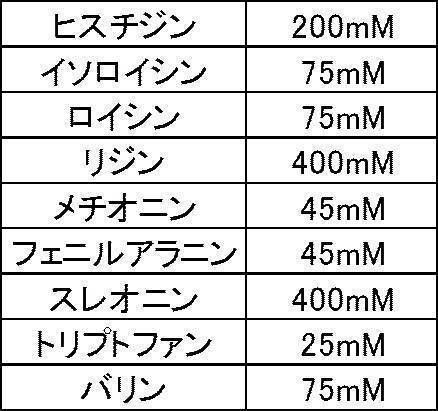
実施例3 マウス肺癌3LL細胞の皮下移植モデルにおける癌増殖抑制効果
定法によりC57BL/6マウスにマウス肺癌3LL細胞(1x106個)を皮下移植することで皮下移植モデルマウスを作製し、薬効効果を検討した。癌細胞移植後5日目から7日目の48時間、ならびに12日目から14日目の48時間、皮下移植モデルマウスに45mMのL-フェニルアラニン水溶液を自由飲水させた。移植6日目から15日目にかけて経時的に皮下腫瘍の長径ならびに短径を測定し、1/2x(短径)2x(長径)により体積を算出した。移植後15日目の腫瘍体積はコントロール群が3000mm3に対して45mMのL-フェニルアラニン水溶液を自由飲水させた群では1000mm3となった。L-フェニルアラニンによる腫瘍増殖抑制効果が示された(図3)。
定法によりC57BL/6マウスにマウス肺癌3LL細胞(1x106個)を皮下移植することで皮下移植モデルマウスを作製し、薬効効果を検討した。癌細胞移植後5日目から7日目の48時間、ならびに12日目から14日目の48時間、皮下移植モデルマウスに45mMのL-フェニルアラニン水溶液を自由飲水させた。移植6日目から15日目にかけて経時的に皮下腫瘍の長径ならびに短径を測定し、1/2x(短径)2x(長径)により体積を算出した。移植後15日目の腫瘍体積はコントロール群が3000mm3に対して45mMのL-フェニルアラニン水溶液を自由飲水させた群では1000mm3となった。L-フェニルアラニンによる腫瘍増殖抑制効果が示された(図3)。
実施例4 マウス乳癌4T1自然肺転移モデルにおける転移抑制効果
定法によりBalb/cマウスにマウス乳癌4T1細胞(5x104個)を乳脂肪層に同所移植することで乳癌モデルマウスを作製し、薬効効果を検討した。癌細胞移植後21日目に原発巣を切除、23日目から30日目の間45mMのL-フェニルアラニン水溶液を自由飲水法により投与した。30日目に肺を摘出し、ホルマリン固定をした後、顕微鏡下で肺の転移結節数を数えた。その結果、L-フェニルアラニン投与群のマウス肺の転移結節数はコントロール群に対して有意に減少していた。L-フェニルアラニンによる肺転移抑制効果が示された(図4)。
定法によりBalb/cマウスにマウス乳癌4T1細胞(5x104個)を乳脂肪層に同所移植することで乳癌モデルマウスを作製し、薬効効果を検討した。癌細胞移植後21日目に原発巣を切除、23日目から30日目の間45mMのL-フェニルアラニン水溶液を自由飲水法により投与した。30日目に肺を摘出し、ホルマリン固定をした後、顕微鏡下で肺の転移結節数を数えた。その結果、L-フェニルアラニン投与群のマウス肺の転移結節数はコントロール群に対して有意に減少していた。L-フェニルアラニンによる肺転移抑制効果が示された(図4)。
実施例5 マウス肺癌3LL細胞の皮下移植モデルにおける抗癌剤とL-フェニルアラニンまたはL-スレオニンの併用投与効果
前述のマウス肺癌3LL細胞の皮下移植モデルマウスに、癌細胞移植後5日目から抗癌剤5-FU単独(10mg/kg)あるいは抗癌剤5-FU(10mg/kg)と、45mMのL-フェニルアラニン水溶液、若しくは400mMのL-スレオニン水溶液をそれぞれ自由飲水法にて併用投与した。投与スケジュールは表2に示す。
前述のマウス肺癌3LL細胞の皮下移植モデルマウスに、癌細胞移植後5日目から抗癌剤5-FU単独(10mg/kg)あるいは抗癌剤5-FU(10mg/kg)と、45mMのL-フェニルアラニン水溶液、若しくは400mMのL-スレオニン水溶液をそれぞれ自由飲水法にて併用投与した。投与スケジュールは表2に示す。
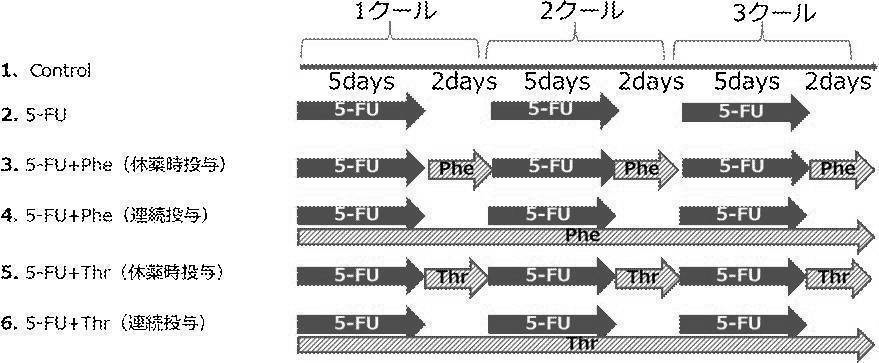
その結果、抗癌剤単独投与群に比べて、L-フェニルアラニン投与群では連続自由飲水投与、あるいは抗癌剤の休薬期間のみ投与のいずれの群においても、癌の増殖が有意に抑制された(図5のa))。一方、L-スレオニン投与群では連続自由飲水投与、あるいは抗癌剤の休薬期間のみ投与のいずれの群においても有意な癌の増殖抑制効果は認められなかった(図5のb))。L-フェニルアラニンは連続投与もしくは休薬期間のみ投与のいずれの投与スケジュールであっても、抗癌剤と併用投与することにより腫瘍増殖抑制効果を促進させることが示された。
実施例6 マウス乳癌4T1細胞皮下移植モデルを用いた薬物動態試験(PK試験)
定法によりBalb/cマウスにマウス乳癌4T1細胞(5x105個)を皮下に移植し23日間飼育した皮下移植モデルマウスを用いて、薬物動態試験を実施した。最初に採血した時間を0hとし、直後に1g/kgの容量でL-フェニルアラニンを強制経口投与した後、0.5、1、2、4、8(h)のタイムコースで鎖骨下静脈から50μlを目安に採血を繰り返した。血液中のアミノ酸濃度は、前述のAPI4000 LC-MS/MS system(AB SCIEX)にて測定した。その結果、血中のフェニルアラニンの半減期が1時間30分であることが明らかとなった(図6)。ヒトの血中のフェニルアラニンの半減期が1時間である(Proc Natl Acad Sci U S A.:96(6),3160-3164(1999))ことから、ヒトとマウスでは、血中のフェニルアラニンの代謝速度がほぼ同じであることが示された。
定法によりBalb/cマウスにマウス乳癌4T1細胞(5x105個)を皮下に移植し23日間飼育した皮下移植モデルマウスを用いて、薬物動態試験を実施した。最初に採血した時間を0hとし、直後に1g/kgの容量でL-フェニルアラニンを強制経口投与した後、0.5、1、2、4、8(h)のタイムコースで鎖骨下静脈から50μlを目安に採血を繰り返した。血液中のアミノ酸濃度は、前述のAPI4000 LC-MS/MS system(AB SCIEX)にて測定した。その結果、血中のフェニルアラニンの半減期が1時間30分であることが明らかとなった(図6)。ヒトの血中のフェニルアラニンの半減期が1時間である(Proc Natl Acad Sci U S A.:96(6),3160-3164(1999))ことから、ヒトとマウスでは、血中のフェニルアラニンの代謝速度がほぼ同じであることが示された。
本発明では、癌細胞に対して優れたグルタミン代謝阻害作用を有し、安全性が高く、副作用が低減された癌化学療法補助剤、癌治療および/または予防用剤、あるいは、癌治療および/または予防用メディカルフードを提供することができる。また、本発明の癌化学療法補助剤、癌治療および/または予防用剤、あるいは、癌治療および/または予防用メディカルフードは、癌化学療法実施時の癌化学療法剤投与期間中の休薬期間に投与や摂取することで、休薬期間中の薬剤耐性を持つ癌細胞の増殖を抑制し、癌の再発・転移を予防することができる。さらに、本発明の剤は、安全性が高いため、医薬用途に限らず、食品、メディカルフードへの利用も可能である。
本出願は、日本で出願された特願2014-047639および特願2014-086389を基礎としており、その内容は本明細書にすべて包含されるものである。
Claims (35)
- 芳香族アミノ酸を有効成分として含有する癌治療および/または予防用剤。
- 癌化学療法期間中に摂取することを特徴とする、請求項1に記載の癌治療および/または予防用剤。
- 癌化学療法期間のうち、休薬中に摂取することを特徴とする、請求項2に記載の癌治療および/または予防用剤。
- 休薬中の期間が5日から6週間であることを特徴とする、請求項3に記載の癌治療および/または予防用剤。
- 癌化学療法剤がダカルバジン、テガフール、ゲムシタビン、ネダプラチン、フルオロウラシル、およびシスプラチンからなる群から選ばれる1種または複数であり、休薬中の期間が7日から4週間であることを特徴とする、請求項3または4に記載の癌治療および/または予防用剤。
- 癌化学療法剤がダカルバジンの場合、休薬中の期間が13日から4週間であり、癌化学療法剤がテガフールの場合、休薬中の期間が7日から14日間であり、癌化学療法剤がゲムシタビンの場合、休薬中の期間が1週間であり、癌化学療法剤がネダプラチンの場合、休薬中の期間が4週間であり、癌化学療法剤がフルオロウラシルの場合、休薬中の期間が3週間であり、癌化学療法剤がシスプラチンの場合、休薬中の期間が1週間から3週間であり、癌化学療法剤がシスプラチンとゲムシタビンとの多剤併用の場合、休薬中の期間が13日間であることを特徴とする、請求項3~5のいずれか1項に記載の癌治療および/または予防用剤。
- 癌化学療法が、術後補助化学療法であることを特徴とする、請求項2~6のいずれか1項に記載の癌治療および/または予防用剤。
- 癌化学療法が、術前化学療法であることを特徴とする、請求項2~6のいずれか1項に記載の癌治療および/または予防用剤。
- 1摂取あたりの単位包装形態からなり、該単位中に有効成分として芳香族アミノ酸を1摂取あたり1~7g含有する、請求項1~8のいずれか1項に記載の癌治療および/または予防用剤。
- 芳香族アミノ酸がフェニルアラニンである、請求項1~9のいずれか1項に記載の癌治療および/または予防用剤。
- 芳香族アミノ酸を有効成分として含有する癌治療および/または予防用メディカルフード。
- 癌化学療法期間中に摂取することを特徴とする、請求項11に記載の癌治療および/または予防用メディカルフード。
- 癌化学療法期間のうち、休薬中に摂取することを特徴とする、請求項12に記載の癌治療および/または予防用メディカルフード。
- 休薬中の期間が5日から6週間であることを特徴とする、請求項13に記載の癌治療および/または予防用メディカルフード。
- 癌化学療法剤がダカルバジン、テガフール、ゲムシタビン、ネダプラチン、フルオロウラシル、およびシスプラチンからなる群から選ばれる1種または複数であり、休薬中の期間が7日から4週間であることを特徴とする、請求項13または14に記載の癌治療および/または予防用メディカルフード。
- 癌化学療法剤がダカルバジンの場合、休薬中の期間が13日から4週間であり、癌化学療法剤がテガフールの場合、休薬中の期間が7日から14日間であり、癌化学療法剤がゲムシタビンの場合、休薬中の期間が1週間であり、癌化学療法剤がネダプラチンの場合、休薬中の期間が4週間であり、癌化学療法剤がフルオロウラシルの場合、休薬中の期間が3週間であり、癌化学療法剤がシスプラチンの場合、休薬中の期間が1週間から3週間であり、癌化学療法剤がシスプラチンとゲムシタビンとの多剤併用の場合、休薬中の期間が13日間であることを特徴とする、請求項13~15のいずれか1項に記載の癌治療および/または予防用メディカルフード。
- 癌化学療法が、術後補助化学療法であることを特徴とする、請求項12~16のいずれか1項に記載の癌治療および/または予防用メディカルフード。
- 癌化学療法が、術前化学療法であることを特徴とする、請求項12~16のいずれか1項に記載の癌治療および/または予防用メディカルフード。
- 1摂取あたりの単位包装形態からなり、該単位中に有効成分として芳香族アミノ酸を1摂取あたり1~7g含有する、請求項11~18のいずれか1項に記載の癌治療および/または予防用メディカルフード。
- 芳香族アミノ酸がフェニルアラニンである、請求項11~19のいずれか1項に記載の癌治療および/または予防用メディカルフード。
- 芳香族アミノ酸を有効成分として含むことを特徴とする癌化学療法補助剤。
- 癌化学療法剤の休薬中に投与することを特徴とする、請求項21に記載の癌化学療法補助剤。
- 休薬中の期間が5日から6週間であることを特徴とする、請求項22に記載の癌化学療法補助剤。
- 癌化学療法剤がダカルバジン、テガフール、ゲムシタビン、ネダプラチン、フルオロウラシル、およびシスプラチンからなる群から選ばれる1種または複数であり、休薬中の期間が7日から4週間であることを特徴とする、請求項22または23に記載の癌化学療法補助剤。
- 癌化学療法剤がダカルバジンの場合、休薬中の期間が13日から4週間であり、癌化学療法剤がテガフールの場合、休薬中の期間が7日から14日間であり、癌化学療法剤がゲムシタビンの場合、休薬中の期間が1週間であり、癌化学療法剤がネダプラチンの場合、休薬中の期間が4週間であり、癌化学療法剤がフルオロウラシルの場合、休薬中の期間が3週間であり、癌化学療法剤がシスプラチンの場合、休薬中の期間が1週間から3週間であり、癌化学療法剤がシスプラチンとゲムシタビンとの多剤併用の場合、休薬中の期間が13日間であることを特徴とする、請求項22~24のいずれか1項に記載の癌化学療法補助剤。
- 癌化学療法剤が、術後補助化学療法の癌化学療法剤であることを特徴とする、請求項22~25のいずれか1項に記載の癌化学療法補助剤。
- 癌化学療法剤が、術前化学療法の癌化学療法剤であることを特徴とする、請求項22~25のいずれか1項に記載の癌化学療法補助剤。
- 乳癌を対象とする、請求項21~27のいずれか1項に記載の癌化学療法補助剤。
- 肺癌を対象とする、請求項21~27のいずれか1項に記載の癌化学療法補助剤。
- 癌化学療法剤がフルオロウラシルである、請求項22~29のいずれか1項に記載の癌化学療法補助剤。
- 1投与あたり有効成分として芳香族アミノ酸を1~7g含有する、請求項21~30のいずれか1項に記載の癌化学療法補助剤。
- 芳香族アミノ酸がフェニルアラニンである、請求項21~31のいずれか1項に記載の癌化学療法補助剤。
- 芳香族アミノ酸を有効成分として含むことを特徴とするグルタミン代謝阻害剤。
- 癌細胞の代謝を阻害することを特徴とする、請求項33に記載のグルタミン代謝阻害剤。
- 芳香族アミノ酸がフェニルアラニンである、請求項33または34に記載のグルタミン代謝阻害剤。
Applications Claiming Priority (4)
| Application Number | Priority Date | Filing Date | Title |
|---|---|---|---|
| JP2014-047639 | 2014-03-11 | ||
| JP2014047639 | 2014-03-11 | ||
| JP2014086389 | 2014-04-18 | ||
| JP2014-086389 | 2014-04-18 |
Publications (1)
| Publication Number | Publication Date |
|---|---|
| WO2015137383A1 true WO2015137383A1 (ja) | 2015-09-17 |
Family
ID=54071825
Family Applications (1)
| Application Number | Title | Priority Date | Filing Date |
|---|---|---|---|
| PCT/JP2015/057119 Ceased WO2015137383A1 (ja) | 2014-03-11 | 2015-03-11 | 癌化学療法の補助剤 |
Country Status (1)
| Country | Link |
|---|---|
| WO (1) | WO2015137383A1 (ja) |
Cited By (2)
| Publication number | Priority date | Publication date | Assignee | Title |
|---|---|---|---|---|
| WO2022009212A1 (en) * | 2020-07-09 | 2022-01-13 | Technion Research And Development Foundation Ltd. | TYROSINE, TRYPTOPHAN AND PHENYLALANINE AS mTOR AGONISTS MEDIATING PROTEASOME DYNAMICS, COMPOSITIONS, METHODS AND USES THEREOF IN THERAPY, AND PROGNOSTIC METHODS FOR DRUG-RESISTANCE |
| WO2025263592A1 (ja) * | 2024-06-19 | 2025-12-26 | Agc株式会社 | グルタミン代謝阻害剤 |
Citations (3)
| Publication number | Priority date | Publication date | Assignee | Title |
|---|---|---|---|---|
| JPS5841818A (ja) * | 1981-09-07 | 1983-03-11 | Sangi:Kk | 抗腫瘍剤 |
| JPH08508045A (ja) * | 1993-11-09 | 1996-08-27 | イムナル カーエフテー | 癌性疾患の予防および治療のための製剤組成物、ならびにその製造法 |
| WO2003030890A1 (fr) * | 2001-10-05 | 2003-04-17 | Tetsuro Asao | Activateurs du systeme immunitaire |
-
2015
- 2015-03-11 WO PCT/JP2015/057119 patent/WO2015137383A1/ja not_active Ceased
Patent Citations (3)
| Publication number | Priority date | Publication date | Assignee | Title |
|---|---|---|---|---|
| JPS5841818A (ja) * | 1981-09-07 | 1983-03-11 | Sangi:Kk | 抗腫瘍剤 |
| JPH08508045A (ja) * | 1993-11-09 | 1996-08-27 | イムナル カーエフテー | 癌性疾患の予防および治療のための製剤組成物、ならびにその製造法 |
| WO2003030890A1 (fr) * | 2001-10-05 | 2003-04-17 | Tetsuro Asao | Activateurs du systeme immunitaire |
Non-Patent Citations (2)
| Title |
|---|
| FUMIKAZU RI: "L-Phenylalanine Fuka ni yoru 5- Fluorouracil no Seigan Koka Zokyo ni Kansuru Kenkyu", MEDICAL JOURNAL OF KAGOSHIMA UNIVERSITY, vol. 37, 1985, pages 285 - 308 * |
| YANAGI S. ET AL.: "Effect of phenylalanine- enriched diet on growth of Ehrlich ascites tumor cells", GANN, vol. 65, 1974, pages 423 - 427 * |
Cited By (3)
| Publication number | Priority date | Publication date | Assignee | Title |
|---|---|---|---|---|
| WO2022009212A1 (en) * | 2020-07-09 | 2022-01-13 | Technion Research And Development Foundation Ltd. | TYROSINE, TRYPTOPHAN AND PHENYLALANINE AS mTOR AGONISTS MEDIATING PROTEASOME DYNAMICS, COMPOSITIONS, METHODS AND USES THEREOF IN THERAPY, AND PROGNOSTIC METHODS FOR DRUG-RESISTANCE |
| CN116406294A (zh) * | 2020-07-09 | 2023-07-07 | 技术研发基金会有限公司 | 酪氨酸、色氨酸及苯丙氨酸作为调节蛋白酶体动力学的mTOR激动剂、其在治疗中的组成、方法及用途、以及抗药性的预后方法 |
| WO2025263592A1 (ja) * | 2024-06-19 | 2025-12-26 | Agc株式会社 | グルタミン代謝阻害剤 |
Similar Documents
| Publication | Publication Date | Title |
|---|---|---|
| JP6789916B2 (ja) | 薬学的組成物及び方法 | |
| JP6090836B2 (ja) | 化学療法剤の抗腫瘍活性増強剤 | |
| Ajani et al. | A multi-center phase II study of sequential paclitaxel and bryostatin-1 (NSC 339555) in patients with untreated, advanced gastric or gastroesophageal junction adenocarcinoma | |
| HK1040190A1 (zh) | 乙酰地那林与吉西他滨、卡帕西滨或顺铂组合化疗癌症 | |
| KR20140079831A (ko) | 췌장암 및/또는 담도암 치료약 | |
| ES2848706T3 (es) | Terapia de combinación contra el cáncer usando un compuesto azabicíclico | |
| KR20240119059A (ko) | 암에 대한 wee1 억제제 | |
| EP4415721A1 (en) | Combinations of wee 1 inhibitors and anti-cd47 antibodies | |
| BR112019009799A2 (pt) | método para tratar câncer em um paciente | |
| JPWO2012147901A1 (ja) | 抗癌剤副作用改善用組成物 | |
| JP2025163103A (ja) | 放射線および/または抗がん治療補助療法としてアデノシン二リン酸リボースの活用 | |
| TW200306185A (en) | Combinations comprising EPOTHILONES and anti-metabolites | |
| CN109674789B (zh) | 羧胺三唑与谷氨酸摄取与代谢抑制剂在抗肿瘤中的用途 | |
| KR20220124739A (ko) | 암의 치료를 위한 병용 요법 | |
| JP2021078397A (ja) | 脂質減少促進剤 | |
| JP2019203025A (ja) | 癌化学療法時の副作用軽減剤 | |
| WO2023242100A1 (en) | Novel ras inhibitors | |
| Tydeman-Edwards | Glutamine and its use in selected oncology settings | |
| EP2826482A1 (en) | Novel antitumor agent comprising combination of three agents | |
| US20200375943A1 (en) | Cytocidal method of cancer cells selectively in human patients clinically by depletion of l-ascorbic acid, primarily, with its supplementation alternately augmenting its cytocidal effect | |
| JP2003055208A (ja) | 組み合わせ化学療法 | |
| WO2025073968A1 (en) | Combination of roginolisib with a malt1-gls inhibitor | |
| CN119454969A (zh) | 含pd-l1小分子抑制剂的药物组合及其应用 | |
| EP4536665A1 (en) | Novel ras inhibitors | |
| EP4536202A1 (en) | Mitoxanthrone derivatives as ras inhibitors |
Legal Events
| Date | Code | Title | Description |
|---|---|---|---|
| 121 | Ep: the epo has been informed by wipo that ep was designated in this application |
Ref document number: 15761312 Country of ref document: EP Kind code of ref document: A1 |
|
| NENP | Non-entry into the national phase |
Ref country code: DE |
|
| NENP | Non-entry into the national phase |
Ref country code: JP |
|
| 122 | Ep: pct application non-entry in european phase |
Ref document number: 15761312 Country of ref document: EP Kind code of ref document: A1 |