WO2015137175A1 - アリールボロン酸エステル化合物の製造方法 - Google Patents
アリールボロン酸エステル化合物の製造方法 Download PDFInfo
- Publication number
- WO2015137175A1 WO2015137175A1 PCT/JP2015/056037 JP2015056037W WO2015137175A1 WO 2015137175 A1 WO2015137175 A1 WO 2015137175A1 JP 2015056037 W JP2015056037 W JP 2015056037W WO 2015137175 A1 WO2015137175 A1 WO 2015137175A1
- Authority
- WO
- WIPO (PCT)
- Prior art keywords
- compound
- acid ester
- producing
- nickel complex
- boronic acid
- Prior art date
- Legal status (The legal status is an assumption and is not a legal conclusion. Google has not performed a legal analysis and makes no representation as to the accuracy of the status listed.)
- Ceased
Links
- 0 CC(C)[n]1c2ccccc2c(-c(cc2)ccc2F)c1CC[C@]1OC(C)(C)O[C@@](C*)C1 Chemical compound CC(C)[n]1c2ccccc2c(-c(cc2)ccc2F)c1CC[C@]1OC(C)(C)O[C@@](C*)C1 0.000 description 3
Classifications
-
- C—CHEMISTRY; METALLURGY
- C07—ORGANIC CHEMISTRY
- C07F—ACYCLIC, CARBOCYCLIC OR HETEROCYCLIC COMPOUNDS CONTAINING ELEMENTS OTHER THAN CARBON, HYDROGEN, HALOGEN, OXYGEN, NITROGEN, SULFUR, SELENIUM OR TELLURIUM
- C07F5/00—Compounds containing elements of Groups 3 or 13 of the Periodic Table
- C07F5/02—Boron compounds
- C07F5/04—Esters of boric acids
Definitions
- the present invention relates to a method for producing an aryl boronic acid ester compound from a fluoroaryl compound by a one-step reaction process.
- the present invention has been made in view of the above-described conventional circumstances, and should provide a method capable of producing an aryl boronic acid ester compound from various fluorinated aryl compounds by a one-step reaction process. It is an issue.
- the present inventors tried to obtain an aryl boronic acid ester compound by cross-coupling a fluorinated aryl compound and a boration reagent.
- a cross-coupling reaction has not been known, but it has been found that the coupling reaction can be performed by setting specific reaction conditions, and the production method of the present invention has been completed.
- the method for producing an aryl boronic acid ester compound of the present invention comprises a fluorinated aryl compound, diboron pinacol ester or pinacol borane, a zerovalent nickel complex, a phosphine ligand, and a monovalent or divalent copper compound. And cross-coupling in an aprotic solvent in the presence of a base.
- an aryl boronic acid ester compound of the present invention even when a fluorinated aryl compound to which a particularly strong electron withdrawing group is not bonded is used as a substrate, cross-coupling with diboron pinacol ester or pinacol borane Since the reaction proceeds, it can be used as a general-purpose production method for aryl boronic acid ester compounds.
- any compound in which fluorine is directly bonded to a benzene ring and does not have a functional group that hinders the coupling reaction in the production method of the present invention can be used.
- fluorobenzene and derivatives thereof, fluorobiphenyl and derivatives thereof, fluoronaphthalene and derivatives thereof, and the like can be used.
- the present inventors have confirmed that an aryl boronic acid ester compound can be obtained even if an ether moiety, an ester moiety or an amino group is present in the fluorinated aryl compound.
- (Bpin) 2 As the diboron pinacol ester, (Bpin) 2 , (Bcat) 2 and the like can be used.
- the pinacol borane can be used HBpin.
- Ni (cod) 2 bis (cyclooctadiene) nickel (abbreviation Ni (cod) 2 ) or the like can be used as the zero-valent nickel complex.
- phosphine ligand it is preferable to use phosphines having at least one alkyl group.
- phosphines having at least one alkyl group For example, trialkylphosphine, triarylphosphine, or diaryldiphosphine can be used.
- the trialkylphosphine include P (cC 6 H 11 ) 3 and P (cC 5 H 9 ) 3 .
- the triarylphosphine include P (Ph) 3 and P (p-MeO C 6 H 4 ) 3 .
- diaryldiphosphines include 1,1-bis (diphenylphosphino) methane (DPPM), 1,2-bis (diphenylphosphino) ethane (DPPE), and 1,3-bis (diphenylphosphino).
- DPPM 1,1-bis (diphenylphosphino) methane
- DPPE 1,2-bis (diphenylphosphino) ethane
- DPPF 1,3-bis (diphenylphosphino).
- DPPP 1,1′-bis (diphenylphosphino) ferrocene
- 2-dicyclohexylphosphino-2 ′, 4 ′, 6′-triisopropylbiphenyl (XPhos) can also be used.
- a monovalent or divalent copper compound can be used as the copper compound, and a monovalent copper compound is preferred.
- the monovalent copper compound include CuI, CuBr, CuCl, CuOAc, CuBF 4 (MeCN) 4 , and CuPF 4 (MeCN) 4 .
- the divalent copper compound include CuCl 2 , CuBr 2 , CuF 2 , and Cu (OAc) 2 .
- alkali metal alkoxides such as CsF, KOtBu, NaOtBu, and the like can be used.
- toluene, xylene, hexane, tBuOMe, cC 5 H 9 OMe, THF, dimethoxyethylene, DMF, and the like can be used as the aprotic solvent.
- Particularly preferred are low-polarity aprotic solvents such as toluene and xylene.
- a divalent nickel complex can be used instead of a zero valent nickel complex.
- the divalent nickel complex is reduced to a zero valent nickel complex.
- a reducing agent that can be used is required. That is, a fluorinated aryl compound, diboron pinacol ester or pinacol borane, a divalent nickel complex, a reducing agent capable of reducing the divalent nickel complex, a phosphine ligand, and a monovalent or divalent copper
- NiCl 2 (dme), Ni (acac) 2 , etc. can be used as the divalent nickel complex.
- a typical metal hydride such as alkylaluminum such as DIBAL or a zerovalent nickel complex such as Ni (cod) 2 can be used.
- a fluorinated aryl compound is used as a raw material.
- Numerous pharmaceuticals composed of fluorinated aryl compounds have been developed (for example, Atorvastatin, a blood cholesterol lowering agent, Iloperodon, an antidepressant, etc.), and aryl boronic acid ester compounds can be obtained from these compounds.
- the aryl boronic acid ester compound can be used as a reagent for the Suzuki-Miyaura coupling reaction, and therefore is a convenient intermediate material in compound synthesis. For example, the following usage can be considered.
- PET positron emission tomography
- a tracer labeled with a short-lived radionuclide that emits a positron such as 18 F or 11 C is administered in vivo.
- This is a method of imaging the distribution by a computer.
- the PET method is used as a useful measurement technique in various fields such as biology, drug development, and medicine because it can trace the movement of a substance in a living body over time, non-invasively and quantitatively.
- the aryl boronic acid ester compound produced by the method of the present invention introduces a C—C bond by a coupling reaction using a transition metal catalyst or is oxidized to a hydroxyl group. , Amination, iodination, bromination, chlorination, azidation, etc., etherification using the Chan-Evans-Lam coupling reaction, and reaction with carbon monoxide to convert the carbonyl group It can be converted into various compounds such as by introduction.
- Example 1 In Example 1, 4-fluorobiphenyl (1) was used as a fluorinated aryl compound serving as a substrate, and B 2 (pin) 2 was used as a diboron pinacol ester to produce the corresponding boronate ester (3).
- Ni (COD) 2 bis (cyclooctadiene) nickel (0)
- PCy 3 Tricyclohexylphosphine (28.0 mg, 0.1 mmol, 50 mol%), sealed with a lid with a septum, and taken out from the glove box.
- Toluene (0.5 mL) was added to the vial and stirred at room temperature for 10 minutes to prepare a nickel phosphine complex toluene solution (0.5 mL).
- the total amount of the nickel phosphine complex toluene solution prepared previously (0.5 mL) was added, and the mixture was stirred at room temperature for 5 minutes, and then heated and stirred at 80 ° C. for 24 hours using a heat block.
- saturated aqueous ammonium chloride solution (2 mL) and diethyl ether (2 mL) were added, and the mixture was stirred at room temperature for 15 min.
- the reaction mixture was extracted with diethyl ether using a separatory funnel (5 mL ⁇ 3), and the organic layers were combined, washed with a saturated aqueous sodium chloride solution (5 mL), and dried over anhydrous sodium sulfate.
- Example 2 to 11 In Examples 2 to 11, the following fluorinated biphenyl compounds were used in place of 4-fluorobiphenyl in Example 1. “Bn” in the formula represents a benzyl group. Other conditions were the same as in Example 1 (however, in Example 11, 30 mol% of Ni (COD) 2 , 9 equivalents of CsF, 150 mol% of tricyclohexylphosphine, and 60 mol% of CuI were used). The details are omitted.
- Example 12 the corresponding boronic acid ester (5) was produced using 4-fluoroanisole (4) as the fluorinated aryl compound as a substrate and B 2 (pin) 2 as the diboron pinacol ester. That is, in a glove box substituted with argon, bis (cyclooctadiene) nickel (0) (15.4 mg, 0.06 mmol, 30 mol%) and tricyclohexylphosphine (84.1 mg, 0.3 mmol, 150 mol) were placed in a 5 mL vial. %), Seal with a lid with a septum, and remove from the glove box.
- Toluene (0.6 mL) was added to the vial and stirred at room temperature for 10 minutes to prepare a nickel phosphine complex toluene solution (0.6 mL).
- bis (pinacolato) diboron (101.6 mg, 0.4 mmol, 2.0 equiv.)
- Copper iodide (22.8 mg, 0.12 mmol, 60 mol%)
- fluoride in a glove box substituted with argon
- cesium 272.9 mg, 1.8 mmol, 9.0 equiv.
- Example 13 to 24 In Examples 13 to 24, the following fluorinated aryl compounds were used in place of 4-fluorobiphenyl (1) in Example 1. Other conditions are the same as those in the first embodiment, and the details are omitted.
- TBS represents a tert-butyldimethylsilyl group
- TIPS triisopropylsilyl group
- Boc represents a tert-butoxycarbonyl group.
- Comparative Examples 1 to 4 In Comparative Examples 1 to 4, various silver compounds (see Table 2) were used instead of the copper compound, and the corresponding boronate ester (3) was produced in the same manner as in Examples 25 to 34 except for the other conditions. The experimental procedure is the same as in Example 1, and the description is omitted.
- Example 35 to 37 4-fluorobiphenyl (1) was used as the fluorinated aryl compound as a substrate, B 2 (pin) 2 was used as the diboron pinacol ester, and various bases (see Table 3) were used. The other conditions were fixed as follows to produce the corresponding boronate ester (3).
- the experimental procedure is the same as in Example 1, and the description is omitted.
- Example 38 to 41 a boronate ester (3) was produced under the following conditions using a phosphine ligand (see Table 4) other than tricyclohexylphosphine (PCy 3 ).
- Example 42 to 49 In Examples 42 to 49, a boronic ester (3) was produced under the following conditions using a nonpolar solvent other than toluene (see Table 5).
- the boronic acid ester (3) was not obtained using any activator other than the copper compound.
- Example 50 to 52 In Examples 50 to 52, a divalent nickel complex was used instead of the nickel complex Ni (cod) 2 used in Example 1 (or a zero-valent nickel complex and a divalent nickel complex were used in combination), Further, diisobutylaluminum DIBAL was added as a reducing agent (see Table 7). Other conditions and procedures are the same as those in the first embodiment, and a description thereof will be omitted.
- Example 53 In Example 53, instead of (Bpin) 2 which is diboron pinacol ester used in Example 1, HBpin which is pinacol borane was used, and other conditions and procedures were carried out in the same manner as in Example 1. .
- a fluorine substituent composed of 19 F which is a normal non-radioactive isotope
- a fluorine substituent composed of 18 F which is a radioisotope.
- it can be used as a raw material for the synthesis of PET probes and an intermediate material for drug discovery.
- aryl boronic acid ester compounds can be produced from various fluorinated aryl compounds by a one-step reaction process.
- the aryl boronic acid ester compound serves as a substrate for the Suzuki-Miyaura coupling reaction, and can be used as a raw material for the synthesis of PET probes and an intermediate material for drug discovery.
Landscapes
- Chemical & Material Sciences (AREA)
- Organic Chemistry (AREA)
- Low-Molecular Organic Synthesis Reactions Using Catalysts (AREA)
Abstract
【課題】様々なフッ化アリール化合物から、一段階の反応工程によってアリールボロン酸エステル化合物を製造する方法を提供することを解決すべき課題としている。 【解決手段】フッ化アリール化合物と、ジボロンピナコールエステル又はピナコールボランとを、0価のニッケル錯体と、ホスフィンリガンドと、1価又は2価の銅化合物(好ましくは1価)と、塩基の存在下、非プロトン性溶媒中でクロスカップリングさせる。フッ化アリール化合物としてはフルオロベンゼンやその誘導体、フルオロビフェニルやその誘導体等を用いることができる。0価のニッケル錯体としては、Ni(cod)2等を用いることができる。ホスフィンリガンドとしては、トリアルキルホスフィンやトリアリールホスフィンやジアリールジホスフィンを用いることができる。
Description
本発明はフッ化アリール化合物から一段階の反応工程によってアリールボロン酸エステル化合物を製造する方法に関する。
医薬品に用いられる化合物において、フッ素置換基の導入が効能や代謝を劇的に改善することがよくある。このため、フッ素置換基を導入した数多くの医薬品が開発されており、市販医薬品の30%はフッ素を含む化合物と言われている。
一方、開発された医薬品を基に、更に優れた医薬品を開発するためには、既存医薬品をリード化合物とし、その化学構造の一部を新たな化学構造に代えた誘導体を数多く合成し、これらの誘導体について薬効等を調べるということが行われている。しかしながら、新たな誘導体を合成するには多大な労力を要するため、このことが、新薬開発を困難なものにしている。
一方、開発された医薬品を基に、更に優れた医薬品を開発するためには、既存医薬品をリード化合物とし、その化学構造の一部を新たな化学構造に代えた誘導体を数多く合成し、これらの誘導体について薬効等を調べるということが行われている。しかしながら、新たな誘導体を合成するには多大な労力を要するため、このことが、新薬開発を困難なものにしている。
このため、既に開発された数多くのフッ化アリール化合物からなる医薬品のフッ素置換基を、他の置換基に容易に替えることができれば、新規医薬品を開発するために、極めて有用なツールとなりうる。
ところが、炭素-フッ素結合は極めて安定であるため、フッ化アリール化合物のフッ素置換基を他の置換基に変換するには、強い電子求引性基が結合した特殊なフッ化アリール化合物について求核剤と反応させ、フッ素置換基と求核置換させる以外に良い方法がなく(例えば非特許文献1、2)、様々なフッ化アリール化合物に適用できるような、汎用的な方法は見出されていなかった。
Acc.Chem.Res.2011,44,333.
J.Am.Chem.Soc.2006,128,15964.
本発明は、上記従来の実情に鑑みてなされたものであり、様々なフッ化アリール化合物から一段階の反応工程によってアリールボロン酸エステル化合物を製造することができる方法を提供することを解決すべき課題としている。
本発明者らは上記課題を解決するため、フッ化アリール化合物とホウ素化試薬とをクロスカップリングさせて、アリールボロン酸エステル化合物を得ることを試みた。従来、このようなクロスカップリング反応は知られていないが、特定の反応条件を設定することにより、このカップリング反応が可能となることを見出し、本発明の製造方法を完成した。
すなわち、本発明のアリールボロン酸エステル化合物の製造方法は、フッ化アリール化合物と、ジボロンピナコールエステル又はピナコールボランとを、0価のニッケル錯体と、ホスフィンリガンドと、1価又は2価の銅化合物と、塩基の存在下、非プロトン性溶媒中でクロスカップリングさせることを特徴とする。
本発明のアリールボロン酸エステル化合物の製造方法によれば、特に強い電子求引性基が結合していないフッ化アリール化合物を基質として用いても、ジボロンピナコールエステルやピナコールボランとのクロスカップリング反応が進行するため、アリールボロン酸エステル化合物の汎用的な製造方法として用いることができる。
フッ化アリール化合物としては、ベンゼン環にフッ素が直接結合した化合物であって、本発明の製造方法におけるカップリング反応を妨害する官能基を有しない化合物であれば用いることができる。例えば、フルオロベンゼンやその誘導体、フルオロビフェニルやその誘導体、フルオロナフタレンやその誘導体等を用いることができる。本発明者らは、フッ化アリール化合物中にエーテル部位やエステル部位やアミノ基が存在していても、アリールボロン酸エステル化合物を得ることができることを確認している。
また、ジボロンピナコールエステルとしては (Bpin)2、(Bcat)2等を用いることができる。また、ピナコールボランとしてはHBpinを用いることができる。

さらに、0価のニッケル錯体としては、ビス(シクロオクタジエン)ニッケル(略称Ni(cod)2)等を用いることができる。
また、ホスフィンリガンドとしては、少なくともひとつのアルキル基を有するホスフィン類を用いることが好ましい。例えば、トリアルキルホスフィンやトリアリールホスフィンやジアリールジホスフィンを用いることができる。トリアルキルホスフィンとして、具体的にはP(c-C6H11)3、P(c-C5H9)3等が挙げられる。また、トリアリールホスフィンとして具体的にはP(Ph)3、P(p-MeO C6H4)3等が挙げられる。また、ジアリールジホスフィンとして、具体的には1,1-ビス(ジフェニルホスフィノ)メタン (DPPM)、1,2-ビス(ジフェニルホスフィノ)エタン (DPPE)、1,3-ビス(ジフェニルホスフィノ)プロパン (DPPP)、1,1'-ビス(ジフェニルホスフィノ)フェロセン (DPPF)等を用いることができる。その他、2-ジシクロヘキシルホスフィノ-2',4',6'-トリイソプロピルビフェニル(XPhos)を用いることもできる。
さらに、銅化合物としては1価又は2価の銅化合物を用いることができ、好ましいのは1価の銅化合物である。1価の銅化合物として具体的にはCuI、CuBr、CuCl、CuOAc、CuBF4(MeCN)4、CuPF4(MeCN)4等が挙げられる。また、2価の銅化合物として具体的にはCuCl2、CuBr2、CuF2、Cu(OAc)2等が挙げられる。
また、塩基としては、CsFやKOtBu、NaOtBu等のアルカリ金属アルコキシド等を用いることができる。
さらに、非プロトン性溶媒としては、トルエン、キシレン、ヘキサン、tBuOMe、c-C5H9OMe、THF、ジメトキシエチレン、DMF等を用いることができる。特に好ましいのは、トルエンやキシレンなどの極性が低い非プロトン性溶媒である。
本発明のアリールボロン酸エステル化合物の製造方法として、0価のニッケル錯体の替りに2価のニッケル錯体を用いることもできるが、この場合には2価のニッケル錯体を0価のニッケル錯体に還元することのできる還元剤が必要となる。すなわち、フッ化アリール化合物と、ジボロンピナコールエステル又はピナコールボランとを、2価のニッケル錯体と、該2価のニッケル錯体を還元可能な還元剤と、ホスフィンリガンドと、1価又は2価の銅化合物と、塩基の存在下、非プロトン性溶媒中でクロスカップリングさせることを特徴とするアリールボロン酸エステル化合物の製造方法である。
2価のニッケル錯体としては、NiCl2(dme)やNi(acac)2、等を用いることができる。
また、2価のニッケル錯体を還元可能な還元剤としては、DIBAL等のアルキルアルミニウム等を始めとする典型金属水素化物や、Ni(cod)2等の0価のニッケル錯体を用いることができる。
また、2価のニッケル錯体を還元可能な還元剤としては、DIBAL等のアルキルアルミニウム等を始めとする典型金属水素化物や、Ni(cod)2等の0価のニッケル錯体を用いることができる。
本発明のアリールボロン酸エステル化合物の製造方法では、原料としてフッ化アリール化合物を用いる。フッ化アリール化合物からなる医薬品は多数開発されており(例えば、血中コレステロール低下剤のAtorvastatinや抗鬱薬のIloperodon等)、それらの化合物からアリールボロン酸エステル化合物を得ることができることになる。アリールボロン酸エステル化合物は、鈴木-宮浦カップリング反応の試薬として用いることができるため、化合物合成における便利な中間原料となる。例えば、以下のような利用が考えられる。
(1)各種PET用プローブの合成
PET(陽電子放射断層画像撮)法とは、18Fや11C などのポジトロンを放出する短寿命放射核で標識されたトレーサーを生体内に投与し、その体内分布をコンピューターにより画像化する方法である。PET法は生体内での物質の移動を経時的、非侵襲的かつ定量的に追跡することができるため、生物学、医薬品開発、医療などの各分野において有用な測定技術として活用されている。
・[18F]標識PET用プローブの合成
生理活性を有する[19F]フッ化アリール化合物をアリールボロン酸エステル化合物とした後、PETプローブとして使用可能な[18F]フッ化アリール化合物に変換する。アリールボロン酸エステル化合物から[18F]フッ化アリール化合物の変換については、鈴木正昭らが開発した特許文献WO2011/068181の方法やTobias Ritterらが開発した非特許文献(Science, 2011, 334, 639.)により行うことができる。
・[11C]標識PET用プローブの合成
生理活性を有する[19F]フッ化アリール化合物をアリールボロン酸エステル化合物とした後、PETプローブとして使用可能な[11C]フッ化アリール化合物に変換する。アリールボロン酸エステル化合物から[11C]フッ化アリール化合物の変換については、鈴木正昭らが開発した特許文献WO2008/023780の方法により行うことができる。
PET(陽電子放射断層画像撮)法とは、18Fや11C などのポジトロンを放出する短寿命放射核で標識されたトレーサーを生体内に投与し、その体内分布をコンピューターにより画像化する方法である。PET法は生体内での物質の移動を経時的、非侵襲的かつ定量的に追跡することができるため、生物学、医薬品開発、医療などの各分野において有用な測定技術として活用されている。
・[18F]標識PET用プローブの合成
生理活性を有する[19F]フッ化アリール化合物をアリールボロン酸エステル化合物とした後、PETプローブとして使用可能な[18F]フッ化アリール化合物に変換する。アリールボロン酸エステル化合物から[18F]フッ化アリール化合物の変換については、鈴木正昭らが開発した特許文献WO2011/068181の方法やTobias Ritterらが開発した非特許文献(Science, 2011, 334, 639.)により行うことができる。
・[11C]標識PET用プローブの合成
生理活性を有する[19F]フッ化アリール化合物をアリールボロン酸エステル化合物とした後、PETプローブとして使用可能な[11C]フッ化アリール化合物に変換する。アリールボロン酸エステル化合物から[11C]フッ化アリール化合物の変換については、鈴木正昭らが開発した特許文献WO2008/023780の方法により行うことができる。
(2)創薬等のための中間原料としての利用
本発明の方法で製造したアリールボロン酸エステル化合物は、遷移金属触媒を用いるカップリング反応によってC-C結合を導入したり、酸化して水酸基に変換したり、アミノ化、ヨウ素化、臭素化、塩素化、アジド化等を行ったり、Chan-Evans-Lamカップリング反応を利用してエーテル化したり、一酸化炭素との反応によりカルボニル基を導入するなど、様々な化合物に変換することができる。
本発明の方法で製造したアリールボロン酸エステル化合物は、遷移金属触媒を用いるカップリング反応によってC-C結合を導入したり、酸化して水酸基に変換したり、アミノ化、ヨウ素化、臭素化、塩素化、アジド化等を行ったり、Chan-Evans-Lamカップリング反応を利用してエーテル化したり、一酸化炭素との反応によりカルボニル基を導入するなど、様々な化合物に変換することができる。
<実施例>
以下、本発明を具体化した実施例について述べる。
(実施例1)
実施例1では、基質となるフッ化アリール化合物として4-フルオロビフェニル(1)、ジボロンピナコールエステルとしてB2(pin)2を用い、相当するボロン酸エステル(3)を製造した。
すなわち、アルゴンで置換されたグローブボックス中において、5 mLバイアルにビス(シクロオクタジエン)ニッケル(0) (以下「Ni(COD)2」と略すことがある)(5.1 mg, 0.02 mmol, 10 mol %)、トリシクロヘキシルホスフィン(以下「PCy3」と略すことがある)(28.0 mg, 0.1 mmol, 50 mol %)を入れ、セプタム付きのふたで密閉し、グローブボックスから取り出す。このバイアルにトルエン(0.5 mL)を加え、室温にて10分間撹拌し、ニッケルホスフィン錯体トルエン溶液(0.5 mL)を調製した。
別の5 mLバイアルに、アルゴンで置換されたグローブボックス内において4-フルオロビフェニル(1, 34.0 mg, 0.2 mmol, 1 equiv.)、ビス(ピナコラート)ジボロン(101.6 mg, 0.4 mmol, 2.0 equiv.)、ヨウ化銅(7.6 mg, 0.04 mmol, 20 mol %)、フッ化セシウム(91.0 mg, 0.6 mmol, 3.0 equiv.)を入れ、セプタム付きのふたで密閉し、グローブボックスから取り出した。トルエン(0.5 mL)を加え、室温で5分撹拌した。次いで先に調製したニッケルホスフィン錯体トルエン溶液全量(0.5 mL)を加え、室温で5分撹拌した後、ヒートブロックを用いて80℃で24時間加熱撹拌した。室温まで冷却した後、飽和塩化アンモニウム水溶液(2 mL)、ジエチルエーテル(2 mL)を加え室温で15分撹拌した。分液漏斗を用いて反応混合物をジエチルエーテルで抽出(5 mL × 3)した後、有機層を合わせて飽和塩化ナトリウム水溶液(5 mL)で洗浄し、無水硫酸ナトリウムで乾燥した。乾燥剤をろ別後、ロータリーエバポレーターで濃縮し、分取薄層クロマトグラフィー(シリカゲル担持、展開溶媒はヘキサン: 酢酸エチル: 酢酸 = 20: 1: 0.1の混合溶媒を使用)にて精製することにより、2-(4-ビフェニリル)-4,4,5,5-テトラメチル-1,3,2-ジオキサボロラン(3, 55.8 mg, 0.20 mmol)を収率99%以上で得た。

以下、本発明を具体化した実施例について述べる。
(実施例1)
実施例1では、基質となるフッ化アリール化合物として4-フルオロビフェニル(1)、ジボロンピナコールエステルとしてB2(pin)2を用い、相当するボロン酸エステル(3)を製造した。
すなわち、アルゴンで置換されたグローブボックス中において、5 mLバイアルにビス(シクロオクタジエン)ニッケル(0) (以下「Ni(COD)2」と略すことがある)(5.1 mg, 0.02 mmol, 10 mol %)、トリシクロヘキシルホスフィン(以下「PCy3」と略すことがある)(28.0 mg, 0.1 mmol, 50 mol %)を入れ、セプタム付きのふたで密閉し、グローブボックスから取り出す。このバイアルにトルエン(0.5 mL)を加え、室温にて10分間撹拌し、ニッケルホスフィン錯体トルエン溶液(0.5 mL)を調製した。
別の5 mLバイアルに、アルゴンで置換されたグローブボックス内において4-フルオロビフェニル(1, 34.0 mg, 0.2 mmol, 1 equiv.)、ビス(ピナコラート)ジボロン(101.6 mg, 0.4 mmol, 2.0 equiv.)、ヨウ化銅(7.6 mg, 0.04 mmol, 20 mol %)、フッ化セシウム(91.0 mg, 0.6 mmol, 3.0 equiv.)を入れ、セプタム付きのふたで密閉し、グローブボックスから取り出した。トルエン(0.5 mL)を加え、室温で5分撹拌した。次いで先に調製したニッケルホスフィン錯体トルエン溶液全量(0.5 mL)を加え、室温で5分撹拌した後、ヒートブロックを用いて80℃で24時間加熱撹拌した。室温まで冷却した後、飽和塩化アンモニウム水溶液(2 mL)、ジエチルエーテル(2 mL)を加え室温で15分撹拌した。分液漏斗を用いて反応混合物をジエチルエーテルで抽出(5 mL × 3)した後、有機層を合わせて飽和塩化ナトリウム水溶液(5 mL)で洗浄し、無水硫酸ナトリウムで乾燥した。乾燥剤をろ別後、ロータリーエバポレーターで濃縮し、分取薄層クロマトグラフィー(シリカゲル担持、展開溶媒はヘキサン: 酢酸エチル: 酢酸 = 20: 1: 0.1の混合溶媒を使用)にて精製することにより、2-(4-ビフェニリル)-4,4,5,5-テトラメチル-1,3,2-ジオキサボロラン(3, 55.8 mg, 0.20 mmol)を収率99%以上で得た。
(実施例2~11)
実施例2~11では、実施例1におけ4-フルオロビフェニルの替りに、以下に示すフッ化ビフェニル化合物を用いた。式中の「Bn」はベンジル基を示す。その他の条件については実施例1と同様(ただし、実施例11についてはNi(COD)2を30mol%、CsFを9当量、トリシクロヘキシルホスフィンを150mol%、CuIを60mol%それぞれ使用場合についても行った。)であり、詳細を省略する。
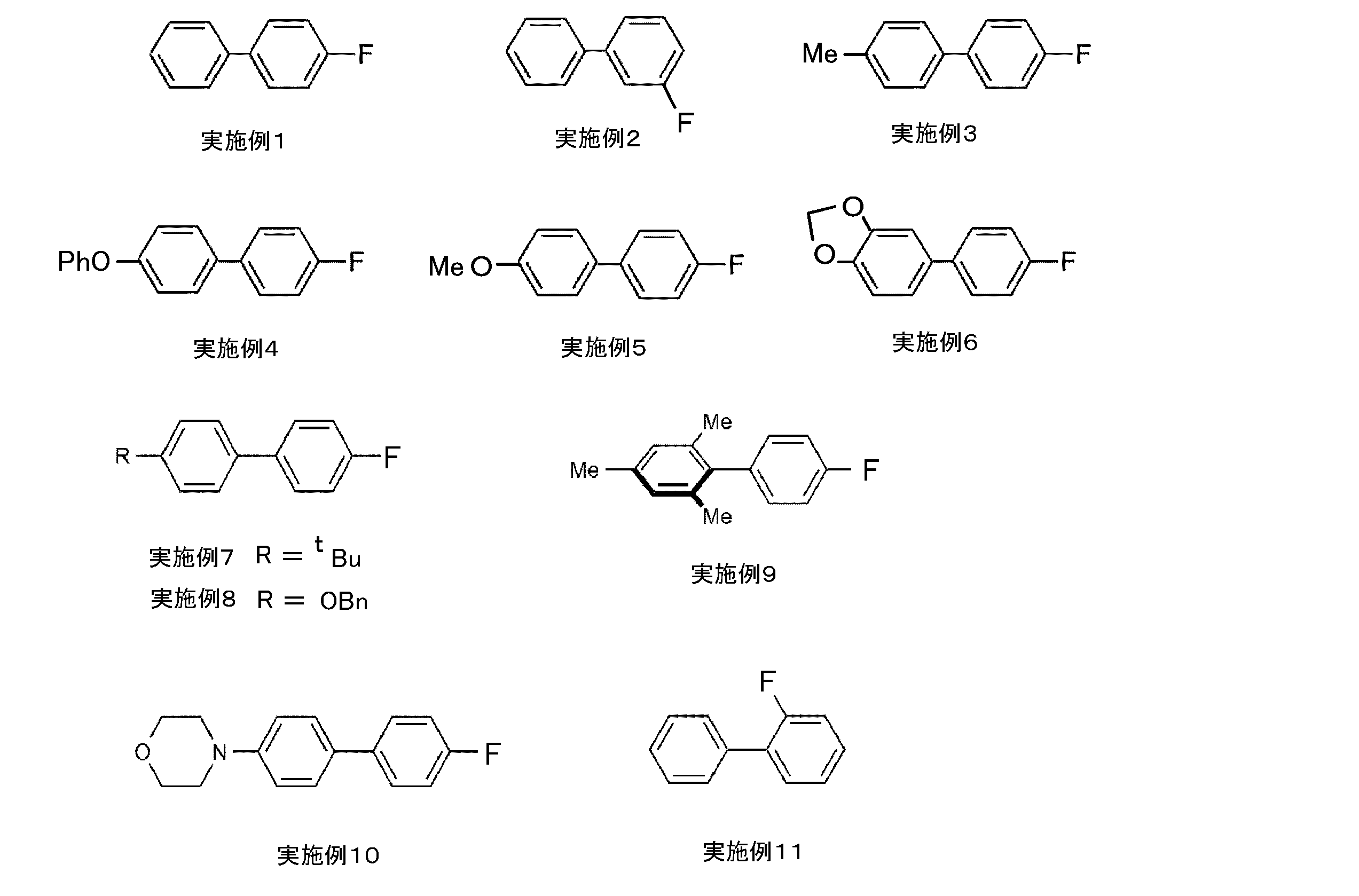
実施例2~11では、実施例1におけ4-フルオロビフェニルの替りに、以下に示すフッ化ビフェニル化合物を用いた。式中の「Bn」はベンジル基を示す。その他の条件については実施例1と同様(ただし、実施例11についてはNi(COD)2を30mol%、CsFを9当量、トリシクロヘキシルホスフィンを150mol%、CuIを60mol%それぞれ使用場合についても行った。)であり、詳細を省略する。
(実施例12)
実施例12では、基質となるフッ化アリール化合物として4-フルオロアニソール(4)、ジボロンピナコールエステルとしてB2(pin)2を用い、相当するボロン酸エステル(5)を製造した。
すなわち、アルゴンで置換されたグローブボックス中において、5 mLバイアルにビス(シクロオクタジエン)ニッケル(0)(15.4 mg, 0.06 mmol, 30 mol %)とトリシクロヘキシルホスフィン(84.1 mg, 0.3 mmol, 150 mol %)を入れ、セプタム付きのふたで密閉し、グローブボックスから取り出す。このバイアルにトルエン(0.6 mL)を加え、室温にて10分間撹拌し、ニッケルホスフィン錯体トルエン溶液(0.6 mL)を調製した。
別の5 mLバイアルに、アルゴンで置換されたグローブボックス内においてビス(ピナコラート)ジボロン(101.6 mg, 0.4 mmol, 2.0 equiv.)、ヨウ化銅(22.8 mg, 0.12 mmol, 60 mol %)、フッ化セシウム(272.9 mg, 1.8 mmol, 9.0 equiv.)を入れ、セプタム付きのふたで密閉し、グローブボックスから取り出す。4-フルオロアニソール(4, 22.6 μL, 0.2 mmol, 1 equiv.)、トルエン(0.4 mL)を加え、室温で5分撹拌した。次いで先に調製したニッケルホスフィン錯体トルエン溶液全量(0.6 mL)を加え、室温で5分撹拌した後、ヒートブロックを用いて80℃で24時間加熱撹拌した。室温まで冷却した後、飽和塩化アンモニウム水溶液(2 mL)、ジエチルエーテル(2 mL)を加え室温で15分撹拌した。分液漏斗を用いて反応混合物をジエチルエーテルで抽出(5 mL × 3)した後、有機層を合わせて飽和塩化ナトリウム水溶液(5 mL)で洗浄し、無水硫酸ナトリウムで乾燥した。乾燥剤をろ別後、ロータリーエバポレーターで濃縮し、分取薄層クロマトグラフィー(シリカゲル担持、展開溶媒はベンゼン: 酢酸エチル: 酢酸 = 20: 1: 0.2の混合溶媒を使用)にて精製することにより、2-(4-メトキシフェニル)-4,4,5,5-テトラメチル-1,3,2-ジオキサボロラン(5, 30.1 mg, 0.128 mmol)を収率64%で得た。

実施例12では、基質となるフッ化アリール化合物として4-フルオロアニソール(4)、ジボロンピナコールエステルとしてB2(pin)2を用い、相当するボロン酸エステル(5)を製造した。
すなわち、アルゴンで置換されたグローブボックス中において、5 mLバイアルにビス(シクロオクタジエン)ニッケル(0)(15.4 mg, 0.06 mmol, 30 mol %)とトリシクロヘキシルホスフィン(84.1 mg, 0.3 mmol, 150 mol %)を入れ、セプタム付きのふたで密閉し、グローブボックスから取り出す。このバイアルにトルエン(0.6 mL)を加え、室温にて10分間撹拌し、ニッケルホスフィン錯体トルエン溶液(0.6 mL)を調製した。
別の5 mLバイアルに、アルゴンで置換されたグローブボックス内においてビス(ピナコラート)ジボロン(101.6 mg, 0.4 mmol, 2.0 equiv.)、ヨウ化銅(22.8 mg, 0.12 mmol, 60 mol %)、フッ化セシウム(272.9 mg, 1.8 mmol, 9.0 equiv.)を入れ、セプタム付きのふたで密閉し、グローブボックスから取り出す。4-フルオロアニソール(4, 22.6 μL, 0.2 mmol, 1 equiv.)、トルエン(0.4 mL)を加え、室温で5分撹拌した。次いで先に調製したニッケルホスフィン錯体トルエン溶液全量(0.6 mL)を加え、室温で5分撹拌した後、ヒートブロックを用いて80℃で24時間加熱撹拌した。室温まで冷却した後、飽和塩化アンモニウム水溶液(2 mL)、ジエチルエーテル(2 mL)を加え室温で15分撹拌した。分液漏斗を用いて反応混合物をジエチルエーテルで抽出(5 mL × 3)した後、有機層を合わせて飽和塩化ナトリウム水溶液(5 mL)で洗浄し、無水硫酸ナトリウムで乾燥した。乾燥剤をろ別後、ロータリーエバポレーターで濃縮し、分取薄層クロマトグラフィー(シリカゲル担持、展開溶媒はベンゼン: 酢酸エチル: 酢酸 = 20: 1: 0.2の混合溶媒を使用)にて精製することにより、2-(4-メトキシフェニル)-4,4,5,5-テトラメチル-1,3,2-ジオキサボロラン(5, 30.1 mg, 0.128 mmol)を収率64%で得た。
(実施例13~24)
実施例13~24では、実施例1における4-フルオロビフェニル(1)の替りに、以下に示すフッ化アリール化合物を用いた。その他の条件については実施例1と同様であり、詳細を省略する。なお、式中の「TBS」はtert-ブチルジメチルシリル基を、「TIPS」トリイソプロピルシリル基を、「Boc」はtert-ブトキシカルボニル基を示す。

実施例13~24では、実施例1における4-フルオロビフェニル(1)の替りに、以下に示すフッ化アリール化合物を用いた。その他の条件については実施例1と同様であり、詳細を省略する。なお、式中の「TBS」はtert-ブチルジメチルシリル基を、「TIPS」トリイソプロピルシリル基を、「Boc」はtert-ブトキシカルボニル基を示す。
<結果>
実施例1~24において得られた、該当するボロン酸エステルの収率を表1に示す。この表から、フルオロベンゼンやその誘導体、フルオロビフェニルやその誘導体、フルオロナフタレンやその誘導体等について、相当するボロン酸エステルを合成できることが分かった。また、フッ化アリール化合物中にエーテル基やエステル基やアミノ基が存在していても、アリールボロン酸エステル化合物を得ることができることが分かった。

実施例1~24において得られた、該当するボロン酸エステルの収率を表1に示す。この表から、フルオロベンゼンやその誘導体、フルオロビフェニルやその誘導体、フルオロナフタレンやその誘導体等について、相当するボロン酸エステルを合成できることが分かった。また、フッ化アリール化合物中にエーテル基やエステル基やアミノ基が存在していても、アリールボロン酸エステル化合物を得ることができることが分かった。
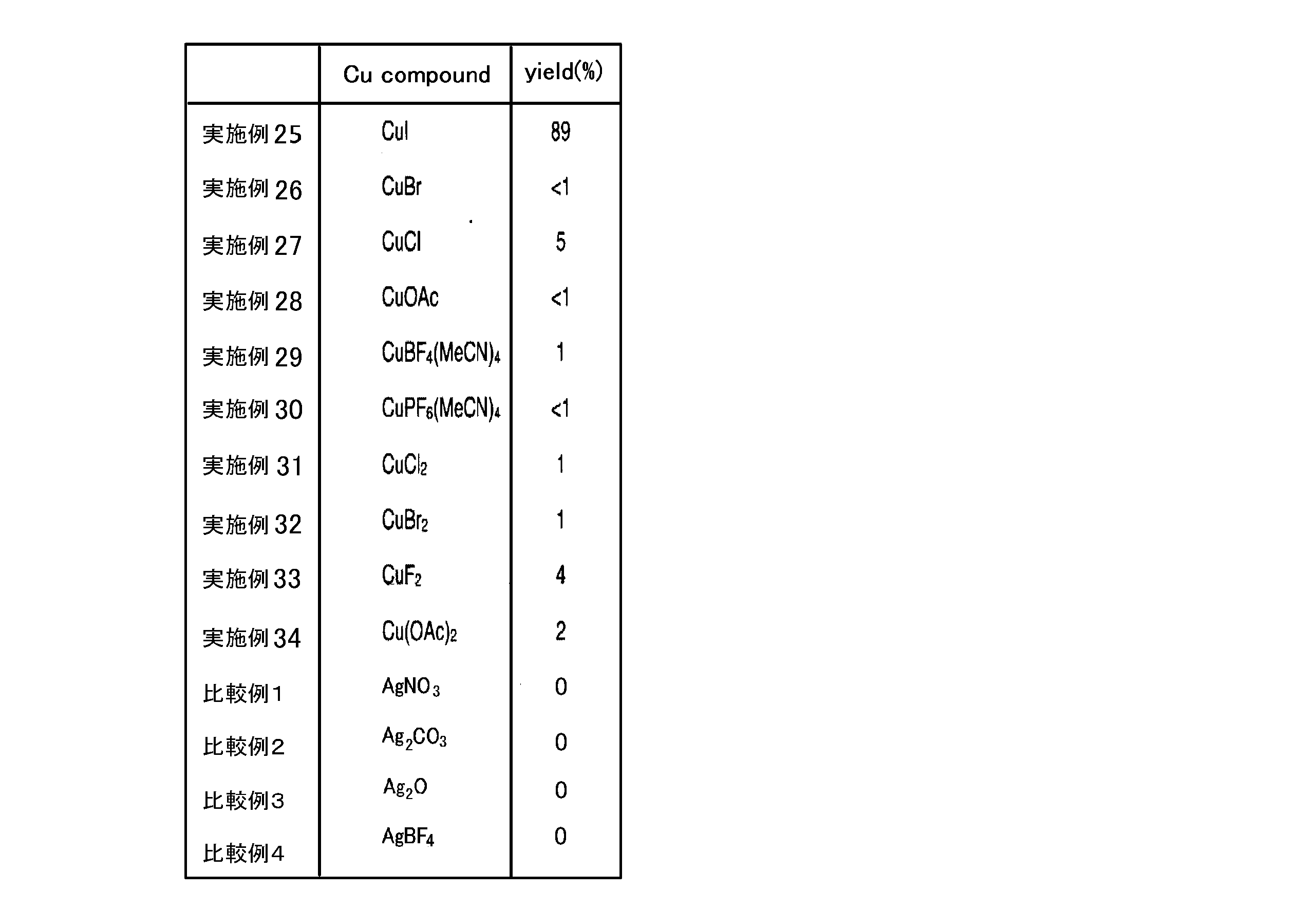
(25~34)
実施例25~34では、基質となるフッ化アリール化合物として4-フルオロビフェニル(1)、ジボロンピナコールエステルとしてB2(pin)2を用い、銅化合物に様々なもの(表2参照)を用い、その他の条件は下記のように固定して、相当するボロン酸エステル(3)を製造した。実験の手順については実施例1と同様であり、説明を省略する。

実施例25~34では、基質となるフッ化アリール化合物として4-フルオロビフェニル(1)、ジボロンピナコールエステルとしてB2(pin)2を用い、銅化合物に様々なもの(表2参照)を用い、その他の条件は下記のように固定して、相当するボロン酸エステル(3)を製造した。実験の手順については実施例1と同様であり、説明を省略する。
(比較例1~4)
比較例1~4では、銅化合物の代わり様々な銀化合物を(表2参照)を用い、その他の条件は実施例25~34と同様にして、相当するボロン酸エステル(3)を製造した。実験の手順については実施例1と同様であり、説明を省略する。
比較例1~4では、銅化合物の代わり様々な銀化合物を(表2参照)を用い、その他の条件は実施例25~34と同様にして、相当するボロン酸エステル(3)を製造した。実験の手順については実施例1と同様であり、説明を省略する。
結果を表2に示す。この表から、銅化合物を用いるとボロン酸エステル(3)が得られるが、収率の点でCuIが極めて優れていることが分かった。これに対して銀化合物を用いた場合には、いずれもボロン酸エステル(3)は得られなかった。
(実施例35~37)
実施例35~37では、基質となるフッ化アリール化合物として4-フルオロビフェニル(1)、ジボロンピナコールエステルとしてB2(pin)2を用い、塩基に様々なもの(表3参照)を用い、その他の条件は下記のように固定して、相当するボロン酸エステル(3)を製造した。実験の手順については実施例1と同様であり、説明を省略する。

実施例35~37では、基質となるフッ化アリール化合物として4-フルオロビフェニル(1)、ジボロンピナコールエステルとしてB2(pin)2を用い、塩基に様々なもの(表3参照)を用い、その他の条件は下記のように固定して、相当するボロン酸エステル(3)を製造した。実験の手順については実施例1と同様であり、説明を省略する。
結果を表3に示す。この表から、塩基としては、CsFを用いることにより、高い収率でボロン酸エステル(3)が得られることが分かった。また、KOtBu、NaOtBu等のアルカリ金属アルコラート等を用いても、収率は悪いものの、ボロン酸エステル(3)が得られることが分かった。

(実施例38~41)
実施例38~41では、トリシクロヘキシルホスフィン(PCy3)以外のホスフィンリガンド(表4参照)を用い、下記条件によってボロン酸エステル(3)を製造した。

実施例38~41では、トリシクロヘキシルホスフィン(PCy3)以外のホスフィンリガンド(表4参照)を用い、下記条件によってボロン酸エステル(3)を製造した。
結果を表4に示す。この表から、ホスフィンリガンドとしては、トリアルキルホスフィンやトリアリールホスフィンやジアリールジホスフィンも用いることができることが分かった。

(実施例42~49)
実施例42~49では、トルエン以外の非極性溶媒(表5参照)を用い、下記条件によってボロン酸エステル(3)を製造した。

実施例42~49では、トルエン以外の非極性溶媒(表5参照)を用い、下記条件によってボロン酸エステル(3)を製造した。
結果を表5に示す。この表から、溶媒としては非プロトン性溶媒を用いることができ、その中でも極性が低い非プロトン性溶媒が好ましいことが分かった。

(比較例5~9)
比較例5~9では、実施例1における銅化合物の代わりに、鈴木-宮浦反応における様々な活性化剤(表6参照)を添加した。その他の条件及び手順は実施例1と同様であり、説明を省略する。
比較例5~9では、実施例1における銅化合物の代わりに、鈴木-宮浦反応における様々な活性化剤(表6参照)を添加した。その他の条件及び手順は実施例1と同様であり、説明を省略する。
その結果、表6に示すように、銅化合物以外のいずれの活性化剤を用いても、ボロン酸エステル(3)は得られなかった。

(実施例50~52)
実施例50~52では、実施例1で用いたニッケル錯体であるNi(cod)2の代わりに2価のニッケル錯体を用い(あるいは0価のニッケル錯体と2価のニッケル錯体を併用し)、更に還元剤としてジイソブチルアルミニウムDIBALを添加した(表7参照)。その他の条件及び手順は実施例1と同様であり、説明を省略する。
実施例50~52では、実施例1で用いたニッケル錯体であるNi(cod)2の代わりに2価のニッケル錯体を用い(あるいは0価のニッケル錯体と2価のニッケル錯体を併用し)、更に還元剤としてジイソブチルアルミニウムDIBALを添加した(表7参照)。その他の条件及び手順は実施例1と同様であり、説明を省略する。
その結果、表7に示すように、実施例1と比較して収率は低いものの、ボロン酸エステル(3)が得られた。

(実施例53)
実施例53では、実施例1で用いたジボロンピナコールエステルである(Bpin)2の代わりに、ピナコールボランであるHBpinを用い、その他の条件及び手順は実施例1と同様にして反応を行った。
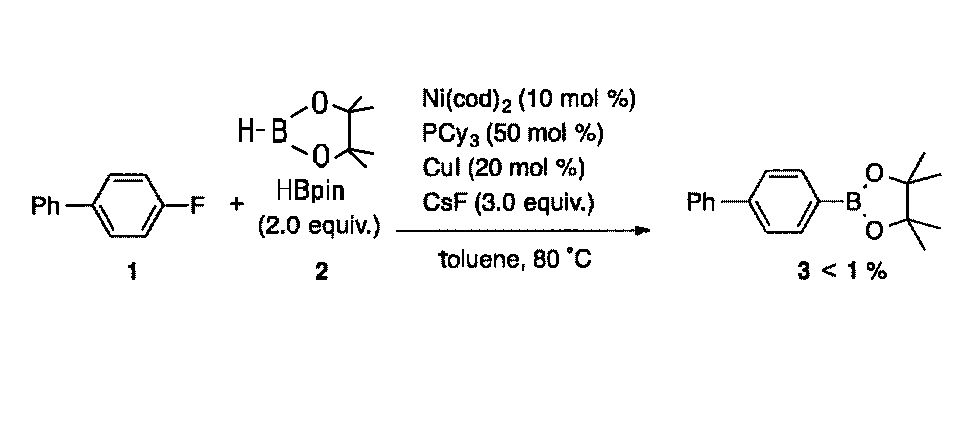
実施例53では、実施例1で用いたジボロンピナコールエステルである(Bpin)2の代わりに、ピナコールボランであるHBpinを用い、その他の条件及び手順は実施例1と同様にして反応を行った。
その結果、実施例1と比較して収率は1%以下と低いものの、ボロン酸エステル(3)が得られた。
<本発明のアリールボロン酸エステル化合物の製造方法を利用した[18F]標識化合物の合成>
本発明の製造方法で得たアリールボロン酸エステル化合物を中間原料とし、 [18F]標識化合物を合成した。すなわち、下記合成経路に従い、ジヒドロフルバスタチン保護体6のフッ素置換基をボロン酸エステル7に変換し(実施例54)、さらに、ボロン酸エステル部分をTredwell, M. らの方法により (A general copper-mediated nucleophilic 18F fluorination of arenes. Angew. Chem. Int. Ed. 53, 7751-7755 (2014))[18F]に変換した。反応における仕込み比はFluoroarene (1 equiv.), (Bpin)2 (2 equiv.), Ni(COD)2 (30 mol %), CuI (60 mol %), P(c-C6H11)3 (150 mol %), CsF (9 equiv.)とした。その結果、収率44%(2回行った反応の平均値)でボロン酸エステル7を得た。
このように、本発明のアリールボロン酸エステル化合物の製造方法を利用すれば、通常の非放射性同位元素である19Fからなるフッ素置換基を、放射性同位元素である18Fからなるフッ素置換基に変換することができる。このため、PET用プローブの合成の原料や創薬のための中間原料として利用できる。
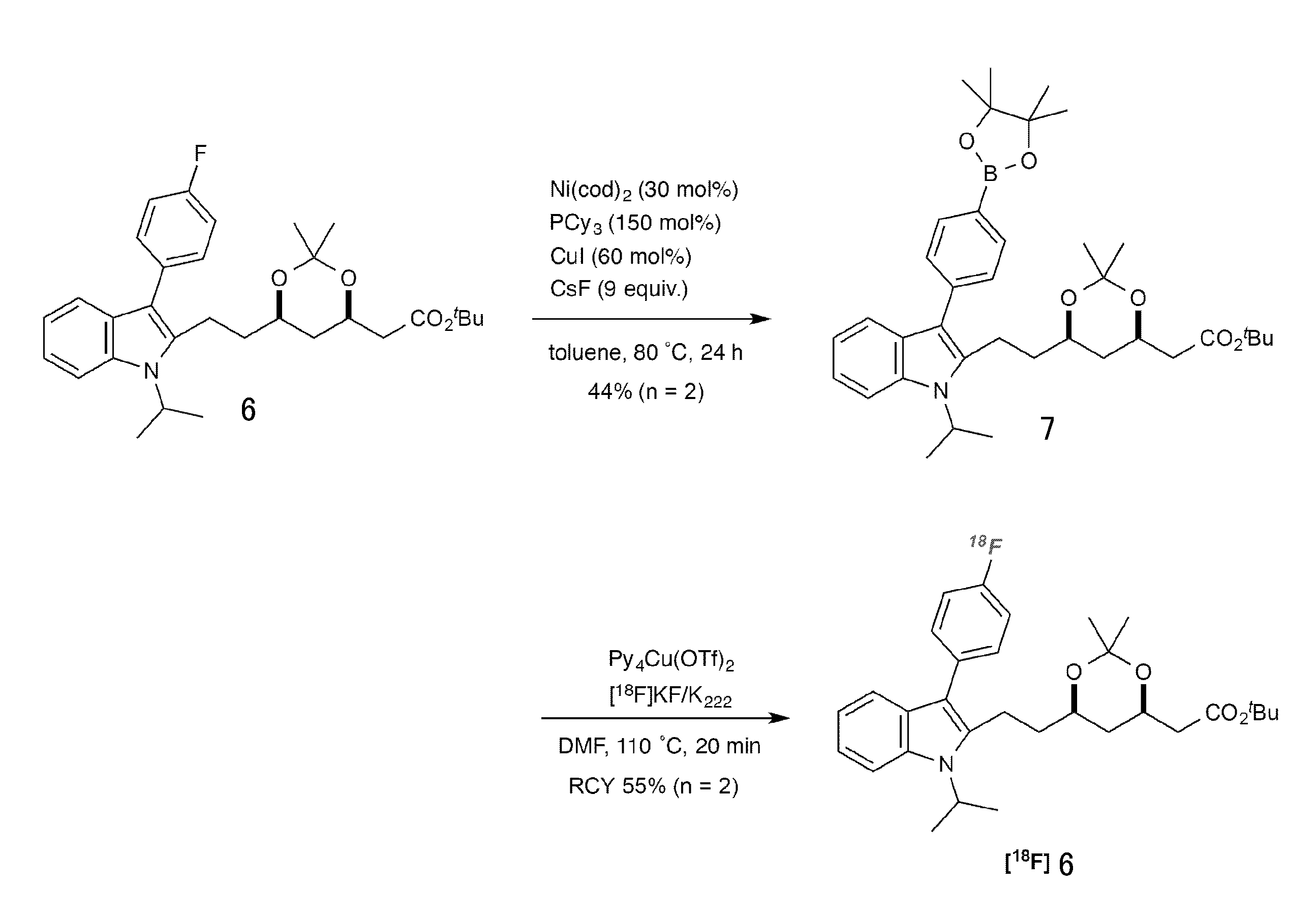
本発明の製造方法で得たアリールボロン酸エステル化合物を中間原料とし、 [18F]標識化合物を合成した。すなわち、下記合成経路に従い、ジヒドロフルバスタチン保護体6のフッ素置換基をボロン酸エステル7に変換し(実施例54)、さらに、ボロン酸エステル部分をTredwell, M. らの方法により (A general copper-mediated nucleophilic 18F fluorination of arenes. Angew. Chem. Int. Ed. 53, 7751-7755 (2014))[18F]に変換した。反応における仕込み比はFluoroarene (1 equiv.), (Bpin)2 (2 equiv.), Ni(COD)2 (30 mol %), CuI (60 mol %), P(c-C6H11)3 (150 mol %), CsF (9 equiv.)とした。その結果、収率44%(2回行った反応の平均値)でボロン酸エステル7を得た。
このように、本発明のアリールボロン酸エステル化合物の製造方法を利用すれば、通常の非放射性同位元素である19Fからなるフッ素置換基を、放射性同位元素である18Fからなるフッ素置換基に変換することができる。このため、PET用プローブの合成の原料や創薬のための中間原料として利用できる。
この発明は上記発明の実施の態様及び実施例の説明に何ら限定されるものではない。特許請求の範囲を逸脱せず、当業者が容易に想到できる範囲で種々の変形態様もこの発明に含まれる。
本発明の製造方法によれば、様々なフッ化アリール化合物から一段階の反応工程によってアリールボロン酸エステル化合物を製造することができる。アリールボロン酸エステル化合物は、鈴木-宮浦カップリング反応の基質となり、PET用プローブの合成の原料や創薬のための中間原料としての利用できる。
Claims (3)
- フッ化アリール化合物と、ジボロンピナコールエステル又はピナコールボランとを、0価のニッケル錯体と、ホスフィンリガンドと、1価又は2価の銅化合物と、塩基の存在下、非プロトン性溶媒中でクロスカップリングさせることを特徴とするアリールボロン酸エステル化合物の製造方法。
- 前記フッ化アリール化合物は、フルオロベンゼン若しくはその誘導体、又は、フルオロビフェニル若しくはその誘導体である請求項1に記載のアリールボロン酸エステル化合物の製造方法。
- フッ化アリール化合物と、ジボロンピナコールエステル又はピナコールボランとを、2価のニッケル錯体と、該2価のニッケル錯体を還元可能な還元剤と、ホスフィンリガンドと、1価又は2価の銅化合物と、塩基の存在下、非プロトン性溶媒中でクロスカップリングさせることを特徴とするアリールボロン酸エステル化合物の製造方法。
Priority Applications (1)
| Application Number | Priority Date | Filing Date | Title |
|---|---|---|---|
| JP2016507454A JPWO2015137175A1 (ja) | 2014-03-10 | 2015-03-02 | アリールボロン酸エステル化合物の製造方法 |
Applications Claiming Priority (2)
| Application Number | Priority Date | Filing Date | Title |
|---|---|---|---|
| JP2014-046496 | 2014-03-10 | ||
| JP2014046496 | 2014-03-10 |
Publications (1)
| Publication Number | Publication Date |
|---|---|
| WO2015137175A1 true WO2015137175A1 (ja) | 2015-09-17 |
Family
ID=54071623
Family Applications (1)
| Application Number | Title | Priority Date | Filing Date |
|---|---|---|---|
| PCT/JP2015/056037 Ceased WO2015137175A1 (ja) | 2014-03-10 | 2015-03-02 | アリールボロン酸エステル化合物の製造方法 |
Country Status (2)
| Country | Link |
|---|---|
| JP (1) | JPWO2015137175A1 (ja) |
| WO (1) | WO2015137175A1 (ja) |
Cited By (2)
| Publication number | Priority date | Publication date | Assignee | Title |
|---|---|---|---|---|
| CN105859761A (zh) * | 2016-04-26 | 2016-08-17 | 丽水学院 | 一种芳香硼酸酯化合物合成方法 |
| CN116715689A (zh) * | 2023-06-09 | 2023-09-08 | 珠海市海瑞德生物科技有限公司 | 氟比洛芬及其中间体的合成方法 |
Citations (5)
| Publication number | Priority date | Publication date | Assignee | Title |
|---|---|---|---|---|
| WO2008023780A1 (en) * | 2006-08-25 | 2008-02-28 | Gifu University | Method of rapid methylation, kit for preparing pet tracer and method of producing pet tracer |
| WO2009131107A1 (ja) * | 2008-04-22 | 2009-10-29 | ユニマテック株式会社 | 含フッ素ボロン酸エステル化合物およびその製造法 |
| JP2010241764A (ja) * | 2009-04-09 | 2010-10-28 | Unimatec Co Ltd | 含フッ素ボロン酸エステル化合物の製造方法 |
| WO2011068181A1 (ja) * | 2009-12-04 | 2011-06-09 | 独立行政法人理化学研究所 | 高速フルオロメチル化法及びそれを利用したpetトレーサーの製造方法 |
| WO2012121345A1 (ja) * | 2011-03-10 | 2012-09-13 | 国立大学法人大阪大学 | 有機基で置換された含フッ素オレフィンの製造方法 |
-
2015
- 2015-03-02 JP JP2016507454A patent/JPWO2015137175A1/ja active Pending
- 2015-03-02 WO PCT/JP2015/056037 patent/WO2015137175A1/ja not_active Ceased
Patent Citations (5)
| Publication number | Priority date | Publication date | Assignee | Title |
|---|---|---|---|---|
| WO2008023780A1 (en) * | 2006-08-25 | 2008-02-28 | Gifu University | Method of rapid methylation, kit for preparing pet tracer and method of producing pet tracer |
| WO2009131107A1 (ja) * | 2008-04-22 | 2009-10-29 | ユニマテック株式会社 | 含フッ素ボロン酸エステル化合物およびその製造法 |
| JP2010241764A (ja) * | 2009-04-09 | 2010-10-28 | Unimatec Co Ltd | 含フッ素ボロン酸エステル化合物の製造方法 |
| WO2011068181A1 (ja) * | 2009-12-04 | 2011-06-09 | 独立行政法人理化学研究所 | 高速フルオロメチル化法及びそれを利用したpetトレーサーの製造方法 |
| WO2012121345A1 (ja) * | 2011-03-10 | 2012-09-13 | 国立大学法人大阪大学 | 有機基で置換された含フッ素オレフィンの製造方法 |
Non-Patent Citations (3)
| Title |
|---|
| ERIC CLOT ET AL.: "C-F and C-H Bond Activation of Fluorobenzenes and Fluoropyridines at Transition Metal Centers: How Fluorine Tips the Scales", ACCOUNTS OF CHEMICAL RESEARCH, vol. 44, no. 5, 2011, pages 333 - 348, XP055224437, ISSN: 0001-4842 * |
| MATTHEW TREDWELL ET AL.: "A General Copper- Mediated Nucleophilic 18F Fluorination of Arenes", ANGEWANDTE CHEMIE INTERNATIONAL EDITION, vol. 126, no. 30, 2014, pages 7751 - 7755, XP055224436, ISSN: 0044-8249 * |
| THOMAS SCHAUB ET AL.: "Catalytic C-C Bond Formation Accomplished by Selective C-F Activation of Perfluorinated Arenes", JOURNAL OF THE AMERICAN CHEMICAL SOCIETY, vol. 128, no. 50, 2006, pages 15964 - 15965, XP055224435, ISSN: 0002-7863 * |
Cited By (3)
| Publication number | Priority date | Publication date | Assignee | Title |
|---|---|---|---|---|
| CN105859761A (zh) * | 2016-04-26 | 2016-08-17 | 丽水学院 | 一种芳香硼酸酯化合物合成方法 |
| CN105859761B (zh) * | 2016-04-26 | 2018-06-26 | 丽水学院 | 一种芳香硼酸酯化合物合成方法 |
| CN116715689A (zh) * | 2023-06-09 | 2023-09-08 | 珠海市海瑞德生物科技有限公司 | 氟比洛芬及其中间体的合成方法 |
Also Published As
| Publication number | Publication date |
|---|---|
| JPWO2015137175A1 (ja) | 2017-04-06 |
Similar Documents
| Publication | Publication Date | Title |
|---|---|---|
| Hoover et al. | A transmetalation reaction enables the synthesis of [18F] 5-fluorouracil from [18F] fluoride for human PET imaging | |
| JP5279077B2 (ja) | 高速メチル化法、petトレーサー調製用キット、及びpet用トレーサーの製造方法 | |
| Zhang et al. | Iron‐Catalyzed Cross‐Coupling Reactions for the Construction of Carbon‐Heteroatom Bonds | |
| Chen et al. | Iron-catalyzed cross-electrophile coupling of inert C–O bonds with alkyl bromides | |
| Wu et al. | Palladium Catalyzed Selective B (3)–H Activation/Oxidative Dehydrogenative Coupling for the Synthesis of Bis (o-carborane) s | |
| Sun et al. | Iron-catalyzed C–F bond silylation and borylation of fluoroarenes | |
| Shi et al. | Metal-organic layers as reusable solid fluorination reagents and heterogeneous catalysts for aromatic fluorination | |
| Saccomanni et al. | Design, synthesis and preliminary evaluation of 18F-labelled 1, 8-naphthyridin-and quinolin-2-one-3-carboxamide derivatives for PET imaging of CB2 cannabinoid receptor | |
| LaBerge et al. | Activation and formation of aromatic C–F bonds | |
| Niwa et al. | Molecular renovation strategy for expeditious synthesis of molecular probes | |
| Helbert et al. | Cross-coupling of [11 C] methyllithium for 11 C-labelled PET tracer synthesis | |
| Mboyi et al. | Straightforward synthesis of substituted dibenzyl derivatives | |
| JPWO2015137175A1 (ja) | アリールボロン酸エステル化合物の製造方法 | |
| Ma et al. | Fe (0)-catalyzed radical halosulfonation: Regioselective synthesis of α-halo alkylboronic esters | |
| Kabalka et al. | No-carrier-added radiohalogenations utilizing organoboranes: The synthesis of iodine-123 labeled curcumin | |
| JPWO2010074272A1 (ja) | ヘテロ芳香環型アリールの高速メチル化法及びpet用トレーサーの製造方法 | |
| JP2012522051A (ja) | 放射性標識方法 | |
| US20090238759A1 (en) | Method of Rapid Methylation of Alkene Compound and Kit for PET Tracer Preparation Using the Same | |
| Tang et al. | Synthesis of Mono‐fluoroallenes through Copper‐Catalyzed Defluorinative Silylation of α, α‐Difluoroalkylalkynes. | |
| JP6037330B2 (ja) | 11c−標識チアミン及びその誘導体、11c−標識フルスルチアミン、チアミン前駆体、並びにpet用プローブ及びそれらを用いたイメージング方法 | |
| TWI392510B (zh) | N-甲基-3-(2-三丁基錫苯氧基)-3-苯丙胺之製備方法及其用途 | |
| US10968245B2 (en) | Method for preparing tricarbonyl technetium-99m intermediate | |
| CN104130092B (zh) | 一种对甲基苯磺酰氧代化合物间的还原偶联方法 | |
| Furuya | Transition-metal-mediated fluorination of arenes | |
| Gan et al. | Preparation of a palladium dimer with a cobalt-containing bulky phosphine ligand: Its application in palladium catalyzed Suzuki reactions |
Legal Events
| Date | Code | Title | Description |
|---|---|---|---|
| 121 | Ep: the epo has been informed by wipo that ep was designated in this application |
Ref document number: 15761315 Country of ref document: EP Kind code of ref document: A1 |
|
| ENP | Entry into the national phase |
Ref document number: 2016507454 Country of ref document: JP Kind code of ref document: A |
|
| NENP | Non-entry into the national phase |
Ref country code: DE |
|
| 122 | Ep: pct application non-entry in european phase |
Ref document number: 15761315 Country of ref document: EP Kind code of ref document: A1 |