WO2015129847A1 - プログラム - Google Patents
プログラム Download PDFInfo
- Publication number
- WO2015129847A1 WO2015129847A1 PCT/JP2015/055771 JP2015055771W WO2015129847A1 WO 2015129847 A1 WO2015129847 A1 WO 2015129847A1 JP 2015055771 W JP2015055771 W JP 2015055771W WO 2015129847 A1 WO2015129847 A1 WO 2015129847A1
- Authority
- WO
- WIPO (PCT)
- Prior art keywords
- content
- window
- program
- tab
- read
- Prior art date
- Legal status (The legal status is an assumption and is not a legal conclusion. Google has not performed a legal analysis and makes no representation as to the accuracy of the status listed.)
- Ceased
Links
Images


Classifications
-
- G—PHYSICS
- G06—COMPUTING OR CALCULATING; COUNTING
- G06F—ELECTRIC DIGITAL DATA PROCESSING
- G06F3/00—Input arrangements for transferring data to be processed into a form capable of being handled by the computer; Output arrangements for transferring data from processing unit to output unit, e.g. interface arrangements
- G06F3/01—Input arrangements or combined input and output arrangements for interaction between user and computer
- G06F3/048—Interaction techniques based on graphical user interfaces [GUI]
- G06F3/0484—Interaction techniques based on graphical user interfaces [GUI] for the control of specific functions or operations, e.g. selecting or manipulating an object, an image or a displayed text element, setting a parameter value or selecting a range
- G06F3/04847—Interaction techniques to control parameter settings, e.g. interaction with sliders or dials
-
- G—PHYSICS
- G06—COMPUTING OR CALCULATING; COUNTING
- G06F—ELECTRIC DIGITAL DATA PROCESSING
- G06F16/00—Information retrieval; Database structures therefor; File system structures therefor
- G06F16/90—Details of database functions independent of the retrieved data types
- G06F16/95—Retrieval from the web
- G06F16/958—Organisation or management of web site content, e.g. publishing, maintaining pages or automatic linking
- G06F16/986—Document structures and storage, e.g. HTML extensions
-
- G—PHYSICS
- G06—COMPUTING OR CALCULATING; COUNTING
- G06F—ELECTRIC DIGITAL DATA PROCESSING
- G06F9/00—Arrangements for program control, e.g. control units
- G06F9/06—Arrangements for program control, e.g. control units using stored programs, i.e. using an internal store of processing equipment to receive or retain programs
- G06F9/44—Arrangements for executing specific programs
- G06F9/451—Execution arrangements for user interfaces
-
- G—PHYSICS
- G06—COMPUTING OR CALCULATING; COUNTING
- G06Q—INFORMATION AND COMMUNICATION TECHNOLOGY [ICT] SPECIALLY ADAPTED FOR ADMINISTRATIVE, COMMERCIAL, FINANCIAL, MANAGERIAL OR SUPERVISORY PURPOSES; SYSTEMS OR METHODS SPECIALLY ADAPTED FOR ADMINISTRATIVE, COMMERCIAL, FINANCIAL, MANAGERIAL OR SUPERVISORY PURPOSES, NOT OTHERWISE PROVIDED FOR
- G06Q30/00—Commerce
- G06Q30/02—Marketing; Price estimation or determination; Fundraising
- G06Q30/0241—Advertisements
- G06Q30/0276—Advertisement creation
Definitions
- the present invention relates to a program for determining whether or not content displayed in a browser window or tab is being viewed by a user.
- the present invention is intended to solve the above-described problems, and an object thereof is to provide a program for determining whether or not content displayed in a browser window or tab is being browsed by a user.
- the program according to the present invention is: A program associated with content displayed in a window or tab of a browser operating on a terminal, wherein the terminal executes the program,
- a callback function defined by the program is registered by the window.requestAnimationFrame method assigned to the window or tab,
- the callback function is called, it is determined whether or not the window or tab is being viewed by the user based on the time stamp interval at which the callback function is called for the window or tab.
- the server is configured to notify the server of the determination result intermittently.
- the terminal executes the program,
- the callback function is called, the content is read depending on the result of the determination and whether each element included in the content is drawn so as to be viewable in the window or tab at the time of the determination.
- Find the rate The server can be configured to intermittently notify the server of the obtained reading completion rate.
- the terminal executes the program, When the callback function is called, depending on the result of the determination and whether each element included in the content is drawn so as to be viewable in the window or tab when the determination is made, Asking whether or not it has been read, When the read rate for the content exceeds a threshold, a break between the read element and the unread element is identified, An advertisement can be inserted in the break, or the advertisement can be displayed in a pop-up in front of the break so as to overlap only with the read element.
- a program according to another aspect of the present invention is a program associated with content displayed in a window or tab of a browser operating on a terminal, and the terminal executes the program, Intermittently determine whether the window or tab is being viewed by the user, Depending on the result of the determination and whether or not each element included in the content is drawn so as to be viewable in the window or tab at the time when the determination is made, the reading rate for the content and the reading of each element are completed. Asking whether or not When the read rate for the content exceeds a threshold, a break between the read element and the unread element is identified, An advertisement is inserted in the break, or an advertisement is popped up in front of the break so as to overlap only the read element.
- the window.requestAnimationFrame method assigned to the window or tab in which the content is displayed is used. This method registers a callback function that is called when the screen display is ready to be updated (redrawn).
- the callback function is defined by a script program associated with the content, and the script program is typically described in JavaScript® (registered trademark) language.
- the window or the like In order for a window or the like in which content is displayed to be visible to the user, the window or the like is not hidden by other windows (including browser windows and browser tabs, and other application windows). is necessary.
- the browser frequently updates (redraws) the screen display for windows that can be viewed by the user, and updates (redraws) for hidden windows and other windows that are not focused.
- the calculation load is reduced by lowering.
- the interval at which the callback function is called has two peaks, when the window is visible from the user and when it is not visible from the user.
- the window is seen by the user if the interval at which the callback function is called is equal to or less than the threshold with the middle of these two peaks as the threshold, and if the interval is less than the threshold, the window Are determined not to be seen by the user.
- the callback function is registered when content is loaded into a window or the like. Thereafter, each time the callback function is called, the callback function is re-registered. As a result, the callback function is called each time the system is ready to update (redraw) the screen display such as a window.
- an array for managing the call time is referenced.
- the array is initialized when content is loaded into a window or the like, or when a callback function is first called for the window or the like.
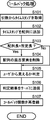
- FIG. 1 is a flowchart showing processing contents in a callback function according to an embodiment of the present invention.
- FIG. 1 is a flowchart showing processing contents in a callback function according to an embodiment of the present invention.
- the terminal operating the browser acquires the argument passed to the callback function (step S101).
- the argument indicates a time stamp of the time when the callback function is called.
- step S102 adds the acquired time stamp to the array (step S102). If the length of the array exceeds the predetermined length (step S103; Yes), the oldest element of the array is deleted (step S104). If not exceeded (step S103; No), the process proceeds to step S105 as it is.
- the terminal determines from the history of the time stamps stored in the array whether the window is currently visible to the user, that is, whether the content is being viewed by the user (step S105). Specifically, the following methods can be considered.
- the above-mentioned threshold is obtained by experiment etc., and the determination is made based on the difference between the latest two time stamps and the above-mentioned threshold. is there.
- the predetermined length of the array can be 2.
- the threshold value is adaptively determined based on the distribution of the difference between the time stamps stored in the adjacent elements of the array, and the determination is made.
- the average value of each difference may be obtained, and an intermediate value between the two average values may be used as a threshold value.
- threshold value adaptively in units of browsers rather than in units of windows or tabs.
- the threshold is determined based on the distribution of the differences calculated by the callback function registered for each content, the terminal performance and browser implementation
- a threshold value can be determined according to
- a threshold value determined in the past may be stored as a value that can be referred to based on a cookie or the like, and may be adopted as an initial value after the next time.
- the terminal transmits the determination result to the server (step S106).
- Sending to the server is not done every time the callback function is called, but only when the judgment result is switched, or the handler function registered using setInterval () etc. is sent at regular intervals. It is good also as transmitting to a server intermittently by calling.
- the terminal registers the callback function again by the window.requestAnimationFrame method (step S107), and ends the execution of this callback function.
- the “reading rate It is possible to estimate “reading rate”.
- the content it is estimated which part is the body of the content (a part other than the advertisement or the navigation bar of the content).
- various text extraction techniques can be employed. For example, a tag having a specific attribute may be assigned in advance to a portion corresponding to the text.
- the horizontal width and the vertical width when it is assumed that the content is displayed on the screen are acquired, and the screen display of the content is divided into four areas of the upper left, the upper right, the lower left, and the lower right based on the horizontal width and the vertical width.
- the node displayed in the upper left (or other area) is extracted, the area of the area where the head of the node is displayed on the screen and including the center of the screen is obtained, and the area is The node included in the predetermined range or the largest node is set as the start node of the text.
- each element of the content body may be a tag unit, a character unit, a word unit, or a line unit
- the readable time length in which each element is visible to the user is integrated.
- each element of the content body is “positioned at a position to be rendered in a window or the like and the content is viewed by the user” in the callback function. That is, it is determined whether or not it is in a readable state. If it is in the readable state, the latest time interval of the time stamp is divided into the readable time length of each element arranged at the position to be drawn in the current window or the like.
- Weighting may be performed.
- the upper weight may be increased between what is displayed on the upper side and what is displayed on the lower side in the browser screen. This is because the user usually reads the content from the beginning. Even after scrolling, it is possible to examine where the element is currently placed in the screen and to calculate the weight of the divide accordingly. As described above, if it is determined that the user is viewing the content in the latest and the previous callback call, the difference between the two is divided.
- the difference is not divided. This is because when the user is browsing the content, the callback function is frequently called, so that an error in the switching timing of whether or not the content is visible to the user can be ignored.
- the reading time length may be obtained from the average human reading time statistics based on the type of character, the length of the character string, the size of the video or still image, the playback time, etc. It may be obtained from a browsing state or the like. When accumulating these statistics, it is necessary to examine which element was displayed when, but such information can also be collected by a callback function.
- human attitudes toward content can be classified into three ways: sneaking, reading carefully, and leaving it as it is displayed. Therefore, whether or not the content is visible to the user is determined according to the above embodiment, and after calculating the total time length during which the content is visible, the above statistical processing is performed for the entire user or the user. If performed in units, a threshold value and a reading time length can be obtained.
- the rate of reading is calculated by identifying how much of the elements included in the content body has been read.
- the calculated read completion rate is typically transmitted to the server together with the determination result as to whether or not the content is visible.
- an advertisement such as a limited time coupon from the server to the browser at the moment when the content is browsed, immediately after reading the content, or when the content is almost read.
- the push may be performed automatically, or may be performed by the server operator by observing the user's browsing behavior on the server.
- Ads such as limited time coupons are not necessarily pushed. That is, the callback function of the script program calculates the reading rate and the like, and compares the reading rate with the advertisement display threshold. If the read rate exceeds the threshold for displaying the advertisement, the callback function acquires the advertisement from the server and displays the advertisement in a pop-up in the content or near the location where the user is currently viewing. Insert it.
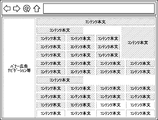
- FIG. 3 is a display example of content in the embodiment of the present invention.
- a dotted line surrounding the element is shown, but the dotted line is not displayed on the actual browser screen.
- the program arranges from the top whether or not the readable time length of the element included in the portion corresponding to the body of the content exceeds the reading time length of the element, that is, whether or not the element has been read. .
- FIG. 4 is an explanatory diagram showing the read and unread states of the content elements in the embodiment of the present invention.
- the background of the part that has been read is hatched. Search for a break where the exceeding element is continuous and the non-exceeding element is changing continuously. This place is a place where it is estimated that the user is currently reading the content.
- the spear program can insert an advertisement immediately before the relevant part. Further, after identifying the area where the element that has been read is displayed on the browser screen, the advertisement may be displayed in an overlay or pop-up at the end of the area.
- FIG. 5 is a display example of content and a pop-up advertisement in the embodiment of the present invention. As shown in this figure, it is desirable to arrange the pop-up display so as not to hide elements that have not been read, and existing banner advertisements. In addition, it is desirable that the position of the pop-up display is as close as possible to the unread element. This is because the vicinity is estimated to be the place where the user is currently paying attention.
- ⁇ ⁇ Near an unread element is the line just before the break or the line before the break.
- the pop-up advertisement is arranged so that the lower end of the pop-up advertisement touches the lower end of the line before the break and the center of the cut coincides with the center of the pop-up advertisement.
- the pop-up position can be changed as appropriate, such as displaying pop-up advertisements at intervals, or placing the pop-up advertisements in the previous line if the pop-up advertisements are of a size that does not enter immediately before the break.
- the threshold for advertisement display the method and location of advertisement pop-up display, etc.
- various aspects are randomly adopted to some extent, the conversion rate is measured for each aspect, and the aspect with the highest rate is adopted. Automatic adjustment such as increasing the probability may be performed. The automatic adjustment may be performed for each user or may be processed for the entire user who accesses.
- the same server may be used as the script distribution server and the content distribution server, but different servers may be used. Therefore, hereinafter, the former is called a script server and the latter is called a content server.
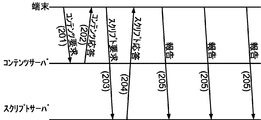
- FIG. 2 is a session diagram showing a state of communication in the embodiment of the present invention.
- a description will be given with reference to FIG.
- a content request for acquiring content is transmitted from the browser to the content server (201).
- Typical operations include selecting a link shown in other content already displayed on the browser, or directly entering a URL (Universal Resource Locator) in the browser address bar.
- URL Universal Resource Locator
- the content server that has received the content request transmits a content response designating the content corresponding to the content request to the terminal (202).
- the content specified in the response is typically a HTML (Hyper Text Markup Language) page, and a script program to be read when the page is loaded on the terminal is distributed in the HTML. URL is described.
- the script program is written in JavaScript® (registered trademark).
- the browser starts the content rendering process.
- the terminal transmits a script request for acquiring the script program to the script server (203).
- the script server that has received the script request transmits a script response designating the script program corresponding to the script request to the terminal (204).
- the browser executes the onload process specified for the content onload event.
- this onload process registration to execute the callback function specified in the script program by the window.requestAnimationFrame method of the window or tab is performed.
- the report is sent (205).
- the content provider may specify the URL specification of the script program and the callback function registration processing in the onload event in the provided content. These specifications can be made by embedding a very short HTML fragment template in the content.
- ⁇ Information such as the presence / absence of content browsing and read rate is statistically processed by the script server and then transmitted to the content provider. Therefore, the content provider can also perform an appropriate analysis on the reaction of the content provided by the content provider.
- the transmission destination of the report from the terminal can be the content server.
- the content server may observe the viewer's behavior, and the time-limited coupon or the like may be pushed when reading of the content approaches.
- nodes displayed in the first view are extracted from the DOM tree.
- the area of the area where the candidate node is drawn in the browser screen of the first view is calculated, and the node with the largest area is set as the candidate node.
- the constant Z can be determined by an experiment or the like using a large number of contents, and is preferably about 65 to 75 for contents that are currently widely browsed.
- the extraction of the candidate node and the search of the body node can be performed by performing a depth-first search or a breadth-first search from the body node of the content DOM tree. That is, among the child nodes of the body node, it is determined whether or not the node having the largest drawing area in the first view satisfies the above area condition. If the area condition is not satisfied, it is determined whether or not the node having the largest drawing area in the first view among the child nodes of the node satisfies the above condition. The search process is repeated.
- the drawing area is not the area displayed on the screen in the first view, but the drawing area of each node when all of the content is displayed. You may do it.
- the search may be started from a node to be displayed on the browser screen in the first view among the child nodes of the body node.
- the search may be started from the node that should be displayed in the upper left area obtained by dividing the browser screen into four of the nodes that should be displayed on the browser screen in the first view.
- a callback function is registered by the window.requestAnimationFrame method, and it is determined whether the content is displayed so that it can be seen by the user according to the interval at which the function is called. Judgment may be performed using the function of page visibility.
- registration may be performed using setInterval () so that this handler function is executed intermittently. If document.visibilityState is "visible", the readable time length of the element currently drawn in the browser screen may be accumulated.
- the script uses both the method by window.requestAnimationFrame and the method by page visibility to accumulate the readable time length of each element, Investigate. If the difference is small, the operation is changed to use one of the methods of window.requestAnimationFrame and page visibility, and the fact is reported to the server.
- the server receives the report and decides whether to use window.requestAnimationFrame or page visibility for that type of browser, and when the script is executed in that type of browser after that, Change the settings to use the determined method.
- the program stores the drawing position and drawing size of the content body on the browser screen in a JavaScript (registered trademark) variable or cookie.
- the program checks the difference between the drawing position and the drawing size of the content body when it was last in the previous readable state.
- the program estimates that it has changed to the readable state by the operation of the “return” button. If they match, it is presumed that the window has changed to a readable state by switching between windows and tabs.
- the present embodiment it is possible to analyze the user's behavior of returning to the content after temporarily transitioning from a certain content to another content, and adjusting the configuration of the content according to the user's behavior. Will be able to.
- the program according to the above embodiment is A program associated with content displayed in a window or tab of a browser operating on a terminal, wherein the terminal executes the program,
- a callback function defined by the program is registered by the window.requestAnimationFrame method assigned to the window or tab
- the callback function is called, it is determined whether or not the window or tab is being viewed by the user based on the time stamp interval at which the callback function is called for the window or tab.
- re-register the callback function using the window.requestAnimationFrame method assigned to the tab The result of the determination is intermittently notified to the server.
- the terminal executes the program, When the callback function is called, the content is read depending on the result of the determination and whether each element included in the content is drawn so as to be viewable in the window or tab at the time of the determination. Find the rate
- the server can be configured to intermittently notify the server of the obtained reading completion rate.
- the terminal executes the program, When the callback function is called, depending on the result of the determination and whether each element included in the content is drawn so as to be viewable in the window or tab when the determination is made, Asking whether or not it has been read, When the read rate for the content exceeds a threshold, a break between the read element and the unread element is identified, An advertisement can be inserted in the break, or the advertisement can be displayed in a pop-up in front of the break so as to overlap only with the read element.
- the program according to the above embodiment is a program associated with content displayed in a window or tab of a browser operating on a terminal, and the terminal executes the program, Intermittently determine whether the window or tab is being viewed by the user, Depending on the result of the determination and whether or not each element included in the content is drawn so as to be viewable in the window or tab at the time when the determination is made, the reading rate for the content and the reading of each element are completed. Asking whether or not When the read rate for the content exceeds a threshold, a break between the read element and the unread element is identified, An advertisement is inserted in the break, or an advertisement is popped up in front of the break so as to overlap only the read element.
Landscapes
- Engineering & Computer Science (AREA)
- Theoretical Computer Science (AREA)
- Physics & Mathematics (AREA)
- General Physics & Mathematics (AREA)
- Software Systems (AREA)
- General Engineering & Computer Science (AREA)
- Business, Economics & Management (AREA)
- Databases & Information Systems (AREA)
- Accounting & Taxation (AREA)
- Strategic Management (AREA)
- Development Economics (AREA)
- Finance (AREA)
- Human Computer Interaction (AREA)
- Data Mining & Analysis (AREA)
- Entrepreneurship & Innovation (AREA)
- Game Theory and Decision Science (AREA)
- Economics (AREA)
- Marketing (AREA)
- General Business, Economics & Management (AREA)
- Information Transfer Between Computers (AREA)
- Management, Administration, Business Operations System, And Electronic Commerce (AREA)
- User Interface Of Digital Computer (AREA)
Priority Applications (5)
| Application Number | Priority Date | Filing Date | Title |
|---|---|---|---|
| KR1020167024460A KR101712592B1 (ko) | 2014-02-28 | 2015-02-27 | 프로그램 |
| CN201580004418.2A CN105993006B (zh) | 2014-02-28 | 2015-02-27 | 基于回调函数的内容处理方法及终端 |
| US15/113,859 US10409469B2 (en) | 2014-02-28 | 2015-02-27 | Methods for displaying content in a window or tab of a browser |
| JP2015526799A JP5797871B1 (ja) | 2014-02-28 | 2015-02-27 | プログラム |
| TW104134190A TWI598835B (zh) | 2014-02-28 | 2015-10-19 | 終端裝置及儲存媒體 |
Applications Claiming Priority (2)
| Application Number | Priority Date | Filing Date | Title |
|---|---|---|---|
| JP2014-037875 | 2014-02-28 | ||
| JP2014037875 | 2014-02-28 |
Publications (1)
| Publication Number | Publication Date |
|---|---|
| WO2015129847A1 true WO2015129847A1 (ja) | 2015-09-03 |
Family
ID=54009160
Family Applications (1)
| Application Number | Title | Priority Date | Filing Date |
|---|---|---|---|
| PCT/JP2015/055771 Ceased WO2015129847A1 (ja) | 2014-02-28 | 2015-02-27 | プログラム |
Country Status (6)
| Country | Link |
|---|---|
| US (1) | US10409469B2 (enExample) |
| JP (2) | JP5797871B1 (enExample) |
| KR (1) | KR101712592B1 (enExample) |
| CN (1) | CN105993006B (enExample) |
| TW (1) | TWI598835B (enExample) |
| WO (1) | WO2015129847A1 (enExample) |
Families Citing this family (6)
| Publication number | Priority date | Publication date | Assignee | Title |
|---|---|---|---|---|
| CN108089856B (zh) * | 2016-11-22 | 2021-06-08 | 北京国双科技有限公司 | 一种页面元素的监听方法及装置 |
| US11216241B2 (en) * | 2016-12-13 | 2022-01-04 | Samsung Electronics Co., Ltd. | Method and device for audio management |
| JP6982526B2 (ja) * | 2017-07-19 | 2021-12-17 | ヤフー株式会社 | プログラム、端末装置の制御方法、および提供装置 |
| EP3686744B1 (en) | 2017-09-19 | 2024-01-10 | Lupine Software LLC. | Program |
| CN110647680A (zh) * | 2019-09-06 | 2020-01-03 | 中国建设银行股份有限公司 | 用户浏览行为分析方法及装置 |
| CN113867840B (zh) * | 2021-09-29 | 2023-06-13 | 四川长虹电器股份有限公司 | 一种智能电视web native插件框架及构建方法 |
Citations (3)
| Publication number | Priority date | Publication date | Assignee | Title |
|---|---|---|---|---|
| JP2005182364A (ja) * | 2003-12-18 | 2005-07-07 | Canon Software Inc | Www中継サーバおよび情報閲覧時間計測方法およびプログラムおよび記録媒体 |
| JP2010250795A (ja) * | 2008-11-11 | 2010-11-04 | Providence:Kk | 精読率計測装置、クライアント端末、精読率計測システム、精読率計測方法、及びプログラム |
| WO2013178805A2 (en) * | 2012-05-31 | 2013-12-05 | Meetrics Gmbh | A method for signaling whether a part of a web page is visible to a user and device |
Family Cites Families (26)
| Publication number | Priority date | Publication date | Assignee | Title |
|---|---|---|---|---|
| US7523191B1 (en) * | 2000-06-02 | 2009-04-21 | Yahoo! Inc. | System and method for monitoring user interaction with web pages |
| US6510531B1 (en) * | 1999-09-23 | 2003-01-21 | Lucent Technologies Inc. | Methods and systems for testing parallel queues |
| US20030080995A1 (en) * | 2001-10-12 | 2003-05-01 | United Virtualities, Inc. | Contextually adaptive web browser |
| US6938045B2 (en) * | 2002-01-18 | 2005-08-30 | Seiko Epson Corporation | Image server synchronization |
| US20040210846A1 (en) * | 2003-04-21 | 2004-10-21 | Olsen Gregory P. | Transparent network clipboard sharing |
| US7409482B2 (en) * | 2004-10-26 | 2008-08-05 | Lenovo (Singapore) Pte, Ltd. | Computer and method for on-demand network access control |
| US20080186184A1 (en) * | 2005-09-28 | 2008-08-07 | Visible Assets Inc. | Networked security tags for portable devices |
| US7924884B2 (en) * | 2005-12-20 | 2011-04-12 | Citrix Systems, Inc. | Performance logging using relative differentials and skip recording |
| US8386317B2 (en) * | 2007-07-23 | 2013-02-26 | Say Media, Inc. | Full page video advertisement |
| US7765295B2 (en) * | 2006-10-25 | 2010-07-27 | Compuware Corporation | Methods and apparatus for real user monitoring |
| US20080103888A1 (en) * | 2006-10-26 | 2008-05-01 | Yahoo! Inc. | System and method for tracking purchases related to digital advertisements |
| US8676637B2 (en) * | 2007-02-15 | 2014-03-18 | At&T Intellectual Property I, L.P. | Methods, systems and computer program products that use measured location data to identify sources that fraudulently activate internet advertisements |
| US20090024482A1 (en) * | 2007-07-18 | 2009-01-22 | Fox Interactive Media | System and method for deploying an ad widget |
| US8681874B2 (en) * | 2008-03-13 | 2014-03-25 | Cisco Technology, Inc. | Video insertion information insertion in a compressed bitstream |
| US20100005403A1 (en) * | 2008-07-02 | 2010-01-07 | Rozmaryn Gadiel Z | Monitoring viewable times of webpage elements on single webpages |
| JP4848399B2 (ja) | 2008-07-02 | 2011-12-28 | ヤフー株式会社 | メタバース内においてユーザが見た広告をWebページにおいて表示する広告配信サーバ及び方法 |
| JP2010117929A (ja) * | 2008-11-13 | 2010-05-27 | Nippon Telegr & Teleph Corp <Ntt> | 既表示範囲提示装置及びプログラム |
| US8689131B2 (en) * | 2009-01-21 | 2014-04-01 | Microsoft Corporation | Visual creation of computer-based workflows |
| CN102906667B (zh) * | 2010-04-23 | 2016-11-23 | 意美森公司 | 用于提供触觉效果的系统和方法 |
| US20120079366A1 (en) * | 2010-09-27 | 2012-03-29 | David Cohen | Measurement of content placement effectiveness over web pages and like media |
| GB2486002A (en) * | 2010-11-30 | 2012-06-06 | Youview Tv Ltd | Media Content Provision |
| US20120158478A1 (en) * | 2010-12-17 | 2012-06-21 | Curtis Bingham Holder | Market research and consumer ad revenue share system |
| JP5564442B2 (ja) * | 2011-01-11 | 2014-07-30 | 日本電信電話株式会社 | 文章検索装置 |
| US8782693B2 (en) * | 2012-02-29 | 2014-07-15 | Google Inc. | Interfaces to allow video ad serving into a mobile phone application video stream |
| JP6345911B2 (ja) * | 2013-04-09 | 2018-06-20 | 株式会社ミクシィ | コンテンツ表示時間検知システム、コンテンツ表示時間検知方法、ユーザ端末並びにその制御方法及び制御プログラム、サーバシステム及びその制御方法 |
| US20150193817A1 (en) * | 2014-01-07 | 2015-07-09 | GoldSpot Media Inc. | Method and apparatus for generating an intelligent advertisement |
-
2015
- 2015-02-27 CN CN201580004418.2A patent/CN105993006B/zh active Active
- 2015-02-27 KR KR1020167024460A patent/KR101712592B1/ko active Active
- 2015-02-27 US US15/113,859 patent/US10409469B2/en active Active
- 2015-02-27 JP JP2015526799A patent/JP5797871B1/ja active Active
- 2015-02-27 WO PCT/JP2015/055771 patent/WO2015129847A1/ja not_active Ceased
- 2015-08-19 JP JP2015162250A patent/JP6453187B2/ja active Active
- 2015-10-19 TW TW104134190A patent/TWI598835B/zh active
Patent Citations (3)
| Publication number | Priority date | Publication date | Assignee | Title |
|---|---|---|---|---|
| JP2005182364A (ja) * | 2003-12-18 | 2005-07-07 | Canon Software Inc | Www中継サーバおよび情報閲覧時間計測方法およびプログラムおよび記録媒体 |
| JP2010250795A (ja) * | 2008-11-11 | 2010-11-04 | Providence:Kk | 精読率計測装置、クライアント端末、精読率計測システム、精読率計測方法、及びプログラム |
| WO2013178805A2 (en) * | 2012-05-31 | 2013-12-05 | Meetrics Gmbh | A method for signaling whether a part of a web page is visible to a user and device |
Also Published As
| Publication number | Publication date |
|---|---|
| US20170031579A1 (en) | 2017-02-02 |
| CN105993006A (zh) | 2016-10-05 |
| CN105993006B (zh) | 2019-11-29 |
| KR101712592B1 (ko) | 2017-03-06 |
| KR20160119163A (ko) | 2016-10-12 |
| TW201631536A (zh) | 2016-09-01 |
| JP5797871B1 (ja) | 2015-10-21 |
| HK1225829A1 (zh) | 2017-09-15 |
| US10409469B2 (en) | 2019-09-10 |
| TWI598835B (zh) | 2017-09-11 |
| JP6453187B2 (ja) | 2019-01-16 |
| JP2015215923A (ja) | 2015-12-03 |
| JPWO2015129847A1 (ja) | 2017-03-30 |
Similar Documents
| Publication | Publication Date | Title |
|---|---|---|
| JP6453187B2 (ja) | プログラム | |
| US20230274078A1 (en) | Systems, methods, and media for correlating information corresponding to multiple related frames on a web page | |
| KR102455232B1 (ko) | 콘텍스트 기반 탭 관리를 위한 방법 및 전자 장치 | |
| US8751953B2 (en) | Progress indicators for loading content | |
| US8112672B2 (en) | Diagnostics and error reporting for common tagging issues | |
| US20100121676A1 (en) | Method and system for logging impressions of online advertisments | |
| US20150143230A1 (en) | Method and device for displaying webpage contents in browser | |
| US9298845B2 (en) | Method and system of detection of viewing of objects inserted in web pages | |
| US9003273B2 (en) | Document clipping with linked information | |
| CN112764653A (zh) | 基于下拉页面获取信息的方法和装置 | |
| EP2856410B1 (en) | A method for signaling whether a part of a web page is visible to a user and device | |
| CN102629933A (zh) | 一种识别用户实际点击访问网站行为的方法及系统 | |
| US20150331837A1 (en) | Text processing method and mobile terminal | |
| KR20140066398A (ko) | 디스플레이 장치 정보에 따른 웹 페이지 레이아웃 변경 시스템 및 방법 | |
| CN107316203B (zh) | 展示信息的探测方法及装置、计算机可读存储介质、终端 | |
| CN106339501A (zh) | 一种媒体文件推送方法和装置 | |
| US10402477B2 (en) | Method for real-time automatic modification on the server side of a web page to visualize a content superposed to the web page | |
| HK1225829B (zh) | 基於回调函数的内容处理方法及终端 | |
| CN119011388A (zh) | 一种基于曝光埋点获取数据的方法及系统 | |
| CN108268192A (zh) | 列表操作方法和装置 | |
| CN117112953A (zh) | 页面停留时长的确定方法、装置、存储介质及计算机设备 | |
| CN119377055A (zh) | 首屏时间上报方法、装置、计算机设备和存储介质 | |
| US11205200B1 (en) | Systems, methods, and media for detecting advertisements with advertising cues | |
| US20180248801A1 (en) | Reducing load to downstream services by filtering requests | |
| JP2005099962A (ja) | クリックカウントシステム |
Legal Events
| Date | Code | Title | Description |
|---|---|---|---|
| ENP | Entry into the national phase |
Ref document number: 2015526799 Country of ref document: JP Kind code of ref document: A |
|
| 121 | Ep: the epo has been informed by wipo that ep was designated in this application |
Ref document number: 15755511 Country of ref document: EP Kind code of ref document: A1 |
|
| WWE | Wipo information: entry into national phase |
Ref document number: 15113859 Country of ref document: US |
|
| NENP | Non-entry into the national phase |
Ref country code: DE |
|
| ENP | Entry into the national phase |
Ref document number: 20167024460 Country of ref document: KR Kind code of ref document: A |
|
| 122 | Ep: pct application non-entry in european phase |
Ref document number: 15755511 Country of ref document: EP Kind code of ref document: A1 |