WO2015115449A1 - ホットメルト接着剤 - Google Patents
ホットメルト接着剤 Download PDFInfo
- Publication number
- WO2015115449A1 WO2015115449A1 PCT/JP2015/052267 JP2015052267W WO2015115449A1 WO 2015115449 A1 WO2015115449 A1 WO 2015115449A1 JP 2015052267 W JP2015052267 W JP 2015052267W WO 2015115449 A1 WO2015115449 A1 WO 2015115449A1
- Authority
- WO
- WIPO (PCT)
- Prior art keywords
- hot melt
- melt adhesive
- mass
- random copolymer
- less
- Prior art date
- Legal status (The legal status is an assumption and is not a legal conclusion. Google has not performed a legal analysis and makes no representation as to the accuracy of the status listed.)
- Ceased
Links
Classifications
-
- C—CHEMISTRY; METALLURGY
- C09—DYES; PAINTS; POLISHES; NATURAL RESINS; ADHESIVES; COMPOSITIONS NOT OTHERWISE PROVIDED FOR; APPLICATIONS OF MATERIALS NOT OTHERWISE PROVIDED FOR
- C09J—ADHESIVES; NON-MECHANICAL ASPECTS OF ADHESIVE PROCESSES IN GENERAL; ADHESIVE PROCESSES NOT PROVIDED FOR ELSEWHERE; USE OF MATERIALS AS ADHESIVES
- C09J109/00—Adhesives based on homopolymers or copolymers of conjugated diene hydrocarbons
- C09J109/06—Copolymers with styrene
-
- C—CHEMISTRY; METALLURGY
- C08—ORGANIC MACROMOLECULAR COMPOUNDS; THEIR PREPARATION OR CHEMICAL WORKING-UP; COMPOSITIONS BASED THEREON
- C08L—COMPOSITIONS OF MACROMOLECULAR COMPOUNDS
- C08L25/00—Compositions of, homopolymers or copolymers of compounds having one or more unsaturated aliphatic radicals, each having only one carbon-to-carbon double bond, and at least one being terminated by an aromatic carbocyclic ring; Compositions of derivatives of such polymers
- C08L25/02—Homopolymers or copolymers of hydrocarbons
- C08L25/04—Homopolymers or copolymers of styrene
- C08L25/08—Copolymers of styrene
- C08L25/10—Copolymers of styrene with conjugated dienes
-
- C—CHEMISTRY; METALLURGY
- C09—DYES; PAINTS; POLISHES; NATURAL RESINS; ADHESIVES; COMPOSITIONS NOT OTHERWISE PROVIDED FOR; APPLICATIONS OF MATERIALS NOT OTHERWISE PROVIDED FOR
- C09J—ADHESIVES; NON-MECHANICAL ASPECTS OF ADHESIVE PROCESSES IN GENERAL; ADHESIVE PROCESSES NOT PROVIDED FOR ELSEWHERE; USE OF MATERIALS AS ADHESIVES
- C09J123/00—Adhesives based on homopolymers or copolymers of unsaturated aliphatic hydrocarbons having only one carbon-to-carbon double bond; Adhesives based on derivatives of such polymers
- C09J123/02—Adhesives based on homopolymers or copolymers of unsaturated aliphatic hydrocarbons having only one carbon-to-carbon double bond; Adhesives based on derivatives of such polymers not modified by chemical after-treatment
- C09J123/10—Homopolymers or copolymers of propene
- C09J123/12—Polypropene
Definitions
- the present invention relates to a hot melt adhesive containing a propylene homopolymer as an essential component.
- Hot-melt adhesives are solventless adhesives. After being applied to the adherend by heating and melting, it is solidified by cooling and expresses adhesiveness, allowing instant bonding and high-speed bonding. It is used in a wide range of fields. Adhesive materials to be bonded with hot melt adhesives and their use conditions vary, and various hot melt adhesives have been developed and supplied to the market for various applications. Various operating temperatures are assumed.
- an ethylene-vinyl acetate copolymer or a thermoplastic elastomer such as a styrene-butadiene-styrene block copolymer or a styrene-isoprene-styrene block copolymer is used as a base polymer.
- blended tackifier resin and the plasticizer with this is mainly used.
- hot-melt adhesives manufactured using the base polymer as described above have poor thermal stability during heating, cause oxidation, gelation, decomposition, coloration, etc. during coating, and the strength of the bonded portion is deteriorated over time. There were problems such as causing changes.
- Propylene polymers have been conventionally used as base polymers for hot melt adhesives.
- low molecular weight polypropylene polymerized with a metallocene-based catalyst has high fluidity and excellent coating properties when used as a hot-melt adhesive, excellent adhesion strength of low-polar substances such as PP, and heat stability during heating and melting. Since it is excellent in properties, it can be suitably used as a base polymer for various hot melt adhesives (Patent Document 1). It is particularly suitable for spray coating used in the assembly of sanitary materials such as paper diapers and sanitary products.
- the hot melt adhesive having a polypropylene as a base polymer described in Patent Document 1 exhibits high adhesive strength in bonding of non-woven polypropylene fabrics (hereinafter also referred to as “PP non-woven fabric”), but other materials constituting sanitary materials
- PP non-woven fabric non-woven polypropylene fabrics
- PE film polyethylene film
- the adhesive strength may decrease during the storage process from pasting to use. It is an object of the present invention to provide a hot melt adhesive having high fluidity at the time of melting, exhibiting high adhesive strength between PP nonwoven fabrics, and further having high adhesiveness of PE film-PP nonwoven fabric and long-term stability.
- a base polymer of a hot melt adhesive As a base polymer of a hot melt adhesive, it is generally said that a resin having high flexibility and excellent elongation is preferable. When the flexibility and elongation of the base polymer are insufficient, the adhesive composition cannot follow the deformation of the adherend and easily causes interfacial peeling, resulting in a decrease in adhesive strength. It is an object of the present invention to provide a hot melt adhesive having high fluidity at the time of melting, exhibiting high adhesive strength between PP nonwoven fabrics, and further having high adhesive strength of PE film-PP nonwoven fabric and excellent elongation. And
- the present invention relates to the following [1] to [17].
- [1] (A) a propylene homopolymer satisfying the following (i) to (iii): (B) A hot melt adhesive containing a styrene random copolymer and at least one selected from elastomers having a breaking elongation of 700% or more and a tensile elastic modulus of 10 MPa or less. (I) Tensile modulus at 23 ° C. is 400 MPa or less (ii) Weight average molecular weight (Mw) is 10,000 to 150,000 (Iii) Mw / Mn is 2.5 or less [2] The hot melt adhesive according to [1], wherein (B) is a styrene random copolymer.
- (B) is a styrene random copolymer
- the fluidity at the time of melting is high
- the adhesive strength between PP nonwoven fabrics is high
- a hot melt adhesive having long-term stability can be provided.
- the hot melt adhesive of the present invention has improved long-term stability in addition to applicability, adhesiveness of low-polarity substances, and thermal stability during heat-melting, so that it can be used for the production of sanitary materials such as disposable diapers. It can be particularly suitably used as a hot melt adhesive.
- (B) is an elastomer having a breaking elongation of 700% or more and a tensile modulus of elasticity of 10 MPa or less
- the fluidity at the time of melting is high, and the PP nonwoven fabric exhibits high adhesive strength.
- -It is possible to provide a hot melt adhesive having high adhesive strength of PP nonwoven fabric and excellent elongation.
- the hot melt adhesive of the present invention has improved adhesion to PE film (adhesive strength and elongation) in addition to applicability, adhesion of low-polarity substances, and thermal stability during heating and melting. It can be particularly suitably used as a hot melt adhesive for the production of sanitary materials such as paper diapers.
- the hot melt adhesive of the present invention comprises (A) a propylene homopolymer satisfying the following (i) to (iii), (B) a styrene random copolymer, a breaking elongation of 700% or more and a tensile modulus of 10 MPa or less. At least one selected from the group of elastomers. (I) Tensile modulus at 23 ° C.
- the hot melt adhesive of the present invention has high fluidity at the time of melting, exhibits high adhesive strength between PP nonwoven fabrics, and further has high adhesiveness of PE film-PP nonwoven fabric and its long-term stability.
- This is a combination of a predetermined (A) propylene homopolymer and (B) a styrene random copolymer, which suppresses deterioration of the resin itself, increases compatibility of components, suppresses changes over time, It is considered that long-term stability in strength was obtained.
- the hot melt adhesive of the present invention according to the second embodiment has high fluidity at the time of melting, exhibits high adhesive strength between PP nonwoven fabrics, and further has high adhesive strength of PE film-PP nonwoven fabric and excellent elongation. .
- (A) Propylene homopolymer (A) The propylene homopolymer satisfies the following (i) to (iii) in order to increase the fluidity at the time of melting of the hot melt adhesive and to obtain high adhesive strength between the PP nonwoven fabrics.
- Tensile modulus at 23 ° C. is 400 MPa or less
- Weight average molecular weight (Mw) is 10,000 to 150,000
- Mw / Mn is 2.5 or less
- the measuring method of various numerical values is based on the method described in the examples.
- the propylene homopolymer has a tensile modulus at 23 ° C. of 400 MPa or less.
- a lower tensile elastic modulus is preferable from the viewpoint of adhesiveness, and the lower limit thereof is not particularly limited, and the measurement limit value is the lower limit.
- the tensile elastic modulus is preferably 1 MPa or more, more preferably 5 MPa or more, and further preferably 10 MPa or more.
- moderate flexibility is required from the viewpoint of the followability of the hot melt adhesive to the adherend and the adhesion to the unevenness of the adherend surface. The From such a viewpoint, the tensile elastic modulus at 23 ° C.
- the propylene homopolymer of the present invention is 400 MPa or less, preferably 350 MPa or less, more preferably 300 MPa or less, still more preferably 250 MPa or less, and still more preferably 200 MPa or less. More preferably, it is 150 MPa or less.
- moderate flexibility is required from the viewpoint of bleeding of the hot melt adhesive onto the adherend and the anchor effect on the unevenness of the adherend surface. Is done. From such a viewpoint, the tensile elastic modulus at 23 ° C.
- the tensile elastic modulus of the propylene homopolymer of the present invention is measured by the method described in the examples.
- the tensile modulus of the propylene homopolymer of the present invention can be adjusted within a desired range by changing the polymerization conditions (reaction temperature, reaction time, catalyst, promoter) of the propylene homopolymer. .
- Weight average molecular weight The propylene homopolymer has a weight average molecular weight of 10,000 to 150,000. When the weight average molecular weight is 10,000 to 150,000, the fluidity and adhesion at melting are excellent. From such a viewpoint, the weight average molecular weight is preferably 10,000 to 150,000, more preferably 15,000 to 140,000, and more preferably 15,000 to 130,000. The weight average molecular weight can be controlled by appropriately adjusting the polymerization conditions (propylene pressure, polymerization time, etc.).
- the propylene homopolymer has a molecular weight distribution (Mw / Mn) of 2.5 or less. If the molecular weight distribution is 2.5 or less, the fluidity at the time of melting is excellent. From such a viewpoint, the molecular weight distribution is preferably 2.4 or less, more preferably 2.2 or less. From the viewpoint of productivity, the molecular weight distribution is preferably 1.1 or more, more preferably 1.3 or more. By using a metallocene catalyst, the molecular weight distribution (Mw / Mn) can be 2.5 or less.
- the propylene homopolymer has a mesopentad fraction [mmmm] of preferably 20 to 80 mol%.
- the mesopentad fraction [mmmm] is preferably more than 20 mol% and 80 mol% or less, more preferably more than 40 mol% and 75 mol% or less. It is possible to control the mesopentad fraction by adjusting the monomer concentration and the reaction pressure.
- the propylene homopolymer has an intrinsic viscosity [ ⁇ ] of preferably 0.01 to 2.0 deciliter / g, more preferably 0.1 to 1.5 deciliter / g, and still more preferably 0, from the viewpoint of applicability. .2 to 1.0 deciliter / g.
- the intrinsic viscosity [ ⁇ ] is determined by the measurement method described in the examples.
- the intrinsic viscosity [ ⁇ ] can be controlled by adjusting the polymerization conditions (propylene pressure, polymerization time, etc.).
- the melting point (Tm-D) of the propylene homopolymer is preferably 0 to 140 ° C., more preferably 20 to 120 ° C., and still more preferably 40 to 100 ° C. from the viewpoint of improving open time and improving creep resistance.
- a differential scanning calorimeter DSC-7, manufactured by Perkin Elmer
- 10 mg of a sample is held at ⁇ 10 ° C. for 5 minutes in a nitrogen atmosphere, and then heated at 10 ° C./min.
- the peak top of the peak observed on the highest temperature side of the melting endotherm curve obtained by the above is defined as the melting point (Tm-D). It is possible to control the melting point by adjusting the monomer concentration and the reaction pressure.
- Propylene homopolymer production method As a manufacturing method of a propylene homopolymer, the method of manufacturing a propylene homopolymer by homopolymerizing propylene using a metallocene catalyst is mentioned.
- the metallocene catalyst include JP-A-58-19309, JP-A-61-130314, JP-A-3-163088, JP-A-4-300787, JP-A-4-21694, and special tables.
- Transition metal compounds having one or two ligands such as a cyclopentadienyl group, a substituted cyclopentadienyl group, an indenyl group, and a substituted indenyl group as described in JP-A-1-503636 Examples thereof include a catalyst obtained by combining a transition metal compound whose ligand is geometrically controlled and a promoter.
- the ligand comprises a transition metal compound in which a crosslinked structure is formed via a crosslinking group, and in particular, a transition in which a crosslinked structure is formed via two crosslinking groups.
- a method using a metallocene catalyst obtained by combining a metal compound and a cocatalyst is more preferable. Examples described in paragraphs “0037” to “0084” of JP-A-2001-172325 are also preferable examples in the present invention.
- the content of the propylene homopolymer is preferably with respect to 100 parts by mass of the hot melt adhesive in order to increase the fluidity at the time of melting of the hot melt adhesive and to obtain high adhesive strength between the PP nonwoven fabrics. Is 1 to 50 parts by mass, more preferably 5 to 40 parts by mass, and still more preferably 8 to 30 parts by mass.
- the styrenic random copolymer in the present invention is a random copolymer of an aromatic vinyl compound and another monomer, preferably a random copolymer of an aromatic vinyl compound and a conjugated diene.
- Aromatic vinyl compound means an aromatic hydrocarbon compound having a vinyl group.
- styrene For example, styrene, ⁇ -methylstyrene, o-methylstyrene, p-methylstyrene, p-tert-butylstyrene, 2, Examples include 4-dimethylstyrene, vinyl naphthalene, and vinyl anthracene. Of these, styrene is preferred. These aromatic vinyl compounds can be used alone or in combination of two or more. “Conjugated diene” means a diolefin compound having at least a pair of conjugated double bonds.
- conjugated diene examples include 1,3-butadiene, 2-methyl-1,3-butadiene (or isoprene), 2,3-dimethyl-1,3-butadiene, 1,3-pentadiene, and 1,3-hexadiene. Is mentioned. Of these, 1,3-butadiene and 2-methyl-1,3-butadiene are preferred. These conjugated diene compounds can be used alone or in combination of two or more.
- the content of the structural unit derived from the aromatic vinyl compound in the styrene random copolymer is preferably 1 to 40% by mass, more preferably 2 to 30% by mass, and still more preferably 5 to 20% by mass. .
- the content of the constituent unit derived from the conjugated diene in the (B) styrene random copolymer is preferably 60 to 99% by mass, more preferably 70 to 98% by mass, and still more preferably 80 to 95% by mass.
- the styrene random copolymer may be either hydrogenated or non-hydrogenated, but in order to obtain excellent long-term stability, the hydrogenated styrene random copolymer may be used. Polymers are preferred.
- the styrene random copolymer preferably has a breaking elongation of 700% or more and a tensile modulus of 10 MPa or less.
- the elongation at break of the styrene random copolymer is preferably 700% or more, more preferably 800% or more. When the elongation at break is 700% or more, the adhesive is stretched and the adhesive strength is improved. The elongation at break is preferably 1200% or less, more preferably 1100% or less.
- the tensile elastic modulus of the styrene random copolymer is preferably 10 MPa or less, more preferably 5 MPa or less, and still more preferably 3 MPa or less.
- the tensile elastic modulus When the tensile elastic modulus is 10 MPa or less, the adhesive is extended and the adhesive strength is improved.
- the tensile elastic modulus is preferably 0.1 MPa or more, more preferably 1 MPa or more.
- the measuring method of breaking elongation and a tensile elasticity modulus are based on the measuring method as described in an Example.
- the content of the styrenic random copolymer is preferably 1 to 50 parts by mass, more preferably 2 parts per 100 parts by mass of the hot melt adhesive in order to obtain excellent adhesiveness and long-term stability. -30 parts by mass, more preferably 3-25 parts by mass.
- (B) Elastomers have a breaking elongation of 700% or more and a tensile modulus of 10 MPa or less in order to obtain excellent adhesive strength and elongation.
- (B) Elongation at break of elastomers is 700% or more, more preferably 800% or more. When the elongation at break is 700% or more, the adhesive is stretched and the adhesive strength is improved. The elongation at break is preferably 1200% or less, more preferably 1100% or less.
- the tensile modulus of the elastomer is 10 MPa or less, more preferably 5 MPa or less, and still more preferably 3 MPa or less.
- the tensile elastic modulus When the tensile elastic modulus is 10 MPa or less, the adhesive is extended and the adhesive strength is improved.
- the tensile elastic modulus is preferably 0.1 MPa or more, more preferably 1 MPa or more.
- the measuring method of breaking elongation and a tensile elasticity modulus are based on the measuring method as described in an Example.
- the elastomers are preferably not block copolymers, and more preferably (Ba) random copolymers in order to obtain long-term storage stability.
- elastomers examples include styrene copolymers, butadiene acrylonitrile elastomers, natural rubber, polybutadiene rubber, polyisoprene rubber, butyl rubber, polyester rubber, acrylic rubber, silicon rubber, amorphous or low crystalline ethylene. And olefin elastomers such as propylene elastomer and propylene elastomer. Among these, (Bb) styrene-based copolymer is preferable. Moreover, you may use these individually or in combination of 2 or more types.
- Examples of (Bb) styrene-based copolymers include styrene-based random copolymers and styrene-based block copolymers. In order to obtain long-term storage stability, styrene-based random copolymers are preferred.
- the styrene-based copolymer is a copolymer of an aromatic vinyl compound and another monomer, and is preferably a copolymer of an aromatic vinyl compound and a conjugated diene.
- “Aromatic vinyl compound” means an aromatic hydrocarbon compound having a vinyl group.
- These aromatic vinyl compounds can be used alone or in combination of two or more.
- Conjugated diene means a diolefin compound having at least a pair of conjugated double bonds.
- the conjugated diene include 1,3-butadiene, 2-methyl-1,3-butadiene (or isoprene), 2,3-dimethyl-1,3-butadiene, 1,3-pentadiene, and 1,3-hexadiene. Is mentioned. Of these, 1,3-butadiene and 2-methyl-1,3-butadiene are preferred.
- These conjugated diene compounds can be used alone or in combination of two or more.
- the content of the structural unit derived from the aromatic vinyl compound in the (Bb) styrene copolymer is preferably 1 to 40% by mass, more preferably 2 to 30% by mass, and still more preferably 5 to 20% by mass.
- the content of the structural unit derived from the conjugated diene in the (Bb) styrene copolymer is preferably 60 to 99% by mass, more preferably 70 to 98% by mass, and still more preferably 80 to 95% by mass.
- the styrene copolymer may be hydrogenated or non-hydrogenated, but in order to obtain excellent adhesive strength and elongation, (Bc) hydrogenated styrene Type copolymer is preferred, and (Bd) hydrogenated styrene type random copolymer is more preferred.
- the content of the elastomer (B) is preferably 1 to 50 parts by mass, more preferably 2 to 30 parts by mass, and still more preferably 100 parts by mass with respect to 100 parts by mass of the hot melt adhesive in order to obtain excellent adhesive strength and elongation. Is 3 to 25 parts by mass.
- the hot melt adhesive of the present invention may contain a tackifying resin.
- the tackifying resin include a solid, semi-solid or liquid resin at room temperature composed of a hydrogenated derivative of an aliphatic hydrocarbon petroleum resin, a rosin derivative resin, a polyterpene resin, a petroleum resin, an oil-soluble phenol resin, or the like. be able to. You may use these individually or in combination of 2 or more types.
- the content of the tackifying resin is preferably 20 to 60 parts by mass with respect to 100 parts by mass of the hot-melt adhesive, from the viewpoints of improvement in tackiness, applicability, and wettability to the adherend due to a decrease in viscosity. More preferably, it is 30 to 60 parts by mass.
- the hot melt adhesive of the present invention may contain oil.
- the oil include paraffinic process oil and naphthenic process oil.
- the content of the oil is preferably 5 to 40 parts by mass, more preferably 100 parts by mass with respect to 100 parts by mass of the hot melt adhesive, from the viewpoints of improvement in tackiness, applicability, and improvement in wettability to the adherend due to a decrease in viscosity. Is 10 to 30 parts by mass.
- the hot melt adhesive of the present invention may contain a wax.
- the wax include animal wax, plant wax, carnauba wax, candelilla wax, wood wax, beeswax, mineral wax, petroleum wax, paraffin wax, microcrystalline wax, petrolatum, higher fatty acid wax, higher fatty acid ester wax, Fischer Examples include Tropsch wax.
- the content of the wax is preferably 5 to 40 parts by mass, more preferably 10 to 30 parts with respect to 100 parts by mass of the hot melt adhesive, from the viewpoints of coating properties and improvement of wettability to the adherend due to a decrease in viscosity. Part by mass.
- the hot melt adhesive of the present invention may contain, for example, a plasticizer, an inorganic filler, an antioxidant and the like.
- a plasticizer include phthalic acid esters, adipic acid esters, fatty acid esters, glycols, and epoxy polymer plasticizers.
- the inorganic filler include clay, talc, calcium carbonate, barium carbonate and the like.
- antioxidants examples include trisnoniphenyl phosphite, distearyl pentaerythritol diphosphite, ADK STAB 1178 (manufactured by ADEKA Corporation), Stamilizer TNP (manufactured by Sumitomo Chemical Co., Ltd.), Irgaphos 168 (manufactured by BASF Corporation), Phosphoric antioxidants such as Sandstab P-EPQ (Sand Corp.), 2,6-di-t-butyl-4-methylphenol, n-octadecyl-3- (3 ′, 5′-di-t-butyl) -4′-hydroxyphenyl) propionate, Sumilizer BHT (manufactured by Sumitomo Chemical Co., Ltd.), Irganox 1010 (manufactured by BASF), phenolic antioxidants, dilauryl-3,3′-thiodipropionate, pentaerythritol t
- the hot melt adhesive of the present invention is preferably at least one selected from (A) a propylene homopolymer, (B) a styrene random copolymer and elastomers as a base polymer, preferably (C) a tackifier resin, (D ) Oil, (E) Wax, and various additives as necessary, dry blended using a Henschel mixer, etc., and then melt-kneaded with a single or twin screw extruder, plast mill, Banbury mixer, etc. be able to.
- the hot melt adhesive of the present invention has a melt viscosity at 160 ° C. of preferably 12000 mPa ⁇ s or less, more preferably 2000 to 11000 mPa ⁇ s, and further preferably 4000 to 10000 mPa ⁇ s.
- the melt viscosity is measured by the method described in the examples.
- the hot melt adhesive of the present invention is excellent in adhesiveness with various substrates including low polar substances such as polyolefins, and is excellent in thermal stability during heating and melting. It can be suitably used for bookbinding, textiles, woodworking, electrical materials, canning, construction and bag making. Particularly, it is suitably used for adhesion of polyolefin-based materials. For example, it is used for adhesion between polyolefin nonwoven fabric and polyolefin nonwoven fabric, or adhesion between polyolefin film and polyolefin nonwoven fabric, preferably adhesion between PP nonwoven fabric and PP nonwoven fabric. Or used for adhesion between PE film and PP nonwoven fabric.
- the method for applying the hot melt adhesive of the present invention is not particularly limited, and for example, any method of contact application or non-contact application may be used.
- Contact coating refers to a coating method in which an ejector is brought into contact with a member or a film when applying a hot melt adhesive.
- Non-contact coating refers to an ejector applied to a member or a film when applying a hot melt adhesive.
- the coating method which does not contact. Examples of the contact coating method include slot coater coating and roll coater coating.
- Non-contact coating methods include, for example, spiral coating to be applied in a spiral manner, omega coating to be applied in a wave shape, control seam coating, slot spray coating to be applied in a planar manner, curtain spray coating, and dot coating. Dot coating etc. to work are mentioned. Among these, spiral coating is preferable for the hot melt adhesive of the present invention.
- Spiral coating is a method in which an adhesive is spirally contactlessly applied with air by intermittent or continuous coating.
- ⁇ Tensile modulus> The sample was press-molded to prepare a test piece, and the tensile modulus (MPa) of the sample was measured under the following conditions in accordance with JIS K7113. -Test piece (No. 2 dumbbell) Thickness: 1mm ⁇ Crosshead speed: 100mm / min ⁇ Load cell: 100N ⁇ Measurement temperature: 23 °C
- Weight average molecular weight (Mw), molecular weight distribution (Mw / Mn) measurement The weight average molecular weight (Mw) and molecular weight distribution (Mw / Mn) of the sample were determined by gel permeation chromatography (GPC). For the measurement, the following apparatus and conditions were used, and a weight average molecular weight in terms of polystyrene was obtained. The results are shown in Table 1.
- ⁇ GPC measurement device Column: TOSO GMHHR-H (S) HT Detector: RI detector for liquid chromatogram WATERS 150C ⁇ Measurement conditions> Solvent: 1,2,4-trichlorobenzene Measurement temperature: 145 ° C Flow rate: 1.0 ml / min Sample concentration: 2.2 mg / ml Injection volume: 160 ⁇ l Calibration curve: Universal Calibration Analysis program: HT-GPC (Ver.1.0)
- Tm-D Melting point
- the coating conditions of the spiral spray gun were a hot melt adhesive melting temperature of 150 ° C., a spray gun temperature of 150 ° C., and a hot air temperature of 180 ° C.
- the amount of hot melt adhesive applied was 4 g / m 2, and the hot air pressure was adjusted so that the width of the coated spiral was about 15 mm.
- the pressure for pressure bonding with a press roller after coating was 0.1 MPa, and the open time was about 0.1 seconds.
- the laminate bonded with the hot-melt adhesive was cut at a width of 25 mm in the direction perpendicular to the traveling direction of the substrate (CD direction), and used as a test piece for measuring the T-shaped peel adhesive strength.
- the PE film-PP non-woven fabric adhesive strength test results are indicated as “PE / NW” in the table, and the PP non-woven fabric-PP non-woven fabric adhesive strength test results are indicated as “NW / NW” in the table.
- the test piece was cured at 23 ° C. and 50% RH for 24 hours or more, and then subjected to a T-shaped peel test in the same environment. In order to evaluate the change in peel adhesive strength over time, test pieces cured at 23 ° C. and 50% RH for 24 hours or more are held at 50 ° C. for 2 weeks and 4 weeks, and further cured at 23 ° C. and 50% RH for 24 hours. After that, the peel adhesive strength was measured in the same manner.
- T-peeling test In the T-type peel test, an autograph AGS-X manufactured by Shimadzu Corporation was used, a peel test was performed at a peel speed of 100 mm / min, and a peel length of 30 mm, and an average value of two maximum values was calculated. Five test pieces were measured for each hot melt adhesive, and the average value of the top three was taken as the peel adhesive strength.
- the hot melt adhesive of the present invention has high fluidity when melted, exhibits high adhesive strength between PP nonwoven fabrics, and further has high adhesiveness and long-term stability of PE film-PP nonwoven fabric.
- the hot melt adhesive of the present invention has high fluidity when melted, exhibits high adhesive strength between PP nonwoven fabrics, and further has high adhesive strength and excellent elongation of PE film-PP nonwoven fabric. For this reason, it can be suitably used as a hot-melt adhesive for sanitary materials, packaging, bookbinding, textiles, woodworking, electrical materials, canning, building and bag making.
Landscapes
- Chemical & Material Sciences (AREA)
- Organic Chemistry (AREA)
- Health & Medical Sciences (AREA)
- Chemical Kinetics & Catalysis (AREA)
- Medicinal Chemistry (AREA)
- Polymers & Plastics (AREA)
- Adhesives Or Adhesive Processes (AREA)
Abstract
溶融時の流動性が高く、PP不織布同士の高い接着強度を示し、更に、PEフィルム‐PP不織布の高い接着性、及び長期安定性を有するホットメルト接着剤を提供する。 (A)下記(i)~(iii)を満たすプロピレン単独重合体と、(B)スチレン系ランダム共重合体、及び破断伸び700%以上かつ引張弾性率10MPa以下のエラストマー類から選ばれる少なくとも一種とを含むホットメルト接着剤。 (i)23℃における引張弾性率が400MPa以下 (ii)重量平均分子量(Mw)が10,000~150,000 (iii)Mw/Mnが2.5以下
Description
本発明は、プロピレン単独重合体を必須成分とするホットメルト接着剤に関する。
ホットメルト接着剤は、無溶剤の接着剤であり、加熱溶融することで被着体に塗工後、冷却することで固化して接着性を発現するので、瞬間接着及び高速接着が可能であるという特徴を有し、幅広い分野で使用されている。ホットメルト接着剤で接着される被着材もそれらの使用条件も様々であり、現在、各種用途向けに種々のホットメルト接着剤が開発され市場に供給されており、使用条件についても低温から高温までの様々な使用温度が想定されている。
従来のホットメルト接着剤としては、エチレン-酢酸ビニル共重合体、あるいは、スチレン-ブタジエン-スチレンブロック共重合体やスチレン-イソプレン-スチレンブロック共重合体等の熱可塑性エラストマーをベースポリマーに使用し、これに粘着性付与樹脂や可塑剤を配合した樹脂組成物が主に使用されている。
しかしながら前記のようなベースポリマーを用いて製造されたホットメルト接着剤は、加熱時の熱安定性が悪く、塗工時に酸化、ゲル化、分解、着色などを起こしたり、接着部の強度が経時変化を起こすといったような問題があった。
プロピレン系重合体は従来よりホットメルト接着剤のベースポリマーとして使用されている。なかでもメタロセン系触媒により重合された低分子量ポリプロピレンは、流動性が高くホットメルト接着剤として使用した場合の塗布性に優れ、PP等の低極性物質の接着強度に優れ、加熱溶融時の熱安定性に優れることから、各種ホットメルト接着剤のベースポリマーとして好適に使用できる(特許文献1)。特に紙おむつや生理用品等の衛生材料の組み立てに用いられているスプレー塗布に適している。
しかしながら前記のようなベースポリマーを用いて製造されたホットメルト接着剤は、加熱時の熱安定性が悪く、塗工時に酸化、ゲル化、分解、着色などを起こしたり、接着部の強度が経時変化を起こすといったような問題があった。
プロピレン系重合体は従来よりホットメルト接着剤のベースポリマーとして使用されている。なかでもメタロセン系触媒により重合された低分子量ポリプロピレンは、流動性が高くホットメルト接着剤として使用した場合の塗布性に優れ、PP等の低極性物質の接着強度に優れ、加熱溶融時の熱安定性に優れることから、各種ホットメルト接着剤のベースポリマーとして好適に使用できる(特許文献1)。特に紙おむつや生理用品等の衛生材料の組み立てに用いられているスプレー塗布に適している。
特許文献1に記載のポリプロピレンをベースポリマーとしたホットメルト接着剤は、ポリプロピレン製不織布(以下「PP不織布」ともいう)同士の張り合わせにおいては高い接着強度を示すものの、衛生材料を構成する他の素材、特にポリエチレン製フィルム(以下「PEフィルム」ともいう)との接着強度が、従来使用されてきたエラストマー系ホットメルト接着剤と比較した場合に劣るという問題があった。
また、貼り合わせてから使用するまで、保存する過程において接着力の低下が起こることがある。
本発明は、溶融時の流動性が高く、PP不織布同士の高い接着強度を示し、更に、PEフィルム‐PP不織布の高い接着性、及び長期安定性を有するホットメルト接着剤を提供することを課題とする。
本発明は、溶融時の流動性が高く、PP不織布同士の高い接着強度を示し、更に、PEフィルム‐PP不織布の高い接着性、及び長期安定性を有するホットメルト接着剤を提供することを課題とする。
ホットメルト接着剤のベースポリマーとしては一般的には柔軟性が高く、伸びに優れる樹脂が好ましいと言われている。ベースポリマーの柔軟性と伸びが不足すると、接着剤組成物が被着体の変形に追従することができずに界面剥離を生じやすく、接着強度の低下を招く。
本発明は、溶融時の流動性が高く、PP不織布同士の高い接着強度を示し、更に、PEフィルム‐PP不織布の高い接着強度、及び優れた伸びを有するホットメルト接着剤を提供することを課題とする。
本発明は、溶融時の流動性が高く、PP不織布同士の高い接着強度を示し、更に、PEフィルム‐PP不織布の高い接着強度、及び優れた伸びを有するホットメルト接着剤を提供することを課題とする。
本発明は、以下の〔1〕~〔17〕に関する。
〔1〕 (A)下記(i)~(iii)を満たすプロピレン単独重合体と、
(B)スチレン系ランダム共重合体、及び破断伸び700%以上かつ引張弾性率10MPa以下のエラストマー類から選ばれる少なくとも一種と
を含むホットメルト接着剤。
(i)23℃における引張弾性率が400MPa以下
(ii)重量平均分子量(Mw)が10,000~150,000
(iii)Mw/Mnが2.5以下
〔2〕 (B)が、スチレン系ランダム共重合体である、〔1〕に記載のホットメルト接着剤。
〔3〕 (B)スチレン系ランダム共重合体が、水添されたスチレン系共重合体である、〔2〕に記載のホットメルト接着剤。
〔4〕 (A)プロピレン単独重合体の含有量が、ホットメルト接着剤100質量部に対して1~50質量部である、〔2〕又は〔3〕に記載のホットメルト接着剤。
〔5〕 (B)スチレン系ランダム共重合体の含有量が、ホットメルト接着剤100質量部に対して、1~50質量部である、〔2〕~〔4〕のいずれかに記載のホットメルト接着剤。
〔6〕 (B)スチレン系ランダム共重合体が、芳香族ビニル化合物と共役ジエンのランダム共重合体である、〔2〕~〔5〕のいずれかに記載のホットメルト接着剤。
〔7〕 (B)スチレン系ランダム共重合体の芳香族ビニル化合物由来の構成単位の含有量が、1~40質量%である、〔6〕に記載のホットメルト接着剤。
〔8〕 (B)スチレン系ランダム共重合体の共役ジエン由来の構成単位の含有量が、60~99質量%である、〔6〕又は〔7〕に記載のホットメルト接着剤。
〔9〕 (B)スチレン系ランダム共重合体が、破断伸び700%以上かつ引張弾性率10MPa以下である、〔2〕~〔8〕のいずれかに記載のホットメルト接着剤。
〔10〕 (B)が、破断伸び700%以上かつ引張弾性率10MPa以下のエラストマー類である、〔1〕に記載のホットメルト接着剤。
〔11〕 (B)エラストマー類が、(Ba)ランダム共重合体である、〔10〕に記載のホットメルト接着剤。
〔12〕 (B)エラストマー類が、(Bb)スチレン系共重合体である、〔10〕又は〔11〕に記載のホットメルト接着剤。
〔13〕 (B)エラストマー類が、(Bc)水添されたスチレン系共重合体である、〔10〕~〔12〕のいずれかに記載のホットメルト接着剤。
〔14〕 (B)エラストマー類が、(Bd)水添されたスチレン系ランダム共重合体である、〔10〕~〔13〕のいずれかに記載のホットメルト接着剤。
〔15〕 (B)エラストマー類が、芳香族ビニル化合物と共役ジエンのランダム共重合体である、〔10〕~〔14〕のいずれかに記載のホットメルト接着剤。
〔16〕 (A)プロピレン単独重合体の含有量が、ホットメルト接着剤100質量部に対して1~50質量部である、〔10〕~〔15〕のいずれかに記載のホットメルト接着剤。
〔17〕 (B)エラストマー類の含有量が、ホットメルト接着剤100質量部に対して、1~50質量部である、〔10〕~〔16〕のいずれかに記載のホットメルト接着剤。
〔1〕 (A)下記(i)~(iii)を満たすプロピレン単独重合体と、
(B)スチレン系ランダム共重合体、及び破断伸び700%以上かつ引張弾性率10MPa以下のエラストマー類から選ばれる少なくとも一種と
を含むホットメルト接着剤。
(i)23℃における引張弾性率が400MPa以下
(ii)重量平均分子量(Mw)が10,000~150,000
(iii)Mw/Mnが2.5以下
〔2〕 (B)が、スチレン系ランダム共重合体である、〔1〕に記載のホットメルト接着剤。
〔3〕 (B)スチレン系ランダム共重合体が、水添されたスチレン系共重合体である、〔2〕に記載のホットメルト接着剤。
〔4〕 (A)プロピレン単独重合体の含有量が、ホットメルト接着剤100質量部に対して1~50質量部である、〔2〕又は〔3〕に記載のホットメルト接着剤。
〔5〕 (B)スチレン系ランダム共重合体の含有量が、ホットメルト接着剤100質量部に対して、1~50質量部である、〔2〕~〔4〕のいずれかに記載のホットメルト接着剤。
〔6〕 (B)スチレン系ランダム共重合体が、芳香族ビニル化合物と共役ジエンのランダム共重合体である、〔2〕~〔5〕のいずれかに記載のホットメルト接着剤。
〔7〕 (B)スチレン系ランダム共重合体の芳香族ビニル化合物由来の構成単位の含有量が、1~40質量%である、〔6〕に記載のホットメルト接着剤。
〔8〕 (B)スチレン系ランダム共重合体の共役ジエン由来の構成単位の含有量が、60~99質量%である、〔6〕又は〔7〕に記載のホットメルト接着剤。
〔9〕 (B)スチレン系ランダム共重合体が、破断伸び700%以上かつ引張弾性率10MPa以下である、〔2〕~〔8〕のいずれかに記載のホットメルト接着剤。
〔10〕 (B)が、破断伸び700%以上かつ引張弾性率10MPa以下のエラストマー類である、〔1〕に記載のホットメルト接着剤。
〔11〕 (B)エラストマー類が、(Ba)ランダム共重合体である、〔10〕に記載のホットメルト接着剤。
〔12〕 (B)エラストマー類が、(Bb)スチレン系共重合体である、〔10〕又は〔11〕に記載のホットメルト接着剤。
〔13〕 (B)エラストマー類が、(Bc)水添されたスチレン系共重合体である、〔10〕~〔12〕のいずれかに記載のホットメルト接着剤。
〔14〕 (B)エラストマー類が、(Bd)水添されたスチレン系ランダム共重合体である、〔10〕~〔13〕のいずれかに記載のホットメルト接着剤。
〔15〕 (B)エラストマー類が、芳香族ビニル化合物と共役ジエンのランダム共重合体である、〔10〕~〔14〕のいずれかに記載のホットメルト接着剤。
〔16〕 (A)プロピレン単独重合体の含有量が、ホットメルト接着剤100質量部に対して1~50質量部である、〔10〕~〔15〕のいずれかに記載のホットメルト接着剤。
〔17〕 (B)エラストマー類の含有量が、ホットメルト接着剤100質量部に対して、1~50質量部である、〔10〕~〔16〕のいずれかに記載のホットメルト接着剤。
(B)がスチレン系ランダム共重合体である場合、本発明によれば、溶融時の流動性が高く、PP不織布同士の高い接着強度を示し、更に、PEフィルム‐PP不織布の高い接着性及び長期安定性を有するホットメルト接着剤を提供することができる。
本発明ホットメルト接着剤は、塗布性、低極性物質の接着性、加熱溶融時の熱安定性に加えて、長期安定性が向上していることから、紙おむつ等の衛生材料の製造のためのホットメルト接着剤として、特に好適に使用できる。
本発明ホットメルト接着剤は、塗布性、低極性物質の接着性、加熱溶融時の熱安定性に加えて、長期安定性が向上していることから、紙おむつ等の衛生材料の製造のためのホットメルト接着剤として、特に好適に使用できる。
(B)が破断伸び700%以上かつ引張弾性率10MPa以下のエラストマー類である場合、本発明によれば、溶融時の流動性が高く、PP不織布同士の高い接着強度を示し、更に、PEフィルム‐PP不織布の高い接着強度、及び優れた伸びを有するホットメルト接着剤を提供することができる。
本発明のホットメルト接着剤は、塗布性、低極性物質の接着性、加熱溶融時の熱安定性に加えて、PEフィルムとの接着性(接着強度、及び伸び)が向上していることから、紙おむつ等の衛生材料の製造のためのホットメルト接着剤として、特に好適に使用できる。
本発明のホットメルト接着剤は、塗布性、低極性物質の接着性、加熱溶融時の熱安定性に加えて、PEフィルムとの接着性(接着強度、及び伸び)が向上していることから、紙おむつ等の衛生材料の製造のためのホットメルト接着剤として、特に好適に使用できる。
本発明のホットメルト接着剤は、(A)下記(i)~(iii)を満たすプロピレン単独重合体と、(B)スチレン系ランダム共重合体、及び破断伸び700%以上かつ引張弾性率10MPa以下のエラストマー類から選ばれる少なくとも一種を含む。
(i)23℃における引張弾性率が400MPa以下
(ii)重量平均分子量(Mw)が10,000~150,000
(iii)Mw/Mnが2.5以下
以下、本明細書において、(B)としてスチレン系ランダム共重合体を用いた場合の本発明の実施形態を、「第1形態」ともいい、(B)として前記エラストマー類を用いた場合の本発明の実施形態を、「第2形態」ともいう。
(i)23℃における引張弾性率が400MPa以下
(ii)重量平均分子量(Mw)が10,000~150,000
(iii)Mw/Mnが2.5以下
以下、本明細書において、(B)としてスチレン系ランダム共重合体を用いた場合の本発明の実施形態を、「第1形態」ともいい、(B)として前記エラストマー類を用いた場合の本発明の実施形態を、「第2形態」ともいう。
第1形態に係る本発明のホットメルト接着剤は、溶融時の流動性が高く、PP不織布同士の高い接着強度を示し、更に、PEフィルム‐PP不織布の高い接着性及びその長期安定性を有する。これは、所定の(A)プロピレン単独重合体と、(B)スチレン系ランダム共重合体を組み合わせることで、樹脂そのものの劣化を抑制し、成分の相溶性が高まり経時で変化を抑制し、接着強度の長期安定性が得られたものと考えられる。
第2形態に係る本発明のホットメルト接着剤は、溶融時の流動性が高く、PP不織布同士の高い接着強度を示し、更に、PEフィルム‐PP不織布の高い接着強度、及び優れた伸びを有する。
[(A)プロピレン単独重合体]
(A)プロピレン単独重合体は、ホットメルト接着剤の溶融時の流動性を高くするため、PP不織布同士の高い接着強度を得るため、下記(i)~(iii)を満たす。
(i)23℃における引張弾性率が400MPa以下
(ii)重量平均分子量(Mw)が10,000~150,000
(iii)Mw/Mnが2.5以下
各種数値の測定方法は、実施例に記載の方法による。
(A)プロピレン単独重合体は、ホットメルト接着剤の溶融時の流動性を高くするため、PP不織布同士の高い接着強度を得るため、下記(i)~(iii)を満たす。
(i)23℃における引張弾性率が400MPa以下
(ii)重量平均分子量(Mw)が10,000~150,000
(iii)Mw/Mnが2.5以下
各種数値の測定方法は、実施例に記載の方法による。
(i)引張弾性率
(A)プロピレン単独重合体は、23℃における引張弾性率が400MPa以下である。接着性の観点から引張弾性率は低い方が好ましく、その下限は特に限定されず、測定限界値が下限となる。具体的には、上記引張弾性率は、好ましくは1MPa以上、より好ましくは5MPa以上、更に好ましくは10MPa以上である。
例えば被着体としてポリエチレン製フィルムを用いる場合、被着体へのホットメルト接着剤の追随性の観点や、被着体表面の凹凸への密着性の観点から、適度な柔軟性が必要とされる。このような観点から、本発明のプロピレン単独重合体の23℃における引張弾性率は、400MPa以下であり、好ましくは350MPa以下、より好ましくは300MPa以下、更に好ましくは250MPa以下、より更に好ましくは200MPa以下、より更に好ましくは150MPa以下である。
例えば被着体として不織布を用いる場合、被着体へのホットメルト接着剤のブリード(滲み出し)の観点や、被着体表面の凹凸へのアンカー効果の観点から、適度な柔軟性が必要とされる。このような観点から、本発明のプロピレン単独重合体の23℃における引張弾性率は、400MPa以下であり、好ましくは350MPa以下、より好ましくは300MPa以下、更に好ましくは250MPa以下、より更に好ましくは200MPa以下、より更に好ましくは150MPa以下である。
本発明のプロピレン単独重合体の引張弾性率は、実施例に記載の方法で測定される。
本発明のプロピレン単独重合体の引張弾性率は、プロピレン単独重合体の重合条件(反応温度、反応時間、触媒、助触媒)を変動させたりすることで、所望の範囲内に調節することができる。
(A)プロピレン単独重合体は、23℃における引張弾性率が400MPa以下である。接着性の観点から引張弾性率は低い方が好ましく、その下限は特に限定されず、測定限界値が下限となる。具体的には、上記引張弾性率は、好ましくは1MPa以上、より好ましくは5MPa以上、更に好ましくは10MPa以上である。
例えば被着体としてポリエチレン製フィルムを用いる場合、被着体へのホットメルト接着剤の追随性の観点や、被着体表面の凹凸への密着性の観点から、適度な柔軟性が必要とされる。このような観点から、本発明のプロピレン単独重合体の23℃における引張弾性率は、400MPa以下であり、好ましくは350MPa以下、より好ましくは300MPa以下、更に好ましくは250MPa以下、より更に好ましくは200MPa以下、より更に好ましくは150MPa以下である。
例えば被着体として不織布を用いる場合、被着体へのホットメルト接着剤のブリード(滲み出し)の観点や、被着体表面の凹凸へのアンカー効果の観点から、適度な柔軟性が必要とされる。このような観点から、本発明のプロピレン単独重合体の23℃における引張弾性率は、400MPa以下であり、好ましくは350MPa以下、より好ましくは300MPa以下、更に好ましくは250MPa以下、より更に好ましくは200MPa以下、より更に好ましくは150MPa以下である。
本発明のプロピレン単独重合体の引張弾性率は、実施例に記載の方法で測定される。
本発明のプロピレン単独重合体の引張弾性率は、プロピレン単独重合体の重合条件(反応温度、反応時間、触媒、助触媒)を変動させたりすることで、所望の範囲内に調節することができる。
(ii)重量平均分子量(Mw)
プロピレン単独重合体は、重量平均分子量が10,000~150,000である。重量平均分子量が10,000~150,000であれば、溶融時の流動性及び接着性に優れる。このような観点から、重量平均分子量は、好ましくは10,000~150,000、より好ましくは15,000~140,000、より好ましくは15,000~130,000である。重量平均分子量は、重合条件(プロピレン圧、重合時間等)を適宜調整することで制御可能である。
プロピレン単独重合体は、重量平均分子量が10,000~150,000である。重量平均分子量が10,000~150,000であれば、溶融時の流動性及び接着性に優れる。このような観点から、重量平均分子量は、好ましくは10,000~150,000、より好ましくは15,000~140,000、より好ましくは15,000~130,000である。重量平均分子量は、重合条件(プロピレン圧、重合時間等)を適宜調整することで制御可能である。
(iii)分子量分布(Mw/Mn)
プロピレン単独重合体は、分子量分布(Mw/Mn)が2.5以下である。分子量分布が2.5以下であれば、溶融時の流動性に優れる。このような観点から、分子量分布は、好ましくは2.4以下、より好ましくは2.2以下である。また生産性の観点から分子量分布は、好ましくは1.1以上であり、より好ましくは1.3以上である。メタロセン系触媒を用いることにより、分子量分布(Mw/Mn)を2.5以下とすることができる。
プロピレン単独重合体は、分子量分布(Mw/Mn)が2.5以下である。分子量分布が2.5以下であれば、溶融時の流動性に優れる。このような観点から、分子量分布は、好ましくは2.4以下、より好ましくは2.2以下である。また生産性の観点から分子量分布は、好ましくは1.1以上であり、より好ましくは1.3以上である。メタロセン系触媒を用いることにより、分子量分布(Mw/Mn)を2.5以下とすることができる。
(iv)メソペンタッド分率[mmmm]
プロピレン単独重合体は、メソペンタッド分率[mmmm]が、好ましくは20~80モル%である。[mmmm]が20~80モル%であれば、溶融時の流動性及び接着性に優れる。このような観点から、メソペンタッド分率[mmmm]は、好ましくは20モル%を超え80モル%以下、より好ましくは40モル%を超え75モル%以下である。モノマー濃度や反応圧力を調整することで、メソペンタッド分率を制御することが可能である。
プロピレン単独重合体は、メソペンタッド分率[mmmm]が、好ましくは20~80モル%である。[mmmm]が20~80モル%であれば、溶融時の流動性及び接着性に優れる。このような観点から、メソペンタッド分率[mmmm]は、好ましくは20モル%を超え80モル%以下、より好ましくは40モル%を超え75モル%以下である。モノマー濃度や反応圧力を調整することで、メソペンタッド分率を制御することが可能である。
(v)極限粘度[η]
プロピレン単独重合体は、極限粘度[η]が、塗布性の観点から、好ましくは0.01~2.0デシリットル/g、より好ましくは0.1~1.5デシリットル/g、更に好ましくは0.2~1.0デシリットル/gである。極限粘度[η]は実施例に記載の測定方法による。重合条件(プロピレン圧、重合時間等)を調整することで、極限粘度[η]を制御することが可能である。
プロピレン単独重合体は、極限粘度[η]が、塗布性の観点から、好ましくは0.01~2.0デシリットル/g、より好ましくは0.1~1.5デシリットル/g、更に好ましくは0.2~1.0デシリットル/gである。極限粘度[η]は実施例に記載の測定方法による。重合条件(プロピレン圧、重合時間等)を調整することで、極限粘度[η]を制御することが可能である。
(vi)融点(Tm-D)
プロピレン単独重合体の融点(Tm-D)は、オープンタイム向上及び耐クリープ性向上の観点から、好ましくは0~140℃、より好ましくは20~120℃、更に好ましくは40~100℃である。
なお、本発明では、示差走査型熱量計(パーキン・エルマー社製、DSC-7)を用い、試料10mgを窒素雰囲気下-10℃で5分間保持した後、10℃/分で昇温させることにより得られた融解吸熱カーブの最も高温側に観測されるピークのピークトップを融点(Tm-D)とする。モノマー濃度や反応圧力を調整することで、融点を制御することが可能である。
プロピレン単独重合体の融点(Tm-D)は、オープンタイム向上及び耐クリープ性向上の観点から、好ましくは0~140℃、より好ましくは20~120℃、更に好ましくは40~100℃である。
なお、本発明では、示差走査型熱量計(パーキン・エルマー社製、DSC-7)を用い、試料10mgを窒素雰囲気下-10℃で5分間保持した後、10℃/分で昇温させることにより得られた融解吸熱カーブの最も高温側に観測されるピークのピークトップを融点(Tm-D)とする。モノマー濃度や反応圧力を調整することで、融点を制御することが可能である。
(プロピレン単独重合体の製造方法)
プロピレン単独重合体の製造方法としては、メタロセン触媒を用いて、プロピレンを単独重合してプロピレン単独重合体を製造する方法が挙げられる。
メタロセン系触媒としては、特開昭58-19309号公報、特開昭61-130314号公報、特開平3-163088号公報、特開平4-300887号公報、特開平4-211694号公報、特表平1-502036号公報等に記載されるようなシクロペンタジエニル基、置換シクロペンタジエニル基、インデニル基、置換インデニル基等を1又は2個配位子とする遷移金属化合物、及び該配位子が幾何学的に制御された遷移金属化合物と助触媒を組み合わせて得られる触媒が挙げられる。
プロピレン単独重合体の製造方法としては、メタロセン触媒を用いて、プロピレンを単独重合してプロピレン単独重合体を製造する方法が挙げられる。
メタロセン系触媒としては、特開昭58-19309号公報、特開昭61-130314号公報、特開平3-163088号公報、特開平4-300887号公報、特開平4-211694号公報、特表平1-502036号公報等に記載されるようなシクロペンタジエニル基、置換シクロペンタジエニル基、インデニル基、置換インデニル基等を1又は2個配位子とする遷移金属化合物、及び該配位子が幾何学的に制御された遷移金属化合物と助触媒を組み合わせて得られる触媒が挙げられる。
メタロセン触媒のなかでも、配位子が架橋基を介して架橋構造を形成している遷移金属化合物からなる場合が好ましく、なかでも、2個の架橋基を介して架橋構造を形成している遷移金属化合物と助触媒を組み合わせて得られるメタロセン触媒を用いる方法がさらに好ましい。特開2001-172325号公報の段落「0037」~「0084」に記載の例が本発明においても好適な例として挙げられる。
(A)プロピレン単独重合体の含有量は、ホットメルト接着剤の溶融時の流動性を高くするため、PP不織布同士の高い接着強度を得るため、ホットメルト接着剤100質量部に対して、好ましくは1~50質量部、より好ましくは5~40質量部、更に好ましくは8~30質量部である。
[(B)スチレン系ランダム共重合体(第1形態)]
本発明におけるスチレン系ランダム共重合体とは、芳香族ビニル化合物と他のモノマーとのランダム共重合体であり、好ましくは芳香族ビニル化合物と共役ジエンのランダム共重合体である。ランダム共重合体を用いることで、優れた長期安定性が得られる。
「芳香族ビニル化合物」とは、ビニル基を有する芳香族炭化水素化合物を意味し、例えば、スチレン、α-メチルスチレン、o-メチルスチレン、p-メチルスチレン、p-tert-ブチルスチレン、2,4-ジメチルスチレン、ビニルナフタレン、及びビニルアントラセン等が挙げられる。
これらの中でもスチレンが好ましい。これらの芳香族ビニル化合物は、単独で又は二種以上を組み合わせて使用することができる。
「共役ジエン」とは、一対の共役二重結合を少なくとも有するジオレフィン化合物を意味する。共役ジエンとしては、例えば、1,3-ブタジエン、2-メチル-1,3-ブタジエン(又はイソプレン)、2,3-ジメチル-1,3-ブタジエン、1,3-ペンタジエン、1,3-ヘキサジエンが挙げられる。これらの中でも1,3-ブタジエン、2-メチル-1,3-ブタジエンが好ましい。これらの共役ジエン化合物は、単独で又は二種以上を組み合わせて使用することができる。
本発明におけるスチレン系ランダム共重合体とは、芳香族ビニル化合物と他のモノマーとのランダム共重合体であり、好ましくは芳香族ビニル化合物と共役ジエンのランダム共重合体である。ランダム共重合体を用いることで、優れた長期安定性が得られる。
「芳香族ビニル化合物」とは、ビニル基を有する芳香族炭化水素化合物を意味し、例えば、スチレン、α-メチルスチレン、o-メチルスチレン、p-メチルスチレン、p-tert-ブチルスチレン、2,4-ジメチルスチレン、ビニルナフタレン、及びビニルアントラセン等が挙げられる。
これらの中でもスチレンが好ましい。これらの芳香族ビニル化合物は、単独で又は二種以上を組み合わせて使用することができる。
「共役ジエン」とは、一対の共役二重結合を少なくとも有するジオレフィン化合物を意味する。共役ジエンとしては、例えば、1,3-ブタジエン、2-メチル-1,3-ブタジエン(又はイソプレン)、2,3-ジメチル-1,3-ブタジエン、1,3-ペンタジエン、1,3-ヘキサジエンが挙げられる。これらの中でも1,3-ブタジエン、2-メチル-1,3-ブタジエンが好ましい。これらの共役ジエン化合物は、単独で又は二種以上を組み合わせて使用することができる。
(B)スチレン系ランダム共重合体の芳香族ビニル化合物由来の構成単位の含有量は、好ましくは1~40質量%、より好ましくは2~30質量%、更に好ましくは5~20質量%である。
(B)スチレン系ランダム共重合体の共役ジエン由来の構成単位の含有量は、好ましくは60~99質量%、より好ましくは70~98質量%、更に好ましくは80~95質量%である。
(B)スチレン系ランダム共重合体は、水添されたものであっても、非水添のものであってもよいが、優れた長期安定性を得るため、水添されたスチレン系ランダム共重合体が好ましい。
(B)スチレン系ランダム共重合体の共役ジエン由来の構成単位の含有量は、好ましくは60~99質量%、より好ましくは70~98質量%、更に好ましくは80~95質量%である。
(B)スチレン系ランダム共重合体は、水添されたものであっても、非水添のものであってもよいが、優れた長期安定性を得るため、水添されたスチレン系ランダム共重合体が好ましい。
(B)スチレン系ランダム共重合体は、破断伸び700%以上かつ引張弾性率10MPa以下であることが好ましい。
(B)スチレン系ランダム共重合体の破断伸びは、好ましくは700%以上、より好ましくは800%以上である。破断伸びが700%以上であると、接着剤が伸びて接着強度が向上する。当該破断伸びは、好ましくは1200%以下、より好ましくは1100%以下である。
(B)スチレン系ランダム共重合体の引張弾性率は、好ましくは10MPa以下、より好ましくは5MPa以下、更に好ましくは3MPa以下である。引張弾性率が10MPa以下であると、接着剤が伸びて接着強度が向上する。当該引張弾性率は、好ましくは0.1MPa以上、より好ましくは1MPa以上である。
破断伸び、及び引張弾性率の測定方法は、実施例に記載の測定方法による。
(B)スチレン系ランダム共重合体の破断伸びは、好ましくは700%以上、より好ましくは800%以上である。破断伸びが700%以上であると、接着剤が伸びて接着強度が向上する。当該破断伸びは、好ましくは1200%以下、より好ましくは1100%以下である。
(B)スチレン系ランダム共重合体の引張弾性率は、好ましくは10MPa以下、より好ましくは5MPa以下、更に好ましくは3MPa以下である。引張弾性率が10MPa以下であると、接着剤が伸びて接着強度が向上する。当該引張弾性率は、好ましくは0.1MPa以上、より好ましくは1MPa以上である。
破断伸び、及び引張弾性率の測定方法は、実施例に記載の測定方法による。
(B)スチレン系ランダム共重合体の市販品としては、ダイナロン1321P(JSR株式会社製)等を挙げることができる。
(B)スチレン系ランダム共重合体の含有量は、優れた接着性、及び長期安定性を得るため、ホットメルト接着剤100質量部に対して、好ましくは1~50質量部、より好ましくは2~30質量部、更に好ましくは3~25質量部である。
[(B)エラストマー類(第2形態)]
(B)エラストマー類は、優れた接着強度及び伸びを得るため、破断伸び700%以上かつ引張弾性率10MPa以下である。
(B)エラストマー類の破断伸びは、700%以上であり、より好ましくは800%以上である。破断伸びが700%以上であると、接着剤が伸びて接着強度が向上する。当該破断伸びは、好ましくは1200%以下、より好ましくは1100%以下である。
(B)エラストマー類の引張弾性率は、10MPa以下であり、より好ましくは5MPa以下、更に好ましくは3MPa以下である。引張弾性率が10MPa以下であると、接着剤が伸びて接着強度が向上する。当該引張弾性率は、好ましくは0.1MPa以上、より好ましくは1MPa以上である。
破断伸び、及び引張弾性率の測定方法は、実施例に記載の測定方法による。
(B)エラストマー類は、優れた接着強度及び伸びを得るため、破断伸び700%以上かつ引張弾性率10MPa以下である。
(B)エラストマー類の破断伸びは、700%以上であり、より好ましくは800%以上である。破断伸びが700%以上であると、接着剤が伸びて接着強度が向上する。当該破断伸びは、好ましくは1200%以下、より好ましくは1100%以下である。
(B)エラストマー類の引張弾性率は、10MPa以下であり、より好ましくは5MPa以下、更に好ましくは3MPa以下である。引張弾性率が10MPa以下であると、接着剤が伸びて接着強度が向上する。当該引張弾性率は、好ましくは0.1MPa以上、より好ましくは1MPa以上である。
破断伸び、及び引張弾性率の測定方法は、実施例に記載の測定方法による。
(B)エラストマー類は、ブロック共重合体でないことが好ましく、長期保存安定性を得るため、より好ましくは(Ba)ランダム共重合体である。
(B)エラストマー類としては、例えば、スチレン系共重合体、ブタジエンアクリロニトリルエラストマー、天然ゴム、ポリブタジエンゴム、ポリイソプレンゴム、ブチルゴム、ポリエステルゴム、アクリルゴム、シリコンゴム、非晶質または低結晶性のエチレン系エラストマー、プロピレン系エラストマーなどのオレフィン系エラストマー等が挙げられる。これらの中でも、(Bb)スチレン系共重合体が好ましい。また、これらは単独又は二種以上を組み合わせて使用してもよい。
(Bb)スチレン系共重合体としては、スチレン系ランダム共重合体、スチレン系ブロック共重合体等が挙げられるが、長期保存安定性を得るため、スチレン系ランダム共重合体が好ましい。
(Bb)スチレン系共重合体としては、スチレン系ランダム共重合体、スチレン系ブロック共重合体等が挙げられるが、長期保存安定性を得るため、スチレン系ランダム共重合体が好ましい。
(Bb)スチレン系共重合体とは、芳香族ビニル化合物と他のモノマーとの共重合体であり、好ましくは芳香族ビニル化合物と共役ジエンとの共重合体である。
「芳香族ビニル化合物」とは、ビニル基を有する芳香族炭化水素化合物を意味し、例えば、スチレン、α-メチルスチレン、o-メチルスチレン、p-メチルスチレン、p-tert-ブチルスチレン、2,4-ジメチルスチレン、ビニルナフタレン、及びビニルアントラセン等が挙げられる。
これらの中でもスチレンが好ましい。これらの芳香族ビニル化合物は、単独で又は二種以上を組み合わせて使用することができる。
「共役ジエン」とは、一対の共役二重結合を少なくとも有するジオレフィン化合物を意味する。共役ジエンとしては、例えば、1,3-ブタジエン、2-メチル-1,3-ブタジエン(又はイソプレン)、2,3-ジメチル-1,3-ブタジエン、1,3-ペンタジエン、1,3-ヘキサジエンが挙げられる。これらの中でも1,3-ブタジエン、2-メチル-1,3-ブタジエンが好ましい。これらの共役ジエン化合物は、単独で又は二種以上を組み合わせて使用することができる。
「芳香族ビニル化合物」とは、ビニル基を有する芳香族炭化水素化合物を意味し、例えば、スチレン、α-メチルスチレン、o-メチルスチレン、p-メチルスチレン、p-tert-ブチルスチレン、2,4-ジメチルスチレン、ビニルナフタレン、及びビニルアントラセン等が挙げられる。
これらの中でもスチレンが好ましい。これらの芳香族ビニル化合物は、単独で又は二種以上を組み合わせて使用することができる。
「共役ジエン」とは、一対の共役二重結合を少なくとも有するジオレフィン化合物を意味する。共役ジエンとしては、例えば、1,3-ブタジエン、2-メチル-1,3-ブタジエン(又はイソプレン)、2,3-ジメチル-1,3-ブタジエン、1,3-ペンタジエン、1,3-ヘキサジエンが挙げられる。これらの中でも1,3-ブタジエン、2-メチル-1,3-ブタジエンが好ましい。これらの共役ジエン化合物は、単独で又は二種以上を組み合わせて使用することができる。
(Bb)スチレン系共重合体の芳香族ビニル化合物由来の構成単位の含有量は、好ましくは1~40質量%、より好ましくは2~30質量%、更に好ましくは5~20質量%である。
(Bb)スチレン系共重合体の共役ジエン由来の構成単位の含有量は、好ましくは60~99質量%、より好ましくは70~98質量%、更に好ましくは80~95質量%である。
(Bb)スチレン系共重合体の共役ジエン由来の構成単位の含有量は、好ましくは60~99質量%、より好ましくは70~98質量%、更に好ましくは80~95質量%である。
(Bb)スチレン系共重合体は、水添されたものであっても、未水添のものであってもよいが、優れた接着強度及び伸びを得るため、(Bc)水添されたスチレン系共重合体が好ましく、(Bd)水添されたスチレン系ランダム共重合体がより好ましい。
(B)エラストマー類の市販品としては、ダイナロン1321P(JSR株式会社製)等を挙げることができる。
(B)エラストマー類の含有量は、優れた接着強度及び伸びを得るため、ホットメルト接着剤100質量部に対して、好ましくは1~50質量部、より好ましくは2~30質量部、更に好ましくは3~25質量部である。
[(C)粘着付与樹脂]
本発明のホットメルト接着剤は、粘着付与樹脂を含有していてもよい。
粘着付与樹脂としては、例えば、脂肪族系炭化水素石油樹脂の水素化誘導体、ロジン誘導体樹脂、ポリテルペン樹脂、石油樹脂、油溶性フェノール樹脂などからなる常温で固体、半固体あるいは液状のもの等を挙げることができる。これらは単独で又は二種以上を組み合わせて用いてもよい。本発明では、ベースポリマーとの相溶性を考慮して、水素添加物を用いることが好ましい。中でも、熱安定性に優れる脂肪族系炭化水素石油樹脂の水素化誘導体がより好ましい。
粘着付与樹脂の含有量は、粘着性向上、塗布性、及び粘度低下による被着体への濡れ性向上の観点から、ホットメルト接着剤100質量部に対して、好ましくは20~60質量部、より好ましくは30~60質量部である。
本発明のホットメルト接着剤は、粘着付与樹脂を含有していてもよい。
粘着付与樹脂としては、例えば、脂肪族系炭化水素石油樹脂の水素化誘導体、ロジン誘導体樹脂、ポリテルペン樹脂、石油樹脂、油溶性フェノール樹脂などからなる常温で固体、半固体あるいは液状のもの等を挙げることができる。これらは単独で又は二種以上を組み合わせて用いてもよい。本発明では、ベースポリマーとの相溶性を考慮して、水素添加物を用いることが好ましい。中でも、熱安定性に優れる脂肪族系炭化水素石油樹脂の水素化誘導体がより好ましい。
粘着付与樹脂の含有量は、粘着性向上、塗布性、及び粘度低下による被着体への濡れ性向上の観点から、ホットメルト接着剤100質量部に対して、好ましくは20~60質量部、より好ましくは30~60質量部である。
[(D)オイル]
本発明のホットメルト接着剤は、オイルを含有していてもよい。
オイルとしては、例えば、パラフィン系プロセスオイル、ナフテン系プロセスオイル等が挙げられる。
オイルの含有量は、粘着性向上、塗布性、及び粘度低下による被着体への濡れ性向上の観点から、ホットメルト接着剤100質量部に対して、好ましくは5~40質量部、より好ましくは10~30質量部である。
本発明のホットメルト接着剤は、オイルを含有していてもよい。
オイルとしては、例えば、パラフィン系プロセスオイル、ナフテン系プロセスオイル等が挙げられる。
オイルの含有量は、粘着性向上、塗布性、及び粘度低下による被着体への濡れ性向上の観点から、ホットメルト接着剤100質量部に対して、好ましくは5~40質量部、より好ましくは10~30質量部である。
[(E)ワックス]
本発明のホットメルト接着剤は、ワックスを含有していてもよい。
ワックスとしては、例えば、動物ワックス、植物ワックス、カルナウバワックス、キャンデリラワックス、木蝋、蜜蝋、鉱物ワックス、石油ワックス、パラフィンワックス、マイクロクリスタリンワックス、ペトロラタム、高級脂肪酸ワックス、高級脂肪酸エステルワックス、フィッシャー・トロプシュワックス等が挙げられる。
ワックスの含有量は、塗布性、及び粘度低下による被着体への濡れ性向上の観点から、ホットメルト接着剤100質量部に対して、好ましくは5~40質量部、より好ましくは10~30質量部である。
本発明のホットメルト接着剤は、ワックスを含有していてもよい。
ワックスとしては、例えば、動物ワックス、植物ワックス、カルナウバワックス、キャンデリラワックス、木蝋、蜜蝋、鉱物ワックス、石油ワックス、パラフィンワックス、マイクロクリスタリンワックス、ペトロラタム、高級脂肪酸ワックス、高級脂肪酸エステルワックス、フィッシャー・トロプシュワックス等が挙げられる。
ワックスの含有量は、塗布性、及び粘度低下による被着体への濡れ性向上の観点から、ホットメルト接着剤100質量部に対して、好ましくは5~40質量部、より好ましくは10~30質量部である。
[その他の添加剤]
本発明のホットメルト接着剤は、例えば、可塑剤、無機フィラー、酸化防止剤等を含有していてもよい。
可塑剤としては、例えば、フタル酸エステル類、アジピン酸エステル類、脂肪酸エステル類、グリコール類、エポキシ系高分子可塑剤等が挙げられる。
無機フィラーとしては、例えば、クレー、タルク、炭酸カルシウム、炭酸バリウム等が挙げられる。
酸化防止剤としては、例えば、トリスノニフェニルホスファイト、ジステアリルペンタエリスリトールジホスファイト、アデカスタブ1178(株式会社ADEKA製)、スタミライザーTNP(住友化学株式会社製)、イルガフォス168(BASF社製)、SandstabP-EPQ(サンド社製)、等のリン系酸化防止剤、2,6-ジ-t-ブチル-4-メチルフェノール、n-オクタデシル-3-(3’,5’-ジ-t-ブチル-4’-ヒドロキシフェニル)プロピオネート、スミライザーBHT(住友化学株式会社製)、イルガノックス1010(BASF社製)等のフェノール系酸化防止剤、ジラウリル-3,3’-チオジプロピオネート、ペンタエリスリトールテトラキス(3-ラウリルチオプロピオネート)、スミライザーTPL(住友化学株式会社製)、ヨシノックスDLTP(吉富製薬株式会社製)、アンチオックスL(日油株式会社製)等のイオウ系酸化防止剤等が挙げられる。
本発明のホットメルト接着剤は、例えば、可塑剤、無機フィラー、酸化防止剤等を含有していてもよい。
可塑剤としては、例えば、フタル酸エステル類、アジピン酸エステル類、脂肪酸エステル類、グリコール類、エポキシ系高分子可塑剤等が挙げられる。
無機フィラーとしては、例えば、クレー、タルク、炭酸カルシウム、炭酸バリウム等が挙げられる。
酸化防止剤としては、例えば、トリスノニフェニルホスファイト、ジステアリルペンタエリスリトールジホスファイト、アデカスタブ1178(株式会社ADEKA製)、スタミライザーTNP(住友化学株式会社製)、イルガフォス168(BASF社製)、SandstabP-EPQ(サンド社製)、等のリン系酸化防止剤、2,6-ジ-t-ブチル-4-メチルフェノール、n-オクタデシル-3-(3’,5’-ジ-t-ブチル-4’-ヒドロキシフェニル)プロピオネート、スミライザーBHT(住友化学株式会社製)、イルガノックス1010(BASF社製)等のフェノール系酸化防止剤、ジラウリル-3,3’-チオジプロピオネート、ペンタエリスリトールテトラキス(3-ラウリルチオプロピオネート)、スミライザーTPL(住友化学株式会社製)、ヨシノックスDLTP(吉富製薬株式会社製)、アンチオックスL(日油株式会社製)等のイオウ系酸化防止剤等が挙げられる。
[ホットメルト接着剤の製造方法]
本発明のホットメルト接着剤は、ベースポリマーとして(A)プロピレン単独重合体と(B)スチレン系ランダム共重合体及びエラストマー類から選ばれる少なくとも一種に、好ましくは(C)粘着付与樹脂、(D)オイル、(E)ワックスを、更に必要に応じて各種添加剤を、ヘンシェルミキサー等を用いてドライブレンドし、単軸又は2軸押出機、プラストミルやバンバリーミキサー等により溶融混練することで製造することができる。
本発明のホットメルト接着剤は、ベースポリマーとして(A)プロピレン単独重合体と(B)スチレン系ランダム共重合体及びエラストマー類から選ばれる少なくとも一種に、好ましくは(C)粘着付与樹脂、(D)オイル、(E)ワックスを、更に必要に応じて各種添加剤を、ヘンシェルミキサー等を用いてドライブレンドし、単軸又は2軸押出機、プラストミルやバンバリーミキサー等により溶融混練することで製造することができる。
本発明のホットメルト接着剤は、160℃の溶融粘度が、好ましくは12000mPa・s以下であり、より好ましくは2000~11000mPa・sであり、更に好ましくは4000~10000mPa・sである。溶融粘度は、実施例に記載の方法により測定される。
本発明のホットメルト接着剤は、ポリオレフィン類等の低極性物質を含む多様な基材との接着性に優れ、加熱溶融時の熱安定性にも優れることから、例えば、衛生材料用、包装用、製本用、繊維用、木工用、電気材料用、製缶用、建築用及び製袋用等に好適に用いることができる。
特にポリオレフィン系の材料の接着に好適に用いられ、例えば、ポリオレフィン不織布-ポリオレフィン不織布間の接着、又はポリオレフィンフィルム-ポリオレフィン不織布間の接着のために使用され、好ましくは、PP不織布-PP不織布間の接着、又はPEフィルム-PP不織布間の接着のために使用される。
特にポリオレフィン系の材料の接着に好適に用いられ、例えば、ポリオレフィン不織布-ポリオレフィン不織布間の接着、又はポリオレフィンフィルム-ポリオレフィン不織布間の接着のために使用され、好ましくは、PP不織布-PP不織布間の接着、又はPEフィルム-PP不織布間の接着のために使用される。
本発明のホットメルト接着剤を塗布する方法は、特に制限されるものではないが、例えば、接触塗布、非接触塗布のいずれの方法であってもよい。接触塗布とは、ホットメルト接着剤を塗布する際、噴出機を部材やフィルムに接触させる塗布方法をいい、非接触塗布とは、ホットメルト接着剤を塗布する際、噴出機を部材やフィルムに接触させない塗布方法をいう。接触塗布方法としては、例えば、スロットコーター塗工、ロールコーター塗工等が挙げられる。非接触塗布方法としては、例えば、螺旋状に塗布するスパイラル塗工、波状に塗布するオメガ塗工、コントロールシーム塗工、面状に塗布するスロットスプレー塗工、カーテンスプレー塗工、点状に塗工するドット塗工等が挙げられる。
これらの中でも、本発明のホットメルト接着剤は、スパイラル塗工が好ましい。スパイラル塗工は、間欠または連続塗工で接着剤をエアーでらせん状に非接触塗布する方法である。
これらの中でも、本発明のホットメルト接着剤は、スパイラル塗工が好ましい。スパイラル塗工は、間欠または連続塗工で接着剤をエアーでらせん状に非接触塗布する方法である。
本明細書の実施例において、各種物性は以下の方法に従って測定した。
<引張弾性率>
試料をプレス成形して試験片を作成し、JIS K 7113に準拠して、下記条件にて試料の引張弾性率(MPa)を測定した。
・試験片(2号ダンベル) 厚み:1mm
・クロスヘッド速度:100mm/min
・ロードセル:100N
・測定温度:23℃
試料をプレス成形して試験片を作成し、JIS K 7113に準拠して、下記条件にて試料の引張弾性率(MPa)を測定した。
・試験片(2号ダンベル) 厚み:1mm
・クロスヘッド速度:100mm/min
・ロードセル:100N
・測定温度:23℃
<破断伸び>
試料をプレス成形して試験片を作成し、JIS K 7113に準拠して、下記条件にて試料の引張り破断伸び(%)を測定した。
・試験片(JIS K7113-2号 1/2サイズダンベル) 厚み:1mm
・測定温度:23℃
・引張速度:100mm/min
・チャック間距離:40mm
試料をプレス成形して試験片を作成し、JIS K 7113に準拠して、下記条件にて試料の引張り破断伸び(%)を測定した。
・試験片(JIS K7113-2号 1/2サイズダンベル) 厚み:1mm
・測定温度:23℃
・引張速度:100mm/min
・チャック間距離:40mm
〔重量平均分子量(Mw)、分子量分布(Mw/Mn)測定〕
試料をゲルパーミエイションクロマトグラフィ(GPC)法により、重量平均分子量(Mw)及び分子量分布(Mw/Mn)を求めた。測定には、下記の装置及び条件を使用し、ポリスチレン換算の重量平均分子量を得た。結果を表1に示す。
<GPC測定装置>
カラム :TOSO GMHHR-H(S)HT
検出器 :液体クロマトグラム用RI検出器 WATERS 150C
<測定条件>
溶媒 :1,2,4-トリクロロベンゼン
測定温度 :145℃
流速 :1.0ml/分
試料濃度 :2.2mg/ml
注入量 :160μl
検量線 :Universal Calibration
解析プログラム:HT-GPC(Ver.1.0)
試料をゲルパーミエイションクロマトグラフィ(GPC)法により、重量平均分子量(Mw)及び分子量分布(Mw/Mn)を求めた。測定には、下記の装置及び条件を使用し、ポリスチレン換算の重量平均分子量を得た。結果を表1に示す。
<GPC測定装置>
カラム :TOSO GMHHR-H(S)HT
検出器 :液体クロマトグラム用RI検出器 WATERS 150C
<測定条件>
溶媒 :1,2,4-トリクロロベンゼン
測定温度 :145℃
流速 :1.0ml/分
試料濃度 :2.2mg/ml
注入量 :160μl
検量線 :Universal Calibration
解析プログラム:HT-GPC(Ver.1.0)
〔極限粘度(η)〕
試料を粘度計((株)離合社製、商品名:「VMR-053U-PC・F01」)、ウベローデ型粘度管(測時球容積:2~3ml、毛細管直径:0.44~0.48mm)、溶媒としてテトラリンを用いて、0.02~0.16g/dLの溶液を135℃にて測定した。結果を表1に示す。
試料を粘度計((株)離合社製、商品名:「VMR-053U-PC・F01」)、ウベローデ型粘度管(測時球容積:2~3ml、毛細管直径:0.44~0.48mm)、溶媒としてテトラリンを用いて、0.02~0.16g/dLの溶液を135℃にて測定した。結果を表1に示す。
〔融点(Tm-D)〕
試料を示差走査型熱量計(パーキン・エルマー社製、DSC-7)を用い、試料10mgを窒素雰囲気下-10℃で5分間保持した後、10℃/分で昇温させることにより得られた融解吸熱カーブの最も高温側に観測されるピークのピークトップから融点(Tm-D)を求めた。結果を表1に示す。
試料を示差走査型熱量計(パーキン・エルマー社製、DSC-7)を用い、試料10mgを窒素雰囲気下-10℃で5分間保持した後、10℃/分で昇温させることにより得られた融解吸熱カーブの最も高温側に観測されるピークのピークトップから融点(Tm-D)を求めた。結果を表1に示す。

[ホットメルト接着剤用樹脂組成物の製造]
(A)~(D)成分を表2に示す割合(質量部)で配合し、1リットル容のステンレス製容器に入れてマントルヒーターで180℃で30分間加熱して溶融させた後、回転翼で十分に攪拌して実施例1~4および比較例1~4のホットメルト接着剤を製造した。各ホットメルト接着剤について溶融粘度、T形剥離接着強度を測定した。
(A)~(D)成分を表2に示す割合(質量部)で配合し、1リットル容のステンレス製容器に入れてマントルヒーターで180℃で30分間加熱して溶融させた後、回転翼で十分に攪拌して実施例1~4および比較例1~4のホットメルト接着剤を製造した。各ホットメルト接着剤について溶融粘度、T形剥離接着強度を測定した。
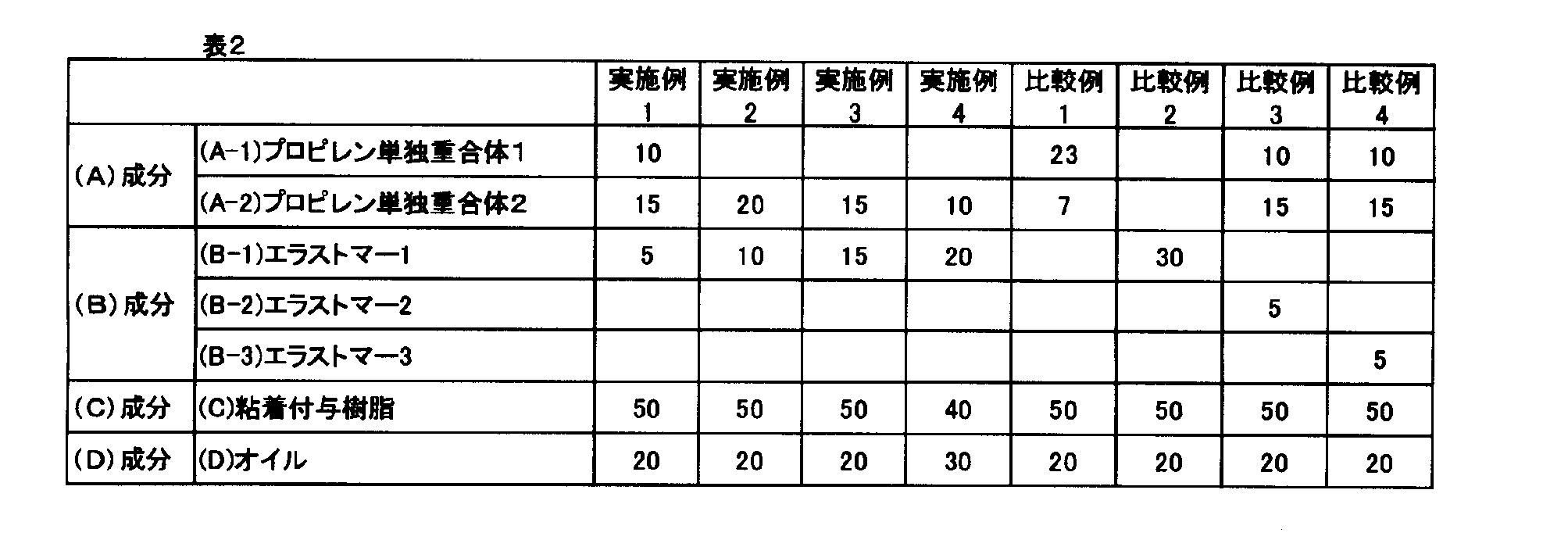
(A-1)プロピレン単独重合体1
出光興産株式会社製:商品名「エルモーデュ(L-MODU) S901」
(A-2)プロピレン単独重合体2
出光興産株式会社製:商品名「エルモーデュ(L-MODU) S400」
(B-1)エラストマー1
スチレンブタジエンランダム共重合体の水素化物 JSR株式会社製:商品名「ダイナロン1321P」(破断伸び811%、引張弾性率2.0MPa、スチレン含有量10質量%)
(B-2)エラストマー2
スチレンブタジエンブロック共重合体 Kraton Polymer社製:商品名「クレイトンD-1102JSZ」(破断伸び629%、引張弾性率22.6MPa)
(B-3)エラストマー3
スチレンブタジエンブロック共重合体の水素化物 JSR株式会社製:商品名「ダイナロン8600P」(破断伸び684%、引張弾性率2.3MPa)
(C)粘着付与樹脂
水添脂環族系炭化水素樹脂 エクソンモービルケミカル社製:商品名「エスコレッツ5300」
(D)オイル
パラフィン系プロセスオイル 出光興産株式会社製:商品名「ダイアナプロセスオイルPW-90」
出光興産株式会社製:商品名「エルモーデュ(L-MODU) S901」
(A-2)プロピレン単独重合体2
出光興産株式会社製:商品名「エルモーデュ(L-MODU) S400」
(B-1)エラストマー1
スチレンブタジエンランダム共重合体の水素化物 JSR株式会社製:商品名「ダイナロン1321P」(破断伸び811%、引張弾性率2.0MPa、スチレン含有量10質量%)
(B-2)エラストマー2
スチレンブタジエンブロック共重合体 Kraton Polymer社製:商品名「クレイトンD-1102JSZ」(破断伸び629%、引張弾性率22.6MPa)
(B-3)エラストマー3
スチレンブタジエンブロック共重合体の水素化物 JSR株式会社製:商品名「ダイナロン8600P」(破断伸び684%、引張弾性率2.3MPa)
(C)粘着付与樹脂
水添脂環族系炭化水素樹脂 エクソンモービルケミカル社製:商品名「エスコレッツ5300」
(D)オイル
パラフィン系プロセスオイル 出光興産株式会社製:商品名「ダイアナプロセスオイルPW-90」
[ホットメルト接着剤の評価]
各ホットメルト接着剤について溶融粘度を測定した。また各ホットメルト接着剤の接着性能を評価する目的で貼り合わせ試験片を作成し、以下に示す各条件でT形剥離接着強度を測定した。評価結果を表3に示す。
各ホットメルト接着剤について溶融粘度を測定した。また各ホットメルト接着剤の接着性能を評価する目的で貼り合わせ試験片を作成し、以下に示す各条件でT形剥離接着強度を測定した。評価結果を表3に示す。
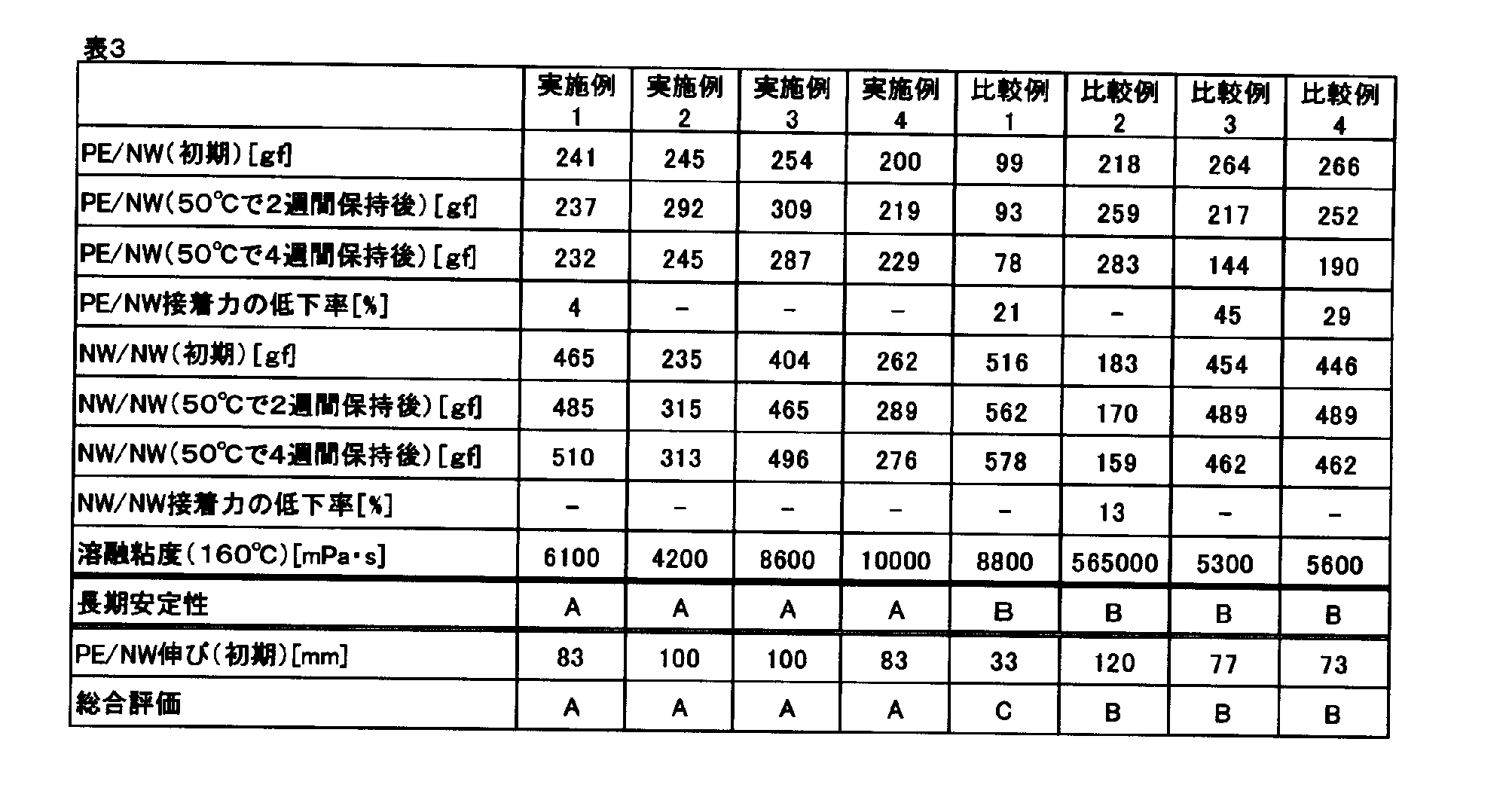
[溶融粘度]
JIS K-6862に準拠して、ブルックフィールド型回転粘度計を用いて160℃で測定した。
JIS K-6862に準拠して、ブルックフィールド型回転粘度計を用いて160℃で測定した。
[貼り合わせ試験片の作成]
メック株式会社製HMAコーターシステムにノードソン株式会社製のスパイラルスプレーガンをセットして、ホットメルト接着剤が塗布された塗工基材と貼り合わせ基材とが接着された積層体を作成した。
塗工基材としてはPP不織布(SMS3層,17g/m2,150mm巾)または通気性のPEフィルム(20g/m2,150mm巾)を、貼り合わせ基材としてはPP不織布(同上)を使用し、ライン速度150m/分で貼り合わせた。
スパイラルスプレーガン(ノズル径約0.5mmφ)の塗工条件は、ホットメルト接着剤の溶融温度を150℃、スプレーガン温度を150℃、ホットエアー温度を180℃とした。ホットメルト接着剤の塗布量は4g/m2とし、塗工されたスパイラルの巾が約15mmとなるようにホットエアー圧を調節した。塗工後にプレスローラーで圧着するための圧力は0.1MPa、オープンタイムは約0.1秒とした。
ホットメルト接着剤で貼り合わせた積層体は、基材の進行方向に対して垂直の方向(CD方向)に25mm巾で切断し、T形剥離接着強度を測定するための試験片とした。PEフィルム‐PP不織布の接着強度試験結果は、表中で「PE/NW」と示し、PP不織布‐PP不織布の接着強度試験結果は、表中で「NW/NW」と示した。試験片は23℃,50%RHで24時間以上養生した後に、同環境下でT形剥離試験を行った。
剥離接着力の経時での変化を評価するため、23℃,50%RHで24時間以上養生した試験片を50℃で2週間、4週間保持し、更に23℃,50%RHで24時間養生した後に同様に剥離接着強度を測定した。
メック株式会社製HMAコーターシステムにノードソン株式会社製のスパイラルスプレーガンをセットして、ホットメルト接着剤が塗布された塗工基材と貼り合わせ基材とが接着された積層体を作成した。
塗工基材としてはPP不織布(SMS3層,17g/m2,150mm巾)または通気性のPEフィルム(20g/m2,150mm巾)を、貼り合わせ基材としてはPP不織布(同上)を使用し、ライン速度150m/分で貼り合わせた。
スパイラルスプレーガン(ノズル径約0.5mmφ)の塗工条件は、ホットメルト接着剤の溶融温度を150℃、スプレーガン温度を150℃、ホットエアー温度を180℃とした。ホットメルト接着剤の塗布量は4g/m2とし、塗工されたスパイラルの巾が約15mmとなるようにホットエアー圧を調節した。塗工後にプレスローラーで圧着するための圧力は0.1MPa、オープンタイムは約0.1秒とした。
ホットメルト接着剤で貼り合わせた積層体は、基材の進行方向に対して垂直の方向(CD方向)に25mm巾で切断し、T形剥離接着強度を測定するための試験片とした。PEフィルム‐PP不織布の接着強度試験結果は、表中で「PE/NW」と示し、PP不織布‐PP不織布の接着強度試験結果は、表中で「NW/NW」と示した。試験片は23℃,50%RHで24時間以上養生した後に、同環境下でT形剥離試験を行った。
剥離接着力の経時での変化を評価するため、23℃,50%RHで24時間以上養生した試験片を50℃で2週間、4週間保持し、更に23℃,50%RHで24時間養生した後に同様に剥離接着強度を測定した。
[T形剥離試験]
T型剥離試験には株式会社島津製作所製オートグラフAGS-Xを用い、剥離速度100mm/min,剥離長さ30mmで剥離試験を行い、極大値2点の平均値を計算した。各ホットメルト接着剤について5個の試験片の測定を行い、上位3個の平均値をもって剥離接着強度とした。
T型剥離試験には株式会社島津製作所製オートグラフAGS-Xを用い、剥離速度100mm/min,剥離長さ30mmで剥離試験を行い、極大値2点の平均値を計算した。各ホットメルト接着剤について5個の試験片の測定を行い、上位3個の平均値をもって剥離接着強度とした。
[安定性評価]
A:以下の条件を全て満たす
B:以下の条件のいずれか1つを満たす
C:以下の条件をいずれも満たさない
(1)PE/NW接着力の低下率:20%以下
低下率=[(初期の剥離接着強度)―(4週間エイジングの剥離接着強度)]/(初期の剥離接着強度)
※低下してないデータは、「-」と表記し、当該条件を満たすと判断した。
(2)NW/NW接着力の低下率:10%以下
低下率=[(初期の剥離接着強度)―(4週間エイジングの剥離接着強度)]/(初期の剥離接着強度)
※低下してないデータは、「-」と表記し、当該条件を満たすと判断した。
A:以下の条件を全て満たす
B:以下の条件のいずれか1つを満たす
C:以下の条件をいずれも満たさない
(1)PE/NW接着力の低下率:20%以下
低下率=[(初期の剥離接着強度)―(4週間エイジングの剥離接着強度)]/(初期の剥離接着強度)
※低下してないデータは、「-」と表記し、当該条件を満たすと判断した。
(2)NW/NW接着力の低下率:10%以下
低下率=[(初期の剥離接着強度)―(4週間エイジングの剥離接着強度)]/(初期の剥離接着強度)
※低下してないデータは、「-」と表記し、当該条件を満たすと判断した。
[伸び]
T型剥離試験において、試験力上位3個の剥離時ストローク距離平均を試験力伸びとした。
T型剥離試験において、試験力上位3個の剥離時ストローク距離平均を試験力伸びとした。
[総合評価]
A:以下の条件を全て満たす
B:以下の条件のいずれか1つを満たさない
C:以下の条件のいずれか2つを満たさない
(1)PE/NW接着力(初期):200gf以上
(2)NW/NW接着力(初期):200gf以上
(3)伸び(初期):80mm以上
A:以下の条件を全て満たす
B:以下の条件のいずれか1つを満たさない
C:以下の条件のいずれか2つを満たさない
(1)PE/NW接着力(初期):200gf以上
(2)NW/NW接着力(初期):200gf以上
(3)伸び(初期):80mm以上
本発明のホットメルト接着剤は、溶融時の流動性が高く、PP不織布同士の高い接着強度を示し、更に、PEフィルム‐PP不織布の高い接着性及び長期安定性を有する。また、本発明のホットメルト接着剤は、溶融時の流動性が高く、PP不織布同士の高い接着強度を示し、更に、PEフィルム‐PP不織布の高い接着強度、及び優れた伸びを有する。このため、衛生材料用、包装用、製本用、繊維用、木工用、電気材料用、製缶用、建築用及び製袋用等のホットメルト接着剤として好適に用いることができる。
Claims (17)
- (A)下記(i)~(iii)を満たすプロピレン単独重合体と、
(B)スチレン系ランダム共重合体、及び破断伸び700%以上かつ引張弾性率10MPa以下のエラストマー類から選ばれる少なくとも一種と
を含むホットメルト接着剤。
(i)23℃における引張弾性率が400MPa以下
(ii)重量平均分子量(Mw)が10,000~150,000
(iii)Mw/Mnが2.5以下 - (B)が、スチレン系ランダム共重合体である、請求項1に記載のホットメルト接着剤。
- (B)スチレン系ランダム共重合体が、水添されたスチレン系共重合体である、請求項2に記載のホットメルト接着剤。
- (A)プロピレン単独重合体の含有量が、ホットメルト接着剤100質量部に対して1~50質量部である、請求項2又は3に記載のホットメルト接着剤。
- (B)スチレン系ランダム共重合体の含有量が、ホットメルト接着剤100質量部に対して、1~50質量部である、請求項2~4のいずれかに記載のホットメルト接着剤。
- (B)スチレン系ランダム共重合体が、芳香族ビニル化合物と共役ジエンのランダム共重合体である、請求項2~5のいずれかに記載のホットメルト接着剤。
- (B)スチレン系ランダム共重合体の芳香族ビニル化合物由来の構成単位の含有量が、1~40質量%である、請求項6に記載のホットメルト接着剤。
- (B)スチレン系ランダム共重合体の共役ジエン由来の構成単位の含有量が、60~99質量%である、請求項6又は7に記載のホットメルト接着剤。
- (B)スチレン系ランダム共重合体が、破断伸び700%以上かつ引張弾性率10MPa以下である、請求項2~8のいずれかに記載のホットメルト接着剤。
- (B)が、破断伸び700%以上かつ引張弾性率10MPa以下のエラストマー類である、請求項1に記載のホットメルト接着剤。
- (B)エラストマー類が、(Ba)ランダム共重合体である、請求項10に記載のホットメルト接着剤。
- (B)エラストマー類が、(Bb)スチレン系共重合体である、請求項10又は11に記載のホットメルト接着剤。
- (B)エラストマー類が、(Bc)水添されたスチレン系共重合体である、請求項10~12のいずれかに記載のホットメルト接着剤。
- (B)エラストマー類が、(Bd)水添されたスチレン系ランダム共重合体である、請求項10~13のいずれかに記載のホットメルト接着剤。
- (B)エラストマー類が、芳香族ビニル化合物と共役ジエンのランダム共重合体である、請求項10~14のいずれかに記載のホットメルト接着剤。
- (A)プロピレン単独重合体の含有量が、ホットメルト接着剤100質量部に対して1~50質量部である、請求項10~15のいずれかに記載のホットメルト接着剤。
- (B)エラストマー類の含有量が、ホットメルト接着剤100質量部に対して、1~50質量部である、請求項10~16のいずれかに記載のホットメルト接着剤。
Applications Claiming Priority (4)
| Application Number | Priority Date | Filing Date | Title |
|---|---|---|---|
| JP2014018620A JP2015145471A (ja) | 2014-02-03 | 2014-02-03 | ホットメルト接着剤 |
| JP2014-018623 | 2014-02-03 | ||
| JP2014018623A JP6346451B2 (ja) | 2014-02-03 | 2014-02-03 | ホットメルト接着剤 |
| JP2014-018620 | 2014-02-03 |
Publications (1)
| Publication Number | Publication Date |
|---|---|
| WO2015115449A1 true WO2015115449A1 (ja) | 2015-08-06 |
Family
ID=53757022
Family Applications (1)
| Application Number | Title | Priority Date | Filing Date |
|---|---|---|---|
| PCT/JP2015/052267 Ceased WO2015115449A1 (ja) | 2014-02-03 | 2015-01-28 | ホットメルト接着剤 |
Country Status (1)
| Country | Link |
|---|---|
| WO (1) | WO2015115449A1 (ja) |
Cited By (5)
| Publication number | Priority date | Publication date | Assignee | Title |
|---|---|---|---|---|
| US20170145198A1 (en) * | 2014-07-03 | 2017-05-25 | Idemitsu Kosan Co., Ltd. | Spunbonded non-woven fabric and method for manufacturing same |
| JP2019011422A (ja) * | 2017-06-30 | 2019-01-24 | ヘンケルジャパン株式会社 | ホットメルト接着剤 |
| WO2020085299A1 (ja) * | 2018-10-22 | 2020-04-30 | 出光興産株式会社 | ホットメルト接着剤 |
| JP2022065181A (ja) * | 2017-06-30 | 2022-04-26 | ヘンケルジャパン株式会社 | ホットメルト接着剤 |
| CN116218435A (zh) * | 2023-03-09 | 2023-06-06 | 佛山市本嘉新材料科技有限公司 | 一种卫生用品端封胶及其制备方法、刮涂方法 |
Citations (6)
| Publication number | Priority date | Publication date | Assignee | Title |
|---|---|---|---|---|
| WO2001096490A1 (en) * | 2000-06-14 | 2001-12-20 | Idemitsu Petrochemical Co., Ltd. | Polyolefin resin for hot-melt adhesive |
| WO2003091289A1 (en) * | 2002-04-23 | 2003-11-06 | Idemitsu Kosan Co., Ltd. | Process for producing highly flowable propylene polymer and highly flowable propylene polymer |
| WO2009113153A1 (ja) * | 2008-03-10 | 2009-09-17 | ニチバン株式会社 | 表面保護シート |
| JP2013064056A (ja) * | 2011-09-16 | 2013-04-11 | Henkel Japan Ltd | ホットメルト接着剤 |
| JP2013064055A (ja) * | 2011-09-16 | 2013-04-11 | Henkel Japan Ltd | ホットメルト接着剤 |
| WO2014077258A1 (ja) * | 2012-11-15 | 2014-05-22 | 出光興産株式会社 | プロピレン系重合体及びホットメルト接着剤 |
-
2015
- 2015-01-28 WO PCT/JP2015/052267 patent/WO2015115449A1/ja not_active Ceased
Patent Citations (6)
| Publication number | Priority date | Publication date | Assignee | Title |
|---|---|---|---|---|
| WO2001096490A1 (en) * | 2000-06-14 | 2001-12-20 | Idemitsu Petrochemical Co., Ltd. | Polyolefin resin for hot-melt adhesive |
| WO2003091289A1 (en) * | 2002-04-23 | 2003-11-06 | Idemitsu Kosan Co., Ltd. | Process for producing highly flowable propylene polymer and highly flowable propylene polymer |
| WO2009113153A1 (ja) * | 2008-03-10 | 2009-09-17 | ニチバン株式会社 | 表面保護シート |
| JP2013064056A (ja) * | 2011-09-16 | 2013-04-11 | Henkel Japan Ltd | ホットメルト接着剤 |
| JP2013064055A (ja) * | 2011-09-16 | 2013-04-11 | Henkel Japan Ltd | ホットメルト接着剤 |
| WO2014077258A1 (ja) * | 2012-11-15 | 2014-05-22 | 出光興産株式会社 | プロピレン系重合体及びホットメルト接着剤 |
Cited By (8)
| Publication number | Priority date | Publication date | Assignee | Title |
|---|---|---|---|---|
| US20170145198A1 (en) * | 2014-07-03 | 2017-05-25 | Idemitsu Kosan Co., Ltd. | Spunbonded non-woven fabric and method for manufacturing same |
| US10844205B2 (en) * | 2014-07-03 | 2020-11-24 | Idemitsu Kosan Co., Ltd. | Spunbonded non-woven fabric and method for manufacturing same |
| JP2019011422A (ja) * | 2017-06-30 | 2019-01-24 | ヘンケルジャパン株式会社 | ホットメルト接着剤 |
| JP7032878B2 (ja) | 2017-06-30 | 2022-03-09 | ヘンケルジャパン株式会社 | ホットメルト接着剤 |
| JP2022065181A (ja) * | 2017-06-30 | 2022-04-26 | ヘンケルジャパン株式会社 | ホットメルト接着剤 |
| JP7289952B2 (ja) | 2017-06-30 | 2023-06-12 | ヘンケルジャパン株式会社 | ホットメルト接着剤 |
| WO2020085299A1 (ja) * | 2018-10-22 | 2020-04-30 | 出光興産株式会社 | ホットメルト接着剤 |
| CN116218435A (zh) * | 2023-03-09 | 2023-06-06 | 佛山市本嘉新材料科技有限公司 | 一种卫生用品端封胶及其制备方法、刮涂方法 |
Similar Documents
| Publication | Publication Date | Title |
|---|---|---|
| US9822283B2 (en) | Hot melt adhesive | |
| CN106255735B (zh) | 热熔粘合剂 | |
| JP5947153B2 (ja) | ホットメルト接着剤 | |
| US10400142B2 (en) | Hot melt adhesive | |
| JP5924894B2 (ja) | 使い捨て製品用ホットメルト接着剤 | |
| JP2009242533A (ja) | ホットメルト接着剤 | |
| JP2013064055A (ja) | ホットメルト接着剤 | |
| KR102715472B1 (ko) | 보다 낮은 용융 점도를 갖는 핫 멜트 접착제 조성물 | |
| WO2015115449A1 (ja) | ホットメルト接着剤 | |
| JPWO2016104539A1 (ja) | ホットメルト接着剤用ベースポリマー | |
| CN110114432A (zh) | 用于弹性附件的热熔性粘合剂组合物 | |
| JP6346451B2 (ja) | ホットメルト接着剤 | |
| JP2015145471A (ja) | ホットメルト接着剤 | |
| JP2019116554A (ja) | 組成物、粘着剤および粘着フィルム | |
| JP2016180105A (ja) | 使い捨て製品用ホットメルト接着剤 | |
| JP2015092008A (ja) | ホットメルト接着剤 |
Legal Events
| Date | Code | Title | Description |
|---|---|---|---|
| 121 | Ep: the epo has been informed by wipo that ep was designated in this application |
Ref document number: 15742922 Country of ref document: EP Kind code of ref document: A1 |
|
| NENP | Non-entry into the national phase |
Ref country code: DE |
|
| 122 | Ep: pct application non-entry in european phase |
Ref document number: 15742922 Country of ref document: EP Kind code of ref document: A1 |