WO2015076216A1 - Cutting insert, cutting tool, and method for producing cut article - Google Patents
Cutting insert, cutting tool, and method for producing cut article Download PDFInfo
- Publication number
- WO2015076216A1 WO2015076216A1 PCT/JP2014/080315 JP2014080315W WO2015076216A1 WO 2015076216 A1 WO2015076216 A1 WO 2015076216A1 JP 2014080315 W JP2014080315 W JP 2014080315W WO 2015076216 A1 WO2015076216 A1 WO 2015076216A1
- Authority
- WO
- WIPO (PCT)
- Prior art keywords
- wiper blade
- blade
- cutting
- insert
- corner
- Prior art date
- Legal status (The legal status is an assumption and is not a legal conclusion. Google has not performed a legal analysis and makes no representation as to the accuracy of the status listed.)
- Ceased
Links
Images

Classifications
-
- B—PERFORMING OPERATIONS; TRANSPORTING
- B23—MACHINE TOOLS; METAL-WORKING NOT OTHERWISE PROVIDED FOR
- B23C—MILLING
- B23C5/00—Milling-cutters
- B23C5/02—Milling-cutters characterised by the shape of the cutter
- B23C5/06—Face-milling cutters, i.e. having only or primarily a substantially flat cutting surface
-
- B—PERFORMING OPERATIONS; TRANSPORTING
- B23—MACHINE TOOLS; METAL-WORKING NOT OTHERWISE PROVIDED FOR
- B23C—MILLING
- B23C5/00—Milling-cutters
- B23C5/16—Milling-cutters characterised by physical features other than shape
- B23C5/20—Milling-cutters characterised by physical features other than shape with removable cutter bits or teeth or cutting inserts
- B23C5/202—Plate-like cutting inserts with special form
-
- B—PERFORMING OPERATIONS; TRANSPORTING
- B23—MACHINE TOOLS; METAL-WORKING NOT OTHERWISE PROVIDED FOR
- B23C—MILLING
- B23C2200/00—Details of milling cutting inserts
- B23C2200/04—Overall shape
- B23C2200/0422—Octagonal
-
- B—PERFORMING OPERATIONS; TRANSPORTING
- B23—MACHINE TOOLS; METAL-WORKING NOT OTHERWISE PROVIDED FOR
- B23C—MILLING
- B23C2200/00—Details of milling cutting inserts
- B23C2200/08—Rake or top surfaces
-
- B—PERFORMING OPERATIONS; TRANSPORTING
- B23—MACHINE TOOLS; METAL-WORKING NOT OTHERWISE PROVIDED FOR
- B23C—MILLING
- B23C2200/00—Details of milling cutting inserts
- B23C2200/12—Side or flank surfaces
- B23C2200/123—Side or flank surfaces curved
-
- B—PERFORMING OPERATIONS; TRANSPORTING
- B23—MACHINE TOOLS; METAL-WORKING NOT OTHERWISE PROVIDED FOR
- B23C—MILLING
- B23C2200/00—Details of milling cutting inserts
- B23C2200/20—Top or side views of the cutting edge
- B23C2200/203—Curved cutting edges
-
- B—PERFORMING OPERATIONS; TRANSPORTING
- B23—MACHINE TOOLS; METAL-WORKING NOT OTHERWISE PROVIDED FOR
- B23C—MILLING
- B23C2200/00—Details of milling cutting inserts
- B23C2200/20—Top or side views of the cutting edge
- B23C2200/205—Discontinuous cutting edges
-
- B—PERFORMING OPERATIONS; TRANSPORTING
- B23—MACHINE TOOLS; METAL-WORKING NOT OTHERWISE PROVIDED FOR
- B23C—MILLING
- B23C2200/00—Details of milling cutting inserts
- B23C2200/20—Top or side views of the cutting edge
- B23C2200/208—Wiper, i.e. an auxiliary cutting edge to improve surface finish
Definitions
- the present invention relates to a cutting insert, a cutting tool, and a method for manufacturing a workpiece.
- a rolling tool used for milling a workpiece generally includes a plurality of cutting inserts. At this time, in order to finish the work surface of the work material more flat, at least of a plurality of cutting inserts (throw away inserts) as in a rolling tool disclosed in Japanese Patent Laid-Open No. 2001-138122 (Patent Document 1). It is known that one has a structure (a throw-away tip with a wiper blade) having a wiper blade that protrudes toward a work material as compared with a wiping blade included in another cutting insert.
- the wiper blade is a substantially linear cutting blade or a substantially arc-shaped cutting blade having a large curvature radius.
- the rotation trajectory of the cutting insert with the wiper blade that cuts the workpiece first and the workpiece is cut later.
- the area overlapping with the rotation trajectory of the cutting insert with the wiper blade to be enlarged becomes larger. Therefore, the thickness of the chips cut by the wiper blade may become excessively thin.
- the thickness of the chip is excessively thin, the work surface of the work material is raised as if it was peeled off, and the state of the finished surface may be deteriorated.
- the present invention has been made in view of the above-described problems, and provides a cutting insert, a cutting tool, and a method for manufacturing a cut product that can improve the state of a finished surface by suppressing the occurrence of a peeling phenomenon. is there.
- the cutting insert based on 1 aspect of this invention is a polygon-shaped upper surface, a lower surface, the side surface connected to each of the said upper surface and the said lower surface, and the cutting blade located in the intersection part of the said upper surface and the said side surface It has.
- the cutting blade is located between the first corner blade and the second corner blade having an arc shape located at corners adjacent to each other on the upper surface, and between the first corner blade and the second corner blade. And a wiper blade.
- the wiper blade includes an arc-shaped first wiper blade and an arc-shaped second wiper blade positioned closer to the second corner blade than the first wiper blade.
- the radius of curvature of the first wiper blade is R1
- the radius of curvature of the second wiper blade is R2
- the radius of curvature of the first corner blade and the second corner blade is R0. In this case, R0 ⁇ R1 ⁇ R2.
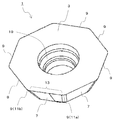
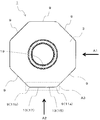
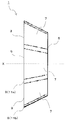
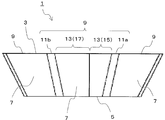
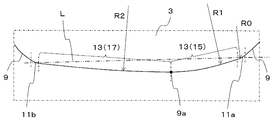
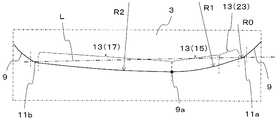
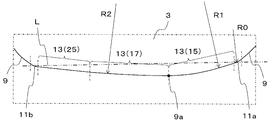
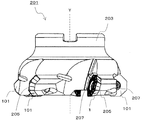
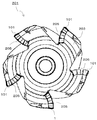
- FIG. 1 It is a perspective view which shows the cutting tool of the 1st Embodiment of this invention. It is a perspective view which shows the cutting insert of the 1st Embodiment of this invention. It is a top view of the cutting insert shown in FIG. It is a side view from the A1 direction in the cutting insert shown in FIG. It is a side view from the A2 direction in the cutting insert shown in FIG. It is the enlarged view to which area
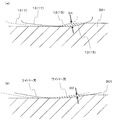
- (A) is a conceptual diagram at the time of cutting using the cutting insert shown in FIG.
- (B) is a conceptual diagram at the time of cutting using the conventional cutting insert. It is the top view which expanded a part of modification 1 of the cutting insert shown in FIG.
- the cutting insert of one embodiment is explained in detail using a drawing.
- the drawings referred to below for convenience of explanation, among the constituent members of the embodiment, only the main members necessary for explaining the present invention are shown in a simplified manner. Therefore, the cutting insert of the present invention may include any component not shown in the drawings to which the present specification refers.
- the dimension of the member in each figure does not represent the dimension of an actual structural member, the dimension ratio of each member, etc. faithfully.
- a cutting insert 1 with a wiper blade of the present embodiment (hereinafter also referred to as a first insert 1 for convenience), as illustrated in FIG. 1, is an insert pocket 205 positioned on the distal end side of a tool body 203 described later. It is a cutting insert which is detachably attached to.
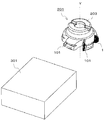
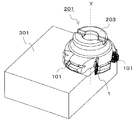
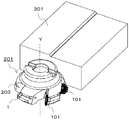
- a cutting tool 201 used for milling illustrated in FIG. 1 includes a tool main body 203, a first insert 1 having a wiper blade attached to the tool main body 203, and a cutting insert 101 having no wiper blade (hereinafter referred to as a “cutting tool”). For convenience, it is also referred to as a second insert 101).
- the first insert 1 of the present embodiment includes a substantially polygonal upper surface 3, a lower surface 5, side surfaces 7 connected to the upper surface 3 and the lower surface 5, respectively, A cutting edge 9 is provided at the intersection with the side surface 7.
- the upper surface 3 functions as a rake face through which chips flow during cutting.
- the upper surface 3 has a substantially polygonal shape, and has a substantially octagonal shape in the present embodiment.
- the substantially polygonal shape does not mean strictly a polygonal shape.
- the corner portions on the upper surface 3 in the present embodiment are not strict corners, but are rounded.
- the side portions on the upper surface 3 are not strictly linear, but are slightly curved as will be described later.
- the lower surface 5 is a surface located on the side opposite to the upper surface 3 and functions as a seating surface for the insert pocket when the first insert 1 is attached to the tool body.
- the lower surface 5 in the present embodiment has a substantially polygonal shape, specifically a substantially octagonal shape, like the upper surface 3. At this time, the lower surface 5 is configured to be slightly smaller than the upper surface 3. Therefore, the lower surface 5 is configured to be similar to the upper surface 3.
- the cutting blade 9 in the present embodiment has a first corner blade 11a and a second corner blade 11b, and at least one wiper blade 13.
- the first corner blade 11 a and the second corner blade 11 b are respectively located at corners adjacent to each other on the upper surface 3. Since the corner portion of the upper surface 3 has a rounded shape as described above, the first corner blade 11a and the second corner blade 11b each have an arc shape when viewed from above.
- the first corner blade 11a is located on the outer peripheral side of the tool body with respect to the second corner blade 11b when the first insert 1 is attached to the tool body.
- the second corner blade 11b is positioned closer to the inner peripheral side of the tool body than the first corner blade 11a when the first insert 1 is attached to the tool body.
- FIG. 6 the right side corresponds to the outer peripheral side of the tool body, and the left side corresponds to the inner peripheral side of the tool body. Further, the lower side of FIG. 6 corresponds to the tip direction from the tool body, in other words, the direction protruding toward the work material.
- the wiper blade 13 is located between the first corner blade 11a and the second corner blade 11b adjacent to each other, that is, on the side of the upper surface 3.
- the wiper blade 13 functions as a cutting blade that finishes the processed surface of the work material smoothly. Therefore, when the first insert 1 is attached to the tool body, the wiper blade 13 includes the tip portion 9a that protrudes most from the tool body in the tip direction, in other words, toward the work material. Is provided.
- the tip end portion 9a is located at a portion farthest from the virtual straight line L connecting the center of the first corner blade 11a and the center of the second corner blade 11b when the wiper blade 13 is viewed from above. ing.
- the wiper blade 13 in the present embodiment has a first wiper blade 15 and a second wiper blade 17.
- the first wiper blade 15 is located closer to the first corner blade 11 a than the second wiper blade 17. Therefore, the first wiper blade 15 is located on the outer peripheral side of the tool body with respect to the second wiper blade 17 when the first insert 1 is attached to the tool body.
- at least a part of the first wiper blade 15 is provided so as to be positioned on the outer peripheral side of the tool main body with respect to the tip portion 9a.
- the second wiper blade 17 is located closer to the second corner blade 11b than the first wiper blade 15. Therefore, the second wiper blade 17 is provided so as to be positioned closer to the inner peripheral side of the tool body than the first wiper blade 15. In other words, the second wiper blade 17 is provided so as to be positioned closer to the rotation center axis side of the tool body than the first wiper blade 15. In the present embodiment, the second wiper blade is provided so that at least a part of the second wiper blade is located on the inner peripheral side of the tool body with respect to the tip end portion 9a when the first insert 1 is attached to the tool body. Yes.
- the first wiper blade 15 and the second wiper blade 17 are continuous.
- the first wiper blade 15 and the second wiper blade 15 are located at the furthest part from the virtual straight line L connecting the center of the first corner blade 11a and the center of the second corner blade 11b.
- the boundary with the wiper blade 17 is located.
- the tip end portion 9 a is located at the boundary between the first wiper blade 15 and the second wiper blade 17. Therefore, the entire first wiper blade 15 is provided so as to be positioned on the outer peripheral side of the tool body with respect to the tip end portion 9a. Further, the entire second wiper blade 17 is provided so as to be located on the inner peripheral side of the tool body with respect to the tip end portion 9a.
- the tip end portion 9 a of the cutting edge 9 is located at the lowest position among the cutting edges 9.
- the first wiper blade 15 is provided so as to be positioned on the outer peripheral side of the tool body, that is, on the right side in FIG. 6 among the wiper blades 13 sandwiched between the first corner blade 11a and the second corner blade 11b. And is continuous with the first corner blade 11a.
- the second wiper blade 17 is positioned on the inner peripheral side of the tool body, that is, on the left side in FIG. 6, of the wiper blade 13 sandwiched between the first corner blade 11a and the second corner blade 11b. It is provided and continues to the second corner blade 11b.
- the first wiper blade 15 and the second wiper blade 17 are each formed to have an arc shape when viewed from above.
- the radius of curvature of the first corner blade 11a and the second corner blade 11b is R0
- the radius of curvature of the first wiper blade 15 is R1
- the radius of curvature of the second wiper blade 17 is R2.
- the wiper blade 13 having a large curvature radius is positioned between the first corner blade 11a and the second corner blade 11b having a small curvature radius.
- the wiper blade 13 has a curved shape instead of a linear shape.
- the wiper blade 13 is not a simple circular arc shape consisting of a single arc, but is positioned on the outer peripheral side during cutting, the first wiper blade 15 having a relatively small radius of curvature, and the inner peripheral side during cutting And a second wiper blade 17 having a relatively large radius of curvature.
- the chip thickness D2 is very small, as shown in FIG. 7B.
- the locus of the wiper blade that cuts the workpiece 301 first is indicated by a one-dot chain line.
- the radius of curvature of the first wiper blade 15 is relatively small. Therefore, the cutting angle of the entire first wiper blade 15 is increased, and excessive cutting of the work material 301 by the wiper blade 13 that previously cuts the work material 301, which is indicated by a dashed line, is suppressed. The Thereby, when cutting with the cutting insert 1 with a wiper blade shown with a continuous line next, the thickness D1 of the chip cut with the 2nd wiper blade 17 is securable.
- the overall cutting angle of the first wiper blade 15 is defined by an imaginary straight line connecting one end and the other end of the first wiper blade 15 to the work surface of the work material. Means an angle.
- the curvature radius R0 of the first corner blade 11a and the second corner blade 11b in the above embodiment is set to about 0.4 to 2 mm.
- the radius of curvature R1 of the first wiper blade 15 is set to about 50 to 200 mm.
- the radius of curvature R2 of the second wiper blade 17 is set to about 200 to 800 mm.
- the wiper blade 13 located on the side of the upper surface 3 is constituted by an arc-shaped first wiper blade 15 and an arc-shaped second wiper blade 17. Therefore, the side portion on the upper surface 3 has a slightly curved shape.
- the second wiper blade 17 is longer than the first wiper blade 15. As a result, the length of the second wiper blade 17 can be ensured while ensuring a large cutting angle of the first wiper blade 15. Therefore, since the length of the second wiper blade 17 having a relatively small cutting angle can be ensured, the flatness of the processed surface can be improved.
- the intersecting line portion between the upper surface 3 and the side surface 7 may not be a strict line shape due to the intersection of the two surfaces.
- the intersection line between the upper surface 3 and the side surface 7 is sharp, the durability of the cutting blade 9 is lowered.
- a portion where the upper surface 3 and the side surface 7 intersect with each other may be slightly curved so-called honing.
- Examples of the material of the first insert 1 include cemented carbide or cermet.
- the composition of the cemented carbide is, for example, WC—Co produced by adding cobalt (Co) powder to tungsten carbide (WC) and sintering, and WC—coating WC—Co with titanium carbide (TiC).
- WC—TiC—TaC—Co in which tantalum carbide (TaC) is added to TiC—Co or WC—TiC—Co.
- the cermet is a sintered composite material in which a metal is combined with a ceramic component, and specifically includes a titanium compound mainly composed of titanium carbide (TiC) or titanium nitride (TiN).
- the surface of the first insert 1 may be coated with a film using a chemical vapor deposition (CVD) method or a physical vapor deposition (PVD) method.
- CVD chemical vapor deposition
- PVD physical vapor deposition
- the composition of the coating include titanium carbide (TiC), titanium nitride (TiN), titanium carbonitride (TiCN), and alumina (Al 2 O 3 ).
- the shapes of the upper surface 3 and the lower surface 5 are not limited to the above forms.
- the shape of the upper surface 3 when viewed from above is substantially octagonal.
- the shape of the upper surface 3 when viewed from above is triangular, quadrangular, pentagonal or hexagonal. Such a polygonal shape may be used.
- a through hole 19 is formed from the center of the upper surface 3 to the center of the lower surface 5.
- the through hole 19 is provided for inserting a screw when the first insert 1 is screwed and fixed to the tool body of the cutting tool.
- the direction of the central axis X of the through hole 19, in other words, the through direction is orthogonal to the upper surface 3 and the lower surface 5.
- the maximum width when the top surface 3 of the first insert 1 of the present embodiment is viewed from above is 20 to 30 mm.
- the height from the lower surface 5 to the upper surface 3 is 3 to 7 mm.
- the height from the lower surface 5 to the upper surface 3 means a width in a direction parallel to the through hole 19 between the upper end of the upper surface 3 and the lower end of the lower surface 5.
- the cutting tool 201 of the present embodiment has a rotation center axis Y and a tool body 203 (hereinafter also referred to as a holder 203) having a plurality of insert pockets 205 on the outer peripheral surface on the distal end side.
- the first insert 1 mounted in at least one of the insert pockets 205, and the second insert 101 mounted in the insert pocket 205 in which the first insert 1 is not mounted. Yes.
- the second insert 101 has a configuration similar to that of the first insert 1 and does not have the wiper blade 13 in the first insert 1. Specifically, like the first insert 1, the second insert 101 has a substantially polygonal upper and lower surfaces and side surfaces between the upper and lower surfaces. Further, a cutting edge is formed at the intersection of the upper surface and the side surface of the second insert 101. However, the cutting blade in the second insert 101 does not have a wiper blade.
- the portion of the second insert 101 corresponding to the wiper blade 13 connecting the first corner blade 11a and the second corner blade 11b of the first insert 1 has a linear shape. Therefore, when the first insert 1 and the second insert 101 are mounted on the holder 203, the above-mentioned cutting blade portion of the second insert 101 is located behind the holder 203 rather than the wiper blade 13 of the first insert 1. Located on the end side. As described above, the wiper blade 13 in the first insert 1 protrudes in the distal direction from the cutting blade in the second insert 101, so that the processed surface of the work material can be satisfactorily finished with the wiper blade 13. it can.
- the first insert 1 provided with the wiper blade 13 is subjected to a larger load than the second insert 101 not provided with the wiper blade. Therefore, only the plurality of first inserts 1 may be attached to the holder 203, but in general, the second insert 101 is also attached to the holder 203 in addition to the first insert 1.
- the number of the second insert 101 is usually larger than that of the first insert 1. Mounted on the holder 203.
- the holder 203 has a substantially rotating body shape around the rotation center axis Y.
- a plurality of insert pockets 205 are provided at equal intervals on the outer peripheral surface on the tip side of the holder 203.
- the insert pocket 205 is a part to which the first insert 1 or the second insert 101 is attached, and is open to the outer peripheral surface and the front end surface of the holder 203.
- the insert pocket 205 has a seating surface that opposes the rotation direction and two restraint side surfaces that are positioned in a direction in which the seating surface intersects.
- the first insert 1 or the second insert 101 is mounted in a plurality of insert pockets 205 provided in the holder 203.
- the first insert 1 is attached to the holder 203 so that at least the wiper blade 13 of the cutting edge 9 protrudes from the holder 203 in the distal direction.
- the tip 9 a of the wiper blade 13 is positioned so as to protrude most from the holder 203 in the tip direction.
- the first insert 1 is mounted in the insert pocket 205 so that the wiper blade 13 of the cutting blade 9 protrudes most from the holder 203 in the distal direction.
- the second insert 101 is mounted on the holder 203 so that a cutting blade formed on the outer periphery of the upper surface protrudes from the holder 203 in the distal direction. At this time, as described above, the wiper blade 13 in the first insert 1 protrudes in the distal direction from the cutting blade in the second insert 101.
- the wiper blade 13 has a first wiper blade 15 and a second wiper blade 17 instead of a straight arc shape or a simple arc shape consisting of one arc. ing.
- a first wiper blade 15 and a second wiper blade 17 instead of a straight arc shape or a simple arc shape consisting of one arc.
- the first insert 1 and the second insert 101 are mounted in the insert pocket 205 by screws 207, respectively. That is, screws 207 are inserted into the through holes 19 of the first insert 1 and the second insert 101, respectively, and the tips of these screws 207 are inserted into screw holes (not shown) formed in the insert pocket 205.
- the first insert 1 and the second insert 101 are fixed to the holder 203 by screwing the parts together.
- steel, cast iron or the like can be used as the holder 203.
- steel with high toughness is used among these members.
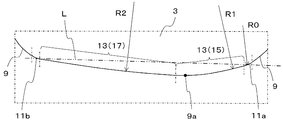
- FIG. 8 is an enlarged top view of a part of the first modification and corresponding to the region shown in FIG. 6 in the first insert 1 shown in FIG.
- the tip end portion 9a is located at the boundary between the first wiper blade 15 and the second wiper blade 17, but the first wiper blade 15 and the second wiper blade 15
- the position of the wiper blade 17 is not limited to such a form.
- the first wiper blade 15 may be at least partially positioned on the outer peripheral side of the tool main body with respect to the tip end portion 9a. Therefore, as shown in FIG. 8, a configuration in which the tip end portion 9 a is included in the first wiper blade 15 may be employed.
- the 2nd wiper blade 17 whole is provided so that it may be located in the inner peripheral side of a tool main body rather than the front-end
- transformation is carried out.
- a configuration in which the distal end portion 9a is included in the second wiper blade 17 may be employed.
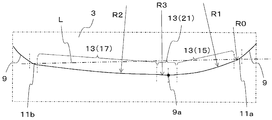
- Modification 2 of the first insert 1 of the above embodiment will be described with reference to FIG. 9 is an enlarged top view of a part of the second modification and corresponding to the region shown in FIG. 6 in the first insert 1 shown in FIG.
- the wiper blade 13 is constituted by the first wiper blade 15 and the second wiper blade 17, but the configuration of the wiper blade 13 is such a form. It is not limited.
- the wiper blade 13 further includes an arc-shaped third wiper blade 21 located between the first wiper blade 15 and the second wiper blade 17. Yes.
- the curvature radius R3 of the third wiper blade 21 is set to about 200 to 800 mm.
- R1 ⁇ R3 ⁇ R2 is satisfied.
- the present invention is not particularly limited to this, and may be R1 ⁇ R2 ⁇ R3, for example.
- the wiper blade 13 has such a third wiper blade 21, it is easy to increase the cutting angle of the first wiper blade 15. Therefore, it becomes easier to ensure a larger thickness of chips cut by the second wiper blade 17. As a result, when the third wiper blade 21 is provided, the finished surface can be further improved.
- the third wiper blade 21 is positioned so as to include the tip portion 9a. ing.
- the third wiper blade 21 moves the wiper blade 13 to the upper surface. When viewed, it is positioned so as to include a portion farthest from the virtual straight line L connecting the center of the first corner blade 11a and the center of the second corner blade 11b.
- the length of the third wiper blade 21 is shorter than the lengths of the first wiper blade 15 and the second wiper blade 17. Thereby, the length of the 1st wiper blade 15 and the 2nd wiper blade 17 is securable, without making the length of the wiper blade 13 whole too large.
- FIG. 10 is an enlarged top view of a part of the third modification and corresponding to the region shown in FIG. 6 in the first insert 1 shown in FIG.
- the wiper blade 13 is configured by the arc-shaped first wiper blade 15 and the arc-shaped second wiper blade 17.
- the present invention is not limited to such a form.
- the wiper blade 13 further includes a linear first straight blade 23 that connects the first corner blade 11a and the first wiper blade 15.
- the tool body is located on the outer peripheral side of the tip portion 9a of the wiper blade 13 which is configured by the first wiper blade 15 and the first linear blade 23. The length of the located part can be shortened.
- FIG. 11 is an enlarged top view of a part of the modification 4 and corresponding to the region shown in FIG. 6 in the first insert 1 shown in FIG.
- the wiper blade 13 further includes the linear first straight blade 23 that connects the first corner blade 11 a and the first wiper blade 15.
- the wiper blade 13 has a linear second straight blade 25 that connects the second corner blade 11 b and the second wiper blade 17.
- the wiper blade 13 has such a configuration, the inner peripheral side of the tool body with respect to the tip end portion 9a of the wiper blade 13 constituted by the second wiper blade 17 and the second linear blade 25.
- the cut angle of the entire portion located at can be reduced. Therefore, the surface roughness of the finished surface of the work material can be reduced.
- the cut workpiece is produced by cutting the work material 301.
- the manufacturing method in the present embodiment includes the following steps. That is, (1) a step of rotating a cutting tool 201 typified by the above embodiment; (2) a step of bringing the cutting edge 9 in the rotating cutting tool 201 into contact with the work material 301; (3) a step of separating the cutting tool 201 from the work material 301; It has.
- the cutting tool 201 is relatively moved closer to the work material 301 while being rotated.
- the cutting blade 9 in the first insert 1 and the cutting blade in the second insert 101 are brought into contact with the workpiece 301 to cut the workpiece 301.
- the cutting tool 201 is relatively moved away from the work material 301.
- the work material 301 is fixed and the cutting tool 201 is brought closer. 14 and 15, the work material 301 is fixed and the cutting tool 201 is rotated. In FIG. 16, the work material 301 is fixed and the cutting tool 201 is moved away. In the cutting in the manufacturing method of the present embodiment, the work material 301 is fixed and the cutting tool 201 is moved in each step, but it is naturally not limited to such a form.
- the work material 301 may be brought close to the cutting tool 201 in the step (1). Similarly, the work material 301 may be moved away from the cutting tool 201 in the step (3).
- the state where the cutting tool 201 is rotated is maintained, and the cutting blade 9 of the first insert 1 and the cutting blade of the second insert 101 are brought into contact with different portions of the work material 301. What is necessary is just to repeat the process to make.
- representative examples of the material of the work material 301 include carbon steel, alloy steel, stainless steel, cast iron, and non-ferrous metal.
- Cutting insert (first insert) DESCRIPTION OF SYMBOLS 3 ... Upper surface 5 ... Lower surface 7 ... Side surface 9 ... Cutting edge 9a ... Tip part 11a ... 1st corner blade 11b ... 2nd corner blade 13 ... Wiper Blade 15 ... first wiper blade 17 ... second wiper blade 19 ... through hole 21 ... third wiper blade 23 ... first linear blade 25 ... second Straight blade 101 ... cutting insert (second insert) 201: Cutting tool 203 ... Tool body (holder) 205 ... Insert pocket 207 ... Screw 301 ... Work material
Landscapes
- Engineering & Computer Science (AREA)
- Mechanical Engineering (AREA)
- Milling Processes (AREA)
Abstract
Description
本発明は、切削インサート、切削工具及び被削加工物の製造方法に関する。 The present invention relates to a cutting insert, a cutting tool, and a method for manufacturing a workpiece.
被削材のフライス加工に用いられる転削工具は、一般的に複数の切削インサートを備えている。このとき、被削材の加工面をより平坦に仕上げるため、特開2001-138122号公報(特許文献1)に開示された転削工具のように、複数の切削インサート(スローアウェイチップ)の少なくとも一つを、他の切削インサートが有するさらい刃と比較して被削材に向かって突出するワイパー刃を有する構成(ワイパー刃付きスローアウェイチップ)とすることが知られている。 A rolling tool used for milling a workpiece generally includes a plurality of cutting inserts. At this time, in order to finish the work surface of the work material more flat, at least of a plurality of cutting inserts (throw away inserts) as in a rolling tool disclosed in Japanese Patent Laid-Open No. 2001-138122 (Patent Document 1). It is known that one has a structure (a throw-away tip with a wiper blade) having a wiper blade that protrudes toward a work material as compared with a wiping blade included in another cutting insert.
特許文献1に開示された転削工具においては、ワイパー刃が、略直線形状の切刃又は曲率半径が大きな略円弧形状の切刃とされている。このような場合では、ワイパー刃付きの切削インサートによって繰り返し被削材の切削が行われるフライス加工において、先に被削材を切削するワイパー刃付きの切削インサートの回転軌跡と後に被削材を切削するワイパー刃付きの切削インサートの回転軌跡との重なり合う領域が大きくなる。そのため、ワイパー刃によって切削される切屑の厚みが過度に薄くなる可能性がある。切屑の厚みが過度に薄い場合、被削材の加工面がむしられたようにささくれ立ち、仕上げ面の状態が逆に悪化してしまう可能性があった。
In the rolling tool disclosed in
本発明は、上記の課題に鑑みてなされたものであり、むしれ現象の発生を抑制して仕上げ面の状態を良好にできる切削インサート、切削工具及び切削加工物の製造方法を提供することにある。 The present invention has been made in view of the above-described problems, and provides a cutting insert, a cutting tool, and a method for manufacturing a cut product that can improve the state of a finished surface by suppressing the occurrence of a peeling phenomenon. is there.
本発明の一態様に基づく切削インサートは、多角形状の上面と、下面と、前記上面及び前記下面のそれぞれに接続された側面と、前記上面と前記側面との交線部に位置する切刃とを備えている。前記切刃は、前記上面における互いに隣り合う角部に位置する円弧形状の第1のコーナ刃及び第2のコーナ刃と、前記第1のコーナ刃及び前記第2のコーナ刃の間に位置するワイパー刃とを有している。 The cutting insert based on 1 aspect of this invention is a polygon-shaped upper surface, a lower surface, the side surface connected to each of the said upper surface and the said lower surface, and the cutting blade located in the intersection part of the said upper surface and the said side surface It has. The cutting blade is located between the first corner blade and the second corner blade having an arc shape located at corners adjacent to each other on the upper surface, and between the first corner blade and the second corner blade. And a wiper blade.
前記ワイパー刃は、円弧形状の第1のワイパー刃と、前記第1のワイパー刃よりも前記第2のコーナ刃の側に位置する円弧形状の第2のワイパー刃とを有している。そして、上面視において、前記第1のワイパー刃の曲率半径をR1、前記第2のワイパー刃の曲率半径をR2、前記第1のコーナ刃及び前記第2のコーナ刃の曲率半径をR0とした場合に、R0<R1<R2となっている。 The wiper blade includes an arc-shaped first wiper blade and an arc-shaped second wiper blade positioned closer to the second corner blade than the first wiper blade. In the top view, the radius of curvature of the first wiper blade is R1, the radius of curvature of the second wiper blade is R2, and the radius of curvature of the first corner blade and the second corner blade is R0. In this case, R0 <R1 <R2.
<切削インサート>
以下、一実施形態の切削インサートについて、図面を用いて詳細に説明する。但し、以下で参照する各図は、説明の便宜上、実施形態の構成部材のうち、本発明を説明するために必要な主要部材のみを簡略化して示したものである。したがって、本発明の切削インサートは、本明細書が参照する各図に示されていない任意の構成部材を備え得る。また、各図中の部材の寸法は、実際の構成部材の寸法及び各部材の寸法比率等を忠実に表したものではない。
<Cutting insert>
Hereinafter, the cutting insert of one embodiment is explained in detail using a drawing. However, in the drawings referred to below, for convenience of explanation, among the constituent members of the embodiment, only the main members necessary for explaining the present invention are shown in a simplified manner. Therefore, the cutting insert of the present invention may include any component not shown in the drawings to which the present specification refers. Moreover, the dimension of the member in each figure does not represent the dimension of an actual structural member, the dimension ratio of each member, etc. faithfully.
本実施形態のワイパー刃付きの切削インサート1(以下、便宜的に第1のインサート1ともいう)は、図1に例示されるように、後述する工具本体203の先端側に位置するインサートポケット205に着脱可能に取り付けられる切削インサートである。図1に例示する、フライス加工に用いられる切削工具201は、工具本体203、この工具本体203に取り付けられた、ワイパー刃を有する第1のインサート1及びワイパー刃を有さない切削インサート101(以下、便宜的に第2のインサート101ともいう)によって構成される。
A cutting insert 1 with a wiper blade of the present embodiment (hereinafter also referred to as a
図2~6に示すように、本実施形態の第1のインサート1は、略多角形状の上面3と、下面5と、上面3及び下面5のそれぞれに接続された側面7と、上面3と側面7との交線部に位置する切刃9とを備えている。上面3は、切削加工時に切屑が流れるすくい面として機能する。
As shown in FIGS. 2 to 6, the
上面3は、略多角形状であり、本実施形態においては略八角形の形状をしている。ここで、略多角形状とは、厳密に多角形状であることを意味するものではない。例えば、本実施形態での上面3における角部はそれぞれ厳密な角となっておらず、丸みを帯びた形状となっている。また、上面3における辺部は、厳密に直線形状とはなっておらず、後述するようにわずかに曲線形状となっている。
The
下面5は、上面3とは反対側に位置する面であり、第1のインサート1を工具本体に取り付ける際にインサートポケットへの着座面として機能する。本実施形態における下面5は、上面3と同様に略多角形状、具体的には略八角形の形状をしている。このとき、下面5は上面3よりも一回り小さくなるように構成されている。そのため、下面5は上面3に対して相似形となるように構成されている。
The
本実施形態における切刃9は、第1のコーナ刃11a及び第2のコーナ刃11bと、少なくとも1つのワイパー刃13とを有している。第1のコーナ刃11a及び第2のコーナ刃11bは、上面3における互いに隣り合う角部にそれぞれ位置している。上面3の角部は、上述の通り丸みを帯びた形状となっていることから、第1のコーナ刃11a及び第2のコーナ刃11bは、それぞれ上面視した場合に円弧形状となっている。
The
図6に示す第1のインサート1においては、第1のコーナ刃11aは、第1のインサート1を工具本体に取り付けた際に、第2のコーナ刃11bよりも工具本体の外周側に位置する。言い換えれば、第2のコーナ刃11bは、第1のインサート1を工具本体に取り付けた際に、第1のコーナ刃11aよりも工具本体の内周側に位置する。
In the
すなわち、図6においては、右側が工具本体の外周側に相当し、左側が工具本体の内周側に相当している。また、図6の下側が、工具本体から先端方向、言い換えれば、被削材に向かって突出する方向に相当している。 That is, in FIG. 6, the right side corresponds to the outer peripheral side of the tool body, and the left side corresponds to the inner peripheral side of the tool body. Further, the lower side of FIG. 6 corresponds to the tip direction from the tool body, in other words, the direction protruding toward the work material.
ワイパー刃13は互いに隣り合う第1のコーナ刃11a及び第2のコーナ刃11bの間、すなわち上面3の辺部に位置している。ワイパー刃13は、被削材の加工面を平滑に仕上げる切刃として機能する。そのため、第1のインサート1を工具本体に取り付けた際に、ワイパー刃13は、切刃9のうち工具本体から先端方向、言い換えれば、被削材に向かって最も突出する先端部9aを含むように設けられる。本実施形態においては、ワイパー刃13を上面視した場合における第1のコーナ刃11aの中心と第2のコーナ刃11bの中心とを結ぶ仮想直線Lから最も離れた部分に先端部9aが位置している。
The
本実施形態におけるワイパー刃13は、第1のワイパー刃15及び第2のワイパー刃17を有している。第1のワイパー刃15は、第2のワイパー刃17よりも第1のコーナ刃11aの側に位置している。そのため、第1のワイパー刃15は、第1のインサート1を工具本体に取り付けた際に、第2のワイパー刃17よりも工具本体の外周側に位置している。本実施形態においては、第1のワイパー刃15の少なくとも一部が、上記の先端部9aよりも工具本体の外周側に位置するように設けられている。
The
第2のワイパー刃17は、第1のワイパー刃15よりも第2のコーナ刃11bの側に位置している。そのため、第2のワイパー刃17は、第1のワイパー刃15よりも工具本体の内周側に位置するように設けられている。言い換えれば、第2のワイパー刃17は、第1のワイパー刃15よりも工具本体の回転中心軸の側に位置するように設けられている。本実施形態においては、第2のワイパー刃は、第1のインサート1を工具本体に取り付けた際に、少なくとも一部が先端部9aよりも工具本体の内周側に位置するように設けられている。
The
本実施形態の第1のインサート1においては、第1のワイパー刃15と第2のワイパー刃17とが連続している。そして、ワイパー刃13を上面視した場合において、第1のコーナ刃11aの中心と第2のコーナ刃11bの中心とを結ぶ仮想直線Lから最も離れた部分に第1のワイパー刃15と第2のワイパー刃17との境界が位置している。言い換えれば、第1のワイパー刃15と第2のワイパー刃17との境界に先端部9aが位置している。そのため、第1のワイパー刃15の全体が、先端部9aよりも工具本体の外周側に位置するように設けられている。また、第2のワイパー刃17の全体が、先端部9aよりも工具本体の内周側に位置するように設けられている。
In the
図6に示す第1のインサート1においては、切刃9における先端部9aが切刃9のうち最も下方に位置している。また、第1のワイパー刃15は、第1のコーナ刃11a及び第2のコーナ刃11bによって挟まれたワイパー刃13のうち工具本体の外周側、すなわち図6においては右側に位置するように設けられており、第1のコーナ刃11aに連続している。さらに、第2のワイパー刃17は、第1のコーナ刃11a及び第2のコーナ刃11bによって挟まれたワイパー刃13のうち工具本体の内周側、すなわち図6においては左側に位置するように設けられており、第2のコーナ刃11bに連続している。
In the
第1のワイパー刃15及び第2のワイパー刃17はそれぞれ上面視において円弧形状となるように形成されている。第1のコーナ刃11a及び第2のコーナ刃11bの曲率半径をR0、第1のワイパー刃15の曲率半径をR1、第2のワイパー刃17の曲率半径をR2とする。このとき、本実施形態の第1のインサート1においては、R0<R1<R2となっている。
The
本実施形態の第1のインサート1においては、曲率半径の小さい第1のコーナ刃11a及び第2のコーナ刃11bの間に曲率半径の大きなワイパー刃13が位置している。そして、ワイパー刃13が直線形状ではなく、曲線形状となっている。さらに、ワイパー刃13は、一つの円弧からなる単純な円弧形状ではなく、切削加工時に外周側に位置して、相対的に曲率半径が小さい第1のワイパー刃15、及び切削加工時に内周側に位置して、相対的に曲率半径が大きい第2のワイパー刃17によって構成されている。
In the
ワイパー刃が曲率半径の大きな一つの円弧からなる略円弧形状である場合、図7(b)に示すように、切屑の厚みD2が非常に小さくなる。なお、図7(a)及び図7(b)のそれぞれにおいて、先に被削材301を切削するワイパー刃の軌跡を一点鎖線で示している。また、次に被削材301を切削するワイパー刃の軌跡を実線で示している。そのため図7において、左上から右下に向かって延びる斜線の群にて示された領域がワイパー刃で切削される切屑となる。
When the wiper blade has a substantially arc shape composed of one arc having a large radius of curvature, the chip thickness D2 is very small, as shown in FIG. 7B. In each of FIG. 7A and FIG. 7B, the locus of the wiper blade that cuts the
図7(a)から明らかであるように、本実施形態の第1のインサート1においては、第1のワイパー刃15の曲率半径が相対的に小さい。そのため、第1のワイパー刃15の全体での切込み角が大きくなり、一点鎖線で示される、先に被削材301を切削するワイパー刃13によって過度に被削材301を切削することが抑制される。これにより、実線で示される、次にワイパー刃付きの切削インサート1によって切削加工を行なう場合において、第2のワイパー刃17で切削される切屑の厚みD1を確保できる。
7A, in the
このように切屑の厚みが確保されるので、加工面がむしられる現象の発生が抑制される。そして、上記の現象の発生が抑制されることによって、加工面の光沢も良好なものにできる。また、第2のワイパー刃17の曲率半径が相対的に大きいため、加工面の表面粗さを安定して小さくできる。なお、上記の第1のワイパー刃15の全体での切込み角とは、第1のワイパー刃15における一方の端部と他方の端部を結ぶ仮想直線が被削材の加工面に対して成す角度を意味している。
Since the thickness of the chips is ensured in this way, the occurrence of a phenomenon that the processed surface is peeled is suppressed. Further, by suppressing the occurrence of the above phenomenon, the gloss of the processed surface can be improved. Further, since the radius of curvature of the
上記の実施形態における第1のコーナ刃11a及び第2のコーナ刃11bの曲率半径R0は、0.4~2mm程度に設定される。第1のワイパー刃15の曲率半径R1は、50~200mm程度に設定される。第2のワイパー刃17の曲率半径R2は、200~800mm程度に設定される。
The curvature radius R0 of the
上面3における辺部に位置するワイパー刃13が、円弧形状の第1のワイパー刃15及び円弧形状の第2のワイパー刃17によって構成されている。そのため、上面3における辺部は、わずかに曲線形状となっている。
The
また、本実施形態においては、第2のワイパー刃17が第1のワイパー刃15よりも長い構成になっている。これにより、第1のワイパー刃15の切込み角を大きく確保しつつ、第2のワイパー刃17の長さを確保することができる。そのため、切込み角の相対的に小さな第2のワイパー刃17の長さを長く確保できるので、加工面の平坦性を高めることができる。
In the present embodiment, the
上面3と側面7との交線部は、2つの面が交わることによる厳密な線形状でなくてもよい。上面3と側面7との交線部が尖っていると、切刃9の耐久性が低下する。そのため、上面3と側面7とが交わる部分がわずかに曲面形状となっている、いわゆるホーニング加工が施されていてもよい。
The intersecting line portion between the
第1のインサート1の材質としては、例えば、超硬合金あるいはサーメットなどが挙げられる。超硬合金の組成としては、例えば、炭化タングステン(WC)にコバルト(Co)の粉末を加えて焼結して生成されるWC-Co、WC-Coに炭化チタン(TiC)を添加したWC-TiC-Co、あるいはWC-TiC-Coに炭化タンタル(TaC)を添加したWC-TiC-TaC-Coがある。また、サーメットは、セラミック成分に金属を複合させた焼結複合材料であり、具体的には、炭化チタン(TiC)、又は窒化チタン(TiN)を主成分としたチタン化合物が挙げられる。
Examples of the material of the
第1のインサート1の表面は、化学蒸着(CVD)法又は物理蒸着(PVD)法を用いて被膜でコーティングされていてもよい。被膜の組成としては、炭化チタン(TiC)、窒化チタン(TiN)、炭窒化チタン(TiCN)又はアルミナ(Al2O3)などが挙げられる。
The surface of the
なお、上面3及び下面5の形状としては、上記の形態に限定されるものではない。本実施形態の第1のインサート1においては上面視した場合の上面3の形状が略八角形であったが、例えば、上面視した場合の上面3の形状が三角形、四角形、五角形、六角形のような多角形状であってもよい。
Note that the shapes of the
上面3の中心から下面5の中心にかけては貫通孔19が形成されている。貫通孔19は、第1のインサート1を切削工具の工具本体にネジ止め固定する際にネジを挿入するために設けられている。貫通孔19の中心軸Xの方向、言い換えれば貫通方向は、上面3及び下面5に対して直交している。
A through
本実施形態の第1のインサート1における上面3を上面視した場合の最大幅は20~30mmである。また、下面5から上面3までの高さは3~7mmである。ここで、下面5から上面3までの高さとは、上面3の上端と下面5の下端との間における貫通孔19に平行な方向での幅を意味している。
The maximum width when the
<切削工具>
次に、本発明の一実施形態の切削工具201について図面を用いて説明する。
<Cutting tools>
Next, a
本実施形態の切削工具201は、図1、12及び13に示すように、回転中心軸Yを有し、先端側の外周面に複数のインサートポケット205を有する工具本体203(以下、ホルダ203とも言う)と、インサートポケット205の少なくとも一つに装着される上記の第1のインサート1と、第1のインサート1が装着されていないインサートポケット205に装着された第2のインサート101とを備えている。
As shown in FIGS. 1, 12 and 13, the
第2のインサート101は、第1のインサート1に類似した構成であって、第1のインサート1におけるワイパー刃13を有さない構成となっている。具体的には、第2のインサート101は、第1のインサート1と同様に、略多角形状である上面及び下面、ならびに上面と下面との間に側面を有している。また、第2のインサート101における上面と側面との交線部には切刃が形成されている。ただし、第2のインサート101における切刃はワイパー刃を有していない。
The
第2のインサート101における、第1のインサート1の第1のコーナ刃11aと第2のコーナ刃11bとを結ぶワイパー刃13に対応する部分は、直線形状となっている。そのため、第1のインサート1及び第2のインサート101をホルダ203に装着した場合において、第2のインサート101における上記の切刃の部分は第1のインサート1のワイパー刃13よりもホルダ203の後端側に位置している。このように、第1のインサート1におけるワイパー刃13が、第2のインサート101における切刃よりも先端方向に突出していることによって、被削材の加工面をワイパー刃13で良好に仕上げることができる。
The portion of the
ワイパー刃13を備えている第1のインサート1は、ワイパー刃を備えていない第2のインサート101と比較して大きな負荷が加わる。そのため、ホルダ203には複数の第1のインサート1のみを装着してもよいが、一般的には、第1のインサート1に加えて第2のインサート101もホルダ203に装着される。ワイパー刃13を備えている第1のインサート1及びワイパー刃を備えていない第2のインサート101をホルダ203に装着する場合には、通常、第2のインサート101が第1のインサート1よりも数多くホルダ203に装着される。
The
ホルダ203は、回転中心軸Yを中心とする略回転体形状をなす。そして、ホルダ203の先端側の外周面には、インサートポケット205が等間隔に複数設けられている。インサートポケット205は、第1のインサート1又は第2のインサート101が装着される部分であり、ホルダ203の外周面及び先端面に開口している。具体的には、インサートポケット205は、回転方向に対向する着座面と、着座面の交差する方向に位置する、2つの拘束側面とを有している。
The
そして、ホルダ203に設けられた複数のインサートポケット205に、第1のインサート1又は第2のインサート101が装着される。第1のインサート1は、少なくとも切刃9におけるワイパー刃13がホルダ203から先端方向に突出するようにホルダ203に装着される。このとき、ワイパー刃13における先端部9aが、ホルダ203から先端方向に最も突出するように位置している。本実施形態においては、切刃9のうちワイパー刃13がホルダ203から先端方向に最も突出するように第1のインサート1がインサートポケット205に装着されている。これにより、切屑の厚みが確保されるので、加工面がむしられる現象の発生が抑制される。
Then, the
第2のインサート101は、上面の外周に形成された切刃がホルダ203から先端方向に突出するようにホルダ203に装着される。このとき、上述のように、第1のインサート1におけるワイパー刃13が、第2のインサート101における切刃よりも先端方向に突出している。
The
上記の実施形態の第1のインサート1は、ワイパー刃13が、直線形状あるいは一つの円弧からなる単純な円弧形状ではなく、上記の第1のワイパー刃15及び第2のワイパー刃17を有している。ワイパー刃13を用いて切削加工を複数回行う場合において、第1のワイパー刃15の曲率半径が相対的に小さいことから、先の切削加工で過度に被削材を切削することが抑制される。そのため、後の切削加工において第2のワイパー刃17を用いて切削加工を行なう際に、切屑の厚みを大きく確保することができる。
In the
本実施形態においては、第1のインサート1及び第2のインサート101は、それぞれネジ207によって、インサートポケット205に装着されている。すなわち、第1のインサート1及び第2のインサート101の貫通孔19にそれぞれネジ207を挿入し、これらのネジ207の先端をインサートポケット205に形成されたネジ孔(不図示)に挿入してネジ部同士を螺合させることによって、第1のインサート1及び第2のインサート101がホルダ203に固定されている。
In the present embodiment, the
ホルダ203としては、鋼、鋳鉄などを用いることができる。本実施形態では、これらの部材の中で靱性の高い鋼が用いられている。
As the
<変形例1>
次に、上記の実施形態の第1のインサート1の変形例1について図8を用いて説明する。なお、図8は、変形例1の一部であって、図3に示す第1のインサート1における図6に示す領域に対応する部分を拡大した上面図である。
<
Next,
上記の実施形態の第1のインサート1においては、先端部9aが第1のワイパー刃15と第2のワイパー刃17との境界に位置しているが、第1のワイパー刃15及び第2のワイパー刃17の位置としては、このような形態に限られるものではない。第1のワイパー刃15は、少なくとも一部が先端部9aよりも工具本体の外周側に位置すればよい。そのため、図8に示すように、先端部9aが第1のワイパー刃15に含まれているような構成であってもよい。
In the
また、上記の実施形態の第1のインサート1においては、第2のワイパー刃17の全体が、先端部9aよりも工具本体の内周側に位置するように設けられているが、上記の変形例1の構成に代えて、先端部9aが第2のワイパー刃17に含まれているような構成であってもよい。
Moreover, in the
<変形例2>
次に、上記の実施形態の第1のインサート1の変形例2について図9を用いて説明する。なお、図9は、変形例2の一部であって、図3に示す第1のインサート1における図6に示す領域に対応する部分を拡大した上面図である。
<Modification 2>
Next, Modification 2 of the
上記の実施形態の第1のインサート1においては、ワイパー刃13が第1のワイパー刃15及び第2のワイパー刃17によって構成されていたが、ワイパー刃13の構成としては、このような形態に限られるものではない。
In the
本変形例の第1のインサート1においては、ワイパー刃13が、第1のワイパー刃15と第2のワイパー刃17との間に位置する円弧形状の第3のワイパー刃21をさらに有している。このとき、上面視において、第3のワイパー刃21の曲率半径をR3とした場合に、R1<R3となっている。本変形例ではR1<R3<R2となっている。第3のワイパー刃21の曲率半径R3は、200~800mm程度に設定される。
In the
なお、本変形例ではR1<R3<R2となっているが、特にこのように限定されるものではなく、たとえばR1<R2<R3であってもよい。 In this modification, R1 <R3 <R2 is satisfied. However, the present invention is not particularly limited to this, and may be R1 <R2 <R3, for example.
ワイパー刃13が、このような第3のワイパー刃21を有している場合には、第1のワイパー刃15の切込み角を大きくし易い。そのため、第2のワイパー刃17によって切削される切屑の厚みをさらに大きく確保し易くなる。結果として、第3のワイパー刃21を有している場合には、仕上げ面の状態をさらに良好なものにできる。第1のワイパー刃15の切込み角を大きくしつつ、第2のワイパー刃17の切込み角を小さくするため、本変形例では、第3のワイパー刃21は、先端部9aを含むように位置している。
When the
言い換えれば、第1のワイパー刃15の切込み角を大きくしつつ、第2のワイパー刃17の切込み角を小さくするため、本変形例においては、第3のワイパー刃21は、ワイパー刃13を上面視した場合において、第1のコーナ刃11aの中心と第2のコーナ刃11bの中心とを結ぶ仮想直線Lから最も離れた部位を含むように位置している。
In other words, in order to reduce the cutting angle of the
また、本変形例においては、第3のワイパー刃21の長さが第1のワイパー刃15及び第2のワイパー刃17の長さよりも短い構成になっている。これにより、ワイパー刃13全体の長さを過度に大きくすることなく、第1のワイパー刃15及び第2のワイパー刃17の長さを確保することができる。
Further, in this modification, the length of the
<変形例3>
次に、上記の実施形態の第1のインサート1の変形例3について図10を用いて説明する。なお、図10は、変形例3の一部であって、図3に示す第1のインサート1における図6に示す領域に対応する部分を拡大した上面図である。
<
Next,
上記の実施形態の第1のインサート1においては、ワイパー刃13が円弧形状の第1のワイパー刃15及び円弧形状の第2のワイパー刃17によって構成されているが、ワイパー刃13の構成としては、このような形態に限られるものではない。
In the
本変形例の第1のインサート1においては、ワイパー刃13が、第1のコーナ刃11aと第1のワイパー刃15とを接続する直線形状の第1の直線刃23をさらに有している。ワイパー刃13がこのような構成を有している場合には、第1のワイパー刃15及び第1の直線刃23によって構成される、ワイパー刃13における先端部9aよりも工具本体の外周側に位置する部分の長さを短くできる。
In the
<変形例4>
次に、上記の実施形態の第1のインサート1の変形例4について図11を用いて説明する。なお、図11は、変形例4の一部であって、図3に示す第1のインサート1における図6に示す領域に対応する部分を拡大した上面図である。
<Modification 4>
Next, Modification 4 of the
上記の変形例3においては、ワイパー刃13が、第1のコーナ刃11aと第1のワイパー刃15とを接続する直線形状の第1の直線刃23をさらに有しているが、本変形例の第1のインサート1においては、ワイパー刃13が、第2のコーナ刃11bと第2のワイパー刃17とを接続する直線形状の第2の直線刃25を有している。
In the third modification, the
ワイパー刃13がこのような構成を有している場合には、第2のワイパー刃17及び第2の直線刃25によって構成される、ワイパー刃13における先端部9aよりも工具本体の内周側に位置する部分全体の切込み角を小さくできる。そのため、被削材の仕上げ面の表面粗さを小さくできる。
When the
<切削加工物の製造方法>
次に、本発明の一実施形態の切削加工物の製造方法について図面を用いて説明する。
<Manufacturing method of cut product>
Next, the manufacturing method of the cut workpiece of one Embodiment of this invention is demonstrated using drawing.
切削加工物は、被削材301を切削加工することによって作製される。本実施形態における製造方法は、以下の工程を備えている。すなわち、
(1)上記実施形態に代表される切削工具201を回転させる工程と、
(2)回転している切削工具201における切刃9を被削材301に接触させる工程と、
(3)切削工具201を被削材301から離す工程と、
を備えている。
The cut workpiece is produced by cutting the
(1) a step of rotating a
(2) a step of bringing the
(3) a step of separating the
It has.
より具体的には、まず、図14に示すように、切削工具201を回転させながら被削材301に相対的に近付ける。次に、図15に示すように、第1のインサート1における切刃9及び第2のインサート101における切刃を被削材301に接触させて、被削材301を切削する。そして、図16に示すように、切削工具201を被削材301から相対的に遠ざける。
More specifically, first, as shown in FIG. 14, the
本実施形態においては、被削材301を固定するとともに切削工具201を近づけている。また、図14、15においては、被削材301を固定するとともに切削工具201を回転させている。また、図16においては、被削材301を固定するとともに切削工具201を遠ざけている。なお、本実施形態の製造方法における切削加工では、それぞれの工程において、被削材301を固定するとともに切削工具201を動かしているが、当然ながらこのような形態に限定されるものではない。
In the present embodiment, the
例えば、(1)の工程において、被削材301を切削工具201に近づけてもよい。同様に、(3)の工程において、被削材301を切削工具201から遠ざけてもよい。切削加工を継続する場合には、切削工具201を回転させた状態を維持して、被削材301の異なる箇所に第1のインサート1における切刃9及び第2のインサート101における切刃を接触させる工程を繰り返せばよい。
For example, the
なお、被削材301の材質の代表例としては、炭素鋼、合金鋼、ステンレス、鋳鉄、又は非鉄金属などが挙げられる。
Note that representative examples of the material of the
1・・・切削インサート(第1のインサート)
3・・・上面
5・・・下面
7・・・側面
9・・・切刃
9a・・・先端部
11a・・・第1のコーナ刃
11b・・・第2のコーナ刃
13・・・ワイパー刃
15・・・第1のワイパー刃
17・・・第2のワイパー刃
19・・・貫通孔
21・・・第3のワイパー刃
23・・・第1の直線刃
25・・・第2の直線刃
101・・・切削インサート(第2のインサート)
201・・・切削工具
203・・・工具本体(ホルダ)
205・・・インサートポケット
207・・・ネジ
301・・・被削材
1 ... Cutting insert (first insert)
DESCRIPTION OF
201: Cutting
205 ...
Claims (12)
前記切刃は、前記上面における互いに隣り合う角部に位置する円弧形状の第1のコーナ刃及び第2のコーナ刃と、前記第1のコーナ刃及び前記第2のコーナ刃の間に位置するワイパー刃とを有し、
前記ワイパー刃は、円弧形状の第1のワイパー刃と、前記第1のワイパー刃よりも前記第2のコーナ刃の側に位置する円弧形状の第2のワイパー刃とを有し、
上面視において、前記第1のワイパー刃の曲率半径をR1、前記第2のワイパー刃の曲率半径をR2、前記第1のコーナ刃及び前記第2のコーナ刃の曲率半径をR0とした場合に、R0<R1<R2となることを特徴とする切削インサート。 A polygonal upper surface, a lower surface, a side surface connected to each of the upper surface and the lower surface, and a cutting blade located at the intersection of the upper surface and the side surface,
The cutting blade is located between the first corner blade and the second corner blade having an arc shape located at corners adjacent to each other on the upper surface, and between the first corner blade and the second corner blade. A wiper blade,
The wiper blade has an arc-shaped first wiper blade, and an arc-shaped second wiper blade positioned closer to the second corner blade than the first wiper blade,
In a top view, when the radius of curvature of the first wiper blade is R1, the radius of curvature of the second wiper blade is R2, and the radius of curvature of the first corner blade and the second corner blade is R0. , R0 <R1 <R2.
上面視において、前記第3のワイパー刃の曲率半径をR3とした場合に、R1<R3となることを特徴とする請求項1に記載の切削インサート。 The wiper blade further includes an arc-shaped third wiper blade located between the first wiper blade and the second wiper blade,
2. The cutting insert according to claim 1, wherein R1 <R3 when the curvature radius of the third wiper blade is R3 in a top view.
前記ワイパー刃を上面視した場合において、前記第1のコーナ刃の中心と前記第2のコーナ刃の中心とを結ぶ仮想直線から最も離れた部分に前記第1のワイパー刃と前記第2のワイパー刃との境界が位置していることを特徴とする請求項1に記載の切削インサート。 The first wiper blade and the second wiper blade are continuous;
When the wiper blade is viewed from above, the first wiper blade and the second wiper are located at a portion farthest from an imaginary straight line connecting the center of the first corner blade and the center of the second corner blade. The cutting insert according to claim 1, wherein a boundary with the blade is located.
前記切刃が前記工具本体から突出するように前記インサートポケットに装着された、請求項1~8のいずれか1つに記載の切削インサートとを具備している切削工具。 A tool body having an insert pocket on the tip side;
The cutting tool according to any one of claims 1 to 8, wherein the cutting insert is mounted in the insert pocket so that the cutting edge protrudes from the tool body.
回転している前記切削工具における前記切刃を被削材に接触させる工程と、
前記切削工具を前記被削材から離す工程とを備えた切削加工物の製造方法。 Rotating the cutting tool according to any one of claims 9 to 11,
Contacting the work piece with the cutting edge in the rotating cutting tool;
The manufacturing method of the cut workpiece provided with the process of separating the said cutting tool from the said workpiece.
Priority Applications (5)
| Application Number | Priority Date | Filing Date | Title |
|---|---|---|---|
| US15/037,197 US9884378B2 (en) | 2013-11-19 | 2014-11-17 | Cutting insert, cutting tool, and method of manufacturing machined product |
| CN201480063029.2A CN105745046B (en) | 2013-11-19 | 2014-11-17 | The manufacturing method of cutting insert, cutting element and being cut machining object |
| EP14863741.6A EP3072617B1 (en) | 2013-11-19 | 2014-11-17 | Cutting insert, cutting tool, and method for producing cut article |
| JP2015549135A JP6194013B2 (en) | 2013-11-19 | 2014-11-17 | Cutting insert, cutting tool and method of manufacturing workpiece |
| US15/858,213 US10124426B2 (en) | 2013-11-19 | 2017-12-29 | Cutting insert, cutting tool, and method of manufacturing machined product |
Applications Claiming Priority (2)
| Application Number | Priority Date | Filing Date | Title |
|---|---|---|---|
| JP2013-239128 | 2013-11-19 | ||
| JP2013239128 | 2013-11-19 |
Related Child Applications (2)
| Application Number | Title | Priority Date | Filing Date |
|---|---|---|---|
| US15/037,197 A-371-Of-International US9884378B2 (en) | 2013-11-19 | 2014-11-17 | Cutting insert, cutting tool, and method of manufacturing machined product |
| US15/858,213 Continuation US10124426B2 (en) | 2013-11-19 | 2017-12-29 | Cutting insert, cutting tool, and method of manufacturing machined product |
Publications (1)
| Publication Number | Publication Date |
|---|---|
| WO2015076216A1 true WO2015076216A1 (en) | 2015-05-28 |
Family
ID=53179479
Family Applications (1)
| Application Number | Title | Priority Date | Filing Date |
|---|---|---|---|
| PCT/JP2014/080315 Ceased WO2015076216A1 (en) | 2013-11-19 | 2014-11-17 | Cutting insert, cutting tool, and method for producing cut article |
Country Status (5)
| Country | Link |
|---|---|
| US (2) | US9884378B2 (en) |
| EP (1) | EP3072617B1 (en) |
| JP (1) | JP6194013B2 (en) |
| CN (1) | CN105745046B (en) |
| WO (1) | WO2015076216A1 (en) |
Cited By (2)
| Publication number | Priority date | Publication date | Assignee | Title |
|---|---|---|---|---|
| US11407043B2 (en) | 2019-12-13 | 2022-08-09 | Tungaloy Corporation | Cutting insert |
| JPWO2023281889A1 (en) * | 2021-07-08 | 2023-01-12 |
Families Citing this family (7)
| Publication number | Priority date | Publication date | Assignee | Title |
|---|---|---|---|---|
| JP6711842B2 (en) * | 2015-11-28 | 2020-06-17 | 京セラ株式会社 | Manufacturing method of cutting insert, cutting tool, and machined product |
| AT15155U1 (en) * | 2016-02-26 | 2017-01-15 | Ceratizit Austria Gmbh | peeling plate |
| CN106113171A (en) * | 2016-08-17 | 2016-11-16 | 江苏飞达钻头股份有限公司 | Carpenter's smoothing, reamer |
| WO2019065525A1 (en) * | 2017-09-27 | 2019-04-04 | 京セラ株式会社 | Cutting insert, cutting tool, and method for producing cut object |
| DE102019123912A1 (en) | 2019-09-05 | 2021-03-11 | Kennametal Inc. | Cutting insert and cutting tool |
| JP6858354B1 (en) * | 2019-12-13 | 2021-04-14 | 株式会社タンガロイ | Cutting insert |
| CN114799299A (en) * | 2022-05-31 | 2022-07-29 | 厦门金鹭特种合金有限公司 | Finish machining smoothing cutter |
Citations (7)
| Publication number | Priority date | Publication date | Assignee | Title |
|---|---|---|---|---|
| JP2000005903A (en) * | 1998-06-05 | 2000-01-11 | Sandvik Ab | Cutting tip |
| JP2001138122A (en) | 1999-11-17 | 2001-05-22 | Mitsubishi Materials Corp | Indexable inserts and milling tools with wiper blades |
| JP2001198724A (en) * | 2000-01-21 | 2001-07-24 | Mitsubishi Materials Corp | Indexable inserts and indexable milling tools |
| JP2007044782A (en) * | 2005-08-08 | 2007-02-22 | Sumitomo Electric Hardmetal Corp | Throw-away tip and milling cutter using the same |
| JP2008006579A (en) * | 2006-06-27 | 2008-01-17 | Sandvik Intellectual Property Ab | Face milling insert |
| WO2013002341A1 (en) * | 2011-06-30 | 2013-01-03 | 京セラ株式会社 | Cutting insert, cutting tool, and method for manufacturing cut workpiece using same |
| JP2013176834A (en) * | 2011-12-12 | 2013-09-09 | Mitsubishi Materials Corp | Cutting insert and interchangeable cutting edge-type cutting tool |
Family Cites Families (13)
| Publication number | Priority date | Publication date | Assignee | Title |
|---|---|---|---|---|
| JP3317490B2 (en) * | 1998-06-18 | 2002-08-26 | 日立ツール株式会社 | High feed indexable rotary tool |
| KR100916280B1 (en) * | 2001-05-25 | 2009-09-10 | 히타치 쓰루 가부시키가이샤 | Blade End Exchange Tool |
| IL150783A0 (en) * | 2001-10-16 | 2003-02-12 | Iscar Ltd | Cutting tool and cutting insert therefor |
| JP2004255521A (en) | 2003-02-26 | 2004-09-16 | Tungaloy Corp | Rotary cutting tool |
| US20040232535A1 (en) | 2003-05-22 | 2004-11-25 | Terry Tarn | Microelectromechanical device packages with integral heaters |
| US7220083B2 (en) * | 2003-10-15 | 2007-05-22 | Tdy Industries, Inc. | Cutting insert for high feed face milling |
| JP4779864B2 (en) | 2006-08-09 | 2011-09-28 | 株式会社タンガロイ | Throw-away inserts and throw-away cutting tools |
| JP4888798B2 (en) * | 2009-06-16 | 2012-02-29 | 株式会社タンガロイ | Cutting insert and face mill |
| WO2011001939A1 (en) | 2009-06-29 | 2011-01-06 | 京セラ株式会社 | Cutting insert, cutting tool, and manufacturing method for cut product using the same |
| DE102009035754A1 (en) * | 2009-07-24 | 2011-01-27 | Hartmetall-Werkzeugfabrik Paul Horn Gmbh | Cutting insert for a cutting tool for machining, in particular for high-feed milling |
| CN102481641B (en) * | 2010-01-29 | 2013-11-06 | 京瓷株式会社 | Cutting insert, cutting tool, and manufacturing method for cut product using same |
| AT12004U1 (en) * | 2010-02-25 | 2011-09-15 | Ceratizit Austria Gmbh | CUTTING INSERT |
| JP5401732B1 (en) | 2012-10-23 | 2014-01-29 | 住友電工ハードメタル株式会社 | Milling insert changeable cutting insert |
-
2014
- 2014-11-17 WO PCT/JP2014/080315 patent/WO2015076216A1/en not_active Ceased
- 2014-11-17 CN CN201480063029.2A patent/CN105745046B/en active Active
- 2014-11-17 EP EP14863741.6A patent/EP3072617B1/en active Active
- 2014-11-17 US US15/037,197 patent/US9884378B2/en active Active
- 2014-11-17 JP JP2015549135A patent/JP6194013B2/en active Active
-
2017
- 2017-12-29 US US15/858,213 patent/US10124426B2/en active Active
Patent Citations (7)
| Publication number | Priority date | Publication date | Assignee | Title |
|---|---|---|---|---|
| JP2000005903A (en) * | 1998-06-05 | 2000-01-11 | Sandvik Ab | Cutting tip |
| JP2001138122A (en) | 1999-11-17 | 2001-05-22 | Mitsubishi Materials Corp | Indexable inserts and milling tools with wiper blades |
| JP2001198724A (en) * | 2000-01-21 | 2001-07-24 | Mitsubishi Materials Corp | Indexable inserts and indexable milling tools |
| JP2007044782A (en) * | 2005-08-08 | 2007-02-22 | Sumitomo Electric Hardmetal Corp | Throw-away tip and milling cutter using the same |
| JP2008006579A (en) * | 2006-06-27 | 2008-01-17 | Sandvik Intellectual Property Ab | Face milling insert |
| WO2013002341A1 (en) * | 2011-06-30 | 2013-01-03 | 京セラ株式会社 | Cutting insert, cutting tool, and method for manufacturing cut workpiece using same |
| JP2013176834A (en) * | 2011-12-12 | 2013-09-09 | Mitsubishi Materials Corp | Cutting insert and interchangeable cutting edge-type cutting tool |
Cited By (6)
| Publication number | Priority date | Publication date | Assignee | Title |
|---|---|---|---|---|
| US11407043B2 (en) | 2019-12-13 | 2022-08-09 | Tungaloy Corporation | Cutting insert |
| JPWO2023281889A1 (en) * | 2021-07-08 | 2023-01-12 | ||
| WO2023281889A1 (en) * | 2021-07-08 | 2023-01-12 | 兼房株式会社 | Rotary cutting tool |
| JP7403033B2 (en) | 2021-07-08 | 2023-12-21 | 兼房株式会社 | rotary cutting tool |
| CN117425537A (en) * | 2021-07-08 | 2024-01-19 | 兼房株式会社 | Rotary cutting tools |
| CN117425537B (en) * | 2021-07-08 | 2024-06-04 | 兼房株式会社 | Rotary cutting tools |
Also Published As
| Publication number | Publication date |
|---|---|
| US20160288224A1 (en) | 2016-10-06 |
| US9884378B2 (en) | 2018-02-06 |
| JP6194013B2 (en) | 2017-09-06 |
| EP3072617A1 (en) | 2016-09-28 |
| US20180117686A1 (en) | 2018-05-03 |
| JPWO2015076216A1 (en) | 2017-03-16 |
| CN105745046A (en) | 2016-07-06 |
| EP3072617B1 (en) | 2019-06-26 |
| CN105745046B (en) | 2018-08-24 |
| EP3072617A4 (en) | 2017-07-19 |
| US10124426B2 (en) | 2018-11-13 |
Similar Documents
| Publication | Publication Date | Title |
|---|---|---|
| JP6194013B2 (en) | Cutting insert, cutting tool and method of manufacturing workpiece | |
| JP6343016B2 (en) | Cutting insert, cutting tool, and manufacturing method of cut workpiece | |
| JP6356781B2 (en) | Cutting insert, cutting tool, and manufacturing method of cut workpiece | |
| JP5591409B2 (en) | Cutting insert, cutting tool and method of manufacturing workpiece | |
| JP6386524B2 (en) | Cutting insert for turning tool, turning tool, and method for producing cut product | |
| JP6462845B2 (en) | Insert, drill, and method of manufacturing a cut product using the same | |
| US10239125B2 (en) | Cutting insert, cutting tool, and method for manufacturing machined product using same | |
| JP6272457B2 (en) | Cutting insert, cutting tool, and manufacturing method of cut workpiece | |
| JP6609638B2 (en) | CUTTING TOOL AND MANUFACTURING METHOD OF CUT WORK | |
| JP6711842B2 (en) | Manufacturing method of cutting insert, cutting tool, and machined product | |
| JP5905123B2 (en) | Cutting insert, cutting tool, and method of manufacturing cut workpiece | |
| JP2014188606A (en) | Cutting insert, cutting tool, and method of manufacturing cutting work piece | |
| JPWO2016186217A1 (en) | HOLDER, CUTTING TOOL, AND CUTTING PRODUCT MANUFACTURING METHOD USING THE SAME | |
| JP6352639B2 (en) | Cutting insert, cutting tool, and method of manufacturing cut workpiece | |
| JP5952073B2 (en) | Cutting insert, cutting tool and method of manufacturing workpiece | |
| JP6495681B2 (en) | Cutting insert, cutting tool, and manufacturing method of cut workpiece | |
| JP6430796B2 (en) | CUTTING TOOL AND PROCESS FOR PRODUCING CUT WORK | |
| JP2014124719A (en) | Cutting insert, cutting tool, and method of manufacturing cutting workpiece | |
| JP5762020B2 (en) | Cutting insert, cutting tool, and cutting method of work material using the same | |
| JP2017064869A (en) | CUTTING INSERT, CUTTING TOOL, AND CUTTING PRODUCT PRODUCTION METHOD USING THE SAME |
Legal Events
| Date | Code | Title | Description |
|---|---|---|---|
| 121 | Ep: the epo has been informed by wipo that ep was designated in this application |
Ref document number: 14863741 Country of ref document: EP Kind code of ref document: A1 |
|
| ENP | Entry into the national phase |
Ref document number: 2015549135 Country of ref document: JP Kind code of ref document: A |
|
| WWE | Wipo information: entry into national phase |
Ref document number: 15037197 Country of ref document: US |
|
| REEP | Request for entry into the european phase |
Ref document number: 2014863741 Country of ref document: EP |
|
| WWE | Wipo information: entry into national phase |
Ref document number: 2014863741 Country of ref document: EP |
|
| NENP | Non-entry into the national phase |
Ref country code: DE |