WO2015045942A1 - 繊維板 - Google Patents
繊維板 Download PDFInfo
- Publication number
- WO2015045942A1 WO2015045942A1 PCT/JP2014/074379 JP2014074379W WO2015045942A1 WO 2015045942 A1 WO2015045942 A1 WO 2015045942A1 JP 2014074379 W JP2014074379 W JP 2014074379W WO 2015045942 A1 WO2015045942 A1 WO 2015045942A1
- Authority
- WO
- WIPO (PCT)
- Prior art keywords
- weight
- fiberboard
- fiber
- dry
- bagasse
- Prior art date
- Legal status (The legal status is an assumption and is not a legal conclusion. Google has not performed a legal analysis and makes no representation as to the accuracy of the status listed.)
- Ceased
Links
Classifications
-
- B—PERFORMING OPERATIONS; TRANSPORTING
- B27—WORKING OR PRESERVING WOOD OR SIMILAR MATERIAL; NAILING OR STAPLING MACHINES IN GENERAL
- B27N—MANUFACTURE BY DRY PROCESSES OF ARTICLES, WITH OR WITHOUT ORGANIC BINDING AGENTS, MADE FROM PARTICLES OR FIBRES CONSISTING OF WOOD OR OTHER LIGNOCELLULOSIC OR LIKE ORGANIC MATERIAL
- B27N3/00—Manufacture of substantially flat articles, e.g. boards, from particles or fibres
- B27N3/04—Manufacture of substantially flat articles, e.g. boards, from particles or fibres from fibres
-
- B—PERFORMING OPERATIONS; TRANSPORTING
- B27—WORKING OR PRESERVING WOOD OR SIMILAR MATERIAL; NAILING OR STAPLING MACHINES IN GENERAL
- B27N—MANUFACTURE BY DRY PROCESSES OF ARTICLES, WITH OR WITHOUT ORGANIC BINDING AGENTS, MADE FROM PARTICLES OR FIBRES CONSISTING OF WOOD OR OTHER LIGNOCELLULOSIC OR LIKE ORGANIC MATERIAL
- B27N3/00—Manufacture of substantially flat articles, e.g. boards, from particles or fibres
- B27N3/08—Moulding or pressing
- B27N3/10—Moulding of mats
- B27N3/14—Distributing or orienting the particles or fibres
Definitions
- the present invention relates to a fiberboard containing one kind of bagasse fiber of lignocellulosic fiber, which is cellulose fiber containing lignin, such as wood fiber and wood flour.
- lignocellulosic fiber which is cellulose fiber containing lignin, such as wood fiber and wood flour.
- Fiber boards containing lignocellulose fibers such as bagasse fibers and adhesives are materials for building materials such as floor materials, wall materials, roof materials, and furniture. Etc. (see, for example, Patent Document 1). Such a lignocellulose fiber board is used, for example, around water in a kitchen or the like. When a lignocellulose fiber board is used around water, a fungicide is added to impart antifungal properties around the water. Moreover, when a lignocellulose fiber board is used around water, in order to provide water resistance, a water repellent is added.
- the lignocellulose fiber board is produced by molding a kneaded body containing lignocellulose fibers and an adhesive at high temperature and high pressure. Therefore, since the kneaded body receives a larger amount of heat than usual during molding of the lignocellulose fiber plate, the active ingredient of the antifungal agent added to the lignocellulose fiber plate is thermally decomposed, and the lignocellulose fiber plate after molding. However, there was a problem that sufficient anti-fungal performance could not be exhibited. In general, a wood screw is used to connect the lignocellulose fiber board to another member or to attach a hinge to the lignocellulose fiber board.
- the lignocellulosic fiber board is a board formed by bonding (partially) lignocellulosic fibers in a dot-like manner with an adhesive, and therefore has a lower wood screw holding power than solid wood or plywood. There was a problem. Further, when the lignocellulose fiber board contains a large amount of water repellent, there is a problem that the wood screw holding power is reduced.
- the present invention has been made in view of such a problem, and even if it receives a larger amount of heat than usual, it is possible to suppress thermal decomposition of the active ingredient of the antifungal agent, and a fiber excellent in antifungal properties.
- the purpose is to provide a board.
- Another object of the present invention is to provide a fiberboard having water repellency and excellent wood screw retention.
- the fiberboard according to the first aspect of the present invention contains bagasse fiber, an adhesive, and an antifungal agent having an active ingredient having a heat resistant temperature of 180 ° C. or higher.
- the fungicide content may be 1.0 ⁇ 10 ⁇ 6 to 5% by weight in a dry weight ratio with respect to the dry fiberboard weight.
- the fungicide content may be 1.0 ⁇ 10 ⁇ 6 to 8% by weight in a dry weight ratio with respect to the dry fiber weight.
- the fiberboard according to the second aspect of the present invention contains bagasse fibers, an adhesive, and a water repellent, has an average density of 0.68 to 0.95 g / cm 3 , Content is 6 weight% or less by solid content weight ratio with respect to dry fiber board weight.
- the dry fiber weight ratio to the dry fiber board weight may be 65 to 98%.
- the bagasse fiber has a particle size such that the bagasse fiber remaining on the mesh is 40% or more when the bagasse fiber raw material is sieved using a mesh having a sieve opening of 500 ⁇ m or more. Also good.
- the bagasse fiber may have a ratio of length to fiber width of 10 to 1000.
- the content of the adhesive may be 2 to 30% by weight in a dry weight ratio with respect to the dry fiberboard weight.
- the heat resistant temperature of the active ingredient contains an antifungal agent having a heat resistance of 180 ° C. or higher, the active ingredient of the antifungal agent is produced by the heat when the fiberboard is produced. Can be prevented from thermally decomposing, so that a fiberboard having excellent antifungal properties can be obtained.
- the average density of the fiberboard is 0.68 to 0.95 g / cm 3
- the content of the water repellent is a weight ratio of the solid content to the dry fiberboard weight. Therefore, a fiberboard having water repellency and excellent wood screw retention can be obtained.
- the fiberboard according to the first embodiment of the present invention contains bagasse fiber, an adhesive, and an antifungal agent having a heat resistant temperature of an active ingredient of 180 ° C. or higher.
- Bagasse fiber is an elongated fiber that remains after squeezing sugar liquid from sugarcane.
- the bagasse fiber is preferably used after being pulverized or defibrated to a predetermined size (length, width). Bagasse fiber is formed from squeezed culm after squeezing sugar solution from sugarcane, and contains 0.001 to 20% by weight of sugar per fiber weight.
- the average density of the fiberboard is preferably 0.68 to 0.95 g / cm 3 and more preferably 0.70 to 0.85 g / cm 3 .
- the reason why the average density of the fiberboard is preferably 0.68 g / cm 3 or more is that when the average density is less than 0.68 g / cm 3 , entanglement force between the fibers does not occur when the fiber board is formed. This is because sufficient wood screw holding force cannot be obtained.
- the reason why the average density of the fiber board is preferably 0.95 g / cm 3 or less is that when the average density of the fiber board exceeds 0.95 g / cm 3 , there is almost no void inside the fiber board, This is because the fiberboard sometimes expands greatly.
- the average density of the fiberboard is within the above range (0.68 to 0.95 g / cm 3 )
- sufficient fiber screw holding force can be obtained for the fiberboard, and the amount of expansion of the fiberboard during water absorption is also increased. Can be reduced.
- the average density of the fiberboard is 0.70 to 0.85 g / cm 3 , the wood screw holding power can be further exhibited and the raw material cost can be reduced.
- a bagasse fiber particle size condition when a bagasse fiber raw material (input amount 100%) is sieved using a mesh having a sieve opening of 500 ⁇ m or more, the bagasse fiber remaining on the mesh is 40% or more. It is preferable to have a particle size such that the remaining amount is 40% or more (the bagasse fiber has a particle size such that the bagasse fiber remaining on the mesh having an opening of 500 ⁇ m or more is 40% or more).
- As conditions for passing bagasse fiber through a sieve 5 g of bagasse fiber raw material is shaken under the conditions of a stroke width of 70 and a shaking time of 2 minutes. The reason why the bagasse fiber preferably has the above particle size is as follows.
- the bagasse has a particle size such that the bagasse fiber raw material (input amount 100%) is screened with a mesh having a sieve opening of 500 ⁇ m or more and the bagasse fiber remaining on the mesh is less than 40%.
- the fibers have, when a fiber board is formed with bagasse fibers having this particle size, no entanglement force between the fibers is generated, so that sufficient wood screw holding force cannot be obtained. That is, if the bagasse fiber particle size satisfies the above conditions, sufficient wood screw holding force can be obtained for the fiberboard.
- the wood screw holding force is the maximum load required to pull out the wood screw when the wood screw specified in Japanese Industrial Standard JIS B1112 is screwed vertically into the sample (test material), the sample is fixed and the wood screw is pulled out vertically. is there.
- the ratio of the length of bagasse fiber to the width of the bagasse fiber is preferably 10 to 1000, and more preferably 20 to 500.
- the reason why the ratio of the length to the width of the bagasse fiber (dimension ratio) is preferably 10 or more is that if the dimension ratio is less than 10, the fiber board does not generate entanglement force between the fibers, which is sufficient. This is because the wood screw holding force cannot be obtained.
- the reason why the ratio of the length to the width of the bagasse fiber (size ratio) is preferably 1000 or less is that when the size ratio exceeds 1000, when kneading the bagasse fiber and an additive such as an adhesive, This is because the bagasse fibers are entangled and the additive is not sufficiently dispersed in the mixture of the bagasse fibers and the additive, so that the mechanical strength of the fiberboard is lowered. That is, if the dimensional ratio of the bagasse fibers is within the above range (10 to 1000), the fiberboard has a sufficient wood screw holding force and the fiberboard has a sufficient mechanical strength. Further, when the dimensional ratio of the bagasse fibers is in the range of 20 to 500, the entanglement force between the fibers is more easily exhibited.
- the adhesive examples include various thermosetting resins such as urea resin, melamine resin, urea melamine resin, phenol resin, resorcinol resin, epoxy resin, urethane resin, fuller resin, isocyanate resin, and the like. Is used.
- an adhesive satisfying the highest standard F ⁇ (F forster) in Japanese Industrial Standard (JIS) is preferable.
- the adhesive satisfying the F forster is a highly safe adhesive that is classified into a category having the lowest possibility of emitting formaldehyde in the JIS standard.
- the content of the adhesive is preferably 2 to 30% by weight and more preferably 5 to 20% by weight in terms of the dry weight ratio with respect to the dry fiberboard weight.
- the reason why the content of the adhesive is preferably 2% by weight or more is that when the content of the adhesive is less than 2% by weight, there are few bonding points between the bagasse fiber and the adhesive (adhesion with respect to the amount of bagasse fiber). This is because the adhesive strength between the bagasse fibers does not increase, and sufficient wood screw holding force cannot be obtained.
- the reason why the content of the adhesive is preferably 30% by weight or less is that if the content of the adhesive exceeds 30% by weight, the fiberboard becomes too hard and nails and wood screws are inserted into the fiberboard. Because it becomes difficult.
- the content of the adhesive is within the above range (2 to 30% by weight), a sufficient wood screw retaining force can be obtained on the fiberboard, and nails and wood screws can be easily inserted into the fiberboard. . If the content of the adhesive is in the range of 5 to 20% by weight, the wood screw holding power is more exhibited and the raw material cost can be reduced.
- the dry weight ratio of the adhesive to the dry fiberboard weight means that the dry adhesive occupies 100% by weight of the fiberboard when the dry weight of the entire fiberboard of this embodiment is 100% by weight. It is the ratio of solid content.
- an antifungal agent having an effective temperature of 180 ° C. or higher for the active ingredient
- an antifungal agent whose active ingredient is an organic iodine compound, a benzothiazole compound or the like is used.
- the organic iodo compound include diiodomethyl-p-tolylsulfone.
- the benzothiazole compound include 2- (thiocyanomethylthioben) benzothiazole.
- the active ingredient of the antifungal agent is thermally decomposed by heat at the time of producing fiberboard. This can be suppressed.
- the active ingredient of an antifungal agent is a component (compound) which shows an antifungal action.
- the heat-resistant temperature of the active ingredient is the temperature at which the active ingredient is thermally decomposed (thermal decomposition temperature).
- This thermal decomposition temperature can be measured by, for example, differential scanning calorimetry (DSC).
- the content of the fungicide is preferably 1.0 ⁇ 10 ⁇ 6 to 5 wt% in terms of the dry weight ratio to the dry fiberboard weight, and 1.0 ⁇ 10 ⁇ 3 to 1.0 ⁇ 10 ⁇ 1 wt. % Is more preferable.
- the reason why the fungicide content with respect to the dry fiberboard weight is preferably 1.0 ⁇ 10 ⁇ 6 wt% or more is that the fungicide content with respect to the dry fiberboard weight is 1.0 ⁇ 10 ⁇ 6 wt. This is because if it is less than%, sufficient antifungal properties cannot be imparted to the fiberboard.
- the content of the fungicide relative to the weight of the dry fiberboard is 5% by weight or less.
- the content of the fungicide relative to the weight of the dry fiberboard exceeds 5% by weight, an excessive fungicide This is because it inhibits the curing of the adhesive. That is, if the content of the fungicide relative to the weight of the dried fiberboard is within the above range (1.0 ⁇ 10 ⁇ 6 to 5% by weight in terms of dry weight), sufficient fungicide can be obtained on the fiberboard. At the same time, the adhesive is sufficiently cured to obtain sufficient mechanical strength for the fiberboard. In addition, when the content of the fungicide relative to the weight of the dry fiberboard is within the range of 1.0 ⁇ 10 ⁇ 3 to 1.0 ⁇ 10 ⁇ 1 wt%, the fungicide performance is further exhibited and the raw material cost is reduced. Can be reduced.
- the dry weight ratio of the fungicide to the dry fiberboard weight means that the dry weight of the fungicide in 100% by weight of the fiberboard when the dry weight of the fiberboard of this embodiment is 100% by weight. It is the ratio.
- the fungicide content is preferably 1.0 ⁇ 10 ⁇ 6 to 8 wt% in terms of the dry weight ratio with respect to the dry fiber weight, and 1.0 ⁇ 10 ⁇ 3 to 1.0 ⁇ 10 ⁇ 1. More preferably, it is% by weight.
- the reason why the fungicide content is preferably 1.0 ⁇ 10 ⁇ 6 wt% or more based on the dry fiber weight is that the fungicide content based on the dry fiber weight is less than 1.0 ⁇ 10 ⁇ 6 wt% Then, it is because sufficient antifungal property cannot be provided to a fiber board.
- the reason why the content of the fungicide relative to the dry fiber weight is preferably 8% by weight or less is that when the content of the fungicide relative to the dry fiber weight exceeds 8% by weight, the excess fungicide adheres. This is because the curing of the agent is inhibited. That is, if the content of the fungicide relative to the dry fiber weight is within the above range (dry weight ratio: 1.0 ⁇ 10 ⁇ 6 to 8% by weight), the fiberboard can have sufficient fungicidal properties. The adhesive is sufficiently cured, and sufficient mechanical strength is obtained for the fiberboard. If the content of the fungicide relative to the dry fiber weight is in the range of 1.0 ⁇ 10 ⁇ 3 to 1.0 ⁇ 10 ⁇ 1 wt%, the fungicidal performance is further exhibited and the raw material cost can be reduced.
- the dry weight ratio of the fungicide to the dry fiber weight means that the dry weight of the bagasse fiber in the fiberboard of the present embodiment is 100% by weight of the dry weight of the bagasse fiber in 100% by weight of the dry weight of the bagasse fiber. It is the ratio of the dry weight of the fungicide.
- the fiberboard of the present embodiment is within the range that does not impair the antifungal property and mechanical strength, in addition to the adhesive and the antifungal agent, a water repellent, a curing agent, a release agent, an antiseptic, an ant proof An additive such as an agent may be contained.
- the fiberboard of the present embodiment may include not only bagasse fibers but also fibers such as medium density fiberboard (MDF) and wood chips.
- MDF medium density fiberboard
- the method for producing the fiberboard of the present embodiment is not particularly limited. For example, a step of kneading bagasse fibers, an adhesive, and an antifungal agent to produce a kneaded body, and heating and pressurizing the kneaded body. And a method having a process.
- an aqueous solution or dispersion of the adhesive and the fungicide is stirred while spraying the bagasse fiber, and these The method of kneading these materials is used.
- Examples of the method for kneading the bagasse fiber, the adhesive, and the fungicide include a method using a blender, a mixer, a mixer, a stirrer, a kneader, and the like.
- the moisture content of the bagasse fiber is preferably 30% by weight or less, more preferably 2 to 15% by weight.
- the reason why the moisture content of the bagasse fiber is preferably 30% by weight or less is that when the moisture content of the bagasse fiber exceeds 30% by weight, the moisture content of the fiberboard obtained by heating and pressing the kneaded body increases, This is because the mechanical strength of the plate is lowered. If the moisture content of the bagasse fiber is high, moisture inside the board cannot be completely removed during press molding, and a phenomenon called “puncture” may occur in which the board bursts when the press board is opened. The reason why the moisture content of the bagasse fiber is preferably 2 to 15% is that the frequency of the puncture phenomenon can be reduced.
- the adhesive and the antifungal agent are used in the step of preparing the bagasse fiber, the adhesive, and the antifungal agent kneaded body. Add additives in the same way as
- a pre-formed mat-like material (forming mat) is produced by temporarily pressing.
- the forming mat is sandwiched with a hot press plate and heated and pressed to obtain a fiberboard.
- the molding pressure is increased for a predetermined time at the initial stage of heating and pressurization of the forming mat, and then the steady molding pressure is obtained.
- P 1 the molding pressure at the initial stage of heating and pressurization
- P 2 the steady molding pressure
- the temperature at which the forming mat is heated is appropriately adjusted according to the type of adhesive constituting the forming mat (kneaded body), but is preferably 170 to 230 ° C, for example, 180 to 220 ° C. More preferably, it is 190 to 220 ° C.
- the temperature at which the forming mat is heated may be constant throughout the process of heating and pressurizing the forming mat, or may be changed within the above range.
- the pressure at the time of pressurizing the forming mat is appropriately adjusted according to the composition and size (volume, area), etc. of the forming mat.
- P 2 is 3 to 10 MPa
- P 1 -P 2 is 7 to 90 MPa.
- the pressure at the time of pressurizing the forming mat may be constant throughout the process of heating and pressurizing the forming mat, or may be changed within the above range.
- the initial heating and pressurizing time of the forming mat is appropriately adjusted according to the composition and size (volume, area) of the forming mat, but is preferably 5 to 100 seconds, for example.
- the fiberboard obtained as described above is then cut into a predetermined size as necessary, and subjected to a finishing process such as a sanding process and formed into a fiberboard product.
- the heat resistant temperature of the active ingredient contains an antifungal agent having a temperature of 180 ° C. or higher
- the active ingredient of the antifungal agent is thermally decomposed by the heat at the time of producing the fiberboard. Therefore, a fiberboard having excellent antifungal properties can be obtained.
- a fiberboard exhibiting sufficient fungicidal performance can be obtained even when bagasse fiber having a high sugar content as a fungi nutrient is used.
- the fiberboard according to the second embodiment of the present invention contains bagasse fibers, an adhesive, and a water repellent, has an average density of 0.68 to 0.95 g / cm 3 , Content is 6 weight% or less by solid content weight ratio with respect to dry fiber board weight.
- Bagasse fiber is an elongated fiber that remains after squeezing sugar liquid from sugarcane.
- the bagasse fiber is preferably used after being pulverized or defibrated to a predetermined size (length, width).
- the average density of the fiberboard of the second embodiment is 0.68 to 0.95 g / cm 3 , and preferably 0.70 to 0.85 g / cm 3 .
- the reason why the average density of the fiberboard of the second embodiment is preferably 0.68 g / cm 3 or more is that when the average density is less than 0.68 g / cm 3 , the entanglement force between the fibers when the fiber board is formed. This is because sufficient wood screw holding force cannot be obtained.
- the reason that the average density of the fiberboard is preferably 0.95 g / cm 3 or less is that when the average density exceeds 0.95 g / cm 3 , there is almost no void inside the fiberboard. This is because the will expand greatly. That is, if the average density of the fiberboard is within the above range (0.68 to 0.95 g / cm 3 ), sufficient fiber screw holding force can be obtained for the fiberboard, and the amount of expansion of the fiberboard during water absorption is also increased. Can be reduced. If the average density of the fiberboard is in the range of an average density of 0.70 to 0.85 g / cm 3 , the wood screw holding power can be further exerted and the raw material cost can be reduced.
- the bagasse fiber As a bagasse particle size condition, when a bagasse fiber raw material (input amount 100%) is sieved using a mesh having a sieve opening of 500 ⁇ m or more, the bagasse fiber remaining on the mesh is 40% or more (remaining amount) It is preferable that the bagasse fiber has a particle size such that the bagasse fiber remaining in the mesh having a sieve opening of 500 ⁇ m or more is 40% or more.
- the bagasse fiber has a particle size such that the bagasse fiber remaining in the mesh having a sieve opening of 500 ⁇ m or more is 40% or more.
- 5 g of bagasse fiber raw materials are shaken on the conditions of stroke width 70 and shaking time 2 minutes. The reason why the bagasse fiber preferably has the above particle size is as follows.
- the bagasse has a particle size such that the bagasse fiber raw material (input amount 100%) is screened with a mesh having a sieve opening of 500 ⁇ m or more and the bagasse fiber remaining on the mesh is less than 40%.
- the fibers have, when a fiber board is formed with bagasse fibers having this particle size, no entanglement force between the fibers is generated, so that sufficient wood screw holding force cannot be obtained. That is, if the bagasse fiber particle size satisfies the above conditions, sufficient wood screw holding force can be obtained for the fiberboard.
- the ratio of the length of bagasse fiber to the width of the bagasse fiber is preferably 10 to 1000, and more preferably 20 to 500.
- the reason why the ratio of the length to the width of the bagasse fiber (dimension ratio) is preferably 10 or more is that if the dimension ratio is less than 10, the fiber board does not generate entanglement force between the fibers, which is sufficient. This is because the wood screw holding force cannot be obtained.
- the reason why the ratio of the length to the width of the bagasse fiber (size ratio) is preferably 1000 or less is that when the size ratio exceeds 1000, when kneading the bagasse fiber and an additive such as an adhesive, This is because the bagasse fibers are entangled with each other and the additive is not sufficiently dispersed in the mixture of the bagasse fibers and the additive, so that the mechanical strength such as the peel strength of the fiberboard is lowered. That is, if the dimensional ratio of the bagasse fibers is within the above range (10 to 1000), the fiberboard has a sufficient wood screw holding force and the fiberboard has a sufficient mechanical strength. Further, when the dimensional ratio of bagasse fibers is in the range of 20 to 500, the entanglement force between the fibers is more easily exhibited.
- the adhesive examples include various thermosetting resins such as urea resin, melamine resin, urea melamine resin, phenol resin, resorcinol resin, epoxy resin, urethane resin, fuller resin, isocyanate resin, and the like. Is used.
- an adhesive satisfying the highest standard F ⁇ (F forster) in Japanese Industrial Standard (JIS) is preferable.
- the adhesive satisfying the F forster is a highly safe adhesive that is classified into a category having the lowest possibility of emitting formaldehyde in the JIS standard.
- the content of the adhesive is preferably 2 to 30% by weight and more preferably 5 to 20% by weight in terms of the dry weight ratio with respect to the dry fiberboard weight.
- the reason why the content of the adhesive is preferably 2% by weight or more is that when the content of the adhesive is less than 2% by weight, there are few bonding points between the bagasse fiber and the adhesive (adhesion with respect to the amount of bagasse fiber). This is because the adhesive strength between the bagasse fibers does not increase, and sufficient wood screw holding force cannot be obtained.
- the reason why the content of the adhesive is preferably 30% by weight or less is that if the content of the adhesive exceeds 30% by weight, the fiberboard becomes too hard and nails and wood screws are inserted into the fiberboard. Because it becomes difficult.
- the content of the adhesive is within the above range (2 to 30% by weight), a sufficient wood screw retaining force can be obtained on the fiberboard, and nails and wood screws can be easily inserted into the fiberboard. . Further, when the content of the adhesive is in the range of 5 to 20% by weight, the wood screw holding power is more exhibited and the raw material cost can be reduced.
- the dry weight ratio of the adhesive to the dry fiberboard weight means that the dry adhesive occupies 100% by weight of the fiberboard when the dry weight of the entire fiberboard of this embodiment is 100% by weight. It is the ratio of solid content.
- water repellent for example, a solid water repellent such as paraffin wax, microwax, fatty acid amide or the like is used at room temperature (25 ° C.).
- the content of the water repellent is 6% by weight or less and preferably 4% by weight or less in terms of the solid content weight ratio to the dry fiberboard weight.
- the reason why the content of the water repellent is preferably 6% by weight or less is that when the content of the water repellent exceeds 6% by weight, the surface of the fiber is slippery due to the water repellent adhering to the surface of the fiber. This is because the wood screw holding force is reduced. That is, if the content of the water repellent is within the above range (6% by weight or less), sufficient wood screw holding force can be obtained for the fiberboard.
- it is preferable that content of a water repellent is 0.1 weight% or more. If the content of the water repellent is 0.1% by weight or more, the expansion of the thickness of the fiberboard upon water absorption can be suppressed.
- the solid content weight ratio of the water repellent to the weight of the dry fiberboard means that the water repellent occupies in 100% by weight of the fiberboard when the dry weight of the entire fiberboard according to the second embodiment is 100% by weight. It is the ratio of the solid content of the agent.
- the dry fiber weight ratio with respect to the dry fiberboard weight is preferably 65 to 98%, and more preferably 80 to 95%.
- the reason why the dry fiber weight ratio to the dry fiber board weight is preferably 65% or more is that when the dry fiber weight ratio to the dry fiber board weight is less than 65%, when the fiber board is formed, the entanglement force between the fibers is generated. This is because sufficient wood screw holding force cannot be obtained.
- the reason why the dry fiber weight ratio with respect to the dry fiber board weight is preferably 98% or less is that when the dry fiber weight ratio with respect to the dry fiber board weight exceeds 98%, the voids in the fiber board are almost eliminated, so This is because the fiberboard sometimes expands greatly.
- the moisture content of the bagasse fiber is preferably 30% by weight or less, more preferably 1 to 15% by weight.
- the reason why the moisture content of the bagasse fiber is preferably 30% by weight or less is that when the moisture content of the bagasse fiber exceeds 30% by weight, the moisture content of the fiberboard obtained by heating and pressing the kneaded body increases, This is because the mechanical strength of the plate is lowered.
- the moisture content of the bagasse fiber is high, moisture inside the board cannot be completely removed during press molding, and a phenomenon called “puncture” may occur in which the board bursts when the press board is opened.
- the reason why the moisture content of the bagasse fiber is preferably 1 to 15% is that the frequency of the puncture phenomenon can be reduced.
- the additive is added to the fiberboard of the second embodiment in addition to the adhesive and the water repellent, the additive is added in the same manner as the adhesive and the water repellent in the step of producing the kneaded body.
- the initial heating and pressurizing time of the forming mat is appropriately adjusted according to the composition and size (volume, area) of the forming mat, but is preferably 5 to 100 seconds, for example.
- Example B5 A fiberboard of Example B5 was obtained in the same manner as in Example B1, except that the addition amount of the paraffin wax was changed to 5% by weight. About the obtained fiber board, it carried out similarly to Example B1, and measured the wood screw retention strength. The evaluation results are shown in Table 3.
Landscapes
- Life Sciences & Earth Sciences (AREA)
- Engineering & Computer Science (AREA)
- Manufacturing & Machinery (AREA)
- Wood Science & Technology (AREA)
- Forests & Forestry (AREA)
- Dry Formation Of Fiberboard And The Like (AREA)
Abstract
本発明は、リグノセルロース繊維と接着剤を含む混練体を高温、高圧で成形して作製されるリグノセルロース繊維板において、作成時に通常よりも多くの熱量を受けても、添加した防かび剤の有効成分が熱分解することを抑制して、防かび性に優れる繊維板を提供することを課題とする。 本発明は、バガス繊維と、接着剤と、有効成分の耐熱温度が180℃以上の防かび剤とを含有する繊維板である。
Description
本発明は、木質繊維や木粉のような、リグニンを含んだセルロース繊維であるリグノセルロース繊維の1種のバガス繊維を含有する繊維板に関する。
本願は、2013年9月30日に、日本に出願された特願2013-205416号および2013年9月30日に、日本に出願された特願2013-205417号に基づき優先権を主張し、その内容をここに援用する。
本願は、2013年9月30日に、日本に出願された特願2013-205416号および2013年9月30日に、日本に出願された特願2013-205417号に基づき優先権を主張し、その内容をここに援用する。
バガス繊維等のリグノセルロース繊維と、接着剤とを含有する繊維板(以下、「リグノセルロース繊維板」と言うこともある。)は、床材、壁材、屋根材等の建材用部材や家具等の材料として用いられている(例えば、特許文献1参照)。
このようなリグノセルロース繊維板は、例えば、台所等の水回りに用いられる。リグノセルロース繊維板が水回りに用いられる場合、水回りに防かび性を付与するために、防かび剤が添加される。また、リグノセルロース繊維板が水回りに用いられる場合、耐水性を付与するために、撥水剤が添加される。
このようなリグノセルロース繊維板は、例えば、台所等の水回りに用いられる。リグノセルロース繊維板が水回りに用いられる場合、水回りに防かび性を付与するために、防かび剤が添加される。また、リグノセルロース繊維板が水回りに用いられる場合、耐水性を付与するために、撥水剤が添加される。
リグノセルロース繊維板は、リグノセルロース繊維と接着剤を含む混練体を高温、高圧で成形して作製される。そのため、リグノセルロース繊維板の成形時に、混練体が通常よりも多くの熱量を受けるので、リグノセルロース繊維板に添加した防かび剤の有効成分が熱分解してしまい、成形後のリグノセルロース繊維板が十分な防かび性能を発揮できないという課題があった。
また、通常、リグノセルロース繊維板を他の部材に接続したり、リグノセルロース繊維板に蝶番を取り付けたりするには、木ねじが用いられる。
しかしながら、リグノセルロース繊維板は、リグノセルロース繊維を接着剤によって点状に(部分的に)接着して形成された板であるため、無垢材や合板等と比較して、木ねじ保持力が低いという課題があった。
また、リグノセルロース繊維板が撥水剤を多量に含有すると、木ねじ保持力が低下するという課題があった。
また、通常、リグノセルロース繊維板を他の部材に接続したり、リグノセルロース繊維板に蝶番を取り付けたりするには、木ねじが用いられる。
しかしながら、リグノセルロース繊維板は、リグノセルロース繊維を接着剤によって点状に(部分的に)接着して形成された板であるため、無垢材や合板等と比較して、木ねじ保持力が低いという課題があった。
また、リグノセルロース繊維板が撥水剤を多量に含有すると、木ねじ保持力が低下するという課題があった。
本発明は、このような課題に鑑みてなされたものであって、通常よりも多くの熱量を受けても、防かび剤の有効成分が熱分解することを抑制でき、防かび性に優れる繊維板を提供することを目的とする。
また、本発明は、撥水性を有し、かつ、木ねじ保持力に優れる繊維板を提供することを目的とする。
また、本発明は、撥水性を有し、かつ、木ねじ保持力に優れる繊維板を提供することを目的とする。
本発明の第一態様に係る繊維板は、バガス繊維と、接着剤と、有効成分の耐熱温度が180℃以上の防かび剤と、を含有する。
前記防かび剤の含有量は、乾燥繊維板重量に対する乾燥重量比で1.0×10⁻⁶~5重量%であってもよい。
前記防かび剤の含有量は、乾燥繊維重量に対する乾燥重量比で1.0×10⁻⁶~8重量%であってもよい。
本発明の第二態様に係る繊維板は、バガス繊維と、接着剤と、撥水剤と、を含有し、平均密度が0.68~0.95g/cm3であり、前記撥水剤の含有量が、乾燥繊維板重量に対する固形分重量比で6重量%以下である。
前記乾燥繊維板重量に対する乾燥繊維重量比は、65~98%であってもよい。
前記バガス繊維は、500μm以上のふるい目の開きを有するメッシュを用いて、バガス繊維原料を篩にかけた際に、前記メッシュ上に残るバガス繊維が40%以上であるような粒度を有していてもよい。
前記バガス繊維は、繊維の幅に対する長さの比が10~1000であってもよい。
前記接着剤の含有量は、前記乾燥繊維板重量に対する乾燥重量比で2~30重量%であってもよい。
本発明の第一態様に係る繊維板によれば、有効成分の耐熱温度が180℃以上の防かび剤を含有しているので、繊維板を作製する際の熱により、防かび剤の有効成分が熱分解することを抑制できるため、防かび性に優れる繊維板が得られる。
本発明の第二態様に係る繊維板によれば、繊維板の平均密度が0.68~0.95g/cm3であり、撥水剤の含有量が、乾燥繊維板重量に対する固形分重量比で6重量%以下であるので、撥水性を有し、かつ、木ねじ保持力に優れる繊維板が得られる。
本発明の繊維板の実施の形態について説明する。
なお、本実施の形態は、発明の趣旨をより良く理解させるために具体的に説明するものであり、特に指定のない限り、本発明を限定するものではない。
なお、本実施の形態は、発明の趣旨をより良く理解させるために具体的に説明するものであり、特に指定のない限り、本発明を限定するものではない。
本発明の第一実施形態に係る繊維板は、バガス繊維と、接着剤と、有効成分の耐熱温度が180℃以上の防かび剤と、を含有する。
バガス繊維は、サトウキビから糖液を搾り取った後に残る、細長い繊維である。第一実施形態では、バガス繊維を所定の大きさ(長さ、幅)に、粉砕または解繊して用いることが好ましい。
また、バガス繊維は、サトウキビから糖液を搾り取った後の搾り粕から形成されるが、繊維重量当たり0.001~20重量%の糖分を含んでいる。
繊維板の平均密度は、0.68~0.95g/cm3であることが好ましく、0.70~0.85g/cm3であることがより好ましい。
繊維板の平均密度が0.68g/cm3以上であることが好ましい理由は、平均密度が0.68g/cm3未満では、繊維板を形成したとき、繊維間の絡み力が発生しないため、十分な木ねじ保持力が得られないからである。一方、繊維板の平均密度が0.95g/cm3以下であることが好ましい理由は、繊維板の平均密度が0.95g/cm3を超えると、繊維板内部の空隙がほぼなくなるため、吸水時に繊維板が大きく膨張してしまうからである。
すなわち、繊維板の平均密度が上記の範囲内(0.68~0.95g/cm3)であれば、繊維板に十分な木ねじ保持力が得られるとともに、吸水時の繊維板の膨張量も少なくすることができる。
さらに繊維板の平均密度が0.70~0.85g/cm3であれば、木ネジ保持力がより発揮され、かつ原料コストを低減できる。
また、バガス繊維は、サトウキビから糖液を搾り取った後の搾り粕から形成されるが、繊維重量当たり0.001~20重量%の糖分を含んでいる。
繊維板の平均密度は、0.68~0.95g/cm3であることが好ましく、0.70~0.85g/cm3であることがより好ましい。
繊維板の平均密度が0.68g/cm3以上であることが好ましい理由は、平均密度が0.68g/cm3未満では、繊維板を形成したとき、繊維間の絡み力が発生しないため、十分な木ねじ保持力が得られないからである。一方、繊維板の平均密度が0.95g/cm3以下であることが好ましい理由は、繊維板の平均密度が0.95g/cm3を超えると、繊維板内部の空隙がほぼなくなるため、吸水時に繊維板が大きく膨張してしまうからである。
すなわち、繊維板の平均密度が上記の範囲内(0.68~0.95g/cm3)であれば、繊維板に十分な木ねじ保持力が得られるとともに、吸水時の繊維板の膨張量も少なくすることができる。
さらに繊維板の平均密度が0.70~0.85g/cm3であれば、木ネジ保持力がより発揮され、かつ原料コストを低減できる。
バガス繊維の粒度条件として、500μm以上のふるい目の開きを有するメッシュ(篩)を用いて、バガス繊維原料(投入量100%)を篩にかけた際に、メッシュ上に残るバガス繊維が40%以上(残量40%以上)であるような粒度を有する(バガス繊維は、500μm以上のふるい目の開きを有するメッシュに残るバガス繊維が40%以上であるような粒度を有すること)ことが好ましい。バガス繊維を篩にかける際の条件としては、バガス繊維原料5gを、ストローク幅70および振とう時間2分の条件で振とうする。
バガス繊維が上記のような粒度を有することが好ましい理由は、以下の通りである。500μm以上のふるい目の開きを有するメッシュ(篩)を用いて、バガス繊維原料(投入量100%)を篩にかけた際に、メッシュ上に残るバガス繊維が40%未満であるような粒度をバガス繊維が有する場合には、この粒度を有するバガス繊維によって繊維板を形成したとき、繊維間の絡み力が発生しないため、十分な木ねじ保持力が得られない。すなわち、バガス繊維の粒度が上記の条件を満たせば、繊維板に十分な木ねじ保持力が得られる。なお、木ねじ保持力とは、日本工業規格JIS B1112に規定された木ねじを試料(試験材)に垂直にねじ込み、試料を固定して木ねじを垂直に引き抜いた際の木ねじの引き抜きに要する最大荷重である。
バガス繊維が上記のような粒度を有することが好ましい理由は、以下の通りである。500μm以上のふるい目の開きを有するメッシュ(篩)を用いて、バガス繊維原料(投入量100%)を篩にかけた際に、メッシュ上に残るバガス繊維が40%未満であるような粒度をバガス繊維が有する場合には、この粒度を有するバガス繊維によって繊維板を形成したとき、繊維間の絡み力が発生しないため、十分な木ねじ保持力が得られない。すなわち、バガス繊維の粒度が上記の条件を満たせば、繊維板に十分な木ねじ保持力が得られる。なお、木ねじ保持力とは、日本工業規格JIS B1112に規定された木ねじを試料(試験材)に垂直にねじ込み、試料を固定して木ねじを垂直に引き抜いた際の木ねじの引き抜きに要する最大荷重である。
バガス繊維は、バガス繊維の幅に対する長さの比(以下、「寸法比」と言うこともある。)が10~1000であることが好ましく、20~500であることがより好ましい。
バガス繊維の幅に対する長さの比(寸法比)が10以上であることが好ましい理由は、寸法比が10未満では、繊維板を形成したとき、繊維間の絡み力が発生しないため、十分な木ねじ保持力が得られないからである。一方、バガス繊維の幅に対する長さの比(寸法比)が1000以下であることが好ましい理由は、寸法比が1000を超えると、バガス繊維と、接着剤等の添加剤とを混練する際、バガス繊維同士が絡まり合い、バガス繊維と添加剤との混合物中で添加剤が十分に分散しなくなるため、繊維板の機械的強度が低下するからである。
すなわち、バガス繊維の寸法比が上記の範囲内(10~1000)であれば、繊維板は十分な木ねじ保持力を有するとともに、繊維板は十分な機械的強度を有する。
さらに、バガス繊維の寸法比が20~500の範囲内であれば、繊維同士の絡み力がより発揮しやすくなる。
バガス繊維の幅に対する長さの比(寸法比)が10以上であることが好ましい理由は、寸法比が10未満では、繊維板を形成したとき、繊維間の絡み力が発生しないため、十分な木ねじ保持力が得られないからである。一方、バガス繊維の幅に対する長さの比(寸法比)が1000以下であることが好ましい理由は、寸法比が1000を超えると、バガス繊維と、接着剤等の添加剤とを混練する際、バガス繊維同士が絡まり合い、バガス繊維と添加剤との混合物中で添加剤が十分に分散しなくなるため、繊維板の機械的強度が低下するからである。
すなわち、バガス繊維の寸法比が上記の範囲内(10~1000)であれば、繊維板は十分な木ねじ保持力を有するとともに、繊維板は十分な機械的強度を有する。
さらに、バガス繊維の寸法比が20~500の範囲内であれば、繊維同士の絡み力がより発揮しやすくなる。
接着剤としては、例えば、ユリア系樹脂、メラミン系樹脂、ユリアメラミン系樹脂、フェノール系樹脂、レゾルシノール系樹脂、エポキシ樹脂、ウレタン樹脂、フルフェラール系樹脂、イソシアネート系樹脂などの各種の熱硬化性樹脂が用いられる。
これらの接着剤の中でも、日本工業規格(JIS)における最上位規格F☆☆☆☆(Fフォースター)を満たす接着剤が好ましい。なお、Fフォースターを満たす接着剤とは、JIS規格においてホルムアルデヒドを発散する可能性が最も低い区分に分類されるような、安全性の高い接着剤である。
これらの接着剤の中でも、日本工業規格(JIS)における最上位規格F☆☆☆☆(Fフォースター)を満たす接着剤が好ましい。なお、Fフォースターを満たす接着剤とは、JIS規格においてホルムアルデヒドを発散する可能性が最も低い区分に分類されるような、安全性の高い接着剤である。
接着剤の含有量は、乾燥繊維板重量に対する乾燥重量比で2~30重量%であることが好ましく、5~20重量%であることがより好ましい。
接着剤の含有量が2重量%以上であることが好ましい理由は、接着剤の含有量が2重量%未満では、バガス繊維と接着剤との結合点が少ない(バガス繊維の量に対して接着剤の量が少ない)ため、バガス繊維間の接着強度が上がらないので、十分な木ねじ保持力が得られないからである。一方、接着剤の含有量が30重量%以下であることが好ましい理由は、接着剤の含有量が30重量%を超えると、繊維板が硬くなり過ぎて、繊維板に釘や木ねじを刺し込むことが難しくなるからである。
すなわち、接着剤の含有量が上記の範囲内(2~30重量%)であれば、繊維板に十分な木ねじ保持力が得られるとともに、繊維板に釘や木ねじを容易に刺し込むことができる。
接着剤の含有量が5~20重量%の範囲内であれば、木ネジ保持力がより発揮され、かつ原料コストを低減できる。
接着剤の含有量が2重量%以上であることが好ましい理由は、接着剤の含有量が2重量%未満では、バガス繊維と接着剤との結合点が少ない(バガス繊維の量に対して接着剤の量が少ない)ため、バガス繊維間の接着強度が上がらないので、十分な木ねじ保持力が得られないからである。一方、接着剤の含有量が30重量%以下であることが好ましい理由は、接着剤の含有量が30重量%を超えると、繊維板が硬くなり過ぎて、繊維板に釘や木ねじを刺し込むことが難しくなるからである。
すなわち、接着剤の含有量が上記の範囲内(2~30重量%)であれば、繊維板に十分な木ねじ保持力が得られるとともに、繊維板に釘や木ねじを容易に刺し込むことができる。
接着剤の含有量が5~20重量%の範囲内であれば、木ネジ保持力がより発揮され、かつ原料コストを低減できる。
ここで、乾燥繊維板重量に対する接着剤の乾燥重量比とは、本実施形態の繊維板全体の乾燥重量を100重量%とした場合、繊維板の100重量%中に占める乾燥後の接着剤の固形分の割合のことである。
有効成分の耐熱温度が180℃以上の防かび剤としては、有効成分が有機ヨード系化合物やベンゾチアゾール系化合物等である防かび剤が用いられる。
有機ヨード系化合物としては、例えば、ジヨードメチル-p-トリルスルホン等が挙げられる。
ベンゾチアゾール系化合物としては、例えば、2-(チオシアノメチルチオベン)ベンゾチアゾール等が挙げられる。
後述するように、通常、バガス繊維、接着剤、および防かび剤を含む混練体を、加熱加圧して繊維板を作製する際の温度は170~230℃である。そのため、有効成分の耐熱温度が180℃以上(特に、180~500℃が好ましい)の防かび剤を用いることにより、繊維板を作製する際の熱により、防かび剤の有効成分が熱分解することを抑制できる。
なお、防かび剤の有効成分とは、防かび作用を示す成分(化合物)のことである。
有機ヨード系化合物としては、例えば、ジヨードメチル-p-トリルスルホン等が挙げられる。
ベンゾチアゾール系化合物としては、例えば、2-(チオシアノメチルチオベン)ベンゾチアゾール等が挙げられる。
後述するように、通常、バガス繊維、接着剤、および防かび剤を含む混練体を、加熱加圧して繊維板を作製する際の温度は170~230℃である。そのため、有効成分の耐熱温度が180℃以上(特に、180~500℃が好ましい)の防かび剤を用いることにより、繊維板を作製する際の熱により、防かび剤の有効成分が熱分解することを抑制できる。
なお、防かび剤の有効成分とは、防かび作用を示す成分(化合物)のことである。
ここで、有効成分の耐熱温度とは、有効成分が熱分解する温度(熱分解温度)のことである。この熱分解温度は、例えば、示差走査熱量分析(Differential scanning calorimetry、DSC)によって測定することができる。
防かび剤の含有量は、乾燥繊維板重量に対する乾燥重量比で1.0×10⁻⁶~5重量%であることが好ましく、1.0×10⁻³~1.0×10⁻¹重量%であることがより好ましい。
乾燥繊維板重量に対する防かび剤の含有量が1.0×10⁻⁶重量%以上であることが好ましい理由は、乾燥繊維板重量に対する防かび剤の含有量が1.0×10⁻⁶重量%未満では、繊維板に十分な防かび性を付与することができないからである。一方、乾燥繊維板重量に対する防かび剤の含有量が5重量%以下であることが好ましい理由は、乾燥繊維板重量に対する防かび剤の含有量が5重量%を超えると、過剰な防かび剤が接着剤の硬化を阻害するからである。
すなわち、乾燥繊維板重量に対する防かび剤の含有量が上記の範囲内(乾燥重量比で1.0×10⁻⁶~5重量%)であれば、繊維板に十分な防かび性が得られるとともに、接着剤が十分に硬化して、繊維板に十分な機械的強度が得られる。
また、乾燥繊維板重量に対する防かび剤の含有量が1.0×10⁻³~1.0×10⁻¹重量%の範囲内であれば、防かび性能がより発揮され、かつ原料コストを低減できる。
乾燥繊維板重量に対する防かび剤の含有量が1.0×10⁻⁶重量%以上であることが好ましい理由は、乾燥繊維板重量に対する防かび剤の含有量が1.0×10⁻⁶重量%未満では、繊維板に十分な防かび性を付与することができないからである。一方、乾燥繊維板重量に対する防かび剤の含有量が5重量%以下であることが好ましい理由は、乾燥繊維板重量に対する防かび剤の含有量が5重量%を超えると、過剰な防かび剤が接着剤の硬化を阻害するからである。
すなわち、乾燥繊維板重量に対する防かび剤の含有量が上記の範囲内(乾燥重量比で1.0×10⁻⁶~5重量%)であれば、繊維板に十分な防かび性が得られるとともに、接着剤が十分に硬化して、繊維板に十分な機械的強度が得られる。
また、乾燥繊維板重量に対する防かび剤の含有量が1.0×10⁻³~1.0×10⁻¹重量%の範囲内であれば、防かび性能がより発揮され、かつ原料コストを低減できる。
ここで、乾燥繊維板重量に対する防かび剤の乾燥重量比とは、本実施形態の繊維板の乾燥重量を100重量%とした場合、繊維板の100重量%中に占める防かび剤の乾燥重量の割合のことである。
また、防かび剤の含有量は、乾燥繊維重量に対する乾燥重量比で1.0×10⁻⁶~8重量%であることが好ましく、1.0×10⁻³~1.0×10⁻¹重量%であることがより好ましい。
乾燥繊維重量に対する防かび剤の含有量が1.0×10⁻⁶重量%以上であることが好ましい理由は、乾燥繊維重量に対する防かび剤の含有量が1.0×10⁻⁶重量%未満では、繊維板に十分な防かび性を付与することができないからである。一方、乾燥繊維重量に対する防かび剤の含有量が8重量%以下であることが好ましい理由は、乾燥繊維重量に対する防かび剤の含有量が8重量%を超えると、過剰な防かび剤が接着剤の硬化を阻害するからである。
すなわち、乾燥繊維重量に対する防かび剤の含有量が上記の範囲内(乾燥重量比で1.0×10⁻⁶~8重量%)であれば、繊維板に十分な防かび性が得られるとともに、接着剤が十分に硬化して、繊維板に十分な機械的強度が得られる。
乾燥繊維重量に対する防かび剤の含有量が1.0×10⁻³~1.0×10⁻¹重量%の範囲内であれば、防かび性能がより発揮され、かつ原料コストを低減できる。
乾燥繊維重量に対する防かび剤の含有量が1.0×10⁻⁶重量%以上であることが好ましい理由は、乾燥繊維重量に対する防かび剤の含有量が1.0×10⁻⁶重量%未満では、繊維板に十分な防かび性を付与することができないからである。一方、乾燥繊維重量に対する防かび剤の含有量が8重量%以下であることが好ましい理由は、乾燥繊維重量に対する防かび剤の含有量が8重量%を超えると、過剰な防かび剤が接着剤の硬化を阻害するからである。
すなわち、乾燥繊維重量に対する防かび剤の含有量が上記の範囲内(乾燥重量比で1.0×10⁻⁶~8重量%)であれば、繊維板に十分な防かび性が得られるとともに、接着剤が十分に硬化して、繊維板に十分な機械的強度が得られる。
乾燥繊維重量に対する防かび剤の含有量が1.0×10⁻³~1.0×10⁻¹重量%の範囲内であれば、防かび性能がより発揮され、かつ原料コストを低減できる。
ここで、乾燥繊維重量に対する防かび剤の乾燥重量比とは、本実施形態の繊維板におけるバガス繊維の乾燥重量を100重量%とした場合、バガス繊維の乾燥重量の100重量%中に占める防かび剤の乾燥重量の割合のことである。
本実施形態の繊維板は、防かび性および機械的強度を損なわない範囲内であれば、接着剤と防かび剤の他に、撥水剤、硬化剤、離型剤、防腐剤、防蟻剤等の添加剤が含んでいてもよい。
また、本実施形態の繊維板は、バガス繊維のみでなく、中密度繊維板(medium density fiberboard、MDF)や木片などの繊維を含んでいてもよい。
また、本実施形態の繊維板は、バガス繊維のみでなく、中密度繊維板(medium density fiberboard、MDF)や木片などの繊維を含んでいてもよい。
本実施形態の繊維板の製造方法は、特に限定されないが、例えば、バガス繊維と、接着剤と、防かび剤とを混練して、混練体を作製する工程と、この混練体を加熱加圧する工程と、を有する方法が挙げられる。
混練体を作製する工程では、バガス繊維と、接着剤と、防かび剤とを混練する方法としては、接着剤と防かび剤の水溶液または分散液を、バガス繊維にスプレーしながら攪拌し、これらの材料を混練する方法が用いられる。
バガス繊維と、接着剤と、防かび剤とを混練する方法としては、例えば、ブレンダー、ミキサー、混合機、撹拌機、混練機等を用いる方法が挙げられる。
バガス繊維と、接着剤と、防かび剤とを混練する方法としては、例えば、ブレンダー、ミキサー、混合機、撹拌機、混練機等を用いる方法が挙げられる。
接着剤および防かび剤と、バガス繊維とを混練する際、バガス繊維の含水率は30重量%以下であることが好ましく、2~15重量%であることがより好ましい。
バガス繊維の含水率が30重量%以下であることが好ましい理由は、バガス繊維の含水率が30重量%を超えると、混練体を加熱加圧して得られる繊維板の含水率が高くなり、繊維板の機械的強度が低下するからである。
バガス繊維の含水率が高いと、プレス成形時にボード内部の水分が抜け切れず、プレス盤開放時にボードが破裂する「パンク」という現象が生じることがある。バガス繊維の含水率が2~15%が好ましい理由は、このパンク現象の頻度を少なくすることができるからである。
バガス繊維の含水率が30重量%以下であることが好ましい理由は、バガス繊維の含水率が30重量%を超えると、混練体を加熱加圧して得られる繊維板の含水率が高くなり、繊維板の機械的強度が低下するからである。
バガス繊維の含水率が高いと、プレス成形時にボード内部の水分が抜け切れず、プレス盤開放時にボードが破裂する「パンク」という現象が生じることがある。バガス繊維の含水率が2~15%が好ましい理由は、このパンク現象の頻度を少なくすることができるからである。
本実施形態の繊維板に、接着剤および防かび剤の他に添加剤を添加する場合、このバガス繊維、接着剤、および防かび剤の混練体を作製する工程において、接着剤および防かび剤と同様にして添加剤を添加する。
次いで、混練体を、所定の厚みを有するように堆積させた後、仮圧締めしてプレフォーミングされたマット状物(フォーミングマット)を作製する。
次いで、フォーミングマットを熱プレス盤で挟圧して加熱加圧し、繊維板を得る。
本実施形態では、フォーミングマットの加熱加圧の初期に所定時間にわたって成形圧を高くし、その後、定常の成形圧とする。
加熱加圧の初期における成形圧をP1、定常の成形圧をP2とした場合、P1>P2とし、P1-P2は7~90MPaであることが好ましい。
本実施形態では、フォーミングマットの加熱加圧の初期に所定時間にわたって成形圧を高くし、その後、定常の成形圧とする。
加熱加圧の初期における成形圧をP1、定常の成形圧をP2とした場合、P1>P2とし、P1-P2は7~90MPaであることが好ましい。
フォーミングマットを加熱する温度は、フォーミングマット(混練体)を構成する接着剤の種類に応じて適宜調整されるが、例えば、170~230℃であることが好ましく、180~220℃であることがより好ましく、190~220℃であることがさらに好ましい。
なお、フォーミングマットを加熱する温度は、フォーミングマットを加熱加圧する工程の全体を通じて一定であってもよく、上記の範囲内で変化させてもよい。
なお、フォーミングマットを加熱する温度は、フォーミングマットを加熱加圧する工程の全体を通じて一定であってもよく、上記の範囲内で変化させてもよい。
フォーミングマットを加圧する際の圧力は、フォーミングマットの組成や大きさ(体積、面積)等に応じて適宜調整されるが、例えば、P2は3~10MPa、P1-P2は7~90MPaであることが好ましい。
なお、フォーミングマットを加圧する際の圧力は、フォーミングマットを加熱加圧する工程の全体を通じて一定であってもよく、上記の範囲内で変化させてもよい。
なお、フォーミングマットを加圧する際の圧力は、フォーミングマットを加熱加圧する工程の全体を通じて一定であってもよく、上記の範囲内で変化させてもよい。
フォーミングマットの初期の加熱加圧時間は、フォーミングマットの組成や大きさ(体積、面積)等に応じて適宜調整されるが、例えば、5秒~100秒であることが好ましい。
上記のようにして得られた繊維板は、その後、必要に応じて所定の大きさに切断され、サンディング処理等の仕上げ処理が施されて、繊維板製品に成形される。
第一実施形態の繊維板によれば、有効成分の耐熱温度が180℃以上の防かび剤を含有しているので、繊維板を作製する際の熱により、防かび剤の有効成分が熱分解することを抑制できるため、防かび性に優れる繊維板が得られる。また、防かび剤の有効成分が熱分解することを抑制できるため、かびの栄養分となる糖分の含有量が多いバガス繊維を用いても、十分な防かび性能を発揮する繊維板が得られる。
本発明の第二実施形態に係る繊維板は、バガス繊維と、接着剤と、撥水剤と、を含有し、平均密度が0.68~0.95g/cm3であり、撥水剤の含有量が、乾燥繊維板重量に対する固形分重量比で6重量%以下である。
バガス繊維は、サトウキビから糖液を搾り取った後に残る、細長い繊維である。第二実施形態では、バガス繊維を所定の大きさ(長さ、幅)に、粉砕または解繊して用いることが好ましい。
第二実施形態の繊維板の平均密度は、0.68~0.95g/cm3であり、0.70~0.85g/cm3であることが好ましい。
第二実施形態の繊維板の平均密度が0.68g/cm3以上であることが好ましい理由は、平均密度が0.68g/cm3未満では、繊維板を形成したとき、繊維間の絡み力が発生しないため、十分な木ねじ保持力が得られないからである。一方、繊維板の平均密度が0.95g/cm3以下であることが好ましい理由は、平均密度が0.95g/cm3を超えると、繊維板内部の空隙がほぼなくなるため、吸水時に繊維板が大きく膨張してしまうからである。
すなわち、繊維板の平均密度が上記の範囲内(0.68~0.95g/cm3)であれば、繊維板に十分な木ねじ保持力が得られるとともに、吸水時の繊維板の膨張量も少なくすることができる。
繊維板の平均密度が平均密度0.70~0.85g/cm3の範囲内であれば、木ネジ保持力がより発揮され、かつ原料コストを低減できる。
第二実施形態の繊維板の平均密度は、0.68~0.95g/cm3であり、0.70~0.85g/cm3であることが好ましい。
第二実施形態の繊維板の平均密度が0.68g/cm3以上であることが好ましい理由は、平均密度が0.68g/cm3未満では、繊維板を形成したとき、繊維間の絡み力が発生しないため、十分な木ねじ保持力が得られないからである。一方、繊維板の平均密度が0.95g/cm3以下であることが好ましい理由は、平均密度が0.95g/cm3を超えると、繊維板内部の空隙がほぼなくなるため、吸水時に繊維板が大きく膨張してしまうからである。
すなわち、繊維板の平均密度が上記の範囲内(0.68~0.95g/cm3)であれば、繊維板に十分な木ねじ保持力が得られるとともに、吸水時の繊維板の膨張量も少なくすることができる。
繊維板の平均密度が平均密度0.70~0.85g/cm3の範囲内であれば、木ネジ保持力がより発揮され、かつ原料コストを低減できる。
バガス繊維の粒度条件として、500μm以上のふるい目の開きを有するメッシュを用いて、バガス繊維原料(投入量100%)を篩にかけた際に、メッシュ上に残るバガス繊維が40%以上(残量40%以上)であるような粒度を有すること(バガス繊維は、500μm以上のふるい目の開きを有するメッシュに残るバガス繊維が40%以上であるような粒度を有すること)が好ましい。
バガス繊維原料を篩にかける条件については、バガス繊維原料5gを、ストローク幅70および振とう時間2分の条件で振とうする。
バガス繊維が上記のような粒度を有することが好ましい理由は、以下の通りである。500μm以上のふるい目の開きを有するメッシュ(篩)を用いて、バガス繊維原料(投入量100%)を篩にかけた際に、メッシュ上に残るバガス繊維が40%未満であるような粒度をバガス繊維が有する場合には、この粒度を有するバガス繊維によって繊維板を形成したとき、繊維間の絡み力が発生しないため、十分な木ねじ保持力が得られない。すなわち、バガス繊維の粒度が上記の条件を満たせば、繊維板に十分な木ねじ保持力が得られる。
バガス繊維原料を篩にかける条件については、バガス繊維原料5gを、ストローク幅70および振とう時間2分の条件で振とうする。
バガス繊維が上記のような粒度を有することが好ましい理由は、以下の通りである。500μm以上のふるい目の開きを有するメッシュ(篩)を用いて、バガス繊維原料(投入量100%)を篩にかけた際に、メッシュ上に残るバガス繊維が40%未満であるような粒度をバガス繊維が有する場合には、この粒度を有するバガス繊維によって繊維板を形成したとき、繊維間の絡み力が発生しないため、十分な木ねじ保持力が得られない。すなわち、バガス繊維の粒度が上記の条件を満たせば、繊維板に十分な木ねじ保持力が得られる。
バガス繊維は、バガス繊維の幅に対する長さの比(以下、「寸法比」と言うこともある。)が10~1000であることが好ましく、20~500であることがより好ましい。
バガス繊維の幅に対する長さの比(寸法比)が10以上であることが好ましい理由は、寸法比が10未満では、繊維板を形成したとき、繊維間の絡み力が発生しないため、十分な木ねじ保持力が得られないからである。一方、バガス繊維の幅に対する長さの比(寸法比)が1000以下であることが好ましい理由は、寸法比が1000を超えると、バガス繊維と、接着剤等の添加剤とを混練する際、バガス繊維同士が絡まり合い、バガス繊維と添加剤との混合物中で添加剤が十分に分散しなくなるため、繊維板の剥離強さ等の機械的強度が低下するからである。
すなわち、バガス繊維の寸法比が上記の範囲内(10~1000)であれば、繊維板は十分な木ねじ保持力を有するとともに、繊維板は十分な機械的強度を有する。
また、バガス繊維の寸法比が20~500の範囲内であれば、繊維同士の絡み力がより発揮しやすくなる。
バガス繊維の幅に対する長さの比(寸法比)が10以上であることが好ましい理由は、寸法比が10未満では、繊維板を形成したとき、繊維間の絡み力が発生しないため、十分な木ねじ保持力が得られないからである。一方、バガス繊維の幅に対する長さの比(寸法比)が1000以下であることが好ましい理由は、寸法比が1000を超えると、バガス繊維と、接着剤等の添加剤とを混練する際、バガス繊維同士が絡まり合い、バガス繊維と添加剤との混合物中で添加剤が十分に分散しなくなるため、繊維板の剥離強さ等の機械的強度が低下するからである。
すなわち、バガス繊維の寸法比が上記の範囲内(10~1000)であれば、繊維板は十分な木ねじ保持力を有するとともに、繊維板は十分な機械的強度を有する。
また、バガス繊維の寸法比が20~500の範囲内であれば、繊維同士の絡み力がより発揮しやすくなる。
接着剤としては、例えば、ユリア系樹脂、メラミン系樹脂、ユリアメラミン系樹脂、フェノール系樹脂、レゾルシノール系樹脂、エポキシ樹脂、ウレタン樹脂、フルフェラール系樹脂、イソシアネート系樹脂などの各種の熱硬化性樹脂が用いられる。
これらの接着剤の中でも、日本工業規格(JIS)における最上位規格F☆☆☆☆(Fフォースター)を満たす接着剤が好ましい。なお、Fフォースターを満たす接着剤とは、JIS規格においてホルムアルデヒドを発散する可能性が最も低い区分に分類されるような、安全性の高い接着剤である。
これらの接着剤の中でも、日本工業規格(JIS)における最上位規格F☆☆☆☆(Fフォースター)を満たす接着剤が好ましい。なお、Fフォースターを満たす接着剤とは、JIS規格においてホルムアルデヒドを発散する可能性が最も低い区分に分類されるような、安全性の高い接着剤である。
接着剤の含有量は、乾燥繊維板重量に対する乾燥重量比で2~30重量%であることが好ましく、5~20重量%であることがより好ましい。
接着剤の含有量が2重量%以上であることが好ましい理由は、接着剤の含有量が2重量%未満では、バガス繊維と接着剤との結合点が少ない(バガス繊維の量に対して接着剤の量が少ない)ため、バガス繊維間の接着強度が上がらないので、十分な木ねじ保持力が得られないからである。一方、接着剤の含有量が30重量%以下であることが好ましい理由は、接着剤の含有量が30重量%を超えると、繊維板が硬くなり過ぎて、繊維板に釘や木ねじを刺し込むことが難しくなるからである。
すなわち、接着剤の含有量が上記の範囲内(2~30重量%)であれば、繊維板に十分な木ねじ保持力が得られるとともに、繊維板に釘や木ねじを容易に刺し込むことができる。
また、接着剤の含有量が5~20重量%の範囲内であれば、木ネジ保持力がより発揮され、かつ原料コストを低減できる。
接着剤の含有量が2重量%以上であることが好ましい理由は、接着剤の含有量が2重量%未満では、バガス繊維と接着剤との結合点が少ない(バガス繊維の量に対して接着剤の量が少ない)ため、バガス繊維間の接着強度が上がらないので、十分な木ねじ保持力が得られないからである。一方、接着剤の含有量が30重量%以下であることが好ましい理由は、接着剤の含有量が30重量%を超えると、繊維板が硬くなり過ぎて、繊維板に釘や木ねじを刺し込むことが難しくなるからである。
すなわち、接着剤の含有量が上記の範囲内(2~30重量%)であれば、繊維板に十分な木ねじ保持力が得られるとともに、繊維板に釘や木ねじを容易に刺し込むことができる。
また、接着剤の含有量が5~20重量%の範囲内であれば、木ネジ保持力がより発揮され、かつ原料コストを低減できる。
ここで、乾燥繊維板重量に対する接着剤の乾燥重量比とは、本実施形態の繊維板全体の乾燥重量を100重量%とした場合、繊維板の100重量%中に占める乾燥後の接着剤の固形分の割合のことである。
撥水剤としては、例えば、パラフィンワックス、マイクロワックス、脂肪酸アミド等の常温(25℃)で固体の撥水剤が用いられる。
撥水剤の含有量は、乾燥繊維板重量に対する固形分重量比で6重量%以下であり、4重量%以下であることが好ましい。
撥水剤の含有量が6重量%以下であることが好ましい理由は、撥水剤の含有量が6重量%を超えると、繊維の表面に付着した撥水剤により、繊維の表面が滑りやすくなるため、木ねじ保持力が低下するからである。すなわち、撥水剤の含有量が上記の範囲内(6重量%以下)であれば、繊維板に十分な木ねじ保持力が得られる。
また、撥水剤の含有量は0.1重量%以上であることが好ましい。撥水剤の含有量が0.1重量%以上であれば、吸水時の繊維板の厚さ膨張を抑えることができる。
撥水剤の含有量が6重量%以下であることが好ましい理由は、撥水剤の含有量が6重量%を超えると、繊維の表面に付着した撥水剤により、繊維の表面が滑りやすくなるため、木ねじ保持力が低下するからである。すなわち、撥水剤の含有量が上記の範囲内(6重量%以下)であれば、繊維板に十分な木ねじ保持力が得られる。
また、撥水剤の含有量は0.1重量%以上であることが好ましい。撥水剤の含有量が0.1重量%以上であれば、吸水時の繊維板の厚さ膨張を抑えることができる。
ここで、乾燥繊維板重量に対する撥水剤の固形分重量比とは、第二実施形態に係る繊維板全体の乾燥重量を100重量%とした場合、繊維板の100重量%中に占める撥水剤の固形分の割合のことである。
第二実施形態に係る繊維板では、乾燥繊維板重量に対する乾燥繊維重量比は、65~98%であることが好ましく、80~95%であることがより好ましい。
乾燥繊維板重量に対する乾燥繊維重量比が65%以上であることが好ましい理由は、乾燥繊維板重量に対する乾燥繊維重量比が65%未満では、繊維板を形成したとき、繊維間の絡み力が発生しないため、十分な木ねじ保持力が得られないからである。一方、乾燥繊維板重量に対する乾燥繊維重量比が98%以下であることが好ましい理由は、乾燥繊維板重量に対する乾燥繊維重量比が98%を超えると、繊維板内部の空隙がほぼなくなるため、吸水時に繊維板が大きく膨張してしまうからである。
すなわち、乾燥繊維板重量に対する乾燥繊維重量比が上記の範囲内(65~98%)であれば、繊維板に十分な木ねじ保持力が得られるとともに、吸水時の繊維板の膨張量も少なくすることができる。
乾燥繊維板重量に対する乾燥繊維重量比が80~95%であれば、木ネジ保持力がより発揮され、かつ原料コストを低減できる。
乾燥繊維板重量に対する乾燥繊維重量比が65%以上であることが好ましい理由は、乾燥繊維板重量に対する乾燥繊維重量比が65%未満では、繊維板を形成したとき、繊維間の絡み力が発生しないため、十分な木ねじ保持力が得られないからである。一方、乾燥繊維板重量に対する乾燥繊維重量比が98%以下であることが好ましい理由は、乾燥繊維板重量に対する乾燥繊維重量比が98%を超えると、繊維板内部の空隙がほぼなくなるため、吸水時に繊維板が大きく膨張してしまうからである。
すなわち、乾燥繊維板重量に対する乾燥繊維重量比が上記の範囲内(65~98%)であれば、繊維板に十分な木ねじ保持力が得られるとともに、吸水時の繊維板の膨張量も少なくすることができる。
乾燥繊維板重量に対する乾燥繊維重量比が80~95%であれば、木ネジ保持力がより発揮され、かつ原料コストを低減できる。
ここで、乾燥繊維板重量に対する乾燥繊維重量比とは、本実施形態の繊維板全体の乾燥重量に対する、繊維板を構成する繊維全体の乾燥重量の割合のことである。
第二実施形態の繊維板は、木ねじ保持力、その他の機械的強度、撥水性等を損なわない範囲内であれば、接着剤と撥水剤の他に、防かび剤、硬化剤、離型剤、防腐剤、防蟻剤等の添加剤が含まれていてもよい。
また、第二実施形態の繊維板は、バガス繊維のみでなく、中密度繊維板(medium density fiberboard、MDF)や木片などの繊維が含まれていてもよい。
また、第二実施形態の繊維板は、バガス繊維のみでなく、中密度繊維板(medium density fiberboard、MDF)や木片などの繊維が含まれていてもよい。
第二実施形態の繊維板の製造方法は、特に限定されないが、例えば、バガス繊維と、接着剤と、撥水剤とを混練して、混練体を作製する工程と、この混練体を加熱加圧する工程と、を有する方法が挙げられる。
混練体を作製する工程では、バガス繊維と、接着剤と、撥水剤とを混練する方法としては、接着剤と撥水剤の水溶液または分散液を、バガス繊維にスプレーしながら攪拌し、これらの材料を混練する方法が用いられる。
バガス繊維と、接着剤と、撥水剤とを混練する方法としては、例えば、ブレンダー、ミキサー、混合機、撹拌機、混練機等を用いる方法が挙げられる。
バガス繊維と、接着剤と、撥水剤とを混練する方法としては、例えば、ブレンダー、ミキサー、混合機、撹拌機、混練機等を用いる方法が挙げられる。
接着剤および撥水剤と、バガス繊維とを混練する際、バガス繊維の含水率は30重量%以下であることが好ましく、1~15重量%であることがより好ましい。
バガス繊維の含水率が30重量%以下であることが好ましい理由は、バガス繊維の含水率が30重量%を超えると、混練体を加熱加圧して得られる繊維板の含水率が高くなり、繊維板の機械的強度が低下するからである。
なお、バガス繊維の含水率が高いと、プレス成形時にボード内部の水分が抜け切れず、プレス盤開放時にボードが破裂する「パンク」という現象が生じることがある。バガス繊維の含水率が1~15%であることが好ましい理由は、このパンク現象の頻度を少なくすることができるからである。
バガス繊維の含水率が30重量%以下であることが好ましい理由は、バガス繊維の含水率が30重量%を超えると、混練体を加熱加圧して得られる繊維板の含水率が高くなり、繊維板の機械的強度が低下するからである。
なお、バガス繊維の含水率が高いと、プレス成形時にボード内部の水分が抜け切れず、プレス盤開放時にボードが破裂する「パンク」という現象が生じることがある。バガス繊維の含水率が1~15%であることが好ましい理由は、このパンク現象の頻度を少なくすることができるからである。
第二実施形態の繊維板に、接着剤および撥水剤の他に添加剤を添加する場合、この混練体を作製する工程において、接着剤および撥水剤と同様にして添加剤を添加する。
次いで、混練体を、所定の厚みを有するように堆積させた後、仮圧締めしてプレフォーミングされたマット状物(フォーミングマット)を作製する。
次いで、フォーミングマットを熱プレス盤で挟圧して加熱加圧し、繊維板を得る。
第二実施形態では、フォーミングマットの加熱加圧の初期に所定時間にわたって成形圧を高くし、その後、定常の成形圧とする。
加熱加圧の初期における成形圧をP1、定常の成形圧をP2とした場合、P1>P2とし、P1-P2は7~90MPaであることが好ましい。
第二実施形態では、フォーミングマットの加熱加圧の初期に所定時間にわたって成形圧を高くし、その後、定常の成形圧とする。
加熱加圧の初期における成形圧をP1、定常の成形圧をP2とした場合、P1>P2とし、P1-P2は7~90MPaであることが好ましい。
フォーミングマットを加熱する温度は、フォーミングマット(混練体)を構成する接着剤の種類に応じて適宜調整されるが、例えば、170~230℃であることが好ましく、180~220℃であることがより好ましく、190~220℃であることがさらに好ましい。
なお、フォーミングマットを加熱する温度は、フォーミングマットを加熱加圧する工程の全体を通じて一定であってもよく、上記の範囲内で変化させてもよい。
なお、フォーミングマットを加熱する温度は、フォーミングマットを加熱加圧する工程の全体を通じて一定であってもよく、上記の範囲内で変化させてもよい。
フォーミングマットを加圧する際の圧力は、フォーミングマットの組成や大きさ(体積、面積)等に応じて適宜調整されるが、例えば、P2は3~10MPa、P1-P2は7~90MPaであることが好ましい。
なお、フォーミングマットを加圧する際の圧力は、フォーミングマットを加熱加圧する工程の全体を通じて一定であってもよく、上記の範囲内で変化させてもよい。
なお、フォーミングマットを加圧する際の圧力は、フォーミングマットを加熱加圧する工程の全体を通じて一定であってもよく、上記の範囲内で変化させてもよい。
フォーミングマットの初期の加熱加圧時間は、フォーミングマットの組成や大きさ(体積、面積)等に応じて適宜調整されるが、例えば、5秒~100秒であることが好ましい。
上記のようにして得られた繊維板は、その後、必要に応じて所定の大きさに切断され、サンディング処理等の仕上げ処理が施されて、繊維板製品に成形される。
第二実施形態の繊維板によれば、平均密度が0.68~0.95g/cm3であり、撥水剤の含有量が、乾燥繊維板重量に対する固形分重量比で6重量%以下であるので、撥水性を有し、かつ、十分な木ねじ保持力を有する繊維板が得られる。
以下、実施例および比較例により本発明をさらに具体的に説明するが、本発明は以下の実施例に限定されるものではない。
以下に示す実施例A1は、上述した第1実施形態に対応する実施例である。
[実施例A1] サトウキビの絞り粕であるバガス繊維(500μm以上のふるい目の開きを有するメッシュ(篩)(円筒形で幅63mm、面積330cm2、JISZ8801に適合した金属製網ふるいで、目の開き500μm、線径315μmのメッシュを使用)を用いてバガス繊維原料(投入量100%)約900g~1100gを篩にかけた際に、メッシュ上に残るバガス繊維が70%含まれるような粒度を有するバガス繊維)を、200℃にて、バガス繊維の含水率が5%になるように乾燥させた。
接着剤として、ユリアメラミン系樹脂を水に分散させた分散液(固形分濃度60重量%)を、乾燥繊維板重量に対する接着剤の添加量が、固形分重量比で10重量%となるように、エアースプレーガンにより乾燥させたバガス繊維に添加した。
また、防かび剤として、耐熱性が200℃以上の有機ヨード系化合物を有効成分として含む防かび剤を水に分散させた分散液(固形分濃度10重量%)を、乾燥繊維板重量に対する防かび剤の乾燥重量比が1.5×10⁻²重量%となるように、エアースプレーガンにより接着剤を添加したバガス繊維に添加した。
さらに、硬化剤として、塩化アンモニウム系硬化剤を水に分散させた分散液(固形分濃度20重量%)を、接着剤100重量部に対し2.5重量部となるように、接着剤および防かび剤を添加したバガス繊維に添加した。
その後、バガス繊維、接着剤、防かび剤、および硬化剤を混練して、接着剤、防かび剤、および硬化剤をバガス繊維全体に均一に分散させて、バガス繊維、接着剤、防かび剤、および硬化剤から形成される混練体を得た。
次いで、混練体を、フォーミング工程に供給し、敷きならしてフォーミングマットを形成した後、予備プレス工程にて、そのフォーミングマットを仮圧締めした。
次いで、仮圧締めしたフォーミングマット(300mm×300mm×80mm)を、上下両面から熱プレス盤で加熱加圧して、実施例A1の繊維板を得た。
繊維板を加熱加圧する工程において、フォーミングマットを加熱する温度を180℃とし、フォーミングマットを加圧する圧力を1.5MPaとし、フォーミングマットを加熱加圧する時間を250秒とした。
[実施例A1] サトウキビの絞り粕であるバガス繊維(500μm以上のふるい目の開きを有するメッシュ(篩)(円筒形で幅63mm、面積330cm2、JISZ8801に適合した金属製網ふるいで、目の開き500μm、線径315μmのメッシュを使用)を用いてバガス繊維原料(投入量100%)約900g~1100gを篩にかけた際に、メッシュ上に残るバガス繊維が70%含まれるような粒度を有するバガス繊維)を、200℃にて、バガス繊維の含水率が5%になるように乾燥させた。
接着剤として、ユリアメラミン系樹脂を水に分散させた分散液(固形分濃度60重量%)を、乾燥繊維板重量に対する接着剤の添加量が、固形分重量比で10重量%となるように、エアースプレーガンにより乾燥させたバガス繊維に添加した。
また、防かび剤として、耐熱性が200℃以上の有機ヨード系化合物を有効成分として含む防かび剤を水に分散させた分散液(固形分濃度10重量%)を、乾燥繊維板重量に対する防かび剤の乾燥重量比が1.5×10⁻²重量%となるように、エアースプレーガンにより接着剤を添加したバガス繊維に添加した。
さらに、硬化剤として、塩化アンモニウム系硬化剤を水に分散させた分散液(固形分濃度20重量%)を、接着剤100重量部に対し2.5重量部となるように、接着剤および防かび剤を添加したバガス繊維に添加した。
その後、バガス繊維、接着剤、防かび剤、および硬化剤を混練して、接着剤、防かび剤、および硬化剤をバガス繊維全体に均一に分散させて、バガス繊維、接着剤、防かび剤、および硬化剤から形成される混練体を得た。
次いで、混練体を、フォーミング工程に供給し、敷きならしてフォーミングマットを形成した後、予備プレス工程にて、そのフォーミングマットを仮圧締めした。
次いで、仮圧締めしたフォーミングマット(300mm×300mm×80mm)を、上下両面から熱プレス盤で加熱加圧して、実施例A1の繊維板を得た。
繊維板を加熱加圧する工程において、フォーミングマットを加熱する温度を180℃とし、フォーミングマットを加圧する圧力を1.5MPaとし、フォーミングマットを加熱加圧する時間を250秒とした。
「防かび性の評価」 得られた繊維板について、日本工業規格:JIS Z2911「かび抵抗性試験方法」に準拠して、かび抵抗性試験を実施した。
実施例A1における防かび剤の有効成分、防かび剤の耐熱温度、および防かび剤の添加量(含有量)を表1に示す。
かび抵抗性試験開始から1週間後、2週間後、3週間後、および4週間後における繊維板の表面積全体に占めるかびの面積(かびの発育面積)を表2に示す。
実施例A1における防かび剤の有効成分、防かび剤の耐熱温度、および防かび剤の添加量(含有量)を表1に示す。
かび抵抗性試験開始から1週間後、2週間後、3週間後、および4週間後における繊維板の表面積全体に占めるかびの面積(かびの発育面積)を表2に示す。
[比較例A1] 防かび剤として、耐熱性が約100℃のイソチアゾリン系化合物を有効成分として含む防かび剤を用い、乾燥繊維板重量に対する防かび剤の乾燥重量比が1.5×10⁻²重量%となるように繊維板を作成した以外は実施例A1と同様にして、比較例A1の繊維板を得た。
得られた繊維板について、実施例A1と同様にして、かび抵抗性試験を実施した。
比較例A1における防かび剤の有効成分、防かび剤の耐熱温度、および防かび剤の添加量(含有量)を表1に示す。
かび抵抗性試験開始から1週間後、2週間後、3週間後、および4週間後における繊維板の表面積全体に占めるかびの面積(かびの発育面積)を表2に示す。
得られた繊維板について、実施例A1と同様にして、かび抵抗性試験を実施した。
比較例A1における防かび剤の有効成分、防かび剤の耐熱温度、および防かび剤の添加量(含有量)を表1に示す。
かび抵抗性試験開始から1週間後、2週間後、3週間後、および4週間後における繊維板の表面積全体に占めるかびの面積(かびの発育面積)を表2に示す。


表2の結果から、有効成分の耐熱温度が200℃以上の防かび剤を含有していれば、防かび性に優れる繊維板が得られることが確認された。
以下に示す実施例B1~B13は、上述した第2実施形態に対応する実施例である。
[実施例B1] サトウキビの絞り粕であるバガス繊維(500μm以上のふるい目の開きを有するメッシュ(篩)(円筒形で幅63mm、面積330cm2、JISZ8801に適合した金属製網ふるいで、目の開き500μm、線径315μmのメッシュを使用)を用いて、バガス繊維原料(投入量100%)約900g~1100gを篩にかけた後に、メッシュ上に残るバガス繊維が70%含まれるような粒度を有するバガス繊維)を、200℃にて、含水率が5%になるように乾燥させた。
接着剤として、ユリアメラミン系樹脂を水に分散させた分散液(固形分濃度60重量%)を、乾燥繊維板重量に対する接着剤の添加量(含有量)が、乾燥重量比で10重量%となるように、エアースプレーガンにより乾燥させたバガス繊維に添加した。
また、撥水剤として、パラフィン系ワックスを水に分散させた分散液(固形分濃度50重量%)を、乾燥繊維板重量に対する撥水剤の添加量(含有量)が、固形分重量比で1重量%となるように、エアースプレーガンにより接着剤を添加したバガス繊維に添加した。
さらに、硬化剤として、塩化アンモニウム系硬化剤を水に分散させた分散液(固形分濃度20重量%)を、接着剤100重量部に対し2.5重量部となるように、接着剤および撥水剤を添加したバガス繊維に添加した。
その後、混練機を用いて、バガス繊維、接着剤、撥水剤、および硬化剤を混練して、接着剤、撥水剤、および硬化剤をバガス繊維全体に均一に分散させて、バガス繊維、接着剤、撥水剤、および硬化剤から形成される混練体を得た。
次いで、混練体を、フォーミング工程に供給し、敷きならしてフォーミングマットを形成した後、予備プレス工程にて、そのフォーミングマットを仮圧締めした。
次いで、仮圧締めしたフォーミングマット(300mm×300mm×80mm)を、上下両面から熱プレス盤で加熱加圧して、実施例B1の繊維板を得た。
繊維板を加熱加圧する工程において、フォーミングマットを加熱する温度を200℃とし、フォーミングマットを加圧する圧力を1.5MPaとし、フォーミングマットを加熱加圧する時間を250秒とした。
[実施例B1] サトウキビの絞り粕であるバガス繊維(500μm以上のふるい目の開きを有するメッシュ(篩)(円筒形で幅63mm、面積330cm2、JISZ8801に適合した金属製網ふるいで、目の開き500μm、線径315μmのメッシュを使用)を用いて、バガス繊維原料(投入量100%)約900g~1100gを篩にかけた後に、メッシュ上に残るバガス繊維が70%含まれるような粒度を有するバガス繊維)を、200℃にて、含水率が5%になるように乾燥させた。
接着剤として、ユリアメラミン系樹脂を水に分散させた分散液(固形分濃度60重量%)を、乾燥繊維板重量に対する接着剤の添加量(含有量)が、乾燥重量比で10重量%となるように、エアースプレーガンにより乾燥させたバガス繊維に添加した。
また、撥水剤として、パラフィン系ワックスを水に分散させた分散液(固形分濃度50重量%)を、乾燥繊維板重量に対する撥水剤の添加量(含有量)が、固形分重量比で1重量%となるように、エアースプレーガンにより接着剤を添加したバガス繊維に添加した。
さらに、硬化剤として、塩化アンモニウム系硬化剤を水に分散させた分散液(固形分濃度20重量%)を、接着剤100重量部に対し2.5重量部となるように、接着剤および撥水剤を添加したバガス繊維に添加した。
その後、混練機を用いて、バガス繊維、接着剤、撥水剤、および硬化剤を混練して、接着剤、撥水剤、および硬化剤をバガス繊維全体に均一に分散させて、バガス繊維、接着剤、撥水剤、および硬化剤から形成される混練体を得た。
次いで、混練体を、フォーミング工程に供給し、敷きならしてフォーミングマットを形成した後、予備プレス工程にて、そのフォーミングマットを仮圧締めした。
次いで、仮圧締めしたフォーミングマット(300mm×300mm×80mm)を、上下両面から熱プレス盤で加熱加圧して、実施例B1の繊維板を得た。
繊維板を加熱加圧する工程において、フォーミングマットを加熱する温度を200℃とし、フォーミングマットを加圧する圧力を1.5MPaとし、フォーミングマットを加熱加圧する時間を250秒とした。
「木ねじ保持力の評価」 得られた繊維板について、日本工業規格:JIS A5905「繊維板」に準拠して、木ねじ保持力を測定した。なお、木ねじ保持力とは、日本工業規格JIS B1112に規定された木ねじを試料(試験材)に垂直にねじ込み、試料を固定して木ねじを垂直に引き抜いた際の木ねじの引き抜きに要する最大荷重である。
評価結果を表3に示す。
評価結果を表3に示す。
[実施例B2] パラフィン系ワックスの添加量を2重量%とした以外は実施例B1と同様にして、実施例B2の繊維板を得た。
得られた繊維板について、実施例B1と同様にして、木ねじ保持力を測定した。
評価結果を表3に示す。
得られた繊維板について、実施例B1と同様にして、木ねじ保持力を測定した。
評価結果を表3に示す。
[実施例B3] パラフィン系ワックスの添加量を3重量%とした以外は実施例B1と同様にして、実施例B3の繊維板を得た。
得られた繊維板について、実施例B1と同様にして、木ねじ保持力を測定した。
評価結果を表3に示す。
得られた繊維板について、実施例B1と同様にして、木ねじ保持力を測定した。
評価結果を表3に示す。
[実施例B4] パラフィン系ワックスの添加量を4重量%とした以外は実施例B1と同様にして、実施例B4の繊維板を得た。
得られた繊維板について、実施例B1と同様にして、木ねじ保持力を測定した。
評価結果を表3に示す。
得られた繊維板について、実施例B1と同様にして、木ねじ保持力を測定した。
評価結果を表3に示す。
[実施例B5] パラフィン系ワックスの添加量を5重量%とした以外は実施例B1と同様にして、実施例B5の繊維板を得た。
得られた繊維板について、実施例B1と同様にして、木ねじ保持力を測定した。
評価結果を表3に示す。
得られた繊維板について、実施例B1と同様にして、木ねじ保持力を測定した。
評価結果を表3に示す。
[実施例B6] パラフィン系ワックスの添加量を6重量%とした以外は実施例B1と同様にして、実施例B6の繊維板を得た。
得られた繊維板について、実施例B1と同様にして、木ねじ保持力を測定した。
評価結果を表3に示す。
得られた繊維板について、実施例B1と同様にして、木ねじ保持力を測定した。
評価結果を表3に示す。
[比較例B1] パラフィン系ワックスの添加量を7重量%とした以外は実施例B1と同様にして、比較例B1の繊維板を得た。
得られた繊維板について、実施例B1と同様にして、木ねじ保持力を測定した。
評価結果を表3に示す。
得られた繊維板について、実施例B1と同様にして、木ねじ保持力を測定した。
評価結果を表3に示す。
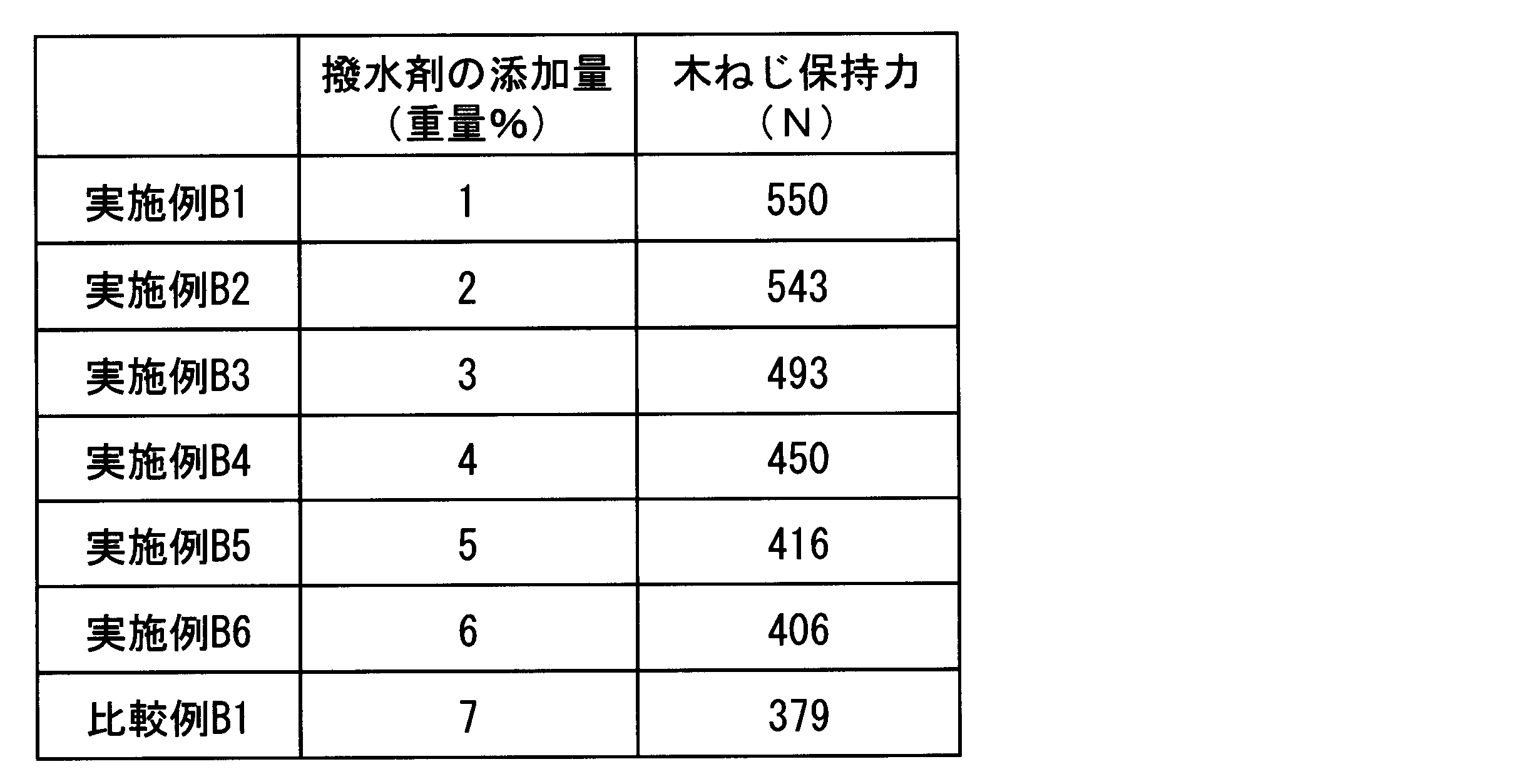
表3の結果から、パラフィン系ワックスの添加量が6重量%以下であれば、木ねじ保持力が400N以上となり、繊維板に十分な木ねじ保持力が得られることが確認された。
[実施例B7] 繊維板の平均密度を0.68g/cm3とし、パラフィン系ワックスの添加量を2重量%とした以外は実施例B1と同様にして、実施例B7の繊維板を得た。
得られた繊維板について、実施例B1と同様にして、木ねじ保持力を測定した。
また、得られた繊維板について、日本工業規格:JIS A5905「繊維板」に準拠して、吸水による繊維板の厚み方向の膨張率(%)を測定した。
評価結果を表4に示す。
得られた繊維板について、実施例B1と同様にして、木ねじ保持力を測定した。
また、得られた繊維板について、日本工業規格:JIS A5905「繊維板」に準拠して、吸水による繊維板の厚み方向の膨張率(%)を測定した。
評価結果を表4に示す。
[実施例B8] 繊維板の平均密度を0.73g/cm3とし、パラフィン系ワックスの添加量を2重量%とした以外は実施例B1と同様にして、実施例B8の繊維板を得た。
得られた繊維板について、実施例B1と同様にして、木ねじ保持力を測定した。
また、得られた繊維板について、実施例B7と同様にして、吸水による繊維板の厚み方向の膨張率(%)を測定した。
評価結果を表4に示す。
得られた繊維板について、実施例B1と同様にして、木ねじ保持力を測定した。
また、得られた繊維板について、実施例B7と同様にして、吸水による繊維板の厚み方向の膨張率(%)を測定した。
評価結果を表4に示す。
[実施例B9] 繊維板の平均密度を0.78g/cm3とし、パラフィン系ワックスの添加量を2重量%とした以外は実施例B1と同様にして、実施例B9の繊維板を得た。
得られた繊維板について、実施例B1と同様にして、木ねじ保持力を測定した。
また、得られた繊維板について、実施例B7と同様にして、吸水による繊維板の厚み方向の膨張率(%)を測定した。
評価結果を表4に示す。
得られた繊維板について、実施例B1と同様にして、木ねじ保持力を測定した。
また、得られた繊維板について、実施例B7と同様にして、吸水による繊維板の厚み方向の膨張率(%)を測定した。
評価結果を表4に示す。
[実施例B10] 繊維板の平均密度を0.83g/cm3とし、パラフィン系ワックスの添加量を2重量%とした以外は実施例B1と同様にして、実施例B10の繊維板を得た。
得られた繊維板について、実施例B1と同様にして、木ねじ保持力を測定した。
また、得られた繊維板について、実施例B7と同様にして、吸水による繊維板の厚み方向の膨張率(%)を測定した。
評価結果を表4に示す。
得られた繊維板について、実施例B1と同様にして、木ねじ保持力を測定した。
また、得られた繊維板について、実施例B7と同様にして、吸水による繊維板の厚み方向の膨張率(%)を測定した。
評価結果を表4に示す。
[実施例B11] 繊維板の平均密度を0.88g/cm3とし、パラフィン系ワックスの添加量を2重量%とした以外は実施例B1と同様にして、実施例B11の繊維板を得た。
得られた繊維板について、実施例B1と同様にして、木ねじ保持力を測定した。
また、得られた繊維板について、実施例B7と同様にして、吸水による繊維板の厚み方向の膨張率(%)を測定した。
評価結果を表4に示す。
得られた繊維板について、実施例B1と同様にして、木ねじ保持力を測定した。
また、得られた繊維板について、実施例B7と同様にして、吸水による繊維板の厚み方向の膨張率(%)を測定した。
評価結果を表4に示す。
[実施例B12] 繊維板の平均密度を0.93g/cm3とし、パラフィン系ワックスの添加量を2重量%とした以外は実施例B1と同様にして、実施例B12の繊維板を得た。
得られた繊維板について、実施例B1と同様にして、木ねじ保持力を測定した。
また、得られた繊維板について、実施例B7と同様にして、吸水による繊維板の厚み方向の膨張率(%)を測定した。
評価結果を表4に示す。
得られた繊維板について、実施例B1と同様にして、木ねじ保持力を測定した。
また、得られた繊維板について、実施例B7と同様にして、吸水による繊維板の厚み方向の膨張率(%)を測定した。
評価結果を表4に示す。
[実施例B13] 繊維板の平均密度を0.95g/cm3とし、パラフィン系ワックスの添加量を2重量%とした以外は実施例B1と同様にして、実施例B13の繊維板を得た。
得られた繊維板について、実施例B1と同様にして、木ねじ保持力を測定した。
また、得られた繊維板について、実施例B7と同様にして、吸水による繊維板の厚み方向の膨張率(%)を測定した。
評価結果を表4に示す。
得られた繊維板について、実施例B1と同様にして、木ねじ保持力を測定した。
また、得られた繊維板について、実施例B7と同様にして、吸水による繊維板の厚み方向の膨張率(%)を測定した。
評価結果を表4に示す。
[比較例B2] 繊維板の平均密度を0.63g/cm3とし、パラフィン系ワックスの添加量を2重量%とした以外は実施例B1と同様にして、比較例B2の繊維板を得た。
得られた繊維板について、実施例B1と同様にして、木ねじ保持力を測定した。
また、得られた繊維板について、実施例B7と同様にして、吸水による繊維板の厚み方向の膨張率(%)を測定した。
評価結果を表4に示す。
得られた繊維板について、実施例B1と同様にして、木ねじ保持力を測定した。
また、得られた繊維板について、実施例B7と同様にして、吸水による繊維板の厚み方向の膨張率(%)を測定した。
評価結果を表4に示す。
[比較例B3] 繊維板の平均密度を0.98g/cm3とし、パラフィン系ワックスの添加量を2重量%とした以外は実施例B1と同様にして、比較例B3の繊維板を得た。
得られた繊維板について、実施例B1と同様にして、木ねじ保持力を測定した。
また、得られた繊維板について、実施例B7と同様にして、吸水による繊維板の厚み方向の膨張率(%)を測定した。
評価結果を表4に示す。
得られた繊維板について、実施例B1と同様にして、木ねじ保持力を測定した。
また、得られた繊維板について、実施例B7と同様にして、吸水による繊維板の厚み方向の膨張率(%)を測定した。
評価結果を表4に示す。
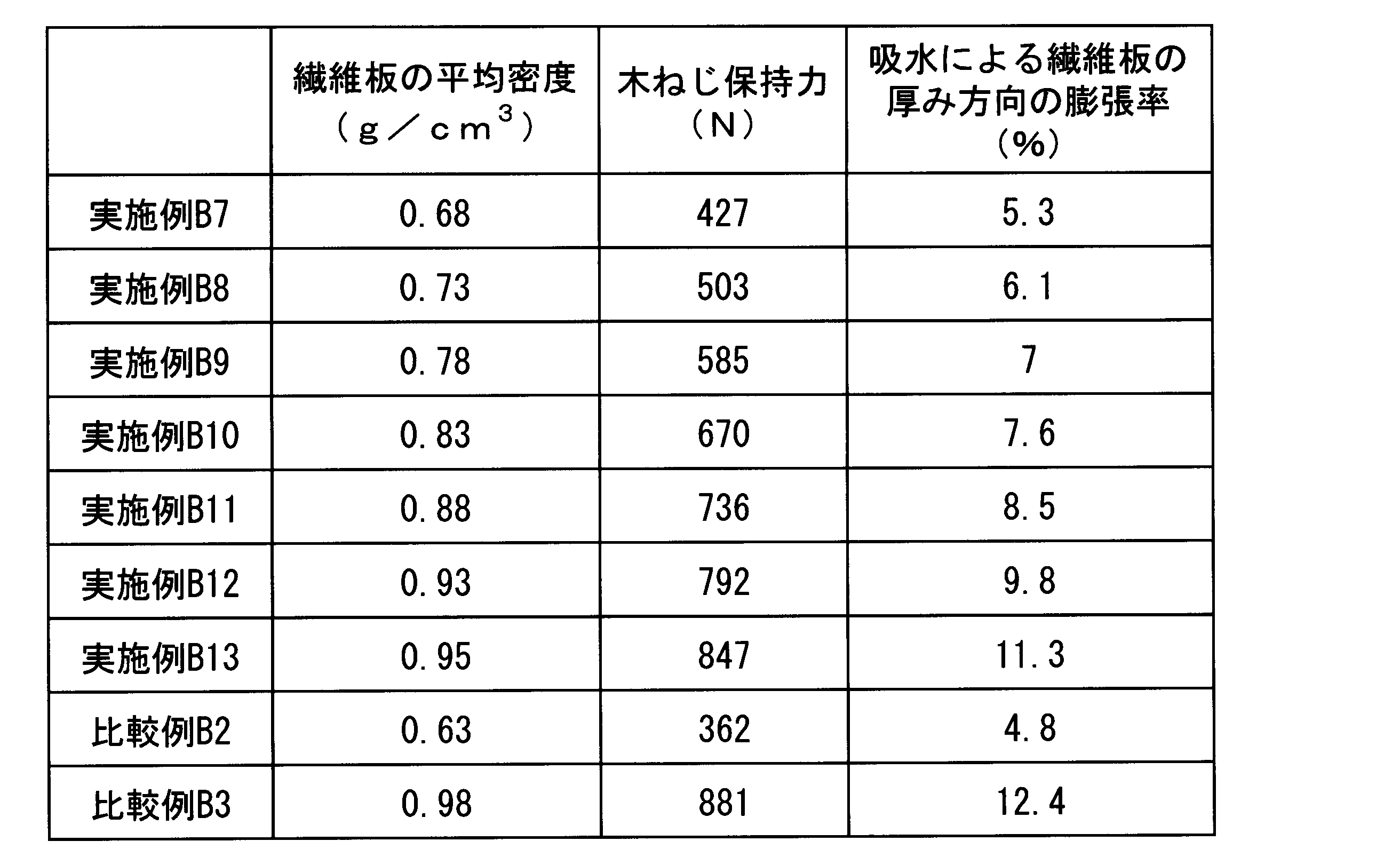
表4の結果から、繊維板の平均密度を0.68~0.95g/cm3とすることにより、木ねじ保持力が400N以上となり、繊維板に十分な木ねじ保持力が得られ、吸水による繊維板の厚みの方向の膨張率が12%以下となることが確認された。
Claims (8)
- 繊維板であって、
バガス繊維と、接着剤と、有効成分の耐熱温度が180℃以上の防かび剤と、を含有する
繊維板。 - 前記防かび剤の含有量は、乾燥繊維板重量に対する乾燥重量比で1.0×10⁻⁶~5重量%である請求項1に記載された繊維板。
- 前記防かび剤の含有量は、乾燥繊維重量に対する乾燥重量比で1.0×10⁻⁶~8重量%である請求項1に記載された繊維板。
- 繊維板であって、
バガス繊維と、接着剤と、撥水剤と、を含有し、
平均密度が0.68~0.95g/cm3であり、
前記撥水剤の含有量が、乾燥繊維板重量に対する固形分重量比で6重量%以下である
繊維板。 - 前記乾燥繊維板重量に対する乾燥繊維重量比は、65~98%である
請求項4に記載された繊維板。 - 前記バガス繊維は、500μm以上のふるい目の開きを有するメッシュを用いて、バガス繊維原料を篩にかけた際に、前記メッシュ上に残るバガス繊維が40%以上であるような粒度を有する
請求項4または5に記載された繊維板。 - 前記バガス繊維は、繊維の幅に対する長さの比が10~1000である
請求項4~6のいずれか1項に記載された繊維板。 - 前記接着剤の含有量は、前記乾燥繊維板重量に対する乾燥重量比で2~30重量%である
請求項4~7のいずれか1項に記載された繊維板。
Applications Claiming Priority (4)
| Application Number | Priority Date | Filing Date | Title |
|---|---|---|---|
| JP2013205416A JP6155484B2 (ja) | 2013-09-30 | 2013-09-30 | 繊維板 |
| JP2013-205416 | 2013-09-30 | ||
| JP2013-205417 | 2013-09-30 | ||
| JP2013205417A JP2015066902A (ja) | 2013-09-30 | 2013-09-30 | 繊維板 |
Publications (1)
| Publication Number | Publication Date |
|---|---|
| WO2015045942A1 true WO2015045942A1 (ja) | 2015-04-02 |
Family
ID=52743083
Family Applications (1)
| Application Number | Title | Priority Date | Filing Date |
|---|---|---|---|
| PCT/JP2014/074379 Ceased WO2015045942A1 (ja) | 2013-09-30 | 2014-09-16 | 繊維板 |
Country Status (1)
| Country | Link |
|---|---|
| WO (1) | WO2015045942A1 (ja) |
Citations (5)
| Publication number | Priority date | Publication date | Assignee | Title |
|---|---|---|---|---|
| JP2000026205A (ja) * | 1998-07-09 | 2000-01-25 | Sumitomo Osaka Cement Co Ltd | 抗菌防黴剤及びその製造方法 |
| JP2009279934A (ja) * | 2008-05-09 | 2009-12-03 | Lanxess Deutschland Gmbh | 木質材料の製造方法 |
| JP2010280187A (ja) * | 2009-06-05 | 2010-12-16 | Toyota Boshoku Corp | 繊維ボードの製造方法 |
| WO2011010495A1 (ja) * | 2009-07-23 | 2011-01-27 | 株式会社エス・ディー・エス バイオテック | エンジニアリングウッド製造用防腐組成物及びエンジニアリングウッド |
| JP2012121834A (ja) * | 2010-12-08 | 2012-06-28 | Nippon Nohyaku Co Ltd | 木材用防腐防カビ組成物及びその使用方法 |
-
2014
- 2014-09-16 WO PCT/JP2014/074379 patent/WO2015045942A1/ja not_active Ceased
Patent Citations (5)
| Publication number | Priority date | Publication date | Assignee | Title |
|---|---|---|---|---|
| JP2000026205A (ja) * | 1998-07-09 | 2000-01-25 | Sumitomo Osaka Cement Co Ltd | 抗菌防黴剤及びその製造方法 |
| JP2009279934A (ja) * | 2008-05-09 | 2009-12-03 | Lanxess Deutschland Gmbh | 木質材料の製造方法 |
| JP2010280187A (ja) * | 2009-06-05 | 2010-12-16 | Toyota Boshoku Corp | 繊維ボードの製造方法 |
| WO2011010495A1 (ja) * | 2009-07-23 | 2011-01-27 | 株式会社エス・ディー・エス バイオテック | エンジニアリングウッド製造用防腐組成物及びエンジニアリングウッド |
| JP2012121834A (ja) * | 2010-12-08 | 2012-06-28 | Nippon Nohyaku Co Ltd | 木材用防腐防カビ組成物及びその使用方法 |
Similar Documents
| Publication | Publication Date | Title |
|---|---|---|
| JP5443048B2 (ja) | 木質材料の製造方法 | |
| US11999137B2 (en) | Cellulosic articles made from cellulosic materials and methods therefor | |
| DE102014105879A1 (de) | Bindemittel für Holzwerkstoffe | |
| DE102007025331A1 (de) | Mehrschichtige Werkstoffplatte, insbesondere aus Hanf | |
| JP2014151599A (ja) | 木質ボード | |
| WO2016163080A1 (ja) | 繊維ボードの製造方法 | |
| EP1110687B1 (de) | Verfahren zur Herstellung einer leichten Faserplatte und leichte Faserplatte mit geschlossener Oberfläche | |
| WO2015045942A1 (ja) | 繊維板 | |
| JP6155484B2 (ja) | 繊維板 | |
| DE102007019416A1 (de) | Grundwerkstoff, dessen Herstellungsverfahren sowie Verwendung | |
| JP5828673B2 (ja) | 木質繊維板、該木質繊維板を用いた木質複合板および床材ならびにこれらの製造方法 | |
| JP2015066902A (ja) | 繊維板 | |
| EP2551081A1 (de) | Formteil und Verfahren zu dessen Herstellung | |
| JP5914825B2 (ja) | 繊維ボード | |
| EP1780243B1 (de) | Bindemittelzusammensetzung für Holzwerkstoffe | |
| MY204908A (en) | Hydrophobing and formaldehyde scavenging compositions comprising wax emulsions and resorcinol and their use for increasing the hydrophobicity of wood composite boards and fibreglass or rock wool insulations | |
| JP3979705B2 (ja) | 木質系ボードの製造方法 | |
| DE102006047279A1 (de) | Verwendung von Popcorn für Holz- und Verbundwerkstoffe | |
| JPH11226918A (ja) | 木質ボードとその製造方法 | |
| Jarlis | Asian Journal of Science Education | |
| Ukey et al. | Role of resin content in MDF board fabricated from lignocellulosic fibre of Bambusa polymorpha Munro | |
| EP0197923A1 (en) | Fiber board composition | |
| Shukla et al. | Evaluation of strength properties of parallel splint lumber (PSL) and its comparison with laminated veneer lumber (LVL), rubber wood and teak | |
| JP2009241356A (ja) | 不燃ボード及びその製造方法 | |
| WO2025153613A1 (de) | Holzwerkstoffplatte und verfahren zu ihrer herstellung |
Legal Events
| Date | Code | Title | Description |
|---|---|---|---|
| 121 | Ep: the epo has been informed by wipo that ep was designated in this application |
Ref document number: 14849576 Country of ref document: EP Kind code of ref document: A1 |
|
| NENP | Non-entry into the national phase |
Ref country code: DE |
|
| 122 | Ep: pct application non-entry in european phase |
Ref document number: 14849576 Country of ref document: EP Kind code of ref document: A1 |