WO2015020073A1 - ショ糖脂肪酸エステルの製造方法 - Google Patents
ショ糖脂肪酸エステルの製造方法 Download PDFInfo
- Publication number
- WO2015020073A1 WO2015020073A1 PCT/JP2014/070677 JP2014070677W WO2015020073A1 WO 2015020073 A1 WO2015020073 A1 WO 2015020073A1 JP 2014070677 W JP2014070677 W JP 2014070677W WO 2015020073 A1 WO2015020073 A1 WO 2015020073A1
- Authority
- WO
- WIPO (PCT)
- Prior art keywords
- fatty acid
- weight
- acid ester
- sucrose
- sucrose fatty
- Prior art date
- Legal status (The legal status is an assumption and is not a legal conclusion. Google has not performed a legal analysis and makes no representation as to the accuracy of the status listed.)
- Ceased
Links
Classifications
-
- C—CHEMISTRY; METALLURGY
- C07—ORGANIC CHEMISTRY
- C07H—SUGARS; DERIVATIVES THEREOF; NUCLEOSIDES; NUCLEOTIDES; NUCLEIC ACIDS
- C07H13/00—Compounds containing saccharide radicals esterified by carbonic acid or derivatives thereof, or by organic acids, e.g. phosphonic acids
- C07H13/02—Compounds containing saccharide radicals esterified by carbonic acid or derivatives thereof, or by organic acids, e.g. phosphonic acids by carboxylic acids
- C07H13/04—Compounds containing saccharide radicals esterified by carbonic acid or derivatives thereof, or by organic acids, e.g. phosphonic acids by carboxylic acids having the esterifying carboxyl radicals attached to acyclic carbon atoms
- C07H13/06—Fatty acids
-
- C—CHEMISTRY; METALLURGY
- C07—ORGANIC CHEMISTRY
- C07H—SUGARS; DERIVATIVES THEREOF; NUCLEOSIDES; NUCLEOTIDES; NUCLEIC ACIDS
- C07H1/00—Processes for the preparation of sugar derivatives
Definitions
- the present invention relates to a method for producing a sucrose fatty acid ester. More specifically, the present invention relates to a method for producing a sucrose fatty acid ester, in which coloring can be suppressed and a sucrose fatty acid ester having a very small amount of remaining organic solvent can be obtained.
- Sucrose fatty acid esters are compounds used in various applications, typified by chemical reaction aids, additives to foods, cosmetics, pharmaceuticals, detergents, antistatic agents for packaging containers, etc. Excellent biodegradability and surface activity.
- the sucrose fatty acid ester is obtained, for example, by reacting sucrose and a fatty acid alkyl ester in a reaction solvent in the presence of a catalyst. In this case, after completion of the reaction, a reaction mixture containing sucrose fatty acid ester is obtained.
- the reaction mixture is a liquid using an organic solvent and water. After subjecting to liquid extraction, the obtained organic solvent solution is subjected to continuous countercurrent extraction with water to obtain an organic solvent solution containing almost no dimethyl sulfoxide as a reaction solvent, and the solvent is distilled off from this organic solvent solution.
- Patent Document 1 A method is known (Patent Document 1).
- Patent Document 1 cannot sufficiently suppress the coloring of the sucrose fatty acid ester after drying because the organic solvent is not sufficiently removed and the sucrose fatty acid ester is very easily colored. There was a problem.
- the present invention is intended to provide a method for producing a sucrose fatty acid ester in which coloring is suppressed and the residual amount of the organic solvent is extremely small.
- the present inventors conducted a reduced-pressure drying step for obtaining a target product by using one or more reduced-pressure dryers to set the internal pressure and / or heating temperature. After making a series of processes that change at least two stages, the internal pressure and heating temperature of the first stage and the final stage are set within predetermined ranges, respectively, so that coloring is substantially suppressed and the residual amount of solvent is extremely reduced.
- the present invention has been completed by finding that it can be reduced to a small amount and further studying it.
- the present invention is a method for producing a sucrose fatty acid ester, wherein a sucrose fatty acid ester is obtained from a reaction mixture obtained by reacting sucrose and a fatty acid lower alkyl ester in a reaction solvent in the presence of an alkali catalyst.
- the in-machine pressure in the first stage of the reduced-pressure drying step is equal to or lower than atmospheric pressure, and the heating temperature is 20 ° C. or higher and 200 ° C. or lower
- the present invention relates to a method for producing a sucrose fatty acid ester, comprising a reduced pressure drying step in which the in-machine pressure at the final stage of the reduced pressure drying step is 10 kPa ⁇ abs or less and the heating temperature is 20 ° C. or higher and 200 ° C. or lower.
- At least one of the vacuum dryers is preferably a twin screw extruder.
- the series of reduced-pressure drying steps is preferably composed of any one of 2 to 9 steps.
- the content of the sucrose fatty acid ester in the organic solvent phase obtained in the purification step (2) is preferably 10 to 80% by weight.
- the present invention also relates to a sucrose fatty acid ester obtained by the above production method, having a Gardner color number of 3 or less and a residual amount of organic solvent of 10 ppm or less.
- a sucrose fatty acid ester in which coloring is suppressed and the residual amount of the organic solvent is extremely small can be obtained. More specifically, it is possible to obtain a Gardner color number of 3 or less for coloring and a 10 ppm or less residual solvent amount.
- the sucrose fatty acid ester is an ester of sucrose and a fatty acid.
- the fatty acid include saturated or unsaturated fatty acids having 6 to 30 carbon atoms. The carbon number is preferably 8 or more. On the other hand, the carbon number is preferably 22 or less.
- the saturated fatty acid include caproic acid, caprylic acid, capric acid, lauric acid, myristic acid, palmitic acid, stearic acid, and behenic acid.
- the unsaturated fatty acid include linoleic acid, oleic acid, linolenic acid, erucic acid, ricinoleic acid and the like.
- the object of the present invention has a hue of 3 or less, preferably 2 or less, and a residual amount of organic solvent of 10 ppm or less, preferably 5 ppm or less.
- the average value of the esterification rate of the alcohol portion of sucrose (hereinafter referred to as “average esterification degree”) is not particularly limited, but the removal of the solvent of the present invention
- the method can be particularly suitably applied when the average degree of esterification, which is considered to be easy to color the sucrose fatty acid ester, is 6.0 or less.
- the sucrose fatty acid ester can be produced by subjecting sucrose and a fatty acid lower alkyl ester to a transesterification reaction by a conventional method.
- the transesterification reaction can be carried out under total reflux.
- it is preferable that the transesterification reaction is initially performed while distilling the reaction solvent, followed by distilling a certain amount of the reaction solvent, and then performing total reflux without distilling. In this way, the transesterification reaction is promoted, and the distilled reaction solvent can be recovered and reused.
- the amount of the reaction solvent to be distilled off is, for example, about 0.1 to 30% by weight, preferably about 1 to 20% by weight of the whole reaction solvent.
- sucrose Any commercially available sucrose can be used.
- the sucrose may be one obtained by collecting sucrose that has not been reacted at the time of producing the sucrose fatty acid ester (collected sugar).
- the form may be a solid state or a solution state dissolved in a solvent.
- generated at the neutralization process mentioned later may be included.
- Examples of the fatty acid lower alkyl ester include esters of the above-described fatty acids and lower aliphatic alcohols.
- Examples of lower aliphatic alcohols include those having 1 to 4 carbon atoms, and specific examples include methanol, ethanol, propanol, butanol and the like.
- the fatty acid lower alkyl ester may be used alone or as a mixture of two or more of any proportion.
- the fatty acid lower alkyl ester is usually used in an amount of 0.1 to 15 mol per mol of sucrose, but is preferably 0.2 mol or more, and preferably 10 mol or less.
- reaction solvent used in the transesterification reaction any of those commonly used in this field can be used as long as the reaction proceeds suitably.
- examples of such a reaction solvent include trimethylamine, triethylamine, N -Tertiary amines such as methylmorpholine, pyridine, quinoline, pyrazine, methylpyrazine, N, N-dimethylpiperidine, amides such as formamide, N, N-dimethylformamide, 2-pyrrolidone, N-methyl-2-pyrrolidone And dialkyl sulfoxides such as dimethyl sulfoxide, among which pyridine, N, N-dimethylformamide, and dimethyl sulfoxide are preferable. From the viewpoint of thermal stability, solubility in sucrose and safety, dimethyl sulfoxide ( Hereinafter abbreviated as DMSO.) The most preferred.
- the reaction solvent can be used alone or in combination of two or more.
- the amount of the reaction solvent used is usually preferably 30 to 90% by weight in the reaction mixture, more preferably 50% by weight or more, and more preferably 85% by weight or less.
- the reaction solvent preferably has a water content of 0.1% by weight or less.
- the transesterification reaction is performed in the presence of an alkali catalyst.
- the alkali catalyst When the reaction system is substantially non-aqueous, the alkali catalyst is present in a suspended state in the reaction system.
- the alkali catalyst include alkali metal hydrides (sodium bicarbonate, potassium bicarbonate, etc.), alkali metal hydroxides (lithium hydroxide, sodium hydroxide, potassium hydroxide, etc.), alkali metal salts (sodium carbonate, carbonate, etc.). Potassium) and the like are effective, and potassium carbonate, sodium carbonate and the like are particularly preferable.
- the alkali catalyst can be used alone or in combination of two or more.
- the amount of these alkali catalysts used is usually preferably 0.1 to 2.0 parts by weight, more preferably 0.2 parts by weight or more, based on 1 part by weight of sucrose and fatty acid alkyl ester. 1.0 part by weight or less is more preferable.
- the reaction temperature for the transesterification reaction is usually preferably 80 to 120 ° C, more preferably 90 ° C or more, and more preferably 100 ° C or less.
- the reaction pressure is usually 0.2 to 43 kPa, preferably 0.7 to 32 kPa.
- the reaction time is not particularly limited, but is usually preferably 1 to 50 hours, more preferably 2 hours or more, and more preferably 40 hours or less.
- the reaction between sucrose and the fatty acid lower alkyl ester is preferably carried out under reflux of the reaction solvent. Thereby, alcohol by-produced during the reaction can be easily removed from the reaction system.
- the transesterification reaction is stopped by adding an acid and neutralizing the alkali catalyst.
- acids include organic acids such as formic acid, acetic acid, propionic acid, oxalic acid, succinic acid, benzoic acid, tartaric acid, lactic acid, malic acid, carbonic acid, citric acid and maleic acid, and inorganic acids such as hydrochloric acid and sulfuric acid.
- lactic acid, malic acid, citric acid and the like are preferable from the viewpoint of influence on the living body.
- the pH of the reaction mixture is in the range of about 5.0 to 7.5, preferably about 5.5 to 6.5, more preferably about 6.0. It is preferable to add these acids so that These acids can be used alone or in combination of two or more.
- sucrose has eight hydroxyl groups
- the produced sucrose fatty acid ester is theoretically a mixture from monoester to octaester, and the composition of the produced ester can be adjusted by the proportion of raw materials used.
- the reaction mixture of sucrose and fatty acid lower alkyl ester thus obtained contains a reaction solvent, an unreacted raw material, an alkali catalyst, an acid and the like in addition to the target sucrose fatty acid ester.
- the extraction step in the present invention is a step of subjecting the reaction mixture to liquid-liquid extraction using an organic solvent and water, and extracting sucrose fatty acid ester into the organic solvent phase. At this time, the reaction solvent, the unreacted raw material, the alkali catalyst, the acid, the alkali catalyst and the neutralized salt with the acid, etc. migrate to the aqueous phase.
- the concentration of the reaction solvent in the reaction mixture is high, it is preferable to reduce the concentration in advance by distilling a part thereof.
- a preferable concentration of the reaction solvent is 30% by weight or less, more preferably 20% by weight or less in the reaction mixture.
- the lower limit of the concentration of the reaction solvent is not particularly limited as long as the viscosity is not excessively increased or solidified, but is preferably 5% by weight or more, more preferably 10% by weight or more in the reaction mixture.
- the distillation method is not particularly limited.
- batch distillation using a stirred tank capable of reducing pressure and heating, or a thin film evaporator also referred to as “thin film evaporator” or “thin film evaporator”. It can be carried out at a temperature of 60 to 150 ° C. under reduced pressure using a mold (vertical, horizontal, etc.). The reaction solvent thus distilled off can be recovered and reused in the transesterification reaction.
- Liquid-liquid extraction can be carried out by adding an organic solvent (extraction solvent) and water to the reaction mixture and stirring the mixture.
- alcohols include n-butyl alcohol, isobutyl alcohol, t-butyl alcohol, n-amyl alcohol, isoamyl alcohol, n-hexanol, and cyclohexanol.
- ketones include methyl ethyl ketone and diethyl ketone. Or methyl isobutyl ketone is mentioned.
- the amount of the organic solvent used relative to the reaction mixture is usually 0.5 to 20 parts by weight, preferably 1 to 10 parts by weight, based on 1 part by weight of the sucrose fatty acid ester in the reaction mixture.
- the amount of water used is usually 0.05 to 10 parts by weight, preferably 0.5 to 2 parts by weight with respect to 1 part by weight of the organic solvent. Stirring is usually sufficient for 0.5 to 4 hours.
- the organic solvent can be used alone or in combination of two or more.
- the purification solvent recovered in the next purification step can be used in place of the “water”, in addition to the commonly used water.
- Liquid-liquid extraction is preferably performed after adjusting the pH of the mixture of the organic solvent and water. By doing so, hydrolysis of the sucrose fatty acid ester is suppressed and it contributes to efficient extraction into an organic solvent phase.
- the pH of the mixed solution is preferably 5.5 to 6.5.
- the acid used for neutralization of the alkali catalyst can be appropriately used.
- liquid-liquid extraction is preferably performed by adding a salting-out agent from the viewpoint of stable operation.
- a salting-out agent is arbitrary, the salt of the acid used for pH adjustment is preferable.
- alkali carbonates potassium, sodium, etc.
- alkali citrates potassium, sodium, etc.
- alkali lactates potassium, sodium, etc.
- alkali sulfates potassium, sodium, etc.
- Liquid-liquid extraction is usually carried out under conditions where the concentration of the salting-out agent is 50 ppm or more, but it is preferably carried out in the range of 500 to 3000 ppm from the viewpoint of stable operability and economy.
- a bleaching agent to the mixture to reduce the coloration as desired.
- the bleaching agent include oxidizing agents such as hydrogen peroxide, sodium chlorite, sodium hypochlorite and ozone, and reducing agents such as sodium sulfite, potassium pyrosulfite, sodium pyrosulfite and sodium hyposulfite.
- an adsorbent such as activated carbon can be used.
- the added amount of the bleaching agent is 0. The amount is preferably 1 to 5.0 parts by weight, more preferably 0.3 parts by weight or more, and even more preferably 3.0 parts by weight or less.
- Liquid-liquid extraction is carried out by stirring the mixture obtained according to the above operation.
- Stirring of the mixture can be usually carried out at a temperature of 40 to 80 ° C., more preferably 50 ° C. or more, and more preferably 70 ° C. or less.
- the stirring time is usually preferably 1 to 8 hours, more preferably 2 hours or more, and more preferably 6 hours or less.
- the excess bleaching agent is decomposed or the remaining bleaching agent is removed. That is, when an oxidizing agent is added as a bleaching agent, an excess bleaching agent is decomposed using a reducing agent, and conversely, when a reducing agent is added as a bleaching agent, an oxidizing agent is used.
- These reducing agents or oxidizing agents are used in an amount of 0.9 to 1.5 equivalents relative to 1 equivalent of the remaining amount of bleach (that is, 90 to 150 of the amount necessary to decompose all the remaining bleaching agent). Mass%), preferably 1.0 equivalent or more, or more preferably 1.2 equivalent or less.
- an adsorbent is used as a bleaching agent, the bleaching agent remaining in the mixture is removed by, for example, filtration.
- the mixture After decomposing or removing the bleaching agent, the mixture is allowed to stand to separate into an organic solvent phase and an aqueous phase, and then both phases are separated. At this time, the sucrose fatty acid ester is contained in the organic solvent phase. On the other hand, the aqueous layer contains unreacted sucrose, reaction solvent, salt produced in the reaction step, and the like.
- the separated organic solvent phase is subjected to the following purification process. Further, the collected aqueous phase can recover the reaction solvent and unreacted sucrose by distilling off water and an organic solvent under reduced pressure (recovered sugar), and can be reused for transesterification.
- the purification step in the present invention is a step of purifying the organic solvent phase obtained in the extraction step using a counter solvent by a countercurrent distribution type extraction device having a light liquid supply port and a heavy liquid supply port.
- a countercurrent distribution type extraction device having a light liquid supply port and a heavy liquid supply port.
- the heavier specific gravity is supplied from the heavy liquid supply port
- the lighter specific gravity is supplied from the light liquid supply port to direct the organic solvent phase and the purification solvent.
- the purpose is to reduce the reaction solvent remaining in the organic solvent phase by flowing contact.
- the pH of the purification solvent it is preferable to adjust the pH of the purification solvent to 5.0 to 6.0. By doing so, it contributes to suppressing hydrolysis of the sucrose fatty acid ester and facilitating countercurrent distribution. Adjustment of pH can be suitably performed using the acid used for the neutralization of the said alkali catalyst.
- the “countercurrent distribution type extraction device having a light liquid supply port and a heavy liquid supply port” used in the present invention is a case where a light liquid having a lower specific gravity and a heavy liquid having a higher specific gravity are supplied from the respective supply ports.
- the reaction solvent or the like remaining in the organic solvent phase is transferred to the purification solvent by countercurrent contact, and then the organic solvent phase and the purification solvent are respectively recovered, and the recovered organic solvent phase is subjected to the next purification. Provided to the process. This operation is repeated until the concentration of the reaction solvent remaining in the organic solvent phase is 1 ppm or less, preferably 0.5 ppm or less, more preferably 0.2 ppm or less.
- the counter-current distribution type extraction device may be of a vertical type (tower type) or a horizontal type. Moreover, the weir type thing which provided the weir for enabling efficient counterflow inside is also sufficient. Further, from the viewpoint of operational efficiency, a continuous type is preferable in which the recovered organic solvent phase can be continuously supplied again.
- the counter-current distribution type extraction device any of those usually used in this field can be used. Specifically, a perforated plate extraction tower, a dam plate type extraction tower (for example, WINTRAY (trade name, Etc., etc.), baffle extraction towers, rotary column towers and other column tower type extraction devices; spray towers, packed towers, pulsation type extraction towers and other differential contact devices.
- the purification solvent water can be used, or a mixed solution of water and the organic solvent used in the extraction step can be used.
- a purification solvent water is basically used. However, when the purification step is continuously performed, a predetermined amount of the organic solvent used in the extraction step is mixed with water as a purification solvent in advance. It is preferable to use one because the purification step can be carried out stably without changing the mixing ratio of water and the organic solvent in the purification solvent.
- the recovered solvent for purification can be reused instead of “water” in the extraction step as described above.
- the purification step is preferably performed by adding a salting-out agent to the purification solvent from the viewpoint of stable operation.
- a salting-out agent is arbitrary, the salt of the acid used for pH adjustment is preferable.
- alkali citrate such as potassium and sodium
- alkali lactate such as potassium and sodium
- alkali sulfate such as potassium and sodium.
- the purification step is usually performed under the condition that the concentration of the salting-out agent is 50 ppm or more, but it is preferably performed in the range of 500 to 3000 ppm from the viewpoint of stable operation and economy.
- the temperature in the purification step is preferably 40 to 80 ° C. from the viewpoint of suppressing decomposition and coloring of the product.
- the supply amount of heavy liquid and light liquid in the purification process varies depending on the type of apparatus, the type of organic solvent, etc., for example, when using a weir plate type extraction tower as the apparatus and isobutyl alcohol as the organic solvent,
- the ratio of the supplied amount of the solvent for purification and the isobutyl alcohol phase which is a light liquid is preferably in the range of 5/1 to 1/5 (volume ratio).
- an organic solvent phase containing a sucrose fatty acid ester can be obtained.
- the organic solvent phase includes a sucrose fatty acid ester and includes an organic solvent and water.
- the reduced-pressure drying step is a step of drying the organic solvent phase obtained in the above purification step under reduced pressure, distilling off the organic solvent and water contained therein, and isolating the target sucrose fatty acid ester. is there.
- the reduced-pressure drying process according to the present invention includes an sucrose fatty acid ester obtained through the purification process, and an organic solvent phase containing an organic solvent and water, by one or more reduced-pressure dryers.
- the pressure and / or heating temperature is changed in at least two stages or more and dried under reduced pressure, the in-machine pressure of the first reduced pressure drying process is lower than atmospheric pressure, and the heating temperature is It is 20 ° C. or higher and 200 ° C. or lower, the in-machine pressure of the final vacuum drying step is 10 kPa ⁇ abs or lower, and the heating temperature is 20 ° C. or higher and 200 ° C. or lower.
- in-machine pressure refers to the pressure in the gas phase in the vacuum dryer, and the in-machine pressure can be measured by a conventional method, for example, a pressure gauge installed in contact with the gas phase. it can. As long as the pressure gauge is in contact with the gas phase in the vacuum dryer, for example, the position of the pressure gauge is not limited. For example, the pressure gauge may be in the exhaust pipe from the vacuum dryer.
- Heating temperature refers to the temperature of a heat medium (hot water, steam, oil, etc.) or an electric heater that is used to heat the mixture and circulates in a jacket or coil of a vacuum dryer.
- the concentration of sucrose fatty acid ester in the organic solvent phase subjected to the drying step is preferably 10% by weight or more, more preferably 30% by weight or more. If the concentration is less than 10% by weight, it is industrially inefficient. On the other hand, the concentration is preferably 80% by weight or less, and more preferably 50% by weight or less. When the concentration exceeds 80% by weight, the viscosity is very high and it tends to be difficult to adapt to a vacuum dryer. In carrying out the vacuum drying at each stage, water is added as necessary to adjust the concentration of the sucrose fatty acid ester so that the concentration of the sucrose fatty acid ester falls within the above range.
- the reduced pressure dryer is not particularly limited as long as it can be dried under reduced pressure while maintaining the internal pressure and the heating temperature at the predetermined pressure and the predetermined temperature, and any of machines and instruments having such functions. Can also be used for the purposes of the present invention.
- Specific examples of the vacuum dryer of the present invention include, for example, a batch type such as a stirring tank, and a continuous type such as a flash distiller, a thin film evaporator, a drum dryer, an extruder, and a belt dryer.
- Each vacuum dryer includes various types.
- the extruder includes a single screw extruder, a twin screw extruder, and the like, and various types of these extruders have different screw diameters and different screw shapes.
- At least one is preferably an extruder, and particularly preferably a twin screw extruder.
- a twin screw extruder it is advantageous in terms of suppressing coloring of the sucrose fatty acid ester and reducing the remaining amount of the organic solvent.
- one-stage reduced-pressure drying refers to drying under reduced pressure using a single reduced-pressure dryer under conditions in which the internal pressure and the heating temperature are maintained at the predetermined pressure and the predetermined temperature.
- one vacuum dryer means a single vacuum dryer, and each of the vacuum dryers is divided into two or more compartments, such as a certain type of extruder. When the pressure and temperature can be set individually in the compartment, the compartment means the “one vacuum dryer” of the present invention.
- a series of reduced-pressure drying of two or more stages can be performed by using one or two or more apparatuses that perform at least one or more stages of reduced-pressure drying.
- the in-machine pressure and / or the heating temperature need only be changed in at least two stages, and as long as such a condition is achieved, the in-machine pressure and the heating temperature may not be changed in two or more successive stages.
- “a series” means that other steps (for example, a purification step) other than drying under reduced pressure are not incorporated in the course of drying under reduced pressure.
- the number of stages is preferably any one of 2 to 9 from the viewpoint of the quality of the target product and the efficiency for obtaining it.
- the in-machine pressure in the first-stage reduced-pressure drying step is atmospheric pressure or lower, preferably 80 kPa ⁇ abs or lower, more preferably 60 kPa ⁇ abs or lower.
- the atmospheric pressure is exceeded, the heating temperature necessary for solvent removal becomes too high, and the sucrose fatty acid ester tends to be colored.
- the same pressure is preferably 3 kPa ⁇ abs or more, more preferably 4 kPa ⁇ abs or more. If it is less than 3 kPa ⁇ abs, there is a tendency that blockage due to flushing or splashing tends to occur.
- the in-machine pressure is preferably higher than the final in-machine pressure.
- the internal pressure in the final-stage reduced-pressure drying step is 10 kPa ⁇ abs or less, preferably 2 kPa ⁇ abs or less, more preferably 0.6 kPa ⁇ abs or less. If it exceeds 10 kPa, it is difficult to sufficiently reduce the residual solvent, or it becomes necessary to increase the temperature of the sucrose fatty acid ester, so that it tends to be colored easily. On the other hand, there is no restriction
- the in-machine pressure at the final stage of the vacuum drying process is lower than the in-machine pressure at the first stage.
- the heating temperature in the first-stage vacuum drying step is 20 to 200 ° C. If the temperature exceeds 200 ° C., coloring tends to be suppressed, while if it is less than 20 ° C., there is a tendency that the residual solvent cannot be sufficiently reduced. To solve this problem, for example, the in-machine pressure is made extremely high vacuum. There is a need and equipment costs tend to be high.
- As an upper limit of heating temperature 160 degrees C or less is preferable, More preferably, it is 140 degrees C or less.
- the lower limit of the temperature is preferably 60 ° C. or higher, more preferably 100 ° C. or higher.
- the heating temperature in the final-stage vacuum drying process is 20 to 200 ° C. If it exceeds 200 ° C., coloring tends to be suppressed, whereas if it is less than 20 ° C., it tends to be difficult to sufficiently reduce the residual solvent.
- As an upper limit of heating temperature 160 degrees C or less is preferable, More preferably, it is 140 degrees C or less.
- the lower limit of the temperature is preferably 60 ° C. or higher, more preferably 80 ° C. or higher, and still more preferably 100 ° C. or higher.
- the in-machine pressure and heating temperature in the intermediate stage between the first stage and the final stage can be appropriately set within the above-described pressure and temperature ranges.
- the higher the temperature the more the coloring tendency increases. Therefore, the pressure and temperature adopted in the first stage, and the pressure and temperature planned to be adopted in the final stage. It will be decided as appropriate.
- the processing time and the processing flow rate for one-stage vacuum drying will be described.
- the treatment time when using a batch type vacuum dryer is not particularly limited, but is generally 0.5 to 20 hours. If it exceeds 20 hours, the sucrose fatty acid ester may be colored.
- the processing flow rate when using a continuous vacuum dryer is not particularly limited because it depends on the size of the apparatus, but is generally 0.5 to 10,000 kg / hour.
- the number of rotations of the screw may be appropriately set according to other conditions, but is generally 100 to 1500 rpm. It is preferable.
- sucrose fatty acid ester which is the target product can be isolated through the above-mentioned vacuum drying step.
- sucrose fatty acid ester thus isolated is in the form of a lump, it can be converted into a sucrose fatty acid ester powder by further subjecting it to a pulverization step.
- the pulverization can be performed by a conventional method.
- the bulk sucrose fatty acid ester obtained above is not only pulverized by a high-speed rotary mill such as a hammer mill, cage mill, axial flow mill, annular mill or shear mill, but also a supersonic jet nozzle system, an opposed nozzle system or
- a fine powder can be obtained by combining pulverization with one or more pulverizers such as a jet mill having a swirling airflow system.
- sucrose fatty acid ester thus obtained is suppressed in coloring and the residual amount of the organic solvent is negligible, it can be used in various applications, that is, additives for chemical reactions, additives to detergents, packaging containers, etc. In addition to these antistatic agents, it can also be suitably used as additives for feeds, cosmetics, foods, pharmaceuticals and the like.
- the in-machine pressure is maintained at a high level. While preventing the mixture containing the sugar fatty acid ester and the solvent from bumping and preventing the coloring of the sucrose fatty acid ester by keeping the heating temperature within a predetermined range, the concentration of the sucrose fatty acid ester is then increased.
- the pressure is relatively high, it is considered that the internal pressure is set low to increase the efficiency of drying under reduced pressure, thereby realizing removal of the organic solvent having both coloring suppression and efficiency.
- the Gardner color number is measured using a tetrahydrofuran solution (concentration: 200 g / L) of sucrose fatty acid ester according to JIS K0071.
- the amount of “organic solvent” (ppm) in the sucrose fatty acid ester is a value determined by gas chromatography (GC).
- GC gas chromatography
- Example 1 Transesterification reaction
- the reactor was charged with 345.7 parts by weight of DMSO and subjected to total reflux at 90 ° C. and 3.7 kPa until the water content of DMSO reached 0.06% by weight.
- 0.26 parts by weight of potassium carbonate, 67.2 parts by weight of sucrose, and 21.4 parts by weight of methyl stearate were added, and the reaction was conducted while distilling DMSO at 95 ° C. and 3.7 kPa. After the distillation amount of DMSO reached 42.9 parts by weight, the reaction was carried out under total reflux without distilling DMSO. After reacting for a total of 4 hours, 90% by weight lactic acid aqueous solution was added so that the pH was 6.0, and the reaction was stopped. Distilled DMSO was recovered for reuse.
- This solution was adjusted to pH 6.0 with 5% aqueous potassium carbonate solution and allowed to stand to separate into two layers, and an upper layer (IBA phase) and a lower layer (aqueous phase) were separated.
- the IBA phase was sent to the next purification step.
- the aqueous phase was subjected to use in Example 2 in order to reuse DMSO and unreacted sucrose contained therein.
- sucrose stearate after the drying treatment was coarsely pulverized using a high-speed rotary mill and further pulverized using a jet mill to obtain sucrose stearate powder.
- the remaining amount of IBA was measured and the hue was evaluated.
- Example 2 (Processing for reuse) 70.5 parts by weight of DMSO was added to 263 parts by weight of the aqueous phase as the lower layer obtained in the extraction step of Example 1. This solution was heated to 90 ° C., and water and isobutyl alcohol were removed under conditions of 2.7 kPa to obtain a 35 wt% sucrose DMSO solution. (Transesterification reaction-grinding process) Instead of using 345.7 parts by weight of DMSO, a mixture of 280.7 parts by weight of DMSO and 100 parts by weight of the 35% by weight sucrose DMSO solution was used, and the amount of sucrose used was 32.2 parts by weight. The same operation as in Example 1 was performed to obtain sucrose stearate powder.
- Example 3 The amount of sucrose used was 40.0 parts by weight, the amount of methyl stearate used was 172.0 parts by weight, the amount of DMSO used was 265.4 parts by weight, and potassium carbonate 0.56 parts by weight.
- a sucrose stearate powder was obtained in the same manner as in Example 1 except that 49.8 parts by weight of DMSO was added.
- Example 4 21.4 parts by weight of methyl stearate is an even fatty acid methyl having 8 to 18 carbon atoms (methyl fatty acid having 8 and 10 carbon atoms: 5% by weight, methyl laurate: 70% by weight, fatty acid methyl having 14, 16 and 18 carbon atoms) : 25 wt% mixture) Same as Example 1 except that 18.7 parts by weight, DMSO usage was changed to 333.9 parts, and potassium carbonate usage was changed to 0.29 parts by weight. Operation was performed to obtain a predetermined sucrose fatty acid ester powder.
- Example 5 In the extraction process, Example 1 was used except that instead of the stirring tank, a thin film evaporation apparatus (hereinafter simply referred to as “thin film” when displaying that the thin film evaporation apparatus was used in the table) was used.
- the sucrose stearate powder was obtained in the same manner as in Example 1.
- Example 6 (Processing for reuse) 70.5 parts by weight of DMSO was added to 263 parts by weight of the aqueous phase as the lower layer obtained in the extraction step of Example 5. This solution was heated to 90 ° C., and water and isobutyl alcohol were removed under conditions of 2.7 kPa to obtain a 35 wt% sucrose DMSO solution. (Transesterification reaction-grinding process) Instead of using 345.7 parts by weight of DMSO, a mixture of 280.7 parts by weight of DMSO and 100 parts by weight of the 35% by weight sucrose DMSO solution was used, and the amount of sucrose used was 32.2 parts by weight. The same operation as in Example 5 was performed to obtain sucrose stearate powder.
- Example 7 The amount of sucrose used was 40.0 parts by weight, the amount of methyl stearate used was 172.0 parts by weight, the amount of DMSO used was 265.4 parts by weight, and potassium carbonate 0.56 parts by weight.
- a sucrose stearate powder was obtained in the same manner as in Example 5 except that 49.8 parts by weight of DMSO was added.
- Example 8 18.7 parts by weight of 21.4 parts by weight of methyl stearate (purity: 70% by weight, fatty acid methyl having 8 to 10 carbon atoms: 5% by weight, methyl fatty acid having 14 to 14 carbon atoms: 25% by weight)
- the same operation as in Example 5 was carried out except that the amount of DMSO used was changed to 333.9 parts by weight and the amount of potassium carbonate used was changed to 0.29 parts by weight to obtain sucrose stearate powder. It was.
- Example 9 In the refining process, instead of the perforated plate extraction tower, a weir plate type extraction tower (trade name: WINTRAY, manufactured by JGC Corporation.
- WINTRAY trade name: WINTRAY, manufactured by JGC Corporation.
- Table 9 when displaying that the weir plate type extraction tower is used, simply “ The sucrose stearate powder was obtained by carrying out the same operation as in Example 1 except that “weir plate” was used.
- Example 10 (Processing for reuse) 70.5 parts by weight of DMSO was added to 263 parts by weight of the aqueous phase as the lower layer obtained in the extraction step of Example 9. This solution was heated to 90 ° C., and water and isobutyl alcohol were removed under conditions of 2.7 kPa to obtain a 35 wt% sucrose DMSO solution. (Transesterification reaction-grinding process) Instead of using 345.7 parts by weight of DMSO, a mixture of 280.7 parts by weight of DMSO and 100 parts by weight of the 35% by weight sucrose DMSO solution was used, and the amount of sucrose used was 32.2 parts by weight. The same operation as in Example 9 was performed to obtain sucrose stearate powder.
- Example 11 The amount of sucrose used was 40.0 parts by weight, the amount of methyl stearate used was 172.0 parts by weight, the amount of DMSO used was 265.4 parts by weight, and potassium carbonate 0.56 parts by weight.
- a sucrose stearate powder was obtained in the same manner as in Example 9 except that 49.8 parts by weight of DMSO was added.
- Example 12 18.7 parts by weight of 21.4 parts by weight of methyl stearate (purity: 70% by weight, fatty acid methyl having 8 to 10 carbon atoms: 5% by weight, methyl fatty acid having 14 to 18 carbon atoms: 25% by weight)
- the same operation as in Example 9 was carried out except that the amount of DMSO used was changed to 333.9 parts by weight and the amount of potassium carbonate used was changed to 0.29 parts by weight to obtain sucrose stearate powder. It was.
- Example 13 In the extraction step, a sucrose stearate powder was obtained by performing the same operation as in Example 9 except that a thin film evaporator was used instead of the stirring tank.
- Example 14 (Processing for reuse) 70.5 parts by weight of DMSO was added to 263 parts by weight of the aqueous phase as the lower layer obtained in the extraction step of Example 13. This solution was heated to 90 ° C., and water and isobutyl alcohol were removed under conditions of 2.7 kPa to obtain a 35 wt% sucrose DMSO solution. (Transesterification reaction-grinding process) Instead of using 345.7 parts by weight of DMSO, a mixture of 280.7 parts by weight of DMSO and 100 parts by weight of the 35% by weight sucrose DMSO solution was used, and the amount of sucrose used was 32.2 parts by weight. The same operation as in Example 13 was performed to obtain sucrose stearate powder.
- Example 15 The amount of sucrose used was 40.0 parts by weight, the amount of methyl stearate used was 172.0 parts by weight, the amount of DMSO used was 265.4 parts by weight, and potassium carbonate 0.56 parts by weight.
- a sucrose stearate powder was obtained in the same manner as in Example 13 except that 49.8 parts by weight of DMSO was added.
- Example 16 18.7 parts by weight of 21.4 parts by weight of methyl stearate (purity: 70% by weight, fatty acid methyl having 8 to 10 carbon atoms: 5% by weight, methyl fatty acid having 14 to 18 carbon atoms: 25% by weight)
- the same operation as in Example 13 was carried out except that the amount of DMSO used was changed to 333.9 parts by weight and the amount of potassium carbonate used was changed to 0.29 parts by weight to obtain sucrose stearate powder. It was.
- Example 17 In the refining process, a baffle extraction tower was used in place of the perforated plate extraction tower (hereinafter referred to as “baffle” when simply indicated in the table that the baffle extraction tower was used). The same operation as in Example 1 was performed to obtain sucrose stearate powder.
- Example 18 (Processing for reuse) 70.5 parts by weight of DMSO was added to 263 parts by weight of the aqueous phase as the lower layer obtained in the extraction step of Example 17. This solution was heated to 90 ° C., and water and isobutyl alcohol were removed under conditions of 2.7 kPa to obtain a 35 wt% sucrose DMSO solution. (Transesterification reaction-grinding process) Instead of using 345.7 parts by weight of DMSO, a mixture of 280.7 parts by weight of DMSO and 100 parts by weight of the 35% by weight sucrose DMSO solution was used, and the amount of sucrose used was 32.2 parts by weight. The same operation as in Example 17 was performed to obtain sucrose stearate powder.
- Example 19 The amount of sucrose used was 40.0 parts by weight, the amount of methyl stearate used was 172.0 parts by weight, the amount of DMSO used was 265.4 parts by weight, and potassium carbonate 0.56 parts by weight.
- a sucrose stearate powder was obtained in the same manner as in Example 17 except that 49.8 parts by weight of DMSO was added.
- Example 20 18.7 parts by weight of 21.4 parts by weight of methyl stearate (purity: 70% by weight, fatty acid methyl having 8 to 10 carbon atoms: 5% by weight, methyl fatty acid having 14 to 18 carbon atoms: 25% by weight)
- the same operation as in Example 17 was carried out except that the amount of DMSO used was changed to 333.9 parts by weight and the amount of potassium carbonate used was changed to 0.29 parts by weight to obtain sucrose stearate powder. It was.
- Example 21 In the extraction step, a sucrose stearate powder was obtained by performing the same operation as in Example 17 except that a thin film evaporator was used instead of the stirring tank.
- Example 22 (Processing for reuse) 70.5 parts by weight of DMSO was added to 263 parts by weight of the aqueous phase as the lower layer obtained in the extraction step of Example 21. This solution was heated to 90 ° C., and water and isobutyl alcohol were removed under conditions of 2.7 kPa to obtain a 35 wt% sucrose DMSO solution. (Transesterification reaction-grinding process) Instead of using 345.7 parts by weight of DMSO, a mixture of 280.7 parts by weight of DMSO and 100 parts by weight of the 35% by weight sucrose DMSO solution was used, and the amount of sucrose used was 32.2 parts by weight. The same operation as in Example 21 was performed to obtain sucrose stearate powder.
- Example 23 The amount of sucrose used was 40.0 parts by weight, the amount of methyl stearate used was 172.0 parts by weight, the amount of DMSO used was 265.4 parts by weight, and potassium carbonate 0.56 parts by weight.
- a sucrose stearate powder was obtained in the same manner as in Example 21 except that 49.8 parts by weight of DMSO was added.
- Example 24 18.7 parts by weight of 21.4 parts by weight of methyl stearate (purity: 70% by weight, fatty acid methyl having 8 to 10 carbon atoms: 5% by weight, methyl fatty acid having 14 to 18 carbon atoms: 25% by weight)
- the same operation as in Example 21 was carried out except that the amount of DMSO used was changed to 333.9 parts by weight and the amount of potassium carbonate used was changed to 0.29 parts by weight to obtain sucrose stearate powder. It was.
- Example 1 In the vacuum drying step, the same operation as in Example 1 was performed except that the solvent and water and isobutyl alcohol were removed under the conditions described in Table 7 to obtain sucrose stearate powder.
- Example 2 In the vacuum drying step, the same operation as in Example 5 was performed except that water and isobutyl alcohol as solvents were removed under the conditions described in Table 7 to obtain sucrose stearate powder.
- Example 3 In the vacuum drying step, the same operation as in Example 9 was performed except that water and isobutyl alcohol as solvents were removed under the conditions described in Table 7 to obtain sucrose stearate powder.
- Example 4 In the vacuum drying step, the same operation as in Example 13 was performed except that the solvent and water and isobutyl alcohol were removed under the conditions shown in Table 7 to obtain sucrose stearate powder.
- Example 5 In the vacuum drying step, the same operation as in Example 17 was carried out except that water and isobutyl alcohol as solvents were removed under the conditions described in Table 7 to obtain sucrose stearate powder.
- Example 6 In the vacuum drying step, the same operation as in Example 21 was performed except that the solvent and water and isobutyl alcohol were removed under the conditions described in Table 7 to obtain sucrose stearate powder.
Landscapes
- Chemical & Material Sciences (AREA)
- Organic Chemistry (AREA)
- Health & Medical Sciences (AREA)
- Life Sciences & Earth Sciences (AREA)
- Engineering & Computer Science (AREA)
- Biochemistry (AREA)
- Biotechnology (AREA)
- General Health & Medical Sciences (AREA)
- Genetics & Genomics (AREA)
- Molecular Biology (AREA)
- Saccharide Compounds (AREA)
Abstract
着色が抑制されかつ有機溶媒の残存量が極僅かなショ糖脂肪酸エステルの製造方法を提供すること。 反応溶媒中、アルカリ触媒の存在下、ショ糖と脂肪酸低級アルキルエステルとを反応させて得た反応混合物からショ糖脂肪酸エステルを取得する、ショ糖脂肪酸エステルの製造方法であって、所定の抽出工程、精製工程、および、減圧乾燥工程を含んでなる、ショ糖脂肪酸エステルの製造方法。
Description
本発明は、ショ糖脂肪酸エステルの製造方法に関する。さらに詳しくは、着色が抑制されかつ有機溶媒の残存量が極僅かなショ糖脂肪酸エステルを得ることができる、ショ糖脂肪酸エステルの製造方法に関する。
ショ糖脂肪酸エステルは、化学反応における助剤、食品、化粧品、医薬品、洗剤等への添加剤、包装容器等への帯電防止剤等に代表される、種々の用途に用いられている化合物であり、優れた生分解性および界面活性能を示す。
ショ糖脂肪酸エステルは、例えば、ショ糖と脂肪酸アルキルエステルとを、反応溶媒中、触媒存在下に反応させることにより得られる。この場合、反応終了後、ショ糖脂肪酸エステルを含む反応混合物が得られるが、該反応混合物からショ糖脂肪酸エステルを取得する方法としては、例えば、該反応混合物を有機溶媒と水とを用いた液液抽出に付した後、得られる有機溶媒溶液を水で連続向流式抽出に付して反応溶媒であるジメチルスルホキシドを殆ど含まない有機溶媒溶液を取得し、この有機溶媒溶液から溶媒を留去する方法が知られている(特許文献1)。
しかし、特許文献1の方法では、有機溶媒の除去が充分でないという問題、および、ショ糖脂肪酸エステルが極めて着色しやすいものであるが故、乾燥後のショ糖脂肪酸エステルの着色を充分に抑制できないという問題があった。
本発明は、着色が抑制され、かつ有機溶媒の残存量が極僅かなショ糖脂肪酸エステルの製造方法を提供しようとするものである。
本発明者らは、上記課題の解決に向けて鋭意検討を進めた結果、目的物を得るための減圧乾燥工程を、1以上の減圧乾燥機を用いて、機内の圧力および/または加熱温度を少なくとも2段階以上変化させる一連の工程とした上で、その第一段階および最終段階の機内圧力および加熱温度を、それぞれ所定の範囲内とすることにより、着色をほぼ抑えかつ溶媒の残存量を極僅かにすることができることを見出し、更に検討を重ねて、本発明を完成した。
すなわち、本発明は、反応溶媒中、アルカリ触媒の存在下、ショ糖と脂肪酸低級アルキルエステルとを反応させて得た反応混合物からショ糖脂肪酸エステルを取得する、ショ糖脂肪酸エステルの製造方法であって、
(1)該反応混合物を、有機溶媒と水を用いた液液抽出に付し、有機溶媒相にショ糖脂肪酸エステルを抽出する抽出工程、
(2)軽液供給口および重液供給口を備えた向流分配型抽出装置を用いて、上記抽出工程(1)で得られた有機溶媒相と精製用溶媒のうち、より比重の重い方を重液供給口から供給すると共に、より比重の軽い方を軽液供給口から供給して、有機溶媒相および精製用溶媒を向流接触させる精製工程、および、
(3)上記精製工程(2)で得られた有機溶媒相を、1つ以上の減圧乾燥機により、機内の圧力および/または加熱温度を少なくとも2段階以上変化させて減圧乾燥する、一連の減圧乾燥工程であって、
該減圧乾燥工程の第一段階の機内圧力が大気圧以下であり、かつ、その加熱温度が20℃以上200℃以下であり、
該減圧乾燥工程の最終段階の機内圧力が10kPa・abs以下、かつ、その加熱温度が20℃以上200℃以下である、減圧乾燥工程
を含んでなる、ショ糖脂肪酸エステルの製造方法に関する。
(1)該反応混合物を、有機溶媒と水を用いた液液抽出に付し、有機溶媒相にショ糖脂肪酸エステルを抽出する抽出工程、
(2)軽液供給口および重液供給口を備えた向流分配型抽出装置を用いて、上記抽出工程(1)で得られた有機溶媒相と精製用溶媒のうち、より比重の重い方を重液供給口から供給すると共に、より比重の軽い方を軽液供給口から供給して、有機溶媒相および精製用溶媒を向流接触させる精製工程、および、
(3)上記精製工程(2)で得られた有機溶媒相を、1つ以上の減圧乾燥機により、機内の圧力および/または加熱温度を少なくとも2段階以上変化させて減圧乾燥する、一連の減圧乾燥工程であって、
該減圧乾燥工程の第一段階の機内圧力が大気圧以下であり、かつ、その加熱温度が20℃以上200℃以下であり、
該減圧乾燥工程の最終段階の機内圧力が10kPa・abs以下、かつ、その加熱温度が20℃以上200℃以下である、減圧乾燥工程
を含んでなる、ショ糖脂肪酸エステルの製造方法に関する。
減圧乾燥工程(3)において、減圧乾燥機の少なくとも一つは、二軸押出機であることが好ましい。
減圧乾燥工程(3)において、一連の減圧乾燥工程は、2~9段階までのいずれかの段階からなるものであることが好ましい。
減圧乾燥工程(3)において、精製工程(2)で得られた有機溶媒相におけるショ糖脂肪酸エステルの含有量は、10~80重量%であることが好ましい。
また、本発明は、前記製造方法により得られる、ガードナー色数が3以下、かつ、有機溶媒の残存量が10ppm以下である、ショ糖脂肪酸エステルに関する。
本発明のショ糖脂肪酸エステルの製造方法によれば、着色が抑制され、かつ、有機溶媒の残存量が極僅かなショ糖脂肪酸エステルを得ることができる。より具体的には、着色についてはガードナー色数が3以下のものが、残存溶媒量については10ppm以下のものを得ることができる。
本発明を構成する各要素について、以下説明する。
(目的物)
本発明において、ショ糖脂肪酸エステルとは、ショ糖と脂肪酸とのエステルである。該脂肪酸としては、通常、炭素数6~30の飽和または不飽和脂肪酸が挙げられる。該炭素数としては、好ましくは8以上である。一方、該炭素数は、好ましくは22以下である。飽和脂肪酸としては、例えば、カプロン酸、カプリル酸、カプリン酸、ラウリン酸、ミリスチン酸、パルミチン酸、ステアリン酸、ベヘニン酸などが挙げられる。不飽和脂肪酸としては、例えば、リノール酸、オレイン酸、リノレイン酸、エルカ酸、リシノール酸などが挙げられる。
本発明において、ショ糖脂肪酸エステルとは、ショ糖と脂肪酸とのエステルである。該脂肪酸としては、通常、炭素数6~30の飽和または不飽和脂肪酸が挙げられる。該炭素数としては、好ましくは8以上である。一方、該炭素数は、好ましくは22以下である。飽和脂肪酸としては、例えば、カプロン酸、カプリル酸、カプリン酸、ラウリン酸、ミリスチン酸、パルミチン酸、ステアリン酸、ベヘニン酸などが挙げられる。不飽和脂肪酸としては、例えば、リノール酸、オレイン酸、リノレイン酸、エルカ酸、リシノール酸などが挙げられる。
本発明の目的物は、色相がガードナー色数3以下、好ましくは2以下であり、かつ、有機溶媒の残存量が10ppm以下、好ましくは、5ppm以下である。
本発明のショ糖脂肪酸エステルにおいて、ショ糖のアルコール部分のエステル化の割合の平均値(以下、「平均エステル化度」という)は、特段限定されるものではないが、本発明の溶媒の除去方法は、ショ糖脂肪酸エステルが着色し易いとされる平均エステル化度が6.0以下の場合に、特に好適に適用できる。
(エステル交換反応)
本発明において、ショ糖脂肪酸エステルは、ショ糖と脂肪酸低級アルキルエステルとを、常法により、エステル交換反応に付すことにより製造することができる。エステル交換反応は、全還流下実施することができる。あるいは、エステル交換反応は、始めは反応溶媒を留出させながら行い、一定量反応溶媒を留出させて以降、留出させることなく全還流しながら行うことが好ましい。こうすることで、エステル交換反応を促進させるとともに、留出させた反応溶媒を回収し、再利用することができる。このような留出させるべき反応溶媒の一定量としては、例えば、反応溶媒全体の0.1~30重量%、好ましくは1~20重量%程度である。
本発明において、ショ糖脂肪酸エステルは、ショ糖と脂肪酸低級アルキルエステルとを、常法により、エステル交換反応に付すことにより製造することができる。エステル交換反応は、全還流下実施することができる。あるいは、エステル交換反応は、始めは反応溶媒を留出させながら行い、一定量反応溶媒を留出させて以降、留出させることなく全還流しながら行うことが好ましい。こうすることで、エステル交換反応を促進させるとともに、留出させた反応溶媒を回収し、再利用することができる。このような留出させるべき反応溶媒の一定量としては、例えば、反応溶媒全体の0.1~30重量%、好ましくは1~20重量%程度である。
ショ糖は、市販のものをいずれも使用することができる。また、ショ糖は、ショ糖脂肪酸エステル製造時に未反応であったショ糖を回収したもの(回収糖)でもよい。形態としては、固体の状態であってもよいし、溶媒に溶解した溶液状態であってもよい。なお、回収糖を使用する場合、後述する中和工程で生成する塩などを含むものであってもよい。
脂肪酸低級アルキルエステルとしては、上述の脂肪酸と低級脂肪族アルコールとのエステルが挙げられる。低級脂肪族アルコールとしては、例えば、炭素数1~4のものが挙げられ、具体的には、メタノール、エタノール、プロパノール、ブタノールなどが挙げられる。脂肪酸低級アルキルエステルは、1種または任意の割合からなる2種以上の混合物を用いてもよい。脂肪酸低級アルキルエステルは、通常、ショ糖1モルに対して0.1~15モル使用するが、0.2モル以上であることが好ましく、10モル以下であることが好ましい。
エステル交換反応に用いる反応溶媒としては、反応を好適に進行させるものである限り、この分野で通常使用するものをいずれも使用できるが、そのような反応溶媒としては、例えば、トリメチルアミン、トリエチルアミン、N-メチルモルホリン、ピリジン、キノリン、ピラジン、メチルピラジン、N,N-ジメチルピペリジン等の第三級アミン類、ホルムアミド、N,N-ジメチルホルムアミド、2-ピロリドン、N-メチル-2-ピロリドン等のアミド類、ジメチルスルホキシド等のジアルキルスルホキシド類等が挙げられるが、中でもピリジン、N,N-ジメチルホルムアミド、ジメチルスルホキシドが好ましく、熱的安定性、ショ糖に対する溶解性および安全性の点から、ジメチルスルホキシド(以下、DMSOと略記する。)が最も好ましい。反応溶媒は単独で用いることも、2種以上を混合して用いることもできる。
反応溶媒の使用量は、通常、反応混合物中、30~90重量%であることが好ましく、50重量%以上がより好ましく、85重量%以下がより好ましい。また、反応溶媒は、水分含有量が0.1重量%以下であることが好ましい。
エステル交換反応は、アルカリ触媒の存在下に行う。反応系が実質的に非水系であると、アルカリ触媒は反応系内に懸濁状態で存在する。アルカリ触媒としては、例えば、アルカリ金属水素化物(炭酸水素ナトリウム、炭酸水素カリウム等)、アルカリ金属水酸化物(水酸化リチウム、水酸化ナトリウム、水酸化カリウム等)、アルカリ金属塩(炭酸ナトリウム、炭酸カリウム等)等が有効であり、特に炭酸カリウム、炭酸ナトリウム等が好ましい。アルカリ触媒は単独で用いることも、2種以上を併用することもできる。これらアルカリ触媒の使用量は、通常、ショ糖および脂肪酸アルキルエステル1重量部に対して、0.1~2.0重量部であることが好ましく、0.2重量部以上であることがより好ましく、1.0重量部以下であることがより好ましい。
エステル交換反応の反応温度は、通常、80~120℃であることが好ましいが、90℃以上がより好ましく、100℃以下がより好ましい。反応圧力は、通常0.2~43kPa、好ましくは0.7~32kPaである。反応時間は、特に限定されないが、通常、1~50時間であることが好ましく、2時間以上がより好ましく、40時間以下であることがより好ましい。
ショ糖と脂肪酸低級アルキルエステルの反応は、反応溶媒の還流下に実施することが望ましい。これにより、反応中に副生するアルコールを容易に反応系外に除去することができる。
エステル交換反応は、酸を添加し、アルカリ触媒を中和することによって、反応を停止させる。酸としては、通常、ギ酸、酢酸、プロピオン酸、シュウ酸、コハク酸、安息香酸、酒石酸、乳酸、リンゴ酸、炭酸、クエン酸およびマレイン酸などの有機酸、塩酸、硫酸などの無機酸が挙げられ、このうち、生体に対する影響等の観点からは、乳酸、リンゴ酸、クエン酸などが好ましい。反応を停止する際には、反応混合物のpHが約5.0~7.5の範囲となるように、好ましくは約5.5~6.5となるように、より好ましくは約6.0となるように、これら酸を添加するのが好ましい。酸としては単独で用いることも、2種以上を併用することもできる。
ショ糖は水酸基を8個有しているので、生成したショ糖脂肪酸エステルは、理論上、モノエステルからオクタエステルまでの混合物であり、原料の使用割合により生成エステルの組成を調整することができる。かくして得られたショ糖と脂肪酸低級アルキルエステルとの反応混合物は、目的物であるショ糖脂肪酸エステルの他、反応溶媒、未反応原料、アルカリ触媒、酸等を含有するものである。
(抽出工程)
本発明における抽出工程は、上記反応混合物を、有機溶媒と水を用いた液液抽出に付し、有機溶媒相にショ糖脂肪酸エステルを抽出する工程である。このとき、水相には、反応溶媒、未反応原料、アルカリ触媒、酸、アルカリ触媒と酸による中和塩等が移行する。
本発明における抽出工程は、上記反応混合物を、有機溶媒と水を用いた液液抽出に付し、有機溶媒相にショ糖脂肪酸エステルを抽出する工程である。このとき、水相には、反応溶媒、未反応原料、アルカリ触媒、酸、アルカリ触媒と酸による中和塩等が移行する。
この液液抽出においては、反応混合物中の反応溶媒の濃度が高すぎると、その水相への移行が不十分となりやすい。したがって、反応混合物中の反応溶媒の濃度が高い場合には、予め、その一部を留去して濃度を低下させておくのが好ましい。好ましい反応溶媒の濃度としては、反応混合物中、30重量%以下、より好ましくは20重量%以下である。一方、反応溶媒の濃度の下限は、高粘度化し過ぎたりまたは固化しない限り特に限定はないが、好ましくは、反応混合物中、5重量%以上、より好ましくは10重量%以上である。該留去の方法は特に限定されず、例えば、減圧および加熱できる攪拌槽によるバッチ式留去や、薄膜蒸発装置(「薄膜蒸発機」や「薄膜蒸発器」ともいう。また、椀型、筒型(縦型、横型など)など、いずれのタイプも含む。以下同様。)を用いて、減圧下、60~150℃の温度で実施することができる。こうして留去させた反応溶媒は、回収して、エステル交換反応に再利用することができる。
液液抽出は、反応混合物に有機溶媒(抽出溶媒)と水を加え、該混合物を攪拌することにより実施することができる。液液抽出に用いる有機溶媒としては、炭素数4~10のアルコールもしくはケトン、または、酢酸エチル等が挙げられる。このようなアルコールとしては、例えば、n-ブチルアルコール、イソブチルアルコール、t-ブチルアルコール、n-アミルアルコール、イソアミルアルコール、n-ヘキサノール、シクロヘキサノールが挙げられ、ケトンとしては、例えば、メチルエチルケトン、ジエチルケトンまたはメチルイソブチルケトンが挙げられる。このうち、酢酸エチル、メチルエチルケトン、イソブチルアルコールが好ましい。
反応混合物に対する有機溶媒の使用量は、通常、反応混合物中のショ糖脂肪酸エステル1重量部に対して、0.5~20重量部、好ましくは1~10重量部である。一方、水の使用量は、通常、有機溶媒1重量部に対して、水0.05~10重量部、好ましくは0.5~2重量部である。攪拌は、通常、0.5~4時間行えば充分である。有機溶媒は、単独で用いることも、2種以上を混合して用いることもできる。なお、液液抽出において、水としては、通常使用する水の他、次の精製工程で回収した精製用溶媒を、当該「水」に代えて、使用することもできる。
反応混合物に対する有機溶媒の使用量は、通常、反応混合物中のショ糖脂肪酸エステル1重量部に対して、0.5~20重量部、好ましくは1~10重量部である。一方、水の使用量は、通常、有機溶媒1重量部に対して、水0.05~10重量部、好ましくは0.5~2重量部である。攪拌は、通常、0.5~4時間行えば充分である。有機溶媒は、単独で用いることも、2種以上を混合して用いることもできる。なお、液液抽出において、水としては、通常使用する水の他、次の精製工程で回収した精製用溶媒を、当該「水」に代えて、使用することもできる。
液液抽出は、有機溶媒と水との混液のpHを調節してから行うことが好ましい。そうすることで、ショ糖脂肪酸エステルの加水分解を抑制し、かつ、効率的な有機溶媒相への抽出にも寄与するからである。具体的には、該混液のpHは5.5~6.5であることが好ましい。pHの調整には、上記アルカリ触媒の中和に用いた酸を適宜使用することができる。
また、液液抽出は、安定操業の観点から、塩析剤を添加して行うことが好ましい。塩析剤の種類は任意であるが、pH調整に用いた酸の塩が好ましい。そのような塩のうち、好ましいものとしては、炭酸アルカリ(カリウム、ナトリウムなど)、クエン酸アルカリ(カリウム、ナトリウムなど)、乳酸アルカリ(カリウム、ナトリウムなど)、硫酸アルカリ(カリウム、ナトリウムなど)等が挙げられる。液液抽出は、通常、塩析剤の濃度が50ppm以上の条件下で行なわれるが、安定操業性および経済性の点等から500~3000ppmの範囲で行うことが好ましい。
また、液液抽出工程においては、所望により、混合物に漂白剤を添加して、その着色を低減することが好ましい。こうすることで、より着色が抑えられた、目的物たるショ糖脂肪酸エステルを得ることが可能となる。漂白剤としては、例えば、過酸化水素、亜塩素酸ナトリウム、次亜塩素酸ナトリウムおよびオゾンなどの酸化剤、亜硫酸ナトリウム、ピロ亜硫酸カリウム、ピロ亜硫酸ナトリウムおよび次亜硫酸ナトリウムなどの還元剤が挙げられる。また、活性炭などの吸着剤も使用可能である。漂白剤の添加量は、ショ糖脂肪酸エステル100重量部に対して、0.l~5.0重量部であることが好ましく、0.3重量部以上であることがより好ましく、3.0重量部以下であることがより好ましい。
液液抽出は、上記操作に従い得た混合物を攪拌することにより実施する。混合物の攪拌は、通常、40~80℃の温度で実施することができ、50℃以上であることがより好ましく、70℃以下であることがより好ましい。また、攪拌時間は、通常、1~8時間であることが好ましく、2時間以上であることがより好ましく、6時間以下であることがより好ましい。
攪拌終了後、漂白剤を添加していた場合には、過剰の漂白剤を分解するか、または、残留する漂白剤を除去する。すなわち、漂白剤として酸化剤を加えた場合は還元剤を用いて、逆に漂白剤として還元剤を加えた場合は酸化剤を用いて、過剰の漂白剤を分解する。これら還元剤または酸化剤の使用量は、漂白剤の残存量1当量に対し、0.9~1.5当量(すなわち、残存する漂白剤のすべてを分解するために必要な量の90~150質量%)であることが好ましく、1.0当量以上であること、または、1.2当量以下であることがより好ましい。また、漂白剤として吸着剤を使用した場合には、混合物中に残留する漂白剤を、例えば、ろ過などにより、除去する。
漂白剤を分解または除去した後、混合物を静置して有機溶媒相と水相に分離させたのち、両相をそれぞれ分取する。このとき、ショ糖脂肪酸エステルは有機溶媒相に含まれる。一方、水層には、未反応のショ糖、反応溶媒、反応工程で生成した塩などが含まれる。なお、分取した有機溶媒相は、以下の精製工程に供する。また、分取した水相は、水や有機溶媒を減圧留去することにより、反応溶媒と未反応のショ糖を回収し(回収糖)、エステル交換反応に再利用することができる。
(精製工程)
本発明における精製工程は、軽液供給口および重液供給口を備えた向流分配型抽出装置により、上記抽出工程で得られた有機溶媒相を、精製用溶媒を用いて精製する工程であり、有機溶媒相と精製用溶媒のうち、より比重の重い方を重液供給口から供給すると共に、より比重の軽い方を軽液供給口から供給して、有機溶媒相および精製用溶媒を向流接触させ、有機溶媒相に残る反応溶媒等の低減を目的とするものである。
本発明における精製工程は、軽液供給口および重液供給口を備えた向流分配型抽出装置により、上記抽出工程で得られた有機溶媒相を、精製用溶媒を用いて精製する工程であり、有機溶媒相と精製用溶媒のうち、より比重の重い方を重液供給口から供給すると共に、より比重の軽い方を軽液供給口から供給して、有機溶媒相および精製用溶媒を向流接触させ、有機溶媒相に残る反応溶媒等の低減を目的とするものである。
精製工程を開始するにあたり、精製用溶媒のpHは5.0~6.0に調整しておくことが好ましい。そうすることで、ショ糖脂肪酸エステルの加水分解を抑制し、かつ、向流分配を容易ならしめることに寄与するからである。pHの調整は、上記アルカリ触媒の中和に用いた酸を使用して適宜行うことができる。
本発明で用いる「軽液供給口および重液供給口を備えた向流分配型抽出装置」とは、より比重の軽い軽液とより比重の重い重液をそれぞれの供給口から供給した場合に、両液が効率よく向流接触できるよう設計された抽出装置をいう。本発明においては、向流接触により、有機溶媒相に残る反応溶媒等が精製用溶媒へ移行し、その後、有機溶媒相および精製用溶媒がそれぞれ回収され、回収された有機溶媒相は次の精製工程に供される。この操作が、有機溶媒相に残留する反応溶媒の濃度が、1ppm以下、好ましくは0.5ppm以下、より好ましくは0.2ppm以下になるまで繰り返される。
該向流分配型抽出装置は、縦型(塔型)および横型のいずれの形式のものであってもよい。また、内部に効率的な向流を可能ならしめるための堰を設けた堰型のものであってもよい。また、操作の効率性の観点からは、回収された有機溶媒相を連続して再供給することができる、連続式のものが好ましい。向流分配型抽出装置としては、この分野で通常使用されるものをいずれも使用することができるが、具体的には、多孔板抽出塔、堰板型抽出塔(例えば、WINTRAY(商品名、日揮社製)など)、バッフル抽出塔、回転円盤塔などの段塔型抽出装置;スプレー塔、充填塔、脈動型抽出塔などの微分型接触装置等を挙げることができる。
精製用溶媒としては、水を使用することができ、または、水と上記抽出工程で使用した有機溶媒との混液を使用することができる。精製用溶媒としては、基本的には水を用いるものであるが、該精製工程を連続して行う場合、予め精製用溶媒として、水に上記抽出工程で使用した有機溶媒の所定量を混和したものを用いれば、精製用溶媒における水と該有機溶媒との混和比率を変化させることなく、安定的に精製工程を実施することができるので好ましい。なお、回収された精製用溶媒は、前記のとおり、抽出工程における「水」に代えて、再利用することができる。
該精製工程は、安定操業の観点から、精製用溶媒に塩析剤を添加して行うことが好ましい。塩析剤の種類は任意であるが、pH調整に用いた酸の塩が好ましい。そのような塩のうち、好ましいものとしては、クエン酸アルカリ(カリウム、ナトリウムなど)、乳酸アルカリ(カリウム、ナトリウムなど)、硫酸アルカリ(カリウム、ナトリウムなど)等が挙げられる。精製工程は、通常、塩析剤の濃度が50ppm以上の条件下で行なわれるが、安定操業性および経済性の点等から500~3000ppmの範囲で行うことが好ましい。
精製工程における温度は、生成物の分解や着色を抑制するとの観点から、40~80℃であることが好ましい。
精製工程における重液および軽液の供給量は、装置の種類、有機溶媒の種類等により異なるが、例えば、装置として堰板型抽出塔を用い、有機溶媒としてイソブチルアルコールを使用する場合、重液たる精製用溶媒と軽液たるイソブチルアルコール相との供給量の割合は、5/1~1/5(容量比)の範囲であることが好ましい。
かかる精製工程を経て、ショ糖脂肪酸エステルを含む有機溶媒相を得ることができる。該有機溶媒相は、ショ糖脂肪酸エステルを含み、かつ、有機溶媒と水とを含んでなるものである。
(減圧乾燥工程)
本発明において、減圧乾燥工程は、上記精製工程で得た有機溶媒相を減圧乾燥し、これに含まれる有機溶媒と水を留去し、目的物であるショ糖脂肪酸エステルを単離する工程である。
本発明において、減圧乾燥工程は、上記精製工程で得た有機溶媒相を減圧乾燥し、これに含まれる有機溶媒と水を留去し、目的物であるショ糖脂肪酸エステルを単離する工程である。
本発明にかかわる減圧乾燥工程は、精製工程を経て得られた、ショ糖脂肪酸エステルを含み、かつ、有機溶媒と水とを含んでなる有機溶媒相を、1つ以上の減圧乾燥機により、機内の圧力および/または加熱温度を少なくとも2段階以上変化させて減圧乾燥する一連の工程からなるものであり、第一段階の減圧乾燥工程の機内圧力が大気圧以下であり、かつ、その加熱温度が20℃以上200℃以下であり、最終段階の減圧乾燥工程の機内圧力が10kPa・abs以下、かつ、その加熱温度が20℃以上200℃以下であるものである。ここで、「機内圧力」とは、減圧乾燥機内の気相の圧力をいい、該機内圧力は、常法により、例えば、該気相に接するように設置された圧力計などにより測定することができる。圧力計は、例えば、減圧乾燥機内の気相に接する限り、その設置位置は限定されず、例えば、減圧乾燥機からの排気管内であってもよい。「加熱温度」とは、上記混合物を加熱するために用いる、減圧乾燥機のジャケットやコイルに流通させる熱媒体(温水、蒸気、油など)や電気ヒータなどの温度をいう。
乾燥工程に供する有機溶媒相におけるショ糖脂肪酸エステルの濃度は、10重量%以上であることが好ましく、より好ましくは30重量%以上である。該濃度が10重量%未満では、工業的に非効率である。一方、該濃度は、80重量%以下であることが好ましく、より好ましくは50重量%以下である。該濃度が、80重量%を超えると非常に粘度が高く、減圧乾燥機に適応し難い傾向がある。なお、各段階の減圧乾燥の実施にあたっては、ショ糖脂肪酸エステルの濃度が上記範囲内となるように、必要に応じ、水を添加して、ショ糖脂肪酸エステルの濃度を調整する。
本発明において減圧乾燥機とは、機内圧力および加熱温度を所定の圧力および所定の温度に維持した条件下減圧乾燥できるものであれば特に限定されず、そのような機能を有する機械や器具のいずれをも本発明の目的に使用することができる。本発明の減圧乾燥機の具体例としては、例えば、攪拌槽などのバッチ型のものや、フラッシュ蒸留機、薄膜蒸発装置、ドラムドライヤー、押出機、ベルトドライヤーなどの連続型のものなどが挙げられる。各々の減圧乾燥機には、様々な種類のものが含まれる。例えば、押出機には、一軸押出機や二軸押出機などが含まれ、これら押出機には、それぞれスクリュー径の異なるものやスクリュー形状が異なるものなどが多種存在する。
減圧乾燥機としては、少なくとも一つが押出機であることが好ましく、特に、二軸押出機であることが好ましい。二軸押出機を使用する場合、ショ糖脂肪酸エステルの着色抑制および有機溶媒の残存量低減の面で有利である。
本明細書において、「1段階の減圧乾燥」とは、一の減圧乾燥機により、機内圧力および加熱温度を所定の圧力および所定の温度に維持した条件下減圧乾燥することをいう。ここにおいて、「一の減圧乾燥機」とは、単一の減圧乾燥機を意味する他、例えば、ある種の押出機の如きに、減圧乾燥機内を、2以上の区画に仕切ることにより、各区画において、個別に圧力および温度の設定ができる場合には、該区画をもって、本発明の「一の減圧乾燥機」を意味するものとする。
したがって、2段階以上の、一連の減圧乾燥は、少なくとも1段階以上の減圧乾燥を行う機器を、単独または二つ以上用いて実施することができ、例えば、一の機器内にて機内圧力および/または加熱温度を2段階以上変化させることにより実施してもよい。この場合において、機内圧力および/または加熱温度は、少なくとも2段階以上変化させればよく、かかる条件が達成される限り、連続した二以上の段階において、機内圧力および加熱温度を変化させないことも可能である。ここで、「一連」とは、減圧乾燥の途中に、減圧乾燥以外の他の工程(例えば、精製工程など)を組み入れないことを意味する。
減圧乾燥において、「機内圧力および/または加熱温度を変化させる」とは、「圧力」および/または「温度」を、「不連続に変化させる」ことをいう。
段階数は、目的物の品質およびそれを得るための効率性の観点からは、2~9までのいずれかの段階数であることが好ましい。
<圧力>
本発明において、第一段階の減圧乾燥工程における機内圧力としては、大気圧以下であり、好ましくは80kPa・abs以下、より好ましくは60kPa・abs以下である。大気圧を超える場合には、脱溶媒のために必要な加熱温度が高くなり過ぎるため、ショ糖脂肪酸エステルが着色し易くなる傾向がある。一方、同圧力は、好ましくは3kPa・abs以上、より好ましくは4kPa・abs以上である。3kPa・abs未満では、フラッシュや飛沫同伴による閉塞が発生し易くなる傾向がある。また、該機内圧力は、最終段階の機内圧力よりも高いものであることが好ましい。
本発明において、第一段階の減圧乾燥工程における機内圧力としては、大気圧以下であり、好ましくは80kPa・abs以下、より好ましくは60kPa・abs以下である。大気圧を超える場合には、脱溶媒のために必要な加熱温度が高くなり過ぎるため、ショ糖脂肪酸エステルが着色し易くなる傾向がある。一方、同圧力は、好ましくは3kPa・abs以上、より好ましくは4kPa・abs以上である。3kPa・abs未満では、フラッシュや飛沫同伴による閉塞が発生し易くなる傾向がある。また、該機内圧力は、最終段階の機内圧力よりも高いものであることが好ましい。
最終段階の減圧乾燥工程における機内圧力は、10kPa・abs以下であり、好ましくは2kPa・abs以下、より好ましくは0.6kPa・abs以下である。10kPa超では、残存溶媒を十分に低減でき難くなったり、あるいはショ糖脂肪酸エステルの温度を高くすることが必要となるために着色し易くなる傾向がある。一方、同圧力の下限値としては、特に制限はなく、可能な範囲で低ければ低いほど好ましい。
なお、本発明においては、減圧乾燥工程の最終段階の機内圧力は、第一段階の機内圧力よりも低いものであることが好ましい。
<温度>
本発明において、第一段階の減圧乾燥工程における加熱温度は、20~200℃である。200℃超では、着色が抑えられない傾向がある一方、20℃未満では、残存溶媒を十分に低減でき難くなる傾向があり、これを解決するには、例えば、機内圧力を著しく高真空とする必要があり、設備費が高額となる傾向がある。加熱温度の上限値としては、160℃以下が好ましく、より好ましくは140℃以下である。同温度の下限値としては、60℃以上が好ましく、より好ましくは100℃以上である。
本発明において、第一段階の減圧乾燥工程における加熱温度は、20~200℃である。200℃超では、着色が抑えられない傾向がある一方、20℃未満では、残存溶媒を十分に低減でき難くなる傾向があり、これを解決するには、例えば、機内圧力を著しく高真空とする必要があり、設備費が高額となる傾向がある。加熱温度の上限値としては、160℃以下が好ましく、より好ましくは140℃以下である。同温度の下限値としては、60℃以上が好ましく、より好ましくは100℃以上である。
一方、最終段階の減圧乾燥工程における加熱温度は、20~200℃である。200℃超では、着色が抑えられない傾向がある一方、20℃未満では、残存溶媒を十分に低減でき難くなる傾向がある。加熱温度の上限値としては、160℃以下が好ましく、より好ましくは140℃以下である。同温度の下限値としては、60℃以上が好ましく、より好ましくは80℃以上、さらに好ましくは100℃以上である。
第一段階と最終段階の間の、中間段階における機内圧力および加熱温度は、上述した圧力および温度の範囲内において、適宜設定することができる。但し、該中間段階に限らず、本減圧乾燥工程においては、温度を高くすればするほど着色傾向が増すので、第一段階で採用した圧力と温度、および、最終段階で採用予定の圧力および温度をも勘案して適宜決定する。
<処理時間、処理流量>
1段階の減圧乾燥について、処理時間および処理流量を説明する。バッチ型の減圧乾燥機を使用する場合の処理時間は、特に限定されないが、一般的には0.5~20時間である。20時間を越えると、ショ糖脂肪酸エステルが着色する恐れがある。一方、連続式の減圧乾燥機を使用する場合の処理流量は、装置の大きさによるため特に限定されないが、一般的には0.5~10000kg/時間である。
1段階の減圧乾燥について、処理時間および処理流量を説明する。バッチ型の減圧乾燥機を使用する場合の処理時間は、特に限定されないが、一般的には0.5~20時間である。20時間を越えると、ショ糖脂肪酸エステルが着色する恐れがある。一方、連続式の減圧乾燥機を使用する場合の処理流量は、装置の大きさによるため特に限定されないが、一般的には0.5~10000kg/時間である。
<その他>
減圧乾燥機として押出機(好ましくは、二軸押出機)を使用する場合において、スクリューの回転数は、その他の条件に合わせて適宜設定すればよいが、一般的には、100~1500rpmであることが好ましい。
減圧乾燥機として押出機(好ましくは、二軸押出機)を使用する場合において、スクリューの回転数は、その他の条件に合わせて適宜設定すればよいが、一般的には、100~1500rpmであることが好ましい。
上記減圧乾燥工程を経て、目的物であるショ糖脂肪酸エステルを単離することができる。
(粉砕工程)
こうして単離したショ糖脂肪酸エステルは、塊状である場合、さらに粉砕工程に付すことにより、ショ糖脂肪酸エステルの粉末とすることができる。該粉砕は、常法により実施することができる。例えば、上記で得られた塊状のショ糖脂肪酸エステルは、ハンマミル、ケージミル、軸流型ミル、アニュラミルまたはせん断型ミルなどの高速回転ミルによる粉砕に加えて、超音速ジェットノズル方式、対向ノズル方式または旋回気流方式を有するジェットミルなどの粉砕機の1種以上による粉砕を組み合わせることにより、微粉末化することができる。
こうして単離したショ糖脂肪酸エステルは、塊状である場合、さらに粉砕工程に付すことにより、ショ糖脂肪酸エステルの粉末とすることができる。該粉砕は、常法により実施することができる。例えば、上記で得られた塊状のショ糖脂肪酸エステルは、ハンマミル、ケージミル、軸流型ミル、アニュラミルまたはせん断型ミルなどの高速回転ミルによる粉砕に加えて、超音速ジェットノズル方式、対向ノズル方式または旋回気流方式を有するジェットミルなどの粉砕機の1種以上による粉砕を組み合わせることにより、微粉末化することができる。
こうして得られるショ糖脂肪酸エステルは、着色が抑制されかつ有機溶媒の残存量が極僅かなものであるため、各種用途、すなわち、化学反応における助剤、洗剤等への添加剤、包装容器等への帯電防止剤などの他、飼料、化粧品、食品、医薬品等の添加剤としても、好適に使用することができる。
なお、理論に拘束されることは意図しないが、本発明においては、溶媒の減圧乾燥にあたり、ショ糖脂肪酸エステルの濃度が比較的低い第一段階においては、機内圧力を高めに保つことにより、ショ糖脂肪酸エステルと溶媒とを含んでなる混合物の突沸を防ぎつつ、かつ、加熱温度を所定の範囲内にすることによりショ糖脂肪酸エステルの着色をも防止した上で、その後ショ糖脂肪酸エステルの濃度が比較的高くなった最終段階においては、機内圧力を低めに設定して減圧乾燥の効率を高め、もって、着色抑制および効率性を兼ね備えた有機溶媒の除去を実現するものであると考えられる。
本明細書において、単に「部」というときは、「重量部」を意味する。ガードナー色数はJIS K 0071に準じて、ショ糖脂肪酸エステルのテトラヒドロフラン溶液(濃度:200g/L)を用いて測定される。ショ糖脂肪酸エステルにおける「有機溶媒」(ppm)の量は、ガスクロマトグラフィー(GC)により、求めた値である。ショ糖脂肪酸エステルにおいて「平均エステル化度」に言及する場合、その値は、下記式に従い求めた値である。
<平均エステル化度の求め方>
平均エステル化度=Xとする次式において、下記OHV、AV、MwSug、MwFaを代入してXを算出する。
(ショ糖1分子中のOH基の数-X)
=(サンプル1g中のOH基のモル数)/(サンプル1g中のショ糖脂肪酸エステルのモル数)
=((OHV-AV)/(1000×56.11))/{1/(MwSug+(MwFa-18)X)}
OHV:ショ糖脂肪酸エステルの水酸基価
AV:ショ糖脂肪酸エステルの酸価
MwSug:ショ糖の分子量
MwFa:構成脂肪酸の平均分子量
平均エステル化度=Xとする次式において、下記OHV、AV、MwSug、MwFaを代入してXを算出する。
(ショ糖1分子中のOH基の数-X)
=(サンプル1g中のOH基のモル数)/(サンプル1g中のショ糖脂肪酸エステルのモル数)
=((OHV-AV)/(1000×56.11))/{1/(MwSug+(MwFa-18)X)}
OHV:ショ糖脂肪酸エステルの水酸基価
AV:ショ糖脂肪酸エステルの酸価
MwSug:ショ糖の分子量
MwFa:構成脂肪酸の平均分子量
実施例にもとづいて本発明を詳細に説明するが、本発明はこれらのみに限定されるものではない。
[実施例1]
(エステル交換反応)
反応器にDMSO345.7重量部を仕込み、90℃、3.7kPaの条件下で、DMSOの水分含有量が0.06重量%となるまで全還流を行った。ここに、炭酸カリウム0.26重量部、ショ糖67.2重量部およびステアリン酸メチル21.4重量部を加え、95℃、3.7kPaの条件下で、DMSOを留出させながら反応を行い、DMSOの留出量が42.9重量部に到達して以降は、DMSOを留出させずに全還流の下反応を行った。合計4時間反応させた後、pHが6.0になるように90重量%乳酸水溶液を加えて、反応を停止した。留出させたDMSOは再利用のため回収した。
(エステル交換反応)
反応器にDMSO345.7重量部を仕込み、90℃、3.7kPaの条件下で、DMSOの水分含有量が0.06重量%となるまで全還流を行った。ここに、炭酸カリウム0.26重量部、ショ糖67.2重量部およびステアリン酸メチル21.4重量部を加え、95℃、3.7kPaの条件下で、DMSOを留出させながら反応を行い、DMSOの留出量が42.9重量部に到達して以降は、DMSOを留出させずに全還流の下反応を行った。合計4時間反応させた後、pHが6.0になるように90重量%乳酸水溶液を加えて、反応を停止した。留出させたDMSOは再利用のため回収した。
(抽出工程)
攪拌槽(以下、表中において、攪拌槽を用いたことを表示する場合、単に、「攪拌」と記載する。)を用いて、上記反応混合物の固形分が84.0重量%となるまで、DMSOを減圧留去し、濃縮した。留去したDMSOは再利用のため回収した。
攪拌槽(以下、表中において、攪拌槽を用いたことを表示する場合、単に、「攪拌」と記載する。)を用いて、上記反応混合物の固形分が84.0重量%となるまで、DMSOを減圧留去し、濃縮した。留去したDMSOは再利用のため回収した。
ここに、0.1重量%硫酸カリウム水溶液240重量部およびイソブチルアルコール(IBA)240重量部、さらに5重量%炭酸カリウム水溶液を加えてpH7.8に調整し、さらに35重量%過酸化水素水溶液1.14重量部を加えて4時間攪拌した。続いて、ピロ亜硫酸カリウム10重量%水溶液を用いて、過酸化水素の残存量に対して1.2当量比のピロ亜硫酸カリウムとなるように加え、これにより過酸化水素を分解した。この溶液を5%炭酸カリウム水溶液でpHが6.0となるように調整した後、静置して2層に分離させ、上層(IBA相)と下層(水相)を分取した。IBA相は、次の精製工程へ送った。一方、水相は、その中に含まれるDMSOと未反応のショ糖を再利用すべく、実施例2での利用に供した。
(精製工程)
上記で得たIBA相を、多孔板抽出塔(以下、表中において、多孔板抽出塔を用いたことを表示する場合、単に、「多孔」と記載する。)を用いて精製した。すなわち、塔内温度を60℃とし、軽液供給口から、精製工程で得られたIBA相を、重液供給口から、精製用溶媒(水/イソブチルアルコール/硫酸カリウム=92.9/7/0.1(重量比)、pH=5.5)を、供給量がIBA相/精製用溶媒=2/1(容量比)となるように供給し、連続的に向流分配させ、その結果得られるIBA相たる上層において、DMSO濃度が0.2ppmになるまで、該精製工程を繰り返した。
上記で得たIBA相を、多孔板抽出塔(以下、表中において、多孔板抽出塔を用いたことを表示する場合、単に、「多孔」と記載する。)を用いて精製した。すなわち、塔内温度を60℃とし、軽液供給口から、精製工程で得られたIBA相を、重液供給口から、精製用溶媒(水/イソブチルアルコール/硫酸カリウム=92.9/7/0.1(重量比)、pH=5.5)を、供給量がIBA相/精製用溶媒=2/1(容量比)となるように供給し、連続的に向流分配させ、その結果得られるIBA相たる上層において、DMSO濃度が0.2ppmになるまで、該精製工程を繰り返した。
(減圧乾燥工程)
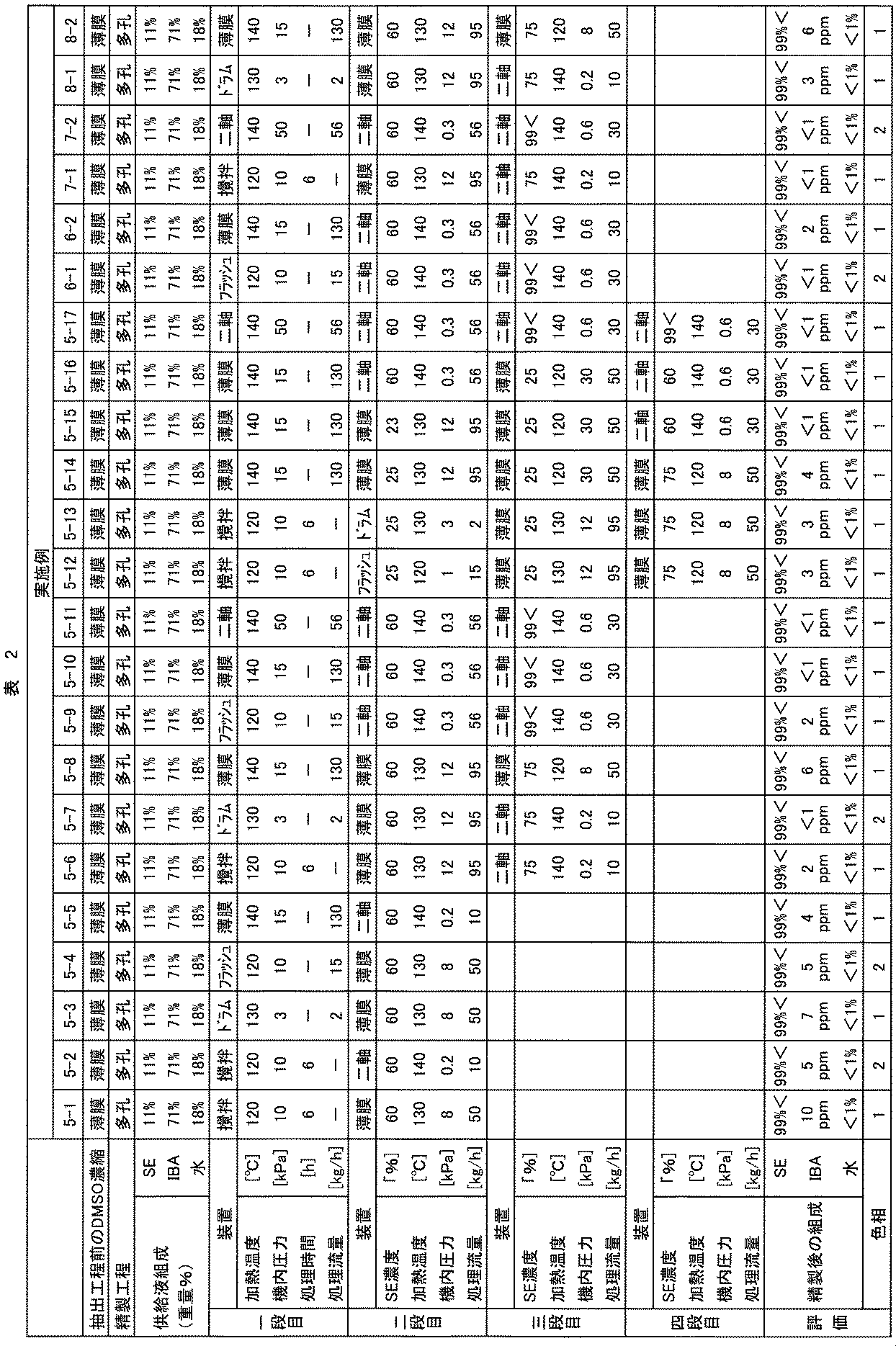
上記で得たIBA相(ショ糖ステアリン酸エステル(SE)12重量%、イソブチルアルコール(IBA)70重量%、および、水18重量%)について、その所定量を、表1記載の条件で減圧乾燥し、溶媒である水およびイソブチルアルコールを除去した。二段目以降においては、その開始にあたり、適宜、水を添加して、SE濃度を調整した(各表中、二段目以降において、「SE濃度」とあるのは、当該段目の減圧乾燥工程開始前のSE濃度である)。なお、この工程を通じて留去させたイソブチルアルコールおよび水は、再利用(例えば、抽出工程での再利用)に供すべく、回収した。
上記で得たIBA相(ショ糖ステアリン酸エステル(SE)12重量%、イソブチルアルコール(IBA)70重量%、および、水18重量%)について、その所定量を、表1記載の条件で減圧乾燥し、溶媒である水およびイソブチルアルコールを除去した。二段目以降においては、その開始にあたり、適宜、水を添加して、SE濃度を調整した(各表中、二段目以降において、「SE濃度」とあるのは、当該段目の減圧乾燥工程開始前のSE濃度である)。なお、この工程を通じて留去させたイソブチルアルコールおよび水は、再利用(例えば、抽出工程での再利用)に供すべく、回収した。
<減圧乾燥に使用した機器>
攪拌槽(攪拌):容量5m3の攪拌槽、アンカ翼あり
ドラムドライヤー(ドラム):ダブルドラムドライヤー、伝熱面積0.2m2、ドラム径200mm
フラッシュ蒸発機(フラッシュ):フラッシュタンク容量200L、加熱管電熱面積0.
8m2(予備加熱用)
二軸押出機(二軸):スクリュー径25mm
薄膜蒸発装置(薄膜):伝熱面積0.5m2
攪拌槽(攪拌):容量5m3の攪拌槽、アンカ翼あり
ドラムドライヤー(ドラム):ダブルドラムドライヤー、伝熱面積0.2m2、ドラム径200mm
フラッシュ蒸発機(フラッシュ):フラッシュタンク容量200L、加熱管電熱面積0.
8m2(予備加熱用)
二軸押出機(二軸):スクリュー径25mm
薄膜蒸発装置(薄膜):伝熱面積0.5m2
(粉砕工程)
乾燥処理後のショ糖ステアリン酸エステルは、高速回転ミルを用いて粗粉砕を行い、さらに、ジェットミルを用いて微粉砕することにより、ショ糖ステアリン酸エステル粉末とした。
乾燥処理後のショ糖ステアリン酸エステルは、高速回転ミルを用いて粗粉砕を行い、さらに、ジェットミルを用いて微粉砕することにより、ショ糖ステアリン酸エステル粉末とした。
上記で得たショ糖ステアリン酸エステルについて、IBA残存量を測定し、色相を評価した。
(有機溶媒(IBA)の残存量の測定)
JECFA(Joint FAO/WHO Expert Committee on Food Additives, FAO/WHO合同食品添加物専門家会議)で評価・設定された食品添加物規格(Food Additive specification) INS473(Sucrose Esters of Fatty Acids)記載の方法に準じて測定した。
JECFA(Joint FAO/WHO Expert Committee on Food Additives, FAO/WHO合同食品添加物専門家会議)で評価・設定された食品添加物規格(Food Additive specification) INS473(Sucrose Esters of Fatty Acids)記載の方法に準じて測定した。
(色相)
上記で得たショ糖ステアリン酸エステルの各サンプルの色相は、JIS K 0071に準じて、ショ糖脂肪酸エステルのテトラヒドロフラン溶液(濃度:200g/L)を用いてガードナー色数により評価した。結果を表1に示す。
上記で得たショ糖ステアリン酸エステルの各サンプルの色相は、JIS K 0071に準じて、ショ糖脂肪酸エステルのテトラヒドロフラン溶液(濃度:200g/L)を用いてガードナー色数により評価した。結果を表1に示す。
[実施例2]
(再利用のための処理)
実施例1の抽出工程で得られた下層たる水相263重量部に対して、DMSOを70.5重量部加えた。この溶液を90℃に加熱し、2.7kPaの条件下で、水およびイソブチルアルコールを除去することにより、35重量%ショ糖DMSO溶液を得た。
(エステル交換反応~粉砕工程)
DMSO345.7重量部に代えて、DMSO280.7重量部および上記35重量%ショ糖DMSO溶液100重量部の混合物を用い、さらに、ショ糖の使用量を32.2重量部とした以外は、実施例1と同様の操作を行い、ショ糖ステアリン酸エステル粉末を得た。
(再利用のための処理)
実施例1の抽出工程で得られた下層たる水相263重量部に対して、DMSOを70.5重量部加えた。この溶液を90℃に加熱し、2.7kPaの条件下で、水およびイソブチルアルコールを除去することにより、35重量%ショ糖DMSO溶液を得た。
(エステル交換反応~粉砕工程)
DMSO345.7重量部に代えて、DMSO280.7重量部および上記35重量%ショ糖DMSO溶液100重量部の混合物を用い、さらに、ショ糖の使用量を32.2重量部とした以外は、実施例1と同様の操作を行い、ショ糖ステアリン酸エステル粉末を得た。
得られたショ糖ステアリン酸エステルについて、上記と同様にして、IBA残存量を測定し、色相を評価した。結果を表1に示す。
[実施例3]
ショ糖の使用量を40.0重量部、ステアリン酸メチルの使用量を172.0重量部、DMSOの使用量を265.4重量部および炭酸カリウムを0.56重量部とし、反応初期で留出させるDMSOを49.8重量部とした以外は実施例1と同様の操作を行い、ショ糖ステアリン酸エステル粉末を得た。
ショ糖の使用量を40.0重量部、ステアリン酸メチルの使用量を172.0重量部、DMSOの使用量を265.4重量部および炭酸カリウムを0.56重量部とし、反応初期で留出させるDMSOを49.8重量部とした以外は実施例1と同様の操作を行い、ショ糖ステアリン酸エステル粉末を得た。
得られたショ糖ステアリン酸エステルについて、上記と同様にして、IBA残存量を測定し、色相を評価した。結果を表1に示す。
[実施例4]
ステアリン酸メチル21.4重量部を炭素数8~18の偶数脂肪酸メチル(炭素数8および10の脂肪酸メチル:5重量%、ラウリン酸メチル:70重量%、炭素数14、16および18の脂肪酸メチル:25重量%の混合物)18.7重量部に、DMSOの使用量を333.9重量部に、炭酸カリウムの使用量を0.29重量部にそれぞれ変更した以外は、実施例1と同様の操作を行い、所定のショ糖脂肪酸エステル粉末を得た。
ステアリン酸メチル21.4重量部を炭素数8~18の偶数脂肪酸メチル(炭素数8および10の脂肪酸メチル:5重量%、ラウリン酸メチル:70重量%、炭素数14、16および18の脂肪酸メチル:25重量%の混合物)18.7重量部に、DMSOの使用量を333.9重量部に、炭酸カリウムの使用量を0.29重量部にそれぞれ変更した以外は、実施例1と同様の操作を行い、所定のショ糖脂肪酸エステル粉末を得た。
得られた所定のショ糖脂肪酸エステルについて、上記と同様にして、IBA残存量を測定し、色相を評価した。結果を表1に示す。

[実施例5]
抽出工程において、攪拌槽に代えて、薄膜蒸発装置(以下、表中において、薄膜蒸発装置を用いたことを表示する場合、単に、「薄膜」と記載する。)を用いた以外は実施例1と同様の操作を行い、ショ糖ステアリン酸エステル粉末を得た。
抽出工程において、攪拌槽に代えて、薄膜蒸発装置(以下、表中において、薄膜蒸発装置を用いたことを表示する場合、単に、「薄膜」と記載する。)を用いた以外は実施例1と同様の操作を行い、ショ糖ステアリン酸エステル粉末を得た。
得られたショ糖ステアリン酸エステルについて、上記と同様にして、IBA残存量を測定し、色相を評価した。結果を表2に示す。
[実施例6]
(再利用のための処理)
実施例5の抽出工程で得られた下層たる水相263重量部に対して、DMSOを70.5重量部加えた。この溶液を90℃に加熱し、2.7kPaの条件下で、水およびイソブチルアルコールを除去することにより、35重量%ショ糖DMSO溶液を得た。
(エステル交換反応~粉砕工程)
DMSO345.7重量部に代えて、DMSO280.7重量部および上記35重量%ショ糖DMSO溶液100重量部の混合物を用い、さらに、ショ糖の使用量を32.2重量部とした以外は、実施例5と同様の操作を行い、ショ糖ステアリン酸エステル粉末を得た。
(再利用のための処理)
実施例5の抽出工程で得られた下層たる水相263重量部に対して、DMSOを70.5重量部加えた。この溶液を90℃に加熱し、2.7kPaの条件下で、水およびイソブチルアルコールを除去することにより、35重量%ショ糖DMSO溶液を得た。
(エステル交換反応~粉砕工程)
DMSO345.7重量部に代えて、DMSO280.7重量部および上記35重量%ショ糖DMSO溶液100重量部の混合物を用い、さらに、ショ糖の使用量を32.2重量部とした以外は、実施例5と同様の操作を行い、ショ糖ステアリン酸エステル粉末を得た。
得られたショ糖ステアリン酸エステルについて、上記と同様にして、IBA残存量を測定し、色相を評価した。結果を表2に示す。
[実施例7]
ショ糖の使用量を40.0重量部、ステアリン酸メチルの使用量を172.0重量部、DMSOの使用量を265.4重量部および炭酸カリウムを0.56重量部とし、反応初期で留出させるDMSOを49.8重量部とした以外は実施例5と同様の操作を行い、ショ糖ステアリン酸エステル粉末を得た。
ショ糖の使用量を40.0重量部、ステアリン酸メチルの使用量を172.0重量部、DMSOの使用量を265.4重量部および炭酸カリウムを0.56重量部とし、反応初期で留出させるDMSOを49.8重量部とした以外は実施例5と同様の操作を行い、ショ糖ステアリン酸エステル粉末を得た。
得られたショ糖ステアリン酸エステルについて、上記と同様にして、IBA残存量を測定し、色相を評価した。結果を表2に示す。
[実施例8]
ステアリン酸メチル21.4重量部をラウリン酸メチル(純度:70重量%、炭素数8~10の脂肪酸メチル:5重量%、炭素数C14~18の脂肪酸メチル:25重量%)18.7重量部に、DMSOの使用量を333.9重量部に、炭酸カリウムの使用量を0.29重量部にそれぞれ変更した以外は、実施例5と同様の操作を行い、ショ糖ステアリン酸エステル粉末を得た。
ステアリン酸メチル21.4重量部をラウリン酸メチル(純度:70重量%、炭素数8~10の脂肪酸メチル:5重量%、炭素数C14~18の脂肪酸メチル:25重量%)18.7重量部に、DMSOの使用量を333.9重量部に、炭酸カリウムの使用量を0.29重量部にそれぞれ変更した以外は、実施例5と同様の操作を行い、ショ糖ステアリン酸エステル粉末を得た。
得られたショ糖ステアリン酸エステルについて、上記と同様にして、IBA残存量を測定し、色相を評価した。結果を表2に示す。
[実施例9]
精製工程において、多孔板抽出塔に代えて、堰板型抽出塔(商品名:WINTRAY、日揮社製。以下、表中において、堰板型抽出塔を用いたことを表示する場合、単に、「堰板」と記載する。)を用いた以外は実施例1と同様の操作を行い、ショ糖ステアリン酸エステル粉末を得た。
精製工程において、多孔板抽出塔に代えて、堰板型抽出塔(商品名:WINTRAY、日揮社製。以下、表中において、堰板型抽出塔を用いたことを表示する場合、単に、「堰板」と記載する。)を用いた以外は実施例1と同様の操作を行い、ショ糖ステアリン酸エステル粉末を得た。
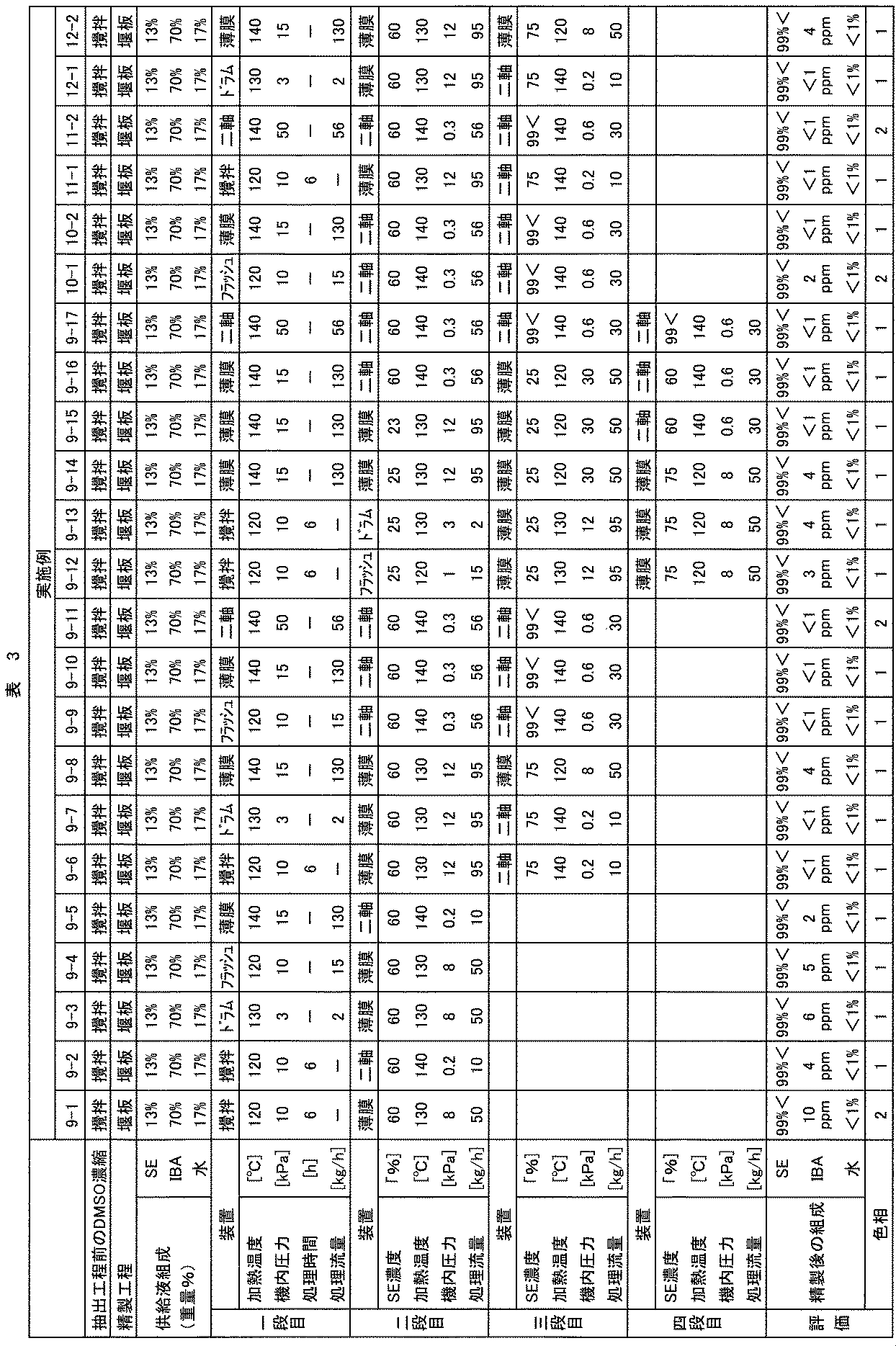
得られたショ糖ステアリン酸エステルについて、上記と同様にして、IBA残存量を測定し、色相を評価した。結果を表3に示す。
[実施例10]
(再利用のための処理)
実施例9の抽出工程で得られた下層たる水相263重量部に対して、DMSOを70.5重量部加えた。この溶液を90℃に加熱し、2.7kPaの条件下で、水およびイソブチルアルコールを除去することにより、35重量%ショ糖DMSO溶液を得た。
(エステル交換反応~粉砕工程)
DMSO345.7重量部に代えて、DMSO280.7重量部および上記35重量%ショ糖DMSO溶液100重量部の混合物を用い、さらに、ショ糖の使用量を32.2重量部とした以外は、実施例9と同様の操作を行い、ショ糖ステアリン酸エステル粉末を得た。
(再利用のための処理)
実施例9の抽出工程で得られた下層たる水相263重量部に対して、DMSOを70.5重量部加えた。この溶液を90℃に加熱し、2.7kPaの条件下で、水およびイソブチルアルコールを除去することにより、35重量%ショ糖DMSO溶液を得た。
(エステル交換反応~粉砕工程)
DMSO345.7重量部に代えて、DMSO280.7重量部および上記35重量%ショ糖DMSO溶液100重量部の混合物を用い、さらに、ショ糖の使用量を32.2重量部とした以外は、実施例9と同様の操作を行い、ショ糖ステアリン酸エステル粉末を得た。
得られたショ糖ステアリン酸エステルについて、上記と同様にして、IBA残存量を測定し、色相を評価した。結果を表3に示す。
[実施例11]
ショ糖の使用量を40.0重量部、ステアリン酸メチルの使用量を172.0重量部、DMSOの使用量を265.4重量部および炭酸カリウムを0.56重量部とし、反応初期で留出させるDMSOを49.8重量部とした以外は実施例9と同様の操作を行い、ショ糖ステアリン酸エステル粉末を得た。
ショ糖の使用量を40.0重量部、ステアリン酸メチルの使用量を172.0重量部、DMSOの使用量を265.4重量部および炭酸カリウムを0.56重量部とし、反応初期で留出させるDMSOを49.8重量部とした以外は実施例9と同様の操作を行い、ショ糖ステアリン酸エステル粉末を得た。
得られたショ糖ステアリン酸エステルについて、上記と同様にして、IBA残存量を測定し、色相を評価した。結果を表3に示す。
[実施例12]
ステアリン酸メチル21.4重量部をラウリン酸メチル(純度:70重量%、炭素数8~10の脂肪酸メチル:5重量%、炭素数14~18の脂肪酸メチル:25重量%)18.7重量部に、DMSOの使用量を333.9重量部に、炭酸カリウムの使用量を0.29重量部にそれぞれ変更した以外は、実施例9と同様の操作を行い、ショ糖ステアリン酸エステル粉末を得た。
ステアリン酸メチル21.4重量部をラウリン酸メチル(純度:70重量%、炭素数8~10の脂肪酸メチル:5重量%、炭素数14~18の脂肪酸メチル:25重量%)18.7重量部に、DMSOの使用量を333.9重量部に、炭酸カリウムの使用量を0.29重量部にそれぞれ変更した以外は、実施例9と同様の操作を行い、ショ糖ステアリン酸エステル粉末を得た。
得られたショ糖ステアリン酸エステルについて、上記と同様にして、IBA残存量を測定し、色相を評価した。結果を表3に示す。
[実施例13]
抽出工程において、攪拌槽に代えて、薄膜蒸発装置を用いた以外は実施例9と同様の操作を行い、ショ糖ステアリン酸エステル粉末を得た。
抽出工程において、攪拌槽に代えて、薄膜蒸発装置を用いた以外は実施例9と同様の操作を行い、ショ糖ステアリン酸エステル粉末を得た。
得られたショ糖ステアリン酸エステルについて、上記と同様にして、IBA残存量を測定し、色相を評価した。結果を表4に示す。
[実施例14]
(再利用のための処理)
実施例13の抽出工程で得られた下層たる水相263重量部に対して、DMSOを70.5重量部加えた。この溶液を90℃に加熱し、2.7kPaの条件下で、水およびイソブチルアルコールを除去することにより、35重量%ショ糖DMSO溶液を得た。
(エステル交換反応~粉砕工程)
DMSO345.7重量部に代えて、DMSO280.7重量部および上記35重量%ショ糖DMSO溶液100重量部の混合物を用い、さらに、ショ糖の使用量を32.2重量部とした以外は、実施例13と同様の操作を行い、ショ糖ステアリン酸エステル粉末を得た。
(再利用のための処理)
実施例13の抽出工程で得られた下層たる水相263重量部に対して、DMSOを70.5重量部加えた。この溶液を90℃に加熱し、2.7kPaの条件下で、水およびイソブチルアルコールを除去することにより、35重量%ショ糖DMSO溶液を得た。
(エステル交換反応~粉砕工程)
DMSO345.7重量部に代えて、DMSO280.7重量部および上記35重量%ショ糖DMSO溶液100重量部の混合物を用い、さらに、ショ糖の使用量を32.2重量部とした以外は、実施例13と同様の操作を行い、ショ糖ステアリン酸エステル粉末を得た。
得られたショ糖ステアリン酸エステルについて、上記と同様にして、IBA残存量を測定し、色相を評価した。結果を表4に示す。
[実施例15]
ショ糖の使用量を40.0重量部、ステアリン酸メチルの使用量を172.0重量部、DMSOの使用量を265.4重量部および炭酸カリウムを0.56重量部とし、反応初期で留出させるDMSOを49.8重量部とした以外は実施例13と同様の操作を行い、ショ糖ステアリン酸エステル粉末を得た。
ショ糖の使用量を40.0重量部、ステアリン酸メチルの使用量を172.0重量部、DMSOの使用量を265.4重量部および炭酸カリウムを0.56重量部とし、反応初期で留出させるDMSOを49.8重量部とした以外は実施例13と同様の操作を行い、ショ糖ステアリン酸エステル粉末を得た。
得られたショ糖ステアリン酸エステルについて、上記と同様にして、IBA残存量を測定し、色相を評価した。結果を表4に示す。
[実施例16]
ステアリン酸メチル21.4重量部をラウリン酸メチル(純度:70重量%、炭素数8~10の脂肪酸メチル:5重量%、炭素数14~18の脂肪酸メチル:25重量%)18.7重量部に、DMSOの使用量を333.9重量部に、炭酸カリウムの使用量を0.29重量部にそれぞれ変更した以外は、実施例13と同様の操作を行い、ショ糖ステアリン酸エステル粉末を得た。
ステアリン酸メチル21.4重量部をラウリン酸メチル(純度:70重量%、炭素数8~10の脂肪酸メチル:5重量%、炭素数14~18の脂肪酸メチル:25重量%)18.7重量部に、DMSOの使用量を333.9重量部に、炭酸カリウムの使用量を0.29重量部にそれぞれ変更した以外は、実施例13と同様の操作を行い、ショ糖ステアリン酸エステル粉末を得た。
得られたショ糖ステアリン酸エステルについて、上記と同様にして、IBA残存量を測定し、色相を評価した。結果を表4に示す。

[実施例17]
精製工程において、多孔板抽出塔に代えて、バッフル抽出塔(以下、表中において、バッフル抽出塔を用いたことを表示する場合、単に、「バッフル」と記載する。)を用いた以外は実施例1と同様の操作を行い、ショ糖ステアリン酸エステル粉末を得た。
精製工程において、多孔板抽出塔に代えて、バッフル抽出塔(以下、表中において、バッフル抽出塔を用いたことを表示する場合、単に、「バッフル」と記載する。)を用いた以外は実施例1と同様の操作を行い、ショ糖ステアリン酸エステル粉末を得た。
得られたショ糖ステアリン酸エステルについて、上記と同様にして、IBA残存量を測定し、色相を評価した。結果を表5に示す。
[実施例18]
(再利用のための処理)
実施例17の抽出工程で得られた下層たる水相263重量部に対して、DMSOを70.5重量部加えた。この溶液を90℃に加熱し、2.7kPaの条件下で、水およびイソブチルアルコールを除去することにより、35重量%ショ糖DMSO溶液を得た。
(エステル交換反応~粉砕工程)
DMSO345.7重量部に代えて、DMSO280.7重量部および上記35重量%ショ糖DMSO溶液100重量部の混合物を用い、さらに、ショ糖の使用量を32.2重量部とした以外は、実施例17と同様の操作を行い、ショ糖ステアリン酸エステル粉末を得た。
(再利用のための処理)
実施例17の抽出工程で得られた下層たる水相263重量部に対して、DMSOを70.5重量部加えた。この溶液を90℃に加熱し、2.7kPaの条件下で、水およびイソブチルアルコールを除去することにより、35重量%ショ糖DMSO溶液を得た。
(エステル交換反応~粉砕工程)
DMSO345.7重量部に代えて、DMSO280.7重量部および上記35重量%ショ糖DMSO溶液100重量部の混合物を用い、さらに、ショ糖の使用量を32.2重量部とした以外は、実施例17と同様の操作を行い、ショ糖ステアリン酸エステル粉末を得た。
得られたショ糖ステアリン酸エステルについて、上記と同様にして、IBA残存量を測定し、色相を評価した。結果を表5に示す。
[実施例19]
ショ糖の使用量を40.0重量部、ステアリン酸メチルの使用量を172.0重量部、DMSOの使用量を265.4重量部および炭酸カリウムを0.56重量部とし、反応初期で留出させるDMSOを49.8重量部とした以外は実施例17と同様の操作を行い、ショ糖ステアリン酸エステル粉末を得た。
ショ糖の使用量を40.0重量部、ステアリン酸メチルの使用量を172.0重量部、DMSOの使用量を265.4重量部および炭酸カリウムを0.56重量部とし、反応初期で留出させるDMSOを49.8重量部とした以外は実施例17と同様の操作を行い、ショ糖ステアリン酸エステル粉末を得た。
得られたショ糖ステアリン酸エステルについて、上記と同様にして、IBA残存量を測定し、色相を評価した。結果を表5に示す。
[実施例20]
ステアリン酸メチル21.4重量部をラウリン酸メチル(純度:70重量%、炭素数8~10の脂肪酸メチル:5重量%、炭素数14~18の脂肪酸メチル:25重量%)18.7重量部に、DMSOの使用量を333.9重量部に、炭酸カリウムの使用量を0.29重量部にそれぞれ変更した以外は、実施例17と同様の操作を行い、ショ糖ステアリン酸エステル粉末を得た。
ステアリン酸メチル21.4重量部をラウリン酸メチル(純度:70重量%、炭素数8~10の脂肪酸メチル:5重量%、炭素数14~18の脂肪酸メチル:25重量%)18.7重量部に、DMSOの使用量を333.9重量部に、炭酸カリウムの使用量を0.29重量部にそれぞれ変更した以外は、実施例17と同様の操作を行い、ショ糖ステアリン酸エステル粉末を得た。
得られたショ糖ステアリン酸エステルについて、上記と同様にして、IBA残存量を測定し、色相を評価した。結果を表5に示す。

[実施例21]
抽出工程において、攪拌槽に代えて、薄膜蒸発装置を用いた以外は実施例17と同様の操作を行い、ショ糖ステアリン酸エステル粉末を得た。
抽出工程において、攪拌槽に代えて、薄膜蒸発装置を用いた以外は実施例17と同様の操作を行い、ショ糖ステアリン酸エステル粉末を得た。
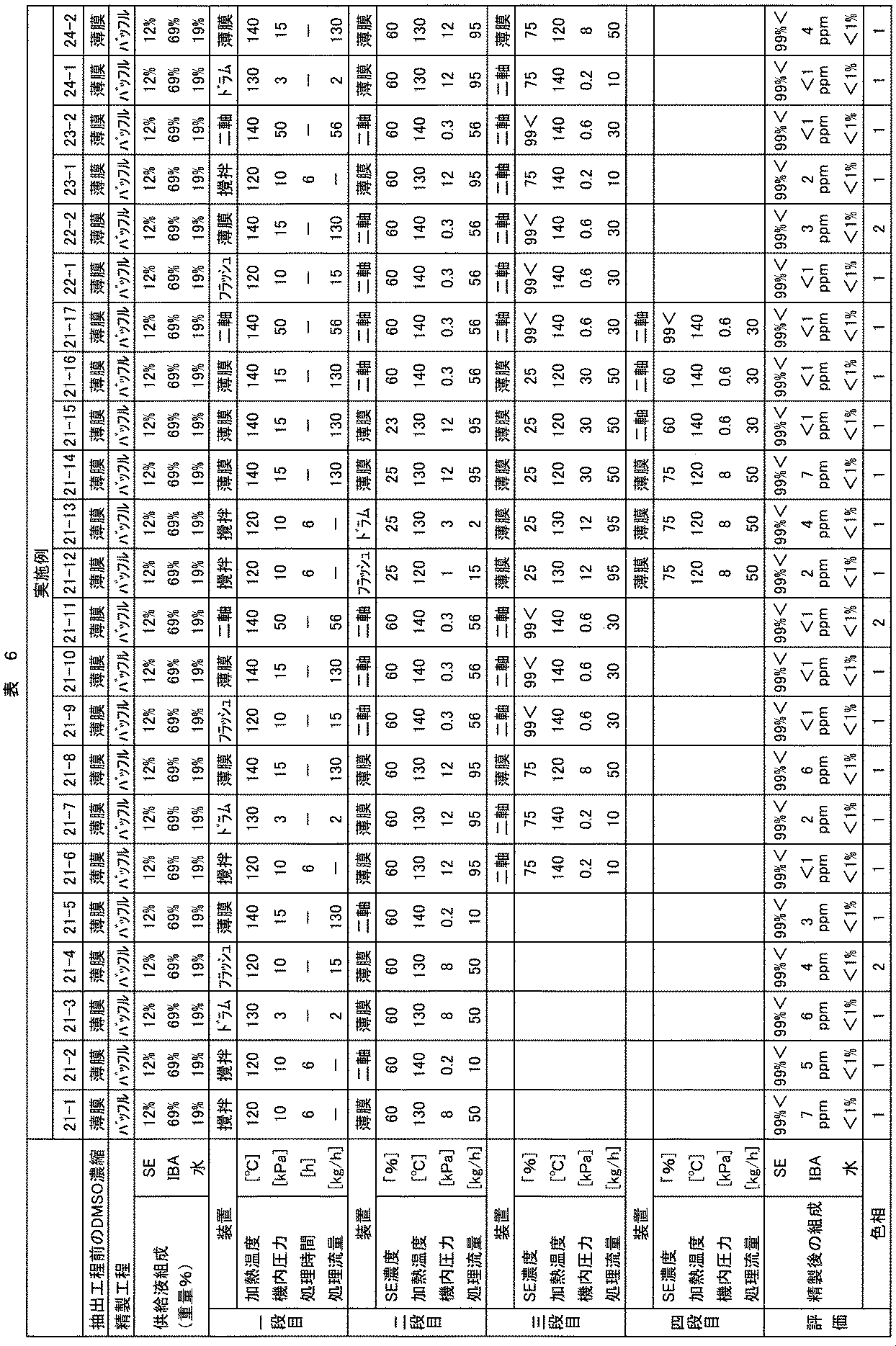
得られたショ糖ステアリン酸エステルについて、上記と同様にして、IBA残存量を測定し、色相を評価した。結果を表6に示す。
[実施例22]
(再利用のための処理)
実施例21の抽出工程で得られた下層たる水相263重量部に対して、DMSOを70.5重量部加えた。この溶液を90℃に加熱し、2.7kPaの条件下で、水およびイソブチルアルコールを除去することにより、35重量%ショ糖DMSO溶液を得た。
(エステル交換反応~粉砕工程)
DMSO345.7重量部に代えて、DMSO280.7重量部および上記35重量%ショ糖DMSO溶液100重量部の混合物を用い、さらに、ショ糖の使用量を32.2重量部とした以外は、実施例21と同様の操作を行い、ショ糖ステアリン酸エステル粉末を得た。
(再利用のための処理)
実施例21の抽出工程で得られた下層たる水相263重量部に対して、DMSOを70.5重量部加えた。この溶液を90℃に加熱し、2.7kPaの条件下で、水およびイソブチルアルコールを除去することにより、35重量%ショ糖DMSO溶液を得た。
(エステル交換反応~粉砕工程)
DMSO345.7重量部に代えて、DMSO280.7重量部および上記35重量%ショ糖DMSO溶液100重量部の混合物を用い、さらに、ショ糖の使用量を32.2重量部とした以外は、実施例21と同様の操作を行い、ショ糖ステアリン酸エステル粉末を得た。
得られたショ糖ステアリン酸エステルについて、上記と同様にして、IBA残存量を測定し、色相を評価した。結果を表6に示す。
[実施例23]
ショ糖の使用量を40.0重量部、ステアリン酸メチルの使用量を172.0重量部、DMSOの使用量を265.4重量部および炭酸カリウムを0.56重量部とし、反応初期で留出させるDMSOを49.8重量部とした以外は実施例21と同様の操作を行い、ショ糖ステアリン酸エステル粉末を得た。
ショ糖の使用量を40.0重量部、ステアリン酸メチルの使用量を172.0重量部、DMSOの使用量を265.4重量部および炭酸カリウムを0.56重量部とし、反応初期で留出させるDMSOを49.8重量部とした以外は実施例21と同様の操作を行い、ショ糖ステアリン酸エステル粉末を得た。
得られたショ糖ステアリン酸エステルについて、上記と同様にして、IBA残存量を測定し、色相を評価した。結果を表6に示す。
[実施例24]
ステアリン酸メチル21.4重量部をラウリン酸メチル(純度:70重量%、炭素数8~10の脂肪酸メチル:5重量%、炭素数14~18の脂肪酸メチル:25重量%)18.7重量部に、DMSOの使用量を333.9重量部に、炭酸カリウムの使用量を0.29重量部にそれぞれ変更した以外は、実施例21と同様の操作を行い、ショ糖ステアリン酸エステル粉末を得た。
ステアリン酸メチル21.4重量部をラウリン酸メチル(純度:70重量%、炭素数8~10の脂肪酸メチル:5重量%、炭素数14~18の脂肪酸メチル:25重量%)18.7重量部に、DMSOの使用量を333.9重量部に、炭酸カリウムの使用量を0.29重量部にそれぞれ変更した以外は、実施例21と同様の操作を行い、ショ糖ステアリン酸エステル粉末を得た。
得られたショ糖ステアリン酸エステルについて、上記と同様にして、IBA残存量を測定し、色相を評価した。結果を表6に示す。
[比較例1]
減圧乾燥工程において、表7記載の条件で減圧乾燥し、溶媒である水およびイソブチルアルコールを除去した以外は実施例1と同様の操作を行い、ショ糖ステアリン酸エステル粉末を得た。
減圧乾燥工程において、表7記載の条件で減圧乾燥し、溶媒である水およびイソブチルアルコールを除去した以外は実施例1と同様の操作を行い、ショ糖ステアリン酸エステル粉末を得た。
得られたショ糖ステアリン酸エステルについて、上記と同様にして、IBA残存量を測定し、色相を評価した。結果を表7に示す。
[比較例2]
減圧乾燥工程において、表7記載の条件で減圧乾燥し、溶媒である水およびイソブチルアルコールを除去した以外は実施例5と同様の操作を行い、ショ糖ステアリン酸エステル粉末を得た。
減圧乾燥工程において、表7記載の条件で減圧乾燥し、溶媒である水およびイソブチルアルコールを除去した以外は実施例5と同様の操作を行い、ショ糖ステアリン酸エステル粉末を得た。
得られたショ糖ステアリン酸エステルについて、上記と同様にして、IBA残存量を測
定し、色相を評価した。結果を表7に示す。
定し、色相を評価した。結果を表7に示す。
[比較例3]
減圧乾燥工程において、表7記載の条件で減圧乾燥し、溶媒である水およびイソブチルアルコールを除去した以外は実施例9と同様の操作を行い、ショ糖ステアリン酸エステル粉末を得た。
減圧乾燥工程において、表7記載の条件で減圧乾燥し、溶媒である水およびイソブチルアルコールを除去した以外は実施例9と同様の操作を行い、ショ糖ステアリン酸エステル粉末を得た。
得られたショ糖ステアリン酸エステルについて、上記と同様にして、IBA残存量を測定し、色相を評価した。結果を表7に示す。
[比較例4]
減圧乾燥工程において、表7記載の条件で減圧乾燥し、溶媒である水およびイソブチルアルコールを除去した以外は実施例13と同様の操作を行い、ショ糖ステアリン酸エステル粉末を得た。
減圧乾燥工程において、表7記載の条件で減圧乾燥し、溶媒である水およびイソブチルアルコールを除去した以外は実施例13と同様の操作を行い、ショ糖ステアリン酸エステル粉末を得た。
得られたショ糖ステアリン酸エステルについて、上記と同様にして、IBA残存量を測定し、色相を評価した。結果を表7に示す。
[比較例5]
減圧乾燥工程において、表7記載の条件で減圧乾燥し、溶媒である水およびイソブチルアルコールを除去した以外は実施例17と同様の操作を行い、ショ糖ステアリン酸エステル粉末を得た。
減圧乾燥工程において、表7記載の条件で減圧乾燥し、溶媒である水およびイソブチルアルコールを除去した以外は実施例17と同様の操作を行い、ショ糖ステアリン酸エステル粉末を得た。
得られたショ糖ステアリン酸エステルについて、上記と同様にして、IBA残存量を測定し、色相を評価した。結果を表7に示す。
[比較例6]
減圧乾燥工程において、表7記載の条件で減圧乾燥し、溶媒である水およびイソブチルアルコールを除去した以外は実施例21と同様の操作を行い、ショ糖ステアリン酸エステル粉末を得た。
減圧乾燥工程において、表7記載の条件で減圧乾燥し、溶媒である水およびイソブチルアルコールを除去した以外は実施例21と同様の操作を行い、ショ糖ステアリン酸エステル粉末を得た。
得られたショ糖ステアリン酸エステルについて、上記と同様にして、IBA残存量を測定し、色相を評価した。結果を表7に示す。
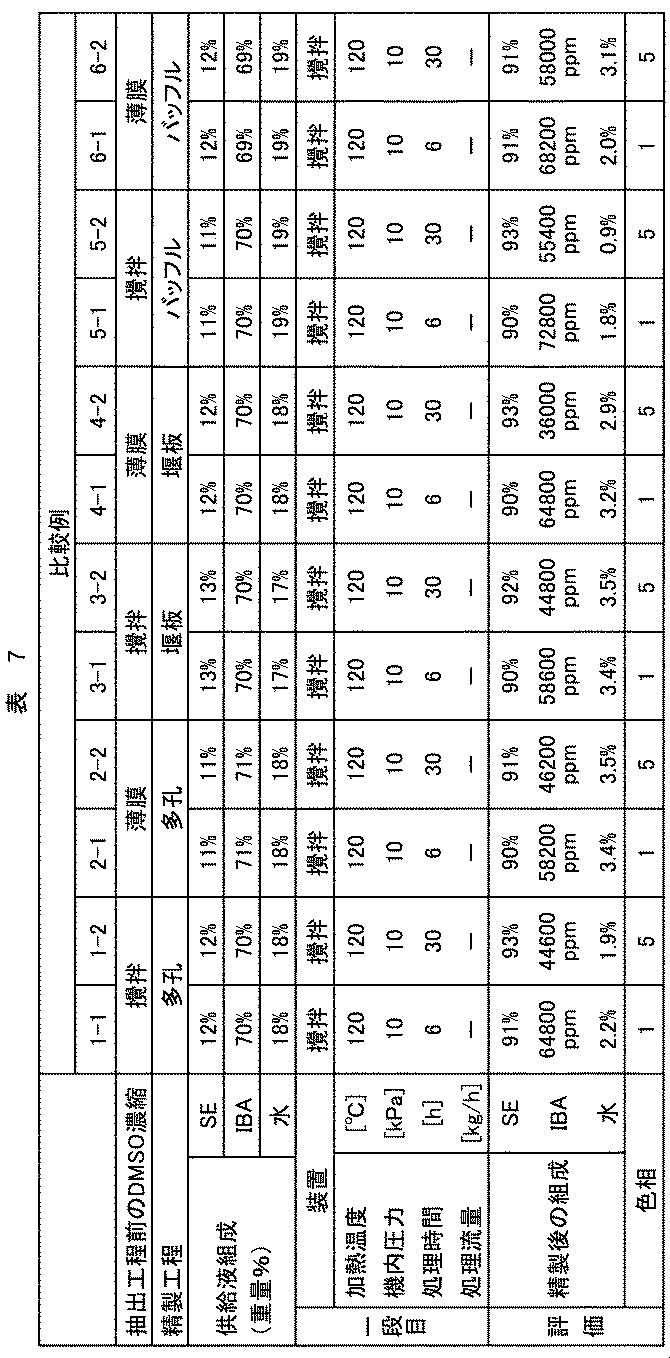
本発明によれば、着色が抑制され、かつ有機溶媒の残存量が極僅かなショ糖脂肪酸エステルの製造方法を提供することができる。
Claims (5)
- 反応溶媒中、アルカリ触媒の存在下、ショ糖と脂肪酸低級アルキルエステルとを反応させて得た反応混合物からショ糖脂肪酸エステルを取得する、ショ糖脂肪酸エステルの製造方法であって、
(1)該反応混合物を、有機溶媒と水を用いた液液抽出に付し、有機溶媒相にショ糖脂肪酸エステルを抽出する抽出工程、
(2)軽液供給口および重液供給口を備えた向流分配型抽出装置を用いて、上記抽出工程(1)で得られた有機溶媒相と精製用溶媒のうち、より比重の重い方を重液供給口から供給すると共に、より比重の軽い方を軽液供給口から供給して、有機溶媒相および精製用溶媒を向流接触させる精製工程、および、
(3)上記精製工程(2)で得られた有機溶媒相を、1つ以上の減圧乾燥機により、機内の圧力および/または加熱温度を少なくとも2段階以上変化させて減圧乾燥する、一連の減圧乾燥工程であって、
該減圧乾燥工程の第一段階の機内圧力が大気圧以下であり、かつ、その加熱温度が20℃以上200℃以下であり、
該減圧乾燥工程の最終段階の機内圧力が10kPa・abs以下、かつ、その加熱温度が20℃以上200℃以下である、減圧乾燥工程
を含んでなる、ショ糖脂肪酸エステルの製造方法。 - 減圧乾燥工程(3)において、減圧乾燥機の少なくとも一つが、二軸押出機である、請求項1記載のショ糖脂肪酸エステルの製造方法。
- 減圧乾燥工程(3)において、一連の減圧乾燥工程が、2~9段階までのいずれかの段階からなるものである、請求項1または2記載のショ糖脂肪酸エステルの製造方法。
- 減圧乾燥工程(3)において、精製工程(2)で得られた有機溶媒相におけるショ糖脂肪酸エステルの含有量が、10~80重量%である、請求項1~3のいずれか1項に記載のショ糖脂肪酸エステルの製造方法。
- 請求項1~4のいずれか1項に記載のショ糖脂肪酸エステルの製造方法により得られる、ガードナー色数が3以下、かつ、有機溶媒の残存量が10ppm以下である、ショ糖脂肪酸エステル。
Applications Claiming Priority (2)
| Application Number | Priority Date | Filing Date | Title |
|---|---|---|---|
| JP2013166980 | 2013-08-09 | ||
| JP2013-166980 | 2013-08-09 |
Publications (1)
| Publication Number | Publication Date |
|---|---|
| WO2015020073A1 true WO2015020073A1 (ja) | 2015-02-12 |
Family
ID=52461404
Family Applications (1)
| Application Number | Title | Priority Date | Filing Date |
|---|---|---|---|
| PCT/JP2014/070677 Ceased WO2015020073A1 (ja) | 2013-08-09 | 2014-08-06 | ショ糖脂肪酸エステルの製造方法 |
Country Status (2)
| Country | Link |
|---|---|
| TW (1) | TW201605883A (ja) |
| WO (1) | WO2015020073A1 (ja) |
Cited By (2)
| Publication number | Priority date | Publication date | Assignee | Title |
|---|---|---|---|---|
| CN107163091A (zh) * | 2017-06-13 | 2017-09-15 | 广东省石油与精细化工研究院 | 一种蔗糖脂肪酸酯的分级提取方法 |
| CN110106021A (zh) * | 2019-03-27 | 2019-08-09 | 中粮粮油工业(巢湖)有限公司 | 植物油中特丁基对苯二酚的脱除方法 |
Families Citing this family (1)
| Publication number | Priority date | Publication date | Assignee | Title |
|---|---|---|---|---|
| CN106854226B (zh) * | 2016-12-08 | 2023-07-25 | 广西科技师范学院 | 蔗糖脂肪酸酯的精制方法 |
Citations (5)
| Publication number | Priority date | Publication date | Assignee | Title |
|---|---|---|---|---|
| JPS6115893A (ja) * | 1984-06-29 | 1986-01-23 | Dai Ichi Kogyo Seiyaku Co Ltd | シヨ糖脂肪酸エステルの精製法 |
| JPH0421693A (ja) * | 1990-05-16 | 1992-01-24 | Dai Ichi Kogyo Seiyaku Co Ltd | ショ糖脂肪酸エステルの脱色方法 |
| JPH07206889A (ja) * | 1994-01-18 | 1995-08-08 | Mitsubishi Chem Corp | ショ糖脂肪酸エステルの製造方法 |
| JPH07228590A (ja) * | 1993-12-24 | 1995-08-29 | Mitsubishi Chem Corp | 蔗糖脂肪酸エステルの製造方法 |
| JP2014091705A (ja) * | 2012-11-02 | 2014-05-19 | Dai Ichi Kogyo Seiyaku Co Ltd | 溶媒の除去方法 |
-
2014
- 2014-08-06 WO PCT/JP2014/070677 patent/WO2015020073A1/ja not_active Ceased
- 2014-08-07 TW TW103127099A patent/TW201605883A/zh unknown
Patent Citations (5)
| Publication number | Priority date | Publication date | Assignee | Title |
|---|---|---|---|---|
| JPS6115893A (ja) * | 1984-06-29 | 1986-01-23 | Dai Ichi Kogyo Seiyaku Co Ltd | シヨ糖脂肪酸エステルの精製法 |
| JPH0421693A (ja) * | 1990-05-16 | 1992-01-24 | Dai Ichi Kogyo Seiyaku Co Ltd | ショ糖脂肪酸エステルの脱色方法 |
| JPH07228590A (ja) * | 1993-12-24 | 1995-08-29 | Mitsubishi Chem Corp | 蔗糖脂肪酸エステルの製造方法 |
| JPH07206889A (ja) * | 1994-01-18 | 1995-08-08 | Mitsubishi Chem Corp | ショ糖脂肪酸エステルの製造方法 |
| JP2014091705A (ja) * | 2012-11-02 | 2014-05-19 | Dai Ichi Kogyo Seiyaku Co Ltd | 溶媒の除去方法 |
Cited By (2)
| Publication number | Priority date | Publication date | Assignee | Title |
|---|---|---|---|---|
| CN107163091A (zh) * | 2017-06-13 | 2017-09-15 | 广东省石油与精细化工研究院 | 一种蔗糖脂肪酸酯的分级提取方法 |
| CN110106021A (zh) * | 2019-03-27 | 2019-08-09 | 中粮粮油工业(巢湖)有限公司 | 植物油中特丁基对苯二酚的脱除方法 |
Also Published As
| Publication number | Publication date |
|---|---|
| TW201605883A (zh) | 2016-02-16 |
Similar Documents
| Publication | Publication Date | Title |
|---|---|---|
| CN103998108B (zh) | 从水溶液中分离羧酸的方法 | |
| CA2863737C (en) | Carboxylate acidification | |
| JP2021119177A (ja) | アセスルファムカリウム組成物及びその製造方法 | |
| EP3218359B1 (en) | Preparation of dialkyl esters of 2,5-furandicarboxylic acid | |
| WO2015020073A1 (ja) | ショ糖脂肪酸エステルの製造方法 | |
| CN107325134A (zh) | 一种蔗糖脂肪酸酯类化合物及其制备方法和纯化方法 | |
| JP2956504B2 (ja) | 蔗糖脂肪酸エステルの製造方法 | |
| JP2016141668A (ja) | ショ糖脂肪酸エステルの製造方法 | |
| JP2016141667A (ja) | ショ糖脂肪酸エステルの製造方法 | |
| CN103429307A (zh) | 从稀水溶液中回收有机酸的方法 | |
| CN107686530A (zh) | 一种舒更葡糖钠的合成方法 | |
| JPS6316369B2 (ja) | ||
| JP3617064B2 (ja) | ショ糖脂肪酸エステルの製造方法 | |
| JP4616744B2 (ja) | ソルビタン脂肪酸エステルの製造方法 | |
| JP4451356B2 (ja) | ポリグリセリン脂肪酸エステルの製造方法 | |
| JP2003520834A (ja) | 無水ギ酸を製造する際の消泡剤としての抽出剤の使用 | |
| KR20170073672A (ko) | 아크릴산의 정제 방법 및 정제 장치 | |
| JP3013451B2 (ja) | ショ糖脂肪酸エステルの製造方法 | |
| EP1957442B1 (de) | Verfahren zur herstellung von schwefelsäuremonoestern aus aminoalkanolen | |
| CN105026354B (zh) | 丙酸铵的热盐分解 | |
| JPH04257598A (ja) | ショ糖脂肪酸エステルの製造方法 | |
| US20130150621A1 (en) | Processes for purification of succinic acid via distillation | |
| CN111108085A (zh) | 用于制备苯甲酸酯的方法 | |
| JPH04321697A (ja) | ショ糖脂肪酸エステルの精製方法 | |
| JPH07224023A (ja) | トランス−1,4−シクロヘキサンジメタノールジアルキルスルホネートの精製方法 |
Legal Events
| Date | Code | Title | Description |
|---|---|---|---|
| 121 | Ep: the epo has been informed by wipo that ep was designated in this application |
Ref document number: 14834105 Country of ref document: EP Kind code of ref document: A1 |
|
| NENP | Non-entry into the national phase |
Ref country code: DE |
|
| NENP | Non-entry into the national phase |
Ref country code: JP |
|
| 122 | Ep: pct application non-entry in european phase |
Ref document number: 14834105 Country of ref document: EP Kind code of ref document: A1 |