WO2015015613A1 - 分岐ヒアルロン酸及びその製造方法 - Google Patents
分岐ヒアルロン酸及びその製造方法 Download PDFInfo
- Publication number
- WO2015015613A1 WO2015015613A1 PCT/JP2013/070826 JP2013070826W WO2015015613A1 WO 2015015613 A1 WO2015015613 A1 WO 2015015613A1 JP 2013070826 W JP2013070826 W JP 2013070826W WO 2015015613 A1 WO2015015613 A1 WO 2015015613A1
- Authority
- WO
- WIPO (PCT)
- Prior art keywords
- hyaluronic acid
- uridine diphosphate
- uridine
- acid
- enzyme
- Prior art date
- Legal status (The legal status is an assumption and is not a legal conclusion. Google has not performed a legal analysis and makes no representation as to the accuracy of the status listed.)
- Ceased
Links
- 0 OC(*C(C(O)=O)OC1O)C1O Chemical compound OC(*C(C(O)=O)OC1O)C1O 0.000 description 2
Classifications
-
- C—CHEMISTRY; METALLURGY
- C12—BIOCHEMISTRY; BEER; SPIRITS; WINE; VINEGAR; MICROBIOLOGY; ENZYMOLOGY; MUTATION OR GENETIC ENGINEERING
- C12P—FERMENTATION OR ENZYME-USING PROCESSES TO SYNTHESISE A DESIRED CHEMICAL COMPOUND OR COMPOSITION OR TO SEPARATE OPTICAL ISOMERS FROM A RACEMIC MIXTURE
- C12P19/00—Preparation of compounds containing saccharide radicals
- C12P19/26—Preparation of nitrogen-containing carbohydrates
-
- A—HUMAN NECESSITIES
- A61—MEDICAL OR VETERINARY SCIENCE; HYGIENE
- A61K—PREPARATIONS FOR MEDICAL, DENTAL OR TOILETRY PURPOSES
- A61K31/00—Medicinal preparations containing organic active ingredients
- A61K31/70—Carbohydrates; Sugars; Derivatives thereof
- A61K31/715—Polysaccharides, i.e. having more than five saccharide radicals attached to each other by glycosidic linkages; Derivatives thereof, e.g. ethers, esters
- A61K31/726—Glycosaminoglycans, i.e. mucopolysaccharides
- A61K31/728—Hyaluronic acid
-
- A—HUMAN NECESSITIES
- A61—MEDICAL OR VETERINARY SCIENCE; HYGIENE
- A61K—PREPARATIONS FOR MEDICAL, DENTAL OR TOILETRY PURPOSES
- A61K8/00—Cosmetics or similar toiletry preparations
- A61K8/18—Cosmetics or similar toiletry preparations characterised by the composition
- A61K8/72—Cosmetics or similar toiletry preparations characterised by the composition containing organic macromolecular compounds
- A61K8/73—Polysaccharides
- A61K8/735—Mucopolysaccharides, e.g. hyaluronic acid; Derivatives thereof
-
- A—HUMAN NECESSITIES
- A61—MEDICAL OR VETERINARY SCIENCE; HYGIENE
- A61Q—SPECIFIC USE OF COSMETICS OR SIMILAR TOILETRY PREPARATIONS
- A61Q19/00—Preparations for care of the skin
-
- C—CHEMISTRY; METALLURGY
- C08—ORGANIC MACROMOLECULAR COMPOUNDS; THEIR PREPARATION OR CHEMICAL WORKING-UP; COMPOSITIONS BASED THEREON
- C08B—POLYSACCHARIDES; DERIVATIVES THEREOF
- C08B37/00—Preparation of polysaccharides not provided for in groups C08B1/00 - C08B35/00; Derivatives thereof
- C08B37/006—Heteroglycans, i.e. polysaccharides having more than one sugar residue in the main chain in either alternating or less regular sequence; Gellans; Succinoglycans; Arabinogalactans; Tragacanth or gum tragacanth or traganth from Astragalus; Gum Karaya from Sterculia urens; Gum Ghatti from Anogeissus latifolia; Derivatives thereof
- C08B37/0063—Glycosaminoglycans or mucopolysaccharides, e.g. keratan sulfate; Derivatives thereof, e.g. fucoidan
- C08B37/0072—Hyaluronic acid, i.e. HA or hyaluronan; Derivatives thereof, e.g. crosslinked hyaluronic acid (hylan) or hyaluronates
-
- C—CHEMISTRY; METALLURGY
- C08—ORGANIC MACROMOLECULAR COMPOUNDS; THEIR PREPARATION OR CHEMICAL WORKING-UP; COMPOSITIONS BASED THEREON
- C08L—COMPOSITIONS OF MACROMOLECULAR COMPOUNDS
- C08L5/00—Compositions of polysaccharides or of their derivatives not provided for in groups C08L1/00 or C08L3/00
- C08L5/08—Chitin; Chondroitin sulfate; Hyaluronic acid; Derivatives thereof
-
- A—HUMAN NECESSITIES
- A61—MEDICAL OR VETERINARY SCIENCE; HYGIENE
- A61K—PREPARATIONS FOR MEDICAL, DENTAL OR TOILETRY PURPOSES
- A61K2800/00—Properties of cosmetic compositions or active ingredients thereof or formulation aids used therein and process related aspects
- A61K2800/10—General cosmetic use
Definitions
- the present invention relates to branched hyaluronic acid and a method for producing the same.
- Hyaluronic acid is abundant in biological tissues such as bovine eyeballs, chicken crowns, animal buffer tissues, placenta, cancer cells, and skin.
- Glucuronic acid and N-acetylglucosamine are combined with ⁇ 1,3 bonds and ⁇ 1, It is a linear polysaccharide linked alternately by four bonds, and is a high molecular weight glucosaminoglycan having a molecular weight of 10 5 to 10 6 Da.
- Hyaluronic acid has a high viscosity, a high moisturizing effect, and an excellent lubricating effect against physical friction and an excellent protective effect against invasion of bacteria and the like. Since hyaluronic acid has these properties, it is widely used as a pharmaceutical agent such as a cosmetic additive, an arthritis therapeutic agent, a wound dressing, an ophthalmic surgical adjuvant, and a post-surgical adhesion inhibitor.
- hyaluronic acid is effective in improving moisture retention, which is one of the characteristics of hyaluronic acid (Patent Document 1).
- Patent Document 1 Increasing the molecular weight of hyaluronic acid is effective in improving moisture retention, which is one of the characteristics of hyaluronic acid (Patent Document 1).
- the molecular weight is increased, the viscosity of hyaluronic acid increases, and there is a problem in that when a cosmetic product or the like is produced, the degree of freedom of blending with other components is restricted, resulting in a sticky feeling. Therefore, it is necessary to improve moisture retention without increasing the viscosity of hyaluronic acid.
- An object of the present invention is to provide a branched hyaluronic acid having improved moisture retention without increasing the viscosity.
- the present invention relates to a compound (S) having a total of 3 or more of at least one group selected from the group consisting of groups represented by any of the following general formulas (1) to (4), and glucuronic acid and N A branched hyaluronic acid obtained by alternately dehydrating and condensing acetylglucosamine with ⁇ 1,3 bonds and ⁇ 1,4 bonds; at least selected from the group consisting of groups represented by any one of the following general formulas (3) to (6) Branched hyaluronic acid production method in which hyaluronic acid synthase (A) is allowed to act on compound (S ′) having a total of 3 or more of one kind group, uridine diphosphate-glucuronic acid and uridine diphosphate-N-acetylglucosamine It is.
- the branched hyaluronic acid of the present invention has a low viscosity despite improving the function of moisture retention. Moreover, the method for producing branched hyaluronic acid of the present invention can produce branched hyaluronic acid having a low viscosity and improved moisturizing function.
- the branched hyaluronic acid of the present invention is obtained by adding glucuronic acid and N to compound (S) having a total of at least one selected from the group consisting of groups represented by any one of the following general formulas (1) to (4).
- -Branched hyaluronic acid obtained by alternately dehydrating and condensing acetylglucosamine with ⁇ 1,3 bonds and ⁇ 1,4 bonds.
- Branched hyaluronic acid is a branched hyaluronic acid molecule in which some or all of the protons of the carboxyl group are replaced with alkali metal (lithium, sodium, potassium, etc.) ions and / or alkaline earth metal (calcium, etc.) ions. Contains hyaluronate.
- the compound (S) is a compound having a total of three or more at least one functional group selected from the group consisting of groups represented by any one of the general formulas (1) to (4). That is, it may have three or more of one type of functional group represented by any one of (1) to (4), or may have a total of three or more of plural types of functional groups.
- (S) includes the following (S1) to (S4).
- (S1) A compound (T1) reacted with a compound (SS1) in which 2 to 10,000 total of glucuronic acid and / or N-acetylglucosamine are bound.
- (S2) A compound in which 2 to 10,000 glucuronic acids are bonded or a compound in which 2 to 10,000 glucuronic acids and N-acetylglucosamine are combined (SS2) is reacted with compound (U).
- (S3) Compound (V) is reacted with a compound (SS3) in which 2 to 10,000 total of glucuronic acid and / or N-acetylglucosamine are bound to form reactive monomer (V ′), and (V ′) Polymerized.
- (S4) Reactive monomer by reacting compound (W) with one having 2 to 10,000 glucuronic acids bound or one having a total of 2 to 10,000 glucuronic acids and N-acetylglucosamine bound (SS4)
- the body (W ′) is obtained by polymerizing (W ′).
- the total number of groups represented by any one of the general formulas (1) to (4) in the molecule of the compound (S) is 3 or more, but from the viewpoint of moisture retention and viscosity, 4 to 1, It is preferably 000,000, more preferably 6 to 1,000,000.
- the compound (T) includes a compound having two or more functional groups that react with hydroxyl groups in the molecule (SS1) in which 2 to 10,000 total of glucuronic acid and / or N-acetylglucosamine are bonded.
- Organic polyisocyanate compound (T1), polyvalent carboxylic acid (anhydride) (T2), polyfunctional epoxy resin (T3), aldehyde group-containing compound (T4) and divinyl sulfone (T5) organic polyisocyanate compound (T1), polyvalent carboxylic acid (anhydride) (T2), polyfunctional epoxy resin (T3), aldehyde group-containing compound (T4) and divinyl sulfone (T5).
- the organic polyisocyanate compound (T1) includes compounds having two or more isocyanate groups in one molecule, such as aromatic polyisocyanates, aliphatic polyisocyanates, alicyclic polyisocyanates, araliphatic polyisocyanates, and the like. Modified products (urethane groups, carbodiimide groups, allophanate groups, urea groups, biuret groups, isocyanurate groups and oxazolidone group-containing modified products) and mixtures of two or more thereof.
- Aromatic polyisocyanates include aromatic diisocyanates having 6 to 16 carbon atoms (excluding carbons in NCO groups; the following polyisocyanates are the same), aromatic triisocyanates having 6 to 20 carbon atoms, and crude products of these isocyanates. Thing etc. are mentioned. Specific examples include diethylbenzene diisocyanate, 1,3- and 1,4-phenylene diisocyanate, 2,4- and 2,6-tolylene diisocyanate (TDI), crude TDI, 2,4′- and 4,4′-. Examples include diphenylmethane diisocyanate (MDI) and polymethylene polyphenylene polyisocyanate (crude MDI).
- MDI diphenylmethane diisocyanate
- CAde MDI polymethylene polyphenylene polyisocyanate
- aliphatic polyisocyanate examples include aliphatic diisocyanates having 2 to 18 carbon atoms. Specific examples include ethylene diisocyanate, tetramethylene diisocyanate, and hexamethylene diisocyanate (HDI).
- alicyclic polyisocyanate examples include alicyclic diisocyanates having 4 to 16 carbon atoms. Specific examples include isophorone diisocyanate (IPDI), 4,4'-dicyclohexylmethane diisocyanate (hydrogenated MDI), 1,4-cyclohexane diisocyanate, and the like.
- IPDI isophorone diisocyanate
- MDI 4,4'-dicyclohexylmethane diisocyanate
- 1,4-cyclohexane diisocyanate examples include 1,4-cyclohexane diisocyanate, and the like.
- araliphatic isocyanate examples include araliphatic diisocyanates having 8 to 12 carbon atoms. Specific examples include xylylene diisocyanate (XDI) and ⁇ , ⁇ , ⁇ ′, ⁇ ′-tetramethylxylylene diisocyanate (TMXDI). Specific examples of the modified polyisocyanate include carbodiimide-modified MDI. As an organic polyisocyanate compound (T1), 1 type may be individual, or 2 or more types may be used together.
- Examples of the polyvalent carboxylic acid (anhydride) (T2) include acyclic polyvalent carboxylic acid (anhydride), aromatic polyvalent carboxylic acid (anhydride), and alicyclic polyvalent carboxylic acid (anhydride). It is.
- Carboxylic acid (anhydride) means carboxylic acid and / or carboxylic anhydride.
- Examples of the acyclic polyvalent carboxylic acid (anhydride) include divalent or trivalent or higher carboxylic acids (anhydrides) having 2 to 20 carbon atoms. Specific examples include oxalic acid, malonic acid, and succinic acid. And anhydrides thereof.
- aromatic polycarboxylic acid examples include divalent or trivalent or higher carboxylic acids having 8 to 20 carbon atoms (anhydrides). Specific examples include phthalic acid, isophthalic acid, terephthalic acid and These anhydrides etc. are mentioned.
- alicyclic polycarboxylic acid (anhydride) examples include divalent or trivalent or higher carboxylic acids (anhydrides) having 8 to 20 carbon atoms. Specifically, cyclohexane-1,2-dicarboxylic acid. , Cyclohexane-1,3-dicarboxylic acid, cyclohexane-1,4-dicarboxylic acid, tetrahydrophthalic acid, and anhydrides thereof.
- polyhydric carboxylic acid (anhydride) (T2) 1 type may be individual, or 2 or more types may be used together.
- polyfunctional epoxy resin (T3) examples include compounds having two or more epoxy groups having 5 to 100 carbon atoms, such as ethylene glycol diglycidyl ether, diethylene glycol diglycidyl ether, propylene glycol diglycidyl ether, Dipropylene glycol diglycidyl ether, glycerol diglycidyl ether, trimethylolpropane triglycidyl ether, sorbitol polyglycidyl ether, diglycidyl succinate, diglycidyl adipate, bisphenol A type epoxy resin, phenol novolac type epoxy resin and hydrogenated Examples thereof include bisphenol A type epoxy resin.
- 1 type may be individual, or 2 or more types may be used together.
- aldehyde group-containing compound (T4) examples include compounds having one or more aldehyde groups having 1 to 100 carbon atoms, specifically, fatty acids having formaldehyde, alkyl having 2 to 4 carbon atoms and / or alkenyl groups.
- Aldehydes acetaldehyde, propionaldehyde, n-butyraldehyde, isobutyraldehyde, etc.
- aromatic aldehydes having 7-100 carbon atoms benzaldehyde, cinnamaldehyde, etc.
- alicyclic aldehydes having 4-100 carbon atoms cyclopropanaldehyde
- Cyclopentane aldehyde 3-methylcyclopentane aldehyde, 1-phenylcyclopentane aldehyde, and the like.
- the aldehyde group-containing compound (T4) one kind may be used alone, or two or more kinds may be used in combination.
- T5 divinyl sulfone
- T5 is preferable from the viewpoint of ease of production and moisture retention.
- the amount of compound (T) bound is determined from the viewpoint of moisturizing capacity, (SS1) glucuronic acid units and N-acetylglucosamine units in the molecule. Is preferably 0.0001 to 100 mol%, more preferably 0.01 to 30 mol%, based on the total number of moles. If the amount of compound (T) used is increased, the number of branches can be increased, and if it is decreased, the number of branches can be decreased.
- (S1) can be obtained by reacting a compound (SS1) in which 2 to 10,000 total of glucuronic acid and / or N-acetylglucosamine are bound to the compound (T).
- the reaction conditions may be the same as the general conditions for reacting the compound having a hydroxyl group with the compound (T), and are not particularly limited.
- the compound (U) reacts with a carboxyl group in the molecule of 2 to 10,000 glucuronic acids bonded or 2 to 10,000 total of glucuronic acid and N-acetylglucosamine bonded (SS2).
- a compound having two or more functional groups is included, a polyhydric alcohol (U1), a compound having two or more primary and / or secondary amino groups (U2), an amino alcohol (U3) and two or more thiol groups Having the compound (U4).
- polyhydric alcohol (U1) examples include aliphatic polyhydric alcohols and alicyclic polyhydric alcohols.
- examples of the aliphatic polyhydric alcohols include divalent or trivalent or higher alcohols having 2 to 20 carbon atoms and adducts thereof with alkylene oxide (hereinafter abbreviated as AO).
- AO 1,2-AO having 2 to 6 carbon atoms such as ethylene oxide (hereinafter abbreviated as EO), 1,2-AO ⁇ 1,2-propylene oxide (hereinafter referred to as PO) having 3 or more carbon atoms. Abbreviation) and 1,2 butylene oxide ⁇ .
- EO ethylene oxide
- PO 1,2-AO ⁇ 1,2-propylene oxide
- Two or more kinds of AO may be used together (random addition and / or block addition).
- the alicyclic polyhydric alcohol include divalent or trivalent or higher alcohols having 6 to 20 carbon atoms and AO adducts thereof. Specific examples include 1,4-cyclohexanediol and 1,3-cyclohexane. Examples include dimethanol, 1,4-cyclohexanedimethanol, hydrogenated bisphenol A, hydrogenated bisphenol F, spiroglycol, dihydroxymethyltricyclodecane, and AO adducts thereof.
- polyhydric alcohol (U1) 1 type may be individual or 2 or more types may be used together.
- (U2) includes aliphatic polyamines such as ethylenediamine, trimethylenediamine, hexamethylenediamine and diethylenetriamine; piperazine, N-aminoethylpiperazine and other heterocyclic polyamines described in JP-B No.
- dicyclohexylmethanediamine and Cycloaliphatic polyamines such as isophoronediamine
- aromatic polyamines such as phenylenediamine, tolylenediamine, diethyltolylenediamine, xylylenediamine, diphenylmethanediamine, diphenyletherdiamine and polyphenylmethanepolyamine
- polyamide polyamines for example, dicarboxylic acid ( Dimer acid, etc.) and an excess of polyamines (more than 2 moles per mole of acid) (such as the above-mentioned alkylene diamine and polyalkylene polyamine).
- Low molecular weight polyamide polyamine Low molecular weight polyamide polyamine]; polyether polyamine [hydride of cyanoethylated polyether alcohol (polyalkylene glycol, etc.)]; addition reaction of cyanoethylated polyamine [for example, acrylonitrile and polyamine (such as alkylenediamine and polyalkylenepolyamine, etc.)
- cyanoethylated polyamine obtained by Examples thereof include biscyanoethyldiethylenetriamine and the like.
- the compound (U2) having two or more primary and / or secondary amino groups one kind may be used alone, or two or more kinds may be used in combination.
- (U3) includes alkanolamines such as mono-, di- and tri-alkanolamines (monoethanolamine, monoisopropanolamine, monobutanolamine, triethanolamine, and tripropanolamine); 4) Substituents [N, N-dialkylmonoalkanolamine (N, N-dimethylethanolamine, N, N-diethylethanolamine, etc.) and N-alkyldialkanolamine (N-methyldiethanolamine, N-butyldiethanolamine, etc.) )]; And the quaternized nitrogen atom by a quaternizing agent such as dimethyl sulfate or benzyl chloride. As amino alcohol (U3), 1 type may be individual or 2 or more types may be used together.
- Examples of (U4) include divalent to octavalent polythiols having 2 to 20 carbon atoms. Specific examples include ethanedithiol, propanedithiol, 1,3-butanedithiol, 1,4-butanedithiol, 1,6-hexanedithiol, and 3-methylpentanedithiol. As a compound (U4) which has 2 or more of thiol groups, 1 type may be individual or 2 or more types may be used together.
- (S2) is obtained by reacting glucuronic acid with 2 to 10,000 or glucuronic acid and N-acetylglucosamine with a total of 2 to 10,000 (SS2) and compound (U). It is.
- the reaction conditions may be the same as the general conditions for reacting the compound having a carboxyl group with the compound (U), and are not particularly limited.
- (S2) when 2 to 10,000 glucuronic acids are combined or 2 to 10,000 total glucuronic acids and N-acetylglucosamine are combined (SS2) with compound (U)
- the binding amount of the compound (U) is preferably 0.00001 to 50 mol%, more preferably 0.001 based on the number of moles of glucuronic acid units in the molecule of (SS2) from the viewpoint of moisture retention and viscosity. ⁇ 20 mol%. If the amount of the compound (U) used is increased, the number of branches can be increased, and if it is decreased, the number of branches can be decreased.
- (S2) a glucuronic acid per molecule of (SS2) in which 2 to 10,000 glucuronic acids are bound or a total of 2 to 10,000 glucuronic acids and N-acetylglucosamine are bound (SS2)
- the total number of acid units and N-acetylglucosamine units is preferably 2 to 1,000, more preferably 2 to 100, and still more preferably 2 to 30 It is.
- Compound (V) has at least one functional group that reacts with a hydroxyl group in the molecule of a compound (SS3) in which 2 to 10,000 total of glucuronic acid and / or N-acetylglucosamine are bonded, and is polymerizable.
- Compounds having one or more functional groups are included, including unsaturated carboxylic acid (V1), unsaturated epoxide (V2), halide having unsaturated hydrocarbyl group (V3) and unsaturated isocyanate (V4).
- (V1) includes an unsaturated monocarboxylic acid having one polymerizable unsaturated group and an unsaturated dicarboxylic acid (anhydride).
- the unsaturated dicarboxylic acid (anhydride) means an unsaturated dicarboxylic acid and / or an unsaturated dicarboxylic acid anhydride.
- the unsaturated monocarboxylic acid include unsaturated monocarboxylic acids having 3 to 12 carbon atoms, and specific examples include (meth) acrylic acid and crotonic acid.
- unsaturated dicarboxylic acids include those having 4 to 30 carbon atoms such as aliphatic ones (4 to 24 carbon atoms such as maleic acid, fumaric acid, itaconic acid, citraconic acid, mesaconic acid, and These anhydrides), and alicyclic ones (8 to 24 carbon atoms, such as cyclohexane dicarboxylic acid and cycloheptene dicarboxylic acid).
- the unsaturated carboxylic acid (V1) may be used alone or in combination of two or more.
- V2 includes unsaturated epoxies having one polymerizable unsaturated group, and glycidyl ethers having an unsaturated hydrocarbyl group (for example, vinyl glycidyl ether, propenyl glycidyl ether, (meth) allyl glycidyl ether and p-vinylphenylglycidyl ether, etc.); glycidyl esters having an unsaturated monocarboxylic acid acyl group (for example, glycidyl (meth) acrylate, etc.).
- the unsaturated epoxide (V2) may be used alone or in combination of two or more.
- Examples of (V3) include halides having an unsaturated hydrocarbyl group having 2 to 20 carbon atoms (such as chloride and bromide), and examples include vinyl chloride, propenyl chloride, and (meth) allyl chloride.
- halides having an unsaturated hydrocarbyl group such as chloride and bromide
- examples include vinyl chloride, propenyl chloride, and (meth) allyl chloride.
- the halide (V3) having an unsaturated hydrocarbyl group one kind may be used alone, or two or more kinds may be used in combination.
- V4 includes unsaturated isocyanates having 3 to 20 carbon atoms, such as (meth) allyl isocyanate; (meth) acryloyloxyalkyl (C2-6) isocyanate [2- (meth) acryloyloxyethyl Isocyanate, etc.].
- unsaturated isocyanate (V4) 1 type may be individual, or 2 or more types may be used together.
- (S3) is a reactive monomer (V ′) obtained by reacting a compound (V3) with a total of 2 to 10,000 glucuronic acid and / or N-acetylglucosamine bound (SS3). ).
- Reaction conditions for reacting a total of 2 to 10,000 glucuronic acids and / or N-acetylglucosamine (SS3) with the compound (V) include a compound having a hydroxyl group and the compound (V).
- the general conditions for the reaction may be the same, and are not particularly limited, but a total of 2 to 10,000 glucuronic acid and / or N-acetylglucosamine (SS3) and the compound (V) are combined. It is preferable to carry out an equimolar amount reaction.
- reaction conditions for the polymerization reaction of the reactive monomer (V ′) may be the same as the general conditions for the polymerization reaction of the compound having a polymerizable unsaturated group, and are not particularly limited.
- (S3) may be one of (V ') polymerized, two or more of copolymerized, or a polymerized mixture.
- (S3) the total number of glucuronic acid units and N-acetylglucosamine units per molecule of (SS3) in a total of 2 to 10,000 glucuronic acid and / or N-acetylglucosamine bound (SS3) From the viewpoint of moisture retention, the number is preferably 2 to 1,000, more preferably 2 to 100, and even more preferably 2 to 30.
- Compound (W) reacts with a carboxyl group in the molecule of an oligomer in which 2 to 10,000 glucuronic acids are bonded or a combination of 2 to 10,000 glucuronic acids and N-acetylglucosamine (SS4).
- a compound having one or more functional groups and one or more polymerizable functional groups is included, and examples thereof include unsaturated alcohol (W1) and unsaturated amine (W2).
- (W1) includes unsaturated alcohols and AO adducts of unsaturated alcohols.
- Unsaturated alcohols include unsaturated alcohols having 3 to 20 carbon atoms, such as (meth) allyl alcohol, crotyl alcohol, isocrotyl alcohol, 1-buten-3-ol, 2-buten-1-ol.
- unsaturated hydrocarbylene diol alkene diol, such as 2-butene 1,4-diol
- these (poly) oxyalkylene ethers alkylene group is C2-4, degree of polymerization 1-100) 2-hydroxyethyl propenyl ether, etc .
- hydroxyl-containing (meth) acrylic acid esters such as hydroxyalkyl (C2-4) (meth) acrylates [hydroxyethyl (meth) acrylate and hydroxypropyl (meth) acrylate etc.]
- polyoxy Alkylene the alkylene group is C2-4) Degree of polymerization 2 to 100) (meth) acrylate [polyethylene glycol (meth) acrylate and polypropylene glycol (meth) acrylate, etc.]
- hydroxyl group-containing (meth) acrylamide such as N- or N, N-hydroxyalkyl (C1 to C4)
- (W2) includes unsaturated amines having 2 to 20 carbon atoms, specifically, unsaturated hydrocarbyl monoamines (eg, (meth) allylamine and crotylamine); N-unsaturated hydrocarbyl substituted polyamines [N-vinyl, propenyl or (meth) allyl substituted products of aliphatic, alicyclic, aliphatic aromatic or aromatic polyamine having 2 to 20 carbon atoms] (for example, (meth) allylphenylenediamine); amino group-containing ( (Meth) acrylic acid ester and (meth) acrylamide (for example, aminoalkyl (2 to 4 carbon atoms) (meth) acrylate [aminoethyl (meth) acrylate etc.], aminoalkyl (2 to 4 carbon atoms) (meth) acrylamide [ Aminoethyl (meth) acrylamide, etc.] and their N-alkyl (C 1-4) substituted products [t Buty
- (S4) is obtained by reacting a compound (W) with a compound in which 2 to 10,000 glucuronic acids are combined or a compound in which 2 to 10,000 glucuronic acid and N-acetylglucosamine are combined (SS4).
- the obtained reactive monomer (W ′) is polymerized.
- Reaction conditions for reacting 2 to 10,000 glucuronic acids or a total of 2 to 10,000 glucuronic acids and N-acetylglucosamine (SS4) with compound (W) include carboxyl groups The conditions may be the same as the general conditions for reacting the compound having the above and the compound (W), and are not particularly limited.
- reaction conditions for the polymerization reaction of the reactive monomer (W ′) may be the same as the general conditions for the polymerization reaction of the compound having a polymerizable unsaturated group, and are not particularly limited.
- (S4) may be one of (W ′) polymerized, two or more of copolymerized, or a mixture of polymerized ones.
- (S4) a glucuronic acid per molecule of (SS4) in which 2 to 10,000 glucuronic acids are bound or a total of 2 to 10,000 glucuronic acids and N-acetylglucosamine are bound (SS4)
- the total number of acid units and N-acetylglucosamine units is preferably 2 to 100, more preferably 2 to 30, from the viewpoint of moisture retention and viscosity.
- (S), (S1) and (S2) are preferable, more preferably (S1), and particularly preferably (SS1) and divinylsulfone (T5) from the viewpoint of ease of production and moisture retention. Is a reaction.
- the branched hyaluronic acid of the present invention is branched hyaluronic acid obtained by alternately dehydrating and condensing glucuronic acid and N-acetylglucosamine with ⁇ 1,3 bonds and ⁇ 1,4 bonds to the compound (S).
- the hydroxyl group bonded to the 1-position carbon atom of the general formula (1) and N -A hydroxyl group bonded to the 3rd carbon atom of acetylglucosamine forms an ether bond by dehydration condensation ( ⁇ 1,3 bond), and further binds to the 1st carbon atom of this N-acetylglucosamine.
- ⁇ 1,4 bond The hydroxyl group bonded to the 4-position carbon atom of glucuronic acid forms an ether bond by dehydration condensation ( ⁇ 1,4 bond), and N-acetylglucosamine and glucuronic acid similarly form ⁇ 1,3 These are alternately connected by bonds and ⁇ 1,4 bonds.
- the compound (S) has a group represented by the general formula (2), a hydroxyl group bonded to the 1-position carbon atom of the general formula (2) and a 4-position carbon of glucuronic acid.
- the hydroxyl group bonded to the atom forms an ether bond by dehydration condensation ( ⁇ 1,4 bond).
- the hydroxyl group bonded to the carbon atom at the position forms an ether bond by dehydration condensation ( ⁇ 1,3 bond).
- glucuronic acid and N-acetylglucosamine alternate with ⁇ 1,4 bond and ⁇ 1,3 bond. It is combined with.
- the compound (S) has a group represented by the general formula (3)
- the hydroxyl group bonded to the 4-position carbon atom of the general formula (3) and the 1-position of N-acetylglucosamine The hydroxyl group bonded to the carbon atom of the above form an ether bond by dehydration condensation ( ⁇ 1,4 bond), and the hydroxyl group bonded to the carbon atom at the 3-position of this N-acetylglucosamine and glucuronic acid
- An ether bond is formed by dehydration condensation with the hydroxyl group bonded to the 1st carbon atom ( ⁇ 1,3 bond), and similarly, N-acetylglucosamine and glucuronic acid are bonded with ⁇ 1,4 bond and ⁇ 1,3 bond.
- the compound (S) has a group represented by the general formula (4)
- the hydroxyl group bonded to the 3-position carbon atom of the general formula (4) and the 1-position carbon of glucuronic acid forms an ether bond by dehydration condensation ( ⁇ 1,3 bond).
- the hydroxyl group bonded to the carbon atom at the 4-position of this glucuronic acid and 1 of N-acetylglucosamine forms an ether bond by dehydration condensation ( ⁇ 1,4 bond), and similarly, glucuronic acid and N-acetylglucosamine are bonded by ⁇ 1,3 bond and ⁇ 1,4 bond. It is an alternate combination.
- the total number of glucuronic acid units and N-acetylglucosamine units to be alternately bonded per group (each of the general formulas (1) to (4)) possessed by the compound (S) is as follows: From the viewpoint of moisture retention, the number is preferably 10 to 1,000,000, more preferably 100 to 1,000,000.
- the weight average molecular weight of the branched hyaluronic acid of the present invention is preferably 1 to 10,000,000 kDa, more preferably 10 to 1,000,000 kDa, from the viewpoint of moisture retention.
- the branched hyaluronic acid of the present invention is not particularly limited as long as it is obtained by alternately dehydrating and condensing glucuronic acid and N-acetylglucosamine with ⁇ 1,3 bonds and ⁇ 1,4 bonds to the above compound (S). Moreover, if the said branched hyaluronic acid can be synthesize
- the branched hyaluronic acid of the present invention has a branched structure as compared with normal hyaluronic acid in which the same number of glucuronic acid and N-acetylglucosamine are linearly bound, so that the moisture retention is about the same or higher. Although there is, the viscosity is lowered.
- the branched hyaluronic acid of the present invention can adjust the viscosity of hyaluronic acid by adjusting the number of branches while maintaining the excellent properties of hyaluronic acid.
- the branched hyaluronic acid of the present invention can be widely used as a pharmaceutical, a medical device such as a cosmetic, a quasi-drug, an arthritis therapeutic agent, a wound dressing, an ophthalmic surgical adjuvant and a post-surgical adhesion inhibitor. .
- the method for producing a branched hyaluronic acid according to the present invention comprises a compound having a total of at least one group selected from the group consisting of groups represented by any one of the following general formulas (3) to (6) (S ′ ), Uridine diphosphate-glucuronic acid as well as uridine diphosphate-N-acetylglucosamine, which is a method for producing branched hyaluronic acid in which hyaluronic acid synthase (A) is allowed to act.
- branched hyaluronic acid after fermentation production is chemically crosslinked to form branched hyaluronic acid
- the target branched hyaluronic acid cannot be obtained due to gelation, but according to the branched hyaluronic acid production method of the present invention, moisturizing Therefore, branched hyaluronic acid having a low viscosity and improved function can be produced with high productivity without gelation.
- the compound (S ′) is a compound (S′1) having a total of three or more groups represented by the general formula (3) and / or the general formula (4).
- branched hyaluronic acid can be produced by using a class II hyaluronic acid synthase described later.
- branched hyaluronic acid can be produced by using a class I hyaluronic acid synthase described later.
- (S′3) branched hyaluronic acid can be produced by using class I hyaluronic acid synthase and class II hyaluronic acid synthase.
- the compound (S′1) is a compound having a total of three or more groups represented by the general formula (3) and / or (4) in the above (S). Preferred as the compound (S′1) is the same as the above (S).
- Compound (S′2) is obtained by reacting uridine diphosphate-glucuronic acid and uridine diphosphate-N-acetylglucosamine with hyaluronic acid synthase (A) to form a ⁇ 1,3 bond between glucuronic acid and N-acetylglucosamine.
- hyaluronic acid having a terminal represented by the general formula (5) and / or (6) is obtained by producing hyaluronic acid bonded with ⁇ 1,4 bond, and this hyaluronic acid is converted into compound (SS1 ) To (SS4), and using (T) to (W) for the reaction, compound (S′2) can be produced.
- the preferred hyaluronic acid whose terminal is a group represented by the above general formula (5) and / or (6) is the glucuronic acid unit and N— in (SS1) to (SS4)
- the preferred total number of bonds of acetylglucosamine units is the same as the preferred range of the amount of bonds (T) to (W).
- Compound (S′3) can be produced in the same manner as Compound (S′2), and preferred ones are also the same.
- the compound (S ′) is preferably (S′2) from the viewpoint of reaction specificity.
- uridine diphosphate-glucuronic acid is a compound in which glucuronic acid is bonded to the phosphate group of uridine diphosphate.
- Uridine diphosphate-glucuronic acid can be synthesized, for example, from uridine triphosphate and glucuronic acid monophosphate. It can also be obtained by oxidation of uridine diphosphate-glucose. Furthermore, it can also be produced by a microorganism culture method using a microorganism overexpressing uridine diphosphate dehydrogenase that oxidizes uridine diphosphate-glucose.
- Uridine diphosphate-N-acetylglucosamine is a compound in which N-acetylglucosamine is bonded to the phosphate group of uridine diphosphate.
- Uridine diphosphate-N-acetylglucosamine can be synthesized, for example, from uridine triphosphate and N-acetylglucosamine monophosphate by uridine diphosphate-N-acetylglucosamine pyrophosphorylase.
- the hyaluronic acid synthase (A) is an enzyme having a hyaluronic acid synthesizing activity for synthesizing hyaluronic acid from uridine diphosphate-glucuronic acid and uridine diphosphate-N-acetylglucosamine. Specifically, hyaluronic acid synthesizing activity is determined by uridine diphosphate-glucuronic acid and uridine diphosphate-N-acetylglucosamine as sugar donors, and glucuronic acid bound to N-acetylglucosamine by ⁇ 1,3 bonds. The ability to synthesize an oligosaccharide having a repeating structure of ⁇ 1,4 linkages of sugar units.
- hyaluronic acid synthase As the hyaluronic acid synthase (A), a conventional hyaluronic acid synthase can be used and is not particularly limited as long as it has hyaluronic acid synthesizing activity.
- non-patent literature The Journal of Biological Chemistry, 2007, Vol. 282, No. 51, P36777-36781
- class I and class II hyaluronic acid synthases Class I and class II are classified according to the homology of the amino acid sequence of the enzyme.
- Class I hyaluronic acid synthases include Streptococcus pyrogenesis, Streptococcus equisimilis and algal virus-derived hyaluronic acid synthase, etc.
- the class II hyaluronic acid synthase includes Pasteurella multocida-derived hyaluronic acid synthase and the like, and the above general formula (3) and / or the above compounds (S′1) and (S′3) (1) Glucuronic acid and N-acetylglucosamine are bonded to the group represented by (4) while uridine diphosphate-glucuronic acid and uridine diphosphate-N-acetylglucosamine are eliminated. And an enzyme that catalyzes the reaction of 1,4 linkage.
- class I hyaluronic acid synthase is preferable from the viewpoint of reaction specificity.
- a method using a class I hyaluronic acid synthase using (S′2) as the compound (S ′) is preferable from the viewpoint of reaction specificity.
- the production method of the present invention is a production method in which hyaluronic acid synthase (A) is allowed to act on compound (S ′), uridine diphosphate-glucuronic acid and uridine diphosphate-N-acetylglucosamine.
- the enzyme (A) is allowed to act, the hyaluronic acid synthase (A) can be allowed to act in the presence of a uridine diphosphate converting enzyme (B) having an activity of converting uridine diphosphate into the following compound (K). preferable.
- Compound (K) At least one compound selected from the group consisting of uracil, uridine, uridine monophosphate, uridine triphosphate, polyuridylic acid, deoxyuridine diphosphate and uridine diphosphate-sugar.
- Uridine diphosphate converting enzyme includes the following (B-1) to (B-7).
- B-1 an enzyme having an activity to convert uridine diphosphate to uracil
- B-2 an enzyme having an activity to convert uridine diphosphate to uridine
- B-3 uridine diphosphate to uridine monophosphate
- B-4 an enzyme having an activity to convert uridine diphosphate to uridine triphosphate
- B-5 an enzyme having an activity to convert uridine diphosphate to polyuridylic acid
- B--7 Enzyme having activity to convert uridine diphosphate to deoxyuridine diphosphate
- B-7 Enzyme having activity to convert uridine diphosphate to uridine diphosphate-sugar
- (B-2) is an enzyme that catalyzes the reaction of hydrolyzing the phosphate ester bond between the sugar and phosphoric acid in the ribonucleotide to form a nucleoside and phosphoric acid.
- Specific examples of (B-2) include nucleotidase and apyrase.
- (B-3) is an enzyme that catalyzes a reaction in which a phosphoric acid diester such as uridine diphosphate is hydrolyzed to form a phosphoric acid monoester.
- a phosphoric acid diester such as uridine diphosphate
- Specific examples of (B-3) include adenosine diphosphate (ADP) -specific phosphofructokinase and nucleotidase.
- (B-4) is an enzyme that catalyzes a reaction of transferring a phosphate group from a compound having a phosphate group to a ribonucleoside diphosphate such as uridine diphosphate.
- Specific examples of (B-4) include nucleoside diphosphate kinase, polyphosphate kinase, arginine kinase, pyruvate kinase, carbamate kinase, phosphoglycerate kinase, and phosphocreatine kinase.
- Nucleoside diphosphate kinase is an enzyme that transfers a phosphate group from nucleoside triphosphate to nucleoside diphosphate.
- Specific examples of the nucleoside diphosphate kinase include those derived from organisms ⁇ from animals (for example, from humans, cattle and rats), from plants (for example, from Arabidopsis and rice).
- those derived from microorganisms for example, those derived from the genus Escherichia, those derived from the genus Saccharomyces, those derived from the genus Bacillus and those derived from the Thermus etc.
- Chemically modified eg, chemically modified by acting at least one selected from the group consisting of carbodiimide compounds, succinic anhydride, iodoacetic acid and imidazole compounds
- those derived from organisms ⁇ For example, Smith et al. (Th Journal of Biological Chemistry, 1978, Vol.253, No.18, and the like as obtained by modifying the genes using P6551-6560). The same applies hereinafter.
- Polyphosphate kinase is an enzyme having an activity of generating ribonucleoside diphosphate and polyphosphate having one degree of polymerization from ribonucleoside diphosphate and polyphosphate.
- Specific examples of polyphosphate kinases include those derived from organisms ⁇ from plants (for example, tobacco-derived) and from microorganisms (for example, from the genus Escherichia, from the genus Corynebacterium).
- Arginine kinase is an enzyme having an activity of generating ribonucleoside triphosphate and L-arginine from ribonucleoside diphosphate and ⁇ -phosphono-L-arginine.
- arginine kinases are derived from organisms (such as those derived from animals (such as those derived from Drosophila, shrimps and fleas), those derived from plants (such as those derived from zelkova), and microorganisms.
- Pyruvate kinase is an enzyme having an activity of generating ribonucleoside triphosphate and pyruvate from ribonucleoside diphosphate and phosphoenolpyruvate.
- Specific examples of pyruvate kinases include organism-derived ⁇ animal-derived (eg, human-derived, bovine-derived and rat-derived), plant-derived (eg, Arabidopsis-derived and castor-derived).
- microorganisms for example, those derived from the genus Escherichia and Saccharomyces
- chemically modifying organisms for example, carbodiimide compounds, succinic anhydride, iodoacetic acid
- Carbamate kinase is an enzyme having an activity of generating ribonucleoside triphosphate, carbon dioxide, and ammonia from carbamoyl phosphate and ribonucleoside diphosphate.
- Specific examples of the carbamate kinase include organism-derived ⁇ animal-derived (for example, rat-derived) and microorganism-derived (for example, Pyrococcus genus, and Lactobacillus genus).
- Etc. those obtained by chemically modifying organisms (for example, those chemically modified by the action of at least one selected from the group consisting of carbodiimide compounds, succinic anhydride, iodoacetic acid and imidazole compounds) ) And those obtained by genetically modifying living organisms.
- Phosphoglycerate kinase is an enzyme having an activity of generating ribonucleoside triphosphate and 3-phosphoglycerate from 3-phosphoglycerol phosphate and ribonucleoside diphosphate.
- Specific examples of the phosphoglycerate kinase include those derived from organisms ⁇ from animals (for example, from rats) and from microorganisms (for example, from the genus Saccharomyces) ⁇ , A biologically-derived one (for example, a carbodiimide compound, a succinic anhydride, an iodoacetic acid and an imidazole compound that is chemically modified by the action of at least one selected from the group) and a biological-derived one Modified ones.
- Phosphocreatine kinase is an enzyme having an activity of generating ribonucleoside triphosphate and creatine from phosphocreatine and ribonucleoside diphosphate.
- Specific examples of phosphocreatine kinases include those derived from living organisms ⁇ animal-derived (eg, rat-derived) and the like ⁇ , those obtained by chemically modifying living organisms (eg, carbodiimide compounds, succinic anhydride, And those chemically modified by the action of at least one selected from the group consisting of iodoacetic acid and imidazole compounds) and those genetically modified from organisms.
- a phosphate group-containing compound (b-4) that imparts a phosphate group to uridine diphosphate may be used if necessary.
- Examples of (b-4) include phosphoenolpyruvate, carbamoyl phosphate, 3-phosphoglycerol phosphate, phosphocreatine, triaminophosphine oxide, phosphorylated amino acids (eg, ⁇ -phosphono-L-arginine), Examples thereof include polyphosphoric acid and nucleoside triphosphate (for example, uridine triphosphate and guanosine triphosphate).
- Preferred combinations of (B-4) and (b-4) are as described above.
- (B-5) is an enzyme that catalyzes a reaction in which a ribonucleoside diphosphate such as uridine diphosphate is converted into a copolymer of ribonucleoside monophosphate and inorganic phosphate.
- a ribonucleoside diphosphate such as uridine diphosphate
- Specific examples of (B-5) include polyribonucleotide nucleotidyl transferase.
- (B-6) is an enzyme that catalyzes the reaction of reducing ribonucleotides such as uridine diphosphate to deoxyribonucleotides.
- Specific examples of (B-6) include ribonucleoside diphosphoreductase and the like.
- a reducing agent (b-6) As (b-6), an electron transfer protein can be used, and examples thereof include reduced thioredoxin.
- (B-7) is an enzyme that catalyzes a reaction for synthesizing a sugar nucleic acid from a ribonucleoside diphosphate such as uridine diphosphate and a sugar phosphate.
- a ribonucleoside diphosphate such as uridine diphosphate and a sugar phosphate.
- Specific examples of (B-7) include sucrose synthase and N-acylneulaminate cytidylyltransferase.
- sugar phosphate (b-7) which is a raw material of sugar nucleic acid.
- (B-7) is a compound in which phosphoric acid is bonded to the hydroxyl group of a monosaccharide or oligosaccharide, such as glucuronic acid monophosphate (1-phospho- ⁇ -D-glucuronic acid, etc.), N-acetylglucosamine mono And phosphoric acid (N-acetyl-D-glucosamine-1-phosphate, etc.).
- (B) Of the uridine diphosphate converting enzyme (B), from the viewpoint of efficiently producing branched hyaluronic acid and from the viewpoint of easy industrialization, (B-2), (B-3), (B-4), (B ⁇ 5) and (B-7) are preferable, and (B-4) is more preferable.
- the enzyme activity ratio (Y) calculated from the following formula (1) using the following enzyme activity Vmax 1 and the following enzyme activity Vmax 2 is the branched hyaluronic acid. Is preferably 0.1 or more, more preferably 10 or more, from the viewpoint of efficiently utilizing the substrate and effective utilization of the substrates (uridine diphosphate-glucuronic acid and uridine diphosphate-N-acetylglucosamine). is there.
- Enzyme activity ratio (Y) Vmax 1 / Vmax 2 (1)
- Enzyme activity Vmax 1 Enzyme activity of uridine diphosphate converting enzyme (B) for uridine diphosphate.
- Enzyme activity Vmax 2 Enzyme activity of uridine diphosphate converting enzyme (B) for uridine diphosphate-glucuronic acid and uridine diphosphate-N-acetylglucosamine.
- the enzyme activities Vmax 1 and Vmax 2 can be measured by the following enzyme activity Vmax measurement method.
- ⁇ Measurement method of enzyme activity Vmax> Including a certain amount of substrate (uridine diphosphate, uridine diphosphate-glucuronic acid or uridine diphosphate-N-acetylglucosamine), uridine diphosphate converting enzyme (B), pH adjusting agent (P) and water, An enzyme reaction solution (II) prepared at a constant temperature and a constant pH is prepared.
- (B) is (B-4) in the enzyme reaction solution (II) a phosphate group-containing compound (b-4) is added as necessary, and (B) is (B-6) Add the reducing agent (b-6), and in the case of (B-7), add the raw material (b-7) of the sugar nucleic acid.
- the enzyme reaction solution (II) After preparing the enzyme reaction solution (II), it is allowed to stand, and the enzyme reaction is carried out for 1 minute to 100 hours. Next, the amount (X) of the reaction product after the reaction is measured to determine the enzyme reaction initial velocity v. Similarly, the enzyme reaction initial velocity v is determined using enzyme reaction solutions (II) having different substrate concentrations. A line Weber-Burk plot is prepared from the obtained enzyme reaction initial velocity v and the substrate concentration to determine the enzyme activity Vmax.
- the temperature of the enzyme reaction solution (II) is in the range of 0 to 100 ° C., and the activity of (B) is not inactivated, and the measurement is completed from the time of preparation of the enzyme reaction solution (II) at an active temperature It is only necessary that the temperature can be maintained at a constant temperature.
- the pH of the enzyme reaction solution (II) may be in the range of pH 3-12. When the optimum pH of the hyaluronic acid synthase (A) is known, the optimum pH is preferable.
- the pH adjuster (P) used in the enzyme reaction solution (II) is preferably a Good buffer such as a HEPES buffer or MES buffer from the viewpoint of ease of handling and the stability of (B).
- the concentration (molar concentration) of the pH adjusting agent (P) in the enzyme reaction solution (II) is 25 to 500 mM.
- the concentration (molar concentration) of (B) in the enzyme reaction solution (II) is appropriately selected depending on the type of (B) to be used. When plotting on the axis, select the concentration at which the plot is a linear function.
- the concentration (molar concentration) of (b-4) in the enzyme reaction solution (II) is 1 nM to 10M. Further, the concentration of (b-4) is set to such a level that the reaction rate does not change even if the concentration of (b-4) is changed twice or 1 ⁇ 2 times.
- the concentration (molar concentration) of the reducing agent (b-6) in the enzyme reaction solution (II) is 1 nM to 10 M.
- the concentration of (b-6) is set to such a level that the reaction rate does not change even if the concentration of (b-6) is changed twice or 1 ⁇ 2 times.
- the concentration (molar concentration) of sugar phosphate (b-7) in the enzyme reaction solution (II) is 1 nM to 10 M.
- the concentration of (b-7) is set to such a level that the reaction rate does not change even if the concentration of (b-7) is changed twice or 1 ⁇ 2 times.
- the concentration (molar concentration) of the substrate in the enzyme reaction solution (II) may be selected from three or more points between the minimum substrate concentration and the maximum substrate concentration at which the reaction product amount (X) can be observed over time. If the reaction time is too short, an accurate value of the reaction product amount (X) cannot be measured. Further, when the reaction time is too long, there is a problem that the enzyme is deactivated or the substrate is depleted. Therefore, when the reaction product amount (X) is plotted on the vertical axis and the time is plotted on the horizontal axis, the reaction time is a reaction time in which the plot is a linear function.
- the amount of reaction product (X) is determined by performing analysis using HPLC under appropriate conditions for the purpose of quantitatively measuring the amount of reaction product.
- the reaction product is a product produced by converting a substrate by the activity of the uridine diphosphate converting enzyme (B).
- Enzyme activity Vmax (M / s) is determined using a Lineweaver-Burk plot derived from the Michaelis-Menten equation.
- the Line Weber-Burk plot shows the reciprocal of the concentration of each substrate (1 / [S]) on the horizontal axis (x axis) and the reciprocal of the initial enzyme reaction rate at each substrate concentration (1 / V) is plotted, and the intersection of the approximate straight line of the plot and the y-axis is the reciprocal (1 / Vmax) of the enzyme activity Vmax.
- Vmax 1 is obtained using uridine diphosphate as a substrate.
- Vmax 2 was determined using uridine diphosphate-glucuronic acid or uridine diphosphate-N-acetylglucosamine as a substrate, and at least one of the calculated enzyme activity ratios (Y) was 0.1 or more. It is preferable that all of the calculated enzyme activity ratios (Y) are 0.1 or more.
- hyaluronic acid synthase (A) acts on conventional uridine diphosphate-glucuronic acid and uridine diphosphate-N-acetylglucosamine except that compound (S ′) is used.
- This may be the same as the method for producing hyaluronic acid.
- a method of manufacturing by the following steps (i) to (iii) is included.
- a predetermined amount of compound (S ′), uridine diphosphate-glucuronic acid, uridine diphosphate-N-acetylglucosamine, solvent (D), and hyaluronic acid synthase (A) are mixed to form a reaction solution (L ) And adjust to a predetermined temperature and a predetermined pH. If necessary, uridine diphosphate converting enzyme (B) may be added. Moreover, in this process, you may stir as needed.
- reaction solution (L) may contain (B).
- (B) is (B-4), (b-4) may be included.
- (B) to be used is (B-6), (b-6) is included.
- (B) to be used is (B-7), (b-7) is included.
- reaction solution (L) may contain lipid (M), saccharide (N) and oligosaccharide (O).
- the produced branched hyaluronic acid is purified.
- a solution (D) is added by adding an appropriate amount of solvent (D alcohol) such as alcohol (alcohol having 1 to 10 carbon atoms) or a solution is exchanged using a membrane (specifically, a ceramic membrane). And the like.
- D alcohol solvent
- a membrane specifically, a ceramic membrane
- the content (% by weight) of the compound (S ′) in the reaction solution (L) is 0.000001 to from the viewpoint of efficiently producing the branched hyaluronic acid and causing the hyaluronic acid synthase (A) to act efficiently. 1% by weight is preferred.
- the content (molar concentration) of uridine diphosphate-glucuronic acid in the reaction solution (L) is from the viewpoint of efficiently producing branched hyaluronic acid and from the viewpoint of efficiently acting the hyaluronic acid synthase (A). 1 mM to 2 M is preferred.
- the content (molar concentration) of uridine diphosphate-N-acetylglucosamine in the reaction solution (L) is from the viewpoint of efficiently producing branched hyaluronic acid and from the viewpoint of allowing hyaluronic acid synthase (A) to act efficiently. 0.1 mM to 2 M is preferred.
- the content (unit / L) of the hyaluronic acid synthase (A) in the reaction solution (L) is 0 from the viewpoint of efficiently producing the branched hyaluronic acid and from the viewpoint of efficiently acting the hyaluronic acid synthase (A). .1 to 1,000,000 units / L are preferred.
- One unit is defined as one unit of activity for synthesizing hyaluronic acid from 1 ⁇ mol uridine diphosphate-glucuronic acid and 1 ⁇ mol uridine diphosphate-N-acetylglucosamine per minute.
- Examples of the solvent (D) include water, organic solvents, and mixtures thereof.
- the water is not particularly limited, and examples thereof include tap water, ion exchange water, distilled water, and reverse osmosis water.
- the buffer aqueous solution etc. which contain pH adjuster (P) in water are mentioned.
- the pH adjuster (P) a conventional pH adjuster can be used, borate buffer, phosphate buffer, acetate buffer, Tris buffer, HEPES buffer, MES buffer, sulfuric acid, hydrochloric acid, citric acid, lactic acid, pyruvic acid, Examples include formic acid, monoethanolamine, and diethanolamine.
- organic solvent examples include alcohols (alcohols having 1 to 18 carbon atoms, such as methanol, ethanol, butanol and ethylene glycol), ketones (acetone, methyl ethyl ketone, etc.), ethers (tetrahydrofuran, diethyl ether and ethylene). Glycol monoalkyl ethers), sulfoxides (dimethyl sulfoxide, etc.), aliphatic or alicyclic hydrocarbons (n-hexane, n-heptane, mineral spirit, cyclohexane, etc.) and fluorine-containing compounds (tetrafluoroethylene, etc.) It is done.
- solvents (D) an aqueous buffer solution is preferable from the viewpoint of protein stability.
- the temperature of the reaction solution (L) is preferably 0 to 100 ° C. from the viewpoints of the stability of the enzymes (A) and (B) and the reaction rate.
- the pH of the reaction solution (L) is preferably pH 3 to 12 from the viewpoint of the optimum reaction conditions.
- Uridine diphosphate converting enzyme (B) may be used. Further, when (B-4) is used as (B), (b-4) may be used, and when (B-6) is used as (B), (b-6) must be used. When (B-7) is used as (B), it is necessary to use (b-7).
- the content (unit / L) of (B) in the reaction solution (L) depends on the viewpoint of efficiently producing branched hyaluronic acid and the hyaluronic acid synthase (A). Is preferably 0.1 to 1,000,000 units / L. One unit is defined as one unit of activity that converts 1 ⁇ mol of uridine diphosphate to compound (K) per minute.
- the content (molar concentration) of (b-4), (b-6) or (b-7) in the reaction solution (L) depends on the viewpoint of efficiently producing branched hyaluronic acid and the hyaluronic acid synthase (A). From the standpoint of efficiently acting, 0.01 nM to 10M is preferable.
- lipid (M), saccharide (N) and oligosaccharide (O) may be used from the viewpoint of enzyme stabilization and enzyme activation.
- examples of the lipid (M) include cardiopine and oleic acid.
- examples of the saccharide (N) include glycerin.
- Examples of the oligosaccharide (O) include oligohyaluronic acid.
- the content (% by weight) of the lipid (M) in the reaction solution (L) is preferably 0 to 1% by weight from the viewpoint of enzyme stabilization and enzyme activation.
- the content (% by weight) of the saccharide (N) in the reaction solution (L) is preferably 0 to 30% by weight from the viewpoint of enzyme stabilization and enzyme activation.
- the content (% by weight) of the oligosaccharide (O) in the reaction solution (L) is preferably 0 to 1% by weight from the viewpoint of enzyme stabilization and enzyme activation.
- step (ii) the time for which hyaluronic acid synthase (A) is allowed to act is the activity of hyaluronic acid synthase (A), the temperature of the reaction solution (L), hyaluronic acid synthase (A), uridine diphosphate- It varies depending on the amount ratio of glucuronic acid and uridine diphosphate-N-acetylglucosamine. If the temperature of the reaction solution (L) is adjusted to a temperature at which the activity of the hyaluronic acid synthase (A) is high and the reaction rate is fast, the reaction time can be shortened.
- the following steps (1) to (3) are performed in the order of (1), (2), (3) and (1) from the viewpoint of efficiently producing a branched hyaluronic acid.
- a method for producing branched hyaluronic acid that includes or includes the following steps (1) to (3) at the same time is preferable, and more preferably, the following Michaelis constant Km is less than 100 times the inhibitory concentration IC 50 below.
- Step (1) Hyaluronic acid synthase (A) is allowed to act on the compound (S ′), uridine diphosphate-glucuronic acid and uridine diphosphate-N-acetylglucosamine (A), branched hyaluronic acid and uridine A step of obtaining a composition (Z ′) containing diphosphoric acid.
- Step (2) A step of obtaining uridine triphosphate by reacting uridine diphosphate converting enzyme (B-4) with uridine diphosphate and the phosphate group-containing compound (b-4).
- Michaelis constant Km In a reaction in which uridine diphosphate is used as a substrate, uridine diphosphate converting enzyme (B-4) is used as an enzyme, and a phosphate group-containing compound (b-4) is allowed to act to synthesize uridine triphosphate. Michaelis constant.
- Uridine diphosphate-glucuron as a substrate at the concentration of (A) when hyaluronic acid synthase (A) is allowed to act on uridine diphosphate-glucuronic acid and uridine diphosphate-N-acetylglucosamine
- concentration of uridine diphosphate when the enzyme activity of (A) was halved determined using acid and uridine diphosphate-N-acetylglucosamine and uridine diphosphate as an inhibitor.
- Michaelis constant Km is preferably less than 100 times the inhibitory concentration IC 50 described below.
- Michaelis constant Km In a reaction in which uridine diphosphate is used as a substrate, uridine diphosphate converting enzyme (B-4) is used as an enzyme, and a phosphate group-containing compound (b-4) is allowed to act to synthesize uridine triphosphate. Michaelis constant.
- Uridine diphosphate-glucuron as a substrate at the concentration of (A) when hyaluronic acid synthase (A) is allowed to act on uridine diphosphate-glucuronic acid and uridine diphosphate-N-acetylglucosamine
- the Km is obtained for each (B-4), and the Km is preferably less than 100 times the IC 50 for all (B-4). In the case of using two or more kinds of (A) obtains an IC 50 for each (A), Km is preferably less than 100 times the largest IC 50 in an IC 50 as determined.
- the Michaelis constant Km is determined by determining the substrate concentration dependency of the initial rate of the enzyme reaction by the method reported by Agarwal et al. (Method described in Methods of enzyme morphology, 1978, Vol. 51, P483-491). As the form of (B-4) used for the measurement of the Michaelis constant Km, a purified enzyme is used.
- Inhibitory concentration IC 50 ' is determined by determining the concentration dependence of enzymatic reactions initial velocity of the inhibitor. Specifically, those obtained by the measurement method described below inhibitory concentration IC 50.
- As the form of (A) used for the measurement of the inhibitory concentration IC 50 a purified enzyme is used.
- Inhibitory concentration IC 50 of, in the above manufacturing method, the concentration of (A) at a concentration similar to when the action of (A), at conditions of temperature and pH, are determined by the following measuring methods.
- a certain temperature and pH including a certain amount of hyaluronic acid synthase (A), uridine diphosphate, uridine diphosphate-glucuronic acid, uridine diphosphate-N-acetylglucosamine, pH adjuster (P) and water
- the enzyme reaction solution (III) having a prepared liquid volume of 1 mL or less.
- the temperature of the enzyme reaction solution (III) is selected to be the same as the temperature at which (A) acts when the branched hyaluronic acid is produced.
- the pH of the enzyme reaction solution (III) is selected to be the same as the pH at which (A) acts when the branched hyaluronic acid is produced.
- the molar concentration of the hyaluronic acid synthase (A) in the enzyme reaction solution (III) is adjusted to a concentration at which (A) acts when the branched hyaluronic acid is produced.
- the content (molar concentration) of uridine diphosphate in the enzyme reaction solution (III) is such that the uridine diphosphate is 0 M in the enzyme reaction solution (III), and the uridine diphosphate concentration is from 0 M to hyaluronic acid synthase ( 4 or more types of enzyme reaction solutions (III) having a concentration of uridine diphosphate different from the concentration of uridine diphosphate, where the activity of A) becomes 0 (the production of hyaluronic acid cannot be observed), a total of 5 What is necessary is just to produce the enzyme reaction solution (III) more than a kind.
- the concentration of uridine diphosphate is 0 M, and the concentration range is greater than 0 and less than Ki for similar hyaluronic acid synthase. What is necessary is just to produce 2 or more types and a total of 5 or more types in a density range of 2 or more types, Ki or more and 10 times or less of Ki.
- the content of uridine diphosphate-glucuronic acid and uridine diphosphate-N-acetylglucosamine in the enzyme reaction solution (III) may be selected so that the change in peak area over time can be observed.
- the Michaelis constant Km of the hyaluronic acid synthase similar to (A) used for the measurement may be selected between a concentration range of Km or more and 5 times or less of Km.
- the pH adjuster (P) used in the enzyme reaction solution (III) is preferably a Good buffer such as phosphate, borate, HEPES buffer, and MES buffer from the viewpoint of ease of handling and enzyme stability.
- the content (molar concentration) of (P) in the enzyme reaction solution (III) is 100 to 500 mM.
- the enzyme reaction solution (III) having a different uridine diphosphate concentration is measured in the same manner, and the enzyme reaction initial velocity v is calculated.
- the inhibitory concentration IC 50 is the concentration of each uridine diphosphate on the horizontal axis (x axis), and the initial rate v of the enzyme reaction when the uridine diphosphate concentration is 0 on the vertical axis (y axis) is 100 (%).
- the Michaelis constant Km is preferably less than 100 times the inhibitory concentration IC 50 , more preferably 10 times or less.
- the Michaelis constant Km for (B-4) of uridine diphosphate is less than 100 times the inhibitory concentration IC 50 of uridine diphosphate for hyaluronan synthase (A), so that uridine diphosphate is uridine diphosphate.
- uridine diphosphate can be efficiently reused without being consumed by binding to hyaluronic acid synthase (A).
- Km 100 times IC 50
- uridine diphosphate converting enzyme (B-4) and hyaluronic acid synthase (A) are present in equimolar amounts, uridine catalyzed by uridine diphosphate converting enzyme (B-4)
- the molar amount of diphosphate is estimated to be about 1/100 of the molar amount of uridine diphosphate that binds to hyaluronic acid synthase (A).
- 1-phospho-glucuronic acid used in step (3) is obtained by phosphorylating the hydroxyl group at position 1 of glucuronic acid with phosphoric acid.
- Uridine triphosphate-monosaccharide-1-phosphate uridylyltransferase (C) used in step (3) generates uridine diphosphate-glucuronic acid from uridine triphosphate and 1-phospho-glucuronic acid.
- the enzyme is not particularly limited as long as it has an activity.
- Animal uridine triphosphate-monosaccharide-1-phosphate uridylyltransferase C-1 of animal origin, plant uridine triphosphate-monosaccharide-1-phosphate uridylyltransferase (C-2) of plant origin ), A microbial uridine triphosphate-monosaccharide-1-phosphate uridylyltransferase (C-3), (C-1) to (C-3) chemically modified mutants (C) -4) and a variant (C-5) in which (C-1) to (C-3) are genetically modified.
- Examples of animal uridine triphosphate-monosaccharide-1-phosphate uridylyltransferase (C-1) include those derived from pigs.
- Examples of the plant uridine triphosphate-monosaccharide-1-phosphate uridylyltransferase include those derived from Arabidopsis thaliana, peas, and barley.
- Examples of the microbial uridine triphosphate-monosaccharide-1-phosphate uridylyltransferase (C-3) include those derived from the genus Thermus.
- Examples of chemically modified uridine triphosphate-monosaccharide-1-phosphate uridylyltransferase include, for example, the above uridine triphosphate-monosaccharide-1-phosphate uridylyltransferase and a carbodiimide compound, Examples thereof include those chemically modified by the action of succinic anhydride, iodoacetic acid, imidazole compound and the like.
- C-2 uridine triphosphate-monosaccharide-1-phosphate uridylyltransferase
- C-2 is preferred from the viewpoint of high activity of synthesizing uridine diphosphate-glucuronic acid, and Preferred is a nucleoside diphosphate kinase derived from Arabidopsis thaliana.
- Two or more uridine triphosphate-monosaccharide-1-phosphate uridylyltransferases (C) may be used.
- the enzymes (A), (B) and (C) used in the method for producing branched hyaluronic acid of the present invention may be in any form as long as it has the above activity. Specifically, cells (including cells) containing enzymes are disrupted (homogenizer, French press, Waring blender, mortar, etc.), freeze-thawed, self-digested, dried, enzyme treated, sonicated or chemically treated.
- Processed products obtained by processing according to general processing methods such as processing (acids, alkalis, surfactants, etc.), purified enzymes (processed products are salted out, isoelectric point precipitation, organic solvent precipitation, dialysis or various chromatography) Enzymes purified by the above method), membrane-bound protein (cell wall or cell membrane denatured product) and immobilization catalyst (enzyme immobilized by a general entrapment method, crosslinking method, carrier binding method, etc.).
- the immobilization carrier used in this case include glass beads, silica gel, polyurethane, polyacrylamide, polyvinyl alcohol, carrageenan, and alginic acid. Without being limited to al.), And the like.
- the hyaluronic acid synthase (A) is allowed to act on the compound (S ′), uridine diphosphate-glucuronic acid and uridine diphosphate-N-acetylglucosamine.
- the present invention can be carried out without limitation.
- uridine diphosphate-glucuronic acid uridine diphosphate-N-acetylglucosamine, hyaluronic acid synthase (A) and solvent (D) are mixed to form a reaction solution (E ), Adjusted to a predetermined temperature and a predetermined pH to carry out the reaction.
- the content (molar concentration) of uridine diphosphate-glucuronic acid in the reaction solution (E) is preferably 0.0001 mM to 1 M, more preferably 0.001 mM to 500 mM, from the viewpoint of efficiently producing branched hyaluronic acid. It is.
- the content (molar concentration) of uridine diphosphate-N-acetylglucosamine in the reaction solution (E) is preferably 0.0001 mM to 1 M, more preferably 0.001 mM, from the viewpoint of efficiently producing branched hyaluronic acid. ⁇ 500 mM.
- the content (unit / mL) of the hyaluronic acid synthase (A) in the reaction solution (E) is preferably 0.00001 unit / mL to 10,000 unit / mL, more preferably 0, from the viewpoint of reaction efficiency. .001 units / mL to 1,000 units / mL. One unit is the amount of enzyme that converts 1 ⁇ mol uridine diphosphate-glucuronic acid and 1 ⁇ mol uridine diphosphate-N-acetylglucosamine to hyaluronic acid per minute.
- the temperature of the reaction solution (E) is preferably 0 ° C. to 100 ° C., more preferably 30 ° C.
- the pH of the reaction solution (E) is preferably pH 2 to 12, more preferably pH 4 to 9, from the viewpoint of the stability of the enzyme activity of the hyaluronic acid synthase (A).
- the time for which the hyaluronic acid synthase (A) is allowed to act is preferably 1 minute to 1,000 hours from the viewpoint of the stability of the enzyme activity of (A).
- the step (2) is not limited as long as uridine diphosphate converting enzyme (B-4) is allowed to act on uridine diphosphate and the phosphate group-containing compound (b-4) to obtain uridine triphosphate. Can be implemented.
- Specific examples of the step (2) include a reaction solution (E) after the reaction in the step (1), a phosphate group-containing compound (b-4), and a uridine diphosphate converting enzyme (B-4).
- the mixture is mixed to obtain a reaction solution (F), which is adjusted to a predetermined temperature and a predetermined pH to carry out the reaction.
- the content (molar concentration) of the phosphate group-containing compound (b-4) in the reaction solution (F) is preferably 0.0001 mM to 1 M, more preferably 0.001 mM to 500 mM, from the viewpoint of easy reaction. It is.
- the content (unit / mL) of the uridine diphosphate converting enzyme (B-4) in the reaction solution (F) is 0.00001 unit / mL from the viewpoint of the ability to catalyze the reaction for synthesizing uridine triphosphate. mL to 10,000 units / mL is preferable, and 0.001 unit / mL to 1,000 units / mL is more preferable.
- One unit is the amount of enzyme that converts 1 ⁇ mol of uridine diphosphate and 1 ⁇ mol of a phosphate group-containing compound (b-4) to uridine triphosphate per minute.
- the temperature of the reaction solution (F) is preferably 0 ° C. to 100 ° C., more preferably 30 ° C. to 70 ° C., from the viewpoint of the stability of the enzyme activity of (B-4).
- the pH of the reaction solution (F) is preferably pH 2 to 12, more preferably pH 4 to 9, from the viewpoint of the stability of the enzyme activity of (B-4).
- the reaction time of the uridine diphosphate converting enzyme (B-4) in the reaction solution (F) is preferably 10 minutes to 1,000 hours from the viewpoint of the stability of the enzyme activity of (B-4).
- the reaction solution (F) may contain pyrophosphate decomposing enzyme.
- pyrophosphate is generated as a by-product, and pyrophosphate may inhibit the activity of (B-4).
- pyrophosphate decomposing enzyme When pyrophosphate decomposing enzyme is used, pyrophosphate is decomposed, and it can be mitigated that pyrophosphate inhibits the enzyme activity of (B-4).
- pyrophosphate degrading enzymes include enzymes classified into EC 3.1.3 and EC 3.6.1, and specific examples include alkaline phosphatase, apyrase, phytase, and diphosphatase.
- diphosphatase is preferable from the viewpoint that it is difficult to decompose the reaction products (uridine triphosphate and branched hyaluronic acid).
- the content (unit / mL) of pyrophosphate degrading enzyme in the reaction solution (F) is 0.00001 from the viewpoint of decomposing pyrophosphate without decomposing the reaction products (uridine triphosphate and branched hyaluronic acid). ⁇ 100 units / mL is preferred.
- the unit is the amount of enzyme that degrades 1 ⁇ mol of pyrophosphate per minute.
- uridine triphosphate-monosaccharide-1-phosphate uridylyltransferase C is allowed to act on uridine triphosphate and 1-phospho-glucuronic acid to uridine diphosphate-glucuronic acid.
- C) is mixed to obtain a reaction solution (G), which is adjusted to a predetermined temperature and a predetermined pH to carry out the reaction.
- the content (molar concentration) of 1-phospho-glucuronic acid in the reaction solution (G) is preferably from 0.0001 mM to 1 M, more preferably from the viewpoint of efficiently producing uridine diphosphate-glucuronic acid. 001 mM to 500 mM.
- the content (unit / mL) of uridine triphosphate-monosaccharide-1-phosphate uridylyltransferase (C) in the reaction solution (G) is from the viewpoint of efficiently producing uridine diphosphate-glucuronic acid. 0.00001 unit / mL to 10,000 unit / mL, preferably 0.001 unit / mL to 1,000 unit / mL.
- the temperature of the reaction solution (G) is preferably 0 ° C.
- the pH of the reaction solution (G) is preferably pH 2 to 12, more preferably pH 4 to 9, from the viewpoint of the stability of the enzyme activity of (C).
- the time for which uridine triphosphate-monosaccharide-1-phosphate uridylyltransferase (C) is allowed to act is 10 minutes to 1, from the viewpoint of the stability of the enzyme activity of (C). 000 hours is preferred.
- the reaction solution (G) may contain pyrophosphate decomposing enzyme.
- step (3) pyrophosphate is generated as a by-product, and pyrophosphate may inhibit the activity of (C).
- pyrophosphate decomposing enzyme is used, pyrophosphate is decomposed and it can be mitigated that pyrophosphate inhibits the enzyme activity of (C).
- the preferred pyrophosphate degrading enzymes are the same as described above.
- the content (unit / mL) of pyrophosphate degrading enzyme in the reaction solution (G) is 0.00001 to from the viewpoint of decomposing pyrophosphate without decomposing the reaction product (uridine diphosphate-glucuronic acid). 100 units / mL is preferred. In pyrophosphate degrading enzyme, the unit is the amount of enzyme that degrades 1 ⁇ mol of pyrophosphate per minute.
- uridine diphosphate-glucuronic acid uridine diphosphate-N-acetylglucosamine, hyaluronic acid synthase (A), etc. are added to the reaction solution (G) after the reaction to obtain a reaction solution (E).
- the reaction of step (1) is performed.
- a phosphate group-containing compound (b-4) and a uridine diphosphate converting enzyme (B-4) are further added to the reaction solution (G) after the reaction, if necessary. And the reactions of steps (1) and (2) may be performed simultaneously.
- steps (1), (2), (3) and (1) are included in this order, the steps (1) to (3) may be included any number of times. Moreover, another process may enter between (1), (2), (3) and (1).
- the above steps (1) to (3) may be performed simultaneously.
- the production method in which the above steps (1) to (3) are simultaneously performed can be carried out without any limitation as long as the reactions in steps (1) to (3) are performed in the same reaction solution.
- Specific examples include phosphate group-containing compounds (b-4), uridine diphosphate converting enzyme (B-4), 1-phospho-glucuronic acid, uridine triphosphate-monosaccharide-1-phosphate uridiri
- the reaction solution (H) was prepared by adding transferase (C), uridine diphosphate-glucuronic acid, uridine diphosphate-N-acetylglucosamine, hyaluronic acid synthase (A) and solvent (D), and branched hyaluronic acid. To manufacture.
- the content (molar concentration) of uridine diphosphate-glucuronic acid in the reaction solution (H) is preferably 0.0001 mM to 1 M, more preferably 0.01 mM to 1 mM, from the viewpoint of the synthesis efficiency of branched hyaluronic acid. is there.
- the content (molar concentration) of uridine diphosphate-N-acetylglucosamine in the reaction solution (H) is preferably 0.0001 mM to 1 M, more preferably 0.01 mM to 1 M from the viewpoint of the synthesis efficiency of branched hyaluronic acid. 1 mM.
- the content (unit / mL) of the hyaluronic acid synthase (A) in the reaction solution (H) is preferably 0.00001 units / mL to 10,000 units / mL from the viewpoint of efficiently producing branched hyaluronic acid. More preferably, it is 0.001 unit / mL to 1,000 unit / mL.
- the content (molar concentration) of the phosphate group-containing compound (b-4) in the reaction solution (H) is 0.0001 mM from the viewpoint of ease of binding to the uridine diphosphate converting enzyme (B-4). ⁇ 1M is preferred, more preferably 0.01 mM to 10 mM.
- the content (unit / mL) of uridine diphosphate converting enzyme (B-4) in the reaction solution (H) is 0.00001 unit / mL from the viewpoint of efficiently converting uridine diphosphate to uridine triphosphate. mL to 10,000 units / mL is preferable, and 0.001 unit / mL to 1,000 units / mL is more preferable.
- the content (molar concentration) of 1-phospho-glucuronic acid in the reaction solution (H) is preferably from 0.0001 mM to 1 M, more preferably from the viewpoint of easy conversion to uridine diphosphate-glucuronic acid. 01 mM to 100 mM.
- the content (unit / mL) of uridine triphosphate-monosaccharide-1-phosphate uridylyltransferase (C) in the reaction solution (H) is from the viewpoint of improving the conversion efficiency of uridine diphosphate-glucuronic acid. 0.00001 unit / mL to 10,000 unit / mL, preferably 0.001 unit / mL to 1,000 unit / mL. One unit is the amount of enzyme that converts uridine diphosphate-glucuronic acid from 1 ⁇ mol of uridine triphosphate and 1 ⁇ mol of 1-phospho-glucuronic acid per minute.
- the temperature of the reaction solution (H) is preferably 0 ° C. to 100 ° C., more preferably 30 ° C.
- the pH of the reaction solution (H) is preferably pH 2 to 12, more preferably pH 4 to 9, from the viewpoint of the stability of the enzyme ⁇ (C), (B-4) and (A) ⁇ .
- Pyrophosphate degrading enzyme may be used in the reaction solution (H). In some cases, pyrophosphate is generated as a by-product, and pyrophosphate may inhibit the activity of the enzyme ⁇ (C), (B-4) and (A) ⁇ . When pyrophosphate decomposing enzyme is used, pyrophosphate is decomposed, and it can be mitigated that pyrophosphate inhibits the enzyme activities of (C), (B-4) and (A). A preferable pyrophosphate decomposing enzyme is the same as the pyrophosphate decomposing enzyme used in the reaction solution (F).
- the content (unit / mL) of pyrophosphate degrading enzyme in the reaction solution (H) is such that pyrophosphate is decomposed without decomposing the reaction products (uridine triphosphate, uridine diphosphate-glucuronic acid and branched hyaluronic acid). From the viewpoint of decomposition, 0.00001 to 100 units / mL is preferable.
- the raw materials ⁇ (b-4), 1-phospho-glucuronic acid, uridine diphosphate-glucuronic acid and uridine diphosphate-N-acetylglucosamine ⁇ and the enzyme ⁇ (B- 4), (C) and (A) ⁇ may be charged at the same time to prepare the reaction solution (H), or may be sequentially added to form the reaction solution (H).
- Time for reaction of uridine diphosphate converting enzyme (B-4), uridine triphosphate-monosaccharide-1-phosphate uridylyltransferase (C) and hyaluronic acid synthase (A) in the reaction solution (H) Varies depending on the enzyme activity, the temperature of the reaction solution (H), the amount ratio of raw materials, and the like.
- the reaction time can be shortened by adjusting the temperature of the reaction solution (H) to a temperature at which the enzyme activity is high and the reaction rate is fast.
- the larger the amount of enzyme for each substrate in the reaction solution (H) the faster the reaction and the shorter the reaction time.
- the reaction time is preferably 10 minutes to 1,000 hours from the viewpoint of enzyme stability.
- a novel branched hyaluronic acid can be obtained.
- the branched hyaluronic acid obtained by the production method of the present invention can adjust the viscosity of hyaluronic acid by adjusting the number of branches while maintaining the excellent properties of hyaluronic acid. Therefore, the branched hyaluronic acid obtained by the production method of the present invention is used for pharmaceuticals, medical devices such as cosmetics, quasi-drugs, arthritis therapeutic agents, wound dressing agents, surgical aids for ophthalmic surgery, and post-surgical adhesion inhibitors. Can be used widely.
- hyaluronic acid synthase A plasmid in which a gene in which a FLAG tag is fused to hyaluronic acid synthase (SEQ ID NO: 1) derived from Pasteurella multocida was incorporated into pKK223-3 was transformed into E. coli E. coli.
- the Escherichia coli was recovered using a centrifuge ("Universal refrigerated centrifuge 5922" manufactured by Kubota Corporation (hereinafter the same), 4 ° C, 6000 xg, 15 minutes).
- the recovered E. coli is resuspended in buffer A ⁇ 100 mM phosphate buffer (pH 7.0), 100 mM sodium chloride, 10 mM magnesium chloride, 10 mM dodecyl maltoside, 5 mM oleic acid ⁇ and subjected to ultrasonic disruption (130 W, 10 Min). Thereafter, purification was performed with an anti-FLAG antibody column to obtain an aqueous solution of hyaluronic acid synthase (A-1).
- hyaluronic acid synthase (A-2) In production example 1, instead of “hyaluronic acid synthase derived from Pasteurella multocida (SEQ ID NO: 1)”, “hyaluronic acid synthase derived from Streptococcus pyogenesis (SEQ ID NO: 1)” An aqueous solution of hyaluronic acid synthase (A-2) was obtained in the same manner except that 2) was used.
- Aqueous solution Z ⁇ 1 mM uridine diphosphate-glucuronic acid (uridine diphosphate-glucuronic acid containing radioactive isotope labeled with 14 C, radioactivity 300 mCi / mmol), 1 mM uridine diphosphate-N-acetylglucosamine, 50 mM phosphorus
- acid buffer solution pH 7.0
- 100 mM sodium chloride, 10 mM magnesium chloride, 10 mM dodecyl maltoside, 5 mM oleic acid ⁇ 10 ⁇ L of the aqueous solution of hyaluronic acid synthase (A-1) obtained in Production Example 1 was added.
- the reaction solution (1-1) was used, and the reaction was performed at 30 ° C. for 1 hour. After separation of the substrate and hyaluronic acid unreacted paper chromatography using filter paper, cut out the origin unit, after immersion in a liquid scintillation cocktail to measure the radioisotope using a liquid scintillation counter, 14 C The amount of hyaluronic acid synthesized was calculated from the amount of glucuronic acid labeled with. From the results, the concentration of hyaluronic acid synthase (A-1) in the aqueous solution was determined and found to be 1 unit / mL.
- hyaluronic acid synthase (A-2) was used instead of the aqueous solution of hyaluronic acid synthase (A-1).
- concentration of the aqueous solution (A-2) was measured and found to be 1 unit / mL.
- IC 50 of Hyaluronic Acid Synthase (A-1)> In Preparation Example 1, add 940 ⁇ L of aqueous solution 1 [50 mM phosphate buffer (pH 7.5, 25 ° C.) containing 5 mM magnesium chloride and 0.05 mM sodium uridine diphosphate] in a 1.5 mL tube. 20 ⁇ L of the obtained hyaluronic acid synthase aqueous solution (A-1) was dissolved, and the tube was allowed to stand at 40 ° C. for 20 minutes using a constant temperature water bath.
- aqueous solution 1 [50 mM phosphate buffer (pH 7.5, 25 ° C.) containing 5 mM magnesium chloride and 0.05 mM sodium uridine diphosphate] in a 1.5 mL tube. 20 ⁇ L of the obtained hyaluronic acid synthase aqueous solution (A-1) was dissolved, and the tube was allowed to stand at 40 ° C. for 20 minutes
- the substrate solution [1-1] [uridine diphosphate-glucuronic acid sodium salt and uridine diphosphate-N-acetylglucosamine adjusted to 40 ° C. was added to buffer B ⁇ 50 mM phosphate buffer (pH 7. 5 and 25 ° C.) to a concentration of 20 mM] was added to prepare an enzyme reaction solution (III-1). Immediately after the preparation of (III-1) and every 5 minutes, 100 ⁇ L was taken out, and the taken out solution was heated at 100 ° C. for 2 minutes to stop the enzyme reaction. About the solution which stopped the enzyme reaction, it centrifuged using the centrifuge (4 degreeC, 12,000 xg, 10 minutes), and the impurity was precipitated.
- Enzyme reaction solutions (III-2) to (III-6) were prepared in the same manner except that the aqueous solutions 2 to 6 were used in place of the aqueous solution 1.
- the peak area of hyaluronic acid was recorded as in the case of the enzyme reaction solution (III-1).
- Sodium hyaluronate manufactured by Funakoshi Co., Ltd., “Hyarose”, molecular mass: 175 kDa
- buffer B 0.001 ⁇ g / mL, 0.01 ⁇ g / mL, 0.1 ⁇ g / mL, and 5 ⁇ g / mL, respectively.
- Concentrated solutions were prepared and used as hyaluronic acid standard solutions (1) to (4).
- (1) to (4) were analyzed by HPLC, and the peak areas of hyaluronic acid were recorded.
- Each hyaluronic acid concentration ( ⁇ g) was plotted on the horizontal axis (x axis), and each peak area P was plotted on the vertical axis (y axis), and the slope “k” of the straight line was calculated.
- the uridine diphosphate concentration [S] on the horizontal axis (x-axis) and the enzyme reaction solutions (III-1) to (III-6) on the vertical axis (y-axis) The relative value of the initial reaction rate v was plotted.
- the inhibitory concentration IC 50 was measured in the same manner except that “hyaluronic acid synthase aqueous solution (A-1) 20 ⁇ L” was replaced with “hyaluronic acid synthase aqueous solution (A-1) 200 ⁇ L”. As a result, it was 0.2 mM.
- hyaluronic acid synthase aqueous solution (A-2) instead of “hyaluronic acid synthase aqueous solution (A-1)” in “measurement of inhibitory concentration IC 50 of hyaluronic acid synthase (A-1)”
- the inhibitory concentration IC 50 was measured and found to be 0.11 mL.
- ⁇ Production Example 3> Production of pyruvate kinase The same procedure as in Production Example 1 was conducted except that “Pyruvate kinase derived from E. coli (SEQ ID NO: 3)” was used instead of “Hyaluronic acid synthase derived from Pasteurella multocida (SEQ ID NO: 1)”. An aqueous solution of pyruvate kinase (B-4) was obtained.
- the amount of the reaction product (uridine triphosphate) was determined by developing with TLC (Sidma, PEI-Cellulose plate) (developing solvent, 1M LiCl, 1M formic acid) and detecting with UV (260 nm).
- the enzyme reaction solution (II-1) having a uridine diphosphate concentration of 0.3 mM, 0.1 mM, 0.05 mM (II-2) to (II-4) was also subjected to the same enzyme reaction.
- the speed v was calculated.
- the horizontal axis (x axis) is the reciprocal (1 / [S]) of the substrate (uridine diphosphate) concentration of the enzyme reaction solutions (II-1) to (II-4), and the vertical axis (y axis) is respectively
- a Linewave-Burk plot in which the reciprocal (1 / v) of the initial enzyme reaction rate at a substrate concentration of 1 was plotted was prepared.
- Vmax 1 (1 / Vmax 1 ) was determined from the intersection of the approximate straight line of the plot and the y-axis.
- Vmax 2 was determined in the same manner except that “uridine diphosphate-glucuronic acid” was used instead of “uridine diphosphate” as a substrate.
- the enzyme activity ratio (Y) was calculated from the obtained Vmax 1 and Vmax 2 , it was 10 or more.
- Vmax 2 was determined in the same manner except that “uridine diphosphate-N-acetylglucosamine” was used instead of “uridine diphosphate” as a substrate.
- the enzyme activity ratio (Y) was calculated from the obtained Vmax 1 and Vmax 2 , it was 10 or more.
- the molar concentration of sodium uridine diphosphate was 5 mM (substrate solution [2-2]), 2 mM (substrate solution [2-3]), 1 mM (substrate solution [2-4]). And a solution changed to 0.3 mM (substrate solution [2-5]) was prepared.
- the enzyme reaction solution (IV-2-1) except that the substrate solutions [2-2] to [2-5] are used instead of the substrate solution [2-1], the enzyme reaction solution (IV-2- 2) to (IV-2-5) were prepared.
- the enzyme reaction solutions (IV-2-2) to (IV-2-5) the peak area of uridine triphosphate was recorded in the same manner as the enzyme reaction solution (IV-2-1).
- Sodium uridine triphosphate (manufactured by Wako Pure Chemical Industries, Ltd.) was dissolved in buffer B to prepare 0.005 mM, 0.1 mM, 1 mM and 5 mM concentrations, and uridine triphosphate standard solution ( M-1) to (M-4). 80 ⁇ L of (M-1) to (M-4) were analyzed by HPLC under the same conditions as described above, and the peak areas of uridine triphosphate were recorded. Each uridine triphosphate concentration (mM) is plotted on the horizontal axis (x-axis), and each peak area P is plotted on the vertical axis (y-axis) to calculate the slope “k ′” of the straight line.
- uridine triphosphate-monosaccharide- was similarly used except that “a gene derived from Arabidopsis thaliana (SEQ ID NO: 4)” was used instead of “hyaluronic acid synthase derived from Pasteurella multocida (SEQ ID NO: 1)”.
- An aqueous solution of 1-phosphate uridylyltransferase (C) was obtained.
- Uridine triphosphate obtained in Production Example 4 was added to 1 mL of 50 mM phosphate buffer (pH 7.0) containing 100 mM sodium chloride, 10 mM magnesium chloride, 10 mM uridine triphosphate and 10 mM glucuron monophosphate.
- Three reaction solutions were prepared by adding 10 ⁇ L of an aqueous solution of monosaccharide-1-phosphate uridylyltransferase (C), and reacted at 30 ° C. for 5 minutes, 10 minutes, and 15 minutes, respectively.
- the amount of uridine diphosphate-glucuronic acid produced was determined by detecting with UV light (260 nm) using HPLC.
- the activity of uridine diphosphate-monosaccharide-1-phosphate uridylyltransferase (C) to produce uridine diphosphate-glucuronic acid was determined to be 5 units. / Ml.
- oligohyaluronic acid having a molecular weight of 1,000 to 10,000
- sodium hyaluronate manufactured by Shiseido Co., Ltd., product name: sodium biohyaluronate HA9N
- the solution was desalted with Sephadex G-10 (manufactured by GE Healthcare) and lyophilized.
- a lyophilized product is dissolved in water, and the molecular weight is less than 1,000, the molecular weight is 1,000 to 10,000, and the molecular weight is greater than 10,000 using the size exclusion chromatography method under the following measurement conditions. Divided into things.
- Apparatus Liquid chromatograph low pressure GE system (manufactured by Shimadzu Corporation) Detector: differential refractometer column: SB-802.5HQ Column temperature: 40 ° C Mobile phase: 0.2M NaCl Flow rate: 0.4 mL / min Injection volume: 200 ⁇ L Of sodium hyaluronate obtained by chromatography, sodium hyaluronate having a molecular weight of 1,000 to 10,000 (sodium oligohyaluronate) is desalted using PD MidiTrap G-10 (manufactured by GE Healthcare). Thereafter, freeze-drying was performed to obtain oligohyaluronic acid (SS11).
- SS11 oligohyaluronic acid
- oligohyaluronic acid (SS12) having a molecular weight of 1,000 to 10,000 and having the group of the above general formula (5) and / or (6) 1 mM uridine diphosphate-glucuronic acid, 1 mM uridine diphosphate-N -Hyaluronic acid synthase (A- 10 ⁇ L of the aqueous solution of 2) was added to obtain a reaction solution, which was reacted at 30 ° C. for 1 hour. Thereafter, the reaction solution was desalted with Sephadex G-10 (manufactured by GE Healthcare), and lyophilized to obtain oligohyaluronic acid having a group of the above general formula (5) and / or (6).
- Sephadex G-10 manufactured by GE Healthcare
- a lyophilized product is dissolved in water, and a molecular weight of less than 1,000, a molecular weight of 1,000 to 10,000, and a molecular weight of 10,000 are obtained using size exclusion chromatography under the same conditions as in Production Example 5. Divided into bigger ones. Those having a molecular weight of 1,000 to 10,000 are desalted using PD MidiTrap G-10 (manufactured by GE Healthcare) and then lyophilized to obtain the above general formula (1,000 to 10,000). 5) and / or oligo hyaluronic acid (SS12) having the group (6). The molar ratio of glucuronic acid unit, N-acetylglucosamine unit and uridine diphosphate unit in oligohyaluronic acid (SS12) was confirmed to be 10: 10: 1.
- PD MidiTrap G-10 manufactured by GE Healthcare
- ⁇ Production Example 12> ⁇ Synthesis of Compound (S′2-5) To 1800 ⁇ L of purified water, 200 ⁇ L of 2N NaOH aqueous solution and divinyl sulfone (manufactured by Wako Pure Chemical Industries, Ltd., 25 ° C., specific gravity 1.0177 g / mL) 0.5 ⁇ L (added) And 0.5 g of the oligohyaluronic acid (SS12) obtained in Production Example 6 was added to the total amount of glucuronic acid units and N-acetylglucosamine units in the oligohyaluronic acid (SS12). Was added. This mixture was stirred and mixed at room temperature for 5 minutes, desalted using PD MidiTrap G-10 (manufactured by GE Healthcare), and lyophilized to obtain compound (S′2-5).
- PD MidiTrap G-10 manufactured by GE Healthcare
- ⁇ Production Example 13> ⁇ Synthesis of Compound (S′2-6) To 1800 ⁇ L of purified water, 200 ⁇ L of 2N NaOH aqueous solution and 2 ⁇ L of divinyl sulfone (Wako Pure Chemical Industries, Ltd., 25 ° C., specific gravity 1.0177 g / mL) In the acid (SS12), 0.8 mol% relative to the total number of moles of glucuronic acid units and N-acetylglucosamine units) and 0.5 g of oligohyaluronic acid (SS12) obtained in Production Example 6 did. The mixture was stirred and mixed at room temperature for 5 minutes, desalted using PD MidiTrap G-10 (manufactured by GE Healthcare), and lyophilized to obtain compound (S′2-6).
- PD MidiTrap G-10 manufactured by GE Healthcare
- Example 1 10 ⁇ l of an aqueous solution prepared by dissolving 0.1 g of the compound (S′1-1) obtained in Production Example 7 in 1 ml of MilliQ water was added to the reaction solution R ⁇ 20 mM uridine diphosphate-glucuronic acid, 20 mM uridine diphosphate-N-acetyl.
- Glucosamine 50 mM phosphate buffer (pH 7.0), 100 mM sodium chloride, 10 mM magnesium chloride, 10 mM dodecyl maltoside, 5 mM oleic acid, 10 mM phosphoenolpyruvate ⁇
- an aqueous solution of pyruvate kinase (B-4) 100 ⁇ l was added, and 0.2 mL of the aqueous solution of hyaluronic acid synthase (A-1) obtained in Production Example 1 was further added, and the reaction was carried out at 30 ° C. for 1 hour. Thereafter, desalting was performed using PD MidiTrap G-10 (manufactured by GE Healthcare), followed by freeze-drying to obtain 2 mg of branched hyaluronic acid (H-1).
- Example 2 ⁇ Examples 2 to 7>
- the compounds shown in Table 1 were used, and instead of “the hyaluronic acid synthase (A-1) obtained in Production Example 1,” “Production Example 2”.
- Branched hyaluronic acids (H-2) to (H-7) were obtained in the same manner except that the hyaluronic acid synthase (A-2) obtained in 1) was used.
- the amount of branched hyaluronic acid obtained is shown in Table 1.
- Example 8 a branched hyaluronic acid (H-8) was obtained in the same manner except that the compound shown in Table 1 was used instead of the compound (S′1-1). The amount of branched hyaluronic acid obtained is shown in Table 1.
- Example 9 branched hyaluronic acid (H-9) was obtained in the same manner as in Example 1 except that an aqueous solution of pyruvate kinase (B-4) was not used.
- the amount of branched hyaluronic acid obtained is shown in Table 1.
- Example 10 10 ⁇ l of an aqueous solution obtained by dissolving 0.1 g of the compound (S′1-1) obtained in Production Example 7 in 1 ml of MilliQ water was added to the reaction solution RR ⁇ 20 mM uridine diphosphate-glucuronic acid, 20 mM uridine diphosphate-N-acetyl.
- Glucosamine 50 mM phosphate buffer (pH 7.0), 100 mM sodium chloride, 10 mM magnesium chloride, 10 mM dodecyl maltoside, 5 mM oleic acid, 10 mM phosphoenolpyruvate, 100 mM glucuronic acid monophosphate, 100 mM N-acetylglucosamine monophosphate Acid ⁇ 8 mL, an aqueous solution of pyruvate kinase (B-4) (obtained in Production Example 3) and uridine triphosphate-monosaccharide-1-phosphate uridylyltransferase (C) (in Production Example 4) 100 ⁇ l each of the obtained product) was added, and the hair obtained in Production Example 1 was further added.
- B-4 aqueous solution of pyruvate kinase
- C uridine triphosphate-monosaccharide-1-phosphate uridylyltransferase
- Example 1 linear hyaluronic acid was similarly used except that “oligohyaluronic acid (SS11) obtained in Production Example 5” was used instead of “Compound (S′1-1) obtained in Production Example 7”. (H′-1) was synthesized. The amount of linear hyaluronic acid obtained is shown in Table 1.
- Example 2 In Example 1, “oligohyaluronic acid (SS11) obtained in Production Example 5” was used in place of “Compound (S′1-1) obtained in Production Example 7”, and hyaluronic acid synthase (A-1) was used. A linear hyaluronic acid (H′-2) was synthesized in the same manner except that “2 mL” was used instead of “0.2 mL”. The amount of linear hyaluronic acid obtained is shown in Table 1.
- Example 3 In Example 1, instead of “Compound (S′1-1) obtained in Production Example 7”, “Oligohyaluronic acid (SS12) obtained in Production Example 6” was used, and “Hyaluron obtained in Production Example 1” was used. In the same manner, except that “0.2 mL of the aqueous solution of acid synthase (A-1)” is used instead of “0.2 mL of the aqueous solution of hyaluronic acid synthase (A-2) obtained in Production Example 2”. Hyaluronic acid (H′-3) was synthesized. The amount of linear hyaluronic acid obtained is shown in Table 1.
- ⁇ Moisture retention measurement> Sixty women aged 23 to 35 years old were washed 60 minutes after cleansing with cleansing milk and facial cleansing foam, and then divided into 15 groups. Each group was given in Examples 1 to 10 and Comparative Examples 1 to 4. Branched hyaluronic acids (H-1) to (H-10) and linear hyaluronic acids (H'-1) to (H'-4) were dissolved in distilled water to give 0.05 wt% aqueous solutions. 1 mL or 1 mL of distilled water was applied, set at room temperature of 28 ° C. and humidity of 40%, and rested for 2 hours.
- the branched hyaluronic acids (H-1) and (H-7) obtained in Examples 1 and 7 have the same molecular weight as the linear hyaluronic acid obtained in Comparative Examples 2 and 4, Although the viscosity is lower than those of Comparative Examples 2 and 4, the moisture retention is high despite the viscosity being comparable to the linear hyaluronic acid obtained in Comparative Examples 1 and 3. That is, it can be seen that the branched hyaluronic acid of the present invention can improve moisture retention without increasing the viscosity of hyaluronic acid.
- Examples 1 to 10 show that the branched hyaluronic acid of the present invention does not easily increase in viscosity even when the molecular weight is increased, and the moisture retention can be improved without increasing the viscosity of hyaluronic acid. Furthermore, when Example 1 is compared with Example 9, it can be seen that the amount of branched hyaluronic acid obtained is increased by using pyruvate kinase (B-4). Further, when Example 1 was compared with Example 10, it was obtained by further using pyruvate kinase (B-4) and uridine triphosphate-monosaccharide-1-phosphate uridylyltransferase (C). It can be seen that more branched hyaluronic acid is produced.
- B-4 pyruvate kinase
- C uridine triphosphate-monosaccharide-1-phosphate uridylyltransferase
- the branched hyaluronic acid of the present invention can adjust the viscosity of hyaluronic acid by adjusting the number of branches while maintaining the excellent properties of hyaluronic acid. Therefore, the branched hyaluronic acid of the present invention is widely used as cosmetics, quasi-drugs, pharmaceuticals (arthritis therapeutic agents, wound dressing agents, surgical aids for ophthalmic surgery, anti-adhesion agents after surgery) and medical devices. it can.
- a branched hyaluronic acid derivative can be produced, and the hyaluronic acid derivative obtained by the production method of the present invention is not limited to cosmetics but also quasi-drugs, pharmaceuticals and medical products. It can also be used for equipment.
Landscapes
- Health & Medical Sciences (AREA)
- Life Sciences & Earth Sciences (AREA)
- Chemical & Material Sciences (AREA)
- General Health & Medical Sciences (AREA)
- Organic Chemistry (AREA)
- Molecular Biology (AREA)
- Engineering & Computer Science (AREA)
- Veterinary Medicine (AREA)
- Public Health (AREA)
- Animal Behavior & Ethology (AREA)
- Chemical Kinetics & Catalysis (AREA)
- Medicinal Chemistry (AREA)
- Biochemistry (AREA)
- Epidemiology (AREA)
- Zoology (AREA)
- Polymers & Plastics (AREA)
- Dermatology (AREA)
- Wood Science & Technology (AREA)
- Microbiology (AREA)
- Biotechnology (AREA)
- General Chemical & Material Sciences (AREA)
- Pharmacology & Pharmacy (AREA)
- Materials Engineering (AREA)
- Birds (AREA)
- Bioinformatics & Cheminformatics (AREA)
- General Engineering & Computer Science (AREA)
- Genetics & Genomics (AREA)
- Polysaccharides And Polysaccharide Derivatives (AREA)
- Cosmetics (AREA)
Abstract
本発明の目的は、粘度を上げずに保湿性を向上した分岐ヒアルロン酸を提供することであって、本発明の分岐ヒアルロン酸は、下記一般式(1)~(4)のいずれかで表される基のうち少なくとも1種の基を合計3つ以上有する化合物(S)にグルクロン酸とN-アセチルグルコサミンとをβ1,3結合及びβ1,4結合で交互に結合させた分岐ヒアルロン酸であることを特徴とする。
Description
本発明は分岐ヒアルロン酸及びその製造方法に関する。
ヒアルロン酸は牛の眼球、鶏冠、動物の緩衝組織、胎盤、癌細胞及び皮膚などの生体組織に多量に含まれているもので、グルクロン酸とN-アセチルグルコサミンとがβ1,3結合とβ1,4結合で交互に結合した直鎖状の多糖であり、分子量が105~106Daの高分子量のグルコサミノグリカンである。ヒアルロン酸は、粘度が高く、高い保湿効果を有し、物理的摩擦に対する潤滑効果及び細菌などの侵入に対する保護効果が優れているという性質を持つ。
ヒアルロン酸はこれらの性質を持つので、化粧品添加剤、関節炎治療剤、創傷被覆剤、眼科手術用手術補助剤及び外科手術後の癒着阻止剤などの医薬品として広範囲に使用されている。
ヒアルロン酸はこれらの性質を持つので、化粧品添加剤、関節炎治療剤、創傷被覆剤、眼科手術用手術補助剤及び外科手術後の癒着阻止剤などの医薬品として広範囲に使用されている。
ヒアルロン酸の特性の一つである保湿性を向上させるためには、ヒアルロン酸の分子量を大きくすることが有効である(特許文献1)。しかしながら、分子量を大きくすると、ヒアルロン酸の粘度が高くなり、化粧品等を製造する際、他の成分との配合の自由度が制約される、ベタツキ感がでるという問題がある。
したがって、ヒアルロン酸の粘度を上げずに、保湿性を向上する必要がある。
したがって、ヒアルロン酸の粘度を上げずに、保湿性を向上する必要がある。
本発明は、粘度を上げずに保湿性を向上した分岐ヒアルロン酸を提供することを目的とする。
本発明者は、上記の目的を達成するべく検討を行った結果、本発明に到達した。
すなわち、本発明は、下記一般式(1)~(4)のいずれかで表される基からなる群より選ばれる少なくとも1種の基を合計3つ以上有する化合物(S)にグルクロン酸とN-アセチルグルコサミンとをβ1,3結合及びβ1,4結合で交互に脱水縮合させた分岐ヒアルロン酸;下記一般式(3)~(6)のいずれかで表される基からなる群より選ばれる少なくとも1種の基を合計3つ以上有する化合物(S’)、ウリジン二リン酸-グルクロン酸及びウリジン二リン酸-N-アセチルグルコサミンにヒアルロン酸合成酵素(A)を作用させる分岐ヒアルロン酸の製造方法である。
すなわち、本発明は、下記一般式(1)~(4)のいずれかで表される基からなる群より選ばれる少なくとも1種の基を合計3つ以上有する化合物(S)にグルクロン酸とN-アセチルグルコサミンとをβ1,3結合及びβ1,4結合で交互に脱水縮合させた分岐ヒアルロン酸;下記一般式(3)~(6)のいずれかで表される基からなる群より選ばれる少なくとも1種の基を合計3つ以上有する化合物(S’)、ウリジン二リン酸-グルクロン酸及びウリジン二リン酸-N-アセチルグルコサミンにヒアルロン酸合成酵素(A)を作用させる分岐ヒアルロン酸の製造方法である。


本発明の分岐ヒアルロン酸は、保湿性の機能を向上しているにもかかわらず粘度が低い。また、本発明の分岐ヒアルロン酸の製造方法は、保湿性の機能を向上した粘度の低い分岐ヒアルロン酸を製造することができる。
本発明の分岐ヒアルロン酸は、下記一般式(1)~(4)のいずれかで表される基からなる群より選ばれる少なくとも1種を合計3つ以上有する化合物(S)にグルクロン酸とN-アセチルグルコサミンとをβ1,3結合及びβ1,4結合で交互に脱水縮合させた分岐ヒアルロン酸である。分岐ヒアルロン酸としては、分岐ヒアルロン酸分子中のカルボキシル基のプロトンの一部又は全部がアルカリ金属(リチウム、ナトリウム及びカリウム等)イオン及び/又はアルカリ土類金属(カルシウム等)イオンで置換された分岐ヒアルロン酸塩を含む。

化合物(S)は、上記一般式(1)~(4)のいずれかで表される基からなる群より選ばれる少なくとも1種の官能基を合計3つ以上有する化合物である。すなわち、(1)~(4)のいずれかで表される基の1種の官能基を3つ以上有してもよいし、複数種の官能基を合計3つ以上有しても良い。(S)には、下記(S1)~(S4)が含まれる。
(S1)グルクロン酸及び/又はN-アセチルグルコサミンが合計2~10,000個結合したもの(SS1)に化合物(T)を反応させたもの。
(S2)グルクロン酸が2~10,000個結合したもの又はグルクロン酸とN-アセチルグルコサミンとが合計2~10,000個結合したもの(SS2)に化合物(U)を反応させたもの。
(S3)グルクロン酸及び/又はN-アセチルグルコサミンが合計2~10,000個結合したもの(SS3)に化合物(V)を反応させて反応性単量体(V’)とし、(V’)を重合したもの。
(S4)グルクロン酸が2~10,000個結合したもの又はグルクロン酸及びN-アセチルグルコサミンが合計2~10,000個結合したもの(SS4)に化合物(W)を反応させて反応性単量体(W’)とし、(W’)を重合したもの。
(S1)グルクロン酸及び/又はN-アセチルグルコサミンが合計2~10,000個結合したもの(SS1)に化合物(T)を反応させたもの。
(S2)グルクロン酸が2~10,000個結合したもの又はグルクロン酸とN-アセチルグルコサミンとが合計2~10,000個結合したもの(SS2)に化合物(U)を反応させたもの。
(S3)グルクロン酸及び/又はN-アセチルグルコサミンが合計2~10,000個結合したもの(SS3)に化合物(V)を反応させて反応性単量体(V’)とし、(V’)を重合したもの。
(S4)グルクロン酸が2~10,000個結合したもの又はグルクロン酸及びN-アセチルグルコサミンが合計2~10,000個結合したもの(SS4)に化合物(W)を反応させて反応性単量体(W’)とし、(W’)を重合したもの。
化合物(S)の分子中の上記一般式(1)~(4)のいずれかで表される基の数は、合計3つ以上であるが、保湿能及び粘度の観点から、4~1,000,000が好ましく、さらに好ましくは6~1,000,000である。
化合物(T)としては、グルクロン酸及び/又はN-アセチルグルコサミンが合計2~10,000個結合したもの(SS1)の分子中のヒドロキシル基と反応する官能基を2個以上有する化合物が含まれ、有機ポリイソシアネート化合物(T1)、多価カルボン酸(無水物)(T2)、多官能エポキシ樹脂(T3)、アルデヒド基含有化合物(T4)及びジビニルスルホン(T5)が含まれる。
有機ポリイソシアネート化合物(T1)としては、1分子中に2個以上のイソシアネート基を有する化合物が含まれ、芳香族ポリイソシアネート、脂肪族ポリイソシアネート、脂環式ポリイソシアネート、芳香脂肪族ポリイソシアネート、これらの変性物(ウレタン基、カルボジイミド基、アロファネート基、ウレア基、ビウレット基、イソシアヌレート基及びオキサゾリドン基含有変性物等)及びこれらの2種以上の混合物が含まれる。
芳香族ポリイソシアネートとしては、炭素数(NCO基中の炭素を除く;以下のポリイソシアネートも同様)が6~16の芳香族ジイソシアネート、炭素数6~20の芳香族トリイソシアネート及びこれらのイソシアネートの粗製物等が挙げられる。具体例としては、ジエチルベンゼンジイソシアネート、1,3-及び1,4-フェニレンジイソシアネート、2,4-及び2,6-トリレンジイソシアネート(TDI)、粗製TDI、2,4’-及び4,4’-ジフェニルメタンジイソシアネート(MDI)並びにポリメチレンポリフェニレンポリイソシアネート(粗製MDI)等が挙げられる。
脂肪族ポリイソシアネートとしては、炭素数2~18の脂肪族ジイソシアネート等が挙げられる。具体例としては、エチレンジイソシアネート、テトラメチレンジイソシアネート及びヘキサメチレンジイソシアネート(HDI)等が挙げられる。
脂環式ポリイソシアネートとしては、炭素数4~16の脂環式ジイソシアネート等が挙げられる。具体例としては、イソホロンジイソシアネート(IPDI)、4,4’-ジシクロヘキシルメタンジイソシアネート(水添MDI)及び1,4-シクロヘキサンジイソシアネート等が挙げられる。
芳香脂肪族イソシアネートとしては、炭素数8~12の芳香脂肪族ジイソシアネート等が挙げられる。具体例としては、キシリレンジイソシアネート(XDI)及びα,α,α’,α’-テトラメチルキシリレンジイソシアネート(TMXDI)等が挙げられる。
変性ポリイソシアネートの具体例としては、カルボジイミド変性MDI等が挙げられる。
有機ポリイソシアネート化合物(T1)としては、1種単独でも、2種以上を併用してもよい。
変性ポリイソシアネートの具体例としては、カルボジイミド変性MDI等が挙げられる。
有機ポリイソシアネート化合物(T1)としては、1種単独でも、2種以上を併用してもよい。
多価カルボン酸(無水物)(T2)としては、非環式多価カルボン酸(無水物)、芳香族多価カルボン酸(無水物)及び脂環式多価カルボン酸(無水物)が含まれる。
なお、カルボン酸(無水物)とはカルボン酸及び/又はカルボン酸無水物を意味する。
非環式多価カルボン酸(無水物)としては、炭素数2~20の2価又は3価以上のカルボン酸(無水物)が挙げられ、具体的には、シュウ酸、マロン酸、コハク酸及びこれらの無水物等が挙げられる。
芳香族多価カルボン酸(無水物)としては、炭素数8~20の2価又は3価以上のカルボン酸(無水物)が挙げられ、具体的には、フタル酸、イソフタル酸、テレフタル酸及びこれらの無水物等が挙げられる。
脂環式多価カルボン酸(無水物)としては、炭素数8~20の2価又は3価以上のカルボン酸(無水物)が挙げられ、具体的には、シクロヘキサン-1,2-ジカルボン酸、シクロヘキサン-1,3-ジカルボン酸、シクロヘキサン-1,4-ジカルボン酸、テトラヒドロフタル酸及びこれらの無水物等が挙げられる。
多価カルボン酸(無水物)(T2)としては、1種単独でも、2種以上を併用してもよい。
なお、カルボン酸(無水物)とはカルボン酸及び/又はカルボン酸無水物を意味する。
非環式多価カルボン酸(無水物)としては、炭素数2~20の2価又は3価以上のカルボン酸(無水物)が挙げられ、具体的には、シュウ酸、マロン酸、コハク酸及びこれらの無水物等が挙げられる。
芳香族多価カルボン酸(無水物)としては、炭素数8~20の2価又は3価以上のカルボン酸(無水物)が挙げられ、具体的には、フタル酸、イソフタル酸、テレフタル酸及びこれらの無水物等が挙げられる。
脂環式多価カルボン酸(無水物)としては、炭素数8~20の2価又は3価以上のカルボン酸(無水物)が挙げられ、具体的には、シクロヘキサン-1,2-ジカルボン酸、シクロヘキサン-1,3-ジカルボン酸、シクロヘキサン-1,4-ジカルボン酸、テトラヒドロフタル酸及びこれらの無水物等が挙げられる。
多価カルボン酸(無水物)(T2)としては、1種単独でも、2種以上を併用してもよい。
多官能エポキシ樹脂(T3)としては、炭素数5~100のエポキシ基を2個以上有する化合物が含まれ、具体的には、エチレングリコールジグリシジルエーテル、ジエチレングリコールジグリシジルエーテル、プロピレングリコールジグリシジルエーテル、ジプロピレングリコールジグリシジルエーテル、グリセロールジグリシジルエーテル、トリメチロールプロパントリグリシジルエーテル、ソルビトールポリグリシジルエーテル、コハク酸ジグリシジルエステル、アジピン酸ジグリシジルエステル、ビスフェノールA型エポキシ樹脂、フェノールノボラック型エポキシ樹脂及び水添ビスフェノールA型エポキシ樹脂等が挙げられる。
多官能エポキシ樹脂(T3)としては、1種単独でも、2種以上を併用してもよい。
多官能エポキシ樹脂(T3)としては、1種単独でも、2種以上を併用してもよい。
アルデヒド基含有化合物(T4)としては、炭素数1~100のアルデヒド基を1個以上有する化合物が含まれ、具体的には、ホルムアルデヒド、炭素数2~4のアルキル及び/又はアルケニル基を有する脂肪族アルデヒド(アセトアルデヒド、プロピオンアルデヒド、n-ブチルアルデヒド及びイソブチルアルデヒド等)、炭素数7~100の芳香族アルデヒド(ベンズアルデヒド及びシンナムアルデヒド等)、並びに炭素数4~100の脂環式アルデヒド(シクロプロパンアルデヒド、シクロペンタンアルデヒド、3-メチルシクロペンタンアルデヒド及び1-フェニルシクロペンタンアルデヒド等)等が挙げられる。
アルデヒド基含有化合物(T4)としては、1種単独でも、2種以上を併用してもよい。
アルデヒド基含有化合物(T4)としては、1種単独でも、2種以上を併用してもよい。
化合物(T)としては、製造の容易性及び保湿性の観点から、ジビニルスルホン(T5)が好ましい。
(S1)において、(SS1)と化合物(T)とを結合させる場合において、化合物(T)の結合量は、保湿能の観点から、(SS1)分子中のグルクロン酸単位及びN-アセチルグルコサミン単位の合計モル数を基準として、0.0001~100モル%が好ましく、さらに好ましくは0.01~30モル%である。
化合物(T)の使用量を多くすれば、分岐の数を増やすことができ、少なくすれば分岐の数を少なくすることができる。
化合物(T)の使用量を多くすれば、分岐の数を増やすことができ、少なくすれば分岐の数を少なくすることができる。
(S1)は、グルクロン酸及び/又はN-アセチルグルコサミンが合計2~10,000個結合したもの(SS1)と上記化合物(T)とを反応させることにより得ることができる。反応条件は、ヒドロキシル基を有する化合物と上記化合物(T)とを反応させる際の一般的な条件と同じでよく、特に限定されない。
(S1)における、グルクロン酸及び/又はN-アセチルグルコサミンが合計2~10,000個結合したもの(SS1)において、(SS1)の1分子当たりのグルクロン酸単位とN-アセチルグルコサミン単位の合計数は、保湿性及び粘度の観点から、2~1,000個であることが好ましく、さらに好ましくは2~100個、次にさらに好ましくは2~30個である。
(S1)における、グルクロン酸及び/又はN-アセチルグルコサミンが合計2~10,000個結合したもの(SS1)において、(SS1)の1分子当たりのグルクロン酸単位とN-アセチルグルコサミン単位の合計数は、保湿性及び粘度の観点から、2~1,000個であることが好ましく、さらに好ましくは2~100個、次にさらに好ましくは2~30個である。
化合物(U)としては、グルクロン酸が2~10,000個結合したもの又はグルクロン酸及びN-アセチルグルコサミンが合計2~10,000個結合したもの(SS2)の分子中のカルボキシル基と反応する官能基を2個以上有する化合物が含まれ、多価アルコール(U1)、1級及び/又は2級アミノ基を2個以上有する化合物(U2)、アミノアルコール(U3)及びチオール基を2個以上有する化合物(U4)が含まれる。
多価アルコール(U1)としては、脂肪族多価アルコール及び脂環式多価アルコールが含まれる。
脂肪族多価アルコールとしては、炭素数2~20の2価又は3価以上のアルコール及びこれらのアルキレンオキサイド(以下、AOと略記する)付加物が挙げられ、具体的には、エチレングリコール、1,2-又は1,3-プロピレングリコール、ジエチレングリコール、ネオペンチルグリコール、グリセリン、トリメチロールエタン、トリメチロールプロパン、1,2,6-ヘキサントリオール、ペンタエリスリトール、ジグリセリン、トリグリセリン、ジペンタエリスリトール、ソルビトール、マンニトール及びこれらのAO付加物等が挙げられる。
AOとしては、炭素数2~6の1,2-AO、例えば、エチレンオキサイド(以下、EOと略す)、炭素数3以上の1,2-AO{1,2-プロピレンオキサイド(以下、POと略す)及び1,2ブチレンオキサイド}等が挙げられる。AOは2種以上を併用(ランダム付加及び/又はブロック付加)してもよい。以下において同じである。
脂環式多価アルコールとしては、炭素数6~20の2価又は3価以上のアルコール及びこれらのAO付加物が挙げられ、具体的には、1,4-シクロヘキサンジオール、1,3-シクロヘキサンジメタノール、1,4-シクロヘキサンジメタノール、水添ビスフェノールA、水添ビスフェノールF、スピログリコール、ジヒドロキシメチルトリシクロデカン及びこれらのAO付加物等が挙げられる。
多価アルコール(U1)としては、1種単独でも、2種以上を併用してもよい。
脂肪族多価アルコールとしては、炭素数2~20の2価又は3価以上のアルコール及びこれらのアルキレンオキサイド(以下、AOと略記する)付加物が挙げられ、具体的には、エチレングリコール、1,2-又は1,3-プロピレングリコール、ジエチレングリコール、ネオペンチルグリコール、グリセリン、トリメチロールエタン、トリメチロールプロパン、1,2,6-ヘキサントリオール、ペンタエリスリトール、ジグリセリン、トリグリセリン、ジペンタエリスリトール、ソルビトール、マンニトール及びこれらのAO付加物等が挙げられる。
AOとしては、炭素数2~6の1,2-AO、例えば、エチレンオキサイド(以下、EOと略す)、炭素数3以上の1,2-AO{1,2-プロピレンオキサイド(以下、POと略す)及び1,2ブチレンオキサイド}等が挙げられる。AOは2種以上を併用(ランダム付加及び/又はブロック付加)してもよい。以下において同じである。
脂環式多価アルコールとしては、炭素数6~20の2価又は3価以上のアルコール及びこれらのAO付加物が挙げられ、具体的には、1,4-シクロヘキサンジオール、1,3-シクロヘキサンジメタノール、1,4-シクロヘキサンジメタノール、水添ビスフェノールA、水添ビスフェノールF、スピログリコール、ジヒドロキシメチルトリシクロデカン及びこれらのAO付加物等が挙げられる。
多価アルコール(U1)としては、1種単独でも、2種以上を併用してもよい。
(U2)としては、エチレンジアミン、トリメチレンジアミン、ヘキサメチレンジアミン及びジエチレントリアミン等の脂肪族ポリアミン;ピペラジン、N-アミノエチルピペラジン及びその他特公昭55-21044号公報記載の複素環式ポリアミン;ジシクロヘキシルメタンジアミン及びイソホロンジアミン等の脂環式ポリアミン;フェニレンジアミン、トリレンジアミン、ジエチルトリレンジアミン、キシリレンジアミン、ジフェニルメタンジアミン、ジフェニルエ-テルジアミン及びポリフェニルメタンポリアミン等の芳香族ポリアミン;ポリアミドポリアミン[例えばジカルボン酸(ダイマー酸等)と過剰の(酸1モル当り2モル以上の)ポリアミン(上記アルキレンジアミン及びポリアルキレンポリアミン等)との縮合により得られる低分子量ポリアミドポリアミン];ポリエーテルポリアミン[ポリエーテルアルコール(ポリアルキレングリコール等)のシアノエチル化物の水素化物];シアノエチル化ポリアミン[例えばアクリロニトリルとポリアミン(上記アルキレンジアミン及びポリアルキレンポリアミン等)との付加反応により得られるシアノエチル化ポリアミン。例えばビスシアノエチルジエチレントリアミン等]等が挙げられる。
1級及び/又は2級アミノ基を2個以上有する化合物(U2)としては、1種単独でも、2種以上を併用してもよい。
1級及び/又は2級アミノ基を2個以上有する化合物(U2)としては、1種単独でも、2種以上を併用してもよい。
(U3)としては、アルカノールアミン、例えばモノ-、ジ-及びトリ-アルカノールアミン(モノエタノールアミン、モノイソプロパノールアミン、モノブタノールアミン、トリエタノールアミン及びトリプロパノールアミン等);これらのアルキル(炭素数1~4)置換体〔N,N-ジアルキルモノアルカノールアミン(N,N-ジメチルエタノールアミン及びN,N-ジエチルエタノールアミン等)及びN-アルキルジアルカノールアミン(N-メチルジエタノールアミン及びN-ブチルジエタノールアミン等)〕;及びこれらのジメチル硫酸又はベンジルクロリド等の4級化剤による窒素原子4級化物等が挙げられる。
アミノアルコール(U3)としては、1種単独でも、2種以上を併用してもよい。
アミノアルコール(U3)としては、1種単独でも、2種以上を併用してもよい。
(U4)としては、炭素数2~20の2~8価の多価チオールが挙げられる。具体的にはエタンジチオール、プロパンジチオール、1,3-ブタンジチオール、1,4-ブタンジチオール、1、6-ヘキサンジチオール及び3-メチルペンタンジチオール等が挙げられる。
チオール基を2個以上有する化合物(U4)としては、1種単独でも、2種以上を併用してもよい。
チオール基を2個以上有する化合物(U4)としては、1種単独でも、2種以上を併用してもよい。
(S2)は、グルクロン酸が2~10,000個結合したもの又はグルクロン酸及びN-アセチルグルコサミンが合計2~10,000個結合したもの(SS2)と化合物(U)とを反応させたものである。反応条件は、カルボキシル基を有する化合物と上記化合物(U)とを反応させる際の一般的な条件と同じでよく、特に限定されない。
(S2)において、グルクロン酸が2~10,000個結合したもの又はグルクロン酸及びN-アセチルグルコサミンが合計2~10,000個結合したもの(SS2)と化合物(U)とを結合させる場合の化合物(U)の結合量は、保湿能及び粘度の観点から、(SS2)の分子中のグルクロン酸単位のモル数を基準として、0.00001~50モル%が好ましく、さらに好ましくは0.001~20モル%である。
化合物(U)の使用量を多くすれば、分岐の数を増やすことができ、少なくすれば分岐の数を少なくすることができる。
化合物(U)の使用量を多くすれば、分岐の数を増やすことができ、少なくすれば分岐の数を少なくすることができる。
(S2)において、グルクロン酸が2~10,000個結合したもの又はグルクロン酸及びN-アセチルグルコサミンが合計2~10,000個結合したもの(SS2)において、(SS2)の1分子当たりのグルクロン酸単位及びN-アセチルグルコサミン単位の合計数は、保湿性及び粘度の観点から、2~1,000個であることが好ましく、さらに好ましくは2~100個、次にさらに好ましくは2~30個である。
化合物(V)としては、グルクロン酸及び/又はN-アセチルグルコサミンが合計2~10,000個結合したもの(SS3)の分子中のヒドロキシル基と反応する官能基を1個以上有し、重合性官能基を1個以上有する化合物が含まれ、不飽和カルボン酸(V1)、不飽和エポキシド(V2)、不飽和ハイドロカルビル基を有するハライド(V3)及び不飽和イソシアネート(V4)が含まれる。
(V1)としては、重合性不飽和基を1個有する不飽和モノカルボン酸及び不飽和ジカルボン酸(無水物)を含む。なお、本発明において不飽和ジカルボン酸(無水物)は、不飽和ジカルボン酸及び/又は不飽和ジカルボン酸無水物を意味する。
不飽和モノカルボン酸としては、炭素数3~12の不飽和モノカルボン酸が挙げられ、具体的には、(メタ)アクリル酸及びクロトン酸等が挙げられる。
不飽和ジカルボン酸(無水物)としては、炭素数4~30のものが挙げられ、例えば脂肪族のもの(炭素数4~24、例えばマレイン酸、フマル酸、イタコン酸、シトラコン酸、メサコン酸及びこれらの無水物等)、並びに脂環式のもの(炭素数8~24、例えばシクロへキサンジカルボン酸及びシクロヘプテンジカルボン酸等)等が挙げられる。
不飽和カルボン酸(V1)は1種単独でも、2種以上を併用してもよい。
不飽和モノカルボン酸としては、炭素数3~12の不飽和モノカルボン酸が挙げられ、具体的には、(メタ)アクリル酸及びクロトン酸等が挙げられる。
不飽和ジカルボン酸(無水物)としては、炭素数4~30のものが挙げられ、例えば脂肪族のもの(炭素数4~24、例えばマレイン酸、フマル酸、イタコン酸、シトラコン酸、メサコン酸及びこれらの無水物等)、並びに脂環式のもの(炭素数8~24、例えばシクロへキサンジカルボン酸及びシクロヘプテンジカルボン酸等)等が挙げられる。
不飽和カルボン酸(V1)は1種単独でも、2種以上を併用してもよい。
(V2)としては、重合性不飽和基を1個有する不飽和エポキシが含まれ、不飽和ハイドロカルビル基を有するグリシジルエーテル(例えば、ビニルグリシジルエーテル、プロペニルグリシジルエーテル、(メタ)アリルグリシジルエーテル及びp-ビニルフェニルグリシジルエーテル等);不飽和モノカルボン酸アシル基を有するグリシジルエステル(例えば、グリシジル(メタ)アクリレート等)等が挙げられる。
不飽和エポキシド(V2)は1種単独でも、2種以上を併用してもよい。
不飽和エポキシド(V2)は1種単独でも、2種以上を併用してもよい。
(V3)としては、炭素数2~20の不飽和ハイドロカルビル基を有するハライド(クロライド及びブロマイド等)が含まれ、例えば、ビニルクロライド、プロペニルクロライド及び(メタ)アリルクロライド等が挙げられる。
不飽和ハイドロカルビル基を有するハライド(V3)としては、1種単独でも、2種以上を併用してもよい。
不飽和ハイドロカルビル基を有するハライド(V3)としては、1種単独でも、2種以上を併用してもよい。
(V4)としては、炭素数3~20の不飽和イソシアネートが含まれ、例えば、(メタ)アリルイソシアネート;(メタ)アクリロイロキシアルキル(C2~6)イソシアネート[2-(メタ)アクリロイロキシエチルイソシアネート等]等が挙げられる。
不飽和イソシアネート(V4)としては、1種単独でも、2種以上を併用してもよい。
不飽和イソシアネート(V4)としては、1種単独でも、2種以上を併用してもよい。
(S3)は、グルクロン酸及び/又はN-アセチルグルコサミンが合計2~10,000個結合したもの(SS3)と上記化合物(V)とを反応させて得られた反応性単量体(V’)を重合したものである。グルクロン酸及び/又はN-アセチルグルコサミンが合計2~10,000個結合したもの(SS3)と上記化合物(V)とを反応させる反応条件としては、ヒドロキシル基を有する化合物と上記化合物(V)とを反応させる際の一般的な条件と同じでよく、特に限定されないが、グルクロン酸及び/又はN-アセチルグルコサミンが合計2~10,000個結合したもの(SS3)と上記化合物(V)とを等モル量反応させることが好ましい。また、反応性単量体(V’)の重合反応の反応条件としては、重合性不飽和基を有する化合物を重合反応させる際の一般的な条件と同じでよく、特に限定されない。また、(S3)としては、(V’)を1種重合させたものでもよく、2種以上共重合させたものでもよく、重合したものを混合してもよい。
(S3)において、グルクロン酸及び/又はN-アセチルグルコサミンが合計2~10,000個結合したもの(SS3)において、(SS3)の1分子当たりのグルクロン酸単位及びN-アセチルグルコサミン単位の合計数は、保湿性の観点から、2~1,000個であることが好ましく、さらに好ましくは2~100個、次にさらに好ましくは2~30個である。
化合物(W)としては、グルクロン酸が2~10,000個結合したオリゴマー又はグルクロン酸及びN-アセチルグルコサミンが合計2~10,000個結合したもの(SS4)の分子中のカルボキシル基と反応する官能基を1個以上有し、重合性官能基を1個以上有する化合物が含まれ、不飽和アルコール(W1)及び不飽和アミン(W2)等が挙げられる。
(W1)としては、不飽和アルコール及び不飽和アルコールのAO付加物が含まれる。
不飽和アルコールとしては、炭素数3~20の不飽和アルコールが含まれ、例えば、(メタ)アリルアルコール、クロチルアルコール、イソクロチルアルコール、1-ブテン-3-オール、2-ブテン1-オール及びプロパギルアルコール等;不飽和ハイドロカルビレンジオール(アルケンジオール、例えば2-ブテン1,4-ジオール等);これらの(ポリ)オキシアルキレンエーテル(アルキレン基はC2~4、重合度1~100)、例えば2-ヒドロキシエチルプロペニルエーテル等;水酸基含有(メタ)アクリル酸エステル、例えばヒドロキシアルキル(C2~4)(メタ)アクリレート[ヒドロキシエチル(メタ)アクリレート及びヒドロキシプロピル(メタ)アクリレート等]、ポリオキシアルキレン(アルキレン基はC2~4、重合度2~100)(メタ)アクリレート[ポリエチレングリコール(メタ)アクリレート及びポリプロピレングリコール(メタ)アクリレート等];並びに水酸基含有(メタ)アクリルアミド、例えばN-もしくはN,N-ヒドロキシアルキル(C1~4)置換(メタ)アクリルアミド[N-メチロール(メタ)アクリルアミド及びN,N-ジヒドロキシエチル(メタ)アクリルアミド等]が挙げられる。
(W1)としては、1種単独でも、2種以上を併用してもよい。
不飽和アルコールとしては、炭素数3~20の不飽和アルコールが含まれ、例えば、(メタ)アリルアルコール、クロチルアルコール、イソクロチルアルコール、1-ブテン-3-オール、2-ブテン1-オール及びプロパギルアルコール等;不飽和ハイドロカルビレンジオール(アルケンジオール、例えば2-ブテン1,4-ジオール等);これらの(ポリ)オキシアルキレンエーテル(アルキレン基はC2~4、重合度1~100)、例えば2-ヒドロキシエチルプロペニルエーテル等;水酸基含有(メタ)アクリル酸エステル、例えばヒドロキシアルキル(C2~4)(メタ)アクリレート[ヒドロキシエチル(メタ)アクリレート及びヒドロキシプロピル(メタ)アクリレート等]、ポリオキシアルキレン(アルキレン基はC2~4、重合度2~100)(メタ)アクリレート[ポリエチレングリコール(メタ)アクリレート及びポリプロピレングリコール(メタ)アクリレート等];並びに水酸基含有(メタ)アクリルアミド、例えばN-もしくはN,N-ヒドロキシアルキル(C1~4)置換(メタ)アクリルアミド[N-メチロール(メタ)アクリルアミド及びN,N-ジヒドロキシエチル(メタ)アクリルアミド等]が挙げられる。
(W1)としては、1種単独でも、2種以上を併用してもよい。
(W2)としては、炭素数2~20の不飽和アミンが含まれ、具体的には、不飽和ハイドロカルビルモノアミン(例えば、(メタ)アリルアミンおよびクロチルアミン);N-不飽和ハイドロカルビル置換ポリアミン[炭素数2~20の脂肪族,脂環式,脂肪芳香族または芳香族ポリアミンのN-ビニル、プロペニルもしくは(メタ)アリル置換体](例えば、(メタ)アリルフェニレンジアミン);アミノ基含有(メタ)アクリル酸エステル及び(メタ)アクリルアミド(例えば、アミノアルキル(炭素数2~4)(メタ)アクリレート[アミノエチル(メタ)アクリレート等]、アミノアルキル(炭素数2~4)(メタ)アクリルアミド[アミノエチル(メタ)アクリルアミド等]及びこれらのN-アルキル(炭素数1~4)置換体[t-ブチルアミノエチル(メタ)アクリレート等])等が挙げられる。
(W2)としては、1種単独でも、2種以上を併用してもよい。
(W2)としては、1種単独でも、2種以上を併用してもよい。
(S4)は、グルクロン酸が2~10,000個結合したもの又はグルクロン酸及びN-アセチルグルコサミンが合計2~10,000個結合したもの(SS4)と化合物(W)とを反応させて得られた反応性単量体(W’)を重合したものである。グルクロン酸が2~10,000個結合したもの又はグルクロン酸及びN-アセチルグルコサミンが合計2~10,000個結合したもの(SS4)と化合物(W)とを反応させる反応条件としては、カルボキシル基を有する化合物と上記化合物(W)とを反応させる一般的な条件と同じでよく、特に限定されないが、グルクロン酸が2~10,000個結合したもの又はグルクロン酸及びN-アセチルグルコサミンが合計2~10,000個結合したもの(SS4)と化合物(W)とを等モル量反応させることが好ましい。また、反応性単量体(W’)の重合反応の反応条件としては、重合性不飽和基を有する化合物を重合反応させる際の一般的な条件と同じでよく、特に限定されない。また、(S4)としては、(W’)を1種重合させたものでもよく、2種以上共重合させたものでもよく、重合したものを混合してもよい。
(S4)において、グルクロン酸が2~10,000個結合したもの又はグルクロン酸及びN-アセチルグルコサミンが合計2~10,000個結合したもの(SS4)において、(SS4)の1分子当たりのグルクロン酸単位及びN-アセチルグルコサミン単位の合計数は、保湿性及び粘度の観点から、2~100個であることが好ましく、さらに好ましくは2~30個である。
上記化合物(S)のうち、製造の容易性及び保湿性の観点から、(S1)及び(S2)が好ましく、さらに好ましくは(S1)であり、特に好ましくは(SS1)にジビニルスルホン(T5)を反応させたものである。
本発明の分岐ヒアルロン酸は、上記化合物(S)にグルクロン酸とN-アセチルグルコサミンとをβ1,3結合及びβ1,4結合で交互に脱水縮合させた分岐ヒアルロン酸である。
本発明の分岐ヒアルロン酸は、化合物(S)が上記一般式(1)で表される基を有する場合は、上記一般式(1)の1位の炭素原子に結合しているヒドロキシル基とN-アセチルグルコサミンの3位の炭素原子に結合しているヒドロキシル基とが脱水縮合によりエーテル結合を形成し(β1,3結合)、さらに、このN-アセチルグルコサミンの1位の炭素原子に結合しているヒドロキシル基とグルクロン酸の4位の炭素原子に結合しているヒドロキシル基とが脱水縮合によりエーテル結合を形成し(β1,4結合)、同様にN-アセチルグルコサミンとグルクロン酸とがβ1,3結合及びβ1,4結合で交互に結合したものである。
本発明の分岐ヒアルロン酸は、化合物(S)が上記一般式(1)で表される基を有する場合は、上記一般式(1)の1位の炭素原子に結合しているヒドロキシル基とN-アセチルグルコサミンの3位の炭素原子に結合しているヒドロキシル基とが脱水縮合によりエーテル結合を形成し(β1,3結合)、さらに、このN-アセチルグルコサミンの1位の炭素原子に結合しているヒドロキシル基とグルクロン酸の4位の炭素原子に結合しているヒドロキシル基とが脱水縮合によりエーテル結合を形成し(β1,4結合)、同様にN-アセチルグルコサミンとグルクロン酸とがβ1,3結合及びβ1,4結合で交互に結合したものである。
また、化合物(S)が上記一般式(2)で表される基を有する場合は、上記一般式(2)の1位の炭素原子に結合しているヒドロキシル基とグルクロン酸の4位の炭素原子に結合しているヒドロキシル基とが脱水縮合によりエーテル結合を形成し(β1,4結合)、さらに、このグルクロン酸の1位の炭素原子に結合しているヒドロキシル基とN-アセチルグルコサミンの3位の炭素原子に結合しているヒドロキシル基とが脱水縮合によりエーテル結合を形成し(β1,3結合)、同様にグルクロン酸とN-アセチルグルコサミンとがβ1,4結合及びβ1,3結合で交互に結合したものである。
また、化合物(S)が上記一般式(3)で表される基を有する場合は、上記一般式(3)の4位の炭素原子に結合しているヒドロキシル基とN-アセチルグルコサミンの1位の炭素原子に結合しているヒドロキシル基とが脱水縮合によりエーテル結合を形成し(β1,4結合)、さらに、このN-アセチルグルコサミンの3位の炭素原子に結合しているヒドロキシル基とグルクロン酸の1位の炭素原子に結合しているヒドロキシル基とが脱水縮合によりエーテル結合を形成し(β1,3結合)、同様にN-アセチルグルコサミンとグルクロン酸とがβ1,4結合及びβ1,3結合で交互に結合したものである。
また、化合物(S)が上記一般式(4)で表される基を有する場合は、上記一般式(4)の3位の炭素原子に結合しているヒドロキシル基とグルクロン酸の1位の炭素原子に結合しているヒドロキシル基とが脱水縮合によりエーテル結合を形成し(β1,3結合)、さらに、このグルクロン酸の4位の炭素原子に結合しているヒドロキシル基とN-アセチルグルコサミンの1位の炭素原子に結合しているヒドロキシル基とが脱水縮合によりエーテル結合を形成し(β1,4結合)、同様に、グルクロン酸とN-アセチルグルコサミンとがβ1,3結合及びβ1,4結合で交互に結合したものである。
本発明の分岐ヒアルロン酸において、化合物(S)の有する基(上記一般式(1)~(4)のそれぞれ)1つ当たりに交互に結合させるグルクロン酸単位及びN-アセチルグルコサミン単位の合計数は、保湿性の観点から、10~1,000,000個が好ましく、さらに好ましくは100~1,000,000個である。
また、本発明の分岐ヒアルロン酸の重量平均分子量は、保湿性の観点から、1~10,000,000kDaが好ましく、さらに好ましくは10~1,000,000kDaである。
また、本発明の分岐ヒアルロン酸の重量平均分子量は、保湿性の観点から、1~10,000,000kDaが好ましく、さらに好ましくは10~1,000,000kDaである。
本発明の分岐ヒアルロン酸は、上記化合物(S)にグルクロン酸とN-アチルグルコサミンとがβ1,3結合及びβ1,4結合で交互に脱水縮合したものであればよく、特に限定されない。
また、上記分岐ヒアルロン酸を合成することができれば製造方法は特に限定されないが、例えば、後述する分岐ヒアルロン酸の製造方法により製造することができる。
また、上記分岐ヒアルロン酸を合成することができれば製造方法は特に限定されないが、例えば、後述する分岐ヒアルロン酸の製造方法により製造することができる。
本発明の分岐ヒアルロン酸は、同じ数のグルクロン酸及びN-アセチルグルコサミンが直線上に結合した通常のヒアルロン酸と比較して、分岐構造を有していることにより、保湿性は同程度以上であるものの、粘度が低くなる。
また、本発明の分岐ヒアルロン酸は、ヒアルロン酸の優れた性質を保持しつつ、分岐の数を調整することにより、ヒアルロン酸の粘度を調整することができる。したがって、本発明の分岐ヒアルロン酸は、化粧品、医薬部外品、関節炎治療剤、創傷被覆剤、眼科手術用手術補助剤及び外科手術後の癒着阻止剤などの医薬品、医療機器として広範囲に使用できる。
また、本発明の分岐ヒアルロン酸は、ヒアルロン酸の優れた性質を保持しつつ、分岐の数を調整することにより、ヒアルロン酸の粘度を調整することができる。したがって、本発明の分岐ヒアルロン酸は、化粧品、医薬部外品、関節炎治療剤、創傷被覆剤、眼科手術用手術補助剤及び外科手術後の癒着阻止剤などの医薬品、医療機器として広範囲に使用できる。
本発明の分岐ヒアルロン酸の製造方法は、下記一般式(3)~(6)のいずれかで表される基からなる群より選ばれる少なくとも1種の基を合計3つ以上有する化合物(S’)、ウリジン二リン酸-グルクロン酸並びにウリジン二リン酸-N-アセチルグルコサミンにヒアルロン酸合成酵素(A)を作用させる分岐ヒアルロン酸の製造方法である。
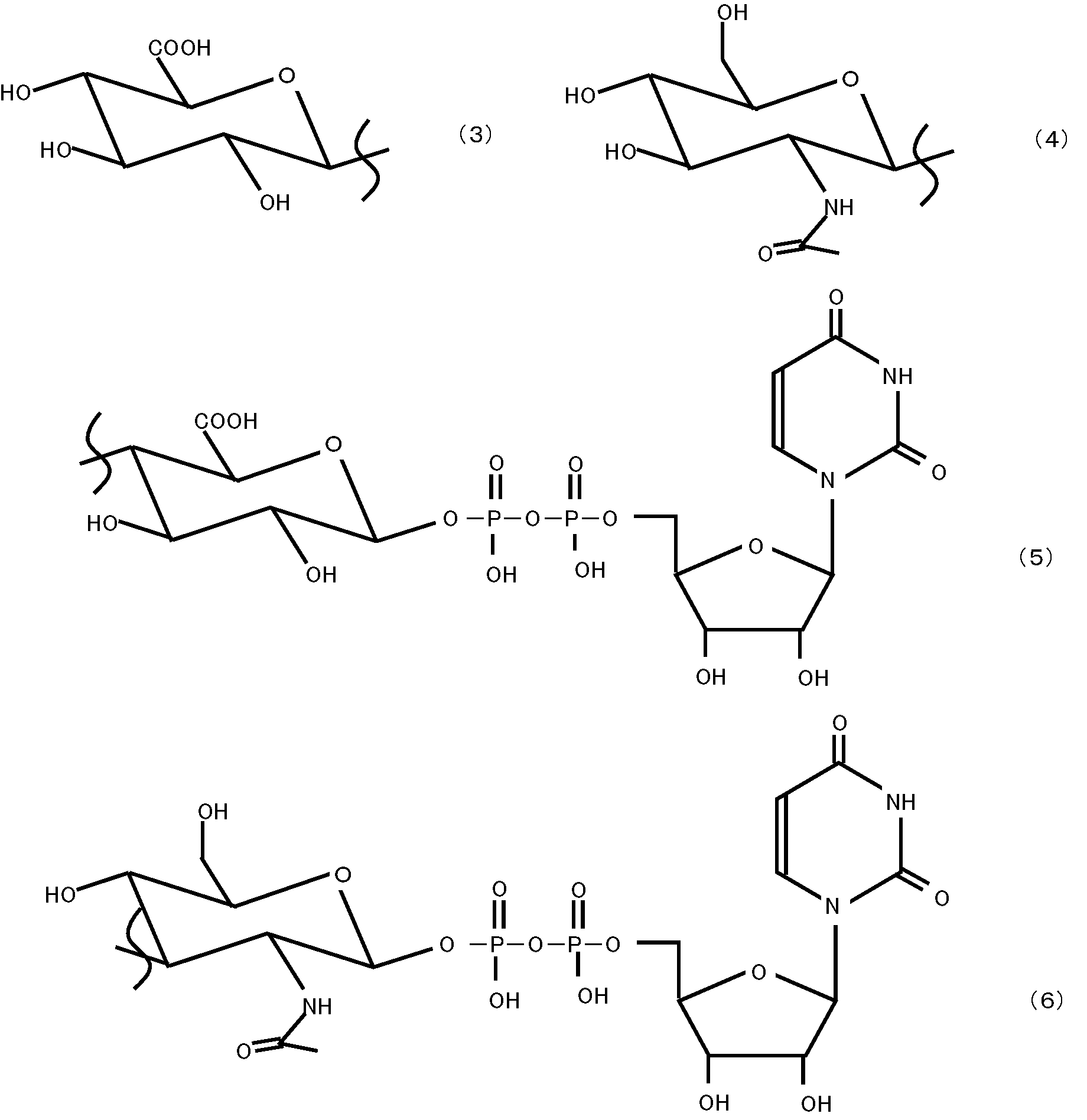
醗酵生産後のヒアルロン酸を化学的に架橋して分岐ヒアルロン酸とした場合、ゲル化してしまい目的の分岐ヒアルロン酸を得ることができないが、本発明の分岐ヒアルロン酸の製造方法によれば、保湿性の機能を向上させた、粘度の低い分岐ヒアルロン酸を、ゲル化させずに生産率高く製造することができる。
本発明の製造方法において、化合物(S’)は上記一般式(3)で表される基及び/又は上記一般式(4)で表される基を合計3つ以上有する化合物(S’1)、上記一般式(5)で表される基及び/又は(6)で表される基を合計3つ以上有する化合物(S’2)、並びに上記一般式(3)で表される基及び/又は(4)で表される基と上記一般式(5)で表される基及び/又は(6)で表される基とを合計3つ以上有する化合物(S’3)からなる群より選ばれる少なくとも1種の化合物である。
化合物(S’)として、化合物(S’1)を用いる場合は、後述するクラスIIのヒアルロン酸合成酵素を用いることで分岐ヒアルロン酸を製造することができる。また、化合物(S’2)を用いる場合は、後述するクラスIのヒアルロン酸合成酵素を用いることで分岐ヒアルロン酸を製造することができる。また、(S’3)を用いる場合は、クラスIのヒアルロン酸合成酵素及びクラスIIのヒアルロン酸合成酵素を用いることで、分岐ヒアルロン酸を製造することができる。
化合物(S’1)は、上述の(S)において、上記一般式(3)及び/又は(4)で表される基を合計3つ以上有する化合物である。
化合物(S’1)として好ましいものは上記(S)と同様である。
化合物(S’1)として好ましいものは上記(S)と同様である。
化合物(S’2)は、ウリジン二リン酸-グルクロン酸及びウリジン二リン酸-N-アセチルグルコサミンにヒアルロン酸合成酵素(A)を作用させてグルクロン酸とN-アセチルグルコサミンとがβ1,3結合又はβ1,4結合で結合したヒアルロン酸を製造することで、末端が上記一般式(5)及び/又は(6)で表される基であるヒアルロン酸が得られ、このヒアルロン酸を化合物(SS1)~(SS4)の代わりに用いて、上記(T)~(W)を用いて反応させることで、化合物(S’2)を製造することができる。
(S’2)において、末端が上記一般式(5)及び/又は(6)で表される基であるヒアルロン酸の好ましいものについては、(SS1)~(SS4)におけるグルクロン酸単位及びN-アセチルグルコサミン単位の好ましい合計結合数、(T)~(W)の結合量の好ましい範囲と同じである。
(S’2)において、末端が上記一般式(5)及び/又は(6)で表される基であるヒアルロン酸の好ましいものについては、(SS1)~(SS4)におけるグルクロン酸単位及びN-アセチルグルコサミン単位の好ましい合計結合数、(T)~(W)の結合量の好ましい範囲と同じである。
化合物(S’3)は、上記化合物(S’2)と同様にして製造することができ、好ましいものも同様である。
化合物(S’)としては、反応特異性の観点から、(S’2)が好ましい。
本発明において、ウリジン二リン酸-グルクロン酸とは、ウリジン二リン酸のリン酸基にグルクロン酸が結合した化合物である。ウリジン二リン酸-グルクロン酸は、例えば、ウリジン三リン酸とグルクロン酸一リン酸から合成することができる。また、ウリジン二リン酸-グルコースの酸化によって得ることができる。さらに、ウリジン二リン酸-グルコースの酸化を行うウリジン二リン酸デヒドロゲナーゼを過剰発現した微生物を用いた微生物培養方法によっても生産可能である。
ウリジン二リン酸-N-アセチルグルコサミンとは、ウリジン二リン酸のリン酸基にN-アセチルグルコサミンが結合した化合物である。ウリジン二リン酸-N-アセチルグルコサミンは、例えば、ウリジン三リン酸とN-アセチルグルコサミン一リン酸からウリジン二リン酸-N-アセチルグルコサミンピロホスホリラーゼによって合成することができる。
ヒアルロン酸合成酵素(A)とは、ウリジン二リン酸-グルクロン酸とウリジン二リン酸-N-アセチルグルコサミンとからヒアルロン酸を合成するヒアルロン酸合成活性を有する酵素である。ヒアルロン酸合成活性は、具体的には、ウリジン二リン酸-グルクロン酸及びウリジン二リン酸-N-アセチルグルコサミンを糖供与体として、グルクロン酸がβ1,3結合でN-アセチルグルコサミンに結合した二糖単位の、β1,4結合による繰り返し構造を有するオリゴ糖を合成する能力をいう。
ヒアルロン酸合成酵素(A)としては、従来のヒアルロン酸合成酵素を使用でき、ヒアルロン酸合成活性を有するものであれば特に限定されないが、例えば、非特許文献(The Journal of Biological Chemistry,2007,Vol.282,No.51,P36777-36781)に記載されているクラスI及びクラスIIのヒアルロン酸合成酵素が挙げられる。クラスI及びクラスIIは、酵素のアミノ酸配列の相同性によって分類されたものである。
クラスIのヒアルロン酸合成酵素には、ストレプトコッカス・ピロジェネシスやストレプトコッカス・エクイシミリス及び藻類ウイルス由来のヒアルロン酸合成酵素等が含まれ、上記化合物(S’2)及び(S’3)中の上記一般式(5)及び/又は(6)で表される基におけるウリジン二リン酸基と、ウリジン二リン酸-グルクロン酸及びウリジン二リン酸-N-アセチルグルコサミンにおけるウリジン二リン酸基を脱離させながらグルクロン酸及びN-アセチルグルコサミンを1,3結合及び1,4結合させる反応を触媒する酵素である。
また、クラスIIのヒアルロン酸合成酵素には、パスツレラ・ムルトシダ由来のヒアルロン酸合成酵素等が含まれ、上記化合物(S’1)及び(S’3)中の上記一般式(3)及び/又は(4)で表される基に、ウリジン二リン酸-グルクロン酸及びウリジン二リン酸-N-アセチルグルコサミンにおけるウリジン二リン酸基を脱離させながらグルクロン酸及びN-アセチルグルコサミンを1,3結合及び1,4結合させる反応を触媒する酵素である。
ヒアルロン酸合成酵素(A)のうち、反応特異性の観点から、クラスIのヒアルロン酸合成酵素が好ましい。
ヒアルロン酸合成酵素(A)としては、従来のヒアルロン酸合成酵素を使用でき、ヒアルロン酸合成活性を有するものであれば特に限定されないが、例えば、非特許文献(The Journal of Biological Chemistry,2007,Vol.282,No.51,P36777-36781)に記載されているクラスI及びクラスIIのヒアルロン酸合成酵素が挙げられる。クラスI及びクラスIIは、酵素のアミノ酸配列の相同性によって分類されたものである。
クラスIのヒアルロン酸合成酵素には、ストレプトコッカス・ピロジェネシスやストレプトコッカス・エクイシミリス及び藻類ウイルス由来のヒアルロン酸合成酵素等が含まれ、上記化合物(S’2)及び(S’3)中の上記一般式(5)及び/又は(6)で表される基におけるウリジン二リン酸基と、ウリジン二リン酸-グルクロン酸及びウリジン二リン酸-N-アセチルグルコサミンにおけるウリジン二リン酸基を脱離させながらグルクロン酸及びN-アセチルグルコサミンを1,3結合及び1,4結合させる反応を触媒する酵素である。
また、クラスIIのヒアルロン酸合成酵素には、パスツレラ・ムルトシダ由来のヒアルロン酸合成酵素等が含まれ、上記化合物(S’1)及び(S’3)中の上記一般式(3)及び/又は(4)で表される基に、ウリジン二リン酸-グルクロン酸及びウリジン二リン酸-N-アセチルグルコサミンにおけるウリジン二リン酸基を脱離させながらグルクロン酸及びN-アセチルグルコサミンを1,3結合及び1,4結合させる反応を触媒する酵素である。
ヒアルロン酸合成酵素(A)のうち、反応特異性の観点から、クラスIのヒアルロン酸合成酵素が好ましい。
本発明の分岐ヒアルロン酸合成酵素の製造方法において、反応特異性の観点から、化合物(S’)として(S’2)を用いて、クラスIのヒアルロン酸合成酵素を用いた製造方法が好ましい。
本発明の製造方法は、化合物(S’)、ウリジン二リン酸-グルクロン酸及びウリジン二リン酸-N-アセチルグルコサミンにヒアルロン酸合成酵素(A)を作用させる製造方法であるが、ヒアルロン酸合成酵素(A)を作用させる際、ウリジン二リン酸を下記化合物(K)に変換する活性を有するウリジン二リン酸変換酵素(B)の存在下でヒアルロン酸合成酵素(A)を作用させることが好ましい。(B)の存在下でヒアルロン酸合成酵素(A)を作用させることにより、分岐ヒアルロン酸をさらに効率よく製造することができる。
化合物(K):ウラシル、ウリジン、ウリジン一リン酸、ウリジン三リン酸、ポリウリジル酸、デオキシウリジン二リン酸及びウリジン二リン酸-糖からなる群より選ばれる少なくとも1種の化合物。
化合物(K):ウラシル、ウリジン、ウリジン一リン酸、ウリジン三リン酸、ポリウリジル酸、デオキシウリジン二リン酸及びウリジン二リン酸-糖からなる群より選ばれる少なくとも1種の化合物。
ウリジン二リン酸変換酵素(B)には、下記(B-1)~(B-7)が含まれる。
(B-1)ウリジン二リン酸をウラシルに変換する活性を有する酵素
(B-2)ウリジン二リン酸をウリジンに変換する活性を有する酵素
(B-3)ウリジン二リン酸をウリジン一リン酸に変換する活性を有する酵素
(B-4)ウリジン二リン酸をウリジン三リン酸に変換する活性を有する酵素
(B-5)ウリジン二リン酸をポリウリジル酸に変換する活性を有する酵素
(B-6)ウリジン二リン酸をデオキシウリジン二リン酸に変換する活性を有する酵素
(B-7)ウリジン二リン酸をウリジン二リン酸-糖に変換する活性を有する酵素
(B-1)ウリジン二リン酸をウラシルに変換する活性を有する酵素
(B-2)ウリジン二リン酸をウリジンに変換する活性を有する酵素
(B-3)ウリジン二リン酸をウリジン一リン酸に変換する活性を有する酵素
(B-4)ウリジン二リン酸をウリジン三リン酸に変換する活性を有する酵素
(B-5)ウリジン二リン酸をポリウリジル酸に変換する活性を有する酵素
(B-6)ウリジン二リン酸をデオキシウリジン二リン酸に変換する活性を有する酵素
(B-7)ウリジン二リン酸をウリジン二リン酸-糖に変換する活性を有する酵素
(B-2)は、リボヌクレオチド中の糖とリン酸との間のリン酸エステル結合を加水分解して、ヌクレオシドとリン酸にする反応を触媒する酵素である。(B-2)として、具体的には、ヌクレオチダーゼ及びアピラーゼ等が挙げられる。
(B-3)は、ウリジン二リン酸等のリン酸ジエステルを加水分解してリン酸モノエステルとする反応を触媒する酵素である。(B-3)として、具体的には、アデノシン二リン酸(ADP)特異的ホスホフルクトキナーゼ及びヌクレオチダーゼ等が挙げられる。
(B-4)は、リン酸基を有する化合物から、ウリジン二リン酸等のリボヌクレオシド二リン酸にリン酸基を転移させる反応を触媒する酵素である。(B-4)として、具体的には、ヌクレオシド二リン酸キナーゼ、ポリリン酸キナーゼ、アルギニンキナーゼ、ピルビン酸キナーゼ、カルバミン酸キナーゼ、ホスホグリセリン酸キナーゼ及びホスホクレアチンキナーゼ等が挙げられる。
ヌクレオシド二リン酸キナーゼは、ヌクレオシド三リン酸からヌクレオシド二リン酸にリン酸基を転移する酵素である。ヌクレオシド二リン酸キナーゼとして、具体的には、生物由来のもの{動物由来のもの(例えば、ヒト由来、ウシ由来及びラット由来のもの等)、植物由来のもの(例えば、シロイヌナズナ由来及びコメ由来のもの等)及び微生物由来のもの(例えば、エシェリヒア(Escherichia)属由来、サッカロマイセス(Saccharomyces)属由来、バシルス(Bacillus)属由来及びサーマス(Thermus)属由来のもの等)等}、生物由来のものを化学修飾したもの(例えば、カルボジイミド化合物、無水コハク酸、ヨード酢酸及びイミダゾール化合物からなる群より選ばれる少なくとも1種を作用させて化学修飾したもの等)及び生物由来のものを遺伝子的に修飾したもの{例えば、Smithらの方法(The Journal of Biological Chemistry,1978,Vol.253,No.18,P6551-6560)を用いて遺伝子を改変して得たもの等が挙げられる。以下同じ}等が挙げられる。
ポリリン酸キナーゼは、リボヌクレオシド二リン酸とポリリン酸とから、リボヌクレオシド二リン酸と、重合度の1つ少ないポリリン酸とを生成する活性を有する酵素である。ポリリン酸キナーゼとして、具体的には、生物由来のもの{植物由来のもの(例えば、タバコ由来のもの等)及び微生物由来のもの(例えば、エシェリヒア(Escherichia)属由来、コリネバクテリウム(Corynebacterium)属由来、シュードモナス(Pseudomonas)属由来及びサーマス(Thermus)属由来のもの等)等}、生物由来のものを化学修飾したもの(例えば、カルボジイミド化合物、無水コハク酸、ヨード酢酸及びイミダゾール化合物からなる群より選ばれる少なくとも1種を作用させて化学修飾したもの等)並びに生物由来のものを遺伝子的に修飾したもの等が挙げられる。
アルギニンキナーゼは、リボヌクレオシド二リン酸とω-ホスホノ-L-アルギニンからリボヌクレオシド三リン酸とL-アルギニンを生成する活性を有する酵素である。アルギニンキナーゼとして、具体的には、生物由来のもの{動物由来のもの(例えば、ショウジョウバエ由来、エビ由来及びノミ由来のもの等)、植物由来のもの(例えば、ケヤリ由来のもの等)及び微生物由来のもの(例えば、バシルス(Bacillus)属由来のもの等)等}、生物由来のものを化学修飾したもの(例えば、カルボジイミド化合物、無水コハク酸、ヨード酢酸及びイミダゾール化合物からなる群より選ばれる少なくとも1種を作用させて化学修飾したもの等)並びに生物由来のものを遺伝子的に修飾したもの等が挙げられる。
ピルビン酸キナーゼは、リボヌクレオシド二リン酸とホスホエノールピルビン酸からリボヌクレオシド三リン酸とピルビン酸を生成する活性を有する酵素である。ピルビン酸キナーゼとして、具体的には、生物由来のもの{動物由来のもの(例えば、ヒト由来、ウシ由来及びラット由来のもの等)、植物由来のもの(例えば、シロイヌナズナ由来及びトウゴマ由来のもの等)及び微生物由来のもの(例えば、エシェリヒア(Escherichia)属由来及びサッカロマイセス(Saccharomyces)属由来のもの等)等}、生物由来のものを化学修飾したもの(例えば、カルボジイミド化合物、無水コハク酸、ヨード酢酸及びイミダゾール化合物からなる群より選ばれる少なくとも1種を作用させて化学修飾したもの等)並びに生物由来のものを遺伝子的に修飾したもの等が挙げられる。
カルバミン酸キナーゼは、カルバモイルリン酸とリボヌクレオシド二リン酸からリボヌクレオシド三リン酸、二酸化炭素、及びアンモニアを生成する活性を有する酵素である。カルバミン酸キナーゼとして、具体的には、生物由来のもの{動物由来のもの(例えば、ラット由来のもの等)及び微生物由来のもの(例えば、ピロコッカス(Pyrococcus)属由来、及びラクトバチルス(Lactobacillus)属由来のもの等)等}、生物由来のものを化学修飾したもの(例えば、カルボジイミド化合物、無水コハク酸、ヨード酢酸及びイミダゾール化合物からなる群より選ばれる少なくとも1種を作用させて化学修飾したもの等)並びに生物由来のものを遺伝子的に修飾したもの等が挙げられる。
ホスホグリセリン酸キナーゼは、3-ホスホグリセロールリン酸とリボヌクレオシド二リン酸からリボヌクレオシド三リン酸及び3-ホスホグリセリン酸を生成する活性を有する酵素である。ホスホグリセリン酸キナーゼとして、具体的には、生物由来のもの{動物由来のもの(例えば、ラット由来のもの等)及び微生物由来のもの(例えば、サッカロマイセス(Saccharomyces)属由来のもの等)等}、生物由来のものを化学修飾したもの(例えば、カルボジイミド化合物、無水コハク酸、ヨード酢酸及びイミダゾール化合物からなる群より選ばれる少なくとも1種を作用させて化学修飾したもの等)並びに生物由来のものを遺伝子的に修飾したもの等が挙げられる。
ホスホクレアチンキナーゼは、ホスホクレアチンとリボヌクレオシド二リン酸からリボヌクレオシド三リン酸及びクレアチンを生成する活性を有する酵素である。ホスホクレアチンキナーゼとして、具体的には、生物由来のもの{動物由来のもの(例えば、ラット由来のもの等)等}、生物由来のものを化学修飾したもの(例えば、カルボジイミド化合物、無水コハク酸、ヨード酢酸及びイミダゾール化合物からなる群より選ばれる少なくとも1種を作用させて化学修飾したもの等)並びに生物由来のものを遺伝子的に修飾したもの等が挙げられる。
ウリジン二リン酸変換酵素(B)として(B-4)を用いる場合、必要により、ウリジン二リン酸にリン酸基を与えるリン酸基含有化合物(b-4)を用いてもよい。(b-4)としては、例えば、ホスホエノールピルビン酸、カルバモイルリン酸、3-ホスホグリセロールリン酸、ホスホクレアチン、トリアミノホスフィンオキシド、リン酸化したアミノ酸(例えばω-ホスホノ-L-アルギニン等)、ポリリン酸及びヌクレオシド三リン酸(例えばウリジン三リン酸及びグアノシン三リン酸等)等が挙げられる。(B-4)と(b-4)の好ましい組み合わせは上述の通りである。
(B-5)は、ウリジン二リン酸等のリボヌクレオシド二リン酸をリボヌクレオシド一リン酸の共重合物及び無機リン酸とする反応を触媒する酵素である。(B-5)として、具体的には、ポリリボヌクレオチドヌクレオチジルトランスフェラーゼ等が挙げられる。
(B-6)は、ウリジン二リン酸等のリボヌクレオチドを還元してデオキシリボヌクレオチドとする反応を触媒する酵素である。(B-6)として、具体的には、リボヌクレオシドジホスホリダクターゼ等が挙げられる。
ウリジン二リン酸変換酵素(B)として(B-6)を用いる場合、還元剤(b-6)を用いる必要がある。(b-6)としては、電子伝達タンパク質を用いることができ、例えば、還元型チオレドキシン等が挙げられる。
ウリジン二リン酸変換酵素(B)として(B-6)を用いる場合、還元剤(b-6)を用いる必要がある。(b-6)としては、電子伝達タンパク質を用いることができ、例えば、還元型チオレドキシン等が挙げられる。
(B-7)は、ウリジン二リン酸等のリボヌクレオシド二リン酸と糖リン酸とから糖核酸を合成する反応を触媒する酵素である。(B-7)として、具体的には、スクロースシンターゼ及びN-アシルニューラミネートシチジリルトランスフェラーゼ等が挙げられる。
ウリジン二リン酸変換酵素(B)として(B-7)を用いる場合、糖核酸の原料である糖リン酸(b-7)を用いる必要がある。(b-7)は、単糖又はオリゴ糖の水酸基にリン酸が結合した化合物であり、例えば、グルクロン酸一リン酸(1-ホスホ-α-D-グルクロン酸等)、N-アセチルグルコサミン一リン酸(N-アセチル-D-グルコサミン-1-ホスファート等)等が挙げられる。
上記ウリジン二リン酸変換酵素(B)のうち、分岐ヒアルロン酸を効率よく製造する観点及び工業化しやすいという観点から、(B-2)、(B-3)、(B-4)、(B-5)及び(B-7)が好ましく、さらに好ましくは(B-4)である。
本発明において、ウリジン二リン酸変換酵素(B)を用いる場合、下記酵素活性Vmax1及び下記酵素活性Vmax2を用いて下記数式(1)から算出した酵素活性比(Y)が、分岐ヒアルロン酸を効率よく製造する観点及び基質(ウリジン二リン酸-グルクロン酸及びウリジン二リン酸-N-アセチルグルコサミン)を有効利用する観点から、0.1以上であることが好ましく、さらに好ましくは10以上である。
酵素活性比(Y)=Vmax1/Vmax2 (1)
酵素活性Vmax1:ウリジン二リン酸変換酵素(B)のウリジン二リン酸に対する酵素活性。
酵素活性Vmax2:ウリジン二リン酸変換酵素(B)のウリジン二リン酸-グルクロン酸及びウリジン二リン酸-N-アセチルグルコサミンに対する酵素活性。
なお、酵素活性Vmax1及びVmax2は下記酵素活性Vmaxの測定法により測定できる。
酵素活性比(Y)=Vmax1/Vmax2 (1)
酵素活性Vmax1:ウリジン二リン酸変換酵素(B)のウリジン二リン酸に対する酵素活性。
酵素活性Vmax2:ウリジン二リン酸変換酵素(B)のウリジン二リン酸-グルクロン酸及びウリジン二リン酸-N-アセチルグルコサミンに対する酵素活性。
なお、酵素活性Vmax1及びVmax2は下記酵素活性Vmaxの測定法により測定できる。
<酵素活性Vmaxの測定法>
一定量の基質(ウリジン二リン酸、ウリジン二リン酸-グルクロン酸又はウリジン二リン酸-N-アセチルグルコサミン)、ウリジン二リン酸変換酵素(B)、pH調整剤(P)及び水を含む、一定の温度及び一定のpHに調製した酵素反応溶液(II)を作成する。酵素反応溶液(II)中に、(B)が(B-4)である場合は必要によりリン酸基含有化合物(b-4)を添加し、(B)が(B-6)である場合は還元剤(b-6)を添加し、(B-7)である場合は糖核酸の原料(b-7)を添加する。
酵素反応溶液(II)を作成後、静置し、1分~100時間酵素反応させる。次に、反応後の反応生成物量(X)を測定して酵素反応初速度vを求める。同様に、基質の濃度が異なる酵素反応溶液(II)を用いて、酵素反応初速度vを求める。得られた酵素反応初速度vと基質の濃度とからラインウェバー-バークプロットを作成し、酵素活性Vmaxを求める。
ここで、酵素反応溶液(II)の温度は、0~100℃の範囲内で、(B)の活性が失活せず、活性がある温度で、酵素反応溶液(II)作成時から測定終了までの間、一定温度に保つことができればよい。
酵素反応溶液(II)のpHは、pH3~12の範囲内であればよい。ヒアルロン酸合成酵素(A)の最適pHがわかっている場合は最適pHであることが好ましい。
酵素反応溶液(II)に用いるpH調整剤(P)は、扱いやすさ及び(B)の安定性の観点から、HEPESバッファー、MESバッファー等のGoodバッファーが好ましい。酵素反応溶液(II)中のpH調整剤(P)の濃度(モル濃度)は、25~500mMである。
酵素反応溶液(II)中の(B)の濃度(モル濃度)は、使用する(B)の種類によって適宜選択されるが、後述する反応生成物量(X)を縦軸に、時間hを横軸にプロットした場合、プロットが一次関数となる濃度を選ぶ。
(B)が(B-4)であり、リン酸基含有化合物(b-4)を添加する場合、酵素反応溶液(II)中の(b-4)の濃度(モル濃度)は、1nM~10Mである。また、(b-4)の濃度は、(b-4)の濃度を2倍又は1/2倍に変化させても、反応速度が変化しない程度の濃度とする。
(B)が(B-6)である場合、酵素反応溶液(II)中の還元剤(b-6)の濃度(モル濃度)は、1nM~10Mである。また、(b-6)の濃度は、(b-6)の濃度を2倍又は1/2倍に変化させても、反応速度が変化しない程度の濃度とする。
(B)が(B-7)である場合、酵素反応溶液(II)中の糖リン酸(b-7)の濃度(モル濃度)は、1nM~10Mである。また、(b-7)の濃度は、(b-7)の濃度を2倍又は1/2倍に変化させても、反応速度が変化しない程度の濃度とする。
酵素反応溶液(II)中の基質の濃度(モル濃度)は、経時的に反応生成物量(X)を観測できる最小の基質濃度から最大の基質濃度の間で3点以上選べばよい。
反応時間は、短すぎると、反応生成物量(X)の正確な値が測定できない。また、反応時間が長すぎると、酵素が失活したり基質が枯渇するという問題が存在する。したがって、反応時間は反応生成物量(X)を縦軸に、時間を横軸にプロットした場合、プロットが一次関数となる反応時間とする。
反応生成物量(X)は、反応生成物の量を定量的に測定する目的で適切な条件下でHPLCを用いて解析を行うことにより求める。ここにおいて、反応生成物とは、ウリジン二リン酸変換酵素(B)が有する活性により基質が変換されて生成したものである。
酵素活性Vmax(M/s)はミカエリスメンテン式から派生したラインウェバー-バーク(Lineweaver-Burk)プロットを用いて求める。ラインウェバー-バークプロットは、横軸(x軸)にそれぞれの基質の濃度の逆数(1/[S])、縦軸(y軸)にそれぞれの基質濃度での酵素反応初速度の逆数(1/v)をプロットしたものであり、プロットの近似直線とy軸との交点が酵素活性Vmaxの逆数(1/Vmax)である。
一定量の基質(ウリジン二リン酸、ウリジン二リン酸-グルクロン酸又はウリジン二リン酸-N-アセチルグルコサミン)、ウリジン二リン酸変換酵素(B)、pH調整剤(P)及び水を含む、一定の温度及び一定のpHに調製した酵素反応溶液(II)を作成する。酵素反応溶液(II)中に、(B)が(B-4)である場合は必要によりリン酸基含有化合物(b-4)を添加し、(B)が(B-6)である場合は還元剤(b-6)を添加し、(B-7)である場合は糖核酸の原料(b-7)を添加する。
酵素反応溶液(II)を作成後、静置し、1分~100時間酵素反応させる。次に、反応後の反応生成物量(X)を測定して酵素反応初速度vを求める。同様に、基質の濃度が異なる酵素反応溶液(II)を用いて、酵素反応初速度vを求める。得られた酵素反応初速度vと基質の濃度とからラインウェバー-バークプロットを作成し、酵素活性Vmaxを求める。
ここで、酵素反応溶液(II)の温度は、0~100℃の範囲内で、(B)の活性が失活せず、活性がある温度で、酵素反応溶液(II)作成時から測定終了までの間、一定温度に保つことができればよい。
酵素反応溶液(II)のpHは、pH3~12の範囲内であればよい。ヒアルロン酸合成酵素(A)の最適pHがわかっている場合は最適pHであることが好ましい。
酵素反応溶液(II)に用いるpH調整剤(P)は、扱いやすさ及び(B)の安定性の観点から、HEPESバッファー、MESバッファー等のGoodバッファーが好ましい。酵素反応溶液(II)中のpH調整剤(P)の濃度(モル濃度)は、25~500mMである。
酵素反応溶液(II)中の(B)の濃度(モル濃度)は、使用する(B)の種類によって適宜選択されるが、後述する反応生成物量(X)を縦軸に、時間hを横軸にプロットした場合、プロットが一次関数となる濃度を選ぶ。
(B)が(B-4)であり、リン酸基含有化合物(b-4)を添加する場合、酵素反応溶液(II)中の(b-4)の濃度(モル濃度)は、1nM~10Mである。また、(b-4)の濃度は、(b-4)の濃度を2倍又は1/2倍に変化させても、反応速度が変化しない程度の濃度とする。
(B)が(B-6)である場合、酵素反応溶液(II)中の還元剤(b-6)の濃度(モル濃度)は、1nM~10Mである。また、(b-6)の濃度は、(b-6)の濃度を2倍又は1/2倍に変化させても、反応速度が変化しない程度の濃度とする。
(B)が(B-7)である場合、酵素反応溶液(II)中の糖リン酸(b-7)の濃度(モル濃度)は、1nM~10Mである。また、(b-7)の濃度は、(b-7)の濃度を2倍又は1/2倍に変化させても、反応速度が変化しない程度の濃度とする。
酵素反応溶液(II)中の基質の濃度(モル濃度)は、経時的に反応生成物量(X)を観測できる最小の基質濃度から最大の基質濃度の間で3点以上選べばよい。
反応時間は、短すぎると、反応生成物量(X)の正確な値が測定できない。また、反応時間が長すぎると、酵素が失活したり基質が枯渇するという問題が存在する。したがって、反応時間は反応生成物量(X)を縦軸に、時間を横軸にプロットした場合、プロットが一次関数となる反応時間とする。
反応生成物量(X)は、反応生成物の量を定量的に測定する目的で適切な条件下でHPLCを用いて解析を行うことにより求める。ここにおいて、反応生成物とは、ウリジン二リン酸変換酵素(B)が有する活性により基質が変換されて生成したものである。
酵素活性Vmax(M/s)はミカエリスメンテン式から派生したラインウェバー-バーク(Lineweaver-Burk)プロットを用いて求める。ラインウェバー-バークプロットは、横軸(x軸)にそれぞれの基質の濃度の逆数(1/[S])、縦軸(y軸)にそれぞれの基質濃度での酵素反応初速度の逆数(1/v)をプロットしたものであり、プロットの近似直線とy軸との交点が酵素活性Vmaxの逆数(1/Vmax)である。
上記測定において、基質としてウリジン二リン酸を用いて求めたものがVmax1である。また、基質としてウリジン二リン酸-グルクロン酸又はウリジン二リン酸-N-アセチルグルコサミンをそれぞれ用いてVmax2をそれぞれ求めて、算出した酵素活性比(Y)のうち少なくとも1つが0.1以上であることが好ましく、さらに好ましくは、算出した酵素活性比(Y)の全てが0.1以上であることである。
本発明の分岐ヒアルロン酸の製造方法は、化合物(S’)を用いる以外は、従来のウリジン二リン酸-グルクロン酸及びウリジン二リン酸-N-アセチルグルコサミンにヒアルロン酸合成酵素(A)を作用させるヒアルロン酸の製造方法と同様でよい。例えば、下記工程(i)~(iii)により製造する方法が含まれる。
(i)所定量の化合物(S’)、ウリジン二リン酸-グルクロン酸、ウリジン二リン酸-N-アセチルグルコサミン、溶剤(D)及びヒアルロン酸合成酵素(A)を混合して反応溶液(L)とし、所定の温度、所定のpHに調整する。必要により、ウリジン二リン酸変換酵素(B)を加えてもよい。また、本工程では、必要により攪拌してもよい。
上記工程においては、化合物(S’)、ウリジン二リン酸-グルクロン酸、ウリジン二リン酸-N-アセチルグルコサミン及び溶剤(D)を混合し、温度及びpHを調整した後、ヒアルロン酸合成酵素(A)を添加してもよい。さらに、ヒアルロン酸合成酵素(A)は、そのまま添加してもよく、溶剤(D)で希釈してから添加してもよい。
また、反応溶液(L)中には(B)を含んでもよい。(B)が(B-4)である場合は、(b-4)を含んでもよい。使用する(B)が(B-6)である場合は、(b-6)を含む。使用する(B)が(B-7)である場合は、(b-7)を含む。
さらに、反応溶液(L)中には、脂質(M)、糖類(N)及びオリゴ糖(O)を含んでもよい。
(ii)反応溶液(L)の温度を調整しながら、所定の時間、化合物(S’)、ウリジン二リン酸-グルクロン酸及びウリジン二リン酸-N-アセチルグルコサミンにヒアルロン酸合成酵素(A)を作用させる。本工程では、必要により攪拌してもよい。
(iii)生成した分岐ヒアルロン酸を精製する。分岐ヒアルロン酸の精製方法としては、適量のアルコール(炭素数1~10のアルコール)等の溶剤(D)を加えて沈殿させる方法や膜(具体的には、セラミック膜等)を用いて溶液交換をする方法等が挙げられる。
(i)所定量の化合物(S’)、ウリジン二リン酸-グルクロン酸、ウリジン二リン酸-N-アセチルグルコサミン、溶剤(D)及びヒアルロン酸合成酵素(A)を混合して反応溶液(L)とし、所定の温度、所定のpHに調整する。必要により、ウリジン二リン酸変換酵素(B)を加えてもよい。また、本工程では、必要により攪拌してもよい。
上記工程においては、化合物(S’)、ウリジン二リン酸-グルクロン酸、ウリジン二リン酸-N-アセチルグルコサミン及び溶剤(D)を混合し、温度及びpHを調整した後、ヒアルロン酸合成酵素(A)を添加してもよい。さらに、ヒアルロン酸合成酵素(A)は、そのまま添加してもよく、溶剤(D)で希釈してから添加してもよい。
また、反応溶液(L)中には(B)を含んでもよい。(B)が(B-4)である場合は、(b-4)を含んでもよい。使用する(B)が(B-6)である場合は、(b-6)を含む。使用する(B)が(B-7)である場合は、(b-7)を含む。
さらに、反応溶液(L)中には、脂質(M)、糖類(N)及びオリゴ糖(O)を含んでもよい。
(ii)反応溶液(L)の温度を調整しながら、所定の時間、化合物(S’)、ウリジン二リン酸-グルクロン酸及びウリジン二リン酸-N-アセチルグルコサミンにヒアルロン酸合成酵素(A)を作用させる。本工程では、必要により攪拌してもよい。
(iii)生成した分岐ヒアルロン酸を精製する。分岐ヒアルロン酸の精製方法としては、適量のアルコール(炭素数1~10のアルコール)等の溶剤(D)を加えて沈殿させる方法や膜(具体的には、セラミック膜等)を用いて溶液交換をする方法等が挙げられる。
反応溶液(L)中の化合物(S’)の含有量(重量%)は、分岐ヒアルロン酸を効率よく製造する観点及びヒアルロン酸合成酵素(A)を効率よく作用させる観点から、0.000001~1重量%が好ましい。
反応溶液(L)中のウリジン二リン酸-グルクロン酸の含有量(モル濃度)は、分岐ヒアルロン酸を効率よく製造する観点及びヒアルロン酸合成酵素(A)を効率よく作用させる観点から、0.1mM~2Mが好ましい。
反応溶液(L)中のウリジン二リン酸-N-アセチルグルコサミンの含有量(モル濃度)は、分岐ヒアルロン酸を効率よく製造する観点及びヒアルロン酸合成酵素(A)を効率よく作用させる観点から、0.1mM~2Mが好ましい。
反応溶液(L)中のヒアルロン酸合成酵素(A)の含有量(ユニット/L)は、分岐ヒアルロン酸を効率よく製造する観点及びヒアルロン酸合成酵素(A)を効率よく作用させる観点から、0.1~1,000,000ユニット/Lが好ましい。
1ユニットとは、1分間に1μmolのウリジン二リン酸-グルクロン酸及び1μmolのウリジン二リン酸-N-アセチルグルコサミンからヒアルロン酸を合成する活性を1ユニットと定義する。
反応溶液(L)中のウリジン二リン酸-グルクロン酸の含有量(モル濃度)は、分岐ヒアルロン酸を効率よく製造する観点及びヒアルロン酸合成酵素(A)を効率よく作用させる観点から、0.1mM~2Mが好ましい。
反応溶液(L)中のウリジン二リン酸-N-アセチルグルコサミンの含有量(モル濃度)は、分岐ヒアルロン酸を効率よく製造する観点及びヒアルロン酸合成酵素(A)を効率よく作用させる観点から、0.1mM~2Mが好ましい。
反応溶液(L)中のヒアルロン酸合成酵素(A)の含有量(ユニット/L)は、分岐ヒアルロン酸を効率よく製造する観点及びヒアルロン酸合成酵素(A)を効率よく作用させる観点から、0.1~1,000,000ユニット/Lが好ましい。
1ユニットとは、1分間に1μmolのウリジン二リン酸-グルクロン酸及び1μmolのウリジン二リン酸-N-アセチルグルコサミンからヒアルロン酸を合成する活性を1ユニットと定義する。
溶剤(D)としては、水、有機溶剤及びこれらの混合物が含まれる。水としては、特に限定されるものではなく、例えば、水道水、イオン交換水、蒸留水及び逆浸透水等が挙げられる。また、水中にpH調整剤(P)を含むバッファー水溶液等が挙げられる。
pH調整剤(P)としては、従来のpH調整剤が使用でき、ホウ酸バッファー、リン酸バッファー、酢酸バッファー、Trisバッファー、HEPESバッファー、MESバッファー、硫酸、塩酸、クエン酸、乳酸、ピルビン酸、蟻酸、モノエタノールアミン及びジエタノールアミン等が挙げられる。
有機溶剤としては、アルコール(炭素数1~18のアルコールが挙げられ、具体的には、メタノール、エタノール、ブタノール及びエチレングリコール等)、ケトン(アセトン、メチルエチルケトン等)、エーテル(テトラヒドロフラン、ジエチルエーテル及びエチレングリコールモノアルキルエーテル等)、スルホキシド(ジメチルスルホキシド等)、脂肪族または脂環式炭化水素(n-ヘキサン、n-ヘプタン、ミネラルスピリット、シクロヘキサン等)及びふっ素含有化合物(テトラフルオロエチレン等)等が挙げられる。これらの溶剤(D)のうち、タンパク質の安定性の観点からバッファー水溶液が好ましい。
pH調整剤(P)としては、従来のpH調整剤が使用でき、ホウ酸バッファー、リン酸バッファー、酢酸バッファー、Trisバッファー、HEPESバッファー、MESバッファー、硫酸、塩酸、クエン酸、乳酸、ピルビン酸、蟻酸、モノエタノールアミン及びジエタノールアミン等が挙げられる。
有機溶剤としては、アルコール(炭素数1~18のアルコールが挙げられ、具体的には、メタノール、エタノール、ブタノール及びエチレングリコール等)、ケトン(アセトン、メチルエチルケトン等)、エーテル(テトラヒドロフラン、ジエチルエーテル及びエチレングリコールモノアルキルエーテル等)、スルホキシド(ジメチルスルホキシド等)、脂肪族または脂環式炭化水素(n-ヘキサン、n-ヘプタン、ミネラルスピリット、シクロヘキサン等)及びふっ素含有化合物(テトラフルオロエチレン等)等が挙げられる。これらの溶剤(D)のうち、タンパク質の安定性の観点からバッファー水溶液が好ましい。
反応溶液(L)の温度は、酵素(A)及び(B)の安定性並びに反応速度の観点から0~100℃が好ましい。
反応溶液(L)のpHは、反応の至適条件の観点から、pH3~12が好ましい。
上記工程(i)及び(ii)において、上記ウリジン二リン酸-グルクロン酸、ウリジン二リン酸-N-アセチルグルコサミン及びヒアルロン酸合成酵素(A)以外に、分岐ヒアルロン酸を効率よく製造する観点から、ウリジン二リン酸変換酵素(B)を用いてもよい。また、(B)として(B-4)を用いる場合は(b-4)を用いてもよく、(B)として(B-6)を用いる場合は(b-6)を用いる必要があり、(B)として(B-7)を用いる場合は(b-7)を用いる必要がある。
ウリジン二リン酸変換酵素(B)を用いる場合、反応溶液(L)中の(B)の含有量(ユニット/L)は、分岐ヒアルロン酸を効率よく製造する観点及びヒアルロン酸合成酵素(A)を効率よく作用させる観点から、0.1~1,000,000ユニット/Lが好ましい。
1ユニットとは、1分間に1μmolのウリジン二リン酸を化合物(K)に変換する活性を1ユニットと定義する。
ウリジン二リン酸変換酵素(B)を用いる場合、反応溶液(L)中の(B)の含有量(ユニット/L)は、分岐ヒアルロン酸を効率よく製造する観点及びヒアルロン酸合成酵素(A)を効率よく作用させる観点から、0.1~1,000,000ユニット/Lが好ましい。
1ユニットとは、1分間に1μmolのウリジン二リン酸を化合物(K)に変換する活性を1ユニットと定義する。
反応溶液(L)中の(b-4)、(b-6)又は(b-7)の含有量(モル濃度)は、分岐ヒアルロン酸を効率よく製造する観点及びヒアルロン酸合成酵素(A)を効率よく作用させる観点から、0.01nM~10Mが好ましい。
また、上記以外に、酵素の安定化及び酵素の活性化の観点から、脂質(M)、糖類(N)及びオリゴ糖(O)を用いてもよい。
脂質(M)としては、例えば、カルディオピン及びオレイン酸等が挙げられる。
糖類(N)としては、例えば、グリセリン等が挙げられる。
オリゴ糖(O)としては、例えば、オリゴヒアルロン酸等が挙げられる。
脂質(M)としては、例えば、カルディオピン及びオレイン酸等が挙げられる。
糖類(N)としては、例えば、グリセリン等が挙げられる。
オリゴ糖(O)としては、例えば、オリゴヒアルロン酸等が挙げられる。
反応溶液(L)中の脂質(M)の含有量(重量%)は、酵素の安定化及び酵素の活性化の観点から、0~1重量%が好ましい。
反応溶液(L)中の糖類(N)の含有量(重量%)は、酵素の安定化及び酵素の活性化の観点から、0~30重量%が好ましい。
反応溶液(L)中のオリゴ糖(O)の含有量(重量%)は、酵素の安定化及び酵素の活性化の観点から、0~1重量%が好ましい。
反応溶液(L)中の糖類(N)の含有量(重量%)は、酵素の安定化及び酵素の活性化の観点から、0~30重量%が好ましい。
反応溶液(L)中のオリゴ糖(O)の含有量(重量%)は、酵素の安定化及び酵素の活性化の観点から、0~1重量%が好ましい。
工程(ii)において、ヒアルロン酸合成酵素(A)を作用させる時間は、ヒアルロン酸合成酵素(A)の活性、反応溶液(L)の温度、ヒアルロン酸合成酵素(A)、ウリジン二リン酸-グルクロン酸及びウリジン二リン酸-N-アセチルグルコサミンの量比等によって異なる。反応溶液(L)の温度を、ヒアルロン酸合成酵素(A)の活性が高く、反応速度が速い温度に調整すれば、反応時間を短くすることができる。また、反応溶液(L)中のウリジン二リン酸-グルクロン酸及びウリジン二リン酸-N-アセチルグルコサミンに対するヒアルロン酸合成酵素(A)の量が多いほど、反応は早くなり、反応時間は短くなる。
本発明の分岐ヒアルロン酸の製造方法としては、分岐ヒアルロン酸を効率よく製造する観点から、下記工程(1)~(3)を(1)、(2)、(3)及び(1)の順に含む又は下記工程(1)~(3)を同時に行う分岐ヒアルロン酸の製造方法が好ましく、さらに好ましくは下記ミカエリス定数Kmが下記阻害濃度IC50の100倍未満である製造方法である。
工程(1):上記化合物(S’)、ウリジン二リン酸-グルクロン酸及びウリジン二リン酸-N-アセチルグルコサミンにヒアルロン酸合成酵素(A)を作用させて(A)、分岐ヒアルロン酸及びウリジン二リン酸を含む組成物(Z’)を得る工程。
工程(2):ウリジン二リン酸とリン酸基含有化合物(b-4)とにウリジン二リン酸変換酵素(B-4)を作用させてウリジン三リン酸を得る工程。
工程(3):ウリジン三リン酸と1-ホスホ-グルクロン酸とにウリジン三リン酸-モノサッカリド-1-リン酸ウリジリルトランスフェラーゼ(C)を作用させてウリジン二リン酸-グルクロン酸を得る工程。
ミカエリス定数Km:ウリジン二リン酸を基質とし、ウリジン二リン酸変換酵素(B-4)を酵素とし、リン酸基含有化合物(b-4)を作用させてウリジン三リン酸を合成する反応におけるミカエリス定数。
阻害濃度IC50:ヒアルロン酸合成酵素(A)をウリジン二リン酸-グルクロン酸及びウリジン二リン酸-N-アセチルグルコサミンに作用させる際の(A)の濃度において、基質としてウリジン二リン酸-グルクロン酸及びウリジン二リン酸-N-アセチルグルコサミンを用いて、阻害剤としてウリジン二リン酸を用いて求めた、(A)の酵素活性が半減するときのウリジン二リン酸の濃度。
工程(1):上記化合物(S’)、ウリジン二リン酸-グルクロン酸及びウリジン二リン酸-N-アセチルグルコサミンにヒアルロン酸合成酵素(A)を作用させて(A)、分岐ヒアルロン酸及びウリジン二リン酸を含む組成物(Z’)を得る工程。
工程(2):ウリジン二リン酸とリン酸基含有化合物(b-4)とにウリジン二リン酸変換酵素(B-4)を作用させてウリジン三リン酸を得る工程。
工程(3):ウリジン三リン酸と1-ホスホ-グルクロン酸とにウリジン三リン酸-モノサッカリド-1-リン酸ウリジリルトランスフェラーゼ(C)を作用させてウリジン二リン酸-グルクロン酸を得る工程。
ミカエリス定数Km:ウリジン二リン酸を基質とし、ウリジン二リン酸変換酵素(B-4)を酵素とし、リン酸基含有化合物(b-4)を作用させてウリジン三リン酸を合成する反応におけるミカエリス定数。
阻害濃度IC50:ヒアルロン酸合成酵素(A)をウリジン二リン酸-グルクロン酸及びウリジン二リン酸-N-アセチルグルコサミンに作用させる際の(A)の濃度において、基質としてウリジン二リン酸-グルクロン酸及びウリジン二リン酸-N-アセチルグルコサミンを用いて、阻害剤としてウリジン二リン酸を用いて求めた、(A)の酵素活性が半減するときのウリジン二リン酸の濃度。
上記製造方法において、下記ミカエリス定数Kmは下記阻害濃度IC50の100倍未満であることが好ましい。
ミカエリス定数Km:ウリジン二リン酸を基質とし、ウリジン二リン酸変換酵素(B-4)を酵素とし、リン酸基含有化合物(b-4)を作用させてウリジン三リン酸を合成する反応におけるミカエリス定数。
阻害濃度IC50:ヒアルロン酸合成酵素(A)をウリジン二リン酸-グルクロン酸及びウリジン二リン酸-N-アセチルグルコサミンに作用させる際の(A)の濃度において、基質としてウリジン二リン酸-グルクロン酸及びウリジン二リン酸-N-アセチルグルコサミンを用いて、阻害剤としてウリジン二リン酸を用いて求めた、(A)の酵素活性が半減するときのウリジン二リン酸の濃度。
2種以上の(B-4)を用いる場合は、それぞれの(B-4)についてKmを求め、全ての(B-4)についてKmがIC50の100倍未満であることが好ましい。
また、2種以上の(A)を用いる場合は、それぞれの(A)についてIC50を求め、Kmが、求めたIC50の中で最も大きいIC50の100倍未満であることが好ましい。
ミカエリス定数Km:ウリジン二リン酸を基質とし、ウリジン二リン酸変換酵素(B-4)を酵素とし、リン酸基含有化合物(b-4)を作用させてウリジン三リン酸を合成する反応におけるミカエリス定数。
阻害濃度IC50:ヒアルロン酸合成酵素(A)をウリジン二リン酸-グルクロン酸及びウリジン二リン酸-N-アセチルグルコサミンに作用させる際の(A)の濃度において、基質としてウリジン二リン酸-グルクロン酸及びウリジン二リン酸-N-アセチルグルコサミンを用いて、阻害剤としてウリジン二リン酸を用いて求めた、(A)の酵素活性が半減するときのウリジン二リン酸の濃度。
2種以上の(B-4)を用いる場合は、それぞれの(B-4)についてKmを求め、全ての(B-4)についてKmがIC50の100倍未満であることが好ましい。
また、2種以上の(A)を用いる場合は、それぞれの(A)についてIC50を求め、Kmが、求めたIC50の中で最も大きいIC50の100倍未満であることが好ましい。
ミカエリス定数Kmは、Agarwalらによって報告された方法(Methods of enzymology,1978,Vol.51,P483-491に記載の方法)で酵素反応初速度の基質濃度依存性を求めることによって求められる。ミカエリス定数Kmの測定に用いる(B-4)の形態としては、精製酵素を用いる。
阻害濃度IC50は、酵素反応初速度の阻害剤に対する濃度依存性を求めることによって求められる。具体的には、下記阻害濃度IC50の測定法によって求めたものである。阻害濃度IC50の測定に用いる(A)の形態としては、精製酵素を用いる。
阻害濃度IC50は、上記の製造方法において、(A)を作用させる際の濃度と同様の(A)の濃度、温度及びpHの条件下において、下記測定方法によって求められる。
<(A)の酵素活性が半減するときのウリジン二リン酸の濃度である阻害濃度IC50の測定方法>
一定量のヒアルロン酸合成酵素(A)、ウリジン二リン酸、ウリジン二リン酸-グルクロン酸、ウリジン二リン酸-N-アセチルグルコサミン、pH調整剤(P)及び水を含む一定の温度及びpHに調製した液量1mL以下の酵素反応溶液(III)を作成する。
酵素反応溶液(III)の温度は、分岐ヒアルロン酸を製造する際に(A)を作用させる温度と同じ温度を選ぶ。
酵素反応溶液(III)のpHは、分岐ヒアルロン酸を製造する際に(A)を作用させるpHと同じpHを選ぶ。
酵素反応溶液(III)中のヒアルロン酸合成酵素(A)のモル濃度は、分岐ヒアルロン酸を製造する際に(A)を作用させる濃度に調整する。
酵素反応溶液(III)中のウリジン二リン酸の含有量(モル濃度)は、ウリジン二リン酸が0Mの酵素反応溶液(III)、及びウリジン二リン酸の濃度が0Mからヒアルロン酸合成酵素(A)の活性が0になる(ヒアルロン酸の生成が観測できなくなる)ウリジン二リン酸の濃度との間で、ウリジン二リン酸の濃度が異なる4種類以上の酵素反応溶液(III)、合計5種類以上の酵素反応溶液(III)を作成すればよい。また、類似のヒアルロン酸合成酵素に対するウリジン二リン酸の阻害定数Kiが分かっている場合は、ウリジン二リン酸の濃度が0Mのもの、類似ヒアルロン酸合成酵素の0より大きくKi未満の濃度範囲で2種類以上、Ki以上及びKiの10倍以下の濃度範囲で2種類以上、合計5種類以上作成すればよい。
酵素反応溶液(III)中のウリジン二リン酸-グルクロン酸及びウリジン二リン酸-N-アセチルグルコサミンの含有量は、経時的なピーク面積変化を観測できる点を1点選べばよい。測定に使用する(A)と類似のヒアルロン酸合成酵素のミカエリス定数Kmが分かっている場合は、Km以上及びKmの5倍以下の濃度範囲の間で選べばよい。
酵素反応溶液(III)に用いるpH調整剤(P)は、扱いやすさ及び酵素の安定性の観点から、リン酸塩、ホウ酸塩、HEPESバッファー及びMESバッファー等のGoodバッファーが好ましい。酵素反応溶液(III)中の(P)の含有量(モル濃度)は、100~500mMである。
酵素反応溶液(III)について、(III)を作成直後及び一定時間(例えば5分)ごとに溶液の一部(例えば100μL)を取り出し、取り出したものを100℃で1分間熱処理し、酵素反応を停止する。液体クロマトグラフィーを用いて取り出した反応溶液中のヒアルロン酸の量を定量する。酵素反応溶液(III)を作成直後のピーク面積をP0、h時間後のピーク面積をPhとし、ピーク面積の変化ΔP(ΔP=Ph-P0)とヒアルロン酸のピーク面積に対する検量線を用いて酵素反応初速度v(M/s)を算出する。
さらに、ウリジン二リン酸の濃度が異なる酵素反応溶液(III)を用いて、同様に測定し、酵素反応初速度vを算出する。
阻害濃度IC50は、横軸に(x軸)にそれぞれのウリジン二リン酸の濃度、縦軸(y軸)にウリジン二リン酸濃度が0の時の酵素反応初速度vを100(%)としたときの相対活性をプロットする。プロットを直線でつなぎ、y=50(%)となるときのウリジン二リン酸濃度を阻害濃度IC50とする。
<(A)の酵素活性が半減するときのウリジン二リン酸の濃度である阻害濃度IC50の測定方法>
一定量のヒアルロン酸合成酵素(A)、ウリジン二リン酸、ウリジン二リン酸-グルクロン酸、ウリジン二リン酸-N-アセチルグルコサミン、pH調整剤(P)及び水を含む一定の温度及びpHに調製した液量1mL以下の酵素反応溶液(III)を作成する。
酵素反応溶液(III)の温度は、分岐ヒアルロン酸を製造する際に(A)を作用させる温度と同じ温度を選ぶ。
酵素反応溶液(III)のpHは、分岐ヒアルロン酸を製造する際に(A)を作用させるpHと同じpHを選ぶ。
酵素反応溶液(III)中のヒアルロン酸合成酵素(A)のモル濃度は、分岐ヒアルロン酸を製造する際に(A)を作用させる濃度に調整する。
酵素反応溶液(III)中のウリジン二リン酸の含有量(モル濃度)は、ウリジン二リン酸が0Mの酵素反応溶液(III)、及びウリジン二リン酸の濃度が0Mからヒアルロン酸合成酵素(A)の活性が0になる(ヒアルロン酸の生成が観測できなくなる)ウリジン二リン酸の濃度との間で、ウリジン二リン酸の濃度が異なる4種類以上の酵素反応溶液(III)、合計5種類以上の酵素反応溶液(III)を作成すればよい。また、類似のヒアルロン酸合成酵素に対するウリジン二リン酸の阻害定数Kiが分かっている場合は、ウリジン二リン酸の濃度が0Mのもの、類似ヒアルロン酸合成酵素の0より大きくKi未満の濃度範囲で2種類以上、Ki以上及びKiの10倍以下の濃度範囲で2種類以上、合計5種類以上作成すればよい。
酵素反応溶液(III)中のウリジン二リン酸-グルクロン酸及びウリジン二リン酸-N-アセチルグルコサミンの含有量は、経時的なピーク面積変化を観測できる点を1点選べばよい。測定に使用する(A)と類似のヒアルロン酸合成酵素のミカエリス定数Kmが分かっている場合は、Km以上及びKmの5倍以下の濃度範囲の間で選べばよい。
酵素反応溶液(III)に用いるpH調整剤(P)は、扱いやすさ及び酵素の安定性の観点から、リン酸塩、ホウ酸塩、HEPESバッファー及びMESバッファー等のGoodバッファーが好ましい。酵素反応溶液(III)中の(P)の含有量(モル濃度)は、100~500mMである。
酵素反応溶液(III)について、(III)を作成直後及び一定時間(例えば5分)ごとに溶液の一部(例えば100μL)を取り出し、取り出したものを100℃で1分間熱処理し、酵素反応を停止する。液体クロマトグラフィーを用いて取り出した反応溶液中のヒアルロン酸の量を定量する。酵素反応溶液(III)を作成直後のピーク面積をP0、h時間後のピーク面積をPhとし、ピーク面積の変化ΔP(ΔP=Ph-P0)とヒアルロン酸のピーク面積に対する検量線を用いて酵素反応初速度v(M/s)を算出する。
さらに、ウリジン二リン酸の濃度が異なる酵素反応溶液(III)を用いて、同様に測定し、酵素反応初速度vを算出する。
阻害濃度IC50は、横軸に(x軸)にそれぞれのウリジン二リン酸の濃度、縦軸(y軸)にウリジン二リン酸濃度が0の時の酵素反応初速度vを100(%)としたときの相対活性をプロットする。プロットを直線でつなぎ、y=50(%)となるときのウリジン二リン酸濃度を阻害濃度IC50とする。
分岐ヒアルロン酸を効率よく生産する観点から、ミカエリス定数Kmは、阻害濃度IC50の100倍未満であることが好ましく、さらに好ましくは10倍以下であることである。
ウリジン二リン酸の(B-4)に対するミカエリス定数Kmが、ウリジン二リン酸のヒアルロン酸合成酵素(A)に対する阻害濃度IC50の100倍未満であることで、ウリジン二リン酸がウリジン二リン酸変換酵素(B-4)に触媒されてウリジン三リン酸を合成する活性が高く、効率よくウリジン三リン酸が合成され、ウリジン三リン酸からウリジン二リン酸-グルクロン酸、しいては分岐ヒアルロン酸を効率良く製造できる。また、ウリジン二リン酸がヒアルロン酸合成酵素(A)との結合で消費されることなく、ウリジン二リン酸を効率よく再利用できる。
例えば、無精製のウリジン二リン酸-グルクロン酸とウリジン二リン酸-N-アセチルグルコサミンとにヒアルロン酸合成酵素(A)を作用させる際に、KmがIC50の100倍(Km=100×IC50)であるウリジン二リン酸変換酵素(B-4)とヒアルロン酸合成酵素(A)とが等モル量存在している場合、ウリジン二リン酸変換酵素(B-4)に触媒されるウリジン二リン酸のモル量は、ヒアルロン酸合成酵素(A)と結合するウリジン二リン酸のモル量のおよそ100分の1程度であると推察される。
ウリジン二リン酸の(B-4)に対するミカエリス定数Kmが、ウリジン二リン酸のヒアルロン酸合成酵素(A)に対する阻害濃度IC50の100倍未満であることで、ウリジン二リン酸がウリジン二リン酸変換酵素(B-4)に触媒されてウリジン三リン酸を合成する活性が高く、効率よくウリジン三リン酸が合成され、ウリジン三リン酸からウリジン二リン酸-グルクロン酸、しいては分岐ヒアルロン酸を効率良く製造できる。また、ウリジン二リン酸がヒアルロン酸合成酵素(A)との結合で消費されることなく、ウリジン二リン酸を効率よく再利用できる。
例えば、無精製のウリジン二リン酸-グルクロン酸とウリジン二リン酸-N-アセチルグルコサミンとにヒアルロン酸合成酵素(A)を作用させる際に、KmがIC50の100倍(Km=100×IC50)であるウリジン二リン酸変換酵素(B-4)とヒアルロン酸合成酵素(A)とが等モル量存在している場合、ウリジン二リン酸変換酵素(B-4)に触媒されるウリジン二リン酸のモル量は、ヒアルロン酸合成酵素(A)と結合するウリジン二リン酸のモル量のおよそ100分の1程度であると推察される。
上記分岐ヒアルロン酸の製造方法において、工程(3)で用いる1-ホスホ-グルクロン酸は、グルクロン酸の1位のヒドロキシル基がリン酸でリン酸エステル化されたものである。
工程(3)で用いるウリジン三リン酸-モノサッカリド-1-リン酸ウリジリルトランスフェラーゼ(C)は、ウリジン三リン酸と1-ホスホ-グルクロン酸とからウリジン二リン酸-グルクロン酸を生成する活性を有する酵素であれば特に限定されない。動物起源の動物ウリジン三リン酸-モノサッカリド-1-リン酸ウリジリルトランスフェラーゼ(C-1)、植物起源の植物ウリジン三リン酸-モノサッカリド-1-リン酸ウリジリルトランスフェラーゼ(C-2)、微生物起源の微生物ウリジン三リン酸-モノサッカリド-1-リン酸ウリジリルトランスフェラーゼ(C-3)、(C-1)~(C-3)が化学的に修飾された変異体(C-4)及び(C-1)~(C-3)が遺伝子的に修飾された変異体(C-5)が含まれる。
動物ウリジン三リン酸-モノサッカリド-1-リン酸ウリジリルトランスフェラーゼ(C-1)としては、例えば、ブタ由来のもの等が挙げられる。
植物ウリジン三リン酸-モノサッカリド-1-リン酸ウリジリルトランスフェラーゼ(C-2)としては、例えば、シロイヌナズナ由来、エンドウマメ由来、オオムギ由来のもの等が挙げられる。
微生物ウリジン三リン酸-モノサッカリド-1-リン酸ウリジリルトランスフェラーゼ(C-3)としては、例えば、サーマス(Thermus)属由来のもの等が挙げられる。
化学的に修飾したウリジン三リン酸-モノサッカリド-1-リン酸ウリジリルトランスフェラーゼ(C-4)として、例えば上記ウリジン三リン酸-モノサッカリド-1-リン酸ウリジリルトランスフェラーゼにカルボジイミド化合物、無水コハク酸、ヨード酢酸及びイミダゾール化合物等を作用させて化学修飾したもの等が挙げられる。
遺伝子的に修飾したウリジン三リン酸-モノサッカリド-1-リン酸ウリジリルトランスフェラーゼ(C-5)として、Smithらの方法(The Journal of Biochemistry,1998,Vol.253,No.18,P6551-6560)で上記ウリジン三リン酸-モノサッカリド-1-リン酸ウリジリルトランスフェラーゼの遺伝子を改変してアミノ酸を置換したもの等が挙げられる。
上記ウリジン三リン酸-モノサッカリド-1-リン酸ウリジリルトランスフェラーゼ(C)のうち、ウリジン二リン酸-グルクロン酸を合成する活性の高さの観点から、(C-2)が好ましく、さらに好ましくはシロイヌナズナ由来のヌクレオシド二リン酸キナーゼである。
また、ウリジン三リン酸-モノサッカリド-1-リン酸ウリジリルトランスフェラーゼ(C)は、2種以上を用いてもよい。
また、ウリジン三リン酸-モノサッカリド-1-リン酸ウリジリルトランスフェラーゼ(C)は、2種以上を用いてもよい。
本発明の分岐ヒアルロン酸の製造方法に使用する(A)、(B)及び(C)の酵素は、上記の活性を有するものであれば、どのような形態であっても良い。具体的には、酵素を含む細胞(細胞には菌体を含む)を、破砕(ホモジナイザー、フレンチプレス、ワーリングブレンダー及び乳鉢等)、凍結融解、自己消化、乾燥、酵素処理、超音波処理若しくは化学処理(酸、アルカリ及び界面活性剤等)等の一般的処理法に従って処理して得られる処理物、精製酵素(処理物を、塩析、等電点沈殿、有機溶媒沈殿、透析又は各種クロマトグラフィー等により精製した酵素)、膜結合型タンパク(細胞の細胞壁若しくは細胞膜の変性物)及び固定化触媒(酵素を一般的な包括法、架橋法、担体結合法等で固定化したもの。固定化する際の固定化担体の例としては、ガラスビーズ、シリカゲル、ポリウレタン、ポリアクリルアミド、ポリビニルアルコール、カラギーナン、アルギン酸等が挙げられるが、これらに限定されるものではない。)等が挙げられる。
上記分岐ヒアルロン酸の製造方法において、上記工程(1)は、化合物(S’)、ウリジン二リン酸-グルクロン酸及びウリジン二リン酸-N-アセチルグルコサミンにヒアルロン酸合成酵素(A)を作用させて、分岐ヒアルロン酸及びウリジン二リン酸を含む組成物(Z’)を得ることができれば制限なく実施できる。工程(1)の具体的な一例としては、ウリジン二リン酸-グルクロン酸、ウリジン二リン酸-N-アセチルグルコサミン、ヒアルロン酸合成酵素(A)及び溶剤(D)を混合して反応溶液(E)とし、所定の温度、所定のpHに調整し、反応を行うものである。
反応溶液(E)中のウリジン二リン酸-グルクロン酸の含有量(モル濃度)は、分岐ヒアルロン酸を効率よく製造する観点から、0.0001mM~1Mが好ましく、さらに好ましくは0.001mM~500mMである。
反応溶液(E)中のウリジン二リン酸-N-アセチルグルコサミンの含有量(モル濃度)は、分岐ヒアルロン酸を効率よく製造する観点から、0.0001mM~1Mが好ましく、さらに好ましくは0.001mM~500mMである。
反応溶液(E)中のヒアルロン酸合成酵素(A)の含有量(ユニット/mL)は、反応効率の観点から、0.00001ユニット/mL~10,000ユニット/mLが好ましく、さらに好ましくは0.001ユニット/mL~1,000ユニット/mLである。
1ユニットとは、1分間に1μmolのウリジン二リン酸-グルクロン酸及び1μmolのウリジン二リン酸-N-アセチルグルコサミンをヒアルロン酸にする酵素量である。
反応溶液(E)の温度は、ヒアルロン酸合成酵素(A)の酵素活性の安定性の観点から、0℃~100℃が好ましく、さらに好ましくは30℃~70℃である。
反応溶液(E)のpHは、ヒアルロン酸合成酵素(A)の酵素活性の安定性の観点から、pH2~12が好ましく、さらに好ましくはpH4~9である。
反応溶液(E)において、ヒアルロン酸合成酵素(A)を作用させる時間は、(A)の酵素活性の安定性の観点から、1分~1,000時間が好ましい。
反応溶液(E)中のウリジン二リン酸-N-アセチルグルコサミンの含有量(モル濃度)は、分岐ヒアルロン酸を効率よく製造する観点から、0.0001mM~1Mが好ましく、さらに好ましくは0.001mM~500mMである。
反応溶液(E)中のヒアルロン酸合成酵素(A)の含有量(ユニット/mL)は、反応効率の観点から、0.00001ユニット/mL~10,000ユニット/mLが好ましく、さらに好ましくは0.001ユニット/mL~1,000ユニット/mLである。
1ユニットとは、1分間に1μmolのウリジン二リン酸-グルクロン酸及び1μmolのウリジン二リン酸-N-アセチルグルコサミンをヒアルロン酸にする酵素量である。
反応溶液(E)の温度は、ヒアルロン酸合成酵素(A)の酵素活性の安定性の観点から、0℃~100℃が好ましく、さらに好ましくは30℃~70℃である。
反応溶液(E)のpHは、ヒアルロン酸合成酵素(A)の酵素活性の安定性の観点から、pH2~12が好ましく、さらに好ましくはpH4~9である。
反応溶液(E)において、ヒアルロン酸合成酵素(A)を作用させる時間は、(A)の酵素活性の安定性の観点から、1分~1,000時間が好ましい。
上記工程(2)は、ウリジン二リン酸とリン酸基含有化合物(b-4)とにウリジン二リン酸変換酵素(B-4)を作用させてウリジン三リン酸を得ることができれば制限なく実施できる。工程(2)の具体的な一例としては、工程(1)での反応後の反応溶液(E)、リン酸基含有化合物(b-4)及びウリジン二リン酸変換酵素(B-4)を混合して反応溶液(F)とし、所定の温度、所定のpHに調整し、反応を行うものである。
反応溶液(F)中のリン酸基含有化合物(b-4)の含有量(モル濃度)は、反応しやすさの観点から、0.0001mM~1Mが好ましく、さらに好ましくは0.001mM~500mMである。
反応溶液(F)中のウリジン二リン酸変換酵素(B-4)の含有量(ユニット/mL)は、ウリジン三リン酸を合成する反応を触媒しやすさの観点から、0.00001ユニット/mL~10,000ユニット/mLが好ましく、さらに好ましくは0.001ユニット/mL~1,000ユニット/mLである。
1ユニットとは、1分間に1μmolのウリジン二リン酸及び1μmolのリン酸基含有化合物(b-4)をウリジン三リン酸にする酵素量である。
反応溶液(F)の温度は、(B-4)の酵素活性の安定性の観点から、0℃~100℃が好ましく、さらに好ましくは30℃~70℃である。
反応溶液(F)のpHは、(B-4)の酵素活性の安定性の観点から、pH2~12が好ましく、さらに好ましくはpH4~9である。
反応溶液(F)において、ウリジン二リン酸変換酵素(B-4)を作用させる時間は、(B-4)の酵素活性の安定性の観点から、10分~1,000時間が好ましい。
反応溶液(F)中のウリジン二リン酸変換酵素(B-4)の含有量(ユニット/mL)は、ウリジン三リン酸を合成する反応を触媒しやすさの観点から、0.00001ユニット/mL~10,000ユニット/mLが好ましく、さらに好ましくは0.001ユニット/mL~1,000ユニット/mLである。
1ユニットとは、1分間に1μmolのウリジン二リン酸及び1μmolのリン酸基含有化合物(b-4)をウリジン三リン酸にする酵素量である。
反応溶液(F)の温度は、(B-4)の酵素活性の安定性の観点から、0℃~100℃が好ましく、さらに好ましくは30℃~70℃である。
反応溶液(F)のpHは、(B-4)の酵素活性の安定性の観点から、pH2~12が好ましく、さらに好ましくはpH4~9である。
反応溶液(F)において、ウリジン二リン酸変換酵素(B-4)を作用させる時間は、(B-4)の酵素活性の安定性の観点から、10分~1,000時間が好ましい。
反応溶液(F)中には、ピロリン酸分解酵素を含有してもよい。工程(2)では副生成物としてピロリン酸が生成し、ピロリン酸が(B-4)の活性を阻害してしまう場合がある。ピロリン酸分解酵素を用いると、ピロリン酸が分解され、ピロリン酸が(B-4)の酵素活性の阻害することを緩和することができる。
ピロリン酸分解酵素としては、EC3.1.3及びEC3.6.1に分類される酵素が挙げられ、具体的にはアルカリホスファターゼ、アピラーゼ、フィターゼ及びジホスファターゼ等が挙げられる。
ピロリン酸分解酵素としては、反応生成物(ウリジン三リン酸及び分岐ヒアルロン酸)を分解しにくいという観点から、ジホスファターゼが好ましい。
反応溶液(F)中のピロリン酸分解酵素の含有量(ユニット/mL)は、反応生成物(ウリジン三リン酸及び分岐ヒアルロン酸)を分解せずにピロリン酸を分解する観点から、0.00001~100ユニット/mLが好ましい。
ピロリン酸分解酵素において、ユニットは、1分間に1μmolのピロリン酸を分解する酵素量である。
ピロリン酸分解酵素としては、EC3.1.3及びEC3.6.1に分類される酵素が挙げられ、具体的にはアルカリホスファターゼ、アピラーゼ、フィターゼ及びジホスファターゼ等が挙げられる。
ピロリン酸分解酵素としては、反応生成物(ウリジン三リン酸及び分岐ヒアルロン酸)を分解しにくいという観点から、ジホスファターゼが好ましい。
反応溶液(F)中のピロリン酸分解酵素の含有量(ユニット/mL)は、反応生成物(ウリジン三リン酸及び分岐ヒアルロン酸)を分解せずにピロリン酸を分解する観点から、0.00001~100ユニット/mLが好ましい。
ピロリン酸分解酵素において、ユニットは、1分間に1μmolのピロリン酸を分解する酵素量である。
上記工程(3)は、ウリジン三リン酸と1-ホスホ-グルクロン酸とにウリジン三リン酸-モノサッカリド-1-リン酸ウリジリルトランスフェラーゼ(C)を作用させてウリジン二リン酸-グルクロン酸を得ることができれば制限なく実施できる。工程(3)の具体的な一例としては、工程(2)での反応後の反応溶液(F)、1-ホスホ-グルクロン酸及びウリジン三リン酸-モノサッカリド-1-リン酸ウリジリルトランスフェラーゼ(C)を混合して反応溶液(G)とし、所定の温度、所定のpHに調整し、反応を行うものである。
反応溶液(G)中の1-ホスホ-グルクロン酸の含有量(モル濃度)は、ウリジン二リン酸-グルクロン酸を効率よく製造する観点から、0.0001mM~1Mが好ましく、さらに好ましくは0.001mM~500mMである。
反応溶液(G)中のウリジン三リン酸-モノサッカリド-1-リン酸ウリジリルトランスフェラーゼ(C)の含有量(ユニット/mL)は、ウリジン二リン酸-グルクロン酸を効率よく製造する観点から、0.00001ユニット/mL~10,000ユニット/mLが好ましく、さらに好ましくは0.001ユニット/mL~1,000ユニット/mLである。
反応溶液(G)の温度は、(C)の酵素活性の安定性の観点から、0℃~100℃が好ましく、さらに好ましくは30℃~70℃である。
反応溶液(G)のpHは、(C)の酵素活性の安定性の観点から、pH2~12が好ましく、さらに好ましくはpH4~9である。
反応溶液(G)において、ウリジン三リン酸-モノサッカリド-1-リン酸ウリジリルトランスフェラーゼ(C)を作用させる時間は、(C)の酵素活性の安定性の観点から、10分~1,000時間が好ましい。
反応溶液(G)中のウリジン三リン酸-モノサッカリド-1-リン酸ウリジリルトランスフェラーゼ(C)の含有量(ユニット/mL)は、ウリジン二リン酸-グルクロン酸を効率よく製造する観点から、0.00001ユニット/mL~10,000ユニット/mLが好ましく、さらに好ましくは0.001ユニット/mL~1,000ユニット/mLである。
反応溶液(G)の温度は、(C)の酵素活性の安定性の観点から、0℃~100℃が好ましく、さらに好ましくは30℃~70℃である。
反応溶液(G)のpHは、(C)の酵素活性の安定性の観点から、pH2~12が好ましく、さらに好ましくはpH4~9である。
反応溶液(G)において、ウリジン三リン酸-モノサッカリド-1-リン酸ウリジリルトランスフェラーゼ(C)を作用させる時間は、(C)の酵素活性の安定性の観点から、10分~1,000時間が好ましい。
反応溶液(G)中には、ピロリン酸分解酵素を含有してもよい。工程(3)では副生成物としてピロリン酸が生成し、ピロリン酸が(C)の活性を阻害してしまう場合がある。ピロリン酸分解酵素を用いると、ピロリン酸が分解され、ピロリン酸が(C)の酵素活性の阻害することを緩和することができる。
ピロリン酸分解酵素として好ましいものは上述と同様である。
反応溶液(G)中のピロリン酸分解酵素の含有量(ユニット/mL)は、反応生成物(ウリジン二リン酸-グルクロン酸)を分解せずにピロリン酸を分解する観点から、0.00001~100ユニット/mLが好ましい。
ピロリン酸分解酵素において、ユニットは、1分間に1μmolのピロリン酸を分解する酵素量である。
ピロリン酸分解酵素として好ましいものは上述と同様である。
反応溶液(G)中のピロリン酸分解酵素の含有量(ユニット/mL)は、反応生成物(ウリジン二リン酸-グルクロン酸)を分解せずにピロリン酸を分解する観点から、0.00001~100ユニット/mLが好ましい。
ピロリン酸分解酵素において、ユニットは、1分間に1μmolのピロリン酸を分解する酵素量である。
反応後の反応溶液(G)に、必要により、ウリジン二リン酸-グルクロン酸、ウリジン二リン酸-N-アセチルグルコサミン及びヒアルロン酸合成酵素(A)等を追加して、反応溶液(E)とし、工程(1)の反応を行う。
また、反応後の反応溶液(G)に、上記に加えて、さらに必要によりリン酸基含有化合物(b-4)及びウリジン二リン酸変換酵素(B-4)を添加して反応溶液(F)とし、工程(1)及び(2)の反応を同時に行ってもよい。
また、反応後の反応溶液(G)に、上記に加えて、さらに必要によりリン酸基含有化合物(b-4)及びウリジン二リン酸変換酵素(B-4)を添加して反応溶液(F)とし、工程(1)及び(2)の反応を同時に行ってもよい。
上記工程(1)、(2)、(3)及び(1)の順に含んでいれば上記工程(1)~(3)は何回含んでもよい。また、(1)、(2)、(3)及び(1)の間に別の工程が入ってもよい。
また、上記工程(1)~(3)を同時に行ってもよい。
上記工程(1)~(3)を同時に行う製造方法は、工程(1)~(3)の反応を同じ反応溶液中で行っていれば特に制限なく実施できる。具体的一例としては、リン酸基含有化合物(b-4)、ウリジン二リン酸変換酵素(B-4)、1-ホスホ-グルクロン酸、ウリジン三リン酸-モノサッカリド-1-リン酸ウリジリルトランスフェラーゼ(C)、ウリジン二リン酸-グルクロン酸、ウリジン二リン酸-N-アセチルグルコサミン、ヒアルロン酸合成酵素(A)及び溶剤(D)を仕込んで反応溶液(H)として、分岐ヒアルロン酸を製造するものである。
上記工程(1)~(3)を同時に行う製造方法は、工程(1)~(3)の反応を同じ反応溶液中で行っていれば特に制限なく実施できる。具体的一例としては、リン酸基含有化合物(b-4)、ウリジン二リン酸変換酵素(B-4)、1-ホスホ-グルクロン酸、ウリジン三リン酸-モノサッカリド-1-リン酸ウリジリルトランスフェラーゼ(C)、ウリジン二リン酸-グルクロン酸、ウリジン二リン酸-N-アセチルグルコサミン、ヒアルロン酸合成酵素(A)及び溶剤(D)を仕込んで反応溶液(H)として、分岐ヒアルロン酸を製造するものである。
反応溶液(H)中のウリジン二リン酸-グルクロン酸の含有量(モル濃度)は、分岐ヒアルロン酸の合成効率の観点から、0.0001mM~1Mが好ましく、さらに好ましくは0.01mM~1mMである。
反応溶液(H)中のウリジン二リン酸-N-アセチルグルコサミンの含有量(モル濃度)は、分岐ヒアルロン酸の合成効率の観点から、0.0001mM~1Mが好ましく、さらに好ましくは0.01mM~1mMである。
反応溶液(H)中のヒアルロン酸合成酵素(A)の含有量(ユニット/mL)は、分岐ヒアルロン酸を効率よく製造する観点から、0.00001ユニット/mL~10,000ユニット/mLが好ましく、さらに好ましくは0.001ユニット/mL~1,000ユニット/mLである。
反応溶液(H)中のリン酸基含有化合物(b-4)の含有量(モル濃度)は、ウリジン二リン酸変換酵素(B-4)との結合しやすさの観点から、0.0001mM~1Mが好ましく、さらに好ましくは0.01mM~10mMである。
反応溶液(H)中のウリジン二リン酸変換酵素(B-4)の含有量(ユニット/mL)は、ウリジン二リン酸を効率よくウリジン三リン酸に変換する観点から、0.00001ユニット/mL~10,000ユニット/mLが好ましく、さらに好ましくは0.001ユニット/mL~1,000ユニット/mLである。
反応溶液(H)中の1-ホスホ-グルクロン酸の含有量(モル濃度)は、ウリジン二リン酸-グルクロン酸に変換されやすくする観点から、0.0001mM~1Mが好ましく、さらに好ましくは0.01mM~100mMである。
反応溶液(H)中のウリジン三リン酸-モノサッカリド-1-リン酸ウリジリルトランスフェラーゼ(C)の含有量(ユニット/mL)はウリジン二リン酸―グルクロン酸の変換効率を良くする観点から、0.00001ユニット/mL~10,000ユニット/mLが好ましく、さらに好ましくは0.001ユニット/mL~1,000ユニット/mLである。
1ユニットとは、1分間に1μmolのウリジン三リン酸及び1μmolの1-ホスホ-グルクロン酸をウリジン二リン酸-グルクロン酸にする酵素量である。
反応溶液(H)の温度は、酵素{(C)、(B-4)及び(A)}の安定性の観点から、0℃~100℃が好ましく、さらに好ましくは30℃~70℃である。
反応溶液(H)のpHは、酵素{(C)、(B-4)及び(A)}の安定性の観点から、pH2~12が好ましく、さらに好ましくはpH4~9である。
反応溶液(H)中のウリジン二リン酸-N-アセチルグルコサミンの含有量(モル濃度)は、分岐ヒアルロン酸の合成効率の観点から、0.0001mM~1Mが好ましく、さらに好ましくは0.01mM~1mMである。
反応溶液(H)中のヒアルロン酸合成酵素(A)の含有量(ユニット/mL)は、分岐ヒアルロン酸を効率よく製造する観点から、0.00001ユニット/mL~10,000ユニット/mLが好ましく、さらに好ましくは0.001ユニット/mL~1,000ユニット/mLである。
反応溶液(H)中のリン酸基含有化合物(b-4)の含有量(モル濃度)は、ウリジン二リン酸変換酵素(B-4)との結合しやすさの観点から、0.0001mM~1Mが好ましく、さらに好ましくは0.01mM~10mMである。
反応溶液(H)中のウリジン二リン酸変換酵素(B-4)の含有量(ユニット/mL)は、ウリジン二リン酸を効率よくウリジン三リン酸に変換する観点から、0.00001ユニット/mL~10,000ユニット/mLが好ましく、さらに好ましくは0.001ユニット/mL~1,000ユニット/mLである。
反応溶液(H)中の1-ホスホ-グルクロン酸の含有量(モル濃度)は、ウリジン二リン酸-グルクロン酸に変換されやすくする観点から、0.0001mM~1Mが好ましく、さらに好ましくは0.01mM~100mMである。
反応溶液(H)中のウリジン三リン酸-モノサッカリド-1-リン酸ウリジリルトランスフェラーゼ(C)の含有量(ユニット/mL)はウリジン二リン酸―グルクロン酸の変換効率を良くする観点から、0.00001ユニット/mL~10,000ユニット/mLが好ましく、さらに好ましくは0.001ユニット/mL~1,000ユニット/mLである。
1ユニットとは、1分間に1μmolのウリジン三リン酸及び1μmolの1-ホスホ-グルクロン酸をウリジン二リン酸-グルクロン酸にする酵素量である。
反応溶液(H)の温度は、酵素{(C)、(B-4)及び(A)}の安定性の観点から、0℃~100℃が好ましく、さらに好ましくは30℃~70℃である。
反応溶液(H)のpHは、酵素{(C)、(B-4)及び(A)}の安定性の観点から、pH2~12が好ましく、さらに好ましくはpH4~9である。
反応溶液(H)中にはピロリン酸分解酵素を用いてもよい。副生成物としてピロリン酸が生成し、ピロリン酸が酵素{(C)、(B-4)及び(A)}の活性を阻害してしまう場合がある。ピロリン酸分解酵素を用いると、ピロリン酸を分解し、ピロリン酸が(C)、(B-4)及び(A)の酵素活性を阻害することを緩和することができる。
好ましいピロリン酸分解酵素としては、上記反応溶液(F)に用いるピロリン酸分解酵素と同様である。
反応溶液(H)中のピロリン酸分解酵素の含有量(ユニット/mL)は、反応生成物(ウリジン三リン酸、ウリジン二リン酸-グルクロン酸及び分岐ヒアルロン酸)を分解せずにピロリン酸を分解する観点から、0.00001~100ユニット/mLが好ましい。
好ましいピロリン酸分解酵素としては、上記反応溶液(F)に用いるピロリン酸分解酵素と同様である。
反応溶液(H)中のピロリン酸分解酵素の含有量(ユニット/mL)は、反応生成物(ウリジン三リン酸、ウリジン二リン酸-グルクロン酸及び分岐ヒアルロン酸)を分解せずにピロリン酸を分解する観点から、0.00001~100ユニット/mLが好ましい。
反応溶液(H)を作成する場合、上記原料{(b-4)、1-ホスホ-グルクロン酸、ウリジン二リン酸-グルクロン酸及びウリジン二リン酸-N-アセチルグルコサミン}並びに酵素{(B-4)、(C)及び(A)}を同時に仕込んで反応溶液(H)を作成してもよく、逐次的に投入して反応溶液(H)としてもよい。
反応溶液(H)において、ウリジン二リン酸変換酵素(B-4)、ウリジン三リン酸-モノサッカリド-1-リン酸ウリジリルトランスフェラーゼ(C)及びヒアルロン酸合成酵素(A)を作用させる時間は、それぞれの酵素活性、反応溶液(H)の温度、原料の量比等によって異なる。反応溶液(H)の温度を、全て酵素の活性が高く、反応速度が速い温度に調整すれば、反応時間を短くすることができる。また、反応溶液(H)中のそれぞれの基質に対する酵素の量が多いほど、反応は早くなり、反応時間は短くなる。
反応溶液(H)において、反応時間は、酵素の安定性の観点から、10分~1,000時間が好ましい。
反応溶液(H)において、反応時間は、酵素の安定性の観点から、10分~1,000時間が好ましい。
本発明の分岐ヒアルロン酸の製造方法によれば、新規な分岐ヒアルロン酸を得ることができる。また、本発明の製造方法により得られた分岐ヒアルロン酸は、ヒアルロン酸の優れた性質を保持しつつ、分岐の数を調整する事により、ヒアルロン酸の粘度を調整することができる。したがって、本発明の製造方法により得られる分岐ヒアルロン酸は、化粧品、医薬部外品、関節炎治療剤、創傷被覆剤、眼科手術用手術補助剤及び外科手術後の癒着阻止剤などの医薬品、医療機器として広範囲に使用できる。
以下、実施例及び比較例により本発明をさらに説明するが、本発明はこれらに限定されるものではない。
<製造例1>
○ヒアルロン酸合成酵素(A-1)の製造
パスツレラ・ムルトシダ由来のヒアルロン酸合成酵素(配列番号1)にFLAGタグを融合した遺伝子をpKK223-3に組み込んだプラスミドを大腸菌E.coliSUREに形質転換して、培養し、培養液の濁度(濁度計:(株)島津製作所製「UV-1700」、1mlの石英セル)が0.5に達したところで、発現誘導した後、遠心分離機[久保田商事(株)製「ユニバーサル冷却遠心機5922」(以下同じ)、4℃、6000×g、15分間]を用いて大腸菌を回収した。回収した大腸菌を、緩衝液A{100mMリン酸緩衝液(pH7.0)、100mM塩化ナトリウム、10mM塩化マグネシウム、10mMドデシルマルトシド、5mMオレイン酸}に再懸濁して、超音波破砕(130W、10分)を行った。その後、抗FLAG抗体カラムで精製を行い、ヒアルロン酸合成酵素(A-1)の水溶液を得た。
○ヒアルロン酸合成酵素(A-1)の製造
パスツレラ・ムルトシダ由来のヒアルロン酸合成酵素(配列番号1)にFLAGタグを融合した遺伝子をpKK223-3に組み込んだプラスミドを大腸菌E.coliSUREに形質転換して、培養し、培養液の濁度(濁度計:(株)島津製作所製「UV-1700」、1mlの石英セル)が0.5に達したところで、発現誘導した後、遠心分離機[久保田商事(株)製「ユニバーサル冷却遠心機5922」(以下同じ)、4℃、6000×g、15分間]を用いて大腸菌を回収した。回収した大腸菌を、緩衝液A{100mMリン酸緩衝液(pH7.0)、100mM塩化ナトリウム、10mM塩化マグネシウム、10mMドデシルマルトシド、5mMオレイン酸}に再懸濁して、超音波破砕(130W、10分)を行った。その後、抗FLAG抗体カラムで精製を行い、ヒアルロン酸合成酵素(A-1)の水溶液を得た。
<製造例2>
○ヒアルロン酸合成酵素(A-2)の製造
製造例1において、「パスツレラ・ムルトシダ由来のヒアルロン酸合成酵素(配列番号1)」に代えて「ストレプトコッカス・ピオジェネシス由来のヒアルロン酸合成酵素(配列番号2)」を用いた以外は同様にして、ヒアルロン酸合成酵素(A-2)の水溶液を得た。
○ヒアルロン酸合成酵素(A-2)の製造
製造例1において、「パスツレラ・ムルトシダ由来のヒアルロン酸合成酵素(配列番号1)」に代えて「ストレプトコッカス・ピオジェネシス由来のヒアルロン酸合成酵素(配列番号2)」を用いた以外は同様にして、ヒアルロン酸合成酵素(A-2)の水溶液を得た。
<ヒアルロン酸合成酵素(A-1)の水溶液の濃度測定>
水溶液Z{1mM ウリジン二リン酸-グルクロン酸(14Cでラベルした放射性同位体を含むウリジン二リン酸-グルクロン酸、放射能300mCi/mmol)、1mM ウリジン二リン酸-N-アセチルグルコサミン、50mMリン酸緩衝液(pH7.0)、100mM塩化ナトリウム、10mM塩化マグネシウム、10mMドデシルマルトシド、5mMオレイン酸}1mLに、製造例1で得たヒアルロン酸合成酵素(A-1)の水溶液を10μL加えて、反応溶液(1-1)とし、30℃で1時間反応を行った。ろ紙を用いたペーパークロマトグラフィー法で未反応の基質とヒアルロン酸を分離した後、原点部を切り出し、液体シンチレーションカクテルに浸漬させた後、液体シンチレーションカウンターを用いて放射性同位体を測定し、14Cでラベルしたグルクロン酸の取り込み量からヒアルロン酸の合成量を算出した。その結果から、ヒアルロン酸合成酵素(A-1)の水溶液中の濃度を求めたところ1ユニット/mLであった。
水溶液Z{1mM ウリジン二リン酸-グルクロン酸(14Cでラベルした放射性同位体を含むウリジン二リン酸-グルクロン酸、放射能300mCi/mmol)、1mM ウリジン二リン酸-N-アセチルグルコサミン、50mMリン酸緩衝液(pH7.0)、100mM塩化ナトリウム、10mM塩化マグネシウム、10mMドデシルマルトシド、5mMオレイン酸}1mLに、製造例1で得たヒアルロン酸合成酵素(A-1)の水溶液を10μL加えて、反応溶液(1-1)とし、30℃で1時間反応を行った。ろ紙を用いたペーパークロマトグラフィー法で未反応の基質とヒアルロン酸を分離した後、原点部を切り出し、液体シンチレーションカクテルに浸漬させた後、液体シンチレーションカウンターを用いて放射性同位体を測定し、14Cでラベルしたグルクロン酸の取り込み量からヒアルロン酸の合成量を算出した。その結果から、ヒアルロン酸合成酵素(A-1)の水溶液中の濃度を求めたところ1ユニット/mLであった。
上記ヒアルロン酸合成酵素(A-1)の水溶液の濃度測定において、ヒアルロン酸合成酵素(A-1)の水溶液に代えてヒアルロン酸合成酵素(A-2)の水溶液を用いて、ヒアルロン酸合成酵素(A-2)の水溶液の濃度を測定したところ、1ユニット/mLであった。
<ヒアルロン酸合成酵素(A-1)の阻害濃度IC50の測定>
1.5mL容量のチューブ中で940μLの水溶液1[5mMの塩化マグネシウムと0.05mMのウリジン二リン酸ナトリウムを含む50mMのリン酸緩衝液(pH7.5、25℃)]に、製造例1で得たヒアルロン酸合成酵素水溶液(A-1)を20μL溶解し、恒温水槽を用いてチューブを40℃で20分静置した。ここに、40℃に温調した基質溶液[1-1][ウリジン二リン酸-グルクロン酸ナトリウム塩及びウリジン二リン酸-N-アセチルグルコサミンを緩衝液B{50mMのリン酸緩衝液(pH7.5、25℃)}に溶解してそれぞれ20mMの濃度にしたもの]を50μL添加し、酵素反応溶液(III-1)とした。(III-1)を作成直後及び5分おきに100μLずつ取り出し、取り出した溶液は、100℃で2分間加熱して酵素反応を停止した。酵素反応を停止した溶液について、遠心分離器(4℃、12,000×g、10分)を用いて遠心し、不純物を沈殿させた。上清80μLを下記条件でHPLCにより分析し、ヒアルロン酸のピーク面積を記録した。
<HPLCの測定条件>
以下において、HPLCの測定条件は全て同じである。
装置:ACQUITY UPLCシステム(Waters社製)
カラム:Shodex OHpak SB-806M HQ
移動相:0.1M NaNO3
流速:1.0ml/min
検出器:ACQUITY UPLC RID検出器
温度:40℃
水溶液1において、ウリジン二リン酸ナトリウムの濃度が異なる溶液{0mM(水溶液2)、0.15mM(水溶液3)、0.3mM(水溶液4)、1mM(水溶液5)及び3mM(水溶液6)}を作成した。水溶液1に代えて水溶液2~6を用いる以外は同様にして酵素反応溶液(III-2)~(III-6)を作成した。酵素反応溶液(III-2)~(III-6)についても、酵素反応溶液(III-1)の場合と同様にして、ヒアルロン酸のピーク面積を記録した。
ヒアルロン酸ナトリウム(フナコシ(株)製、「ヒアロース」、分子質量:175kDa)を緩衝液Bに溶解し、それぞれ0.001μg/mL、0.01μg/mL、0.1μg/mL及び5μg/mLの濃度にしたものを作成し、ヒアルロン酸標準溶液(1)~(4)とした。(1)~(4)を、HPLCにより分析し、ヒアルロン酸のピーク面積をそれぞれ記録した。横軸(x軸)にそれぞれのヒアルロン酸濃度(μg)、縦軸(y軸)にそれぞれのピーク面積Pをプロットし、直線の傾き「k」を算出した。
(III-1)~(III-6)を作成直後のウリジン二リン酸のピーク面積をP0、「m」分後のピーク面積をPhとし、それぞれピーク面積の変化ΔP(ΔP=Ph-P0)と上記直線の傾きを用いて下記数式(2)からそれぞれの酵素反応初速度v(μg/s)を算出した。
v=ΔP/(k×m×60)(2)
酵素反応溶液(III-2)を用いて測定した酵素反応初速度vを100%とし、酵素反応溶液(III-1)及び(III-3)~(III-6)を用いて測定した酵素反応初速度の相対値(%)を算出した。算出した相対値を用いて、横軸(x軸)にそれぞれのウリジン二リン酸濃度[S]、縦軸(y軸)に酵素反応溶液(III-1)~(III-6)での酵素反応初速度vの相対値をプロットした。プロットの近似曲線と直線y=50(%)との交点でのウリジン二リン酸の濃度が阻害濃度IC50であり、阻害濃度IC50は0.2mMであった。
また、上記において、「ヒアルロン酸合成酵素水溶液(A-1)を20μL」に代えて「ヒアルロン酸合成酵素水溶液(A-1)を200μL」とする以外は同様にして、阻害濃度IC50を測定したところ、0.2mMであった。
1.5mL容量のチューブ中で940μLの水溶液1[5mMの塩化マグネシウムと0.05mMのウリジン二リン酸ナトリウムを含む50mMのリン酸緩衝液(pH7.5、25℃)]に、製造例1で得たヒアルロン酸合成酵素水溶液(A-1)を20μL溶解し、恒温水槽を用いてチューブを40℃で20分静置した。ここに、40℃に温調した基質溶液[1-1][ウリジン二リン酸-グルクロン酸ナトリウム塩及びウリジン二リン酸-N-アセチルグルコサミンを緩衝液B{50mMのリン酸緩衝液(pH7.5、25℃)}に溶解してそれぞれ20mMの濃度にしたもの]を50μL添加し、酵素反応溶液(III-1)とした。(III-1)を作成直後及び5分おきに100μLずつ取り出し、取り出した溶液は、100℃で2分間加熱して酵素反応を停止した。酵素反応を停止した溶液について、遠心分離器(4℃、12,000×g、10分)を用いて遠心し、不純物を沈殿させた。上清80μLを下記条件でHPLCにより分析し、ヒアルロン酸のピーク面積を記録した。
<HPLCの測定条件>
以下において、HPLCの測定条件は全て同じである。
装置:ACQUITY UPLCシステム(Waters社製)
カラム:Shodex OHpak SB-806M HQ
移動相:0.1M NaNO3
流速:1.0ml/min
検出器:ACQUITY UPLC RID検出器
温度:40℃
水溶液1において、ウリジン二リン酸ナトリウムの濃度が異なる溶液{0mM(水溶液2)、0.15mM(水溶液3)、0.3mM(水溶液4)、1mM(水溶液5)及び3mM(水溶液6)}を作成した。水溶液1に代えて水溶液2~6を用いる以外は同様にして酵素反応溶液(III-2)~(III-6)を作成した。酵素反応溶液(III-2)~(III-6)についても、酵素反応溶液(III-1)の場合と同様にして、ヒアルロン酸のピーク面積を記録した。
ヒアルロン酸ナトリウム(フナコシ(株)製、「ヒアロース」、分子質量:175kDa)を緩衝液Bに溶解し、それぞれ0.001μg/mL、0.01μg/mL、0.1μg/mL及び5μg/mLの濃度にしたものを作成し、ヒアルロン酸標準溶液(1)~(4)とした。(1)~(4)を、HPLCにより分析し、ヒアルロン酸のピーク面積をそれぞれ記録した。横軸(x軸)にそれぞれのヒアルロン酸濃度(μg)、縦軸(y軸)にそれぞれのピーク面積Pをプロットし、直線の傾き「k」を算出した。
(III-1)~(III-6)を作成直後のウリジン二リン酸のピーク面積をP0、「m」分後のピーク面積をPhとし、それぞれピーク面積の変化ΔP(ΔP=Ph-P0)と上記直線の傾きを用いて下記数式(2)からそれぞれの酵素反応初速度v(μg/s)を算出した。
v=ΔP/(k×m×60)(2)
酵素反応溶液(III-2)を用いて測定した酵素反応初速度vを100%とし、酵素反応溶液(III-1)及び(III-3)~(III-6)を用いて測定した酵素反応初速度の相対値(%)を算出した。算出した相対値を用いて、横軸(x軸)にそれぞれのウリジン二リン酸濃度[S]、縦軸(y軸)に酵素反応溶液(III-1)~(III-6)での酵素反応初速度vの相対値をプロットした。プロットの近似曲線と直線y=50(%)との交点でのウリジン二リン酸の濃度が阻害濃度IC50であり、阻害濃度IC50は0.2mMであった。
また、上記において、「ヒアルロン酸合成酵素水溶液(A-1)を20μL」に代えて「ヒアルロン酸合成酵素水溶液(A-1)を200μL」とする以外は同様にして、阻害濃度IC50を測定したところ、0.2mMであった。
「ヒアルロン酸合成酵素(A-1)の阻害濃度IC50の測定」において、「ヒアルロン酸合成酵素水溶液(A-1)」に代えて「ヒアルロン酸合成酵素水溶液(A-2)」を用いる以外は同様にして阻害濃度IC50を測定したところ、共に0.11mLであった。
<製造例3>
○ピルビン酸キナーゼの製造
製造例1において、「パスツレラ・ムルトシダ由来のヒアルロン酸合成酵素(配列番号1)」に代えて「大腸菌由来のピルビン酸キナーゼ(配列番号3)」を用いる以外は同様にして、ピルビン酸キナーゼ(B-4)の水溶液を得た。
○ピルビン酸キナーゼの製造
製造例1において、「パスツレラ・ムルトシダ由来のヒアルロン酸合成酵素(配列番号1)」に代えて「大腸菌由来のピルビン酸キナーゼ(配列番号3)」を用いる以外は同様にして、ピルビン酸キナーゼ(B-4)の水溶液を得た。
<ピルビン酸キナーゼ(B-4)の水溶液の濃度測定>
水溶液{50mMリン酸緩衝液(pH7.0)、100mM塩化ナトリウム、10mM塩化マグネシウム、1mMウリジン二リン酸}1mLに、1Mホスホエノールピルビン酸1カリウム10μL、ピルビン酸キナーゼ(B-4)の水溶液を10μL加えて、反応溶液とし、30℃で5、10、15分反応を行った。反応生成物(ウリジン三リン酸)の量は、TLC(Sidma社、PEI-Celluroseプレート)で展開して(展開溶媒、1M LiCl、1M ギ酸)、UV(260nm)で検出して求めた。ウリジン三リン酸の生成量から、ピルビン酸キナーゼ(B-4)の水溶液の濃度を計算したところ、8ユニット/mlであった。
水溶液{50mMリン酸緩衝液(pH7.0)、100mM塩化ナトリウム、10mM塩化マグネシウム、1mMウリジン二リン酸}1mLに、1Mホスホエノールピルビン酸1カリウム10μL、ピルビン酸キナーゼ(B-4)の水溶液を10μL加えて、反応溶液とし、30℃で5、10、15分反応を行った。反応生成物(ウリジン三リン酸)の量は、TLC(Sidma社、PEI-Celluroseプレート)で展開して(展開溶媒、1M LiCl、1M ギ酸)、UV(260nm)で検出して求めた。ウリジン三リン酸の生成量から、ピルビン酸キナーゼ(B-4)の水溶液の濃度を計算したところ、8ユニット/mlであった。
<製造例3で得られたピルビン酸キナーゼ(B-4)の酵素活性Vmax1、Vmax2、酵素活性比(Y)の測定>
100mMの塩化ナトリウム及び10mMの塩化マグネシウムを含む50mMのリン酸緩衝液(pH7.0)1mLに、溶液中の濃度が0.5mMとなるように基質(ウリジン二リン酸)を加え、ホスホエノールピルビン酸1カリウム(和光純薬工業(株)製)を溶液中の濃度が100mMとなるように加え、製造例3で得たピルビン酸キナーゼ(B-4)の水溶液を1μL加えて酵素反応溶液(II-1)とし、反応を開始した。酵素反応溶液(II-1)を30℃で静置し、HPLCを用いて反応生成物(ウリジン二リン酸-グルコース)の量を5分毎に測定しながら30分酵素反応させ、酵素反応初速度vを算出した。さらに、酵素反応溶液(II-1)中のウリジン二リン酸の濃度が0.3mM、0.1mM、0.05mMのもの(II-2)~(II-4)について、同様に酵素反応初速度vを算出した。
横軸(x軸)にそれぞれ酵素反応溶液(II-1)~(II-4)の基質(ウリジン二リン酸)の濃度の逆数(1/[S])、縦軸(y軸)にそれぞれの基質濃度での酵素反応初速度の逆数(1/v)をプロットしたLinewaver-Burkプロットを作成した。プロットの近似直線とy軸との交点から、酵素活性Vmax1の逆数(1/Vmax1)を求めた。
基質として、「ウリジン二リン酸」に代えて「ウリジン二リン酸-グルクロン酸」を用いる以外は同様にしてVmax2を求めた。求めたVmax1及びVmax2から酵素活性比(Y)を算出したところ、10以上であった。
また、基質として、「ウリジン二リン酸」に代えて「ウリジン二リン酸-N-アセチルグルコサミン」を用いる以外は同様にしてVmax2を求めた。求めたVmax1及びVmax2から酵素活性比(Y)を算出したところ、10以上であった。
100mMの塩化ナトリウム及び10mMの塩化マグネシウムを含む50mMのリン酸緩衝液(pH7.0)1mLに、溶液中の濃度が0.5mMとなるように基質(ウリジン二リン酸)を加え、ホスホエノールピルビン酸1カリウム(和光純薬工業(株)製)を溶液中の濃度が100mMとなるように加え、製造例3で得たピルビン酸キナーゼ(B-4)の水溶液を1μL加えて酵素反応溶液(II-1)とし、反応を開始した。酵素反応溶液(II-1)を30℃で静置し、HPLCを用いて反応生成物(ウリジン二リン酸-グルコース)の量を5分毎に測定しながら30分酵素反応させ、酵素反応初速度vを算出した。さらに、酵素反応溶液(II-1)中のウリジン二リン酸の濃度が0.3mM、0.1mM、0.05mMのもの(II-2)~(II-4)について、同様に酵素反応初速度vを算出した。
横軸(x軸)にそれぞれ酵素反応溶液(II-1)~(II-4)の基質(ウリジン二リン酸)の濃度の逆数(1/[S])、縦軸(y軸)にそれぞれの基質濃度での酵素反応初速度の逆数(1/v)をプロットしたLinewaver-Burkプロットを作成した。プロットの近似直線とy軸との交点から、酵素活性Vmax1の逆数(1/Vmax1)を求めた。
基質として、「ウリジン二リン酸」に代えて「ウリジン二リン酸-グルクロン酸」を用いる以外は同様にしてVmax2を求めた。求めたVmax1及びVmax2から酵素活性比(Y)を算出したところ、10以上であった。
また、基質として、「ウリジン二リン酸」に代えて「ウリジン二リン酸-N-アセチルグルコサミン」を用いる以外は同様にしてVmax2を求めた。求めたVmax1及びVmax2から酵素活性比(Y)を算出したところ、10以上であった。
<製造例3で得たピルビン酸キナーゼ(B-4)を用いたウリジン三リン酸を合成する反応におけるミカエリス定数Km測定>
製造例3で得たピルビン酸キナーゼ(B-4)の水溶液10μLを、1.5mLのチューブ中で890μLの水溶液7[5mMの塩化マグネシウム、100mMのホスホエノールピルビン酸1カリウムを含む50mMのリン酸緩衝液(pH7.5、25℃)]に溶解し、恒温水槽を用いてチューブを30℃で3分静置した。ここに、30℃に温調した基質溶液[2-1](ウリジン二リン酸ナトリウムを緩衝液Bに溶解して10mMの濃度にしたもの)を100μL添加し、酵素反応溶液(IV-2-1)とした。(IV-2-1)を作成直後及び1分おきに100μLずつ取り出し、取り出した溶液を100℃で2分間加熱して酵素反応を停止した。遠心分離器(4℃、12,000×g、10分)を用いて遠心し、不純物を沈殿させた。上清80μLをHPLCで分析し、ウリジン三リン酸のピーク面積を記録した。
基質溶液[2-1]において、ウリジン二リン酸ナトリウムのモル濃度を5mM(基質溶液[2-2])、2mM(基質溶液[2-3])、1mM(基質溶液[2-4])及び0.3mM(基質溶液[2-5])に変更した溶液を作成した。酵素反応溶液(IV-2-1)において、基質溶液[2-1]に代えて基質溶液[2-2]~[2-5]を用いる以外は同様にして酵素反応溶液(IV-2-2)~(IV-2-5)を作成した。酵素反応溶液(IV-2-2)~(IV-2-5)についても、酵素反応溶液(IV-2-1)と同様にして、ウリジン三リン酸のピーク面積を記録した。
ウリジン三リン酸ナトリウム(和光純薬工業(株)製)を緩衝液Bに溶解し、0.005mM、0.1mM、1mM及び5mMの濃度にしたものを作成し、ウリジン三リン酸標準溶液(M-1)~(M-4)とした。(M-1)~(M-4)を80μL、上記と同条件のHPLCで分析し、ウリジン三リン酸のピーク面積をそれぞれ記録した。横軸(x軸)にそれぞれのウリジン三リン酸濃度(mM)、縦軸(y軸)にそれぞれのピーク面積Pをプロットし、直線の傾き「k’」を算出した。
酵素反応溶液(IV-2-1)~(IV-2-5)を作成直後のウリジン三リン酸のピーク面積をP0、「m’」分後のピーク面積をPhとし、それぞれピーク面積の変化ΔP(ΔP=Ph-P0)と上記直線の傾き「k’」を用いて下記数式(3)からそれぞれの酵素反応初速度v(mM/s)を算出した。
v=ΔP/(k’×m’×60)(3)
算出した酵素反応初速度vを用いて、横軸(x軸)にそれぞれの基質濃度[S]、縦軸(y軸)にそれぞれの基質濃度での酵素反応初速度の逆数[S]/vをプロットし、Hanes-Woolfプロットを作成した。プロットの近似直線とx軸との交点(-Km)から、ミカエリス定数Kmは6mMであった。
製造例3で得たピルビン酸キナーゼ(B-4)の水溶液10μLを、1.5mLのチューブ中で890μLの水溶液7[5mMの塩化マグネシウム、100mMのホスホエノールピルビン酸1カリウムを含む50mMのリン酸緩衝液(pH7.5、25℃)]に溶解し、恒温水槽を用いてチューブを30℃で3分静置した。ここに、30℃に温調した基質溶液[2-1](ウリジン二リン酸ナトリウムを緩衝液Bに溶解して10mMの濃度にしたもの)を100μL添加し、酵素反応溶液(IV-2-1)とした。(IV-2-1)を作成直後及び1分おきに100μLずつ取り出し、取り出した溶液を100℃で2分間加熱して酵素反応を停止した。遠心分離器(4℃、12,000×g、10分)を用いて遠心し、不純物を沈殿させた。上清80μLをHPLCで分析し、ウリジン三リン酸のピーク面積を記録した。
基質溶液[2-1]において、ウリジン二リン酸ナトリウムのモル濃度を5mM(基質溶液[2-2])、2mM(基質溶液[2-3])、1mM(基質溶液[2-4])及び0.3mM(基質溶液[2-5])に変更した溶液を作成した。酵素反応溶液(IV-2-1)において、基質溶液[2-1]に代えて基質溶液[2-2]~[2-5]を用いる以外は同様にして酵素反応溶液(IV-2-2)~(IV-2-5)を作成した。酵素反応溶液(IV-2-2)~(IV-2-5)についても、酵素反応溶液(IV-2-1)と同様にして、ウリジン三リン酸のピーク面積を記録した。
ウリジン三リン酸ナトリウム(和光純薬工業(株)製)を緩衝液Bに溶解し、0.005mM、0.1mM、1mM及び5mMの濃度にしたものを作成し、ウリジン三リン酸標準溶液(M-1)~(M-4)とした。(M-1)~(M-4)を80μL、上記と同条件のHPLCで分析し、ウリジン三リン酸のピーク面積をそれぞれ記録した。横軸(x軸)にそれぞれのウリジン三リン酸濃度(mM)、縦軸(y軸)にそれぞれのピーク面積Pをプロットし、直線の傾き「k’」を算出した。
酵素反応溶液(IV-2-1)~(IV-2-5)を作成直後のウリジン三リン酸のピーク面積をP0、「m’」分後のピーク面積をPhとし、それぞれピーク面積の変化ΔP(ΔP=Ph-P0)と上記直線の傾き「k’」を用いて下記数式(3)からそれぞれの酵素反応初速度v(mM/s)を算出した。
v=ΔP/(k’×m’×60)(3)
算出した酵素反応初速度vを用いて、横軸(x軸)にそれぞれの基質濃度[S]、縦軸(y軸)にそれぞれの基質濃度での酵素反応初速度の逆数[S]/vをプロットし、Hanes-Woolfプロットを作成した。プロットの近似直線とx軸との交点(-Km)から、ミカエリス定数Kmは6mMであった。
<製造例4>
製造例1において、「パスツレラ・ムルトシダ由来のヒアルロン酸合成酵素(配列番号1)」に代えて「シロイヌナズナ由来の遺伝子(配列番号4)」を用いる以外は同様にしてウリジン三リン酸-モノサッカリド-1-リン酸ウリジリルトランスフェラーゼ(C)の水溶液を得た。
製造例1において、「パスツレラ・ムルトシダ由来のヒアルロン酸合成酵素(配列番号1)」に代えて「シロイヌナズナ由来の遺伝子(配列番号4)」を用いる以外は同様にしてウリジン三リン酸-モノサッカリド-1-リン酸ウリジリルトランスフェラーゼ(C)の水溶液を得た。
100mMの塩化ナトリウム、10mMの塩化マグネシウム、10mMのウリジン三リン酸及び10mMのグルクロン一リン酸を含む50mMのリン酸緩衝液(pH7.0)1mLに、製造例4で得たウリジン三リン酸-モノサッカリド-1-リン酸ウリジリルトランスフェラーゼ(C)の水溶液を10μL加えて、反応溶液としたものを3つ作成し、それぞれ30℃で5分、10分、15分反応を行った。生成したウリジン二リン酸-グルクロン酸の定量はHPLCを用いて、UVライト(260nm)で検出して求めた。ウリジン二リン酸-グルクロン酸の生成量から、ウリジン三リン酸-モノサッカリド-1-リン酸ウリジリルトランスフェラーゼ(C)のウリジン二リン酸-グルクロン酸を生成させる活性を求めたところ、5ユニット/mlであった。
<製造例5>
○分子量1,000~10,000のオリゴヒアルロン酸(SS11)の製造
ヒアルロン酸ナトリウム((株)資生堂製、品名:バイオヒアルロン酸ナトリウムHA9N)を、酸性条件下で加熱還流を行い加水分解した後、Sephadex G-10(GEヘルスケア社製)で脱塩し、さらに凍結乾燥した。凍結乾燥品を水に溶解して、以下の測定条件下でサイズ排除クロマトグラフィー法を用いて、分子量1,000未満のもの、分子量1,000~10,000のもの及び分子量10,000より大きいものに分けた。
装置:液体クロマトグラフ低圧GEシステム((株)島津製作所製)
検出器:示差屈折率計
カラム:SB-802.5HQ
カラム温度:40℃
移動相:0.2M NaCl
流量:0.4mL/min
注入量:200μL
クロマトグラフィーで得られたヒアルロン酸ナトリウムのうち、分子量が1,000~10,000のヒアルロン酸ナトリウム(オリゴヒアルロン酸ナトリウム)を、PD MidiTrap G-10(GEヘルスケア社製)を用いて脱塩後、凍結乾燥を行い、オリゴヒアルロン酸(SS11)とした。
○分子量1,000~10,000のオリゴヒアルロン酸(SS11)の製造
ヒアルロン酸ナトリウム((株)資生堂製、品名:バイオヒアルロン酸ナトリウムHA9N)を、酸性条件下で加熱還流を行い加水分解した後、Sephadex G-10(GEヘルスケア社製)で脱塩し、さらに凍結乾燥した。凍結乾燥品を水に溶解して、以下の測定条件下でサイズ排除クロマトグラフィー法を用いて、分子量1,000未満のもの、分子量1,000~10,000のもの及び分子量10,000より大きいものに分けた。
装置:液体クロマトグラフ低圧GEシステム((株)島津製作所製)
検出器:示差屈折率計
カラム:SB-802.5HQ
カラム温度:40℃
移動相:0.2M NaCl
流量:0.4mL/min
注入量:200μL
クロマトグラフィーで得られたヒアルロン酸ナトリウムのうち、分子量が1,000~10,000のヒアルロン酸ナトリウム(オリゴヒアルロン酸ナトリウム)を、PD MidiTrap G-10(GEヘルスケア社製)を用いて脱塩後、凍結乾燥を行い、オリゴヒアルロン酸(SS11)とした。
<製造例6>
○分子量1,000~10,000の上記一般式(5)及び/又は(6)の基を有するオリゴヒアルロン酸(SS12)の製造
1mM ウリジン二リン酸-グルクロン酸、1mM ウリジン二リン酸-N-アセチルグルコサミン、50mMリン酸緩衝液(pH7.0)、1M塩化ナトリウム、10mM塩化マグネシウム、10mMドデシルマルトシド及び5mMオレイン酸を含む溶液1mLに、製造例2で得たヒアルロン酸合成酵素(A-2)の水溶液を10μL加えて、反応溶液とし、30℃で1時間反応を行った。その後、反応溶液をSephadex G-10(GEヘルスケア社製)で脱塩し、さらに凍結乾燥し、上記一般式(5)及び/又は(6)の基を有するオリゴヒアルロン酸を得た。凍結乾燥品を水に溶解して、製造例5と同様の条件によりサイズ排除クロマトグラフィー法を用いて、分子量1,000未満のもの、分子量1,000~10,000のもの及び分子量10,000より大きいものに分けた。
分子量が1,000~10,000のものを、PD MidiTrap G-10(GEヘルスケア社製)を用いて脱塩後、凍結乾燥を行い、分子量1,000~10,000の上記一般式(5)及び/又は(6)の基を有するオリゴヒアルロン酸(SS12)とした。
なお、オリゴヒアルロン酸(SS12)中のグルクロン酸単位、N-アセチルグルコサミン単位及びウリジン二リン酸単位のモル比をNMRで確認したところ、10:10:1であった。
○分子量1,000~10,000の上記一般式(5)及び/又は(6)の基を有するオリゴヒアルロン酸(SS12)の製造
1mM ウリジン二リン酸-グルクロン酸、1mM ウリジン二リン酸-N-アセチルグルコサミン、50mMリン酸緩衝液(pH7.0)、1M塩化ナトリウム、10mM塩化マグネシウム、10mMドデシルマルトシド及び5mMオレイン酸を含む溶液1mLに、製造例2で得たヒアルロン酸合成酵素(A-2)の水溶液を10μL加えて、反応溶液とし、30℃で1時間反応を行った。その後、反応溶液をSephadex G-10(GEヘルスケア社製)で脱塩し、さらに凍結乾燥し、上記一般式(5)及び/又は(6)の基を有するオリゴヒアルロン酸を得た。凍結乾燥品を水に溶解して、製造例5と同様の条件によりサイズ排除クロマトグラフィー法を用いて、分子量1,000未満のもの、分子量1,000~10,000のもの及び分子量10,000より大きいものに分けた。
分子量が1,000~10,000のものを、PD MidiTrap G-10(GEヘルスケア社製)を用いて脱塩後、凍結乾燥を行い、分子量1,000~10,000の上記一般式(5)及び/又は(6)の基を有するオリゴヒアルロン酸(SS12)とした。
なお、オリゴヒアルロン酸(SS12)中のグルクロン酸単位、N-アセチルグルコサミン単位及びウリジン二リン酸単位のモル比をNMRで確認したところ、10:10:1であった。
<製造例7>
○化合物(S’1-1)の合成
精製水1800μLに、2N NaOH水溶液200μL、及びジビニルスルホン(和光純薬工業(株)製、25℃、比重1.0177g/mL)2μL(添加するオリゴヒアルロン酸(SS11)中のグルクロン酸単位及びN-アセチルグルコサミン単位の合計モル数に対して0.7モル%相当)を加え、さらに製造例5で得たオリゴヒアルロン酸(SS11)0.5gを添加した。この混合物を、室温で5分間攪拌混合した後、PD MidiTrap G-10(GEヘルスケア社製)を用いて脱塩後、凍結乾燥を行い、化合物(S’1-1)を得た。
○化合物(S’1-1)の合成
精製水1800μLに、2N NaOH水溶液200μL、及びジビニルスルホン(和光純薬工業(株)製、25℃、比重1.0177g/mL)2μL(添加するオリゴヒアルロン酸(SS11)中のグルクロン酸単位及びN-アセチルグルコサミン単位の合計モル数に対して0.7モル%相当)を加え、さらに製造例5で得たオリゴヒアルロン酸(SS11)0.5gを添加した。この混合物を、室温で5分間攪拌混合した後、PD MidiTrap G-10(GEヘルスケア社製)を用いて脱塩後、凍結乾燥を行い、化合物(S’1-1)を得た。
<製造例8>
○化合物(S’2-1)の合成
精製水1800μLに、2N NaOH水溶液200μL、及びジビニルスルホン(和光純薬工業(株)製、25℃、比重1.0177g/mL)4μL(添加するオリゴヒアルロン酸(SS12)中のグルクロン酸単位及びN-アセチルグルコサミン単位の合計モル数に対して1.6モル%相当)を加え、さらに製造例6で得たオリゴヒアルロン酸(SS12)0.5gを添加した。この混合物を、室温で5分間攪拌混合した後、PD MidiTrap G-10(GEヘルスケア社製)を用いて脱塩後、凍結乾燥を行い、化合物(S’2-1)を得た。
○化合物(S’2-1)の合成
精製水1800μLに、2N NaOH水溶液200μL、及びジビニルスルホン(和光純薬工業(株)製、25℃、比重1.0177g/mL)4μL(添加するオリゴヒアルロン酸(SS12)中のグルクロン酸単位及びN-アセチルグルコサミン単位の合計モル数に対して1.6モル%相当)を加え、さらに製造例6で得たオリゴヒアルロン酸(SS12)0.5gを添加した。この混合物を、室温で5分間攪拌混合した後、PD MidiTrap G-10(GEヘルスケア社製)を用いて脱塩後、凍結乾燥を行い、化合物(S’2-1)を得た。
<製造例9>
○化合物(S’2-2)の合成
精製水1800μLに、2N NaOH水溶液200μL、及びジビニルスルホン(和光純薬工業(株)製、25℃、比重1.0177g/mL)8μL(添加するオリゴヒアルロン酸(SS12)中のグルクロン酸単位及びN-アセチルグルコサミン単位の合計モル数に対して3.1モル%相当)を加え、さらに製造例6で得たオリゴヒアルロン酸(SS12)0.5gを添加した。この混合物を、室温で5分間攪拌混合した後、PD MidiTrap G-10(GEヘルスケア社製)を用いて脱塩後、凍結乾燥を行い、化合物(S’2-2)を得た。
○化合物(S’2-2)の合成
精製水1800μLに、2N NaOH水溶液200μL、及びジビニルスルホン(和光純薬工業(株)製、25℃、比重1.0177g/mL)8μL(添加するオリゴヒアルロン酸(SS12)中のグルクロン酸単位及びN-アセチルグルコサミン単位の合計モル数に対して3.1モル%相当)を加え、さらに製造例6で得たオリゴヒアルロン酸(SS12)0.5gを添加した。この混合物を、室温で5分間攪拌混合した後、PD MidiTrap G-10(GEヘルスケア社製)を用いて脱塩後、凍結乾燥を行い、化合物(S’2-2)を得た。
<製造例10>
○化合物(S’2-3)の合成
精製水1800μLに、2N NaOH水溶液200μL、及びジビニルスルホン(和光純薬工業(株)製、25℃、比重1.0177g/mL)16μL(添加するオリゴヒアルロン酸(SS12)中のグルクロン酸単位及びN-アセチルグルコサミン単位の合計モル数に対して6.3モル%相当)を加え、さらに製造例6で得たオリゴヒアルロン酸(SS12)0.5gを添加した。この混合物を、室温で5分間攪拌混合した後、PD MidiTrap G-10(GEヘルスケア社製)を用いて脱塩後、凍結乾燥を行い、化合物(S’2-3)を得た。
○化合物(S’2-3)の合成
精製水1800μLに、2N NaOH水溶液200μL、及びジビニルスルホン(和光純薬工業(株)製、25℃、比重1.0177g/mL)16μL(添加するオリゴヒアルロン酸(SS12)中のグルクロン酸単位及びN-アセチルグルコサミン単位の合計モル数に対して6.3モル%相当)を加え、さらに製造例6で得たオリゴヒアルロン酸(SS12)0.5gを添加した。この混合物を、室温で5分間攪拌混合した後、PD MidiTrap G-10(GEヘルスケア社製)を用いて脱塩後、凍結乾燥を行い、化合物(S’2-3)を得た。
<製造例11>
○化合物(S’2-4)の合成
精製水1800μLに、2N NaOH水溶液200μL、及びジビニルスルホン(和光純薬工業(株)製、25℃、比重1.0177g/mL)1μL(添加するオリゴヒアルロン酸(SS12)中のグルクロン酸単位及びN-アセチルグルコサミン単位の合計モル数に対して0.4モル%相当)を加え、さらに製造例6で得たオリゴヒアルロン酸(SS12)0.5gを添加した。この混合物を、室温で5分間攪拌混合した後、PD MidiTrap G-10(GEヘルスケア社製)を用いて脱塩後、凍結乾燥を行い、化合物(S’2-4)を得た。
○化合物(S’2-4)の合成
精製水1800μLに、2N NaOH水溶液200μL、及びジビニルスルホン(和光純薬工業(株)製、25℃、比重1.0177g/mL)1μL(添加するオリゴヒアルロン酸(SS12)中のグルクロン酸単位及びN-アセチルグルコサミン単位の合計モル数に対して0.4モル%相当)を加え、さらに製造例6で得たオリゴヒアルロン酸(SS12)0.5gを添加した。この混合物を、室温で5分間攪拌混合した後、PD MidiTrap G-10(GEヘルスケア社製)を用いて脱塩後、凍結乾燥を行い、化合物(S’2-4)を得た。
<製造例12>
○化合物(S’2-5)の合成
精製水1800μLに、2N NaOH水溶液200μL、及びジビニルスルホン(和光純薬工業(株)製、25℃、比重1.0177g/mL)0.5μL(添加するオリゴヒアルロン酸(SS12)中のグルクロン酸単位及びN-アセチルグルコサミン単位の合計モル数に対して0.2モル%相当)を加え、さらに製造例6で得たオリゴヒアルロン酸(SS12)0.5gを添加した。この混合物を、室温で5分間攪拌混合した後、PD MidiTrap G-10(GEヘルスケア社製)を用いて脱塩後、凍結乾燥を行い、化合物(S’2-5)を得た。
○化合物(S’2-5)の合成
精製水1800μLに、2N NaOH水溶液200μL、及びジビニルスルホン(和光純薬工業(株)製、25℃、比重1.0177g/mL)0.5μL(添加するオリゴヒアルロン酸(SS12)中のグルクロン酸単位及びN-アセチルグルコサミン単位の合計モル数に対して0.2モル%相当)を加え、さらに製造例6で得たオリゴヒアルロン酸(SS12)0.5gを添加した。この混合物を、室温で5分間攪拌混合した後、PD MidiTrap G-10(GEヘルスケア社製)を用いて脱塩後、凍結乾燥を行い、化合物(S’2-5)を得た。
<製造例13>
○化合物(S’2-6)の合成
精製水1800μLに、2N NaOH水溶液200μL、及びジビニルスルホン(和光純薬工業(株)製、25℃、比重1.0177g/mL)2μL(添加するオリゴヒアルロン酸(SS12)中のグルクロン酸単位及びN-アセチルグルコサミン単位の合計モル数に対して0.8モル%相当)を加え、さらに製造例6で得たオリゴヒアルロン酸(SS12)0.5gを添加した。この混合物を、室温で5分間攪拌混合した後、PD MidiTrap G-10(GEヘルスケア社製)を用いて脱塩後、凍結乾燥を行い、化合物(S’2-6)を得た。
○化合物(S’2-6)の合成
精製水1800μLに、2N NaOH水溶液200μL、及びジビニルスルホン(和光純薬工業(株)製、25℃、比重1.0177g/mL)2μL(添加するオリゴヒアルロン酸(SS12)中のグルクロン酸単位及びN-アセチルグルコサミン単位の合計モル数に対して0.8モル%相当)を加え、さらに製造例6で得たオリゴヒアルロン酸(SS12)0.5gを添加した。この混合物を、室温で5分間攪拌混合した後、PD MidiTrap G-10(GEヘルスケア社製)を用いて脱塩後、凍結乾燥を行い、化合物(S’2-6)を得た。
<製造例14>
製造例7において、「ジビニルスルホン2μL」に代えて「ジビニルスルホン8μL(添加するオリゴヒアルロン酸(SS11)中のグルクロン酸単位及びN-アセチルグルコサミン単位の合計モル数に対して2.7モル%相当)」とする以外は同様にして化合物(S’1-2)を得た。
製造例7において、「ジビニルスルホン2μL」に代えて「ジビニルスルホン8μL(添加するオリゴヒアルロン酸(SS11)中のグルクロン酸単位及びN-アセチルグルコサミン単位の合計モル数に対して2.7モル%相当)」とする以外は同様にして化合物(S’1-2)を得た。
<実施例1>
製造例7で得た化合物(S’1-1)0.1gをMilliQ水1mlに溶かした水溶液10μlを、反応液R{20mM ウリジン二リン酸-グルクロン酸、20mM ウリジン二リン酸-N-アセチルグルコサミン、50mMリン酸緩衝液(pH7.0)、100mM塩化ナトリウム、10mM塩化マグネシウム、10mMドデシルマルトシド、5mMオレイン酸、10mMホスホエノールピルビン酸}8mLに加え、ピルビン酸キナーゼ(B-4)の水溶液(製造例3で得たもの)100μlを加え、さらに製造例1で得たヒアルロン酸合成酵素(A-1)の水溶液を0.2mL加えて、30℃で1時間反応を行った。その後、PD MidiTrap G-10(GEヘルスケア社製)を用いて脱塩後、凍結乾燥を行い分岐ヒアルロン酸(H-1)を2mg得た。
製造例7で得た化合物(S’1-1)0.1gをMilliQ水1mlに溶かした水溶液10μlを、反応液R{20mM ウリジン二リン酸-グルクロン酸、20mM ウリジン二リン酸-N-アセチルグルコサミン、50mMリン酸緩衝液(pH7.0)、100mM塩化ナトリウム、10mM塩化マグネシウム、10mMドデシルマルトシド、5mMオレイン酸、10mMホスホエノールピルビン酸}8mLに加え、ピルビン酸キナーゼ(B-4)の水溶液(製造例3で得たもの)100μlを加え、さらに製造例1で得たヒアルロン酸合成酵素(A-1)の水溶液を0.2mL加えて、30℃で1時間反応を行った。その後、PD MidiTrap G-10(GEヘルスケア社製)を用いて脱塩後、凍結乾燥を行い分岐ヒアルロン酸(H-1)を2mg得た。
<実施例2~7>
実施例1において、化合物(S’1-1)に代えて表1に記載の化合物を用いて、「製造例1で得たヒアルロン酸合成酵素(A-1)」に代えて「製造例2で得たヒアルロン酸合成酵素(A-2)」を用いる以外は同様にして、分岐ヒアルロン酸(H-2)~(H-7)を得た。得られた分岐ヒアルロン酸の量を表1に記載した。
実施例1において、化合物(S’1-1)に代えて表1に記載の化合物を用いて、「製造例1で得たヒアルロン酸合成酵素(A-1)」に代えて「製造例2で得たヒアルロン酸合成酵素(A-2)」を用いる以外は同様にして、分岐ヒアルロン酸(H-2)~(H-7)を得た。得られた分岐ヒアルロン酸の量を表1に記載した。
<実施例8>
実施例1において、化合物(S’1-1)に代えて表1に記載の化合物を用いる以外は同様にして、分岐ヒアルロン酸(H-8)を得た。得られた分岐ヒアルロン酸の量を表1に記載した。
実施例1において、化合物(S’1-1)に代えて表1に記載の化合物を用いる以外は同様にして、分岐ヒアルロン酸(H-8)を得た。得られた分岐ヒアルロン酸の量を表1に記載した。
<実施例9>
実施例1において、ピルビン酸キナーゼ(B-4)の水溶液を用いなかったこと以外は実施例1と同様にして分岐ヒアルロン酸(H-9)を得た。得られた分岐ヒアルロン酸の量を表1に記載した。
実施例1において、ピルビン酸キナーゼ(B-4)の水溶液を用いなかったこと以外は実施例1と同様にして分岐ヒアルロン酸(H-9)を得た。得られた分岐ヒアルロン酸の量を表1に記載した。
<実施例10>
製造例7で得た化合物(S’1-1)0.1gをMilliQ水1mlに溶かした水溶液10μlを、反応液RR{20mM ウリジン二リン酸-グルクロン酸、20mM ウリジン二リン酸-N-アセチルグルコサミン、50mMリン酸緩衝液(pH7.0)、100mM塩化ナトリウム、10mM塩化マグネシウム、10mMドデシルマルトシド、5mMオレイン酸、10mMホスホエノールピルビン酸、100mM グルクロン酸一リン酸、100mM N-アセチルグルコサミン一リン酸}8mLに加え、ピルビン酸キナーゼ(B-4)の水溶液(製造例3で得たもの)とウリジン三リン酸-モノサッカリド-1-リン酸ウリジリルトランスフェラーゼ(C)(製造例4で得たもの)をそれぞれ100μlを加え、さらに製造例1で得たヒアルロン酸合成酵素(A-1)の水溶液を0.2mL加えて、30℃で1時間反応を行った。その後、PD MidiTrap G-10(GEヘルスケア社製)を用いて脱塩後、凍結乾燥を行い分岐ヒアルロン酸(H-10)を3mg得た。
製造例7で得た化合物(S’1-1)0.1gをMilliQ水1mlに溶かした水溶液10μlを、反応液RR{20mM ウリジン二リン酸-グルクロン酸、20mM ウリジン二リン酸-N-アセチルグルコサミン、50mMリン酸緩衝液(pH7.0)、100mM塩化ナトリウム、10mM塩化マグネシウム、10mMドデシルマルトシド、5mMオレイン酸、10mMホスホエノールピルビン酸、100mM グルクロン酸一リン酸、100mM N-アセチルグルコサミン一リン酸}8mLに加え、ピルビン酸キナーゼ(B-4)の水溶液(製造例3で得たもの)とウリジン三リン酸-モノサッカリド-1-リン酸ウリジリルトランスフェラーゼ(C)(製造例4で得たもの)をそれぞれ100μlを加え、さらに製造例1で得たヒアルロン酸合成酵素(A-1)の水溶液を0.2mL加えて、30℃で1時間反応を行った。その後、PD MidiTrap G-10(GEヘルスケア社製)を用いて脱塩後、凍結乾燥を行い分岐ヒアルロン酸(H-10)を3mg得た。
<比較例1>
実施例1において、「製造例7で得た化合物(S’1-1)」に代えて「製造例5で得たオリゴヒアルロン酸(SS11)」を用いる以外は同様にして、直鎖ヒアルロン酸(H’-1)を合成した。得られた直鎖ヒアルロン酸の量を表1に記載した。
実施例1において、「製造例7で得た化合物(S’1-1)」に代えて「製造例5で得たオリゴヒアルロン酸(SS11)」を用いる以外は同様にして、直鎖ヒアルロン酸(H’-1)を合成した。得られた直鎖ヒアルロン酸の量を表1に記載した。
<比較例2>
実施例1において、「製造例7で得た化合物(S’1-1)」に代えて「製造例5で得たオリゴヒアルロン酸(SS11)」を用いて、ヒアルロン酸合成酵素(A-1)の水溶液を「0.2mL」に代えて「2mL」用いる以外は同様にして、直鎖ヒアルロン酸(H’-2)を合成した。得られた直鎖ヒアルロン酸の量を表1に記載した。
実施例1において、「製造例7で得た化合物(S’1-1)」に代えて「製造例5で得たオリゴヒアルロン酸(SS11)」を用いて、ヒアルロン酸合成酵素(A-1)の水溶液を「0.2mL」に代えて「2mL」用いる以外は同様にして、直鎖ヒアルロン酸(H’-2)を合成した。得られた直鎖ヒアルロン酸の量を表1に記載した。
<比較例3>
実施例1において、「製造例7で得た化合物(S’1-1)」に代えて「製造例6で得たオリゴヒアルロン酸(SS12)」を用いて、「製造例1で得たヒアルロン酸合成酵素(A-1)の水溶液を0.2mL」に代えて「製造例2で得たヒアルロン酸合成酵素(A-2)の水溶液を0.2mL」用いる以外は同様にして、直鎖ヒアルロン酸(H’-3)を合成した。得られた直鎖ヒアルロン酸の量を表1に記載した。
実施例1において、「製造例7で得た化合物(S’1-1)」に代えて「製造例6で得たオリゴヒアルロン酸(SS12)」を用いて、「製造例1で得たヒアルロン酸合成酵素(A-1)の水溶液を0.2mL」に代えて「製造例2で得たヒアルロン酸合成酵素(A-2)の水溶液を0.2mL」用いる以外は同様にして、直鎖ヒアルロン酸(H’-3)を合成した。得られた直鎖ヒアルロン酸の量を表1に記載した。
<比較例4>
実施例1において、「製造例7で得た化合物(S’1-1)」に代えて「製造例6で得たオリゴヒアルロン酸(SS12)」を用いて、「製造例1で得たヒアルロン酸合成酵素(A-1)の水溶液を0.2mL」に代えて「製造例2で得たヒアルロン酸合成酵素(A-2)の水溶液を2mL」用いる以外は同様にして、直鎖ヒアルロン酸(H’-4)を合成した。得られた直鎖ヒアルロン酸の量を表1に記載した。
実施例1において、「製造例7で得た化合物(S’1-1)」に代えて「製造例6で得たオリゴヒアルロン酸(SS12)」を用いて、「製造例1で得たヒアルロン酸合成酵素(A-1)の水溶液を0.2mL」に代えて「製造例2で得たヒアルロン酸合成酵素(A-2)の水溶液を2mL」用いる以外は同様にして、直鎖ヒアルロン酸(H’-4)を合成した。得られた直鎖ヒアルロン酸の量を表1に記載した。
<重量平均分子量の測定>
非特許文献{Anal Biochem、2006、352(2)、p243-251}に記載のSEC-MALLS法に準じて測定した。結果を表1に記載した。
非特許文献{Anal Biochem、2006、352(2)、p243-251}に記載のSEC-MALLS法に準じて測定した。結果を表1に記載した。
<粘度測定>
実施例1~10で得た分岐ヒアルロン酸(H-1)~(H-10)及び比較例1~4で得た直鎖ヒアルロン酸(H’-1)~(H’-4)をそれぞれ蒸留水に溶解して0.1重量%水溶液を作成し粘度測定を行った。
粘度は、JISZ8803(B型粘度計、測定温度:25℃)に準じて測定した。結果を表1に記載した。
実施例1~10で得た分岐ヒアルロン酸(H-1)~(H-10)及び比較例1~4で得た直鎖ヒアルロン酸(H’-1)~(H’-4)をそれぞれ蒸留水に溶解して0.1重量%水溶液を作成し粘度測定を行った。
粘度は、JISZ8803(B型粘度計、測定温度:25℃)に準じて測定した。結果を表1に記載した。
<保湿量測定>
23歳から35歳の女性60人をクレンジングミルクと洗顔フォームで洗顔後60分してから、任意に15グループに分けて、それぞれのグループに、実施例1~10及び比較例1~4で得た分岐ヒアルロン酸(H-1)~(H-10)及び直鎖ヒアルロン酸(H’-1)~(H’-4)をそれぞれ蒸留水に溶解して0.05重量%水溶液としたもの1mL又は蒸留水1mLを塗布し、室温28℃、湿度40%に設定し2時間安静にした。その後、コルネオメーターCM825((株)インテグラル製)を用いて(H-1)~(H-10)、(H’-1)~(H’-4)及び蒸留水の塗布部の肌水分量測定を行った。各グループの平均値を算出し、蒸留水のみを塗布したグループの肌水分量の平均値に対する相対値で表1に示した。
23歳から35歳の女性60人をクレンジングミルクと洗顔フォームで洗顔後60分してから、任意に15グループに分けて、それぞれのグループに、実施例1~10及び比較例1~4で得た分岐ヒアルロン酸(H-1)~(H-10)及び直鎖ヒアルロン酸(H’-1)~(H’-4)をそれぞれ蒸留水に溶解して0.05重量%水溶液としたもの1mL又は蒸留水1mLを塗布し、室温28℃、湿度40%に設定し2時間安静にした。その後、コルネオメーターCM825((株)インテグラル製)を用いて(H-1)~(H-10)、(H’-1)~(H’-4)及び蒸留水の塗布部の肌水分量測定を行った。各グループの平均値を算出し、蒸留水のみを塗布したグループの肌水分量の平均値に対する相対値で表1に示した。
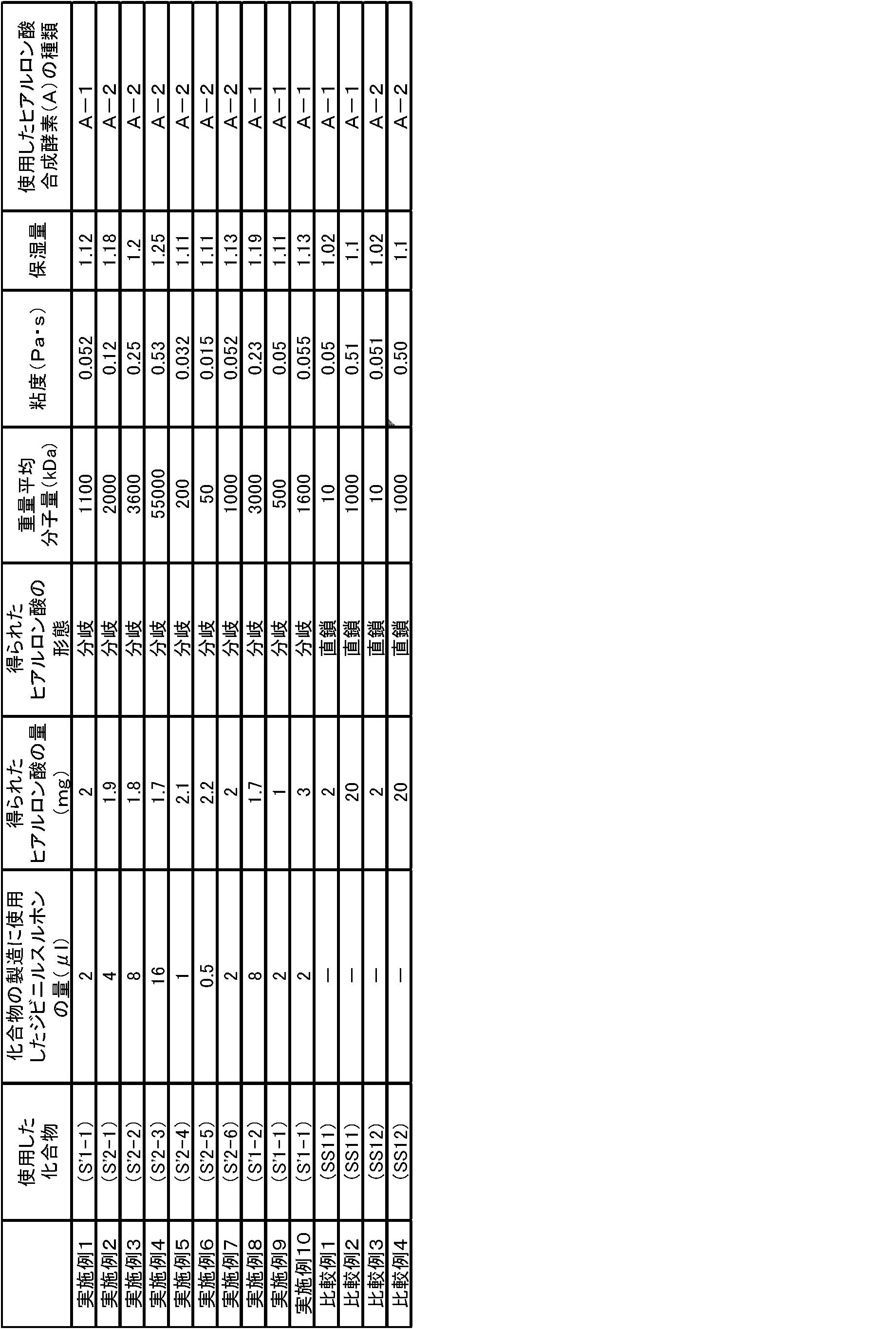
表1の結果から、比較例2及び4で得た直鎖ヒアルロン酸(H’-2)及び(H’-4)は、保湿性は高いものの、粘度が高いことがわかる。また、比較例1及び3で得た直鎖ヒアルロン酸(H’-1)及び(H’-3)は、粘度は低いものの、保湿性が低いことがわかる。
一方、実施例1及び7で得た分岐ヒアルロン酸(H-1)及び(H-7)は、分子量が比較例2及び4で得た直鎖ヒアルロン酸と同程度であるにもかかわらず、粘度は比較例2及び4の粘度よりも低く、粘度が比較例1及び3で得た直鎖ヒアルロン酸と同程度であるにもかかわらず、保湿性が高い。つまり、本発明の分岐ヒアルロン酸は、ヒアルロン酸の粘度を上げずに保湿性を向上させることができることがわかる。
また、実施例1~10から、本発明の分岐ヒアルロン酸は、分子量を高くしても、粘度が高くなりにくく、ヒアルロン酸の粘度を上げずに保湿性を向上させることができることがわかる。
さらに、実施例1と実施例9とを比較した場合、ピルビン酸キナーゼ(B-4)を用いることで、得られる分岐ヒアルロン酸が多くなることが分かる。また、実施例1と実施例10とを比較した場合、ピルビン酸キナーゼ(B-4)及びウリジン三リン酸-モノサッカリド-1-リン酸ウリジリルトランスフェラーゼ(C)をさらに用いることで、得られる分岐ヒアルロン酸が多くなることがわかる。
一方、実施例1及び7で得た分岐ヒアルロン酸(H-1)及び(H-7)は、分子量が比較例2及び4で得た直鎖ヒアルロン酸と同程度であるにもかかわらず、粘度は比較例2及び4の粘度よりも低く、粘度が比較例1及び3で得た直鎖ヒアルロン酸と同程度であるにもかかわらず、保湿性が高い。つまり、本発明の分岐ヒアルロン酸は、ヒアルロン酸の粘度を上げずに保湿性を向上させることができることがわかる。
また、実施例1~10から、本発明の分岐ヒアルロン酸は、分子量を高くしても、粘度が高くなりにくく、ヒアルロン酸の粘度を上げずに保湿性を向上させることができることがわかる。
さらに、実施例1と実施例9とを比較した場合、ピルビン酸キナーゼ(B-4)を用いることで、得られる分岐ヒアルロン酸が多くなることが分かる。また、実施例1と実施例10とを比較した場合、ピルビン酸キナーゼ(B-4)及びウリジン三リン酸-モノサッカリド-1-リン酸ウリジリルトランスフェラーゼ(C)をさらに用いることで、得られる分岐ヒアルロン酸が多くなることがわかる。
本発明の分岐ヒアルロン酸は、ヒアルロン酸の優れた性質を保持しつつ、分岐の数を調整することにより、ヒアルロン酸の粘度を調整することができる。したがって、本発明の分岐ヒアルロン酸は、化粧品、医薬部外品、医薬品(関節炎治療剤、創傷被覆剤、眼科手術用手術補助剤、外科手術後の癒着阻止剤など)及び医療機器として広範囲に使用できる。また、本発明の分岐ヒアルロン酸の製造方法によれば、分岐したヒアルロン酸誘導体を製造でき、本発明の製造方法により得られたヒアルロン酸誘導体は、化粧品のみならず医薬部外品、医薬品及び医療機器にも用いることができる。
Claims (5)
- 下記一般式(1)~(4)のいずれかで表される基からなる群より選ばれる少なくとも1種の基を合計3つ以上有する化合物(S)にグルクロン酸とN-アセチルグルコサミンとをβ1,3結合及びβ1,4結合で交互に脱水縮合させた分岐ヒアルロン酸。

- 下記一般式(3)~(6)のいずれかで表される基からなる群より選ばれる少なくとも1種の基を合計3つ以上有する化合物(S’)、ウリジン二リン酸-グルクロン酸及びウリジン二リン酸-N-アセチルグルコサミンにヒアルロン酸合成酵素(A)を作用させる分岐ヒアルロン酸の製造方法。

- ウリジン二リン酸を下記化合物(K)に変換する活性を有するウリジン二リン酸変換酵素(B)の存在下でヒアルロン酸合成酵素(A)を作用させる請求項2に記載の分岐ヒアルロン酸の製造方法。
化合物(K):ウラシル、ウリジン、ウリジン一リン酸、ウリジン三リン酸、ポリウリジル酸、デオキシウリジン二リン酸及びウリジン二リン酸-糖からなる群より選ばれる少なくとも1種の化合物。 - 下記酵素活性Vmax1及び下記酵素活性Vmax2を用いて下記数式(1)から算出した酵素活性比(Y)が0.1以上である請求項3に記載の分岐ヒアルロン酸の製造方法。
酵素活性比(Y)=Vmax1/Vmax2 (1)
酵素活性Vmax1:ウリジン二リン酸変換酵素(B)のウリジン二リン酸に対する酵素活性。
酵素活性Vmax2:ウリジン二リン酸変換酵素(B)のウリジン二リン酸-グルクロン酸及びウリジン二リン酸-N-アセチルグルコサミンに対する酵素活性。 - 下記工程(1)~(3)を(1)、(2)、(3)及び(1)の順に含む又は下記工程(1)~(3)を同時に行う分岐ヒアルロン酸の製造方法であり、
下記ミカエリス定数Kmが下記阻害濃度IC50の100倍未満である請求項2~4のいずれかに記載の分岐ヒアルロン酸の製造方法。
工程(1):上記化合物(S’)、ウリジン二リン酸-グルクロン酸及びウリジン二リン酸-N-アセチルグルコサミンにヒアルロン酸合成酵素(A)を作用させて、分岐ヒアルロン酸及びウリジン二リン酸を含む組成物(Z’)を得る工程。
工程(2):ウリジン二リン酸とリン酸基含有化合物(b-4)とにウリジン二リン酸変換酵素(B-4)を作用させてウリジン三リン酸を得る工程。
工程(3):ウリジン三リン酸と1-ホスホ-グルクロン酸とにウリジン三リン酸-モノサッカリド-1-リン酸ウリジリルトランスフェラーゼ(C)を作用させてウリジン二リン酸-グルクロン酸を得る工程。
ミカエリス定数Km:ウリジン二リン酸を基質とし、ウリジン二リン酸変換酵素(B-4)を酵素とし、リン酸基含有化合物(b-4)を作用させてウリジン三リン酸を合成する反応におけるミカエリス定数。
阻害濃度IC50:ヒアルロン酸合成酵素(A)をウリジン二リン酸-グルクロン酸及びウリジン二リン酸-N-アセチルグルコサミンに作用させる際の(A)の濃度において、基質としてウリジン二リン酸-グルクロン酸及びウリジン二リン酸-N-アセチルグルコサミンを用いて、阻害剤としてウリジン二リン酸を用いて求めた、(A)の酵素活性が半減するときのウリジン二リン酸の濃度。
Priority Applications (1)
| Application Number | Priority Date | Filing Date | Title |
|---|---|---|---|
| PCT/JP2013/070826 WO2015015613A1 (ja) | 2013-07-31 | 2013-07-31 | 分岐ヒアルロン酸及びその製造方法 |
Applications Claiming Priority (1)
| Application Number | Priority Date | Filing Date | Title |
|---|---|---|---|
| PCT/JP2013/070826 WO2015015613A1 (ja) | 2013-07-31 | 2013-07-31 | 分岐ヒアルロン酸及びその製造方法 |
Publications (1)
| Publication Number | Publication Date |
|---|---|
| WO2015015613A1 true WO2015015613A1 (ja) | 2015-02-05 |
Family
ID=52431185
Family Applications (1)
| Application Number | Title | Priority Date | Filing Date |
|---|---|---|---|
| PCT/JP2013/070826 Ceased WO2015015613A1 (ja) | 2013-07-31 | 2013-07-31 | 分岐ヒアルロン酸及びその製造方法 |
Country Status (1)
| Country | Link |
|---|---|
| WO (1) | WO2015015613A1 (ja) |
Citations (2)
| Publication number | Priority date | Publication date | Assignee | Title |
|---|---|---|---|---|
| JP2013075884A (ja) * | 2011-09-12 | 2013-04-25 | Sanyo Chem Ind Ltd | ウリジン3リン酸の製造方法及びヒアルロン酸の製造方法 |
| JP2013147642A (ja) * | 2011-12-20 | 2013-08-01 | Sanyo Chem Ind Ltd | 分岐ヒアルロン酸及びその製造方法 |
-
2013
- 2013-07-31 WO PCT/JP2013/070826 patent/WO2015015613A1/ja not_active Ceased
Patent Citations (2)
| Publication number | Priority date | Publication date | Assignee | Title |
|---|---|---|---|---|
| JP2013075884A (ja) * | 2011-09-12 | 2013-04-25 | Sanyo Chem Ind Ltd | ウリジン3リン酸の製造方法及びヒアルロン酸の製造方法 |
| JP2013147642A (ja) * | 2011-12-20 | 2013-08-01 | Sanyo Chem Ind Ltd | 分岐ヒアルロン酸及びその製造方法 |
Non-Patent Citations (1)
| Title |
|---|
| KATSUHIRO WADA: "Hyaluronan Chemistry for Applications", SEN'I TO KOGYO, vol. 65, no. 11, 10 December 2009 (2009-12-10), pages 407 - 411 * |
Similar Documents
| Publication | Publication Date | Title |
|---|---|---|
| Belghith et al. | Microbial production of levansucrase for synthesis of fructooligosaccharides and levan | |
| Poli et al. | Synthesis, production, and biotechnological applications of exopolysaccharides and polyhydroxyalkanoates by archaea | |
| Yadav et al. | Novel in vivo-degradable cellulose-chitin copolymer from metabolically engineered Gluconacetobacter xylinus | |
| Rehm | Bacterial polymers: biosynthesis, modifications and applications | |
| EP2379708B1 (en) | Synthesis of fucosylated compounds | |
| Zhu et al. | Characterization of a new endo-type polyM-specific alginate lyase from Pseudomonas sp. | |
| EP3101129B1 (en) | Microorganism having adjusted expression of r-specific enoyl-coa hydratase gene, and method for manufacturing polyhydroxyalkanoate copolymer using same | |
| Zhu et al. | Preparation of trisaccharides from alginate by a novel alginate lyase Alg7A from marine bacterium Vibrio sp. W13 | |
| EP3054005A1 (en) | Heparosan-producing bacterium and heparosan manufacturing method | |
| JP6316537B2 (ja) | 分岐ヒアルロン酸及びその製造方法 | |
| JP2010516289A (ja) | 高度分枝状アミロースおよびアミロペクチン・クラスターを酵素的に調製する方法 | |
| Zhao et al. | High-level extracellular expression of κ-carrageenase in Brevibacillus choshinensis for the production of a series of κ-carrageenan oligosaccharides | |
| WO2016021604A1 (ja) | 糖質原料からの共重合ポリヒドロキシアルカン酸の製造法 | |
| Stępniewska et al. | Biosynthesis of ectoine by the methanotrophic bacterial consortium isolated from Bogdanka coalmine (Poland) | |
| JP6000948B2 (ja) | 多糖の製造方法 | |
| JP6231993B2 (ja) | ヒアルロン酸組成物 | |
| CN106755172A (zh) | 利用乙醇醛合成乙酰辅酶a及其衍生产品的新途径 | |
| Jemli et al. | The cyclodextrin glycosyltransferase of Paenibacillus pabuli US132 strain: molecular characterization and overproduction of the recombinant enzyme | |
| WO2015015613A1 (ja) | 分岐ヒアルロン酸及びその製造方法 | |
| KR20120113400A (ko) | 신규미생물 비브리오 스플린디더스 bst398 및 이를 이용한 저분자 히알루론산의 제조방법 | |
| JP2021513862A (ja) | ホスホリラーゼ酵素による、アルファ−1,3グリコシド結合を含むグルカンの合成 | |
| JP5985893B2 (ja) | ウリジン3リン酸の製造方法及びヒアルロン酸の製造方法 | |
| EP3757209A1 (en) | Enzymatic production of levan-based, prebiotic fructooligosaccharides | |
| Meliawati et al. | Hyaluronic acid (hyaluronan) | |
| CN110643586B (zh) | 一种肝素骨架合酶及其编码基因与应用 |
Legal Events
| Date | Code | Title | Description |
|---|---|---|---|
| 121 | Ep: the epo has been informed by wipo that ep was designated in this application |
Ref document number: 13890552 Country of ref document: EP Kind code of ref document: A1 |
|
| NENP | Non-entry into the national phase |
Ref country code: DE |
|
| 122 | Ep: pct application non-entry in european phase |
Ref document number: 13890552 Country of ref document: EP Kind code of ref document: A1 |
|
| NENP | Non-entry into the national phase |
Ref country code: JP |