WO2015009997A1 - Hexacoordinate silicon-containing precursors for ald/cvd silicon-containing film applications - Google Patents
Hexacoordinate silicon-containing precursors for ald/cvd silicon-containing film applications Download PDFInfo
- Publication number
- WO2015009997A1 WO2015009997A1 PCT/US2014/047154 US2014047154W WO2015009997A1 WO 2015009997 A1 WO2015009997 A1 WO 2015009997A1 US 2014047154 W US2014047154 W US 2014047154W WO 2015009997 A1 WO2015009997 A1 WO 2015009997A1
- Authority
- WO
- WIPO (PCT)
- Prior art keywords
- silicon
- molecule
- independently
- aryl
- precursors
- Prior art date
- Legal status (The legal status is an assumption and is not a legal conclusion. Google has not performed a legal analysis and makes no representation as to the accuracy of the status listed.)
- Ceased
Links
Classifications
-
- C—CHEMISTRY; METALLURGY
- C07—ORGANIC CHEMISTRY
- C07F—ACYCLIC, CARBOCYCLIC OR HETEROCYCLIC COMPOUNDS CONTAINING ELEMENTS OTHER THAN CARBON, HYDROGEN, HALOGEN, OXYGEN, NITROGEN, SULFUR, SELENIUM OR TELLURIUM
- C07F7/00—Compounds containing elements of Groups 4 or 14 of the Periodic Table
- C07F7/02—Silicon compounds
- C07F7/025—Silicon compounds without C-silicon linkages
-
- C—CHEMISTRY; METALLURGY
- C07—ORGANIC CHEMISTRY
- C07F—ACYCLIC, CARBOCYCLIC OR HETEROCYCLIC COMPOUNDS CONTAINING ELEMENTS OTHER THAN CARBON, HYDROGEN, HALOGEN, OXYGEN, NITROGEN, SULFUR, SELENIUM OR TELLURIUM
- C07F7/00—Compounds containing elements of Groups 4 or 14 of the Periodic Table
- C07F7/02—Silicon compounds
- C07F7/08—Compounds having one or more C—Si linkages
- C07F7/10—Compounds having one or more C—Si linkages containing nitrogen having a Si-N linkage
-
- C—CHEMISTRY; METALLURGY
- C23—COATING METALLIC MATERIAL; COATING MATERIAL WITH METALLIC MATERIAL; CHEMICAL SURFACE TREATMENT; DIFFUSION TREATMENT OF METALLIC MATERIAL; COATING BY VACUUM EVAPORATION, BY SPUTTERING, BY ION IMPLANTATION OR BY CHEMICAL VAPOUR DEPOSITION, IN GENERAL; INHIBITING CORROSION OF METALLIC MATERIAL OR INCRUSTATION IN GENERAL
- C23C—COATING METALLIC MATERIAL; COATING MATERIAL WITH METALLIC MATERIAL; SURFACE TREATMENT OF METALLIC MATERIAL BY DIFFUSION INTO THE SURFACE, BY CHEMICAL CONVERSION OR SUBSTITUTION; COATING BY VACUUM EVAPORATION, BY SPUTTERING, BY ION IMPLANTATION OR BY CHEMICAL VAPOUR DEPOSITION, IN GENERAL
- C23C16/00—Chemical coating by decomposition of gaseous compounds, without leaving reaction products of surface material in the coating, i.e. chemical vapour deposition [CVD] processes
- C23C16/22—Chemical coating by decomposition of gaseous compounds, without leaving reaction products of surface material in the coating, i.e. chemical vapour deposition [CVD] processes characterised by the deposition of inorganic material, other than metallic material
- C23C16/30—Deposition of compounds, mixtures or solid solutions, e.g. borides, carbides, nitrides
- C23C16/34—Nitrides
- C23C16/345—Silicon nitride
-
- C—CHEMISTRY; METALLURGY
- C23—COATING METALLIC MATERIAL; COATING MATERIAL WITH METALLIC MATERIAL; CHEMICAL SURFACE TREATMENT; DIFFUSION TREATMENT OF METALLIC MATERIAL; COATING BY VACUUM EVAPORATION, BY SPUTTERING, BY ION IMPLANTATION OR BY CHEMICAL VAPOUR DEPOSITION, IN GENERAL; INHIBITING CORROSION OF METALLIC MATERIAL OR INCRUSTATION IN GENERAL
- C23C—COATING METALLIC MATERIAL; COATING MATERIAL WITH METALLIC MATERIAL; SURFACE TREATMENT OF METALLIC MATERIAL BY DIFFUSION INTO THE SURFACE, BY CHEMICAL CONVERSION OR SUBSTITUTION; COATING BY VACUUM EVAPORATION, BY SPUTTERING, BY ION IMPLANTATION OR BY CHEMICAL VAPOUR DEPOSITION, IN GENERAL
- C23C16/00—Chemical coating by decomposition of gaseous compounds, without leaving reaction products of surface material in the coating, i.e. chemical vapour deposition [CVD] processes
- C23C16/22—Chemical coating by decomposition of gaseous compounds, without leaving reaction products of surface material in the coating, i.e. chemical vapour deposition [CVD] processes characterised by the deposition of inorganic material, other than metallic material
- C23C16/30—Deposition of compounds, mixtures or solid solutions, e.g. borides, carbides, nitrides
- C23C16/40—Oxides
- C23C16/401—Oxides containing silicon
-
- C—CHEMISTRY; METALLURGY
- C23—COATING METALLIC MATERIAL; COATING MATERIAL WITH METALLIC MATERIAL; CHEMICAL SURFACE TREATMENT; DIFFUSION TREATMENT OF METALLIC MATERIAL; COATING BY VACUUM EVAPORATION, BY SPUTTERING, BY ION IMPLANTATION OR BY CHEMICAL VAPOUR DEPOSITION, IN GENERAL; INHIBITING CORROSION OF METALLIC MATERIAL OR INCRUSTATION IN GENERAL
- C23C—COATING METALLIC MATERIAL; COATING MATERIAL WITH METALLIC MATERIAL; SURFACE TREATMENT OF METALLIC MATERIAL BY DIFFUSION INTO THE SURFACE, BY CHEMICAL CONVERSION OR SUBSTITUTION; COATING BY VACUUM EVAPORATION, BY SPUTTERING, BY ION IMPLANTATION OR BY CHEMICAL VAPOUR DEPOSITION, IN GENERAL
- C23C16/00—Chemical coating by decomposition of gaseous compounds, without leaving reaction products of surface material in the coating, i.e. chemical vapour deposition [CVD] processes
- C23C16/44—Chemical coating by decomposition of gaseous compounds, without leaving reaction products of surface material in the coating, i.e. chemical vapour deposition [CVD] processes characterised by the method of coating
- C23C16/455—Chemical coating by decomposition of gaseous compounds, without leaving reaction products of surface material in the coating, i.e. chemical vapour deposition [CVD] processes characterised by the method of coating characterised by the method used for introducing gases into reaction chamber or for modifying gas flows in reaction chamber
-
- C—CHEMISTRY; METALLURGY
- C23—COATING METALLIC MATERIAL; COATING MATERIAL WITH METALLIC MATERIAL; CHEMICAL SURFACE TREATMENT; DIFFUSION TREATMENT OF METALLIC MATERIAL; COATING BY VACUUM EVAPORATION, BY SPUTTERING, BY ION IMPLANTATION OR BY CHEMICAL VAPOUR DEPOSITION, IN GENERAL; INHIBITING CORROSION OF METALLIC MATERIAL OR INCRUSTATION IN GENERAL
- C23C—COATING METALLIC MATERIAL; COATING MATERIAL WITH METALLIC MATERIAL; SURFACE TREATMENT OF METALLIC MATERIAL BY DIFFUSION INTO THE SURFACE, BY CHEMICAL CONVERSION OR SUBSTITUTION; COATING BY VACUUM EVAPORATION, BY SPUTTERING, BY ION IMPLANTATION OR BY CHEMICAL VAPOUR DEPOSITION, IN GENERAL
- C23C16/00—Chemical coating by decomposition of gaseous compounds, without leaving reaction products of surface material in the coating, i.e. chemical vapour deposition [CVD] processes
- C23C16/44—Chemical coating by decomposition of gaseous compounds, without leaving reaction products of surface material in the coating, i.e. chemical vapour deposition [CVD] processes characterised by the method of coating
- C23C16/455—Chemical coating by decomposition of gaseous compounds, without leaving reaction products of surface material in the coating, i.e. chemical vapour deposition [CVD] processes characterised by the method of coating characterised by the method used for introducing gases into reaction chamber or for modifying gas flows in reaction chamber
- C23C16/45523—Pulsed gas flow or change of composition over time
- C23C16/45525—Atomic layer deposition [ALD]
- C23C16/45553—Atomic layer deposition [ALD] characterized by the use of precursors specially adapted for ALD
Definitions
- hexacoordinate silicon-containing precursors Disclosed are hexacoordinate silicon-containing precursors, methods of synthesizing the same, and methods of using the same to deposit silicon- containing films using vapor deposition processes for manufacturing
- Si-containing thin films are used widely in the semiconductor, photovoltaic, LCD-TFT, flat panel type devices, refractory materials, or aeronautics industries.
- Si-containing thin films may be used for example, as dielectric materials having electrical properties which may be insulating (SiO 2 , SiN, SiCN, SiCOH, MSiOx).
- Si-containing thin films may be used as conducting films, such as metal silicides or metal silicon nitrides.
- Dussarrat et al. disclose a class of Si precursors for CVD of Si-containing films having the general formula (R 1 R 2 N) x SiH -x wherein x is between 1 and 4 and the R substituents are independently H, C1 -C6 linear, branched, or cyclic carbon chains (WO2006/097525).
- R 4-x SiL x including silicon compounds having the formula R 4-x SiL x , wherein x is an integer having a value from 1 to 3; R may be selected from H, branched and unbranched C1 -C6 alkyl, C3-C8 cycloalkyl, and C6-C13 aryl groups; and L may be selected from isocyanato, methylethylketoxime,
- Pinnavaia et al. claim a method for the preparation of a porous synthetic, semi-crystalline hybrid organic-inorganic silcon oxide composition from silicon acetylacetonate and silicon 1 ,3-diketonate precursors (US6465387).
- Hexacoordinate silicon containing compounds are also known in the art and have been proposed for CVD applications (see, e.g., Karsch and Segmuller, Silicon and Germanium Compounds with Amidinate Ligands, Organosilicon Chemistry V From Molecules to Materials pp. 271 -276 of Organosilicon Chemistry V: From Molecules to Materials, WILEY-VCH Verlag GmbH & Co., 2003).
- R groups independently selected relative to other R groups bearing the same or different subscripts or superscripts, but is also independently selected relative to any additional species of that same R group.
- R groups may, but need not be identical to each other or to R 2 or to R 3 .
- values of R groups are independent of each other when used in different formulas.
- alkyl group refers to saturated functional groups containing exclusively carbon and hydrogen atoms. Further, the term “alkyl group” refers to linear, branched, or cyclic alkyl groups. Examples of linear alkyl groups include without limitation, methyl groups, ethyl groups, propyl groups, butyl groups, etc. Examples of branched alkyls groups include without limitation, t-butyl. Examples of cyclic alkyl groups include without limitation, cyclopropyl groups, cyclopentyl groups, cyclohexyl groups, etc.
- aryl refers to aromatic ring compounds where one hydrogen atom has been removed from the ring.
- heterocycle refers to a cyclic compound that has atoms of at least two different elements as members of its ring.
- the abbreviation "Me” refers to a methyl group
- the abbreviation “Et” refers to an ethyl group
- the abbreviation “Pr” refers to any propyl group (i.e., n-propyl or isopropyl);
- the abbreviation “iPr” refers to an isopropyl group
- the abbreviation “Bu” refers to any butyl group (n-butyl, iso-butyl, t-butyl, sec-butyl);
- the abbreviation “tBu” refers to a tert-butyl group
- the abbreviation “sBu” refers to a sec-butyl group
- the abbreviation “iBu” refers to an iso-butyl group
- the abbreviation “ph” refers to a phenyl group
- the abbreviation “Am” refers to any amyl group (iso-
- SRO Strontium Ruthenium Oxide film
- HCDS hexachlorodisilane
- PCDS pentachlorodisilane
- FIG 1 is a gas chromatogram of the synthesis product of Example 1 ;
- FIG 2 is a thermogravimetric analysis (TGA) graph demonstrating the percentage of weight loss with temperature change for SiH 2 (N'Pr-amd)2 as compared to that of DiPAS [SiH 3 (NiPr 2 )] and SiHsiNTPr-amd).
- TGA thermogravimetric analysis
- each L 1 , L 2 , L 3 and L 4 is independently chosen from oxygen or nitrogen atoms; L 1 and L 2 being joined together via a carbon bridge having one to three carbon atoms; and L 1 , L 2 and the carbon bridge forming a monoanionic ligand bonded to silicon.
- L 3 and L 4 are joined together via a carbon bridge having one to three carbon atoms and L 3 , L 4 and the carbon bridge form a monoanionic ligand bonded to silicon.
- the disclosed molecules may have one or more of the following aspects:
- R 1 , R 2 , R 3 , R 4 , R 5 and R 6 may each independently be H, a C1 to C6 alkyl group, or a C3-C20 aryl or heterocycle group;
- R 5 and R 6 not joined to form cyclic chains •
- R 1 being Me, Et, Pr, or Bu;
- R 2 being H, Me, Et, Pr, or Bu;
- R 3 being Me, Et, Pr, or Bu
- R 4 being Me, Et, Pr, or Bu
- R 5 being H, Me, Et, Pr, or Bu
- R 6 being Me, Et, Pr, or Bu
- R 1 , R 2 , R 3 , R 4 , R 5 , R 6 , R 7 and R 8 may each independently be H, C6 alkyl group, or a C3-C20 aryl or heterocycle group;
- R 1 being Me, Et, Pr, or Bu
- R 2 being Me, Et, Pr, or Bu
- R 4 being H, Me or Et
- R 4 being Me or Et
- R 5 being Me, Et, Pr, or Bu
- R 6 being Me, Et, Pr, or Bu
- R 7 being H, Me or Et
- R 7 being Me or Et
- R 8 being H, Me or Et
- R 8 being Me or Et
- R 1 , R 2 , R 3 , R 4 , R 5 , and R 6 may each independently be H, a C1 to C6 alkyl group, or a C3-C20 aryl or heterocycle group;
- R 1 being Me, Et, Pr, or Bu
- R 2 being Me, Et, Pr, or Bu
- R 3 being Me, Et, Pr, or Bu
- R 4 being Me, Et, Pr, or Bu
- R 5 being Me, Et, Pr, or Bu
- R 6 being Me, Et, Pr, or Bu
- R 1 , R 2 , R 3 , and R 4 may each independently be H, a C1 to C6 alkyl group or a C3-C20 aryl or heterocycle group, and each X may independently be CI, Br, I or F;
- R 1 being Me, Et, Pr, or Bu
- R 2 being Me, Et, Pr, or Bu
- R 3 being Me, Et, Pr, or Bu
- R 4 being Me, Et, Pr, or Bu
- R 1 , R 2 , R 3 , R 4 , R 5 , R 6 , R 7 and R 8 may each independently be H,
- R 1 being Me, Et, Pr, or Bu
- R 2 being H, Me, Et, or Pr
- R 3 being H, Me, Et, or Pr
- R 4 being Me, Et, Pr, or Bu
- R 5 being Me, Et, Pr, or Bu
- R 6 being H, Me, Et, or Pr
- R 7 being H, Me, Et, or Pr
- R 8 being Me, Et, Pr, or Bu
- R 1 , R 2 , R 3 , R 4 , R 5 , R 6 , R 7 , R 8 , R 9 , and R 10 may each independently be H, a C1 to C6 alkyl group, or a C3-C20 aryl or heterocycle group;
- R 1 being Me, Et, Pr, or Bu
- R 2 being Me, Et, Pr, or Bu
- R 3 being H, Me, Et, or Pr
- R 4 being Me, Et, Pr, or Bu
- R 5 being Me, Et, Pr, or Bu
- R 6 being Me, Et, Pr, or Bu
- R 7 being Me, Et, Pr, or Bu
- R 8 being H, Me, Et, or Pr
- R 9 being Me, Et, Pr, or Bu
- R 10 being Me, Et, Pr, or Bu
- R 1 , R 2 , R 3 , R 4 , R 5 , and R 6 may each independently be H, a C1 to C6 alkyl group, or a C3-C20 aryl or heterocycle group;
- R 1 being Me, Et, Pr, or Bu
- R 2 being H, Me, Et, or Pr
- R 3 being Me, Et, Pr, or Bu
- R 4 being Me, Et, Pr, or Bu
- R 5 being H, Me, Et, or Pr
- R 6 being Me, Et, Pr, or Bu
- R 1 , R 2 , R 3 and R 4 may each independently be H, a C1 to C6 alkyl group, or a C3-C20 aryl or heterocycle group;
- R 1 being H, Me, Et, or Pr
- R 2 being H, Me, Et, or Pr
- R 3 being H, Me, Et, or Pr
- R 4 being H, Me, Et, or Pr
- R 1 and R 2 may be H, a C1 to C6 alkyl group, or a C3-C20 aryl or heterocycle group;
- R 1 being H, Me, Et, Pr, or Bu;
- R 2 being H, Me, Et, Pr, or Bu;
- R 1 , R 2 , R 3 , R 4 , R 5 , R 6 , R 7 , and R 8 may each independently be H, a C1 to C6 alkyl group, or a C3-C20 aryl or heterocycle group;
- R 1 being Me, Et, Pr, or Bu
- R 2 being H, Me, Et, Pr, or Bu;
- R 3 being H, Me, Et, or Pr
- R 4 being H, Me, Et, Pr, or Bu;
- R 5 being Me, Et, Pr, or Bu
- R 6 being H, Me, Et, Pr, or Bu
- R 7 being H, Me, Et, or Pr
- R 8 being H, Me, Et, Pr, or Bu
- R 1 , R 2 , R 3 , R 4 , R 5 and R 6 may each independently be H, a C1 to C6 alkyl group, or a C3-C20 aryl or heterocycle group;
- R 1 being Me, Et, Pr, or Bu
- R 2 being H, Me, Et, or Pr
- R 3 being H, Me, Et, or Pr
- R 4 being Me, Et, Pr, or Bu; • R being H, Me, Et, or Pr;
- R 6 being H, Me, Et, or Pr
- R 1 , R 2 , R 3 and R 4 may each independently be H, a C1 to C6 alkyl group, or a C3-C20 aryl or heterocycle group;
- R 1 being Me, Et, Pr, or Bu
- R 2 being H, Me, Et, Pr, or Bu;
- R 3 being Me, Et, Pr, or Bu
- R 4 being H, Me, Et, Pr, or Bu.
- At least one organosilane precursor disclosed above is introduced into a reactor having at least one substrate disposed therein. At least part of the organosilane precursor is deposited onto the at least one substrate to form a Si- containing layer using a vapor deposition method.
- the disclosed methods may have one or more of the following aspects:
- an element of the at least one second precursor being selected from the group consisting of group 2, group 13, group 14, transition metal, lanthanides, and combinations thereof;
- the element of the at least one second precursor being selected from Mg, Ca, Sr, Ba, Zr, Hf, Ti, Nb, Ta, Al, Si, Ge, Y, or lanthanides;
- the reactor • introducing into the reactor at least one co-reactant; • the co-reactant being selected from the group consisting of O 2 , O 3 , H 2 O, H 2 O 2 , NO, NO 2 , a carboxylic acid, and combinations thereof;
- the Si-containing layer being a silicon oxide layer
- the co-reactant being selected from the group consisting of H 2 , NH 3 ,
- SiH 3 3N
- hydridosilanes such as SiH 4 , Si 2 H 6 , S13H8, Si 4 Hi 0 , S15H 10, Si6Hi 2
- chlorosilanes and chloropolysilanes such as S1HCI3, SiH 2 CI 2 , SiH 3 CI, Si 2 CI 6 , Si 2 HCI 5 , Si 3 CI 8
- alkysilanes such as Me 2 SiH 2 , Et 2 SiH 2 , MeSiH 3
- EtSiH 3 hydrazines (such as N 2 H 4 , MeHNNH 2 , MeHNNHMe), organic amines (such as NMeH 2 , NEtH 2 , NMe 2 H, NEt 2 H, NMe 3 , NEt 3 , (SiMe 3 ) 2 NH), pyrazoline, pyridine, B-containing molecules (such as B 2 H 6 , 9- borabicylo[3,3,1 ]none, trimethylboron, triethylboron, borazine), alkyl metals (such as trimethylaluminum, triethylaluminum, dimethylzinc, diethylzinc), radical species thereof, and mixtures thereof;
- hydrazines such as N 2 H 4 , MeHNNH 2 , MeHNNHMe
- organic amines such as NMeH 2 , NEtH 2 , NMe 2 H, NEt 2 H, NMe 3
- the co-reactant being selected from the group consisting of H 2 , NH 3 , SiH 4 , Si 2 H 6 , S13H8, SiH 2 Me 2 , SiH 2 Et 2 , N(SiH 3 )3, hydrogen radicals thereof, and mixtures thereof;
- the vapor deposition process being a chemical vapor deposition process
- the vapor deposition process being an atomic layer deposition (ALD)
- the vapor deposition processing being a spatial ALD process
- the silicon-containing layer being S1O 2 ;
- the silicon-containing layer being SiN
- the silicon-containing layer being SiON
- the silicon-containing layer being SiCN
- the silicon-containing layer being SiCOH.
- Si-containing thin film forming precursors methods of synthesizing the same, and methods of using the same to deposit silicon- containing films using vapor deposition processes for manufacturing
- the disclosed organosilane precursors have the following formula:
- each L 1 , L 2 , L 3 , and L 4 is independently an oxygen or nitrogen atom, L 1 and L 2 and L 3 and L 4 being joined together via a carbon bridge having one to three carbon atoms; and L 1 , L 2 , and the carbon bridge and L 3 , L 4 , and the carbon bridge each form monoanionic ligands bonded to silicon.
- the L 1 , L 2 , L 3 , and L 4 nitrogen or oxygen atoms are bonded to the silicon atom, resulting in a hexacoordinate Si (IV) center.
- the carbon atoms in the carbon bridge may be sp 2 hybridized, resulting in a delocalized charge across the monoanionic ligand.
- the carbon atoms in the carbon bridge may be either sp 3 hybridized or some combination of sp 2 and sp 3 hybridized, resulting in a negative charge on one of L 1 or L 2 and L 3 or L 4 resulting in a neutral charge on the other of L 1 or L 2 and L 3 or L 4 .
- Each of the nitrogen, oxygen, and carbon atoms may independently be substituted by H, C1 -C6 alkyl groups, aryl groups, or heterocycle groups.
- the disclosed organosilane precursors are derived from different classes of ligand systems, such as diketiminate, diketonate, ketoiminate, amidinate, guanidinate, isoureate, and/or a-halo amidinate ligands.
- the specific design of these precursors may help improve volatility, reduce the melting point (liquids or very low melting solids), increase reactivity with water, and increase thermal stability for wider process window applications.
- the disclosed organosilane precursors may be more reactive than other R -x SiL x precursors due to
- the hexacoordinate organosilane precursor contains two hydrogen atoms directly bonded to the Si atom. These Si-H bonds may help increase the volatility of the precursor.
- the disclosed organosilane precursors contain no Si-halogen bonds, which is important because halogens may damage other layers in the substrate (e.g., low k layers, copper interconnect layers, etc.). Additionally, in ALD processes, the two Si-H bonds of the disclosed precursors may help to provide a larger growth rate per cycle when compared to the analogous Si- halogen containing precursors because the H atoms occupy less surface area, resulting in more molecules on the substrate surface.
- L 1 , L 2 , L 3 and L 4 may all be nitrogen atoms. Due to their increased nitrogen content when compared to the when any of L 1 through L 4 is an oxygen atom, these molecules may be used to produce silicon-containing films that also contain nitrogen, such as SiN, SiCN, SiON, MSiN, or MSiON, whererin M is an element such as Hf, Zr, Ti, Nb, Ta, or Ge, or to tune the amount of nitrogen in those films.
- Exemplary organosilane precursors wherein L 1 , L 2 , L 3 and L 4 are all nitrogen atoms may have the following formula:
- R 1 , R 2 , R 3 , R 4 , R 5 and R 6 may each independently be H, a C1 to C6 alkyl group, or a C3-C20 aryl or heterocycle group.
- R 1 , R 2 , R 3 , R 4 , R 5 and R 6 may each independently be H, a C1 to C6 alkyl group, or a C3-C20 aryl or heterocycle group.
- the bisamidinate precursors may be synthesized by combining a
- the disclosed amidinate precursors may be synthesized by reaction of SiHnCI 4- n with two equivalents of the ligand compound (i.e., Li[R 1 NC(R 2 )NR 3 ] or Li(amd)) and subsequent reduction using a selected metal hydride, such as LAH (lithium aluminum hydride).
- a selected metal hydride such as LAH (lithium aluminum hydride).
- the resulting solution may be stirred at room temperature overnight.
- Exemplary hydrocarbon solutions suitable for these synthesis methods include diethyl ether, pentane, hexane, or toluene.
- the resulting suspension is filtered and the resulting solution distilled to remove solvent. Purification of the resulting liquid or solid is carried out by distillation or sublimation, respectively.
- the ligand compound may be synthesized by combining a hydrocarbon solution of metalorganic salt (i.e., alkyl lithium) to a hydrocarbon solution of the appropriate carbodiimide (i.e.,
- Exemplary bisamidinate precursors include:
- Exemplary organosilane precursors wherein L 1 , L 2 , L 3 and L 4 are all nitrogen atoms may have the following formula:
- R 1 , R 2 , R 3 , R 4 , R 5 and R 6 may each independently be H, a C1 to C6 alkyl group, or a C3-C20 aryl or heterocycle group. Due to their increased nitrogen content when compared to the other molecules, these molecules may be used to produce silicon-containing films that also contain nitrogen, such as SiN or SiON, or to tune the amount of nitrogen in a SiN or SiON containing film.
- the guanidinate precursors may be synthesized by combining a
- the disclosed guanidinate precursors may be
- Exemplary hydrocarbon solutions suitable for these synthesis methods include diethyl ether, pentane, hexane, or toluene.
- the resulting suspension is filtered and the resulting solution distilled to remove solvent. Purification of the resulting liquid or solid is carried out by distillation or sublimation, respectively.
- All of the starting materials are commercially available.
- Exemplary bisguanidinate precursors include:
- Exemplary organosilane precursors wherein L 1 , L 2 , L 3 and L 4 are all nitrogen atoms may have the following formula:
- R 1 , R 2 , R 3 , R 4 , R 5 and R 6 may each independently be H, a C1 to C6 alkyl group, or a C3-C20 aryl or heterocycle group. Due to their increased oxygen content when compared to the other molecules, these molecules may be used to produce silicon-containing films that also contain oxygen, such as S1O2 or SiON, or to tune the amount of oxygen in a S1O2 or SiON containing film.
- the isoureate precursors may be synthesized by combining a hydrocarbon solution of SiX2H 2 , wherein X is CI, Br, I, or triflate (SO3CF3 " ), with a neat or hydrocarbon solution of the ligand compound, such as Li[R 1 NC(OR 3 )NR 2 ] (or Li(iso)), under atmosphere of nitrogen, the outlet of the mixing flask being connected to an oil bubbler to inhibit backflow of air and moisture.
- a hydrocarbon solution of SiX2H 2 wherein X is CI, Br, I, or triflate (SO3CF3 " )
- SO3CF3 " neat or hydrocarbon solution of the ligand compound, such as Li[R 1 NC(OR 3 )NR 2 ] (or Li(iso)
- the disclosed isoureate precursors may be synthesized by reaction of SiH n CI -n with a single equivalent of the ligand compound (i.e., Li[R 1 NC(OR 3 )NR 2 ] or Li(iso)) and subsequent reduction using a selected metal hydride, such as LAH (lithium aluminum hydride). In all three synthesis routes, the resulting solution may be stirred at room temperature overnight.
- hydrocarbon solutions suitable for these synthesis methods include diethyl ether, pentane, hexane, or toluene.
- the resulting suspension is filtered and the resulting solution distilled to remove solvent. Purification of the resulting liquid or solid is carried out by distillation or sublimation, respectively.
- All of the starting materials are commercially available.
- Exemplary bisisoureate precursors include:
- Exemplary organosilane precursors wherein L 1 , L 2 , L 3 and L 4 are all nitrogen atoms may have the following formula:
- R 1 , R 2 , R 3 , and R 4 may each independently be H, a C1 to C6 alkyl group, or a C3-C20 aryl or heterocyde group, and each X may independently be CI, Br, I, or F.
- the halogen atoms are bonded to the carbon backbone, not directly to the Si. As a result, halogen contamination of the substrate is minimized because the halogen atom will leave the reactor with the volatile haloamidinate by-product.
- a hydrocarbon solution of one molar equivalent of an appropriate base such as potassium hexamethyldisilazide
- the resulting solution may be reacted with SiH 2 (aryl) 2 , wherein aryl can be phenyl, tolyl, or any other appropriate aryl substituent.
- the resulting mixture may be purified by fractional distillation.
- Exemplary organosilane precursors wherein L 1 , L 2 , L 3 and L 4 are all nitrogen atoms may have the following formula:
- R 1 , R 2 , R 3 , R 4 , R 5 , R 6 , R 7 and R 8 may each independently be H, a C1 to C6 alkyl group, or a C3-C20 aryl or heterocycle group.
- the four carbon atoms may be sp 2 or sp 3 hybridized.
- the fomula above illustrates an anionic charge localized at the "L 2 " nitrogen atom.
- the "L 1 " nitrogen atom having the double bond to C(R 3 ) forms a dative bond to the silicon atom.
- the double bond may also be delocalized across the ring when the carbon atoms are sp 2 hybridized.
- Exemplary organosilane precursors wherein L 1 , L 2 , L 3 and L 4 are all nitrogen atoms may have the following formula:
- R 1 , R 2 , R 3 , R 4 , R 5 , R 6 , R 7 , R 8 , R 9 and R 10 may each independently be H, a C1 to C6 alkyl group, or a C3-C20 aryl or heterocycle group.
- the four carbon atoms may be sp 2 or sp 3 hybridized.
- An anionic charge may be localized one of the nitrogen atoms.
- the second nitrogen atom may form a dative bond to the Si atom. Due to the unsymmetrical nature of the ligand, the three carbon atoms will produce different peaks in nuclear magnetic resonance (NMR) spectra.
- NMR nuclear magnetic resonance
- H 2 Si[RN(CR) 2 NR] 2 or H 2 Si[R 2 N(CR)2NR]2 precursors may be
- a second synthetic route to the disclosed H 2 Si[RN(CR) 2 NR] 2 or H 2 Si[R 2 N(CR) 2 NR] 2 precursors is by reaction of the protonated ligand RN(CR) 2 NHR or RHN(CR) 2 NR 2 with either a neat or a hydrocarbon solution of a
- the disclosed H 2 Si[RN(CR) 2 NR] 2 or H 2 Si[R 2 N(CR) 2 NR] 2 precursors may be synthesized by reaction of SiH n CI 4-n with two equivalents of the ligand compound (i.e., Li[RN(CR) 2 NR] or Li[R 2 N(CR) 2 NR]) and subsequent reduction using a selected metal hydride, such as LAH (lithium aluminum hydride).
- a selected metal hydride such as LAH (lithium aluminum hydride).
- the resulting solution may be stirred at room temperature overnight.
- Exemplary hydrocarbon solutions suitable for these synthesis methods include diethyl ether, pentane, hexane, or toluene.
- the resulting suspension is filtered and the resulting solution distilled to remove solvent.
- Exemplary organosilane precursors wherein L 1 , L 2 , L 3 and L 4 are all nitrogen atoms may have the following formula:
- R 1 , R 2 , R 3 , R 4 , R 5 , R 6 , R 7 , R 8 , R 9 and R 10 may each independently be H, a C1 to C6 alkyl group, or a C3-C20 aryl or heterocycle group.
- FTIR Fourier- Transform Infra Red
- Exemplary bis( -diketiminato)silane precursors include:
- Exemplary organosilane precursors wherein L 1 , L 2 , L 3 and L 4 are all nitrogen atoms may have the following formula:
- R 1 , R 2 , R 3 , R 4 , R 5 , R 6 , R 7 , R 8 , R 9 , R 10 , R 11 and R 12 may each
- the six carbon atoms may be sp 2 or sp 3 hybridized.
- An anionic charge may be localized at the "L 2 " nitrogen atom.
- the "L 1 " nitrogen atom may form a dative bond to the Si atom. Due to the unsymmetrical nature of the ligand, the three carbon atoms will produce different peaks in nuclear magnetic resonance (NMR) spectra.
- H 2 Si[RN(CR) 3 NR] 2 or H 2 Si[R 2 N(CR)3NR]2 precursors may be
- a second synthetic route to the disclosed H 2 Si[RN(CR) 3 NR] 2 or H 2 Si[R 2 N(CR) 3 NR] 2 precursors is by reaction of the protonated ligand RN(CR) 3 NHR or RHN(CR)3NR 2 with either a neat or a hydrocarbon solution of a
- the disclosed H 2 Si[RN(CR) 3 NR] 2 or H 2 Si[R 2 N(CR) 3 NR] 2 precursors may be synthesized by reaction of SiH n CI 4-n with two equivalents of the ligand compound (i.e., Li[RN(CR) 3 NR] or Li[R 2 N(CR) 3 NR]) and subsequent reduction using a selected metal hydride, such as LAH (lithium aluminum hydride).
- a selected metal hydride such as LAH (lithium aluminum hydride).
- the resulting solution may be stirred at room temperature overnight.
- Exemplary hydrocarbon solutions suitable for these synthesis methods include diethyl ether, pentane, hexane, or toluene.
- the resulting suspension is filtered and the resulting solution distilled to remove solvent. Purification of the resulting liquid or solid is carried out by distillation or sublimation, respectively.
- metalorganic salt i.e., alkyl lithium
- L 1 , L 2 , L 3 , and L 4 may all be oxygen atoms. Due to the increased oxygen content when compared to the when any of L 1 through L 4 is a nitrogen atom, these molecules may be used to produce silicon-containing films that also contain oxygen, such as S1O2, SiOC, or SiON, or to tune the amount of oxygen in a S1O2, SiOC, or SiON containing film.
- oxygen such as S1O2, SiOC, or SiON
- Exemplary organosilane precursors wherein L 1 , L 2 , L 3 , and L 4 are all oxygen atoms may have the following formula:
- R 1 , R 2 , R 3 , R 4 , R 5 , and R 6 may each independently be H, a C1 to C6 alkyl group, or a C3-C20 aryl or heterocycle group.
- the three carbon atoms are sp 2 hybridized. If R 1 , R 3 , R 4 , and R 6 are the same (i.e., each Me), the resulting nuclear magnetic transform Fourier-Transform Infra Red (FTIR) spectra for these molecules will produce one peak for the O atoms due to the derealization of the electrons across the ligand.
- FTIR Fourier-Transform Infra Red
- Exemplary bis(diketonato)silane precursors include:
- Exemplary organosilane precursors wherein L 1 , L 2 , L 3 , and L 4 are all oxygen atoms may have the following formula:
- R 1 , R 2 , R 3 , and R 4 may each independently be H, a C1 to C6 alkyl group, or a C3-C20 aryl or heterocycle group.
- Each carbon atom may be sp 2 or sp 3 hybridized.
- An anionic charge may be localized at one of the oxygen atoms. The other oxygen atom may form a dative bond to the Si atom. Due to the
- silyl bis(3-methoxy-1 -propanolato-0,0') precursors include:
- the H 2 Si[O(CR) 3 O] 2 and H 2 Si[RO(CR) 3 O] 2 precursors may be synthesized by combining a hydrocarbon solution of SiX 2 H 2 , wherein X is CI, Br, I, or triflate (SO3CF3 " ), with a neat or hydrocarbon solution of the ligand compound, such as Li[O(CR)3O] or Li[RO(CR) 3 O] under atmosphere of nitrogen, the outlet of the mixing flask being connected to an oil bubbler to inhibit backflow of air and moisture.
- a second synthetic route to the disclosed H 2 Si[O(CR) 3 O] 2 and H 2 Si[RO(CR) 3 O] 2 precursors is by reaction of the protonated ligand (HO(CR) 3 O or RO(CR) 3 OH) with either a neat or a hydrocarbon solution of a bis(dialkylamino)silane [SiH 2 (NR 2 ) 2 ] performed under an inert atmosphere.
- the disclosed H 2 Si[O(CR) 3 O] 2 and H 2 Si[RO(CR) 3 O] 2 precursors may be synthesized by reaction of SiH n CI 4-n with a two equivalents of the ligand compound (i.e., Li[O(CR) 3 O] or Li[RO(CR) 3 O]) and subsequent reduction using a selected metal hydride such as LAH (lithium aluminum hydride).
- a selected metal hydride such as LAH (lithium aluminum hydride).
- the resulting solution may be stirred at room temperature overnight.
- Exemplary hydrocarbon solutions suitable for these synthesis methods include diethyl ether, pentane, hexane, or toluene.
- the resulting suspension is filtered and the resulting solution distilled to remove solvent. Purification of the resulting liquid or solid is carried out by distillation or sublimation, respectively.
- Li[RO(CR) 3 O] all of the starting materials are commercially available.
- the ligand compound may be synthesized by combining a hydrocarbon solution of
- metalorganic salt i.e., alkyl lithium
- Exemplary organosilane precursors wherein L 1 , L 2 , L 3 , and L 4 are all oxygen atoms may have the following formula:
- R 1 and R 2 may each independently be H, a C1 to C6 alkyl group, or a C3- C20 aryl or heterocycle group.
- the four carbon atoms may be sp 2 or sp 3 hybridized.
- the fomula above illustrates an anionic charge localized at the single bonded oxygen atom.
- the oxygen atom having the double bond to C(R 1 ) forms a dative bond to the silicon atom.
- the double bond may also be delocalized across the ring when the carbon atoms are sp 2 hybridized.
- ketosilylether precursors include:
- Exemplary organosilane precursors wherein L 1 , L 2 , L 3 , and L 4 are all oxygen atoms may have the following formula:
- R 1 , R 2 , and R 3 may each independently be H, a C1 to C6 alkyl group, or a C3-C20 aryl or heterocycle group.
- the four carbon atoms may be sp 2 or sp 3 hybridized.
- An anionic charge may be localized at one of the oxygen atoms.
- the other oxygen atom may form a dative bond to the Si atom. Due to the
- silyl bis(2-alkoxy-1 -ethanolato-0,0') precursors include:
- the H 2 Si[O(CR) 2 O] 2 and H 2 Si[RO(CR) 2 O] 2 precursors may be synthesized by combining a hydrocarbon solution of SiX 2 H 2 , wherein X is CI, Br, I, or triflate (SO3CF3 " ), with a neat or hydrocarbon solution of the ligand compound, such as Li[O(CR) 2 O] or Li[RO(CR) 2 O] under atmosphere of nitrogen, the outlet of the mixing flask being connected to an oil bubbler to inhibit backflow of air and moisture.
- a second synthetic route to the disclosed H 2 Si[O(CR) 2 O] 2 and H 2 Si[RO(CR) 2 O] 2 precursors is by reaction of the protonated ligand (HO(CR) 2 O or RO(CR) 2 OH) with either a neat or a hydrocarbon solution of a bis(dialkylamino)silane [SiH 2 (NR 2 ) 2 ] performed under an inert atmosphere.
- the protonated ligand HO(CR) 2 O or RO(CR) 2 OH
- the disclosed H 2 Si[O(CR) 2 O] 2 and H 2 Si[RO(CR) 2 O] 2 precursors may be synthesized by reaction of SiH n CI 4-n with two equivalents of the ligand compound (i.e., Li[O(CR) 2 O] or Li[RO(CR) 2 O]) and subsequent reduction using a selected metal hydride, such as LAH (lithium aluminum hydride).
- a selected metal hydride such as LAH (lithium aluminum hydride).
- the resulting solution may be stirred at room temperature overnight.
- Exemplary hydrocarbon solutions suitable for these synthesis methods include diethyl ether, pentane, hexane, or toluene.
- the resulting suspension is filtered and the resulting solution distilled to remove solvent.
- the ligand compound may be synthesized by combining a hydrocarbon solution of
- metalorganic salt i.e., alkyl lithium
- organosilane precursors wherein L 1 , L 2 , L 3 , and L 4 are all oxygen atoms may have the followin formula:
- R 1 and R 2 may be H, a C1 to C6 alkyl group, or a C3-C20 aryl or heterocycle group.
- the carbon atom is sp 2 hybridized.
- Exemplary bis(acetato)silane precursors include:
- the H 2 Si[OC(R 2 )O]2 precursors may be synthesized by combining a hydrocarbon solution of SiX 2 H 2 , wherein X is CI, Br, I, or triflate (SO 3 CF 3 " ), with a neat or hydrocarbon solution of the ligand compound, such as Li[OC(R 2 )O], under atmosphere of nitrogen, the outlet of the mixing flask being connected to an oil bubbler to inhibit backflow of air and moisture.
- a second synthetic route to the disclosed H 2 Si[OC(R 2 )O] 2 precursors is by reaction of the protonated ligand
- the disclosed H 2 Si[OC(R 2 )O] 2 precursors may be synthesized by reaction of SiH n CI -n with two equivalents of the ligand compound (i.e., Li[OC(R 2 )O]) and subsequent reduction using a selected metal hydride, such as LAH (lithium aluminum hydride).
- a selected metal hydride such as LAH (lithium aluminum hydride).
- the resulting solution may be stirred at room temperature overnight.
- Exemplary hydrocarbon solutions suitable for these synthesis methods include diethyl ether, pentane, hexane, or toluene.
- the resulting suspension is filtered and the resulting solution distilled to remove solvent. Purification of the resulting liquid or solid is carried out by distillation or sublimation, respectively.
- L 1 and L 4 may both be nitrogen atoms and L 2 and L 3 may both be oxygen atoms. Due to their increased nitrogen content when compared to the when L 1 and L 4 are oxygen atoms, these molecules may be used to produce silicon- containing films that also contain nitrogen, such as SiN, SiCN, SiON, MSiN, or MSiON, wherein M is an element such as Hf, Zr, Ti, Nb, Ta, or Ge, or to tune the amount of nitrogen in those films.
- nitrogen such as SiN, SiCN, SiON, MSiN, or MSiON, wherein M is an element such as Hf, Zr, Ti, Nb, Ta, or Ge, or to tune the amount of nitrogen in those films.
- Exemplary organosilane precursors wherein L 1 and L 4 are nitrogen atoms and L 2 and L 3 are oxygen atoms may have the following formula: R 4 R '5 R 6
- R 1 , R 2 , R 3 , and R 4 may each independently be H, a C1 to C6 alkyl group, or a C3-C20 aryl or heterocycle group.
- the six carbon atoms are sp 2 hybridized and the electrons are delocalized across the ligand.
- Exemplary organosilane precursors wherein L 1 and L 4 are nitrogen atoms and L 2 and L 3 are oxygen atoms may have the following formula:
- R 1 , R 2 , R 3 , R 4 , R 5 , R 6 , R 7 and R 8 may each independently be H, a C1 to C6 alkyl group, or a C3-C20 aryl or heterocycle group.
- the six carbon atoms may be sp 2 or sp 3 hybridized.
- An anionic charge may be localized at the oxygen atom.
- the nitrogen atom may form a dative bond to the Si atom. Due to the
- Exemplary organosilane precursors wherein L 1 and L 4 are nitrogen atoms and L 2 and L 3 are oxygen atoms may have the following formula:
- R 1 , R 2 , R 3 , R 4 , R 5 , R 6 , R 7 , R 8 , R 9 and R 10 may each independently be H, a C1 to C6 alkyl group, or a C3-C20 aryl or heterocycle group.
- the six carbon atoms may be sp 2 or sp 3 hybridized.
- An anionic charge may be localized at the oxygen atom.
- the nitrogen atom may form a dative bond to the Si atom. Due to the unsymmetrical nature of the ligand, the three carbon atoms will produce different peaks in nuclear magnetic resonance (NMR) spectra.
- NMR nuclear magnetic resonance
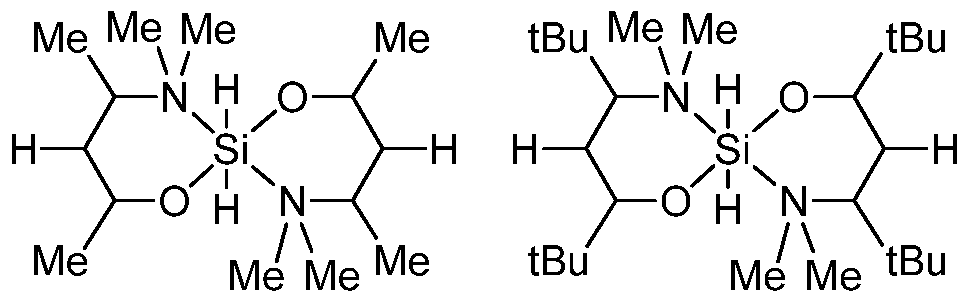
- Exemplary ⁇ -aminosilylether precursors include:
- Exemplary organosilane precursors wherein L 1 and L 4 are nitrogen atoms and L 2 and L 3 are oxygen atoms may have the following formula:
- R 1 , R 2 , R 3 , R 4 , R 5 , R 6 , R 7 , R 8 , R 9 and R 10 may each independently be H, a C1 to C6 alkyl group, or a C3-C20 aryl or heterocycle group.
- the six carbon atoms may be sp 2 or sp 3 hybridized.
- An anionic charge may be localized at the nitrogen atom.
- the oxygen atom may form a dative bond to the Si atom. Due to the unsymmetrical nature of the ligand, the three carbon atoms will produce different peaks in nuclear magnetic resonance (NMR) spectra.
- NMR nuclear magnetic resonance
- Exemplary organosilane precursors wherein L 1 and L 4 are nitrogen atoms and L 2 and L 3 are oxygen atoms may have the following formula:
- R 1 , R 2 , R 3 , R 4 , R 5 , R 6 , R 7 and R 8 may each independently be H, a C1 to C6 alkyl group, or a C3-C20 aryl or heterocycle group.
- the six carbon atoms may be sp 2 or sp 3 hybridized.
- An anionic charge may be localized at the nitrogen atom.
- the oxygen atom may form a dative bond to the Si atom. Due to the
- precursors may be synthesized by combining a hydrocarbon solution of SiX 2 H 2 , wherein X is CI, Br, I, or triflate (SO3CF3 " ), with a neat or hydrocarbon solution of the ligand compound, such as Li[RN(CR) 3 O], Li[R 2 N(CR) 3 O], or Li[RN(CR) 3 OR], under atmosphere of nitrogen, the outlet of the mixing flask being connected to an oil bubbler to inhibit backflow of air and moisture.
- a hydrocarbon solution of SiX 2 H 2 wherein X is CI, Br, I, or triflate (SO3CF3 "
- SO3CF3 " neat or hydrocarbon solution of the ligand compound, such as Li[RN(CR) 3 O], Li[R 2 N(CR) 3 O], or Li[RN(CR) 3 OR]
- a second synthetic route to the disclosed H 2 Si[RN(CR) 3 O]2, H 2 Si[R 2 N(CR)3O]2, and H 2 Si[RN(CR) 3 OR] 2 precursors is by reaction of the protonated ligand (RN(CR) 3 OH, R 2 N(CR) 3 OH, or RHN(CR) 3 OR with either a neat or a hydrocarbon solution of a bis(dialkylamino)silane [SiH 2 (NR 2 ) 2 ] performed under an inert atmosphere.
- the disclosed protonated ligand RN(CR) 3 OH, R 2 N(CR) 3 OH, or RHN(CR) 3 OR
- H 2 Si[RN(CR) 3 O] 2 , H 2 Si[R 2 N(CR) 3 O] 2 , and H 2 Si[RN(CR) 3 OR] 2 precursors may be synthesized by reaction of SiH n CI 4-n with two equivalents of the ligand compound (i.e., Li[RN(CR) 3 O], Li[R 2 N(CR) 3 O], or Li[RN(CR) 3 OR]) and subsequent reduction using a selected metal hydride, such as LAH (lithium aluminum hydride).
- the resulting solution may be stirred at room temperature overnight.
- Exemplary hydrocarbon solutions suitable for these synthesis methods include diethyl ether, pentane, hexane, or toluene.
- the resulting suspension is filtered and the resulting solution distilled to remove solvent. Purification of the resulting liquid or solid is carried out by distillation or sublimation, respectively.
- Li[RN(CR) 3 OR] all of the starting materials are commercially available.
- the ligand compound may be synthesized by combining a hydrocarbon solution of
- metalorganic salt i.e., alkyl lithium
- Exemplary organosilane precursors wherein L 1 and L 4 are nitrogen atoms and L 2 and L 3 are oxygen atoms may have the following formula:
- R 1 , R 2 , R 3 , R 4 , R 5 and R 6 may each independently be H, a C1 to C6 alkyl group, or a C3-C20 aryl or heterocycle group.
- the four carbon atoms may be sp 2 or sp 3 hybridized.
- the fomula above illustrates an anionic charge localized at the nitrogen atom.
- the oxygen atom having the double bond to C(R 3 ) forms a dative bond to the silicon atom.
- the double bond may also be delocalized across the ring when the carbon atoms are sp 2 hybridized.
- Exemplary organosilane precursors wherein L 1 and L 4 are nitrogen atoms and L 2 and L 3 are oxygen atoms may have the following formula: wherein R 1 , R 2 , R 3 , R 4 , R 5 , R 6 , R 7 and R 8 may each independently be H, a C1 to C6 alkyl group, or a C3-C20 aryl or heterocycle group.
- the four carbon atoms may be sp 2 or sp 3 hybridized.
- An anionic charge may be localized at the oxygen atom.
- the nitrogen atom may form a dative bond to the Si atom. Due to the unsymmetrical nature of the ligand, the two carbon atoms will produce different peaks in nuclear magnetic resonance (NMR) spectra.
- NMR nuclear magnetic resonance
- Exemplary a-aminosilylether precursors include:
- Exemplary organosilane precursors wherein L 1 and L 4 are nitrogen atoms and L 2 and L 3 are oxygen atoms may have the following formula: wherein R 1 , R 2 , R 3 , R 4 , R 5 , R 6 , R 7 and R 8 may each independently be H, a C1 to C6 alkyl group, or a C3-C20 aryl or heterocycle group.
- the four carbon atoms may be sp 2 or sp 3 hybridized.
- An anionic charge may be localized at the nitrogen atom.
- the oxygen atom may form a dative bond to the Si atom. Due to the unsymmetrical nature of the ligand, the three carbon atoms will produce different peaks in nuclear magnetic resonance (NMR) spectra.
- NMR nuclear magnetic resonance
- Exemplary organosilane precursors wherein L 1 and L 4 are nitrogen atoms and L 2 and L 3 are oxygen atoms may have the following formula:
- R 1 , R 2 , R 3 , R 4 , R 5 and R 6 may each independently be H, a C1 to C6 alkyl group, or a C3-C20 aryl or heterocycle group.
- the four carbon atoms may be sp 2 or sp 3 hybridized.
- An anionic charge may be localized at the oxygen atom.
- the nitrogen atom may form a dative bond to the Si atom. Due to the unsymmetrical nature of the ligand, the three carbon atoms will produce different peaks in nuclear magnetic resonance (NMR) spectra.
- NMR nuclear magnetic resonance
- precursors may be synthesized by combining a hydrocarbon solution of SiX 2 H 2 , wherein X is CI, Br, I, or triflate (SO3CF3 " ), with a neat or hydrocarbon solution of the ligand compound, such as Li[RN(CR) 2 O], Li[R 2 N(CR) 2 O], or Li[RN(CR) 2 OR], under atmosphere of nitrogen, the outlet of the mixing flask being connected to an oil bubbler to inhibit backflow of air and moisture.
- a hydrocarbon solution of SiX 2 H 2 wherein X is CI, Br, I, or triflate (SO3CF3 "
- SO3CF3 " neat or hydrocarbon solution of the ligand compound, such as Li[RN(CR) 2 O], Li[R 2 N(CR) 2 O], or Li[RN(CR) 2 OR]
- a second synthetic route to the disclosed H 2 Si[RN(CR) 2 O] 2 , H 2 Si[R 2 N(CR) 2 O] 2 , and H 2 Si[RN(CR) 2 OR] 2 precursors is by reaction of the protonated ligand (RN(CR) 2 OH, R 2 N(CR) 2 OH, or RHN(CR) 2 OR with either a neat or a hydrocarbon solution of a bis(dialkylamino)silane [SiH 2 (NR 2 ) 2 ] performed under an inert atmosphere.
- the disclosed protonated ligand RN(CR) 2 OH, R 2 N(CR) 2 OH, or RHN(CR) 2 OR
- H 2 Si[RN(CR) 2 O] 2 , H 2 Si[R 2 N(CR) 2 O] 2 , and H 2 Si[RN(CR) 2 OR] 2 precursors may be synthesized by reaction of SiH n CI 4-n with two equivalents of the ligand compound (i.e., Li[RN(CR) 2 O], Li[R 2 N(CR) 2 O], or Li[RN(CR) 2 OR]) and subsequent reduction using a selected metal hydride, such as LAH (lithium aluminum hydride).
- the resulting solution may be stirred at room temperature overnight.
- Exemplary hydrocarbon solutions suitable for these synthesis methods include diethyl ether, pentane, hexane, or toluene.
- the resulting suspension is filtered and the resulting solution distilled to remove solvent. Purification of the resulting liquid or solid is carried out by distillation or sublimation, respectively.
- metalorganic salt i.e., alkyl lithium
- Exemplary organosilane precursors wherein L 1 and L 4 are nitrogen atoms and L 2 and L 3 are oxygen atoms may have the following formula:
- R 1 , R 2 , R 3 and R 4 may each independently be H, a C1 to C6 alkyl group, or a C3-C20 aryl or heterocycle group.
- the carbon atom is sp 2 hybridized.
- Exemplary bis(N-alkylacetamidinato)silane precursors include:
- the H 2 Si[R 1 NC(R 2 )O]2 precursors may be synthesized by combining a hydrocarbon solution of SiX 2 H 2 , wherein X is CI, Br, I, or triflate (SO3CF3 " ), with a neat or hydrocarbon solution of the ligand compound, such as Li[R 1 NC(R 2 )O], under atmosphere of nitrogen, the outlet of the mixing flask being connected to an oil bubbler to inhibit backflow of air and moisture.
- the disclosed H 2 Si[R 1 NC(R 2 )O] 2 precursors may be synthesized by reaction of SiH n CI 4-n with two equivalents of the ligand compound (i.e.,
- a selected metal hydride such as LAH (lithium aluminum hydride).
- the resulting solution may be stirred at room temperature overnight.
- Exemplary hydrocarbon solutions suitable for these synthesis methods include diethyl ether, pentane, hexane, or toluene.
- the resulting suspension is filtered and the resulting solution distilled to remove solvent. Purification of the resulting liquid or solid is carried out by distillation or sublimation, respectively. Except for the ligand compounds
- the ligand compound may be synthesized by combining a hydrocarbon solution of
- metalorganic salt i.e., alkyl lithium
- the hexacoordinate silicon-containing molecule may be purified by continuous or fractional batch distillation or sublimation prior to use to a purity ranging from approximately 95% w/w to approximately 100% w/w, preferably ranging from approximately 99% w/w to approximately 100% w/w.
- the hexacoordinate silicon-containing precursor may contain any of the following impurities: mono-, tris-, or tetra-substituted analogs; solvents; chlorinated metal compounds; or other reaction products.
- the total quantity of these impurities is below 0.1 % w/w.
- the concentration of each of hexane, substituted hexane, pentane, substituted pentane, dimethyl ether, or anisole in the purified hexacoordinate silicon-containing molecule may range from approximately 0% w/w to
- Solvents may be used in the precursor's synthesis. Separation of the solvents from the precursor may be difficult if both have similar boiling points. Cooling the mixture may produce solid precursor in liquid solvent, which may be separated by filtration. Vacuum distillation may also be used, provided the precursor product is not heated above approximately its decomposition point.
- the disclosed organosilane precursor contains less than 5% v/v, preferably less than 1 % v/v, more preferably less than 0.1 % v/v, and even more preferably less than 0.01 % v/v of any of its mono-, tris-, or tetra- substituted analogs, reactants, or other reaction products.
- This embodiment may provide better process repeatability.
- This embodiment may be produced by distillation of the hexacoordinate organosilane precursor.
- the disclosed organosilane precursor may contain between 5% v/v and 50% v/v of one or more of its mono-, tris-, or tetra-substituted analogs, reactants, or other reaction products, particularly when the mixture provides improved process parameters or isolation of the target compound is too difficult or expensive.
- a mixture of reaction products may produce a stable, liquid mixture suitable for vapor deposition.
- hexacoordinate silicon-containing molecule may each range from approximately 0 ppb to approximately 100 ppb, and more preferably from approximately 0 ppb to approximately 10 ppb.
- the disclosed methods provide for the use of the organosilane precursors for deposition of silicon-containing films.
- the disclosed methods may be useful in the manufacture of semiconductor, photovoltaic, LCD- TFT, or flat panel type devices.
- the method includes: introducing the vapor of the disclosed organosilane precursors into a reactor having at least one substrate disposed therein: and using a vapor deposition process to deposit at least part of the disclosed organosilane precursor onto the substrate to form a Si-containing layer.
- the disclosed methods also provide for forming a bimetal-containing layer on a substrate using a vapor deposition process and, more particularly, for deposition of SiMO x films, wherein x may be 0-4 and M is Ta, Hf, Nb, Mg, Al, Sr, Y, Ba, Ca, As, Sb, Bi, Sn, Pb, Co, lanthanides (such as Er), or combinations thereof.
- the disclosed methods of forming silicon-containing layers on substrates may be useful in the manufacture of semiconductor, photovoltaic, LCD-TFT, or flat panel type devices.
- the disclosed organosilane precursors may deposit Si- containing films using any vapor deposition methods known in the art. Examples of suitable vapor deposition methods include chemical vapor deposition (CVD) or atomic layer deposition (ALD). Exemplary CVD methods include thermal CVD, plasma enhanced CVD (PECVD), pulsed CVD (PCVD), low pressure CVD
- LPCVD sub-atmospheric CVD
- SACVD sub-atmospheric CVD
- APCVD atmospheric pressure CVD
- HWCVD hot-wire CVD
- cat-CVD also known as cat-CVD, in which a hot wire serves as an energy source for the deposition process
- radicals incorporated CVD radicals incorporated CVD
- Exemplary ALD methods include thermal ALD, plasma enhanced ALD (PEALD), spatial isolation ALD, hot-wire ALD (HWALD), radicals incorporated ALD, and combinations thereof.
- PEALD plasma enhanced ALD
- HWALD hot-wire ALD
- Super critical fluid deposition may also be used.
- the disclosed methods may also be used in the flowable PECVD deposition processes described in U.S. Pat. App. Pub. No. 2014/0051264 to
- the deposition method is preferably ALD, spatial ALD, or PE-ALD.
- the vapor of the organosilane precursor is introduced into a reaction chamber containing at least one substrate.
- the temperature and the pressure within the reaction chamber and the temperature of the substrate are held at conditions suitable for vapor deposition of at least part of the organosilane precursor onto the substrate.
- conditions within the chamber are such that at least part of the vaporized precursor is deposited onto the substrate to form the silicon- contianing film.
- a co-reactant may also be used to help in formation of the Si- containing layer.
- the reaction chamber may be any enclosure or chamber of a device in which deposition methods take place, such as, without limitation, a parallel-plate type reactor, a cold-wall type reactor, a hot-wall type reactor, a single-wafer reactor, a multi-wafer reactor, or other such types of deposition systems. All of these exemplary reaction chambers are capable of serving as an ALD reaction chamber.
- the reaction chamber may be maintained at a pressure ranging from about 0.5 mTorr to about 20 Torr.
- the temperature within the reaction chamber may range from about 20°C to about 600°C.
- the temperature may be optimized through mere
- the temperature of the reactor may be controlled by either controlling the temperature of the substrate holder or controlling the temperature of the reactor wall. Devices used to heat the substrate are known in the art.
- the reactor wall is heated to a sufficient temperature to obtain the desired film at a sufficient growth rate and with desired physical state and composition.
- a non-limiting exemplary temperature range to which the reactor wall may be heated includes from approximately 20°C to approximately 600°C.
- the deposition temperature may range from approximately 20°C to approximately 550°C.
- the deposition temperature may range from approximately 300°C to approximately 600°C.
- the substrate may be heated to a sufficient temperature to obtain the desired silicon-containing film at a sufficient growth rate and with desired physical state and composition.
- a non-limiting exemplary temperature range to which the substrate may be heated includes from 150°C to 600°C.
- the temperature of the substrate remains less than or equal to 500°C.
- a substrate is generally defined as the material on which a process is conducted.
- the substrates may be any suitable substrate used in semiconductor, photovoltaic, flat panel, or LCD-TFT device manufacturing.
- suitable substrates include wafers, such as silicon, silica, glass, Ge, or GaAs wafers.
- the wafer may have one or more layers of differing materials deposited on it from a previous manufacturing step.
- the wafers may include silicon layers (crystalline, amorphous, porous, etc.), silicon oxide layers, silicon nitride layers, silicon oxy nitride layers, carbon doped silicon oxide (SiCOH) layers, or combinations thereof.
- the wafers may include copper layers, tungsten layers or metal layers (e.g. platinum, palladium, nickel, rhodium, or gold).
- the wafers may include barrier layers, such as manganese, manganese oxide, tantalum, tantalum nitride, etc.
- Plastic layers such as poly(3,4-ethylenedioxythiophene)poly (styrenesulfonate) [PEDOTPSS] may also be used.
- the layers may be planar or patterned.
- the substrate may be a patterened photoresist film made of hydrogenated carbon, for example CH X , wherein x is greater than zero (e.g., x ⁇ 4).
- the substrate may include layers of oxides which are used as dielectric materials in MIM, DRAM, or FeRam technologies (for example, ZrO2 based materials, HfO2 based materials, T1O2 based materials, rare earth oxide based materials, ternary oxide based materials, etc.) or from nitride-based films (for example, TaN) that are used as an oxygen barrier between copper and the low-k layer.
- the disclosed processes may deposit the silicon-containing layer directly on the wafer or directly on one or more than one (when patterned layers form the substrate) of the layers on top of the wafer.
- film or “layer” used herein refer to a thickness of some material laid on or spread over a surface and that the surface may be a trench or a line.
- substrates the wafer and any associated layers thereon are referred to as substrates.
- the actual substrate utilized may also depend upon the specific precursor embodiment utilized.
- the preferred substrate utilized will be selected from hydrogenated carbon, TiN, SRO, Ru, and Si type substrates, such as polysilicon or crystalline silicon substrates.
- the disclosed organosilane precursors may be supplied either in neat form or in a blend with a suitable solvent, such as toluene, ethyl benzene, xylene, mesitylene, decane, dodecane, octane, hexane, pentane, tertiary amines, acetone, tetrahydrofuran, ethanol, ethylmethylketone, 1 ,4-dioxane, or others.
- a suitable solvent such as toluene, ethyl benzene, xylene, mesitylene, decane, dodecane, octane, hexane, pentane, tertiary amines, acetone, tetrahydrofuran, ethanol, ethylmethylketone, 1 ,4-dioxane, or others.
- the disclosed precursors may be present in varying concentration
- the neat or blended organosilane precursors are introduced into a reactor in vapor form by conventional means, such as tubing and/or flow meters.
- the precursor in vapor form may be produced by vaporizing the neat or blended precursor solution through a conventional vaporization step such as direct vaporization, distillation, by bubbling, or by using a sublimator such as the one disclosed in PCT Publication WO2009/087609 to Xu et al.
- the neat or blended precursor may be fed in liquid state to a vaporizer where it is vaporized before it is introduced into the reactor.
- the neat or blended precursor may be vaporized by passing a carrier gas into a container containing the precursor or by bubbling the carrier gas into the precursor.
- the carrier gas may include, but is not limited to, Ar, He, or N 2 , and mixtures thereof. Bubbling with a carrier gas may also remove any dissolved oxygen present in the neat or blended precursor solution. The carrier gas and precursor are then introduced into the reactor as a vapor.
- the container may be heated to a temperature that permits the organosilane precursor to be in its liquid phase and to have a sufficient vapor pressure.
- the container may be maintained at temperatures in the range of, for example, 0-150°C. Those skilled in the art recognize that the temperature of the container may be adjusted in a known manner to control the amount of
- organosilane precursor vaporized.
- reaction gas may also be any reaction gas.
- the reaction gas may be an oxidizing agent such as one of O 2 ; O 3 ; H 2 O; H 2 O 2 ; oxygen containing radicals such as O- or OH-; NO;
- the oxidizing agent is selected from the group consisting of O 2 , O 3 , H 2 O, H 2 O 2 , oxygen containing radicals thereof such as O- or OH-, and mixtures thereof.
- the co-reactant is plasma treated oxygen, ozone, or combinations thereof.
- the resulting silicon containing film will also contain oxygen.
- the reaction gas may be a reducing agent such as one of H 2 , NH 3 , (SiH 3 )3N , hydridosilanes (such as SiH 4 , Si 2 H 6 , S13H8, Si 4 Hi 0 , S15H10, Si6Hi 2 ), chlorosilanes and chloropolysilanes (such as SiHCl3, SiH 2 CI 2 , SIH 3 CI, Si 2 Cl6,
- a reducing agent such as one of H 2 , NH 3 , (SiH 3 )3N , hydridosilanes (such as SiH 4 , Si 2 H 6 , S13H8, Si 4 Hi 0 , S15H10, Si6Hi 2 ), chlorosilanes and chloropolysilanes (such as SiHCl3, SiH 2 CI 2 , SIH 3 CI, Si 2 Cl6,
- alkylsilanes such as (CH 3 ) 2 SiH 2 , (C 2 H 5 ) 2 SiH 2 , (CH 3 )SiH 3 ,
- the reducing agent is H 2 , NH 3 , SiH , Si 2 H 6 , S13H8, SiH 2 Me 2 , SiH 2 Et 2 , N(SiH 3 )3, hydrogen radicals thereof, or mixtures thereof.
- the resulting silicon containing film may be pure Si.
- the reaction gas may be treated by a plasma, in order to decompose the reaction gas into its radical form.
- N 2 may also be utilized as a reducing agent when treated with plasma.
- the plasma may be generated with a power ranging from about 50 W to about 500 W, preferably from about 100 W to about 200 W.
- the plasma may be generated or present within the reactor itself. Alternatively, the plasma may generally be at a location removed from the reactor, for instance, in a remotely located plasma system.
- One of skill in the art will recognize methods and apparatus suitable for such plasma treatment.
- the co- reactants may include a metal-containing precursor which is selected from, but not limited to, metal alkyls, such as Ln(RCp) 3 or Co(RCp) 2 , metal amines, such as Nb(Cp)(NtBu)(NMe 2 )3 and any combination thereof.
- metal alkyls such as Ln(RCp) 3 or Co(RCp) 2
- metal amines such as Nb(Cp)(NtBu)(NMe 2 )3 and any combination thereof.
- the disclosed organosilane precursors may also be used with a halosilane or polyhalodisilane, such as hexachlorodisilane, pentachlorodisilane, or
- the organosilane precursor and one or more co-reactants may be any suitable organosilane precursor and one or more co-reactants.
- the organosilane precursor may be introduced in one pulse and two additional metal sources may be introduced together in a separate pulse [modified atomic layer deposition].
- the reaction chamber may already contain the co- reactant prior to introduction of the organosilane precursor.
- the co-reactant may be passed through a plasma system localized or remotely from the reaction chamber, and decomposed to radicals.
- the organosilane precursor may be introduced to the reaction chamber continuously while other metal sources are introduced by pulse (pulsed-chemical vapor deposition). In each example, a pulse may be followed by a purge or evacuation step to remove excess amounts of the component introduced.
- the pulse may last for a time period ranging from about 0.01 s to about 10 s, alternatively from about 0.3 s to about 3 s, alternatively from about 0.5 s to about 2 s.
- the organosilane precursor and one or more co-reactants may be simultaneously sprayed from a shower head under which a susceptor holding several wafers is spun (spatial ALD).
- the vapor phase of a organosilane precursor is introduced into the reaction chamber, where it is contacted with a suitable substrate. Excess organosilane precursor may then be removed from the reaction chamber by purging and/or evacuating the reaction chamber.
- An oxygen source is introduced into the reaction chamber where it reacts with the absorbed organosilane precursor in a self-limiting manner. Any excess oxygen source is removed from the reaction chamber by purging and/or evacuating the reaction chamber. If the desired film is a silicon oxide film, this two- step process may provide the desired film thickness or may be repeated until a film having the necessary thickness has been obtained.
- the two-step process above may be followed by introduction of a second vapor of a metal-containing precursor into the reaction chamber.
- the metal-containing precursor will be selected based on the nature of the silicon metal oxide film being deposited. After introduction into the reaction chamber, the metal-containing precursor is contacted with the substrate. Any excess metal-containing precursor is removed from the reaction chamber by purging and/or evacuating the reaction chamber.
- an oxygen source may be introduced into the reaction chamber to react with the metal- containing precursor. Excess oxygen source is removed from the reaction chamber by purging and/or evacuating the reaction chamber. If a desired film thickness has been achieved, the process may be terminated. However, if a thicker film is desired, the entire four-step process may be repeated. By alternating the provision of the organosilane precursor, metal-containing precursor, and oxygen source, a film of desired composition and thickness can be deposited.
- films having a desired stoichiometric M:Si ratio may be obtained.
- a SiMO 2 film may be obtained by having one pulse of the organosilane precursor and one pulses of the metal-containing precursor, with each pulse being followed by pulses of the oxygen source.
- the number of pulses required to obtain the desired film may not be identical to the stoichiometric ratio of the resulting film.
- the halosilane compound is trichlorosilane, hexachlorodisilane (HCDS),
- PCDS pentachlorodisilane
- tetrachlorodisilane tetrachlorodisilane
- hexachlorocyclohexasilane pentachlorodisilane
- the deposition may further utilize an N-containing co- reactant, such as NH 3 .
- Vapors of the disclosed precursors and the halosilane compounds may be introduced sequentially or simultaneously into the reactor, depending on the desired concentration of the final film. The selected sequence of precursor injection will be determined based upon the desired film composition targeted. The precursor introduction steps may be repeated until the deposited layer achieves a suitable thickness.
- the introductory pulses may be simultaneous when using a spatial ALD device.
- the order of the introduction of the precursors may be varied and the deposition may be performed with or without the NH 3 co-reactant in order to tune the amounts of carbon and nitrogen in the SiCN film.
- a silicon-containing film may be deposited by the flowable PECVD method disclosed in U.S. Pat. App. Pub. No. 2014/0051264 using the disclosed compounds and a radical nitrogen- or oxygen-containing co-reactant.
- the radical nitrogen- or oxygen-containing co-reactant such as NH 3 or H 2 O respectively, is generated in a remote plasma system.
- the radical co-reactant and the vapor phase of the disclosed precursors are introduced into the reaction chamber where they react and deposit the initially flowable film on the substrate. Applicants believe that the nitrogen atoms of the amidinate groups in the disclosed compounds help to further improve the flowability of the deposited film, resulting in films having less voids.
- the silicon-containing films resulting from the processes discussed above may include Si, SiO 2 , SiN, SiON, SiCN, SiCOH, or MSiO x , whererin M is an element such as Hf, Zr, Ti, Nb, Ta, or Ge, and x may be 4, depending of course on the oxidation state of M.
- M is an element such as Hf, Zr, Ti, Nb, Ta, or Ge
- x may be 4, depending of course on the oxidation state of M.
- the film may be subject to further processing, such as thermal annealing, furnace-annealing, rapid thermal annealing, UV or e-beam curing, and/or plasma gas exposure.
- further processing such as thermal annealing, furnace-annealing, rapid thermal annealing, UV or e-beam curing, and/or plasma gas exposure.
- the silicon-containing film may be exposed to a temperature ranging from approximately 200°C and approximately 1000°C for a time ranging from approximately 0.1 second to approximately 7200 seconds under an inert atmosphere, a H-containing atmosphere, a N-containing atmosphere, an O- containing atmosphere, or combinations thereof. Most preferably, the temperature is 600°C for less than 3600 seconds under a H-containing atmosphere.
- the resulting film may contain fewer impurities and therefore may have improved performance characteristics.
- the annealing step may be performed in the same reaction chamber in which the deposition process is performed. Alternatively, the substrate may be removed from the reaction chamber, with the annealing/flash annealing process being performed in a separate apparatus. Any of the above post- treatment methods, but especially thermal annealing, has been found effective to reduce carbon and nitrogen contamination of the silicon-containing film.
- a 3-necked flask (equipped with a -78 °C condensor and dropping funnel) was loaded with silicon tetrachloride (14.8ml_, 0.129 mol) and anhydrous diethyl ether (100ml_), then cooled in a dry ice bath to - 40 °C.
- a freshly prepared 0 °C suspension of lithium amidinate (0.259 mol) in diethyl ether (260 ml_) was transferred into the reaction flask. After the lithium amidinate addition, the resulting colorless suspension was allowed to warm to room temperature with stirring for three hours.
- reaction mixture was then cooled to -40 °C and a 2M solution of lithium aluminum hydride in THF (132 ml_, 0.264 mol) was added. After the lithium aluminium hydride addition, the reaction was allowed to warm to room temperature and stirred for 3 hours. The suspension was filtered over a medium glass frit with a pad of Celite to obtain a cloudy, pale yellow liquid.
- Thermogravimetric analysis was conducted on SiH 2 (N lPr -amd)2, SiH 3 (N' Pr - amd), and SiH 3 (NHiPr). The temperature ramped from 25°C to 500°C at a rate of 10°C/minute under open cup atmospheric pressure conditions. The results shown in FIG 2 show the good volatility and low residue of SiH 2 (N lPr -amd)2, which suggests this compound will have favourable behaviour under vapour deposition process conditions.
Landscapes
- Chemical & Material Sciences (AREA)
- Organic Chemistry (AREA)
- General Chemical & Material Sciences (AREA)
- Chemical Kinetics & Catalysis (AREA)
- Engineering & Computer Science (AREA)
- Materials Engineering (AREA)
- Mechanical Engineering (AREA)
- Metallurgy (AREA)
- Inorganic Chemistry (AREA)
- Chemical Vapour Deposition (AREA)
Abstract
Description




Claims


Priority Applications (3)
| Application Number | Priority Date | Filing Date | Title |
|---|---|---|---|
| JP2016527119A JP2016525119A (en) | 2013-07-19 | 2014-07-18 | Hexacoordinate silicon-containing precursors for ALD / CVD silicon-containing films |
| US14/905,859 US9822132B2 (en) | 2013-07-19 | 2014-07-18 | Hexacoordinate silicon-containing precursors for ALD/CVD silicon-containing film applications |
| KR1020167004432A KR20160033215A (en) | 2013-07-19 | 2014-07-18 | Hexacoordinate silicon-containing precursors for ald/cvd silicon-containing film applications |
Applications Claiming Priority (2)
| Application Number | Priority Date | Filing Date | Title |
|---|---|---|---|
| US201361856647P | 2013-07-19 | 2013-07-19 | |
| US61/856,647 | 2013-07-19 |
Publications (1)
| Publication Number | Publication Date |
|---|---|
| WO2015009997A1 true WO2015009997A1 (en) | 2015-01-22 |
Family
ID=52346743
Family Applications (1)
| Application Number | Title | Priority Date | Filing Date |
|---|---|---|---|
| PCT/US2014/047154 Ceased WO2015009997A1 (en) | 2013-07-19 | 2014-07-18 | Hexacoordinate silicon-containing precursors for ald/cvd silicon-containing film applications |
Country Status (5)
| Country | Link |
|---|---|
| US (1) | US9822132B2 (en) |
| JP (1) | JP2016525119A (en) |
| KR (1) | KR20160033215A (en) |
| TW (1) | TW201509799A (en) |
| WO (1) | WO2015009997A1 (en) |
Cited By (3)
| Publication number | Priority date | Publication date | Assignee | Title |
|---|---|---|---|---|
| WO2016094711A3 (en) * | 2014-12-13 | 2016-10-13 | L'air Liquide, Societe Anonyme Pour L'etude Et L'exploitation Des Procedes Georges Claude | Organosilane precursors for ald/cvd silicon-containing film applications and methods of using the same |
| US9593133B2 (en) | 2012-07-20 | 2017-03-14 | America Air Liquide, Inc. | Organosilane precursors for ALD/CVD silicon-containing film applications |
| WO2017115147A3 (en) * | 2015-12-28 | 2017-08-10 | L'air Liquide, Societe Anonyme Pour L'etude Et L'exploitation Des Procedes Georges Claude | Vapor disposition of silicon-containing films using penta-substituted disilanes |
Families Citing this family (25)
| Publication number | Priority date | Publication date | Assignee | Title |
|---|---|---|---|---|
| US9112003B2 (en) | 2011-12-09 | 2015-08-18 | Asm International N.V. | Selective formation of metallic films on metallic surfaces |
| US9895715B2 (en) | 2014-02-04 | 2018-02-20 | Asm Ip Holding B.V. | Selective deposition of metals, metal oxides, and dielectrics |
| US10047435B2 (en) | 2014-04-16 | 2018-08-14 | Asm Ip Holding B.V. | Dual selective deposition |
| US9490145B2 (en) | 2015-02-23 | 2016-11-08 | Asm Ip Holding B.V. | Removal of surface passivation |
| US10428421B2 (en) | 2015-08-03 | 2019-10-01 | Asm Ip Holding B.V. | Selective deposition on metal or metallic surfaces relative to dielectric surfaces |
| US10814349B2 (en) | 2015-10-09 | 2020-10-27 | Asm Ip Holding B.V. | Vapor phase deposition of organic films |
| US10695794B2 (en) | 2015-10-09 | 2020-06-30 | Asm Ip Holding B.V. | Vapor phase deposition of organic films |
| JP6478330B2 (en) * | 2016-03-18 | 2019-03-06 | 株式会社Kokusai Electric | Semiconductor device manufacturing method, substrate processing apparatus, and program |
| US11081342B2 (en) | 2016-05-05 | 2021-08-03 | Asm Ip Holding B.V. | Selective deposition using hydrophobic precursors |
| US10373820B2 (en) | 2016-06-01 | 2019-08-06 | Asm Ip Holding B.V. | Deposition of organic films |
| US10453701B2 (en) | 2016-06-01 | 2019-10-22 | Asm Ip Holding B.V. | Deposition of organic films |
| US11430656B2 (en) | 2016-11-29 | 2022-08-30 | Asm Ip Holding B.V. | Deposition of oxide thin films |
| US11094535B2 (en) | 2017-02-14 | 2021-08-17 | Asm Ip Holding B.V. | Selective passivation and selective deposition |
| US11501965B2 (en) * | 2017-05-05 | 2022-11-15 | Asm Ip Holding B.V. | Plasma enhanced deposition processes for controlled formation of metal oxide thin films |
| JP7183187B2 (en) | 2017-05-16 | 2022-12-05 | エーエスエム アイピー ホールディング ビー.ブイ. | Selective PEALD of oxides on dielectrics |
| JP2020056104A (en) | 2018-10-02 | 2020-04-09 | エーエスエム アイピー ホールディング ビー.ブイ. | Selective passivation and selective deposition |
| US12482648B2 (en) | 2018-10-02 | 2025-11-25 | Asm Ip Holding B.V. | Selective passivation and selective deposition |
| US11965238B2 (en) | 2019-04-12 | 2024-04-23 | Asm Ip Holding B.V. | Selective deposition of metal oxides on metal surfaces |
| KR102675053B1 (en) * | 2019-08-05 | 2024-06-12 | 오씨아이 주식회사 | Etching solution for silicon nitride layer and method for preparing semiconductor device using the same |
| US11139163B2 (en) | 2019-10-31 | 2021-10-05 | Asm Ip Holding B.V. | Selective deposition of SiOC thin films |
| TWI862807B (en) | 2020-03-30 | 2024-11-21 | 荷蘭商Asm Ip私人控股有限公司 | Selective deposition of silicon oxide on dielectric surfaces relative to metal surfaces |
| TWI865747B (en) | 2020-03-30 | 2024-12-11 | 荷蘭商Asm Ip私人控股有限公司 | Simultaneous selective deposition of two different materials on two different surfaces |
| TW202140832A (en) | 2020-03-30 | 2021-11-01 | 荷蘭商Asm Ip私人控股有限公司 | Selective deposition of silicon oxide on metal surfaces |
| KR102557277B1 (en) * | 2020-11-11 | 2023-07-20 | 주식회사 한솔케미칼 | Rare earth precursors, preparation method thereof and process for the formation of thin films using the same |
| US12612697B2 (en) * | 2023-06-14 | 2026-04-28 | Micron Technology, Inc. | Methods for depositing silicon films by atomic layer deposition |
Citations (1)
| Publication number | Priority date | Publication date | Assignee | Title |
|---|---|---|---|---|
| US6736993B1 (en) * | 2000-04-18 | 2004-05-18 | Advanced Technology Materials, Inc. | Silicon reagents and low temperature CVD method of forming silicon-containing gate dielectric materials using same |
Family Cites Families (48)
| Publication number | Priority date | Publication date | Assignee | Title |
|---|---|---|---|---|
| US2590039A (en) | 1948-07-30 | 1952-03-18 | Socony Vacuum Oil Co Inc | Reaction of organosiliconhalides with organodithiols and diselenyl substituted organo compounds, and products thereof |
| NL126402C (en) | 1964-11-16 | |||
| FR2575466B1 (en) | 1984-12-27 | 1987-02-20 | Centre Nat Rech Scient | NOVEL HEXACOORDIN SILICON COMPLEXES, THEIR PREPARATION PROCESS AND THEIR APPLICATION |
| JPH06132276A (en) | 1992-10-22 | 1994-05-13 | Kawasaki Steel Corp | Semiconductor film forming method |
| JPH06132284A (en) | 1992-10-22 | 1994-05-13 | Kawasaki Steel Corp | Method for forming protective film of semiconductor device |
| JP2716330B2 (en) | 1992-11-13 | 1998-02-18 | セントラル硝子株式会社 | Low-reflection glass and its manufacturing method |
| JP2000195801A (en) | 1998-12-24 | 2000-07-14 | Fujitsu Ltd | Method for manufacturing semiconductor device |
| US6649083B1 (en) | 1999-08-12 | 2003-11-18 | Board Of Trustees Of Michigan State University | Combined porous organic and inorganic oxide materials prepared by non-ionic surfactant templating route |
| US7005392B2 (en) | 2001-03-30 | 2006-02-28 | Advanced Technology Materials, Inc. | Source reagent compositions for CVD formation of gate dielectric thin films using amide precursors and method of using same |
| US6391803B1 (en) | 2001-06-20 | 2002-05-21 | Samsung Electronics Co., Ltd. | Method of forming silicon containing thin films by atomic layer deposition utilizing trisdimethylaminosilane |
| US20030118725A1 (en) | 2001-11-02 | 2003-06-26 | Shipley Company, L.L.C. | Precursor compounds for metal oxide film deposition and methods of film deposition using the same |
| JP4358492B2 (en) | 2002-09-25 | 2009-11-04 | レール・リキード−ソシエテ・アノニム・プール・レテュード・エ・レクスプロワタシオン・デ・プロセデ・ジョルジュ・クロード | Method for producing silicon nitride film or silicon oxynitride film by thermal chemical vapor deposition |
| CN1726303B (en) | 2002-11-15 | 2011-08-24 | 哈佛学院院长等 | Atomic layer deposition using metal amidinates |
| US7125582B2 (en) | 2003-07-30 | 2006-10-24 | Intel Corporation | Low-temperature silicon nitride deposition |
| JP2005213633A (en) | 2004-02-02 | 2005-08-11 | L'air Liquide Sa Pour L'etude & L'exploitation Des Procede S Georges Claude | Method for producing silicon nitride film or silicon oxynitride film by chemical vapor deposition |
| US7098150B2 (en) | 2004-03-05 | 2006-08-29 | Air Liquide America L.P. | Method for novel deposition of high-k MSiON dielectric films |
| US20060045986A1 (en) | 2004-08-30 | 2006-03-02 | Hochberg Arthur K | Silicon nitride from aminosilane using PECVD |
| US7332618B2 (en) | 2004-09-28 | 2008-02-19 | Praxair Technology, Inc. | Organometallic precursor compounds |
| JP2006261434A (en) | 2005-03-17 | 2006-09-28 | L'air Liquide Sa Pour L'etude & L'exploitation Des Procede S Georges Claude | Method for forming silicon oxide film |
| US7875556B2 (en) | 2005-05-16 | 2011-01-25 | Air Products And Chemicals, Inc. | Precursors for CVD silicon carbo-nitride and silicon nitride films |
| JP4554446B2 (en) | 2005-06-21 | 2010-09-29 | ルネサスエレクトロニクス株式会社 | Manufacturing method of semiconductor device |
| US7875312B2 (en) | 2006-05-23 | 2011-01-25 | Air Products And Chemicals, Inc. | Process for producing silicon oxide films for organoaminosilane precursors |
| CN101495672B (en) | 2006-11-02 | 2011-12-07 | 高级技术材料公司 | Antimony and germanium compounds useful for CVD/ALD of metal thin films |
| US20080207007A1 (en) | 2007-02-27 | 2008-08-28 | Air Products And Chemicals, Inc. | Plasma Enhanced Cyclic Chemical Vapor Deposition of Silicon-Containing Films |
| WO2008128141A2 (en) | 2007-04-12 | 2008-10-23 | Advanced Technology Materials, Inc. | Zirconium, hafnuim, titanium, and silicon precursors for ald/cvd |
| JP2011511881A (en) | 2007-06-28 | 2011-04-14 | アドバンスド テクノロジー マテリアルズ,インコーポレイテッド | Precursor for silicon dioxide gap filler |
| US9034105B2 (en) | 2008-01-10 | 2015-05-19 | American Air Liquide, Inc. | Solid precursor sublimator |
| KR101802124B1 (en) | 2008-06-05 | 2017-11-27 | 레르 리키드 쏘시에떼 아노님 뿌르 레드 에렉스뿔라따시옹 데 프로세데 조르즈 클로드 | Preparation of lanthanide-containing precursors and deposition of lanthanide-containing films |
| US8129555B2 (en) | 2008-08-12 | 2012-03-06 | Air Products And Chemicals, Inc. | Precursors for depositing silicon-containing films and methods for making and using same |
| KR101308572B1 (en) | 2009-07-21 | 2013-09-13 | 주식회사 유엠티 | Metal organic precursor for deposition of silicon containing thin film |
| US20130022745A1 (en) | 2009-08-14 | 2013-01-24 | American Air Liquide, Inc. | Silane blend for thin film vapor deposition |
| US7989365B2 (en) | 2009-08-18 | 2011-08-02 | Applied Materials, Inc. | Remote plasma source seasoning |
| US8535760B2 (en) | 2009-09-11 | 2013-09-17 | Air Products And Chemicals, Inc. | Additives to silane for thin film silicon photovoltaic devices |
| US8932674B2 (en) | 2010-02-17 | 2015-01-13 | American Air Liquide, Inc. | Vapor deposition methods of SiCOH low-k films |
| KR101226876B1 (en) | 2010-04-01 | 2013-01-28 | 레르 리키드 쏘시에떼 아노님 뿌르 레?드 에렉스뿔라따시옹 데 프로세데 조르즈 클로드 | Metal nitride containing film deposition using combination of amino-metal and halogenated metal precursors |
| US8404878B2 (en) | 2010-04-07 | 2013-03-26 | American Air Liquide, Inc. | Titanium-containing precursors for vapor deposition |
| US8912353B2 (en) | 2010-06-02 | 2014-12-16 | Air Products And Chemicals, Inc. | Organoaminosilane precursors and methods for depositing films comprising same |
| EP2444405A1 (en) | 2010-10-07 | 2012-04-25 | L'Air Liquide Société Anonyme pour l'Etude et l'Exploitation des Procédés Georges Claude | Metal compounds for deposition of chalcogenide films at low temperature |
| US20120277457A1 (en) | 2010-10-12 | 2012-11-01 | Air Products And Chemicals, Inc. | Aminosilanes and methods for making same |
| KR20120078909A (en) | 2011-01-03 | 2012-07-11 | 닛산 가가쿠 고교 가부시키 가이샤 | A new organic amino silicon composition and thin film comprising silicon by using the same |
| KR101938903B1 (en) | 2011-02-05 | 2019-01-15 | 가부시키가이샤 브리지스톤 | Metal complex catalysts and polymerization methods employing same |
| WO2012176988A1 (en) | 2011-06-24 | 2012-12-27 | Up Chemical Co., Ltd. | Organometallic compound, preparing method of the same, and preparing method of thin film using the same |
| US8993072B2 (en) | 2011-09-27 | 2015-03-31 | Air Products And Chemicals, Inc. | Halogenated organoaminosilane precursors and methods for depositing films comprising same |
| DE102012002408B4 (en) | 2012-02-09 | 2015-09-24 | Fachhochschule Düsseldorf | Measuring arrangement and method for detecting the force load in a flexible object |
| WO2014015237A1 (en) | 2012-07-20 | 2014-01-23 | L'air Liquide, Societe Anonyme Pour L'etude Et L'exploitation Des Procedes Georges Claude | Organosilane precursors for ald/cvd silicon-containing film applications |
| US10453675B2 (en) | 2013-09-20 | 2019-10-22 | Versum Materials Us, Llc | Organoaminosilane precursors and methods for depositing films comprising same |
| CN104447838B (en) | 2014-11-06 | 2017-12-29 | 江南大学 | A kind of beta diimine radical silicide and its application |
| CN104341447B (en) | 2014-11-06 | 2017-06-16 | 江南大学 | A kind of silicon compound of amidino groups containing N and its application |
-
2014
- 2014-07-07 TW TW103123287A patent/TW201509799A/en unknown
- 2014-07-18 US US14/905,859 patent/US9822132B2/en active Active
- 2014-07-18 WO PCT/US2014/047154 patent/WO2015009997A1/en not_active Ceased
- 2014-07-18 JP JP2016527119A patent/JP2016525119A/en active Pending
- 2014-07-18 KR KR1020167004432A patent/KR20160033215A/en not_active Withdrawn
Patent Citations (1)
| Publication number | Priority date | Publication date | Assignee | Title |
|---|---|---|---|---|
| US6736993B1 (en) * | 2000-04-18 | 2004-05-18 | Advanced Technology Materials, Inc. | Silicon reagents and low temperature CVD method of forming silicon-containing gate dielectric materials using same |
Non-Patent Citations (3)
| Title |
|---|
| CHONGYING XU ET AL.: "Synthesis and Characterization of Neutral cis-Hexacoo rdinate Bis( beta-diketonate) Silicon(IV) Complexes", INORGANIC CHEMISTRY, vol. 43, no. 4, 2004 * |
| KONSTANTIN JUNOLD ET AL.: "Bis[N,N' -diisopropylbenzamidinato(-)]silicon(II ) : A Silicon(II) Compound with Both a Bidentate and a Monodentate Amidinato L igand", ANGEW. CHEM. INT. ED., vol. 51, 2012, pages 7020 - 7023 * |
| VAD. V. NEGREBETSKY ET AL.: "Dynamic stereochemistry of hypervalent silicon , german ium and tin compounds containing amidomethyl C, O-chelating ligands", RUSSIAN CHEMICAL BULLETIN, vol. 46, no. 11, November 1997 (1997-11-01) * |
Cited By (5)
| Publication number | Priority date | Publication date | Assignee | Title |
|---|---|---|---|---|
| US9593133B2 (en) | 2012-07-20 | 2017-03-14 | America Air Liquide, Inc. | Organosilane precursors for ALD/CVD silicon-containing film applications |
| US9938303B2 (en) | 2012-07-20 | 2018-04-10 | American Air Liquide, Inc. | Organosilane precursors for ALD/CVD silicon-containing film applications |
| WO2016094711A3 (en) * | 2014-12-13 | 2016-10-13 | L'air Liquide, Societe Anonyme Pour L'etude Et L'exploitation Des Procedes Georges Claude | Organosilane precursors for ald/cvd silicon-containing film applications and methods of using the same |
| US10570513B2 (en) | 2014-12-13 | 2020-02-25 | American Air Liquide, Inc. | Organosilane precursors for ALD/CVD silicon-containing film applications and methods of using the same |
| WO2017115147A3 (en) * | 2015-12-28 | 2017-08-10 | L'air Liquide, Societe Anonyme Pour L'etude Et L'exploitation Des Procedes Georges Claude | Vapor disposition of silicon-containing films using penta-substituted disilanes |
Also Published As
| Publication number | Publication date |
|---|---|
| JP2016525119A (en) | 2016-08-22 |
| TW201509799A (en) | 2015-03-16 |
| KR20160033215A (en) | 2016-03-25 |
| US20160152640A1 (en) | 2016-06-02 |
| US9822132B2 (en) | 2017-11-21 |
Similar Documents
| Publication | Publication Date | Title |
|---|---|---|
| US9822132B2 (en) | Hexacoordinate silicon-containing precursors for ALD/CVD silicon-containing film applications | |
| EP2875166B1 (en) | Organosilane precursors for ald/cvd silicon-containing film applications | |
| US9969756B2 (en) | Carbosilane substituted amine precursors for deposition of Si-containing films and methods thereof | |
| US9777373B2 (en) | Amino(iodo)silane precursors for ALD/CVD silicon-containing film applications and methods of using the same | |
| US9382268B1 (en) | Sulfur containing organosilane precursors for ALD/CVD silicon-containing film applications | |
| US20180202042A1 (en) | Alkylamino-substituted halocarbosilane precursors | |
| US20200339610A1 (en) | Alkylamino-substituted carbosilane precursors | |
| US10053775B2 (en) | Methods of using amino(bromo)silane precursors for ALD/CVD silicon-containing film applications | |
| US10570513B2 (en) | Organosilane precursors for ALD/CVD silicon-containing film applications and methods of using the same | |
| WO2016054566A1 (en) | Organodisilane precursors for ald/cvd silicon-containing film applications | |
| WO2017127044A1 (en) | Si-containing film forming compositions for ald/cvd of silicon-containing films |
Legal Events
| Date | Code | Title | Description |
|---|---|---|---|
| 121 | Ep: the epo has been informed by wipo that ep was designated in this application |
Ref document number: 14826631 Country of ref document: EP Kind code of ref document: A1 |
|
| ENP | Entry into the national phase |
Ref document number: 2016527119 Country of ref document: JP Kind code of ref document: A |
|
| WWE | Wipo information: entry into national phase |
Ref document number: 14905859 Country of ref document: US |
|
| NENP | Non-entry into the national phase |
Ref country code: DE |
|
| ENP | Entry into the national phase |
Ref document number: 20167004432 Country of ref document: KR Kind code of ref document: A |
|
| 122 | Ep: pct application non-entry in european phase |
Ref document number: 14826631 Country of ref document: EP Kind code of ref document: A1 |