WO2015001997A1 - 衛生用品 - Google Patents
衛生用品 Download PDFInfo
- Publication number
- WO2015001997A1 WO2015001997A1 PCT/JP2014/066511 JP2014066511W WO2015001997A1 WO 2015001997 A1 WO2015001997 A1 WO 2015001997A1 JP 2014066511 W JP2014066511 W JP 2014066511W WO 2015001997 A1 WO2015001997 A1 WO 2015001997A1
- Authority
- WO
- WIPO (PCT)
- Prior art keywords
- sanitary
- ion complex
- pga
- glutamic acid
- article according
- Prior art date
- Legal status (The legal status is an assumption and is not a legal conclusion. Google has not performed a legal analysis and makes no representation as to the accuracy of the status listed.)
- Ceased
Links
Images
Classifications
-
- A—HUMAN NECESSITIES
- A01—AGRICULTURE; FORESTRY; ANIMAL HUSBANDRY; HUNTING; TRAPPING; FISHING
- A01N—PRESERVATION OF BODIES OF HUMANS OR ANIMALS OR PLANTS OR PARTS THEREOF; BIOCIDES, e.g. AS DISINFECTANTS, AS PESTICIDES OR AS HERBICIDES; PEST REPELLANTS OR ATTRACTANTS; PLANT GROWTH REGULATORS
- A01N33/00—Biocides, pest repellants or attractants, or plant growth regulators containing organic nitrogen compounds
- A01N33/02—Amines; Quaternary ammonium compounds
- A01N33/12—Quaternary ammonium compounds
-
- A—HUMAN NECESSITIES
- A01—AGRICULTURE; FORESTRY; ANIMAL HUSBANDRY; HUNTING; TRAPPING; FISHING
- A01N—PRESERVATION OF BODIES OF HUMANS OR ANIMALS OR PLANTS OR PARTS THEREOF; BIOCIDES, e.g. AS DISINFECTANTS, AS PESTICIDES OR AS HERBICIDES; PEST REPELLANTS OR ATTRACTANTS; PLANT GROWTH REGULATORS
- A01N47/00—Biocides, pest repellants or attractants, or plant growth regulators containing organic compounds containing a carbon atom not being member of a ring and having no bond to a carbon or hydrogen atom, e.g. derivatives of carbonic acid
- A01N47/40—Biocides, pest repellants or attractants, or plant growth regulators containing organic compounds containing a carbon atom not being member of a ring and having no bond to a carbon or hydrogen atom, e.g. derivatives of carbonic acid the carbon atom having a double or triple bond to nitrogen, e.g. cyanates, cyanamides
- A01N47/42—Biocides, pest repellants or attractants, or plant growth regulators containing organic compounds containing a carbon atom not being member of a ring and having no bond to a carbon or hydrogen atom, e.g. derivatives of carbonic acid the carbon atom having a double or triple bond to nitrogen, e.g. cyanates, cyanamides containing —N=CX2 groups, e.g. isothiourea
- A01N47/44—Guanidine; Derivatives thereof
-
- A—HUMAN NECESSITIES
- A61—MEDICAL OR VETERINARY SCIENCE; HYGIENE
- A61L—METHODS OR APPARATUS FOR STERILISING MATERIALS OR OBJECTS IN GENERAL; DISINFECTION, STERILISATION OR DEODORISATION OF AIR; CHEMICAL ASPECTS OF BANDAGES, DRESSINGS, ABSORBENT PADS OR SURGICAL ARTICLES; MATERIALS FOR BANDAGES, DRESSINGS, ABSORBENT PADS OR SURGICAL ARTICLES
- A61L15/00—Chemical aspects of, or use of materials for, bandages, dressings or absorbent pads
- A61L15/16—Bandages, dressings or absorbent pads for physiological fluids such as urine or blood, e.g. sanitary towels, tampons
- A61L15/42—Use of materials characterised by their function or physical properties
- A61L15/46—Deodorants or malodour counteractants, e.g. to inhibit the formation of ammonia or bacteria
-
- A—HUMAN NECESSITIES
- A61—MEDICAL OR VETERINARY SCIENCE; HYGIENE
- A61F—FILTERS IMPLANTABLE INTO BLOOD VESSELS; PROSTHESES; DEVICES PROVIDING PATENCY TO, OR PREVENTING COLLAPSING OF, TUBULAR STRUCTURES OF THE BODY, e.g. STENTS; ORTHOPAEDIC, NURSING OR CONTRACEPTIVE DEVICES; FOMENTATION; TREATMENT OR PROTECTION OF EYES OR EARS; BANDAGES, DRESSINGS OR ABSORBENT PADS; FIRST-AID KITS
- A61F13/00—Bandages or dressings; Absorbent pads
- A61F13/15—Absorbent pads, e.g. sanitary towels, swabs or tampons for external or internal application to the body; Supporting or fastening means therefor; Tampon applicators
- A61F13/84—Accessories, not otherwise provided for, for absorbent pads
- A61F13/8405—Additives, e.g. for odour, disinfectant or pH control
-
- A—HUMAN NECESSITIES
- A61—MEDICAL OR VETERINARY SCIENCE; HYGIENE
- A61F—FILTERS IMPLANTABLE INTO BLOOD VESSELS; PROSTHESES; DEVICES PROVIDING PATENCY TO, OR PREVENTING COLLAPSING OF, TUBULAR STRUCTURES OF THE BODY, e.g. STENTS; ORTHOPAEDIC, NURSING OR CONTRACEPTIVE DEVICES; FOMENTATION; TREATMENT OR PROTECTION OF EYES OR EARS; BANDAGES, DRESSINGS OR ABSORBENT PADS; FIRST-AID KITS
- A61F13/00—Bandages or dressings; Absorbent pads
- A61F13/15—Absorbent pads, e.g. sanitary towels, swabs or tampons for external or internal application to the body; Supporting or fastening means therefor; Tampon applicators
- A61F13/84—Accessories, not otherwise provided for, for absorbent pads
- A61F13/8405—Additives, e.g. for odour, disinfectant or pH control
- A61F2013/8408—Additives, e.g. for odour, disinfectant or pH control with odour control
-
- A—HUMAN NECESSITIES
- A61—MEDICAL OR VETERINARY SCIENCE; HYGIENE
- A61L—METHODS OR APPARATUS FOR STERILISING MATERIALS OR OBJECTS IN GENERAL; DISINFECTION, STERILISATION OR DEODORISATION OF AIR; CHEMICAL ASPECTS OF BANDAGES, DRESSINGS, ABSORBENT PADS OR SURGICAL ARTICLES; MATERIALS FOR BANDAGES, DRESSINGS, ABSORBENT PADS OR SURGICAL ARTICLES
- A61L2300/00—Biologically active materials used in bandages, wound dressings, absorbent pads or medical devices
- A61L2300/20—Biologically active materials used in bandages, wound dressings, absorbent pads or medical devices containing or releasing organic materials
- A61L2300/204—Biologically active materials used in bandages, wound dressings, absorbent pads or medical devices containing or releasing organic materials with nitrogen-containing functional groups, e.g. aminoxides, nitriles, guanidines
- A61L2300/206—Biguanides, e.g. chlorohexidine
-
- A—HUMAN NECESSITIES
- A61—MEDICAL OR VETERINARY SCIENCE; HYGIENE
- A61L—METHODS OR APPARATUS FOR STERILISING MATERIALS OR OBJECTS IN GENERAL; DISINFECTION, STERILISATION OR DEODORISATION OF AIR; CHEMICAL ASPECTS OF BANDAGES, DRESSINGS, ABSORBENT PADS OR SURGICAL ARTICLES; MATERIALS FOR BANDAGES, DRESSINGS, ABSORBENT PADS OR SURGICAL ARTICLES
- A61L2300/00—Biologically active materials used in bandages, wound dressings, absorbent pads or medical devices
- A61L2300/20—Biologically active materials used in bandages, wound dressings, absorbent pads or medical devices containing or releasing organic materials
- A61L2300/204—Biologically active materials used in bandages, wound dressings, absorbent pads or medical devices containing or releasing organic materials with nitrogen-containing functional groups, e.g. aminoxides, nitriles, guanidines
- A61L2300/208—Quaternary ammonium compounds
-
- A—HUMAN NECESSITIES
- A61—MEDICAL OR VETERINARY SCIENCE; HYGIENE
- A61L—METHODS OR APPARATUS FOR STERILISING MATERIALS OR OBJECTS IN GENERAL; DISINFECTION, STERILISATION OR DEODORISATION OF AIR; CHEMICAL ASPECTS OF BANDAGES, DRESSINGS, ABSORBENT PADS OR SURGICAL ARTICLES; MATERIALS FOR BANDAGES, DRESSINGS, ABSORBENT PADS OR SURGICAL ARTICLES
- A61L2300/00—Biologically active materials used in bandages, wound dressings, absorbent pads or medical devices
- A61L2300/80—Biologically active materials used in bandages, wound dressings, absorbent pads or medical devices characterised by a special chemical form
Definitions
- the present invention relates to a sanitary product excellent in deodorizing properties and skin care.
- ammonia is a causative substance of body odor, discomfort, and rough skin. Ammonia is generated by the hydrolysis of urea contained in body fluids by urease producing bacteria. For this reason, sanitary products in which an antibacterial agent is contained in fibers have been developed as conventional sanitary products. Antibacterial agents include organic antibacterial agents such as quaternary ammonium salts, natural product extracts, and inorganic antibacterial agents such as silver, copper, and zinc.
- Patent Document 1 discloses a paper diaper containing quaternary ammonium such as benzalkonium chloride.
- Patent Document 2 discloses a fiber material containing a plant-derived extract.
- Patent Document 3 discloses a sanitary article in which silver ions are supported on cellulose.
- Hygiene products treated with the antibacterial agent described above can be expected to suppress body odor and bacteria that cause rough skin, but because the antibacterial agent has high water solubility, antibacterial components fixed to the fibers are eluted by body fluids. , Antimicrobial persistence decreases. Therefore, when used for a long time, it may cause odor and rough skin.
- Sanitary goods are discarded after use, although they are disposable. From the viewpoint of saving resources, it is desirable to use materials with low environmental impact.
- Bio-based polymers have attracted attention as polymer materials derived from natural products.
- Bio-based polymers are highly safe for the human body, and natural products can be used as raw materials as they are, so no waste is generated and the environmental load is small. Furthermore, it has an advantage of high biodegradability, and various uses are expected as a resource that does not depend on petrochemical materials.
- PGA poly- ⁇ -glutamic acid
- Poly- ⁇ -glutamic acid is a polyamino acid in which the ⁇ -amino group and ⁇ -carboxyl group of glutamic acid are connected by an amide bond.
- PGA has come to be known as the main component of natto stringing, but it has biodegradability and adhesiveness as its attractive functionality. Furthermore, it is a natural moisturizing ingredient used in cosmetics, and has high safety to the skin.
- Patent Document 4 describes an ion complex (hereinafter sometimes referred to as PGAIC) formed from poly- ⁇ -glutamic acid and a quaternary ammonium ion compound.
- the ion complex is a polymer that is insoluble in water, and is expected to be used in new applications.
- This document describes the usefulness of a film formed from the ion complex as a material having antibacterial properties.
- the ion complex has hydrophobicity and does not cause dissolution by water or outflow by water.
- JP-A-4-2345 Japanese Laid-Open Patent Publication No. 2008-231593 Japanese Patent Laid-Open No. 11-200245 Japanese Patent No. 5279080
- An object of the present invention is to provide a hygiene product that exhibits a deodorizing effect and has skin care performance and can be used in a wide range of fields required for health and hygiene.
- the inventors of the present invention have made extensive studies in order to solve the above-mentioned problems, and have found that sanitary products containing an ion complex of poly- ⁇ -glutamic acid have excellent characteristics, and have reached the present invention. That is, it has been found that hygienic products contain an ionic complex formed from poly- ⁇ -glutamic acid and a cationic fungicide, in particular a quaternary ammonium salt or a biguanide fungicide, and exhibit a deodorizing and skin care action. The present invention has been completed.
- the present invention provides a sanitary article containing an ion complex of poly- ⁇ -glutamic acid with high safety and low environmental impact.
- (Claim 1) A hygiene product characterized by a PGA ion complex formed from poly- ⁇ -glutamic acid and a cationic fungicide.
- (Section 2) Item 2.
- (Section 3) The sanitary article according to claim 1 or 2, wherein the PGA ion complex is contained in a sheet or fabric in a layer close to the side in contact with the skin.
- (Claim 4) Item 4.
- (Section 5) Item 5.
- (Claim 6) Item 6.
- (Claim 7) Item 7.
- the sanitary article according to Items 1 to 6, wherein the cationic fungicide is at least one selected from the group consisting of cetylpyridinium chloride, benzalkonium chloride, benzethonium chloride, chlorhexidine hydrochloride and chlorhexidine gluconate.
- (Section 8) Item 8.
- the sanitary article of the present invention has an excellent deodorizing effect and skin care effect, and the ionic complex formed from poly- ⁇ -glutamic acid and a cationic bactericidal agent exhibits water insolubility, so that spillage due to body fluids is prevented. In addition, it has high persistence and exhibits a long-term deodorizing effect and skin care effect even when used at low concentrations.
- the sanitary article of the present invention can be applied to various materials including not only fibers and non-woven fabrics used in sanitary articles but also plastics, films, wood, paper, concrete, metals, ceramics, glass, and the like. It is also excellent in that the ion complex itself can be processed into various forms such as films, plastics, fibers, liquids, and gels.
- poly- ⁇ -glutamic acid itself is biodegradable, and quaternary ammonium salts or biguanide fungicides as counter cations are widely used as surfactants, fungicides and the like. Because it is safe. Therefore, according to the present invention, it is possible to provide a hygiene product that exhibits excellent effects in deodorization and skin care, and can be used in a wide range of fields required in terms of health and hygiene, and its use.
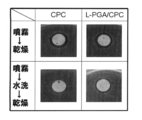
- Example 3 The result of the hello test before and after water washing of the nonwoven fabric each sprayed with CPC and PGA ion complex in Example 1 is shown.
- the present invention provides a sanitary article containing an ion complex formed from poly- ⁇ -glutamic acid and a cation (hereinafter also referred to as PGA ion complex).
- Poly- ⁇ -glutamic acid (hereinafter also simply referred to as PGA) is a polyamino acid in which the ⁇ -amino group and ⁇ -carboxyl group of glutamic acid are amide-bonded.
- the type of PGA is not particularly limited. For example, there are those consisting only of L-glutamic acid, those consisting only of D-glutamic acid, and those containing both, any of which can be used. However, the higher one ratio is, the better the stereoregularity, the higher the strength, etc., and the better the melting point (about 150 ° C.) when dried. This melting point becomes clearer by using an ion complex. Furthermore, since L-glutamic acid is superior in biodegradability, it is preferable to use PGA having a L-glutamic acid content of 90% or more.
- the molecular size of the PGA used is not particularly limited, but those having an average molecular mass of 10 kD or more are suitable. In general, the larger the molecular size, the higher the performance such as strength. On the other hand, a PGA with an excessively large molecular size is expensive to manufacture and may be technically difficult to manufacture, so it is usually set to 1,000 kD or less.
- PGA poly- ⁇ -glutamic acid is obtained when glutamic acid is polymerized under normal conditions, it is preferably biosynthesized using a microorganism.
- microorganisms that produce PGA include Bacillus subtilis (Bacillus natto), Bacillus subtilis (Sengoku soy sauce), Bacillus megaterium, Bacillus anthracis, Bacillus halodurans, and Naturalbaeagae.
- Bacillus subtilis which is a Bacillus subtilis
- Naturalba aegyptica which is a hyperhalophilic archaea.
- it is preferable to use PGA produced by Naturalba aegyiaca which is a microorganism that produces PGA consisting only of L-glutamic acid.
- the cationic fungicide contained in the ion complex of the present invention is not particularly limited, but quaternary ammonium salts and biguanide fungicides are preferred.
- quaternary ammonium salts include cetylpyridinium chloride, benzalkonium chloride, benzethonium chloride, distearyldimethylammonium chloride, stearyldimethylbenzylammonium chloride, stearyltrimethylammonium chloride, cetyltrimethylammonium chloride, lauryltrimethylammonium chloride, and chloride. Examples include lauryl pyridinium.
- biguanide fungicides examples include chlorhexidine hydrochloride, chlorhexidine acetate, chlorhexidine gluconate, alexidine hydrochloride, alexidine acetate, alexidine gluconate, polyhexamethylene biguanidine and the like.
- cetylpyridinium chloride, benzalkonium chloride, benzethonium chloride, chlorhexidine hydrochloride, and chlorhexidine gluconate are preferable.
- These cationic fungicides may form an ion complex only by one kind, or may be a PGA ion complex containing two or more kinds.
- the PGA ion complex As the PGA ion complex according to the present invention, those containing glutamic acid constituting the PGA and the cationic fungicide in an equimolar amount or in an arbitrary molar ratio can be used. In order to overcome the disadvantages, those that are sufficiently modified with a cationic fungicide are preferred. More specifically, the proportion of the cationic fungicide in the PGA ion complex is preferably 0.5 mol times or more, more preferably 0.6 mol times or more with respect to glutamic acid constituting PGA. More preferably, it is 0.7 mole times or more. In particular, those containing equimolar or substantially equimolar amounts of glutamic acid and cationic fungicide constituting PGA are suitable.
- substantially equimolar means that the number of moles of both is substantially equal.
- the amount of the cationic fungicide for glutamic acid constituting PGA is 0.8 mol times or more and 1.2 mol times or less. In particular, it means 0.9 mole times or more and 1.1 mole times or less.
- the PGA ion complex of the present invention can be produced very easily only by mixing PGA and a cationic fungicide such as a quaternary ammonium salt or a biguanide fungicide in a solvent.
- water is suitable. This is because the raw material PGA can be dissolved well and the target compound PGA ion complex is insoluble in water, which is convenient for isolation and purification of the target product after the reaction.
- water-soluble organic substances such as alcohols such as methanol and ethanol; ethers such as THF; amides such as dimethylformamide and dimethylacetamide may be used to increase their solubility in the reaction solution.
- a solvent may be added to the reaction solution. However, considering the separation of the PGA complex after completion of the reaction, it is preferable to use only water as the solvent.
- the salt may be used as PGA as a raw material.
- the salt include alkali metal salts such as sodium salt and potassium salt; alkaline earth metal salts such as calcium salt and magnesium salt. Further, even when a salt is used, it is not necessary that all carboxy groups are salts, and only a part thereof may be a salt. However, since polyvalent metal salts such as alkaline earth metal salts may have low solubility in water, a PGA free body or a monovalent metal salt of PGA is preferably used.
- Quaternary ammonium salts or biguanide fungicides are usually present as halide salts. Therefore, in the present invention, the quaternary ammonium salt or biguanide fungicide may be added directly to the reaction solution, or the salt may be added after dissolving in an aqueous solvent.
- the quaternary ammonium salt or biguanide fungicide is preferably used in a sufficient amount relative to PGA in order to sufficiently modify PGA.
- the concentration of each component in the reaction solution is not particularly limited.
- the concentration of PGA in the reaction solution can be about 0.5 w / v% or more and about 10 w / v% or less
- the concentration of the cationic bactericidal agent can be about 1.0 w / v% or more and about 10 w / v% or less.
- the reaction solution is preferably heated moderately to promote complex formation.
- the heating temperature can be, for example, about 40 ° C. or higher and 80 ° C. or lower.
- the reaction time may be adjusted as appropriate, but can usually be about 1 hour or more and 20 hours or less.
- the PGA ion complex of the present invention is insoluble in water, it can be easily separated from an aqueous solvent by filtration or centrifugation.
- the separated PGA ion complex can be washed with water to remove excess PGA, cationic fungicide, and other salts.
- the aqueous solvent can be easily removed by washing with acetone or the like.
- the PGA ion complex of the present invention exhibits biodegradability and does not exhibit water solubility or excessive water absorption while having moisture retention. Moreover, since it has a clear melting point and the melting point and the thermal decomposition starting point are sufficiently separated, thermoforming is possible.
- the PGA ion complex of the present invention can be used as a sanitary material that can be used in a wide range of fields required in terms of hygiene.
- the PGA ion complex of the present invention not only exhibits an excellent bacteriostatic effect against both gram-positive and gram-negative bacteria, but also exhibits an excellent bacteriostatic effect against fungi.
- -It can also be used as an antibacterial and / or antifungal agent that can be widely used in the hygiene field where antibacterial and antifungal properties are required in terms of hygiene.
- Gram-positive bacteria in which the PGA ion complex of the present invention exhibits antibacterial effects include Staphylococcus, Streptococcus, Corynebacterium, Bacillus, Listeria, Clostridium, and Lactobacillus.
- Gram-negative bacteria in which the PGA ion complex of the present invention exhibits antibacterial effects include Escherichia, Pseudomonas, Salmonella, Enterobacter, Neisseria, Xanthomonas, Serratia, and Campylobacter.
- fungi in which the PGA ion complex of the present invention exhibits an antibacterial effect include the genus Mycophyta of the genus Absidia, Mucor, Rhizopus, Aspergillus, Neurospora, Penicillium, Trichoderma, Neosartoria, Candida, Genus, Ascomycota such as Saccharomyces, Basidiomycetes such as Trametes, Cryptococcus, Incomplete fungi such as Alternaria, Fusarium, Cladosporium, Curvularia, Aureobasidium, and the like.
- Examples of forms in which the PGA ion complex of the present invention is used as a sanitary product include blending a sanitary product base material into a resin, impregnating the base material, coating, or spraying.
- the type of polymer is not particularly limited, and can be freely selected according to the use of the sanitary product.
- resins include, for example, vinyl chloride polymers, urethane polymers, acrylic polymers, olefin polymers, ethylene polymers, propylene polymers, amide polymers, ethylene-vinyl acetate copolymers, chlorides.
- a plasticizer, a filler, a colorant (dye, pigment, etc.), an ultraviolet absorber and the like may be appropriately blended as necessary.
- the blending ratio is preferably within a range in which deodorizing and skin care effects can be expressed and the function as a polymer resin is not impaired. Specifically, it is preferably 0.1% or more, more preferably 0.1% to 20.0%. preferable.
- the above resin composition can be processed into various forms according to its use and the like.
- the resin composition of the present invention is formed into a film shape, a sheet shape, a plate shape, a fiber shape, or a three-dimensional shape by a known resin processing method such as extrusion molding, injection molding, solution casting method, and spinning method. be able to.
- a sheet or fiber that is optimal for forms such as disposable diapers, sanitary products, underwear, masks, wet tissues, and gloves is desirable.
- the PGA ion complex of the present invention When the PGA ion complex of the present invention is dissolved in a solvent and impregnated or applied to a resin or fiber as a base material for sanitary products, there is no particular restriction on the type of resin or fiber, and it can be freely selected according to the application. Can do.
- Specific examples of the resin and fiber that can be used include resins such as polyethylene, polypropylene, polyester, polyolefin, and ethylene vinyl acetate, polyamide, nylon, aramid, rayon, and glass fiber.
- the solvent to be used is preferably a solvent of water, alcohols such as ethanol, methanol, isopropanol, and hydrocarbons such as n-hexane, ketones, esters, fatty acids, silicone oil, etc.
- solvents can also be used. These solvents may be used alone or in combination of two or more. If necessary, plasticizers, fillers, colorants (dyes, pigments, etc.), ultraviolet absorbers and the like may be appropriately blended.
- the resin, fiber, etc. preferably contain 0.1% or more of the PGA ion complex, preferably 0.1-20% or more. If it is less than 0.1%, the deodorizing effect may not be sufficiently exhibited. Although an upper limit is not specifically limited, When it melt
- the treatment is performed by a method such as brush coating, spraying, dipping, impregnation, coating, or printing. There is no particular limitation.
- the PGA ion complex of the present invention can be used as a spray for hygiene products.
- deodorizing properties and skin care properties can be imparted by spray application directly on paper diapers, sanitary products, underwear, masks, wet tissues, gloves, sanitary equipment and the like.
- the dispersion used for the propellant is preferably water, alcohols such as ethanol, methanol, isopropanol, and hydrocarbon solvents such as n-hexane, ketones, Various solvents such as esters, fatty acids and silicone oils can also be used. These solvents may be used alone or in combination of two or more.
- the sanitary article preferably contains 0.1% or more in the spray, and preferably contains 0.1 to 20%. If it is less than 0.1%, the deodorizing effect may not be sufficiently exhibited. Although an upper limit is not specifically limited, When it melt
- the PGA ion complex has a clear melting point and a bioplastic material utilizing the property that it can be thermoformed because the melting point and the thermal decomposition starting point are sufficiently separated from each other. As described above, it can be used after being processed into a film-like molded body or the like.
- a PGA ion complex is spun by a solution spinning method such as a wet spinning method, a dry wet spinning method, a dry spinning method, a gel spinning method, a melt spinning method, a charged spinning method, etc. It can be used as a fiber structure such as a knitted fabric or a non-woven fabric.
- Nanofibers can be produced by a method of obtaining a fine fibrous material to form a nonwoven fibrous structure.
- the PGA ion complex of the present invention has low irritation to skin, high adhesion to skin, and high permeability. Moreover, since the film
- the method of applying the PGA ion complex to the skin may be applied directly or sprayed, but it may be impregnated, applied, sprayed and contained in sanitary goods such as nonwoven fabrics, woven and knitted fabrics, and indirectly transferred to the skin. I do not care.
- the PGA ion complex is desirably contained in a sheet or fabric in a layer close to the part that comes into contact with the skin, but more preferably contained in a sheet or fabric in the uppermost layer part on the side that comes into contact with the skin.
- the concentration at which the PGA ion complex of the present invention exhibits a skin care effect is preferably 1 mg / cm 2 or more, more preferably 1 mg / cm 2 to 50 mg / cm 2 . is there.
- the PGA ion complex of the present invention is a polyion composed of a carboxyl group and a quaternary ammonium salt, it reacts with a low-volatile component that causes odor of urine and sweat, and chemically removes the volatile component.
- a low-volatile component that causes odor of urine and sweat
- it can.
- ammonia trimethylamine
- acetic acid lactic acid, butyric acid, valeric acid, isovaleric acid
- formaldehyde acetaldehyde, propionaldehyde, butyraldehyde, propylaldehyde
- hydrogen sulfide methanethiol, ethanethiol and the like
- the concentration at which the PGA ion complex of the present invention exhibits a deodorizing effect is preferably 0.1% or more, more preferably 0.1% to 20%, relative to the sanitary article base material. If it is less than 0.1%, the deodorizing effect may not be sufficiently exhibited.
- CPC-containing non-woven fabric is obtained by dissolving cetylpyridinium chloride (CPC) (5 g) in 99.5% ethanol (95 g), impregnating a polypropylene non-woven fabric into the solution, and drying the solution. A containing nonwoven fabric was prepared. These nonwoven fabrics were used in comparative examples of experimental examples described later.
- PP Nonwoven Fabric Polypropylene Nonwoven Fabric
- a halo test was performed.
- a PP nonwoven fabric cut into a circle having a diameter of 10 mm is sprayed with the following test solutions (1) and (2), and then air-dried PP nonwoven fabric ("after spraying" in Table 1 described later, “spraying ⁇ drying” in FIG. 1) ))
- the PP nonwoven fabric soaked in distilled water, washed, and air-dried ("After water washing” in Table 1 to be described later, "Spraying->Washing->Drying” in FIG. 1), respectively.
- Example 2 Biological deodorization test of PGAIC-containing non-woven fabric
- the PGAIC-containing non-woven fabric produced in Production Example 2, the PGA-containing non-woven fabric produced in Production Example 3, and the CPC-containing non-woven fabric produced in Production Example 4 were each 5 cm x 5 cm. Cut out and washed with 50 mL of water. After drying, each nonwoven fabric is put into a 1 L polyvinylidene fluoride odor measurement bag, and artificial urine (urea: 2.0 g, NaCl: 0.8 g, MgSO 4 : 0.1 g, CaCl 2 : 0.05 g, water: 100.0 g), medium (yeast extract, polypeptone) and P.
- the odor was determined according to the following criteria. -: No odor is felt. +: A small amount of odor is felt, but is usually difficult to detect. ++: A strong odor is felt. ++++: A strong odor is felt.
- Example 3 Chemical deodorization test of PGAIC-containing non-woven fabric
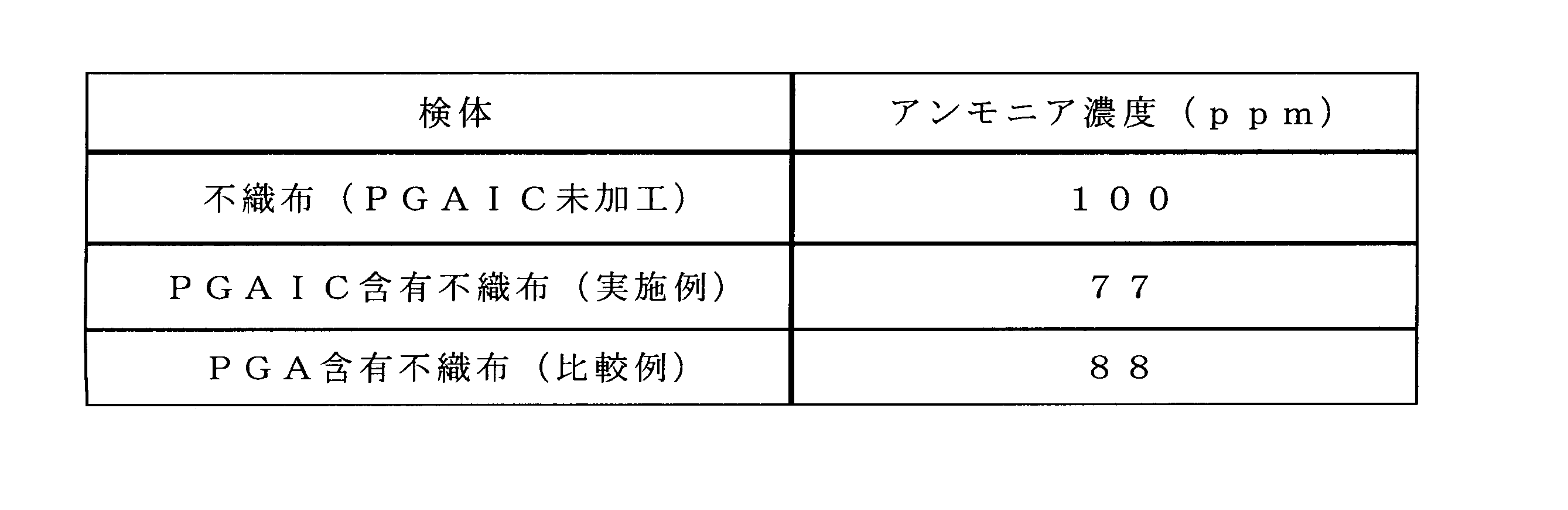
- the PGAIC-containing non-woven fabric (20 cm x 20 cm) obtained in Production Example 2 and the PGA non-woven fabric (20 cm x 20 cm) obtained in Production Example 3 were 3 L capacity. It put into the airtight container and sprayed 100 ppm ammonia gas. Two hours later, the ammonia concentration was analyzed with an ammonia gas detector tube. As a result, the ammonia concentration of the PGAIC-containing non-woven fabric (Example) produced in Production Example 2 was reduced from 100 ppm to 77 ppm, and the effect exceeded that of the non-woven fabric produced in Production Example 3 (Comparative Example). The results are shown in Table 3. From this result, it was confirmed that PGAIC has not only the biological deodorizing effect shown in Example 2 but also the effect of chemically capturing ammonia.
- Example 4 Transfer test of PGAIC-containing non-woven fabric to skin
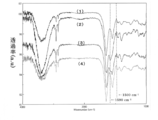
- the PGAIC-containing non-woven fabric obtained in Production Example 2 was contacted with human skin, and the transfer of PGAIC after 1 minute contact was performed by IR-ATR method (manufactured by JASCO, FT-IR6100). Skin after flowing water 1590 cm -1, an absorption band derived from PGAIC to 1500 cm -1, the transfer to the skin was confirmed.
- the results are shown in FIG. In the figure, (1) is skin contacted with an unwoven fabric, (2) is skin after PGAIC transfer, (3) is skin washed with running water after PGAIC transfer, and (4) is washed with detergent after PGAIC transfer. Each skin result is shown. As is apparent from FIG. 2, PGAIC is transferred to the skin. From these results, the skin care action of the skin by PGAIC and the alleviation of irritation by the irritating substance were recognized.
- the sanitary product of the present invention can be contained in sanitary products such as disposable diapers, sanitary products, masks, etc., and can be used in a wide range of fields that require deodorization and skin care during use in terms of health and hygiene.
Landscapes
- Life Sciences & Earth Sciences (AREA)
- Health & Medical Sciences (AREA)
- Engineering & Computer Science (AREA)
- General Health & Medical Sciences (AREA)
- Agronomy & Crop Science (AREA)
- Environmental Sciences (AREA)
- Zoology (AREA)
- Wood Science & Technology (AREA)
- Dentistry (AREA)
- Plant Pathology (AREA)
- Pest Control & Pesticides (AREA)
- Epidemiology (AREA)
- Veterinary Medicine (AREA)
- Public Health (AREA)
- Animal Behavior & Ethology (AREA)
- Materials Engineering (AREA)
- Chemical & Material Sciences (AREA)
- Hematology (AREA)
- Absorbent Articles And Supports Therefor (AREA)
- Treatments For Attaching Organic Compounds To Fibrous Goods (AREA)
- Undergarments, Swaddling Clothes, Handkerchiefs Or Underwear Materials (AREA)
- Apparatus For Disinfection Or Sterilisation (AREA)
- Agricultural Chemicals And Associated Chemicals (AREA)
Abstract
健康・衛生面で消臭、スキンケア性が要求される分野で広範囲に利用することができる、安全性の高い、低環境負荷の衛生用品を提供する。ポリ-γ-グルタミン酸とカチオン性殺菌剤から形成されるPGAイオンコンプレックスを含有する衛生用品。
Description
本発明は、消臭性、スキンケアに優れた衛生用品に関する。
近年、衣食住での衛生志向により、美容、健康、快適なライフスタイルに合わせた衛生用品が求められている。とりわけ、高齢化社会を背景に、高齢者向け介護用品の需要が増加傾向にあり、紙おむつ、ウェットティッシュ、失禁バット、医療タオル等の衛生用品の利便性、快適性が求められる。衛生用品は、使い捨ての利便性さが良いことが長所であるが、尿、汗、血液が付着した皮膚に接触して使用されることが多く、長時間の使用によっては、体液の臭いや皮膚への付着による不快感により、使用者にとって苦痛となる場合があり、体臭と体液付着による不快感を軽減することが使命とされる。
一般的に、体臭、不快感、肌荒れの原因物質としてアンモニアが挙げられる。アンモニアは、体液に含まれる尿素がウレアーゼ生産菌により加水分解することで発生する。このため、従来の衛生用品には、繊維に抗菌剤を含有させた衛生用品が開発されている。抗菌剤は、有機系抗菌剤である第四級アンモニウム塩、天然物抽出物、銀、銅、亜鉛等の無機系抗菌剤が挙げられる。
上記記載の抗菌剤の例としては、特許文献1には、塩化ベンザルコニウム等の第四級アンモニウムを含有する紙おむつが開示されている。特許文献2には、植物由来の抽出物を含有する繊維素材が開示されている。無機系抗菌剤の例としては、特許文献3には、銀イオンをセルロースに担持した衛生用品が開示されている。
上記記載の抗菌剤で処理した衛生用品は、体臭、肌荒れの原因となる細菌を抑える効果が期待できるが、抗菌剤の水溶性が高いため、繊維に固着した抗菌成分が体液によって溶出してしまい、抗菌の持続性が低下する。それ故、長期間使用すると、臭気の発生や肌荒れの原因となる場合がある。
衛生用品は、使い捨ての利便性があるものの、使用後は廃棄される。資源節約の観点からは、環境負荷の少ない素材の使用が望ましい。
かかる現状を鑑みると、衛生用品としては、消臭性を示し、皮膚へ体液が付着する不快感を防ぐスキンケア性能、さらには、体液による有効成分の流出を防ぐ衛生用品が求められる。
近年、天然物由来の高分子材料として、バイオベースポリマーが注目を集めている。バイオベースポリマーは、人体への安全性が高く、天然物をそのまま素材として利用できるため、廃棄物が生じず、環境負荷が少ない。さらには、生分解性が高い利点を有し、石油化学材料に依存しない資源として種々の用途が期待されている。バイオポリマーとしては、ポリ-γ-グルタミン酸(以下、PGAと記載することもある)の開発が進められている。ポリ-γ-グルタミン酸は、グルタミン酸のα-アミノ基とγ-カルボキシル基がアミド結合で結ばれたポリアミノ酸である。PGAは納豆の糸引きの主成分として知られるようになったが、その魅力的な機能性として、生分解性、接着性を兼ね備えている。さらには、化粧品に使用される天然保湿剤成分であり、皮膚への高い安全性を有している。
特許文献4においては、ポリ-γ-グルタミン酸と第四級アンモニウムイオン化合物から形成されるイオンコンプレックス(以下、PGAICと記載することもある)が記載されている。当該イオンコンプレックスは、水に不溶性のポリマーであり、新たな用途が期待される。本文献では、当該イオンコンプレックスから成形されたフィルムは、抗菌性をも有する材料としての有用性が記載されている。また、当該イオンコンプレックスは、疎水性を有し、水による溶解、水分による流出が起こらない特徴を有している。
上述のように、衛生用品としては、人体への安全性が高く、消臭性、スキンケア性能を備え、さらには、低環境負荷を有する素材が望まれる。本発明の目的は、消臭効果を示し、且つ、スキンケア性能を備えた、健康・衛生面で要求される分野で広範囲に利用することができる衛生用品を提供することである。
本発明者らは、上記課題を解決するために鋭意研究を重ね、ポリ-γ-グルタミン酸のイオンコンプレックスを含有する衛生用品が優れた特性を有することを見出し、本発明に至った。すなわち、ポリ-γ-グルタミン酸とカチオン性殺菌剤、特に第四級アンモニウム塩もしくはビグアニド系殺菌剤から形成されたイオンコンプレックスを衛生用品に含有することで、消臭、スキンケア作用を示すことを見出し、本発明を完成するに至った。
本発明は、安全性の高い、低環境負荷のポリ-γ-グルタミン酸のイオンコンプレックスを含有する衛生用品を提供する。
代表的な発明は以下の通りである。
(項1)
ポリ-γ-グルタミン酸とカチオン性殺菌剤から形成されるPGAイオンコンプレックスを特徴とする衛生用品。
(項2)
衛生用品が紙おむつ、生理用品、マスク、ウェットティッシュ、肌着、失禁用パッド、又は、ガーゼである項1に記載の衛生用品。
(項3)
前記PGAイオンコンプレックスが肌に触れる側に近い層のシートまたは、布帛に含まれていることを特徴とする項1又は2記載の衛生用品。
(項4)
前記PGAイオンコンプレックスが肌に触れる側の少なくとも最上層のシート又は布帛に含まれていることを特徴とする項1~3に記載の衛生用品。
(項5)
カチオン性殺菌剤が第四級アンモニウム塩である、項1~4に記載の衛生用品。
(項6)
カチオン性殺菌剤がビグアニド系殺菌剤である、項1~5に記載の衛生用品。
(項7)
カチオン性殺菌剤が塩化セチルピリジニウム、塩化ベンザルコニウム、塩化ベンゼトニウム、塩酸クロルヘキシジン及びグルコン酸クロルヘキシジンからなる群より選択される1種以上である、項1~6に記載の衛生用品。
(項8)
ポリ-γ-グルタミン酸を構成するグルタミン酸のうち、L-グルタミン酸の占める割合が90%以上である、項1~7のいずれかに記載の衛生用品。
(項9)
ポリ-γ-グルタミン酸を構成するグルタミン酸がL-グルタミン酸からなる、項1~8に記載の衛生用品。
(項10)
前記のPGAイオンコンプレックスの溶液を不織布又は織編物へ含浸又は塗布して使用する、項1~9に記載の衛生用品。
(項11)
前記のPGAイオンコンプレックスが衛生用品の不織布又は織編物に0.1~20wt%含有されている、項1~11記載の衛生用品。
(項12)
前記のPGAイオンコンプレックスを衛生用品によって、消臭しつつ、同時にスキンケアを行う方法。
(項13)
前記のPGAイオンコンプレックスを含む衛生用品によって、水分や湿気による不快感を低減する方法。
ポリ-γ-グルタミン酸とカチオン性殺菌剤から形成されるPGAイオンコンプレックスを特徴とする衛生用品。
(項2)
衛生用品が紙おむつ、生理用品、マスク、ウェットティッシュ、肌着、失禁用パッド、又は、ガーゼである項1に記載の衛生用品。
(項3)
前記PGAイオンコンプレックスが肌に触れる側に近い層のシートまたは、布帛に含まれていることを特徴とする項1又は2記載の衛生用品。
(項4)
前記PGAイオンコンプレックスが肌に触れる側の少なくとも最上層のシート又は布帛に含まれていることを特徴とする項1~3に記載の衛生用品。
(項5)
カチオン性殺菌剤が第四級アンモニウム塩である、項1~4に記載の衛生用品。
(項6)
カチオン性殺菌剤がビグアニド系殺菌剤である、項1~5に記載の衛生用品。
(項7)
カチオン性殺菌剤が塩化セチルピリジニウム、塩化ベンザルコニウム、塩化ベンゼトニウム、塩酸クロルヘキシジン及びグルコン酸クロルヘキシジンからなる群より選択される1種以上である、項1~6に記載の衛生用品。
(項8)
ポリ-γ-グルタミン酸を構成するグルタミン酸のうち、L-グルタミン酸の占める割合が90%以上である、項1~7のいずれかに記載の衛生用品。
(項9)
ポリ-γ-グルタミン酸を構成するグルタミン酸がL-グルタミン酸からなる、項1~8に記載の衛生用品。
(項10)
前記のPGAイオンコンプレックスの溶液を不織布又は織編物へ含浸又は塗布して使用する、項1~9に記載の衛生用品。
(項11)
前記のPGAイオンコンプレックスが衛生用品の不織布又は織編物に0.1~20wt%含有されている、項1~11記載の衛生用品。
(項12)
前記のPGAイオンコンプレックスを衛生用品によって、消臭しつつ、同時にスキンケアを行う方法。
(項13)
前記のPGAイオンコンプレックスを含む衛生用品によって、水分や湿気による不快感を低減する方法。
本発明の衛生用品は、優れた消臭効果およびスキンケア効果を有しており、且つポリ-γ-グルタミン酸とカチオン性殺菌剤から形成されたイオンコンプレックスが水不溶性を示すことから、体液による流出がなく、残留性が高い上、低濃度での使用であっても長時間の消臭効果およびスキンケア効果を示す。また、本発明の衛生用品は、衛生用品に使用される繊維、不織布のみならず、プラスチック、フィルム、木材、紙、コンクリート、金属、セラミック、ガラスなどを含む各種材料への当該イオンコンプレックスの塗布が可能であり、当該イオンコンプレックス自体をフィルム、プラスチック、繊維、液体、ゲル等への種々の形態にも加工が可能である点でも優れている。さらに、本発明の衛生用品は、ポリ-γ-グルタミン酸自体が生分解性である上に、カウンターカチオンである第四級アンモニウム塩もしくはビグアニド系殺菌剤も界面活性剤、殺菌剤等として広く利用されているので、安全性も高い。従って、本発明により、消臭およびスキンケアにおいて優れた効果を示し、健康・衛生面で要求される分野で広範囲に利用することができる衛生用品、および、その用途を提供することができる。
本発明はポリ-γ-グルタミン酸とカチオンから形成されたイオンコンプレックス(以下、PGAイオンコンプレックスとも言う。)を含有する衛生用品を提供する。
ポリ-γ-グルタミン酸(以下、単にPGAとも言う。)とは、グルタミン酸のα-アミノ基とγ-カルボキシル基とがアミド結合したポリアミノ酸である。PGAの種類は、特に制限されない。例えば、L-グルタミン酸のみからなるもの、D-グルタミン酸のみからなるもの、両方を含むものがあるが、何れも用いることができる。但し、一方の割合がより多い方が立体規則性に優れ、強度なども高くなり、また、よく乾燥すれば融点(約150℃)をも示す様になる。この融点は、イオンコンプレックスとすることで、より明確となる。さらに、L-グルタミン酸からなるものの方が生分解性に優れるので、L-グルタミン酸の含有割合が90%以上であるPGAを用いることが好ましい。
使用するPGAの分子サイズも特に制限されないが、平均分子質量で10kD以上のものが好適である。一般的に、分子サイズが大きいほど強度などの性能が高くなる。一方、分子サイズが過剰に大きなPGAは製造コストが大きく、また、製造が技術的に難しい場合もあるので、通常は1,000kD以下とする。
PGAは、市販されているものがあればそれを用いてもよいし、別途製造してもよい。但し、通常の条件でグルタミン酸を重合するとポリ-α-グルタミン酸が得られるので、微生物を使って生合成させることが好ましい。PGAを生産する微生物としては、Bacillus subtilis(納豆菌)、Bacillus subtilis(戦国醤菌)、Bacillus megaterium、Bacillus anthracis、Bacillus halodurans、Natrialba aegyptiaca、Hydraなどがある。分子サイズの大きいPGAを製造できる微生物としては、枯草菌であるBacillus subtilisや超好塩古細菌であるNatrialba aegyptiacaがある。この中でも、L-グルタミン酸のみからなるPGAを生産する微生物であるNatrialba aegytiacaによって生産されたPGAを用いるのが好ましい。
本発明のイオンコンプレックスに含まれるカチオン性殺菌剤は、特に制限されないが、第四級アンモニウム塩およびビグアニド系殺菌剤が好ましい。第四級アンモニウム塩としては、例えば、塩化セチルピリジニウム、塩化ベンザルコニウム、塩化ベンゼトニウム、塩化ジステアリルジメチルアンモニウム、塩化ステアリルジメチルベンジルアンモニウム、塩化ステアリルトリメチルアンモニウム、塩化セチルトリメチルアンモニウム、塩化ラウリルトリメチルアンモニウム、塩化ラウリルピリジニウム等が挙げられる。ビグアニド系殺菌剤としては、塩酸クロルヘキシジン、酢酸クロルヘキシジン、グルコン酸クロルヘキシジン、塩酸アレキシジン、酢酸アレキシジン、グルコン酸アレキシジン、ポリヘキサメチレンビグアニジン等が挙げられる。この中でも、好ましくは塩化セチルピリジニウム、塩化ベンザルコニウム、塩化ベンゼトニウム、塩酸クロルヘキシジン、グルコン酸クロルヘキシジンが挙げられる。これらのカチオン性殺菌剤は1種のみでイオンコンプレックスを形成してもよいし、2種以上を含むPGAイオンコンプレックスにしてもよい。
本発明に係るPGAイオンコンプレックスとしては、PGAを構成するグルタミン酸とカチオン性殺菌剤とを等モルあるいは任意のモル比で含むものを用いることができるが、過剰な親水性などPGAの有する材料としての欠点を克服するために、カチオン性殺菌剤により十分に改質されているものが好適である。より具体的には、PGAイオンコンプレックスにおけるカチオン性殺菌剤の割合が、PGAを構成するグルタミン酸に対して0.5モル倍以上であることが好ましく、0.6モル倍以上であることがより好ましく、0.7モル倍以上であることがさらに好ましい。特に、PGAを構成するグルタミン酸とカチオン性殺菌剤とを等モルまたは略等モル含むものが好適である。ここで、略等モルとは、両者のモル数がほぼ等しいことを意味するが、具体的にはPGAを構成するグルタミン酸に対するカチオン性殺菌剤が0.8モル倍以上、1.2モル倍以下、特に0.9モル倍以上、1.1モル倍以下であることをいうものとする。
本発明のPGAイオンコンプレックスは、溶媒中、PGAと第四級アンモニウム塩もしくはビグアニド系殺菌剤等のカチオン性殺菌剤を混合するのみで、極めて容易に製造できる。
ここで使用する溶媒としては、水が好適である。原料であるPGAを良好に溶解できるからであり、また、目的化合物であるPGAイオンコンプレックスは水に対して不溶性であることから、反応後における目的物の単離精製に好都合なためである。但し、カチオン性殺菌剤の水溶性などによっては、反応液に対するそれらの溶解性を高めるために、メタノールやエタノールなどのアルコール;THFなどのエーテル;ジメチルホルムアミドやジメチルアセトアミドなどのアミドなどの水溶性有機溶媒を反応液に添加してもよい。しかし、反応終了後におけるPGAコンプレックスの分離を考慮すれば、溶媒としては水のみを用いることが好ましい。
原料であるPGAとしては、その塩を用いてもよい。当該塩としては、ナトリウム塩やカリウム塩などのアルカリ金属塩;カルシウム塩やマグネシウム塩などのアルカリ土類金属塩などを挙げることができる。また、塩を用いる場合であっても全てのカルボキシ基が塩となっている必要はなく、その一部のみが塩となっていてもよい。但し、アルカリ土類金属塩などの多価金属塩は、水に対する溶解性が低い場合があり得るので、好適にはPGAのフリー体またはPGAの一価金属塩を用いる。
第四級アンモニウム塩もしくはビグアニド系殺菌剤は、通常、ハロゲン化物塩として存在する。よって、本発明においては、反応液へ第四級アンモニウム塩もしくはビグアニド系殺菌剤を直接添加、或いは当該塩を水溶媒に溶解した上で添加すればよい。第四級アンモニウム塩もしくはビグアニド系殺菌剤は、PGAを十分に改質するため、PGAに対して十分量用いることが好ましい。
本発明のPGAイオンコンプレックスは水不溶性であることから、水溶媒から容易に分離できるため、反応液における各成分の濃度は特に制限されない。例えば、反応液におけるPGAの濃度を0.5w/v%以上、10w/v%以下程度、カチオン性殺菌剤の濃度を1.0w/v%以上、10w/v%以下程度とすることができる。
反応液は、コンプレックスの形成を促進するために適度に加熱することが好ましい。加熱温度は、例えば40℃以上、80℃以下程度とすることができる。反応時間は適宜調整すればよいが、通常、1時間以上、20時間以下程度とすることができる。
本発明のPGAイオンコンプレックスは水不溶性であることから、濾過や遠心分離などにより水溶媒から容易に分離することができる。また、分離したPGAイオンコンプレックスは、水で洗浄することにより、過剰に用いたPGAまたはカチオン性殺菌剤、その他の塩を除去することも可能である。また、水溶媒は、アセトンなどで洗浄することにより簡便に除去できる。
本発明のPGAイオンコンプレックスは、生分解性を示す上に、保湿性を有しながらも水溶性や過剰な吸水性を示さない。また、明確な融点を有し、且つ融点と熱分解開始点が十分に離れていることから加熱成形が可能である。
本発明のPGAイオンコンプレックスは、衛生面で要求される分野で広範囲に利用することができる衛生素材として利用できる。
本発明のPGAイオンコンプレックスは、グラム陽性およびグラム陰性のいずれの細菌類に対しても優れた静菌効果を発揮するのみならず、同時に真菌類に対しても優れた静菌効果を示し、健康・衛生面で抗細菌性や抗真菌性が要求される衛生分野で広範囲に利用することができる抗細菌剤および/または抗真菌剤としても利用できる。
本発明のPGAイオンコンプレックスが抗菌効果を示すグラム陽性細菌の例としては、Staphylococcus属、Streptococcus属、Corynebacterium属、Bacillus属、Listeria属、Clostridium属、Lactobacillus属等が挙げられる。
本発明のPGAイオンコンプレックスが抗菌効果を示すグラム陰性細菌の例としては、Escherichia属、Pseudomonas属、Salmonella属、Enterobacter属、Neisseria属、Xanthomonas属、Serratia属、Campylobacter属等が挙げられる。
本発明のPGAイオンコンプレックスが抗菌効果を示すグラム陰性細菌の例としては、Escherichia属、Pseudomonas属、Salmonella属、Enterobacter属、Neisseria属、Xanthomonas属、Serratia属、Campylobacter属等が挙げられる。
本発明のPGAイオンコンプレックスが抗菌効果を示す真菌の例としては、Absidia属、Mucor属、Rhizopus属等の接合菌門、Aspergillus属、Neurospora属、Penicillium属、Trichoderma属、Neosartorya属、Candida属、Pichia属、Saccharomyces属等の子嚢菌門、Trametes属、Cryptococcus等の担子菌門、Alternaria属、Fusarium属、Cladosporium属、Curvularia属、Aureobasidium属等の不完全菌類等が挙げられる。
本発明のPGAイオンコンプレックスを衛生用品として利用する形態としては、衛生用品の基材の樹脂への配合、基材への含浸、塗布又は噴霧等が挙げられる。
本発明のPGAイオンコンプレックスを基材の樹脂に配合した衛生用品として使用する場合、ポリマーの種類には特に制約はなく、衛生用品の用途等に応じて自由に選ぶことができる。使用し得る樹脂の具体例としては、例えば、塩化ビニル系ポリマー、ウレタン系ポリマー、アクリル系ポリマー、オレフィン系ポリマー、エチレン系ポリマー、プロピレン系ポリマー、アミド系ポリマー、エチレン-酢酸ビニル共重合体、塩化ビニリデン系ポリマー、スチレン系ポリマー、エステル系ポリマー、ナイロン系ポリマー、セルロース誘導体、カーボネート系ポリマー、フッ素系樹脂、シリコーン系樹脂、ビニルアルコール系ポリマー、ビニルエステル系ポリマー、合成ゴム、天然ゴムなどが挙げられる。樹脂組成物には、必要に応じて、可塑剤、充填剤、着色剤(染料、顔料など)、紫外線吸収剤等を適宜配合してもよい。配合割合としては、消臭、スキンケア効果を発現でき且つ高分子樹脂としての機能を損なわない範囲が好ましく、具体的には0.1%以上が好ましく、0.1%~20.0%がより好ましい。
上記の樹脂組成物は、その用途等に応じて種々の形態に加工することができる。例えば、本発明の樹脂組成物は、押出成形、射出成形、溶液流延法、紡糸法等それ自体既知の樹脂加工法によって、フィルム状、シート状、板状、繊維状、立体状に成形することができる。衛生用品としての用途では、紙おむつ、生理用品、肌着、マスク、ウェットティッシュ、手袋等の形態に最適なシート状、繊維状が望ましい。
本発明のPGAイオンコンプレックスを溶媒に溶かして、衛生用品の基材となる樹脂、繊維への含浸、塗布する場合、樹脂、繊維の種類には特に制約はなく、用途に応じて自由に選ぶことができる。使用し得る樹脂、繊維の具体例としては、ポリエチレン、ポリプロピレン、ポリエステル、ポリオレフィン、エチレン酢酸ビニル等の樹脂、ポリアミド、ナイロン、アラミド、レーヨン、ガラス繊維等が挙げられる。使用する溶媒は、安全性の観点から、水、エタノール、メタノール、イソプロパノール等のアルコール類、及び、n-ヘキサン等の炭化水素類の溶媒が好ましく、ケトン類、エステル類、脂肪酸類、シリコーン油等の各種の溶媒も使用することができる。これらの溶媒は、1種だけ単独で用いてもよく、2種以上混合して用いてもよい。必要に応じて、可塑剤、充填剤、着色剤(染料、顔料など)、紫外線吸収剤等を適宜配合してもよい。樹脂、繊維等には当該PGAイオンコンプレックスが0.1%以上含まれていることが好ましく、0.1~20%以上含まれていることが好ましい。0.1%より少ないと消臭の効果が十分に発揮されない恐れがある。上限は特に限定されないが、溶媒等に溶解する場合は、当該PGAイオンコンプレックスは20%以下であることが好ましい。
本発明のPGAイオンコンプレックスを用いて、工業製品あるいは基材に含有処理を施す際には、刷け塗り、スプレイ法、ディッピング法、含浸法、コーティング法、プリント法等の方法で処理を行ってもよく、特に限定されない。
さらに、本発明のPGAイオンコンプレックスは、衛生用品への噴霧剤として使用することができる。具体的には、紙おむつ、生理用品、肌着、マスク、ウェットティッシュ、手袋、衛生機器類等に直接噴霧塗布することにより、消臭性とスキンケア性を持たせることができる。この場合、噴霧剤に使用される分散液としては、安全性の観点から、水、エタノール、メタノール、イソプロパノール等のアルコール類、及び、n-ヘキサン等の炭化水素類の溶媒が好ましく、ケトン類、エステル類、脂肪酸類、シリコーン油等の各種の溶媒も使用することができる。これらの溶媒は、1種だけ単独で用いてもよく、2種以上混合して用いてもよい。衛生用品には噴霧剤中に0.1%以上含まれていることが好ましく、0.1~20%含まれていることが好ましい。0.1%より少ないと消臭の効果が十分に発揮されない恐れがある。上限は特に限定されないが、溶媒等に溶解する場合は、当該PGAイオンコンプレックスは20%以下であることが好ましい。
本発明の衛生用品の一態様として、PGAイオンコンプレックスは明確な融点を有し、且つ融点と熱分解開始点が十分に離れていることから加熱成形が可能である性質を利用し、バイオプラスチック材料として、フィルム状成形体等に加工して使用することもできる。
本発明の衛生用品の別の態様として、PGAイオンコンプレックスを湿式紡糸法、乾湿式紡糸法、乾式紡糸法、ゲル紡糸法などの溶液紡糸法、溶融紡糸法、荷電紡糸法等によって紡糸し、織編物または不織布等の繊維構造体として使用することができる。一例として、メタノールやエタノールなどのアルコール溶媒もしくはジエチルエーテルやTHFなどのエーテル溶媒に溶解し、荷電紡糸法(荷電中で帯電した高分子溶液をノズル先端より吐出しながら、その溶液の電荷反発力により微細の繊維状物を得る方法)によりナノファイバーを作製して、不織布状の繊維構造体とすることができる。
本発明のPGAイオンコンプレックスは、皮膚への刺激性が低く、肌への密着性、浸透性が高い。また、脂溶性が高く、尿、汗、血液等の体液の直接的な接触を保護する膜が形成されるため、体液の不快感を軽減するスキンケアを持たせることができる。さらには、体液由来の湿気による不快感を軽減させることもできる。当該PGAイオンコンプレックスの皮膚への塗布方法は、直接塗布、噴霧してもよいが、不織布、織編物等の衛生用品に含浸、塗布、噴霧させて含有させ、間接的に皮膚へ転写させる方法でも構わない。当該PGAイオンコンプレックスは、皮膚に触れる部分に近い層のシート又は布帛に含有させることが望ましいが、皮膚に触れる側の最上層部のシート又は、布帛へ含有させることがより好ましい。
本発明のPGAイオンコンプレックスがスキンケア効果を示す濃度としては、皮膚へ塗布した濃度が1mg/cm2以上塗られていることが好ましく、より好ましくは、1mg/cm2~50mg/cm2の範囲である。
本発明のPGAイオンコンプレックスは、カルボキシル基と第四級アンモニウム塩からなるポリイオンであるため、尿、汗の臭いの原因となる低揮発性成分と反応し、揮発成分を化学的に除去することができる。例えば、アンモニア、トリメチルアミン、酢酸、乳酸、酪酸、吉草酸、イソ吉草酸、ホルムアルデヒド、アセトアルデヒド、プロピオンアルデヒド、ブチルアルデヒド、プロピルアルデヒド、硫化水素、メタンチオール、エタンチオール等が挙げられる。衛生材料の用途からは、尿や汗の臭いの原因となるアンモニアの除去が望ましい。
本発明のPGAイオンコンプレックスが消臭効果を示す濃度としては、衛生用品の基材に対し、0.1%以上含まれていることが好ましく、0.1%~20%がより好ましい。0.1%より少ないと消臭の効果が十分に発揮されない恐れがある。
以下の実施例により、本発明を更に詳細に説明するが、本発明は、これらに何ら限定されるものではない。
(製造例1)PGAIC(PGA/CPC)の製造
超好塩古細菌ナトリアルバ・エジプチアキア(N.aegyptiaca)由来の平均分子量1000kDのポリ-γ-L-グルタミン酸ナトリウム塩(PGA)(40g)を精製水に溶解し、18w/v%の溶液とした。当該溶液へ60℃に保温した塩化セチルピリジニウム(CPC)の0.2M水溶液(1551g)を加えた。原料であるPGA(含量90%以上)の水溶液から、CPC添加直後に水不溶性材料が形成されることを確認した後、さらに60℃で4時間保温した。得られた水不溶性材料を濾別回収した後、1000mLの精製水で計3回洗浄した。さらにアセトンで洗浄することにより脱水した後、真空乾燥し、粉末としてPGAIC(93g)を回収した。得られたPGAICの1H-NMRの結果から、PGAとCPCが100:100のモル比で結合していることが確認された。
超好塩古細菌ナトリアルバ・エジプチアキア(N.aegyptiaca)由来の平均分子量1000kDのポリ-γ-L-グルタミン酸ナトリウム塩(PGA)(40g)を精製水に溶解し、18w/v%の溶液とした。当該溶液へ60℃に保温した塩化セチルピリジニウム(CPC)の0.2M水溶液(1551g)を加えた。原料であるPGA(含量90%以上)の水溶液から、CPC添加直後に水不溶性材料が形成されることを確認した後、さらに60℃で4時間保温した。得られた水不溶性材料を濾別回収した後、1000mLの精製水で計3回洗浄した。さらにアセトンで洗浄することにより脱水した後、真空乾燥し、粉末としてPGAIC(93g)を回収した。得られたPGAICの1H-NMRの結果から、PGAとCPCが100:100のモル比で結合していることが確認された。
(製造例2)PGAIC(L-PGA/CPC)含有不織布の製造
製造例1で得られたPGAIC(5g)を99.5%エタノール(95g)に溶解し、当該溶液に、ポリプロピレン製不織布を含漬し、乾燥させることで、PGAIC含有の不織布を作製した。これらの不織布は後述の実施例で用いた。
製造例1で得られたPGAIC(5g)を99.5%エタノール(95g)に溶解し、当該溶液に、ポリプロピレン製不織布を含漬し、乾燥させることで、PGAIC含有の不織布を作製した。これらの不織布は後述の実施例で用いた。
(製造例3)PGA含有不織布の製造
超好塩古細菌ナトリアルバ・エジプチアキア(N.aegyptiaca)由来の平均分子量1000kDのポリ-γ-L-グルタミン酸ナトリウム塩(PGA)(5g)を精製水(95g)に溶解し、当該溶液に、ポリプロピレン製不織布を含漬し、乾燥させることで、PGA含有の不織布を作製した。これらの不織布は後述の実験例の比較例で用いた。
超好塩古細菌ナトリアルバ・エジプチアキア(N.aegyptiaca)由来の平均分子量1000kDのポリ-γ-L-グルタミン酸ナトリウム塩(PGA)(5g)を精製水(95g)に溶解し、当該溶液に、ポリプロピレン製不織布を含漬し、乾燥させることで、PGA含有の不織布を作製した。これらの不織布は後述の実験例の比較例で用いた。
(製造例4)CPC含有不織布の製造
塩化セチルピリジニウム(CPC)(5g)を99.5%エタノール(95g)に溶解し、当該溶液に、ポリプロピレン製不織布を含漬し、乾燥させることで、CPC含有の不織布を作製した。これらの不織布は後述の実験例の比較例で用いた。
塩化セチルピリジニウム(CPC)(5g)を99.5%エタノール(95g)に溶解し、当該溶液に、ポリプロピレン製不織布を含漬し、乾燥させることで、CPC含有の不織布を作製した。これらの不織布は後述の実験例の比較例で用いた。
(実施例1)PGAIC噴霧剤のポリプロピレン不織布(PP不織布)への接着性の評価
PGAICのPP不織布への接着性を評価するため、ハローテストを行った。
直径10mmの円形に切り抜いたPP不織布に、以下の(1)および(2)の試験液を噴霧した後、風乾したPP不織布(後述の表1では「噴霧後」、図1では「噴霧→乾燥」)と、前記PP不織布をさらに蒸留水に浸して洗浄し風乾したもの(後述の表1では「水洗浄後」、図1では「噴霧→水洗→乾燥」)とを、それぞれ用意した。
・ 製造例1で製造したPGAICを70%エタノールに溶解した0.1%溶液
・ 塩化セチルピリジニウム(CPC)を70%エタノールに溶解した0.1%溶液
[ハローテスト]
Streptococcus aureus NBRC13276の懸濁液をSCD液体培地中で37℃にて16時間液体培養した後、50℃ に保温したSCD寒天培地 に106個/mlとなるように添加し、菌体を含む固形培地を調製した。各試験液で処理したPP不織布を前記固形培地上に置床し、37 ℃ にて24時間培養した。培養後、PP不織布周辺部においては、細菌の増殖が抑制されるとハローが形成される。図1に示す様に、PGAイオンコンプレックスを噴霧したPP不織布の周辺部には、噴霧後および水洗浄後に明瞭なハロー(発育阻止帯)が形成された(表1にはハロー幅の数値を示した。)。一方、CPCを噴霧したPP不織布の周辺部には、水洗浄後にハローは形成されなかった。これらの結果は、PP不織布へのPGAイオンコンプレックスの接着性が抗菌性と共に水洗浄後も維持されていることを示している。
PGAICのPP不織布への接着性を評価するため、ハローテストを行った。
直径10mmの円形に切り抜いたPP不織布に、以下の(1)および(2)の試験液を噴霧した後、風乾したPP不織布(後述の表1では「噴霧後」、図1では「噴霧→乾燥」)と、前記PP不織布をさらに蒸留水に浸して洗浄し風乾したもの(後述の表1では「水洗浄後」、図1では「噴霧→水洗→乾燥」)とを、それぞれ用意した。
・ 製造例1で製造したPGAICを70%エタノールに溶解した0.1%溶液
・ 塩化セチルピリジニウム(CPC)を70%エタノールに溶解した0.1%溶液
[ハローテスト]
Streptococcus aureus NBRC13276の懸濁液をSCD液体培地中で37℃にて16時間液体培養した後、50℃ に保温したSCD寒天培地 に106個/mlとなるように添加し、菌体を含む固形培地を調製した。各試験液で処理したPP不織布を前記固形培地上に置床し、37 ℃ にて24時間培養した。培養後、PP不織布周辺部においては、細菌の増殖が抑制されるとハローが形成される。図1に示す様に、PGAイオンコンプレックスを噴霧したPP不織布の周辺部には、噴霧後および水洗浄後に明瞭なハロー(発育阻止帯)が形成された(表1にはハロー幅の数値を示した。)。一方、CPCを噴霧したPP不織布の周辺部には、水洗浄後にハローは形成されなかった。これらの結果は、PP不織布へのPGAイオンコンプレックスの接着性が抗菌性と共に水洗浄後も維持されていることを示している。

(実施例2)PGAIC含有不織布の生物学的消臭試験
製造例2で作製したPGAIC含有不織布、製造例3で作製したPGA含有不織布、製造例4で作製したCPC含有不織布をそれぞれ5cm×5cmに切り取り、50mLの水で水洗した。乾燥後、各不織布を1Lのポリフッ化ビニリデン 製臭気測定用袋に入れ、人工尿(尿素:2.0g、NaCl:0.8g、MgSO4:0.1g、CaCl2:0.05g、水:100.0g)と培地(酵母エキス、ポリペプトン)、P.mirabilisを各不織布に添加し、37℃で放置した後、アンモニアの検知管でアンモニア濃度、臭気を測定した。消臭試験の結果を表2に示す。製造例2で作製したPGAIC含有不織布(実施例)は、最大で98時間放置してもアンモニアの発生が抑制され、製造例3および4で作製した不織布(比較例1および2)よりも顕著な消臭効果が認められた。
製造例2で作製したPGAIC含有不織布、製造例3で作製したPGA含有不織布、製造例4で作製したCPC含有不織布をそれぞれ5cm×5cmに切り取り、50mLの水で水洗した。乾燥後、各不織布を1Lのポリフッ化ビニリデン 製臭気測定用袋に入れ、人工尿(尿素:2.0g、NaCl:0.8g、MgSO4:0.1g、CaCl2:0.05g、水:100.0g)と培地(酵母エキス、ポリペプトン)、P.mirabilisを各不織布に添加し、37℃で放置した後、アンモニアの検知管でアンモニア濃度、臭気を測定した。消臭試験の結果を表2に示す。製造例2で作製したPGAIC含有不織布(実施例)は、最大で98時間放置してもアンモニアの発生が抑制され、製造例3および4で作製した不織布(比較例1および2)よりも顕著な消臭効果が認められた。
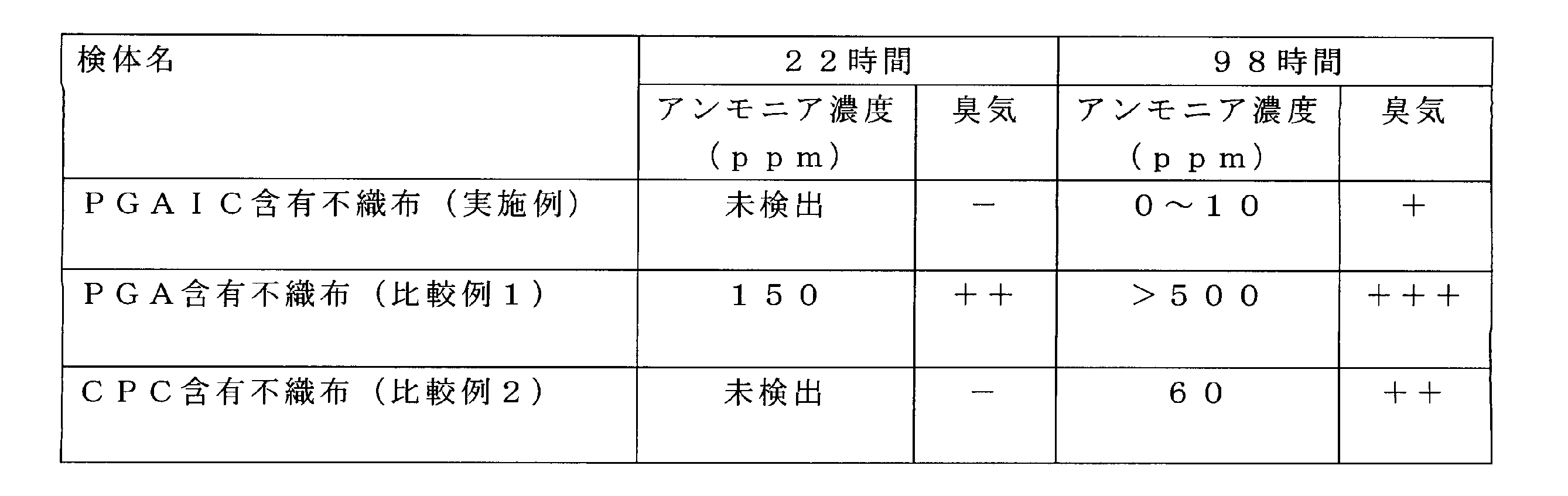
なお、表2において、臭気の判定は、下記に示す基準により判定した。
-:臭気が感じられない。
+:少量の臭気を感じるが、通常では感知し難い。
++:強い臭気を感じる。
+++:猛烈な臭気を感じる。
-:臭気が感じられない。
+:少量の臭気を感じるが、通常では感知し難い。
++:強い臭気を感じる。
+++:猛烈な臭気を感じる。
(実施例3)PGAIC含有不織布の化学的消臭試験
製造例2で得られたPGAIC含有不織布(20cm×20cm)、および製造例3で得られたPGAの不織布(20cm×20cm)を3L容量の気密性容器に入れ、100ppmのアンモニアガスを噴霧した。2時間後、アンモニアガス検知管にてアンモニア濃度を分析した。その結果、製造例2で作製したPGAIC含有不織布(実施例)のアンモニア濃度が100ppmから77ppmまで減少し、その効果は製造例3で作製した不織布(比較例)を上回っていた。結果を表3に示す。本結果により、PGAICは、実施例2に示す生物学的消臭効果だけでなく、アンモニアを化学的に捕捉する効果も有することが認められた。
製造例2で得られたPGAIC含有不織布(20cm×20cm)、および製造例3で得られたPGAの不織布(20cm×20cm)を3L容量の気密性容器に入れ、100ppmのアンモニアガスを噴霧した。2時間後、アンモニアガス検知管にてアンモニア濃度を分析した。その結果、製造例2で作製したPGAIC含有不織布(実施例)のアンモニア濃度が100ppmから77ppmまで減少し、その効果は製造例3で作製した不織布(比較例)を上回っていた。結果を表3に示す。本結果により、PGAICは、実施例2に示す生物学的消臭効果だけでなく、アンモニアを化学的に捕捉する効果も有することが認められた。
(実施例4)PGAIC含有不織布の皮膚への転写試験
製造例2で得られたPGAIC含有不織布をヒトの皮膚へ接触し、1分間接触後のPGAICの転写をIR-ATR法(JASCO社製、FT-IR6100)で分析した。流水後の皮膚は1590cm-1、1500cm-1にPGAIC由来の吸収帯を示し、皮膚への転写が確認された。図2にその結果を示す。図中、(1)は未加工の不織布を接触した皮膚、(2)はPGAIC転写後の皮膚、(3)はPGAIC転写後に流水で洗浄した皮膚、(4)はPGAIC転写後に洗剤で洗浄した皮膚の結果をそれぞれ示す。図2から明らかな通り、PGAICが皮膚に転写されている。 これらの結果から、PGAICによる皮膚のスキンケア作用及び刺激性物質による刺激の緩和が認められた。
製造例2で得られたPGAIC含有不織布をヒトの皮膚へ接触し、1分間接触後のPGAICの転写をIR-ATR法(JASCO社製、FT-IR6100)で分析した。流水後の皮膚は1590cm-1、1500cm-1にPGAIC由来の吸収帯を示し、皮膚への転写が確認された。図2にその結果を示す。図中、(1)は未加工の不織布を接触した皮膚、(2)はPGAIC転写後の皮膚、(3)はPGAIC転写後に流水で洗浄した皮膚、(4)はPGAIC転写後に洗剤で洗浄した皮膚の結果をそれぞれ示す。図2から明らかな通り、PGAICが皮膚に転写されている。 これらの結果から、PGAICによる皮膚のスキンケア作用及び刺激性物質による刺激の緩和が認められた。
本発明の衛生用品は、紙おむつ、生理用品、マスク等の衛生用品に含有させ、健康・衛生面で使用中の消臭性、スキンケアが要求される分野で広範囲に利用することができる。
Claims (13)
- ポリ-γ-グルタミン酸とカチオン性殺菌剤から形成されるPGAイオンコンプレックスを特徴とする衛生用品。
- 衛生用品が紙おむつ、生理用品、マスク、ウェットティッシュ、肌着、失禁用パッド、又は、ガーゼである請求項1に記載の衛生用品。
- 前記PGAイオンコンプレックスが肌に触れる側に近い層のシートまたは、布帛に含まれていることを特徴とする請求項1又は2記載の衛生用品。
- 前記PGAイオンコンプレックスが肌に触れる側の少なくとも最上層のシート又は布帛に含まれていることを特徴とする請求項1~3に記載の衛生用品。
- カチオン性殺菌剤が第四級アンモニウム塩である、請求項1~4に記載の衛生用品。
- カチオン性殺菌剤がビグアニド系殺菌剤である、請求項1~5に記載の衛生用品。
- カチオン性殺菌剤が塩化セチルピリジニウム、塩化ベンザルコニウム、塩化ベンゼトニウム、塩酸クロルヘキシジン及びグルコン酸クロルヘキシジンからなる群より選択される1種以上である、請求項1~6に記載の衛生用品。
- ポリ-γ-グルタミン酸を構成するグルタミン酸のうち、L-グルタミン酸の占める割合が90%以上である、請求項1~7のいずれかに記載の衛生用品。
- ポリ-γ-グルタミン酸を構成するグルタミン酸がL-グルタミン酸からなる、請求項1~8に記載の衛生用品。
- 前記のPGAイオンコンプレックスのエタノール溶液を不織布へ含漬又は塗布して使用する、請求項1~9に記載の衛生用品。
- 前記のPGAイオンコンプレックスが衛生用品の不織布又は織編物に0.1~20%含有されている、請求項1~11記載の衛生用品。
- 前記のPGAイオンコンプレックスを含む衛生用品によって、消臭しつつ、同時にスキンケアを行う方法。
- 前記のPGAイオンコンプレックスを含む衛生用品によって、水分や湿気による不快感を低減する方法。
Priority Applications (1)
| Application Number | Priority Date | Filing Date | Title |
|---|---|---|---|
| JP2015525149A JPWO2015001997A1 (ja) | 2013-07-05 | 2014-06-23 | 衛生用品 |
Applications Claiming Priority (2)
| Application Number | Priority Date | Filing Date | Title |
|---|---|---|---|
| JP2013141523 | 2013-07-05 | ||
| JP2013-141523 | 2013-07-05 |
Publications (1)
| Publication Number | Publication Date |
|---|---|
| WO2015001997A1 true WO2015001997A1 (ja) | 2015-01-08 |
Family
ID=52143576
Family Applications (1)
| Application Number | Title | Priority Date | Filing Date |
|---|---|---|---|
| PCT/JP2014/066511 Ceased WO2015001997A1 (ja) | 2013-07-05 | 2014-06-23 | 衛生用品 |
Country Status (3)
| Country | Link |
|---|---|
| JP (1) | JPWO2015001997A1 (ja) |
| TW (1) | TW201521585A (ja) |
| WO (1) | WO2015001997A1 (ja) |
Cited By (4)
| Publication number | Priority date | Publication date | Assignee | Title |
|---|---|---|---|---|
| WO2015156164A1 (ja) * | 2014-04-08 | 2015-10-15 | 東洋紡株式会社 | イオンコンプレックスを含有する藻類抑制剤 |
| JP2018070536A (ja) * | 2016-11-01 | 2018-05-10 | 株式会社桃谷順天館 | アクネ菌株選択的抗菌剤 |
| CN109954161A (zh) * | 2017-12-22 | 2019-07-02 | 北京小鹿科技有限公司 | 一种可生物降解的婴儿纸尿裤及其制备工艺 |
| JP2023151060A (ja) * | 2022-03-31 | 2023-10-16 | 東洋濾紙株式会社 | ポリ-γ-グルタミン酸イオンコンプレックスの製造方法 |
Families Citing this family (1)
| Publication number | Priority date | Publication date | Assignee | Title |
|---|---|---|---|---|
| CN108392322B (zh) * | 2018-02-07 | 2020-12-04 | 爹地宝贝股份有限公司 | 远红外保健卫生巾 |
Citations (5)
| Publication number | Priority date | Publication date | Assignee | Title |
|---|---|---|---|---|
| JP2003027371A (ja) * | 2001-07-16 | 2003-01-29 | Toray Ind Inc | 機能性不織布および衛生材料ならびに清掃用布帛 |
| JP2005533136A (ja) * | 2001-11-06 | 2005-11-04 | イー・アイ・デュポン・ドウ・ヌムール・アンド・カンパニー | 抗菌ポリオレフィン製品およびそれらの製造方法 |
| JP2010222496A (ja) * | 2009-03-24 | 2010-10-07 | Kochi Univ | Pgaイオンコンプレックス |
| JP2012211308A (ja) * | 2011-03-23 | 2012-11-01 | Kochi Univ | 生分解性ハイドロゲルおよびその製造方法 |
| JP2014122203A (ja) * | 2012-11-21 | 2014-07-03 | Toyobo Co Ltd | 抗真菌剤およびコーティング剤 |
-
2014
- 2014-06-23 WO PCT/JP2014/066511 patent/WO2015001997A1/ja not_active Ceased
- 2014-06-23 JP JP2015525149A patent/JPWO2015001997A1/ja not_active Withdrawn
- 2014-07-04 TW TW103123095A patent/TW201521585A/zh unknown
Patent Citations (5)
| Publication number | Priority date | Publication date | Assignee | Title |
|---|---|---|---|---|
| JP2003027371A (ja) * | 2001-07-16 | 2003-01-29 | Toray Ind Inc | 機能性不織布および衛生材料ならびに清掃用布帛 |
| JP2005533136A (ja) * | 2001-11-06 | 2005-11-04 | イー・アイ・デュポン・ドウ・ヌムール・アンド・カンパニー | 抗菌ポリオレフィン製品およびそれらの製造方法 |
| JP2010222496A (ja) * | 2009-03-24 | 2010-10-07 | Kochi Univ | Pgaイオンコンプレックス |
| JP2012211308A (ja) * | 2011-03-23 | 2012-11-01 | Kochi Univ | 生分解性ハイドロゲルおよびその製造方法 |
| JP2014122203A (ja) * | 2012-11-21 | 2014-07-03 | Toyobo Co Ltd | 抗真菌剤およびコーティング剤 |
Cited By (5)
| Publication number | Priority date | Publication date | Assignee | Title |
|---|---|---|---|---|
| WO2015156164A1 (ja) * | 2014-04-08 | 2015-10-15 | 東洋紡株式会社 | イオンコンプレックスを含有する藻類抑制剤 |
| JP2018070536A (ja) * | 2016-11-01 | 2018-05-10 | 株式会社桃谷順天館 | アクネ菌株選択的抗菌剤 |
| WO2018084112A1 (ja) * | 2016-11-01 | 2018-05-11 | 株式会社桃谷順天館 | アクネ菌株選択的抗菌剤 |
| CN109954161A (zh) * | 2017-12-22 | 2019-07-02 | 北京小鹿科技有限公司 | 一种可生物降解的婴儿纸尿裤及其制备工艺 |
| JP2023151060A (ja) * | 2022-03-31 | 2023-10-16 | 東洋濾紙株式会社 | ポリ-γ-グルタミン酸イオンコンプレックスの製造方法 |
Also Published As
| Publication number | Publication date |
|---|---|
| JPWO2015001997A1 (ja) | 2017-02-23 |
| TW201521585A (zh) | 2015-06-16 |
Similar Documents
| Publication | Publication Date | Title |
|---|---|---|
| JP7512375B2 (ja) | 不織布水溶性複合材料構造 | |
| US7381715B2 (en) | Antimicrobial solid surface materials containing chitosan-metal complexes | |
| US20060177489A1 (en) | Attachment of chitosan to surfaces using rehydration process | |
| US20060083710A1 (en) | Process for making antimicrobial polymer articles | |
| CN103118712B (zh) | 抗微生物的一次性吸收制品 | |
| US8043632B2 (en) | Process for making antimicrobial articles by reacting chitosan with amino-reactive polymer surfaces | |
| JPWO2015001997A1 (ja) | 衛生用品 | |
| US20030091612A1 (en) | Antimicrobial polyolefin articles and methods for their preparation | |
| JP3687219B2 (ja) | 抗菌性繊維及びそれを用いた繊維製品 | |
| US20060177490A1 (en) | Chitosan-base antimicrobial thermoplastic polymer blends | |
| TWI568809B (zh) | 病毒不活化劑 | |
| JP6488473B2 (ja) | 抗真菌剤およびコーティング剤 | |
| US8486428B2 (en) | Compositions and methods for making and using acyclic N-halamine-based biocidal polymeric materials and articles | |
| WO2016121539A1 (ja) | 耐水耐有機溶媒性組成物 | |
| CN109381371A (zh) | 一种具有清凉功能的抗菌湿纸巾 | |
| JP4311001B2 (ja) | 消臭性繊維及びそれを用いた繊維成形品 | |
| JP2008202195A (ja) | 湿潤ワイパー | |
| JP6497613B2 (ja) | ポリ(メタ)アクリル酸イオンコンプレックス | |
| JP2015168659A (ja) | 液体消臭除菌剤組成物 | |
| JP2018109241A (ja) | 使い捨て衣類 | |
| CN102851778A (zh) | 物理抗病毒无纺布的制造方法 | |
| KR19990075848A (ko) | 항균 기능을 가진 일회용 기저귀 | |
| CN108505329A (zh) | 一种用于一次性卫生用品的阻燃抗菌除臭整理液 |
Legal Events
| Date | Code | Title | Description |
|---|---|---|---|
| 121 | Ep: the epo has been informed by wipo that ep was designated in this application |
Ref document number: 14820453 Country of ref document: EP Kind code of ref document: A1 |
|
| ENP | Entry into the national phase |
Ref document number: 2015525149 Country of ref document: JP Kind code of ref document: A |
|
| NENP | Non-entry into the national phase |
Ref country code: DE |
|
| 122 | Ep: pct application non-entry in european phase |
Ref document number: 14820453 Country of ref document: EP Kind code of ref document: A1 |