WO2014199662A1 - フェノール性水酸基含有化合物、フェノール樹脂、硬化性組成物、その硬化物、半導体封止材料、及びプリント配線基板 - Google Patents
フェノール性水酸基含有化合物、フェノール樹脂、硬化性組成物、その硬化物、半導体封止材料、及びプリント配線基板 Download PDFInfo
- Publication number
- WO2014199662A1 WO2014199662A1 PCT/JP2014/054141 JP2014054141W WO2014199662A1 WO 2014199662 A1 WO2014199662 A1 WO 2014199662A1 JP 2014054141 W JP2014054141 W JP 2014054141W WO 2014199662 A1 WO2014199662 A1 WO 2014199662A1
- Authority
- WO
- WIPO (PCT)
- Prior art keywords
- compound
- group
- hydroxyl group
- phenolic hydroxyl
- curable composition
- Prior art date
- Legal status (The legal status is an assumption and is not a legal conclusion. Google has not performed a legal analysis and makes no representation as to the accuracy of the status listed.)
- Ceased
Links
- 0 C*CCc(cccc1-c(cc(c2c3cccc2)O)c3O)c1O Chemical compound C*CCc(cccc1-c(cc(c2c3cccc2)O)c3O)c1O 0.000 description 5
- OXNLYFQEKALYIP-UHFFFAOYSA-N Cc1c(-c(cc(c2c3cccc2)O)c3O)c(O)ccc1 Chemical compound Cc1c(-c(cc(c2c3cccc2)O)c3O)c(O)ccc1 OXNLYFQEKALYIP-UHFFFAOYSA-N 0.000 description 1
- IMMFSVGFKRCLOK-UHFFFAOYSA-N Cc1cc(-c(cc(c2c3cccc2)O)c3O)ccc1O Chemical compound Cc1cc(-c(cc(c2c3cccc2)O)c3O)ccc1O IMMFSVGFKRCLOK-UHFFFAOYSA-N 0.000 description 1
Images



Classifications
-
- C—CHEMISTRY; METALLURGY
- C08—ORGANIC MACROMOLECULAR COMPOUNDS; THEIR PREPARATION OR CHEMICAL WORKING-UP; COMPOSITIONS BASED THEREON
- C08G—MACROMOLECULAR COMPOUNDS OBTAINED OTHERWISE THAN BY REACTIONS ONLY INVOLVING UNSATURATED CARBON-TO-CARBON BONDS
- C08G8/00—Condensation polymers of aldehydes or ketones with phenols only
- C08G8/02—Condensation polymers of aldehydes or ketones with phenols only of ketones
-
- C—CHEMISTRY; METALLURGY
- C07—ORGANIC CHEMISTRY
- C07C—ACYCLIC OR CARBOCYCLIC COMPOUNDS
- C07C39/00—Compounds having at least one hydroxy or O-metal group bound to a carbon atom of a six-membered aromatic ring
- C07C39/12—Compounds having at least one hydroxy or O-metal group bound to a carbon atom of a six-membered aromatic ring polycyclic with no unsaturation outside the aromatic rings
- C07C39/15—Compounds having at least one hydroxy or O-metal group bound to a carbon atom of a six-membered aromatic ring polycyclic with no unsaturation outside the aromatic rings with all hydroxy groups on non-condensed rings, e.g. phenylphenol
-
- C—CHEMISTRY; METALLURGY
- C08—ORGANIC MACROMOLECULAR COMPOUNDS; THEIR PREPARATION OR CHEMICAL WORKING-UP; COMPOSITIONS BASED THEREON
- C08G—MACROMOLECULAR COMPOUNDS OBTAINED OTHERWISE THAN BY REACTIONS ONLY INVOLVING UNSATURATED CARBON-TO-CARBON BONDS
- C08G59/00—Polycondensates containing more than one epoxy group per molecule; Macromolecules obtained by polymerising compounds containing more than one epoxy group per molecule using curing agents or catalysts which react with the epoxy groups
- C08G59/18—Macromolecules obtained by polymerising compounds containing more than one epoxy group per molecule using curing agents or catalysts which react with the epoxy groups ; e.g. general methods of curing
- C08G59/40—Macromolecules obtained by polymerising compounds containing more than one epoxy group per molecule using curing agents or catalysts which react with the epoxy groups ; e.g. general methods of curing characterised by the curing agents used
- C08G59/62—Alcohols or phenols
- C08G59/621—Phenols
-
- C—CHEMISTRY; METALLURGY
- C08—ORGANIC MACROMOLECULAR COMPOUNDS; THEIR PREPARATION OR CHEMICAL WORKING-UP; COMPOSITIONS BASED THEREON
- C08G—MACROMOLECULAR COMPOUNDS OBTAINED OTHERWISE THAN BY REACTIONS ONLY INVOLVING UNSATURATED CARBON-TO-CARBON BONDS
- C08G61/00—Macromolecular compounds obtained by reactions forming a carbon-to-carbon link in the main chain of the macromolecule
- C08G61/02—Macromolecular compounds containing only carbon atoms in the main chain of the macromolecule, e.g. polyxylylenes
-
- C—CHEMISTRY; METALLURGY
- C08—ORGANIC MACROMOLECULAR COMPOUNDS; THEIR PREPARATION OR CHEMICAL WORKING-UP; COMPOSITIONS BASED THEREON
- C08L—COMPOSITIONS OF MACROMOLECULAR COMPOUNDS
- C08L61/00—Compositions of condensation polymers of aldehydes or ketones; Compositions of derivatives of such polymers
- C08L61/04—Condensation polymers of aldehydes or ketones with phenols only
- C08L61/16—Condensation polymers of aldehydes or ketones with phenols only of ketones with phenols
-
- H—ELECTRICITY
- H05—ELECTRIC TECHNIQUES NOT OTHERWISE PROVIDED FOR
- H05K—PRINTED CIRCUITS; CASINGS OR CONSTRUCTIONAL DETAILS OF ELECTRIC APPARATUS; MANUFACTURE OF ASSEMBLAGES OF ELECTRICAL COMPONENTS
- H05K1/00—Printed circuits
- H05K1/02—Details
- H05K1/03—Use of materials for the substrate
- H05K1/0313—Organic insulating material
- H05K1/0353—Organic insulating material consisting of two or more materials, e.g. two or more polymers, polymer + filler, + reinforcement
- H05K1/0373—Organic insulating material consisting of two or more materials, e.g. two or more polymers, polymer + filler, + reinforcement containing additives, e.g. fillers
-
- H—ELECTRICITY
- H05—ELECTRIC TECHNIQUES NOT OTHERWISE PROVIDED FOR
- H05K—PRINTED CIRCUITS; CASINGS OR CONSTRUCTIONAL DETAILS OF ELECTRIC APPARATUS; MANUFACTURE OF ASSEMBLAGES OF ELECTRICAL COMPONENTS
- H05K1/00—Printed circuits
- H05K1/02—Details
- H05K1/09—Use of materials for the conductive, e.g. metallic pattern
-
- C—CHEMISTRY; METALLURGY
- C08—ORGANIC MACROMOLECULAR COMPOUNDS; THEIR PREPARATION OR CHEMICAL WORKING-UP; COMPOSITIONS BASED THEREON
- C08L—COMPOSITIONS OF MACROMOLECULAR COMPOUNDS
- C08L65/00—Compositions of macromolecular compounds obtained by reactions forming a carbon-to-carbon link in the main chain; Compositions of derivatives of such polymers
-
- H—ELECTRICITY
- H10—SEMICONDUCTOR DEVICES; ELECTRIC SOLID-STATE DEVICES NOT OTHERWISE PROVIDED FOR
- H10W—GENERIC PACKAGES, INTERCONNECTIONS, CONNECTORS OR OTHER CONSTRUCTIONAL DETAILS OF DEVICES COVERED BY CLASS H10
- H10W74/00—Encapsulations, e.g. protective coatings
- H10W74/40—Encapsulations, e.g. protective coatings characterised by their materials
- H10W74/47—Encapsulations, e.g. protective coatings characterised by their materials comprising organic materials, e.g. plastics or resins
- H10W74/473—Encapsulations, e.g. protective coatings characterised by their materials comprising organic materials, e.g. plastics or resins containing a filler
Definitions
- the present invention relates to a phenolic hydroxyl group-containing compound having excellent heat resistance and flame retardancy in a cured product, a phenol resin containing the compound, a curable composition and a cured product thereof, a semiconductor sealing material, and a printed wiring board.
- Phenolic resins are used as curing agents for epoxy resins, for example, and epoxy resin compositions that use phenolic resins as curing agents are not only adhesives, molding materials, and coating materials, but also cured products with heat resistance and moisture resistance. Because of its excellent point, it is widely used in the electrical and electronic fields such as semiconductor sealing materials and insulating materials for printed wiring boards.
- power semiconductors represented by in-vehicle power modules
- in-vehicle power modules are important technologies that hold the key to energy saving in electrical and electronic equipment.
- Si silicon
- SiC silicon carbide
- the advantage of the SiC semiconductor is that it can be operated under higher temperature conditions. Therefore, the semiconductor encapsulant is required to have higher heat resistance than ever before.
- the phenolic hydroxyl group containing compound represented by these is known (refer patent document 1).
- Such a phenolic hydroxyl group-containing compound has a feature of excellent heat resistance in a cured product, but is not sufficiently flame retardant.
- the problem to be solved by the present invention is a phenolic hydroxyl group-containing compound excellent in heat resistance and flame retardancy in a cured product, a phenol resin containing the compound, a curable composition and its cured product, a semiconductor sealing material, and It is to provide a printed wiring board.
- the present inventors have found that the reaction product of a compound having a quinone skeleton and a hydrocarbon group or alkoxy group-containing phenol is bonded to aromatic nuclei without involving a methylene chain. Since it has a molecular structure with a high hydroxyl group concentration and the reactivity of the hydroxyl group is high, it has been found that the cured product is excellent in heat resistance and flame retardancy, and the present invention has been completed.
- R 1 and R 2 are each an alkyl group having 1 to 4 carbon atoms, an alkoxy group having 1 to 4 carbon atoms, an aryl group, or an aralkyl group, Is an integer from 0 to 3, and n is an integer from 0 to 4.
- l or n is 2 or more, the plurality of R 1 or R 2 may be the same or different from each other.
- K is an integer of 1 to 3
- m is 1 or 2
- Ar is the following structural formula (Ar1)
- R 3 is any one of an alkyl group having 1 to 4 carbon atoms, an alkoxy group having 1 to 4 carbon atoms, an aryl group, and an aralkyl group, and q is an integer of 1 to 4.
- q is In the case of 2 or more, the plurality of R 3 may be the same or different from each other, and p is 1 or 2.
- ⁇ It is a structural site represented by ]
- the present invention further relates to a phenol resin containing the phenolic hydroxyl group-containing compound.
- the present invention further relates to a method for producing a phenol resin, characterized by reacting a compound (Q) having a quinone structure in the molecular structure with a compound (P) having a naphthol or dihydroxynaphthalene skeleton.
- the present invention further relates to a phenol resin produced by the production method.
- the present invention further relates to a curable composition containing the phenolic hydroxyl group-containing compound or phenol resin and a curing agent as essential components.
- the present invention further relates to a cured product obtained by curing reaction of the curable composition.
- the present invention further relates to a semiconductor sealing material containing an inorganic filler in addition to the curable composition.
- the present invention further relates to a printed wiring board obtained by impregnating a reinforced composition with an organic solvent and varnishing the resin composition, impregnating a reinforcing base material, and stacking a copper foil and heat-pressing it.
- a phenolic hydroxyl group-containing compound having a low melt viscosity and excellent heat resistance and flame retardancy in a cured product, a phenol resin containing the same, a curable composition and its cured product, a semiconductor sealing material, and a print A wiring board can be provided.
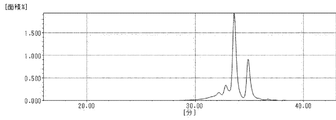
- FIG. 1 is a GPC chart of the phenol resin (1) obtained in Example 1.
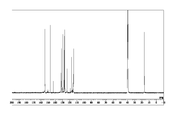
- FIG. FIG. 2 is a 13C-NMR chart of the phenol resin (1) obtained in Example 1.
- FIG. 3 is an MS spectrum of the phenol resin (1) obtained in Example 1.
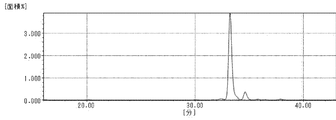
- FIG. 4 is a GPC chart of the phenol resin (2) obtained in Example 2.
- FIG. 5 is a GPC chart of the phenol resin (3) obtained in Example 3.
- FIG. 6 is an MS spectrum of the phenol resin (3) obtained in Example 3.
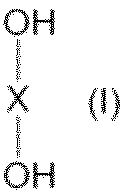
- the phenolic hydroxyl group-containing compound of the present invention has the following general formula (I)
- R 1 and R 2 are each an alkyl group having 1 to 4 carbon atoms, an alkoxy group having 1 to 4 carbon atoms, an aryl group, or an aralkyl group, Is an integer from 0 to 3, and n is an integer from 0 to 4.
- l or n is 2 or more, the plurality of R 1 or R 2 may be the same or different from each other.
- K is an integer of 1 to 3
- m is 1 or 2
- Ar is the following structural formula (Ar1)
- R 3 is any one of an alkyl group having 1 to 4 carbon atoms, an alkoxy group having 1 to 4 carbon atoms, an aryl group, and an aralkyl group, and q is an integer of 1 to 4.
- q is In the case of 2 or more, the plurality of R 3 may be the same or different from each other, and p is 1 or 2.
- ⁇ It is a structural site represented by ] It has the molecular structure represented by these.
- the phenolic hydroxyl group-containing compound of the present invention represented by the general formula (I) has a structure in which aromatic nuclei are bonded to each other without a methylene chain, the molecular weight is low, and the aromatic ring and hydroxyl group concentration is low. It has high characteristics.
- Such a compound is excellent in the heat resistance of the cured product, but has a high flammable hydroxyl group concentration and tends to be inferior in flame retardancy due to the presence of many reactive groups in close proximity.
- the phenolic hydroxyl group-containing compound of the present invention has a biphenyl skeleton or a terphenyl skeleton, and in the structural formula (x1) or (x2), two hydroxyl groups located at the para position of the aromatic nucleus are reactive. Since it is excellent, it has the characteristics which are excellent in both the heat resistance in a hardened
- the compound represented by the general formula (I) includes, for example, a compound (Q) having a quinone structure in the molecular structure and a hydrocarbon group or alkoxy group-containing phenol (P) under non-catalytic or acid-catalyzed conditions. And those produced by a method of reacting in a temperature range of 40 to 180 ° C.
- any component is selectively produced depending on the reaction conditions, or it is produced as a phenol resin that is a mixture of a plurality of types of phenolic hydroxyl group-containing compounds. I can do it.
- the compound (Q) having a quinone structure in the molecular structure is, for example, the following structural formula (Q1) or (Q2)
- R 1 and R 2 are each an alkyl group having 1 to 4 carbon atoms, an alkoxy group having 1 to 4 carbon atoms, an aryl group, or an aralkyl group; Is an integer from 0 to 3, and n is an integer from 0 to 4.
- the plurality of R 1 or R 2 may be the same or different from each other.
- Specific examples include parabenzoquinone, 2-methylbenzoquinone, 2,3,5-trimethyl-benzoquinone, naphthoquinone, and the like. These may be used alone or in combination of two or more.
- the hydrocarbon group or alkoxy group-containing phenol (P) is, for example, the following structural formula (P1)
- R 3 is an alkyl group having 1 to 4 carbon atoms, an alkoxy group having 1 to 4 carbon atoms, an aryl group or an aralkyl group, and q is an integer of 1 to 4 .
- q is 2 or more, the plurality of R 3 may be the same or different.
- P is 1 or 2, respectively.
- Specific examples thereof include orthocresol, metacresol, paracresol, 2,6-dimethylphenol, 2,5-dimethylphenol, 2,4-dimethylphenol, 3,5-dimethylphenol.
- 2,3,4-trimethylphenol 2,3,5-trimethylphenol, 2,3,6-trimethylphenol, 2,4,5-trimethylphenol, 3,4,5-trimethylphenol, 4-isopropylphenol 4-tert-butylphenol, 2-methoxyphenol, 3-methoxyphenol, 4-methoxyphenol, 2-methoxy-4-methylphenol, 2-tert-butyl-4-methoxyphenol, 2,6-dimethoxyphenol, 3 , 5-Dimethoxyphenol, 2-ethoxyphenol 3-ethoxy phenol, 4-ethoxy phenol, 2-phenylphenol, 3-phenylphenol, 4-phenylphenol, 4-benzyl-phenol, and the like. These may be used alone or in combination of two or more.
- R 3 in the general formula (P1) is a methyl group
- the value of q in the general formula (P1) is 1 or More preferred is cresol or dimethylphenol which is 2 and the value of p is 1.
- the reaction of the compound (Q) having a quinone structure in the molecular structure with a hydrocarbon group or alkoxy group-containing phenol (P) proceeds under non-catalytic conditions because of its high reactivity, but an acid catalyst is used as appropriate.
- an acid catalyst is used as appropriate.
- the acid catalyst used here include inorganic acids such as hydrochloric acid, sulfuric acid, and phosphoric acid, organic acids such as methanesulfonic acid, p-toluenesulfonic acid, and oxalic acid, boron trifluoride, anhydrous aluminum chloride, and zinc chloride. And Lewis acid.
- these acid catalysts it is preferably used in an amount of 5.0% by mass or less based on the total mass of the compound (Q) having the quinone structure and the hydrocarbon group or alkoxy group-containing phenol (P). .
- the reaction is preferably performed under solvent-free conditions, but may be performed in an organic solvent as necessary.
- organic solvent used here include methyl cellosolve, isopropyl alcohol, ethyl cellosolve, toluene, xylene, and methyl isobutyl ketone.
- the organic solvent is added in an amount of 50 to 50 parts per 100 parts by weight in total of the compound (Q) having a quinone structure and the hydrocarbon group or alkoxy group-containing phenol (P). It is preferable to use it in a proportion that is in the range of 200 parts by mass
- the desired phenolic hydroxyl group-containing compound or phenol resin is obtained by drying under reduced pressure. Can be obtained.
- the compound of the present invention has excellent heat resistance and flame retardancy in a cured product. is there.
- the more preferable thing of the phenolic hydroxyl group containing compound which has a structure represented by the said general formula (I) is explained in full detail.
- R 3 is any one of an alkyl group having 1 to 4 carbon atoms, an alkoxy group having 1 to 4 carbon atoms, an aryl group, and an aralkyl group, and q is an integer of 1 to 4.
- q is In the case of 2 or more, the plurality of R 3 may be the same or different from each other, and p is 1 or 2.
- It is a structural site represented by When k or m is 2 or more, the plurality of Ars may be the same or different.
- a phenolic hydroxyl group-containing compound represented by any of the above.
- the phenolic hydroxyl group-containing compound represented by the structural formula (I-1) is more specifically represented by the following structural formulas (1) to (3).
- k is an integer of 1 to 3
- R 4 is an alkyl group having 1 to 4 carbon atoms, an alkoxy group having 1 to 4 carbon atoms, an aryl group, or an aralkyl group.
- U is an integer of 1 to 4.
- u is 2 or more, the plurality of R 4 may be the same or different from each other.
- the phenolic hydroxyl group-containing compound represented by the structural formula (1) is particularly excellent in heat resistance and flame retardancy in a cured product among the phenolic hydroxyl group-containing compounds of the present invention represented by the general formula (I).
- the binuclear compound (x1) having a k value of 1 in the structural formula (1) and the k value in the structural formula (1) is particularly excellent in heat resistance and flame retardancy in a cured product.
- the binuclear compound (x1) having a k value of 1 in the structural formula (1) and the k value in the structural formula (1) is preferably used as a phenol resin containing a trinuclear compound (x2) in which 2 is 2, and the content of the dinuclear compound (x1) in the phenol resin is 2 to 50% in terms of area ratio in GPC measurement More preferably, the content ratio of the trinuclear compound (x2) is in the range of 10 to 95% as an area ratio in GPC measurement.
- the content of the binuclear compound (x1) in the phenol resin is in the range of 2 to 35% in terms of the area ratio in GPC measurement, and the content of the trinuclear compound (x2) is in GPC measurement.
- An area ratio of 30 to 90% is particularly preferable.
- a phenol resin containing the tetranuclear compound (x3 ′) represented by the formula and at this time, the total of the tetranuclear compound (x3) and the tetranuclear compound (x3 ′) in the phenolic resin
- the content of is preferably in the range of 2 to 20% in terms of area ratio in GPC measurement.
- the binuclear compound (x1), the trinuclear compound (x2), the tetranuclear compound (x3), the tetranuclear compound (x3 ′), and other components in the phenol resin is the ratio of the peak area of each component to the total peak area of the phenol resin, calculated from GPC measurement data under the following conditions.
- the compound represented by the structural formula (1) uses, for example, parabenzoquinone as the compound (Q) having a quinone structure in the molecular structure, and cresol as the hydrocarbon group or alkoxy group-containing phenol (P), It can be manufactured by the method described above. At this time, the reaction ratio of parabenzoquinone and cresol is low in melt viscosity, and a phenol resin having further excellent heat resistance and flame retardancy in a cured product can be obtained. Therefore, naphthol is 0.1 to 1 mol per mol of parabenzoquinone. The ratio is preferably in the range of 10.0 mol.
- the cresol used here may be any of ortho-cresol, meta-cresol, and para-cresol, and a plurality of types may be used in combination. Among them, orthocresol is preferable because a phenol resin having a low melt viscosity and excellent heat resistance and flame retardancy in a cured product can be obtained.
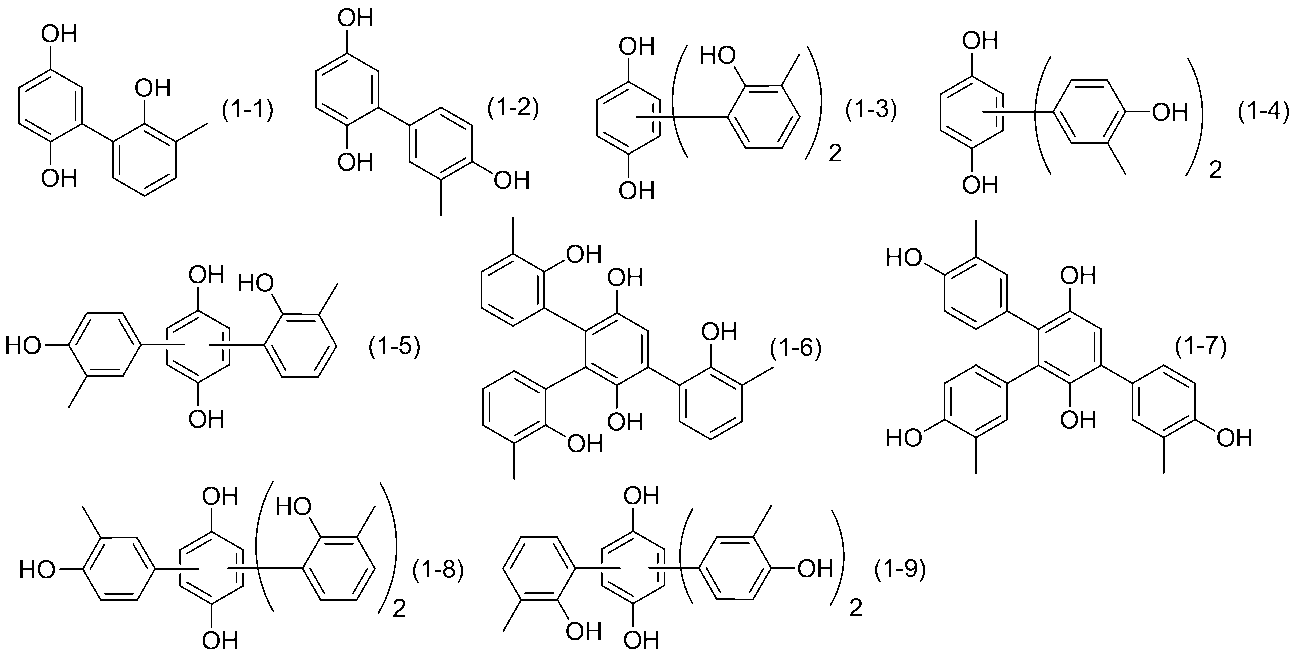
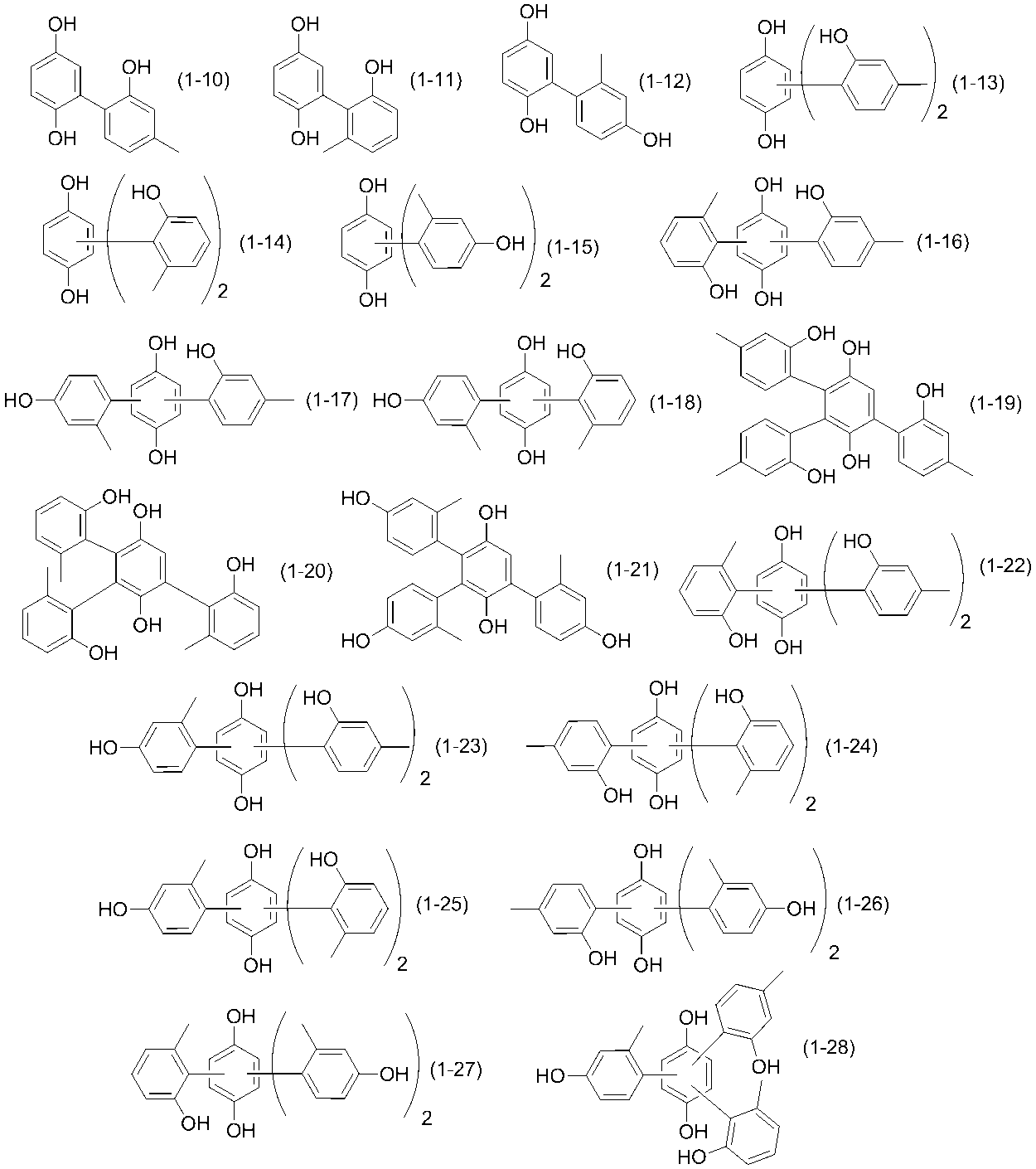
- the compounds represented by the structural formula (1) include, for example, the following structural formulas (1-1) to (1-31).
- the phenolic hydroxyl group-containing compound represented by the structural formula (2) is excellent in heat resistance and flame retardancy in a cured product, among the phenolic hydroxyl group-containing compounds of the present invention represented by the general formula (I). Has characteristics.
- the binuclear compound (x1) having a k value of 1 in the structural formula (2) and the k value in the structural formula (2) is preferably used as a phenol resin containing a trinuclear compound (x2) in which 2 is 2, and the content of the dinuclear compound (x1) in the phenol resin is 2 to 50% in terms of area ratio in GPC measurement More preferably, the content ratio of the trinuclear compound (x2) is in the range of 10 to 95% in terms of area ratio in GPC measurement.
- the content of the binuclear compound (x1) in the epoxy resin is in the range of 2 to 35% as an area ratio in GPC measurement, and the content of the trinuclear compound (x2) is in GPC measurement.
- An area ratio of 30 to 95% is particularly preferable.
- a phenol resin containing the tetranuclear compound (x3 ′) represented by the formula and at this time, the tetranuclear compound (x3) and the tetranuclear compound (x3 ′) in the phenolic resin
- the total content is preferably in the range of 2 to 20% in terms of area ratio in GPC measurement.
- the phenolic hydroxyl group-containing compound represented by the structural formula (2) is, for example, parabenzoquinone as the compound (Q) having a quinone structure in the molecular structure, and the hydrocarbon group or alkoxy group-containing phenol (P). It can be produced by the above-described method using dimethylphenol. At this time, the reaction ratio of parabenzoquinone and dimethylphenol has a low melt viscosity, and a phenol resin having further excellent heat resistance and flame retardancy in the cured product can be obtained. The ratio is preferably in the range of 1 to 10.0 mol.
- the dimethylphenol used here may be any positional isomer such as 2,6-dimethylphenol, 2,5-dimethylphenol, 2,4-dimethylphenol, 3,5-dimethylphenol.
- 2,6-dimethylphenol is preferable because a phenol resin having a low melt viscosity and excellent heat resistance and flame retardancy in a cured product can be obtained.
- the compounds represented by the structural formula (2) are, for example, the following structural formulas (2-1) to (2-3)
- the phenolic hydroxyl group-containing compound represented by the structural formula (3) includes, for example, parabenzoquinone as the compound (Q) having a quinone structure in the molecular structure, and the hydrocarbon group or alkoxy group-containing phenol (P).
- parabenzoquinone as the compound (Q) having a quinone structure in the molecular structure
- P hydrocarbon group or alkoxy group-containing phenol
- a phenylphenol compound it can be produced by the method described above. At this time, the reaction ratio between parabenzoquinone and phenylphenol compound is low in melt viscosity, and a phenol resin having further excellent heat resistance and flame retardancy in a cured product can be obtained.
- the ratio is preferably in the range of 0.1 to 10.0 mol.
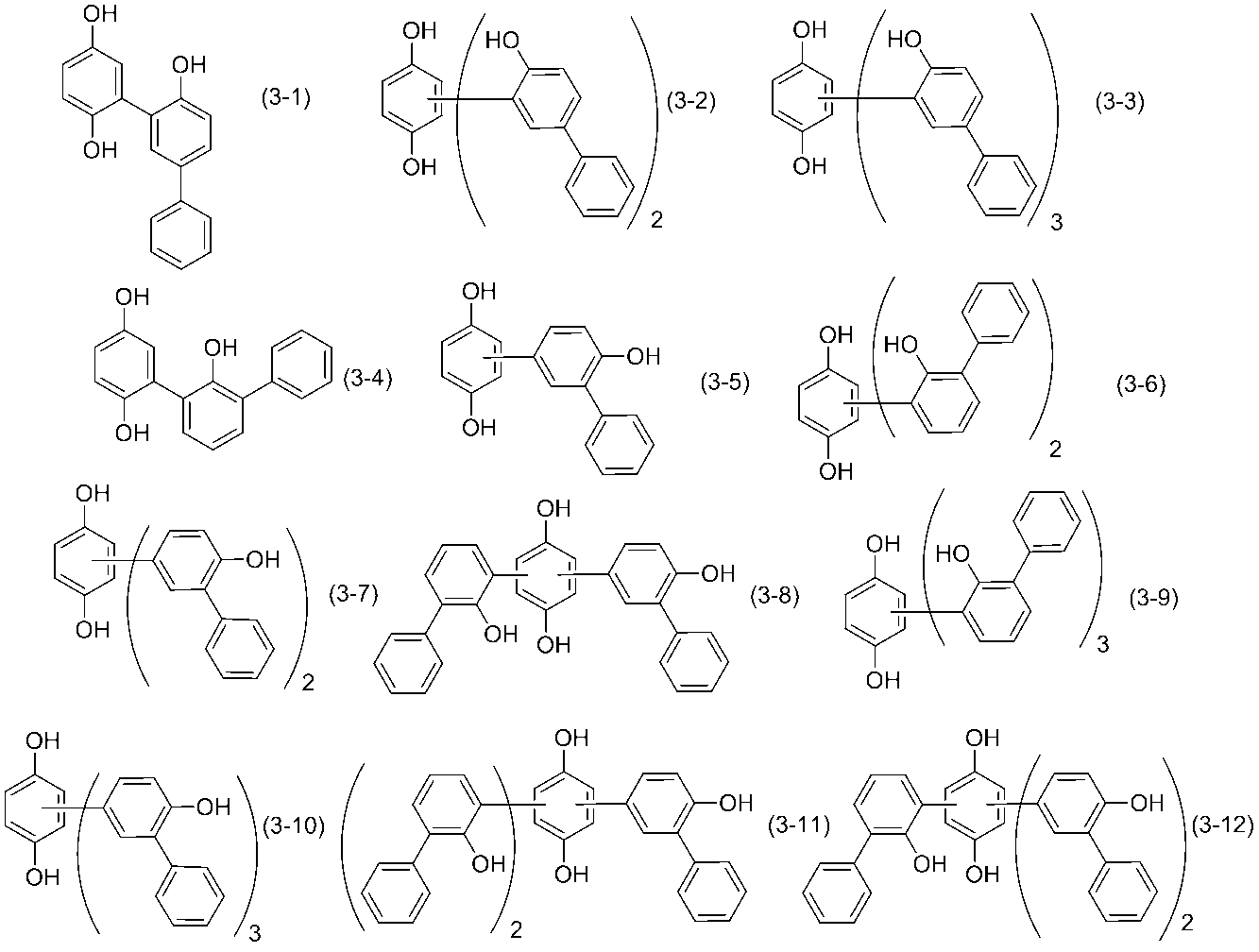
- the compounds represented by the structural formula (3) include, for example, the following structural formulas (3-1) to (3-12)
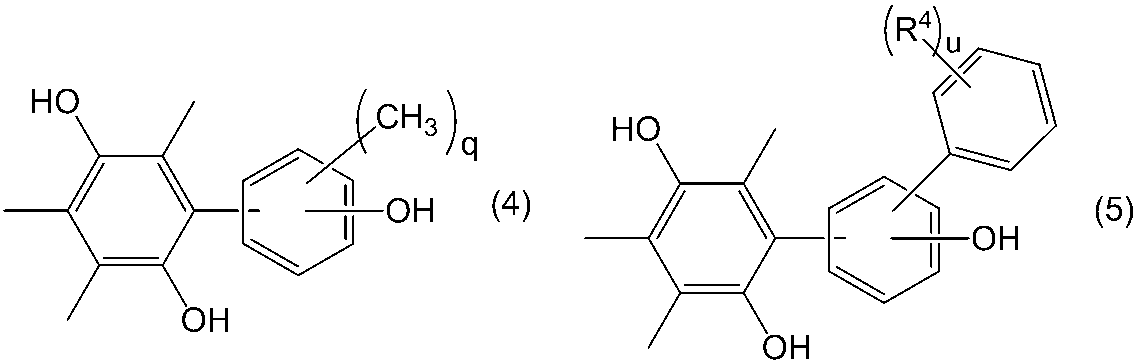
- the phenolic hydroxyl group-containing compound represented by the structural formula (I-2) is more specifically represented by the following structural formula (4) or (5)
- [Q in the formula (4) is 1 or 2
- R 4 in the formula (5) is an alkyl group having 1 to 4 carbon atoms, an alkoxy group having 1 to 4 carbon atoms, an aryl group, or an aralkyl group.
- u is an integer of 1 to 4.
- the plurality of R 4 may be the same or different from each other.
- the phenolic hydroxyl group-containing compound represented by the structural formula (4) includes, for example, 2,3,5-trimethyl-parabenzoquinone as the compound (Q) having a quinone structure in the molecular structure, the hydrocarbon group or It can be produced by the above-described method using cresol or dimethylphenol as the alkoxy group-containing phenol (P).
- the reaction ratio between 2,3,5-trimethyl-parabenzoquinone and cresol or dimethylphenol is low because melt viscosity is low, and a phenol resin having further excellent heat resistance and flame retardancy in a cured product can be obtained.
- 3,5-trimethyl-parabenzoquinone is preferably in a ratio of cresol or dimethylphenol in the range of 0.1 to 10.0 mol.
- the compounds represented by the structural formula (4) include, for example, the following structural formulas (4-1) to (4-7).
- the phenolic hydroxyl group-containing compound represented by the structural formula (5) includes, for example, 2,3,5-trimethyl-parabenzoquinone as the compound (Q) having a quinone structure in the molecular structure, the hydrocarbon group or A phenylphenol compound can be used as the alkoxy group-containing phenol (P) and can be produced by the method described above.
- the reaction ratio of 2,3,5-trimethyl-parabenzoquinone and the phenylphenol compound is low, the melt viscosity is low, and a phenol resin having further excellent heat resistance and flame retardancy in the cured product can be obtained.
- the ratio is preferably such that the phenylphenol compound is in the range of 0.1 to 10.0 moles per mole of 3,5-trimethyl-parabenzoquinone.
- the compounds represented by the structural formula (5) include, for example, the following structural formulas (5-1) to (5-3)
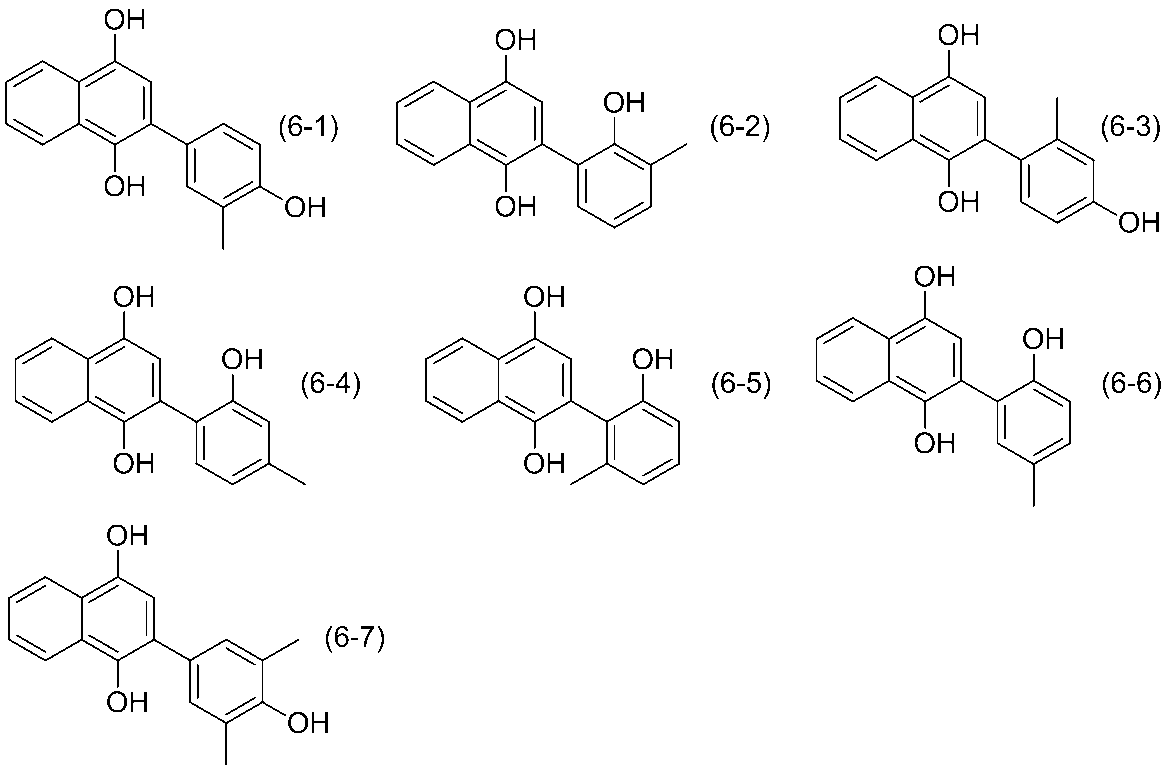
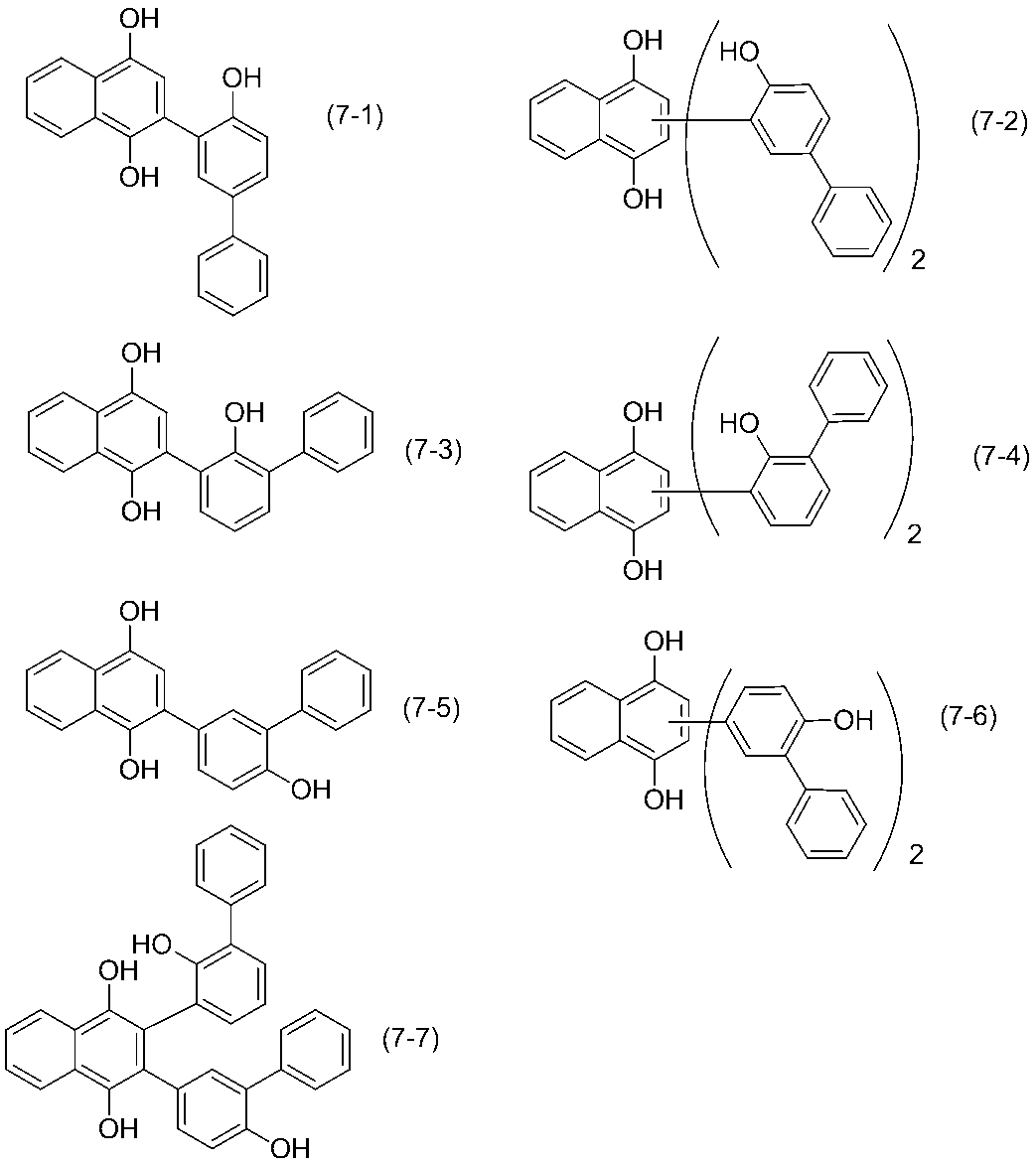
- the phenolic hydroxyl group-containing compound represented by the structural formula (I-3) is more specifically represented by the following structural formula (6) or (7)
- R 4 is an alkyl group having 1 to 4 carbon atoms, an alkoxy group having 1 to 4 carbon atoms, an aryl group or an aralkyl group, and u is It is an integer from 1 to 4. When u is 2 or more, the plurality of R 4 may be the same or different from each other.
- a phenolic hydroxyl group-containing compound represented by any of the above.
- the phenolic hydroxyl group-containing compound represented by the structural formula (6) includes, for example, naphthoquinone as the compound (Q) having a quinone structure in the molecular structure, and cresol as the hydrocarbon group or alkoxy group-containing phenol (P). Or it can manufacture by the above-mentioned method using dimethylphenol. At this time, the reaction ratio between naphthoquinone and cresol or dimethylphenol is such that the melt viscosity is low, and a phenol resin that is more excellent in heat resistance and flame retardancy in a cured product can be obtained. Is preferably in the range of 0.1 to 10.0 mol.
- the compounds represented by the structural formula (6) include, for example, the following structural formulas (6-1) to (6-7).
- the phenolic hydroxyl group-containing compound represented by the structural formula (7) includes, for example, naphthoquinone as the compound (Q) having a quinone structure in the molecular structure and phenyl as the hydrocarbon group or alkoxy group-containing phenol (P). It can be produced by the above-described method using a phenol compound. At this time, the reaction ratio between naphthoquinone and the phenylphenol compound is such that the melt viscosity is low, and a phenol resin having further excellent heat resistance and flame retardancy in the cured product can be obtained. The ratio is preferably in the range of 1 to 10.0 mol.
- the compounds represented by the structural formula (7) are, for example, the following structural formulas (7-1) to (7-7).
- the phenolic hydroxyl group-containing compound represented by the structural formula (1) or (2) is preferable in terms of excellent balance between heat resistance and flame retardancy of the cured product.
- the phenol resin containing the phenolic hydroxyl group-containing compound of the present invention preferably has a hydroxyl group equivalent of 70 to 150 g / equivalent because it is excellent in curability.
- the curable composition of the present invention comprises the phenolic hydroxyl group-containing compound detailed above or a phenol resin containing the compound and a curing agent as essential components.
- curing agent an epoxy resin is mentioned, for example.
- the epoxy resin used here is 1,6-diglycidyloxynaphthalene, 2,7-diglycidyloxynaphthalene, ⁇ -naphthol novolak type epoxy resin, ⁇ -naphthol novolak type epoxy resin, ⁇ -naphthol / ⁇ -naphthol co-condensation type novolak polyglycidyl ether, naphthol aralkyl type epoxy resin, 1,1-bis (2,7-diglycidyloxy-1-naphthyl) alkane and other naphthalene skeleton-containing epoxy resin; bisphenol A type epoxy resin Bisphenol type epoxy resin such as bisphenol F type epoxy resin; biphenyl type epoxy resin such as biphenyl type epoxy resin and tetramethylbiphenyl type epoxy resin; phenol novolac type epoxy resin, cresol novolac type epoxy resin, Sphenol A novolak type epoxy resin, bisphenol F novolak type epoxy resin, bisphenol
- the compounding ratio of the phenolic hydroxyl group-containing compound or phenol resin and the epoxy resin is equivalent to the phenolic hydroxyl group-containing compound or phenolic hydroxyl group in the phenol resin and the epoxy group in the epoxy resin. It is preferable that the ratio (phenolic hydroxyl group / epoxy group) is 1 / 0.5 to 1 / 1.5 because of excellent reactivity and heat resistance in the cured product.
- an epoxy resin as a hardening
- other curing agents for epoxy resins include various known curing agents such as amine compounds, amide compounds, acid anhydride compounds, and phenol compounds.
- examples of the amine compound include diaminodiphenylmethane, diethylenetriamine, triethylenetetramine, diaminodiphenylsulfone, isophoronediamine, imidazole, BF 3 -amine complex, and guanidine derivative.
- the amide compound include dicyandiamide.
- polyamide resins synthesized from dimer of linolenic acid and ethylenediamine examples include acid anhydride compounds include phthalic anhydride, trimellitic anhydride, pyromellitic anhydride, maleic anhydride, and tetrahydrophthalic anhydride.
- phenolic compounds include phenol novolac resin, cresol novolac resin Aromatic hydrocarbon formaldehyde resin modified phenolic resin, dicyclopentadiene phenol addition type resin, phenol aralkyl resin (Zylok resin), naphthol aralkyl resin, triphenylol methane resin, tetraphenylol ethane resin, naphthol novolak resin, naphthol-phenol co Condensed novolak resin, naphthol-cresol co-condensed novolak resin, biphenyl-modified phenol resin (polyhydric phenol compound in which phenol nucleus is linked by bismethylene group), biphenyl-modified naphthol resin (polyvalent naphthol compound in which phenol nucleus
- the blending ratio of the phenolic hydroxyl group-containing compound or phenolic resin of the present invention and the curing agent for other epoxy resin is excellent in heat resistance and flame retardancy in the cured product. It is not particularly limited as long as the characteristics of the phenolic hydroxyl group-containing compound are utilized. For example, 5 to 95 parts by mass of the phenolic hydroxyl group-containing compound or phenol resin of the present invention in 100 parts by mass of the total of both. It is preferable that it is the range of these.
- the mixture ratio with the said epoxy resin is the phenolic hydroxyl group containing compound or phenol resin of this invention, and the active hydrogen atom which the hardening
- the reactivity and the heat resistance of the cured product are such that the equivalent ratio (active hydrogen atom / epoxy group) of the total and the epoxy group contained in the epoxy resin is 1 / 0.5 to 1 / 1.5. It is preferable because of its excellent resistance.
- a curing accelerator can be used in combination as necessary.
- Various curing accelerators can be used, and examples thereof include phosphorus compounds, tertiary amines, imidazoles, organic acid metal salts, Lewis acids, and amine complex salts.
- imidazole compounds are 2-ethyl-4-methylimidazole
- phosphorus compounds are triphenylphosphine because of their excellent curability, heat resistance, electrical properties, and moisture resistance reliability.
- DBU 1,8-diazabicyclo- [5.4.0] -undecene
- the curable composition of the present invention described in detail above may further contain other additive components depending on the application and desired performance. Specifically, for the purpose of further improving the flame retardancy, a non-halogen flame retardant containing substantially no halogen atom may be blended.
- non-halogen flame retardant examples include a phosphorus flame retardant, a nitrogen flame retardant, a silicone flame retardant, an inorganic flame retardant, and an organic metal salt flame retardant. These may be used alone or in combination.
- the phosphorus flame retardant can be either inorganic or organic.
- the inorganic compound include phosphorous such as red phosphorus, monoammonium phosphate, diammonium phosphate, triammonium phosphate, and ammonium polyphosphate.
- examples thereof include inorganic nitrogen-containing phosphorus compounds such as ammonium acids and phosphoric acid amides.
- the red phosphorus is preferably subjected to a surface treatment for the purpose of preventing hydrolysis and the like, and the surface treatment method is, for example, (i) magnesium hydroxide, aluminum hydroxide, zinc hydroxide, titanium hydroxide, oxidation A method of coating with an inorganic compound such as bismuth, bismuth hydroxide, bismuth nitrate, or a mixture thereof; (ii) inorganic compounds such as magnesium hydroxide, aluminum hydroxide, zinc hydroxide, titanium hydroxide, and phenol resins; (Iii) Double coating with a thermosetting resin such as a phenol resin on a coating of an inorganic compound such as magnesium hydroxide, aluminum hydroxide, zinc hydroxide, or titanium hydroxide. And the like.
- the surface treatment method is, for example, (i) magnesium hydroxide, aluminum hydroxide, zinc hydroxide, titanium hydroxide, oxidation A method of coating with an inorganic compound such as bismuth, bismuth hydroxide,
- organic phosphorus compounds examples include 9,10-dihydro, as well as general-purpose organic phosphorus compounds such as phosphate ester compounds, phosphonic acid compounds, phosphinic acid compounds, phosphine oxide compounds, phosphorane compounds, and organic nitrogen-containing phosphorus compounds.
- the blending amount thereof is appropriately selected depending on the type of the phosphorus-based flame retardant, the other components of the curable composition, and the desired degree of flame retardancy.
- a phenolic hydroxyl group-containing compound or a phenol resin In the case of using red phosphorus as a non-halogen flame retardant in 100 parts by mass of a curable composition containing all of a curing agent, other additives and fillers, the range of 0.1 to 2.0 parts by mass In the case of using an organophosphorus compound, it is preferably blended in the range of 0.1 to 10.0 parts by mass, particularly in the range of 0.5 to 6.0 parts by mass. It is preferable.
- blending amounts are appropriately selected depending on the type of the phosphorus-based flame retardant, the other components of the curable composition, and the desired degree of flame retardancy.
- red phosphorus when used as a non-halogen flame retardant, it is preferably blended in the range of 0.1 to 2.0 parts by mass.
- organic phosphorus compound When an organic phosphorus compound is used, 0.1 to 10.0 parts by mass is similarly applied. It is preferable to mix in the range of 0.5 to 6.0 parts by mass.
- the phosphorous flame retardant when using the phosphorous flame retardant, may be used in combination with hydrotalcite, magnesium hydroxide, boric compound, zirconium oxide, black dye, calcium carbonate, zeolite, zinc molybdate, activated carbon, etc. Good.
- nitrogen flame retardant examples include triazine compounds, cyanuric acid compounds, isocyanuric acid compounds, phenothiazines, and the like, and triazine compounds, cyanuric acid compounds, and isocyanuric acid compounds are preferable.
- triazine compound examples include melamine, acetoguanamine, benzoguanamine, melon, melam, succinoguanamine, ethylene dimelamine, melamine polyphosphate, triguanamine, and the like, for example, (i) guanylmelamine sulfate, melem sulfate, melam sulfate (Ii) Co-condensates of phenolic compounds such as phenol, cresol, xylenol, butylphenol, nonylphenol with melamines such as melamine, benzoguanamine, acetoguanamine, formguanamine and formaldehyde, (iii) (Ii) a mixture of a co-condensate of (ii) and a phenol resin such as a phenol formaldehyde condensate, (iv) a mixture of (ii) and (iii) further modified with paulownia oil, isomerized lins
- cyanuric acid compound examples include cyanuric acid and melamine cyanurate.
- the compounding amount of the nitrogen-based flame retardant is appropriately selected depending on the type of the nitrogen-based flame retardant, the other components of the curable composition, and the desired degree of flame retardancy.
- the curable composition 100 It is preferable to mix in the range of 0.05 to 10 parts by mass, particularly 0.1 to 5 parts by mass.
- a metal hydroxide, a molybdenum compound or the like may be used in combination.
- the silicone flame retardant is not particularly limited as long as it is an organic compound containing a silicon atom, and examples thereof include silicone oil, silicone rubber, and silicone resin.
- the amount of the silicone-based flame retardant is appropriately selected depending on the type of the silicone-based flame retardant, the other components of the curable composition, and the desired degree of flame retardancy.
- the curable composition 100 It is preferable to blend in the range of 0.05 to 20 parts by mass in parts by mass.
- inorganic flame retardant examples include metal hydroxide, metal oxide, metal carbonate compound, metal powder, boron compound, and low melting point glass.
- metal hydroxide examples include aluminum hydroxide, magnesium hydroxide, dolomite, hydrotalcite, calcium hydroxide, barium hydroxide, and zirconium hydroxide.
- metal oxide examples include zinc molybdate, molybdenum trioxide, zinc stannate, tin oxide, aluminum oxide, iron oxide, titanium oxide, manganese oxide, zirconium oxide, zinc oxide, molybdenum oxide, cobalt oxide, bismuth oxide, Examples thereof include chromium oxide, nickel oxide, copper oxide, and tungsten oxide.
- metal carbonate compound examples include zinc carbonate, magnesium carbonate, calcium carbonate, barium carbonate, basic magnesium carbonate, aluminum carbonate, iron carbonate, cobalt carbonate, and titanium carbonate.
- metal powder examples include aluminum, iron, titanium, manganese, zinc, molybdenum, cobalt, bismuth, chromium, nickel, copper, tungsten, and tin.
- Examples of the boron compound include zinc borate, zinc metaborate, barium metaborate, boric acid, and borax.
- low-melting-point glass examples include Shipley (Bokusui Brown), hydrated glass SiO 2 —MgO—H 2 O, PbO—B 2 O 3 system, ZnO—P 2 O 5 —MgO system, and P 2 O 5. Glassy compounds such as —B 2 O 3 —PbO—MgO, P—Sn—O—F, PbO—V 2 O 5 —TeO 2 , Al 2 O 3 —H 2 O, and lead borosilicate Can be mentioned.
- the blending amount of the inorganic flame retardant is appropriately selected depending on the kind of the inorganic flame retardant, the other components of the curable composition, and the desired degree of flame retardancy.
- the curable composition 100 It is preferable to mix in the range of 0.5 to 50 parts by mass, particularly in the range of 5 to 30 parts by mass.
- organometallic salt flame retardant for example, ferrocene, acetylacetonate metal complex, organometallic carbonyl compound, organocobalt salt compound, organosulfonic acid metal salt, metal atom and aromatic compound or heterocyclic compound are ionically bonded or coordinated Examples include a bonded compound.
- the amount of the organic metal salt flame retardant is appropriately selected depending on the type of the organic metal salt flame retardant, the other components of the curable composition, and the desired degree of flame retardancy. Preferably in the range of 0.005 to 10 parts by mass in 100 parts by mass of the composition.
- various compounding agents such as a silane coupling agent, a release agent, a pigment, and an emulsifier can be added to the curable composition of the present invention as necessary.
- an inorganic filler can be blended as necessary.
- the phenolic hydroxyl group-containing compound and phenol resin used in the present invention can be suitably used particularly for semiconductor sealing materials.
- the inorganic filler examples include fused silica, crystalline silica, alumina, silicon nitride, and aluminum hydroxide. Especially, since it becomes possible to mix
- the fused silica can be used in either crushed or spherical shape, but in order to increase the blending amount of the fused silica and to suppress an increase in the melt viscosity of the curable composition, a spherical one is mainly used. It is preferable. Furthermore, in order to increase the blending amount of the spherical silica, it is preferable to appropriately adjust the particle size distribution of the spherical silica.
- the filling rate is preferably in the range of 0.5 to 95 parts by mass in 100 parts by mass of the curable composition.
- a conductive filler such as silver powder or copper powder can be used.
- an organic solvent examples include methyl ethyl ketone, acetone, dimethylformamide, methyl isobutyl ketone, methoxypropanol, cyclohexanone, methyl cellosolve, ethyl diglycol acetate, and propylene glycol monomethyl ether acetate.
- the amount used can be appropriately selected depending on the application. For example, in the printed wiring board application, it is preferable to use a polar solvent having a boiling point of 160 ° C.
- methyl ethyl ketone such as methyl ethyl ketone, acetone, dimethylformamide, and the non-volatile content is 40 to 80% by mass. It is preferable to use in the ratio which becomes.
- organic solvents for example, ketones such as acetone, methyl ethyl ketone, cyclohexanone, acetates such as ethyl acetate, butyl acetate, cellosolve acetate, propylene glycol monomethyl ether acetate, carbitol acetate, It is preferable to use carbitols such as cellosolve and butyl carbitol, aromatic hydrocarbons such as toluene and xylene, dimethylformamide, dimethylacetamide, N-methylpyrrolidone and the like, and the nonvolatile content is 30 to 60% by mass. It is preferable to use in proportions.
- the curable composition of the present invention can be obtained by uniformly mixing the above-described components.
- the curable composition of the present invention in which a phenolic hydroxyl group-containing compound or resin, a curing agent, and, if necessary, a curing accelerator is blended can be easily converted into a cured product by a method similar to a conventionally known method.
- Examples of the cured product include molded cured products such as laminates, cast products, adhesive layers, coating films, and films.
- the phenolic hydroxyl group-containing compound and phenol resin of the present invention have a low melt viscosity and are excellent in heat resistance and flame retardancy in a cured product, and therefore can be used for various electronic materials. Especially, it can use suitably for a semiconductor sealing material application taking advantage of the low melt viscosity.
- the semiconductor encapsulating material is made uniform, for example, using a phenolic hydroxyl group-containing compound or a phenol resin containing the phenolic component of the present invention, a compound such as a curing agent, and a filler, using an extruder, a kneader, a roll, or the like. Can be adjusted by a method of sufficiently mixing.
- the filler used here include the inorganic filler described above.
- the filler is preferably used in the range of 0.5 to 95 parts by mass in 100 parts by mass of the curable composition. Among these, it is preferable to use in the range of 70 to 95 parts by weight, particularly in the range of 80 to 95 parts by weight because flame retardancy, moisture resistance and solder crack resistance are improved and the linear expansion coefficient can be reduced. preferable.
- a method for molding a semiconductor package using the obtained semiconductor sealing material includes, for example, molding the semiconductor sealing material using a casting or transfer molding machine, injection molding machine, etc., and further a temperature of 50 to 200 ° C. Examples of the method include heating for 2 to 10 hours under conditions, and by such a method, a semiconductor device which is a molded product can be obtained.
- the varnish containing the phenolic hydroxyl group-containing compound or phenol resin of the present invention, a curing agent, an organic solvent, other additives, etc. A method of impregnating a reinforcing base material with a curable composition in a shape and stacking a copper foil and heat-pressing it.
- the reinforcing substrate that can be used here include paper, glass cloth, glass nonwoven fabric, aramid paper, aramid cloth, glass mat, and glass roving cloth.
- the varnish-like curable composition described above is first heated at a heating temperature corresponding to the solvent type used, preferably 50 to 170 ° C., so that a prepreg as a cured product is obtained. obtain.
- the mass ratio of the curable composition and the reinforcing substrate used at this time is not particularly limited, but it is usually preferable to prepare so that the resin content in the prepreg is 20 to 60 mass%.
- the prepreg obtained as described above is laminated by a conventional method, and a copper foil is appropriately stacked, and heat-pressed at 170 to 250 ° C. for 10 minutes to 3 hours under a pressure of 1 to 10 MPa, A desired printed circuit board can be obtained.
- GPC Measurement conditions are as follows. Measuring device: “HLC-8220 GPC” manufactured by Tosoh Corporation Column: Guard column “HXL-L” manufactured by Tosoh Corporation + “TSK-GEL G2000HXL” manufactured by Tosoh Corporation + “TSK-GEL G2000HXL” manufactured by Tosoh Corporation + Tosoh Corporation “TSK-GEL G3000HXL” + “TSK-GEL G4000HXL” manufactured by Tosoh Corporation Detector: RI (differential refractometer) Data processing: “GPC-8020 Model II version 4.10” manufactured by Tosoh Corporation Measurement conditions: Column temperature 40 ° C Developing solvent Tetrahydrofuran Flow rate 1.0 ml / min Standard: The following monodisperse polystyrene having a known molecular weight was used according to the measurement manual of “GPC-8020 model II version 4.10”.
- the 13C NMR spectrum is shown in FIG. 2, and the MS spectrum is shown in FIG.
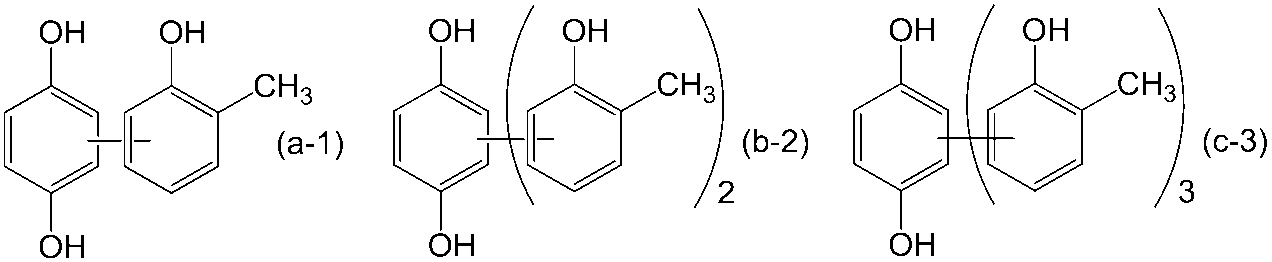
- the hydroxyl group equivalent of the phenol resin (1) is 81 g / equivalent, and from the MS spectrum, 216 peaks corresponding to the dinuclear compound (x1) represented by the following structural formula (a-1), the following structural formula (b- 322 peaks corresponding to the trinuclear compound (x2) represented by 1) and 428 peaks corresponding to the tetranuclear compound (x3) represented by the following structural formula (c-1) were detected.
- the content of the binuclear compound (x1) equivalent component in the phenol resin calculated from the GPC chart is 4.6%
- the content of the trinuclear compound (x2) equivalent component is 88.0%
- the tetranuclear compound was 5.1%.
- the hydroxyl equivalent of the phenol resin (2) was 97 g / equivalent.
- the content of the binuclear compound (x1) equivalent component in the phenol resin calculated from the GPC chart is 25.8%
- the content of the trinuclear compound (x2) equivalent component is 51.7%
- the content of (x3) equivalent component was 10.0%.
- the GPC chart of the obtained phenol resin (3) is shown in FIG. 5, and the MS spectrum is shown in FIG.
- the hydroxyl equivalent of the phenol resin (3) is 88 g / equivalent, and from the MS spectrum, 230 peaks corresponding to the compound represented by the following structural formula (a-2), represented by the following structural formula (b-2) 350 peaks corresponding to the compound and 470 peaks corresponding to the compound represented by the following structural formula (c-2) were detected.
- the content of the binuclear compound (x1) equivalent component in the phenol resin calculated from the GPC chart is 8.0%
- the content of the trinuclear compound (x2) equivalent component is 87.8%
- the tetranuclear compound The content of (x3) equivalent component was 1.6%.
- TPP Triphenylphosphine
- a curable composition was obtained by melt-kneading at a temperature of 5 minutes for 5 minutes. Using the obtained curable composition, a sample having a width of 12.7 mm, a length of 127 mm, and a thickness of 1.6 mm was molded by a transfer molding machine at a temperature of 175 ° C. for 90 seconds, and then at a temperature of 175 ° C. for 5 hours. After curing, an evaluation sample was obtained.
Landscapes
- Chemical & Material Sciences (AREA)
- Organic Chemistry (AREA)
- Health & Medical Sciences (AREA)
- Chemical Kinetics & Catalysis (AREA)
- Medicinal Chemistry (AREA)
- Polymers & Plastics (AREA)
- Engineering & Computer Science (AREA)
- Microelectronics & Electronic Packaging (AREA)
- Epoxy Resins (AREA)
- Structures Or Materials For Encapsulating Or Coating Semiconductor Devices Or Solid State Devices (AREA)
- Compositions Of Macromolecular Compounds (AREA)
- Organic Low-Molecular-Weight Compounds And Preparation Thereof (AREA)
Abstract
Description


{式(x1)又は(x2)中、R1及びR2はそれぞれ炭素原子数1~4のアルキル基、炭素原子数1~4のアルコキシ基、アリール基又はアラルキル基の何れかであり、lは0~3の整数、nは0~4の整数である。lまたはnが2以上の場合、複数のR1又はR2は同一であっても良いし、それぞれ異なっていても良い。また、kは1~3の整数、mは1又は2であり、Arは下記構造式(Ar1)

(式中、R3は炭素原子数1~4のアルキル基、炭素原子数1~4のアルコキシ基、アリール基又はアラルキル基の何れかであり、qは1~4の整数である。qが2以上の場合、複数のR3は同一であっても良いし、それぞれ異なっていても良い。また、pは1又は2である。)
で表される構造部位である。k又はmが2以上の場合、複数のArは同一であっても良いし、それぞれ異なっていても良い。}
で表される構造部位である。]
で表される分子構造を有することを特徴とするフェノール性水酸基含有化合物に関する。
本発明のフェノール性水酸基含有化合物は、下記一般式(I)
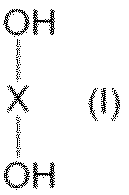
[式中Xは、下記構造式(x1)又は(x2)
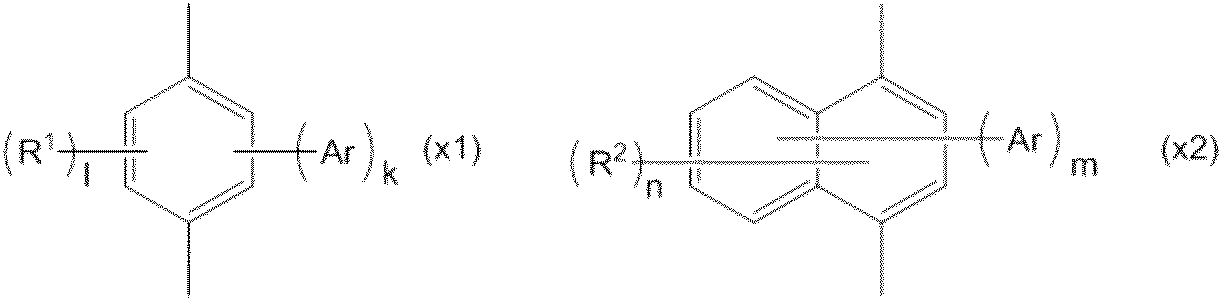
{式(x1)又は(x2)中、R1及びR2はそれぞれ炭素原子数1~4のアルキル基、炭素原子数1~4のアルコキシ基、アリール基又はアラルキル基の何れかであり、lは0~3の整数、nは0~4の整数である。lまたはnが2以上の場合、複数のR1又はR2は同一であっても良いし、それぞれ異なっていても良い。また、kは1~3の整数、mは1又は2であり、Arは下記構造式(Ar1)

(式中、R3は炭素原子数1~4のアルキル基、炭素原子数1~4のアルコキシ基、アリール基又はアラルキル基の何れかであり、qは1~4の整数である。qが2以上の場合、複数のR3は同一であっても良いし、それぞれ異なっていても良い。また、pは1又は2である。)
で表される構造部位である。k又はmが2以上の場合、複数のArは同一であっても良いし、それぞれ異なっていても良い。}
で表される構造部位である。]
で表される分子構造を有することを特徴とする。

で表される化合物が挙げられ、具体的には、パラベンゾキノン、2-メチルベンゾキノン、2,3,5-トリメチル-ベンゾキノン、ナフトキノン等が挙げられる。これらはそれぞれ単独で用いても良いし、2種類以上を併用しても良い。
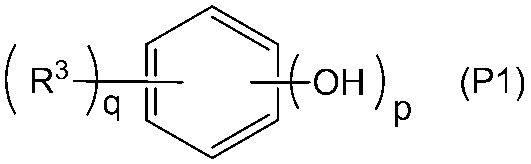
で表される化合物が挙げられ、具体的には、オルソクレゾール、メタクレゾール、パラクレゾール、2,6-ジメチルフェノール、2,5-ジメチルフェノール、2,4-ジメチルフェノール、3,5-ジメチルフェノール、2,3,4-トリメチルフェノール、2,3,5-トリメチルフェノール、2,3,6-トリメチルフェノール、2,4,5-トリメチルフェノール、3,4,5-トリメチルフェノール、4-イソプロピルフェノール、4-tert-ブチルフェノール、2-メトキシフェノール、3-メトキシフェノール、4-メトキシフェノール、2‐メトキシ-4-メチルフェノール、2-tert-ブチル-4-メトキシフェノール、2,6-ジメトキシフェノール、3,5-ジメトキシフェノール、2-エトキシフェノール、3-エトキシフェノール、4-エトキシフェノール、2-フェニルフェノール、3-フェニルフェノール、4-フェニルフェノール、4-ベンジルフェノール等が挙げられる。これらはそれぞれ単独で用いても良いし、2種類以上を併用しても良い。

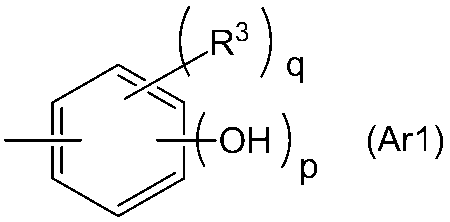
で表される構造部位である。k又はmが2以上の場合、複数のArは同一であっても良いし、それぞれ異なっていても良い。]
の何れかで表されるフェノール性水酸基含有化合物が挙げられる。

の何れか表される化合物が挙げられる。
<GPC測定条件>
測定装置 :東ソー株式会社製「HLC-8220 GPC」、
カラム:東ソー株式会社製ガードカラム「HXL-L」
+東ソー株式会社製「TSK-GEL G2000HXL」
+東ソー株式会社製「TSK-GEL G2000HXL」
+東ソー株式会社製「TSK-GEL G3000HXL」
+東ソー株式会社製「TSK-GEL G4000HXL」
検出器: RI(示差屈折計)
データ処理:東ソー株式会社製「GPC-8020モデルIIバージョン4.10」
測定条件: カラム温度 40℃
展開溶媒 テトラヒドロフラン
流速 1.0ml/分
標準 : 前記「GPC-8020モデルIIバージョン4.10」の測定マニュアルに準拠して、分子量が既知の下記の単分散ポリスチレンを用いた。
(使用ポリスチレン)
東ソー株式会社製「A-500」
東ソー株式会社製「A-1000」
東ソー株式会社製「A-2500」
東ソー株式会社製「A-5000」
東ソー株式会社製「F-1」
東ソー株式会社製「F-2」
東ソー株式会社製「F-4」
東ソー株式会社製「F-10」
東ソー株式会社製「F-20」
東ソー株式会社製「F-40」
東ソー株式会社製「F-80」
東ソー株式会社製「F-128」
試料 : 樹脂固形分換算で1.0質量%のテトラヒドロフラン溶液をマイクロフィルターでろ過したもの(50μl)。

の何れかで表される化合物等が挙げられる。


の何れかで表される化合物等が挙げられる。
の何れかで表される化合物等が挙げられる。
の何れかで表される化合物等が挙げられる。

の何れかで表される化合物等が挙げられる。

の何れかで表される化合物等が挙げられる。

[式中m、qはそれぞれ1または2であり、R4は炭素原子数1~4のアルキル基、炭素原子数1~4のアルコキシ基、アリール基又はアラルキル基の何れかであり、uは1~4の整数である。uが2以上の場合、複数のR4は同一であっても良いし、それぞれ異なっていても良い。]
の何れかで表されるフェノール性水酸基含有化合物が挙げられる。
の何れかで表される化合物等が挙げられる。
の何れかで表される化合物等が挙げられる。
測定装置 :東ソー株式会社製「HLC-8220 GPC」、
カラム:東ソー株式会社製ガードカラム「HXL-L」
+東ソー株式会社製「TSK-GEL G2000HXL」
+東ソー株式会社製「TSK-GEL G2000HXL」
+東ソー株式会社製「TSK-GEL G3000HXL」
+東ソー株式会社製「TSK-GEL G4000HXL」
検出器: RI(示差屈折計)
データ処理:東ソー株式会社製「GPC-8020モデルIIバージョン4.10」
測定条件: カラム温度 40℃
展開溶媒 テトラヒドロフラン
流速 1.0ml/分
標準 : 前記「GPC-8020モデルIIバージョン4.10」の測定マニュアルに準拠して、分子量が既知の下記の単分散ポリスチレンを用いた。
(使用ポリスチレン)
東ソー株式会社製「A-500」
東ソー株式会社製「A-1000」
東ソー株式会社製「A-2500」
東ソー株式会社製「A-5000」
東ソー株式会社製「F-1」
東ソー株式会社製「F-2」
東ソー株式会社製「F-4」
東ソー株式会社製「F-10」
東ソー株式会社製「F-20」
東ソー株式会社製「F-40」
東ソー株式会社製「F-80」
東ソー株式会社製「F-128」
試料 : 樹脂固形分換算で1.0質量%のテトラヒドロフラン溶液をマイクロフィルターでろ過したもの(50μl)。
装置:日本電子(株)製 AL-400
測定モード:SGNNE(NOE消去の1H完全デカップリング法)
溶媒 :ジメチルスルホキシド
パルス角度:45°パルス
試料濃度 :30wt%
積算回数 :10000回
温度計、滴下ロート、冷却管、分留管、撹拌器を取り付けたフラスコに、オルソクレゾール649質量部(6.0モル)、パラベンゾキノン162質量部(1.5モル)、パラトルエンスルホン酸8質量部を仕込み、撹拌しながら室温から120℃まで昇温した。120℃に到達後、2時間攪拌した。反応終了後、析出した結晶物を渡別し、水200質量部で2回水洗した。その後加熱減圧条件下で乾燥してフェノール樹脂(1)117質量部得た。得られたフェノール樹脂(1)のGPCチャートを図1に、13CNMRスペクトルを図2、およびMSスペクトルを図3に示す。フェノール樹脂(1)の水酸基当量は81g/当量であり、MSスペクトルから下記構造式(a-1)で表される2核体化合物(x1)に相当する216のピーク、下記構造式(b-1)で表される3核体化合物(x2)に相当する322のピーク、下記構造式(c-1)で表される4核体化合物(x3)に相当する428のピークが検出された。GPCチャートから算出されるフェノール樹脂中の2核体化合物(x1)相当成分の含有量は4.6%、3核体化合物(x2)相当成分の含有量は88.0%、4核体化合物(x3)相当成分の含有量は5.1%であった。
温度計、滴下ロート、冷却管、分留管、撹拌器を取り付けたフラスコに、オルソクレゾール649質量部(6.0モル)、パラトルエンスルホン酸3質量部を仕込み、撹拌しながら室温から80℃まで昇温した。80℃に到達した後、パラベンゾキノン162質量部(1.5モル)を1時間要して添加し、その後更に130℃まで昇温し1時間攪拌して反応させた。反応終了後、減圧下乾燥し、フェノール樹脂(2)260質量部得た。得られたフェノール樹脂(2)のGPCチャートを図4に示す。フェノール樹脂(2)の水酸基当量は97g/当量であった。GPCチャートから算出されるフェノール樹脂中の2核体化合物(x1)相当成分の含有量は25.8%、3核体化合物(x2)相当成分の含有量は51.7%、4核体化合物(x3)相当成分の含有量は10.0%であった。
温度計、滴下ロート、冷却管、分留管、撹拌器を取り付けたフラスコに、2,6-ジメチルフェノール733質量部(6.0モル)、パラベンゾキノン216質量部(2.0モル)、パラトルエンスルホン酸9質量部を仕込み、撹拌しながら室温から120℃まで昇温した。120℃に到達後、2時間攪拌した。反応終了後、析出した結晶物を渡別し、水200質量部で2回水洗した。その後加熱減圧条件下で乾燥してフェノール樹脂(3)123質量部得た。得られたフェノール樹脂(3)のGPCチャートを図5に、MSスペクトルを図6に示す。フェノール樹脂(3)の水酸基当量は88g/当量であり、MSスペクトルから下記構造式(a-2)で表される化合物に相当する230のピーク、下記構造式(b-2)で表される化合物に相当する350のピーク、下記構造式(c-2)で表される化合物に相当する470のピークが検出された。GPCチャートから算出されるフェノール樹脂中の2核体化合物(x1)相当成分の含有量は8.0%、3核体化合物(x2)相当成分の含有量は87.8%、4核体化合物(x3)相当成分の含有量は1.6%であった。

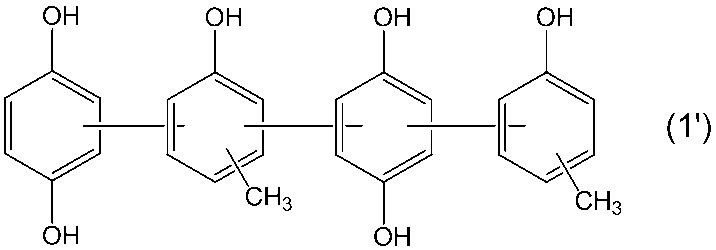
先で得たフェノール樹脂(1)~(3)及び比較対象用フェノール樹脂(1’)[トリフェニルメタン型フェノール樹脂(明和化成株式会社製「MEH-7500」水酸基当量98g/当量)]について、下記の要領で各種評価試験を行った。
1)評価サンプルの作成
前記フェノール樹脂(1)~(3)、(1’)の何れかと、硬化剤としてナフタレン型エポキシ樹脂(DIC株式会社製「EXA-4750」エポキシ基当量188g/当量)、硬化促進剤としてトリフェニルホスフィン(以下「TPP」と略記する。)を用い、下記表2に示す組成で配合して硬化性組成物を得た。これを11cm×9cm×2.4mmの型枠に流し込み、プレスで150℃の温度で10分間成型した後、型枠から成型物を取り出し、次いで、175℃の温度で5時間後硬化させて評価サンプルを得た。
粘弾性測定装置(DMA:レオメトリック社製固体粘弾性測定装置RSAII、レクタンギュラーテンション法;周波数1Hz、昇温速度3℃/min)を用い、前記評価サンプルについて弾性率変化が最大となる(tanδ変化率が最も大きい)温度を測定し、これをガラス転移温度として評価した。結果を表1に示す。

1)評価サンプルの作成
前記フェノール樹脂(1)~(3)、(1’)の何れかと、硬化剤としてナフタレン型エポキシ樹脂(DIC株式会社製「EXA-4750」エポキシ基当量188g/当量)、硬化促進剤としてトリフェニルホスフィン(以下「TPP」と略記する。)、無機充填材として球状シリカ(電気化学株式会社製「FB-5604」)、シランカップリング剤としてカップリング剤(信越化学株式会社製「KBM-403」)、カルナウバワックス(株式会社セラリカ野田製「PEARL WAX No.1-P」)、カーボンブラックを、下記表2に示す組成で配合し、2本ロールを用いて85℃の温度で5分間溶融混練して硬化性組成物を得た。得られた硬化性組成物を用い、トランスファー成形機にて幅12.7mm、長さ127mm、厚み1.6mm大のサンプルを175℃の温度で90秒成形した後、175℃の温度で5時間後硬化して評価用サンプルを得た。
先で得た厚さ1.6mmの評価用サンプル5本を用い、UL-94試験法に準拠して燃焼試験を行った。結果を表2に示す。
難燃試験クラス
*1:1回の接炎における最大燃焼時間(秒)
*2:試験片5本の合計燃焼時間(秒)

Claims (9)
- 下記一般式(I)

[式中Xは、下記構造式(x1)又は(x2)
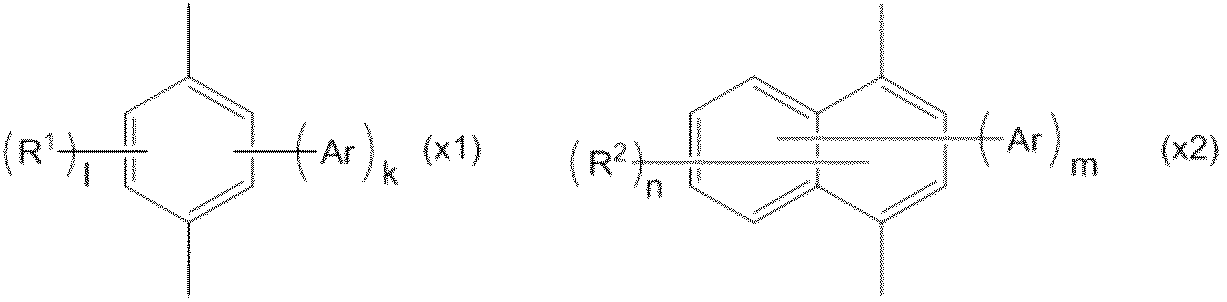
{式(x1)又は(x2)中、R1及びR2はそれぞれ炭素原子数1~4のアルキル基、炭素原子数1~4のアルコキシ基、アリール基又はアラルキル基の何れかであり、lは0~3の整数、nは0~4の整数である。lまたはnが2以上の場合、複数のR1又はR2は同一であっても良いし、それぞれ異なっていても良い。また、kは1~3の整数、mは1又は2であり、Arは下記構造式(Ar1)
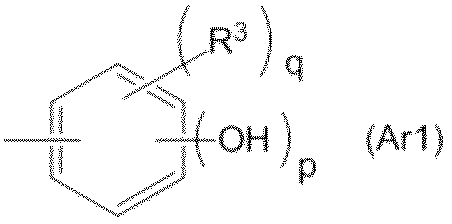
(式中、R3は炭素原子数1~4のアルキル基、炭素原子数1~4のアルコキシ基、アリール基又はアラルキル基の何れかであり、qは1~4の整数である。qが2以上の場合、複数のR3は同一であっても良いし、それぞれ異なっていても良い。また、pは1又は2である。)
で表される構造部位である。k又はmが2以上の場合、複数のArは同一であっても良いし、それぞれ異なっていても良い。}
で表される構造部位である。]
で表される分子構造を有することを特徴とするフェノール性水酸基含有化合物。 - 請求項1に記載のフェノール性水酸基含有化合物を含有するフェノール樹脂。
- 分子構造中にキノン構造を有する化合物(Q)と、炭化水素基又はアルコキシ基含有フェノール(P)とを反応させることを特徴とするフェノール樹脂の製造方法。
- 請求項3に記載の製造方法により製造されるフェノール樹脂。
- 水酸基当量が70~150g/当量の範囲にある請求項2又は4に記載のフェノール樹脂。
- 請求項1に記載のフェノール性水酸基含有化合物又は請求項2、4、5の何れか一つに記載のフェノール樹脂と、硬化剤とを必須成分とする硬化性組成物。
- 請求項6に記載の硬化性組成物を硬化反応させてなる硬化物。
- 請求項6に記載の硬化性組成物に加え、更に無機充填剤を含有する半導体封止材料。
- 請求項6に記載の硬化性組成物に有機溶剤を配合してワニス化した樹脂組成物を、補強基材に含浸し銅箔を重ねて加熱圧着させることにより得られたプリント配線基板。
Priority Applications (4)
| Application Number | Priority Date | Filing Date | Title |
|---|---|---|---|
| CN201480033984.1A CN105308013B (zh) | 2013-06-14 | 2014-02-21 | 含酚性羟基化合物、酚醛树脂、固化性组合物、其固化物、半导体密封材料、及印刷电路基板 |
| US14/897,850 US10011676B2 (en) | 2013-06-14 | 2014-02-21 | Compound containing phenolic hydroxyl group, phenolic resin, curable composition, cured product thereof, semiconductor sealing material, and printed circuit board |
| JP2014535833A JP5682805B1 (ja) | 2013-06-14 | 2014-02-21 | フェノール性水酸基含有化合物、フェノール樹脂、硬化性組成物、その硬化物、半導体封止材料、及びプリント配線基板 |
| KR1020157031537A KR102136618B1 (ko) | 2013-06-14 | 2014-02-21 | 페놀성 수산기 함유 화합물, 페놀 수지, 경화성 조성물, 그 경화물, 반도체 봉지 재료, 및 프린트 배선 기판 |
Applications Claiming Priority (2)
| Application Number | Priority Date | Filing Date | Title |
|---|---|---|---|
| JP2013-125565 | 2013-06-14 | ||
| JP2013125565 | 2013-06-14 |
Publications (1)
| Publication Number | Publication Date |
|---|---|
| WO2014199662A1 true WO2014199662A1 (ja) | 2014-12-18 |
Family
ID=52021970
Family Applications (1)
| Application Number | Title | Priority Date | Filing Date |
|---|---|---|---|
| PCT/JP2014/054141 Ceased WO2014199662A1 (ja) | 2013-06-14 | 2014-02-21 | フェノール性水酸基含有化合物、フェノール樹脂、硬化性組成物、その硬化物、半導体封止材料、及びプリント配線基板 |
Country Status (6)
| Country | Link |
|---|---|
| US (1) | US10011676B2 (ja) |
| JP (1) | JP5682805B1 (ja) |
| KR (1) | KR102136618B1 (ja) |
| CN (1) | CN105308013B (ja) |
| TW (1) | TWI610910B (ja) |
| WO (1) | WO2014199662A1 (ja) |
Cited By (3)
| Publication number | Priority date | Publication date | Assignee | Title |
|---|---|---|---|---|
| JP2016113581A (ja) * | 2014-12-17 | 2016-06-23 | Dic株式会社 | ベンゾオキサジン化合物、ベンゾオキサジン樹脂、ベンゾオキサジン樹脂の製造方法、硬化性樹脂組成物、その硬化物、frp材料、半導体封止材料、ワニス、回路基板、プリプレグ、及びビルドアップフィルム |
| JP2016113549A (ja) * | 2014-12-16 | 2016-06-23 | Dic株式会社 | ベンゾオキサジン化合物、ベンゾオキサジン樹脂、ベンゾオキサジン樹脂の製造方法、硬化性樹脂組成物、その硬化物、frp材料、半導体封止材料、ワニス、回路基板、プリプレグ、及びビルドアップフィルム |
| JPWO2017038968A1 (ja) * | 2015-09-04 | 2018-06-21 | 三菱瓦斯化学株式会社 | 化合物の精製方法 |
Families Citing this family (1)
| Publication number | Priority date | Publication date | Assignee | Title |
|---|---|---|---|---|
| CN105308012B (zh) | 2013-06-14 | 2017-11-17 | Dic株式会社 | 含酚性羟基化合物、酚醛树脂、固化性组合物、其固化物、半导体密封材料、及印刷电路基板 |
Citations (4)
| Publication number | Priority date | Publication date | Assignee | Title |
|---|---|---|---|---|
| JPH04360146A (ja) * | 1991-06-07 | 1992-12-14 | Hitachi Chem Co Ltd | ポジ型ホトレジスト組成物およびレジストパターンの製造方法 |
| JPH0649196A (ja) * | 1992-08-03 | 1994-02-22 | Mitsui Toatsu Chem Inc | 芳香族ポリカーボネート |
| KR20110134714A (ko) * | 2010-06-09 | 2011-12-15 | 한국화학연구원 | 신규 에폭시 화합물 및 난연성 에폭시 수지 조성물 |
| JP2013023613A (ja) * | 2011-07-22 | 2013-02-04 | Dic Corp | ポリヒドロキシ化合物、エポキシ樹脂、熱硬化性樹脂組成物、その硬化物及び半導体封止材料 |
Family Cites Families (4)
| Publication number | Priority date | Publication date | Assignee | Title |
|---|---|---|---|---|
| JP2002114889A (ja) | 2000-10-05 | 2002-04-16 | Ube Ind Ltd | 耐熱性フェノールノボラック樹脂およびその硬化物 |
| US6649840B2 (en) | 2001-01-22 | 2003-11-18 | Thomas & Betts International, Inc. | Ground bus bar connector |
| EP1785441B1 (en) | 2004-09-01 | 2011-06-08 | DIC Corporation | Epoxy resin composition, products of curing thereof, material for the encapsulation of semiconductors, novel phenol resin, novel epoxy resin, process for production of novel phenol resin and process for production of novel epoxy resin |
| CN105308012B (zh) | 2013-06-14 | 2017-11-17 | Dic株式会社 | 含酚性羟基化合物、酚醛树脂、固化性组合物、其固化物、半导体密封材料、及印刷电路基板 |
-
2014
- 2014-02-21 JP JP2014535833A patent/JP5682805B1/ja active Active
- 2014-02-21 WO PCT/JP2014/054141 patent/WO2014199662A1/ja not_active Ceased
- 2014-02-21 US US14/897,850 patent/US10011676B2/en active Active
- 2014-02-21 CN CN201480033984.1A patent/CN105308013B/zh active Active
- 2014-02-21 KR KR1020157031537A patent/KR102136618B1/ko active Active
- 2014-03-18 TW TW103110026A patent/TWI610910B/zh active
Patent Citations (4)
| Publication number | Priority date | Publication date | Assignee | Title |
|---|---|---|---|---|
| JPH04360146A (ja) * | 1991-06-07 | 1992-12-14 | Hitachi Chem Co Ltd | ポジ型ホトレジスト組成物およびレジストパターンの製造方法 |
| JPH0649196A (ja) * | 1992-08-03 | 1994-02-22 | Mitsui Toatsu Chem Inc | 芳香族ポリカーボネート |
| KR20110134714A (ko) * | 2010-06-09 | 2011-12-15 | 한국화학연구원 | 신규 에폭시 화합물 및 난연성 에폭시 수지 조성물 |
| JP2013023613A (ja) * | 2011-07-22 | 2013-02-04 | Dic Corp | ポリヒドロキシ化合物、エポキシ樹脂、熱硬化性樹脂組成物、その硬化物及び半導体封止材料 |
Non-Patent Citations (7)
| Title |
|---|
| A. J. BIRCH ET AL.: "Studies in Relation to Biosynthesis. XXXIX. Oosporein", AUSTRALIAN JOURNAL OF CHEMISTRY, vol. 22, no. 6, 1969, pages 1319 - 1320 * |
| G. LLOYD ET AL.: "The Chemistry of fungi. Part XXV. Ooisporein, a Metabolite of Chaetomium aureum Chivers.", JOURNAL OF THE CHEMICAL SOCIETY, 1955, pages 2163 - 2165 * |
| HANS-ERICK HOGBERG: "Cyclo-oligomerization of Quinones. V. The Acid Catalyzed Reactions of alpha-Naphthoquinone with Phenols", ACTA CHEMICA SCANDINAVICA (1947-1973, vol. 27, no. 7, 1973, pages 2559 - 2566 * |
| KE-QING LING ET AL.: "Copper(II)-Mediated Autoxidation of tert-Butylresorcinols", J. ORG. CHEM., vol. 68, no. 4, 2003, pages 1358 - 1366 * |
| LEE, IN-KYOUNG ET AL.: "p-Terphenyls from Fungus Paxillus curtisii Chelate Irons: A Proposed Role of p-Terphenyls in Fungus", JOURNAL OF MICROBIOLOGY AND BIOTECHNOLOGY, vol. 23, no. 5, 12 March 2013 (2013-03-12), pages 652 - 655 * |
| M. VICTORIA GOMEZ ET AL.: "Synergy between microwave irradiation and heterogeneous catalysis in an environmentally friendly self condensation of hydroxybenzene derivatives", ARKIVOC, vol. III, 2010, pages 264 - 273 * |
| RUDOLF PUMMERER ET AL.: "Die Kondensation von Chinonen mit Phenolen. 3. Mitteilung uber Diarylchinone.", BERICHTE DER DEUTSCHEN CHEMISCHEN GESELLSCHAFT [ABTEILUNG] B: ABHANDLUNGEN, vol. 60B, 1927, pages 1442 - 1451, XP001068313 * |
Cited By (4)
| Publication number | Priority date | Publication date | Assignee | Title |
|---|---|---|---|---|
| JP2016113549A (ja) * | 2014-12-16 | 2016-06-23 | Dic株式会社 | ベンゾオキサジン化合物、ベンゾオキサジン樹脂、ベンゾオキサジン樹脂の製造方法、硬化性樹脂組成物、その硬化物、frp材料、半導体封止材料、ワニス、回路基板、プリプレグ、及びビルドアップフィルム |
| JP2016113581A (ja) * | 2014-12-17 | 2016-06-23 | Dic株式会社 | ベンゾオキサジン化合物、ベンゾオキサジン樹脂、ベンゾオキサジン樹脂の製造方法、硬化性樹脂組成物、その硬化物、frp材料、半導体封止材料、ワニス、回路基板、プリプレグ、及びビルドアップフィルム |
| JPWO2017038968A1 (ja) * | 2015-09-04 | 2018-06-21 | 三菱瓦斯化学株式会社 | 化合物の精製方法 |
| JP7306790B2 (ja) | 2015-09-04 | 2023-07-11 | 三菱瓦斯化学株式会社 | 化合物の精製方法 |
Also Published As
| Publication number | Publication date |
|---|---|
| US10011676B2 (en) | 2018-07-03 |
| KR102136618B1 (ko) | 2020-07-22 |
| US20160137770A1 (en) | 2016-05-19 |
| JPWO2014199662A1 (ja) | 2017-02-23 |
| TWI610910B (zh) | 2018-01-11 |
| CN105308013B (zh) | 2017-10-13 |
| JP5682805B1 (ja) | 2015-03-11 |
| TW201446716A (zh) | 2014-12-16 |
| CN105308013A (zh) | 2016-02-03 |
| KR20160019888A (ko) | 2016-02-22 |
Similar Documents
| Publication | Publication Date | Title |
|---|---|---|
| JP5637419B1 (ja) | エポキシ化合物、エポキシ樹脂、硬化性組成物、その硬化物、半導体封止材料、及びプリント配線基板 | |
| JP5664817B2 (ja) | フェノール性水酸基含有化合物、フェノール樹脂、硬化性組成物、その硬化物、半導体封止材料、及びプリント配線基板 | |
| JP5692471B1 (ja) | フェノール性水酸基含有化合物、フェノール樹脂、硬化性組成物、その硬化物、半導体封止材料、及びプリント配線基板 | |
| JP5682805B1 (ja) | フェノール性水酸基含有化合物、フェノール樹脂、硬化性組成物、その硬化物、半導体封止材料、及びプリント配線基板 | |
| JP2016113549A (ja) | ベンゾオキサジン化合物、ベンゾオキサジン樹脂、ベンゾオキサジン樹脂の製造方法、硬化性樹脂組成物、その硬化物、frp材料、半導体封止材料、ワニス、回路基板、プリプレグ、及びビルドアップフィルム | |
| WO2014208131A1 (ja) | エポキシ化合物、エポキシ樹脂、硬化性組成物、その硬化物、半導体封止材料、及びプリント配線基板 | |
| JP5682804B1 (ja) | フェノール性水酸基含有化合物、フェノール樹脂、硬化性組成物、その硬化物、半導体封止材料、及びプリント配線基板 |
Legal Events
| Date | Code | Title | Description |
|---|---|---|---|
| WWE | Wipo information: entry into national phase |
Ref document number: 201480033984.1 Country of ref document: CN |
|
| ENP | Entry into the national phase |
Ref document number: 2014535833 Country of ref document: JP Kind code of ref document: A |
|
| 121 | Ep: the epo has been informed by wipo that ep was designated in this application |
Ref document number: 14811535 Country of ref document: EP Kind code of ref document: A1 |
|
| ENP | Entry into the national phase |
Ref document number: 20157031537 Country of ref document: KR Kind code of ref document: A |
|
| WWE | Wipo information: entry into national phase |
Ref document number: 14897850 Country of ref document: US |
|
| NENP | Non-entry into the national phase |
Ref country code: DE |
|
| 122 | Ep: pct application non-entry in european phase |
Ref document number: 14811535 Country of ref document: EP Kind code of ref document: A1 |