WO2014142186A1 - ビフィドバクテリウム・ブレーベ株特異的遺伝子 - Google Patents
ビフィドバクテリウム・ブレーベ株特異的遺伝子 Download PDFInfo
- Publication number
- WO2014142186A1 WO2014142186A1 PCT/JP2014/056537 JP2014056537W WO2014142186A1 WO 2014142186 A1 WO2014142186 A1 WO 2014142186A1 JP 2014056537 W JP2014056537 W JP 2014056537W WO 2014142186 A1 WO2014142186 A1 WO 2014142186A1
- Authority
- WO
- WIPO (PCT)
- Prior art keywords
- gene
- strain
- bifidobacterium breve
- genes
- dna
- Prior art date
- Legal status (The legal status is an assumption and is not a legal conclusion. Google has not performed a legal analysis and makes no representation as to the accuracy of the status listed.)
- Ceased
Links
Classifications
-
- C—CHEMISTRY; METALLURGY
- C07—ORGANIC CHEMISTRY
- C07K—PEPTIDES
- C07K14/00—Peptides having more than 20 amino acids; Gastrins; Somatostatins; Melanotropins; Derivatives thereof
- C07K14/195—Peptides having more than 20 amino acids; Gastrins; Somatostatins; Melanotropins; Derivatives thereof from bacteria
-
- C—CHEMISTRY; METALLURGY
- C12—BIOCHEMISTRY; BEER; SPIRITS; WINE; VINEGAR; MICROBIOLOGY; ENZYMOLOGY; MUTATION OR GENETIC ENGINEERING
- C12Q—MEASURING OR TESTING PROCESSES INVOLVING ENZYMES, NUCLEIC ACIDS OR MICROORGANISMS; COMPOSITIONS OR TEST PAPERS THEREFOR; PROCESSES OF PREPARING SUCH COMPOSITIONS; CONDITION-RESPONSIVE CONTROL IN MICROBIOLOGICAL OR ENZYMOLOGICAL PROCESSES
- C12Q1/00—Measuring or testing processes involving enzymes, nucleic acids or microorganisms; Compositions therefor; Processes of preparing such compositions
- C12Q1/68—Measuring or testing processes involving enzymes, nucleic acids or microorganisms; Compositions therefor; Processes of preparing such compositions involving nucleic acids
- C12Q1/6876—Nucleic acid products used in the analysis of nucleic acids, e.g. primers or probes
- C12Q1/6888—Nucleic acid products used in the analysis of nucleic acids, e.g. primers or probes for detection or identification of organisms
- C12Q1/689—Nucleic acid products used in the analysis of nucleic acids, e.g. primers or probes for detection or identification of organisms for bacteria
Definitions
- the present invention relates to a gene specific to the Bifidobacterium breve YIT12272 strain and a method for using the same.
- Bifidobacterium is a major bacterium in the intestinal flora of humans, and is beneficial to human health such as rectification such as constipation and diarrhea improvement, serum cholesterol elevation suppression, and immunostimulation. It is known to have an effect. For this reason, many commercially available products are sold in the form of various fermented foods and drinks and viable bacterial preparations, and in particular, fermented milk foods and drinks have excellent palatability. Suitable for continuous intake.
- Bifidobacterium is an obligate anaerobic bacterium that is weak to oxygen, low pH, and high acidity, and fermented foods and drinks have many difficulties in handling such as growth during production and survival during storage. .
- Bifidobacterium genus bacteria having high survivability under aerobic conditions, low pH, and high acidity conditions have been produced.
- Examples of such strains include Bifidobacterium breve YIT 10001 strain (FERM BP-8205) (patent document 1), Bifidobacterium breve SBR 3212 strain (FERM P-11915) (patent document 2), Bifidobacterium bifidum YIT 4002 strain (FERM BP-1038) (patent document 3), Bifidobacterium breve YIT 12272 strain (FERM BP-11320) (patent document 4), and the like are mentioned.
- Um Breve YIT 12272 is a highly versatile strain applicable to various foods and drinks, having high survival and enhanced resistance to artificial gastric juice and artificial bile and intestinal juice.
- Bifidobacterium breve YIT 12272 strain has very superior characteristics compared to other Bifidobacterium genus bacteria and Bifidobacterium breve, so other Bifidobacterium genus bacteria and It is extremely important to search for a gene specific to the strain that does not exist in Bifidobacterium breve and to clarify its function.
- Non-patent Document 1 the BL0674 gene
- Non-patent Document 2 the BL0674 gene
- Non-patent Document 4 a primer specific to Bifidobacterium breve YIT 12272 and a specific detection method for the strain characterized by using these primers have already been reported.
- An object of the present invention is to provide a gene specific to the Bifidobacterium breve YIT 12272 strain and a method for using the same.
- the present inventors examined in view of the above problems, and identified 145 genes specific to the strain from all genes 1966 of Bifidobacterium breve YIT 12272 and estimated its function. Moreover, it discovered that Bifidobacterium breve YIT 12272 strain could be specifically detected and quantified by targeting the gene concerned.
- the present invention relates to the following 1) to 9).
- a gene for specifically detecting the Bifidobacterium breve YIT 12272 strain which is DNA consisting of the base sequence shown in SEQ ID NOs: 1 to 145 or DNA consisting of a base sequence complementary to the sequence.
- the gene according to 1) which is DNA consisting of the base sequence shown in SEQ ID NOs: 1 to 36 or DNA consisting of a base sequence complementary to the sequence.
- the gene according to 1) which is DNA consisting of the base sequence shown in SEQ ID NOs: 37 to 55 or DNA consisting of a base sequence complementary to the sequence.
- the gene of the present invention is a gene specific to the Bifidobacterium breve YIT 12272 strain, by targeting the gene, only the Bifidobacterium breve YIT 12272 strain in the sample is at the gene level. Can be detected and quantified. Further, by using the gene of the present invention, the excellent characteristics of Bifidobacterium breve YIT 12272 strain can be elucidated at the gene level. Furthermore, by using the presence and / or expression level of the gene of the present invention or its expression product as an index, a microorganism having the same properties as those inherent to the Bifidobacterium breve YIT 12272 strain can be screened.
- the gene of the present invention is modified to produce a genetically modified microorganism having a useful function. can do.
- the DNA comprising the nucleotide sequence represented by SEQ ID NOs: 1 to 145 of the present invention is a gene specific to the Bifidobacterium breve YIT 12272 strain, and is identified by the method described in Example 1 below. . That is, first, the entire amino acid sequence of the strain obtained from the genome sequence information of Bifidobacterium breve YIT 12272 strain (FERM BP-11320) (see Patent Document 4) and the Bifidobacterium whose genome information is disclosed.
- the base sequence of the 161 gene is compared with the genome sequence of a bacterial strain belonging to Bifidobacterium breve whose base sequence of the full-length genome is publicly disclosed on a public database, and the e-value is less than 0.01 and Homologous sequences having a coverage of 100% and a gap number of 0 were selected as Bifidobacterium breve YIT 12272 strain-specific genes that were not found in the control strain (Table 1). ).
- the “cover rate” refers to the ratio of the region where sequence similarity is recognized with other strains to the total length of the Bifidobacterium breve YIT 12272 strain subjected to the search. .
- “Cover rate” (“Alignment length” ⁇ “Gap number”) / “Searched amino acid sequence length of Bifidobacterium breve YIT 12272 strain” ⁇ 100
- “Cover rate” (“Alignment length” ⁇ “Gap number”) / “Searched amino acid sequence length of Bifidobacterium breve YIT 12272 strain” ⁇ 100
- NCBI National Center for Biotechnology Information
- the 36 DNAs shown in SEQ ID NOs: 1 to 36 correspond when the e-value is searched for less than 0.01 using the entire amino acid sequence database published by NCBI.
- This gene has no homologous sequence and encodes a novel amino acid sequence for all microorganisms.
- the 19 DNAs shown in SEQ ID NOs: 37 to 55 in Table 1 are genes for which no corresponding homologous sequence exists when searching under conditions where e-value is less than 0.01 and the coverage rate is more than 60%. . Therefore, these 55 genes are particularly specific for the Bifidobacterium breve YIT 12272 strain for specific detection of the strain and screening for microorganisms that retain the same properties as the inherent properties of the strain. Is more useful.
- the method for specific detection of Bifidobacterium breve YIT 12272 strain of the present invention is any one of a gene comprising a DNA consisting of a base sequence represented by SEQ ID NO: 1-145 or a DNA consisting of a base sequence complementary to the sequence. It targets one or more.
- Specific examples of the detection method include a DNA probe method for detecting using an oligonucleotide probe that specifically binds to these DNAs, and a nucleic acid amplification method for amplifying these DNAs using primers capable of amplifying these DNAs. .
- nucleic acid amplification method for DNA extracted from a specimen using a primer comprising a base sequence represented by SEQ ID NOs: 1 to 145 or a DNA comprising a base sequence complementary to the sequence.
- a method of detecting the amplified DNA fragment by performing a PCR reaction or the like can be mentioned.
- the primer used here can be prepared as a primer that amplifies the full length of the gene based on the base sequences of the 5 ′ end and 3 ′ end of each DNA.
- Such a primer can be easily synthesized by, for example, an automatic DNA synthesizer. These primers can also be used as probes.
- PCR reaction conditions can be performed under normal PCR conditions.
- a heat denaturation reaction for converting a double-stranded DNA into a single strand is 90 to 98 ° C.
- an annealing reaction for hybridizing a primer to a template cDNA is 37 to 72 ° C.
- an extension reaction for allowing DNA polymerase to act is 50 to 75 ° C. This can be carried out by performing 1 to several tens of cycles under the temperature condition.
- preferable reaction conditions include heat denaturation 98 ° C. for 10 seconds, annealing 60 ° C. for 30 seconds, and extension reaction 72 ° C. for 120 seconds ⁇ 30 cycles.
- the primer amplifies only DNA of Bifidobacterium breve YIT 12272 and does not amplify DNA of other Bifidobacterium breve strains.
- the presence or absence of the Bifidobacterium breve YIT 12272 strain can be determined from the Bifidobacterium breve in the sample, preferably the sample.
- the Bifidobacterium breve YIT 12272 strain can be specifically detected at the gene level.
- a heat extraction method As a method for extracting DNA in the specimen, a heat extraction method, an alkali heat extraction method, a phenol / chloroform extraction method, or the like may be used.
- the medium used for culturing the specimen before extraction is not particularly limited as long as the specimen can be cultivated, and examples thereof include a GAM medium known as a medium for growing bifidobacteria.
- glucose and agar can be added to the medium.
- the culture time varies depending on the specimen, for example, it can be carried out for 48 to 144 hours, preferably 72 hours, and the culture temperature is not particularly limited as long as Bifidobacterium breve can be suitably grown. For example, it can be carried out at 34 to 40 ° C., preferably 37 ° C.
- the specimen is not particularly limited as long as it may contain microorganisms.
- microorganisms for example, conjunctival swab, tartar, plaque, sputum, pharyngeal swab, saliva, nasal discharge, alveolar lavage, pleural effusion, gastric juice , Gastric lavage fluid, urine, cervical mucus, vaginal secretions, skin lesions, feces, blood, ascites, tissue, spinal fluid, joint fluid, affected area wipes, foods, pharmaceuticals, cosmetics, foods / pharmaceuticals
- microorganisms such as cosmetic intermediates, microbial cultures, plants, soil, activated sludge, and wastewater.
- the buffer used for suspending the emerged colonies is not particularly limited, and examples thereof include TE buffer.
- the heat treatment is performed by treating the buffer suspension at 72-100 ° C. for 1-10 minutes, preferably 98 ° C. for 2 minutes. Centrifugation is performed at 4 to 30 ° C. and 6,000 to 15,000 rpm for 1 to 10 minutes, preferably at 4 ° C. and 15,000 rpm for 5 minutes.
- the supernatant thus prepared may be used as a template DNA solution for PCR reaction.
- the Bifidobacterium breve YIT 12272 strain in the sample can be quantified.
- the method of quantitative PCR International Journal of Food Microbiology (2008) Vol. 126, p210-215.
- the gene of the present invention or its expression product has the gene and retains the same properties as the inherent properties of the Bifidobacterium breve YIT 12272 strain.
- Microorganisms can be screened. That is, by measuring the presence and / or expression level of the gene of the present invention or its expression product, useful microorganisms having excellent characteristics possessed by the strain can be screened. Examples of expression products of these genes include mRNA and polypeptides.
- the presence and / or expression level of a gene or its expression product is measured by using a probe or primer that can detect the gene or its expression product, the presence or absence of the target gene in the microorganism, the copy number or the expression level.
- a genetically modified microorganism having the same function as that of the strain or an enhanced function can be produced.
- a competence method using DNA uptake ability a protoplast PEG method using protoplasts, an electroporation method using high voltage pulses, or the like may be used.
- a method using homologous recombination or a site-specific integration method can be used.
- a genetically modified microorganism in which the function of the gene is enhanced or suppressed can be created by modifying the gene.
- gene modification include inhibition or suppression of expression of these genes, or enhancement of expression.
- these genes can be destroyed or deleted.
- This method can be achieved by an inactivation method in which a completely different DNA fragment is inserted into the gene or by stepwise homologous recombination.
- a stepwise double crossover method in which part or all of the above are deleted may be used, and a stepwise double crossover method is particularly preferable.
- the regions on both sides sandwiching the deletion region are separated from the chromosomal DNA or amplified by PCR and separated, such as pYSSE3.
- These DNA fragments are cloned in the same orientation as the original orientation in a plasmid vector that can grow in Escherichia coli but cannot replicate in the target microorganism.
- the resulting recombinant plasmid DNA is introduced into the microorganism to be deleted by electroporation, etc., and the desired deletion region is cloned from the resulting antibiotic-resistant clone by PCR or the like.
- a clone in which recombination has occurred in the region homologous to the upstream or downstream cloned region and the plasmid has been inserted on the chromosome is selected.
- the clones obtained in this way are repeatedly subcultured in a medium that does not contain antibiotics, so that the plasmid is detached from the chromosome by recombination between the homologous regions where the plasmids are in close proximity, and disappears as the bacteria grow. Select clones that have lost antibiotic resistance. Clones lacking the target gene region can be isolated from the thus obtained clones by PCR or the like.
- RNA interference by synthesizing a short RNA complementary to the 5′-terminal region of the target gene mRNA, or a region or regulatory gene that controls the expression of these genes is destroyed.
- a method of modification by deletion or the like can be used, and modification of a region controlling the expression of these genes is particularly preferable.
- the amount of transcription of these genes into mRNA can be reduced by modifying the sequence of the promoter that controls the transcription of the genes.
- these genes in the microorganism are introduced by introducing recombinant plasmids carrying these genes into the target microorganism, or by integrating these genes elsewhere in the chromosome by site-specific recombination. May be performed by a method such as increasing the copy number, modifying the control region controlling the expression of these genes, or modifying the control gene and increasing the amount of transcription to mRNA, etc. In particular, a method of increasing the copy number of these genes is preferable.
- the gene of interest is cloned into a plasmid having a plurality of copies per microbial cell, including the original promoter sequence and ribosome binding site of the gene, or separated from another gene.
- microorganisms targeted for gene transfer or modification are not particularly limited, and Gram-positive bacteria, Gram-negative bacteria, yeasts, and the like can be used.
- the microorganisms selected by the screening method and the genetically modified microorganisms obtained by the gene introduction or modification can be used as foods and beverages and pharmaceuticals.
- the microbial cell may be either a live cell or a heated cell (dead cell), may be freeze-dried, or a culture containing these microorganisms may be used.
- a live cell or a heated cell (dead cell)
- a culture containing these microorganisms may be used.
- Such a pharmaceutical can be administered in the form of a conventional pharmaceutical preparation by mixing the microorganism with a solid or liquid non-toxic pharmaceutical carrier.
- preparations include solid preparations such as tablets, granules, powders and capsules, liquid preparations such as solutions, suspensions and emulsions, and freeze-dried preparations. These preparations can be prepared by conventional means on the preparation.
- the non-toxic pharmaceutical carrier include glucose, lactose, sucrose, starch, mannitol, dextrin, fatty acid glyceride, polyethylene glycol, hydroxyethyl starch, ethylene glycol, polyoxyethylene sorbitan fatty acid ester, amino acid, gelatin, albumin , Water, physiological saline and the like.
- conventional additives such as stabilizers, wetting agents, emulsifiers, binders, isotonic agents, excipients and the like can be appropriately added as necessary.
- the microorganism can be used not only as a preparation as described above but also in a food or drink. What is necessary is just to add the said microorganisms as it is or with a various nutrient component when mix
- This food and drink can be used as a health food or a food material that exhibits various pharmacological actions according to the excellent properties of Bifidobacterium breve YIT 12272.
- Such foods and drinks may use additives that can be used as foods and drinks as appropriate, and may be formed into edible forms using conventional means, that is, granules, granules, tablets, capsules, pastes, etc.
- various foods such as processed foods such as ham and sausage, fishery processed foods such as kamaboko and chikuwa, bread, confectionery, butter, powdered milk, water, fruit juice, milk, soft drinks, You may add and use for drinks, such as a tea drink.
- the food and drink includes animal feed.
- examples of the food and drink include fermented food and drink such as fermented milk, lactic acid bacteria beverage, fermented soy milk, fermented fruit juice, and fermented plant liquid using the microorganism.
- fermented food / beverage products should just follow a conventional method.
- the microorganism is inoculated and cultured in a sterilized milk medium alone or simultaneously with other microorganisms, and this is homogenized to obtain a fermented milk base.
- a separately prepared syrup solution is added and mixed, homogenized with a homogenizer or the like, and further added with flavor to finish the final product.
- the fermented milk thus obtained can be a product of any form such as a plain type, a soft type, a fruit flavor type, a solid form, and a liquid form.
- Example 1 Identification of a gene specific to Bifidobacterium breve YIT 12272 strain
- the Bifidobacterium breve YIT 12272 strain was identified from the genome sequence. 145 genes were identified. 1) For all gene regions on the Bifidobacterium breve YIT 12272 strain genome sequence determined using the gene prediction program GeneHackerPlus (Yada, T. et al. 2001, DNA Research, 8, 97-106.) was converted into an amino acid sequence by the sequence conversion program EMBOSS-Transeq (version 6.4.0.0), and the entire amino acid sequence of the strain was obtained.
- GeneHackerPlus Yada, T. et al. 2001, DNA Research, 8, 97-106.
- the 36 genes shown in SEQ ID NOs: 1 to 36 were obtained using the entire amino acid sequence database published by the National Center for Biotechnology Information (NCBI). -A gene that encodes a novel amino acid sequence for all microorganisms when the value is less than 0.01 and no corresponding homologous sequence exists.
- 19 genes shown in SEQ ID NOs: 37 to 55 in Table 1 are genes for which there is no corresponding homologous sequence when searching under conditions where e-value is less than 0.01 and the coverage rate is more than 60%. .
- Example 2 Preparation of specific primers based on the sequence of specific genes (1) Preparation of primers Targeting 18 genes shown in Table 2 randomly selected from the genes of the present invention of SEQ ID NOs: 1 to 145, Primers that amplify the full length of the gene were prepared using a DNA synthesizer based on the base sequences of the 5 ′ end and 3 ′ end (Table 2, SEQ ID NOs: 146 to 181). In addition, as a positive control, a common sequence region of 16S rRNA gene and a dnaA gene having extremely high sequence commonality in Bifidobacterium breve species were used, and primers for amplifying these regions were similarly prepared (Table). 2, SEQ ID NOS: 182-185).
- PCR reaction 7.5 ⁇ L of EmeraldAmp PCR Master Mix (manufactured by Takara), 0.2 ⁇ M primer, 0.5 ⁇ L of the template DNA solution with water to make a total volume of 15 ⁇ L, iCycler (manufactured by Bio-Rad) ), 30 cycles of PCR reaction were performed at 98 ° C. for 10 seconds, 60 ° C. for 30 seconds, and 72 ° C. for 120 seconds.
Landscapes
- Chemical & Material Sciences (AREA)
- Organic Chemistry (AREA)
- Life Sciences & Earth Sciences (AREA)
- Health & Medical Sciences (AREA)
- Proteomics, Peptides & Aminoacids (AREA)
- Analytical Chemistry (AREA)
- Genetics & Genomics (AREA)
- Biochemistry (AREA)
- General Health & Medical Sciences (AREA)
- Engineering & Computer Science (AREA)
- Zoology (AREA)
- Molecular Biology (AREA)
- Biophysics (AREA)
- Wood Science & Technology (AREA)
- Microbiology (AREA)
- Immunology (AREA)
- Bioinformatics & Cheminformatics (AREA)
- General Engineering & Computer Science (AREA)
- Biotechnology (AREA)
- Physics & Mathematics (AREA)
- Gastroenterology & Hepatology (AREA)
- Medicinal Chemistry (AREA)
- Measuring Or Testing Involving Enzymes Or Micro-Organisms (AREA)
- Micro-Organisms Or Cultivation Processes Thereof (AREA)
Abstract
ビフィドバクテリウム・ブレーベ YIT 12272株に特異的な遺伝子及びその利用法の提供。 配列番号1~145に示される塩基配列からなるDNA又は該配列に相補的な塩基配列からなるDNAである、ビフィドバクテリウム・ブレーベ YIT 12272株を特異的に検出するための遺伝子。
Description
本発明は、ビフィドバクテリウム・ブレーベ YIT12272株に特異的な遺伝子及びその利用法に関する。
ビフィドバクテリウム属細菌は、ヒトの腸内細菌叢における主要細菌であり、便秘や下痢の改善等の整腸作用、血清コレステロール上昇抑制作用、免疫賦活作用等、ヒトの健康に対して有益な作用を有することが知られている。このため、各種発酵飲食品や生菌製剤等の形態で多数の市販品が販売されており、特に発酵乳飲食品は、優れた嗜好性を有していることから、ビフィドバクテリウム属細菌の継続的な摂取に適している。
ビフィドバクテリウム属細菌は偏性嫌気性菌であり、酸素や低pH、高酸度に弱く、発酵飲食品においては製造時の増殖や保存時の生残性等、取り扱いに困難な点が多い。ビフィドバクテリウム属細菌の生理効果を得るには、できるだけ多くの菌が生きたまま腸に到達する必要があると考えられており、特に飲食品中での菌の生残性、すなわち飲食後の腸への到達率を高めることが重要なファクターとされている。
斯かる問題を解決するために、好気的条件や低pH、高酸度の条件下でも高い生残性を有するビフィドバクテリウム属細菌の作出が行われている。このような菌株の例として、ビフィドバクテリウム・ブレーベ YIT 10001株(FERM BP-8205)(特許文献1)、ビフィドバクテリウム・ブレーベ SBR 3212株(FERM P-11915)(特許文献2)、ビフィドバクテリウム・ビフィダム YIT 4002株(FERM BP-1038)(特許文献3)、ビフィドバクテリウム・ブレーベ YIT 12272株(FERM BP-11320)(特許文献4)等が挙げられ、中でもビフィドバクテリウム・ブレーベ YIT 12272株は高い生残性を有し、人工胃液耐性、人工胆汁・腸液耐性ともに強化されており、様々な飲食品に適用可能な汎用性の高い菌株である。ビフィドバクテリウム・ブレーベ YIT 12272株は、他のビフィドバクテリウム属細菌やビフィドバクテリウム・ブレーベと比較しても非常に優れた特性を有することから、他のビフィドバクテリウム属細菌やビフィドバクテリウム・ブレーベに存在しない当該菌株に特異的な遺伝子を探索し、その機能を明らかにすることは極めて重要である。
ビフィドバクテリウム属細菌やビフィドバクテリウム・ブレーベに存在する有用遺伝子としては、宿主細胞接着に関連すると考えられているBL0674遺伝子(非特許文献1)や、β-ガラクトシダーゼの産生に関するβ-ガラクトシダーゼ遺伝子(非特許文献2)などが報告されているが、ビフィドバクテリウム・ブレーベ YIT 12272株に特異的な遺伝子は報告されていない。また、ビフィドバクテリウム・ブレーベ YIT 12272株に特異的なプライマーおよびこれらプライマーを使用することを特徴とする当該菌株の特異的検出方法は、既に報告されている(特許文献4)が、このプライマーは当該菌株の菌体からDNAを抽出し、PCRを行うことでRAPD法を行い、当該菌株に特異的な塩基配列を検索し、その配列を基に設計したプライマーであり、当該菌株の遺伝子をターゲットにしているものではなかった。このため、ビフィドバクテリウム・ブレーベ YIT 12272株に特異的な遺伝子はいまだに明らかにされていない。
本発明は、ビフィドバクテリウム・ブレーベ YIT 12272株に特異的な遺伝子及びその利用法を提供することを課題とする。
本発明者らは、上記課題に鑑み検討したところ、ビフィドバクテリウム・ブレーベ YIT 12272株の全遺伝子1966より、当該菌株に特異的な145の遺伝子を特定し、その機能を推定した。また、当該遺伝子を標的とすることにより、ビフィドバクテリウム・ブレーベ YIT 12272株を特異的に検出・定量できることを見出した。
本発明は、以下の1)~9)に係るものである。
1)配列番号1~145に示される塩基配列からなるDNA又は該配列に相補的な塩基配列からなるDNAである、ビフィドバクテリウム・ブレーベ YIT 12272株を特異的に検出するための遺伝子。
2)配列番号1~36に示される塩基配列からなるDNA又は該配列に相補的な塩基配列からなるDNAである1)記載の遺伝子。
3)配列番号37~55に示される塩基配列からなるDNA又は該配列に相補的な塩基配列からなるDNAである1)記載の遺伝子。
4)1)記載の遺伝子のいずれか1つ以上を標的とすることを特徴とするビフィドバクテリウム・ブレーベ YIT 12272株の特異的検出方法。
5)1)記載の遺伝子のいずれか1つ以上を標的とすることを特徴とするビフィドバクテリウム・ブレーベ YIT 12272株の定量方法。
6)1)記載の遺伝子又はその発現産物のいずれか1つ以上の存在及び/又は発現量を指標とすることを特徴とする当該遺伝子を有する微生物のスクリーニング方法。
7)6)記載のスクリーニング方法により選択された微生物。
8)1)記載の遺伝子のいずれか1つ以上を導入すること、及び/又は1)記載の遺伝子のいずれか1つ以上を標的として微生物の遺伝子を改変することを特徴とする遺伝子改変微生物の作出方法。
9)8)記載の作出方法により得られた遺伝子改変微生物。
1)配列番号1~145に示される塩基配列からなるDNA又は該配列に相補的な塩基配列からなるDNAである、ビフィドバクテリウム・ブレーベ YIT 12272株を特異的に検出するための遺伝子。
2)配列番号1~36に示される塩基配列からなるDNA又は該配列に相補的な塩基配列からなるDNAである1)記載の遺伝子。
3)配列番号37~55に示される塩基配列からなるDNA又は該配列に相補的な塩基配列からなるDNAである1)記載の遺伝子。
4)1)記載の遺伝子のいずれか1つ以上を標的とすることを特徴とするビフィドバクテリウム・ブレーベ YIT 12272株の特異的検出方法。
5)1)記載の遺伝子のいずれか1つ以上を標的とすることを特徴とするビフィドバクテリウム・ブレーベ YIT 12272株の定量方法。
6)1)記載の遺伝子又はその発現産物のいずれか1つ以上の存在及び/又は発現量を指標とすることを特徴とする当該遺伝子を有する微生物のスクリーニング方法。
7)6)記載のスクリーニング方法により選択された微生物。
8)1)記載の遺伝子のいずれか1つ以上を導入すること、及び/又は1)記載の遺伝子のいずれか1つ以上を標的として微生物の遺伝子を改変することを特徴とする遺伝子改変微生物の作出方法。
9)8)記載の作出方法により得られた遺伝子改変微生物。
本発明の遺伝子は、ビフィドバクテリウム・ブレーベ YIT 12272株に特異的な遺伝子であることから、当該遺伝子を標的とすることにより、検体中よりビフィドバクテリウム・ブレーベ YIT 12272株のみを遺伝子レベルで検出・定量することができる。また、本発明の遺伝子を用いることで、ビフィドバクテリウム・ブレーベ YIT 12272株の持つ優れた特性を遺伝子レベルで解明することができる。さらに、本発明の遺伝子又はその発現産物の存在及び/又は発現量を指標として、ビフィドバクテリウム・ブレーベ YIT 12272株が有する固有の性質と同一の性質を保持する微生物をスクリーニングすることができる。また、他の微生物へ本発明の遺伝子を導入したり、他の微生物が本発明遺伝子に相当する遺伝子を有する場合に当該遺伝子の改変を行うことで、有用な機能を持った遺伝子改変微生物を作出することができる。
本発明の配列番号1~145に示される塩基配列からなるDNAは、ビフィドバクテリウム・ブレーベ YIT 12272株に特異的な遺伝子であり、後記実施例1に記載の手法によって特定されたものである。
すなわち、先ずビフィドバクテリウム・ブレーベ YIT 12272株(FERM BP-11320)(前記特許文献4参照)のゲノム配列情報から取得した当該菌株の全アミノ酸配列と、ゲノム情報が公開されているビフィドバクテリウム・ブレーベに属する細菌4菌株の全遺伝子のアミノ酸配列を比較し、e-value(偶然に誤った検索結果が含まれる期待値)が0.01未満且つカバー率が60%を上回る相同配列が、対照とした4菌株全てに認められなかった161の遺伝子を、当該菌株に特異的な遺伝子の候補として選択した。次いで、当該161遺伝子の塩基配列を、公共データベース上でゲノム全長の塩基配列が公開されているビフィドバクテリウム・ブレーベに属する細菌株のゲノム配列と比較し、e-valueが0.01未満且つカバー率が100%且つギャップ数が0となる相同配列が、対照とした菌株に認められなかった遺伝子145個を、ビフィドバクテリウム・ブレーベ YIT 12272株特異的遺伝子として選択した(〔表1〕)。
ここで「カバー率」とは、検索にかけたビフィドバクテリウム・ブレーベ YIT 12272株のアミノ酸配列の全長に対して、他菌株との間に配列類似性が認められる領域が占める割合のことをいう。具体的には、相同性検索の結果から得られるアライメント長およびギャップ数の値を用いて以下のように算出する。「カバー率」=(「アライメント長」-「ギャップ数」)/「ビフィドバクテリウム・ブレーベ YIT 12272株の検索アミノ酸配列長」×100
例えば、100アミノ酸からなるビフィドバクテリウム・ブレーベ YIT 12272株の配列aにおいて、相同性検索により菌株Bの105アミノ酸からなる配列bがアライメント長90、ギャップ数10でヒットした場合、そのカバー率は、(90-10)/100×100=80%となる。
すなわち、先ずビフィドバクテリウム・ブレーベ YIT 12272株(FERM BP-11320)(前記特許文献4参照)のゲノム配列情報から取得した当該菌株の全アミノ酸配列と、ゲノム情報が公開されているビフィドバクテリウム・ブレーベに属する細菌4菌株の全遺伝子のアミノ酸配列を比較し、e-value(偶然に誤った検索結果が含まれる期待値)が0.01未満且つカバー率が60%を上回る相同配列が、対照とした4菌株全てに認められなかった161の遺伝子を、当該菌株に特異的な遺伝子の候補として選択した。次いで、当該161遺伝子の塩基配列を、公共データベース上でゲノム全長の塩基配列が公開されているビフィドバクテリウム・ブレーベに属する細菌株のゲノム配列と比較し、e-valueが0.01未満且つカバー率が100%且つギャップ数が0となる相同配列が、対照とした菌株に認められなかった遺伝子145個を、ビフィドバクテリウム・ブレーベ YIT 12272株特異的遺伝子として選択した(〔表1〕)。
ここで「カバー率」とは、検索にかけたビフィドバクテリウム・ブレーベ YIT 12272株のアミノ酸配列の全長に対して、他菌株との間に配列類似性が認められる領域が占める割合のことをいう。具体的には、相同性検索の結果から得られるアライメント長およびギャップ数の値を用いて以下のように算出する。「カバー率」=(「アライメント長」-「ギャップ数」)/「ビフィドバクテリウム・ブレーベ YIT 12272株の検索アミノ酸配列長」×100
例えば、100アミノ酸からなるビフィドバクテリウム・ブレーベ YIT 12272株の配列aにおいて、相同性検索により菌株Bの105アミノ酸からなる配列bがアライメント長90、ギャップ数10でヒットした場合、そのカバー率は、(90-10)/100×100=80%となる。
また、各遺伝子について、米国立生物工学情報センター(National Center for Biotechnology Information、NCBI)で公開されている全アミノ酸配列データベースに対する相同性検索(e-value<0.01)を行い、NCBIのデータベースにより、その機能を推定した。

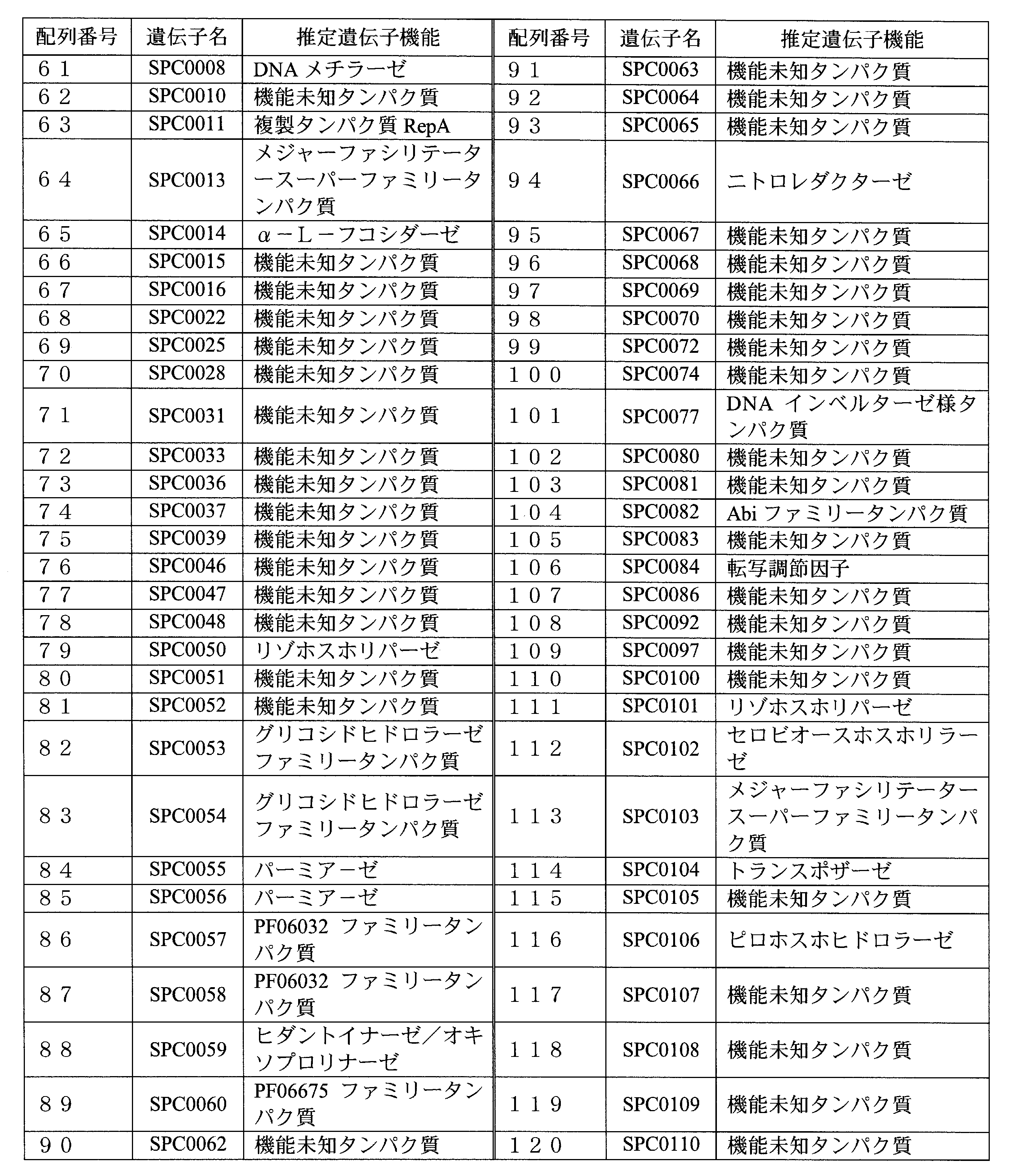
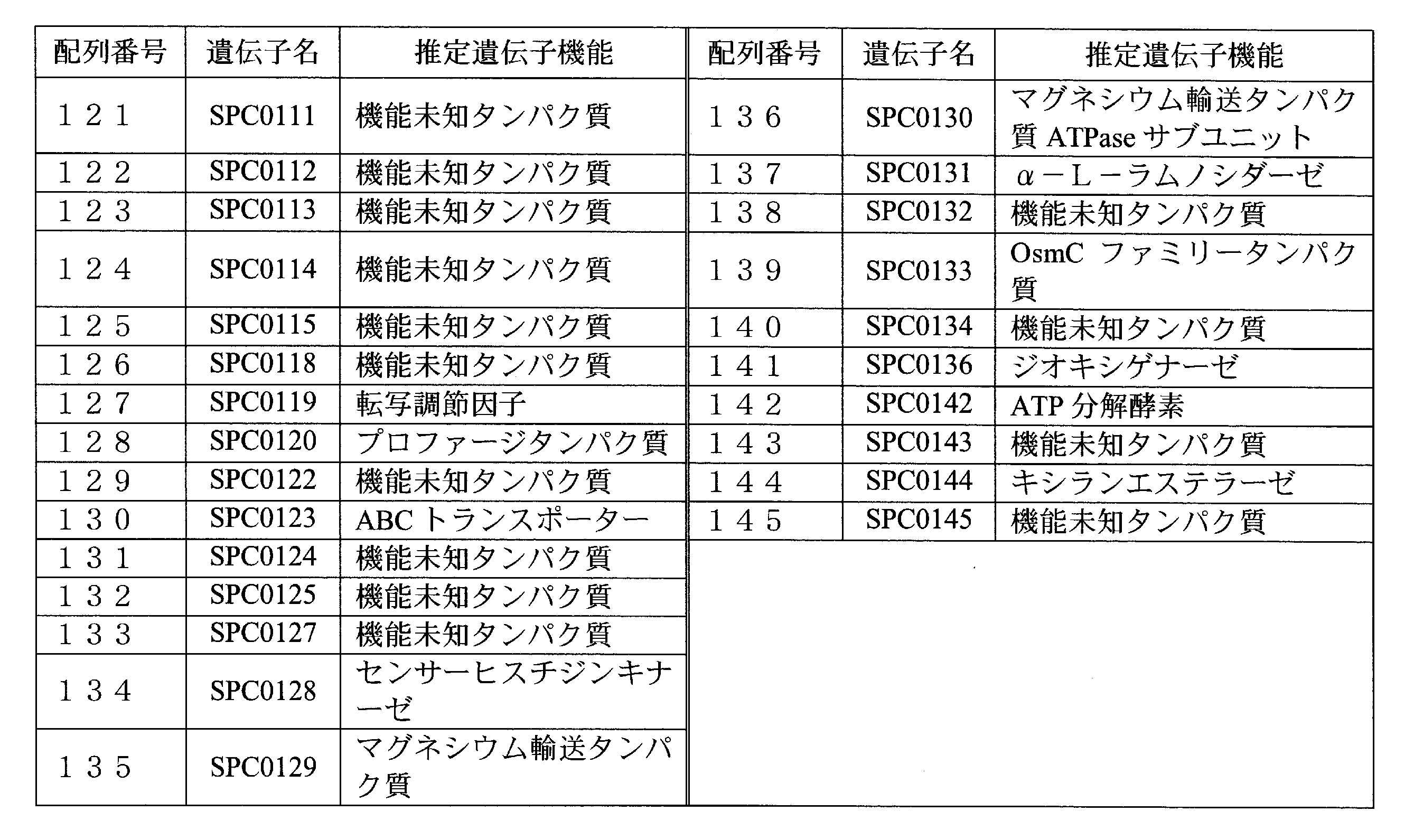
上記表1の145の遺伝子のうち、配列番号1~36に示す36のDNAはNCBIで公開されている全アミノ酸配列データベースを用いてe-valueが0.01未満で検索した際に、該当する相同配列が存在せず、全微生物に対して新規のアミノ酸配列をコードする遺伝子である。また、表1の配列番号37~55に示す19のDNAは、e-valueが0.01未満且つカバー率が60%を超える条件で検索した際には該当する相同配列が存在しない遺伝子である。
したがって、これらの55遺伝子は、ビフィドバクテリウム・ブレーベ YIT 12272株について特に特異性が高く、当該菌株の特異的検出や当該菌株が有する固有の性質と同一の性質を保持する微生物のスクリーニング等に、より有用である。
したがって、これらの55遺伝子は、ビフィドバクテリウム・ブレーベ YIT 12272株について特に特異性が高く、当該菌株の特異的検出や当該菌株が有する固有の性質と同一の性質を保持する微生物のスクリーニング等に、より有用である。
本発明のビフィドバクテリウム・ブレーベ YIT 12272株の特異的検出方法は、配列番号1~145で示される塩基配列からなるDNA又は該配列に相補的な塩基配列からなるDNAである遺伝子のいずれか1つ以上を標的とするものである。
当該検出方法は、具体的には、これらDNAに特異的に結合するオリゴヌクレオチドプローブを用いて検出するDNAプローブ法やこれらのDNAを増幅可能なプライマーを用いて増幅させる核酸増幅法が例示される。
核酸増幅法の一例として、配列番号1~145で示される塩基配列からなるDNA又は該配列に相補的な塩基配列からなるDNAを基に作製されるプライマーを用いて検体から抽出したDNAに対してPCR反応等を行い、増幅されたDNA断片を検出する方法が挙げられる。
当該検出方法は、具体的には、これらDNAに特異的に結合するオリゴヌクレオチドプローブを用いて検出するDNAプローブ法やこれらのDNAを増幅可能なプライマーを用いて増幅させる核酸増幅法が例示される。
核酸増幅法の一例として、配列番号1~145で示される塩基配列からなるDNA又は該配列に相補的な塩基配列からなるDNAを基に作製されるプライマーを用いて検体から抽出したDNAに対してPCR反応等を行い、増幅されたDNA断片を検出する方法が挙げられる。
ここで用いられるプライマーは、各DNAの5’末端及び3’末端部の塩基配列を基に、遺伝子全長を増幅するプライマーとして作製することができる。また、PCR法においては、通常2種類のプライマーを1組として用いることが好ましく、両者がリーディング鎖とラギング鎖との組み合わせになるようにする必要がある。
斯かるプライマーは、例えば自動DNA合成機によって容易に合成することができる。また、これらのプライマーはプローブとしても使用することができる。
斯かるプライマーは、例えば自動DNA合成機によって容易に合成することができる。また、これらのプライマーはプローブとしても使用することができる。
PCR反応の条件は、通常のPCRの条件で行うことができる。例えば、二本鎖DNAを一本鎖にする熱変性反応を90~98℃、プライマーを鋳型cDNAにハイブリダイズさせるアニーリング反応を37~72℃、DNAポリメラーゼを作用させる伸長反応を50~75℃という温度条件で、これを1サイクルとしたものを1~数十サイクル行うことにより、行うことができる。なお、好ましい反応条件の一例としては、熱変性98℃10秒、アニーリング60℃30秒、伸長反応72℃120秒×30サイクルが挙げられる。
前記プライマーは、後記実施例2に示すように、ビフィドバクテリウム・ブレーベ YIT 12272株のDNAのみを増幅し、他のビフィドバクテリウム・ブレーベ株のDNAを増幅しないことから、電気泳動により増幅産物の有無を観察することにより、検体中、好ましくは検体中のビフィドバクテリウム・ブレーベの中からビフィドバクテリウム・ブレーベ YIT 12272株の存在の有無を把握することができる。
斯様に、本発明の145遺伝子を利用することにより、ビフィドバクテリウム・ブレーベ YIT 12272株を遺伝子レベルで特異的に検出することができる。
斯様に、本発明の145遺伝子を利用することにより、ビフィドバクテリウム・ブレーベ YIT 12272株を遺伝子レベルで特異的に検出することができる。
尚、検体中のDNAを抽出する方法としては、熱抽出法、アルカリ熱抽出法、フェノール・クロロホルム抽出法等を利用すればよい。抽出前の検体の培養に使用する培地は、検体を培養することができるものであれば特に限定されるものではなく、例えば、ビフィズス菌増殖用培地として知られるGAM培地を挙げることができる。また、培地には、グルコースやアガーを添加することができる。培養時間は、検体により異なるが、例えば、48~144時間、好ましくは72時間で行うことができ、培養温度は、ビフィドバクテリウム・ブレーベが好適に増殖できる条件であれば特に限定されないが、例えば34~40℃、好ましくは37℃で行うことができる。
上記検体としては、微生物を含有する可能性があるものであれば特に限定されないが、例えば、結膜ぬぐい液、歯石、歯垢、喀痰、咽頭ぬぐい液、唾液、鼻汁、肺胞洗浄液、胸水、胃液、胃洗浄液、尿、子宮頸管粘液、膣分泌物、皮膚病巣、糞便、血液、腹水、組織、髄液、関節液、患部ぬぐい液などの生態由来試料、食品、医薬品、化粧品、食品・医薬品・化粧品の中間処理物、微生物培養液、植物、土壌、活性汚泥、排水のような微生物を含有する可能性のある対象が挙げられる。
出現したコロニーの懸濁に使用するバッファーとしては、特に限定されるものではなく、例えばTEバッファーが挙げられる。DNAの熱抽出法の一例として、加熱処理は、バッファー懸濁液を72~100℃で1~10分間、好ましくは98℃で2分間の処理を行う。遠心分離の条件は、4~30℃、6,000~15,000rpmで1~10分間、好ましくは、4℃、15,000rpm、5分間で行う。このようにして準備した上清液を鋳型DNA溶液としてPCR反応に供試すればよい。
また、前記プライマーを使用した定量的PCRを用いることで、検体中のビフィドバクテリウム・ブレーベ YIT 12272株を定量することができる。定量的PCRの方法の一例として、International Journal of Food Microbiology(2008)Vol.126,p210-215に記載の方法を挙げることができる。
また、本発明の遺伝子又はその発現産物の存在及び/又は発現量を指標とすることで、当該遺伝子を有し、ビフィドバクテリウム・ブレーベ YIT 12272株の固有の性質と同一の性質を保持する微生物をスクリーニングすることができる。すなわち、本発明の遺伝子又はその発現産物の存在及び/又は発現量を測定することにより、当該菌株が有する優れた特性を持った有用微生物をスクリーニングすることができる。これら遺伝子の発現産物としては、mRNAやポリペプチド等が挙げられる。ここで、遺伝子又はその発現産物の存在及び/又は発現量の測定は、当該遺伝子又はその発現産物を検出し得るプローブやプライマーを用いて、微生物における標的とする遺伝子の有無、コピー数や発現量をサザーンハイブリダイゼーション法やノーザンハイブリダイゼーション法やDNAマイクロアレイやRT-PCR法により行うことができる。そして、当該遺伝子又はその発現産物の存在及び/又は発現量に基づき、目的の微生物を選択すればよい。
さらに、本発明の遺伝子を元来有しない他の微生物に、当該遺伝子を単独あるいは組み合わせて導入することで、当該菌株と同様か、或いはその機能が増強された遺伝子改変微生物を作出することができる。これら遺伝子の他の微生物への導入方法としては、DNAの取り込み能を利用したコンピテンス法、プロトプラストを利用したプロトプラストPEG法及び高電圧パルスを利用したエレクトロポレーション法等を利用すればよい。また、遺伝子を微生物染色体に組み込む場合には、相同組換えを利用した方法、部位特異的に組み込む方法を用いることができる。
また、他の微生物が本発明の遺伝子に相当する遺伝子を有する場合には、当該遺伝子を改変することで、当該遺伝子の機能が増強又は抑制された遺伝子改変微生物を作出することもできる。遺伝子の改変には、これら遺伝子の発現阻害若しくは発現抑制、又は発現増強が挙げられる。
遺伝子の発現を阻害するには、これら遺伝子を破壊、欠損すればよく、この方法としては、全く別のDNA断片を遺伝子の内部に挿入する挿入失活法や段階的な相同組換えによって標的遺伝子の一部又は全部を欠失する段階的二重交叉法を用いればよく、特に段階的二重交叉法が好ましい。具体的には、標的遺伝子の一部又は全部を欠失する場合には、欠失領域をはさむ両側の領域を染色体DNAから分離するか、あるいはPCR法によって増幅して分離し、例えばpYSSE3のような大腸菌では増殖するが対象とする微生物中では複製が出来ないプラスミドベクターにそれら両DNA断片を本来の向きと同じ向きに並んだ状態でクローニングする。次に、得られる組換えプラスミドDNAを、欠失を起こさせようとする微生物にエレクトロポレーション法等を用いて導入し、生じる抗生物質耐性のクローンから、PCR法等によって目的の欠失領域の上流又は下流のクローニングした領域との相同領域で組換えを起こしてプラスミドが染色体上に挿入したクローンを選択する。こうして得たクローンを、抗生物質を含まない培地で継代培養を繰り返すことによって、プラスミドが再び近接して存在する相同領域間の組換えによって染色体から離脱し、菌の増殖に伴って消失することによって、抗生物質耐性をなくしたクローンを選択する。こうして得たクローンからPCR法等によって標的遺伝子領域を欠失したクローンを分離することができる。
遺伝子の発現を抑制するには、標的遺伝子のmRNAの5’末端領域と相補的な短いRNAを合成することによる、いわゆるRNA干渉による方法や、これら遺伝子の発現を制御する領域又は制御遺伝子を破壊若しくは欠損等して改変する方法を用いることができ、特にこれら遺伝子の発現を制御する領域の改変が好ましい。具体的には、遺伝子の転写を制御するプロモーターの配列を改変することによって、これら遺伝子のmRNAへの転写量を少なくすることができる。
遺伝子の発現を増強するには、これら遺伝子を運ぶ組換えプラスミドを対象とする微生物に導入すること、これら遺伝子を染色体の別の場所に部位特異的組換えによって組み込むことによって微生物内でのこれら遺伝子のコピー数を増加させること、これら遺伝子の発現を制御する制御領域を改変したり、制御遺伝子を改変し、mRNAへの転写量を多くすることによって発現を増加させる方法等によって行えばよいが、特にこれら遺伝子のコピー数を増加させる方法が好ましい。具体的には、1個の微生物細胞あたり複数個のコピー数を持つプラスミドに、対象とする遺伝子をその遺伝子の本来のプロモーター配列とリボソーム結合部位を含めてクローニングするか、別の遺伝子から分離した、あるいは化学合成によって作成したプロモーターとリボソーム結合部位の下流に該遺伝子のポリペプチドをコードする領域だけをつなげてクローニングした組換えプラスミドを作成し、微生物細胞内にエレクトロポレーション法などによって導入することによって、微生物細胞内での該遺伝子のコピー数を上げることができる。
ここで、遺伝子導入又は改変の対象となる微生物は、特に限定されるものではなく、グラム陽性細菌、グラム陰性細菌、酵母等を用いることができる。
上記スクリーニング方法により選択された微生物および上記遺伝子導入又は改変により得られた遺伝子改変微生物は、飲食品や医薬品として使用できる。この場合、菌体は、生菌又は加熱菌体(死菌体)のいずれでもよく、又は凍結乾燥したものであってもよく、あるいはこれら微生物を含む培養物を用いることでもよい。また、ビフィドバクテリウム・ブレーベ YIT 12272株の持つ優れた特性が保存されている限りは、菌体処理物を利用することも可能である。
斯かる医薬品は、当該微生物を固体又は液体の医薬用無毒性担体と混合して、慣用の医薬品製剤の形態で投与することができる。このような製剤としては、例えば、錠剤、顆粒剤、散剤、カプセル剤等の固形剤、溶液剤、懸濁剤、乳剤等の液剤、凍結乾燥製剤等が挙げられる。これらの製剤は製剤上の常套手段により調製することができる。上記の医薬用無毒性担体としては、例えば、グルコース、乳糖、ショ糖、澱粉、マンニトール、デキストリン、脂肪酸グリセリド、ポリエチレングリコール、ヒドロキシエチルデンプン、エチレングリコール、ポリオキシエチレンソルビタン脂肪酸エステル、アミノ酸、ゼラチン、アルブミン、水、生理食塩水等が挙げられる。また、必要に応じて、安定化剤、湿潤剤、乳化剤、結合剤、等張化剤、賦形剤等の慣用の添加剤を適宜添加することもできる。
また、当該微生物は、上記のような製剤とするだけでなく、飲食品に配合して使用することもできる。飲食品に配合する場合は、当該微生物をそのまま、または種々の栄養成分と共に含有せしめればよい。この飲食品は、ビフィドバクテリウム・ブレーベ YIT 12272株の持つ優れた特性に応じ、種々の薬理作用を発揮する保健用食品又は食品素材として利用できる。斯かる飲食品は、飲食品として使用可能な添加剤を適宜使用し、慣用の手段を用いて食用に適した形態、すなわち、顆粒状、粒状、錠剤、カプセル、ペースト等に成形してもよく、また種々の食品、例えば、ハム、ソーセージ等の食肉加工食品、かまぼこ、ちくわ等の水産加工食品、パン、菓子、バター、粉乳に添加して使用したり、水、果汁、牛乳、清涼飲料、茶飲料等の飲料に添加して使用してもよい。なお、飲食品には、動物の飼料も含まれる。
さらに飲食品としては、当該微生物を利用した発酵乳、乳酸菌飲料、発酵豆乳、発酵果汁、発酵植物液等の発酵飲食品の例が挙げられる。これら発酵飲食品の製造は常法に従えばよい。例えば発酵乳を製造する場合は、まず、殺菌した乳培地に当該微生物を単独又は他の微生物と同時に接種培養し、これを均質化処理して発酵乳ベースを得る。次いで、別途調製したシロップ溶液を添加混合し、ホモゲナイザー等で均質化し、更にフレーバーを添加して最終製品に仕上げればよい。このようにして得られる発酵乳は、プレーンタイプ、ソフトタイプ、フルーツフレーバータイプ、固形状、液状等のいずれの形態の製品とすることもできる。
以下、実施例を挙げて本発明をさらに詳細に説明するが、本発明はこれらに限定されるものではない。実施例1 ビフィドバクテリウム・ブレーベ YIT 12272株に特異的な遺伝子の特定
以下の1)~3)に示す手順により、ビフィドバクテリウム・ブレーベ YIT 12272株ゲノム配列より、当該菌株に特異的な145遺伝子を特定した。
1)遺伝子予測プログラムGeneHackerPlus(Yada,T. et al. 2001, DNA Research, 8, 97-106.)を用いて決定したビフィドバクテリウム・ブレーベ YIT 12272株ゲノム配列上の全遺伝子領域について、各々の塩基配列を配列変換プログラムEMBOSS-Transeq(version 6.4.0.0)によりアミノ酸配列へと変換し、当該菌株の全アミノ酸配列を取得した。
以下の1)~3)に示す手順により、ビフィドバクテリウム・ブレーベ YIT 12272株ゲノム配列より、当該菌株に特異的な145遺伝子を特定した。
1)遺伝子予測プログラムGeneHackerPlus(Yada,T. et al. 2001, DNA Research, 8, 97-106.)を用いて決定したビフィドバクテリウム・ブレーベ YIT 12272株ゲノム配列上の全遺伝子領域について、各々の塩基配列を配列変換プログラムEMBOSS-Transeq(version 6.4.0.0)によりアミノ酸配列へと変換し、当該菌株の全アミノ酸配列を取得した。
2)これらのアミノ酸配列について、公共データベース上(Genbank、version 192.0)でゲノム情報が公開されているビフィドバクテリウム・ブレーベに属する細菌4菌株(ビフィドバクテリウム・ブレーベ DSM 20213T株、ビフィドバクテリウム・ブレーベ ACS-071-V-Sch8b株、ビフィドバクテリウム・ブレーベ UCC2003株、ビフィドバクテリウム・ブレーベ CECT 7263株)の全遺伝子のアミノ酸配列に対し、検索プログラムNCBI-blastp(version 2.2.25+)による相同性検索を行った。ビフィドバクテリウム・ブレーベ YIT 12272株の全1966個の遺伝子のうち、e-value(偶然に誤った検索結果が含まれる期待値)が0.01未満且つカバー率が60%を上回る相同配列が、対照とした4菌株全てに認められなかった161の遺伝子を、当該菌株に特異的な遺伝子の候補とした。
尚、「カバー率」は、検索にかけたビフィドバクテリウム・ブレーベ YIT 12272株のアミノ酸配列の全長に対して、他菌株との間に配列類似性が認められる領域が占める割合を意味し、以下のように算出される。「カバー率」=(「アライメント長」-「ギャップ数」)/「ビフィドバクテリウム・ブレーベ YIT 12272株の検索アミノ酸配列長」×100
尚、「カバー率」は、検索にかけたビフィドバクテリウム・ブレーベ YIT 12272株のアミノ酸配列の全長に対して、他菌株との間に配列類似性が認められる領域が占める割合を意味し、以下のように算出される。「カバー率」=(「アライメント長」-「ギャップ数」)/「ビフィドバクテリウム・ブレーベ YIT 12272株の検索アミノ酸配列長」×100
3)次に、上記の161の遺伝子の塩基配列について、公共データベース上(Genbank、version 192.0)でゲノム全長の塩基配列が公開されているビフィドバクテリウム・ブレーベに属する細菌2菌株(ビフィドバクテリウム・ブレーベ ACS-071-V-Sch8b株、ビフィドバクテリウム・ブレーベ UCC2003株)のゲノム配列に対し、検索プログラムNCBI-blastn(version 2.2.25+)による相同性検索を行った。このうち、e-valueが0.01未満且つカバー率が100%且つギャップ数が0となる相同配列が、対照とした2菌株いずれにも認められなかった145の遺伝子(前記〔表1〕)を、ビフィドバクテリウム・ブレーベに属する細菌の中でYIT 12272株を特異的に検出するための遺伝子として抽出した。
上記表1の145の遺伝子のうち、配列番号1~36に示す36の遺伝子は、米国立生物工学情報センター(National Center for Biotechnology Information、NCBI)で公開されている全アミノ酸配列データベースを用いてe-valueが0.01未満で検索した際に、該当する相同配列が存在せず、全微生物に対して新規のアミノ酸配列をコードする遺伝子である。
また、表1の配列番号37~55に示す19の遺伝子は、e-valueが0.01未満且つカバー率が60%を超える条件で検索した際には該当する相同配列が存在しない遺伝子である。
また、表1の配列番号37~55に示す19の遺伝子は、e-valueが0.01未満且つカバー率が60%を超える条件で検索した際には該当する相同配列が存在しない遺伝子である。
実施例2 特異的遺伝子の配列に基づいた特異的プライマーの作製
(1)プライマーの作製
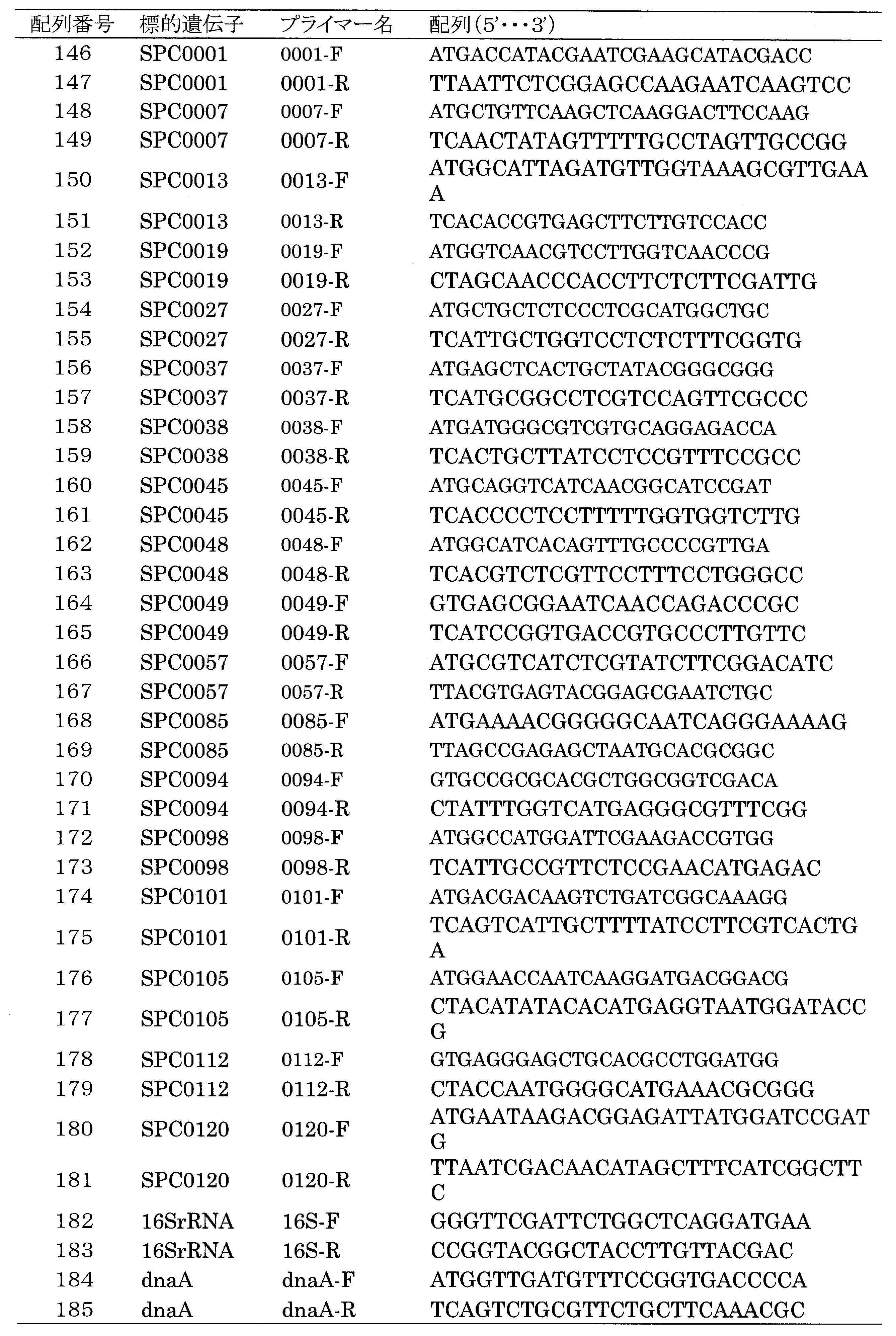
配列番号1~145の本発明の遺伝子からランダムに選出した表2に示す18遺伝子を対象として、各遺伝子の5’末端及び3’末端部の塩基配列を基に、遺伝子全長を増幅するプライマーをDNA合成機を用いて作製した(表2、配列番号146~181)。
また陽性対照として、16SrRNA遺伝子の共通配列領域、及びビフィドバクテリウム・ブレーベの菌種内での配列共通性が極めて高いdnaA遺伝子を用い、これらの領域を増幅するプライマーを同様に作製した(表2、配列番号182~185)。
(1)プライマーの作製
配列番号1~145の本発明の遺伝子からランダムに選出した表2に示す18遺伝子を対象として、各遺伝子の5’末端及び3’末端部の塩基配列を基に、遺伝子全長を増幅するプライマーをDNA合成機を用いて作製した(表2、配列番号146~181)。
また陽性対照として、16SrRNA遺伝子の共通配列領域、及びビフィドバクテリウム・ブレーベの菌種内での配列共通性が極めて高いdnaA遺伝子を用い、これらの領域を増幅するプライマーを同様に作製した(表2、配列番号182~185)。
(2)鋳型DNAの抽出
表3に示した由来の異なるビフィドバクテリウム・ブレーベに属する13菌株を、GAM培地(日水製薬社製)に1%グルコース及び1.5%アガーを添加した平板培地にて嫌気的に37℃で72時間培養した。出現したコロニーの1つを50μLのTEバッファー(10mM Tris、1mM EDTA、pH8.0)に懸濁し、98℃で2分間処理してDNAを抽出した。加熱処理後は直ちに氷冷し、4℃、15,000rpmで5分間遠心した上清を鋳型DNA溶液として下記のPCR反応に供試した。
表3に示した由来の異なるビフィドバクテリウム・ブレーベに属する13菌株を、GAM培地(日水製薬社製)に1%グルコース及び1.5%アガーを添加した平板培地にて嫌気的に37℃で72時間培養した。出現したコロニーの1つを50μLのTEバッファー(10mM Tris、1mM EDTA、pH8.0)に懸濁し、98℃で2分間処理してDNAを抽出した。加熱処理後は直ちに氷冷し、4℃、15,000rpmで5分間遠心した上清を鋳型DNA溶液として下記のPCR反応に供試した。

(3)PCR反応
7.5μLのEmeraldAmp PCR Master Mix(タカラ社製)、0.2μM プライマー、0.5μLの鋳型DNA溶液を水で総量を15μLとした反応液を、iCycler(バイオ・ラッド社製)により、98℃10秒、60℃30秒、72℃120秒で30サイクルのPCR反応を行った。
7.5μLのEmeraldAmp PCR Master Mix(タカラ社製)、0.2μM プライマー、0.5μLの鋳型DNA溶液を水で総量を15μLとした反応液を、iCycler(バイオ・ラッド社製)により、98℃10秒、60℃30秒、72℃120秒で30サイクルのPCR反応を行った。
(4)YIT 12272株の特異的検出
上記PCR反応による増幅産物の有無から各プライマーと各菌株DNAとの結合能を観察することにより、表2に示した18遺伝子がビフィドバクテリウム・ブレーベ YIT 12272株に特異的な遺伝子であるか、及びこれら遺伝子が当該菌株を特異的に検出することに利用できるかを検証した。PCR反応後の反応液に対して、Mupid-exU(アドバンス社製)を用いて、1%アガロースゲルによる100V、25分の電気泳動を行い、0.5mg/mlのエチジウムブロマイドにて染色後、UV照射下で増幅産物を観察した。各プライマーを用いた時の増幅産物の有無は表4に示す通りとなった。これより、表2に示した18遺伝子がビフィドバクテリウム・ブレーベ YIT 12272株に特異的であること及びこれら遺伝子を当該菌株を特異的に検出することに利用できることが明らかとなった。
上記PCR反応による増幅産物の有無から各プライマーと各菌株DNAとの結合能を観察することにより、表2に示した18遺伝子がビフィドバクテリウム・ブレーベ YIT 12272株に特異的な遺伝子であるか、及びこれら遺伝子が当該菌株を特異的に検出することに利用できるかを検証した。PCR反応後の反応液に対して、Mupid-exU(アドバンス社製)を用いて、1%アガロースゲルによる100V、25分の電気泳動を行い、0.5mg/mlのエチジウムブロマイドにて染色後、UV照射下で増幅産物を観察した。各プライマーを用いた時の増幅産物の有無は表4に示す通りとなった。これより、表2に示した18遺伝子がビフィドバクテリウム・ブレーベ YIT 12272株に特異的であること及びこれら遺伝子を当該菌株を特異的に検出することに利用できることが明らかとなった。

Claims (9)
- 配列番号1~145に示される塩基配列からなるDNA又は該配列に相補的な塩基配列からなるDNAである、ビフィドバクテリウム・ブレーベ YIT 12272株を特異的に検出するための遺伝子。
- 配列番号1~36に示される塩基配列からなるDNA又は該配列に相補的な塩基配列からなるDNAである請求項1記載の遺伝子。
- 配列番号37~55に示される塩基配列からなるDNA又は該配列に相補的な塩基配列からなるDNAである請求項1記載の遺伝子。
- 請求項1記載の遺伝子のいずれか1つ以上を標的とすることを特徴とするビフィドバクテリウム・ブレーベ YIT 12272株の特異的検出方法。
- 請求項1記載の遺伝子のいずれか1つ以上を標的とすることを特徴とするビフィドバクテリウム・ブレーベ YIT 12272株の定量方法。
- 請求項1記載の遺伝子又はその発現産物のいずれか1つ以上の存在及び/又は発現量を指標とすることを特徴とする当該遺伝子を有する微生物のスクリーニング方法。
- 請求項6記載のスクリーニング方法により選択された微生物。
- 請求項1記載の遺伝子のいずれか1つ以上を導入すること、及び/又は請求項1記載の遺伝子のいずれか1つ以上を標的として微生物の遺伝子を改変することを特徴とする遺伝子改変微生物の作出方法。
- 請求項8記載の作出方法により得られた遺伝子改変微生物。
Priority Applications (1)
| Application Number | Priority Date | Filing Date | Title |
|---|---|---|---|
| JP2015505522A JP6412865B2 (ja) | 2013-03-13 | 2014-03-12 | ビフィドバクテリウム・ブレーベ株特異的遺伝子 |
Applications Claiming Priority (2)
| Application Number | Priority Date | Filing Date | Title |
|---|---|---|---|
| JP2013050631 | 2013-03-13 | ||
| JP2013-050631 | 2013-03-13 |
Publications (1)
| Publication Number | Publication Date |
|---|---|
| WO2014142186A1 true WO2014142186A1 (ja) | 2014-09-18 |
Family
ID=51536837
Family Applications (1)
| Application Number | Title | Priority Date | Filing Date |
|---|---|---|---|
| PCT/JP2014/056537 Ceased WO2014142186A1 (ja) | 2013-03-13 | 2014-03-12 | ビフィドバクテリウム・ブレーベ株特異的遺伝子 |
Country Status (2)
| Country | Link |
|---|---|
| JP (1) | JP6412865B2 (ja) |
| WO (1) | WO2014142186A1 (ja) |
Cited By (2)
| Publication number | Priority date | Publication date | Assignee | Title |
|---|---|---|---|---|
| JP2017216980A (ja) * | 2016-06-10 | 2017-12-14 | 森永乳業株式会社 | オリゴヌクレオチド |
| US20220000949A1 (en) * | 2018-09-25 | 2022-01-06 | National Cerebral And Cardiovascular Center | Antitumor effect potentiator |
Citations (2)
| Publication number | Priority date | Publication date | Assignee | Title |
|---|---|---|---|---|
| WO2011083738A1 (ja) * | 2010-01-06 | 2011-07-14 | 株式会社ヤクルト本社 | 経口用のdna損傷修復促進剤及びエラスターゼ活性抑制剤 |
| WO2011105335A1 (ja) * | 2010-02-24 | 2011-09-01 | 株式会社ヤクルト本社 | 新規ビフィドバクテリウム属細菌の作出方法 |
-
2014
- 2014-03-12 WO PCT/JP2014/056537 patent/WO2014142186A1/ja not_active Ceased
- 2014-03-12 JP JP2015505522A patent/JP6412865B2/ja active Active
Patent Citations (2)
| Publication number | Priority date | Publication date | Assignee | Title |
|---|---|---|---|---|
| WO2011083738A1 (ja) * | 2010-01-06 | 2011-07-14 | 株式会社ヤクルト本社 | 経口用のdna損傷修復促進剤及びエラスターゼ活性抑制剤 |
| WO2011105335A1 (ja) * | 2010-02-24 | 2011-09-01 | 株式会社ヤクルト本社 | 新規ビフィドバクテリウム属細菌の作出方法 |
Non-Patent Citations (4)
Cited By (3)
| Publication number | Priority date | Publication date | Assignee | Title |
|---|---|---|---|---|
| JP2017216980A (ja) * | 2016-06-10 | 2017-12-14 | 森永乳業株式会社 | オリゴヌクレオチド |
| US20220000949A1 (en) * | 2018-09-25 | 2022-01-06 | National Cerebral And Cardiovascular Center | Antitumor effect potentiator |
| US12186350B2 (en) * | 2018-09-25 | 2025-01-07 | National Cerebral And Cardiovascular Center | Antitumor effect potentiator |
Also Published As
| Publication number | Publication date |
|---|---|
| JPWO2014142186A1 (ja) | 2017-02-16 |
| JP6412865B2 (ja) | 2018-10-24 |
Similar Documents
| Publication | Publication Date | Title |
|---|---|---|
| US8741622B2 (en) | Stress tolerant Bifidobacteria | |
| CN108220219B (zh) | 一套植物乳杆菌食品级表达系统及其在异源蛋白表达中的应用 | |
| JP2013201936A (ja) | 乳酸発酵におけるアミン生成制御方法 | |
| JP6412865B2 (ja) | ビフィドバクテリウム・ブレーベ株特異的遺伝子 | |
| WO2008053588A1 (en) | Cytokine production regulator gene and use thereof | |
| CN120350049A (zh) | 一种促进乳酸菌活性增强的方法 | |
| WO2009150856A1 (ja) | 酸素耐性付与遺伝子及びその利用 | |
| JP7830783B2 (ja) | 乳酸菌lq80株を特異的に検出するプライマーセット、該プライマーセットを用いたキット及び検出方法 | |
| CN103732742B (zh) | 赋予过氧化氢耐性的基因及其利用 | |
| CN115851491A (zh) | 植物乳植杆菌及其应用 | |
| CN117957307A (zh) | 乳酸菌、乳酸菌酵种、发酵乳、发酵乳的制造方法、及乳酸菌的筛选方法 | |
| WO2022080246A1 (ja) | 発酵乳の曳糸性の向上作用を有するタンパク質、並びに、それを用いた発酵乳及びその製造方法 | |
| Odutayo et al. | Characterization of potential probiotics isolated from fermented under-utilized Chrysophyllum albidum Linn kernels using microbiological, biochemical and molecular techniques | |
| EP3081643B1 (en) | Method for regulating acid resistance of microbes | |
| WO2024204681A1 (ja) | ビフィドバクテリウム属細菌の形質転換方法 | |
| WO2023163015A1 (ja) | 乳酸菌、乳酸菌組成物、乳酸菌の製造方法、乳酸菌の酸耐性向上方法、乳酸菌のスクリーニング方法、及び発酵乳の製造方法 | |
| Sugata et al. | Evaluation of Plantaricin Gene Expression in Lactiplantibacillus plantarum Strain SU-KC1a:[Evaluasi Ekspresi Gen Plantarisin pada Lactiplantibacillus plantarum Strain SU-KC1a] | |
| JP2006262818A (ja) | 乳酸桿菌由来の酸耐性に関わる遺伝子 |
Legal Events
| Date | Code | Title | Description |
|---|---|---|---|
| 121 | Ep: the epo has been informed by wipo that ep was designated in this application |
Ref document number: 14765013 Country of ref document: EP Kind code of ref document: A1 |
|
| ENP | Entry into the national phase |
Ref document number: 2015505522 Country of ref document: JP Kind code of ref document: A |
|
| NENP | Non-entry into the national phase |
Ref country code: DE |
|
| 122 | Ep: pct application non-entry in european phase |
Ref document number: 14765013 Country of ref document: EP Kind code of ref document: A1 |