WO2014129496A1 - アクリロニトリル製造用触媒およびアクリロニトリルの製造方法 - Google Patents
アクリロニトリル製造用触媒およびアクリロニトリルの製造方法 Download PDFInfo
- Publication number
- WO2014129496A1 WO2014129496A1 PCT/JP2014/053902 JP2014053902W WO2014129496A1 WO 2014129496 A1 WO2014129496 A1 WO 2014129496A1 JP 2014053902 W JP2014053902 W JP 2014053902W WO 2014129496 A1 WO2014129496 A1 WO 2014129496A1
- Authority
- WO
- WIPO (PCT)
- Prior art keywords
- catalyst
- mass
- group
- acrylonitrile
- parts
- Prior art date
- Legal status (The legal status is an assumption and is not a legal conclusion. Google has not performed a legal analysis and makes no representation as to the accuracy of the status listed.)
- Ceased
Links
Classifications
-
- B—PERFORMING OPERATIONS; TRANSPORTING
- B01—PHYSICAL OR CHEMICAL PROCESSES OR APPARATUS IN GENERAL
- B01J—CHEMICAL OR PHYSICAL PROCESSES, e.g. CATALYSIS OR COLLOID CHEMISTRY; THEIR RELEVANT APPARATUS
- B01J27/00—Catalysts comprising the elements or compounds of halogens, sulfur, selenium, tellurium, phosphorus or nitrogen; Catalysts comprising carbon compounds
- B01J27/14—Phosphorus; Compounds thereof
- B01J27/186—Phosphorus; Compounds thereof with arsenic, antimony, bismuth, vanadium, niobium, tantalum, polonium, chromium, molybdenum, tungsten, manganese, technetium or rhenium
- B01J27/188—Phosphorus; Compounds thereof with arsenic, antimony, bismuth, vanadium, niobium, tantalum, polonium, chromium, molybdenum, tungsten, manganese, technetium or rhenium with chromium, molybdenum, tungsten or polonium
- B01J27/19—Molybdenum
-
- C—CHEMISTRY; METALLURGY
- C07—ORGANIC CHEMISTRY
- C07C—ACYCLIC OR CARBOCYCLIC COMPOUNDS
- C07C253/00—Preparation of carboxylic acid nitriles
- C07C253/24—Preparation of carboxylic acid nitriles by ammoxidation of hydrocarbons or substituted hydrocarbons
- C07C253/26—Preparation of carboxylic acid nitriles by ammoxidation of hydrocarbons or substituted hydrocarbons containing carbon-to-carbon multiple bonds, e.g. unsaturated aldehydes
-
- B—PERFORMING OPERATIONS; TRANSPORTING
- B01—PHYSICAL OR CHEMICAL PROCESSES OR APPARATUS IN GENERAL
- B01J—CHEMICAL OR PHYSICAL PROCESSES, e.g. CATALYSIS OR COLLOID CHEMISTRY; THEIR RELEVANT APPARATUS
- B01J23/00—Catalysts comprising metals or metal oxides or hydroxides, not provided for in group B01J21/00
- B01J23/70—Catalysts comprising metals or metal oxides or hydroxides, not provided for in group B01J21/00 of the iron group metals or copper
- B01J23/76—Catalysts comprising metals or metal oxides or hydroxides, not provided for in group B01J21/00 of the iron group metals or copper combined with metals, oxides or hydroxides provided for in groups B01J23/02 - B01J23/36
- B01J23/84—Catalysts comprising metals or metal oxides or hydroxides, not provided for in group B01J21/00 of the iron group metals or copper combined with metals, oxides or hydroxides provided for in groups B01J23/02 - B01J23/36 with arsenic, antimony, bismuth, vanadium, niobium, tantalum, polonium, chromium, molybdenum, tungsten, manganese, technetium or rhenium
- B01J23/85—Chromium, molybdenum or tungsten
- B01J23/888—Tungsten
- B01J23/8885—Tungsten containing also molybdenum
-
- B—PERFORMING OPERATIONS; TRANSPORTING
- B01—PHYSICAL OR CHEMICAL PROCESSES OR APPARATUS IN GENERAL
- B01J—CHEMICAL OR PHYSICAL PROCESSES, e.g. CATALYSIS OR COLLOID CHEMISTRY; THEIR RELEVANT APPARATUS
- B01J27/00—Catalysts comprising the elements or compounds of halogens, sulfur, selenium, tellurium, phosphorus or nitrogen; Catalysts comprising carbon compounds
- B01J27/14—Phosphorus; Compounds thereof
- B01J27/186—Phosphorus; Compounds thereof with arsenic, antimony, bismuth, vanadium, niobium, tantalum, polonium, chromium, molybdenum, tungsten, manganese, technetium or rhenium
- B01J27/195—Phosphorus; Compounds thereof with arsenic, antimony, bismuth, vanadium, niobium, tantalum, polonium, chromium, molybdenum, tungsten, manganese, technetium or rhenium with vanadium, niobium or tantalum
- B01J27/198—Vanadium
- B01J27/199—Vanadium with chromium, molybdenum, tungsten or polonium
-
- B—PERFORMING OPERATIONS; TRANSPORTING
- B01—PHYSICAL OR CHEMICAL PROCESSES OR APPARATUS IN GENERAL
- B01J—CHEMICAL OR PHYSICAL PROCESSES, e.g. CATALYSIS OR COLLOID CHEMISTRY; THEIR RELEVANT APPARATUS
- B01J37/00—Processes, in general, for preparing catalysts; Processes, in general, for activation of catalysts
- B01J37/0009—Use of binding agents; Moulding; Pressing; Powdering; Granulating; Addition of materials ameliorating the mechanical properties of the product catalyst
- B01J37/0027—Powdering
- B01J37/0045—Drying a slurry, e.g. spray drying
-
- B—PERFORMING OPERATIONS; TRANSPORTING
- B01—PHYSICAL OR CHEMICAL PROCESSES OR APPARATUS IN GENERAL
- B01J—CHEMICAL OR PHYSICAL PROCESSES, e.g. CATALYSIS OR COLLOID CHEMISTRY; THEIR RELEVANT APPARATUS
- B01J37/00—Processes, in general, for preparing catalysts; Processes, in general, for activation of catalysts
- B01J37/08—Heat treatment
-
- B—PERFORMING OPERATIONS; TRANSPORTING
- B01—PHYSICAL OR CHEMICAL PROCESSES OR APPARATUS IN GENERAL
- B01J—CHEMICAL OR PHYSICAL PROCESSES, e.g. CATALYSIS OR COLLOID CHEMISTRY; THEIR RELEVANT APPARATUS
- B01J2523/00—Constitutive chemical elements of heterogeneous catalysts
-
- Y—GENERAL TAGGING OF NEW TECHNOLOGICAL DEVELOPMENTS; GENERAL TAGGING OF CROSS-SECTIONAL TECHNOLOGIES SPANNING OVER SEVERAL SECTIONS OF THE IPC; TECHNICAL SUBJECTS COVERED BY FORMER USPC CROSS-REFERENCE ART COLLECTIONS [XRACs] AND DIGESTS
- Y02—TECHNOLOGIES OR APPLICATIONS FOR MITIGATION OR ADAPTATION AGAINST CLIMATE CHANGE
- Y02P—CLIMATE CHANGE MITIGATION TECHNOLOGIES IN THE PRODUCTION OR PROCESSING OF GOODS
- Y02P20/00—Technologies relating to chemical industry
- Y02P20/50—Improvements relating to the production of bulk chemicals
- Y02P20/52—Improvements relating to the production of bulk chemicals using catalysts, e.g. selective catalysts
Definitions
- the present invention relates to a catalyst for producing acrylonitrile for producing acrylonitrile by vapor-phase catalytic ammoxidation of propylene with molecular oxygen and ammonia, and a method for producing acrylonitrile using the catalyst.
- This application claims priority based on Japanese Patent Application No. 2013-032047 for which it applied to Japan on February 21, 2013, and uses the content here.
- Patent Document 1 discloses a composite oxide catalyst of antimony and at least one element selected from the group consisting of iron, cobalt, and nickel
- Patent Documents 2 to 9 disclose iron, antimony, tellurium
- Patent Documents 10 to 12 disclose methods for preparing these iron and antimony containing catalysts.
- Patent Documents 13 to 20 disclose composite oxide catalysts containing molybdenum, bismuth and iron.
- This invention is made
- the catalyst for producing acrylonitrile of the present invention has a composition represented by the following general formula.
- Fe a Sb b C c D d Te e Co f G g X x Y y Z z O h (SiO 2) i
- Fe is iron; Sb is antimony; Te is tellurium; Co is cobalt;
- C is at least one element selected from the group consisting of copper and nickel;
- D is selected from the group consisting of molybdenum, tungsten and vanadium At least one element;
- G is at least one element selected from the group consisting of phosphorus and boron;
- X is tin, titanium, zirconium, niobium, tantalum, ruthenium, palladium, silver, aluminum, gallium, indium, thallium , At least one element selected from the group consisting of germanium, arsenic, bismuth, lanthanum, cerium, praseodymium,
- the acrylonitrile production catalyst of the present invention preferably contains iron antimonate as a crystal phase.
- the acrylonitrile production method of the present invention is characterized in that acrylonitrile is produced by reacting propylene with molecular oxygen and ammonia in the presence of the acrylonitrile production catalyst of the present invention.
- a catalyst for producing acrylonitrile having a composition represented by the following general formula. Fe a Sb b C c D d Te e Co f G g X x Y y Z z O h (SiO 2) i (Where Fe is iron; Sb is antimony; Te is tellurium; Co is cobalt; C is at least one element selected from the group consisting of copper and nickel; D is at least one element selected from the group consisting of molybdenum, tungsten and vanadium; G is at least one element selected from the group consisting of phosphorus and boron; X is at least one selected from the group consisting of tin, titanium, zirconium, niobium, tantalum, ruthenium, palladium, silver, aluminum, gallium, indium, thallium, germanium, arsenic, bismuth, lanthanum, cerium, praseodymium, neodym
- Seed elements Y is at least one element selected from the group consisting of magnesium, calcium, strontium, barium, manganese, zinc and lead; Z is at least one element selected from the group consisting of lithium, sodium, potassium, rubidium and cesium; O is oxygen; (SiO 2 ) represents silica; a, b, c, d, e, f, g, x, y, z, h and i represent the atomic ratio of each element (silicon in the case of silica); a is 10; b is 5-60; c is 1-8; d is 0.1-4; e is 0.1-5; f is 0.1-4.
- G is 0.1-5; x is 0-5; y is 0-5; z is 0-2; i is 10-200; h is silicon
- [3] A method for producing acrylonitrile, comprising reacting propylene with molecular oxygen and ammonia in the presence of the acrylonitrile production catalyst according to [1] or [2].
- the catalyst for producing acrylonitrile of the present invention generation of by-products is suppressed as compared with conventional catalysts, and acrylonitrile can be produced with high yield.
- One embodiment of the present invention includes a catalyst for producing acrylonitrile having a composition represented by the following general formula. Fe a Sb b C c D d Te e Co f G g X x Y y Z z O h (SiO 2) i
- each symbol is as follows. Fe is iron, Sb is antimony, Te is tellurium, Co is cobalt, C is at least one element selected from the group consisting of copper and nickel; D is at least one element selected from the group consisting of molybdenum, tungsten and vanadium; G is at least one element selected from the group consisting of phosphorus and boron, X is at least one selected from the group consisting of tin, titanium, zirconium, niobium, tantalum, ruthenium, palladium, silver, aluminum, gallium, indium, thallium, germanium, arsenic, bismuth, lanthanum, cerium, praseodymium, neodymium, and samarium.
- Seed elements Y is at least one element selected from the group consisting of magnesium, calcium, strontium, barium, manganese, zinc and lead; Z is at least one element selected from the group consisting of lithium, sodium, potassium, rubidium and cesium, O is oxygen, (SiO 2 ) represents silica.
- a, b, c, d, f, e, g, x, y, z, h, and i represent the atomic ratio of each element (silicon in the case of silica), a is 10; b is 5 to 60, preferably 10 to 55; c is 1 to 8, preferably 1.5 to 7.5; d is 0.1 to 4, preferably 0.
- e is 0.1 to 5, preferably 0.5 to 4.5
- f is 0.1 to 4.5, preferably 0.2 to 3.5
- g is 0.1 to 5, preferably 0.3 to 4
- x is 0 to 5
- Y is from 0 to 5, preferably from 0 to 4.5
- z is from 0 to 2, preferably from 0 to 1.5
- h is an atomic ratio of oxygen necessary to satisfy the valence of each of the above elements excluding silicon
- (a + f) / b is 0.8.
- the lower limit value is preferably 0.52 and the upper limit value is preferably 0.57.
- the composition of the catalyst for producing acrylonitrile refers to the bulk composition of the catalyst, but unless a highly volatile component is used, the composition of the catalyst (atomic ratio) is determined from the amount of raw materials charged for each element constituting the catalyst. ) May be calculated. That is, the composition of the catalyst for producing acrylonitrile in the present invention may be a composition (atomic ratio) calculated from the amount of raw material charged for each element constituting the catalyst.
- the catalyst in one embodiment of the present invention preferably contains iron antimonate as a crystal phase.
- iron antimonate there are several compositions of iron antimonate (see the above-mentioned Patent Document 8), but FeSbO 4 is the most common, and the composition of iron antimonate in the present invention may be mainly considered to be FeSbO 4 .
- the presence of the iron antimonate crystal phase can be confirmed by X-ray diffraction.
- various elements may be dissolved in the iron antimonate in the present invention.
- the Fe component and the Sb component do not necessarily have to form iron antimonate in a crystalline phase. A part of Fe component or Sb component may exist in a free state, or some other compound may be formed.
- the catalyst for producing acrylonitrile according to one embodiment of the present invention contains iron antimonate as a crystal phase, whereby the catalytic activity is improved and physical properties such as particle strength and bulk density can be made preferable. .
- the method of baking after preparing the aqueous slurry containing the raw material of each element which comprises a catalyst, and drying the obtained aqueous slurry is preferable. That is, as a method for preparing the catalyst for producing acrylonitrile of the present invention, an aqueous slurry containing raw materials for each element constituting the catalyst is prepared, the obtained aqueous slurry is dried, and the dried product is calcined.
- the preparation method including that.
- the aqueous slurry may contain all of the desired elements constituting the catalyst in a desired atomic ratio, and some elements may be added to the composition after drying or after calcination by a method such as impregnation. Alternatively, it may be fired after adjusting to a desired atomic ratio.
- the method of patent document 10 or patent document 11 can be used, for example. That is, an aqueous slurry containing an antimony raw material, a trivalent iron compound and nitrate ions was prepared, and after adjusting the pH of the slurry to 7 or less, heat treatment was performed at a temperature in the range of 40 to 150 ° C., and the resulting slurry A catalyst containing iron antimonate as a crystal phase can be prepared by a method of drying and baking.
- a method of preparing a catalyst containing iron antimonate as a crystal phase adjusting an aqueous slurry containing an antimony raw material, a trivalent iron compound and nitrate ions, adjusting the pH of the slurry to 7 or less, Heat treatment is performed at a temperature in the range of 40 to 150 ° C., the obtained slurry is dried and fired, and after the aqueous slurry is dried or fired, the remaining elements are added by a method such as impregnation. And adjusting to the atomic ratio of. Furthermore, the preparation method may include firing after adjusting to a desired atomic ratio.
- the raw material of each element there are no particular restrictions on the raw material of each element, and oxides of each element, or nitrates, carbonates, organic acid salts, ammonium salts, hydroxides, halides, etc. that can be easily converted into oxides by heating are used. it can. Moreover, you may use these in combination of multiple types.
- the raw material of the iron component is not particularly limited as long as it can be easily converted into an oxide.
- iron when preparing a catalyst containing iron antimonate as a crystal phase, iron is preferably present as a trivalent ion in a solution or slurry, for example, inorganic such as ferric nitrate or ferric sulfate. Acid salts; organic acid salts such as iron citrate; and raw materials obtained by dissolving metallic iron such as electrolytic iron powder in nitric acid or the like are preferably used.
- the antimony component is not particularly limited, and oxides such as antimony trioxide and antimony pentoxide, antimony chloride, and antimony sulfate can be used.
- the raw material of the tellurium component is not particularly limited, and a solution in which metal tellurium is dissolved in nitric acid or hydrogen peroxide solution in addition to tellurium dioxide and telluric acid can be used.
- a solution in which metal tellurium is dissolved in nitric acid or hydrogen peroxide solution in addition to tellurium dioxide and telluric acid can be used.
- Oxides, such as cobalt oxide, chlorides, such as cobalt chloride, cobalt nitrate, etc. can be used.
- colloidal silica Although there is no restriction
- the colloidal silica one produced by a known method may be used, or it may be appropriately selected from commercially available colloidal silica.
- the size of the colloidal particles in the colloidal silica is not particularly limited, but the average diameter is preferably 2 to 100 nm, and more preferably 5 to 75 nm.
- the colloidal silica may be colloidal silica with uniform colloidal particle size, or may be colloidal silica in which colloidal particles of several sizes are mixed. Moreover, you may mix and use multiple types of colloidal silica from which an average diameter, pH, etc. differ.
- the catalyst in one embodiment of the present invention can be applied to either a fixed bed reactor or a fluidized bed reactor. That is, the catalyst in one embodiment of the present invention can be used as a fixed bed catalyst or a fluidized bed catalyst, but is particularly preferably used as a fluidized bed catalyst.
- the acrylonitrile production catalyst in one embodiment of the present invention is used as a fluidized bed catalyst, it is preferable to obtain particles dried using a spray dryer.
- the particles are preferably spherical.
- a spray dryer such as a rotary disk type or a nozzle type can be used.
- the spray drying the spray drying conditions are appropriately adjusted so that a catalyst having preferable physical properties as a fluidized bed catalyst such as particle size distribution and particle strength can be obtained.
- the outer diameter is preferably a granular material in the range of 1 to 200 ⁇ m, and the granular material in the range of 5 to 150 ⁇ m. More preferably, it is a product.
- the shape of the granular material is preferably spherical.
- a desired catalyst structure is formed and the activity as a catalyst is expressed.
- the firing time is not particularly limited, but if it is too short, a good catalyst cannot be obtained, so that it is preferably 0.5 hours or longer, more preferably 1 hour or longer.
- the upper limit is not particularly limited, but it is usually within 20 hours because an effect of a certain level cannot be obtained even if firing is performed for a longer time than necessary.
- a general purpose baking furnace can be used. In the case of producing a fluidized bed catalyst, a rotary kiln, a fluidized firing furnace or the like is particularly preferably used.
- the dried product may be immediately fired at a temperature in the range of 550 to 1000 ° C.
- the temperature of 550 to 1000 ° C. after pre-baking in one or two steps in the temperature range of 250 to 500 ° C., the temperature of 550 to 1000 ° C.
- the physical properties and activity of the catalyst may be improved by firing at a temperature in the range.
- oxygen molecular oxygen
- ammonia molecular oxygen
- the concentration of propylene in the raw material gas during the gas phase catalytic ammoxidation reaction can be varied within a wide range, 1 to 20% by volume is appropriate, and 3 to 15% by volume is particularly preferable.
- the molar ratio of propylene to oxygen (propylene: oxygen) in the raw material gas is preferably 1: 1.5 to 1: 3. Although it is industrially advantageous to use air as the oxygen source, air enriched by adding pure oxygen as necessary may be used.
- the molar ratio of propylene to ammonia in the reaction gas (propylene: ammonia) is preferably 1: 1 to 1: 1.5.
- the source gas may be diluted with an inert gas or water vapor.
- the gas phase ammoxidation reaction is usually carried out at a reaction temperature of 370 to 500 ° C., a reaction pressure of normal pressure to 500 kPa, and an apparent contact time of the catalyst and the raw material gas of 1 to 20 seconds.
- Example 1 (Preparation of catalyst) Catalysts having the compositions shown in Table 1 were prepared by the following procedure. 42.7 parts by mass of copper powder was dissolved in 1800 parts by mass of 63% by mass nitric acid. After adding 1750 parts by mass of pure water to this solution, it was heated to 60 ° C., and 150 parts by mass of electrolytic iron powder and 34.3 parts by mass of tellurium powder were added little by little and dissolved. After confirming dissolution, 39.1 parts by mass of cobalt nitrate, 39.1 parts by mass of nickel nitrate, and 6.3 parts by mass of calcium nitrate were sequentially added to the solution and dissolved (solution A).
- a solution (solution C) in which 3 parts by mass of 3 parts by mass of tellurium powder was dissolved was prepared. While stirring, 4437 parts by mass of 20 mass% colloidal silica, 743.8 parts by mass of antimony trioxide powder, B liquid and C liquid were sequentially added to A liquid to obtain an aqueous slurry.
- aqueous ammonia was added dropwise to adjust the pH to 2.0, and the resulting aqueous slurry was heated at the boiling point for 3 hours under reflux.
- the aqueous slurry after the heat treatment was cooled to 80 ° C., and 6.2 parts by mass of 85% by mass phosphoric acid, 33.2 parts by mass of boric acid, and 1.0 part by mass of lithium nitrate were sequentially added.
- the obtained aqueous slurry was spray-dried with a spray dryer at a drying air temperature of 330 ° C. at the dryer inlet and 160 ° C. at the dryer outlet to obtain spherical dry particles.
- the obtained dried particles are calcined at 250 ° C. for 2 hours and at 400 ° C. for 2 hours, and finally fluidly calcined at 795 ° C. for 3 hours using a fluidized calcining furnace, and a catalyst containing iron antimonate as a crystal phase Got.
- Catalyst performance test Using the obtained catalyst, an acrylonitrile production reaction by a vapor-phase catalytic ammoxidation reaction of propylene was carried out as follows.
- the catalyst was packed in a fluidized bed reactor having an inner diameter of 55 mm and a height of 2000 mm so that the apparent contact time between the catalyst and the raw material gas was as shown in Table 2.
- the reaction pressure was 200 kPa, and the reaction temperature was 460 ° C.
- the reaction product was quantified by gas chromatography, and the propylene conversion rate and acrylonitrile yield 4 hours after the start of the reaction were determined.
- the propylene conversion rate and acrylonitrile yield at that time were determined by the following formulas.
- Example 2 In Example 1, it prepared in the same procedure as Example 1 except having changed the preparation amount of cobalt nitrate into 140.7 mass parts and the preparation amount of the antimony trioxide powder into 861.2 mass parts. About the obtained catalyst, the catalyst performance test was implemented like Example 1. FIG. The results are shown in Table 2.
- Example 3 In Example 1, it prepared in the same procedure as Example 1 except having changed the preparation amount of cobalt nitrate into 109.4 mass parts and the preparation amount of the antimony trioxide powder into 783.0 mass parts. About the obtained catalyst, the catalyst performance test was implemented like Example 1. FIG. The results are shown in Table 2.
- Example 4 Catalysts having the compositions shown in Table 1 were prepared by the following procedure. 34.1 parts by mass of copper powder was dissolved in 1800 parts by mass of 63% by mass nitric acid. After adding 1750 parts by mass of pure water to this solution, it was heated to 60 ° C., and 150 parts by mass of electrolytic iron powder and 51.4 parts by mass of tellurium powder were added little by little and dissolved. After confirming dissolution, 117.2 parts by mass of cobalt nitrate, 93.7 parts by mass of nickel nitrate, and 6.4 parts by mass of indium nitrate were sequentially added to the solution and dissolved (solution A).
- a solution prepared by dissolving 14.0 parts by mass of ammonium paratungstate in 700 parts by mass of pure water (Liquid B), 400 parts by mass of pure water, 150 parts by mass of 35% by mass hydrogen peroxide, and 71.1 ammonium paramolybdate A solution (solution C) in which 51.4 parts by mass of tellurium powder and 1 part by mass were dissolved was prepared. While stirring, 4679 parts by mass of 20% by mass colloidal silica, 822.1 parts by mass of antimony trioxide powder, B liquid and C liquid were sequentially added to A liquid to obtain an aqueous slurry.
- aqueous ammonia was added dropwise to adjust the pH to 2.0, and the resulting aqueous slurry was heated at the boiling point for 3 hours under reflux.
- the aqueous slurry after the heat treatment was cooled to 80 ° C., and 31.0 parts by mass of 85% by mass phosphoric acid, 16.6 parts by mass of boric acid, and 2.7 parts by mass of potassium nitrate were sequentially added.
- the obtained aqueous slurry was spray-dried with a spray dryer at a drying air temperature of 330 ° C. at the dryer inlet and 160 ° C. at the dryer outlet to obtain spherical dry particles.
- the obtained dried particles are calcined at 250 ° C. for 2 hours and at 400 ° C. for 2 hours, and finally fluidly calcined at 785 ° C. for 3 hours using a fluidized calcining furnace, and a catalyst containing iron antimonate as a crystal phase Got.
- the catalyst performance test was implemented like Example 1.
- FIG. The results are shown in Table 2.
- Example 5 In Example 4, it prepared in the same procedure as Example 4 except having changed the preparation amount of cobalt nitrate into 93.8 mass parts. About the obtained catalyst, the catalyst performance test was implemented like Example 1. FIG. The results are shown in Table 2.
- Example 6 Catalysts having the compositions shown in Table 1 were prepared by the following procedure. 25.6 parts by mass of copper powder were dissolved in 1750 parts by mass of 63% by mass nitric acid. 1700 parts by mass of pure water was added to this solution and then heated to 60 ° C., and 150 parts by mass of electrolytic iron powder and 68.5 parts by mass of tellurium powder were added little by little and dissolved. After confirming dissolution, 195.4 parts by mass of cobalt nitrate, 156.2 parts by mass of nickel nitrate, 11.7 parts by mass of praseodymium nitrate, and 4.5 parts by mass of lead nitrate were sequentially added to the solution and dissolved (A liquid).
- a solution (solution C) in which 6 parts by mass of tellurium powder and 68.5 parts by mass of tellurium powder were dissolved was prepared. While stirring, 4841 parts by mass of 20 mass% colloidal silica, 861.3 parts by mass of antimony trioxide powder, B liquid, and C liquid were sequentially added to A liquid to obtain an aqueous slurry.
- aqueous ammonia was added dropwise to adjust the pH to 2.0, and the resulting aqueous slurry was heated at the boiling point for 3 hours under reflux.
- the aqueous slurry after the heat treatment was cooled to 80 ° C., and 31.0 parts by mass of 85% by mass phosphoric acid was added.
- the obtained aqueous slurry was spray-dried with a spray dryer at a drying air temperature of 330 ° C. at the dryer inlet and 160 ° C. at the dryer outlet to obtain spherical dry particles. Next, the obtained dried particles are calcined at 250 ° C. for 2 hours and at 400 ° C.
- Example 6 it prepared in the same procedure as Example 6 except having changed the preparation amount of the antimony trioxide powder into 978.8 mass parts. About the obtained catalyst, the catalyst performance test was implemented like Example 1.
- Example 2 Example 2 In Example 6, it prepared in the same procedure as Example 6 except having changed the preparation amount of the antimony trioxide powder into 822.2 mass parts. About the obtained catalyst, the catalyst performance test was implemented like Example 1. FIG. The results are shown in Table 2.
- Example 1 (Comparative Example 1) In Example 1, it prepared in the same procedure as Example 1 except having changed the preparation amount of the antimony trioxide powder into 861.2 mass parts. About the obtained catalyst, the catalyst performance test was implemented like Example 1. FIG. The results are shown in Table 2.
- Example 2 In Example 1, it prepared in the same procedure as Example 1 except having changed the preparation amount of cobalt nitrate into 156.3 mass parts and the preparation amount of the antimony trioxide powder into 743.8 mass parts. About the obtained catalyst, the catalyst performance test was implemented like Example 1. FIG. The results are shown in Table 2.
- Example 3 (Comparative Example 3) In Example 1, it prepared in the procedure similar to Example 1 except the point which changed the preparation amount of the antimony trioxide powder to 900.4 mass parts, and the point which did not prepare cobalt nitrate. About the obtained catalyst, the catalyst performance test was implemented like Example 1. FIG. The results are shown in Table 2.
- Example 4 (Comparative Example 4) In Example 4, it prepared in the same procedure as Example 4 except not having charged cobalt nitrate. About the obtained catalyst, the catalyst performance test was implemented like Example 1. FIG. The results are shown in Table 2.
- Example 5 (Comparative Example 5) In Example 4, it prepared in the same procedure as Example 4 except having changed the preparation amount of cobalt nitrate into 273.6 mass parts. About the obtained catalyst, the catalyst performance test was implemented like Example 1. FIG. The results are shown in Table 2.
- Example 6 (Comparative Example 6) In Example 6, it prepared in the same procedure as Example 6 except having changed the preparation amount of the antimony trioxide powder into 704.6 mass parts. About the obtained catalyst, the catalyst performance test was implemented like Example 1. FIG. The results are shown in Table 2.
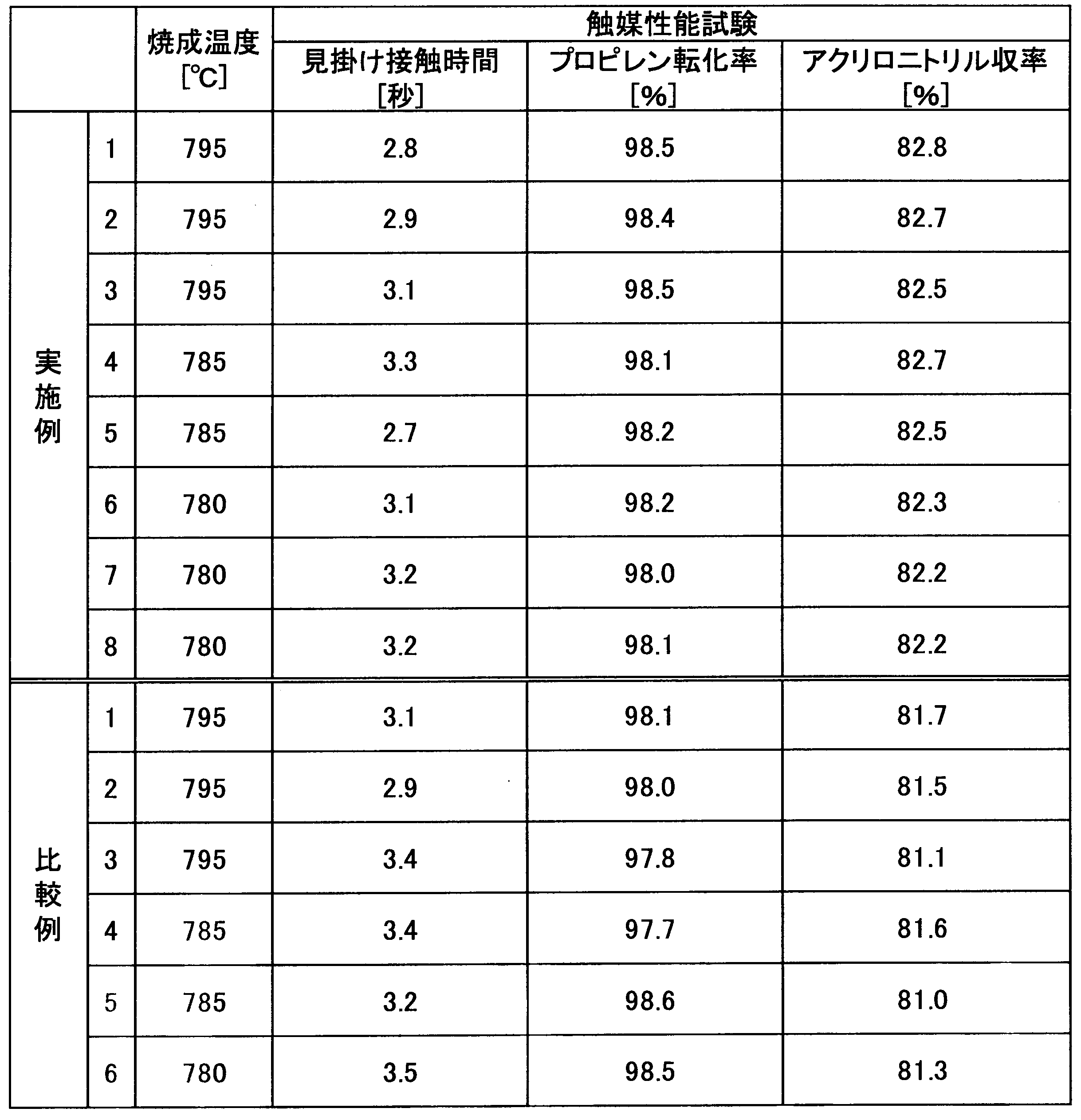
- the catalyst according to the example can increase the acrylonitrile yield as compared with the comparative example in which (a + f) / b does not satisfy the requirement of 0.50 or more and 0.60 or less. It was a thing.
- the catalyst for producing acrylonitrile of the present invention is extremely useful industrially because it can achieve a high acrylonitrile yield when producing acrylonitrile by vapor phase catalytic ammoxidation of propylene, and can produce acrylonitrile advantageously industrially. It is.
Landscapes
- Chemical & Material Sciences (AREA)
- Organic Chemistry (AREA)
- Engineering & Computer Science (AREA)
- Materials Engineering (AREA)
- Chemical Kinetics & Catalysis (AREA)
- Physics & Mathematics (AREA)
- Thermal Sciences (AREA)
- Catalysts (AREA)
- Organic Low-Molecular-Weight Compounds And Preparation Thereof (AREA)
- Low-Molecular Organic Synthesis Reactions Using Catalysts (AREA)
Abstract
Description
本願は、2013年2月21日に、日本に出願された特願2013-032047号に基づき優先権を主張し、その内容をここに援用する。
また、特許文献13~20にはモリブデン、ビスマスと鉄等を含有する複合酸化物触媒が開示されている。
FeaSbbCcDdTeeCofGgXxYyZzOh(SiO2)i
式中、Feは鉄;Sbはアンチモン;Teはテルル;Coはコバルト;Cは銅、ニッケルからなる群より選ばれた少なくとも1種の元素;Dはモリブデン、タングステンおよびバナジウムからなる群より選ばれた少なくとも1種の元素;Gはリンおよびホウ素からなる群より選ばれた少なくとも1種の元素;Xはスズ、チタン、ジルコニウム、ニオブ、タンタル、ルテニウム、パラジウム、銀、アルミニウム、ガリウム、インジウム、タリウム、ゲルマニウム、ヒ素、ビスマス、ランタン、セリウム、プラセオジム、ネオジムおよびサマリウムからなる群より選ばれた少なくとも1種の元素;Yはマグネシウム、カルシウム、ストロンチウム、バリウム、マンガン、亜鉛および鉛からなる群より選ばれた少なくとも1種の元素;Zはリチウム、ナトリウム、カリウム、ルビジウムおよびセシウムからなる群より選ばれた少なくとも1種の元素;Oは酸素;(SiO2)はシリカを表し;a、b、c、d、e、f、g、x、y、z、hおよびiは各元素(シリカの場合はケイ素)の原子比を表し;aは10であり;bは5~60であり;cは1~8であり;dは0.1~4であり;eは0.1~5であり;fは0.1~4.5であり;gは0.1~5であり;xは0~5であり;yは0~5であり;zは0~2であり;iは10~200であり;hはケイ素を除く前記各元素の原子価を満足するのに必要な酸素の原子比であり;かつ、(a+f)/bが、0.50以上、0.60以下である。
また、本発明のアクリロニトリルの製造方法は、本発明のアクリロニトリル製造用触媒の存在下、プロピレンと分子状酸素およびアンモニアとを反応させてアクリロニトリルを製造することを特徴とする。
[1]下記一般式で表される組成を有するアクリロニトリル製造用触媒。
FeaSbbCcDdTeeCofGgXxYyZzOh(SiO2)i
(式中、Feは鉄;Sbはアンチモン;Teはテルル;Coはコバルト;
Cは銅、およびニッケルからなる群より選ばれた少なくとも1種の元素;
Dはモリブデン、タングステンおよびバナジウムからなる群より選ばれた少なくとも1種の元素;
Gはリンおよびホウ素からなる群より選ばれた少なくとも1種の元素;
Xはスズ、チタン、ジルコニウム、ニオブ、タンタル、ルテニウム、パラジウム、銀、アルミニウム、ガリウム、インジウム、タリウム、ゲルマニウム、ヒ素、ビスマス、ランタン、セリウム、プラセオジム、ネオジムおよびサマリウムからなる群より選ばれた少なくとも1種の元素;
Yはマグネシウム、カルシウム、ストロンチウム、バリウム、マンガン、亜鉛および鉛からなる群より選ばれた少なくとも1種の元素;
Zはリチウム、ナトリウム、カリウム、ルビジウムおよびセシウムからなる群より選ばれた少なくとも1種の元素;
Oは酸素;
(SiO2)はシリカを表し;
a、b、c、d、e、f、g、x、y、z、hおよびiは各元素(シリカの場合はケイ素)の原子比を表し;
aは10であり;bは5~60であり;cは1~8であり;dは0.1~4であり;eは0.1~5であり;fは0.1~4.5であり;gは0.1~5であり;xは0~5であり;yは0~5であり;zは0~2であり;iは10~200であり;hはケイ素を除く前記各元素の原子価を満足するのに必要な酸素の原子比であり;
かつ、(a+f)/bが、0.50以上、0.60以下である。)
本発明の一実施形態としては、下記一般式で表される組成を有する、アクリロニトリル製造用触媒が挙げられる。
FeaSbbCcDdTeeCofGgXxYyZzOh(SiO2)i
Feは鉄、
Sbはアンチモン、
Teはテルル、
Coはコバルト、
Cは銅、およびニッケルからなる群より選ばれた少なくとも1種の元素、
Dはモリブデン、タングステンおよびバナジウムからなる群より選ばれた少なくとも1種の元素、
Gはリンおよびホウ素からなる群より選ばれた少なくとも1種の元素、
Xはスズ、チタン、ジルコニウム、ニオブ、タンタル、ルテニウム、パラジウム、銀、アルミニウム、ガリウム、インジウム、タリウム、ゲルマニウム、ヒ素、ビスマス、ランタン、セリウム、プラセオジム、ネオジムおよびサマリウムからなる群より選ばれた少なくとも1種の元素、
Yはマグネシウム、カルシウム、ストロンチウム、バリウム、マンガン、亜鉛および鉛からなる群より選ばれた少なくとも1種の元素、
Zはリチウム、ナトリウム、カリウム、ルビジウムおよびセシウムからなる群より選ばれた少なくとも1種の元素、
Oは酸素、
(SiO2)はシリカを表す。
aは10であり;
bは5~60であり、好ましくは10~55であり;cは1~8であり、好ましくは1.5~7.5であり;dは0.1~4であり、好ましくは0.3~3であり;
eは0.1~5であり、好ましくは0.5~4.5であり;
fは0.1~4.5であり、好ましくは0.2~3.5であり;gは0.1~5であり、好ましくは0.3~4であり;xは0~5であり、好ましくは0~4.5であり;yは0~5でり、好ましくは0~4.5であり;zは0~2であり、好ましくは0~1.5であり;iは10~200であり、好ましくは20~180であり;hはケイ素を除く前記各元素の原子価を満足するのに必要な酸素の原子比であり;かつ、(a+f)/bは、0.50以上、0.60以下であり、下限値は好ましくは、0.52であり、上限値は好ましくは、0.57である。
すなわち、本発明におけるアクリロニトリル製造用触媒の組成は、触媒を構成する各元素の原料の仕込み量から算出された組成(原子比)であってもよい。
また、Fe成分およびSb成分は、必ずしもそのすべてが結晶相のアンチモン酸鉄を形成していなくてもよい。一部のFe成分あるいはSb成分が遊離の状態で存在していてもよいし、また、何らかの別の化合物を形成していてもよい。
本発明の一実施形態であるアクリルニトリル製造用触媒は、アンチモン酸鉄を結晶相として含有することで、触媒活性が向上すると共に、粒子強度や嵩密度等の物性を好ましいものとすることができる。
すなわち、本発明のアクリロニトリル製造用触媒の調製方法としては、触媒を構成する各元素の原料を含有する水性スラリーを調合すること、得られた水性スラリーを乾燥すること、および前記乾燥物を焼成すること、を含む調製方法が挙げられる。
水性スラリーには、触媒を構成する所望の元素の全てが、所望の原子比で含有されていてもよく、一部の元素を乾燥後あるいは焼成後の組成物に含浸等の方法により添加してもよく、さらに所望の原子比に調整した後、焼成してもよい。
すなわち、アンチモン原料、3価の鉄化合物および硝酸イオンを含有する水性スラリーを調合し、このスラリーのpHを7以下に調整した後に40~150℃の範囲の温度で加熱処理し、得られたスラリーを乾燥、焼成する方法により、アンチモン酸鉄を結晶相として含有する触媒を調製することができる。
すなわち、アンチモン酸鉄を結晶相として含有する触媒の調製方法としては、アンチモン原料、3価の鉄化合物および硝酸イオンを含有する水性スラリーを調整すること、前記スラリーのpHを7以下に調整し、40~150℃の範囲の温度で加熱処理すること、得られたスラリーを乾燥させ、焼成すること、および前記水性スラリーの乾燥後または焼成後に、残りの元素を含浸等の方法により添加し、所望の原子比に調整すること、を含む調製方法が挙げられる。
さらに、前記調製方法は、所望の原子比に調整した後に焼成することを含んでもよい。
例えば、鉄成分の原料としては、容易に酸化物に変換し得る原料であれば特に制限されない。
また、アンチモン酸鉄を結晶相として含有する触媒を調製する場合には、溶液またはスラリー中において鉄は3価のイオンとして存在することが好ましく、例えば硝酸第二鉄、硫酸第二鉄等の無機酸塩類;クエン酸鉄等の有機酸塩類;および電解鉄粉等の金属鉄を硝酸等に溶解した原料が好ましく用いられる。
コバルト成分の原料としては特に制限はなく、酸化コバルト等の酸化物、塩化コバルト等の塩化物、硝酸コバルト等を用いることができる。
コロイダルシリカにおけるコロイド粒子の大きさは特に制限はないが、平均直径が2~100nmであることが好ましく、5~75nmであることがより好ましい。コロイダルシリカはコロイド粒子の大きさが均一のコロイダルシリカでも良く、数種類の大きさのコロイド粒子が混ざったコロイダルシリカでもよい。また、平均直径やpH等の異なる複数種のコロイダルシリカを混合して用いてもよい。
本発明の一実施形態における触媒は固定層反応器、流動層反応器のいずれにも適用できる。すなわち本発明の一実施形態における触媒は、固定層触媒として、あるいは流動層触媒として使用できるが、特に流動層触媒として使用することが好ましい。
また、本発明の一実施形態におけるアクリロニトリル製造用触媒を流動層で用いる場合には、その外径が、1~200μmの範囲にある粒状物であることが好ましく、5~150μmの範囲にある粒状物であることがより好ましい。前記粒状物の形状は球形が好ましい。
焼成の方法についても特に制限はなく、汎用の焼成炉を用いることができる。流動層触媒を製造する場合にはロータリーキルン、流動焼成炉等が特に好ましく用いられる。
原料ガス中のプロピレンと酸素のモル比(プロピレン:酸素)は1:1.5~1:3が好ましい。酸素源としては空気を用いることが工業的に有利であるが、必要に応じて純酸素を加えることによって酸素富化した空気を用いてもよい。
また、反応ガス中のプロピレンとアンモニアのモル比(プロピレン:アンモニア)は、1:1~1:1.5が好ましい。
原料ガスは不活性ガスや水蒸気等で希釈してもよい。
なお、本発明において「見掛け接触時間」とは、下記式より求められる値のことである。
見掛け接触時間(秒)=見掛け嵩密度基準の触媒容積(mL)/反応条件に換算した原料ガス量(mL/秒)。
(触媒の調製)
表1に示す組成を有する触媒を、以下の手順で調製した。
63質量%の硝酸1800質量部に銅粉末42.7質量部を溶解した。この溶液に純水1750質量部を添加してから60℃に加熱し、電解鉄粉150質量部、テルル粉末34.3質量部を少量ずつ添加し、溶解した。溶解を確認した後、前記溶液に、硝酸コバルト39.1質量部、硝酸ニッケル39.1質量部、硝酸カルシウム6.3質量部を順次添加し、溶解した(A液)。
別途、純水1750質量部にパラタングステン酸アンモニウム35.1質量部を溶解した溶液(B液)、純水250質量部、35質量%過酸化水素水100質量部にパラモリブデン酸アンモニウム47.4質量部、テルル粉末34.3質量部を溶解した溶液(C液)を調製した。
攪拌しながらA液に20質量%コロイダルシリカ4437質量部、三酸化アンチモン粉末743.8質量部、B液、C液を順次添加して水性スラリーを得た。
この水性スラリーに15質量%アンモニア水を滴下してpHを2.0に調整し、得られた水性スラリーを還流下、沸点で3時間加熱処理した。
加熱処理後の水性スラリーを80℃まで冷却し、85質量%リン酸6.2質量部、ホウ酸33.2質量部、硝酸リチウム1.0質量部を順次添加した。
得られた水性スラリーを、噴霧乾燥機により、乾燥空気の温度を乾燥機入口で330℃、乾燥機出口で160℃として噴霧乾燥し、球状の乾燥粒子を得た。次いで、得られた乾燥粒子を250℃で2時間、400℃で2時間焼成し、最終的に流動焼成炉を用いて795℃で3時間流動焼成し、アンチモン酸鉄を結晶相として含有する触媒を得た。
得られた触媒を用い、以下の要領でプロピレンの気相接触アンモ酸化反応によるアクリロニトリル製造反応を実施した。
触媒流動部の内径が55mm、高さが2000mmの流動層反応器に、触媒と原料ガスの見掛け接触時間が表2の通りになるように触媒を充填した。
反応生成物の定量はガスクロマトグラフィーにて行い、反応開始4時間後のプロピレン転化率およびアクリロニトリル収率を求めた。その際のプロピレン転化率、およびアクリロニトリル収率は下記の式により求めた。
プロピレン転化率(%)=(反応消費されたプロピレンのモル数/原料ガスとして供給したプロピレンのモル数)×100
アクリロニトリル収率(%)=(生成したアクリロニトリルのモル数/原料ガスとして供給したプロピレンのモル数)×100
実施例1において、硝酸コバルトの仕込み量を140.7質量部、三酸化アンチモン粉末の仕込み量を861.2質量部に変更した点以外は実施例1と同様の手順で調製した。
得られた触媒について実施例1と同様に触媒性能試験を実施した。結果を表2に示す。
実施例1において、硝酸コバルトの仕込み量を109.4質量部、三酸化アンチモン粉末の仕込み量を783.0質量部に変更した点以外は実施例1と同様の手順で調製した。
得られた触媒について実施例1と同様に触媒性能試験を実施した。結果を表2に示す。
表1に示す組成を有する触媒を、以下の手順で調製した。
63質量%の硝酸1800質量部に銅粉末34.1質量部を溶解した。この溶液に純水1750質量部を添加してから60℃に加熱し、電解鉄粉150質量部、テルル粉末51.4質量部を少量ずつ添加し、溶解した。溶解を確認した後、前記溶液に、硝酸コバルト117.2質量部、硝酸ニッケル93.7質量部、硝酸インジウム6.4質量部を順次添加し、溶解した(A液)。
別途、純水700質量部にパラタングステン酸アンモニウム14.0質量部を溶解した溶液(B液)、純水400質量部、35質量%過酸化水素水150質量部にパラモリブデン酸アンモニウム71.1質量部、テルル粉末51.4質量部を溶解した溶液(C液)を調製した。
攪拌しながらA液に、20質量%コロイダルシリカ4679質量部、三酸化アンチモン粉末822.1質量部、B液、C液を順次添加して水性スラリーを得た。
この水性スラリーに15質量%アンモニア水を滴下してpHを2.0に調整し、得られた水性スラリーを還流下、沸点で3時間加熱処理した。
加熱処理後の水性スラリーを80℃まで冷却し、85質量%リン酸31.0質量部、ホウ酸16.6質量部、硝酸カリウム2.7質量部を順次添加した。
得られた水性スラリーを、噴霧乾燥機により、乾燥空気の温度を乾燥機入口で330℃、乾燥機出口で160℃として噴霧乾燥し、球状の乾燥粒子を得た。次いで、得られた乾燥粒子を250℃で2時間、400℃で2時間焼成し、最終的に流動焼成炉を用いて785℃で3時間流動焼成し、アンチモン酸鉄を結晶相として含有する触媒を得た。
得られた触媒について実施例1と同様に触媒性能試験を実施した。結果を表2に示す。
実施例4において、硝酸コバルトの仕込み量を93.8質量部に変更した点以外は実施例4と同様の手順で調製した。
得られた触媒について実施例1と同様に触媒性能試験を実施した。結果を表2に示す。
表1に示す組成を有する触媒を、以下の手順で調製した。
63質量%の硝酸1750質量部に銅粉末25.6質量部を溶解した。この溶液に純水1700質量部を添加してから60℃に加熱し、電解鉄粉150質量部、テルル粉末68.5質量部を少量ずつ添加し、溶解した。溶解を確認した後、前記溶液に、硝酸コバルト195.4質量部、硝酸ニッケル156.2質量部、硝酸プラセオジム11.7質量部、硝酸鉛4.5質量部を順次添加し、溶解した(A液)。
別途、純水700質量部にパラタングステン酸アンモニウム14.0質量部を溶解した溶液(B液)、純水400質量部、35質量%過酸化水素水250質量部にパラモリブデン酸アンモニウム56.9質量部、テルル粉末68.5質量部を溶解した溶液(C液)を調製した。
攪拌しながらA液に、20質量%コロイダルシリカ4841質量部、三酸化アンチモン粉末861.3質量部、B液、C液を順次添加して水性スラリーを得た。
この水性スラリーに15質量%アンモニア水を滴下してpHを2.0に調整し、得られた水性スラリーを還流下、沸点で3時間加熱処理した。
加熱処理後の水性スラリーを80℃まで冷却し、85質量%リン酸31.0質量部を添加した。
得られた水性スラリーを、噴霧乾燥機により、乾燥空気の温度を乾燥機入口で330℃、乾燥機出口で160℃として噴霧乾燥し、球状の乾燥粒子を得た。次いで、得られた乾燥粒子を250℃で2時間、400℃で2時間焼成し、最終的に流動焼成炉を用いて780℃で3時間流動焼成し、アンチモン酸鉄を結晶相として含有する触媒を得た。
得られた触媒について実施例1と同様に触媒性能試験を実施した。結果を表2に示す。
(実施例7)
実施例6において、三酸化アンチモン粉末の仕込み量を978.8質量部に変更した点以外は実施例6と同様の手順で調製した。
得られた触媒について実施例1と同様に触媒性能試験を実施した。結果を表2に示す。
(実施例8)
実施例6において、三酸化アンチモン粉末の仕込み量を822.2質量部に変更した点以外は実施例6と同様の手順で調製した。
得られた触媒について実施例1と同様に触媒性能試験を実施した。結果を表2に示す。
実施例1において、三酸化アンチモン粉末の仕込み量を861.2質量部に変更した点以外は実施例1と同様の手順で調製した。
得られた触媒について実施例1と同様に触媒性能試験を実施した。結果を表2に示す。
実施例1において、硝酸コバルトの仕込み量を156.3質量部、三酸化アンチモン粉末の仕込み量を743.8質量部に変更した点以外は実施例1と同様の手順で調製した。
得られた触媒について実施例1と同様に触媒性能試験を実施した。結果を表2に示す。
実施例1において、三酸化アンチモン粉末の仕込み量を900.4質量部に変更した点、硝酸コバルトを仕込まなかった点以外は実施例1と同様の手順で調製した。
得られた触媒について実施例1と同様に触媒性能試験を実施した。結果を表2に示す。
実施例4において、硝酸コバルトを仕込まなかった点以外は実施例4と同様の手順で調製した。
得られた触媒について実施例1と同様に触媒性能試験を実施した。結果を表2に示す。
実施例4において、硝酸コバルトの仕込み量を273.6質量部に変更した点以外は実施例4と同様の手順で調製した。
得られた触媒について実施例1と同様に触媒性能試験を実施した。結果を表2に示す。
実施例6において、三酸化アンチモン粉末の仕込み量を704.6質量部に変更した点以外は実施例6と同様の手順で調製した。
得られた触媒について実施例1と同様に触媒性能試験を実施した。結果を表2に示す。

Claims (3)
- 下記一般式で表される組成を有する、アクリロニトリル製造用触媒。
FeaSbbCcDdTeeCofGgXxYyZzOh(SiO2)i
(式中、Feは鉄;Sbはアンチモン;Teはテルル;Coはコバルト;Cは銅、ニッケルからなる群より選ばれた少なくとも1種の元素;Dはモリブデン、タングステンおよびバナジウムからなる群より選ばれた少なくとも1種の元素;Gはリンおよびホウ素からなる群より選ばれた少なくとも1種の元素;Xはスズ、チタン、ジルコニウム、ニオブ、タンタル、ルテニウム、パラジウム、銀、アルミニウム、ガリウム、インジウム、タリウム、ゲルマニウム、ヒ素、ビスマス、ランタン、セリウム、プラセオジム、ネオジムおよびサマリウムからなる群より選ばれた少なくとも1種の元素;Yはマグネシウム、カルシウム、ストロンチウム、バリウム、マンガン、亜鉛および鉛からなる群より選ばれた少なくとも1種の元素;Zはリチウム、ナトリウム、カリウム、ルビジウムおよびセシウムからなる群より選ばれた少なくとも1種の元素;Oは酸素;(SiO2)はシリカを表し;a、b、c、d、e、f、g、x、y、z、hおよびiは各元素(シリカの場合はケイ素)の原子比を表し;aは10であり;bは5~60であり;cは1~8であり;dは0.1~4であり;eは0.1~5であり;fは0.1~4.5であり;gは0.1~5であり;xは0~5であり;yは0~5であり;zは0~2であり;iは10~200であり;hはケイ素を除く前記各元素の原子価を満足するのに必要な酸素の原子比であり;かつ、(a+f)/bが、0.50以上、0.60以下である。 - 前記触媒が、アンチモン酸鉄を結晶相として含有する請求項1に記載のアクリロニトリル製造用触媒。
- 請求項1または2に記載のアクリロニトリル製造用触媒の存在下、プロピレンと、分子状酸素およびアンモニアと、を反応させることを含むアクリロニトリルの製造方法。
Priority Applications (4)
| Application Number | Priority Date | Filing Date | Title |
|---|---|---|---|
| US14/768,281 US20160008794A1 (en) | 2013-02-21 | 2014-02-19 | Catalyst for acrylonitrile production and method for producing acrylonitrile |
| JP2014511622A JPWO2014129496A1 (ja) | 2013-02-21 | 2014-02-19 | アクリロニトリル製造用触媒およびアクリロニトリルの製造方法 |
| CN201480009003.XA CN104994945A (zh) | 2013-02-21 | 2014-02-19 | 丙烯腈制造用催化剂和丙烯腈的制造方法 |
| KR1020157022251A KR101785181B1 (ko) | 2013-02-21 | 2014-02-19 | 아크릴로니트릴 제조용 촉매 및 아크릴로니트릴의 제조 방법 |
Applications Claiming Priority (2)
| Application Number | Priority Date | Filing Date | Title |
|---|---|---|---|
| JP2013-032047 | 2013-02-21 | ||
| JP2013032047 | 2013-02-21 |
Publications (1)
| Publication Number | Publication Date |
|---|---|
| WO2014129496A1 true WO2014129496A1 (ja) | 2014-08-28 |
Family
ID=51391282
Family Applications (1)
| Application Number | Title | Priority Date | Filing Date |
|---|---|---|---|
| PCT/JP2014/053902 Ceased WO2014129496A1 (ja) | 2013-02-21 | 2014-02-19 | アクリロニトリル製造用触媒およびアクリロニトリルの製造方法 |
Country Status (5)
| Country | Link |
|---|---|
| US (1) | US20160008794A1 (ja) |
| JP (1) | JPWO2014129496A1 (ja) |
| KR (1) | KR101785181B1 (ja) |
| CN (1) | CN104994945A (ja) |
| WO (1) | WO2014129496A1 (ja) |
Families Citing this family (2)
| Publication number | Priority date | Publication date | Assignee | Title |
|---|---|---|---|---|
| FR3065175A1 (fr) * | 2017-04-14 | 2018-10-19 | IFP Energies Nouvelles | Procede de transformation d'alcools par des catalyseurs solides a base de cuivre et d'un element choisi parmi na, ca, ba et k |
| CN109772356B (zh) * | 2019-03-07 | 2020-06-02 | 营口市向阳催化剂有限责任公司 | 一种丙烯腈催化剂及其制备方法和应用 |
Citations (5)
| Publication number | Priority date | Publication date | Assignee | Title |
|---|---|---|---|---|
| JPS5575743A (en) * | 1978-12-05 | 1980-06-07 | Nitto Chem Ind Co Ltd | Reactivation method for antimony-containing oxide catalyst |
| JPS6347505B2 (ja) * | 1980-03-12 | 1988-09-22 | Nitto Chemical Industry Co Ltd | |
| JPH0256143B2 (ja) * | 1983-01-31 | 1990-11-29 | Nitto Chemical Industry Co Ltd | |
| JP3142549B2 (ja) * | 1990-09-10 | 2001-03-07 | 三菱レイヨン株式会社 | 鉄・アンチモン・モリブデン含有酸化物触媒組成物およびその製法 |
| JP2014061511A (ja) * | 2012-08-28 | 2014-04-10 | Mitsubishi Rayon Co Ltd | アクリロニトリル製造用触媒、その製造方法及びアクリロニトリルの製造方法 |
Family Cites Families (4)
| Publication number | Priority date | Publication date | Assignee | Title |
|---|---|---|---|---|
| JP3819192B2 (ja) * | 1999-10-18 | 2006-09-06 | ダイヤニトリックス株式会社 | アクリロニトリルの製造法 |
| CN1136980C (zh) * | 2000-02-24 | 2004-02-04 | 中国石油化工集团公司 | 丙烯氨氧化生产丙烯腈的流化床催化剂 |
| JP5011176B2 (ja) * | 2008-03-14 | 2012-08-29 | ダイヤニトリックス株式会社 | アクリロニトリル合成用触媒およびアクリロニトリルの製造方法 |
| JP5707841B2 (ja) * | 2010-10-14 | 2015-04-30 | 三菱レイヨン株式会社 | 流動層触媒の製造方法、およびアクリロニトリルの製造方法 |
-
2014
- 2014-02-19 CN CN201480009003.XA patent/CN104994945A/zh active Pending
- 2014-02-19 US US14/768,281 patent/US20160008794A1/en not_active Abandoned
- 2014-02-19 JP JP2014511622A patent/JPWO2014129496A1/ja active Pending
- 2014-02-19 WO PCT/JP2014/053902 patent/WO2014129496A1/ja not_active Ceased
- 2014-02-19 KR KR1020157022251A patent/KR101785181B1/ko active Active
Patent Citations (5)
| Publication number | Priority date | Publication date | Assignee | Title |
|---|---|---|---|---|
| JPS5575743A (en) * | 1978-12-05 | 1980-06-07 | Nitto Chem Ind Co Ltd | Reactivation method for antimony-containing oxide catalyst |
| JPS6347505B2 (ja) * | 1980-03-12 | 1988-09-22 | Nitto Chemical Industry Co Ltd | |
| JPH0256143B2 (ja) * | 1983-01-31 | 1990-11-29 | Nitto Chemical Industry Co Ltd | |
| JP3142549B2 (ja) * | 1990-09-10 | 2001-03-07 | 三菱レイヨン株式会社 | 鉄・アンチモン・モリブデン含有酸化物触媒組成物およびその製法 |
| JP2014061511A (ja) * | 2012-08-28 | 2014-04-10 | Mitsubishi Rayon Co Ltd | アクリロニトリル製造用触媒、その製造方法及びアクリロニトリルの製造方法 |
Also Published As
| Publication number | Publication date |
|---|---|
| CN104994945A (zh) | 2015-10-21 |
| JPWO2014129496A1 (ja) | 2017-02-02 |
| KR101785181B1 (ko) | 2017-10-12 |
| US20160008794A1 (en) | 2016-01-14 |
| KR20150107857A (ko) | 2015-09-23 |
Similar Documents
| Publication | Publication Date | Title |
|---|---|---|
| JP5011176B2 (ja) | アクリロニトリル合成用触媒およびアクリロニトリルの製造方法 | |
| JP5919870B2 (ja) | アクリロニトリル製造用触媒の製造方法および該アクリロニトリル製造用触媒を用いたアクリロニトリルの製造方法 | |
| JP5483818B2 (ja) | アクリロニトリル製造用流動床触媒およびアクリロニトリルの製造方法 | |
| CN101524645B (zh) | 丙烯腈制造用催化剂和丙烯腈的制造方法 | |
| JP3819192B2 (ja) | アクリロニトリルの製造法 | |
| JP5210834B2 (ja) | アクリロニトリル合成用触媒の製造方法およびアクリロニトリルの製造方法 | |
| JP4823950B2 (ja) | アクリロニトリル製造用触媒の製造方法 | |
| JP5011178B2 (ja) | アクリロニトリル合成用触媒の製造方法およびアクリロニトリルの製造方法 | |
| JP5210835B2 (ja) | アクリロニトリル合成用触媒の製造方法およびアクリロニトリルの製造方法 | |
| WO2014129496A1 (ja) | アクリロニトリル製造用触媒およびアクリロニトリルの製造方法 | |
| JP2010240593A (ja) | アクリロニトリル合成用複合酸化物触媒の製造方法 | |
| JP4159729B2 (ja) | アクリロニトリルの製造方法 | |
| JP2014061511A (ja) | アクリロニトリル製造用触媒、その製造方法及びアクリロニトリルの製造方法 | |
| JP3872270B2 (ja) | シアン化水素の製造法 | |
| JP2006326440A (ja) | アクリロニトリル合成用触媒 | |
| JP5011177B2 (ja) | アクリロニトリル合成用触媒の製造方法およびアクリロニトリルの製造方法 | |
| WO2014129566A1 (ja) | アクリロニトリル製造用触媒の製造方法およびアクリロニトリルの製造方法 | |
| JP5609254B2 (ja) | 複合酸化物触媒の製造方法 |
Legal Events
| Date | Code | Title | Description |
|---|---|---|---|
| ENP | Entry into the national phase |
Ref document number: 2014511622 Country of ref document: JP Kind code of ref document: A |
|
| 121 | Ep: the epo has been informed by wipo that ep was designated in this application |
Ref document number: 14754560 Country of ref document: EP Kind code of ref document: A1 |
|
| WWE | Wipo information: entry into national phase |
Ref document number: 14768281 Country of ref document: US |
|
| ENP | Entry into the national phase |
Ref document number: 20157022251 Country of ref document: KR Kind code of ref document: A |
|
| NENP | Non-entry into the national phase |
Ref country code: DE |
|
| 122 | Ep: pct application non-entry in european phase |
Ref document number: 14754560 Country of ref document: EP Kind code of ref document: A1 |