WO2014092770A2 - Solvent systems of n-alkyl thiophosphoric triamides and methods of use in agricultural applications - Google Patents
Solvent systems of n-alkyl thiophosphoric triamides and methods of use in agricultural applications Download PDFInfo
- Publication number
- WO2014092770A2 WO2014092770A2 PCT/US2013/044474 US2013044474W WO2014092770A2 WO 2014092770 A2 WO2014092770 A2 WO 2014092770A2 US 2013044474 W US2013044474 W US 2013044474W WO 2014092770 A2 WO2014092770 A2 WO 2014092770A2
- Authority
- WO
- WIPO (PCT)
- Prior art keywords
- composition
- group
- formula
- dibasic ester
- alkyi
- Prior art date
- Legal status (The legal status is an assumption and is not a legal conclusion. Google has not performed a legal analysis and makes no representation as to the accuracy of the status listed.)
- Ceased
Links
- 0 C*NOC(C(C)CCC(O*)=O)=O Chemical compound C*NOC(C(C)CCC(O*)=O)=O 0.000 description 3
- KTZFLQVBUHHGDX-UHFFFAOYSA-N CC(CCC(OC)=O)C(ON)=O Chemical compound CC(CCC(OC)=O)C(ON)=O KTZFLQVBUHHGDX-UHFFFAOYSA-N 0.000 description 1
Classifications
-
- C—CHEMISTRY; METALLURGY
- C05—FERTILISERS; MANUFACTURE THEREOF
- C05B—PHOSPHATIC FERTILISERS
- C05B15/00—Organic phosphatic fertilisers
-
- C—CHEMISTRY; METALLURGY
- C05—FERTILISERS; MANUFACTURE THEREOF
- C05G—MIXTURES OF FERTILISERS COVERED INDIVIDUALLY BY DIFFERENT SUBCLASSES OF CLASS C05; MIXTURES OF ONE OR MORE FERTILISERS WITH MATERIALS NOT HAVING A SPECIFIC FERTILISING ACTIVITY, e.g. PESTICIDES, SOIL-CONDITIONERS, WETTING AGENTS; FERTILISERS CHARACTERISED BY THEIR FORM
- C05G3/00—Mixtures of one or more fertilisers with additives not having a specially fertilising activity
- C05G3/90—Mixtures of one or more fertilisers with additives not having a specially fertilising activity for affecting the nitrification of ammonium compounds or urea in the soil
Definitions
- This invention relates to compositions and methods for use of solvent systems containing alkyl thiophosphoric triamides, used to facilitate incorporation of the alkyl thiophosphoric triamides into solid state or liquid state fertilizer formulations.
- Nitrogen, phosphorus, potassium, calcium, magnesium, and sulfur are the six macronutnents that must be supplied to the plants and soil manually by farmers. In many crops, the amount of nitrogen supplied is critical to the overall quality and growth of the crop. Nitrogen is supplied in either urea or ammonium phosphate forms. Due to the high water solubility of these salts, however, much of the nitrogen applied is lost to run-off and leaching.
- Urease inhibitors are used to protect a farmer's investment in fertilizers by preventing the breakdown of urea by urease, the soil microbe responsible for converting urea to usable ammonia in the soil. This increases the amount of time the nitrogen remains in the soil and is available to the plant for absorption.
- Urease inhibitors can be used with a fertilizer (i.e., incorporated into a urea-containing fertilizer) to slow the conversion of ammonium ions to ammonia gas and thus slow the lost of ammonia to volatilization, thus making it available to plants in the soil longer. Increasing the amount of time that the nitrogen is available to the plant increases the effectiveness of the fertilizer which positively impacts crop yield and qualify.
- Fertilizers in one embodiment, are common water soluble inorganic fertilizers that provide nutrients such as phosphorus- based, nitrogen-based, potassium-based or sulphur-based fertilizers.
- fertilizers include: for nitrogen as the nutrient: nitrates and or ammonium salts such as ammonium nitrate, including in combination with urea e.g. as Uram type materials, calcium ammonium nitrate, ammonium suphate nitrate, ammonium phosphates, particularly mono-ammonium phosphate, di-ammonium phosphate and ammonium polyphosphate, ammonium sulphate, and the less commonly used calcium nitrate, sodium nitrate, potassium nitrate and ammonium chloride.
- urea e.g. as Uram type materials
- NBPT N-(n-buty!-thiophosphoric triamide
- the use of a solvent system containing the NBPT is desirable as, in its liquid form, the solvent system is capable of distributing the NBPT into granular urea (e.g., urea prills) and into liquid fertilizers containing urea.
- the NBPT is capable of being better dispersed in the liquid fertilizer.
- Dicyandiamide is potentially useful as a nitrification inhibitor in aqueous agricultural applications, e.g., end use fertilizer compositions, but has very low solubility (about 41 grams per liter (“g/i")) in water and so is difficult to incorporate into the aqueous end use fertilizer compositions, particularly under field conditions.
- Aqueous end use fertilizer solutions are typically prepared in the field by diluting commercially available concentrated fertilizer compositions with water.
- Commonly used concentrated fertilizer compositions include concentrated ammonium nitrate compositions, such as, for example, UAN 18, UAN 28, UAN 30 and UAN 32.
- aikyi thiophosphonc triamide and in particular, (N-(n-buty!)-thiophosphoric triamide), that has a favorable toxicoiogical and/or ecological profile and desirable characteristics in terms of low volatility, biodegradability or ready biodegradability (i.e., readily biodegradable), low toxicity or low hazard level.
- formulations comprising a mixture or solution of at least one of an alkyl thiophosphonc triamide or dicyandiamide (from about 15% to 35% by weight of formulation) in at least one solvent selected from at least one of the following: at least one dibasic ester (from about 5% to 35% by weight of formulation), at least one dioxolane (from about 25% to 70% by weight of formulation), at least one ester-amide or diamide (from about 10% to 50% by weight of formulation), at least one alky!dimethylamide (from about 10% to 50% by weight of formulation), at least one aikyi lactate (from about 0% to 80% by weight of formulation), ethyl ievulinate (from about 0% to 60% by weight of formulation), at least one glycerine or glycerine derivative (from about 0% to 75% by weight of formulation), at least one alkylene carbonate (from about 0%
- formulations comprising a mixture or solution of at ieast one of: (i) an aikyl thiophosphoric triamide or (ii) dicyandiamide, in at ieast one solvent selected from the group consisting of:
- Re and R 7 individually comprises a hydrogen, an alkyl group, an alkenyl group, a phenyl group, wherein n is an integer of from 1 to 10;
- R 3 comprises a C C 3 6 alkyl group; wherein R 4 and R 5 individually comprise a Ci ⁇ C 3 6 aikyl group, wherein R 4 and R 5 can optionally together form a ring; and wherein A is a linear or branched divalent C2-C13 alkyl group;
- R 3 can be group chosen from, among others, saturated or unsaturated, linear or branched, optionally cyclic, optionally aromatic hydrocarbon-based groups comprising an average number of carbon atoms ranging from 1 to 38.
- R 3 can is selected from the group consisting of a saturated C1-C36 alkyl group, an unsaturated C1-C36 alkyl group, a linear C -C36 alkyl group, a branched C1-C36 alkyl group, a cyclic C -C36 a!kyl group, and an aromatic C1-C36 alkyl group.
- R 4 and R 5 which are identical or different, can be groups chosen from, among others, saturated or unsaturated, linear or branched, optionally cyclic, optionally aromatic, optionally substituted
- R 4 and f3 ⁇ 4 individually comprise a saturated C1-C36 aikyl group, an unsaturated C1-C36 aikyl group, a linear C1-C36 aikyl group, a branched C C 3 6 a!kyl group, a cyclic C1-C36 aikyl group, or an aromatic C1-C36 aikyl group.
- alkyi thiophosphonc triamide is N-(n-butyl)- thiophosphoric triamide.
- the at least one of aikyl thiophosphoric triamide or dicyandiamide can be present in the dispersion in an amount between about 5% by weight of the dispersion to about 14% by weight of the dispersion.
- the at least one of aikyl thiophosphoric triamide or dicyandiamide can be present in the dispersion in an amount between about 7% by weight of the dispersion to about 13% by weight of the dispersion. .
- the at least one of aikyl thiophosphoric triamide or dicyandiamide can be present in the dispersion in an amount between about 8% by weight of the dispersion to about 12% by weight of the dispersion.
- the at least one of aikyl thiophosphoric triamide or dicyandiamide can be present in the dispersion in an amount between about 0.5 % by weight of the dispersion and about 50 % by weight of the dispersion or, in another
- the dispersion can be present in the dispersion in an amount between about 1 % by weight of the dispersion and about 40 % by weight of the dispersion, and, in another embodiment, can be present in the dispersion in an amount between about 0.5 % by weight of the dispersion and about 20 % by weight of the dispersion.
- the at least one of aikyl thiophosphoric triamide or dicyandiamide is present in the dispersion in an amount between about 1 % by weight of the dispersion and about 30 % by weight of the dispersion.
- alkyi thiophosphoric triamide or dicyandiamide means that alkyi thiophosphoric triamide can be solely present, dicyandiamide can be solely present, or a combination of aikyl thiophosphoric triamide and dicyandiamide is present.
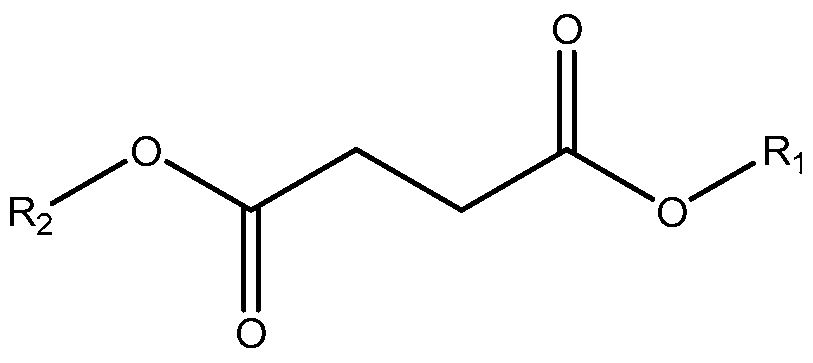
- the at least one dibasic ester can comprises at least two of: diaikyi methyiglutarate, diaikyi ethyisuccinate, diaikyi adipate, diaikyi succinate or diaikyi glutarate.
- the at least one dibasic ester comprises a blend of diaikyi methyiglutarate, diaikyi ethyisuccinate and, optionally, diaikyi adipate.
- the at least one dibasic ester comprises a blend of diaikyi adipate, diaikyi succinate and diaikyi glutarate.
- the aikyl lactate is a straight pr branched aikyl lactate, !n one embodiment, the aikyl lactate is a d-Ce aikyl lactate, !n another embodiment, the aikyl lactate is a CrC 5 aikyl lactate.
- formulations comprising a mixture or solution of at least one of aikyl thiophosphoric triamide or
- R 6 and R 7 individually comprises a hydrogen, an alky! group, an alkenyi group, a phenyl group, wherein n is an integer of from 1 to 10;
- R 3 comprises a C1-C36 alky! group; wherein R 4 and R5 individually comprise a C1-C36 aikyl group, wherein R 4 and R5 can optionally together form a ring; and wherein A is a linear or branched divalent C2-C13 alkyl group;
- the aikyidimethylamide is N,N- Dimethyldodecy!amide
- the dibasic ester is a blend comprising:
- R1 and R2 individually comprise a C1 -C8 alky! group.
- compositions for use in agricultural applications comprising: (A) at least one of an aikyl triphosphoric triamide or a dicyandiamide; and (B) a solvent comprising at least one dioxoiane compound of formula (la):
- R8 and R7 individually comprises a hydrogen, an a!kyi group, an alkeny! group, or a phenyl group, wherein n is an integer of from 1 to 10.
- the compositions described herein, in one aspect, are homogenous dispersions.
- the compositions, in another embodiment, are a fiowable liquid composition
- compositions for use in agricultural applications comprising: (A) at least one of an aikyl thiophosphoric triamide or a dicyandiamide; and (B) a blend of dibasic esters comprising:
- R1 and R2 individually comprise a C1 -C8 alky! group.
- compositions for use in agricultural applications comprising: (A) at least one of an alkyl thiophosphori triamide or a dicyandiamide; and (B) a blend of dibasic esters comprising:
- R1 and R2 individually comprise a C1 -C8 alkyi group.
- compositions for use in agricultural applications comprising: (A) at least one of an alky! thiophosphoric triamide or a dicyandiamide; and (B) at least one compound of formula (Ma):
- compositions for use in agricultural applications comprising: (A) at least one of an aikyl thiophosphoric triamide or a dicyandiamide; and (B) at least one alkyldimethylamide.
- urea-based fertilizer composition in granular or prill form. In another embodiment, the urea-based fertilizer composition is in substantially liquid form.
- Fig. 1 is a matrix of different solvent systems with NBPT, wherein solubility characteristics were observed.
- alkyi means a saturated straight chain, branched chain, or cyclic hydrocarbon radical, including but not limited to, methyl, ethyl, n-propyl, iso-propyi, n-buty!, sec-butyl, t-butyl, pentyi, n-hexyl. and cyciohexyl.
- aryi means a monovalent unsaturated hydrocarbon radical containing one or more six-membered carbon rings in which the unsaturation may be represented by three conjugated double bonds, which may be substituted one or more of carbons of the ring with hydroxy, alkyi, aikenyl, halo, haioalkyl, or amino, including but not limited to, phenoxy, phenyl, methyl phenyl, dimethyiphenyi, trimethylpheny!, ch!orophenyi, trichioromethy!phenyl, aminopheny!, and tristyrylpheny!.
- alkylene means a divalent saturated straight or branched chain hydrocarbon radical, such as for example, methylene, dimethylene, trimethylene.
- surfactant means a compound that when dissolved in an aqueous medium lowers the surface tension of the aqueous medium.
- the solvent system is chosen from one or more of the following components (a through j), below.
- the solvent is chosen from at least one components, typically, two or more
- R8 and R7 individually comprises a hydrogen, an alkyi group, an alkenyi group, a phenyl group, wherein n is an integer of from 1 to 10;
- R 3 comprises a C 1 -C36 alkyi group; wherein R 4 and R 5 individually comprise a C 1 -C36 aikyl group, wherein R 4 and R 5 can optionally together form a ring; and wherein A is a linear or branched divalent C 2 -C6 alkyi group;
- a C C 4 alcohol chosen from t-buty! alcohol, butyl alcohol, iso-propyi alcohol, or propyl alcohol can be added to the solvent.
- the C 1 -C4 alcohol is iso-propyi alcohol.
- the solvent comprises (i) one or a (ii) blend of dibasic esters.
- the blend comprises adducts of alcohol and linear diacids, the adducts having the formula R 1 -OOC-A-COO-R 2 wherein R-i and/or R 2 comprise, individually, a C 1 -C 12 alkyi, more typically a d-Cs alkyi, and A comprises a mixture of -(CH 2 )4-, ⁇ (CH 2 ) 3 , and -(CH 2 )2-- In another
- and/or R 2 comprise, individually, a C4-C 12 alkyi, more typically a C 4 -C 8 alkyi.
- Ri and R 2 can individually comprise a hydrocarbon group originating from fusel oil.
- R and R 2 individually can comprise a hydrocarbon group having 1 to 8 carbon atoms.
- Ri and R 2 individually can comprise a hydrocarbon group having 5 to 8 carbon atoms.
- A comprises a least one, typically at least two, of: -(CH 2 ) 4 -, -CH 2 CH 2 CH(CH 3 )-, -CH 2 CH(C 2 H 5 )-, -(CH 2 ) 4 -, - CH 2 CH 2 CH(CH 3 )-, or -CH 2 CH(C 2 H 5 )-.
- the blend comprises adducts of alcohol and branched or linear diacids, the adducts having the formula Ri ⁇ OOC ⁇ A ⁇ CGO ⁇ R 2 wherein Ri and/or R 2 comprise, individually, a C 1 -C1 2 alkyi, more typically a C -C 8 aikyl, and A comprises a mixture of -(CH 2 ) 4 ⁇ , -CH 2 CH 2 CH(CH 3 )-, and - CH 2 CH(C 2 H 5 )-.
- Ri and/or R 2 comprise, individually, a C 4 -Ci 2 alkyi, more typically a C 4 -C 8 alkyi.
- the acid portion may be derived from such dibasic acids such as adipic, succinic, giutaric, oxalic, malonic, pime!ic, suberic and azeiaic acids, as well as mixtures thereof.
- the dibasic esters can be obtained by a process comprising an "esterification" stage by reaction of a diacid of formula HOOC-A-COOH or of a diester of formula MeOOC-A-COOMe with a branched alcohol or a mixture of alcohols.
- the reactions can be appropriately catalyzed. Use is preferably made of at least 2 molar equivalents of alcohols per diacid or diester.
- the reactions can, if appropriate, be promoted by extraction of the reaction by-products and followed by stages of filtration and/or of purification, for example by distillation.
- the diacids in the form of mixtures can in particular be obtained from a mixture of dinitriie compounds in particular produced and recovered in the process for the manufacture of adiponitrile by double hydrocyanation of butadiene.
- This process used on a large scale industrially to produce the greater majority of the adiponitrile consumed worldwide, is described in numerous patents and works.
- the reaction for the hydrocyanation of butadiene results predominantly in the formulation of linear dinitriles but also in formation of branched dinitriles, the two main ones of which are methy!giutaronitriie and ethylsuccinonitri!e.
- the branched dinitriie compounds are separated by distillation and recovered, for example, as top fraction in a distillation column, in the stages for separation and purification of the adiponitrile.
- the branched dinitriles can subsequently be converted to diacids or diesters (either to light diesters, for a subsequent transesterification reaction with the alcohol or the mixture of alcohols or the fusel oil, or directly to diesters in accordance with the invention).
- Dibasic esters of the present invention may be derived from one or more by-products in the production of polyamide, for example, polyamide 6,6.
- the at least one dibasic ester comprises a blend of linear or branched, cyclic or noncyclic, C1-C20 alkyl, aryi, alkyiaryl or arylalkyl esters of adipic diacids, glutaric diacids, and succinic diacids.
- the composition comprises a blend of linear or branched, cyclic or noncyclic, C1-C20 aikyl, aryl, alkylaryl or aryla!kyl esters of adipic diacids, methylg!utaric diacids, and ethylsuccinic diacids
- polyamide is a copolymer prepared by a condensation reaction formed by reacting a diamine and a dicarboxylic acid.
- polyamide 6,6 is a copolymer prepared by a condensation reaction formed by reacting a diamine, typically hexamethylenediamine, with a dicarboxylic acid, typically adipic acid.
- the blend of dibasic esters can be derived from one or more by-products in the reaction, synthesis and/or production of adipic acid utilized in the production of polyamide, the composition comprising a blend of dialkyl esters of adipic diacids, g!utaric diacids, and succinic diacids (herein referred to sometimes as "AGS" or the “AGS blend”).
- the blend of esters is derived from by-products in the reaction, synthesis and/or production of hexamethylenediamine utilized in the production of polyamide, typically polyamide 8,8.
- the composition comprises a blend of dialkyl esters of adipic diacids, methylglutaric diacids, and ethylsuccinic diacids (herein referred to sometimes as "MGA”, “ GN”, “MGN blend” or "MGA blend”).
- the dibasic ester blend comprises:
- R and/or R 2 can individually comprise a hydrocarbon having from about 1 to about 8 carbon atoms, typically, methyl, ethyl, propyl, isopropyL butyi, isobutyl, n-butyl, isoamyl, hexyl, heptyl or octyi.
- the blend typically comprises (by weight of the blend) (i) about 15% to about 35% of the diester of formula !, (ii) about 55% to about 70% of the diester of formula ⁇ , and ⁇ ' ⁇ ⁇ ahns it 7° to ahrsi it 90% rsf ⁇ h*a Hipster nf fnrmnla I H anr! mnrs /nir.ailv (i ⁇ about 20% to about 28% of the diester of formula S, (ii) about 59% to about 87% of the diester of formula ⁇ , and (iii) about 9% to about 17% of the diester of formula Ml.
- the blend is generally characterized by a flash point of 98 C C, a vapor pressure at 20 °C of less than about 10 Pa, and a distillation temperature range of about 200-300 °C.
- the dibasic ester blend comprises:
- R. and/or f3 ⁇ 4 can individually comprise a hydrocarbon having from about 1 to about 8 carbon atoms, typically, methyl, ethyl, propyl, isopropyl, butyl, isobutyl, n-butyl, isoamyl. hexyi, heptyl, or octyL
- the blend typically comprises (by weight of the blend) (i) from about 5% to about 30% of the diester of formula IV, (ii) from about 70% to about 95% of the diester of formula V, and (iii) from about 0% to about 10% of the diester of formula VI.
- the blend typically comprises (by weight of the blend): (i) from about 6% to about 12% of the diester of formula IV, (ii) from about 86% to about 92% of the diester of formula V, and (iii) from about 0.5% to about 4% of the diester of formula VI.
- the blend comprises (by weight of the blend): (i) about 9% of the diester of formula IV, (ii) about 89% of the diester of formula V, and (iii) about 1 % of the diester of formula VI.
- the blend is generally characterized by a flash point of of 98 °C, a vapor pressure at 20 °C of less than about 10 Pa, and a distillation temperature range of about 200-275 °C.
- the solvent can include other solvents, including but not limited to aliphatic or acyclic hydrocarbons solvents,
- halogenated solvents aromatic hydrocarbon solvents, cyclic terpenes, unsaturated hydrocarbon solvents, halocarbon solvents, poiyols, alcohols Including short chain alcohols, ketones or mixtures thereof.
- the dioxane compound utilized as the solvent or in the solvent blend as described herein includes those of formula (I), below:
- R 6 and R 7 which are identical or different, represent hydrogen or a C1-C14 group or radical.
- R 6 and R 7 are individually selected from an aikyi group, alkenyi group or phenyl radical.
- "n" is an integer of 1 , 2, 3, 4, 5, 6, 7, 8, 9, 10, 1 1 or 12.
- "n" is an integer ranging from 1 to 4 or "n” is an integer ranging from 1 to 2.
- R 6 and R 7 are radicals individually selected from methyl, ethyl, n-propyl, isopropyi or isobutyi radical.
- the dioxolane compound is of formula (!) is 2,2- dimethyl-1 ,3-dioxoiane-4-methanoi.
- the dioxolane compound of formula (!) is 2.2-diisobuty!-1 ,3-dioxolane-4-methanol (also known by the acronym MPG, for the synonym 1 -isobutyl-isopropyiidene glycerol).
- a compound utilized as the solvent or as a component in the solvent blend is a compound of general formula (!l):
- the expression “compound” denotes any compound corresponding to the genera! formula ( ⁇ ).
- the term “compound” also refers to mixtures of several molecules corresponding to general formula ( ⁇ ). It may therefore be a molecule of formula ( ⁇ ) or a mixture of several molecules of formula (II), wherein both fall under the definition of the term “compound” when referring to formula ( ⁇ ),
- the R3, R 4 and R5 groups can be, in some embodiments, identical or, in other embodiment, different.
- the R4 and R5 groups may optionally be substituted. In one particular embodiment, the groups are substituted with hydroxy! groups.
- R 3 group is chosen from methyl, ethyl, propyl, isopropyi, n-butyl, isobutyl, n-pentyl, isopentyi, isoamyl, n-hexy!, cyclohexyl, 2- ethy!butyl, n-octyl, isooctyl, 2-ethylhexyl, tridecyl groups.
- R 4 and R5 groups which are identical or different, in one embodiment, may especially be chosen from methyl, ethyl, propyl (n-propy!), isopropyi, n-buty!, isobutyl, n-pentyl, amy!, isoamyl, hexy!, cyclohexyl or hydroxyethyl groups.
- the R 4 and R5 groups may also be such that they form, together with the nitrogen atom, a morpholine, piperazine or piperidine group.
- R 4 and R 5 are each methyl, or R 4 and R 5 are each ethyl, or R 4 and R 5 are each hydroxyethyi.
- A comprises a linear group of formula ⁇ CH 2 -- CH 2 - and/or of formula ⁇ CH 2 - CH 2 - CH 2 - CH 2 - and/or of formula -( CH 2 ) 8 - then it is a mixture of A groups.
- A is linear, then it is a mixture of A groups, for example a mixture of two or three - CH 2 -- CH 2 - (ethylene); - CH 2 - CH 2 - CH 2 - (n-propylene); and - CH 2 - CH 2 - CH 2 - CH 2 - (n-bufylene) groups (or isomers thereof).
- the A group is a divalent linear aikyi group chosen from the groups of the following formulae: ⁇ CH 2 - CH 2 ⁇ (ethylene); ⁇ CH 2 - CH 2 ⁇ CH 2 - (n-propylene); - CH 2 - CH 2 - CH 2 - (n-buty!ene). and mixtures thereof.
- the compound is a mixture according to the following mixture of molecules:
- the A group is a divalent branched a!kyl group chosen from the groups of the following formulae: -CH(CH 3 )- CH 2 --CH 2 --; -CH(C2H 5 )-CH 2 -; and, optionally, - CH 2 - CH 2 - CH 2 - CH 2 --; as well as mixtures thereof.
- the compound is a mixture according to the following mixture of molecules:
- R 3 OOC-CH(C2H 5 )CH 2 -CONR4R 5 ; and, optionally,
- the compound of the invention is chosen from the following compounds:
- the A group is a divalent branched alkyiene group having one of the following formulae (Ha), (Mb), (l!c), (Ilia) and (1Mb), or a mixture of at least two groups chosen from the groups of formulae (lla), (Sib) and (lie) or from the groups of formulae (Ilia) and (1Mb), or a mixture of at least two groups, one chosen from the groups of formulae (Sla), (lib) and (lie) and the others chosen from the groups of formulae (Ilia) and (1Mb):
- x is an integer greater than 0;
- y is an average integer greater than or equal to 0;
- z is an average integer greater than or equal to 0;
- R 8 which is identical or different, is a d-Ce, preferably C 1 -C4, aikyi group;
- R 9 which is identical or different, is a hydrogen atom or a CrC 6 , preferably C 1 -C4, aikyl group.
- the A group is preferably a group such that y and z are 0.
- x is 1 ; y and z are 0; R 8 is methyl.
- x is 1 ; y and z are 0; R 8 is ethyl.
- the compound of the invention is chosen from the following compounds, and mixtures thereof:
- a M G represents an MG a group of formula ⁇ CH(CH 3 )-CH 2 -CH 2 ⁇ - ! or
- a E s represents an ES a group of formula -CH(C 2 H5)-CH 2 -, or ES b group of formula --CH 2 ⁇ CH(C-2H 5 ) ⁇ or a mixture of ES a and ES groups;
- Pe represents a penty! group, preferably an isopenty! or isoamy! group;
- Cyclo represents a cyclohexyi group;
- Eh represents a 2-ethy!hexyl group
- Bu represents a butyl group, preferably an n-butyl or tert-butyi group
- EtBu represents an ethylbutyl group
- n-He represents an n-hexyl group.
- the compound of the invention is a compound different from the following
- the compound of the invention is a novel compound of the invention, different from the following compounds or mixtures, if the latter, individually, are not used as a mixture with other compounds corresponding to formula (IS):
- the compound of the invention is a novel compound of the invention, different from the following compounds or mixtures, if the latter, individually, are not used as a mixture with other compounds corresponding to formula (IS):
- the esteramide has a meiting point that is less than or equal to 20 °C, preferably 5 °C, preferably 0°C.
- R 3 is a group chosen from saturated or unsaturated, linear or branched, optionally cyclic, optionally aromatic
- hydrocarbon-based groups comprising an average number of carbon atoms ranging from 1 to 38
- R 4 and Rs which are identical or different, are groups chosen from saturated or unsaturated, linear or branched, optionally cyclic, optionally aromatic, optionally substituted hydrocarbon-based groups comprising an average number of carbon atoms ranging from 1 to 38. It is possible for R4 and Rs to form a ring together, and in some embodiment, the ring is optionally substituted and/or optionally comprises a heteroatom.
- A is a linear or branched divalent alkyl group comprising an average number of carbon atoms ranging from 1 to 20, in some embodiments, from 2 to 12, in other embodiments, from 2 to 8, in yet other embodiments, from 2 to 4.
- the solvent comprises amides, alkyl amides, or dialkyl amides.
- one component in the solvent blend comprises an amide, alkyl amide, and/or dialkyl amide.
- the solvent or solvent blend is aiky!dimethy!amide (ADMA).
- the alkyl group is a Ci -C50 alkyl group, more typically a C 2 -C30 alkyl group, even more typically, a C2 -C20 a!kyl group.
- the alkyldimethylamide is ⁇ , ⁇ -dimethyldecanamide (miscibility 0.034%) or N,N- dimethyloctanamide (miscibility 0.43%), or mixtures therof. Mention is made especially of the compounds sold by Rhodia, Rhodiasolv® AD MAS 10 and RhodiasolvCg ) ADMA10.
- the solvent system can contain one or more surfactants.
- the surfactant can be any number of cationic, amphoteric, zwitterionic, anionic or nonionic surfactants, derivatives thereof, as well as blends of such surfactants.
- the solvent system, formulations, dispersions and/or compositions described herein are free of any dyes. In one embodiment, the solvent system, formulations, dispersions and/or compositions described herein are substantially free of any dyes.
- the nonionic surfactants generally includes one or more of for example amides such as alkanolamides, ethoxy!ated
- esters such as fatty acid esters, glycerol esters, ethoxylated fatty acid esters, sorbitan esters, ethoxylated sorbitan;
- ethoxylates such as aikyiphenol ethoxylates, alcohol ethoxylates, tristyrylphenoi ethoxylates, mercaptan ethoxylates; end-capped and EO/PO block copolymers such as ethylene oxide/propylene oxide block copolymers, chlorine capped ethoxylates, tetra-functionai block copolymers; amine oxides such !auramine oxide, cocamine oxide, stearamine oxide, stearamidopropy!amine oxide, palmitamidopropyiamine oxide, decylamine oxide; fatty alcohols such as decyi alcohol, lauryl alcohol, tridecyi alcohol, myristyl alcohol, cetyl alcohol, stearyl alcohol, oleyl alcohol, linoleyl alcohol and linolenyl alcohol; and alkoxylated alcohols such as eihoxylated lauryl alcohol, trideceth alcohol
- the non-ionic surfactant is a glycol such as polyethylene glycol (PEG), a!kyl PEG esters, polypropylene glycol (PPG) and derivatives thereof.
- the surfactant is an alcohol ethoxyiate, an alkyl phenol ethoxyiate or a terpene alkoxylate.
- the surfactant is a C 6 -Ci 3 alcohol ethoxyiate and, more typically, a C 8 -Ci2 alcohol ethoxyiate.
- the surfactant is a cationic surfactant.
- the cationic surfactant includes but is not limited to quaternary ammonium
- cetyl trimethy! ammonium bromide also known as CETAB or cetrimonium bromide
- cetyl trimethy! ammonium chloride also known as cefrimonium chloride
- myristyl trimethyl ammonium bromide also known as myrtrimonium bromide or Quaternium-13
- stearyl dimethyl distearyldimonium chloride dicetyi dimonium chloride
- stearyl octyldimonium methosulfate dihydrogenated palmoylethyi hydroxyethylmonium methosulfate
- isosfearyi benzylimidonium chloride cocoyi benzyl hydroxyethy!
- the surfactant is an anionic surfactant.
- the anionic surfactant includes but is not limited to linear alkylbenzene sulfonates, alpha olefin sulfonates, paraffin sulfonates, alkyl ester sulfonates, aikyl sulfates, aikyl alkoxy sulfates, aikyl sulfonates, aikyl alkoxy carboxyiates, alkyi aikoxylated sulfates, monoaikyl phosphates, dialkyl phosphates, sarcosinates,
- anionic surfactants that are suitable as the anionic surfactant component of the composition of the present invention include, for example, ammonium lauryl sulfate, ammonium iaureth sulfate, triethylamine lauryl sulfate, triethyiamine Iaureth sulfate, triethanolamine lauryl sulfate, triethanoiamine iaureth sulfate, monoethanolamine lauryl sulfate, monoethanolamine Iaureth sulfate, diethanoiamine lauryl sulfate, diethanolamine iaureth sulfate, lauric monogiyceride sodium sulfate, sodium lauryl sulfate, sodium Iaureth sulfate, potassium lauryl sulfate, potassium Iaureth sulfate, sodium-monoa!kyl phosphates, sodium dialkyl phosphates, sodium lauroyl
- Branched anionic surfactants are particularly preferred, such as sodium trideceth sulfate, sodium tridecyi sulfate, ammonium trideceth sulfate, ammonium tridecyi sulfate, and sodium trideceth carboxylate.
- amphoteric surfactant that is acceptable for use includes but is not limited to derivatives of aliphatic secondary and tertiary amines in which the aliphatic radical can be straight chain or branched and wherein one of the aliphatic substituents contains from about 8 to about 18 carbon atoms and one contains an anionic water solubilizing group.
- suitable amphoteric surfactants include the alkali metal, alkaline earth metal, ammonium or substituted ammonium salts of alkyl amphocarboxy giycinates and a!kyl amphocarboxypropionates, alkyl amphodipropionates, alky! amphodiacetates, alkyl amphoglycinates, and a!kyi amphopropionates, as we!i as a!kyi
- lauroamphodipropionate lauroamphodiacetate, cocoamphopropyi sulfonate caproamphodiacetate, caproamphoacetate, caproamphodipropionate, and stearoamphoacetate.
- Suitable zwitterionic surfactants include alky! betaines, such as cocodimethyl carboxymethyi betaine, lauryl dimethyl carboxymethyl betaine, lauryl dimethyl aipha-carboxy-ethyl betaine, cetyl dimethyl carboxymethyi betaine, lauryl bis-(2-hydroxy-ethyl)carboxy methyl betaine, stearyi bis-(2- hydroxy-propyi)carboxymethyl betaine, oleyl dimethyl gamma-carboxypropyl betaine, and lauryl bis-(2-hydroxypropyi)alpha-carboxyethyi betaine, amidopropyl betaines, and alky! betaines, such as cocodimethyl carboxymethyi betaine, lauryl dimethyl carboxymethyl betaine, lauryl dimethyl aipha-carboxy-ethyl betaine, cetyl dimethyl carboxymethyi betaine, lauryl bis-(2-
- suitaines such as cocodimethyl suifopropyl betaine, stearyidimethyl suifopropyl betaine, lauryl dimethyl suifoethyi betaine, lauryl bis- (2-hydroxy-ethyl)su!fopropyi betaine, and alkyiamidopropylhydroxy suitaines.
- the solvent system described herein are characterized by having improved stability of NBPT; improved solubility characteristics; low toxicity of the solvents; good storage characteristics; and good adsorption characteristics onto the urea-containing fertilizers and excellent miscibility with liquid urea containing fertilizer formulations.
- Rhodiasolv® Polarclean is Methy!-5-(dimethy!amino)-2- methyl-5-oxopentanoate and Purasolv EL is an Ethy!-(S)-!actate.
- Rhodiasolv ADIVIA 27.50% 34.38
- Rhodiasolv® LI-TEC is a proprietary blend of dibasic esters comprising a diaikyi methylglutarate as the primary dibasic ester, along with one or more additional dibasic esters. [00271] Table 5
- solvents along the X-axis were combined with certain solvents on the Y-axis, at a 50:50 ratio (by weight), and NBPT was added to the resulting solvent combination.
- the NBPT in the resulting formulation comprised 10 wt% by weight of formulation.
- the different combination of solvents with 10 wt% (by weight of formulation) of NBPT were used to meet the concentration requirements and stability characteristics, and were observed as compatible or non-compatible with NBPT (i.e., to be soluble, or not soluble). As seen in Fig.
- NBPT was found to be soluble in the following 50:50 (by weight) solvent mixtures: Li-Tech:PolarClean; Li-Tech:ADMA; Li-Tech:Ethyl Levuiinate; Li-Tech:G!ycerin; Li-Tech: Propylene Carbonate; RPDE:PolarClean;
- AD A Propylene Carbonate.
Landscapes
- Life Sciences & Earth Sciences (AREA)
- Chemical & Material Sciences (AREA)
- Organic Chemistry (AREA)
- Soil Sciences (AREA)
- Pest Control & Pesticides (AREA)
- Agricultural Chemicals And Associated Chemicals (AREA)
- Fertilizers (AREA)
- Organic Low-Molecular-Weight Compounds And Preparation Thereof (AREA)
Abstract
Solvent systems for the formulation of alkyl thiophosphoric triamide urease inhibitors, that provide stable dispersion of alkyl thiophosphoric triamides and/or dicyandiamide for even distribution (in low or high concentrations) onto fertilizers containing urea in liquid or solid form.
Description
SOLVENT SYSTEMS OF N-ALKYL THSOPHOSPHOPJC T SAMSDES AND METHODS OF USE m AGR!CULTURAL APPLICATIONS
F^ELD OF TH E INVENTION
[0001 ] This invention relates to compositions and methods for use of solvent systems containing alkyl thiophosphoric triamides, used to facilitate incorporation of the alkyl thiophosphoric triamides into solid state or liquid state fertilizer formulations.
BACKGROUND OF THE I VENTIO
[0002] In the current agrochemical market, farmers use various fertilizers to impart macronutnents to plants either by application to the soil or application to plant leaves. Nitrogen, phosphorus, potassium, calcium, magnesium, and sulfur are the six macronutnents that must be supplied to the plants and soil manually by farmers. In many crops, the amount of nitrogen supplied is critical to the overall quality and growth of the crop. Nitrogen is supplied in either urea or ammonium phosphate forms. Due to the high water solubility of these salts, however, much of the nitrogen applied is lost to run-off and leaching. In ammonium-based products, if the nitrogen is not lost to leaching or run-off, if is being converted to ammonia gas by an enzyme called urease where the ammonia can bind to soil particles. Conversion occurring near the surface of the soil, however, does not allow for binding and this ammonia is lost to the atmosphere. Urease inhibitors are used to protect a farmer's investment in
fertilizers by preventing the breakdown of urea by urease, the soil microbe responsible for converting urea to usable ammonia in the soil. This increases the amount of time the nitrogen remains in the soil and is available to the plant for absorption.
[0003] SUMMARY OF THE INVENTION
[0004] Urease inhibitors can be used with a fertilizer (i.e., incorporated into a urea-containing fertilizer) to slow the conversion of ammonium ions to ammonia gas and thus slow the lost of ammonia to volatilization, thus making it available to plants in the soil longer. Increasing the amount of time that the nitrogen is available to the plant increases the effectiveness of the fertilizer which positively impacts crop yield and qualify. Fertilizers, in one embodiment, are common water soluble inorganic fertilizers that provide nutrients such as phosphorus- based, nitrogen-based, potassium-based or sulphur-based fertilizers. Examples of such fertilizers include: for nitrogen as the nutrient: nitrates and or ammonium salts such as ammonium nitrate, including in combination with urea e.g. as Uram type materials, calcium ammonium nitrate, ammonium suphate nitrate, ammonium phosphates, particularly mono-ammonium phosphate, di-ammonium phosphate and ammonium polyphosphate, ammonium sulphate, and the less commonly used calcium nitrate, sodium nitrate, potassium nitrate and ammonium chloride. St is understood that a fertilizer composition can comprise one or a combination of the fertilizers described herein.
[0005] A typical urease inhibitor, NBPT (N-(n-buty!)-thiophosphoric triamide), however, faces drawbacks in its use as NBPT is extremely difficult to handle. NBPT is a sticky, waxy, heat and water sensitive material, which cannot be used in its solid form, as it is used at low concentrations making it difficult to evenly distribute on urea prills (i.e., large granules) and in soil. In order to evenly distribute the NBPT onto the urea, the NBPT should be dispersed into a carrier prior to being sprayed onto the urea. Thus, the use of a solvent system containing the NBPT is desirable as, in its liquid form, the solvent system is capable of distributing the NBPT into granular urea (e.g., urea prills) and into liquid fertilizers containing urea. By introducing the NBPT to liquid fertilizers containing urea (for example, urea-ammonium nitrate solutions or UAN) in a solvent system, the NBPT is capable of being better dispersed in the liquid fertilizer.
[0008] Dicyandiamide is potentially useful as a nitrification inhibitor in aqueous agricultural applications, e.g., end use fertilizer compositions, but has very low solubility (about 41 grams per liter ("g/i")) in water and so is difficult to incorporate into the aqueous end use fertilizer compositions, particularly under field conditions. Aqueous end use fertilizer solutions are typically prepared in the field by diluting commercially available concentrated fertilizer compositions with water. Commonly used concentrated fertilizer compositions include concentrated ammonium nitrate compositions, such as, for example, UAN 18, UAN 28, UAN 30 and UAN 32.
[0007] Thus, it is desirable to have a low cost solvent system containing aikyi thiophosphonc triamide, and in particular, (N-(n-buty!)-thiophosphoric triamide), that has a favorable toxicoiogical and/or ecological profile and desirable characteristics in terms of low volatility, biodegradability or ready biodegradability (i.e., readily biodegradable), low toxicity or low hazard level.
[0008] The present invention described herein will become apparent from the following detailed description and examples, which comprises in one aspect, are formulations comprising a mixture or solution of at least one of an alkyl thiophosphonc triamide or dicyandiamide (from about 15% to 35% by weight of formulation) in at least one solvent selected from at least one of the following: at least one dibasic ester (from about 5% to 35% by weight of formulation), at least one dioxolane (from about 25% to 70% by weight of formulation), at least one ester-amide or diamide (from about 10% to 50% by weight of formulation), at least one alky!dimethylamide (from about 10% to 50% by weight of formulation), at least one aikyi lactate (from about 0% to 80% by weight of formulation), ethyl ievulinate (from about 0% to 60% by weight of formulation), at least one glycerine or glycerine derivative (from about 0% to 75% by weight of formulation), at least one alkylene carbonate (from about 0% to 80% by weight of formulation), at least one alkyoxyaicohoi, ether alcohol, diaikyi alcoho!amine (for example, dimethyl ethanoiamine, diethyl ethanolamine), amine alcohol, amino alcohol or alcohol (from about 0% to 75% by weight of formulation), or any combination thereof. In one embodiment, the at least one of an aikyi thiophosphonc triamide or
dicyandiamide is present in an amount of from about 4% to 14% by weight of formulation.
[0009] In another aspect, described herein are formulations comprising a mixture or solution of at ieast one of: (i) an aikyl thiophosphoric triamide or (ii) dicyandiamide, in at ieast one solvent selected from the group consisting of:
[0010] a) at Ieast one dibasic ester:
[0011] b) at Ieast one dioxolane compound of formula (la):

[0012] wherein Re and R7 individually comprises a hydrogen, an alkyl group, an alkenyl group, a phenyl group, wherein n is an integer of from 1 to 10;
[0013] c) at ieast one ester-amide or diamide, which in one embodiment, is at Ieast one compound of formula (Ha):
[0015] (Ha),
[0018] wherein R3 comprises a C C36 alkyl group; wherein R4 and R5 individually comprise a Ci~C36 aikyl group, wherein R4 and R5 can optionally
together form a ring; and wherein A is a linear or branched divalent C2-C13 alkyl group;
[0017] d) at least one aikyidimethylamide;
[0018] e) at least one alkyl lactate;
[0019] f) ethyl ievuiinate;
[0020] g) 2-butoxyethanol;
[0021] h) at least one glycerine or glycerine derivative;
[0022] I) propylene carbonate; and
[0023] j) any combination thereof.
[0024] In one embodiment, regarding formula il(a), R3 can be group chosen from, among others, saturated or unsaturated, linear or branched, optionally cyclic, optionally aromatic hydrocarbon-based groups comprising an average number of carbon atoms ranging from 1 to 38. In a further embodiment, R3 can is selected from the group consisting of a saturated C1-C36 alkyl group, an unsaturated C1-C36 alkyl group, a linear C -C36 alkyl group, a branched C1-C36 alkyl group, a cyclic C -C36 a!kyl group, and an aromatic C1-C36 alkyl group.
[0025] In another embodiment, R4 and R5, which are identical or different, can be groups chosen from, among others, saturated or unsaturated, linear or branched, optionally cyclic, optionally aromatic, optionally substituted
hydrocarbon-based groups comprising an average number of carbon atoms ranging from 1 to 36. A can be a linear or branched divalent alkyl group comprising an average number of carbon atoms ranging from 2 to 12. In a
further embodiment, R4 and f¾ individually comprise a saturated C1-C36 aikyl group, an unsaturated C1-C36 aikyl group, a linear C1-C36 aikyl group, a branched C C36 a!kyl group, a cyclic C1-C36 aikyl group, or an aromatic C1-C36 aikyl group.
[0026] In one embodiment, alkyi thiophosphonc triamide is N-(n-butyl)- thiophosphoric triamide. The at least one of aikyl thiophosphoric triamide or dicyandiamide can be present in the dispersion in an amount between about 5% by weight of the dispersion to about 14% by weight of the dispersion. In another embodiment, the at least one of aikyl thiophosphoric triamide or dicyandiamide can be present in the dispersion in an amount between about 7% by weight of the dispersion to about 13% by weight of the dispersion. . In another
embodiment, the at least one of aikyl thiophosphoric triamide or dicyandiamide can be present in the dispersion in an amount between about 8% by weight of the dispersion to about 12% by weight of the dispersion.
[0027] The at least one of aikyl thiophosphoric triamide or dicyandiamide can be present in the dispersion in an amount between about 0.5 % by weight of the dispersion and about 50 % by weight of the dispersion or, in another
embodiment, can be present in the dispersion in an amount between about 1 % by weight of the dispersion and about 40 % by weight of the dispersion, and, in another embodiment, can be present in the dispersion in an amount between about 0.5 % by weight of the dispersion and about 20 % by weight of the dispersion. In one particular embodiment, the at least one of aikyl thiophosphoric triamide or dicyandiamide is present in the dispersion in an amount between
about 1 % by weight of the dispersion and about 30 % by weight of the dispersion. The at least one of alkyi thiophosphoric triamide or dicyandiamide means that alkyi thiophosphoric triamide can be solely present, dicyandiamide can be solely present, or a combination of aikyl thiophosphoric triamide and dicyandiamide is present.
[0028] The at least one dibasic ester can comprises at least two of: diaikyi methyiglutarate, diaikyi ethyisuccinate, diaikyi adipate, diaikyi succinate or diaikyi glutarate. In another embodiment, the at least one dibasic ester comprises a blend of diaikyi methyiglutarate, diaikyi ethyisuccinate and, optionally, diaikyi adipate. In a further embodiment, the at least one dibasic ester comprises a blend of diaikyi adipate, diaikyi succinate and diaikyi glutarate.
[0029] In one embodiment, the aikyl lactate is a straight pr branched aikyl lactate, !n one embodiment, the aikyl lactate is a d-Ce aikyl lactate, !n another embodiment, the aikyl lactate is a CrC5 aikyl lactate.
[0030] In another aspect, described herein are formulations comprising a mixture or solution of at least one of aikyl thiophosphoric triamide or
dicyandiamide in at least one solvent selected from the group consisting of:
[0031] a) at least one dibasic ester selected from diaikyi methyiglutarate, diaikyi ethyisuccinate, diaikyi adipate, diaikyi succinate or diaikyi glutarate;
[0032] b) at least one dioxolane compound of formula (la):

Ό034]
Όι 13 1.5' wherein R6 and R7 individually comprises a hydrogen, an alky! group, an alkenyi group, a phenyl group, wherein n is an integer of from 1 to 10;
[0036] c) at least one compound of formula (I la):
[0037] R3OOC-A-CONR4R5
[0038] (!la),
[0039] wherein R3 comprises a C1-C36 alky! group; wherein R4 and R5 individually comprise a C1-C36 aikyl group, wherein R4 and R5 can optionally together form a ring; and wherein A is a linear or branched divalent C2-C13 alkyl group;
[0040] d) at least one aikyidimethylamide;
[0041] e) at least one alkyl lactate;
[0042] !) propylene carbonate; and
[0043] j) any combination thereof.
[0044] In one embodiment, the aikyidimethylamide is N,N- Dimethyldodecy!amide
[0045] In one particular embodiment, the dibasic ester is a blend comprising:
[0046] (i) a first dibasic ester of formula:

(ii) a second dibasic ester of formula
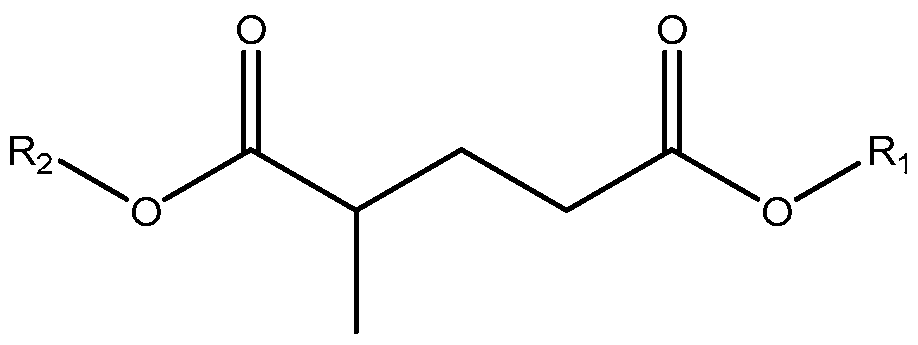
(Π), and
(iii) optionally, a third dibasic ester of formula

[0053] (III),
[0054] wherein R1 and R2 individually comprise a C1 -C8 alky! group.
[0055] In another aspect, described herein are compositions for use in agricultural applications comprising: (A) at least one of an aikyl triphosphoric triamide or a dicyandiamide; and (B) a solvent comprising at least one dioxoiane compound of formula (la):
[0056]

[0057] wherein R8 and R7 individually comprises a hydrogen, an a!kyi group, an alkeny! group, or a phenyl group, wherein n is an integer of from 1 to 10. The compositions described herein, in one aspect, are homogenous dispersions. The compositions, in another embodiment, are a fiowable liquid composition
[0058] In another aspect, described herein are compositions for use in agricultural applications comprising: (A) at least one of an aikyl thiophosphoric triamide or a dicyandiamide; and (B) a blend of dibasic esters comprising:
[0059] (i) a first dibasic ester of formula:

(I).
(ii) a second dibasic ester of formula

(il), and optionally, a third dibasic ester of formula

[0062] wherein R1 and R2 individually comprise a C1 -C8 alky! group.
[0063] In another aspect, described herein are compositions for use in agricultural applications comprising: (A) at least one of an alkyl thiophosphori triamide or a dicyandiamide; and (B) a blend of dibasic esters comprising:
[0064] (i) a first dibasic ester of formula:
[0065]

(N) :
0067] (ii) a second dibasic ester of formula:

(!V) ; and
(iii) a first dibasic ester of formuia:

(Ml),
[0071] wherein R1 and R2 individually comprise a C1 -C8 alkyi group.
[0072] In another aspect, described herein are compositions for use in agricultural applications comprising: (A) at least one of an alky! thiophosphoric triamide or a dicyandiamide; and (B) at least one compound of formula (Ma):
[0073] R300C-A-CONR4R5
(Ha),
[0074] wherein R3 comprises a C1 -C36 alkyl group; wherein R4 and R5 individually comprise a C1 -C38 alkyl group, wherein R4 and R5 can optionally together form a ring; and wherein A is a linear or a branched divalent C2-C8 alkyi group.
[0075] In another aspect, described herein are compositions for use in agricultural applications comprising: (A) at least one of an aikyl thiophosphoric triamide or a dicyandiamide; and (B) at least one alkyldimethylamide.
[0076] In another aspect, described herein are methods for preparing an agricultural composition comprising contacting the formulation of claim 1 with a urea-based fertilizer composition. In one embodiment, urea-based fertilizer composition is in granular or prill form. In another embodiment, the urea-based fertilizer composition is in substantially liquid form.
BRIEF DESCRIPTION OF FIGURES
[0077] Fig. 1 is a matrix of different solvent systems with NBPT, wherein solubility characteristics were observed.
DETAILED DESCRIPTION
[0078] As used herein, the term "alkyi" means a saturated straight chain, branched chain, or cyclic hydrocarbon radical, including but not limited to, methyl, ethyl, n-propyl, iso-propyi, n-buty!, sec-butyl, t-butyl, pentyi, n-hexyl. and cyciohexyl.
[0079] As used herein, the term "aryi" means a monovalent unsaturated hydrocarbon radical containing one or more six-membered carbon rings in which the unsaturation may be represented by three conjugated double bonds, which may be substituted one or more of carbons of the ring with hydroxy, alkyi, aikenyl, halo, haioalkyl, or amino, including but not limited to, phenoxy, phenyl,
methyl phenyl, dimethyiphenyi, trimethylpheny!, ch!orophenyi, trichioromethy!phenyl, aminopheny!, and tristyrylpheny!.
[0080] As used herein, the term "alkylene" means a divalent saturated straight or branched chain hydrocarbon radical, such as for example, methylene, dimethylene, trimethylene.
[0081] As used herein, the terminology "(Cr-C3)" in reference to an organic group, wherein r and s are each integers, indicates that the group may contain from r carbon atoms to s carbon atoms per group.
[0082] As used herein, the terminology "surfactant" means a compound that when dissolved in an aqueous medium lowers the surface tension of the aqueous medium.
[0083] In one embodiment, the solvent system is chosen from one or more of the following components (a through j), below. In another embodiment, the solvent is chosen from at least one components, typically, two or more
components.
[0084] a) at least one dibasic ester;
[0085] b) at least one dioxolane compound of formula (la):

[0089] c) at least one compound of formula (!la):
[0090] 3OOC-A-CO R4 5
(Ha),
[0091] wherein R3 comprises a C1-C36 alkyi group; wherein R4 and R5 individually comprise a C1-C36 aikyl group, wherein R4 and R5 can optionally together form a ring; and wherein A is a linear or branched divalent C2-C6 alkyi group;
[0092] d) at least one aikyidimethylamide;
[0093] e) at least one aikyl lactate;
[0094] f) ethyl ievuiinate;
[0095] g) 2-butoxyethanol;
[0098] h) at least one glycerine or glycerine derivative;
[0097] I) propylene carbonate; and
[0098] j) any combination thereof.
[0099] In one embodiment, a C C4 alcohol chosen from t-buty! alcohol, butyl alcohol, iso-propyi alcohol, or propyl alcohol can be added to the solvent. In one typical embodiment, the C1-C4 alcohol is iso-propyi alcohol.
[00100] In one embodiment, the solvent comprises (i) one or a (ii) blend of dibasic esters. In one embodiment, the blend comprises adducts of alcohol and linear diacids, the adducts having the formula R1-OOC-A-COO-R2 wherein R-i
and/or R2 comprise, individually, a C1-C12 alkyi, more typically a d-Cs alkyi, and A comprises a mixture of -(CH2)4-, ~(CH2)3, and -(CH2)2-- In another
embodiment, R| and/or R2 comprise, individually, a C4-C12 alkyi, more typically a C4-C8 alkyi. In one embodiment, Ri and R2 can individually comprise a hydrocarbon group originating from fusel oil. In one embodiment, R and R2 individually can comprise a hydrocarbon group having 1 to 8 carbon atoms. In one embodiment, Ri and R2 individually can comprise a hydrocarbon group having 5 to 8 carbon atoms. In another embodiment, A comprises a least one, typically at least two, of: -(CH2)4-, -CH2CH2CH(CH3)-, -CH2CH(C2H5)-, -(CH2)4-, - CH2CH2CH(CH3)-, or -CH2CH(C2H5)-.
[00101] In one embodiment, the blend comprises adducts of alcohol and branched or linear diacids, the adducts having the formula Ri~OOC~A~CGO~R2 wherein Ri and/or R2 comprise, individually, a C1-C12 alkyi, more typically a C -C8 aikyl, and A comprises a mixture of -(CH2)4~, -CH2CH2CH(CH3)-, and - CH2CH(C2H5)-. In another embodiment, Ri and/or R2 comprise, individually, a C4-Ci2 alkyi, more typically a C4-C8 alkyi. !t is understood that the acid portion may be derived from such dibasic acids such as adipic, succinic, giutaric, oxalic, malonic, pime!ic, suberic and azeiaic acids, as well as mixtures thereof.
[00102] The dibasic esters can be obtained by a process comprising an "esterification" stage by reaction of a diacid of formula HOOC-A-COOH or of a diester of formula MeOOC-A-COOMe with a branched alcohol or a mixture of alcohols. The reactions can be appropriately catalyzed. Use is preferably made
of at least 2 molar equivalents of alcohols per diacid or diester. The reactions can, if appropriate, be promoted by extraction of the reaction by-products and followed by stages of filtration and/or of purification, for example by distillation.
[00103] The diacids in the form of mixtures can in particular be obtained from a mixture of dinitriie compounds in particular produced and recovered in the process for the manufacture of adiponitrile by double hydrocyanation of butadiene. This process, used on a large scale industrially to produce the greater majority of the adiponitrile consumed worldwide, is described in numerous patents and works. The reaction for the hydrocyanation of butadiene results predominantly in the formulation of linear dinitriles but also in formation of branched dinitriles, the two main ones of which are methy!giutaronitriie and ethylsuccinonitri!e. The branched dinitriie compounds are separated by distillation and recovered, for example, as top fraction in a distillation column, in the stages for separation and purification of the adiponitrile. The branched dinitriles can subsequently be converted to diacids or diesters (either to light diesters, for a subsequent transesterification reaction with the alcohol or the mixture of alcohols or the fusel oil, or directly to diesters in accordance with the invention).
[00104] Dibasic esters of the present invention may be derived from one or more by-products in the production of polyamide, for example, polyamide 6,6. In one embodiment, the at least one dibasic ester comprises a blend of linear or branched, cyclic or noncyclic, C1-C20 alkyl, aryi, alkyiaryl or arylalkyl esters of adipic diacids, glutaric diacids, and succinic diacids. In another embodiment, the
composition comprises a blend of linear or branched, cyclic or noncyclic, C1-C20 aikyl, aryl, alkylaryl or aryla!kyl esters of adipic diacids, methylg!utaric diacids, and ethylsuccinic diacids
[00105] Generally, polyamide is a copolymer prepared by a condensation reaction formed by reacting a diamine and a dicarboxylic acid. Specifically, polyamide 6,6 is a copolymer prepared by a condensation reaction formed by reacting a diamine, typically hexamethylenediamine, with a dicarboxylic acid, typically adipic acid.
[00106] In one embodiment, the blend of dibasic esters can be derived from one or more by-products in the reaction, synthesis and/or production of adipic acid utilized in the production of polyamide, the composition comprising a blend of dialkyl esters of adipic diacids, g!utaric diacids, and succinic diacids (herein referred to sometimes as "AGS" or the "AGS blend").
[00107] In one embodiment, the blend of esters is derived from by-products in the reaction, synthesis and/or production of hexamethylenediamine utilized in the production of polyamide, typically polyamide 8,8. The composition comprises a blend of dialkyl esters of adipic diacids, methylglutaric diacids, and ethylsuccinic diacids (herein referred to sometimes as "MGA", " GN", "MGN blend" or "MGA blend").
[00108] In certain embodiments, the dibasic ester blend comprises:
[00109] a diester of formula I:
(0
a diesier of formula II:

(Π) ; and
1111 a diesier of formula IN:

(III).
[00112] R and/or R2 can individually comprise a hydrocarbon having from about 1 to about 8 carbon atoms, typically, methyl, ethyl, propyl, isopropyL butyi, isobutyl, n-butyl, isoamyl, hexyl, heptyl or octyi. In such embodiments, the blend typically comprises (by weight of the blend) (i) about 15% to about 35% of the diester of formula !, (ii) about 55% to about 70% of the diester of formula Π, and ί'ύ \ ahns it 7° to ahrsi it 90% rsf †h*a Hipster nf fnrmnla I H anr! mnrs /nir.ailv (i\
about 20% to about 28% of the diester of formula S, (ii) about 59% to about 87% of the diester of formula Π, and (iii) about 9% to about 17% of the diester of formula Ml. The blend is generally characterized by a flash point of 98 CC, a vapor pressure at 20 °C of less than about 10 Pa, and a distillation temperature range of about 200-300 °C.
[00113] In certain other embodiments, the dibasic ester blend comprises:
[00114] a diester of the formula IV:

a diester of the formula V:

(V) ; and, optionally,
00116] a diester of the formula VI:
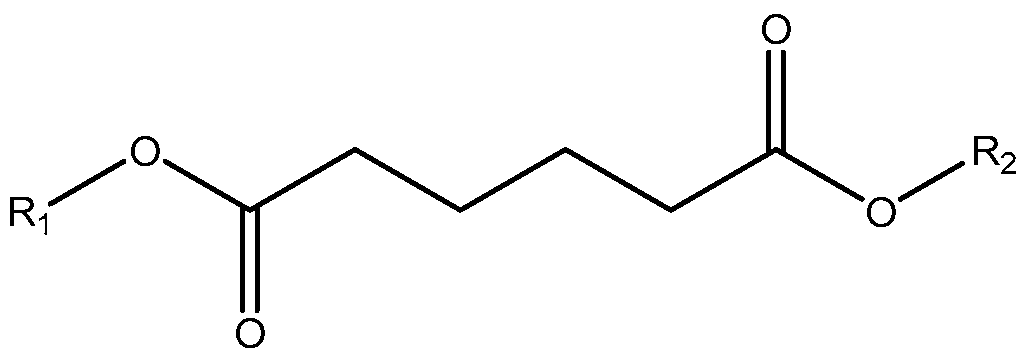
(VI).
[00117] R. and/or f¾ can individually comprise a hydrocarbon having from about 1 to about 8 carbon atoms, typically, methyl, ethyl, propyl, isopropyl, butyl, isobutyl, n-butyl, isoamyl. hexyi, heptyl, or octyL In such embodiments, the blend typically comprises (by weight of the blend) (i) from about 5% to about 30% of the diester of formula IV, (ii) from about 70% to about 95% of the diester of formula V, and (iii) from about 0% to about 10% of the diester of formula VI. More typically, the blend typicaliy comprises (by weight of the blend): (i) from about 6% to about 12% of the diester of formula IV, (ii) from about 86% to about 92% of the diester of formula V, and (iii) from about 0.5% to about 4% of the diester of formula VI.
[00118] Most typically, the blend comprises (by weight of the blend): (i) about 9% of the diester of formula IV, (ii) about 89% of the diester of formula V, and (iii) about 1 % of the diester of formula VI. The blend is generally characterized by a flash point of of 98 °C, a vapor pressure at 20 °C of less than about 10 Pa, and a distillation temperature range of about 200-275 °C.
[00119] In another embodiment, the solvent can include other solvents, including but not limited to aliphatic or acyclic hydrocarbons solvents,
halogenated solvents, aromatic hydrocarbon solvents, cyclic terpenes,
unsaturated hydrocarbon solvents, halocarbon solvents, poiyols, alcohols Including short chain alcohols, ketones or mixtures thereof.
[00120] The dioxane compound utilized as the solvent or in the solvent blend as described herein includes those of formula (I), below:

[00121] in which: R6 and R7, which are identical or different, represent hydrogen or a C1-C14 group or radical. In one embodiment, R6 and R7 are individually selected from an aikyi group, alkenyi group or phenyl radical. In some embodiments, "n" is an integer of 1 , 2, 3, 4, 5, 6, 7, 8, 9, 10, 1 1 or 12. Typically, "n" is an integer ranging from 1 to 4 or "n" is an integer ranging from 1 to 2.
[00122] In one particular embodiment, R6 and R7 are radicals individually selected from methyl, ethyl, n-propyl, isopropyi or isobutyi radical.
[00123] In one embodiment the dioxolane compound is of formula (!) is 2,2- dimethyl-1 ,3-dioxoiane-4-methanoi. In another embodiment, the dioxolane compound of formula (!) is 2.2-diisobuty!-1 ,3-dioxolane-4-methanol (also known by the acronym MPG, for the synonym 1 -isobutyl-isopropyiidene glycerol).
[00124] In one embodiment, a compound utilized as the solvent or as a component in the solvent blend is a compound of general formula (!l):

(II),
[00125] According to one embodiment, the expression "compound" denotes any compound corresponding to the genera! formula (Π). In other embodiments, the term "compound" also refers to mixtures of several molecules corresponding to general formula (Π). It may therefore be a molecule of formula (Π) or a mixture of several molecules of formula (II), wherein both fall under the definition of the term "compound" when referring to formula (Π),
[00126] The R3, R4 and R5 groups can be, in some embodiments, identical or, in other embodiment, different. In one embodiment, may be groups chosen from C1-C20 aikyl, aryl, alkaryl or arylalkyl groups or the phenyl group. In another embodiment, may be groups chosen from C1-C12 aikyl, aryl, alkaryl or ary!aikyi groups or the phenyl group. Mention is made especially of Rhodiasolv®
PolarClean (Manufactured by Rhodia Inc. of Cranbury, NJ). The R4 and R5 groups may optionally be substituted. In one particular embodiment, the groups are substituted with hydroxy! groups.
[00127] In one embodiment, R3 group is chosen from methyl, ethyl, propyl, isopropyi, n-butyl, isobutyl, n-pentyl, isopentyi, isoamyl, n-hexy!, cyclohexyl, 2- ethy!butyl, n-octyl, isooctyl, 2-ethylhexyl, tridecyl groups.
[00128] R4 and R5 groups, which are identical or different, in one embodiment, may especially be chosen from methyl, ethyl, propyl (n-propy!), isopropyi, n-buty!, isobutyl, n-pentyl, amy!, isoamyl, hexy!, cyclohexyl or hydroxyethyl groups. The
R4 and R5 groups may also be such that they form, together with the nitrogen atom, a morpholine, piperazine or piperidine group. According to some embodiments, R4 and R5 are each methyl, or R4 and R5 are each ethyl, or R4 and R5 are each hydroxyethyi.
[00129] According to one embodiment, if A comprises a linear group of formula ~ CH2-- CH2- and/or of formula ~ CH2- CH2- CH2- CH2- and/or of formula -( CH2)8- then it is a mixture of A groups. According to one particular embodiment, if A is linear, then it is a mixture of A groups, for example a mixture of two or three - CH2-- CH2- (ethylene); - CH2- CH2- CH2- (n-propylene); and - CH2- CH2- CH2- CH2- (n-bufylene) groups (or isomers thereof).
[00130] According to a first particular embodiment of the invention, the A group is a divalent linear aikyi group chosen from the groups of the following formulae: ~ CH2- CH2~~ (ethylene); ~ CH2- CH2~~ CH2- (n-propylene); - CH2- CH2- CH2- CH2- (n-buty!ene). and mixtures thereof.
[00131] According to such embodiment, the compound is a mixture according to the following mixture of molecules:
[00132] R3OOC-(CH2)2-CONR4R5;
[00133] R3OOC-(CH2)3-CONR4R5 ; and
[00134] R3OOC-(CH2)4-CONR4R5
[00135] According to another particular embodiment of the invention, the A group is a divalent branched a!kyl group chosen from the groups of the following
formulae: -CH(CH3)- CH2--CH2--; -CH(C2H5)-CH2-; and, optionally, - CH2- CH2- CH2- CH2--; as well as mixtures thereof.
[00136] According to such embodiment, the compound is a mixture according to the following mixture of molecules:
[00137] R3OOC-CH(CH3)(CH2)2-CON iR5;
[00138] R3OOC-CH(C2H5)CH2-CONR4R5 ; and, optionally,
[00139] R3QOC-(CH2)4-CONR4R5
[00140] According to one particular variant in this first embodiment, the compound of the invention is chosen from the following compounds:
[00141] MeOOC- CH2- CH2~CONMe2;
[00142] MeOOC- CH2- CH2- CH2-CON Me2;
[00143] MeOOC- CH2- CH2~~ CH2-CON Me2, as a mixture with MeOOC- CH2- CH2-CH2- CH2-CON Me2 and/or with MeOOC- CH2- CH2-CON Me2, [00144] According to another embodiment of the invention, the A group is a divalent branched alkyiene group having one of the following formulae (Ha), (Mb), (l!c), (Ilia) and (1Mb), or a mixture of at least two groups chosen from the groups of formulae (lla), (Sib) and (lie) or from the groups of formulae (Ilia) and (1Mb), or a mixture of at least two groups, one chosen from the groups of formulae (Sla), (lib) and (lie) and the others chosen from the groups of formulae (Ilia) and (1Mb):
[00145] -(CHR9)y~(CHR8)x-(CHR9)z--CH2-CH2- (lla)
[00146] -CH2-CH2-(CHR9)z-(CHR8)x-(CHR9)y~ (Mb)
[00147] -(CHR9)z- CH2-(CHR8)x-CH2-(CHR9)y~ (lie)
[00148] -(CHR9)y-(CHR8)x-(CHR9)z-CH2- (S!!a)
[00149] - CH2-(CHR9)z-(CHR8)x-(CHR9)y-- (S!!b)
[00150] where:
[00151] x is an integer greater than 0;
[00152] y is an average integer greater than or equal to 0;
[00153] z is an average integer greater than or equal to 0; R8, which is identical or different, is a d-Ce, preferably C1 -C4, aikyi group; and R9, which is identical or different, is a hydrogen atom or a CrC6, preferably C1 -C4, aikyl group. In this particular embodiment, the A group is preferably a group such that y and z are 0.
[00154] In one embodiment, in formula (Ha) and/or in the formula (lib): x is 1 ; y and z are 0; R8 is methyl.
[00155] In another embodiment, in the formula (Ilia) and/or in the formula (1Mb): x is 1 ; y and z are 0; R8 is ethyl.
[00156] According to another embodiment, the compound of the invention is chosen from the following compounds, and mixtures thereof:
[00157] MeOOC-AMG-CONMe2;
[00158] MeOOC-AEs-CONMe2;
[00159] PeOOC-AMG-CONMe2;
[00160] PeOOC-AEs~CON e2;
[00181] CycloOOC-AMG-CONMe2;
[00162] CycloOOC-AEs-CONMe2;
[00163] EhOOC-AMG-CONMe2;
[00164] EhOOC-AES-CONMe2;
[00165] PeOOC-AMG-CONEtz;
[00166] PeQOC-AES-CONEt2:
[00167] CycloOOC-AMG-CONEt2;
[00168] CycloOOC-AES-CONEt2;
[00169] BuOOC-AMG-CONEta;
[00170] BuOOC-AEs-CONEt2;
[00171] BuOOC-AMG-CONMe2;
[00172] BuOOC-AEs-CONMe2;
[00173] EtBuOOC-AwG-CONMe2;
[00174] EtBuOOC-AES-CONMe2;
[00175] n-HeOOC-AMG-CONMe2;
[00176] A7-HeOOC-AES-CONMe2;
[00177] where
[00178] AMG represents an MGa group of formula ~~CH(CH3)-CH2-CH2~-! or
MGb group of formula -CH2-CH2-CH(CH3)- or a mixture of Ga and G groups;
[00179] AEs represents an ESa group of formula -CH(C2H5)-CH2-, or ESb group of formula --CH2~~CH(C-2H5)~~ or a mixture of ESa and ES groups;
[00180] Pe represents a penty! group, preferably an isopenty! or isoamy! group;
[00181] Cyclo represents a cyclohexyi group;
[00182] Eh represents a 2-ethy!hexyl group;
[00183] Bu represents a butyl group, preferably an n-butyl or tert-butyi group;
[00184] EtBu represents an ethylbutyl group; and
[00185] n-He represents an n-hexyl group.
[00186] It is mentioned that according to one particular embodiment, the compound of the invention is a compound different from the following
compounds:
[00187] MeOOC-CHEt-CH2-CON Me2;
[00188] MeOOC-CH2-CH(CH3)-CH2-CONMe2;
[00189] MeOOC-CH2-CH2-CH2-CONMe2; and
[00190] MeOOC-CH2-CH2-CONMe2;
[00191] if the latter are not used as a mixture with other compounds corresponding to formula (M).
[00192] It is mentioned that according to one even more particular variant of one or the other of the particular embodiments of the invention, the compound of the invention is a novel compound of the invention, different from the following compounds or mixtures, if the latter, individually, are not used as a mixture with other compounds corresponding to formula (IS):
[00193] MeOOC-CHEt-CH2-CONMe2;
[00194] MeOOC-CH2-CH(CH3)-CH2-CONMe2;
[00195] MeOOC-CH2-CH2-CH2-CONMe2;
[00196] MeOOC-CH2--CH2-CONMe2;
[00197] mixture of PhOOC-CH(CH3)-CH2-CONEt2 and PhOOC-CH2-CH2- CH2-CONEt2;
[00198] EtOOC-CH(CH3)-CH2-CONEt2;
[00199] MeOOC-CH(CH3)-CH2-CONEt2;
[00200] Me-CH(OMe)-OOC-CH(CH3)-CH2-CONEl2;
[00201] Cyclohex l-OOC-CH(CH3)-CH2-CONEt2;
[00202] Ph-CH2OOC-CH(CH3)-CH2-CONEt2;
[00203] p-cresyl-OOC-CH(CH3)-CH2-CONEt2;
[00204] mixture of EtOOC-CHEt-CH2-CONEt2, EtOOC-CH(CH3)-CH2-CH2- -CONEt2 and EtOOC-CH2-CH2-CH2-CH2-CONEt2; and
[00205] MeOOC-CH2-CH(CH3)-CH2-CONH(n-butyl).
[00206] It is mentioned that according to one even more particular variant of one or the other of the particular embodiments of the invention, the compound of the invention is a novel compound of the invention, different from the following compounds or mixtures, if the latter, individually, are not used as a mixture with other compounds corresponding to formula (IS):
[00207] C4H9-OOC-CH2-CH2-CONEt2
[00208] C6H13-OOC-(CH2)8-CON(C3H7)2
[00209] C8H17-OOC-(CH2)8-CON(C4H9)2
[00210] C8H i 7-OOC-(CH2)8-CON(C8H , 7)2.
[00211] In one embodiment, it is possible to use the following compounds as a mixture with other compounds corresponding to formula (II):
[00212] MeOOC-CHEt-CH2-CONMe2;
[00213] MeOOC-CH2-CH(CH3)-CH2-CONMe2;
[00214] MeOOC-CH2-CH2-CH2-CONMe2;
[00215] MeOOC-CH2-CH2-CONMe2;
[00216] mixture of PhOOC--CH(CH3)--CH2--CONEt2 and PhOOC-CH2-CH2- CH2~CONEt2;
[00217] EtOOC-CH(CH3)-CH2-CONEt2;
[00218] MeOOC-CH(CH3)-CH2--CONEt2;
[00219] Me-CH(OMe)-OOC-CH(CH3)-CH2-CONEt2;
[00220] Cyclohexyl-OOC-CH(CH3)-CH2-CONEt2;
[00221] Ph-CH200C-CH(CH3)-CH2-CONEt2;
[00222] p-cresyl-OOC-CH(CH3)-CH2-CONEt2;
[00223] mixture of EtOOC-CHEt-CH2-CONEt2, EtOOC-CH(CH3)-CH2-CH2-
-CONEt2 and EtOOC-CH2-CH2-CH2-CH2-CONEt2;
[00224] MeOOC-CH2-CH(CH3)-CH2-CONH(n-butyl);
[00225] C4H9-OOC-CH2-CH2-CONEt2;
[00226] C6H13-OOC-(CH2)8-CON(C3H7)2;
[00227] C8Hi7-OOC-(CH2)8-CON(C4H9)2; and
[00228] C8H ! 7-OCC-(CH2)8-CON (C8H 7)2.
[00229] It is mentioned that according to one stili more particular variant of one or the other of the particular embodiments of the invention, the foiiowing compounds or mixtures are not used:
[00230] MeOOC-CHEt-CH2-CONMe2;
[00231] MeOOC-CH2-CH(CH3)-CH2-CONMe2;
[00232] MeOOC-CH2-CH2-CH2-CONMe2;
[00233] MeOOC-CH2-CH2-CONMe2;
[00234] mixture of PhOOC-CH(CH3)-CH2-CONEt2 and PhOOC-CH2-CH2- CH2~CONEt2;
[00235] EtOOC--CH(CH3)--CH2--CONEt2;
[00236] MeOOC-CH(CH3)-CH2--CONEt2;
[00237] Me-CH(OMe)-OOC-CH(CH3)-CH2-CONEt2;
[00238] Cyclohexyl-OOC-CH(CH3)-CH2-CONEt2;
[00239] Ph-CH2OOC-CH(CH3)-CH2-CONEt2;
[00240] p-cresyl-OOC-CH(CH3)-CH2-CONEt2;
[00241] mixture of EtOOC-CHEt-CH2-CONEt2, EtOOC-CH(CH3)-CH2-CH2- -CONEt2 and EtOOC-CH2-CH2-CH2-CH2-CONEf2; and
[00242] MeOOC-CH2-CH(CH3)-CH2-CONH(n-butyl).
[00243] It is mentioned that according to one stili more particular variant of one or the other of the particular embodiments of the invention, the foiiowing compounds or mixtures are not used:
[00244] C4H9-OOC-CH2-CH2-CONEt2;
[00245] C6H13-OOC-(CH2)8-CON(C3H7)2;
[00246] C8H17-OOC-(CH2)8-CON(C4Hs)2;
[00247] C8H , 7-OOC-(CH2)8-CON(C8H 17)2 -
[00248] According to one embodiment, the esteramide has a meiting point that is less than or equal to 20 °C, preferably 5 °C, preferably 0°C.
[00249] In one particular embodiment, R3 is a group chosen from saturated or unsaturated, linear or branched, optionally cyclic, optionally aromatic
hydrocarbon-based groups comprising an average number of carbon atoms ranging from 1 to 38, R4 and Rs, which are identical or different, are groups chosen from saturated or unsaturated, linear or branched, optionally cyclic, optionally aromatic, optionally substituted hydrocarbon-based groups comprising an average number of carbon atoms ranging from 1 to 38. It is possible for R4 and Rs to form a ring together, and in some embodiment, the ring is optionally substituted and/or optionally comprises a heteroatom. In some embodiments, A is a linear or branched divalent alkyl group comprising an average number of carbon atoms ranging from 1 to 20, in some embodiments, from 2 to 12, in other embodiments, from 2 to 8, in yet other embodiments, from 2 to 4.
[00250] In one embodiment, the solvent comprises amides, alkyl amides, or dialkyl amides. In an alternative embodiment, one component in the solvent blend comprises an amide, alkyl amide, and/or dialkyl amide. In one particular embodiment, the solvent or solvent blend is aiky!dimethy!amide (ADMA). The alkyl group is a Ci -C50 alkyl group, more typically a C2 -C30 alkyl group, even
more typically, a C2 -C20 a!kyl group. In one particular embodiment, the alkyldimethylamide is Ν,Ν-dimethyldecanamide (miscibility 0.034%) or N,N- dimethyloctanamide (miscibility 0.43%), or mixtures therof. Mention is made especially of the compounds sold by Rhodia, Rhodiasolv® AD MAS 10 and RhodiasolvCg) ADMA10.
[00251] In another embodiment, the solvent system can contain one or more surfactants. The surfactant can be any number of cationic, amphoteric, zwitterionic, anionic or nonionic surfactants, derivatives thereof, as well as blends of such surfactants. In one embodiment, the solvent system, formulations, dispersions and/or compositions described herein are free of any dyes. In one embodiment, the solvent system, formulations, dispersions and/or compositions described herein are substantially free of any dyes.
[00252] In one embodiment, the nonionic surfactants generally includes one or more of for example amides such as alkanolamides, ethoxy!ated
aikanoiamides, ethylene bisamides; esters such as fatty acid esters, glycerol esters, ethoxylated fatty acid esters, sorbitan esters, ethoxylated sorbitan;
ethoxylates such as aikyiphenol ethoxylates, alcohol ethoxylates, tristyrylphenoi ethoxylates, mercaptan ethoxylates; end-capped and EO/PO block copolymers such as ethylene oxide/propylene oxide block copolymers, chlorine capped ethoxylates, tetra-functionai block copolymers; amine oxides such !auramine oxide, cocamine oxide, stearamine oxide, stearamidopropy!amine oxide, palmitamidopropyiamine oxide, decylamine oxide; fatty alcohols such as decyi
alcohol, lauryl alcohol, tridecyi alcohol, myristyl alcohol, cetyl alcohol, stearyl alcohol, oleyl alcohol, linoleyl alcohol and linolenyl alcohol; and alkoxylated alcohols such as eihoxylated lauryl alcohol, trideceth alcohols; and fatty acids such as lauric acid, oleic acid, stearic acid, myristic acid, cetearic acid, isostearic acid, linoleic acid, linolenic acid, ricinoleic acid, elaidic acid, arichidonic acid, myristoleic acid and mixtures thereof.
[00253] In another embodiment, the non-ionic surfactant is a glycol such as polyethylene glycol (PEG), a!kyl PEG esters, polypropylene glycol (PPG) and derivatives thereof. In one embodiment, the surfactant is an alcohol ethoxyiate, an alkyl phenol ethoxyiate or a terpene alkoxylate. In one exemplary
embodiment, the surfactant is a C6-Ci3 alcohol ethoxyiate and, more typically, a C8-Ci2 alcohol ethoxyiate.
[00254] In another embodiment, the surfactant is a cationic surfactant. The cationic surfactant includes but is not limited to quaternary ammonium
compounds, such as cetyl trimethy! ammonium bromide (also known as CETAB or cetrimonium bromide), cetyl trimethy! ammonium chloride (also known as cefrimonium chloride), myristyl trimethyl ammonium bromide (also known as myrtrimonium bromide or Quaternium-13), stearyl dimethyl distearyldimonium chloride, dicetyi dimonium chloride, stearyl octyldimonium methosulfate, dihydrogenated palmoylethyi hydroxyethylmonium methosulfate, isosfearyi benzylimidonium chloride, cocoyi benzyl hydroxyethy! imidazoiinium chloride, dicetyi dimonium chloride and distearyldimonium chloride;
isostearylarriinopropalkonium chloride or olealkonium chloride; behentrimonium chloride; as well as mixtures thereof.
[00255] In another embodiment, the surfactant is an anionic surfactant. The anionic surfactant includes but is not limited to linear alkylbenzene sulfonates, alpha olefin sulfonates, paraffin sulfonates, alkyl ester sulfonates, aikyl sulfates, aikyl alkoxy sulfates, aikyl sulfonates, aikyl alkoxy carboxyiates, alkyi aikoxylated sulfates, monoaikyl phosphates, dialkyl phosphates, sarcosinates,
sulfosuccinates, isethionates, and taurates, as well as mixtures thereof.
Commonly used anionic surfactants that are suitable as the anionic surfactant component of the composition of the present invention include, for example, ammonium lauryl sulfate, ammonium iaureth sulfate, triethylamine lauryl sulfate, triethyiamine Iaureth sulfate, triethanolamine lauryl sulfate, triethanoiamine iaureth sulfate, monoethanolamine lauryl sulfate, monoethanolamine Iaureth sulfate, diethanoiamine lauryl sulfate, diethanolamine iaureth sulfate, lauric monogiyceride sodium sulfate, sodium lauryl sulfate, sodium Iaureth sulfate, potassium lauryl sulfate, potassium Iaureth sulfate, sodium-monoa!kyl phosphates, sodium dialkyl phosphates, sodium lauroyl sarcosinate, lauroyl sarcosine, cocoyi sarcosine, ammonium cocyl sulfate, ammonium lauryl sulfate, sodium cocyl sulfate, sodium frideceth sulfate, sodium tridecyl sulfate, ammonium trideceth sulfate, ammonium tridecyl sulfate, sodium cocoyi isethionate, disodium Iaureth su!fosuccinate, sodium methyl oleoyi faurate, sodium Iaureth carboxylate, sodium trideceth carboxylate, sodium lauryl sulfate,
potassium cocyl sulfate, potassium lauryl sulfate, monoethanolamine cocyl sulfate, sodium tridecyi benzene sulfonate, and sodium dodecyl benzene sulfonate. Branched anionic surfactants are particularly preferred, such as sodium trideceth sulfate, sodium tridecyi sulfate, ammonium trideceth sulfate, ammonium tridecyi sulfate, and sodium trideceth carboxylate.
[00256] Any amphoteric surfactant that is acceptable for use includes but is not limited to derivatives of aliphatic secondary and tertiary amines in which the aliphatic radical can be straight chain or branched and wherein one of the aliphatic substituents contains from about 8 to about 18 carbon atoms and one contains an anionic water solubilizing group. Specific examples of suitable amphoteric surfactants include the alkali metal, alkaline earth metal, ammonium or substituted ammonium salts of alkyl amphocarboxy giycinates and a!kyl amphocarboxypropionates, alkyl amphodipropionates, alky! amphodiacetates, alkyl amphoglycinates, and a!kyi amphopropionates, as we!i as a!kyi
iminopropionates, a!kyi iminodipropionates, and a!kyi amphopropylsulfonates , such as for example, cocoamphoacetate cocoamphopropionate,
cocoamphodiacetate, !auroamphoacetate, lauroamphodiacetate ,
lauroamphodipropionate, lauroamphodiacetate, cocoamphopropyi sulfonate caproamphodiacetate, caproamphoacetate, caproamphodipropionate, and stearoamphoacetate.
[00257] Suitable zwitterionic surfactants include alky! betaines, such as cocodimethyl carboxymethyi betaine, lauryl dimethyl carboxymethyl betaine,
lauryl dimethyl aipha-carboxy-ethyl betaine, cetyl dimethyl carboxymethyi betaine, lauryl bis-(2-hydroxy-ethyl)carboxy methyl betaine, stearyi bis-(2- hydroxy-propyi)carboxymethyl betaine, oleyl dimethyl gamma-carboxypropyl betaine, and lauryl bis-(2-hydroxypropyi)alpha-carboxyethyi betaine, amidopropyl betaines, and alky! suitaines, such as cocodimethyl suifopropyl betaine, stearyidimethyl suifopropyl betaine, lauryl dimethyl suifoethyi betaine, lauryl bis- (2-hydroxy-ethyl)su!fopropyi betaine, and alkyiamidopropylhydroxy suitaines.
[00258] The solvent system described herein are characterized by having improved stability of NBPT; improved solubility characteristics; low toxicity of the solvents; good storage characteristics; and good adsorption characteristics onto the urea-containing fertilizers and excellent miscibility with liquid urea containing fertilizer formulations.
[00259] Experiments
[00280] Experiment 1
[00281] The solvent systems embodied herein were screened to assess compatibility with NBPT. To prepare each sample, the components (NBPT, solvents, and dye) were combined and stirred at room temperature until uniform. The samples were then vacuum-filtered through Whatman 1 filtration paper to remove any undissolved pigment. A combination of solvents was used to meet the concentration requirements and stability characteristics. The solvents tested that resulted in some degree of success with select molecular structures are as follows:
00262] Table 1
R0985-165-01
NBPT 21 .0% 26.25
Rhodiasolv
Poiarclean 30.5% 38.1 1
Purasolv EL 48.2% 60.26
Dye 0.3% 0.38
100.0% 125,0
Ό0263]
[00264] From Table 1 , Rhodiasolv® Polarclean is Methy!-5-(dimethy!amino)-2- methyl-5-oxopentanoate and Purasolv EL is an Ethy!-(S)-!actate.
Ό0265] Table 2
R0985-165-02
NBPT 21.0% 26.25
Rhodiasolv ADMA 30.9% 38.66
Purasolv EL 43.5% 54.38
Water 3.2% 4.00
Urea 1 .1 % 1 .34
Dye 0.3% 0.38
100.00% 125.0
Ό0266]
00267] Table 3
R0985-165-03
NBPT 21 .00% 26.25
Rhodiasolv ADIVIA 27.50% 34.38
Purasolv EL 51 .20% 64.00
Dye 0.3% 0.38
100.00% 125.00
Ό0268] Table 4
R0985-167-01
NBPT 21 .00% 26.25
Augeo SL-191 59.16% 73.95
Rhodiasolv LI-TEC 19.54% 24.43
Dye 0.3% 0.38
100.00% 125.00
[00269]
[00270] From Table 4, Rhodiasolv® LI-TEC is a proprietary blend of dibasic esters comprising a diaikyi methylglutarate as the primary dibasic ester, along with one or more additional dibasic esters. [00271] Table 5
R0985-167-02
NBPT 26.65% 32.50
Augeo SL-191 54.65% 69.15
Rhodiasolv LI-TEC 18.4% 22.98
Dye 0.3% 0.38
100.00% 125.00
[00272]
[00273] From the Tables above, all blend components are suitable for use in fertilizer applications in the United States. The formulations, and specially Table 5, meets stability and requirements and application requirements, as compatible with urea prills, UAN, and passes the smell test. [00274] Experiment 2
[00275] As shown in Fig. 1 , the solvent systems were screened to assess compatibility with NBPT. (Note that both unattempted and redundant entries were marked with an "HI ", e.g., Li-Tech (X-axis): PolarCiean (Y-axis) is redundant as Li-Tech (Y-axis):PolarClean (X-axis) is already indicated as "Soluble"). To prepare each sample, the components (i.e., NBPT and one or more solvents, no dyes) were combined and stirred at room temperature until uniform. Referring back to Fig. 1 , solvents along the X-axis were combined with certain solvents on the Y-axis, at a 50:50 ratio (by weight), and NBPT was added
to the resulting solvent combination. The NBPT in the resulting formulation comprised 10 wt% by weight of formulation. The different combination of solvents with 10 wt% (by weight of formulation) of NBPT were used to meet the concentration requirements and stability characteristics, and were observed as compatible or non-compatible with NBPT (i.e., to be soluble, or not soluble). As seen in Fig. 1 , NBPT was found to be soluble in the following 50:50 (by weight) solvent mixtures: Li-Tech:PolarClean; Li-Tech:ADMA; Li-Tech:Ethyl Levuiinate; Li-Tech:G!ycerin; Li-Tech: Propylene Carbonate; RPDE:PolarClean;
RPDE:ADMA; RPDE:Ethy! Levuiinate; RPDE:G!ycerin; RPDE:Propylene
Carbonate; PolarClean:ADMA; PoiarClean:Ethy! Levuiinate; PoiarClean:Giycerin; PolarCiean:Propyiene Carbonate; ADMA:Ethyi Levuiinate: ADMA:Glycerin;
AD A: Propylene Carbonate.
[00276] Individual solvent systems of (i) Rhodiasolv® ADMA, (ii) Augeo™ 8L- 191 (not shown in Fig. 1 ), (ill) Rhodiasolv© L!-TECH, (iv) a blend of dimethyl esters of adipic diacids, glutaric diacids, and succinic diacids ("RPDE"), and (v) Rhodiasolv® PolarCiean were also screened to assess compatibility with NBPT and were prepared under the same process as the solvent mixtures above for Experiment 2. The NBPT in the resulting formulation comprised 10 wt% by weight of formulation. All the solvents systems of (i)-(v) with 10 wt% (by weight of formulation) of NBPT ail met the concentration requirements and stability characteristics, and were observed to be compatible with NBPT (i.e., NBPT
soluble in solvent systems (i)-(v)). (Even at the lower amount of 10% when degradation can occur more rapidly.)
[00277] The present invention, therefore, is well adapted to carry out the objects and attain the ends and advantages mentioned, as well as others inherent therein. While the invention has been depicted and described and is defined by reference to particular preferred embodiments of the invention, such references do not imply a limitation on the invention, and no such limitation in scope is to be inferred.
Claims
CLA! M IS
What is claimed is:
1. A composition for use in an agricultural application comprising:
(A) at ieast one of an aikyl thiophosphonc triamide or a dicyandiamide; and
(B) a solvent comprising at ieast one dioxoiane compound of formula
(la):

2, A composition for use in an agricultural application comprising:
(A) at Ieast one of an alkyi thiophosphonc triamide or a dicyandiamide; and
(B) a blend of dibasic esters comprising:
(i) a first dibasic ester of formula:

) a second dibasic ester of formula

(II), and
(iii) optionally, a third dibasic ester of formula:

(III).
wherein Ri and i¾ individually comprise a C 1 -C3 aikyl group. A composition for use in an agricultural application comprising:
(A) at least one of an aikyl thiophosphonc triamide or a dicyandiamide; and
(B) a blend of dibasic esters comprising:
(i) a first dibasic ester of formula:

(IV)
(ii) a second dibasic ester of formula:


A composition for use in an agricultural application comprising:
(A) at least one of an alkyi thiophosphonc tnamide or a dicyandiamide; and
(B) at least one compound of formula (Ha):

(Ha),
wherein R3 comprises a C1-C36 a kyi group; wherein R4 and R5 individually comprise a C1-C36 alkyi group, wherein R4 and R5 can optionally together form a ring: and wherein A is a linear or a branched divalent C2-C6 alkyi group,
5. A composition for use in an agricultural application comprising:
(A) at least one of an alky! thiophosphonc triamide or a dicyandiamide: and
(B) at least one a!kyldimethy!amide,
8. The compositions of any of claims 1 to 5 wherein the composition is a homogenous dispersion.
7. The composition of any of claims 1 to 5 further comprising a solvent selected from the group consisting of: a) at least one dioxolane compound of formula (la):

R3OOC-A-CO R4R5
(Ha), wherein R3 comprises a C1-C36 alkyi group; wherein R4 and R5 individually comprise a C1 -C36 alkyl group, wherein R4 and R5 can optionally together form a ring; and wherein A is a linear or a branched divalent C2-C-6 alkyi group; d) at least one aikyldimethyiamide; e) at least one alkyl lactate; f) ethyl levuiinate; g) at least one alkyoxyalcohol, ether alcohol, amine alcohol, amino aicoho or alcohol; h) at least one glycerine or glycerine derivative; i) at least one alkylene carbonate; and
j) any combination thereof.
8. The composition of any of claims 1 to 5 wherein the alkyi thiophosphoric triamide is N-(n-butyl)-thiophosphoric triamide.
9. The composition of any of claims 1 to 5 wherein the at least one of aikyi thiophosphoric triamide or dicyandiamide is present in an amount between about 0.5 % by weight of the composition and about 50 % by weight of the composition.
10. The composition of any of claims 1 to 5 wherein the at least one of alkyl thiophosphoric triamide or dicyandiamide is present in an amount between about 1 % by weight of the composition and about 30 % by weight of the composition.
1 1. The composition of claim 7 wherein R3 is selected from the group consisting of a saturated C1-C36 alkyi group, an unsaturated C1-C36 alkyl group, a linear d- C36 alkyl group, a branched C1-C36 alky! group, a cyclic C1-C36 alkyl group, and an aromatic C -C36 aikyi group.
12. The composition of claim 7 wherein R4 and R5 individually comprise a saturated C1-C36 alkyl group, an unsaturated C1-C36 alkyl group, a linear C1-C36 alkyl group, a branched C1-C36 aikyi group, a cyclic C1-C36 alkyl group, or an aromatic C1-C36 alkyi group.
13. The composition of claim 7 wherein the at least one dibasic ester comprises at least two of: dia!kyi methy!glutarate, dialkyi ethylsuccinate, dia!kyi adipate, dialky! succinate or dialkyi glutarate.
14. The composition of claim 7 wherein the at least one dibasic ester comprises a blend of dialkyi methyiglutarate, dialkyi ethylsuccinate and, optionally, dialkyi ariinat£»
15. The composition of claim 7 wherein the at least one dibasic ester comprises a blend of dialkyi adipate, dialkyl succinate and dialkyl glutarate.
16. The composition of claim 7 wherein the alkyl lactate is a d-Ce aikyl lactate.
17. The composition of claim 7 wherein the alkoxyalcohol is 2-butoxyethanoI.
18. The composition of claim 7 wherein the at least one aikylene carbonate is propylene carbonate.
19. The composition of any of claims 1 to 5 wherein the composition is a flowable liquid composition.
20. The composition of claim 19 wherein the flowable liquid composition is a homogenous solution.
21. The composition of claim 7 wherein the amine alcohol is selected from the group consisting of ethanolamine, propanolamine, dialkyl alkanolamines, methano!amine, and any combination thereof.
22. The composition of claim 7 wherein the at least one a!kyldimethy!amide is N,N-Dimethyldodecylamide.
23. The composition of claim 7 wherein the at least one dibasic ester is a blend comprising:
(i) a first dibasic ester of formula:

) a second dibasic ester of formula

(II), and
(iii) optionally, a third dibasic ester of formula:

(III).
rein | and F¾ individually comprise a d-Ce alky! group.
24. A method for preparing an agricultural composition comprising contacting the composition of any of claims 1 to 5 with a nitrogen-based fertilizer composition.
25. The method of claim 24 wherein the nitrogen-based fertilizer composition is in granular form.
26. The method of claim 24 wherein the nitrogen-based fertilizer composition is in substantially liquid form.
Priority Applications (1)
| Application Number | Priority Date | Filing Date | Title |
|---|---|---|---|
| KR1020157018229A KR101922764B1 (en) | 2012-12-12 | 2013-06-06 | N-alkyl thiophosphoric triamide solvents in agricultural applications |
Applications Claiming Priority (2)
| Application Number | Priority Date | Filing Date | Title |
|---|---|---|---|
| US13/711,768 US10173935B2 (en) | 2011-12-12 | 2012-12-12 | Solvent systems of N-alkyl thiophosphoric triamides and methods of use in agricultural applications |
| US13/711,768 | 2012-12-12 |
Publications (2)
| Publication Number | Publication Date |
|---|---|
| WO2014092770A2 true WO2014092770A2 (en) | 2014-06-19 |
| WO2014092770A3 WO2014092770A3 (en) | 2015-06-18 |
Family
ID=50935113
Family Applications (1)
| Application Number | Title | Priority Date | Filing Date |
|---|---|---|---|
| PCT/US2013/044474 Ceased WO2014092770A2 (en) | 2012-12-12 | 2013-06-06 | Solvent systems of n-alkyl thiophosphoric triamides and methods of use in agricultural applications |
Country Status (3)
| Country | Link |
|---|---|
| US (2) | US10173935B2 (en) |
| KR (1) | KR101922764B1 (en) |
| WO (1) | WO2014092770A2 (en) |
Cited By (1)
| Publication number | Priority date | Publication date | Assignee | Title |
|---|---|---|---|---|
| EP2935159A4 (en) * | 2012-12-20 | 2016-08-17 | Rhodia Operations | LIQUID COMPOSITIONS OF DICYANDIAMIDE AND / OR ALKYLTHIOPHOSPHORIC TRIAMIDE AND THEIR USE IN AGRICULTURAL APPLICATIONS |
Families Citing this family (27)
| Publication number | Priority date | Publication date | Assignee | Title |
|---|---|---|---|---|
| US10173935B2 (en) * | 2011-12-12 | 2019-01-08 | Rhodia Operations | Solvent systems of N-alkyl thiophosphoric triamides and methods of use in agricultural applications |
| US9732008B2 (en) * | 2012-10-01 | 2017-08-15 | Gary David McKnight | Liquid formulations of urease inhibitors for fertilizers |
| WO2015001457A2 (en) * | 2013-07-04 | 2015-01-08 | Basf Se | Compositions with improved urease-inhibiting effect comprising (thio)phosphoric acid triamide and further compounds |
| US8888886B1 (en) | 2013-08-06 | 2014-11-18 | Garnett B Whitehurst | NBPT solutions for preparing urease inhibited urea fertilizers prepared from N-substituted morpholines |
| BR112016010982A8 (en) | 2013-08-23 | 2023-03-07 | Koch Agronomic Services Llc | UREA AND NITROGEN STABILIZING COMPOSITIONS |
| US9822044B2 (en) | 2014-02-03 | 2017-11-21 | AgXplore International, Inc. | Urease inhibitor formulations |
| US10093590B2 (en) * | 2014-02-03 | 2018-10-09 | AgXplore International, LLC | Methods for treating solid fertilizer |
| CN107207375B (en) | 2014-09-30 | 2021-06-25 | 罗地亚经营管理公司 | Solvent for phosphorothioate triamide or dicyandiamide solution, and related methods |
| US10196322B2 (en) * | 2014-10-21 | 2019-02-05 | Rhodia Operations | Solvent systems for dicyandiamide and/or alkyl thiophosphoric triamide and use in agricultural applications |
| WO2016070184A1 (en) | 2014-10-31 | 2016-05-06 | Koch Agronomic Services, Llc | Nitrification inhibitor compositions and methods of making thereof |
| AU2016223099B2 (en) | 2015-02-24 | 2019-11-21 | Koch Agronomic Services, Llc | Granular urea fertilizer with nitrogen stabilizer additives |
| US10464858B2 (en) | 2015-05-13 | 2019-11-05 | World Source Enterprises, Llc | Non-aqueous organo liquid delivery systems containing dispersed poly (organic acids) that improve availability of macro and micro-nutrients to plants |
| NZ737741A (en) | 2015-07-13 | 2018-05-25 | Koch Agronomic Services Llc | Highly concentrated phosphoric or thiophosphoric triamide formulation |
| US10428230B2 (en) * | 2015-07-21 | 2019-10-01 | Kolazi S. Narayanan | Synergistic mixed solvents-based compositions with improved efficiency of performance and environmental safety for removal of paint, varnish and stain |
| KR20180031771A (en) | 2015-08-17 | 2018-03-28 | 로디아 오퍼레이션스 | High temperature amine-stabilized DCD and / or alkylthiophosphoric triamide solvent systems and their use in agricultural applications |
| EP3436416B1 (en) * | 2016-04-01 | 2024-01-24 | Basf Se | Use of a cation source to prevent decomposition of (thio)phosphoric acid triamide urease inhibitors when a phosphorus-containing fertilizer is present |
| EP3478647B1 (en) | 2016-06-29 | 2024-12-04 | Specialty Operations France | Stabilized dcd and/or alkyl thiophosphoric triamide solvent systems and use in agricultural applications |
| KR101896295B1 (en) | 2016-12-13 | 2018-09-12 | 경기도 | Compound fertilizer for reducing fertilizer application rate and fertilizing method using the same |
| US11866383B1 (en) | 2018-04-04 | 2024-01-09 | Synsus Private Label Partners, Llc | Nitrification inhibiting compositions and their use in agricultural applications |
| US11124462B1 (en) | 2018-08-27 | 2021-09-21 | Hocking International Laboratories, LLC | Compositions and their use in agricultural applications |
| MX2024004120A (en) | 2021-10-04 | 2024-04-22 | Koch Agronomic Services Llc | AGRICULTURAL COMPOSITIONS AND METHODS FOR PREPARING AND USING THEM. |
| EP4536612A1 (en) | 2022-06-09 | 2025-04-16 | Specialty Operations France | Composition comprising a eutectic mixture comprising an alkylthiophosphoric triamide urease inhibitor |
| EP4661665A1 (en) * | 2023-02-09 | 2025-12-17 | Specialty Operations France | Solvent composition for agrochemical formulations |
| AU2024217949A1 (en) * | 2023-02-09 | 2025-07-31 | Specialty Operations France | Solvent composition for agrochemical formulations |
| CN120659535A (en) * | 2023-02-09 | 2025-09-16 | 法国特种经营公司 | Solvent composition for agrochemical formulations |
| WO2025068381A1 (en) | 2023-09-29 | 2025-04-03 | Specialty Operations France | Composition comprising an alkyltrhiophosphoric triamide urease inhibitor |
| WO2026017687A1 (en) | 2024-07-15 | 2026-01-22 | Specialty Operations France | Solvent systems for dicyandiamide and alkyl thiophosphoric triamide and use in agricultural applications |
Family Cites Families (72)
| Publication number | Priority date | Publication date | Assignee | Title |
|---|---|---|---|---|
| GB932741A (en) * | 1959-02-03 | 1963-07-31 | Shell Res Ltd | Herbicidal granules or pellets and process for making same |
| US3152039A (en) | 1960-11-23 | 1964-10-06 | Dow Chemical Co | Germicidal compositions |
| GB960109A (en) | 1961-02-02 | 1964-06-10 | Dow Chemical Co | Soil nitrification fertilizer compositions and process for making same |
| US3353949A (en) | 1964-07-06 | 1967-11-21 | American Cyanamid Co | Method for preventing the segregation of mixed fertilizer |
| US3425819A (en) | 1965-05-24 | 1969-02-04 | Int Minerals & Chem Corp | Method of preparing a complex fertilizer comprising urea coated with ammonium phosphate |
| US3986859A (en) | 1970-02-06 | 1976-10-19 | Societe Nationale Des Petroles D'aquitaine | Synergic compositions for the curative treatment of plant deficiencies |
| US4530714A (en) | 1983-03-16 | 1985-07-23 | Allied Corporation | N-aliphatic and N,N-aliphatic phosphoric triamide urease inhibitors and urease inhibited urea based fertilizer compositions |
| DE3447783A1 (en) * | 1984-12-29 | 1986-07-10 | Henkel Kgaa | METHOD FOR PRODUCING SALTS OF THE 1,3-DIOXOLAN-4-CARBONIC ACIDS AND THE USE THEREOF |
| US4686790A (en) | 1985-10-29 | 1987-08-18 | Kuwait Institute For Scientific Research | Degradable agricultural plastic articles, e.g., mulching film, comprising slowly released multinutrients in matrix of thermoplastic, and process for preparing same |
| US5435821A (en) | 1985-12-12 | 1995-07-25 | Exxon Research & Engineering Co. | Controlled release vegetation enhancement agents coated with sulfonated polymers, method of production and prcesses of use |
| JP2634657B2 (en) | 1987-02-26 | 1997-07-30 | マサチユセツツ・インスチチユート・オブ・テクノロジー | Method for producing hydroxamic acid polymer from primary amide polymer |
| HU207197B (en) | 1987-07-16 | 1993-03-29 | Chinoin Gyogyszer Es Vegyeszet | Plant protecting solution and aquous suspension containing water insoluble active component |
| US5024689A (en) | 1988-02-08 | 1991-06-18 | Freeport Mcmoran Resource Partners | Nitrogen fertilizer |
| US5160528A (en) | 1989-12-11 | 1992-11-03 | Isp Investments Inc. | Delivery system for agricultural chemicals |
| US5071463A (en) | 1989-12-11 | 1991-12-10 | Isp Investments Inc. | Delivery system for agricultural chemicals |
| US5364438A (en) * | 1993-11-12 | 1994-11-15 | Freeport-Mcmoran Resource Partners, Limited Partnership | Fluid urea-containing fertilizer |
| US5352265A (en) | 1993-11-12 | 1994-10-04 | Freeport-Mcmoran Resource Partners, Limited Partnership | Granular urea-based fertilizer |
| US5698003A (en) * | 1995-12-19 | 1997-12-16 | Imc-Agrico Company | Formulation for fertilizer additive concentrate |
| US5770771A (en) | 1997-01-21 | 1998-06-23 | Albemarle Corporation | Preparation of N-hydrocarbylthiophosphoric triamides |
| US5883297A (en) * | 1997-01-21 | 1999-03-16 | Albemarle Corporation | Preparation and recovery of N-hydrocarbylthiophosphoric triamides or N-hydrocarbylphosphoric triamides |
| US5876621A (en) * | 1997-09-30 | 1999-03-02 | Sapienza; Richard | Environmentally benign anti-icing or deicing fluids |
| US6451746B1 (en) * | 2000-11-03 | 2002-09-17 | Chemlink Laboratories, Llc | Carrier for liquid ingredients to be used in effervescent products |
| NZ511606A (en) | 2001-05-09 | 2002-11-26 | Summit Quinphos Nz Ltd | Fertiliser compositions comprising urea granules coated with wet ground sulphur |
| CN1184173C (en) | 2001-11-07 | 2005-01-12 | 中国科学院沈阳应用生态研究所 | Release controlling fertilizer and its prepn |
| US7641919B2 (en) * | 2001-12-28 | 2010-01-05 | Inter American University Of Puerto Rico | Anti-bacterial plant compositions |
| US6825151B2 (en) | 2002-01-30 | 2004-11-30 | Nufarm Americas Inc. | Liquid herbicidal compositions and use thereof in a granular herbicide |
| US6830603B2 (en) | 2002-08-07 | 2004-12-14 | Whitehurst Associates, Inc. | Volatility-inhibited urea fertilizers |
| BRPI0511064A (en) * | 2004-05-12 | 2007-12-26 | Bayer Cropscience Gmbh | plant growth regulation |
| US20060202156A1 (en) * | 2005-02-02 | 2006-09-14 | Richard Sapienza | Environmentally benign anti-icing or deicing fluids employing industrial streams comprising hydroxycarboxylic acid salts and/or other effective deicing/anti-icing agents |
| US7494525B2 (en) | 2005-02-22 | 2009-02-24 | Tessenderlo Kerley, Inc. | Calcium polysulfide, potassium polysulfide, calcium thiosulfate, and magnesium thiosulfate as urease inhibitors |
| US8138106B2 (en) | 2005-09-30 | 2012-03-20 | Rayonier Trs Holdings Inc. | Cellulosic fibers with odor control characteristics |
| BRPI0707108A2 (en) | 2006-01-12 | 2011-04-19 | Agrotain International L L C | fluid fertilizer composition, dry runoff additive, and method of preparation of a dry runoff additive |
| EP1820788A1 (en) | 2006-02-16 | 2007-08-22 | BASF Aktiengesellschaft | Preparations with improved urease-inhibiting properties and those preparations containing urea based fertilizers. |
| DK2001938T3 (en) | 2006-03-31 | 2016-08-01 | Albemarle Corp | Process for the preparation of coated urea-formaldehyde polymers |
| WO2007113835A1 (en) * | 2006-04-05 | 2007-10-11 | Yissum Research Development Company Of The Hebrew University Of Jerusalem | Anti-allergy compositions |
| WO2008002503A2 (en) | 2006-06-23 | 2008-01-03 | Agrotain International, L.L.C. | Solid urea fertilizer |
| CZ301509B6 (en) | 2006-06-28 | 2010-03-31 | Agra Group, A. S. | Solvent system for preparing solutions of thiophosphoric acid N-alkyl triamides, compositions containing thiophosphoric acid N-alkyl triamides and use thereof |
| CN101108781B (en) | 2006-07-21 | 2011-03-23 | 中国科学院沈阳应用生态研究所 | Slow release, long-acting urea manure and technique of manufacturing the same |
| CN101200400B (en) | 2006-12-15 | 2012-01-04 | 中国科学院沈阳应用生态研究所 | Acetic ester coated controlled-release urea fertilizer and preparation technique |
| FR2912149B1 (en) * | 2007-02-05 | 2012-10-12 | Rhodia Poliamida E Especialidades Ltda | USE OF DIOXOLANE DERIVATIVES IN COATING SYSTEMS AND COATING SYSTEM FORMULATION |
| US20110105333A1 (en) | 2007-08-16 | 2011-05-05 | Rafel Israels | Seed Treatment Compositions and Methods |
| DE102007062614C5 (en) | 2007-12-22 | 2019-03-14 | Eurochem Agro Gmbh | Mixture for the treatment of urea-containing fertilizers, uses of the mixture and urea-containing fertilizer containing the mixture |
| FR2925826B1 (en) | 2007-12-31 | 2010-01-29 | Agrofinance Internationale | UREASE AND NITRIFICATION INHIBITOR COMPOSITION |
| US8222194B2 (en) * | 2008-05-09 | 2012-07-17 | Rhodia Operations | Cleaning compositions incorporating green solvents and methods for use |
| CN101328097B (en) | 2008-06-20 | 2012-03-07 | 钟成虎 | Compound film controlled release fertilizer and organic polymer coating material thereof |
| US20120148752A1 (en) | 2008-09-12 | 2012-06-14 | Albemarle Corporation | Process for coating an active ingredient with a urea-formaldehyde polymer |
| CN101723752A (en) | 2008-10-17 | 2010-06-09 | 中国科学院沈阳应用生态研究所 | Biodegradable coated compound fertilizer and preparation method thereof |
| CZ302400B6 (en) | 2008-10-20 | 2011-05-04 | Agra Group, A.S. | Process for preparing N-(hydrocarbyl)triamides of phosphoric or thiophosphoric acid |
| CZ2008842A3 (en) * | 2008-12-23 | 2010-06-30 | Agra Group, A. S. | Liquid composition ontaining derivative of phosphoric or thiophosphoric acid thiamide and use thereof |
| US8048189B2 (en) | 2009-02-17 | 2011-11-01 | Whitehurst Associates Inc. | Buffered amino alcohol solutions of N-(n-butyl)thiophosphoric triamide (NBPT) and urea fertilizers using such solutions as urease inhibitors |
| US20100206031A1 (en) | 2009-02-17 | 2010-08-19 | Whitehurst Associates, Inc. | Amino alcohol solutions of N-(n-butyl)thiophosphoric triamide (NBPT) and urea fertilizers using such solutions as urease inhibitors |
| EP2266400A1 (en) * | 2009-06-15 | 2010-12-29 | Nufarm | NMP-free formulations of neonicotinoids |
| US8617286B2 (en) * | 2010-10-21 | 2013-12-31 | John M. Rizzo | Method for increasing crop yield |
| CN103228134B (en) * | 2010-11-25 | 2016-03-16 | 巴斯夫欧洲公司 | Anhydrous composition comprising a pesticide and a copolymer having sulfonic acid groups |
| AU2013202217B2 (en) | 2011-11-14 | 2014-09-25 | Incitec Fertilisers Operations Pty Ltd | Urease inhibitor formulations |
| US10173935B2 (en) | 2011-12-12 | 2019-01-08 | Rhodia Operations | Solvent systems of N-alkyl thiophosphoric triamides and methods of use in agricultural applications |
| WO2013123229A1 (en) | 2012-02-14 | 2013-08-22 | Albemarle Corporation | A process for producing a powder comprising an extruded carrier with an active compound |
| GB201211271D0 (en) * | 2012-06-26 | 2012-08-08 | Phytoquest Ltd | Advanced glycation end product analogues |
| CN102746073A (en) | 2012-07-25 | 2012-10-24 | 武秀英 | Nitrogen stabilizing agent and application thereof |
| US20140037570A1 (en) | 2012-08-02 | 2014-02-06 | Whitehurst Associates Inc. | NBPT solution for preparing urease inhibited urea fertilizers prepared from N-alkyl; N, N-alkyl; and N-alkyl-N-alkoxy amino alcohols |
| CA2881465C (en) | 2012-08-15 | 2021-01-05 | Koch Agronomic Services, Llc | Compositions of substantially spherical particles and methods of making thereof |
| US9090516B2 (en) | 2012-08-16 | 2015-07-28 | Helena Holding Company | Solvent free N-alkyl thiosphoric triamide formulations for use in the stabilization of nitrogen fertilizer |
| WO2014036278A1 (en) | 2012-08-31 | 2014-03-06 | Helena Holding Company | Stabilized n-alkyl thiosphoric triamide solvent systems for use in nitrogen fertilizer |
| US9732008B2 (en) | 2012-10-01 | 2017-08-15 | Gary David McKnight | Liquid formulations of urease inhibitors for fertilizers |
| CN105209407A (en) | 2012-12-20 | 2015-12-30 | 罗地亚经营管理公司 | Liquid dicyandiamide and/or alkyl thiophosphoric triamide compositions and their use in agricultural applications |
| WO2015001457A2 (en) | 2013-07-04 | 2015-01-08 | Basf Se | Compositions with improved urease-inhibiting effect comprising (thio)phosphoric acid triamide and further compounds |
| BR112016010982A8 (en) | 2013-08-23 | 2023-03-07 | Koch Agronomic Services Llc | UREA AND NITROGEN STABILIZING COMPOSITIONS |
| CA2931450C (en) | 2013-11-26 | 2020-04-14 | Gary David Mcknight | Nitrification inhibitors designed for urea and manure based fertilizers |
| WO2015161195A1 (en) | 2014-04-17 | 2015-10-22 | Mcknight Gary David | Compositions and methods comprising ntrification inhibitors containing a mixture of protic and aprotic solvent systems |
| CN107207375B (en) | 2014-09-30 | 2021-06-25 | 罗地亚经营管理公司 | Solvent for phosphorothioate triamide or dicyandiamide solution, and related methods |
| US10196322B2 (en) | 2014-10-21 | 2019-02-05 | Rhodia Operations | Solvent systems for dicyandiamide and/or alkyl thiophosphoric triamide and use in agricultural applications |
| CN104671999B (en) | 2015-02-02 | 2017-07-14 | 济南大学 | A kind of enhanced slow-release fertilizer for concrete for plant growth |
-
2012
- 2012-12-12 US US13/711,768 patent/US10173935B2/en active Active
-
2013
- 2013-06-06 WO PCT/US2013/044474 patent/WO2014092770A2/en not_active Ceased
- 2013-06-06 KR KR1020157018229A patent/KR101922764B1/en not_active Expired - Fee Related
-
2018
- 2018-12-03 US US16/207,352 patent/US10556836B2/en active Active
Cited By (3)
| Publication number | Priority date | Publication date | Assignee | Title |
|---|---|---|---|---|
| EP2935159A4 (en) * | 2012-12-20 | 2016-08-17 | Rhodia Operations | LIQUID COMPOSITIONS OF DICYANDIAMIDE AND / OR ALKYLTHIOPHOSPHORIC TRIAMIDE AND THEIR USE IN AGRICULTURAL APPLICATIONS |
| AU2013361160B2 (en) * | 2012-12-20 | 2018-01-04 | Specialty Operations France | Liquid dicyandiamide and/or alkyl thiophosphoric triamide compositions and their use in agricultural applications |
| AU2018200621B2 (en) * | 2012-12-20 | 2018-12-13 | Specialty Operations France | Liquid dicyandiamide and/or alkyl thiophosphoric triamide compositions and their use in agricultural applications |
Also Published As
| Publication number | Publication date |
|---|---|
| KR20150095778A (en) | 2015-08-21 |
| US20190100468A1 (en) | 2019-04-04 |
| WO2014092770A3 (en) | 2015-06-18 |
| US10173935B2 (en) | 2019-01-08 |
| US10556836B2 (en) | 2020-02-11 |
| KR101922764B1 (en) | 2018-11-27 |
| US20130145806A1 (en) | 2013-06-13 |
Similar Documents
| Publication | Publication Date | Title |
|---|---|---|
| US10556836B2 (en) | Solvent systems of N-alkyl thiophosphoric triamides and methods of use in agricultural applications | |
| CA2859162C (en) | Solvent systems of n-alkyl thiophosphoric triamides and methods of use in agricultural applications | |
| AU2013361160B2 (en) | Liquid dicyandiamide and/or alkyl thiophosphoric triamide compositions and their use in agricultural applications | |
| CA2995831C (en) | High temperature amine-stabilized dcd and/or alkyl thiophosphoric triamide solvent systems and use in agricultural applications | |
| EP3478647B1 (en) | Stabilized dcd and/or alkyl thiophosphoric triamide solvent systems and use in agricultural applications | |
| AU2015335983B2 (en) | Improved solvent systems for dicyandiamide and/or alkyl thiophosphoric triamide and use in agricultural applications | |
| NZ626377B2 (en) | Solvent systems of n-alkyl thiophosphoric triamides and methods of use in agricultural applications |
Legal Events
| Date | Code | Title | Description |
|---|---|---|---|
| 121 | Ep: the epo has been informed by wipo that ep was designated in this application |
Ref document number: 13863013 Country of ref document: EP Kind code of ref document: A2 |
|
| ENP | Entry into the national phase |
Ref document number: 20157018229 Country of ref document: KR Kind code of ref document: A |
|
| 122 | Ep: pct application non-entry in european phase |
Ref document number: 13863013 Country of ref document: EP Kind code of ref document: A2 |