WO2014069415A1 - パターン形成方法、感活性光線性又は感放射線性樹脂組成物、レジスト膜、電子デバイスの製造方法及び電子デバイス - Google Patents
パターン形成方法、感活性光線性又は感放射線性樹脂組成物、レジスト膜、電子デバイスの製造方法及び電子デバイス Download PDFInfo
- Publication number
- WO2014069415A1 WO2014069415A1 PCT/JP2013/079167 JP2013079167W WO2014069415A1 WO 2014069415 A1 WO2014069415 A1 WO 2014069415A1 JP 2013079167 W JP2013079167 W JP 2013079167W WO 2014069415 A1 WO2014069415 A1 WO 2014069415A1
- Authority
- WO
- WIPO (PCT)
- Prior art keywords
- group
- repeating unit
- acid
- atom
- pattern
- Prior art date
- Legal status (The legal status is an assumption and is not a legal conclusion. Google has not performed a legal analysis and makes no representation as to the accuracy of the status listed.)
- Ceased
Links
Classifications
-
- G—PHYSICS
- G03—PHOTOGRAPHY; CINEMATOGRAPHY; ANALOGOUS TECHNIQUES USING WAVES OTHER THAN OPTICAL WAVES; ELECTROGRAPHY; HOLOGRAPHY
- G03F—PHOTOMECHANICAL PRODUCTION OF TEXTURED OR PATTERNED SURFACES, e.g. FOR PRINTING, FOR PROCESSING OF SEMICONDUCTOR DEVICES; MATERIALS THEREFOR; ORIGINALS THEREFOR; APPARATUS SPECIALLY ADAPTED THEREFOR
- G03F7/00—Photomechanical, e.g. photolithographic, production of textured or patterned surfaces, e.g. printing surfaces; Materials therefor, e.g. comprising photoresists; Apparatus specially adapted therefor
- G03F7/004—Photosensitive materials
- G03F7/038—Macromolecular compounds which are rendered insoluble or differentially wettable
-
- G—PHYSICS
- G03—PHOTOGRAPHY; CINEMATOGRAPHY; ANALOGOUS TECHNIQUES USING WAVES OTHER THAN OPTICAL WAVES; ELECTROGRAPHY; HOLOGRAPHY
- G03F—PHOTOMECHANICAL PRODUCTION OF TEXTURED OR PATTERNED SURFACES, e.g. FOR PRINTING, FOR PROCESSING OF SEMICONDUCTOR DEVICES; MATERIALS THEREFOR; ORIGINALS THEREFOR; APPARATUS SPECIALLY ADAPTED THEREFOR
- G03F7/00—Photomechanical, e.g. photolithographic, production of textured or patterned surfaces, e.g. printing surfaces; Materials therefor, e.g. comprising photoresists; Apparatus specially adapted therefor
- G03F7/004—Photosensitive materials
- G03F7/039—Macromolecular compounds which are photodegradable, e.g. positive electron resists
- G03F7/0392—Macromolecular compounds which are photodegradable, e.g. positive electron resists the macromolecular compound being present in a chemically amplified positive photoresist composition
- G03F7/0397—Macromolecular compounds which are photodegradable, e.g. positive electron resists the macromolecular compound being present in a chemically amplified positive photoresist composition the macromolecular compound having an alicyclic moiety in a side chain
-
- G—PHYSICS
- G03—PHOTOGRAPHY; CINEMATOGRAPHY; ANALOGOUS TECHNIQUES USING WAVES OTHER THAN OPTICAL WAVES; ELECTROGRAPHY; HOLOGRAPHY
- G03F—PHOTOMECHANICAL PRODUCTION OF TEXTURED OR PATTERNED SURFACES, e.g. FOR PRINTING, FOR PROCESSING OF SEMICONDUCTOR DEVICES; MATERIALS THEREFOR; ORIGINALS THEREFOR; APPARATUS SPECIALLY ADAPTED THEREFOR
- G03F7/00—Photomechanical, e.g. photolithographic, production of textured or patterned surfaces, e.g. printing surfaces; Materials therefor, e.g. comprising photoresists; Apparatus specially adapted therefor
- G03F7/26—Processing photosensitive materials; Apparatus therefor
- G03F7/30—Imagewise removal using liquid means
- G03F7/32—Liquid compositions therefor, e.g. developers
- G03F7/325—Non-aqueous compositions
Definitions
- the present invention relates to a pattern forming method, an actinic ray-sensitive or radiation-sensitive resin composition, a resist film, an electronic device manufacturing method, and an electronic device. More specifically, the present invention relates to a pattern forming method and actinic ray sensitivity suitable for use in semiconductor manufacturing processes such as ICs, circuit boards such as liquid crystal and thermal heads, and other photofabrication lithography processes. Alternatively, the present invention relates to a radiation-sensitive resin composition, a resist film, an electronic device manufacturing method, and an electronic device. In particular, the present invention relates to an ArF exposure apparatus, an ArF immersion projection exposure apparatus, and an EUV exposure apparatus that use far ultraviolet light having a wavelength of 300 nm or less as a light source. Alternatively, the present invention relates to a radiation-sensitive resin composition, a resist film, an electronic device manufacturing method, and an electronic device.
- a pattern formation method using chemical amplification has been used to compensate for the sensitivity reduction due to light absorption.
- a photoacid generator contained in an exposed portion is decomposed by light irradiation to generate an acid.
- PEB Post Exposure Bake
- the alkali-insoluble group contained in the photosensitive composition is changed to an alkali-soluble group by the catalytic action of the generated acid.
- development is performed using, for example, an alkaline solution.
- an exposed part is removed and a desired pattern is obtained.
- various alkali developers have been proposed.
- this alkaline developer a 2.38 mass% TMAH (tetramethylammonium hydroxide aqueous solution) aqueous alkaline developer is generally used.
- the exposure light source has become shorter in wavelength and the projection lens has a higher numerical aperture (high NA).
- high NA numerical aperture
- a method of filling a liquid having a high refractive index (hereinafter also referred to as “immersion liquid”) between the projection lens and the sample that is, an immersion method
- EUV lithography in which exposure is performed with ultraviolet light having a shorter wavelength (13.5 nm) has also been proposed.
- isolated lines and dot patterns can be formed satisfactorily.
- the shape of the pattern tends to deteriorate.
- a resin having a cyclic group containing a —SO 2 — group has low solubility in an organic solvent (eg, n-butyl acetate) contained in an organic developer, and tends to deteriorate developability. It was.
- an organic solvent eg, n-butyl acetate
- a good pattern shape has been obtained by the conventional pattern forming method using a developer containing an organic solvent, in recent years, for example, there is a need for miniaturization of a hole pattern. It is increasing rapidly, and it is the actual situation that further performance improvement is required for resist compositions.
- the object of the present invention has been made in view of the above background, and in forming a fine pattern such as a hole pattern having a pore size of 75 nm or less (preferably a pore size of 45 nm or less) with an organic developer, the local pattern size is uniform.
- the present invention has the following configuration, whereby the above object of the present invention is achieved.
- (B) a compound that generates an acid upon irradiation with actinic rays or radiation (a) a step of exposing the film, and (c)
- the pattern formation method which has the process of developing this exposed film
- the repeating unit (a2) is a repeating unit having no alcoholic hydroxyl group.
- the compound (B) that generates an acid upon irradiation with active light or radiation is a compound represented by the following general formula (b3 ′) or (b5 ′): The pattern formation method of description.
- R 1 ′′ to R 3 ′′ each independently represents an aryl group. Any two of R 1 ′′ to R 3 ′′ may be bonded to each other to form a ring together with the sulfur atom in the formula.
- q3 is an integer of 1 to 12
- r2 is an integer of 0 to 3
- t3 is an integer of 1 to 3
- R 7 is a substituent
- R 8 is A hydrogen atom or an alkyl group.
- p is an integer of 1 to 3
- R 7 is a substituent
- Q ′′ is an alkylene group, oxygen atom or sulfur atom which may contain an oxygen atom or a sulfur atom.
- N2 is 0 or 1
- v2 is an integer from 0 to 3
- w2 is an integer from 0 to 3.
- [9] [1] An actinic ray-sensitive or radiation-sensitive resin composition used in the pattern forming method according to any one of [8]. [10] [9] A resist film formed from the actinic ray-sensitive or radiation-sensitive resin composition according to [9]. [11] [1] A method for manufacturing an electronic device, comprising the pattern forming method according to any one of [8]. [12] [11] An electronic device manufactured by the method for manufacturing an electronic device according to [11].
- the present invention preferably further has the following configuration.
- [13] The pattern forming method according to any one of [1] to [8], wherein the repeating unit (a0) having a —SO 2 — group is a (meth) acrylate repeating unit.
- [14] The pattern forming method according to any one of [1] to [8], wherein the repeating unit (a0) having a —SO 2 — group is a repeating unit represented by the following general formula (I).
- R represents a hydrogen atom or an alkyl group.
- T represents a single bond or a (q + 1) -valent linking group.
- q represents an integer of 1 to 3.
- U and V each independently represent an oxygen atom, an NH group, or a single bond.
- Rt represents an alkyl group, a cycloalkyl group or an aryl group.
- the cycloalkyl group for Rt may have a nitrogen atom or an oxygen atom as a ring member.
- the developer is a developer containing at least one organic solvent selected from the group consisting of ketone solvents, ester solvents, alcohol solvents, amide solvents and ether solvents, [1] to [1] [8] The pattern forming method according to any one of [13] and [14]. [16] The method for forming a pattern according to any one of [1] to [8] and [13] to [15], further comprising (d) a step of washing with a rinse solution containing an organic solvent. [17] The pattern forming method according to any one of [1] to [8] and [13] to [16], wherein the exposure in the step (a) is immersion exposure.
- a fine pattern such as a hole pattern having a pore size of 75 nm or less (preferably a pore size of 45 nm or less) with an organic developer, a pattern forming method excellent in local pattern dimension uniformity and roundness, It is possible to provide an actinic ray-sensitive or radiation-sensitive resin composition and a resist film used therefor, and an electronic device manufacturing method and an electronic device using the resist film.
- the notation which does not describe substitution and non-substitution includes the thing which has a substituent with the thing which does not have a substituent.
- the “alkyl group” includes not only an alkyl group having no substituent (unsubstituted alkyl group) but also an alkyl group having a substituent (substituted alkyl group).
- active light or “radiation” means, for example, the emission line spectrum of a mercury lamp, far ultraviolet rays represented by excimer laser, extreme ultraviolet rays (EUV light), X-rays, electron beams (EB), etc. To do.
- light means actinic rays or radiation.
- exposure in the present specification is not limited to exposure to far ultraviolet rays, extreme ultraviolet rays, X-rays, EUV light and the like represented by mercury lamps and excimer lasers, but also electron beams, ion beams, and the like, unless otherwise specified. The exposure with the particle beam is also included in the exposure.
- the pattern forming method of the present invention comprises: (A) forming a film with an actinic ray-sensitive or radiation-sensitive resin composition containing the following resin (A) and the following compound (B); (A) each repeating unit containing a repeating unit (a0) having a —SO 2 — group and a repeating unit (a1) having a group that decomposes by the action of an acid to generate a polar group, and excluding the repeating unit (a0) A resin having a molar average ClogP value of 2.0 or more for each monomer corresponding to ## STR4 ##
- the exposed film is developed using a developer containing an organic solvent to form a negative pattern.
- a fine pattern such as a hole pattern having a pore size of 75 nm or less (preferably a pore size of 45 nm or less) with an organic developer, it is excellent in local pattern dimension uniformity and roundness. The reason is not clear, but is estimated as follows.
- the conventional resin having a cyclic group containing a —SO 2 — group has a high polarity, and therefore, the resin with respect to the organic solvent (for example, n-butyl acetate) contained in the organic developer is used.
- the solubility was low and the developability tended to be poor.
- the solubility of each repeating unit other than the repeating unit (a0) having a —SO 2 — group contained in the resin (A) in an organic solvent specifically, By making the molar average value of the ClogP value of each monomer corresponding to each repeating unit excluding the repeating unit (a0) 2.0 or more, the solubility of the resin (A) as a whole in the organic solvent can be improved. It is considered that the developability can be improved. As a result, it is presumed that the formation of a fine pattern such as a hole pattern having a hole diameter of 75 nm or less using an organic developer is excellent in local pattern dimension uniformity and roundness.
- a fine hole pattern is formed by a positive image forming method
- the shape of the pattern is likely to deteriorate, and a fine pattern (for example, a hole diameter of 75 nm or less) can be formed. Really impossible. This is because, when such a fine pattern is formed by a positive-type image forming method, an area where a hole portion is to be formed becomes an exposed portion. This is because it is almost impossible optically.
- the exposure light source in the step (a) for exposing the film is not particularly limited, but an ArF excimer laser, EUV light, electron beam, KrF excimer laser, etc. can be applied. Exposure with an excimer laser or EUV light is preferred, and exposure with an ArF excimer laser is more preferred. In addition, a higher resolution pattern can be formed by appropriately combining so-called immersion exposure techniques.
- the developer contains at least one organic solvent selected from the group consisting of ketone solvents, ester solvents, alcohol solvents, amide solvents, and ether solvents. It is preferable that
- the pattern forming method of the present invention preferably further includes (d) a step of cleaning with a rinse liquid containing an organic solvent.
- the rinsing liquid may be a rinsing liquid containing at least one organic solvent selected from the group consisting of hydrocarbon solvents, ketone solvents, ester solvents, alcohol solvents, amide solvents, and ether solvents. preferable.
- the pattern forming method of the present invention preferably includes (e) a heating step after (b) the exposure step.
- the resin (A) is a resin whose polarity is increased by the action of an acid to increase the solubility in an alkali developer, and (f) a step of developing using an alkali developer is further included. You may have.
- the pattern forming method of the present invention can have (b) an exposure step a plurality of times.
- the pattern forming method of the present invention can include (e) a heating step a plurality of times.
- the resist film of the present invention is a film formed from the actinic ray-sensitive or radiation-sensitive resin composition, and is formed, for example, by applying an actinic ray-sensitive or radiation-sensitive resin composition to a substrate. It is a film to be made.
- the actinic ray-sensitive or radiation-sensitive resin composition that can be used in the present invention will be described.
- the present invention also relates to an actinic ray-sensitive or radiation-sensitive resin composition described below.
- the actinic ray-sensitive or radiation-sensitive resin composition according to the present invention is a negative type particularly when a pattern having a fine pore diameter (for example, 75 nm or less, preferably 45 nm or less) is formed on a resist film.
- the actinic ray-sensitive or radiation-sensitive resin composition according to the present invention is an actinic ray-sensitive or radiation-sensitive resin composition for organic solvent development used in development using a developer containing an organic solvent.
- the term “for organic solvent development” means an application that is used in a step of developing using a developer containing at least an organic solvent.
- the actinic ray-sensitive or radiation-sensitive resin composition of the present invention is typically a resist composition, particularly a negative resist composition (that is, a resist composition for developing an organic solvent). It is preferable because a high effect can be obtained.
- the composition according to the present invention is typically a chemically amplified resist composition.
- the ClogP value refers to a common logarithm of 1-octanol / water partition coefficient P, which indicates the ratio between the equilibrium concentrations of the monomer (monomer) in 1-octanol and in water.
- the molar average value of the ClogP value of each monomer corresponding to each repeating unit excluding the repeating unit (a0) is preferably 2.5 or more from the above viewpoint, and is 3.0 or more. More preferably, it is more preferably 3.5 or more.
- the upper limit of the molar average ClogP value of each monomer corresponding to each repeating unit excluding the repeating unit (a0) is not particularly limited, but is preferably 10.0 or less, and is 8.0 or less. More preferably, it is more preferably 6.0 or less.
- the molar average ClogP value of each monomer corresponding to each repeating unit excluding the repeating unit (a0) can be calculated as follows.
- the resin (A) is composed of repeating units D1, D2, ..., Dx, ..., Dn, and the ClogP value of the monomer (monomer) corresponding to the repeating units D1, D2, ..., Dx, ..., Dn, ClogP1, ClogP2,..., ClogPn, respectively, and the molar fractions of the repeating units D1, D2,..., Dx,..., Dn in the resin (A) are respectively ⁇ 1, ⁇ 2,.
- the molar average value of the ClogP values of each monomer corresponding to each repeating unit excluding the repeating unit (a0) can be calculated by the following calculation formula.
- Mole average value of ClogP value of each monomer corresponding to each repeating unit excluding repeating unit (a0) ⁇ [( ⁇ 1 ⁇ ClogP1) + ( ⁇ 2 ⁇ ClogP2) +... + ( ⁇ x ⁇ ClogPx) +. ClogPn)]
- Specific examples of each repeating unit that can constitute the resin (A) and the ClogP value of the monomer (monomer) corresponding to the repeating unit are described below, but the present invention is not limited thereto. It is not something.
- the resin (A) contains a repeating unit (a0) having a —SO 2 — group.
- the repeating unit (a0) having a —SO 2 — group is particularly preferably a repeating unit having a —SO 2 —O— group.
- the repeating unit (a0) having a —SO 2 — group is preferably a (meth) acrylate repeating unit.
- the repeating unit (a0) having a —SO 2 — group is preferably represented by the following general formula (I).
- R represents a hydrogen atom or an alkyl group.
- T represents a single bond or a (q + 1) -valent linking group.
- q represents an integer of 1 to 3.
- U and V each independently represent an oxygen atom, an NH group, or a single bond.
- Rt represents an alkyl group, a cycloalkyl group or an aryl group.
- the cycloalkyl group for Rt may have a nitrogen atom or an oxygen atom as a ring member.
- the alkyl group for R may have a substituent, and is preferably an alkyl group having 1 to 5 carbon atoms, and examples of the substituent include a halogen atom.
- the (q + 1) -valent linking group for T is an alkylene group, a cycloalkylene group or the like.
- q is 2 or 3
- the cycloalkylene group may have a nitrogen atom or an oxygen atom as a ring member.
- q is preferably 1 or 2, and more preferably 1.
- One of U and V is preferably an oxygen atom, and in that case, the other is preferably an NH group or a single bond.
- the alkyl group for Rt may have a substituent and is preferably an alkyl group having 1 to 5 carbon atoms.
- the cycloalkyl group for Rt may have a substituent and is preferably a cycloalkyl group having 3 to 20 carbon atoms.
- the aryl group for Rt may have a substituent and is preferably an aryl group having 6 to 20 carbon atoms. Examples of the substituent include a halogen atom.
- Specific examples of the repeating unit (a0) having a —SO 2 — group include the following structures, but the present invention is not limited thereto.
- the repeating unit having a —SO 2 — group is a repeating unit having a cyclic group containing a —SO 2 — group (hereinafter, also simply referred to as a —SO 2 — group-containing cyclic group). Is preferred.
- the ring is counted as the first ring, and when it is only the ring, it is called a monocyclic group, and when it has another ring structure, it is called a polycyclic group regardless of the structure.
- the cyclic group may be a monocyclic group or a polycyclic group.
- the —SO 2 — group-containing cyclic group is particularly a cyclic group containing a —SO 2 —O— group in the ring skeleton, that is, —SO——O— in —SO 2 —O— A sultone ring which forms a part is preferable.
- the —SO 2 — group-containing cyclic group preferably has 3 to 30 carbon atoms, preferably 4 to 20, more preferably 4 to 15, and particularly preferably 4 to 12. preferable.
- the carbon number is the number of carbon atoms constituting the ring skeleton, and does not include the carbon number in the substituent.
- the —SO 2 — group-containing cyclic group may be an —SO 2 — group-containing aliphatic cyclic group or an —SO 2 — group-containing aromatic cyclic group.
- An —SO 2 — group-containing aliphatic cyclic group is preferable.
- the —SO 2 — group-containing aliphatic cyclic group includes hydrogen from an aliphatic hydrocarbon ring in which a part of carbon atoms constituting the ring skeleton is substituted with —SO 2 — group or —SO 2 —O— group. Examples include groups in which at least one atom has been removed.
- the alicyclic hydrocarbon group preferably has 3 to 20 carbon atoms, and more preferably 3 to 12 carbon atoms.
- the alicyclic hydrocarbon group may be polycyclic or monocyclic.
- the monocyclic alicyclic hydrocarbon group a group in which two hydrogen atoms are removed from a monocycloalkane having 3 to 6 carbon atoms is preferable.
- the monocycloalkane include cyclopentane and cyclohexane.
- the polycyclic alicyclic hydrocarbon group is preferably a group in which two hydrogen atoms are removed from a polycycloalkane having 7 to 12 carbon atoms.
- Specific examples of the polycycloalkane include adamantane, norbornane, isobornane. , Tricyclodecane, tetracyclododecane and the like.
- the —SO 2 — group-containing cyclic group may have a substituent.
- substituents include an alkyl group, an alkoxy group, a halogen atom, a halogenated alkyl group, a hydroxyl group, an oxygen atom ( ⁇ O), —COOR ′′, —OC ( ⁇ O) R ′′ (R ′′ represents a hydrogen atom or an alkyl group). Group), a hydroxyalkyl group, a cyano group, and the like.
- the alkyl group as the substituent is preferably an alkyl group having 1 to 6 carbon atoms.
- the alkyl group is preferably linear or branched.
- a methyl group or an ethyl group is preferable, and a methyl group is particularly preferable.
- the alkoxy group as the substituent is preferably an alkoxy group having 1 to 6 carbon atoms.
- the alkoxy group is preferably linear or branched.
- Specific examples include a group bonded to an oxygen atom (—O—) to the alkyl group mentioned as the alkyl group as the substituent.
- the halogen atom as the substituent include a fluorine atom, a chlorine atom, a bromine atom, and an iodine atom, and a fluorine atom is preferable.
- the halogenated alkyl group for the substituent include groups in which part or all of the hydrogen atoms of the alkyl group have been substituted with the halogen atoms.
- halogenated alkyl group as the substituent examples include groups in which part or all of the hydrogen atoms of the alkyl group mentioned as the alkyl group as the substituent are substituted with the halogen atom.
- a fluorinated alkyl group is preferable, and a perfluoroalkyl group is particularly preferable.
- R ′′ in —COOR ′′ and —OC ( ⁇ O) R ′′ is preferably a hydrogen atom or a linear, branched or cyclic alkyl group having 1 to 15 carbon atoms.
- R ′′ is a linear or branched alkyl group, it preferably has 1 to 10 carbon atoms, more preferably 1 to 5 carbon atoms, and particularly preferably a methyl group or an ethyl group. preferable.
- R ′′ is a cyclic alkyl group, it preferably has 3 to 15 carbon atoms, more preferably 4 to 12 carbon atoms, and most preferably 5 to 10 carbon atoms.
- a fluorine atom Or a group in which one or more hydrogen atoms have been removed from a polycycloalkane such as monocycloalkane, bicycloalkane, tricycloalkane, and tetracycloalkane, which may or may not be substituted with a fluorinated alkyl group
- a monocycloalkane such as cyclopentane or cyclohexane
- a polycycloalkane such as adamantane, norbornane, isobornane, tricyclodecane, or tetracyclododecane.
- the hydroxyalkyl group as the substituent is preferably one having 1 to 6 carbon atoms. Specifically, at least one hydrogen atom of the alkyl group mentioned as the alkyl group as the substituent is substituted with a hydroxyl group.
- Group. More specific examples of the —SO 2 — group-containing cyclic group include groups represented by the following general formulas (3-1) to (3-4).
- a ′ is an alkylene group having 1 to 5 carbon atoms which may contain an oxygen atom or a sulfur atom, an oxygen atom or a sulfur atom, z is an integer of 0 to 2, and R 6 is an alkyl group.
- a ′ represents an alkylene group having 1 to 5 carbon atoms which may contain an oxygen atom (—O—) or a sulfur atom (—S—), An oxygen atom or a sulfur atom.
- the alkylene group having 1 to 5 carbon atoms in A ′ is preferably a linear or branched alkylene group, and examples thereof include a methylene group, an ethylene group, an n-propylene group, and an isopropylene group.
- specific examples thereof include a group in which —O— or —S— is interposed between the terminal or carbon atoms of the alkylene group, such as —O—CH 2.
- a ′ is preferably an alkylene group having 1 to 5 carbon atoms or —O—, more preferably an alkylene group having 1 to 5 carbon atoms, and most preferably a methylene group.
- z may be any of 0 to 2, and is most preferably 0. When z is 2, the plurality of R 6 may be the same or different.
- alkyl group alkoxy group, halogenated alkyl group, —COOR ′′, —OC ( ⁇ O) R ′′, and hydroxyalkyl group in R 6
- the —SO 2 — group-containing cyclic group described above has, respectively.
- Specific examples of cyclic groups represented by the general formulas (3-1) to (3-4) are shown below. In the formula, “Ac” represents an acetyl group.
- the group represented by the general formula (3-1) is preferable, and the chemical formulas (3-1-1), (3-1-18), It is more preferable to use at least one selected from the group consisting of groups represented by any one of (3-3-1) and (3-4-1), and represented by the chemical formula (3-1-1) Most preferred are groups
- repeating unit (a0) examples include a repeating unit represented by the following general formula (a0-1).
- R represents a hydrogen atom or an alkyl group
- R 5 represents a —SO 2 — group-containing cyclic group
- R 29 represents a single bond or a divalent linking group.
- R 29 may be a single bond or a divalent linking group. Since it is excellent in the effect of this invention, it is preferable that it is a bivalent coupling group.
- the divalent linking group for R 29 is not particularly limited, and an alkylene group or an ester bond (—C ( ⁇ O) —O—) is preferable.
- the alkylene group is preferably a linear or branched alkylene group.
- the repeating unit (a0) is preferably a repeating unit represented by the following general formula (a0-11).
- R 4 is a divalent linking group.
- the divalent linking group for R 4 is preferably a linear or branched alkylene group, a divalent alicyclic hydrocarbon group, or a divalent linking group containing a hetero atom.
- Examples of the linear or branched alkylene group, divalent alicyclic hydrocarbon group, and divalent linking group containing a hetero atom include a linear or branched alkylene group, or oxygen as a hetero atom.
- a divalent linking group containing an atom is preferred.
- As the linear alkylene group a methylene group or an ethylene group is preferable, and a methylene group is particularly preferable.
- an alkylmethylene group or an alkylethylene group is preferable, and —CH (CH 3 ) —, —C (CH 3 ) 2 — or —C (CH 3 ) 2 CH 2 — is particularly preferable.
- the divalent linking group containing an oxygen atom is preferably a divalent linking group containing an ether bond or an ester bond, and is represented by — (CH 2 ) c —C ( ⁇ O) —O— (CH 2 ) d —. Particularly preferred are the groups c is an integer of 1 to 5, preferably 1 or 2. d is an integer of 1 to 5, preferably 1 or 2.
- the repeating unit (a0) is particularly preferably a repeating unit represented by the following general formula (a0-21) or (a0-22), more preferably a repeating unit represented by the formula (a0-22).
- a ′ is preferably a methylene group, an oxygen atom (—O—) or a sulfur atom (—S—).
- R 4 is preferably a linear or branched alkylene group or a divalent linking group containing an oxygen atom.
- the repeating unit represented by the general formula (a0-22) is particularly preferably a repeating unit represented by the following general formula (a0-22a) or (a0-22b).
- R and A ′ are the same as defined above, and c to e are each independently an integer of 1 to 3.] ]
- the repeating unit (a0) contained in the resin (A) may be one type or two or more types.
- the content of the repeating unit (a0) is preferably 1 mol% to 50 mol%, more preferably 1 mol% to 30 mol%, based on the total of all repeating units constituting the resin (A). More preferably, it is 1 mol% to 20 mol%.
- the resin (A) contains a repeating unit (a1) having an acid-decomposable group.
- the “acid-decomposable group” means at least part of the structure of the acid-decomposable group by the action of an acid (an acid generated from the compound (B) upon exposure). It is an acid-decomposable group that can be cleaved by a bond.
- the polar group is not particularly limited as long as it is a group that is hardly soluble or insoluble in a developer containing an organic solvent, and examples thereof include a carboxy group, a hydroxyl group, an amino group, and a sulfo group (—SO 3 H). Among these, a carboxy group and a hydroxyl group are preferable, and a carboxy group is particularly preferable. More specifically, examples of the acid-decomposable group include a group in which a hydrogen atom of the polar group is substituted with an acid-dissociable group.
- the “acid-dissociable group” means that at least a bond between the acid-dissociable group and an atom adjacent to the acid-dissociable group is cleaved by the action of an acid (an acid generated from the compound (B) upon exposure). It is a group having acid dissociation properties.
- the acid-dissociable group is preferably a group having a lower polar group than the polar group generated by dissociation of the acid-dissociable group, thereby replacing the hydrogen atom of the polar group with the acid-dissociable group.
- the acid-dissociable group is not particularly limited, and those that have been proposed as acid-dissociable groups for base resins for chemically amplified resists can be used.
- a group that forms a cyclic or chain tertiary alkyl ester with a carboxy group in (meth) acrylic acid or the like; an acetal-type acid dissociable group such as an alkoxyalkyl group is widely known.
- the “(meth) acrylic acid ester” means one or both of an acrylic acid ester having a hydrogen atom bonded to the ⁇ -position and a methacrylic acid ester having a methyl group bonded to the ⁇ -position.
- the “tertiary alkyl ester” is an ester formed by replacing the hydrogen atom of a carboxy group with a chain or cyclic alkyl group, and the carbonyloxy group (—C (O)). A structure in which the tertiary carbon atom of the chain or cyclic alkyl group is bonded to the terminal oxygen atom of —O—.
- tertiary alkyl ester when an acid acts, a bond is cut between an oxygen atom and a tertiary carbon atom.
- the chain or cyclic alkyl group may have a substituent.
- a group that is acid dissociable by constituting a carboxy group and a tertiary alkyl ester will be referred to as a “tertiary alkyl ester type acid dissociable group” for convenience.
- Examples of the tertiary alkyl ester type acid dissociable group include an aliphatic branched acid dissociable group and an acid dissociable group containing an aliphatic cyclic group.
- aliphatic branched means having a branched structure having no aromaticity.
- the structure of the “aliphatic branched acid dissociable group” is not limited to a group consisting of carbon and hydrogen (hydrocarbon group), but is preferably a hydrocarbon group. Further, the “hydrocarbon group” may be either saturated or unsaturated, but is usually preferably saturated.
- Examples of the aliphatic branched acid dissociable group include a group represented by —C (R 71 ) (R 72 ) (R 73 ).
- R 71 to R 73 are each independently a linear alkyl group having 1 to 5 carbon atoms.
- the group represented by —C (R 71 ) (R 72 ) (R 73 ) preferably has 4 to 8 carbon atoms, and specifically includes a tert-butyl group and a 2-methyl-2-butyl group. 2-methyl-2-pentyl group, 3-methyl-3-pentyl group and the like. A tert-butyl group is particularly preferable.
- the “aliphatic cyclic group” means a monocyclic group or a polycyclic group having no aromaticity.
- the aliphatic cyclic group in the “acid-dissociable group containing an aliphatic cyclic group” may or may not have a substituent.
- the basic ring structure excluding the substituent of the aliphatic cyclic group is not limited to a group consisting of carbon and hydrogen (hydrocarbon group), but is preferably a hydrocarbon group.
- the hydrocarbon group may be saturated or unsaturated, but is usually preferably saturated.
- the aliphatic cyclic group may be monocyclic or polycyclic. Examples of the aliphatic cyclic group include one or more hydrogen atoms from a monocycloalkane which may or may not be substituted with an alkyl group having 1 to 5 carbon atoms, a fluorine atom or a fluorinated alkyl group.
- Examples thereof include a group in which one or more hydrogen atoms have been removed from a polycycloalkane such as bicycloalkane, tricycloalkane, and tetracycloalkane. More specifically, a group obtained by removing one or more hydrogen atoms from a monocycloalkane such as cyclopentane or cyclohexane or one or more polycycloalkanes such as adamantane, norbornane, isobornane, tricyclodecane or tetracyclododecane. And alicyclic hydrocarbon groups such as a group in which a hydrogen atom is removed. Further, a part of carbon atoms constituting the ring of these alicyclic hydrocarbon groups may be substituted with an ether group (—O—).
- Examples of the acid dissociable group containing an aliphatic cyclic group include: (I) On the ring skeleton of a monovalent aliphatic cyclic group, a substituent (on a carbon atom bonded to an atom adjacent to the acid dissociable group (for example, —O— in —C ( ⁇ O) —O—)) An atom or group other than a hydrogen atom) to form a tertiary carbon atom; (Ii) a group having a monovalent aliphatic cyclic group and a branched alkylene having a tertiary carbon atom bonded to the monovalent aliphatic cyclic group.
- examples of the substituent bonded to the carbon atom bonded to the atom adjacent to the acid dissociable group on the ring skeleton of the aliphatic cyclic group include an alkyl group.
- alkyl group include those similar to R 14 in formulas (1-1) to (1-9) described later.
- Specific examples of the group (i) include groups represented by the following general formulas (1-1) to (1-9).
- Specific examples of the group (ii) include groups represented by the following general formulas (2-1) to (2-6).
- R 14 represents an alkyl group, and g represents an integer of 0 to 8.
- R 15 and R 16 each independently represents an alkyl group.
- the alkyl group for R 14 may be linear, branched or cyclic, and is preferably linear or branched.
- the linear alkyl group preferably has 1 to 5 carbon atoms, more preferably 1 to 4 carbon atoms, and still more preferably 1 or 2.
- Specific examples include a methyl group, an ethyl group, an n-propyl group, an n-butyl group, and an n-pentyl group. Among these, a methyl group, an ethyl group or an n-butyl group is preferable, and a methyl group or an ethyl group is more preferable.
- the branched alkyl group preferably has 3 to 10 carbon atoms, and more preferably 3 to 5 carbon atoms. Specific examples include isopropyl group, isobutyl group, tert-butyl group, isopentyl group, neopentyl group and the like, and isopropyl group is most preferable.
- g is preferably an integer of 0 to 3, more preferably an integer of 1 to 3, and still more preferably 1 or 2.
- examples of the alkyl group for R 15 to R 16 include the same alkyl groups as those described above for R 14 .
- repeating unit (a1) examples include repeating units represented by the following general formula (a1-0-1).
- R represents a hydrogen atom or an alkyl group
- X 1 represents an acid dissociable group
- the alkyl group for R may have a substituent, and is preferably an alkyl group having 1 to 5 carbon atoms.
- substituent include a halogen atom.
- R is preferably a hydrogen atom, an alkyl group having 1 to 5 carbon atoms or a fluorinated alkyl group having 1 to 5 carbon atoms, and most preferably a hydrogen atom or a methyl group.
- X 1 is not particularly limited as long as it is an acid dissociable group, and examples thereof include the above-described tertiary alkyl ester type acid dissociable groups, acetal type acid dissociable groups, and the like. An ester type acid dissociable group is preferred.
- Rx represents a hydrogen atom, CH 3 , CF 3 , or CH 2 OH.
- Rxa and Rxb each represents an alkyl group having 1 to 4 carbon atoms.
- Z represents a substituent, and when a plurality of Zs are present, the plurality of Zs may be the same as or different from each other.
- p represents 0 or a positive integer.
- Specific examples and preferred examples of Z are the same as specific examples and preferred examples of the substituent that each of the aforementioned groups such as an aliphatic cyclic group may have.
- the repeating unit having an acid-decomposable group is preferably a repeating unit represented by the following general formula (a1-1-02) or (a1-1-02 ′).
- h is preferably 1 or 2.
- the repeating unit (a1) contained in the resin (A) may be one type or two or more types.
- the content of the repeating unit (a1) is preferably 50 mol% or more, more preferably 60 to 97 mol%, more preferably 65 to 90 mol based on all the repeating units of the resin (A). % Is more preferable.
- a pattern can be easily obtained when an actinic ray-sensitive or radiation-sensitive resin composition is obtained, and lithography properties such as CDU and roundness are improved. Moreover, the balance with another repeating unit can be taken by making it below an upper limit.
- the resin (A) preferably further contains a repeating unit (a2) having a non-acid-decomposable aliphatic hydrocarbon group.
- acid non-dissociable aliphatic cyclic group means that when an acid is generated from the compound (B) by exposure, it remains in the repeating unit as it is without being dissociated even when the acid acts.
- a group cyclic group means that when an acid is generated from the compound (B) by exposure, it remains in the repeating unit as it is without being dissociated even when the acid acts.
- repeating unit (a2) having a non-acid-decomposable aliphatic hydrocarbon group the repeating unit having a polar group is the repeating unit (a3), and the repeating unit having no polar group such as an alcoholic hydroxyl group is the repeating unit (a4).
- the repeating unit (a2) having a non-acid-decomposable aliphatic hydrocarbon group is preferably a repeating unit (a4) which is a repeating unit having no polar group such as an alcoholic hydroxyl group.
- the repeating unit (a3) is a repeating unit having a non-acid-decomposable aliphatic hydrocarbon group having a polar group.
- the repeating unit (a3) is a repeating unit that does not correspond to the repeating units (a0) and (a1).
- the polar group examples include a hydroxyl group (alcoholic hydroxyl group and the like), a cyano group, a carboxy group, a fluorinated alcohol group (a hydroxyalkyl group in which a part of hydrogen atoms of the alkyl group is substituted with a fluorine atom), and the like. Among these, a hydroxyl group and a carboxy group are preferable, and a hydroxyl group is particularly preferable.
- the number of polar groups bonded to the aliphatic hydrocarbon group is not particularly limited, but is preferably 1 to 3, and most preferably 1.
- the aliphatic hydrocarbon group to which the polar group is bonded may be saturated, unsaturated, or saturated. More specifically, examples of the aliphatic hydrocarbon group include a linear or branched aliphatic hydrocarbon group, an aliphatic hydrocarbon group containing a ring in the structure, and the like.
- the “linear or branched aliphatic hydrocarbon group” preferably has 1 to 12 carbon atoms, more preferably 1 to 10, more preferably 1 to 8, still more preferably 1 to 6. .
- part or all of the hydrogen atoms may be substituted with a substituent other than the polar group.
- the substituent include a fluorine atom, a fluorinated alkyl group having 1 to 5 carbon atoms substituted with a fluorine atom, an oxygen atom ( ⁇ O), and the like.
- the linear or branched aliphatic hydrocarbon group may include a divalent group containing a hetero atom between carbon atoms.
- the repeating unit (a3) is preferably a repeating unit represented by the following general formula (a3-1) or (a3-2).
- R is the same as defined above, R 81 is a linear or branched alkylene group, and R 82 is an alkylene group which may be intervened by a divalent group containing a hetero atom. . ]
- the alkylene group for R 81 preferably has 1 to 12 carbon atoms, and more preferably 1 to 10 carbon atoms.
- the alkylene group for R 82 preferably has 1 to 12 carbon atoms, more preferably 1 to 10 carbon atoms, and particularly preferably 1 to 6 carbon atoms.
- the alkylene group is an alkylene group having 2 or more carbon atoms, a divalent group containing a hetero atom may be interposed between carbon atoms of the alkylene group.
- R 82 is particularly preferably an alkylene group in which a divalent group containing a hetero atom is not present, or an alkylene group in which a divalent group containing an oxygen atom is present as a hetero atom.
- the alkylene group intervening by a divalent group containing an oxygen atom — (CH 2 ) f—O—C ( ⁇ O) — (CH 2 ) g′— [wherein f and g ′ are each independently It is an integer from 1 to 3. ] Is preferable.
- Examples of the “aliphatic hydrocarbon group including a ring in the structure” include a cyclic aliphatic hydrocarbon group, whether the cyclic aliphatic hydrocarbon group is bonded to the terminal of the chain aliphatic hydrocarbon group described above. Or the group which intervenes in the middle of a chain-like aliphatic hydrocarbon group etc. are mentioned.
- the cyclic aliphatic hydrocarbon group preferably has 3 to 30 carbon atoms.
- the cyclic aliphatic hydrocarbon group may be polycyclic, monocyclic, or polycyclic.
- a resin for a resist composition for ArF excimer laser can be appropriately selected from those proposed.
- the monocyclic aliphatic hydrocarbon group is preferably a group in which two or more hydrogen atoms are removed from a monocycloalkane having 3 to 20 carbon atoms, and examples of the monocycloalkane include cyclopentane and cyclohexane.
- the polycyclic aliphatic hydrocarbon group a group in which two or more hydrogen atoms are removed from a polycycloalkane having 7 to 30 carbon atoms is preferable.
- Specific examples of the polycycloalkane include adamantane, norbornane, isobornane. , Tricyclodecane, tetracyclododecane and the like.
- the hydrogen atoms may be substituted with a substituent other than the polar group.
- substituents include an alkyl group having 1 to 5 carbon atoms, a fluorine atom, a fluorinated alkyl group having 1 to 5 carbon atoms substituted with a fluorine atom, and an oxygen atom ( ⁇ O).
- the repeating unit (a3) is a repeating unit represented by the following general formula (a3-3), (a3-4) or (a3-5) Is preferred.
- R is as defined above, j is an integer of 1 to 3, k ′ is an integer of 1 to 3, t ′ is an integer of 1 to 3, and l ′ is 1 to 5] S ′ is an integer of 1 to 3. ]
- j is preferably 1 or 2, and more preferably 1.
- j is 2, it is preferable that the hydroxyl group is bonded to the 3rd and 5th positions of the adamantyl group.
- j is 1, it is preferable that the hydroxyl group is bonded to the 3-position of the adamantyl group.
- k ′ is preferably 1.
- the cyano group is preferably bonded to the 5th or 6th position of the norbornyl group.
- t ′ is preferably 1.
- l ′ is preferably 1.
- s ′ is preferably 1.
- the oxygen atom (—O—) of the carbonyloxy group is preferably bonded to the 2nd or 3rd position of the norbornane ring.
- the fluorinated alkyl alcohol group is preferably bonded to the 5th or 6th position of the norbornyl group.
- the repeating unit (a3) contained in the resin (A) may be one type or two or more types.
- the repeating unit (a3) preferably has a repeating unit represented by any one of the above general formulas (a3-1) to (a3-5), and the repeating unit represented by the general formula (a3-3) It is particularly preferred to have In the resin (A), the content of the repeating unit (a3) is preferably from 1 to 40 mol%, more preferably from 5 to 35 mol%, more preferably from 5 to 30 mol, based on all repeating units constituting the resin (A). % Is more preferable. By setting it to the lower limit value or more, the effect of containing the repeating unit (a3) is sufficiently obtained, and by setting it to the upper limit value or less, it is possible to balance with other repeating units.
- the repeating unit (a4) is a repeating unit that does not contain a polar group such as an alcoholic hydroxyl group among non-acid-decomposable aliphatic cyclic groups.
- the aliphatic cyclic group is not particularly limited as long as it is a non-acid-decomposable type, and is used for a resin component of a resist composition for ArF excimer laser, KrF excimer laser (preferably for ArF excimer laser), etc. A number of conventionally known devices can be used.
- the aliphatic cyclic group may be saturated, unsaturated, or saturated.
- aliphatic cyclic group may be monocyclic or polycyclic, and is preferably polycyclic because the above effects are excellent.
- those having 2 to 4 rings are preferable, and among them, at least one selected from a tricyclodecyl group, an adamantyl group, a tetracyclododecyl group, an isobornyl group and a norbornyl group is preferable in terms of industrial availability. .
- non-acid-decomposable aliphatic cyclic group examples include, for example, a carbon atom bonded to an atom adjacent to the aliphatic cyclic group (for example, —O— in —C ( ⁇ O) —O—). And monovalent aliphatic cyclic groups to which substituents (atoms or groups other than hydrogen atoms) are not bonded.
- R 14 in the groups represented by formulas (1-1) to (1-9) mentioned in the description of the repeating unit (a1) is substituted with a hydrogen atom; carbon constituting the ring skeleton And a group obtained by removing a hydrogen atom from the tertiary carbon atom of a cycloalkane having a tertiary carbon atom formed only by an atom.
- a substituent may be bonded to the aliphatic cyclic group. Examples of the substituent include an alkyl group having 1 to 5 carbon atoms, a fluorine atom, and a fluorinated alkyl group.
- the repeating unit (a4) is preferably a repeating unit represented by the following general formula (a4-0), and particularly preferably a repeating unit represented by the following general formulas (a4-1) to (a4-5).
- R is the same as defined above, and R 40 represents a non-acid-decomposable aliphatic polycyclic group.
- the repeating unit (a4) contained in the resin (A) may be one type or two or more types.
- the content of the repeating unit (a4) in the resin (A) is 5 to 40 mol% with respect to all the repeating units constituting the resin (A).
- 10 to 35 mol% is more preferable.
- the resin (A) may contain other repeating units other than the repeating units (a0) to (a4) as long as the effects of the present invention are not impaired.
- the other repeating units are not particularly limited as long as they are other repeating units that are not classified into the above-mentioned repeating units (a0) to (a4).
- a number of hitherto known materials can be used for resist resins such as lasers.
- the resin (A) may have a repeating unit (b) containing a lactone-containing cyclic group.
- the lactone-containing cyclic group refers to a cyclic group containing a ring (lactone ring) containing —O—C (O) — in the ring skeleton.
- the lactone ring is counted as the first ring.
- the lactone-containing cyclic group may be a monocyclic group or a polycyclic group.
- the lactone cyclic group in the repeating unit (b) is not particularly limited, and any one can be used.
- the lactone-containing monocyclic group includes a group obtained by removing one hydrogen atom from a 4- to 6-membered ring lactone, such as a group obtained by removing one hydrogen atom from ⁇ -propionolactone, or ⁇ -butyrolactone. Examples thereof include a group in which one hydrogen atom has been removed and a group in which one hydrogen atom has been removed from ⁇ -valerolactone.
- lactone-containing polycyclic group examples include groups in which one hydrogen atom has been removed from a bicycloalkane, tricycloalkane, or tetracycloalkane having a lactone ring.
- repeating unit (b) examples include, for example, those in which R 5 in the general formula (a0-1) is substituted with a lactone-containing cyclic group, and more specifically, the following general formula (b-1 ) To (b-5).
- R is a hydrogen atom or an alkyl group
- R ′ is independently a hydrogen atom, an alkyl group having 1 to 5 carbon atoms, an alkoxy group having 1 to 5 carbon atoms, or —COOR ′′
- Is a hydrogen atom or an alkyl group
- R 29 is a single bond or a divalent linking group, s ′′ is an integer of 0 to 2
- a ′′ is a carbon number that may contain an oxygen atom or a sulfur atom 1 to 5 alkylene groups, oxygen atom or sulfur atom
- m is 0 or 1;
- R in the general formulas (b-1) to (b-5) is the same as R in the general formula (a0-1).
- Examples of the alkyl group of 1 to 5 carbon atoms for R ′ include a methyl group, an ethyl group, a propyl group, an n-butyl group, and a tert-butyl group.
- Examples of the alkoxy group having 1 to 5 carbon atoms of R ′ include a methoxy group, an ethoxy group, an n-propoxy group, an iso-propoxy group, an n-butoxy group, and a tert-butoxy group.
- R ′ is preferably a hydrogen atom in view of industrial availability.
- the alkyl group in R ′′ may be linear, branched or cyclic.
- R ′′ is a linear or branched alkyl group, it preferably has 1 to 10 carbon atoms, and more preferably 1 to 5 carbon atoms.
- R ′′ is a cyclic alkyl group, it preferably has 3 to 15 carbon atoms, more preferably 4 to 12 carbon atoms, and most preferably 5 to 10 carbon atoms.
- a fluorine atom Or a group in which one or more hydrogen atoms have been removed from a polycycloalkane such as monocycloalkane, bicycloalkane, tricycloalkane, and tetracycloalkane, which may or may not be substituted with a fluorinated alkyl group
- a group in which one or more hydrogen atoms have been removed from a monocycloalkane such as cyclopentane or cyclohexane, or a polycycloalkane such as adamantane, norbornane, isobornane, tricyclodecane, or tetracyclododecane.
- a ′′ is preferably an alkylene group having 1 to 5 carbon atoms, an oxygen atom (—O—) or a sulfur atom (—S—), more preferably an alkylene group having 1 to 5 carbon atoms or —O—.
- the alkylene group having 1 to 5 carbon atoms is more preferably a methylene group or dimethylmethylene group, and most preferably a methylene group.
- R 29 is the same as R 29 in general formula (a0-1).
- s ′′ is preferably 1 to 2.
- Specific examples of the repeating unit represented by the general formulas (b-1) to (b-5) are shown below.
- R ⁇ represents a hydrogen atom, a methyl group or a trifluoromethyl group.
- the repeating unit (b) is preferably at least one selected from the group consisting of repeating units represented by the general formulas (b-1) to (b-5). More preferably, at least one selected from the group consisting of repeating units represented by b-3) is selected from the group consisting of repeating units represented by the general formula (b-1) or (b-2). At least one of these is particularly preferred. Among them, the formulas (b-1-1), (b-1-2), (b-2-1), (b-2-7), (b-2-12), (b-2- 14), (b-3-1), and (b-3-5) are preferably at least one selected from the group consisting of repeating units.
- the repeating unit (b) that may be contained in the resin (A) may be one type or two or more types.
- the resin (A) may or may not contain the repeating unit (b), but when it is contained, the content of the repeating unit (b) in the resin (A) is the total number of repeating units constituting the resin (A).
- the amount is preferably 3 to 30 mol%, more preferably 5 to 25 mol%, still more preferably 10 to 20 mol%, based on the total of the units.
- Resin (A) is preferably a copolymer having repeating units (a1), (a0) and (a4).
- the mass average molecular weight (Mw) of the resin (A) is not particularly limited, preferably 1000 to 50000, more preferably 1500 to 30000, 2000 to 25000 is more preferable. When the amount is not more than the upper limit of this range, there is sufficient solubility in a resist solvent for use as a resist and good solubility in an organic developer. Further, when it is at least the lower limit of the range, the dry etching resistance and the resist pattern cross-sectional shape are good. Further, the dispersity (Mw / Mn) of the resin (A) is not particularly limited, and is preferably 1.0 to 5.0, more preferably 1.0 to 3.0, and 1.0 to 2.5. Most preferred. In addition, Mn shows a number average molecular weight.
- Resin (A) is a known monomer that uses a radical polymerization initiator such as dimethyl-2,2-azobis (2-methylpropionate) or azobisisobutyronitrile as a monomer for deriving each repeating unit. It can be obtained by polymerizing by radical polymerization or the like.
- a commercially available monomer may be used, or a monomer produced by a known method may be used.
- resin (A) may be used individually by 1 type, and may use 2 or more types together.
- the actinic ray-sensitive or radiation-sensitive resin composition in the present invention does not fall under the resin (A) as long as the effects of the present invention are not impaired, and is a resin that decreases in solubility in an organic developer due to the action of an acid ( A ′) may be contained.
- the resin (A ′) is not particularly limited, and conventionally known as a base resin for a chemically amplified positive resist composition used in a positive development process using an alkali developer. Any number of base resins (for example, base resins for ArF excimer laser, KrF excimer laser (preferably for ArF excimer laser)) may be used.
- a resin having the repeating unit (a1) as an essential repeating unit and optionally further including one or more of the repeating units (a2) to (a4) can be mentioned. It is done. Moreover, you may mix
- the content of the resin (A) can be adjusted according to the resist film thickness to be formed.
- Compound (B) that generates acid upon irradiation with actinic ray or radiation is not particularly limited. What is proposed as an agent can be used.
- acid generators include onium salt acid generators such as iodonium salts and sulfonium salts, oxime sulfonate acid generators, bisalkyl or bisarylsulfonyldiazomethanes, poly (bissulfonyl) diazomethanes, and the like.
- diazomethane acid generators there are various known diazomethane acid generators, nitrobenzyl sulfonate acid generators, imino sulfonate acid generators, disulfone acid generators, and the like.
- the onium salt acid generator for example, a compound represented by the following general formula (b-1) or (b-2) can be used.
- R 1 ′′ to R 3 ′′ and R 5 ′′ to R 6 ′′ each independently represents an aryl group or an alkyl group which may have a substituent; R in the formula (b-1); Any one of 1 ′′ to R 3 ′′ may be bonded to each other to form a ring together with the sulfur atom in the formula; R 4 ′′ may be an optionally substituted alkyl group, halogen, An alkyl group, an aryl group, or an alkenyl group; at least one of R 1 ′′ to R 3 ′′ represents an aryl group, and at least one of R 5 ′′ to R 6 ′′ represents an aryl group.]
- R 1 ′′ and R 3 ′′ each independently represents an aryl group or an alkyl group which may have a substituent. Note that any two of R 1 ′′ to R 3 ′′ in formula (b-1) may be bonded to each other to form a ring together with the sulfur atom in the formula. In addition, at least one of R 1 ′′ to R 3 ′′ represents an aryl group. Of R 1 ′′ to R 3 ′′, two or more are preferably aryl groups, and most preferably R 1 ′′ to R 3 ′′ are all aryl groups.
- the aryl group for R 1 ′′ to R 3 ′′ is not particularly limited, and examples thereof include aryl groups having 6 to 20 carbon atoms.
- the aryl group is preferably an aryl group having 6 to 10 carbon atoms because it can be synthesized at a low cost. Specific examples include a phenyl group and a naphthyl group.
- the aryl group may have a substituent.
- “Having a substituent” means that part or all of the hydrogen atoms of the aryl group are substituted with a substituent, such as an alkyl group, an alkoxy group, a halogen atom, a hydroxyl group, An alkoxyalkyloxy group, —O—R 50 —C ( ⁇ O) — (O) n—R 51 [wherein R 50 is an alkylene group or a single bond, and R 51 is an acid-decomposable group or an acid-nondecomposable group. N is 0 or 1. ] Etc. are mentioned.
- the alkyl group on which the hydrogen atom of the aryl group may be substituted is preferably an alkyl group having 1 to 5 carbon atoms, and is a methyl group, ethyl group, propyl group, n-butyl group, or tert-butyl group. Is most preferred.
- an alkoxy group which may be substituted with a hydrogen atom of the aryl group an alkoxy group having 1 to 5 carbon atoms is preferable, and a methoxy group, an ethoxy group, an n-propoxy group, an iso-propoxy group, an n-butoxy group, A tert-butoxy group is preferable, and a methoxy group and an ethoxy group are most preferable.
- the halogen atom that may be substituted with the hydrogen atom of the aryl group is preferably a fluorine atom.
- alkoxyalkyloxy group in which the hydrogen atom of the aryl group may be substituted examples include, for example, —O—C (R 47 ) (R 48 ) —O—R 49 [wherein R 47 and R 48 each represent It is independently a hydrogen atom or a linear or branched alkyl group, R 49 is an alkyl group, and R 48 and R 49 may be bonded to each other to form one ring structure. However, at least one of R 47 and R 48 is a hydrogen atom. ].
- the alkyl group preferably has 1 to 5 carbon atoms, preferably an ethyl group or a methyl group, and most preferably a methyl group.
- R 47 and R 48 is preferably a hydrogen atom, the other is preferably a hydrogen atom or a methyl group, and both R 47 and R 48 are particularly preferably hydrogen atoms.
- the alkyl group for R 49 preferably has 1 to 15 carbon atoms and may be linear, branched or cyclic.
- the linear or branched alkyl group for R 49 preferably has 1 to 5 carbon atoms, and examples thereof include a methyl group, an ethyl group, a propyl group, an n-butyl group, and a tert-butyl group. Can be mentioned.
- the cyclic alkyl group for R 49 preferably has 4 to 15 carbon atoms, more preferably 4 to 12 carbon atoms, and most preferably 5 to 10 carbon atoms.
- a monocycloalkane, bicycloalkane, tricycloalkane, tetracycloalkane, etc. which may or may not be substituted with an alkyl group having 1 to 5 carbon atoms, a fluorine atom or a fluorinated alkyl group, etc.
- a group obtained by removing one or more hydrogen atoms from the polycycloalkane examples include cyclopentane and cyclohexane.
- Examples of the polycycloalkane include adamantane, norbornane, isobornane, tricyclodecane, and tetracyclododecane. Among them, a group obtained by removing one or more hydrogen atoms from adamantane is preferable.
- R 48 and R 49 may be bonded to each other to form one ring structure.
- a cyclic group is formed by R 48 , R 49 , the oxygen atom to which R 49 is bonded, and the carbon atom to which the oxygen atom and R 48 are bonded.
- the cyclic group is preferably a 4- to 7-membered ring, and more preferably a 4- to 6-membered ring.
- the alkylene group for R 50 is a linear or branched alkylene A group having 1 to 5 carbon atoms is preferred.
- the alkylene group include a methylene group, an ethylene group, a trimethylene group, a tetramethylene group, and a 1,1-dimethylethylene group.
- the acid-decomposable group in R 51 is not particularly limited as long as it is an organic group that can be dissociated by the action of an acid (an acid generated from the compound (B) at the time of exposure). For example, it is mentioned in the description of the repeating unit (a1).
- Examples of the acid-decomposable group are the same. Among them, the tertiary alkyl ester type is preferable.
- Examples of the acid non-decomposable group for R 51 include a linear alkyl group which may have a substituent, and a branched alkyl group which may have a substituent (however, a tertiary alkyl group).
- Preferred acid non-decomposable groups include decyl, tricyclodecanyl, adamantyl, 1- (1-adamantyl) methyl, tetracyclododecanyl, isobornyl and norbornyl groups.
- the alkyl group for R 1 ′′ to R 3 ′′ is not particularly limited and includes, for example, a linear, branched or cyclic alkyl group having 1 to 10 carbon atoms. From the viewpoint of excellent resolution, the number of carbon atoms is preferably 1 to 5. Specific examples include methyl group, ethyl group, n-propyl group, isopropyl group, n-butyl group, isobutyl group, n-pentyl group, cyclopentyl group, hexyl group, cyclohexyl group, nonyl group, decyl group and the like. A methyl group is preferable because it is excellent in resolution and can be synthesized at low cost.
- the alkyl group may have a substituent. “Having a substituent” means that part or all of the hydrogen atoms of the alkyl group are substituted with a substituent, and the substituent may be a substituent that the aryl group may have. The thing similar to what was mentioned as a group is mentioned.
- any two of R 1 ′′ to R 3 ′′ may be bonded to each other to form a ring together with the sulfur atom in the formula.
- the ring may be saturated or unsaturated.
- the ring may be monocyclic or polycyclic. For example, when one or both of two forming a ring are a cyclic group (cyclic alkyl group or aryl group), a polycyclic ring (fused ring) is formed when they are combined.
- one ring containing a sulfur atom in the ring skeleton in the formula is a 3 to 10-membered ring including the sulfur atom It is preferably a 5- to 7-membered ring.
- Specific examples of the ring formed by combining two of R 1 ′′ to R 3 ′′ include benzothiophene, dibenzothiophene, 9H-thioxanthene, thioxanthone, thianthrene, phenoxathiin, tetrahydrothiophenium, tetrahydro Examples include thiopyranium.
- the remaining one is preferably an aryl group.
- R 1 ′′ to R 3 ′′ are all phenyl groups that may have a substituent, that is, the cation moiety is triphenylsulfonium.
- preferred skeletons include cation moieties represented by the following formulas (I-1-1) to (I-1-14).
- any two of R 1 ′′ to R 3 ′′ are bonded to each other to form a ring together with the sulfur atom in the formula.
- Preferable specific examples in this case include, for example, cation moieties represented by the following formulas (I-11-12) and (I-11-13).
- Z 4 represents a single bond, a methylene group, a sulfur atom, an oxygen atom, a nitrogen atom, a carbonyl group, —SO—, —SO 2 —, —SO 3 —, —COO—, —CONH— or — N (R N ) —
- R N is an alkyl group having 1 to 5 carbon atoms
- R 41 to R 46 are each independently an alkyl group, acetyl group, alkoxy group, carboxy group, hydroxyl group or A hydroxyalkyl group
- n1 to n5 are each independently an integer of 0 to 3
- n6 is an integer of 0 to 2.
- the alkyl group is preferably an alkyl group having 1 to 5 carbon atoms, and in particular, linear or branched And more preferably a methyl group, an ethyl group, a propyl group, an isopropyl group, an n-butyl group, or a tert-butyl group.
- the alkoxy group is preferably an alkoxy group having 1 to 5 carbon atoms, more preferably a linear or branched alkoxy group, and particularly preferably a methoxy group or an ethoxy group.
- the hydroxyalkyl group is preferably a group in which one or more hydrogen atoms in the alkyl group are substituted with a hydroxy group, and examples thereof include a hydroxymethyl group, a hydroxyethyl group, and a hydroxypropyl group.
- n1 to n6 attached to R 41 to R 46 are integers of 2 or more, the plurality of R 41 to R 46 may be the same or different.
- n1 is preferably 0 to 2, more preferably 0 or 1, and still more preferably 0.
- n2 and n3 are preferably each independently 0 or 1, more preferably 0. n4 is preferably 0 to 2, more preferably 0 or 1.
- n5 is preferably 0 or 1, more preferably 0. n6 is preferably 0 or 1, more preferably 1.
- R 4 ′′ represents an alkyl group, a halogenated alkyl group, an aryl group, or an alkenyl group which may have a substituent.
- the alkyl group for R 4 ′′ may be linear, branched or cyclic.
- the linear or branched alkyl group preferably has 1 to 10 carbon atoms, more preferably 1 to 8 carbon atoms, and most preferably 1 to 4 carbon atoms.
- the cyclic alkyl group preferably has 4 to 15 carbon atoms, more preferably 4 to 10 carbon atoms, and most preferably 6 to 10 carbon atoms.
- halogenated alkyl group for R 4 ′′ examples include a group in which part or all of the hydrogen atoms of the linear, branched, or cyclic alkyl group are substituted with a halogen atom.
- a fluorine atom, a chlorine atom, a bromine atom, an iodine atom, etc. are mentioned, A fluorine atom is preferable.
- the ratio of the number of halogen atoms to the total number of halogen atoms and hydrogen atoms contained in the halogenated alkyl group (halogenation rate (%)) is preferably 10 to 100%. 50 to 100% is preferable, and 100% is most preferable.
- the aryl group in R 4 ′′ is preferably an aryl group having 6 to 20 carbon atoms.
- the alkenyl group in R 4 ′′ is preferably an alkenyl group having 2 to 10 carbon atoms.
- “optionally substituted” means one of hydrogen atoms in the linear, branched or cyclic alkyl group, halogenated alkyl group, aryl group, or alkenyl group. It means that part or all may be substituted with a substituent (an atom or group other than a hydrogen atom).
- the number of substituents in R 4 ′′ may be one or two or more.
- substituents include, for example, a halogen atom, a hetero atom, an alkyl group, and a formula: X-Q1- [wherein Q1 is a divalent linking group containing an oxygen atom, and X has a substituent. It is also a hydrocarbon group having 3 to 30 carbon atoms. ] Etc. which are represented by these.
- the halogen atom and alkyl group include the same groups as those described above for R 4 ′′ as the halogen atom and alkyl group in the halogenated alkyl group.
- hetero atom include an oxygen atom, a nitrogen atom, and a sulfur atom.
- Q1 is a divalent linking group containing an oxygen atom.
- Q1 may contain atoms other than oxygen atoms.
- atoms other than oxygen atoms include carbon atoms, hydrogen atoms, oxygen atoms, sulfur atoms, and nitrogen atoms.
- the divalent linking group containing an oxygen atom include an oxygen atom (ether bond; —O—), an ester bond (—C ( ⁇ O) —O—), and an amide bond (—C ( ⁇ O) —NH.
- Non-hydrocarbon oxygen atom-containing linking group such as carbonate bond (—O—C ( ⁇ O) —O—); the non-hydrocarbon oxygen atom
- Examples include a combination of a containing linking group and an alkylene group. Examples of the combination include —R 91 —O—, —R 92 —O—C ( ⁇ O) —, —C ( ⁇ O) —O—R 93 —, —C ( ⁇ O) —O—R. 93 —O—C ( ⁇ O) — (wherein R 91 to R 93 are each independently an alkylene group).
- the alkylene group for R 91 to R 93 is preferably a linear or branched alkylene group, and the alkylene group preferably has 1 to 12 carbon atoms, more preferably 1 to 5 carbon atoms, and particularly preferably 1 to 3 carbon atoms. preferable.
- alkylene group examples include a methylene group [—CH 2 —]; —CH (CH 3 ) —, —CH (CH 2 CH 3 ) —, —C (CH 3 ) 2 —, —C ( Alkyl methylene groups such as CH 3 ) (CH 2 CH 3 ) —, —C (CH 3 ) (CH 2 CH 2 CH 3 ) —, —C (CH 2 CH 3 ) 2 —; ethylene group [—CH 2 CH 2— ]; —CH (CH 3 ) CH 2 —, —CH (CH 3 ) CH (CH 3 ) —, —C (CH 3 ) 2 CH 2 —, —CH (CH 2 CH 3 ) CH 2 —, Alkylethylene groups such as —CH (CH 2 CH 3 ) CH 2 —; trimethylene group (n-propylene group) [—CH 2 CH 2 CH 2 —]; —CH (CH 3 ) CH 2 CH 2 —, —CH (CH
- Q1 is preferably a divalent linking group containing an ester bond or an ether bond, and in particular, —R 91 —O—, —R 92 —O—C ( ⁇ O) —, —C ( ⁇ O) —O —, —C ( ⁇ O) —O—R 93 — or C ( ⁇ O) —O—R 93 —O—C ( ⁇ O) — is preferred.
- the hydrocarbon group for X may be an aromatic hydrocarbon group or an aliphatic hydrocarbon group.
- the aromatic hydrocarbon group is a hydrocarbon group having an aromatic ring.
- the aromatic hydrocarbon group preferably has 3 to 30 carbon atoms, more preferably 5 to 30 carbon atoms, still more preferably 5 to 20, still more preferably 6 to 15, and most preferably 6 to 12.
- the carbon number does not include the carbon number in the substituent.
- Specific examples of the aromatic hydrocarbon group include a hydrogen atom from an aromatic hydrocarbon ring such as a phenyl group, a biphenyl group, a fluorenyl group, a naphthyl group, an anthryl group, and a phenanthryl group.
- Aryl groups such as aryl group, benzyl group, phenethyl group, 1-naphthylmethyl group, 2-naphthylmethyl group, 1-naphthylethyl group, 2-naphthylethyl group, etc., which are excluded.
- the number of carbon atoms in the alkyl chain in the arylalkyl group is preferably 1 to 4, more preferably 1 to 2, and particularly preferably 1.
- the aromatic hydrocarbon group may have a substituent. For example, a part of carbon atoms constituting the aromatic ring of the aromatic hydrocarbon group may be substituted with a hetero atom, and a hydrogen atom bonded to the aromatic ring of the aromatic hydrocarbon group is substituted with a substituent.
- Examples of the former include heteroaryl groups in which some of the carbon atoms constituting the ring of the aryl group are substituted with heteroatoms such as oxygen atoms, sulfur atoms, nitrogen atoms, and aromatic hydrocarbons in the arylalkyl groups.
- Examples include heteroarylalkyl groups in which some of the carbon atoms constituting the ring are substituted with the above heteroatoms.
- Examples of the substituent of the aromatic hydrocarbon group in the latter example include an alkyl group, an alkoxy group, a halogen atom, a halogenated alkyl group, a hydroxyl group, and an oxygen atom ( ⁇ O).
- the alkyl group as a substituent of the aromatic hydrocarbon group is preferably an alkyl group having 1 to 5 carbon atoms, and most preferably a methyl group, an ethyl group, a propyl group, an n-butyl group, or a tert-butyl group. preferable.
- the alkoxy group as a substituent of the aromatic hydrocarbon group is preferably an alkoxy group having 1 to 5 carbon atoms, and is a methoxy group, ethoxy group, n-propoxy group, iso-propoxy group, n-butoxy group, tert- A butoxy group is preferable, and a methoxy group and an ethoxy group are most preferable.
- halogen atom as a substituent for the aromatic hydrocarbon group
- examples of the halogen atom as a substituent for the aromatic hydrocarbon group include a fluorine atom, a chlorine atom, a bromine atom, and an iodine atom, and a fluorine atom is preferable.
- examples of the halogenated alkyl group as a substituent of the aromatic hydrocarbon group include groups in which part or all of the hydrogen atoms of the alkyl group have been substituted with the halogen atoms.
- the aliphatic hydrocarbon group for X may be a saturated aliphatic hydrocarbon group or an unsaturated aliphatic hydrocarbon group.
- the aliphatic hydrocarbon group may be linear, branched or cyclic.
- the aliphatic hydrocarbon group may have a part of the carbon atoms constituting the aliphatic hydrocarbon group substituted by a substituent containing a hetero atom, and the hydrogen atom constituting the aliphatic hydrocarbon group A part or all of may be substituted with a substituent containing a hetero atom.
- the “heteroatom” in X is not particularly limited as long as it is an atom other than a carbon atom and a hydrogen atom, and examples thereof include a halogen atom, an oxygen atom, a sulfur atom, and a nitrogen atom.
- examples of the halogen atom include a fluorine atom, a chlorine atom, an iodine atom, and a bromine atom.
- the “substituent containing a heteroatom” (hereinafter sometimes referred to as a heteroatom-containing substituent) may be composed of only the heteroatom, or may be a group containing a group other than the heteroatom or an atom. May be.
- hetero atom-containing substituent that may substitute a part of carbon atoms constituting the aliphatic hydrocarbon group
- the substituent (alkyl group, acyl group, etc.) that may be substituted with H preferably has 1 to 10 carbon atoms, and more preferably 1 to 8 carbon atoms. Particularly preferably, it has 1 to 5 carbon atoms.
- these substituents may be included in the ring structure.
- hetero atom-containing substituent that may substitute part or all of the hydrogen atoms constituting the aliphatic hydrocarbon group
- halogen atom examples include a fluorine atom, a chlorine atom, a bromine atom, and an iodine atom, and a fluorine atom is preferable.
- the alkyl group in the alkoxy group as the heteroatom-containing substituent may be linear, branched or cyclic, or a combination thereof.
- the carbon number is preferably 1-30.
- the carbon number thereof is preferably 1-20, more preferably 1-17, still more preferably 1-15, and more preferably 1-15. 10 is particularly preferred.
- the same examples as the specific examples of the linear or branched saturated hydrocarbon group exemplified below are exemplified.
- the carbon number thereof is preferably 3 to 30, more preferably 3 to 20, still more preferably 3 to 15, and 4 to 12 carbon atoms. Particularly preferred are 5 to 10 carbon atoms.
- the alkyl group may be monocyclic or polycyclic. Specific examples include groups in which one or more hydrogen atoms have been removed from monocycloalkane, groups in which one or more hydrogen atoms have been removed from polycycloalkanes such as bicycloalkane, tricycloalkane, and tetracycloalkane. . Specific examples of the monocycloalkane include cyclopentane and cyclohexane.
- polycycloalkane examples include adamantane, norbornane, isobornane, tricyclodecane, and tetracyclododecane.
- these cycloalkyl groups some or all of the hydrogen atoms bonded to the ring may or may not be substituted with a substituent such as a fluorine atom or a fluorinated alkyl group.
- —C ( ⁇ O) —R 80 and —COOR 81 as the hetero atom-containing substituent, the alkyl group in R 80 and R 81 is the same as the alkyl group mentioned as the alkyl group in the alkoxy group. Can be mentioned.
- Examples of the alkyl group in the halogenated alkyl group as the heteroatom-containing substituent include the same alkyl groups as mentioned for the alkyl group in the alkoxy group.
- a fluorinated alkyl group is particularly preferred.
- Examples of the halogenated alkoxy group as the heteroatom-containing substituent include groups in which part or all of the hydrogen atoms of the alkoxy group have been substituted with the halogen atoms.
- the halogenated alkoxy group is preferably a fluorinated alkoxy group.
- hydroxyalkyl group as the heteroatom-containing substituent examples include groups in which at least one hydrogen atom of the alkyl group mentioned as the alkyl group in the alkoxy group is substituted with a hydroxyl group.
- the number of hydroxyl groups in the hydroxyalkyl group is preferably 1 to 3, and most preferably 1.
- aliphatic hydrocarbon group examples include a linear or branched saturated hydrocarbon group, a linear or branched monovalent unsaturated hydrocarbon group, or a cyclic aliphatic hydrocarbon group (aliphatic ring).
- Formula group is preferred.
- the linear saturated hydrocarbon group (alkyl group) preferably has 1 to 20 carbon atoms, more preferably 1 to 15 carbon atoms, and most preferably 1 to 10 carbon atoms.
- the branched saturated hydrocarbon group (alkyl group) preferably has 3 to 20 carbon atoms, more preferably 3 to 15 carbon atoms, and most preferably 3 to 10 carbon atoms.
- alkyl group preferably has 3 to 20 carbon atoms, more preferably 3 to 15 carbon atoms, and most preferably 3 to 10 carbon atoms.
- Examples include 1-methylpentyl group, 2-methylpentyl group, 3-methylpentyl group, 4-methylpentyl group and the like.
- the unsaturated hydrocarbon group preferably has 2 to 10 carbon atoms, preferably 2 to 5, preferably 2 to 4, and particularly preferably 3.
- Examples of the linear monovalent unsaturated hydrocarbon group include a vinyl group, a propenyl group (allyl group), and a butynyl group.
- Examples of the branched monovalent unsaturated hydrocarbon group include a 1-methylpropenyl group and a 2-methylpropenyl group.
- As the unsaturated hydrocarbon group a propenyl group is particularly preferable.
- the aliphatic cyclic group may be a monocyclic group or a polycyclic group.
- the number of carbon atoms is preferably 3 to 30, more preferably 5 to 30, further preferably 5 to 20, particularly preferably 6 to 15, and most preferably 6 to 12.
- a group in which one or more hydrogen atoms have been removed from a monocycloalkane a group in which one or more hydrogen atoms have been removed from a polycycloalkane such as bicycloalkane, tricycloalkane, tetracycloalkane, etc.
- a group in which one or more hydrogen atoms have been removed from a monocycloalkane a group in which one or more hydrogen atoms have been removed from a polycycloalkane such as bicycloalkane, tricycloalkane, tetracycloalkane, etc.
- a group in which one or more hydrogen atoms have been removed from a monocycloalkane a group in which one or
- a monocycloalkane such as cyclopentane or cyclohexane
- polycycloalkanes such as adamantane, norbornane, isobornane, tricyclodecane, or tetracyclododecane.
- examples include a group excluding a hydrogen atom.
- the aliphatic cyclic group does not contain a substituent containing a hetero atom in the ring structure, the aliphatic cyclic group is preferably a polycyclic group, and has one or more hydrogen atoms from the polycycloalkane.
- Excluded groups are preferred, and most preferred are groups in which one or more hydrogen atoms have been removed from adamantane.
- the aliphatic cyclic group includes a substituent containing a hetero atom in the ring structure
- examples of the substituent containing a hetero atom include —O—, —C ( ⁇ O) —O—, —S—. , —S ( ⁇ O) 2 — and —S ( ⁇ O) 2 —O— are preferable.
- Specific examples of the aliphatic cyclic group include groups represented by the following formulas (L1) to (L5) and (S1) to (S4).
- Q ′′ is an alkylene group which may contain an oxygen atom or a sulfur atom, an oxygen atom or a sulfur atom, and m is an integer of 0 or 1.
- the alkylene group in Q ′′ is preferably linear or branched, and preferably has 1 to 5 carbon atoms.
- a methylene group [—CH 2 —]; —CH ( CH 3 ) —, —CH (CH 2 CH 3 ) —, —C (CH 3 ) 2 —, —C (CH 3 ) (CH 2 CH 3 ) —, —C (CH 3 ) (CH 2 CH 2 CH 3 ) —, —C (CH 2 CH 3 ) 2 — and the like, an alkylmethylene group; an ethylene group [—CH 2 CH 2 —]; —CH (CH 3 ) CH 2 —, —CH (CH 3 ) CH (CH 3 ) —, —C (CH 3 ) 2 CH 2 —, alkylethylene groups such as —CH (CH 2 CH 3 ) CH 2 —; trimethylene group (n-propylene group) [—CH 2 CH 2 CH 2 —] ;
- a methylene group or an alkylmethylene group is preferable, and a methylene group, —CH (CH 3 ) — or C (CH 3 ) 2 — is particularly preferred.
- the alkylene group may contain an oxygen atom (—O—) or a sulfur atom (—S—). Specific examples thereof include a group in which —O— or S— is interposed between the terminal of the alkylene group or between carbon atoms, and examples thereof include —O—R 94 —, —S—R 95 —, —R 96 —OR. 97- , -R 98 -S-R 99- and the like.
- R 94 to R 99 are each independently an alkylene group.
- alkylene group examples include the same alkylene groups exemplified as the alkylene group for Q "Among them, -O-CH 2 -., - CH 2 -O-CH 2 -, - S-CH 2 - , —CH 2 —S—CH 2 — and the like are preferable.
- the hydrogen atoms may be substituted with substituents.
- alkyl group as the substituent examples include the same alkyl groups as those in the alkoxy group as the heteroatom-containing substituent.
- alkyl group an alkyl group having 1 to 6 carbon atoms is particularly preferable.
- the alkyl group is preferably linear or branched, and specifically includes a methyl group, an ethyl group, a propyl group, an isopropyl group, an n-butyl group, an isobutyl group, a tert-butyl group, Examples thereof include a pentyl group, an isopentyl group, a neopentyl group, and a hexyl group.
- a methyl group or an ethyl group is preferable, and a methyl group is particularly preferable.
- the halogen atom, alkoxy group, —C ( ⁇ O) —R 80 , —COOR 81 , halogenated alkyl group, and halogenated alkoxy group as the substituent are each a hydrogen atom constituting the aliphatic hydrocarbon group.
- the thing similar to what was mentioned as a hetero atom containing substituent which may substitute a part or all of is mentioned.
- the number of the substituents that the aliphatic cyclic group has may be one or two or more. When having a plurality of substituents, the plurality of substituents may be the same or different.
- X is preferably a cyclic group which may have a substituent.
- the cyclic group may be an aromatic hydrocarbon group which may have a substituent, an aliphatic cyclic group which may have a substituent, or a substituent. It is preferably an aliphatic cyclic group that may be used.
- the aromatic hydrocarbon group is preferably a naphthyl group which may have a substituent or a phenyl group which may have a substituent.
- aliphatic cyclic group which may have a substituent a polycyclic aliphatic cyclic group which may have a substituent is preferable. Examples of the polycyclic aliphatic cyclic group include groups obtained by removing one or more hydrogen atoms from the polycycloalkane, groups represented by the above (L2) to (L5), (S3) to (S4) Etc. are preferred.
- R 5 ′′ and R 6 ′′ each independently represents an aryl group or an alkyl group. At least one of R 5 ′′ and R 6 ′′ represents an aryl group. All of R 5 ′′ and R 6 ′′ are preferably aryl groups. As the aryl group for R 5 ′′ and R 6 ′′, the same as the aryl groups for R 1 ′′ to R 3 ′′ can be used. As the alkyl group for R 5 ′′ and R 6 ′′, the same as the alkyl groups for R 1 ′′ to R 3 ′′ can be used. Among these, it is most preferable that R 5 ′′ and R 6 ′′ are all phenyl groups. "As R 4 in the formula (b-1)" R 4 in the In the formula (b-2) include the same as.
- onium salt acid generators represented by the formulas (b-1) and (b-2) include diphenyliodonium trifluoromethanesulfonate or nonafluorobutanesulfonate; bis (4-tert-butylphenyl) iodonium.
- the anion portion of these onium salts may be methanesulfonate, n-propanesulfonate, n-butanesulfonate, n-octanesulfonate, 1-adamantanesulfonate, 2-norbornanesulfonate, d-camphor-10-sulfonate, benzenesulfonate,
- Onium salts substituted with alkyl sulfonates such as fluorobenzene sulfonate and p-toluene sulfonate can also be used.
- onium salts obtained by replacing the anion moiety of these onium salts with anion moieties represented by any of the following formulas (b1) to (b8) can also be used.
- p is an integer of 1 to 3
- v0 is an integer of 0 to 3
- q1 and q2 are each independently an integer of 1 to 5
- q3 is an integer of 1 to 12
- ⁇ r2 each independently represents an integer of 0 to 3
- g is an integer of 1 to 20
- t3 is an integer of 1 to 3
- R 7 is a substituent
- R 8 is a hydrogen atom or an alkyl It is a group.
- n1 to n5 are each independently 0 or 1
- v1 to v5 are each independently an integer of 0 to 3
- w1 to w5 Are each independently an integer of 0 to 3.
- Examples of the substituent for R 7 include an alkyl group and a heteroatom-containing substituent.
- Examples of the alkyl group include those similar to the alkyl group mentioned as the substituent that the aromatic hydrocarbon group may have in the description of X.
- the heteroatom-containing substituent is the same as the heteroatom-containing substituent that may substitute a part or all of the hydrogen atoms constituting the aliphatic hydrocarbon group in the description of X. Is mentioned.
- the symbols (r1 to r2, w1 to w5) attached to R 7 are integers of 2 or more, a plurality of R 7 in the compound may be the same or different.
- the alkyl group for R 8 may have a substituent, and examples thereof include the same as the alkyl group for R above.
- r1 to r2 and w1 to w5 are each preferably an integer of 0 to 2, and more preferably 0 or 1.
- v0 to v5 are preferably 0 to 2, and most preferably 0 or 1.
- t3 is preferably 1 or 2, and most preferably 1.
- q3 is preferably 1 to 5, more preferably 1 to 3, and most preferably 1.
- the onium salt acid generator in the general formula (b-1) or (b-2), the anion moiety is represented by the following general formula (b-3) or (b-4).
- An onium salt-based acid generator replaced with can also be used (the cation moiety is the same as (b-1) or (b-2)).
- X ′′ represents an alkylene group having 2 to 6 carbon atoms in which at least one hydrogen atom is substituted with a fluorine atom
- Y ′′ and Z ′′ each independently represent at least one hydrogen atom as a fluorine atom
- X ′′ is a linear or branched alkylene group in which at least one hydrogen atom is substituted with a fluorine atom, and the alkylene group has 2 to 6 carbon atoms, preferably 3 to 5 carbon atoms, Most preferably, it has 3 carbon atoms.
- Y ′′ and Z ′′ are each independently a linear or branched alkyl group in which at least one hydrogen atom is substituted with a fluorine atom, and the alkyl group has 1 to 10 carbon atoms, Has 1 to 7 carbon atoms, more preferably 1 to 3 carbon atoms.
- the number of carbon atoms of the X ′′ alkylene group or the number of carbon atoms of the Y ′′ and Z ′′ alkyl groups is preferably as small as possible because the solubility in a resist solvent is good within the above-mentioned range of carbon numbers.
- the strength of the acid increases as the number of hydrogen atoms substituted with fluorine atoms increases, and high-energy light or electron beam of 200 nm or less
- the ratio of fluorine atoms in the alkylene group or alkyl group, that is, the fluorination rate is preferably 70 to 100%, more preferably 90 to 100%, and most preferably all.
- the anion moiety (R 4 ′′ SO 3 ⁇ ) is R 7 ′′ —COO— [wherein R 7 ′′ is an alkyl group or fluorinated alkyl.
- An onium salt-based acid generator substituted with a cation group can be used (the cation moiety is the same as (b-1) or (b-2)).
- R 7 ′′ include the same as R 4 ′′ described above.
- Specific examples of the “R 7 ′′ —COO—” include trifluoroacetate ion, acetate ion, 1-adamantanecarboxylate ion and the like.
- the compound (B) that generates an acid upon irradiation with actinic rays or radiation is preferably a compound represented by the following general formula (b3 ′) or (b5 ′).
- R 1 ′′ to R 3 ′′ each independently represents an aryl group. Any two of R 1 ′′ to R 3 ′′ may be bonded to each other to form a ring together with the sulfur atom in the formula.
- q3 is an integer of 1 to 12
- r2 is an integer of 0 to 3
- t3 is an integer of 1 to 3
- R 7 is a substituent
- R 8 is A hydrogen atom or an alkyl group.
- p is an integer of 1 to 3
- R 7 is a substituent
- Q ′′ is an alkylene group, oxygen atom or sulfur atom which may contain an oxygen atom or a sulfur atom.
- N2 is 0 or 1
- v2 is an integer from 0 to 3
- w2 is an integer from 0 to 3.
- the aryl group for R 1 ′′ to R 3 ′′ may have a substituent.
- the alkyl group for R 8 may have a substituent and is preferably an alkyl group having 1 to 5 carbon atoms. Examples of the substituent include a halogen atom.
- the compound (B) that generates an acid upon irradiation with actinic rays or radiation these acid generators may be used singly or in combination of two or more.
- the content of the compound (B) that generates an acid upon irradiation with actinic rays or radiation is 0.1 to 30 parts by mass with respect to 100 parts by mass of the resin (A).
- the amount is preferably 1 to 25 parts by mass, more preferably 5 to 20 parts by mass.
- the actinic ray-sensitive or radiation-sensitive resin composition has at least one of a fluorine atom and a silicon atom, particularly when applied to immersion exposure, in order to impart water repellency to the resist film, A hydrophobic resin (F) different from A) can be contained.
- the hydrophobic resin (F) is unevenly distributed in the film surface layer, and when the immersion medium is water, the static / dynamic contact angle of the resist film surface with water is improved, and the immersion liquid followability is improved. be able to.
- the fluorine atom and / or silicon atom in the hydrophobic resin (F) may be contained in the main chain of the resin or may be contained in the side chain.
- the partial structure having a fluorine atom is a resin having an alkyl group having a fluorine atom, a cycloalkyl group having a fluorine atom, or an aryl group having a fluorine atom.
- the alkyl group having a fluorine atom preferably having 1 to 10 carbon atoms, more preferably 1 to 4 carbon atoms
- the cycloalkyl group having a fluorine atom is a monocyclic or polycyclic cycloalkyl group in which at least one hydrogen atom is substituted with a fluorine atom, and may further have a substituent other than a fluorine atom.
- the aryl group having a fluorine atom include those in which at least one hydrogen atom of an aryl group such as a phenyl group or a naphthyl group is substituted with a fluorine atom, and may further have a substituent other than a fluorine atom.
- the hydrophobic resin (F) may have at least one group selected from the following groups (x) to (z).
- Examples of the acid group (x) include a phenolic hydroxyl group, a carboxylic acid group, a fluorinated alcohol group, a sulfonic acid group, a sulfonamide group, a sulfonylimide group, an (alkylsulfonyl) (alkylcarbonyl) methylene group, and an (alkylsulfonyl) (alkyl Carbonyl) imide group, bis (alkylcarbonyl) methylene group, bis (alkylcarbonyl) imide group, bis (alkylsulfonyl) methylene group, bis (alkylsulfonyl) imide group, tris (alkylcarbonyl) methylene group, tris (alkylsulfonyl) A methylene group etc.
- Preferred acid groups include fluorinated alcohol groups (preferably hexafluoroisopropanol), sulfonimide groups, and bis (alkylcarbonyl) methylene groups.
- the content of the repeating unit having an acid group (x) is preferably 1 to 50 mol%, more preferably 3 to 35 mol%, still more preferably 5 to 5%, based on all repeating units in the hydrophobic resin (F). 20 mol%.
- the group having a lactone structure As the group having a lactone structure, the acid anhydride group, or the acid imide group (y), a group having a lactone structure is particularly preferable.
- the repeating unit containing these groups is a repeating unit in which this group is directly bonded to the main chain of the resin, such as a repeating unit of acrylic acid ester and methacrylic acid ester.
- this repeating unit may be a repeating unit in which this group is bonded to the main chain of the resin via a linking group.
- this repeating unit may be introduce
- the content of the repeating unit having a group having a lactone structure, an acid anhydride group, or an acid imide group is preferably 1 to 100 mol% based on all repeating units in the hydrophobic resin (F), The content is more preferably 3 to 98 mol%, further preferably 5 to 95 mol%.
- Examples of the repeating unit having a group (z) capable of decomposing by the action of an acid in the hydrophobic resin (F) include the same repeating units having an acid-decomposable group as mentioned for the resin (A).
- the repeating unit having a group (z) that is decomposed by the action of an acid may have at least one of a fluorine atom and a silicon atom.
- the content of the repeating unit having a group (z) that is decomposed by the action of an acid is preferably 1 to 80 mol% with respect to all the repeating units in the resin (F). The amount is preferably 10 to 80 mol%, more preferably 20 to 60 mol%.
- the weight average molecular weight of the hydrophobic resin (F) in terms of standard polystyrene is preferably 1,000 to 100,000, more preferably 1,000 to 50,000, and still more preferably 2,000 to 20,000. is there.
- the hydrophobic resin (F) may be used alone or in combination.
- the content of the hydrophobic resin (F) in the composition is preferably 0.01 to 10% by mass, more preferably 0.05 to 8% by mass, and more preferably 0.1 to 10% by mass with respect to the total solid content in the composition. 5 mass% is still more preferable.
- the molecular weight distribution (Mw / Mn, also referred to as dispersity) is preferably in the range of 1 to 5, more preferably 1 to 3, and still more preferably from the viewpoints of resolution, resist shape, resist pattern sidewall, roughness, and the like. It is in the range of 1-2.
- hydrophobic resin (F) examples include compounds (HR-1) to (HR-90) exemplified in JP-A-2011-197587, [0314] to [0320]. It is not limited to these.
- the actinic ray-sensitive or radiation-sensitive resin composition may contain a basic compound (D) as an optional component.
- the basic compound (D) is not particularly limited as long as it acts as an acid diffusion control agent, that is, a quencher that traps the acid generated from the compound (B) upon exposure, and various compounds have already been proposed. Therefore, any known one may be used.
- As the basic compound (D) a low molecular compound (non-polymer) is usually used.
- Examples of the basic compound (D) include amines such as aliphatic amines and aromatic amines, and aliphatic amines are preferable, and secondary aliphatic amines and tertiary aliphatic amines are particularly preferable.
- the aliphatic amine is an amine having one or more aliphatic groups, and the aliphatic groups preferably have 1 to 20 carbon atoms.
- Examples of the aliphatic amine include an amine (alkylamine or alkyl alcohol amine) or a cyclic amine in which at least one hydrogen atom of ammonia NH 3 is substituted with an alkyl group or hydroxyalkyl group having 20 or less carbon atoms. .
- alkylamines and alkyl alcohol amines include monoalkylamines such as n-hexylamine, n-heptylamine, n-octylamine, n-nonylamine, n-decylamine; diethylamine, di-n-propylamine, di- -Dialkylamines such as n-heptylamine, di-n-octylamine, dicyclohexylamine; trimethylamine, triethylamine, tri-n-propylamine, tri-n-butylamine, tri-n-pentylamine, tri-n-hexylamine Trialkylamines such as tri-n-heptylamine, tri-n-octylamine, tri-n-nonylamine, tri-n-decylamine, tri-n-dodecylamine; diethanolamine, triethanolamine, diisopropanolamine, Iso
- trialkylamine and / or alkyl alcohol amine are preferable.
- the cyclic amine include heterocyclic compounds containing a nitrogen atom as a hetero atom.
- the heterocyclic compound may be monocyclic (aliphatic monocyclic amine) or polycyclic (aliphatic polycyclic amine).
- Specific examples of the aliphatic monocyclic amine include piperidine and piperazine.
- As the aliphatic polycyclic amine those having 6 to 10 carbon atoms are preferable. Specifically, 1,5-diazabicyclo [4.3.0] -5-nonene, 1,8-diazabicyclo [5.
- aliphatic amines include tris (2-methoxymethoxyethyl) amine, tris ⁇ 2- (2-methoxyethoxy) ethyl ⁇ amine, tris ⁇ 2- (2-methoxyethoxymethoxy) ethyl ⁇ amine, tris ⁇ 2 -(1-methoxyethoxy) ethyl ⁇ amine, tris ⁇ 2- (1-ethoxyethoxy) ethyl ⁇ amine, tris ⁇ 2- (1-ethoxypropoxy) ethyl ⁇ amine, tris [2- ⁇ 2- (2-hydroxy Ethoxy) ethoxy ⁇ ethylamine and the like.
- aromatic amine examples include aniline, N, N-dibutylaniline, pyridine, 4-dimethylaminopyridine, pyrrole, indole, pyrazole, imidazole or derivatives thereof, diphenylamine, triphenylamine, tribenzylamine, 2,6 -Diisopropylaniline, 2,2'-dibilidyl, 4,4'-dibilidyl and the like. These may be used alone or in combination of two or more.
- the basic compound (D) is usually used in the range of 0.01 to 5.0 parts by mass with respect to 100 parts by mass of the resin (A). By setting the content in the above range, the resist pattern shape, the stability over time, and the like are improved.
- the actinic ray-sensitive or radiation-sensitive resin composition includes an organic carboxylic acid as an optional component for the purpose of preventing sensitivity deterioration and improving the resist pattern shape, stability over time, and the like.
- At least one compound (E) selected from the group consisting of phosphorus oxoacids and derivatives thereof (hereinafter referred to as component (E)) can be contained.
- the organic carboxylic acid for example, acetic acid, malonic acid, citric acid, malic acid, succinic acid, benzoic acid, salicylic acid and the like are suitable.
- phosphorus oxo acids include phosphoric acid, phosphonic acid, and phosphinic acid. Among these, phosphonic acid is particularly preferable.
- Examples of the oxo acid derivative of phosphorus include esters in which the hydrogen atom of the oxo acid is substituted with a hydrocarbon group, and the hydrocarbon group includes an alkyl group having 1 to 5 carbon atoms, and 6 to 6 carbon atoms. 15 aryl groups and the like.
- Examples of phosphoric acid derivatives include phosphoric acid esters such as di-n-butyl phosphate and diphenyl phosphate.
- Examples of the phosphonic acid derivatives include phosphonic acid esters such as phosphonic acid dimethyl ester, phosphonic acid-di-n-butyl ester, phenylphosphonic acid, phosphonic acid diphenyl ester, and phosphonic acid dibenzyl ester.
- phosphinic acid derivatives examples include phosphinic acid esters such as phenylphosphinic acid.
- a component may be used individually by 1 type and may use 2 or more types together.
- the component (E) is usually used in the range of 0.01 to 5.0 parts by mass with respect to 100 parts by mass of the resin (A).
- the actinic ray-sensitive or radiation-sensitive resin composition further includes a miscible additive, for example, an additional resin for improving the performance of the resist film, and an interface for improving the coating property.
- a miscible additive for example, an additional resin for improving the performance of the resist film, and an interface for improving the coating property.
- An activator, a dissolution inhibitor, a plasticizer, a stabilizer, a colorant, an antihalation agent, a dye, and the like can be appropriately added and contained.
- the surfactant is preferably a fluorine-based and / or silicon-based surfactant.
- Surfactants corresponding to these include Megafac F176 and Megafac R08 manufactured by DIC Corporation, PF656 and PF6320 manufactured by OMNOVA, Troisol S-366 manufactured by Troy Chemical Co., and Sumitomo 3M Co., Ltd. Fluorado FC430, polysiloxane polymer KP-341 manufactured by Shin-Etsu Chemical Co., Ltd., and the like. Further, other surfactants other than fluorine-based and / or silicon-based surfactants can also be used. More specific examples include polyoxyethylene alkyl ethers and polyoxyethylene alkyl aryl ethers.
- surfactants can be used as appropriate.
- surfactant that can be used include surfactants described in [0273] et seq. Of US Patent Application Publication No. 2008 / 0248425A1.
- the actinic ray-sensitive or radiation-sensitive resin composition of the present invention may or may not contain a surfactant, but when it is contained, the amount of surfactant used is actinic ray-sensitive or It is preferably 0 to 2% by mass, more preferably 0.0001 to 2% by mass, and particularly preferably 0.0005 to 1% by mass with respect to the total solid content (total amount excluding the solvent) of the radiation-sensitive resin composition. is there. On the other hand, it is also preferable that the addition amount of the surfactant is 10 ppm or less or not contained. This increases the uneven distribution of the surface of the hydrophobic resin, whereby the resist film surface can be made more hydrophobic, and the water followability during immersion exposure can be improved.
- the actinic ray-sensitive or radiation-sensitive resin composition of the present invention can be produced by dissolving the material in an organic solvent (hereinafter sometimes referred to as (S) component).
- an organic solvent hereinafter sometimes referred to as (S) component.
- S organic solvent
- any component can be used as long as it can dissolve each component to be used to form a uniform solution.
- any one of known solvents for chemically amplified resists can be used. Two or more types can be appropriately selected and used.
- lactones such as ⁇ -butyrolactone
- ketones such as acetone, methyl ethyl ketone (MEK), cyclohexanone, methyl-n-pentyl ketone, methyl isopentyl ketone, 2-heptanone
- ethylene glycol diethylene glycol, propylene glycol, dipropylene glycol
- Polyhydric alcohols such as: ethylene glycol monoacetate, diethylene glycol monoacetate, propylene glycol monoacetate, dipropylene glycol monoacetate and other compounds having an ester bond, the polyhydric alcohols or monomethyl ether of the compound having an ester bond , Monoalkyl ethers such as monoethyl ether, monopropyl ether, monobutyl ether or ethers such as monophenyl ether Derivatives of polyhydric alcohols such as compounds having a bond [in these, propylene glycol monomethyl ether acetate (PGMEA) or propy
- organic solvents may be used independently and may be used as 2 or more types of mixed solvents.
- PGMEA, PGME, ⁇ -butyrolactone, cyclohexanone, and EL are preferable.
- the mixed solvent which mixed PGMEA and the polar solvent is also preferable.
- the blending ratio may be appropriately determined in consideration of the compatibility between PGMEA and the polar solvent, but is preferably 1: 9 to 9: 1, more preferably 2: 8 to 8: 2. It is preferable to be within the range. More specifically, when EL is blended as a polar solvent, the mass ratio of PGMEA: EL is preferably 1: 9 to 9: 1, more preferably 2: 8 to 8: 2.
- the mass ratio of PGMEA: PGME is preferably 1: 9 to 9: 1, more preferably 2: 8 to 8: 2, and still more preferably 3: 7 to 7: 3.
- the mass ratio of PGMEA: (PGME + cyclohexanone) is preferably 1: 9 to 9: 1, more preferably 2: 8 to 8: 2, and still more preferably 3. : 7 to 7: 3.
- a mixed solvent of at least one selected from PGMEA and EL and ⁇ -butyrolactone is also preferable.
- the mixing ratio of the former and the latter is preferably 70:30 to 95: 5.
- the usage-amount of a component is not specifically limited, It is a density
- the actinic ray-sensitive or radiation-sensitive resin composition is used so that the solid content concentration is in the range of 1 to 20% by mass, preferably 2 to 15% by mass.
- the present invention also relates to an electronic device manufacturing method including the above-described pattern forming method of the present invention, and an electronic device manufactured by this manufacturing method.
- the electronic device of the present invention is suitably mounted on electrical and electronic equipment (home appliances, OA / media related equipment, optical equipment, communication equipment, etc.).
- the reaction solution was allowed to cool and then added dropwise to a mixed solution of 420 g of hexane / 180 g of ethyl acetate over 20 minutes, and the precipitated powder was collected by filtration and dried to obtain 8.0 g of Resin A-1.
- the polymer composition ratio (molar ratio) calculated from 13 C-NMR was 15/70/15.
- the obtained resin A-1 had a weight average molecular weight (Mw) of 7900 in terms of standard polystyrene and a dispersity (Mw / Mn) of 1.70.
- Resins A-2 to A-23 and comparative resins A′-1 and A′-2 were synthesized in the same manner as in the synthesis examples.
- the composition ratio (molar ratio) of each repeating unit and each monomer corresponding to each repeating unit excluding the repeating unit (a0)
- the following table shows the molar average value, the weight average molecular weight (Mw), and the degree of dispersion of the ClogP value. Further, the composition ratio (molar ratio), weight average molecular weight (Mw), and degree of dispersion of each repeating unit were calculated by the same method as for resin A-1.
- the monomer (monomer) corresponding to the structure of each repeating unit corresponding to the abbreviations in the table and its ClogP value are as follows.
- Examples 1 to 38 and Comparative Examples 1 to 4 ⁇ Resist preparation>
- the components shown in Tables 2 and 3 below are dissolved in a solvent, and a solution with a solid content of 4% by mass is prepared for each, and this is filtered through a polyethylene filter having a pore size of 0.05 ⁇ m.
- a radiation sensitive resin composition was prepared.
- the actinic ray-sensitive or radiation-sensitive resin composition was evaluated by the following method, and the results are shown in Tables 2 and 3.
- An ArF excimer laser immersion scanner (XTML 1700i, NA 1.20, C-Quad, outer sigma 0.981, inner sigma 0.895, XY deflection) manufactured by ASML was used, and the hole portion was 45 nm and between the holes.
- the exposure was performed through a square array halftone mask having a pitch of 75 nm. Ultra pure water was used as the immersion liquid. Then, it heated at 105 degreeC for 60 second (PEB: Post Exposure Bake). Subsequently, it was developed by paddle with butyl acetate for 30 seconds and spin-dried to obtain a hole pattern having a pore diameter of 45 nm.
- CDU evaluation [Local pattern dimension uniformity (Local CDU, nm)] The hole size is observed with a length-measuring scanning electron microscope (SEM, Hitachi, Ltd. S-9380II). Under the exposure condition (1), the optimum exposure amount (E) when resolving a hole pattern having an average 45 nm hole portion. opt ) (mJ / cm 2 ) and exposure condition (2), the optimum exposure dose (E opt ) (mJ / cm 2 ) when resolving a hole pattern with an average hole portion of 75 nm was calculated.
- composition ratio of each repeating unit is a molar ratio.
- W-1 Megafuck F176 (manufactured by DIC Corporation) (fluorine-based)
- W-2 Megafuck R08 (manufactured by DIC Corporation) (fluorine and silicon)
- W-3 PF6320 (manufactured by OMNOVA Solutions Inc.) (fluorine-based)
- W-4 Troisol S-366 (manufactured by Troy Chemical Co., Ltd.)
- Examples 1 to 38 using a resin (A) having a ClogP value of each monomer corresponding to each repeating unit excluding the repeating unit (a0) having a molar average value of 2.0 or more are local CDU and roundness It can be seen that the evaluation value is small and the local CDU and roundness are excellent.
- the pattern forming method of the present invention can be suitably used in a lithography process in the manufacture of electronic devices such as various semiconductor elements and recording media.
- a fine pattern such as a hole pattern having a pore size of 75 nm or less (preferably a pore size of 45 nm or less) with an organic developer, a pattern forming method excellent in local pattern dimension uniformity and roundness, It is possible to provide an actinic ray-sensitive or radiation-sensitive resin composition used therefor, a resist film, an electronic device manufacturing method using the same, and an electronic device.
Landscapes
- Physics & Mathematics (AREA)
- Spectroscopy & Molecular Physics (AREA)
- General Physics & Mathematics (AREA)
- Materials For Photolithography (AREA)
- Exposure And Positioning Against Photoresist Photosensitive Materials (AREA)
Abstract
【課題】孔径75nm以下(好ましくは孔径45nm以下)のホールパターンなどの微細パターンの有機系現像液による形成において、局所的なパターン寸法の均一性(Local CDU、nm)及び真円性に優れるパターン形成方法、それに用いられる感活性光線性又は感放射線性樹脂組成物、及びレジスト膜、並びにこれらを用いる電子デバイスの製造方法及び電子デバイスを提供する。 (ア)下記樹脂(A)及び下記化合物(B)を含有する感活性光線性又は感放射線性樹脂組成物によって膜を形成する工程、 (A)-SO2-基を有する繰り返し単位(a0)及び酸の作用により分解して極性基を生じる基を有する繰り返し単位(a1)を含有し、前記繰り返し単位(a0)を除く各繰り返し単位に対応する各モノマーのClogP値のモル平均値が2.0以上の樹脂、及び (B)活性光線又は放射線の照射により酸を発生する化合物 (イ)該膜を露光する工程、及び (ウ)該露光された膜を、有機溶剤を含む現像液を用いて現像してネガ型のパターンを形成する工程を有するパターン形成方法。
Description
本発明は、パターン形成方法、感活性光線性又は感放射線性樹脂組成物、レジスト膜、電子デバイスの製造方法、及び電子デバイスに関する。より詳細には、本発明は、IC等の半導体製造工程、液晶及びサーマルヘッド等の回路基板の製造、更にはその他のフォトファブリケーションのリソグラフィー工程に好適に用いられるパターン形成方法、感活性光線性又は感放射線性樹脂組成物、レジスト膜、電子デバイスの製造方法、及び電子デバイスに関する。特には、本発明は、波長が300nm以下の遠紫外線光を光源とするArF露光装置及びArF液浸式投影露光装置並びにEUV露光装置での露光に好適に用いられるパターン形成方法、感活性光線性又は感放射線性樹脂組成物、レジスト膜、電子デバイスの製造方法、及び電子デバイスに関する。
KrFエキシマレーザー(248nm)用レジスト以降、光吸収による感度低下を補うべく、化学増幅を利用したパターン形成方法が用いられている。例えば、ポジ型の化学増幅法では、まず、露光部に含まれる光酸発生剤が、光照射により分解して酸を発生する。そして、露光後のベーク(PEB:Post Exposure Bake)過程等において、発生した酸の触媒作用により、感光性組成物に含まれるアルカリ不溶性の基をアルカリ可溶性の基に変化させる。その後、例えばアルカリ溶液を用いて、現像を行う。これにより、露光部を除去して、所望のパターンを得る。
上記方法において、アルカリ現像液としては、種々のものが提案されている。例えば、このアルカリ現像液として、2.38質量%TMAH(テトラメチルアンモニウムヒドロキシド水溶液)の水系アルカリ現像液が汎用的に用いられている。
上記方法において、アルカリ現像液としては、種々のものが提案されている。例えば、このアルカリ現像液として、2.38質量%TMAH(テトラメチルアンモニウムヒドロキシド水溶液)の水系アルカリ現像液が汎用的に用いられている。
また半導体素子の微細化のために、露光光源の短波長化及び投影レンズの高開口数(高NA)化が進み、現在では、193nmの波長を有するArFエキシマレーザーを光源とする露光機が開発されている。解像力を更に高める技術として、投影レンズと試料との間に高屈折率の液体(以下、「液浸液」ともいう)を満たす方法(即ち、液浸法)が提唱されている。また、更に短い波長(13.5nm)の紫外光で露光を行なうEUVリソグラフィーも提唱されている。
しかしながら、以上のようなポジ型の画像形成方法では、孤立のラインやドットパターンは良好に形成できるが、孤立のスペースや微細なパターンを形成した場合には、パターンの形状が劣化しやすい。
そこで、パターンのより一層の微細化の要請に対し、最近では、現在主流のポジ型だけではなく、化学増幅レジスト組成物により得られるレジスト膜を、有機系現像液を用いてネガ型パターンを解像する技術も知られている。このような技術としては、例えば、-SO2-基を含有する環式基を有する樹脂を使用する有機系現像液によるネガ型のパターン形成方法が知られている(例えば、特許文献1、2参照)。
しかしながら、-SO2-基を含有する環式基を有する樹脂は、有機系現像液に含有される有機溶剤(例えば、n-ブチルアセテート)に対する溶解性が低く、現像性が悪くなる傾向にあった。
また、有機溶剤を含んだ現像液を用いた、上記従来のパターン形成方法によって、良好なパターン形状は得られるようになってはきているものの、近年、例えば、ホールパターンの微細化のニーズが急激に高まっており、レジスト組成物に対しても、更なる性能向上が求められているのが、実状である。
また、有機溶剤を含んだ現像液を用いた、上記従来のパターン形成方法によって、良好なパターン形状は得られるようになってはきているものの、近年、例えば、ホールパターンの微細化のニーズが急激に高まっており、レジスト組成物に対しても、更なる性能向上が求められているのが、実状である。
本発明の目的は、上記背景を鑑みてなされたものであり、孔径75nm以下(好ましくは孔径45nm以下)のホールパターンなどの微細パターンの有機系現像液による形成において、局所的なパターン寸法の均一性(Local CDU、nm)及び真円性に優れるパターン形成方法、それに用いられる感活性光線性又は感放射線性樹脂組成物、及びレジスト膜、並びにこれらを用いる電子デバイスの製造方法及び電子デバイスを提供することにある。
本発明は、下記の構成であり、これにより本発明の上記目的が達成される。
〔1〕
(ア)下記樹脂(A)及び下記化合物(B)を含有する感活性光線性又は感放射線性樹脂組成物によって膜を形成する工程、
(A)-SO2-基を有する繰り返し単位(a0)及び酸の作用により分解して極性基を生じる基を有する繰り返し単位(a1)を含有し、前記繰り返し単位(a0)を除く各繰り返し単位に対応する各モノマーのClogP値のモル平均値が2.0以上の樹脂、及び
(B)活性光線又は放射線の照射により酸を発生する化合物
(イ)該膜を露光する工程、及び
(ウ)該露光された膜を、有機溶剤を含む現像液を用いて現像してネガ型のパターンを形成する工程を有するパターン形成方法。
〔2〕
上記酸の作用により分解して極性基を生じる基を有する繰り返し単位(a1)の含有量が、樹脂(A)の全繰り返し単位に対して50モル%以上である、〔1〕に記載のパターン形成方法。
〔3〕
上記-SO2-基を有する繰り返し単位(a0)の含有量が、樹脂(A)の全繰り返し単位に対して1~20モル%である、〔1〕又は〔2〕に記載のパターン形成方法。
〔4〕
上記樹脂(A)が、非酸分解型脂肪族炭化水素基を有する繰り返し単位(a2)を更に含有する〔1〕~〔3〕のいずれか1項に記載のパターン形成方法。
〔5〕
上記繰り返し単位(a2)がアルコール性水酸基を有しない繰り返し単位である、〔4〕に記載のパターン形成方法。
〔6〕
上記活性光線又は放射線の照射により酸を発生する化合物(B)が下記一般式(b3’)又は(b5’)で表される化合物である、〔1〕~〔5〕のいずれか1項に記載のパターン形成方法。
〔1〕
(ア)下記樹脂(A)及び下記化合物(B)を含有する感活性光線性又は感放射線性樹脂組成物によって膜を形成する工程、
(A)-SO2-基を有する繰り返し単位(a0)及び酸の作用により分解して極性基を生じる基を有する繰り返し単位(a1)を含有し、前記繰り返し単位(a0)を除く各繰り返し単位に対応する各モノマーのClogP値のモル平均値が2.0以上の樹脂、及び
(B)活性光線又は放射線の照射により酸を発生する化合物
(イ)該膜を露光する工程、及び
(ウ)該露光された膜を、有機溶剤を含む現像液を用いて現像してネガ型のパターンを形成する工程を有するパターン形成方法。
〔2〕
上記酸の作用により分解して極性基を生じる基を有する繰り返し単位(a1)の含有量が、樹脂(A)の全繰り返し単位に対して50モル%以上である、〔1〕に記載のパターン形成方法。
〔3〕
上記-SO2-基を有する繰り返し単位(a0)の含有量が、樹脂(A)の全繰り返し単位に対して1~20モル%である、〔1〕又は〔2〕に記載のパターン形成方法。
〔4〕
上記樹脂(A)が、非酸分解型脂肪族炭化水素基を有する繰り返し単位(a2)を更に含有する〔1〕~〔3〕のいずれか1項に記載のパターン形成方法。
〔5〕
上記繰り返し単位(a2)がアルコール性水酸基を有しない繰り返し単位である、〔4〕に記載のパターン形成方法。
〔6〕
上記活性光線又は放射線の照射により酸を発生する化合物(B)が下記一般式(b3’)又は(b5’)で表される化合物である、〔1〕~〔5〕のいずれか1項に記載のパターン形成方法。

上記一般式(b3’)及び(b5’)中、R1”~R3”はそれぞれ独立に、アリール基を表す。R1”~R3”のうち、いずれか2つが相互に結合して式中のイオウ原子と共に環を形成してもよい。
上記一般式(b3’)中、q3は1~12の整数であり、r2は0~3の整数であり、t3は1~3の整数であり、R7は置換基であり、R8は水素原子、又はアルキル基である。
上記一般式(b5’)中、pは1~3の整数であり、R7は置換基であり、Q”は、酸素原子若しくは硫黄原子を含んでいてもよいアルキレン基、酸素原子又は硫黄原子であり、n2は0又は1であり、v2は0~3の整数であり、w2は0~3の整数である。
〔7〕
上記繰り返し単位(a0)が、-SO2-O-基を有する繰り返し単位である、〔1〕~〔6〕のいずれか1項に記載のパターン形成方法。
〔8〕
上記繰り返し単位(a0)が、-SO2-O-基を含有する環式基を有する繰り返し単位である、〔7〕に記載のパターン形成方法。
〔9〕
〔1〕~〔8〕のいずれか1項に記載のパターン形成方法に供せられる感活性光線性又は感放射線性樹脂組成物。
〔10〕
〔9〕に記載の感活性光線性又は感放射線性樹脂組成物により形成されるレジスト膜。
〔11〕
〔1〕~〔8〕のいずれか1項に記載のパターン形成方法を含む、電子デバイスの製造方法。
〔12〕
〔11〕に記載の電子デバイスの製造方法により製造された電子デバイス。
上記一般式(b3’)中、q3は1~12の整数であり、r2は0~3の整数であり、t3は1~3の整数であり、R7は置換基であり、R8は水素原子、又はアルキル基である。
上記一般式(b5’)中、pは1~3の整数であり、R7は置換基であり、Q”は、酸素原子若しくは硫黄原子を含んでいてもよいアルキレン基、酸素原子又は硫黄原子であり、n2は0又は1であり、v2は0~3の整数であり、w2は0~3の整数である。
〔7〕
上記繰り返し単位(a0)が、-SO2-O-基を有する繰り返し単位である、〔1〕~〔6〕のいずれか1項に記載のパターン形成方法。
〔8〕
上記繰り返し単位(a0)が、-SO2-O-基を含有する環式基を有する繰り返し単位である、〔7〕に記載のパターン形成方法。
〔9〕
〔1〕~〔8〕のいずれか1項に記載のパターン形成方法に供せられる感活性光線性又は感放射線性樹脂組成物。
〔10〕
〔9〕に記載の感活性光線性又は感放射線性樹脂組成物により形成されるレジスト膜。
〔11〕
〔1〕~〔8〕のいずれか1項に記載のパターン形成方法を含む、電子デバイスの製造方法。
〔12〕
〔11〕に記載の電子デバイスの製造方法により製造された電子デバイス。
本発明は、更に、下記の構成であることが好ましい。
〔13〕
上記-SO2-基を有する繰り返し単位(a0)が、(メタ)アクリレート系繰り返し単位である、〔1〕~〔8〕のいずれか1項に記載のパターン形成方法。
〔14〕
上記-SO2-基を有する繰り返し単位(a0)が、下記一般式(I)で表される繰り返し単位である、〔1〕~〔8〕のいずれか1項に記載のパターン形成方法。
〔13〕
上記-SO2-基を有する繰り返し単位(a0)が、(メタ)アクリレート系繰り返し単位である、〔1〕~〔8〕のいずれか1項に記載のパターン形成方法。
〔14〕
上記-SO2-基を有する繰り返し単位(a0)が、下記一般式(I)で表される繰り返し単位である、〔1〕~〔8〕のいずれか1項に記載のパターン形成方法。
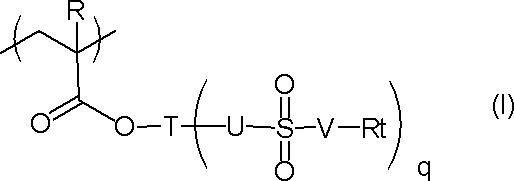
上記一般式(I)中、
Rは水素原子又はアルキル基を表す。
Tは単結合又は(q+1)価の連結基を表す。
qは1~3の整数を表す。
U及びVは、各々独立に、酸素原子、NH基、又は単結合を表す。
Rtはアルキル基、シクロアルキル基又はアリール基を表す。
Rtについてのシクロアルキル基は環員として窒素原子又は酸素原子を有していてもよい。
〔15〕
前記現像液が、ケトン系溶剤、エステル系溶剤、アルコール系溶剤、アミド系溶剤及びエーテル系溶剤からなる群より選択される少なくとも1種類の有機溶剤を含有する現像液である、〔1〕~〔8〕、〔13〕及び〔14〕のいずれか1項に記載のパターン形成方法。
〔16〕
更に、(エ)有機溶剤を含有するリンス液を用いて洗浄する工程を含む、〔1〕~〔8〕、〔13〕~〔15〕のいずれか1項に記載のパターン形成方法。
〔17〕
前記工程(イ)における露光が液浸露光である、〔1〕~〔8〕及び〔13〕~〔16〕のいずれか1項に記載のパターン形成方法。
〔18〕
前記工程(イ)における露光がArF露光である、〔1〕~〔8〕及び〔13〕~〔17〕のいずれか1項に記載のパターン形成方法。
〔19〕
有機溶剤現像用の化学増幅型のレジスト組成物である、〔9〕に記載の感活性光線性又は感放射線性樹脂組成物。
〔20〕
液浸露光用である、〔9〕又は〔19〕に記載の感活性光線性又は感放射線性樹脂組成物。
Rは水素原子又はアルキル基を表す。
Tは単結合又は(q+1)価の連結基を表す。
qは1~3の整数を表す。
U及びVは、各々独立に、酸素原子、NH基、又は単結合を表す。
Rtはアルキル基、シクロアルキル基又はアリール基を表す。
Rtについてのシクロアルキル基は環員として窒素原子又は酸素原子を有していてもよい。
〔15〕
前記現像液が、ケトン系溶剤、エステル系溶剤、アルコール系溶剤、アミド系溶剤及びエーテル系溶剤からなる群より選択される少なくとも1種類の有機溶剤を含有する現像液である、〔1〕~〔8〕、〔13〕及び〔14〕のいずれか1項に記載のパターン形成方法。
〔16〕
更に、(エ)有機溶剤を含有するリンス液を用いて洗浄する工程を含む、〔1〕~〔8〕、〔13〕~〔15〕のいずれか1項に記載のパターン形成方法。
〔17〕
前記工程(イ)における露光が液浸露光である、〔1〕~〔8〕及び〔13〕~〔16〕のいずれか1項に記載のパターン形成方法。
〔18〕
前記工程(イ)における露光がArF露光である、〔1〕~〔8〕及び〔13〕~〔17〕のいずれか1項に記載のパターン形成方法。
〔19〕
有機溶剤現像用の化学増幅型のレジスト組成物である、〔9〕に記載の感活性光線性又は感放射線性樹脂組成物。
〔20〕
液浸露光用である、〔9〕又は〔19〕に記載の感活性光線性又は感放射線性樹脂組成物。
本発明によれば、孔径75nm以下(好ましくは孔径45nm以下)のホールパターンなどの微細パターンの有機系現像液による形成において、局所的なパターン寸法の均一性及び真円性に優れるパターン形成方法、それに用いられる感活性光線性又は感放射線性樹脂組成物、及びレジスト膜、並びにこれらを用いる電子デバイスの製造方法及び電子デバイスを提供することができる。
以下、本発明の実施形態について詳細に説明する。
本明細書に於ける基(原子団)の表記に於いて、置換及び無置換を記していない表記は、置換基を有さないものと共に置換基を有するものをも包含するものである。例えば、「アルキル基」とは、置換基を有さないアルキル基(無置換アルキル基)のみならず、置換基を有するアルキル基(置換アルキル基)をも包含するものである。
本明細書中における「活性光線」又は「放射線」とは、例えば、水銀灯の輝線スペクトル、エキシマレーザーに代表される遠紫外線、極紫外線(EUV光)、X線、電子線(EB)等を意味する。また、本発明において光とは、活性光線又は放射線を意味する。
また、本明細書中における「露光」とは、特に断らない限り、水銀灯、エキシマレーザーに代表される遠紫外線、極紫外線、X線、EUV光などによる露光のみならず、電子線、イオンビーム等の粒子線による描画も露光に含める。
本明細書に於ける基(原子団)の表記に於いて、置換及び無置換を記していない表記は、置換基を有さないものと共に置換基を有するものをも包含するものである。例えば、「アルキル基」とは、置換基を有さないアルキル基(無置換アルキル基)のみならず、置換基を有するアルキル基(置換アルキル基)をも包含するものである。
本明細書中における「活性光線」又は「放射線」とは、例えば、水銀灯の輝線スペクトル、エキシマレーザーに代表される遠紫外線、極紫外線(EUV光)、X線、電子線(EB)等を意味する。また、本発明において光とは、活性光線又は放射線を意味する。
また、本明細書中における「露光」とは、特に断らない限り、水銀灯、エキシマレーザーに代表される遠紫外線、極紫外線、X線、EUV光などによる露光のみならず、電子線、イオンビーム等の粒子線による描画も露光に含める。
本発明のパターン形成方法は、
(ア)下記樹脂(A)及び下記化合物(B)を含有する感活性光線性又は感放射線性樹脂組成物によって膜を形成する工程、
(A)-SO2-基を有する繰り返し単位(a0)及び酸の作用により分解して極性基を生じる基を有する繰り返し単位(a1)を含有し、前記繰り返し単位(a0)を除く各繰り返し単位に対応する各モノマーのClogP値のモル平均値が2.0以上の樹脂、及び
(B)活性光線又は放射線の照射により酸を発生する化合物
(イ)該膜を露光する工程、及び
(ウ)該露光された膜を、有機溶剤を含む現像液を用いて現像してネガ型のパターンを形成する工程を有する。
(ア)下記樹脂(A)及び下記化合物(B)を含有する感活性光線性又は感放射線性樹脂組成物によって膜を形成する工程、
(A)-SO2-基を有する繰り返し単位(a0)及び酸の作用により分解して極性基を生じる基を有する繰り返し単位(a1)を含有し、前記繰り返し単位(a0)を除く各繰り返し単位に対応する各モノマーのClogP値のモル平均値が2.0以上の樹脂、及び
(B)活性光線又は放射線の照射により酸を発生する化合物
(イ)該膜を露光する工程、及び
(ウ)該露光された膜を、有機溶剤を含む現像液を用いて現像してネガ型のパターンを形成する工程を有する。
上記の本発明のパターン形成方法によって、孔径75nm以下(好ましくは孔径45nm以下)のホールパターンなどの微細パターンの有機系現像液による形成において、局所的なパターン寸法の均一性及び真円性に優れる理由は定かではないが以下のように推定される。
上述のように、従来の-SO2-基を含有する環式基を有する樹脂は、極性が高いなどの理由から、有機系現像液に含有される有機溶剤(例えば、n-ブチルアセテート)に対する溶解性が低く、現像性が悪くなる傾向にあった。
これに対し、本発明において、樹脂(A)に含有される-SO2-基を有する繰り返し単位(a0)以外の各繰り返し単位の有機溶剤に対する溶解性を向上させることで、具体的には、繰り返し単位(a0)を除く各繰り返し単位に対応する各モノマーのClogP値のモル平均値を2.0以上とすることで、樹脂(A)全体としての有機溶剤に対する溶解性を向上させることができ、現像性を向上させることができるものと考えられる。その結果、孔径75nm以下のホールパターンなどの微細パターンの有機系現像液による形成において、局所的なパターン寸法の均一性及び真円性に優れるものと推定される。
これに対し、本発明において、樹脂(A)に含有される-SO2-基を有する繰り返し単位(a0)以外の各繰り返し単位の有機溶剤に対する溶解性を向上させることで、具体的には、繰り返し単位(a0)を除く各繰り返し単位に対応する各モノマーのClogP値のモル平均値を2.0以上とすることで、樹脂(A)全体としての有機溶剤に対する溶解性を向上させることができ、現像性を向上させることができるものと考えられる。その結果、孔径75nm以下のホールパターンなどの微細パターンの有機系現像液による形成において、局所的なパターン寸法の均一性及び真円性に優れるものと推定される。
ところで、上記したように、ポジ型の画像形成方法により、微細なホールパターンを形成した場合には、パターンの形状が劣化しやすく、微細(例えば、孔径が75nm以下)なパターンを形成することは、実質、不可能である。これは、ポジ型の画像形成方法でこのような微細パターンを形成する場合には、ホール部を形成しようとする領域が露光部となるが、微細な領域を露光して解像することは、光学上、ほぼ不可能であるためである。
膜を露光する工程(イ)における露光光源は、特に限定されないが、ArFエキシマレーザー、EUV光、電子線、KrFエキシマレーザーなどを適用することができ、特に微小なパターン形成の為には、ArFエキシマレーザー又はEUV光により露光することが好ましく、ArFエキシマレーザーにより露光することがより好ましい。また、いわゆる液浸露光の技術を適宜組み合わせて、より高解像なパターン形成を行うこともできる。
本発明のパターン形成方法は、前記現像液が、ケトン系溶剤、エステル系溶剤、アルコール系溶剤、アミド系溶剤及びエーテル系溶剤からなる群より選択される少なくとも1種類の有機溶剤を含有する現像液であることが好ましい。
本発明のパターン形成方法は、前記現像液が、ケトン系溶剤、エステル系溶剤、アルコール系溶剤、アミド系溶剤及びエーテル系溶剤からなる群より選択される少なくとも1種類の有機溶剤を含有する現像液であることが好ましい。
本発明のパターン形成方法は、更に、(エ)有機溶剤を含むリンス液を用いて洗浄する工程を含むことが好ましい。
リンス液は、炭化水素系溶剤、ケトン系溶剤、エステル系溶剤、アルコール系溶剤、アミド系溶剤及びエーテル系溶剤からなる群より選択される少なくとも1種類の有機溶剤を含有するリンス液であることが好ましい。
本発明のパターン形成方法は、(イ)露光工程の後に、(オ)加熱工程を有することが好ましい。
本発明のパターン形成方法は、前記樹脂(A)が、酸の作用により極性が増大してアルカリ現像液に対する溶解度が増大する樹脂でもあり、(カ)アルカリ現像液を用いて現像する工程を更に有していてもよい。
本発明のパターン形成方法は、前記樹脂(A)が、酸の作用により極性が増大してアルカリ現像液に対する溶解度が増大する樹脂でもあり、(カ)アルカリ現像液を用いて現像する工程を更に有していてもよい。
本発明のパターン形成方法は、(イ)露光工程を、複数回有することができる。
本発明のパターン形成方法は、(オ)加熱工程を、複数回有することができる。
本発明のレジスト膜は、上記感活性光線性又は感放射線性樹脂組成物によって形成される膜であり、例えば、基材に、感活性光線性又は感放射線性樹脂組成物を塗布することにより形成される膜である。
以下、本発明で使用し得る感活性光線性又は感放射線性樹脂組成物について説明する。
また、本発明は以下に説明する感活性光線性又は感放射線性樹脂組成物に関するものでもある。
本発明に係る感活性光線性又は感放射線性樹脂組成物は、特にレジスト膜に例えば、微細な孔径(例えば、75nm以下、好ましくは孔径45nm以下)を有するパターンを形成する場合においては、ネガ型の現像(露光されると現像液に対して溶解性が減少し、露光部がパターンとして残り、未露光部が除去される現像)に用いられる。即ち、本発明に係る感活性光線性又は感放射線性樹脂組成物は、有機溶剤を含む現像液を用いた現像に用いられる有機溶剤現像用の感活性光線性又は感放射線性樹脂組成物とすることができる。ここで、有機溶剤現像用とは、少なくとも、有機溶剤を含む現像液を用いて現像する工程に供される用途を意味する。
本発明の感活性光線性又は感放射線性樹脂組成物は、典型的にはレジスト組成物であり、ネガ型のレジスト組成物(即ち、有機溶剤現像用のレジスト組成物)であることが、特に高い効果を得ることができることから好ましい。また本発明に係る組成物は、典型的には化学増幅型のレジスト組成物である。
以下、本発明で使用し得る感活性光線性又は感放射線性樹脂組成物について説明する。
また、本発明は以下に説明する感活性光線性又は感放射線性樹脂組成物に関するものでもある。
本発明に係る感活性光線性又は感放射線性樹脂組成物は、特にレジスト膜に例えば、微細な孔径(例えば、75nm以下、好ましくは孔径45nm以下)を有するパターンを形成する場合においては、ネガ型の現像(露光されると現像液に対して溶解性が減少し、露光部がパターンとして残り、未露光部が除去される現像)に用いられる。即ち、本発明に係る感活性光線性又は感放射線性樹脂組成物は、有機溶剤を含む現像液を用いた現像に用いられる有機溶剤現像用の感活性光線性又は感放射線性樹脂組成物とすることができる。ここで、有機溶剤現像用とは、少なくとも、有機溶剤を含む現像液を用いて現像する工程に供される用途を意味する。
本発明の感活性光線性又は感放射線性樹脂組成物は、典型的にはレジスト組成物であり、ネガ型のレジスト組成物(即ち、有機溶剤現像用のレジスト組成物)であることが、特に高い効果を得ることができることから好ましい。また本発明に係る組成物は、典型的には化学増幅型のレジスト組成物である。
<(A)-SO2-基を有する繰り返し単位(a0)及び酸の作用により分解して極性基を生じる基を有する繰り返し単位(a1)を含有し、前記繰り返し単位(a0)を除く各繰り返し単位に対応する各モノマーのClogP値のモル平均値が2.0以上の樹脂>
樹脂(A)は、繰り返し単位(a0)を除く各繰り返し単位に対応する各モノマーのClogP値のモル平均値が2.0以上である。
樹脂(A)のClogP値が高いほど、特に、繰り返し単位(a0)を除く各繰り返し単位に対応する各モノマーのClogP値のモル平均値が2.0以上であることにより、溶剤への溶解性に優れるため、パターンのCDU、真円性を向上させることができる。
ここでClogP値とは、化合物(モノマー)の1-オクタノール中及び水中におけるモノマーの平衡濃度間の比率を示す1-オクタノール/水分配係数Pの常用対数値をいう。
樹脂(A)において、繰り返し単位(a0)を除く各繰り返し単位に対応する各モノマーのClogP値のモル平均値は、上述の観点から2.5以上であることが好ましく、3.0以上であることがより好ましく、3.5以上であることが更に好ましい。
なお、繰り返し単位(a0)を除く各繰り返し単位に対応する各モノマーのClogP値のモル平均値の上限としては、特に制限はないが、10.0以下であることが好ましく、8.0以下であることがより好ましく、6.0以下であることが更に好ましい。
樹脂(A)は、繰り返し単位(a0)を除く各繰り返し単位に対応する各モノマーのClogP値のモル平均値が2.0以上である。
樹脂(A)のClogP値が高いほど、特に、繰り返し単位(a0)を除く各繰り返し単位に対応する各モノマーのClogP値のモル平均値が2.0以上であることにより、溶剤への溶解性に優れるため、パターンのCDU、真円性を向上させることができる。
ここでClogP値とは、化合物(モノマー)の1-オクタノール中及び水中におけるモノマーの平衡濃度間の比率を示す1-オクタノール/水分配係数Pの常用対数値をいう。
樹脂(A)において、繰り返し単位(a0)を除く各繰り返し単位に対応する各モノマーのClogP値のモル平均値は、上述の観点から2.5以上であることが好ましく、3.0以上であることがより好ましく、3.5以上であることが更に好ましい。
なお、繰り返し単位(a0)を除く各繰り返し単位に対応する各モノマーのClogP値のモル平均値の上限としては、特に制限はないが、10.0以下であることが好ましく、8.0以下であることがより好ましく、6.0以下であることが更に好ましい。
本発明において、繰り返し単位(a0)を除く各繰り返し単位に対応する各モノマーのClogP値のモル平均値は、以下のように算出することができる。
樹脂(A)が、繰り返し単位D1、D2、…、Dx、…、Dnから構成され、繰り返し単位D1、D2、…、Dx、…、Dnに対応する単量体(モノマー)のClogP値を、それぞれ、ClogP1、ClogP2、…、ClogPx…、ClogPnとし、繰り返し単位D1、D2、…、Dx、…、Dnの樹脂(A)中のモル分率を、それぞれ、ω1、ω2、…、ωx、…、ωnとする場合、繰り返し単位(a0)を除く各繰り返し単位に対応する各モノマーのClogP値のモル平均値は、以下の計算式により算出することができる。
繰り返し単位(a0)を除く各繰り返し単位に対応する各モノマーのClogP値のモル平均値=Σ[(ω1×ClogP1)+(ω2×ClogP2)+…+(ωx×ClogPx)+…+(ωn×ClogPn)]
樹脂(A)が、繰り返し単位D1、D2、…、Dx、…、Dnから構成され、繰り返し単位D1、D2、…、Dx、…、Dnに対応する単量体(モノマー)のClogP値を、それぞれ、ClogP1、ClogP2、…、ClogPx…、ClogPnとし、繰り返し単位D1、D2、…、Dx、…、Dnの樹脂(A)中のモル分率を、それぞれ、ω1、ω2、…、ωx、…、ωnとする場合、繰り返し単位(a0)を除く各繰り返し単位に対応する各モノマーのClogP値のモル平均値は、以下の計算式により算出することができる。
繰り返し単位(a0)を除く各繰り返し単位に対応する各モノマーのClogP値のモル平均値=Σ[(ω1×ClogP1)+(ω2×ClogP2)+…+(ωx×ClogPx)+…+(ωn×ClogPn)]
なお、繰り返し単位D1、D2、…、Dx、…、Dnに対応する単量体(モノマー)のClogP値(ClogP1、ClogP2、…、ClogPx…、ClogPn)はCambridgesoft社製のChemBioDraw12.0を用いて算出することができる
樹脂(A)を構成し得る各繰り返し単位の具体例と、該繰り返し単位に対応するモノマー(単量体)のClogP値とを以下に記すが、本発明はこれらに限定されるものではない。
樹脂(A)を構成し得る各繰り返し単位の具体例と、該繰り返し単位に対応するモノマー(単量体)のClogP値とを以下に記すが、本発明はこれらに限定されるものではない。
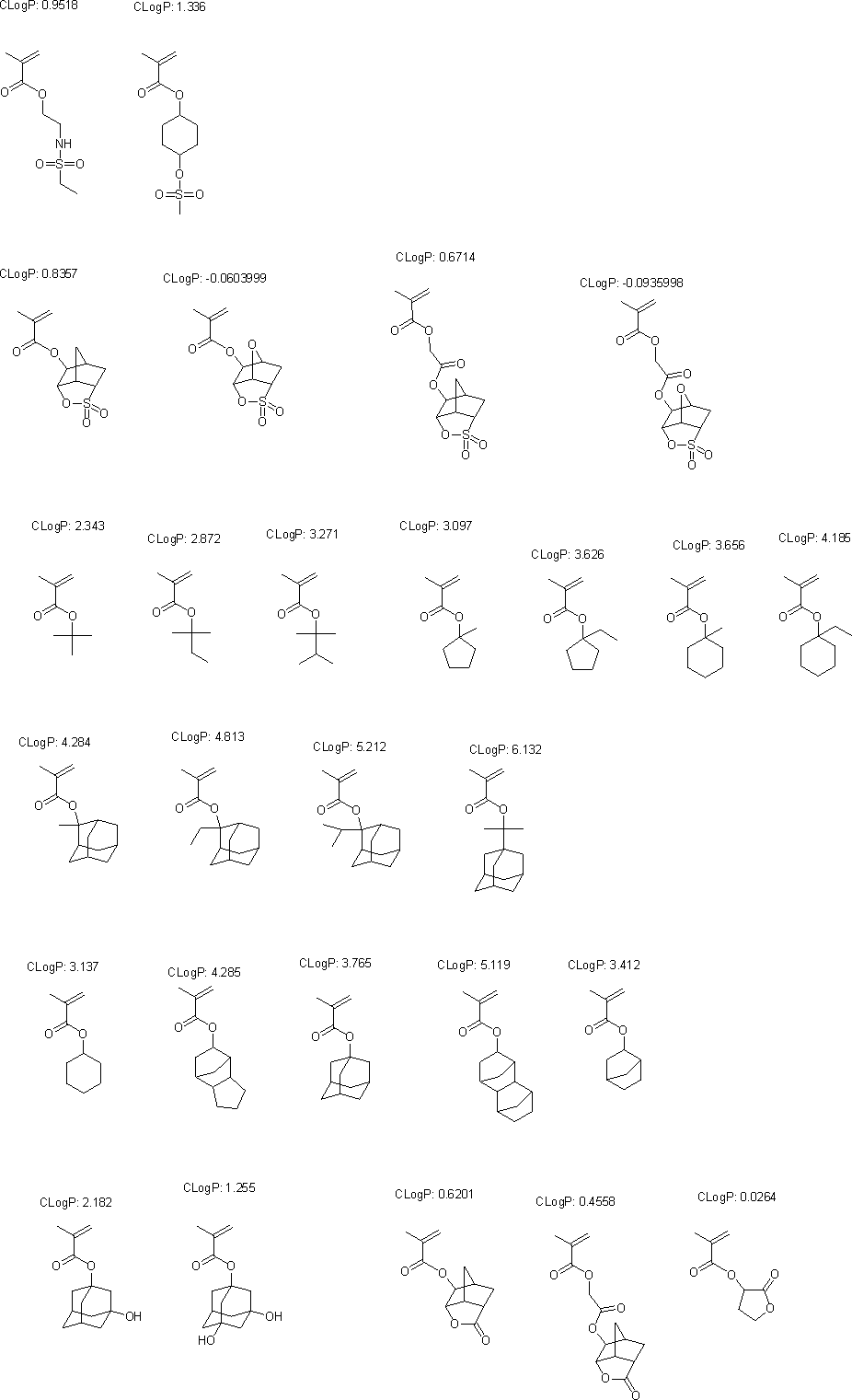
(-SO2-基を有する繰り返し単位(a0))
樹脂(A)は、-SO2-基を有する繰り返し単位(a0)を含有する。
-SO2-基を有する繰り返し単位(a0)は、特に、-SO2-O-基を有する繰り返し単位であることが好ましい。
また、-SO2-基を有する繰り返し単位(a0)は、(メタ)アクリレート系繰り返し単位であることが好ましい。
-SO2-基を有する繰り返し単位(a0)としては下記一般式(I)で表されることが好ましい。
樹脂(A)は、-SO2-基を有する繰り返し単位(a0)を含有する。
-SO2-基を有する繰り返し単位(a0)は、特に、-SO2-O-基を有する繰り返し単位であることが好ましい。
また、-SO2-基を有する繰り返し単位(a0)は、(メタ)アクリレート系繰り返し単位であることが好ましい。
-SO2-基を有する繰り返し単位(a0)としては下記一般式(I)で表されることが好ましい。

上記一般式(I)中、
Rは水素原子又はアルキル基を表す。
Tは単結合又は(q+1)価の連結基を表す。
qは1~3の整数を表す。
U及びVは、各々独立に、酸素原子、NH基、又は単結合を表す。
Rtはアルキル基、シクロアルキル基又はアリール基を表す。
Rtについてのシクロアルキル基は環員として窒素原子又は酸素原子を有していてもよい。
Rについてのアルキル基は、置換基を有していてもよく、炭素数1~5のアルキル基であることが好ましく、置換基としてはハロゲン原子等が挙げられる。
Tについての(q+1)価の連結基としては、アルキレン基、シクロアルキレン基等、qが2又は3のときは、アルキレン基、シクロアルキレン基等から(q-1)個の任意の水素原子を除してなる基が挙げられ、シクロアルキレン基としては、環員として窒素原子又は酸素原子を有していてもよい。
qは1又は2であることが好ましく、1であることがより好ましい。
U及びVは、いずれか一方が酸素原子であることが好ましく、その場合、他方はNH基又は単結合であることが好ましい。
Rtについてのアルキル基としては、置換基を有していてもよく、炭素数1~5のアルキル基であることが好ましい。
Rtについてのシクロアルキル基としては、置換基を有していてもよく、炭素数3~20のシクロアルキル基であることが好ましい。
Rtについてのアリール基としては、置換基を有していてもよく、炭素数6~20のアリール基であることが好ましい。
上記置換基としてはハロゲン原子等が挙げられる。
-SO2-基を有する繰り返し単位(a0)の具体例としては、以下のような構造が挙げられるが、本発明はこれらに限定されるものではない。
Rは水素原子又はアルキル基を表す。
Tは単結合又は(q+1)価の連結基を表す。
qは1~3の整数を表す。
U及びVは、各々独立に、酸素原子、NH基、又は単結合を表す。
Rtはアルキル基、シクロアルキル基又はアリール基を表す。
Rtについてのシクロアルキル基は環員として窒素原子又は酸素原子を有していてもよい。
Rについてのアルキル基は、置換基を有していてもよく、炭素数1~5のアルキル基であることが好ましく、置換基としてはハロゲン原子等が挙げられる。
Tについての(q+1)価の連結基としては、アルキレン基、シクロアルキレン基等、qが2又は3のときは、アルキレン基、シクロアルキレン基等から(q-1)個の任意の水素原子を除してなる基が挙げられ、シクロアルキレン基としては、環員として窒素原子又は酸素原子を有していてもよい。
qは1又は2であることが好ましく、1であることがより好ましい。
U及びVは、いずれか一方が酸素原子であることが好ましく、その場合、他方はNH基又は単結合であることが好ましい。
Rtについてのアルキル基としては、置換基を有していてもよく、炭素数1~5のアルキル基であることが好ましい。
Rtについてのシクロアルキル基としては、置換基を有していてもよく、炭素数3~20のシクロアルキル基であることが好ましい。
Rtについてのアリール基としては、置換基を有していてもよく、炭素数6~20のアリール基であることが好ましい。
上記置換基としてはハロゲン原子等が挙げられる。
-SO2-基を有する繰り返し単位(a0)の具体例としては、以下のような構造が挙げられるが、本発明はこれらに限定されるものではない。

更には、上記-SO2-基を有する繰り返し単位は、-SO2-基を含有する環式基を有する繰り返し単位(以下、単に、-SO2-基含有環式基ともいう)であることが好ましい。該環をひとつの目の環として数え、該環のみの場合は単環式基、更に他の環構造を有する場合は、その構造に関わらず多環式基と称する。環式基は、単環式基であってもよく、多環式基であってもよい。
-SO2-基含有環式基は、特に、その環骨格中に-SO2-O-基を含有する環式基、すなわち-SO2-O-中の-S-O-が環骨格の一部を形成するスルトン(sultone)環であることが好ましい。
-SO2-基含有環式基は、炭素数が3~30であることが好ましく、4~20であることが好ましく、4~15であることがより好ましく、4~12であることが特に好ましい。ただし、該炭素数は環骨格を構成する炭素原子の数であり、置換基における炭素数を含まないものとする。
-SO2-基含有環式基は、-SO2-基含有脂肪族環式基であってもよく、-SO2-基含有芳香族環式基であってもよい。好ましくは-SO2-基含有脂肪族環式基である。
-SO2-基含有脂肪族環式基としては、その環骨格を構成する炭素原子の一部が-SO2-基又は-SO2-O-基で置換された脂肪族炭化水素環から水素原子を少なくとも1つ除いた基が挙げられる。より具体的には、その環骨格を構成する-CH2-が-SO2-基で置換された脂肪族炭化水素環から水素原子を少なくとも1つ除いた基、その環を構成する-CH2-CH2-が-SO2-O-基で置換された脂肪族炭化水素環から水素原子を少なくとも1つ除いた基等が挙げられる。
該脂環式炭化水素基は、炭素数が3~20であることが好ましく、3~12であることがより好ましい。
該脂環式炭化水素基は、多環式であってもよく、単環式であってもよい。単環式の脂環式炭化水素基としては、炭素数3~6のモノシクロアルカンから2個の水素原子を除いた基が好ましく、該モノシクロアルカンとしてはシクロペンタン、シクロヘキサン等が例示できる。多環式の脂環式炭化水素基としては、炭素数7~12のポリシクロアルカンから2個の水素原子を除いた基が好ましく、該ポリシクロアルカンとして具体的には、アダマンタン、ノルボルナン、イソボルナン、トリシクロデカン、テトラシクロドデカン等が挙げられる。
-SO2-基含有環式基は、特に、その環骨格中に-SO2-O-基を含有する環式基、すなわち-SO2-O-中の-S-O-が環骨格の一部を形成するスルトン(sultone)環であることが好ましい。
-SO2-基含有環式基は、炭素数が3~30であることが好ましく、4~20であることが好ましく、4~15であることがより好ましく、4~12であることが特に好ましい。ただし、該炭素数は環骨格を構成する炭素原子の数であり、置換基における炭素数を含まないものとする。
-SO2-基含有環式基は、-SO2-基含有脂肪族環式基であってもよく、-SO2-基含有芳香族環式基であってもよい。好ましくは-SO2-基含有脂肪族環式基である。
-SO2-基含有脂肪族環式基としては、その環骨格を構成する炭素原子の一部が-SO2-基又は-SO2-O-基で置換された脂肪族炭化水素環から水素原子を少なくとも1つ除いた基が挙げられる。より具体的には、その環骨格を構成する-CH2-が-SO2-基で置換された脂肪族炭化水素環から水素原子を少なくとも1つ除いた基、その環を構成する-CH2-CH2-が-SO2-O-基で置換された脂肪族炭化水素環から水素原子を少なくとも1つ除いた基等が挙げられる。
該脂環式炭化水素基は、炭素数が3~20であることが好ましく、3~12であることがより好ましい。
該脂環式炭化水素基は、多環式であってもよく、単環式であってもよい。単環式の脂環式炭化水素基としては、炭素数3~6のモノシクロアルカンから2個の水素原子を除いた基が好ましく、該モノシクロアルカンとしてはシクロペンタン、シクロヘキサン等が例示できる。多環式の脂環式炭化水素基としては、炭素数7~12のポリシクロアルカンから2個の水素原子を除いた基が好ましく、該ポリシクロアルカンとして具体的には、アダマンタン、ノルボルナン、イソボルナン、トリシクロデカン、テトラシクロドデカン等が挙げられる。
-SO2-基含有環式基は、置換基を有していてもよい。該置換基としては、例えばアルキル基、アルコキシ基、ハロゲン原子、ハロゲン化アルキル基、水酸基、酸素原子(=O)、-COOR”、-OC(=O)R”(R”は水素原子又はアルキル基である。)、ヒドロキシアルキル基、シアノ基等が挙げられる。
該置換基としてのアルキル基としては、炭素数1~6のアルキル基が好ましい。該アルキル基は、直鎖状又は分岐鎖状であることが好ましい。具体的には、メチル基、エチル基、プロピル基、イソプロピル基、n-ブチル基、イソブチル基、tert-ブチル基、ペンチル基、イソペンチル基、ネオペンチル基、ヘキシル基等が挙げられる。これらの中でも、メチル基又はエチル基が好ましく、メチル基が特に好ましい。
該置換基としてのアルコキシ基としては、炭素数1~6のアルコキシ基が好ましい。該アルコキシ基は、直鎖状又は分岐鎖状であることが好ましい。具体的には、前記置換基としてのアルキル基として挙げたアルキル基に酸素原子(-O-)に結合した基が挙げられる。
該置換基としてのハロゲン原子としては、フッ素原子、塩素原子、臭素原子、ヨウ素原子等が挙げられ、フッ素原子が好ましい。
該置換基のハロゲン化アルキル基としては、前記アルキル基の水素原子の一部又は全部が前記ハロゲン原子で置換された基が挙げられる。
該置換基としてのハロゲン化アルキル基としては、前記置換基としてのアルキル基として挙げたアルキル基の水素原子の一部又は全部が前記ハロゲン原子で置換された基が挙げられる。該ハロゲン化アルキル基としてはフッ素化アルキル基が好ましく、特にパーフルオロアルキル基が好ましい。
前記-COOR”、-OC(=O)R”におけるR”は、いずれも、水素原子又は炭素数1~15の直鎖状、分岐鎖状若しくは環状のアルキル基であることが好ましい。
R”が直鎖状若しくは分岐鎖状のアルキル基の場合は、炭素数1~10であることが好ましく、炭素数1~5であることが更に好ましく、メチル基又はエチル基であることが特に好ましい。
R”が環状のアルキル基の場合は、炭素数3~15であることが好ましく、炭素数4~12であることが更に好ましく、炭素数5~10が最も好ましい。具体的には、フッ素原子又はフッ素化アルキル基で置換されていてもよいし、されていなくてもよいモノシクロアルカン、ビシクロアルカン、トリシクロアルカン、テトラシクロアルカンなどのポリシクロアルカンから1個以上の水素原子を除いた基などを例示できる。より具体的には、シクロペンタン、シクロヘキサン等のモノシクロアルカンや、アダマンタン、ノルボルナン、イソボルナン、トリシクロデカン、テトラシクロドデカンなどのポリシクロアルカンから1個以上の水素原子を除いた基などが挙げられる。
該置換基としてのヒドロキシアルキル基としては、炭素数が1~6であるものが好ましく、具体的には、前記置換基としてのアルキル基として挙げたアルキル基の水素原子の少なくとも1つが水酸基で置換された基が挙げられる。
-SO2-基含有環式基として、より具体的には、下記一般式(3-1)~(3-4)で表される基が挙げられる。
該置換基としてのアルキル基としては、炭素数1~6のアルキル基が好ましい。該アルキル基は、直鎖状又は分岐鎖状であることが好ましい。具体的には、メチル基、エチル基、プロピル基、イソプロピル基、n-ブチル基、イソブチル基、tert-ブチル基、ペンチル基、イソペンチル基、ネオペンチル基、ヘキシル基等が挙げられる。これらの中でも、メチル基又はエチル基が好ましく、メチル基が特に好ましい。
該置換基としてのアルコキシ基としては、炭素数1~6のアルコキシ基が好ましい。該アルコキシ基は、直鎖状又は分岐鎖状であることが好ましい。具体的には、前記置換基としてのアルキル基として挙げたアルキル基に酸素原子(-O-)に結合した基が挙げられる。
該置換基としてのハロゲン原子としては、フッ素原子、塩素原子、臭素原子、ヨウ素原子等が挙げられ、フッ素原子が好ましい。
該置換基のハロゲン化アルキル基としては、前記アルキル基の水素原子の一部又は全部が前記ハロゲン原子で置換された基が挙げられる。
該置換基としてのハロゲン化アルキル基としては、前記置換基としてのアルキル基として挙げたアルキル基の水素原子の一部又は全部が前記ハロゲン原子で置換された基が挙げられる。該ハロゲン化アルキル基としてはフッ素化アルキル基が好ましく、特にパーフルオロアルキル基が好ましい。
前記-COOR”、-OC(=O)R”におけるR”は、いずれも、水素原子又は炭素数1~15の直鎖状、分岐鎖状若しくは環状のアルキル基であることが好ましい。
R”が直鎖状若しくは分岐鎖状のアルキル基の場合は、炭素数1~10であることが好ましく、炭素数1~5であることが更に好ましく、メチル基又はエチル基であることが特に好ましい。
R”が環状のアルキル基の場合は、炭素数3~15であることが好ましく、炭素数4~12であることが更に好ましく、炭素数5~10が最も好ましい。具体的には、フッ素原子又はフッ素化アルキル基で置換されていてもよいし、されていなくてもよいモノシクロアルカン、ビシクロアルカン、トリシクロアルカン、テトラシクロアルカンなどのポリシクロアルカンから1個以上の水素原子を除いた基などを例示できる。より具体的には、シクロペンタン、シクロヘキサン等のモノシクロアルカンや、アダマンタン、ノルボルナン、イソボルナン、トリシクロデカン、テトラシクロドデカンなどのポリシクロアルカンから1個以上の水素原子を除いた基などが挙げられる。
該置換基としてのヒドロキシアルキル基としては、炭素数が1~6であるものが好ましく、具体的には、前記置換基としてのアルキル基として挙げたアルキル基の水素原子の少なくとも1つが水酸基で置換された基が挙げられる。
-SO2-基含有環式基として、より具体的には、下記一般式(3-1)~(3-4)で表される基が挙げられる。
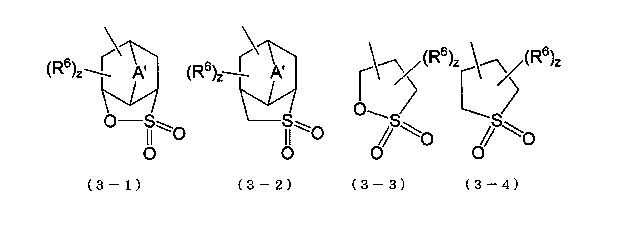
[式中、A’は酸素原子若しくは硫黄原子を含んでいてもよい炭素数1~5のアルキレン基、酸素原子又は硫黄原子であり、zは0~2の整数であり、R6はアルキル基、アルコキシ基、ハロゲン化アルキル基、水酸基、-COOR”、-OC(=O)R”、ヒドロキシアルキル基又はシアノ基であり、R”は水素原子又はアルキル基である。]
前記一般式(3-1)~(3-4)中、A’は、酸素原子(-O-)若しくは硫黄原子(-S-)を含んでいてもよい炭素数1~5のアルキレン基、酸素原子又は硫黄原子である。
A’における炭素数1~5のアルキレン基としては、直鎖状又は分岐鎖状のアルキレン基が好ましく、メチレン基、エチレン基、n-プロピレン基、イソプロピレン基等が挙げられる。
該アルキレン基が酸素原子又は硫黄原子を含む場合、その具体例としては、前記アルキレン基の末端又は炭素原子間に-O-又は-S-が介在する基が挙げられ、例えば-O-CH2-、-CH2-O-CH2-、-S-CH2-、-CH2-S-CH2-等が挙げられる。
A’としては、炭素数1~5のアルキレン基又は-O-が好ましく、炭素数1~5のアルキレン基がより好ましく、メチレン基が最も好ましい。
zは0~2のいずれであってもよく、0が最も好ましい。
zが2である場合、複数のR6はそれぞれ同じであってもよく、異なっていてもよい。
R6におけるアルキル基、アルコキシ基、ハロゲン化アルキル基、-COOR”、-OC(=O)R”、ヒドロキシアルキル基としては、それぞれ、前記で-SO2-基含有環式基が有していてもよい置換基として挙げたアルキル基、アルコキシ基、ハロゲン化アルキル基、-COOR”、-OC(=O)R”、ヒドロキシアルキル基と同様のものが挙げられる。
以下に、前記一般式(3-1)~(3-4)で表される具体的な環式基を例示する。なお、式中の「Ac」はアセチル基を示す。
A’における炭素数1~5のアルキレン基としては、直鎖状又は分岐鎖状のアルキレン基が好ましく、メチレン基、エチレン基、n-プロピレン基、イソプロピレン基等が挙げられる。
該アルキレン基が酸素原子又は硫黄原子を含む場合、その具体例としては、前記アルキレン基の末端又は炭素原子間に-O-又は-S-が介在する基が挙げられ、例えば-O-CH2-、-CH2-O-CH2-、-S-CH2-、-CH2-S-CH2-等が挙げられる。
A’としては、炭素数1~5のアルキレン基又は-O-が好ましく、炭素数1~5のアルキレン基がより好ましく、メチレン基が最も好ましい。
zは0~2のいずれであってもよく、0が最も好ましい。
zが2である場合、複数のR6はそれぞれ同じであってもよく、異なっていてもよい。
R6におけるアルキル基、アルコキシ基、ハロゲン化アルキル基、-COOR”、-OC(=O)R”、ヒドロキシアルキル基としては、それぞれ、前記で-SO2-基含有環式基が有していてもよい置換基として挙げたアルキル基、アルコキシ基、ハロゲン化アルキル基、-COOR”、-OC(=O)R”、ヒドロキシアルキル基と同様のものが挙げられる。
以下に、前記一般式(3-1)~(3-4)で表される具体的な環式基を例示する。なお、式中の「Ac」はアセチル基を示す。


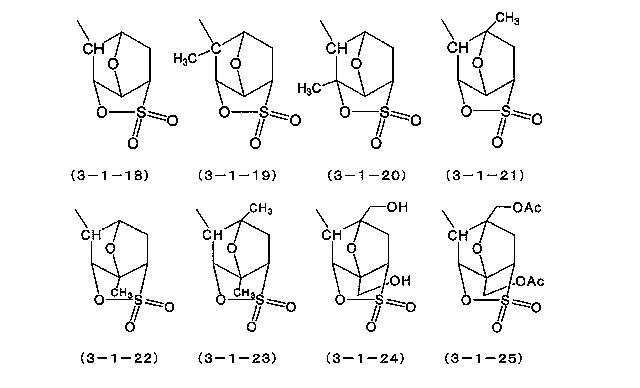
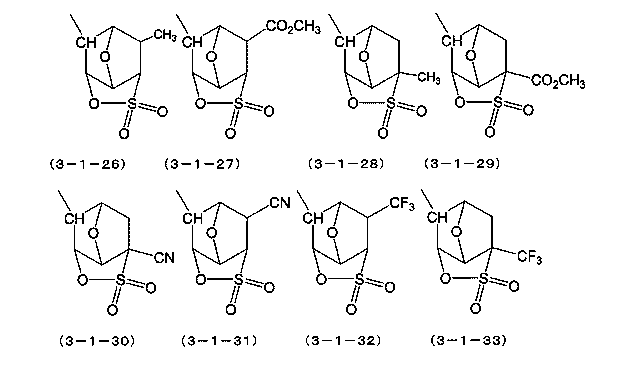
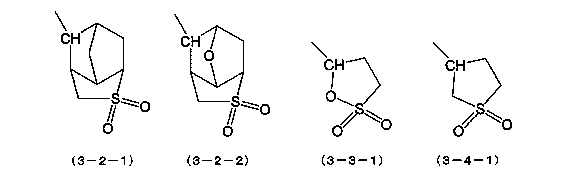
-SO2-基含有環式基としては、上記の中でも、前記一般式(3-1)で表される基が好ましく、前記化学式(3-1-1)、(3-1-18)、(3-3-1)及び(3-4-1)のいずれかで表される基からなる群から選択される少なくとも一種を用いることがより好ましく、前記化学式(3-1-1)で表される基が最も好ましい。
繰り返し単位(a0)の例として、より具体的には、下記一般式(a0-1)で表される繰り返し単位が挙げられる。

[式中、Rは水素原子、又はアルキル基であり、R5は-SO2-基含有環式基であり、R29は単結合又は2価の連結基である。]
式(a0-1)中、Rは一般式(I)について前述したものと同様である。
R5は、前記で挙げた-SO2-基含有環式基と同様である。
R29は、単結合、2価の連結基のいずれであってもよい。本発明の効果に優れることから、2価の連結基であることが好ましい。
R29における2価の連結基としては、特に限定されず、アルキレン基、又はエステル結合(-C(=O)-O-)を含むものが好ましい。
該アルキレン基は、直鎖状又は分岐鎖状のアルキレン基が好ましい。
エステル結合を含む2価の連結基としては、特に、一般式:-R4-C(=O)-O-[式中、R4は2価の連結基である。]で表される基が好ましい。すなわち、繰り返し単位(a0)は、下記一般式(a0-11)で表される繰り返し単位であることが好ましい。
R5は、前記で挙げた-SO2-基含有環式基と同様である。
R29は、単結合、2価の連結基のいずれであってもよい。本発明の効果に優れることから、2価の連結基であることが好ましい。
R29における2価の連結基としては、特に限定されず、アルキレン基、又はエステル結合(-C(=O)-O-)を含むものが好ましい。
該アルキレン基は、直鎖状又は分岐鎖状のアルキレン基が好ましい。
エステル結合を含む2価の連結基としては、特に、一般式:-R4-C(=O)-O-[式中、R4は2価の連結基である。]で表される基が好ましい。すなわち、繰り返し単位(a0)は、下記一般式(a0-11)で表される繰り返し単位であることが好ましい。

[式中、R及びR5はそれぞれ前記と同様であり、R4は2価の連結基である。]
R4の2価の連結基としては、直鎖状若しくは分岐鎖状のアルキレン基、2価の脂環式炭化水素基、又はヘテロ原子を含む2価の連結基が好ましい。
該直鎖状若しくは分岐鎖状のアルキレン基、2価の脂環式炭化水素基、ヘテロ原子を含む2価の連結基としては、直鎖状若しくは分岐鎖状のアルキレン基、又はヘテロ原子として酸素原子を含む2価の連結基が好ましい。
直鎖状のアルキレン基としては、メチレン基又はエチレン基が好ましく、メチレン基が特に好ましい。
分岐鎖状のアルキレン基としては、アルキルメチレン基又はアルキルエチレン基が好ましく、-CH(CH3)-、-C(CH3)2-又は-C(CH3)2CH2-が特に好ましい。
酸素原子を含む2価の連結基としては、エーテル結合又はエステル結合を含む2価の連結基が好ましく、-(CH2)c-C(=O)-O-(CH2)d-で表される基が特に好ましい。cは1~5の整数であり、1又は2が好ましい。dは1~5の整数であり、1又は2が好ましい。
R4の2価の連結基としては、直鎖状若しくは分岐鎖状のアルキレン基、2価の脂環式炭化水素基、又はヘテロ原子を含む2価の連結基が好ましい。
該直鎖状若しくは分岐鎖状のアルキレン基、2価の脂環式炭化水素基、ヘテロ原子を含む2価の連結基としては、直鎖状若しくは分岐鎖状のアルキレン基、又はヘテロ原子として酸素原子を含む2価の連結基が好ましい。
直鎖状のアルキレン基としては、メチレン基又はエチレン基が好ましく、メチレン基が特に好ましい。
分岐鎖状のアルキレン基としては、アルキルメチレン基又はアルキルエチレン基が好ましく、-CH(CH3)-、-C(CH3)2-又は-C(CH3)2CH2-が特に好ましい。
酸素原子を含む2価の連結基としては、エーテル結合又はエステル結合を含む2価の連結基が好ましく、-(CH2)c-C(=O)-O-(CH2)d-で表される基が特に好ましい。cは1~5の整数であり、1又は2が好ましい。dは1~5の整数であり、1又は2が好ましい。
繰り返し単位(a0)としては、特に、下記一般式(a0-21)又は(a0-22)で表される繰り返し単位が好ましく、式(a0-22)で表される繰り返し単位がより好ましい。

[式中、R、A’、R6、z及びR4はそれぞれ前記と同じである。]
式(a0-21)中、A’はメチレン基、酸素原子(-O-)又は硫黄原子(-S-)であることが好ましい。
R4としては、直鎖状若しくは分岐鎖状のアルキレン基、又は酸素原子を含む2価の連結基が好ましい。R4における直鎖状若しくは分岐鎖状のアルキレン基、酸素原子を含む2価の連結基としては、それぞれ、前記で挙げた直鎖状若しくは分岐鎖状のアルキレン基、酸素原子を含む2価の連結基と同様のものが挙げられる。
上記一般式(a0-22)で表される繰り返し単位としては、特に、下記一般式(a0-22a)又は(a0-22b)で表される繰り返し単位が好ましい。
式(a0-21)中、A’はメチレン基、酸素原子(-O-)又は硫黄原子(-S-)であることが好ましい。
R4としては、直鎖状若しくは分岐鎖状のアルキレン基、又は酸素原子を含む2価の連結基が好ましい。R4における直鎖状若しくは分岐鎖状のアルキレン基、酸素原子を含む2価の連結基としては、それぞれ、前記で挙げた直鎖状若しくは分岐鎖状のアルキレン基、酸素原子を含む2価の連結基と同様のものが挙げられる。
上記一般式(a0-22)で表される繰り返し単位としては、特に、下記一般式(a0-22a)又は(a0-22b)で表される繰り返し単位が好ましい。

[式中、R及びA’はそれぞれ前記と同じであり、c~eはそれぞれ独立に1~3の整数である。]
樹脂(A)が含有する繰り返し単位(a0)は1種であってもよく2種以上であってもよい。
樹脂(A)中、繰り返し単位(a0)の含有量は、樹脂(A)を構成する全繰り返し単位の合計に対し、好ましくは1mol%~50mol%であり、より好ましくは1mol%~30mol%であり、更に好ましくは、1mol%~20mol%である。
樹脂(A)中、繰り返し単位(a0)の含有量は、樹脂(A)を構成する全繰り返し単位の合計に対し、好ましくは1mol%~50mol%であり、より好ましくは1mol%~30mol%であり、更に好ましくは、1mol%~20mol%である。
(酸の作用により分解して極性基を生じる基(以下、「酸分解性基」ともいう)を有する繰り返し単位(a1))
樹脂(A)は、酸分解性基を有する繰り返し単位(a1)を含有する。
ここで本明細書及び特許請求の範囲において、「酸分解性基」は、酸(露光により化合物(B)から発生する酸)の作用により、当該酸分解性基の構造中の少なくとも一部の結合が開裂し得る酸分解性を有する基である。
樹脂(A)は、酸分解性基を有する繰り返し単位(a1)を含有する。
ここで本明細書及び特許請求の範囲において、「酸分解性基」は、酸(露光により化合物(B)から発生する酸)の作用により、当該酸分解性基の構造中の少なくとも一部の結合が開裂し得る酸分解性を有する基である。
極性基としては、有機溶剤を含む現像液中で難溶化又は不溶化する基であれば特に限定されないが、例えばカルボキシ基、水酸基、アミノ基、スルホ基(-SO3H)等が挙げられる。これらのなかでも、カルボキシ基、水酸基が好ましく、カルボキシ基が特に好ましい。
酸分解性基としてより具体的には、前記極性基の水素原子を酸解離性基で置換した基が挙げられる。
「酸解離性基」は、酸(露光により化合物(B)から発生する酸)の作用により、少なくとも、当該酸解離性基と該酸解離性基に隣接する原子との間の結合が開裂し得る酸解離性を有する基である。本発明において、酸解離性基は、当該酸解離性基の解離により生成する極性基よりも極性基の低い基であることが好ましく、これにより、極性基の水素原子を酸解離性基で置換した基において該酸解離性基が解離すると、該極性基が生じて極性が増大する。結果、樹脂(A)全体の親水性が増大し、相対的に、有機系現像液に対する溶解性が減少する。
酸解離性基としては、特に限定されず、これまで、化学増幅型レジスト用のベース樹脂の酸解離性基として提案されているものを使用することができる。一般的には、(メタ)アクリル酸等におけるカルボキシ基と環状又は鎖状の第3級アルキルエステルを形成する基;アルコキシアルキル基等のアセタール型酸解離性基などが広く知られている。なお、「(メタ)アクリル酸エステル」とは、α位に水素原子が結合したアクリル酸エステルと、α位にメチル基が結合したメタクリル酸エステルの一方あるいは両方を意味する。
ここで、「第3級アルキルエステル」とは、カルボキシ基の水素原子が、鎖状又は環状のアルキル基で置換されることによりエステルを形成しており、そのカルボニルオキシ基(-C(O)-O-)の末端の酸素原子に、前記鎖状又は環状のアルキル基の第3級炭素原子が結合している構造を示す。この第3級アルキルエステルにおいては、酸が作用すると、酸素原子と第3級炭素原子との間で結合が切断される。
前記鎖状又は環状のアルキル基は置換基を有していてもよい。
以下、カルボキシ基と第3級アルキルエステルを構成することにより、酸解離性となっている基を、便宜上、「第3級アルキルエステル型酸解離性基」という。
酸分解性基としてより具体的には、前記極性基の水素原子を酸解離性基で置換した基が挙げられる。
「酸解離性基」は、酸(露光により化合物(B)から発生する酸)の作用により、少なくとも、当該酸解離性基と該酸解離性基に隣接する原子との間の結合が開裂し得る酸解離性を有する基である。本発明において、酸解離性基は、当該酸解離性基の解離により生成する極性基よりも極性基の低い基であることが好ましく、これにより、極性基の水素原子を酸解離性基で置換した基において該酸解離性基が解離すると、該極性基が生じて極性が増大する。結果、樹脂(A)全体の親水性が増大し、相対的に、有機系現像液に対する溶解性が減少する。
酸解離性基としては、特に限定されず、これまで、化学増幅型レジスト用のベース樹脂の酸解離性基として提案されているものを使用することができる。一般的には、(メタ)アクリル酸等におけるカルボキシ基と環状又は鎖状の第3級アルキルエステルを形成する基;アルコキシアルキル基等のアセタール型酸解離性基などが広く知られている。なお、「(メタ)アクリル酸エステル」とは、α位に水素原子が結合したアクリル酸エステルと、α位にメチル基が結合したメタクリル酸エステルの一方あるいは両方を意味する。
ここで、「第3級アルキルエステル」とは、カルボキシ基の水素原子が、鎖状又は環状のアルキル基で置換されることによりエステルを形成しており、そのカルボニルオキシ基(-C(O)-O-)の末端の酸素原子に、前記鎖状又は環状のアルキル基の第3級炭素原子が結合している構造を示す。この第3級アルキルエステルにおいては、酸が作用すると、酸素原子と第3級炭素原子との間で結合が切断される。
前記鎖状又は環状のアルキル基は置換基を有していてもよい。
以下、カルボキシ基と第3級アルキルエステルを構成することにより、酸解離性となっている基を、便宜上、「第3級アルキルエステル型酸解離性基」という。
第3級アルキルエステル型酸解離性基としては、脂肪族分岐鎖状酸解離性基、脂肪族環式基を含有する酸解離性基が挙げられる。
ここで、「脂肪族分岐鎖状」とは、芳香族性を持たない分岐鎖状の構造を有することを示す。「脂肪族分岐鎖状酸解離性基」の構造は、炭素及び水素からなる基(炭化水素基)であることに限定はされないが、炭化水素基であることが好ましい。また、「炭化水素基」は飽和又は不飽和のいずれでもよいが、通常は飽和であることが好ましい。
脂肪族分岐鎖状酸解離性基としては、例えば、-C(R71)(R72)(R73)で表される基が挙げられる。式中、R71~R73は、それぞれ独立に、炭素数1~5の直鎖状のアルキル基である。-C(R71)(R72)(R73)で表される基は、炭素数が4~8であることが好ましく、具体的にはtert-ブチル基、2-メチル-2-ブチル基、2-メチル-2-ペンチル基、3-メチル-3-ペンチル基などが挙げられる。特にtert-ブチル基が好ましい。
ここで、「脂肪族分岐鎖状」とは、芳香族性を持たない分岐鎖状の構造を有することを示す。「脂肪族分岐鎖状酸解離性基」の構造は、炭素及び水素からなる基(炭化水素基)であることに限定はされないが、炭化水素基であることが好ましい。また、「炭化水素基」は飽和又は不飽和のいずれでもよいが、通常は飽和であることが好ましい。
脂肪族分岐鎖状酸解離性基としては、例えば、-C(R71)(R72)(R73)で表される基が挙げられる。式中、R71~R73は、それぞれ独立に、炭素数1~5の直鎖状のアルキル基である。-C(R71)(R72)(R73)で表される基は、炭素数が4~8であることが好ましく、具体的にはtert-ブチル基、2-メチル-2-ブチル基、2-メチル-2-ペンチル基、3-メチル-3-ペンチル基などが挙げられる。特にtert-ブチル基が好ましい。
「脂肪族環式基」は、芳香族性を持たない単環式基又は多環式基であることを示す。
「脂肪族環式基を含有する酸解離性基」における脂肪族環式基は、置換基を有していてもよいし、有していなくてもよい。置換基としては、炭素数1~5のアルキル基、炭素数1~5のアルコキシ基、フッ素原子、フッ素原子で置換された炭素数1~5のフッ素化アルキル基、酸素原子(=O)等が挙げられる。
該脂肪族環式基の置換基を除いた基本の環の構造は、炭素及び水素からなる基(炭化水素基)であることに限定はされないが、炭化水素基であることが好ましい。また、該炭化水素基は、飽和又は不飽和のいずれでもよいが、通常は飽和であることが好ましい。
脂肪族環式基は、単環式であってもよく、多環式であってもよい。
脂肪族環式基としては、例えば、炭素数1~5のアルキル基、フッ素原子又はフッ素化アルキル基で置換されていてもよいし、されていなくてもよいモノシクロアルカンから1個以上の水素原子を除いた基、ビシクロアルカン、トリシクロアルカン、テトラシクロアルカンなどのポリシクロアルカンから1個以上の水素原子を除いた基などが挙げられる。より具体的には、シクロペンタン、シクロヘキサン等のモノシクロアルカンから1個以上の水素原子を除いた基や、アダマンタン、ノルボルナン、イソボルナン、トリシクロデカン、テトラシクロドデカンなどのポリシクロアルカンから1個以上の水素原子を除いた基などの脂環式炭化水素基が挙げられる。また、これらの脂環式炭化水素基の環を構成する炭素原子の一部がエーテル基(-O-)で置換されたものであってもよい。
「脂肪族環式基を含有する酸解離性基」における脂肪族環式基は、置換基を有していてもよいし、有していなくてもよい。置換基としては、炭素数1~5のアルキル基、炭素数1~5のアルコキシ基、フッ素原子、フッ素原子で置換された炭素数1~5のフッ素化アルキル基、酸素原子(=O)等が挙げられる。
該脂肪族環式基の置換基を除いた基本の環の構造は、炭素及び水素からなる基(炭化水素基)であることに限定はされないが、炭化水素基であることが好ましい。また、該炭化水素基は、飽和又は不飽和のいずれでもよいが、通常は飽和であることが好ましい。
脂肪族環式基は、単環式であってもよく、多環式であってもよい。
脂肪族環式基としては、例えば、炭素数1~5のアルキル基、フッ素原子又はフッ素化アルキル基で置換されていてもよいし、されていなくてもよいモノシクロアルカンから1個以上の水素原子を除いた基、ビシクロアルカン、トリシクロアルカン、テトラシクロアルカンなどのポリシクロアルカンから1個以上の水素原子を除いた基などが挙げられる。より具体的には、シクロペンタン、シクロヘキサン等のモノシクロアルカンから1個以上の水素原子を除いた基や、アダマンタン、ノルボルナン、イソボルナン、トリシクロデカン、テトラシクロドデカンなどのポリシクロアルカンから1個以上の水素原子を除いた基などの脂環式炭化水素基が挙げられる。また、これらの脂環式炭化水素基の環を構成する炭素原子の一部がエーテル基(-O-)で置換されたものであってもよい。
脂肪族環式基を含有する酸解離性基としては、例えば、
(i)1価の脂肪族環式基の環骨格上、当該酸解離性基に隣接する原子(例えば-C(=O)-O-における-O-)と結合する炭素原子に置換基(水素原子以外の原子又は基)が結合して第3級炭素原子が形成されている基;
(ii)1価の脂肪族環式基と、これに結合する第3級炭素原子を有する分岐鎖状アルキレンとを有する基等が挙げられる。
前記(i)の基において、脂肪族環式基の環骨格上、当該酸解離性基に隣接する原子と結合する炭素原子に結合する置換基としては、例えばアルキル基が挙げられる。該アルキル基としては、例えば後述する式(1-1)~(1-9)中のR14と同様のものが挙げられる。
前記(i)の基の具体例としては、例えば下記一般式(1-1)~(1-9)で表される基等が挙げられる。
前記(ii)の基の具体例としては、例えば下記一般式(2-1)~(2-6)で表される基等が挙げられる。
(i)1価の脂肪族環式基の環骨格上、当該酸解離性基に隣接する原子(例えば-C(=O)-O-における-O-)と結合する炭素原子に置換基(水素原子以外の原子又は基)が結合して第3級炭素原子が形成されている基;
(ii)1価の脂肪族環式基と、これに結合する第3級炭素原子を有する分岐鎖状アルキレンとを有する基等が挙げられる。
前記(i)の基において、脂肪族環式基の環骨格上、当該酸解離性基に隣接する原子と結合する炭素原子に結合する置換基としては、例えばアルキル基が挙げられる。該アルキル基としては、例えば後述する式(1-1)~(1-9)中のR14と同様のものが挙げられる。
前記(i)の基の具体例としては、例えば下記一般式(1-1)~(1-9)で表される基等が挙げられる。
前記(ii)の基の具体例としては、例えば下記一般式(2-1)~(2-6)で表される基等が挙げられる。

[式中、R14はアルキル基であり、gは0~8の整数である。]

[式中、R15及びR16は、それぞれ独立してアルキル基である。]
式(1-1)~(1-9)中、R14のアルキル基は、直鎖状、分岐鎖状、環状のいずれであってもよく、直鎖状又は分岐鎖状が好ましい。
該直鎖状のアルキル基は、炭素数が1~5であることが好ましく、1~4がより好ましく、1又は2が更に好ましい。具体的には、メチル基、エチル基、n-プロピル基、n-ブチル基、n-ペンチル基等が挙げられる。これらの中でも、メチル基、エチル基又はn-ブチル基が好ましく、メチル基又はエチル基がより好ましい。
該分岐鎖状のアルキル基は、炭素数が3~10であることが好ましく、3~5がより好ましい。具体的には、イソプロピル基、イソブチル基、tert-ブチル基、イソペンチル基、ネオペンチル基等が挙げられ、イソプロピル基であることが最も好ましい。
gは0~3の整数が好ましく、1~3の整数がより好ましく、1又は2が更に好ましい。
式(2-1)~(2-6)中、R15~R16のアルキル基としては、前記R14のアルキル基と同様のものが挙げられる。
上記式(1-1)~(1-9)、(2-1)~(2-6)中、環を構成する炭素原子の一部がエーテル性酸素原子(-O-)で置換されていてもよい。
また、式(1-1)~(1-9)、(2-1)~(2-6)中、環を構成する炭素原子に結合した水素原子が置換基で置換されていてもよい。該置換基としては、炭素数1~5のアルキル基、フッ素原子、フッ素化アルキル基が挙げられる。
式(1-1)~(1-9)中、R14のアルキル基は、直鎖状、分岐鎖状、環状のいずれであってもよく、直鎖状又は分岐鎖状が好ましい。
該直鎖状のアルキル基は、炭素数が1~5であることが好ましく、1~4がより好ましく、1又は2が更に好ましい。具体的には、メチル基、エチル基、n-プロピル基、n-ブチル基、n-ペンチル基等が挙げられる。これらの中でも、メチル基、エチル基又はn-ブチル基が好ましく、メチル基又はエチル基がより好ましい。
該分岐鎖状のアルキル基は、炭素数が3~10であることが好ましく、3~5がより好ましい。具体的には、イソプロピル基、イソブチル基、tert-ブチル基、イソペンチル基、ネオペンチル基等が挙げられ、イソプロピル基であることが最も好ましい。
gは0~3の整数が好ましく、1~3の整数がより好ましく、1又は2が更に好ましい。
式(2-1)~(2-6)中、R15~R16のアルキル基としては、前記R14のアルキル基と同様のものが挙げられる。
上記式(1-1)~(1-9)、(2-1)~(2-6)中、環を構成する炭素原子の一部がエーテル性酸素原子(-O-)で置換されていてもよい。
また、式(1-1)~(1-9)、(2-1)~(2-6)中、環を構成する炭素原子に結合した水素原子が置換基で置換されていてもよい。該置換基としては、炭素数1~5のアルキル基、フッ素原子、フッ素化アルキル基が挙げられる。
繰り返し単位(a1)として、より具体的には、下記一般式(a1-0-1)で表される繰り返し単位等が挙げられる。
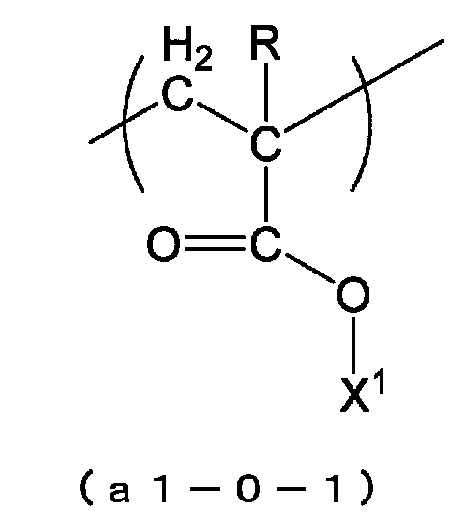
[式中、Rは水素原子、又はアルキル基であり;X1は酸解離性基である。]
上記一般式(a1-0-1)において、Rのアルキル基としては、置換基を有していてもよく、炭素数1~5のアルキル基であることが好ましい。前記置換基としてはハロゲン原子等が挙げられる。Rとしては、水素原子、炭素数1~5のアルキル基又は炭素数1~5のフッ素化アルキル基が好ましく、水素原子又はメチル基が最も好ましい。
X1は、酸解離性基であれば特に限定されることはなく、例えば上述した第3級アルキルエステル型酸解離性基、アセタール型酸解離性基などを挙げることができ、第3級アルキルエステル型酸解離性基が好ましい。
X1は、酸解離性基であれば特に限定されることはなく、例えば上述した第3級アルキルエステル型酸解離性基、アセタール型酸解離性基などを挙げることができ、第3級アルキルエステル型酸解離性基が好ましい。
以下に、酸分解性基を有する繰り返し単位の具体例を示す。
具体例中、Rxは、水素原子、CH3、CF3、又はCH2OHを表す。Rxa、Rxbはそれぞれ炭素数1~4のアルキル基を表す。Zは、置換基を表し、複数存在する場合、複数のZは互いに同じであっても異なっていてもよい。pは0又は正の整数を表す。Zの具体例及び好ましい例は、脂肪族環式基などの前述した各基が有し得る置換基の具体例及び好ましい例と同様である。
具体例中、Rxは、水素原子、CH3、CF3、又はCH2OHを表す。Rxa、Rxbはそれぞれ炭素数1~4のアルキル基を表す。Zは、置換基を表し、複数存在する場合、複数のZは互いに同じであっても異なっていてもよい。pは0又は正の整数を表す。Zの具体例及び好ましい例は、脂肪族環式基などの前述した各基が有し得る置換基の具体例及び好ましい例と同様である。


酸分解性基を有する繰り返し単位として、これらの中でも、下記一般式(a1-1-02)又は(a1-1-02’)で表される繰り返し単位が好ましい。
各式中、hは、1又は2が好ましい。
各式中、hは、1又は2が好ましい。
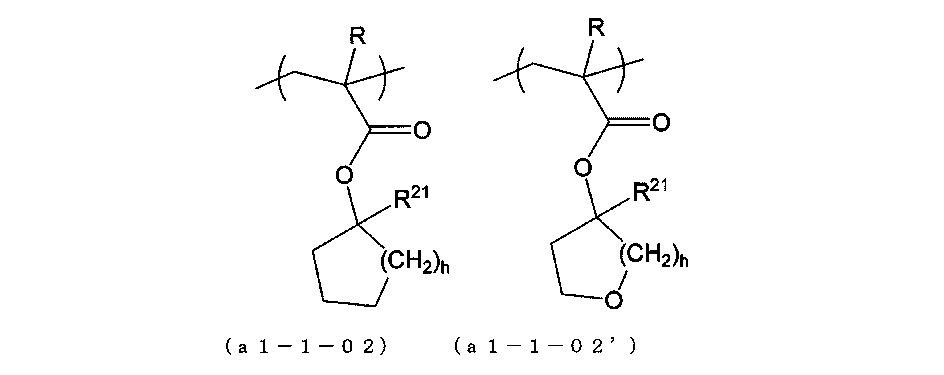
[式中、Rは前記と同じであり、R21はアルキル基であり、hは1~3の整数である。]
R21についての具体例、好ましい例としてはR14についてのアルキル基として前述した具体例、好ましい例と同様である。
樹脂(A)が含有する繰り返し単位(a1)は1種であってもよく2種以上であってもよい。
樹脂(A)中、繰り返し単位(a1)の含有量が、樹脂(A)の全繰り返し単位に対して50モル%以上であることが好ましく、60~97モル%がより好ましく、65~90モル%が更に好ましい。下限値以上とすることによって、感活性光線性又は感放射線性樹脂組成物とした際に容易にパターンを得ることができCDU、真円性等のリソグラフィー特性も向上する。また、上限値以下とすることにより他の繰り返し単位とのバランスをとることができる。
R21についての具体例、好ましい例としてはR14についてのアルキル基として前述した具体例、好ましい例と同様である。
樹脂(A)が含有する繰り返し単位(a1)は1種であってもよく2種以上であってもよい。
樹脂(A)中、繰り返し単位(a1)の含有量が、樹脂(A)の全繰り返し単位に対して50モル%以上であることが好ましく、60~97モル%がより好ましく、65~90モル%が更に好ましい。下限値以上とすることによって、感活性光線性又は感放射線性樹脂組成物とした際に容易にパターンを得ることができCDU、真円性等のリソグラフィー特性も向上する。また、上限値以下とすることにより他の繰り返し単位とのバランスをとることができる。
(非酸分解型脂肪族炭化水素基を有する繰り返し単位(a2))
樹脂(A)は、非酸分解型脂肪族炭化水素基を有する繰り返し単位(a2)を更に含有することが好ましい。
ここで、「酸非解離性の脂肪族環式基」は、露光により化合物(B)から酸が発生した際に、該酸が作用しても解離することなくそのまま当該繰り返し単位中に残る脂肪族環式基である。
非酸分解型脂肪族炭化水素基を有する繰り返し単位(a2)のうち、極性基を有する繰り返し単位を繰り返し単位(a3)、アルコール性水酸基等の極性基を有しない繰り返し単位を繰り返し単位(a4)とする。
非酸分解型脂肪族炭化水素基を有する繰り返し単位(a2)は、アルコール性水酸基等の極性基を有しない繰り返し単位を繰り返し単位(a4)であることが好ましい。
樹脂(A)は、非酸分解型脂肪族炭化水素基を有する繰り返し単位(a2)を更に含有することが好ましい。
ここで、「酸非解離性の脂肪族環式基」は、露光により化合物(B)から酸が発生した際に、該酸が作用しても解離することなくそのまま当該繰り返し単位中に残る脂肪族環式基である。
非酸分解型脂肪族炭化水素基を有する繰り返し単位(a2)のうち、極性基を有する繰り返し単位を繰り返し単位(a3)、アルコール性水酸基等の極性基を有しない繰り返し単位を繰り返し単位(a4)とする。
非酸分解型脂肪族炭化水素基を有する繰り返し単位(a2)は、アルコール性水酸基等の極性基を有しない繰り返し単位を繰り返し単位(a4)であることが好ましい。
(極性基を有する非酸分解型脂肪族炭化水素基を有する繰り返し単位(a3))
繰り返し単位(a3)は、極性基を有する非酸分解型脂肪族炭化水素基を有する繰り返し単位である。なお、繰り返し単位(a3)は、前記繰り返し単位(a0)及び(a1)には該当しない繰り返し単位である。
繰り返し単位(a3)は、極性基を有する非酸分解型脂肪族炭化水素基を有する繰り返し単位である。なお、繰り返し単位(a3)は、前記繰り返し単位(a0)及び(a1)には該当しない繰り返し単位である。
極性基としては、水酸基(アルコール性水酸基等)、シアノ基、カルボキシ基、フッ素化アルコール基(アルキル基の水素原子の一部がフッ素原子で置換されたヒドロキシアルキル基)等が挙げられる。
これらの中でも、水酸基、カルボキシ基が好ましく、水酸基が特に好ましい。
繰り返し単位(a3)において、脂肪族炭化水素基に結合する極性基の数は、特に限定されないが、1~3個が好ましく、1個が最も好ましい。
前記極性基が結合する脂肪族炭化水素基は、飽和であってもよく、不飽和であってもよく、飽和であることが好ましい。
脂肪族炭化水素基として、より具体的には、直鎖状又は分岐鎖状の脂肪族炭化水素基、構造中に環を含む脂肪族炭化水素基等が挙げられる。
これらの中でも、水酸基、カルボキシ基が好ましく、水酸基が特に好ましい。
繰り返し単位(a3)において、脂肪族炭化水素基に結合する極性基の数は、特に限定されないが、1~3個が好ましく、1個が最も好ましい。
前記極性基が結合する脂肪族炭化水素基は、飽和であってもよく、不飽和であってもよく、飽和であることが好ましい。
脂肪族炭化水素基として、より具体的には、直鎖状又は分岐鎖状の脂肪族炭化水素基、構造中に環を含む脂肪族炭化水素基等が挙げられる。
前記「直鎖状又は分岐鎖状の脂肪族炭化水素基」は、炭素数が1~12であることが好ましく、1~10がより好ましく、1~8がより好ましく、1~6が更に好ましい。
該直鎖状又は分岐鎖状の脂肪族炭化水素基は、水素原子の一部又は全部が、前記極性基以外の置換基で置換されていてもよい。該置換基としては、フッ素原子、フッ素原子で置換された炭素数1~5のフッ素化アルキル基、酸素原子(=O)等が挙げられる。また、該直鎖状又は分岐鎖状の脂肪族炭化水素基は、炭素原子間にヘテロ原子を含む2価の基が介在してもよい。
前記脂肪族炭化水素基が直鎖状又は分岐鎖状である場合、繰り返し単位(a3)としては、下記一般式(a3-1)又は(a3-2)で表される繰り返し単位が好ましい。
該直鎖状又は分岐鎖状の脂肪族炭化水素基は、水素原子の一部又は全部が、前記極性基以外の置換基で置換されていてもよい。該置換基としては、フッ素原子、フッ素原子で置換された炭素数1~5のフッ素化アルキル基、酸素原子(=O)等が挙げられる。また、該直鎖状又は分岐鎖状の脂肪族炭化水素基は、炭素原子間にヘテロ原子を含む2価の基が介在してもよい。
前記脂肪族炭化水素基が直鎖状又は分岐鎖状である場合、繰り返し単位(a3)としては、下記一般式(a3-1)又は(a3-2)で表される繰り返し単位が好ましい。
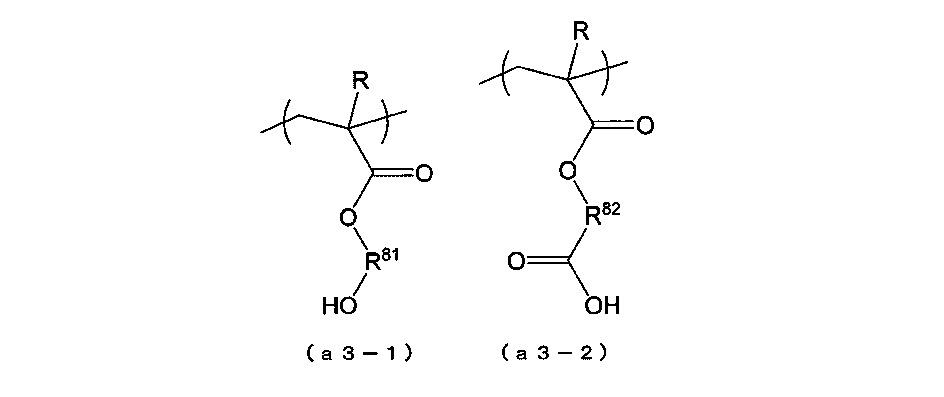
[式中、Rは前記に同じであり、R81は直鎖状又は分岐鎖状のアルキレン基であり、R82は、ヘテロ原子を含む2価の基が介在してもよいアルキレン基である。]
式(a3-1)中、R81におけるアルキレン基は、炭素数が1~12であることが好ましく、1~10であることがより好ましい。
式(a3-2)中、R82におけるアルキレン基は、炭素数が1~12であることが好ましく、1~10であることがより好ましく、1~6が特に好ましい。
該アルキレン基が炭素数2以上のアルキレン基である場合、該アルキレン基の炭素原子間に、ヘテロ原子を含む2価の基が介在してもよい。
R82としては、特に、ヘテロ原子を含む2価の基が介在しないアルキレン基、又はヘテロ原子として酸素原子を含む2価の基が介在するアルキレン基が好ましい。
酸素原子を含む2価の基が介在するアルキレン基としては、-(CH2)f-O-C(=O)-(CH2)g’-[式中、f及びg’はそれぞれ独立に1~3の整数である。]が好ましい。
式(a3-2)中、R82におけるアルキレン基は、炭素数が1~12であることが好ましく、1~10であることがより好ましく、1~6が特に好ましい。
該アルキレン基が炭素数2以上のアルキレン基である場合、該アルキレン基の炭素原子間に、ヘテロ原子を含む2価の基が介在してもよい。
R82としては、特に、ヘテロ原子を含む2価の基が介在しないアルキレン基、又はヘテロ原子として酸素原子を含む2価の基が介在するアルキレン基が好ましい。
酸素原子を含む2価の基が介在するアルキレン基としては、-(CH2)f-O-C(=O)-(CH2)g’-[式中、f及びg’はそれぞれ独立に1~3の整数である。]が好ましい。
前記「構造中に環を含む脂肪族炭化水素基」としては、環状の脂肪族炭化水素基、該環状の脂肪族炭化水素基が前述した鎖状の脂肪族炭化水素基の末端に結合するか又は鎖状の脂肪族炭化水素基の途中に介在する基などが挙げられる。
環状の脂肪族炭化水素基は、炭素数が3~30であることが好ましい。また、該環状の脂肪族炭化水素基は、多環式であってもよく、単環式であってもよく、多環式が好ましい。
環状の脂肪族炭化水素基として、具体的には、例えばArFエキシマレーザー用レジスト組成物用の樹脂において、多数提案されているものの中から適宜選択して用いることができる。例えば単環式の脂肪族炭化水素基としては、炭素数3~20のモノシクロアルカンから2個以上の水素原子を除いた基が好ましく、該モノシクロアルカンとしてはシクロペンタン、シクロヘキサン等が例示できる。多環式の脂肪族炭化水素基としては、炭素数7~30のポリシクロアルカンから2個以上の水素原子を除いた基が好ましく、該ポリシクロアルカンとして具体的には、アダマンタン、ノルボルナン、イソボルナン、トリシクロデカン、テトラシクロドデカン等が挙げられる。
前記環状の脂肪族炭化水素基は、水素原子の一部又は全部が、前記極性基以外の置換基で置換されていてもよい。該置換基としては、炭素数1~5のアルキル基、フッ素原子、フッ素原子で置換された炭素数1~5のフッ素化アルキル基、酸素原子(=O)等が挙げられる。
前記脂肪族炭化水素基が、構造中に環を含む場合、繰り返し単位(a3)としては、下記一般式(a3-3)、(a3-4)又は(a3-5)で表される繰り返し単位が好ましい。
環状の脂肪族炭化水素基は、炭素数が3~30であることが好ましい。また、該環状の脂肪族炭化水素基は、多環式であってもよく、単環式であってもよく、多環式が好ましい。
環状の脂肪族炭化水素基として、具体的には、例えばArFエキシマレーザー用レジスト組成物用の樹脂において、多数提案されているものの中から適宜選択して用いることができる。例えば単環式の脂肪族炭化水素基としては、炭素数3~20のモノシクロアルカンから2個以上の水素原子を除いた基が好ましく、該モノシクロアルカンとしてはシクロペンタン、シクロヘキサン等が例示できる。多環式の脂肪族炭化水素基としては、炭素数7~30のポリシクロアルカンから2個以上の水素原子を除いた基が好ましく、該ポリシクロアルカンとして具体的には、アダマンタン、ノルボルナン、イソボルナン、トリシクロデカン、テトラシクロドデカン等が挙げられる。
前記環状の脂肪族炭化水素基は、水素原子の一部又は全部が、前記極性基以外の置換基で置換されていてもよい。該置換基としては、炭素数1~5のアルキル基、フッ素原子、フッ素原子で置換された炭素数1~5のフッ素化アルキル基、酸素原子(=O)等が挙げられる。
前記脂肪族炭化水素基が、構造中に環を含む場合、繰り返し単位(a3)としては、下記一般式(a3-3)、(a3-4)又は(a3-5)で表される繰り返し単位が好ましい。

[式中、Rは前記と同じであり、jは1~3の整数であり、k’は1~3の整数であり、t’は1~3の整数であり、l’は1~5の整数であり、s’は1~3の整数である。]
式(a3-3)中、jは1又は2であることが好ましく、1であることが更に好ましい。jが2の場合は、水酸基がアダマンチル基の3位と5位に結合しているものが好ましい。jが1の場合は、水酸基がアダマンチル基の3位に結合しているものが好ましい。
式(a3-4)中、k’は1であることが好ましい。シアノ基はノルボルニル基の5位又は6位に結合していることが好ましい。
式(a3-5)中、t’は1であることが好ましい。l’は1であることが好ましい。s’は1であることが好ましい。
式(a3-5)中、カルボニルオキシ基の酸素原子(-O-)は、ノルボルナン環の2位又は3位に結合していることが好ましい。フッ素化アルキルアルコール基は、ノルボルニル基の5位又は6位に結合していることが好ましい。
式(a3-4)中、k’は1であることが好ましい。シアノ基はノルボルニル基の5位又は6位に結合していることが好ましい。
式(a3-5)中、t’は1であることが好ましい。l’は1であることが好ましい。s’は1であることが好ましい。
式(a3-5)中、カルボニルオキシ基の酸素原子(-O-)は、ノルボルナン環の2位又は3位に結合していることが好ましい。フッ素化アルキルアルコール基は、ノルボルニル基の5位又は6位に結合していることが好ましい。
樹脂(A)が含有する繰り返し単位(a3)は1種であってもよく2種以上であってもよい。
繰り返し単位(a3)としては、上記一般式(a3-1)~(a3-5)のいずれかで表される繰り返し単位を有することが好ましく、一般式(a3-3)で表される繰り返し単位を有することが特に好ましい。
樹脂(A)中、繰り返し単位(a3)の含有量は、樹脂(A)を構成する全繰り返し単位に対し、1~40モル%が好ましく、5~35モル%がより好ましく、5~30モル%が更に好ましい。下限値以上とすることにより繰り返し単位(a3)を含有させることによる効果が充分に得られ、上限値以下とすることにより他の繰り返し単位とのバランスをとることができる。
繰り返し単位(a3)としては、上記一般式(a3-1)~(a3-5)のいずれかで表される繰り返し単位を有することが好ましく、一般式(a3-3)で表される繰り返し単位を有することが特に好ましい。
樹脂(A)中、繰り返し単位(a3)の含有量は、樹脂(A)を構成する全繰り返し単位に対し、1~40モル%が好ましく、5~35モル%がより好ましく、5~30モル%が更に好ましい。下限値以上とすることにより繰り返し単位(a3)を含有させることによる効果が充分に得られ、上限値以下とすることにより他の繰り返し単位とのバランスをとることができる。
(繰り返し単位(a4))
繰り返し単位(a4)は、非酸分解型の脂肪族環式基のうち、アルコール性水酸基等の極性基を含有しない繰り返し単位である。
該脂肪族環式基としては、非酸分解型であれば特に限定されず、ArFエキシマレーザー用、KrFエキシマレーザー用(好ましくはArFエキシマレーザー用)等のレジスト組成物の樹脂成分に用いられるものとして従来から知られている多数のものが使用可能である。該脂肪族環式基は、飽和であってもよく、不飽和であってもよく、飽和であることが好ましい。具体的には、前記繰り返し単位(a1)において脂肪族環式基の説明で挙げたモノシクロアルカン、ポリシクロアルカン等のシクロアルカンから水素原子を1つ除いた基が挙げられる。
脂肪族環式基は、単環式であってもよく、多環式であってもよく、上記効果に優れることから多環式であることが好ましい。特に、2~4環式のものが好ましく、中でも、トリシクロデシル基、アダマンチル基、テトラシクロドデシル基、イソボルニル基及びノルボルニル基から選ばれる少なくとも1種が、工業上入手し易いなどの点で好ましい。
非酸分解型の脂肪族環式基の具体例としては、例えば、当該脂肪族環式基に隣接する原子(例えば-C(=O)-O-における-O-)と結合する炭素原子に置換基(水素原子以外の原子又は基)が結合していない1価の脂肪族環式基が挙げられる。具体的には、前記繰り返し単位(a1)の説明で挙げた式(1-1)~(1-9)で表される基におけるR14を水素原子で置換した基;環骨格を構成する炭素原子のみによって形成された第3級炭素原子を有するシクロアルカンの前記第3級炭素原子から水素原子を除いた基等が挙げられる。
該脂肪族環式基には、置換基が結合していてもよい。該置換基としては、例えば、炭素数1~5のアルキル基、フッ素原子、フッ素化アルキル基等が挙げられる。
繰り返し単位(a4)としては、下記一般式(a4-0)で表される繰り返し単位が好ましく、特に、下記一般式(a4-1)~(a4-5)で表される繰り返し単位が好ましい。
繰り返し単位(a4)は、非酸分解型の脂肪族環式基のうち、アルコール性水酸基等の極性基を含有しない繰り返し単位である。
該脂肪族環式基としては、非酸分解型であれば特に限定されず、ArFエキシマレーザー用、KrFエキシマレーザー用(好ましくはArFエキシマレーザー用)等のレジスト組成物の樹脂成分に用いられるものとして従来から知られている多数のものが使用可能である。該脂肪族環式基は、飽和であってもよく、不飽和であってもよく、飽和であることが好ましい。具体的には、前記繰り返し単位(a1)において脂肪族環式基の説明で挙げたモノシクロアルカン、ポリシクロアルカン等のシクロアルカンから水素原子を1つ除いた基が挙げられる。
脂肪族環式基は、単環式であってもよく、多環式であってもよく、上記効果に優れることから多環式であることが好ましい。特に、2~4環式のものが好ましく、中でも、トリシクロデシル基、アダマンチル基、テトラシクロドデシル基、イソボルニル基及びノルボルニル基から選ばれる少なくとも1種が、工業上入手し易いなどの点で好ましい。
非酸分解型の脂肪族環式基の具体例としては、例えば、当該脂肪族環式基に隣接する原子(例えば-C(=O)-O-における-O-)と結合する炭素原子に置換基(水素原子以外の原子又は基)が結合していない1価の脂肪族環式基が挙げられる。具体的には、前記繰り返し単位(a1)の説明で挙げた式(1-1)~(1-9)で表される基におけるR14を水素原子で置換した基;環骨格を構成する炭素原子のみによって形成された第3級炭素原子を有するシクロアルカンの前記第3級炭素原子から水素原子を除いた基等が挙げられる。
該脂肪族環式基には、置換基が結合していてもよい。該置換基としては、例えば、炭素数1~5のアルキル基、フッ素原子、フッ素化アルキル基等が挙げられる。
繰り返し単位(a4)としては、下記一般式(a4-0)で表される繰り返し単位が好ましく、特に、下記一般式(a4-1)~(a4-5)で表される繰り返し単位が好ましい。

[式中、Rは前記と同じであり、R40は非酸分解型の脂肪族多環式基である。]
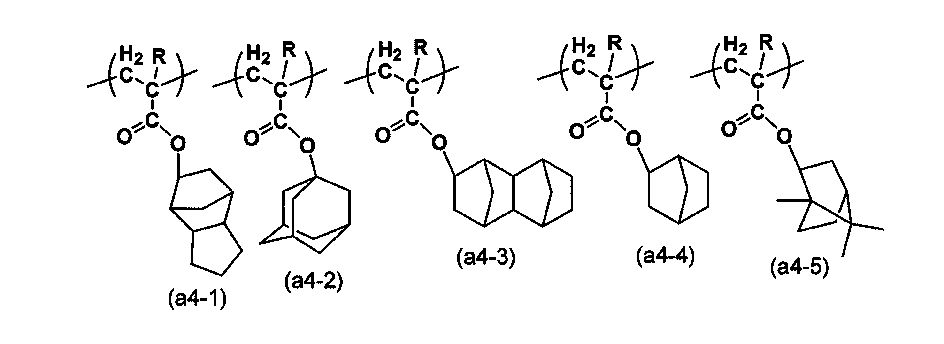
[式中、Rは前記と同じである。]
樹脂(A)が含有する繰り返し単位(a4)は1種であってもよく2種以上であってもよい。
繰り返し単位(a4)を樹脂(A)に含有させる場合、樹脂(A)中の繰り返し単位(a4)の含有量は、樹脂(A)を構成する全繰り返し単位に対し、5~40モル%が好ましく、10~35モル%がより好ましい。
樹脂(A)が含有する繰り返し単位(a4)は1種であってもよく2種以上であってもよい。
繰り返し単位(a4)を樹脂(A)に含有させる場合、樹脂(A)中の繰り返し単位(a4)の含有量は、樹脂(A)を構成する全繰り返し単位に対し、5~40モル%が好ましく、10~35モル%がより好ましい。
樹脂(A)は、本発明の効果を損なわない範囲で、上記繰り返し単位(a0)~(a4)以外の他の繰り返し単位を含んでいてもよい。
該他の繰り返し単位は、上述の繰り返し単位(a0)~(a4)に分類されない他の繰り返し単位であれば特に限定されるものではなく、ArFエキシマレーザー用、KrFエキシマレーザー用(好ましくはArFエキシマレーザー用)等のレジスト用樹脂に用いられるものとして従来から知られている多数のものが使用可能である。
該他の繰り返し単位は、上述の繰り返し単位(a0)~(a4)に分類されない他の繰り返し単位であれば特に限定されるものではなく、ArFエキシマレーザー用、KrFエキシマレーザー用(好ましくはArFエキシマレーザー用)等のレジスト用樹脂に用いられるものとして従来から知られている多数のものが使用可能である。
(ラクトン含有環式基を含む繰り返し単位(b))
更に、樹脂(A)は、ラクトン含有環式基を含む繰り返し単位(b)を有していてもよい。
ここで、ラクトン含有環式基とは、その環骨格中に-O-C(O)-を含む環(ラクトン環)を含有する環式基を示す。ラクトン環をひとつの目の環として数え、ラクトン環のみの場合は単環式基、更に他の環構造を有する場合は、その構造に関わらず多環式基と称する。ラクトン含有環式基は、単環式基であってもよく、多環式基であってもよい。
繰り返し単位(b)におけるラクトン環式基としては、特に限定されることなく任意のものが使用可能である。具体的には、ラクトン含有単環式基としては、4~6員環ラクトンから水素原子を1つ除いた基、例えばβ-プロピオノラクトンから水素原子を1つ除いた基、γ-ブチロラクトンから水素原子1つを除いた基、δ-バレロラクトンから水素原子を1つ除いた基等が挙げられる。また、ラクトン含有多環式基としては、ラクトン環を有するビシクロアルカン、トリシクロアルカン、テトラシクロアルカンから水素原子一つを除いた基が挙げられる。
繰り返し単位(b)の例としては、例えば前記一般式(a0-1)中のR5をラクトン含有環式基で置換したものが挙げられ、より具体的には、下記一般式(b-1)~(b-5)で表される繰り返し単位が挙げられる。
更に、樹脂(A)は、ラクトン含有環式基を含む繰り返し単位(b)を有していてもよい。
ここで、ラクトン含有環式基とは、その環骨格中に-O-C(O)-を含む環(ラクトン環)を含有する環式基を示す。ラクトン環をひとつの目の環として数え、ラクトン環のみの場合は単環式基、更に他の環構造を有する場合は、その構造に関わらず多環式基と称する。ラクトン含有環式基は、単環式基であってもよく、多環式基であってもよい。
繰り返し単位(b)におけるラクトン環式基としては、特に限定されることなく任意のものが使用可能である。具体的には、ラクトン含有単環式基としては、4~6員環ラクトンから水素原子を1つ除いた基、例えばβ-プロピオノラクトンから水素原子を1つ除いた基、γ-ブチロラクトンから水素原子1つを除いた基、δ-バレロラクトンから水素原子を1つ除いた基等が挙げられる。また、ラクトン含有多環式基としては、ラクトン環を有するビシクロアルカン、トリシクロアルカン、テトラシクロアルカンから水素原子一つを除いた基が挙げられる。
繰り返し単位(b)の例としては、例えば前記一般式(a0-1)中のR5をラクトン含有環式基で置換したものが挙げられ、より具体的には、下記一般式(b-1)~(b-5)で表される繰り返し単位が挙げられる。
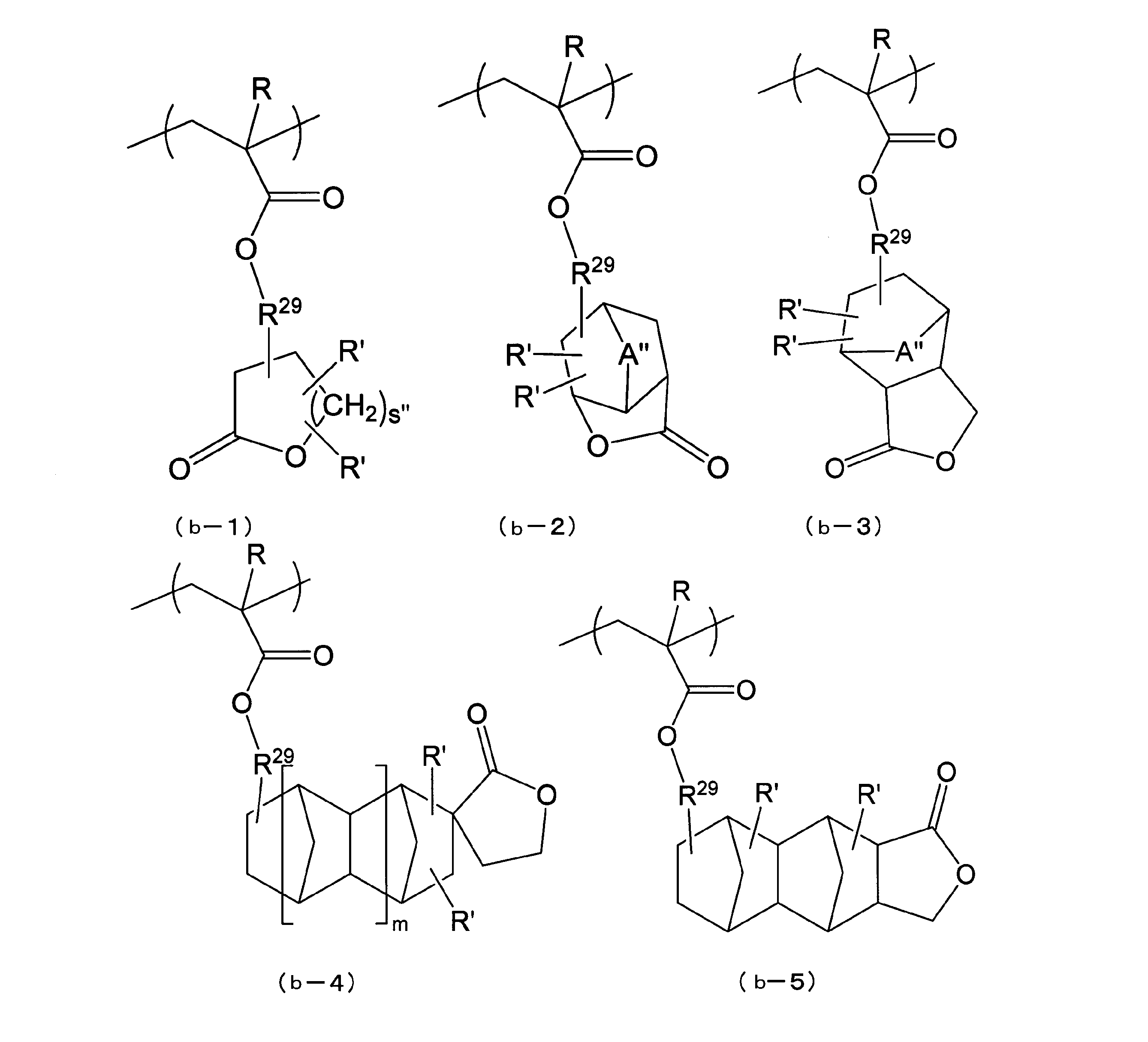
[式中、Rは水素原子、又はアルキル基であり;R’はそれぞれ独立に水素原子、炭素数1~5のアルキル基、炭素数1~5のアルコキシ基又は-COOR”であり、R”は水素原子又はアルキル基であり;R29は単結合又は2価の連結基であり、s”は0~2の整数であり;A”は酸素原子若しくは硫黄原子を含んでいてもよい炭素数1~5のアルキレン基、酸素原子又は硫黄原子であり;mは0又は1である。]
一般式(b-1)~(b-5)におけるRは、前記一般式(a0-1)におけるRと同様である。
R’の炭素数1~5のアルキル基としては、例えばメチル基、エチル基、プロピル基、n-ブチル基、tert-ブチル基が挙げられる。
R’の炭素数1~5のアルコキシ基としては、例えばメトキシ基、エトキシ基、n-プロポキシ基、iso-プロポキシ基、n-ブトキシ基、tert-ブトキシ基が挙げられる。
R’は、工業上入手が容易であること等を考慮すると、水素原子が好ましい。
R”におけるアルキル基は、直鎖状、分岐鎖状、環状のいずれであってもよい。
R”が直鎖状又は分岐鎖状のアルキル基の場合は、炭素数1~10であることが好ましく、炭素数1~5であることが更に好ましい。
R”が環状のアルキル基の場合は、炭素数3~15であることが好ましく、炭素数4~12であることが更に好ましく、炭素数5~10が最も好ましい。具体的には、フッ素原子又はフッ素化アルキル基で置換されていてもよいし、されていなくてもよいモノシクロアルカン、ビシクロアルカン、トリシクロアルカン、テトラシクロアルカンなどのポリシクロアルカンから1個以上の水素原子を除いた基などを例示できる。具体的には、シクロペンタン、シクロヘキサン等のモノシクロアルカンや、アダマンタン、ノルボルナン、イソボルナン、トリシクロデカン、テトラシクロドデカンなどのポリシクロアルカンから1個以上の水素原子を除いた基などが挙げられる。
A”としては、炭素数1~5のアルキレン基、酸素原子(-O-)又は硫黄原子(-S-)であることが好ましく、炭素数1~5のアルキレン基又は-O-がより好ましい。炭素数1~5のアルキレン基としては、メチレン基又はジメチルメチレン基がより好ましく、メチレン基が最も好ましい。
R29は、前記一般式(a0-1)中のR29と同様である。
式(b-1)中、s”は1~2であることが好ましい。
以下に、前記一般式(b-1)~(b-5)で表される繰り返し単位の具体例を例示する。以下の各式中、Rαは、水素原子、メチル基又はトリフルオロメチル基を示す。
R’の炭素数1~5のアルキル基としては、例えばメチル基、エチル基、プロピル基、n-ブチル基、tert-ブチル基が挙げられる。
R’の炭素数1~5のアルコキシ基としては、例えばメトキシ基、エトキシ基、n-プロポキシ基、iso-プロポキシ基、n-ブトキシ基、tert-ブトキシ基が挙げられる。
R’は、工業上入手が容易であること等を考慮すると、水素原子が好ましい。
R”におけるアルキル基は、直鎖状、分岐鎖状、環状のいずれであってもよい。
R”が直鎖状又は分岐鎖状のアルキル基の場合は、炭素数1~10であることが好ましく、炭素数1~5であることが更に好ましい。
R”が環状のアルキル基の場合は、炭素数3~15であることが好ましく、炭素数4~12であることが更に好ましく、炭素数5~10が最も好ましい。具体的には、フッ素原子又はフッ素化アルキル基で置換されていてもよいし、されていなくてもよいモノシクロアルカン、ビシクロアルカン、トリシクロアルカン、テトラシクロアルカンなどのポリシクロアルカンから1個以上の水素原子を除いた基などを例示できる。具体的には、シクロペンタン、シクロヘキサン等のモノシクロアルカンや、アダマンタン、ノルボルナン、イソボルナン、トリシクロデカン、テトラシクロドデカンなどのポリシクロアルカンから1個以上の水素原子を除いた基などが挙げられる。
A”としては、炭素数1~5のアルキレン基、酸素原子(-O-)又は硫黄原子(-S-)であることが好ましく、炭素数1~5のアルキレン基又は-O-がより好ましい。炭素数1~5のアルキレン基としては、メチレン基又はジメチルメチレン基がより好ましく、メチレン基が最も好ましい。
R29は、前記一般式(a0-1)中のR29と同様である。
式(b-1)中、s”は1~2であることが好ましい。
以下に、前記一般式(b-1)~(b-5)で表される繰り返し単位の具体例を例示する。以下の各式中、Rαは、水素原子、メチル基又はトリフルオロメチル基を示す。
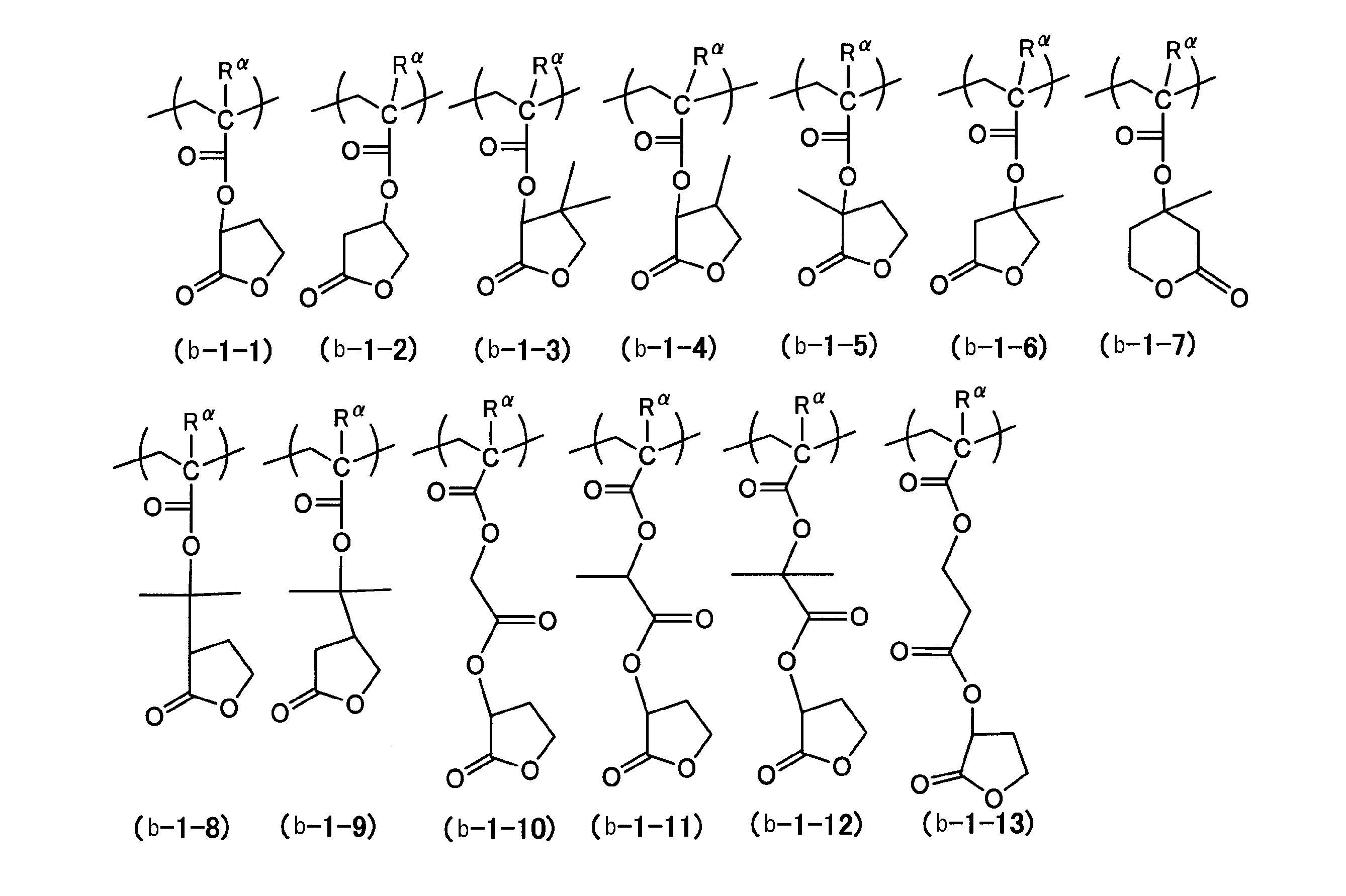
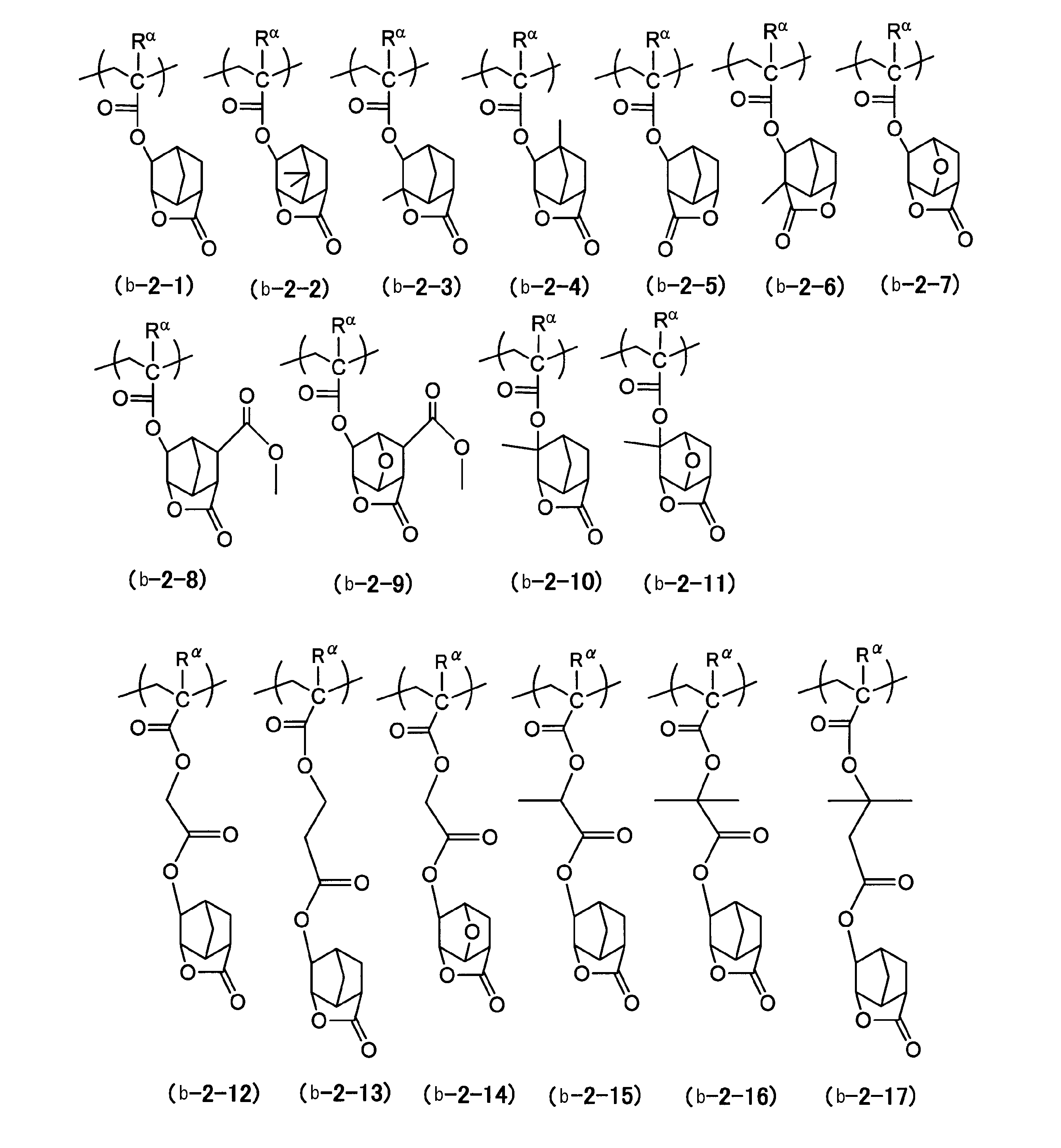

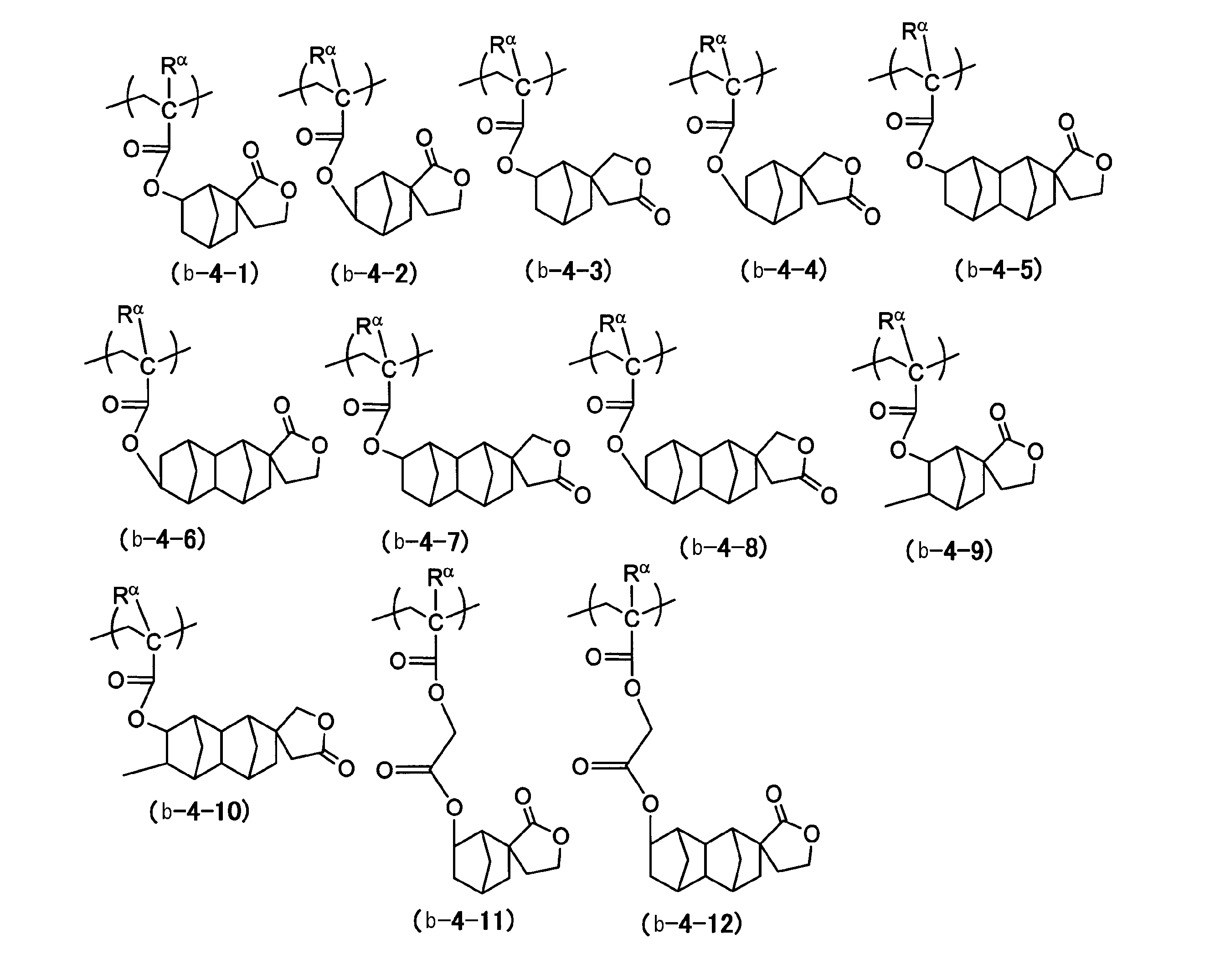
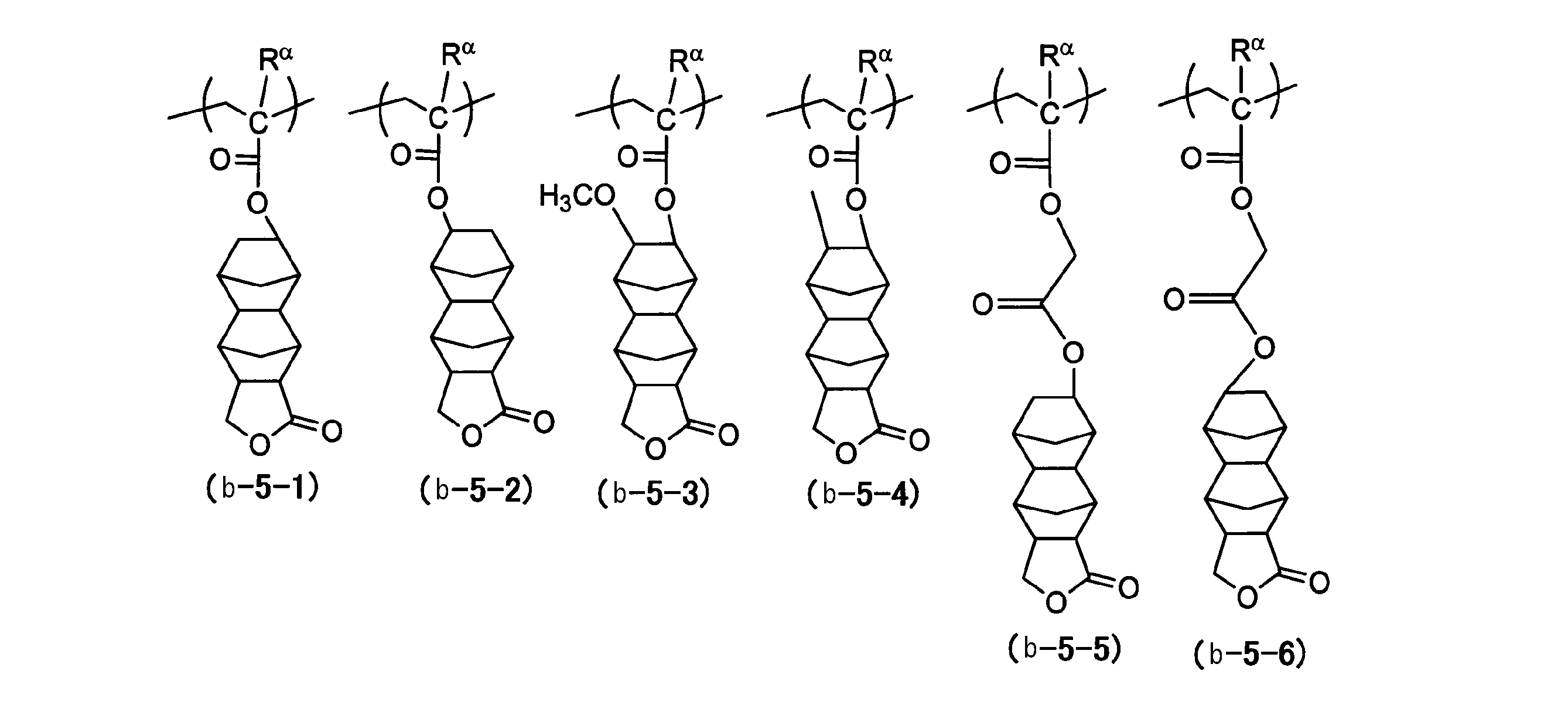
繰り返し単位(b)としては、前記一般式(b-1)~(b-5)で表される繰り返し単位からなる群から選択される少なくとも1種が好ましく、一般式(b-1)~(b-3)で表される繰り返し単位からなる群から選択される少なくとも1種がより好ましく、前記一般式(b-1)又は(b-2)で表される繰り返し単位からなる群から選択される少なくとも1種が特に好ましい。
なかでも、前記式(b-1-1)、(b-1-2)、(b-2-1)、(b-2-7)、(b-2-12)、(b-2-14)、(b-3-1)、(b-3-5)で表される繰り返し単位からなる群から選択される少なくとも1種が好ましい。
なかでも、前記式(b-1-1)、(b-1-2)、(b-2-1)、(b-2-7)、(b-2-12)、(b-2-14)、(b-3-1)、(b-3-5)で表される繰り返し単位からなる群から選択される少なくとも1種が好ましい。
樹脂(A)が含有していてもよい繰り返し単位(b)は1種であってもよく2種以上であってもよい。
樹脂(A)は繰り返し単位(b)を含有してもしなくてもよいが、含有する場合、樹脂(A)中、繰り返し単位(b)の含有量は、樹脂(A)を構成する全繰り返し単位の合計に対し、3~30モル%であることが好ましく、5~25モル%であることがより好ましく、10~20モル%であることが更に好ましい。下限値以上とすることにより繰り返し単位(b)を含有させることによる効果が充分に得られ、上限値以下とすることにより他の繰り返し単位とのバランスをとることができ、リソグラフィー特性が向上する。
樹脂(A)は繰り返し単位(b)を含有してもしなくてもよいが、含有する場合、樹脂(A)中、繰り返し単位(b)の含有量は、樹脂(A)を構成する全繰り返し単位の合計に対し、3~30モル%であることが好ましく、5~25モル%であることがより好ましく、10~20モル%であることが更に好ましい。下限値以上とすることにより繰り返し単位(b)を含有させることによる効果が充分に得られ、上限値以下とすることにより他の繰り返し単位とのバランスをとることができ、リソグラフィー特性が向上する。
樹脂(A)としては、繰り返し単位(a1)、(a0)及び(a4)を有する共重合体が好ましい。
樹脂(A)の質量平均分子量(Mw)(ゲルパーミエーションクロマトグラフィー(GPC)によるポリスチレン換算基準)は、特に限定されるものではなく、1000~50000が好ましく、1500~30000がより好ましく、2000~25000が更に好ましい。この範囲の上限値以下であると、レジストとして用いるのに充分なレジスト溶剤への溶解性があり、有機系現像液に対する溶解性も良好である。また、該範囲の下限値以上であると、ドライエッチング耐性やレジストパターン断面形状が良好である。
また、樹脂(A)の分散度(Mw/Mn)は、特に限定されず、1.0~5.0が好ましく、1.0~3.0がより好ましく、1.0~2.5が最も好ましい。なお、Mnは数平均分子量を示す。
また、樹脂(A)の分散度(Mw/Mn)は、特に限定されず、1.0~5.0が好ましく、1.0~3.0がより好ましく、1.0~2.5が最も好ましい。なお、Mnは数平均分子量を示す。
樹脂(A)は、各繰り返し単位を誘導するモノマーを、例えばジメチル-2,2-アゾビス(2-メチルプロピオネート)、アゾビスイソブチロニトリルのようなラジカル重合開始剤を用いた公知のラジカル重合等によって重合させることによって得ることができる。
各繰り返し単位を誘導するモノマーは、それぞれ、市販のものを用いてもよく、公知の方法に製造したものを用いてもよい。
本発明において、樹脂(A)は、1種を単独で用いてもよく、2種以上を併用しても良い。
各繰り返し単位を誘導するモノマーは、それぞれ、市販のものを用いてもよく、公知の方法に製造したものを用いてもよい。
本発明において、樹脂(A)は、1種を単独で用いてもよく、2種以上を併用しても良い。
本発明における感活性光線性又は感放射線性樹脂組成物は、本発明の効果を損なわない範囲で、樹脂(A)に該当しない、酸の作用により有機系現像液に対する溶解性が減少する樹脂(A’)を含有してもよい。
樹脂(A’)としては、特に限定されず、従来、アルカリ現像液を用いたポジ型現像プロセスに用いられている化学増幅型ポジ型レジスト組成物用の基材樹脂として従来から知られている多数のもの(例えばArFエキシマレーザー用、KrFエキシマレーザー用(好ましくはArFエキシマレーザー用)等のベース樹脂)から任意に選択して用いればよい。例えばArFエキシマレーザー用のベース樹脂としては、前記繰り返し単位(a1)を必須の繰り返し単位として有し、任意に前記繰り返し単位(a2)~(a4)のうちの1種以上を更に有する樹脂が挙げられる。また、樹脂(A’)として、分子量が500以上4000未満の非重合体(低分子化合物)を配合してもよい。
樹脂(A’)は、1種を単独で用いてもよく、2種以上を組み合わせて用いてもよい。
樹脂(A’)としては、特に限定されず、従来、アルカリ現像液を用いたポジ型現像プロセスに用いられている化学増幅型ポジ型レジスト組成物用の基材樹脂として従来から知られている多数のもの(例えばArFエキシマレーザー用、KrFエキシマレーザー用(好ましくはArFエキシマレーザー用)等のベース樹脂)から任意に選択して用いればよい。例えばArFエキシマレーザー用のベース樹脂としては、前記繰り返し単位(a1)を必須の繰り返し単位として有し、任意に前記繰り返し単位(a2)~(a4)のうちの1種以上を更に有する樹脂が挙げられる。また、樹脂(A’)として、分子量が500以上4000未満の非重合体(低分子化合物)を配合してもよい。
樹脂(A’)は、1種を単独で用いてもよく、2種以上を組み合わせて用いてもよい。
本発明における感活性光線性又は感放射線性樹脂組成物中、樹脂(A)の含有量は、形成しようとするレジスト膜厚等に応じて調整することができる。
<活性光線又は放射線の照射により酸を発生する化合物(B)>
活性光線又は放射線の照射により酸を発生する化合物(B)(単に、化合物(B)、酸発生剤(B)ともいう)としては、特に限定されず、これまで化学増幅型レジスト用の酸発生剤として提案されているものを使用することができる。このような酸発生剤としては、これまで、ヨードニウム塩やスルホニウム塩などのオニウム塩系酸発生剤、オキシムスルホネート系酸発生剤、ビスアルキル又はビスアリールスルホニルジアゾメタン類、ポリ(ビススルホニル)ジアゾメタン類などのジアゾメタン系酸発生剤、ニトロベンジルスルホネート系酸発生剤、イミノスルホネート系酸発生剤、ジスルホン系酸発生剤など多種のものが知られている。
オニウム塩系酸発生剤として、例えば下記一般式(b-1)又は(b-2)で表される化合物を用いることができる。
活性光線又は放射線の照射により酸を発生する化合物(B)(単に、化合物(B)、酸発生剤(B)ともいう)としては、特に限定されず、これまで化学増幅型レジスト用の酸発生剤として提案されているものを使用することができる。このような酸発生剤としては、これまで、ヨードニウム塩やスルホニウム塩などのオニウム塩系酸発生剤、オキシムスルホネート系酸発生剤、ビスアルキル又はビスアリールスルホニルジアゾメタン類、ポリ(ビススルホニル)ジアゾメタン類などのジアゾメタン系酸発生剤、ニトロベンジルスルホネート系酸発生剤、イミノスルホネート系酸発生剤、ジスルホン系酸発生剤など多種のものが知られている。
オニウム塩系酸発生剤として、例えば下記一般式(b-1)又は(b-2)で表される化合物を用いることができる。

[式中、R1”~R3”、R5”~R6”は、それぞれ独立に、置換基を有していてもよいアリール基又はアルキル基を表し;式(b-1)におけるR1”~R3”のうち、いずれか2つが相互に結合して式中のイオウ原子と共に環を形成してもよく;R4”は、置換基を有していてもよいアルキル基、ハロゲン化アルキル基、アリール基又はアルケニル基を表し;R1”~R3”のうち少なくとも1つはアリール基を表し、R5”~R6”のうち少なくとも1つはアリール基を表す。]
式(b-1)中、R1”~R3”はそれぞれ独立に、置換基を有していてもよいアリール基又はアルキル基を表す。なお、式(b-1)におけるR1”~R3”のうち、いずれか2つが相互に結合して式中のイオウ原子と共に環を形成してもよい。
また、R1”~R3”のうち、少なくとも1つはアリール基を表す。R1”~R3”のうち、2以上がアリール基であることが好ましく、R1”~R3”の全てがアリール基であることが最も好ましい。
また、R1”~R3”のうち、少なくとも1つはアリール基を表す。R1”~R3”のうち、2以上がアリール基であることが好ましく、R1”~R3”の全てがアリール基であることが最も好ましい。
R1”~R3”のアリール基としては、特に制限はなく、例えば、炭素数6~20のアリール基が挙げられる。アリール基としては、安価に合成可能なことから、炭素数6~10のアリール基が好ましい。具体的には、例えばフェニル基、ナフチル基が挙げられる。
該アリール基は、置換基を有していてもよい。「置換基を有する」とは、当該アリール基の水素原子の一部又は全部が置換基で置換されていることを意味し、該置換基としては、アルキル基、アルコキシ基、ハロゲン原子、水酸基、アルコキシアルキルオキシ基、-O-R50-C(=O)-(O)n-R51[式中、R50はアルキレン基又は単結合であり、R51は酸分解性基又は酸非分解性基であり、nは0又は1である。]等が挙げられる。
前記アリール基の水素原子が置換されていてもよいアルキル基としては、炭素数1~5のアルキル基が好ましく、メチル基、エチル基、プロピル基、n-ブチル基、tert-ブチル基であることが最も好ましい。
前記アリール基の水素原子が置換されていてもよいアルコキシ基としては、炭素数1~5のアルコキシ基が好ましく、メトキシ基、エトキシ基、n-プロポキシ基、iso-プロポキシ基、n-ブトキシ基、tert-ブトキシ基が好ましく、メトキシ基、エトキシ基が最も好ましい。
前記アリール基の水素原子が置換されていてもよいハロゲン原子としては、フッ素原子が好ましい。
該アリール基は、置換基を有していてもよい。「置換基を有する」とは、当該アリール基の水素原子の一部又は全部が置換基で置換されていることを意味し、該置換基としては、アルキル基、アルコキシ基、ハロゲン原子、水酸基、アルコキシアルキルオキシ基、-O-R50-C(=O)-(O)n-R51[式中、R50はアルキレン基又は単結合であり、R51は酸分解性基又は酸非分解性基であり、nは0又は1である。]等が挙げられる。
前記アリール基の水素原子が置換されていてもよいアルキル基としては、炭素数1~5のアルキル基が好ましく、メチル基、エチル基、プロピル基、n-ブチル基、tert-ブチル基であることが最も好ましい。
前記アリール基の水素原子が置換されていてもよいアルコキシ基としては、炭素数1~5のアルコキシ基が好ましく、メトキシ基、エトキシ基、n-プロポキシ基、iso-プロポキシ基、n-ブトキシ基、tert-ブトキシ基が好ましく、メトキシ基、エトキシ基が最も好ましい。
前記アリール基の水素原子が置換されていてもよいハロゲン原子としては、フッ素原子が好ましい。
前記アリール基の水素原子が置換されていてもよいアルコキシアルキルオキシ基としては、例えば、-O-C(R47)(R48)-O-R49[式中、R47及びR48はそれぞれ独立して水素原子又は直鎖状若しくは分岐鎖状のアルキル基であり、R49はアルキル基であり、R48及びR49は相互に結合して一つの環構造を形成していても良い。ただし、R47及びR48のうち少なくとも1つは水素原子である。]が挙げられる。
R47、R48において、アルキル基の炭素数は好ましくは1~5であり、エチル基、メチル基が好ましく、メチル基が最も好ましい。
そして、R47及びR48は、一方が水素原子であり、他方が水素原子又はメチル基であることが好ましく、R47及びR48がいずれも水素原子であることが特に好ましい。
R49のアルキル基としては、好ましくは炭素数が1~15であり、直鎖状、分岐鎖状、環状のいずれであってもよい。
R49における直鎖状、分岐鎖状のアルキル基としては、炭素数が1~5であることが好ましく、例えば、メチル基、エチル基、プロピル基、n-ブチル基、tert-ブチル基などが挙げられる。
R49における環状のアルキル基としては、炭素数4~15であることが好ましく、炭素数4~12であることが更に好ましく、炭素数5~10であることが最も好ましい。具体的には炭素数1~5のアルキル基、フッ素原子又はフッ素化アルキル基で置換されていてもよいし、されていなくてもよいモノシクロアルカン、ビシクロアルカン、トリシクロアルカン、テトラシクロアルカンなどのポリシクロアルカンから1個以上の水素原子を除いた基などが挙げられる。モノシクロアルカンとしては、シクロペンタン、シクロヘキサン等が挙げられる。ポリシクロアルカンとしては、アダマンタン、ノルボルナン、イソボルナン、トリシクロデカン、テトラシクロドデカン等が挙げられる。中でもアダマンタンから1個以上の水素原子を除いた基が好ましい。
R48及びR49は、相互に結合して一つの環構造を形成していても良い。この場合、R48とR49と、R49が結合した酸素原子と、該酸素原子及びR48が結合した炭素原子とにより環式基が形成されている。該環式基としては、4~7員環が好ましく、4~6員環がより好ましい。
R47、R48において、アルキル基の炭素数は好ましくは1~5であり、エチル基、メチル基が好ましく、メチル基が最も好ましい。
そして、R47及びR48は、一方が水素原子であり、他方が水素原子又はメチル基であることが好ましく、R47及びR48がいずれも水素原子であることが特に好ましい。
R49のアルキル基としては、好ましくは炭素数が1~15であり、直鎖状、分岐鎖状、環状のいずれであってもよい。
R49における直鎖状、分岐鎖状のアルキル基としては、炭素数が1~5であることが好ましく、例えば、メチル基、エチル基、プロピル基、n-ブチル基、tert-ブチル基などが挙げられる。
R49における環状のアルキル基としては、炭素数4~15であることが好ましく、炭素数4~12であることが更に好ましく、炭素数5~10であることが最も好ましい。具体的には炭素数1~5のアルキル基、フッ素原子又はフッ素化アルキル基で置換されていてもよいし、されていなくてもよいモノシクロアルカン、ビシクロアルカン、トリシクロアルカン、テトラシクロアルカンなどのポリシクロアルカンから1個以上の水素原子を除いた基などが挙げられる。モノシクロアルカンとしては、シクロペンタン、シクロヘキサン等が挙げられる。ポリシクロアルカンとしては、アダマンタン、ノルボルナン、イソボルナン、トリシクロデカン、テトラシクロドデカン等が挙げられる。中でもアダマンタンから1個以上の水素原子を除いた基が好ましい。
R48及びR49は、相互に結合して一つの環構造を形成していても良い。この場合、R48とR49と、R49が結合した酸素原子と、該酸素原子及びR48が結合した炭素原子とにより環式基が形成されている。該環式基としては、4~7員環が好ましく、4~6員環がより好ましい。
前記アリール基の水素原子が置換されていてもよい-O-R50-C(=O)-(O)n-R51中、R50におけるアルキレン基は、直鎖状又は分岐鎖状のアルキレン基が好ましく、その炭素数は1~5が好ましい。該アルキレン基としては、例えば、メチレン基、エチレン基、トリメチレン基、テトラメチレン基、1,1-ジメチルエチレン基などが挙げられる。
R51における酸分解性基としては、酸(露光時に化合物(B)から発生する酸)の作用により解離しうる有機基であれば特に限定されず、例えば前記繰り返し単位(a1)の説明で挙げた酸分解性基と同様のものが挙げられる。中でも、第3級アルキルエステル型のものが好ましい。
R51における酸非分解性基としては、例えば、置換基を有していてもよい直鎖状のアルキル基、置換基を有していてもよい分岐鎖状のアルキル基(ただし第3級アルキル基を除く。)、酸非分解性の脂肪族環式基等が挙げられる。酸非分解性の脂肪族環式基としては前記繰り返し単位(a4)の説明で挙げたものと同様のものが挙げられる。好ましい酸非分解性基としては、デシル基、トリシクロデカニル基、アダマンチル基、1-(1-アダマンチル)メチル基、テトラシクロドデカニル基、イソボルニル基、ノルボルニル基が挙げられる。
R51における酸分解性基としては、酸(露光時に化合物(B)から発生する酸)の作用により解離しうる有機基であれば特に限定されず、例えば前記繰り返し単位(a1)の説明で挙げた酸分解性基と同様のものが挙げられる。中でも、第3級アルキルエステル型のものが好ましい。
R51における酸非分解性基としては、例えば、置換基を有していてもよい直鎖状のアルキル基、置換基を有していてもよい分岐鎖状のアルキル基(ただし第3級アルキル基を除く。)、酸非分解性の脂肪族環式基等が挙げられる。酸非分解性の脂肪族環式基としては前記繰り返し単位(a4)の説明で挙げたものと同様のものが挙げられる。好ましい酸非分解性基としては、デシル基、トリシクロデカニル基、アダマンチル基、1-(1-アダマンチル)メチル基、テトラシクロドデカニル基、イソボルニル基、ノルボルニル基が挙げられる。
R1”~R3”のアルキル基としては、特に制限はなく、例えば炭素数1~10の直鎖状、分岐鎖状又は環状のアルキル基等が挙げられる。解像性に優れる点から、炭素数1~5であることが好ましい。具体的には、メチル基、エチル基、n-プロピル基、イソプロピル基、n-ブチル基、イソブチル基、n-ペンチル基、シクロペンチル基、ヘキシル基、シクロヘキシル基、ノニル基、デシル基等が挙げられ、解像性に優れ、また安価に合成可能なことから好ましいものとして、メチル基を挙げることができる。
該アルキル基は、置換基を有していてもよい。「置換基を有する」とは、当該アルキル基の水素原子の一部又は全部が置換基で置換されていることを意味し、該置換基としては、前記アリール基が有していてもよい置換基として挙げたものと同様のものが挙げられる。
該アルキル基は、置換基を有していてもよい。「置換基を有する」とは、当該アルキル基の水素原子の一部又は全部が置換基で置換されていることを意味し、該置換基としては、前記アリール基が有していてもよい置換基として挙げたものと同様のものが挙げられる。
式(b-1)中、R1”~R3”のうち、いずれか2つが相互に結合して式中のイオウ原子と共に環を形成してもよい。該環は、飽和であってもよく、不飽和であってもよい。また、該環は、単環式であってもよく、多環式であってもよい。例えば環を形成する2つのうちの一方又は両方が環式基(環状のアルキル基又はアリール基)である場合、それらが結合すると、多環式の環(縮合環)が形成される。
R1”~R3”のうちの2つが結合して環を形成する場合、式中のイオウ原子をその環骨格に含む1つの環が、イオウ原子を含めて、3~10員環であることが好ましく、5~7員環であることが特に好ましい。
R1”~R3”のうちの2つが結合して形成される環の具体例としては、ベンゾチオフェン、ジベンゾチオフェン、9H-チオキサンテン、チオキサントン、チアントレン、フェノキサチイン、テトラヒドロチオフェニウム、テトラヒドロチオピラニウムなどが挙げられる。
R1”~R3”のうち、いずれか2つが相互に結合して式中のイオウ原子と共に環を形成する場合、残りの1つはアリール基であることが好ましい。
R1”~R3”のうちの2つが結合して環を形成する場合、式中のイオウ原子をその環骨格に含む1つの環が、イオウ原子を含めて、3~10員環であることが好ましく、5~7員環であることが特に好ましい。
R1”~R3”のうちの2つが結合して形成される環の具体例としては、ベンゾチオフェン、ジベンゾチオフェン、9H-チオキサンテン、チオキサントン、チアントレン、フェノキサチイン、テトラヒドロチオフェニウム、テトラヒドロチオピラニウムなどが挙げられる。
R1”~R3”のうち、いずれか2つが相互に結合して式中のイオウ原子と共に環を形成する場合、残りの1つはアリール基であることが好ましい。
式(b-1)で表される化合物のカチオン部のうち、R1”~R3”が全て、置換基を有していてもよいフェニル基である場合、つまり当該カチオン部がトリフェニルスルホニウム骨格を有する場合の好ましい具体例としては、例えば、下記式(I-1-1)~(I-1-14)で表されるカチオン部が挙げられる。

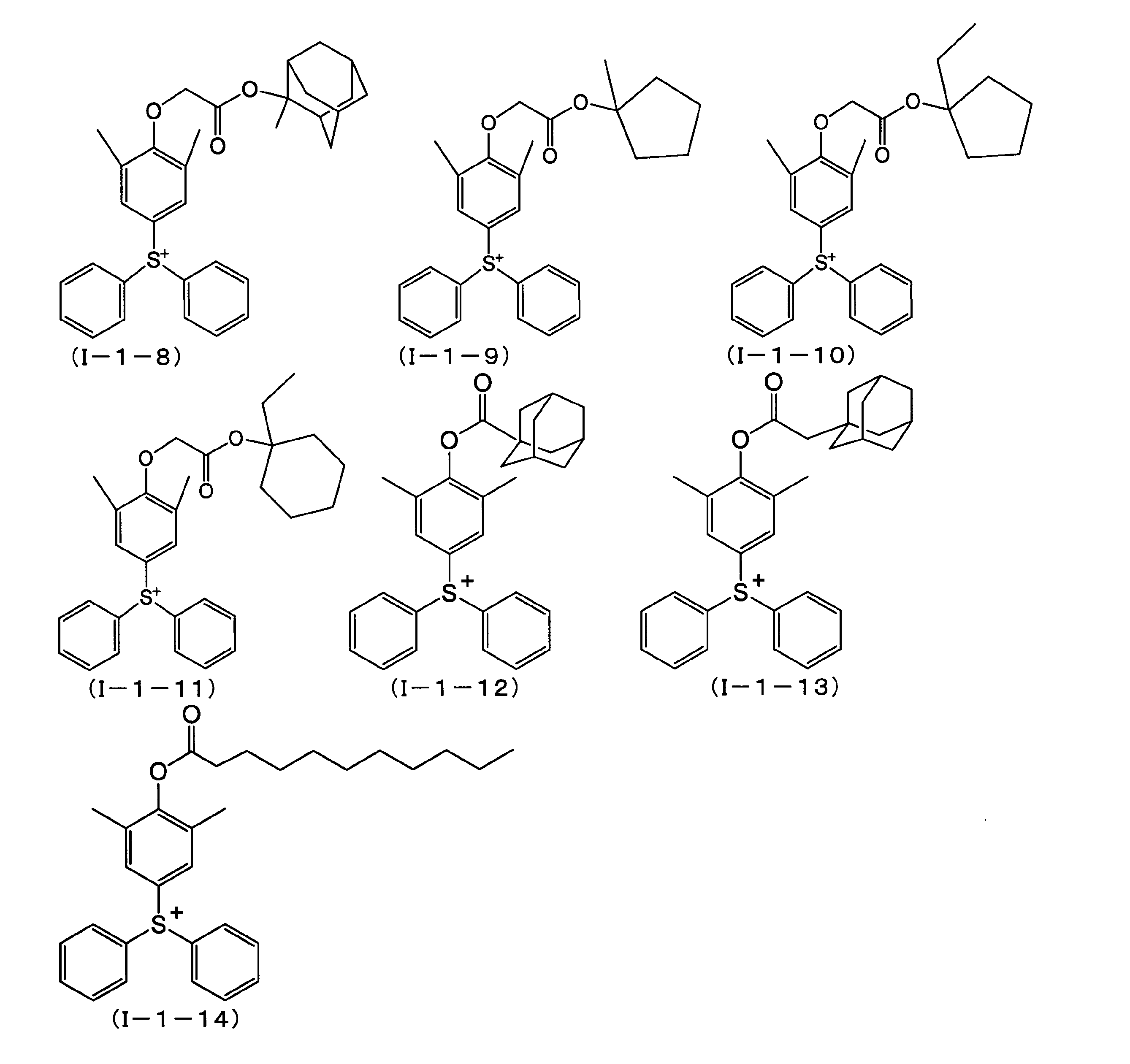
また、これらのカチオン部におけるフェニル基の一部又は全部が、置換基を有していてもよいナフチル基で置換されたものも好ましいものとして挙げられる。3つのフェニル基のうち、ナフチル基で置換されるのは、1又は2が好ましい。
また、式(b-1)で表される化合物のカチオン部のうち、R1”~R3”のうちのいずれか2つが相互に結合して式中のイオウ原子と共に環を形成している場合の好ましい具体例としては、例えば、下記式(I-11-12)、(I-11-13)で表されるカチオン部が挙げられる。
また、式(b-1)で表される化合物のカチオン部のうち、R1”~R3”のうちのいずれか2つが相互に結合して式中のイオウ原子と共に環を形成している場合の好ましい具体例としては、例えば、下記式(I-11-12)、(I-11-13)で表されるカチオン部が挙げられる。
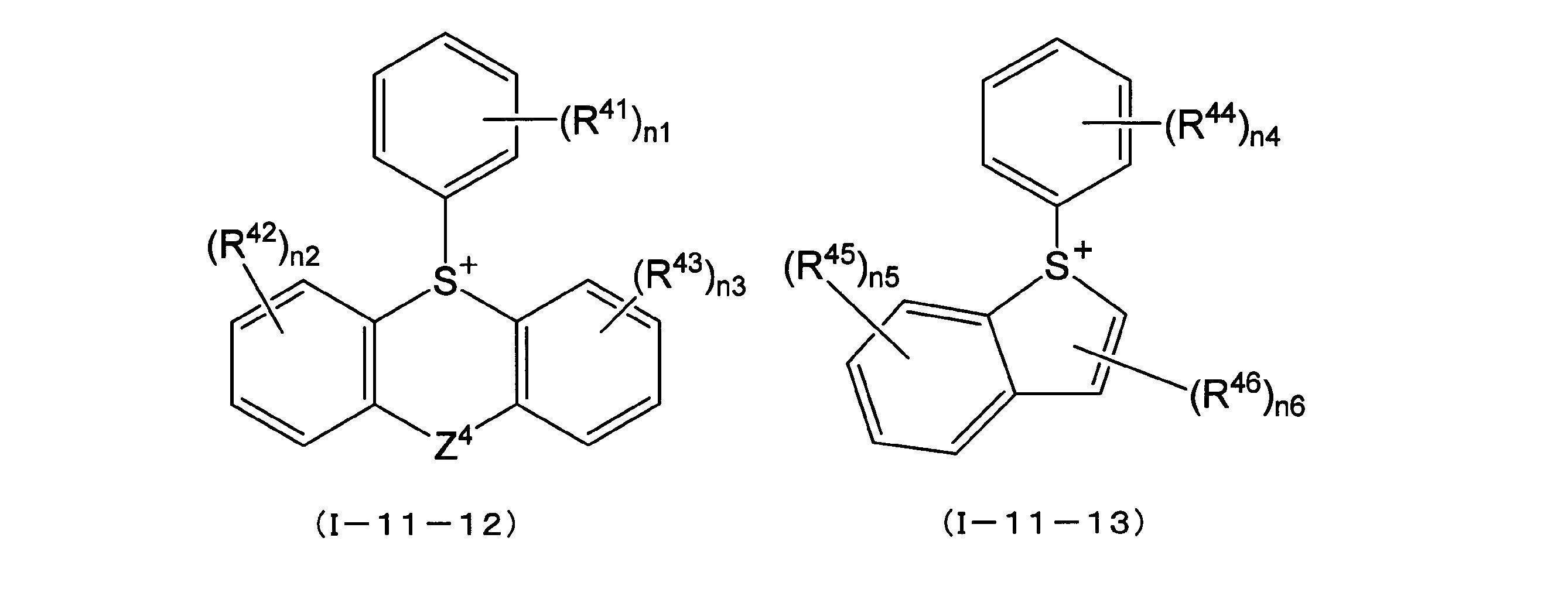
[上記一般式中、Z4は単結合、メチレン基、硫黄原子、酸素原子、窒素原子、カルボニル基、-SO-、-SO2-、-SO3-、-COO-、-CONH-又は-N(RN)-(該RNは炭素数1~5のアルキル基である。)であり;R41~R46はそれぞれ独立してアルキル基、アセチル基、アルコキシ基、カルボキシ基、水酸基又はヒドロキシアルキル基であり;n1~n5はそれぞれ独立して0~3の整数であり、n6は0~2の整数である。]
上記一般式(I-11-12)及び(I-11-13)中、R41~R46において、アルキル基は、炭素数1~5のアルキル基が好ましく、なかでも直鎖又は分岐鎖状のアルキル基がより好ましく、メチル基、エチル基、プロピル基、イソプロピル基、n-ブチル基、又はtert-ブチル基であることが特に好ましい。
アルコキシ基は、炭素数1~5のアルコキシ基が好ましく、なかでも直鎖又は分岐鎖状のアルコキシ基がより好ましく、メトキシ基、エトキシ基が特に好ましい。
ヒドロキシアルキル基は、上記アルキル基中の一個又は複数個の水素原子がヒドロキシ基に置換した基が好ましく、ヒドロキシメチル基、ヒドロキシエチル基、ヒドロキシプロピル基等が挙げられる。
R41~R46に付された符号n1~n6が2以上の整数である場合、複数のR41~R46はそれぞれ同じであってもよく、異なっていてもよい。
n1は、好ましくは0~2であり、より好ましくは0又は1であり、更に好ましくは0である。
n2及びn3は、好ましくはそれぞれ独立して0又は1であり、より好ましくは0である。
n4は、好ましくは0~2であり、より好ましくは0又は1である。
n5は、好ましくは0又は1であり、より好ましくは0である。
n6は、好ましくは0又は1であり、より好ましくは1である。
上記一般式(I-11-12)及び(I-11-13)中、R41~R46において、アルキル基は、炭素数1~5のアルキル基が好ましく、なかでも直鎖又は分岐鎖状のアルキル基がより好ましく、メチル基、エチル基、プロピル基、イソプロピル基、n-ブチル基、又はtert-ブチル基であることが特に好ましい。
アルコキシ基は、炭素数1~5のアルコキシ基が好ましく、なかでも直鎖又は分岐鎖状のアルコキシ基がより好ましく、メトキシ基、エトキシ基が特に好ましい。
ヒドロキシアルキル基は、上記アルキル基中の一個又は複数個の水素原子がヒドロキシ基に置換した基が好ましく、ヒドロキシメチル基、ヒドロキシエチル基、ヒドロキシプロピル基等が挙げられる。
R41~R46に付された符号n1~n6が2以上の整数である場合、複数のR41~R46はそれぞれ同じであってもよく、異なっていてもよい。
n1は、好ましくは0~2であり、より好ましくは0又は1であり、更に好ましくは0である。
n2及びn3は、好ましくはそれぞれ独立して0又は1であり、より好ましくは0である。
n4は、好ましくは0~2であり、より好ましくは0又は1である。
n5は、好ましくは0又は1であり、より好ましくは0である。
n6は、好ましくは0又は1であり、より好ましくは1である。
式(b-1)及び(b-2)中、R4”は、置換基を有していても良いアルキル基、ハロゲン化アルキル基、アリール基、又はアルケニル基を表す。
R4”におけるアルキル基は、直鎖状、分岐鎖状、環状のいずれであっても良い。
前記直鎖状又は分岐鎖状のアルキル基としては、炭素数1~10であることが好ましく、炭素数1~8であることが更に好ましく、炭素数1~4であることが最も好ましい。
前記環状のアルキル基としては、炭素数4~15であることが好ましく、炭素数4~10であることが更に好ましく、炭素数6~10であることが最も好ましい。
R4”におけるハロゲン化アルキル基としては、前記直鎖状、分岐鎖状若しくは環状のアルキル基の水素原子の一部又は全部がハロゲン原子で置換された基が挙げられる。該ハロゲン原子としては、フッ素原子、塩素原子、臭素原子、ヨウ素原子等が挙げられ、フッ素原子が好ましい。
ハロゲン化アルキル基においては、当該ハロゲン化アルキル基に含まれるハロゲン原子及び水素原子の合計数に対するハロゲン原子の数の割合(ハロゲン化率(%))が、10~100%であることが好ましく、50~100%であることが好ましく、100%が最も好ましい。該ハロゲン化率が高いほど、酸の強度が強くなるので好ましい。
前記R4”におけるアリール基は、炭素数6~20のアリール基であることが好ましい。
前記R4”におけるアルケニル基は、炭素数2~10のアルケニル基であることが好ましい。
前記R4”において、「置換基を有していても良い」とは、前記直鎖状、分岐鎖状若しくは環状のアルキル基、ハロゲン化アルキル基、アリール基、又はアルケニル基における水素原子の一部又は全部が置換基(水素原子以外の他の原子又は基)で置換されていても良いことを意味する。
R4”における置換基の数は1つであってもよく、2つ以上であってもよい。
R4”におけるアルキル基は、直鎖状、分岐鎖状、環状のいずれであっても良い。
前記直鎖状又は分岐鎖状のアルキル基としては、炭素数1~10であることが好ましく、炭素数1~8であることが更に好ましく、炭素数1~4であることが最も好ましい。
前記環状のアルキル基としては、炭素数4~15であることが好ましく、炭素数4~10であることが更に好ましく、炭素数6~10であることが最も好ましい。
R4”におけるハロゲン化アルキル基としては、前記直鎖状、分岐鎖状若しくは環状のアルキル基の水素原子の一部又は全部がハロゲン原子で置換された基が挙げられる。該ハロゲン原子としては、フッ素原子、塩素原子、臭素原子、ヨウ素原子等が挙げられ、フッ素原子が好ましい。
ハロゲン化アルキル基においては、当該ハロゲン化アルキル基に含まれるハロゲン原子及び水素原子の合計数に対するハロゲン原子の数の割合(ハロゲン化率(%))が、10~100%であることが好ましく、50~100%であることが好ましく、100%が最も好ましい。該ハロゲン化率が高いほど、酸の強度が強くなるので好ましい。
前記R4”におけるアリール基は、炭素数6~20のアリール基であることが好ましい。
前記R4”におけるアルケニル基は、炭素数2~10のアルケニル基であることが好ましい。
前記R4”において、「置換基を有していても良い」とは、前記直鎖状、分岐鎖状若しくは環状のアルキル基、ハロゲン化アルキル基、アリール基、又はアルケニル基における水素原子の一部又は全部が置換基(水素原子以外の他の原子又は基)で置換されていても良いことを意味する。
R4”における置換基の数は1つであってもよく、2つ以上であってもよい。
前記置換基としては、例えば、ハロゲン原子、ヘテロ原子、アルキル基、式:X-Q1-[式中、Q1は酸素原子を含む2価の連結基であり、Xは置換基を有していてもよい炭素数3~30の炭化水素基である。]で表される基等が挙げられる。
前記ハロゲン原子、アルキル基としては、R4”において、ハロゲン化アルキル基におけるハロゲン原子、アルキル基として挙げたもの同様のものが挙げられる。
前記ヘテロ原子としては、酸素原子、窒素原子、硫黄原子等が挙げられる。
前記ハロゲン原子、アルキル基としては、R4”において、ハロゲン化アルキル基におけるハロゲン原子、アルキル基として挙げたもの同様のものが挙げられる。
前記ヘテロ原子としては、酸素原子、窒素原子、硫黄原子等が挙げられる。
X-Q1-で表される基において、Q1は酸素原子を含む2価の連結基である。
Q1は、酸素原子以外の原子を含有してもよい。酸素原子以外の原子としては、例えば炭素原子、水素原子、酸素原子、硫黄原子、窒素原子等が挙げられる。
酸素原子を含む2価の連結基としては、例えば、酸素原子(エーテル結合;-O-)、エステル結合(-C(=O)-O-)、アミド結合(-C(=O)-NH-)、カルボニル基(-C(=O)-)、カーボネート結合(-O-C(=O)-O-)等の非炭化水素系の酸素原子含有連結基;該非炭化水素系の酸素原子含有連結基とアルキレン基との組み合わせ等が挙げられる。
該組み合わせとしては、例えば、-R91-O-、-R92-O-C(=O)-、-C(=O)-O-R93-、-C(=O)-O-R93-O-C(=O)-(式中、R91~R93はそれぞれ独立にアルキレン基である。)等が挙げられる。
R91~R93におけるアルキレン基としては、直鎖状又は分岐鎖状のアルキレン基が好ましく、該アルキレン基の炭素数は、1~12が好ましく、1~5がより好ましく、1~3が特に好ましい。
該アルキレン基として、具体的には、例えばメチレン基[-CH2-];-CH(CH3)-、-CH(CH2CH3)-、-C(CH3)2-、-C(CH3)(CH2CH3)-、-C(CH3)(CH2CH2CH3)-、-C(CH2CH3)2-等のアルキルメチレン基;エチレン基[-CH2CH2-];-CH(CH3)CH2-、-CH(CH3)CH(CH3)-、-C(CH3)2CH2-、-CH(CH2CH3)CH2-、-CH(CH2CH3)CH2-等のアルキルエチレン基;トリメチレン基(n-プロピレン基)[-CH2CH2CH2-];-CH(CH3)CH2CH2-、-CH2CH(CH3)CH2-等のアルキルトリメチレン基;テトラメチレン基[-CH2CH2CH2CH2-];-CH(CH3)CH2CH2CH2-、-CH2CH(CH3)CH2CH2-等のアルキルテトラメチレン基;ペンタメチレン基-CH2CH2CH2CH2CH2-]等が挙げられる。
Q1としては、エステル結合又はエーテル結合を含む2価の連結基が好ましく、なかでも、-R91-O-、-R92-O-C(=O)-、-C(=O)-O-、-C(=O)-O-R93-又はC(=O)-O-R93-O-C(=O)-が好ましい。
Q1は、酸素原子以外の原子を含有してもよい。酸素原子以外の原子としては、例えば炭素原子、水素原子、酸素原子、硫黄原子、窒素原子等が挙げられる。
酸素原子を含む2価の連結基としては、例えば、酸素原子(エーテル結合;-O-)、エステル結合(-C(=O)-O-)、アミド結合(-C(=O)-NH-)、カルボニル基(-C(=O)-)、カーボネート結合(-O-C(=O)-O-)等の非炭化水素系の酸素原子含有連結基;該非炭化水素系の酸素原子含有連結基とアルキレン基との組み合わせ等が挙げられる。
該組み合わせとしては、例えば、-R91-O-、-R92-O-C(=O)-、-C(=O)-O-R93-、-C(=O)-O-R93-O-C(=O)-(式中、R91~R93はそれぞれ独立にアルキレン基である。)等が挙げられる。
R91~R93におけるアルキレン基としては、直鎖状又は分岐鎖状のアルキレン基が好ましく、該アルキレン基の炭素数は、1~12が好ましく、1~5がより好ましく、1~3が特に好ましい。
該アルキレン基として、具体的には、例えばメチレン基[-CH2-];-CH(CH3)-、-CH(CH2CH3)-、-C(CH3)2-、-C(CH3)(CH2CH3)-、-C(CH3)(CH2CH2CH3)-、-C(CH2CH3)2-等のアルキルメチレン基;エチレン基[-CH2CH2-];-CH(CH3)CH2-、-CH(CH3)CH(CH3)-、-C(CH3)2CH2-、-CH(CH2CH3)CH2-、-CH(CH2CH3)CH2-等のアルキルエチレン基;トリメチレン基(n-プロピレン基)[-CH2CH2CH2-];-CH(CH3)CH2CH2-、-CH2CH(CH3)CH2-等のアルキルトリメチレン基;テトラメチレン基[-CH2CH2CH2CH2-];-CH(CH3)CH2CH2CH2-、-CH2CH(CH3)CH2CH2-等のアルキルテトラメチレン基;ペンタメチレン基-CH2CH2CH2CH2CH2-]等が挙げられる。
Q1としては、エステル結合又はエーテル結合を含む2価の連結基が好ましく、なかでも、-R91-O-、-R92-O-C(=O)-、-C(=O)-O-、-C(=O)-O-R93-又はC(=O)-O-R93-O-C(=O)-が好ましい。
X-Q1-で表される基において、Xの炭化水素基は、芳香族炭化水素基であってもよく、脂肪族炭化水素基であってもよい。
芳香族炭化水素基は、芳香環を有する炭化水素基である。該芳香族炭化水素基の炭素数は3~30であることが好ましく、5~30であることがより好ましく、5~20が更に好ましく、6~15が特に好ましく、6~12が最も好ましい。ただし、該炭素数には、置換基における炭素数を含まないものとする。
芳香族炭化水素基として、具体的には、フェニル基、ビフェニル(biphenyl)基、フルオレニル(fluorenyl)基、ナフチル基、アントリル(anthryl)基、フェナントリル基等の、芳香族炭化水素環から水素原子を1つ除いたアリール基、ベンジル基、フェネチル基、1-ナフチルメチル基、2-ナフチルメチル基、1-ナフチルエチル基、2-ナフチルエチル基等のアリールアルキル基等が挙げられる。前記アリールアルキル基中のアルキル鎖の炭素数は、1~4であることが好ましく、1~2であることがより好ましく、1であることが特に好ましい。
該芳香族炭化水素基は、置換基を有していてもよい。例えば当該芳香族炭化水素基が有する芳香環を構成する炭素原子の一部がヘテロ原子で置換されていてもよく、当該芳香族炭化水素基が有する芳香環に結合した水素原子が置換基で置換されていてもよい。
前者の例としては、前記アリール基の環を構成する炭素原子の一部が酸素原子、硫黄原子、窒素原子等のヘテロ原子で置換されたヘテロアリール基、前記アリールアルキル基中の芳香族炭化水素環を構成する炭素原子の一部が前記ヘテロ原子で置換されたヘテロアリールアルキル基等が挙げられる。
後者の例における芳香族炭化水素基の置換基としては、例えば、アルキル基、アルコキシ基、ハロゲン原子、ハロゲン化アルキル基、水酸基、酸素原子(=O)等が挙げられる。
前記芳香族炭化水素基の置換基としてのアルキル基としては、炭素数1~5のアルキル基が好ましく、メチル基、エチル基、プロピル基、n-ブチル基、tert-ブチル基であることが最も好ましい。
前記芳香族炭化水素基の置換基としてのアルコキシ基としては、炭素数1~5のアルコキシ基が好ましく、メトキシ基、エトキシ基、n-プロポキシ基、iso-プロポキシ基、n-ブトキシ基、tert-ブトキシ基が好ましく、メトキシ基、エトキシ基が最も好ましい。
前記芳香族炭化水素基の置換基としてのハロゲン原子としては、フッ素原子、塩素原子、臭素原子、ヨウ素原子等が挙げられ、フッ素原子が好ましい。
前記芳香族炭化水素基の置換基としてのハロゲン化アルキル基としては、前記アルキル基の水素原子の一部又は全部が前記ハロゲン原子で置換された基が挙げられる。
芳香族炭化水素基は、芳香環を有する炭化水素基である。該芳香族炭化水素基の炭素数は3~30であることが好ましく、5~30であることがより好ましく、5~20が更に好ましく、6~15が特に好ましく、6~12が最も好ましい。ただし、該炭素数には、置換基における炭素数を含まないものとする。
芳香族炭化水素基として、具体的には、フェニル基、ビフェニル(biphenyl)基、フルオレニル(fluorenyl)基、ナフチル基、アントリル(anthryl)基、フェナントリル基等の、芳香族炭化水素環から水素原子を1つ除いたアリール基、ベンジル基、フェネチル基、1-ナフチルメチル基、2-ナフチルメチル基、1-ナフチルエチル基、2-ナフチルエチル基等のアリールアルキル基等が挙げられる。前記アリールアルキル基中のアルキル鎖の炭素数は、1~4であることが好ましく、1~2であることがより好ましく、1であることが特に好ましい。
該芳香族炭化水素基は、置換基を有していてもよい。例えば当該芳香族炭化水素基が有する芳香環を構成する炭素原子の一部がヘテロ原子で置換されていてもよく、当該芳香族炭化水素基が有する芳香環に結合した水素原子が置換基で置換されていてもよい。
前者の例としては、前記アリール基の環を構成する炭素原子の一部が酸素原子、硫黄原子、窒素原子等のヘテロ原子で置換されたヘテロアリール基、前記アリールアルキル基中の芳香族炭化水素環を構成する炭素原子の一部が前記ヘテロ原子で置換されたヘテロアリールアルキル基等が挙げられる。
後者の例における芳香族炭化水素基の置換基としては、例えば、アルキル基、アルコキシ基、ハロゲン原子、ハロゲン化アルキル基、水酸基、酸素原子(=O)等が挙げられる。
前記芳香族炭化水素基の置換基としてのアルキル基としては、炭素数1~5のアルキル基が好ましく、メチル基、エチル基、プロピル基、n-ブチル基、tert-ブチル基であることが最も好ましい。
前記芳香族炭化水素基の置換基としてのアルコキシ基としては、炭素数1~5のアルコキシ基が好ましく、メトキシ基、エトキシ基、n-プロポキシ基、iso-プロポキシ基、n-ブトキシ基、tert-ブトキシ基が好ましく、メトキシ基、エトキシ基が最も好ましい。
前記芳香族炭化水素基の置換基としてのハロゲン原子としては、フッ素原子、塩素原子、臭素原子、ヨウ素原子等が挙げられ、フッ素原子が好ましい。
前記芳香族炭化水素基の置換基としてのハロゲン化アルキル基としては、前記アルキル基の水素原子の一部又は全部が前記ハロゲン原子で置換された基が挙げられる。
Xにおける脂肪族炭化水素基は、飽和脂肪族炭化水素基であってもよく、不飽和脂肪族炭化水素基であってもよい。また、脂肪族炭化水素基は、直鎖状、分岐鎖状、環状のいずれであってもよい。
Xにおいて、脂肪族炭化水素基は、当該脂肪族炭化水素基を構成する炭素原子の一部がヘテロ原子を含む置換基で置換されていてもよく、当該脂肪族炭化水素基を構成する水素原子の一部又は全部がヘテロ原子を含む置換基で置換されていてもよい。
Xにおける「ヘテロ原子」としては、炭素原子及び水素原子以外の原子であれば特に限定されず、例えばハロゲン原子、酸素原子、硫黄原子、窒素原子等が挙げられる。ハロゲン原子としては、フッ素原子、塩素原子、ヨウ素原子、臭素原子等が挙げられる。
「ヘテロ原子を含む置換基」(以下、ヘテロ原子含有置換基ということがある。)は、前記ヘテロ原子のみからなるものであってもよく、前記ヘテロ原子以外の基又は原子を含む基であってもよい。
Xにおいて、脂肪族炭化水素基は、当該脂肪族炭化水素基を構成する炭素原子の一部がヘテロ原子を含む置換基で置換されていてもよく、当該脂肪族炭化水素基を構成する水素原子の一部又は全部がヘテロ原子を含む置換基で置換されていてもよい。
Xにおける「ヘテロ原子」としては、炭素原子及び水素原子以外の原子であれば特に限定されず、例えばハロゲン原子、酸素原子、硫黄原子、窒素原子等が挙げられる。ハロゲン原子としては、フッ素原子、塩素原子、ヨウ素原子、臭素原子等が挙げられる。
「ヘテロ原子を含む置換基」(以下、ヘテロ原子含有置換基ということがある。)は、前記ヘテロ原子のみからなるものであってもよく、前記ヘテロ原子以外の基又は原子を含む基であってもよい。
前記脂肪族炭化水素基を構成する炭素原子の一部を置換してもよいヘテロ原子含有置換基としては、例えば-O-、-C(=O)-O-、-C(=O)-、-O-C(=O)-O-、-C(=O)-NH-、-NH-(Hはアルキル基、アシル基等の置換基で置換されていてもよい。)、-S-、-S(=O)2-、-S(=O)2-O-等が挙げられる。-NH-である場合、そのHを置換してもよい置換基(アルキル基、アシル基等)は、炭素数が1~10であることが好ましく、炭素数1~8であることが更に好ましく、炭素数1~5であることが特に好ましい。
脂肪族炭化水素基が環状である場合、これらの置換基を環構造中に含んでいてもよい。
脂肪族炭化水素基が環状である場合、これらの置換基を環構造中に含んでいてもよい。
前記脂肪族炭化水素基を構成する水素原子の一部又は全部を置換してもよいヘテロ原子含有置換基としては、例えば、ハロゲン原子、アルコキシ基、水酸基、-C(=O)-R80[R80はアルキル基である。]、-COOR81[R81は水素原子又はアルキル基である。]、ハロゲン化アルキル基、ハロゲン化アルコキシ基、アミノ基、アミド基、ニトロ基、酸素原子(=O)、硫黄原子、スルホニル基(SO2)等が挙げられる。
前記ヘテロ原子含有置換基としてのハロゲン原子としては、フッ素原子、塩素原子、臭素原子、ヨウ素原子等が挙げられ、フッ素原子が好ましい。
前記ヘテロ原子含有置換基としてのアルコキシ基におけるアルキル基としては、直鎖状、分岐鎖状、環状の何れであってもよく、それらの組み合わせであってもよい。その炭素数は1~30が好ましい。該アルキル基が直鎖状又は分岐鎖状である場合、その炭素数は1~20であることが好ましく、1~17であることがより好ましく、1~15であることが更に好ましく、1~10が特に好ましい。具体的には、この後例示する直鎖状若しくは分岐鎖状の飽和炭化水素基の具体例と同様のものが挙げられる。該アルキル基が環状である場合(シクロアルキル基である場合)、その炭素数は、3~30であることが好ましく、3~20がより好ましく、3~15が更に好ましく、炭素数4~12であることが特に好ましく、炭素数5~10が最も好ましい。該アルキル基は単環式であってもよく、多環式であってもよい。具体的には、モノシクロアルカンから1個以上の水素原子を除いた基、ビシクロアルカン、トリシクロアルカン、テトラシクロアルカンなどのポリシクロアルカンから1個以上の水素原子を除いた基等を例示できる。前記モノシクロアルカンとして、具体的には、シクロペンタン、シクロヘキサン等が挙げられる。また、前記ポリシクロアルカンとして、具体的には、アダマンタン、ノルボルナン、イソボルナン、トリシクロデカン、テトラシクロドデカン等が挙げられる。これらのシクロアルキル基は、その環に結合した水素原子の一部又は全部が、フッ素原子、フッ素化アルキル基等の置換基で置換されていてもよいし、されていなくてもよい。
前記ヘテロ原子含有置換基としての-C(=O)-R80、-COOR81において、R80、R81におけるアルキル基としては、前記アルコキシ基におけるアルキル基として挙げたアルキル基と同様のものが挙げられる。
前記ヘテロ原子含有置換基としてのハロゲン化アルキル基におけるアルキル基としては、前記アルコキシ基におけるアルキル基として挙げたアルキル基と同様のものが挙げられる。該ハロゲン化アルキル基としては、フッ素化アルキル基が特に好ましい。
前記ヘテロ原子含有置換基としてのハロゲン化アルコキシ基としては、前記アルコキシ基の水素原子の一部又は全部が前記ハロゲン原子で置換された基が挙げられる。該ハロゲン化アルコキシ基としては、フッ素化アルコキシ基が好ましい。
前記ヘテロ原子含有置換基としてのヒドロキシアルキル基としては、前記アルコキシ基におけるアルキル基として挙げたアルキル基の水素原子の少なくとも1つが水酸基で置換された基が挙げられる。ヒドロキシアルキル基が有する水酸基の数は、1~3が好ましく、1が最も好ましい。
前記ヘテロ原子含有置換基としてのハロゲン原子としては、フッ素原子、塩素原子、臭素原子、ヨウ素原子等が挙げられ、フッ素原子が好ましい。
前記ヘテロ原子含有置換基としてのアルコキシ基におけるアルキル基としては、直鎖状、分岐鎖状、環状の何れであってもよく、それらの組み合わせであってもよい。その炭素数は1~30が好ましい。該アルキル基が直鎖状又は分岐鎖状である場合、その炭素数は1~20であることが好ましく、1~17であることがより好ましく、1~15であることが更に好ましく、1~10が特に好ましい。具体的には、この後例示する直鎖状若しくは分岐鎖状の飽和炭化水素基の具体例と同様のものが挙げられる。該アルキル基が環状である場合(シクロアルキル基である場合)、その炭素数は、3~30であることが好ましく、3~20がより好ましく、3~15が更に好ましく、炭素数4~12であることが特に好ましく、炭素数5~10が最も好ましい。該アルキル基は単環式であってもよく、多環式であってもよい。具体的には、モノシクロアルカンから1個以上の水素原子を除いた基、ビシクロアルカン、トリシクロアルカン、テトラシクロアルカンなどのポリシクロアルカンから1個以上の水素原子を除いた基等を例示できる。前記モノシクロアルカンとして、具体的には、シクロペンタン、シクロヘキサン等が挙げられる。また、前記ポリシクロアルカンとして、具体的には、アダマンタン、ノルボルナン、イソボルナン、トリシクロデカン、テトラシクロドデカン等が挙げられる。これらのシクロアルキル基は、その環に結合した水素原子の一部又は全部が、フッ素原子、フッ素化アルキル基等の置換基で置換されていてもよいし、されていなくてもよい。
前記ヘテロ原子含有置換基としての-C(=O)-R80、-COOR81において、R80、R81におけるアルキル基としては、前記アルコキシ基におけるアルキル基として挙げたアルキル基と同様のものが挙げられる。
前記ヘテロ原子含有置換基としてのハロゲン化アルキル基におけるアルキル基としては、前記アルコキシ基におけるアルキル基として挙げたアルキル基と同様のものが挙げられる。該ハロゲン化アルキル基としては、フッ素化アルキル基が特に好ましい。
前記ヘテロ原子含有置換基としてのハロゲン化アルコキシ基としては、前記アルコキシ基の水素原子の一部又は全部が前記ハロゲン原子で置換された基が挙げられる。該ハロゲン化アルコキシ基としては、フッ素化アルコキシ基が好ましい。
前記ヘテロ原子含有置換基としてのヒドロキシアルキル基としては、前記アルコキシ基におけるアルキル基として挙げたアルキル基の水素原子の少なくとも1つが水酸基で置換された基が挙げられる。ヒドロキシアルキル基が有する水酸基の数は、1~3が好ましく、1が最も好ましい。
脂肪族炭化水素基としては、直鎖状若しくは分岐鎖状の飽和炭化水素基、直鎖状若しくは分岐鎖状の1価の不飽和炭化水素基、又は環状の脂肪族炭化水素基(脂肪族環式基)が好ましい。
直鎖状の飽和炭化水素基(アルキル基)としては、炭素数が1~20であることが好ましく、1~15であることがより好ましく、1~10が最も好ましい。具体的には、例えば、メチル基、エチル基、プロピル基、ブチル基、ペンチル基、ヘキシル基、ヘプチル基、オクチル基、ノニル基、デシル基、ウンデシル基、ドデシル基、トリデシル基、イソトリデシル基、テトラデシル基、ペンタデシル基、ヘキサデシル基、イソヘキサデシル基、ヘプタデシル基、オクタデシル基、ノナデシル基、イコシル基、ヘンイコシル基、ドコシル基等が挙げられる。
分岐鎖状の飽和炭化水素基(アルキル基)としては、炭素数が3~20であることが好ましく、3~15であることがより好ましく、3~10が最も好ましい。具体的には、例えば、1-メチルエチル基、1-メチルプロピル基、2-メチルプロピル基、1-メチルブチル基、2-メチルブチル基、3-メチルブチル基、1-エチルブチル基、2-エチルブチル基、1-メチルペンチル基、2-メチルペンチル基、3-メチルペンチル基、4-メチルペンチル基などが挙げられる。
不飽和炭化水素基としては、炭素数が2~10であることが好ましく、2~5が好ましく、2~4が好ましく、3が特に好ましい。直鎖状の1価の不飽和炭化水素基としては、例えば、ビニル基、プロペニル基(アリル基)、ブチニル基などが挙げられる。分岐鎖状の1価の不飽和炭化水素基としては、例えば、1-メチルプロペニル基、2-メチルプロペニル基などが挙げられる。不飽和炭化水素基としてはプロペニル基が特に好ましい。
直鎖状の飽和炭化水素基(アルキル基)としては、炭素数が1~20であることが好ましく、1~15であることがより好ましく、1~10が最も好ましい。具体的には、例えば、メチル基、エチル基、プロピル基、ブチル基、ペンチル基、ヘキシル基、ヘプチル基、オクチル基、ノニル基、デシル基、ウンデシル基、ドデシル基、トリデシル基、イソトリデシル基、テトラデシル基、ペンタデシル基、ヘキサデシル基、イソヘキサデシル基、ヘプタデシル基、オクタデシル基、ノナデシル基、イコシル基、ヘンイコシル基、ドコシル基等が挙げられる。
分岐鎖状の飽和炭化水素基(アルキル基)としては、炭素数が3~20であることが好ましく、3~15であることがより好ましく、3~10が最も好ましい。具体的には、例えば、1-メチルエチル基、1-メチルプロピル基、2-メチルプロピル基、1-メチルブチル基、2-メチルブチル基、3-メチルブチル基、1-エチルブチル基、2-エチルブチル基、1-メチルペンチル基、2-メチルペンチル基、3-メチルペンチル基、4-メチルペンチル基などが挙げられる。
不飽和炭化水素基としては、炭素数が2~10であることが好ましく、2~5が好ましく、2~4が好ましく、3が特に好ましい。直鎖状の1価の不飽和炭化水素基としては、例えば、ビニル基、プロペニル基(アリル基)、ブチニル基などが挙げられる。分岐鎖状の1価の不飽和炭化水素基としては、例えば、1-メチルプロペニル基、2-メチルプロペニル基などが挙げられる。不飽和炭化水素基としてはプロペニル基が特に好ましい。
脂肪族環式基としては、単環式基であってもよく、多環式基であってもよい。その炭素数は3~30であることが好ましく、5~30であることがより好ましく、5~20が更に好ましく、6~15が特に好ましく、6~12が最も好ましい。
具体的には、例えば、モノシクロアルカンから1個以上の水素原子を除いた基;ビシクロアルカン、トリシクロアルカン、テトラシクロアルカンなどのポリシクロアルカンから1個以上の水素原子を除いた基などが挙げられる。より具体的には、シクロペンタン、シクロヘキサン等のモノシクロアルカンから1個以上の水素原子を除いた基;アダマンタン、ノルボルナン、イソボルナン、トリシクロデカン、テトラシクロドデカンなどのポリシクロアルカンから1個以上の水素原子を除いた基などが挙げられる。
脂肪族環式基が、その環構造中にヘテロ原子を含む置換基を含まない場合は、脂肪族環式基としては、多環式基が好ましく、ポリシクロアルカンから1個以上の水素原子を除いた基が好ましく、アダマンタンから1個以上の水素原子を除いた基が最も好ましい。
脂肪族環式基が、その環構造中にヘテロ原子を含む置換基を含むものである場合、該ヘテロ原子を含む置換基としては、-O-、-C(=O)-O-、-S-、-S(=O)2-、-S(=O)2-O-が好ましい。かかる脂肪族環式基の具体例としては、例えば以下の式(L1)~(L5)、(S1)~(S4)で表される基等が挙げられる。
具体的には、例えば、モノシクロアルカンから1個以上の水素原子を除いた基;ビシクロアルカン、トリシクロアルカン、テトラシクロアルカンなどのポリシクロアルカンから1個以上の水素原子を除いた基などが挙げられる。より具体的には、シクロペンタン、シクロヘキサン等のモノシクロアルカンから1個以上の水素原子を除いた基;アダマンタン、ノルボルナン、イソボルナン、トリシクロデカン、テトラシクロドデカンなどのポリシクロアルカンから1個以上の水素原子を除いた基などが挙げられる。
脂肪族環式基が、その環構造中にヘテロ原子を含む置換基を含まない場合は、脂肪族環式基としては、多環式基が好ましく、ポリシクロアルカンから1個以上の水素原子を除いた基が好ましく、アダマンタンから1個以上の水素原子を除いた基が最も好ましい。
脂肪族環式基が、その環構造中にヘテロ原子を含む置換基を含むものである場合、該ヘテロ原子を含む置換基としては、-O-、-C(=O)-O-、-S-、-S(=O)2-、-S(=O)2-O-が好ましい。かかる脂肪族環式基の具体例としては、例えば以下の式(L1)~(L5)、(S1)~(S4)で表される基等が挙げられる。

[式中、Q”は、酸素原子若しくは硫黄原子を含んでいてもよいアルキレン基、酸素原子又は硫黄原子であり、mは0又は1の整数である。]
式中、Q”におけるアルキレン基は、直鎖状又は分岐鎖状であることが好ましく、その炭素数は1~5が好ましい。具体的には、メチレン基[-CH2-];-CH(CH3)-、-CH(CH2CH3)-、-C(CH3)2-、-C(CH3)(CH2CH3)-、-C(CH3)(CH2CH2CH3)-、-C(CH2CH3)2-等のアルキルメチレン基;エチレン基[-CH2CH2-];-CH(CH3)CH2-、-CH(CH3)CH(CH3)-、-C(CH3)2CH2-、-CH(CH2CH3)CH2-等のアルキルエチレン基;トリメチレン基(n-プロピレン基)[-CH2CH2CH2-];-CH(CH3)CH2CH2-、-CH2CH(CH3)CH2-等のアルキルトリメチレン基;テトラメチレン基[-CH2CH2CH2CH2-];-CH(CH3)CH2CH2CH2-、-CH2CH(CH3)CH2CH2-等のアルキルテトラメチレン基;ペンタメチレン基[-CH2CH2CH2CH2CH2-]等が挙げられる。これらの中でも、メチレン基又はアルキルメチレン基が好ましく、メチレン基、-CH(CH3)-又はC(CH3)2-が特に好ましい。
該アルキレン基は、酸素原子(-O-)若しくは硫黄原子(-S-)を含んでいてもよい。その具体例としては、前記アルキレン基の末端又は炭素原子間に-O-又はS-が介在する基が挙げられ、例えば-O-R94-、-S-R95-、-R96-OR97-、-R98-S-R99-等が挙げられる。ここで、R94~R99はそれぞれ独立にアルキレン基である。該アルキレン基としては、前記Q”におけるアルキレン基として挙げたアルキレン基と同様のものが挙げられる。中でも、-O-CH2-、-CH2-O-CH2-、-S-CH2-、-CH2-S-CH2-等が好ましい。
該アルキレン基は、酸素原子(-O-)若しくは硫黄原子(-S-)を含んでいてもよい。その具体例としては、前記アルキレン基の末端又は炭素原子間に-O-又はS-が介在する基が挙げられ、例えば-O-R94-、-S-R95-、-R96-OR97-、-R98-S-R99-等が挙げられる。ここで、R94~R99はそれぞれ独立にアルキレン基である。該アルキレン基としては、前記Q”におけるアルキレン基として挙げたアルキレン基と同様のものが挙げられる。中でも、-O-CH2-、-CH2-O-CH2-、-S-CH2-、-CH2-S-CH2-等が好ましい。
これらの脂肪族環式基は、水素原子の一部又は全部が置換基で置換されていてもよい。該置換基としては、例えば、アルキル基、ハロゲン原子、アルコキシ基、水酸基、-C(=O)-R80[R80はアルキル基である。]、-COOR81[R81は水素原子又はアルキル基である。]、ハロゲン化アルキル基、ハロゲン化アルコキシ基、アミノ基、アミド基、ニトロ基、酸素原子(=O)、硫黄原子、スルホニル基(SO2)等が挙げられる。
該置換基としてのアルキル基としては、前記ヘテロ原子含有置換基としてのアルコキシ基におけるアルキル基として挙げたものと同様のものが挙げられる。
該アルキル基としては、特に、炭素数1~6のアルキル基が好ましい。また、該アルキル基は、直鎖状又は分岐鎖状であることが好ましく、具体的には、メチル基、エチル基、プロピル基、イソプロピル基、n-ブチル基、イソブチル基、tert-ブチル基、ペンチル基、イソペンチル基、ネオペンチル基、ヘキシル基等が挙げられる。これらの中でも、メチル基又はエチル基が好ましく、メチル基が特に好ましい。
該置換基としてのハロゲン原子、アルコキシ基、-C(=O)-R80、-COOR81、ハロゲン化アルキル基、ハロゲン化アルコキシ基としては、それぞれ、前記脂肪族炭化水素基を構成する水素原子の一部又は全部を置換してもよいヘテロ原子含有置換基として挙げたものと同様のものが挙げられる。
脂肪族環式基の水素原子を置換する置換基としては、上記の中でも、アルキル基、酸素原子(=O)、水酸基が好ましい。
脂肪族環式基が有する置換基の数は、1つであってもよく、2以上であってもよい。置換基を複数有する場合、該複数の置換基はそれぞれ同じであってもよく、異なっていてもよい。
該置換基としてのアルキル基としては、前記ヘテロ原子含有置換基としてのアルコキシ基におけるアルキル基として挙げたものと同様のものが挙げられる。
該アルキル基としては、特に、炭素数1~6のアルキル基が好ましい。また、該アルキル基は、直鎖状又は分岐鎖状であることが好ましく、具体的には、メチル基、エチル基、プロピル基、イソプロピル基、n-ブチル基、イソブチル基、tert-ブチル基、ペンチル基、イソペンチル基、ネオペンチル基、ヘキシル基等が挙げられる。これらの中でも、メチル基又はエチル基が好ましく、メチル基が特に好ましい。
該置換基としてのハロゲン原子、アルコキシ基、-C(=O)-R80、-COOR81、ハロゲン化アルキル基、ハロゲン化アルコキシ基としては、それぞれ、前記脂肪族炭化水素基を構成する水素原子の一部又は全部を置換してもよいヘテロ原子含有置換基として挙げたものと同様のものが挙げられる。
脂肪族環式基の水素原子を置換する置換基としては、上記の中でも、アルキル基、酸素原子(=O)、水酸基が好ましい。
脂肪族環式基が有する置換基の数は、1つであってもよく、2以上であってもよい。置換基を複数有する場合、該複数の置換基はそれぞれ同じであってもよく、異なっていてもよい。
Xとしては、置換基を有していてもよい環式基が好ましい。該環式基は、置換基を有していてもよい芳香族炭化水素基であってもよく、置換基を有していてもよい脂肪族環式基であってもよく、置換基を有していてもよい脂肪族環式基であることが好ましい。
前記芳香族炭化水素基としては、置換基を有していてもよいナフチル基、又は置換基を有していてもよいフェニル基が好ましい。
置換基を有していてもよい脂肪族環式基としては、置換基を有していてもよい多環式の脂肪族環式基が好ましい。該多環式の脂肪族環式基としては、前記ポリシクロアルカンから1個以上の水素原子を除いた基、前記(L2)~(L5)、(S3)~(S4)で表される基等が好ましい。
前記芳香族炭化水素基としては、置換基を有していてもよいナフチル基、又は置換基を有していてもよいフェニル基が好ましい。
置換基を有していてもよい脂肪族環式基としては、置換基を有していてもよい多環式の脂肪族環式基が好ましい。該多環式の脂肪族環式基としては、前記ポリシクロアルカンから1個以上の水素原子を除いた基、前記(L2)~(L5)、(S3)~(S4)で表される基等が好ましい。
式(b-2)中、R5”及びR6”はそれぞれ独立にアリール基又はアルキル基を表す。R5”及びR6”のうち、少なくとも1つはアリール基を表す。R5”及びR6”の全てがアリール基であることが好ましい。
R5”及びR6”のアリール基としては、R1”~R3”のアリール基と同様のものが挙げられる。
R5”及びR6”のアルキル基としては、R1”~R3”のアルキル基と同様のものが挙げられる。
これらの中で、R5”及びR6”は全てフェニル基であることが最も好ましい。
式(b-2)中のR4”としては上記式(b-1)のR4”と同様のものが挙げられる。
R5”及びR6”のアリール基としては、R1”~R3”のアリール基と同様のものが挙げられる。
R5”及びR6”のアルキル基としては、R1”~R3”のアルキル基と同様のものが挙げられる。
これらの中で、R5”及びR6”は全てフェニル基であることが最も好ましい。
式(b-2)中のR4”としては上記式(b-1)のR4”と同様のものが挙げられる。
式(b-1)、(b-2)で表されるオニウム塩系酸発生剤の具体例としては、ジフェニルヨードニウムのトリフルオロメタンスルホネート又はノナフルオロブタンスルホネート;ビス(4-tert-ブチルフェニル)ヨードニウムのトリフルオロメタンスルホネート又はノナフルオロブタンスルホネート;トリフェニルスルホニウムのトリフルオロメタンスルホネート、そのヘプタフルオロプロパンスルホネート又はそのノナフルオロブタンスルホネート;トリ(4-メチルフェニル)スルホニウムのトリフルオロメタンスルホネート、そのヘプタフルオロプロパンスルホネート又はそのノナフルオロブタンスルホネート;ジメチル(4-ヒドロキシナフチル)スルホニウムのトリフルオロメタンスルホネート、そのヘプタフルオロプロパンスルホネート又はそのノナフルオロブタンスルホネート;モノフェニルジメチルスルホニウムのトリフルオロメタンスルホネート、そのヘプタフルオロプロパンスルホネート又はそのノナフルオロブタンスルホネート;ジフェニルモノメチルスルホニウムのトリフルオロメタンスルホネート、そのヘプタフルオロプロパンスルホネート又はそのノナフルオロブタンスルホネート;(4-メチルフェニル)ジフェニルスルホニウムのトリフルオロメタンスルホネート、そのヘプタフルオロプロパンスルホネート又はそのノナフルオロブタンスルホネート;(4-メトキシフェニル)ジフェニルスルホニウムのトリフルオロメタンスルホネート、そのヘプタフルオロプロパンスルホネート又はそのノナフルオロブタンスルホネート;トリ(4-tert-ブチル)フェニルスルホニウムのトリフルオロメタンスルホネート、そのヘプタフルオロプロパンスルホネート又はそのノナフルオロブタンスルホネート;ジフェニル(1-(4-メトキシ)ナフチル)スルホニウムのトリフルオロメタンスルホネート、そのヘプタフルオロプロパンスルホネート又はそのノナフルオロブタンスルホネート;ジ(1-ナフチル)フェニルスルホニウムのトリフルオロメタンスルホネート、そのヘプタフルオロプロパンスルホネート又はそのノナフルオロブタンスルホネート;1-フェニルテトラヒドロチオフェニウムのトリフルオロメタンスルホネート、そのヘプタフルオロプロパンスルホネート又はそのノナフルオロブタンスルホネート;1-(4-メチルフェニル)テトラヒドロチオフェニウムのトリフルオロメタンスルホネート、そのヘプタフルオロプロパンスルホネート又はそのノナフルオロブタンスルホネート;1-(3,5-ジメチル-4-ヒドロキシフェニル)テトラヒドロチオフェニウムのトリフルオロメタンスルホネート、そのヘプタフルオロプロパンスルホネート又はそのノナフルオロブタンスルホネート;1-(4-メトキシナフタレン-1-イル)テトラヒドロチオフェニウムのトリフルオロメタンスルホネート、そのヘプタフルオロプロパンスルホネート又はそのノナフルオロブタンスルホネート;1-(4-エトキシナフタレン-1-イル)テトラヒドロチオフェニウムのトリフルオロメタンスルホネート、そのヘプタフルオロプロパンスルホネート又はそのノナフルオロブタンスルホネート;1-(4-n-ブトキシナフタレン-1-イル)テトラヒドロチオフェニウムのトリフルオロメタンスルホネート、そのヘプタフルオロプロパンスルホネート又はそのノナフルオロブタンスルホネート;1-フェニルテトラヒドロチオピラニウムのトリフルオロメタンスルホネート、そのヘプタフルオロプロパンスルホネート又はそのノナフルオロブタンスルホネート;1-(4-ヒドロキシフェニル)テトラヒドロチオピラニウムのトリフルオロメタンスルホネート、そのヘプタフルオロプロパンスルホネート又はそのノナフルオロブタンスルホネート;1-(3,5-ジメチル-4-ヒドロキシフェニル)テトラヒドロチオピラニウムのトリフルオロメタンスルホネート、そのヘプタフルオロプロパンスルホネート又はそのノナフルオロブタンスルホネート;1-(4-メチルフェニル)テトラヒドロチオピラニウムのトリフルオロメタンスルホネート、そのヘプタフルオロプロパンスルホネート又はそのノナフルオロブタンスルホネート等が挙げられる。
また、これらのオニウム塩のアニオン部をメタンスルホネート、n-プロパンスルホネート、n-ブタンスルホネート、n-オクタンスルホネート、1-アダマンタンスルホネート、2-ノルボルナンスルホネート、d-カンファー-10-スルホネート、ベンゼンスルホネート、パーフルオロベンゼンスルホネート、p-トルエンスルホネート等のアルキルスルホネートに置き換えたオニウム塩も用いることができる。
また、これらのオニウム塩のアニオン部を下記式(b1)~(b8)のいずれかで表されるアニオン部に置き換えたオニウム塩も用いることができる。
また、これらのオニウム塩のアニオン部をメタンスルホネート、n-プロパンスルホネート、n-ブタンスルホネート、n-オクタンスルホネート、1-アダマンタンスルホネート、2-ノルボルナンスルホネート、d-カンファー-10-スルホネート、ベンゼンスルホネート、パーフルオロベンゼンスルホネート、p-トルエンスルホネート等のアルキルスルホネートに置き換えたオニウム塩も用いることができる。
また、これらのオニウム塩のアニオン部を下記式(b1)~(b8)のいずれかで表されるアニオン部に置き換えたオニウム塩も用いることができる。
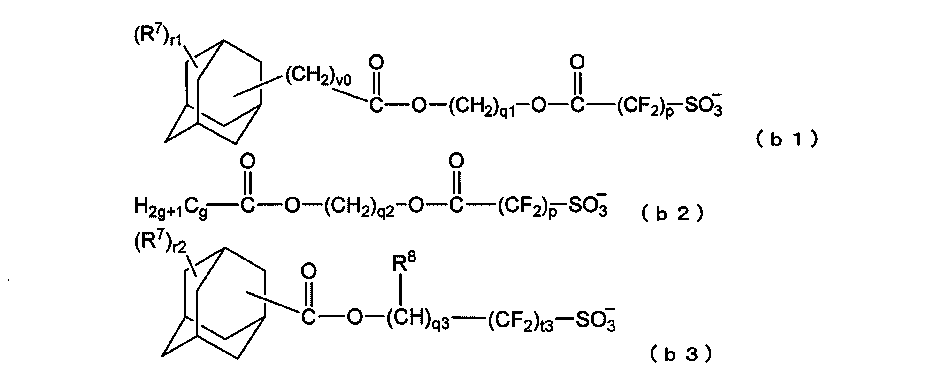
[式中、pは1~3の整数であり、v0は0~3の整数であり、q1及びq2はそれぞれ独立に1~5の整数であり、q3は1~12の整数であり、r1~r2はそれぞれ独立に0~3の整数であり、gは1~20の整数であり、t3は1~3の整数であり、R7は置換基であり、R8は水素原子、又はアルキル基である。]
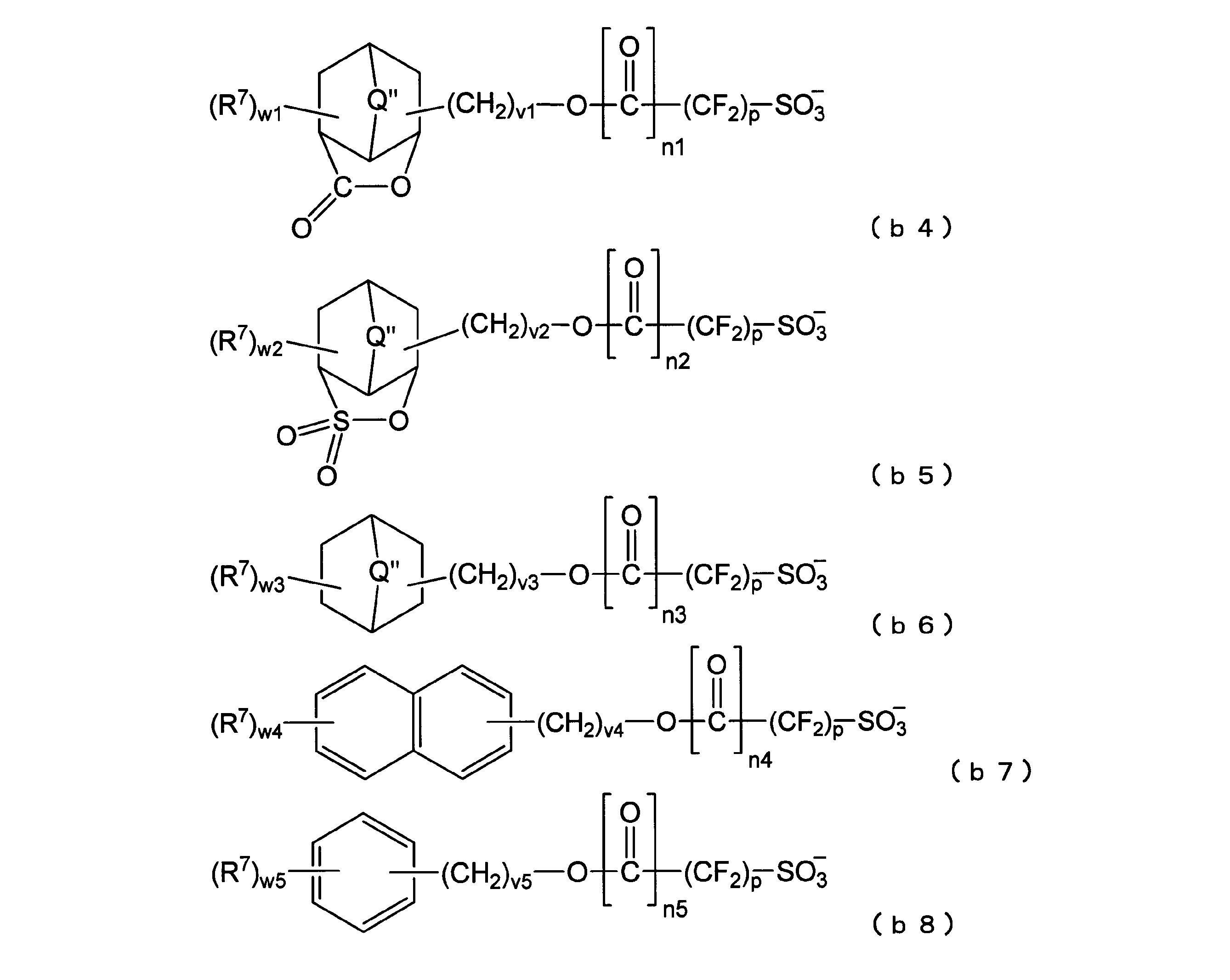
[式中、p、R7、Q”はそれぞれ前記と同じであり、n1~n5はそれぞれ独立に0又は1であり、v1~v5はそれぞれ独立に0~3の整数であり、w1~w5はそれぞれ独立に0~3の整数である。]
R7の置換基としては、アルキル基、ヘテロ原子含有置換基等が挙げられる。アルキル基としては、前記Xの説明で、芳香族炭化水素基が有していてもよい置換基として挙げたアルキル基と同様のものが挙げられる。また、ヘテロ原子含有置換基としては、前記Xの説明で、脂肪族炭化水素基を構成する水素原子の一部又は全部を置換してもよいヘテロ原子含有置換基として挙げたものと同様のものが挙げられる。
R7に付された符号(r1~r2、w1~w5)が2以上の整数である場合、当該化合物中の複数のR7はそれぞれ同じであってもよく、異なっていてもよい。
R8におけるアルキル基としては、置換基を有していてもよく、それぞれ、上記Rにおけるアルキル基と同様のものが挙げられる。
r1~r2、w1~w5は、それぞれ、0~2の整数であることが好ましく、0又は1であることがより好ましい。
v0~v5は0~2が好ましく、0又は1が最も好ましい。
t3は、1又は2が好ましく、1であることが最も好ましい。
q3は、1~5であることが好ましく、1~3であることが更に好ましく、1であることが最も好ましい。
R7に付された符号(r1~r2、w1~w5)が2以上の整数である場合、当該化合物中の複数のR7はそれぞれ同じであってもよく、異なっていてもよい。
R8におけるアルキル基としては、置換基を有していてもよく、それぞれ、上記Rにおけるアルキル基と同様のものが挙げられる。
r1~r2、w1~w5は、それぞれ、0~2の整数であることが好ましく、0又は1であることがより好ましい。
v0~v5は0~2が好ましく、0又は1が最も好ましい。
t3は、1又は2が好ましく、1であることが最も好ましい。
q3は、1~5であることが好ましく、1~3であることが更に好ましく、1であることが最も好ましい。
また、オニウム塩系酸発生剤としては、前記一般式(b-1)又は(b-2)において、アニオン部を下記一般式(b-3)又は(b-4)で表されるアニオン部に置き換えたオニウム塩系酸発生剤も用いることができる(カチオン部は(b-1)又は(b-2)と同様)。

[式中、X”は、少なくとも1つの水素原子がフッ素原子で置換された炭素数2~6のアルキレン基を表し;Y”、Z”は、それぞれ独立に、少なくとも1つの水素原子がフッ素原子で置換された炭素数1~10のアルキル基を表す。]
X”は、少なくとも1つの水素原子がフッ素原子で置換された直鎖状又は分岐鎖状のアルキレン基であり、該アルキレン基の炭素数は2~6であり、好ましくは炭素数3~5、最も好ましくは炭素数3である。
Y”、Z”は、それぞれ独立に、少なくとも1つの水素原子がフッ素原子で置換された直鎖状又は分岐鎖状のアルキル基であり、該アルキル基の炭素数は1~10であり、好ましくは炭素数1~7、より好ましくは炭素数1~3である。
X”のアルキレン基の炭素数又はY”、Z”のアルキル基の炭素数は、上記炭素数の範囲内において、レジスト溶媒への溶解性も良好である等の理由により、小さいほど好ましい。
また、X”のアルキレン基又はY”、Z”のアルキル基において、フッ素原子で置換されている水素原子の数が多いほど、酸の強度が強くなり、また200nm以下の高エネルギー光や電子線に対する透明性が向上するので好ましい。該アルキレン基又はアルキル基中のフッ素原子の割合、すなわちフッ素化率は、好ましくは70~100%、更に好ましくは90~100%であり、最も好ましくは、全ての水素原子がフッ素原子で置換されたパーフルオロアルキレン基又はパーフルオロアルキル基である。
Y”、Z”は、それぞれ独立に、少なくとも1つの水素原子がフッ素原子で置換された直鎖状又は分岐鎖状のアルキル基であり、該アルキル基の炭素数は1~10であり、好ましくは炭素数1~7、より好ましくは炭素数1~3である。
X”のアルキレン基の炭素数又はY”、Z”のアルキル基の炭素数は、上記炭素数の範囲内において、レジスト溶媒への溶解性も良好である等の理由により、小さいほど好ましい。
また、X”のアルキレン基又はY”、Z”のアルキル基において、フッ素原子で置換されている水素原子の数が多いほど、酸の強度が強くなり、また200nm以下の高エネルギー光や電子線に対する透明性が向上するので好ましい。該アルキレン基又はアルキル基中のフッ素原子の割合、すなわちフッ素化率は、好ましくは70~100%、更に好ましくは90~100%であり、最も好ましくは、全ての水素原子がフッ素原子で置換されたパーフルオロアルキレン基又はパーフルオロアルキル基である。
また、前記一般式(b-1)又は(b-2)において、アニオン部(R4”SO3
-)を、R7”-COO-[式中、R7”はアルキル基又はフッ素化アルキル基である。]に置き換えたオニウム塩系酸発生剤も用いることができる(カチオン部は(b-1)又は(b-2)と同様)。
R7”としては、前記R4”と同様のものが挙げられる。
上記「R7”-COO-」の具体的としては、トリフルオロ酢酸イオン、酢酸イオン、1-アダマンタンカルボン酸イオンなどが挙げられる。
前記活性光線又は放射線の照射により酸を発生する化合物(B)としては、下記一般式(b3’)又は(b5’)で表される化合物であることが好ましい。
R7”としては、前記R4”と同様のものが挙げられる。
上記「R7”-COO-」の具体的としては、トリフルオロ酢酸イオン、酢酸イオン、1-アダマンタンカルボン酸イオンなどが挙げられる。
前記活性光線又は放射線の照射により酸を発生する化合物(B)としては、下記一般式(b3’)又は(b5’)で表される化合物であることが好ましい。

上記一般式(b3’)及び(b5’)中、R1”~R3”はそれぞれ独立に、アリール基を表す。R1”~R3”のうち、いずれか2つが相互に結合して式中のイオウ原子と共に環を形成してもよい。
上記一般式(b3’)中、q3は1~12の整数であり、r2は0~3の整数であり、t3は1~3の整数であり、R7は置換基であり、R8は水素原子又はアルキル基である。
上記一般式(b5’)中、pは1~3の整数であり、R7は置換基であり、Q”は、酸素原子若しくは硫黄原子を含んでいてもよいアルキレン基、酸素原子又は硫黄原子であり、n2は0又は1であり、v2は0~3の整数であり、w2は0~3の整数である。
R1”~R3”についてのアリール基は置換基を有していてもよい。
R8についてのアルキル基は置換基を有していてもよく、炭素数1~5のアルキル基であることが好ましい。前記置換基としてはハロゲン原子等が挙げられる。
上記一般式(b3’)中、q3は1~12の整数であり、r2は0~3の整数であり、t3は1~3の整数であり、R7は置換基であり、R8は水素原子又はアルキル基である。
上記一般式(b5’)中、pは1~3の整数であり、R7は置換基であり、Q”は、酸素原子若しくは硫黄原子を含んでいてもよいアルキレン基、酸素原子又は硫黄原子であり、n2は0又は1であり、v2は0~3の整数であり、w2は0~3の整数である。
R1”~R3”についてのアリール基は置換基を有していてもよい。
R8についてのアルキル基は置換基を有していてもよく、炭素数1~5のアルキル基であることが好ましい。前記置換基としてはハロゲン原子等が挙げられる。
活性光線又は放射線の照射により酸を発生する化合物(B)としては、これらの酸発生剤を1種単独で用いてもよいし、2種以上を組み合わせて用いてもよい。
感活性光線性又は感放射線性樹脂組成物における活性光線又は放射線の照射により酸を発生する化合物(B)の含有量は、樹脂(A)100質量部に対し、0.1~30質量部が好ましく、1~25質量部がより好ましく、更に好ましくは5~20質量部である。上記範囲とすることでパターン形成が充分に行われる。また、均一な溶液が得られ、保存安定性が良好となるため好ましい。
感活性光線性又は感放射線性樹脂組成物における活性光線又は放射線の照射により酸を発生する化合物(B)の含有量は、樹脂(A)100質量部に対し、0.1~30質量部が好ましく、1~25質量部がより好ましく、更に好ましくは5~20質量部である。上記範囲とすることでパターン形成が充分に行われる。また、均一な溶液が得られ、保存安定性が良好となるため好ましい。
<疎水性樹脂(F)>
感活性光線性又は感放射線性樹脂組成物には、レジスト膜に撥水性を付与するために、特に液浸露光に適用する際、フッ素原子及び珪素原子の少なくともいずれかを有し、前記樹脂(A)とは異なる疎水性樹脂(F)を含有させることができる。これにより、膜表層に疎水性樹脂(F)が偏在化し、液浸媒体が水の場合、水に対するレジスト膜表面の静的/動的な接触角を向上させ、液浸液追随性を向上させることができる。
疎水性樹脂(F)に於けるフッ素原子及び/又は珪素原子は、樹脂の主鎖中に含まれていてもよく、側鎖中に含まれていてもよい。
感活性光線性又は感放射線性樹脂組成物には、レジスト膜に撥水性を付与するために、特に液浸露光に適用する際、フッ素原子及び珪素原子の少なくともいずれかを有し、前記樹脂(A)とは異なる疎水性樹脂(F)を含有させることができる。これにより、膜表層に疎水性樹脂(F)が偏在化し、液浸媒体が水の場合、水に対するレジスト膜表面の静的/動的な接触角を向上させ、液浸液追随性を向上させることができる。
疎水性樹脂(F)に於けるフッ素原子及び/又は珪素原子は、樹脂の主鎖中に含まれていてもよく、側鎖中に含まれていてもよい。
疎水性樹脂(F)がフッ素原子を含んでいる場合、フッ素原子を有する部分構造として、フッ素原子を有するアルキル基、フッ素原子を有するシクロアルキル基、又は、フッ素原子を有するアリール基を有する樹脂であることが好ましい。
フッ素原子を有するアルキル基(好ましくは炭素数1~10、より好ましくは炭素数1~4)は、少なくとも1つの水素原子がフッ素原子で置換された直鎖又は分岐アルキル基であり、更にフッ素原子以外の置換基を有していてもよい。
フッ素原子を有するシクロアルキル基は、少なくとも1つの水素原子がフッ素原子で置換された単環又は多環のシクロアルキル基であり、更にフッ素原子以外の置換基を有していてもよい。
フッ素原子を有するアリール基としては、フェニル基、ナフチル基などのアリール基の少なくとも1つの水素原子がフッ素原子で置換されたものが挙げられ、更にフッ素原子以外の置換基を有していてもよい。
フッ素原子を有するアルキル基(好ましくは炭素数1~10、より好ましくは炭素数1~4)は、少なくとも1つの水素原子がフッ素原子で置換された直鎖又は分岐アルキル基であり、更にフッ素原子以外の置換基を有していてもよい。
フッ素原子を有するシクロアルキル基は、少なくとも1つの水素原子がフッ素原子で置換された単環又は多環のシクロアルキル基であり、更にフッ素原子以外の置換基を有していてもよい。
フッ素原子を有するアリール基としては、フェニル基、ナフチル基などのアリール基の少なくとも1つの水素原子がフッ素原子で置換されたものが挙げられ、更にフッ素原子以外の置換基を有していてもよい。
更に、疎水性樹脂(F)は、下記(x)~(z)の群から選ばれる基を少なくとも1つを有していてもよい。
(x)酸基、
(y)ラクトン構造を有する基、酸無水物基、又は酸イミド基、
(z)酸の作用により分解する基
(x)酸基、
(y)ラクトン構造を有する基、酸無水物基、又は酸イミド基、
(z)酸の作用により分解する基
酸基(x)としては、フェノール性水酸基、カルボン酸基、フッ素化アルコール基、スルホン酸基、スルホンアミド基、スルホニルイミド基、(アルキルスルホニル)(アルキルカルボニル)メチレン基、(アルキルスルホニル)(アルキルカルボニル)イミド基、ビス(アルキルカルボニル)メチレン基、ビス(アルキルカルボニル)イミド基、ビス(アルキルスルホニル)メチレン基、ビス(アルキルスルホニル)イミド基、トリス(アルキルカルボニル)メチレン基、トリス(アルキルスルホニル)メチレン基等が挙げられる。
好ましい酸基としては、フッ素化アルコール基(好ましくはヘキサフルオロイソプロパノール)、スルホンイミド基、ビス(アルキルカルボニル)メチレン基が挙げられる。
酸基(x)を有する繰り返し単位の含有量は、疎水性樹脂(F)中の全繰り返し単位に対し、1~50モル%が好ましく、より好ましくは3~35モル%、更に好ましくは5~20モル%である。
好ましい酸基としては、フッ素化アルコール基(好ましくはヘキサフルオロイソプロパノール)、スルホンイミド基、ビス(アルキルカルボニル)メチレン基が挙げられる。
酸基(x)を有する繰り返し単位の含有量は、疎水性樹脂(F)中の全繰り返し単位に対し、1~50モル%が好ましく、より好ましくは3~35モル%、更に好ましくは5~20モル%である。
ラクトン構造を有する基、酸無水物基、又は酸イミド基(y)としては、ラクトン構造を有する基が特に好ましい。
これらの基を含んだ繰り返し単位は、例えば、アクリル酸エステル及びメタクリル酸エステルによる繰り返し単位等の、樹脂の主鎖に直接この基が結合している繰り返し単位である。或いは、この繰り返し単位は、この基が連結基を介して樹脂の主鎖に結合している繰り返し単位であってもよい。或いは、この繰り返し単位は、この基を有する重合開始剤又は連鎖移動剤を重合時に用いて、樹脂の末端に導入されていてもよい。
これらの基を含んだ繰り返し単位は、例えば、アクリル酸エステル及びメタクリル酸エステルによる繰り返し単位等の、樹脂の主鎖に直接この基が結合している繰り返し単位である。或いは、この繰り返し単位は、この基が連結基を介して樹脂の主鎖に結合している繰り返し単位であってもよい。或いは、この繰り返し単位は、この基を有する重合開始剤又は連鎖移動剤を重合時に用いて、樹脂の末端に導入されていてもよい。
ラクトン構造を有する基、酸無水物基、又は酸イミド基を有する繰り返し単位の含有量は、疎水性樹脂(F)中の全繰り返し単位を基準として、1~100モル%であることが好ましく、3~98モル%であることがより好ましく、5~95モル%であることが更に好ましい。
疎水性樹脂(F)に於ける、酸の作用により分解する基(z)を有する繰り返し単位は、樹脂(A)で挙げた酸分解性基を有する繰り返し単位と同様のものが挙げられる。酸の作用により分解する基(z)を有する繰り返し単位が、フッ素原子及び珪素原子の少なくともいずれかを有していても良い。疎水性樹脂(F)に於ける、酸の作用により分解する基(z)を有する繰り返し単位の含有量は、樹脂(F)中の全繰り返し単位に対し、1~80モル%が好ましく、より好ましくは10~80モル%、更に好ましくは20~60モル%である。
疎水性樹脂(F)の標準ポリスチレン換算の重量平均分子量は、好ましくは1,000~100,000で、より好ましくは1,000~50,000、更により好ましくは2,000~20,000である。
また、疎水性樹脂(F)は、1種で使用してもよいし、複数併用してもよい。
疎水性樹脂(F)の組成物中の含有量は、組成物中の全固形分に対し、0.01~10質量%が好ましく、0.05~8質量%がより好ましく、0.1~5質量%が更に好ましい。
また、疎水性樹脂(F)は、1種で使用してもよいし、複数併用してもよい。
疎水性樹脂(F)の組成物中の含有量は、組成物中の全固形分に対し、0.01~10質量%が好ましく、0.05~8質量%がより好ましく、0.1~5質量%が更に好ましい。
また、解像度、レジスト形状、レジストパターンの側壁、ラフネスなどの点から、分子量分布(Mw/Mn、分散度ともいう)は、1~5の範囲が好ましく、より好ましくは1~3、更に好ましくは1~2の範囲である。
疎水性樹脂(F)の具体例としては、特開2011-197587号公報の[0314]~[0320]に例示されている化合物(HR-1)~(HR-90)等が挙げられるが、これらに限定されるものではない。
<塩基性化合物(D)>
本発明において、感活性光線性又は感放射線性樹脂組成物は、任意の成分として、塩基性化合物(D)を含有してもよい。
塩基性化合物(D)としては、酸拡散制御剤、すなわち露光により前記化合物(B)から発生する酸をトラップするクエンチャーとして作用するものであれば特に限定されず、既に多種多様なものが提案されているので、公知のものから任意に用いればよい。
塩基性化合物(D)としては、通常、低分子化合物(非重合体)が用いられている。塩基性化合物(D)としては、例えば脂肪族アミン、芳香族アミン等のアミンが挙げられ、脂肪族アミンが好ましく、特に第2級脂肪族アミンや第3級脂肪族アミンが好ましい。ここで、脂肪族アミンとは、1つ以上の脂肪族基を有するアミンであり、該脂肪族基は炭素数が1~20であることが好ましい。
脂肪族アミンとしては、例えば、アンモニアNH3の水素原子の少なくとも1つを、炭素数20以下のアルキル基又はヒドロキシアルキル基で置換したアミン(アルキルアミン又はアルキルアルコールアミン)又は環式アミンが挙げられる。
アルキルアミン及びアルキルアルコールアミンの具体例としては、n-ヘキシルアミン、n-ヘプチルアミン、n-オクチルアミン、n-ノニルアミン、n-デシルアミン等のモノアルキルアミン;ジエチルアミン、ジ-n-プロピルアミン、ジ-n-ヘプチルアミン、ジ-n-オクチルアミン、ジシクロヘキシルアミン等のジアルキルアミン;トリメチルアミン、トリエチルアミン、トリ-n-プロピルアミン、トリ-n-ブチルアミン、トリ-n-ペンチルアミン、トリ-n-ヘキシルアミン、トリ-n-ヘプチルアミン、トリ-n-オクチルアミン、トリ-n-ノニルアミン、トリ-n-デシルアミン、トリ-n-ドデシルアミン等のトリアルキルアミン;ジエタノールアミン、トリエタノールアミン、ジイソプロパノールアミン、トリイソプロパノールアミン、ジ-n-オクタノールアミン、トリ-n-オクタノールアミン、ステアリルジエタノールアミン、ラウリルジエタノールアミン等のアルキルアルコールアミンが挙げられる。これらの中でも、トリアルキルアミン及び/又はアルキルアルコールアミンが好ましい。
環式アミンとしては、例えば、ヘテロ原子として窒素原子を含む複素環化合物が挙げられる。該複素環化合物としては、単環式のもの(脂肪族単環式アミン)であっても多環式のもの(脂肪族多環式アミン)であってもよい。
脂肪族単環式アミンとして、具体的には、ピペリジン、ピペラジン等が挙げられる。
脂肪族多環式アミンとしては、炭素数が6~10のものが好ましく、具体的には、1,5-ジアザビシクロ[4.3.0]-5-ノネン、1,8-ジアザビシクロ[5.4.0]-7-ウンデセン、ヘキサメチレンテトラミン、1,4-ジアザビシクロ[2.2.2]オクタン等が挙げられる。
その他の脂肪族アミンとしては、トリス(2-メトキシメトキシエチル)アミン、トリス{2-(2-メトキシエトキシ)エチル}アミン、トリス{2-(2-メトキシエトキシメトキシ)エチル}アミン、トリス{2-(1-メトキシエトキシ)エチル}アミン、トリス{2-(1-エトキシエトキシ)エチル}アミン、トリス{2-(1-エトキシプロポキシ)エチル}アミン、トリス[2-{2-(2-ヒドロキシエトキシ)エトキシ}エチルアミン等が挙げられる。
芳香族アミンとしては、例えば、アニリン、N,N-ジブチルアニリン、ピリジン、4-ジメチルアミノピリジン、ピロール、インドール、ピラゾール、イミダゾール又はこれらの誘導体、ジフェニルアミン、トリフェニルアミン、トリベンジルアミン、2,6-ジイソプロピルアニリン、2,2’-ジビリジル、4,4’-ジビリジルなどが挙げられる。
これらは単独で用いてもよいし、2種以上を組み合わせて用いてもよい。
塩基性化合物(D)は、樹脂(A)100質量部に対して、通常、0.01~5.0質量部の範囲で用いられる。上記範囲とすることにより、レジストパターン形状、引き置き経時安定性等が向上する。
本発明において、感活性光線性又は感放射線性樹脂組成物は、任意の成分として、塩基性化合物(D)を含有してもよい。
塩基性化合物(D)としては、酸拡散制御剤、すなわち露光により前記化合物(B)から発生する酸をトラップするクエンチャーとして作用するものであれば特に限定されず、既に多種多様なものが提案されているので、公知のものから任意に用いればよい。
塩基性化合物(D)としては、通常、低分子化合物(非重合体)が用いられている。塩基性化合物(D)としては、例えば脂肪族アミン、芳香族アミン等のアミンが挙げられ、脂肪族アミンが好ましく、特に第2級脂肪族アミンや第3級脂肪族アミンが好ましい。ここで、脂肪族アミンとは、1つ以上の脂肪族基を有するアミンであり、該脂肪族基は炭素数が1~20であることが好ましい。
脂肪族アミンとしては、例えば、アンモニアNH3の水素原子の少なくとも1つを、炭素数20以下のアルキル基又はヒドロキシアルキル基で置換したアミン(アルキルアミン又はアルキルアルコールアミン)又は環式アミンが挙げられる。
アルキルアミン及びアルキルアルコールアミンの具体例としては、n-ヘキシルアミン、n-ヘプチルアミン、n-オクチルアミン、n-ノニルアミン、n-デシルアミン等のモノアルキルアミン;ジエチルアミン、ジ-n-プロピルアミン、ジ-n-ヘプチルアミン、ジ-n-オクチルアミン、ジシクロヘキシルアミン等のジアルキルアミン;トリメチルアミン、トリエチルアミン、トリ-n-プロピルアミン、トリ-n-ブチルアミン、トリ-n-ペンチルアミン、トリ-n-ヘキシルアミン、トリ-n-ヘプチルアミン、トリ-n-オクチルアミン、トリ-n-ノニルアミン、トリ-n-デシルアミン、トリ-n-ドデシルアミン等のトリアルキルアミン;ジエタノールアミン、トリエタノールアミン、ジイソプロパノールアミン、トリイソプロパノールアミン、ジ-n-オクタノールアミン、トリ-n-オクタノールアミン、ステアリルジエタノールアミン、ラウリルジエタノールアミン等のアルキルアルコールアミンが挙げられる。これらの中でも、トリアルキルアミン及び/又はアルキルアルコールアミンが好ましい。
環式アミンとしては、例えば、ヘテロ原子として窒素原子を含む複素環化合物が挙げられる。該複素環化合物としては、単環式のもの(脂肪族単環式アミン)であっても多環式のもの(脂肪族多環式アミン)であってもよい。
脂肪族単環式アミンとして、具体的には、ピペリジン、ピペラジン等が挙げられる。
脂肪族多環式アミンとしては、炭素数が6~10のものが好ましく、具体的には、1,5-ジアザビシクロ[4.3.0]-5-ノネン、1,8-ジアザビシクロ[5.4.0]-7-ウンデセン、ヘキサメチレンテトラミン、1,4-ジアザビシクロ[2.2.2]オクタン等が挙げられる。
その他の脂肪族アミンとしては、トリス(2-メトキシメトキシエチル)アミン、トリス{2-(2-メトキシエトキシ)エチル}アミン、トリス{2-(2-メトキシエトキシメトキシ)エチル}アミン、トリス{2-(1-メトキシエトキシ)エチル}アミン、トリス{2-(1-エトキシエトキシ)エチル}アミン、トリス{2-(1-エトキシプロポキシ)エチル}アミン、トリス[2-{2-(2-ヒドロキシエトキシ)エトキシ}エチルアミン等が挙げられる。
芳香族アミンとしては、例えば、アニリン、N,N-ジブチルアニリン、ピリジン、4-ジメチルアミノピリジン、ピロール、インドール、ピラゾール、イミダゾール又はこれらの誘導体、ジフェニルアミン、トリフェニルアミン、トリベンジルアミン、2,6-ジイソプロピルアニリン、2,2’-ジビリジル、4,4’-ジビリジルなどが挙げられる。
これらは単独で用いてもよいし、2種以上を組み合わせて用いてもよい。
塩基性化合物(D)は、樹脂(A)100質量部に対して、通常、0.01~5.0質量部の範囲で用いられる。上記範囲とすることにより、レジストパターン形状、引き置き経時安定性等が向上する。
本発明において、感活性光線性又は感放射線性樹脂組成物には、感度劣化の防止や、レジストパターン形状、引き置き経時安定性等の向上の目的で、任意の成分として、有機カルボン酸、並びにリンのオキソ酸及びその誘導体からなる群から選択される少なくとも1種の化合物(E)(以下、(E)成分という。)を含有させることができる。
有機カルボン酸としては、例えば、酢酸、マロン酸、クエン酸、リンゴ酸、コハク酸、安息香酸、サリチル酸などが好適である。
リンのオキソ酸としては、リン酸、ホスホン酸、ホスフィン酸等が挙げられ、これらの中でも特にホスホン酸が好ましい。
リンのオキソ酸の誘導体としては、例えば、上記オキソ酸の水素原子を炭化水素基で置換したエステル等が挙げられ、前記炭化水素基としては、炭素数1~5のアルキル基、炭素数6~15のアリール基等が挙げられる。
リン酸の誘導体としては、リン酸ジ-n-ブチルエステル、リン酸ジフェニルエステル等のリン酸エステルなどが挙げられる。
ホスホン酸の誘導体としては、ホスホン酸ジメチルエステル、ホスホン酸-ジ-n-ブチルエステル、フェニルホスホン酸、ホスホン酸ジフェニルエステル、ホスホン酸ジベンジルエステル等のホスホン酸エステルなどが挙げられる。
ホスフィン酸の誘導体としては、フェニルホスフィン酸等のホスフィン酸エステルなどが挙げられる。
(E)成分は、1種を単独で用いてもよく、2種以上を併用してもよい。
(E)成分は、樹脂(A)100質量部に対して、通常、0.01~5.0質量部の範囲で用いられる。
有機カルボン酸としては、例えば、酢酸、マロン酸、クエン酸、リンゴ酸、コハク酸、安息香酸、サリチル酸などが好適である。
リンのオキソ酸としては、リン酸、ホスホン酸、ホスフィン酸等が挙げられ、これらの中でも特にホスホン酸が好ましい。
リンのオキソ酸の誘導体としては、例えば、上記オキソ酸の水素原子を炭化水素基で置換したエステル等が挙げられ、前記炭化水素基としては、炭素数1~5のアルキル基、炭素数6~15のアリール基等が挙げられる。
リン酸の誘導体としては、リン酸ジ-n-ブチルエステル、リン酸ジフェニルエステル等のリン酸エステルなどが挙げられる。
ホスホン酸の誘導体としては、ホスホン酸ジメチルエステル、ホスホン酸-ジ-n-ブチルエステル、フェニルホスホン酸、ホスホン酸ジフェニルエステル、ホスホン酸ジベンジルエステル等のホスホン酸エステルなどが挙げられる。
ホスフィン酸の誘導体としては、フェニルホスフィン酸等のホスフィン酸エステルなどが挙げられる。
(E)成分は、1種を単独で用いてもよく、2種以上を併用してもよい。
(E)成分は、樹脂(A)100質量部に対して、通常、0.01~5.0質量部の範囲で用いられる。
本発明において、感活性光線性又は感放射線性樹脂組成物には、更に所望により混和性のある添加剤、例えばレジスト膜の性能を改良するための付加的樹脂、塗布性を向上させるための界面活性剤、溶解抑制剤、可塑剤、安定剤、着色剤、ハレーション防止剤、染料などを適宜、添加含有させることができる。
含有する場合、界面活性剤としては、フッ素系及び/又はシリコン系界面活性剤が好ましい。
これらに該当する界面活性剤としては、DIC(株)製のメガファックF176、メガファックR08、OMNOVA社製のPF656、PF6320、トロイケミカル(株)製のトロイゾルS-366、住友スリーエム(株)製のフロラードFC430、信越化学工業(株)製のポリシロキサンポリマーKP-341などが挙げられる。
また、フッ素系及び/又はシリコン系界面活性剤以外の他の界面活性剤を使用することもできる。より具体的には、ポリオキシエチレンアルキルエーテル類、ポリオキシエチレンアルキルアリールエーテル類などが挙げられる。
含有する場合、界面活性剤としては、フッ素系及び/又はシリコン系界面活性剤が好ましい。
これらに該当する界面活性剤としては、DIC(株)製のメガファックF176、メガファックR08、OMNOVA社製のPF656、PF6320、トロイケミカル(株)製のトロイゾルS-366、住友スリーエム(株)製のフロラードFC430、信越化学工業(株)製のポリシロキサンポリマーKP-341などが挙げられる。
また、フッ素系及び/又はシリコン系界面活性剤以外の他の界面活性剤を使用することもできる。より具体的には、ポリオキシエチレンアルキルエーテル類、ポリオキシエチレンアルキルアリールエーテル類などが挙げられる。
その他、公知の界面活性剤が適宜使用可能である。使用可能な界面活性剤としては、例えば、米国特許出願公開第2008/0248425A1号明細書の[0273]以降に記載の界面活性剤が挙げられる。
界面活性剤は単独で使用してもよいし、2種以上を併用してもよい。
本発明の感活性光線性又は感放射線性樹脂組成物は界面活性剤を含有していても含有していなくてもよいが、含有する場合、界面活性剤の使用量は、感活性光線性又は感放射線性樹脂組成物の全固形分量(溶剤を除く全量)に対して、好ましくは0~2質量%、更に好ましくは0.0001~2質量%、特に好ましくは0.0005~1質量%である。
一方、界面活性剤の添加量を10ppm以下、或いは含有しないことも好ましい。これにより疎水性樹脂の表面偏在性があがり、それにより、レジスト膜表面をより疎水的にすることができ、液浸露光時の水追随性を向上させることが出来る。
本発明の感活性光線性又は感放射線性樹脂組成物は界面活性剤を含有していても含有していなくてもよいが、含有する場合、界面活性剤の使用量は、感活性光線性又は感放射線性樹脂組成物の全固形分量(溶剤を除く全量)に対して、好ましくは0~2質量%、更に好ましくは0.0001~2質量%、特に好ましくは0.0005~1質量%である。
一方、界面活性剤の添加量を10ppm以下、或いは含有しないことも好ましい。これにより疎水性樹脂の表面偏在性があがり、それにより、レジスト膜表面をより疎水的にすることができ、液浸露光時の水追随性を向上させることが出来る。
本発明の感活性光線性又は感放射線性樹脂組成物は、材料を有機溶剤(以下、(S)成分ということがある)に溶解させて製造することができる。
(S)成分としては、使用する各成分を溶解し、均一な溶液とすることができるものであればよく、従来、化学増幅型レジストの溶剤として公知のものの中から任意のものを1種又は2種以上適宜選択して用いることができる。
例えば、γ-ブチロラクトン等のラクトン類;アセトン、メチルエチルケトン(MEK)、シクロヘキサノン、メチル-n-ペンチルケトン、メチルイソペンチルケトン、2-ヘプタノンなどのケトン類;エチレングリコール、ジエチレングリコール、プロピレングリコール、ジプロピレングリコールなどの多価アルコール類;エチレングリコールモノアセテート、ジエチレングリコールモノアセテート、プロピレングリコールモノアセテート、又はジプロピレングリコールモノアセテート等のエステル結合を有する化合物、前記多価アルコール類又は前記エステル結合を有する化合物のモノメチルエーテル、モノエチルエーテル、モノプロピルエーテル、モノブチルエーテル等のモノアルキルエーテル又はモノフェニルエーテル等のエーテル結合を有する化合物等の多価アルコール類の誘導体[これらの中では、プロピレングリコールモノメチルエーテルアセテート(PGMEA)、プロピレングリコールモノメチルエーテル(PGME)が好ましい];ジオキサンのような環式エーテル類や、乳酸メチル、乳酸エチル(EL)、酢酸メチル、酢酸エチル、酢酸ブチル、ピルビン酸メチル、ピルビン酸エチル、メトキシプロピオン酸メチル、エトキシプロピオン酸エチルなどのエステル類;アニソール、エチルベンジルエーテル、クレジルメチルエーテル、ジフェニルエーテル、ジベンジルエーテル、フェネトール、ブチルフェニルエーテル、エチルベンゼン、ジエチルベンゼン、ペンチルベンゼン、イソプロピルベンゼン、トルエン、キシレン、シメン、メシチレン等の芳香族系有機溶剤、ジメチルスルホキシド(DMSO)などを挙げることができる。
これらの有機溶剤は単独で用いてもよく、2種以上の混合溶剤として用いてもよい。
なかでも、PGMEA、PGME、γ-ブチロラクトン、シクロヘキサノン、ELが好ましい。
また、PGMEAと極性溶剤とを混合した混合溶媒も好ましい。その配合比(質量比)は、PGMEAと極性溶剤との相溶性等を考慮して適宜決定すればよいが、好ましくは1:9~9:1、より好ましくは2:8~8:2の範囲内とすることが好ましい。
より具体的には、極性溶剤としてELを配合する場合は、PGMEA:ELの質量比は、好ましくは1:9~9:1、より好ましくは2:8~8:2である。また、極性溶剤としてPGMEを配合する場合は、PGMEA:PGMEの質量比は、好ましくは1:9~9:1、より好ましくは2:8~8:2、更に好ましくは3:7~7:3である。また、極性溶剤としてPGME及びシクロヘキサノンを配合する場合は、PGMEA:(PGME+シクロヘキサノン)の質量比は、好ましくは1:9~9:1、より好ましくは2:8~8:2、更に好ましくは3:7~7:3である。
また、(S)成分として、その他には、PGMEA及びELの中から選ばれる少なくとも1種とγ-ブチロラクトンとの混合溶剤も好ましい。この場合、混合割合としては、前者と後者の質量比が好ましくは70:30~95:5とされる。
(S)成分の使用量は特に限定されず、基板等に塗布可能な濃度で、塗布膜厚に応じて適宜設定される。一般的には感活性光線性又は感放射線性樹脂組成物の固形分濃度が1~20質量%、好ましくは2~15質量%の範囲内となるように用いられる。
(S)成分としては、使用する各成分を溶解し、均一な溶液とすることができるものであればよく、従来、化学増幅型レジストの溶剤として公知のものの中から任意のものを1種又は2種以上適宜選択して用いることができる。
例えば、γ-ブチロラクトン等のラクトン類;アセトン、メチルエチルケトン(MEK)、シクロヘキサノン、メチル-n-ペンチルケトン、メチルイソペンチルケトン、2-ヘプタノンなどのケトン類;エチレングリコール、ジエチレングリコール、プロピレングリコール、ジプロピレングリコールなどの多価アルコール類;エチレングリコールモノアセテート、ジエチレングリコールモノアセテート、プロピレングリコールモノアセテート、又はジプロピレングリコールモノアセテート等のエステル結合を有する化合物、前記多価アルコール類又は前記エステル結合を有する化合物のモノメチルエーテル、モノエチルエーテル、モノプロピルエーテル、モノブチルエーテル等のモノアルキルエーテル又はモノフェニルエーテル等のエーテル結合を有する化合物等の多価アルコール類の誘導体[これらの中では、プロピレングリコールモノメチルエーテルアセテート(PGMEA)、プロピレングリコールモノメチルエーテル(PGME)が好ましい];ジオキサンのような環式エーテル類や、乳酸メチル、乳酸エチル(EL)、酢酸メチル、酢酸エチル、酢酸ブチル、ピルビン酸メチル、ピルビン酸エチル、メトキシプロピオン酸メチル、エトキシプロピオン酸エチルなどのエステル類;アニソール、エチルベンジルエーテル、クレジルメチルエーテル、ジフェニルエーテル、ジベンジルエーテル、フェネトール、ブチルフェニルエーテル、エチルベンゼン、ジエチルベンゼン、ペンチルベンゼン、イソプロピルベンゼン、トルエン、キシレン、シメン、メシチレン等の芳香族系有機溶剤、ジメチルスルホキシド(DMSO)などを挙げることができる。
これらの有機溶剤は単独で用いてもよく、2種以上の混合溶剤として用いてもよい。
なかでも、PGMEA、PGME、γ-ブチロラクトン、シクロヘキサノン、ELが好ましい。
また、PGMEAと極性溶剤とを混合した混合溶媒も好ましい。その配合比(質量比)は、PGMEAと極性溶剤との相溶性等を考慮して適宜決定すればよいが、好ましくは1:9~9:1、より好ましくは2:8~8:2の範囲内とすることが好ましい。
より具体的には、極性溶剤としてELを配合する場合は、PGMEA:ELの質量比は、好ましくは1:9~9:1、より好ましくは2:8~8:2である。また、極性溶剤としてPGMEを配合する場合は、PGMEA:PGMEの質量比は、好ましくは1:9~9:1、より好ましくは2:8~8:2、更に好ましくは3:7~7:3である。また、極性溶剤としてPGME及びシクロヘキサノンを配合する場合は、PGMEA:(PGME+シクロヘキサノン)の質量比は、好ましくは1:9~9:1、より好ましくは2:8~8:2、更に好ましくは3:7~7:3である。
また、(S)成分として、その他には、PGMEA及びELの中から選ばれる少なくとも1種とγ-ブチロラクトンとの混合溶剤も好ましい。この場合、混合割合としては、前者と後者の質量比が好ましくは70:30~95:5とされる。
(S)成分の使用量は特に限定されず、基板等に塗布可能な濃度で、塗布膜厚に応じて適宜設定される。一般的には感活性光線性又は感放射線性樹脂組成物の固形分濃度が1~20質量%、好ましくは2~15質量%の範囲内となるように用いられる。
また、本発明は、上記した本発明のパターン形成方法を含む、電子デバイスの製造方法、及び、この製造方法により製造された電子デバイスにも関する。
本発明の電子デバイスは、電気電子機器(家電、OA・メディア関連機器、光学用機器及び通信機器等)に、好適に、搭載されるものである。
本発明の電子デバイスは、電気電子機器(家電、OA・メディア関連機器、光学用機器及び通信機器等)に、好適に、搭載されるものである。
以下、本発明を実施例により更に詳細に説明するが、本発明がこれにより限定されるものではない。
<酸分解性樹脂>
〔合成例 樹脂A-1の合成〕
窒素気流下シクロヘキサノン25.5gを3つ口フラスコに入れ、これを85℃に加熱した。これに下記化合物(モノマー)を左から順に2.00g、5.13g、1.30g、重合開始剤V-601(和光純薬製、0.743g)をシクロヘキサノン46gに溶解させた溶液を6時間かけて滴下した。滴下終了後、更に85℃で2時間反応させた。反応液を放冷後ヘキサン420g/酢酸エチル180gの混合液に20分かけて滴下し、析出した粉体をろ取、乾燥すると、樹脂A-1 8.0gが得られた。13C-NMRから算出したポリマー組成比(モル比)は15/70/15であった。得られた樹脂A-1の重量平均分子量(Mw)は、標準ポリスチレン換算で7900、分散度(Mw/Mn)は、1.70であった。
〔合成例 樹脂A-1の合成〕
窒素気流下シクロヘキサノン25.5gを3つ口フラスコに入れ、これを85℃に加熱した。これに下記化合物(モノマー)を左から順に2.00g、5.13g、1.30g、重合開始剤V-601(和光純薬製、0.743g)をシクロヘキサノン46gに溶解させた溶液を6時間かけて滴下した。滴下終了後、更に85℃で2時間反応させた。反応液を放冷後ヘキサン420g/酢酸エチル180gの混合液に20分かけて滴下し、析出した粉体をろ取、乾燥すると、樹脂A-1 8.0gが得られた。13C-NMRから算出したポリマー組成比(モル比)は15/70/15であった。得られた樹脂A-1の重量平均分子量(Mw)は、標準ポリスチレン換算で7900、分散度(Mw/Mn)は、1.70であった。

合成例と同様の操作を行い、樹脂A-2~A-23及び比較例用樹脂A’-1及びA’-2を合成した。
樹脂A-1~A-23及び比較例用樹脂A’-1及びA’-2について、各繰り返し単位の組成比(モル比)、繰り返し単位(a0)を除く各繰り返し単位に対応する各モノマーのClogP値のモル平均値、重量平均分子量(Mw)、分散度を下表に示す。また、各繰り返し単位の組成比(モル比)、重量平均分子量(Mw)及び分散度は、樹脂A-1と同様の方法で算出した。
各樹脂について、繰り返し単位(a0)を除く各繰り返し単位に対応する各モノマーのClogP値のモル平均値の算出については、前述の通りである。
各繰り返し単位に対応する単量体(モノマー)のClogP値はChemBioDraw12.0により算出した。
樹脂A-1~A-23及び比較例用樹脂A’-1及びA’-2について、各繰り返し単位の組成比(モル比)、繰り返し単位(a0)を除く各繰り返し単位に対応する各モノマーのClogP値のモル平均値、重量平均分子量(Mw)、分散度を下表に示す。また、各繰り返し単位の組成比(モル比)、重量平均分子量(Mw)及び分散度は、樹脂A-1と同様の方法で算出した。
各樹脂について、繰り返し単位(a0)を除く各繰り返し単位に対応する各モノマーのClogP値のモル平均値の算出については、前述の通りである。
各繰り返し単位に対応する単量体(モノマー)のClogP値はChemBioDraw12.0により算出した。

表中の略号に対する各繰り返し単位の構造に対応する単量体(モノマー)及びそのClogP値は以下の通りである。
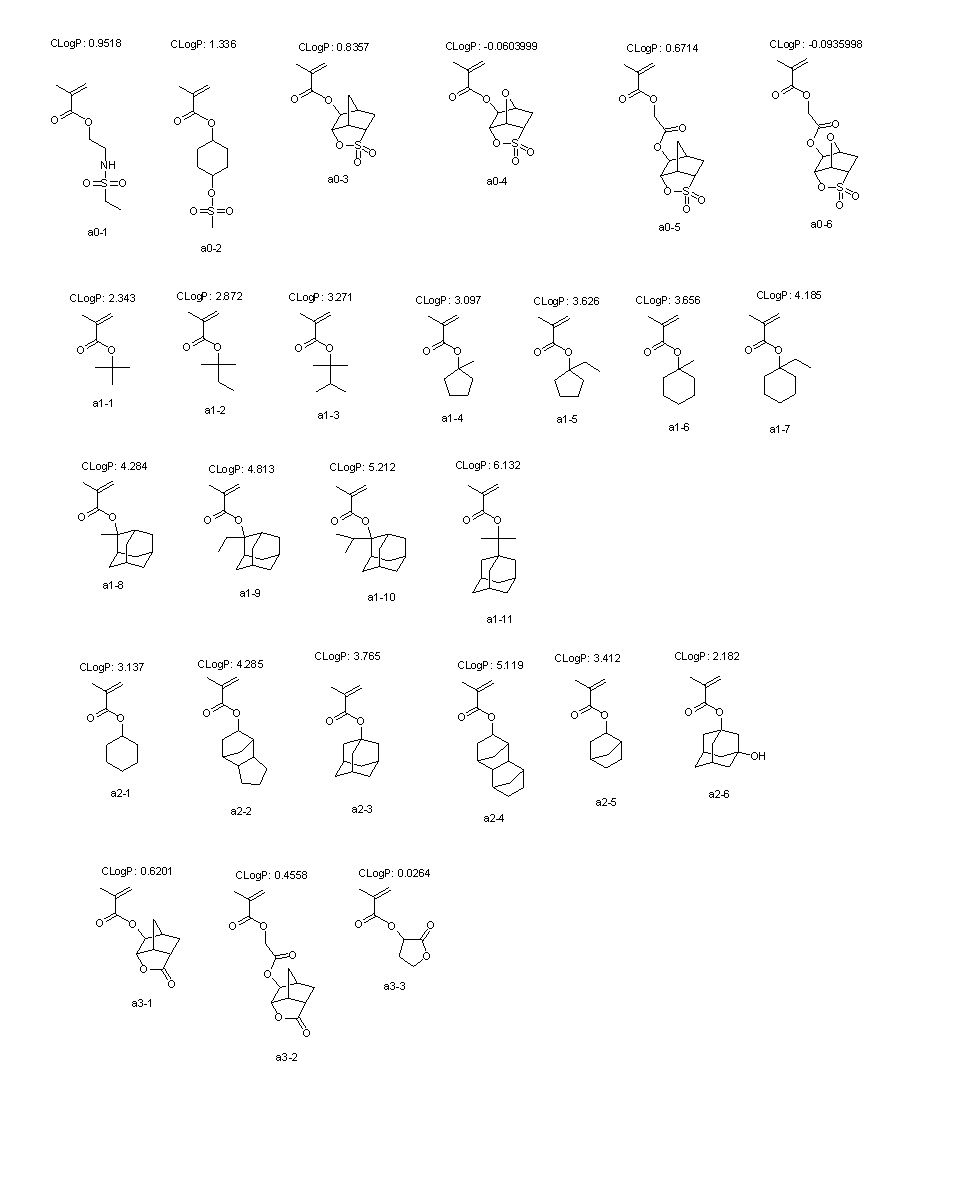
実施例1~38及び比較例1~4
<レジスト調製>
後掲の表2及び3に示す成分を溶剤に溶解させ、それぞれについて固形分濃度4質量%の溶液を調製し、これを0.05μmのポアサイズを有するポリエチレンフィルターで濾過して感活性光線性又は感放射性樹脂組成物を調製した。感活性光線性又は感放射性樹脂組成物を下記の方法で評価し、結果を表2及び3に示した。
<レジスト調製>
後掲の表2及び3に示す成分を溶剤に溶解させ、それぞれについて固形分濃度4質量%の溶液を調製し、これを0.05μmのポアサイズを有するポリエチレンフィルターで濾過して感活性光線性又は感放射性樹脂組成物を調製した。感活性光線性又は感放射性樹脂組成物を下記の方法で評価し、結果を表2及び3に示した。
<レジスト評価>
(露光条件(1):ArF液浸露光)
シリコンウエハー上に有機反射防止膜ARC29SR(日産化学社製)を塗布し、205℃で、60秒間ベークを行い、膜厚98nmの反射防止膜を形成した。その上に調製した感活性光線性又は感放射性樹脂組成物を塗布し、130℃で、60秒間ベークを行い、膜厚120nmのレジスト膜を形成した。これにArFエキシマレーザー液浸スキャナー(ASML社製 XT1700i、NA1.20、C-Quad、アウターシグマ0.981、インナーシグマ0.895、XY偏向)を用い、ホール部分が45nmでありかつホール間のピッチが75nmである正方配列のハーフトーンマスクを通して露光した。液浸液としては超純水を用いた。その後、105℃で60秒間加熱(PEB:Post Exposure Bake)した。次いで、酢酸ブチルで30秒間パドルして現像し、スピン乾燥して、孔径45nmのホールパターンを得た。
(露光条件(1):ArF液浸露光)
シリコンウエハー上に有機反射防止膜ARC29SR(日産化学社製)を塗布し、205℃で、60秒間ベークを行い、膜厚98nmの反射防止膜を形成した。その上に調製した感活性光線性又は感放射性樹脂組成物を塗布し、130℃で、60秒間ベークを行い、膜厚120nmのレジスト膜を形成した。これにArFエキシマレーザー液浸スキャナー(ASML社製 XT1700i、NA1.20、C-Quad、アウターシグマ0.981、インナーシグマ0.895、XY偏向)を用い、ホール部分が45nmでありかつホール間のピッチが75nmである正方配列のハーフトーンマスクを通して露光した。液浸液としては超純水を用いた。その後、105℃で60秒間加熱(PEB:Post Exposure Bake)した。次いで、酢酸ブチルで30秒間パドルして現像し、スピン乾燥して、孔径45nmのホールパターンを得た。
(露光条件(2):ArFドライ露光)
シリコンウエハー上に有機反射防止膜ARC29A(日産化学社製)を塗布し、205℃で、60秒間ベークを行い、膜厚78nmの反射防止膜を形成した。その上に調製した感活性光線性又は感放射性樹脂組成物を塗布し、130℃で、60秒間ベークを行い、膜厚120nmのレジスト膜を形成した。これにArFエキシマレーザースキャナー(ASML社製 PAS5500/1100、NA0.75、Dipole、σo/σi=0.89/0.65)を用い、ホール部分が75nmでありかつホール間のピッチが90nmである正方配列のハーフトーンマスクを通して露光した。その後100℃で、60秒間加熱した後、酢酸ブチルで30秒間パドルして現像し、スピン乾燥して、孔径75nmのホールパターンを得た。
シリコンウエハー上に有機反射防止膜ARC29A(日産化学社製)を塗布し、205℃で、60秒間ベークを行い、膜厚78nmの反射防止膜を形成した。その上に調製した感活性光線性又は感放射性樹脂組成物を塗布し、130℃で、60秒間ベークを行い、膜厚120nmのレジスト膜を形成した。これにArFエキシマレーザースキャナー(ASML社製 PAS5500/1100、NA0.75、Dipole、σo/σi=0.89/0.65)を用い、ホール部分が75nmでありかつホール間のピッチが90nmである正方配列のハーフトーンマスクを通して露光した。その後100℃で、60秒間加熱した後、酢酸ブチルで30秒間パドルして現像し、スピン乾燥して、孔径75nmのホールパターンを得た。
(CDU評価)
〔局所的なパターン寸法の均一性(Local CDU、nm)〕
測長走査型電子顕微鏡(SEM(株)日立製作所S-9380II)によりホールサイズを観察し、露光条件(1)では、ホール部分が平均45nmのホールパターンを解像する時の最適露光量(Eopt)(mJ/cm2)、露光条件(2)では、ホール部分が平均75nmのホールパターンを解像する時の最適露光量(Eopt)(mJ/cm2)を算出した。前記最適露光量で露光された1ショット内において、互いの間隔が1μmの20箇所の領域において、各領域ごとに任意の25個(すなわち、計500個)のホールサイズを測定し、これらの標準偏差を求め、3σを算出した。値が小さいほど寸法のばらつきが小さく、良好な性能であることを示す。
〔局所的なパターン寸法の均一性(Local CDU、nm)〕
測長走査型電子顕微鏡(SEM(株)日立製作所S-9380II)によりホールサイズを観察し、露光条件(1)では、ホール部分が平均45nmのホールパターンを解像する時の最適露光量(Eopt)(mJ/cm2)、露光条件(2)では、ホール部分が平均75nmのホールパターンを解像する時の最適露光量(Eopt)(mJ/cm2)を算出した。前記最適露光量で露光された1ショット内において、互いの間隔が1μmの20箇所の領域において、各領域ごとに任意の25個(すなわち、計500個)のホールサイズを測定し、これらの標準偏差を求め、3σを算出した。値が小さいほど寸法のばらつきが小さく、良好な性能であることを示す。
(真円性評価)
〔(真円性、nm)〕
前記最適露光量で露光された1ショット内において、互いの間隔が1μmの20箇所の領域において、各領域ごとに任意の25個(すなわち、計500個)のホールサイズを真円近似モードで測定し、ホールパターンの半径を1個のホールにつき32点測定した。測定で得られたホール半径と真円近似したときの半径とのバラツキ(3σ)を算出し、これらの平均値を求め、真円性を算出した。値が小さいほど真円に近く、良好な性能であることを示す。
〔(真円性、nm)〕
前記最適露光量で露光された1ショット内において、互いの間隔が1μmの20箇所の領域において、各領域ごとに任意の25個(すなわち、計500個)のホールサイズを真円近似モードで測定し、ホールパターンの半径を1個のホールにつき32点測定した。測定で得られたホール半径と真円近似したときの半径とのバラツキ(3σ)を算出し、これらの平均値を求め、真円性を算出した。値が小さいほど真円に近く、良好な性能であることを示す。
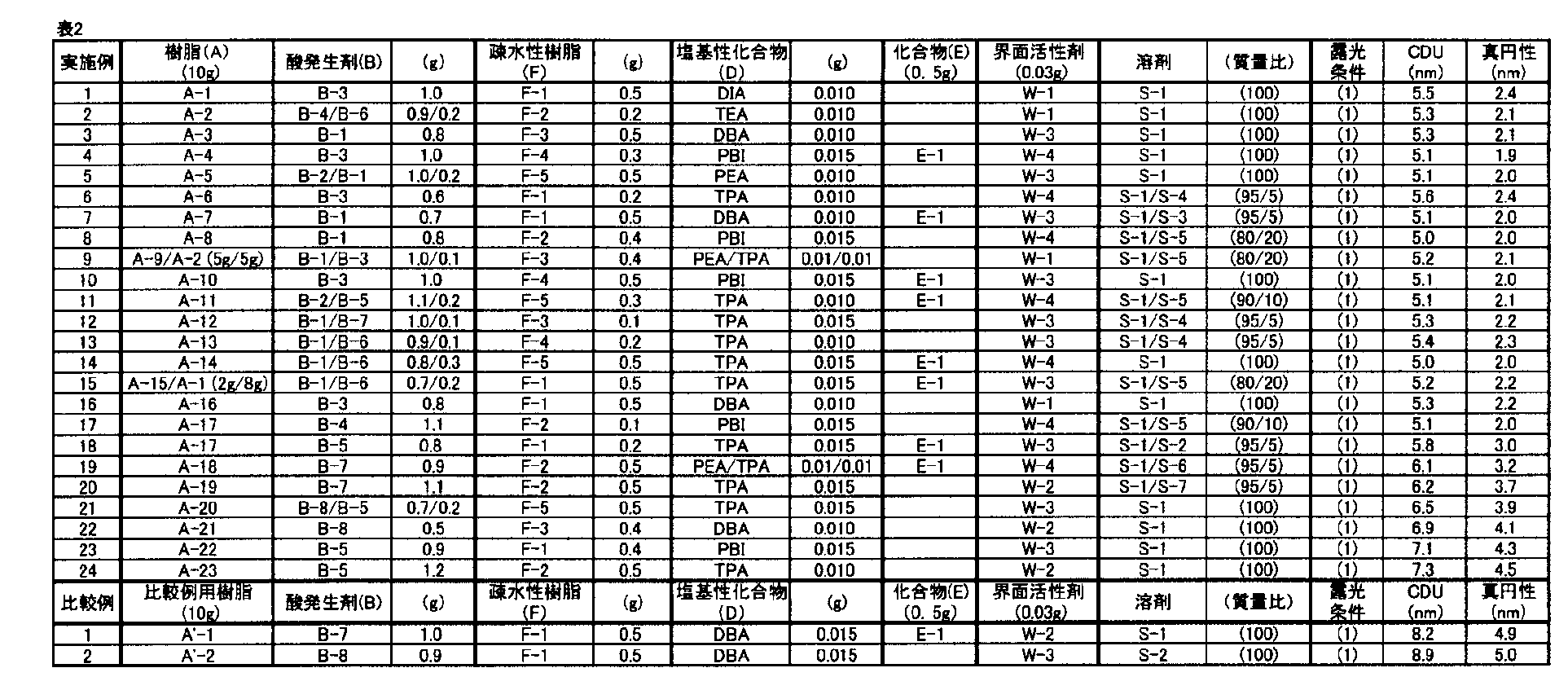

表中の略号は以下の通りである。
〔酸発生剤(B)〕
〔酸発生剤(B)〕

〔疎水性樹脂(F)〕
下記構造中、各繰り返し単位の組成比はモル比である。
下記構造中、各繰り返し単位の組成比はモル比である。
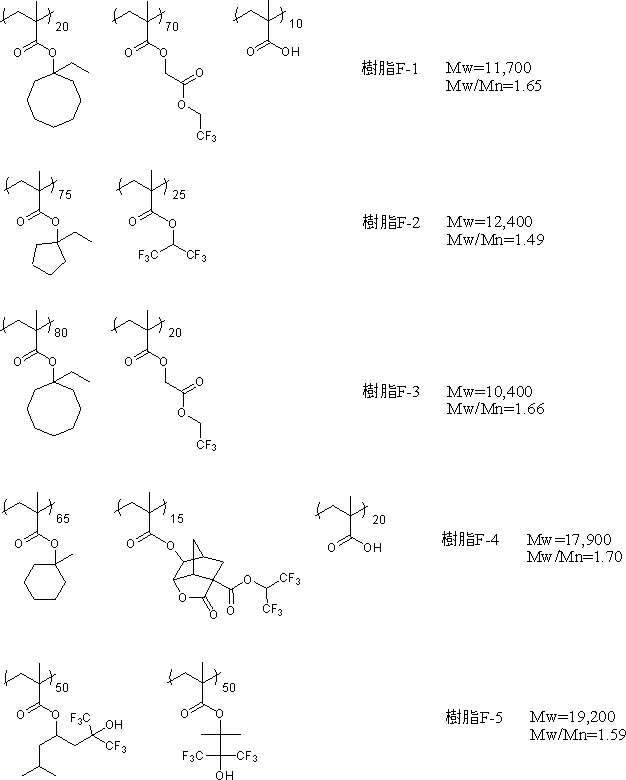
〔塩基性化合物(D)〕
DIA:2,6-ジイソプロピルアニリン
TEA:トリエタノールアミン
DBA:N,N-ジブチルアニリン
PBI:2-フェニルベンズイミダゾール
PEA:N-フェニルジエタノールアミン
TPA:トリ-n-ペンチルアミン
DIA:2,6-ジイソプロピルアニリン
TEA:トリエタノールアミン
DBA:N,N-ジブチルアニリン
PBI:2-フェニルベンズイミダゾール
PEA:N-フェニルジエタノールアミン
TPA:トリ-n-ペンチルアミン
〔化合物(E)〕
E-1:サリチル酸
E-1:サリチル酸
〔界面活性剤〕
W-1:メガファックF176(DIC(株)製)(フッ素系)
W-2:メガファックR08(DIC(株)製)(フッ素及びシリコン系)
W-3:PF6320(OMNOVA Solutions Inc.製)(フッ素系)
W-4:トロイゾルS-366(トロイケミカル(株)製)
W-1:メガファックF176(DIC(株)製)(フッ素系)
W-2:メガファックR08(DIC(株)製)(フッ素及びシリコン系)
W-3:PF6320(OMNOVA Solutions Inc.製)(フッ素系)
W-4:トロイゾルS-366(トロイケミカル(株)製)
〔溶剤〕
S-1:プロピレングリコールモノメチルエーテルアセテート(PGMEA;1-メトキシ-2-アセトキシプロパン)
S-2:2-ヘプタノン
S-3:シクロヘキサノン
S-4:γ-ブチロラクトン
S-5:プロピレングリコールモノメチルエーテル(PGME;1-メトキシ-2-プロパノール)
S-6:乳酸エチル
S-7:プロピレンカーボネート
S-1:プロピレングリコールモノメチルエーテルアセテート(PGMEA;1-メトキシ-2-アセトキシプロパン)
S-2:2-ヘプタノン
S-3:シクロヘキサノン
S-4:γ-ブチロラクトン
S-5:プロピレングリコールモノメチルエーテル(PGME;1-メトキシ-2-プロパノール)
S-6:乳酸エチル
S-7:プロピレンカーボネート
上掲の表2及び表3から明らかなように、繰り返し単位(a0)を除く各繰り返し単位に対応する各モノマーのClogP値のモル平均値が2.0未満の樹脂を使用した比較例1~4は、ローカルCDU及び真円性の評価値が大きく、ローカルCDU及び真円性に劣ることが分かる。
一方、繰り返し単位(a0)を除く各繰り返し単位に対応する各モノマーのClogP値のモル平均値が2.0以上の樹脂(A)を使用した実施例1~38は、ローカルCDU及び真円性の評価値が小さく、ローカルCDU及び真円性に優れることが分かる。
一方、繰り返し単位(a0)を除く各繰り返し単位に対応する各モノマーのClogP値のモル平均値が2.0以上の樹脂(A)を使用した実施例1~38は、ローカルCDU及び真円性の評価値が小さく、ローカルCDU及び真円性に優れることが分かる。
本発明のパターン形成方法は、各種の半導体素子、記録媒体などの電子デバイスの製造におけるリソグラフィープロセスにおいて、好適に用いることができる。
本発明によれば、孔径75nm以下(好ましくは孔径45nm以下)のホールパターンなどの微細パターンの有機系現像液による形成において、局所的なパターン寸法の均一性及び真円性に優れるパターン形成方法、それに用いられる感活性光線性又は感放射線性樹脂組成物、及びレジスト膜、並びにこれらを用いる電子デバイスの製造方法及び電子デバイスを提供することができる。
本発明を詳細にまた特定の実施態様を参照して説明したが、本発明の精神と範囲を逸脱することなく様々な変更や修正を加えることができることは当業者にとって明らかである。
本出願は、2012年10月31日出願の日本特許出願(特願2012-240415)に基づくものであり、その内容はここに参照として取り込まれる。
本出願は、2012年10月31日出願の日本特許出願(特願2012-240415)に基づくものであり、その内容はここに参照として取り込まれる。
Claims (12)
- (ア)下記樹脂(A)及び下記化合物(B)を含有する感活性光線性又は感放射線性樹脂組成物によって膜を形成する工程、
(A)-SO2-基を有する繰り返し単位(a0)及び酸の作用により分解して極性基を生じる基を有する繰り返し単位(a1)を含有し、前記繰り返し単位(a0)を除く各繰り返し単位に対応する各モノマーのClogP値のモル平均値が2.0以上の樹脂、及び
(B)活性光線又は放射線の照射により酸を発生する化合物
(イ)該膜を露光する工程、及び
(ウ)該露光された膜を、有機溶剤を含む現像液を用いて現像してネガ型のパターンを形成する工程を有するパターン形成方法。 - 前記酸の作用により分解して極性基を生じる基を有する繰り返し単位(a1)の含有量が、樹脂(A)の全繰り返し単位に対して50モル%以上である、請求項1に記載のパターン形成方法。
- 前記-SO2-基を有する繰り返し単位(a0)の含有量が、樹脂(A)の全繰り返し単位に対して1~20モル%である、請求項1又は2に記載のパターン形成方法。
- 前記樹脂(A)が、非酸分解型脂肪族炭化水素基を有する繰り返し単位(a2)を更に含有する請求項1~3のいずれか1項に記載のパターン形成方法。
- 前記繰り返し単位(a2)がアルコール性水酸基を有しない繰り返し単位である、請求項4に記載のパターン形成方法。
- 前記活性光線又は放射線の照射により酸を発生する化合物(B)が下記一般式(b3’)又は(b5’)で表される化合物である、請求項1~5のいずれか1項に記載のパターン形成方法。

上記一般式(b3’)及び(b5’)中、R1”~R3”はそれぞれ独立に、アリール基を表す。R1”~R3”のうち、いずれか2つが相互に結合して式中のイオウ原子と共に環を形成してもよい。
上記一般式(b3’)中、q3は1~12の整数であり、r2は0~3の整数であり、t3は1~3の整数であり、R7は置換基であり、R8は水素原子、又はアルキル基である。
上記一般式(b5’)中、pは1~3の整数であり、R7は置換基であり、Q”は、酸素原子若しくは硫黄原子を含んでいてもよいアルキレン基、酸素原子又は硫黄原子であり、n2は0又は1であり、v2は0~3の整数であり、w2は0~3の整数である。 - 前記繰り返し単位(a0)が、-SO2-O-基を有する繰り返し単位である、請求項1~6のいずれか1項に記載のパターン形成方法。
- 前記繰り返し単位(a0)が、-SO2-O-基を含有する環式基を有する繰り返し単位である、請求項7に記載のパターン形成方法。
- 請求項1~8のいずれか1項に記載のパターン形成方法に供せられる感活性光線性又は感放射線性樹脂組成物。
- 請求項9に記載の感活性光線性又は感放射線性樹脂組成物により形成されるレジスト膜。
- 請求項1~8のいずれか1項に記載のパターン形成方法を含む、電子デバイスの製造方法。
- 請求項11に記載の電子デバイスの製造方法により製造された電子デバイス。
Priority Applications (2)
| Application Number | Priority Date | Filing Date | Title |
|---|---|---|---|
| KR1020157010352A KR20150063085A (ko) | 2012-10-31 | 2013-10-28 | 패턴 형성 방법, 감활성광선성 또는 감방사선성 수지 조성물, 레지스트막, 전자 디바이스의 제조 방법 및 전자 디바이스 |
| US14/698,863 US20150248054A1 (en) | 2012-10-31 | 2015-04-29 | Pattern forming method, actinic ray-sensitive or radiation-sensitive resin composition, resist film, method of manufacturing electronic device, and electronic device |
Applications Claiming Priority (2)
| Application Number | Priority Date | Filing Date | Title |
|---|---|---|---|
| JP2012-240415 | 2012-10-31 | ||
| JP2012240415A JP2014089404A (ja) | 2012-10-31 | 2012-10-31 | パターン形成方法、感活性光線性又は感放射線性樹脂組成物、レジスト膜、電子デバイスの製造方法及び電子デバイス |
Related Child Applications (1)
| Application Number | Title | Priority Date | Filing Date |
|---|---|---|---|
| US14/698,863 Continuation US20150248054A1 (en) | 2012-10-31 | 2015-04-29 | Pattern forming method, actinic ray-sensitive or radiation-sensitive resin composition, resist film, method of manufacturing electronic device, and electronic device |
Publications (1)
| Publication Number | Publication Date |
|---|---|
| WO2014069415A1 true WO2014069415A1 (ja) | 2014-05-08 |
Family
ID=50627320
Family Applications (1)
| Application Number | Title | Priority Date | Filing Date |
|---|---|---|---|
| PCT/JP2013/079167 Ceased WO2014069415A1 (ja) | 2012-10-31 | 2013-10-28 | パターン形成方法、感活性光線性又は感放射線性樹脂組成物、レジスト膜、電子デバイスの製造方法及び電子デバイス |
Country Status (5)
| Country | Link |
|---|---|
| US (1) | US20150248054A1 (ja) |
| JP (1) | JP2014089404A (ja) |
| KR (1) | KR20150063085A (ja) |
| TW (1) | TW201426186A (ja) |
| WO (1) | WO2014069415A1 (ja) |
Cited By (3)
| Publication number | Priority date | Publication date | Assignee | Title |
|---|---|---|---|---|
| JP2015145493A (ja) * | 2013-12-19 | 2015-08-13 | ローム アンド ハース エレクトロニック マテリアルズ エルエルシーRohm and Haas Electronic Materials LLC | 光酸発生共重合体および関連するフォトレジスト組成物、塗布基板、および電子デバイス形成方法 |
| US9639002B2 (en) * | 2014-10-02 | 2017-05-02 | Tokyo Ohka Kogyo Co., Ltd. | Method of forming resist pattern |
| US20180081277A1 (en) * | 2015-05-29 | 2018-03-22 | Fujifilm Corporation | Pattern forming method, resist pattern, method for manufacturing electronic device, and composition for forming upper layer film |
Families Citing this family (6)
| Publication number | Priority date | Publication date | Assignee | Title |
|---|---|---|---|---|
| US9772558B2 (en) | 2013-09-24 | 2017-09-26 | International Business Machines Corporation | Sulfonic acid ester containing polymers for organic solvent based dual-tone photoresists |
| JP6252157B2 (ja) * | 2013-12-16 | 2017-12-27 | 住友化学株式会社 | レジスト組成物及びレジストパターンの製造方法 |
| JP6482344B2 (ja) * | 2015-03-24 | 2019-03-13 | 東京応化工業株式会社 | レジスト組成物、レジストパターン形成方法、酸発生剤及び化合物 |
| JP6958071B2 (ja) * | 2016-08-09 | 2021-11-02 | 住友化学株式会社 | 酸発生剤、ジスト組成物及びレジストパターンの製造方法 |
| KR20200122354A (ko) * | 2018-03-26 | 2020-10-27 | 후지필름 가부시키가이샤 | 감광성 수지 조성물과 그 제조 방법, 레지스트막, 패턴 형성 방법, 및 전자 디바이스의 제조 방법 |
| JP7489229B2 (ja) * | 2019-05-17 | 2024-05-23 | 住友化学株式会社 | 塩、クエンチャー、レジスト組成物及びレジストパターンの製造方法 |
Citations (5)
| Publication number | Priority date | Publication date | Assignee | Title |
|---|---|---|---|---|
| JP2011191727A (ja) * | 2010-02-18 | 2011-09-29 | Tokyo Ohka Kogyo Co Ltd | レジストパターン形成方法、ネガ型現像用レジスト組成物 |
| JP2012168334A (ja) * | 2011-02-14 | 2012-09-06 | Tokyo Ohka Kogyo Co Ltd | レジストパターン形成方法 |
| JP2012173419A (ja) * | 2011-02-18 | 2012-09-10 | Tokyo Ohka Kogyo Co Ltd | レジスト組成物、レジストパターン形成方法 |
| JP5035466B1 (ja) * | 2011-02-04 | 2012-09-26 | Jsr株式会社 | レジストパターン形成用感放射線性樹脂組成物 |
| JP2013163652A (ja) * | 2012-02-10 | 2013-08-22 | Shin-Etsu Chemical Co Ltd | 単量体、高分子化合物、レジスト材料及びパターン形成方法 |
Family Cites Families (1)
| Publication number | Priority date | Publication date | Assignee | Title |
|---|---|---|---|---|
| JP5767919B2 (ja) * | 2010-09-17 | 2015-08-26 | 富士フイルム株式会社 | パターン形成方法 |
-
2012
- 2012-10-31 JP JP2012240415A patent/JP2014089404A/ja not_active Abandoned
-
2013
- 2013-10-28 WO PCT/JP2013/079167 patent/WO2014069415A1/ja not_active Ceased
- 2013-10-28 KR KR1020157010352A patent/KR20150063085A/ko not_active Ceased
- 2013-10-30 TW TW102139210A patent/TW201426186A/zh unknown
-
2015
- 2015-04-29 US US14/698,863 patent/US20150248054A1/en not_active Abandoned
Patent Citations (5)
| Publication number | Priority date | Publication date | Assignee | Title |
|---|---|---|---|---|
| JP2011191727A (ja) * | 2010-02-18 | 2011-09-29 | Tokyo Ohka Kogyo Co Ltd | レジストパターン形成方法、ネガ型現像用レジスト組成物 |
| JP5035466B1 (ja) * | 2011-02-04 | 2012-09-26 | Jsr株式会社 | レジストパターン形成用感放射線性樹脂組成物 |
| JP2012168334A (ja) * | 2011-02-14 | 2012-09-06 | Tokyo Ohka Kogyo Co Ltd | レジストパターン形成方法 |
| JP2012173419A (ja) * | 2011-02-18 | 2012-09-10 | Tokyo Ohka Kogyo Co Ltd | レジスト組成物、レジストパターン形成方法 |
| JP2013163652A (ja) * | 2012-02-10 | 2013-08-22 | Shin-Etsu Chemical Co Ltd | 単量体、高分子化合物、レジスト材料及びパターン形成方法 |
Cited By (4)
| Publication number | Priority date | Publication date | Assignee | Title |
|---|---|---|---|---|
| JP2015145493A (ja) * | 2013-12-19 | 2015-08-13 | ローム アンド ハース エレクトロニック マテリアルズ エルエルシーRohm and Haas Electronic Materials LLC | 光酸発生共重合体および関連するフォトレジスト組成物、塗布基板、および電子デバイス形成方法 |
| US9639002B2 (en) * | 2014-10-02 | 2017-05-02 | Tokyo Ohka Kogyo Co., Ltd. | Method of forming resist pattern |
| US20180081277A1 (en) * | 2015-05-29 | 2018-03-22 | Fujifilm Corporation | Pattern forming method, resist pattern, method for manufacturing electronic device, and composition for forming upper layer film |
| US10852637B2 (en) * | 2015-05-29 | 2020-12-01 | Fujifilm Corporation | Pattern forming method, resist pattern, method for manufacturing electronic device, and composition for forming upper layer film |
Also Published As
| Publication number | Publication date |
|---|---|
| JP2014089404A (ja) | 2014-05-15 |
| TW201426186A (zh) | 2014-07-01 |
| US20150248054A1 (en) | 2015-09-03 |
| KR20150063085A (ko) | 2015-06-08 |
Similar Documents
| Publication | Publication Date | Title |
|---|---|---|
| JP5978137B2 (ja) | レジスト組成物、レジストパターン形成方法 | |
| JP5677135B2 (ja) | レジスト組成物、レジストパターン形成方法および高分子化合物 | |
| TWI536096B (zh) | 光阻組成物,光阻圖型之形成方法,高分子化合物 | |
| JP5639795B2 (ja) | レジストパターン形成方法 | |
| JP6243608B2 (ja) | 化合物、高分子化合物、レジスト組成物、レジストパターン形成方法 | |
| TWI389922B (zh) | 高分子化合物,正型光阻組成物,及光阻圖型之形成方法 | |
| WO2014069415A1 (ja) | パターン形成方法、感活性光線性又は感放射線性樹脂組成物、レジスト膜、電子デバイスの製造方法及び電子デバイス | |
| JP6118533B2 (ja) | 化合物、レジスト組成物、レジストパターン形成方法。 | |
| JP6084157B2 (ja) | レジストパターン形成方法 | |
| TWI395066B (zh) | 正型光阻組成物及光阻圖型之形成方法 | |
| JP2011043749A (ja) | ポジ型レジスト組成物、レジストパターン形成方法、高分子化合物 | |
| JP2014006489A (ja) | レジスト組成物、レジストパターン形成方法、化合物 | |
| JP6106432B2 (ja) | レジスト組成物、レジストパターン形成方法、高分子化合物 | |
| KR102176070B1 (ko) | 레지스트 조성물, 레지스트 패턴 형성 방법 | |
| JP2014153440A (ja) | レジスト組成物、高分子化合物、化合物及びレジストパターン形成方法 | |
| TWI596121B (zh) | 高分子化合物之製造方法,光阻組成物及光阻圖型之形成方法 | |
| JP2013160813A (ja) | レジスト組成物及びパターン形成方法 | |
| CN108693711A (zh) | 抗蚀剂组合物及抗蚀图案形成方法以及化合物及酸扩散控制剂 | |
| JP6368558B2 (ja) | レジスト組成物、レジストパターン形成方法及び高分子化合物 | |
| KR20210069571A (ko) | 레지스트 조성물 및 레지스트 패턴 형성 방법 | |
| JP5308871B2 (ja) | レジスト組成物、レジストパターン形成方法 | |
| JP2016180881A (ja) | レジスト組成物、レジストパターン形成方法、光反応性クエンチャー及び化合物 | |
| KR102049120B1 (ko) | 레지스트 조성물, 레지스트 패턴 형성 방법 및 화합물 | |
| JP2013190637A (ja) | 溶剤現像ネガ型レジスト組成物、レジストパターン形成方法 | |
| TWI585113B (zh) | 高分子化合物之製造方法、光阻組成物、光阻圖型之形成方法 |
Legal Events
| Date | Code | Title | Description |
|---|---|---|---|
| 121 | Ep: the epo has been informed by wipo that ep was designated in this application |
Ref document number: 13850849 Country of ref document: EP Kind code of ref document: A1 |
|
| ENP | Entry into the national phase |
Ref document number: 20157010352 Country of ref document: KR Kind code of ref document: A |
|
| NENP | Non-entry into the national phase |
Ref country code: DE |
|
| 122 | Ep: pct application non-entry in european phase |
Ref document number: 13850849 Country of ref document: EP Kind code of ref document: A1 |