WO2014048542A1 - Materialien für organische elektrolumineszenzvorrichtungen - Google Patents
Materialien für organische elektrolumineszenzvorrichtungen Download PDFInfo
- Publication number
- WO2014048542A1 WO2014048542A1 PCT/EP2013/002672 EP2013002672W WO2014048542A1 WO 2014048542 A1 WO2014048542 A1 WO 2014048542A1 EP 2013002672 W EP2013002672 W EP 2013002672W WO 2014048542 A1 WO2014048542 A1 WO 2014048542A1
- Authority
- WO
- WIPO (PCT)
- Prior art keywords
- formula
- atoms
- radical
- occurrence
- substituted
- Prior art date
- Legal status (The legal status is an assumption and is not a legal conclusion. Google has not performed a legal analysis and makes no representation as to the accuracy of the status listed.)
- Ceased
Links
- 0 CC(c1c2)(c(cc(cc3)N(c4ccc(C)cc4)c4cc(O*)cc(*)c4)c3-c1cc(C(*)(*)c1c3)c2-c1ccc3N(c1ccc(C)cc1)c1cc(*)cc(*)c1)I Chemical compound CC(c1c2)(c(cc(cc3)N(c4ccc(C)cc4)c4cc(O*)cc(*)c4)c3-c1cc(C(*)(*)c1c3)c2-c1ccc3N(c1ccc(C)cc1)c1cc(*)cc(*)c1)I 0.000 description 7
- VSQXFWPDQQZSOA-UHFFFAOYSA-N Cc1ccc(-c2ccc(-c3ccc[s]3)[s]2)[s]1 Chemical compound Cc1ccc(-c2ccc(-c3ccc[s]3)[s]2)[s]1 VSQXFWPDQQZSOA-UHFFFAOYSA-N 0.000 description 1
Classifications
-
- C—CHEMISTRY; METALLURGY
- C08—ORGANIC MACROMOLECULAR COMPOUNDS; THEIR PREPARATION OR CHEMICAL WORKING-UP; COMPOSITIONS BASED THEREON
- C08G—MACROMOLECULAR COMPOUNDS OBTAINED OTHERWISE THAN BY REACTIONS ONLY INVOLVING UNSATURATED CARBON-TO-CARBON BONDS
- C08G61/00—Macromolecular compounds obtained by reactions forming a carbon-to-carbon link in the main chain of the macromolecule
- C08G61/12—Macromolecular compounds containing atoms other than carbon in the main chain of the macromolecule
-
- C—CHEMISTRY; METALLURGY
- C09—DYES; PAINTS; POLISHES; NATURAL RESINS; ADHESIVES; COMPOSITIONS NOT OTHERWISE PROVIDED FOR; APPLICATIONS OF MATERIALS NOT OTHERWISE PROVIDED FOR
- C09K—MATERIALS FOR MISCELLANEOUS APPLICATIONS, NOT PROVIDED FOR ELSEWHERE
- C09K11/00—Luminescent materials, e.g. electroluminescent or chemiluminescent
- C09K11/02—Use of particular materials as binders, particle coatings or suspension media therefor
- C09K11/025—Use of particular materials as binders, particle coatings or suspension media therefor non-luminescent particle coatings or suspension media
-
- C—CHEMISTRY; METALLURGY
- C09—DYES; PAINTS; POLISHES; NATURAL RESINS; ADHESIVES; COMPOSITIONS NOT OTHERWISE PROVIDED FOR; APPLICATIONS OF MATERIALS NOT OTHERWISE PROVIDED FOR
- C09K—MATERIALS FOR MISCELLANEOUS APPLICATIONS, NOT PROVIDED FOR ELSEWHERE
- C09K11/00—Luminescent materials, e.g. electroluminescent or chemiluminescent
- C09K11/06—Luminescent materials, e.g. electroluminescent or chemiluminescent containing organic luminescent materials
-
- H—ELECTRICITY
- H10—SEMICONDUCTOR DEVICES; ELECTRIC SOLID-STATE DEVICES NOT OTHERWISE PROVIDED FOR
- H10K—ORGANIC ELECTRIC SOLID-STATE DEVICES
- H10K50/00—Organic light-emitting devices
- H10K50/10—OLEDs or polymer light-emitting diodes [PLED]
- H10K50/14—Carrier transporting layers
- H10K50/15—Hole transporting layers
- H10K50/155—Hole transporting layers comprising dopants
-
- H—ELECTRICITY
- H10—SEMICONDUCTOR DEVICES; ELECTRIC SOLID-STATE DEVICES NOT OTHERWISE PROVIDED FOR
- H10K—ORGANIC ELECTRIC SOLID-STATE DEVICES
- H10K71/00—Manufacture or treatment specially adapted for the organic devices covered by this subclass
- H10K71/30—Doping active layers, e.g. electron transporting layers
-
- H—ELECTRICITY
- H10—SEMICONDUCTOR DEVICES; ELECTRIC SOLID-STATE DEVICES NOT OTHERWISE PROVIDED FOR
- H10K—ORGANIC ELECTRIC SOLID-STATE DEVICES
- H10K85/00—Organic materials used in the body or electrodes of devices covered by this subclass
- H10K85/10—Organic polymers or oligomers
- H10K85/111—Organic polymers or oligomers comprising aromatic, heteroaromatic, or aryl chains, e.g. polyaniline, polyphenylene or polyphenylene vinylene
-
- H—ELECTRICITY
- H10—SEMICONDUCTOR DEVICES; ELECTRIC SOLID-STATE DEVICES NOT OTHERWISE PROVIDED FOR
- H10K—ORGANIC ELECTRIC SOLID-STATE DEVICES
- H10K85/00—Organic materials used in the body or electrodes of devices covered by this subclass
- H10K85/10—Organic polymers or oligomers
- H10K85/111—Organic polymers or oligomers comprising aromatic, heteroaromatic, or aryl chains, e.g. polyaniline, polyphenylene or polyphenylene vinylene
- H10K85/113—Heteroaromatic compounds comprising sulfur or selene, e.g. polythiophene
-
- H—ELECTRICITY
- H10—SEMICONDUCTOR DEVICES; ELECTRIC SOLID-STATE DEVICES NOT OTHERWISE PROVIDED FOR
- H10K—ORGANIC ELECTRIC SOLID-STATE DEVICES
- H10K85/00—Organic materials used in the body or electrodes of devices covered by this subclass
- H10K85/10—Organic polymers or oligomers
- H10K85/111—Organic polymers or oligomers comprising aromatic, heteroaromatic, or aryl chains, e.g. polyaniline, polyphenylene or polyphenylene vinylene
- H10K85/115—Polyfluorene; Derivatives thereof
-
- H—ELECTRICITY
- H10—SEMICONDUCTOR DEVICES; ELECTRIC SOLID-STATE DEVICES NOT OTHERWISE PROVIDED FOR
- H10K—ORGANIC ELECTRIC SOLID-STATE DEVICES
- H10K85/00—Organic materials used in the body or electrodes of devices covered by this subclass
- H10K85/10—Organic polymers or oligomers
- H10K85/151—Copolymers
-
- H—ELECTRICITY
- H10—SEMICONDUCTOR DEVICES; ELECTRIC SOLID-STATE DEVICES NOT OTHERWISE PROVIDED FOR
- H10K—ORGANIC ELECTRIC SOLID-STATE DEVICES
- H10K85/00—Organic materials used in the body or electrodes of devices covered by this subclass
- H10K85/30—Coordination compounds
- H10K85/341—Transition metal complexes, e.g. Ru(II)polypyridine complexes
- H10K85/342—Transition metal complexes, e.g. Ru(II)polypyridine complexes comprising iridium
-
- C—CHEMISTRY; METALLURGY
- C08—ORGANIC MACROMOLECULAR COMPOUNDS; THEIR PREPARATION OR CHEMICAL WORKING-UP; COMPOSITIONS BASED THEREON
- C08G—MACROMOLECULAR COMPOUNDS OBTAINED OTHERWISE THAN BY REACTIONS ONLY INVOLVING UNSATURATED CARBON-TO-CARBON BONDS
- C08G2261/00—Macromolecular compounds obtained by reactions forming a carbon-to-carbon link in the main chain of the macromolecule
- C08G2261/10—Definition of the polymer structure
- C08G2261/13—Morphological aspects
- C08G2261/135—Cross-linked structures
-
- C—CHEMISTRY; METALLURGY
- C08—ORGANIC MACROMOLECULAR COMPOUNDS; THEIR PREPARATION OR CHEMICAL WORKING-UP; COMPOSITIONS BASED THEREON
- C08G—MACROMOLECULAR COMPOUNDS OBTAINED OTHERWISE THAN BY REACTIONS ONLY INVOLVING UNSATURATED CARBON-TO-CARBON BONDS
- C08G2261/00—Macromolecular compounds obtained by reactions forming a carbon-to-carbon link in the main chain of the macromolecule
- C08G2261/10—Definition of the polymer structure
- C08G2261/14—Side-groups
- C08G2261/141—Side-chains having aliphatic units
- C08G2261/1412—Saturated aliphatic units
-
- C—CHEMISTRY; METALLURGY
- C08—ORGANIC MACROMOLECULAR COMPOUNDS; THEIR PREPARATION OR CHEMICAL WORKING-UP; COMPOSITIONS BASED THEREON
- C08G—MACROMOLECULAR COMPOUNDS OBTAINED OTHERWISE THAN BY REACTIONS ONLY INVOLVING UNSATURATED CARBON-TO-CARBON BONDS
- C08G2261/00—Macromolecular compounds obtained by reactions forming a carbon-to-carbon link in the main chain of the macromolecule
- C08G2261/10—Definition of the polymer structure
- C08G2261/14—Side-groups
- C08G2261/141—Side-chains having aliphatic units
- C08G2261/1414—Unsaturated aliphatic units
-
- C—CHEMISTRY; METALLURGY
- C08—ORGANIC MACROMOLECULAR COMPOUNDS; THEIR PREPARATION OR CHEMICAL WORKING-UP; COMPOSITIONS BASED THEREON
- C08G—MACROMOLECULAR COMPOUNDS OBTAINED OTHERWISE THAN BY REACTIONS ONLY INVOLVING UNSATURATED CARBON-TO-CARBON BONDS
- C08G2261/00—Macromolecular compounds obtained by reactions forming a carbon-to-carbon link in the main chain of the macromolecule
- C08G2261/10—Definition of the polymer structure
- C08G2261/14—Side-groups
- C08G2261/142—Side-chains containing oxygen
- C08G2261/1424—Side-chains containing oxygen containing ether groups, including alkoxy
-
- C—CHEMISTRY; METALLURGY
- C08—ORGANIC MACROMOLECULAR COMPOUNDS; THEIR PREPARATION OR CHEMICAL WORKING-UP; COMPOSITIONS BASED THEREON
- C08G—MACROMOLECULAR COMPOUNDS OBTAINED OTHERWISE THAN BY REACTIONS ONLY INVOLVING UNSATURATED CARBON-TO-CARBON BONDS
- C08G2261/00—Macromolecular compounds obtained by reactions forming a carbon-to-carbon link in the main chain of the macromolecule
- C08G2261/30—Monomer units or repeat units incorporating structural elements in the main chain
- C08G2261/31—Monomer units or repeat units incorporating structural elements in the main chain incorporating aromatic structural elements in the main chain
- C08G2261/314—Condensed aromatic systems, e.g. perylene, anthracene or pyrene
-
- C—CHEMISTRY; METALLURGY
- C08—ORGANIC MACROMOLECULAR COMPOUNDS; THEIR PREPARATION OR CHEMICAL WORKING-UP; COMPOSITIONS BASED THEREON
- C08G—MACROMOLECULAR COMPOUNDS OBTAINED OTHERWISE THAN BY REACTIONS ONLY INVOLVING UNSATURATED CARBON-TO-CARBON BONDS
- C08G2261/00—Macromolecular compounds obtained by reactions forming a carbon-to-carbon link in the main chain of the macromolecule
- C08G2261/30—Monomer units or repeat units incorporating structural elements in the main chain
- C08G2261/31—Monomer units or repeat units incorporating structural elements in the main chain incorporating aromatic structural elements in the main chain
- C08G2261/314—Condensed aromatic systems, e.g. perylene, anthracene or pyrene
- C08G2261/3142—Condensed aromatic systems, e.g. perylene, anthracene or pyrene fluorene-based, e.g. fluorene, indenofluorene, or spirobifluorene
-
- C—CHEMISTRY; METALLURGY
- C08—ORGANIC MACROMOLECULAR COMPOUNDS; THEIR PREPARATION OR CHEMICAL WORKING-UP; COMPOSITIONS BASED THEREON
- C08G—MACROMOLECULAR COMPOUNDS OBTAINED OTHERWISE THAN BY REACTIONS ONLY INVOLVING UNSATURATED CARBON-TO-CARBON BONDS
- C08G2261/00—Macromolecular compounds obtained by reactions forming a carbon-to-carbon link in the main chain of the macromolecule
- C08G2261/30—Monomer units or repeat units incorporating structural elements in the main chain
- C08G2261/31—Monomer units or repeat units incorporating structural elements in the main chain incorporating aromatic structural elements in the main chain
- C08G2261/316—Monomer units or repeat units incorporating structural elements in the main chain incorporating aromatic structural elements in the main chain bridged by heteroatoms, e.g. N, P, Si or B
- C08G2261/3162—Arylamines
-
- C—CHEMISTRY; METALLURGY
- C08—ORGANIC MACROMOLECULAR COMPOUNDS; THEIR PREPARATION OR CHEMICAL WORKING-UP; COMPOSITIONS BASED THEREON
- C08G—MACROMOLECULAR COMPOUNDS OBTAINED OTHERWISE THAN BY REACTIONS ONLY INVOLVING UNSATURATED CARBON-TO-CARBON BONDS
- C08G2261/00—Macromolecular compounds obtained by reactions forming a carbon-to-carbon link in the main chain of the macromolecule
- C08G2261/30—Monomer units or repeat units incorporating structural elements in the main chain
- C08G2261/32—Monomer units or repeat units incorporating structural elements in the main chain incorporating heteroaromatic structural elements in the main chain
- C08G2261/322—Monomer units or repeat units incorporating structural elements in the main chain incorporating heteroaromatic structural elements in the main chain non-condensed
- C08G2261/3223—Monomer units or repeat units incorporating structural elements in the main chain incorporating heteroaromatic structural elements in the main chain non-condensed containing one or more sulfur atoms as the only heteroatom, e.g. thiophene
-
- C—CHEMISTRY; METALLURGY
- C08—ORGANIC MACROMOLECULAR COMPOUNDS; THEIR PREPARATION OR CHEMICAL WORKING-UP; COMPOSITIONS BASED THEREON
- C08G—MACROMOLECULAR COMPOUNDS OBTAINED OTHERWISE THAN BY REACTIONS ONLY INVOLVING UNSATURATED CARBON-TO-CARBON BONDS
- C08G2261/00—Macromolecular compounds obtained by reactions forming a carbon-to-carbon link in the main chain of the macromolecule
- C08G2261/30—Monomer units or repeat units incorporating structural elements in the main chain
- C08G2261/32—Monomer units or repeat units incorporating structural elements in the main chain incorporating heteroaromatic structural elements in the main chain
- C08G2261/324—Monomer units or repeat units incorporating structural elements in the main chain incorporating heteroaromatic structural elements in the main chain condensed
- C08G2261/3243—Monomer units or repeat units incorporating structural elements in the main chain incorporating heteroaromatic structural elements in the main chain condensed containing one or more sulfur atoms as the only heteroatom, e.g. benzothiophene
-
- C—CHEMISTRY; METALLURGY
- C08—ORGANIC MACROMOLECULAR COMPOUNDS; THEIR PREPARATION OR CHEMICAL WORKING-UP; COMPOSITIONS BASED THEREON
- C08G—MACROMOLECULAR COMPOUNDS OBTAINED OTHERWISE THAN BY REACTIONS ONLY INVOLVING UNSATURATED CARBON-TO-CARBON BONDS
- C08G2261/00—Macromolecular compounds obtained by reactions forming a carbon-to-carbon link in the main chain of the macromolecule
- C08G2261/30—Monomer units or repeat units incorporating structural elements in the main chain
- C08G2261/34—Monomer units or repeat units incorporating structural elements in the main chain incorporating partially-aromatic structural elements in the main chain
- C08G2261/342—Monomer units or repeat units incorporating structural elements in the main chain incorporating partially-aromatic structural elements in the main chain containing only carbon atoms
-
- C—CHEMISTRY; METALLURGY
- C08—ORGANIC MACROMOLECULAR COMPOUNDS; THEIR PREPARATION OR CHEMICAL WORKING-UP; COMPOSITIONS BASED THEREON
- C08G—MACROMOLECULAR COMPOUNDS OBTAINED OTHERWISE THAN BY REACTIONS ONLY INVOLVING UNSATURATED CARBON-TO-CARBON BONDS
- C08G2261/00—Macromolecular compounds obtained by reactions forming a carbon-to-carbon link in the main chain of the macromolecule
- C08G2261/40—Polymerisation processes
- C08G2261/41—Organometallic coupling reactions
- C08G2261/411—Suzuki reactions
-
- C—CHEMISTRY; METALLURGY
- C08—ORGANIC MACROMOLECULAR COMPOUNDS; THEIR PREPARATION OR CHEMICAL WORKING-UP; COMPOSITIONS BASED THEREON
- C08G—MACROMOLECULAR COMPOUNDS OBTAINED OTHERWISE THAN BY REACTIONS ONLY INVOLVING UNSATURATED CARBON-TO-CARBON BONDS
- C08G2261/00—Macromolecular compounds obtained by reactions forming a carbon-to-carbon link in the main chain of the macromolecule
- C08G2261/50—Physical properties
- C08G2261/51—Charge transport
- C08G2261/512—Hole transport
-
- C—CHEMISTRY; METALLURGY
- C08—ORGANIC MACROMOLECULAR COMPOUNDS; THEIR PREPARATION OR CHEMICAL WORKING-UP; COMPOSITIONS BASED THEREON
- C08G—MACROMOLECULAR COMPOUNDS OBTAINED OTHERWISE THAN BY REACTIONS ONLY INVOLVING UNSATURATED CARBON-TO-CARBON BONDS
- C08G2261/00—Macromolecular compounds obtained by reactions forming a carbon-to-carbon link in the main chain of the macromolecule
- C08G2261/70—Post-treatment
- C08G2261/76—Post-treatment crosslinking
-
- C—CHEMISTRY; METALLURGY
- C08—ORGANIC MACROMOLECULAR COMPOUNDS; THEIR PREPARATION OR CHEMICAL WORKING-UP; COMPOSITIONS BASED THEREON
- C08G—MACROMOLECULAR COMPOUNDS OBTAINED OTHERWISE THAN BY REACTIONS ONLY INVOLVING UNSATURATED CARBON-TO-CARBON BONDS
- C08G2261/00—Macromolecular compounds obtained by reactions forming a carbon-to-carbon link in the main chain of the macromolecule
- C08G2261/70—Post-treatment
- C08G2261/79—Post-treatment doping
- C08G2261/792—Post-treatment doping with low-molecular weight dopants
-
- C—CHEMISTRY; METALLURGY
- C08—ORGANIC MACROMOLECULAR COMPOUNDS; THEIR PREPARATION OR CHEMICAL WORKING-UP; COMPOSITIONS BASED THEREON
- C08G—MACROMOLECULAR COMPOUNDS OBTAINED OTHERWISE THAN BY REACTIONS ONLY INVOLVING UNSATURATED CARBON-TO-CARBON BONDS
- C08G2261/00—Macromolecular compounds obtained by reactions forming a carbon-to-carbon link in the main chain of the macromolecule
- C08G2261/90—Applications
- C08G2261/95—Use in organic luminescent diodes
-
- C—CHEMISTRY; METALLURGY
- C09—DYES; PAINTS; POLISHES; NATURAL RESINS; ADHESIVES; COMPOSITIONS NOT OTHERWISE PROVIDED FOR; APPLICATIONS OF MATERIALS NOT OTHERWISE PROVIDED FOR
- C09K—MATERIALS FOR MISCELLANEOUS APPLICATIONS, NOT PROVIDED FOR ELSEWHERE
- C09K2211/00—Chemical nature of organic luminescent or tenebrescent compounds
- C09K2211/18—Metal complexes
- C09K2211/185—Metal complexes of the platinum group, i.e. Os, Ir, Pt, Ru, Rh or Pd
-
- H—ELECTRICITY
- H10—SEMICONDUCTOR DEVICES; ELECTRIC SOLID-STATE DEVICES NOT OTHERWISE PROVIDED FOR
- H10K—ORGANIC ELECTRIC SOLID-STATE DEVICES
- H10K2101/00—Properties of the organic materials covered by group H10K85/00
- H10K2101/10—Triplet emission
-
- H—ELECTRICITY
- H10—SEMICONDUCTOR DEVICES; ELECTRIC SOLID-STATE DEVICES NOT OTHERWISE PROVIDED FOR
- H10K—ORGANIC ELECTRIC SOLID-STATE DEVICES
- H10K30/00—Organic devices sensitive to infrared radiation, light, electromagnetic radiation of shorter wavelength or corpuscular radiation
- H10K30/80—Constructional details
- H10K30/865—Intermediate layers comprising a mixture of materials of the adjoining active layers
-
- H—ELECTRICITY
- H10—SEMICONDUCTOR DEVICES; ELECTRIC SOLID-STATE DEVICES NOT OTHERWISE PROVIDED FOR
- H10K—ORGANIC ELECTRIC SOLID-STATE DEVICES
- H10K50/00—Organic light-emitting devices
- H10K50/10—OLEDs or polymer light-emitting diodes [PLED]
- H10K50/11—OLEDs or polymer light-emitting diodes [PLED] characterised by the electroluminescent [EL] layers
-
- H—ELECTRICITY
- H10—SEMICONDUCTOR DEVICES; ELECTRIC SOLID-STATE DEVICES NOT OTHERWISE PROVIDED FOR
- H10K—ORGANIC ELECTRIC SOLID-STATE DEVICES
- H10K50/00—Organic light-emitting devices
- H10K50/10—OLEDs or polymer light-emitting diodes [PLED]
- H10K50/17—Carrier injection layers
-
- H—ELECTRICITY
- H10—SEMICONDUCTOR DEVICES; ELECTRIC SOLID-STATE DEVICES NOT OTHERWISE PROVIDED FOR
- H10K—ORGANIC ELECTRIC SOLID-STATE DEVICES
- H10K50/00—Organic light-emitting devices
- H10K50/80—Constructional details
- H10K50/805—Electrodes
- H10K50/81—Anodes
-
- H—ELECTRICITY
- H10—SEMICONDUCTOR DEVICES; ELECTRIC SOLID-STATE DEVICES NOT OTHERWISE PROVIDED FOR
- H10K—ORGANIC ELECTRIC SOLID-STATE DEVICES
- H10K50/00—Organic light-emitting devices
- H10K50/80—Constructional details
- H10K50/805—Electrodes
- H10K50/82—Cathodes
-
- Y—GENERAL TAGGING OF NEW TECHNOLOGICAL DEVELOPMENTS; GENERAL TAGGING OF CROSS-SECTIONAL TECHNOLOGIES SPANNING OVER SEVERAL SECTIONS OF THE IPC; TECHNICAL SUBJECTS COVERED BY FORMER USPC CROSS-REFERENCE ART COLLECTIONS [XRACs] AND DIGESTS
- Y02—TECHNOLOGIES OR APPLICATIONS FOR MITIGATION OR ADAPTATION AGAINST CLIMATE CHANGE
- Y02E—REDUCTION OF GREENHOUSE GAS [GHG] EMISSIONS, RELATED TO ENERGY GENERATION, TRANSMISSION OR DISTRIBUTION
- Y02E10/00—Energy generation through renewable energy sources
- Y02E10/50—Photovoltaic [PV] energy
- Y02E10/549—Organic PV cells
Definitions
- the present invention relates to an organic composition containing a conjugated polymer as a hole transporting compound and a doping compound. Furthermore, the present invention relates to the use of the composition according to the invention in organic electroluminescent devices, in particular in the so-called buffer layer of such devices. The present invention also relates to a formulation which contains the composition according to the invention and a solvent and to an organic electroluminescent device which contains the composition according to the invention.
- FIG. 1 shows an OLED which consists of several layers.
- Such an OLED preferably comprises a cathode, an emitting layer (EML), an intermediate layer (interlayer), a buffer layer and as an anode indium tin oxide (ITO).
- EML emitting layer
- interlayer intermediate layer
- ITO an anode indium tin oxide
- Buffer layers generally have a major influence on the performance of the PLEDs / OLEDs. They usually have two distinct functions: 1) smoothing the surface of the ITO to avoid the formation of so-called “dark spots”; 2) promoting hole injection into the organic layer.
- composition comprising as a buffer layer with a
- an organic composition comprising the following components: a) a hole transport compound, and a dopant compound selected from ionic compounds wherein the hole transport compound is a conjugated polymer comprising a polymer segment of the general formula (1); it consists of:
- B is a repeat unit which is identically or differently selected on each occurrence from the group consisting of amine, triarylamine, thiophene, carbazole, phenanthrene, dehydrophenanthrene, fluorene, spirobifluorene, benzofluorene, dibenzofluorene, indenofluorene, indolocarbazoles and derivatives thereof, triarylamine, phenanthrene or a derivative of these is preferred;
- A is a repeating unit which is identically or differently selected on each occurrence from the group consisting of phenylenevinylene, phenanthrene, dehydrophenanthrene, fluorene, spirobifluorene, benzofluorene, dibenzofluorene, Indenofluorene, indolocarbazole and their derivatives, with fluorene, indenofluorene, spirobifluorene, phenanthrene or derivative thereof being preferred;
- the units A and B are present as repeating units in the conjugated polymer; the ratio of units A and B to each other may be expressed by the ratio x: y, and is preferably in the range of 9: 1 to 1: 9, more preferably 6: 1 to 1: 6, and most preferably in the range of 3: 2 to 2: 3; is 0, 1, 2, 3 or 4, with 0 or 1, preferably and 0 being particularly preferred; is greater than or equal to 1, wherein 1, 2 or 3 is preferred and 1 or 2 is particularly preferred.
- repeating units A and B are different from each other. Examples of repeating units which fall under the abovementioned compounds are described, for example, in WO 2004/041901 A1, EP 01491568 A1,
- an alkylamino group and an arylamino group are meant primary amino groups which bind to an alkyl radical or an aryl radical.
- a dialkylamino group, a diarylamino group or an alkylarylannino group is understood as meaning secondary amino groups to which either two alkyl radicals, two aryl radicals or one alkyl and one aryl radical bind.
- an alkyl radical is preferably straight-chain, branched or cyclic alkyl groups Understood.
- the straight-chain alkyl groups are preferably 1 to 40, more preferably 1 to 20, and most preferably 1 to 6
- the branched or cyclic alkyl groups preferably have 3 to 40, more preferably 3 to 20, and most preferably 3 to 6 carbon atoms. In all three cases, preference is given to alkyl groups having 1 or 3 to 6 carbon atoms, particularly preferably 1 to 3 carbon atoms.
- One or more hydrogen atoms on these alkyl groups may also preferably be replaced by a fluorine atom.
- one or more of the CH 2 groups of these units by N, O or S can be replaced (R is a radical selected from the group consisting of H and Ci -6 alkyl).
- R is a radical selected from the group consisting of H and Ci -6 alkyl.
- Examples of such compounds include the following: methyl, ethyl, n -propyl, i -propyl, n -butyl, i -butyl, s -butyl, t -butyl, 2-methyl -butyl, n -pentyl, s -pentyl, Cyclopentyl, n-hexyl, cyclohexyl, n-heptyl, cycloheptyl, n-octyl, cyclooctyl, 2-ethylhexyl, trifluoromethyl, pentafluoroethyl and 2,2,2-trifluoroethyl.
- an aryl radical is understood as meaning a monocyclic or polycyclic aromatic or heteroaromatic radical
- Hydrocarbon radical preferably contain 5 to 20, more preferably 5 to 10 and most preferably 5 or 6 aromatic ring atoms.
- residue When the residue is an aromatic moiety it preferably contains from 6 to 20, more preferably from 6 to 10, most preferably 6, carbon atoms as ring atoms.
- residue When the residue is a heteroaromatic moiety, it contains 5 to 20, more preferably 5 to 10, most preferably 5 aromatic ring atoms, at least one of which is a heteroatom.
- the heteroatoms are preferably selected from N, O and / or S.
- an aromatic or heteroaromatic unit either a simple aromatic cycle, ie benzene, or a simple heteroaromatic cycle, for example pyridine, pyrimidine, thiophene, etc., or a fused aryl or heteroaryl group, for example
- examples of the aromatic or heteroaromatic unit according to the invention are: benzene, naphthalene, anthracene, phenanthrene, pyrene, chrysene, benzanthracene, perylene, naphthacene, pentacene, benzpyrene, furan, benzofuran, isobenzofuran, dibenzofuran, thiophene, benzothiophene, isobenzothiophene, dibenzothiophene , Pyrrole, indole, isoindole, pyridine, quinoline, isoquinoline, acridine, phenanthridine, benzo-5,6-quinoline, benzo-6,7-quinoline, benzo-7,8-quinoline
- polymer is to be understood as meaning both polymeric compounds, oligomeric compounds and dendrimers.
- the polymeric compounds according to the invention preferably have 10 to 10,000, particularly preferably 20 to 5000 and in particular 50 to 2000 structural units preferably 2 to 9 structural units, the branching factor of the polymers being between 0
- the conjugated polymer in the composition of the invention may be a crosslinked or uncrosslinked polymer.
- the polymer according to the invention may contain a crosslinkable group, preferably in a side chain.
- the crosslinkable group group for crosslinking
- the conjugated polymer is preferably covalently bonded to the conjugated polymer and / or the ionic compound.
- the hole transport compound and / or the doping compound is / are preferably soluble in an organic solvent.
- organic solvents the dichloromethane, trichloromethane, monochlorobenzene, o-dichlorobenzene, tetrahydrofuran, anisole, mesitylene, morpholine, toluene, o-xylene, m-xylene, p-xylene, 1,4-dioxane, acetone, methyl ethyl ketone, 1 , 2-dichloroethane, 1,1-trichloroethane, 1,1,2,2-tetrachloroethane, ethyl acetate, n-butyl acetate, dimethylacetamide, tetralin, decalin, indane, cyclohexanone, dimethylformamide (DMF), dimethyl sulfoxide (DMSO), propylene carbonate , Dichloromethane (
- the composition of the invention preferably has an ion-conducting compound.
- ion-conducting compounds the person skilled in the art can use various compounds or formulations, depending on which ion is suitable. Examples of lithium ions and protons are described as follows. Suitable lithium ion conductors are formulation or mixtures containing one or more of the following polymers: perfluorosulfonic acid, polybenzimidazoles, sulfonated polyether ketone, sulfonated
- naphthalene polyimides polyethylene oxide and their derivatives.
- Particular preferred Li-ion conductors are polyethylene oxide and its derivatives.
- Suitable proton-conducting polymers can be selected from the polymers for proton exchange membrane for fuel cells. Such polymers are well known to those skilled in the art. Examples of this are described by Hicker et al. in Chemical Reviews 2004, 104, 4587-4612.
- the conjugated polymer in the composition of the present invention may be a conjugated block copolymer or a conjugated random copolymer, in which latter units A and B are randomly distributed.
- the polymer may also be a polymer which contains randomly distributed segments and segments of the general formula (2) or only segments of the general formula (2):
- the repeating units B and A, in particular A, can be any one of the repeating units B and A, in particular A, can be any one of the repeating units B and A, in particular A, can be any one of the repeating units B and A, in particular A, can be any one of the repeating units B and A, in particular A, can be any one of the repeating units B and A, in particular A, can be any one of the repeating units B and A, in particular A, can
- Hydrocarbon radical having 1 to 40 carbon atoms which may be substituted and may contain one or more heteroatoms, wherein the radicals R 2 and R 3 may together form a carbyl radical, or together with the fluorene radical to which they are attached, also a spiro group can form; are independently H or an optionally substituted each occurrence
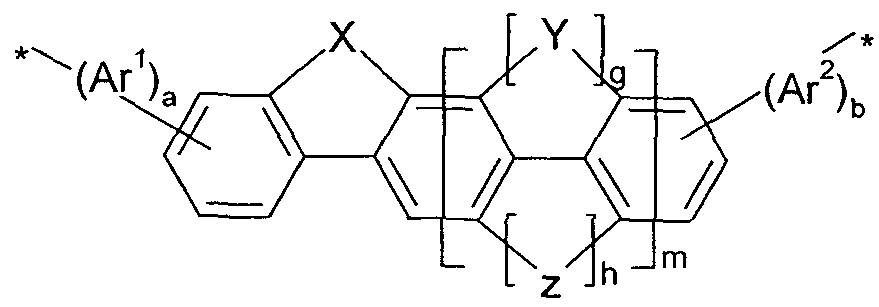
- corresponding h in the same unit different from g is 0 or 1, respectively; is halogen; is 0, 1, 2 or 3, preferably 0 or 1; are identical or different on each occurrence, a bivalent aromatic or heteroaromatic unit having 6 or 5 to 40 ring atoms, which may be substituted by one or more radicals R 2 , wherein the ring system also at the positions 7,8 or 8,9 of the structural unit of the general formula (3) may be fused; and a and b are each independently 0 or 1.
- sil is meant in the present invention a
- a bivalent aromatic or heteroaromatic moiety having 6 or 5 to 40, more preferably 6 or 5 to 20, most preferably 6 or 5 to 10 aromatic ring atoms may be a monocyclic or polycyclic moiety.
- the unit preferably contains 6 to 40, more preferably 6 to 20, most preferably 6 to 10, carbon atoms as ring atoms.
- the moiety is a heteroaromatic moiety, it contains 5 to 40, more preferably 5 to 20, most preferably 5 to 0 aromatic ring atoms, at least one of which is a heteroatom.
- the heteroatoms are preferably selected from N, O and / or S.
- a simple aromatic cycle ie benzene, or a simple heteroaromatic cycle
- a simple heteroaromatic cycle for example pyridine, pyrimidine, thiophene, etc.
- a fused aryl or heteroaryl group for example, naphthalene, anthracene, phenanthrene, quinoline, isoquinoline, benzothiophene, benzofuran and indole, etc. understood.
- aromatic or heteroaromatic unit Inventive examples of the aromatic or heteroaromatic unit are accordingly: benzene, naphthalene, anthracene, phenanthrene, Pyrene, chrysene, benzanthracene, perylene, naphthacene, pentacene, benzpyrene, furan, benzofuran, isobenzofuran, dibenzofuran, thiophene, benzothiophene, isobenzothiophene, dibenzothiophene, pyrrole, indole,
- the abovementioned compounds are such that two hydrogen substituents are absent and these compounds are bonded at these sites as indicated in formula (3).
- repeating units B and A may independently be a structural unit of the general formulas (4-1) and (4-2):
- Y is the same or different at each occurrence and is a bivalent aromatic or heteroaromatic unit having 6 or 5 to 40 ring atoms, which may be substituted by one or more R 7 ;
- R 7 is the same or different at each occurrence
- aliphatic or aromatic hydrocarbon radical having 1 to 20 carbon atoms; is identical or different at each occurrence, an aromatic or heteroaromatic ring system having 6 or 5 to 40 ring atoms, which may be substituted with R 7 ; is the same or different at each occurrence 0 or 1; s is the same or different at each occurrence 0, 1 or 2, wherein s is 0 preferred; where the dashed bond represents the linkage in the polymer.
- An aromatic ring system having 6 to 40 ring atoms, more preferably 6 to 20 and most preferably 6 to 10 ring atoms, is preferably understood in the context of this invention to mean a monocyclic or polycyclic system.
- an aromatic ring system is to be understood as meaning a system which does not necessarily contain only aromatic groups, but in which several aromatic radicals are also replaced by a short non-aromatic unit ( ⁇ 10% of the atoms other than H, preferably ⁇ 5%. the atoms other than H), such as sp 3 -hybridized C, O, N, etc., may be interrupted.
- aromatic ring systems can be monocyclic or polycyclic, ie they can have one ring (eg phenyl) or two or more rings, which can also be condensed (eg naphthyl) or covalently linked (eg biphenyl), or a combination of condensed and linked rings.
- Preferred aromatic ring systems are e.g. Phenyl, biphenyl, triphenyl, naphthyl, anthracyl, binaphthyl, phenanthryl, dihydrophenanthryl, pyrene, dihydropyrene, chrysene, perylene, tetracene, pentacene, benzpyrene, fluorene and indene.
- a heteroaromatic ring system with 5 to 40 ring atoms, preferably 5 to 30 and particularly preferably 5 to 14 ring atoms is understood in the context of this invention as a monocyclic or polycyclic system.
- the heteroaromatic ring system contains at least one heteroatom selected from N, O and S (remaining atoms are carbon).
- a heteroaromatic ring system is to be understood as meaning a system which does not necessarily contain only aromatic or heteroaromatic groups, but in which also several aromatic or heteroaromatic groups are replaced by a short non-aromatic unit ( ⁇ 10% of the atoms other than H, preferably ⁇ 5% of the on H different atoms), such as sp 3 -hybridized C, O, N, etc., may be interrupted.
- These heteroaromatic ring systems may be monocyclic or polycyclic, ie they may have one ring (eg pyridyl) or two or more rings, which may also be fused or covalently linked, or one
- Preferred heteroaromatic ring systems are e.g. 5-membered rings such as pyrrole, pyrazole, imidazole, 1, 2,3-triazole, 2,4-triazole, tetrazole, furan, thiophene, selenophene, oxazole, isoxazole, 1, 2-thiazole, 1, 3-thiazole, 1, 2,3-oxadiazole, 1, 2,4-oxadiazole, 1, 2,5-oxadiazole, 1, 3,4-oxadiazole, 1, 2,3-thiadiazole, 1, 2,4-thiadiazole, 1, 2,5-thiadiazole, 1, 3,4-thiadiazole, 6-membered rings such as pyridine, pyridazine, pyrimidine, pyrazine, 1, 3,5-triazine, 1, 2,4-triazine, 1, 2 , 3-triazine, 1, 2,4,5-tetrazine, 1, 2,3,4-tetrazine, 1,
- the bivalent aromatic or heteroaromatic moiety having 5 to 40 ring atoms mentioned in connection with the formulas (4-1) and (4-2) is as defined above.
- aryloxy radical is meant a group in which an aryl radical, as defined above, binds via an oxygen atom.
- a hydrocarbon radical with 1 to 20 carbon atoms is understood in the present application to mean a hydrocarbon radical as defined above, but with only 1 to 20 carbon atoms.
- repeating units B and A can be a thiophene compound of the general formula (5):
- T 1 , T 2 are each independently of one another thiophene, selenophene, thieno [2,3b] thiophene, thieno [3,2b] thiophene, dithienothiophene or pyrrole, which may be substituted by one or more radicals R 1 ;
- R 12, R 13 are each independently H or a
- Ar 4 , Ar 5 are each independently a bivalent aromatic or heteroaromatic moiety optionally substituted and attached to the 2,3-position of one or more adjacent thiophene or selenophene groups; c and e are independently 0, 1, 2, 3 or 4 where 1 ⁇ c + e ⁇ 6; d and f are independently 0, 1, 2, 3 or 4.
- Ar 6 at each occurrence is independently a covalent single bond or a bivalent aromatic or heteroaromatic moiety
- Ar 7 is independently a bivalent aromatic or heteroaromatic moiety each occurrence;
- Ar. ! Each of 8, 8 independently of one another is a substituted or unsubstituted aromatic or heteroaromatic group which may be substituted by an R 14 radical and / or which may be bridged via a divalent group with another repeat unit of the general formula (6) ;
- R 14 is a straight-chain, branched or cyclic alkyl radical having 1 or 3 to 12 C atoms or a straight-chain, branched or cyclic alkenyl radical having 2 or 3 to 12 C atoms; R 14 is particularly preferably vinyl or sec-butyl; and w is 1, 2 or 3.
- a straight-chain, branched or cyclic alkenyl radical having 2 or 3 to 12 C atoms is an alkyl radical in which one H atom is absent and the rest binds at this point.
- B is a triarylamine and A is indenofluorene, fluorene, spirobifluorene, phenanthrene or a derivative thereof. Further preferred is that B is a phenanthrene or a derivative thereof and A is an indenofluorene or derivative thereof.
- the above listed derivatives of these compounds are each preferred herein. Examples of preferred repeating units B are given in the following formulas (7) to (11):
- R 2 or R 3 has; each independently is 0, 1 or 2, preferably 0 or 1;
- Each P is independently 0, 1, 2, 3 or 4, preferably 0 or 1.
- repeating unit B is as follows.
- Formula (40) Formula (41) wherein R ° is H, halogen or optionally a fluorinated, linear or branched alkyl or alkoxy group having 1 to 12 C atoms, preferably R ° is H, F, methyl, i-propyl, t-butyl, n-pentoxy, or trifluoromethyl.
- repeating unit A Particularly preferred examples of the repeating unit A are as follows.
- the polymers used in the composition according to the invention are generally prepared by polymerization of monomer types, of which at least one monomer in the polymer leads to repeat units A and at least one monomer in the polymer to repeat units B. Suitable polymerization reactions are known in the art and described in the literature. Particularly suitable and preferred polymerization reactions which lead to C-C or C-N linkages are the following:
- the C-C linkages are preferably selected from the group of the SUZUKI coupling, the YAMAMOTO coupling and the STILLE coupling; the C-N linkage is preferably a HARTWIG-BUCHWALD coupling.
- the dendrimers according to the invention can be prepared according to methods known to the person skilled in the art or in analogy thereto. Suitable methods are described in the literature, e.g. in Frechet, Jean M. J .; Hawker, Craig J., "Hyperbranched polyphenylenes and hyperbranched polyesters: new soluble, three-dimensional, reactive polymers", Reactive & Functional Polymers (1995), 26 (1-3), 127-36; Janssen, H.M .; Meijer, E.W., "The synthesis and characterization of dendritic molecules", Materials Science and Technology (1999), 20 (Synthesis of Polymers), 403-458; Tomalia, Donald A., "Dendrimer molecules", Scientific American (1995), 272 (5), 62-6, WO 02/067343 A1 and WO 2005/026144 A1.
- the doping compound is preferably an ionic compound of the formula G + A " , where G + and A " have the following meanings:
- R F is a fluorinated aryl or alkylaryl radical or a fluorinated alkyl radical of the formula (C o F 20 -p + iHp), where o is an integer from 1 to 12 and p is an integer from 0 to 7, wherein RF is preferably CF 3 , C 2 F 5 , C 3 F 7 or C 4 F 9 .
- alkyl radical is preferably selected from a straight-chain alkyl radical having 1 to 20 C atoms and a branched alkyl radical having 3 to 20 C atoms, the maximum number of C atoms in each case preferably being 14 or even more preferably 4.
- aryl radical alkylaryl radical or “alkyl radical” are otherwise as defined above selected from the group of cations consisting of alkali (preferably Li + , Na + and K + ) and alkaline earth metal ions,
- ammonium, phosphonium, thiouronium, guanidinium cations and their derivatives are represented by the following formulas (54) to (58) and more preferable examples of heteroeylic ones
- R 5 to R 20 are each independently selected from a straight-chain alkyl radical having 1 to 20 C atoms and a branched alkyl radical having 3 to 20 C atoms, a straight-chain or branched alkenyl radical having 2 or 3 to 20 C atoms and one or more non-conjugated double bonds, a straight-chain or branched alkynyl radical having 2 or 3 to 20 C atoms and one or more non-conjugated double bonds, a saturated, partially saturated or fully saturated cycloalkyl radical having 3 to 7 carbon atoms which may be substituted by further alkyl radicals having 1 to 6 carbon atoms, one of several of the radicals R 15-20 being partially or completely substituted by -F and / or -Cl, or partially by oR ', -CN, - C (0) OH, -C (0) NR' 2) - SO 2 NR 2, -S0 2 OH, -S0 2 X, -NO 2 can be substitute
- alkyl radical has the same meaning as defined above: An alkenyl radical or alkynyl radical is understood to mean alkyl radicals which have a C-C double bond or a C-C triple bond, respectively.
- R 15 to R 18 may be H, provided that at least one of R 5 to R 8 is not H.
- R 15 to R 18 may be H and NR " 2 , wherein R" is as defined above.
- R 15 to R 19 may be H.
- R 15 to R 20 may be H, CN and NR ' 2 , wherein R "is as defined above.
- Formula (71) Formula (72) 1, 2,4-triazolium 1, 2,3-triazolium
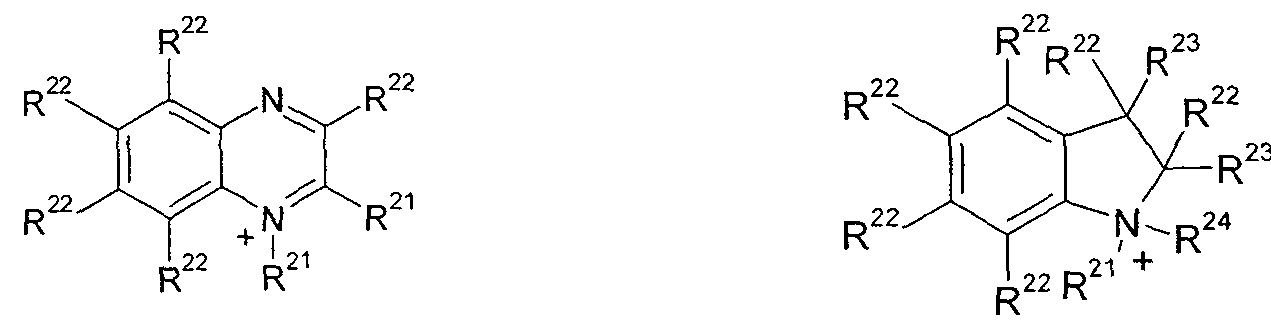
- the substituents R to R 24 are each independently selected from H, CN, a straight-chain or branched alkyl A radical having 1 or 3 to 20 C atoms, a straight-chain or branched alkenyl radical having 2 or 3 to 20 C atoms and one or more non-conjugated double bonds, a straight-chain or branched alkynyl radical having 2 or 3, respectively to 20 carbon atoms and one or more non-conjugated triple bonds, a partially or fully unsaturated cycloalkyl radical having 3 to 7 carbon atoms, which may be substituted by an alkyl radical having 1 to 6 carbon atoms, a saturated or partially or fully unsaturated aryl radical, arylalkyl radical, or alkyl radical, wherein the substituents R 21 , R 22 , R 23 and / or R 24 may together form a ring, wherein one or more of the substituents R 21 to R 24 partially or completely with a
- alkyl radical aryl radical
- arylalkyl radical have the same meaning as defined above:
- An alkenyl radical or alkynyl radical is understood as meaning alkyl radicals which are a CC doublebin - Have a CC or triple bond.
- R 22 is preferably selected from -OR ", - NR" 2, -C (0) OH, -C (0) NR '2, - S0 2 NR "2, -S0 2 OH, - S0 2 X and -N0 2 .
- organic ion G + have a structure of formula (87) depicted below. They include N, N, N-trimethylbutylammonium-ion, N-ethyl-N, N-dimethyl-propylammonium-L, N-ethyl-N, N-dimethylbutylammonium-L, N, N-dimethyl-N-propylbutyl- ammonium ion, N- (2-methoxyethyl) -N, N-dimethylethyl ammonium ion, 1-ethyl-3-methylimidazolium ion, 1-ethyl-1-dimethylimidazolium ion, 1-ethyl-3,4-dimethylimidazolium 1-ethyl-2,3,4-trimethylimidazolium ion, 1-ethyl-1,3-trimethylimidazolium-1-one, N-methyl-N-propylpyr
- a further embodiment of the present invention relates to a formulation, for example a solution, dispersion or miniemulsion, in particular a solution which contains the composition according to the invention and a solvent.
- the solvent in the composition according to the invention may be any solvent with which a solution, dispersion or miniemulsion can be prepared with the composition according to the invention.
- suitable and preferred organic solvents include, without limitation, dichloromethane, trichloromethane, monochlorobenzene, o-dichlorobenzene, tetrahydrofuran, anisole, mesitylene, morpholine, toluene, o-xylene, m-xylene, p-xylene, 4 Dioxane, acetone, methyl ethyl ketone, 1,2-dichloroethane, 1,1-trichloroethane, 1,1,2,2-tetrachloroethane, ethyl acetate, n-butyl acetate, dimethylacetamide, tetralin, decalin, indane, cyclohexanone, dimethylformamide (DMF), Dimethyl sulfoxide (DMSO), propylene carbonate, dichloromethane (DCM), tetrahydrofuran (THF), ethyl acetate,
- the concentration of the composition in the solution is preferably 0.1 to 10% by weight, very preferably 0.5 to 5% by weight, based on the total weight of the solution.
- the solution may also contain one or more binders to adjust the rheological properties, as in WO 2005/055248 A1 and US Pat
- WO 2011/076325 described.
- Solvent blends can also be used and identified as described in "Solvent, WHeIIis, Federation of Societies for Coatings Technology, p9-10, 1986". Such a procedure may result in a mixture of non-solvents which dissolves the composition, although it is desirable to to have at least one true solvent in a blend.
- Another preferred embodiment of the formulation is a dispersion or emulsion, with a miniemulsion being most preferred, heterophasic systems in which a discontinuous phase comprising solid nanoparticles or stable nanodroplets is dispersed in a second continuous phase.
- the present invention relates to a dispersion or emulsion wherein the various components of the composition are either in the same phase or in the different phases. Preferred distributions are as follows:
- Compounds are located in the interface between the two phases.
- dispersion or emulsion wherein the continuous phase is a polar phase and 2) dispersion or inverse miniemulsion wherein the continuous phase is a non-polar phase
- the preferred formulation is the polar continuous phase dispersion or miniemulsion.
- one or more surfactants may be added.
- solvents, surfactants, and processing to make a stable dispersion or miniemulsion also presents no difficulty to those skilled in the art. Examples of these are disclosed in the prior art, as described, for example, by Landfester et al. (Ann., Re., Mater., Res. 2006, 36, 231).
- the formulations according to the invention are preferably used to prepare thin layers.
- the coating of devices, as from eg OLEDs, solution is preferred over the coating by means of vacuum deposition.
- Preferred coating techniques include, without limitation, dip coating, spin coating, inkjet printing, letterpress printing, screen printing, knife coating, web printing, reverse web printing, offset printing, flexographic printing, gravure printing, web printing, spray coating, brushing or pad printing, slot die coating.
- Ink-jet printing processes are particularly preferred because they make it possible to produce high-resolution displays.
- the present invention therefore also relates to so-called thin films which comprise or consist of the composition according to the invention.
- composition or formulation according to the invention are particularly suitable for the production of films or coatings, in particular for the production of structured coatings, e.g. by thermal or light-induced crosslinking of crosslinkable groups in the composition according to the invention.
- the present invention also relates to the use of the composition according to the invention in an electronic device. Likewise, the present invention also relates to the use of a formulation according to the invention in the production of an electronic
- the electronic devices are preferably organic electronic devices, in particular organic or
- OLED polymeric organic electroluminescent devices
- OFET organic field effect transistors
- OIC organic integrated circuits
- OFT organic thin film transistors
- OLET organic light emitting transistors
- OSCs organic solar cells
- O lasers organic laser diodes
- OFQDs organic field quench devices
- LECs light emitting electrochemical cells
- OPDs organic photovoltaic elements or devices
- OPCs organic photoreceptors
- Electroluminescent devices OLED, PLED
- PLED polymeric organic electroluminescent devices
- the invention is
- thin film is a layer having a thickness in the range from 1 nm to 100 ⁇ m, preferably in the range from 2 nm to 10 ⁇ m, very preferably in the range from 3 nm to 1 ⁇ m, and very particularly preferably in the range from 5 nm to 0.1 ⁇ , understood.
- the present invention accordingly also relates to an electronic
- the buffer layer contains a composition according to the invention.
- the active layer of the electronic device according to the invention may be a light-emitting layer or a charge generation layer.
- a charge generation layer is understood as meaning a layer which absorbs photons and then, if appropriate with the aid of an electric field, can generate free charge carriers.
- the photon energy can range from UV to IR.
- An electronic device containing such a charge generation layer comprises: 1) organic photovoltaic cells (Bundgaard et al., Solar Energy Materials & Solar Cells 91 (2007) 954-985); 2) Dye-Sensitized Solar Cells (DSSCs) (Grätzel in J. Photochem., Photobiol., C: Photochem. Reviews, 4, 145 (2003)); 3) organic photoreceptors
- OPCs Organic Photoreceptors for Xerography
- charge generation layer organic photoreceptors for Xerography
- Paul M. Borsenberger and David S. Weiss, Marcel Dekker, Inc. (1998)); 4) organic photodiodes (Campbell et al., Appl. Phys. Lett. 95, 263302 (2009)).
- a light-emitting layer is a layer that preferably emits light in the visible region.
- the light-emitting layer may consist of one or more layers. If a plurality of emission layers are present, these preferably have a total of m e h eral emission maxima between 380 nm and 750 nm, so that Total white emission results, ie, in the emitting layers different emitting compounds are used, which can fluoresce or phosphorescent (phosphorescent or fluorescent emitter compound). Particular preference is given to systems having three emitting layers, the three layers exhibiting blue, green and orange or red emission (for the basic structure see, for example, WO 2005/011013).
- all the emitting layers to be fluorescent layers or for all the emitting layers to be phosphorescent layers or for one or more emitting layer (s) to comprise a fluorescent layer (s) and one or more other layer (s) Phosphorescent layer (s) are.
- a fluorescent compound in the sense of this invention is a compound which exhibits luminescence from an excited singlet state at room temperature.
- all luminescent compounds which contain no heavy atoms ie no atoms with an atomic number greater than 36, are to be regarded as fluorescent compounds.
- a person skilled in the art will be familiar with a large number of known fluorescent compounds from the prior art from which they can choose without difficulty and without being inventive.
- phosphorescent emitter compounds in the light-emitting layer.
- a phosphorescent emitter compound is generally understood a compound that shows luminescence from an excited state with higher spin multiplicity. A higher spin multiplication probability exists if the spin quantum number S is greater than or equal to 1.
- Suitable phosphorescent emitter compounds are, in particular, compounds which emit light, preferably in the visible range, with suitable excitation and, in addition, at least one atom of order numbers> 38 and ⁇ 84, particularly preferably> 56 and ⁇ 80. hold. Preference is given as phosphorescence emitter compounds containing copper, molybdenum, tungsten, rhenium, ruthenium, osmium, rhodium, iridium, palladium, platinum, silver, gold or europium, in particular compounds which contain iridium, platinum or copper.
- Examples of the emitters described above can be found in the applications WO 00/70655, WO 01/41512, WO 02/02714, WO 02/15645, EP 1191613, EP 1191612, EP 1191614, WO 2005/033244.
- all the phosphorescent complexes which are used according to the prior art for phosphorescent OLEDs and as are known to the person skilled in the art in the field of organic electroluminescence are suitable.
- Particularly preferred organic electronic devices contain as phosphorescent emitter compounds at least one
- DCy is the same or different at each occurrence, a cyclic one
- CCy is the same or different at each occurrence a cyclic
- A is the same or different at each occurrence as a mononionic, bidentate chelating ligand, preferably a diketonate ligand;
- R, '25 is defined independently at each occurrence as R. 6
- the active materials such as emitter compounds, are preferably embedded in a matrix material (host material).
- triplet level of the matrix material is higher than the triplet level of the emitter.
- Suitable triplet matrix materials are, for example, ketones, phosphine oxides, sulfoxides and sulfones, eg. B. according to WO 2004/013080,
- WO 2011/088877 As matrix or host material for singlet emitters, it is generally possible to use all materials known to the person skilled in the art for this purpose. It is preferred if the singlet level of the matrix material is higher than the singlet level of the emitter. As single-source materials, materials of various substance classes are suitable for this purpose. Preferred host materials are selected from the classes of the oligoarylenes (z. B. 2,2 ', 7,7 -Tetraphenylspirobifluoren I according to EP 676461 or dinaphthylanthracene), in particular the oligoarylenes containing condensed aromatic groups, the Oligoarylen- vinylene (z. B.
- DPVBi or spiro-DPVBi according to EP 676461 the poly-podal metal complexes (eg according to WO 2004/08 017), the hole-conducting compounds (eg according to WO 2004/058911), the electron-conducting compounds, in particular ketones, phosphine oxides , Sulfoxides, etc. (eg according to WO 2005/084081 and WO 2005/084082), the atrop isomers (eg according to WO 2006/048268) or the boronic acid derivatives (eg according to WO 2006/117052 ).
- Particularly preferred host materials are selected from the classes of oligoarylenes containing naphthalene, anthracene and / or pyrene or atropisomers of these compounds, the oligoarylenevinylenes, the ketones, the phosphine oxides and the sulfoxides.
- Very particularly preferred host materials are, in addition to the compounds according to the invention, selected from the classes of oligoarylenes containing anthracene and / or pyrene or atropisomers thereof
- Oligoarylene in the context of this invention is intended to mean a compound be in which at least three aryl or arylene groups are bonded together.
- the cathode may be composed of various materials as used in the prior art. Examples of particularly suitable cathode materials are generally low work function metals, followed by a layer of aluminum or a layer of silver. Examples include cesium, barium, calcium, ytterbium and samarium, each followed by a layer of aluminum or silver. Also suitable is an alloy of magnesium and silver.
- the anode high workfunction materials are preferred.
- the anode has a potential greater than 4.5 eV. Vacuum up.
- metals with a high redox potential such as Ag, Pt or Au, are suitable for this purpose.
- metal / metal-electrons z. B. Al / Ni / NiO X
- AI / PtO x may be preferred.
- at least one of the electrodes must be transparent to either the
- Irradiation of the organic material or the extraction of light to allow.
- a preferred construction uses a transparent anode.
- Preferred anode materials here are conductive mixed metal oxides. Particularly preferred are indium tin oxide (ITO) or indium zinc oxide (IZO). Preference is furthermore given to conductive, doped organic materials, in particular conductive doped polymers.
- compositions and devices according to the invention are distinguished by the following surprising advantages over the prior art: 1. With the aid of the compositions according to the invention, it is possible to combine the buffer layer and the interlayer. Thus, simpler devices are possible.
- compositions minimize the energy barrier at the anode by forming an ionic double layer.
- compositions allow the preparation
- compositions suitable to reduce the costs of mass production are provided.
- compositions of the invention allow the preparation of anhydrous formulations with organic solvents, so that the stability of electronic
- the buffer layers according to the present invention are more stable to electrons compared to the buffer layers of the prior art.
- Embodiments of the present invention are to be considered. For these features may desire independent protection in addition to or as an alternative to any presently claimed invention.
- Figure 1 shows the current density as a function of the voltage for OLED1 and Refl.
- Figure 2 shows the luminance as a function of voltage for OLED1 and Ref1.
- the following materials are used to make the emitter layer:
- H1 and H2 are host materials that can be synthesized according to WO 2009/124627 and DE 102008036982.
- TG1 is a green triplet emitter, which is synthesized according to DE 102009041414.
- As ion-conducting material is polyethylene oxide) (PEO, average Aldrich). Lithium trifluoromethanesulfonate (LiTrf, 99.995% metal base, Aldrich) is used as the ionic compound.
- WO 2008/009343 synthesized.
- the stated percentages here are mol% of monomers.
- the molecular weight of all polymers is between 200,000 and 300,000 g / mol (GPC measurements: THF, 1 mL / min, Plgel 10 pm mixed B 2 x 300 x 7.5 mm 2 , 35 ° C, Rl detection against polystyrene calibrated).
- the OLEDs 1 to 6 with an anode / buffer layer / E L / cathode structure are prepared using the solutions 1 to 6 prepared under Example 2 as follows:
- RefO can be produced using PEDOT as the buffer layer.
- RefO is prepared analogously to OLED1-6, wherein steps 1) and 2) are carried out as follows:
- the resulting OLEDs are characterized by standard methods well known to those skilled in the art. The following properties are measured: UIL characteristic, electroluminescence spectrum, efficiency and operating voltage. In particular, the efficiency at 1000 nits is compared here. The results are summarized in the following Table 2, where Refl-6 serves as a comparison, and RefO according to the prior art. Table 2
- REfO delivers an efficiency of about 16 cd / A @ Iknits.
- Figures 1 and 2 show the current density and luminance of OLED1 and Refl as a function of voltage.
- Conductive layer having compositions containing Polymer7, Polymer8 and Polymer9.
- Polymer7, Polymer8 and Polymer9 are not crosslinkable polymers and are not incorporated into an OLED as a buffer layer.
- a thin film of 80 nm is applied by spin-coating on a glass substrate in clean room by applying the solutions (solution 7 - solution 9).
- a reference layer 80 nm
- the conductivities of the layers are determined by a four-conductor probing method.
- the thin layer with the inventive compositions is at least an order of magnitude higher than the corresponding reference layer.
- the Polymer7, Polymer8 and Polymer9 and the like can easily be modified into crosslinkable polymers so that they can also be used for other electronic devices.
Landscapes
- Chemical & Material Sciences (AREA)
- Engineering & Computer Science (AREA)
- Materials Engineering (AREA)
- Organic Chemistry (AREA)
- Health & Medical Sciences (AREA)
- Chemical Kinetics & Catalysis (AREA)
- Medicinal Chemistry (AREA)
- Polymers & Plastics (AREA)
- Manufacturing & Machinery (AREA)
- Physics & Mathematics (AREA)
- Optics & Photonics (AREA)
- Crystallography & Structural Chemistry (AREA)
- Inorganic Chemistry (AREA)
- Electroluminescent Light Sources (AREA)
- Pyridine Compounds (AREA)
- Polyoxymethylene Polymers And Polymers With Carbon-To-Carbon Bonds (AREA)
- Compositions Of Macromolecular Compounds (AREA)
Description




Claims

Priority Applications (3)
| Application Number | Priority Date | Filing Date | Title |
|---|---|---|---|
| US14/431,578 US10003024B2 (en) | 2012-09-27 | 2013-09-05 | Materials for organic electroluminescent devices |
| DE112013004753.5T DE112013004753A5 (de) | 2012-09-27 | 2013-09-05 | Materialien für organische Elektrolumineszenzvorrichtungen |
| JP2015533469A JP6545619B2 (ja) | 2012-09-27 | 2013-09-05 | 有機エレクトロルミッセンス素子のための材料 |
Applications Claiming Priority (2)
| Application Number | Priority Date | Filing Date | Title |
|---|---|---|---|
| EP12006747.5 | 2012-09-27 | ||
| EP12006747 | 2012-09-27 |
Publications (1)
| Publication Number | Publication Date |
|---|---|
| WO2014048542A1 true WO2014048542A1 (de) | 2014-04-03 |
Family
ID=47262947
Family Applications (1)
| Application Number | Title | Priority Date | Filing Date |
|---|---|---|---|
| PCT/EP2013/002672 Ceased WO2014048542A1 (de) | 2012-09-27 | 2013-09-05 | Materialien für organische elektrolumineszenzvorrichtungen |
Country Status (4)
| Country | Link |
|---|---|
| US (1) | US10003024B2 (de) |
| JP (1) | JP6545619B2 (de) |
| DE (1) | DE112013004753A5 (de) |
| WO (1) | WO2014048542A1 (de) |
Cited By (1)
| Publication number | Priority date | Publication date | Assignee | Title |
|---|---|---|---|---|
| WO2016188609A1 (en) * | 2015-05-22 | 2016-12-01 | Merck Patent Gmbh | Formulation containing an organic semiconductor and a metal complex |
Families Citing this family (9)
| Publication number | Priority date | Publication date | Assignee | Title |
|---|---|---|---|---|
| GB201223369D0 (en) * | 2012-12-24 | 2013-02-06 | Cambridge Display Tech Ltd | Polymer and device |
| EP2963010B1 (de) * | 2014-07-04 | 2018-02-21 | Novaled GmbH | Elektronische Vorrichtung und Verbindung |
| TWI745395B (zh) * | 2016-07-08 | 2021-11-11 | 德商麥克專利有限公司 | 有機電致發光裝置用之材料 |
| US11251373B2 (en) | 2016-11-30 | 2022-02-15 | Hodogaya Chemical Co., Ltd. | High molecular weight compound containing substituted triarylamine structural unit |
| US10270036B2 (en) | 2016-12-27 | 2019-04-23 | Samsung Electronics Co., Ltd. | Polymer, composition including the polymer, and organic light-emitting device including the polymer |
| JP2018203889A (ja) * | 2017-06-06 | 2018-12-27 | 日立化成株式会社 | 硬化性重合体、重合液、導電性膜及び有機発光素子 |
| KR102761518B1 (ko) | 2020-03-19 | 2025-02-04 | 삼성디스플레이 주식회사 | 유기 발광 소자 |
| WO2021213917A1 (en) * | 2020-04-21 | 2021-10-28 | Merck Patent Gmbh | Emulsions comprising organic functional materials |
| WO2023215234A2 (en) * | 2022-05-02 | 2023-11-09 | The Regents Of The University Of California | Luminescent benzoyl-pyrazine organic compounds |
Citations (3)
| Publication number | Priority date | Publication date | Assignee | Title |
|---|---|---|---|---|
| US20070029556A1 (en) * | 2005-08-08 | 2007-02-08 | Osram Opto Semiconductors Gmbh | Solution processed crosslinkable hole injection and hole transport polymers for OLEDs |
| US20100140601A1 (en) * | 2007-05-23 | 2010-06-10 | Sumitomo Chemical Company, Limited | Polymer compound and method for producing the same, and light-emitting material, liquid composition, thin film, polymer light-emitting device, surface light source, display device, organic transistor and solar cell, each using the polymer compound |
| US20110037058A1 (en) * | 2007-10-24 | 2011-02-17 | Merck Patent Gmbh Patents & Scientific Information | Optoelectronic device |
Family Cites Families (15)
| Publication number | Priority date | Publication date | Assignee | Title |
|---|---|---|---|---|
| JPH0528825A (ja) * | 1991-07-19 | 1993-02-05 | Matsushita Electric Ind Co Ltd | 高分子複合電極 |
| DE602004021211D1 (de) * | 2003-03-07 | 2009-07-09 | Merck Patent Gmbh | Fluorene und Arylgruppen enthaltende Mono-, Oligo- und Polymere |
| DE10340711A1 (de) * | 2003-09-04 | 2005-04-07 | Covion Organic Semiconductors Gmbh | Elektronische Vorrichtung enthaltend organische Halbleiter |
| DE102004020298A1 (de) * | 2004-04-26 | 2005-11-10 | Covion Organic Semiconductors Gmbh | Elektrolumineszierende Polymere und deren Verwendung |
| DE112005002495B4 (de) * | 2004-10-11 | 2016-11-17 | Cambridge Display Technology Ltd. | Polares halbleitendes Lochtransportmaterial |
| US20060094859A1 (en) * | 2004-11-03 | 2006-05-04 | Marrocco Matthew L Iii | Class of bridged biphenylene polymers |
| GB0428444D0 (en) * | 2004-12-29 | 2005-02-02 | Cambridge Display Tech Ltd | Conductive polymer compositions in opto-electrical devices |
| KR100798817B1 (ko) * | 2006-07-28 | 2008-01-28 | 주식회사 두산 | 전계 발광 소자용 스피로 화합물, 및 이를 포함하는 전계발광 소자 |
| CN101563388B (zh) * | 2006-07-21 | 2013-05-15 | 普莱克斯托尼克斯公司 | 导电聚合物的磺化和oled器件、光电器件以及esd器件 |
| US8367219B2 (en) * | 2007-10-30 | 2013-02-05 | Samsung Electronics Co., Ltd. | Anthracene-based compound and organic light emitting device employing the same |
| KR101683026B1 (ko) * | 2008-04-11 | 2016-12-07 | 닛산 가가쿠 고교 가부시키 가이샤 | 도핑된 공액 중합체, 소자, 및 소자의 제조 방법 |
| KR101757016B1 (ko) * | 2010-03-11 | 2017-07-11 | 메르크 파텐트 게엠베하 | 방사성 섬유 |
| EP2569347A1 (de) * | 2010-05-11 | 2013-03-20 | Plextronics, Inc. | Dotierung von konjugierten polymeren und vorrichtungen |
| JP5505123B2 (ja) * | 2010-06-22 | 2014-05-28 | 東ソー株式会社 | 新規トリアリールアミンポリマー、その製造方法およびその用途 |
| EP2764518A1 (de) * | 2011-10-04 | 2014-08-13 | Plextronics, Inc. | Verbesserte dotierunserfahren für lochinjektion und transportschichten |
-
2013
- 2013-09-05 WO PCT/EP2013/002672 patent/WO2014048542A1/de not_active Ceased
- 2013-09-05 JP JP2015533469A patent/JP6545619B2/ja not_active Expired - Fee Related
- 2013-09-05 DE DE112013004753.5T patent/DE112013004753A5/de not_active Ceased
- 2013-09-05 US US14/431,578 patent/US10003024B2/en active Active
Patent Citations (3)
| Publication number | Priority date | Publication date | Assignee | Title |
|---|---|---|---|---|
| US20070029556A1 (en) * | 2005-08-08 | 2007-02-08 | Osram Opto Semiconductors Gmbh | Solution processed crosslinkable hole injection and hole transport polymers for OLEDs |
| US20100140601A1 (en) * | 2007-05-23 | 2010-06-10 | Sumitomo Chemical Company, Limited | Polymer compound and method for producing the same, and light-emitting material, liquid composition, thin film, polymer light-emitting device, surface light source, display device, organic transistor and solar cell, each using the polymer compound |
| US20110037058A1 (en) * | 2007-10-24 | 2011-02-17 | Merck Patent Gmbh Patents & Scientific Information | Optoelectronic device |
Cited By (5)
| Publication number | Priority date | Publication date | Assignee | Title |
|---|---|---|---|---|
| WO2016188609A1 (en) * | 2015-05-22 | 2016-12-01 | Merck Patent Gmbh | Formulation containing an organic semiconductor and a metal complex |
| CN107667439A (zh) * | 2015-05-22 | 2018-02-06 | 默克专利有限公司 | 包含有机半导体和金属络合物的制剂 |
| JP2018518837A (ja) * | 2015-05-22 | 2018-07-12 | メルク パテント ゲーエムベーハー | 有機半導体と金属錯体を含む調合物 |
| US10566550B2 (en) | 2015-05-22 | 2020-02-18 | Merck Patent Gmbh | Formulation containing an organic semiconductor and a metal complex |
| CN107667439B (zh) * | 2015-05-22 | 2021-01-05 | 默克专利有限公司 | 包含有机半导体和金属络合物的制剂 |
Also Published As
| Publication number | Publication date |
|---|---|
| JP6545619B2 (ja) | 2019-07-17 |
| US10003024B2 (en) | 2018-06-19 |
| DE112013004753A5 (de) | 2015-08-27 |
| US20150255724A1 (en) | 2015-09-10 |
| JP2016501915A (ja) | 2016-01-21 |
Similar Documents
| Publication | Publication Date | Title |
|---|---|---|
| WO2014048542A1 (de) | Materialien für organische elektrolumineszenzvorrichtungen | |
| DE112010001236B4 (de) | Organische elektrolumineszenzvorrichtung | |
| EP3052505B1 (de) | Borenthaltende verbindungen | |
| EP3221294B1 (de) | Heterocyclische verbindungen zur verwendung in elektronischen vorrichtungen | |
| WO2010136111A1 (de) | Zusammensetzung, enthaltend mindestens eine emitterverbindung und mindestens ein polymer mit konjugationsunterbrechenden einheiten | |
| EP3237387A1 (de) | Heterocyclische verbindungen mit dibenzazapin-strukturen | |
| DE102010048497A1 (de) | Formulierungen für organische Elektrolumineszenzvorrichtungen | |
| EP2732479A1 (de) | Verbindungen für organische elektrolumineszenzvorrichtungen | |
| WO2012089294A1 (de) | Materialien für organische elektrolumineszenzvorrichtungen | |
| EP2867329A1 (de) | Polymere enthaltend 2,7-pyren-struktureinheiten | |
| EP2721086A1 (de) | Materialien für organische elektrolumineszenzvorrichtungen | |
| EP3044285A1 (de) | Heterocyclische verbindungen | |
| EP2603540A1 (de) | Polymere mit carbazol-struktureinheiten | |
| WO2012019725A1 (de) | Polymere mit carbazol-struktureinheiten | |
| EP2401315A1 (de) | Vernetzbare und vernetzte polymere, verfahren zu deren herstellung sowie deren verwendung | |
| WO2012013310A1 (de) | Polymere enthaltend substituierte benzodithiopheneinheiten, blends enthaltend diese polymere sowie vorrichtungen enthaltend diese polymere oder blends | |
| EP3197887B1 (de) | Heterocyclische verbindungen mit benzo[c]coumarin-strukturen | |
| WO2011091838A1 (de) | Styrolbasierte copolymere, insbesondere für die anwendung in optoelektronischen bauteilen | |
| WO2010034393A1 (de) | Neue polymere mit niedriger polydispersität | |
| WO2012007102A1 (de) | Polymere materialien für organische elektrolumineszenzvorrichtungen | |
| EP3230402A1 (de) | Elektronische vorrichtung | |
| WO2011009522A2 (de) | Materialien für elektronische vorrichtungen | |
| EP2817350A2 (de) | Polymere enthaltend dibenzocycloheptan-struktureinheiten | |
| EP3820965A1 (de) | Materialien für elektronische vorrichtungen |
Legal Events
| Date | Code | Title | Description |
|---|---|---|---|
| 121 | Ep: the epo has been informed by wipo that ep was designated in this application |
Ref document number: 13759446 Country of ref document: EP Kind code of ref document: A1 |
|
| WWE | Wipo information: entry into national phase |
Ref document number: 14431578 Country of ref document: US |
|
| ENP | Entry into the national phase |
Ref document number: 2015533469 Country of ref document: JP Kind code of ref document: A |
|
| WWE | Wipo information: entry into national phase |
Ref document number: 112013004753 Country of ref document: DE Ref document number: 1120130047535 Country of ref document: DE |
|
| REG | Reference to national code |
Ref country code: DE Ref legal event code: R225 Ref document number: 112013004753 Country of ref document: DE |
|
| 122 | Ep: pct application non-entry in european phase |
Ref document number: 13759446 Country of ref document: EP Kind code of ref document: A1 |