WO2014043954A1 - 液晶介质混合物及使用其的液晶显示器 - Google Patents
液晶介质混合物及使用其的液晶显示器 Download PDFInfo
- Publication number
- WO2014043954A1 WO2014043954A1 PCT/CN2012/082995 CN2012082995W WO2014043954A1 WO 2014043954 A1 WO2014043954 A1 WO 2014043954A1 CN 2012082995 W CN2012082995 W CN 2012082995W WO 2014043954 A1 WO2014043954 A1 WO 2014043954A1
- Authority
- WO
- WIPO (PCT)
- Prior art keywords
- group
- different
- liquid crystal
- same
- formula
- Prior art date
- Legal status (The legal status is an assumption and is not a legal conclusion. Google has not performed a legal analysis and makes no representation as to the accuracy of the status listed.)
- Ceased
Links
Classifications
-
- C—CHEMISTRY; METALLURGY
- C09—DYES; PAINTS; POLISHES; NATURAL RESINS; ADHESIVES; COMPOSITIONS NOT OTHERWISE PROVIDED FOR; APPLICATIONS OF MATERIALS NOT OTHERWISE PROVIDED FOR
- C09K—MATERIALS FOR MISCELLANEOUS APPLICATIONS, NOT PROVIDED FOR ELSEWHERE
- C09K19/00—Liquid crystal materials
- C09K19/04—Liquid crystal materials characterised by the chemical structure of the liquid crystal components, e.g. by a specific unit
- C09K19/06—Non-steroidal liquid crystal compounds
- C09K19/08—Non-steroidal liquid crystal compounds containing at least two non-condensed rings
- C09K19/30—Non-steroidal liquid crystal compounds containing at least two non-condensed rings containing saturated or unsaturated non-aromatic rings, e.g. cyclohexane rings
- C09K19/3098—Unsaturated non-aromatic rings, e.g. cyclohexene rings
-
- C—CHEMISTRY; METALLURGY
- C09—DYES; PAINTS; POLISHES; NATURAL RESINS; ADHESIVES; COMPOSITIONS NOT OTHERWISE PROVIDED FOR; APPLICATIONS OF MATERIALS NOT OTHERWISE PROVIDED FOR
- C09K—MATERIALS FOR MISCELLANEOUS APPLICATIONS, NOT PROVIDED FOR ELSEWHERE
- C09K19/00—Liquid crystal materials
- C09K19/04—Liquid crystal materials characterised by the chemical structure of the liquid crystal components, e.g. by a specific unit
- C09K19/06—Non-steroidal liquid crystal compounds
- C09K19/32—Non-steroidal liquid crystal compounds containing condensed ring systems, i.e. fused, bridged or spiro ring systems
-
- C—CHEMISTRY; METALLURGY
- C09—DYES; PAINTS; POLISHES; NATURAL RESINS; ADHESIVES; COMPOSITIONS NOT OTHERWISE PROVIDED FOR; APPLICATIONS OF MATERIALS NOT OTHERWISE PROVIDED FOR
- C09K—MATERIALS FOR MISCELLANEOUS APPLICATIONS, NOT PROVIDED FOR ELSEWHERE
- C09K19/00—Liquid crystal materials
- C09K19/52—Liquid crystal materials characterised by components which are not liquid crystals, e.g. additives with special physical aspect: solvents, solid particles
-
- C—CHEMISTRY; METALLURGY
- C09—DYES; PAINTS; POLISHES; NATURAL RESINS; ADHESIVES; COMPOSITIONS NOT OTHERWISE PROVIDED FOR; APPLICATIONS OF MATERIALS NOT OTHERWISE PROVIDED FOR
- C09K—MATERIALS FOR MISCELLANEOUS APPLICATIONS, NOT PROVIDED FOR ELSEWHERE
- C09K19/00—Liquid crystal materials
- C09K19/04—Liquid crystal materials characterised by the chemical structure of the liquid crystal components, e.g. by a specific unit
- C09K2019/0444—Liquid crystal materials characterised by the chemical structure of the liquid crystal components, e.g. by a specific unit characterized by a linking chain between rings or ring systems, a bridging chain between extensive mesogenic moieties or an end chain group
- C09K2019/0448—Liquid crystal materials characterised by the chemical structure of the liquid crystal components, e.g. by a specific unit characterized by a linking chain between rings or ring systems, a bridging chain between extensive mesogenic moieties or an end chain group the end chain group being a polymerizable end group, e.g. -Sp-P or acrylate
-
- C—CHEMISTRY; METALLURGY
- C09—DYES; PAINTS; POLISHES; NATURAL RESINS; ADHESIVES; COMPOSITIONS NOT OTHERWISE PROVIDED FOR; APPLICATIONS OF MATERIALS NOT OTHERWISE PROVIDED FOR
- C09K—MATERIALS FOR MISCELLANEOUS APPLICATIONS, NOT PROVIDED FOR ELSEWHERE
- C09K19/00—Liquid crystal materials
- C09K19/04—Liquid crystal materials characterised by the chemical structure of the liquid crystal components, e.g. by a specific unit
- C09K19/06—Non-steroidal liquid crystal compounds
- C09K19/34—Non-steroidal liquid crystal compounds containing at least one heterocyclic ring
- C09K19/3402—Non-steroidal liquid crystal compounds containing at least one heterocyclic ring having oxygen as hetero atom
- C09K2019/3422—Non-steroidal liquid crystal compounds containing at least one heterocyclic ring having oxygen as hetero atom the heterocyclic ring being a six-membered ring
-
- C—CHEMISTRY; METALLURGY
- C09—DYES; PAINTS; POLISHES; NATURAL RESINS; ADHESIVES; COMPOSITIONS NOT OTHERWISE PROVIDED FOR; APPLICATIONS OF MATERIALS NOT OTHERWISE PROVIDED FOR
- C09K—MATERIALS FOR MISCELLANEOUS APPLICATIONS, NOT PROVIDED FOR ELSEWHERE
- C09K19/00—Liquid crystal materials
- C09K19/52—Liquid crystal materials characterised by components which are not liquid crystals, e.g. additives with special physical aspect: solvents, solid particles
- C09K19/54—Additives having no specific mesophase characterised by their chemical composition
- C09K19/542—Macromolecular compounds
- C09K2019/548—Macromolecular compounds stabilizing the alignment; Polymer stabilized alignment
Definitions
- the present invention relates to liquid crystal display technology, and more particularly to a liquid crystal medium mixture and a liquid crystal display using the same. Background technique
- PSVA Polymer stabilized vertical alignment
- TN/STN Transmission nematic/Super twisted nematic
- MVA Multi-domain vertical alignment
- PVA Plasma-up Vertical Alignment
- TFT-LCD Thin Film Transistor Liquid Crystal Display
- Negative liquid crystal material is used. When no electric field is applied, the liquid crystal molecules are arranged perpendicular to the surface of the substrate. A certain amount of monomer which can be polymerized under ultraviolet light is added to the liquid crystal material, and the cylinder is called RM. After the liquid crystal is added to the substrate for combination, a signal of a suitable frequency, waveform, and voltage is applied to the panel to cause the liquid crystal molecules to be tilted in a predetermined direction, and the panel is irradiated with ultraviolet light to polymerize the RM to form a polymer deposited in the panel.
- the surface of the two substrates which is a polymer bump, can make the liquid crystal molecules have a certain pretilt angle without applying voltage, thereby accelerating the response speed of the liquid crystal molecules.
- Relative friction (Rubbing) can only be aligned in a single direction.
- the advantage of this method is that multi-angle alignment (producing pretilt angle) can be achieved in different areas within the panel.
- the photoreactive group contained in RM (Reactive Mesogen, Reactive Mesogen) used in PSVA technology is usually mercapto propylene.
- UV (ultraviolet) light irradiation causes some problems in these RM reactions: the main wavelength range of photopolymerization of RM containing such groups can be 200-300 nm, and ultraviolet light having a wavelength exceeding 300 nm can also The RM reacts, but the efficiency is very low, the speed is very slow, and it does not have good mass productivity. Therefore, it is necessary to illuminate the panel with a light source having a wavelength of 300 nm or less to cause the RM to react.
- the use of light sources below 300 nm will bring many disadvantages and difficulties to the fabrication of the panel:
- the ultraviolet light below 300 nm has higher energy, which will cause the price of the alignment layer material polyimide (Polyimide) and liquid crystal molecules to be destroyed.
- the VHR (voltage holding ratio) of the panel is lowered, the image sticking becomes severe, and the RA (Responsive Analysis) results are deteriorated.
- the glass used to fabricate the TFT-LCD substrate is usually 300 nm.
- the following ultraviolet light has a certain absorption effect, which will reduce the irradiation efficiency of the light source; more deadly is that the liquid crystal material itself has a strong absorption effect on ultraviolet light below 300 nm, and ultraviolet light having a wavelength below 300 nm cannot pass through the liquid crystal material at all. That is to say, most of the ultraviolet light from the light source is absorbed by the liquid crystal material (destructive action), and only a small part is absorbed by the RM to cause polymerization, which occurs at a very shallow position on the light incident side, which in turn causes light to enter the light. The unevenness of the reaction between the side and the backlight side RM reduces the alignment effect of the panel. Summary of the invention
- the technical problem to be solved by the present invention is to provide a liquid crystal medium mixture to which a sensitizer having a strong absorption effect on ultraviolet light having a wavelength of 300 to 360 nm is added, and a reaction wavelength of the polymerizable monomer is made by the sensitizer Moving to long wavelengths, the polymerization efficiency is high and the polymer uniformity is good.
- the liquid crystal medium mixture can be irradiated with ultraviolet light having a wavelength of 300-360 nm, avoiding the absorption band of the liquid crystal material, and reducing the damage of the liquid crystal material and the alignment material PI (polyimide) by ultraviolet light.
- the effect is to increase the polymerization efficiency and uniformity of the polymerizable monomer, and improve the alignment effect of the panel, thereby improving the quality and life of the panel.
- a liquid crystal medium mixture including components: a liquid crystal material, a polymerizable monomer, and a sensitizer, the liquid crystal material including a polymerization reaction stable when the polymerizable monomer is polymerized.
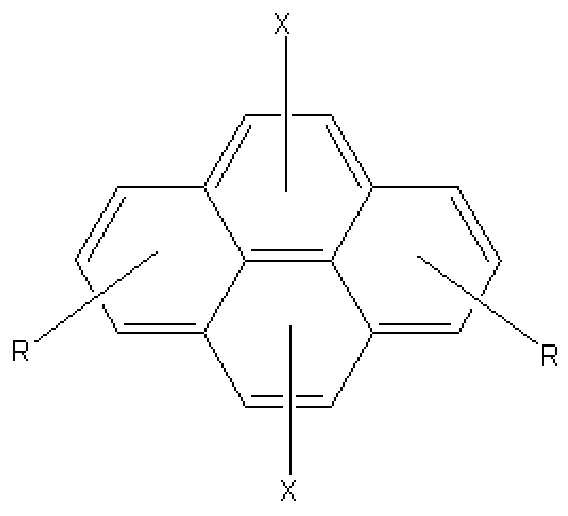
- An alkenyl compound which is highly absorptive to ultraviolet light having a wavelength in the range of 300 to 360 nm, which is one or more of the following molecular structural formulas:
- R represents a chain structure consisting of 1 to 6 carbon atoms
- X represents a substituent group attached to the ring structure, which is R, a halogen substituent or other substituent group, including:
- the substituent group represented by X is: -H, -F, -Cl, -Br, -1, -CN, -N0 2 , -R, -0-R, -CO-R, -OCO-R, -COO-R or -(OCH 2 CH 2 ) nl CH 3
- nl is an integer from 1 to 5, wherein different R in the same formula may be the same or different, and different Xs in the same formula may be the same or different.
- liquid crystal medium is mixed
- Polymerization occurs under irradiation of 300-360 nm ultraviolet light.
- R1 represents a straight or branched alkenyl group having 2 to 9 carbon atoms
- R2 represents a straight or branched alkyl group having 1 to 12 carbon atoms
- X independently represents 11, F, Cl, OCF 3 or CF 3 ;
- n 1;
- n and k represent 0 ⁇ 3 respectively.
- the polymerizable monomer comprises at least one polymerizable molecule having the following structural formula:
- P 2 represents a polymerizable group which is the same or different and is a decyl acrylate group, an acrylate group, a vinyl group, a vinyloxy group or an epoxy group, and wherein the polymerizable group in the formula is different at the same time Is a mercapto acrylate group;
- L 2 represents a linking group which is the same or different and is a carbon-carbon single bond, -0-, -COO-, -OCO-, -CH 2 0-, -OCH 2 0 -, -0(CH 2 ) 2 0-, -COCH 2 -
- X represents a substituent group attached to the ring structure
- n is an integer of 1-4
- a plurality of n in any formula are the same or different, and if 11>1, it means that the same ring structure has a plurality of substituent groups.
- X which are the same or different, and the substituent group represented by X is: -H, -F, -Cl, -Br, -1, -CN or -N0 2 .
- the weight ratio of the sensitizer to the polymerizable monomer is 0.01% to 10%.
- a liquid crystal display includes: an upper substrate and a lower substrate disposed opposite to each other, and a liquid crystal medium mixture disposed between the upper substrate and the lower substrate, the liquid crystal medium
- the mixture includes components: a liquid crystal material, a polymerizable monomer, and a sensitizer, the liquid crystal material comprising an alkenyl compound which is stable to polymerization during polymerization of the polymerizable monomer, the sensitizer having strong absorption of ultraviolet light having a wavelength in the range of 300 to 360 nm Sex, which is one or more of the following molecular structural formulas:
- R represents a chain structure consisting of 1 to 6 carbon atoms
- X represents a substituent group attached to the ring structure, which is R, a halogen substituent or other substituent group, including:
- the substituent group represented by X is: -H, -F, -Cl, -Br, -1, -CN, -N02, -R, -0-R, -CO-R, -OCO-R, -COO-R or -(OCH2CH2)nlCH3,
- Nl is an integer from 1 to 5, wherein different R in the same formula may be the same or different, and different Xs in the same formula may be the same or different.
- liquid crystal medium is mixed
- Polymerization occurs under irradiation of 300-360 nm ultraviolet light.
- R1 represents a straight or branched alkenyl group having 2 to 9 carbon atoms
- R2 represents a straight or branched alkyl group having 1 to 12 carbon atoms
- X independently represents 11, F, Cl, OCF 3 or CF 3 ;
- n 1;
- n and k represent 0 ⁇ 3 respectively.
- the polymerizable monomer comprises at least one polymerizable molecule having the following structural formula:
- P 2 represents a polymerizable group which is the same or different and is a decyl acrylate group, an acrylate group, a vinyl group, a vinyloxy group or an epoxy group, and wherein the polymerizable group in the formula is different at the same time Is a mercapto acrylate group;
- L 2 represents a linking group which is the same or different and is a carbon-carbon single bond, -0-, -COO-, -OCO-, -CH 2 0-, -OCH 2 0 -, -0(CH 2 ) 2 0-, -COCH 2 -
- X represents a substituent group attached to the ring structure
- n is an integer of 1-4
- a plurality of n in any formula are the same or different, and if 11>1, it means that the same ring structure has multiple substitutions.
- the groups x, which are the same or different, and the substituent groups represented by X are: -H, -F, -Cl, -Br, -1, -CN or -N0 2 .
- the weight ratio of the sensitizer to the polymerizable monomer is 0.01% to 10%.
- the liquid crystal medium mixture provided by the embodiment of the invention is added with a sensitizer having a strong absorption effect on ultraviolet light having a wavelength of 300-360 nm, and the liquid crystal material comprises an alkenyl compound which is stable to polymerization during polymerization of the polymerizable monomer.
- the sensitizer can interact with an alkenyl compound in the polymerizable monomer to form an exciplex, which can transfer the absorbed energy to the polymerizable monomer to initiate polymerization thereof, and the reaction wavelength of the polymerizable monomer is long.
- the wavelength (300-360 nm) shifts, the polymerization efficiency is high, and the polymer uniformity is good.
- the liquid crystal display prepared by using the liquid crystal medium mixture can be irradiated with ultraviolet light having a wavelength of 300-360 nm, avoiding the absorption band of the liquid crystal material, reducing the damage of the ultraviolet light to the liquid crystal material and the alignment material PI, and improving the polymerizable monomer.
- the polymerization efficiency and uniformity improve the alignment effect of the panel, thereby improving the quality and life of the panel, achieving stable mass production, and the obtained liquid crystal display has high reliability.
- the liquid crystal medium mixture provided by the present invention comprises a component: a liquid crystal material, a polymerizable monomer, and a sensitizer, the liquid crystal material comprising an alkenyl compound which is stable to polymerization during polymerization of the polymerizable monomer, the sensitizer Strongly absorbs ultraviolet light having a wavelength in the range of 300-360 nm, and the sensitizer can form an exciplex with the base compound in the polymerizable monomer, and transfer the absorbed energy to the polymerizable monomer, thereby triggering Polymerization of monomer polymerization.
- the structure of the sensitizer is composed of a fused ring aromatic hydrocarbon composed of a plurality of benzene rings and a substituent attached to the aromatic ring.
- the sensitizer may be one or more of the following molecular structural formulas: ⁇
- R represents a chain structure consisting of 1 to 6 carbon atoms
- X represents a substituent group attached to the ring structure, which is R, a halogen substituent or other substituent group, including:
- the substituent group represented by X is: -H, -F, -Cl, -Br, -1, -CN, -N0 2 , -R, -0-R, -CO-R, -OCO-R, -COO-R or -(OCH 2 CH 2 ) nl CH 3
- nl is an integer from 1 to 5, wherein different R in the same formula may be the same or different, and different Xs in the same formula may be the same or different.
- the sensitizer has similar characteristics in chemical structure, and both have a large ⁇ -conjugated system. Generally, the larger the conjugated system is, the longer the absorption wavelength is.
- a material having a larger conjugated system such as naphthalene has a strong absorption spectrum at 240-320 nm, and a strong absorption spectrum at 300-360 nm.
- the sensitizer is added in an amount of 5 ppm to 1000 ppm based on the total weight of the liquid crystal medium mixture, and the sensitizer may be used singly or in combination of plural kinds.
- R1 represents a straight or branched alkenyl group having 2 to 9 carbon atoms
- R2 represents a straight or branched alkyl group having 1 to 12 carbon atoms
- X independently represents 11, F, Cl, OCF 3 or CF 3 ;
- n 1;
- n and k represent 0 ⁇ 3 respectively.
- the polymerizable monomer comprises at least one polymerizable molecule having the following structural formula:
- PI and P2 represent a polymerizable group, which may be the same or different, and may be a methacrylate group, an acrylate group, a vinyl group, a vinyloxy group or an epoxy group, and the polymerizable group in the formula
- the group is not all thiol acrylate groups at the same time;
- L1 and L2 represent a linking group, which may be the same or different, and are carbon-carbon single bonds, -0-, -COO-, -OCO-, -CH20-, - OCH20-, -0(CH2)20-, -COCH2-
- ⁇ represents a substituent group attached to the ring structure, and ⁇ is an integer of 1-4, any molecular formula
- the plurality of n may be the same or different. If 11>1, it means that the same ring structure has a plurality of substituent groups X, which are the same or different, and the substituent groups represented by X are: -H, -F, -Cl, -Br, -1, -CN or -N0 2 .
- the weight ratio of the sensitizer to the polymerizable monomer is 0.01% to 10%.
- Polymerization occurs under irradiation of 300-360 nm ultraviolet light. That is, when ultraviolet light irradiation is used to cause internal polymerization, ultraviolet light having a wavelength of 300-360 nm may be used, and the ultraviolet light in the wavelength band is little or not absorbed by the liquid crystal material, thereby reducing the damage to the liquid crystal material, and
- the sensitizer has a strong absorption effect on the ultraviolet light of the wavelength band, and forms an exciplex with the polymerizable monomer in the wavelength band, and transfers the absorbed energy to the polymerizable monomer to initiate polymerization of the polymerizable monomer.
- the reaction serves to shift the reaction wavelength of the polymerizable monomer to a long wavelength (the reaction wavelength is shifted from 200 to 300 nm to 300 to 360 nm), and the sensitizer itself does not undergo any chemical reaction, and mainly serves only as an energy transfer. Therefore, it does not have a negative effect on products such as liquid crystal medium mixtures and liquid crystal displays.
- the liquid crystal medium mixture of the present invention is applicable to a display, and the liquid crystal display using the liquid crystal medium mixture of the present invention comprises: an upper substrate and a lower substrate disposed opposite to each other, and a liquid crystal medium disposed between the upper substrate and the lower substrate
- the specific composition of the mixture of the liquid crystal medium is as described above, and will not be described herein.
- the liquid crystal medium mixture is added with the sensitizer, which has a strong absorption effect on ultraviolet light having a wavelength of 300-360 nm, and is irradiated with ultraviolet light (wavelength of 300-360 nm) corresponding to a liquid crystal medium mixture, and sensitized.
- the agent absorbs energy in the band and transmits it to the polymerizable monomer to polymerize the polymerizable monomer, and the reaction effect and uniformity are high, the polymer is formed uniformly, and the alignment effect of the liquid crystal display panel is improved, thereby improving the quality of the panel. And life, to achieve stable mass production, the resulting liquid crystal display has high reliability.
- the upper substrate and the lower substrate are formed with a Data line, a Gate line, a TFT array, an ITO pixel electrode, a common electrode, and the like, and the surface of the substrate is coated with an alignment layer; the upper substrate has a black matrix and R, G, and B pixels, and the substrate The spacer support, the common electrode, the outermost surface thereof is also coated with an alignment layer; a negative liquid crystal material is used, and mixed with a polymerizable monomer, a sensitizer or the like to obtain a liquid crystal medium mixture. Sensitizer Points
- the sensitizer was added in an amount of 70 ppm in the liquid crystal medium mixture.
- the panel is irradiated with ultraviolet light having a wavelength of 310-360 nm from the upper substrate direction to polymerize the polymerizable monomer to form a polymer to achieve alignment.
- Example 1 the difference is in the molecular structure of the sensitizer and the content in the entire liquid crystal medium mixture, and the ultraviolet light wavelength range is different, as shown in Table 1 below.
- Example 2-7 sensitizer molecular structure, content and ultraviolet wavelength range
- the liquid crystal medium mixture of the present invention shifts the reaction wavelength of the polymerizable monomer from 200-300 nm to 300-360 nm by adding a sensitizer, avoids the absorption band of the liquid crystal material, and improves the polymerizable single The reaction efficiency and uniformity of the body.
- the liquid crystal display produced by using the liquid crystal medium mixture adopts ultraviolet light with a wavelength of 300-360 nm, avoids the absorption band of the liquid crystal material, and greatly reduces the damage effect of ultraviolet light on the liquid crystal material and the alignment material PI of the liquid crystal display, and improves The quality and longevity of the liquid crystal display panel can achieve stable mass production, and the obtained liquid crystal display has high reliability.
Landscapes
- Chemical & Material Sciences (AREA)
- Crystallography & Structural Chemistry (AREA)
- Engineering & Computer Science (AREA)
- Materials Engineering (AREA)
- Organic Chemistry (AREA)
- Liquid Crystal (AREA)
- Polymerisation Methods In General (AREA)
- Addition Polymer Or Copolymer, Post-Treatments, Or Chemical Modifications (AREA)
- Liquid Crystal Substances (AREA)
Description
液晶介质混合物及使用其的液晶显示器 本申请要求于 2012 年 9 月 21 日提交中国专利局、 申请号为 201210360723.3、 发明名称为 "液晶介质混合物及使用其的液晶显示器" 的 中国专利申请的优先权, 上述专利的全部内容通过引用结合在本申请中。 技术领域
本发明涉及液晶显示技术, 尤其涉及一种液晶介质混合物及使用其的液 晶显示器。 背景技术
在 LCD 行业中, 近年来发展起来的 PSVA(Polymer stabilized vertical alignment, 聚合物稳定垂直对齐)技术相对传统的 TN/STN ( Twisted nematic/Super twisted nematic , 扭曲向列型 /超扭曲向列型)技术有可视角宽、 对比高、响应快等诸多优点, 而相对其他的 VA技术,如 MVA ( Multi-domain vertical alignment, 多象限垂直配向型)、 PVA ( Patterned vertical alignment, 垂直取向构型)技术, 在穿透率、 制程筒便性上也具有相当的优势, 所以 PSVA已成为现今 TFT-LCD ( Thin Film Transistor Liquid Crystal Display, 薄 膜晶体管液晶显示器)行业的一大主流技术。
PSVA的关键制程中: 采用负型液晶材料, 未加电场时液晶分子垂直于 基板表面排列, 液晶材料中添加了一定量在紫外光照射下可发生聚合反应的 单体, 筒称 RM。 在基板上滴加液晶进行组合之后, 对面板施加合适频率、 波形、 电压的信号, 使液晶分子沿预先设定的方向倾倒, 同时采用紫外光照 射面板, 使 RM聚合形成高分子沉积于面板内的两个基板表面, 此即为聚合 物 bump, 可以使液晶分子在未加电压的情况下具有一定的预倾角, 由此来 加快液晶分子的响应速度。 相对摩擦(Rubbing ) 只能单一方向配向, 这个 方法的好处是可以在面板内实现不同区域多角度配向 (产生预倾角)。
根据美国专利 US7169449 等的揭示, 使用在 PSVA 技术中的 RM ( Reactive Mesogen , 反应性介晶体)所含的光反应性基团通常为曱基丙烯
酸酯基、 丙烯酸酯基、 乙烯基、 乙烯氧基、 环氧基等, 其中最常用的是曱基 丙烯酸酯基。 但是直接使用 UV (紫外 ) 光照射使这些 RM反应存在一些问 题: 能使含上述此类基团的 RM 发生光聚合反应的主要波长范围为 200-300nm, 波长超过 300nm的紫外光虽然也可使 RM发生反应, 但效率很 低, 速度非常慢, 不具备良好的量产性, 因此必须采用波长在 300nm以下的 光源来照射面板, 使 RM发生反应。 然而使用 300nm以下的光源会给面板 的制作带来很多缺点和难度: 首先, 300nm以下的紫外光具有较高的能量, 会使配向层材料聚酰亚胺(Polyimide )以及液晶分子发生降价破坏, 造成面 板的 VHR ( Voltage holding ratio电压保持率)降低、 Image sticking (影响残 留) 变严重、 RA ( Reliability analysis可靠性分析) 结果变差等; 其次, 用 来制作 TFT-LCD基板的玻璃通常对 300nm以下的紫外光具有一定的吸收作 用,会使光源的照射效率下降; 更为致命的是液晶材料本身对 300nm以下的 紫外光具有强吸收作用, 波长在 300nm 以下的紫外光完全不能穿过液晶材 料, 也就是说来自光源的绝大部分紫外光被液晶材料吸收(起破坏作用 ), 只有极少部分被 RM吸收发生聚合反应, 这部分发生在入光侧极浅的位置, 这又导致入光侧与背光侧 RM反应的不均匀性, 使面板的配向效果下降。 发明内容
本发明的所要解决的技术问题在于,提供一种液晶介质混合物其添加有 对波长 300-360nm的紫外光有较强的吸收作用的敏化剂,通过该敏化剂使可 聚合单体反应波长向长波长移动, 聚合反应效率高且形成聚合物均匀性好。
以及提供一种液晶显示器, 通过上述液晶介质混合物可采用波长 300-360nm的紫外光照射, 避开了液晶材料的吸收波段, 降低紫外光对液晶 材料及配向材料 PI (聚酰亚胺 )的破坏作用, 且提高可聚合单体的聚合反应 效率及均匀性, 提高面板的配向效果, 从而可提高面板的品质和寿命。
为解决上述技术问题, 本发明实施例提供一种液晶介质混合物, 其包括 组分: 液晶材料、 可聚合单体及敏化剂, 该液晶材料包括在可聚合单体聚合 时对聚合反应稳定的烯基化合物,所述敏化剂对波长在 300-360nm范围的紫 外光具有强吸收性, 其为以下分子结构式所示中的一种或多种:


其中,该液晶介质混合
300-360nm的紫外光照射下发生聚合反应。
其具有如下结构通式:
 或 /及
或 /及
Rr B1 B2 -R2

R2表示具有 1-12个碳原子的直链或支链烷基;
X分别独立的表示11、 F、 Cl、 OCF3或 CF3;
m表示 1-4;
n、 k分别表示 0~3。
其中,所述可聚合单体至少包含一种可聚合分子,其具有如下结构通式:
 式中, ? 与 P2表示可聚合基团, 其之间相同或不同, 为曱基丙烯酸酯 基、 丙烯酸酯基、 乙烯基、 乙烯氧基或环氧基, 且所述式中可聚合基团不同 时全为曱基丙烯酸酯基; 与 L2表示连接基团, 其之间相同或不同, 为碳 碳单键、 -0-、 -COO-、 -OCO-、 -CH20-、 -OCH20-、 -0(CH2)20-、 -COCH2-
或亚曱基; X表示核心基团,


其中, 在所述液晶介质混合物中, 所述敏化剂与所述可聚合单体的重量 比为 0.01%~10%。
相应地, 本发明实施例的另一方面, 提供一种液晶显示器, 其包括: 相 对平行设置的上基板与下基板、及设于该上基板与下基板之间的液晶介质混 合物, 该液晶介质混合物包括组分:
液晶材料、 可聚合单体及敏化剂, 该液晶材料包括在可聚合单体聚合时 对聚合反应稳定的烯基化合物,所述敏化剂对波长在 300-360nm范围的紫外 光具有强吸收性, 其为以下分子结构式所示中的一种或多种:
式 I


式 VI

其中, 该液晶介质混合
300-360nm的紫外光照射下发生聚合反应。
其具有如下结构通式:


Rl表示具有 2-9个碳原子的直链或支链烯基;
R2表示具有 1-12个碳原子的直链或支链烷基;
X分别独立的表示11、 F、 Cl、 OCF3或 CF3;
m表示 1-4;
n、 k分别表示 0~3。
其中,所述可聚合单体至少包含一种可聚合分子,其具有如下结构通式:
 式中, ? 与 P2表示可聚合基团, 其之间相同或不同, 为曱基丙烯酸酯 基、 丙烯酸酯基、 乙烯基、 乙烯氧基或环氧基, 且所述式中可聚合基团不同 时全为曱基丙烯酸酯基; 与 L2表示连接基团, 其之间相同或不同, 为碳 碳单键、 -0-、 -COO-、 -OCO-、 -CH20-、 -OCH20-、 -0(CH2)20-、 -COCH2-
或亚曱基; X表示核心基团,


其中, 在所述液晶介质混合物中, 所述敏化剂与所述可聚合单体的重量 比为 0.01%~10%。 实施本发明实施例, 具有如下的有益效果:
本发明实施例提供的液晶介质混合物,其添加有对波长 300-360nm的紫 外光有较强的吸收作用的敏化剂, 液晶材料包括在可聚合单体聚合时对聚合 反应稳定的烯基化合物,该敏化剂可与可聚合单体中的烯基化合物相互作用 形成激基复合物, 能将吸收的能量传递给可聚合单体, 引发其聚合反应, 使 可聚合单体反应波长向长波长(300-360nm )移动, 聚合反应效率高且形成 聚合物均匀性好。
使用该液晶介质混合物制作的液晶显示器,可采用波长 300-360nm的紫 外光照射, 避开了液晶材料的吸收波段, 降低紫外光对液晶材料及配向材料 PI的破坏作用, 且提高可聚合单体的聚合反应效率及均匀性,提高面板的配 向效果, 从而可提高面板的品质和寿命, 实现稳定的量产性, 制得的液晶显 示器具有高可靠性。 具体实施方式
为更进一步阐述本发明所采取的技术手段及其效果, 以下结合本发明的 优选实施例及其附图进行详细描述。
本发明提供的液晶介质混合物, 其包括组分: 液晶材料、 可聚合单体及 敏化剂, 该液晶材料包括在可聚合单体聚合时对聚合反应稳定的烯基化合 物, 所述敏化剂对波长在 300-360nm范围的紫外光具有强吸收性, 该敏化剂 能与可聚合单体中的婦基化合物形成激基复合物,将吸收到的能量传递给可 聚合单体, 引发可聚合单体聚合反应。 该敏化剂的结构由多个苯环连接构成 的稠环芳烃及连接在芳环上的取代基构成。
所述敏化剂可为以下分子结构式所示中的一种或多种:
Οΐ


所述敏化剂在化学结构上具有类似的特点, 都具有较大的 π共轭体系, 通常在一定范围内共轭体系越大, 吸收波长越长。 具有较大共轭体系物质如 萘,其在 240-320nm有较强的吸收光谱, 而蒽在 300-360nm有较强的吸收光 谱。 敏化剂的添加量为液晶介质混合物总重量的 5ppm-1000ppm, 敏化剂可 单独一种使用, 也可多种混合使用。
如下结构通式:


Rl表示具有 2-9个碳原子的直链或支链烯基;
R2表示具有 1-12个碳原子的直链或支链烷基;
X分别独立的表示11、 F、 Cl、 OCF3或 CF3;
m表示 1-4;
n、 k分别表示 0~3。
所述可聚合单体至少包含一种可聚合分子, 其具有如下结构通式:
 式中, PI与 P2表示可聚合基团, 其之间可相同或不同, 为曱基丙烯酸 酯基、 丙烯酸酯基、 乙烯基、 乙烯氧基或环氧基, 且所述式中可聚合基团不 同时全为曱基丙烯酸酯基; L1与 L2表示连接基团, 其之间可相同或不同, 为碳碳单键、 -0-、 -COO-、 -OCO-、 -CH20-、 -OCH20-、 -0(CH2)20-、 -COCH2-
或亚曱基; X 表示核心基团, 为


其中 χ表示连接在环结构上的取代基团, η为 1-4的整数, 任一分子式
中多个 n之间可相同或不同, 若11>1 , 表示同一环结构有多个取代基团 X, 它们相同或不同, X代表的取代基团为: -H、 -F、 -Cl、 -Br、 -1、 -CN或 -N02。
其中, 在所述液晶介质混合物中, 所述敏化剂与所述可聚合单体的重量 比为 0.01%~10%。
300-360nm的紫外光照射下发生聚合反应。 即, 采用紫外光照射使内发生聚 合反应时, 可采用波长 300-360nm的紫外光, 该波段的紫外光极少或不会被 液晶材料吸收, 从而降低了对液晶材料的破坏作用, 而所述敏化剂对该波段 的紫外光具有较强的吸收作用 , 其在该波段与可聚合单体形成激基复合物, 将吸收到的能量传递给可聚合单体, 引发可聚合单体聚合反应, 起到使可聚 合单体反应波长向长波长移动(反应波长由 200-300nm移至 300-360nm )的 目的, 而敏化剂本身不发生任何化学反应, 主要只起到能量传递的作用, 因 此不会对液晶介质混合物及制成的液晶显示器等产品带来负面效应。
本发明的液晶介质混合物可应用于显示器,本发明的使用上述液晶介质 混合物的液晶显示器, 其包括: 相对平行设置的上基板与下基板、 及设于该 上基板与下基板之间的液晶介质混合物,所述液晶介质混合物的具体构成如 上述所述, 在此不进行赘述。
参见上述, 液晶介质混合物添加有所述敏化剂, 其对波长 300-360nm的 紫外光有较强的吸收作用, 采用对应该液晶介质混合物的紫外光 (波长 300-360nm )进行照射, 敏化剂在该波段吸收能量后传递给可聚合单体, 使 可聚合单体发生聚合反应, 且反应效果及均匀性高, 形成聚合物均匀, 提高 液晶显示器面板的配向效果, 从而可提高面板的品质和寿命, 实现稳定的量 产性, 制得的液晶显示器可靠性高。
下面通过具体实施例, 说明本发明实施方式。
实施例 1
制作上、 下基板, 下基板上有 Data线、 Gate线、 TFT阵列、 ITO像素 电极及共电极等, 基板表面涂布有配向层; 上基板上有黑矩阵及 R、 G、 B 像素, 基板间距支撑物, 共电极, 其最表面同样涂布由配向层; 采用负型液 晶材料, 并与可聚合单体及敏化剂等混合得到液晶介质混合物。 其中敏化剂
的分

敏化剂在液晶介质混合物中的添加量为 70ppm。 将上、 下基板与液晶介 质组合形成面板后, 采用波长 310-360nm的紫外光从上基板方向照射面板, 使可聚合单体发生聚合反应, 形成聚合物, 以达到配向的目的。
实施例 2-6
参照实施例 1 , 其不同在于敏化剂的分子结构和在整个液晶介质混合物 中的含量、 紫外光波长范围不同, 具体见下表 1。
表 1.实施例 2-7的敏化剂分子结构、 含量及紫外光波长范围

综上所述, 本发明的液晶介质混合物通过添加敏化剂, 使其可聚合单体 的反应波长由 200-300nm移至 300-360nm, 避开了液晶材料的吸收波段, 且 提高可聚合单体的反应效率及均匀性。使用该液晶介质混合物制作的液晶显 示器, 其采用的紫外光波长为 300-360nm, 避开了液晶材料的吸收波段, 大 大降低了紫外光对液晶显示器的液晶材料及配向材料 PI 的破坏作用, 提高 该液晶显示器面板的品质和寿命, 可实现稳定的量产性, 制得的液晶显示器 具有高可靠性。
以上所述, 对于本领域的普通技术人员来说, 可以根据本发明的技术方 案和技术构思作出其他各种相应的改变和变形, 而所有这些改变和变形都应 属于本发明后附的权利要求的保护范围。
Claims
1、 一种液晶介质混合物, 其特征在于, 其包括组分: 液晶材料、 可聚 合单体及敏化剂,该液晶材料包括在可聚合单体聚合时对聚合反应稳定的烯 基化合物, 所述敏化剂对波长在 300-360nm范围的紫外光具有强吸收性, 其 为以 子结构式所示中的一种或多种:


式 VI

2、 如权利要求 1所述的液晶介质混合物, 其特征在于, 该液晶介质混 射下发生聚合反应。
3、 如权利要求 1所述的液晶介质混合物, 其特征在于, 所述婦基化合 物,


Rl表示具有 2-9个碳原子的直链或支链烯基;
R2表示具有 1-12个碳原子的直链或支链烷基;
X分别独立的表示11、 F、 Cl、 OCF3或 CF3;
m表示 1-4;
n、 k分别表示 0~3。
4、 如权利要求 3所述的液晶介质混合物, 其特征在于, 在所述液晶介 质混合物中, 所述敏化剂与所述可聚合单体的重量比为 0.01%~10%。
5、 如权利要求 1所述的液晶介质混合物, 其特征在于, 所述可聚合单 体至少包含一种可聚合分子, 其具有如下结构通式:

或亚曱基; X表示核心基团,

 ,其中 x表示连接在环结构上的取代基团, n为 1-4的整数, 任一分子式中多个 n之间相同或不同, 若11>1 , 表示同一环结构有多个取代 基团 X, 它们相同或不同, X代表的取代基团为: -H、 -F、 -Cl、 -Br、 -1、 -CN 或 -N02。
6、 如权利要求 1所述的液晶介质混合物, 其特征在于, 所述可聚合单 体至少包含一种可聚合分子, 其具有如下结构通式:

式中, ? 与 P2表示可聚合基团, 其之间相同或不同, 为曱基丙烯酸酯 基、 丙烯酸酯基、 乙烯基、 乙烯氧基或环氧基, 且所述式中可聚合基团不同 时全为曱基丙烯酸酯基; 与 L2表示连接基团, 其之间相同或不同, 为碳 碳单键、 -0-、 -COO-、 -OCO-、 -CH20-、 -OCH20-、 -0(CH2)20-、 -COCH2-
或亚曱基; X表示核心基团,


7、 如权利要求 3所述的液晶介质混合物, 其特征在于, 所述可聚合单
体至少包含一种可聚合分子, 其具有如下结构通式:

式中, ? 与 P2表示可聚合基团, 其之间相同或不同, 为曱基丙烯酸酯 基、 丙烯酸酯基、 乙烯基、 乙烯氧基或环氧基, 且所述式中可聚合基团不同 时全为曱基丙烯酸酯基; 与 L2表示连接基团, 其之间相同或不同, 为碳 碳单键、 -0-、 -COO-、 -OCO-、 -CH20-、 -OCH20-、 -0(CH2)20-、 -COCH2-
或亚曱基; X表示核心基团,


8、 如权利要求 4所述的液晶介质混合物, 其特征在于, 所述可聚合单 体至少包含一种可聚合分子, 其具有如下结构通式:

式中, ? 与 P2表示可聚合基团, 其之间相同或不同, 为曱基丙烯酸酯 基、 丙烯酸酯基、 乙烯基、 乙烯氧基或环氧基, 且所述式中可聚合基团不同 时全为曱基丙烯酸酯基; 与 L2表示连接基团, 其之间相同或不同, 为碳 碳单键、 -0-、 -COO-、 -OCO-、 -CH20-、 -OCH20-、 -0(CH2)20-、 -COCH2-
或亚曱基; X表示核心基团,


9、 一种液晶显示器, 其特征在于, 其包括: 相对平行设置的上基板与 下基板、 及设于该上基板与下基板之间的液晶介质混合物, 该液晶介质混合 物包括组分:
液晶材料、 可聚合单体及敏化剂, 该液晶材料包括在可聚合单体聚合时 对聚合反应稳定的烯基化合物,所述敏化剂对波长在 300-360nm范围的紫外 光具 强吸收性, 其为以下分子结构式所示中的一种或多种:



10、 如权利要求 9所述的液晶显示器, 其特征在于, 该液晶介质混合物 通过所述敏化剂使其中的可聚合单体在波长为 300-360nm 的紫外光照射下 发生聚合反应。
11、 如权利要求 10所述的液晶显示器, 其特征在于, 所述烯基化合物,

R1表示具有 2-9个碳原子的直链或支链烯基;
R2表示具有 1-12个碳原子的直链或支链烷基;
X分别独立的表示11、 F、 Cl、 OCF3或 CF3;
m表示 1-4;
n、 k分别表示 0~3。
12、 如权利要求 11 所述的液晶显示器, 其特征在于, 在所述液晶介质 混合物中, 所述敏化剂与所述可聚合单体的重量比为 0.01%~10%。
13、 如权利要求 9所述的液晶显示器, 其特征在于, 所述可聚合单体至 少包含一种可聚合分子, 其具有如下结构通式:

式中, ? 与 P2表示可聚合基团, 其之间相同或不同, 为曱基丙烯酸酯 基、 丙烯酸酯基、 乙烯基、 乙烯氧基或环氧基, 且所述式中可聚合基团不同 时全为曱基丙烯酸酯基; 与 L2表示连接基团, 其之间相同或不同, 为碳 碳单键、 -0-、 -COO-、 -OCO-、 -CH20-、 -OCH20-、 -0(CH2)20-、 -COCH2-
或亚曱基; X表示核心基团,


14、 如权利要求 10所述的液晶显示器, 其特征在于, 所述可聚合单体 至少包含一种可聚合分子, 其具有如下结构通式:

式中, ? 与 P2表示可聚合基团, 其之间相同或不同, 为曱基丙烯酸酯 基、 丙烯酸酯基、 乙烯基、 乙烯氧基或环氧基, 且所述式中可聚合基团不同 时全为曱基丙烯酸酯基; 与 L2表示连接基团, 其之间相同或不同, 为碳 碳单键、 -0-、 -COO-、 -OCO-、 -CH20-、 -OCH20-、 -0(CH2)20-、 -COCH2-
或亚曱基; X表示核心基团,


15、 如权利要求 11 所述的液晶显示器, 其特征在于, 所述可聚合单体 至少包含一种可聚合分子, 其具有如下结构通式:

式中, ? 与 P2表示可聚合基团, 其之间相同或不同, 为曱基丙烯酸酯 基、 丙烯酸酯基、 乙烯基、 乙烯氧基或环氧基, 且所述式中可聚合基团不同 时全为曱基丙烯酸酯基; 与 L2表示连接基团, 其之间相同或不同, 为碳 碳单键、 -0-、 -COO-、 -OCO-、 -CH20-、 -OCH20-、 -0(CH2)20-、 -COCH2-
或亚曱基; X表示核心基团,


16、 如权利要求 12所述的液晶显示器, 其特征在于, 所述可聚合单体 至少包含一种可聚合分子, 其具有如下结构通式:

式中, ? 与 P2表示可聚合基团, 其之间相同或不同, 为曱基丙烯酸酯 基、 丙烯酸酯基、 乙烯基、 乙烯氧基或环氧基, 且所述式中可聚合基团不同 时全为曱基丙烯酸酯基; 与 L2表示连接基团, 其之间相同或不同, 为碳 碳单键、 -0-、 -COO-、 -OCO-、 -CH20-、 -OCH20-、 -0(CH2)20-、 -COCH2-
或亚曱基; X表示核心基团,


Priority Applications (1)
| Application Number | Priority Date | Filing Date | Title |
|---|---|---|---|
| US13/703,445 US20140085592A1 (en) | 2012-09-21 | 2012-10-16 | Mixture for Liquid Crystal Medium and Liquid Crystal Display Using the Same |
Applications Claiming Priority (2)
| Application Number | Priority Date | Filing Date | Title |
|---|---|---|---|
| CN2012103607233A CN102876336A (zh) | 2012-09-21 | 2012-09-21 | 液晶介质混合物及使用其的液晶显示器 |
| CN201210360723.3 | 2012-09-21 |
Publications (1)
| Publication Number | Publication Date |
|---|---|
| WO2014043954A1 true WO2014043954A1 (zh) | 2014-03-27 |
Family
ID=47477860
Family Applications (1)
| Application Number | Title | Priority Date | Filing Date |
|---|---|---|---|
| PCT/CN2012/082995 Ceased WO2014043954A1 (zh) | 2012-09-21 | 2012-10-16 | 液晶介质混合物及使用其的液晶显示器 |
Country Status (2)
| Country | Link |
|---|---|
| CN (1) | CN102876336A (zh) |
| WO (1) | WO2014043954A1 (zh) |
Families Citing this family (1)
| Publication number | Priority date | Publication date | Assignee | Title |
|---|---|---|---|---|
| CN104991418B (zh) | 2015-06-24 | 2019-09-24 | 常州强力电子新材料股份有限公司 | 一种用于uv-led光固化的增感剂及其制备方法和应用 |
Citations (5)
| Publication number | Priority date | Publication date | Assignee | Title |
|---|---|---|---|---|
| US20080179565A1 (en) * | 2007-01-31 | 2008-07-31 | Au Optronics Corp. | Photosensitive monomer, liquid crystal material having the same, liquid crystal panel and method for manufacturing thereof by incorporating the same, and electro-optical device and method for manufacturing thereof by incorporating the same |
| JP2009282344A (ja) * | 2008-05-23 | 2009-12-03 | Tokyo Institute Of Technology | 感光性耐熱性樹脂組成物 |
| JP2011190333A (ja) * | 2010-03-13 | 2011-09-29 | Kawasaki Kasei Chem Ltd | 光カチオン重合増感剤組成物、光感応性酸発生剤組成物、光カチオン重合性組成物及び該光カチオン重合組成物を重合してなる重合物 |
| CN102660299A (zh) * | 2012-04-28 | 2012-09-12 | 深圳市华星光电技术有限公司 | 液晶介质混合物及使用其的液晶显示器 |
| CN102660300A (zh) * | 2012-04-28 | 2012-09-12 | 深圳市华星光电技术有限公司 | 液晶介质组合物、使用其的液晶显示器及其制作方法 |
Family Cites Families (2)
| Publication number | Priority date | Publication date | Assignee | Title |
|---|---|---|---|---|
| JP5448024B2 (ja) * | 2007-03-15 | 2014-03-19 | 住友化学株式会社 | 光硬化性接着剤、該光硬化性接着剤を用いた偏光板およびその製造方法、光学部材および液晶表示装置 |
| JP5557281B2 (ja) * | 2009-06-26 | 2014-07-23 | 住友化学株式会社 | 偏光板及びそれを用いた積層光学部材 |
-
2012
- 2012-09-21 CN CN2012103607233A patent/CN102876336A/zh active Pending
- 2012-10-16 WO PCT/CN2012/082995 patent/WO2014043954A1/zh not_active Ceased
Patent Citations (5)
| Publication number | Priority date | Publication date | Assignee | Title |
|---|---|---|---|---|
| US20080179565A1 (en) * | 2007-01-31 | 2008-07-31 | Au Optronics Corp. | Photosensitive monomer, liquid crystal material having the same, liquid crystal panel and method for manufacturing thereof by incorporating the same, and electro-optical device and method for manufacturing thereof by incorporating the same |
| JP2009282344A (ja) * | 2008-05-23 | 2009-12-03 | Tokyo Institute Of Technology | 感光性耐熱性樹脂組成物 |
| JP2011190333A (ja) * | 2010-03-13 | 2011-09-29 | Kawasaki Kasei Chem Ltd | 光カチオン重合増感剤組成物、光感応性酸発生剤組成物、光カチオン重合性組成物及び該光カチオン重合組成物を重合してなる重合物 |
| CN102660299A (zh) * | 2012-04-28 | 2012-09-12 | 深圳市华星光电技术有限公司 | 液晶介质混合物及使用其的液晶显示器 |
| CN102660300A (zh) * | 2012-04-28 | 2012-09-12 | 深圳市华星光电技术有限公司 | 液晶介质组合物、使用其的液晶显示器及其制作方法 |
Also Published As
| Publication number | Publication date |
|---|---|
| CN102876336A (zh) | 2013-01-16 |
Similar Documents
| Publication | Publication Date | Title |
|---|---|---|
| TWI477588B (zh) | 高分子安定化液晶組成物、液晶顯示元件、液晶顯示元件之製法 | |
| TWI794367B (zh) | 液晶組合物及液晶顯示元件 | |
| CN102660300B (zh) | 液晶介质组合物、使用其的液晶显示器及其制作方法 | |
| JP5525108B2 (ja) | 液晶表示装置 | |
| CN103748507B (zh) | 液晶显示装置的制造方法 | |
| TWI521283B (zh) | Liquid crystal display panel and liquid crystal display device | |
| JP5763769B2 (ja) | 液晶表示装置 | |
| CN102786936B (zh) | 液晶介质组合物 | |
| CN103765305B (zh) | 液晶显示面板和液晶显示装置 | |
| CN105593755A (zh) | 液晶取向膜的制造方法及使用其的液晶显示元件 | |
| TWI518420B (zh) | 液晶顯示元件的製造方法及液晶顯示元件 | |
| CN102746855B (zh) | 用于液晶显示器的液晶介质混合物 | |
| WO2014043965A1 (zh) | 液晶介质混合物及使用其的液晶显示器 | |
| WO2014043954A1 (zh) | 液晶介质混合物及使用其的液晶显示器 | |
| US20140085592A1 (en) | Mixture for Liquid Crystal Medium and Liquid Crystal Display Using the Same | |
| WO2014056272A1 (zh) | 液晶介质组合物及使用其制作的液晶显示面板 | |
| WO2014043952A1 (zh) | 液晶介质混合物及使用其的液晶显示器 |
Legal Events
| Date | Code | Title | Description |
|---|---|---|---|
| WWE | Wipo information: entry into national phase |
Ref document number: 13703445 Country of ref document: US |
|
| 121 | Ep: the epo has been informed by wipo that ep was designated in this application |
Ref document number: 12885141 Country of ref document: EP Kind code of ref document: A1 |
|
| NENP | Non-entry into the national phase |
Ref country code: DE |
|
| 122 | Ep: pct application non-entry in european phase |
Ref document number: 12885141 Country of ref document: EP Kind code of ref document: A1 |