WO2014033979A1 - 情報提供装置、情報提供方法、及び、プログラム - Google Patents
情報提供装置、情報提供方法、及び、プログラム Download PDFInfo
- Publication number
- WO2014033979A1 WO2014033979A1 PCT/JP2013/002575 JP2013002575W WO2014033979A1 WO 2014033979 A1 WO2014033979 A1 WO 2014033979A1 JP 2013002575 W JP2013002575 W JP 2013002575W WO 2014033979 A1 WO2014033979 A1 WO 2014033979A1
- Authority
- WO
- WIPO (PCT)
- Prior art keywords
- employee
- information
- work
- tray
- state
- Prior art date
- Legal status (The legal status is an assumption and is not a legal conclusion. Google has not performed a legal analysis and makes no representation as to the accuracy of the status listed.)
- Ceased
Links
Images





Classifications
-
- G—PHYSICS
- G06—COMPUTING OR CALCULATING; COUNTING
- G06Q—INFORMATION AND COMMUNICATION TECHNOLOGY [ICT] SPECIALLY ADAPTED FOR ADMINISTRATIVE, COMMERCIAL, FINANCIAL, MANAGERIAL OR SUPERVISORY PURPOSES; SYSTEMS OR METHODS SPECIALLY ADAPTED FOR ADMINISTRATIVE, COMMERCIAL, FINANCIAL, MANAGERIAL OR SUPERVISORY PURPOSES, NOT OTHERWISE PROVIDED FOR
- G06Q50/00—Information and communication technology [ICT] specially adapted for implementation of business processes of specific business sectors, e.g. utilities or tourism
- G06Q50/10—Services
- G06Q50/12—Hotels or restaurants
Definitions
- the present invention relates to an information providing apparatus, an information providing method, and a program.
- Patent Document 1 discloses a waiter assisting device having a terminal carried by an employee and a controller communicating with the terminal.
- the controller holds an estimated time for the customer to complete the dish for each dish, uses the information to determine the lowering timing, and notifies the employee of the lowering timing via the terminal.
- Patent Document 2 discloses a technology in which a wearable device such as a head-mounted display is attached to an employee, and the order contents for each customer are provided to the employee using the device.
- Patent Document 3 discloses a device used in a restaurant that divides and manages a passenger floor into a plurality of management target areas, and detects the number of waiting seats in a menu item and the number of each of the management target areas.
- a store management device is disclosed in which the management target area in which the specified number exceeds a certain value is notified, and the name of the clerk in charge of the management target area is notified.
- Patent Document 3 it is configured to notify predetermined information to an administrator such as a store manager, but is not configured to notify predetermined information to each employee.
- This invention makes it a subject to provide the new means for providing the appropriate information according to the condition to the employee of a restaurant.
- the present invention it is possible to grasp the work status of the employee of the restaurant and provide the employee with appropriate information according to the work status.
- FIG. 1 is a system diagram illustrating an overall configuration of a system using an information providing apparatus according to an embodiment. It is a figure which shows typically an example of the head part of this embodiment. It is an example of the functional block diagram of the control apparatus of this embodiment. It is a flowchart which shows an example of the flow of a process in which the specific
- the apparatus includes an arbitrary computer CPU, memory, and a program loaded in the memory (a program stored in the memory in advance from the stage of shipping the apparatus, a storage medium such as a CD, and the like on the Internet). And a storage unit such as a hard disk for storing the program, and a network connection interface, and any combination of hardware and software. It will be understood by those skilled in the art that there are various modifications to the implementation method and apparatus.
- each device is described as being realized by one device, but the means for realizing it is not limited to this. That is, it may be a physically separated configuration or a logically separated configuration.
- FIG. 1 is a diagram schematically showing a usage scene of the information providing apparatus of the present embodiment.
- the information providing apparatus monitors the employee 300 via the head unit 100. Then, the work status of the employee 300 being monitored is specified based on the state of work tools (such as trays, catering wagons, cards, counters, etc.) and customers 500 located within a predetermined distance from the employee 300. Thereafter, whether or not to provide information (instructions or the like) to the employee 300 based on the specified work situation is determined. When it is determined that information is to be provided, the information providing apparatus projects the determined content information on the surface of the tray or the uniform of the employee 300 via the head unit 100.
- work tools such as trays, catering wagons, cards, counters, etc.
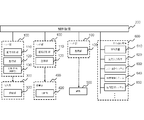
- FIG. 2 is an example of a system diagram showing an overall configuration of a system using the information providing apparatus of the present embodiment.
- the information providing apparatus of the present embodiment includes a control device 200 and a head unit 100 shown in FIG.
- the information provision apparatus of this embodiment may include the other apparatus 600 as illustrated in FIG. 2 as necessary.
- the head unit 100 includes an image projection unit 110 and a monitoring unit 120 as shown in FIG.
- the head unit 100 may further include a projection direction adjusting unit 130.
- the information providing apparatus according to the present embodiment may include one head unit 100 or a plurality of head units 100.
- a part of the head units 100 does not include at least one of the image projection unit 110, the monitoring unit 120, and the projection direction adjustment unit 130. You can also.
- the projection direction and the imaging direction, and the projection range and the imaging range may be the same or different.
- FIG. 3 schematically shows an example of the head unit 100.
- the illustrated head unit 100 includes an image projecting unit 110, a monitoring unit 120, and a projection direction adjusting unit 130 (131, 132, 133).
- the image projection unit 110 is a visible light projection device or an infrared light projection device, and generates or generates an image by irradiating the projection unit 320 or 420 with light representing a predetermined pattern or character, or a free pattern or character. to erase. The contents of these images are generated or controlled by the control device 200.
- the monitoring unit 120 can analyze the position, inclination, surface state, and the like of the position of the employee 300 and the customer 500, the work table 400, and the work tools used by the employee 300 (tray, serving wagon, cart, counter, etc.).
- a visible light camera an infrared camera, a distance sensor, a distance recognition processing device, and a pattern recognition processing device, or a combination of a plurality of them.
- a camera that simply captures spatial information as a two-dimensional image may be combined with an image processing apparatus that selectively extracts object information from these images.
- spatial information may be acquired based on the principle of pattern disturbance and triangulation using an infrared pattern projection device and an infrared camera.
- information on the depth direction may be acquired together with the plane information by simultaneously photographing from a plurality of different directions.
- spatial information of the object may be acquired by irradiating the object with a very short light pulse and measuring the time until the light is reflected and returned by the object.
- the projection direction adjustment unit 130 is configured to be able to adjust the image projection position by the image projection unit 110.
- the projection direction adjustment unit 130 has a mechanism for rotating or moving the whole or a part of the apparatus constituting the head unit 100, and changes the direction and position of the light projected from the image projection unit 110 using the mechanism.
- the position where the image is projected may be adjusted (moved).
- the projection direction adjusting unit 130 may reflect the light emitted from the image projecting unit 110 with a movable mirror or change the direction of the light with a special optical system.
- the projection direction adjustment unit 130 may be configured so that the image projection unit 110 itself is movable.
- the projection direction adjusting unit 130 may display an image at a desired position by masking part of the light emitted from the image projecting unit 110. Further, when the original projection angle of the image projection unit 110 is large, the image signal may be processed so that light is projected only at a necessary portion, and the data may be delivered to the image projection unit 110.
- the projection direction adjusting unit 130 may adjust (rotate or move) the monitoring unit 120 in addition to the image projecting unit 110.
- the projection direction adjustment unit 130 includes a highly accurate rotation or position information acquisition device or the like in order to prevent the monitoring range of the monitoring unit 120 from deviating from a predetermined region.
- the monitoring direction of the monitoring unit 120 is changed accordingly (the monitoring range is changed). It has become.
- the head unit 100 is fixed to a ceiling 140 or a wall surface.
- the head unit 100 may be installed so as to be entirely exposed from the ceiling 140 or the wall surface, or may be installed partially or entirely embedded in the ceiling 140 or the wall surface.
- the control device 200 shown in FIG. 2 is connected to the head unit 100 and other devices 600, and interlocks and controls them.
- the control device 200 is composed of one or a plurality of control devices.
- the control device 200 includes a personal computer, an office computer, a set top box, and an embedded microcomputer.
- the control device 200 is a virtual device such as a server alone or a server group that is incorporated in the head unit 100 or is located at a position via an in-house network or the Internet. In some cases.
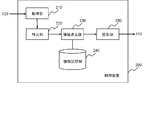
- the control device 200 includes an acquisition unit 210, a specification unit 220, an information determination unit 230, an information storage unit 240, and a projection unit 250.
- the configuration illustrated in FIG. 4 is merely an example, and some or all of the plurality of units included in the control device 200 illustrated in FIG. 4 may be provided in the head unit 100. The combination is a matter of design.
- the acquisition unit 210 receives the position of the employee 300 and the customer 500, the work table 400, the position and the surface of the work tool (tray, serving wagon, cart, counter, etc.) used by the employee 300 from the monitoring unit 120.
- Information that can analyze the inclination, surface state, etc. of the surface on which the object is placed (hereinafter, analysis information) is acquired.
- the acquisition unit 210 can acquire analysis information from the monitoring unit 120 in real time.
- the identification unit 220 analyzes the analysis information acquired by the acquisition unit 210 and determines the position of the employee 300 or the customer 500, the work table 400, and work tools used by the employee 300 (tray, serving wagon, cart, counter, etc.). The position, the inclination of the surface (surface on which an object such as a dish or a dish is placed), the surface state (whether or not an object is placed, whether or not a dish is placed, etc.) are specified. Based on the analysis result, the work status of the employee is specified.
- the identifying unit 220 may determine the work status of the employee 300 as follows: a: taking an order, b: accounting process, c: guidance for in-store or menu contents, d: serving, e: lowering basket, f: other (dessert etc. It is possible to specify whether it is a simple dish arrangement or in-store cleaning).
- the specifying unit 220 may include a surface state of a tray, a catering wagon, a cart, or a counter (whether an object is placed) within a predetermined distance (design item) from the employee 300. Or whether the dish is on, etc.), and the work status of the employee 300 may be specified based on the analysis result.
- the specifying unit 220 may analyze an object placed on the surface of the tray, the distribution wagon, the cart, or the counter, and specify the work status of the employee based on the analysis result.
- the specifying unit 220 specifies the inclination of the surface of the tray (working tool) within a predetermined distance (design item) from the employee 300, and the specified inclination is perpendicular or perpendicular to the direction of gravity.
- the employee 300 may specify that the work using the tray is being performed.
- the specifying unit 220 may analyze the state of the customer 500 within a predetermined distance (design items) from the employee 300 and specify the work status of the employee 300 based on the analysis result. For example, the specifying unit 220 specifies whether the customer 500 standing within a predetermined distance from the employee 300 is standing or sitting, and the work status of the employee 300 based on the specified result. May be specified.
- the monitoring unit 120 acquires coordinates of a three-dimensional space by triangulating with a laser in a predetermined monitoring area, and constantly tracks and monitors the employee 300 in the predetermined monitoring area based on the measurement data.
- achieves the following specific processes by analyzing the analysis information acquired from the monitoring part 120.
- the specifying unit 220 specifies whether or not there is a predetermined work tool (design item) within a predetermined distance from the monitored employee 300.
- the working tool here is a tray having a predetermined shape.
- the specifying unit 220 specifies the inclination of the surface of the tray (eg, the inclination with respect to the direction of gravity).
- the means for specifying the tray tilt is not particularly limited, but for example, a plurality of points on the surface of the tray are observed with a laser, and the tray plane position and tilt information obtained from the observed spatial coordinates of the plurality of points are obtained on the floor surface. You may specify based on the difference with the inclination information of the floor surface obtained by observing several points (not shown) similarly.
- the specifying unit 220 sets the Analyze objects (such as dishes) placed on the surface. For example, it is analyzed whether there is any object on the surface of the tray.
- the employee 300 specifies that it is being laid or being lowered (while moving an empty plate to a washing place or the like) ( F080). In addition, by analyzing whether the dish is on the dish or analyzing the arrangement of the dish on the tray, it is being served (when the dish is on) or under the dish (when the dish is not on) ) Can be specified. On the other hand, when there is no object on the surface of the tray (there is no object of F040), the employee 300 specifies that it is in the process of being lowered (while collecting empty dishes to be placed on the tray) ( F090).
- the identifying unit 220 analyzes the state of the customer 500 within a predetermined distance (design matter) from the employee 300 (F030). If it is not determined in F020 that the tilt of the tray is tilted within a predetermined angle (design matter) from a state perpendicular or perpendicular to the direction of gravity, the process may proceed to F030.
- F030 it is determined whether the customer 500 is sitting or standing.
- the employee 300 specifies that he / she is taking an order from the customer 500 or is guiding the menu contents to the customer 500. (F050).
- the moving direction of the customer 500 is specified using the preceding and following data (F070).
- the employee 300 specifies that the customer 500 is in-store guidance (guide to the seat etc.) (F110). ).
- the employee 300 specifies that the customer 500 is accounting (guide to the cash register) ( F100).
- F030 when the positions of the employee 300 and the customer 500 are within a predetermined distance from the cash register, it is specified that the employee 30 is accounting for the customer 500 (delivery of money or a receipt). Can do.
- the employee 300 when there is no customer 500 within a predetermined distance (design matters) from the employee 300 (no F030 customer), the employee 300 performs other work (such as simple dishes such as desserts, in-store cleaning, etc.) ) Is specified (F060).
- other work such as simple dishes such as desserts, in-store cleaning, etc.
- the monitoring unit 120 obtains the coordinates of the three-dimensional space by triangulating a predetermined monitoring area with a laser, and is in the predetermined monitoring area based on the measurement data.
- the employee 300 is constantly tracked and monitored.
- achieves the following specific processes by analyzing the analysis information acquired from the monitoring part 120.
- the specifying unit 220 specifies whether or not there is a predetermined work tool (design item) within a predetermined distance from the monitored employee 300.
- the working tool is a galley wagon or cart having a predetermined shape.
- the identifying unit 220 analyzes the surface of the serving wagon or cart and identifies whether there is any object on the surface (F041).
- the employee 300 is in the middle of the catering or in the process of lowering (while moving the empty dish to the washing place etc.) Specify (F081). Further, by analyzing whether the dish is on the plate, it is possible to identify whether the dish is being served (when the dish is placed) or under the dish (when the dish is not placed). On the other hand, if there is no object on the surface of the serving wagon or cart (there is no item of F041), the employee 300 is in the process of hanging down (while collecting empty dishes to be placed on the tray). Specify (F091).
- the monitoring unit 120 obtains the coordinates of the three-dimensional space by triangulating a predetermined monitoring area with a laser, and is in the predetermined monitoring area based on the measurement data.
- the employee 300 is constantly tracked and monitored.
- achieves the following specific processes by analyzing the analysis information acquired from the monitoring part 120.
- the specifying unit 220 specifies whether or not there is a predetermined work tool (design item) within a predetermined distance from the monitored employee 300.
- the working tool is a counter having a predetermined shape for handing over dishes prepared at the kitchen to the staff.
- the specifying unit 220 analyzes the surface of the counter and specifies whether there is a dish on the surface (F042).
- the employee 300 is identified as serving (preparing for serving) (F082). On the other hand, if there is no food on the counter surface (there is no food of F042), the employee 300 is identified as performing other work (such as simple cooking of dishes such as desserts and in-store cleaning) (F092). .
- the monitoring unit 120 obtains the coordinates of the three-dimensional space by performing triangulation with a laser in a predetermined monitoring area, and instead of constantly tracking and monitoring the employee 300 in the predetermined monitoring area using this measurement data.
- the imaging of the monitoring area may be continued.
- the specifying unit 220 may extract the employee 300 by analyzing the imaging data for each frame. For example, the specifying unit 220 extracts a person region in the captured image using a conventional technique.
- the feature amount of the person region is extracted, and the feature amount of the employee 300 that is held in advance (eg, the feature amount calculated in consideration of the uniform or belongings required by the employee 300, It is determined whether or not matching is performed with a facial feature amount or the like, and in the case of matching, the person may be determined as the employee 300.
- a person other than the employee 300 may be determined as a customer.
- a predetermined work tool (design item) may be extracted by pattern matching using a feature amount.
- the information determination unit 230 determines whether or not to provide information to the employee 300 based on the work status of the employee 300. When it is determined that information is to be provided, the information determination unit 230 determines the content of the information to be provided. The information determination unit 230 can make the above determination by using information stored in the information storage unit 240, for example.
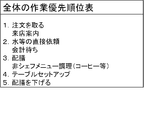
- the information storage unit 240 can perform a plurality of operations, a: take an order, b: accounting processing, c: guide the contents of the store or menu, d: serving, e: lowering basket, f: other (simple dessert etc. Information indicating the priority order of cooking, store cleaning, etc.) is stored. In addition, a work list staying at that time (a stay work list) is stored. If the work that the employee 300 is performing at that time is a work with a lower priority than the work that remains, the information determination unit 230 gives the employee the priority so that the work that stays is performed. It can be decided to give instructions to 300.
- control device 200 may include an update unit (not shown) that changes the priority order of a plurality of operations stored in the information storage unit 240. For example, when the store is full and there is a customer waiting for a seat to become available (a customer waiting for a seat), the update unit may increase the priority of the lowering bar.
- the employee 300 inputs the presence / absence of a customer waiting for a seat via the cash register / accounting system shown in FIG.
- an update part grasps
- the information determination unit 230 can detect that the work that the worker 300 has completed is completed by tracking the work status of the employee 300. When the information determination unit 230 detects that the employee 300 has finished a certain work, the information determination unit 230 instructs the employee 300 to perform one or more of the staying work lists stored in the information storage unit 240. You may decide to put it out.
- the means for storing the work list staying at that time in the information storage unit 240 is not particularly limited, and, for example, an employee 300 (such as a store manager) who is in charge of monitoring the status of the entire store is staying.
- the information may be accumulated in the information storage unit 240 by grasping the work and inputting the work via a device connected to the control device 200.
- a cooked and unprepared dish is placed on a work table 400 (deshap counter) on which cooked dishes coming out of the kitchen are placed. May be monitored. Then, when a cooked and unprepared dish is placed, the serving may be automatically added to the staying work list. When the dish disappears from the work table 400 (deshap counter), the serving may be deleted from the staying work list.
- the control device 200 may perform distinction and recognition as to which customer the dish awaiting serving before serving is for.
- the control device 200 performs processing for identifying the responsible employee, and the serving may be added to the work list of the responsible employee 300.
- the projection unit 250 controls the image projection unit 110 to project information to be presented to the employee 300 determined based on the work status of the employee 300 to a position where the employee 300 can visually recognize. Note that the projection unit 250 can adjust the projection position by controlling the projection direction adjustment unit 130 as necessary.
- the position where the employee 300 can visually recognize can be a position within a predetermined distance (design matter) from the employee 300, for example. Further, when the direction of the face that the employee 300 is facing can be specified by analyzing the captured image, the position where the employee 300 can visually recognize may be the tip of the line of sight of the employee 300.
- the employee 300 shown in FIG. 2 includes a projection unit 320 that projects the light emitted from the image projection unit 110.
- a part of the uniform or part of the body worn by the employee 300 may be used as the projection unit 320.
- the work table (table, counter, etc.) 400 may include a projection unit 420 that projects the light emitted from the image projection unit 110.
- the whole or part of the surface of the work table 400 may be used as the projection unit 420.
- the projection part on which information is projected is not limited thereto, and any part where an image can be projected so that the employee 300 can visually recognize it can be used as the projection part.
- a tray, a cloth cloth, tableware, a menu table, a floor surface, a wall surface, a fixture, or the like may be used as the projection unit.
- visible light it is desirable to use a screen-like thing that is scattered and reflected so that the employee 300 can visually recognize it.
- infrared light it is desirable to use a projecting part coated with a phosphor that absorbs infrared light and emits visible light.
- the projection unit 250 is optimal based on the positional relationship between the employee 300 and each of the plurality of projection units at that time, the orientation of the face of the employee 300, etc.
- the image projection unit 110 and the projection direction adjustment unit 130 are controlled so that a predetermined projection position is determined and predetermined information is projected onto the determined projection position.
- the other devices 600 include an in-store calling device (calling device) 610 for calling an employee, an order input device (order input terminal) 620 used by the customer 500 and the employee 300, a cash register and an accounting system 630. , Inventory management system 640, in-store monitoring system 650, in-store content distribution system, store reservation system, parking lot management system, customer information management system, attendance management system, and other systems. Further, it is an input terminal device (instruction input terminal) for issuing an instruction to a system such as a personal computer, a mobile phone, or a tablet terminal. Furthermore, it is a data providing system for customer information, employee information, weather information, traffic information, railway operation information, air travel information, food information, and other news. These devices or systems may operate alone or as a single type, or may be linked to each other. Both devices are connected to the control device 200, share some or all of each other's information, and operate in conjunction with each other as necessary.
- the head unit 100 and other devices 600 can be composed of one or a plurality of units. For example, when the employee 300 within the projection range of a certain image projection unit 110 and the monitoring range of the monitoring unit 120 moves out of this range, the adjacent image projection unit 110 and the monitoring unit 120 continue to perform the same operation. It may be controlled by the control device 200.
- the monitoring unit 120 included in the head unit 100 installed on the ceiling 140 in the restaurant is that the employee 300 has entered the own monitoring range, and that the employee has come out from the own monitoring range. And monitoring the position of employees who are within their scope. Then, when a certain monitoring unit 120 detects that the employee 300 has entered the own monitoring range, the control device 200 analyzes the analysis information acquired from the monitoring unit 120, so that the employee 300 has or The state of the tray around the employee 300 is specified. Further, the state of the customer 500 near the employee 300 is specified according to the orientation and surface state of the tray. Based on this result, the work status of the employee 300 is specified.
- the work status of the employee 300 is: a: taking an order, b: accounting processing, c: in-store or menu contents guidance, d: serving, e: lowering bowl, f: other (simple dessert etc. Specific dish arrangement or in-store cleaning). It is also possible to detect the timing at which each work is completed with the same mechanism. Since details have been described above, they are omitted here.
- the control device 200 confirms the current in-store priority work list (see FIG. 6), and uses the image projection unit 110 to trace one or more of the tasks with high priority. And displayed on a projection unit 320 or 420 such as a cash register or work table.
- the position of the projection unit 320 or 420 such as a tray can be identified by analyzing the analysis information acquired from the monitoring unit 120, and adjusted by the projection direction adjustment unit 130 so that light can be projected toward the projection unit 320 or 420. Is done. Even when the employee 300 or the projection unit 320 moves during projection, the projection position is adjusted according to this movement.
- the employee 300 can determine whether to perform a high priority job displayed on the projection unit 320 or 420 or to perform another job based on his / her own judgment, and can start the next job.
- Image projection from the projection unit 110 is interrupted. That is, only the projection unit 320 or 420 displays an image, and when the projection unit 320 or 420 is blocked or the projection unit 320 or 420 does not exist, the image is not projected.
- the work 300 is not interrupted or disturbed, and the employee 300 can obtain a lot of information in a short time.
- the state of the entire store can be monitored, and the control device 200 can grasp the situation in real time. Further, for example, a plurality of tasks are weighted according to the contents, and the plurality of task priorities stored in the information storage unit 240 are changed in real time by the program of the control device 200 (update unit).
- the work ability, current position, and current work status of each employee 300 may be grasped individually.
- the control equipment 200 can change the contents to be instructed according to the work ability, position, and situation of each worker 300.
- the projection unit 320 or 420 on which the image is projected may change the location and content according to the work expected of the employee 300. For example, immediately after the arrangement is finished, the work can be instructed with the minimum movement of the line of sight of the employee 300 by displaying on the tray. Also, immediately after the end of the accounting process, you can call attention by displaying it in the empty part of the cash register or counter. If the employee 300 is back near the kitchen immediately after the end of the lowering rod, instructions may be displayed on the work table 400 (deshap counter) on which the dishes coming out of the kitchen are placed. In preparation for this, a customer-oriented dish for the customer 500 may be displayed near the cooked dish. In addition, near the cooked dish on the work table 400, an explanation of the contents of the dish, timing of eating, points to note when serving, information to be conveyed to the customer, and the like may be displayed. After confirming the information, the employee can serve the dish.
- the information providing apparatus tracks the trend of the employee 300 and automatically ignores the instruction by specifying the work content that the employee 300 is performing next. Can be detected. For this reason, the employee 300 can ignore the instruction of the information providing apparatus of the present embodiment and immediately move on to another work. That is, it is possible to operate the information providing apparatus of the present embodiment regardless of the ability of the employee 300 and the congestion situation in the store.
- the store atmosphere is hardly broken or the design of the store is hardly restricted.
- information is presented to the employee 300 and information can be input from the employee 300 using a gesture or the like.
- information can be selected by hiding a part of the projection image with a hand or the like. Even when information is not displayed, it is possible to input information by making a certain movement of the hand to be monitored.
- what kind of state is recognized, what kind of device or system is connected, what kind of instruction is issued, and which instruction is given priority is an operational problem. For example, if only the monitoring of the customer 500 and the input to the calling system for calling the employee 300 are displayed, the store gives priority to the quick response to the customer 500, and the store has a large number of employees 300. Then, it becomes an effective customer 500 service. In addition, if the cooking prepared in the kitchen is monitored and the accounting completion status of the customer 500 is displayed with priority, the waiting time for the customer 500 to wait for cooking and vacant seat guidance is shortened, and the restaurant has a high customer turnover rate. It becomes. If the system is connected to a customer information system and displays customer information such as previous order information and preferences, it will be a store that emphasizes customer service.
- the surface of the work tool (tray, catering wagon, cart, counter, etc.) used by the employee 300 is a process that can be identified by the analysis information acquired from the monitoring unit 120 and recognizes the surface state. A recognition process is performed.
- the recognition process may be performed over the entire surface of the work tool (tray, serving wagon, cart, counter, etc.), for example, continuously or intermittently.
- specification part 220 of this embodiment specifies the state of the surface of work tools (a tray, a distribution wagon, a cart, a counter, etc.) by analyzing the state of recognition processing.
- Other configurations are the same as those of the first embodiment. Details will be described below.
- FIG. 7 shows an example of a tray whose surface has been subjected to recognition processing. Note that the recognition process can be performed in the same manner for the catering wagon, cart, counter, and the like.
- a plurality of marks 322 are attached to the surface of the illustrated tray as a recognition process. In the case of the illustrated example, one mark 322 is provided at the center of the tray surface and four marks 322 surrounding it.
- 7A, 7B, and 7C show a state in which the surface is observed from a direction perpendicular to the surface of the tray, and D is a direction inclined by a predetermined angle from the direction perpendicular to the surface of the tray. The appearance of observing the surface is shown.
- the relative position between the tray position and the monitoring unit 120 is obtained, and thus the assumed inclination of the tray can be obtained by calculation. Also, the assumed pattern change at this time can be obtained by calculation.
- the mark 322 located in the center can be read (shown in the captured image), but when a part of the mark 322 in the periphery cannot be read, there is a dirt 323 around the tray.
- a relatively light object such as a cloth (an object that does not lose its balance even when placed on the edge) is placed.
- FIG. 7C when a part of the mark 322 at the center 324 cannot be read or the relative position is shifted (325), a relatively heavy object such as tableware is placed on the tray. It is assumed. If the tableware is placed only on the periphery of the tray, it becomes equal to the state of FIG. 7B. However, in order to balance the weight normally, the tableware and the like are placed so as to be symmetrical with respect to the center of the tray. It is not necessary to assume this case in operation.
- face authentication technology with many feature points can be used to confirm the state of the customer 500.
- face authentication technology with many feature points can be used to confirm the state of the customer 500.
- mark 322 is not limited to a circular cross as illustrated, and may be any other shape, character, number, symbol, or the like. Further, the number of marks 322 formed on the surface of the tray is not limited to that shown in the figure.
- ⁇ Invention 1> A means for analyzing the status of the employee and the work tool used by the employee, and identifying the work status of the employee based on the analysis result; Projecting means for projecting information to be presented to the employee determined based on the work situation onto a position where the employee can visually recognize the information, An information providing apparatus.
- ⁇ Invention 2> In the information providing apparatus according to the first aspect, The information providing apparatus is configured to analyze a surface state of a tray, a catering wagon, a cart, or a counter within a predetermined distance from the employee, and to identify the work status of the employee based on the analysis result.
- ⁇ Invention 3> In the information providing apparatus according to the invention 2, On the surface of the tray, the catering wagon, the cart or the counter, a recognition process for recognizing the surface state is performed, The information providing apparatus that analyzes the state of the tray, the catering wagon, the cart, or the counter by analyzing the state of the recognition process.
- ⁇ Invention 4> In the information providing apparatus according to the invention 2 or 3, The information providing apparatus that analyzes an object placed on a surface of the tray, the catering wagon, the cart, or the counter, and identifies the work status of the employee based on the analysis result.
- the specifying means specifies a tilt of the surface of the tray within a predetermined distance from the employee, and the specified tilt is a tilt within a predetermined angle from a state perpendicular or perpendicular to the direction of gravity.
- An information providing device that identifies that the employee is performing work using the tray when the state is in a state.
- the information providing device that analyzes a state of a customer who is within a predetermined distance from the employee and identifies the work status of the employee based on the analysis result.
- the projection means may be any one of the employee's uniform or body surface, the tray, tableware, floor surface, wall surface, furniture, work table, cloth width, and menu within a predetermined distance from the employee.
- An information providing device that projects information.
- ⁇ Invention 8> In the information provision apparatus in any one of invention 1-7, One or more of a store calling device, order input device, accounting system, store monitoring system, inventory management system, store content distribution system, store visit reservation system, customer information management system, and instruction input terminal are connected. Information provision device that operates in conjunction with the system.
- ⁇ Invention 9> Computer A means for analyzing the state of the employee and the work tool used by the employee, and identifying the work status of the employee based on the analysis result; Projecting means for projecting information to be presented to the employee determined based on the work status onto a position where the employee can visually recognize the information, Program to function as.
- ⁇ Invention 9-2> In the program according to the invention 9, A program for causing the specifying means to analyze a surface state of a tray, a catering wagon, a cart or a counter within a predetermined distance from the employee, and to specify the work status of the employee based on the analysis result.
- ⁇ Invention 9-3> In the program according to the invention 9-2, On the surface of the tray, the catering wagon, the cart or the counter, a recognition process for recognizing the surface state is performed, A program for causing the specifying means to analyze the state of the recognition process to analyze the state of the tray, the catering wagon, the cart, or the counter.
- ⁇ Invention 9-4> In the program according to the invention 9-2 or 9-3, A program for causing the specifying means to analyze an object placed on the surface of the tray, the catering wagon, the cart, or the counter, and to specify the work status of the employee based on the analysis result.
- the specifying means specifies the inclination of the surface of the tray within a predetermined distance from the employee, and the specified inclination is an inclination within a predetermined angle from a state perpendicular or perpendicular to the direction of gravity. If it is in a state, the program identifies the employee as performing work using the tray.
- the projection means may include any one of the employee's uniform or body surface, the tray, tableware, floor surface, wall surface, furniture, work table, cloth width, and menu within a predetermined distance from the employee.
- the computer is any one of an in-store calling device, an order input device, an accounting system, an in-store monitoring system, an inventory management system, an in-store content distribution system, a store reservation system, a customer information management system, and an instruction input terminal.
- ⁇ Invention 10> Computer A specific step of analyzing the state of the employee and the work tool used by the employee and identifying the work status of the employee based on the analysis result; Projecting the information to be presented to the employee determined based on the work situation onto a position where the employee can visually recognize, Information provision method to execute.
- ⁇ Invention 10-2> In the information providing method according to the tenth aspect, In the specifying step, an information providing method for analyzing a surface condition of a tray, a catering wagon, a cart, or a counter within a predetermined distance from the employee and specifying the work status of the employee based on the analysis result.
- ⁇ Invention 10-3> In the information providing method according to the invention 10-2, On the surface of the tray, the catering wagon, the cart or the counter, a recognition process for recognizing the surface state is performed, The information providing method of analyzing the state of the tray, the catering wagon, the cart, or the counter by analyzing the state of the recognition process in the specifying step.
- ⁇ Invention 10-4> In the information providing method according to the invention 10-2 or 10-3, In the specifying step, an information providing method of analyzing an object placed on a surface of the tray, the catering wagon, the cart, or the counter and specifying the work status of the employee based on the analysis result.
- ⁇ Invention 10-5> In the information providing method according to any one of inventions 10 to 10-4, In the specifying step, the inclination of the surface of the tray within a predetermined distance from the employee is specified, and the specified inclination is an inclination within a predetermined angle from a state perpendicular or perpendicular to the direction of gravity. An information providing method for identifying that the employee is performing work using the tray when the state is in a state.
- ⁇ Invention 10-6> In the information providing method according to any one of Inventions 10 to 10-5, In the specifying step, an information providing method for analyzing a state of a customer who is within a predetermined distance from the employee and specifying the work status of the employee based on the analysis result.
- ⁇ Invention 10-7> In the information providing method according to any one of Inventions 10 to 10-6, In the projecting step, the employee's uniform or body surface, the tray, tableware, a floor, a wall, a fixture, a workbench, a cloth, and a menu within a predetermined distance from the employee are used as the menu.
- ⁇ Invention 10-8> In the information providing method according to any one of Inventions 10 to 10-7, The computer is any one of an in-store calling device, an order input device, an accounting system, an in-store monitoring system, an inventory management system, an in-store content distribution system, a store reservation system, a customer information management system, and an instruction input terminal. Or a method of providing information that is connected to a plurality and operates in conjunction with these.
Landscapes
- Business, Economics & Management (AREA)
- Tourism & Hospitality (AREA)
- Health & Medical Sciences (AREA)
- Economics (AREA)
- General Health & Medical Sciences (AREA)
- Human Resources & Organizations (AREA)
- Marketing (AREA)
- Primary Health Care (AREA)
- Strategic Management (AREA)
- Physics & Mathematics (AREA)
- General Business, Economics & Management (AREA)
- General Physics & Mathematics (AREA)
- Engineering & Computer Science (AREA)
- Theoretical Computer Science (AREA)
- Management, Administration, Business Operations System, And Electronic Commerce (AREA)
Description
本発明は、情報提供装置、情報提供方法、及び、プログラムに関する。
飲食店における従業員の作業は、a:注文を取る、b:会計処理、c:店内やメニュー内容の案内、d:配膳、e:下げ膳、f:その他(デザートなどの簡単な料理盛りつけや店内清掃等)と多岐に渡る。
従業員が状況に応じた適切な作業を行うことで、少ない従業員数で店内全体としての業務が円滑に進み、店舗のランニングコスト削減、及び、顧客満足度向上による売り上げが伸びる等の効果が得られる。しかし、作業の優先順位は状況に応じて変動するため、その時点における優先順位を適切に判断し、当該優先順位を考慮して適切な作業を行うのは難しい。特に、経験の浅い従業員は、優先順位を適切に判断するのが難しい。
このような問題を解決する手段として、例えば、ベテラン従業員が状況に応じた適切な指示を経験の浅い従業員に口頭で伝えるという手段が考えられる。
しかし、当該手段の場合、指示内容が顧客に聞こえてしまい、店内の雰囲気を悪化させるという問題がある。また、顧客に聞こえないように互いが近接して指示を出す場合は、互いが近接し、かつ、顧客から離れるまでの移動時間が無駄となる問題がある。また、経験の浅い従業員を監視し、必要に応じて指示を与えるという業務が、ベテラン従業員によるその他の業務に支障をきたす問題がある。
特許文献1には、従業員が携帯する端末と、当該端末と通信するコントローラとを有する給仕作業補助装置が開示されている。当該コントローラは、顧客が料理を完食する予想時間を料理ごとに保持しておき、当該情報を利用して下げ膳タイミングを判断し、上記端末を介して従業員に下げ膳タイミングを通知する。
特許文献2には、従業員にヘッドマウントディスプレイ等のウェアラブル装置を装着させておき、当該装置を利用して、従業員に顧客ごとのオーダー内容を提供する技術が開示されている。
特許文献3には、客席フロアを複数の管理対象領域に区分して管理する飲食店で利用される装置であって、メニュー品目の待ち状態にある客席を検知するとともに管理対象領域毎にその数を特定し、特定した数が一定値を超えた管理対象領域を報知するとともに、その管理対象領域を担当する店員の氏名を報知する店舗管理装置が開示されている。
しかし、特許文献1に記載の技術の場合、通知された下げ膳タイミングを確認するために端末の操作等が必要となり面倒である。また、当該技術は、従業員のその時点の作業状態を考慮することなく所定の従業員に下げ膳タイミングを通知する。このため、下げ膳タイミングを通知された従業員がその時点で他の作業を行っている場合、この従業員は下げ膳を即座に実行できない。すなわち、業務が円滑に進まない。
特許文献2に記載の技術の場合、従業員はヘッドマウントディスプレイ等のウェアラブル装置を装着しなければならない。かかる場合、この装置が従業員の作業の邪魔になる恐れがある。また、当該装置により店の雰囲気が損なわれる恐れもある。
特許文献3に記載の技術の場合、店長などの管理者に所定の情報を報知するよう構成しているが、従業員各々に所定の情報を報知するようには構成していない。
本発明は、飲食店の従業員に、状況に応じた適切な情報を提供するための新たな手段を提供することを課題とする。
本発明によれば、
従業員及び前記従業員が使用する作業用具の状態を分析し、分析結果に基づいて前記従業員の作業状況を特定する特定手段と、
前記作業状況に基づいて決定された前記従業員に提示する情報を、前記従業員が視認できる位置に投影する投影手段と、
を有する情報提供装置が提供される。
従業員及び前記従業員が使用する作業用具の状態を分析し、分析結果に基づいて前記従業員の作業状況を特定する特定手段と、
前記作業状況に基づいて決定された前記従業員に提示する情報を、前記従業員が視認できる位置に投影する投影手段と、
を有する情報提供装置が提供される。
また、本発明によれば、
コンピュータを、
従業員及び前記従業員が使用する作業用具の状態を分析し、分析結果に基づいて前記従業員の作業状況を特定する特定手段、
前記作業状況に基づいて決定された前記従業員に提示する情報を、前記従業員が視認できる位置に投影する投影手段、
として機能させるためのプログラムが提供される。
コンピュータを、
従業員及び前記従業員が使用する作業用具の状態を分析し、分析結果に基づいて前記従業員の作業状況を特定する特定手段、
前記作業状況に基づいて決定された前記従業員に提示する情報を、前記従業員が視認できる位置に投影する投影手段、
として機能させるためのプログラムが提供される。
また、本発明によれば、
コンピュータが、
従業員及び前記従業員が使用する作業用具の状態を分析し、分析結果に基づいて前記従業員の作業状況を特定する特定ステップと、
前記作業状況に基づいて決定された前記従業員に提示する情報を、前記従業員が視認できる位置に投影する投影ステップと、
を実行する情報提供方法が提供される。
コンピュータが、
従業員及び前記従業員が使用する作業用具の状態を分析し、分析結果に基づいて前記従業員の作業状況を特定する特定ステップと、
前記作業状況に基づいて決定された前記従業員に提示する情報を、前記従業員が視認できる位置に投影する投影ステップと、
を実行する情報提供方法が提供される。
本発明によれば、飲食店の従業員の作業状況を把握し、その作業状況に応じた適切な情報を従業員に提供することが可能となる。
上述した目的、および、その他の目的、特徴および利点は、以下に述べる好適な実施の形態、および、それに付随する以下の図面によって、さらに明らかになる。
本実施形態の情報提供装置の利用場面を模式的に示す図である。
本実施形態の情報提供装置を利用したシステムの全体構成を示すシステム図である。
本実施形態のヘッド部の一例を模式的に示す図である。
本実施形態の制御装置の機能ブロック図の一例である。
本実施形態の特定部が従業員の作業状況を特定する処理の流れの一例を示すフローチャートである。
本実施形態の情報記憶部が記憶する情報の一例を模式的に示す図である。
本実施形態のトレーの一例を示す図である。
本実施形態の特定部が従業員の作業状況を特定する処理の流れの一例を示すフローチャートである。
本実施形態の特定部が従業員の作業状況を特定する処理の流れの一例を示すフローチャートである。
以下、本発明の実施の形態について図面を用いて説明する。
なお、本実施形態の装置は、任意のコンピュータのCPU、メモリ、メモリにロードされたプログラム(あらかじめ装置を出荷する段階からメモリ内に格納されているプログラムのほか、CD等の記憶媒体やインターネット上のサーバ等からダウンロードされたプログラムも含む)、そのプログラムを格納するハードディスク等の記憶ユニット、ネットワーク接続用インタフェイスを中心にハードウェアとソフトウェアの任意の組合せによって実現される。そして、その実現方法、装置にはいろいろな変形例があることは、当業者には理解されるところである。
また、本実施形態の説明において利用する機能ブロック図は、ハードウェア単位の構成ではなく、機能単位のブロックを示している。これらの図においては、各装置は1つの機器により実現されるよう記載されているが、その実現手段はこれに限定されない。すなわち、物理的に分かれた構成であっても、論理的に分かれた構成であっても構わない。
<第1の実施形態>
まず、本実施形態の概要について説明する。
まず、本実施形態の概要について説明する。
図1は、本実施形態の情報提供装置の利用場面を模式的に示す図である。本実施形態の情報提供装置は、ヘッド部100を介して従業員300を監視する。そして、監視中の従業員300の作業状況を、当該従業員300から所定の距離以内に位置する作業用具(トレー、配膳ワゴン、カード、カウンター等)や顧客500の状態に基づいて特定する。その後、特定した作業状況に基づいてこの従業員300に情報(指示等)を提供するか否か、提供する場合はその内容(指示内容等)を決定する。そして、情報を提供すると決定した場合、情報提供装置は、ヘッド部100を介して、決定した内容の情報をトレーの表面や従業員300のユニフォーム上等に投影する。
このような本実施形態によれば、従業員300のその時点における作業状況を把握し、その作業状況に応じた適切な情報を従業員300に提供することが可能となる。
以下、本実施形態の構成について詳細に説明する。
図2は、本実施形態の情報提供装置を利用したシステムの全体構成を示すシステム図の一例である。本実施形態の情報提供装置は、図2に示す制御装置200とヘッド部100とを含む。また、本実施形態の情報提供装置は、必要に応じて、図2に例示するようなその他の装置600を含んでもよい。
ヘッド部100は、図2に示すように画像投影部110と監視部120とを含む。なお、ヘッド部100はさらに投影方向調整部130を備えてもよい。本実施形態の情報提供装置は、1つのヘッド部100を有してもよいし、複数のヘッド部100を有してもよい。本実施形態の情報提供装置が複数のヘッド部100を有する場合、一部のヘッド部100が画像投影部110、監視部120及び投影方向調整部130の少なくとも一つを有さない構成とすることもできる。画像投影部110と監視部120の双方が含まれるヘッド部100は、投影方向と撮像方向、及び、投影範囲と撮像範囲が一致していても良く、また異なっていてもよい。
図3にヘッド部100の一例を模式的に示す。図示するヘッド部100は、画像投影部110と、監視部120と、投影方向調整部130(131、132、133)とを含む。
画像投影部110は、可視光プロジェクション装置や赤外光プロジェクション装置であり、予め決まったパターンや文字、または自由なパターンや文字を表す光を投射部320または420に照射することで画像を生成または消去する。これらの画像の内容は、制御装置200により生成、または制御される。
監視部120は、従業員300や顧客500の位置、作業台400、従業員300が使用する作業用具(トレー、配膳ワゴン、カート、カウンター等)の位置や傾きや表面状態等を分析可能な情報を取得する装置であり、可視光カメラ、赤外線カメラ、距離センサ、距離認識処理装置、パターン認識処理装置の中の1つで、または複数個を組み合わせて構成される。例えば、空間情報を単純に2次元画像で撮影するカメラと、これらの画像より対象物の情報を選択的に抽出する画像処理装置を組み合わせてもよい。また、赤外線パターン投射装置と赤外線カメラを用いて、パターンの乱れや3角測量の原理に基づいて空間の情報を取得してもよい。また、複数の異なる方向から同時に撮影することにより、平面情報と共にその奥行き方向の情報を取得してもよい。さらに非常に短い光パルスを対象物に照射し、その光が対象物で反射され戻るまでの時間を計測して対象物の空間情報を取得してもよい。
投影方向調整部130は、画像投影部110による画像投影位置を調整可能に構成されている。例えば、投影方向調整部130はヘッド部100を構成する装置の全体または一部を回転または移動させる機構を持ち、当該機構を用いて画像投影部110から投影される光の向きや位置を変えることで、画像を投影する位置を調整(移動)してもよい。または、投影方向調整部130は、画像投影部110から出た光を、可動型ミラーで反射させたり、特殊な光学系で光の向きを変えたりしてもよい。また、投影方向調整部130は、画像投影部110そのものを移動可能に構成してもよい。
その他、投影方向調整部130は、画像投影部110の本来の投射範囲が広い場合、画像投影部110から出る光の一部をマスクして所望の位置に画像を表示してもよい。また、画像投影部110の本来の投射角度が大きい場合、必要な箇所にのみ光が投射されるように画像信号を加工して画像投影部110にデータを引き渡してもよい。
なお、投影方向調整部130は、画像投影部110に加えて、監視部120をも調整(回転または移動)してもよい。この場合、投影方向調整部130には、監視部120の監視範囲が所定領域からずれる事を防ぐため、高精度の回転または位置情報取得装置などが含まれる。図3に示す例の場合、投影方向調整部130(131、132、133)により画像投影部110の投影方向を変更すると、それに伴い監視部120の監視方向も変わる(監視範囲が変わる)構成になっている。
図1に示すように、ヘッド部100は天井140または壁面などに固定して設置される。ヘッド部100は天井140または壁面から全て露出して設置されてもよいし、一部または全体が天井140または壁面の内部に埋没されて設置されてもよい。
図2に示される制御装置200は、ヘッド部100と、その他の装置600に接続され、これらを連動・制御する。
制御装置200は1台または複数の制御装置で構成される。制御装置200は、パソコンやオフコン、セットトップボックスや組み込み型マイコンを含む。また、制御装置200は、独立に存在する場合の他に、ヘッド部100に組み込まれる場合や、社内ネットワークやインターネットなどを介した位置に存在するサーバ単体またはサーバ群などによる仮想的な機器である場合もある。
ここで、図4に制御装置200の機能ブロック図の一例を示す。図示するように、制御装置200は、取得部210と、特定部220と、情報決定部230と、情報記憶部240と、投影部250とを有する。なお、図4に示す構成はあくまで一例であり、図4に示す制御装置200が有するこれら複数の部の一部又は全部を、ヘッド部100内に設けることもできる。その組み合わせ方は設計的事項である。
取得部210は、監視部120から、従業員300や顧客500の位置、作業台400、従業員300が使用する作業用具(トレー、配膳ワゴン、カート、カウンター等)の位置や表面(料理、皿等のオブジェクトが載置される面)の傾きや表面状態等を分析可能な情報(以下、分析情報)を取得する。取得部210は、監視部120からリアルタイムに分析情報を取得することができる。
特定部220は、取得部210が取得した分析情報を分析し、従業員300や顧客500の位置、作業台400、従業員300が使用する作業用具(トレー、配膳ワゴン、カート、カウンター等)の位置や表面(料理、皿等のオブジェクトが載置される面)の傾きや表面状態(オブジェクトが載っているか否か、料理が載っているか否か等)等を特定する。そして、分析結果に基づいて、従業員の作業状況を特定する。
例えば、特定部220は、従業員300の作業状況として、a:注文を取る、b:会計処理、c:店内やメニュー内容の案内、d:配膳、e:下げ膳、f:その他(デザートなどの簡単な料理盛りつけや店内清掃等)のいずれであるかを特定することができる。
作業状況を特定する手段の一例として、例えば、特定部220は、従業員300から所定の距離(設計的事項)以内にあるトレー、配膳ワゴン、カート又はカウンターの表面状態(オブジェクトが載っているか否か、料理が載っているか否か等)を分析し、分析結果に基づいて、従業員300の作業状況を特定してもよい。
また、特定部220は、トレー、配膳ワゴン、カート又はカウンターの表面に載置されたオブジェクトを分析し、分析結果に基づいて、従業員の作業状況を特定してもよい。
また、特定部220は、従業員300から所定の距離(設計的事項)以内にあるトレー(作業用具)の表面の傾きを特定し、特定した傾きが重力方向に対して垂直または垂直な状態から所定角度(設計的事項)以内の傾きである第1の状態である場合、従業員300はトレーを使用した作業を行っていると特定してもよい。
また、特定部220は、従業員300から所定の距離(設計的事項)以内にいる顧客500の状態を分析し、分析結果に基づいて従業員300の作業状況を特定してもよい。例えば、特定部220は、従業員300から所定の距離以内にいる顧客500が立った状態、及び、座った状態のいずれであるかを特定し、特定した結果に基づいて従業員300の作業状況を特定してもよい。
以下、図5のフローチャートを用いて、特定部220による特定処理の一例を説明する。例えば、監視部120は、所定の監視エリア内をレーザで三角測量することで3次元空間の座標を取得し、この測定データにより所定の監視エリア内にいる従業員300を常時追跡監視している。そして、特定部220は、監視部120から取得した分析情報を分析することで、以下のような特定処理を実現する。
まず、特定部220は、監視中の従業員300から所定の距離以内に所定の作業用具(設計的事項)があるか否かを特定する。ここでの作業用具は、所定形状のトレーとする。
トレーがある場合(図5のF010のYES)、特定部220は、トレーの表面の傾き(例:重力方向に対する傾き)を特定する。トレーの傾きを特定する手段は特段制限されないが、例えば、トレーの表面の複数点をレーザで観察し、観察された複数点の空間座標より求められるトレーの平面の位置と傾き情報を、床面(不図示)の複数点を同様に観察して得られた床面の傾き情報との違いに基づいて特定してもよい。
特定した傾きが重力方向に対して垂直または垂直な状態から所定角度(設計的事項)以内の傾きである第1の状態である場合(F020の垂直)、特定部220は、次いで、そのトレーの表面に載置されたオブジェクト(皿等)を分析する。例えば、トレーの表面に何らかのオブジェクトがあるか否かを分析する。
トレーの表面に何らかのオブジェクトがある場合(F040の物がある)、その従業員300は配膳中、又は、下げ膳中(空いた皿を洗い場等に移動させている途中)であると特定する(F080)。なお、さらに、皿の上に料理が載っているか否か、またはトレー上の皿の配置を分析することで、配膳中(料理が載っている場合)か下膳中(料理が載っていない場合)かを特定することができる。一方、トレーの表面にオブジェクトがない場合(F040の物がない)は、その従業員300は下げ膳中(トレーに載置するために空いた皿をまとめている途中)であると特定する(F090)。
一方、従業員300から所定の距離以内にトレーがない場合(F010のNO)、また、F020でトレーの傾きが重力方向に対して平行または平行な状態から所定角度(設計的事項)以内の傾きであると特定された場合(F020の平行)、特定部220は、従業員300から所定の距離以内(設計的事項)にいる顧客500の状態を分析する(F030)。なお、F020でトレーの傾きが重力方向に対して垂直または垂直な状態から所定角度(設計的事項)以内の傾きであると特定されなかった場合に、F030に進んでもよい。
F030では、顧客500が座っている状態か、それとも、立っている状態かを判断する。そして、顧客500が座っている状態である場合(F030の座っている)、その従業員300は顧客500から注文を取っている、または、顧客500にメニュー内容の案内をしていると特定する(F050)。一方、顧客500が立っている状態である場合(F030の立っている)、前後のデータを利用して顧客500の移動方向を特定する(F070)。
顧客500の移動方向が入口から店内に向かう方向である場合(F070の入口から)、その従業員300は顧客500に対して店内案内(座席への誘導等)をしていると特定する(F110)。一方、顧客500の移動方向が店内から入口に向かう方向である場合(F070の店内から)、その従業員300は顧客500に対して会計処理(レジへの誘導)をしていると特定する(F100)。F030では、さらに、従業員300と顧客500の位置がレジから所定以内の距離である場合、その従業員30は顧客500に対して会計処理(金銭やレシートの受渡し)していると特定することができる。
なお、従業員300から所定の距離以内(設計的事項)に顧客500がいない場合は(F030の顧客はいない)、その従業員300はその他の作業(デザートなどの簡単な料理盛りつけや店内清掃等)を行っていると特定する(F060)。
次に、図8のフローチャートを用いて、特定部220による特定処理のその他の例を説明する。
図5を用いて説明した例と同様、例えば監視部120は、所定の監視エリア内をレーザで三角測量することで3次元空間の座標を取得し、この測定データにより所定の監視エリア内にいる従業員300を常時追跡監視している。そして、特定部220は、監視部120から取得した分析情報を分析することで、以下のような特定処理を実現する。
まず、特定部220は、監視中の従業員300から所定の距離以内に所定の作業用具(設計的事項)があるか否かを特定する。ここでの作業用具は、所定形状の配膳ワゴン又はカートとする。
配膳ワゴン又はカートがある場合(F011のYES)、特定部220は、配膳ワゴン又はカートの表面を分析し、表面に何らかのオブジェクトがあるか否かを特定する(F041)。
配膳ワゴン又はカートの表面に何らかのオブジェクトがある場合(F041の物がある)、その従業員300は配膳中、又は、下げ膳中(空いた皿を洗い場等に移動させている途中)であると特定する(F081)。なお、さらに、皿の上に料理が載っているかを分析することで、配膳中(料理が載っている場合)か下膳中(料理が載っていない場合)かを特定することができる。一方、配膳ワゴン又はカートの表面にオブジェクトがない場合(F041の物がない)は、その従業員300は下げ膳中(トレーに載置するために空いた皿をまとめている途中)であると特定する(F091)。
一方、従業員300から所定の距離以内に配膳ワゴン又はカートがない場合(F011のNO)、F030に進む。F030以降の処理は図5を用いて説明した例と同様であるので、ここでの説明は省略する。
次に、図9のフローチャートを用いて、特定部220による特定処理のその他の例を説明する。
図5を用いて説明した例と同様、例えば監視部120は、所定の監視エリア内をレーザで三角測量することで3次元空間の座標を取得し、この測定データにより所定の監視エリア内にいる従業員300を常時追跡監視している。そして、特定部220は、監視部120から取得した分析情報を分析することで、以下のような特定処理を実現する。
まず、特定部220は、監視中の従業員300から所定の距離以内に所定の作業用具(設計的事項)があるか否かを特定する。ここでの作業用具は、調理場で作られた料理を配膳係に引き渡すための所定形状のカウンターとする。
カウンターがある場合(F012のYES)、特定部220は、カウンターの表面を分析し、表面に料理があるか否かを特定する(F042)。
カウンターに料理がある場合(F042の料理がある)、その従業員300は配膳中(配膳の準備中)であると特定する(F082)。一方、カウンターの表面に料理がない場合(F042の料理がない)は、その従業員300はその他の作業(デザートなどの簡単な料理盛りつけや店内清掃等)を行っていると特定する(F092)。
一方、従業員300から所定の距離以内にカウンターがない場合(F012のNO)、F030に進む。F030以降の処理は図5を用いて説明した例と同様であるので、ここでの説明は省略する。
なお、ここで説明した特定部220による処理の流れはあくまで一例であり、特定部220による処理はこれらに限定されない。
例えば、監視部120は、所定の監視エリア内をレーザで三角測量することで3次元空間の座標を取得し、この測定データにより所定の監視エリア内にいる従業員300を常時追跡監視する代わりに、監視エリアを撮像し続けてもよい。そして、特定部220は当該撮像データをフレームごとに分析し、従業員300を抽出してもよい。例えば、特定部220は、従来技術を利用して撮像画像内の人物領域を抽出する。その後、人物領域の特徴量を抽出し、予め保持している従業員300の特徴量(例:従業員300に義務付けているユニフォームや所持品等を考慮して算出された特徴量、従業員の顔の特徴量等)とマッチングするか否か判定し、マッチングする場合、その人物を従業員300と判断してもよい。当該手段の場合、従業員300以外の人物を顧客と判断してもよい。また、特徴量を利用したパターンマッチングにより所定の作業用具(設計的事項)を抽出してもよい。
図4に戻り、情報決定部230は、従業員300の作業状況に基づいて、当該従業員300に情報を提供するか否かを決定する。また、情報を提供すると決定した場合、情報決定部230は提供する情報の内容を決定する。情報決定部230は、例えば情報記憶部240に記憶されている情報を利用して、上記決定を行うことができる。
例えば、情報記憶部240は、複数の作業、a:注文を取る、b:会計処理、c:店内やメニュー内容の案内、d:配膳、e:下げ膳、f:その他(デザートなどの簡単な料理盛りつけや店内清掃等)の優先順位を示す情報を記憶しておく。また、その時点で滞留している作業リスト(滞留作業リスト)を記憶しておく。そして、従業員300がその時点で行っている作業が滞留している作業よりも優先順位の低い作業である場合、情報決定部230は、滞留している作業を優先して行うようその従業員300に指示を出すことを決定することができる。
なお、制御装置200は、情報記憶部240が記憶する複数の作業の優先順位を変更する更新部(不図示)を有してもよい。例えば、更新部は、店内が満席状態であり、席が空くのを待っている顧客(席待ち顧客)がいる場合、下げ膳の優先順位を上げてもよい。例えば、図2に示すレジ・会計システム又はその他の装置を介して従業員300が席待ち顧客の有無を入力する。そして、更新部は、当該システム又は装置から席待ち顧客の有無を把握し、優先順位の変更を行う。なお、図2に示すレジ・会計システム又はその他の装置を介して従業員300から複数の作業の優先順位を変更する入力を受付けてもよい。そして、更新部は、当該システム又は装置から入力内容を取得し、入力内容に従って優先順位の変更を行ってもよい。
また、情報決定部230は、従業員300の作業状況を追跡することで、当該作業員300がそれまで行っていた作業を終了したことを検知することができる。情報決定部230は、従業員300がある作業を終了したことを検知すると、情報記憶部240に記憶されている滞留作業リストの中の1つ又は複数を行うよう、その従業員300に指示を出すことを決定してもよい。
情報記憶部240にその時点で滞留している作業リストを記憶させる手段は特段制限されず、例えば、店内全体の状況を監視する業務を負っている従業員300(店長など)が滞留している作業を把握し、制御装置200と接続された装置を介して入力することで、情報記憶部240に蓄積されていってもよい。
その他、図1の右側の図に示すようにキッチンから出てくる調理済みの料理を載せる作業台400(デシャップカウンター)に、調理済みかつ配膳前の料理が置かれていないか、ヘッド部100を介して監視してもよい。そして、調理済みかつ配膳前の料理が置かれている場合、滞留している作業リストの中に配膳が自動的に追加されてもよい。そして、当該料理が作業台400(デシャップカウンター)からなくなると、滞留している作業リストの中から配膳を削除してもよい。配膳前の配膳待ちの料理がどの顧客向けなのかの区別と認識は、制御装置200が行っても良い。また配膳待ちの料理を担当する従業員300が決まっている場合は、制御装置200が担当従業員を特定する処理を行い、担当従業員300の作業リストの中に配膳が追加されてもよい。
図4に戻り、投影部250は、画像投影部110を制御し、従業員300の作業状況に基づいて決定された従業員300に提示する情報を、従業員300が視認できる位置に投影する。なお、投影部250は、必要に応じて投影方向調整部130を制御し、投影位置を調整することができる。
従業員300が視認できる位置は、例えば、従業員300から所定の距離(設計的事項)以内の位置とすることができる。また、撮像画像を分析することで従業員300が向いている顔の方向を特定できる場合、従業員300が視認できる位置は、その従業員300の視線の先としてもよい。
図2に示される従業員300は、画像投影部110から出た光を投射される投射部320を含む。例えば、従業員300が着ているユニフォームの一部や体の一部を投射部320としてもよい。また、作業台(テーブル、カウンター等)400も同様に、画像投影部110から出た光を投射される投射部420を含んでもよい。例えば、作業台400の表面の全体又は一部を投射部420としてもよい。なお、情報が投影される投射部はこれらに限定されず、従業員300が視認可能に画像を投影可能なあらゆる箇所を投射部とすることができる。例えば、トレー、布巾、食器、メニュー表、床面、壁面、什器などを投射部としてもよい。なお、可視光が投射される場合は、従業員300が視認できるよう散乱反射させるスクリーン状のものを投射部とするのが望ましい。また、赤外光が投射される場合は、赤外光を吸収して可視光を発する蛍光体が塗布されたものを投射部とするのが望ましい。
例えば、投影部250は、このような複数の投射部の中から、その時点における従業員300とこれら複数の投射部各々との位置関係、また、従業員300の顔の向き等に基づいて最適な投影位置を決定し、決定した投影位置に所定の情報を投影するよう、画像投影部110及び投影方向調整部130を制御する。
図2に戻り、その他の装置600は、従業員を呼ぶための店内呼出装置(呼出装置)610、顧客500や従業員300が使用する注文入力装置(注文入力端末)620、レジや会計システム630、在庫管理システム640、店内監視システム650、店内コンテンツ配信システム、来店予約システム、駐車場管理システム、顧客情報管理システム、勤怠管理システム、などの他のシステムである。また、パソコン、携帯電話、タブレット端末、などのシステムに指示を出すための入力端末装置(指示入力用端末)である。さらに、顧客情報、従業員情報、天気情報、交通情報、鉄道運行情報、航空運行情報、食材情報、その他のニュース、などのデータ提供システムである。これらの装置またはシステムは、単体または単種類で動作してもよいし、互いに連動していてもよい。いずれの装置も、制御装置200に接続され、互いの情報の一部または全部を共用し、必要に応じて連動して動作する。
ヘッド部100およびその他の装置600は1台もしくは複数台で構成することができる。例えば、ある画像投影部110の投影範囲及び監視部120の監視範囲にいる従業員300がこの範囲を外れるよう移動すると、隣り合う画像投影部110や監視部120が引き続き同様の動作を行うよう、制御装置200により制御されてもよい。
次に、本装置の動作の一例について、図1、図5、図6を用い、従業員300の配膳がトレーで行われる場合について説明する。
図1に示すように、飲食店内の天井140に設置されたヘッド部100に含まれる監視部120は、自己の監視範囲に従業員300が入ってきたこと、自己の監視範囲から従業員が出て行ったこと、及び、自己の監視範囲にいる従業員の位置等を監視し続ける。そして、ある監視部120が自己の監視範囲に従業員300が入ったことを検知すると、制御装置200は当該監視部120から取得した分析情報を分析することで、従業員300が持っているまたは従業員300の周辺にあるトレーの状態を特定する。またトレーの向きや表面状態に応じて、従業員300の近くの顧客500の状態を特定する。この結果に基づいて、従業員300の作業状況を特定する。具体的には、従業員300の作業状況が、a:注文を取る、b:会計処理、c:店内やメニュー内容の案内、d:配膳、e:下げ膳、f:その他(デザートなどの簡単な料理盛りつけや店内清掃等)のいずれであるかを特定する。また、同様の仕組みで各作業が終了したタイミングを検出することも可能である。詳細は上述したので、ここでは省略する。
その後、従業員300の各作業が終了し、次の作業が決まっていない状態(それまで継続していた作業を終えるとともに、次の作業を開始していない状態、または、当該状態が所定時間継続した状態)を検出すると、制御装置200は現在の店内の優先業務リスト(図6参照)を確認し、優先順位の高い作業のうち、1つまたは複数を、画像投影部110を用いて、トレーやレジや作業台などの投射部320または420に表示する。トレーなどの投射部320または420の位置は監視部120から取得した分析情報を分析することで特定可能であり、投射部320または420に向けて光が投射できるよう、投影方向調整部130で調整される。また投影中に従業員300や投射部320が移動した場合でも、この動きに合わせて投射位置が調整される。
なお、従業員300は、投射部320または420に表示された優先順位の高い業務を行うか、自己の判断で別の業務を行うかを決定し、次の業務を始めることができる。
同様の手段でその従業員300が次の業務を開始したことを検知した場合、また、トレーや作業台400などの投射部320または420が遮られて画像表示が不可能になった場合、画像投影部110からの画像投影は中断される。つまり、画像が表示されるのは投射部320または420のみであり、投射部320または420が遮られたり、投射部320または420が存在しない場合は画像が投影されないため、従業員300の他の作業を中断したり邪魔したりすることはなく、従業員300は多くの情報を短時間で得ることができる。
1つのヘッド部100又は複数のヘッド部100を組み合わせることで、店内全体の状態を監視することができ、制御装置200はその状況をリアルタイムに把握することができる。また、例えば、複数の作業には内容に応じて重み付けがされており、制御装置200のプログラムにより、情報記憶部240が記憶する複数の作業優先順位は、リアルタイムに変更される(更新部)。
複数の従業員300がいる場合、各従業員300の作業能力、現在位置、現在の作業状況は個別に把握されていてもよい。かかる場合、制御装備200は、各作業員300の作業能力、位置、状況に応じて指示すべき内容を変えることが可能である。
なお、ここまではトレー(作業用具)を用いて従業員の作業状況を特定する場合を中心に説明したが、例えば図8及び9を用いて説明したようにトレーではない場合でも同様の処理が可能である。
また、画像が投影される投射部320または420は、従業員300に期待する作業に応じて場所や内容を変えても良い。例えば、配膳が終了した直後であれば、トレーへ表示することで、従業員300の視線移動が最小で作業を指示できる。また、会計処理終了直後であれば、レジやカウンターの空き部分に表示することで注意を促せる。下げ膳終了直後であれば、その従業員300はキッチンの近くに戻っているので、キッチンから出てくる料理を載せる作業台400(デシャップカウンター)に指示を表示しても良く、続けて配膳をする場合に備えて、調理の終わった料理の近くに、どの顧客500向けの料理かを表示しても良い。また、作業台400上における調理の終わった料理の近くに、料理内容の説明や食べ頃のタイミング、配膳する際の注意点、お客様に伝えることとなっている情報などを表示してもよい。従業員は、当該情報を確認後、料理を配膳することができる。
その他にも、状況認識の方法、画像投射の位置、投射内容は、使用する店舗の様態に合わせて様々な形態が考えられる。これらについて、当該業者は容易に想像できるであろう。
次に、本実施形態の作用効果について説明する。
本実施形態によれば、従業員のその時点における作業状況を把握し、その作業状況に応じた適切な情報を従業員に提供することが可能となる。
例えば、本実施形態によれば、顧客500から注文を取る、会計処理を行う、店内やメニュー内容を案内する、配膳する、下げ膳を行う、その他の作業を行うという複数の作業のうち、どの作業を従業員が行っているか判断することができる。その後、従業員が現在行っている作業、その時点における滞留作業、及び、これら複数の作業の優先順位に基づいて、その従業員が行っている作業より優先順位の高い作業が滞留しているか判断し、滞留している場合には、滞留している優先順位の高い作業を優先して行うよう、その従業員に指示を送ることができる。従業員へ提示された指示は、飲食店全体の状況を鑑みて優先順位が決まった情報とすることができるため、店内全体での給仕作業の効率向上を図ることができる。
なお、状況判断能力に優れる従業員300であったり、顧客500や他の従業員300などから直接指示を受けた場合など、本実施形態の情報提供装置からの指示を無視する必要がある状況が生じた場合、指示に従うか無視するかの意思表示を本実施形態の情報提供装置に対して明示しない状態で指示を無視してもよい。かかる場合であっても、本実施形態の情報提供装置は、その従業員300の動向を追跡し、その従業員300が次に行っている作業内容を特定することで、自動的に指示を無視されたことを検出することが可能である。このため、従業員300は、本実施形態の情報提供装置の指示を無視して直ちに他の作業に移ることが可能である。すなわち、従業員300の能力や店内混雑状況に左右されずに本実施形態の情報提供装置を運用することが可能である。
本実施形態によれば、顧客500などに見える範囲に画像を投影しないようにすることができるため、店の雰囲気を壊したり、店舗のデザイン性の制約を受けたりすることがほとんどない。
なお、本実施形態は、従業員300に情報を提示すると共に、ジェスチャ等による従業員300からの情報入力も可能である。表示対象と監視対象が一致している場合、投影画像の一部を手などで隠すことで、情報選択が可能となる。また情報が表示されていない状態でも、監視対象の手などが決まった動きをすることで、情報入力が可能である。
本実施形態でどのような状態を認識し、どのような機器やシステムと接続し、どのような指示を出すか、どの指示を優先するかは運用上の問題である。例えば、顧客500の監視と、従業員300を呼ぶための呼出システムへの入力のみを表示する構成とすれば、顧客500に対する応答の早さを優先した店舗となり、従業員300の人数が多い店舗では有効な顧客500サービスとなる。またキッチンで調理された料理の監視と、顧客500の会計完了状態を重点的に表示する構成とすれば、顧客500の調理待ち及び空席案内待ちの時間が短縮され、顧客回転率の高い飲食店となる。顧客情報システムと接続され、以前のオーダー情報や好みなどの顧客情報を表示するシステムとすれば、常連客への応対を重視した店舗となる。
<第2の実施形態>
本実施形態は、第1の実施形態の構成を基本とし、以下の点で相違する。本実施形態では、従業員300が使用する作業用具(トレー、配膳ワゴン、カート、カウンター等)の表面に、監視部120から取得される分析情報で識別可能な処理であって、表面状態を認識するための認識処理が施されている。
本実施形態は、第1の実施形態の構成を基本とし、以下の点で相違する。本実施形態では、従業員300が使用する作業用具(トレー、配膳ワゴン、カート、カウンター等)の表面に、監視部120から取得される分析情報で識別可能な処理であって、表面状態を認識するための認識処理が施されている。
認識処理は、例えば、連続的に又は断続的に、作業用具(トレー、配膳ワゴン、カート、カウンター等)の表面の全面に渡って施されていてもよい。そして、本実施形態の特定部220は、認識処理の状態を分析することで、作業用具(トレー、配膳ワゴン、カート、カウンター等)の表面の状態を特定する。その他の構成は第1の実施形態と同様である。以下、詳細に説明する。
図7に、表面に認識処理が施されたトレーの一例を示す。なお、配膳ワゴン、カート、カウンター等についても、同様にして認識処理を施すことができる。図示するトレーの表面には、認識処理として複数のマーク322が付されている。図示する例の場合、マーク322は、トレー表面の中心部に1つと、それを取り囲む4つのマーク322が付されている。
図7のA、B、Cは、トレーの表面に対して垂直な方向から当該表面を観察した様子を示しており、Dは、トレーの表面に対して垂直な方向から所定角度傾いた方向から当該表面を観察した様子を示している。
トレー表面がほぼ天井140を向いており、汚れや他の物が無い状態で監視部120に撮像された場合、図7のAに示すように全てのマーク322がそのままの形状で抽出される。これに対し、表面に汚れや他の物が無いが、トレー表面が完全に天井140を向かず、多少傾いている状態で監視部120に撮像された場合、図7のDに示すように全てのマーク322が抽出されるものの、その形状は、トレー表面の傾きに応じて変形する。例えば、このようなマーク322の形状の変化に基づいて、トレー表面の傾きを特定することもできる。また、監視部120の測定範囲のどの位置にトレー表面が見えるかを測定すると、トレー位置と監視部120の相対位置が求められるため、想定されるトレーの傾きは計算で求める事ができる。またこのときの想定されるパターンの形状変化も計算により求めることができる。
ところで、図7のBにあるように、中心に位置するマーク322は読み取れる(撮像画像に写っている)が、周辺にあるマーク322の一部が読み取れない場合、トレー周辺に汚れ323がある、又は、布巾などの比較的軽い物(端にのせてもバランスが崩れない物)がのっていると想定される。また図7のCにあるように、中心324にあるマーク322の一部が読み取れないか、相対位置がずれている(325)場合は、トレーに食器などの比較的重い物がのっていると想定される。なお、食器をトレーの周辺部のみに載せると、図7のBの状態と等しくなるが、通常は重量バランスを取るため、トレーの中心に対して対称となるよう食器等を載せるため、実際の運用ではこの場合を想定する必要は無い。
また、顧客500の状態の確認には、特徴点の多い顔認証技術を用いることができる。顔の向きと動きをカメラで認識するためには、先のトレーの特徴点と同様、顔の特徴点である目や口や鼻を撮影した画像の、それぞれの相対位置を抽出することで可能である。また顔の向きと動きがわかれば、顧客500の状態を推定することも可能となり、したがって従業員300の状態が判明する。
なお、マーク322は図示するような丸十字に限定されず、その他のあらゆる形状、文字、数字、記号等とすることができる。また、トレーの表面に形成するマーク322の数は図示するものに限定されない。
<<付記>>
上記説明によれば、以下の発明の説明がなされている。
<発明1>
従業員及び前記従業員が使用する作業用具の状態を分析し、分析結果に基づいて前記従業員の作業状況を特定する特定手段と、
前記作業状況に基づいて決定された前記従業員に提示する情報を、前記従業員が視認できる位置に投影する投影手段と、
を有する情報提供装置。
<発明2>
発明1に記載の情報提供装置において、
前記特定手段は、前記従業員から所定の距離以内にあるトレー、配膳ワゴン、カート又はカウンターの表面状態を分析し、分析結果に基づいて、前記従業員の作業状況を特定する情報提供装置。
<発明3>
発明2に記載の情報提供装置において、
前記トレー、前記配膳ワゴン、前記カート又は前記カウンターの表面には、表面状態を認識するための認識処理が施されており、
前記特定手段は、前記認識処理の状態を分析することで、前記トレー、前記配膳ワゴン、前記カート又は前記カウンターの状態を分析する情報提供装置。
<発明4>
発明2または3に記載の情報提供装置において、
前記特定手段は、前記トレー、前記配膳ワゴン、前記カート又は前記カウンターの表面に載置されたオブジェクトを分析し、分析結果に基づいて、前記従業員の作業状況を特定する情報提供装置。
<発明5>
発明1から4のいずれかに記載の情報提供装置において、
前記特定手段は、前記従業員から所定の距離以内にある前記トレーの表面の傾きを特定し、特定した傾きが重力方向に対して垂直または垂直な状態から所定角度以内の傾きである第1の状態である場合、前記従業員は前記トレーを使用した作業を行っていると特定する情報提供装置。
<発明6>
発明1から5のいずれかに記載の情報提供装置において、
前記特定手段は、前記従業員から所定の距離以内にいる顧客の状態を分析し、分析結果に基づいて前記従業員の作業状況を特定する情報提供装置。
<発明7>
発明1から6のいずれかに記載の情報提供装置において、
前記投影手段は、前記従業員のユニフォームまたは体の表面、前記従業員から所定の距離以内にある前記トレー、食器、床面、壁面、什器、作業台、布巾及びメニューの中のいずれかに前記情報を投影する情報提供装置。
<発明8>
発明1から7のいずれかに記載の情報提供装置において、
店内呼出装置、注文入力装置、会計システム、店内監視システム、在庫管理システム、店内コンテンツ配信システム、来店予約システム、顧客情報管理システム、及び、指示入力用端末のうち、いずれか1つまたは複数が接続され、連動して動作する情報提供装置。
<発明9>
コンピュータを、
従業員及び前記従業員が使用する作業用具の状態を分析し、分析結果に基づいて前記従業員の作業状況を特定する特定手段、
前記作業状況に基づいて決定された前記従業員に提示する情報を、前記従業員が視認できる位置に投影する投影手段、
として機能させるためのプログラム。
<発明9-2>
発明9に記載のプログラムにおいて、
前記特定手段に、前記従業員から所定の距離以内にあるトレー、配膳ワゴン、カート又はカウンターの表面状態を分析させ、分析結果に基づいて、前記従業員の作業状況を特定させるプログラム。
<発明9-3>
発明9-2に記載のプログラムにおいて、
前記トレー、前記配膳ワゴン、前記カート又は前記カウンターの表面には、表面状態を認識するための認識処理が施されており、
前記特定手段に、前記認識処理の状態を分析させることで、前記トレー、前記配膳ワゴン、前記カート又は前記カウンターの状態を分析させるプログラム。
<発明9-4>
発明9-2または9-3に記載のプログラムにおいて、
前記特定手段に、前記トレー、前記配膳ワゴン、前記カート又は前記カウンターの表面に載置されたオブジェクトを分析させ、分析結果に基づいて、前記従業員の作業状況を特定させるプログラム。
<発明9-5>
発明9から9-4のいずれかに記載のプログラムにおいて、
前記特定手段に、前記従業員から所定の距離以内にある前記トレーの表面の傾きを特定させ、特定した傾きが重力方向に対して垂直または垂直な状態から所定角度以内の傾きである第1の状態である場合、前記従業員は前記トレーを使用した作業を行っていると特定させるプログラム。
<発明9-6>
発明9から9-5のいずれかに記載のプログラムにおいて、
前記特定手段に、前記従業員から所定の距離以内にいる顧客の状態を分析させ、分析結果に基づいて前記従業員の作業状況を特定させるプログラム。
<発明9-7>
発明9から9-6のいずれかに記載のプログラムにおいて、
前記投影手段に、前記従業員のユニフォームまたは体の表面、前記従業員から所定の距離以内にある前記トレー、食器、床面、壁面、什器、作業台、布巾及びメニューの中のいずれかに前記情報を投影させるプログラム。
<発明9-8>
発明9から9-7のいずれかに記載のプログラムにおいて、
前記コンピュータは、店内呼出装置、注文入力装置、会計システム、店内監視システム、在庫管理システム、店内コンテンツ配信システム、来店予約システム、顧客情報管理システム、及び、指示入力用端末のうち、いずれか1つまたは複数と接続されており、これらと連動して前記コンピュータを動作させるプログラム。
<発明10>
コンピュータが、
従業員及び前記従業員が使用する作業用具の状態を分析し、分析結果に基づいて前記従業員の作業状況を特定する特定ステップと、
前記作業状況に基づいて決定された前記従業員に提示する情報を、前記従業員が視認できる位置に投影する投影ステップと、
を実行する情報提供方法。
<発明10-2>
発明10に記載の情報提供方法において、
前記特定ステップでは、前記従業員から所定の距離以内にあるトレー、配膳ワゴン、カート又はカウンターの表面状態を分析し、分析結果に基づいて、前記従業員の作業状況を特定する情報提供方法。
<発明10-3>
発明10-2に記載の情報提供方法において、
前記トレー、前記配膳ワゴン、前記カート又は前記カウンターの表面には、表面状態を認識するための認識処理が施されており、
前記特定ステップでは、前記認識処理の状態を分析することで、前記トレー、前記配膳ワゴン、前記カート又は前記カウンターの状態を分析する情報提供方法。
<発明10-4>
発明10-2または10-3に記載の情報提供方法において、
前記特定ステップでは、前記トレー、前記配膳ワゴン、前記カート又は前記カウンターの表面に載置されたオブジェクトを分析し、分析結果に基づいて、前記従業員の作業状況を特定する情報提供方法。
<発明10-5>
発明10から10-4のいずれかに記載の情報提供方法において、
前記特定ステップでは、前記従業員から所定の距離以内にある前記トレーの表面の傾きを特定し、特定した傾きが重力方向に対して垂直または垂直な状態から所定角度以内の傾きである第1の状態である場合、前記従業員は前記トレーを使用した作業を行っていると特定する情報提供方法。
<発明10-6>
発明10から10-5のいずれかに記載の情報提供方法において、
前記特定ステップでは、前記従業員から所定の距離以内にいる顧客の状態を分析し、分析結果に基づいて前記従業員の作業状況を特定する情報提供方法。
<発明10-7>
発明10から10-6のいずれかに記載の情報提供方法において、
前記投影ステップでは、前記従業員のユニフォームまたは体の表面、前記従業員から所定の距離以内にある前記トレー、食器、床面、壁面、什器、作業台、布巾及びメニューの中のいずれかに前記情報を投影する情報提供方法。
<発明10-8>
発明10から10-7のいずれかに記載の情報提供方法において、
前記コンピュータは、店内呼出装置、注文入力装置、会計システム、店内監視システム、在庫管理システム、店内コンテンツ配信システム、来店予約システム、顧客情報管理システム、及び、指示入力用端末のうち、いずれか1つまたは複数と接続されており、これらと連動して動作する情報提供方法。
上記説明によれば、以下の発明の説明がなされている。
<発明1>
従業員及び前記従業員が使用する作業用具の状態を分析し、分析結果に基づいて前記従業員の作業状況を特定する特定手段と、
前記作業状況に基づいて決定された前記従業員に提示する情報を、前記従業員が視認できる位置に投影する投影手段と、
を有する情報提供装置。
<発明2>
発明1に記載の情報提供装置において、
前記特定手段は、前記従業員から所定の距離以内にあるトレー、配膳ワゴン、カート又はカウンターの表面状態を分析し、分析結果に基づいて、前記従業員の作業状況を特定する情報提供装置。
<発明3>
発明2に記載の情報提供装置において、
前記トレー、前記配膳ワゴン、前記カート又は前記カウンターの表面には、表面状態を認識するための認識処理が施されており、
前記特定手段は、前記認識処理の状態を分析することで、前記トレー、前記配膳ワゴン、前記カート又は前記カウンターの状態を分析する情報提供装置。
<発明4>
発明2または3に記載の情報提供装置において、
前記特定手段は、前記トレー、前記配膳ワゴン、前記カート又は前記カウンターの表面に載置されたオブジェクトを分析し、分析結果に基づいて、前記従業員の作業状況を特定する情報提供装置。
<発明5>
発明1から4のいずれかに記載の情報提供装置において、
前記特定手段は、前記従業員から所定の距離以内にある前記トレーの表面の傾きを特定し、特定した傾きが重力方向に対して垂直または垂直な状態から所定角度以内の傾きである第1の状態である場合、前記従業員は前記トレーを使用した作業を行っていると特定する情報提供装置。
<発明6>
発明1から5のいずれかに記載の情報提供装置において、
前記特定手段は、前記従業員から所定の距離以内にいる顧客の状態を分析し、分析結果に基づいて前記従業員の作業状況を特定する情報提供装置。
<発明7>
発明1から6のいずれかに記載の情報提供装置において、
前記投影手段は、前記従業員のユニフォームまたは体の表面、前記従業員から所定の距離以内にある前記トレー、食器、床面、壁面、什器、作業台、布巾及びメニューの中のいずれかに前記情報を投影する情報提供装置。
<発明8>
発明1から7のいずれかに記載の情報提供装置において、
店内呼出装置、注文入力装置、会計システム、店内監視システム、在庫管理システム、店内コンテンツ配信システム、来店予約システム、顧客情報管理システム、及び、指示入力用端末のうち、いずれか1つまたは複数が接続され、連動して動作する情報提供装置。
<発明9>
コンピュータを、
従業員及び前記従業員が使用する作業用具の状態を分析し、分析結果に基づいて前記従業員の作業状況を特定する特定手段、
前記作業状況に基づいて決定された前記従業員に提示する情報を、前記従業員が視認できる位置に投影する投影手段、
として機能させるためのプログラム。
<発明9-2>
発明9に記載のプログラムにおいて、
前記特定手段に、前記従業員から所定の距離以内にあるトレー、配膳ワゴン、カート又はカウンターの表面状態を分析させ、分析結果に基づいて、前記従業員の作業状況を特定させるプログラム。
<発明9-3>
発明9-2に記載のプログラムにおいて、
前記トレー、前記配膳ワゴン、前記カート又は前記カウンターの表面には、表面状態を認識するための認識処理が施されており、
前記特定手段に、前記認識処理の状態を分析させることで、前記トレー、前記配膳ワゴン、前記カート又は前記カウンターの状態を分析させるプログラム。
<発明9-4>
発明9-2または9-3に記載のプログラムにおいて、
前記特定手段に、前記トレー、前記配膳ワゴン、前記カート又は前記カウンターの表面に載置されたオブジェクトを分析させ、分析結果に基づいて、前記従業員の作業状況を特定させるプログラム。
<発明9-5>
発明9から9-4のいずれかに記載のプログラムにおいて、
前記特定手段に、前記従業員から所定の距離以内にある前記トレーの表面の傾きを特定させ、特定した傾きが重力方向に対して垂直または垂直な状態から所定角度以内の傾きである第1の状態である場合、前記従業員は前記トレーを使用した作業を行っていると特定させるプログラム。
<発明9-6>
発明9から9-5のいずれかに記載のプログラムにおいて、
前記特定手段に、前記従業員から所定の距離以内にいる顧客の状態を分析させ、分析結果に基づいて前記従業員の作業状況を特定させるプログラム。
<発明9-7>
発明9から9-6のいずれかに記載のプログラムにおいて、
前記投影手段に、前記従業員のユニフォームまたは体の表面、前記従業員から所定の距離以内にある前記トレー、食器、床面、壁面、什器、作業台、布巾及びメニューの中のいずれかに前記情報を投影させるプログラム。
<発明9-8>
発明9から9-7のいずれかに記載のプログラムにおいて、
前記コンピュータは、店内呼出装置、注文入力装置、会計システム、店内監視システム、在庫管理システム、店内コンテンツ配信システム、来店予約システム、顧客情報管理システム、及び、指示入力用端末のうち、いずれか1つまたは複数と接続されており、これらと連動して前記コンピュータを動作させるプログラム。
<発明10>
コンピュータが、
従業員及び前記従業員が使用する作業用具の状態を分析し、分析結果に基づいて前記従業員の作業状況を特定する特定ステップと、
前記作業状況に基づいて決定された前記従業員に提示する情報を、前記従業員が視認できる位置に投影する投影ステップと、
を実行する情報提供方法。
<発明10-2>
発明10に記載の情報提供方法において、
前記特定ステップでは、前記従業員から所定の距離以内にあるトレー、配膳ワゴン、カート又はカウンターの表面状態を分析し、分析結果に基づいて、前記従業員の作業状況を特定する情報提供方法。
<発明10-3>
発明10-2に記載の情報提供方法において、
前記トレー、前記配膳ワゴン、前記カート又は前記カウンターの表面には、表面状態を認識するための認識処理が施されており、
前記特定ステップでは、前記認識処理の状態を分析することで、前記トレー、前記配膳ワゴン、前記カート又は前記カウンターの状態を分析する情報提供方法。
<発明10-4>
発明10-2または10-3に記載の情報提供方法において、
前記特定ステップでは、前記トレー、前記配膳ワゴン、前記カート又は前記カウンターの表面に載置されたオブジェクトを分析し、分析結果に基づいて、前記従業員の作業状況を特定する情報提供方法。
<発明10-5>
発明10から10-4のいずれかに記載の情報提供方法において、
前記特定ステップでは、前記従業員から所定の距離以内にある前記トレーの表面の傾きを特定し、特定した傾きが重力方向に対して垂直または垂直な状態から所定角度以内の傾きである第1の状態である場合、前記従業員は前記トレーを使用した作業を行っていると特定する情報提供方法。
<発明10-6>
発明10から10-5のいずれかに記載の情報提供方法において、
前記特定ステップでは、前記従業員から所定の距離以内にいる顧客の状態を分析し、分析結果に基づいて前記従業員の作業状況を特定する情報提供方法。
<発明10-7>
発明10から10-6のいずれかに記載の情報提供方法において、
前記投影ステップでは、前記従業員のユニフォームまたは体の表面、前記従業員から所定の距離以内にある前記トレー、食器、床面、壁面、什器、作業台、布巾及びメニューの中のいずれかに前記情報を投影する情報提供方法。
<発明10-8>
発明10から10-7のいずれかに記載の情報提供方法において、
前記コンピュータは、店内呼出装置、注文入力装置、会計システム、店内監視システム、在庫管理システム、店内コンテンツ配信システム、来店予約システム、顧客情報管理システム、及び、指示入力用端末のうち、いずれか1つまたは複数と接続されており、これらと連動して動作する情報提供方法。
この出願は、2012年8月27日に出願された日本特許出願特願2012-186863号を基礎とする優先権を主張し、その開示の全てをここに取り込む。
Claims (10)
- 従業員及び前記従業員が使用する作業用具の状態を分析し、分析結果に基づいて前記従業員の作業状況を特定する特定手段と、
前記作業状況に基づいて決定された前記従業員に提示する情報を、前記従業員が視認できる位置に投影する投影手段と、
を有する情報提供装置。 - 請求項1に記載の情報提供装置において、
前記特定手段は、前記従業員から所定の距離以内にあるトレー、配膳ワゴン、カート又はカウンターの表面状態を分析し、分析結果に基づいて、前記従業員の作業状況を特定する情報提供装置。 - 請求項2に記載の情報提供装置において、
前記トレー、前記配膳ワゴン、前記カート又は前記カウンターの表面には、表面状態を認識するための認識処理が施されており、
前記特定手段は、前記認識処理の状態を分析することで、前記トレー、前記配膳ワゴン、前記カート又は前記カウンターの状態を分析する情報提供装置。 - 請求項2または3に記載の情報提供装置において、
前記特定手段は、前記トレー、前記配膳ワゴン、前記カート又は前記カウンターの表面に載置されたオブジェクトを分析し、分析結果に基づいて、前記従業員の作業状況を特定する情報提供装置。 - 請求項1から4のいずれか1項に記載の情報提供装置において、
前記特定手段は、前記従業員から所定の距離以内にある前記トレーの表面の傾きを特定し、特定した傾きが重力方向に対して垂直または垂直な状態から所定角度以内の傾きである第1の状態である場合、前記従業員は前記トレーを使用した作業を行っていると特定する情報提供装置。 - 請求項1から5のいずれか1項に記載の情報提供装置において、
前記特定手段は、前記従業員から所定の距離以内にいる顧客の状態を分析し、分析結果に基づいて前記従業員の作業状況を特定する情報提供装置。 - 請求項1から6のいずれか1項に記載の情報提供装置において、
前記投影手段は、前記従業員のユニフォームまたは体の表面、前記従業員から所定の距離以内にある前記トレー、食器、床面、壁面、什器、作業台、布巾及びメニューの中のいずれかに前記情報を投影する情報提供装置。 - 請求項1から7のいずれか1項に記載の情報提供装置において、
店内呼出装置、注文入力装置、会計システム、店内監視システム、在庫管理システム、店内コンテンツ配信システム、来店予約システム、顧客情報管理システム、及び、指示入力用端末のうち、いずれか1つまたは複数が接続され、連動して動作する情報提供装置。 - コンピュータを、
従業員及び前記従業員が使用する作業用具の状態を分析し、分析結果に基づいて前記従業員の作業状況を特定する特定手段、
前記作業状況に基づいて決定された前記従業員に提示する情報を、前記従業員が視認できる位置に投影する投影手段、
として機能させるためのプログラム。 - コンピュータが、
従業員及び前記従業員が使用する作業用具の状態を分析し、分析結果に基づいて前記従業員の作業状況を特定する特定ステップと、
前記作業状況に基づいて決定された前記従業員に提示する情報を、前記従業員が視認できる位置に投影する投影ステップと、
を実行する情報提供方法。
Applications Claiming Priority (2)
| Application Number | Priority Date | Filing Date | Title |
|---|---|---|---|
| JP2012186863 | 2012-08-27 | ||
| JP2012-186863 | 2012-08-27 |
Publications (1)
| Publication Number | Publication Date |
|---|---|
| WO2014033979A1 true WO2014033979A1 (ja) | 2014-03-06 |
Family
ID=50182822
Family Applications (1)
| Application Number | Title | Priority Date | Filing Date |
|---|---|---|---|
| PCT/JP2013/002575 Ceased WO2014033979A1 (ja) | 2012-08-27 | 2013-04-16 | 情報提供装置、情報提供方法、及び、プログラム |
Country Status (1)
| Country | Link |
|---|---|
| WO (1) | WO2014033979A1 (ja) |
Cited By (7)
| Publication number | Priority date | Publication date | Assignee | Title |
|---|---|---|---|---|
| WO2015159550A1 (ja) * | 2014-04-18 | 2015-10-22 | 日本電気株式会社 | 情報処理システム、制御方法、及びプログラム記録媒体 |
| JP2015536076A (ja) * | 2012-10-20 | 2015-12-17 | インテル コーポレイション | メディアの動的投影のためのシステム |
| JP2016004384A (ja) * | 2014-06-16 | 2016-01-12 | パナソニックIpマネジメント株式会社 | 店舗管理システムおよび店舗管理方法 |
| JP2018128979A (ja) * | 2017-02-10 | 2018-08-16 | パナソニックIpマネジメント株式会社 | 厨房支援システム |
| JP2022017391A (ja) * | 2017-05-15 | 2022-01-25 | シャープ株式会社 | 通知システム |
| JP7427753B1 (ja) | 2022-11-18 | 2024-02-05 | Necプラットフォームズ株式会社 | 店舗管理サーバー、プログラム、及び、店舗管理方法 |
| JP2025112813A (ja) * | 2024-01-22 | 2025-08-01 | Necプラットフォームズ株式会社 | 回収管理システム、食器回収システム、回収管理方法、及びプログラム |
Citations (3)
| Publication number | Priority date | Publication date | Assignee | Title |
|---|---|---|---|---|
| JP2006167361A (ja) * | 2004-12-20 | 2006-06-29 | Tama Tlo Kk | 計測評価用食器、計測評価用下敷き部材、食事の計測装置およびその計測評価システム |
| JP2006188253A (ja) * | 2005-01-06 | 2006-07-20 | Kaneyoshi:Kk | 水産物の情報印字及び管理装置 |
| JP2011076323A (ja) * | 2009-09-30 | 2011-04-14 | Toshiba Tec Corp | 注文管理装置、注文管理システム及び制御プログラム |
-
2013
- 2013-04-16 WO PCT/JP2013/002575 patent/WO2014033979A1/ja not_active Ceased
Patent Citations (3)
| Publication number | Priority date | Publication date | Assignee | Title |
|---|---|---|---|---|
| JP2006167361A (ja) * | 2004-12-20 | 2006-06-29 | Tama Tlo Kk | 計測評価用食器、計測評価用下敷き部材、食事の計測装置およびその計測評価システム |
| JP2006188253A (ja) * | 2005-01-06 | 2006-07-20 | Kaneyoshi:Kk | 水産物の情報印字及び管理装置 |
| JP2011076323A (ja) * | 2009-09-30 | 2011-04-14 | Toshiba Tec Corp | 注文管理装置、注文管理システム及び制御プログラム |
Cited By (8)
| Publication number | Priority date | Publication date | Assignee | Title |
|---|---|---|---|---|
| JP2015536076A (ja) * | 2012-10-20 | 2015-12-17 | インテル コーポレイション | メディアの動的投影のためのシステム |
| WO2015159550A1 (ja) * | 2014-04-18 | 2015-10-22 | 日本電気株式会社 | 情報処理システム、制御方法、及びプログラム記録媒体 |
| JP2016004384A (ja) * | 2014-06-16 | 2016-01-12 | パナソニックIpマネジメント株式会社 | 店舗管理システムおよび店舗管理方法 |
| JP2018128979A (ja) * | 2017-02-10 | 2018-08-16 | パナソニックIpマネジメント株式会社 | 厨房支援システム |
| JP2022017391A (ja) * | 2017-05-15 | 2022-01-25 | シャープ株式会社 | 通知システム |
| JP7427753B1 (ja) | 2022-11-18 | 2024-02-05 | Necプラットフォームズ株式会社 | 店舗管理サーバー、プログラム、及び、店舗管理方法 |
| JP2024073721A (ja) * | 2022-11-18 | 2024-05-30 | Necプラットフォームズ株式会社 | 店舗管理サーバー、プログラム、及び、店舗管理方法 |
| JP2025112813A (ja) * | 2024-01-22 | 2025-08-01 | Necプラットフォームズ株式会社 | 回収管理システム、食器回収システム、回収管理方法、及びプログラム |
Similar Documents
| Publication | Publication Date | Title |
|---|---|---|
| WO2014033979A1 (ja) | 情報提供装置、情報提供方法、及び、プログラム | |
| US11741558B2 (en) | Systems and methods for a delivery system using a non-sequential queuing system | |
| JP6980738B2 (ja) | 食べ物および/または飲み物のサービングのためのロボット | |
| JP6997159B2 (ja) | 食べ物および/または飲み物のサービングのためのロボット | |
| US9796093B2 (en) | Customer service robot and related systems and methods | |
| US11093995B2 (en) | Monitoring of customer consumption activity and management based on monitoring | |
| WO2018106719A1 (en) | Intelligent service robot and related systems and methods | |
| US20140222501A1 (en) | Customer behavior analysis device, customer behavior analysis system and customer behavior analysis method | |
| US9563914B2 (en) | Using head mountable displays to provide real-time assistance to employees in a retail environment | |
| JP2018147033A (ja) | 提示方法、提示装置及び提示プログラム | |
| US20240054579A1 (en) | Non-Sequential Restaurant Order System and Method | |
| JP6601890B1 (ja) | 商品購入支援システム、商品購入支援装置及びpos端末装置 | |
| JP7318303B2 (ja) | 清掃管理プログラム、清掃管理方法及び清掃管理装置 | |
| EP2763085A1 (en) | Item status analysis device, item status analysis system and item status analysis method | |
| JP7509177B2 (ja) | 情報処理装置および情報処理システム、情報処理方法、プログラム | |
| US20250191054A1 (en) | Systems and methods for synchronized pre-ordered item preparation at locations | |
| JP7546795B2 (ja) | 清掃管理装置および清掃管理方法 | |
| WO2022254880A1 (ja) | 清掃管理システム、清掃管理方法、ゴミ検出装置、サーバ装置、及びプログラム | |
| CN208625093U (zh) | 货架 | |
| JP2022003485A (ja) | 評価装置、評価方法、および評価システム | |
| WO2023139692A1 (ja) | 清掃管理装置および清掃管理方法 | |
| JP2016045784A (ja) | 注文登録処理装置及び注文登録処理プログラム |
Legal Events
| Date | Code | Title | Description |
|---|---|---|---|
| 121 | Ep: the epo has been informed by wipo that ep was designated in this application |
Ref document number: 13832188 Country of ref document: EP Kind code of ref document: A1 |
|
| NENP | Non-entry into the national phase |
Ref country code: DE |
|
| 122 | Ep: pct application non-entry in european phase |
Ref document number: 13832188 Country of ref document: EP Kind code of ref document: A1 |
|
| NENP | Non-entry into the national phase |
Ref country code: JP |